WO2011021571A1 - マグネシウムまたはその合金基材の表面処理方法とナノ構造体 - Google Patents
マグネシウムまたはその合金基材の表面処理方法とナノ構造体 Download PDFInfo
- Publication number
- WO2011021571A1 WO2011021571A1 PCT/JP2010/063717 JP2010063717W WO2011021571A1 WO 2011021571 A1 WO2011021571 A1 WO 2011021571A1 JP 2010063717 W JP2010063717 W JP 2010063717W WO 2011021571 A1 WO2011021571 A1 WO 2011021571A1
- Authority
- WO
- WIPO (PCT)
- Prior art keywords
- magnesium
- alloy
- nanostructure
- grown
- base material
- Prior art date
- Legal status (The legal status is an assumption and is not a legal conclusion. Google has not performed a legal analysis and makes no representation as to the accuracy of the status listed.)
- Ceased
Links
Images



Classifications
-
- C—CHEMISTRY; METALLURGY
- C23—COATING METALLIC MATERIAL; COATING MATERIAL WITH METALLIC MATERIAL; CHEMICAL SURFACE TREATMENT; DIFFUSION TREATMENT OF METALLIC MATERIAL; COATING BY VACUUM EVAPORATION, BY SPUTTERING, BY ION IMPLANTATION OR BY CHEMICAL VAPOUR DEPOSITION, IN GENERAL; INHIBITING CORROSION OF METALLIC MATERIAL OR INCRUSTATION IN GENERAL
- C23C—COATING METALLIC MATERIAL; COATING MATERIAL WITH METALLIC MATERIAL; SURFACE TREATMENT OF METALLIC MATERIAL BY DIFFUSION INTO THE SURFACE, BY CHEMICAL CONVERSION OR SUBSTITUTION; COATING BY VACUUM EVAPORATION, BY SPUTTERING, BY ION IMPLANTATION OR BY CHEMICAL VAPOUR DEPOSITION, IN GENERAL
- C23C22/00—Chemical surface treatment of metallic material by reaction of the surface with a reactive liquid, leaving reaction products of surface material in the coating, e.g. conversion coatings, passivation of metals
- C23C22/05—Chemical surface treatment of metallic material by reaction of the surface with a reactive liquid, leaving reaction products of surface material in the coating, e.g. conversion coatings, passivation of metals using aqueous solutions
- C23C22/68—Chemical surface treatment of metallic material by reaction of the surface with a reactive liquid, leaving reaction products of surface material in the coating, e.g. conversion coatings, passivation of metals using aqueous solutions using aqueous solutions with pH between 6 and 8
Definitions
- the present invention relates to a surface treatment method of magnesium or an alloy base material thereof, magnesium hydroxide obtained by this method, magnesium-aluminum hydroxide nanostructure, magnesium grown on the surface thereof, or magnesium or It relates to the alloy base material.
- the present invention also relates to a method for imparting a color based on the structural color to the surface of magnesium and its alloy by using this nanostructure.
- Mg (OH) 2 structures having nanoscales are attracting attention as biomaterials, adsorbents of toxic pollutants in solution, and structures for forming superhydrophobic surfaces.
- magnesium and its alloys are being studied for various applications due to their light weight, but with improved corrosion resistance, the design of the electronic component housing requires a design, so it gives a metallic color. Technology is required.
- Non-Patent Documents 1 and 2 various measures for forming nanostructures such as magnesium hydroxide have been conventionally studied (for example, see Non-Patent Documents 1 and 2).
- Patent Document 1 it has been proposed to form a corrosion-resistant film such as magnesium sulfide by physically wet-blasting to improve corrosion resistance, followed by high-temperature steam treatment at a relative humidity of 80% or more.
- the surface structure, the crystal structure, and the like are changed by blasting or heat treatment, which causes the target function to deteriorate.
- the present invention eliminates the conventional problems from the background as described above, and does not impair the functionality of magnesium nanostructures such as hydroxides, and magnesium as a base material is integrated with the alloy. It is an object of the present invention to provide a new technical means that enables formation of nanostructures by simple operation and enables formation of nanostructures.
- the present invention is characterized by the following as the means.
- Magnesium or its alloy as a base material is immersed in pure water in an airtight container, and then heated to grow magnesium nanostructures on the base material surface. is there.
- a magnesium hydroxide is grown as a magnesium nanostructure on the surface of the substrate.
- the magnesium alloy as the base material is an aluminum-containing magnesium alloy, and a magnesium aluminum hydroxide is grown as a magnesium nanostructure on the surface of the base material.
- the pressure in the sealed container is in the range of 0.1 to 0.4 MPa, and the heating temperature is in the range of 100 to 130 ° C.
- the surface structure color is changed or imparted by controlling the growth of the magnesium structure.
- ⁇ 6> A magnesium hydroxide nanostructure characterized by being grown on the surface of magnesium or an alloy thereof as a substrate.
- ⁇ 7> Provided is magnesium or an alloy thereof, wherein a magnesium hydroxide nanostructure is grown on the surface of magnesium or an alloy thereof as a base material.
- ⁇ 8> A magnesium / aluminum hydroxide nanostructure characterized by being grown on the surface of an aluminum-containing magnesium alloy as a substrate.
- ⁇ 9> The nanostructure according to ⁇ 8>, which is grown together with the nanostructure of magnesium hydroxide.
- a magnesium alloy characterized in that a magnesium / aluminum hydroxide nanostructure is grown on the surface of an aluminum-containing magnesium alloy as a base material; and A ⁇ 11> magnesium hydroxide nanostructure is also grown, and a magnesium alloy is provided.
- ⁇ 12> Provided is a water-repellent magnesium or alloy base material, characterized in that any one of magnesium and alloys thereof is coated with an organic monomolecular film having a hydrophobic functional group on the surface.
- magnesium hydroxide Mg (OH) 2 , [Mg 1-x Al x (OH) 2 ] (CO 3 ) x / 2 ⁇ nH 2 O, etc. on magnesium or its alloy Enables direct growth of nanostructures. It was an aqueous solution process that did not use any chemicals and so on, and by controlling the size and size of the nanostructure, it was realized to impart a color based on the structural color to the substrate surface.
- nanostructures can be formed on magnesium and magnesium alloys in an aqueous solution process that does not use any chemicals, so high temperature heat treatment for crystallization and immobilization on a substrate is not required.
- magnesium and magnesium alloy introduced into the aqueous solution are used as raw materials for the structure to be produced, it is a low environmental load type process that does not use any unnecessary metal salt, surfactant or other chemicals.
- the nano / micro structure is formed on magnesium and a magnesium alloy, the adhesion to the substrate is extremely high.
- a particle base material, a complex shape base material, or the like can also be used.
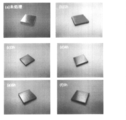
- Reaction time 0 hours
- Reaction time 1 hour
- Reaction time 3 hours
- Reaction time 6 hours
- Reaction time 9 hours.
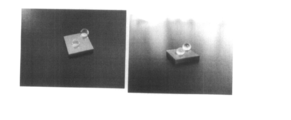
- Reaction time 6 hours.
- magnesium or an alloy thereof is used as a base material.
- the alloy mainly contains magnesium and contains at least 50 atomic%, and exhibits various characteristics and functions of the magnesium alloy. Good.
- additive elements that may coexist for example, aluminum (Al), zinc (Zn), manganese (Mn) and the like are preferably considered.
- examples of the alloy include AZ31, AZ91D, AM60B and the like, which are alloys with aluminum, but are not limited thereto.
- Such a base material may have various shapes formed by various means.
- the surface treatment of the present invention is preferably performed with pure water in a sealed container, for example, by immersing the base material in ultrapure water having a resistivity of 18.2 M ⁇ , and then heating in a heating furnace.
- Mg 1-x Al x (OH) 2 (CO 3 ) x / 2 ⁇ nH 2 O
- nano means that in the present invention, the term “nano” usually means a nanoscale size of less than 1 ⁇ m.
- the press-fitting in the sealed container in which the substrate is immersed is preferably 1 MPa or less, for example, 0.1 to 0.4 MPa.
- the heating temperature is in the range of 100 to 130 ° C., and the heating time is 3 to 12 hours.
- the structural color of the base material can be variously changed and imparted.
- the product of the present invention can be used as an automobile part, a housing for electronic devices, an adsorbent of a toxic pollutant in a solution, a super water-repellent surface structure, a part of a corrosion-resistant film, and the like.
- polycrystalline Mg (OH) 2 and [Mg 1-x Al x (OH) 2 ] (CO 3 ) x / 2 ⁇ nH 2 O nanostructures are fabricated and the reaction time is controlled. By doing so, various colors were imparted to the substrate surface.
- the coefficient x in the chemical formula showing magnesium / aluminum hydroxide is determined by the type and composition of the alloy.
- the surface of the substrate on which the polycrystalline Mg (OH) 2 and [Mg 1-x Al x (OH) 2 ] (CO 3 ) x / 2 ⁇ nH 2 O nanostructures are formed is hydrophobic. By coating an organic monomolecular film having a functional functional group, super-water repellency was imparted to the surface of the substrate.
- the coloring is uniform over the entire surface of the magnesium alloy, indicating the uniformity of the structure.
- FIG. 1 shows an XRD pattern of Mg (OH) 2 and [Mg 1-x Al x (OH) 2 ] (CO 3 ) x / 2 ⁇ nH 2 O nanostructures formed on a magnesium alloy (FIG. 1).
- the intensity of the 101 diffraction line of Mg (OH) 2 is very strong, indicating high orientation.
- the crystallite size in the direction perpendicular to the (101) plane was estimated to be about 15.17 nm using the Scherrer equation from the half-width of the diffraction line.
- the film thickness formed with Mg (OH) 2 and [Mg 1 -xAl x (OH) 2 ] (CO 3 ) x / 2 ⁇ nH 2 O nanostructures increased depending on the treatment time.
- the film thicknesses when the processing time was 3, 6, and 12 hours were 400, 600, and 1800 nm, respectively (shown by arrows in FIGS. 3 (a), (b), and (c)).
- FIG. 4 An appearance photograph of the surface of a magnesium alloy (AZ31) on which a polycrystalline Mg (OH) 2 nanostructure is formed is shown (FIG. 4).
- the reaction time of 1 hour there was no metallic luster and a black gray color was exhibited (b).
- the reaction time was 3 hours, a reddish yellow color was observed (c).
- the reaction time was 4 or 6 hours, and a bluish green color was exhibited (d) and (e).
- a reaction time of 9 hours green and red were mixed (f).
- the Mg (OH) 2 nanostructure was composed of a Brucite type polycrystalline Mg (OH) 2 phase.
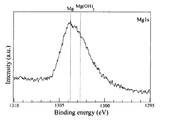
- the formed structure was not oxide (MgO) but hydroxide (Mg (OH) 2 (FIG. 6).
- the color of the surface of the magnesium alloy (AZ31) on which the polycrystalline Mg (OH) 2 nano-microstructure was formed varied depending on the angle at which the surface was observed. This change is due to the structural color.
Landscapes
- Chemical & Material Sciences (AREA)
- General Chemical & Material Sciences (AREA)
- Chemical Kinetics & Catalysis (AREA)
- Engineering & Computer Science (AREA)
- Materials Engineering (AREA)
- Mechanical Engineering (AREA)
- Metallurgy (AREA)
- Organic Chemistry (AREA)
- Chemical Treatment Of Metals (AREA)
- Compounds Of Alkaline-Earth Elements, Aluminum Or Rare-Earth Metals (AREA)
- Other Surface Treatments For Metallic Materials (AREA)
Abstract
マグネシウムおよびマグネシウム合金上にマグネシウムおよびその合金表面にナノ構造体を形成し、これによって構造色に基づく色彩を付与する。 基材としてのマグネシウムまたはその合金を密閉容器内にて純水に浸漬し、その後加熱して、基材表面にマグネシウムナノ構造体としてマグネシウム水酸化物を成長させる。
Description
本発明は、マグネシウムまたはその合金基材の表面処理方法とこの方法により得られるマグネシウム水酸化物並びにマグネシウム・アルミニウム水酸化物のナノ構造体およびそれらのナノ構造体を表面上に成長させたマグネシウムまたはその合金基材に関するものである。また、このナノ構造体によりマグネシウムおよびその合金表面に構造色に基づく色彩を付与する方法に関するものである。
自動車部品、電子機器類の筐体、溶液中の毒性公害物質の吸着剤、超撥水表面の構造体形成技術、耐食性皮膜作製等の様々な分野において、マグネシウム水酸化物Mg(OH)2や[Mg1-xAlx(OH)2](CO3)x/2・nH2O等のマグネシウム・アルミニウム水酸化物のナノ構造体に注目が集まっている。特に、生体材料や、溶液中の毒性公害物質の吸着剤、超撥水表面の構造体形成技術としてナノスケールを有するMg(OH)2構造体が注目されている。また、マグネシウムやその合金についてはその軽量性から様々な応用が検討されているが、耐食性の向上とともに、電子部品の筐体には、意匠性が必要なため、金属感を有する色彩を付与する技術が求められている。
そこで、従来よりマグネシウム水酸化物等のナノ構造体を形成することの方策が様々に検討されてきている(たとえば非特許文献1および2を参照)。
しかしながら、従来の方法では、オートクレーブ等の反応容器内で金属源となるマグネシウム塩と界面活性剤等の有機物を用いて合成するため、有機物が不純物としてマグネシウム構造体に取り込まれる。この結果、作製した構造体の機能を低下させることがあった。
また、これらの手法では、作製した水酸化マグネシウムのナノおよびマイクロ構造体を基板上に固定化する必要があり、密着性が低いという問題点があった。このため、密着性を向上させるために加熱処理を行う必要があった。
さらに、作製したMg(OH)2のナノおよびマイクロ構造体を基板上に固定化するため、構造体を基材に対して垂直方向に制御することが困難であった。
また、たとえば、耐食性の向上のために、物理的に湿式ブラスト処理し、その後、相対湿度80%以上で、高温水蒸気処理して、硫化マグネシウム等の耐食性皮膜を形成することも提案されている(特許文献1)。
しかし、このような方法では、ブラスト処理や加熱処理により表面構造、結晶構造等が変化し、目的とする機能が低下する原因となっていた。
さらに、加熱処理に伴う、高エネルギー消費、高CO2排出、プロセスの複雑化なども問題となっていた。しかも、実際的には多くの薬剤を使用するため処理後の廃液処理が必要であり、環境負荷の高いことも問題であった。
Ding, Y.; Zhang, G.; Wu, H.; Hai, B.; Wang, L.; Qian, Y. Nanoscale Magnesium Hydroxide and Magnesium Oxide Powders: Control over Size, Shape, and Structure via Hydrothermal SynthesisChem. Mater., 2001, 13, 435
Li, Y.; Sui, M.; Ding, Y.; Zhang, G.; Zhuang, J. Wang, C.Preparation of Mg(OH)2 NanorodsAdv. Mater., 2000, 12, 818.
本発明は、以上のとおりの背景から、従来の問題点を解消して、水酸化物等のマグネシウムナノ構造体を、その機能性を損なうことなく、しかも基材としてのマグネシウムがその合金と一体化して形成することを可能とし、簡便な操作で効率的にナノ構造体を形成可能とする新しい技術手段を提供することを課題としている。
本発明は、前記手段として以下のことを特徴としている。
<1>基材としてのマグネシウムまたはその合金を密閉容器内にて純水に浸漬し、その後加熱して、基材表面にマグネシウムナノ構造体を成長させるマグネシウムまたはその合金基材の表面処理方法である。
<2>基材表面にマグネシウムナノ構造体としてマグネシウム水酸化物を成長させる。
<3>基材としてのマグネシウム合金がアルミニウム含有マグネシウム合金であって、基材表面にマグネシウムナノ構造体としてマグネシウム・アルミニウム水酸化物を成長させる。
<4>密閉容器内の圧力を0.1~0.4MPaの範囲内とし、加熱温度を100~130℃の範囲内とする。
<5>以上のいずれかの表面処理方法において、マグネシウム構造体の成長を制御することで表面構造色の変更・付与を行う。
<1>基材としてのマグネシウムまたはその合金を密閉容器内にて純水に浸漬し、その後加熱して、基材表面にマグネシウムナノ構造体を成長させるマグネシウムまたはその合金基材の表面処理方法である。
<2>基材表面にマグネシウムナノ構造体としてマグネシウム水酸化物を成長させる。
<3>基材としてのマグネシウム合金がアルミニウム含有マグネシウム合金であって、基材表面にマグネシウムナノ構造体としてマグネシウム・アルミニウム水酸化物を成長させる。
<4>密閉容器内の圧力を0.1~0.4MPaの範囲内とし、加熱温度を100~130℃の範囲内とする。
<5>以上のいずれかの表面処理方法において、マグネシウム構造体の成長を制御することで表面構造色の変更・付与を行う。
そして、以上の方法によって、本発明では、
<6>基材としてのマグネシウムまたはその合金の表面に成長されていることを特徴とするマグネシウム水酸化物のナノ構造体を提供する。
<7>基材としてのマグネシウムまたはその合金の表面にマグネシウム水酸化物のナノ構造体が成長されていることを特徴とするマグネシウムまたはその合金を提供する。
<8>基材としてのアルミニウム含有マグネシウム合金の表面に成長されていることを特徴とするマグネシウム・アルミニウム水酸化物のナノ構造体を提供する。
<9>マグネシウム水酸化物のナノ構造体とともに成長されている前記<8>のナノ構造体を提供する。
<10>基材としてのアルミニウム含有マグネシウム合金の表面に、マグネシウム・アルミニウム水酸化物のナノ構造体が成長されていることを特徴とするマグネシウム合金、そして、
<11>マグネシウム水酸化物のナノ構造体も成長されていることを特徴とするマグネシウム合金を提供する。
<6>基材としてのマグネシウムまたはその合金の表面に成長されていることを特徴とするマグネシウム水酸化物のナノ構造体を提供する。
<7>基材としてのマグネシウムまたはその合金の表面にマグネシウム水酸化物のナノ構造体が成長されていることを特徴とするマグネシウムまたはその合金を提供する。
<8>基材としてのアルミニウム含有マグネシウム合金の表面に成長されていることを特徴とするマグネシウム・アルミニウム水酸化物のナノ構造体を提供する。
<9>マグネシウム水酸化物のナノ構造体とともに成長されている前記<8>のナノ構造体を提供する。
<10>基材としてのアルミニウム含有マグネシウム合金の表面に、マグネシウム・アルミニウム水酸化物のナノ構造体が成長されていることを特徴とするマグネシウム合金、そして、
<11>マグネシウム水酸化物のナノ構造体も成長されていることを特徴とするマグネシウム合金を提供する。
さらに本発明においては、
<12>以上いずれかのマグネシウムまたはその合金において、表面上に疎水性官能基を有する有機単分子膜が被覆されていることを特徴とする撥水性マグネシウムまたはその合金基材を提供する。
<12>以上いずれかのマグネシウムまたはその合金において、表面上に疎水性官能基を有する有機単分子膜が被覆されていることを特徴とする撥水性マグネシウムまたはその合金基材を提供する。
以上のとおりの本発明においては、マグネシウムやその合金上にマグネシウム水酸化物Mg(OH)2や、[Mg1-xAlx(OH)2](CO3)x/2・nH2O等のナノ構造体の直接成長を可能とする。薬剤等を一切使用しない水溶液プロセスであって、そのナノ構造体のサイズや大きさを制御することにより、構造色に基づく色彩を基材表面に付与することを実現した。
このプロセスでは、薬剤等を一切使用しない水溶液プロセスにおいて、マグネシウムおよびマグネシウム合金上にナノ構造体を形成させることができるため、結晶化や基板上への固定化のための高温加熱処理を必要としない。
また、水溶液中に導入するマグネシウムおよびマグネシウム合金を、作製する構造体の原料として用いるため、不要な金属塩や界面活性剤等の薬剤を一切使用しない低環境負荷型のプロセスである。
更に、マグネシウムおよびマグネシウム合金上に上記のナノ・マイクロ構造体を形成するため、基板との密着性が極めて高い。
大型の密閉容器内で処理することにより、大面積化処理が容易にできる。
また、平板上基板以外に、粒子基材、複雑形状基材等も用いることができる。
以下、本発明を詳細に説明する。
本発明においてはマグネシウムまたはその合金を基材としているが、この場合の合金は、組成においてマグネシウムを主として、少なくとも50原子%を含有し、マグネシウム合金の特性、機能を発現する各種のものであってよい。共存してもよい添加元素としては、たとえばアルミニウム(Al)、亜鉛(Zn)、マンガン(Mn)等が好適に考慮される。たとえば、合金としては、アルミニウムとの合金であるAZ31、AZ91D、AM60B等が例示されるが、これらに限定されるものではない。
このような基材としては、様々な手段において成形された各種の形状を有していてもよい。
本発明の表面処理は、密閉容器内の純水により好適には、たとえば抵抗率18.2MΩの超純水中に、前記の基材を浸漬し、その後、加熱炉において加熱することで、基材表面にマグネシウム水酸化物Mg(OH)2や合金添加成分との複合物としてのマグネシウム・アルミニウム水酸化物[Mg1-xAlx(OH)2](CO3)x/2・nH2O等のマグネシウムナノ構造体を成長させる。
ここで、「ナノ」の用語については、本発明では、通常は、1μm未満のナノスケールの大きさであることを意味している。
基材を浸漬する密閉容器内の圧入は1MPa以下、たとえば0.1~0.4MPaとすることが好ましい。そして、加熱温度については100~130℃の範囲が、また加熱時間は3~12時間が考慮される。
そして本発明においては、以上のような条件の選択をもってナノ構造体の成長を制御することで、基材の構造色を様々に変更・付与することが可能となる。
本発明品は、自動車部品、電子機器類の筐体、溶液中の毒性公害物質の吸着剤、超撥水表面の構造体、耐食性皮膜の一部等として利用できる。
以下の実施例では、多結晶性のMg(OH)2および[Mg1-xAlx(OH)2](CO3)x/2・nH2Oナノ構造体を作製し、反応時間を制御することにより、様々な色彩を基材表面に付与した。ここで、マグネシウム・アルミニウム水酸化物を示す化学式中の係数xについては合金の種類、組成等によって定まってくる。また、実施例では、多結晶性のMg(OH)2および[Mg1-xAlx(OH)2](CO3)x/2・nH2Oナノ構造体を形成した基材表面に疎水性官能基を有する有機単分子膜を被覆させることにより、その基材表面に超撥水性を付与した。
以下、実施例により本発明をさらに詳しく説明するが、本発明はこれらの実施例に何ら限定されるものではない。
抵抗率18.2MΩの超純水20mLとマグネシウム合金(AZ31)を密閉容器内に入れ、電気炉を用いて密閉容器を加熱し、密閉容器内を120℃、内圧0.2MPaに所定時間(1-24時間)、マグネシウム合金(AZ31)を超純水に浸漬した状態で保持し、反応を行った(超純水溶液pH=7.5)。
反応終了後、エタノール中で10分間の超音波洗浄を行い、アルゴンガスで乾燥させた。
Mg(OH)2および[Mg1-xAlx(OH)2](CO3)x/2・nH2Oナノ構造体の形成により、反応時間に応じて基材表面が赤色や緑色等に着色した。
これは、Mg(OH)2および[Mg1-xAlx(OH)2](CO3)x/2・nH2Oナノ構造体形成における可視光の波長に対応した数百nmオーダーの凹凸や膜厚によるものと考えられる。
また、着色はマグネシウム合金表面の全面に渡って均一であり、構造体の均一性を示している。
エタノール中での超音波処理30分において、形成したMg(OH)2および[Mg1-xAlx(OH)2](CO3)x/2・nH2Oナノ構造体の破壊や剥離、色彩の変化は見られなかった。
マグネシウム合金上に形成したMg(OH)2および[Mg1-xAlx(OH)2](CO3)x/2・nH2Oナノ構造体のXRDパターンを示す(図1)。
2θ=18.5,37.9,および50.8°の位置に回折線が観察され、Mg(OH)2(JCPDS No.44-1482)の001,101,102,110および111回折線に帰属された。また、2θ=11.3,22.6,60.1および62.1°の位置に回折線が観察され、[Mg1-xAlx(OH)2](CO3)x/2・nH2Oの003,006,110および1013回折線に帰属された。
Mg(OH)2の101回折線の強度は非常に強く、高い配向を示している。
(101)面に垂直方向の結晶子サイズは、回折線半値幅よりシェラーの式を用いて約15.17nmと見積もられた。
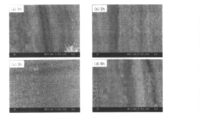
マグネシウム合金表面には、Mg(OH)2および[Mg1-xAlx(OH)2](CO3)x/2・nH2Oに起因する構造体が形成されており、その構造は、ナノスケールの凹凸を有していた(図2)。
Mg(OH)2および[Mg1-xAlx(OH)2](CO3)x/2・nH2Oナノ構造体の大きさおよび密度は、反応時間とともに増加した。占有面積は反応時間とともに増加した(図2(a)、(b)、(c)、(d))。
Mg(OH)2および[Mg1-xAlx(OH)2](CO3)x/2・nH2Oナノ構造体で形成される膜厚は処理時間に依存して増加した。たとえば、処理時間が3、6、12時間の時の膜厚はそれぞれ400、600、1800nmであった(図3(a)、(b)、(c)矢印表示)。
多結晶性Mg(OH)2ナノ構造体を形成したマグネシウム合金(AZ31)表面の外観写真を示す(図4)。反応時間1時間では、金属光沢は無く黒灰色を呈した(b)。反応時間3時間では、赤みを帯びた黄色を呈した(c)。一方、反応時間4、6時間では、青みを帯びた緑色を呈した(d)、(e)。反応時間9時間では、緑と赤色が入り混じった色を示した(f)。
反応時間に応じて、様々な色彩に対応した反射スペクトルのピークを確認できる(図5(a)、(b)、(c)、(d)、(e))。
Mg(OH)2ナノ構造体は、Bruciteタイプの多結晶性 Mg(OH)2相により構成されていた。
また、6時間反応後のナノ・マイクロ構造体の酸化状態をX線光電子分光法(XPS)により測定した結果、形成した構造体は酸化物(MgO)ではなく水酸化物(Mg(OH)2)であった(図6)。
6時間反応させ多結晶性Mg(OH)2ナノ・マイクロ構造体を形成したマグネシウム合金(AZ31)表面に疎水性官能基を有する有機単分子膜を被覆した表面での水滴挙動について、その表面は157°の水滴接触角となり、超撥水性を示した(図7)。
多結晶性Mg(OH)2ナノ・マイクロ構造体を形成したマグネシウム合金(AZ31)表面の色彩は、その表面を観察する角度に依存して変化した。この変化は、構造色に起因する。
Claims (12)
- 基材としてのマグネシウムまたはその合金を密閉容器内にて純水に浸漬し、その後加熱して、基材表面にマグネシウムナノ構造体を成長させることを特徴とするマグネシウムまたはその合金基材の表面処理方法。
- 基材表面にマグネシウムナノ構造体としてマグネシウム水酸化物を成長させることを特徴とする請求項1に記載の表面処理方法。
- 基材としてのマグネシウム合金がアルミニウム含有マグネシウム合金であって、基材表面にマグネシウムナノ構造体としてマグネシウム・アルミニウム水酸化物を成長させることを特徴とする請求項1に記載の表面処理方法。
- 密閉容器内の圧力を0.1~0.4MPaの範囲内とし、加熱温度を100~130℃の範囲内とすることを特徴とする請求項1から3のうちのいずれかに記載の表面処理方法。
- 請求項1から4のうちのいずれかに記載の表面処理方法において、マグネシウム構造体の成長を制御することで表面の色調を変更することを特徴とする表面構造色の変更・付与方法。
- 基材としてのマグネシウムまたはその合金の表面に成長されていることを特徴とするマグネシウム水酸化物のナノ構造体。
- 基材としてのマグネシウムまたはその合金の表面にマグネシウム水酸化物のナノ構造体が成長されていることを特徴とするマグネシウムまたはその合金。
- 基材としてのアルミニウム含有マグネシウム合金の表面に成長されていることを特徴とするマグネシウム・アルミニウム水酸化物のナノ構造体。
- マグネシウム水酸化物のナノ構造体とともに成長されていることを特徴とする請求項8に記載のナノ構造体。
- 基材としてのアルミニウム含有マグネシウム合金の表面に、マグネシウム・アルミニウム水酸化物のナノ構造体が成長されていることを特徴とするマグネシウム合金。
- マグネシウム水酸化物のナノ構造体も成長されていることを特徴とする請求項10に記載のマグネシウム合金。
- 請求項7、10および11のうちのいずれかに記載のマグネシウムまたはその合金において、表面上に疎水性官能基を有する有機単分子膜が被覆されていることを特徴とする撥水性マグネシウムまたはその合金基材。
Priority Applications (1)
| Application Number | Priority Date | Filing Date | Title |
|---|---|---|---|
| JP2011527655A JP5557839B2 (ja) | 2009-08-20 | 2010-08-12 | アルミニウム含有マグネシウム合金基材の表面処理方法 |
Applications Claiming Priority (2)
| Application Number | Priority Date | Filing Date | Title |
|---|---|---|---|
| JP2009-191376 | 2009-08-20 | ||
| JP2009191376 | 2009-08-20 |
Publications (1)
| Publication Number | Publication Date |
|---|---|
| WO2011021571A1 true WO2011021571A1 (ja) | 2011-02-24 |
Family
ID=43607026
Family Applications (1)
| Application Number | Title | Priority Date | Filing Date |
|---|---|---|---|
| PCT/JP2010/063717 Ceased WO2011021571A1 (ja) | 2009-08-20 | 2010-08-12 | マグネシウムまたはその合金基材の表面処理方法とナノ構造体 |
Country Status (2)
| Country | Link |
|---|---|
| JP (1) | JP5557839B2 (ja) |
| WO (1) | WO2011021571A1 (ja) |
Cited By (5)
| Publication number | Priority date | Publication date | Assignee | Title |
|---|---|---|---|---|
| JP2014125639A (ja) * | 2012-12-25 | 2014-07-07 | Shibaura Institute Of Technology | 高耐食性マグネシウム系材料及びその製造方法、並びに、マグネシウム系材料の表面処理方法 |
| JP5978376B1 (ja) * | 2015-11-04 | 2016-08-24 | Toda株式会社 | 音響用マグネシウム振動板の製造方法および音響用マグネシウム振動板 |
| JP2017503077A (ja) * | 2013-12-26 | 2017-01-26 | ポスコPosco | 発色処理された基材およびこのための基材の発色処理方法 |
| WO2018062360A1 (ja) * | 2016-09-28 | 2018-04-05 | 国立大学法人愛媛大学 | ハイブリッド材料の製造方法及びハイブリッド材料 |
| JP2019026918A (ja) * | 2017-08-03 | 2019-02-21 | 株式会社ユー・エム・アイ | 金属とフッ素ゴムとの接合体およびその接合方法 |
Citations (4)
| Publication number | Priority date | Publication date | Assignee | Title |
|---|---|---|---|---|
| JPS5230262A (en) * | 1975-09-02 | 1977-03-07 | Kyowa Chem Ind Co Ltd | Method of reforming powder surface |
| JP2005054238A (ja) * | 2003-08-05 | 2005-03-03 | Araco Corp | マグネシウム材またはマグネシウム合金材の表面処理方法 |
| JP2008266709A (ja) * | 2007-04-19 | 2008-11-06 | National Institute Of Advanced Industrial & Technology | 金属表面微細構造の作成方法 |
| JP2009114504A (ja) * | 2007-11-07 | 2009-05-28 | Shingijutsu Kenkyusho:Kk | マグネシウム合金物品、マグネシウム合金部材およびその製造方法 |
-
2010
- 2010-08-12 JP JP2011527655A patent/JP5557839B2/ja not_active Expired - Fee Related
- 2010-08-12 WO PCT/JP2010/063717 patent/WO2011021571A1/ja not_active Ceased
Patent Citations (4)
| Publication number | Priority date | Publication date | Assignee | Title |
|---|---|---|---|---|
| JPS5230262A (en) * | 1975-09-02 | 1977-03-07 | Kyowa Chem Ind Co Ltd | Method of reforming powder surface |
| JP2005054238A (ja) * | 2003-08-05 | 2005-03-03 | Araco Corp | マグネシウム材またはマグネシウム合金材の表面処理方法 |
| JP2008266709A (ja) * | 2007-04-19 | 2008-11-06 | National Institute Of Advanced Industrial & Technology | 金属表面微細構造の作成方法 |
| JP2009114504A (ja) * | 2007-11-07 | 2009-05-28 | Shingijutsu Kenkyusho:Kk | マグネシウム合金物品、マグネシウム合金部材およびその製造方法 |
Cited By (7)
| Publication number | Priority date | Publication date | Assignee | Title |
|---|---|---|---|---|
| JP2014125639A (ja) * | 2012-12-25 | 2014-07-07 | Shibaura Institute Of Technology | 高耐食性マグネシウム系材料及びその製造方法、並びに、マグネシウム系材料の表面処理方法 |
| JP2017503077A (ja) * | 2013-12-26 | 2017-01-26 | ポスコPosco | 発色処理された基材およびこのための基材の発色処理方法 |
| JP5978376B1 (ja) * | 2015-11-04 | 2016-08-24 | Toda株式会社 | 音響用マグネシウム振動板の製造方法および音響用マグネシウム振動板 |
| WO2017078010A1 (ja) * | 2015-11-04 | 2017-05-11 | Toda株式会社 | 音響用マグネシウム振動板の製造方法および音響用マグネシウム振動板 |
| WO2018062360A1 (ja) * | 2016-09-28 | 2018-04-05 | 国立大学法人愛媛大学 | ハイブリッド材料の製造方法及びハイブリッド材料 |
| JPWO2018062360A1 (ja) * | 2016-09-28 | 2019-08-29 | 国立大学法人愛媛大学 | ハイブリッド材料の製造方法及びハイブリッド材料 |
| JP2019026918A (ja) * | 2017-08-03 | 2019-02-21 | 株式会社ユー・エム・アイ | 金属とフッ素ゴムとの接合体およびその接合方法 |
Also Published As
| Publication number | Publication date |
|---|---|
| JP5557839B2 (ja) | 2014-07-23 |
| JPWO2011021571A1 (ja) | 2013-01-24 |
Similar Documents
| Publication | Publication Date | Title |
|---|---|---|
| Wahab et al. | The role of pH variation on the growth of zinc oxide nanostructures | |
| Soofivand et al. | Silver chromate and silver dichromate nanostructures: sonochemical synthesis, characterization, and photocatalytic properties | |
| El-Nahhal et al. | Synthesis & characterization of silica coated and functionalized silica coated zinc oxide nanomaterials | |
| Amri et al. | Surface structural features and optical analysis of nanostructured Cu-oxide thin film coatings coated via the sol-gel dip coating method | |
| JP5557839B2 (ja) | アルミニウム含有マグネシウム合金基材の表面処理方法 | |
| Zak et al. | XPS and UV–vis studies of Ga-doped zinc oxide nanoparticles synthesized by gelatin based sol-gel approach | |
| Yang et al. | Control of the formation of rod-like ZnO mesocrystals and their photocatalytic properties | |
| Wang et al. | Self-cleaning and depollution of fiber reinforced cement materials modified by neutral TiO2/SiO2 hydrosol photoactive coatings | |
| Li et al. | Synthesis and characterization of ZnO–Ag core–shell nanocomposites with uniform thin silver layers | |
| Yao et al. | Multi-colored hollow carbon-containing titania nanoshells for anti-counterfeiting applications | |
| Vikraman et al. | Shape-and size-tunable synthesis of tin sulfide thin films for energy applications by electrodeposition | |
| Hatel et al. | A novel approach to synthesize nanostructured WO3 and graphene/WO3 nanocomposites: structural and morphological investigations | |
| Qu et al. | Synthesis of octahedral ZnO mesoscale superstructures via thermal decomposing octahedral zinc hydroxide precursors | |
| Gao et al. | Fabrication of hierarchically structured rutile TiO2 nanorods on mica particles and their superhydrophilic coating without UV irridiation | |
| Wang et al. | Acetate-intercalated Ni–In layered double hydroxides with low infrared emissivity: synthesis, delamination and restacked to form the multilayer films | |
| JP5240813B2 (ja) | 金属表面微細構造の作成方法 | |
| Navaneethan et al. | Morphological evolution of monodispersed ZnO nanorods to 3 dimensional hierarchical flowers by hydrothermal growth | |
| CN101901827B (zh) | 核/壳型纤锌矿/闪锌矿ZnS异质纳米结构及其制备方法 | |
| Salim et al. | The effect of post-treatments on the powder morphology of titanium dioxide (TiO2) powders synthesized for cold spray | |
| JP2015212213A (ja) | グラフェンシートとの一体化ZnOナノロッド、およびグラフェンシート上へのZnOナノロッドの製造方法 | |
| Dikici | Temperature-dependent growth of ZnO structures by thermal oxidation of Zn coatings electrodeposited on steel substrates and their photocatalytic activities | |
| Chen et al. | Growth mechanism of ZnO nanostructures in wet-oxidation process | |
| Zhou et al. | Characterization of flaky aluminum pigments multi-coated by TiO2 and SiO2 | |
| Ban et al. | Bottom-up synthesis of titanophosphate nanosheets by the aqueous solution process | |
| CN102181855A (zh) | 一种形貌可控尖晶石薄膜及其制备方法 |
Legal Events
| Date | Code | Title | Description |
|---|---|---|---|
| 121 | Ep: the epo has been informed by wipo that ep was designated in this application |
Ref document number: 10809916 Country of ref document: EP Kind code of ref document: A1 |
|
| WWE | Wipo information: entry into national phase |
Ref document number: 2011527655 Country of ref document: JP |
|
| NENP | Non-entry into the national phase |
Ref country code: DE |
|
| 122 | Ep: pct application non-entry in european phase |
Ref document number: 10809916 Country of ref document: EP Kind code of ref document: A1 |