WO2011000892A2 - Catalysed dye systems - Google Patents

Catalysed dye systems Download PDF

Info

Publication number
WO2011000892A2
WO2011000892A2 PCT/EP2010/059322 EP2010059322W WO2011000892A2 WO 2011000892 A2 WO2011000892 A2 WO 2011000892A2 EP 2010059322 W EP2010059322 W EP 2010059322W WO 2011000892 A2 WO2011000892 A2 WO 2011000892A2
Authority
WO
WIPO (PCT)
Prior art keywords
dye system
dye
substrate
catalyst
compound
Prior art date
Legal status (The legal status is an assumption and is not a legal conclusion. Google has not performed a legal analysis and makes no representation as to the accuracy of the status listed.)
Ceased
Application number
PCT/EP2010/059322
Other languages
French (fr)
Other versions
WO2011000892A3 (en
Inventor
Richard Simon Blackburn
Patrick Columba Mcgowan
Christopher Martin Pask
Christopher Mark Rayner
Current Assignee (The listed assignees may be inaccurate. Google has not performed a legal analysis and makes no representation or warranty as to the accuracy of the list.)
University of Leeds
Original Assignee
University of Leeds
Priority date (The priority date is an assumption and is not a legal conclusion. Google has not performed a legal analysis and makes no representation as to the accuracy of the date listed.)
Filing date
Publication date
Priority to CN201080030051.9A priority Critical patent/CN102470080B/en
Application filed by University of Leeds filed Critical University of Leeds
Priority to US13/381,126 priority patent/US8535391B2/en
Priority to EP10730147.5A priority patent/EP2448545B1/en
Priority to ES10730147.5T priority patent/ES2598501T3/en
Priority to BR112012000571A priority patent/BR112012000571A2/en
Priority to CA2803942A priority patent/CA2803942C/en
Priority to AU2010268006A priority patent/AU2010268006B2/en
Priority to JP2012518900A priority patent/JP2012531512A/en
Publication of WO2011000892A2 publication Critical patent/WO2011000892A2/en
Publication of WO2011000892A3 publication Critical patent/WO2011000892A3/en
Anticipated expiration legal-status Critical
Priority to ZA2012/00796A priority patent/ZA201200796B/en
Ceased legal-status Critical Current

Links

Classifications

    • AHUMAN NECESSITIES
    • A61MEDICAL OR VETERINARY SCIENCE; HYGIENE
    • A61KPREPARATIONS FOR MEDICAL, DENTAL OR TOILETRY PURPOSES
    • A61K8/00Cosmetics or similar toiletry preparations
    • A61K8/18Cosmetics or similar toiletry preparations characterised by the composition
    • A61K8/19Cosmetics or similar toiletry preparations characterised by the composition containing inorganic ingredients
    • A61K8/26Aluminium; Compounds thereof
    • AHUMAN NECESSITIES
    • A61MEDICAL OR VETERINARY SCIENCE; HYGIENE
    • A61KPREPARATIONS FOR MEDICAL, DENTAL OR TOILETRY PURPOSES
    • A61K8/00Cosmetics or similar toiletry preparations
    • A61K8/18Cosmetics or similar toiletry preparations characterised by the composition
    • A61K8/19Cosmetics or similar toiletry preparations characterised by the composition containing inorganic ingredients
    • A61K8/29Titanium; Compounds thereof
    • AHUMAN NECESSITIES
    • A61MEDICAL OR VETERINARY SCIENCE; HYGIENE
    • A61KPREPARATIONS FOR MEDICAL, DENTAL OR TOILETRY PURPOSES
    • A61K8/00Cosmetics or similar toiletry preparations
    • A61K8/18Cosmetics or similar toiletry preparations characterised by the composition
    • A61K8/19Cosmetics or similar toiletry preparations characterised by the composition containing inorganic ingredients
    • AHUMAN NECESSITIES
    • A61MEDICAL OR VETERINARY SCIENCE; HYGIENE
    • A61KPREPARATIONS FOR MEDICAL, DENTAL OR TOILETRY PURPOSES
    • A61K8/00Cosmetics or similar toiletry preparations
    • A61K8/18Cosmetics or similar toiletry preparations characterised by the composition
    • A61K8/19Cosmetics or similar toiletry preparations characterised by the composition containing inorganic ingredients
    • A61K8/23Sulfur; Selenium; Tellurium; Compounds thereof
    • AHUMAN NECESSITIES
    • A61MEDICAL OR VETERINARY SCIENCE; HYGIENE
    • A61KPREPARATIONS FOR MEDICAL, DENTAL OR TOILETRY PURPOSES
    • A61K8/00Cosmetics or similar toiletry preparations
    • A61K8/18Cosmetics or similar toiletry preparations characterised by the composition
    • A61K8/19Cosmetics or similar toiletry preparations characterised by the composition containing inorganic ingredients
    • A61K8/28Zirconium; Compounds thereof
    • AHUMAN NECESSITIES
    • A61MEDICAL OR VETERINARY SCIENCE; HYGIENE
    • A61KPREPARATIONS FOR MEDICAL, DENTAL OR TOILETRY PURPOSES
    • A61K8/00Cosmetics or similar toiletry preparations
    • A61K8/18Cosmetics or similar toiletry preparations characterised by the composition
    • A61K8/30Cosmetics or similar toiletry preparations characterised by the composition containing organic compounds
    • A61K8/40Cosmetics or similar toiletry preparations characterised by the composition containing organic compounds containing nitrogen
    • A61K8/41Amines
    • AHUMAN NECESSITIES
    • A61MEDICAL OR VETERINARY SCIENCE; HYGIENE
    • A61QSPECIFIC USE OF COSMETICS OR SIMILAR TOILETRY PREPARATIONS
    • A61Q5/00Preparations for care of the hair
    • A61Q5/10Preparations for permanently dyeing the hair
    • DTEXTILES; PAPER
    • D06TREATMENT OF TEXTILES OR THE LIKE; LAUNDERING; FLEXIBLE MATERIALS NOT OTHERWISE PROVIDED FOR
    • D06PDYEING OR PRINTING TEXTILES; DYEING LEATHER, FURS OR SOLID MACROMOLECULAR SUBSTANCES IN ANY FORM
    • D06P1/00General processes of dyeing or printing textiles, or general processes of dyeing leather, furs, or solid macromolecular substances in any form, classified according to the dyes, pigments, or auxiliary substances employed
    • D06P1/0032Determining dye recipes and dyeing parameters; Colour matching or monitoring
    • DTEXTILES; PAPER
    • D06TREATMENT OF TEXTILES OR THE LIKE; LAUNDERING; FLEXIBLE MATERIALS NOT OTHERWISE PROVIDED FOR
    • D06PDYEING OR PRINTING TEXTILES; DYEING LEATHER, FURS OR SOLID MACROMOLECULAR SUBSTANCES IN ANY FORM
    • D06P1/00General processes of dyeing or printing textiles, or general processes of dyeing leather, furs, or solid macromolecular substances in any form, classified according to the dyes, pigments, or auxiliary substances employed
    • D06P1/32General processes of dyeing or printing textiles, or general processes of dyeing leather, furs, or solid macromolecular substances in any form, classified according to the dyes, pigments, or auxiliary substances employed using oxidation dyes
    • AHUMAN NECESSITIES
    • A61MEDICAL OR VETERINARY SCIENCE; HYGIENE
    • A61KPREPARATIONS FOR MEDICAL, DENTAL OR TOILETRY PURPOSES
    • A61K2800/00Properties of cosmetic compositions or active ingredients thereof or formulation aids used therein and process related aspects
    • A61K2800/40Chemical, physico-chemical or functional or structural properties of particular ingredients
    • A61K2800/58Metal complex; Coordination compounds
    • DTEXTILES; PAPER
    • D06TREATMENT OF TEXTILES OR THE LIKE; LAUNDERING; FLEXIBLE MATERIALS NOT OTHERWISE PROVIDED FOR
    • D06PDYEING OR PRINTING TEXTILES; DYEING LEATHER, FURS OR SOLID MACROMOLECULAR SUBSTANCES IN ANY FORM
    • D06P3/00Special processes of dyeing or printing textiles, or dyeing leather, furs, or solid macromolecular substances in any form, classified according to the material treated
    • D06P3/02Material containing basic nitrogen
    • D06P3/04Material containing basic nitrogen containing amide groups
    • D06P3/14Wool
    • DTEXTILES; PAPER
    • D06TREATMENT OF TEXTILES OR THE LIKE; LAUNDERING; FLEXIBLE MATERIALS NOT OTHERWISE PROVIDED FOR
    • D06PDYEING OR PRINTING TEXTILES; DYEING LEATHER, FURS OR SOLID MACROMOLECULAR SUBSTANCES IN ANY FORM
    • D06P3/00Special processes of dyeing or printing textiles, or dyeing leather, furs, or solid macromolecular substances in any form, classified according to the material treated
    • D06P3/58Material containing hydroxyl groups
    • D06P3/60Natural or regenerated cellulose
    • DTEXTILES; PAPER
    • D06TREATMENT OF TEXTILES OR THE LIKE; LAUNDERING; FLEXIBLE MATERIALS NOT OTHERWISE PROVIDED FOR
    • D06PDYEING OR PRINTING TEXTILES; DYEING LEATHER, FURS OR SOLID MACROMOLECULAR SUBSTANCES IN ANY FORM
    • D06P3/00Special processes of dyeing or printing textiles, or dyeing leather, furs, or solid macromolecular substances in any form, classified according to the material treated
    • D06P3/58Material containing hydroxyl groups
    • D06P3/60Natural or regenerated cellulose
    • D06P3/6091Natural or regenerated cellulose preparing non-azo dyes on the material
    • DTEXTILES; PAPER
    • D06TREATMENT OF TEXTILES OR THE LIKE; LAUNDERING; FLEXIBLE MATERIALS NOT OTHERWISE PROVIDED FOR
    • D06PDYEING OR PRINTING TEXTILES; DYEING LEATHER, FURS OR SOLID MACROMOLECULAR SUBSTANCES IN ANY FORM
    • D06P3/00Special processes of dyeing or printing textiles, or dyeing leather, furs, or solid macromolecular substances in any form, classified according to the material treated
    • D06P3/79Polyolefins
    • DTEXTILES; PAPER
    • D06TREATMENT OF TEXTILES OR THE LIKE; LAUNDERING; FLEXIBLE MATERIALS NOT OTHERWISE PROVIDED FOR
    • D06PDYEING OR PRINTING TEXTILES; DYEING LEATHER, FURS OR SOLID MACROMOLECULAR SUBSTANCES IN ANY FORM
    • D06P3/00Special processes of dyeing or printing textiles, or dyeing leather, furs, or solid macromolecular substances in any form, classified according to the material treated
    • D06P3/79Polyolefins
    • D06P3/797Polyolefins preparing non-azo dyes on the material

Definitions

  • This invention relates to multi-component catalysed dye systems which are particularly applicable to the dyeing of textile fibres and, most especially, human hair. Most particularly, it is concerned with oxidative dye systems.
  • Permanent hair coloration currently represents at least 80% of the hair coloration market (J. S. Anderson, J. Soc. Dyers CoI., 2000, 116, 193). This system relies on the diffusion of uncoloured precursors into the hair where they undergo oxidation reactions to produce the desired colour in situ; these colorants usually last at least 24 shampoos. Permanent oxidative hair coloration typically involves three components, as follows:
  • the coupler which is generally an aromatic compound with at least one (usually two meta-) electron donating group (e.g. 6-13);
  • PPD hair dye component p-phenylenediamine
  • bladder cancer bladder cancer
  • PPD p-phenylenediamine
  • PPD is an important component of most hair colorant formulations and, whilst alone it is a suspected carcinogen, in the presence of hydrogen peroxide and the absence of couplers, it may form a trimer - "Bandrowski's base", as shown in Scheme 1 and discussed by M. Picardo, C. Cannistraci, A. Cristaudo, C. de Luca and B.
  • PPD and other compounds such as p-toluenediamine (PTD; 2), resorcinol (6) and ammonia can also provoke severe adverse reactions when used in hair and skin coloration (CJ. Le Coz, C. Lefebvre, F. Keller, E. Grosshans, Arch. Dermatol. 2000, 136, 1515; CJ. Le Coz, Rev. Fr. Aller. Immunol. Clin. 2001 , 41 , 504, M. Onder, CA. Atahan, P. Oztas, M. O. Oztas, Int. J. Dermatol. 2001 , 40, 577).
  • PPD p-toluenediamine
  • resorcinol (6) and ammonia can also provoke severe adverse reactions when used in hair and skin coloration (CJ. Le Coz, C. Lefebvre, F. Keller, E. Grosshans, Arch. Dermatol. 2000, 136, 1515; CJ. Le Coz, Rev. Fr. Aller
  • Allergic contact dermatitis is commonly associated with exposure to p-phenylenediamine, as noted by E. M. Coulter, C. Jenkinson, Y. Wu, J. Farrell, B. Foster, A. Smith, C. McGuire, C. Pease, D. Basketter, C. King, P. S. Friedmann, M. Pirmohamed, B.K. Park and D.J. Naisbett, (J. Investig. Dermatol. 2008, 128, 897).
  • Such suspect compounds are used in most hair colorant formulations and are essential for brown and black shades, which are the most popular colours.
  • WO-A-2006/106366 discloses an oxidative hair dye system which eliminates the use of p-phenylenediamine, and which comprises a hair dye, a supposed organometallic compound and an oxidising agent.
  • the supposed organometallic compound is stated to be preferably an organotitanate compound, particularly a tetraalkyl titanate or a titanate chelate.
  • Such compounds are stated to be useful for enhancing the substantivity of topical compositions applied to the body, these compositions comprising one or more cosmetic and/or therapeutic benefit agents, a bonding agent having hydrolysable or exchangeable ligands, and a carrier.
  • the present inventors have investigated the use of a broader range of metal- containing catalysts in hair dyeing systems in order to avoid the use of potentially harmful materials.
  • suitable systems may be based on combinations of organic precursors with metal-containing catalysts and oxidising agents. Many of these dye systems also find application in dyeing textile fibre substrates.
  • a dye system for application to a substrate comprising:
  • said catalyst is a homogeneous catalyst or a heterogeneous catalyst.
  • said catalyst comprises at least one metal- containing compound.
  • said substrate comprises human hair.
  • said substrate comprises a natural or synthetic polymeric substrate. Additional embodiments of the invention envisage the use of textile fibre substrates.
  • said at least one dye precursor is an organic precursor. Said embodiment is especially preferred when said dye system is intended for application to human hair.
  • said at least one dye precursor comprises an aromatic amino compound, a phenolic compound, or an aminophenolic compound.
  • said at least one metal-containing compound for use as a catalyst comprises at least one inorganic metal compound.
  • said at least one metal-containing compound for use as a catalyst comprises at least one metal complex comprising at least one organic ligand.
  • Typical oxidising agents especially for the dyeing of textile substrates, include percarbonates, persulphates, organic peracids and organic hydroperoxides. In certain circumstances, molecular oxygen (including air) may also be used.
  • a preferred oxidising agent is hydrogen peroxide.
  • a method for the coloration of a substrate comprising:
  • said catalyst is a homogeneous catalyst or a heterogeneous catalyst.
  • said catalyst comprises at least one metal-containing compound.
  • said treatments of said substrate with at least one dye precursor, an oxidising agent and a catalyst are carried out simultaneously. In an alternative embodiment of the invention, said treatments are carried out sequentially.
  • said method is performed by treating said substrate in aqueous solutions comprising said dye systems.
  • said substrate is selected from human hair, natural or synthetic polymeric substrates, or textile fibre substrates.
  • said method is carried out at ambient temperatures.
  • natural or synthetic polymeric substrates and textile fibres said method may be carried out at any suitable temperature and pressure.
  • textile fibre coloration is carried out at atmospheric pressure and at a temperature which is preferably in the range from 20°-1 10°C.
  • textile fibre coloration may take place at elevated pressures. Pressures anywhere in the range of 1 -500 bar may be employed but, typically, suitable pressures would be in the range of 1 -20 bar, with corresponding elevated temperatures in the range from 100°-200°C being employed, as appropriate.
  • said at least one dye precursor comprises an organic precursor, which is preferably an oxidisable organic precursor and may, for example, be selected from an aromatic amino compound, a phenolic compound or an aminophenolic compound;
  • said at least one metal-containing compound for use as a catalyst comprises at least one inorganic metal compound or at least one metal complex comprising at least one organic ligand; and said oxidising agent is hydrogen peroxide.
  • the dye systems of the invention are applied to human hair.
  • Preferred examples of said at least one dye precursor comprise existing hair dye components such as p-aminophenol (4), o-aminophenol (5), p-amino-o-cresol (8), m- aminophenol (9), p-chlororesorcinol (10), 2,3-dihydroxynaphthalene (11) and 3-methylcatechol (12), similarly functionalised precursors not currently used as hair dye components, such as 4- methylresorcinol (14), p-aminobenzoic acid (15) which also finds application as a UV filter in some sunscreens, 1 ,3-dihydroxynaphthalene (16) and 1 ,4-dihydroxynaphthalene (17), in addition to naturally occurring compounds and derivatives thereof, examples of which include phenolic compounds such as gallic acid (18), tannic acid (19), vanillin (20), phloroglucinol (21 ) and orcinol (22), and derivatives thereof.
  • existing hair dye components such as p-aminophenol (4), o
  • each of these derivatives was individually tested as a hair dye precursor in a system comprising at least one metal-containing catalyst and an oxidising agent, usually in the form of hydrogen peroxide, and each was applied to bleached white hair swatches.
  • an oxidising agent usually in the form of hydrogen peroxide
  • Suitable derivatives of these naturally occurring phenolic compounds include derivatives of salicylic acid, such as 5-aminosalicylic acid (23), whilst aromatic amino derivatives such as isatin (24), 1 -methylindole (25) and 2-methylindole (26) also find application according to the invention:
  • said at least one metal-containing compound for use as a catalyst comprises at least one inorganic metal compound.
  • Preferred inorganic metal compounds comprise compounds of d-block transition metals such as scandium, titanium, vanadium, chromium, molybdenum, iron, manganese, cobalt, nickel, copper, zirconium and zinc including, but not limited to, the acetates, acetyl aceto nates, aluminates, bicarbonates, borates, bromates, carbonates, chlorites, cyanides, diethylcitrates, halides, hexafluoroacetylacetonates, hexafluorophosphates, hexafluorosilicates, dihydrogen phosphates, hydrogen carbonates, hydrogen sulphates, hydrogen sulphides, hydrogen sulphites, hydroxides, hypochlorites, iodates, nitrates, nitrites,
  • Alternative metal compounds for use as catalysts comprise salts of the alkali metals of Group 1 , such as potassium, or the alkaline earth metals of Group 2, for example magnesium.
  • suitable salts include acetates, acetyl aceto nates, aluminates, bicarbonates, borates, bromates, carbonates, chlorites, cyanides, diethylcitrates, halides, hexafluoroacetylacetonates, hexafluorophosphates, hexafluorosilicates, dihydrogen phosphates, hydrogen carbonates, hydrogen sulphates, hydrogen sulphides, hydrogen sulphites, hydroxides, hypochlorites, iodates, nitrates, nitrites, oxalates, oxides, perfluorophthalocyanines, peroxides, phosphates, phthalocyanines, pyrophosphates, silicates, sulphamates,
  • said catalyst comprises at least one mineral or clay.
  • said minerals or clays include anatase, brookite, eudialyte, ilmenite, perovskite, rutile, sabaite, titanite, zircon, zirconolite, zircohylite or zirkelite.
  • said substrate is selected from human hair, natural or synthetic polymeric substrates, or textile fibre substrates.
  • said method is performed by treating said substrate in aqueous solutions comprising said dye systems.
  • said substrate comprises human hair
  • said method is carried out at ambient temperatures.
  • said method may be carried out at any suitable temperature and pressure.
  • textile fibre coloration is carried out at atmospheric pressure and at a temperature which is preferably in the range from 20°-1 10 Q C.
  • textile fibre coloration may take place at elevated pressures. Pressures anywhere in the range of 1 -500 bar may be employed but, typically, suitable pressures would be in the range of 1 -20 bar, with corresponding elevated temperatures in the range from 100°-200 ⁇ € being employed, as appropriate.
  • said at least one dye precursor comprises an organic precursor, which is preferably an oxidisable organic precursor and may, for example, be selected from the group of naturally occurring phenolic compounds previously disclosed herein, an aromatic amino compound, a phenolic compound or an aminophenolic compound;
  • said at least one metal-containing compound for use as a catalyst comprises at least one inorganic metal compound, most preferably a compound of a d-block transition metals such as iron, manganese, zirconium and zinc, or a salt of an alkali metal of Group 1 , such as potassium, or an alkaline earth metal of Group 2, for example magnesium; and
  • the dye systems of the invention are applied to substrates which comprise textile fibres.
  • Application of the dye systems according to the invention to textile fibres may be achieved by treating said fibres with the dye systems of the first aspect of the invention according to the method of the second aspect of the invention.
  • application of dyes is achieved by treatment of a substrate with at least one dye precursor, an oxidising agent and a catalyst, wherein said catalyst comprises at least one metal-containing compound, by a method wherein said treatments are carried out simultaneously.
  • said treatments may be carried out sequentially.
  • said at least one metal-containing compound for use as a catalyst comprises at least one metal complex comprising at least one organic ligand. It is also preferred that said at least one dye precursor comprises an aromatic amino compound, a phenolic compound or an aminophenolic compound such as p- or m-aminophenol, and that said oxidising agent is hydrogen peroxide.
  • particularly suitable catalysts which comprise at least one metal complex comprising at least one organic ligand are metal chelates, most particularly titanium complexes comprising at least one organic ligand.
  • Typical ligands include optionally substituted alkyl ligands.
  • a particularly preferred example of such a catalyst is titanium triethanolamine isopropyl chelate complex.
  • dye precursors comprising aromatic amino compounds, phenolic compounds and/or aminophenolic compounds may be employed.
  • aromatic amino compounds phenolic compounds and/or aminophenolic compounds
  • suitable aminophenolic compounds include m- aminophenol (9) and p-amino-o-cresol (8).
  • the dye systems according to the invention have also been successfully applied to natural and synthetic polymeric substrates such as polyethylene, polyvinyl chloride), rubber and leather, as well as to paper.
  • Application of the dyes of the first aspect of the invention according to the method of the second aspect of the invention is preferably carried out using the same basic procedure as for hair dyes, wherein the substrate is typically treated in an aqueous mixture containing the three components of the dyeing system. Most preferably said treatments are carried out simultaneously in a one-stage process. Alternatively, however, said treatments may be carried out sequentially via a two-stage process. Thus, in the one-stage dyeing process, the dye precursor, catalyst and hydrogen peroxide are applied at the same time, whilst in the two-stage process, the dye precursor is applied first, over a period of about 30 minutes, after which the catalyst and hydrogen peroxide are applied.
  • Said treatments may be carried out at any suitable temperature, but the preferred temperature range is from 20°-1 1 O 0 C.
  • Preferred pH conditions for the dyeing of wool are in the range of 5-8.
  • Dye precursor (10% on weight of fibre) was added to the aqueous dyebath at a liquor ratio of 20:1 and mixed; 2) Fabric was wetted and added to the dyebath;
  • Titanium triethanolamine isopropyl chelate complex (10 ml dm 3 ) was added to the dyebath and mixed;
  • Cotton fabric was dyed according to the following procedure: 1 ) Dye precursor (10% on weight of fibre) was added to the aqueous dyebath at a liquor ratio of 20:1 and mixed;
  • Titanium triethanolamine isopropyl chelate complex (10 ml dm "3 ) was added to the dyebath and mixed;
  • Lyocell was first scoured using 2 g dm "3 Sandozin NIN and 1 g dm "3 Na 2 CO 3 for 15 min at 60 0 C. The fabric was then dyed according to the following procedure:
  • Dye precursor (10% on weight of fibre) was added to the aqueous dyebath at a liquor ratio of 20:1 and mixed;
  • Titanium triethanolamine isopropyl chelate complex (10 ml dm "3 ) was added to the dyebath and mixed;
  • Dye precursor (10% on weight of fibre) was added to the aqueous dyebath at a liquor ratio of 20:1 and mixed;
  • Titanium triethanolamine isopropyl chelate complex (10 ml dm 3 ) was added to the dyebath and mixed;
  • Dye precursor (10% on weight of fibre) was added to the aqueous dyebath at a liquor ratio of 20:1 and mixed;
  • Titanium triethanolamine isopropyl chelate complex (10 ml dm 3 ) was added to the dyebath and mixed;
  • Dye precursor (10% on weight of fibre) was added to the aqueous dyebath at a liquor ratio of 20:1 and mixed;
  • Titanium triethanolamine isopropyl chelate complex (10 ml dm 3 ) was added to the dyebath and mixed;

Landscapes

  • Health & Medical Sciences (AREA)
  • Life Sciences & Earth Sciences (AREA)
  • Public Health (AREA)
  • Veterinary Medicine (AREA)
  • Animal Behavior & Ethology (AREA)
  • General Health & Medical Sciences (AREA)
  • Epidemiology (AREA)
  • Birds (AREA)
  • Chemical & Material Sciences (AREA)
  • Inorganic Chemistry (AREA)
  • Engineering & Computer Science (AREA)
  • Textile Engineering (AREA)
  • Cosmetics (AREA)
  • Catalysts (AREA)
  • Organic Low-Molecular-Weight Compounds And Preparation Thereof (AREA)

Abstract

The present invention is concerned with a dye system for application to a substrate, the dye system comprising: (a) at least one dye precursor; (b) an oxidising agent; and (c) a catalyst, wherein the catalyst is a homogeneous catalyst or a heterogeneous catalyst. Preferably, the catalyst comprises at least one metal-containing compound. The invention also envisages a method for the coloration of a substrate, the method comprising treating the substrate with the dye system of the invention. In preferred embodiments of the invention, the substrate comprises human hair, natural or synthetic polymers, or textile fibres. In further preferred embodiments, the at least one dye precursor is an organic precursor, the at least one metal derivative for use as a catalyst comprises at least one inorganic metal compound or at least one metal complex comprising at least one organic ligand, and the oxidising agent is hydrogen peroxide.

Description

CATALYSED DYE SYSTEMS
Field of the Invention
[0001] This invention relates to multi-component catalysed dye systems which are particularly applicable to the dyeing of textile fibres and, most especially, human hair. Most particularly, it is concerned with oxidative dye systems.
Background to the Invention
[0002] The dyeing of textile fibres is a major industry throughout the world and efforts are continually being made to find new and improved materials for this purpose which can provide improvements in terms of factors such as economy, dyeing properties, health and safety and environmental considerations. There is particular interest in developing dyes which can be conveniently and efficiently applied to textile fibres, and which provide intense shades having good fastness properties at reasonable cost.
[0003] Coloration of hair, from a social perspective, is a major business, with the numbers of people colouring their hair, both in professional salons and in the home, steadily increasing ( h ttp ://www . pg . co m ; http://www.henkel.com). However, people applying colorants to their hair and having their hair coloured are exposed to significant health risks in view of the nature of the materials in use, and it is desirable that alternative natural, non-toxic, non-carcinogenic means of hair coloration are developed in order to minimise any potential hazards to human health. In addition, currently available hair colorants are derived from non-sustainable sources, consuming fossil fuels in their production, and it would be desirable if natural plant-based dyes could instead be utilised in the hair coloration industry.
[0004] Permanent hair coloration currently represents at least 80% of the hair coloration market (J. S. Anderson, J. Soc. Dyers CoI., 2000, 116, 193). This system relies on the diffusion of uncoloured precursors into the hair where they undergo oxidation reactions to produce the desired colour in situ; these colorants usually last at least 24 shampoos. Permanent oxidative hair coloration typically involves three components, as follows:
(a) the primary intermediate (or "base"), which is usually an ortho- or para- substituted (hydroxy, amine, substituted amine) aromatic amine (e.g. 1-5);
(b) the coupler, which is generally an aromatic compound with at least one (usually two meta-) electron donating group (e.g. 6-13); and
(c) an oxidant, which is almost always hydrogen peroxide (H2O2).
Figure imgf000003_0001
10 1 1 12 13 [0005] However, significant concerns exist with regard to the potential toxicological effects of the components which are used, particularly aromatic amines which represent nearly all of the primary intermediates employed, as many of these are suspect carcinogens, tumorgens or mutagens, and may effect reproduction (httBj//hazaj^ojn/nτsds/tox). Indeed, it is believed that many of the primary intermediates and couplers may be banned for human use within the foreseeable future. In 2008, the World Health Organisation announced evidence that the hair dye component p-phenylenediamine (PPD; 1 ) increases the risk of bladder cancer (Cancer Research UK, http://www.cancerhelp.orq.uk/help/def ault.asp?paqe=4124); PPD is an important component of most hair colorant formulations and, whilst alone it is a suspected carcinogen, in the presence of hydrogen peroxide and the absence of couplers, it may form a trimer - "Bandrowski's base", as shown in Scheme 1 and discussed by M. Picardo, C. Cannistraci, A. Cristaudo, C. de Luca and B. Santucci (Dermatologica, 1990, 181 , 104) - which is known to be mutagenic (B.N. Ames, H. O. Kammen and E. Yamasaki, Proc. Natl. Acad. Sci. USA, 1975, 72, 2423).
Figure imgf000004_0001
SCHEME 1 FORMATION OF BANDROWSKI'S BASE BY OXIDATION
OF P-PHENYLENEDIAMINE
[0006] PPD and other compounds, such as p-toluenediamine (PTD; 2), resorcinol (6) and ammonia can also provoke severe adverse reactions when used in hair and skin coloration (CJ. Le Coz, C. Lefebvre, F. Keller, E. Grosshans, Arch. Dermatol. 2000, 136, 1515; CJ. Le Coz, Rev. Fr. Aller. Immunol. Clin. 2001 , 41 , 504, M. Onder, CA. Atahan, P. Oztas, M. O. Oztas, Int. J. Dermatol. 2001 , 40, 577). Allergic contact dermatitis is commonly associated with exposure to p-phenylenediamine, as noted by E. M. Coulter, C. Jenkinson, Y. Wu, J. Farrell, B. Foster, A. Smith, C. McGuire, C. Pease, D. Basketter, C. King, P. S. Friedmann, M. Pirmohamed, B.K. Park and D.J. Naisbett, (J. Investig. Dermatol. 2008, 128, 897). Such suspect compounds are used in most hair colorant formulations and are essential for brown and black shades, which are the most popular colours. Hence, it is desirable, and potentially necessary, to use colorants that pose no significant health hazard; this would necessarily involve a combination of less hazardous synthetic components and greater use of natural compounds.
[0007] In addition, many oxidative hair coloration systems rely on the use of alkaline agents, typically ammonia, in order to raise the hair cuticle, thereby allowing the dye precursors to penetrate the hair more easily, whilst also activating hydrogen peroxide. Clearly, improved systems which eliminated the requirement for the use of ammonia would also be desirable.
[0008] WO-A-2006/106366 discloses an oxidative hair dye system which eliminates the use of p-phenylenediamine, and which comprises a hair dye, a supposed organometallic compound and an oxidising agent. The supposed organometallic compound is stated to be preferably an organotitanate compound, particularly a tetraalkyl titanate or a titanate chelate. Such compounds are stated to be useful for enhancing the substantivity of topical compositions applied to the body, these compositions comprising one or more cosmetic and/or therapeutic benefit agents, a bonding agent having hydrolysable or exchangeable ligands, and a carrier. [0009] The present inventors have investigated the use of a broader range of metal- containing catalysts in hair dyeing systems in order to avoid the use of potentially harmful materials. The inventors have found that suitable systems may be based on combinations of organic precursors with metal-containing catalysts and oxidising agents. Many of these dye systems also find application in dyeing textile fibre substrates.
Summary of the Invention
[0010] Thus, according to a first aspect of the present invention, there is provided a dye system for application to a substrate, said dye system comprising:
(a) at least one dye precursor;
(b) an oxidising agent; and
(c) a catalyst,
wherein said catalyst is a homogeneous catalyst or a heterogeneous catalyst.
[0011] In preferred embodiments of the invention, said catalyst comprises at least one metal- containing compound.
[0012] In one preferred embodiment of the invention, said substrate comprises human hair. In alternative embodiments of the invention, said substrate comprises a natural or synthetic polymeric substrate. Additional embodiments of the invention envisage the use of textile fibre substrates.
[0013] In one preferred embodiment of the invention, said at least one dye precursor is an organic precursor. Said embodiment is especially preferred when said dye system is intended for application to human hair.
[0014] Typically, said at least one dye precursor comprises an aromatic amino compound, a phenolic compound, or an aminophenolic compound.
[0015] In another preferred embodiment of the invention, said at least one metal-containing compound for use as a catalyst comprises at least one inorganic metal compound.
[0016] In an alternative embodiment of the invention, said at least one metal-containing compound for use as a catalyst comprises at least one metal complex comprising at least one organic ligand.
[0017] Typical oxidising agents, especially for the dyeing of textile substrates, include percarbonates, persulphates, organic peracids and organic hydroperoxides. In certain circumstances, molecular oxygen (including air) may also be used. A preferred oxidising agent, however, is hydrogen peroxide.
[0018] According to a second aspect of the present invention, there is provided a method for the coloration of a substrate, said method comprising:
(a) treating said substrate with at least one dye precursor;
(b) treating said substrate with an oxidising agent; and
(c) treating said substrate with a catalyst,
wherein said catalyst is a homogeneous catalyst or a heterogeneous catalyst.
[0019] In the most preferred embodiments of the second aspect of the invention, said catalyst comprises at least one metal-containing compound.
[0020] In a preferred embodiment of the second aspect of the invention, said treatments of said substrate with at least one dye precursor, an oxidising agent and a catalyst are carried out simultaneously. In an alternative embodiment of the invention, said treatments are carried out sequentially.
[0021] Preferably, said method is performed by treating said substrate in aqueous solutions comprising said dye systems.
[0022] In preferred embodiments of the invention, said substrate is selected from human hair, natural or synthetic polymeric substrates, or textile fibre substrates. When said substrate comprises human hair, it is preferred that said method is carried out at ambient temperatures. In the case of natural or synthetic polymeric substrates and textile fibres, said method may be carried out at any suitable temperature and pressure. Thus, in certain embodiments, textile fibre coloration is carried out at atmospheric pressure and at a temperature which is preferably in the range from 20°-1 10°C. In alternative embodiments, textile fibre coloration may take place at elevated pressures. Pressures anywhere in the range of 1 -500 bar may be employed but, typically, suitable pressures would be in the range of 1 -20 bar, with corresponding elevated temperatures in the range from 100°-200°C being employed, as appropriate.
[0023] In preferred embodiments of the method according to the second aspect of the invention, at least one of the following conditions applies:
• said at least one dye precursor comprises an organic precursor, which is preferably an oxidisable organic precursor and may, for example, be selected from an aromatic amino compound, a phenolic compound or an aminophenolic compound;
• said at least one metal-containing compound for use as a catalyst comprises at least one inorganic metal compound or at least one metal complex comprising at least one organic ligand; and said oxidising agent is hydrogen peroxide.
Description of the Invention
[0024] In the most preferred embodiments, the dye systems of the invention are applied to human hair.
[0025] Preferred examples of said at least one dye precursor comprise existing hair dye components such as p-aminophenol (4), o-aminophenol (5), p-amino-o-cresol (8), m- aminophenol (9), p-chlororesorcinol (10), 2,3-dihydroxynaphthalene (11) and 3-methylcatechol (12), similarly functionalised precursors not currently used as hair dye components, such as 4- methylresorcinol (14), p-aminobenzoic acid (15) which also finds application as a UV filter in some sunscreens, 1 ,3-dihydroxynaphthalene (16) and 1 ,4-dihydroxynaphthalene (17), in addition to naturally occurring compounds and derivatives thereof, examples of which include phenolic compounds such as gallic acid (18), tannic acid (19), vanillin (20), phloroglucinol (21 ) and orcinol (22), and derivatives thereof.
Figure imgf000007_0001
14 15 16 17
Figure imgf000007_0002
18 19 20
Figure imgf000007_0003
21 22
[0026] These materials may all be applied as components of dye systems according to the first aspect of the invention, in combination with an oxidising agent and a catalyst, by a method according to the second aspect of the invention. Thus, in certain embodiments each of these derivatives was individually tested as a hair dye precursor in a system comprising at least one metal-containing catalyst and an oxidising agent, usually in the form of hydrogen peroxide, and each was applied to bleached white hair swatches. The use of m-aminophenol and p-amino-o- cresol resulted in dark red/brown shades, o-aminophenol yielded a brown shade, and p- aminophenol produced an almost black coloration. In addition, p-chlororesorcinol and 2,3- dihydroxynaphthalene both gave a blonde colour, whilst the use of 3-methylcatechol resulted in a medium brown shade. Gallic acid and tannic acid, both of which are polyphenols found in certain woods and tea leaves, both resulted in significant red/brown coloration. Phloroglucinol, which may be isolated from the bark of fruit trees, orcinol, which is present in many species of lichen, and catechol - found in fruit and vegetables such as apples and potatoes - all produce a blonde colour, whilst vanillin produced a blonde colour naturally smelling of vanilla, which offered a potentially useful additional feature.
[0027] Suitable derivatives of these naturally occurring phenolic compounds include derivatives of salicylic acid, such as 5-aminosalicylic acid (23), whilst aromatic amino derivatives such as isatin (24), 1 -methylindole (25) and 2-methylindole (26) also find application according to the invention:
Figure imgf000008_0001
23 24 25 26
[0028] When applied to bleached white hair swatches in combination with a catalyst and an oxidising agent, 5-aminosalicylic acid produced a light brown colour, whilst isatin and 2- methylindole both resulted in a pale yellow colour and 1 -methylindole produced a green colour.
[0029] In further preferred embodiments of the invention, said at least one metal-containing compound for use as a catalyst comprises at least one inorganic metal compound. Preferred inorganic metal compounds comprise compounds of d-block transition metals such as scandium, titanium, vanadium, chromium, molybdenum, iron, manganese, cobalt, nickel, copper, zirconium and zinc including, but not limited to, the acetates, acetyl aceto nates, aluminates, bicarbonates, borates, bromates, carbonates, chlorites, cyanides, diethylcitrates, halides, hexafluoroacetylacetonates, hexafluorophosphates, hexafluorosilicates, dihydrogen phosphates, hydrogen carbonates, hydrogen sulphates, hydrogen sulphides, hydrogen sulphites, hydroxides, hypochlorites, iodates, nitrates, nitrites, oxalates, oxides, perfluorophthalocyanines, peroxides, phosphates, phthalocyanines, pyrophosphates, silicates, sulphamates, sulphates, sulphides, sulphites, tartrates, tetrafluoroborates, thiocyanates, thiolates, thiosulphates, tosylates and triflates of these metals. [0030] Especially preferred compounds in this context include TiBr2, TiBr4, TiCI2, TiCI3, TiCI4,
TiF3, TiF4, Ti2O3, TiO(SO4), (TiO2)(SiO2), TiS2, VBr3, VCI2, VCI3, VCI4, V2O3, V2O4, V2O5, VO(SO4), VOCI3, VOF3, V(C5H7O2)3, VO(C5H7O2)2, VO(OR)3, Mo2(OCOCH3)4, Mo(CO)6, MoCI3, MoCI5, MoO2CI2, MoF6,MoO2, MoO3, MoS2, MoOCI4, MoSO4, Mn(OCOCH3)2, Mn(OCOCH3)2.xH2O, Mn(C5H7O2)2, MnBr2,MnBr2.xH2O, MnCO3, MnCO3.xH2O, Mn2(CO)10, MnCI2, MnCI2.xH2O,MnF2, MnF3, Mn(HCO2)2.xH2O, MnI2, Mn(NO3)2, Mn(NO3)2.xH2O, Mn3O4, Mn2O3, MnO2, Mn(C32H16N8), MnSO4, MnSO4.xH2O, MnS, Fe(OCOCH3)2, Fe(OCOCH3)3, FeBr2, FeBr3, FeCI2, FeCI2.xH2O, FeCI3, FeCI3.xH2O, Fe(OEt)3, FeSO4.NH3CH2CH2NH3SO4.4H2O, Fe4[Fe(CN)6]3, FeF2, FeF3, FeF3.xH2O, FeI2, Fe(CH3CHOHCOO)2.xH2O, Fe(NO3)3.xH2O, Fe(C2O4).xH2O, FeO, Fe2O3, Fe3O4, FePO4.xH2O, Fe(C32H16N8), FeSO4.xH2O, FeS, Fe(BF)4.xH2O, FeO3Ti, Fe(SCN)2, Co(OCOCH3)2, Co(OCOCH3)2.xH2O, Co(C5H7O2)2, Co(C5H7O2)2.xH2O, AI2CoO4, CoBr2, CoBr2.xH2O, CoCO3, CoCO3.xH2O, Co2(CO)81CoCI2, CoCI2.xH2O, CoF2, Co[CH3(CH2)3CH(C2H5)CO2]2, Co(OH)2, CoI2, Co(NO3)2, Co(NO3)2.xH2O, Co(C2O4), Co(C2O4).xH2O, CoSO4, CoSO4.xH2O, Co(BF4)2, Co(BF4)2.xH2O, Co(SCN)2, Ni(OCOCH3)2, Ni(OCOCH3).xH2O, Ni(C5H7O2),, NiBr2, NiBr2.xH2O, NiCO3, Ni(CO3).xNi(OH)2, NiCI2, NiCI2.xH2O, NiOCoO, Ni[CH3(CH2)3CH(C2H5)CO2]2, NiF2, Ni(OH)2, NiI2, Ni(NO3)2, Ni(NO3)2.xH2O, Ni(C2O4), Ni(C2O4).xH2O, NiO2, NiO2.xH2O, Ni(C32H16N8), Ni(SO3NH2),, Ni(SO3NH2)2.xH2O, NiSO4, NiSO4.xH2O, Ni3S2, NiZnFe4O4, CuOCOCH3, Cu(OCOCH3)2, Cu(OCOCH3)2.xH2O, Cu(C5H7O2)2, CuBr, CuBr2, CuCO3, CuCO3-Cu(OH)2, CuCI, CuCI2, CuCI2.xH2O, Cu[CH3(CH2)3CH(C2H5)CO2]2, CuF2, CuF2.xH2O, Cu(HCO2)2, Cu(HCO2)2.xH2O, Cu(OH)2, Cu2(OH)PO4, CuI, CuFe2O4, Cu(NO3)2, Cu(NO3)2.xH2O, Cu2O, CuO, Cu(C32H16N8), Cu2P2O7-XH2O, CuSO4, CuSO4.xH2O, CuS, Cu[O2CCH(OH)CH(OH)CO2].xH2O, Cu(BF4)2, Cu(BF4).xH2O, Cu(SCN), Zn(OCOCH3)2, Zn(OCOCH3)2.xH2O, Zn(C5H7O2),, Zn(C5H7O2)2.xH2O, ZnBr2, ZnBr2.xH2O, ZnCI2, ZnF2, Zn(C32F16N8), Zn(C5HF6O2)2, Zn(C5HF6O2)2.xH2O, ZnSiF6.xH2O, ZnI2, ZnFe2O4,Zn(NO3)2, Zn(NO3)2.xH2O, Zn(C2O4), Zn(C2O4).xH2O, ZnO, ZnO.xH2O, ZnO2, Zn3(PO4)2, Zn(C32H16N8), ZnSO4, ZnSO4.xH2O, ZnS, Zn(BF4)2, Zn(BF4)2.xH2O, Zn2TiO4, Zr(OCOCH3)4, Zr(OCOCH3)x(OH)4.x, Zr(C5H7O2),, Zr(C26H44O16), ZrCO3(OH2)2.ZrO2, ZrCI4, ZrF4, ZrF4.xH2O, Zr(HPO4)2, Zr(OH)4, ZrI4, ZrO(NO3)2, ZrO(NO3)2.xH2O, Zr(SO4)2, Zr(SO4)2.xH2O, ZrOCI2 and ZrOCI2.xH2O. These compounds may, for example, be applied in combination with readily available aminophenolic compounds, such as p- or m-aminophenol, and oxidising agents such as hydrogen peroxide.
[0031 ] Thus, when applied in combination with p-aminophenol and hydrogen peroxide, the Fe compounds produced dark brown colours whilst ZnCI2 and ZnF2 provided very intense red brown colours, and ZrCI2O and MnCI2 provided very dark brown, almost black colours. However, certain differences were observed when these materials were used in combination with m-aminophenol so that Fe compounds again give dark brown colours, as did ZrCI2O and MnCI2, whilst ZnCI2 and ZnF2 gave no coloration at all. This difference in behaviour is considered to be due to the difference in ease of oxidation between the two organic species, with p-aminophenol undergoing oxidation far more readily than m-aminophenol.
[0032] Alternative metal compounds for use as catalysts comprise salts of the alkali metals of Group 1 , such as potassium, or the alkaline earth metals of Group 2, for example magnesium. Specific examples of suitable salts include acetates, acetyl aceto nates, aluminates, bicarbonates, borates, bromates, carbonates, chlorites, cyanides, diethylcitrates, halides, hexafluoroacetylacetonates, hexafluorophosphates, hexafluorosilicates, dihydrogen phosphates, hydrogen carbonates, hydrogen sulphates, hydrogen sulphides, hydrogen sulphites, hydroxides, hypochlorites, iodates, nitrates, nitrites, oxalates, oxides, perfluorophthalocyanines, peroxides, phosphates, phthalocyanines, pyrophosphates, silicates, sulphamates, sulphates, sulphides, sulphites, tartrates, tetrafluoroborates, thiocyanates, thiolates, thiosulphates, tosylates and triflates, such as KAI(SO4)2 K2CO3, K3PO4, KNO3, KCI, MgSO4, Mg3(PO4)2, MgCO3, Mg(NO3)2 and MgCI2.
[0033] When applied in combination with p-aminophenol and hydrogen peroxide, MgSO4 produced a very intense red brown colour, whilst KAI(SO4)2 gave rise to a very dark brown, almost black colour. However, differences were again observed when these salts were used in combination with m-aminophenol wherein KAI(SO4)2 only yielded a pale brown colour, and MgSO4 gave no coloration at all.
[0034] In certain embodiments of the invention wherein said at least one metal-containing compound comprises at least one inorganic metal compound, said catalyst comprises at least one mineral or clay. Preferred examples of said minerals or clays include anatase, brookite, eudialyte, ilmenite, perovskite, rutile, sabaite, titanite, zircon, zirconolite, zircohylite or zirkelite.
[0035] In preferred embodiments of the invention, said substrate is selected from human hair, natural or synthetic polymeric substrates, or textile fibre substrates. Preferably, said method is performed by treating said substrate in aqueous solutions comprising said dye systems. When said substrate comprises human hair, it is preferred that said method is carried out at ambient temperatures. In the case of natural or synthetic polymeric substrates, or textile fibres, said method may be carried out at any suitable temperature and pressure. Thus, in certain embodiments, textile fibre coloration is carried out at atmospheric pressure and at a temperature which is preferably in the range from 20°-1 10QC. In alternative embodiments, textile fibre coloration may take place at elevated pressures. Pressures anywhere in the range of 1 -500 bar may be employed but, typically, suitable pressures would be in the range of 1 -20 bar, with corresponding elevated temperatures in the range from 100°-200<€ being employed, as appropriate.
[0036] It is preferred that, when performing the method according to the second aspect of the invention for treating human hair, at least one of the following conditions applies:
• said at least one dye precursor comprises an organic precursor, which is preferably an oxidisable organic precursor and may, for example, be selected from the group of naturally occurring phenolic compounds previously disclosed herein, an aromatic amino compound, a phenolic compound or an aminophenolic compound;
• said at least one metal-containing compound for use as a catalyst comprises at least one inorganic metal compound, most preferably a compound of a d-block transition metals such as iron, manganese, zirconium and zinc, or a salt of an alkali metal of Group 1 , such as potassium, or an alkaline earth metal of Group 2, for example magnesium; and
• said oxidising agent is hydrogen peroxide.
[0037] In alternative embodiments of the invention, the dye systems of the invention are applied to substrates which comprise textile fibres. Application of the dye systems according to the invention to textile fibres may be achieved by treating said fibres with the dye systems of the first aspect of the invention according to the method of the second aspect of the invention. Typically, application of dyes is achieved by treatment of a substrate with at least one dye precursor, an oxidising agent and a catalyst, wherein said catalyst comprises at least one metal-containing compound, by a method wherein said treatments are carried out simultaneously. Alternatively, however, said treatments may be carried out sequentially.
[0038] When applying said dye systems to textile fibres, it is preferred that said at least one metal-containing compound for use as a catalyst comprises at least one metal complex comprising at least one organic ligand. It is also preferred that said at least one dye precursor comprises an aromatic amino compound, a phenolic compound or an aminophenolic compound such as p- or m-aminophenol, and that said oxidising agent is hydrogen peroxide.
[0039] In the context of the present invention, particularly suitable catalysts which comprise at least one metal complex comprising at least one organic ligand are metal chelates, most particularly titanium complexes comprising at least one organic ligand. Typical ligands include optionally substituted alkyl ligands. A particularly preferred example of such a catalyst is titanium triethanolamine isopropyl chelate complex.
[0040] In certain embodiments of the invention wherein the dye systems of the invention are applied to substrates which comprise textile fibres, dye precursors comprising aromatic amino compounds, phenolic compounds and/or aminophenolic compounds may be employed. Thus, for example, excellent results have been achieved when utilising N,N-bis(hydroxyethyl)-p- phenylenediamine sulphate (27), and particularly suitable aminophenolic compounds include m- aminophenol (9) and p-amino-o-cresol (8).
Figure imgf000012_0001
27
[0041] Application of at least one of these dye precursors to textile fibre substrates in the presence of metal containing catalysts and hydrogen peroxide has been found to give promising results on textile substrates including wool, cotton, polypropylene, polyester, polyetherketone, p-aramid, m-aramid and lyocell. Particularly impressive results have been observed in the case of wool.
[0042] Thus, it has been observed that the use of m-aminophenol and N,N-bis(hydroxyethyl)- p-phenylenediamine sulphate as dye precursors with wool substrates leads to significant coloration at room temperature over a period of two hours, giving brown and yellow/green dyeings, respectively, whilst dyeings carried out on wool with p-aminophenol and m- aminophenol as precursors yielded brown colours, and red shades on wool were observed with a p-amino-o-cresol precursor.
[0043] However, when m-aminophenol and N,N-bis(hydroxyethyl)-p-phenylenediamine sulphate have been applied to wool in combination as dye precursors under reflux conditions, significantly more intense coloration has been observed, giving very dark brown shades.
[0044] The dye systems according to the invention have also been successfully applied to natural and synthetic polymeric substrates such as polyethylene, polyvinyl chloride), rubber and leather, as well as to paper.
[0045] Application of the dyes of the first aspect of the invention according to the method of the second aspect of the invention is preferably carried out using the same basic procedure as for hair dyes, wherein the substrate is typically treated in an aqueous mixture containing the three components of the dyeing system. Most preferably said treatments are carried out simultaneously in a one-stage process. Alternatively, however, said treatments may be carried out sequentially via a two-stage process. Thus, in the one-stage dyeing process, the dye precursor, catalyst and hydrogen peroxide are applied at the same time, whilst in the two-stage process, the dye precursor is applied first, over a period of about 30 minutes, after which the catalyst and hydrogen peroxide are applied.
[0046] Said treatments may be carried out at any suitable temperature, but the preferred temperature range is from 20°-1 1 O0C. Preferred pH conditions for the dyeing of wool are in the range of 5-8.
[0047] The invention will now be further illustrated, though without in any way limiting its scope, by reference to the following Examples.
Examples
Example 1 - Dyeing of Hair
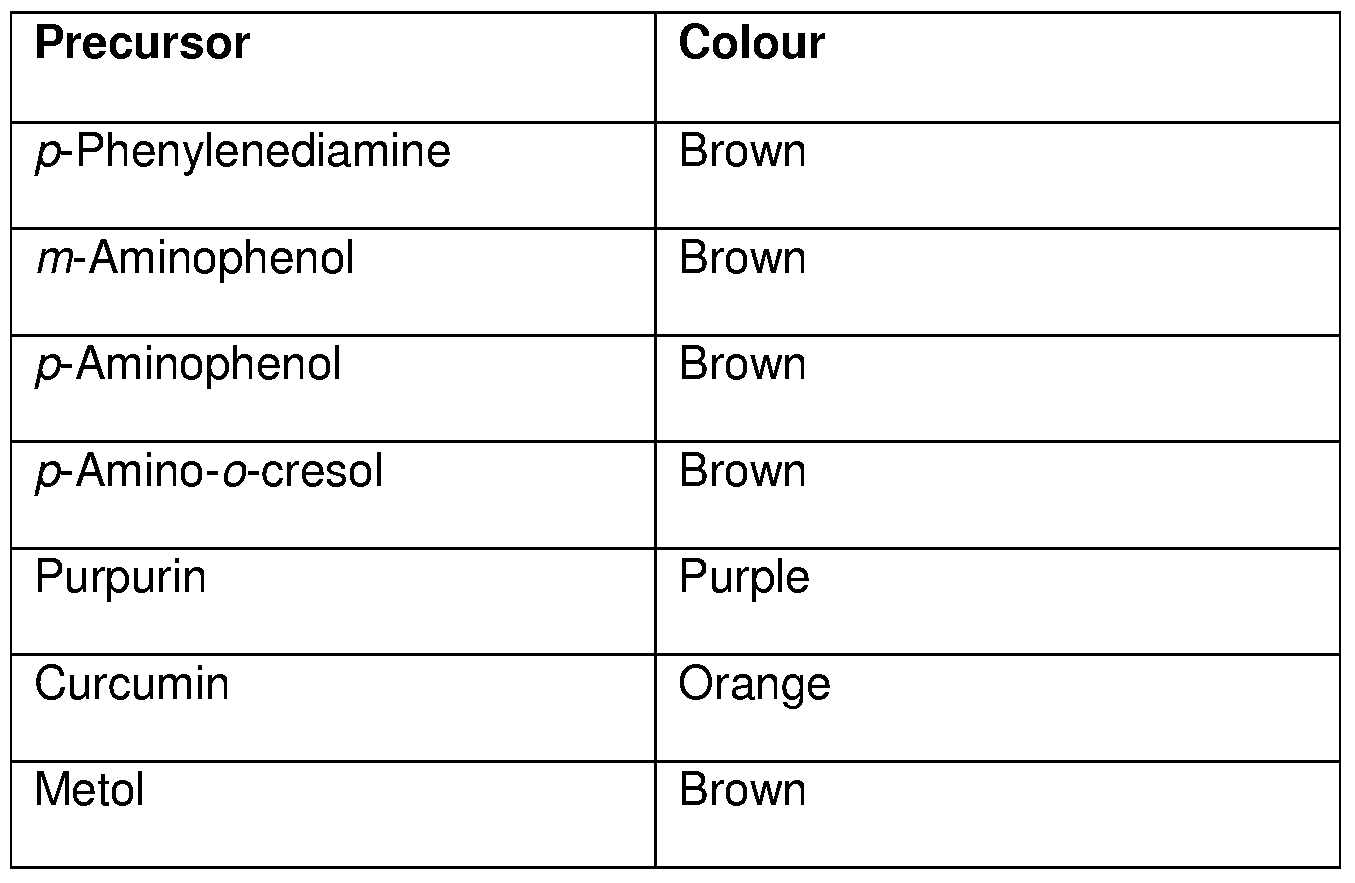
[0048] Solutions of dye precursor (100 mg) and ZrOCI2 (100 mg) in water (20 ml) were prepared and added to glass jars. Into each jar was suspended a bleached blonde hair swatch. Hydrogen peroxide (0.1 ml) was added, the jars sealed, and the mixtures shaken for 60 minutes, after which the swatches were removed, rinsed in warm water and air dried. The results are summarised in Table 1 .
Figure imgf000013_0001
TABLE 1 Colours observed when dyeing hair swatches with various dye precursors and
ZrOCI2 catalyst according to the invention
Example 2 - Dyeing of Hair
[0049] Solutions of m-aminophenol (30 mg) in water (10 ml) were prepared and added to glass jars. Catalyst (30 mg) was added, and a bleached blonde hair swatch suspended in each jar. Hydrogen peroxide (0.1 ml) was added, the jars sealed and the mixtures shaken for 60 minutes, after which the swatches were removed, rinsed in warm water and air dried. The results are summarised in Table 2.
Figure imgf000014_0001
TABLE 2 Colours observed when dyeing hair swatches using m-aminophenol dye precursor and various catalysts according to the invention
Example 3 - Dyeing of Hair
[0050] Solutions of p-amino-o-cresol (30mg) in water (10 ml) were prepared and added to glass jars. Catalyst (30 mg) was added, and a bleached blonde hair swatch suspended in each jar. Hydrogen peroxide (0.1 ml) was added, the jars sealed and the mixtures shaken for 60 minutes, after which the swatches were removed, rinsed in warm water and air dried. The results are summarised in Table 3.
Figure imgf000015_0001
TABLE 3 Colours observed when dyeing hair swatches using p-amino-o-cresol dye precursor and various catalysts according to the invention
Example 4 - Dyeing of Wool
[0051] Wool was first scoured using 2 g dm 3 Sandozin NIN for 15 minutes at 60 0C. The fabric was then dyed according to the following procedure:
1 ) Dye precursor (10% on weight of fibre) was added to the aqueous dyebath at a liquor ratio of 20:1 and mixed; 2) Fabric was wetted and added to the dyebath;
3) Titanium triethanolamine isopropyl chelate complex (10 ml dm 3) was added to the dyebath and mixed;
4) Hydrogen peroxide (10 ml dm"3) was added to the dyebath and mixed; and
5) Dyeing was carried out according to the following dyeing profile:
60 minutes
850C
Figure imgf000016_0001
The results are summarised in Table 4. The dyeings were seen to produce union shades.
Figure imgf000016_0002
TABLE 4 Colours observed when dyeing wool using various dye precursors and titanium triethanolamine isopropyl chelate complex catalyst according to the invention
Example 5 - Dyeing of Cotton
[0052] Cotton fabric was dyed according to the following procedure: 1 ) Dye precursor (10% on weight of fibre) was added to the aqueous dyebath at a liquor ratio of 20:1 and mixed;
2) Fabric was wetted and added to the dyebath;
3) Titanium triethanolamine isopropyl chelate complex (10 ml dm"3) was added to the dyebath and mixed;
4) Hydrogen peroxide (10 ml dm"3) was added to the dyebath and mixed; and
5) Dyeing was carried out according to the following dyeing profile:
60 minutes
Figure imgf000017_0001
The results are summarised in Table 5. The dyeings were seen to produce union shades.
Figure imgf000017_0002
TABLE 5 Colours observed when dyeing cotton using various dye precursors and titanium triethanolamine isopropyl chelate complex catalyst according to the invention Example 6 - Dyeing of Lvocell
[0053] Lyocell was first scoured using 2 g dm"3 Sandozin NIN and 1 g dm"3 Na2CO3 for 15 min at 60 0C. The fabric was then dyed according to the following procedure:
1 ) Dye precursor (10% on weight of fibre) was added to the aqueous dyebath at a liquor ratio of 20:1 and mixed;
2) Fabric was wetted and added to the dyebath;
3) Titanium triethanolamine isopropyl chelate complex (10 ml dm"3) was added to the dyebath and mixed;
4) Hydrogen peroxide (10 ml dm"3) was added to the dyebath and mixed;
5) Dyeing was carried out according to the following dyeing profile:
950C 60 minutes
Figure imgf000018_0001
The results are summarised in Table 6. The dyeings were seen to produce union shades.
Figure imgf000018_0002
TABLE 6 Colours observed when dyeing lyocell using various dye precursors and titanium triethanolamine isopropyl chelate complex catalyst according to the invention Example 7 - Dyeing of p-Aramid
[0054] p-Aramid fibre was dyed according to the following procedure:
1 ) Dye precursor (10% on weight of fibre) was added to the aqueous dyebath at a liquor ratio of 20:1 and mixed;
2) Fabric was wetted and added to the dyebath;
3) Titanium triethanolamine isopropyl chelate complex (10 ml dm 3) was added to the dyebath and mixed;
4) Hydrogen peroxide (10 ml dm"3) was added to the dyebath and mixed;
5) Dyeing was carried out according to the following dyeing profile:
12O0C 60 minutes
20C min"1
50C mIn"1
400C
200C
The results are summarised in Table 7. The dyeings were seen to produce union shades.
Figure imgf000019_0001
TABLE 7 Colours observed when dyeing p-aramid using various dye precursors and titanium triethanolamine isopropyl chelate complex catalyst according to the invention Example 8 - Dyeing of Polypropylene
[0055] The polymer was dyed according to the following procedure:
1 ) Dye precursor (10% on weight of fibre) was added to the aqueous dyebath at a liquor ratio of 20:1 and mixed;
2) Fabric was wetted and added to the dyebath;
3) Titanium triethanolamine isopropyl chelate complex (10 ml dm 3) was added to the dyebath and mixed;
4) Hydrogen peroxide (10 ml dm"3) was added to the dyebath and mixed; and
5) Dyeing was carried out according to the following dyeing profile
900C 60 minutes
20C min" 1
50C min 4O0C
Figure imgf000020_0001
The results are summarised in the Table 8. The dyeings were seen to produce union shades.
Figure imgf000020_0002
TABLE 8 Colours observed when dyeing polypropylene using various dye precursors and titanium triethanolamine isopropyl chelate complex catalyst according to the invention Example 9 - Dyeing of PET/cotton blend
[0056] The fabric was dyed according to the following procedure:
1 ) Dye precursor (10% on weight of fibre) was added to the aqueous dyebath at a liquor ratio of 20:1 and mixed;
2) Fabric was wetted and added to the dyebath;
3) Titanium triethanolamine isopropyl chelate complex (10 ml dm 3) was added to the dyebath and mixed;
4) Hydrogen peroxide (10 ml dm"3) was added to the dyebath and mixed;
5) Dyeing was carried out according to the following dyeing profile:
Figure imgf000021_0001
The results are summarised in Table 9. The dyeings were seen to produce union shades.
Figure imgf000021_0002
TABLE 9 Colours observed when dyeing PET/cotton blend using various dye precursors and titanium triethanolamine isopropyl chelate complex catalyst according to the invention [0057] Throughout the description and claims of this specification, the words "comprise" and
"contain" and variations of them mean "including but not limited to", and they are not intended to (and do not) exclude other moieties, additives, components, integers or steps. Throughout the description and claims of this specification, the singular encompasses the plural unless the context otherwise requires. In particular, where the indefinite article is used, the specification is to be understood as contemplating plurality as well as singularity, unless the context requires otherwise.
[0058] Features, integers, characteristics, compounds, chemical moieties or groups described in conjunction with a particular aspect, embodiment or example of the invention are to be understood to be applicable to any other aspect, embodiment or example described herein unless incompatible therewith. All of the features disclosed in this specification (including any accompanying claims, abstract and drawings), and/or all of the steps of any method or process so disclosed, may be combined in any combination, except combinations where at least some of such features and/or steps are mutually exclusive. The invention is not restricted to the details of any foregoing embodiments. The invention extends to any novel one, or any novel combination, of the features disclosed in this specification (including any accompanying claims, abstract and drawings), or to any novel one, or any novel combination, of the steps of any method or process so disclosed.
[0059] The reader's attention is directed to all papers and documents which are filed concurrently with or previous to this specification in connection with this application and which are open to public inspection with this specification, and the contents of all such papers and documents are incorporated herein by reference.

Claims

1. A dye system for application to a substrate, said dye system comprising:
(a) at least one dye precursor;
(b) an oxidising agent; and
(c) a catalyst,
wherein said catalyst is a homogeneous catalyst or a heterogeneous catalyst.
2. A dye system as claimed in claim 1 wherein said substrate comprises human hair.
3. A dye system as claimed in claim 1 wherein said substrate comprises a natural or synthetic polymeric substrate.
4. A dye system as claimed in claim 1 wherein said substrate comprises a textile fibre substrate.
5. A dye system as claimed in any one of claims 1 to 4 wherein said catalyst comprises at least one metal-containing compound.
6. A dye system as claimed in claim 5 wherein said at least one metal-containing compound for use as a catalyst comprises at least one inorganic metal compound.
7. A dye system as claimed in claim 6 wherein said at least one inorganic metal compound comprises at least one compound of a d-block transition metal.
8. A dye system as claimed in claim 7 wherein said d-block transition metal comprises scandium, titanium, vanadium, chromium, molybdenum, iron, manganese, cobalt, nickel, copper, zirconium or zinc.
9. A dye system as claimed in claim 7 or 8 wherein said at least one inorganic metal compound comprises an acetate, acetyl aceton ate, aluminate, bicarbonate, borate, bromate, carbonate, chlorite, cyanide, diethylcitrate, halide, hexafluoroacetylacetonate, hexafluorophosphate, hexafluorosilicate, dihydrogen phosphate, hydrogen carbonate, hydrogen sulphate, hydrogen sulphide, hydrogen sulphite, hydroxide, hypochlorite, iodate, nitrate, nitrite, oxalate, oxide, perfluorophthalocyanine, peroxide, phosphate, phthalocyanine, pyrophosphate, silicate, sulphamate, sulphate, sulphide, sulphite, tartrate, tetrafluoroborate, thiocyanate, thiolate, thiosulphate, tosylate or triflate.
10. A dye system as claimed in claim 7, 8 or 9 wherein said at least one compound is selected from TiBr2, TiBr4, TiCI2, TiCI3, TiCI4, TiF3, TiF4, Ti2O3, TiO(SO4), (TiO2)(SiO2), TiS2, VBr3, VCI2, VCI3, VCI4, V2O3, V2O4, V2O5, VO(SO4), VOCI3, VOF3, V(C5H7O2)3, VO(C5H7O2);,, VO(OR)3, Mo2(OCOCH3)4, Mo(CO)6, MoCI3, MoCI5, MoO2CI2, MoF6,MoO2, MoO3, MoS2, MoOCI4, MoSO4, Mn(OCOCH3)2, Mn(OCOCH3)2.xH2O, Mn(C5H7O2)2,
MnBr2,MnBr2.xH2O, MnCO3, MnCO3.xH2O, Mn2(CO)10, MnCI2, MnCI2.xH2O,MnF2, MnF3, Mn(HCO2)2.xH2O, MnI2, Mn(NO3)2, Mn(NO3)2.xH2O, Mn3O4, Mn2O3, MnO2, Mn(C32H16N8), MnSO4, MnSO4.xH2O, MnS, Fe(OCOCH3)2, Fe(OCOCH3)3, FeBr2, FeBr3, FeCI2, FeCI2.xH2O, FeCI3, FeCI3.xH2O, Fe(OEt)3, FeSO4.NH3CH2CH2NH3SO4.4H2O, Fe4[Fe(CN)6]3, FeF2, FeF3, FeF3.xH2O, FeI2, Fe(CH3CHOHCOO)2.xH2O, Fe(NO3)3.xH2O,
Fe(C2O4).xH2O, FeO, Fe2O3, Fe3O4, FePO4.xH2O, Fe(C32H16N8), FeSO4.xH2O, FeS, Fe(BF)4.xH2O, FeO3Ti, Fe(SCN)2, Co(OCOCH3)2, Co(OCOCH3)2.xH2O, Co(C5H7O2)2, Co(C5H7O2)2.xH2O, AI2CoO4, CoBr2, CoBr2.xH2O, CoCO3, CoCO3.xH2O, Co2(CO)81CoCI2, CoCI2.xH2O, CoF2, Co[CH3(CH2)3CH(C2H5)CO2]2, Co(OH)2, CoI2, Co(NO3)2, Co(NO3)2.xH2O, Co(C2O4), Co(C2O4).xH2O, CoSO4, CoSO4.xH2O, Co(BF4)2,
Co(BF4)2.xH2O, Co(SCN)2, Ni(OCOCH3)2, Ni(OCOCH3).xH2O, Ni(C5H7O2),, NiBr2, NiBr2.xH2O, NiCO3, Ni(CO3).xNi(OH)2, NiCI2, NiCI2.xH2O, NiOCoO, Ni[CH3(CH2)3CH(C2H5)CO2]2, NiF2, Ni(OH)2, NiI2, Ni(NO3)2, Ni(NO3)2.xH2O, Ni(C2O4), Ni(C2O4).xH2O, NiO2, NiO2.xH2O, Ni(C32H16N8), Ni(SO3NH2),, Ni(SO3NH2)2.xH2O, NiSO4, NiSO4.xH2O, Ni3S2, NiZnFe4O4, CuOCOCH3, Cu(OCOCH3)2, Cu(OCOCH3)2.xH2O,
Cu(C5H7O2)2, CuBr, CuBr2, CuCO3, CuCO3-Cu(OH)2, CuCI, CuCI2, CuCI2.xH2O, Cu[CH3(CH2)3CH(C2H5)CO2]2, CuF2, CuF2.xH2O, Cu(HCO2)2, Cu(HCO2)2.xH2O, Cu(OH)2, Cu2(OH)PO4, CuI, CuFe2O4, Cu(NO3)2, Cu(NO3)2.xH2O, Cu2O, CuO, Cu(C32H16N8), Cu2P2O7-XH2O, CuSO4, CuSO4.xH2O, CuS, Cu[O2CCH(OH)CH(OH)CO2].xH2O, Cu(BF4)2, Cu(BF4).xH2O, Cu(SCN), Zn(OCOCH3)2, Zn(OCOCH3)2.xH2O, Zn(C5H7O2),,
Zn(C5H7O2)2.xH2O, ZnBr2, ZnBr2.xH2O, ZnCI2, ZnF2, Zn(C32F16N8), Zn(C5HF6O2)2, Zn(C5HF6O2)2.xH2O, ZnSiF6.xH2O, ZnI2, ZnFe2O4,Zn(NO3)2, Zn(NO3)2.xH2O, Zn(C2O4), Zn(C2O4).xH2O, ZnO, ZnO.xH2O, ZnO2, Zn3(PO4)2, Zn(C32H16N8), ZnSO4, ZnSO4.xH2O, ZnS, Zn(BF4)2, Zn(BF4)2.xH2O, Zn2TiO4, Zr(OCOCH3)4, Zr(OCOCH3)x(OH)4_x, Zr(C5H7O2),, Zr(C26H44O16), ZrCO3(OH2)2.ZrO2, ZrCI4, ZrF4, ZrF4.xH2O, Zr(HPO4)2, Zr(OH)4, ZrI4,
ZrO(NO3)2, ZrO(NO3)2.xH2O, Zr(SO4)2, Zr(SO4)2.xH2O, ZrOCI2 and ZrOCI2.xH2O.
1 1 . A dye system as claimed in claim 6 wherein said at least one inorganic metal compound is chosen from salts of the alkali metals of Group 1 or the alkaline earth metals of Group 2.
12. A dye system as claimed in claim 1 1 wherein said alkali metal of Group 1 or alkaline earth metal of Group 2 comprises potassium or magnesium.
13. A dye system as claimed in claim 1 1 or 12 wherein said at least one salt comprises an acetate, acetylacetonate, aluminate, bicarbonate, borate, bromate, carbonate, chlorite, cyanide, diethylcitrate, halide, hexafluoroacetylacetonate, hexafluorophosphate, hexafluorosilicate, dihydrogen phosphate, hydrogen carbonate, hydrogen sulphate, hydrogen sulphide, hydrogen sulphite, hydroxide, hypochlorite, iodate, nitrate, nitrite, oxalate, oxide, perfluorophthalocyanine, peroxide, phosphate, phthalocyanine, pyrophosphate, silicate, sulphamate, sulphate, sulphide, sulphite, tartrate, tetrafluoroborate, thiocyanate, thiolate, thiosulphate, tosylate or triflate salt.
14. A dye system as claimed in claim 12 or 13 wherein said at least one salt comprises KAI(SO4)2 K2CO3, K3PO4, KNO3, KCI, MgSO4, Mg3(PO4)2, MgCO3, Mg(NO3)2 or MgCI2.
15. A dye system as claimed in any one of claims 1 to 14 wherein said catalyst comprises a mineral or clay.
16. A dye system as claimed in claim 15 wherein said mineral or clay comprises at least one of anatase, brookite, eudialyte, ilmenite, perovskite, rutile, sabaite, titanite, zircon, zirconolite, zircohylite or zirkelite.
17. A dye system as claimed in claim 5 wherein said at least one metal-containing compound for use as a catalyst comprises at least one metal complex comprising at least one organic ligand.
18. A dye system as claimed in claim 17 wherein said at least one metal complex comprising at least one organic ligand comprises at least one metal chelate.
19. A dye system as claimed in claim 17 or 18 wherein said at least one metal complex comprising at least one organic ligand comprises at least one titanium complex comprising at least one organic ligand.
20. A dye system as claimed in claim 17, 18 or 19 wherein said at least one organic ligand comprises at least one optionally substituted alkyl ligand.
21 . A dye system as claimed in any one of claims 17 to 20 wherein said at least one metal complex comprising at least one organic ligand is titanium triethanolamine isopropyl chelate complex.
22. A dye system as claimed in any one of claims 1 to 21 wherein said at least one dye precursor is an organic precursor.
23. A dye system as claimed in any preceding claim wherein said at least one dye precursor comprises at least one aromatic amino compound, phenolic compound, or aminophenolic compound.
24. A dye system as claimed in claim 22 or 23 wherein said at least one dye precursor is selected from p-aminophenol (4), o-aminophenol (5), p-amino-o-cresol (8), m- aminophenol (9), p-chlororesorcinol (10), 2,3-dihydroxynaphthalene (11) and 3- methylcatechol (12):
Figure imgf000026_0001
10 1 1 12
25. A dye system as claimed in claim 22 or 23 wherein said at least one dye precursor is selected from 4-methylresorcinol (14), p-aminobenzoic acid (15), 1 ,3- dihydroxynaphthalene (16) and 1 ,4-dihydroxynaphthalene (17):
Figure imgf000026_0002
14 15 16 17
26. A dye system as claimed in claim 22 or 23 wherein said at least one dye precursor comprises at least one naturally occurring compound or derivative thereof.
27. A dye system as claimed in claim 26 wherein said at least one naturally occurring compound or derivative thereof comprises at least one phenolic compound or derivative thereof.
28. A dye system as claimed in claim 27 wherein said at least one naturally occurring phenolic compound or derivative thereof is selected from gallic acid (18), tannic acid (19), vanillin (20), phloroglucinol (21) or orcinol (22):
Figure imgf000027_0001
18 19 20
Figure imgf000027_0002
21 22
29. A dye system as claimed in claim 27 wherein said at least one naturally occurring phenolic compound or derivative thereof comprises 5-aminosalicylic acid (23):
Figure imgf000027_0003
23
30. A dye system as claimed in claim 22 wherein said at least one organic precursor comprises isatin (24), 1 -methylindole (25) or 2-methylindole (26):
Figure imgf000028_0001
24 25 26
31 . A dye system as claimed in claim 23 wherein said at least one aromatic amino compound comprises N,N-bis(hydroxyethyl)-p-phenylenediamine (27):
Figure imgf000028_0002
27
32. A dye system as claimed in any preceding claim wherein said oxidising agent is selected from percarbonates, persulphates, organic peracids, organic hydroperoxides, molecular oxygen and air.
33. A dye system as claimed in any one of claims 1 to 31 wherein said oxidising agent is hydrogen peroxide.
34. A method for the coloration of a substrate, said method comprising:
(a) treating said substrate with at least one dye precursor;
(b) treating said substrate with an oxidising agent; and
(c) treating said substrate with a catalyst, wherein said catalyst is a homogeneous catalyst or a heterogeneous catalyst.
35. A method as claimed in claim 34 wherein said substrate comprises human hair.
36. A method as claimed in claim 35 which is carried out at ambient temperatures.
37. A method as claimed in claim 34 wherein said substrate comprises paper.
38. A method as claimed in claim 34 wherein said substrate comprises a natural or synthetic polymeric substrate.
39. A method as claimed in claim 38 wherein said substrate is selected from polyethylene, polyvinyl chloride, rubber or leather.
40. A method as claimed in claim 34 wherein said substrate comprises a textile fibre substrate.
41. A method as claimed in claim 40 wherein said textile fibre comprises at least one of cotton, wool, polypropylene, polyester, polyetherketone, p-aramid, m-aramid or lyocell.
42. A method as claimed in any one of claims 38 to 41 which is carried out at pressures of 1 -500 bar.
43. A method as claimed in any one of claims 38 to 41 which is carried out at atmospheric pressure and at a temperature in the range from 20°-1 10<€.
44. A method as claimed in any one of claims 38 to 42 which is carried out at pressures of 1 -20 bar and elevated temperatures in the range from 100°-200°C.
45. A method as claimed in claim 41 wherein said textile fibre comprises wool and said method is carried out at a pH in the range of 5-8.
46. A method as claimed in any one of claims 34 to 45 wherein said treatments of said substrate with at least one dye precursor, an oxidising agent and a catalyst are carried out simultaneously.
47. A method as claimed in any one of claims 34 to 45 wherein said treatments are carried out sequentially.
48. A method as claimed in any one of claims 34 to 47 which is performed by treating said substrate in aqueous solutions comprising said dye system.
49. A method as claimed in any one of claims 34 to 48 wherein said catalyst comprises at least one metal-containing compound.
50. A method as claimed in claim 49 wherein said at least one metal-containing compound for use as a catalyst comprises at least one inorganic metal compound.
51 . A method as claimed in claim 49 wherein said at least one metal-containing compound for use as a catalyst comprises at least one metal complex comprising at least one organic ligand.
52. A method as claimed in any one of claims 34 to 51 wherein said at least one dye precursor comprises an organic precursor.
53. A method as claimed in any one of claims 34 to 52 wherein said at least one dye precursor comprises at least one aromatic amino compound, phenolic compound or aminophenolic compound.
54. A method as claimed in any one of claims 34 to 53 wherein said oxidising agent is selected from percarbonates, persulphates, organic peracids, organic hydroperoxides, molecular oxygen and air.
55. A method as claimed in any one of claims 34 to 53 wherein said oxidising agent is hydrogen peroxide.
56. A method for the coloration of a substrate which comprises treating a substrate with a dye system as claimed in any one of claims 1 to 33.
PCT/EP2010/059322 2009-07-02 2010-06-30 Catalysed dye systems Ceased WO2011000892A2 (en)

Priority Applications (9)

Application Number Priority Date Filing Date Title
JP2012518900A JP2012531512A (en) 2009-07-02 2010-06-30 Catalytic dye system
US13/381,126 US8535391B2 (en) 2009-07-02 2010-06-30 Catalysed dye systems
EP10730147.5A EP2448545B1 (en) 2009-07-02 2010-06-30 Catalysed dye systems
ES10730147.5T ES2598501T3 (en) 2009-07-02 2010-06-30 Catalyzed Coloring Systems
BR112012000571A BR112012000571A2 (en) 2009-07-02 2010-06-30 catalyzed dye systems
CN201080030051.9A CN102470080B (en) 2009-07-02 2010-06-30 Catalysed dye systems
AU2010268006A AU2010268006B2 (en) 2009-07-02 2010-06-30 Catalysed dye systems
CA2803942A CA2803942C (en) 2009-07-02 2010-06-30 Catalysed dye systems
ZA2012/00796A ZA201200796B (en) 2009-07-02 2012-02-01 Catalysed dye systems

Applications Claiming Priority (2)

Application Number Priority Date Filing Date Title
GBGB0911493.5A GB0911493D0 (en) 2009-07-02 2009-07-02 Catalysed dye systems
GB0911493.5 2009-07-02

Publications (2)

Publication Number Publication Date
WO2011000892A2 true WO2011000892A2 (en) 2011-01-06
WO2011000892A3 WO2011000892A3 (en) 2011-06-16

Family

ID=41008636

Family Applications (1)

Application Number Title Priority Date Filing Date
PCT/EP2010/059322 Ceased WO2011000892A2 (en) 2009-07-02 2010-06-30 Catalysed dye systems

Country Status (12)

Country Link
US (1) US8535391B2 (en)
EP (2) EP3111915B1 (en)
JP (1) JP2012531512A (en)
KR (1) KR20120110078A (en)
CN (1) CN102470080B (en)
AU (1) AU2010268006B2 (en)
BR (1) BR112012000571A2 (en)
CA (1) CA2803942C (en)
ES (2) ES2651838T3 (en)
GB (1) GB0911493D0 (en)
WO (1) WO2011000892A2 (en)
ZA (1) ZA201200796B (en)

Cited By (19)

* Cited by examiner, † Cited by third party
Publication number Priority date Publication date Assignee Title
FR2976794A1 (en) * 2011-06-23 2012-12-28 Oreal Dyeing keratin fibers, preferably hair, comprises treating fibers with compositions containing ortho-diphenol derivatives, manganese or zinc salts, hydrogen peroxide, (bi)carbonates, basifying agents and titanium salts to keratin fibers
FR2976793A1 (en) * 2011-06-23 2012-12-28 Oreal Dyeing keratin fibers, preferably hair, comprises treating fibers with compositions containing ortho-diphenol derivatives, manganese or zinc salts, hydrogen peroxide, (bi)carbonates, basifying agents and titanium salts to keratin fibers
WO2013007606A2 (en) 2011-07-08 2013-01-17 Unilever Plc Hair care composition
JP2013519008A (en) * 2010-02-26 2013-05-23 コリア・ユニバーシティ・リサーチ・アンド・ビジネス・ファウンデーション Agents for improving the fastness of dyes
US8460445B2 (en) 2007-06-11 2013-06-11 Basf Se Corrosion protection coatings
FR2996125A1 (en) * 2012-09-28 2014-04-04 Oreal Coloring keratinous fibers, preferably hair, comprises treating fibers with cosmetic composition including naphthol derivative, magnesium/zinc salt, hydrogen peroxide, bicarbonates and optionally alkalizing agent different from bicarbonate
WO2012175683A3 (en) * 2011-06-23 2014-04-10 L'oreal Hair dyeing process using at least one ortho-diphenol, a manganese or zinc salt, hydrogen peroxide, (bi)carbonate, an alkaline agent and a titanium or scandium salt
US20140353200A1 (en) * 2011-12-20 2014-12-04 L'oreal Oxidation dyeing process using a composition rich in fatty substances and metal catalysts, and device suitable therefor
WO2015086677A1 (en) * 2013-12-13 2015-06-18 L'oreal Hair dyeing process using at least one ortho-diphenol and one organic salt of titanium and of a carboxylic acid
WO2015086678A1 (en) * 2013-12-13 2015-06-18 L'oreal Hair dyeing method employing at least one ortho-diphenol, one titanium derivative and one carboxylic acid
DE102016209961A1 (en) 2016-06-07 2017-03-16 Henkel Ag & Co. Kgaa Pre-treatment agent with transition metal salts
US10524998B2 (en) 2014-12-08 2020-01-07 L'oreal Hair dyeing process using at least one dye, an organic titanium salt, and a non-cellulosic-based polysaccharide
US10524992B2 (en) 2014-12-08 2020-01-07 L'oreal Hair dyeing process using at least one direct and/or natural dye, a titanium salt, a cellulose-based polysaccharide and optionally a particular organic solvent
US10524996B2 (en) 2014-12-08 2020-01-07 L'oreal Hair dyeing process using at least one dye, a titanium salt and an anionic thickening polymer
US10537511B2 (en) 2014-12-08 2020-01-21 L'oreal Hair dyeing process using at least one dye, a titanium salt and an insoluble silicate
US10952947B2 (en) 2018-03-27 2021-03-23 Elc Management Llc Thickened catalyzed dye system
US11160738B2 (en) 2018-03-27 2021-11-02 Elc Management Llc Method for forming a catalyzed dye system
US11369554B2 (en) 2018-03-27 2022-06-28 Elc Management Llc Catalyzed dye system
FR3124381A1 (en) * 2021-06-28 2022-12-30 L'oreal Process for lightening keratin fibers using a composition at basic pH comprising one or more specific metal compounds

Families Citing this family (9)

* Cited by examiner, † Cited by third party
Publication number Priority date Publication date Assignee Title
CN103194914B (en) * 2013-04-24 2014-08-13 南通大学 Normal-pressure dyeing method of fragrant polyester/polyurethane knitting fabric
FR3007281B1 (en) 2013-06-21 2015-07-24 Oreal OXIDATION COLORING PROCESS USING A RICH BODY COMPOSITION COMPRISING METAL CATALYSTS, AND COUPLERS
FR3007276B1 (en) * 2013-06-21 2015-06-19 Oreal OXIDATION COLORING PROCESS USING PRE-TREATMENT BASED ON BODY-RICH COMPOSITION AND METAL CATALYSTS
JP6787539B2 (en) * 2015-01-22 2020-11-18 ホーユー株式会社 Hair dye composition and method for stabilizing the color tone of the hair dye composition
FR3037240B1 (en) * 2015-06-12 2018-11-23 L'oreal MULTI-STAGE HAIR COLORING PROCESS USING AT LEAST ONE TITANIUM SALT AND SYNTHETIC DIRECT COLOR
CN107661747A (en) * 2016-07-28 2018-02-06 天津师范大学 Application of trifluoromethanesulfonic acid Ag (I) complexs based on 4 (ylmethyl of 1,2,4 triazoles of 1H 1) aniline in dyestuff is adsorbed
CN106311132B (en) * 2016-10-21 2018-11-27 西南大学 A kind of TiO2The method of the preparation and its removal mercury ions in waste water of/bentonite composite material
CN112726234B (en) * 2020-12-28 2023-03-28 武汉纺织大学 Organic perovskite paste for cotton fabric vat dye printing and preparation method and application thereof
CN114573087A (en) * 2022-03-18 2022-06-03 成都理工大学 Method for degrading phenol wastewater by using copper pyrophosphate as catalyst

Family Cites Families (22)

* Cited by examiner, † Cited by third party
Publication number Priority date Publication date Assignee Title
CA1201067A (en) * 1982-12-07 1986-02-25 Keith Brown Hair dyeing process and composition
DE3628398C2 (en) * 1986-08-21 1994-04-21 Goldwell Ag Agent for the oxidative dyeing of hair, process for its preparation and use of the agent
US4904274A (en) * 1988-05-12 1990-02-27 Clairol Incorporated Coloring hair with aminoalkyl-or aminohydroxyalkyl-catechols
CA1333690C (en) 1988-05-12 1994-12-27 Thomas Matthew Schultz Process for dyeing hair by the sequential treatment with metal ion containing composition and dye composition containing 5,6-dihydroxyindole-2-carboxylic acid
DE4331136C1 (en) * 1993-09-14 1994-08-25 Goldwell Ag Composition for the simultaneous colouring and lightening of human hair
US5993491A (en) * 1998-05-13 1999-11-30 Bristol-Myers Squibb Company Oxidative hair dye compositions and methods containing 1-(4-aminophenyl)-2-pyrrolidinemethanols
US5902835A (en) * 1998-05-28 1999-05-11 Air Products And Chemicals, Inc. Group IVB metal blowing catalyst compositions for the production of polyurethane foams
DE19852972A1 (en) * 1998-11-17 2000-05-18 Henkel Kgaa Colorants with transition metal complexes
DE19859721A1 (en) 1998-12-23 2000-06-29 Henkel Kgaa Agent for dyeing keratin fibers
DE19859681A1 (en) * 1998-12-23 2000-06-29 Henkel Kgaa Colorants with transition metals
DE10031993A1 (en) * 1999-08-17 2001-02-22 Henkel Kgaa Process for the oxidative coloring of keratin fibers
FR2798854B1 (en) * 1999-09-24 2001-11-16 Oreal KERATINIC FIBER OXIDATION DYE COMPOSITION AND DYEING METHOD USING THE SAME
FR2814947B1 (en) 2000-10-09 2003-01-31 Oreal TINCTORIAL COMPOSITION PROMOTING NATURAL PIGMENTATION PROCEDURE FOR OBTAINING AND USING FOR COLORING THE SKIN AND / OR KERATINIC FIBERS
DE60105544T2 (en) 2000-10-09 2005-12-08 L'oreal Dyeing composition, method for the preparation and use for coloring the skin and / or the keratin fibers
FR2847810B1 (en) * 2002-11-29 2006-02-10 COLORING AGENT FOR HUMAN KERATINIC MATERIALS HAVING AT LEAST TWO COMPONENTS AND METHODS FOR COLORING
US20040148712A1 (en) * 2002-11-29 2004-08-05 Francis Pruche Composition for coloring a keratin material, comprising at least two components, and coloring processes
BRPI0610694A2 (en) 2005-04-06 2010-07-20 Boots Co Plc improved oxidative hair dyes and related topical compositions
CA2606380C (en) * 2005-05-03 2011-08-02 The Procter & Gamble Company Compositions comprising a discrete particle aggregates and/or agglomerate for application to keratin fibers
DE102006036394A1 (en) 2006-08-02 2008-02-07 Henkel Kgaa Use of heteroaromatic compound for activating hydrogen peroxide and brightening keratin fibers such as wool, feathers and preferably human hair
NZ574744A (en) * 2006-08-10 2011-12-22 Combe Inc A catalyzed air oxidation haircolor
FR2939645B1 (en) * 2008-12-12 2011-02-11 Oreal CAPILLARY COLORING PROCESS FROM A COMPOSITION COMPRISING AT LEAST ONE ORTHODIPHENOL, A METALLIC SALT, HYDROGEN PEROXIDE AND (BI) CARBONATE
FR2939654B1 (en) * 2008-12-12 2011-02-11 Oreal A CAPILLARY COLORING PROCESS USING A HEMATOXYLINE, HEMATEINE, BRAZILINE OR BRAZILEINE DERIVATIVE, A METAL SALT, HYDROGEN PEROXIDE AND (BI) CARBONATE

Non-Patent Citations (8)

* Cited by examiner, † Cited by third party
Title
B.N. AMES; H.O. KAMMEN; E. YAMASAKI, PROC. NATL. ACAD. SCI. USA, vol. 72, 1975, pages 2423
C.J. LE COZ, REV. FR. ALLER. IMMUNOL. CLIN., vol. 41, 2001, pages 504
C.J. LE COZ; C. LEFEBVRE; F. KELLER; E. GROSSHANS, ARCH. DERMATOL., vol. 136, 2000, pages 1515
E.M. COULTER; C. JENKINSON; Y. WU; J. FARRELL; B. FOSTER; A. SMITH; C. MCGUIRE; C. PEASE; D. BASKETTER; C. KING, J. INVESTIG. DERMATOL., vol. 128, 2008, pages 897
J.S. ANDERSON, J. SOC. DYERS COL., vol. 116, 2000, pages 193
M. ONDER; C.A. ATAHAN; P. OZTAS; M.O. OZTAS, INT. J. DERMATOL., vol. 40, 2001, pages 577
M. PICARDO; C. CANNISTRACI; A. CRISTAUDO; C. DE LUCA; B. SANTUCCI, DERMATOLOGICA, vol. 181, 1990, pages 104
See also references of EP2448545A2

Cited By (28)

* Cited by examiner, † Cited by third party
Publication number Priority date Publication date Assignee Title
US8460445B2 (en) 2007-06-11 2013-06-11 Basf Se Corrosion protection coatings
JP2013519008A (en) * 2010-02-26 2013-05-23 コリア・ユニバーシティ・リサーチ・アンド・ビジネス・ファウンデーション Agents for improving the fastness of dyes
FR2976794A1 (en) * 2011-06-23 2012-12-28 Oreal Dyeing keratin fibers, preferably hair, comprises treating fibers with compositions containing ortho-diphenol derivatives, manganese or zinc salts, hydrogen peroxide, (bi)carbonates, basifying agents and titanium salts to keratin fibers
FR2976793A1 (en) * 2011-06-23 2012-12-28 Oreal Dyeing keratin fibers, preferably hair, comprises treating fibers with compositions containing ortho-diphenol derivatives, manganese or zinc salts, hydrogen peroxide, (bi)carbonates, basifying agents and titanium salts to keratin fibers
CN107049803A (en) * 2011-06-23 2017-08-18 欧莱雅 Use catechol, manganese salt or zinc salt, hydrogen peroxide, carbonic acid(Hydrogen)The hair-dyeing method of salt, basifier and titanium salt or scandium salts
WO2012175683A3 (en) * 2011-06-23 2014-04-10 L'oreal Hair dyeing process using at least one ortho-diphenol, a manganese or zinc salt, hydrogen peroxide, (bi)carbonate, an alkaline agent and a titanium or scandium salt
CN103945822A (en) * 2011-06-23 2014-07-23 欧莱雅 Process for coloring hair using at least one of catechol, manganese or zinc salts, hydrogen peroxide, (bi)carbonate salts, alkaline agents and titanium or scandium salts
JP2014520132A (en) * 2011-06-23 2014-08-21 ロレアル Hair dyeing method using at least one ortho-diphenol, manganese salt or zinc salt, hydrogen peroxide, (bi) carbonate, alkali agent, titanium salt or scandium salt
WO2013007606A2 (en) 2011-07-08 2013-01-17 Unilever Plc Hair care composition
US9173821B2 (en) * 2011-12-20 2015-11-03 L'oreal Oxidation dyeing process using a composition rich in fatty substances and metal catalysts, and device suitable therefor
US20140353200A1 (en) * 2011-12-20 2014-12-04 L'oreal Oxidation dyeing process using a composition rich in fatty substances and metal catalysts, and device suitable therefor
FR2996125A1 (en) * 2012-09-28 2014-04-04 Oreal Coloring keratinous fibers, preferably hair, comprises treating fibers with cosmetic composition including naphthol derivative, magnesium/zinc salt, hydrogen peroxide, bicarbonates and optionally alkalizing agent different from bicarbonate
US10052273B2 (en) 2013-12-13 2018-08-21 L'oreal Hair dyeing method employing at least one ortho-diphenol, one titanium derivative and one carboxylic acid
WO2015086677A1 (en) * 2013-12-13 2015-06-18 L'oreal Hair dyeing process using at least one ortho-diphenol and one organic salt of titanium and of a carboxylic acid
FR3014681A1 (en) * 2013-12-13 2015-06-19 Oreal A CAPILLARY COLORING PROCESS USING AT LEAST ONE ORTHODIPHENOL, AN ORGANIC TITANIUM SALT AND CARBOXYLIC ACID
FR3014682A1 (en) * 2013-12-13 2015-06-19 Oreal CAPILLARY COLORING PROCESS IMPLEMENTING AT LEAST ONE ORTHODIPHENOL, A TITANIUM DERIVATIVE, AND A CARBOXYLIC ACID
WO2015086678A1 (en) * 2013-12-13 2015-06-18 L'oreal Hair dyeing method employing at least one ortho-diphenol, one titanium derivative and one carboxylic acid
US10010495B2 (en) 2013-12-13 2018-07-03 L'oreal Hair dyeing process using at least one ortho-diphenol and one organic salt of titanium and of a carboxylic acid
US10524998B2 (en) 2014-12-08 2020-01-07 L'oreal Hair dyeing process using at least one dye, an organic titanium salt, and a non-cellulosic-based polysaccharide
US10524992B2 (en) 2014-12-08 2020-01-07 L'oreal Hair dyeing process using at least one direct and/or natural dye, a titanium salt, a cellulose-based polysaccharide and optionally a particular organic solvent
US10524996B2 (en) 2014-12-08 2020-01-07 L'oreal Hair dyeing process using at least one dye, a titanium salt and an anionic thickening polymer
US10537511B2 (en) 2014-12-08 2020-01-21 L'oreal Hair dyeing process using at least one dye, a titanium salt and an insoluble silicate
DE102016209961A1 (en) 2016-06-07 2017-03-16 Henkel Ag & Co. Kgaa Pre-treatment agent with transition metal salts
US10952947B2 (en) 2018-03-27 2021-03-23 Elc Management Llc Thickened catalyzed dye system
US11160738B2 (en) 2018-03-27 2021-11-02 Elc Management Llc Method for forming a catalyzed dye system
US11369554B2 (en) 2018-03-27 2022-06-28 Elc Management Llc Catalyzed dye system
FR3124381A1 (en) * 2021-06-28 2022-12-30 L'oreal Process for lightening keratin fibers using a composition at basic pH comprising one or more specific metal compounds
WO2023275070A1 (en) * 2021-06-28 2023-01-05 L'oreal Method for lightening keratin fibres employing a composition having a basic ph comprising one or more specific metal compounds

Also Published As

Publication number Publication date
AU2010268006A1 (en) 2012-02-09
CN102470080B (en) 2017-08-29
CA2803942C (en) 2019-02-05
GB0911493D0 (en) 2009-08-12
EP2448545B1 (en) 2016-09-07
CA2803942A1 (en) 2011-01-06
EP3111915A1 (en) 2017-01-04
JP2012531512A (en) 2012-12-10
BR112012000571A2 (en) 2016-02-10
US20120110751A1 (en) 2012-05-10
KR20120110078A (en) 2012-10-09
ES2651838T3 (en) 2018-01-30
EP2448545A2 (en) 2012-05-09
ZA201200796B (en) 2012-10-31
ES2598501T3 (en) 2017-01-27
CN102470080A (en) 2012-05-23
EP3111915B1 (en) 2017-10-04
AU2010268006B2 (en) 2016-09-08
US8535391B2 (en) 2013-09-17
WO2011000892A3 (en) 2011-06-16

Similar Documents

Publication Publication Date Title
US8535391B2 (en) Catalysed dye systems
DE69211045T2 (en) Process for the oxidative coloring of hair with catalytic pretreatment
JPH072637A (en) Use of metal salts and chelates with chlorite as oxidant in hair dyeing
CA3095160C (en) Method for forming a catalyzed dye system
CA3095158C (en) Catalyzed dye system
AU2019242743B2 (en) Thickened catalyzed dye system
CN111840131B (en) Preparation method of hair dyeing material
HK40040875A (en) Thickened catalyzed dye system
HK40041677A (en) Catalyzed dye system

Legal Events

Date Code Title Description
WWE Wipo information: entry into national phase

Ref document number: 201080030051.9

Country of ref document: CN

WWE Wipo information: entry into national phase

Ref document number: 13381126

Country of ref document: US

WWE Wipo information: entry into national phase

Ref document number: 2011003348

Country of ref document: CL

Ref document number: 2012518900

Country of ref document: JP

NENP Non-entry into the national phase

Ref country code: DE

WWE Wipo information: entry into national phase

Ref document number: 19/DELNP/2012

Country of ref document: IN

ENP Entry into the national phase

Ref document number: 20127000138

Country of ref document: KR

Kind code of ref document: A

WWE Wipo information: entry into national phase

Ref document number: 2010268006

Country of ref document: AU

REEP Request for entry into the european phase

Ref document number: 2010730147

Country of ref document: EP

WWE Wipo information: entry into national phase

Ref document number: 2010730147

Country of ref document: EP

ENP Entry into the national phase

Ref document number: 2010268006

Country of ref document: AU

Date of ref document: 20100630

Kind code of ref document: A

REG Reference to national code

Ref country code: BR

Ref legal event code: B01A

Ref document number: 112012000571

Country of ref document: BR

Kind code of ref document: A2

121 Ep: the epo has been informed by wipo that ep was designated in this application

Ref document number: 10730147

Country of ref document: EP

Kind code of ref document: A2

ENP Entry into the national phase

Ref document number: 2803942

Country of ref document: CA

ENP Entry into the national phase

Ref document number: 112012000571

Country of ref document: BR

Kind code of ref document: A2

Effective date: 20120102