WO2010150822A1 - 収着濾過材料 - Google Patents
収着濾過材料 Download PDFInfo
- Publication number
- WO2010150822A1 WO2010150822A1 PCT/JP2010/060664 JP2010060664W WO2010150822A1 WO 2010150822 A1 WO2010150822 A1 WO 2010150822A1 JP 2010060664 W JP2010060664 W JP 2010060664W WO 2010150822 A1 WO2010150822 A1 WO 2010150822A1
- Authority
- WO
- WIPO (PCT)
- Prior art keywords
- mol
- glass
- sorption
- filtration material
- electrolyte melt
- Prior art date
- Legal status (The legal status is an assumption and is not a legal conclusion. Google has not performed a legal analysis and makes no representation as to the accuracy of the status listed.)
- Ceased
Links
Classifications
-
- G—PHYSICS
- G21—NUCLEAR PHYSICS; NUCLEAR ENGINEERING
- G21F—PROTECTION AGAINST X-RADIATION, GAMMA RADIATION, CORPUSCULAR RADIATION OR PARTICLE BOMBARDMENT; TREATING RADIOACTIVELY CONTAMINATED MATERIAL; DECONTAMINATION ARRANGEMENTS THEREFOR
- G21F9/00—Treating radioactively contaminated material; Decontamination arrangements therefor
- G21F9/28—Treating solids
- G21F9/30—Processing
-
- B—PERFORMING OPERATIONS; TRANSPORTING
- B01—PHYSICAL OR CHEMICAL PROCESSES OR APPARATUS IN GENERAL
- B01J—CHEMICAL OR PHYSICAL PROCESSES, e.g. CATALYSIS OR COLLOID CHEMISTRY; THEIR RELEVANT APPARATUS
- B01J20/00—Solid sorbent compositions or filter aid compositions; Sorbents for chromatography; Processes for preparing, regenerating or reactivating thereof
- B01J20/02—Solid sorbent compositions or filter aid compositions; Sorbents for chromatography; Processes for preparing, regenerating or reactivating thereof comprising inorganic material
- B01J20/0203—Solid sorbent compositions or filter aid compositions; Sorbents for chromatography; Processes for preparing, regenerating or reactivating thereof comprising inorganic material comprising compounds of metals not provided for in B01J20/04
- B01J20/0211—Compounds of Ti, Zr, Hf
-
- B—PERFORMING OPERATIONS; TRANSPORTING
- B01—PHYSICAL OR CHEMICAL PROCESSES OR APPARATUS IN GENERAL
- B01J—CHEMICAL OR PHYSICAL PROCESSES, e.g. CATALYSIS OR COLLOID CHEMISTRY; THEIR RELEVANT APPARATUS
- B01J20/00—Solid sorbent compositions or filter aid compositions; Sorbents for chromatography; Processes for preparing, regenerating or reactivating thereof
- B01J20/02—Solid sorbent compositions or filter aid compositions; Sorbents for chromatography; Processes for preparing, regenerating or reactivating thereof comprising inorganic material
- B01J20/0203—Solid sorbent compositions or filter aid compositions; Sorbents for chromatography; Processes for preparing, regenerating or reactivating thereof comprising inorganic material comprising compounds of metals not provided for in B01J20/04
- B01J20/0225—Compounds of Fe, Ru, Os, Co, Rh, Ir, Ni, Pd, Pt
- B01J20/0229—Compounds of Fe
-
- B—PERFORMING OPERATIONS; TRANSPORTING
- B01—PHYSICAL OR CHEMICAL PROCESSES OR APPARATUS IN GENERAL
- B01J—CHEMICAL OR PHYSICAL PROCESSES, e.g. CATALYSIS OR COLLOID CHEMISTRY; THEIR RELEVANT APPARATUS
- B01J20/00—Solid sorbent compositions or filter aid compositions; Sorbents for chromatography; Processes for preparing, regenerating or reactivating thereof
- B01J20/02—Solid sorbent compositions or filter aid compositions; Sorbents for chromatography; Processes for preparing, regenerating or reactivating thereof comprising inorganic material
- B01J20/04—Solid sorbent compositions or filter aid compositions; Sorbents for chromatography; Processes for preparing, regenerating or reactivating thereof comprising inorganic material comprising compounds of alkali metals, alkaline earth metals or magnesium
- B01J20/041—Oxides or hydroxides
-
- B—PERFORMING OPERATIONS; TRANSPORTING
- B01—PHYSICAL OR CHEMICAL PROCESSES OR APPARATUS IN GENERAL
- B01J—CHEMICAL OR PHYSICAL PROCESSES, e.g. CATALYSIS OR COLLOID CHEMISTRY; THEIR RELEVANT APPARATUS
- B01J20/00—Solid sorbent compositions or filter aid compositions; Sorbents for chromatography; Processes for preparing, regenerating or reactivating thereof
- B01J20/02—Solid sorbent compositions or filter aid compositions; Sorbents for chromatography; Processes for preparing, regenerating or reactivating thereof comprising inorganic material
- B01J20/06—Solid sorbent compositions or filter aid compositions; Sorbents for chromatography; Processes for preparing, regenerating or reactivating thereof comprising inorganic material comprising oxides or hydroxides of metals not provided for in group B01J20/04
-
- B—PERFORMING OPERATIONS; TRANSPORTING
- B01—PHYSICAL OR CHEMICAL PROCESSES OR APPARATUS IN GENERAL
- B01J—CHEMICAL OR PHYSICAL PROCESSES, e.g. CATALYSIS OR COLLOID CHEMISTRY; THEIR RELEVANT APPARATUS
- B01J20/00—Solid sorbent compositions or filter aid compositions; Sorbents for chromatography; Processes for preparing, regenerating or reactivating thereof
- B01J20/02—Solid sorbent compositions or filter aid compositions; Sorbents for chromatography; Processes for preparing, regenerating or reactivating thereof comprising inorganic material
- B01J20/06—Solid sorbent compositions or filter aid compositions; Sorbents for chromatography; Processes for preparing, regenerating or reactivating thereof comprising inorganic material comprising oxides or hydroxides of metals not provided for in group B01J20/04
- B01J20/08—Solid sorbent compositions or filter aid compositions; Sorbents for chromatography; Processes for preparing, regenerating or reactivating thereof comprising inorganic material comprising oxides or hydroxides of metals not provided for in group B01J20/04 comprising aluminium oxide or hydroxide; comprising bauxite
-
- G—PHYSICS
- G21—NUCLEAR PHYSICS; NUCLEAR ENGINEERING
- G21C—NUCLEAR REACTORS
- G21C19/00—Arrangements for treating, for handling, or for facilitating the handling of, fuel or other materials which are used within the reactor, e.g. within its pressure vessel
- G21C19/42—Reprocessing of irradiated fuel
- G21C19/44—Reprocessing of irradiated fuel of irradiated solid fuel
- G21C19/48—Non-aqueous processes
-
- G—PHYSICS
- G21—NUCLEAR PHYSICS; NUCLEAR ENGINEERING
- G21F—PROTECTION AGAINST X-RADIATION, GAMMA RADIATION, CORPUSCULAR RADIATION OR PARTICLE BOMBARDMENT; TREATING RADIOACTIVELY CONTAMINATED MATERIAL; DECONTAMINATION ARRANGEMENTS THEREFOR
- G21F9/00—Treating radioactively contaminated material; Decontamination arrangements therefor
- G21F9/04—Treating liquids
- G21F9/06—Processing
- G21F9/12—Processing by absorption; by adsorption; by ion-exchange
-
- B—PERFORMING OPERATIONS; TRANSPORTING
- B01—PHYSICAL OR CHEMICAL PROCESSES OR APPARATUS IN GENERAL
- B01J—CHEMICAL OR PHYSICAL PROCESSES, e.g. CATALYSIS OR COLLOID CHEMISTRY; THEIR RELEVANT APPARATUS
- B01J2220/00—Aspects relating to sorbent materials
- B01J2220/40—Aspects relating to the composition of sorbent or filter aid materials
- B01J2220/42—Materials comprising a mixture of inorganic materials
-
- Y—GENERAL TAGGING OF NEW TECHNOLOGICAL DEVELOPMENTS; GENERAL TAGGING OF CROSS-SECTIONAL TECHNOLOGIES SPANNING OVER SEVERAL SECTIONS OF THE IPC; TECHNICAL SUBJECTS COVERED BY FORMER USPC CROSS-REFERENCE ART COLLECTIONS [XRACs] AND DIGESTS
- Y02—TECHNOLOGIES OR APPLICATIONS FOR MITIGATION OR ADAPTATION AGAINST CLIMATE CHANGE
- Y02E—REDUCTION OF GREENHOUSE GAS [GHG] EMISSIONS, RELATED TO ENERGY GENERATION, TRANSMISSION OR DISTRIBUTION
- Y02E30/00—Energy generation of nuclear origin
- Y02E30/30—Nuclear fission reactors
-
- Y—GENERAL TAGGING OF NEW TECHNOLOGICAL DEVELOPMENTS; GENERAL TAGGING OF CROSS-SECTIONAL TECHNOLOGIES SPANNING OVER SEVERAL SECTIONS OF THE IPC; TECHNICAL SUBJECTS COVERED BY FORMER USPC CROSS-REFERENCE ART COLLECTIONS [XRACs] AND DIGESTS
- Y02—TECHNOLOGIES OR APPLICATIONS FOR MITIGATION OR ADAPTATION AGAINST CLIMATE CHANGE
- Y02W—CLIMATE CHANGE MITIGATION TECHNOLOGIES RELATED TO WASTEWATER TREATMENT OR WASTE MANAGEMENT
- Y02W30/00—Technologies for solid waste management
- Y02W30/50—Reuse, recycling or recovery technologies
Definitions
- the present invention relates to Cs in an electrolyte melt comprising a chloride-based mixed salt, for example, Cs which is a fission product accumulated in a chloride-based spent electrolyte melt generated in a dry reprocessing step of spent nuclear fuel.
- the present invention relates to a sorption filtration material capable of separating an electrolyte melt and a fission product by selective sorption.
- the spent fuel is dissolved in a solvent of a chloride-based high-temperature molten salt, and the electrolytic deposit deposited on the cathode is recovered by electrolytic treatment of the melt and reprocessed. is doing.
- the spent electrolyte melt generated in such a process contains actinide substances and fission products (FP) and is therefore discarded as high-level radioactive waste. Therefore, it is necessary to regenerate the spent electrolyte melt from the viewpoint of reducing the amount of waste and economical efficiency.
- FP fission products
- an object of the present invention is to provide a sorption filtration material that can simplify the regeneration of an electrolyte melt and reduce environmental and economic loads.
- the present invention provides a sorption filtration material capable of selectively sorbing Cs in an electrolyte melt composed of a chloride-based mixed salt.
- the sorption filtration material of the present invention comprises 1 to 50 mol% Fe 2 O 3 , 30 to 80 mol% P 2 O 5 , 0 to 30 mol% Al 2 O 3, and 0 to 30% TiO 2.
- the total content of R 2 O and R'O is glass or crystallized glass is 1 mol% or more Features.
- the glass and crystallized glass precursor glass has a softening point of 450 ° C. or higher.
- Sorption filter material of the present invention comprises a Fe 2 O 3 from Fe 2 O 3 -P 2 O 5 based glass or crystallized glass comprising as essential components, in the electrolyte melt of a mixed salt of a chloride based It has a function of selectively sorbing Cs, for example, Cs which is FP remaining in the chloride-based spent electrolyte melt.
- the sorption filtration material of the present invention comprises 1 to 50 mol% Fe 2 O 3 , 30 to 80 mol% P 2 O 5 , 0 to 30 mol% Al 2 O 3 , TiO 2. 0 to 50 mol%, ZrO 2 0 to 5 mol%, R 2 O selected from Li 2 O, Na 2 O, K 2 O at least one selected from 0 to 40 mol%, R′O MgO From a glass or crystallized glass containing 0 to 60 mol% of one or more selected from CaO, SrO, BaO and ZnO and having a total content of R 2 O and R′O of 1 mol% or more Become.
- P 2 O 5 is an essential main component for glass formation and is a component that facilitates glass melting.
- P 2 O 5 is desirably contained in the range of 30 to 80 mol% in the glass or crystallized glass.
- the P 2 O 5 content is less than 30 mol%, the above-described effects cannot be exhibited, and vitrification becomes difficult.
- the P 2 O 5 content exceeds 80%, the moisture resistance of the glass is deteriorated.
- the P 2 O 5 content is more preferably in the range of 40 to 70 mol%.
- Fe 2 O 3 is an essential component for sorbing Cs, and is a component that improves the hygroscopicity that is a problem with P 2 O 5 glass and stabilizes the glass. It is desirable to contain Fe 2 O 3 in the range of 1 to 50 mol% in the glass or crystallized glass. If the Fe 2 O 3 content is less than 1 mol%, the above-described effect cannot be exhibited. If the Fe 2 O 3 content exceeds 50 mol%, it will not vitrify. The Fe 2 O 3 content is more preferably in the range of 5 to 45 mol%.
- Al 2 O 3 is a component that suppresses crystallization during glass formation and improves the chemical durability of the glass. Further, by containing Al 2 O 3 in the glass, the material shape can be maintained even after immersing Cs in the molten salt.
- Al 2 O 3 is preferably contained in the range of 0 to 30 mol% in the glass or crystallized glass. If the Al 2 O 3 content exceeds 30 mol%, it will not vitrify. The Al 2 O 3 content is more preferably in the range of 0 to 20 mol%.
- TiO 2 is a component that improves the heat resistance of the glass and makes it easy to maintain the material shape after Cs sorption, similar to Al 2 O 3 .
- TiO 2 is preferably contained in the range of 0 to 50 mol% in the glass or crystallized glass. If the TiO 2 content exceeds 50 mol%, vitrification becomes difficult. The TiO 2 content is more preferably in the range of 0 to 35 mol%.
- ZrO 2 is a component that improves the heat resistance of the glass and makes it easy to maintain the material shape after Cs sorption, similar to Al 2 O 3 . Furthermore, in crystallized glass, it is a component that becomes a crystal nucleus. ZrO 2 is preferably contained in the range of 0 to 5 mol% in the glass or crystallized glass. If the ZrO 2 content exceeds 5 mol%, vitrification becomes difficult. The ZrO 2 content is more preferably in the range of 0 to 4 mol%.
- R 2 O is at least one selected from Li 2 O, Na 2 O, and K 2 O, and is a component that promotes Cs sorption.
- R 2 O is desirably contained in the range of 0 to 40 mol% in total in the glass or crystallized glass. When the R 2 O content exceeds 40 mol%, the softening point becomes too low and the electrolyte melt cannot withstand the melting temperature. In addition, the moisture resistance of the glass is significantly deteriorated.
- the R 2 O content is more preferably in the range of 0 to 35 mol%.
- R′O is at least one selected from MgO, CaO, SrO, BaO, and ZnO, and is not an essential component, but is a component that can adjust the softening point and Cs sorption. If appropriate, R′O is contained in the glass or crystallized glass in a total range of 0 to 60 mol%. If the R'O content exceeds 60 mol%, vitrification becomes difficult. The R′O content is more preferably in the range of 0 to 55 mol%.
- the sorption of Cs is promoted by setting the total content of R 2 O and R′O to 1 mol% or more.
- the total content of R 2 O and R′O is preferably 3 mol% or more, more preferably 5 mol% or more.
- the total content of R 2 O and R′O is less than 1 mol%, there is almost no sorption property and it is unsuitable as a sorption filter material.
- V 2 O 5 , SnO 2 , TeO 2, etc. which are represented by general oxides, or F 2 , Cl 2, etc. are added up to 3 mol% within the range that does not impair the above properties. May be.
- any glass or crystallized glass may be used as long as it has Cs sorption performance. If it is glass, it becomes easy to promote sorption, and if it is crystallized glass, it will become easy to maintain heat resistance and the shape after sorption.
- the softening point of the glass and the precursor glass of crystallized glass is 450 ° C. or higher. If the softening point is less than 450 ° C., it may not be able to withstand the melting temperature of the electrolyte melt and the shape may not be maintained.
- the Cs sorption effect of the sorption filtration material of the present invention is due to any of ion exchange, molecular sieving, reaction / crystallization, or a combination thereof.
- the shape of the sorption filtration material of the present invention is not particularly limited, but is preferably powdery, fibrous, or porous in order to increase the Cs sorption effect.
- the sorption filtration material of the present invention is effective for a molten salt of a chloride-based electrolyte melt containing Cs.
- the chloride electrolyte melt may contain other salts such as phosphates.
- Orthophosphoric acid as P 2 O 5 source iron oxide as Fe 2 O 3 source, aluminum oxide as Al 2 O 3 source, titanium oxide as TiO 2 source, lithium carbonate as Li 2 O source, sodium carbonate as Na 2 O source , Potassium carbonate as the K 2 O source, magnesium carbonate as the MgO source, calcium carbonate as the CaO source, strontium carbonate as the SrO source, barium carbonate as the BaO source, and zinc oxide as the ZnO source. Then, it was put into a platinum crucible and heated and melted in an electric heating furnace at 1100 to 1300 ° C. for 1 to 3 hours. The molten glass was poured into a mold, made into a block shape, transferred into an electric furnace maintained above the glass transition point, and gradually cooled to obtain glass samples of Examples 1 to 8 and Comparative Examples 1 to 4.
- the softening point and Cs sorption effect were evaluated for each sample thus prepared.
- the softening point was measured using a thermal analyzer TG-DTA (manufactured by Rigaku Corporation).
- the Cs sorption effect is obtained by adding CsCl to a LiCl-KCl mixed salt and heating it at 500 ° C. in a dry atmosphere to form a molten salt. And evaluated by elemental analysis.
- Tables 1 and 2 show the compositions and evaluation test results of the glass samples of Examples 1 to 8 and Comparative Examples 1 to 4, respectively.
- the compositions of Comparative Examples 1 and 2 are in an appropriate range, but the (R 2 O + R′O) content is less than 1 mol%, so that the Cs sorption effect is obtained. I could't. Since the sample of Comparative Example 3 was not suitable in composition, it was not vitrified and the Cs sorption effect was not obtained. Further, the sample of Comparative Example 4 is a typical soda lime glass, because it does not contain Fe 2 O 3, Cs sorption effect was not obtained.
- the sorption filtration material of the present invention selects Cs in an electrolyte melt composed of a chloride-based mixed salt, for example, Cs that is a fission product accumulated in a chloride-based spent electrolyte melt. Therefore, it is possible to simplify the regeneration of the electrolyte melt and reduce the environmental and economic loads.
Landscapes
- Chemical & Material Sciences (AREA)
- Inorganic Chemistry (AREA)
- Analytical Chemistry (AREA)
- Organic Chemistry (AREA)
- Chemical Kinetics & Catalysis (AREA)
- Physics & Mathematics (AREA)
- Engineering & Computer Science (AREA)
- General Engineering & Computer Science (AREA)
- High Energy & Nuclear Physics (AREA)
- Plasma & Fusion (AREA)
- Treatment Of Liquids With Adsorbents In General (AREA)
- Solid-Sorbent Or Filter-Aiding Compositions (AREA)
- Glass Compositions (AREA)
Abstract
本発明によれば、塩化物系の混合塩からなる電解質融液中のCsを選択的に収着する収着濾過材料が提供される。この収着濾過材料の使用により、電解質融液の再生を簡便化して、環境及び経済面での負荷を低減することができる。
Description
本発明は、塩化物系の混合塩からなる電解質融液中のCs、例えば、使用済核燃料の乾式再処理工程で生じる塩化物系使用済電解質融液中に蓄積した核分裂生成物であるCsを選択的に収着させることで、電解質融液と核分裂生成物を分離可能な収着濾過材料に関する。
使用済核燃料の乾式再処理工程では、塩化物系の高温溶融塩の溶媒に使用済燃料を溶解し、融液を電解処理することで陰極上に析出する電解析出物を回収し、再処理している。このような工程で発生する使用済電解質融液は、アクチノイド物質や核分裂生成物(FP)を含有しているため、高レベル放射性廃棄物として廃棄される。そのため、廃棄物量の低減や経済性の観点から、使用済電解質融液の再生を行う必要性がある。
従来技術として、使用済電解質融液中に残留するアクチノイド物質を還元・抽出工程で取り除き、ゼオライトカラムを通過させることでFPを吸着・除去する再処理工程が検討されている(例えば、非特許文献1参照)。しかし、この再処理工程ではFPを吸着したゼオライトの処理・処分が必要となり、廃棄物処理工程においてFPを安定化させた大量のソーダライトが発生し、環境負荷及び経済性の点から大きな課題となっている。
この問題を解決すべく、使用済電解質融液中のFPをリン酸塩に転換することにより沈殿分離し、電解質融液の再生を試みている(例えば、特許文献1参照)。しかしながら、使用済電解質融液中に残留するFPのうち、例えばCsのようにリン酸塩として電解質融液中に沈殿しないものがある(例えば、非特許文献2参照)。そのため、沈殿分離後の電解質融液中もまた処理・処分が必要であり、経済性の面から大きな課題となっている。
「乾式再処理技術開発における要素技術開発の現状」明珍宗孝、青瀬晋一、サイクル機構、No.24別冊、2004、11、p166
「乾式再処理から発生する廃溶融塩の固化技術の開発」豊原尚美 他、日本原子力学会和文論文誌、Vol.1、No.4、2002、p420
上記課題に鑑み、本発明は、電解質融液の再生を簡便化して、環境及び経済面での負荷を低減できる収着濾過材料を提供することを目的とする。
即ち、本発明では、塩化物系の混合塩からなる電解質融液中のCsを選択的に収着できる収着濾過材料が提供される。
好ましくは、本発明の収着濾過材料は、Fe2O3を1~50モル%、P2O5を30~80モル%、Al2O3を0~30モル%、TiO2を0~50モル%、ZrO2を0~5モル%、R2OとしてLi2O、Na2O、K2Oから選択される1種以上を0~40モル%、R’OとしてMgO、CaO、SrO、BaO、ZnOから選択される1種以上を0~60モル%含有し、且つ、R2OとR’Oの合計含有量が1モル%以上であるガラス又は結晶化ガラスであることを特徴とする。
また、好ましくは、ガラス及び結晶化ガラスの前駆体ガラスの軟化点が450℃以上であることを特徴とする。
以下、本発明を詳細に説明する。
本発明の収着濾過材料は、Fe2O3を必須成分として含むFe2O3-P2O5系のガラス又は結晶化ガラスからなり、塩化物系の混合塩からなる電解質融液中のCs、例えば、塩化物系使用済電解質融液中に残留するFPであるCsを選択的に収着する機能を有する。
より具体的には、本発明の収着濾過材料は、Fe2O3を1~50モル%、P2O5を30~80モル%、Al2O3を0~30モル%、TiO2を0~50モル%、ZrO2を0~5モル%、R2OとしてLi2O、Na2O、K2Oから選択される1種以上を0~40モル%、R’OとしてMgO、CaO、SrO、BaO、ZnOから選択される1種以上を0~60モル%含有し、且つ、R2OとR’Oの合計含容量が1モル%以上であるガラス又は結晶化ガラスからなる。
P2O5は、ガラス形成のための必須の主成分であり、ガラス溶融を容易にする成分である。ガラス又は結晶化ガラス中にP2O5は30~80モル%の範囲で含有させることが望ましい。P2O5含有量が30モル%未満では、上記作用を発揮し得ず、且つ、ガラス化が困難となる。P2O5含有量が80%を超えると、ガラスの耐湿性が悪くなる。P2O5含有量は、より好ましくは40~70モル%の範囲である。
Fe2O3は、Csを収着するための必須成分であり、P2O5系ガラスで問題となる吸湿性を改善し、ガラスを安定化させる成分である。ガラス又は結晶化ガラス中にFe2O3は1~50モル%の範囲で含有させることが望ましい。Fe2O3含有量が1モル%未満では、上記作用を発揮し得ない。Fe2O3含有量が50モル%を超えると、ガラス化しなくなる。Fe2O3含有量は、より好ましくは5~45モル%の範囲である。
Al2O3は、ガラス形成の際に結晶化を抑制し、且つガラスの化学的耐久性を向上させる成分である。またガラス中にAl2O3を含有することで、溶融塩に浸漬してCsを収着した後でも材料形状を維持できるようになる。ガラス又は結晶化ガラス中にAl2O3は0~30モル%の範囲で含有させることが好ましい。Al2O3含有量が30モル%を超えると、ガラス化しなくなる。Al2O3含有量は、より好ましくは0~20モル%の範囲である。
TiO2は、ガラスの耐熱性を向上させ、またAl2O3と同様にCs収着後の材料形状を維持しやすくする成分である。ガラス又は結晶化ガラス中にTiO2は0~50モル%の範囲で含有させることが好ましい。TiO2含有量が50モル%を超えるとガラス化が困難となる。TiO2含有量は、より好ましくは0~35モル%の範囲である。
ZrO2は、ガラスの耐熱性を向上させ、またAl2O3と同様にCs収着後の材料形状を維持しやすくする成分である。さらに、結晶化ガラスにおいては結晶核となる成分である。ガラス又は結晶化ガラス中にZrO2は0~5モル%の範囲で含有させることが好ましい。ZrO2含有量が5モル%を超えると、ガラス化が困難となる。ZrO2含有量は、より好ましくは0~4モル%の範囲である。
R2Oは、Li2O、Na2O、K2Oから選択される1種以上であり、Csの収着を促進する成分である。ガラス又は結晶化ガラス中にR2Oは合計で0~40モル%の範囲で含有させることが望ましい。R2O含有量が40モル%を超えると、軟化点が低くなり過ぎ、電解質融液の溶融温度に耐えることが出来ない。また、ガラスの耐湿性も著しく悪くなる。R2O含有量は、より好ましくは0~35モル%の範囲である。
R’Oは、MgO、CaO、SrO、BaO、ZnOから選択される1種以上であり、必須成分ではないが、軟化点及びCsの収着性を調整できる成分である。適宜、ガラス又は結晶化ガラス中にR’Oは合計で0~60モル%の範囲で含有させる。R’O含有量が60モル%を超えると、ガラス化が困難となる。R’O含有量は、より好ましくは0~55モル%の範囲である。
上記組成範囲内において、R2OとR’Oの合計含有量を1モル%以上とすることで、Csの収着が促進される。R2OとR’Oの合計含有量は、好ましくは3モル%以上、より好ましくは5モル%以上である。R2OとR’Oの合計含有量が1モル%未満では、収着性がほとんど無く、収着濾過材として不適である。
この他にも、一般的な酸化物で表すIn2O3、V2O5、SnO2、TeO2など、あるいはF2やCl2などを、上記性質を損なわない範囲で3モル%まで加えてもよい。
上記成分系において、Csの収着性能があれば、ガラス或いは結晶化ガラスのどちらでも構わない。ガラスであれば収着を促進しやすくなり、結晶化ガラスであれば耐熱性及び収着後の形状を維持しやすくなる。
また、ガラス及び結晶化ガラスの前駆体ガラスの軟化点が450℃以上であることが好ましい。軟化点が450℃未満であると、電解質融液の溶融温度に耐えられなくなり、形状を維持できなくなる可能性がある。
本発明の収着濾過材料のCs収着効果は、イオン交換、分子篩い、反応・結晶化などのいずれかによるもの、あるいはその複合である。
本発明の収着濾過材料は特に形状を問わないが、Cs収着効果を上げるために粉末状、繊維状、或いは多孔質にすることが好ましい。
本発明の収着濾過材料は、Csを含有する塩化物系電解質融液の溶融塩に効果を示す。但し、塩化物系電解質融液は、リン酸塩等の他の塩を含有していてもよい。
以下、実施例を挙げて本発明を具体的に説明する。但し、本発明は以下の実施例に限定されるものではない。
P2O5源として正リン酸、Fe2O3源として酸化鉄、Al2O3源として酸化アルミニウム、TiO2源として酸化チタン、Li2O源として炭酸リチウム、Na2O源として炭酸ナトリウム、K2O源として炭酸カリウム、MgO源として炭酸マグネシウム、CaO源として炭酸カルシウム、SrO源として炭酸ストロンチウム、BaO源として炭酸バリウム、ZnO源として酸化亜鉛を使用し、これらを表の組成となるべく調合したうえで、白金ルツボに投入し、電気加熱炉内で1100~1300℃、1~3時間加熱溶融した。溶融ガラスを鋳型に流し込み、ブロック状とし、ガラス転移点以上に保持した電気炉内に移入して徐冷し、実施例1~8及び比較例1~4のガラス試料を得た。
このようにして作製した各試料について、軟化点及びCs収着効果を評価した。尚、軟化点は、熱分析装置TG―DTA(リガク(株)製)を用いて測定した。Cs収着効果は、LiCl-KCl混合塩にCsClを添加し、乾燥した大気中500℃で加熱することで溶融塩とし、ガラス試料をその溶融塩に5時間浸漬した後で試料をX線回折や元素分析することで評価した。
実施例1~8及び比較例1~4のガラス試料の組成及び評価試験結果を表1及び表2にそれぞれ示す。

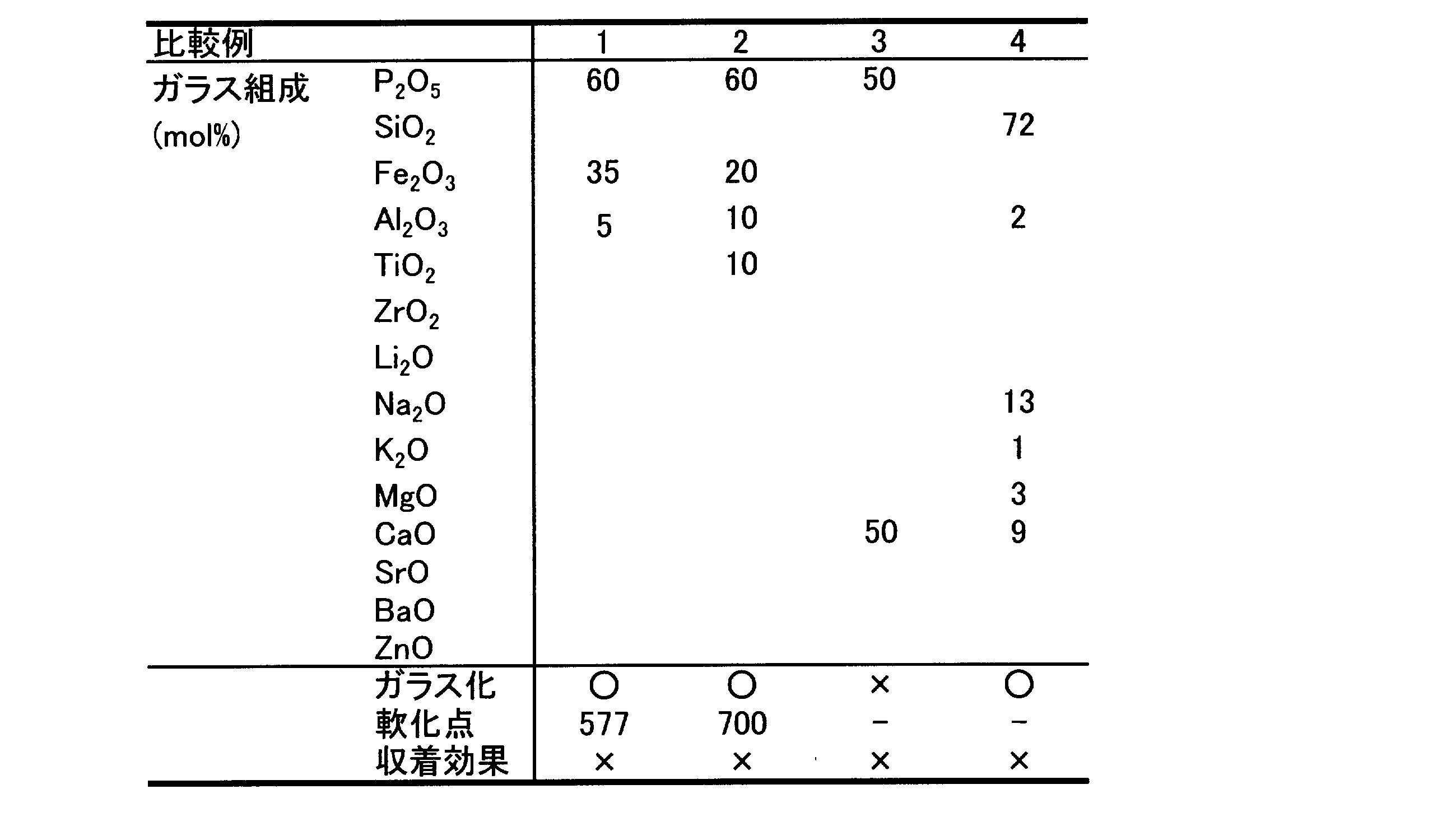
表1から明らかなように、実施例1~8の試料はいずれも組成が適切な範囲であるため、安定なガラスが得られ、軟化点も所望の範囲に入っていた。溶融電解質融液に浸漬した後の各試料の元素分析ではCs元素及びX線回折からCsを含む結晶が観測され、Cs収着効果が得られたことが確認された。
一方、表2に示すように、比較例1及び2の試料は組成が適切な範囲であるが、(R2O+R’O)含有量が1モル%未満であるため、Cs収着効果は得られなかった。比較例3の試料は組成が適切でないため、ガラス化せず、Cs収着効果は得られなかった。また、比較例4の試料は一般的なソーダライムガラスであるが、Fe2O3を含有していないため、Cs収着効果は得られなかった。
上述の通り、本発明の収着濾過材料は、塩化物系の混合塩からなる電解質融液中のCs、例えば、塩化物系使用済電解質融液中に蓄積した核分裂生成物であるCsを選択的に収着できるため、電解質融液の再生を簡便化して、環境及び経済面での負荷を低減することができる。
以上、本発明の実施形態について説明したが、本発明は上記実施形態に限定されるものではなく、本発明の趣旨を逸脱しない範囲で、当業者の通常の知識に基づいて、以下の実施形態に対し適宜変更、改良可能であることはいうまでもない。
Claims (3)
- 塩化物系の混合塩からなる電解質融液中のCsを選択的に収着する収着濾過材料。
- Fe2O3を1~50モル%、P2O5を30~80モル%、Al2O3を0~30モル%、TiO2を0~50モル%、ZrO2を0~5モル%、R2OとしてLi2O、Na2O、K2Oから選択される1種以上を0~40モル%、R’OとしてMgO、CaO、SrO、BaO、ZnOから選択される1種以上を0~60モル%含有し、且つ、R2OとR’Oの合計含有量が1モル%以上であるガラス又は結晶化ガラスであることを特徴とする、請求項1に記載の収着濾過材料。
- 前記ガラス及び結晶化ガラスの前駆体ガラスの軟化点が450℃以上であることを特徴とする、請求項1又は2に記載の収着濾過材料。
Applications Claiming Priority (2)
| Application Number | Priority Date | Filing Date | Title |
|---|---|---|---|
| JP2009152777A JP5177442B2 (ja) | 2009-06-26 | 2009-06-26 | 収着濾過材料 |
| JP2009-152777 | 2009-06-26 |
Publications (1)
| Publication Number | Publication Date |
|---|---|
| WO2010150822A1 true WO2010150822A1 (ja) | 2010-12-29 |
Family
ID=43386591
Family Applications (1)
| Application Number | Title | Priority Date | Filing Date |
|---|---|---|---|
| PCT/JP2010/060664 Ceased WO2010150822A1 (ja) | 2009-06-26 | 2010-06-23 | 収着濾過材料 |
Country Status (2)
| Country | Link |
|---|---|
| JP (1) | JP5177442B2 (ja) |
| WO (1) | WO2010150822A1 (ja) |
Families Citing this family (5)
| Publication number | Priority date | Publication date | Assignee | Title |
|---|---|---|---|---|
| JP5668998B2 (ja) * | 2009-11-26 | 2015-02-12 | 独立行政法人日本原子力研究開発機構 | 核分裂生成物の濾過・収着材及びそれを使用した核分裂生成物の濾過・収着方法 |
| JP5552922B2 (ja) * | 2010-06-29 | 2014-07-16 | セントラル硝子株式会社 | 核分裂生成物の分離材及びその製造方法、並びに該分離材を用いた核分裂生成物の分離方法 |
| JP5137043B2 (ja) * | 2011-03-04 | 2013-02-06 | セントラル硝子株式会社 | 収着材料 |
| JP5988706B2 (ja) * | 2012-06-04 | 2016-09-07 | 吉澤石灰工業株式会社 | セシウム捕捉材及びその製造方法 |
| JP6077366B2 (ja) * | 2013-04-02 | 2017-02-08 | アルプス電気株式会社 | 廃棄物の処理方法 |
Citations (3)
| Publication number | Priority date | Publication date | Assignee | Title |
|---|---|---|---|---|
| JPH11326589A (ja) * | 1998-05-18 | 1999-11-26 | Tokyo Electric Power Co Inc:The | 放射性廃棄物の固化処理方法 |
| JP2004045371A (ja) * | 2002-05-20 | 2004-02-12 | Ebara Corp | 放射性核種を含有する液体処理方法と装置 |
| JP2005262096A (ja) * | 2004-03-18 | 2005-09-29 | National Institute Of Advanced Industrial & Technology | 特異的アルカリ金属イオン吸着剤及び高純度リチウムまたは高純度セシウムの製造方法 |
-
2009
- 2009-06-26 JP JP2009152777A patent/JP5177442B2/ja not_active Expired - Fee Related
-
2010
- 2010-06-23 WO PCT/JP2010/060664 patent/WO2010150822A1/ja not_active Ceased
Patent Citations (3)
| Publication number | Priority date | Publication date | Assignee | Title |
|---|---|---|---|---|
| JPH11326589A (ja) * | 1998-05-18 | 1999-11-26 | Tokyo Electric Power Co Inc:The | 放射性廃棄物の固化処理方法 |
| JP2004045371A (ja) * | 2002-05-20 | 2004-02-12 | Ebara Corp | 放射性核種を含有する液体処理方法と装置 |
| JP2005262096A (ja) * | 2004-03-18 | 2005-09-29 | National Institute Of Advanced Industrial & Technology | 特異的アルカリ金属イオン吸着剤及び高純度リチウムまたは高純度セシウムの製造方法 |
Also Published As
| Publication number | Publication date |
|---|---|
| JP2011007694A (ja) | 2011-01-13 |
| JP5177442B2 (ja) | 2013-04-03 |
Similar Documents
| Publication | Publication Date | Title |
|---|---|---|
| Wu et al. | Synthesis of pyrochlore-borosilicate glass-ceramics for immobilization of high-level nuclear waste | |
| US10427945B2 (en) | Ion sieve material, and methods of preparing and using the same | |
| JP5177442B2 (ja) | 収着濾過材料 | |
| JP6989568B2 (ja) | 放射性廃棄物固化体の製造方法 | |
| TW201527236A (zh) | 玻璃化學強化用熔融鹽之再生方法 | |
| JP5137043B2 (ja) | 収着材料 | |
| US9922741B2 (en) | Method for the pre-calcining treatment of an aqueous nitric solution comprising at least one radionuclide and optionally ruthenium | |
| Gardner et al. | Synthesis and characterization of sintered H–Y zeolite-derived waste forms for dehalogenated electrorefiner salt | |
| JP6292854B2 (ja) | 放射性廃棄物のガラス固化体及びその形成方法 | |
| WO2010150823A1 (ja) | 濾過材料 | |
| CN113684504A (zh) | 一种用于乏燃料干法后处理的电解精炼废熔盐处理方法 | |
| JP5552922B2 (ja) | 核分裂生成物の分離材及びその製造方法、並びに該分離材を用いた核分裂生成物の分離方法 | |
| CN115806386A (zh) | 一种制备高硫高放废液硼硅酸盐玻璃固化体的方法 | |
| US5875407A (en) | Method for synthesizing pollucite from chabazite and cesium chloride | |
| JP3864203B2 (ja) | 放射性廃棄物の固化処理方法 | |
| JP5668998B2 (ja) | 核分裂生成物の濾過・収着材及びそれを使用した核分裂生成物の濾過・収着方法 | |
| Katasho et al. | Electrochemical reduction behavior of simplified simulants of vitrified radioactive waste in molten CaCl2 | |
| KR100757200B1 (ko) | 제올라이트만을 이용한 염화염 폐기물 고정화 생성물의제조방법 | |
| KR100766516B1 (ko) | 염화리튬 또는 염화리튬-염화칼륨 공융염 내에 존재하는 스트론튬 및 바륨 성분을 제거하는 방법 | |
| Riley et al. | Ceramic waste form process for immobilizing iodine in glass-bonded iodosodalite | |
| JPH11295487A (ja) | 放射性廃棄物の処理方法及び放射性廃棄物のガラス固化体 | |
| RU2232440C2 (ru) | Монолитный блок силикатного стекла для иммобилизации радиоактивных отходов и способ его получения | |
| Chong | Characterization of Sodalite Based Waste Forms for Immobilization of 129I | |
| RU2781278C1 (ru) | Электрохимический способ получения микродисперсных порошков гексаборидов металлов лантаноидной группы, допированных кальцием | |
| IT8520286A1 (it) | Composizione di vetro per il contenimento di scarichi nucleari |
Legal Events
| Date | Code | Title | Description |
|---|---|---|---|
| 121 | Ep: the epo has been informed by wipo that ep was designated in this application |
Ref document number: 10792140 Country of ref document: EP Kind code of ref document: A1 |
|
| NENP | Non-entry into the national phase |
Ref country code: DE |
|
| 122 | Ep: pct application non-entry in european phase |
Ref document number: 10792140 Country of ref document: EP Kind code of ref document: A1 |