WO2010146804A1 - Recycled magnesium alloy, process for producing the same, and magnesium alloy - Google Patents
Recycled magnesium alloy, process for producing the same, and magnesium alloy Download PDFInfo
- Publication number
- WO2010146804A1 WO2010146804A1 PCT/JP2010/003838 JP2010003838W WO2010146804A1 WO 2010146804 A1 WO2010146804 A1 WO 2010146804A1 JP 2010003838 W JP2010003838 W JP 2010003838W WO 2010146804 A1 WO2010146804 A1 WO 2010146804A1
- Authority
- WO
- WIPO (PCT)
- Prior art keywords
- magnesium alloy
- content
- corrosion
- recycled
- molten metal
- Prior art date
- Legal status (The legal status is an assumption and is not a legal conclusion. Google has not performed a legal analysis and makes no representation as to the accuracy of the status listed.)
- Ceased
Links
Images

Classifications
-
- C—CHEMISTRY; METALLURGY
- C22—METALLURGY; FERROUS OR NON-FERROUS ALLOYS; TREATMENT OF ALLOYS OR NON-FERROUS METALS
- C22C—ALLOYS
- C22C23/00—Alloys based on magnesium
- C22C23/02—Alloys based on magnesium with aluminium as the next major constituent
-
- C—CHEMISTRY; METALLURGY
- C22—METALLURGY; FERROUS OR NON-FERROUS ALLOYS; TREATMENT OF ALLOYS OR NON-FERROUS METALS
- C22B—PRODUCTION AND REFINING OF METALS; PRETREATMENT OF RAW MATERIALS
- C22B26/00—Obtaining alkali, alkaline earth metals or magnesium
- C22B26/20—Obtaining alkaline earth metals or magnesium
- C22B26/22—Obtaining magnesium
-
- C—CHEMISTRY; METALLURGY
- C22—METALLURGY; FERROUS OR NON-FERROUS ALLOYS; TREATMENT OF ALLOYS OR NON-FERROUS METALS
- C22B—PRODUCTION AND REFINING OF METALS; PRETREATMENT OF RAW MATERIALS
- C22B7/00—Working up raw materials other than ores, e.g. scrap, to produce non-ferrous metals and compounds thereof; Methods of a general interest or applied to the winning of more than two metals
- C22B7/001—Dry processes
- C22B7/003—Dry processes only remelting, e.g. of chips, borings, turnings; apparatus used therefor
-
- C—CHEMISTRY; METALLURGY
- C22—METALLURGY; FERROUS OR NON-FERROUS ALLOYS; TREATMENT OF ALLOYS OR NON-FERROUS METALS
- C22B—PRODUCTION AND REFINING OF METALS; PRETREATMENT OF RAW MATERIALS
- C22B9/00—General processes of refining or remelting of metals; Apparatus for electroslag or arc remelting of metals
-
- C—CHEMISTRY; METALLURGY
- C22—METALLURGY; FERROUS OR NON-FERROUS ALLOYS; TREATMENT OF ALLOYS OR NON-FERROUS METALS
- C22C—ALLOYS
- C22C23/00—Alloys based on magnesium
- C22C23/04—Alloys based on magnesium with zinc or cadmium as the next major constituent
-
- C—CHEMISTRY; METALLURGY
- C22—METALLURGY; FERROUS OR NON-FERROUS ALLOYS; TREATMENT OF ALLOYS OR NON-FERROUS METALS
- C22F—CHANGING THE PHYSICAL STRUCTURE OF NON-FERROUS METALS AND NON-FERROUS ALLOYS
- C22F1/00—Changing the physical structure of non-ferrous metals or alloys by heat treatment or by hot or cold working
- C22F1/06—Changing the physical structure of non-ferrous metals or alloys by heat treatment or by hot or cold working of magnesium or alloys based thereon
-
- Y—GENERAL TAGGING OF NEW TECHNOLOGICAL DEVELOPMENTS; GENERAL TAGGING OF CROSS-SECTIONAL TECHNOLOGIES SPANNING OVER SEVERAL SECTIONS OF THE IPC; TECHNICAL SUBJECTS COVERED BY FORMER USPC CROSS-REFERENCE ART COLLECTIONS [XRACs] AND DIGESTS
- Y02—TECHNOLOGIES OR APPLICATIONS FOR MITIGATION OR ADAPTATION AGAINST CLIMATE CHANGE
- Y02P—CLIMATE CHANGE MITIGATION TECHNOLOGIES IN THE PRODUCTION OR PROCESSING OF GOODS
- Y02P10/00—Technologies related to metal processing
- Y02P10/20—Recycling
-
- Y—GENERAL TAGGING OF NEW TECHNOLOGICAL DEVELOPMENTS; GENERAL TAGGING OF CROSS-SECTIONAL TECHNOLOGIES SPANNING OVER SEVERAL SECTIONS OF THE IPC; TECHNICAL SUBJECTS COVERED BY FORMER USPC CROSS-REFERENCE ART COLLECTIONS [XRACs] AND DIGESTS
- Y02—TECHNOLOGIES OR APPLICATIONS FOR MITIGATION OR ADAPTATION AGAINST CLIMATE CHANGE
- Y02W—CLIMATE CHANGE MITIGATION TECHNOLOGIES RELATED TO WASTEWATER TREATMENT OR WASTE MANAGEMENT
- Y02W30/00—Technologies for solid waste management
- Y02W30/50—Reuse, recycling or recovery technologies
Definitions
- the present invention relates to a recycled magnesium alloy and a process for producing the same, and a magnesium alloy.
- Magnesium (Mg) is the lightest of the practical metals and has a good specific strength, and its resources are abundant. Now that weight saving and reduction of environmental burdens are strongly demanded, magnesium is a promising metal material and magnesium alloys are becoming to be used in various products in various fields.
- Magnesium is a very active metal and has the lowest potential (i.e., the highest ionization tendency) among the practical metals. Since magnesium does not form a corrosion resistant film on itself, magnesium-based members are susceptible to corrosion. Therefore, acquisition of corrosion resistance is essential to widespread utilization of the magnesium-based members. One possible means for the acquisition is to provide a corrosion resistant film on a surface of the magnesium-based members. However, formation of a corrosion resistant film incurs high costs. Moreover, even if a corrosion resistant film is formed, corrosion may proceed from defect portions or damaged portions of the film.
- magnesium alloys having good corrosion resistance in themselves.
- the root cause of corrosion of magnesium alloys is the presence of impurity elements (corrosion-causing elements) such as copper (Cu), iron (Fe) and nickel (Ni).
- impurity elements corrosion-causing elements
- conventional magnesium alloys ensure corrosion resistance by strictly limiting the amount of these corrosion-causing elements mixed in the alloys.
- a known alloy AZ91D according to ASTM standards ensures good corrosion resistance by strictly limiting the content of corrosion-causing impurities to less than 0.03 mass % (300 ppm) of Cu, less than 0.0015 mass % (15 ppm) of Ni, and less than 0.005 mass % (50 ppm) of Fe.
- Such a magnesium alloy needs to be produced under strictly controlled conditions and production of brand-new products is taken for granted. This not only incurs an increase in production costs but also inhibits recyclability of magnesium-based members, and does not meet current demand for effective utilization of resources and reduction of environmental burdens.
- Patent Document 1 proposed a magnesium alloy, especially a magnesium alloy recycled from scraps (a secondary alloy), having a good corrosion resistance in spite of relatively large content of corrosion-causing elements such as Cu.
- this document proposed a magnesium alloy comprising, by mass (hereinafter % by mass will be sometimes simply referred to as %), aluminum (Al): 10 to 20 %, zinc (Zn): 2.5 to 10 % and manganese (Mn): 0.1 to 2 % and permitting Cu: 0.3 to 2 % or Ni: 0.001 to 2 %.
- magnesium alloy AZ92 according to ASTM standards which is defined to comprise Al: 8.3 to 9.7 %, Zn: 1.6 to 2.4 %, Mn: 0.1 to 0.35 %, Cu: less than 0.35 %, Ni: less than 0.01 %, and Fe: less than 0.02 %.
- This magnesium alloy is not practically used at present and little is known about its corrosion resistance.
- the standard specification of this AZ92 alloy takes production of brand-new products (a primary alloy) for granted and does not intend recycling of magnesium alloys. Besides, as long as the present inventors know, no reports on recycling of this alloy have been made.
- Patent Document 2 describes a magnesium alloy having a similar composition in terms of Al, Zn and Mn, but does not have any reference to recycling of magnesium alloys. Besides, as is apparent from the description that this alloy contains Ca, which causes corrosion, in an amount of 0.5 to 5 mass %, Patent Document 2 has no description of corrosion resistance or the like of this magnesium alloy. Moreover, this magnesium alloy is not a cast material but a plastically worked material comprising atomized powder.
- the present invention has been made in view of these circumstances. It is an object of the present invention to provide a process for producing a recycled magnesium alloy which enables recycling of magnesium alloys and obtaining a magnesium alloy having a good corrosion resistance, and to provide such a recycled magnesium alloy having a good corrosion resistance. It is another object of the present invention to provide a magnesium alloy which exhibits a good corrosion resistance in itself without any special anti-corrosion treatment and is suitable for future recycling.
- the present inventors have earnestly studied to solve these problems and, as a result of trial and error, succeeded in obtaining a recycled magnesium alloy which can remarkably increase the permissible amount of Cu, which is a corrosion-causing element, in comparison with those of the conventional alloys and at the same time assure practical level of corrosion resistance, by increasing Zn content of the magnesium alloy while suppressing Al content. Then the present inventors have further extended this finding and completed the following aspects of the present invention.
- a process for producing a recycled magnesium alloy of the present invention comprises: a melting step of heating and melting a collected raw material comprising a collected magnesium alloy member, thereby obtaining raw material molten metal; an adjusting step of adjusting composition of the raw material molten metal in accordance with Cu content of the raw material molten metal, thereby obtaining adjusted molten metal comprising, by mass: Al: 5 to 10 %, Zn: not less than 1 % and not less than three times of the Cu content (%), Mn: 0.1 to 1.5 %, and the remainder: Mg and impurities with or without one or more reforming elements; and a solidifying step of cooling and solidifying the adjusted molten metal, thereby obtaining a recycled magnesium alloy.
- the present invention can be grasped not only as the abovementioned process for producing a recycled magnesium alloy but also as a recycled magnesium alloy obtained by the process. That is to say, the present invention can be a recycled magnesium alloy obtained by melting and solidifying a collected raw material comprising a collected magnesium alloy member, and produced by the abovementioned production process.
- the present invention can also be grasped as the following recycled magnesium alloy regardless of its production process. That is to say, the present invention can be a recycled magnesium alloy obtained by melting and solidifying a collected raw material comprising a collected magnesium alloy member and comprising, by mass: Al: 5 to 10 %, Zn: 2.4 to 6 %, Mn: 0.1 to 1.5 %, Cu: not more than one third of the Zn content (%), and the remainder: Mg and impurities with or without one or more reforming elements.
- the abovementioned recycled magnesium alloy may comprise, by mass: Al: 5 to 10 %, Zn: 1 to 2.4 %, Mn: 0.1 to 1.5 %, R.E. (rare earth element(s)): 0.1 to 1.5 %, Cu: not more than one third of the Zn content (%), and the remainder: Mg and impurities with or without one or more reforming elements.
- the abovementioned recycled magnesium alloy may comprise, by mass: Al: 5 to 10 %, Zn: 1 to 6 %, Mn: 0.1 to 1.5 %, R.E.: 0.1 to 1.5 %, Cu: not more than one third of the Zn content (%), and the remainder: Mg and impurities with or without one or more reforming elements.
- the present invention can be grasped not only as a recycled magnesium alloy or a process for producing the same but also a brand-new magnesium alloy (a primary alloy) which can be easily recycled in future.
- the present invention can be a magnesium alloy comprising, by mass: Al: 5 to 10 %, Zn: 1 to 6 %, Mn: 0.1 to 1.5 %, and the remainder: Mg and impurities with or without one or more reforming elements.
- the abovementioned magnesium alloy of the present invention may further contain 0.1 to 1.5 % of R.E.
- the Zn content of the magnesium alloy of the present invention containing 0.1 to 1.5 % of R.E. may be 1 to 2.4 %.
- the present invention pays special attention to Cu among corrosion-causing elements of magnesium alloys. This is because, when recycling of magnesium alloys is considered, Cu is an element which is very easily mixed in the alloys but no effective method for removing Cu is available at present.
- Cu is easily mixed in recycling magnesium alloys is that Cu is heavily used in members of aluminum alloys, iron-based sintered bodies and so on and electrically conductive materials.
- Fe which is one of the main corrosion-causing elements other than Cu, can be removed by sedimentation from molten metal of magnesium alloys by using Mn. Therefore, reduction of Fe content is relatively easy.
- Ni which is also a corrosion-causing element, is hardly solid soluble in magnesium alloys, so it is unlikely that Ni content of magnesium alloys will rapidly increase.
- the present inventors have earnestly studied about the Mg-Al-Cu compound on the basis of the AZ91 alloy, which contains about 0.7 % of Zn, and as a result, have newly found that the Mg-Al-Cu compound is an Mg 6 Al 7 Cu 3 compound containing a slight amount of Zn.
- the present inventors have conducted more research on the basis of this finding and reached the idea that corrosion caused by this compound may be suppressed by changing the Mg 6 Al 7 Cu 3 compound, which is a cause of corrosion. Then, when the present inventors have actually increased Zn content of magnesium alloys, it has been found that corrosion resistance of the magnesium alloys improves. Specifically speaking, it has become apparent that by increasing Zn content, corrosion resistance of magnesium alloys can be maintained regardless of variation in Cu content. That is to say, even if Cu is mixed in magnesium alloys, owing to the presence of Zn, the Mg 6 Al 7 Cu 3 compound, which becomes starting points of corrosion, is not formed and instead an "Mg 32 (Al, Zn, Cu) 49 " compound is formed. It is believed that this change from the Mg 6 Al 7 Cu 3 compound to the "Mg 32 (Al, Zn, Cu) 49 " compound appears as an improvement in corrosion resistance and corrosion resistance deterioration caused by Cu is suppressed.
- the present invention can assure corrosion resistance of even a recycled magnesium alloy whose Cu content easily changes, not to mention that of a brand-new magnesium alloy, and thus recyclability of magnesium alloys can be improved.
- a recycled magnesium alloy or "a magnesium alloy” mentioned in this specification can be not only a bulk material such as an ingot but also a raw material having the shape of a rod, a tube, a plate or the like, a cast material such as a die cast material, a forged material, a cut material or the like. In these cases, “a magnesium alloy” can be restated as “a magnesium alloy member”.
- Corrosion resistance uses corrosion rate, corrosion rate susceptibility and the like as indices.
- “Corrosion rate” is corrosion weight loss per unit time (day).
- “Corrosion rate susceptibility” mentioned in this specification is the ratio of the amount of change in corrosion rate relative to the amount of change in Cu content (the rate of change of corrosion rate relative to Cu content).
- preferred corrosion rate (MCD) is not more than 1, not more than 0.8, not more than 0.7, not more than 0.6, not more than 0.5, not more than 0.4, not more than 0.3, or not more than 0.2.
- Preferred corrosion rate susceptibility is not more than 400, not more than 350, not more than 300, not more than 200, not more than 100, not more than 80, not more than 50, or not more than 40. It should be noted that the unit of each value of corrosion rate shown here is mg/cm -2 /day -1 . In addition, because in calculating corrosion rate susceptibility, Cu content is regarded as dimensionless number (for example, Cu content of 1 mass % is regarded as 0.01), the unit of each value of corrosion rate susceptibility is also mg/cm -2 /day -1 .
- corrosion rate susceptibility is the rate of change of corrosion rate (MCD) relative to Cu content
- corrosion rate susceptibility of an Mg alloy having a certain composition is obtained from the slope of a dispersion diagram made by plotting corrosion rate on the axis of ordinates relative to Cu content on the axis of abscissas.
- a dispersion diagram made by plotting corrosion rate on the axis of ordinates relative to Cu content on the axis of abscissas.
- the Cu content exceeds 0.5 %
- corrosion is severer and the change in corrosion rate tends to be excessively great.
- the Cu content is less than 0.1 %
- corrosion is mild and the change in corrosion rate tends to be excessively small. States of such local areas vary widely and this is not preferable in view of appropriately evaluating corrosion rate susceptibility. Therefore, in this specification, practical corrosion rate susceptibility (CS) was calculated from the slope of the abovementioned dispersion diagram within the Cu content range of 0.1 to 0.5
- a range "x to y" mentioned in this specification includes both the lower limit value “x” and the upper limit value “y”, unless otherwise specified. Moreover, the lower limit values and the upper limit values mentioned in this specification can be arbitrarily combined to form a new range "a to b".
- Chemical composition of molten metals and alloys can be identified by analyzing samples by the Quantolet spectrometric method, XRF, ICP or the like. Chemical composition of various molten metals and alloys in this specification should be regarded as identified by the Quantolet method unless otherwise specified.
- the collected raw material includes not only at least one pure magnesium alloy member but also a wide variety of members and impurities attached to the alloy member.
- Recycled magnesium alloys obtained by using this kind of collected raw material generally contain a large amount of Cu, which is difficult to be removed and is a main cause of corrosion. Therefore, recycled magnesium alloys are generally poor in corrosion resistance.
- the present invention makes it possible to effectively suppress corrosion caused by Cu by making a recycled magnesium alloy contain a relatively large amount of Zn as mentioned above. Namely, the production process of the present invention enables to obtain a recycled magnesium alloy having a good corrosion resistance regardless of relatively large content of Cu. In other words, the production process of the present invention makes it possible to greatly increase the permissible amount of Cu, which is difficult to be removed and is a corrosion-causing element, and ensure practical level of corrosion resistance of a recycled magnesium alloy.
- This increase in the permissible amount of Cu enables not only an improvement in corrosion resistance but also drastic reduction of production costs of a (recycled) magnesium alloy such as raw material costs and management costs.
- Fig. 1 is a correlation diagram of chemical composition (Cu and Zn) and corrosion rate of magnesium alloys.
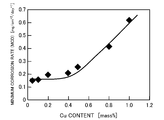
- Fig. 2 is a dispersion diagram showing the relation between Cu content and minimum corrosion rate of magnesium alloys.
- the present invention will be described in more detail by way of embodiments of the invention. Description in this specification including that of the following embodiments can be appropriately applied not only to magnesium alloys but also recycled magnesium alloys and their production processes of the present invention.
- the present invention can be formed by adding one or more selected arbitrarily from the constituent features described below to the aforementioned constitution of the present invention. Any of the following constitutional features can be selected in a multiple form beyond categories.
- a constituent feature about one compositional range is relevant not only to a product but also to a production process.
- a constitutional feature about a production process can be regarded as that of a (recycled) magnesium alloy when it is understood as a product by process. It should be noted that which embodiment is best varies with target application, required characteristics or the like.
- a recycled magnesium alloy or a magnesium alloy of the present invention basically comprises Zn, Al, Mn, with Mg being the remainder, and it is more preferable that the magnesium alloy further contains R.E.
- R.E Recycled Magnesium Alloy/Magnesium Alloys
- Zn is an element improving corrosion resistance of the magnesium alloy of the present invention. Especially, Zn suppresses corrosion caused by Cu, which is a corrosion-causing element, and increases the permissible amount of Cu.
- the magnesium alloy of the present invention contains 1 to 6 % of Zn.
- An upper limit value or a lower limit value of Zn can be arbitrarily determined within this range. It is particularly preferable that the lower limit value is any of 1.5 %, 2 %, 2.4 %, 2.5 % and 3 %. It is particularly preferable that the upper limit value is any of 5.5 %, 5 %, 4.5 % and 4 %.
- corrosion resistance of the magnesium alloy improves further as mentioned below. The reason or mechanism is not fully clarified, but it is believed that R.E. not only suppresses corrosion caused by Ni, which is a corrosion-causing element, but also can further improve corrosion resistance of the magnesium alloy in cooperation with Zn.
- the magnesium alloy of the present invention contains R.E.
- the lower limit of Zn content relatively high when the magnesium alloy does not contain R.E.
- the magnesium alloy contains R.E. making the lower limit of Zn content not less than 1 % allows the magnesium alloy of the present invention to exhibit a sufficient corrosion resistance. In this case, if Zn is contained in a range of 1 to 2.4 %, the magnesium alloy can efficiently obtain corrosion resistance.
- Al Al is an element improving mechanical characteristics such as strength of magnesium alloys and also an element effective in improving corrosion resistance of the magnesium alloys.
- An excessively small Al content is not preferable because these effects cannot be obtained.
- an excessively large Al content is not preferable, either, because elongation of the magnesium alloys decreases.
- the excessively large Al content may inhibit the abovementioned effect of Zn to improve corrosion resistance. Therefore, in the present invention, it is preferable to contain Al in a range of 5 to 10 %.
- An upper limit value or a lower limit value of Al can be arbitrarily determined within this range.
- the lower limit value is any of 6 %, 7 %, 8 %, and 8.5 %.
- the upper limit value is 9.5 %.
- R.E. R.E. (rare earth element(s)) is one or more elements which can improve corrosion resistance of magnesium alloys in cooperation with the abovementioned Zn.
- R.E. is also one or more elements effective in suppressing corrosion caused by Ni. It is not preferable to contain R.E. in an excessively small amount, because these effects are not exhibited much. On the other hand, it is not preferable to contain expensive R.E. in an excessively large amount, because raw material costs of magnesium alloys increase. Therefore, in the present invention, it is preferable to contain R.E. in a range of 0.1 to 1.5 %. An upper limit value or a lower limit value of R.E. can be determined arbitrarily within this range.
- the lower limit value is any of 0.2 %, 0.3 %, 0.4 %, and 0.5 %.
- the upper limit value is any of 1.3 %, 1 % and 0.8 %.
- R.E. includes a number of elements.
- R.E. mentioned in the present invention is not limited to one or more particular elements, but especially cerium (Ce), lanthanum (La) and so on are effective in improving corrosion resistance of magnesium alloys.
- Ce cerium
- La lanthanum
- Mm mischmetal
- One exemplary composition of Mm comprises, by mass, Ce: 52 %, La: 25 %, Nd: 16 %, and Pr: 5 %.
- Mn Mn is an element effective in removing Fe, which is a corrosion-causing element, from molten metal of magnesium alloys and suppressing corrosion caused by Fe.
- Mn content of the magnesium alloy of the present invention is defined as 0.1 to 1.5 %.
- An upper limit value or a lower limit value of the Mn content can be arbitrarily determined within this range. It is especially preferable that the lower limit value is either 0.2 % or 0.3 %. It is especially preferable that the upper limit value is any of 1.2 %, 1 %, 0.8 %, and 0.6 %.
- Mn can remove Fe or suppress corrosion caused by Fe in cooperation with R.E.
- Reforming Element A "reforming element” mentioned in this specification is an element effective in improving characteristics of magnesium alloys, other than Mg, Al, Mn, Zn, R.E and corrosion-causing elements such as Cu, Ni and Fe. Characteristics to be improved are not limited in kind and are, for example, corrosion resistance, strength, elongation, toughness and flame retardancy. Examples of the reforming element include silicon (Si): 0.2 to 2 %, calcium (Ca): 0.2 to 1.5 %, and beryllium (Be): 0.0001 to 0.005 %.
- the reforming element can be one or more of tin (Sn), yttrium (Y), strontium (St), bismuth (Bi) and zirconium (Zr). These reforming elements can be contained singly or in any combination. The content of these reforming elements is not limited to the exemplary ranges, and generally the content is very small.
- Impurities mentioned in this specification are elements which are not necessary to improve characteristics of magnesium alloys, and include not only elements which degrade the characteristics but also elements which do not degrade the characteristics. Typical examples of impurities are Cu, Ni and Fe, which are corrosion-causing elements. In addition to these, there are impurities contained in raw material powder and those mixed in respective steps of production processes. Elements which cannot be removed for costs or technical reasons are especially called "inevitable impurities".
- the upper limit value of the permissible Cu content can be increased to about 0.1 %, 0.3 %, 0.4 % or 0.5 %. These values are remarkably high when compared to Cu content of less than 0.03 % of the conventional AZ91D alloy.
- the permissible Ni content is greatly increased when compared to Ni content of less than 0.0015 % of the conventional AZ91D alloy.
- the upper limit value of Ni content can be increased to about 0.002 %, 0.005 %, 0.01 %, or 0.05 %. Accordingly, since in the present invention, the permissible Cu content and the permissible Ni content can be increased to not more than 0.5 % and not more than 0.05 %, respectively, recycling of magnesium alloys becomes easy and corrosion resistance of recycled magnesium alloys can be ensured.
- a process for producing a recycled magnesium alloy of the present invention basically comprises a melting step, an adjusting step and a solidifying step.
- the melting step is a step of heating and melting a collected raw material comprising a collected magnesium alloy member, thereby obtaining a raw material molten metal.
- the "magnesium alloy member” mentioned here means at least one member comprising magnesium or a magnesium alloy.
- This member can have any shape, form or history.
- the magnesium alloy member can be a product, an ingot, or a scrape.
- the magnesium alloy member can be a used item or an unused item.
- the "collected raw material” can comprise not only a magnesium alloy member alone but also a magnesium alloy member mixed with other metal members. Needless to say, it is more preferable that the collected raw material comprises only a magnesium alloy member of a composition similar to a desired composition of a recycled magnesium alloy to be obtained.
- the adjusting step is a step of obtaining adjusted molten metal by adjusting composition of the raw material molten metal in a certain compositional range in accordance with Cu content of the raw material molten metal.
- the compositional range to be obtained has been already discussed but additional discussion will be made here about Zn and R.E.
- Zn content of the adjusted molten metal is defined not only as not less than 1 % but also as not less than three times of Cu content in accordance with the Cu content of the raw material molten metal. This can ensure corrosion resistance of a recycled magnesium alloy obtained by the production process of the present invention.
- the Zn content is not less than 3.5 times, not less than 4 times, not less than 4.5 times, not less than 5 times, not less than 7 times, or not less than 10 times of the Cu content. As mentioned before, it is efficient to make Zn content of the adjusted molten metal not more than 6 %.
- the adjusted molten metal contains substantially no R.E., it is efficient to make Zn content of the adjusted molten metal not less than 2.4 %.
- the adjusted molten metal contains 0.1 to 1.5 % of R.E., it is efficient to make Zn content of the adjusted molten metal not more than 2.4 %.
- making Zn content not less than 2.4 % can further improve corrosion resistance.
- Ni which is a corrosion-causing element
- making the adjusted molten metal contain R.E. enables to obtain a recycled magnesium alloy having a good corrosion resistance.
- the solidifying step is a step of cooling and solidifying the adjusted molten metal, thereby obtaining a recycled magnesium alloy.
- This step is a step of solidifying, by natural or forcible cooling, molten metal which has been introduced into a mold (e.g., a metal mold and a sand mold) for gravity casting, metal mold casting, die casting and so on.
- a mold e.g., a metal mold and a sand mold
- compositionally segregated portions or portions having coarse crystal grain corrosion may proceed from starting points of these portions and corrosion resistance of magnesium alloys may be degraded. It is preferable to employ a die casting step as the solidifying step, because such segregation in the metal structure is small. It is also possible to equalize the metal structure or composition by applying appropriate thermal treatment to a magnesium alloy member obtained after the solidifying step.
- the magnesium alloy of the present invention can be used in a variety of products, such as structural members, casing members, wheels, and other automotive components. Since the magnesium alloy of the present invention has a good corrosion resistance in itself, anti-corrosion treatment can be omitted depending on portions to be used, and costs of the magnesium alloy member can be reduced.
- a commercially available raw material comprising pure metal was introduced into a crucible formed of a high-Cr alloy steel (JIS SUS430) and having an inner diameter of 80 mm and a height of 230 mm, and melted by an electric furnace, thereby obtaining molten metal (raw material molten metal) (melting step).
- Chemical composition of this molten metal was adjusted to respective compositions shown in Tables 1 to 7, and held at 750 deg. C (adjusting step).
- the thus obtained molten metal (the adjusted molten metal) was filled in a cavity of a metal mold and rapidly cooled and solidified, thereby obtaining specimens comprising die castings having various chemical compositions shown in Tables 1 to 7 (solidifying step).
- die cast specimens had a plate shape of 40 x 150 x 3 mm. This die casting was conducted by using a 50-tonn die cast machine under casting conditions of injection speed: 0.4 m/s, injection pressure: 64 MPa and molten metal temperature: 650 deg. C.
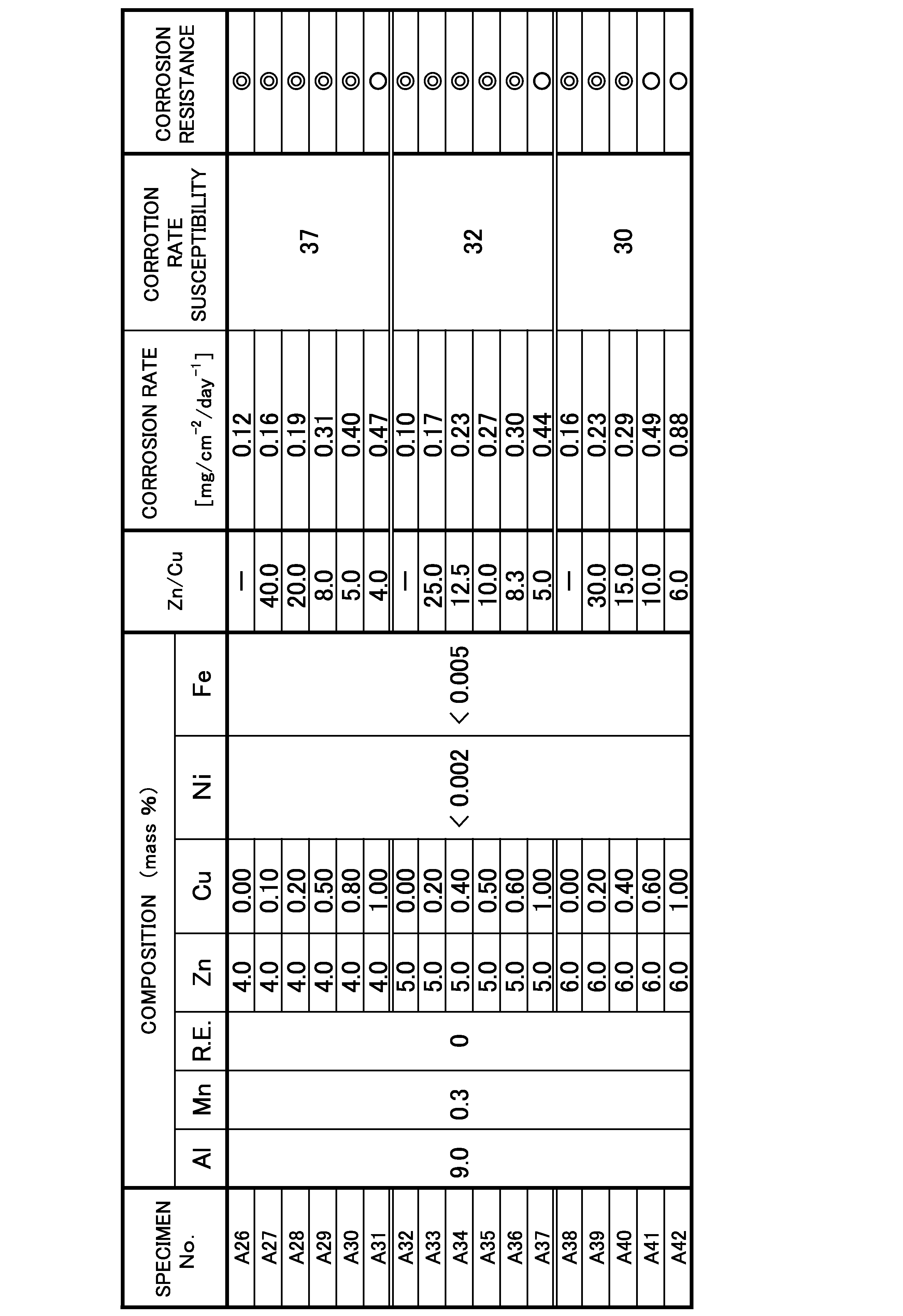
- Corrosion test according to JIS H 0541 was carried out by using plate-shaped test pieces (25 x 25 x 2 mm) cut out from the abovementioned specimens. Specifically, the respective test pieces were immersed in an aqueous 5 % NaCl solution for 100 hours and bubbles (hydrogen gas) generated there were collected and corrosion weight loss of the respective test pieces was calculated from the amount of the generated bubbles. Corrosion rate was obtained from the thus calculated corrosion weight loss of the respective test pieces. In this specification, corrosion rate (MCD) is expressed as corrosion weight loss per day (mg/cm -2 /day -1 ).
- this rate of change indicates susceptibility of corrosion rate to Cu content
- this rate of change is called corrosion rate susceptibility (CS: mg/cm -2 /day -1 ) in this specification and calculated by the abovementioned method. It should be noted that, although arbitrarily omitted in this specification, the unit of corrosion rate or corrosion rate susceptibility is mg/cm -2 /day -1 unless otherwise specified.
- corrosion rate (MCD) and corrosion rate susceptibility (CS) are employed here as evaluation criteria.
- MCD corrosion rate
- CS corrosion rate susceptibility
- a preferred upper limit of Cu content is 1.2 %, 1 %, 0.8 %, 0.6 %, 0.5 %, or 0.4 %.
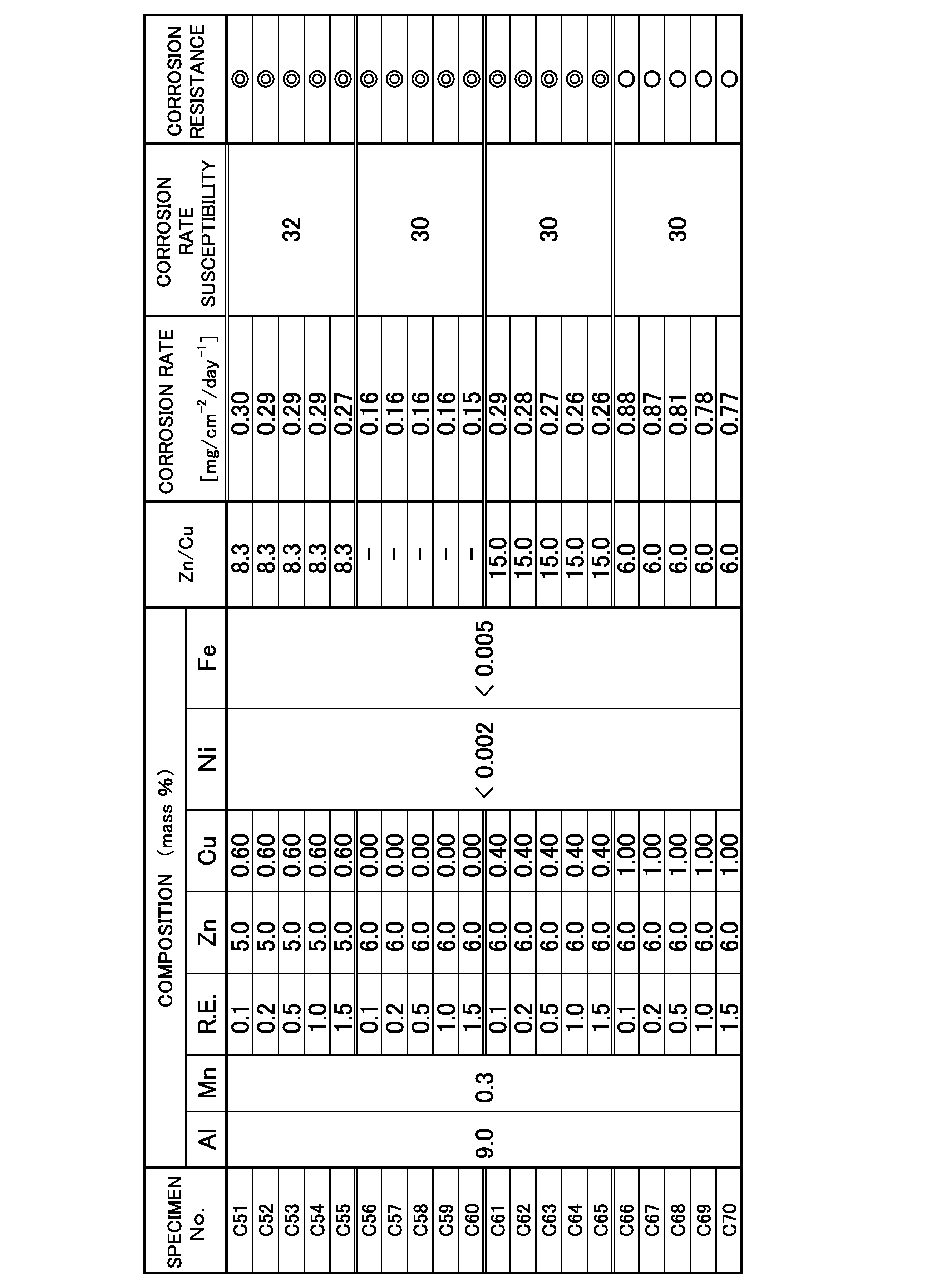
- magnesium alloys having the same chemical composition except R.E. are compared with each other among the specimens shown in Tables 1 to 3 and Tables 4 to 6, it is understood that the magnesium alloys containing R.E. have lower corrosion rates than those containing no R.E. and are improved in corrosion resistance. This means that R.E. does not inhibit the abovementioned corrosion suppression effect of Zn and rather improves corrosion resistance of magnesium alloys. It is believed that, especially when magnesium alloys contain Ni, R.E. is effective in improving their corrosion resistance. This tendency is remarkable when R.E. content is in a range of 0.1 to 1.5 % or 0.2 to 1.0 %.
- the recycled magnesium alloy and the magnesium alloy of the present invention can be used in a variety of products, including structural members, casing members, wheels, and other automotive components.
- the process of the present invention can be used for producing such a useful magnesium alloy.
Landscapes
- Chemical & Material Sciences (AREA)
- Engineering & Computer Science (AREA)
- Materials Engineering (AREA)
- Mechanical Engineering (AREA)
- Metallurgy (AREA)
- Organic Chemistry (AREA)
- Manufacturing & Machinery (AREA)
- Life Sciences & Earth Sciences (AREA)
- Environmental & Geological Engineering (AREA)
- General Life Sciences & Earth Sciences (AREA)
- Geology (AREA)
- Physics & Mathematics (AREA)
- Thermal Sciences (AREA)
- Crystallography & Structural Chemistry (AREA)
- Manufacture And Refinement Of Metals (AREA)
Abstract
Description
(1) A process for producing a recycled magnesium alloy of the present invention comprises: a melting step of heating and melting a collected raw material comprising a collected magnesium alloy member, thereby obtaining raw material molten metal; an adjusting step of adjusting composition of the raw material molten metal in accordance with Cu content of the raw material molten metal, thereby obtaining adjusted molten metal comprising, by mass:
Al: 5 to 10 %,
Zn: not less than 1 % and not less than three times of the Cu content (%),
Mn: 0.1 to 1.5 %, and
the remainder: Mg and impurities with or without one or more reforming elements; and
a solidifying step of cooling and solidifying the adjusted molten metal, thereby obtaining a recycled magnesium alloy.
(1) The present invention can be grasped not only as the abovementioned process for producing a recycled magnesium alloy but also as a recycled magnesium alloy obtained by the process. That is to say, the present invention can be a recycled magnesium alloy obtained by melting and solidifying a collected raw material comprising a collected magnesium alloy member, and produced by the abovementioned production process.
Al: 5 to 10 %,
Zn: 2.4 to 6 %,
Mn: 0.1 to 1.5 %,
Cu: not more than one third of the Zn content (%), and
the remainder: Mg and impurities with or without one or more reforming elements.
Al: 5 to 10 %,
Zn: 1 to 2.4 %,
Mn: 0.1 to 1.5 %,
R.E. (rare earth element(s)): 0.1 to 1.5 %,
Cu: not more than one third of the Zn content (%), and
the remainder: Mg and impurities with or without one or more reforming elements.
Al: 5 to 10 %,
Zn: 1 to 6 %,
Mn: 0.1 to 1.5 %,
R.E.: 0.1 to 1.5 %,
Cu: not more than one third of the Zn content (%), and
the remainder: Mg and impurities with or without one or more reforming elements.
By the way, the present invention can be grasped not only as a recycled magnesium alloy or a process for producing the same but also a brand-new magnesium alloy (a primary alloy) which can be easily recycled in future.
Al: 5 to 10 %,
Zn: 1 to 6 %,
Mn: 0.1 to 1.5 %, and
the remainder: Mg and impurities with or without one or more reforming elements.
(1) The present invention pays special attention to Cu among corrosion-causing elements of magnesium alloys. This is because, when recycling of magnesium alloys is considered, Cu is an element which is very easily mixed in the alloys but no effective method for removing Cu is available at present. One of the reasons why Cu is easily mixed in recycling magnesium alloys is that Cu is heavily used in members of aluminum alloys, iron-based sintered bodies and so on and electrically conductive materials.
(1) When the term "recycling" is used in this specification, how many times it is recycled is not considered. In addition, "a recycled magnesium alloy" or "a magnesium alloy" mentioned in this specification can be not only a bulk material such as an ingot but also a raw material having the shape of a rod, a tube, a plate or the like, a cast material such as a die cast material, a forged material, a cut material or the like. In these cases, "a magnesium alloy" can be restated as "a magnesium alloy member".
<Composition>
A recycled magnesium alloy or a magnesium alloy of the present invention (hereinafter, simply referred to as a "magnesium alloy") basically comprises Zn, Al, Mn, with Mg being the remainder, and it is more preferable that the magnesium alloy further contains R.E. Hereinafter, these main constituent elements will be discussed.
As mentioned above, Zn is an element improving corrosion resistance of the magnesium alloy of the present invention. Especially, Zn suppresses corrosion caused by Cu, which is a corrosion-causing element, and increases the permissible amount of Cu.
Al is an element improving mechanical characteristics such as strength of magnesium alloys and also an element effective in improving corrosion resistance of the magnesium alloys. An excessively small Al content is not preferable because these effects cannot be obtained. On the other hand, an excessively large Al content is not preferable, either, because elongation of the magnesium alloys decreases. In addition, the excessively large Al content may inhibit the abovementioned effect of Zn to improve corrosion resistance. Therefore, in the present invention, it is preferable to contain Al in a range of 5 to 10 %. An upper limit value or a lower limit value of Al can be arbitrarily determined within this range. Preferably the lower limit value is any of 6 %, 7 %, 8 %, and 8.5 %. On the other hand, preferably the upper limit value is 9.5 %.
R.E. (rare earth element(s)) is one or more elements which can improve corrosion resistance of magnesium alloys in cooperation with the abovementioned Zn. R.E. is also one or more elements effective in suppressing corrosion caused by Ni. It is not preferable to contain R.E. in an excessively small amount, because these effects are not exhibited much. On the other hand, it is not preferable to contain expensive R.E. in an excessively large amount, because raw material costs of magnesium alloys increase. Therefore, in the present invention, it is preferable to contain R.E. in a range of 0.1 to 1.5 %. An upper limit value or a lower limit value of R.E. can be determined arbitrarily within this range. It is particularly preferable that the lower limit value is any of 0.2 %, 0.3 %, 0.4 %, and 0.5 %. On the other hand, it is particularly preferable that the upper limit value is any of 1.3 %, 1 % and 0.8 %.
Mn is an element effective in removing Fe, which is a corrosion-causing element, from molten metal of magnesium alloys and suppressing corrosion caused by Fe. When the content of Mn remaining in magnesium alloys is excessively small, these effects cannot be obtained. On the other hand, when the Mn content is excessively large, costs of magnesium alloys increase and it is uneconomical. Therefore, Mn content of the magnesium alloy of the present invention is defined as 0.1 to 1.5 %. An upper limit value or a lower limit value of the Mn content can be arbitrarily determined within this range. It is especially preferable that the lower limit value is either 0.2 % or 0.3 %. It is especially preferable that the upper limit value is any of 1.2 %, 1 %, 0.8 %, and 0.6 %.
A "reforming element" mentioned in this specification is an element effective in improving characteristics of magnesium alloys, other than Mg, Al, Mn, Zn, R.E and corrosion-causing elements such as Cu, Ni and Fe. Characteristics to be improved are not limited in kind and are, for example, corrosion resistance, strength, elongation, toughness and flame retardancy. Examples of the reforming element include silicon (Si): 0.2 to 2 %, calcium (Ca): 0.2 to 1.5 %, and beryllium (Be): 0.0001 to 0.005 %. Furthermore, the reforming element can be one or more of tin (Sn), yttrium (Y), strontium (St), bismuth (Bi) and zirconium (Zr). These reforming elements can be contained singly or in any combination. The content of these reforming elements is not limited to the exemplary ranges, and generally the content is very small.
Impurities mentioned in this specification are elements which are not necessary to improve characteristics of magnesium alloys, and include not only elements which degrade the characteristics but also elements which do not degrade the characteristics. Typical examples of impurities are Cu, Ni and Fe, which are corrosion-causing elements. In addition to these, there are impurities contained in raw material powder and those mixed in respective steps of production processes. Elements which cannot be removed for costs or technical reasons are especially called "inevitable impurities".
A process for producing a recycled magnesium alloy of the present invention basically comprises a melting step, an adjusting step and a solidifying step.
(1) Melting Step
The melting step is a step of heating and melting a collected raw material comprising a collected magnesium alloy member, thereby obtaining a raw material molten metal.
The adjusting step is a step of obtaining adjusted molten metal by adjusting composition of the raw material molten metal in a certain compositional range in accordance with Cu content of the raw material molten metal. The compositional range to be obtained has been already discussed but additional discussion will be made here about Zn and R.E.
The solidifying step is a step of cooling and solidifying the adjusted molten metal, thereby obtaining a recycled magnesium alloy. This step is a step of solidifying, by natural or forcible cooling, molten metal which has been introduced into a mold (e.g., a metal mold and a sand mold) for gravity casting, metal mold casting, die casting and so on.
Because of its good corrosion resistance, the magnesium alloy of the present invention can be used in a variety of products, such as structural members, casing members, wheels, and other automotive components. Since the magnesium alloy of the present invention has a good corrosion resistance in itself, anti-corrosion treatment can be omitted depending on portions to be used, and costs of the magnesium alloy member can be reduced.
<Production of Specimens>
Specimens having chemical composition shown in Tables 1 to 7 were prepared by using various commercially available raw materials. R.E. used was commercially available Mm (Ce: 52 %, La: 25 %, Nd: 16 %, and Pr: 5 %).
(1) Corrosion test according to JIS H 0541 was carried out by using plate-shaped test pieces (25 x 25 x 2 mm) cut out from the abovementioned specimens. Specifically, the respective test pieces were immersed in an aqueous 5 % NaCl solution for 100 hours and bubbles (hydrogen gas) generated there were collected and corrosion weight loss of the respective test pieces was calculated from the amount of the generated bubbles. Corrosion rate was obtained from the thus calculated corrosion weight loss of the respective test pieces. In this specification, corrosion rate (MCD) is expressed as corrosion weight loss per day (mg/cm-2/day-1).

(1) Effect of Zn
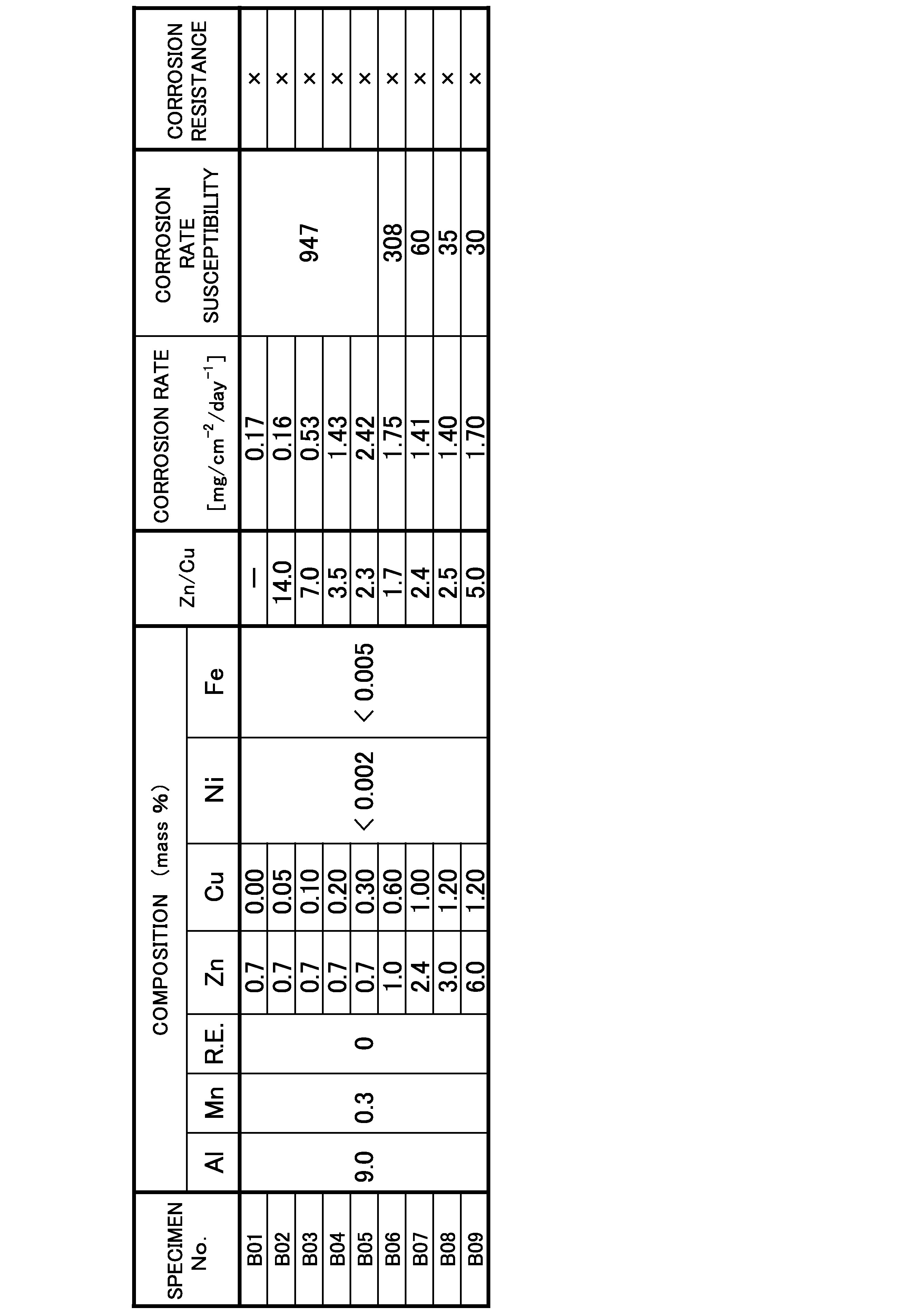
Corrosion resistance of the respective specimens in which Zn content and Cu content were variously changed is shown in Tables 1 to 3. A diagram obtained by plotting Zn content of these specimens on the axis of ordinates against Cu content of these specimens on the axis of abscissas is shown in Fig. 1. It should be noted that the shape of the plot marks was changed by values of corrosion rate (MCD).
The specimens in which Zn content and Cu content were variously changed were examined about effect of R.E. content on corrosion resistance and the results are shown in Tables 4 to 6. It is apparent from the results shown in Tables 4 to 6 that, if chemical composition other than R.E. is the same, as magnesium alloys contain a larger amount of R.E., corrosion rate decreases and corrosion resistance of the magnesium alloys improves.
The respective specimens shown in Table 7 were examined about effect of Al content on corrosion rate. The results shown in Table 7 indicate that in both cases when Al content is excessively small and excessively large, corrosion rate increases and corrosion resistance of magnesium alloys is degraded. Especially as the Al content increases, corrosion rate tends to increase and corrosion resistance of magnesium alloys tends to be degraded. This is believed to be because, owing to an increase in Al content, beta phase, which forms a solid solution with Zn, increases in magnesium alloys, and as a result formation of the corrosion resistant relatively stable Mg-Al-Cu-Zn compound is inhibited. Therefore, in order to suppress corrosion caused by Cu reliably by Zn, it is preferable to make Al content not more than 10.5 % or not more than 10 %.
The relation between Cu content and corrosion rate of magnesium alloys having a certain composition (Mg-9 % Al-0.3 % Mn-x % Cu-y % Zn) is shown in Fig. 2, based on the results shown in Tables 1 to 3. As apparent also from Fig. 1, corrosion rate of magnesium alloys are affected by Cu content and Zn content. Therefore, in Fig. 2, the minimum of the corrosion rates obtained by variously changing the Zn content (the minimum corrosion rate obtained by optimizing the Zn content) under a certain Cu content is shown on the axis of ordinates.




Claims (20)
- A process for producing a recycled magnesium alloy, comprising:
a melting step of heating and melting a collected raw material comprising a collected magnesium alloy member, thereby obtaining raw material molten metal;
an adjusting step of adjusting composition of the raw material molten metal in accordance with copper (Cu) content of the raw material molten metal, thereby obtaining adjusted molten metal comprising, by mass:
aluminum (Al): 5 to 10 %,
zinc (Zn): not less than 1 % and not less than three times of
the Cu content (%),
manganese (Mn): 0.1 to 1.5 %, and
the remainder: magnesium (Mg) and impurities with or without one
or more reforming elements; and
a solidifying step of cooling and solidifying the adjusted molten metal, thereby obtaining a recycled magnesium alloy. - The process for producing a recycled magnesium alloy according to claim 1, wherein the adjusting step is a step of making the Zn content of the adjusted molten metal not less than 2.4 %.
- The process for producing a recycled magnesium alloy according to claim 1, wherein the adjusting step is a step of making the adjusted molten metal further contain 0.1 to 1.5 % of one or more rare earth elements (R.E.).
- The process for producing a recycled magnesium alloy according to claim 3, wherein the adjusting step is a step of making the Zn content of the adjusted molten metal 1 to 2.4 %.
- The process for producing a recycled magnesium alloy according to claim 3, wherein the raw material molten metal contains not less than 0.001 % of nickel (Ni).
- The process for producing a recycled magnesium alloy according to claim 1, wherein the adjusting step is a step of making the Zn content of the adjusted molten metal not more than 6 %.
- The process for producing a recycled magnesium alloy according to claim 1, wherein the adjusting step is a step of making the Cu content of the adjusted molten metal not more than 0.5 %.
- The process for producing a recycled magnesium alloy according to claim 1, wherein the adjusting step is a step of making the content of Ni, which is one of the impurities, of the adjusted molten metal not more than 0.05 %.
- A recycled magnesium alloy obtained by melting and solidifying a collected raw material comprising a collected magnesium alloy member, and produced by the process of claim 1.
- The recycled magnesium alloy according to claim 9, comprising, by mass:
Al: 5 to 10 %,
Zn: 2.4 to 6 %,
Mn: 0.1 to 1.5 %,
Cu: not more than one third of the Zn content (%), and
the remainder: Mg and impurities with or without one or more reforming elements. - The recycled magnesium alloy according to claim 9, comprising, by mass:
Al: 5 to 10 %,
Zn: 1 to 2.4 %,
Mn: 0.1 to 1.5 %,
R.E.: 0.1 to 1.5 %,
Cu: not more than one third of the Zn content (%), and
the remainder: Mg and impurities with or without one or more reforming elements. - The recycled magnesium alloy according to claim 9, comprising, by mass:
Al: 5 to 10 %,
Zn: 1 to 6 %,
Mn: 0.1 to 1.5 %,
R.E.: 0.1 to 1.5 %,
Cu: not more than one third of the Zn content (%), and
the remainder: Mg and impurities with or without one or more reforming elements. - The recycled magnesium alloy according to claim 9, wherein the content of Cu, which is one of the impurities, is not more than 0.5 %.
- The recycled magnesium alloy according to claim 9, wherein the content of Ni, which is one of the impurities, is not more than 0.05 %.
- A magnesium alloy, comprising, by mass:
Al: 5 to 10 %,
Zn: 1 to 6 %,
Mn: 0.1 to 1.5 %, and
the remainder: Mg and impurities with or without one or more
reforming elements. - The magnesium alloy according to claim 15, further containing 0.1 to 1.5 % of R.E.
- The magnesium alloy according to claim 16, wherein the Zn content is 1 to 2.4 %.
- The magnesium alloy according to claim 15, wherein the content of Cu, which is one of the impurities, is not more than 0.5 %.
- The magnesium alloy according to claim 15, wherein the content of Ni, which is one of the impurities, is not more than 0.05 %.
- The magnesium alloy according to claim 15, further containing a reforming element comprising at least one selected from the group consisting of not more than 2 % of silicon (Si), not more than 1.5 % of calcium (Ca) and not more than 0.005 % of beryllium (Be) or at least one selected from the group consisting of tin (Sn), yttrium (Y), strontium (Sr), bismuth (Bi) and zirconium (Zr).
Priority Applications (3)
| Application Number | Priority Date | Filing Date | Title |
|---|---|---|---|
| DE112010002575.4T DE112010002575B4 (en) | 2009-06-17 | 2010-06-09 | Recycled magnesium alloy, process for improving the corrosion resistance of a recycled magnesium alloy and magnesium alloy |
| CN201080028398.XA CN102803534B (en) | 2009-06-17 | 2010-06-09 | Recycling magnesium alloy, its manufacture method and magnesium alloy |
| US13/378,938 US9169542B2 (en) | 2009-06-17 | 2010-06-09 | Recycled magnesium alloy, process for producing the same, and magnesium alloy |
Applications Claiming Priority (2)
| Application Number | Priority Date | Filing Date | Title |
|---|---|---|---|
| JP2009-144725 | 2009-06-17 | ||
| JP2009144725 | 2009-06-17 |
Publications (1)
| Publication Number | Publication Date |
|---|---|
| WO2010146804A1 true WO2010146804A1 (en) | 2010-12-23 |
Family
ID=43086706
Family Applications (1)
| Application Number | Title | Priority Date | Filing Date |
|---|---|---|---|
| PCT/JP2010/003838 Ceased WO2010146804A1 (en) | 2009-06-17 | 2010-06-09 | Recycled magnesium alloy, process for producing the same, and magnesium alloy |
Country Status (5)
| Country | Link |
|---|---|
| US (1) | US9169542B2 (en) |
| JP (1) | JP5405392B2 (en) |
| CN (1) | CN102803534B (en) |
| DE (1) | DE112010002575B4 (en) |
| WO (1) | WO2010146804A1 (en) |
Cited By (3)
| Publication number | Priority date | Publication date | Assignee | Title |
|---|---|---|---|---|
| CN102260811A (en) * | 2011-07-22 | 2011-11-30 | 曹金 | Magnesium-based blocking explosion-proof alloy material |
| CN102899544A (en) * | 2012-10-17 | 2013-01-30 | 创金美科技(深圳)有限公司 | Rare earth magnesium alloy |
| CN103305737A (en) * | 2013-06-19 | 2013-09-18 | 山东临沂临工汽车桥箱有限公司 | Grain refinement type cast magnesium alloy and preparation method thereof |
Families Citing this family (25)
| Publication number | Priority date | Publication date | Assignee | Title |
|---|---|---|---|---|
| JP5595891B2 (en) * | 2010-12-17 | 2014-09-24 | 株式会社豊田中央研究所 | Method for producing heat-resistant magnesium alloy, heat-resistant magnesium alloy casting and method for producing the same |
| KR101964895B1 (en) * | 2011-04-18 | 2019-04-02 | 고쿠리츠다이가쿠호진 도호쿠다이가쿠 | Magnesium fuel cell |
| US10689740B2 (en) | 2014-04-18 | 2020-06-23 | Terves, LLCq | Galvanically-active in situ formed particles for controlled rate dissolving tools |
| US11167343B2 (en) | 2014-02-21 | 2021-11-09 | Terves, Llc | Galvanically-active in situ formed particles for controlled rate dissolving tools |
| WO2015127174A1 (en) | 2014-02-21 | 2015-08-27 | Terves, Inc. | Fluid activated disintegrating metal system |
| US10758974B2 (en) | 2014-02-21 | 2020-09-01 | Terves, Llc | Self-actuating device for centralizing an object |
| CA2936816A1 (en) | 2014-02-21 | 2015-08-27 | Terves, Inc. | Manufacture of controlled rate dissolving materials |
| US20170268088A1 (en) | 2014-02-21 | 2017-09-21 | Terves Inc. | High Conductivity Magnesium Alloy |
| CN110004339B (en) | 2014-04-18 | 2021-11-26 | 特维斯股份有限公司 | Electrochemically active in situ formed particles for controlled rate dissolution tool |
| GB201413327D0 (en) | 2014-07-28 | 2014-09-10 | Magnesium Elektron Ltd | Corrodible downhole article |
| CN104109790B (en) * | 2014-08-08 | 2016-03-30 | 苏州金仓合金新材料有限公司 | high-strength magnesium alloy material and preparation method thereof |
| CN104178672B (en) * | 2014-09-12 | 2016-09-14 | 衢州市联橙环保科技有限公司 | A kind of high-strength magnesium alloy and preparation method thereof |
| CN104404329A (en) * | 2014-12-19 | 2015-03-11 | 中北大学 | Magnesium alloy material with high corrosion resistance and preparation method of magnesium alloy material |
| CN104694805B (en) * | 2015-02-27 | 2017-05-24 | 河南科技大学 | Low-cost multi-component heat-resistant magnesium alloy and preparation method of magnesium alloy |
| US20190085432A1 (en) * | 2016-03-31 | 2019-03-21 | Kurimoto, Ltd. | Degradable mg alloy |
| KR101888357B1 (en) * | 2017-01-09 | 2018-08-16 | 인제대학교 산학협력단 | Manufacturing method of magnesium and magnesium alloy ingots containing low contents of iron |
| CA3012511A1 (en) | 2017-07-27 | 2019-01-27 | Terves Inc. | Degradable metal matrix composite |
| CN107815574A (en) * | 2017-09-28 | 2018-03-20 | 江苏晶王新材料科技有限公司 | A kind of corrosion resistant magnesium alloy materials |
| CN109182861A (en) * | 2018-11-08 | 2019-01-11 | 中信戴卡股份有限公司 | A kind of plastic deformation magnesium alloy and preparation method thereof |
| CN109763045A (en) * | 2019-03-22 | 2019-05-17 | 鹤壁恒镁新材料科技有限公司 | Middle high-strength magnesium alloy and preparation method thereof |
| CN110629088A (en) * | 2019-10-09 | 2019-12-31 | 天津大学 | A kind of high utilization rate magnesium alloy electrode material and manufacturing method |
| CN112680644A (en) * | 2020-12-25 | 2021-04-20 | 山西瑞格金属新材料有限公司 | High-strength high-toughness magnesium alloy for ultrathin wall component and preparation method thereof |
| CN114990401A (en) * | 2022-05-31 | 2022-09-02 | 重庆大学 | A kind of high-performance cast magnesium alloy and preparation method thereof |
| US20240309487A1 (en) * | 2023-03-13 | 2024-09-19 | California Institute Of Technology | Systems and Methods for Modifying Metal Feedstock Material |
| WO2025177884A1 (en) * | 2024-02-21 | 2025-08-28 | 日本精機株式会社 | Magnesium alloy and magnesium alloy member |
Citations (12)
| Publication number | Priority date | Publication date | Assignee | Title |
|---|---|---|---|---|
| GB431054A (en) * | 1932-12-24 | 1935-06-24 | Ig Farbenindustrie Ag | Process for improving aluminium-magnesium alloys |
| US2264310A (en) * | 1940-03-09 | 1941-12-02 | Dow Chemical Co | Magnesium base alloy |
| US2264309A (en) * | 1940-03-09 | 1941-12-02 | Dow Chemical Co | Magnesium base alloy |
| US2314852A (en) * | 1940-09-09 | 1943-03-23 | Anglo California Nat Bank Of S | Heat treatment of magnesium base alloys |
| US2413928A (en) * | 1944-10-14 | 1947-01-07 | American Cyanamid Co | Heat treatment for magnesium alloys |
| US3291656A (en) * | 1962-11-27 | 1966-12-13 | Fuchs Otto | Castings of magnesium-aluminum-zinc alloys |
| DE1236210B (en) * | 1963-08-09 | 1967-03-09 | Fuchs Fa Otto | Process for the production of tempered cast parts from a magnesium-aluminum-zinc alloy |
| SU473761A1 (en) * | 1973-07-23 | 1975-06-14 | Предприятие П/Я В-2652 | Magnesium based alloy |
| JPH0397824A (en) | 1989-08-24 | 1991-04-23 | Pechiney Rech Group Interet Economique | Method for manufacture of magnesium alloy and alloy obtained by said method |
| JP2000201728A (en) * | 1999-01-18 | 2000-07-25 | Shiseido Co Ltd | Cosmetics container made of magnesium alloy |
| WO2007009435A1 (en) | 2005-07-20 | 2007-01-25 | Technische Universität Clausthal | Magnesium alloy |
| EP1847626A2 (en) * | 2006-04-17 | 2007-10-24 | Tetsuichi Motegi | Magnesium alloys |
Family Cites Families (14)
| Publication number | Priority date | Publication date | Assignee | Title |
|---|---|---|---|---|
| JP2757599B2 (en) | 1991-07-30 | 1998-05-25 | 日本電気株式会社 | Test pattern generation method for electron beam test |
| JPH0573207A (en) | 1991-09-13 | 1993-03-26 | Nec Corp | Pointing device |
| JPH05311310A (en) * | 1992-05-11 | 1993-11-22 | Kobe Steel Ltd | Mg-al or mg-al-zn alloy excellent in corrosion resistance |
| JPH06228698A (en) * | 1993-02-03 | 1994-08-16 | Kobe Steel Ltd | Mg base alloy excellent in corrosion resistance |
| JP2730847B2 (en) * | 1993-06-28 | 1998-03-25 | 宇部興産株式会社 | Magnesium alloy for castings with excellent high temperature creep strength |
| JPH08134581A (en) | 1994-11-14 | 1996-05-28 | Mitsui Mining & Smelting Co Ltd | Manufacturing method of magnesium alloy |
| JP2000104136A (en) | 1998-07-31 | 2000-04-11 | Toyota Central Res & Dev Lab Inc | Magnesium alloy having fine crystal grains and method for producing the same |
| CN1279199C (en) * | 2004-09-29 | 2006-10-11 | 上海交通大学 | High Strength Heat Resistant Deformation Magnesium Alloy Containing Ca |
| CN100339497C (en) * | 2004-09-29 | 2007-09-26 | 上海交通大学 | High-strength creep resistant deforming magnesium alloy containing Ca and Si |
| JP2007070686A (en) * | 2005-09-06 | 2007-03-22 | Daido Steel Co Ltd | Good workability magnesium alloy and method for producing the same |
| JP2007070685A (en) * | 2005-09-06 | 2007-03-22 | Daido Steel Co Ltd | Good workability magnesium alloy and method for producing the same |
| JP4539572B2 (en) | 2006-01-27 | 2010-09-08 | 株式会社豊田中央研究所 | Magnesium alloys and castings for casting |
| JP2009120883A (en) * | 2007-11-13 | 2009-06-04 | Mitsubishi Alum Co Ltd | Magnesium alloy foil and its manufacturing method |
| DE102008020523B4 (en) | 2008-04-23 | 2014-05-15 | Helmholtz-Zentrum Geesthacht Zentrum für Material- und Küstenforschung GmbH | Ductile magnesium alloy |
-
2010
- 2010-05-24 JP JP2010118493A patent/JP5405392B2/en not_active Expired - Fee Related
- 2010-06-09 WO PCT/JP2010/003838 patent/WO2010146804A1/en not_active Ceased
- 2010-06-09 CN CN201080028398.XA patent/CN102803534B/en not_active Expired - Fee Related
- 2010-06-09 DE DE112010002575.4T patent/DE112010002575B4/en not_active Expired - Fee Related
- 2010-06-09 US US13/378,938 patent/US9169542B2/en not_active Expired - Fee Related
Patent Citations (14)
| Publication number | Priority date | Publication date | Assignee | Title |
|---|---|---|---|---|
| GB431054A (en) * | 1932-12-24 | 1935-06-24 | Ig Farbenindustrie Ag | Process for improving aluminium-magnesium alloys |
| US2264310A (en) * | 1940-03-09 | 1941-12-02 | Dow Chemical Co | Magnesium base alloy |
| US2264309A (en) * | 1940-03-09 | 1941-12-02 | Dow Chemical Co | Magnesium base alloy |
| US2314852A (en) * | 1940-09-09 | 1943-03-23 | Anglo California Nat Bank Of S | Heat treatment of magnesium base alloys |
| US2413928A (en) * | 1944-10-14 | 1947-01-07 | American Cyanamid Co | Heat treatment for magnesium alloys |
| US3291656A (en) * | 1962-11-27 | 1966-12-13 | Fuchs Otto | Castings of magnesium-aluminum-zinc alloys |
| DE1236210B (en) * | 1963-08-09 | 1967-03-09 | Fuchs Fa Otto | Process for the production of tempered cast parts from a magnesium-aluminum-zinc alloy |
| SU473761A1 (en) * | 1973-07-23 | 1975-06-14 | Предприятие П/Я В-2652 | Magnesium based alloy |
| JPH0397824A (en) | 1989-08-24 | 1991-04-23 | Pechiney Rech Group Interet Economique | Method for manufacture of magnesium alloy and alloy obtained by said method |
| US5073207A (en) | 1989-08-24 | 1991-12-17 | Pechiney Recherche | Process for obtaining magnesium alloys by spray deposition |
| JP2000201728A (en) * | 1999-01-18 | 2000-07-25 | Shiseido Co Ltd | Cosmetics container made of magnesium alloy |
| WO2007009435A1 (en) | 2005-07-20 | 2007-01-25 | Technische Universität Clausthal | Magnesium alloy |
| US20090104070A1 (en) | 2005-07-20 | 2009-04-23 | Andre Ditze | Magnesium alloy |
| EP1847626A2 (en) * | 2006-04-17 | 2007-10-24 | Tetsuichi Motegi | Magnesium alloys |
Non-Patent Citations (2)
| Title |
|---|
| DATABASE WPI Week 197619, Derwent World Patents Index; AN 1976-35458X, XP002610862 * |
| SCHARF C ET AL: "APPLICATION OF REMELTED POST CONSUMER SCRAP FOR STRUCTURAL MAGNESIUM PARTS", MAGNESIUM ALLOYS AND THEIR APPLICATIONS, XX, XX, 1 January 2004 (2004-01-01), pages 980 - 987, XP009072472 * |
Cited By (3)
| Publication number | Priority date | Publication date | Assignee | Title |
|---|---|---|---|---|
| CN102260811A (en) * | 2011-07-22 | 2011-11-30 | 曹金 | Magnesium-based blocking explosion-proof alloy material |
| CN102899544A (en) * | 2012-10-17 | 2013-01-30 | 创金美科技(深圳)有限公司 | Rare earth magnesium alloy |
| CN103305737A (en) * | 2013-06-19 | 2013-09-18 | 山东临沂临工汽车桥箱有限公司 | Grain refinement type cast magnesium alloy and preparation method thereof |
Also Published As
| Publication number | Publication date |
|---|---|
| CN102803534B (en) | 2015-11-25 |
| JP2011021274A (en) | 2011-02-03 |
| JP5405392B2 (en) | 2014-02-05 |
| US20120156087A1 (en) | 2012-06-21 |
| US9169542B2 (en) | 2015-10-27 |
| DE112010002575B4 (en) | 2018-02-22 |
| CN102803534A (en) | 2012-11-28 |
| DE112010002575T5 (en) | 2012-08-02 |
Similar Documents
| Publication | Publication Date | Title |
|---|---|---|
| WO2010146804A1 (en) | Recycled magnesium alloy, process for producing the same, and magnesium alloy | |
| Candan et al. | Effects of titanium addition on mechanical and corrosion behaviours of AZ91 magnesium alloy | |
| JP5595891B2 (en) | Method for producing heat-resistant magnesium alloy, heat-resistant magnesium alloy casting and method for producing the same | |
| Zhang et al. | Microstructures, tensile properties and corrosion behavior of die-cast Mg–4Al-based alloys containing La and/or Ce | |
| KR101258470B1 (en) | High-Strength High-Ductility Ignition-Proof Magnesium Alloy | |
| CN101248201B (en) | Magnesium alloy | |
| JP6569531B2 (en) | Magnesium alloy and manufacturing method thereof | |
| WO2017068332A1 (en) | A casting magnesium alloy for providing improved thermal conductivity | |
| WO2010056130A1 (en) | Magnesium based alloys and processes for preparation thereof | |
| KR20160011136A (en) | Magnesium alloy having improved corrosion resistance and method for manufacturing magnesium alloy member using the same | |
| CN116987939A (en) | A kind of super corrosion-resistant magnesium alloy and preparation method thereof | |
| CN116837261B (en) | A high corrosion-resistant aluminum-containing magnesium alloy and its preparation method | |
| KR20150005626A (en) | Magnesium alloy and method for producing same | |
| JP2022177040A (en) | Aluminum alloy for die casting and aluminum alloy die casting material | |
| JP5215710B2 (en) | Magnesium alloy with excellent creep characteristics at high temperature and method for producing the same | |
| JP2001316745A (en) | Boron-containing Al-based alloy and method for producing the same | |
| KR102306290B1 (en) | Magnesium alloy with excellent corrosion resistance and manufacturing method thereof | |
| CN101191167B (en) | Magnesium alloy containing rare earth element and preparation method thereof | |
| US20260028701A1 (en) | Wrought copper-zinc alloy, semi-finished product formed of a wrought copper-zinc alloy and method for producing a semi-finished product of this type | |
| JP5449754B2 (en) | Forging piston for engine or compressor | |
| JP5903239B2 (en) | Aluminum material with excellent resistance to alcohol corrosion | |
| CN117448641A (en) | An ultra-high-strength, corrosion-resistant multi-component low-alloyed magnesium alloy and its preparation method | |
| CN102703786B (en) | Heat-resisting anti-corrosion magnesium alloy for automobile engine cylinder | |
| CN1661123A (en) | High-corrosion-resistant cast magnesium-aluminum alloy and preparation method thereof | |
| KR101888357B1 (en) | Manufacturing method of magnesium and magnesium alloy ingots containing low contents of iron |
Legal Events
| Date | Code | Title | Description |
|---|---|---|---|
| WWE | Wipo information: entry into national phase |
Ref document number: 201080028398.X Country of ref document: CN |
|
| 121 | Ep: the epo has been informed by wipo that ep was designated in this application |
Ref document number: 10726323 Country of ref document: EP Kind code of ref document: A1 |
|
| WWE | Wipo information: entry into national phase |
Ref document number: 13378938 Country of ref document: US |
|
| WWE | Wipo information: entry into national phase |
Ref document number: 1120100025754 Country of ref document: DE Ref document number: 112010002575 Country of ref document: DE |
|
| 122 | Ep: pct application non-entry in european phase |
Ref document number: 10726323 Country of ref document: EP Kind code of ref document: A1 |