WO2010143731A1 - 水解性繊維シートの製造方法 - Google Patents
水解性繊維シートの製造方法 Download PDFInfo
- Publication number
- WO2010143731A1 WO2010143731A1 PCT/JP2010/059997 JP2010059997W WO2010143731A1 WO 2010143731 A1 WO2010143731 A1 WO 2010143731A1 JP 2010059997 W JP2010059997 W JP 2010059997W WO 2010143731 A1 WO2010143731 A1 WO 2010143731A1
- Authority
- WO
- WIPO (PCT)
- Prior art keywords
- water
- fiber sheet
- decomposable
- pulp
- fiber
- Prior art date
- Legal status (The legal status is an assumption and is not a legal conclusion. Google has not performed a legal analysis and makes no representation as to the accuracy of the status listed.)
- Ceased
Links
Classifications
-
- D—TEXTILES; PAPER
- D04—BRAIDING; LACE-MAKING; KNITTING; TRIMMINGS; NON-WOVEN FABRICS
- D04H—MAKING TEXTILE FABRICS, e.g. FROM FIBRES OR FILAMENTARY MATERIAL; FABRICS MADE BY SUCH PROCESSES OR APPARATUS, e.g. FELTS, NON-WOVEN FABRICS; COTTON-WOOL; WADDING ; NON-WOVEN FABRICS FROM STAPLE FIBRES, FILAMENTS OR YARNS, BONDED WITH AT LEAST ONE WEB-LIKE MATERIAL DURING THEIR CONSOLIDATION
- D04H1/00—Non-woven fabrics formed wholly or mainly of staple fibres or like relatively short fibres
- D04H1/40—Non-woven fabrics formed wholly or mainly of staple fibres or like relatively short fibres from fleeces or layers composed of fibres without existing or potential cohesive properties
- D04H1/42—Non-woven fabrics formed wholly or mainly of staple fibres or like relatively short fibres from fleeces or layers composed of fibres without existing or potential cohesive properties characterised by the use of certain kinds of fibres insofar as this use has no preponderant influence on the consolidation of the fleece
- D04H1/425—Cellulose series
-
- D—TEXTILES; PAPER
- D04—BRAIDING; LACE-MAKING; KNITTING; TRIMMINGS; NON-WOVEN FABRICS
- D04H—MAKING TEXTILE FABRICS, e.g. FROM FIBRES OR FILAMENTARY MATERIAL; FABRICS MADE BY SUCH PROCESSES OR APPARATUS, e.g. FELTS, NON-WOVEN FABRICS; COTTON-WOOL; WADDING ; NON-WOVEN FABRICS FROM STAPLE FIBRES, FILAMENTS OR YARNS, BONDED WITH AT LEAST ONE WEB-LIKE MATERIAL DURING THEIR CONSOLIDATION
- D04H1/00—Non-woven fabrics formed wholly or mainly of staple fibres or like relatively short fibres
- D04H1/40—Non-woven fabrics formed wholly or mainly of staple fibres or like relatively short fibres from fleeces or layers composed of fibres without existing or potential cohesive properties
- D04H1/44—Non-woven fabrics formed wholly or mainly of staple fibres or like relatively short fibres from fleeces or layers composed of fibres without existing or potential cohesive properties the fleeces or layers being consolidated by mechanical means, e.g. by rolling
- D04H1/46—Non-woven fabrics formed wholly or mainly of staple fibres or like relatively short fibres from fleeces or layers composed of fibres without existing or potential cohesive properties the fleeces or layers being consolidated by mechanical means, e.g. by rolling by needling or like operations to cause entanglement of fibres
- D04H1/48—Non-woven fabrics formed wholly or mainly of staple fibres or like relatively short fibres from fleeces or layers composed of fibres without existing or potential cohesive properties the fleeces or layers being consolidated by mechanical means, e.g. by rolling by needling or like operations to cause entanglement of fibres in combination with at least one other method of consolidation
- D04H1/482—Non-woven fabrics formed wholly or mainly of staple fibres or like relatively short fibres from fleeces or layers composed of fibres without existing or potential cohesive properties the fleeces or layers being consolidated by mechanical means, e.g. by rolling by needling or like operations to cause entanglement of fibres in combination with at least one other method of consolidation in combination with shrinkage
-
- D—TEXTILES; PAPER
- D21—PAPER-MAKING; PRODUCTION OF CELLULOSE
- D21H—PULP COMPOSITIONS; PREPARATION THEREOF NOT COVERED BY SUBCLASSES D21C OR D21D; IMPREGNATING OR COATING OF PAPER; TREATMENT OF FINISHED PAPER NOT COVERED BY CLASS B31 OR SUBCLASS D21G; PAPER NOT OTHERWISE PROVIDED FOR
- D21H27/00—Special paper not otherwise provided for, e.g. made by multi-step processes
Definitions
- the present invention relates to a method for producing a hydrolyzable fiber sheet that is easily dispersed by a water flow.
- the present invention particularly relates to a method for producing a water-decomposable fiber sheet excellent in water-decomposability and wet strength.
- Cleaning sheets made from paper, non-woven fabric, etc. are used for wiping human skin such as buttocks or for cleaning the toilet area.
- This cleaning sheet needs to have a certain level of water disintegration so that it can be poured into the toilet after use and discarded. This is because when a cleaning sheet or the like having low water decomposability is poured into a toilet and discarded, the waste water pipe may be clogged or it may take time to disperse in the septic tank.
- the above-mentioned cleaning sheet is often packaged and sold in a state pre-moistened with a cleaning chemical or the like from the viewpoint of simplicity and work efficiency. Therefore, the cleaning sheet needs to have sufficient wet strength to withstand taking-out and wiping operations in a wet state impregnated with a cleaning chemical or the like. That is, the above-described cleaning sheet needs to have properties that are seemingly contradictory to water decomposability and wet strength.
- Patent Document 1 discloses a water-disintegrable cleaning article containing a water-soluble binder having a carboxyl group, metal ions, and an organic solvent.
- a water-soluble binder having a carboxyl group, metal ions, and an organic solvent.
- the metal ions and organic solvents used in the water-degradable cleaning article have skin irritation, there is a safety problem.
- Patent Document 2 discloses a water-degradable cleaning article obtained by impregnating a polyvinyl alcohol-containing fiber with an aqueous boric acid solution.
- polyvinyl alcohol is weak against heat, and when it is 40 ° C. or higher, there is a problem that the wet strength of the water-degradable cleaning article is lowered.
- Patent Document 3 discloses a wet strength of 100 to 800 gf / 25 mm measured according to JIS P 8135, obtained by mixing fibers and pulp having an average fiber length of 4 to 20 mm and entangled by high-pressure water jet treatment.
- a water-disintegrating non-woven fabric is disclosed. Since this is a nonwoven fabric in which fibers are entangled, it has a bulky feeling. However, in this nonwoven fabric, fibers having a long average fiber length are entangled by high-pressure water jet treatment to produce a relatively high wet strength, and it is difficult to achieve both strength and water decomposability.
- a fibrillated rayon comprising a main body portion having a predetermined fiber length and microfibers extending from the main body portion, as described in Patent Document 4, Patent Document 5, and the like.
- a water-decomposable fiber sheet comprising The water-decomposable fiber sheet has both a certain level of water-decomposability and wet strength, but there is a need in the art for a method for producing a water-degradable fiber sheet having higher wet strength and / or water decomposability. .
- the present invention is a water-degradable fiber sheet having equivalent water-decomposability and high wet strength as compared with a water-degradable fiber sheet containing a conventional fibrillated rayon, and not only the above-described cleaning sheet, It aims at providing the manufacturing method of the water-decomposable fiber sheet which can be used also for water-decomposable absorbent articles, such as a sanitary napkin, a panty liner, and a disposable diaper.
- the inventors of the present invention have (i) a step of producing a fiber web by wet papermaking a material containing the following fibers; 30-50% by mass of unbeaten pulp (a) having a beating degree of 700 cc or more; 20-40% by mass of beaten pulp (b) having a beating degree of 400-650 cc; 15 to 45% by mass of regenerated cellulose (c) having a beating degree of 700 cc or more; and 2 to 15% by mass of fibrillated purified cellulose (d) having a beating degree of 0 to 400 cc, where beating pulp (b) and fibrils
- Each refined purified cellulose (d) has a main body part and a microfiber part extending from the main body part, and the weight-weighted average fiber length distribution peak of the main part of the fibrillated purified cellulose (d)
- a fiber length is in the range of 1 to 7 mm; and (ii) water jet treatment of the fiber web to produce a water-
- the present invention relates to the following aspects.
- [Aspect 1] wet-paper-making a material containing the following fibers to produce a fiber web; 30-50% by mass of unbeaten pulp (a) having a beating degree of 700 cc or more; 20-40% by mass of beaten pulp (b) having a beating degree of 400-650 cc; 15 to 45% by mass of regenerated cellulose (c) having a beating degree of 700 cc or more; and 2 to 15% by mass of fibrillated purified cellulose (d) having a beating degree of 0 to 400 cc, where beating pulp (b) and fibrils
- Each refined purified cellulose (d) has a main body part and a microfiber part extending from the main body part, and the weight-weighted average fiber length distribution peak of the main part of the fibrillated purified cellulose (d)
- a fiber length is in the range of 1 to 7 mm; and (ii) water jet treatment of the fiber web to produce a water-degradable fiber
- the regenerated cellulose (c) includes regenerated cellulose (c-1) having an average fiber length in the range of 3 mm or more and 8 mm or less, and regenerated cellulose (c-2) having an average fiber length in the range of more than 8 mm to 13 mm or less. 5.
- the wettability of MD of the water-decomposable fiber sheet is 3 N / 25 mm or more, and the wet strength of CD has a value of 70% or more of the wet strength of MD.
- the water-decomposable fiber sheet produced by the method of the present invention has high strength, it can be removed from a plastic container or bag and wiped regardless of whether it is used in a dry state or a wet state. It is hard to break at the time of. Moreover, the water-decomposable fiber sheet produced by the method of the present invention has high wet strength and can be easily dispersed when immersed in a large amount of water after use. be able to. Furthermore, since the water-decomposable fiber sheet produced by the method of the present invention is composed of a material that is not harmful to the human body, it can be used for a portion that directly contacts the human body.
- Unbeaten pulp (a) is a component for imparting bulkiness to the water-degradable fiber sheet produced by the method of the present invention.
- Examples of the unbeaten pulp (a) include wood pulp such as softwood pulp and hardwood pulp, Manila hemp, Linder pulp, bamboo pulp, kenaf and the like.
- the unbeaten pulp (a) is preferably a softwood pulp that easily balances strength and water dispersibility.
- Examples of softwood pulp include softwood bleached kraft pulp.
- Unbeaten pulp (a) should have a beating degree of 700 cc or more.
- beating degree means a value of CSF: Canadian Standard Freeness, and can be measured according to the Canadian Standard Freeness Test Method of JIS P 8121.
- the average fiber length of the unbeaten pulp (a) is not particularly limited, but generally 2 to 4 mm is preferable from the viewpoint of economy and productivity.
- the term “average” in the average fiber length means a weighted average.
- the beaten pulp (b) is a component for imparting strength, that is, dry strength and wet strength, to the water-degradable fiber sheet produced by the method of the present invention.
- the raw material of the beaten pulp (b) include wood pulp such as softwood pulp and hardwood pulp, manila hemp, linder pulp, bamboo pulp, kenaf and the like, as in the case of the unbeaten pulp (a).
- the unbeaten pulp (a) is preferably a softwood pulp that easily balances strength and water dispersibility. Examples of softwood pulp include softwood bleached kraft pulp.
- the beaten pulp (b) may be the same material as the unbeaten pulp (a) or may be a different material.
- the beaten pulp (b) is a pulp obtained by beating the above-described material by a method such as free beating or viscous beating, and has a main body portion and a microfiber portion extending from the main body portion.
- the beating (fibrillation) will be described in detail in the section [fibrillated purified cellulose (d)].
- the beaten pulp (b) has a beating degree of 400 to 650 cc, preferably 400 to 600 cc. If the beating degree is less than 400 cc, the water-degradable fiber sheet produced by the method of the present invention becomes paper-like and the texture is lowered. If the beating degree exceeds 650 cc, the required wet strength cannot be obtained.
- the fiber length at the peak of the weight-weighted average fiber length distribution of the body portion of the beating pulp (b) is not particularly limited as long as the beating degree is in the range of 400 to 650 cc, but is preferably 0.3 to 5.0 mm, 0.5 to 3.0 mm is more preferable, and 0.7 to 2.0 mm is more preferable.
- Regenerated cellulose (c) is a component that imparts a texture to the hydrolyzable fiber sheet produced by the method of the present invention and increases the wet strength.
- examples of the regenerated cellulose (c) include viscose rayon and copper ammonia rayon.
- Regenerated cellulose (c) may use only one type of fiber, or two or more types of fibers may be used in combination.
- the average fiber length of the regenerated cellulose (c) is preferably in the range of 3 to 13 mm, more preferably in the range of 5 to 11 mm. As the average fiber length increases, the strength of the water-decomposable fiber sheet, particularly the wet strength increases, but the water-decomposability tends to deteriorate.
- a fiber having an average fiber length in the range of 3 mm or more and 8 mm or less and a fiber in the range of more than 8 mm and 13 mm or less are used in combination. While maintaining the strength of the water-degradable fiber sheet produced by the method of the present invention, it maintains a certain level of water-decomposability while increasing the strength by the fibers having a short average fiber length, and is excellent in both wet strength and water-degradability. A water-decomposable fiber sheet can be obtained. Thus, by using fibers having different average fiber lengths, it is possible to achieve both the water decomposability and the wet strength of the water degradable fiber sheet produced by the method of the present invention.
- the fineness of the regenerated cellulose (c) is preferably 0.6 to 1.7 dtex, more preferably 0.8 to 1.4 dtex. If the fineness is less than 0.6, the production cost of regenerated cellulose (c) tends to increase or the spinning quality tends to be unstable. If the fineness exceeds 1.7, fiber entanglement is unlikely to occur and sufficient. There is a tendency that strength cannot be obtained.
- the fibrillated purified cellulose (d) is a component that imparts both water decomposability and wet strength to the water degradable fiber sheet produced by the method of the present invention.
- the surface of the purified cellulose is finely fibrillated, that is, microfibers having a thickness of submicron are peeled off from the surface of the main part of the fiber (fibrillated purified cellulose (d)).
- microfibers extend from the surface of the fiber main body.
- the fibrillated purified cellulose (d) fibers have a fibrillated surface and therefore have a different surface structure from normal purified cellulose fibers having a smooth surface.
- the microfiber portion of the fibrillated purified cellulose (d) is separated from the fiber surface of the fibrillated purified cellulose (d), and the purified cellulose (d) fibrillated at least at one location. It means a submicron thick fiber piece connected to the main body.
- the fibrillated purified cellulose (d) can be obtained, for example, by refining it in a viscous manner, for example, by dispersing the purified cellulose in water and applying mechanical force.
- Specific production methods include, for example, a method in which purified cellulose is stirred vigorously in a mixer, and a method in which beating or viscous beating is performed using a pulper, refiner, and beater.
- viscous beating means beating intended to fibrillate the surface of the fiber without changing the fiber length, that is, to fluff, but the surface of the fiber is fibrillated. If it is a thing, the thing in which a fiber length becomes a little short is also contained in a sticky beating.
- the fibrillated purified cellulose There are several means to identify the fibrillated purified cellulose (d). One of them is the weight-weighted average fiber length distribution (mass distribution) of the main body part and microfiber in the fibrillated purified cellulose (d). Since the length distribution of the microfiber appears shorter than the fiber length distribution of the main body portion, by examining the fiber length distribution of the entire fibrillated purified cellulose (d), The weight-weighted average fiber length distribution with the fiber part can be known. Another means for specifying the fibrillated purified cellulose (d) is the beating degree of the fibrillated purified cellulose (d). The weight-weighted average fiber length distribution can be measured using a Kajaani fiber length measuring instrument manufactured by Metso Automation.
- the fibrillated purified cellulose (d) is a fiber length peak and a fibrillated portion of the main portion of the fibrillated purified cellulose (d) as described in JP-A No. 2001-288658. It can be specified as having a fiber length peak of microfiber.
- the fiber length at the peak of the weight-weighted average fiber length distribution of the main portion of the fibrillated purified cellulose (d) is in the range of 1 to 7 mm, and preferably in the range of 2 to 6 mm.
- the fiber length at the peak of the weight-weighted average fiber length distribution of the main portion of the fibrillated purified cellulose (d) is less than 1 mm, sufficient entanglement strength is difficult to obtain, and the wet strength of the hydrolyzable fiber sheet becomes low.
- the fiber length exceeds 7 mm not only microfibers but also the main body parts are entangled with each other when the water jet treatment is performed, or the main body parts are entangled with other fibers. The water decomposability of the water decomposable fiber sheet produced by the above decreases.
- microfibers having a length of 1 mm or less extending from the main body portion of the fibrillated purified cellulose (d) preferably occupy 0.1 to 65% by mass of the dry mass of the fibrillated purified cellulose (d). If the amount of microfiber is below the above range, the strength tends to decrease due to insufficient confounding, and if it exceeds the above range, the length of the main body portion is shortened, and not the viscous beating, but the free beating become.
- the beating degree of the fibrillated purified cellulose (d) is 0 to 400 cc, preferably 100 to 300 cc, more preferably 150 to 250 cc.
- the wet strength of the water-decomposable fiber sheet can be increased.
- the water-degradable fiber sheet becomes harder and more difficult to hydrolyze. The above range is preferable.
- the beating degree of the fibrillated purified cellulose (d) can be adjusted by the processing time by the mixer, the pulper or the refiner, and the beating method. As the beating progresses (the value of the beating degree decreases), the proportion of the weight-weighted average fiber length distribution of short fibers mainly caused by the generated microfibers increases.
- the fineness of the fibrillated purified cellulose (d) is preferably about 1.1 to about 7.7 dtex, and more preferably 1.1 to 1.9 dtex. If the fineness is less than 1.1 dtex, the main part of the fibrillated purified cellulose (d) tends to be entangled and the tendency to decrease water disintegration tends to occur. On the other hand, if the fineness exceeds 7.7 dtex, There is also a tendency for productivity to decrease.
- pulp is dissolved in an aqueous solution of N-methylmorpholine N-oxide to form a spinning dope, and extruded into a dilute solution of N-methylmorpholine N-oxide to form fibers, such as Tencel. (Trademark) and lyocell (trademark).
- the water-degradable fiber sheet produced by the method of the present invention contains unbeaten pulp (a), beaten pulp (b), regenerated cellulose (c), and fibrillated purified cellulose (d).
- the amount of unbeaten pulp (a), beaten pulp (b), regenerated cellulose (c) and fibrillated purified cellulose (d) is 30 to 50% by mass and 20 to 40%, respectively, based on the total amount thereof. % By mass, 15 to 45% by mass, and 2 to 15% by mass, preferably 35 to 45% by mass, 15 to 25% by mass, 30 to 40% by mass, and 3 to 10% by mass, respectively.
- Unbeaten pulp (a) is a component for imparting bulkiness to the water-degradable fiber sheet produced by the method of the present invention.
- the beaten pulp (b) is a component for imparting strength, that is, dry strength and wet strength, to the water-degradable fiber sheet produced by the method of the present invention.
- Regenerated cellulose (c) is a component that imparts a texture to the hydrolyzable fiber sheet produced by the method of the present invention and increases wet strength. However, if the amount of regenerated cellulose (c) is too large, it is economically disadvantageous. Tend to be.
- the fibrillated purified cellulose (d) is a component that imparts both water decomposability and wet strength to the water degradable fiber sheet produced by the method of the present invention. However, an increase in the amount of fibrillated purified cellulose (d) tends to be economically disadvantageous.
- the total amount of unbeaten pulp (a) and beaten pulp (b) is based on the total amount of unbeaten pulp (a), beaten pulp (b), regenerated cellulose (c) and fibrillated purified cellulose (d).
- the content is preferably 50 to 70% by mass, and more preferably 55 to 65% by mass.
- the water-decomposable fiber sheet produced by the method of the present invention is obtained by forming the above-described components (a) to (d) into a sheet shape.
- Examples of the water-decomposable fiber sheet produced by the method of the present invention include a fiber web obtained by treating the above-described components with papermaking or the like, and a nonwoven fabric obtained by subjecting the fiber web to water jet treatment.
- the basis weight (weight per unit area) of the water-decomposable fiber sheet produced by the method of the present invention is 20 to 100 g / m 2 in consideration of being used in a wet state and being used as a surface material of an absorbent article. Preferably there is.
- the basis weight is less than the above range, it is difficult to obtain the required wet strength, and when the basis weight is more than the above range, flexibility tends to be lacking.
- the basis weight of the water-decomposable fibrous sheet produced by the method of the present invention it is 30 ⁇ 70g / m 2 preferable. It is also possible to form a water-decomposable fiber sheet produced by the method of the present invention by laminating and integrating fiber webs of about 15 to 25 g / m 2 .
- the water-decomposable fiber sheet produced by the method of the present invention can be used as it is made by a wet method or the like. Moreover, when the water-degradable fiber sheet produced by the method of the present invention is dried, the strength of the sheet increases due to hydrogen bonding due to OH groups on the surface of the beaten pulp (b) and / or the fibrillated purified cellulose (d). . Further, when the ratio of fibrillation is increased, that is, when the ratio of microfibers is increased, the surface area of the fibers is increased, so that the bond strength due to hydrogen bonds is also increased. As described above, the hydrogen bonding force can contribute to high water disintegration and strength, particularly dry strength.
- water jet treatment on the fiber web after the fiber web is formed by a wet method.
- a high-pressure water jet flow treatment apparatus generally used in this technical field can be used.
- the microfibers extending from the beaten pulp (b) and the fibrillated purified cellulose (d) are entangled with other fibers, and as a result, the bonding force between the fibers due to the entanglement is increased.
- the dry strength is increased by the hydrogen bonding force of the microfiber. Further, when wet, high wet strength can be maintained by entanglement even when hydrogen bonds are broken.
- the entanglement in the water-decomposable fiber sheet produced by the method of the present invention is a state in which the microfibers on the surface of the beaten pulp (b) and the fibrillated purified cellulose (d) are entangled with other fibers. This is different from the entanglement of fibers such as ordinary spunlace nonwoven fabric in which the fibers themselves are entangled.
- a fiber web is generally placed on a mesh-like conveyor belt that moves continuously, and a high-pressure water jet is jetted so as to pass from the front surface to the back surface of the fiber web.
- the water-degradable fiber sheet produced by the method of the present invention preferably has a MD wet strength of 3 N / 25 mm or more and a CD wet strength of 70% or more of the MD wet strength.
- a MD wet strength of 3 N / 25 mm or more
- a CD wet strength of 70% or more of the MD wet strength.
- dry strength means the breaking strength in a dry state, and the breaking strength is measured in principle according to JIS P 8135 and JIS P 8113, and is cut into a width of 25 mm and a length of 150 mm.
- the fiber sheet is left to dry for 24 hours under the conditions of 20 ° C. and 65% relative humidity, and then the fiber sheet in the dry state is measured with a Tensilon tester at a chuck interval of 100 mm and a tensile speed of 100 mm / min. It is the tensile force (N) at the time of fracture at the time of failure.
- wet strength means the breaking strength in a wet state, and the measurement of the breaking strength is carried out by impregnating the above-mentioned dry fiber sheet with moisture of 2.5 times its mass, and Is the tensile force (N) at break when measured in the same manner as above.
- MD means a machine direction at the time of manufacturing (Machine Direction)
- CD means a direction perpendicular to the machine direction (Cross Machine Direction).
- MD is also referred to as the longitudinal direction of the water-degradable fiber sheet
- CD is also referred to as the transverse direction of the water-degradable fiber sheet.
- the water disintegration property of the water disintegratable fiber sheet produced by the method of the present invention varies depending on the drainage facilities in each country, the state of sewage treatment, etc., but generally, JIS P 4501 toilet paper loosening described later
- the value measured according to the ease test is preferably 600 seconds or less.
- the toilet paper looseness test of JIS P 4501 is as follows.
- the hydrolyzable fiber sheet is cut into a length of 10 cm and a width of 10 cm, put into a 300 mL beaker containing 300 mL of ion-exchanged water, and stirred using a rotor.
- the rotation speed is 600 rpm.
- the dispersion state of the water-decomposable fiber sheet is visually observed over time, and the time until the water-decomposable fiber sheet is finely dispersed is measured.
- the above method is a measure of water decomposability according to the above test method, and a water degradable fiber sheet having a water decomposability substantially equivalent to the water decomposability is produced by the method of the present invention. Included in the range.
- the water-decomposable fiber sheet produced by the method of the present invention can change the fiber type, blending ratio, basis weight, etc. in order to obtain the above-mentioned preferable water-decomposability and wet strength. Etc. can also be changed. For example, if there are many fibers with a long fiber length at the peak of the average fiber length or weight-weighted average fiber length distribution, water disintegration can be achieved by measures such as reducing the fiber sheet basis weight or water jet processing energy. In addition, a sheet having excellent wet strength can be formed.
- the water-decomposable fiber sheet produced by the method of the present invention is excellent in water-decomposability and wet strength without containing a binder.
- a binder can be added to the water-decomposable fiber sheet. More preferably, the binder dissolves or swells when contacted with a large amount of water, and releases the bonding between the fibers.
- binder examples include alkyl celluloses such as carboxymethyl cellulose, methyl cellulose, ethyl cellulose and benzyl cellulose, polyvinyl alcohol, modified polyvinyl alcohol containing a predetermined amount of sulfonic acid group or carboxyl group, and polyamide epichlorohydrin. Since the water-decomposable fiber sheet produced by the method of the present invention is excellent in water-decomposability and wet strength, the amount of the binder added may be small compared to the conventional case, for example, in the case of a water-soluble or water-swellable binder. Can obtain a sufficient wet strength even with about 2 g per 100 g of fiber.
- a water-insoluble binder In the case of a water-insoluble binder, sufficient wet strength can be obtained even at 0.2 g or less. Therefore, even if the binder is used, the safety of the water-decomposable fiber sheet produced by the method of the present invention is not so lowered.
- the water-soluble binder can be applied using a silk screen or the like. When the binder is water-swellable or water-insoluble, the binder can be mixed during the production of the fiber web.
- the wet strength of the water-decomposable fiber sheet can be further increased by adding an electrolyte such as a water-soluble inorganic salt and / or organic salt to the nonwoven fabric.
- an electrolyte such as a water-soluble inorganic salt and / or organic salt to the nonwoven fabric.
- the inorganic salt include sodium sulfate, potassium sulfate, zinc sulfate, zinc nitrate, potassium alum, sodium chloride, aluminum sulfate, magnesium sulfate, potassium chloride, sodium carbonate, sodium bicarbonate, ammonium carbonate, and the like.
- organic salt examples include sodium pyrrolidone carboxylate, sodium citrate, potassium citrate, sodium tartrate, potassium tartrate, sodium lactate, sodium succinate, calcium pantothenate, calcium lactate, and sodium lauryl sulfate.
- alkyl cellulose is used as the binder, a monovalent salt is preferable.
- polyvinyl alcohol or modified polyvinyl alcohol is used as the binder, it is preferable to use a monovalent salt.
- alkyl cellulose in order to increase the strength of the water-decomposable fiber sheet, for example, a polymerization property such as a (meth) acrylic acid maleic acid resin or a (meth) acrylic acid fumaric acid resin is used.
- a copolymer of the acid anhydride having and other compounds can be contained.
- the copolymer is preferably a water-soluble copolymer that is saponified by the action of sodium hydroxide or the like to partially form a sodium salt of a carboxylic acid. It is also preferable in terms of strength to further contain an amino acid derivative such as trimethylglycine.
- the water-degradable fiber sheet produced by the method of the present invention has additives that are usually used in the water-degradable fiber sheet, for example, surfactants, bactericides, and storages, as long as the effects of the present invention are not hindered.
- additives for example, surfactants, bactericides, and storages, as long as the effects of the present invention are not hindered.
- the water-decomposable fiber sheet produced by the method of the present invention is excellent in water-decomposability and wet strength, it can be suitably used as a wet tissue used for human skin such as wipes and as a cleaning sheet around a toilet. it can.
- the water-degradable fiber sheet produced by the method of the present invention is packaged and sold as a product pre-moistened with a cleaning liquid or the like, it is preferably sealed and packaged so that the fiber sheet is not dried.
- the water-decomposable fiber sheet produced by the method of the present invention can be sold in a dry state.
- the water-decomposable fiber sheet produced by the method of the present invention may be of a type used by a product purchaser by impregnating a water-decomposable fiber sheet with a liquid medicine or the like at the time of use.
- the water-decomposable fiber sheet can be embossed.
- the hydrogen bond between the fibrillated purified cellulose (d) or between the fibrillated purified cellulose (d) and other fibers becomes stronger.
- the water-decomposable fiber sheet produced by the method of the present invention can be a sheet having a multilayer structure containing a large amount of purified cellulose (d) fibrillated in the surface layer.
- Example 1 [Examination of amount of unbeaten pulp (a) and beaten pulp (b)] As shown in Table 1, a wet papermaking method using a square sheet machine containing unbeaten pulp (a), beaten pulp (b), regenerated cellulose (c) -1 and fibrillated purified cellulose (d). A fiber web was produced by The fiber web is placed on a 100-mesh plastic net, water is sucked from the lower surface by suction, and then water jet processing is performed using two nozzles (nozzle diameter 92 ⁇ , 0.5 mm pitch) from the upper surface of the fiber web ( Treatment pressure 80 kg / cm 2 , running speed 30 m / min), and then dried with a rotary dryer to obtain a hydrolyzable fiber sheet. About the obtained water-decomposable fiber sheet, water-decomposability, strength during drying and wetting, and tensile elongation at break were evaluated by the following test methods.
- Example 2 [Examination of amount of regenerated cellulose (c) and fibrillated purified cellulose (d)] As shown in Table 2, unbeaten pulp (a), beaten pulp (b), regenerated cellulose (c) -1, regenerated cellulose (c) -2 (viscose rayon, manufactured by Ohmi Kenshi, average fiber length 10 mm, 1. 1 dtex) and fibrillated purified cellulose (d) were used in the same manner as in Example 1 except that water-degradable fiber sheet No. 1 was used. 8 ⁇ No. 10 was obtained.
- Example 2 For the obtained water-decomposable fiber sheet, water-decomposability, strength during drying and wetness, and tensile elongation at break were evaluated in the same manner as in Example 1.
- the unbeaten pulp (a), the beaten pulp (b), the regenerated cellulose (c) -1, and the fibrillated purified cellulose (d) are the same as those used in Example 1.
- the results are also shown in Table 2.
Landscapes
- Engineering & Computer Science (AREA)
- Textile Engineering (AREA)
- Mechanical Engineering (AREA)
- Paper (AREA)
- Nonwoven Fabrics (AREA)
- Cleaning Implements For Floors, Carpets, Furniture, Walls, And The Like (AREA)
Abstract
本発明は、クリーニングシートに用いることができる、高い水解性及び湿潤強度を有する水解性繊維シートの製造方法を提供することを目的とする。 (i)所定の繊維を含む材料を湿式抄紙して、繊維ウェッブを製造する工程;そして(ii)上記繊維ウェッブを、ウォータージェット処理し、水解性繊維シートを製造する工程:を含むことを特徴とする、水解性繊維シートの製造方法。
Description
本発明は水流によって容易に分散する水解性繊維シートの製造方法に関する。本発明は、特に、水解性及び湿潤強度に優れた水解性繊維シートの製造方法に関する。
おしり等の人の肌を拭く為に、あるいはトイレ周辺の清掃の為に、紙、不織布等から製造されたクリーニングシートが使われている。このクリーニングシートは、使用後にトイレに流し、廃棄することができるように一定の水解性を有する必要がある。というのは、水解性の低いクリーニングシート等をトイレに流し、廃棄した場合、廃水管を詰まらせるか、又は浄化槽における分散に時間がかかる等の恐れがあるためである。
また、上述のクリーニングシートは、簡便さ、作業効率等の点から清浄薬液等で予め湿らせた状態で包装され、販売されていることが多い。従って、当該クリーニングシートは、清浄薬液等が含浸した湿潤状態で、取り出し及び拭き取り作業に耐えるだけの十分な湿潤強度をも有する必要がある。
すなわち、上述のクリーニングシートは、水解性と、湿潤強度との一見相反する性質を有する必要がある。
すなわち、上述のクリーニングシートは、水解性と、湿潤強度との一見相反する性質を有する必要がある。
上記問題点を解決するために、例えば、特許文献1には、カルボキシル基を有する水溶性バインダー、金属イオン及び有機溶剤を含有する水解性清掃物品が開示されている。しかし、当該水解性清掃物品に用いられている金属イオン及び有機溶剤には皮膚刺激性があるので、安全上の問題がある。
また、特許文献2には、ポリビニルアルコール含有繊維に、ホウ酸水溶液を含浸させた水解性清掃物品が開示されている。しかし、ポリビニルアルコールは熱に弱く、40℃以上になると、水解性清掃物品の湿潤強度が低下してしまう問題点がある。
一方、特許文献3には、平均繊維長4~20mmの繊維とパルプとが混合された後、高圧水ジェット流処理により交絡させて得られる、JIS P 8135により測定した湿潤強度100~800gf/25mmをもつ水崩壊性不織布が開示されている。これは繊維を交絡させた不織布であるため、嵩高感を有する。しかし、この不織布では、高圧水ジェット処理により平均繊維長の長い繊維を交絡させて比較的高い湿潤強度を生じさせているので、強度並びに水解性を両立するのは困難である。
本件出願人は、上記課題を解決するために、特許文献4、特許文献5等に記載されるように、所定の繊維長の本体部分と、この本体部分から延びるマイクロファイバーとから成るフィブリル化レーヨンを含む水解性繊維シートを開示してきた。当該水解性繊維シートは、一定の水解性及び湿潤強度を両立させたものであるが、さらに高い湿潤強度及び/又は水解性を有する水解性繊維シートの製造方法に対する要求が、当技術分野にある。
本発明は、従来のフィブリル化レーヨンを含む水解性繊維シートと比較して、同等の水解性を有しつつ且つ高い湿潤強度を有する水解性繊維シートであって、上述のクリーニングシートのみならず、生理用ナプキン、パンティライナー、使い捨ておむつ等の水解性の吸収性物品にも用いることができる水解性繊維シートの製造方法を提供することを目的とする。
本発明者らは、上記課題を解決するために鋭意検討した結果、(i)次の繊維を含む材料を湿式抄紙して、繊維ウェッブを製造する工程;
叩解度が700cc以上の未叩解パルプ(a)を30~50質量%;
叩解度が400~650ccの叩解パルプ(b)を20~40質量%;
叩解度が700cc以上の再生セルロース(c)を15~45質量%;及び
叩解度が0~400ccのフィブリル化した精製セルロース(d)を2~15質量%、ここで叩解パルプ(b)及びフィブリル化した精製セルロース(d)は、それぞれ、本体部分と当該本体部分から延びるマイクロファイバー部分とを有し、フィブリル化した精製セルロース(d)の本体部分の、重さ加重平均繊維長分布のピークにおける繊維長が1~7mmの範囲内にあり;そして
(ii)上記繊維ウェッブを、ウォータージェット処理し、水解性繊維シートを製造する工程、ここで、上記水解性繊維シートにおいて、叩解パルプ(b)及びフィブリル化した精製セルロース(d)のマイクロファイバーが、それぞれ、他の繊維と交絡している:
を含むことを特徴とする、水解性繊維シートの製造方法により、上記課題を解決できることを見出し、本発明を完成するに至った。
叩解度が700cc以上の未叩解パルプ(a)を30~50質量%;
叩解度が400~650ccの叩解パルプ(b)を20~40質量%;
叩解度が700cc以上の再生セルロース(c)を15~45質量%;及び
叩解度が0~400ccのフィブリル化した精製セルロース(d)を2~15質量%、ここで叩解パルプ(b)及びフィブリル化した精製セルロース(d)は、それぞれ、本体部分と当該本体部分から延びるマイクロファイバー部分とを有し、フィブリル化した精製セルロース(d)の本体部分の、重さ加重平均繊維長分布のピークにおける繊維長が1~7mmの範囲内にあり;そして
(ii)上記繊維ウェッブを、ウォータージェット処理し、水解性繊維シートを製造する工程、ここで、上記水解性繊維シートにおいて、叩解パルプ(b)及びフィブリル化した精製セルロース(d)のマイクロファイバーが、それぞれ、他の繊維と交絡している:
を含むことを特徴とする、水解性繊維シートの製造方法により、上記課題を解決できることを見出し、本発明を完成するに至った。
具体的には、本発明は以下の態様に関する。
[態様1]
(i)次の繊維を含む材料を湿式抄紙して、繊維ウェッブを製造する工程;
叩解度が700cc以上の未叩解パルプ(a)を30~50質量%;
叩解度が400~650ccの叩解パルプ(b)を20~40質量%;
叩解度が700cc以上の再生セルロース(c)を15~45質量%;及び
叩解度が0~400ccのフィブリル化した精製セルロース(d)を2~15質量%、ここで叩解パルプ(b)及びフィブリル化した精製セルロース(d)は、それぞれ、本体部分と当該本体部分から延びるマイクロファイバー部分とを有し、フィブリル化した精製セルロース(d)の本体部分の、重さ加重平均繊維長分布のピークにおける繊維長が1~7mmの範囲内にあり;そして
(ii)上記繊維ウェッブを、ウォータージェット処理し、水解性繊維シートを製造する工程、ここで、上記水解性繊維シートにおいて、叩解パルプ(b)及びフィブリル化した精製セルロース(d)のマイクロファイバーが、それぞれ、他の繊維と交絡している:
を含むことを特徴とする、水解性繊維シートの製造方法。
[態様1]
(i)次の繊維を含む材料を湿式抄紙して、繊維ウェッブを製造する工程;
叩解度が700cc以上の未叩解パルプ(a)を30~50質量%;
叩解度が400~650ccの叩解パルプ(b)を20~40質量%;
叩解度が700cc以上の再生セルロース(c)を15~45質量%;及び
叩解度が0~400ccのフィブリル化した精製セルロース(d)を2~15質量%、ここで叩解パルプ(b)及びフィブリル化した精製セルロース(d)は、それぞれ、本体部分と当該本体部分から延びるマイクロファイバー部分とを有し、フィブリル化した精製セルロース(d)の本体部分の、重さ加重平均繊維長分布のピークにおける繊維長が1~7mmの範囲内にあり;そして
(ii)上記繊維ウェッブを、ウォータージェット処理し、水解性繊維シートを製造する工程、ここで、上記水解性繊維シートにおいて、叩解パルプ(b)及びフィブリル化した精製セルロース(d)のマイクロファイバーが、それぞれ、他の繊維と交絡している:
を含むことを特徴とする、水解性繊維シートの製造方法。
[態様2]
工程(ii)の後に、(iii)水解性繊維シートを乾燥する工程をさらに含む、態様1に記載の水解性繊維シートの製造方法。
[態様3]
フィブリル化した精製セルロース(d)のマイクロファイバー部分が、フィブリル化した精製セルロース(d)の乾燥質量の0.1~65質量%を占める、態様1又は2に記載の水解性繊維シートの製造方法。
工程(ii)の後に、(iii)水解性繊維シートを乾燥する工程をさらに含む、態様1に記載の水解性繊維シートの製造方法。
[態様3]
フィブリル化した精製セルロース(d)のマイクロファイバー部分が、フィブリル化した精製セルロース(d)の乾燥質量の0.1~65質量%を占める、態様1又は2に記載の水解性繊維シートの製造方法。
[態様4]
再生セルロース(c)の平均繊維長が、3~13mmの範囲にある、態様1~3のいずれか1つに記載の水解性繊維シートの製造方法。
再生セルロース(c)の平均繊維長が、3~13mmの範囲にある、態様1~3のいずれか1つに記載の水解性繊維シートの製造方法。
[態様5]
再生セルロース(c)が、平均繊維長が3mm以上8mm以下の範囲にある再生セルロース(c−1)と、平均繊維長が8mm超13mm以下の範囲にある再生セルロース(c−2)とを含む、態様1~4のいずれか1つに記載の水解性繊維シートの製造方法。
再生セルロース(c)が、平均繊維長が3mm以上8mm以下の範囲にある再生セルロース(c−1)と、平均繊維長が8mm超13mm以下の範囲にある再生セルロース(c−2)とを含む、態様1~4のいずれか1つに記載の水解性繊維シートの製造方法。
[態様6]
上記水解性繊維シートの水解性が600秒以下である、態様1~5のいずれか1つに記載の水解性繊維シートの製造方法。
上記水解性繊維シートの水解性が600秒以下である、態様1~5のいずれか1つに記載の水解性繊維シートの製造方法。
[態様7]
上記水解性繊維シートのMDの湿潤強度が、3N/25mm以上であり、CDの湿潤強度が、MDの湿潤強度の70%以上の値を有する、態様1~6のいずれか1つに記載の水解性繊維シートの製造方法。
上記水解性繊維シートのMDの湿潤強度が、3N/25mm以上であり、CDの湿潤強度が、MDの湿潤強度の70%以上の値を有する、態様1~6のいずれか1つに記載の水解性繊維シートの製造方法。
本発明の方法により製造される水解性繊維シートは、高い強度を有するので、乾燥状態及び湿潤状態のどちらで使用された場合であっても、プラスチック製の容器又は袋から取り出す際、及び拭き取り作業の際に破けにくい。
また、本発明の方法により製造される水解性繊維シートは、高い湿潤強度を有しつつ、使用後に大量の水に浸されると容易に分散することができるので、トイレ等に流して廃棄することができる。
さらに、本発明の方法により製造される水解性繊維シートは、人体にとって害のないものから構成されているので、人体に直接接触する部分に用いることができる。
また、本発明の方法により製造される水解性繊維シートは、高い湿潤強度を有しつつ、使用後に大量の水に浸されると容易に分散することができるので、トイレ等に流して廃棄することができる。
さらに、本発明の方法により製造される水解性繊維シートは、人体にとって害のないものから構成されているので、人体に直接接触する部分に用いることができる。
本発明の水解性繊維シートの製造方法について、以下、詳細に説明する。
[未叩解パルプ(a)]
未叩解パルプ(a)は、本発明の方法により製造される水解性繊維シートに嵩高性を付与するための成分である。未叩解パルプ(a)としては、針葉樹パルプ、広葉樹パルプ等の木材パルプ、マニラ麻、リンダーパルプ、竹パルプ、ケナフ等を挙げることができる。未叩解パルプ(a)としては、強度及び水分散性が両立しやすい針葉樹パルプが好ましい。針葉樹パルプとしては、針葉樹晒クラフトパルプを挙げることができる。
未叩解パルプ(a)は、本発明の方法により製造される水解性繊維シートに嵩高性を付与するための成分である。未叩解パルプ(a)としては、針葉樹パルプ、広葉樹パルプ等の木材パルプ、マニラ麻、リンダーパルプ、竹パルプ、ケナフ等を挙げることができる。未叩解パルプ(a)としては、強度及び水分散性が両立しやすい針葉樹パルプが好ましい。針葉樹パルプとしては、針葉樹晒クラフトパルプを挙げることができる。
未叩解パルプ(a)は、700cc以上の叩解度を有するものを使用する。なお、本明細書において、「叩解度」とは、CSF:カナディアン・スタンダード・フリーネスの値を意味し、JIS P 8121のカナダ標準ろ水度試験方法に従って測定することができる。
未叩解パルプ(a)の平均繊維長は、特に制限されないが、一般的には2~4mmのものが経済的にも生産性の観点からも好ましい。
なお、本明細書において、平均繊維長における「平均」の用語は、加重平均を意味する。
なお、本明細書において、平均繊維長における「平均」の用語は、加重平均を意味する。
[叩解パルプ(b)]
叩解パルプ(b)は、本発明の方法により製造される水解性繊維シートに強度、すわなち、乾燥強度及び湿潤強度を付与するための成分である。叩解パルプ(b)の素材としては、未叩解パルプ(a)と同様に、針葉樹パルプ、広葉樹パルプ等の木材パルプ、マニラ麻、リンダーパルプ、竹パルプ、ケナフ等を挙げることができる。未叩解パルプ(a)としては、強度及び水分散性が両立しやすい針葉樹パルプが好ましい。針葉樹パルプとしては、針葉樹晒クラフトパルプを挙げることができる。叩解パルプ(b)は、未叩解パルプ(a)と同一の素材であってもよく、又は異なる素材であってもよい。
叩解パルプ(b)は、本発明の方法により製造される水解性繊維シートに強度、すわなち、乾燥強度及び湿潤強度を付与するための成分である。叩解パルプ(b)の素材としては、未叩解パルプ(a)と同様に、針葉樹パルプ、広葉樹パルプ等の木材パルプ、マニラ麻、リンダーパルプ、竹パルプ、ケナフ等を挙げることができる。未叩解パルプ(a)としては、強度及び水分散性が両立しやすい針葉樹パルプが好ましい。針葉樹パルプとしては、針葉樹晒クラフトパルプを挙げることができる。叩解パルプ(b)は、未叩解パルプ(a)と同一の素材であってもよく、又は異なる素材であってもよい。
叩解パルプ(b)は、上述の素材を、遊離状叩解や粘状叩解等の方法により叩解させたパルプであり、本体部分と当該本体部分から延びるマイクロファイバー部分とを有する。叩解(フィブリル化)については、[フィブリル化した精製セルロース(d)]の項で詳述する。
叩解パルプ(b)は、400~650ccの叩解度を有し、好ましくは400~600ccの叩解度を有する。叩解度が400ccを下回ると、本発明の方法により製造される水解性繊維シートがペーパーライクになって風合いが低下、叩解度が650ccを上回ると、必要な湿潤強度を得ることができない。
叩解パルプ(b)の本体部分の、重さ加重平均繊維長分布のピークにおける繊維長は、叩解度が400~650ccの範囲にあれば特に制限されないが、0.3~5.0mmが好ましく、0.5~3.0mmがより好ましく、0.7~2.0mmがさらに好ましい。
[再生セルロース(c)]
再生セルロース(c)は、本発明の方法により製造される水解性繊維シートに風合いを付与し且つ湿潤強度を高める成分である。再生セルロース(c)としては、ビスコースレーヨン、銅アンモニアレーヨン等が挙げられる。
再生セルロース(c)は、本発明の方法により製造される水解性繊維シートに風合いを付与し且つ湿潤強度を高める成分である。再生セルロース(c)としては、ビスコースレーヨン、銅アンモニアレーヨン等が挙げられる。
再生セルロース(c)は、1種のみの繊維を用いてもよく、又は2種以上の繊維を併用することもできる。1種のみの繊維を用いる場合には、再生セルロース(c)の平均繊維長は、好ましくは3~13mmの範囲にあり、より好ましくは5~11mmの範囲にある。平均繊維長が長くなるほど、水解性繊維シートの強度、特に湿潤強度が増すが、水解性が劣る傾向がある。
2種以上の繊維を併用する場合には、例えば、平均繊維長が3mm以上8mm以下の範囲にある繊維と、8mm超13mm以下の範囲にある繊維とを併用し、平均繊維長の長い繊維によって、本発明の方法により製造される水解性繊維シートの強度を維持しつつ、平均繊維長の短い繊維によって強度を高めながらも一定の水解性を保持し、湿潤強度及び水解性の両方に優れた水解性繊維シートを得ることができる。このように、平均繊維長の異なる繊維を用いることにより、本発明の方法により製造される水解性繊維シートの水解性及び湿潤強度を両立することができる。
再生セルロース(c)の繊度は、好ましくは0.6~1.7dtexであり、より好ましくは0.8~1.4dtexである。繊度が0.6を下回ると、再生セルロース(c)の生産コストがアップしたり、紡糸品質が不安定となる傾向があり、繊度が1.7を上回ると、繊維交絡が生じにくくなり十分な強度は得られなくなる傾向がある。
[フィブリル化した精製セルロース(d)]
フィブリル化した精製セルロース(d)は、本発明の方法により製造される水解性繊維シートに、水解性と、湿潤強度との両方を付与する成分である。フィブリル化した精製セルロース(d)は、精製セルロースの表面が細かくフィブリル化している、すなわち、サブミクロンの太さのマイクロファイバーが繊維(フィブリル化した精製セルロース(d))の本体部分の表面から剥離し、繊維の本体部分の表面からマイクロファイバーが延びている。フィブリル化した精製セルロース(d)の繊維は、フィブリル化された表面を有するので、平滑な表面を有する通常の精製セルロースの繊維とは異なる表面構造を有する。
フィブリル化した精製セルロース(d)は、本発明の方法により製造される水解性繊維シートに、水解性と、湿潤強度との両方を付与する成分である。フィブリル化した精製セルロース(d)は、精製セルロースの表面が細かくフィブリル化している、すなわち、サブミクロンの太さのマイクロファイバーが繊維(フィブリル化した精製セルロース(d))の本体部分の表面から剥離し、繊維の本体部分の表面からマイクロファイバーが延びている。フィブリル化した精製セルロース(d)の繊維は、フィブリル化された表面を有するので、平滑な表面を有する通常の精製セルロースの繊維とは異なる表面構造を有する。
なお、本明細書において、フィブリル化した精製セルロース(d)のマイクロファイバー部分とは、フィブリル化した精製セルロース(d)の繊維表面から剥離し、少なくとも1カ所でフィブリル化した精製セルロース(d)の本体部分と接続されているサブミクロンの太さの繊維片を意味する。
フィブリル化した精製セルロース(d)は、例えば、粘状叩解させる、例えば、精製セルロースを水に分散させ、機械的な力を加えることにより得ることができる。具体的な製造方法としては、例えば、精製セルロースをミキサーにかけて水中で強く攪拌する方法、パルパー、リファイナー、ビーターを用いて叩解又は粘状叩解させる方法がある。
なお、本明細書において、「粘状叩解」は、繊維長を変化させることなく、繊維の表面をフィブリル化する、すなわち毛羽立たせることを意図する叩解を意味するが、繊維の表面がフィブリル化されるものであれば、繊維長が若干短くなるものも粘状叩解に含まれる。
なお、本明細書において、「粘状叩解」は、繊維長を変化させることなく、繊維の表面をフィブリル化する、すなわち毛羽立たせることを意図する叩解を意味するが、繊維の表面がフィブリル化されるものであれば、繊維長が若干短くなるものも粘状叩解に含まれる。
フィブリル化した精製セルロース(d)を特定するためには、いくつかの手段がある。そのうちの一つの手段が、フィブリル化した精製セルロース(d)における本体部分及びマイクロファイバーの、重さ加重平均繊維長分布(質量分布)である。マイクロファイバーの長さ分布は、上記本体部分の繊維長の分布に比べて短いところに表れるので、フィブリル化した精製セルロース(d)全体の繊維長の分布を調べることにより、上述の本体部分とマイクロファイバー部分との重さ加重平均繊維長分布を知ることができる。またフィブリル化精製セルロース(d)を特定する他の一つの手段は、フィブリル化した精製セルロース(d)の叩解度である。
なお、上記重さ加重平均繊維長分布は、メッツォオートメーション社製カヤーニ繊維長測定器を用いて測定することができる。
なお、上記重さ加重平均繊維長分布は、メッツォオートメーション社製カヤーニ繊維長測定器を用いて測定することができる。
フィブリル化した精製セルロース(d)は、特開2001−288658号明細書に記載されるように、フィブリル化した精製セルロース(d)の本体部分の繊維長のピークと、フィブリル化された部分であるマイクロファイバーの繊維長のピークとを有するものとして特定できる。
フィブリル化した精製セルロース(d)の本体部分の、重さ加重平均繊維長分布のピークにおける繊維長は、1~7mmの範囲内にあり、2~6mmの範囲内にあることが好ましい。
フィブリル化した精製セルロース(d)の本体部分の、重さ加重平均繊維長分布のピークにおける繊維長が1mmを下回ると、十分な交絡強度が得られにくく、水解性繊維シートの湿潤強度が低くなる。一方、上記繊維長が7mmを上回ると、ウォータージェット処理を施したときにマイクロファイバーだけではなく、上記本体部分同士が交絡するか、又は本体部分が他の繊維に交絡するため、本発明の方法により製造される水解性繊維シートの水解性が低下する。
フィブリル化した精製セルロース(d)の本体部分から延びる長さ1mm以下のマイクロファイバーは、フィブリル化した精製セルロース(d)の乾燥質量の0.1~65質量%を占めるものであることが好ましい。マイクロファイバーの量が上述の範囲を下回ると、交絡不足で強度が低下する傾向があり、上述の範囲を上回ると、本体部分の長さが短くなってしまい、粘状叩解ではなく、遊離状叩解になってしまう。
フィブリル化した精製セルロース(d)の叩解度は、0~400ccであり、好ましくは100~300ccであり、より好ましくは150~250ccである。叩解を進行させる(叩解度の数値を小さくする)ことにより、水解性繊維シートの湿潤強度を上げることができるが、叩解を進行させると、水解性繊維シートが硬くなり、さらに水解しにくくなるため、上記範囲が好ましい。
フィブリル化した精製セルロース(d)の叩解度は、ミキサー、パルパー又はリファイナーによる処理時間、叩解方法によって調整することができる。叩解が進行する(叩解度の数値が小さくなる)にしたがって、主に、生成したマイクロファイバーに起因する短い繊維の重さ加重平均繊維長分布の割合が高くなる。
フィブリル化した精製セルロース(d)の繊度は、約1.1~約7.7dtexであることが好ましく、1.1~1.9dtexであることがより好ましい。繊度が1.1dtexを下回ると、フィブリル化した精製セルロース(d)の本体部分が交絡しすぎて、水解性が低下する傾向が生じる傾向があり、一方、繊度が7.7dtexを超えると、地合いが低下し、また、生産性も低下する傾向がある。
精製セルロースとしては、パルプを、N−メチルモルホリンN−オキシドの水溶液に溶解させて紡糸原液(ドープ)とし、N−メチルモルホリンN−オキシドの希薄溶液中に押出して繊維としたもの、例えば、テンセル(商標)、リヨセル(商標)を挙げることができる。
[水解性繊維シート]
本発明の方法により製造される水解性繊維シートは、未叩解パルプ(a)、叩解パルプ(b)、再生セルロース(c)及びフィブリル化した精製セルロース(d)を含む。
未叩解パルプ(a)、叩解パルプ(b)、再生セルロース(c)及びフィブリル化した精製セルロース(d)の量は、それらの合計量を基準として、それぞれ、30~50質量%、20~40質量%、15~45質量%及び2~15質量%であり、好ましくは、それぞれ、35~45質量%、15~25質量%、30~40質量%及び3~10質量%である。
本発明の方法により製造される水解性繊維シートは、未叩解パルプ(a)、叩解パルプ(b)、再生セルロース(c)及びフィブリル化した精製セルロース(d)を含む。
未叩解パルプ(a)、叩解パルプ(b)、再生セルロース(c)及びフィブリル化した精製セルロース(d)の量は、それらの合計量を基準として、それぞれ、30~50質量%、20~40質量%、15~45質量%及び2~15質量%であり、好ましくは、それぞれ、35~45質量%、15~25質量%、30~40質量%及び3~10質量%である。
未叩解パルプ(a)は、本発明の方法により製造される水解性繊維シートに嵩高性を付与するための成分である。また、叩解パルプ(b)は、本発明の方法により製造される水解性繊維シートに強度、すわなち、乾燥強度及び湿潤強度を付与するための成分である。未叩解パルプ(a)を、叩解パルプ(b)に置換することにより、水解性繊維シートの湿潤強度及び乾燥強度を高くすることができるが、叩解パルプ(b)の量が多すぎると、嵩が小さくなり、ペーパーライクになる傾向がある。
再生セルロース(c)は、本発明の方法により製造される水解性繊維シートに風合いを付与し且つ湿潤強度を高める成分であるが、再生セルロース(c)の量が多すぎると、経済的に不利になる傾向がある。
フィブリル化した精製セルロース(d)は、本発明の方法により製造される水解性繊維シートに、水解性と、湿潤強度との両方を付与する成分である。ただし、フィブリル化した精製セルロース(d)の量が増加すると、経済的に不利になる傾向がある。
フィブリル化した精製セルロース(d)は、本発明の方法により製造される水解性繊維シートに、水解性と、湿潤強度との両方を付与する成分である。ただし、フィブリル化した精製セルロース(d)の量が増加すると、経済的に不利になる傾向がある。
なお、未叩解パルプ(a)及び叩解パルプ(b)の合計量は、未叩解パルプ(a)、叩解パルプ(b)、再生セルロース(c)及びフィブリル化した精製セルロース(d)の総量に基づいて、50~70質量%であることが好ましく、55~65質量%であることがより好ましい。
本発明の方法により製造される水解性繊維シートは、上述の(a)~(d)の成分を、シート状に形成したものである。本発明の方法により製造される水解性繊維シートの例としては、上述の成分を抄紙等の処理をすることにより得られる繊維ウェッブや、繊維ウェッブにウォータージェット処理を施した不織布が挙げられる。
本発明の方法により製造される水解性繊維シートの坪量(目付)は、湿潤状態で用いられること、吸収性物品の表面材に使用されること等を考慮すると、20~100g/m2であることが好ましい。坪量が上述の範囲を下回ると、必要な湿潤強度が得られにくくなり、坪量が上述の範囲を上回ると、柔軟性に欠ける傾向がある。特に、人の肌に対して用いられる場合には、湿潤強度及びソフト感を考慮すると、本発明の方法により製造される水解性繊維シートの坪量は、30~70g/m2であることが好ましい。なお、15~25g/m2程度の繊維ウェッブを積層して一体化することにより本発明の方法により製造される水解性繊維シートを形成することもできる。
本発明の方法により製造される水解性繊維シートは、湿式法等によって抄紙されたままの状態で用いることができる。
また、本発明の方法により製造される水解性繊維シートを乾燥すると、叩解パルプ(b)及び/又はフィブリル化した精製セルロース(d)の表面のOH基による水素結合により、シートの強度が高くなる。また、フィブリル化の割合を高くする、すなわち、マイクロファイバーの割合を増やすと、繊維の表面積が多くるので、水素結合による結合強度も高くなる。以上のように、上記水素結合力は、高い水解性及び強度、特に乾燥強度に貢献しうる。
また、本発明の方法により製造される水解性繊維シートを乾燥すると、叩解パルプ(b)及び/又はフィブリル化した精製セルロース(d)の表面のOH基による水素結合により、シートの強度が高くなる。また、フィブリル化の割合を高くする、すなわち、マイクロファイバーの割合を増やすと、繊維の表面積が多くるので、水素結合による結合強度も高くなる。以上のように、上記水素結合力は、高い水解性及び強度、特に乾燥強度に貢献しうる。
また、湿潤強度を高めるためには、例えば、湿式法により繊維ウェッブが形成された後に、当該繊維ウェッブに、ウォータージェット処理を施すことが好ましい。当該ウォータージェット処理では、当技術分野で一般的に用いられている高圧水ジェット流処理装置を用いることができる。ウォータージェット処理を施すことにより、叩解パルプ(b)及びフィブリル化した精製セルロース(d)から延びているマイクロファイバーが、他の繊維と交絡し、その結果、交絡による繊維間の結合力が高くなり、またマイクロファイバーの水素結合力により乾燥強度が高くなる。また湿潤時には、水素結合が切れても交絡によって高い湿潤強度を維持することができる。
なお、本発明の方法により製造される水解性繊維シートにおける交絡は、叩解パルプ(b)及びフィブリル化した精製セルロース(d)の表面にあるマイクロファイバーが、他の繊維に絡んだ状態であるので、繊維そのものが絡みあう通常のスパンレース不織布等の繊維の交絡とは異なる。
ウォータージェット処理では、繊維ウェッブを、連続移動するメッシュ状のコンベアベルトの上に載せ、その繊維ウェッブの表面から裏面に通過するように高圧水ジェット流を噴射させるのが一般的である。当該ウォータージェット処理においては、繊維ウェッブの坪量、噴射ノズルの孔径、噴射ノズルの孔数、繊維ウェッブを処理するときの通過速度(処理速度)、メッシュ等によって得られる水解性繊維シートの性質が変わりうる。なお、上記水解性繊維シートの製造においては、繊維ウェッブが形成された後、当該繊維ウェッブは、乾燥処理されることなく、ウォータージェット処理が施されることが工程上簡便で好ましい。ただし、繊維ウェッブを一旦乾燥させた後、ウォータージェット処理を施すことも可能である。
本発明の方法により製造される水解性繊維シートは、MDの湿潤強度が、3N/25mm以上であり、CDの湿潤強度が、MDの湿潤強度の70%以上の値を有することが好ましい。本発明の方法により製造される水解性繊維シートが、上記値を有することにより、取り出し、拭き取り作業等の際に、破れにくいシートとなる。
本明細書において、「乾燥強度」とは、乾燥状態における破断強度を意味し、破断強度の測定は、原則として、JIS P 8135及びJIS P 8113に準拠し、幅25mm×長さ150mmに裁断した繊維シートを、20℃、相対湿度65%雰囲気の条件下で24時間放置して乾燥状態にし、次いで、当該乾燥状態の繊維シートを、テンシロン試験機でチャック間隔100mm、引張速度100mm/分で測定したときの破断時の引張力(N)である。
本明細書において、「湿潤強度」とは、湿潤状態における破断強度を意味し、破断強度の測定は、上述の乾燥状態の繊維シートに、その質量の2.5倍の水分を含浸させ、上述と同様に測定したときの破断時の引張力(N)である。
なお、本明細書において、「MD」は、製造時の機械方向(Machine Direction)を意味し、そして「CD」は、機械方向と直角に交差する方向(Cross Machine Direction)を意味する。MDは、水解性繊維シートの縦方向とも称され、そしてCDは、水解性繊維シートの横方向とも称される。
また、本発明の方法により製造される水解性繊維シートにおける水解性は、各国の排水設備、下水処理の状況等により異なるものであるが、一般的には、後述のJIS P 4501のトイレットペーパーほぐれやすさ試験に準じて測定される値が、600秒以下であることが好ましい。
JIS P 4501のトイレットペーパーほぐれやすさ試験は、以下の通りである。
水解性繊維シートを、縦10cm×横10cmに切断し、イオン交換水300mLが入った容量300mLのビーカーに投入して、回転子を用いて撹拌する。回転速度は600rpmである。
目視により、水解性繊維シートの分散状態を、経時観察し、水解性繊維シートが細かく分散されるまでの時間を測定する。
水解性繊維シートを、縦10cm×横10cmに切断し、イオン交換水300mLが入った容量300mLのビーカーに投入して、回転子を用いて撹拌する。回転速度は600rpmである。
目視により、水解性繊維シートの分散状態を、経時観察し、水解性繊維シートが細かく分散されるまでの時間を測定する。
ただし、上記方法は、上記試験方法に従った水解性の目安であり、当該水解性と実質的に同等の水解性を有する水解性繊維シートが、本発明の方法により製造される水解性繊維シートの範囲に含まれる。
本発明の方法により製造される水解性繊維シートは、上述の好ましい水解性及び湿潤強度を得るために、繊維の種類、配合割合、坪量等を変化させることができ、またウォータージェットの処理条件等を変化させることもできる。例えば、平均繊維長又は重さ加重平均繊維長分布のピークにおける繊維長が長い繊維が多い場合には、繊維シートの目付を小さくする、ウォータージェットの処理エネルギーを小さくする等の処置により、水解性及び湿潤強度が優れるシートを形成することができる。
本発明の方法により製造される水解性繊維シートは、バインダーを含有させなくとも、水解性及び湿潤強度に優れる。しかし、用途によっては、上記水解性繊維シートの湿潤強度をさらに高めるために、上記水解性繊維シートに、バインダーを添加することができる。当該バインダーは、大量の水に接触した場合に溶解又は膨潤し、繊維どうしの接合を解除するものがより好ましい。
上記バインダーとして、例えば、カルボキシメチルセルロース、メチルセルロース、エチルセルロース、ベンジルセルロース等のアルキルセルロース、ポリビニルアルコール、スルホン酸基又はカルボキシル基を所定量含有する変性ポリビニルアルコール、ポリアミドエピクロロヒドリン等を挙げることができる。本発明の方法により製造される水解性繊維シートは、水解性及び湿潤強度に優れるので、上記バインダーの添加量は、従来と比べて少量でよく、例えば、水溶性又は水膨潤性バインダーの場合には繊維100gに対して2g程度でも十分な湿潤強度を得ることができる。非水溶性バインダーの場合には0.2g以下でも十分な湿潤強度を得ることができる。従って、上記バインダーを用いても、本発明の方法により製造される水解性繊維シートの安全性は、それほど低下しない。上記水溶性バインダーは、シルクスクリーン等を用いて塗工することができる。上記バインダーが、水膨潤性又は非水溶性である場合には、当該バインダーを、繊維ウェッブの製造の際に混抄することができる。
上記バインダーを使用する場合、水溶性の無機塩及び/又は有機塩等の電解質を不織布に含有させると、水解性繊維シートの湿潤強度をさらに高めることができる。上記無機塩としては、硫酸ナトリウム、硫酸カリウム、硫酸亜鉛、硝酸亜鉛、カリミョウバン、塩化ナトリウム、硫酸アルミニウム、硫酸マグネシウム、塩化カリウム、炭酸ナトリウム、炭酸水素ナトリウム、炭酸アンモニウム等をあげることができ、そして上記有機塩としては、ピロリドンカルボン酸ナトリウム、クエン酸ナトリウム、クエン酸カリウム、酒石酸ナトリウム、酒石酸カリウム、乳酸ナトリウム、コハク酸ナトリウム、パントテン酸カルシウム、乳酸カルシウム、ラウリル硫酸ナトリウム等を挙げることができる。上記バインダーとしてアルキルセルロースを用いる場合には、一価の塩が好ましい。また、上記バインダーとしてポリビニルアルコールや変性ポリビニルアルコールを用いる場合は、一価の塩を用いることが好ましい。
また、上記バインダーとしてアルキルセルロースを用いる場合は、上記水解性繊維シートの強度を高めるために、例えば、(メタ)アクリル酸マレイン酸系樹脂又は(メタ)アクリル酸フマル酸系樹脂等の重合性を有する酸無水物と、その他の化合物とのコポリマーを含有させることができる。上記コポリマーは、水酸化ナトリウム等を作用させて鹸化し、部分的にカルボン酸のナトリウム塩とした水溶性のものであることが好ましい。また、トリメチルグリシン等のアミノ酸誘導体をさらに含有させることも、強度の点において好ましい。
なお、本発明の方法により製造される水解性繊維シートには、本発明の効果を妨げない範囲で、水解性繊維シートに通常用いられている添加剤、例えば、界面活性剤、殺菌剤、保存剤、消臭剤、保湿剤、エタノール等のアルコール、グリセリン等の多価アルコール等を含有させることができる。
本発明の方法により製造される水解性繊維シートは、水解性及び湿潤強度に優れるため、おしり拭き等の人肌に使用するウエットティッシュとして、またトイレ周りの清掃用シート等として好適に用いることができる。本発明の方法により製造される水解性繊維シートを、清浄液等であらかじめ湿らせた製品として包装及び販売する場合には、繊維シートが乾燥しないように密封包装することが好ましい。あるいは、本発明の方法により製造される水解性繊維シートを、乾燥状態で販売することができる。例えば、本発明の方法により製造される水解性繊維シートは、製品の購買者が、使用時に水解性繊維シートに水薬液等を含浸させて用いるタイプであってもよい。
さらに、上記水解性繊維シートに、エンボス処理を施すことができる。少量の水分を添加し、加熱してエンボス処理を施すと、フィブリル化した精製セルロース(d)同士、又はフィブリル化した精製セルロース(d)と他の繊維との水素結合が強くなるため、乾燥強度の高い繊維シートとなる。その他、本発明の方法により製造される水解性繊維シートは、表面層にフィブリル化した精製セルロース(d)を多く含む複層構造を有するシートであることができる。
以下、本発明を、以下の実施例によりさらに詳しく説明するが、本発明はこれらの実施例に限定されるものではない。
[製造例1]
針葉樹晒クラフトパルプ(NBKP、カナディアン・スタンダード・フリーネス(CSF)=740cc)をミキサーにかけて、叩解度が600ccである叩解パルプ(b)を得た。テンセル(レンチング社(オーストリア)、商品名、平均繊維長3mm、1.7dtex)を、バッチ式離解機(相川鉄工製、パルパー)及び連続式離解機(相川鉄工(株)製、B型トップファイナー)により粘状叩解し、フィブリル化した精製セルロース(d)(重さ加重平均繊維長分布のピークにおける繊維長3mm、マイクロファイバー部分1.54質量%、叩解度212cc)を得た。未叩解パルプ(a)として、針葉樹晒クラフトパルプ(NBKP、カナディアン・スタンダード・フリーネス(CSF)=740cc)を準備し、再生セルロース(c)−1として、ビスコースレーヨン(オーミケンシ製、平均繊維長7mm、1.1dtex)を準備した。
針葉樹晒クラフトパルプ(NBKP、カナディアン・スタンダード・フリーネス(CSF)=740cc)をミキサーにかけて、叩解度が600ccである叩解パルプ(b)を得た。テンセル(レンチング社(オーストリア)、商品名、平均繊維長3mm、1.7dtex)を、バッチ式離解機(相川鉄工製、パルパー)及び連続式離解機(相川鉄工(株)製、B型トップファイナー)により粘状叩解し、フィブリル化した精製セルロース(d)(重さ加重平均繊維長分布のピークにおける繊維長3mm、マイクロファイバー部分1.54質量%、叩解度212cc)を得た。未叩解パルプ(a)として、針葉樹晒クラフトパルプ(NBKP、カナディアン・スタンダード・フリーネス(CSF)=740cc)を準備し、再生セルロース(c)−1として、ビスコースレーヨン(オーミケンシ製、平均繊維長7mm、1.1dtex)を準備した。
[実施例1]
[未叩解パルプ(a)及び叩解パルプ(b)の量の検討]
表1に示すように、未叩解パルプ(a)、叩解パルプ(b)、再生セルロース(c)−1及びフィブリル化した精製セルロース(d)を配合し、角型シートマシーンを用いて湿式抄紙法により繊維ウェッブを製造した。当該繊維ウェッブを、100メッシュのプラスチックネットに乗せ、下面から水をサクションで吸引しながら、次いでこの繊維ウェッブの上面からノズル(ノズル径92μ、0.5mmピッチ)2本を用いてウォータージェット処理(処理圧80kg/cm2、走行スピード30m/min)し、次いでロータリードライヤーで乾燥して水解性繊維シートを得た。
得られた水解性繊維シートについて、水解性、並びに乾燥時及び湿潤時の強度及び引張破断伸びを、以下の試験方法で評価した。
[未叩解パルプ(a)及び叩解パルプ(b)の量の検討]
表1に示すように、未叩解パルプ(a)、叩解パルプ(b)、再生セルロース(c)−1及びフィブリル化した精製セルロース(d)を配合し、角型シートマシーンを用いて湿式抄紙法により繊維ウェッブを製造した。当該繊維ウェッブを、100メッシュのプラスチックネットに乗せ、下面から水をサクションで吸引しながら、次いでこの繊維ウェッブの上面からノズル(ノズル径92μ、0.5mmピッチ)2本を用いてウォータージェット処理(処理圧80kg/cm2、走行スピード30m/min)し、次いでロータリードライヤーで乾燥して水解性繊維シートを得た。
得られた水解性繊維シートについて、水解性、並びに乾燥時及び湿潤時の強度及び引張破断伸びを、以下の試験方法で評価した。
[水解性試験]
水解性は、上述のように、JIS P 4501のトイレットペーパーほぐれやすさ試験に準拠して評価した。
水解性は、上述のように、JIS P 4501のトイレットペーパーほぐれやすさ試験に準拠して評価した。
[乾燥時及び湿潤時の強度及び引張破断伸び]
水解性繊維シートNo.1~No.7の乾燥時及び湿潤時の強度及び引張破断伸びを、上述の試験方法に従って測定した。測定は、乾燥時及び湿潤時ともに、MD及びCDの両方に対して行った。結果を、併せて表1に示す。
水解性繊維シートNo.1~No.7の乾燥時及び湿潤時の強度及び引張破断伸びを、上述の試験方法に従って測定した。測定は、乾燥時及び湿潤時ともに、MD及びCDの両方に対して行った。結果を、併せて表1に示す。

水解性繊維シートNo.1~No.7から、未叩解パルプ(a)を、一部叩解パルプ(b)に置換することにより、水解性を維持しつつ且つ湿潤強度を高めることができることが分かる。ただし、叩解パルプ(b)の置換量が増えすぎると、水解性繊維シートの湿潤強度が低下することが分かる。
なお、叩解パルプ(b)の割合が高すぎると、繊維ウェッブ形成時のろ水性が低下し、生成した繊維ウェッブ、ひいては水解性繊維シートの縦横比の差が大きくなり、地合いも悪くなる傾向が見られた。
なお、叩解パルプ(b)の割合が高すぎると、繊維ウェッブ形成時のろ水性が低下し、生成した繊維ウェッブ、ひいては水解性繊維シートの縦横比の差が大きくなり、地合いも悪くなる傾向が見られた。
[実施例2]
[再生セルロース(c)及びフィブリル化した精製セルロース(d)の量の検討]
表2に示すように、未叩解パルプ(a)、叩解パルプ(b)、再生セルロース(c)−1、再生セルロース(c)−2(ビスコースレーヨン、オーミケンシ製、平均繊維長10mm、1.1dtex)及びフィブリル化した精製セルロース(d)を用いた以外は、実施例1と同様にして、水解性繊維シートNo.8~No.10を得た。
[再生セルロース(c)及びフィブリル化した精製セルロース(d)の量の検討]
表2に示すように、未叩解パルプ(a)、叩解パルプ(b)、再生セルロース(c)−1、再生セルロース(c)−2(ビスコースレーヨン、オーミケンシ製、平均繊維長10mm、1.1dtex)及びフィブリル化した精製セルロース(d)を用いた以外は、実施例1と同様にして、水解性繊維シートNo.8~No.10を得た。
得られた水解性繊維シートについて、水解性、並びに乾燥時及び湿潤時の強度及び引張破断伸びを、実施例1と同様に評価した。なお、未叩解パルプ(a)、叩解パルプ(b)、再生セルロース(c)−1、及びフィブリル化した精製セルロース(d)は、実施例1で用いたものと同一である。結果を、併せて表2に示す。
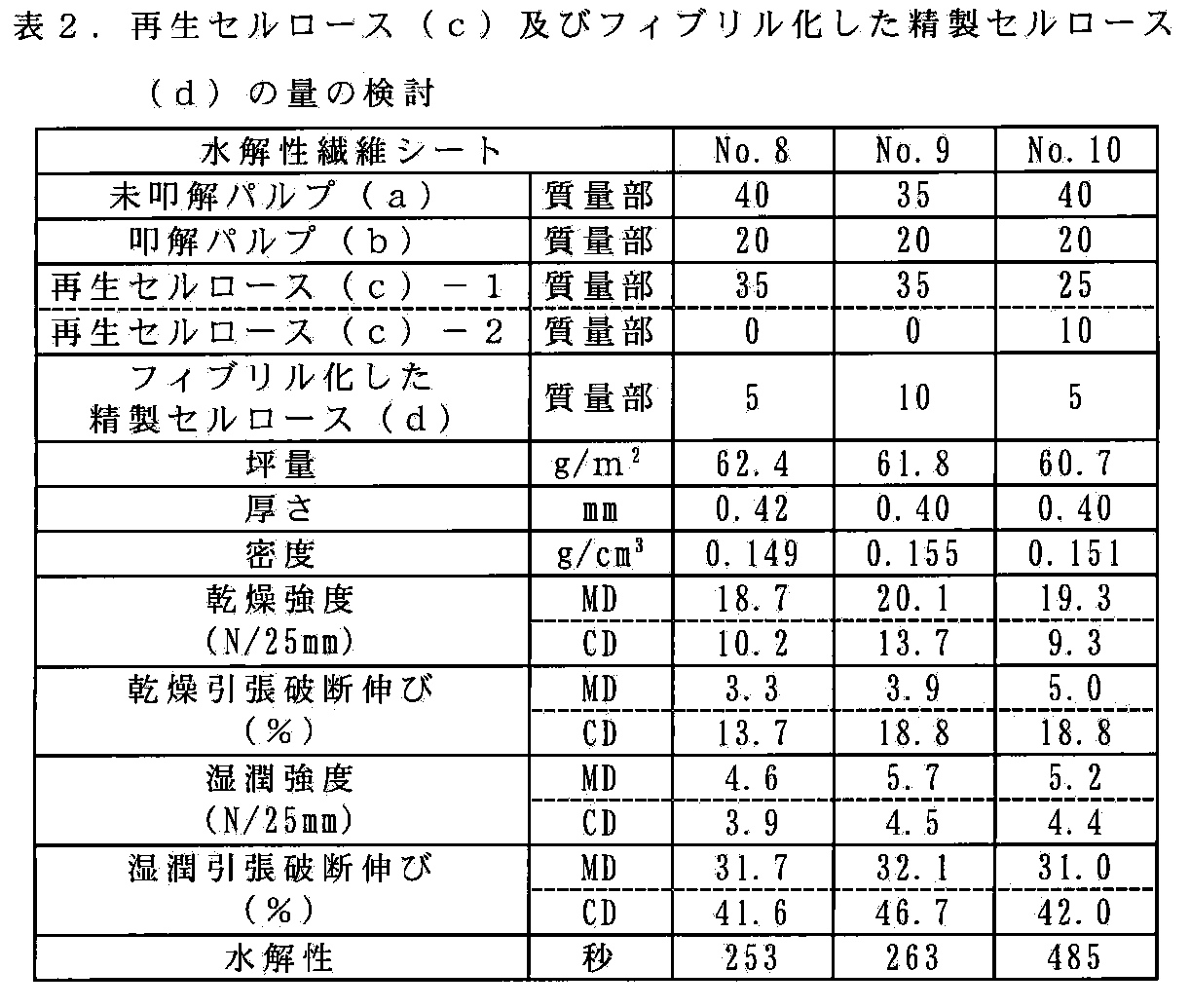
実施例1の水解性繊維シートNo.3及びNo.4と、水解性繊維シートNo.8とを比較すると、未叩解パルプ(a)又は叩解パルプ(b)を、再生セルロース(c)−1に置換することにより、湿潤強度が大きく向上することが分かる。
また、水解性繊維シートNo.8及びNo.9を比較すると、フィブリル化した精製セルロース(d)の量を増やすことにより、湿潤強度が大きく向上することが分かる。
さらに、水解性繊維シートNo.8及びNo.10を比較すると、平均繊維長の異なる2種の再生セルロース(c)を併用することにより、湿潤強度向上させることできることが分かる。
また、水解性繊維シートNo.8及びNo.9を比較すると、フィブリル化した精製セルロース(d)の量を増やすことにより、湿潤強度が大きく向上することが分かる。
さらに、水解性繊維シートNo.8及びNo.10を比較すると、平均繊維長の異なる2種の再生セルロース(c)を併用することにより、湿潤強度向上させることできることが分かる。
Claims (7)
- (i)次の繊維を含む材料を湿式抄紙して、繊維ウェッブを製造する工程;
叩解度が700cc以上の未叩解パルプ(a)を30~50質量%;
叩解度が400~650ccの叩解パルプ(b)を20~40質量%;
叩解度が700cc以上の再生セルロース(c)を15~45質量%;及び
叩解度が0~400ccのフィブリル化した精製セルロース(d)を2~15質量%、ここで叩解パルプ(b)及びフィブリル化した精製セルロース(d)は、それぞれ、本体部分と当該本体部分から延びるマイクロファイバー部分とを有し、フィブリル化した精製セルロース(d)の本体部分の、重さ加重平均繊維長分布のピークにおける繊維長が1~7mmの範囲内にあり;そして
(ii)前記繊維ウェッブを、ウォータージェット処理し、水解性繊維シートを製造する工程、ここで、前記水解性繊維シートにおいて、叩解パルプ(b)及びフィブリル化した精製セルロース(d)のマイクロファイバーが、それぞれ、他の繊維と交絡している:
を含むことを特徴とする、水解性繊維シートの製造方法。 - 工程(ii)の後に、(iii)水解性繊維シートを乾燥する工程をさらに含む、請求項1に記載の水解性繊維シートの製造方法。
- フィブリル化した精製セルロース(d)のマイクロファイバー部分が、フィブリル化した精製セルロース(d)の乾燥質量の0.1~65質量%を占める、請求項1又は2に記載の水解性繊維シートの製造方法。
- 再生セルロース(c)の平均繊維長が、3~13mmの範囲にある、請求項1~3のいずれか一項に記載の水解性繊維シートの製造方法。
- 再生セルロース(c)が、平均繊維長が3mm以上8mm以下の範囲にある再生セルロース(c−1)と、平均繊維長が8mm超13mm以下の範囲にある再生セルロース(c−2)とを含む、請求項1~4のいずれか一項に記載の水解性繊維シートの製造方法。
- 前記水解性繊維シートの水解性が600秒以下である、請求項1~5のいずれか一項に記載の水解性繊維シートの製造方法。
- 前記水解性繊維シートのMDの湿潤強度が、3N/25mm以上であり、CDの湿潤強度が、MDの湿潤強度の70%以上の値を有する、請求項1~6のいずれか一項に記載の水解性繊維シートの製造方法。
Applications Claiming Priority (2)
| Application Number | Priority Date | Filing Date | Title |
|---|---|---|---|
| JP2009-140492 | 2009-06-11 | ||
| JP2009140492A JP5599166B2 (ja) | 2009-06-11 | 2009-06-11 | 水解性繊維シートの製造方法 |
Publications (1)
| Publication Number | Publication Date |
|---|---|
| WO2010143731A1 true WO2010143731A1 (ja) | 2010-12-16 |
Family
ID=43308984
Family Applications (1)
| Application Number | Title | Priority Date | Filing Date |
|---|---|---|---|
| PCT/JP2010/059997 Ceased WO2010143731A1 (ja) | 2009-06-11 | 2010-06-08 | 水解性繊維シートの製造方法 |
Country Status (4)
| Country | Link |
|---|---|
| JP (1) | JP5599166B2 (ja) |
| AR (1) | AR077007A1 (ja) |
| TW (1) | TWI526589B (ja) |
| WO (1) | WO2010143731A1 (ja) |
Cited By (1)
| Publication number | Priority date | Publication date | Assignee | Title |
|---|---|---|---|---|
| EP3382078A4 (en) * | 2015-12-28 | 2018-10-03 | Unicharm Corporation | Water-disintegrable nonwoven fabric and process for producing same |
Families Citing this family (7)
| Publication number | Priority date | Publication date | Assignee | Title |
|---|---|---|---|---|
| AT517303B1 (de) * | 2015-06-11 | 2018-02-15 | Chemiefaser Lenzing Ag | Verwendung cellulosischer Fasern zur Herstellung eines Vliesstoffes |
| JP2017225719A (ja) * | 2016-06-24 | 2017-12-28 | 王子ホールディングス株式会社 | 消臭シート及び消臭シートの製造方法 |
| EP3330436B1 (de) | 2016-11-30 | 2018-08-08 | CheM&P GmbH & Co KG | Feuchtfestes, faserhaltiges substrat mit einstellbarer feucht- und nassfestigkeit und verfahren zu dessen herstellung |
| JP6346969B1 (ja) * | 2017-01-31 | 2018-06-20 | 大王製紙株式会社 | 水解性シート及び当該水解性シートの製造方法 |
| JP6962701B2 (ja) * | 2017-03-31 | 2021-11-05 | 大王製紙株式会社 | 清掃用シート及び当該清掃用シートの製造方法 |
| EP4038227A1 (en) * | 2019-09-30 | 2022-08-10 | Kelheim Fibres GmbH | Wetlaid web comprising viscose fibre |
| CN117867754B (zh) * | 2024-01-22 | 2026-05-29 | 泰盛科技(集团)股份有限公司 | 可冲散无纺布 |
Citations (1)
| Publication number | Priority date | Publication date | Assignee | Title |
|---|---|---|---|---|
| JP2001172850A (ja) * | 1999-01-29 | 2001-06-26 | Uni Charm Corp | フィブリル化レーヨンを含有した水解性繊維シート |
Family Cites Families (1)
| Publication number | Priority date | Publication date | Assignee | Title |
|---|---|---|---|---|
| JP3792147B2 (ja) * | 2001-10-15 | 2006-07-05 | ユニ・チャーム株式会社 | 水解性シートおよびその製造方法 |
-
2009
- 2009-06-11 JP JP2009140492A patent/JP5599166B2/ja not_active Expired - Fee Related
-
2010
- 2010-06-07 AR ARP100101995 patent/AR077007A1/es not_active Application Discontinuation
- 2010-06-08 WO PCT/JP2010/059997 patent/WO2010143731A1/ja not_active Ceased
- 2010-06-11 TW TW099119119A patent/TWI526589B/zh not_active IP Right Cessation
Patent Citations (1)
| Publication number | Priority date | Publication date | Assignee | Title |
|---|---|---|---|---|
| JP2001172850A (ja) * | 1999-01-29 | 2001-06-26 | Uni Charm Corp | フィブリル化レーヨンを含有した水解性繊維シート |
Cited By (1)
| Publication number | Priority date | Publication date | Assignee | Title |
|---|---|---|---|---|
| EP3382078A4 (en) * | 2015-12-28 | 2018-10-03 | Unicharm Corporation | Water-disintegrable nonwoven fabric and process for producing same |
Also Published As
| Publication number | Publication date |
|---|---|
| JP2010285719A (ja) | 2010-12-24 |
| AR077007A1 (es) | 2011-07-27 |
| JP5599166B2 (ja) | 2014-10-01 |
| TWI526589B (zh) | 2016-03-21 |
| TW201111574A (en) | 2011-04-01 |
Similar Documents
| Publication | Publication Date | Title |
|---|---|---|
| JP5599165B2 (ja) | 水解性繊維シート | |
| JP3640582B2 (ja) | フィブリル化レーヨンを含有した水解性繊維シート | |
| JP3618276B2 (ja) | 繊維長の異なるフィブリル化レーヨンを含有した水解性繊維シート | |
| JP3640564B2 (ja) | 繊維長の異なる再生セルロース繊維を含有した水解性不織布およびその製造方法 | |
| TWI239363B (en) | Water-disintegratable sheet and manufacturing method thereof | |
| JP3640591B2 (ja) | 表面摩擦に対する強度が高い水解性繊維シートの製造方法 | |
| JP3640592B2 (ja) | 多層構造の水解性繊維シート | |
| JP5599166B2 (ja) | 水解性繊維シートの製造方法 | |
| US6451718B1 (en) | Method of manufacturing a water disintegratable non-woven fabric and the water disintegratable non-woven fabric | |
| JP3948071B2 (ja) | 水解性不織布およびその製造方法 | |
| JP3284960B2 (ja) | 水解性不織布およびその製造方法 | |
| JP3129192B2 (ja) | 水崩壊性不織布及びその製造方法 | |
| JPWO2019150964A1 (ja) | 水解性不織布、湿潤水解性不織布及び水解性不織布の製造方法 | |
| JP7559579B2 (ja) | 水解性不織布、水解性不織布積層体及び水解性不織布の製造方法 | |
| JPH11279915A (ja) | 水解性不織布及びその製造方法 | |
| JP7501121B2 (ja) | 水解性不織布、湿潤水解性不織布及び水解性不織布の製造方法 | |
| JPH11152667A (ja) | 水解性不織布 | |
| JP2023154569A (ja) | 不織布、不織布の製造方法 | |
| BR0003187B1 (pt) | folha fibrosa que se decompÕe em Água. |
Legal Events
| Date | Code | Title | Description |
|---|---|---|---|
| 121 | Ep: the epo has been informed by wipo that ep was designated in this application |
Ref document number: 10786260 Country of ref document: EP Kind code of ref document: A1 |
|
| NENP | Non-entry into the national phase |
Ref country code: DE |
|
| 122 | Ep: pct application non-entry in european phase |
Ref document number: 10786260 Country of ref document: EP Kind code of ref document: A1 |