WO2010134173A1 - 情報処理装置、通信制御方法および通信制御プログラム - Google Patents
情報処理装置、通信制御方法および通信制御プログラム Download PDFInfo
- Publication number
- WO2010134173A1 WO2010134173A1 PCT/JP2009/059278 JP2009059278W WO2010134173A1 WO 2010134173 A1 WO2010134173 A1 WO 2010134173A1 JP 2009059278 W JP2009059278 W JP 2009059278W WO 2010134173 A1 WO2010134173 A1 WO 2010134173A1
- Authority
- WO
- WIPO (PCT)
- Prior art keywords
- keyword
- information processing
- data
- server device
- unit
- Prior art date
- Legal status (The legal status is an assumption and is not a legal conclusion. Google has not performed a legal analysis and makes no representation as to the accuracy of the status listed.)
- Ceased
Links
Images








Classifications
-
- G—PHYSICS
- G06—COMPUTING OR CALCULATING; COUNTING
- G06F—ELECTRIC DIGITAL DATA PROCESSING
- G06F16/00—Information retrieval; Database structures therefor; File system structures therefor
- G06F16/20—Information retrieval; Database structures therefor; File system structures therefor of structured data, e.g. relational data
- G06F16/25—Integrating or interfacing systems involving database management systems
- G06F16/252—Integrating or interfacing systems involving database management systems between a Database Management System and a front-end application
-
- G—PHYSICS
- G06—COMPUTING OR CALCULATING; COUNTING
- G06F—ELECTRIC DIGITAL DATA PROCESSING
- G06F15/00—Digital computers in general; Data processing equipment in general
- G06F15/16—Combinations of two or more digital computers each having at least an arithmetic unit, a program unit and a register, e.g. for a simultaneous processing of several programs
Definitions
- This case relates to an information processing apparatus, a communication control method, and a communication control program.
- An information processing apparatus as a client apparatus can access an information processing apparatus as a server apparatus via a network and acquire data managed by the server apparatus.
- An example of a client-server type distributed data management system is WWW (World Wide Web) that transmits and receives data in accordance with HTTP (HyperText Transfer Protocol).
- server devices there can be many server devices accessible from the client device.
- server devices that manage many types of data.
- a server device used in electronic commerce may manage a large number of product data. Therefore, it is preferable that the user can use means for facilitating search and acquisition of desired data.
- Patent Document 1 there is a database server that presents frequently used keywords to the user and searches for product information using the keyword selected by the user (see, for example, Patent Document 1).
- Patent Document 2 there is an electronic commerce server that stores a purchase history of a user and presents a succeeding product compatible with a past purchased product to the user (for example, see Patent Document 2).
- Patent Document 1 has a problem that it takes time to reach desired data because the user explicitly performs a search operation. Further, in the method described in Patent Document 2, since the history information on the server device side is used, there is a problem that it is difficult to present appropriate data to a user who has little use record.
- the present invention has been made in view of such points, and an object thereof is to provide an information processing apparatus, a communication control method, and a communication control program that can easily acquire user-desired data from a server apparatus. To do.
- an information processing apparatus having a storage unit, a communication unit, and a control unit.
- the storage unit stores a keyword according to the executed information processing.
- the communication unit transmits a message designating the destination server device via the network, and receives data corresponding to the message from the server device.
- the control unit adds at least one of the keywords stored in the storage unit to a message addressed to a predetermined server device among messages transmitted by the communication unit.
- a communication control method for an information processing apparatus connected to a network is provided.
- executed information processing is detected, keywords corresponding to the information processing are extracted, and stored in the storage unit of the information processing apparatus.
- At least one of keywords stored in the storage unit is added to a message addressed to a predetermined server device among messages transmitted via the network.
- Data corresponding to the keyword added to the message is received from a predetermined server device via the network.
- a communication control program to be executed by a computer connected to a network is provided.
- the computer detects the executed information processing, extracts keywords corresponding to the information processing, and stores them in the storage unit of the computer. At least one of keywords stored in the storage unit is added to a message addressed to a predetermined server device among messages transmitted via the network. Data corresponding to the keyword added to the message is received from a predetermined server device via the network.
- FIG. 1 is a diagram illustrating an example of an information processing apparatus according to the present embodiment.
- the information processing apparatus 1 is connected to the network 4 and can communicate with the server apparatuses 2 and 3 via the network 4.
- the information processing apparatus 1 includes a storage unit 1a, a communication unit 1b, and a control unit 1c.
- the storage unit 1a stores keywords according to executed information processing (for example, information processing executed by the information processing apparatus 1 in response to a user operation). For example, the keywords are extracted by the control unit 1c and sequentially stored in the storage unit 1a.
- the storage unit 1a may store a plurality of keywords.
- the type of information processing and the acquired date and time may be further stored in association with the keyword.
- the information processing includes data communication with a server device that provides a website, reproduction of music data or video data, execution of other application software, and the like.
- keywords can be extracted from a transmitted search word or a received text document.
- keywords can be extracted from attribute information of reproduction target data.
- keywords can be extracted from the name of the software.
- the communication unit 1b transmits messages 5 and 6 specifying the destination server device via the network 4.
- the messages 5 and 6 for example, an HTTP request can be used.
- the destination server device can be specified using, for example, a host name or an IP (Internet Protocol) address.
- the communication unit 1 b receives data corresponding to the messages 5 and 6 from the server devices 2 and 3 via the network 4.
- the received data includes, for example, text data and image data.
- the control unit 1c adds the keyword (for example, the keyword 5a) stored in the storage unit 1a to the message 5 addressed to the predetermined server device 2 among the messages 5 and 6 transmitted by the communication unit 1b. As a result, it is possible to acquire data selected according to the added keyword among the data managed by the predetermined server device 2. Only one keyword or a plurality of keywords may be added. Further, all of the keywords stored in the storage unit 1a may be added, or some keywords may be narrowed down and added.
- the keyword for example, the keyword 5a
- keywords corresponding to the executed information processing are stored in the storage unit 1a.
- Messages 5 and 6 specifying the destination server device are transmitted via the network 4 by the communication unit 1b, and data corresponding to the messages 5 and 6 is received from the server devices 2 and 3.
- the control unit 1c adds at least one of the keywords stored in the storage unit 1a to the message 5 addressed to the predetermined server device 2.
- the information processing apparatus 1 can automatically transmit a keyword reflecting the user's interest when accessing the predetermined server apparatus 2.
- user-desired data can be easily acquired from the server device 2, and the burden of the user's data search operation is reduced.
- this communication control method is also effective for a server device that has no access record of the user.
- the server device 2 is a web server device that provides an electronic commerce site.
- the information processing device 1 transmits a message including a predetermined address (for example, the root address of the electronic commerce site)
- the information processing device 1 receives screen data (for example, a product classification list) for searching for product data managed by the server device 2.
- screen data for example, a product classification list
- the product data corresponding to the keyword added to the message is also received from the server device 2. That is, even before the user performs a search operation, the user can receive a product that is considered to be of great interest to the user.
- FIG. 2 is a diagram showing the overall configuration of the electronic commerce system.
- the electronic commerce system includes a client device 100, server devices 200, 200a, 200b, and a broadcasting station 300.
- the client device 100 and the server devices 200, 200a, 200b are connected to the network 21.
- the client device 100 is connected to the antenna 31.
- the client device 100 is an information terminal device that can be operated by a user.
- a desktop computer, a notebook computer, a portable terminal device, or the like can be considered.
- the client device 100 communicates with the server devices 200, 200a, and 200b via the network 21.
- a television signal from the broadcast station 300 is received via the antenna 31.
- various application software can be executed in response to a user operation.
- the server devices 200, 200 a, and 200 b are information processing devices that perform data processing and data transmission in response to access from the client device 100.
- the server device 200 provides an electronic commerce site.
- the server device 200a provides a search site.
- the server device 200b provides an electronic commerce site different from the server device 200. Note that data processed by each server device may be stored in a storage device in the device, or may be stored in an external storage device (for example, a database server device) (not shown).
- Broadcast station 300 is a wireless transmission device that transmits a television signal.
- the broadcast station 300 encodes and modulates video data of a television broadcast program and wirelessly outputs it.
- the television signal output from the broadcast station 300 is received by the antenna 31 and input to the client device 100.
- the client device 100 may use cable television broadcasting instead of television broadcasting.
- the server devices 200, 200a, and 200b are implemented as web server devices.
- the client device 100 is implemented as a web client device that executes a web browser.
- FIG. 3 is a block diagram showing hardware of the client device.
- the client device 100 includes a central processing unit (CPU) 101, a memory 102, a hard disk drive (HDD: Hard Disc Drive) 103, a graphic processing unit 104, an input interface 105, a disk drive 106, a communication unit 107, and a TV tuner. 108. Each of the above units is connected to the bus 109.
- the CPU 101 controls the entire client device 100.
- the CPU 101 reads out a program stored in the HDD 103, expands it in the memory 102, and executes it. Specifically, when the client device 100 is activated, an OS (Operating System) program starts to be executed, and an application program is executed in accordance with a subsequent user operation. Note that a plurality of CPUs may be mounted on the client device 100 to perform distributed processing.
- OS Operating System
- the memory 102 temporarily stores at least a part of a program executed by the CPU 101 and data used for processing.
- a RAM Random Access Memory
- the CPU 101 reads / writes programs and data from / to the memory 102 as appropriate.
- the HDD 103 stores programs executed by the CPU 101 and data used for processing.
- Programs stored in the HDD 103 include an OS program and application programs such as a web browser program and a television broadcast viewing program.
- a non-volatile memory device such as an SSD (Solid State Drive) may be used.
- the graphic processing unit 104 is connected to the display 11.
- the graphic processing unit 104 generates an image signal for the display screen under the control of the CPU 101 and outputs it to the display 11.
- the display screen includes a window corresponding to the application program being executed.
- the input interface 105 is connected to the input device 12.
- the input device 12 for example, a keyboard, a mouse, a touch pad, a touch panel, or the like can be used.
- the input interface 105 detects a user operation (for example, key press) on the input device 12 and outputs an input signal to the CPU 101.
- the disk drive 106 is a drive device that reads data from the disk medium 13 that is a portable recording medium.
- a magnetic disk such as a flexible disk (FD)
- an optical disk such as a CD (Compact Disc) or a DVD (Digital Versatile Disc), or a magneto-optical disk (MO) can be used.
- music data and video data are recorded on the disk medium 13.
- the communication unit 107 is connected to the network 21.
- the communication unit 107 communicates with the server devices 200, 200a, and 200b according to the control of the CPU 101. That is, transmission data is encoded and modulated, and output to server apparatuses 200, 200a, and 200b. Also, the received data from the server devices 200, 200a, 200b is demodulated and decoded. Note that the communication unit 107 may be connected to the network 21 via a wireless access network.
- the TV tuner 108 is connected to the antenna 31.
- the TV tuner 108 acquires a television signal from the antenna 31 and extracts a signal in a frequency band corresponding to the channel to be viewed. Then, demodulation and decoding are performed to obtain video data of a television broadcast program.
- the viewing target channel is designated by the CPU 101.
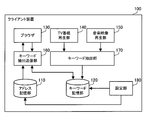
- FIG. 4 is a block diagram showing functions of the client device.
- an address storage unit 110 a keyword storage unit 120, a browser 130, a TV program playback unit 140, a music video playback unit 150, a keyword extraction transmission unit 160, a keyword extraction unit 170, and a setting unit 180 are implemented.
- the functions of these modules are realized by the CPU 101 executing a program. However, some or all of these modules may be realized by a dedicated hardware circuit.
- the address storage unit 110 stores an address of a target website for executing a predetermined process. Specifically, an address indicating a keyword extraction target and an address indicating a keyword automatic addition target are stored. The address is described in, for example, a URL (UniformatorResource Locator) format.
- the addresses stored in the address storage unit 110 include those fixedly defined in advance and those set by the setting unit 180.
- the keyword storage unit 120 stores a keyword that characterizes the interest of the user of the client device 100.
- a plurality of keywords can be stored.
- the keywords stored in the keyword storage unit 120 include those extracted by the keyword extraction / transmission unit 160, those extracted by the keyword extraction unit 170, and those set by the setting unit 180.
- the browser 130 provides a user interface for acquiring and browsing data managed by the server devices 200, 200a, and 200b. Specifically, an HTTP request addressed to the server devices 200, 200a, and 200b is transmitted in accordance with a user operation. Then, an HTTP response is received as a response to the HTTP request, and data (for example, text data or image data) included in the HTTP response is displayed.
- data for example, text data or image data
- the TV program playback unit 140 provides a user interface for viewing a television broadcast program. Specifically, a channel to be viewed is designated on the TV tuner 108 according to the user's channel selection operation, and the video data of the designated channel is acquired and displayed. In addition, the TV program reproducing unit 140 acquires and displays program information indicating an outline of the television broadcast program. As the program information, for example, the broadcast station 300 acquires what is multiplexed with video data and transmitted. Alternatively, it is acquired via a network 21 from a website that provides program information.
- the music video playback unit 150 plays back content data such as music data and video data in accordance with a user operation. For example, data recorded on the HDD 103 or the disk medium 13 is reproduced. At that time, the music video reproduction unit 150 acquires and displays the attribute information added to the content data.
- the attribute information includes, for example, a title, genre, artist name, performer name, and the like.
- the keyword extraction / transmission unit 160 monitors the input / output message of the browser 130, and performs keyword extraction processing and addition processing on the message including the address stored in the address storage unit 110. Specifically, an HTTP request or an HTTP response including an extraction target address is detected, and a keyword is extracted and stored in the keyword storage unit 120. Further, an HTTP request including an address to be added is detected, and a keyword stored in the keyword storage unit 120 is added.
- the detection of the HTTP request and the HTTP response may be realized by monitoring the execution process of the browser 130 or may be realized by monitoring data transmission / reception of the communication unit 107. Further, the keyword addition process may be performed after a request from the destination server apparatus.
- the keyword extraction unit 170 monitors the execution process of the TV program playback unit 140, the music video playback unit 150, and other application software, extracts the keywords, and stores them in the keyword storage unit 120. It is conceivable that the execution process to be monitored is registered in the keyword extraction unit 170 in advance.
- the keyword extraction unit 170 detects viewing of a television broadcast program, and extracts a keyword from program information about the viewed television broadcast program.
- the program information may be acquired from the TV program playback unit 140 or may be acquired from a website via the network 21. Note that the detection of the viewing of a television broadcast program can also be realized by monitoring the operation of the TV tuner 108.
- the keyword extraction unit 170 detects the reproduction of the content data and detects the keyword from the attribute information of the content data.
- the attribute information may be acquired from the music video playback unit 150 or directly from the content data.
- the keyword extraction unit 170 can also monitor the execution of various application software such as game software and image editing software. In that case, for example, it is conceivable to extract the name of the executed software as a keyword.
- the setting unit 180 provides a user interface for setting addresses and keywords.
- the setting unit 180 stores the input address in the address storage unit 110. Further, when the user inputs a keyword, the input keyword is stored in the keyword storage unit 120.
- addresses and keywords can be stored in a file on the HDD 103.
- the browser 130, the TV program playback unit 140, and the music video playback unit 150 can be realized as separate application software.
- the keyword extraction unit 170 can be realized as resident software that automatically starts after the OS is started.
- the keyword extraction / transmission unit 160 can be realized as software (add-in) incorporated in the browser 130.
- FIG. 5 is a block diagram showing the hardware of the server device.
- the server device 200 includes a CPU 201, a memory 202, an HDD 203, and a communication unit 204. Each of the above units is connected to the bus 205.
- the server apparatuses 200a and 200b can also be realized by the same hardware configuration as the server apparatus 200.
- the CPU 201 controls the entire server apparatus 200.
- the CPU 201 reads a program stored in the HDD 203, expands it in the memory 202, and executes it. Specifically, when the server device 200 is activated, the OS program starts to be executed, and thereafter, the web server program that processes access from the client device 100 starts to execute.
- the server apparatus 200 may be equipped with a plurality of CPUs to perform distributed processing.
- the memory 202 temporarily stores at least a part of a program executed by the CPU 201 and data used for processing.
- a RAM can be used as the memory 202.
- the CPU 201 reads / writes programs and data from / to the memory 202 as appropriate.
- the HDD 203 stores programs executed by the CPU 201 and data used for processing.
- the programs stored in the HDD 203 include an OS program and application programs such as a web server program and a data search program.
- a nonvolatile memory device such as an SSD may be used instead of the HDD 203 (or in combination with the HDD 203).
- the communication unit 204 is connected to the network 21.
- the communication unit 204 communicates with the client device 100 according to the control of the CPU 201. That is, the received data from the client device 100 is demodulated and decoded. Further, the transmission data is encoded and modulated, and output to the client apparatus 100.
- FIG. 6 is a block diagram showing functions of the server device.
- a product information storage unit 210 a template storage unit 220, a request reception unit 230, and a search unit 240 are mounted.
- the functions of these modules are realized by the CPU 201 executing a program. However, some or all of these modules may be realized by a dedicated hardware circuit.
- the product information storage unit 210 stores product data handled by the server device 200 in electronic commerce.
- the product data includes text data indicating the description of the product and image data indicating the appearance of the product. Further, the product information storage unit 210 stores data used for searching for products such as keywords related to each product.
- the product information storage unit 210 can store data in various formats such as a relationship table and XML (eXtensibletMarkup Language).
- the template storage unit 220 stores a template of HTML data to be transmitted to the client device 100, that is, an HTML template.
- the HTML template defines a display method of product data. HTML data can be generated by embedding text data in an HTML template.
- the request reception unit 230 processes an HTTP request and an HTTP response.
- the request reception unit 230 requests the search unit 240 to perform processing corresponding to the address specified in the HTTP request. If a keyword is added to the HTTP request, the keyword is extracted and passed to the search unit 240. After that, when processing result data is acquired from the search unit 240, an HTTP response is generated and transmitted to the client device 100.
- the search unit 240 receives a request from the request reception unit 230 and acquires product data from the product information storage unit 210.
- a search is performed using the keyword to narrow down product data to be acquired.
- the search unit 240 generates HTML data from the text data that is the product data and the HTML template stored in the template storage unit 220 and passes the HTML data to the request reception unit 230. Further, the image data that is the product data is passed to the request receiving unit 230.
- the request receiving unit 230 can be realized as resident software.
- the search unit 240 may be activated in response to a request from the request accepting unit 230, or may be activated at all times. In the latter case, a thread for processing the request may be generated for each request.
- the HTML data output from the server device 200 includes data indicating details of individual products and data (product classification list or the like) for the user to search for desired products.
- the former is output when, for example, an HTTP request designating an address corresponding to each product is received.
- the latter is output when, for example, an HTTP request specifying a route address (such as a top page address) of an electronic commerce site is received.
- HTML data including product data corresponding to the keyword can be output.
- the process of automatically outputting the product data corresponding to the keyword may be performed only for an HTTP request specifying a route address, or performed for an HTTP request specifying an arbitrary address in the electronic commerce site. Also good.
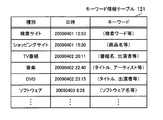
- FIG. 7 shows the data structure of the keyword information table.
- the keyword information table 121 is stored in the keyword storage unit 120 of the client device 100. Data is appropriately added to the keyword information table 121 by the keyword extraction / transmission unit 160, the keyword extraction unit 170, and the setting unit 180.
- the keyword information table 121 includes items of type, date and keyword.
- type item the type of information processing that is the cause of keyword acquisition is set.
- date / time item the date / time when the keyword was acquired is set.
- keyword item one or more acquired keywords are set. When setting a plurality of keywords, for example, the keywords are separated by commas.
- the client device 100 transmits a search word to the server device 200a that provides the search site
- the client device 100 sets the type as “search site” and registers the search word as a keyword.
- the type is “shopping site” and the product name is registered.
- the type is “TV program” and the program name, performer name, etc. are registered.
- the type is “music” and the music title, artist name, etc. are registered.
- the type is “DVD”, and the title of the video and the name of the performer are registered.
- the application software is executed, the type is “software” and the software name is registered.
- FIG. 8 shows the data structure of the request message.
- the request message 141 is a message transmitted from the client device 100 to the server device 200.
- the request message 141 can be implemented as an HTTP request.
- the request message 141 includes a method name, a host name, a path name, and a keyword.
- the method name indicates the name of an HTTP method used for communication, such as “GET” or “POST”.
- the host name indicates a name assigned to the destination server device, and may include a domain name.
- the path name indicates a name for identifying the file or data to be accessed in the server device, and may include a directory hierarchy.
- the host name and path name form part of the address. For example, “http: //” + host name + path name corresponds to the URL.
- the keyword can be added to the request message 141 by various methods.
- the keyword is transmitted as cookie data.
- a method of transmitting a keyword including a keyword in a path name, or a method of transmitting a keyword as transmission data of a POST method can be considered.
- a plurality of keywords can be added to the request message 141. The plurality of keywords may be ordered according to importance.
- FIG. 9 is a diagram showing the data structure of the product information table.
- the product information table 211 is stored in the product information storage unit 210 of the server device 200. For example, data is registered in the merchandise information table 211 in accordance with the operation of the administrator of the server device 200.
- the product information table 211 includes items of product ID and related words.
- an identifier for identifying a product handled in electronic commerce or a type of product is set.
- the related word field one or more keywords related to the product indicated by the product ID are set. When setting a plurality of keywords, for example, the keywords are separated by commas.
- FIG. 10 is a flowchart showing the control of the client device. This processing is executed in the client device 100 when the web browser process (that is, the browser 130) is running. In the following, the process illustrated in FIG. 10 will be described in order of step number.
- Step S11 The keyword extraction / transmission unit 160 starts monitoring the browser 130.
- the keyword extraction and transmission unit 160 monitors the transmission of HTTP requests and the reception of HTTP responses by the browser 130.
- Step S12 The keyword extraction and transmission unit 160 determines whether the browser 130 has transmitted an HTTP request addressed to a server device (for example, the server device 200a) that provides a predetermined search site.
- a server device for example, the server device 200a
- the address of the search target search site is stored in the address storage unit 110. If a corresponding HTTP request is detected, the process proceeds to step S13. If not detected, the process proceeds to step S14.
- Step S13 The keyword extraction and transmission unit 160 extracts a search word from the HTTP request detected in Step S12. Then, the extracted search word is registered in the keyword information table 121 stored in the keyword storage unit 120 together with the type “search site” and the current date and time.
- Step S14 The keyword extraction / transmission unit 160 determines whether the browser 130 has received an HTTP response from a server device (for example, the server device 200b) that provides a predetermined electronic commerce site.
- a server device for example, the server device 200b
- the address of the monitored electronic commerce site is stored in the address storage unit 110. If a corresponding HTTP response is detected, the process proceeds to step S15. If not detected, the process proceeds to step S16.
- the keyword extraction and transmission unit 160 extracts a keyword related to the product from the HTTP response detected in Step S14.
- the keyword may be extracted from the header portion of HTML data.
- the extracted keyword is registered in the keyword information table 121 stored in the keyword storage unit 120 together with the type “shopping site” and the current date and time.
- Step S16 The keyword extraction transmission unit 160 determines whether the browser 130 has transmitted an HTTP request designating a predetermined address.
- the address of the electronic commerce site provided by the server device 200 is stored in the address storage unit 110 as the monitoring target address. If a corresponding HTTP request is detected, the process proceeds to step S17. If not detected, the process proceeds to step S20.
- the keyword extraction and transmission unit 160 prioritizes the keywords registered in the keyword information table 121 based on the type.
- the priority of the type may be specified by the user in advance, or may be determined from the execution frequency of various types of application software. For example, a type with higher execution frequency is set to a higher priority.
- the execution frequency can be determined from data registered in the keyword information table 121, or can be determined by separately monitoring the process of the client device 100.
- the keyword extraction / transmission unit 160 prioritizes keywords in the same type based on the date and time. For example, a keyword with a new date and time is set to a higher priority. Note that keywords that have passed a predetermined period (for example, one week) or more after registration may be excluded from transmission candidates. Further, keywords that have passed for a predetermined period or longer may be deleted from the keyword information table 121.
- steps S17 and S18 may be performed in reverse order to prioritize keywords by giving priority to the date and time. For example, prioritize by classifying the elapsed period from registration into multiple ranges (for example, less than 1 day, 1 day to less than 3 days, 3 days or more, etc.), and prioritize keywords belonging to the same category by type You can also.
- the keyword extraction and transmission unit 160 adds some or all of the keywords prioritized in steps S17 and S18 to the HTTP request detected in step S16. For example, a predetermined number (for example, five) of keywords are selected and added from the higher priority. At that time, priority information of each keyword can be added together.
- Step S20 The keyword extraction / transmission unit 160 determines whether the operation of the browser 130 has ended (whether the web browser process has ended). When the operation is finished, the monitoring of the browser 130 is finished. If the operation has not ended, the process proceeds to step S11.
- the client device 100 extracts keywords from transmission / reception data when using a search site or an electronic commerce site. Thereby, keywords that characterize the user's interest can be collected. Further, the client device 100 automatically transmits a part or all of the accumulated keywords when accessing the server device 200. Thereby, the server apparatus 200 can know a user's interest.
- the client device 100 may add a keyword to an HTTP request that specifies an arbitrary address in the electronic commerce site, or an HTTP request that specifies a specific address (for example, a route address) in the electronic commerce site. Only keywords may be added. Also, when accessing the same e-commerce site multiple times in succession, that is, when sending an HTTP request specifying the address in the e-commerce site multiple times in succession, a keyword is added only to the first HTTP request. May be.
- the extraction process in steps S11 to S15 and the transmission process in steps S16 to S19 may be performed in parallel by separate processes.
- the keyword extraction process can also be executed by the keyword extraction unit 170 in parallel with the processing by the keyword extraction transmission unit 160 described above. However, the keyword extraction process may be stopped while the transmission process of steps S16 to S19 is being executed or while the electronic commerce site to be transmitted is being accessed.
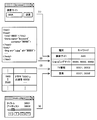
- FIG. 11 shows an example of keyword extraction.
- FIG. 11 shows (1) an extraction example when using a search site, (2) an extraction example when using an electronic commerce site, (3) an extraction example when viewing a television broadcast program, and (4) an extraction example when reproducing music data. Is shown. It is also possible to extract keywords by a method other than the method shown in FIG.
- the keyword extraction / transmission unit 160 acquires the search word “AAA”.
- the type “search site” and the keyword “AAA” are registered in the keyword information table 121.
- the keyword extraction and transmission unit 160 acquires the web page title “BBB1” and the keyword “BBB2” in the meta tag of the HTML data. Also, the description “BBB3” given to the product image is acquired. As a result, the type “shopping site” and the keywords “BBB1, BBB2, BBB3” are registered in the keyword information table 121.
- the keyword extraction unit 170 acquires a program title “CCC1” and a performer name “CCC2”. As a result, the type “TV program” and the keywords “CCC1, CCC2” are registered in the keyword information table 121.
- the keyword extraction unit 170 acquires the music title "DDD1" and the artist name "DDD2". As a result, the type “music” and the keywords “DDD1, DDD2” are registered in the keyword information table 121.
- the keyword extraction / transmission unit 160 and the keyword extraction unit 170 can also extract keywords from sentences and phrases.
- keywords can be extracted by performing morphological analysis or syntactic analysis on a sentence.
- general terms that do not characterize the user's interest may be set as NG words, and NG words may not be extracted.
- FIG. 12 is a flowchart showing the control of the server device. This process is executed in the server device 200 in response to an HTTP request from the client device 100. In the following, the process illustrated in FIG. 12 will be described in order of step number.
- the request reception unit 230 receives the HTTP request transmitted from the client device 100 via the network 21.
- the request reception unit 230 determines whether the HTTP request received in step S21 includes a predetermined address (for example, the root address of the electronic commerce site). This determination can be made based on, for example, a path name. If the predetermined address is included, the process proceeds to step S23. If not included, the process proceeds to step S26.
- a predetermined address for example, the root address of the electronic commerce site
- the request reception unit 230 extracts keywords from the HTTP request received in step S21. Then, the extracted keyword is passed to the search unit 240.
- the search unit 240 collates the keyword acquired from the request reception unit 230 with the related word in the product information table 211 stored in the product information storage unit 210, and selects a product that matches the acquired keyword. . You may narrow down the goods selected to a predetermined number or less.
- a method of selecting a product having a related word that completely or partially matches a keyword can be considered.
- a plurality of keywords When a plurality of keywords are acquired, it may be conditional on having related words corresponding to all keywords, or may be conditional on having related words corresponding to at least one keyword. Moreover, it is good also as conditions on the condition that the ratio which the corresponding related word exists exceeds a predetermined threshold value.
- priority When priority is given to a keyword, you may weight according to priority.
- Step S25 The search unit 240 acquires the product data selected in Step S24 from the product information storage unit 210. Also, an HTML template corresponding to the address included in the HTTP request is acquired from the template storage unit 220. Then, text data that is product data is embedded in an HTML template to generate HTML data, which is output to the request receiving unit 230. Thereafter, the process proceeds to step S27.
- the request reception unit 230 and the search unit 240 perform normal processing according to the address included in the HTTP request. For example, in the case of an address corresponding to a product category, the search unit 240 generates HTML data indicating a product category list and outputs it to the request receiving unit 230. On the other hand, in the case of an address corresponding to each product, HTML data indicating the details of the product is generated and output to the request receiving unit 230.
- the request reception unit 230 adds an HTTP header to the data acquired from the search unit 240 to generate an HTTP response, and transmits the HTTP response to the client apparatus 100.
- the server device 200 receives an HTTP request including a keyword from the client device 100
- the server device 200 searches for a product that matches the keyword.
- product data that matches the keyword is also transmitted to the client device 100.
- the server apparatus 200 can present the goods considered that a user's interest is high.
- FIG. 13 shows an example of a display screen.
- the display screen 131 is an example of a screen displayed on the display 11 after the browser 130 accesses the server device 200.
- the e-commerce site root address “http://www.shoppingsite.com/top.cgi” is specified and accessed, a web page including a product classification area and a recommended product area is displayed as shown in FIG. Is displayed.
- product category items such as “Desktop PC” and “Notebook PC” are displayed. Each product category item is given a hyperlink. The user can search for a desired product by following the hyperlink from the product classification list.
- product data corresponding to the keyword automatically transmitted from the client device 100 to the server device 200 is displayed.
- the recommended product is a product of high interest to the user, the user can skip the operation of searching for the desired product and proceed to a procedure for purchasing the product.
- the client device 100 can collect keywords according to the execution status of information processing, that is, keywords that characterize the user's interest. And when using an electronic commerce site, the collected keyword can be transmitted automatically. As a result, it is possible to quickly receive a product that is considered to be of high interest to the user. In particular, when a user accesses a top page of an electronic commerce site and before the user performs an operation for searching for a product, such product can be presented.
- the user can use the electronic commerce site comfortably.
- the operator side of the electronic commerce site has an advantage that the user's willingness to purchase can be promoted.
- the processing functions of the client device 100 and the server device 200 can be realized by a general-purpose computer.
- a program describing the contents of the processing function is provided.
- the program describing the contents of the processing function can be recorded on a computer-readable recording medium.
- a recording medium for example, a magnetic disk, an optical disk, a magneto-optical disk (MO), or a semiconductor memory can be used.
- the magnetic disk HDD, FD, and magnetic tape (MT: Magnetic Tape) can be considered.
- MT Magnetic Tape
- the optical disk a CD, a CD-R (Recordable) / RW (ReWritable), a DVD, and a DVD-R / RW are conceivable.
- a portable recording medium on which the program is recorded is provided.
- the program can be stored in a storage device of another computer and transferred to a computer that executes the program via a network.
- the computer that executes the program stores, for example, a program recorded on a portable recording medium or a program received from another computer in its own storage device. Then, the program is read from the storage device and executed. However, it is also possible to read and execute a program directly from a portable recording medium. In addition, each time a program is received from another computer, the program can be executed sequentially.
Landscapes
- Engineering & Computer Science (AREA)
- Theoretical Computer Science (AREA)
- Databases & Information Systems (AREA)
- Physics & Mathematics (AREA)
- General Engineering & Computer Science (AREA)
- General Physics & Mathematics (AREA)
- Computer Hardware Design (AREA)
- Data Mining & Analysis (AREA)
- Software Systems (AREA)
- Information Transfer Between Computers (AREA)
Abstract
Description
本発明の上記および他の目的、特徴および利点は本発明の例として好ましい実施の形態を表す添付の図面と関連した以下の説明により明らかになるであろう。
図1は、本実施の形態に係る情報処理装置の例を示す図である。情報処理装置1は、ネットワーク4に接続されており、サーバ装置2,3とネットワーク4を介して通信可能である。情報処理装置1は、記憶部1a、通信部1bおよび制御部1cを有する。
なお、HDD203に代えて(または、HDD203と併せて)、SSDなどの不揮発性メモリ装置を用いてもよい。
ユーザが検索ワード「AAA」を入力して送信ボタンを押下した場合、キーワード抽出送信部160は、検索ワード「AAA」を取得する。これにより、種別「検索サイト」、キーワード「AAA」が、キーワード情報テーブル121に登録される。
ユーザが商品紹介のウェブページを閲覧した場合、キーワード抽出送信部160は、ウェブページのタイトル「BBB1」とHTMLデータのメタタグ内のキーワード「BBB2」とを取得する。また、商品画像に与えられた説明「BBB3」を取得する。これにより、種別「ショッピングサイト」、キーワード「BBB1,BBB2,BBB3」が、キーワード情報テーブル121に登録される。
ユーザがテレビジョン放送番組を視聴した場合、キーワード抽出部170は、番組タイトル「CCC1」と出演者名「CCC2」とを取得する。これにより、種別「TV番組」、キーワード「CCC1,CCC2」が、キーワード情報テーブル121に登録される。
ユーザがHDD103に格納された音楽データを再生させた場合、キーワード抽出部170は、音楽のタイトル「DDD1」とアーティスト名「DDD2」とを取得する。これにより、種別「音楽」、キーワード「DDD1,DDD2」が、キーワード情報テーブル121に登録される。
[ステップS22]要求受付部230は、ステップS21で受信したHTTPリクエストに、所定のアドレス(例えば、電子商取引サイトのルートアドレス)が含まれるか判断する。この判断は、例えば、パス名に基づいて判断することができる。所定のアドレスが含まれている場合、処理をステップS23に進める。含まれていない場合、処理をステップS26に進める。
[ステップS24]検索部240は、要求受付部230から取得したキーワードと商品情報記憶部210に記憶された商品情報テーブル211の関連ワードとを照合して、取得したキーワードに適合する商品を選択する。選択する商品は所定数以下に絞ってもよい。
このようにして、サーバ装置200は、クライアント装置100からキーワードを含むHTTPリクエストを受信すると、キーワードに適合する商品を検索する。そして、HTTPリクエストで明示に要求されたデータに加えて、キーワードに適合する商品のデータも、クライアント装置100に送信する。これにより、サーバ装置200は、ユーザの興味が高いと考えられる商品を提示できる。
1a 記憶部
1b 通信部
1c 制御部
2,3 サーバ装置
4 ネットワーク
5,6 メッセージ
5a キーワード
Claims (8)
- 実行された情報処理に応じたキーワードを記憶する記憶部と、
ネットワーク経由で、宛先のサーバ装置を指定したメッセージを送信し、前記メッセージに応じたデータを前記サーバ装置から受信する通信部と、
前記通信部が送信する前記メッセージのうち、所定のサーバ装置宛てのメッセージに、前記記憶部に記憶された前記キーワードの少なくとも1つを付加する制御部と、
を有することを特徴とする情報処理装置。 - 前記記憶部は、前記キーワードに対応付けて前記情報処理の種類を示す情報を記憶し、
前記制御部は、前記情報処理の種類に基づいて、前記メッセージに付加するキーワードを選択することを特徴とする請求の範囲第1項記載の情報処理装置。 - 前記情報処理には、前記所定のサーバ装置と異なる他のサーバ装置との通信が含まれ、
前記制御部は、前記他のサーバ装置宛てのメッセージまたは前記他のサーバ装置から受信したデータから、前記キーワードを抽出して前記記憶部に格納する、
ことを特徴とする請求の範囲第1項記載の情報処理装置。 - 前記情報処理には、音楽データまたは映像データの再生が含まれ、
前記制御部は、再生された前記音楽データまたは前記映像データの属性情報から、前記キーワードを抽出して前記記憶部に格納する、
ことを特徴とする請求の範囲第1項記載の情報処理装置。 - 前記通信部は、前記所定のサーバ装置が管理するデータのうち、前記メッセージに付加された前記キーワードに応じて選択されるデータを、前記所定のサーバ装置から受信することを特徴とする請求の範囲第1項記載の情報処理装置。
- 前記通信部は、所定のアドレスを含むメッセージを送信すると、前記所定のサーバ装置が管理するデータに対する検索の操作に用いられる画面データを更に受信し、
前記制御部は、前記所定のアドレスを含むメッセージに対する応答を受けて、前記検索の操作のための第1の領域と前記キーワードに応じて選択されたデータを示す第2の領域とを含む画面を表示する、
ことを特徴とする請求の範囲第5項記載の情報処理装置。 - ネットワークに接続された情報処理装置の通信制御方法であって、
実行された情報処理を検出し、前記情報処理に応じたキーワードを抽出して前記情報処理装置の記憶部に記憶し、
前記ネットワーク経由で送信するメッセージのうち、所定のサーバ装置宛てのメッセージに、前記記憶部に記憶された前記キーワードの少なくとも1つを付加し、
前記メッセージに付加した前記キーワードに応じたデータを、前記ネットワーク経由で前記所定のサーバ装置から受信する、
ことを特徴とする通信制御方法。 - ネットワークに接続されたコンピュータに、
実行された情報処理を検出し、前記情報処理に応じたキーワードを抽出して前記コンピュータの記憶部に記憶し、
前記ネットワーク経由で送信するメッセージのうち、所定のサーバ装置宛てのメッセージに、前記記憶部に記憶された前記キーワードの少なくとも1つを付加し、
前記メッセージに付加した前記キーワードに応じたデータを、前記ネットワーク経由で前記所定のサーバ装置から受信する、
処理を実行させることを特徴とする通信制御プログラム。
Priority Applications (4)
| Application Number | Priority Date | Filing Date | Title |
|---|---|---|---|
| KR1020117025703A KR20120022838A (ko) | 2009-05-20 | 2009-05-20 | 정보 처리 장치, 통신 제어 방법 및 통신 제어 프로그램을 기록한 컴퓨터 판독 가능한 기록 매체 |
| PCT/JP2009/059278 WO2010134173A1 (ja) | 2009-05-20 | 2009-05-20 | 情報処理装置、通信制御方法および通信制御プログラム |
| JP2011514250A JP5522166B2 (ja) | 2009-05-20 | 2009-05-20 | 情報処理装置、通信制御方法および通信制御プログラム |
| US13/373,242 US20120059909A1 (en) | 2009-05-20 | 2011-11-09 | Information processing apparatus, communication control method, and computer-readable recording medium storing communication control program |
Applications Claiming Priority (1)
| Application Number | Priority Date | Filing Date | Title |
|---|---|---|---|
| PCT/JP2009/059278 WO2010134173A1 (ja) | 2009-05-20 | 2009-05-20 | 情報処理装置、通信制御方法および通信制御プログラム |
Related Child Applications (1)
| Application Number | Title | Priority Date | Filing Date |
|---|---|---|---|
| US13/373,242 Continuation US20120059909A1 (en) | 2009-05-20 | 2011-11-09 | Information processing apparatus, communication control method, and computer-readable recording medium storing communication control program |
Publications (1)
| Publication Number | Publication Date |
|---|---|
| WO2010134173A1 true WO2010134173A1 (ja) | 2010-11-25 |
Family
ID=43125872
Family Applications (1)
| Application Number | Title | Priority Date | Filing Date |
|---|---|---|---|
| PCT/JP2009/059278 Ceased WO2010134173A1 (ja) | 2009-05-20 | 2009-05-20 | 情報処理装置、通信制御方法および通信制御プログラム |
Country Status (4)
| Country | Link |
|---|---|
| US (1) | US20120059909A1 (ja) |
| JP (1) | JP5522166B2 (ja) |
| KR (1) | KR20120022838A (ja) |
| WO (1) | WO2010134173A1 (ja) |
Cited By (3)
| Publication number | Priority date | Publication date | Assignee | Title |
|---|---|---|---|---|
| JP2013223046A (ja) * | 2012-04-13 | 2013-10-28 | Sharp Corp | 携帯端末装置および情報通信システム |
| JP2014154170A (ja) * | 2013-02-08 | 2014-08-25 | Samsung Electronics Co Ltd | おすすめパネル提供方法及びそのためのデバイス、並びにおすすめアイテム提供方法及びそのためのサーバ |
| US10943260B2 (en) | 2013-02-08 | 2021-03-09 | Samsung Electronics Co., Ltd. | Method and device for providing recommendation panel, and method and server for providing recommendation item |
Citations (4)
| Publication number | Priority date | Publication date | Assignee | Title |
|---|---|---|---|---|
| JPH11265378A (ja) * | 1998-03-17 | 1999-09-28 | Ntt Data Corp | 自動情報検索装置及び文書作成支援システム |
| JP2006302194A (ja) * | 2005-04-25 | 2006-11-02 | Brother Ind Ltd | コンテンツ出力システム、及び、プログラム |
| JP2007299336A (ja) * | 2006-05-03 | 2007-11-15 | Xing Inc | サイト検索方法、サイト検索システム、サーバ装置、端末装置、及びコンピュータプログラム |
| JP2008033687A (ja) * | 2006-07-28 | 2008-02-14 | Fujitsu Ltd | 検索クエリー作成装置 |
Family Cites Families (9)
| Publication number | Priority date | Publication date | Assignee | Title |
|---|---|---|---|---|
| JP2001084267A (ja) * | 1999-09-14 | 2001-03-30 | Dainippon Printing Co Ltd | 商品データベースシステム |
| JP2003288358A (ja) * | 2002-03-28 | 2003-10-10 | Osaka Gas Co Ltd | 情報検索装置、情報検索方法、およびプログラム |
| JP3890285B2 (ja) * | 2002-10-23 | 2007-03-07 | キヤノン株式会社 | ファイル記録システム及びファイル転送方法 |
| US7505671B2 (en) * | 2004-02-25 | 2009-03-17 | Casio Computer Co., Ltd. | Recording/reproduction apparatus, system and program which reproduces a section of a recorded program based on a keyword relating to the section and a reproduction speed corresponding to the keyword |
| EP2171616A4 (en) * | 2007-05-22 | 2012-05-02 | Nuance Communications Inc | KEY DATA-BASED SERVICES FOR MOBILE DEVICE MESSAGES |
| GB2449465A (en) * | 2007-05-23 | 2008-11-26 | Once Ltd | E-mail ID system |
| KR20090024016A (ko) * | 2007-09-03 | 2009-03-06 | 삼성전자주식회사 | 음악 인식 기능을 이용한 음악 방송 모니터링 장치 및 방법 |
| US7680699B2 (en) * | 2007-10-23 | 2010-03-16 | Mozes Oncorporated | Method, system, and medium for sharing digital content and purchasing products at live performances |
| US20100287191A1 (en) * | 2009-05-05 | 2010-11-11 | Academia Inc. | Tracking and retrieval of keywords used to access user resources on a per-user basis |
-
2009
- 2009-05-20 KR KR1020117025703A patent/KR20120022838A/ko not_active Abandoned
- 2009-05-20 JP JP2011514250A patent/JP5522166B2/ja not_active Expired - Fee Related
- 2009-05-20 WO PCT/JP2009/059278 patent/WO2010134173A1/ja not_active Ceased
-
2011
- 2011-11-09 US US13/373,242 patent/US20120059909A1/en not_active Abandoned
Patent Citations (4)
| Publication number | Priority date | Publication date | Assignee | Title |
|---|---|---|---|---|
| JPH11265378A (ja) * | 1998-03-17 | 1999-09-28 | Ntt Data Corp | 自動情報検索装置及び文書作成支援システム |
| JP2006302194A (ja) * | 2005-04-25 | 2006-11-02 | Brother Ind Ltd | コンテンツ出力システム、及び、プログラム |
| JP2007299336A (ja) * | 2006-05-03 | 2007-11-15 | Xing Inc | サイト検索方法、サイト検索システム、サーバ装置、端末装置、及びコンピュータプログラム |
| JP2008033687A (ja) * | 2006-07-28 | 2008-02-14 | Fujitsu Ltd | 検索クエリー作成装置 |
Cited By (3)
| Publication number | Priority date | Publication date | Assignee | Title |
|---|---|---|---|---|
| JP2013223046A (ja) * | 2012-04-13 | 2013-10-28 | Sharp Corp | 携帯端末装置および情報通信システム |
| JP2014154170A (ja) * | 2013-02-08 | 2014-08-25 | Samsung Electronics Co Ltd | おすすめパネル提供方法及びそのためのデバイス、並びにおすすめアイテム提供方法及びそのためのサーバ |
| US10943260B2 (en) | 2013-02-08 | 2021-03-09 | Samsung Electronics Co., Ltd. | Method and device for providing recommendation panel, and method and server for providing recommendation item |
Also Published As
| Publication number | Publication date |
|---|---|
| US20120059909A1 (en) | 2012-03-08 |
| JP5522166B2 (ja) | 2014-06-18 |
| JPWO2010134173A1 (ja) | 2012-11-08 |
| KR20120022838A (ko) | 2012-03-12 |
Similar Documents
| Publication | Publication Date | Title |
|---|---|---|
| JP5175339B2 (ja) | ローカルネットワーク内の装置のユーザに適切な情報を提供する方法及びシステム | |
| US9923962B2 (en) | Techniques and systems for supporting podcasting | |
| JP5481559B2 (ja) | テレビジョンまたは消費者向け電子製品デバイスでのコンテンツ認識および同期 | |
| US20080059989A1 (en) | Methods and systems for providing media assets over a network | |
| JP2008541298A (ja) | ポッドキャスティングの取得、管理及び同期化 | |
| US20110119248A1 (en) | Topic identification system, topic identification device, client terminal, program, topic identification method, and information processing method | |
| WO2007130472A2 (en) | Methods and systems for providing media assets over a network | |
| US7925970B2 (en) | Information processing system that manages stored content using playlists | |
| JP5310250B2 (ja) | 情報処理装置および情報処理方法 | |
| JP5522166B2 (ja) | 情報処理装置、通信制御方法および通信制御プログラム | |
| JP4249673B2 (ja) | コンテンツ再生と連動したネットワーク情報の提供方法 | |
| US20030055914A1 (en) | Communication apparatus and method, recording medium, program, and content providing apparatus | |
| JP5048623B2 (ja) | ウェブページ配信方法、ウェブページ配信システム、及びそのプログラム | |
| JP2006025156A (ja) | マーケティング情報収集システム及びマーケティング情報収集方法 | |
| KR101283726B1 (ko) | 동영상 관련 정보 제공방법 및 제공 시스템 | |
| JP2010157080A (ja) | コンテンツ関連情報検索システム、コンテンツ関連情報検索方法、およびコンテンツ関連情報検索プログラム | |
| JP2008283265A (ja) | デジタルコンテンツリンクシステム及びこのシステムに用いられるデジタルコンテンツリンクサーバー |
Legal Events
| Date | Code | Title | Description |
|---|---|---|---|
| 121 | Ep: the epo has been informed by wipo that ep was designated in this application |
Ref document number: 09844906 Country of ref document: EP Kind code of ref document: A1 |
|
| WWE | Wipo information: entry into national phase |
Ref document number: 2011514250 Country of ref document: JP |
|
| ENP | Entry into the national phase |
Ref document number: 20117025703 Country of ref document: KR Kind code of ref document: A |
|
| NENP | Non-entry into the national phase |
Ref country code: DE |
|
| 122 | Ep: pct application non-entry in european phase |
Ref document number: 09844906 Country of ref document: EP Kind code of ref document: A1 |