WO2010115055A1 - L-ornithine phenyl acetate and methods of making thereof - Google Patents

L-ornithine phenyl acetate and methods of making thereof Download PDF

Info

Publication number
WO2010115055A1
WO2010115055A1 PCT/US2010/029708 US2010029708W WO2010115055A1 WO 2010115055 A1 WO2010115055 A1 WO 2010115055A1 US 2010029708 W US2010029708 W US 2010029708W WO 2010115055 A1 WO2010115055 A1 WO 2010115055A1
Authority
WO
WIPO (PCT)
Prior art keywords
composition
ornithine
salt
phenyl acetate
crystalline form
Prior art date
Legal status (The legal status is an assumption and is not a legal conclusion. Google has not performed a legal analysis and makes no representation as to the accuracy of the status listed.)
Ceased
Application number
PCT/US2010/029708
Other languages
French (fr)
Inventor
Keith Anderson
Jim Behling
Christine Henderson Dougan
Stephen William Watt
Peter Manini
Attilia Figini
Current Assignee (The listed assignees may be inaccurate. Google has not performed a legal analysis and makes no representation or warranty as to the accuracy of the list.)
Ocera Therapeutics Inc
Original Assignee
Ocera Therapeutics Inc
Priority date (The priority date is an assumption and is not a legal conclusion. Google has not performed a legal analysis and makes no representation as to the accuracy of the date listed.)
Filing date
Publication date
Priority to KR1020187008530A priority Critical patent/KR101975726B1/en
Priority to SM20170601T priority patent/SMT201700601T1/en
Priority to MX2018006692A priority patent/MX375111B/en
Priority to KR1020197012203A priority patent/KR102123243B1/en
Priority to NO10759442A priority patent/NO2413924T3/no
Priority to BRPI1013657A priority patent/BRPI1013657A2/en
Priority to CA2757373A priority patent/CA2757373C/en
Priority to CN201080021311.6A priority patent/CN102421432B/en
Priority to PL10759442T priority patent/PL2413924T3/en
Priority to EP10759442.6A priority patent/EP2413924B1/en
Priority to DK10759442.6T priority patent/DK2413924T3/en
Priority to SG2011071164A priority patent/SG174982A1/en
Priority to EP17185173.6A priority patent/EP3263100B1/en
Priority to LTEP10759442.6T priority patent/LT2413924T/en
Priority to MX2014008993A priority patent/MX356608B/en
Priority to JP2012503725A priority patent/JP6144488B2/en
Priority to KR1020217004211A priority patent/KR102399540B1/en
Priority to MX2011010262A priority patent/MX2011010262A/en
Priority to KR1020207016586A priority patent/KR102217081B1/en
Application filed by Ocera Therapeutics Inc filed Critical Ocera Therapeutics Inc
Priority to KR1020227016294A priority patent/KR20220067001A/en
Priority to EP22185562.0A priority patent/EP4101838A1/en
Priority to EA201171216A priority patent/EA023051B1/en
Priority to HRP20171962TT priority patent/HRP20171962T1/en
Priority to NZ595706A priority patent/NZ595706A/en
Priority to ES10759442.6T priority patent/ES2652187T3/en
Priority to AU2010232521A priority patent/AU2010232521B2/en
Priority to MX2020009699A priority patent/MX388894B/en
Priority to SI201031596T priority patent/SI2413924T1/en
Priority to EP20161306.4A priority patent/EP3686183B1/en
Priority to KR1020117026256A priority patent/KR101844605B1/en
Publication of WO2010115055A1 publication Critical patent/WO2010115055A1/en
Priority to ZA2011/07189A priority patent/ZA201107189B/en
Priority to IL215449A priority patent/IL215449B/en
Anticipated expiration legal-status Critical
Priority to CY20171101334T priority patent/CY1119843T1/en
Priority to IL263784A priority patent/IL263784A/en
Ceased legal-status Critical Current

Links

Classifications

    • CCHEMISTRY; METALLURGY
    • C07ORGANIC CHEMISTRY
    • C07CACYCLIC OR CARBOCYCLIC COMPOUNDS
    • C07C227/00Preparation of compounds containing amino and carboxyl groups bound to the same carbon skeleton
    • C07C227/38Separation; Purification; Stabilisation; Use of additives
    • C07C227/40Separation; Purification
    • AHUMAN NECESSITIES
    • A61MEDICAL OR VETERINARY SCIENCE; HYGIENE
    • A61KPREPARATIONS FOR MEDICAL, DENTAL OR TOILETRY PURPOSES
    • A61K31/00Medicinal preparations containing organic active ingredients
    • A61K31/185Acids; Anhydrides, halides or salts thereof, e.g. sulfur acids, imidic, hydrazonic or hydroximic acids
    • A61K31/19Carboxylic acids, e.g. valproic acid
    • A61K31/195Carboxylic acids, e.g. valproic acid having an amino group
    • A61K31/197Carboxylic acids, e.g. valproic acid having an amino group the amino and the carboxyl groups being attached to the same acyclic carbon chain, e.g. gamma-aminobutyric acid [GABA], beta-alanine, epsilon-aminocaproic acid or pantothenic acid
    • A61K31/198Alpha-amino acids, e.g. alanine or edetic acid [EDTA]
    • AHUMAN NECESSITIES
    • A61MEDICAL OR VETERINARY SCIENCE; HYGIENE
    • A61KPREPARATIONS FOR MEDICAL, DENTAL OR TOILETRY PURPOSES
    • A61K31/00Medicinal preparations containing organic active ingredients
    • A61K31/185Acids; Anhydrides, halides or salts thereof, e.g. sulfur acids, imidic, hydrazonic or hydroximic acids
    • A61K31/205Amine addition salts of organic acids; Inner quaternary ammonium salts, e.g. betaine, carnitine
    • AHUMAN NECESSITIES
    • A61MEDICAL OR VETERINARY SCIENCE; HYGIENE
    • A61PSPECIFIC THERAPEUTIC ACTIVITY OF CHEMICAL COMPOUNDS OR MEDICINAL PREPARATIONS
    • A61P1/00Drugs for disorders of the alimentary tract or the digestive system
    • A61P1/16Drugs for disorders of the alimentary tract or the digestive system for liver or gallbladder disorders, e.g. hepatoprotective agents, cholagogues, litholytics
    • CCHEMISTRY; METALLURGY
    • C07ORGANIC CHEMISTRY
    • C07CACYCLIC OR CARBOCYCLIC COMPOUNDS
    • C07C227/00Preparation of compounds containing amino and carboxyl groups bound to the same carbon skeleton
    • C07C227/14Preparation of compounds containing amino and carboxyl groups bound to the same carbon skeleton from compounds containing already amino and carboxyl groups or derivatives thereof
    • C07C227/18Preparation of compounds containing amino and carboxyl groups bound to the same carbon skeleton from compounds containing already amino and carboxyl groups or derivatives thereof by reactions involving amino or carboxyl groups, e.g. hydrolysis of esters or amides, by formation of halides, salts or esters
    • CCHEMISTRY; METALLURGY
    • C07ORGANIC CHEMISTRY
    • C07CACYCLIC OR CARBOCYCLIC COMPOUNDS
    • C07C227/00Preparation of compounds containing amino and carboxyl groups bound to the same carbon skeleton
    • C07C227/38Separation; Purification; Stabilisation; Use of additives
    • C07C227/40Separation; Purification
    • C07C227/42Crystallisation
    • CCHEMISTRY; METALLURGY
    • C07ORGANIC CHEMISTRY
    • C07CACYCLIC OR CARBOCYCLIC COMPOUNDS
    • C07C229/00Compounds containing amino and carboxyl groups bound to the same carbon skeleton
    • C07C229/02Compounds containing amino and carboxyl groups bound to the same carbon skeleton having amino and carboxyl groups bound to acyclic carbon atoms of the same carbon skeleton
    • C07C229/04Compounds containing amino and carboxyl groups bound to the same carbon skeleton having amino and carboxyl groups bound to acyclic carbon atoms of the same carbon skeleton the carbon skeleton being acyclic and saturated
    • C07C229/26Compounds containing amino and carboxyl groups bound to the same carbon skeleton having amino and carboxyl groups bound to acyclic carbon atoms of the same carbon skeleton the carbon skeleton being acyclic and saturated having more than one amino group bound to the carbon skeleton, e.g. lysine
    • CCHEMISTRY; METALLURGY
    • C07ORGANIC CHEMISTRY
    • C07CACYCLIC OR CARBOCYCLIC COMPOUNDS
    • C07C51/00Preparation of carboxylic acids or their salts, halides or anhydrides
    • C07C51/41Preparation of salts of carboxylic acids
    • C07C51/412Preparation of salts of carboxylic acids by conversion of the acids, their salts, esters or anhydrides with the same carboxylic acid part
    • CCHEMISTRY; METALLURGY
    • C07ORGANIC CHEMISTRY
    • C07CACYCLIC OR CARBOCYCLIC COMPOUNDS
    • C07C51/00Preparation of carboxylic acids or their salts, halides or anhydrides
    • C07C51/42Separation; Purification; Stabilisation; Use of additives
    • CCHEMISTRY; METALLURGY
    • C07ORGANIC CHEMISTRY
    • C07CACYCLIC OR CARBOCYCLIC COMPOUNDS
    • C07C51/00Preparation of carboxylic acids or their salts, halides or anhydrides
    • C07C51/42Separation; Purification; Stabilisation; Use of additives
    • C07C51/43Separation; Purification; Stabilisation; Use of additives by change of the physical state, e.g. crystallisation
    • CCHEMISTRY; METALLURGY
    • C07ORGANIC CHEMISTRY
    • C07CACYCLIC OR CARBOCYCLIC COMPOUNDS
    • C07C57/00Unsaturated compounds having carboxyl groups bound to acyclic carbon atoms
    • C07C57/30Unsaturated compounds having carboxyl groups bound to acyclic carbon atoms containing six-membered aromatic rings
    • C07C57/32Phenylacetic acid
    • CCHEMISTRY; METALLURGY
    • C07ORGANIC CHEMISTRY
    • C07CACYCLIC OR CARBOCYCLIC COMPOUNDS
    • C07C57/00Unsaturated compounds having carboxyl groups bound to acyclic carbon atoms
    • C07C57/46Unsaturated compounds having carboxyl groups bound to acyclic carbon atoms containing six-membered aromatic rings and other rings, e.g. cyclohexylphenylacetic acid
    • AHUMAN NECESSITIES
    • A61MEDICAL OR VETERINARY SCIENCE; HYGIENE
    • A61KPREPARATIONS FOR MEDICAL, DENTAL OR TOILETRY PURPOSES
    • A61K2121/00Preparations for use in therapy
    • CCHEMISTRY; METALLURGY
    • C07ORGANIC CHEMISTRY
    • C07BGENERAL METHODS OF ORGANIC CHEMISTRY; APPARATUS THEREFOR
    • C07B2200/00Indexing scheme relating to specific properties of organic compounds
    • C07B2200/13Crystalline forms, e.g. polymorphs

Definitions

  • the present application relates to the fields of pharmaceutical chemistry, biochemistry, and medicine.
  • it relates to L-ornithine phenyl acetate salts and methods of making and using the same.
  • Hepatic encephalopathy is a primary clinical consequence of progressive hyperammonemia and is a complex neuropsychiatric syndrome, which may complicate acute or chronic hepatic failure. It is characterized by changes in mental state including a wide range of neuropsychiatric symptoms ranging from minor signs of altered brain function to overt psychiatric and/or neurological symptoms, or even deep coma. The accumulation of unmetabolized ammonia has been considered as the main factor involved in the pathogenesis of hepatic encephalopathy, but additional mechanisms may be associated.
  • L-Ornithine monohydrochloride and other L-ornithine salts are available for their use in the treatment of hyperammonemia and hepatic encephalopathy.
  • U.S. Publication No. 2008/0119554 which is hereby incorporated by reference in its entirety, describes compositions of L-ornithine and phenyl acetate for the treatment of hepatic encephalopathy.
  • L-ornithine has been prepared by enzymatic conversion methods.
  • U.S. Patent Nos. 5,405,761 and 5,591,613, both of which are hereby incorporated by reference in their entirety, describe enzymatic conversion of arginine to form L-ornithine salts.
  • Sodium phenyl acetate is commercially available, and also available as an injectable solution for the treatment of acute hyperammonemia.
  • the injectable solution is marketed as AMMONUL.
  • salt forms may exhibit improved degradation properties, certain salts, particularly sodium or chloride salts, may be undesirable when treating patients having diseases associated with the liver disease, such as hepatic encephalopathy. For example, a high sodium intake may be dangerous for cirrhotic patients prone to ascites, fluid overload and electrolyte imbalances. Similarly, certain salts are difficult to administer intravenously because of an increased osmotic pressure, i.e., the solution is hypertonic.
  • compositions comprising a crystalline form of L-ornithine phenyl acetate.
  • the crystalline form exhibits an X-ray powder diffraction pattern comprising at least one characteristic peak, wherein said characteristic peak is selected from the group consisting of approximately 6.0°, 13.9°, 14.8°, 17.1°, 17.8° and 24.1° 2 ⁇ .
  • the crystalline form exhibits an X-ray powder diffraction pattern comprising at least three characteristic peaks, wherein said characteristic peaks are selected from the group consisting of approximately 6.0°, 13.9°, 14.8°, 17.1°, 17.8° and 24.1° 2 ⁇ .
  • the crystalline form exhibits an X-ray powder diffraction pattern comprising characteristic peaks at approximately 6.0°, 13.9°, 14.8°, 17.1°, 17.8° and 24.1° 2 ⁇ .
  • the crystalline form has a melting point of about 202° C.
  • the crystalline form is represented by the formula [CsHi S N 2 O 2 ][CsH 7 O 2 ].
  • the crystalline form exhibit an X-ray powder diffraction pattern comprising at least one characteristic peak, wherein said characteristic peak is selected from the group consisting of approximately 4.9°, 13.2°, 17.4°, 20.8° and 24.4° 2 ⁇ .
  • the crystalline form exhibits an X-ray powder diffraction pattern comprising at least three characteristic peaks, wherein said characteristic peaks are selected from the group consisting of approximately 4.9°, 13.2°, 17.4°, 20.8° and 24.4° 2 ⁇ .
  • the crystalline form exhibits an X-ray powder diffraction pattern comprising characteristic peaks at approximately 4.9°, 13.2°, 17.4°, 20.8° and 24.4° 2 ⁇ .
  • the crystalline form comprising water and/or ethanol molecules.
  • the crystalline form comprises about 1 1% by weight of said molecules as determined by thermogravimetric analysis.
  • the crystalline form is characterized by differential scanning calorimetry as comprising an endotherm at about 35° C.
  • the crystalline has a melting point at about 203° C.
  • the crystalline form is represented by the formula [C 5 H 13 N 2 O 2 ][C 8 H 7 O 2 ]EtOH-H 2 O.
  • Some embodiments have the crystalline form exhibiting an X-ray powder diffraction pattern comprising at least one characteristic peak, wherein said characteristic peak is selected from the group consisting of approximately 5.8°, 14.1°, 18.6°, 19.4°, 22.3° and 24.8° 2 ⁇ .
  • the crystalline form exhibits an X-ray powder diffraction pattern comprising at least three characteristic peaks, wherein said characteristic peaks are selected from the group consisting of approximately 5.8°, 14.1°, 18.6°, 19.4°, 22.3° and 24.8° 2 ⁇ .
  • the crystalline form exhibits an X-ray powder diffraction pattern comprising characteristic peaks at approximately 5.8°, 14.1°, 18.6°, 19.4°, 22.3° and 24.8° 2 ⁇ .
  • the crystalline form is characterized by differential scanning calorimetry as comprising an endotherm at about 40° C. In some embodiments, the crystalline form comprises a melting point at about 203° C.
  • the crystalline form exhibits an X-ray powder diffraction pattern comprising at least one characteristic peak, wherein said characteristic peak is selected from the group consisting of approximately 13.7°, 17.4°, 19.8°, 20.6° and 23.7° 2 ⁇ .
  • the crystalline form exhibits an X-ray powder diffraction pattern comprising at least three characteristic peaks, wherein said characteristic peak is selected from the group consisting of approximately 13.7°, 17.4°, 19.8°, 20.6° and 23.7° 2 ⁇ .
  • the crystalline form exhibits an X-ray powder diffraction pattern comprising characteristic peaks at approximately 13.7°, 17.4°, 19.8°, 20.6° and 23.7° 2 ⁇ .
  • the crystalline form is characterized by differential scanning calorimetry as comprising an endotherm at about 174° C. In some embodiments, the crystalline form has a melting point of about 196° C. In some embodiments, the crystalline form comprises a pharmaceutically acceptable carrier.
  • compositions disclosed herein have a composition comprising: at least about 50% by weight of a crystalline form of L-ornithine phenyl acetate salt and at least about 0.01% by weight benzoic acid or a salt thereof.
  • the composition comprises at least about 0.10% by weight benzoic acid or a salt thereof. In some embodiments, the composition comprises no more than 5% by weight benzoic acid or a salt thereof. In some embodiments, the composition comprises no more than 1% by weight benzoic acid or a salt thereof.
  • the composition further comprises at least 10 ppm silver. In some embodiments, comprises at least 20 ppm silver. In some embodiments, the composition further comprises at least 25 ppm silver. In some embodiments, comprises no more than 600 ppm silver. In some embodiments, composition comprises no more than 100 ppm silver. In some embodiments, the composition comprises no more than 65 ppm silver.
  • the isotonic solution has an osmolality in the range of about 280 to about 330 m ⁇ sm/kg.
  • the composition has a density in the range of about 1.1 to about 1.3 kg/m 3 .
  • Some embodiments disclosed herein include a process for making L- ornithine phenyl acetate salt comprising: intermixing an L-ornithine salt, a benzoate salt and a solvent to form an intermediate solution; intermixing phenyl acetate with said intermediate solution; and isolating a composition comprising at least 70% crystalline L- ornithine phenyl acetate by weight.
  • the process comprises removing at least a portion of a salt from said intermediate solution before intermixing the phenyl acetate, wherein said salt is not an L-ornithine salt.
  • the process comprises adding hydrochloric acid before removing at least a portion of the salt.
  • intermixing the L-ornithine, the benzoate salt and the solvent comprises: dispersing the L-ornithine salt in water to form a first solution; dispersing the benzoate salt in DMSO to form a second solution; and intermixing said first solution and said second solution to form said solution.
  • the composition comprises at least about 0.10% by weight benzoate salt. In some embodiments, composition comprises no more than 5% by weight benzoate salt. In some embodiments, composition comprises no more than 1% by weight benzoate salt.
  • the L-ornithine salt is L-ornithine hydrochloride.
  • the benzoate salt is silver benzoate.
  • the composition comprises at least 10 ppm silver. In some embodiments, composition comprises at least 20 ppm silver. In some embodiments, the composition comprises at least 25 ppm silver. In some embodiments, the composition comprises no more than 600 ppm silver. In some embodiments, the composition comprises no more than 100 ppm silver. In some embodiments, the composition comprises no more than 65 ppm silver.
  • the phenyl acetate is in an alkali metal salt.
  • the alkali metal salt is sodium phenyl acetate.
  • the composition comprises no more than 100 ppm sodium. In some embodiments, the composition comprises no more than 20 ppm sodium.
  • the L-ornithine is in a halide salt.
  • the halide salt is L-ornithine hydrochloride.
  • the composition comprises no more than 0.1% by weight chloride. In some embodiments, the composition comprises no more than 0.01% by weight chloride. [0031] Some embodiments disclosed herein include a composition obtained by any of the processes disclosed herein.
  • Some embodiments disclosed herein include a process for making L- ornithine phenyl acetate salt comprising: increasing the pH value of a solution comprising an L-ornithine salt at least until an intermediate salt precipitates, wherein said intermediate salt is not an L-ornithine salt; isolating the intermediate salt from said solution; intermixing phenyl acetic acid with said solution; and isolating L-ornithine phenyl acetate salt from said solution.
  • the pH value is increased to at least 8.0. In some embodiments, the pH value is increased to at least 9.0. In some embodiments, increasing the pH value comprises adding a pH modifier selected from the group consisting of sodium hydroxide, potassium hydroxide, sodium methoxide, potassium t- butoxide, sodium carbonate, calcium carbonate, dibutylamine, tryptamine, sodium hydride, calcium hydride, butyllithium, ethylmagnesium bromide or combinations thereof.
  • a pH modifier selected from the group consisting of sodium hydroxide, potassium hydroxide, sodium methoxide, potassium t- butoxide, sodium carbonate, calcium carbonate, dibutylamine, tryptamine, sodium hydride, calcium hydride, butyllithium, ethylmagnesium bromide or combinations thereof.
  • Some embodiments disclosed herein include a method of treating or ameliorating hyperammonemia in a subject by administering a therapeutically effective amount of a crystalline form of L-ornithine phenyl acetate salt.
  • the crystalline form is administered orally.
  • the crystalline form is selected from the group consisting of Form I, Form II, Form III, Form V, wherein: Form I exhibits an X-ray powder diffraction pattern having characteristic peaks at approximately 4.9°, 13.2°, 17.4°, 20.8° and 24.4° 2 ⁇ ; Form II exhibits an X-ray powder diffraction pattern having characteristic peaks at approximately 6.0°, 13.9°, 14.8°, 17.1°, 17.8° and 24.1° 2 ⁇ ; Form III exhibits an X-ray powder diffraction pattern having characteristic peaks at approximately 5.8°, 14.1°, 18.6°, 19.4°, 22.3° and 24.8° 2 ⁇ ; and Form V exhibits an X-ray powder diffraction pattern having characteristic peaks at approximately 13.7°, 17.4°, 19.8°, 20.6° and 23.7° 2 ⁇ .
  • the crystalline form is Form I. In some embodiments, the crystalline form is Form II. In some embodiments, the crystalline form is Form III. In some embodiments, the crystalline form is Form V. [0038] In some embodiments, the at least two crystalline forms selected from the group consisting of Form I, Form II, Form III and Form V, are administered. In some embodiments, the at least two crystalline forms are administered at about the same time.
  • the crystalline form is administered from 1 to 3 times daily.
  • the therapeutically effective amount is in the range of about 500 mg to about 50 g.
  • the subject is identified as having hepatic encephalopathy. In some embodiments, the subject is identified as having hyperammonemia.
  • Some embodiments disclosed herein include a process for making L- ornithine phenyl acetate salt comprising: intermixing an L-ornithine salt, silver phenyl acetate and a solvent to form a solution, wherein the L-ornithine salt is an alkali metal salt; and isolating L-ornithine phenyl acetate from said solution.
  • Some embodiments disclosed herein include a method of treating or ameliorating hyperammonemia comprising intravenously administering a therapeutically effective amount of a solution comprising L-ornithine phenyl acetate, wherein said therapeutically effective amount comprises no more than 500 mL of said solution.
  • the solution comprises at least about 25 mg/mL of L-ornithine phenyl acetate. In some embodiments, the solution comprises at least about 40 mg/mL of L-ornithine phenyl acetate. In some embodiments, the solution comprises no more than 300 mg/mL. In some embodiments, the solution is isotonic with body fluid.
  • Some embodiments disclosed herein include a method of compressing L-ornithine phenyl acetate, the method comprising applying pressure to a metastable form of L-ornithine phenyl acetate to induce a phase change.
  • the metastable form is amorphous. In some embodiments, the metastable form exhibits an X-ray powder diffraction pattern comprising at least one characteristic peak, wherein said characteristic peak is selected from the group consisting of approximately 4.9°, 13.2°, 20.8° and 24.4° 2 ⁇ .
  • the pressure is applied for a predetermined time. In some embodiments, the predetermined time is about 1 second or less. In some embodiments, the pressure is at least about 500 psi. [0047] In some embodiments, the phase change yields a composition having a density in the range of about 1.1 to about 1.3 kg/m 3 after applying the pressure.
  • the phase change yields a composition exhibiting an X-ray powder diffraction pattern comprising at least one characteristic peak, wherein said characteristic peak is selected from the group consisting of approximately 6.0°, 13.9°, 14.8°, 17.1°, 17.8° and 24.1° 2 ⁇ .
  • Some embodiments disclosed herein include a composition obtained by applying pressure to a metastable form of L-ornithine phenyl acetate to induce a phase change.
  • FIGURE 1 is an X-ray powder diffraction pattern of Form I.
  • FIGURE 2 shows differential scanning calorimetry results for Form I.
  • FIGURE 3 shows thermogravimetric gravimetric/differential thermal analysis of Form I.
  • FIGURE 4 shows the 1 H nuclear magnetic resonance spectrum obtained from a sample of Form I.
  • FIGURE 5 shows dynamic vapor sorption results for Form I.
  • FIGURE 6 is an X-ray powder diffraction pattern of Form II.
  • FIGURE 7 shows differential scanning calorimetry results for Form II.
  • FIGURE 8 shows thermogravimetric gravimetric/differential thermal analysis of Form II.
  • FIGURE 9 shows the 1 H nuclear magnetic resonance spectrum obtained from a sample of Form II.
  • FIGURE 10 shows dynamic vapor sorption results for Form II.
  • FIGURE 11 is an X-ray powder diffraction pattern of Form III.
  • FIGURE 12 shows differential scanning calorimetry results for Form III.
  • FIGURE 13 shows thermogravimetric gravimetric/differential thermal analysis of Form III.
  • FIGURE 14 shows the 1 H nuclear magnetic resonance spectrum obtained from a sample of Form III.
  • FIGURE 15 shows dynamic vapor sorption results for Form III.
  • FIGURE 16 is an X-ray powder diffraction pattern of Form V.
  • FIGURE 17 shows differential scanning calorimetry results for Form V.
  • FIGURE 18 shows thermogravimetric gravimetric/differential thermal analysis of Form V.
  • FIGURE 19 shows the 1 H nuclear magnetic resonance spectrum obtained from a sample of Form V.
  • FIGURE 20 shows dynamic vapor sorption results for Form V.
  • FIGURE 21 shows the 1 H nuclear magnetic resonance spectrum obtained from a sample of L-ornithine benzoate.
  • FIGURE 22 shows the 1 H nuclear magnetic resonance spectrum obtained from a sample of L-ornithine phenyl acetate.
  • L-ornithine phenyl acetate salts and in particular, crystalline forms of said salt. These methods permit large-scale production of pharmaceutically acceptable forms of L-ornithine phenyl acetate using economical processes. Moreover, crystalline forms of L-ornithine phenyl acetate, including Forms I, II, III and V are also disclosed.
  • the L-ornithine phenyl acetate salts permit intravenous administration with negligible concomitant sodium load, and therefore minimize the amount of i.v. fluid that is required.
  • the present application relates to new crystalline forms of L-ornithine phenyl acetate salts, as well as methods of making and using L-ornithine phenyl acetate salts.
  • the salt advantageously exhibits long-term stability without significant amounts of sodium or chloride.
  • L-ornithine phenyl acetate is expected to provide an improved safety profile compared to other salts of L-ornithine and phenyl acetate.
  • L-ornithine phenyl acetate exhibits lower tonicity compared to other salts, and therefore can be administered intravenously at higher concentrations. Accordingly, L-ornithine phenyl acetate is expected to provide significant clinical improvements for the treatment of hepatic encephalopathy.
  • the present application also relates to various polymorphs of L- ornithine phenyl acetate.
  • the occurrence of different crystal forms (polymorphism) is a property of some molecules and molecular complexes.
  • Salt complexes such as L- ornithine phenyl acetate, may give rise to a variety of solids having distinct physical properties like melting point, X-ray diffraction pattern, infrared absorption fingerprint and NMR spectrum.
  • the differences in the physical properties of polymorphs result from the orientation and intermolecular interactions of adjacent molecules (complexes) in the bulk solid. Accordingly, polymorphs can be distinct solids sharing the same active pharmaceutical ingredient yet having distinct advantageous and/or disadvantageous physico-chemical properties compared to other forms in the polymorph family.
  • L-Ornithine phenyl acetate salt may be produced, for example, through an intermediate salt, such as L-ornithine benzoate.
  • an L- ornithine salt of Formula I can be reacted with a benzoate salt of Formula II to obtain the intermediate L-ornithine benzoate.
  • X in Formula I can be any ion capable of forming a salt with L-ornithine other than benzoic acid or phenyl acetic acid.
  • X can be a monoatomic anion, such as, but not limited to, a halide (e.g., fluoride, chloride, bromide, and iodide).
  • X can also be a polyatomic anion, such as, but not limited to, acetate, aspartate, formate, oxalate, bicarbonate, carbonate, bitrate, sulfate, nitrate, isonicotinate, salicylate, citrate, tartrate, pantothenate, bitartrate, ascorbate, succinate, maleate, gentisinate, fiimarate, gluconate, glucaronate, saccharate, formate, glutamate, methanesulfonate, ethanesulfonate, benzensulfonate, p-toluenesulfonate, pamoate (i.e., l,l'-methylene-bis-(2-hydroxy-3- naphthoate), phosphate and the like.
  • X is a monovalent ion.
  • X is chloride.
  • the benzoate salt of Formula II is not particularly limited, and therefore Y in Formula II can be any appropriate ion capable of forming a salt with benzoic acid.
  • Y can be a monoatomic cation, such as an alkali metal ion (e.g., Li + , Na + , and K + ) and other monovalent ions (e.g., Ag + ).
  • Y may also be a polyatomic cation, such as ammonium, L-arginine, diethylamine, choline, ethanolamine, lH-imidazole, trolamine, and the like.
  • Y is an inorganic ion.
  • Y is silver.
  • the intermediate L-ornithine benzoate (i.e., Formula III) can be prepared by intermixing solutions including compounds of Formulae I and II.
  • the compounds of Formulae I and II may be separately dissolved in water and dimethyl sulfoxide (DMSO), respectively.
  • DMSO dimethyl sulfoxide
  • the two solutions may then be intermixed so that the L-ornithine and benzoic acid react to form the salt of Formula III.
  • the two salt compounds can be directly dissolved into a single solution.
  • L-ornithine and benzoic acid are dissolved in separate solvents, and subsequently intermixed.
  • L-ornithine is dissolved in an aqueous solution
  • benzoic acid is dissolved in an organic solvent
  • the L-ornithine and benzoic acid solutions are subsequently intermixed.
  • Non-limiting examples of solvents which may be used when intermixing L-ornithine and benzoate salts include acetonitrile, dimethylsulfoxide (DMSO), cyclohexane, ethanol, acetone, acetic acid, 1-propanol, dimethylcarbonate, N- methyl-2-pyrrolidone (NMP), ethyl acetate (EtOAc), toluene, isopropyl alcohol (IPA), diisopropoyl ether, nitromethane, water, 1,4 dioxane, tdiethyl ether, ethylene glycol, methyl acetate (MeOAc), methanol, 2-butanol, cumene, ethyl formate, isobutyl acetate, 3- methyl-1-butanol, anisole, and combinations thereof.
  • the L- ornithine benzoate solution includes water.
  • counterions X and Y may form a precipitate that can be removed from the intermixed solution using known methods, such as filtration, centrifugation, and the like.
  • X is chloride
  • Y is silver
  • the reaction produces a precipitate having AgCl.
  • Scheme 1 shows the compounds of Formulae I and II as salts, it is also within the scope of the present application to intermix the free base of L-ornithine and benzoic acid to form the intermediate of L-ornithine benzoate. Consequently, forming and isolating the precipitate is optional.
  • the relative amount of L-ornithine and benzoate salts that are intermixed is not limited; however the molar ratio of L-ornithine to benzoic acid may optionally be in the range of about 10:90 and 90:10. In some embodiments, the molar ratio of L-ornithine benzoate can be in the range of about 30:70 and 30:70. In some embodiments, the molar ratio of L-ornithine to benzoate can be in the range of about 40:60 and 60:40. In some embodiments, the molar ratio of L-ornithine to benzoate is about 1 :1.
  • X and Y are both inorganic ions (e.g., X and Y are chloride and silver, respectively)
  • additional amounts of X-containing salt may be added to encourage further precipitation of the counterion Y.
  • the molar ratio of L-ornithine hydrochloride to silver benzoate may be greater than 1 :1 so that an excess of chloride is present relative to silver. Accordingly, in some embodiments, the molar ratio of L-ornithine to benzoic acid is greater than about 1 :1.
  • the additional chloride salt is not required to be derived from an L-ornithine salt (e.g., L-ornithine hydrochloride).
  • L-ornithine salt e.g., L-ornithine hydrochloride
  • dilute solutions of hydrochloric acid may be added to the solution to further remove silver.
  • the additional X-containing salt it is preferably added before the AgCl is initially isolated.
  • the L-ornithine benzoate can be reacted with a phenyl acetate salt of Formula FV to form L-ornithine phenyl acetate.
  • a phenyl acetate salt of Formula FV for example, sodium phenyl acetate can be intermixed with a solution of L-ornithine benzoate to form L-ornithine phenyl acetate.
  • Various salts of phenyl acetate may be used, and therefore Z in Formula FV can be any cation capable of forming a salt with phenyl acetate other than benzoic acid or L-ornithine.
  • Z can be a monoatomic cation, such as an alkali metal ion (e.g., Li + , Na + , and K + ) and other monovalent ions (e.g., Ag + ).
  • Z may also be a polyatomic cation, such as ammonium, L-arginine, diethylamine, choline, ethanolamine, lH-imidazole, trolamine, and the like.
  • Z is an inorganic ion.
  • Z is sodium.
  • the relative amount of L-ornithine and phenyl acetate salts that are intermixed is also not limited; however the molar ratio of L-ornithine to phenyl acetate may optionally be in the range of about 10:90 and 90: 10. In some embodiments, the molar ratio of L-ornithine to phenyl acetate can be in the range of about 30:70 and 30:70. In some embodiments, the molar ratio of L-ornithine to phenyl acetate can be in the range of about 40:60 and 60:40. In some embodiments, the molar ratio of L-ornithine to benzoic acid is about 1 : 1.
  • the L-ornithine phenyl acetate of Formula V may then be isolated from solution using known techniques. For example, by evaporating any solvent until the L- ornithine phenyl acetate crystallizes, or alternatively by the adding an anti-solvent miscible in the L-ornithine phenyl acetate solution until the L-ornithine phenyl acetate precipitates from solution.
  • Another possible means for isolating the L-ornithine phenyl acetate is to adjust the temperature of the solution (e.g., lower the temperature) until the L-ornithine phenyl acetate precipitates. As will be discussed in further detail in a later section, the method of isolating the L-ornithine phenyl acetate affects the crystalline form that is obtained.
  • the isolated L-ornithine phenyl acetate may be subjected to various additional processing, such as drying and the like.
  • L-ornithine phenyl acetate may be subsequently intermixed with a dilute HCl solution to precipitate residual silver.
  • the L-ornithine phenyl acetate may again be isolated from solution using similar methods disclosed above.
  • L-ornithine phenyl acetate may similarly be prepared using an intermediate salt other than L-ornithine benzoate.
  • L- ornithine, or a salt thereof e.g., L-ornithine hydrochloride
  • L-Ornithine acetate may then be intermixed with phenyl acetic acid, or a salt thereof (e.g., sodium phenyl acetate), to obtain L-ornithine phenyl acetate.
  • Scheme 4 illustrates an exemplary process of forming L-ornithine phenyl acetate using L-ornithine acetate as an intermediate salt.
  • the intermediate salt can be a pharmaceutically acceptable salt of L-ornithine.
  • the intermediate L-ornithine salt can be an acetate, aspartate, formate, oxalate, bicarbonate, carbonate, bitrate, sulfate, nitrate, isonicotinate, salicylate, citrate, tartrate, pantothenate, bitartrate, ascorbate, succinate, maleate, gentisinate, fumarate, gluconate, glucaronate, saccharate, formate, benzoate, glutamate, methanesulfonate, ethanesulfonate, benzensulfonate, p-toluenesulfonate, pamoate (i.e., l,l'-methylene-bis-(2-hydroxy-3- naphthoate) or phosphate.
  • the free acid of the intermediate is preferably a weaker acid relative to phenyl acetic acid.
  • the intermediate is an L-ornithine salt with an anion component that exhibits a pK a value that is higher than the pK a value of phenyl acetic acid.
  • acetic acid and phenyl acetic acid exhibit pK a values of about 4.76 and 4.28, respectively.
  • L-Ornithine phenyl acetate may also be prepared, in some embodiments, without forming an intermediate salt, such as L-ornithine benzoate.
  • Scheme 4 illustrates an exemplary process for preparing L-ornithine phenyl acetate without an intermediate salt.
  • a pH modifier may be added to a solution of L-ornithine salt ⁇ e.g., as illustrated in Scheme 4 by the compound of Formula I) until a salt precipitates from solution, where the salt is not an L-ornithine salt.
  • sodium methoxide NaOMe
  • NaOMe sodium methoxide
  • the precipitate may optionally be isolated from solution using known techniques, such as filtration, centrifugation, and the like.
  • the free base of L-ornithine ⁇ e.g., as illustrated in Scheme 4 by the compound of Formula I-a
  • phenyl acetic acid or a salt thereof (e.g., as illustrated in Scheme 4 by the compound of Formula IV), to obtain L-ornithine phenyl acetate.
  • the L-ornithine phenyl acetate of Formula V may then be isolated as previously described.
  • a pH modifier can include a basic compound, or anhydrous precursor thereof, and/or a chemically protected base.
  • pH modifiers include sodium hydroxide, potassium hydroxide, sodium methoxide, potassium t- butoxide, sodium carbonate, calcium carbonate, dibutylamine, tryptamine, sodium hydride, calcium hydride, butyllithium, ethylmagnesium bromide and combinations thereof.
  • the amount of pH modifier to be added is not particularly limited; however the molar ratio of L-ornithine to pH modifier may optionally be in the range of about 10:90 and 90:10.
  • the molar ratio of L-ornithine to pH modifier can be in the range of about 30:70 and 30:70. In some embodiments, the molar ratio of L- ornithine to pH modifier can be in the range of about 40:60 and 60:40. In some embodiments, the molar ratio of L-ornithine to pH modifier is about 1 : 1.
  • the pH modifier may, in some embodiments be added to adjust the pH value to at least about 8.0; at least about 9.0; or at least about 9.5.
  • Another process for forming L-ornithine phenyl acetate includes reacting an alkali metal salt of L-ornithine with a phenyl acetate salt.
  • L-ornithine hydrochloride may be intermixed with silver phenyl acetate and a solvent. AgCl may then precipitate and is optionally isolated from the solution.
  • the remaining L-ornithine phenyl acetate can also be isolated using known methods. This process can be completed using generally the same procedures and conditions outlined above.
  • the relative molar amounts of L-ornithine to phenyl acetate can be 10:90 to 90:10; 30:70 to 70:30; 40:60 to 60:40; or about 1 :1.
  • the L-ornithine phenyl acetate may be isolated by evaporating the solvent, adding an anti- solvent, and/or reducing the temperature.
  • compositions of L-ornithine phenyl acetate are also disclosed herein.
  • the compositions of the present application advantageously have low amounts of inorganic salts, particularly alkali metal salts and/or halide salts, and therefore are particularly suited for oral and/or intravenous administration to patients with hepatic encephalopathy. Meanwhile, these compositions may exhibit similar stability profiles compared to other salts (e.g., mixtures of L-ornithine hydrochloride and sodium phenyl acetate).
  • the compositions may, in some embodiments, be obtained by one of the processes disclosed in the present application. For example, any of the disclosed processes using L-ornithine benzoate as an intermediate may yield the compositions of the present application.
  • compositions in some embodiments, can include a crystalline form of L-ornithine phenyl acetate (e.g., Forms I, II, III and/or V disclosed herein).
  • the composition may include at least about 20% by weight of a crystalline form of L-ornithine phenyl acetate (preferably at least about 50% by weight, and more preferably at least about 80% by weight).
  • the composition consists essentially of a crystalline form of L-ornithine phenyl acetate.
  • the composition includes a mixture of at least two (e.g., two, three or four forms) of Forms I, II, III, and V.
  • compositions in some embodiments, include Form II.
  • the compositions may include at least about 20%; at least about 50%; at least about 90%; at least about 95%; or at least about 99% of Form II.
  • the compositions may also include, for example, Forms I, III or V.
  • the compositions may optionally include at least about 20%; at least about 50%; at least about 90%; at least about 95%; or at least about 99% of Forms I, II, III and/or V.
  • amorphous forms of L-ornithine phenyl acetate are also within the scope of the present application.
  • Various methods are known in the art for preparing amorphous forms.
  • a solution of L-ornithine phenyl acetate may be dried under vacuum by lyophilization to obtain an amorphous composition. See P.C.T. Application WO 2007/058634, which published in English and designates the U.S., and is hereby incorporated by reference for disclosing methods of lyophilization.
  • the composition have low amounts (if any) of alkali and halogen ions or salts, particular sodium and chloride.
  • the composition comprises no more than about 100 ppm of alkali metals (preferably no more than about 20 ppm, and most preferably no more than about 10 ppm).
  • the composition comprises no more than about 100 ppm of sodium (preferably no more than about 20 ppm, and most preferably no more than about 10 ppm).
  • the composition comprises no more than about 0.1% by weight of halides (preferably no more than about 0.01% by weight).
  • the composition comprises no more than about 0.1% by weight of chloride (preferably no more than about 0.01% by weight).
  • the reduced content of alkali metals and halides provides a composition suitable for preparing concentrated isotonic solutions.
  • these compositions can be more easily administered intravenously compared to, for example, administering mixtures of L-ornithine hydrochloride and sodium phenyl acetate.
  • an about 45 to about 55 mg/mL solution of L-ornithine phenyl acetate in water is isotonic with body fluids (e.g., the solution exhibits an osmolality in the range of about 280 to about 330 m ⁇ sm/kg).
  • compositions may also include residual amounts of the anion from an intermediate salt formed during the process of making the L-ornithine phenyl acetate composition.
  • some of the processes disclosed herein yield compositions having benzoic acid or a salt thereof.
  • the composition comprises at least about 0.01% by weight benzoic acid or a salt thereof (preferably at least about 0.05% by weight, and more preferably about 0.1% by weight).
  • the composition comprises no more than about 3% by weight benzoic acid or a salt thereof (preferably no more than about 1% by weight, and more preferably no more than about 0.5% by weight).
  • the composition includes a salt, or an acid thereof, in the range of about 0.01% to about 3% by weight (preferably about 0.1% to about 1%), wherein the salt is selected from acetate, aspartate, formate, oxalate, bicarbonate, carbonate, bitrate, sulfate, nitrate, isonicotinate, salicylate, citrate, tartrate, pantothenate, bitartrate, ascorbate, succinate, maleate, gentisinate, fumarate, gluconate, glucaronate, saccharate, formate, benzoate, glutamate, methanesulfonate, ethanesulfonate, benzensulfonate, p-toluenesulfonate, pamoate (i.e., l,l'-methylene-bis-(2-hydroxy-3- naphthoate) or phosphate.
  • the salt is selected from acetate, aspartate, formate, oxa
  • a composition prepared using an acetate intermediate may have residual amounts of acetic acid or acetate.
  • the composition includes at least about 0.01% by weight acetic acid or acetate (preferably at least about 0.05% by weight, and more preferably about 0.1% by weight).
  • the composition includes no more than about 3% by weight acetic acid or acetate (preferably no more than about 1% by weight, and more preferably no more than about 0.5% by weight).
  • compositions may also include low amounts of silver.
  • Exemplary processes disclosed herein utilize, for example, silver benzoate, but still yield compositions with surprisingly low amounts of silver.
  • the composition includes no more than about 600 ppm silver (preferably no more than about 100 ppm, and more preferably no more than about 65 ppm).
  • the composition includes at least about 10 ppm silver (alternatively at least about 20 or 25 ppm silver).
  • compositions of L-ornithine phenyl acetate of the present application may also be formulated for administration to a subject (e.g., a human).
  • L- Ornithine phenyl acetate, and accordingly the compositions disclosed herein may be formulated for administration with a pharmaceutically acceptable carrier or diluent.
  • L- ornithine phenyl acetate may thus be formulated as a medicament with a standard pharmaceutically acceptable carrier(s) and/or excipient(s) as is routine in the pharmaceutical art. The exact nature of the formulation will depend upon several factors including the desired route of administration.
  • L-ornithine phenyl acetate is formulated for oral, intravenous, intragastric, subcutaneous, intravascular or intraperitoneal administration.
  • the pharmaceutical carrier or diluent may be, for example, water or an isotonic solution, such as 5% dextrose in water or normal saline.
  • Solid oral forms may contain, together with the active compound, diluents, e.g. lactose, dextrose, saccharose, cellulose, corn starch or potato starch; lubricants, e.g. silica, talc, stearic acid, magnesium or calcium stearate, and/or polyethylene glycols; binding agents, e.g. starches, gum arabic, gelatin, methylcellulose, carboxymethylcellulose or polyvinyl pyrrolidone; disaggregating agents, e.g.
  • Such pharmaceutical preparations may be manufactured in known manners, for example, by means of mixing, granulating, tabletting, sugar- coating, or film-coating processes.
  • Liquid dispersions for oral administration may be syrups, emulsions or suspensions.
  • the syrups may contain as carriers, for example, saccharose or saccharose with glycerine and/or mannitol and/or sorbitol.
  • Suspensions and emulsions may contain a carrier, for example a natural gum, agar, sodium alginate, pectin, methylcellulose, carboxymethylcellulose, or polyvinyl alcohol.
  • the suspensions or solutions for intramuscular injections may contain, together with L-ornithine phenyl acetate, a pharmaceutically acceptable carrier, e.g. sterile water, olive oil, ethyl oleate, glycols, e.g. propylene glycol, and if desired, a suitable amount of lidocaine hydrochloride.
  • the medicament may consist essentially of L-ornithine phenyl acetate and a pharmaceutically acceptable carrier. Such a medicament therefore contains substantially no other amino acids in addition to L-ornithine and phenyl acetate. Furthermore, such a medicament contains insubstantial amounts of other salts in addition to L-ornithine phenyl acetate.
  • Oral formulations may generally include dosages of L-ornithine phenyl acetate in the range of about 500 mg to about 100 g. Accordingly, in some embodiments, the oral formulation includes the L-ornithine phenyl acetate compositions disclosed herein in the range of about 500 mg to about 50 g. In some embodiments, the oral formulation is substantially free of alkali metal salts and halides (e.g., contains no more than trace amounts of alkali metal salts and halides).
  • Intravenous formulations may also generally include dosages of L- ornithine phenyl acetate in the range of about 500 mg to about 100 g (preferably about 1 g to about 50 g).
  • the intravenous formulation is substantially free of alkali metal salts and halides (e.g., contains no more than trace amounts of alkali metal salts and halides).
  • the intravenous formulation has a concentration of about 5 to about 300 mg/mL of L-ornithine phenyl acetate (preferably about 25 to about 200 mg/mL, and more preferably about 40 to about 60 mg/mL).
  • the composition, or medicament containing said composition may optionally be placed is sealed packaging.
  • the sealed packaging may reduce or prevent moisture and/or ambient air from contacting the composition or medicament.
  • the packaging includes a hermetic seal.
  • the packaging sealed under vacuum or with an inert gas (e.g., argon) within the sealed package. Accordingly, the packaging can inhibit or reduce the rate of degradation for the composition or medicament stored within the packaging.
  • an inert gas e.g., argon
  • the packaging can inhibit or reduce the rate of degradation for the composition or medicament stored within the packaging.
  • Various types of sealed packaging are known in the art. For example, U.S. Patent Number 5,560,490, is hereby incorporate by reference in its entirety, discloses an exemplary sealed package for medicaments.
  • compositions with greater density may be obtained by applying sufficient pressure to compositions having Form I (described below) to induce a transition to Form II (described below). For example, applying 3 tons of force for 90 minutes to Forms I and II yield densities of 1.197 kg/m 3 and 1.001 kg/m 3 , respectively. Surprisingly, Form I converted to Form II under these conditions; therefore the greater density appears to be explained by the different crystalline form as the starting material.
  • a person of ordinary skill guided by the teachings of the present application, can determine appropriate amounts of pressure and time to induce the phase change.
  • at least about 1 ton of force is applied (preferably at least about 2 tons, and more preferably about 3 tons).
  • at least about 500 psi of pressure is applied (preferably at least about 1000 psi, and more preferably at least about 2000 psi).
  • the amount of time for applying pressure is not particularly limited, and as discussed above, will vary depending upon the amount time. For example, when applying large forces (e.g., 10 tons) to a typical tablet-sized punch, the time may be about 1 second or less. In some embodiments, the time for apply pressure is a predetermined time. The time may be, for example, about 0.1 seconds; about 1 second; at least about 1 minute; at least about 5 minutes; or at least about 20 minutes.
  • the composition includes at least about 10% by weight of Form I. In some embodiments, the composition includes at least about 30% by weight of Form I.
  • methods of increasing the density of an L-ornithine phenyl acetate composition having solvate components include applying pressure to the composition sufficient to induce a transition to Form II.
  • the pressure is at least about 500 psi (preferably at least about 1000 psi, and more preferably at least about 2000 psi).
  • the time for apply pressure is a predetermined time.
  • the composition includes at least about 10% of the solvate form (preferably at least about 30%, and more preferably at least about 50%).
  • compositions of L-ornithine phenyl acetate disclosed herein may therefore have higher densities compared to compositions obtain by, for example, precipitating a crystalline form.
  • the composition has a density of at least about 1.1 kg/m 3 (preferably at least about 1.15 kg/m 3 , and more preferably at least about 1.18 kg/m 3 ).
  • the composition has a density of no more than about 1.3 kg/m 3 (preferably no more than about 1.25 kg/m 3 , and more preferably no more than about 1.22 kg/m 3 ).
  • the composition has a density of about 1.2 kg/m 3 .
  • crystalline forms of L-ornithine phenyl acetate and in particular, crystalline Form I, Form II, Form III, and Form V.
  • L-Ornithine phenyl acetate may, in some embodiments, be obtained using the processes disclosed above and then crystallized using any of the methods disclosed herein.
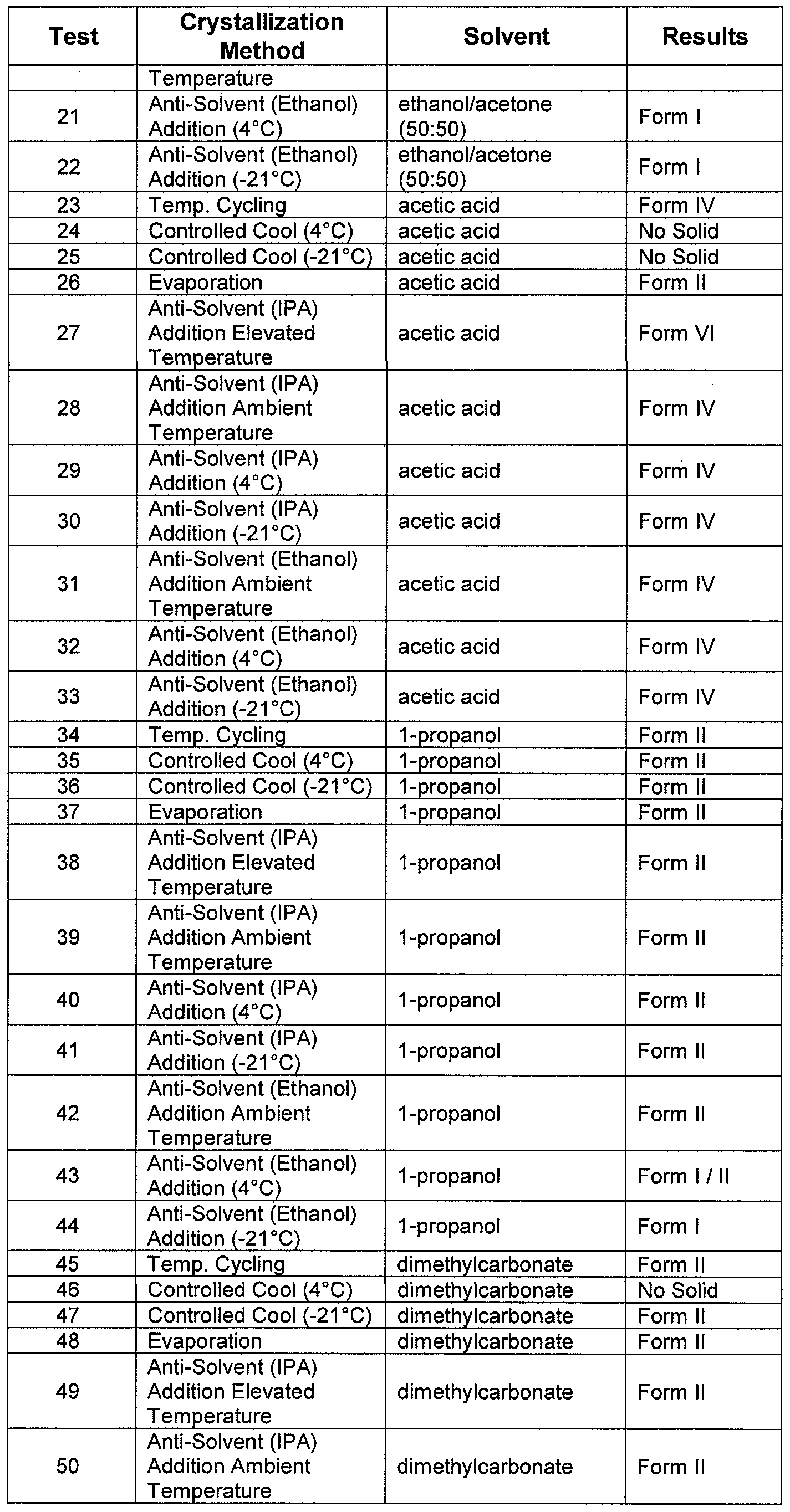
  • Form I [0116] The precise conditions for forming crystalline Form I may be empirically determined and it is only possible to give a number of methods which have been found to be suitable in practice.
  • crystalline Form I may generally be obtained by crystallizing L-ornithine phenyl acetate under controlled conditions.
  • Exemplary solvents for the solution that yield crystalline Form I upon adding ethanol include, but are not limited to, cyclohexanone, 1- propanol, diemthylcarbonate, N-methylpyrrolidine (NMP), diethyl ether, 2-butanol, cumene, ethyl formate, isobutyl acetate, 3-nethyl-l-butanol, and anisole.
  • the process can yield Form I by utilizing particular isolation methods.
  • L-ornithine phenyl acetate may be isolated by adding ethanol at reduced temperature to yield Form I.
  • FIGURE 1 shows the crystalline structure of Form I as determined by X-ray powder diffraction (XRPD).
  • Form I which may be obtained by the methods disclosed above, exhibits characteristic peaks at approximately 4.9°, 13.2°, 17.4°, 20.8° and 24.4° 2 ⁇ .
  • a crystalline form of L-ornithine phenyl acetate has one or more characteristic peaks (e.g. , one, two, three, four or five characteristic peaks) selected from approximately 4.9°, 13.2°, 17.4°, 20.8°,and 24.4° 2 ⁇ .
  • the peak positions are assumed to be equal if the two theta (2 ⁇ ) values agree to within 0.2° (i.e., ⁇ 0.2°).
  • ⁇ 0.2° the United States Pharmacopeia states that if the angular setting of the 10 strongest diffraction peaks agree to within ⁇ 0.2° with that of a reference material, and the relative intensities of the peaks do not vary by more than 20%, the identity is confirmed. Accordingly, peak positions within 0.2° of the positions recited herein are assumed to be identical.
  • FIGURE 2 shows results obtained by differential scanning calorimetry (DSC) for Form I. These results indicate an endotherm at 35° C, which is possibly associated with a desolvation and/or dehydration to Form II. A second transition at about 203° C indicates the melting point for the crystal. To explore the possible existence of a desolvation and/or dehydration transition, Form I was analyzed by thermogravimetric gravimetric/differential thermal analysis (TG/DTA), which is shown in FIGURE 3.
  • TG/DTA thermogravimetric gravimetric/differential thermal analysis
  • the crystalline form of L-ornithine phenyl acetate is characterized by differential scanning calorimetry as having an endotherm at about at about 35° C.
  • a crystalline form of L-ornithine phenyl acetate exhibits a weight loss of about 11% at about 35° C, as determined by TGA.
  • a crystalline form of L-ornithine phenyl acetate exhibits a melting point of about 203° C.
  • FIGURE 4 shows nuclear magnetic resonance (NMR) integrals and chemical shifts for Form I.
  • the integrals confirm the presence of L-ornithine phenyl acetate: 7.5 (aromatic CH), 3.8 (CH adjacent to NH 2 ), 3.6 (CH 2 unit of phenyl acetate), 3.15 (CH 2 adjacent to NH 2 ) and 1.9 (aliphatic CH 2 units) ppm (integrals: 5: 1 :2:2:4 protons; 1.2, 0.25, 0.5, 0.5, 1.0). Amine protons and hydroxyl protons were not observed due to proton exchange at both the zwitterion and site of salt formation.
  • FIGURE 5 shows dynamic vapor sorption (DVS) results for Form I, and show a water uptake of about 0.2% by weight.
  • XRPD results following DVA analysis confirm that Form I did not transition to a different polymorph.
  • Form I can therefore be characterized as non-hygroscopic and stable over a wide range of humidity.
  • Form I is metastable.
  • a crystalline form of L-ornithine phenyl acetate can be represented by the formula C] 5 H 28 N 2 O 6 .
  • a crystalline form of L-ornithine phenyl acetate can be represented by the formula [CsHnN 2 O 2 ][C 8 H 7 O 2 ]EtOH 1 H 2 O.
  • Form II [0125] The precise conditions for forming crystalline Form II may be empirically determined and it is only possible to give a number of methods which have been found to be suitable in practice.
  • crystalline Form II may be prepared by crystallization under controlled conditions.
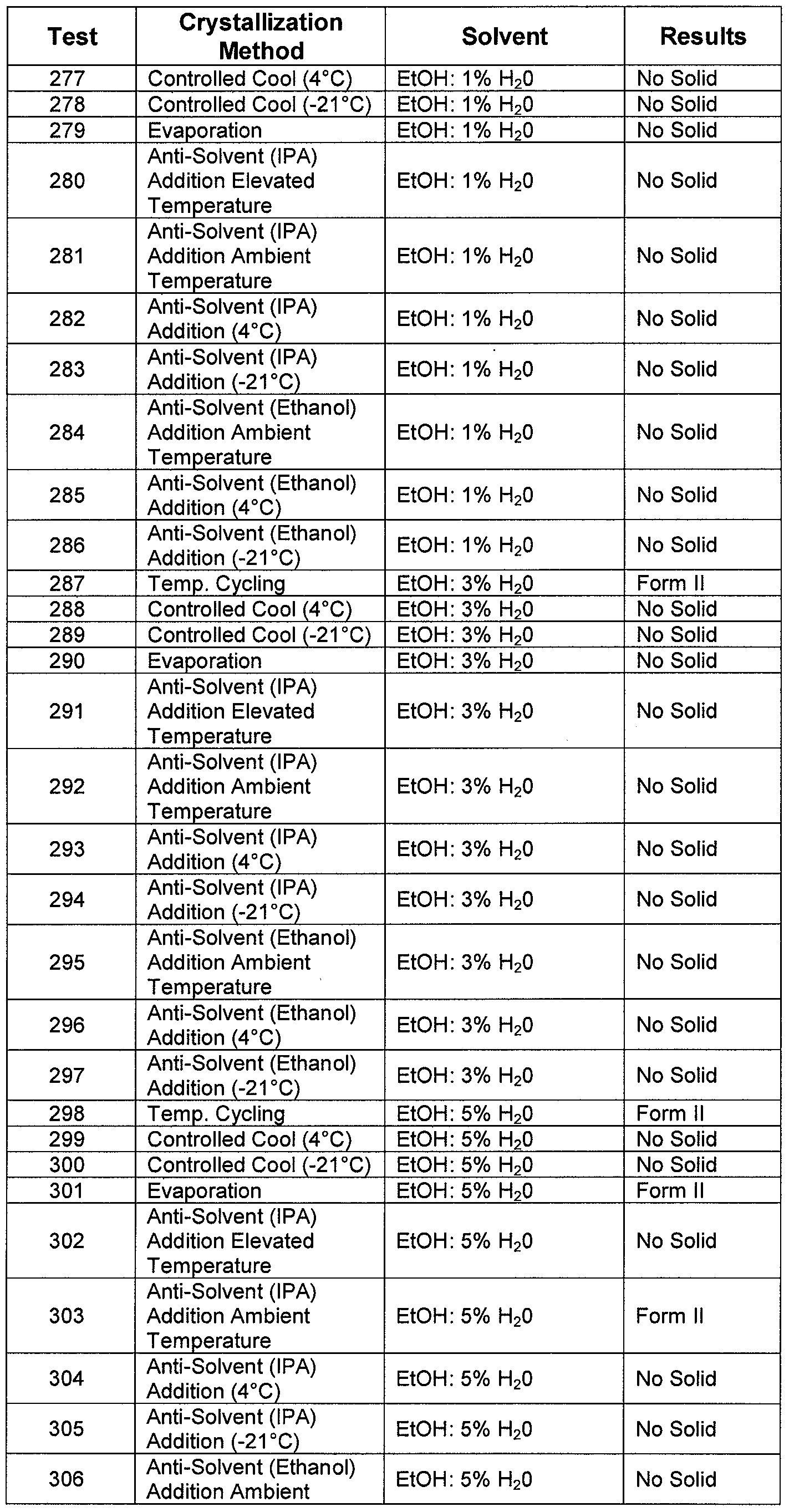
  • Crystalline Form II can be prepared by, for example, evaporating a saturated organic solution of L-ornithine phenyl acetate.
  • organic solutions that may be used to obtain Form II include ethanol, acetone, benzonitrile, dichloromethane (DCM), dimethyl sulfoxide (DMSO), ethyl acetate (EtOAc), acetonitrile (MeCN), methyl acetate (MeOAc), nitromethane, tert-butyl methyl ether (TBME), tetrahydrofuran, and toluene.
  • Other solvents may yield a mixture of Form I and II, such as, but not limited to, 1,4 dioxane, 1-butanol, cyclohexane, IPA, THF, MEK, MeOAc and water.
  • Form II can also be obtained by precipitating L-ornithine phenyl acetate from a saturated organic solution by adding an anti-solvent for L-ornithine phenyl acetate, such as IPA.
  • Form II may be precipitated over a broad range of temperatures (e.g., room temperature, 4° C, and -21° C).
  • Non-limiting examples of suitable solvents for the saturated organic solution include cyclohexanone, 1-propanol, dimethyl carbonate, N-methylpyrrolidone (NMP), diisopropyl ether, diethyl ether, ethylene glycol, dimethylformamide (DMF), 2-butanol, cumene, isobutyl acetate, 3-methyl- 1-butanol, and anisole.
  • the same listed solvents e.g., cyclohexanone
  • Form II may be precipitated by adding ethanol at ambient conditions.
  • Form II may also be obtained by forming a slurry of L-ornithine phenyl acetate with the listed organic solvents and cycling the temperature between 25° and 40° C every 4 hours for about 18 cycles (or 72 hours).
  • the process can yield Form II by utilizing particular isolation methods.
  • L-ornithine phenyl acetate may by isolated by adding IPA, or evaporating the organic solvent, to yield Form II.
  • FIGURE 6 shows the crystalline structure of Form II as determined by XRPD.
  • Form II which may be obtained by the methods disclosed above, exhibits characteristic peaks at approximately 6.0°, 13.9°, 14.8°, 17.1°, 17.8° and 24.1° 2 ⁇ .
  • a crystalline form of L-ornithine phenyl acetate has one or more characteristic peaks (e.g. , one, two, three, four, five or six characteristic peaks) selected from approximately 6.0°, 13.9°, 14.8°, 17.1°, 17.8° and 24.12° ⁇ .
  • FIGURE 7 shows results obtained by differential scanning calorimetry (DSC) for Form II. These results indicate a melting point of about 202° C, which is approximately the same as the melting point for Form I. This suggests that Form I transitions to Form II upon heating above about 35° C. Form II was also analyzed using TG/DTA, as shown in FIGURE 8, and exhibits an about 9.7% weight loss associated with residual solvent. The melting point of about 202° C could also be observed by TGA testing. Accordingly, in some embodiments, a crystalline form of L-ornithine phenyl acetate exhibits a melting point of about 202° C.
  • FIGURE 9 shows nuclear magnetic resonance (NMR) integrals and chemical shifts for Form II.
  • the integrals confirm the presence of L-ornithine phenyl acetate: 7.5 (aromatic CH), 3.8 (CH adjacent to NH2), 3.6 (CH2 unit of phenyl acetate), 3.15 (CH2 adjacent to NH2) and 1.9 (aliphatic CH2 units) ppm (integrals: 5: 1 :2:2:4 protons; 7.0, 1.4, 2.9, 3.0, 5.9). Amine protons and hydroxyl protons were not observed due to proton exchange at both the zwitterion and site of salt formation.
  • FIGURE 10 shows dynamic vapor sorption (DVS) results for Form II, and show a water uptake of about 0.3% by weight.
  • XRPD results following DVA analysis confirm that Form II did not transition to a different polymorph.
  • Form II can therefore be characterized as non-hygroscopic and stable over a wide range of humidity.
  • a crystalline form of L-ornithine phenyl acetate can be represented by the formula CnH 2 ON 2 O 4 .
  • a crystalline form of L-ornithine phenyl acetate can be represented by the formula [CsHnN 2 O 2 ][CsHyO 2 ].
  • Form III may be obtained by placing a saturated solution of L-ornithine phenyl acetate in a cooled temperature environment of about -21° C, where the solution is a mixture of acetone and water (e.g., equal parts volume of acetone and water).
  • adding IPA to a saturated solution of L- ornithine phenyl acetate in 2-butanol can yield Form III when completed at ambient conditions.
  • Form III may be obtained, for example, by adding IPA to a saturated solution of L-ornithine phenyl acetate in isobutyl acetate when completed at reduced temperatures of about -21° C.
  • L-ornithine phenyl acetate in the context of the processes for making L-ornithine phenyl acetate disclosed above, the process can yield Form III by utilizing particular solvents and isolation methods.
  • L-ornithine phenyl acetate may be formed within a mixture of acetone and water, and subsequently placed in a cool environment of about -21° C to yield Form in.
  • FIGURE 11 shows the crystalline structure of Form III as determined by XRPD.
  • Form III which may be obtained by the methods disclosed above, exhibits characteristic peaks at approximately 5.8°, 14.1°, 18.6°, 19.4°, 22.3° and 24.8° 2 ⁇ .
  • a crystalline form of L-ornithine phenyl acetate has one or more characteristic peaks (e.g. , one, two, three, four, five or six characteristic peaks) selected from approximately 5.8°, 14.1°, 18.6°, 19.4°, 22.3° and 24.8° 2 ⁇ .
  • FIGURE 12 shows results obtained by differential scanning calorimetry (DSC) for Form III. These results indicate a melting point of about 203° C, which is approximately the same as the melting points for Form I and Form II. Additionally, Form III exhibits an endotherm at about 40° C. Form III was also analyzed using TG/DTA, as shown in FIGURE 13, and exhibits no significant weight loss before the melting point. Form III may therefore be characterized as anhydrous. The melting point of about 203° C could also be observed by TGA testing. Accordingly, in some embodiments, a crystalline form of L-ornithine phenyl acetate exhibits a melting point of about 203° C.
  • a crystalline form of L-ornithine phenyl acetate is characterized by differential scanning calorimetry as having an endotherm at about 40° C. In some embodiments, a crystalline form of L-ornithine phenyl acetate is anhydrous.
  • Form III A 7-day stability study of Form III at 40°C/75%RH indicated that a transformation to Form II occurred under these conditions. In contrast, Form II is stable at elevated temperatures, with or without vacuum, for periods of 7 or 10 days. Accordingly, Form III is most likely metastable, but more stable than Form I.
  • FIGURE 14 shows nuclear magnetic resonance (NMR) integrals and chemical shifts for Form III.
  • the integrals confirm the presence of L-ornithine phenyl acetate: 7.5 (aromatic CH), 3.8 (CH adjacent to NH2), 3.6 (CH2 unit of phenyl acetate), 3.15 (CH2 adjacent to NH2) and 1.9 (aliphatic CH2 units) ppm (integrals: 5: 1 :2:2:4 protons; 4.2, 0.8, 1.7, 1.7, 3.0). Amine protons and hydroxyl protons were not observed due to proton exchange at both the zwitterion and site of salt formation.
  • FIGURE 15 shows dynamic vapor sorption (DVS) results for Form III, and show a water uptake of about 2.0% by weight.
  • XRPD results following DVS analysis confirm that Form III did not transition to a different polymorph.
  • Form III therefore exhibits greater water uptake compared to Forms I and II; however Form III is still characterized as non-hygroscopic and stable over a wide range of humidity at room temperature.
  • Form V is still characterized as non-hygroscopic and stable over a wide range of humidity at room temperature.
  • Form V may be obtained by placing a saturated solution of L-ornithine phenyl acetate in a cooled temperature environment of about -21° C, where the solution is cyclohexanone.
  • the same saturated solution may yield Form V when evaporating the solvent.
  • Form V also forms from saturated solutions of L-ornithine phenyl acetate having diisopropyl ether as a solvent.
  • a saturated solution having a solvent ratio of about 1 to 2 of diisopropyl ether and IPA will yield Form V when placed in a cooled temperature environment of about 4° C.
  • a solution having only the solvent diisopropyl ether can yield Form V when placed in a cooled temperature environment of about -21° C.
  • FIGURE 16 shows the crystalline structure of Form V as determined by XRPD.
  • Form V which may be obtained by the methods disclosed above, exhibits characteristic peaks at approximately 13.7°, 17.4°, 19.8°, 20.6° and 23.7° 2 ⁇ .
  • a crystalline form of L-ornithine phenyl acetate has one or more characteristic peaks (e.g. , one, two, three, four, or five characteristic peaks) selected from approximately 13.7°, 17.4°, 19.8°, 20.6° and 23.7° 2 ⁇ .
  • FIGURE 17 shows results obtained by differential scanning calorimetry (DSC) for Form V. These results indicate a melting point of about 196° C, which is below the melting point of other forms. Form V also exhibits an endotherm at about 174° C. Form V was also analyzed using thermal gravimetric analysis (TGA), as shown in FIGURE 18, and exhibits no significant weight loss before the melting point. Form V may therefore be characterized as anhydrous. The melting point of about 196° C could also be observed by TGA testing. Accordingly, in some embodiments, a crystalline form of L-ornithine phenyl acetate exhibits a melting point of about 196° C.
  • DSC differential scanning calorimetry
  • a crystalline form of L-ornithine phenyl acetate is characterized by differential scanning calorimetry as having an endotherm at about 174° C. In some embodiments, a crystalline form of L-ornithine phenyl acetate is anhydrous.
  • FIGURE 19 shows nuclear magnetic resonance (NMR) integrals and chemical shifts for Form V.
  • the integrals confirm the presence of L-ornithine phenyl acetate: 7.5 (aromatic CH), 3.8 (CH adjacent to NH2), 3.6 (CH2 unit of phenyl acetate), 3.15 (CH2 adjacent to NH2) and 1.9 (aliphatic CH2 units) ppm (integrals: 5: 1 :2:2:4 protons; 4.2, 0.8, 1.7, 1.7, 3.0). Amine protons and hydroxyl protons were not observed due to proton exchange at both the zwitterion and site of salt formation.
  • FIGURE 19 shows dynamic vapor sorption (DVS) results for Form V, and show a water uptake of about 0.75% by weight.
  • XRPD results following DVS analysis suggest that Form V transitioned to Form II, but the chemical composition was unchanged.
  • Form V is therefore characterized as non-hygroscopic, but not stable over a wide range of humidity.
  • L-Ornithine phenyl acetate may be administered to a subject for treating or ameliorating the onset of liver decompensation or hepatic encephalopathy.
  • L-Ornithine phenyl acetate can thus be administered to improve the condition of a subject, for example a subject suffering from chronic liver disease following a precipitating event.
  • L-ornithine phenyl acetate may be administered to combat or delay the onset of liver decompensation or hepatic encephalopathy.
  • L-Ornithine phenyl acetate may be administered in combination to a subject for treatment of hepatic encephalopathy.
  • L-Ornithine phenyl acetate may be administered to improve the condition of a patient suffering from hepatic encephalopathy.
  • L-Ornithine phenyl acetate may be administered to alleviate the symptoms associated with hepatic encephalopathy.
  • L-Ornithine phenyl acetate may be administered to combat hepatic encephalopathy.
  • L-Ornithine phenyl acetate may be administered to prevent or reduce the likelihood of an initial hepatic encephalopathic episode in a person at risk for hepatic encephalopathic episodes.
  • L-Ornithine phenyl acetate may be administered to lessen the severity of an initial hepatic encephalopathic episode in a person at risk for hepatic encephalopathic episodes.
  • L-Ornithine phenyl acetate may be administered to delay an initial hepatic encephalopathic episode in a person at risk for hepatic encephalopathic episodes.
  • liver decompensation and hepatic encephalopathy commonly involves "precipitating events” (or “acute attacks”).
  • precipitating events include gastrointestinal bleeding, infection (sepsis), portal vein thrombosis and dehydration.
  • infections infections
  • portal vein thrombosis portal vein thrombosis
  • dehydration The onset of such an acute attack is likely to lead to hospitalization. The patient may suffer one of these acute attacks or a combination of these acute attacks.
  • L-ornithine phenyl acetate A subject who has had or is suspected of having had an acute attack is treated according to the invention with L-ornithine phenyl acetate to prevent or reduce the likelihood of progression of the liver to the decompensated state. Consequently, L- ornithine phenyl acetate can prevent or reduce the likelihood of the medical consequences of liver decompensation such as hepatic encephalopathy. L-Ornithine phenyl acetate may be used to preserve liver function. Use of L-ornithine phenyl acetate may thus extend the life of a patient with liver disease. In one embodiment, the metabolic consequences of a gastrointestinal bleed such as hyperammonemia, hypoisoleucemia and reduced protein synthesis in the post-bleeding period are prevented.
  • treatment of subjects may begin as soon as possible after the onset or the suspected onset of a precipitating event (acute attack).
  • treatment of the subject begins prior to repeated acute attacks. More preferably, treatment of the subject begins following the first acute attack.
  • the subject treated with L-ornithine phenyl acetate is identified as having the onset or the suspected onset of a precipitating event (acute attack).
  • Treatment is typically given promptly after the start of an acute attack.
  • Treatment may begin after the symptom(s) of an acute attack or suspected acute attack have been detected e.g. by a medic such as a physician, a paramedic or a nurse.
  • Treatment may begin upon hospitalization of the subject.
  • Treatment may thus begin within 6 hours, within 3 hours, within 2 hours or within 1 hour after the symptom(s) of an acute attack or suspected acute attack have been detected.
  • Treatment of the subject may therefore begin from 1 to 48 hours, for example from 1 to 36 hours or from 1 to 24 hours after the symptom(s) of an acute attack or suspected acute attack have been detected.
  • Treatment may occur for up to 8 weeks, for example up to 6 weeks, up to 4 weeks or up to 2 weeks after the symptom(s) of an acute attack or suspected acute attack have been detected. Treatment may therefore occur for up to 48 hours, for example for up to 36 hours or for up to 24 hours after the symptom(s) of an acute attack or suspected acute attack have been detected. Typically, treatment occurs to the time when recovery from the acute precipitating event is evident.
  • L-Ornithine phenyl acetate may also be used to treat or ameliorate hyperammonemia.
  • L-ornithine phenyl acetate may be administered to patients identified as having excess ammonia levels in the blood, or patients exhibiting symptoms of excess ammonia in the blood.
  • L-Ornithine phenyl acetate may also be administered to reduce the risk of hyperammonemia.
  • L-ornithine phenyl acetate can be administered daily, for an indefinite period of time. For example, daily dosages may be administered for the life of the patient, or until a physician determines the patient no longer exhibits a risk for hyperammonemia.
  • a therapeutically effective amount of L-ornithine phenyl acetate is administered to reduce the risk of hyperammonemia. In some embodiments, a therapeutically effective amount of L- ornithine phenyl acetate is administered orally for the prophylaxis of hyperammonemia.
  • a therapeutically effective amount of L-ornithine phenyl acetate is administered to the subject.
  • the useful in vivo dosage to be administered and the particular mode of administration will vary depending upon the age, weight, the severity of the affliction, and mammalian species treated, the particular compounds employed, and the specific use for which these compounds are employed. (See e.g., Fingl et al. 1975, in "The Pharmacological Basis of Therapeutics", which is hereby incorporated herein by reference in its entirety, with particular reference to Ch. 1, p. 1).
  • the determination of effective dosage levels that is the dosage levels necessary to achieve the desired result, can be accomplished by one skilled in the art using routine pharmacological methods.
  • a typical dose of L-ornithine phenyl acetate may be from about 0.02 to about 1.25 g/kg of bodyweight (preferably from about 0.1 to about 0.6 g/kg of bodyweight).
  • a dosage may therefore be from about 500 mg to about 50 g (preferably about 5 g to about 40 g, and more preferably about 10 g to about 30 g).
  • a single daily dose may be administered.
  • multiple doses for example two, three, four or five doses may be administered. Such multiple doses may be administered over a period of one month or two weeks or one week.
  • a single dose or multiple doses such as two, three, four or five doses may be administered daily.
  • XRPD analysis was carried out on a Bruker D8 advance or Seimens D5000, scanning the samples between 4° and 50° 2 ⁇ .
  • approximately 5 mg of a sample was gently compressed on the XRPD zero back ground single 96 well plate sample holder. The sample was then loaded into a Bruker D8-Discover diffractometer in transmission mode and analysed using the following experimental conditions.
  • each form was compressed into discs by placing the material into a die (diameter 12 mm) and compressing the die under 5 tons of pressure in a hydraulic press for about 2 minutes.
  • the dissolution instrument, Sotax AT7 conforms to EP2 and USP2 in which paddles were used to stir the media.
  • 1 cm 3 aliquots of media were extracted from the dissolution pots at times 10, 20, 30, 40, 50, 60, 70, 80 and 120 seconds and tested for API concentration by HPLC. Dissolution curves were plotted and from the first 6 or 7 points on the curves the intrinsic dissolution rate curves were calculated. All tests were carried out at 37° C and a paddle speed of 150 rpm.
  • Slurries (supersaturated solution: about 250 ⁇ l of pH solution and solid was added until dissolution was no longer observed and ca. 100 mg of solid was in the slurry) were prepared for each form in a variety of pH environments; 1, 4, 7, 10 and 13.2. The slurries were shaken constantly for a period of 14 days and measurements taken at 7 and 14 day time points. Appropriate buffers were prepared for each pH and are detailed further below.
  • a buffer having a pH value of 1 was prepared by dissolving 372.75 mg of potassium chloride in 25 ml of deionized water to give a 0.2 M solution. Subsequently, 67 ml of 0.2 M hydrochloric acid was added (this was prepared from a 5 M solution; 10 ml was added to 40 ml of deionized water giving a 1 M solution which was diluted further; 20 ml was added to 80 ml of deionized water giving the required 0.2 M solution) to achieve the desired pH.
  • a buffer having a pH value of 4 was prepared by dissolving 1.02 g of potassium hydrogen phthalate in 50 ml of deionized water to give a 0.1 M solution.
  • a buffer having a pH value of 7 was prepared by dissolving 680.00 mg of potassium phosphate monobasic in 50 ml of deionized water to give a 0.1 M solution. Subsequently, 29.1 ml of 0.1 M sodium hydroxide was added (this was prepared from a 1 M solution; 5 ml was added to 45 ml of deionized water giving the required 0.1 M solution) to achieve the desired pH.
  • a buffer having a pH value of 10 was prepared by dissolving 210.00 mg of sodium bicarbonate in 50 ml of deionized water to give a 0.05 M solution. Subsequently, 10.7 ml of 0.1 M sodium hydroxide was added (this was prepared from a 1 M solution; 5 ml was added to 45 ml of deionized water giving the required 0.1 M solution) to achieve the desired pH.
  • Example 1 Precipitating Crystalline Forms
  • Example 4 Small-scale Batch Process to Produce L-Ornithine Phenyl Acetate
  • About 8.4g (0.049moles) of L-ornithine HCl was dissolved in 42 mL H 2 O and, separately, about 11.4g of silver benzoate was dissolved in 57mL DMSO. Subsequently, the silver benzoate solution was added to the L-ornithine HCl solution. Combining the two mixtures resulted in an immediate, exothermic precipitation of a creamy white solid (AgCl). The solid was removed by vacuum filtration and retaining the filtrate (L-ornithine benzoate in solution). 20OmL of IPA was added to the filtrate and the mixture was cooled to 4°C. A crystalline solid precipitated after about 3 hours (L- ornithine benzoate) which was isolated by vacuum filtration. Yield: 60 %
  • the last three trials included adding diluted HCl to the solution to precipitate remaining amount of silver as AgCl. The precipitate was then removed by filtration before The three trials included adding: (1) 1.0 g of 0.33% HCl at 20° C; (2) 1.0 g of 0.33% HCl at 30° C; and (3) 0.1 g of 3.3% HCl at 20° C. The three trials reduced the silver content to 30 ppm, 42 ppm, and 33 ppm, respectively, and each trial yielding greater than 90% L-ornithine phenyl acetate. Accordingly, the addition of HCl was effective in reducing the amount of residual silver.
  • Form III does not transition to Form II under vacuum at 120° C, but rather exhibits greater chemical degradation compared to Forms I and II under these conditions. Meanwhile, Form III converts to Form II and exhibits substantial chemical degradation at 120° C without a vacuum.
  • Form I converted to Form II in all the trials, but most interestingly, Form I exhibits substantial chemical degradation at 120° C without a vacuum. Thus, the conversion from Form I does not exhibit the same chemical stability as Form II, which is surprising considering the material readily converts to Form II.
  • Form II was stable and did not chemically degrade in all of the trials. Thus, Form II is the most stable. Meanwhile, Form III is more stable than Form I, but both forms exhibit substantial chemical degradation at 120° C without a vacuum.
  • HPLC results for the trials exhibiting chemical degradation are summarized in TABLE 12.
  • Each degraded material exhibits common peaks at relative retention times (RRT) of 1.9, 2.2, 2.4, and 2.7, which suggests a common degradation pathway for different forms.
  • Example 8 Oxygen Stability Studies of Forms I, H, and HI
  • a slurry of Forms I, II and III were formed with water and the pH value adjusted to either 1.0, 4.0, 7.0, 10.0, and 13.2. The slurries were stored for 7 or 14 days, and subsequently the solids were removed by filtration. Form I converted to Form II in all of the samples. NMR and IR results show Forms I and II did not degrade after 14 days in the varied pHs, and similarly HPLC results show about 98% purity or more for these samples. Form III also exhibited no degradation after 7 days according to NMR and IR results. HPLC tests show about 95% purity or more; however IR results show Form III converted to Form II over the 7-day test. TLC results for all samples indicated a single spot with similar R f values.
  • Example 11 Compression Studies of Forms I, IL and III

Landscapes

  • Chemical & Material Sciences (AREA)
  • Organic Chemistry (AREA)
  • Health & Medical Sciences (AREA)
  • Engineering & Computer Science (AREA)
  • Crystallography & Structural Chemistry (AREA)
  • Oil, Petroleum & Natural Gas (AREA)
  • General Health & Medical Sciences (AREA)
  • Veterinary Medicine (AREA)
  • Medicinal Chemistry (AREA)
  • Public Health (AREA)
  • Pharmacology & Pharmacy (AREA)
  • Life Sciences & Earth Sciences (AREA)
  • Animal Behavior & Ethology (AREA)
  • Chemical Kinetics & Catalysis (AREA)
  • Epidemiology (AREA)
  • Nuclear Medicine, Radiotherapy & Molecular Imaging (AREA)
  • General Chemical & Material Sciences (AREA)
  • Bioinformatics & Cheminformatics (AREA)
  • Gastroenterology & Hepatology (AREA)
  • Acyclic And Carbocyclic Compounds In Medicinal Compositions (AREA)
  • Organic Low-Molecular-Weight Compounds And Preparation Thereof (AREA)
  • Medicinal Preparation (AREA)
  • Pharmaceuticals Containing Other Organic And Inorganic Compounds (AREA)
  • Medicines That Contain Protein Lipid Enzymes And Other Medicines (AREA)

Abstract

Disclosed herein are crystalline forms of L-ornithine phenyl acetate and methods of making the same. The crystalline form may, in some embodiments, be Forms I, II, III and V, or mixtures thereof. The crystalline forms may be formulated for treating subjects with liver disorders, such as hepatic encephalopathy. Accordingly, some embodiments include formulations and methods of administering L-ornithine phenyl acetate.

Description

L-ORNITHINE PHENYL ACETATE AND METHODS OF MAKING THEREOF
CROSS-REFERENCE TO RELATED APPLICATIONS
[0001] This application claims the benefit of priority of U.S. Provisional Application No. 61/166,676, filed April 3, 2009. The priority document is hereby incorporated by reference in its entirety.
BACKGROUND Field
[0002] The present application relates to the fields of pharmaceutical chemistry, biochemistry, and medicine. In particular, it relates to L-ornithine phenyl acetate salts and methods of making and using the same. Description
[0003] Hyperammonemia is a hallmark of liver disease and is characterized by an excess of ammonia in the bloodstream. Hepatic encephalopathy is a primary clinical consequence of progressive hyperammonemia and is a complex neuropsychiatric syndrome, which may complicate acute or chronic hepatic failure. It is characterized by changes in mental state including a wide range of neuropsychiatric symptoms ranging from minor signs of altered brain function to overt psychiatric and/or neurological symptoms, or even deep coma. The accumulation of unmetabolized ammonia has been considered as the main factor involved in the pathogenesis of hepatic encephalopathy, but additional mechanisms may be associated.
[0004] L-Ornithine monohydrochloride and other L-ornithine salts are available for their use in the treatment of hyperammonemia and hepatic encephalopathy. For example, U.S. Publication No. 2008/0119554, which is hereby incorporated by reference in its entirety, describes compositions of L-ornithine and phenyl acetate for the treatment of hepatic encephalopathy. L-ornithine has been prepared by enzymatic conversion methods. For example, U.S. Patent Nos. 5,405,761 and 5,591,613, both of which are hereby incorporated by reference in their entirety, describe enzymatic conversion of arginine to form L-ornithine salts. Sodium phenyl acetate is commercially available, and also available as an injectable solution for the treatment of acute hyperammonemia. The injectable solution is marketed as AMMONUL. [0005] Although salt forms may exhibit improved degradation properties, certain salts, particularly sodium or chloride salts, may be undesirable when treating patients having diseases associated with the liver disease, such as hepatic encephalopathy. For example, a high sodium intake may be dangerous for cirrhotic patients prone to ascites, fluid overload and electrolyte imbalances. Similarly, certain salts are difficult to administer intravenously because of an increased osmotic pressure, i.e., the solution is hypertonic. High concentrations of excess salt may require diluting large volumes of solution for intravenous administration which, in turn, leads to excessive fluid overload. Accordingly, there exists a need for the preparation of L-ornithine and phenyl acetate salts which are favorable for the treatment of hepatic encephalopathy or other conditions where fluid overload and electrolyte imbalance are prevalent.
SUMMARY
[0006] Some embodiments disclosed herein include a composition comprising a crystalline form of L-ornithine phenyl acetate.
[0007] In some embodiments, the crystalline form exhibits an X-ray powder diffraction pattern comprising at least one characteristic peak, wherein said characteristic peak is selected from the group consisting of approximately 6.0°, 13.9°, 14.8°, 17.1°, 17.8° and 24.1° 2Θ. In some embodiments, the crystalline form exhibits an X-ray powder diffraction pattern comprising at least three characteristic peaks, wherein said characteristic peaks are selected from the group consisting of approximately 6.0°, 13.9°, 14.8°, 17.1°, 17.8° and 24.1° 2Θ. In some embodiments, the crystalline form exhibits an X-ray powder diffraction pattern comprising characteristic peaks at approximately 6.0°, 13.9°, 14.8°, 17.1°, 17.8° and 24.1° 2Θ.
[0008] In some embodiments, the crystalline form has a melting point of about 202° C. In some embodiments, the crystalline form exhibits a single crystal X-ray crystal lographic analysis with crystal parameters approximately equal to the following: unit cell dimensions: a=6.594(2) A, b=6.5448(18) A, c=31.632(8) A, α=90°, β=91.12(3)°, γ=90°; Crystal System: Monoclinic; and Space Group: P2i . In some embodiments, the crystalline form is represented by the formula [CsHiSN2O2][CsH7O2].
[0009] Some embodiments have the crystalline form exhibit an X-ray powder diffraction pattern comprising at least one characteristic peak, wherein said characteristic peak is selected from the group consisting of approximately 4.9°, 13.2°, 17.4°, 20.8° and 24.4° 2Θ. In some embodiments, the crystalline form exhibits an X-ray powder diffraction pattern comprising at least three characteristic peaks, wherein said characteristic peaks are selected from the group consisting of approximately 4.9°, 13.2°, 17.4°, 20.8° and 24.4° 2Θ. In some embodiments, the crystalline form exhibits an X-ray powder diffraction pattern comprising characteristic peaks at approximately 4.9°, 13.2°, 17.4°, 20.8° and 24.4° 2Θ.
[0010] Some embodiments have the crystalline form comprising water and/or ethanol molecules. Li some embodiments, the crystalline form comprises about 1 1% by weight of said molecules as determined by thermogravimetric analysis. In some embodiments, the crystalline form is characterized by differential scanning calorimetry as comprising an endotherm at about 35° C. In some embodiments, the crystalline has a melting point at about 203° C.
[0011] Some embodiments have the crystalline form exhibiting a single crystal X-ray crystallographic analysis with crystal parameters approximately equal to the following: unit cell dimensions: a=5.3652(4) A, b=7.7136(6) A, c=20.9602(18) A, α=90°, β=94.986(6)°, γ=90°; Cr ystal System: Monoclinic; a nd S pace Group: P2i. In some embodiments, the crystalline form is represented by the formula [C5H13N2O2][C8H7O2]EtOH-H2O.
[0012] Some embodiments have the crystalline form exhibiting an X-ray powder diffraction pattern comprising at least one characteristic peak, wherein said characteristic peak is selected from the group consisting of approximately 5.8°, 14.1°, 18.6°, 19.4°, 22.3° and 24.8° 2Θ. In some embodiments, the crystalline form exhibits an X-ray powder diffraction pattern comprising at least three characteristic peaks, wherein said characteristic peaks are selected from the group consisting of approximately 5.8°, 14.1°, 18.6°, 19.4°, 22.3° and 24.8° 2Θ. In some embodiments, the crystalline form exhibits an X-ray powder diffraction pattern comprising characteristic peaks at approximately 5.8°, 14.1°, 18.6°, 19.4°, 22.3° and 24.8° 2Θ.
[0013] In some embodiments, the crystalline form is characterized by differential scanning calorimetry as comprising an endotherm at about 40° C. In some embodiments, the crystalline form comprises a melting point at about 203° C.
[0014] In some embodiments, the crystalline form exhibits an X-ray powder diffraction pattern comprising at least one characteristic peak, wherein said characteristic peak is selected from the group consisting of approximately 13.7°, 17.4°, 19.8°, 20.6° and 23.7° 2Θ. In some embodiments, the crystalline form exhibits an X-ray powder diffraction pattern comprising at least three characteristic peaks, wherein said characteristic peak is selected from the group consisting of approximately 13.7°, 17.4°, 19.8°, 20.6° and 23.7° 2Θ. In some embodiments, the crystalline form exhibits an X-ray powder diffraction pattern comprising characteristic peaks at approximately 13.7°, 17.4°, 19.8°, 20.6° and 23.7° 2Θ.
[0015] In some embodiments, the crystalline form is characterized by differential scanning calorimetry as comprising an endotherm at about 174° C. In some embodiments, the crystalline form has a melting point of about 196° C. In some embodiments, the crystalline form comprises a pharmaceutically acceptable carrier.
[0016] Some embodiments disclosed herein have a composition comprising: at least about 50% by weight of a crystalline form of L-ornithine phenyl acetate salt and at least about 0.01% by weight benzoic acid or a salt thereof.
[0017] In some embodiments, the composition comprises at least about 0.10% by weight benzoic acid or a salt thereof. In some embodiments, the composition comprises no more than 5% by weight benzoic acid or a salt thereof. In some embodiments, the composition comprises no more than 1% by weight benzoic acid or a salt thereof.
[0018] In some embodiments, the composition further comprises at least 10 ppm silver. In some embodiments, comprises at least 20 ppm silver. In some embodiments, the composition further comprises at least 25 ppm silver. In some embodiments, comprises no more than 600 ppm silver. In some embodiments, composition comprises no more than 100 ppm silver. In some embodiments, the composition comprises no more than 65 ppm silver.
[0019] In some embodiments, about 50 mg/mL of the composition in water is isotonic with body fluids, hi some embodiments, the isotonic solution has an osmolality in the range of about 280 to about 330 mθsm/kg.
[0020] In some embodiments, the composition has a density in the range of about 1.1 to about 1.3 kg/m3.
[0021] Some embodiments disclosed herein include a process for making L- ornithine phenyl acetate salt comprising: intermixing an L-ornithine salt, a benzoate salt and a solvent to form an intermediate solution; intermixing phenyl acetate with said intermediate solution; and isolating a composition comprising at least 70% crystalline L- ornithine phenyl acetate by weight.
[0022] In some embodiments, the process comprises removing at least a portion of a salt from said intermediate solution before intermixing the phenyl acetate, wherein said salt is not an L-ornithine salt. In some embodiments, the process comprises adding hydrochloric acid before removing at least a portion of the salt.
[0023] In some embodiments, intermixing the L-ornithine, the benzoate salt and the solvent comprises: dispersing the L-ornithine salt in water to form a first solution; dispersing the benzoate salt in DMSO to form a second solution; and intermixing said first solution and said second solution to form said solution.
[0024] In some embodiments, the composition comprises at least about 0.10% by weight benzoate salt. In some embodiments, composition comprises no more than 5% by weight benzoate salt. In some embodiments, composition comprises no more than 1% by weight benzoate salt.
[0025] In some embodiments, the L-ornithine salt is L-ornithine hydrochloride. In some embodiments, the benzoate salt is silver benzoate.
[0026] In some embodiments, the composition comprises at least 10 ppm silver. In some embodiments, composition comprises at least 20 ppm silver. In some embodiments, the composition comprises at least 25 ppm silver. In some embodiments, the composition comprises no more than 600 ppm silver. In some embodiments, the composition comprises no more than 100 ppm silver. In some embodiments, the composition comprises no more than 65 ppm silver.
[0027] In some embodiments, the phenyl acetate is in an alkali metal salt. In some embodiments, the alkali metal salt is sodium phenyl acetate.
[0028] In some embodiments, the composition comprises no more than 100 ppm sodium. In some embodiments, the composition comprises no more than 20 ppm sodium.
[0029] In some embodiments, the L-ornithine is in a halide salt. In some embodiments, the halide salt is L-ornithine hydrochloride.
[0030] In some embodiments, the composition comprises no more than 0.1% by weight chloride. In some embodiments, the composition comprises no more than 0.01% by weight chloride. [0031] Some embodiments disclosed herein include a composition obtained by any of the processes disclosed herein.
[0032] Some embodiments disclosed herein include a process for making L- ornithine phenyl acetate salt comprising: increasing the pH value of a solution comprising an L-ornithine salt at least until an intermediate salt precipitates, wherein said intermediate salt is not an L-ornithine salt; isolating the intermediate salt from said solution; intermixing phenyl acetic acid with said solution; and isolating L-ornithine phenyl acetate salt from said solution.
[0033] In some embodiments, the pH value is increased to at least 8.0. In some embodiments, the pH value is increased to at least 9.0. In some embodiments, increasing the pH value comprises adding a pH modifier selected from the group consisting of sodium hydroxide, potassium hydroxide, sodium methoxide, potassium t- butoxide, sodium carbonate, calcium carbonate, dibutylamine, tryptamine, sodium hydride, calcium hydride, butyllithium, ethylmagnesium bromide or combinations thereof.
[0034] Some embodiments disclosed herein include a method of treating or ameliorating hyperammonemia in a subject by administering a therapeutically effective amount of a crystalline form of L-ornithine phenyl acetate salt.
[0035] In some embodiments, the crystalline form is administered orally.
[0036] In some embodiments, the crystalline form is selected from the group consisting of Form I, Form II, Form III, Form V, wherein: Form I exhibits an X-ray powder diffraction pattern having characteristic peaks at approximately 4.9°, 13.2°, 17.4°, 20.8° and 24.4° 2Θ; Form II exhibits an X-ray powder diffraction pattern having characteristic peaks at approximately 6.0°, 13.9°, 14.8°, 17.1°, 17.8° and 24.1° 2Θ; Form III exhibits an X-ray powder diffraction pattern having characteristic peaks at approximately 5.8°, 14.1°, 18.6°, 19.4°, 22.3° and 24.8° 2Θ; and Form V exhibits an X-ray powder diffraction pattern having characteristic peaks at approximately 13.7°, 17.4°, 19.8°, 20.6° and 23.7° 2Θ.
[0037] In some embodiments, the crystalline form is Form I. In some embodiments, the crystalline form is Form II. In some embodiments, the crystalline form is Form III. In some embodiments, the crystalline form is Form V. [0038] In some embodiments, the at least two crystalline forms selected from the group consisting of Form I, Form II, Form III and Form V, are administered. In some embodiments, the at least two crystalline forms are administered at about the same time.
[0039] In some embodiments, the crystalline form is administered from 1 to 3 times daily. In some embodiments, the therapeutically effective amount is in the range of about 500 mg to about 50 g.
[0040] In some embodiments, the subject is identified as having hepatic encephalopathy. In some embodiments, the subject is identified as having hyperammonemia.
[0041] Some embodiments disclosed herein include a process for making L- ornithine phenyl acetate salt comprising: intermixing an L-ornithine salt, silver phenyl acetate and a solvent to form a solution, wherein the L-ornithine salt is an alkali metal salt; and isolating L-ornithine phenyl acetate from said solution.
[0042] Some embodiments disclosed herein include a method of treating or ameliorating hyperammonemia comprising intravenously administering a therapeutically effective amount of a solution comprising L-ornithine phenyl acetate, wherein said therapeutically effective amount comprises no more than 500 mL of said solution.
[0043] In some embodiments, the solution comprises at least about 25 mg/mL of L-ornithine phenyl acetate. In some embodiments, the solution comprises at least about 40 mg/mL of L-ornithine phenyl acetate. In some embodiments, the solution comprises no more than 300 mg/mL. In some embodiments, the solution is isotonic with body fluid.
[0044] Some embodiments disclosed herein include a method of compressing L-ornithine phenyl acetate, the method comprising applying pressure to a metastable form of L-ornithine phenyl acetate to induce a phase change.
[0045] In some embodiments, the metastable form is amorphous. In some embodiments, the metastable form exhibits an X-ray powder diffraction pattern comprising at least one characteristic peak, wherein said characteristic peak is selected from the group consisting of approximately 4.9°, 13.2°, 20.8° and 24.4° 2Θ.
[0046] In some embodiments, the pressure is applied for a predetermined time. In some embodiments, the predetermined time is about 1 second or less. In some embodiments, the pressure is at least about 500 psi. [0047] In some embodiments, the phase change yields a composition having a density in the range of about 1.1 to about 1.3 kg/m3 after applying the pressure.
[0048] In some embodiments, the phase change yields a composition exhibiting an X-ray powder diffraction pattern comprising at least one characteristic peak, wherein said characteristic peak is selected from the group consisting of approximately 6.0°, 13.9°, 14.8°, 17.1°, 17.8° and 24.1° 2Θ.
[0049] Some embodiments disclosed herein include a composition obtained by applying pressure to a metastable form of L-ornithine phenyl acetate to induce a phase change.
BRIEF DESCRIPTION OF THE DRAWINGS
[0050] FIGURE 1 is an X-ray powder diffraction pattern of Form I.
[0051] FIGURE 2 shows differential scanning calorimetry results for Form I.
[0052] FIGURE 3 shows thermogravimetric gravimetric/differential thermal analysis of Form I.
[0053] FIGURE 4 shows the 1H nuclear magnetic resonance spectrum obtained from a sample of Form I.
[0054] FIGURE 5 shows dynamic vapor sorption results for Form I.
[0055] FIGURE 6 is an X-ray powder diffraction pattern of Form II.
[0056] FIGURE 7 shows differential scanning calorimetry results for Form II.
[0057] FIGURE 8 shows thermogravimetric gravimetric/differential thermal analysis of Form II.
[0058] FIGURE 9 shows the 1H nuclear magnetic resonance spectrum obtained from a sample of Form II.
[0059] FIGURE 10 shows dynamic vapor sorption results for Form II.
[0060] FIGURE 11 is an X-ray powder diffraction pattern of Form III.
[0061] FIGURE 12 shows differential scanning calorimetry results for Form III.
[0062] FIGURE 13 shows thermogravimetric gravimetric/differential thermal analysis of Form III.
[0063] FIGURE 14 shows the 1H nuclear magnetic resonance spectrum obtained from a sample of Form III.
[0064] FIGURE 15 shows dynamic vapor sorption results for Form III. [0065] FIGURE 16 is an X-ray powder diffraction pattern of Form V.
[0066] FIGURE 17 shows differential scanning calorimetry results for Form V.
[0067] FIGURE 18 shows thermogravimetric gravimetric/differential thermal analysis of Form V.
[0068] FIGURE 19 shows the 1H nuclear magnetic resonance spectrum obtained from a sample of Form V.
[0069] FIGURE 20 shows dynamic vapor sorption results for Form V.
[0070] FIGURE 21 shows the 1H nuclear magnetic resonance spectrum obtained from a sample of L-ornithine benzoate.
[0071] FIGURE 22 shows the 1H nuclear magnetic resonance spectrum obtained from a sample of L-ornithine phenyl acetate.
DETAILED DESCRIPTION
[0072] Disclosed herein are methods of making L-ornithine phenyl acetate salts, and in particular, crystalline forms of said salt. These methods permit large-scale production of pharmaceutically acceptable forms of L-ornithine phenyl acetate using economical processes. Moreover, crystalline forms of L-ornithine phenyl acetate, including Forms I, II, III and V are also disclosed. The L-ornithine phenyl acetate salts permit intravenous administration with negligible concomitant sodium load, and therefore minimize the amount of i.v. fluid that is required.
[0073] The present application relates to new crystalline forms of L-ornithine phenyl acetate salts, as well as methods of making and using L-ornithine phenyl acetate salts. The salt advantageously exhibits long-term stability without significant amounts of sodium or chloride. As a result, L-ornithine phenyl acetate is expected to provide an improved safety profile compared to other salts of L-ornithine and phenyl acetate. Also, L-ornithine phenyl acetate exhibits lower tonicity compared to other salts, and therefore can be administered intravenously at higher concentrations. Accordingly, L-ornithine phenyl acetate is expected to provide significant clinical improvements for the treatment of hepatic encephalopathy.
[0074] The present application also relates to various polymorphs of L- ornithine phenyl acetate. The occurrence of different crystal forms (polymorphism) is a property of some molecules and molecular complexes. Salt complexes, such as L- ornithine phenyl acetate, may give rise to a variety of solids having distinct physical properties like melting point, X-ray diffraction pattern, infrared absorption fingerprint and NMR spectrum. The differences in the physical properties of polymorphs result from the orientation and intermolecular interactions of adjacent molecules (complexes) in the bulk solid. Accordingly, polymorphs can be distinct solids sharing the same active pharmaceutical ingredient yet having distinct advantageous and/or disadvantageous physico-chemical properties compared to other forms in the polymorph family.
Method of Making L-Ornithine Phenyl Acetate Salt
[0075] Some embodiments disclosed herein include a method of making L- ornithine phenyl acetate salt. L-Ornithine phenyl acetate may be produced, for example, through an intermediate salt, such as L-ornithine benzoate. As shown in Scheme 1, an L- ornithine salt of Formula I can be reacted with a benzoate salt of Formula II to obtain the intermediate L-ornithine benzoate.
Scheme 1
Figure imgf000012_0001
-XY
Figure imgf000012_0002
(Ml)
[0076] Various salts of L-ornithine may be used in the compound of Formula I, and therefore X in Formula I can be any ion capable of forming a salt with L-ornithine other than benzoic acid or phenyl acetic acid. X can be a monoatomic anion, such as, but not limited to, a halide (e.g., fluoride, chloride, bromide, and iodide). X can also be a polyatomic anion, such as, but not limited to, acetate, aspartate, formate, oxalate, bicarbonate, carbonate, bitrate, sulfate, nitrate, isonicotinate, salicylate, citrate, tartrate, pantothenate, bitartrate, ascorbate, succinate, maleate, gentisinate, fiimarate, gluconate, glucaronate, saccharate, formate, glutamate, methanesulfonate, ethanesulfonate, benzensulfonate, p-toluenesulfonate, pamoate (i.e., l,l'-methylene-bis-(2-hydroxy-3- naphthoate), phosphate and the like. In some embodiments, X is a monovalent ion. In some embodiments, X is chloride.
[0077] Similarly, the benzoate salt of Formula II is not particularly limited, and therefore Y in Formula II can be any appropriate ion capable of forming a salt with benzoic acid. In some embodiments, Y can be a monoatomic cation, such as an alkali metal ion (e.g., Li+, Na+, and K+) and other monovalent ions (e.g., Ag+). Y may also be a polyatomic cation, such as ammonium, L-arginine, diethylamine, choline, ethanolamine, lH-imidazole, trolamine, and the like. In some embodiments, Y is an inorganic ion. In some embodiments, Y is silver.
[0078] Many other possible salts of L-ornithine and benzoic acid may be used for the compounds of Formulae I and II, respectively, and can readily be prepared by those skilled in the art. See, for example, Bighley L.D., et al., "Salt forms of drugs and absorption," In: Swarbrick J., Horlan J.C., eds. Encyclopedia of pharmaceutical technology, Vol. 12. New York: Marcel Dekker, Inc. pp. 452-499, which is hereby incorporated by reference in its entirety.
[0079] The intermediate L-ornithine benzoate (i.e., Formula III) can be prepared by intermixing solutions including compounds of Formulae I and II. As an example, the compounds of Formulae I and II may be separately dissolved in water and dimethyl sulfoxide (DMSO), respectively. The two solutions may then be intermixed so that the L-ornithine and benzoic acid react to form the salt of Formula III. Alternatively, the two salt compounds can be directly dissolved into a single solution. In some embodiments, L-ornithine and benzoic acid are dissolved in separate solvents, and subsequently intermixed. In some embodiments, L-ornithine is dissolved in an aqueous solution, benzoic acid is dissolved in an organic solvent, and the L-ornithine and benzoic acid solutions are subsequently intermixed.
[0080] Non-limiting examples of solvents which may be used when intermixing L-ornithine and benzoate salts include acetonitrile, dimethylsulfoxide (DMSO), cyclohexane, ethanol, acetone, acetic acid, 1-propanol, dimethylcarbonate, N- methyl-2-pyrrolidone (NMP), ethyl acetate (EtOAc), toluene, isopropyl alcohol (IPA), diisopropoyl ether, nitromethane, water, 1,4 dioxane, tdiethyl ether, ethylene glycol, methyl acetate (MeOAc), methanol, 2-butanol, cumene, ethyl formate, isobutyl acetate, 3- methyl-1-butanol, anisole, and combinations thereof. In some embodiments, the L- ornithine benzoate solution includes water. In some embodiments, the L-ornithine benzoate solution includes DMSO.
[0081] Upon intermixing L-ornithine and benzoate salts, counterions X and Y may form a precipitate that can be removed from the intermixed solution using known methods, such as filtration, centrifugation, and the like. In some embodiments, X is chloride, Y is silver, and the reaction produces a precipitate having AgCl. Although Scheme 1 shows the compounds of Formulae I and II as salts, it is also within the scope of the present application to intermix the free base of L-ornithine and benzoic acid to form the intermediate of L-ornithine benzoate. Consequently, forming and isolating the precipitate is optional.
[0082] The relative amount of L-ornithine and benzoate salts that are intermixed is not limited; however the molar ratio of L-ornithine to benzoic acid may optionally be in the range of about 10:90 and 90:10. In some embodiments, the molar ratio of L-ornithine benzoate can be in the range of about 30:70 and 30:70. In some embodiments, the molar ratio of L-ornithine to benzoate can be in the range of about 40:60 and 60:40. In some embodiments, the molar ratio of L-ornithine to benzoate is about 1 :1.
[0083] In embodiments where X and Y are both inorganic ions (e.g., X and Y are chloride and silver, respectively), additional amounts of X-containing salt may be added to encourage further precipitation of the counterion Y. For example, if X is chloride and Y is silver, the molar ratio of L-ornithine hydrochloride to silver benzoate may be greater than 1 :1 so that an excess of chloride is present relative to silver. Accordingly, in some embodiments, the molar ratio of L-ornithine to benzoic acid is greater than about 1 :1. Nevertheless, the additional chloride salt is not required to be derived from an L-ornithine salt (e.g., L-ornithine hydrochloride). For example, dilute solutions of hydrochloric acid may be added to the solution to further remove silver. Although it is not particularly limited when the additional X-containing salt is added, it is preferably added before the AgCl is initially isolated.
[0084] As shown in Scheme 2, the L-ornithine benzoate can be reacted with a phenyl acetate salt of Formula FV to form L-ornithine phenyl acetate. For example, sodium phenyl acetate can be intermixed with a solution of L-ornithine benzoate to form L-ornithine phenyl acetate. Various salts of phenyl acetate may be used, and therefore Z in Formula FV can be any cation capable of forming a salt with phenyl acetate other than benzoic acid or L-ornithine. In some embodiments, Z can be a monoatomic cation, such as an alkali metal ion (e.g., Li+, Na+, and K+) and other monovalent ions (e.g., Ag+). Z may also be a polyatomic cation, such as ammonium, L-arginine, diethylamine, choline, ethanolamine, lH-imidazole, trolamine, and the like. In some embodiments, Z is an inorganic ion. In some embodiments, Z is sodium.
[0085] The relative amount of L-ornithine and phenyl acetate salts that are intermixed is also not limited; however the molar ratio of L-ornithine to phenyl acetate may optionally be in the range of about 10:90 and 90: 10. In some embodiments, the molar ratio of L-ornithine to phenyl acetate can be in the range of about 30:70 and 30:70. In some embodiments, the molar ratio of L-ornithine to phenyl acetate can be in the range of about 40:60 and 60:40. In some embodiments, the molar ratio of L-ornithine to benzoic acid is about 1 : 1.
Scheme 2
Figure imgf000015_0001
[0086] The L-ornithine phenyl acetate of Formula V may then be isolated from solution using known techniques. For example, by evaporating any solvent until the L- ornithine phenyl acetate crystallizes, or alternatively by the adding an anti-solvent miscible in the L-ornithine phenyl acetate solution until the L-ornithine phenyl acetate precipitates from solution. Another possible means for isolating the L-ornithine phenyl acetate is to adjust the temperature of the solution (e.g., lower the temperature) until the L-ornithine phenyl acetate precipitates. As will be discussed in further detail in a later section, the method of isolating the L-ornithine phenyl acetate affects the crystalline form that is obtained.
[0087] The isolated L-ornithine phenyl acetate may be subjected to various additional processing, such as drying and the like. In some embodiments, L-ornithine phenyl acetate may be subsequently intermixed with a dilute HCl solution to precipitate residual silver. The L-ornithine phenyl acetate may again be isolated from solution using similar methods disclosed above.
[0088] As would be appreciated by a person of ordinary, guided by the teachings of the present application, L-ornithine phenyl acetate may similarly be prepared using an intermediate salt other than L-ornithine benzoate. Thus, for example, L- ornithine, or a salt thereof (e.g., L-ornithine hydrochloride), can be intermixed with a solution having acetic acid. L-Ornithine acetate may then be intermixed with phenyl acetic acid, or a salt thereof (e.g., sodium phenyl acetate), to obtain L-ornithine phenyl acetate. Scheme 4 illustrates an exemplary process of forming L-ornithine phenyl acetate using L-ornithine acetate as an intermediate salt. In some embodiments, the intermediate salt can be a pharmaceutically acceptable salt of L-ornithine. For example, the intermediate L-ornithine salt can be an acetate, aspartate, formate, oxalate, bicarbonate, carbonate, bitrate, sulfate, nitrate, isonicotinate, salicylate, citrate, tartrate, pantothenate, bitartrate, ascorbate, succinate, maleate, gentisinate, fumarate, gluconate, glucaronate, saccharate, formate, benzoate, glutamate, methanesulfonate, ethanesulfonate, benzensulfonate, p-toluenesulfonate, pamoate (i.e., l,l'-methylene-bis-(2-hydroxy-3- naphthoate) or phosphate. The free acid of the intermediate is preferably a weaker acid relative to phenyl acetic acid. In some embodiments, the intermediate is an L-ornithine salt with an anion component that exhibits a pKa value that is higher than the pKa value of phenyl acetic acid. As an example, for L-ornithine acetate, acetic acid and phenyl acetic acid exhibit pKa values of about 4.76 and 4.28, respectively. Scheme 3
Figure imgf000017_0001
HCI
OH
H2O
Figure imgf000017_0002
[0089] L-Ornithine phenyl acetate may also be prepared, in some embodiments, without forming an intermediate salt, such as L-ornithine benzoate. Scheme 4 illustrates an exemplary process for preparing L-ornithine phenyl acetate without an intermediate salt. A pH modifier may be added to a solution of L-ornithine salt {e.g., as illustrated in Scheme 4 by the compound of Formula I) until a salt precipitates from solution, where the salt is not an L-ornithine salt. As an example, sodium methoxide (NaOMe) can be added to a solution of L-ornithine hydrochloride until sodium chloride precipitates from solution to leave a free base of L-ornithine. The precipitate may optionally be isolated from solution using known techniques, such as filtration, centrifugation, and the like. The free base of L-ornithine {e.g., as illustrated in Scheme 4 by the compound of Formula I-a) may be intermixed with phenyl acetic acid, or a salt thereof (e.g., as illustrated in Scheme 4 by the compound of Formula IV), to obtain L-ornithine phenyl acetate. The L-ornithine phenyl acetate of Formula V may then be isolated as previously described. Scheme 4
Figure imgf000018_0001
[0090] A pH modifier can include a basic compound, or anhydrous precursor thereof, and/or a chemically protected base. Non-limiting examples of pH modifiers include sodium hydroxide, potassium hydroxide, sodium methoxide, potassium t- butoxide, sodium carbonate, calcium carbonate, dibutylamine, tryptamine, sodium hydride, calcium hydride, butyllithium, ethylmagnesium bromide and combinations thereof. Also, the amount of pH modifier to be added is not particularly limited; however the molar ratio of L-ornithine to pH modifier may optionally be in the range of about 10:90 and 90:10. In some embodiments, the molar ratio of L-ornithine to pH modifier can be in the range of about 30:70 and 30:70. In some embodiments, the molar ratio of L- ornithine to pH modifier can be in the range of about 40:60 and 60:40. In some embodiments, the molar ratio of L-ornithine to pH modifier is about 1 : 1. The pH modifier may, in some embodiments be added to adjust the pH value to at least about 8.0; at least about 9.0; or at least about 9.5.
[0091] Another process for forming L-ornithine phenyl acetate, in some embodiments, includes reacting an alkali metal salt of L-ornithine with a phenyl acetate salt. As an example, L-ornithine hydrochloride may be intermixed with silver phenyl acetate and a solvent. AgCl may then precipitate and is optionally isolated from the solution. The remaining L-ornithine phenyl acetate can also be isolated using known methods. This process can be completed using generally the same procedures and conditions outlined above. For example, the relative molar amounts of L-ornithine to phenyl acetate can be 10:90 to 90:10; 30:70 to 70:30; 40:60 to 60:40; or about 1 :1. Also, the L-ornithine phenyl acetate may be isolated by evaporating the solvent, adding an anti- solvent, and/or reducing the temperature.
Compositions of L-Ornithine Phenyl Acetate
[0092] Also disclosed herein are compositions of L-ornithine phenyl acetate. The compositions of the present application advantageously have low amounts of inorganic salts, particularly alkali metal salts and/or halide salts, and therefore are particularly suited for oral and/or intravenous administration to patients with hepatic encephalopathy. Meanwhile, these compositions may exhibit similar stability profiles compared to other salts (e.g., mixtures of L-ornithine hydrochloride and sodium phenyl acetate). The compositions may, in some embodiments, be obtained by one of the processes disclosed in the present application. For example, any of the disclosed processes using L-ornithine benzoate as an intermediate may yield the compositions of the present application.
[0093] The compositions, in some embodiments, can include a crystalline form of L-ornithine phenyl acetate (e.g., Forms I, II, III and/or V disclosed herein). In some embodiments, the composition may include at least about 20% by weight of a crystalline form of L-ornithine phenyl acetate (preferably at least about 50% by weight, and more preferably at least about 80% by weight). In some embodiments, the composition consists essentially of a crystalline form of L-ornithine phenyl acetate. In some embodiments, the composition includes a mixture of at least two (e.g., two, three or four forms) of Forms I, II, III, and V.
[0094] The compositions, in some embodiments, include Form II. For example, the compositions may include at least about 20%; at least about 50%; at least about 90%; at least about 95%; or at least about 99% of Form II. Similarly, the compositions may also include, for example, Forms I, III or V. The compositions may optionally include at least about 20%; at least about 50%; at least about 90%; at least about 95%; or at least about 99% of Forms I, II, III and/or V.
[0095] Also within the scope of the present application are amorphous forms of L-ornithine phenyl acetate. Various methods are known in the art for preparing amorphous forms. For example, a solution of L-ornithine phenyl acetate may be dried under vacuum by lyophilization to obtain an amorphous composition. See P.C.T. Application WO 2007/058634, which published in English and designates the U.S., and is hereby incorporated by reference for disclosing methods of lyophilization.
[0096] It is preferred that the composition have low amounts (if any) of alkali and halogen ions or salts, particular sodium and chloride. In some embodiments, the composition comprises no more than about 100 ppm of alkali metals (preferably no more than about 20 ppm, and most preferably no more than about 10 ppm). In some embodiments, the composition comprises no more than about 100 ppm of sodium (preferably no more than about 20 ppm, and most preferably no more than about 10 ppm). In some embodiments, the composition comprises no more than about 0.1% by weight of halides (preferably no more than about 0.01% by weight). In some embodiments, the composition comprises no more than about 0.1% by weight of chloride (preferably no more than about 0.01% by weight).
[0097] The reduced content of alkali metals and halides provides a composition suitable for preparing concentrated isotonic solutions. As such, these compositions can be more easily administered intravenously compared to, for example, administering mixtures of L-ornithine hydrochloride and sodium phenyl acetate. In some embodiments, an about 45 to about 55 mg/mL solution of L-ornithine phenyl acetate in water (preferably about 50 mg/mL) is isotonic with body fluids (e.g., the solution exhibits an osmolality in the range of about 280 to about 330 mθsm/kg).
[0098] The compositions may also include residual amounts of the anion from an intermediate salt formed during the process of making the L-ornithine phenyl acetate composition. For example, some of the processes disclosed herein yield compositions having benzoic acid or a salt thereof. In some embodiments, the composition comprises at least about 0.01% by weight benzoic acid or a salt thereof (preferably at least about 0.05% by weight, and more preferably about 0.1% by weight). In some embodiments, the composition comprises no more than about 3% by weight benzoic acid or a salt thereof (preferably no more than about 1% by weight, and more preferably no more than about 0.5% by weight). In some embodiments, the composition includes a salt, or an acid thereof, in the range of about 0.01% to about 3% by weight (preferably about 0.1% to about 1%), wherein the salt is selected from acetate, aspartate, formate, oxalate, bicarbonate, carbonate, bitrate, sulfate, nitrate, isonicotinate, salicylate, citrate, tartrate, pantothenate, bitartrate, ascorbate, succinate, maleate, gentisinate, fumarate, gluconate, glucaronate, saccharate, formate, benzoate, glutamate, methanesulfonate, ethanesulfonate, benzensulfonate, p-toluenesulfonate, pamoate (i.e., l,l'-methylene-bis-(2-hydroxy-3- naphthoate) or phosphate.
[0099] Similarly, a composition prepared using an acetate intermediate may have residual amounts of acetic acid or acetate. In some embodiments, the composition includes at least about 0.01% by weight acetic acid or acetate (preferably at least about 0.05% by weight, and more preferably about 0.1% by weight). In some embodiments, the composition includes no more than about 3% by weight acetic acid or acetate (preferably no more than about 1% by weight, and more preferably no more than about 0.5% by weight).
[0100] The compositions may also include low amounts of silver. Exemplary processes disclosed herein utilize, for example, silver benzoate, but still yield compositions with surprisingly low amounts of silver. Thus, in some embodiments, the composition includes no more than about 600 ppm silver (preferably no more than about 100 ppm, and more preferably no more than about 65 ppm). In some embodiments, the composition includes at least about 10 ppm silver (alternatively at least about 20 or 25 ppm silver).
Pharmaceutical Compositions
[0101] The compositions of L-ornithine phenyl acetate of the present application may also be formulated for administration to a subject (e.g., a human). L- Ornithine phenyl acetate, and accordingly the compositions disclosed herein, may be formulated for administration with a pharmaceutically acceptable carrier or diluent. L- ornithine phenyl acetate may thus be formulated as a medicament with a standard pharmaceutically acceptable carrier(s) and/or excipient(s) as is routine in the pharmaceutical art. The exact nature of the formulation will depend upon several factors including the desired route of administration. Typically, L-ornithine phenyl acetate is formulated for oral, intravenous, intragastric, subcutaneous, intravascular or intraperitoneal administration.
[0102] The pharmaceutical carrier or diluent may be, for example, water or an isotonic solution, such as 5% dextrose in water or normal saline. Solid oral forms may contain, together with the active compound, diluents, e.g. lactose, dextrose, saccharose, cellulose, corn starch or potato starch; lubricants, e.g. silica, talc, stearic acid, magnesium or calcium stearate, and/or polyethylene glycols; binding agents, e.g. starches, gum arabic, gelatin, methylcellulose, carboxymethylcellulose or polyvinyl pyrrolidone; disaggregating agents, e.g. starch, alginic acid, alginates or sodium starch glycolate; effervescing mixtures; dyestuffs; sweeteners; wetting agents, such as lecithin, polysorbates, laurylsulphates; and, in general, non-toxic and pharmacologically inactive substances used in pharmaceutical formulations. Such pharmaceutical preparations may be manufactured in known manners, for example, by means of mixing, granulating, tabletting, sugar- coating, or film-coating processes.
[0103] Liquid dispersions for oral administration may be syrups, emulsions or suspensions. The syrups may contain as carriers, for example, saccharose or saccharose with glycerine and/or mannitol and/or sorbitol.
[0104] Suspensions and emulsions may contain a carrier, for example a natural gum, agar, sodium alginate, pectin, methylcellulose, carboxymethylcellulose, or polyvinyl alcohol. The suspensions or solutions for intramuscular injections may contain, together with L-ornithine phenyl acetate, a pharmaceutically acceptable carrier, e.g. sterile water, olive oil, ethyl oleate, glycols, e.g. propylene glycol, and if desired, a suitable amount of lidocaine hydrochloride.
[0105] The medicament may consist essentially of L-ornithine phenyl acetate and a pharmaceutically acceptable carrier. Such a medicament therefore contains substantially no other amino acids in addition to L-ornithine and phenyl acetate. Furthermore, such a medicament contains insubstantial amounts of other salts in addition to L-ornithine phenyl acetate.
[0106] Oral formulations may generally include dosages of L-ornithine phenyl acetate in the range of about 500 mg to about 100 g. Accordingly, in some embodiments, the oral formulation includes the L-ornithine phenyl acetate compositions disclosed herein in the range of about 500 mg to about 50 g. In some embodiments, the oral formulation is substantially free of alkali metal salts and halides (e.g., contains no more than trace amounts of alkali metal salts and halides).
[0107] Intravenous formulations may also generally include dosages of L- ornithine phenyl acetate in the range of about 500 mg to about 100 g (preferably about 1 g to about 50 g). In some embodiments, the intravenous formulation is substantially free of alkali metal salts and halides (e.g., contains no more than trace amounts of alkali metal salts and halides). In some embodiments, the intravenous formulation has a concentration of about 5 to about 300 mg/mL of L-ornithine phenyl acetate (preferably about 25 to about 200 mg/mL, and more preferably about 40 to about 60 mg/mL). [0108] The composition, or medicament containing said composition, may optionally be placed is sealed packaging. The sealed packaging may reduce or prevent moisture and/or ambient air from contacting the composition or medicament. In some embodiments, the packaging includes a hermetic seal. In some embodiments, the packaging sealed under vacuum or with an inert gas (e.g., argon) within the sealed package. Accordingly, the packaging can inhibit or reduce the rate of degradation for the composition or medicament stored within the packaging. Various types of sealed packaging are known in the art. For example, U.S. Patent Number 5,560,490, is hereby incorporate by reference in its entirety, discloses an exemplary sealed package for medicaments.
Compositions with Improved Density
[0109] Applicants have surprisingly found that compositions with greater density may be obtained by applying sufficient pressure to compositions having Form I (described below) to induce a transition to Form II (described below). For example, applying 3 tons of force for 90 minutes to Forms I and II yield densities of 1.197 kg/m3 and 1.001 kg/m3, respectively. Surprisingly, Form I converted to Form II under these conditions; therefore the greater density appears to be explained by the different crystalline form as the starting material.
[0110] Accordingly, disclosed herein are methods of increasing the density of an L-ornithine phenyl acetate composition having Form I by applying pressure to the composition sufficient to induce a transition to Form II. The appropriate amount of force or pressure to induce the phase change may vary with the amount of time the force or pressure is applied. Thus, a person of ordinary skill, guided by the teachings of the present application, can determine appropriate amounts of pressure and time to induce the phase change. In some embodiments, at least about 1 ton of force is applied (preferably at least about 2 tons, and more preferably about 3 tons). In some embodiments, at least about 500 psi of pressure is applied (preferably at least about 1000 psi, and more preferably at least about 2000 psi).
[0111] The amount of time for applying pressure is not particularly limited, and as discussed above, will vary depending upon the amount time. For example, when applying large forces (e.g., 10 tons) to a typical tablet-sized punch, the time may be about 1 second or less. In some embodiments, the time for apply pressure is a predetermined time. The time may be, for example, about 0.1 seconds; about 1 second; at least about 1 minute; at least about 5 minutes; or at least about 20 minutes.
[0112] In some embodiments, the composition includes at least about 10% by weight of Form I. In some embodiments, the composition includes at least about 30% by weight of Form I.
[0113] Without being bound to any particular theory, Applicants believe the greater density may result, at least in part, from ethanol solvate component present in Form I. Applying pressure to the solvate may facilitate forming a denser structure with fewer defects (e.g., grain boundaries). Consequently, in some embodiments, methods of increasing the density of an L-ornithine phenyl acetate composition having solvate components include applying pressure to the composition sufficient to induce a transition to Form II. In some embodiments, the pressure is at least about 500 psi (preferably at least about 1000 psi, and more preferably at least about 2000 psi). In some embodiments, the time for apply pressure is a predetermined time. In some embodiments, the composition includes at least about 10% of the solvate form (preferably at least about 30%, and more preferably at least about 50%).
[0114] The compositions of L-ornithine phenyl acetate disclosed herein may therefore have higher densities compared to compositions obtain by, for example, precipitating a crystalline form. In some embodiments, the composition has a density of at least about 1.1 kg/m3 (preferably at least about 1.15 kg/m3, and more preferably at least about 1.18 kg/m3). In some embodiments, the composition has a density of no more than about 1.3 kg/m3 (preferably no more than about 1.25 kg/m3, and more preferably no more than about 1.22 kg/m3). In some embodiments, the composition has a density of about 1.2 kg/m3.
Crystalline Forms of L-Ornithine Phenyl Acetate
[0115] Also disclosed herein are crystalline forms of L-ornithine phenyl acetate, and in particular, crystalline Form I, Form II, Form III, and Form V. L-Ornithine phenyl acetate may, in some embodiments, be obtained using the processes disclosed above and then crystallized using any of the methods disclosed herein. Form I [0116] The precise conditions for forming crystalline Form I may be empirically determined and it is only possible to give a number of methods which have been found to be suitable in practice.
[0117] Thus, for example, crystalline Form I may generally be obtained by crystallizing L-ornithine phenyl acetate under controlled conditions. As an example, precipitating L-ornithine phenyl acetate from a saturated solution by adding ethanol at reduced temperatures (e.g., 4° or-21° C). Exemplary solvents for the solution that yield crystalline Form I upon adding ethanol include, but are not limited to, cyclohexanone, 1- propanol, diemthylcarbonate, N-methylpyrrolidine (NMP), diethyl ether, 2-butanol, cumene, ethyl formate, isobutyl acetate, 3-nethyl-l-butanol, and anisole.
[0118] Accordingly, in the context of the processes for making L-ornithine phenyl acetate disclosed above, the process can yield Form I by utilizing particular isolation methods. For example, L-ornithine phenyl acetate may be isolated by adding ethanol at reduced temperature to yield Form I.
[0119] Crystalline Form I was characterized using various techniques which are described in further detail in the experimental methods section. FIGURE 1 shows the crystalline structure of Form I as determined by X-ray powder diffraction (XRPD). Form I, which may be obtained by the methods disclosed above, exhibits characteristic peaks at approximately 4.9°, 13.2°, 17.4°, 20.8° and 24.4° 2Θ. Thus, in some embodiments, a crystalline form of L-ornithine phenyl acetate has one or more characteristic peaks (e.g. , one, two, three, four or five characteristic peaks) selected from approximately 4.9°, 13.2°, 17.4°, 20.8°,and 24.4° 2Θ.
[0120] As is well understood in the art, because of the experimental variability when X-ray diffraction patterns are measured on different instruments, the peak positions are assumed to be equal if the two theta (2Θ) values agree to within 0.2° (i.e., ± 0.2°). For example, the United States Pharmacopeia states that if the angular setting of the 10 strongest diffraction peaks agree to within ± 0.2° with that of a reference material, and the relative intensities of the peaks do not vary by more than 20%, the identity is confirmed. Accordingly, peak positions within 0.2° of the positions recited herein are assumed to be identical.
[0121] FIGURE 2 shows results obtained by differential scanning calorimetry (DSC) for Form I. These results indicate an endotherm at 35° C, which is possibly associated with a desolvation and/or dehydration to Form II. A second transition at about 203° C indicates the melting point for the crystal. To explore the possible existence of a desolvation and/or dehydration transition, Form I was analyzed by thermogravimetric gravimetric/differential thermal analysis (TG/DTA), which is shown in FIGURE 3. Form
I exhibits a 11.28% weight loss at about 35° C, and therefore these results further suggest that Form I exhibits a desolvation and/or dehydration transition at about 35° C. The melting point of about 203° C could also be observed by TGA testing. Accordingly, in some embodiments, the crystalline form of L-ornithine phenyl acetate is characterized by differential scanning calorimetry as having an endotherm at about at about 35° C. In some embodiments, a crystalline form of L-ornithine phenyl acetate exhibits a weight loss of about 11% at about 35° C, as determined by TGA. In some embodiments, a crystalline form of L-ornithine phenyl acetate exhibits a melting point of about 203° C.
[0122] FIGURE 4 shows nuclear magnetic resonance (NMR) integrals and chemical shifts for Form I. The integrals confirm the presence of L-ornithine phenyl acetate: 7.5 (aromatic CH), 3.8 (CH adjacent to NH2), 3.6 (CH2 unit of phenyl acetate), 3.15 (CH2 adjacent to NH2) and 1.9 (aliphatic CH2 units) ppm (integrals: 5: 1 :2:2:4 protons; 1.2, 0.25, 0.5, 0.5, 1.0). Amine protons and hydroxyl protons were not observed due to proton exchange at both the zwitterion and site of salt formation. Meanwhile, FIGURE 5 shows dynamic vapor sorption (DVS) results for Form I, and show a water uptake of about 0.2% by weight. XRPD results following DVA analysis (not shown) confirm that Form I did not transition to a different polymorph. Form I can therefore be characterized as non-hygroscopic and stable over a wide range of humidity.
[0123] A 7-day stability study of Form I at 40°C/75%RH indicated that a transformation to Form II occurred under these conditions. Form I also converts to Form
II at elevated temperatures (e.g., 80° or 120° C), with or without applying a vacuum, after 7 or 14 days. Accordingly, Form I is metastable.
[0124] Single crystal x-ray diffraction (SXRD) was also used to determine the structure of Form I at -20° and -123° C, and the results are summarized in TABLES 1 and 2. The results confirm that Form I is a solvate having ethanol and water molecules within the unit cell. In some embodiments, a crystalline form of L-ornithine phenyl acetate can be represented by the formula C]5H28N2O6. In some embodiments, a crystalline form of L-ornithine phenyl acetate can be represented by the formula [CsHnN2O2][C8H7O2]EtOH1H2O. In some embodiments, a crystalline form of L- ornithine phenyl acetate exhibits a single crystal X-ray crystallographic analysis with crystal parameters approximately equal to the following: unit cell dimensions of a=5.3652(4) A, b=7.7136(6) A, c=20.9602(18) A, α=90°, β=94.986(6)°, γ=90°; a monoclinic crystal system, and a P2i space group.
TABLE 1 - Crystallographic Data of Form I Collected at -20° C
Figure imgf000027_0001
TABLE 2 - Crystallographic Data of Form I Collected at -123° C
Figure imgf000027_0002
Form II [0125] The precise conditions for forming crystalline Form II may be empirically determined and it is only possible to give a number of methods which have been found to be suitable in practice.
[0126] Thus, for example, crystalline Form II may be prepared by crystallization under controlled conditions. Crystalline Form II can be prepared by, for example, evaporating a saturated organic solution of L-ornithine phenyl acetate. Non- limiting examples of organic solutions that may be used to obtain Form II include ethanol, acetone, benzonitrile, dichloromethane (DCM), dimethyl sulfoxide (DMSO), ethyl acetate (EtOAc), acetonitrile (MeCN), methyl acetate (MeOAc), nitromethane, tert-butyl methyl ether (TBME), tetrahydrofuran, and toluene. Other solvents may yield a mixture of Form I and II, such as, but not limited to, 1,4 dioxane, 1-butanol, cyclohexane, IPA, THF, MEK, MeOAc and water.
[0127] Form II can also be obtained by precipitating L-ornithine phenyl acetate from a saturated organic solution by adding an anti-solvent for L-ornithine phenyl acetate, such as IPA. Form II may be precipitated over a broad range of temperatures (e.g., room temperature, 4° C, and -21° C). Non-limiting examples of suitable solvents for the saturated organic solution include cyclohexanone, 1-propanol, dimethyl carbonate, N-methylpyrrolidone (NMP), diisopropyl ether, diethyl ether, ethylene glycol, dimethylformamide (DMF), 2-butanol, cumene, isobutyl acetate, 3-methyl- 1-butanol, and anisole. Alternatively, the same listed solvents (e.g., cyclohexanone) can be used to form a solution of L-ornithine phenyl acetate, and Form II may be precipitated by adding ethanol at ambient conditions. As another example, Form II may also be obtained by forming a slurry of L-ornithine phenyl acetate with the listed organic solvents and cycling the temperature between 25° and 40° C every 4 hours for about 18 cycles (or 72 hours).
[0128] Accordingly, in the context of the processes for making L-ornithine phenyl acetate disclosed above, the process can yield Form II by utilizing particular isolation methods. For example, L-ornithine phenyl acetate may by isolated by adding IPA, or evaporating the organic solvent, to yield Form II.
[0129] FIGURE 6 shows the crystalline structure of Form II as determined by XRPD. Form II, which may be obtained by the methods disclosed above, exhibits characteristic peaks at approximately 6.0°, 13.9°, 14.8°, 17.1°, 17.8° and 24.1° 2Θ. Thus, in some embodiments, a crystalline form of L-ornithine phenyl acetate has one or more characteristic peaks (e.g. , one, two, three, four, five or six characteristic peaks) selected from approximately 6.0°, 13.9°, 14.8°, 17.1°, 17.8° and 24.12° θ.
[0130] FIGURE 7 shows results obtained by differential scanning calorimetry (DSC) for Form II. These results indicate a melting point of about 202° C, which is approximately the same as the melting point for Form I. This suggests that Form I transitions to Form II upon heating above about 35° C. Form II was also analyzed using TG/DTA, as shown in FIGURE 8, and exhibits an about 9.7% weight loss associated with residual solvent. The melting point of about 202° C could also be observed by TGA testing. Accordingly, in some embodiments, a crystalline form of L-ornithine phenyl acetate exhibits a melting point of about 202° C.
[0131] A 7-day stability study of Form II at 40°C/75%RH failed to produce an observable phase change. In fact, Form II was stable over 14 days when exposed to elevated temperatures, varying pHs, UV light or oxygen. Accordingly, Form II is considered stable.
[0132] FIGURE 9 shows nuclear magnetic resonance (NMR) integrals and chemical shifts for Form II. The integrals confirm the presence of L-ornithine phenyl acetate: 7.5 (aromatic CH), 3.8 (CH adjacent to NH2), 3.6 (CH2 unit of phenyl acetate), 3.15 (CH2 adjacent to NH2) and 1.9 (aliphatic CH2 units) ppm (integrals: 5: 1 :2:2:4 protons; 7.0, 1.4, 2.9, 3.0, 5.9). Amine protons and hydroxyl protons were not observed due to proton exchange at both the zwitterion and site of salt formation. Meanwhile, FIGURE 10 shows dynamic vapor sorption (DVS) results for Form II, and show a water uptake of about 0.3% by weight. XRPD results following DVA analysis (not shown) confirm that Form II did not transition to a different polymorph. Form II can therefore be characterized as non-hygroscopic and stable over a wide range of humidity.
[0133] Single crystal x-ray diffraction (SXRD) was also used to determine the structure of Form II at 23° and -123° C, and the results are summarized in TABLES 3 and 4. The results demonstrate that Form II is anhydrous and therefore structurally different from Form I. In some embodiments, a crystalline form of L-ornithine phenyl acetate can be represented by the formula CnH2ON2O4. In some embodiments, a crystalline form of L-ornithine phenyl acetate can be represented by the formula [CsHnN2O2][CsHyO2]. In some embodiments, a crystalline form of L-ornithine phenyl acetate exhibits a single crystal X-ray crystallographic analysis with crystal parameters approximately equal to the following: unit cell dimensions of a = 6.594(2) A, α= 90°, b = 6.5448(18) A, β=
91.12(3)°, c = 31.632(8) A, γ= 90°; a monoclinic crystal system; and a P2\ space group.
TABLE 3 - Crystallographic Data of Form II Collected at 23° C
Figure imgf000030_0001
TABLE 4 - Crystallographic Data of Form II Collected at -123° C
Figure imgf000030_0002
Form III
[0134] The precise conditions for forming crystalline Form III may be empirically determined and it is only possible to give a number of methods which have been found to be suitable in practice.
[0135] Thus, for example, Form III may be obtained by placing a saturated solution of L-ornithine phenyl acetate in a cooled temperature environment of about -21° C, where the solution is a mixture of acetone and water (e.g., equal parts volume of acetone and water). As another example, adding IPA to a saturated solution of L- ornithine phenyl acetate in 2-butanol can yield Form III when completed at ambient conditions. Furthermore, Form III may be obtained, for example, by adding IPA to a saturated solution of L-ornithine phenyl acetate in isobutyl acetate when completed at reduced temperatures of about -21° C.
[0136] Accordingly, in the context of the processes for making L-ornithine phenyl acetate disclosed above, the process can yield Form III by utilizing particular solvents and isolation methods. For example, L-ornithine phenyl acetate may be formed within a mixture of acetone and water, and subsequently placed in a cool environment of about -21° C to yield Form in.
[0137] FIGURE 11 shows the crystalline structure of Form III as determined by XRPD. Form III, which may be obtained by the methods disclosed above, exhibits characteristic peaks at approximately 5.8°, 14.1°, 18.6°, 19.4°, 22.3° and 24.8° 2Θ. Thus, in some embodiments, a crystalline form of L-ornithine phenyl acetate has one or more characteristic peaks (e.g. , one, two, three, four, five or six characteristic peaks) selected from approximately 5.8°, 14.1°, 18.6°, 19.4°, 22.3° and 24.8° 2Θ.
[0138] FIGURE 12 shows results obtained by differential scanning calorimetry (DSC) for Form III. These results indicate a melting point of about 203° C, which is approximately the same as the melting points for Form I and Form II. Additionally, Form III exhibits an endotherm at about 40° C. Form III was also analyzed using TG/DTA, as shown in FIGURE 13, and exhibits no significant weight loss before the melting point. Form III may therefore be characterized as anhydrous. The melting point of about 203° C could also be observed by TGA testing. Accordingly, in some embodiments, a crystalline form of L-ornithine phenyl acetate exhibits a melting point of about 203° C. In some embodiments, a crystalline form of L-ornithine phenyl acetate is characterized by differential scanning calorimetry as having an endotherm at about 40° C. In some embodiments, a crystalline form of L-ornithine phenyl acetate is anhydrous.
[0139] A 7-day stability study of Form III at 40°C/75%RH indicated that a transformation to Form II occurred under these conditions. In contrast, Form II is stable at elevated temperatures, with or without vacuum, for periods of 7 or 10 days. Accordingly, Form III is most likely metastable, but more stable than Form I.
[0140] FIGURE 14 shows nuclear magnetic resonance (NMR) integrals and chemical shifts for Form III. The integrals confirm the presence of L-ornithine phenyl acetate: 7.5 (aromatic CH), 3.8 (CH adjacent to NH2), 3.6 (CH2 unit of phenyl acetate), 3.15 (CH2 adjacent to NH2) and 1.9 (aliphatic CH2 units) ppm (integrals: 5: 1 :2:2:4 protons; 4.2, 0.8, 1.7, 1.7, 3.0). Amine protons and hydroxyl protons were not observed due to proton exchange at both the zwitterion and site of salt formation. Meanwhile, FIGURE 15 shows dynamic vapor sorption (DVS) results for Form III, and show a water uptake of about 2.0% by weight. XRPD results following DVS analysis (not shown) confirm that Form III did not transition to a different polymorph. Form III therefore exhibits greater water uptake compared to Forms I and II; however Form III is still characterized as non-hygroscopic and stable over a wide range of humidity at room temperature. Form V
[0141] The precise conditions for forming crystalline Form V may be empirically determined and it is only possible to give a number of methods which have been found to be suitable in practice.
[0142] Thus, for example, Form V may be obtained by placing a saturated solution of L-ornithine phenyl acetate in a cooled temperature environment of about -21° C, where the solution is cyclohexanone. As another example, the same saturated solution may yield Form V when evaporating the solvent.
[0143] Form V also forms from saturated solutions of L-ornithine phenyl acetate having diisopropyl ether as a solvent. For example, a saturated solution having a solvent ratio of about 1 to 2 of diisopropyl ether and IPA will yield Form V when placed in a cooled temperature environment of about 4° C. Similarly, a solution having only the solvent diisopropyl ether can yield Form V when placed in a cooled temperature environment of about -21° C.
[0144] FIGURE 16 shows the crystalline structure of Form V as determined by XRPD. Form V, which may be obtained by the methods disclosed above, exhibits characteristic peaks at approximately 13.7°, 17.4°, 19.8°, 20.6° and 23.7° 2Θ. Thus, in some embodiments, a crystalline form of L-ornithine phenyl acetate has one or more characteristic peaks (e.g. , one, two, three, four, or five characteristic peaks) selected from approximately 13.7°, 17.4°, 19.8°, 20.6° and 23.7° 2Θ.
[0145] FIGURE 17 shows results obtained by differential scanning calorimetry (DSC) for Form V. These results indicate a melting point of about 196° C, which is below the melting point of other forms. Form V also exhibits an endotherm at about 174° C. Form V was also analyzed using thermal gravimetric analysis (TGA), as shown in FIGURE 18, and exhibits no significant weight loss before the melting point. Form V may therefore be characterized as anhydrous. The melting point of about 196° C could also be observed by TGA testing. Accordingly, in some embodiments, a crystalline form of L-ornithine phenyl acetate exhibits a melting point of about 196° C. In some embodiments, a crystalline form of L-ornithine phenyl acetate is characterized by differential scanning calorimetry as having an endotherm at about 174° C. In some embodiments, a crystalline form of L-ornithine phenyl acetate is anhydrous.
[0146] FIGURE 19 shows nuclear magnetic resonance (NMR) integrals and chemical shifts for Form V. The integrals confirm the presence of L-ornithine phenyl acetate: 7.5 (aromatic CH), 3.8 (CH adjacent to NH2), 3.6 (CH2 unit of phenyl acetate), 3.15 (CH2 adjacent to NH2) and 1.9 (aliphatic CH2 units) ppm (integrals: 5: 1 :2:2:4 protons; 4.2, 0.8, 1.7, 1.7, 3.0). Amine protons and hydroxyl protons were not observed due to proton exchange at both the zwitterion and site of salt formation. Meanwhile, FIGURE 19 shows dynamic vapor sorption (DVS) results for Form V, and show a water uptake of about 0.75% by weight. XRPD results following DVS analysis (not shown) suggest that Form V transitioned to Form II, but the chemical composition was unchanged. Form V is therefore characterized as non-hygroscopic, but not stable over a wide range of humidity.
[0147] A 7-day stability study of Form V at 40°C/75%RH indicated that a transformation to Form II occurred under these conditions; however the chemical composition was unchanged. Accordingly, Form V is most likely metastable.
Methods of Treating Liver Decompensation or Hepatic Encephalopathy
[0148] L-Ornithine phenyl acetate, and accordingly any of the compositions of L-ornithine phenyl acetate disclosed herein, may be administered to a subject for treating or ameliorating the onset of liver decompensation or hepatic encephalopathy. L-Ornithine phenyl acetate can thus be administered to improve the condition of a subject, for example a subject suffering from chronic liver disease following a precipitating event. As another example, L-ornithine phenyl acetate may be administered to combat or delay the onset of liver decompensation or hepatic encephalopathy.
[0149] L-Ornithine phenyl acetate may be administered in combination to a subject for treatment of hepatic encephalopathy. L-Ornithine phenyl acetate may be administered to improve the condition of a patient suffering from hepatic encephalopathy. L-Ornithine phenyl acetate may be administered to alleviate the symptoms associated with hepatic encephalopathy. L-Ornithine phenyl acetate may be administered to combat hepatic encephalopathy. L-Ornithine phenyl acetate may be administered to prevent or reduce the likelihood of an initial hepatic encephalopathic episode in a person at risk for hepatic encephalopathic episodes. L-Ornithine phenyl acetate may be administered to lessen the severity of an initial hepatic encephalopathic episode in a person at risk for hepatic encephalopathic episodes. L-Ornithine phenyl acetate may be administered to delay an initial hepatic encephalopathic episode in a person at risk for hepatic encephalopathic episodes.
[0150] Development of liver decompensation and hepatic encephalopathy commonly involves "precipitating events" (or "acute attacks"). Such precipitating events include gastrointestinal bleeding, infection (sepsis), portal vein thrombosis and dehydration. The onset of such an acute attack is likely to lead to hospitalization. The patient may suffer one of these acute attacks or a combination of these acute attacks.
[0151] A subject who has had or is suspected of having had an acute attack is treated according to the invention with L-ornithine phenyl acetate to prevent or reduce the likelihood of progression of the liver to the decompensated state. Consequently, L- ornithine phenyl acetate can prevent or reduce the likelihood of the medical consequences of liver decompensation such as hepatic encephalopathy. L-Ornithine phenyl acetate may be used to preserve liver function. Use of L-ornithine phenyl acetate may thus extend the life of a patient with liver disease. In one embodiment, the metabolic consequences of a gastrointestinal bleed such as hyperammonemia, hypoisoleucemia and reduced protein synthesis in the post-bleeding period are prevented.
[0152] Typically, treatment of subjects may begin as soon as possible after the onset or the suspected onset of a precipitating event (acute attack). Preferably, treatment of the subject begins prior to repeated acute attacks. More preferably, treatment of the subject begins following the first acute attack. Thus, in some embodiments, the subject treated with L-ornithine phenyl acetate is identified as having the onset or the suspected onset of a precipitating event (acute attack).
[0153] Treatment is typically given promptly after the start of an acute attack. Treatment may begin after the symptom(s) of an acute attack or suspected acute attack have been detected e.g. by a medic such as a physician, a paramedic or a nurse. Treatment may begin upon hospitalization of the subject. Treatment may thus begin within 6 hours, within 3 hours, within 2 hours or within 1 hour after the symptom(s) of an acute attack or suspected acute attack have been detected. Treatment of the subject may therefore begin from 1 to 48 hours, for example from 1 to 36 hours or from 1 to 24 hours after the symptom(s) of an acute attack or suspected acute attack have been detected.
[0154] Treatment may occur for up to 8 weeks, for example up to 6 weeks, up to 4 weeks or up to 2 weeks after the symptom(s) of an acute attack or suspected acute attack have been detected. Treatment may therefore occur for up to 48 hours, for example for up to 36 hours or for up to 24 hours after the symptom(s) of an acute attack or suspected acute attack have been detected. Typically, treatment occurs to the time when recovery from the acute precipitating event is evident.
[0155] L-Ornithine phenyl acetate may also be used to treat or ameliorate hyperammonemia. Thus, L-ornithine phenyl acetate may be administered to patients identified as having excess ammonia levels in the blood, or patients exhibiting symptoms of excess ammonia in the blood. L-Ornithine phenyl acetate may also be administered to reduce the risk of hyperammonemia. In some embodiments, L-ornithine phenyl acetate can be administered daily, for an indefinite period of time. For example, daily dosages may be administered for the life of the patient, or until a physician determines the patient no longer exhibits a risk for hyperammonemia. In some embodiments, a therapeutically effective amount of L-ornithine phenyl acetate is administered to reduce the risk of hyperammonemia. In some embodiments, a therapeutically effective amount of L- ornithine phenyl acetate is administered orally for the prophylaxis of hyperammonemia.
[0156] A therapeutically effective amount of L-ornithine phenyl acetate is administered to the subject. As will be readily apparent to one skilled in the art, the useful in vivo dosage to be administered and the particular mode of administration will vary depending upon the age, weight, the severity of the affliction, and mammalian species treated, the particular compounds employed, and the specific use for which these compounds are employed. (See e.g., Fingl et al. 1975, in "The Pharmacological Basis of Therapeutics", which is hereby incorporated herein by reference in its entirety, with particular reference to Ch. 1, p. 1). The determination of effective dosage levels, that is the dosage levels necessary to achieve the desired result, can be accomplished by one skilled in the art using routine pharmacological methods. Typically, human clinical applications of products are commenced at lower dosage levels, with dosage level being increased until the desired effect is achieved. Alternatively, acceptable in vitro studies can be used to establish useful doses and routes of administration of the compositions identified by the present methods using established pharmacological methods.
[0157] A typical dose of L-ornithine phenyl acetate may be from about 0.02 to about 1.25 g/kg of bodyweight (preferably from about 0.1 to about 0.6 g/kg of bodyweight). A dosage may therefore be from about 500 mg to about 50 g (preferably about 5 g to about 40 g, and more preferably about 10 g to about 30 g).
[0158] A single daily dose may be administered. Alternatively, multiple doses, for example two, three, four or five doses may be administered. Such multiple doses may be administered over a period of one month or two weeks or one week. In some embodiments, a single dose or multiple doses such as two, three, four or five doses may be administered daily.
EXAMPLES AND EXPERIMENTAL METHODS
[0159] Additional embodiments are disclosed in further detail in the following examples, which are not in any way intended to limit the scope of the claims. X-rav Powder Diffraction (XRPD)
[0160] XRPD analysis was carried out on a Bruker D8 advance or Seimens D5000, scanning the samples between 4° and 50° 2Θ. In embodiments using the Bruker D8 device, approximately 5 mg of a sample was gently compressed on the XRPD zero back ground single 96 well plate sample holder. The sample was then loaded into a Bruker D8-Discover diffractometer in transmission mode and analysed using the following experimental conditions.
[0161] Operator D8-Discover
[0162] Raw Data Origin BRUKER-binary V3 (.RAW)
[0163] Scan Axis Gonio
[0164] Start Position [°2Θ.] 4.0000
[0165] End Position [°2Θ.] 49.9800
[0166] Step Size [°2Θ.] 0.0200
[0167] Scan Step Time [s] 39.1393
[0168] Scan Type Continuous
[0169] Offset [°2Θ.] 0.0000
[0170] Divergence Slit Type Fixed
[0171] Divergence Slit Size [°] 2.0000 [0172] Specimen Length [mm] 10.00
[0173] Receiving Slit Size [mm] 0.1000
[0174] Measurement Temperature [0C] 25.00
[0175] Anode Material Cu
[0176] K- Alpha 1 [A] 1.54060
[0177] K-Alpha2 [A] 1.54443
[0178] K-Beta [A] 1.39225
[0179] K-A2 / K-Al Ratio 0.50000
[0180] Generator Settings 4O mA , 4O kV
[0181] Diffractometer Type Unknown
[0182] Diffractometer Number 0
[0183] Goniometer Radius [mm] 250.00
[0184] Dist. Focus-Diverg. Slit [mm] 91.00
[0185] Incident Beam Monochromator No
[0186] Spinning No
[0187] In embodiments using the Seimens D5000 device, approximately 5 mg of sample was gently compressed on glass slide containing a thin layer of holding grease. The sample was then loaded into a Seimens D5000 diffractometer running in reflection mode and analysed, whilst spinning, using the following experimental conditions.
[0188] Raw Data Origin Siemens-binary V2 (.RAW)
[0189] Start Position [°2Θ.] 3.0000
[0190] End Position [°2Θ.] 50.000
[0191] Step Size [°2Θ.] 0.0200
[0192] Scan Step Time [s] 0.8
[0193] Scan Type Continuous
[0194] Offset [°2Θ.] 0.0000
[0195] Divergence Slit Type Fixed
[0196] Divergence Slit Size [°] 1.0000
[0197] Specimen Length [mm] various
[0198] Receiving Slit Size [mm] 0.2000
[0199] Measurement Temperature [° C] 20.00 [0200] Anode Material Cu
[0201] K-Alphal [A] 1.54060
[0202] K-Alpha2 [A] 1.54443
[0203] K-Beta [A] 1.39225
[0204] K-A2 / K-Al Ratio 0.50000 (nominal)
[0205] Generator Settings 40 mA, 40 kV
[0206] Diffractometer Type d5000
[0207] Diffractometer Number 0
[0208] Goniometer Radius [mm] 217.50
[0209] Incident Beam Monochromator No [0210] Diffracted Beam Monochromator (Graphite) [0211] Spinning Yes
Single Crystal X-rav Diffraction fSXRD)
[0212] All measurements were carried out using a Bruker Smart Apex diffractometer operating with Mo-Ka radiation. Unless otherwise specified the data were obtained in 60 ω-scan 10 s images collected in three separate settings of 20 and φ. Differential Scanning Calorimetry (DSC)
[0213] Approximately 5 mg of sample was weighed into an aluminium DSC pan and sealed with a pierced aluminium lid (non-hermetically). The sample pan was then loaded into a Seiko DSC6200 (equipped with a cooler), cooled, and held at 25 0C. Once a stable heat-flow response was obtained, the sample and reference were then heated to about 250 0C at a scan rate of 10 °C/min and the resulting heat flow response monitored. Prior to analysis, the instrument was temperature and heat-flow calibrated using an indium reference standard. Sample analysis was carried out by Muse measurement software where the temperatures of thermal events were quoted as the onset temperature, measured according to the manufacturer's specifications. Thermogravimetric Gravimetric/Differential Thermal Analysis (TG/DTA)
[0214] Approximately 5 mg of sample was weighed into an aluminium pan and loaded into a simultaneous thermogravimetric/differential thermal analyser (DTA) and held at room temperature. The sample was then heated at a rate of 10 °C/min from 25 0C to 300 0C during which time the change in sample weight was monitored along with any thermal events (DTA). Nitrogen was used as the purge gas, at a flow rate of 20 cm3/min. Prior to analysis the instrument was weight and temperature calibrated using a 100 mg reference weight and an indium reference standard, respectively. Dynamic Vapor Sorption (DVS)
[0215] Approximately 10 mg of sample was placed into a wire-mesh vapor sorption balance pan and loaded into a DVS-I dynamic vapor sorption balance supplied by Scientific and Medical Systems (SMS). The sample was then dried by maintaining a 0% humidity environment until no further weight change was recorded. The sample was then subjected to a ramping profile from 0 - 90% relative humidity (RH) at 10% increments, maintaining the sample at each step until a stable weight had been achieved (99.5% step completion). After completion of the sorption cycle, the sample was then dried using the same procedure. The weight change during the sorption/desorption cycles were then plotted, allowing for the hygroscopic nature of the sample to be determined. 1H Nuclear Magnetic Resonance (NMR)
102161 1H NMR was performed on a Bruker AC200. An NMR of each sample was performed in d-H2O and each sample was prepared to about 5 mg concentration. The NMR spectra for L-ornithine benzoate and L-ornithine phenyl acetate are provided in FIGURES 21 and 22, respectively. Solubility Approximations
[0217] Approximately, 25 mg portions of the sample were placed in vials 5 volume increments of the appropriate solvent system were added. Between each addition, the mixture was checked for dissolution and if no dissolution was apparent, the mixture was warmed to 500C, and checked again. The procedure was continued until dissolution was observed or when 100 volumes of solvent had been added. HPLC Solubility Determinations
[0218] Slurries of each solvent were prepared and the samples shaken for about 48 hrs at 25°C. Each sample was then drawn through a filter, and the filtrate transferred to an HPLC vial for analysis. From the data the solubility of L-ornithine phenyl acetate for each solvent was determined. Temperature Cycling Experiments
[0219] Using the information gathered from the solubility approximations, slurries of the sample were prepared in 24 selected solvent systems. The slurries were temperature cycled at 4O0C or 25°C in 4 hour cycles for a period of 72 hours. The solids were visually checked for any obvious signs of degradation (i.e. color changes) and then, if not degraded, isolated by filtration. The solids were allowed to dry at ambient conditions for about 24 hours prior to analysis. Crash Cooling Experiments
[0220] Crash cooling experiments were performed by placing saturated solutions of the sample, in the 24 selected solvent systems, in environments of 4°C and - 210C for about 48 hours. Any solid material was recovered and the solids were allowed to dry at ambient conditions for about 24 hours prior to analysis. Evaporation Experiments
[0221] Evaporation experiments were conducted by allowing saturated solutions of the sample to evaporate freely at ambient conditions. The solid material was then recovered after the material had evaporated to dryness and analyzed. Anti-solvent Addition Experiments
[0222] Anti-solvent addition experiments were conducted by adding anti- solvent to saturated solutions of the sample. The addition was continued until there was no further precipitation and the samples adjusted to various temperature for 24 hours: elevated, ambient, 4° C or -21°. The solid was then isolated and dried at ambient conditions for about 24 hours prior to analysis. Polarized Light Microscopy (PLM)
[0223] The presence of crystallinity (birefringence) was determined using a Leica Leitz DMRB polarised optical microscope equipped with a high resolution Leica camera and image capture software (Firecam V.1.0). All images were recorded using a 10x objective, unless otherwise stated. Silver Analysis
[0224] All silver analysis was carried out on an Agilent 7500ce ICP-MS. Intrinsic Dissolution Rates
[0225] Approximately 100 mg of each form was compressed into discs by placing the material into a die (diameter 12 mm) and compressing the die under 5 tons of pressure in a hydraulic press for about 2 minutes. The dissolution instrument, Sotax AT7 conforms to EP2 and USP2 in which paddles were used to stir the media. Each form was tested under the following pH conditions; 1.0, 4.5 and 6.7, in the stationary disc mode (i.e. discs were added at time=0 seconds and allowed to sink to the bottom of the media). 1 cm3 aliquots of media were extracted from the dissolution pots at times 10, 20, 30, 40, 50, 60, 70, 80 and 120 seconds and tested for API concentration by HPLC. Dissolution curves were plotted and from the first 6 or 7 points on the curves the intrinsic dissolution rate curves were calculated. All tests were carried out at 37° C and a paddle speed of 150 rpm.
HPLC-UV Instrument Details
Instrument: Agilent 1200
Column: Gemini C 18, 5μm, 150.0 x 4.6mm
Column Temperature: 400C
Mobile Phase A: Phosphate Buffer
Mobile Phase B: Acetonitrile
Elution: Gradient λ: 210nm
Injection Volume: lOμL
Flow Rate: 1 mL/min
Thin Layer Chromatography (TLC)
[0226] A small spot of solution containing the sample was applied to a plate, about one centimeter from the base. The plate is then dipped into the TLC tank (sealed container) containing methanol:ethyl acetate (95:5) solvent mixture. The solvent moves up the plate by capillary action and meets the sample mixture, which is dissolved and is carried up the plate by the solvent mixture. The number of spots was noted and the Rf values were calculated for each spot. Infrared (IR)
[0227] Infrared spectroscopy was carried out on a Bruker ALPHA P spectrometer. Sufficient material was placed onto the centre of the plate of the spectrometer and the spectra were obtained using the following parameters: [0228] Resolution: 4 cm-1
[0229] Background Scan Time: 16 scans
[0230] Sample Scan Time: 16 scans
[0231] Data Collection: 4000 to 400 cm-1
[0232] Result Spectrum: Transmittance
[0233] Software: OPUS version 6
Stabilities Studies: pH 1, 4, 7, 10 and 14 Environments
[0234] Slurries (supersaturated solution: about 250 μl of pH solution and solid was added until dissolution was no longer observed and ca. 100 mg of solid was in the slurry) were prepared for each form in a variety of pH environments; 1, 4, 7, 10 and 13.2. The slurries were shaken constantly for a period of 14 days and measurements taken at 7 and 14 day time points. Appropriate buffers were prepared for each pH and are detailed further below.
[0235] A buffer having a pH value of 1 was prepared by dissolving 372.75 mg of potassium chloride in 25 ml of deionized water to give a 0.2 M solution. Subsequently, 67 ml of 0.2 M hydrochloric acid was added (this was prepared from a 5 M solution; 10 ml was added to 40 ml of deionized water giving a 1 M solution which was diluted further; 20 ml was added to 80 ml of deionized water giving the required 0.2 M solution) to achieve the desired pH.
[0236] A buffer having a pH value of 4 was prepared by dissolving 1.02 g of potassium hydrogen phthalate in 50 ml of deionized water to give a 0.1 M solution.
[0237] A buffer having a pH value of 7 was prepared by dissolving 680.00 mg of potassium phosphate monobasic in 50 ml of deionized water to give a 0.1 M solution. Subsequently, 29.1 ml of 0.1 M sodium hydroxide was added (this was prepared from a 1 M solution; 5 ml was added to 45 ml of deionized water giving the required 0.1 M solution) to achieve the desired pH.
[0238] A buffer having a pH value of 10 was prepared by dissolving 210.00 mg of sodium bicarbonate in 50 ml of deionized water to give a 0.05 M solution. Subsequently, 10.7 ml of 0.1 M sodium hydroxide was added (this was prepared from a 1 M solution; 5 ml was added to 45 ml of deionized water giving the required 0.1 M solution) to achieve the desired pH.
[0239] A buffer having a pH value of pH 13.2 by dissolving 372.75 mg of potassium chloride in 25 ml of deionized water to give a 0.2 M solution. Subsequently, 66 ml of 0.2 M sodium hydroxide was added (this was prepared from a 1 M solution; 20 ml was added to 80 ml of deionized water giving the required 0.2 M solution) taking the pH to 13. IM sodium hydroxide was then added drop wise to achieve the desired pH. Example 1 : Precipitating Crystalline Forms
[0240] Saturated solutions of L-ornithine phenyl acetate were subjected to temperature cycling, crash cooling, evaporation, or anti-solvent addition as described above. The precipitate was analyzed by PLM and XRPD to determine the crystalline form (if any). The results are summarized in TABLE 5. [0241] Six unique crystalline forms were identified from the precipitation studies, Forms I- VI. However, Forms FV and VI were obtained from solutions of acetic acid, and NMR results confirmed these forms to be L-ornithine acetate. Meanwhile, Tests 540-611 utilized samples of L-ornithine phenyl acetate originally isolated by the addition of ethanol anti-solvent. Many of these example produced Form I, which is an ethanol solvate, and therefore it is believed these samples originally included residual ethanol. Consequently, Form I may not be reproduced for certain conditions if the original sample does not include residual ethanol.
TABLE 5 - Examples of Preparing Crystalline Forms
Figure imgf000043_0001
Figure imgf000044_0001
Figure imgf000045_0001
Figure imgf000046_0001
Figure imgf000047_0001
Figure imgf000048_0001
Figure imgf000049_0001
Figure imgf000050_0001
Figure imgf000051_0001
Figure imgf000052_0001
Figure imgf000053_0001
Figure imgf000054_0001
Figure imgf000055_0001
Figure imgf000056_0001
Figure imgf000057_0001
Figure imgf000058_0001
Figure imgf000059_0001
Figure imgf000060_0001
Figure imgf000061_0001
Figure imgf000062_0001
Figure imgf000063_0001
Example 2: Intrinsic Dissolution Studies
[0242] The intrinsic dissolution rates for Forms I, II, and III were measured at pH conditions of 1.0, 4.5 and 6.7. The results are reproduced below in TABLE 6. In each case, complete dissolution was achieved in less than 3 minutes. Surprisingly, a pH dependence was observed for Form II; with the intrinsic dissolution rate increasing with the pH. In contrast, Forms I and III appear to dissolve at rates independent of pH. TABLE 6 - Calculated Intrinsic Dissolution Rates (mg/cm2/s)
Figure imgf000063_0002
Example 3: Solubility Studies
[0243] The solubility of L-ornithine phenyl acetate was approximated according to methods disclosed above. 24 solvents systems were tested: 1,4 dioxane, 1- butanol, ethanol, acetone, benzonitrile, cyclohexane, DCM, DMSO, EtOAc, Heptane, IPA, IPA (1% H2O), MeCN, MeCn (1% H2O), MEK, MeOAc, methanol, MIBK, Nitromethane, THF, THF (1% H2O), Toluene and water. L-ornithine phenyl acetate exhibited a solubility in water, whereas L-ornithine phenyl acetate was substantially insoluble in the remaining solvent systems.
[0244] Slurries of L-ornithine phenyl acetate in water were also prepared and the slurry was filtered. The filtrate concentration was analyzed by HPLC, and the results show the solubility of L-ornithine phenyl acetate to be about 1.072 mg/mL.
[0245] HPLC determinations of solubility were also completed for five solvents: ethanol, acetone, methanol, DMSO and IPA. These results are summarized in TABLE 7.
TABLE 7 - HPLC Solubility Determinations
Figure imgf000064_0001
[0246] These results indicate that both acetone and IPA are suitable as anti- solvents for precipitating L-ornithine phenyl acetate. In contrast, solvents with measurable solubility are less favorable for precipitating crystalline forms of L-ornithine phenyl acetate.
[0247] Finally, the solubility of L-ornithine phenyl acetate was determined in various mixtures of IPA and water using HPLC. The results are shown in TABLE 8. TABLE 8 - HPLC Solubility Determinations (IPA/Water)
Figure imgf000064_0002
Example 4: Small-scale Batch Process to Produce L-Ornithine Phenyl Acetate [0248] About 8.4g (0.049moles) of L-ornithine HCl was dissolved in 42 mL H2O and, separately, about 11.4g of silver benzoate was dissolved in 57mL DMSO. Subsequently, the silver benzoate solution was added to the L-ornithine HCl solution. Combining the two mixtures resulted in an immediate, exothermic precipitation of a creamy white solid (AgCl). The solid was removed by vacuum filtration and retaining the filtrate (L-ornithine benzoate in solution). 20OmL of IPA was added to the filtrate and the mixture was cooled to 4°C. A crystalline solid precipitated after about 3 hours (L- ornithine benzoate) which was isolated by vacuum filtration. Yield: 60 %
[0249] 7.6 g (0.03moles) of the L-ornithine benzoate was dissolved in 38 mL H2O and about 4.4g of sodium phenyl acetate was dissolved 22 mL H2O. Subsequently, the sodium phenyl acetate solution was added to the L-ornithine benzoate solution and left to stir for about 10 minutes About 24OmL of IPA (8:2 IPA:H2O) was added and the solution stirred for 30 minutes before cooling to 4°C. A crystalline solid precipitated after about 3 hrs at 4°C (L-ornithine phenyl acetate). The precipitate was isolated by vacuum filtration and washed with 48-144mL of IPA. Yield: 57 % Example 5: Large-scale Batch Process to Produce L-Ornithine Phenyl Acetate
[0250] Two separate batch of L-ornithine phenyl acetate were prepared as follows:
[0251] About 75 Kg of L-Ornithine monohydrochloride was dissolved in 227 kg of water. To the resulting solution was added 102 Kg of silver benzoate dissolved in 266 kg of DMSO at room temperature within 2 hours. Initially, a strong exothermy was observed and the silver chloride precipitated. The receiver containing the solution was then washed with 14 Kg of DMSO that was added to the reaction mass. In order to remove the silver chloride formed, the reaction mass was filtered over a lens filter prepared with 10 kg of Celite and a GAF filter of lmm. After filtration, the filter was washed with an additional 75 kg of water. The reaction mass was then heated at 35±2° C and 80 kg of sodium phenyl acetate was added. At this point the reaction mass was stirred at 35 ±2° C for at least 30 minutes.
[0252] In order to precipitate the final API, 353 kg of isopropyl alcohol was added to the reaction mass. The reaction mass was then cooled to 0±3°C within 6 hours, stirred for 1 hour and then the product isolated in a centrifuge. [0253] About 86 kg of finished wet produce was obtained. The product was then dried at 40±5°C for about 6.5 to 8 hours to provide about 75 kg of L-ornithine phenyl acetate. Yield: 63.25. TABLE 9 summarizes measurements relating to the final product. TABLE 9 - Analytical Results for Large-scale Batch Process
Figure imgf000066_0001
Example 6: Reducing Silver Content in L-Ornithine Phenyl Acetate
[0254] Batch 2 from Example 5 exhibited high amounts of silver (157 ppm), and therefore procedures were tested for reducing the silver content. Nine trials were completed; each generally including dissolving about 20 g of L-ornithine phenyl acetate from Batch 2 into 1.9 parts water, and then subsequently adding 10.8 parts IPA. A crystalline form was isolated at 0° C by filtration.
[0255] For four trials, 8.0 mg or 80 mg of heavy metal scavengers SMOPEX 102 or SMOPEX 112 were added to the aqueous solution and stirred for 2 hours. The scavengers failed to reduce the silver content below 126 ppm. Meanwhile, another trial applied the general conditions disclosed above and reduced the silver content to 179 ppm. In still another trial, the L-ornithine phenyl acetate was slurried in a solution of IPA, rather than crystallized; however this trial also failed to reduce the silver content below 144 ppm.
[0256] The last three trials included adding diluted HCl to the solution to precipitate remaining amount of silver as AgCl. The precipitate was then removed by filtration before The three trials included adding: (1) 1.0 g of 0.33% HCl at 20° C; (2) 1.0 g of 0.33% HCl at 30° C; and (3) 0.1 g of 3.3% HCl at 20° C. The three trials reduced the silver content to 30 ppm, 42 ppm, and 33 ppm, respectively, and each trial yielding greater than 90% L-ornithine phenyl acetate. Accordingly, the addition of HCl was effective in reducing the amount of residual silver.
Example 6: Process for Preparing L-Ornithine Phenyl Acetate without an Intermediate
Salt
[0257] As a general procedure, L-ornithine hydrochloride was suspended in a solvent. After that the reaction mass was heated and a base, sodium methoxide, was added. NaCl formed and was removed from the system by filtration. The reaction mass was cooled and a molar equivalent of phenyl acetic acid was added to the reaction mass in order to form L-ornithine phenyl acetate. The final product was isolated, washed and dried. A summary of the trial for this process is provided in TABLE 10.
TABLE 10 - Process Trials
Figure imgf000067_0001
[0258] The resulting L-ornithine phenyl acetate was found to exhibit high amounts of chloride (at least about 1% by weight), and presumably include similar amounts of sodium. The yields were about 50% for Trials 2, 4, and 5. Example 7: Thermal Stability Studies of Forms I, II, and III
[0259] Samples of Forms I, II and III were stored at increased temperatures and designated conditions as outlined in TABLE 11. The vacuum applied 600 psi to achieve the reduced pressure. The final compositions were tested by XRPD, NMR, IR and HPLC to determine any changes to the material.
[0260] Most notably, Form III does not transition to Form II under vacuum at 120° C, but rather exhibits greater chemical degradation compared to Forms I and II under these conditions. Meanwhile, Form III converts to Form II and exhibits substantial chemical degradation at 120° C without a vacuum.
[0261] Form I converted to Form II in all the trials, but most interestingly, Form I exhibits substantial chemical degradation at 120° C without a vacuum. Thus, the conversion from Form I does not exhibit the same chemical stability as Form II, which is surprising considering the material readily converts to Form II.
[0262] Form II was stable and did not chemically degrade in all of the trials. Thus, Form II is the most stable. Meanwhile, Form III is more stable than Form I, but both forms exhibit substantial chemical degradation at 120° C without a vacuum.
TABLE 11 - Thermal Stability Trials
Figure imgf000068_0001
Figure imgf000069_0001
[0263] HPLC results for the trials exhibiting chemical degradation (e.g., Trial 10 from TABLE 11) are summarized in TABLE 12. Each degraded material exhibits common peaks at relative retention times (RRT) of 1.9, 2.2, 2.4, and 2.7, which suggests a common degradation pathway for different forms.
TABLE 12 - HPLC Results for Degraded Samples
Figure imgf000069_0002
Example 8: Oxygen Stability Studies of Forms I, H, and HI
[0264] Samples of Forms I, II and III were stored in 100% oxygen environments for 7 or 14 days and analyzed by NMR and IR. The results establish that Forms I and II show no signs of degradation after 14 days. Only IR results were completed for Form III at 7 days, and these results confirm there was no significant degradation. TLC results for all samples indicated a single spot with similar Rf values. Example 9: UV Stability Studies of Forms I. II. and III
[0265] Samples of Forms I, II and III were exposed to ultraviolet (UV) radiation for 7 or 14 days. A CAMAG universal UV Lampe applied radiation to the samples with setting of 254 mμ. NMR and IR results show no degradation of Forms I and II after 14 days. Similarly, Form III exhibits no degradation after 7 days as determined by NMR and IR. TLC results for all samples indicated a single spot with similar Rf values. Example 10: pH Stability Studies of Forms I, IL and III
[0266] A slurry of Forms I, II and III were formed with water and the pH value adjusted to either 1.0, 4.0, 7.0, 10.0, and 13.2. The slurries were stored for 7 or 14 days, and subsequently the solids were removed by filtration. Form I converted to Form II in all of the samples. NMR and IR results show Forms I and II did not degrade after 14 days in the varied pHs, and similarly HPLC results show about 98% purity or more for these samples. Form III also exhibited no degradation after 7 days according to NMR and IR results. HPLC tests show about 95% purity or more; however IR results show Form III converted to Form II over the 7-day test. TLC results for all samples indicated a single spot with similar Rf values. Example 11 : Compression Studies of Forms I, IL and III
[0267] Samples of Forms I, II and III were subjected to 3 tons of force using a Moore Hydraulic Press for about 90 minutes. The resultant tablet's mass, diameter and thickness were measured to determine the density. The tablets were also analyzed by NMR and IR. Form I transitioned to a composition of Form II with a density of 1.197 kg/m3. Form II did not exhibit a transition and had a final density of 1.001 kg/m3. Finally, Form III did not exhibit a transition and had a final density of 1.078 kg/m3. Example 12: Process for Producing L-Ornithine Phenyl Acetate via an Acetate Intermediate
[0268] Dissolve 25 mg of L-ornithine HCl 5 vols of H2O, and then add excess acetic acid (about 5 vols) to form a slurry. Subject the slurry to temperature cycling between 25° and 40° C every 4 hours for about 3 days. Add 1 equivalent of phenylacetic acid (with respect to L-ornithine) and stir for about 4-6 hrs (possibly heat). Use IPA as an anti-solvent, add enough to obtain a ratio of 70:30 (IPA:H2O). Isolate by vacuum filtration and dry for about 4-8 hrs at 80 0C to remove any residual acetic acid.

Claims

WHAT IS CLAIMED IS:
1. A composition comprising a crystalline form of L-ornithine phenyl acetate.
2. The composition of Claim 1, wherein said crystalline form exhibits an X-ray powder diffraction pattern comprising at least one characteristic peak, wherein said characteristic peak is selected from the group consisting of approximately 6.0°, 13.9°, 14.8°, 17.1°, 17.8° and 24.1° 2Θ.
3. The composition of Claim 2, wherein said crystalline form exhibits an X-ray powder diffraction pattern comprising at least three characteristic peaks, wherein said characteristic peaks are selected from the group consisting of approximately 6.0°, 13.9°, 14.8°, 17.1°, 17.8° and 24.1° 2Θ.
4. The composition of any one of Claims 2-3, wherein said crystalline form exhibits an X-ray powder diffraction pattern comprising characteristic peaks at approximately 6.0°, 13.9°, 14.8°, 17.1°, 17.8° and 24.1° 2Θ.
5. The composition of any one of Claims 1-4, wherein said crystalline form has a melting point of about 202° C.
6. The composition of any one of Claims 1-5, wherein said crystalline form exhibits a single crystal X-ray crystal lographic analysis with crystal parameters approximately equal to the following: unit cell dimensions: a=6.594(2) A, b=6.5448(18) A, c=31.632(8) A, α=90°, β=91.12(3)°, 7=90°;
Crystal System: Monoclinic; and Space Group: P2j.
7. The composition of any one of Claims 1-6, wherein the said crystalline form is represented by the formula [CsHnN2O2][CgH7O2].
8. The composition of Claim 1, wherein said crystalline form exhibits an X-ray powder diffraction pattern comprising at least one characteristic peak, wherein said characteristic peak is selected from the group consisting of approximately 4.9°, 13.2°, 17.4°, 20.8° and 24.4° 2Θ.
9. The composition of Claim 8, wherein said crystalline form exhibits an X-ray powder diffraction pattern comprising at least three characteristic peaks, wherein said characteristic peaks are selected from the group consisting of approximately 4.9°, 13.2°, 17.4°, 20.8° and 24.4° 2Θ.
10. The composition of any one of Claims 8-9, wherein said crystalline form exhibits an X-ray powder diffraction pattern comprising characteristic peaks at approximately 4.9°, 13.2°, 17.4°, 20.8° and 24.4° 2Θ.
11. The composition of any one of Claims 1 and 8-10, wherein said crystalline form comprises water and/or ethanol molecules.
12. The composition of Claim 11, wherein said crystalline form comprises about 1 1% by weight of said molecules as determined by thermogravimetric analysis.
13. The composition of any one of Claims 1 and 8-12, wherein said crystalline form is characterized by differential scanning calorimetry as comprising an endotherm at about 35° C.
14. The composition of Claim 13, further comprising a melting point at about 203° C.
15. The composition of any one of Claims 1 and 8-14, wherein said crystalline form exhibits a single crystal X-ray crystallographic analysis with crystal parameters approximately equal to the following: unit cell dimensions: a=5.3652(4) A, b=7.7136(6) A, c=20.9602(18) A, α=90°, β=94.986(6)°, γ=90°;
Crystal System: Monoclinic; and Space Group: P2\ .
16. The composition of any one of Claims 1 and 8-15, wherein the said crystalline form is represented by the formula [C5H]3N2O2][CgH7O2]EtOH-H2O.
17. The composition of Claim 1, wherein said crystalline form exhibits an X-ray powder diffraction pattern comprising at least one characteristic peak, wherein said characteristic peak is selected from the group consisting of approximately 5.8°, 14.1°, 18.6°, 19.4°, 22.3° and 24.8° 2Θ.
18. The composition of Claim 17, wherein said crystalline form exhibits an X-ray powder diffraction pattern comprising at least three characteristic peaks, wherein said characteristic peaks are selected from the group consisting of approximately 5.8°, 14.1°, 18.6°, 19.4°, 22.3° and 24.8° 2Θ.
19. The composition of any one of Claims 17-18, wherein said crystalline form exhibits an X-ray powder diffraction pattern comprising characteristic peaks at approximately 5.8°, 14.1°, 18.6°, 19.4°, 22.3° and 24.8° 2Θ.
20. The composition of any one of Claims 1 and 17-19, wherein said crystalline form is characterized by differential scanning calorimetry as comprising an endotherm at about 40° C.
21. The composition of Claim 20, further comprising a melting point at about 203° C.
22. The composition of Claim 1, wherein said crystalline form exhibits an X-ray powder diffraction pattern comprising at least one characteristic peak, wherein said characteristic peak is selected from the group consisting of approximately 13.7°, 17.4°, 19.8°, 20.6° and 23.7° 2Θ.
23. The composition of Claim 22, wherein said crystalline form exhibits an X-ray powder diffraction pattern comprising at least three characteristic peaks, wherein said characteristic peak is selected from the group consisting of approximately 13.7°, 17.4°, 19.8°, 20.6° and 23.7° 2Θ.
24. The composition of Claim 23, wherein said crystalline form exhibits an X-ray powder diffraction pattern comprising characteristic peaks at approximately 13.7°, 17.4°, 19.8°, 20.6° and 23.7° 2Θ.
25. The composition of any one of Claims 1 and 22-24, wherein said crystalline form is characterized by differential scanning calorimetry as comprising an endotherm at about 174° C.
26. The composition of Claim 25, wherein said crystalline form has a melting point ofabout l96° C.
27. The composition of any one of Claims 1-26, further comprising a pharmaceutically acceptable carrier.
28. A composition comprising: at least about 50% by weight of a crystalline form of L-ornithine phenyl acetate salt; and at least about 0.01% by weight benzoic acid or a salt thereof.
29. The composition of Claim 28, wherein the composition comprises at least about 0.10% by weight benzoic acid or a salt thereof.
30. The composition of any one of Claims 28-29, wherein the composition comprises no more than 5% by weight benzoic acid or a salt thereof.
31. The composition of any one of Claims 28-29, wherein the composition comprises no more than 1% by weight benzoic acid or a salt thereof.
32. The composition of any one of Claims 28-31, wherein the composition further comprises at least 10 ppm silver.
33. The composition of any one of Claims 28-31, wherein the composition further comprises at least 20 ppm silver.
34. The composition of any one of Claims 28-31, wherein the composition further comprises at least 25 ppm silver.
35. The composition of any one of Claims 28-31, wherein the composition comprises no more than 600 ppm silver.
36. The composition of any one of Claims 32-34, wherein the composition comprises no more than 100 ppm silver.
37. The composition of any one of Claims 32-34, wherein the composition comprises no more than 65 ppm silver.
38. The composition of any one of Claims 32-37, wherein about 50 mg/mL of said composition in water is isotonic with body fluids.
39. The composition of Claim 38, wherein the isotonic solution has an osmolality in the range of about 280 to about 330 mθsm/kg.
40. The composition of any one of Claims 32-39, wherein the composition has a density in the range of about 1.1 to about 1.3 kg/m3.
41. A process for making L-ornithine phenyl acetate salt comprising: intermixing an L-ornithine salt, a benzoate salt and a solvent to form an intermediate solution; intermixing phenyl acetate with said intermediate solution; and isolating a composition comprising at least 70% crystalline L-ornithine phenyl acetate by weight.
42. The process of Claim 41, further comprising removing at least a portion of a salt from said intermediate solution before intermixing the phenyl acetate, wherein said salt is not an L-ornithine salt.
43. The process of Claim 42, wherein the process further comprises adding hydrochloric acid before removing at least a portion of the salt.
44. The process of any one of Claims 41-42, wherein intermixing the L-ornithine, the benzoate salt and the solvent comprises: dispersing the L-ornithine salt in water to form a first solution; dispersing the benzoate salt in DMSO to form a second solution; and intermixing said first solution and said second solution to form said solution.
45. The process of any one of Claims 41-44, wherein said composition comprises at least about 0.10% by weight benzoate salt.
46. The process of Claim 45, wherein said composition comprises no more than 5% by weight benzoate salt.
47. The process of Claim 46, wherein said composition comprises no more than 1 % by weight benzoate salt.
48. The process of any one of Claims 41-47, wherein the L-ornithine salt is L- ornithine hydrochloride.
49. The process of any one of Claims 41-48, wherein the benzoate salt is silver benzoate.
50. The process of Claim 49, wherein said composition further comprises at least 10 ppm silver.
51. The process of Claim 50, wherein said composition comprises at least 20 ppm silver.
52. The process of Claim 51, wherein said composition comprises at least 25 ppm silver.
53. The process of any one of Claims 49-52, wherein said composition comprises no more than 600 ppm silver.
54. The process of Claim 53, wherein said composition comprises no more than 100 ppm silver.
55. The process of Claim 54, wherein the composition comprises no more than 65 ppm silver.
56. The process of any one of Claims 41-55, wherein the phenyl acetate is in an alkali metal salt.
57. The process of Claim 56, wherein the alkali metal salt is sodium phenyl acetate.
58. The process of Claim 57, wherein said composition comprises no more than 100 ppm sodium.
59. The process of Claim 58, wherein said composition comprises no more than 20 ppm sodium.
60. The process of any one of Claims 41-59, wherein the L-ornithine is in a halide salt.
61. The process of Claim 60, wherein the halide salt is L-ornithine hydrochloride.
62. The process of Claim 61, wherein the composition comprises no more than 0.1% by weight chloride.
63. The process of Claim 62, wherein the composition comprises no more than 0.01% by weight chloride.
64. The composition obtained by the process of any one of Claims 41-63.
65. A process for making L-ornithine phenyl acetate salt comprising: increasing the pH value of a solution comprising an L-ornithine salt at least until an intermediate salt precipitates, wherein said intermediate salt is not an L- ornithine salt; isolating the intermediate salt from said solution; intermixing phenyl acetic acid with said solution; and isolating L-ornithine phenyl acetate salt from said solution.
66. The process of Claim 65, wherein the pH value is increased to at least 8.0.
67. The process of Claim 66, wherein the pH value is increased to at least 9.0.
68. The process of any one of Claims 65-67, wherein increasing the pH value comprises adding a pH modifier selected from the group consisting of sodium hydroxide, potassium hydroxide, sodium methoxide, potassium t-butoxide, sodium carbonate, calcium carbonate, dibutylamine, tryptamine, sodium hydride, calcium hydride, butyllithium, ethylmagnesium bromide or combinations thereof.
69. A method of treating or ameliorating hyperammonemia in a subject by administering a therapeutically effective amount of a crystalline form of L-ornithine phenyl acetate salt.
70. The method of Claim 69, wherein said crystalline form is administered orally.
71. The method of any one of Claims 69 and 70, wherein said crystalline form is selected from the group consisting of Form I, Form II, Form III, Form V, wherein: said Form I exhibits an X-ray powder diffraction pattern having characteristic peaks at approximately 4.9°, 13.2°, 17.4°, 20.8° and 24.4° 2Θ; said Form II exhibits an X-ray powder diffraction pattern having characteristic peaks at approximately 6.0°, 13.9°, 14.8°, 17.1°, 17.8° and 24.1° 2Θ; said Form III exhibits an X-ray powder diffraction pattern having characteristic peaks at approximately 5.8°, 14.1°, 18.6°, 19.4°, 22.3° and 24.8° 2Θ; and said Form V exhibits an X-ray powder diffraction pattern having characteristic peaks at approximately 13.7°, 17.4°, 19.8°, 20.6° and 23.7° 2Θ.
72. The method of Claims 71, wherein said crystalline form is Form I.
73. The method of Claims 71, wherein said crystalline form is Form II.
74. The method of Claims 71, wherein said crystalline form is Form III.
75. The method of Claims 71, wherein said crystalline form is Form V.
76. The method of Claims 71, wherein at least two crystalline forms selected from the group consisting of Form I, Form II, Form III and Form V, are administered.
77. The method of Claim 76, wherein said at least two crystalline forms are administered at about the same time.
78. The method of any one of Claims 71-77, wherein said crystalline form is administered from 1 to 3 times daily.
79. The method of any one of Claims 71-78, wherein said therapeutically effective amount is in the range of about 500 mg to about 50 g.
80. The method of any one of Claims 71-79, wherein the subject is identified as having hepatic encephalopathy.
81. The method of any one of Claims 71-79, wherein the subject is identified as having hyperammonemia.
82. A process for making L-ornithine phenyl acetate salt comprising: intermixing an L-ornithine salt, silver phenyl acetate and a solvent to form a solution, wherein the L-ornithine salt is an alkali metal salt; and isolating L-ornithine phenyl acetate from said solution.
83. A method of treating or ameliorating hyperammonemia comprising intravenously administering a therapeutically effective amount of a solution comprising L-ornithine phenyl acetate, wherein said therapeutically effective amount comprises no more than 500 mL of said solution.
84. The method of Claim 83, wherein the solution comprises at least about 25 mg/mL of L-ornithine phenyl acetate.
85. The method of any one of Claims 83-84, wherein the solution comprises at least about 40 mg/mL of L-ornithine phenyl acetate.
86. The method of any one of Claims 83-85, wherein the solution comprises no more than 300 mg/mL.
87. The method of any one of Claims 83-86, wherein the solution is isotonic with body fluid.
88. A method of compressing L-ornithine phenyl acetate, the method comprising applying pressure to a metastable form of L-ornithine phenyl acetate to induce a phase change.
89. The method of Claim 88, wherein the metastable form is amorphous.
90. The method of Claim 88, wherein the metastable form exhibits an X-ray powder diffraction pattern comprising at least one characteristic peak, wherein said characteristic peak is selected from the group consisting of approximately 4.9°, 17.4, 13.2°, 20.8° and 24.4° 2Θ.
91. The method of any one of Claims 88-90, wherein the pressure is applied for a predetermined time.
92. The method of Claim 91, wherein the predetermined time is about 1 second or less.
93. The method of any one of Claims 88-92, wherein the pressure is at least about 500 psi.
94. The method of any one of Claims 88-93, wherein the phase change yields a composition having a density in the range of about 1.1 to about 1.3 kg/m3 after applying the pressure.
95. The method of any one of Claims 88-94, wherein the phase change yields a composition exhibiting an X-ray powder diffraction pattern comprising at least one characteristic peak, wherein said characteristic peak is selected from the group consisting of approximately 6.0°, 13.9°, 14.8°, 17.1°, 17.8° and 24.1° 2Θ.
96. A composition prepared according to the method of any one of Claims 88-95.
PCT/US2010/029708 2009-04-03 2010-04-01 L-ornithine phenyl acetate and methods of making thereof Ceased WO2010115055A1 (en)

Priority Applications (34)

Application Number Priority Date Filing Date Title
KR1020207016586A KR102217081B1 (en) 2009-04-03 2010-04-01 L-ornithine phenyl acetate and methods of making thereof
MX2018006692A MX375111B (en) 2009-04-03 2010-04-01 L-ORNITHINE PHENYL ACETATE AND METHODS FOR PREPARING SAME.
KR1020197012203A KR102123243B1 (en) 2009-04-03 2010-04-01 L-ornithine phenyl acetate and methods of making thereof
NO10759442A NO2413924T3 (en) 2009-04-03 2010-04-01
BRPI1013657A BRPI1013657A2 (en) 2009-04-03 2010-04-01 phenyl l-ornithine acetate salt production processes, method of compressing phenyl l-ornithine acetate and use of therapeutically effective amount of crystalline form of phenyl l-ornithine acetate salt
CA2757373A CA2757373C (en) 2009-04-03 2010-04-01 L-ornithine phenyl acetate and methods of making thereof
CN201080021311.6A CN102421432B (en) 2009-04-03 2010-04-01 L-ornithine phenylacetate and preparation method thereof
PL10759442T PL2413924T3 (en) 2009-04-03 2010-04-01 L-ornithine phenyl acetate and methods of making thereof
KR1020227016294A KR20220067001A (en) 2009-04-03 2010-04-01 L-ornithine phenyl acetate and methods of making thereof
DK10759442.6T DK2413924T3 (en) 2009-04-03 2010-04-01 L-ORNITHINPHENYL ACETATE AND PROCEDURES FOR PREPARING IT
SG2011071164A SG174982A1 (en) 2009-04-03 2010-04-01 L-ornithine phenyl acetate and methods of making thereof
EP17185173.6A EP3263100B1 (en) 2009-04-03 2010-04-01 L-ornithine phenyl acetate and methods of making thereof
LTEP10759442.6T LT2413924T (en) 2009-04-03 2010-04-01 L-ornithine phenyl acetate and methods of making thereof
MX2014008993A MX356608B (en) 2009-04-03 2010-04-01 L-ornithine phenyl acetate and methods of making thereof.
JP2012503725A JP6144488B2 (en) 2009-04-03 2010-04-01 L-ornithine phenylacetate and process for producing the same
KR1020217004211A KR102399540B1 (en) 2009-04-03 2010-04-01 L-ornithine phenyl acetate and methods of making thereof
MX2011010262A MX2011010262A (en) 2009-04-03 2010-04-01 PHENYL ACETATE OF L-ORNITINE AND METHODS TO MAKE THE SAME.
KR1020187008530A KR101975726B1 (en) 2009-04-03 2010-04-01 L-ornithine phenyl acetate and methods of making thereof
SM20170601T SMT201700601T1 (en) 2009-04-03 2010-04-01 L-ornithine phenyl acetate and methods of making thereof
EP10759442.6A EP2413924B1 (en) 2009-04-03 2010-04-01 L-ornithine phenyl acetate and methods of making thereof
EP22185562.0A EP4101838A1 (en) 2009-04-03 2010-04-01 L-ornithine phenyl acetate and methods of making thereof
EA201171216A EA023051B1 (en) 2009-04-03 2010-04-01 CRYSTAL FORMS OF L-ORNITIN PHENYLACETATE AND THEIR APPLICATION
HRP20171962TT HRP20171962T1 (en) 2009-04-03 2010-04-01 L-ornithine phenyl acetate and methods of making thereof
NZ595706A NZ595706A (en) 2009-04-03 2010-04-01 L-ornithine phenyl acetate and methods of making thereof
ES10759442.6T ES2652187T3 (en) 2009-04-03 2010-04-01 L-Ornithine Phenylacetate and methods to make it
AU2010232521A AU2010232521B2 (en) 2009-04-03 2010-04-01 L-ornithine phenyl acetate and methods of making thereof
MX2020009699A MX388894B (en) 2009-04-03 2010-04-01 L-ornithine phenyl acetate and methods of making thereof
SI201031596T SI2413924T1 (en) 2009-04-03 2010-04-01 L-ORNITINIUM FENILACETATE AND METHODS OF ITS PRODUCTION
EP20161306.4A EP3686183B1 (en) 2009-04-03 2010-04-01 L-ornithine phenyl acetate and methods of making thereof
KR1020117026256A KR101844605B1 (en) 2009-04-03 2010-04-01 L-ornithine phenyl acetate and methods of making thereof
ZA2011/07189A ZA201107189B (en) 2009-04-03 2011-09-30 L-ornithine phenyl acetate and methods of making thereof
IL215449A IL215449B (en) 2009-04-03 2011-10-02 The compositions containing crystalline l-ornithine phenyl acetate compound and use of the compound for the preparation of the compositions for the treatment of hyperammonemia
CY20171101334T CY1119843T1 (en) 2009-04-03 2017-12-20 L-ORNITHINE PHYNYLOXIN AND ITS PRODUCTION METHODS
IL263784A IL263784A (en) 2009-04-03 2018-12-18 The compositions containing crystalline l-ornithine phenyl acetate and use of the compound for the preparation of the compositions for the treatment of hyperammonemia

Applications Claiming Priority (2)

Application Number Priority Date Filing Date Title
US16667609P 2009-04-03 2009-04-03
US61/166,676 2009-04-03

Publications (1)

Publication Number Publication Date
WO2010115055A1 true WO2010115055A1 (en) 2010-10-07

Family

ID=42828717

Family Applications (1)

Application Number Title Priority Date Filing Date
PCT/US2010/029708 Ceased WO2010115055A1 (en) 2009-04-03 2010-04-01 L-ornithine phenyl acetate and methods of making thereof

Country Status (26)

Country Link
US (9) US8173706B2 (en)
EP (4) EP3686183B1 (en)
JP (6) JP6144488B2 (en)
KR (6) KR102399540B1 (en)
CN (3) CN104230730B (en)
AU (1) AU2010232521B2 (en)
BR (1) BRPI1013657A2 (en)
CA (5) CA2757373C (en)
CY (1) CY1119843T1 (en)
DK (3) DK2413924T3 (en)
EA (2) EA023051B1 (en)
ES (3) ES2652187T3 (en)
HR (2) HRP20171962T1 (en)
HU (2) HUE060371T2 (en)
IL (2) IL215449B (en)
LT (2) LT2413924T (en)
MX (4) MX356608B (en)
NO (1) NO2413924T3 (en)
NZ (3) NZ708458A (en)
PL (2) PL3686183T3 (en)
PT (2) PT3686183T (en)
SG (3) SG10201406300YA (en)
SI (1) SI2413924T1 (en)
SM (2) SMT201700601T1 (en)
WO (1) WO2010115055A1 (en)
ZA (1) ZA201107189B (en)

Cited By (17)

* Cited by examiner, † Cited by third party
Publication number Priority date Publication date Assignee Title
WO2012048043A1 (en) 2010-10-06 2012-04-12 Ocera Therapeutics, Inc. Methods of making l-ornithine phenyl acetate
US8785498B2 (en) 2009-04-03 2014-07-22 Ocera Therapeutics, Inc. L-ornithine phenyl acetate and methods of making thereof
WO2016172112A1 (en) 2015-04-20 2016-10-27 Ocera Therapeutics, Inc. Formulations of l-ornithine phenylacetate
US9566257B2 (en) 2004-11-26 2017-02-14 Ucl Business Plc Compositions comprising ornithine and phenylacetate or phenylbutyrate for treating hepatic encephalopathy
WO2017053613A1 (en) * 2015-09-25 2017-03-30 Ocera Therapeutics, Inc. Treatment and prevention of neuronal cell loss using l-ornithine in combination with at least one of phenylacetate and phenylbutyrate
US9858455B2 (en) 2010-08-27 2018-01-02 Q Street, LLC System and method for interactive user-directed interfacing between handheld devices and RFID media
US10039735B2 (en) 2014-11-24 2018-08-07 Ucl Business Plc Treatment of diseases associated with hepatic stellate cell activation using ammonia-lowering therapies
WO2018208677A1 (en) * 2017-05-11 2018-11-15 Ocera Therapeutics, Inc. Processes of making l-ornithine phenylacetate
US10201513B2 (en) 2016-12-19 2019-02-12 Axcella Health Inc. Amino acid compositions and methods for the treatment of liver diseases
US10596136B2 (en) 2018-06-20 2020-03-24 Axcella Health Inc. Compositions and methods for the treatment of fat infiltration in muscle
US10660870B2 (en) 2017-08-14 2020-05-26 Axcella Health Inc. Compositions and methods for the treatment of liver diseases and disorders associated with one or both of hyperammonemia or muscle wasting
US10835506B2 (en) 2015-08-18 2020-11-17 Ocera Therapeutics, Inc. Treatment and prevention of muscle loss using L-ornithine in combination with at least one of phenylacetate and phenylbutyrate
US11219611B2 (en) 2015-11-13 2022-01-11 Ocera Therapeutics, Inc. Formulations of L-ornithine phenylacetate
US11266620B2 (en) 2009-06-08 2022-03-08 Ucl Business Ltd Treatment of portal hypertension and restoration of liver function using L-ornithine phenylacetate
EP4045028A4 (en) * 2019-10-16 2023-11-08 Ocera Therapeutics, Inc. Dosages and uses of ornithine phenylacetate for treating hyperammonemia
WO2024261477A1 (en) 2023-06-20 2024-12-26 Yaqrit Limited Combination of tlr4 antagonist, ornithine and phenylacetate or phenylbutyrate
US12396675B2 (en) 2019-05-09 2025-08-26 Amalive Limited Methods of assessing hepatic encephalopathy

Families Citing this family (5)

* Cited by examiner, † Cited by third party
Publication number Priority date Publication date Assignee Title
CN102993037B (en) * 2012-11-20 2015-03-04 南京工业大学 Preparation method of L-ornithine phenylacetate
CN105481725B (en) * 2014-09-18 2019-01-22 博瑞生物医药(苏州)股份有限公司 The crystal form and preparation method thereof of L-arginine phenylacetate
SG11201802987UA (en) * 2015-11-13 2018-05-30 Ocera Therapeutics Inc Formulation of l-ornithine phenylacetate
CN110707221B (en) * 2019-09-25 2023-09-01 北京大学深圳研究生院 Application of Amino Acid Ionic Liquids in the Preparation of Perovskite Layers in Perovskite Optoelectronic Devices
WO2023240081A1 (en) * 2022-06-06 2023-12-14 Yale University Treatment, amelioration, and/or prevention of inflammatory and autoimmune diseases

Citations (6)

* Cited by examiner, † Cited by third party
Publication number Priority date Publication date Assignee Title
US5405761A (en) 1990-07-02 1995-04-11 Degussa Aktiengesellschaft Method for the preparation of salts of L-ornithine
US5560490A (en) 1992-09-09 1996-10-01 Fisons Plc Pharmaceutical packaging with capsule sealing means
US5591613A (en) 1990-07-02 1997-01-07 Degussa Aktiengesellschaft Method for the preparation of D-arginine and L-ornithine
MXPA03009902A (en) 2003-10-29 2005-05-03 Manuel Francisco Lara Och Jose Compounds for reducing hyperammonemia in patients having cirrhosis or any inability for eliminating ammonium.
WO2006056794A1 (en) * 2004-11-26 2006-06-01 Ucl Business Plc Compositions comprising ornithine and phenylacetate or phenylbutyrate for treating hepatic encephalopathy
WO2007058634A1 (en) 2005-11-17 2007-05-24 Diagen Smartno Pri Ljubljani, D.O.O. Stable formulation of amorphous perindopril salts, a process for their preparation, especially industrial preparation, and their use in the therapy of hypertension

Family Cites Families (64)

* Cited by examiner, † Cited by third party
Publication number Priority date Publication date Assignee Title
GB965637A (en) 1962-04-23 1964-08-06 Tanabe Seiyaku Co L-ornithine l-aspartate
NL302572A (en) 1962-12-27
GB1067742A (en) 1963-09-16 1967-05-03 Kyowa Hakko Kogyo Kk Process for the preparation of l-ornithine l-aspartate
ZA716628B (en) 1970-10-15 1972-06-28 Richardson Merrell Spa Composition and method for treatment of hepatic disease and mental fatigue
FR2113774A1 (en) 1970-11-13 1972-06-30 Roques Ets Prepn of l-ornithine salts with org acids - using silver oxides
US4100293A (en) * 1974-04-15 1978-07-11 The Johns Hopkins University Treatment of hepatic disorders with therapeutic compositions comprising keto analogs of essential amino acids
US3950529A (en) * 1975-02-03 1976-04-13 Massachusetts General Hospital Amino acid formulations for patients with liver disease and method of using same
US4228099A (en) * 1978-03-17 1980-10-14 The Johns Hopkins University Ornithine and arginine salts of branched chain keto acids and uses in treatment of hepatic and renal disorders
US4320146A (en) * 1978-03-17 1982-03-16 The Johns Hopkins University Treatment of hepatic and renal disorders with ornithine and arginine salts of branched chain keto acids
US4352814A (en) * 1979-04-18 1982-10-05 The Johns Hopkins University Treatment of hepatic and renal disorders with mixed salts of essential or semi-essential amino acids and nitrogen-free analogs
US4284647A (en) * 1980-03-31 1981-08-18 The Johns Hopkins University Process for waste nitrogen removal
US4457942A (en) * 1982-08-20 1984-07-03 Brusilow Saul W Process for waste nitrogen removal
US4857555A (en) 1985-09-12 1989-08-15 Brigham & Women's Hospital Method of treating catabolic dysfunction
US4783443A (en) 1986-03-03 1988-11-08 The University Of Chicago Amino acyl cephalosporin derivatives
US5139981A (en) 1987-06-24 1992-08-18 Union Carbide Chemicals & Plastics Technology Corporation Process for preparing silver(I)-exchanged resins
JP2522034B2 (en) * 1988-12-27 1996-08-07 味の素株式会社 α-Keto acid / amino acid salt compound and method for producing the same
JPH03273578A (en) 1990-03-23 1991-12-04 Ricoh Co Ltd Objective lens cleaning device
JP3127484B2 (en) 1991-02-28 2001-01-22 味の素株式会社 Hepatitis treatment
US5767086A (en) 1992-04-03 1998-06-16 Terrapin Technologies, Inc. Bone marrow stimulation by certain glutathione analogs
US5571783A (en) * 1993-03-09 1996-11-05 Clintec Nutrition Company Composition and method for treating patients with hepatic disease
JP3273578B2 (en) 1993-09-21 2002-04-08 第一化学薬品株式会社 Method for producing salt of ornithine with acidic amino acids or keto acids
US5840891A (en) * 1994-07-28 1998-11-24 Syntex (U.S.A.) Inc. 2-(2-amino-1,6-dihydro-6-oxo-purin-9-yl) methoxy-1,3-propanediol derivative
IL116674A (en) 1995-01-09 2003-05-29 Mendell Co Inc Edward Microcrystalline cellulose-based excipient having improved compressibility, pharmaceutical compositions containing the same and methods for the preparation of said excipient and of solid dosage form thereof
WO1997030167A1 (en) 1996-02-13 1997-08-21 The Trustees Of The University Of Pennsylvania Method of treating liver disorders
ZA986614B (en) * 1997-07-25 1999-01-27 Gilead Sciences Nucleotide analog composition
GB9815567D0 (en) * 1998-07-18 1998-09-16 Glaxo Group Ltd Antiviral compound
US6258849B1 (en) * 1998-07-23 2001-07-10 Stanislaw R. Burzynski Treatment regimen for administration of phenylacetylglutamine, phenylacetylisoglutamine, and/or phenylacetate
CA2374273A1 (en) 1999-05-21 2000-11-30 Takeda Chemical Industries, Ltd. Liver function controlling agents
US6768024B1 (en) * 2000-08-04 2004-07-27 Lion Bioscience Ag Triamine derivative melanocortin receptor ligands and methods of using same
JP3211824B1 (en) 2000-10-26 2001-09-25 味の素株式会社 Pharmaceutical granule preparation containing branched-chain amino acid and method for producing the same
TWI309162B (en) 2001-03-15 2009-05-01 Rikagaku Kenkyusho Amino acid composition for improving functional disorder of liver
US6503530B1 (en) 2001-11-01 2003-01-07 Chunghee Kimberly Kang Method of preventing development of severe metabolic derangement in inborn errors of metabolism
US20030105104A1 (en) * 2001-11-27 2003-06-05 Burzynski Stanislaw R. Formulation of amino acids and riboflavin useful to reduce toxic effects of cytotoxic chemotherapy
US20030195255A1 (en) 2002-04-12 2003-10-16 Summar Marshall L. Method for treating hepatic encephalopathies
US20040229948A1 (en) 2002-04-12 2004-11-18 Summar Marshall L. Method for preventing hepatic encephalopathic episodes
CN1383815A (en) 2002-05-08 2002-12-11 刘万忠 Compound prepn of ornithine and asparagic acid for preventing and treating hepatosis and hepatic encephalopathy and its prepn process
US20040152784A1 (en) * 2002-07-23 2004-08-05 Special Products Limited Pharmaceutical composition and method for treatment of a urea cycle deficiency or sickle-cell anaemia
EP1541141A1 (en) 2002-08-30 2005-06-15 Ajinomoto Co., Inc. Therapeutic agent for hepatic disease
US20050059150A1 (en) * 2003-09-17 2005-03-17 Becton, Dickinson And Company Environments that maintain function of primary liver cells
EP1718667B1 (en) * 2004-02-23 2013-01-09 Genentech, Inc. Heterocyclic self-immolative linkers and conjugates
US7589235B2 (en) * 2004-05-06 2009-09-15 Osteologix, A/S High yield and rapid synthesis methods for producing metallo-organic salts
WO2006059237A1 (en) 2004-08-30 2006-06-08 Lunamed, Inc. 4-phenylbutyric acid controlled-release formulations for therapeutic use
GB0426141D0 (en) * 2004-11-26 2004-12-29 Ucl Biomedica Plc Treatment
JPWO2007077995A1 (en) 2006-01-05 2009-06-11 協和発酵バイオ株式会社 Muscle bulking agent
DE102007009243A1 (en) 2007-02-22 2008-09-18 Evonik Röhm Gmbh Pellets with a drug matrix and a polymer coating, and a method for producing the pellets
US20090306209A1 (en) 2008-06-04 2009-12-10 Daugherty F Joseph Enteric-coated formulations of polyethylene glycol and one or more soluble amino acids for oral ingestion and enhanced uptake of same
ES2652187T3 (en) * 2009-04-03 2018-01-31 Ocera Therapeutics, Inc. L-Ornithine Phenylacetate and methods to make it
AU2015221466B2 (en) 2009-04-03 2017-02-02 Ocera Therapeutics, Inc. L-ornithine phenyl acetate and methods of making thereof
CA2763894A1 (en) 2009-06-02 2011-01-13 Salix Pharmaceuticals, Ltd. Use of rifaximin to maintain remission of hepatic encephalopathy
EP2440200B8 (en) 2009-06-08 2014-10-15 UCL Business PLC Treatment of portal hypertension using l-ornithine phenylacetate
AU2014250643B2 (en) 2009-06-08 2016-07-14 Ocera Therapeutics, Inc. Treatment of portal hypertension and restoration of liver function using L-ornithine phenylacetate
JP2011236160A (en) 2010-05-11 2011-11-24 Shinshu Univ Medicine for treating nonalcoholic hepatic disease
EP2625162B1 (en) 2010-10-06 2019-03-13 Ocera Therapeutics, Inc. Methods of making l-ornithine phenyl acetate
SMT201800022T1 (en) 2012-11-21 2018-03-08 Horizon Therapeutics Llc Methods of administering and evaluating nitrogen scavenging drugs for the treatment of hepatic encephalopathy
CN103705490B (en) 2013-10-31 2016-08-17 蚌埠丰原医药科技发展有限公司 The slow releasing preparation of a kind of aspartic acid ornithine and preparation technology thereof
KR102487376B1 (en) 2014-11-24 2023-01-10 유씨엘 비즈니스 리미티드 Treatment of diseases associated with hepatic stellate cell activation using ammonia-lowering therapies
EP4205735A1 (en) 2015-04-20 2023-07-05 Ocera Therapeutics, Inc. Formulations of l-ornithine phenylacetate
JP6990170B2 (en) 2015-08-18 2022-01-12 オセラ セラピューティクス, インコーポレイテッド Treatment and prevention of muscle loss using L-ornithine in combination with at least one of phenylacetate and phenylbutyrate
EP3352748A4 (en) 2015-09-25 2019-06-05 Ocera Therapeutics, Inc. TREATMENT AND PREVENTION OF LOSS OF NEURONAL CELLS BY MEANS OF L-ORNITHINE IN COMBINATION WITH AT LEAST ONE OF THE PHENYLACETATE AND THE PHENYLBUTYRATE
US11219611B2 (en) 2015-11-13 2022-01-11 Ocera Therapeutics, Inc. Formulations of L-ornithine phenylacetate
CN110740988A (en) 2017-05-11 2020-01-31 欧塞拉治疗有限公司 Method for preparing L-ornithine phenylacetate
AU2020270106A1 (en) 2019-05-09 2021-11-18 Ocera Therapeutics, Inc. Methods of assessing and treating hepatic encephalopathy
CN114786662A (en) 2019-10-16 2022-07-22 欧塞拉治疗有限公司 Dosage and use of ornithine phenylacetate for treating hyperammonemia
AU2021277201A1 (en) 2020-05-22 2023-01-05 Ocera Therapeutics, Inc. Uses of ornithine phenylacetate for treating hyperammonemia

Patent Citations (7)

* Cited by examiner, † Cited by third party
Publication number Priority date Publication date Assignee Title
US5405761A (en) 1990-07-02 1995-04-11 Degussa Aktiengesellschaft Method for the preparation of salts of L-ornithine
US5591613A (en) 1990-07-02 1997-01-07 Degussa Aktiengesellschaft Method for the preparation of D-arginine and L-ornithine
US5560490A (en) 1992-09-09 1996-10-01 Fisons Plc Pharmaceutical packaging with capsule sealing means
MXPA03009902A (en) 2003-10-29 2005-05-03 Manuel Francisco Lara Och Jose Compounds for reducing hyperammonemia in patients having cirrhosis or any inability for eliminating ammonium.
WO2006056794A1 (en) * 2004-11-26 2006-06-01 Ucl Business Plc Compositions comprising ornithine and phenylacetate or phenylbutyrate for treating hepatic encephalopathy
US20080119554A1 (en) 2004-11-26 2008-05-22 Rajiv Jalan Compositions Comprising Ornithine And Phenylacetate Or Phenylbutyrate For Treating Hepatic Encephalopathy
WO2007058634A1 (en) 2005-11-17 2007-05-24 Diagen Smartno Pri Ljubljani, D.O.O. Stable formulation of amorphous perindopril salts, a process for their preparation, especially industrial preparation, and their use in the therapy of hypertension

Non-Patent Citations (1)

* Cited by examiner, † Cited by third party
Title
BIGHLEY L.D. ET AL.: "Encyclopedia of pharmaceutical technology", vol. 12, MARCEL DEKKER, INC., article "Salt forms of drugs and absorption", pages: 452 - 499

Cited By (43)

* Cited by examiner, † Cited by third party
Publication number Priority date Publication date Assignee Title
US10610506B2 (en) 2004-11-26 2020-04-07 Ucl Business Ltd Compositions comprising ornithine and phenylacetate or phenylbutyrate for treating hepatic encephalopathy
US9566257B2 (en) 2004-11-26 2017-02-14 Ucl Business Plc Compositions comprising ornithine and phenylacetate or phenylbutyrate for treating hepatic encephalopathy
US9034925B2 (en) 2009-04-03 2015-05-19 Ocera Therapeutics, Inc. L-ornithine phenyl acetate and methods of making thereof
US9604909B2 (en) 2009-04-03 2017-03-28 Ocera Therapeutics, Inc. L-ornithine phenyl acetate and methods of making thereof
US8785498B2 (en) 2009-04-03 2014-07-22 Ocera Therapeutics, Inc. L-ornithine phenyl acetate and methods of making thereof
US11266620B2 (en) 2009-06-08 2022-03-08 Ucl Business Ltd Treatment of portal hypertension and restoration of liver function using L-ornithine phenylacetate
US9858455B2 (en) 2010-08-27 2018-01-02 Q Street, LLC System and method for interactive user-directed interfacing between handheld devices and RFID media
US8946473B2 (en) 2010-10-06 2015-02-03 Ocera Therapeutics, Inc. Methods of making L-ornithine phenyl acetate
US9260379B2 (en) 2010-10-06 2016-02-16 Ocera Therapeutics, Inc. Methods of making L-ornithine phenyl acetate
CN103502203B (en) * 2010-10-06 2016-09-07 欧塞拉治疗有限公司 The method for preparing L-ornithine phenyl acetate
WO2012048043A1 (en) 2010-10-06 2012-04-12 Ocera Therapeutics, Inc. Methods of making l-ornithine phenyl acetate
EP2625162A4 (en) * 2010-10-06 2014-06-25 Ocera Therapeutics Inc METHODS OF MAKING L-ORNITHINE PHENYL ACETATE
CN103502203A (en) * 2010-10-06 2014-01-08 欧塞拉治疗有限公司 The method for preparing L-ornithine phenyl acetate
JP2013542935A (en) * 2010-10-06 2013-11-28 オセラ セラピューティクス, インコーポレイテッド Process for producing L-ornithine phenylacetate
EA028395B1 (en) * 2010-10-06 2017-11-30 Осера Терапьютикс, Инк. METHODS OF OBTAINING L-ORNITIN PHENYLACETATE
US10525029B2 (en) 2014-11-24 2020-01-07 Ucl Business Ltd Treatment of diseases associated with hepatic stellate cell activation using ammonia-lowering therapies
US11040021B2 (en) 2014-11-24 2021-06-22 Ucl Business Ltd Treatment of diseases associated with hepatic stellate cell activation using ammonia-lowering therapies
US10039735B2 (en) 2014-11-24 2018-08-07 Ucl Business Plc Treatment of diseases associated with hepatic stellate cell activation using ammonia-lowering therapies
RU2755904C2 (en) * 2015-04-20 2021-09-22 Осера Терапьютикс, Инк. Compositions of l-ornithine phenyl acetate
WO2016172112A1 (en) 2015-04-20 2016-10-27 Ocera Therapeutics, Inc. Formulations of l-ornithine phenylacetate
EP4205735A1 (en) 2015-04-20 2023-07-05 Ocera Therapeutics, Inc. Formulations of l-ornithine phenylacetate
US10835506B2 (en) 2015-08-18 2020-11-17 Ocera Therapeutics, Inc. Treatment and prevention of muscle loss using L-ornithine in combination with at least one of phenylacetate and phenylbutyrate
WO2017053613A1 (en) * 2015-09-25 2017-03-30 Ocera Therapeutics, Inc. Treatment and prevention of neuronal cell loss using l-ornithine in combination with at least one of phenylacetate and phenylbutyrate
AU2016325556B2 (en) * 2015-09-25 2023-02-16 Ocera Therapeutics, Inc. Treatment and prevention of neuronal cell loss using L-ornithine in combination with at least one of phenylacetate and phenylbutyrate
US11219611B2 (en) 2015-11-13 2022-01-11 Ocera Therapeutics, Inc. Formulations of L-ornithine phenylacetate
US11602511B2 (en) 2016-12-19 2023-03-14 Axcella Health Inc. Amino acid compositions and methods for the treatment of liver diseases
US11129804B2 (en) 2016-12-19 2021-09-28 Axcella Health Inc. Amino acid compositions and methods for the treatment of liver diseases
US10471034B2 (en) 2016-12-19 2019-11-12 Axcella Health Inc. Amino acid compositions and methods for the treatment of liver diseases
US10238617B2 (en) 2016-12-19 2019-03-26 Axcella Health Inc. Amino acid compositions and methods for the treatment of liver diseases
US10201513B2 (en) 2016-12-19 2019-02-12 Axcella Health Inc. Amino acid compositions and methods for the treatment of liver diseases
US11066352B2 (en) 2017-05-11 2021-07-20 Ocera Therapeutics, Inc. Processes of making L-ornithine phenylacetate
WO2018208677A1 (en) * 2017-05-11 2018-11-15 Ocera Therapeutics, Inc. Processes of making l-ornithine phenylacetate
IL270413B (en) * 2017-05-11 2022-08-01 Ocera Therapeutics Inc Processes for the preparation of l-ornithine phenylacetate
AU2018266357B2 (en) * 2017-05-11 2022-12-08 Ocera Therapeutics, Inc. Processes of making L-ornithine phenylacetate
US11571404B2 (en) 2017-08-14 2023-02-07 Axcella Health Inc. Compositions and methods for the treatment of liver diseases and disorders associated with one or both of hyperammonemia or muscle wasting
US10682325B2 (en) 2017-08-14 2020-06-16 Axcella Health Inc. Compositions and methods for the treatment of liver diseases and disorders associated with one or both of hyperammonemia or muscle wasting
US10660870B2 (en) 2017-08-14 2020-05-26 Axcella Health Inc. Compositions and methods for the treatment of liver diseases and disorders associated with one or both of hyperammonemia or muscle wasting
US10973793B2 (en) 2018-06-20 2021-04-13 Axcella Health Inc. Compositions and methods for the treatment of fat infiltration in muscle
US10596136B2 (en) 2018-06-20 2020-03-24 Axcella Health Inc. Compositions and methods for the treatment of fat infiltration in muscle
US11833127B2 (en) 2018-06-20 2023-12-05 Axcella Health Inc. Compositions and methods for the treatment of fat infiltration in muscle
US12396675B2 (en) 2019-05-09 2025-08-26 Amalive Limited Methods of assessing hepatic encephalopathy
EP4045028A4 (en) * 2019-10-16 2023-11-08 Ocera Therapeutics, Inc. Dosages and uses of ornithine phenylacetate for treating hyperammonemia
WO2024261477A1 (en) 2023-06-20 2024-12-26 Yaqrit Limited Combination of tlr4 antagonist, ornithine and phenylacetate or phenylbutyrate

Also Published As

Publication number Publication date
JP2018138575A (en) 2018-09-06
PT2413924T (en) 2018-01-04
ES2928586T3 (en) 2022-11-21
EP3263100B1 (en) 2020-04-01
CA2998344C (en) 2020-06-02
KR101975726B1 (en) 2019-05-07
MX2020009699A (en) 2021-12-17
EP3686183B1 (en) 2022-08-03
JP7086118B2 (en) 2022-06-17
CA2998434C (en) 2020-05-12
CN102421432A (en) 2012-04-18
ZA201107189B (en) 2012-12-27
KR20180033313A (en) 2018-04-02
US20100280119A1 (en) 2010-11-04
CN106810464A (en) 2017-06-09
CN102421432B (en) 2014-09-17
SMT201700601T1 (en) 2018-03-08
PT3686183T (en) 2022-10-03
PL2413924T3 (en) 2018-02-28
AU2010232521A1 (en) 2011-11-17
DK2413924T3 (en) 2017-12-11
KR20210019592A (en) 2021-02-22
US20150251990A1 (en) 2015-09-10
BRPI1013657A2 (en) 2016-04-26
KR102217081B1 (en) 2021-02-18
NO2413924T3 (en) 2018-02-24
IL215449A0 (en) 2011-12-29
SMT202200395T1 (en) 2022-11-18
EA201171216A1 (en) 2012-05-30
EA034409B1 (en) 2020-02-05
PL3686183T3 (en) 2022-11-28
US9034925B2 (en) 2015-05-19
SG10201406300YA (en) 2015-01-29
US20180044281A1 (en) 2018-02-15
HUE035921T2 (en) 2018-05-28
LT3686183T (en) 2022-11-10
US20200239406A1 (en) 2020-07-30
CN104230730A (en) 2014-12-24
SG174982A1 (en) 2011-11-28
US11161802B2 (en) 2021-11-02
EA023051B1 (en) 2016-04-29
KR20190068561A (en) 2019-06-18
US20220162155A1 (en) 2022-05-26
EP2413924A4 (en) 2013-01-02
MX375111B (en) 2025-03-06
DK3263100T3 (en) 2020-05-11
CA2757373C (en) 2018-05-08
CA3077846A1 (en) 2010-10-07
US20140288327A1 (en) 2014-09-25
US9604909B2 (en) 2017-03-28
US12516015B2 (en) 2026-01-06
US20180319736A1 (en) 2018-11-08
US10550069B2 (en) 2020-02-04
MX2011010262A (en) 2012-01-25
CA3205755A1 (en) 2010-10-07
US8785498B2 (en) 2014-07-22
HRP20221232T8 (en) 2023-02-03
HRP20171962T1 (en) 2018-02-09
JP2015145372A (en) 2015-08-13
MX356608B (en) 2018-06-06
KR20120006039A (en) 2012-01-17
US10173964B2 (en) 2019-01-08
SI2413924T1 (en) 2018-01-31
JP6647336B2 (en) 2020-02-14
EP3686183A1 (en) 2020-07-29
JP6010154B2 (en) 2016-10-19
AU2010232521B2 (en) 2015-07-16
KR20220067001A (en) 2022-05-24
CN104230730B (en) 2017-05-24
CA2998434A1 (en) 2010-10-07
KR102399540B1 (en) 2022-05-17
EP3263100A1 (en) 2018-01-03
CY1119843T1 (en) 2018-06-27
CA3077846C (en) 2023-08-22
CA2757373A1 (en) 2010-10-07
US8173706B2 (en) 2012-05-08
JP6144488B2 (en) 2017-06-07
EP2413924A1 (en) 2012-02-08
IL215449B (en) 2019-01-31
JP6328737B2 (en) 2018-05-23
KR101844605B1 (en) 2018-04-02
US8492439B2 (en) 2013-07-23
MX388894B (en) 2025-03-20
ES2791524T3 (en) 2020-11-04
KR102123243B1 (en) 2020-06-17
ES2652187T3 (en) 2018-01-31
JP2022088504A (en) 2022-06-14
EP2413924B1 (en) 2017-09-27
EA201500650A1 (en) 2015-10-30
NZ619235A (en) 2015-06-26
JP2012522803A (en) 2012-09-27
HUE060371T2 (en) 2023-02-28
HK1248558A1 (en) 2018-10-19
US20120208885A1 (en) 2012-08-16
DK3686183T3 (en) 2022-10-03
KR20200070438A (en) 2020-06-17
LT2413924T (en) 2018-02-12
SG10202010988WA (en) 2020-12-30
HRP20221232T1 (en) 2022-12-23
CN106810464B (en) 2019-01-22
US20130296429A1 (en) 2013-11-07
EP4101838A1 (en) 2022-12-14
IL263784A (en) 2019-01-31
CA2998344A1 (en) 2010-10-07
JP2020100624A (en) 2020-07-02
NZ708458A (en) 2017-02-24
NZ595706A (en) 2014-01-31
JP2017081940A (en) 2017-05-18

Similar Documents

Publication Publication Date Title
US12516015B2 (en) L-ornithine phenyl acetate and methods of making thereof
AU2019202311B2 (en) L-ornithine phenyl acetate and methods of making thereof
HK40033714A (en) L-ornithine phenyl acetate and methods of making thereof
HK40033714B (en) L-ornithine phenyl acetate and methods of making thereof
HK1248558B (en) L-ornithine phenyl acetate and methods of making thereof
HK1166699B (en) L-ornithine phenyl acetate and methods of making thereof
HK1166699A (en) L-ornithine phenyl acetate and methods of making thereof

Legal Events

Date Code Title Description
WWE Wipo information: entry into national phase

Ref document number: 201080021311.6

Country of ref document: CN

121 Ep: the epo has been informed by wipo that ep was designated in this application

Ref document number: 10759442

Country of ref document: EP

Kind code of ref document: A1

DPE1 Request for preliminary examination filed after expiration of 19th month from priority date (pct application filed from 20040101)
WWE Wipo information: entry into national phase

Ref document number: 2757373

Country of ref document: CA

Ref document number: MX/A/2011/010262

Country of ref document: MX

WWE Wipo information: entry into national phase

Ref document number: 2012503725

Country of ref document: JP

WWE Wipo information: entry into national phase

Ref document number: 215449

Country of ref document: IL

NENP Non-entry into the national phase

Ref country code: DE

WWE Wipo information: entry into national phase

Ref document number: 595706

Country of ref document: NZ

REEP Request for entry into the european phase

Ref document number: 2010759442

Country of ref document: EP

WWE Wipo information: entry into national phase

Ref document number: 2010759442

Country of ref document: EP

WWE Wipo information: entry into national phase

Ref document number: 7982/DELNP/2011

Country of ref document: IN

WWE Wipo information: entry into national phase

Ref document number: 201171216

Country of ref document: EA

ENP Entry into the national phase

Ref document number: 20117026256

Country of ref document: KR

Kind code of ref document: A

ENP Entry into the national phase

Ref document number: 2010232521

Country of ref document: AU

Date of ref document: 20100401

Kind code of ref document: A

REG Reference to national code

Ref country code: BR

Ref legal event code: B01A

Ref document number: PI1013657

Country of ref document: BR

ENP Entry into the national phase

Ref document number: PI1013657

Country of ref document: BR

Kind code of ref document: A2

Effective date: 20110930