WO2010082487A1 - 逆紐状ミセルから成るオイルゲル化剤および増粘ゲル状組成物 - Google Patents
逆紐状ミセルから成るオイルゲル化剤および増粘ゲル状組成物 Download PDFInfo
- Publication number
- WO2010082487A1 WO2010082487A1 PCT/JP2010/000159 JP2010000159W WO2010082487A1 WO 2010082487 A1 WO2010082487 A1 WO 2010082487A1 JP 2010000159 W JP2010000159 W JP 2010000159W WO 2010082487 A1 WO2010082487 A1 WO 2010082487A1
- Authority
- WO
- WIPO (PCT)
- Prior art keywords
- oil
- gelling agent
- composition
- component
- acid ester
- Prior art date
- Legal status (The legal status is an assumption and is not a legal conclusion. Google has not performed a legal analysis and makes no representation as to the accuracy of the status listed.)
- Ceased
Links
Images

Classifications
-
- C—CHEMISTRY; METALLURGY
- C10—PETROLEUM, GAS OR COKE INDUSTRIES; TECHNICAL GASES CONTAINING CARBON MONOXIDE; FUELS; LUBRICANTS; PEAT
- C10M—LUBRICATING COMPOSITIONS; USE OF CHEMICAL SUBSTANCES EITHER ALONE OR AS LUBRICATING INGREDIENTS IN A LUBRICATING COMPOSITION
- C10M123/00—Lubricating compositions characterised by the thickener being a mixture of two or more compounds covered by more than one of the main groups C10M113/00 - C10M121/00, each of these compounds being essential
- C10M123/02—Lubricating compositions characterised by the thickener being a mixture of two or more compounds covered by more than one of the main groups C10M113/00 - C10M121/00, each of these compounds being essential at least one of them being a non-macromolecular compound
-
- A—HUMAN NECESSITIES
- A23—FOODS OR FOODSTUFFS; TREATMENT THEREOF, NOT COVERED BY OTHER CLASSES
- A23L—FOODS, FOODSTUFFS OR NON-ALCOHOLIC BEVERAGES, NOT OTHERWISE PROVIDED FOR; PREPARATION OR TREATMENT THEREOF
- A23L29/00—Foods or foodstuffs containing additives; Preparation or treatment thereof
- A23L29/10—Foods or foodstuffs containing additives; Preparation or treatment thereof containing emulsifiers
-
- A—HUMAN NECESSITIES
- A61—MEDICAL OR VETERINARY SCIENCE; HYGIENE
- A61K—PREPARATIONS FOR MEDICAL, DENTAL OR TOILETRY PURPOSES
- A61K8/00—Cosmetics or similar toiletry preparations
- A61K8/02—Cosmetics or similar toiletry preparations characterised by special physical form
- A61K8/0291—Micelles
-
- A—HUMAN NECESSITIES
- A61—MEDICAL OR VETERINARY SCIENCE; HYGIENE
- A61K—PREPARATIONS FOR MEDICAL, DENTAL OR TOILETRY PURPOSES
- A61K8/00—Cosmetics or similar toiletry preparations
- A61K8/02—Cosmetics or similar toiletry preparations characterised by special physical form
- A61K8/04—Dispersions; Emulsions
- A61K8/042—Gels
-
- A—HUMAN NECESSITIES
- A61—MEDICAL OR VETERINARY SCIENCE; HYGIENE
- A61K—PREPARATIONS FOR MEDICAL, DENTAL OR TOILETRY PURPOSES
- A61K8/00—Cosmetics or similar toiletry preparations
- A61K8/18—Cosmetics or similar toiletry preparations characterised by the composition
- A61K8/30—Cosmetics or similar toiletry preparations characterised by the composition containing organic compounds
- A61K8/55—Phosphorus compounds
- A61K8/553—Phospholipids, e.g. lecithin
-
- A—HUMAN NECESSITIES
- A61—MEDICAL OR VETERINARY SCIENCE; HYGIENE
- A61K—PREPARATIONS FOR MEDICAL, DENTAL OR TOILETRY PURPOSES
- A61K8/00—Cosmetics or similar toiletry preparations
- A61K8/18—Cosmetics or similar toiletry preparations characterised by the composition
- A61K8/30—Cosmetics or similar toiletry preparations characterised by the composition containing organic compounds
- A61K8/60—Sugars; Derivatives thereof
-
- A—HUMAN NECESSITIES
- A61—MEDICAL OR VETERINARY SCIENCE; HYGIENE
- A61Q—SPECIFIC USE OF COSMETICS OR SIMILAR TOILETRY PREPARATIONS
- A61Q19/00—Preparations for care of the skin
-
- C—CHEMISTRY; METALLURGY
- C09—DYES; PAINTS; POLISHES; NATURAL RESINS; ADHESIVES; COMPOSITIONS NOT OTHERWISE PROVIDED FOR; APPLICATIONS OF MATERIALS NOT OTHERWISE PROVIDED FOR
- C09D—COATING COMPOSITIONS, e.g. PAINTS, VARNISHES OR LACQUERS; FILLING PASTES; CHEMICAL PAINT OR INK REMOVERS; INKS; CORRECTING FLUIDS; WOODSTAINS; PASTES OR SOLIDS FOR COLOURING OR PRINTING; USE OF MATERIALS THEREFOR
- C09D11/00—Inks
- C09D11/02—Printing inks
- C09D11/03—Printing inks characterised by features other than the chemical nature of the binder
-
- C—CHEMISTRY; METALLURGY
- C09—DYES; PAINTS; POLISHES; NATURAL RESINS; ADHESIVES; COMPOSITIONS NOT OTHERWISE PROVIDED FOR; APPLICATIONS OF MATERIALS NOT OTHERWISE PROVIDED FOR
- C09D—COATING COMPOSITIONS, e.g. PAINTS, VARNISHES OR LACQUERS; FILLING PASTES; CHEMICAL PAINT OR INK REMOVERS; INKS; CORRECTING FLUIDS; WOODSTAINS; PASTES OR SOLIDS FOR COLOURING OR PRINTING; USE OF MATERIALS THEREFOR
- C09D7/00—Features of coating compositions, not provided for in group C09D5/00; Processes for incorporating ingredients in coating compositions
- C09D7/40—Additives
- C09D7/43—Thickening agents
-
- C—CHEMISTRY; METALLURGY
- C09—DYES; PAINTS; POLISHES; NATURAL RESINS; ADHESIVES; COMPOSITIONS NOT OTHERWISE PROVIDED FOR; APPLICATIONS OF MATERIALS NOT OTHERWISE PROVIDED FOR
- C09D—COATING COMPOSITIONS, e.g. PAINTS, VARNISHES OR LACQUERS; FILLING PASTES; CHEMICAL PAINT OR INK REMOVERS; INKS; CORRECTING FLUIDS; WOODSTAINS; PASTES OR SOLIDS FOR COLOURING OR PRINTING; USE OF MATERIALS THEREFOR
- C09D7/00—Features of coating compositions, not provided for in group C09D5/00; Processes for incorporating ingredients in coating compositions
- C09D7/40—Additives
- C09D7/70—Additives characterised by shape, e.g. fibres, flakes or microspheres
-
- C—CHEMISTRY; METALLURGY
- C11—ANIMAL OR VEGETABLE OILS, FATS, FATTY SUBSTANCES OR WAXES; FATTY ACIDS THEREFROM; DETERGENTS; CANDLES
- C11C—FATTY ACIDS FROM FATS, OILS OR WAXES; CANDLES; FATS, OILS OR FATTY ACIDS BY CHEMICAL MODIFICATION OF FATS, OILS, OR FATTY ACIDS OBTAINED THEREFROM
- C11C3/00—Fats, oils, or fatty acids by chemical modification of fats, oils, or fatty acids obtained therefrom
-
- A—HUMAN NECESSITIES
- A61—MEDICAL OR VETERINARY SCIENCE; HYGIENE
- A61K—PREPARATIONS FOR MEDICAL, DENTAL OR TOILETRY PURPOSES
- A61K2800/00—Properties of cosmetic compositions or active ingredients thereof or formulation aids used therein and process related aspects
- A61K2800/40—Chemical, physico-chemical or functional or structural properties of particular ingredients
- A61K2800/48—Thickener, Thickening system
-
- A—HUMAN NECESSITIES
- A61—MEDICAL OR VETERINARY SCIENCE; HYGIENE
- A61K—PREPARATIONS FOR MEDICAL, DENTAL OR TOILETRY PURPOSES
- A61K2800/00—Properties of cosmetic compositions or active ingredients thereof or formulation aids used therein and process related aspects
- A61K2800/40—Chemical, physico-chemical or functional or structural properties of particular ingredients
- A61K2800/52—Stabilizers
-
- C—CHEMISTRY; METALLURGY
- C10—PETROLEUM, GAS OR COKE INDUSTRIES; TECHNICAL GASES CONTAINING CARBON MONOXIDE; FUELS; LUBRICANTS; PEAT
- C10M—LUBRICATING COMPOSITIONS; USE OF CHEMICAL SUBSTANCES EITHER ALONE OR AS LUBRICATING INGREDIENTS IN A LUBRICATING COMPOSITION
- C10M2207/00—Organic non-macromolecular hydrocarbon compounds containing hydrogen, carbon and oxygen as ingredients in lubricant compositions
- C10M2207/006—Organic non-macromolecular hydrocarbon compounds containing hydrogen, carbon and oxygen as ingredients in lubricant compositions used as thickening agents
-
- C—CHEMISTRY; METALLURGY
- C10—PETROLEUM, GAS OR COKE INDUSTRIES; TECHNICAL GASES CONTAINING CARBON MONOXIDE; FUELS; LUBRICANTS; PEAT
- C10M—LUBRICATING COMPOSITIONS; USE OF CHEMICAL SUBSTANCES EITHER ALONE OR AS LUBRICATING INGREDIENTS IN A LUBRICATING COMPOSITION
- C10M2223/00—Organic non-macromolecular compounds containing phosphorus as ingredients in lubricant compositions
- C10M2223/10—Phosphatides, e.g. lecithin, cephalin
- C10M2223/106—Phosphatides, e.g. lecithin, cephalin used as thickening agents
-
- C—CHEMISTRY; METALLURGY
- C10—PETROLEUM, GAS OR COKE INDUSTRIES; TECHNICAL GASES CONTAINING CARBON MONOXIDE; FUELS; LUBRICANTS; PEAT
- C10N—INDEXING SCHEME ASSOCIATED WITH SUBCLASS C10M RELATING TO LUBRICATING COMPOSITIONS
- C10N2030/00—Specified physical or chemical properties which is improved by the additive characterising the lubricating composition, e.g. multifunctional additives
- C10N2030/64—Environmental friendly compositions
-
- C—CHEMISTRY; METALLURGY
- C10—PETROLEUM, GAS OR COKE INDUSTRIES; TECHNICAL GASES CONTAINING CARBON MONOXIDE; FUELS; LUBRICANTS; PEAT
- C10N—INDEXING SCHEME ASSOCIATED WITH SUBCLASS C10M RELATING TO LUBRICATING COMPOSITIONS
- C10N2050/00—Form in which the lubricant is applied to the material being lubricated
- C10N2050/10—Form in which the lubricant is applied to the material being lubricated semi-solid; greasy
Definitions
- the present invention relates to an oil gelling agent for thickening or gelling oil such as animal and vegetable oils, mineral oils, hydrocarbons, fatty acid esters, and the like, and a thickening gel-like composition containing the oil and oil gelling agent Related to things.
- Oil gelling agents that thicken or gelate oils such as animal and vegetable oils, mineral oils, hydrocarbons, and fatty acid esters are used in various fields such as cosmetics, pharmaceuticals, foods, paints, inks, and lubricating oils.
- the performance generally required for the oil gelling agent includes that the target oil can be gelled with a small amount of addition, and that the obtained gel is stable over a long period of time. Furthermore, depending on the application, it is required to have high safety for the human body, to produce a gel having thixotropy, and to have a good tactile feel of the obtained gel.
- oil gelling agents low molecular weight gelling agents (1,2,3,4-dibenzylidene-D-sorbitol, 12-hydroxystearic acid, amino acid derivatives, etc.), polymer gelling agents (polyacrylic acid derivatives) , Dextrin derivatives, etc.) are known.
- Low-molecular gelling agents self-assemble in oil and form a huge network structure, and the oil becomes non-fluidized to form a gel.
- high-molecular gelling agents are intertwined in a complex network structure. Forming oil causes gelation of the oil.
- 1,2,3,4-Dibenzylidene-D-sorbitol a low-molecular gelling agent
- 12-hydroxystearic acid is commercially available as a gelling agent for waste tempura oil, but lacks thixotropic properties.
- the gelling agent of an amino acid derivative is hardly soluble in oil, complicated operations such as heating at a high temperature and stirring for a long time are required to dissolve it.
- such an operation has a problem in that it may cause a change in the quality of other components blended in the gel.
- a dextrin derivative of a polymer gelling agent needs to be added at a high concentration for gelation, and also causes a “sticky feeling” peculiar to polymers and is not good in use.
- Polyacrylic acid derivatives show good thickening gelation when added in a small amount, but when used on the skin, a “stickiness” peculiar to polymers is produced, and the feeling of use is not good.
- Patent Document 1 a gel emulsion (Patent Document 1) containing 1 or 2 kinds of natural surfactants such as lecithin and sucrose fatty acid ester, higher alcohol, glycerin and oil has been proposed. Therefore, there is a problem that dripping or the like is liable to occur and handling property is poor, and if either higher alcohol or glycerin is missing, the effect cannot be obtained.
- an oil gelling agent that is safe for the human body
- an agent containing an ⁇ -aminolactam derivative as an active ingredient has been proposed (Patent Document 2).
- Heating and dissolution are required, and high safety to living bodies and the environment is proposed.
- an oil gelling agent having excellent gelling ability, excellent usability, and good handling properties has not been obtained.
- Non-Patent Documents 1-3 There are a few reports of gelation of oil by reverse string micelles (Non-Patent Documents 1-3).
- the reverse string micelle is a kind of self-assembly formed by a surfactant, and is known to cause gelation in order to form a network structure in oil. Since it has a hydrophilic environment inside the reverse string micelle, it is possible to encapsulate water-soluble drugs, enzymes, etc., and it has a feature not found in the oil gelling agent described above.
- Non-patent Document 1 A three-component mixed system of lecithin / water / various oils has been reported as a typical system for forming this reverse string micelle (Non-patent Document 1).
- ethylene glycol, formamide, glycerin, and bile salts (Non-patent Document 3) have only been reported as substitutes for water.
- lecithin forms reverse spherical micelles or reverse elliptical micelles in oil, but when a small amount of water is added to this, hydrogen bonds to the phosphate groups of lecithin and the interface curvature of the molecular assembly decreases. It is believed that reverse string micelle growth occurs.
- reverse-like micelles consisting of typical lecithin / water / various oils
- drugs that are susceptible to hydrolysis are blended. I can't.
- ethylene glycol and formamide which are substitutes for water, cannot be applied to the human body because they have strong irritation to the skin, eyes, mucous membranes and the like.
- bile salts are surfactants derived from living organisms, but they may cause inflammation when attached to the skin, eyes, etc., and are highly safe for the living body and the environment, good gelation ability, excellent use feeling, No oil gelling agent that has all the good handling properties has been obtained.
- the present invention requires an oil gelling agent and a thickened gel-like composition for forming reverse string micelles, which are required to have high safety against living bodies and the environment, excellent usability, and good gelling ability. It is an object of the present invention to provide an oil gelling agent and a thickened gel-like composition using the oil gelling agent.
- lecithin / sucrose fatty acid ester acts as an oil gelling agent for various oils, and these lecithin / sucrose fatty acid ester / various oils. It is possible to obtain a thickened gel-like composition having a reverse cord-like micelle structure by using a three-component mixed system, and the thickened gel-like composition is extremely safe for the human body and the environment, and has good gelation It has been found that it has performance and long-term stability and can solve the above problems.
- the present inventors include an oil gelling agent containing lecithin and a sucrose fatty acid ester to form a reverse string-like micelle, and a thickening gel containing the oil gelling agent and various oil components to form a reverse string-like micelle.
- an oil gelling agent which contains (a) lecithin and (b) sucrose fatty acid ester to form reverse string micelles.
- sucrose fatty acid ester comprises at least one of sucrose capric acid ester, sucrose lauric acid ester, sucrose myristic acid ester, and sucrose palmitic acid ester
- sucrose fatty acid ester comprises at least one of sucrose capric acid ester, sucrose lauric acid ester, sucrose myristic acid ester, and sucrose palmitic acid ester
- the oil gelling agent according to any one of [3].
- sucrose fatty acid ester is 0 with respect to the total mass of (a) lecithin and (b) sucrose fatty acid ester.
- a thickened gel-like composition comprising at least the oil gelling agent according to any one of [1] to [5] above and (c) an oil component to form reverse string micelles.
- the oil gelling agent is contained in an amount of 1% by mass to 70% by mass with respect to the thickened gel composition as a mixing ratio of the oil gelling agent and (c) the oil component.
- the thickening gel-like composition as described in [7].
- the oil gelling agent that forms the reverse corded micelle of the present invention changes the type of fatty acid of the sucrose fatty acid ester to be used, as well as the advantages and effects of being environmentally friendly with high safety for living bodies and the environment.
- HLB hydrophilic / lipophilic balance
- the resulting thickened gel-like composition has thixotropic properties, is difficult to spill, has good handling properties, and has long-term stability over one year.
- the transparency of the thickened gel-like composition can be adjusted depending on the oil gelling agent used, the preparation conditions of the thickened gel-like composition, and the like, from transparent to translucent, white turbid, and the application used.
- it has a hydrophilic environment inside the reverse cord-like micelle structure, and has characteristics not found in conventional thickening gel-like compositions that can contain water-soluble components, drugs, enzymes, and the like.
- the oil gelling agent of the present invention is a material that can thicken or gel various oil components to form reverse string micelles.
- the oil gelling agent of the present invention contains (a) lecithin, (b) sucrose fatty acid ester, and when various (c) oil components are added and mixed, it is thickened or gelled to form an inverted cord-like micelle structure. It becomes a viscous gel-like composition.
- Reverse string-like micelles are a kind of self-assembly formed by a surfactant.
- the surfactant is an amphiphilic substance having a hydrophilic group and a hydrophobic group in the molecule, and forms a self-assembly in water or oil according to the balance of the groups.
- the reverse string-like micelle in which the micelle has grown into a cylindrical shape forms a temporary network structure and forms a highly elastic gel.
- it since it has a hydrophilic environment inside, it is possible to enclose water-soluble components, drugs, enzymes, and the like.
- the inventors of the present invention have conducted extensive research on reverse string micelles, and as a result, have found that a substance that causes reverse string micelle growth requires two conditions. One is to have two or more functional groups capable of hydrogen bonding to the phosphate group of lecithin, and the second is to have a slight hydrophobicity.
- the present inventors have found that reverse string-like micelles can be formed from lecithin, sucrose fatty acid ester and various oils.
- the present inventors have described the structure of the obtained thickened or gel-like preparation, specifically the thickened gel-like preparation formed by mixing lecithin, sucrose myristate and n-decane. Observed.
- the thickened gel-like preparation is transparent, has no crystal structure, is optically isotropic, and does not show a characteristic pattern as a polarized image. From the scattering curve measured by small angle X-ray scattering (SAXS), since a clear diffraction peak was not obtained, no regular structure was formed, and the thickened gel-like composition of the present invention was an inverted string micelle. It can be said that it forms.
- the thickened gel composition of the present invention forms a reverse string-like micelle, and thus depends on the oil to be thickened or gelled, but is transparent if the oil itself is transparent. .
- SAXS measurement was performed using a Nano-STAR manufactured by Bruker AXS, with an X-ray source of CuK ⁇ rays and an output of 45 kV / 120 mA. All SAXS measurements were performed at 25 ° C.
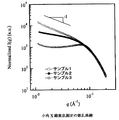
- FIG. 2 shows a thickened gel composition 1 (sample 1) in which 2% by mass of lecithin, 0.4% by mass of sucrose myristic acid ester, 97.6% by mass of n-decane, 10% by mass of lecithin, Thickened gel composition 2 (sample 2) in which 2% by mass of sucrose myristic acid ester and 88% by mass of n-decane are mixed, 25% by mass of lecithin, 5% by mass of sucrose myristic acid ester, 70% by mass of n-decane 2 shows a scattering curve (relationship between scattering intensity I (q) and scattering vector q) of small-angle X-ray scattering measurement with a thickened gel-like composition 3 (sample 3) mixed with%.
- Example 1 shows a thickened gel composition 1 in which 2% by mass of lecithin, 0.4% by mass of sucrose myristic acid ester, 97.6% by mass of n-decane, 10% by mass of lec
- the exact length of the reverse string micelle could not be calculated due to the limitation of the measurement range, but the length (t) of the reverse string micelle is about 500 mm or more from the simulation using the equation (3). It was shown that.
- J 1 is a first-order Bessel function.
- the low q-side scattering intensity decreased and the inclination tended to be gentle.
- a slight peak due to the interparticle interaction is observed at a position where q is about 0.07 ⁇ - 1 . This result shows that in Sample 2 and Sample 3, the amount of reverse string micelle per unit volume in the sample is increased.
- the thickened gel-like composition obtained by thickening or gelling the oil component using the oil gelling agent of the present invention is similarly formed with reverse string-like micelles in view of the gelation state and physical properties. It can be said.
- Lecithin as the oil gelling agent of the present invention is a mixture of naturally occurring phospholipids, such as soybean-derived soybean lecithin, egg yolk-derived egg yolk lecithin, purified lecithin with increased purity, enzyme-treated lysolecithin, etc. Modified lecithin can be used.
- Lecithin is an amphoteric phospholipid having two alkyl chains, and is widely used as a food emulsifier in emulsification of dairy products, reduction in viscosity of chocolate, and in pharmaceutical preparations. Moreover, it is a hydrophobic amphoteric surfactant and has high safety to living bodies and the environment. In the present invention, it is preferable to use soybean lecithin and egg yolk lecithin among lecithins.
- the (b) sucrose fatty acid ester as the oil gelling agent of the present invention is a nonionic surfactant obtained by esterifying a fatty acid derived from edible fats and oils to the hydroxyl group of sucrose, and is approved as a food additive and is a human body. Safety is also high.
- the lower limit of the carbon number as the fatty acid is 6 or more, preferably 10 or more, and the upper limit of the carbon number is 24 or less, preferably 18 or less, and more preferably 16 or less. If the number of carbon atoms in the fatty acid is too small, the ability to form micelles may decrease, and thickening or gelation may not occur. If the number of carbon atoms in the fatty acid is too large, the melting point may increase and stability at low temperatures may decrease. .
- These fatty acids may be used alone or in combination of two or more.
- sucrose fatty acid ester In the sucrose fatty acid ester, a wide range of HLB (hydrophilic lipophilic balance) types can be obtained by changing the carbon number of the fatty acid.
- the sucrose fatty acid ester used in the present invention has an HLB of 5 or more and 18 or less, preferably 9 or more and 17 or less, more preferably 11 or more and 16 or less. If the HLB is too low, the hydrogen bonding ability will be reduced, and if the HLB is too high, it will be difficult to solubilize inside the micelle, and thickening or gelation may not occur.
- fatty acids that form esters include caproic acid, caprylic acid, 2-ethylhexanoic acid, capric acid, lauric acid, isotridecanoic acid, myristic acid, palmitic acid, partoleic acid, stearic acid, isostearic acid, oleic acid, Linoleic acid, behenic acid, erucic acid, ricinoleic acid, hydroxystearic acid and the like can be mentioned.
- capric acid having 10 carbon atoms lauric acid having 12 carbon atoms
- myristic acid having 14 carbon atoms and palmitic acid having 16 carbon atoms are preferably used.
- Sucrose fatty acid esters include monoesters to octaesters as the degree of esterification of fatty acids to sucrose.
- sucrose fatty acid esters of any degree of esterification can be used, and commercially available sucrose fatty acid esters can also be used as they are.
- the monoester content of commercially available sucrose fatty acid esters is usually 0 to 100% and includes those having a plurality of esterification degrees. In the present invention, the monoester content is preferably 40 to 100%, more preferably 80 to 100%. When the monoester content is reduced, thickening gelation may not occur, or even when thickening gelation occurs, a preferred thickening property may not be obtained.
- the mixing ratio with (a) lecithin (b) sucrose fatty acid ester constituting the oil gelling agent of the present invention may be in any range as long as it is a mixing ratio capable of forming reverse string micelles.
- the mass ratio of (b) sucrose fatty acid ester to the total amount of the oil gelling agent varies depending on (c) oil component, but it is expressed as mass% of (b) component / ((a) component + (b) component).
- the lower limit is 0.1% by mass or more, preferably 1% by mass or more, more preferably 7% by mass or more, and the upper limit is experimentally 70% by mass or less, preferably 60% by mass or less, more preferably 50% by mass. % Or
- Oil components that can be gelled in the present invention are not particularly limited, and are oils such as animal and vegetable oils, mineral oils, hydrocarbons, and fatty acid esters. Only polar oil, nonpolar oil, or a mixture of polar oil and nonpolar oil may be used.
- fish oil such as fish oil, liver oil, whale oil, head oil, lard, horse oil, sheep oil, animal oil, vegetable oil such as animal oil, palm oil, palm oil, cacao butter, olive oil, rapeseed oil, linseed oil, etc .
- Hydrocarbons such as liquid paraffin, isoparaffin, kerosene, heavy oil, isooctane, n-heptane, n-decane and cyclohexane; higher fatty acids such as lauric acid, palmitic acid, stearic acid, oleic acid and behenic acid, isopropyl myristate And fatty acid esters such as 2-octyldodecyl myristate and isopropyl palmitate.
- These oils can be used singly or as a mixture of two or more.
- the additive component may be dissolved, dispersed, emulsified, suspended or mixed at a concentration that does not hinder thickening or gelling.
- additive components include surfactants, ultraviolet absorbers, moisturizers, preservatives, preservatives, bactericides, depending on the application such as cosmetics, pharmaceuticals, foods, paints, inks, and lubricating oils.
- antioxidants fluidity improvers, fragrances, pigments, enzymes, physiologically active substances, and the like, and examples include organic compounds or inorganic compounds such as titanium oxide, talc, mica, and water.
- the oil gelling agent When (c) the oil component is gelled with the oil gelling agent containing (a) lecithin (b) sucrose fatty acid ester of the present invention, the oil gelling agent is thickened or gelled with respect to the oil component, and the reverse string Any amount can be mixed as long as it is within the range in which the micelles can be formed.
- the mixing ratio of the oil component is (a) 1 to 70% by mass of lecithin, preferably 3 to 45% by mass, more preferably 5 to 25% by mass, and (b) 0.1 to 40% by mass of sucrose fatty acid ester. %, Preferably 0.4 to 25% by mass, more preferably 0.8 to 15% by mass, and (c) the oil component is 30 to 99% by mass, preferably 50 to 96% by mass, more preferably 70%. It can be set to -94 mass%.
- the mixing ratio of the oil gelling agent to the thickened gel-like composition is expressed by mass% of ((a) component + (b) component) / ((a) component + (b) component + (c) component).
- the lower limit is 1% by mass or more, preferably 4% by mass or more, more preferably 6% by mass or more, and the upper limit is 70% by mass or less, preferably 50% by mass or less, and more preferably 30% by mass.
- the gel strength can be adjusted by the concentration of the oil gelling agent and the mixing ratio of (a) lecithin and (b) sucrose fatty acid ester.
- the thickened gel-like composition of the present invention contains (a) lecithin (b) sucrose fatty acid ester, various (c) oil components are added, and other additive components are added as necessary, uniformly. By dissolving, it can be gelled to form an inverted string micelle structure.
- component an organic solvent solution of lecithin
- component sucrose fatty acid ester
- Ingredient After dissolving the sucrose fatty acid ester, the organic solvent is completely evaporated by drying under reduced pressure, and then (c) the required amount of the oil component is added and further stirred overnight, and the container is kept at room temperature for stabilization.
- the thickening gel-like composition is produced immediately by adding, mixing, and stirring each component, and long-time stirring and standing for stabilizing the gel-like material is appropriately performed as necessary. It only has to be set, and in some cases it is not necessary.
- Examples of the organic solvent used in preparing the thickened gel composition include lower alcohols such as methanol, ethanol, propanol, and butyl alcohol; polyhydric alcohols such as ethylene glycol and propylene glycol; acetone, 2-butanone, and cyclohequinone.
- lower alcohols such as methanol, ethanol, propanol, and butyl alcohol
- polyhydric alcohols such as ethylene glycol and propylene glycol
- acetone, 2-butanone, and cyclohequinone examples of the organic solvent used in preparing the thickened gel composition.
- Ketones such as tetrahydrofuran, ethers such as 1,4-dioxane; esters such as ethyl acetate and butyl acetate; amides such as N, N-dimethylformamide and N, N-dimethylacetamide; chloroform and carbon tetrachloride
- Halogenated hydrocarbons such as dichloromethane, dichloroethane, isopropyl bromide, ethyl bromide, dichlorobenzene, tetrachloroethane, trichloroethane, trichloroethylene, ethylene tetrachloride; water, etc., but it is preferable to use lower alcohols. There. These organic solvents may be used alone or in combination.
- the thickened gel-like composition of the present invention can be used as various products that exhibit gel-like properties at room temperature as detergents, cosmetics, medicines, foods, deodorants, bath agents, fragrances, deodorizers, and the like.
- detergents include food detergents, dish detergents, kitchen detergents, facial cleansers, body soaps, shampoos, rinses and the like.
- Cosmetics include creams, emulsions, lotions, cleansing agents, bath cosmetics, moisturizing cosmetics, blood circulation promoting / massaging agents, pack cosmetics, hair cosmetics, and the like.
- pharmaceuticals include ointments, molded cataplasms, sustained-release preparation bases, transdermal absorption preparations, drug delivery system carriers, electrophoresis gels, and the like.
- ingredients used in ordinary general cosmetics can be blended.
- examples include fragrances, pigments, preservatives, antioxidants, anti-inflammatory agents, ultraviolet absorbers, ultraviolet reflectors, pH adjusters, and various other medicinal ingredients such as hyaluronic acid, allantoin, and the like.
- the thickened gel-like composition formed by adding and mixing various oils to the oil gelling agent of the present invention has a reverse string-like micelle structure, so it has a hydrophilic environment inside and is a water-soluble component ⁇ It is possible to enclose drugs and enzymes.
- This reverse-like micelle is a nanometer-scale extremely fine molecular assembly.
- the polar groups of lecithin and sucrose fatty acid ester molecules face inward, and the hydrophobic groups face outward. Since many strings are gathered together, a hydrophilic environment, that is, a small water pool (water phase) is formed inside.
- water-soluble substances that can be encapsulated include moisturizers, whitening agents, anti-inflammatory agents, antibacterial agents, hormone agents, vitamins, various amino acids and their derivatives, enzymes, antioxidants, hair restorers, etc. Ingredients.
- the thickened gel composition formed by adding and mixing various oils to the oil gelling agent of the present invention a water-soluble substance, a water-soluble drug, and an enzyme that are hardly soluble or insoluble in the oil are directly or When the aqueous solution is contacted, mixed and stirred, the water-soluble substance is taken into the reverse string micelle and can be dissolved in the thickening gel.
- the transparency of the formed thickened gel-like composition can be adjusted according to the oil gelling agent used, the preparation conditions of the thickened gel-like composition, and the like, from transparent to translucent, white turbid, and the application used.
- the oil gelling agent of the present invention is excellent in gelation ability for various oils, can form a stable gel for a long time even when added at a low concentration, and particularly a gel of higher hydrocarbons has excellent thixotropic properties, and There is no shortcoming such as “stickiness”.
- the oil gelling agent of the present invention is made of material components such as lecithin and sucrose fatty acid ester that are highly safe and biodegradable for living bodies and the environment, and is environmentally friendly.
- the oil gelling agent of the present invention is further used in fields other than the above, such as quasi-drugs, inks, paints, lubricating oils, plastics, rubbers, metals, etc., as well as agriculture, fisheries, waste oil treatment, etc. be able to.
- Examples 1 to 8 (Formulation of thickening gel composition)
- a component lecithin soybean lecithin product name “L- ⁇ -Phosphatidylcholine (Soy-95%)” manufactured by Avanti Polar Lipids, Inc.
- component sucrose capric acid ester “Plate” (manufactured by Dojindo Laboratories Co., Ltd.), n-decane (0.774 mPa ⁇ s (25 ° C.) manufactured by Kanto Chemical Co., Ltd.) as component (c) was increased as the composition shown in Table 1.
- a viscous gel composition was prepared. Examples 1 to 8 were made according to each composition.
- Preparation of thickened gel composition Preparation of the thickened gel composition was carried out by encapsulating (a) component: lecithin ethanol solution and (b) component: sucrose fatty acid ester in required bottles, respectively, and stirring using a magnetic stirrer. (B) component: After dissolving sucrose fatty acid ester, ethanol is completely evaporated by drying under reduced pressure. (C) The required amount of oil component was added and further stirred overnight, and the bottle was prepared by allowing it to stand in a thermostatic bath at 25 ° C. for several days for equilibration. In the following Examples 9 to 42 and Comparative Examples 1 to 4, the thickening gel composition was prepared by the same preparation means.
- a thickened gel composition is prepared.
- the ratio of sucrose capric acid ester in these oil gelling agents, that is, (b) component / ((a) component + (b) component) is 11% by mass to 23% by mass in the thickened gel-like composition.
- the ratio of the oil gelling agent, that is, ((a) component + (b) component) / ((a) component + (b) component + (c) component) is 12% by mass to 30% by mass.
- the state of the thickening gel was transparent, both gelled and ⁇ , and the storage stability was also ⁇ .
- the evaluation results are shown in Table 1.
- Example 9 to 20 (Formulation of thickening gel composition)
- b) the component as sucrose laurate, the product name “Ryoto sugar ester L-1695 "(manufactured by Mitsubishi Chemical Foods), n-decane (manufactured by Kanto Chemical Co., Ltd.) as component (c), and a thickened gel-like composition having the composition shown in Table 1 were prepared. . According to each compounding composition, it was set as Examples 9-16.
- (c) component was changed to cyclohexane (0.828 mPa * s (25 degreeC) by Kanto Chemical Co., Inc.), and the thickening gel-like composition was prepared as a compounding composition shown in Table 2. It was set as Examples 17 and 18 according to each compounding composition.
- Example 19 And (c) component was changed to liquid paraffin (manufactured by Kanto Chemical Co., Ltd., 146 mPa ⁇ s (25 ° C.)), and a thickening gel-like composition was prepared as a formulation shown in Table 2 to obtain Example 20.
- component (a): lecithin was 5, 10, 15, 20, 25% by mass
- component (c): n-decane in required amounts It is used to prepare a thickened gel composition.
- the ratio of sucrose laurate in these oil gelling agents that is, (b) component / ((a) component + (b) component) is 11% to 25% by mass
- the oil gel in the thickened gel composition The ratio of the agent ((a) component + (b) component) / ((a) component + (b) component + (c) component) is 6 mass% to 28 mass%.
- the state of the thickening gel was transparent, both gelled and ⁇ , and the storage stability was also ⁇ .
- the evaluation results are shown in Table 1.
- Example 17 to 20 (a) component: lecithin was 10% by mass, (b) component: sucrose laurate, (c) component: cyclohexane, isopropyl palmitate, and liquid paraffin were used.
- a viscous gel composition is prepared. The ratio of sucrose laurate in these oil gelling agents, (b) component / ((a) component + (b) component) is 7% to 58% by mass, oil gelation in the thickened gel composition The ratio of the agent ((a) component + (b) component) / ((a) component + (b) component + (c) component) is from 11% by mass to 24% by mass. The states of the thickening gel were all gelled, and the storage stability was all excellent except for Example 20, and all were transparent. In component (c) of Example 20, liquid paraffin was separated in a small amount, but it was sufficiently transparent and stable in the usual standard of 3 months, and there was no problem in use. . The evaluation results are shown in Table 2.
- Example 21 to 33 (Formulation of thickening gel composition)
- (b) as sucrose myristic ester, trade name “Ryoto Sugar Ester M-1695 "(Mitsubishi Chemical Foods Co., Ltd.), n-decane (manufactured by Kanto Chemical Co., Ltd.) as component (c), and a thickened gel-like composition having the composition shown in Table 2 were prepared.
- Examples 21 to 29 were made according to the respective composition compositions.
- Example 30 The component was changed to cyclohexane (made by Kanto Chemical Co., Inc.), and the thickening gel-like composition was prepared as a compounding composition shown in Table 2. It was set as Example 30 and Example 31 according to each compounding composition.
- (c) component was changed to isopropyl palmitate (manufactured by Wako Pure Chemical Industries, Ltd.), and a thickening gel-like composition was prepared as a blending composition shown in Table 2 to give Example 32, and component (c) was liquid paraffin.
- a blending composition shown in Table 3 in place of (manufactured by Kanto Chemical Co., Inc.), a thickened gel composition was prepared as Example 33.
- Example 21 In Examples 21 to 29, (a) component: lecithin was 5, 10, 15, 20, and 25% by mass, (b) component: sucrose myristic acid ester, and (c) component: n-decane, respectively, as required.
- Examples 30 and 31 were prepared by using a thickened gel composition, and (a) component: lecithin was 10% by mass, (b) component: sucrose myristic acid ester, and (c) component: cyclohexane.
- Example 32 a thickened gel-like composition was prepared by using (a) component: lecithin at 10% by mass, (b) component: sucrose myristic acid ester, and (c) component: isopropyl palmitate.
- Example 33 a thickened gel-like composition was prepared by using 10% by mass of lecithin as the component (a), (b) component: sucrose myristic acid ester, and (c) component: liquid paraffin.
- the mixing ratio is 7% to 58% by mass of the ratio (b) component / ((a) component + (b) component) of the sucrose myristic acid ester in the oil gelling agent.
- the ratio of the oil gelling agent in the gel composition is 7% to 30% by mass.
- the thickening gel was transparent, and both gelled and storage stability was good.
- the gel of Example 32 is thickened ⁇ , but it does not cause any problems in use, and the storage stability of Example 33 is ⁇ small amount separated, but it is a normal guideline. In 3 months, it was sufficiently transparent and stable, and there was no problem in use. The evaluation results are shown in Tables 2 and 3.
- Example 34 to 42 (Formulation of thickening gel composition)
- the ratio (b) component / ((a) component + (b) component) of sucrose palmitate in the oil gelling agent was changed from 11% by mass to 33% by mass to increase the viscosity of the gel.
- the ratio of the oil gelling agent in the composition ((a) component + (b) component) / ((a) component + (b) component + (c) component) was changed from 6 mass% to 30 mass%. is there.
- Example 34 (a) component: lecithin was 5, 10, 15, 20, and 25% by mass, (b) component: sucrose palmitate ester, and (c) component: n-decane, respectively. Even when the thickened gel-like composition was prepared using the required amount, the state of the thickened gel was transparent, and in both cases, the gelation was excellent and the storage stability was excellent. In Example 34, the gel was in a thickened state, but it was not a problem in use. The evaluation results are shown in Table 3.
- Example 43 to 46 Preparation of thickened gel composition
- Preparation of the thickened gel-like composition was carried out in Examples 23, 31, 32, and 33, in which (a) component: lecithin, (b) component: sucrose fatty acid ester, and (c) oil component were enclosed in the required amount bottles, respectively. It was prepared by heating and dissolving at about 60 ° C. and cooling to room temperature. At that time, it was performed in a nitrogen atmosphere to prevent oxidation of lecithin.
- a thickened gel composition shown in Table 4 a thickened gel composition was prepared. According to each compounding composition, it was set as Examples 43-46.
- the transmittance was measured at a wavelength of 550 nm using a spectrophotometer (V-530, manufactured by JASCO Corporation). Based on the transmittances of 100 to 90%, 89 to 50%, and 49% or less, they were evaluated as transparent: 1, translucent: 2, white turbidity: 3. The evaluation results are shown in Table 4.
- the transparency is transparent or translucent, and can provide transparency according to the application used as the thickening gel composition.
- a thickened gel composition was prepared in the same manner as Comparative Example 1 except that the component (c) was changed to isopropyl palmitate (manufactured by Wako Pure Chemical Industries, Ltd.). Further, a thickened gel composition was prepared as Comparative Example 4 in the same manner as Comparative Example 1 except that the component (c) was changed to liquid paraffin (manufactured by Kanto Chemical Co., Inc.).
- Comparative Examples 1 to 4 did not use the sucrose fatty acid ester as the component (b), so that the thickening gel was insufficiently formed or could not be formed.
- Table 3 shows the composition and evaluation results.
- the oil component (c) n-decane has a viscosity increase of 3 million times at 25 ° C. and 0.774 mPa ⁇ s
- cyclohexane has a temperature of 25 ° C.
- the viscosity increased by 2.5 million times
- isopropyl palmitate the viscosity increased by 6.09 mPa ⁇ s at 25 ° C. by 600,000 times.
- a tenfold increase in viscosity was easily obtained.
- the sucrose fatty acid ester of component (b) and the oil component (c) were insufficiently formed or could not be formed. *
- the oil gelling agent which can form a reverse string-like micelle by the 3 component mixed system of a lecithin / sucrose fatty acid ester / various oil can be provided, and the thickening gel form in which the reverse string-like micelle was formed
- the composition has a hydrophilic environment inside reverse string micelles and can contain water-soluble components, drugs, enzymes, and the like. Further, by changing the type of fatty acid of the sucrose fatty acid ester to be used, a wide range of HLB (hydrophilic lipophilic balance) types can be obtained, and it can be widely used as oil gelling agents for various cosmetics, pharmaceuticals, foods and the like. Further, the thickened gel composition formed by using the oil gelling agent has thixotropic properties, good handling properties, and good long-term stability.
Landscapes
- Chemical & Material Sciences (AREA)
- Life Sciences & Earth Sciences (AREA)
- Health & Medical Sciences (AREA)
- Organic Chemistry (AREA)
- Engineering & Computer Science (AREA)
- Wood Science & Technology (AREA)
- Materials Engineering (AREA)
- Veterinary Medicine (AREA)
- Public Health (AREA)
- General Health & Medical Sciences (AREA)
- Animal Behavior & Ethology (AREA)
- Chemical Kinetics & Catalysis (AREA)
- General Chemical & Material Sciences (AREA)
- Birds (AREA)
- Epidemiology (AREA)
- Oil, Petroleum & Natural Gas (AREA)
- Polymers & Plastics (AREA)
- Food Science & Technology (AREA)
- Biophysics (AREA)
- Molecular Biology (AREA)
- Nutrition Science (AREA)
- Dispersion Chemistry (AREA)
- Dermatology (AREA)
- Cosmetics (AREA)
- Medicinal Preparation (AREA)
- Edible Oils And Fats (AREA)
- General Preparation And Processing Of Foods (AREA)
- Jellies, Jams, And Syrups (AREA)
Abstract
【課題】 逆紐状ミセルを形成するオイルゲル化剤および増粘ゲル状組成物として、生体や環境に対する高い安全性、好ましい使用感、および良好なゲル化能を併せ持つオイルゲル化剤および該オイルゲル化剤を用いた増粘ゲル状組成物を提供すること。 【解決手段】 レシチン/ショ糖脂肪酸エステルが各種オイルの逆紐状ミセルを形成するオイルゲル化剤として作用し、又これらレシチン/ショ糖脂肪酸エステル/各種オイルの3成分混合系を用いて、逆紐状ミセル構造を有する増粘ゲル状組成物を得ることができ、人体および環境に対して極めて安全で、かつ長期の安定性を有し、オイルゲル化剤として要求される性能を合わせ持つ良好なオイルゲル化剤、および該オイル化剤とオイル成分とを含み逆紐状ミセルを形成した増粘ゲル状組成物を簡単に提供することができる。
Description
本発明は、動植物油類、鉱物油類、炭化水素類、脂肪酸エステル類等のオイルを増粘又はゲル化して固化するオイルゲル化剤、および該オイル、オイルゲル化剤を含有する増粘ゲル状組成物に関する。
動植物油類、鉱物油類、炭化水素類、脂肪酸エステル類等のオイルを増粘又はゲル化して固化するオイルゲル化剤は、化粧料、医薬品、食品、塗料、インク、潤滑油等の様々な分野で広く利用されている。オイルゲル化剤に一般的に要求される性能としては、少量の添加で目的とするオイルをゲル化でき、得られたゲルが長期にわたり安定であることなどが挙げられる。さらに用途によっては、人体に対する安全性が高いこと、チキソトロピー性を有するゲルを生成すること、得られたゲルの触感がよいことなども要求されている。
従来、オイルゲル化剤としては、低分子ゲル化剤(1,2,3,4-ジベンジリデン-D-ソルビトール、12-ヒドロキシステアリン酸、アミノ酸誘導体等)、高分子ゲル化剤(ポリアクリル酸誘導体、デキストリン誘導体等)等が知られている。低分子ゲル化剤は、オイル中で自己集合し、巨大な網目構造を形成することでオイルが非流動化しゲルを形成し、一方、高分子ゲル化剤は、それらが複雑に絡まり合い網目構造を形成することでオイルのゲル化を引き起こすものである。
低分子ゲル化剤の1,2,3,4-ジベンジリデン-D-ソルビトールは、様々な種類のオイルをゲル化できる優れた化合物であるが、分解してベンズアルデヒドが生成するという点で安全性に問題があり実用化はされていない。12-ヒドロキシステアリン酸は、廃天ぷら油のゲル化剤として市販されているが、チキソトロピー性に欠ける。また、アミノ酸誘導体のゲル化剤はオイルに難溶性であるため、溶解させるには高温での加熱や長時間の攪拌などの煩雑な操作が必要となる。しかも、このような操作はゲルに配合される他成分の品質の変化を招く恐れがある点でも問題がある。一方、高分子ゲル化剤のデキストリン誘導体では、ゲル化に高濃度の添加が必要である上に、高分子特有の「べたつき感」を生じ使用感が良くない。ポリアクリル酸誘導体では少量の添加で良好な増粘ゲル化を示すが皮膚に使用した際には高分子特有の「べたつき感」を生じ、使用感がよくない。
これらの問題を解決させるべく、レシチン、ショ糖脂肪酸エステル等の天然界面活性物質1,2種、高級アルコール、グリセリン、オイルを加えたゲル状エマルション(特許文献1)が提案されているが、弾性が低いため液だれ等生じ易く取扱性が悪く、また高級アルコールおよびグリセリンの何れかが欠けると効果が得られないという問題がある。また、人体にも安全なオイルゲル化剤として、α-アミノラクタム誘導体を有効成分とするもの(特許文献2)が提案されているが、加熱溶解が必要であって、生体や環境に対する高い安全性、良好なゲル化能、使用感に優れ、取扱性のよさ等をすべて合わせ持つオイルゲル化剤は得られていない。
一方、逆紐状ミセルによるオイルのゲル化も少数だが報告されている(非特許文献1-3)。逆紐状ミセルとは、界面活性剤の形成する自己集合体の一種であり、オイル中で網目構造を形成するためにゲル化を引き起こすことが知られている。逆紐状ミセルという内部に親水的な環境を有しているために水溶性の薬物や酵素等を内包することが可能であり、上記したオイルゲル化剤にはない特長を有している。
この逆紐状ミセルを形成する代表的な系として、レシチン/水/各種オイルの3成分混合系が報告されている(非特許文献1)。また、水の代替物質には、エチレングリコール、ホルムアミド、グリセリン、胆汁酸塩(非特許文献3)、が報告されているに過ぎない。通常、レシチンはオイル中で逆球状ミセルあるいは逆楕円状ミセルを形成するが、これに少量の水等を添加するとレシチンのリン酸基に水素結合し、分子集合体の界面曲率が減少するために逆紐状ミセルの成長が起こると考えられている。
従来の逆紐状ミセルが抱える問題として、代表的なレシチン/水/各種オイルから成る逆紐状ミセルでは、水が成分中に含まれているために加水分解を受けやすい薬物等を配合することはできない。また、水の代替物質であるエチレングリコールやホルムアミドは、皮膚、眼、粘膜等への強い刺激性を有するために人体には適用できない。また、胆汁酸塩は生体由来の界面活性剤であるが、皮膚や眼等に付着すると炎症を起こす可能性があり、生体や環境に対する高い安全性、良好なゲル化能、使用感に優れ、取扱性のよさ等をすべて合わせ持つオイルゲル化剤は今まで得られていない。
P. L. Luisi et al.Colloid & Polymer Science, vol.268, p.356 (1990)
Yu. A. Shchipunov, Colloids and Surfaces A, vol.183-185, p.541 (2001)
S. H. Tung et al. Journal of the American Chemical Society, vol.128, p.5751 (2006)
本発明は、逆紐状ミセルを形成するオイルゲル化剤および増粘ゲル状組成物として、生体や環境に対する高い安全性、優れた使用感、および良好なゲル化能が要求され、それらの全てを併せ持つオイルゲル化剤、および該オイルゲル化剤を用いた増粘ゲル状組成物を提供することを課題とする。
本発明者らは、上記課題を解決するために鋭意研究を重ねた結果、レシチン/ショ糖脂肪酸エステルが各種オイルのオイルゲル化剤として作用し、又これらのレシチン/ショ糖脂肪酸エステル/各種オイルの3成分混合系を用いて、逆紐状ミセル構造を有する増粘ゲル状組成物を得ることができること、および該増粘ゲル状組成物は人体および環境に対して極めて安全で、良好なゲル化性能を有しかつ長期の安定性を有し、上記課題を解決できることを見出した。
そして、本発明者らは、レシチンとショ糖脂肪酸エステルを含有し逆紐状ミセルを形成するオイルゲル化剤、および該オイルゲル化剤と各種オイル成分とを含み逆紐状ミセルを形成した増粘ゲル状組成物を発明するに至った。
即ち、本発明は、
[1] (a)レシチン、(b)ショ糖脂肪酸エステルを含有し逆紐状ミセルを形成するオイルゲル化剤。
[2] 前記(a)レシチンが、大豆レシチンまたは卵黄レシチンのいずれかであることを特徴とする上記[1]に記載のオイルゲル化剤。
[3] 前記(b)ショ糖脂肪酸エステルが、炭素数6以上24以下である脂肪酸のエステルであることを特徴とする上記[1]または[2]に記載のオイルゲル化剤。
[4] 前記(b)ショ糖脂肪酸エステルが、ショ糖カプリン酸エステル、ショ糖ラウリン酸エステル、ショ糖ミリスチン酸エステル、ショ糖パルミチン酸エステルのうち少なくとも一つからなることを特徴とする上記[1]~[3]のいずれかに記載のオイルゲル化剤。
[5] 前記(a)レシチンと(b)ショ糖脂肪酸エステルとの混合割合として、(a)レシチンと(b)ショ糖脂肪酸エステルの合計質量に対して、(b)ショ糖脂肪酸エステルを0.1質量%から70質量%含有することを特徴とする上記[1]~[4]のいずれかに記載のオイルゲル化剤。
[6] 上記[1]~[5]のいずれかに記載のオイルゲル化剤と(c)オイル成分とを少なくとも含み逆紐状ミセルを形成した増粘ゲル状組成物。
[7]前記増粘ゲル状組成物が、化粧料、医薬品、食品、塗料、インク、潤滑油の少なくともいずれか一つであることを特徴とする上記[6]に記載の増粘ゲル状組成物。
[8]前記オイルゲル化剤と(c)オイル成分との混合割合として、オイルゲル化剤を増粘ゲル状組成物に対して1質量%から70質量%含有することを特徴とする上記[6]または[7]に記載の増粘ゲル状組成物。
[1] (a)レシチン、(b)ショ糖脂肪酸エステルを含有し逆紐状ミセルを形成するオイルゲル化剤。
[2] 前記(a)レシチンが、大豆レシチンまたは卵黄レシチンのいずれかであることを特徴とする上記[1]に記載のオイルゲル化剤。
[3] 前記(b)ショ糖脂肪酸エステルが、炭素数6以上24以下である脂肪酸のエステルであることを特徴とする上記[1]または[2]に記載のオイルゲル化剤。
[4] 前記(b)ショ糖脂肪酸エステルが、ショ糖カプリン酸エステル、ショ糖ラウリン酸エステル、ショ糖ミリスチン酸エステル、ショ糖パルミチン酸エステルのうち少なくとも一つからなることを特徴とする上記[1]~[3]のいずれかに記載のオイルゲル化剤。
[5] 前記(a)レシチンと(b)ショ糖脂肪酸エステルとの混合割合として、(a)レシチンと(b)ショ糖脂肪酸エステルの合計質量に対して、(b)ショ糖脂肪酸エステルを0.1質量%から70質量%含有することを特徴とする上記[1]~[4]のいずれかに記載のオイルゲル化剤。
[6] 上記[1]~[5]のいずれかに記載のオイルゲル化剤と(c)オイル成分とを少なくとも含み逆紐状ミセルを形成した増粘ゲル状組成物。
[7]前記増粘ゲル状組成物が、化粧料、医薬品、食品、塗料、インク、潤滑油の少なくともいずれか一つであることを特徴とする上記[6]に記載の増粘ゲル状組成物。
[8]前記オイルゲル化剤と(c)オイル成分との混合割合として、オイルゲル化剤を増粘ゲル状組成物に対して1質量%から70質量%含有することを特徴とする上記[6]または[7]に記載の増粘ゲル状組成物。
本発明の逆紐状ミセルを形成するオイルゲル化剤は、生体や環境に対し高い安全性を有する環境調和型であるという利点・効果だけでなく、使用するショ糖脂肪酸エステルの脂肪酸の種類を変えることにより幅広いHLB(親水親油バランス)のタイプが得られ、各種化粧品、医薬品、食品、塗料、インク、潤滑油等のオイルゲル化剤として広く使用できる。又得られる増粘ゲル状組成物はチキソトロピー性を有し、液だれしにくくハンドリング性がよく、1年以上に亘る長期の安定性も備えるという効果を有している。増粘ゲル状組成物の透明性は、用いるオイルゲル化剤、増粘ゲル状組成物の調製条件などから、透明から半透明、白濁とその使用する用途に応じて調製もできる。更に逆紐状ミセル構造の内部に親水的な環境を有し、水溶性の成分・薬物や酵素等を内包できるという従来の増粘ゲル状組成物にはない特徴も備えている。
以下に、本発明を詳細に説明する。本発明のオイルゲル化剤は、各種オイル成分を増粘又はゲル化させ逆紐状ミセルを形成することのできる材料である。本発明のオイルゲル化剤は、(a)レシチン、(b)ショ糖脂肪酸エステルを含有し、各種(c)オイル成分が添加混合されると増粘又はゲル化し逆紐状ミセル構造を形成した増粘ゲル状組成物になる。
逆紐状ミセル(Reverse worm-like micelle)は、界面活性剤の形成する自己集合体の一種である。界面活性剤は分子中に親水基と疎水基とを有する両親媒性物質であり、その基のバランスに応じて水、油中で自己集合体を形成するが、図1に示すとおり、逆球状ミセルが円筒状に成長した逆紐状ミセルは、一時的なネットワーク構造を形成し、高弾性のゲルを形成する。また、内部に親水的な環境を有しているために水溶性の成分・薬物や酵素等を内包することが可能である。
本発明者らは、逆紐状ミセルについて鋭意研究を重ねた結果、逆紐状ミセルの成長を引き起こす物質には2つの条件が必要であることを見出した。一つは、レシチンのリン酸基と水素結合できる官能基を二つ以上持つこと、二つめは、若干の疎水性を有することであり、この二つを満たすものとしてショ糖脂肪酸エステルに注目し、レシチンとショ糖脂肪酸エステルと各種オイルにより逆紐状ミセルを形成できることを見出した。
本発明者らは得られた増粘又はゲル状調製物について、具体的にはレシチンとショ糖ミリスチン酸エステルとn-デカンを混合することにより形成した増粘ゲル状調製物について、その構造を観察した。増粘ゲル状調製物は透明であり、又結晶構造をもたなく光学的には等方性であり、偏光像としては特徴的なパターンは現れない。小角X線散乱(SAXS)測定をした散乱曲線からは、明瞭な回折ピークが得られなかったことから規則構造を形成しておらず、本発明の増粘ゲル状組成物は、逆紐状ミセルを形成しているといえる。
また、本発明の増粘ゲル状組成物は、逆紐状ミセルを形成しているゆえに、増粘又はゲル化されるオイルにもよるが、オイル自体が透明であるならば透明なものである。
また、本発明の増粘ゲル状組成物は、逆紐状ミセルを形成しているゆえに、増粘又はゲル化されるオイルにもよるが、オイル自体が透明であるならば透明なものである。
SAXS測定は、ブルカー・エイエックスエス社製のNano-STARを用い、X線源はCuKα線、出力は45kV/120mAで行った。全てのSAXS測定は25℃で行った。
図2には、レシチン2質量%、ショ糖ミリスチン酸エステル0.4質量%、n-デカン97.6質量%を混合した増粘ゲル状組成物1(サンプル1)と、レシチン10質量%、ショ糖ミリスチン酸エステル2質量%、n-デカン88質量%を混合した増粘ゲル状組成物2(サンプル2)と、レシチン25質量%、ショ糖ミリスチン酸エステル5質量%、n-デカン70質量%を混合した増粘ゲル状組成物3(サンプル3)との、小角X線散乱測定の散乱曲線(散乱強度I(q)と散乱ベクトルqの関係)を示す。ここでq=(4π/λ)sinθ、θは散乱角、λはX線の波長である。これによれば、いずれの散乱曲線も明瞭な回折ピークを示さなかったことから、規則性構造を形成していないことがわかる。
この3つのサンプルの中で最もオイルゲル化剤濃度の低いサンプル1の散乱曲線では、両対数プロットの低q側の勾配が-1になっている。これは長い棒状の粒子、すなわち逆紐状ミセルの存在を示唆する。また(1)式および(2)式に基づくCross-sectionプロットにより、逆紐状ミセルの断面半径(r)は17Åと求められた。

 ここで、Rcは断面の回転半径である。また、測定範囲の制約のために逆紐状ミセルの正確な長さは算出できなかったが、(3)式を用いたシミュレーションから逆紐状ミセルの長さ(t)は約500Å以上であることが示された。
 ここで、J1は一次のベッセル関数である。また、サンプル2およびサンプル3では低q側の散乱強度が減少し、傾きも緩やかになる傾向が認められた。特にサンプル3では、qが約0.07Å-1の位置に粒子間相互作用によるわずかなピークが認められる。この結果は、サンプル2およびサンプル3では、試料内の単位体積当たりの逆紐状ミセル量が増加していることを示している。すなわち、逆紐状ミセル同士が近接することで構造因子の寄与が強くなり、低q側の散乱強度が減少したと考えられる。
更に、本発明のオイルゲル化剤を用いてオイル成分を増粘又はゲル化させた増粘ゲル状組成物は、そのゲル化の状態、物性からすると、同様に逆紐状ミセルが形成されているといえる。
この3つのサンプルの中で最もオイルゲル化剤濃度の低いサンプル1の散乱曲線では、両対数プロットの低q側の勾配が-1になっている。これは長い棒状の粒子、すなわち逆紐状ミセルの存在を示唆する。また(1)式および(2)式に基づくCross-sectionプロットにより、逆紐状ミセルの断面半径(r)は17Åと求められた。
更に、本発明のオイルゲル化剤を用いてオイル成分を増粘又はゲル化させた増粘ゲル状組成物は、そのゲル化の状態、物性からすると、同様に逆紐状ミセルが形成されているといえる。
本発明のオイルゲル化剤としての(a)レシチンは、天然に存在するリン脂質の混合物であり、大豆由来の大豆レシチン、卵黄由来の卵黄レシチン、純度を高めた精製レシチン、酵素処理したリゾレシチン等の改質レシチンを用いることができる。レシチンは2本のアルキル鎖を持つ両性リン脂質であり、食品用乳化剤として、乳製品の乳化、チョコレートの粘度低下に、また医薬製剤などにも広く利用されている。又疎水性の両性界面活性剤であり、生体や環境に対する高い安全性を有している。本発明ではレシチンのなかでも大豆レシチン、卵黄レシチンを用いることが好ましい。
本発明のオイルゲル化剤としての(b)ショ糖脂肪酸エステルは、ショ糖の水酸基に食用油脂由来の脂肪酸をエステル結合して得られる非イオン性界面活性剤であり、食品添加剤として認可され人体に対する安全性も高いものである。脂肪酸としての炭素数の下限値は6以上、好ましくは10以上であり、炭素数の上限値は24以下、好ましくは18以下、更により好ましくは16以下である。脂肪酸の炭素数が少なすぎるとミセル形成能が低下し、増粘又はゲル化が起こらない場合があり、脂肪酸の炭素数が多すぎると融点が高くなり低温での安定性が低下する場合がある。またこれらの脂肪酸は単独で用いるだけでなく2種以上併用してもよい。
(b)ショ糖脂肪酸エステルにおいては、脂肪酸の炭素数を変えることにより幅広いHLB(親水親油バランス)のタイプが得られる。本発明で使用されるショ糖脂肪酸エステルは、HLBが5以上18以下のものであって、好ましくは9以上17以下、より好ましくは11以上16以下である。HLBが低すぎると水素結合能が低下し、HLBが高すぎるとミセル内部に可溶化されにくくなり、増粘又はゲル化が起こらない場合がある。
エステルを形成する脂肪酸としては、例えば、カプロン酸、カプリル酸、2-エチルヘキサン酸、カプリン酸、ラウリン酸、イソトリデカン酸、ミリスチン酸、パルミチン酸、パルトレイン酸、ステアリン酸、イソステアリン酸、オレイン酸、リノール酸、ベヘン酸、エルカ酸、リシノール酸、ヒドロキシステアリン酸等が挙げられる。なかでも炭素数10のカプリン酸、炭素数12のラウリン酸、炭素数14のミリスチン酸、炭素数16のパルミチン酸を用いるのが好ましい。
ショ糖脂肪酸エステルには、ショ糖に対する脂肪酸のエステル化度としてモノエステルからオクタエステルまである。本発明では、いかなるエステル化度のショ糖脂肪酸エステルでも使用でき、市販のショ糖脂肪酸エステルをそのまま使用することもできる。市販のショ糖脂肪酸エステルのモノエステル含量は、通常0~100%であり、複数のエステル化度のものを含んでいる。本発明においては、モノエステル含量は好ましくは40~100%、更に好ましくは、80~100%である。モノエステル含量が少なくなると、増粘ゲル化が起こらないことがあったり、増粘ゲル化が起こっても好ましい増粘度が得られない場合がある。
本発明のオイルゲル化剤を構成する(a)レシチン(b)ショ糖脂肪酸エステルとの混合比率は、逆紐状ミセルが形成できる混合割合ならばいかなる範囲でもよい。(a)レシチンを1~70質量%、好ましくは3~45質量%、より好ましくは5~25質量%、(b)ショ糖脂肪酸エステルを0.1~40質量%、好ましくは0.4~25質量%、より好ましくは0.8~15質量%とすることができる。オイルゲル化剤全量に対する(b)ショ糖脂肪酸エステルの質量割合は、(c)オイル成分によっても異なるが
(b)成分/((a)成分+(b)成分)の質量%であらわすと、実験的に下限は0.1質量%以上、好ましくは1質量%以上、より好ましくは7質量%以上であり、実験的に上限は70質量%以下、好ましくは60質量%以下、より好ましくは50質量%以下である。
(b)成分/((a)成分+(b)成分)の質量%であらわすと、実験的に下限は0.1質量%以上、好ましくは1質量%以上、より好ましくは7質量%以上であり、実験的に上限は70質量%以下、好ましくは60質量%以下、より好ましくは50質量%以下である。
本発明においてゲル化することのできる(c)オイル成分は、特に限定されるものではなく、動植物油類、鉱物油類、炭化水素類、脂肪酸エステル類等のオイルである。極性油のみ、非極性油のみ、あるいは極性油と非極性油の混合物であってもかまわない。具体的には、魚油、肝油、鯨油、ヘッド、ラード、馬油、羊油等の魚油、動物油、ヤシ油、パーム油、カカオバター、オリーブ油、菜種油、あまに油等の植物油の動植物油類;流動パラフィン、イソパラフィン、灯油、重油、イソオクタン、n-ヘプタン、n-デカン、シクロヘキサン等の炭化水素類;ラウリン酸、パルミチン酸、ステアリン酸、オレイン酸、べヘン酸等の高級脂肪酸類、ミリスチン酸イソプロピル、ミリスチン酸2-オクチルドデシル、パルミチン酸イソプロピル等の脂肪酸エステル類等を挙げることができる。これらのオイルは、単独であっても2種以上の混合物であっても用いることができる。
オイルゲル化されるオイル中には、添加成分が増粘又はゲル化を妨げない範囲の濃度で、溶解、分散、乳化、懸濁あるいは混合されていてもよい。このような添加成分の例としては、化粧料、医薬品、食品、塗料、インク、潤滑油などの用途に応じて、界面活性剤、紫外線吸収剤、保湿剤、防腐剤、保存料、殺菌剤、酸化防止剤、流動性向上剤、香料、色素、酵素、生理活性物質等があり、有機化合物又は酸化チタン、タルク、マイカ、水等の無機化合物を挙げることができる。
本発明の(a)レシチン(b)ショ糖脂肪酸エステルを含むオイルゲル化剤により(c)オイル成分をゲル化する際には、オイル成分に対してオイルゲル化剤を、増粘又はゲル化し逆紐状ミセルを形成することのできる範囲ならばいかなる量までも混合できる。オイル成分の混合割合としては、(a)レシチンを1~70質量%、好ましくは3~45質量%、より好ましくは5~25質量%、(b)ショ糖脂肪酸エステルを0.1~40質量%、好ましくは0.4~25質量%、より好ましくは0.8~15質量%としたとき、(c)オイル成分は30~99質量%、好ましくは50~96質量%、より好ましくは70~94質量%とすることができる。
また、増粘ゲル状組成物に対するオイルゲル化剤の混合割合を、((a)成分+(b)成分)/((a)成分+(b)成分+(c)成分)の質量%であらわすと、下限は1質量%以上、好ましくは4質量%以上、さらにより好ましくは6質量%以上であり、上限は70質量%以下、好ましくは50質量%以下であり、さらにより好ましくは30質量%以下ある。この範囲で加え、オイル成分を添加混合し放置することにより、増粘ゲル状組成物を得ることができる。ゲル強度は、オイルゲル化剤の濃度および(a)レシチンと(b)ショ糖脂肪酸エステルの混合割合により調整することが可能である。
本発明の増粘ゲル状組成物は、(a)レシチン(b)ショ糖脂肪酸エステルを含有し、各種(c)オイル成分を添加し、必要に応じてその他の添加成分を添加し、均一に溶解することによって、ゲル化し逆紐状ミセル構造を形成することができる。増粘ゲル状組成物の調製例としては、(a)成分:レシチンの有機溶媒溶液と、(b)成分:ショ糖脂肪酸エステルをそれぞれ必要量容器に封入し、攪拌し、完全に(b)成分:ショ糖脂肪酸エステルを溶解させた後、減圧乾燥により有機溶媒を完全に蒸発させ、次いで(c)オイル成分を必要量加えてさらに一晩撹拌し、安定化のために容器を常温恒温槽で必要に応じて数日間静置することによって調製することができる。また、(a)レシチンと(b)ショ糖脂肪酸エステルと各種(c)オイル成分の混合物を、加熱溶解し、室温まで冷却することによって調製することができる。このときの加熱は、混合物が溶解する温度ならいかなる温度でもかまわないが、好ましくは、50℃~80℃の範囲である。この際、レシチンの酸化防止のために窒素雰囲気下又は酸化防止剤を添加して行うことが好ましい。なお、増粘ゲル状組成物は、各成分の添加、混合、攪拌することにより直ちに生じるものであり、ゲル状物の安定化のための長時間の攪拌及び静置は、必要に応じて適宜設定すればよく、場合によっては必要のないものである。
増粘ゲル状組成物を調製する際に用いる有機溶媒としては、メタノール、エタノール、プロパノール、ブチルアルコール等の低級アルコール類;エチレングリコール、プロピレングリコール等の多価アルコール;アセトン、2-ブタノン、シクロヘキノン等のケトン類;テトラヒドロフラン、1,4-ジオキサン等のエーテル類;酢酸エチル、酢酸ブチル等のエステル類;N,N-ジメチルホルムアミド、N,N-ジメチルアセトアミド等のアミド類;クロロホルム、四塩化炭素、ジクロロメタン、ジクロロエタン、臭化イソプロピル、臭化エチル、ジクロロベンゼン、テトラクロロエタン、トリクロロエタン、トリクロロエチレン、四塩化エチレン等のハロゲン化炭化水素類;水などがあるが、なかでも低級アルコールを用いるのが好ましい。また、これら有機溶媒は単独でも、組み合わせて使用してもかまわない。
本発明の増粘ゲル状組成物は、洗浄剤、化粧料、医薬、食品、消臭剤、入浴剤、芳香剤、脱臭剤等として常温でゲル状を呈する各種製品として用いることができる。なかでも洗浄剤、化粧料、医薬品の用途に特に適している。洗浄剤としては、食品用洗浄剤、食器洗浄剤、厨房用洗浄剤、洗顔料、ボディーソープ、シャンプー、リンス等が挙げられる。化粧料として、クリ-ム、乳液、ローション、クレンジング料、浴用化粧料、保湿化粧料、血行促進・マッサージ剤、パック化粧料、頭髪化粧料等が挙げられる。医薬品としては、軟膏剤、成形パップ剤、徐放製剤基材、経皮吸収製剤、ドラッグデリバリーシステム担体、電気泳動用ゲル等が挙げられる。
化粧料中には、通常の一般化粧料に使用される成分を配合することができる。例えば、香料、色素、防腐剤、抗酸化剤、抗炎症剤、紫外線吸収剤、紫外線反射剤、pH調整剤等が挙げられ、さらに必要に応じて、種々の薬効成分、例えば、ヒアルロン酸、アラントイン、ビタミン類、アミノ酸、胎盤エキス等を挙げることができ、単独であるいは組み合わせて適宜配合することができる。
本発明のオイルゲル化剤に各種オイルが添加混合されて形成された増粘ゲル状組成物は、逆紐状ミセル構造を形成しているので、内部に親水的な環境を有し水溶性の成分・薬物や酵素等を内包することが可能である。この逆紐状ミセルは、ナノメータ・スケールの極めて微細な分子集合体であり、この逆紐状ミセルはレシチンとショ糖脂肪酸エステルとの分子の極性基が内側を向き、疎水基が外側を向いて紐状に多数集合しているので、その内部は親水的な環境即ち小さなウオーター・プール(水相)が形成されている。内包することのできる水溶性の物質としては、例えば、保湿剤、美白剤、抗炎症剤、抗菌剤、ホルモン剤、ビタミン類、各種アミノ酸およびその誘導体や酵素、抗酸化剤、育毛剤などの薬剤成分が挙げられる。
本発明のオイルゲル化剤に各種オイルが添加混合されて形成された増粘ゲル状組成物に、オイルに対して難溶性ないし非溶性を示す水溶性の物質、水溶性薬剤、酵素を直接、またはその水溶液を接触、混合攪拌させると、水溶性の物質は逆紐状ミセルの内部に取り込まれ、増粘ゲル中に溶解せしめることができる。形成された増粘ゲル状組成物の透明性は、用いるオイルゲル化剤、増粘ゲル状組成物の調製条件などから、透明から半透明、白濁とその使用する用途に応じて調製できる。
本発明のオイルゲル化剤は、種々のオイルに対するゲル化能が優れ、低濃度の添加でも長期にわたり安定なゲルを生成することができるとともに、特に高級炭化水素類のゲルはチキソトロピー性が優れ、かつ触感も“べたつき”などの欠点をもたない。しかも、本発明のオイルゲル化剤はレシチン、ショ糖脂肪酸エステルという生体や環境に体する高い安全性、生分解性にも優れている材料成分からできており環境調和型のものである。
本発明のオイルゲル化剤は、さらに、上記以外の医薬部外品、インキ、塗料、潤滑油や、プラスチック、ゴム、金属等の加工分野のほか、農業、水産業、廃油処理等の分野でも用いることができる。
本発明のオイルゲル化剤は、さらに、上記以外の医薬部外品、インキ、塗料、潤滑油や、プラスチック、ゴム、金属等の加工分野のほか、農業、水産業、廃油処理等の分野でも用いることができる。
以下、実施例によって本発明を具体的に説明するが、本発明はそれに限定されるものではない。なお、配合量は特に指定がない限り質量%で示す。
[増粘ゲル状組成物の評価]
粘度測定は、コーンプレート(直径が60、35mmでコーン角が1度)とペルチェ温度コントローラを備えた回転レオメーター(RheoStress600、HAAKE社製)を用いて25℃恒温下で行った。なお、溶媒の蒸発を防止するためにソルベントトラップを用いて測定した。具体的には、コーンプレートと試料台の間に試料を挟みこみ、コーンプレートを一定方向に回転させて試料に段階的にずり速度を加えた。それぞれのずり速度ごとにずり応力を求めて、粘度=ずり応力/ずり速度の関係から粘度を算出した。
また、これに基づき、増粘ゲル化の状態を以下のように評価した。
◎ゲル化(100Pa・s以上のもの):○増粘(10Pa・s以上100Pa・s未満のもの):×増粘ゲル化が不十分(10Pa・s未満のもの)
粘度測定は、コーンプレート(直径が60、35mmでコーン角が1度)とペルチェ温度コントローラを備えた回転レオメーター(RheoStress600、HAAKE社製)を用いて25℃恒温下で行った。なお、溶媒の蒸発を防止するためにソルベントトラップを用いて測定した。具体的には、コーンプレートと試料台の間に試料を挟みこみ、コーンプレートを一定方向に回転させて試料に段階的にずり速度を加えた。それぞれのずり速度ごとにずり応力を求めて、粘度=ずり応力/ずり速度の関係から粘度を算出した。
また、これに基づき、増粘ゲル化の状態を以下のように評価した。
◎ゲル化(100Pa・s以上のもの):○増粘(10Pa・s以上100Pa・s未満のもの):×増粘ゲル化が不十分(10Pa・s未満のもの)
[増粘ゲル状組成物の保存安定性]
保存安定性の確認は、実施例、比較例で調製した増粘ゲル状組成物を直径27.5mm、高さ70mmのサンプル瓶に封入し、25℃に設定した恒温槽中に6か月保存した後、増粘ゲル状組成物の分離状態を目視観察し、下記の基準により保存安定性を評価した。
◎良好である : ○少量分離している : ×悪い
保存安定性の確認は、実施例、比較例で調製した増粘ゲル状組成物を直径27.5mm、高さ70mmのサンプル瓶に封入し、25℃に設定した恒温槽中に6か月保存した後、増粘ゲル状組成物の分離状態を目視観察し、下記の基準により保存安定性を評価した。
◎良好である : ○少量分離している : ×悪い
[実施例1~8]
(増粘ゲル状組成物の配合)
(a)成分のレシチンとして、大豆レシチン商品名「L-α-Phosphatidylcholine (Soy-95%)」Avanti Polar Lipids, Inc.製、(b)成分のショ糖カプリン酸エステルとして、商品名「スクロースモノカプレート」((株)同仁化学研究所製)、(c)成分として、n-デカン(関東化学(株)製 0.774mPa・s(25℃))を、表1に示す配合組成として、増粘ゲル状組成物を調製した。各配合組成に応じて、実施例1~8とした。
(増粘ゲル状組成物の配合)
(a)成分のレシチンとして、大豆レシチン商品名「L-α-Phosphatidylcholine (Soy-95%)」Avanti Polar Lipids, Inc.製、(b)成分のショ糖カプリン酸エステルとして、商品名「スクロースモノカプレート」((株)同仁化学研究所製)、(c)成分として、n-デカン(関東化学(株)製 0.774mPa・s(25℃))を、表1に示す配合組成として、増粘ゲル状組成物を調製した。各配合組成に応じて、実施例1~8とした。
(増粘ゲル状組成物の調製)
増粘ゲル状組成物の調製は、(a)成分:レシチンのエタノール溶液と、(b)成分:ショ糖脂肪酸エステルをそれぞれ必要量ボトルに封入し、マグネチックスターラーを用いて攪拌した。完全に(b)成分:ショ糖脂肪酸エステルを溶解させた後、減圧乾燥によりエタノールを完全に蒸発させる。(c)オイル成分を必要量加えてさらに一晩撹拌し、ボトルを平衡化のために25℃の恒温槽で数日間静置することによって調製した。なお、以下の実施例9~42、比較例1~4においても、増粘ゲル状組成物の調製は、これと同じ調製手段によった。
増粘ゲル状組成物の調製は、(a)成分:レシチンのエタノール溶液と、(b)成分:ショ糖脂肪酸エステルをそれぞれ必要量ボトルに封入し、マグネチックスターラーを用いて攪拌した。完全に(b)成分:ショ糖脂肪酸エステルを溶解させた後、減圧乾燥によりエタノールを完全に蒸発させる。(c)オイル成分を必要量加えてさらに一晩撹拌し、ボトルを平衡化のために25℃の恒温槽で数日間静置することによって調製した。なお、以下の実施例9~42、比較例1~4においても、増粘ゲル状組成物の調製は、これと同じ調製手段によった。
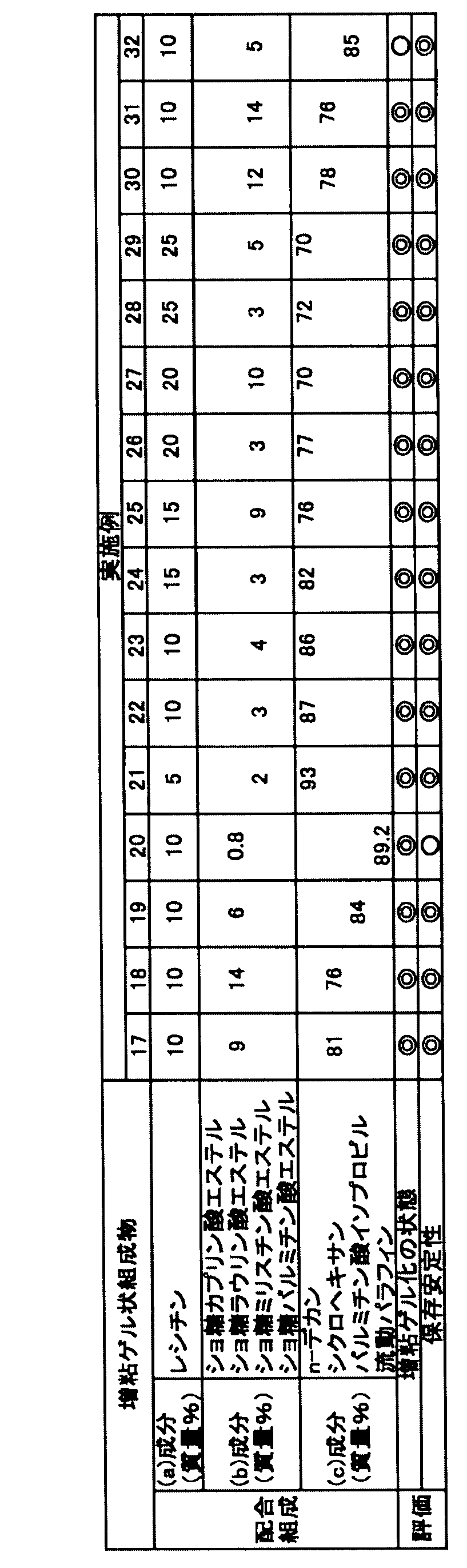
実施例1~8は、(a)成分:レシチンを10、15、20、25質量%とし、(b)成分:ショ糖カプリン酸エステル、(c)成分:n-デカンをそれぞれ所要量用いて増粘ゲル状組成物を調製したものである。これらのオイルゲル化剤中のショ糖カプリン酸エステルの割合、即ち(b)成分/((a)成分+(b)成分)は、11質量%から23質量%、増粘ゲル状組成物中のオイルゲル化剤の割合、即ち((a)成分+(b)成分)/((a)成分+(b)成分+(c)成分)は、12質量%から30質量%である。増粘ゲルの状態は透明であり、いずれもゲル化 ◎であり、保存安定性も◎良好であった。評価結果を表1に示す。
[実施例9~20]
(増粘ゲル状組成物の配合)
(a)成分のレシチンとして、商品名「L-α-Phosphatidylcholine (Soy-95%)」Avanti Polar Lipids, Inc.製、(b)成分をショ糖ラウリン酸エステルとして、商品名「リョートーシュガーエステル L-1695」(三菱化学フーズ(株)製)、(c)成分として、n-デカン(関東化学(株)製)を、表1に示す配合組成として、増粘ゲル状組成物を調製した。各配合組成に応じて、実施例9~16とした。
次に(c)成分をシクロヘキサン(関東化学(株)製 0.828mPa・s(25℃))に変え表2に示す配合組成として、増粘ゲル状組成物を調製した。各配合組成に応じて、実施例17、18とした。
更に(c)成分をパルミチン酸イソプロピル(和光純薬工業(株)製 6.09mPa・s(25℃))に変え表2に示す配合組成として、増粘ゲル状組成物を調製し実施例19とし、(c)成分を流動パラフィン(関東化学(株)製 146mPa・s(25℃))に変え表2に示す配合組成として、増粘ゲル状組成物を調製し実施例20とした。
(増粘ゲル状組成物の配合)
(a)成分のレシチンとして、商品名「L-α-Phosphatidylcholine (Soy-95%)」Avanti Polar Lipids, Inc.製、(b)成分をショ糖ラウリン酸エステルとして、商品名「リョートーシュガーエステル L-1695」(三菱化学フーズ(株)製)、(c)成分として、n-デカン(関東化学(株)製)を、表1に示す配合組成として、増粘ゲル状組成物を調製した。各配合組成に応じて、実施例9~16とした。
次に(c)成分をシクロヘキサン(関東化学(株)製 0.828mPa・s(25℃))に変え表2に示す配合組成として、増粘ゲル状組成物を調製した。各配合組成に応じて、実施例17、18とした。
更に(c)成分をパルミチン酸イソプロピル(和光純薬工業(株)製 6.09mPa・s(25℃))に変え表2に示す配合組成として、増粘ゲル状組成物を調製し実施例19とし、(c)成分を流動パラフィン(関東化学(株)製 146mPa・s(25℃))に変え表2に示す配合組成として、増粘ゲル状組成物を調製し実施例20とした。
実施例9~16は、(a)成分:レシチンを5、10、15、20、25質量%とし、(b)成分:ショ糖ラウリン酸エステル、(c)成分:n-デカンをそれぞれ所要量用いて増粘ゲル状組成物を調製したものである。これらのオイルゲル化剤中のショ糖ラウリン酸エステルの割合、即ち(b)成分/((a)成分+(b)成分)は11質量%から25質量%、増粘ゲル状組成物中のオイルゲル化剤の割合((a)成分+(b)成分)/((a)成分+(b)成分+(c)成分)は6質量%から28質量%としたものである。増粘ゲルの状態は透明で、いずれもゲル化 ◎であり、保存安定性も◎良好であった。評価結果を表1に示す。
実施例17~20は、(a)成分:レシチンを10質量%とし、(b)成分:ショ糖ラウリン酸エステル、(c)成分:シクロヘキサン、パルミチン酸イソプロピル、流動パラフィンをそれぞれ所要量用いて増粘ゲル状組成物を調製したものある。
これらのオイルゲル化剤中のショ糖ラウリン酸エステルの割合、(b)成分/((a)成分+(b)成分)は7質量%から58質量%、増粘ゲル状組成物中のオイルゲル化剤の割合((a)成分+(b)成分)/((a)成分+(b)成分+(c)成分)は11質量%から24質量%としたものである。増粘ゲルの状態は、いずれもゲル化 ◎であり、保存安定性も実施例20を除いてすべて◎良好であり、いずれも透明であった。実施例20の(c)成分:流動パラフィンでは、○少量分離していたが、通常の目安である3か月では十分透明で安定しており、使用上は何ら問題とはならない状態であった。評価結果を表2に示す。
これらのオイルゲル化剤中のショ糖ラウリン酸エステルの割合、(b)成分/((a)成分+(b)成分)は7質量%から58質量%、増粘ゲル状組成物中のオイルゲル化剤の割合((a)成分+(b)成分)/((a)成分+(b)成分+(c)成分)は11質量%から24質量%としたものである。増粘ゲルの状態は、いずれもゲル化 ◎であり、保存安定性も実施例20を除いてすべて◎良好であり、いずれも透明であった。実施例20の(c)成分:流動パラフィンでは、○少量分離していたが、通常の目安である3か月では十分透明で安定しており、使用上は何ら問題とはならない状態であった。評価結果を表2に示す。
実施例9~20によれば、(a)レシチンを5、10、15、20、25質量%とし、(b)ショ糖ラウリン酸エステル、(c)成分として、n-デカンを用いて増粘ゲル状組成物を調製したものでも、(a)レシチンを10質量%とし、(b)ショ糖ラウリン酸エステル、(c)成分をn-デカンだけでなく、シクロヘキサン、パルミチン酸イソプロピル、流動パラフィンとしても、増粘ゲルの状態はいずれもゲル化◎、保存安定性も使用上何ら問題とはならない増粘ゲル状組成物であった。
[実施例21~33]
(増粘ゲル状組成物の配合)
(a)成分:レシチンとして、商品名「L-α-Phosphatidylcholine (Soy-95%)」Avanti Polar Lipids, Inc.製、(b)成分をショ糖ミリスチン酸エステルとして、商品名「リョートーシュガーエステル M-1695」(三菱化学フーズ(株)製)、(c)成分として、n-デカン(関東化学(株)製)を、表2に示す配合組成として、増粘ゲル状組成物を調製した。各配合組成に応じて、実施例21~29とした。(c)成分をシクロヘキサン(関東化学(株)製)に変え表2に示す配合組成として、増粘ゲル状組成物を調製した。各配合組成に応じて、実施例30、実施例31とした。又(c)成分をパルミチン酸イソプロピル(和光純薬工業(株)製)に変え表2に示す配合組成として、増粘ゲル状組成物を調製し実施例32とし、(c)成分を流動パラフィン(関東化学(株)製)に変え表3に示す配合組成として、増粘ゲル状組成物を調製し実施例33とした。
(増粘ゲル状組成物の配合)
(a)成分:レシチンとして、商品名「L-α-Phosphatidylcholine (Soy-95%)」Avanti Polar Lipids, Inc.製、(b)成分をショ糖ミリスチン酸エステルとして、商品名「リョートーシュガーエステル M-1695」(三菱化学フーズ(株)製)、(c)成分として、n-デカン(関東化学(株)製)を、表2に示す配合組成として、増粘ゲル状組成物を調製した。各配合組成に応じて、実施例21~29とした。(c)成分をシクロヘキサン(関東化学(株)製)に変え表2に示す配合組成として、増粘ゲル状組成物を調製した。各配合組成に応じて、実施例30、実施例31とした。又(c)成分をパルミチン酸イソプロピル(和光純薬工業(株)製)に変え表2に示す配合組成として、増粘ゲル状組成物を調製し実施例32とし、(c)成分を流動パラフィン(関東化学(株)製)に変え表3に示す配合組成として、増粘ゲル状組成物を調製し実施例33とした。
実施例21~29は、(a)成分:レシチンを5、10、15、20、25質量%とし、(b)成分:ショ糖ミリスチン酸エステル、(c)成分:n-デカンをそれぞれ所要量用いて増粘ゲル状組成物を調製したもの、実施例30、31は、(a)成分:レシチンを10質量%とし、(b)成分:ショ糖ミリスチン酸エステル、(c)成分:シクロヘキサンを用いて増粘ゲル状組成物を調製したもの、実施例32は、(a)成分:レシチンを10質量%とし、(b)成分:ショ糖ミリスチン酸エステル、(c)成分:パルミチン酸イソプロピルを、実施例33は、(a)成分としてレシチンを10質量%、(b)成分:ショ糖ミリスチン酸エステル、(c)成分:流動パラフィンをそれぞれ所要量用いて増粘ゲル状組成物を調製したものである。
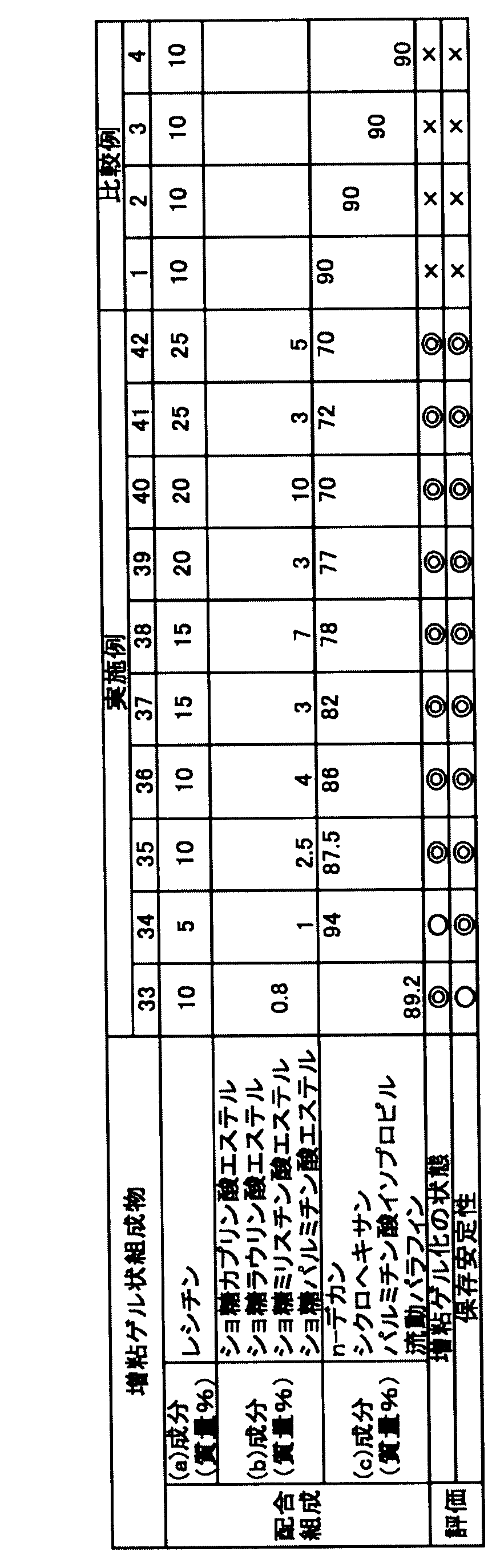
実施例21~33での混合割合は、オイルゲル化剤中のショ糖ミリスチン酸エステルの割合(b)成分/((a)成分+(b)成分)は7質量%から58質量%、増粘ゲル状組成物中のオイルゲル化剤の割合((a)成分+(b)成分)/((a)成分+(b)成分+(c)成分)は7質量%から30質量%としたもので、増粘ゲルの状態は透明で、いずれもゲル化◎、保存安定性も良好であった。なお、実施例32のゲルの状態は、増粘○であるが、使用上は何ら問題とはならない状態であり、また実施例33の保存安定性は○少量分離していたが、通常の目安である3か月では十分透明で安定しており、使用上は何ら問題とはならない状態であった。評価結果を表2、3に示す。
[実施例34~42]
(増粘ゲル状組成物の配合)
(a)成分:レシチンとして、商品名「L-α-Phosphatidylcholine (Soy-95%)」Avanti Polar Lipids, Inc.製、(b)成分をショ糖パルミチン酸エステルとして、商品名「リョートーシュガーエステル モノエステル-P」(三菱化学フーズ(株)製)、(c)成分として、n-デカン(関東化学(株)製)を、表3に示す配合組成として、増粘ゲル状組成物を調製した。各配合組成に応じて、実施例34~42とした。
(増粘ゲル状組成物の配合)
(a)成分:レシチンとして、商品名「L-α-Phosphatidylcholine (Soy-95%)」Avanti Polar Lipids, Inc.製、(b)成分をショ糖パルミチン酸エステルとして、商品名「リョートーシュガーエステル モノエステル-P」(三菱化学フーズ(株)製)、(c)成分として、n-デカン(関東化学(株)製)を、表3に示す配合組成として、増粘ゲル状組成物を調製した。各配合組成に応じて、実施例34~42とした。
実施例34~42は、オイルゲル化剤中のショ糖パルミチン酸エステルの割合(b)成分/((a)成分+(b)成分)を、11質量%から33質量%とし、増粘ゲル状組成物中のオイルゲル化剤の割合((a)成分+(b)成分)/((a)成分+(b)成分+(c)成分)を、6質量%から30質量%としたものである。
実施例34~42によれば、(a)成分:レシチンを5、10、15、20、25質量%とし、(b)成分:ショ糖パルミチン酸エステル、(c)成分:n-デカンをそれぞれ所要量用いて増粘ゲル状組成物を調製したものでも、増粘ゲルの状態は透明で、いずれもゲル化◎、保存安定性も◎良好であった。なお、実施例34はゲルの状態は、増粘○であるが、使用上は何ら問題とはならない状態であった。評価結果を表3に示す。
[実施例43~46]
(増粘ゲル状組成物の調製)
増粘ゲル状組成物の調製は、実施例23、31、32、33において、(a)成分:レシチン、(b)成分:ショ糖脂肪酸エステル、(c)オイル成分をそれぞれ必要量ボトルに封入し、60℃程度で加熱溶解し、室温まで冷却することによって調製した。その際、レシチンの酸化防止のために窒素雰囲気下で行った。
表4に示す配合組成として、増粘ゲル状組成物を調製した。各配合組成に応じて、実施例43~46とした。
(増粘ゲル状組成物の調製)
増粘ゲル状組成物の調製は、実施例23、31、32、33において、(a)成分:レシチン、(b)成分:ショ糖脂肪酸エステル、(c)オイル成分をそれぞれ必要量ボトルに封入し、60℃程度で加熱溶解し、室温まで冷却することによって調製した。その際、レシチンの酸化防止のために窒素雰囲気下で行った。
表4に示す配合組成として、増粘ゲル状組成物を調製した。各配合組成に応じて、実施例43~46とした。
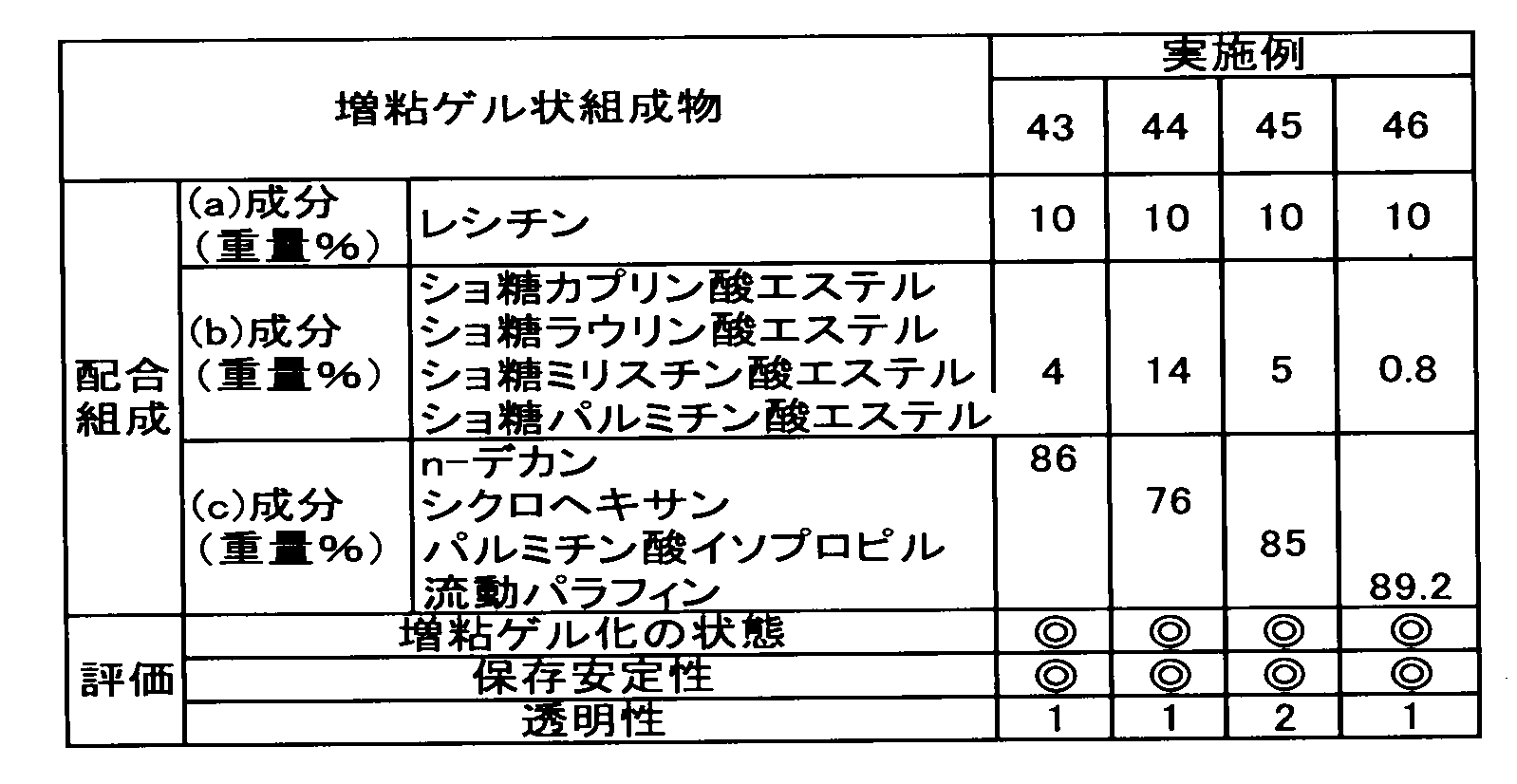
実施例43~46によれば、(a)成分:レシチンを10質量%とし、(b)成分:ショ糖ミリスチン酸エステル、(c)成分:n-デカン、シクロヘキサン、パルミチン酸イソプロピル、流動パラフィンをそれぞれ所要量用いて増粘ゲル状組成物を調製したもので、増粘ゲルの状態は、いずれもゲル化◎、保存安定性も◎良好であった。なお、ゲルの透明性は、調製した増粘ゲル状組成物を直径27.5mm、高さ70mmのサンプル瓶に封入し、25℃に設定した恒温槽中に6か月保存した後、紫外可視分光光度計(V-530、日本分光(株)製)を用い、波長550nmで、透過率を測定した。透過率100~90%、89~50%、49%以下により、透明:1、半透明:2、白濁:3として評価したものである。評価結果を表4に示す。
透明性は、いずれも透明ないし半透明であり、増粘ゲル状組成物として用いる用途に応じた透明性を提供できる。
透明性は、いずれも透明ないし半透明であり、増粘ゲル状組成物として用いる用途に応じた透明性を提供できる。
[比較例1~4]
(増粘ゲル状組成物の配合)
(a)成分:レシチンとして、商品名「L-α-Phosphatidylcholine (Soy-95%)」Avanti Polar Lipids, Inc.製10質量%、(c)成分として、n-デカン(関東化学(株)製)90質量%を配合組成として、増粘ゲル状組成物を調製し比較例1とした。(c)成分をシクロヘキサン(関東化学(株)製)に変えた以外は比較例1と同じにして、増粘ゲル状組成物を調製し比較例2とした。(c)成分をパルミチン酸イソプロピル(和光純薬工業(株)製)に変えた以外は比較例1と同じにして、増粘ゲル状組成物を調製し比較例3した。又(c)成分を流動パラフィン(関東化学(株)製)に変えた以外は比較例1と同じにして、増粘ゲル状組成物を調製し比較例4とした。
(増粘ゲル状組成物の配合)
(a)成分:レシチンとして、商品名「L-α-Phosphatidylcholine (Soy-95%)」Avanti Polar Lipids, Inc.製10質量%、(c)成分として、n-デカン(関東化学(株)製)90質量%を配合組成として、増粘ゲル状組成物を調製し比較例1とした。(c)成分をシクロヘキサン(関東化学(株)製)に変えた以外は比較例1と同じにして、増粘ゲル状組成物を調製し比較例2とした。(c)成分をパルミチン酸イソプロピル(和光純薬工業(株)製)に変えた以外は比較例1と同じにして、増粘ゲル状組成物を調製し比較例3した。又(c)成分を流動パラフィン(関東化学(株)製)に変えた以外は比較例1と同じにして、増粘ゲル状組成物を調製し比較例4とした。
比較例1~4は、(b)成分のショ糖脂肪酸エステルを用いていないため、増粘ゲルの形成が不十分ないし形成し得ないものであった。配合組成と評価結果を表3に示す。これに対して、本発明では、実施例で示すようにオイル成分(c)n-デカンでは、25℃で0.774mPa・sのところ300万倍の増粘度が得られ、シクロヘキサンでは、25℃で0.828mPa・sのところ250万倍の増粘度、パルミチン酸イソプロピルでは、25℃で6.09mPa・sのところ60万倍の増粘度、流動パラフィンでは、25℃で146mPa・sのところ5万倍の増粘度が簡単に得られた。なお、(b)成分のショ糖脂肪酸エステルと(c)オイル成分とでも、増粘ゲルの形成は不十分ないし形成し得ないものであった。

本発明によれば、レシチン/ショ糖脂肪酸エステル/各種オイルの3成分混合系により逆紐状ミセルを形成することのできるオイルゲル化剤が提供でき、逆紐状ミセルが形成された増粘ゲル状組成物は、逆紐状ミセルの内部に親水的な環境を有し、水溶性の成分・薬物や酵素などを内包できる。また使用するショ糖脂肪酸エステルの脂肪酸の種類を変えることにより幅広いHLB(親水親油バランス)のタイプが得られ、各種化粧品、医薬品、食品等のオイルゲル化剤として広く使用できる。更に、該オイルゲル化剤を用いることにより形成する増粘ゲル組成物は、チキソトロピー性を有し、ハンドリング性がよく、長期安定性もよいものである。
Claims (8)
- (a)レシチン、(b)ショ糖脂肪酸エステルを含有し逆紐状ミセルを形成するオイルゲル化剤。
- 前記(a)レシチンが、大豆レシチンまたは卵黄レシチンのいずれかであることを特徴とする請求項1に記載のオイルゲル化剤。
- 前記(b)ショ糖脂肪酸エステルが、炭素数6以上24以下である脂肪酸のエステルであることを特徴とする請求項1または2に記載のオイルゲル化剤。
- 前記(b)ショ糖脂肪酸エステルが、ショ糖カプリン酸エステル、ショ糖ラウリン酸エステル、ショ糖ミリスチン酸エステル、ショ糖パルミチン酸エステルのうち少なくとも一つからなることを特徴とする請求項1~3のいずれかに記載のオイルゲル化剤。
- 前記(a)レシチンと(b)ショ糖脂肪酸エステルとの混合割合として、(a)レシチンと(b)ショ糖脂肪酸エステルの合計質量に対して、(b)ショ糖脂肪酸エステルを0.1質量%から70質量%含有することを特徴とする請求項1~4のいずれかに記載のオイルゲル化剤。
- 前記請求項1~5のいずれかに記載のオイルゲル化剤と(c)オイル成分とを少なくとも含み逆紐状ミセルを形成した増粘ゲル状組成物。
- 前記増粘ゲル状組成物が、化粧料、医薬品、食品、塗料、インク、潤滑油の少なくともいずれか一つであることを特徴とする請求項6に記載の増粘ゲル状組成物。
- 前記オイルゲル化剤と(c)オイル成分との混合割合として、オイルゲル化剤を増粘ゲル状組成物に対して1質量%から70質量%含有することを特徴とする請求項6または7に記載の増粘ゲル状組成物。
Priority Applications (1)
| Application Number | Priority Date | Filing Date | Title |
|---|---|---|---|
| JP2010546593A JP5586026B2 (ja) | 2009-01-16 | 2010-01-14 | 逆紐状ミセルから成るオイルゲル化剤および増粘ゲル状組成物 |
Applications Claiming Priority (2)
| Application Number | Priority Date | Filing Date | Title |
|---|---|---|---|
| JP2009007284 | 2009-01-16 | ||
| JP2009-007284 | 2009-01-16 |
Publications (1)
| Publication Number | Publication Date |
|---|---|
| WO2010082487A1 true WO2010082487A1 (ja) | 2010-07-22 |
Family
ID=42339739
Family Applications (1)
| Application Number | Title | Priority Date | Filing Date |
|---|---|---|---|
| PCT/JP2010/000159 Ceased WO2010082487A1 (ja) | 2009-01-16 | 2010-01-14 | 逆紐状ミセルから成るオイルゲル化剤および増粘ゲル状組成物 |
Country Status (2)
| Country | Link |
|---|---|
| JP (1) | JP5586026B2 (ja) |
| WO (1) | WO2010082487A1 (ja) |
Cited By (5)
| Publication number | Priority date | Publication date | Assignee | Title |
|---|---|---|---|---|
| WO2013081120A1 (ja) | 2011-11-30 | 2013-06-06 | 学校法人日本大学 | レシチンオルガノゲル形成剤 |
| WO2013176243A1 (ja) * | 2012-05-25 | 2013-11-28 | 学校法人日本大学 | レシチンオルガノゲル形成剤 |
| US11337906B2 (en) | 2018-12-31 | 2022-05-24 | L'oreal | Hair care and conditioning compositions |
| CN116350546A (zh) * | 2023-02-27 | 2023-06-30 | 广东丸美生物技术股份有限公司 | 凝胶运载体及其制备方法以及化妆品 |
| US12257330B2 (en) | 2018-12-31 | 2025-03-25 | L'oreal | Hair coloring compositions and methods of use |
Citations (3)
| Publication number | Priority date | Publication date | Assignee | Title |
|---|---|---|---|---|
| JPS5670826A (en) * | 1979-11-15 | 1981-06-13 | Nippon Saafuakutanto Kogyo Kk | Oil-in-polyhydric alcohol type emulsion composition |
| JPH04100535A (ja) * | 1990-08-15 | 1992-04-02 | Seven Kagaku:Kk | 多価アルコール中油型乳化組成物 |
| JPH054911A (ja) * | 1991-06-27 | 1993-01-14 | Pola Chem Ind Inc | 非水ゲル化粧料 |
-
2010
- 2010-01-14 WO PCT/JP2010/000159 patent/WO2010082487A1/ja not_active Ceased
- 2010-01-14 JP JP2010546593A patent/JP5586026B2/ja not_active Expired - Fee Related
Patent Citations (3)
| Publication number | Priority date | Publication date | Assignee | Title |
|---|---|---|---|---|
| JPS5670826A (en) * | 1979-11-15 | 1981-06-13 | Nippon Saafuakutanto Kogyo Kk | Oil-in-polyhydric alcohol type emulsion composition |
| JPH04100535A (ja) * | 1990-08-15 | 1992-04-02 | Seven Kagaku:Kk | 多価アルコール中油型乳化組成物 |
| JPH054911A (ja) * | 1991-06-27 | 1993-01-14 | Pola Chem Ind Inc | 非水ゲル化粧料 |
Non-Patent Citations (4)
| Title |
|---|
| HASHIZAKI, KANANME: "A novel reverse worm-like micelle from a lecithin/sucrose fatty acid ester/oil system", COLLOID AND POLYMER SCIENCE, vol. 287, no. 9, 14 July 2009 (2009-07-14), pages 1099 - 1105 * |
| LUISI, P. L.: "Organogels from water-in-oil microemulsions", COLLOID AND POLYMER SCIENCE, vol. 268, 1990, pages 356 - 374 * |
| SHCHIPUNOV, YU. A.: "Lecithin organogel A micellar system with unique properties", COLLOIDS AND SURFACES A: PHYSICOCHEMICAL AND ENGINEERING ASPECTS, vol. 183, no. 185, 2001, pages 541 - 554 * |
| TUNG, SHIH-HUANG: "A new reverse wormlike micellar system: Mixtures of bile salt and lecithin in organic liquids", J. AM. CHEM. SOC., vol. 128, 2006, pages 5751 - 5756 * |
Cited By (6)
| Publication number | Priority date | Publication date | Assignee | Title |
|---|---|---|---|---|
| WO2013081120A1 (ja) | 2011-11-30 | 2013-06-06 | 学校法人日本大学 | レシチンオルガノゲル形成剤 |
| WO2013176243A1 (ja) * | 2012-05-25 | 2013-11-28 | 学校法人日本大学 | レシチンオルガノゲル形成剤 |
| JPWO2013176243A1 (ja) * | 2012-05-25 | 2016-01-14 | 学校法人日本大学 | レシチンオルガノゲル形成剤 |
| US11337906B2 (en) | 2018-12-31 | 2022-05-24 | L'oreal | Hair care and conditioning compositions |
| US12257330B2 (en) | 2018-12-31 | 2025-03-25 | L'oreal | Hair coloring compositions and methods of use |
| CN116350546A (zh) * | 2023-02-27 | 2023-06-30 | 广东丸美生物技术股份有限公司 | 凝胶运载体及其制备方法以及化妆品 |
Also Published As
| Publication number | Publication date |
|---|---|
| JPWO2010082487A1 (ja) | 2012-07-05 |
| JP5586026B2 (ja) | 2014-09-10 |
Similar Documents
| Publication | Publication Date | Title |
|---|---|---|
| CN102892399B (zh) | 皮肤外用组合物、化妆品及清洗剂 | |
| TWI593429B (zh) | 化妝料用原料 | |
| KR100674058B1 (ko) | 유화 시스템 및 에멀젼 | |
| KR101643261B1 (ko) | 리코펜 함유 조성물 | |
| TWI833884B (zh) | 皮膚或黏膜的外用劑及其製造方法、以及皮膚或黏膜的外用劑之基劑 | |
| JP5586026B2 (ja) | 逆紐状ミセルから成るオイルゲル化剤および増粘ゲル状組成物 | |
| JP6192047B2 (ja) | レシチンオルガノゲル形成剤 | |
| WO2018194179A1 (ja) | ゲル状水中油型乳化組成物 | |
| Kirilov et al. | Organogels for cosmetic and dermocosmetic applications | |
| JP5679215B2 (ja) | 逆紐状ミセルから成るオイルゲル | |
| WO2012165145A1 (ja) | 油性ゲル状組成物 | |
| JP5582467B2 (ja) | レシチンおよび尿素を主成分とする逆紐状ミセルから成るオイルゲル | |
| JP6241852B2 (ja) | レシチンオルガノゲル形成剤 | |
| CN103118659A (zh) | 油性凝胶状组合物 | |
| JP5295695B2 (ja) | 増粘ゲル化剤 | |
| JP5306676B2 (ja) | ショ糖脂肪酸エステル及び水中油型乳化組成物用乳化剤 | |
| WO2013058080A1 (ja) | 油性ゲル状組成物 | |
| JP7769329B2 (ja) | 油性ゲル状組成物 | |
| Grzyb | Simple physicochemical characterization of example emulsions with oleosomes for cosmetic and dermatologic product applications. | |
| JP2023036225A (ja) | 油性ゲル状組成物 | |
| HK40053330A (en) | Topical preparation for the skin or mucosae, method for manufacturing same, and base for topical preparation for the skin or mucosae |
Legal Events
| Date | Code | Title | Description |
|---|---|---|---|
| 121 | Ep: the epo has been informed by wipo that ep was designated in this application |
Ref document number: 10731156 Country of ref document: EP Kind code of ref document: A1 |
|
| ENP | Entry into the national phase |
Ref document number: 2010546593 Country of ref document: JP Kind code of ref document: A |
|
| NENP | Non-entry into the national phase |
Ref country code: DE |
|
| 122 | Ep: pct application non-entry in european phase |
Ref document number: 10731156 Country of ref document: EP Kind code of ref document: A1 |