WO2010026795A1 - 平版印刷版材料および平版印刷版材料の作製方法 - Google Patents
平版印刷版材料および平版印刷版材料の作製方法 Download PDFInfo
- Publication number
- WO2010026795A1 WO2010026795A1 PCT/JP2009/055041 JP2009055041W WO2010026795A1 WO 2010026795 A1 WO2010026795 A1 WO 2010026795A1 JP 2009055041 W JP2009055041 W JP 2009055041W WO 2010026795 A1 WO2010026795 A1 WO 2010026795A1
- Authority
- WO
- WIPO (PCT)
- Prior art keywords
- printing plate
- lithographic printing
- acid
- plate material
- particles
- Prior art date
- Legal status (The legal status is an assumption and is not a legal conclusion. Google has not performed a legal analysis and makes no representation as to the accuracy of the status listed.)
- Ceased
Links
Classifications
-
- B—PERFORMING OPERATIONS; TRANSPORTING
- B41—PRINTING; LINING MACHINES; TYPEWRITERS; STAMPS
- B41C—PROCESSES FOR THE MANUFACTURE OR REPRODUCTION OF PRINTING SURFACES
- B41C1/00—Forme preparation
- B41C1/10—Forme preparation for lithographic printing; Master sheets for transferring a lithographic image to the forme
- B41C1/1008—Forme preparation for lithographic printing; Master sheets for transferring a lithographic image to the forme by removal or destruction of lithographic material on the lithographic support, e.g. by laser or spark ablation; by the use of materials rendered soluble or insoluble by heat exposure, e.g. by heat produced from a light to heat transforming system; by on-the-press exposure or on-the-press development, e.g. by the fountain of photolithographic materials
- B41C1/1016—Forme preparation for lithographic printing; Master sheets for transferring a lithographic image to the forme by removal or destruction of lithographic material on the lithographic support, e.g. by laser or spark ablation; by the use of materials rendered soluble or insoluble by heat exposure, e.g. by heat produced from a light to heat transforming system; by on-the-press exposure or on-the-press development, e.g. by the fountain of photolithographic materials characterised by structural details, e.g. protective layers, backcoat layers or several imaging layers
-
- B—PERFORMING OPERATIONS; TRANSPORTING
- B41—PRINTING; LINING MACHINES; TYPEWRITERS; STAMPS
- B41C—PROCESSES FOR THE MANUFACTURE OR REPRODUCTION OF PRINTING SURFACES
- B41C1/00—Forme preparation
- B41C1/10—Forme preparation for lithographic printing; Master sheets for transferring a lithographic image to the forme
- B41C1/1008—Forme preparation for lithographic printing; Master sheets for transferring a lithographic image to the forme by removal or destruction of lithographic material on the lithographic support, e.g. by laser or spark ablation; by the use of materials rendered soluble or insoluble by heat exposure, e.g. by heat produced from a light to heat transforming system; by on-the-press exposure or on-the-press development, e.g. by the fountain of photolithographic materials
- B41C1/1025—Forme preparation for lithographic printing; Master sheets for transferring a lithographic image to the forme by removal or destruction of lithographic material on the lithographic support, e.g. by laser or spark ablation; by the use of materials rendered soluble or insoluble by heat exposure, e.g. by heat produced from a light to heat transforming system; by on-the-press exposure or on-the-press development, e.g. by the fountain of photolithographic materials using materials comprising a polymeric matrix containing a polymeric particulate material, e.g. hydrophobic heat coalescing particles
-
- B—PERFORMING OPERATIONS; TRANSPORTING
- B41—PRINTING; LINING MACHINES; TYPEWRITERS; STAMPS
- B41C—PROCESSES FOR THE MANUFACTURE OR REPRODUCTION OF PRINTING SURFACES
- B41C2201/00—Location, type or constituents of the non-imaging layers in lithographic printing formes
- B41C2201/06—Backcoats; Back layers
-
- B—PERFORMING OPERATIONS; TRANSPORTING
- B41—PRINTING; LINING MACHINES; TYPEWRITERS; STAMPS
- B41C—PROCESSES FOR THE MANUFACTURE OR REPRODUCTION OF PRINTING SURFACES
- B41C2201/00—Location, type or constituents of the non-imaging layers in lithographic printing formes
- B41C2201/14—Location, type or constituents of the non-imaging layers in lithographic printing formes characterised by macromolecular organic compounds, e.g. binder, adhesives
-
- B—PERFORMING OPERATIONS; TRANSPORTING
- B41—PRINTING; LINING MACHINES; TYPEWRITERS; STAMPS
- B41C—PROCESSES FOR THE MANUFACTURE OR REPRODUCTION OF PRINTING SURFACES
- B41C2210/00—Preparation or type or constituents of the imaging layers, in relation to lithographic printing forme preparation
- B41C2210/04—Negative working, i.e. the non-exposed (non-imaged) areas are removed
-
- B—PERFORMING OPERATIONS; TRANSPORTING
- B41—PRINTING; LINING MACHINES; TYPEWRITERS; STAMPS
- B41C—PROCESSES FOR THE MANUFACTURE OR REPRODUCTION OF PRINTING SURFACES
- B41C2210/00—Preparation or type or constituents of the imaging layers, in relation to lithographic printing forme preparation
- B41C2210/06—Developable by an alkaline solution
-
- B—PERFORMING OPERATIONS; TRANSPORTING
- B41—PRINTING; LINING MACHINES; TYPEWRITERS; STAMPS
- B41C—PROCESSES FOR THE MANUFACTURE OR REPRODUCTION OF PRINTING SURFACES
- B41C2210/00—Preparation or type or constituents of the imaging layers, in relation to lithographic printing forme preparation
- B41C2210/10—Developable by an acidic solution
-
- B—PERFORMING OPERATIONS; TRANSPORTING
- B41—PRINTING; LINING MACHINES; TYPEWRITERS; STAMPS
- B41C—PROCESSES FOR THE MANUFACTURE OR REPRODUCTION OF PRINTING SURFACES
- B41C2210/00—Preparation or type or constituents of the imaging layers, in relation to lithographic printing forme preparation
- B41C2210/24—Preparation or type or constituents of the imaging layers, in relation to lithographic printing forme preparation characterised by a macromolecular compound or binder obtained by reactions involving carbon-to-carbon unsaturated bonds, e.g. acrylics, vinyl polymers
Definitions
- the present invention relates to a lithographic printing plate material and a method for producing the lithographic printing plate material, and more particularly to a lithographic printing plate material suitable for treatment with a developer having a relatively neutral pH and a method for producing the lithographic printing plate material.
- lithographic printing plate materials that can be exposed to an infrared laser to form an image are known.
- these lithographic printing plate materials subjected to infrared laser exposure have been processed with a strong alkaline developer after exposure to remove unnecessary portions to produce a lithographic printing plate capable of printing.
- Patent Documents 1 and 2 Recently, from the viewpoint of environment and safety, it has been proposed to obtain a lithographic printing plate by treating with a developer having a relatively neutral pH without using a strong alkaline developer (see Patent Documents 1 and 2).
- the present invention has been made in view of the above problems, and an object of the present invention is to develop a lithographic printing plate material with a developing solution having a relatively neutral pH, and to develop the same even with a running fatigue solution. It is an object of the present invention to provide a lithographic printing plate material and a method for producing the lithographic printing plate material, which have excellent durability and do not deteriorate non-image area contamination, printing durability, or halftone dot reproducibility.
- An image-forming layer containing heat-meltable particles or heat-fused particles is provided on a support having a hydrophilic surface, and an unexposed portion after image information is exposed and recorded to form an image has a pH of 3 to A lithographic printing plate material, which is removed with a developer in the range of 9 to obtain a lithographic printing plate, and has a back layer containing a surfactant and an isothiazoline derivative on the back surface.
- lithographic printing plate material according to 1 or 2 further comprising a chelating agent on the back surface of the lithographic printing plate material.
- An image forming layer containing thermally fusible particles or thermally fused particles is provided on a support having a hydrophilic surface, and an unexposed area (non-image area) after exposing and recording image information has a pH of 3
- the present invention even if the lithographic printing plate material is processed with a developer having a relatively neutral pH, the developability is good, and the developability is maintained even in a running fatigue solution, and non-image area stains, printing durability, It is possible to provide a planographic printing plate material that does not deteriorate halftone dot reproducibility and a method for producing the planographic printing plate material.
- the present invention has an image forming layer containing heat-fusible particles or heat-fusible particles on a support having a hydrophilic surface, and unexposed portions (non-exposed portions) after image information is exposed and recorded to form an image.
- the lithographic printing plate material from which the image portion is removed with a developer having a pH in the range of 3 to 9 to obtain a lithographic printing plate has a back layer containing an isothiazoline derivative as a surfactant and preservative on the back surface It is characterized by.
- the backside contains a surfactant and an isothiazoline derivative.
- the lithographic printing plate material When the lithographic printing plate material is processed with a developer having a relatively neutral pH, the developability is lower than that of the alkali processing, and therefore the lithographic printing plate having an image forming layer containing heat-fusible particles or heat-fusible particles
- the material is effective, but in the case of a lithographic printing plate material having an image forming layer containing heat-fusible particles or heat-bonding particles as well as a decrease in developability in running processing, non-image area stains, printing durability and halftone dot reproduction The problem was found that the deterioration and fluctuation of the sex increased.
- the support having a hydrophilic surface is a support having a surface from which the heat-sensitive image forming layer is removed at the time of printing and having a surface that can become a non-image part, and the support surface is hydrophilized.
- a support having a hydrophilic surface layer treated and a support provided with a hydrophilic layer containing a hydrophilic substance can be used.
- a known material used as a substrate for a printing plate can be used.
- a composite support etc. are mentioned.
- the thickness of the support is not particularly limited as long as it can be attached to a printing press, but a thickness of 50 to 500 ⁇ m is generally easy to handle.
- a metal plate obtained by hydrophilizing the substrate surface is preferably used.
- the metal plate examples include iron, stainless steel, and aluminum.
- aluminum or an aluminum alloy (hereinafter referred to as an aluminum plate) is particularly preferable because of the relationship between specific gravity and rigidity. Those subjected to any of the known roughening treatment, anodic oxidation treatment, and surface hydrophilization treatment (so-called aluminum grained plate) are more preferred.
- Aluminum alloys can be used as the support, such as alloys of aluminum and metals such as silicon, copper, manganese, magnesium, chromium, zinc, lead, bismuth, nickel, titanium, sodium, iron, etc. It is done.
- the aluminum plate used as the support is preferably subjected to a degreasing treatment in order to remove the rolling oil on the surface prior to roughening (graining treatment).
- a degreasing treatment using a solvent such as trichlene or thinner, an emulsion degreasing treatment using an emulsion such as kesilon or triethanol, or the like is used.
- an alkaline aqueous solution such as caustic soda can be used for the degreasing treatment.
- an alkaline aqueous solution such as caustic soda is used for the degreasing treatment, dirt and oxide film that cannot be removed only by the degreasing treatment can be removed.
- the substrate is immersed in an acid such as phosphoric acid, nitric acid, sulfuric acid, chromic acid, or a mixed acid thereof and desmutted. It is preferable to perform the treatment.
- the roughening method include a mechanical method and a method of etching by electrolysis.
- the mechanical roughening method used is not particularly limited, but a brush polishing method and a honing polishing method are preferable.
- the roughening by the brush polishing method is performed, for example, by rotating a rotating brush using brush bristles having a diameter of 0.2 to 0.8 mm, and for example, volcanic ash particles having a particle diameter of 10 to 100 ⁇ m on water. While supplying the uniformly dispersed slurry, the brush can be pressed.
- For roughening by honing for example, volcanic ash particles having a particle size of 10 to 100 ⁇ m are uniformly dispersed in water, sprayed by applying pressure from a nozzle, and subjected to roughening by colliding with the surface of the support at an angle. Can do.
- abrasive particles having a particle size of 10 to 100 ⁇ m are coated on the surface of the support so as to exist at a density of 2.5 ⁇ 10 3 to 10 ⁇ 10 3 particles / cm 2 at intervals of 100 to 200 ⁇ m. Roughening can also be performed by laminating the sheets and applying a pressure to transfer the rough surface pattern of the sheet.
- the surface is roughened by the mechanical surface roughening method, it is preferable to immerse in an aqueous solution of acid or alkali in order to remove the abrasive that has digged into the surface of the support, formed aluminum scraps, and the like.
- the acid include sulfuric acid, persulfuric acid, hydrofluoric acid, phosphoric acid, nitric acid, hydrochloric acid, and the like.
- the base include sodium hydroxide and potassium hydroxide. Among these, it is preferable to use an aqueous alkali solution such as sodium hydroxide.
- the amount of aluminum dissolved on the surface is preferably 0.5 to 5 g / m 2 .
- the electrochemical surface roughening method is not particularly limited, but a method of electrochemical surface roughening in an acidic electrolyte is preferable.
- the acidic electrolytic solution an acidic electrolytic solution usually used in an electrochemical surface roughening method can be used, but a hydrochloric acid-based or nitric acid-based electrolytic solution is preferably used.
- the electrochemical surface roughening method for example, methods described in JP-B-48-28123, British Patent No. 896,563 and JP-A-53-67507 can be used. This roughening method can be generally performed by applying a voltage in the range of 1 to 50 volts, but is preferably selected from the range of 10 to 30 volts.
- the current density can be in the range of 10 to 200 A / dm 2 , but is preferably selected from the range of 50 to 150 A / dm 2 .
- the quantity of electricity may be in the range of 100 ⁇ 5000C / dm 2, preferably selected from the range of 100 ⁇ 2000C / dm 2.
- the temperature at which the roughening method is performed can be in the range of 10 to 50 ° C., but is preferably selected from the range of 15 to 45 ° C.
- electrochemical surface roughening When electrochemical surface roughening is performed using a nitric acid-based electrolyte as the electrolyte, it can be generally performed by applying a voltage in the range of 1 to 50 volts, but is selected from the range of 10 to 30 volts. Is preferred. Current density may be in the range of 10 ⁇ 200A / dm 2, preferably selected from the range of 20 ⁇ 100A / dm 2. The quantity of electricity, may be in the range of 100 ⁇ 5000C / dm 2, preferably selected from the range of 100 ⁇ 2000C / dm 2. The temperature at which the electrochemical surface roughening method is performed can be in the range of 10 to 50 ° C., but is preferably selected from the range of 15 to 45 ° C.
- the concentration of nitric acid in the electrolytic solution is preferably 0.1 to 5% by mass. If necessary, nitrates, chlorides, amines, aldehydes, phosphoric acid, chromic acid, boric acid, acetic acid, oxalic acid, and the like can be added to the electrolytic solution.
- a hydrochloric acid electrolyte When a hydrochloric acid electrolyte is used as the electrolyte, it can be generally applied by applying a voltage in the range of 1 to 50 volts, but is preferably selected from the range of 2 to 30 volts.
- the current density can be in the range of 10 to 200 A / dm 2 , but is preferably selected from the range of 50 to 150 A / dm 2 .
- the quantity of electricity may be in the range of 100 ⁇ 5000C / dm 2, 100 ⁇ 2000C / dm 2, and more preferably selected from the range of 200 ⁇ 1000C / dm 2.
- the temperature at which the electrochemical surface roughening method is performed can be in the range of 10 to 50 ° C., but is preferably selected from the range of 15 to 45 ° C.
- the concentration of hydrochloric acid in the electrolytic solution is preferably 0.1 to 5% by mass.
- the acid include sulfuric acid, persulfuric acid, hydrofluoric acid, phosphoric acid, nitric acid, hydrochloric acid, and the like.
- the base include sodium hydroxide and potassium hydroxide.
- an alkaline aqueous solution it is preferable to use an alkaline aqueous solution.
- the amount of aluminum dissolved on the surface is preferably 0.5 to 5 g / m 2 .
- neutralization treatment is performed by immersion in an acid such as phosphoric acid, nitric acid, sulfuric acid, chromic acid or a mixed acid thereof.
- the mechanical surface roughening method and the electrochemical surface roughening method may each be used alone for roughing, or the mechanical surface roughening method followed by the electrochemical surface roughening method. You may roughen.
- anodizing treatment is preferably performed.
- a well-known method can be used.
- an oxide film is formed on the support.
- a method of electrolyzing at an electric current density of 1 to 10 A / dm 2 using an aqueous solution containing sulfuric acid and / or phosphoric acid at a concentration of 10 to 50% by mass as an electrolytic solution is preferably used.
- the formed anodic oxidation coating amount is suitably 1 to 50 mg / dm 2 , preferably 10 to 40 mg / dm 2 .
- the anodic oxidation coating amount is obtained by, for example, immersing an aluminum plate in a phosphoric acid chromic acid solution (produced by dissolving 85% phosphoric acid solution: 35 ml, chromium oxide (IV): 20 g in 1 L of water) to dissolve the oxide film. It can be obtained from the measurement of mass change before and after dissolution of the coating on the plate.
- the anodized support may be subjected to a sealing treatment as necessary.
- sealing treatments can be performed using known methods such as hot water treatment, boiling water treatment, water vapor treatment, sodium silicate treatment, dichromate aqueous solution treatment, nitrite treatment, and ammonium acetate treatment.
- a hydrophilization treatment a water-soluble resin such as polyvinylphosphonic acid, a polymer or copolymer having a sulfonic acid group in the side chain, polyacrylic acid, a water-soluble metal salt (for example, zinc borate) or a primer coated with a yellow dye, an amine salt or the like is also suitable.
- a sol-gel treated substrate having a functional group capable of causing an addition reaction by a radical as disclosed in JP-A-5-304358 is also preferably used.
- plastic film used as the support examples include polyethylene terephthalate, polyethylene naphthalate, polyimide, polyamide, polycarbonate, polysulfone, polyphenylene oxide, and cellulose esters.
- a back layer is provided on the back surface of the support on which the image forming layer is applied.
- the back layer contains a water-soluble resin, a surfactant according to the present invention, and an isothiazoline derivative.
- water-soluble resin examples include gum arabic, fiber derivatives (eg, carboxymethyl cellulose, carboxyethyl cellulose, methyl cellulose, etc.) and modified products thereof, polyvinyl alcohol and derivatives thereof, polyvinyl pyrrolidone, polyacrylamide and copolymers thereof, and vinyl methyl ether.
- fiber derivatives eg, carboxymethyl cellulose, carboxyethyl cellulose, methyl cellulose, etc.
- modified products thereof polyvinyl alcohol and derivatives thereof, polyvinyl pyrrolidone, polyacrylamide and copolymers thereof, and vinyl methyl ether.
- Maleic anhydride copolymer vinyl acetate / maleic anhydride copolymer
- styrene / maleic anhydride copolymer and the like.
- the content of these water-soluble resins is suitably 0.1 to 50% by mass, more preferably 0.5 to 3.0% by mass in the composition of the back layer.
- examples of the surfactant according to the present invention include an anionic surfactant and a nonionic surfactant.
- anionic surfactants include fatty acid salts, abietic acid salts, hydroxyalkane sulfonates, alkane sulfonates, dialkyl sulfosuccinates, linear alkyl benzene sulfonates, branched alkyl benzene sulfonates, alkyl naphthalene sulfones.
- Acid salts alkylphenoxy polyoxyethylene propyl sulfonates, polyoxyethylene alkyl sulfophenyl ether salts, polyoxyethylene aryl ether sulfonates, polyoxyethylene naphthyl ether sulfonates, N-methyl-N-oleyl taurine sodium salts N-alkylsulfosuccinic acid monoamide disodium salts, petroleum sulfonates, nitrated castor oil, sulfated beef tallow oil, sulfate esters of fatty acid alkyl esters, Rualkyl nitrates, polyoxyethylene alkyl ether sulfates, fatty acid monoglyceride sulfates, polyoxyethylene alkylphenyl ether sulfates, polyoxyethylene styryl phenyl ether sulfates, alkyl phosphate esters, polyoxyethylene alkyl ethers Phosphoric acid ester salts
- Nonionic surfactants include polyoxyethylene alkyl ethers, polyoxyethylene alkyl phenyl ethers, polyoxyethylene aryl ethers, polyoxyethylene naphthyl ether, polyoxyethylene polystyryl phenyl ether, polyoxyethylene polyoxy Propylene alkyl ether, glycerin fatty acid partial ester, sorbitan fatty acid partial ester, pentaerythritol fatty acid partial ester, propylene glycol mono fatty acid ester, sucrose fatty acid partial ester, polyoxyethylene sorbitan fatty acid partial ester, polyoxyethylene sorbitol fatty acid moiety Esters, polyethylene glycol fatty acid esters, polyglycerin fatty acid partial esters, polyoxyethylenation Bran oils, polyoxyethylene glycerin fatty acid partial esters, fatty acid diethanolamides, N, N-bis-2-hydroxyalkylamines, polyoxyethylene alkylamines, triethanolamine
- polyoxyethylene alkylphenyl ethers polyoxyethylene polyoxypropylene alkyl ether, polyoxyethylene-polyoxypropylene block polymers and the like are preferably used.
- Fluorine-based and silicon-based anions and nonionic surfactants can also be used.
- surfactants can be used in combination of two or more.
- two or more different from each other can be used in combination.
- a combination of two or more different anionic surfactants or a combination of an anionic surfactant and a nonionic surfactant is preferable.
- the amount of the surfactant used is preferably 0.01 to 20% by mass, more preferably 0.1 to 3% by mass of the back layer coating solution.
- Preservatives include phenol or its derivatives, o-phenylphenol, p-chlorometacresol, hydroxybenzoic acid alkyl ester, formalin, imidazole derivatives, sodium dehydroacetate, 4-isothiazolin-3-one derivatives, benzoisothiazoline-3-one , Benztriazole derivatives, amiding anidine derivatives, quaternary ammonium salts, pyridine, quinoline, guanidine and other derivatives, diazine, triazole derivatives, oxazole, oxazine derivatives, and the like.
- 4-isothiazolin-3-one derivatives benzoisothiazolin-3-one and the like, specifically, 1,2-benzisothiazolin-3-one and 5-chloro-2-methyl-4-isothi -3-one, 2-methyl-4-isothiazolin-3-one, and the like preferably.
- a preferable addition amount is an amount that exerts a stable effect on bacteria, molds, yeasts, etc., and varies depending on the types of bacteria, molds, yeasts, but is 0.001 to 4% by mass of the entire back layer. The range is preferable, and the range of 0.003 to 1% by mass is more preferable. Two or more preservatives may be used in combination so as to be effective against various molds and sterilization.
- a chelate compound may be added.
- Preferred chelate compounds include, for example, ethylenediaminetetraacetic acid, potassium salt thereof, sodium salt thereof; diethylenetriaminepentaacetic acid, potassium salt thereof, sodium salt thereof; triethylenetetraminehexaacetic acid, sodium salt thereof; ethylenediamine disuccinic acid, potassium salt thereof.
- An organic amine salt is also effective in place of the sodium salt and potassium salt of the chelating agent.
- the amount added is preferably 0.001 to 1.0% by mass of the entire back layer, and more preferably 0.05 to 0.5%.
- Image forming layer As one of the preferable embodiments of the image forming layer of the present invention, an embodiment in which the image forming layer contains a hydrophobizing precursor can be mentioned.
- hydrophobizing precursor a polymer that changes from hydrophilic (water-soluble or water-swellable) to hydrophobic by heat can be used. Specific examples include polymers containing aryl diazosulfonate units disclosed in JP-A No. 2000-56449.
- thermoplastic hydrophobicity may be mentioned. It is preferable to use particles or microcapsules enclosing a hydrophobic substance.
- thermoplastic fine particles examples include heat-fusible fine particles and heat-fusible fine particles described later.
- the heat-meltable fine particles according to the present invention are fine particles formed of a material that has a low viscosity when melted, and is generally classified as a wax, among thermoplastic materials.
- the physical properties are preferably a softening point of 40 ° C. or higher and 120 ° C. or lower, a melting point of 60 ° C. or higher and 150 ° C. or lower, more preferably a softening point of 40 ° C. or higher and 100 ° C. or lower, and a melting point of 60 ° C. or higher and 120 ° C. or lower.
- the melting point is less than 60 ° C., storage stability is a problem, and when the melting point is higher than 300 ° C., ink deposition sensitivity is lowered.
- Examples of usable materials include paraffin, polyolefin, polyethylene wax, microcrystalline wax, and fatty acid wax. These have a molecular weight of about 800 to 10,000. In order to facilitate emulsification, these waxes can be oxidized to introduce polar groups such as hydroxyl groups, ester groups, carboxyl groups, aldehyde groups, and peroxide groups. Furthermore, in order to lower the softening point and improve workability, these waxes are added to stearoamide, linolenamide, laurylamide, myristamide, hardened beef fatty acid amide, palmitoamide, oleic acid amide, rice sugar fatty acid amide, coconut.
- fatty acid amides or methylolated products of these fatty acid amides can also be added.
- Coumarone-indene resin, rosin-modified phenol resin, terpene-modified phenol resin, xylene resin, ketone resin, acrylic resin, ionomer, and copolymers of these resins can also be used.
- polyethylene polyethylene
- microcrystalline fatty acid ester
- fatty acid fatty acid
- fatty acid it is preferable to contain any of polyethylene, microcrystalline, fatty acid ester, and fatty acid. Since these materials have a relatively low melting point and a low melt viscosity, high-sensitivity image formation can be performed. In addition, since these materials have lubricity, damage when a shearing force is applied to the surface of the printing plate material is reduced, and resistance to printing stains due to scratches or the like is improved.
- the heat-meltable fine particles are preferably dispersible in water, and the average particle diameter is preferably 0.01 to 10 ⁇ m, more preferably 0.1 to 3 ⁇ m.
- the average particle size is larger than 0.01 ⁇ m
- the coating liquid for the layer containing the heat-melting fine particles is applied on the porous hydrophilic layer described above, the heat-melting fine particles become pores of the hydrophilic layer. It does not enter inside or enter into the gaps between fine irregularities on the surface of the hydrophilic layer, and the on-press development becomes sufficient, which is preferable from the viewpoint of preventing soiling. It is preferable from the viewpoint of resolution that the average particle diameter of the heat-meltable fine particles is smaller than 10 ⁇ m.
- composition of the heat-meltable fine particles may vary continuously between the inside and the surface layer, or may be coated with a different material.
- a coating method a known microcapsule formation method, a sol-gel method, or the like can be used.
- the content of the heat-meltable fine particles in the layer is preferably 1 to 90% by mass, more preferably 5 to 80% by mass based on the entire layer.
- thermoplastic hydrophobic polymer fine particles examples include thermoplastic hydrophobic polymer fine particles, and there is no specific upper limit for the softening temperature of the polymer fine particles, but the temperature is the decomposition of the polymer fine particles. It is preferable that the temperature is lower than the temperature.
- the weight average molecular weight (Mw) of the polymer is preferably in the range of 10,000 to 1,000,000.
- polymer constituting the polymer particles include, for example, diene (co) polymers such as polypropylene, polybutadiene, polyisoprene, and ethylene-butadiene copolymer, styrene-butadiene copolymer, Synthetic rubbers such as methyl methacrylate-butadiene copolymer, acrylonitrile-butadiene copolymer, polymethyl methacrylate, methyl methacrylate- (2-ethylhexyl acrylate) copolymer, methyl methacrylate-methacrylic acid copolymer, methyl acrylate- ( (N-methylolacrylamide) copolymer, (meth) acrylic acid ester such as polyacrylonitrile, (meth) acrylic acid (co) polymer, polyvinyl acetate, vinyl acetate-vinyl propionate copolymer, vinyl acetate-ethylene copolymer Polymer etc.
- diene (co) polymers
- Glycol ester (co) polymer vinyl acetate - (2-ethylhexyl acrylate) copolymers, polyvinyl chloride, polyvinylidene chloride, polystyrene and copolymers thereof.
- (meth) acrylic acid esters (meth) acrylic acid (co) polymers, vinyl ester (co) polymers, polystyrene, and synthetic rubbers are preferably used.
- the polymer polymer fine particles may be composed of a polymer polymer polymerized by any known method such as an emulsion polymerization method, a suspension polymerization method, a solution polymerization method, or a gas phase polymerization method.
- the polymer polymerized by the solution polymerization method or the gas phase polymerization method can be made into fine particles by spraying an organic solvent solution of the polymer polymer into an inert gas and drying to make fine particles. Examples include a method in which a molecular polymer is dissolved in a water-immiscible organic solvent, this solution is dispersed in water or an aqueous medium, and the organic solvent is distilled off to form fine particles.
- a surfactant such as sodium lauryl sulfate, sodium dodecylbenzenesulfonate, polyethylene glycol, or a water-soluble resin, such as polyvinyl alcohol, is used as a dispersant or stabilizer in polymerization or micronization as necessary. May be used.
- the heat-fusible fine particles are preferably dispersible in water, and the average particle size is preferably 0.01 to 10 ⁇ m, more preferably 0.1 to 3 ⁇ m.
- the average particle size of the heat-fusible fine particles is smaller than 10 ⁇ m.
- composition of the heat-fusible fine particles may be continuously changed between the inside and the surface layer, or may be coated with a different material.
- a coating method a known microcapsule formation method, a sol-gel method, or the like can be used.
- the content of the thermoplastic fine particles in the layer is preferably 1 to 90% by mass of the whole layer, and more preferably 5 to 80% by mass.
- microcapsules used in the printing plate material of the present invention include microcapsules enclosing a hydrophobic material described in JP-A No. 2002-2135 and JP-A No. 2002-19317.
- the average diameter of the microcapsules is preferably 0.1 to 10 ⁇ m, more preferably 0.3 to 5 ⁇ m, and further preferably 0.5 to 3 ⁇ m.
- the wall thickness of the microcapsule is preferably 1/100 to 1/5 of the diameter, and more preferably 1/50 to 1/10.
- the content of the microcapsule is 5 to 100% by mass of the entire image forming layer, preferably 20 to 95% by mass, and more preferably 40 to 90% by mass.
- a known material and method can be used as the material for the wall material of the microcapsule and the method for producing the microcapsule.
- known materials and methods described in “New Microcapsules, Production Methods, Properties, and Applications” (Takeshi Kondo, Masumi Koishi / Sankyo Publishing Co., Ltd.) or cited references are used. be able to.
- the image forming layer can contain a water-soluble resin or a water-dispersible resin.
- water-soluble resins and water-dispersible resins include oligosaccharides, polysaccharides, polyethylene oxide, polypropylene oxide, polyvinyl alcohol, polyethylene glycol (PEG), polyvinyl ether, styrene-butadiene copolymers, and methyl methacrylate-butadiene copolymers.
- examples thereof include resins such as conjugated diene polymer latex, acrylic polymer latex, vinyl polymer latex, polyacrylic acid, polyacrylate, polyacrylamide, and polyvinylpyrrolidone.
- oligosaccharides polysaccharides, polyacrylic acid, polyacrylates (Na salts, etc.), and polyacrylamide are preferable.
- Oligosaccharides include raffinose, trehalose, maltose, galactose, sucrose, and lactose, with trehalose being particularly preferred.
- polysaccharides starches, celluloses, polyuronic acids, pullulans and the like can be used, but cellulose derivatives such as methyl cellulose salts, carboxymethyl cellulose salts, hydroxyethyl cellulose salts are particularly preferable, and sodium salts and ammonium salts of carboxymethyl cellulose are preferable. More preferred.
- Polyacrylic acid, polyacrylic acid, polyacrylate (Na salt, etc.), and polyacrylamide preferably have a molecular weight of 3,000 to 5,000,000, and more preferably 5,000 to 3,000,000.
- the image forming layer can contain a photothermal conversion material described later. Since a part of the image forming layer is developed on-press, it is preferable to use a material that is less colored with visible light, and it is preferable to use a dye.
- the image forming layer can contain a water-soluble surfactant.
- a surfactant such as Si-based or F-based can be used, but it is particularly preferable to use a surfactant containing Si element because there is no fear of causing printing stains.
- the content of the surfactant is preferably 0.01 to 3% by mass, more preferably 0.03 to 1% by mass, based on the entire hydrophilic layer (solid content as the coating solution).
- it may contain an acid (phosphoric acid, acetic acid, etc.) or an alkali (sodium hydroxide, silicate, phosphate, etc.) for pH adjustment.
- an acid phosphoric acid, acetic acid, etc.
- an alkali sodium hydroxide, silicate, phosphate, etc.
- [Photothermal conversion material] [Dye] General infrared absorbing dyes such as cyanine dyes, croconium dyes, polymethine dyes, azurenium dyes, squalium dyes, thiopyrylium dyes, naphthoquinone dyes, anthraquinone dyes, organic compounds such as phthalocyanine dyes and naphthalocyanine dyes , Azo-based, thioamide-based, dithiol-based, and indoaniline-based organometallic complexes.
- cyanine dyes cyanine dyes, croconium dyes, polymethine dyes, azurenium dyes, squalium dyes, thiopyrylium dyes, naphthoquinone dyes, anthraquinone dyes, organic compounds such as phthalocyanine dyes and naphthalocyanine dyes , Azo-based, thioamide-based, di
- the compounds described in (1) can also be preferably used.
- pigment examples include carbon, graphite, metal, metal oxide and the like.
- the particle size (d50) is preferably 100 nm or less, and more preferably 50 nm or less.
- fine particles having a particle size of 0.5 ⁇ m or less, preferably 100 nm or less, more preferably 50 nm or less can be used.
- any metal can be used as long as the particle diameter is 0.5 ⁇ m or less, preferably 100 nm or less, more preferably 50 nm or less.
- the shape may be any shape such as a spherical shape, a piece shape, or a needle shape. Colloidal metal fine particles (Ag, Au, etc.) are particularly preferable.
- the metal oxide a material that is black in the visible light region, or a material that has conductivity or is a semiconductor can be used.
- the former include black iron oxide and black composite metal oxides containing two or more metals.
- the latter include Sb-doped SnO 2 (ATO), Sn-added In 2 O 3 (ITO), TiO 2 , TiO 2 reduced TiO (titanium oxynitride, generally titanium black), etc. Is mentioned.
- it can also be used those obtained by coating the core material (BaSO 4, TiO 2, 9Al 2 O 3 ⁇ 2B 2 O, K 2 O ⁇ nTiO 2 , etc.) in these metal oxides.
- These particle sizes are 0.5 ⁇ m or less, preferably 100 nm or less, and more preferably 50 nm or less.
- black iron oxide and black composite metal oxides containing two or more metals are more preferable materials.
- the black iron oxide (Fe 3 O 4 ) is preferably a particle having an average particle diameter of 0.01 to 1 ⁇ m and an acicular ratio (major axis diameter / minor axis diameter) in the range of 1 to 1.5. It is preferably substantially spherical (acicular ratio 1) or has an octahedral shape (acicular ratio about 1.4).
- black iron oxide particles examples include TAROX series manufactured by Titanium Industry Co., Ltd.
- BL-100 particle size: 0.2 to 0.6 ⁇ m
- BL-500 particle size: 0.3 to 1.0 ⁇ m
- the octahedral particles include ABL-203 (particle size 0.4 to 0.5 ⁇ m), ABL-204 (particle size 0.3 to 0.4 ⁇ m), and ABL-205 (particle size 0.2 to 0). .3 ⁇ m), ABL-207 (particle size 0.2 ⁇ m), etc. can be preferably used.
- particles whose surface is coated with an inorganic substance such as SiO 2 can also be preferably used.
- spherical particles coated with SiO 2 BL-200 (particle size 0.2 to 0) .3 ⁇ m)
- octahedral shaped particles ABL-207A (particle size 0.2 ⁇ m).
- the black composite metal oxide is a composite metal oxide composed of two or more metals selected from Al, Ti, Cr, Mn, Fe, Co, Ni, Cu, Zn, Sb, and Ba. . These are disclosed by methods disclosed in JP-A-8-27393, JP-A-9-25126, JP-A-9-237570, JP-A-9-241529, JP-A-10-231441, and the like. Can be manufactured.
- the composite metal oxide used in the present invention is particularly preferably a Cu—Cr—Mn or Cu—Fe—Mn composite metal oxide.
- a Cu—Cr—Mn system it is preferable to perform the treatment disclosed in JP-A-8-27393 in order to reduce the elution of hexavalent chromium.
- These composite metal oxides are colored with respect to the amount added, that is, they have good photothermal conversion efficiency.
- These composite metal oxides preferably have an average primary particle size of 1 ⁇ m or less, and more preferably have an average primary particle size in the range of 0.01 to 0.5 ⁇ m.
- the average primary particle size is 1 ⁇ m or less, the photothermal conversion ability with respect to the addition amount becomes better, and when the average primary particle size is within the range of 0.01 to 0.5 ⁇ m, the photothermal conversion ability with respect to the addition amount is improved.
- the photothermal conversion ability with respect to the addition amount is greatly affected by the degree of dispersion of the particles, and the better the dispersion, the better. Therefore, it is preferable to disperse these composite metal oxide particles by a known method separately before adding them to the layer coating solution to prepare a dispersion (paste).
- An average primary particle size of less than 0.01 is not preferable because dispersion becomes difficult.
- a dispersing agent can be appropriately used for the dispersion.
- the addition amount of the dispersant is preferably 0.01 to 5% by mass, more preferably 0.1 to 2% by mass with respect to the composite metal oxide particles.
- the coating liquid for the back layer and the image forming layer can be applied onto a support by a conventionally known method and dried to prepare a photosensitive lithographic printing plate material.
- Examples of coating methods for the coating liquid include an air doctor coater method, a blade coater method, a wire bar method, a knife coater method, a dip coater method, a reverse roll coater method, a gravure coater method, a cast coating method, a curtain coater method, and an extrusion coater method. Can be mentioned.
- the drying temperature of the back layer is preferably in the range of 35 to 85 ° C, more preferably 45 to 65 ° C, and particularly preferably 50 to 60 ° C.
- the drying temperature of the image forming layer is preferably 60 to 160 ° C., more preferably 80 to 140 ° C., and particularly preferably 90 to 120 ° C.
- Image information is exposed and recorded on the printing plate material according to the present invention to form an image.
- the light used for exposure is not particularly limited, but it is preferable to form an image using laser light.
- scanning exposure using a laser that emits light in the infrared and / or near infrared region, that is, in the wavelength range of 700 to 1500 nm is preferable.
- a gas laser may be used as the laser, it is particularly preferable to use a semiconductor laser that emits light in the near infrared region.
- any apparatus may be used as long as it can form an image on the surface of a lithographic printing plate material in accordance with an image signal from a computer using the semiconductor laser.
- the lithographic printing plate material of the present invention is treated with a developer having a pH in the range of 3 to 9 when preparing the lithographic printing plate.
- the lithographic printing plate material of the present invention is developed in such a manner that the unexposed area (non-image area) after image formation is performed by exposing and recording image information when the lithographic printing plate is produced has a pH in the range of 3 to 9.
- a lithographic printing plate is obtained by removing with a liquid.
- the pH of the developer according to the present invention is a measured value at a temperature of 25 ° C.
- the developer according to the present invention preferably contains a water-soluble resin or a surfactant.
- the water-soluble resin described in the back layer is used for the water-soluble resin according to the present invention. More preferably, the same water-soluble resin as that for the back layer is used.
- the surfactant described in the back layer is used for the surfactant according to the present invention. More preferably, the same surfactant as that for the back layer is used.
- the pH of the developer according to the present invention can be used in the range of 3 to 9.
- mineral acid When using in the acidic range pH 3 to 6, adjust by adding mineral acid, organic acid or inorganic salt to the developer.
- the addition amount is preferably 0.01 to 2% by mass.
- mineral acids include nitric acid, sulfuric acid, phosphoric acid, and metaphosphoric acid.
- organic acids examples include citric acid, acetic acid, succinic acid, malonic acid, p-toluenesulfonic acid, tartaric acid, malic acid, lactic acid, levulinic acid, phytic acid, and organic phosphonic acid.
- inorganic salts include magnesium nitrate, primary sodium phosphate, secondary sodium phosphate, nickel sulfate, sodium hexamethanoate, sodium tripolyphosphate, and the like. You may use together at least 1 sort (s) or 2 or more types, such as a mineral acid, an organic acid, or an inorganic salt.
- a water-soluble organic base is preferable, and examples include triethanolamine, diethanolamine, and ethanolamine.
- a preservative, an antifoaming agent, and the like can be added to the developer according to the present invention.
- phenol or a derivative thereof o-phenylphenol, p-chlorometacresol, hydroxybenzoic acid alkyl ester, formalin, imidazole derivative, sodium dehydroacetate, 4-isothiazolin-3-one derivative, benzoisothiazoline-3- ON, benztriazole derivatives, amiding anidine derivatives, quaternary ammonium salts, derivatives of pyridine, quinoline, guanidine, diazine, triazole derivatives, oxazole, oxazine derivatives and the like.
- a preferred addition amount is an amount that stably exerts an effect on bacteria, mold, yeast, etc., and varies depending on the type of bacteria, mold, yeast, but is 0.001 to 4% by mass of the whole developer.
- the range is preferable, and it is preferable to use two or more preservatives in combination so as to be effective against various molds and sterilization.
- a silicon antifoaming agent is preferable.
- emulsification dispersion type and solubilization can be used. The range of 0.01 to 1.0% by mass is optimal.
- a chelate compound may be added.
- Preferred chelate compounds include, for example, ethylenediaminetetraacetic acid, potassium salt thereof, sodium salt thereof; diethylenetriaminepentaacetic acid, potassium salt thereof, sodium salt thereof; triethylenetetraminehexaacetic acid, sodium salt thereof; ethylenediamine disuccinic acid, potassium salt thereof.
- An organic amine salt is also effective in place of the sodium salt and potassium salt of the chelating agent.
- These chelating agents are selected so that they are stably present in the gum solution composition and do not impair the printability.
- the addition amount is suitably 0.001 to 1.0% by mass.
- a sensitizer can be added if necessary.
- hydrocarbons such as turpentine oil, xylene, toluene, low heptane, solvent naphtha, kerosene, mineral spirit, petroleum fraction having a boiling point of about 120 ° C to about 250 ° C, such as dibutyl phthalate, dihebutyl phthalate, di-n-octyl Phthalic acid diester agents such as phthalate, di (2-ethylhexyl) phthalate, dinonyl phthalate, didecyl phthalate, dilauryl phthalate, butyl benzyl phthalate, such as dioctyl adipate, butyl glycol adipate, dioctyl azelate, dibutyl sebacate, di ( 2-ethylhexyl) aliphatic dibasic acid esters such as sebacate and diocty
- plasticizers such as plasticizers, plasticizers, or more plasticizers.
- unsaturated fatty acids such as acid, sorbic acid, linoleic acid, linolenic acid
- fatty acids which are liquid at 50 ° C., more preferred are those having 5 to 25 carbon atoms, and most preferred are those having 8 to 21 carbon atoms.
- These sensitizers can be used alone or in combination of two or more.
- a preferable range of the amount used is 0.01 to 10% by mass, and a more preferable range is 0.05 to 5% by mass.
- a dyeing assistant an organic acid, an inorganic acid, an antifoaming agent, and a plasticizer can be added as additives.
- An unexposed portion of the photosensitive lithographic printing plate material of the present invention is removed with a developer having a pH of 3 to 9 and developed to obtain a lithographic printing plate.
- An automatic used for developing a general photosensitive lithographic printing plate material It is advantageous to use a developing machine.
- a developing bath of an automatic processor used for developing a general general photosensitive lithographic printing plate material is used.
- the developing bath preferably has a mechanism capable of adjusting the developer to a constant temperature. It is preferable that the temperature adjustment can be arbitrarily set within a range of 20 to 35 ° C.
- a mechanism for automatically replenishing the required amount of the developer is provided, and preferably a mechanism for discharging the developer exceeding a certain amount is provided, and preferably a mechanism for detecting plate passing is provided.
- a mechanism for estimating the processing area of the plate based on detection of plate passing is provided, and preferably a replenisher for replenishing based on detection of plate passing and / or estimation of the processing area Is provided with a mechanism for controlling the replenishment amount and / or replenishment timing, preferably a mechanism for controlling the temperature of the developer, preferably detecting the pH and / or conductivity of the developer.
- a mechanism is provided, and preferably a mechanism for controlling the replenishment amount and / or replenishment timing of the replenisher and / or water to be replenished based on the pH and / or conductivity of the developer.
- the lithographic printing plate produced by developing the lithographic printing plate material of the present invention as described above is used for printing, and a general lithographic offset printing machine using dampening water is used as the printing machine. be able to.
- Printing paper, printing ink, fountain solution, etc. used for printing are not particularly limited.
- the inks are preferably inks containing soybean oil.
- the ink containing soybean oil is usually a mixture of organic / inorganic pigments, binder resin, soybean oil, high boiling petroleum solvent, and other additives such as plasticizers, stabilizers, drying agents, thickeners, It may contain a dispersant, a filler, and the like.
- inks preferably used for printing include inks certified by the American Soybean Association (ASA) with a soy seal certification system.
- ASA American Soybean Association
- soybean oil known soybean oil can be used, and edible soybean oil (refined soybean oil) certified by Japanese Agricultural Standards is particularly preferably used.
- the preferred amount of soybean oil to be added varies depending on the type of ink, but it is 20 to 50% by mass for sheet-fed ink and foam ink, 7 to 20% by mass for heat-set ink for off-wheels, and 40 to 50% for ink by newspaper ink. %, 30 to 40% by mass for color ink, and 20 to 30% by mass for business foam ink.
- organic / inorganic pigments disazo yellow, brilliant carmine 6B, phthalocyanine blue, lake red C, carbon black, titanium oxide, calcium carbonate and the like can be used.
- binder resin natural or processed resin such as rosin, copal, dammar, shellac, cured rosin, rosin ester, phenol resin, rosin modified phenol resin, 100% phenol resin, maleic acid resin, alkyd resin, petroleum resin, vinyl resin Acrylic resin, polyamide resin, epoxy resin, amino alkyd resin, polyurethane resin, amino blast resin and the like are preferable.
- Inks containing soybean oil are sold by ink manufacturers and can be easily obtained.
- Naturalis 100 (Naturalith) sheet-fed ink WebWorld Advan off-wheel ink, ⁇ above, Dainippon Ink Chemical Industry Co., Ltd.>
- TK High Unity SOY Sheetfed Ink TK High Echo SOY Sheetfed Ink
- CK Win Echo SOY Sheetfed Ink WD Super Leo Echo SOY Off Wheel Ink
- Leo Echo SOY Off Wheel Ink SCRSOY Business Form Inki ⁇ above, Toyo Ink Co., Ltd.>
- Soyselvo sheet-fed ink ⁇ Tokyo Ink Co., Ltd.>
- part in the examples represents “part by mass” and “%” represents “% by mass”.
- Example 1 A lithographic printing plate material was prepared by the following procedure.
- the obtained back layer coating solution was applied to the back surface of the support to form a back layer.
- the application was performed using a wire bar and dried at 55 ° C. for 2 minutes.
- the dry weight of the back layer was 1.0 g / m 2 .
- the obtained undercoat layer coating solution was applied on the side of the support opposite to the back layer side to form an undercoat layer.
- the application was performed using a wire bar and dried at 150 ° C. for 2 minutes.
- the dry weight of the undercoat layer was 2.0 g / m 2 .
- the obtained coating liquid for hydrophilic layer was applied onto the undercoat layer of the support using a wire bar and dried at 180 ° C. for 1 minute.
- the drying amount of the hydrophilic layer was set to 6 g / m 2 .
- an aging treatment at 60 ° C. for 48 hours was performed to obtain a hydrophilic layer forming support (solid content concentration 5%).
- Alkaline colloidal silica Snowtex-S (Nissan Chemical Co., Ltd., average particle size 8 nm, solid content 30%) 13.50 parts
- Black iron oxide pigment particles ABL-207 (Titanium Industry Co., Ltd., true specific gravity about 5.0 g) / Cm 3 , octahedral shape, average particle size 0.2 ⁇ m, specific surface area 6.7 m 2 / g, Hc: 9.95 kA / m, ⁇ s: 85.7 Am 2 / kg, ⁇ r / ⁇ s: 0.112) 74 .10 parts 10% aqueous solution of trisodium phosphate dodecahydrate (reagent manufactured by Kanto Chemical Co., Ltd.) 1.50 parts
- Porous metal oxide particles Shilton JC-50 (Mizusawa Chemical Co., Ltd., porous aluminosilicate particles, average 1.50 parts Si-based surfactant: 1% aqueous solution of FZ
- the obtained image forming layer coating solution was applied to the hydrophilic layer surface of the coating type hydrophilic layer forming support using a wire bar and dried at 55 ° C. for 3 minutes.
- the dry weight of the image forming layer was 0.4 g / m 2 .
- an aging treatment at 45 ° C. for 24 hours was performed to obtain a lithographic printing plate material.
- ⁇ Exposure and development of lithographic printing plate materials >> ⁇ exposure>
- the lithographic printing plate material was wound around and fixed to an external exposure drum with the image forming layer facing outward.
- a laser beam having a wavelength of 830 nm and a spot diameter of about 18 ⁇ m was used, and the exposure energy was 300 mJ / cm.
- the exposed image contained 1-99% halftone dot image.
- lithographic printing plate material exposed as described above was developed in an automatic processor (manufactured by Raptor 85 Thermal GLUNZ & JENSEN) using Developers 1 to 6 shown below as shown in Table 1. Thereafter, water was not poured into the washing tank after development, and it was dried as it was to obtain a lithographic printing plate.
- Potassium silicate aqueous solution (SiO 2 : 26% by mass, K 2 O: 13.5% by mass) 4.0% by mass Ethylenediaminetetraacetic acid 0.05% by mass Sodium butylnaphthalenesulfonate 2.0% by mass Potassium hydroxide pH 12.3 The remaining component is water.
- the developed lithographic printing plate is coated paper, printing ink (manufactured by Dainippon Ink & Chemicals, Ltd., soybean oil ink “Naturalis 100”) using a printing press (DAIYA1F-1 manufactured by Mitsubishi Heavy Industries). ) And dampening solution (Tokyo ink Co., Ltd. H liquid SG-51 concentration 1.5%), and the number of prints in which highlights are dotted is used as an index to express printing durability.
- Table 2 shows the printing durability before and after running. The smaller the difference, the better the stability.
- Surfactant A Polyoxyethylene naphthyl ether
- Surfactant B Polyoxyethylene-polyoxypropylene block copolymer (ethylene oxide ratio 5.0 mol%, molecular weight 5000)
- the developability is good even when the lithographic printing plate material is treated with a developer having a relatively neutral pH, and the developability is also obtained in a running fatigue solution. It can be seen that there is no deterioration in the non-image area stains, printing durability and halftone dot reproducibility.
Landscapes
- Physics & Mathematics (AREA)
- Optics & Photonics (AREA)
- Thermal Sciences (AREA)
- Engineering & Computer Science (AREA)
- Manufacturing & Machinery (AREA)
- Materials For Photolithography (AREA)
- Photosensitive Polymer And Photoresist Processing (AREA)
Abstract
本発明は、比較的中性pHの現像液で処理しても現像性がよく、ランニング疲労液においてもその現像性が持続し、非画像部汚れや耐刷性や網点再現性の劣化がない平版印刷版材料および平版印刷版材料の作製方法を提供する。本発明の平版印刷版材料は、親水性表面を有する支持体上に熱溶融性粒子または熱融着粒子を含有する画像形成層を有し、画像情報を露光・記録され画像形成された後の未露光部が、pHが3~9の範囲にある現像液で除去され平版印刷版が得られる平版印刷版材料において、裏面に界面活性剤およびイソチアゾリン誘導体を含有するバック層を有することを特徴とする。
Description
本発明は、平版印刷版材料および平版印刷版材料の作製方法に関し、詳しくは、比較的中性pHの現像液で処理するのに好適な平版印刷版材料および平版印刷版材料の作製方法に関する。
近年、製版データのデジタル化にともない、デジタルデータを直接レーザ信号に変調し、平版印刷版材料を露光するいわゆるCTPシステムが普及してきている。
その中でも赤外線レーザで露光し画像を形成できる平版印刷版材料が知られている。
従来これらの赤外線レーザ露光される平版印刷版材料は、露光後に強アルカリ性の現像液で処理し不要な部分を除去して印刷可能な平版印刷版を作製していた。
最近、環境及び安全の観点から強アルカリ性の現像液を使わずに比較的中性pHの現像液で処理し平版印刷版を得ることが提案されている(特許文献1、2参照)。
しかしながら、これらの従来の技術では、アルカリ性の現像液を用いた場合に比べ現像性が低下するため、非画像部の汚れを生じるという問題があった。また、ランニング疲労液において露光の弱いフリンジ部分、いわゆる生固まり部分が除去しきれず、印刷時の印圧により画像部が不要な生固まり部分と一緒に取り去られてしまい、耐刷性の劣化や網点再現性の悪化を生じるという問題があった。また、現像性の低下を解決するために感光層に熱溶融性粒子あるいは熱融着粒子を含有させる方法(特許文献3、4)があるが、これらの技術は機上現像タイプの印刷版に関するものであり、耐刷性、可視画視認性が十分でなく、更にランニング液中での現像性が十分でないため、引っかき傷由来の非画像部汚れが生じるという問題があった。
特開2003-255527号公報
特開2006-106744号公報
特許第2938397号公報
特許第2938398号公報
本発明は、上記課題に鑑みなされたものであり、本発明の目的は、平版印刷版材料を比較的中性pHの現像液で処理しても現像性がよく、ランニング疲労液においてもその現像性が持続し、非画像部汚れや耐刷性や網点再現性の劣化がない平版印刷版材料および平版印刷版材料の作製方法を提供することにある。
本発明の上記目的は、下記の構成により達成される。
1.親水性表面を有する支持体上に熱溶融性粒子または熱融着粒子を含有する画像形成層を有し、画像情報を露光・記録され画像形成された後の未露光部が、pHが3~9の範囲にある現像液で除去され平版印刷版が得られる平版印刷版材料において、裏面に界面活性剤およびイソチアゾリン誘導体を含有するバック層を有することを特徴とする平版印刷版材料。
2.前記平版印刷版材料が赤外レーザ光源により画像情報を露光・記録され画像形成されることを特徴とする1に記載の平版印刷版材料。
3.前記平版印刷版材料の裏面に、キレート剤を含むことを特徴とする1または2に記載の平版印刷版材料。
4.親水性表面を有する支持体上に熱溶融性粒子または熱融着粒子を含有する画像形成層を有し、画像情報を露光・記録した後の未露光部(非画像部)が、pHが3~9の範囲にある現像液で除去され平版印刷版が得られる平版印刷版材料の作製方法において、裏面に界面活性剤およびイソチアゾリン誘導体を含有するバック層を有することを特徴とする平版印刷版材料の作製方法。
5.前記平版印刷版材料が赤外レーザ光源により画像情報を露光・記録され画像形成されることを特徴とする4に記載の平版印刷版材料の作製方法。
6.前記平版印刷版材料の裏面に、キレート剤を含むことを特徴とする4または5に記載の平版印刷版材料の作製方法。
本発明によれば、平版印刷版材料を比較的中性pHの現像液で処理しても現像性がよく、ランニング疲労液においてもその現像性が持続し、非画像部汚れや耐刷性や網点再現性の劣化がない平版印刷版材料および平版印刷版材料の作製方法を提供することができる。
以下、本発明を実施するための最良の形態について説明するが、本発明はこれらに限定されない。
本発明は、親水性表面を有する支持体上に熱溶融性粒子または熱融着粒子を含有する画像形成層を有し、画像情報を露光・記録され画像形成された後の未露光部(非画像部)が、pHが3~9の範囲にある現像液で除去され平版印刷版が得られる平版印刷版材料において、裏面に界面活性剤および防腐剤としてイソチアゾリン誘導体を含有するバック層を有することを特徴とする。
本発明においては、特に、親水性表面を有する支持体上に熱溶融性粒子または熱融着粒子を含有する画像形成層を有する平版印刷版材料において、裏面に界面活性剤およびイソチアゾリン誘導体を含有するバック層を有することで、平版印刷版材料を比較的中性pHの現像液で処理しても現像性がよく、ランニング疲労液においてもその現像性が持続し、非画像部汚れや耐刷性や網点再現性の劣化がない平版印刷版材料が得られる。
平版印刷版材料を比較的中性pHの現像液で処理する場合には、現像性がアルカリ処理に比べ低いため、熱溶融性粒子または熱融着粒子を含有する画像形成層を有する平版印刷版材料が有効であるが、ランニング処理では、現像性の低下とともに熱溶融性粒子または熱融着粒子を含有する画像形成層を有する平版印刷版材料では非画像部汚れや耐刷性や網点再現性の劣化、変動が大きくなるという課題が見出された。裏面(バック層)に界面活性剤およびイソチアゾリン誘導体を含有することによりランニング時に、裏面から界面活性剤および防腐剤であるイソチアゾリン誘導体が補充されることにより上記現像性劣化の影響が低減でき、本発明の目的効果を達成し得たものと推測される。
以下、本発明をさらに詳細に説明する。
(支持体)
本発明に係る親水性表面を有する支持体とは、印刷時、感熱画像形成層が除去された部分が水受容性となり非画像部となり得る表面を有する支持体であり、支持体表面を親水化処理し、親水性の表面層を有する支持体、親水性物質を含む親水性層を設けた支持体を用いることができる。
本発明に係る親水性表面を有する支持体とは、印刷時、感熱画像形成層が除去された部分が水受容性となり非画像部となり得る表面を有する支持体であり、支持体表面を親水化処理し、親水性の表面層を有する支持体、親水性物質を含む親水性層を設けた支持体を用いることができる。
本発明に係る支持体としては、印刷版の基板として使用される公知の材料を使用することができ、例えば、金属板、プラスチックフィルム、ポリオレフィン等で処理された紙、上記材料を適宜貼り合わせた複合支持体等が挙げられる。
支持体の厚さとしては、印刷機に取り付け可能であれば特に制限されるものではないが、50~500μmのものが一般的に取り扱いやすい。
本発明に係る支持体としては、基材表面を親水化処理した金属板が好ましく用いられる。
金属板としては、鉄、ステンレス、アルミニウム等が挙げられるが、本発明においては、比重と剛性との関係から、特にアルミニウムまたはアルミニウム合金(以下両者含めてアルミニウム板と称する)が好ましく、加えて、公知の粗面化処理、陽極酸化処理、表面親水化処理のいずれかの処理がなされたもの(所謂アルミ砂目板)がより好ましい。
支持体として用いるアルミニウム合金としては、種々のものが使用でき、例えば、珪素、銅、マンガン、マグネシウム、クロム、亜鉛、鉛、ビスマス、ニッケル、チタン、ナトリウム、鉄等の金属とアルミニウムの合金が用いられる。
支持体として用いられるアルミニウム板は、粗面化(砂目立て処理)するに先立って表面の圧延油を除去するために脱脂処理を施すことが好ましい。脱脂処理としては、トリクレン、シンナー等の溶剤を用いる脱脂処理、ケシロン、トリエタノール等のエマルジョンを用いたエマルジョン脱脂処理等が用いられる。又、脱脂処理には、苛性ソーダ等のアルカリの水溶液を用いることもできる。脱脂処理に苛性ソーダ等のアルカリ水溶液を用いた場合、上記脱脂処理のみでは除去できない汚れや酸化皮膜も除去することができる。脱脂処理に苛性ソーダ等のアルカリ水溶液を用いた場合、支持体の表面にはスマットが生成するので、この場合には、燐酸、硝酸、硫酸、クロム酸等の酸、或いはそれらの混酸に浸漬しデスマット処理を施すことが好ましい。粗面化の方法としては、例えば、機械的方法、電解によりエッチングする方法が挙げられる。
用いられる機械的粗面化法は特に限定されるものではないが、ブラシ研磨法、ホーニング研磨法が好ましい。ブラシ研磨法による粗面化は、例えば、直径0.2~0.8mmのブラシ毛を使用した回転ブラシを回転し、支持体表面に、例えば、粒径10~100μmの火山灰の粒子を水に均一に分散させたスラリーを供給しながら、ブラシを押し付けて行うことができる。ホーニング研磨による粗面化は、例えば、粒径10~100μmの火山灰の粒子を水に均一に分散させ、ノズルより圧力をかけ射出し、支持体表面に斜めから衝突させて粗面化を行うことができる。又、例えば、支持体表面に、粒径10~100μmの研磨剤粒子を、100~200μmの間隔で、2.5×10³~10×103個/cm2の密度で存在するように塗布したシートを張り合わせ、圧力をかけてシートの粗面パターンを転写することにより粗面化を行うこともできる。
上記の機械的粗面化法で粗面化した後、支持体の表面に食い込んだ研磨剤、形成されたアルミニウム屑等を取り除くため、酸又はアルカリの水溶液に浸漬することが好ましい。酸としては、例えば、硫酸、過硫酸、弗酸、燐酸、硝酸、塩酸等が用いられ、塩基としては、例えば水酸化ナトリウム、水酸化カリウム等が用いられる。これらの中でも、水酸化ナトリウム等のアルカリ水溶液を用いるのが好ましい。表面のアルミニウムの溶解量としては、0.5~5g/m2が好ましい。アルカリ水溶液で浸漬処理を行った後、燐酸、硝酸、硫酸、クロム酸等の酸或いはそれらの混酸に浸漬し中和処理を施すことが好ましい。
電気化学的粗面化法も特に限定されるものではないが、酸性電解液中で電気化学的に粗面化を行う方法が好ましい。酸性電解液は、電気化学的粗面化法に通常用いられる酸性電解液を使用することができるが、塩酸系または硝酸系電解液を用いるのが好ましい。電気化学的粗面化方法については、例えば、特公昭48-28123号公報、英国特許第896,563号公報、特開昭53-67507号公報に記載されている方法を用いることができる。この粗面化法は、一般には、1~50ボルトの範囲の電圧を印加することによって行うことができるが、10~30ボルトの範囲から選ぶのが好ましい。電流密度は、10~200A/dm2の範囲を用いることが出来るが、50~150A/dm2の範囲から選ぶのが好ましい。電気量は、100~5000C/dm2の範囲を用いることができるが、100~2000C/dm2の範囲から選ぶのが好ましい。この粗面化法を行う温度は、10~50℃の範囲を用いることが出来るが、15~45℃の範囲から選ぶのが好ましい。
電解液として硝酸系電解液を用いて電気化学的粗面化を行う場合、一般には、1~50ボルトの範囲の電圧を印加することによって行うことができるが、10~30ボルトの範囲から選ぶのが好ましい。電流密度は、10~200A/dm2の範囲を用いることができるが、20~100A/dm2の範囲から選ぶのが好ましい。電気量は、100~5000C/dm2の範囲を用いることができるが、100~2000C/dm2の範囲から選ぶのが好ましい。電気化学的粗面化法を行う温度は、10~50℃の範囲を用いることができるが、15~45℃の範囲から選ぶのが好ましい。電解液における硝酸濃度は0.1~5質量%が好ましい。電解液には、必要に応じて、硝酸塩、塩化物、アミン類、アルデヒド類、燐酸、クロム酸、ホウ酸、酢酸、しゅう酸等を加えることができる。
電解液として塩酸系電解液を用いる場合、一般には、1~50ボルトの範囲の電圧を印加することによって行うことができるが、2~30ボルトの範囲から選ぶのが好ましい。電流密度は、10~200A/dm2の範囲を用いることができるが、50~150A/dm2の範囲から選ぶのが好ましい。電気量は、100~5000C/dm2の範囲を用いることができるが、100~2000C/dm2、更には200~1000C/dm2の範囲から選ぶのが好ましい。電気化学的粗面化法を行う温度は、10~50℃の範囲を用いることができるが、15~45℃の範囲から選ぶのが好ましい。電解液における塩酸濃度は0.1~5質量%が好ましい。
上記の電気化学的粗面化法で粗面化した後、表面のアルミニウム屑等を取り除くため、酸又はアルカリの水溶液に浸漬することが好ましい。酸としては、例えば、硫酸、過硫酸、弗酸、燐酸、硝酸、塩酸等が用いられ、塩基としては、例えば、水酸化ナトリウム、水酸化カリウム等が用いられる。
これらの中でもアルカリの水溶液を用いるのが好ましい。表面のアルミニウムの溶解量としては、0.5~5g/m2が好ましい。又、アルカリの水溶液で浸漬処理を行った後、燐酸、硝酸、硫酸、クロム酸等の酸或いはそれらの混酸に浸漬し中和処理を施すことが好ましい。
機械的粗面化処理法、電気化学的粗面化法はそれぞれ単独で用いて粗面化してもよいし、又、機械的粗面化処理法に次いで電気化学的粗面化法を行って粗面化してもよい。
粗面化処理の次には、陽極酸化処理を行うことが好ましい。本発明において用いることができる陽極酸化処理の方法には特に制限はなく、公知の方法を用いることができる。陽極酸化処理を行うことにより、支持体上に酸化皮膜が形成される。該陽極酸化処理には、硫酸及び/又は燐酸等を10~50質量%の濃度で含む水溶液を電解液として、電流密度1~10A/dm2で電解する方法が好ましく用いられるが、他に、米国特許第1,412,768号公報に記載されている硫酸中で、高電流密度で電解する方法や、米国特許第3,511,661号公報に記載されている燐酸を用いて電解する方法、クロム酸、シュウ酸、マロン酸等を一種又は二種以上含む溶液を用いる方法等が挙げられる。形成された陽極酸化被覆量は、1~50mg/dm2が適当であり、好ましくは10~40mg/dm2である。陽極酸化被覆量は、例えばアルミニウム板を燐酸クロム酸溶液(燐酸85質量%液:35ml、酸化クロム(IV):20gを1Lの水に溶解して作製)に浸積し、酸化被膜を溶解し、板の被覆溶解前後の質量変化測定等から求められる。
陽極酸化処理された支持体は、必要に応じ封孔処理を施してもよい。これら封孔処理は、熱水処理、沸騰水処理、水蒸気処理、珪酸ソーダ処理、重クロム酸塩水溶液処理、亜硝酸塩処理、酢酸アンモニウム処理等公知の方法を用いて行うことができる。
更に、これらの処理を行った後に、親水化処理として、水溶性の樹脂、例えば、ポリビニルホスホン酸、スルホン酸基を側鎖に有する重合体および共重合体、ポリアクリル酸、水溶性金属塩(例えばホウ酸亜鉛)もしくは、黄色染料、アミン塩等を下塗りしたものも好適である。更に、特開平5-304358号公報に開示されているようなラジカルによって付加反応を起し得る官能基を共有結合させたゾル-ゲル処理基板も好適に用いられる。
支持体として用いられるプラスチックフィルムとしては、ポリエチレンテレフタレート、ポリエチレンナフタレート、ポリイミド、ポリアミド、ポリカーボネート、ポリスルホン、ポリフェニレンオキサイド、セルロースエステル類等のフィルムを挙げることができる。
[バック層]
上述した支持体に画像形成層を塗布する前に、支持体の画像形成層を塗布する面の裏面にバック層を設ける。
上述した支持体に画像形成層を塗布する前に、支持体の画像形成層を塗布する面の裏面にバック層を設ける。
バック層は、水溶性樹脂、本発明に係る界面活性剤およびイソチアゾリン誘導体を含有する。
上記水溶性樹脂としては、アラビアガム、繊維素誘導体(例えば、カルボキシメチルセルロース、カルボキシエチルセルロース、メチルセルロース等)及びその変性体、ポリビニルアルコール及びその誘導体、ポリビニルピロリドン、ポリアクリルアミド及びその共重合体、ビニルメチルエーテル/無水マレイン酸共重合体、酢酸ビニル/無水マレイン酸共重合体、スチレン/無水マレイン酸共重合体等が挙げられる。
これらの水溶性樹脂の含有量は、バック層の組成物中に0.1~50質量%、より好ましくは0.5~3.0質量%が適当である。
また、本発明に係る上記界面活性剤としては、アニオン界面活性剤又はノニオン界面活性剤が挙げられる。例えば、アニオン型界面活性剤としては、脂肪酸塩類、アビエチン酸塩類、ヒドロキシアルカンスルホン酸塩類、アルカンスルホン酸塩類、ジアルキルスルホコハク酸塩類、直鎖アルキルベンゼンスルホン酸塩類、分岐鎖アルキルベンゼンスルホン酸塩類、アルキルナフタレンスルホン酸塩類、アルキルフェノキシポリオキシエチレンプロピルスルホン酸塩類、ポリオキシエチレンアルキルスルホフェニルエーテル塩類、ポリオキシエチレンアリールエーテルスルホン酸塩、ポリオキシエチレンナフチルエーテルスルホン酸塩、N-メチル-N-オレイルタウリンナトリウム類、N-アルキルスルホコハク酸モノアミドニナトリウム塩類、石油スルホン酸塩類、硝酸化ヒマシ油、硫酸化牛脂油、脂肪酸アルキルエステルの硫酸エステル塩類、アルキル硝酸エステル塩類、ポリオキシエチレンアルキルエーテル硫酸エステル塩類、脂肪酸モノグリセリド硫酸エステル塩類、ポリオキシエチレンアルキルフェニルエーテル硫酸エステル塩類、ポリオキシエチレンスチリルフェニルエーテル硫酸エステル塩類、アルキル燐酸エステル塩類、ポリオキシエチレンアルキルエーテル燐酸エステル塩類、ポリオキシエチレンアルキルフェニルエーテル燐酸エステル塩類、スチレン-無水マレイン酸共重合物の部分ケン化物類、オレフィン-無水マレイン酸共重合物の部分ケン化物類、ナフタレンスルホン酸塩ホルマリン縮合物類等が挙げられる。これらの中でもジアルキルスルホコハク酸塩類、アルキル硫酸エステル塩類及びアルキルナフタレンスルホン酸塩類が特に好ましく用いられる。
又、ノニオン界面活性剤としては、ポリオキシエチレンアルキルエーテル類、ポリオキシエチレンアルキルフェニルエーテル類、ポリオキシエチレンアリールエーテル類、ポリオキシエチレンナフチルエーテル、ポリオキシエチレンポリスチリルフェニルエーテル、ポリオキシエチレンポリオキシプロピレンアルキルエーテル、グリセリン脂肪酸部分エステル類、ソルビタン脂肪酸部分エステル類、ペンタエリスリトール脂肪酸部分エステル類、プロピレングリコールモノ脂肪酸エステル、ショ糖脂肪酸部分エステル、ポリオキシエチレンソルビタン脂肪酸部分エステル類、ポリオキシエチレンソルビトール脂肪酸部分エステル類、ポリエチレングリコール脂肪酸エステル類、ポリグリセリン脂肪酸部分エステル類、ポリオキシエチレン化ひまし油類、ポリオキシエチレングリセリン脂肪酸部分エステル類、脂肪酸ジエタノールアミド類、N,N-ビス-2-ヒドロキシアルキルアミン類、ポリオキシエチレンアルキルアミン、トリエタノールアミン脂肪酸エステル、トリアルキルアミンオキシド等が挙げられる。その中でもポリオキシエチレンアルキルフェニルエーテル類、ポリオキシエチレンポリエキシプロピレンアルキルエーテル、ポリオキシエチレン-ポリオキシプロピレンブロックポリマー類等が好ましく用いられる。又、弗素系、シリコン系のアニオン、ノニオン界面活性剤も同様に使用することができる。
これら界面活性剤は2種以上併用することもできる。例えば互いに異なる2種以上を併用することもできる。例えば互いに異なる2種以上のアニオン界面活性剤の併用やアニオン界面活性剤とノニオン界面活性剤の併用が好ましい。
上記界面活性剤の使用量は、好ましくはバック層塗布液の0.01~20質量%であり、より好ましくは0.1~3質量%である。
防腐剤としてはフェノール又はその誘導体、o-フェニルフェノール、p-クロロメタクレゾール、ヒドロキシ安息香酸アルキルエステル、ホルマリン、イミダゾール誘導体、デヒドロ酢酸ナトリウム、4-イソチアゾリン-3-オン誘導体、ベンゾイソチアゾリン-3-オン、ベンズトリアゾール誘導体、アミジングアニジン誘導体、四級アンモニウム塩類、ピリジン、キノリン、グアニジン等の誘導体、ダイアジン、トリアゾール誘導体、オキサゾール、オキサジン誘導体等が挙げられるが、本発明に係る防腐剤としては、イソチアゾリン誘導体、例えば、4-イソチアゾリン-3-オン誘導体、ベンゾイソチアゾリン-3-オン等、具体的には、1,2-ベンゾイソチアゾリン-3-オンの他、5-クロロ-2-メチル-4―イソチアゾリン-3-オン、2-メチル-4-イソチアゾリン-3-オン等が好ましく挙げられる。
好ましい添加量は、細菌、カビ、酵母等に対して、安定に効力を発揮する量であって、細菌、カビ、酵母の種類によっても異なるが、バック層全体の0.001~4質量%の範囲が好ましく、0.003~1質量%の範囲がより好ましい。又種々のカビ、殺菌に対して効力のある様に2種以上の防腐剤を併用しても良い。
更にキレート化合物を添加してもよい。好ましいキレート化合物としては、例えば、エチレンジアミンテトラ酢酸、そのカリウム塩、そのナトリウム塩;ジエチレントリアミンペンタ酢酸、そのカリウム塩、そのナトリウム塩;トリエチレンテトラミンヘキサ酢酸、そのナトリウム塩;エチレンジアミンジコハク酸、そのカリウム塩、そのナトリウム塩;トリエチレンテトラミンヘキサ酢酸、そのカリウム塩、そのナトリウム塩、ヒドロキシエチルエチレンジアミントリ酢酸、そのカリウム塩、そのナトリウム塩:ニトリロトリ酢酸、そのナトリウム塩;1-ヒドロキシエタン-1,1-ジホスホン酸、そのカリウム塩、そのナトリウム塩;アミノトリ(メチレンホスホン酸)、そのカリウム塩、そのナトリウム塩等の様な有機ホスホン酸類或いはホスホノアルカントリカルボン酸類を挙げることが出来る。
上記キレート剤のナトリウム塩、カリウム塩の代わりに有機アミンの塩も有効である。
添加量としては、バック層全体の0.001~1.0質量%であることが好ましく、0.05~0.5%であることがより好ましい。
[画像形成層]
本発明の画像形成層の好ましい態様のひとつとして、画像形成層が疎水化前駆体を含有する態様が挙げられる。
本発明の画像形成層の好ましい態様のひとつとして、画像形成層が疎水化前駆体を含有する態様が挙げられる。
疎水化前駆体としては、熱によって親水性(水溶性または水膨潤性)から疎水性へと変化するポリマーを用いることができる。具体的には、例えば、特開2000-56449号に開示されている、アリールジアゾスルホネート単位を含有するポリマーを挙げることができるが、本発明においては、疎水化前駆体としては、熱可塑性疎水性粒子、もしくは、疎水性物質を内包するマイクロカプセルを用いることが好ましい。
熱可塑性微粒子としては、後述する熱溶融性微粒子および熱融着性微粒子を挙げることができる。
本発明に係る熱溶融性微粒子とは、熱可塑性素材の中でも特に溶融した際の粘度が低く、一般的にワックスとして分類される素材で形成された微粒子である。物性としては、軟化点40℃以上120℃以下、融点60℃以上150℃以下であることが好ましく、軟化点40℃以上100℃以下、融点60℃以上120℃以下であることが更に好ましい。融点が60℃未満では保存性が問題であり、融点が300℃よりも高い場合はインク着肉感度が低下する。
使用可能な素材としては、パラフィン、ポリオレフィン、ポリエチレンワックス、マイクロクリスタリンワックス、脂肪酸系ワックス等が挙げられる。これらは分子量800から10000程度のものである。又、乳化しやすくするためにこれらのワックスを酸化し、水酸基、エステル基、カルボキシル基、アルデヒド基、ペルオキシド基などの極性基を導入することもできる。更には、軟化点を下げたり作業性を向上させたりするためにこれらのワックスにステアロアミド、リノレンアミド、ラウリルアミド、ミリステルアミド、硬化牛脂肪酸アミド、パルミトアミド、オレイン酸アミド、米糖脂肪酸アミド、ヤシ脂肪酸アミド又はこれらの脂肪酸アミドのメチロール化物、メチレンビスステラロアミド、エチレンビスステラロアミドなどを添加することも可能である。又、クマロン-インデン樹脂、ロジン変性フェノール樹脂、テルペン変性フェノール樹脂、キシレン樹脂、ケトン樹脂、アクリル樹脂、アイオノマー、これらの樹脂の共重合体も使用することができる。
これらの中でもポリエチレン、マイクロクリスタリン、脂肪酸エステル、脂肪酸の何れかを含有することが好ましい。これらの素材は融点が比較的低く、溶融粘度も低いため、高感度の画像形成を行うことができる。又、これらの素材は潤滑性を有するため、印刷版材料の表面に剪断力が加えられた際のダメージが低減し、擦りキズ等による印刷汚れ耐性が向上する。
又、熱溶融性微粒子は水に分散可能であることが好ましく、その平均粒径は0.01~10μmであることが好ましく、より好ましくは0.1~3μmである。
平均粒径が0.01μmよりも大きいと、熱溶融性微粒子を含有する層の塗布液を前述した多孔質な親水性層上に塗布した際に、熱溶融性微粒子が親水性層の細孔中に入り込んだり、親水性層表面の微細な凹凸の隙間に入り込んだりしなくなり、機上現像が十分になって、地汚れ防止の観点から好ましい。熱溶融性微粒子の平均粒径が10μmよりも小さいと、解像度の観点から好ましい。
又、熱溶融性微粒子は内部と表層との組成が連続的に変化していたり、もしくは異なる素材で被覆されていてもよい。被覆方法は公知のマイクロカプセル形成方法、ゾルゲル法等が使用できる。
層中の熱溶融性微粒子の含有量としては、層全体の1~90質量%が好ましく、5~80質量%がさらに好ましい。
本発明に係る熱融着性微粒子としては、熱可塑性疎水性高分子重合体微粒子が挙げられ、高分子重合体微粒子の軟化温度に特定の上限はないが、温度は高分子重合体微粒子の分解温度より低いことが好ましい。高分子重合体の重量平均分子量(Mw)は10、000~1、000、000の範囲であることが好ましい。
高分子重合体微粒子を構成する高分子重合体の具体例としては、例えば、ポリプロピレン、ポリブタジエン、ポリイソプレン、エチレン-ブタジエン共重合体等のジエン(共)重合体類、スチレン-ブタジエン共重合体、メチルメタクリレート-ブタジエン共重合体、アクリロニトリル-ブタジエン共重合体等の合成ゴム類、ポリメチルメタクリレート、メチルメタクリレート-(2-エチルヘキシルアクリレート)共重合体、メチルメタクリレート-メタクリル酸共重合体、メチルアクリレート-(N-メチロールアクリルアミド)共重合体、ポリアクリロニトリル等の(メタ)アクリル酸エステル、(メタ)アクリル酸(共)重合体、ポリ酢酸ビニル、酢酸ビニル-プロピオン酸ビニル共重合体、酢酸ビニル-エチレン共重合体等のビニルエステル(共)重合体、酢酸ビニル-(2-エチルヘキシルアクリレート)共重合体、ポリ塩化ビニル、ポリ塩化ビニリデン、ポリスチレン等及びそれらの共重合体が挙げられる。これらのうち、(メタ)アクリル酸エステル、(メタ)アクリル酸(共)重合体、ビニルエステル(共)重合体、ポリスチレン、合成ゴム類が好ましく用いられる。
高分子重合体微粒子は乳化重合法、懸濁重合法、溶液重合法、気相重合法等、公知の何れの方法で重合された高分子重合体からなるものでもよい。溶液重合法又は気相重合法で重合された高分子重合体を微粒子化する方法としては、高分子重合体の有機溶媒溶解液を不活性ガス中に噴霧、乾燥して微粒子化する方法、高分子重合体を水に非混和性の有機溶媒に溶解し、この溶液を水又は水性媒体に分散、有機溶媒を留去して微粒子化する方法等が挙げられる。又、何れの方法においても、必要に応じ重合あるいは微粒子化の際に分散剤、安定剤として、ラウリル硫酸ナトリウム、ドデシルベンゼンスルホン酸ナトリウム、ポリエチレングリコール等の界面活性剤やポリビニルアルコール等の水溶性樹脂を用いてもよい。
又、熱融着性微粒子は水に分散可能であることが好ましく、その平均粒径は0.01~10μmであることが好ましく、より好ましくは0.1~3μmである。
平均粒径が0.01μmよりも大きいと、熱融着性微粒子を含有する層の塗布液を前述した多孔質な親水性層上に塗布した際に、熱融着性微粒子が親水性層の細孔中に入り込んだり、親水性層表面の微細な凹凸の隙間に入り込んだりしなくなり、現像が十分になって、地汚れ防止の観点から好ましい。熱融着性微粒子の平均粒径が10μmよりも小さいと、解像度の観点から好ましい。
又、熱融着性微粒子は内部と表層との組成が連続的に変化していたり、もしくは異なる素材で被覆されていてもよい。被覆方法は公知のマイクロカプセル形成方法、ゾルゲル法等が使用できる。
層中の熱可塑性微粒子の含有量としては、層全体の1~90質量%が好ましく、5~80質量%がさらに好ましい。
本発明の印刷版材料に用いられるマイクロカプセルとしては、例えば特開2002-2135号や特開2002-19317号に記載されている疎水性素材を内包するマイクロカプセルを挙げることができる。
マイクロカプセルは平均径で0.1~10μmであることが好ましく、0.3~5μmであることがより好ましく、0.5~3μmであることがさらに好ましい。
マイクロカプセルの壁の厚さは径の1/100~1/5であることが好ましく、1/50~1/10であることがより好ましい。
マイクロカプセルの含有量は画像形成層全体の5~100質量%であり、20~95質量%であることが好ましく、40~90質量%であることがさらに好ましい。
マイクロカプセルの壁材となる素材、およびマイクロカプセルの製造方法は公知の素材および方法を用いることができる。たとえば、「新版マイクロカプセルその製法・性質・応用」(近藤保、小石真純著/三共出版株式会社発行)に記載されているか、引用されている文献に記載されている公知の素材および方法を用いることができる。
[バインダー]
画像形成層には水溶性樹脂、水分散性樹脂を含有させることができる。水溶性樹脂、水分散性樹脂としては、オリゴ糖、多糖類、ポリエチレンオキサイド、ポリプロピレンオキサイド、ポリビニルアルコール、ポリエチレングリコール(PEG)、ポリビニルエーテル、スチレン-ブタジエン共重合体、メチルメタクリレート-ブタジエン共重合体の共役ジエン系重合体ラテックス、アクリル系重合体ラテックス、ビニル系重合体ラテックス、ポリアクリル酸、ポリアクリル酸塩、ポリアクリルアミド、ポリビニルピロリドン等の樹脂が挙げられる。
画像形成層には水溶性樹脂、水分散性樹脂を含有させることができる。水溶性樹脂、水分散性樹脂としては、オリゴ糖、多糖類、ポリエチレンオキサイド、ポリプロピレンオキサイド、ポリビニルアルコール、ポリエチレングリコール(PEG)、ポリビニルエーテル、スチレン-ブタジエン共重合体、メチルメタクリレート-ブタジエン共重合体の共役ジエン系重合体ラテックス、アクリル系重合体ラテックス、ビニル系重合体ラテックス、ポリアクリル酸、ポリアクリル酸塩、ポリアクリルアミド、ポリビニルピロリドン等の樹脂が挙げられる。
これらのなかでは、オリゴ糖、多糖類、ポリアクリル酸、ポリアクリル酸塩(Na塩等)、ポリアクリルアミドが好ましい。
オリゴ糖としては、ラフィノース、トレハロース、マルトース、ガラクトース、スクロース、ラクトースといったものが挙げられるが、特にトレハロースが好ましい。
多糖類としては、デンプン類、セルロース類、ポリウロン酸、プルランなどが使用可能であるが、特にメチルセルロース塩、カルボキシメチルセルロース塩、ヒドロキシエチルセルロース塩等のセルロース誘導体が好ましく、カルボキシメチルセルロースのナトリウム塩やアンモニウム塩がより好ましい。
ポリアクリル酸、ポリアクリル酸、ポリアクリル酸塩(Na塩等)、ポリアクリルアミドとしては、分子量3000~500万であることが好ましく、5000~300万であることがより好ましい。
[その他含有可能な素材]
画像形成層には後述の光熱変換素材を含有させることができる。画像形成層は一部が機上現像されるため、可視光での着色の少ない素材を用いることが好ましく、色素を用いることが好ましい。
画像形成層には後述の光熱変換素材を含有させることができる。画像形成層は一部が機上現像されるため、可視光での着色の少ない素材を用いることが好ましく、色素を用いることが好ましい。
また、画像形成層には、水溶性の界面活性剤を含有させることができる。Si系、又はF系等の界面活性剤を使用することができるが、特にSi元素を含む界面活性剤を使用することが印刷汚れを生じる懸念がなく、好ましい。該界面活性剤の含有量は親水性層全体(塗布液としては固形分)の0.01~3質量%が好ましく、0.03~1質量%が更に好ましい。
さらに、pH調整のための酸(リン酸、酢酸等)またはアルカリ(水酸化ナトリウム、ケイ酸塩、リン酸塩等)を含有していても良い。
[光熱変換素材]
[色素]
一般的な赤外吸収色素であるシアニン系色素、クロコニウム系色素、ポリメチン系色素、アズレニウム系色素、スクワリウム系色素、チオピリリウム系色素、ナフトキノン系色素、アントラキノン系色素などの有機化合物、フタロシアニン系、ナフタロシアニン系、アゾ系、チオアミド系、ジチオール系、インドアニリン系の有機金属錯体などが挙げられる。具体的には、特開昭63-139191号、特開昭64-33547号、特開平1-160683号、特開平1-280750号、特開平1-293342号、特開平2-2074号、特開平3-26593号、特開平3-30991号、特開平3-34891号、特開平3-36093号、特開平3-36094号、特開平3-36095号、特開平3-42281号、特開平3-97589号、特開平3-103476号等に記載の化合物が挙げられる。これらは一種又は二種以上を組み合わせて用いることができる。
[色素]
一般的な赤外吸収色素であるシアニン系色素、クロコニウム系色素、ポリメチン系色素、アズレニウム系色素、スクワリウム系色素、チオピリリウム系色素、ナフトキノン系色素、アントラキノン系色素などの有機化合物、フタロシアニン系、ナフタロシアニン系、アゾ系、チオアミド系、ジチオール系、インドアニリン系の有機金属錯体などが挙げられる。具体的には、特開昭63-139191号、特開昭64-33547号、特開平1-160683号、特開平1-280750号、特開平1-293342号、特開平2-2074号、特開平3-26593号、特開平3-30991号、特開平3-34891号、特開平3-36093号、特開平3-36094号、特開平3-36095号、特開平3-42281号、特開平3-97589号、特開平3-103476号等に記載の化合物が挙げられる。これらは一種又は二種以上を組み合わせて用いることができる。
また、特開平11-240270号、特開平11-265062号、特開2000-309174号、特開2002-49147号、特開2001-162965号、特開2002-144750号、特開2001-219667号に記載の化合物も好ましく用いることができる。
[顔料]
顔料としては、カーボン、グラファイト、金属、金属酸化物等が挙げられる。
顔料としては、カーボン、グラファイト、金属、金属酸化物等が挙げられる。
カーボンとしては特にファーネスブラックやアセチレンブラックの使用が好ましい。粒度(d50)は100nm以下であることが好ましく、50nm以下であることが更に好ましい。
グラファイトとしては粒径が0.5μm以下、好ましくは100nm以下、更に好ましくは50nm以下の微粒子を使用することができる。
金属としては粒径が0.5μm以下、好ましくは100nm以下、更に好ましくは50nm以下の微粒子であれば何れの金属であっても使用することができる。形状としては球状、片状、針状等何れの形状でも良い。特にコロイド状金属微粒子(Ag、Au等)が好ましい。
金属酸化物としては、可視光域で黒色を呈している素材、または素材自体が導電性を有するか、半導体であるような素材を使用することができる。前者としては、黒色酸化鉄や二種以上の金属を含有する黒色複合金属酸化物が挙げられる。後者とては、例えばSbをドープしたSnO2(ATO)、Snを添加したIn2O3(ITO)、TiO2、TiO2を還元したTiO(酸化窒化チタン、一般的にはチタンブラック)などが挙げられる。又、これらの金属酸化物で芯材(BaSO4、TiO2、9Al2O3・2B2O、K2O・nTiO2等)を被覆したものも使用することができる。これらの粒径は、0.5μm以下、好ましくは100nm以下、更に好ましくは50nm以下である。
これらの光熱変換素材のうち黒色酸化鉄や二種以上の金属を含有する黒色複合金属酸化物がより好ましい素材として挙げられる。
黒色酸化鉄(Fe3O4)としては、平均粒子径0.01~1μmであり、針状比(長軸径/短軸径)が1~1.5の範囲の粒子であることが好ましく、実質的に球状(針状比1)であるか、もしくは、八面体形状(針状比約1.4)を有していることが好ましい。
このような黒色酸化鉄粒子としては、例えば、チタン工業社製のTAROXシリーズが挙げられる。球状粒子としては、BL-100(粒径0.2~0.6μm)、BL-500(粒径0.3~1.0μm)等を好ましく用いることができる。また、八面体形状粒子としては、ABL-203(粒径0.4~0.5μm)、ABL-204(粒径0.3~0.4μm)、ABL-205(粒径0.2~0.3μm)、ABL-207(粒径0.2μm)等を好ましく用いることができる。
さらに、これらの粒子表面をSiO2等の無機物でコーティングした粒子も好ましく用いることができ、そのような粒子としては、SiO2でコーティングされた球状粒子:BL-200(粒径0.2~0.3μm)、八面体形状粒子:ABL-207A(粒径0.2μm)が挙げられる。
黒色複合金属酸化物としては、具体的には、Al、Ti、Cr、Mn、Fe、Co、Ni、Cu、Zn、Sb、Baから選ばれる二種以上の金属からなる複合金属酸化物である。これらは、特開平8-27393号公報、特開平9-25126号公報、特開平9-237570号公報、特開平9-241529号公報、特開平10-231441号公報等に開示されている方法により製造することができる。
本発明に用いる複合金属酸化物としては、特にCu-Cr-Mn系またはCu-Fe-Mn系の複合金属酸化物であることが好ましい。Cu-Cr-Mn系の場合には、6価クロムの溶出を低減させるために、特開平8-27393号公報に開示されている処理を施すことが好ましい。これらの複合金属酸化物は添加量に対する着色、つまり、光熱変換効率が良好である。
これらの複合金属酸化物は平均1次粒子径が1μm以下であることが好ましく、平均1次粒子径が0.01~0.5μmの範囲にあることがより好ましい。平均1次粒子径が1μm以下とすることで、添加量に対する光熱変換能がより良好となり、平均1次粒子径が0.01~0.5μmの範囲とすることで添加量に対する光熱変換能がより良好となる。ただし、添加量に対する光熱変換能は、粒子の分散度にも大きく影響を受け、分散が良好であるほど良好となる。したがって、これらの複合金属酸化物粒子は、層の塗布液に添加する前に、別途公知の方法により分散して、分散液(ペースト)としておくことが好ましい。平均1次粒子径が0.01未満となると分散が困難となるため好ましくない。分散には適宜分散剤を使用することができる。分散剤の添加量は複合金属酸化物粒子に対して0.01~5質量%が好ましく、0.1~2質量%がより好ましい。
(塗布)
上記のバック層および画像形成層の塗布液を従来公知の方法で支持体上に塗布し、乾燥し、感光性の平版印刷版材料を作製することが出来る。
上記のバック層および画像形成層の塗布液を従来公知の方法で支持体上に塗布し、乾燥し、感光性の平版印刷版材料を作製することが出来る。
塗布液の塗布方法としては、例えばエアドクタコータ法、ブレードコータ法、ワイヤーバー法、ナイフコータ法、ディップコータ法、リバースロールコータ法、グラビヤコータ法、キャストコーティング法、カーテンコータ法及び押し出しコータ法等を挙げることが出来る。
バック層の乾燥温度は35~85℃の範囲が好ましく、より好ましくは45~65℃、特に好ましくは、50~60℃の範囲で乾燥することが好ましい。
画像形成層の乾燥温度は60~160℃の範囲が好ましく、より好ましくは80~140℃、特に好ましくは、90~120℃の範囲で乾燥することが好ましい。
(露光)
本発明に係る印刷版材料には、画像情報を露光・記録し画像形成する。露光に用いられる光としては特に限定されるものではないが、レーザ光を用いて画像を形成するのが好ましい。
本発明に係る印刷版材料には、画像情報を露光・記録し画像形成する。露光に用いられる光としては特に限定されるものではないが、レーザ光を用いて画像を形成するのが好ましい。
その中でも、特にサーマルレーザによる露光によって画像形成を行うことが好ましい。
例えば赤外及び/または近赤外領域で発光する、即ち700~1500nmの波長範囲で発光するレーザを使用した走査露光が好ましい。
レーザとしてはガスレーザを用いてもよいが、近赤外領域で発光する半導体レーザを使用することが特に好ましい。
走査露光に好適な装置としては、該半導体レーザを用いてコンピュータからの画像信号に応じて平板印刷版材料表面に画像を形成可能な装置であればどのような方式の装置であってもよい。
一般的には、(1)平板状保持機構に保持された平板印刷版材料に一本もしくは複数本のレーザビームを用いて2次元的な走査を行って平板印刷版材料全面を露光する方式、(2)固定された円筒状の保持機構の内側に、円筒面に沿って保持された平板印刷版材料に、円筒内部から一本もしくは複数本のレーザビームを用いて円筒の周方向(主走査方向)に走査しつつ、周方向に直角な方向(副走査方向)に移動させて平板印刷版材料全面を露光する方式、(3)回転体としての軸を中心に回転する円筒状ドラム表面に保持された平板印刷版材料に、円筒外部から一本もしくは複数本のレーザビームを用いてドラムの回転によって周方向(主走査方向)に走査しつつ、周方向に直角な方向(副走査方向)に移動させて平板印刷版材料全面を露光する方式が挙げられる。又特に印刷装置上で露光を行う装置においては、(3)の露光方式が用いられる。
(現像)
本発明の平版印刷版材料は、平版印刷版の作製の際、pHが3から9の範囲の現像液で処理される。
本発明の平版印刷版材料は、平版印刷版の作製の際、pHが3から9の範囲の現像液で処理される。
本発明の平版印刷版材料は、平版印刷版の作製の際、画像情報を露光・記録され画像形成された後の未露光部(非画像部)が、pHが3~9の範囲にある現像液で除去され平版印刷版が得られることを特徴とする。本発明に係る現像液のpHは、温度25℃での測定値である。
本発明に係る現像液には、水溶性樹脂または界面活性剤を含有することが好ましい。
本発明に係る上記の水溶性樹脂には、前記バック層に記載の水溶性樹脂が用いられる。
より好ましくはバック層と同様の水溶性樹脂を用いるのが良い。
より好ましくはバック層と同様の水溶性樹脂を用いるのが良い。
本発明に係る上記の界面活性材には、前記バック層に記載の界面活性剤が用いられる。より好ましくはバック層と同様の界面活性剤を用いるのが良い。
本発明に係る現像液のpHは、3から9の範囲で用いることが出来る。
酸性領域pH3~6の範囲で使用する場合には現像液中に鉱酸、有機酸又は無機塩等を添加して調節する。その添加量は0.01~2質量%が好ましい。例えば鉱酸としては硝酸、硫酸、リン酸及びメタリン酸等が挙げられる。
又、有機酸としては、クエン酸、酢酸、蓚酸、マロン酸、p-トルエンスルホン酸、酒石酸、リンゴ酸、乳酸、レブリン酸、フィチン酸及び有機ホスホン酸等が挙げられる。
更に無機塩としては、硝酸マグネシウム、第1リン酸ナトリウム、第2リン酸ナトリウム、硫酸ニッケル、ヘキサメタン酸ナトリウム、トリポリリン酸ナトリウム等が挙げられる。鉱酸、有機酸又は無機塩等の少なくとも1種もしくは2種以上を併用してもよい。
塩基性領域pH8~9で用いる場合には、水溶性有機塩基、無機塩基を添加して該pHに調節することが出来る。好ましいのは水溶性有機塩基で、トリエタノールアミン、ジエタノールアミン、エタノールアミン等が挙げられる。
また本発明に係る現像液には、防腐剤、消泡剤等を添加することができる。
例えば防腐剤としてはフェノール又はその誘導体、o-フェニルフェノール、p-クロロメタクレゾール、ヒドロキシ安息香酸アルキルエステル、ホルマリン、イミダゾール誘導体、デヒドロ酢酸ナトリウム、4-イソチアゾリン-3-オン誘導体、ベンゾイソチアゾリン-3-オン、ベンズトリアゾール誘導体、アミジングアニジン誘導体、四級アンモニウム塩類、ピリジン、キノリン、グアニジン等の誘導体、ダイアジン、トリアゾール誘導体、オキサゾール、オキサジン誘導体等が挙げられる。好ましい添加量は、細菌、カビ、酵母等に対して、安定に効力を発揮する量であって、細菌、カビ、酵母の種類によっても異なるが、現像液全体の0.001~4質量%の範囲が好ましく、又種々のカビ、殺菌に対して効力のある様に2種以上の防腐剤を併用することが好ましい。
又、消泡剤としてはシリコン消泡剤が好ましい。その中で乳化分散型及び可溶化等が何れも使用できる。好ましくは0.01~1.0質量%の範囲が最適である。
更にキレート化合物を添加してもよい。好ましいキレート化合物としては、例えば、エチレンジアミンテトラ酢酸、そのカリウム塩、そのナトリウム塩;ジエチレントリアミンペンタ酢酸、そのカリウム塩、そのナトリウム塩;トリエチレンテトラミンヘキサ酢酸、そのナトリウム塩;エチレンジアミンジコハク酸、そのカリウム塩、そのナトリウム塩;トリエチレンテトラミンヘキサ酢酸、そのカリウム塩、そのナトリウム塩、ヒドロキシエチルエチレンジアミントリ酢酸、そのカリウム塩、そのナトリウム塩:ニトリロトリ酢酸、そのナトリウム塩;1-ヒドロキシエタン-1,1-ジホスホン酸、そのカリウム塩、そのナトリウム塩;アミノトリ(メチレンホスホン酸)、そのカリウム塩、そのナトリウム塩等の様な有機ホスホン酸類或いはホスホノアルカントリカルボン酸類を挙げることが出来る。
上記キレート剤のナトリウム塩、カリウム塩の代わりに有機アミンの塩も有効である。これらキレート剤はガム液組成中に安定に存在し、印刷性を阻害しないものが選ばれる。
添加量としては0.001~1.0質量%が適当である。
添加量としては0.001~1.0質量%が適当である。
上記成分の他、必要により感脂化剤も添加することができる。例えばテレピン油、キシレン、トルエン、ローヘプタン、ソルベントナフサ、ケロシン、ミネラルスピリット、沸点が約120℃~約250℃の石油留分等の炭化水素類、例えばジブチルフタレート、ジヘブチルフタレート、ジ-n-オクチルフタレート、ジ(2-エチルヘキシル)フタレート、ジノニルフタレート、ジデシルフタレート、ジラウリルフタレート、ブチルベンジルフタレート等のフタル酸ジエステル剤、例えばジオクチルアジペート、ブチルグリコールアジペート、ジオクチルアゼレート、ジブチルセバケート、ジ(2-エチルヘキシル)セバケート、ジオクチルセバケート等の脂肪族二塩基酸エステル類、例えばエポキシ化大豆油等のエポキシ化トリグリセリド類、例えばトリクレジルフォスフェート、トリオクチルフォスフェート、トリスクロルエチルフォスフェート等のリン酸エステル類、例えば安息香酸ベンジル等の安息香酸エステル類等の凝固点が15℃以下で、1気圧下での沸点が300℃以上の可塑剤が含まれる。更にカプロン酸、エナント酸、カプリル酸、ヘラルゴン酸、カプリン酸、ウンデシル酸、ラウリン酸、トリデシル酸、ミリスチン酸、ペンタデシル酸、パルミチン酸、ヘプタデシル酸、ステアリン酸、ノナデカン酸、アラキン酸、ベヘン酸、リグノセリン酸、セロチン酸、ヘプタコサン酸、モンタン酸、メリシン酸、ラクセル酸、イソ吉草酸等の飽和脂肪酸とアクリル酸、クロトン酸、イソクロトン酸、ウンデシレン酸、オレイン酸、エライジン酸、セトレイン酸、ニルカ酸、ブテシジン酸、ソルビン酸、リノール酸、リノレン酸、アラキドン酸、プロピオール酸、ステアロール酸、イワシ酸、タリリン酸、リカン酸等の不飽和脂肪酸も挙げられる。より好ましくは50℃において液体である脂肪酸であり、更に好ましくは炭素数が5~25であり、最も好ましくは炭素数が8~21である。これらの感脂化剤は1種もしくは2種以上併用することもできる。使用量として好ましい範囲は0.01~10質量%、より好ましい範囲は0.05~5質量%である。
本発明の現像液には、その他、添加剤として、染色助剤、有機酸、無機酸、消泡剤、可塑剤を添加することもできる。
(自動現像機)
本発明の感光性平版印刷版材料の未露光部をpHが3~9である現像液により除去し現像して平版印刷版を得るのには一般感光性平版印刷版材料の現像処理に用いる自動現像機を使用するのが有利である。
本発明の感光性平版印刷版材料の未露光部をpHが3~9である現像液により除去し現像して平版印刷版を得るのには一般感光性平版印刷版材料の現像処理に用いる自動現像機を使用するのが有利である。
未露光部を上述の本発明に用いられるpHが3~9である現像液により除去および現像する工程には、通常の一般感光性平版印刷版材料の現像処理に用いる自動現像機の現像浴を用いることが出来る。該現像浴は該現像液を一定温度に調整できる機構を有していることが好ましい。温度調節は20~35℃の範囲で任意に設定できることが好ましい。また、自動的に該現像液を必要量補充する機構が付与されており、好ましくは一定量を超える該現像液は、排出する機構が付与されており、好ましくは、通版を検知する機構が付与されており、好ましくは通版の検知を基に版の処理面積を推定する機構が付与されており、好ましくは通版の検知及び/又は処理面積の推定を基に補充しようとする補充液の補充量及び/又は補充タイミングを制御する機構が付与されており、好ましくは該現像液の温度を制御する機構が付与されており、好ましくは該現像液のpH及び/又は電導度を検知する機構が付与されており、好ましくは該現像液のpH及び/又は電導度を基に補充しようとする補充液及び/又は水の補充量及び/又は補充タイミングを制御する機構が付与されている。
〈印刷〉
上記のようにして、本発明の平版印刷版材料を現像して作製された平版印刷版は、印刷に供せられるが、印刷機としては湿し水を用いる一般的な平版オフセット印刷機を用いることができる。印刷に用いる印刷用紙、印刷インキ、湿し水等特に限定されない。
上記のようにして、本発明の平版印刷版材料を現像して作製された平版印刷版は、印刷に供せられるが、印刷機としては湿し水を用いる一般的な平版オフセット印刷機を用いることができる。印刷に用いる印刷用紙、印刷インキ、湿し水等特に限定されない。
近年印刷業界においても環境保全の面から、印刷インキにおいては石油系の揮発性有機化合物(VOC)を使用しないインキが開発されその普及が進みつつあるが、本発明の効果はこのような環境対応の印刷インキを使用した場合に特に大きい。
これらのインキとしては大豆油を含むインキが好ましい。大豆油を含むインキは、通常、有機・無機顔料、バインダー樹脂、大豆油、高沸点石油系溶剤を混合したものであり、その他に補助剤として可塑剤、安定剤、乾燥剤、増粘剤、分散剤、充填剤などを含んでいても良い。
本発明において、印刷に、好ましく用いられるインキとしては、アメリカ大豆協会(ASA)がソイシール認定制度を設けて認定したインキが挙げられる。
大豆油としては、公知の大豆油を用いることがで、日本農林規格で認定した食用大豆油(精製大豆油)が特に好ましく用いられる。好ましい大豆油の添加量は、インキの種類によって異なるが、枚葉インキ、フォームインキで20~50質量%、オフ輪ヒートセットインキで7~20質量%、新聞インキでは、墨インキ40~50質量%、色インキで30~40質量%、ビジネスフォームインキでは20~30質量%、を含有していることである。
有機・無機顔料としては、ジスアゾイエロー、ブリリアントカーミン6B、フタロシアニンブルー、レーキレッドC、カーボンブラック、酸化チタン、炭酸カルシウム等を使用することが出来る。
バインダー樹脂としては、ロジン、コーパル、ダンマル、セラック、硬化ロジン、ロジンエステル等の天然または加工樹脂、フェノール樹脂、ロジン変性フェノール樹脂、100%フェノール樹脂、マレイン酸樹脂、アルキド樹脂、石油樹脂、ビニル樹脂、アクリル樹脂、ポリアミド樹脂、エポキシ樹脂、アミノアルキド樹脂、ポリウレタン樹脂、アミノブラスト樹脂などが好ましい。
大豆油を含むインキは、各インキメーカーより販売されており容易に入手することができ、例えば、ナチュラリス100(Naturalith)枚葉インキ、ウエブワールドアドバン(WebWorldAdvan)オフ輪インキ、<以上、大日本インキ化学工業(株)>;TKハイユニティSOY枚葉インキ、TKハイエコーSOY枚葉インキ、CKウインエコーSOY枚葉インキ、WDスーパーレオエコーSOYオフ輪インキ、WDレオエコーSOYオフ輪インキ、SCRSOYビジネスフォームinki<以上、東洋インキ(株)>;ソイセルボ枚葉インキ<東京インキ(株)>;等が挙げられる。
以下、実施例を挙げて本発明を詳細に説明するが、本発明はこれらに限定されない。尚、特に断りない限り、実施例中の「部」は「質量部」を、「%」は「質量%」を表す。
実施例1
以下の手順で平版印刷版材料を作製した。
以下の手順で平版印刷版材料を作製した。
《支持体の作製》
厚さ0.24mmのアルミニウム板(材質1050,調質H16)を、50℃の1質量%水酸化ナトリウム水溶液中に浸漬し、溶解量が2g/m2になるように溶解処理を行い、水洗した後、25℃の0.1質量%塩酸水溶液中に30秒間浸漬し、中和処理した後、水洗し、80℃で5分間乾燥した。
厚さ0.24mmのアルミニウム板(材質1050,調質H16)を、50℃の1質量%水酸化ナトリウム水溶液中に浸漬し、溶解量が2g/m2になるように溶解処理を行い、水洗した後、25℃の0.1質量%塩酸水溶液中に30秒間浸漬し、中和処理した後、水洗し、80℃で5分間乾燥した。
《平版印刷版材料の作製》
〈バック層の塗設〉
下記のバック層用塗布液を調製した。下記素材を十分に撹拌しバック層用塗布液を得た。
〈バック層の塗設〉
下記のバック層用塗布液を調製した。下記素材を十分に撹拌しバック層用塗布液を得た。
得られたバック層用塗布液を、前記支持体裏面に塗布してバック層を形成した。塗布はワイヤーバーを用いて行い、55℃で2分間乾燥させた。バック層の乾燥付量は1.0g/m2であった。
(バック層用塗布液の組成)
白色デキストリン 5.0質量%
ヒドロキシプロピルエーテル化デンプン 10.0質量%
アラビアガム 1.0質量%
燐酸第1アンモン 0.1質量%
ジラウリルコハク酸ナトリウム 0.15質量%
界面活性剤 表1に記載の量
キレート剤 表1に記載の量
防腐剤 表1に記載の量
リン酸 (25℃においてpH=3.2となる量を添加)
残余の成分は純水。
(バック層用塗布液の組成)
白色デキストリン 5.0質量%
ヒドロキシプロピルエーテル化デンプン 10.0質量%
アラビアガム 1.0質量%
燐酸第1アンモン 0.1質量%
ジラウリルコハク酸ナトリウム 0.15質量%
界面活性剤 表1に記載の量
キレート剤 表1に記載の量
防腐剤 表1に記載の量
リン酸 (25℃においてpH=3.2となる量を添加)
残余の成分は純水。
〈下引層の塗設〉
次に、下記の下引層用塗布液を調製した。界面活性剤を除く下記素材をホモジナイザを用いて十分に分散した後、界面活性剤を添加して十分に攪拌し、濾過して下引層用塗布液を得た(固形分濃度20質量%)。
次に、下記の下引層用塗布液を調製した。界面活性剤を除く下記素材をホモジナイザを用いて十分に分散した後、界面活性剤を添加して十分に攪拌し、濾過して下引層用塗布液を得た(固形分濃度20質量%)。
得られた引層用塗布液を、前記支持体のバック層側とは反対側面上に塗布して下引層を形成した。塗布はワイヤーバーを用いて行い、150℃で2分間乾燥させた。下引層の乾燥付量は2.0g/m2であった。
(下引層用塗布液の組成)
アルカリ系コロイダルシリカ:スノーテックス-XS(日産化学社製、固形分20%)
63.00部
アクリルエマルジョン:AE986A(JSR社製、Tg2℃、固形分35.5%)
14.08部
カーボンブラック顔料粒子:SD9020(大日本インキ社製、真比重約2.0g/cm3、1次粒径100nm以下、固形分30%)水分散物 4.53部
多孔質金属酸化物粒子:シルトンJC-20(水澤化学社製、多孔質アルミノシリケート粒子、平均粒径2μm) 1.00部
Si系界面活性剤:FZ2161(日本ユニカー社製)の1%の水溶液 4.00部
純水 3.39部
〈親水性層の塗設〉
次に、下記の親水性層用塗布液を調製した。界面活性剤を除く下記素材を、ホモジナイザを用いて十分に分散した後、界面活性剤を添加して十分に攪拌し、濾過して親水性層用塗布液を得た(固形分濃度30%)。
アルカリ系コロイダルシリカ:スノーテックス-XS(日産化学社製、固形分20%)
63.00部
アクリルエマルジョン:AE986A(JSR社製、Tg2℃、固形分35.5%)
14.08部
カーボンブラック顔料粒子:SD9020(大日本インキ社製、真比重約2.0g/cm3、1次粒径100nm以下、固形分30%)水分散物 4.53部
多孔質金属酸化物粒子:シルトンJC-20(水澤化学社製、多孔質アルミノシリケート粒子、平均粒径2μm) 1.00部
Si系界面活性剤:FZ2161(日本ユニカー社製)の1%の水溶液 4.00部
純水 3.39部
〈親水性層の塗設〉
次に、下記の親水性層用塗布液を調製した。界面活性剤を除く下記素材を、ホモジナイザを用いて十分に分散した後、界面活性剤を添加して十分に攪拌し、濾過して親水性層用塗布液を得た(固形分濃度30%)。
得られた親水性層用塗布液を前記支持体の下引層上にワイヤーバーを用いて塗布し、180℃で1分間乾燥した。親水性層の乾燥付量は6g/m2となるようにした。次いで、60℃・48時間のエイジング処理を行い、親水性層形成支持体を得た(固形分濃度5%)。
(親水性層用塗布液)
アルカリ系コロイダルシリカ:スノーテックス-S(日産化学社製、平均粒径8nm、固形分30%) 13.50部
黒色酸化鉄顔料粒子:ABL-207(チタン工業社製、真比重約5.0g/cm3、八面体形状、平均粒径0.2μm、比表面積6.7m2/g、Hc:9.95kA/m、σs:85.7Am2/kg、σr/σs:0.112) 74.10部
燐酸三ナトリウム・12水和物(関東化学社製試薬)の10%水溶液 1.50部
多孔質金属酸化物粒子:シルトンJC-50(水澤化学社製、多孔質アルミノシリケート粒子、平均粒径5μm) 1.50部
Si系界面活性剤:FZ2161(前出)の1%水溶液 3.00部
純水 6.40部
〈画像形成層の塗設、平版印刷版材料の作製〉
次いで、下記の画像形成層塗布液を調製した。下記素材を十分に混合・攪拌し、濾過して画像形成層用塗布液を得た。
アルカリ系コロイダルシリカ:スノーテックス-S(日産化学社製、平均粒径8nm、固形分30%) 13.50部
黒色酸化鉄顔料粒子:ABL-207(チタン工業社製、真比重約5.0g/cm3、八面体形状、平均粒径0.2μm、比表面積6.7m2/g、Hc:9.95kA/m、σs:85.7Am2/kg、σr/σs:0.112) 74.10部
燐酸三ナトリウム・12水和物(関東化学社製試薬)の10%水溶液 1.50部
多孔質金属酸化物粒子:シルトンJC-50(水澤化学社製、多孔質アルミノシリケート粒子、平均粒径5μm) 1.50部
Si系界面活性剤:FZ2161(前出)の1%水溶液 3.00部
純水 6.40部
〈画像形成層の塗設、平版印刷版材料の作製〉
次いで、下記の画像形成層塗布液を調製した。下記素材を十分に混合・攪拌し、濾過して画像形成層用塗布液を得た。
得られた画像形成層塗布液を、塗布型親水性層形成支持体の親水性層表面にワイヤーバーを用いて塗布し、55℃で3分間乾燥した。画像形成層の乾燥付量は0.4g/m2であった。次いで、45℃・24時間のエイジング処理を行い、平版印刷版材料を得た。
(画像形成層塗布液組成)
疎水化前駆体ブロック化イソシアネート化合物水分散物:WB-700(三井武田ケミカル社製イソシアネート化合物:TDIのトリメチロールプロパン付加物、ブロック剤:オキシム系、解離温度:120℃、固形分44%) 5.68部
疎水化前駆体:熱可塑性微粒子マイクロクリスタリンワックスエマルジョン A206(岐阜セラック社製、平均粒子径0.5μm、軟化点65℃、融点108℃、140℃での溶融粘度8cps、固形分40%) 6.24部
界面活性剤:サーフィノール465(エアプロダクツ社製)の1%水溶液
0.50部
純水 87.58部
塗布型親水性層形成支持体の親水性層表面に上記画像形成層塗布液を、ワイヤーバーを用いて塗布し、55℃で3分間乾燥した。画像形成層の乾燥付量は0.4g/m2であった。次いで、45℃・24時間のエイジング処理を行い、平版印刷版材料を得た。
疎水化前駆体ブロック化イソシアネート化合物水分散物:WB-700(三井武田ケミカル社製イソシアネート化合物:TDIのトリメチロールプロパン付加物、ブロック剤:オキシム系、解離温度:120℃、固形分44%) 5.68部
疎水化前駆体:熱可塑性微粒子マイクロクリスタリンワックスエマルジョン A206(岐阜セラック社製、平均粒子径0.5μm、軟化点65℃、融点108℃、140℃での溶融粘度8cps、固形分40%) 6.24部
界面活性剤:サーフィノール465(エアプロダクツ社製)の1%水溶液
0.50部
純水 87.58部
塗布型親水性層形成支持体の親水性層表面に上記画像形成層塗布液を、ワイヤーバーを用いて塗布し、55℃で3分間乾燥した。画像形成層の乾燥付量は0.4g/m2であった。次いで、45℃・24時間のエイジング処理を行い、平版印刷版材料を得た。
《平版印刷版材料の露光、現像》
〈露光〉
平版印刷版材料を、画像形成層を外側にして外面露光ドラムに巻き付け固定した。露光には波長830nm、スポット径約18μmのレーザビームを用い、露光エネルギーを300mJ/cmとした条件で、2400dpi(dpiとは、1インチ即ち、2.54cm当たりのドット数を表す。)・175線で画像を形成した。露光した画像は1~99%の網点画像を含むものであった。
〈露光〉
平版印刷版材料を、画像形成層を外側にして外面露光ドラムに巻き付け固定した。露光には波長830nm、スポット径約18μmのレーザビームを用い、露光エネルギーを300mJ/cmとした条件で、2400dpi(dpiとは、1インチ即ち、2.54cm当たりのドット数を表す。)・175線で画像を形成した。露光した画像は1~99%の網点画像を含むものであった。
〈現像〉
上記で露光した平版印刷版材料について、自動現像機(Raptor 85 Thermal GLUNZ&JENSEN社製)にて、下記に示す現像液1~6を表1記載のように用いて現像処理を行った。その後は現像後の水洗槽には水を入れず、そのまま乾燥させ、平版印刷版を得た。
上記で露光した平版印刷版材料について、自動現像機(Raptor 85 Thermal GLUNZ&JENSEN社製)にて、下記に示す現像液1~6を表1記載のように用いて現像処理を行った。その後は現像後の水洗槽には水を入れず、そのまま乾燥させ、平版印刷版を得た。
また、現像液1~6について平版印刷版材料をそれぞれ20m2/L相当現像処理した後の現像液についても同様の現像を行い、平版印刷版を得た。
(現像液1)
珪酸カリウム水溶液(SiO2:26質量%、K2O:13.5質量%)4.0質量%
エチレンジアミンテトラ酢酸 0.05質量%
ブチルナフタレンスルホン酸ナトリウム 2.0質量%
水酸化カリウム pH12.3になる量
残余の成分は水。
珪酸カリウム水溶液(SiO2:26質量%、K2O:13.5質量%)4.0質量%
エチレンジアミンテトラ酢酸 0.05質量%
ブチルナフタレンスルホン酸ナトリウム 2.0質量%
水酸化カリウム pH12.3になる量
残余の成分は水。
(現像液2)
白色デキストリン 5.0質量%
ヒドロキシプロピルエーテル化デンプン 10.0質量%
アラビアガム 1.0質量%
燐酸第1アンモン 0.1質量%
ジラウリルコハク酸ナトリウム 0.15質量%
ポリオキシエチレンナフチルエーテル 0.5質量%
ポリオキシエチレンポリオキシプロピレンのブロック共重合体(エチレンオキシド比50mol%、分子量5000) 0.3質量%
エチレンジアミンテトラ酢酸 0.1質量%
エチレングリコール 1.0質量%
1,2ベンゾイソチアゾリン-3-オン 0.005質量%
リン酸 (25℃においてpH=2.5となる量を添加)
(現像液3)
現像液2の組成において、リン酸をpH=3.2になる量を添加したもの。
白色デキストリン 5.0質量%
ヒドロキシプロピルエーテル化デンプン 10.0質量%
アラビアガム 1.0質量%
燐酸第1アンモン 0.1質量%
ジラウリルコハク酸ナトリウム 0.15質量%
ポリオキシエチレンナフチルエーテル 0.5質量%
ポリオキシエチレンポリオキシプロピレンのブロック共重合体(エチレンオキシド比50mol%、分子量5000) 0.3質量%
エチレンジアミンテトラ酢酸 0.1質量%
エチレングリコール 1.0質量%
1,2ベンゾイソチアゾリン-3-オン 0.005質量%
リン酸 (25℃においてpH=2.5となる量を添加)
(現像液3)
現像液2の組成において、リン酸をpH=3.2になる量を添加したもの。
(現像液4)
現像液2の組成において、リン酸及びトリエタノールアミンをpH=5.8になる量を添加したもの。
現像液2の組成において、リン酸及びトリエタノールアミンをpH=5.8になる量を添加したもの。
(現像液5)
現像液2の組成において、リン酸のかわりにトリエタノールアミンをpH=8.8になる量を添加したもの。
現像液2の組成において、リン酸のかわりにトリエタノールアミンをpH=8.8になる量を添加したもの。
(現像液6)
現像液2の組成において、リン酸のかわりに炭酸カリウムをpH=9.5になる量を添加したもの。
現像液2の組成において、リン酸のかわりに炭酸カリウムをpH=9.5になる量を添加したもの。
《評価》
(非画像部汚れの評価)
現像して作製した平版印刷版の非画像部における1m2あたりの微点汚れ(非画像部汚れ)の個数を、ルーペ(倍率:8×20倍)による目視観察で測定して求め、非画像部汚れを表す指標とした。ランニング前後の非画像部汚れを表2に示す。差が小さいほど安定で良いことを表す。
(非画像部汚れの評価)
現像して作製した平版印刷版の非画像部における1m2あたりの微点汚れ(非画像部汚れ)の個数を、ルーペ(倍率:8×20倍)による目視観察で測定して求め、非画像部汚れを表す指標とした。ランニング前後の非画像部汚れを表2に示す。差が小さいほど安定で良いことを表す。
(網点再現性の評価)
現像して作製した平版印刷版の50%網点の変動値(網点再現性)を、市販の網点測定器(iCPlateII X-rite社製)を用いて測定して求め、網点再現性を表す指標とした。ランニング前後の網点再現性を表2に示す。差が小さいほど安定で良いことを表す。
現像して作製した平版印刷版の50%網点の変動値(網点再現性)を、市販の網点測定器(iCPlateII X-rite社製)を用いて測定して求め、網点再現性を表す指標とした。ランニング前後の網点再現性を表2に示す。差が小さいほど安定で良いことを表す。
(耐刷性の評価)
現像して作製した平版印刷版を、印刷機(三菱重工業(株)製DAIYA1F-1)で、コート紙、印刷インキ(大日本インキ化学工業(株)製の、大豆油インキ“ナチュラリス100”)及び湿し水(東京インク(株)製H液SG-51濃度1.5%)を用いて印刷を行い、ハイライト部の点細りの発生する印刷枚数を、耐刷性を表す指標とし、ランニング前後の耐刷性を表2に示す。差が小さいほど安定で良いことを表す。
現像して作製した平版印刷版を、印刷機(三菱重工業(株)製DAIYA1F-1)で、コート紙、印刷インキ(大日本インキ化学工業(株)製の、大豆油インキ“ナチュラリス100”)及び湿し水(東京インク(株)製H液SG-51濃度1.5%)を用いて印刷を行い、ハイライト部の点細りの発生する印刷枚数を、耐刷性を表す指標とし、ランニング前後の耐刷性を表2に示す。差が小さいほど安定で良いことを表す。

界面活性剤A:ポリオキシエチレンナフチルエーテル
界面活性剤B:ポリオキシエチレン-ポリオキシプロピレンのブロック共重合体(エチレンオキシド比5.0mol%、分子量5000)
界面活性剤B:ポリオキシエチレン-ポリオキシプロピレンのブロック共重合体(エチレンオキシド比5.0mol%、分子量5000)
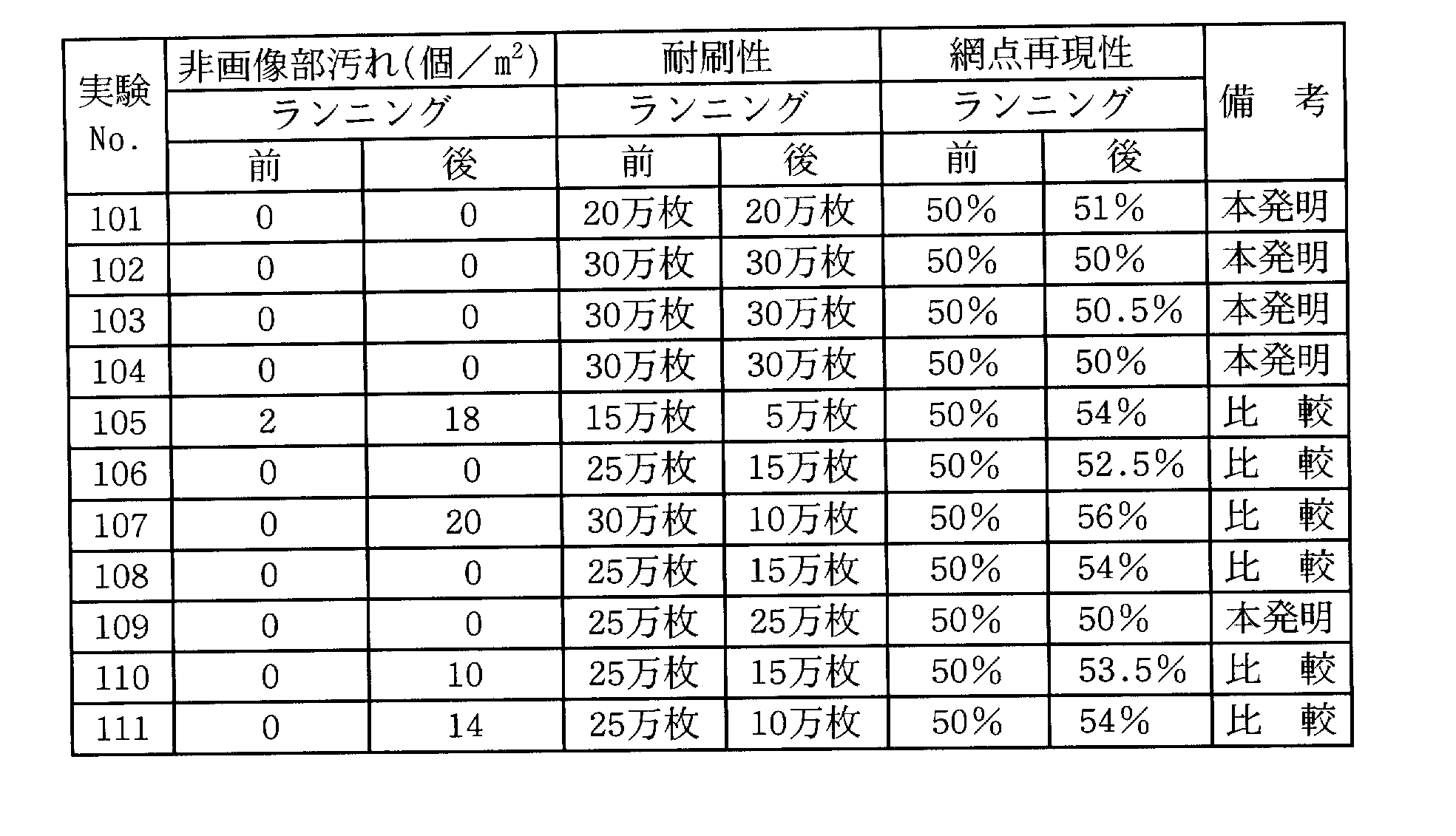
表1、表2から明らかなように、本発明の場合には、平版印刷版材料を比較的中性pHの現像液で処理しても現像性がよく、ランニング疲労液においてもその現像性が持続し、非画像部汚れや耐刷性や網点再現性の劣化がないことがわかる。
Claims (6)
- 親水性表面を有する支持体上に熱溶融性粒子または熱融着粒子を含有する画像形成層を有し、画像情報を露光・記録され画像形成された後の未露光部が、pHが3~9の範囲にある現像液で除去され平版印刷版が得られる平版印刷版材料において、裏面に界面活性剤およびイソチアゾリン誘導体を含有するバック層を有することを特徴とする平版印刷版材料。
- 前記平版印刷版材料が赤外レーザ光源により画像情報を露光・記録され画像形成されることを特徴とする請求の範囲第1項に記載の平版印刷版材料。
- 前記平版印刷版材料の裏面に、キレート剤を含むことを特徴とする請求の範囲第1項または第2項に記載の平版印刷版材料。
- 親水性表面を有する支持体上に熱溶融性粒子または熱融着粒子を含有する画像形成層を有し、画像情報を露光・記録した後の未露光部(非画像部)が、pHが3~9の範囲にある現像液で除去され平版印刷版が得られる平版印刷版材料の作製方法において、裏面に界面活性剤およびイソチアゾリン誘導体を含有するバック層を有することを特徴とする平版印刷版材料の作製方法。
- 前記平版印刷版材料が赤外レーザ光源により画像情報を露光・記録され画像形成されることを特徴とする請求の範囲第4項に記載の平版印刷版材料の作製方法。
- 前記平版印刷版材料の裏面に、キレート剤を含むことを特徴とする請求の範囲第4項または第5項に記載の平版印刷版材料の作製方法。
Applications Claiming Priority (2)
| Application Number | Priority Date | Filing Date | Title |
|---|---|---|---|
| JP2008-229412 | 2008-09-08 | ||
| JP2008229412 | 2008-09-08 |
Publications (1)
| Publication Number | Publication Date |
|---|---|
| WO2010026795A1 true WO2010026795A1 (ja) | 2010-03-11 |
Family
ID=41796970
Family Applications (1)
| Application Number | Title | Priority Date | Filing Date |
|---|---|---|---|
| PCT/JP2009/055041 Ceased WO2010026795A1 (ja) | 2008-09-08 | 2009-03-16 | 平版印刷版材料および平版印刷版材料の作製方法 |
Country Status (1)
| Country | Link |
|---|---|
| WO (1) | WO2010026795A1 (ja) |
Citations (4)
| Publication number | Priority date | Publication date | Assignee | Title |
|---|---|---|---|---|
| JP2005309425A (ja) * | 2004-03-25 | 2005-11-04 | Fuji Photo Film Co Ltd | 平版印刷版原版 |
| JP2005305741A (ja) * | 2004-04-20 | 2005-11-04 | Konica Minolta Medical & Graphic Inc | 平版印刷版材料及び平版印刷版、並びにそれを用いた印刷方法 |
| JP2006098710A (ja) * | 2004-09-29 | 2006-04-13 | Fuji Photo Film Co Ltd | 平版印刷版原版 |
| JP2006312275A (ja) * | 2005-05-09 | 2006-11-16 | Konica Minolta Medical & Graphic Inc | 平版印刷版材料及びそれを用いた印刷方法 |
-
2009
- 2009-03-16 WO PCT/JP2009/055041 patent/WO2010026795A1/ja not_active Ceased
Patent Citations (4)
| Publication number | Priority date | Publication date | Assignee | Title |
|---|---|---|---|---|
| JP2005309425A (ja) * | 2004-03-25 | 2005-11-04 | Fuji Photo Film Co Ltd | 平版印刷版原版 |
| JP2005305741A (ja) * | 2004-04-20 | 2005-11-04 | Konica Minolta Medical & Graphic Inc | 平版印刷版材料及び平版印刷版、並びにそれを用いた印刷方法 |
| JP2006098710A (ja) * | 2004-09-29 | 2006-04-13 | Fuji Photo Film Co Ltd | 平版印刷版原版 |
| JP2006312275A (ja) * | 2005-05-09 | 2006-11-16 | Konica Minolta Medical & Graphic Inc | 平版印刷版材料及びそれを用いた印刷方法 |
Similar Documents
| Publication | Publication Date | Title |
|---|---|---|
| US8377628B2 (en) | Negative working, heat-sensitive, lithographic printing plate precursor | |
| CN101076448B (zh) | 制作平版印刷印版的方法 | |
| US7195861B2 (en) | Method for making a negative working, heat-sensitive lithographic printing plate precursor | |
| JPWO2007145048A1 (ja) | 平版印刷版、平版印刷版材料、平版印刷版材料用支持体および平版印刷方法 | |
| JP2009101694A (ja) | 印刷版材料 | |
| US20090249972A1 (en) | Method for making a lithographic printing plate | |
| EP2871057B1 (en) | Negative working, heat-sensitive lithographic printing plate precursor | |
| US7867572B2 (en) | Method for making a lithographic printing plate precursor | |
| CN111051981B (zh) | 负型平版印刷版原版及平版印刷版的制版方法 | |
| JP2006150605A (ja) | プロセスレス印刷版材料を用いた印刷方法 | |
| JPWO2006129506A1 (ja) | 画像記録材料および画像記録材料の画像形成方法 | |
| WO2010026795A1 (ja) | 平版印刷版材料および平版印刷版材料の作製方法 | |
| JP4637541B2 (ja) | 感熱性平版印刷版前駆体 | |
| WO2018043124A1 (ja) | 平版印刷版の製版方法、及び平版印刷用湿し水 | |
| JP2010014952A (ja) | 平版印刷版の染色方法 | |
| JP2009258348A (ja) | 平版印刷版材料、平版印刷版材料の処理方法、および、平版印刷版の作製方法 | |
| JP2005111822A (ja) | 印刷方法 | |
| CN100551716C (zh) | 平版印刷版材料的曝光可视图像形成方法、铝支持体及平版印刷版材料 | |
| JP2005088330A (ja) | 印刷版材料及び印刷方法 | |
| JP2007160668A (ja) | 平版印刷版材料、その製造方法及び印刷方法 | |
| JP2007230081A (ja) | 平版印刷版材料および平版印刷方法 | |
| JP2007185829A (ja) | 平版印刷版材料、その製造方法及び印刷方法 | |
| JPWO2007074634A1 (ja) | 印刷版材料用支持体および印刷版材料 | |
| JP2005082705A (ja) | 印刷方法 | |
| JP2006150883A (ja) | プロセスレス印刷版材料を用いた印刷方法 |
Legal Events
| Date | Code | Title | Description |
|---|---|---|---|
| 121 | Ep: the epo has been informed by wipo that ep was designated in this application |
Ref document number: 09811324 Country of ref document: EP Kind code of ref document: A1 |
|
| NENP | Non-entry into the national phase |
Ref country code: DE |
|
| NENP | Non-entry into the national phase |
Ref country code: JP |
|
| 122 | Ep: pct application non-entry in european phase |
Ref document number: 09811324 Country of ref document: EP Kind code of ref document: A1 |