WO2007102741A1 - Fouling release composition - Google Patents

Fouling release composition Download PDF

Info

Publication number
WO2007102741A1
WO2007102741A1 PCT/NO2007/000082 NO2007000082W WO2007102741A1 WO 2007102741 A1 WO2007102741 A1 WO 2007102741A1 NO 2007000082 W NO2007000082 W NO 2007000082W WO 2007102741 A1 WO2007102741 A1 WO 2007102741A1
Authority
WO
WIPO (PCT)
Prior art keywords
monomer
fouling release
release composition
weight
alkyl
Prior art date
Legal status (The legal status is an assumption and is not a legal conclusion. Google has not performed a legal analysis and makes no representation as to the accuracy of the status listed.)
Ceased
Application number
PCT/NO2007/000082
Other languages
French (fr)
Inventor
Marit Dahling
Einar Magne Lien
Lorenzo Maria Orsini
Giancarlo Galli
Emo Chiellini
Current Assignee (The listed assignees may be inaccurate. Google has not performed a legal analysis and makes no representation or warranty as to the accuracy of the list.)
Jotun AS
Original Assignee
Jotun AS
Priority date (The priority date is an assumption and is not a legal conclusion. Google has not performed a legal analysis and makes no representation as to the accuracy of the date listed.)
Filing date
Publication date
Application filed by Jotun AS filed Critical Jotun AS
Priority to CN2007800159711A priority Critical patent/CN101437909B/en
Priority to US12/281,521 priority patent/US20090221752A1/en
Priority to EP07747556.4A priority patent/EP1996661B1/en
Priority to JP2008558221A priority patent/JP2009529088A/en
Publication of WO2007102741A1 publication Critical patent/WO2007102741A1/en
Anticipated expiration legal-status Critical
Ceased legal-status Critical Current

Links

Classifications

    • CCHEMISTRY; METALLURGY
    • C09DYES; PAINTS; POLISHES; NATURAL RESINS; ADHESIVES; COMPOSITIONS NOT OTHERWISE PROVIDED FOR; APPLICATIONS OF MATERIALS NOT OTHERWISE PROVIDED FOR
    • C09DCOATING COMPOSITIONS, e.g. PAINTS, VARNISHES OR LACQUERS; FILLING PASTES; CHEMICAL PAINT OR INK REMOVERS; INKS; CORRECTING FLUIDS; WOODSTAINS; PASTES OR SOLIDS FOR COLOURING OR PRINTING; USE OF MATERIALS THEREFOR
    • C09D5/00Coating compositions, e.g. paints, varnishes or lacquers, characterised by their physical nature or the effects produced; Filling pastes
    • C09D5/16Antifouling paints; Underwater paints
    • CCHEMISTRY; METALLURGY
    • C09DYES; PAINTS; POLISHES; NATURAL RESINS; ADHESIVES; COMPOSITIONS NOT OTHERWISE PROVIDED FOR; APPLICATIONS OF MATERIALS NOT OTHERWISE PROVIDED FOR
    • C09DCOATING COMPOSITIONS, e.g. PAINTS, VARNISHES OR LACQUERS; FILLING PASTES; CHEMICAL PAINT OR INK REMOVERS; INKS; CORRECTING FLUIDS; WOODSTAINS; PASTES OR SOLIDS FOR COLOURING OR PRINTING; USE OF MATERIALS THEREFOR
    • C09D183/00Coating compositions based on macromolecular compounds obtained by reactions forming in the main chain of the macromolecule a linkage containing silicon, with or without sulfur, nitrogen, oxygen, or carbon only; Coating compositions based on derivatives of such polymers
    • C09D183/04Polysiloxanes
    • CCHEMISTRY; METALLURGY
    • C09DYES; PAINTS; POLISHES; NATURAL RESINS; ADHESIVES; COMPOSITIONS NOT OTHERWISE PROVIDED FOR; APPLICATIONS OF MATERIALS NOT OTHERWISE PROVIDED FOR
    • C09DCOATING COMPOSITIONS, e.g. PAINTS, VARNISHES OR LACQUERS; FILLING PASTES; CHEMICAL PAINT OR INK REMOVERS; INKS; CORRECTING FLUIDS; WOODSTAINS; PASTES OR SOLIDS FOR COLOURING OR PRINTING; USE OF MATERIALS THEREFOR
    • C09D127/00Coating compositions based on homopolymers or copolymers of compounds having one or more unsaturated aliphatic radicals, each having only one carbon-to-carbon double bond, and at least one being terminated by a halogen; Coating compositions based on derivatives of such polymers
    • CCHEMISTRY; METALLURGY
    • C08ORGANIC MACROMOLECULAR COMPOUNDS; THEIR PREPARATION OR CHEMICAL WORKING-UP; COMPOSITIONS BASED THEREON
    • C08LCOMPOSITIONS OF MACROMOLECULAR COMPOUNDS
    • C08L27/00Compositions of homopolymers or copolymers of compounds having one or more unsaturated aliphatic radicals, each having only one carbon-to-carbon double bond, and at least one being terminated by a halogen; Compositions of derivatives of such polymers
    • C08L27/02Compositions of homopolymers or copolymers of compounds having one or more unsaturated aliphatic radicals, each having only one carbon-to-carbon double bond, and at least one being terminated by a halogen; Compositions of derivatives of such polymers not modified by chemical after-treatment
    • C08L27/12Compositions of homopolymers or copolymers of compounds having one or more unsaturated aliphatic radicals, each having only one carbon-to-carbon double bond, and at least one being terminated by a halogen; Compositions of derivatives of such polymers not modified by chemical after-treatment containing fluorine atoms

Definitions

  • the present invention relates to a fouling release composition
  • a fouling release composition comprising a cured or cross- linked polysiloxane and a fluorinated polymer or oligomer and a method for preventing fouling in an aquatic environment.
  • antifouling coatings are used.
  • Traditional antifouling coatings prevent fouling on the surface by release of substances that are toxic to aquatic fouling organisms.
  • a more environmentally benign solution is the use of biocide-free fouling release coatings. These systems are effective due to the physical properties of the surfaces. Low surface energy, low glass transition temperature (T g ) and low elastic modulus of the surface makes it difficult for the organisms to adhere firmly to the surface, which reduce the accumulation of marine organisms.
  • silicone elastomers or silicone rubbers
  • silicone rubbers for fouling release coatings has been known for some time, as disclosed in US 2,986,474, GB 1 307 001 and US 3,702,778.
  • chemically inert fluids additives are used to improve the fouling release performance of the silicone coatings. These additives migrate to the coating surface where they create a surface layer that promotes the release properties.
  • GB 1 470465 discloses the use of silicone oils in a curable silicone rubber formulation.
  • GB 1 581 727 discloses the use of silicone-free fluid organic compounds, for example low molecular weight polyolefins, low molecular weight polydienes, mineral oils and plasticizers, in a vulcanised silicone rubber formulation.
  • US 6, 107,381 discloses the use of a non-curable polysiloxane comprising at least one polyoxyalkene moiety.
  • the fouling release coatings do not prevent fouling, but reduced the adhesion of fouling organisms on the surface. Some forces are needed to remove the attached fouling organisms from the surface. On a ship hull the hydrodynamic forces of the moving vessel have to be sufficiently high for an effective release of the fouling organisms.
  • the silicone fouling release coatings is therefore limited to fast moving vessels with a speed of at least 15 knots. There is a need to improve the fouling release properties of these coatings, and the present invention offers a method for such improvement.
  • Perfluorinated compounds and polymers containing perfluorinated moieties are known for their very low surface energy and they can be used to improve the fouling release properties of silicone based systems.
  • the fluorinated component will spontaneously migrate to the surface and accumulate at the polymer-air interface.
  • Perfluoroalkyl groups will self-assembly on the surface stabilising the surface against reconstruction in water.
  • EP 1 377 643 B 1 / US 2002/0192181 discloses a cured or cross- linked polymer and a non-reactive fluid fluorinated alkyl- or alkoxy-containing polymer or oligomer.
  • Polysiloxane is the preferred binder.
  • the use of a fluorinated polymer or oligomer from ethylenically unsaturated monomers are not described.
  • the present invention provides a fouling release composition with improved fouling release properties comprising a cured or crosslinked polysiloxane and a fluorinated polymer or oligomer.
  • a fouling release composition with improved fouling release properties comprising a cured or crosslinked polysiloxane and a fluorinated polymer or oligomer.
  • the introduction of polysiloxane pendant groups in the fluorinated polymer or oligomer improves the compatibility with the polysiloxane coating formulation and facilitate the formation of a fluorinated surface layer.
  • the perfluoroalkyl groups self-assembly on the surface stabilising the surface against reconstruction in water.
  • This fluorinated layer can be further stabilised by introducing silane reactive groups in the fluorinated polymer or oligomer that can take part in the curing reaction of the polysiloxane coating.
  • the present invention represents a facile way to produce fluorinated polymers and oligomers, starting from commercial available products. It is possible to control the properties of the fluorinated polymer or oligomer such as surface energy, compatibility and reactivity in a polysiloxane blend by varying the monomer ratio and the chain length of the pendant groups.
  • Fluorinated compounds have a relatively high cost.
  • the present invention represent a way of improve the properties of a fouling release coating with a rninimum amount of a fluorinated polymer.
  • the present invention provides a fouling release composition comprising a cured or crosslinked polysiloxane and a fluorinated polymer or oligomer.
  • the present invention also relates to the use of the fouling release composition above in fouling release coatings for application to articles submerged in seawater.
  • the fluorinated polymer or oligomer of the present invention relates to a polymer or oligomer comprising units selected from (A) polymerisable ethylenically unsaturated monomers containing fluorine functionality, optionally (B) polymerisable ethylenically unsaturated monomers containing polyorganosiloxane functionality and optionally (C) polymerisable ethylenically unsaturated monomers containing silane functionality, and optionally other polymerisable ethylenically unsaturated monomers.
  • the fluorinated polymer or oligomer comprises units selected from monomer (A) of the general formula (I):
  • X 1 is an ethylenically unsaturated group, such as acryloyloxy, methacryloyloxy, vinyl or vinyloxycarbonyl
  • R 1 is a substituted or unsubstituted linear or branched C 1 -C 10 alkyl m is 0 or 1
  • R f is a perfluorinated linear or branched C 1 -C 20 alkyl
  • X 2 is an ethylenically unsaturated group, such as acryloyloxy, methacryloyloxy or vinyl
  • R 2 is a linear or branched C 1 -C 10 alkyl
  • R 3 is independently selected from C 1 -Ci 0 alkyl, m is 0 or 1 n is an integer from 1 to 200;
  • X 3 is an etbylenically unsaturated group, such as acryloyloxy, methacryloyloxy or vinyl
  • R 4 is a linear or branched Ci-C 1O alkyl m is 0 or 1
  • R 5 is a Ci-C 10 alkyl
  • R 6 is independently selected from C 1 -Ci 0 alkoxy and Ci-Ci 0 alkyl
  • R 7 is a Ci-Cio alkoxy, p is 0 or 1;
  • the fluorinated polymer or oligomer of the present invention contains 1-99% by weight of monomer A, preferably 1-50% by weight of monomer A, especially preferred 1-25% by weight of monomer A.
  • the fluorinated polymer or oligomer of the present invention contains 0-99% by weight of monomer B, preferably 1-99% by weight of monomer B.
  • n is preferably >1, more preferably n is >4 and especially preferably n is >8.
  • the fluorinated polymer or oligomer of the present invention contains 0- 25% by weight of monomer C.
  • Examples of monomer A include
  • Examples of monomer B include monomethacryloxypropyl terminated polydimethylsiloxane and monovinyl terminated polydimethylsiloxane. Preferred Mw 500-20 000, more preferred 800-10 000.
  • Examples of monomer C include
  • Examples of other ethylenically unsaturated compounds that may also be used in conformity with the invention are monomers such as acrylic acid and methacrylic acid, esters and amides of acrylic acid and methacrylic acid, vinyl compounds.
  • the fluorinated polymers according to the present invention may be prepared by polymerising at least one monomer A of the structure represented by formula (I) by a suitable polymerisation process.
  • the fluorinated polymer or oligomer of the present invention has a lower surface energy than the polysiloxane.
  • the fluorinated polymer or oligomer will spontaneously migrate to the surface and accumulate at the polymer-air interface. This process is thermodynamically driven due to the difference in surface energy.
  • the low surface energy provided by the fluorinated polymer or oligomer in combination with the elastic properties provided by the cured polysiloxane will improve the fouling release properties of the coating.
  • a coating comprising a fluorinated polymer or oligomer and a curable polysiloxane it is therefore desirable that the migration of the fluorinated polymer or oligomer to the surface is facilitated and that the fluorinated surface layer is stable. Since the fluorinated polymer or oligomer are generally incompatible with polysiloxane, this can prevent a controlled migration and of the fluorinated polymers or oligomers to the coating surface and the formation of a fluorinated surface layer and instead result in the formation of fluorinated domains in polysiloxane matrix.
  • the introduction of polysiloxane pendant groups in the fluorinated polymer or oligomer improves, the compatibility with the polysiloxane coating formulation and facilitate the formation of a
  • fluorinated surface layer When the fluorinated polymer or oligomer have migrated to the surface it is desirable to stabilise the surface of the coating against reconstruction and erosion of the outer fluorinated layer. Perfluoroalkyl groups will self-assembly on the surface stabilising the surface against reconstruction in water. This layer can be further stabilised by introducing silane reactive groups in the fluorinated polymer or oligomer that can take part in o the curing reaction of the polysiloxane coating.
  • the preferred amount of the fluorinated polymer or oligomer is 0.1-25 % by weight of the curable polysiloxane.
  • the fouling release composition of the present invention comprises a cured or crosslinked polysiloxane.
  • the cured or crosslinked polysiloxane is a conventional room temperature vulcanizable (hereafter denoted RTV) composition generally consisting of the main components:
  • the RTV composition can be a one-part or made up of several parts, but preferably not more than a three parts system.
  • the reactive polysiloxane of the present invention is a diorganosiloxane of the general formula (IV):
  • R 8 is a hydroxyl or -O-Si(R 10 ) y ( Rl %-y)
  • R 9 is independently selected from C 1 -C 10 alkyl, aryl and alkaryl
  • R 10 is a hydroxy or a C 1 -C 3 alkoxy
  • R 11 is hydrogen or a C 1 -C 3 alkyl
  • y is an integer from 1 to 3.
  • the reactive polysiloxane is a reactive polydimethylsiloxane.
  • the RTV composition may comprise one or more reactive silicone polymers differing in average molecular weight.
  • the crosslinking agent of the RTV composition has the general formula (V):
  • X 4 is alkoxy, acetoxy, oxime, enoxy or amine
  • R 12 is a C 1 -C 10 alkyl
  • z is 0 or 1.
  • the crosslinking agent may be in a monomeric form or in the form of a self-condensation product, such as a dimer, oligomer or polymer.
  • polysiloxane is di- or tri-alkoxy terminated, a separate crosslinking agent is not required.
  • Curing of the silicone binder proceeds in the presence of a catalyst.
  • catalysts are those known to facilitate condensation reactions in RTV silicone systems, such as carboxylic salts of tin, zinc, titanium, lead, iron, barium and zirconium.
  • Non-metallic catalysts such as hexylammonium acetate and benzyl trimethylammonium acetate, may also be employed.
  • a coating formulation comprising a fluorinated polymer or oligomer and a curable polysiloxane in accordance with the present invention may also include one or more non- reactive oils and other substances commonly used in coating formulation such as and fillers, pigments, solvents and additives:
  • non-reactive oils examples include silicone oils such as polydimethylsiloxane, methylphenyl silicone oils; organic oils such as polyolefin oils and paraffin and biological oils such as coconut oil.
  • fillers examples include barium sulphate, calcium sulphate, calcium carbonate, silicas, silicates, bentonites and other clays.
  • the preferred fillers are silica, including hydrophobic and hydrophilic fumed silica and precipitated silica.
  • pigments examples include titanium dioxide, iron oxides, carbon black, lamp black, iron blue, phthalocyanine blue, cobalt blue, ultramarine blue, phthalocyanine green,
  • suitable solvents and diluents include aromatic hydrocarbons such as toluene, xylene, trimethylbenzene; aliphatic hydrocarbons such as white spirit; alcohols such as 1- methoxy-2-propanol, butanol; ketones such as 2,4-pentanedione, 4-methyl-2-pentanone, 5- methyl-2-hexanone, cyclohexanone; esters such as butyl acetate and mixtures of the above with one another or an aliphatic hydrocarbon.
  • aromatic hydrocarbons such as toluene, xylene, trimethylbenzene
  • aliphatic hydrocarbons such as white spirit
  • alcohols such as 1- methoxy-2-propanol, butanol
  • ketones such as 2,4-pentanedione, 4-methyl-2-pentanone, 5- methyl-2-hexanone, cyclohexanone
  • esters such as butyl acetate and mixtures of the
  • the coating can be applied by any conventional method such as brushing, rolling or spraying (airless or conventional).
  • the composition of the present invention can be applied onto any pre-treatment layers designed for polysiloxane based fouling release finish layers. Examples of such coating layers are epoxy anticorrosive layers and silicone-containing tie- layers designed to ensure adhesion between the substrate and the final silicone containing fouling release layer.
  • Example 1 illustrates the present invention.
  • Solvent is charged to a reaction vessel equipped with stirrer, condenser, thermometer, an adding device and nitrogen inlet, and heated to 85°C under stirring.
  • the monomer batch is prepared by charging the remaining solvents, the fluorinated monomer, other co-monomers and initiator in a flask or beaker.
  • the monomer batch is then charged dropwise to the reaction vessel over a period of 2 hours.
  • the reaction mixture is kept at 85°C for an additional 3 hours.
  • additional initiator in solvent may be added during the post reaction time or the temperature may be raised to 120°C for 30 minutes in order to consume any residual monomers.
  • Example 2 Testing of fouling release performance using pseudobarnacles s
  • the coating compositions of Example 2 were applied by a frame applicator onto PVC panels primed with an epoxy primer and a tie-coat for silicone based coatings. The panels are allowed to cure for at least 1 day. Small aluminium studs (pseudobarnacles) are glued on to the surface using epoxy adhesive and cured for 5 days.
  • the pseudobarnacles are removed by a shear force applied parallel to the surface using a hand-held force gauge. The force required to remove the pseudobarnacle is noted.
  • the strength of adhesion is calculated by dividing the shear force by the area of the pseudobarnacle base. The value reported is the average of 6 measurements.

Landscapes

  • Chemical & Material Sciences (AREA)
  • Life Sciences & Earth Sciences (AREA)
  • Engineering & Computer Science (AREA)
  • Materials Engineering (AREA)
  • Wood Science & Technology (AREA)
  • Organic Chemistry (AREA)
  • Chemical Kinetics & Catalysis (AREA)
  • Paints Or Removers (AREA)
  • Addition Polymer Or Copolymer, Post-Treatments, Or Chemical Modifications (AREA)

Abstract

The present invention relates to a fouling release composition comprising a cured or crosslinked polysiloxane and a fluorinated polymer or oligomer. The present invention also relates to the use of the said fouling release composition in fouling release coatings for application to articles submerged in seawater.

Description

Fouling release composition
The present invention relates to a fouling release composition comprising a cured or cross- linked polysiloxane and a fluorinated polymer or oligomer and a method for preventing fouling in an aquatic environment.
Background
Surfaces that are submerged in seawater are subject to fouling by marine organisms such as green algae, brown algae, barnacles, mussel, tube worms and the like. Qn marine constructions such as vessels, oil platforms, buoys etc. this fouling may result in increased load and accelerated corrosion. On vessels the fouling will reduce the manoeuvrability and increase the frictional resistance which will cause a reduction of the speed and increased fuel consumption.
To prevent attachment and growth of such marine organisms antifouling coatings are used. Traditional antifouling coatings prevent fouling on the surface by release of substances that are toxic to aquatic fouling organisms.
A more environmentally benign solution is the use of biocide-free fouling release coatings. These systems are effective due to the physical properties of the surfaces. Low surface energy, low glass transition temperature (Tg) and low elastic modulus of the surface makes it difficult for the organisms to adhere firmly to the surface, which reduce the accumulation of marine organisms.
The use of silicone elastomers, or silicone rubbers, for fouling release coatings has been known for some time, as disclosed in US 2,986,474, GB 1 307 001 and US 3,702,778. To improve the fouling release performance of the silicone coatings, chemically inert fluids additives are used. These additives migrate to the coating surface where they create a surface layer that promotes the release properties. GB 1 470465 discloses the use of silicone oils in a curable silicone rubber formulation. GB 1 581 727 discloses the use of silicone-free fluid organic compounds, for example low molecular weight polyolefins, low molecular weight polydienes, mineral oils and plasticizers, in a vulcanised silicone rubber formulation. US 6, 107,381 discloses the use of a non-curable polysiloxane comprising at least one polyoxyalkene moiety. The fouling release coatings do not prevent fouling, but reduced the adhesion of fouling organisms on the surface. Some forces are needed to remove the attached fouling organisms from the surface. On a ship hull the hydrodynamic forces of the moving vessel have to be sufficiently high for an effective release of the fouling organisms. The silicone fouling release coatings is therefore limited to fast moving vessels with a speed of at least 15 knots. There is a need to improve the fouling release properties of these coatings, and the present invention offers a method for such improvement.
Perfluorinated compounds and polymers containing perfluorinated moieties are known for their very low surface energy and they can be used to improve the fouling release properties of silicone based systems. In a silicone system the fluorinated component will spontaneously migrate to the surface and accumulate at the polymer-air interface. Perfluoroalkyl groups will self-assembly on the surface stabilising the surface against reconstruction in water.
Fluorinated polymers and additives have been described for use in fouling release compositions. US 6,265,515 Bl (priority 1999, US Navy) discloses a curable fluorinated silicone resin and blends of the curable fluorinated silicone resin providing a low surface energy fouling release composition. The use of a cured or crosslinked polysiloxane and a fluorinated polymer or oligomer is not mentioned. EPl 042 413 Bl (priority GB 1997, Akzo) discloses a two-layer fouling release coating system where the outer layer comprising a curable polymeric fouling-inhibiting material, advantageously a curable polysiloxane, but other curable materials, especially fluorine-containing polymers may be used. The use of fluorine containing polymers in combination with a curable polysiloxane is not mentioned.
Arias E.M., et al., Polymer Preprints (1997), vol. 38, pp 512-513 describes a pure perfluorinated (meth)acrylate fouling release polymer. No fouling release compositions or use of the fluorinated polymers in combination with a curable polysiloxane are mentioned. US 6,899,955 B2 (priority EP 2000, Akzo) discloses a curable fluorinated resin, comprising a bifunctional fluorinated polyether having silicone end groups. Examples of additives that can be used in the coating composition are non- or monofunctional fluorinated polyethers. The use of fluorine containing polymers in combination with a curable polysiloxane is not mentioned. EP 1 377 643 B 1 / US 2002/0192181 (priority EP 2001 , Akzo) discloses a cured or cross- linked polymer and a non-reactive fluid fluorinated alkyl- or alkoxy-containing polymer or oligomer. Polysiloxane is the preferred binder. The use of a fluorinated polymer or oligomer from ethylenically unsaturated monomers are not described.
The present invention provides a fouling release composition with improved fouling release properties comprising a cured or crosslinked polysiloxane and a fluorinated polymer or oligomer. The introduction of polysiloxane pendant groups in the fluorinated polymer or oligomer improves the compatibility with the polysiloxane coating formulation and facilitate the formation of a fluorinated surface layer. The perfluoroalkyl groups self-assembly on the surface stabilising the surface against reconstruction in water. This fluorinated layer can be further stabilised by introducing silane reactive groups in the fluorinated polymer or oligomer that can take part in the curing reaction of the polysiloxane coating.
The present invention represents a facile way to produce fluorinated polymers and oligomers, starting from commercial available products. It is possible to control the properties of the fluorinated polymer or oligomer such as surface energy, compatibility and reactivity in a polysiloxane blend by varying the monomer ratio and the chain length of the pendant groups.
Fluorinated compounds have a relatively high cost. The present invention represent a way of improve the properties of a fouling release coating with a rninimum amount of a fluorinated polymer.
The present invention provides a fouling release composition comprising a cured or crosslinked polysiloxane and a fluorinated polymer or oligomer. The present invention also relates to the use of the fouling release composition above in fouling release coatings for application to articles submerged in seawater.
DETAILED DESCRIPTION: The fluorinated polymer or oligomer of the present invention relates to a polymer or oligomer comprising units selected from (A) polymerisable ethylenically unsaturated monomers containing fluorine functionality, optionally (B) polymerisable ethylenically unsaturated monomers containing polyorganosiloxane functionality and optionally (C) polymerisable ethylenically unsaturated monomers containing silane functionality, and optionally other polymerisable ethylenically unsaturated monomers. Preferable, the fluorinated polymer or oligomer comprises units selected from monomer (A) of the general formula (I):
-(R1)m— Rf
(I) wherein
X1 is an ethylenically unsaturated group, such as acryloyloxy, methacryloyloxy, vinyl or vinyloxycarbonyl
R1 is a substituted or unsubstituted linear or branched C1-C10 alkyl m is 0 or 1
Rf is a perfluorinated linear or branched C1-C20 alkyl;
optionally monomer (B) of the general formula (II):
Figure imgf000005_0001
wherein
X2 is an ethylenically unsaturated group, such as acryloyloxy, methacryloyloxy or vinyl
R2 is a linear or branched C1-C10 alkyl
R3 is independently selected from C1-Ci0 alkyl, m is 0 or 1 n is an integer from 1 to 200;
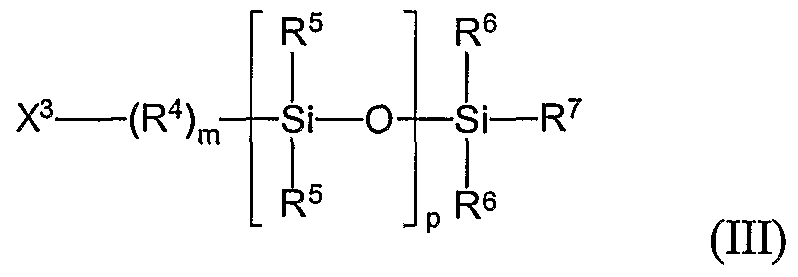
and optionally monomer (C) of the general formula (III):
R5 R6
X3 1 ( (RR44LL -Si-O — Si — -R7
R5 R6
(III) wherein X3 is an etbylenically unsaturated group, such as acryloyloxy, methacryloyloxy or vinyl R4 is a linear or branched Ci-C1O alkyl m is 0 or 1 R5 is a Ci-C10 alkyl, R6 is independently selected from C1-Ci0 alkoxy and Ci-Ci0 alkyl,
R7 is a Ci-Cio alkoxy, p is 0 or 1;
and optionally one or more other polymerisable ethylenically unsaturated compounds.
The fluorinated polymer or oligomer of the present invention contains 1-99% by weight of monomer A, preferably 1-50% by weight of monomer A, especially preferred 1-25% by weight of monomer A. The fluorinated polymer or oligomer of the present invention contains 0-99% by weight of monomer B, preferably 1-99% by weight of monomer B. For monomer B (of the general formula (II)), n is preferably >1, more preferably n is >4 and especially preferably n is >8. The fluorinated polymer or oligomer of the present invention contains 0- 25% by weight of monomer C.
Examples of monomer A include
lH,lH-perfluoropropyl acrylate, lH,lH-perfluorobutyl acrylate, lH,lH-perfluorooctyl acrylate, IH, lH-perfluorooctyl methacrylate, 1 H, lH-perfluorodecyl acrylate, 1H,1H- perfluorodecyl methacrylate, (perfluorocyclohexyl)methyl acrylate, (perfluorocyclohexyl)methyl methacrylate;
2-(perfluorobutyl)ethyl acrylate, 2-(perfluorobutyl)ethyl methacrylate, 2-(perfluorohexyl)ethyl acrylate, 2-(perfluorohexyl)etliyl methacrylate, 2-(perfluorooctyl)ethyl acrylate, 2- (perfluorooctyl)ethyl methacrylate, 2-(perfluorodecyl)ethyl acrylate, 2-(perfluorodecyl)ethyl methacrylate; 2-(perfluoro-3-methylbutyl)ethyl acrylate, 2-(perfluoro-3-methylbutyl)ethyl methacrylate, 2- (perfluoro-5-methylhexyl)ethyl acrylate , 2-(perfluoro-5-methylhexyl)ethyl methacrylate, 2- (perfluoro-7-methyloctyl)ethyl acrylate, 2-(perfluoro-7-methyloctyl)ethyl methacrylate, 2- (perfluoro-9-methyldecyl)ethyl acrylate, 2-(perfluoro-9-methyldecyl)ethyl methacrylate;
5 lH,lH,5H-perfluoropentyl acrylate, IH, lH,5H-perfluoropentyl methacrylate, IH5IH, 7H- perfluoroheptyl acrylate, lH,lH,7H-perfluoroheptyl methacrylate, lH,lH,9H-perfluorononyl acrylate, IH, lH,9H-perfluorononyl methacrylate, lH,lH,llH-perfluoroundecyl acrylate, IH5IH5I lH-perfluoroundecyl methacrylate;
10
3 -(perfluoro-3 -methylbutyl)-2-hydroxypropyl acrylate, 3 -(perfluoro-3 -methylbutyl)-2- hydroxypropyl methacrylate, 3-(perfluoro-5-methylhexyl)-2-hydroxypropyl acrylate, 3-(perfluoro-5-methylhexyl)-2-hydroxypropyl methacrylate, 3-(perfluorobutyl)-2- hydroxypropyl acrylate, 3-(perfluorohexyl)-2-hydroxypropyl acrylate, 3-(perfluorohexyl)-2- I5 hydroxypropyl methacrylate, 3-(perfluorooctyl)-2-hydroxyproρyl acrylate, 3-(perfluorooctyl)- 2-hydroxypropyl methacrylate;
vinyl perfluoroheptanoate, vinyl perfluorooctanoate, vinyl perfluorononanoate, p-vinylbenzyl perfluorooctanoate, 3-[2'-(perfluoropropoxy)-l ', 1 '52'-trifluoroethoxy]vήαylbenzene; 2Q 2-(perfluoropropoxy)perfluoropropyl trifluorovinyl ether
Examples of monomer B include monomethacryloxypropyl terminated polydimethylsiloxane and monovinyl terminated polydimethylsiloxane. Preferred Mw 500-20 000, more preferred 800-10 000.
25
Examples of monomer C include
(3 -acryloyloxypropyl)trimethoxysilane, (3 -acryloyloxypropytymethyldimethoxysilane, (3 -acryloyloxypropytydimethylmethoxysilane, (3 -methacryloyloxypropy^triethoxysilane, (3-methacryloyloxypropyl)ethyldimethoxysilane, 30 (3-methacryloyloxypropyl)dimethyldiethoxysilane, (methacryloyloxymetliyl)trimethoxysilane, (methacryloyloxymethyl)txiethoxysilane5 (methacryloyloxymethyl)dimethylemoxysilane, (3-methacryloyloxypropyl)trimethoxysilane, (3-methacryloyloxypropyl)trietlioxysilane, (S-methacryloyloxypropy^methyldimethoxysilane, (S-methacryloyloxypropytyethylctimethoxysilane, (3 -methacryloyloxypropytydimethylmethoxysilane, (3-methacryloyloxypropyl)dimethylch"ethoxysilane,
vinyltrimethoxysilane, vinyltriethoxysilane, vinyltriisopropoxysilane, vmyltή-tert- butoxysilane, vinylmethyldimethoxysilane, vinylmethyldiethoxysilane, vinyldimethylethoxysilane, styrylethyltrimethoxysilane,
Examples of other ethylenically unsaturated compounds that may also be used in conformity with the invention are monomers such as acrylic acid and methacrylic acid, esters and amides of acrylic acid and methacrylic acid, vinyl compounds.
The fluorinated polymers according to the present invention may be prepared by polymerising at least one monomer A of the structure represented by formula (I) by a suitable polymerisation process.
The fluorinated polymer or oligomer of the present invention has a lower surface energy than the polysiloxane. In a blend of the fluorinated polymer or oligomer and polysiloxane the fluorinated polymer or oligomer will spontaneously migrate to the surface and accumulate at the polymer-air interface. This process is thermodynamically driven due to the difference in surface energy. The low surface energy provided by the fluorinated polymer or oligomer in combination with the elastic properties provided by the cured polysiloxane will improve the fouling release properties of the coating. In a coating comprising a fluorinated polymer or oligomer and a curable polysiloxane it is therefore desirable that the migration of the fluorinated polymer or oligomer to the surface is facilitated and that the fluorinated surface layer is stable. Since the fluorinated polymer or oligomer are generally incompatible with polysiloxane, this can prevent a controlled migration and of the fluorinated polymers or oligomers to the coating surface and the formation of a fluorinated surface layer and instead result in the formation of fluorinated domains in polysiloxane matrix. The introduction of polysiloxane pendant groups in the fluorinated polymer or oligomer improves, the compatibility with the polysiloxane coating formulation and facilitate the formation of a
5 fluorinated surface layer. When the fluorinated polymer or oligomer have migrated to the surface it is desirable to stabilise the surface of the coating against reconstruction and erosion of the outer fluorinated layer. Perfluoroalkyl groups will self-assembly on the surface stabilising the surface against reconstruction in water. This layer can be further stabilised by introducing silane reactive groups in the fluorinated polymer or oligomer that can take part in o the curing reaction of the polysiloxane coating.
The preferred amount of the fluorinated polymer or oligomer is 0.1-25 % by weight of the curable polysiloxane.
s The fouling release composition of the present invention comprises a cured or crosslinked polysiloxane. Preferably, the cured or crosslinked polysiloxane is a conventional room temperature vulcanizable (hereafter denoted RTV) composition generally consisting of the main components:
1) a reactive polysiloxane 0 2) a crosslinking agent
3) a condensation catalyst
The RTV composition can be a one-part or made up of several parts, but preferably not more than a three parts system.
s The reactive polysiloxane of the present invention is a diorganosiloxane of the general formula (IV):
Figure imgf000009_0001
wherein R8 is a hydroxyl or -O-Si(R10)y(Rl %-y) R9 is independently selected from C1-C10 alkyl, aryl and alkaryl R10 is a hydroxy or a C1-C3 alkoxy R11 is hydrogen or a C1-C3 alkyl, y is an integer from 1 to 3.
Preferably, the reactive polysiloxane is a reactive polydimethylsiloxane.
The RTV composition may comprise one or more reactive silicone polymers differing in average molecular weight.
The crosslinking agent of the RTV composition has the general formula (V):
Figure imgf000010_0001
wherein
X4 is alkoxy, acetoxy, oxime, enoxy or amine R12 is a C1-C10 alkyl, z is 0 or 1.
The crosslinking agent may be in a monomeric form or in the form of a self-condensation product, such as a dimer, oligomer or polymer.
If the polysiloxane is di- or tri-alkoxy terminated, a separate crosslinking agent is not required.
Curing of the silicone binder proceeds in the presence of a catalyst. Useful catalysts are those known to facilitate condensation reactions in RTV silicone systems, such as carboxylic salts of tin, zinc, titanium, lead, iron, barium and zirconium. Non-metallic catalysts such as hexylammonium acetate and benzyl trimethylammonium acetate, may also be employed. A coating formulation comprising a fluorinated polymer or oligomer and a curable polysiloxane in accordance with the present invention may also include one or more non- reactive oils and other substances commonly used in coating formulation such as and fillers, pigments, solvents and additives:
Examples of non-reactive oils include silicone oils such as polydimethylsiloxane, methylphenyl silicone oils; organic oils such as polyolefin oils and paraffin and biological oils such as coconut oil.
Examples of fillers include barium sulphate, calcium sulphate, calcium carbonate, silicas, silicates, bentonites and other clays. The preferred fillers are silica, including hydrophobic and hydrophilic fumed silica and precipitated silica.
Examples of pigments include titanium dioxide, iron oxides, carbon black, lamp black, iron blue, phthalocyanine blue, cobalt blue, ultramarine blue, phthalocyanine green,
Examples of suitable solvents and diluents include aromatic hydrocarbons such as toluene, xylene, trimethylbenzene; aliphatic hydrocarbons such as white spirit; alcohols such as 1- methoxy-2-propanol, butanol; ketones such as 2,4-pentanedione, 4-methyl-2-pentanone, 5- methyl-2-hexanone, cyclohexanone; esters such as butyl acetate and mixtures of the above with one another or an aliphatic hydrocarbon.
The coating can be applied by any conventional method such as brushing, rolling or spraying (airless or conventional). The composition of the present invention can be applied onto any pre-treatment layers designed for polysiloxane based fouling release finish layers. Examples of such coating layers are epoxy anticorrosive layers and silicone-containing tie- layers designed to ensure adhesion between the substrate and the final silicone containing fouling release layer.
The following examples illustrate the present invention: Example 1:
General procedure for preparation of fluorinated polymers
Solvent is charged to a reaction vessel equipped with stirrer, condenser, thermometer, an adding device and nitrogen inlet, and heated to 85°C under stirring. The monomer batch is prepared by charging the remaining solvents, the fluorinated monomer, other co-monomers and initiator in a flask or beaker. The monomer batch is then charged dropwise to the reaction vessel over a period of 2 hours. The reaction mixture is kept at 85°C for an additional 3 hours.
Optionally, additional initiator in solvent may be added during the post reaction time or the temperature may be raised to 120°C for 30 minutes in order to consume any residual monomers.
The type and amount of monomers, solvent and initiator used for the preparation of the fluorinated polymers are given in table 1.
Table 1:
Figure imgf000013_0001
Figure imgf000014_0001
W
Example 2:
Preparation of a three pack coating composition
s Part A (base):
105.0 g polydimethylsiloxane, silanol terminated (vise. 1000 cSt)
18.0 g polydimethylsiloxane (vise. 100 cSt) 6.O g titanium dioxide 1.0 g silica 60.O g Xylene 6.5 g fluorinated polymer solution from example 1 (Pl -P 12)
Part B (curing agent)
5.0 g tetraethyl silicate
Part C (catalyst solution) 0.4 g dibutyltin diacetate 8.0 g Xylene 0
Example 3:
Testing of fouling release performance using pseudobarnacles s The coating compositions of Example 2 were applied by a frame applicator onto PVC panels primed with an epoxy primer and a tie-coat for silicone based coatings. The panels are allowed to cure for at least 1 day. Small aluminium studs (pseudobarnacles) are glued on to the surface using epoxy adhesive and cured for 5 days. The pseudobarnacles are removed by a shear force applied parallel to the surface using a hand-held force gauge. The force required to remove the pseudobarnacle is noted. The strength of adhesion is calculated by dividing the shear force by the area of the pseudobarnacle base. The value reported is the average of 6 measurements.
The pseudobarnacle strength of adhesion for the coating compositions of Example 2 are given in table 2.
Table 2
Figure imgf000017_0001

Claims

P a t e n t c l a i m s
1. Fouling release composition comprising a cured or cross-linked polysiloxane and a fluorinated polymer or oligomer derived from an ethylenically unsaturated monomer.
2. Fouling release composition in accordance with claim 1, wherein the fluorinated polymer or oligomer comprises units selected from:
(A) polymerisable ethylenically unsaturated monomers containing fluorine functionality; optionally (B) polymerisable ethylenically unsaturated monomers containing polyorganosiloxane functionality; optionally (C) polymerisable ethylenically unsaturated monomers containing silane functionality; and optionally other polymerisable ethylenically unsaturated monomers.
3. Fouling release composition in accordance with claim 2, wherein the fluorinated polymer or oligomer comprises units selected from: monomer (A) of the general formula (I):
X1 (Ri)m— Rf (I) wherein
X1 is an ethylenically unsaturated group, such as acryloyloxy, methacryloyloxy, vinyl or vinyloxycarbonyl,
R1 is a substituted or unsubstituted linear or branched C1-C10 alkyl, m is O or l,
Rf is a perfluorinated linear or branched Ci-C20 alkyl;
optionally monomer (B) of the general formula (II):
Figure imgf000019_0001
wherein
X2 is an ethylenically unsaturated group, such as acryloyloxy, methacryloyloxy or vinyl,
R2 is a linear or branched C1-C10 alkyl,
R3 is independently selected from C1-Ci0 alkyl, m is 0 or 1, n is an integer from 1 to 200;
optionally monomer (C) of the general formula (III):
Figure imgf000019_0002
wherein
X3 is an ethylenically unsaturated group, such as acryloyloxy, methacryloyloxy or vinyl,
R4 is a linear or branched Ci-Ci0 alkyl, m is 0 or 1, R5 is a Ci-Cio alkyl,
R6 is independently selected from Ci-Cio alkoxy and C1-Ci0 alkyl, R7 is a Ci-Cio alkoxy, p is O or 1;
and optionally one ore more other polymerisable ethylenically unsaturated compound.
4. Fouling release composition in accordance with claim 3, wherein the fluorinated polymer or oligomer comprises 1-99% by weight of monomer A, 0-99% by weight of monomer B, and 0-25% by weight of monomer C.
s 5. Fouling release composition in accordance with claim 3, wherein the fluorinated polymer or oligomer comprises 1-50% by weight of monomer A, 0-99% by weight of monomer B, and 0-25% by weight of monomer C.
6. Fouling release composition in accordance with claim 3, wherein the fluorinated polymer o or oligomer comprises 1-25% by weight of monomer A, 0-99% by weight of monomer B, and 0-25% by weight of monomer C.
7. Fouling release composition in accordance with claim 4-6, wherein the fluorinated polymer or oligomer comprises 1-99% by weight of monomer B. 5
8. Fouling release composition in accordance with claim 1-2, wherein the cured or crosslinked polysiloxane is a diorganosiloxane of the general formula (IV):
Figure imgf000020_0001
wherein 0 R8 is a hydroxyl or -O-Si(R10)y(R11^,
R9 is independently selected from C1-Ci0 alkyl, aryl and alkaryl, R10 is a hydroxy or a Cj-C3 alkoxy, R11 is hydrogen or a Q-C3 alkyl, y is an integer from 1 to 3. 5
9. Fouling release composition in accordance with claim 1-8, wherein the cured or crosslinked polysiloxane is a reactive polydimethylsiloxane.
10. Fouling release composition in accordance with claim 1-8, wherein the amount of the fluorinated polymer or oligomer is 0.1-25 % by weight of the cured or crosslinked polysiloxane.
11. Use of a fouling release composition of any one of claims 1 - 10, in fouling release coatings for articles submerged in seawater.
12. Use in accordance with claim 11, wherein the articles are marine constructions such as vessels, oil platforms and buoys.
PCT/NO2007/000082 2006-03-06 2007-02-28 Fouling release composition Ceased WO2007102741A1 (en)

Priority Applications (4)

Application Number Priority Date Filing Date Title
CN2007800159711A CN101437909B (en) 2006-03-06 2007-02-28 descaling composition
US12/281,521 US20090221752A1 (en) 2006-03-06 2007-02-28 Fouling release composition
EP07747556.4A EP1996661B1 (en) 2006-03-06 2007-02-28 Fouling release composition
JP2008558221A JP2009529088A (en) 2006-03-06 2007-02-28 Dirt release composition

Applications Claiming Priority (2)

Application Number Priority Date Filing Date Title
NO20061075 2006-03-06

Publications (1)

Publication Number Publication Date
WO2007102741A1 true WO2007102741A1 (en) 2007-09-13

Family

ID=38161992

Family Applications (1)

Application Number Title Priority Date Filing Date
PCT/NO2007/000082 Ceased WO2007102741A1 (en) 2006-03-06 2007-02-28 Fouling release composition

Country Status (7)

Country Link
US (1) US20090221752A1 (en)
EP (1) EP1996661B1 (en)
JP (1) JP2009529088A (en)
KR (1) KR20080110781A (en)
CN (1) CN101437909B (en)
SG (1) SG169368A1 (en)
WO (1) WO2007102741A1 (en)

Cited By (7)

* Cited by examiner, † Cited by third party
Publication number Priority date Publication date Assignee Title
WO2009113876A1 (en) * 2008-03-14 2009-09-17 Jotun A/S Binder for air-drying paint comprising nanoparticle bonded silicon derivative of unsaturated fatty acid
EP2138889A1 (en) * 2008-06-26 2009-12-30 Lachezar Komitov Alignment layer for LCD
EP2492323A1 (en) 2011-02-23 2012-08-29 Akzo Nobel Coatings International B.V. Biofouling resistant composition
WO2014078195A1 (en) * 2012-11-13 2014-05-22 3M Innovative Properties Company Curable antifouling composition, method of use, and articles
KR20180079965A (en) 2017-01-03 2018-07-11 주식회사 케이씨씨 Resin for anti-fouling coating, and anti-fouling coating composition comprising the same
KR101970431B1 (en) 2018-01-25 2019-04-18 주식회사 케이씨씨 Antifouling resin and antifouling paint composition comprising the same
CN111615526A (en) * 2018-01-19 2020-09-01 信越化学工业株式会社 Fluorine-containing active energy ray-curable compositions and articles

Families Citing this family (9)

* Cited by examiner, † Cited by third party
Publication number Priority date Publication date Assignee Title
KR20120101516A (en) * 2009-12-04 2012-09-13 엔디에스유 리서치 파운데이션 Amphiphilic fouling release coatings
AU2012271948B2 (en) * 2011-06-21 2015-10-15 Akzo Nobel Coatings International B.V. Biocidal foul release coating systems
CN103732699B (en) * 2011-06-30 2017-07-28 汉伯公司 Enzyme-containing polysiloxane‑based soil release coatings
CN102702880A (en) * 2012-06-14 2012-10-03 天长市银狐漆业有限公司 Anti-fouling paint composition
EP3013876B1 (en) * 2013-06-25 2019-08-28 3M Innovative Properties Company Moisture-curable composition, method of using, and composite article
JP6617704B2 (en) * 2014-07-18 2019-12-11 Agc株式会社 Protein adhesion inhibitor
CN104327721B (en) * 2014-10-15 2016-12-07 大连海事大学 Nano antibacterial low surface energy organosilicon luminescent antifouling coating and preparation method thereof
EP3423271A4 (en) 2016-04-05 2019-01-23 Adaptive Surface Technologies, Inc. CURABLE POLYSILOXANE COMPOSITIONS AND SLIDING MATERIALS AND COATINGS AND ARTICLES MADE THEREFROM
KR102808220B1 (en) * 2019-05-30 2025-05-15 주식회사 케이씨씨 Coat composition for antifouling

Citations (12)

* Cited by examiner, † Cited by third party
Publication number Priority date Publication date Assignee Title
US2986474A (en) 1955-04-12 1961-05-30 Robbart Edward Ship's hull coated with anti-fouling silicone resin and method of coating
US3702778A (en) 1970-03-23 1972-11-14 Battelle Memorial Institute Ship's hull coated with antifouling silicone rubber
GB1307001A (en) 1970-01-12 1973-02-14 Kroyer K K K Marine structure having a surface coating for the prevention of accumulation of marine organisms
GB1470465A (en) 1975-01-20 1977-04-14 Int Paint Co Coated marine surfaces
GB1581727A (en) 1976-12-21 1980-12-17 Shell Int Research Coated marine structure
US5486421A (en) * 1993-11-25 1996-01-23 Dow Corning Toray Silicone Company, Ltd. Curable polymer release coating composition
US6107381A (en) 1997-06-16 2000-08-22 General Electric Company Condensation curable silicone foul release coatings and articles coated therewith
US6417284B1 (en) * 1999-09-30 2002-07-09 Nexpress Solutions Llc Adhesion priming composition for fluoropolymer coatings
US6485838B1 (en) * 1999-05-21 2002-11-26 Jsr Corporation Coating composition, and a coated film and glass each having a coating layer comprised thereof
US6531525B1 (en) * 1993-06-24 2003-03-11 Daikin Industries, Ltd. Abherent compsition
WO2004076570A1 (en) * 2003-02-28 2004-09-10 Koninklijke Philips Electronics N.V. Fluoropolymer-containing sol-gel coating
US20050153610A1 (en) * 2004-01-13 2005-07-14 Tonoga Inc. Particulate filled fluoropolymer coating composition and method of making article therefrom

Family Cites Families (12)

* Cited by examiner, † Cited by third party
Publication number Priority date Publication date Assignee Title
US3064378A (en) * 1959-10-26 1962-11-20 Gen Motors Corp Lamp assembly
SE434517B (en) * 1976-11-25 1984-07-30 Extensor Ab COMPOSITION WITH ANTI-ANTICIPATIVE PROPERTIES APPLICABLE SUCH AS SKEPPSBOTTENFERG, INCLUDING PARTICULAR POLYTETRAFLUORET AND USE THEREOF
GB2070021B (en) * 1980-02-21 1984-03-21 Furukawa Electric Co Ltd Crosslinked ethylene-vinyl acetate copolymer foam containing an inorganic material and its production
JP2595678B2 (en) * 1988-04-15 1997-04-02 ダイキン工業株式会社 Antifouling paint composition and coated product
JPH07181737A (en) * 1993-12-24 1995-07-21 Shin Etsu Chem Co Ltd Binder for electrophotographic toner
JPH08120178A (en) * 1994-10-21 1996-05-14 Daikin Ind Ltd Release agent, cured film obtained from the release agent, and molding method using the release agent
JPH0971749A (en) * 1995-07-03 1997-03-18 Toray Ind Inc Biofouling-preventing polymer, method for producing the same, and biofouling-preventing marine structure
US6350552B1 (en) * 1998-12-23 2002-02-26 Lexmark International, Inc. Reactive compatibilization of polymeric components such as siloxane polymers with toner resins
US6559201B2 (en) * 2000-06-02 2003-05-06 Microphase Coatings, Inc. Antifouling coating composition
US7247672B2 (en) * 2002-12-09 2007-07-24 Taisei Chemical Industries, Ltd. Liquid non-aqueous dispersion and process for producing the same
JP3535840B2 (en) * 2001-02-28 2004-06-07 大成化工株式会社 Method for producing liquid non-aqueous dispersion
RU2279458C2 (en) * 2001-03-21 2006-07-10 Акцо Нобель Н.В. Composition for non-overgrowing covers involving polymer or oligomer comprising alkyl- or alkoxy-groups

Patent Citations (12)

* Cited by examiner, † Cited by third party
Publication number Priority date Publication date Assignee Title
US2986474A (en) 1955-04-12 1961-05-30 Robbart Edward Ship's hull coated with anti-fouling silicone resin and method of coating
GB1307001A (en) 1970-01-12 1973-02-14 Kroyer K K K Marine structure having a surface coating for the prevention of accumulation of marine organisms
US3702778A (en) 1970-03-23 1972-11-14 Battelle Memorial Institute Ship's hull coated with antifouling silicone rubber
GB1470465A (en) 1975-01-20 1977-04-14 Int Paint Co Coated marine surfaces
GB1581727A (en) 1976-12-21 1980-12-17 Shell Int Research Coated marine structure
US6531525B1 (en) * 1993-06-24 2003-03-11 Daikin Industries, Ltd. Abherent compsition
US5486421A (en) * 1993-11-25 1996-01-23 Dow Corning Toray Silicone Company, Ltd. Curable polymer release coating composition
US6107381A (en) 1997-06-16 2000-08-22 General Electric Company Condensation curable silicone foul release coatings and articles coated therewith
US6485838B1 (en) * 1999-05-21 2002-11-26 Jsr Corporation Coating composition, and a coated film and glass each having a coating layer comprised thereof
US6417284B1 (en) * 1999-09-30 2002-07-09 Nexpress Solutions Llc Adhesion priming composition for fluoropolymer coatings
WO2004076570A1 (en) * 2003-02-28 2004-09-10 Koninklijke Philips Electronics N.V. Fluoropolymer-containing sol-gel coating
US20050153610A1 (en) * 2004-01-13 2005-07-14 Tonoga Inc. Particulate filled fluoropolymer coating composition and method of making article therefrom

Cited By (12)

* Cited by examiner, † Cited by third party
Publication number Priority date Publication date Assignee Title
WO2009113876A1 (en) * 2008-03-14 2009-09-17 Jotun A/S Binder for air-drying paint comprising nanoparticle bonded silicon derivative of unsaturated fatty acid
US8318841B2 (en) 2008-03-14 2012-11-27 Sinvent As Binder for air-drying paint comprising nanoparticle bonded silicon derivative of unsaturated fatty acid
EP2138889A1 (en) * 2008-06-26 2009-12-30 Lachezar Komitov Alignment layer for LCD
WO2009156483A1 (en) * 2008-06-26 2009-12-30 Lachezar Komitov Alignment layer for lcd
EP2492323A1 (en) 2011-02-23 2012-08-29 Akzo Nobel Coatings International B.V. Biofouling resistant composition
WO2014078195A1 (en) * 2012-11-13 2014-05-22 3M Innovative Properties Company Curable antifouling composition, method of use, and articles
CN105026446A (en) * 2012-11-13 2015-11-04 3M创新有限公司 Curable antifouling composition, method of use, and articles
US10947396B2 (en) 2012-11-13 2021-03-16 3M Innovative Properties Company Curable antifouling composition, method of use, and articles
KR20180079965A (en) 2017-01-03 2018-07-11 주식회사 케이씨씨 Resin for anti-fouling coating, and anti-fouling coating composition comprising the same
CN111615526A (en) * 2018-01-19 2020-09-01 信越化学工业株式会社 Fluorine-containing active energy ray-curable compositions and articles
CN111615526B (en) * 2018-01-19 2024-02-27 信越化学工业株式会社 Fluorine-containing active energy ray curable compositions and articles
KR101970431B1 (en) 2018-01-25 2019-04-18 주식회사 케이씨씨 Antifouling resin and antifouling paint composition comprising the same

Also Published As

Publication number Publication date
CN101437909B (en) 2013-07-03
US20090221752A1 (en) 2009-09-03
JP2009529088A (en) 2009-08-13
EP1996661A1 (en) 2008-12-03
EP1996661B1 (en) 2014-05-14
SG169368A1 (en) 2011-03-30
KR20080110781A (en) 2008-12-19
CN101437909A (en) 2009-05-20

Similar Documents

Publication Publication Date Title
EP1996661B1 (en) Fouling release composition
CA2315690C (en) Fouling inhibition
KR102814344B1 (en) Anti-fouling composition
US5663215A (en) Coating compositions
JP5557852B2 (en) Metal-crosslinked organopolysiloxane thioblock vinyl copolymer and antifouling coating composition containing the metal-crosslinked copolymer
TWI376403B (en) Anti-fouling coating compositions containing a carboxyl-functional organosilicone
CN104995271A (en) Anti-fouling compositions with a fluorinated oxyalkylene-containing polymer or oligomer
CA2126233C (en) Coating compositions
GB2559454A (en) Antifouling composition
WO2022070978A1 (en) Antifouling coating composition
JP2021507001A (en) A method for controlling aquatic biological contamination on artificial objects using a base material coated with a multi-layer coating system and a multi-layer coating system.
EP3820947A1 (en) Tie-coat composition
JP4060701B2 (en) Underwater construction structure coated body coated with primer antifouling coating film or composite antifouling coating film, and antifouling method for underwater construction structure
JP4093629B2 (en) Antifouling paint composition, antifouling coating film, underwater structure or ship coated with the antifouling coating film, and underwater structure or ship outer plate antifouling method
JP2025507779A (en) Anti-icing paints and coatings, and anti-fouling paints and coatings
JP7793767B2 (en) Antifouling paint composition
CN114716913A (en) Amphiphilic antifouling active agent and preparation method thereof
HK1062921A (en) Copolymers containing fluoro and silyl groups and their use in marine antifoulant composition

Legal Events

Date Code Title Description
121 Ep: the epo has been informed by wipo that ep was designated in this application
DPE2 Request for preliminary examination filed before expiration of 19th month from priority date (pct application filed from 20040101)
WWE Wipo information: entry into national phase

Ref document number: 2008558221

Country of ref document: JP

NENP Non-entry into the national phase

Ref country code: DE

WWE Wipo information: entry into national phase

Ref document number: 7834/DELNP/2008

Country of ref document: IN

WWE Wipo information: entry into national phase

Ref document number: 2007747556

Country of ref document: EP

WWE Wipo information: entry into national phase

Ref document number: 1020087024396

Country of ref document: KR

WWE Wipo information: entry into national phase

Ref document number: 200780015971.1

Country of ref document: CN

WWE Wipo information: entry into national phase

Ref document number: 12281521

Country of ref document: US