WO2007015377A1 - リシンの検出方法、リシン検出用キットおよびセンサーチップ - Google Patents
リシンの検出方法、リシン検出用キットおよびセンサーチップ Download PDFInfo
- Publication number
- WO2007015377A1 WO2007015377A1 PCT/JP2006/314378 JP2006314378W WO2007015377A1 WO 2007015377 A1 WO2007015377 A1 WO 2007015377A1 JP 2006314378 W JP2006314378 W JP 2006314378W WO 2007015377 A1 WO2007015377 A1 WO 2007015377A1
- Authority
- WO
- WIPO (PCT)
- Prior art keywords
- detection
- compound
- lysine
- fine particles
- containing compound
- Prior art date
- Legal status (The legal status is an assumption and is not a legal conclusion. Google has not performed a legal analysis and makes no representation as to the accuracy of the status listed.)
- Ceased
Links
Classifications
-
- G—PHYSICS
- G01—MEASURING; TESTING
- G01N—INVESTIGATING OR ANALYSING MATERIALS BY DETERMINING THEIR CHEMICAL OR PHYSICAL PROPERTIES
- G01N33/00—Investigating or analysing materials by specific methods not covered by groups G01N1/00 - G01N31/00
- G01N33/48—Biological material, e.g. blood, urine; Haemocytometers
- G01N33/50—Chemical analysis of biological material, e.g. blood, urine; Testing involving biospecific ligand binding methods; Immunological testing
- G01N33/53—Immunoassay; Biospecific binding assay; Materials therefor
- G01N33/566—Immunoassay; Biospecific binding assay; Materials therefor using specific carrier or receptor proteins as ligand binding reagents where possible specific carrier or receptor proteins are classified with their target compounds
-
- G—PHYSICS
- G01—MEASURING; TESTING
- G01N—INVESTIGATING OR ANALYSING MATERIALS BY DETERMINING THEIR CHEMICAL OR PHYSICAL PROPERTIES
- G01N2400/00—Assays, e.g. immunoassays or enzyme assays, involving carbohydrates
Definitions
- Lysine detection method lysine detection kit and sensor chip
- the present invention relates to a lysine detection method, a lysine detection kit, and a ricin detection sensor chip. More specifically, the present invention relates to a method, kit, and sensor chip for detecting lysine by distinguishing ricin 60 and ricin 120.
- Ricin a plant-derived proteinous toxin
- castor Ricinus communis
- lysine 60 with a molecular weight of S60 kDa
- the other is a dimer of a very similar protein that is highly similar to lysine 60 (homogeneity of amino acid sequence is approximately 90%).
- the dicine 120 is
- lysine 60 In the case of lysine with a molecular weight of 60 kDa (lysine 60), it consists of two subunits, the A chain (molecular weight 28 kDa) and the B chain (molecular weight 32 kDa), both of which are disulfide bonds (—S—S—bonds) Are connected.
- the B chain binds to the cell surface oligosaccharide, reduces the —S—S— bond, and then incorporates the A chain into the cell by endocytosis.
- a chain acts on 28S ribosomal RNA and hydrolyzes A to inhibit protein biosynthesis
- Ricin 60 with such properties is a powerful toxin that can be killed at doses of 3-5 / ⁇ 8 ⁇ 3 ⁇ 4 (suction), and its raw material, castor bean, is widely distributed in temperate regions and is relatively available. It is easy to produce ricin 60 soon. In addition, ricin 60 can be a stable aerosol, and there is a risk of becoming a component of a potential biochemical weapon because there are not enough treatments or preventive vaccines for poisoning symptoms. Ricin 60 is currently designated as a specified substance in the law concerning the prohibition of chemical weapons and the regulation of specified substances, and its manufacture, possession and use are regulated.
- the detection method of ricin 60 includes, for example, an antigen-antibody method.
- an antigen-antibody method immunostrips based on the immunochromatography method are commercially available for on-site use. It is possible to detect on-site sample force by manual operation at a time, but the detection sensitivity is not so high, but is generally lOOng / ml (Non-patent Document 1).
- the antigen-antibody method the antibody used is a protein and may be denatured. Therefore, it is necessary to manage at low temperature, and even if it can be stored at room temperature, the warranty expiration date is short. There are issues such as: In particular, in regions where temperature control is difficult or where long-term use is unavoidable, it has been desired to develop a detection method that is simpler and can be used anywhere.
- ricin toxin has two types of force, ricin 60 and ricin 120. Although these molecular weights differ greatly, the same raw material power can be obtained, and the protein homozygote is extremely high. When these are mixed, an effective method to accurately detect in a short time whether or not the highly toxic ricin 60 is contained.
- Non-patent Document 2 reports on detection of ricin 60 by ribosomes using ratatoose ceramide, galatose ceramide, etc. without any modification of natural glycolipids.
- Non-patent Document 2 it is described that lysine 60 could be detected by both ratatoose ceramide and galactose ceramide, but the detection sensitivity of these both compounds was low and the sensitivity was similar. There is no description about the detection of.
- Non-Patent Document 1 Japanese Journal of Forensic Toxicology, Vol. 22, 13-16, 2004
- Non-Patent Document 2 nalytical Chemistry, Vol. 73, 72-79, January 1, 2001
- Non-Patent Document 3 Colloids and Surfaces B: Biointerfaces 30 (2003) 13-24
- An object of the present invention is to provide a method for detecting lysine simply and quickly with high detection sensitivity using a specific sugar compound.
- a ceramide compound having a ratatose type sugar chain moiety (latatoose-containing compound), a ceramide compound having a galactose type sugar chain moiety ( It has been found that when a galactose-containing compound) is immobilized on a substrate such as a metal substrate or metal fine particles, it can be fixed with high orientation and high density.
- a substrate containing a ratatoose-containing ceramide compound as a sensor or detection reagent, etc.
- extremely small amounts of lysine 60 and lysine 120 can be detected and quantified with high sensitivity.
- the present invention includes the following.
- a method for detecting lysine comprising the following detection step 1, detection step 2 and certification step;
- n represents an integer of 2 to 20
- Y represents a group having one or two or more thiol groups or one or two or more disulfide groups
- p in the side chain moiety represents 1 to 17 Indicates an integer.
- m represents an integer of 2 to 20
- Z represents a group having one or two or more thiol groups or one or two or more disulfide groups
- q in the side chain moiety represents 1 to Indicates an integer of 17.
- the galactose-containing compound represented by the above is immobilized on the surface of the base material 2 via Z.
- the same test compound as used in the detection step 1 is brought into contact with the surface of the detection base material 2 Detecting a compound bound to the detection substrate 2,
- test compound contains lysine 60;
- the test compound contains lysine 120. Estimated.
- (c) in the detection step 1 and the detection step 2 when the compound bound to the surface of both the detection substrates 1 and 2 is substantially detected,
- the compound bound to the surface of the detection substrate 1 is substantially detected, and in the detection step 2, the compound bound to the surface of the detection substrate 2 is substantially detected. If not, the compound is assumed to be lysine 60:
- the base materials 1 and 2 are the metal substrates 1 and 2, respectively.
- the detection base material 1 in which the latatoose-containing compound is fixed to the metal substrate 1 is the sensor chip 1, and the galactose-containing compound is fixed to the metal substrate 2.
- Ratatosu containing I ⁇ thereof and the galactose-containing I ⁇ object is, it is 0.1 to 10 pieces Znm 2 density when it is fixed to the metal base plate 1 and 2, the method described in [5]
- the sensor chip according to any one of [5] to [7], wherein the sensor chip is for an SPR sensor. [9]
- the base materials 1 and 2 are fine particles 1 and 2, respectively.
- the lysine detection fine particles 1 in which the latatose-containing compound is fixed to the fine particles 1, and the lysine detection fine particles in which the galactose-containing compound is fixed to the fine particles 2 The method according to any one of [1] to [4], wherein the fine particles 2 are present in a colloid in the solution!
- a lysine detection substrate comprising the following detection substrate 1 and the following detection substrate 2;
- n represents an integer of 2 to 20
- Y represents a group having one or two or more thiol groups or one or two or more disulfide groups
- p in the side chain moiety represents 1 to 17 Indicates an integer.
- m represents an integer of 2 to 20
- Z represents a group having one or two or more thiol groups or one or two or more disulfide groups
- q in the side chain moiety represents 1 to Indicates an integer of 17.
- Sensor chip for ricin detection including sensor chip 1 and sensor chip 2 below:
- n represents an integer of 2 to 20
- Y represents a group having one or two or more thiol groups or one or two or more disulfide groups
- p in the side chain moiety represents 1 to 17 Indicates an integer.
- a sensor chip 1 in which a ratatoose-containing compound represented by the formula is fixed to the surface of the metal substrate 1 via Y;
- m represents an integer of 2 to 20
- Z represents one or more thiol groups or one or Represents a group having two or more disulfide groups
- q in the side chain moiety represents an integer of 1 to 17.
- the Ratatosu containing I ⁇ thereof and the galactose-containing I ⁇ object is, it is 0.1 to 10 pieces Znm 2 density when it is fixed to the metal base plate 1 and 2, [13] or [14] The sensor chip described in 1.
- the sensor chip according to any one of [13] to [15], wherein the metal substrates 1 and 2 are gold substrates.
- the sensor chip according to any one of [13] to [16], wherein the sensor chip is for an SPR sensor.
- a lysine detection kit comprising the following detection reagent 1 and the following detection reagent 2;
- n represents an integer of 2 to 20
- Y represents a group having one or two or more thiol groups or one or two or more disulfide groups
- p in the side chain moiety represents 1 to 17 Indicates an integer.
- a detection reagent 1 containing lysine detection fine particles 1 immobilized on the surface of fine particles 1 via a ratatoose-containing compound force Y represented by
- m represents an integer of 2 to 20
- Z represents a group having one or two or more thiol groups or one or two or more disulfide groups
- q in the side chain moiety represents 1 to Indicates an integer of 17.
- the method for detecting lysine according to the present invention includes the following detection step 1, detection step 2 and certification step.
- a detection method of lysine including the following detection step 1, detection step 2 and certification step;
- n represents an integer of 2 to 20
- Y represents a group having one or two or more thiol groups or one or two or more disulfide groups
- p in the side chain moiety represents 1 to 17 Indicates an integer.
- the detection compound fixed on the surface of the base material 1 via the ratatoose-containing compound force Y represented by the following formula: The test compound is brought into contact with the surface of the base material 1, and the compound bound to the detection base material 1 is detected.
- m represents an integer of 2 to 20
- Z represents a group having one or two or more thiol groups or one or two or more disulfide groups
- q in the side chain moiety represents 1 to Indicates an integer of 17.
- the galactose-containing compound represented by the above is immobilized on the surface of the base material 2 via Z.
- the same test compound as used in the detection step 1 is brought into contact with the surface of the detection base material 2 Detecting a compound bound to the detection substrate 2,
- test compound contains lysine 60;
- the detection substrate 1 on which the latatoose-containing compound used in the present invention is immobilized is a detection group on which the galactose-containing compound used in the present invention has a very high binding ability to lysine 60 and 120.
- Material 2 has a very high binding capacity only to lysine 120. Therefore, in the case of the estimation step (a), when the compound bound to the surface of the detection substrate 1 is not substantially detected, it can be estimated that the test compound does not contain lysine 60. .
- the estimation step (b) when the estimation step (b) is applicable, in the detection step 1, the compound bound to the surface of the base material 1 is substantially detected, and in the detection step 2, the base material 2 If the compound bound to the surface is virtually undetectable, the test compound contains ricin 60! /, Can be estimated.
- the estimation step (c) when the estimation step (c) is applicable, in the detection step 1 and the detection step 2, the compound bound to the surface is substantially detected in both of the detection substrates 1 and 2.
- the lysine 120 can be estimated to be contained in the test compound.
- lysine 120 is a dimer of a protein similar to ricin 60, and its molecular weight is significantly different from 120 kDa and 60 kDa, respectively. Therefore, lysine 120 must be removed by a fractional filter with a molecular weight of about 100,000 or separated by molecular sieve. Thus, they can be easily separated and purified in a short time.
- the test compound is subjected to the separation step, and even when lysine 60 is contained, lysine 120 and lysine 60 are separated and purified.
- the detection process 1 and Z or the detection process 2 may be performed again.
- the test compound may be separated and purified in advance, and the above detection step 1 and detection step 2 may be performed for each compound.
- each compound is estimated to be lysine 60 in accordance with the following estimation steps (3 ') of (a'), () and (c '). It is possible to judge whether it can be estimated that lysine 1 20 is possible. [0017] Estimation process (3 ')
- the compound bound to the surface of the detection substrate 1 is substantially detected, and in the detection step 2, the compound bound to the surface of the detection substrate 2 is substantially detected. If not, it can be assumed that the compound is lysine 60.
- substantially detection means to exclude detection of noise level.
- lysine 60 is a protein extracted from the seeds of castor bean (Rincinus communis), has a molecular weight of 60 kDa, and has an A chain (molecular weight of 28 kDa) and a B chain (molecular weight). It is composed of two subunits (32kDa) and is connected by an S—S bond!
- “Rysin 120” is a dimer of a protein that is very similar in homology to ricin 60, and castor moth is also extracted with ricin 60.
- lysine 60 and “lysine 120” are collectively referred to as “lysine”.
- the latatoose-containing compound is represented by the following general formula (I).
- n represents an integer of 2 to 20, preferably 2 to 10, more preferably 3 to 8, and particularly preferably 3 to 5.
- the p is preferably an integer of 1 to 17, more preferably 7 to 17, and still more preferably 10 to 15.
- OH) C CC H CH
- a suitable orientation of the latatoose-containing compound for the sensor Can be immobilized on a substrate and fine particles at high density, and a trace amount of lysine can be obtained by using a biosensor containing a ratatoose-containing compound or a detection reagent containing fine particles to which a ratatoose-containing compound is immobilized. Even 60 and lysine 120 can be detected and quantified with high sensitivity.
- the sensitivity of the sensor when the ratatoose-containing compound is bound to the substrate surface or the fine particle surface is improved, and the lysine 60 In addition, it can be effectively bonded to the substrate surface or fine particle surface with a density and orientation suitable for bonding with lysine 120.
- Y represents a group having one or more thiol groups or one or more disulfide groups.
- the “thiol group” is a group represented by SH
- the “disulfide group” is a group having a structure represented by —S—S.
- the disulfide group is preferably a cyclic disulfide group, and among them, a 5-membered ring dithiolanyl group such as a 1,2-dithiolane 3-yl group, a 1,2-dithiolane 4-yl group, etc.
- Dithiaryl groups such as 1,2-dithian-3-yl group, 1,2-dithian-4-yl group, and the like. Of these, 1,2-dithiolane-3-yl groups are preferred, with 5-membered ring dithioral groups being preferred.
- a group derived from thiotate (lipoic acid) can also be used.
- disulfide groups are preferred! /.
- the ratatoose-containing compound can be firmly and stably fixed on the substrate surface or fine particle surface.
- the group represented by the formula (I) steric hindrance of the ratatose site, the linker site, and the side chain site of the ratatoose-containing compound is usually predicted, resulting in a decrease in bond density and a decrease in sensitivity.
- the combination of a specific linker, a side chain and a disulfide group makes it possible to achieve a strong and stable fixing mechanism, which is free from the influence of steric hindrance and has a highly sensitive sensor. can do.
- the side chain site has a folded structure depending on the length of the linker partial position, and the folded side chain site allows the glycolipid-containing compound to bind to a sugar-binding compound such as lysine. It is speculated that it may be effectively bonded to the substrate surface or fine particle surface with high orientation suitable for bonding.
- a sugar-binding compound such as lysine. It is speculated that it may be effectively bonded to the substrate surface or fine particle surface with high orientation suitable for bonding.
- the total number of atoms (N2) in the main chain of —CH (OH) C 2 CC H CH is preferably p 2p 3
- N1: N2 1: 1.5-1: 5, more preferably in the range of 1: 2 to 1: 3.
- a plurality of long-bonded atoms are atoms constituting the main chain.
- Y is a disulfide group
- the sulfur atom side close to CO is the atom on the main chain, and the total number N1 does not include sulfur atoms.
- the atoms that bond the longest CH and CH (OH) are the atoms that constitute the main chain.
- NH and one OH adjacent thereto are preferably D Ellis mouthpieces.
- the detection sensitivity can be significantly improved as compared with the case where the side chain moiety does not exist.
- the side chain site is composed of such carbon number or number of atoms, and the side chain site has a length larger than the partial length of the linker, the ratatoose-containing compound is oriented more suitable for the sensor.
- a detection reagent containing fine particles to which the lactose-containing compound is immobilized, or a sensor chip (biosensor) containing the lactose-containing compound Therefore, even a smaller amount of ricin 60 and ricin 120 can be detected and quantified with high sensitivity.
- the galactose-containing compound is represented by the following general formula (II).
- m represents an integer of 2 to 20, preferably 2 to 10, more preferably 3 to 8, particularly preferably 3 to 5.
- Q preferably represents an integer of 1 to 17, more preferably 7 to 17, and still more preferably 10 to 15.
- the galactose-containing compound is suitable for sensors q 2q 3
- ricin 60 is not substantially detected.
- N1: N2 1: 1.5-1: 5, more preferably in the range of 1: 2 to 1: 3.
- the atoms that bond the longest CH and CH (OH) are the atoms that constitute the main chain.
- NH and one OH adjacent thereto are preferably D Ellis mouthpieces.
- the detection sensitivity can be significantly improved as compared with the case where the side chain moiety does not exist. Furthermore, when the side chain moiety is composed of such carbon number or number of atoms, and the side chain moiety is larger and longer than the length of the partial position of the linker, the galactose-containing compound can be more highly oriented.
- a sensor chip biosensor that can be immobilized on a substrate or fine particles, and that contains the galactose-containing compound, or a detection reagent that contains fine particles on which the galactose-containing compound is immobilized can be used.
- the detection substrate on which the latatoose-containing compound used in the present invention is immobilized has a very high binding ability to lysine 60 and lysine 120, and the galactose-containing compound used in the present invention.
- the detection substrate to which is immobilized has an extremely high binding ability only to lysine 120.
- a glycosphingolipid as a hydrophilic group
- the glass-containing compound (II) can be produced by the same method.
- Step 1 a method using a naturally occurring sphingoglycolipid as a starting material can be mentioned.
- Glycosphingolipid (A) (wherein G is the same as the exocyclic moiety in formula (I) and R 4 is — C
- the skeleton is composed of a sugar chain site (latatose site) with ⁇ 14 linked to glucose and a lipid called ceramide with fatty acid amide bonded to sphingosine base.
- the glycosphingolipid is a compound widely present in vertebrates, invertebrates, plants and the like. [0043] For example, by treating the glycosphingolipid (A) with an enzyme using a known method (J. Biol. Chem., Vol. 250, P.
- an amide bond at the ceramide site Can be selectively hydrolyzed to obtain a compound (B) (lyso form), which is a single-chain glycolipid in which a sphingosine base having a free amino group becomes a hydrophobic part.
- the enzyme reaction uses an enzyme capable of specifically acting on sphingoglycolipids or sphingomyelin, sphingolipid ceramide N-deacylase (SCDase, EC 3.5.1.69). The enzyme acts on all sphingoglycolipids and sphingomyelins.
- the SCDase can efficiently catalyze a condensation reaction and a fatty acid exchange reaction in addition to hydrolysis (J. Lipid Res., Vol. 38, P .1923, 1997).
- SCDase is preferably added in an amount of 1 to 5 U with respect to 10 ⁇ mol of glycosphingolipid, and preferably used as a surfactant in an acetate buffer having a pH of 5.5 to 6.5. For example, it is preferably carried out at 30 to 40 ° C. in the presence of 0.5% to 2.0% sodium taurodeoxycholate.
- the compound (B) can be obtained in a high yield by adding a hydrocarbon solvent having 10 to 18 carbon atoms corresponding to 10 times the amount of the reaction solution to the upper layer of the reaction solution.
- Compound (D) can be obtained by binding compound (C) as a site by chemical bonding.
- Examples of such a compound include HOOC-C H Y (C) (wherein n and Y are the above n 2n
- the compound (C) for inducing the linker partial position a compound obtained by activating carboxylic acid with ⁇ ⁇ ⁇ ⁇ ⁇ -hydroxysuccinimide (NHS) or the like may be used.
- NHS ⁇ ⁇ ⁇ ⁇ ⁇ -hydroxysuccinimide
- the reaction between the amino group of lyso form ( ⁇ ) and the carboxyl group of compound (C) is carried out in a solvent in the presence of a condensing agent as necessary.
- the amount of compound (C) used is preferably in the range of 1 to 3 equivalents relative to the lyso form ( ⁇ ).
- solvent examples include ⁇ , ⁇ -dimethylformamide (DMF), dimethylsulfoxide, and the like.
- examples include SID (DMSO), acetonitrile, organic solvents such as ethanol, and water. Solvents can be used singly or in combination of two or more.
- a condensing agent for example, 4- (4,6-dimethoxy-1,3,5-triazine-2-yl) -4-methylmorpholine salt (DMT-MM), dicyclohexylcarbodiimide ( DCC), 1-ethyl-3- (3-dimethylaminopropyl) carbodiimide hydrochloride (EDC or WSC) and the like. It is also possible to use an activator such as N-methylmorpholine (NMP) or NHS in combination with the condensing agent.
- DMT-MM 4- (4,6-dimethoxy-1,3,5-triazine-2-yl) -4-methylmorpholine salt
- DCC dicyclohexylcarbodiimide
- EDC or WSC 1-ethyl-3- (3-dimethylaminopropyl) carbodiimide hydrochloride
- NMP N-methylmorpholine
- NHS N-methylmorpholine
- the reaction is preferably carried out at a temperature in the range of 0 ° C to 60 ° C, preferably for about 1 to 48 hours.
- the ratatose-containing compound (I) further reduces the number of carbon atoms in the side chain portion by introducing an epoxy group or a hydroxyl group into a double bond in the side chain portion or converting it into an aldehyde. Can be converted.
- R is —CH—Y.
- R 4 is a group represented by —CH—CH n 2n p 2p 3
- R 4 ′ is a group represented by 1 CH 2 —CH different from R 4 .
- G, n, and p are as defined above.
- an acid such as camphorsulfonic acid (CSA) or p-toluenesulfonic acid (pTsOH), or sodium hydroxide (NaOH) or potassium hydroxide (KOH)
- CSA camphorsulfonic acid
- pTsOH p-toluenesulfonic acid
- NaOH sodium hydroxide
- KOH potassium hydroxide
- NaBH CN sodium cyanoborohydride
- BOH is allowed to act on olefin and then treated with hydrogen peroxide to
- olefin when olefin is oxidized with ozone in an ozone stream, an aldehyde is obtained.
- a hydroxyl group (diol) obtained by cleaving an epoxy group can be oxidized with periodate to obtain a similar derivative (however, a sugar hydroxyl group is protected with an acyl protecting group such as a acetyl group). Need to be).
- the resulting aldehyde can then be reacted with a phosphorus ylide having an arbitrary length of hydrocarbon by a Wittig reaction to arbitrarily convert the length of the side chain in formula (5).
- Ceramide-type glycolipids whose sugar chain sites in the latatoose-containing compound and galactose-containing compound are described as lactose and galactose are all commercially available products (Cosmobio, SIGMA, Chemical industry, Takara Bio, etc.) can also induce forces. These ceramide derivatives can be converted to lyso forms by selective hydrolysis with sphingolipid ceramide N-deacylase (EC 3.5.1.69), and the free amino groups are reacted with thiocarboxylic acids such as lipoic acid. After that, it can be immobilized on the sensor chip.
- the substrate for detecting lysine according to the present invention is a kit including a detection substrate 1 and a detection substrate 2.
- the ratatoose-containing compound represented by the formula (I) is fixed to the surface of the substrate 1 through Y.
- the detection base material 2 is fixed to the surface of the base material 2 via a galactose-containing composite force Z represented by the formula (II).
- the detection substrates 1 and 2 are sometimes collectively referred to as detection substrates, and the substrates 1 and 2 are sometimes collectively referred to as substrates.
- Examples of the substrate include a metal substrate, a glass substrate, and fine particles.
- Examples thereof include metal fine particles and semiconductor fine particles.
- the detection base material can be used as the following sensor chip, and measurement is performed by a method such as SPR.
- the detection substrate 1 is used as the following sensor chip 1
- the detection substrate 2 is used as the following sensor chip 2.
- the substrate is a glass substrate
- a functional group capable of reacting with a thiol group or a disulfide group is introduced on the surface of the glass substrate by a silane coupling method or the like. And the galactose-containing compound are immobilized.
- This detection substrate is used for protein quantification by spectroscopic analysis and optical methods using optical waveguides.
- the detection substrate can be applied to a detection reagent.
- the detection substrate 1 is a lysine detection fine particle 1 in which the latatoose-containing compound is immobilized on the surface of the fine particle 1
- the detection substrate 2 is a galactose-containing compound on the surface of the fine particle 2.
- This is lysine detection fine particle 2 to which an object is fixed.
- the sensor chip for lysine detection according to the present invention includes the following sensor chip 1 and sensor chip 2.
- the ratatoose-containing compound or the galactose-containing compound is fixed to the surface of the metal substrate through a partial linker position.
- the ratatoose-containing compound represented by the formula (I) is fixed to the surface of the metal substrate 1 via Y.
- the sensor chip 2 used in the present invention is fixed to the surface of the metal substrate 2 via the galactose-containing compound force Z represented by the above formula (II).
- the sensor chip 1 and the sensor chip 2 include the latatoose-containing compound and the galatose-containing compound fixed on separate metal substrates, and the sensor chip 1 and the sensor chip 2 exist independently.
- the ratatoose-containing compound and galatato The sensor-containing compound may be fixed on the same metal substrate, and the sensor chip 1 and the sensor chip 2 may coexist on the same substrate.
- the ratatoose-containing compound and the galactose-containing compound can be fixed in an array.
- Examples of the material of the metal substrate include preferably gold, silver, platinum, copper, and noradium. Among these, gold or platinum is more preferable, and gold is particularly preferable.
- the shape of the substrate is not limited, and examples thereof include a plate shape, a tubular shape, a rod shape, and a spherical shape. Of these, a substrate having a plate shape can be preferably used.
- Immobilization on a metal substrate can be preferably performed by direct metal-thiol bonding or adsorption between a metal surface and a thiol group (-SH) or a disulfide group (-S-S-). Therefore, in this case, among the latatoose-containing compound or galactose-containing compound, a compound having —SH or a disulfide group at the terminal is preferable at the terminal of the glycoside.
- Bonding to the substrate can be performed using a self-assembled monolayer (SAM) method or the like.
- SAM self-assembled monolayer
- it is a method in which SAM is formed by van der Waals force between alkyl chains by specifically adsorbing with a compound thiol group having a thiol group or a disulfide group and a metal-thiol bond.
- the latatoose-containing compound and the galactose-containing compound have SH or disulfide groups at the end, the monolayer film on the metal substrate surface by the latatoose-containing compound and the galactose-containing compound is No special equipment is required, and it can be easily carried out simply by immersing the substrate in the solution of these derivatives.
- the structure and orientation can be controlled by the immersion conditions (solvent, concentration, temperature, time).
- the solvent used here is not particularly limited, but an organic solvent in which the derivative to be immobilized is dissolved or Preferred to be a buffer solution.
- the binding ratio of the latatoose-containing gal compound and galactose-containing compound on the surface of the metal substrate is preferably 0.1 to 10 Znm 2 , more preferably 1 to 10 Znm 2 . is there. With such a binding ratio, excellent detection sensitivity can be exhibited.
- the sensor chip 1 to which the latatoose-containing compound used in the present invention is fixed is highly sensitive to detection of ricin 60 and lysine 120, and the galactose-containing compound used in the present invention is extremely high.
- the sensor chip 2 to which the object is fixed is extremely sensitive only to lysine 120.
- a test compound is brought into contact with the substrate surface of the sensor chip, and lysine 60 or lysine 120 bound to the substrate surface is detected. It is to estimate existence.
- the contact between the sensor chip 1 or 2 and the test compound is usually preferably performed in the presence of a solvent.
- a solvent for example, water or a buffer solution is used.
- the pH of the solvent is preferably in the range of 4-8, and the temperature is preferably in the range of 0-60 ° C, more preferably in the range of 25-40 ° C.
- the buffer is, for example, phosphate buffer, acetate buffer, HEPES buffer, or Tris buffer. Liquid, more preferably HEPES buffer (10 mM, pH: 7.5, NaCl: 0.15N).
- the detection method using SPR can detect changes in a test compound (also called an analyte or a compound to be analyzed) without using a labeling substance.
- This SPR phenomenon is an optical phenomenon in which the reflected light is sharply attenuated by the resonance of the evanescent wave generated at the metal-Z liquid interface when surface plasmon (SP) and p-polarized monochromatic light are incident at a critical angle or more.
- SP surface plasmon
- the plasmon resonance angle (SPR signal) force can be detected from the change in dielectric constant at the Z-liquid interface of the sensor chip surface.
- the SPR signal force can be quantitatively obtained by changing the binding and dissociation between the two molecules between the substance immobilized on the metal surface and the specimen.
- the temperature is preferably kept constant in the range of 0 to 60 ° C, more preferably 25 to 40 ° C, preferably phosphate buffer, acetate buffer, HEPES buffer, or Perform with Tris buffer, more preferably with HEPES buffer.
- the flow rate of the buffer solution is preferably 3 to 50 ⁇ L / min, and the sample amount is preferably about 5 to L000 L for one measurement of ⁇ to ⁇ .
- the utility constant takes 2 to 8 measured concentrations, and in each sensorgram for each concentration, create a Scatchyard plot from the equilibrium state and calculate the property constants ( ⁇ and ⁇ ).
- Such a surface plasmon resonance biosensor using the sensor chip of the present invention can detect even a very small amount (about 1 ng) of lysine with high sensitivity without using pretreatment or a labeling substance.
- the constant ( ⁇ ) is a high value in the case of the ratatoose ceramide compound represented by the above formula (I).
- association rate constant (K) and dissociation constant (K) of sensor chip 2 and lysine 120 are as follows: a D In the case of the galactose ceramide compound represented by the above formula (II), Small value.
- Such an effect is achieved by a high degree of orientation and high density fixation by the self-organization function of side chain sites such as sphingosine base, and a plurality of adjacent sugar chain sites efficiently lysine. This is to make it bond strongly.
- the binding is about the noise. Is not included. In this case, it is specifically determined that the noise is not combined and it is determined that it is not combined, or whether it is substantially combined is determined in advance by measuring the absolute sensitivity of each sensor chip 1 and 2 in advance. Can be determined with sufficient accuracy by setting a standard threshold value as a criterion for determining As the standard threshold value, for example, one of the following cases is applicable.
- the response (RU) value when measuring lysine 60 under the specified conditions by the SPR method using the sensor chip 1 is defined as the standard threshold value, and the standard threshold value is (1Z3 ⁇ : LZ2) or less. If it is, it is determined as noise.
- the response (RU) value when lysine 120 is measured under the specified conditions by the SPR method is the standard threshold value, and is below the standard threshold value (1Z3 ⁇ : LZ2), Judge as noise.
- the response (RU) value when measuring lysine 120 under the specified conditions by the SPR method using the sensor chip 2 is the standard threshold value, and is below the standard threshold value (1Z3 ⁇ : LZ2) In the case, it is determined as noise.
- determination of whether or not non-specific binding can be inferred from the fact that the signal is suppressed or reduced to a noise level by measuring after adding latatose or galactose as an inhibitor to the test compound. Furthermore, although it depends on the concentration of lysine 60 or 120 contained in the test compound, whether it is noise or not is usually converted into a detection value under a certain condition according to a known analysis method, and the detection accuracy is estimated. You can also
- the lysine detection fine particles 1 used in the present invention are fine particles in which the latatoceramide complex is fixed on the surface of the fine particles 1.
- the lysine detecting fine particles 2 used in the present invention are fine particles in which the galactose ceramide compound is fixed on the surface of the fine particles 2.
- microparticles 1 and 2 may be collectively referred to as microparticles
- the ricin detection microparticles 1 and 2 may be collectively referred to as lysine detection microparticles
- detection reagents 1 and 2 may be collectively referred to as detection reagents.
- examples of the fine particles include metal fine particles and semiconductor fine particles.
- the material of the metal fine particles is preferably gold, silver, platinum, copper, palladium, etc. Among these, gold or platinum is more preferable, and gold is particularly preferable.
- ZnS-based, CdSe-based nanoparticles, or composite particles which are II-VI group compounds, preferably a combination of Group II elements such as Zn and Cd and Group VI elements such as 0 and S, etc. Is mentioned.
- Such fine particles have an average particle diameter of preferably 1 to: LOOnm, more preferably 1 to 5 Onm.
- the metal fine particles preferably have a monodisperse particle size.
- a visually detectable signal color for example, gold: orange to red, silver: yellow
- dispersion stability in the solvent is good. With high sensitivity The detection time can be shortened.
- the metal fine particles used in the present invention can be produced by a known method.
- gold fine particles can be easily produced in various sizes by using the method of Frens (Nature Phys. Sci., Vol.241, P.20, 1973).
- a method for producing gold fine particles is a method in which a solution of gold chloride is heated to boiling and then mixed with a solution of sodium citrate to reduce salt plating. Can do. As soon as the two solutions are mixed, the boiling solution turns pale blue and nucleation begins. Then, immediately, the color changes from blue to red, and monodisperse fine particles are formed. The reduction of the salt plating is completed by continuing the boiling.
- the particle diameter of the obtained metal fine particles can be adjusted by changing the concentration of the sodium citrate solution.
- the state in which such gold fine particles can be dispersed and present in a solution is not particularly limited, but the gold fine particles are preferably present in a stable dispersion state.
- a colloidal state disersed colloidal state
- the semiconductor fine particles used in the present invention can be produced by a known method.
- a method of synthesizing semiconductor ultrafine particles with an aqueous solution containing a water-soluble organic ligand such as mercaptoethanol or methacrylic acid there is a method of synthesizing semiconductor ultrafine particles with an aqueous solution containing a water-soluble organic ligand such as mercaptoethanol or methacrylic acid.
- a method called neutralization coprecipitation method as disclosed in Japanese Patent Application Laid-Open No. 2002-201471 is synthesized particularly in the form of ZnS fine particles because the surface coordinated semiconductor fine particles are synthesized in a dispersed form in water. It is often used when synthesizing.
- the ZnS fine particles are synthesized in a form dispersed in water by introducing sodium sulfide into an aqueous solution containing Zn and an organic ligand to cause a neutralization coprecipitation reaction.
- the particle diameter of the obtained semiconductor fine particles can be adjusted by changing the concentration of the organic ligand.
- the state of such semiconductor fine particles is not particularly limited, but is preferably dried or dispersed in a solution. In particular, it is preferable to be in a colloidal state (dispersed colloidal state).
- a ratatoose-containing compound or a galactose-containing compound is included in the sensor chip. It is possible to apply a method in which a compound is fixed. That is, a solution in which fine particles are dispersed and a solution of a ratatoose-containing compound or a galactose-containing compound are mixed for 5 minutes or more.
- the metal colloid is stably dispersed, and fine particles for lysine detection can be obtained.
- the binding ratio of the latatoose-containing compound or galactose-containing compound on the surface of the fine particle is determined by the concentration of the ratatoose-containing compound or galactose-containing compound in the solution and other conditions (for example, solvent , Temperature, time, etc.).
- the binding ratio of the ratatoose-containing compound or galactose-containing compound on the surface of the fine particles is preferably in the range of 0.1 to 10 Znm 2 , more preferably 1 to 10 Znm 2 . With such a binding ratio, excellent detection sensitivity can be exhibited.
- the side chain moiety and the linker partial position are constituted by a specific number of atoms.
- the side chain site takes a folding structure according to the length of the linker partial position, and the folded side chain site contains ratatoses. It is presumed that the product or the galactose-containing compound is effectively bonded to the substrate surface or the fine particle surface with an orientation suitable for binding to lysine. As a result, it is presumed that the above-mentioned preference was achieved.
- an integer of 0 preferably an integer of 2 to 10, more preferably 3 to 8, particularly preferably 3 to 5. Since the length of the partial position of the linker is within a specific range, the dispersion stability in the solution Excellent. Therefore, the lysine-detecting fine particles to which the ratatoose-containing compound or galactose-containing compound used in the present invention is bound are particularly excellent in use in a solution.
- the optimum addition amount is an addition amount that is excellent in dispersion stability and has a clear agglutination reaction after lysine addition.
- the optimum mixing amount of the lactose-containing compound or galactose-containing compound can be determined by using the above method.
- the lysine detection fine particles can be obtained by immobilizing the ratatoose-containing compound or the galactose-containing compound to the fine particles, but the solution containing the fine particles is used as it is for the lysine of the present invention. It can be used as a detection reagent.
- the solvent used for the immobilization agent does not denature lysine to be detected.
- water or a buffer solution is used.
- the pH of the solvent is preferably in the range of 6-8, and the temperature is preferably in the range of 0-60 ° C, more preferably in the range of 25-40 ° C.
- Examples of the buffer include a phosphate buffer, an acetate buffer, a HEPES buffer, or a Tris buffer, and more preferably a HEPES buffer (10 mM, pH: 7.5, NaCl: 0.15N).
- a detection reagent containing lysine detection fine particles in a solvent is obtained with the synthesis of lysine detection fine particles.
- the fine particles are present in the form of a colloid in the solution. It is more preferred that the colloid is present in a dispersed state. .
- the fine particles are present in the form of a colloid in the solution.
- the colloid is more preferably present in a dispersed state.
- Confirmation of whether the dispersion of the semiconductor fine particles was stabilized can be made, for example, by adding an equal amount of 10% sodium chloride aqueous solution to the mixed solution and changing the intensity of fluorescence obtained when the dispersion solution is irradiated with ultraviolet rays. If there is no, it can be recognized as being stable.
- the concentration of the lysine detection microparticles in the detection reagent is preferably 1. OX 10 5 to 1. OX 10 15
- the colloid of ricin detection fine particles is dispersed and stably present, so that the storage stability can be improved and the detection sensitivity of lysine can be improved.
- the detection reagent 1 including the lysine-detecting microparticle 1 on which the latatoose-containing compound used in the present invention is immobilized has extremely high detection sensitivity to lysine 60 and lysine 120.
- the detection reagent 2 containing the lysine detection fine particles 2 on which the galactose-containing compound used is immobilized has an extremely high detection sensitivity only for lysine 120.
- the lysine detection kit according to the present invention includes the detection reagents 1 and 2.
- the test compound is brought into contact with the lysine detection fine particle surface in the detection reagent, and lysine bound to the fine particle surface.
- lysine 120 is detected.
- the basic steps of detection are as follows. (1) A step of adding a test compound to the detection reagent and bringing it into contact with the lysine detection microparticles.
- lysine binds to lysine detection fine particles, and the solution shows red when the colloidal particles of the fine particles are dispersed.
- the fine particles aggregate and the red color fades or changes to colorless and transparent, or aggregates (precipitates) are formed.
- the red aggregation precipitate becomes thin or colorless and transparent in the detection step 1
- the presence of ricin 60 or lysine 120 can be estimated
- the red aggregation precipitation becomes thin or becomes colorless and transparent.
- the presence of lysine 120 can be estimated
- the wavelength for measuring the color tone change is not particularly limited as long as the color tone change can be measured.
- the measurement is performed near the maximum absorption wavelength of 500 550 in the case of gold fine particles. This is desirable because the sensitivity can be increased. It goes without saying that highly accurate detection is possible by measuring absorbance at multiple wavelengths.
- Devices that can measure color change include a colorimeter, spectrophotometer, microplate reader, automatic biochemical analyzer, and the like.
- lysine 60 and lysine 120 are detected with lysine detection.
- lysine 120 can be detected very easily and in a short time.
- the latatoose-containing compound specifically binds to lysine 60 and 120, and the galactose-containing compound specifically binds to lysine 120.
- the semiconductor fine particles can be used for a test strip (for example, paper chromatography or test paper).
- the test strip means a test kit that makes a simple and short time determination by allowing a solution of a test compound to permeate a filter paper or a polymer membrane. Specifically, a treatment that can bind the target substance (lysine) to a part of the filter paper or polymer membrane (for example, chemical binding, specific binding using sugar chains or antibodies) is performed on the test strip. By penetrating the test compound solution, the test compound is retained in the treated portion. Next, the treated portion is colored by bringing the latatoose-containing compound and the galactose-containing compound into contact with the fixed metal fine particles or semiconductor fine particles, which are detected visually or with a spectroscopic measuring instrument. That's right.
- a detection method using a test strip by a so-called chromatographic method using a capillary phenomenon can be performed. That is, a treatment that allows the target substance (lysine) to bind to the membrane is performed (for example, chemical binding, specific binding using a sugar chain or an antibody).
- a solution of test compound added to the test strip moves on the strip by capillary action.
- the fine particles are bonded to the target substance (lysine) by bringing the fine metal particles or the semiconductor fine particles immobilized with the latatose-containing compound and the galactose-containing compound into contact with each other.
- the processed part on the membrane is bound to the target substance (lysine), and as a result, a colored or fluorescent light emission judgment line appears on the membrane.
- Such a detection / determination kit is simple and can be detected in a short time.
- FIG. 1 is an SPR sensorgram showing the interaction with compound 60 by a sensor chip in which compound (la), compound (Ila), and compound (Ilia) are immobilized.
- the injection volume of the lysine 60 solution is 100 ⁇ L of a 1 ⁇ g / mL solution
- the flow rate is 10 ⁇ L / min
- the temperature is 25 ° C.
- FIG. 2 is an SPR sensorgram showing the interaction with compound 120 by a sensor chip in which compound (la), compound (Ila), and compound (Ilia) are immobilized.
- the injection amount of lysine 120 solution is 100 L of 1 ⁇ g / mL solution, and the flow rate is 10 / z L / min and the temperature is 25 ° C.
- FIG. 3 An SPR sensorgram showing an interaction with ricin 60 by a sensor chip (la) on which compound (la) is immobilized.
- the result is at 25 ° C.
- FIG. 4 SPR sensorgram showing the interaction with ricin 60 by the sensor chip (2a) on which the compound (Ila) is immobilized.
- the result is at 25 ° C.
- FIG. 5 is an SPR sensorgram showing an interaction with ricin 60 by a sensor chip (3a) on which a compound (Ilia) is immobilized.
- the result is at 25 ° C.
- FIG. 6 An SPR sensorgram showing an interaction with lysine 120 by a sensor chip (la) on which compound (la) is immobilized.
- FIG. 7 is an SPR sensorgram showing the interaction with lysine 120 by the sensor chip (2a) on which the compound (Ila) is immobilized.
- FIG. 8 SPR sensorgram showing the interaction with ricin 120 by the sensor chip (3a) immobilized with the compound (Ilia).
- lysine 120 concentration is 0.01 ⁇ g / mL, 0.1 ⁇ g / mL , 1 ⁇ g / mL, 10 / zg / mL of the solution was injected at 100 / z L, the flow rate was 10 / z L / min, and the temperature was 25 ° C.
- FIG. 9 is a graph showing the interaction with various proteins by a sensor chip in which compound (la), compound (Ila), and compound (Ilia) are immobilized.
- the value of the SPR signal when the concentration of the protein solution is 10 ⁇ g / mL and 10 L of the protein solution is injected at a flow rate of 10 L / min is shown.
- FIG. 10 is a view showing the results of a lysine detection test using a detection reagent in which compound (la), compound (Ila), and compound (Ilia) are immobilized on gold fine particles.
- 100 L of a 10 g / mL lysine solution was added to 200 ⁇ L of reagents (lb) to (3b) and allowed to stand at room temperature for 10 minutes.
- FIG. 11 is a diagram showing the results of lysine specificity evaluation tests using various proteins using detection reagents in which compound (la), compound (Ila), and compound (Ilia) are immobilized on gold microparticles.
- the test conditions were 200 liters of reagents (lb) to (3b), 10 g / mL solutions of various protein solutions, and left at room temperature for 10 minutes.
- Lactosyl-ceramide 10.0 mg (11.0 ⁇ mol) (manufactured by SIGMA) was dissolved in 10 mL of 50% acetic acid buffer (pH 6.0) of 1.0% sodium taurodeoxycholate and placed in a 500 mL pear flask. Next, add sphingolipid ceramide N-deacylase (SCDase) 1.5U (manufactured by Takara Bio Inc.), gently add N-decane lOOmL without mixing with the reaction solution, and react at 37 ° C for 24 hours. Thereafter, SCDase0.5U was further added and reacted at 37 ° C for 24 hours. After removing the upper N-decane, the reaction solution was heated in a boiling water bath for 3 minutes. Furthermore, the reaction solution was filtered and then concentrated.
- SCDase 1.5U manufactured by Takara Bio Inc.
- Lyso- lactosytoceramide 5.0 mg (8.0 ⁇ mol) obtained was dissolved in 3 mL of DMF, and the stirring force was increased.
- S ala saponate Thiotate activated with N-hydroxysuccinimide and dicyclohexylcarbodiimide 5.0 2 mL of DMF solution containing mg (16.0 ⁇ mol) was allowed to react at room temperature for 24 hours.
- the reaction solution was concentrated and then purified by ODS column chromatography. As a result, compound (la) was obtained with a yield of 71% (4.6 mg).
- R CH 2 (CH2) i3CH3, CH 2 (CH2) 15CH3
- Lyso-galactosy ceramide 5.0 mg (10.8 ⁇ mol) obtained in the same manner as above was dissolved in 3 mL of DMF, and the mixture was stirred with stirring and activated with N-hydroxysuccinimide and dicyclohexylcarbodiimide. 2 mL of DMF solution containing 5.0 mg (16.0 ⁇ mol) of thiotate acid was added and reacted at room temperature for 24 hours. The reaction solution was concentrated and then purified by ODS column chromatography. As a result, compound (la) was obtained with a yield of 80% (5.5 mg).
- Lyso-glucosy ceramide 5.0 mg (10.8 ⁇ mol) obtained in the same way as above was added to DM. Dissolve in 3 mL of F, stir with stirring, add 2 mL of DMF solution containing 5.0 mg (16.0 ⁇ mol) of thiotate acid activated with N-hydroxysuccinimide and dicyclohexylcarbodiimide, and react at room temperature for 24 hours. It was. The reaction solution was concentrated and purified by ODS column chromatography. As a result, compound (la) was obtained with a yield of 77% (5.4 mg).
- a gold substrate of SIA kit Au commercially available from Biacore was washed with an ozone cleaner and immersed in 2 mL of a methanol solution in which the compound (la) lOOnmol synthesized in Example 1 was dissolved at room temperature for 24 hours. Thereafter, the sensor chip (la) was prepared by washing three times in order of methanol and water.
- a sensor chip (2a) and a sensor chip (3a) were prepared using the compound (Ila) of Example 2 and the compound (Ilia) of Comparative Example 1 in the same manner as described above.
- a sensor chip (la) on which the compound (la) of Example 1 was immobilized was used as a commercially available surface plasmon resonance biosensor ( Biacore 2000 (manufactured by Biacore) and HEPES (10 mM, pH: 7.5, NaCl: 0.15 M) buffer was flowed at a set temperature of 25 ° C and a flow rate of 10 L / min. It was confirmed that the sensorgram was stable before measurement.
- the results are shown in FIG. 1 for ricin 60 and FIG. 2 for ricin 120.
- the detection intensity of ricin 60 was 1400 RU for the compound (la) of Example 1, 65 RU for the compound (Ila) of Example 2, and 53 RU for the compound (Ilia) of Comparative Example 1.
- the detection intensity of ricin 120 was 1642 RU for the compound (la) of Example 1, 1217 RU for the compound (Ila) of Example 2, and 118 RU for the compound (I Ila) of Comparative Example 1.
- the sensor chip (la) on which the compound (la) of Example 1 was immobilized was attached to the surface plasmon resonance biosensor (Biacore 2000, manufactured by Biacore) in the same manner as described above, and the set temperature was 25 ° C.
- HEPES (10 mM, pH: 7.5, NaCl: 0.15 M) buffer was flowed at a flow rate of 10 L / min. It was confirmed that the sensorgram was stable before measurement.
- ricin 60 (Ricinus communis agglutinin 60, manufactured by Hornen) and ricin 120 (Ricinus communis agglutinin 120, manufactured by Wako Pure Chemical Industries, Ltd.) were used, and HEPES (10 mM, pH: 7.5, Na CI: 0.15 M) buffer solution To 0.01 ⁇ g / mL ⁇ 0.1 ⁇ g / mL ⁇ 1 ⁇ g / mL and 10 ⁇ g / mL, respectively. The lysine solution was injected with 100 ⁇ L at a flow rate of 10 ⁇ L / min.
- Compound (la) Fig. 3 (Lysine 60) and Fig. 6 (Lysine 120) show the results for the fixed sensor chip (la).
- the sensor chip (2a) on which the compound (Ila) of Example 2 was immobilized was also measured. The results are shown in FIG. 4 (lysine 60) and FIG. 7 (lysine 120). Furthermore, the sensor chip (3a) on which the compound (Ilia) of Comparative Example 1 was immobilized was also measured. The results are shown in FIG. 5 (lysine 60) and FIG. 8 (lysine 120).
- the optimum conditions for obtaining the coupling constant were estimated. That is, the sensor chip (la) on which the compound (la) of Example 1 was immobilized was attached to a surface plasmon resonance biosensor, and HEPES (10 mM, pH: 7.5) at a set temperature of 25 ° C and a flow rate of 30 L / min. , NaCl: 0.15 M) buffer solution. It was confirmed that the sensorgram was stable before measurement.
- Coupling constants were prepared in HEPES (10 mM, pH: 7.5, NaCl: 0.15 M) buffer using ricin 60 (Ricinus communis agglutinin 60, manufactured by Hornen) and ricin 120 (Ricinus communis agglutinin 120, manufactured by Wako Pure Chemical Industries). did.
- the lysine concentration should be adjusted to 0.1 g / mL, 0.5 ⁇ g / mL, 0.75 ⁇ g / mL, and 1 ⁇ g / mL if a strong signal is obtained, and 10 ⁇ g / mL for weak signals , 50 ⁇ g / mL, 75 ⁇ g / mL and 100 ⁇ g / mL.
- the sensor chip (2a) on which the compound (IIa) of Example 2 was immobilized and the sensor chip (3a) on which the compound (Ilia) of Comparative Example 1 was immobilized were performed in the same manner.
- the results of obtaining the 1: 1 reaction binding constants from the obtained sensorgram are shown in Table 1 for ricin 60 and in Table 2 for ricin 120.
- the dissociation constant (K 1) for ricin 60 is 6.7 X 10—1Q M for the sensor chip (la).
- Dissociation constant for 0 (K) is, 4.7 X 10- U M in the sensor chip (la), a sensor chip (
- the sensor chip (la) on which the compound (la) of Example 1 is immobilized is mounted on a commercially available surface plasmon resonance biosensor (Biacore 20000, manufactured by Biacore), and the set temperature is 25 ° C and the flow rate is 10 ⁇ L / min.
- HEPES (10 mM, pH: 7.5, NaCl: 0.15 M) buffer was passed through. It was confirmed that the sensorgram was stable before measurement.
- HEPES (10 mM, pH: 7.5, NaCl: 0.15 M ) Prepared to 10 g / mL with buffer. The lysine solution was injected 10 L at a flow rate of 10 L / min. Similarly, the sensor chip (2a) and the sensor chip (3a) on which the compound (Ila) of Example 2 and the compound (Ilia) of Comparative Example 1 were immobilized were also measured.
- Renn 60 Ricinus communis agglutinin 60
- Ricinus 120 Ricinus communis agglutinin 120, manufactured by Wako Pure Chemical Industries
- Albumin Albumin from bovine serum ⁇ SIGMA
- Globulin y- Globulins from bovine blood, made by SIGMA
- PNA Arachis hypogaea (peanuts), made by Wako Pure Chemical
- MPL Maclura pomifera (osage orange tree), made by Vector
- MAM Maackia amurensis
- Figure 9 shows the measurement results.
- the sensor chip (la) to which the compound (la) of Example 1 was immobilized showed a strong signal only for lysine 60 and 120
- the sensor chip (2a) to which the compound (Ila) of Example 2 was immobilized Showed a strong signal only for ricin 120.
- a small signal was detected, but by setting a standard threshold value, it was processed at the noise level.
- Gold particle dispersion solution having a particle diameter of 20 Keio (SIGMA made: particle concentration: 5.0 X 10 11 cells / mL) 500 ⁇ sufficiently After sonication L, 0 g the compound of Example 1 of the (la) The dissolved 100 L methanol solution was added with stirring, and immobilized at 50 ° C. for 1 hour. During this time, the color tone of the gold fine particle dispersion changed immediately after the addition of compound (la), and the change differed depending on the addition concentration. The result of dispersion stability was evaluated visually from the change in color tone of the gold fine particle dispersion. The same procedure was performed for the compound of Example 2 (Ila) and the compound of Comparative Example 1 (Ilia). Here, the dispersion stability result is 1 hour when the compounds (la) to (Ilia) are fixed. Later results.
- SIGMA made: particle concentration: 5.0 X 10 11 cells / mL
- particle size 20 Keio gold particles (SIGMA made: particle concentration: 5.0 X 10 11 cells / m L) optimal fixed per dispersed solution 500 Ji
- the amount of cake was determined to be 2.0 g to 2.5 / zg.
- Gold fine particle dispersion with a particle size of 20 nm (SIGMA: Fine particle concentration: 5.0 X 10 11 particles / mL) 5000
- lysine 60 (Ricinus communis agglutinin 60, manufactured by Hornen) was added to 200 ⁇ L of the obtained reagents (lb) to (3b) with HEPES (10 mM, pH: 7.5, NaCl: 0.15N) buffer.
- HEPES 10 mM, pH: 7.5, NaCl: 0.15N
- the prepared 10 g / mL solution was added at 100 / zL and allowed to stand at room temperature for a certain time. The change in color tone of the gold fine particle dispersion solution at each time was visually evaluated.
- Reagents (lb) to (3b) prepared by the above method were prepared by adding ricin 60 (Ricinus communis agglutinin 60, manufactured by Honen) to 200 L using HEPES (10 mM, pH: 7.5, NaCl: 0.15N) buffer 1.0 A solution of ⁇ 50 / zg / mL was added at 100 / zL and allowed to stand at room temperature for a certain time. The change in color tone of the gold fine particle dispersion solution at each time was visually evaluated.
- HEPES 10 mM, pH: 7.5, NaCl: 0.15N
- Ricin 120 (Ricinus communis agglutinin 120, Wako Pure Chemical Industries, Ltd.) was prepared in 200 L of the reagent (lb) to (3b) prepared by the above method using HEPES (10 mM, pH: 7.5, NaCl: 0.15N) buffer. A 1.0 to 50 / zg / mL solution was added at 100 / z L and allowed to stand at room temperature for a fixed time. The change in color tone of the gold fine particle dispersion solution at each time was visually evaluated.
- the results of reagent (lb), reagent (2b) and reagent (3b) are shown in Table 8, Table 9, and Table 10, respectively.
- Renn 60 Ricinus communis agglutinin 60
- Ricinus 120 Ricinus communis agglutinin 120, manufactured by Wako Pure Chemical Industries
- Albumin Albumin from bovine serum ⁇ SIGMA
- Globulin y- Globulins from bovine blood, made by SIGMA
- PNA Arachis hypogaea (peanuts), made by Wako Pure Chemical
- MPL Maclura pomifera (osage orange tree), made by Vector
- MAM Maackia amurensis
- the combination of the reagent (lb) and the reagent (2b) has a very high protein homology, and even in a mixture of ricin 60 and lysine 120, the presence or absence of lysine 60 can be accurately detected in a short time.
- ricin 60 can be detected simply and rapidly with high detection sensitivity. In particular, even in a mixture of ricin 60 and its dimer lysine 120, ricin 60 can be detected easily and rapidly.
Landscapes
- Health & Medical Sciences (AREA)
- Life Sciences & Earth Sciences (AREA)
- Immunology (AREA)
- Engineering & Computer Science (AREA)
- Molecular Biology (AREA)
- Biomedical Technology (AREA)
- Chemical & Material Sciences (AREA)
- Hematology (AREA)
- Urology & Nephrology (AREA)
- Biotechnology (AREA)
- Microbiology (AREA)
- Cell Biology (AREA)
- Food Science & Technology (AREA)
- Medicinal Chemistry (AREA)
- Physics & Mathematics (AREA)
- Analytical Chemistry (AREA)
- Biochemistry (AREA)
- General Health & Medical Sciences (AREA)
- General Physics & Mathematics (AREA)
- Pathology (AREA)
- Measuring Or Testing Involving Enzymes Or Micro-Organisms (AREA)
Description
明 細 書
リシンの検出方法、リシン検出用キットおよびセンサーチップ
技術分野
[0001] 本発明は、リシンの検出方法、リシン検出用キット、リシン検出用センサーチップに 関する。より詳しくは、リシン 60とリシン 120とを区別してリシンを検出する方法、キット 、センサーチップに関する。
背景技術
[0002] 植物由来のタンパク性毒素であるリシンは、トウゴマ(ヒマ: Ricinus communis)の種 子力 抽出され、 2種の構造的に関連した蛋白質の混合物として得られる。一つは分 子量力 S60kDaのリシン 60、他の一つはリシン 60とホモロジ一が高度に類似(アミノ酸 配列のホモロジ一が約 90%)した極めて類似なタンパク質の 2量体である分子量 12 OkDaのジシン 120である。
[0003] 分子量 60kDaのリシン(リシン 60)の場合、 A鎖(分子量 28kDa)と B鎖(分子量 32 kDa)の 2つのサブユニットで構成され、両者は、ジスルフイド結合(— S— S—結合) でつながっている。 B鎖は、細胞表面のオリゴ糖に結合し、— S— S—結合を還元し た後、エンドサイト一シスによって、 A鎖を細胞の中に取り込む。 A鎖は、 28Sリボソ一 ム RNAに作用し、 A を加水分解することで、タンパク質の生合成を阻害し、細胞を
4324
死滅させる。このような性質を持つリシン 60は、 3〜5 /ζ 8Ζΐ¾ (吸引)投与量で死に 至らしめる強力な毒素であり、その原料であるトウゴマは温帯地域に広く分布してい て比較的入手しやすぐリシン 60を生産することも容易である。また、リシン 60は安定 したエアロゾルが可能であり、中毒症状に対する治療法や予防ワクチンも十分に存 在しないことから、潜在的な生物化学兵器の構成要素となる危険性もある。リシン 60 は、現在化学兵器の禁止及び特定物質の規制等に関する法律において特定物質 に指定されており、その製造、所持、使用は規制されている。
[0004] このため、リシン 60の検出方法の確立が近年重要になってきている。これまで、リシ ン 60の検出方法としては、たとえば抗原抗体法が挙げられる。そのうちで、免疫クロ マトグラフィ一法を原理とした免疫ストリップは現場使用用に市販されており、 15分程
度のマニュアル操作で、現場試料力も検出することが可能であるが、検出感度は高 いものではなぐ概ね lOOng/mlである(非特許文献 1)。さらに、抗原抗体法の場合、 使用する抗体は蛋白質であり変性を受ける可能性があるために、低温での管理が必 要であったり、また室温保管が可能であっても保証有効期限が短いなどの課題があ る。特に、温度管理が困難であったり、長期の使用を余儀なくされる地域においては 、より簡便でどこでも使用できる検出方法の開発が望まれていた。
[0005] また、通常、リシン 60等の検出においては、一つの方法のみによるのではなぐ必 要に応じ複数の検出方法を組み合わせることにより、検出確度を向上させる。このた め、抗原抗体法に加え、さらに有効な検出方法の確立も望まれていた。
[0006] 一方、上述のとおり、リシン毒素にはリシン 60とリシン 120の 2種類存在する力 これ らは分子量が大きく異なるものの、同一原料力も得られ、しかも、タンパク質のホモ口 ジ一が極めて高ぐこれらが混在した場合には、猛毒であるリシン 60が含まれるか否 かを短時間で正確に検出する有効な方法力 Sこれまで存在していな力つた。
[0007] ところで、これまで天然の糖脂質を何ら修飾することなぐラタトースセラミドおよびガ ラタトースセラミド等を用いたリボソームによるリシン 60の検出に関する報告されてい る(非特許文献 2)。ここでは、ラタトースセラミドおよびガラクトースセラミドのいずれで もリシン 60の検出ができたことが記載されているが、これら両ィ匕合物の検出感度は低 ぐまた感度は同程度であり、リシン 120の検出についての記載はない。
[0008] また、別の報告では、糖脂質を用いたリボソームによる表面プラズモン共鳴 (Surface
Plasmon Resonance: SPR)を用いたリシン 60の計測の報告がなされて!/、る(非特許 文献 3)。し力しこの報告では、測定感度が低ぐまたラタトースセラミドおよびガラタト ースセラミドを用いた場合には、リシン 60とのインターラタシヨンが観測されないか、ま たは極めて低いと記載されている。また、リシン 120の検出についての記載はない。 非特許文献 1 : Japanese Journal of Forensic Toxicology, Vol. 22, 13-16, 2004 非特許文献 2 nalytical Chemistry, Vol. 73, 72-79, January 1, 2001
非特許文献 3 : Colloids and Surfaces B: Biointerfaces 30 (2003) 13-24
発明の開示
発明が解決しょうとする課題
[0009] 本発明は、特定の糖ィ匕合物を用いて、簡便かつ迅速に高い検出感度でリシンを検 出する方法を提供することを課題とする。特に、リシン 60と極めて類似なタンパク質の 2量体であるリシン 120との混合物においても、これらを区別して簡便かつ迅速にリシ ンを検出できる方法を提供することを課題とする。
課題を解決するための手段
[0010] 本発明者らは、上記課題を鑑み鋭意研究の結果、ラタトース型の糖鎖部位を有す るセラミド化合物 (ラタトース含有ィ匕合物)、ガラクトース型の糖鎖部位を有するセラミド 化合物 (ガラタトース含有化合物)を、それぞれ、金属基板や金属微粒子等の基材に 固定化すると、高度な配向性で高密度に固定を行うことができることを見出した。 さらに、(1)ラタトース含有セラミドィ匕合物を含有する基材をセンサーあるいは検出 試薬等として用いると、極微量のリシン 60およびリシン 120を高感度で迅速に検出' 定量でき、 (2)ガラクトース含有セラミドィ匕合物を含有する基材をセンサーある!/、は検 出試薬等として用いると、極微量のリシン 120のみを高感度で迅速に検出 ·定量する ことができることを見出した。(1)および(2)の結果により、猛毒のリシン 60のみを選 択的に、高感度で迅速に検出 '定量'判定することができることを見出し、本発明を完 成した。
[0011] すなわち本件発明は以下を含む。
〔1〕
下記の検出工程 1、検出工程 2および認定工程を含む、リシンの検出方法;
(1)枪出工程 1 :
下記一般式 (I)

〔式中、 nは 2〜20の整数を示し、 Yは 1個又は 2個以上のチオール基または 1個又は 2個以上ジスルフイド基を有する基を示し;側鎖部位中の pは 1〜 17の整数を示す。〕
で表されるラタトース含有ィ匕合物力 Yを介して基材 1の表面に固定されている検出 基材 1の表面に、試験化合物を接触させ、検出基材 1に結合したィ匕合物を検出する 工程、
(2)枪出工程 2 :
下記一般式 (II)

〔式中、 mは 2〜20の整数を示し、 Zは 1個又は 2個以上のチオール基または 1個又 は 2個以上ジスルフイド基を有する基を示し;側鎖部位中の qは 1〜 17の整数を示す 。〕で表されるガラクトース含有ィ匕合物が、 Zを介して基材 2の表面に固定されている 検出基材 2の表面に、前記検出工程 1で用いたのと同一の試験化合物を接触させ、 検出基材 2に結合したィ匕合物を検出する工程、
(a)前記検出工程 1において、検出基材 1の表面に結合したィ匕合物が実質的に検出 されな 、場合、試験化合物にリシン 60が含有されて 、な 、と推定し;
(b)前記検出工程 1において、検出基材 1の表面に結合した化合物が実質的に検出 され、前記検出工程 2において、検出基材 2の表面に結合したィ匕合物が実質的に検 出されな 、場合に、試験化合物にリシン 60が含有されて 、ると推定し;
(c)前記検出工程 1および検出工程 2において、検出基材 1および 2のいずれにおい ても表面に結合したィ匕合物が実質的に検出される場合、試験化合物にリシン 120が 含有されていると推定する。 検出工程 1および Zまたは検出工程 2の前に、さらに試験化合物を分離精製する 分離工程を含む、〔1〕に記載の方法。
前記(3)推定工程において、(c)前記検出工程 1および検出工程 2において、検出 基材 1および 2のいずれにおいても表面に結合したィ匕合物が実質的に検出される場 合、さらに前記分離工程を行い、該分離工程を経て得られた各化合物それぞれにつ いて前記検出工程 1および Zまたは検出工程 2を行う、〔2〕に記載の方法。
〔4〕
前記分離精製した各化合物について、検出工程後の推定工程 (3' )が下記のとお りである、〔2〕または〔3〕に記載の方法;
(a')前記検出工程 1において、検出基材 1の表面に結合したィ匕合物が実質的に検出 されな 、場合、該化合物はリシン 60ではな 、と推定し;
( )前記検出工程 1において、検出基材 1の表面に結合した化合物が実質的に検出 され、前記検出工程 2において、検出基材 2の表面に結合したィ匕合物が実質的に検 出されない場合、該化合物はリシン 60であると推定し:
(c')前記検出工程 1および検出工程 2において、検出基材 1および 2のいずれにお いても表面に結合した化合物が実質的に検出される場合、該化合物はリシン 60では ないと推定する。
〔5〕
前記基材 1および 2がそれぞれ金属基板 1および 2であり、前記ラタトース含有ィ匕合 物が金属基板 1に固定された検出基材 1がセンサーチップ 1、前記ガラクトース含有 化合物が金属基板 2に固定された検出基材 2がセンサーチップ 2である、〔1〕〜〔4〕 のいずれかに記載の方法。
〔6〕
前記ラタトース含有ィ匕合物および前記ガラクトース含有ィ匕合物が、それぞれ金属基 板 1および 2に固定されたときの密度が 0. 1〜10個 Znm2である、〔5〕に記載の方法
〔7〕
前記金属基板 1および 2が、金基板である、〔5〕または〔6〕に記載の方法。
〔8〕
前記センサーチップが SPRセンサー用である、 [5]〜〔7〕のいずれかに記載の方
〔9〕
前記基材 1および 2がそれぞれ微粒子 1および 2であり、前記ラタトース含有化合物 が該微粒子 1に固定されたリシン検出用微粒子 1、および前記ガラクトース含有化合 物が該微粒子 2に固定されたリシン検出用微粒子 2が、それぞれ溶液中にコロイドで 存在して!/ヽる、〔1〕〜〔4〕の ヽずれかに記載の方法。
〔10〕
前記微粒子 1および 2の平均粒子径が、 1〜: LOOnmの範囲にある、〔9〕に記載の 方法。
〔11〕
前記微粒子 1および 2が、金属微粒子または半導体微粒子である、〔9〕または〔10〕 に記載の方法。
〔12〕
下記検出基材 1および下記検出基材 2を含む、リシン検出用基材;
(1)下記一般式 (I)

〔式中、 nは 2〜20の整数を示し、 Yは 1個又は 2個以上のチオール基または 1個又は 2個以上ジスルフイド基を有する基を示し;側鎖部位中の pは 1〜 17の整数を示す。〕 で表されるラタトース含有ィ匕合物が、 Yを介して基材 1の表面に固定された、検出基 材 1 :
(2)下記一般式 (II)

〔式中、 mは 2〜20の整数を示し、 Zは 1個又は 2個以上のチオール基または 1個又 は 2個以上ジスルフイド基を有する基を示し;側鎖部位中の qは 1〜 17の整数を示す 。〕で表されるガラクトース含有ィ匕合物が、 Zを介して基材 2の表面に固定された、検 出基材 2。
〔13〕
下記のセンサーチップ 1およびセンサーチップ 2を含む、リシン検出用センサーチッ プ;
(1)下記一般式 (I)
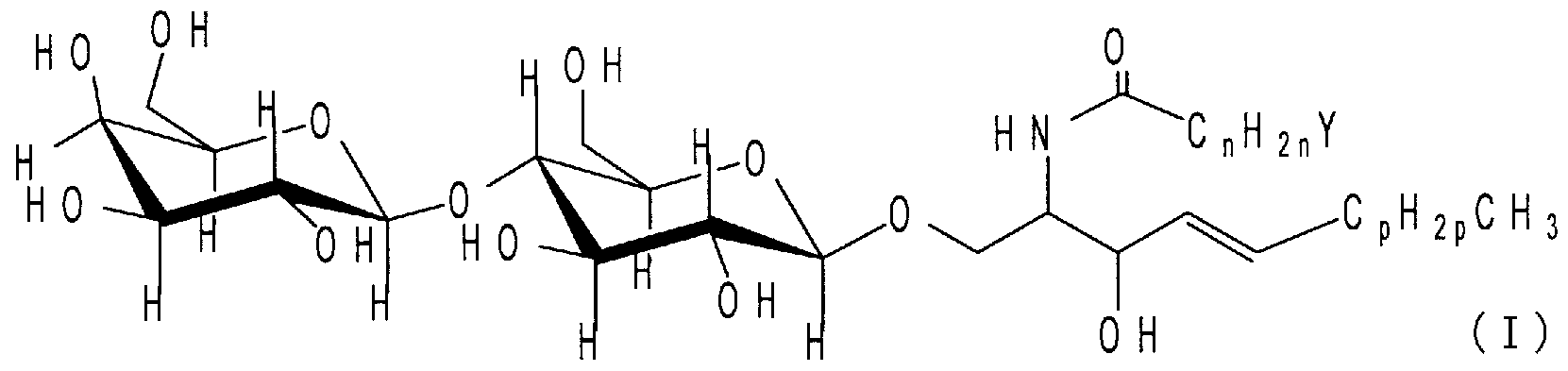
〔式中、 nは 2〜20の整数を示し、 Yは 1個又は 2個以上のチオール基または 1個又は 2個以上ジスルフイド基を有する基を示し;側鎖部位中の pは 1〜 17の整数を示す。〕 で表されるラタトース含有ィ匕合物が、 Yを介して金属基板 1の表面に固定された、セン サーチップ 1;

〔式中、 mは 2〜20の整数を示し、 Zは 1個又は 2個以上のチオール基または 1個又
は 2個以上ジスルフイド基を有する基を示し;側鎖部位中の qは 1〜 17の整数を示す 。〕で表されるガラクトース含有ィ匕合物が、 Zを介して金属基板 2の表面に固定された 、センサーチップ 2。
〔14〕
前記ラタトース含有ィ匕合物と前記ガラクトース含有ィ匕合物とが、同一の金属基板表 面に固定されている、〔13〕に記載のセンサーチップ。
[15]
前記ラタトース含有ィ匕合物および前記ガラクトース含有ィ匕合物が、それぞれ金属基 板 1および 2に固定されたときの密度が 0. 1〜10個 Znm2である、〔13〕または〔14〕 に記載のセンサーチップ。
[16]
前記金属基板 1および 2が、金基板である、〔13〕〜〔15〕のいずれかに記載のセン サーチップ。
〔17〕
前記センサーチップが SPRセンサー用である、〔13〕〜〔16〕のいずれかに記載の センサーチップ。
〔18〕
下記検出試薬 1および下記検出試薬 2を含む、リシン検出用キット;
(1)下記一般式 (I)

〔式中、 nは 2〜20の整数を示し、 Yは 1個又は 2個以上のチオール基または 1個又は 2個以上ジスルフイド基を有する基を示し;側鎖部位中の pは 1〜 17の整数を示す。〕 で表されるラタトース含有ィ匕合物力 Yを介して微粒子 1の表面に固定された、リシン 検出用微粒子 1を含有する検出試薬 1:
(2)下記一般式 (II) ) :

〔式中、 mは 2〜20の整数を示し、 Zは 1個又は 2個以上のチオール基または 1個又 は 2個以上ジスルフイド基を有する基を示し;側鎖部位中の qは 1〜 17の整数を示す 。〕で表されるガラクトース含有ィ匕合物が、 Zを介して微粒子 2の表面に固定された、リ シン検出用微粒子 2を含有する検出試薬 2。 前記検出試薬 1および検出試薬 2において、前記リシン検出用微粒子 1およびリシ ン検出用微粒子 2がそれぞれ溶液中にコロイドで存在している、〔18〕に記載のキット
〔20〕
前記微粒子 1および 2の平均粒子径が、 1〜: LOOnmの範囲にある、〔18〕または〔1 9〕に記載のキット。
〔21〕
前記微粒子 1および 2が金属微粒子または半導体微粒子である、〔18〕〜〔20〕の いずれかに記載のキット。
[0012] くリシンの検出方法〉
本発明に係るリシンの検出方法は、下記の検出工程 1、検出工程 2および認定ェ 程を含む。
[0013] 下記の検出工程 1、検出工程 2および認定工程を含む、リシンの検出方法;
(1)枪出工程 1 :
下記一般式 (I)

〔式中、 nは 2〜20の整数を示し、 Yは 1個又は 2個以上のチオール基または 1個又は 2個以上ジスルフイド基を有する基を示し;側鎖部位中の pは 1〜 17の整数を示す。〕 で表されるラタトース含有ィ匕合物力 Yを介して基材 1の表面に固定されている検出 基材 1の表面に、試験化合物を接触させ、検出基材 1に結合した化合物を検出する 工程、
(2)枪出工程 2 :
下記一般式 (II)

〔式中、 mは 2〜20の整数を示し、 Zは 1個又は 2個以上のチオール基または 1個又 は 2個以上ジスルフイド基を有する基を示し;側鎖部位中の qは 1〜 17の整数を示す 。〕で表されるガラクトース含有ィ匕合物が、 Zを介して基材 2の表面に固定されている 検出基材 2の表面に、前記検出工程 1で用いたのと同一の試験化合物を接触させ、 検出基材 2に結合したィ匕合物を検出する工程、
(a)前記検出工程 1において、検出基材 1の表面に結合したィ匕合物が実質的に検出 されな 、場合、試験化合物にリシン 60が含有されて 、な 、と推定し;
(b)前記検出工程 1において、検出基材 1の表面に結合した化合物が実質的に検出 され、前記検出工程 2において、検出基材 2の表面に結合したィ匕合物が実質的に検 出されな 、場合に、試験化合物にリシン 60が含有されて 、ると推定し;
(c)前記検出工程 1および検出工程 2において、検出基材 1および 2のいずれにおい
ても表面に結合したィ匕合物が実質的に検出される場合、試験化合物にリシン 120が 含有されていると推定する。
[0014] すなわち、本発明で用いるラタトース含有ィ匕合物が固定された検出基材 1は、リシン 60およびリシン 120に対する結合能が極めて高ぐ本発明で用いるガラクトース含有 化合物が固定された検出基材 2はリシン 120に対してのみ結合能が極めて高い。 このため、前記推定工程 (a)に該当する場合は、検出基材 1の表面に結合したィ匕 合物が実質的に検出されない場合、試験化合物にリシン 60が含有されていないと推 定できる。
また、前記推定工程 (b)に該当する場合は、前記検出工程 1において、基材 1の表 面に結合したィ匕合物が実質的に検出され、前記検出工程 2において、基材 2の表面 に結合したィ匕合物が実質的に検出されない場合に、試験化合物にリシン 60が含有 されて!/、ると推定することができる。
さらに、前記推定工程 (c)に該当する場合は、前記検出工程 1および検出工程 2に おいて、検出基材 1および 2のいずれにおいても表面に結合したィ匕合物が実質的に 検出される場合、試験化合物にリシン 120が含有されていると推定することができる。
[0015] ここで、前記推定工程 (c)に該当する場合、リシン 120の存在を推定できるが、リシ ン 120が存在する場合にさらにリシン 60が混入しているか否かは判定できない。しか し、リシン 120はリシン 60に類似したタンパク質の 2量体で、それぞれ分子量が 120k Da、 60kDaと著しく異なるため、分子量 10万程度の分画フィルターなどによる除去 や、分子ふるいによる分離を行なうことによって、これらを容易に短時間で分離精製 することができる。したがって、推定工程 (c)に該当する場合は、試験化合物を分離 工程に供し、リシン 60が含有されている場合でもリシン 120とリシン 60とを分離精製し 、分離したィ匕合物それぞれについて、再び、検出工程 1および Zまたは検出工程 2を 実施すればよい。あるいは、予め、試験化合物を分離精製して、各化合物について、 上記検出工程 1および検出工程 2を実施してもよ 、。
[0016] このような分離工程を行って、各化合物について検出工程を行う場合、下記 (a' )、 ( )、(c' )の推定工程(3 ' )に従って、各化合物がリシン 60と推定できるの力 リシン 1 20と推定できるのかを判断できる。
[0017] 推定工程 (3' )
(a')前記検出工程 1において、検出基材 1の表面に結合したィ匕合物が実質的に検出 されな 、場合、該化合物はリシン 60ではな 、と推定する。
( )前記検出工程 1において、検出基材 1の表面に結合した化合物が実質的に検出 され、前記検出工程 2において、検出基材 2の表面に結合したィ匕合物が実質的に検 出されない場合、該化合物はリシン 60であると推定することができる。
(c')前記検出工程 1および検出工程 2において、検出基材 1および 2のいずれにお いても表面に結合した化合物が実質的に検出される場合、該化合物はリシン 60では ないと推定することができる。
[0018] 本明細書において「実質的に検出」とは、ノイズ程度の検出を除くことを意味する。
[0019] 本明細書にぉ 、て「リシン 60」とは、トウゴマ(ヒマ: Ricinus communis)の種子から抽 出されるタンパク質であり、分子量が 60kDaで、 A鎖(分子量 28kDa)と B鎖(分子量 32kDa)の 2つのサブユニットで構成され、 S— S 結合でつながって!/、る化合物 である。「リシン 120」はリシン 60とホモロジ一が極めて類似なタンパク質の 2量体であ り、トウゴマカもリシン 60とともに抽出される。なお、本明細書において、「リシン 60」お よび「リシン 120」を、まとめて「リシン」という。
[0020] 〈ラ外ース含有化合物〉
前記ラタトース含有ィ匕合物は、下記一般式 (I)で表される。

[0021] 式中、 nは 2〜20の整数を示し、好ましくは 2〜10、さらに好ましくは 3〜8、特に好 ましくは 3〜5である。前記 pは、好ましくは 1〜 17の整数を示し、より好ましくは 7〜17 、さらに好ましくは 10〜 15である。
[0022] このような式 (I)で表されるように、リンカ一部位(一 COC H Y)と側鎖部位(一 CH ( n 2n
OH) C = CC H CH )とを有すると、ラタトース含有ィ匕合物をセンサーに適した配向
性で高密度に基板や微粒子に固定することができるとともに、ラタトース含有化合物 を含有するバイオセンサー、あるいはラタトース含有ィ匕合物が固定された微粒子を含 有する検出試薬を用いると、極微量のリシン 60およびリシン 120でも高感度に検出' 定量できる。
[0023] 特に、式 (I)において、 nが上記範囲にあると、ラタトース含有ィ匕合物を、基板表面あ るいは微粒子表面に結合したときのセンサーの感度が向上するとともに、リシン 60お よびリシン 120との結合に適した密度 ·配向性をもって基板表面または微粒子表面に 効果的〖こ結合させることができる。
[0024] 前記式中、 Yは 1個又は 2個以上のチオール基または 1個又は 2個以上ジスルフイド 基を有する基を示す。本明細書において「チオール基」とは SHで表される基であ り、「ジスルフイド基」とは、—S— S で表される構造を有する基である。
[0025] 前記ジスルフイド基としては、好ましくは環状ジスルフイド基が挙げられ、このうち 5員 環のジチオラニル基、たとえば 1, 2 ジチオラン 3—ィル基、 1, 2 ジチオラン 4 ーィル基など、 6員環のジチア-ル基、たとえば 1, 2 ジチアンー3—ィル基、 1, 2 ージチアンー4ーィル基などが挙げられる。これらのうちでは、 5員環のジチオラ-ル 基が好ましぐ 1, 2 ジチオラン 3—ィル基がより好ましい。また、チォタト酸 (リポ酸 )カゝら誘導される基を用いることもできる。
[0026] これらのうちでは、ジスルフイド基が好まし!/、。ジスルフイド基の場合、ラタトース含有 化合物を基板表面又は微粒子表面に強固に安定に固定ィ匕することができる。特に、 前記式 (I)で表される基では、通常ならば、ラタトース含有ィ匕合物のラタトース部位、リ ンカー部位、および側鎖部位の立体障害が予測され、結合密度の低下、感度低下 などが考えられる力 本発明のように特定のリンカ一と側鎖とジスルフイド基の組み合 わせにより、強固で安定な固定ィヒが可能となり、立体障害の影響がなく高感度のセン サ一とすることができる。
これは、側鎖部位がリンカ一部位の長さに応じて折り畳み構造をとり、折りたたまれ た側鎖部位によって、糖脂質含有ィ匕合物同士がリシンのような糖結合性ィ匕合物との 結合に適した高配向性をもって基板表面や微粒子表面に効果的に結合するためで はないかと推測される。
[0027] さらに、式 (I)において、前記 COC H Yの主鎖に含まれる原子の合計数 (N1)と n 2n
、前記— CH (OH) C二 CC H CHの主鎖に含まれる原子の合計数 (N2)とは、好 p 2p 3
ましくは N1 :N2= 1 : 1. 5〜1 : 5、さらに好ましくは 1: 2〜1: 3の範囲にある。
[0028] なお、 N1においては、前記一 COC H Yにおいて Y中の硫黄原子と一 COとを最 n 2n
長で結合する複数の原子を、主鎖を構成する原子とし、 Yがジスルフイド基の場合は そのうちの COに近い硫黄原子側を主鎖上の原子とし、合計数 N1には硫黄原子 を含まない。また、 N2においては、前記— CH (OH) C = CC H CHにおいて末端 p 2p 3
の CHと CH (OH)を最長で結合する複数の原子を、主鎖を構成する原子とす
3
る。
[0029] 式(I)中、 NHとこれに隣接する一 OHは、 D エリス口体であることが好ましい。
[0030] このような式 (I)の側鎖部位が含まれて 、ると、側鎖部位が存在しな 、場合と比較し て、検出感度を格段に向上させることができる。さらに、このような炭素数あるいは原 子数で側鎖部位が構成され、側鎖部位が前記リンカ一部位の長さよりも大きい長さと なる場合、ラタトース含有ィ匕合物をよりセンサーに適した配向性で基板や微粒子に固 定することができるとともに、該ラクトース含有ィ匕合物を含有するセンサーチップ (バイ ォセンサー)あるいはラタトース含有ィ匕合物が固定された微粒子を含有する検出試薬 を用いると、より微量のリシン 60およびリシン 120でも高感度に検出'定量できる。
[0031] 〈ガラクトース含有化合物〉
前記ガラクトース含有ィ匕合物は、下記一般式 (II)で表される。

[0032] 式中、 mは 2〜20の整数を示し、好ましくは 2〜10、さらに好ましくは 3〜8、特に好 ましくは 3〜5である。前記 qは、好ましくは 1〜 17の整数を示し、より好ましくは 7〜17 、さらに好ましくは 10〜 15である。
[0033] このような式 (II)で表されるように、リンカ一部位(一 COC H Z)と側鎖部位(一 C m 2m
H (OH) C = CC H CH )とを有すると、ガラクトース含有ィ匕合物をセンサーに適した q 2q 3
配向性で高密度に基板や微粒子に固定することができるとともに、ガラクトース含有 化合物が固定されたバイオセンサーあるいは微粒子を含有する検出試薬を用いると 、極微量のリシン 120でも高感度に検出'定量できる一方、リシン 60については実質 的に検出されない。
[0034] 特に、式 (II)において、 mが上記範囲にあると、ガラクトース含有ィ匕合物を、基板表 面あるいは微粒子表面に結合したときのセンサーの感度が向上するとともに、リシン 1 20との結合に適した密度 ·配向性をもって基板表面または微粒子表面に効果的に 結合させることができる。
[0035] 前記式 (II)中、 Zは式 (I)中の Yと同様であり、好ましい態様も同様である。
[0036] さらに、式(II)において、前記 COC H Zの主鎖に含まれる原子の合計数 (N1) m 2m
と、前記 CH (OH) C = CC H CHの主鎖に含まれる原子の合計数 (N2)とは、好 q 2q 3
ましくは N1 :N2= 1 : 1. 5〜1 : 5、さらに好ましくは 1: 2〜1: 3の範囲にある。
[0037] なお、 N1においては、前記 COC H Zにおいて Z中の硫黄原子と COとを最 m 2m
長で結合する複数の原子を、主鎖を構成する原子とし、 zがジスルフイド基の場合は そのうちの COに近い硫黄原子側を主鎖上の原子とし、合計数 N1には硫黄原子 を含まない。また、 N2においては、前記— CH (OH) C = CC H CHにおいて末端 q 2q 3
の CHと CH (OH)を最長で結合する複数の原子を、主鎖を構成する原子とす
3
る。
[0038] 式(II)中、 NHとこれに隣接する一 OHは、 D エリス口体であることが好ましい。
[0039] このような式 (II)の側鎖部位が含まれて 、ると、側鎖部位が存在しな 、場合と比較 して、検出感度を格段に向上させることができる。さらに、このような炭素数あるいは 原子数で側鎖部位が構成され、側鎖部位が前記リンカ一部位の長さよりも大き 、長 さとなる場合、ガラクトース含有ィ匕合物をより高度な配向性で基板や微粒子に固定す ることができるとともに、該ガラタトース含有ィ匕合物を含有するセンサーチップ (バイオ センサー)あるいはガラクトース含有ィ匕合物が固定された微粒子を含有する検出試薬 を用いると、より微量のリシン 120でも高感度に検出 '定量でき、リシン 60は検出され ない。
[0040] 以上のように、本発明で用いるラタトース含有ィ匕合物が固定された検出基材は、リ シン 60およびリシン 120に対する結合能が極めて高ぐ本発明で用いるガラクトース 含有ィ匕合物が固定された検出基材はリシン 120に対してのみ結合能が極めて高い。
[0041] くラ外ース含有化合物、ガラクトース含有化合物の製诰方法〉
本発明で用いるラタトース含有ィ匕合物 (I)、ガラクトース含有ィ匕合物 (II)の製造方法 に限定はないが、細胞二重層膜の表側に多く存在するスフインゴ糖脂質 (親水性基 として糖、脂溶性基としてセラミド部位を有する糖脂質)など力も誘導することができ、 原料入手の容易性からも好適である。以下にラタトース含有ィ匕合物 (I)を例にとって 製造方法を説明する。ガラ外ース含有ィ匕合物 (II)も同様の方法で製造できる。
たとえば、下記工程 1に示すような、出発原料として天然に由来するスフインゴ糖脂 質を用いる方法が挙げられる。
[0042] 工程 1

スフインゴ糖脂質 (A) (式中、 Gは式 (I)中のラ外ース部分と同様であり、 R4は— C
N 1
H -CHであり、 Rは C H -CHである。 )は、ガラクトースとダルコ
0〜: 18 20〜30 3 10〜20 20〜40 3
ースが β 1 4結合した糖鎖部位 (ラタトース部位)と、スフインゴシン塩基に脂肪酸が アミド結合したセラミドと呼ばれる脂質を骨格としている。該スフインゴ糖脂質は、脊椎 動物、無脊椎動物、植物などに広く存在する化合物である。
[0043] たとえば、該スフインゴ糖脂質 (A)を公知の方法を用いて酵素処理することにより(J . Biol. Chem.、 Vol.250, P.24370, 1995年)、セラミド部位にあるアミド結合を選択的に 加水分解し、遊離のアミノ基をもつスフインゴシン塩基が疎水性部となる一本鎖糖脂 質である化合物 (B) (リゾ体)を得ることができる。該酵素反応は、スフインゴ糖脂質や スフインゴミエリンに特異的作用することのできる酵素、スフインゴ脂質セラミド N-デァ シラーゼ (Sphingolipid ceramide N— deacylase: SCDase, E.C. 3.5.1.69)を用いる。当該 酵素はすべてのスフインゴ糖脂質とスフインゴミエリンに作用する。
[0044] 前記 SCDaseは、反応液の pHや界面活性剤濃度により、加水分解以外に、縮合反 応と脂肪酸交換反応も効率よく触媒することができる (J. Lipid Res., Vol.38, P.1923、 1997年)。
[0045] 前記酵素による加水分解反応は、スフインゴ糖脂質 10 μ molに対して SCDaseを好ま しくは 1〜5U添加し、好ましくは pH5.5〜6.5の酢酸緩衝液中で、界面活性剤としてた とえばタウロデオキシコール酸ナトリウム 0.5%〜2.0%の存在下、 30〜40°Cで実施する ことが好ましい。さらに反応液の上層部に、好ましくは反応液の 10倍量に相当する炭 素数 10〜18の炭化水素溶媒を加えることにより高い収率でィ匕合物(B)を得ることが できる。
[0046] 次に、得られた化合物 (B)のァミノ基に、金属基板または微粒子表面と、金属—チ オール結合による固定もしくは化学的および Zまたは物理ィ匕学的な固定が可能なリ ンカー部位となる化合物(C)をィ匕学結合により結合させて化合物(D)を得ることがで きる。このような化合物としては、たとえば、 HOOC-C H Y(C) (式中、 n、 Yは前記 n 2n
式 (I)中の n、 Yと同意義である。)で表される、チォォタト酸、チオール基を末端に有 する脂肪酸、ジスルフイド基を有する脂肪酸が挙げられる。
[0047] また、リンカ一部位を誘導する化合物(C)は、あら力じめカルボン酸を Ν-ヒドロキシ コハク酸イミド (NHS)などで活性ィ匕したものを用いてもよ!、。
リゾ体 (Β)のァミノ基と化合物(C)のカルボキシル基との反応は、溶媒中、必要に応 じ縮合剤の存在下で実施する。化合物(C)の使用量は、リゾ体 (Β)に対して、 1〜3 当量の範囲にあることが好まし 、。
前記溶媒としては、たとえば、 Ν,Ν-ジメチルホルムアミド(DMF)、ジメチルスルホキ
シド (DMSO)、ァセトニトリル、エタノールなどの有機溶媒、水などが挙げられる。溶媒 は、 1種単独であるいは 2種以上を混合して用いることができる。
[0048] 縮合剤を用いる場合、たとえば、 4- (4,6-ジメトキシ- 1,3,5-トリァジン- 2-ィル) -4-メチ ルモルホリン塩(DMT- MM)、ジシクロへキシルカルボジイミド(DCC)、 1-ェチル -3-( 3-ジメチルァミノプロピル)カルボジイミド塩酸塩(EDCまたは WSC)などが挙げられる 。また、 N-メチルモルホリン (NMP)、 NHS等の活性化剤を上記縮合剤と併用して用い ることちでさる。
反応は、好ましくは 0°Cから 60°Cの範囲の温度で、好ましくは 1〜48時間程度行う。
[0049] ラタトース含有化合物(I)は、工程 2に示すように、さらに側鎖部分の 2重結合に、ェ ポキシ基、水酸基の導入やアルデヒドに変換することにより、側鎖部分の炭素数を変 換することができる。
工程 2

[0050] 上記工程 2において、 Rは— C H — Yである。 R4は、— C H — CHで表される基 n 2n p 2p 3
である。 R4'は、 R4と異なる一 C H -CHで表される基である。
p 2p 3
G、 n、 pは、前記と同義である。
N
[0051] ォレフィン部分にエポキシ基を導入するには、アルカリ性過酸ィ匕水素(Prilezhaev エポキシ化反応)、 m-クロ口過安息香酸 (m-chloro perbenzoic acid ;MCPBA酸化)、 Ti (O-i-Pr)と酒石酸ジェチルメタノールの存在下 tert-ブチルヒドロペルォキシド(香月
4
— Sharpless不斉酸化)などを用いて行うことができる。
[0052] ォレフィンに水酸基を導入するには、カンファースルホン酸 (CSA)や p—トルエンス ルホン酸 (pTsOH)のような酸、もしくは、水酸化ナトリウム (NaOH)や水酸化カリウム (K OH)のような塩基の存在下、先のエポキシ基を開裂させ水酸基 (ジオール)を導入で きる。
[0053] また、シァノ水素化ホウ素ナトリウム (NaBH CN)により、還元的に開裂させてもよい
3
。あるいは、ォレフィンに BHを作用させ、その後、過酸化水素水で処理して、モノォ
3
ール(モノアルコール)に変換できる(ヒドロボレーシヨン)。
[0054] さらに、ォレフィンをオゾン気流下でオゾン酸ィ匕すると、アルデヒドが得られる。ェポ キシ基を開裂させて得られる水酸基 (ジオール)を、過ヨウ素酸酸化して同様の誘導 体を得ることもできる(但し、糖水酸基は、例えば、ァセチル基などのァシル系保護基 で保護しておく必要がある)。
[0055] 得られるアルデヒドは、その後、 Wittig反応により、任意の長さの炭化水素を有する リンイリドと反応させて、式 (5)中の側鎖の長さを任意に変換することができる。
[0056] 前記ラタトース含有ィ匕合物およびガラクトース含有ィ匕合物における糖鎖部位が、ラ クトース、ガラクトースで記載されるセラミド型の糖脂質は、いずれも市販品(コスモバ ィォ、 SIGMA、生化学工業、タカラバイオなど)力も誘導できる。これらのセラミド誘導 体は、 sphingolipid ceramide N- deacylase (E.C. 3.5.1.69)による選択的な加水分解に より、リゾ体へと変換でき、遊離したァミノ基にリポ酸のようなチォカルボン酸を反応さ せた後、センサーチップに固定化できる。
[0057] く検出某材〉
本発明に係るリシン検出用基材は、検出基材 1および検出基材 2を含むキットであ る。
前記検出基材 1は、前記式 (I)で表されるラタトース含有ィ匕合物が、 Yを介して基材 1の表面に固定されている。また、前記検出基材 2は、前記式 (II)で表されるガラタト ース含有ィ匕合物力 Zを介して基材 2の表面に固定されている。
なお、本明細書中、検出基材 1および 2を検出基材と総称し、基材 1および 2を基材 と総称することがある。
[0058] 基材としては、金属基板、ガラス基板、微粒子などが挙げられる。微粒子としては、
金属微粒子、半導体微粒子などが挙げられる。
基材が金属基板の場合、検出基材は下記のセンサーチップとして用いることができ 、 SPRなどの方法により、測定を行う。検出基材 1は下記のセンサーチップ 1として、 検出基材 2は下記のセンサーチップ 2として用いられる。
基材がガラス基板の場合、あらカゝじめシランカップリング法などにより、ガラス基板表 面にチオール基あるいはジスルフイド基と反応可能な官能基を導入し、それを介して 前記ラタトース含有ィ匕合物および前記ガラクトース含有ィ匕合物が固定化される。この 検出基材は分光分析法によるタンパク質定量や光導波路による光学的方法などで 用いられる。
基材が金属微粒子や半導体微粒子などの微粒子の場合、検出基材は検出試薬に 適用することができる。具体的には、検出基材 1は微粒子 1の表面に前記ラタトース 含有ィ匕合物が固定されたリシン検出用微粒子 1であり、検出基材 2は微粒子 2の表面 に前記ガラクトース含有ィ匕合物が固定されたリシン検出用微粒子 2である。これらは 検出試薬やテストストリップ (例えば、ペーパークロマトや試験紙など)として用いられ る。
以下に、センサーチップおよび検出試薬の場合について詳説する。
[0059] くセンサーチップ 1および 2、リシン枪出用センサーチップ〉
本発明に係るリシン検出用センサーチップは、下記のセンサーチップ 1およびセン サーチップ 2を含む。
該センサーチップ 1および 2は、それぞれ前記ラタトース含有ィヒ合物または前記ガラ クトース含有ィ匕合物がリンカ一部位を介して金属基板表面に固定されている。
具体的には、本発明で用いるセンサーチップ 1は、前記式 (I)で表されるラタトース 含有化合物が、 Yを介して金属基板 1の表面に固定されている。また、本発明で用い るセンサーチップ 2は、前記式 (II)で表されるガラクトース含有ィ匕合物力 Zを介して 金属基板 2の表面に固定されて 、る。
[0060] これらセンサーチップ 1とセンサーチップ 2とは、前記ラタトース含有化合物およびガ ラタトース含有ィ匕合物が別々の金属基板に固定されて、センサーチップ 1とセンサー チップ 2とが独立して存在して 、てもよ 、し、前記ラタトース含有ィ匕合物およびガラタト
ース含有化合物が同一の金属基板上に固定されて、センサーチップ 1とセンサーチ ップ 2とが同一基板上で共存していてもよい。同一基板上に共存する場合、前記ラタ トース含有ィ匕合物およびガラクトース含有ィ匕合物の固定をアレイ状に行うこともできる
[0061] 前記金属基板の素材としては、たとえば、好ましくは金、銀、白金、銅、ノ ラジウムな どが挙げられ、これらのうちさらに好ましくは金または白金、特に好ましくは金が挙げ られる。基板の形状は限定されず、板状、管状、棒状、球状などの形状が挙げられる 。このうち板状の形状を有する基板を好ましく用いることができる。
[0062] 金属基板への固定化は、好ましくは、金属表面と、チオール基 (-SH)あるいはジス ルフイド基 (-S-S-)の直接的な金属ーチオール結合や吸着により行うことができる。 したがって、この場合、前記ラタトース含有ィ匕合物またはガラクトース含有ィ匕合物の うち、配糖体の末端に、—SHまたはジスルフイド基を末端に有する化合物が好まし い。
[0063] 前記ラタトース含有ィ匕合物およびガラクトース含有ィ匕合物の場合、側鎖部位の自己 組織ィ匕による相乗効果により、高度な配向性と高密度な固定が可能となる。さらに、 この自己組織化は、スフインゴシン塩基のような天然由来の側鎖を有することが望ま しい。これは、センサーチップの基板表面が、細胞膜の表面状態に近似した状態に あるためではな!/、かと推測される。
[0064] 基板との結合は、自己組織化単分子膜 (SAM: Self-Assembled Monolayer)法などを 用いて行うことができる。すなわち、チオール基あるいはジスルフイド基を有する化合 物力 金などと金属ーチオール結合により特異的に吸着し、アルキル鎖間の van der Waals力により SAMを形成させる方法である。
[0065] 前記ラタトース含有ィ匕合物およびガラクトース含有ィ匕合物力 SHまたはジスルフ イド基を末端に有する場合、前記ラタトース含有化合物およびガラクトース含有化合 物による金属基板表面への単分子膜の構築は、特殊な装置を必要とせず、これら誘 導体の溶液中に基板を浸漬するだけで容易に実施できる。また、浸漬条件 (溶媒、 濃度、温度、時間)によって構造、配向の制御も可能である。ここで用いられる溶媒は 特に限定されるものではないが、固定化させる誘導体が溶解する有機溶媒あるいは
緩衝液であることが好ま 、。
[0066] 通常、金属基板表面における前記ラタトース含有ィヒ合物およびガラクトース含有ィ匕 合物の結合割合は、それぞれ好ましくは 0.1〜10個 Znm2、さらに好ましくは 1〜10個 Znm2の範囲である。このような結合割合であると、優れた検出感度を発揮することが できる。
特に、前記ラタトース含有ィ匕合物およびガラクトース含有ィ匕合物において、側鎖部 位が前記リンカ一部位よりも長くなると、側鎖部位カ^ンカ一部位の長さに応じて折り 畳み構造をとり、折りたたまれた側鎖部位によって、前記ラタトース含有化合物および ガラクトース含有ィ匕合物同士がリシン 60あるいはリシン 120との結合に適した配向性 をもって基板表面や微粒子表面に効果的に結合するためではないかと推測される。 それにより、上記のような好ましい結合割合が達成されたものと推測される。
[0067] このような、本発明で用いるラタトース含有ィ匕合物が固定ィ匕されたセンサーチップ 1 は、リシン 60およびリシン 120に対する検出感度が極めて高ぐ本発明で用いるガラ クトース含有ィ匕合物が固定ィ匕されたセンサーチップ 2はリシン 120に対してのみ検出 感度が極めて高い。
[0068] 〈リシン檢 用センサーチップ 用いるリシンの檢出 法〉
本発明に係る各センサーチップ (センサーチップ 1および 2)を用いるリシンの検出 方法は、試験化合物を、センサーチップの基板表面に接触させ、基板表面に結合し たリシン 60あるいはリシン 120を検出し、存在を推定するというものである。
[0069] 検出の基本工程は下記の通りである。
(1)試験化合物を、前記センサーチップの表面に接触させる工程。
(2)センサーチップに結合したリシン 60またはリシン 120を検出する工程。
[0070] 前記センサーチップ 1または 2と、試験化合物との接触は通常、溶媒の存在下で行 うことが好ましい。前記センサーチップを用いるリシンの検出においては、これらが変 性しな 、溶媒を選択することが必要であり、たとえば水または緩衝液などを用いる。 溶媒の pHは、好ましくは 4〜8の範囲であり、温度は好ましくは 0〜60°C、さらに好 ましくは 25〜40°Cの範囲である。
[0071] 緩衝液は、たとえば、リン酸緩衝液、酢酸緩衝液、 HEPES緩衝液、またはトリス緩衝
液、より好ましくは HEPES緩衝液(10mM、 pH : 7.5、 NaCl: 0.15N)などが挙げられる。
[0072] 以下に、本発明に係るセンサーチップのうち、表面プラズモン共鳴(Surface Plasmo n Resonance : SPR)による、リシンの検出方法の一例を示す。 SPRによる検出方法で は、標識物質を用いることなく試験化合物 (アナライト、分析対象化合物ともいう)の変 化を検出することができる。この SPRの現象は、表面プラズモン(SP)と p偏向単色光 を臨界角以上で入射することにより金属 Z液体界面で生じるエバネッセント波が共鳴 することで、反射光に急峻な減衰を示す光学現象であり、これにより、センサーチップ 表面 Z液体界面の誘電率変化をプラズモン共鳴角(SPRシグナル)力も検出できる。 すなわち、金属表面に固定ィ匕した物質と検体との間の二分子間結合および解離の 変化を SPRシグナル力 定量的に得られる。
[0073] このような SPRシグナルを計測することにより、高感度に、センサーチップ 1の場合、 リシン 60およびリシン 120を、センサーチップ 2の場合、リシン 120を検出することが できる。
[0074] リシンの検出は、温度を好ましくは 0〜60°C、さらに好ましくは 25〜40°Cの範囲で 一定に保持し、好ましくはリン酸緩衝液、酢酸緩衝液、 HEPES緩衝液、またはトリス緩 衝液、より好ましくは HEPES緩衝液で行う。
[0075] これに試験化合物を含む溶液をゆっくりと注入する。ァフィユティー定数を求める場 合には、リシンの濃度を変化させ、 2〜8回の測定をすることが望ましい。反応時間は 結合 ·解離反応ともに 3〜30分程度が好ましいが、 目的の相互作用によっては測定 時間を変更する場合がある。
[0076] また、緩衝液の流速は好ましくは 3〜50 μ L/minで、検体量は ρΜ〜 μ Μを 1回の測 定にっき 5〜: L000 L程度にするのが好ましい。ァフィユティー定数は 2〜8点の測 定濃度をとり、各濃度のセンサーグラムにおいて、平衡状態よりスキャッチヤードプロ ットを作成してァフィユティー定数 (Κおよび Κ )を算定する。
d a
[0077] このような、本発明のセンサーチップを用いる、表面プラズモン共鳴バイオセンサー は、極微量(lng程度)のリシンでも、前処理あるいは標識物質を用いないで、高感度 に検出できることができる。
すなわちセンサーチップ 1とリシン 60および 120との結合速度定数 (K )および解離
a
定数 (κ )は、前記式 (I)で表されるラタトースセラミドィ匕合物の場合において高い値
D
および小さい値を示す。
またセンサーチップ 2とリシン 120との結合速度定数 (K )および解離定数 (K )は、 a D 前記式 (II)で表されるガラクトースセラミドィ匕合物の場合にぉ 、て高 、値および小さ い値を示す。
[0078] このような効果はスフインゴシン塩基などの側鎖部位の自己組織化機能により、高 度な配向性と高密度な固定ィヒが行われ、複数の近接する糖鎖部位が効率よくリシン を強く結合させるためである。
[0079] 通常、センサーチップ 1によるリシン 60およびリシン 120の検出、センサーチップ 2 によるリシン 120の検出において、「ィ匕合物が実質的に結合している」場合には、ノィ ズ程度の結合は含まない。この場合、具体的にノイズと判断し結合していないと判定 するか、実質的に結合しているかの判定は、予め、それぞれのセンサーチップ 1およ び 2毎の絶対感度を測定し、ノイズと判定する基準となる標準敷居値を設定しておく ことにより、十分な確度を持って判定可能である。標準敷居値としては、たとえば下記 のいずれか〖こ該当する場合が挙げられる。
[0080] (0 センサーチップ 1を用いて、 SPR法により特定条件下でリシン 60を測定した場 合のレスポンス (RU)値を標準敷居値とし、該標準敷居値の(1Z3〜: LZ2)以下で ある場合、ノイズと判定する。
GO センサーチップ 1を用いて、 SPR法により特定条件下でリシン 120を測定した場 合のレスポンス (RU)値を標準敷居値とし、該標準敷居値の(1Z3〜: LZ2)以下で ある場合、ノイズと判定する。
(iii) センサーチップ 2を用いて、 SPR法により特定条件下でリシン 120を測定した場 合のレスポンス (RU)値を標準敷居値とし、該標準敷居値の(1Z3〜: LZ2)以下で ある場合、ノイズと判定する。
[0081] 標準敷居値の設定における特定条件としては、たとえば、上記 G)〜Gii)のセンサー チップ 1、 2において、式中、 n=m=4、 p = q= 13、 Y=Z= 1, 2—ジチオランー3— ィル基であり、タンパク質濃度が 10 g/mL、 10mM HEPES (pH7. 5、 NaClO. 15M)、流速 lO /z LZmiru温度 25°C (Biacore2000 :商品名)の条件下で行ったも
のが挙げられる。特に、高度な分析 (検出)を行う場合には、上記タンパク質濃度が 1 〜: LOngZmLの条件で行うことが好ましい。また、必要に応じ、タンパク質濃度に対 する検量線を作成してもよ ヽ。この検量線により未知試料のタンパク質濃度を決定す ることちでさる。
[0082] また、非特異的な結合かどうかの判定は、ラタトースあるいはガラクトースを阻害剤と して試験化合物に添加した後、測定することでシグナルが抑制又はノイズ程度になる ことから推測できる。さらに、ノイズであるかどうかは、試験化合物に含まれるリシン 60 や 120の濃度にも依存するが、通常、公知の分析手法に従い、一定条件における検 出値に換算して、検出確度を推測することもできる。
[0083] 〈リシン檢出用微粒早、檢出試靠、リシン檢出用キット〉
リシン檢出用微粒早
本発明で用いるリシン検出用微粒子 1は、前記ラタトースセラミドィ匕合物が、微粒子 1の表面に固定されている微粒子である。
本発明で用いるリシン検出用微粒子 2は、前記ガラクトースセラミドィ匕合物が、微粒 子 2の表面に固定されている微粒子である。
本明細書中、微粒子 1および 2を微粒子と、リシン検出用微粒子 1および 2を、リシン 検出用微粒子と、検出試薬 1および 2を検出試薬と総称することがある。
[0084] 前記のとおり、微粒子としては、金属微粒子、半導体微粒子が挙げられる。
[0085] 金属微粒子の素材としては、好ましくは金、銀、白金、銅、パラジウムなどが挙げら れ、これらのうちより好ましくは金または白金、特に好ましくは金である。
半導体微粒子の素材としては、好ましくは Zn、 Cd等の II族元素と、 0、 S等の VI族 元素とを組み合わせた II VI族系化合物である ZnS系、 CdSe系ナノ粒子あるいは複 合体粒子などが挙げられる。
[0086] このような微粒子は、平均粒子径が、好ましくは 1〜: LOOnm、さらに好ましくは 1〜5 Onmの範囲にある。
[0087] 金属微粒子は、単分散な粒子径であることが好ま 、。この範囲の金属微粒子を用 いることで、視覚的に検出可能なシグナル色 (例えば、金の場合:オレンジ〜赤色、 銀の場合:黄色)が得られ、かつ溶媒中における分散安定性が良好になり、高感度で
検出時間の短縮が図ることができる。
[0088] 本発明で用いる金属微粒子は、公知の方法により製造することができる。たとえば、 金微粒子は、 Frensの方法を用いることにより、種々の大きさの微粒子を容易に製造 することができる(Nature Phys. Sci.、 Vol.241, P.20、 1973年)。
[0089] 具体的には、たとえば金微粒子の製造方法としては、塩化金の溶液を加熱沸騰さ せ、ついで、クェン酸ナトリウムの溶液と混合して塩ィ匕金を還元する方法により行うこ とができる。上記二つの溶液を混合するとすぐに沸騰溶液は薄 ヽ青色に変色して核 生成が開始される。ついで、すぐに青色から赤色に変わって単一分散微粒子の生成 が起こり、塩ィ匕金の還元は沸騰をさらに続けることで完了する。
得られる金属微粒子の粒子径は、クェン酸ナトリウム溶液の濃度を変化させることに より調整することができる。このような金微粒子は溶液中に分散して存在できることが 好ましぐその状態は特に限定されないが、金微粒子が安定な分散状態で存在して いることが好ましい。例えば、コロイド状態 (分散コロイド状態)となることがより好ましい
[0090] また、本発明で用いる半導体微粒子は、公知の方法により製造することができる。
例えば、メルカプトエタノールやメタクリル酸のような水溶性の有機配位子を含む水溶 液により半導体超微粒子を合成する方法がある。中でも、特開 2002— 201471号公 報に示すような中和共沈法と称される方法は、表面配位された半導体微粒子が水中 に分散した形態で合成されることから、特に、 ZnS微粒子を合成する際によく用いられ ている。この ZnS微粒子は、 Zn及び有機配位子を含む水溶液に硫化ナトリウムを投 入し、中和共沈反応を生じさせることにより、水中に分散した形態で合成される。得ら れる半導体微粒子の粒子径は、有機配位子濃度などを変化させることにより調整す ることができる。このような半導体微粒子の状態は特に限定されないが、乾燥もしくは 溶液中に分散した状態が好ましい。特に、コロイド状態 (分散コロイド状態)となること 力 り好ましい。
[0091] 金属微粒子や半導体微粒子などの微粒子に、ラタトース含有ィ匕合物またはガラタト ース含有ィ匕合物を固定ィ匕する方法としては、前記センサーチップにラタトース含有ィ匕 合物またはガラクトース含有ィ匕合物を固定ィ匕した方法を応用することが可能である。
すなわち、微粒子を分散させた溶液とラタトース含有ィ匕合物またはガラクトース含有 化合物の溶液を 5分以上混合する。この時、微粒子に対して十分量のラタトース含有 化合物またはガラクトース含有ィ匕合物が固定されれば、金属コロイドは安定に分散さ れ、リシン検出用微粒子を得ることができる。ここで、微粒子表面におけるラタトース含 有ィ匕合物またはガラクトース含有ィ匕合物の結合割合は、溶液中のラタトース含有ィ匕 合物またはガラクトース含有ィ匕合物の濃度やその他条件 (例えば、溶媒、温度、時間 など)でコントロールすることができる。
[0092] 通常、微粒子表面におけるラタトース含有ィ匕合物またはガラクトース含有ィ匕合物の 結合割合は、好ましくは 0.1〜10個 Znm2、さらに好ましくは 1〜10個 Znm2の範囲であ る。このような結合割合であると、優れた検出感度を発揮することができる。
特に、本発明で用いる式 (1)、 (II)の前記ラタトース含有ィ匕合物またはガラクトース含 有ィ匕合物においては、特定の原子数で側鎖部位、リンカ一部位が構成される。この 場合、特に、側鎖部位が前記リンカ一部位よりも長い場合、側鎖部位がリンカ一部位 の長さに応じて折り畳み構造をとり、折りたたまれた側鎖部位によって、ラタトース含 有ィ匕合物またはガラクトース含有ィ匕合物同士がリシンとの結合に適した配向性をもつ て基板表面や微粒子表面に効果的に結合するためではないかと推測される。それに より、上記のような好ま 、結合割合が達成されたものと推測される。
[0093] また、このようなリシン検出用微粒子は、溶液形態で保存することが、該微粒子の保 存安定性の観点力も好まし 、。
この場合、前記式 (I)または (Π)で表されるラタトース含有ィ匕合物またはガラクトース 含有ィ匕合物が結合したリシン検出用微粒子は、 -C ( = 0) -C H — Yまたは— C ( n 2n
= 0) -C H —Zで表されるリンカ一部位において、 nおよび m力 それぞれ、 2〜2 m 2m
0の整数、好ましくは 2〜 10の整数、さらに好ましくは 3〜8、特に好ましくは 3〜5であ り、リンカ一部位の長さが特定範囲以内にあるため、溶液中での分散安定性に極め て優れている。したがって、本発明で用いるラタトース含有ィ匕合物またはガラクトース 含有ィ匕合物が結合したリシン検出用微粒子は、特に溶液中での使用に優れる。
[0094] 前記ラタトース含有ィ匕合物またはガラクトース含有ィ匕合物の微粒子への固定化に お!、ては、ラタトース含有ィ匕合物またはガラクトース含有ィ匕合物の高度な配向性と高
密度な固定を目的にしていることから、必要十分量のラタトース含有ィ匕合物またはガ ラタトース含有ィ匕合物を混合して固定ィ匕を図ることが好ましいが、過剰量のラタトース 含有化合物またはガラクトース含有化合物を混合すると、混合溶液中からの除去作 業が必要となる。
[0095] たとえば、金微粒子の場合、ラタトース含有ィ匕合物またはガラクトース含有ィ匕合物を 固定ィ匕した金微粒子の分散溶液の分散安定性と色調変化の関係から、ラ外ース含 有ィ匕合物またはガラクトース含有ィ匕合物の最適な混合量を決定することができる。 すなわち、添加したィ匕合物が最適量以下の場合、ラタトース含有ィ匕合物またはガラ クトース含有ィ匕合物を自己組織ィ匕するための十分な量に達しないため、金微粒子表 面の疎水性が増力!]して分散安定性の低下し、色調の変化および凝集 沈殿を生じ る。
また、添加した化合物が最適量以上の場合、リシンを添加した後、凝集反応が過剰 に添加したィ匕合物によって阻害され、色調変化が小さくなることから、過剰量の化合 物を除去する必要がある。したがって、分散安定性に優れ、かつリシン添加後の凝集 反応が明確な添加量が最適添加量となる。
[0096] また、 CdSe/ZnS複合などの半導体微粒子の場合でも、上記手法を用いることでラタ トース含有ィ匕合物またはガラクトース含有ィ匕合物のの最適な混合量を決定することが できる。
[0097] 檢出試
前記微粒子へのラタトース含有ィ匕合物またはガラクトース含有ィ匕合物の固定ィ匕によ り、リシン検出用微粒子を得ることができるが、該微粒子を含む溶液は、そのまま本発 明のリシンの検出試薬として使用することができる。
このため、前記固定ィ匕に使用する溶媒は、検出対象となるリシンが変性しないこと が必要であり、たとえば水または緩衝液などを用いる。
溶媒の pHは、好ましくは 6〜8の範囲であり、温度は好ましくは 0〜60°C、さらに好 ましくは 25〜40°Cの範囲である。
[0098] 緩衝液は、たとえば、リン酸緩衝液、酢酸緩衝液、 HEPES緩衝液、またはトリス緩衝 液、より好ましくは HEPES緩衝液(10mM、 pH : 7.5、 NaCl: 0.15N)などが挙げられる。
[0099] このようにして、リシン検出用微粒子の合成に伴って、リシン検出用微粒子を溶媒 中に含有する検出試薬が得られることとなる。
[0100] 金属微粒子の場合、このような検出試薬においては、溶液中に微粒子がコロイドに なって存在していることが好ましぐ該コロイドは分散して存在していることがより好まし い。
[0101] 金属微粒子の金属コロイドが安定ィ匕されたかの確認は、たとえば、金コロイドの場 合、混合溶液に等量の 10%塩ィ匕ナトリウム水溶液を加えて、金コロイドの色調に変化 がなければ安定ィ匕されていると認定することができる。
[0102] 半導体微粒子の場合も同様に、溶液中に微粒子がコロイドになって存在しているこ とが好ましぐ該コロイドは分散して存在していることがより好ましい。
[0103] 半導体微粒子の分散が安定化されたかの確認は、たとえば、混合溶液に等量の 1 0%塩ィ匕ナトリウム水溶液を加えて、分散溶液に紫外線を照射した時に得られる蛍光 の強度に変化が無ければ安定ィ匕されていると認定することができる。
[0104] 検出試薬中のリシン検出用微粒子の濃度は、好ましくは 1. OX 105〜1. OX 1015個
ZL、さらに好ましくは 1. ox io7〜i. ox io13個 ZLの範囲である。
このような濃度範囲であると、リシン検出用微粒子のコロイドが分散して安定に存在 し、保存安定性を向上させることができるとともに、リシンの検出感度を向上させること ができる。
[0105] このような、本発明で用いるラタトース含有ィ匕合物が固定化されたリシン検出用微粒 子 1を含む検出試薬 1は、リシン 60およびリシン 120に対する検出感度が極めて高く 、本発明で用いるガラクトース含有ィ匕合物が固定化されたリシン検出用微粒子 2を含 む検出試薬 2は、リシン 120に対してのみ検出感度が極めて高い。
[0106] 本発明に係るリシン検出用キットは、前記検出試薬 1および 2を含む。
[0107] く枪出試蓉を用いるリシンの枪出方法〉
本発明で用いる各検出試薬 (検出試薬 1および 2)を用いるリシンの検出方法は、試 験化合物を、検出試薬中のリシン検出用微粒子表面に接触させ、さらに、微粒子表 面に結合したリシン 60あるいはリシン 120を検出するというものである。
[0108] 検出の基本工程は下記の通りである。
(1)試験化合物を、前記検出試薬に添加して、リシン検出用微粒子に接触させるェ 程。
(2)リシン検出用微粒子に結合したリシン 60またはリシン 120を検出する工程。
[0109] リシン検出用微粒子に結合したリシンの検出手段としては、たとえば、金属微粒子 を用いる場合、リシン検出用微粒子のコロイド溶液において、該微粒子がリシンと結 合する際の色調変化力 該リシンの検出を行う方法が挙げられる。
具体的には、たとえば、金微粒子の場合、リシンがリシン検出用微粒子と結合して V、な 、状態にぉ 、て、前記微粒子のコロイド粒子が分散した状態で溶液は赤色を示 すが、リシンが結合すると前記微粒子が凝集して赤色が薄れるあるいは無色透明に 変化する、または、凝集体 (沈殿物)が生じる。
したがって、前記検出工程 1において、赤色の凝集沈殿が薄れるか無色透明にな つた場合、リシン 60またはリシン 120の存在を推定でき、前記検出工程 2において、 赤色の凝集沈殿が薄れるか無色透明になった場合、リシン 120の存在を推定できる
[0110] 色調変化の計測手法としては、目視により観測し、その結果に基づいて測定対象 物質の存在を簡便に半定量することができる。
[0111] また、色調変化を分光光度計により高感度検出することも可能である。その場合、 色調変化を測定するための波長としては、色調変化を測定可能な波長であれば、特 に限定されないが、たとえば、金微粒子の場合、金微粒子の極大吸収波長付近 500 550 付近が測定感度を高くすることができるので望ましい。多波長による吸光度 測定を行うことで、精度の高い検出が可能であることは言うまでもない。
色調変化の測定を行える装置としては、比色計、分光光度計、マイクロプレートリー ダー、生化学自動分析機等が挙げられる。
[0112] また、半導体微粒子を用いる場合、リシン検出用微粒子の溶液において、該微粒 子がリシンと結合する際の蛍光強度の変化力 該リシンの検出を行う方法が挙げられ る。
[0113] このような色調変化あるいは蛍光強度の変化を計測することにより、高感度に、リシ ン検出用微粒子 1を含む検出試薬 1の場合、リシン 60およびリシン 120を、リシン検
出用微粒子 2を含む検出試薬 2の場合、リシン 120を、極めて簡便に短時間で検出 することができる。
〈テストストリップ〉
前記ラタトース含有ィ匕合物は、リシン 60および 120と特異的に結合し、前記ガラタト ース含有ィ匕合物は、リシン 120と特異的に結合するので、これら化合物を固定ィ匕した 金属微粒子および半導体微粒子はテストストリップ (例えば、ペーパークロマトや試験 紙など)に用いることができる。
ここでテストストリップとは、試験化合物の溶液をろ紙や高分子膜に浸透させること で簡便にかつ短時間で判定する検査キットを意味する。具体的には、ろ紙や高分子 膜の一部に標的物質 (リシン)が結合しうる処理 (例えば、化学的結合、糖鎖や抗体を 用いた特異的結合など)を行 ヽ、テストストリップに試験化合物の溶液を浸透させるこ とで、その処理部分に試験化合物が保持される。つぎに、前記ラタトース含有ィ匕合物 および前記ガラクトース含有ィ匕合物を固定ィ匕した金属微粒子あるいは半導体微粒子 と接触させることで、処理部分が着色され、目視あるいは分光計測機器などで検出す ることがでさる。
また、毛細管現象を利用したいわゆるクロマト法によるテストストリップを用いた検出 方法も行うことができる。すなわち、メンブレン上に標的物質 (リシン)が結合しうる処理 (例えば、化学的結合、糖鎖や抗体を用いた特異的結合など)を行う。テストストリップ に添加された試験化合物の溶液は、毛細管現象によりストリップ上を移動する。その 移動過程で、前記ラタトース含有化合物および前記ガラクトース含有化合物を固定 化した金属微粒子あるいは半導体微粒子を接触させることで、これら微粒子は標的 物質 (リシン)と結合する。つぎに、メンブレン上に処理した部分は標的物質 (リシン)と 結合を起こし、その結果、メンブレン上に微粒子による有色あるいは蛍光発光の判定 ラインが現れることで検出される。
このような検出 ·判定キットは簡便でかつ短時間で検出することができる。
なお本明細書において引用されたすベての先行技術文献は、参照として本明細書 に組み入れられる。
図面の簡単な説明
[0115] [図 1]化合物(la)、化合物(Ila)、化合物(Ilia)を固定ィ匕したセンサーチップによるリシ ン 60との相互作用を表した SPRセンサーグラムである。ここで、リシン 60溶液の注入 量は 1 μ g/mL溶液を 100 μ Lであり、流速 10 μ L/min、温度 25°Cの結果である。
[0116] [図 2]化合物(la)、化合物(Ila)、化合物(Ilia)を固定ィ匕したセンサーチップによるリシ ン 120との相互作用を表した SPRセンサーグラムである。ここで、リシン 120溶液の注 入量は 1 μ g/mL溶液を 100 Lであり、流速 10 /z L/min、温度 25°Cの結果である。
[0117] [図 3]化合物(la)を固定ィ匕したセンサーチップ (la)によるリシン 60との相互作用を表 した SPRセンサーグラムである。ここで、リシン 60濃度を 0.01 μ g/mL, 0.1 μ g/mL, 1 μ g/mL, 10 μ g/mLと変化させた溶液を 100 μ L注入し、流速 10 μ L/min、温度 25°Cの 結果である。
[0118] [図 4]化合物(Ila)を固定ィ匕したセンサーチップ (2a)によるリシン 60との相互作用を表 した SPRセンサーグラムである。ここで、リシン 60濃度を 0.01 μ g/mL, 0.1 μ g/mL, 1 μ g/mL, 10 μ g/mLと変化させた溶液を 100 μ L注入し、流速 10 μ L/min、温度 25°Cの 結果である。
[0119] [図 5]化合物(Ilia)を固定ィ匕したセンサーチップ (3a)によるリシン 60との相互作用を表 した SPRセンサーグラムである。ここで、リシン 60濃度を 0.01 μ g/mL, 0.1 μ g/mL, 1 μ g/mL, 10 μ g/mLと変化させた溶液を 100 μ L注入し、流速 10 μ L/min、温度 25°Cの 結果である。
[0120] [図 6]化合物(la)を固定ィ匕したセンサーチップ (la)によるリシン 120との相互作用を表 した SPRセンサーグラムである。ここで、リシン 120濃度を 0.01 μ g/mL, 0.1 μ g/mL, 1 μ g/mL, 10 μ g/mLと変化させた溶液を 100 μ L注入し、流速 10 μ L/min、温度 25°C の結果である。
[0121] [図 7]化合物(Ila)を固定ィ匕したセンサーチップ (2a)によるリシン 120との相互作用を 表した SPRセンサーグラムである。ここで、リシン 120濃度を 0.01 μ g/mL, 0.1 μ g/mL 、 1 μ g/mL, 10 g/mLと変化させた溶液を 100 L注入し、流速 10 /z L/min、温度 25 °Cの結果である。
[0122] [図 8]化合物(Ilia)を固定ィ匕したセンサーチップ (3a)によるリシン 120との相互作用を 表した SPRセンサーグラムである。ここで、リシン 120濃度を 0.01 μ g/mL, 0.1 μ g/mL
、 1 μ g/mL、 10 /z g/mLと変化させた溶液を 100 /z L注入し、流速 10 /z L/min、温度 25 °Cの結果である。
[0123] [図 9]化合物(la)、化合物(Ila)、化合物(Ilia)を固定ィ匕したセンサーチップによる各 種タンパク質との相互作用を表したグラフである。ここで、タンパク質溶液の濃度を 10 μ g/mLとして、タンパク質溶液 10 Lを流速 10 L/minで注入したときの SPRシグナ ルの値を示している。
[0124] [図 10]化合物 (la)、化合物 (Ila)、化合物 (Ilia)を金微粒子に固定ィ匕した検出試薬を 用いたリシン検出試験の結果を示した図である。試験条件は、試薬(lb)〜(3b) 200 μ Lにリシン溶液 10 g/mL溶液を 100 L添加、室温で 10分間静置した。
[0125] [図 11]化合物 (la)、化合物 (Ila)、化合物 (Ilia)を金微粒子に固定ィ匕した検出試薬を 用いた各種タンパク質によるリシン特異性評価試験の結果を示した図である。試験条 件は、試薬(lb)〜(3b) 200 Lに各種タンパク質溶液 10 g/mL溶液を 100 L添カロ 、室温で 10分間静置した。
発明を実施するための最良の形態
[0126] 以下に、本発明の実施例および比較例を挙げ、具体的に説明する力 本発明はこ れらによって何ら限定されるものではない。
[0127] く》脂皙含有化合物の合成〉
実施例 1

Lyso-lactosyl-ceramide

( l a)
[0129] 〔酵素反応によるセラミド部位の選択的加水分解〕
Lactosyl- ceramide 10.0mg (11.0 μ mol) (SIGMA社製)を 1.0%タウロデオキシコール 酸ナトリウムの 50mM酢酸緩衝液(pH6.0) 10mLに溶かし 500mL梨型フラスコに入れた 。次にスフインゴ脂質セラミド N-デアシラーゼ (SCDase) 1.5U (タカラバイオ社製)をカロ え、 N-デカン lOOmLを反応液と混ざらな 、ように静かに加えて 37°Cで 24時間反応さ せた後、さらに SCDase0.5Uをカ卩えて 37°Cで 24時間反応させた。上層部である N-デカ ンを取り除いた後、反応液を沸騰した水浴中で 3分間熱した。さらに、反応液はフィル ターで濾過した後、濃縮した。
[0130] ODSカラムクロマトグラフィーで精製した。その結果、 Lyso- lactosy卜 ceramideを収率 73% (5.0mg)で得た。
[0131] 1H-NMR(600MHz, CD OD): δ 5.756(dt, 1Η,— CH(OH)— CH=CH— CH -, J=6.8Hz, 15
3 一 2
.4Hz), 5.486(dd, 1H,— CH(OH)— CH=CH— CH -, J=7.6Hz, 15.4Hz), 4.352(d, 1H, Gal
一 2
H-l, J=7.7Hz), 4.297(d, 1H, Glc H— 1, J=7.7Hz), 3.988(t, 1H, - CH(NH )- CH(OH)-
, J=6.8Hz), 3.899(dd, IH, Glc H-6, J=2.4Hz, 12.1Hz), 3.832(dd, IH, Glc H- 6,, J=4 .4Hz, 12.1Hz), 3.85— 3.82(m, IH,— O - CH— CH(NH ) -), 3.812(brd, IH, Gal H— 4, J=
一 2 2
3.3Hz), 3.777(dd, IH, Gal H-6, J=7.4Hz, 11.4Hz), 3.77-3.74(m, IH,— O - CH— CH(
一 2
NH ) -), 3.695(dd, IH, Gal H-6' , J=4.7Hz, 11.4Hz), 3.59— 3.50(m, 4H, Glc H— 3, H—
2
4, Gal H-2, H— 5), 3.476(dd, IH, Gal H- 3, J=3.3Hz, 9.5Hz), 3.43- 3.39(m, IH, Glc H-5), 3.28(overlap, IH, Glc H-2), 2.94-2.89(m, IH,— CH(NH )— CH(OH)— ), 2.11—2.
一 2
06(br, 2H, - CH=CH- CH - CH -), 1.37-1.25 (m, 22H, - (CH ) -), 0.897(t, 3H, - CH
― 2 2 一 2 2
— CH , 7.0Hz).
一 3
ESI(+)-MS m/z=624.5(M+H)+
ESI(-)-MS m/z= 622.5 (M- H)— , 668.5 (M+HCOO)"
[0132] 〔ラタトース含有ィ匕合物 (la)の合成〕
得られた Lyso— lactosyト ceramide 5.0mg (8.0 μ mol)を DMF3mLに溶かし、撹拌しな 力 Sらあらカじめ N-ヒドロキシこはく酸イミド、ジシクロへキシルカルボジイミドで活性化さ せたチォォタト酸 5.0mg (16.0 μ mol)を含む DMF溶液 2mLをカ卩ぇ室温で 24時間反応 させた。反応液は濃縮した後、 ODSカラムクロマトグラフィーで精製した。その結果、 化合物(la)を収率 71% (4.6mg)で得た。
[0133] 1H-NMR(600MHz, CD OD): δ 5.642(dt, IH,— CH(OH)— CH=CH— CH -, J=6.6Hz, 15
3 一 2
.4Hz), 5.444(dd, IH,— CH(OH)— C一H=CH— CH -, J=7.7Hz, 15.4Hz), 4.354(d, IH, Gal
2
H-l, J=7.7Hz), 4.302(d, IH, Glc H— 1, J=7.7Hz), 4.16— 4.14(m, IH,— O - C一H— CH(N
2
H— )— , 4.073(t, IH, -CH(NH-)-CH(OH)-, J=7.7Hz), 3.98— 3.97(m, IH, -CH(NH-)- CH(OH)-), 3.898(brd, IH, Glc H-6, J=12.1Hz), 3.833(dd, IH, Glc H-6' , J=4.4Hz, 12.1Hz), 3.806(d, IH, Gal H- 4, J=3.3Hz), 3.770(dd, IH, Gal H-6, J=7.5Hz, 11.6H z), 3.692(dd, IH, Gal H— 6,, J=4.6Hz, 11.6Hz), 3.60- 3.51(m, 6H, Glc H- 3, H- 4, Ga 1 H-2, H-5, -Glc-O-CH— CH(NH— )— , CH— CH(S— )— ), 3.471(dd, IH, Gal H— 3, J=3.
一 2 2 一
3Hz, 9.5Hz), 3.43-3.40(m, IH, Glc H-5), 3.28(overlap, IH, Glc H-2), 3.19- 3.15(m, IH,— CH— CH -S-), 3.12-3.07(m, IH,— CH— CH— S— ), 2.49- 2.43(m, IH,— CH— C
2 一 2 2 一 2 一 2
H -S-), 2.21-2.16(m, 2H, - C(O)- CH— CH -), 2.04-2.00(br, 2H, - CH=CH- CH— C
2 一 2 2 一 2
H -), 1.91- 1.85(m, IH, - CH— CH - S- ), 1.75-1.57, 1.50- 1.41(2xm, 6H, N- thioctyl),
1.39-1.25 (m, 22H, - (CH ) -), 0.891(t, 3H,— CH— CH , 7.0Hz).
一 2 2 一 3
ESI(+)-MS m/z=812.6(M+H)+
ESI(-)-MS m/z=810.7(M-H)", 856.6(M+HCOO)"
実施例 2

Galactosyl-ceramide
R=CH2(CH2)i3CH3, CH2(CH2)15CH3
SCDase, -Dscsns
50m Acetate buffer(pH6.0, NaCI0.15N)
1.0% Sodium taurodeoxycholate
。C, 48h

Lyso-galactosy卜 ceramide

DMF, r.t., 24h

[0135] 〔ガラタトース含有ィ匕合物(Ila)の合成〕
上記の方法と同様にして得られた Lyso-galactosy卜 ceramide 5.0mg(10.8 μ mol)を D MF3mLに溶かし、撹拌しながらあら力じめ N-ヒドロキシこはく酸イミド、ジシクロへキシ ルカルボジイミドで活性化させたチォォタト酸 5.0mg (16.0 μ mol)を含む DMF溶液 2m Lを加え室温で 24時間反応させた。反応液は濃縮した後、 ODSカラムクロマトグラフィ 一で精製した。その結果、化合物(la)を収率 80% (5.5mg)で得た。
[0136] 1H-NMR(600MHz, CD OD): δ 5.680(dt, 1Η,— CH(OH)— CH=CH— CH -, J=6.6Hz, 15
3 一 2
.4Hz), 5.465(dd, 1H,— CH(OH)— CH=CH— CH -, J=7.7Hz, 15.4Hz), 4.230(d, 1H, H—
1, J=7.6Hz), 4.16-4.13(m, 1H,— O— CH— CH(NH— )— , 4.048(t, 1H, -CH(NH-)-CH(0
H)-, J=7.7Hz), 4.00-3.97(m, IH, -CH(NH-)-CH(OH)-), 3.830(brd, IH, H- 4, J=3.4 Hz), 3.780(dd, IH, H- 6, J=6.9Hz, 11.4Hz), 3.724(dd, IH, H— 6,, J=5.2Hz, 11.3Hz), 3.65— 3.61(m, IH,— O - CH— CH(NH— )— ), 3.60— 3.50(m, 3H, H— 2, H— 5, CH— CH(S— )
一 2 2 一
- ), 3.480(dd, IH, H— 3, J=3.3Hz, 9.7Hz), 3.19— 3.15(m, IH,— CH— CH— S— ), 3.12—3.
2 一 2
08(m, IH,— CH— CH— S— ), 2.48- 2.45(m, IH,— CH— CH— S— ), 2.21-2.18(m, 2H, - C(
2 一 2 一 2 2
〇)— CH— CH -), 2.05-2.01(br, 2H, - CH=CH- CH— CH -), 1.91- 1.87(m, IH,— CH - 一 2 2 一 2 2 一 2
CH -S-), 1.73-1.61, 1.49-1.44(2xm, 6H, N— thioctyl), 1.39—1.28 (m, 22H, - (CH )- ),
2 一 2
0.898(t, 3H,— CH— CH , 7.0Hz).
2 一 3
ESI(+)-MS m/z=650.3(M+H)+
ESI(-)-MS m/z=648.3(M-H)", 694.4(M+HCOO)"
〔比較例 1〕

Glucosyl-ceramide
R=CH2(CH2)13CH3l CH2(CH2)15CH3
SCDase, n-Decane
50mM Acetate buffer(pH6.0, NaCI0.15N)
1.0% Sodium taurodeoxycholate
37°C, 48h

Lyso-glucosyl-ceramide

〔グルコース含有ィ匕合物 (ma)の合成〕
上記の方法と同様にして得られた Lyso-glucosy卜 ceramide 5.0mg (10.8 μ mol)を DM
F3mLに溶かし、撹拌しながらあらカゝじめ N-ヒドロキシこはく酸イミド、ジシクロへキシル カルボジイミドで活性化させたチォォタト酸 5.0mg (16.0 μ mol)を含む DMF溶液 2mLを 加え室温で 24時間反応させた。反応液は濃縮した後、 ODSカラムクロマトグラフィー で精製した。その結果、化合物 (la)を収率 77% (5.4mg)で得た。
[0139] 1H-NMR(600MHz, CD OD): δ 5.696(dt, 1Η,— CH(OH)— CH=CH— CH -, J=6.6Hz, 15
3 一 2
.4Hz), 5.466(dd, 1H,— CH(OH)— CH=CH— CH -, J=7.7Hz, 15.4Hz), 4.270(d, 1H, H—
一 2
1, J=7.7Hz), 4.14-4.1 l(m, 1H,— O - CH - CH(NH- )- ), 4.0874 (t, 1H, - CH(NH- )- CH
一 2 一
(OH)-, J=7.7Hz), 4.01- 3.98(m, 1H, -CH(NH-)-CH(OH)-), 3.898(brd, 1H, H- 6, J= 10.6Hz), 3.68-3.62(m, 2H, H— 5,— O - CH— CH(NH— )— ), 3.60— 3.56(m, 1H, CH— CH(
一 2 2 一
S- )- ), 3.40- 3.50(m, 1H, H- 3), 3.29- 3.27(m, 2H, H- 4, H- 6,), 3.23- 3.20(m, 1H, H -2), 3.19- 3.16(m, 1H,— CH - CH— S— ), 3.12- 3.08(m, 1H,— CH - CH— S— ), 2.48-2.45
2 2 2 2
(m, 1H,— C一H— CH— S— ), 2.21-2.18(m, 2H, - C(O)- CH— CH -), 2.05- 2.01(br, 2H, - 2 2 ― 2 2
CH=CH- C一H— CH -), 1.91- 1.85(m, 1H,— CH— CH— S— ), 1.75-1.57, 1.50— 1.41(2xm,
2 2 一 2 2
6H, N-thioctyl), 1.39-1.25 (m, 22H, - (C一H ) -), 0.896(t, 3H,— CH— CH , 7.0Hz).
2 2 一 3
ESI(+)-MS m/z=650.4(M+H)+
ESI(-)-MS m/z=648.3(M-H)", 694.3(M+HCOO)"
[0140] く SPRセンサーによるリシン 60およびリシン 120の枪出〉
(センサーチップの作成)
Biacore社より市販されている SIA kit Auの金基板をオゾンクリーナーで洗浄し、実 施例 1で合成した化合物(la) lOOnmolを溶解させたメタノール溶液 2mLに室温で 24時 間浸漬した。その後、メタノール、水の順で 3回洗浄してセンサーチップ(la)を作成し た。また、上記と同様な方法で実施例 2の化合物(Ila)、比較例 1の化合物(Ilia)を用 いて、それぞれセンサーチップ(2a)、センサーチップ(3a)を作成した。
[0141] (SPR測定)
得られたセンサーチップに対するリシン 60およびリシン 120の特異的吸着の特性を 計測するため、実施例 1の化合物(la)を固定ィ匕したセンサーチップ(la)を市販の表 面プラズモン共鳴バイオセンサー(Biacore2000、 Biacore社製)に装着して、設定温 度 25°C、流速 10 L/minで HEPES (10mM、 pH : 7.5、 NaCl: 0.15M)緩衝液を流した。
計測前にセンサーグラムが安定したことを確認した。
[0142] 次に、リシン 60 (Ricinus communis agglutinin 60、ホーネン製)およびリシン 120 (Ric inus communis agglutinin 120、和光純薬製)を用いて、 HEPES (10mM、 pH : 7.5、 NaC 1 : 0.15M)緩衝液で 1 μ g/mLに調製した。リシン溶液は流速 10 L/minで 100 Lイン ジェタトした。同様にして、実施例 2の化合物(Ila)、比較例 1の化合物(Ilia)をそれぞ れ固定ィ匕したセンサーチップ(2a)、センサーチップ(3a)も測定した。
[0143] その結果をリシン 60について図 1およびリシン 120について図 2に示す。リシン 60 の検出強度は、実施例 1の化合物(la)で 1400RU、実施例 2の化合物(Ila)で 65RU 、比較例 1の化合物(Ilia)で 53RUであった。また、リシン 120の検出強度は、実施例 1の化合物(la)で 1642RU、実施例 2の化合物(Ila)で 1217RU、比較例 1の化合物(I Ila)で 118RUであった。なお、「RU」は「Resonance unit」の略で、基盤表面に物質が 吸着、付着、固定化されると、その量に応じて値が増大することを意味する。 Biacore 社によると 1RU=約 lpg/mm2である。
[0144] この結果から、リシン 60に対しては実施例 1の化合物(la)を固定ィ匕したセンサーチ ップ(la)のみが強いシグナルを示し、リシン 120に対しては実施例 1の化合物(la)を 固定ィ匕したセンサーチップ(la)および実施例 2の化合物(Ila)を固定ィ匕したセンサ 一チップ(2a)が強いシグナルを示した。すなわち、センサーチップ上に化合物(la) および化合物(Ila)を固定ィ匕すれば、特異的かつ高感度にリシン 60およびリシン 120 を検出できることを示唆している。
[0145] (リシン 60およびリシン 120の各種濃度における SPR測定)
実施例 1の化合物(la)を固定ィ匕したセンサーチップ(la)を上記と同様の方法で表 面プラズモン共鳴バイオセンサー(Biacore2000、 Biacore社製)に装着して、設定温 度 25°C、流速 10 L/minで HEPES (10mM、 pH : 7.5、 NaCl: 0.15M)緩衝液を流した。 計測前にセンサーグラムが安定したことを確認した。
[0146] 測定は、リシン 60 (Ricinus communis agglutinin 60、ホーネン製)およびリシン 120 ( Ricinus communis agglutinin 120、和光純薬製)を用い、 HEPES (10mM、 pH : 7.5、 Na CI : 0.15M)緩衝液でそれぞれ 0.01 μ g/mLゝ 0.1 μ g/mLゝ 1 μ g/mLおよび 10 μ g/mL に調製した。リシン溶液は流速 10 μ L/minで 100 μ Lインジェタトした。化合物(la)を
固定ィ匕したセンサーチップ(la)について、結果を図 3 (リシン 60)、図 6 (リシン 120) に示す。
同様にして、実施例 2の化合物(Ila)を固定ィ匕したセンサーチップ(2a)についても 測定した。その結果を図 4 (リシン 60)、図 7 (リシン 120)に示す。さらに、比較例 1の 化合物(Ilia)を固定ィ匕したセンサーチップ(3a)についても測定した。その結果を図 5 (リシン 60)、図 8 (リシン 120)に示す。
[0147] その結果、図 3〜図 5に示すように、リシン 60に対しては実施例 1の化合物(la)を固 定ィ匕したセンサーチップ(la)のみが強いシグナルを示し、その検出限界は約 lng/m Lであると推測される。また、図 6〜図 8に示すように、リシン 120に対しては実施例 1 の化合物(la)を固定化したセンサーチップ(la)および実施例 2の化合物(Ila)を固 定化したセンサーチップ(2a)が強いシグナルを示し、その検出限界はともに約 O.lng /mLであると推測される。このことは、極微量(lng程度)のリシンでも、前処理あるいは 標識物質を用いな 、で、高感度に検出できることを意味して 、る。
[0148] (結合定数の算出)
上記 SPR測定結果から、結合定数を求める最適な条件を推定した。すなわち、実施 例 1の化合物(la)を固定化したセンサーチップ(la)を表面プラズモン共鳴バイオセ ンサ一に装着して、設定温度 25°C、流速 30 L/minの HEPES (10mM、 pH : 7.5、 NaCl : 0.15M)緩衝液を流した。計測前にセンサーグラムが安定したことを確認した。結合 定数はリシン 60 (Ricinus communis agglutinin 60、ホーネン製)およびリシン 120 (Rici nus communis agglutinin 120、和光純薬製)を用い、 HEPES (10mM、 pH : 7.5、 NaCl: 0 .15M)緩衝液で調製した。リシン濃度は、強いシグナルが得られる場合は、 0.1 g/m L、 0.5 μ g/mL、 0.75 μ g/mLおよび 1 μ g/mLに調製し、弱いシグナルの場合では、 10 μ g/mL, 50 μ g/mL, 75 μ g/mLおよび 100 μ g/mLに調製した。実施例 2の化合物(II a)を固定ィ匕したセンサーチップ(2a)、比較例 1の化合物(Ilia)を固定ィ匕したセンサ 一チップ(3a)についても同様な方法で行った。得られたセンサーグラムから 1: 1反 応の結合定数を求めた結果をリシン 60につ 、ては表 1に、リシン 120につ ヽては表 2 に示す。
[0149] リシン 60に対する解離定数(K )は、センサーチップ(la)で 6.7 X 10— 1QM、リシン 12
0に対する解離定数(K )は、センサーチップ(la)で 4.7 X 10— UM、センサーチップ(
2a)で 1.0 X 10— ωΜであり、非常に強い結合をしていることがわかる。この効果はスフィ ンゴシン塩基などの側鎖部位の自己組織化機能により、高度な配向性と高密度な固 定ィ匕が行なわれ、複数の近接する糖鎖部位が効率よくリシンを強く結合させるためで ある。さらに、センサーチップ(la)およびセンサーチップ(2a)を用いてあら力じめノィ ズと判定する基準、すなわち標準敷居値を設定しておくことで、十分な確度を持って 高感度なリシンの定性および定量が可能となる。
[0150] [表 1]

[0151] [表 2]

[0152] (SPRセンサーによる各種タンパク質の検出試験)
得られたセンサーチップに対するリシン 60およびリシン 120の特異性を評価するた めに、各種タンパク質を用いた検出試験を行なった。実施例 1の化合物(la)を固定 化したセンサーチップ(la)を市販の表面プラズモン共鳴バイオセンサー(Biacore20 00、 Biacore社製)に装着して、設定温度 25°C、流速 10 μ L/minで HEPES (10mM、 pH : 7.5、 NaCl: 0.15M)緩衝液を流した。計測前にセンサーグラムが安定したことを確認 した。
[0153] 次に、下記に示す各種タンパク質を用いて、 HEPES (10mM、 pH : 7.5、 NaCl: 0.15M
)緩衝液で 10 g/mLに調製した。リシン溶液は流速 10 L/minで 10 Lインジェクト した。同様にして、実施例 2の化合物 (Ila)、比較例 1の化合物 (Ilia)をそれぞれ固定 化したセンサーチップ(2a)、センサーチップ(3a)も測定した。
[0154] [試験に用いたタンパク質]
レンン 60 : Ricinus communis agglutinin 60、ホ ~~不ン製
リシン 120 : Ricinus communis agglutinin 120、和光純薬製
アルブミン: Albumin from bovine serum ^ SIGMA製
グロブリン: y -Globulins from bovine blood, SIGMA製
ConA: Canavalia ensiformisO'ack bean)、禾ロ光純薬製
SBA : Glycine max(soybean, soya bean)、 ロ光純薬製
PNA:Arachis hypogaea(peanuts)、和光純薬製
MPL: Maclura pomifera(osage orange tree)、 Vector製
MAM : Maackia amurensis、生ィ匕学工業製
SSA: Sambucus sieboldiana、生ィ匕' 工業製
[0155] 測定結果を図 9に示す。実施例 1の化合物(la)を固定ィ匕したセンサーチップ(la) ではリシン 60およびリシン 120に対してのみ強いシグナルを示し、実施例 2の化合物 (Ila)を固定化したセンサーチップ(2a)ではリシン 120に対してのみ強いシグナルを 示した。その他のタンパク質においては、小さなシグナルを検出したものの、標準敷 居値を設定しておくことで、ノイズレベルで処理される程度であった。
[0156] く金微粒子を用いた検出試薬によるリシン 60およびリシン 120の検出〉
(金微粒子を用いた検出試薬の調製)
粒子径 20應の金微粒子分散溶液 (SIGMA製:微粒子濃度: 5.0 X 10¹¹個/ mL) 500 μ Lを十分に超音波処理したのち、 0〜10 gの実施例 1の化合物(la)を溶解させた 100 Lメタノール溶液を撹拌しながら添加し、 50°Cで 1時間、固定化反応した。この間、 化合物 (la)添加直後から金微粒子分散溶液の色調は変化し、その変化は添加濃度 によって異なった。分散安定性の結果は、金微粒子分散溶液の色調変化から目視 にて評価した。同様にして、実施例 2の化合物(Ila)および比較例 1の化合物 (Ilia)に っ 、ても行なった。ここで、分散安定性結果は化合物(la)〜(Ilia)を固定した 1時間
後の結果である。
[0157] 表 3の結果から、添加したィ匕合物量が 1.5 μ g以下の場合、金微粒子表面で構築さ れる自己組織ィ匕膜を形成するための十分な化合物量に達しないことで、金微粒子表 面の疎水性が増加したことによる分散安定性の低下が確認できた。また、添加したィ匕 合物量が 5.0 g以上の場合、過剰に添加したィ匕合物がリシンとの凝集反応を阻害す るため、取り除く必要がある。したがって、簡便かつ分散安定性に優れた検出試薬を 調製するためには、粒子径 20應の金微粒子 (SIGMA製:微粒子濃度: 5.0 X 10¹¹個/ m L)分散溶液 500 じ当たりの最適固定ィ匕量は 2.0 g〜2.5 /z gと決定した。
[0158] [表 3]

(検出試薬によるリシン 60、リシン 120の判定試験)
[0159] 粒子径 20nmの金微粒子分散溶液 (SIGMA製:微粒子濃度: 5.0 X 10¹¹個/ mL) 5000
μ Lを十分に超音波処理したのち、 25 μ gの化合物(la)を溶解させた 500 μ Lメタノー ル溶液を撹拌しながら添加、 50°Cで 1時間、固定ィ匕反応して化合物(la)固定ィ匕の金 微粒子分散溶液:試薬(lb)を調製した。同様にして、実施例 2の化合物 (Ila)固定ィ匕 の金微粒子分散溶液:試薬 (2b)および比較例 1の化合物 (Ilia)固定ィ匕の金微粒子 分散溶液:試薬 (3b)についても調製した。
[0160] 次に、得られた試薬(lb)〜(3b) 200 μ Lにリシン 60 (Ricinus communis agglutinin 6 0、ホーネン製)を HEPES (10mM、 pH : 7.5、 NaCl: 0.15N)緩衝液で調製した 10 g/mL 溶液を 100 /z L添加、室温で一定時間静置した。各時間における金微粒子分散溶液 の色調変化を目視にて評価した。
[0161] 10分後の結果を図 10および表 4に示す。試薬(lb)ではリシン 60およびリシン 120 に対して強 、色調変化を示し、試薬 (2b)ではリシン 120に対してのみ強 、色調変化 を示した。また、添加後 1時間まで観察したが、 10分後以降大きな変化は認められな かった。したがって、試薬(lb)、試薬 (2b)を用いることで、短時間(10分間)かつ簡 便にリシンを検出できることが認められた。
[0162] [表 4]


[0163] (検出試薬によるリシン 60の検出限界濃度試験)
上記の方法によって調製した試薬(lb)〜(3b) 200 Lにリシン 60 (Ricinus commu nis agglutinin 60、ホーネン製)を HEPES (10mM、 pH : 7.5、 NaCl: 0.15N)緩衝液で調 製した 1.0〜50 /z g/mL溶液を 100 /z L添加、室温で一定時間静置した。各時間にお ける金微粒子分散溶液の色調変化を目視にて評価した。
[0164] 試薬(lb)、試薬(2b)および試薬(3b)の結果を、それぞれ、表 5、表 6、および表 7 に示す。この結果から、リシン 60に対しては試薬(lb)のみ変化し、検出限界濃度は 時間に依存していることがわ力つた。検出時間 10分間における限界濃度は約 5 g/m Lであった。
[0165] [表 5]

一 :検出できず 土 :弱い検出 + :検出 ++
[0166] [表 6]

[0167] [表 7]


[0168] (検出試薬によるリシン 120の検出限界濃度試験)
上記の方法によって調製した試薬(lb)〜(3b) 200 Lにリシン 120(Ricinus comm unis agglutinin 120、和光純薬)を HEPES (10mM、 pH:7.5、 NaCl:0.15N)緩衝液で調 製した 1.0〜50/z g/mL溶液を 100/z L添加、室温で一定時間静置した。各時間にお ける金微粒子分散溶液の色調変化を目視にて評価した。
試薬(lb)、試薬 (2b)および試薬 (3b)の結果を、それぞれ、表 8、表 9、および表 1 0に示す。この結果から、リシン 120に対しては試薬(lb)試薬(2b)のみ変化し、検出 限界濃度は時間に依存していることがわ力つた。検出時間 10分間における限界濃度 は約 5 g/mLであった。
[表 8]

-:検出できず 士:弱い検出 +:検出 ++
[0170] [表 9]

-:検出できず 土:弱い検出 +:検出 ++
[0171] [表 10]

-:検出できず 土:弱い検出 +:検出 + +:強 t N
検出
[0172] (検出試薬による各種タンパク質の検出試験)
得られた検出試薬に対するリシン 60およびリシン 120の特異性を評価するために、 各種タンパク質を用いた検出試験を行なった。得られた試薬(lb)〜(3b) 200 しに 下記に示す各種タンパク質を HEPES (10mM、 pH : 7.5、 NaCl : 0.15N)緩衝液で調製し 、 10 /z g/mL溶液を 100 /z L添加、室温で一定時間静置した。各時間における金微粒 子分散溶液の色調変化を目視にて評価した。
[0173] ここで用いたタンパク質は以下の通りである。
レンン 60 : Ricinus communis agglutinin 60、ホ ~~不ン製
リシン 120 : Ricinus communis agglutinin 120、和光純薬製
アルブミン: Albumin from bovine serum ^ SIGMA製
グロブリン: y -Globulins from bovine blood, SIGMA製
ConA: Canavalia ensiformisO'ack bean)、禾ロ光純薬製
SBA : Glycine max(soybean, soya bean)、 ロ光純薬製
PNA:Arachis hypogaea(peanuts)、和光純薬製
MPL: Maclura pomifera(osage orange tree)、 Vector製
MAM : Maackia amurensis、生ィ匕学工業製
SSA: Sambucus sieboldiana、生ィ匕' 工業製
[0174] 10分後の結果を図 11に示す。試薬(lb)ではリシン 60およびリシン 120に対しての み強 、色調変化を示し、試薬 (2b)ではリシン 120に対してのみ強 、色調変化を示し た。その他のタンパク質においては、殆ど変化が認められな力つた。さらに、添加後 1 時間まで観察したが、すべての結果において 10分後以降大きな変化は認められなか つた。したがって、試薬(lb)、試薬 (2b)はリシンに対して優れた特異性を有しており 、短時間(10分間)かつ簡便にリシンを検出できることが認められた。さらに、試薬(lb )および試薬 (2b)の組み合わせにより、タンパク質のホモロジ一が極めて高 、リシン 60とリシン 120の混合物でも、リシン 60の有無を短時間で正確に検出できることが認 められた。
[0175] [表 11]
試薬 実施例 1 実施例 2 比較例 1 タンパク質 試薬 (1 b ) 試薬 (2 b ) 試薬(3 b ) リシン 6 0 + + 一 一 リシン 1 2 0 + + + + 一 アルブミン ― ― 一 グロブリン 一 一 一
ConA ― 一 一
SBA ― 一 一
PNA 一 - 一
MPL ― ― 一
MAM 一 一 一
SSA - 一 一
-:検出できず 土 :弱い検出 +:検出 ++:強い 検出 産業上の利用可能性
本発明のリシン 60の検出方法によれば、簡便かつ迅速に高い検出感度でリシン 6 0を検出することができる。特に、リシン 60とその 2量体であるリシン 120との混合物に おいても、リシン 60を簡便かつ迅速に検出できる。
Claims
請求の範囲
下記の検出工程 1、検出工程 2および認定工程を含む、リシンの検出方法;

〔式中、 nは 2〜20の整数を示し、 Yは 1個又は 2個以上のチオール基または 1個又は 2個以上ジスルフイド基を有する基を示し;側鎖部位中の pは 1〜 17の整数を示す。〕 で表されるラタトース含有ィ匕合物力 Yを介して基材 1の表面に固定されている検出 基材 1の表面に、試験化合物を接触させ、検出基材 1に結合した化合物を検出する 工程、 下記一般式 (II)

〔式中、 mは 2〜20の整数を示し、 Zは 1個又は 2個以上のチオール基または 1個又 は 2個以上ジスルフイド基を有する基を示し;側鎖部位中の qは 1〜 17の整数を示す 。〕で表されるガラクトース含有ィ匕合物が、 Zを介して基材 2の表面に固定されている 検出基材 2の表面に、前記検出工程 1で用いたのと同一の試験化合物を接触させ、 検出基材 2に結合したィ匕合物を検出する工程、
(3)推定工程:
(a)前記検出工程 1において、検出基材 1の表面に結合したィ匕合物が実質的に検出 されな 、場合、試験化合物にリシン 60が含有されて 、な 、と推定し;
(b)前記検出工程 1において、検出基材 1の表面に結合した化合物が実質的に検出 され、前記検出工程 2において、検出基材 2の表面に結合したィ匕合物が実質的に検 出されな 、場合に、試験化合物にリシン 60が含有されて 、ると推定し;
(c)前記検出工程 1および検出工程 2において、検出基材 1および 2のいずれにおい ても表面に結合したィ匕合物が実質的に検出される場合、試験化合物にリシン 120が 含有されていると推定する。
[2] 検出工程 1および Zまたは検出工程 2の前に、さらに試験化合物を分離精製する 分離工程を含む、請求項 1に記載の方法。
[3] 前記(3)推定工程において、(c)前記検出工程 1および検出工程 2において、検出 基材 1および 2のいずれにおいても表面に結合したィ匕合物が実質的に検出される場 合、さらに前記分離工程を行い、該分離工程を経て得られた各化合物それぞれにつ いて前記検出工程 1および Zまたは検出工程 2を行う、請求項 2に記載の方法。
[4] 前記分離精製した各化合物について、検出工程後の推定工程 (3 ' )が下記のとお りである、請求項 2または 3に記載の方法;
(a' )前記検出工程 1において、検出基材 1の表面に結合したィ匕合物が実質的に検出 されな 、場合、該化合物はリシン 60ではな 、と推定し;
( )前記検出工程 1において、検出基材 1の表面に結合した化合物が実質的に検出 され、前記検出工程 2において、検出基材 2の表面に結合したィ匕合物が実質的に検 出されない場合、該化合物はリシン 60であると推定し:
(c' )前記検出工程 1および検出工程 2において、検出基材 1および 2のいずれにお いても表面に結合した化合物が実質的に検出される場合、該化合物はリシン 60では ないと推定する。
[5] 前記基材 1および 2がそれぞれ金属基板 1および 2であり、前記ラタトース含有化合 物が金属基板 1に固定された検出基材 1がセンサーチップ 1、前記ガラクトース含有 化合物が金属基板 2に固定された検出基材 2がセンサーチップ 2である、請求項 1〜 4の!、ずれかに記載の方法。
[6] 前記ラタトース含有化合物および前記ガラクトース含有化合物が、それぞれ金属基 板 1および 2に固定されたときの密度が 0. 1〜10個 Znm2である、請求項 5に記載の
方法。
[7] 前記金属基板 1および 2が、金基板である、請求項 5または 6に記載の方法。
[8] 前記センサーチップが SPRセンサー用である、請求項 5〜7のいずれかに記載の 方法。
[9] 前記基材 1および 2がそれぞれ微粒子 1および 2であり、前記ラタトース含有化合物 が該微粒子 1に固定されたリシン検出用微粒子 1、および前記ガラクトース含有化合 物が該微粒子 2に固定されたリシン検出用微粒子 2が、それぞれ溶液中にコロイドで 存在している、請求項 1〜4のいずれかに記載の方法。
[10] 前記微粒子 1および 2の平均粒子径が、 1〜: LOOnmの範囲にある、請求項 9に記 載の方法。
前記微粒子 1および 2が、金属微粒子または半導体微粒子である、請求項 9または 10に記載の方法。

〔式中、 nは 2〜20の整数を示し、 Yは 1個又は 2個以上のチオール基または 1個又は 2個以上ジスルフイド基を有する基を示し;側鎖部位中の pは 1〜 17の整数を示す。〕 で表されるラタトース含有ィ匕合物が、 Yを介して基材 1の表面に固定された、検出基 材 1 :
(2)下記一般式 (II)

[13] 下記のセンサーチップ 1およびセンサーチップ 2を含む、リシン検出用センサーチッ プ;
(1)下記一般式 (I)

〔式中、 nは 2〜20の整数を示し、 Yは 1個又は 2個以上のチオール基または 1個又は 2個以上ジスルフイド基を有する基を示し;側鎖部位中の pは 1〜 17の整数を示す。〕 で表されるラタトース含有ィ匕合物が、 Yを介して金属基板 1の表面に固定された、セン サーチップ 1;
(2)下記一般式 (II)

〔式中、 mは 2〜20の整数を示し、 Zは 1個又は 2個以上のチオール基または 1個又 は 2個以上ジスルフイド基を有する基を示し;側鎖部位中の qは 1〜 17の整数を示す 。〕で表されるガラクトース含有ィ匕合物が、 Zを介して金属基板 2の表面に固定された 、センサーチップ 2。
[14] 前記ラタトース含有ィ匕合物と前記ガラクトース含有ィ匕合物とが、同一の金属基板表 面に固定されている、請求項 13に記載のセンサーチップ。
[15] 前記ラタトース含有ィ匕合物および前記ガラクトース含有ィ匕合物が、それぞれ金属基
板 1および 2に固定されたときの密度が 0. 1〜10個 Znm2である、請求項 13または 1
4に記載のセンサーチップ。
[16] 前記金属基板 1および 2が、金基板である、請求項 13〜15のいずれかに記載のセ ンサーチップ。 前記センサーチップが SPRセンサー用である、請求項 13〜16のいずれかに記載 のセンサーチップ。

〔式中、 nは 2〜20の整数を示し、 Yは 1個又は 2個以上のチオール基または 1個又は 2個以上ジスルフイド基を有する基を示し;側鎖部位中の pは 1〜 17の整数を示す。〕 で表されるラタトース含有ィ匕合物力 Yを介して微粒子 1の表面に固定された、リシン 検出用微粒子 1を含有する検出試薬 1:
(2)下記一般式 (II) ) :

〔式中、 mは 2〜20の整数を示し、 Zは 1個又は 2個以上のチオール基または 1個又 は 2個以上ジスルフイド基を有する基を示し;側鎖部位中の qは 1〜 17の整数を示す 。〕で表されるガラクトース含有ィ匕合物が、 Zを介して微粒子 2の表面に固定された、リ シン検出用微粒子 2を含有する検出試薬 2。
前記検出試薬 1および検出試薬 2において、前記リシン検出用微粒子 1およびリシ ン検出用微粒子 2がそれぞれ溶液中にコロイドで存在して 、る、請求項 18に記載の
キット。
[20] 前記微粒子 1および 2の平均粒子径が、 1〜: LOOnmの範囲にある、請求項 18また は 19に記載のキット。
[21] 前記微粒子 1および 2が金属微粒子または半導体微粒子である、請求項 18〜20 の!、ずれかに記載のキット。
Priority Applications (1)
| Application Number | Priority Date | Filing Date | Title |
|---|---|---|---|
| JP2007529211A JP4815576B2 (ja) | 2005-08-04 | 2006-07-20 | リシンの検出方法、リシン検出用キットおよびセンサーチップ |
Applications Claiming Priority (2)
| Application Number | Priority Date | Filing Date | Title |
|---|---|---|---|
| JP2005-226381 | 2005-08-04 | ||
| JP2005226381 | 2005-08-04 |
Publications (1)
| Publication Number | Publication Date |
|---|---|
| WO2007015377A1 true WO2007015377A1 (ja) | 2007-02-08 |
Family
ID=37708656
Family Applications (1)
| Application Number | Title | Priority Date | Filing Date |
|---|---|---|---|
| PCT/JP2006/314378 Ceased WO2007015377A1 (ja) | 2005-08-04 | 2006-07-20 | リシンの検出方法、リシン検出用キットおよびセンサーチップ |
Country Status (2)
| Country | Link |
|---|---|
| JP (1) | JP4815576B2 (ja) |
| WO (1) | WO2007015377A1 (ja) |
Cited By (3)
| Publication number | Priority date | Publication date | Assignee | Title |
|---|---|---|---|---|
| JP2009256297A (ja) * | 2008-03-25 | 2009-11-05 | National Institute Of Advanced Industrial & Technology | 毒素またはウィルス含有汚染液の固相抽出方法および無毒化方法、並びにそれに用いる固相抽出用捕集剤および除染剤 |
| CN102175879A (zh) * | 2011-01-19 | 2011-09-07 | 西北大学 | 一种在唾液、血清和尿液中检测肝肿瘤的替代生物标志物的方法 |
| JP2019512712A (ja) * | 2016-03-29 | 2019-05-16 | ユニヴェルシテ・ドゥ・ボルドー | 表面プラズモン共鳴による複雑な生体試料中の活動濃度及び/又は動力学相互作用定数の測定方法 |
Citations (1)
| Publication number | Priority date | Publication date | Assignee | Title |
|---|---|---|---|---|
| WO2005075493A1 (ja) * | 2004-02-09 | 2005-08-18 | National Institute Of Advanced Industrial Science And Technology | 糖脂質含有化合物、それを固定化したバイオセンサー、糖脂質含有微粒子、該微粒子を含む検出試薬および糖結合性化合物の検出方法 |
-
2006
- 2006-07-20 JP JP2007529211A patent/JP4815576B2/ja active Active
- 2006-07-20 WO PCT/JP2006/314378 patent/WO2007015377A1/ja not_active Ceased
Patent Citations (1)
| Publication number | Priority date | Publication date | Assignee | Title |
|---|---|---|---|---|
| WO2005075493A1 (ja) * | 2004-02-09 | 2005-08-18 | National Institute Of Advanced Industrial Science And Technology | 糖脂質含有化合物、それを固定化したバイオセンサー、糖脂質含有微粒子、該微粒子を含む検出試薬および糖結合性化合物の検出方法 |
Non-Patent Citations (6)
| Title |
|---|
| ANDERSON G.P. ET AL.: "Multi-analyte interrogation using the first optic biosensor", BIOSENSORS & BIOELECTRONICS, vol. 14, 2000, pages 771 - 777, XP003007842 * |
| GUSTAFSON I.: "Investigating the interaction of the toxin ricin and its B-chain with immobilized glycolipids in supported phospholipid membranes by surface plasmon resonance", COLLOIDS AND SURFACES B: BIOINTERFACES, vol. 30, 2003, pages 13 - 24, XP003007840 * |
| NARANG U. ET AL.: "Fiber optic-based biosensor for ricin", BIOSENSORS & BIOELECTRONICS, vol. 12, no. 9-10, 1997, pages 937 - 945, XP003007838 * |
| O'BRIEN T. ET AL.: "The development of immunoassays to four biological threat agents in a bidiffractive grating biosensor", BIOSENSORS & BIOELECTRONICS, vol. 14, 2000, pages 815 - 828, XP003007841 * |
| PUU G.: "An approach for analysis of protein toxins based on thin films of lipid mixtures in an optical biosensor", ANAL. CHEM., vol. 73, 2001, pages 72 - 79, XP003007839 * |
| STINE R. ET AL.: "Comparison of glycosphingolipids and antibodies as receptor molecules for ricin detection", ANAL. CHEM., vol. 77, 1 May 2005 (2005-05-01), pages 2882 - 2888, XP003007837 * |
Cited By (3)
| Publication number | Priority date | Publication date | Assignee | Title |
|---|---|---|---|---|
| JP2009256297A (ja) * | 2008-03-25 | 2009-11-05 | National Institute Of Advanced Industrial & Technology | 毒素またはウィルス含有汚染液の固相抽出方法および無毒化方法、並びにそれに用いる固相抽出用捕集剤および除染剤 |
| CN102175879A (zh) * | 2011-01-19 | 2011-09-07 | 西北大学 | 一种在唾液、血清和尿液中检测肝肿瘤的替代生物标志物的方法 |
| JP2019512712A (ja) * | 2016-03-29 | 2019-05-16 | ユニヴェルシテ・ドゥ・ボルドー | 表面プラズモン共鳴による複雑な生体試料中の活動濃度及び/又は動力学相互作用定数の測定方法 |
Also Published As
| Publication number | Publication date |
|---|---|
| JP4815576B2 (ja) | 2011-11-16 |
| JPWO2007015377A1 (ja) | 2009-02-19 |
Similar Documents
| Publication | Publication Date | Title |
|---|---|---|
| Meng et al. | A novel ratiometric fluorescence probe for highly sensitive and specific detection of chlorotetracycline among tetracycline antibiotics | |
| Yuan et al. | Surface plasmon resonance biosensor for the detection of ochratoxin A in cereals and beverages | |
| Bu et al. | Specific enzymatic synthesis of 2, 3-diaminophenazine and copper nanoclusters used for dual-emission ratiometric and naked-eye visual fluorescence sensing of choline | |
| JP2643027B2 (ja) | グリカン化血中タンパク質のアッセイ | |
| CN102412046B (zh) | 富集叠氮标记生物大分子的磁性纳米材料及其制备与应用 | |
| CN115356316B (zh) | 基于溶菌酶介导核-壳纳米复合材料的传感器及检测铜离子和铬离子的应用 | |
| Tang et al. | Sample-pretreatment-free based high sensitive determination of aflatoxin M 1 in raw milk using a time-resolved fluorescent competitive immunochromatographic assay | |
| CN107014787B (zh) | 谷胱甘肽模板金纳米簇在检测半胱氨酸和赖氨酸中的应用 | |
| CN110658168B (zh) | 一种金纳米团簇-金纳米棒免疫传感器对睾酮的检测方法 | |
| Rettke et al. | Picomolar glyphosate sensitivity of an optical particle-based sensor utilizing biomimetic interaction principles | |
| Li et al. | Rapid and sensitive detection of hemoglobin with gold nanoparticles based fluorescence sensor in aqueous solution | |
| Wu et al. | Colorimetric detection of glucose based on the binding specificity of a synthetic cyclic peptide | |
| JP2008530538A (ja) | 固相のオリゴ糖タグ付け:固定化糖質の操作技術 | |
| JP4815576B2 (ja) | リシンの検出方法、リシン検出用キットおよびセンサーチップ | |
| Wang et al. | Hapten synthesis and a colloidal gold immunochromatographic strip assay to detect nitrofen and bifenox in fruits | |
| CN111103429B (zh) | 人血清白蛋白磁性仿生免疫分析试剂盒 | |
| CN112285087B (zh) | 基于Au-Se界面的超灵敏高保真SERS传感器的制备及在生物小分子定量检测的应用 | |
| CN116698764B (zh) | 基于SiO2和Fe3O4@Au@Pt的双信号适配体传感器及其制备方法和应用 | |
| CN109773203B (zh) | 一种以胰蛋白酶抑制剂为合成模板的金纳米簇及应用 | |
| Zvereva et al. | Highly sensitive immunochromatographic assay for qualitative and quantitative control of beta-agonist ractopamine in foods | |
| EP1909104B1 (en) | Novel sugar-immobilized metal nanoparticle, method for measuring sugar-protein interaction using the same and method for recovering protein from sugar-protein interactant | |
| Wang et al. | Development of an indirect competitive ELISA based on polyclonal antibody for the detection of diethylstilbestrol in water samples | |
| JP2003083969A (ja) | リンカー化合物およびリガンド並びにオリゴ糖鎖の固定化方法および蛋白質分析用の支持体 | |
| JP4844920B2 (ja) | 糖脂質含有化合物、それを固定化したバイオセンサー、糖脂質含有微粒子、該微粒子を含む検出試薬および糖結合性化合物の検出方法 | |
| JP4742339B2 (ja) | シアル酸含有3糖化合物、それを用いるサーズウイルスまたはサーズスパイク蛋白質の検出 |
Legal Events
| Date | Code | Title | Description |
|---|---|---|---|
| 121 | Ep: the epo has been informed by wipo that ep was designated in this application | ||
| WWE | Wipo information: entry into national phase |
Ref document number: 2007529211 Country of ref document: JP |
|
| NENP | Non-entry into the national phase |
Ref country code: DE |
|
| 122 | Ep: pct application non-entry in european phase |
Ref document number: 06781338 Country of ref document: EP Kind code of ref document: A1 |