WO2006095624A1 - プロテアーゼインヒビター - Google Patents
プロテアーゼインヒビター Download PDFInfo
- Publication number
- WO2006095624A1 WO2006095624A1 PCT/JP2006/303905 JP2006303905W WO2006095624A1 WO 2006095624 A1 WO2006095624 A1 WO 2006095624A1 JP 2006303905 W JP2006303905 W JP 2006303905W WO 2006095624 A1 WO2006095624 A1 WO 2006095624A1
- Authority
- WO
- WIPO (PCT)
- Prior art keywords
- formula
- protease
- compound
- protease inhibitor
- group
- Prior art date
- Legal status (The legal status is an assumption and is not a legal conclusion. Google has not performed a legal analysis and makes no representation as to the accuracy of the status listed.)
- Ceased
Links
Classifications
-
- C—CHEMISTRY; METALLURGY
- C07—ORGANIC CHEMISTRY
- C07D—HETEROCYCLIC COMPOUNDS
- C07D213/00—Heterocyclic compounds containing six-membered rings, not condensed with other rings, with one nitrogen atom as the only ring hetero atom and three or more double bonds between ring members or between ring members and non-ring members
- C07D213/02—Heterocyclic compounds containing six-membered rings, not condensed with other rings, with one nitrogen atom as the only ring hetero atom and three or more double bonds between ring members or between ring members and non-ring members having three double bonds between ring members or between ring members and non-ring members
- C07D213/04—Heterocyclic compounds containing six-membered rings, not condensed with other rings, with one nitrogen atom as the only ring hetero atom and three or more double bonds between ring members or between ring members and non-ring members having three double bonds between ring members or between ring members and non-ring members having no bond between the ring nitrogen atom and a non-ring member or having only hydrogen or carbon atoms directly attached to the ring nitrogen atom
- C07D213/60—Heterocyclic compounds containing six-membered rings, not condensed with other rings, with one nitrogen atom as the only ring hetero atom and three or more double bonds between ring members or between ring members and non-ring members having three double bonds between ring members or between ring members and non-ring members having no bond between the ring nitrogen atom and a non-ring member or having only hydrogen or carbon atoms directly attached to the ring nitrogen atom with hetero atoms or with carbon atoms having three bonds to hetero atoms with at the most one bond to halogen, e.g. ester or nitrile radicals, directly attached to ring carbon atoms
- C07D213/78—Carbon atoms having three bonds to hetero atoms, with at the most one bond to halogen, e.g. ester or nitrile radicals
- C07D213/84—Nitriles
- C07D213/85—Nitriles in position 3
-
- A—HUMAN NECESSITIES
- A61—MEDICAL OR VETERINARY SCIENCE; HYGIENE
- A61P—SPECIFIC THERAPEUTIC ACTIVITY OF CHEMICAL COMPOUNDS OR MEDICINAL PREPARATIONS
- A61P11/00—Drugs for disorders of the respiratory system
-
- A—HUMAN NECESSITIES
- A61—MEDICAL OR VETERINARY SCIENCE; HYGIENE
- A61P—SPECIFIC THERAPEUTIC ACTIVITY OF CHEMICAL COMPOUNDS OR MEDICINAL PREPARATIONS
- A61P31/00—Antiinfectives, i.e. antibiotics, antiseptics, chemotherapeutics
- A61P31/12—Antivirals
-
- A—HUMAN NECESSITIES
- A61—MEDICAL OR VETERINARY SCIENCE; HYGIENE
- A61P—SPECIFIC THERAPEUTIC ACTIVITY OF CHEMICAL COMPOUNDS OR MEDICINAL PREPARATIONS
- A61P43/00—Drugs for specific purposes, not provided for in groups A61P1/00-A61P41/00
Definitions
- the present invention relates to a protease inhibitor, and more particularly to a protease inhibitor that is a pyridinecarbo-tolyl compound.
- SA RS Severe Acute Respiratory Syndrome
- antiviral agents include cell entry inhibitors that inhibit virus entry into cells (eg, neuraminidase inhibitors) and nucleic acids that inhibit nucleic acid synthesis (eg, acyclovir, ganciclovir, zidovudine, lamivudine, etc.).
- cell entry inhibitors that inhibit virus entry into cells
- nucleic acids that inhibit nucleic acid synthesis
- synthesis inhibitors and protease inhibitors that inhibit protein synthesis (for example, lithonavir, fluorotannin, etc.).
- HIV human immunodeficiency virus
- GP120 the human immunodeficiency virus (HIV) envelope protein GP120 is susceptible to mutation. For this reason, in antiviral drugs targeting envelope proteins, viruses can easily acquire resistance to antiviral drugs by mutations in the envelope proteins.
- proteases necessary for virus propagation in cells are relatively difficult to mutate. Therefore, for antiviral agents targeting proteases, it is promising to develop antiviral agents targeting proteases that make it difficult for viruses to acquire resistance. For this reason, for example, antiviral agents containing protease inhibitors as active ingredients are currently being developed for the purpose of inhibiting the activity of proteases such as ritonavir and fluorotannin ( (See Patent Document 1).
- Patent Document 1 Japanese Patent Application Laid-Open No. 2004-189648
- ritonavir and phlorotannin do not bind sufficiently to the active center of the protease derived from SARS virus, and therefore cannot sufficiently inhibit the activity of the protease! /. For this reason, ritonabinole and phlorotannin are insufficient for use as antiviral agents containing protease inhibitors as active ingredients. Under such circumstances, at present, development of a new protease inhibitor that inhibits the activity of protease is desired.
- the present invention has been made in view of the above-described problems.
- the object is to provide new protease inhibitors that inhibit the activity of proteases.
- the present invention also provides a new antiviral agent containing a protease inhibitor as an active ingredient.
- the present invention provides the following.
- a protease inhibitor which is a pyridinecarbo-tolyl compound represented by the following general formula (1) or a pharmaceutically acceptable salt thereof.
- R and R are each independently
- the protease inhibitor that is a pyridinecarbo-tolyl compound represented by the formula (1) acts on a protease as a kind of substrate, for example, and the reaction of the protease inhibitor The site and the active center on the protease side combine to form a stable complex. Therefore, this protease inhibitor inhibits binding to a protein that is a substrate for the protease, for example, by binding to the active site of the protease, and further inhibits protein degradation by the protease. it can.
- the protease inhibitor power according to the invention of (2) For example, it acts on a protease as a kind of substrate, and the reaction site of this protease inhibitor and the active center on the protease side bind to each other. Furthermore, a stable complex is formed. Therefore, this protease inhibitor inhibits binding to a protein that is a substrate for the protease, for example, by binding to the active site of the protease, and further prevents degradation of the protein by the protease. Can be inhibited.
- a pyridinecarbo-tolyl compound represented by the following formula (2) or a pharmaceutically acceptable product thereof A protease inhibitor that is a salt that can be
- a protease inhibitor which is a pyridinecarbo-tolyl compound represented by the following formula (3) or a pharmaceutically acceptable salt thereof.
- a protease inhibitor which is a pyridinecarbonitryl compound represented by the following formula (8) or a pharmaceutically acceptable salt thereof.
- a protease inhibitor which is a pyridinecarbo-tolyl compound represented by the following formula (14) or a pharmaceutically acceptable salt thereof.
- a protease inhibitor which is a pyridinecarbonitryl compound represented by the following formula (17) or a pharmaceutically acceptable salt thereof.
- a protease inhibitor which is a pyridinecarbonitryl compound represented by the following formula (23) or a pharmaceutically acceptable salt thereof.
- a protease inhibitor which is a pyridinecarbonitryl compound represented by the following formula (102) or a pharmaceutically acceptable salt thereof.
- each of the pyridinecarbo-tolyl-based compounds represented by (1) and (2) acts as a kind of substrate on a protease, and the reaction site of the protease inhibitor binds to the active center on the protease side. A stable complex. Therefore, this protease inhibitor can inhibit, for example, binding to a protein serving as a substrate for this protease by binding to the active site of the protease, and can further inhibit degradation of the protein by this protease. .
- the protease inhibitor power according to the invention of (10) acts as a kind of substrate, for example, a protease having an SH group at the active center, and the reaction site of this protease inhibitor, for example, An active center on the protease side having an SH group at the active center binds to form a stable complex. Therefore, this protease inhibitor inhibits binding to a protein that is a substrate for this protease, for example, by binding to the active site of the protease, and further, it is a protein produced by a protease having an SH group at the active center. Can be inhibited.
- the protease inhibitor power according to the invention of (11) acts as, for example, a virus-derived protease as a kind of substrate, and reacts with the protease inhibitor, for example, a virus-derived protease.
- the active center on the side binds to form a more stable complex.
- this protease inhibitor is for example By binding to the active site of a protease, binding to a protein that is a substrate for the protease is inhibited, and further, degradation of the protein by a virus-derived protease can be inhibited.
- the protease inhibitory force according to the invention of (12) acts as a kind of substrate, for example, an RNA virus-derived protease, and reacts with the protease inhibitor, for example, an RNA virus. It binds to the active center on the protease side, and forms a stable complex. Therefore, this protease inhibitor inhibits, for example, binding to a protein serving as a substrate for this protease by binding to the active site of the protease, and further inhibits degradation of the protein by protease derived from RNA virus. be able to.
- protease inhibitor according to (12), wherein the protease derived from RNA virus is a protease derived from a single-stranded (+) RNA virus.
- the protease inhibitory power according to the invention of (13) acts as a kind of substrate, for example, a protease derived from a single-stranded (+) RNA virus, and the protease inhibitor
- substrate for example, a protease derived from a single-stranded (+) RNA virus
- protease inhibitor The reaction site and, for example, an active center on the protease side derived from a single-stranded (+) RNA virus bind to each other to form a stable complex. Therefore, this protease inhibitor inhibits binding to a protein that is a substrate for this protease, for example, by binding to the active site of the protease, and further, single-stranded (+)
- protease inhibitor according to (13), wherein the protease derived from the single-stranded (+) RNA virus is a protease derived from a virus belonging to the Coronaviridae family.
- the protease inhibitor power according to the invention of (14) acts as a kind of substrate, for example, a protease derived from a virus belonging to the Coronaviridae family, the reaction site of this protease inhibitor, For example, Will belonging to the Coronavirus family It binds to the active center on the protease side derived from the protein to form a stable complex. Therefore, this protease inhibitor inhibits binding to a protein that is a substrate for this protease, for example, by binding to the active site of the protease, and further, a protein derived from a protease derived from a virus belonging to the Coronaviridae family. Can be inhibited.
- protease inhibitor according to (14) which is a protease force derived from a virus belonging to the Coronaviridae family, and is any one of human coronavirus, porcine coronavirus, severe acute respiratory syndrome (SARS) virus A protease inhibitor that is a virus-derived protease.
- SARS severe acute respiratory syndrome
- the protease inhibitor power according to the invention of (15) As one kind of substrate, for example, any one of human coronavirus, porcine coronavirus, and severe acute respiratory syndrome (SARS) virus Acts on proteases derived from viruses, and the reaction site of this protease inhibitor and the active center on the protease side of any virus, such as human coronavirus, porcine coronavirus, and severe acute respiratory syndrome (SARS) virus Bind to each other to form a stable complex.
- SARS severe acute respiratory syndrome
- this protease inhibitor inhibits binding to a protein that is a substrate of this protease, for example, by binding to the active site of the protease, and further, human coronavirus, porcine coronavirus, severe acute respiratory It can inhibit the degradation of proteins by proteases from any virus of the genital syndrome (SARS) virus.
- SARS genital syndrome
- An antiviral agent comprising the protease inhibitor according to any one of (1) to (15) as an active ingredient.
- the protease inhibitor acts as a kind of substrate, for example, protease, and the reaction site of this protease inhibitor binds, for example, the active center on the protease side. Furthermore, a stable complex is formed.
- the protease inhibitor of the present invention can suppress the growth of the virus, for example, by inhibiting the proteolytic reaction by the protease necessary for the virus growth. For this reason, this protease inhibitor can be used for the treatment and prevention of viral infectious diseases as an active ingredient of antiviral agents. The invention's effect
- the protease inhibitor of the present invention can inhibit the activity of the protease by binding to the active center of the protease.
- the protease inhibitor of the present invention can be used as an antiviral agent for the treatment and prevention of viral infections, for example, by inhibiting the activity of proteases necessary for virus growth.
- FIG. 1 is a graph showing the results of the inhibitory effect of SARS-CoV main protease activity by compounds.
- FIG. 2 is a graph showing the results of SARS virus growth inhibitory effect by compounds.
- FIG. 3 is a photograph showing CPE caused by SARS virus after compound administration.
- FIG. 4 is a graph showing the results of SARS virus growth inhibitory effect by each compound.
- FIG. 5 is a graph showing the results of SARS virus growth inhibitory effect by each compound.
- a pyridinecarbo-tolyl compound or a pharmaceutically acceptable salt thereof (hereinafter, also simply referred to as a pyridine carbo-tolyl compound) which is a protease inhibitor useful in the present invention.
- R and R are each independently
- a represented by the formula (1) according to the present invention is specifically ethylene, trimethylene, tetramethylene, propylene, 2-methyltrimethylene, 2,2-dimethyltrimethylene, 2-hydroxy.
- Examples include trimethylene, methylene carbo, ethylene carbo and the like.
- R represented by the formula (1) according to the present invention is specifically 1 pyrrolidinyl, 1-piperidyl, perhydro-1-azepinyl, 4 morpholinyl, 4-thiomorpholinyl, 4-methyl.
- Lou-piperagel can be exemplified.
- R and R represented by the formula (1) according to the present invention are specifically phenyl, 4 full
- Examples of the pharmaceutically acceptable salt of the pyridinecarbo-tolyl compound represented by the formula (1) according to the present invention include hydrochloride, hydrobromide, hydroiodide, Mineral acid salts such as phosphate, sulfate and nitrate; methane sulfonate, ethane sulfonate, benzene sulfonate, ⁇ sulfonate such as toluene sulfonate; oxalate, tartrate, Tamate, maleate, succinate, acetate, benzoate, mandelate, ascorbi Acid addition salts such as organic acid salts such as phosphate, lactate, dalconate and malate.
- the pyridinecarbonitrile compound contained in the protease inhibitor represented by the formula (1) according to the present invention can be purchased commercially from SPECS (Netherlands) or the like. Further, the force that can be produced by the following synthesis method is not particularly limited.
- Synthesis of compound (3) or compound (5) from compound (2) can be produced with reference to L. Soto et ai., Organic Preparation and Procedures Int., 16, 11-24 (1984). it can.
- Compound (4) can be synthesized from compound (3) using a known alcoholic hydroxyl group halogenation reaction or carboxylic acid halide synthesis reaction.
- Compound (4) The compound (1) can also be synthesized using a known alkylation reaction of an amine derivative or a synthesis reaction of a carboxylic acid amide.
- Compound (5) Strength Compound (1) can be synthesized by utilizing a ring-opening reaction of a known oxysilane derivative with an amine.
- pyridinecarbo-tolyl containing a sulfur atom represented by the formula (1) is used.
- the compound include, for example, the following formula (2) 4- (4-methoxyphenyl) 6- (4 methylphenol) -2-[[2- (4 morpholinyl) ethyl] thio] 3 pyridinecarbolyl , Formula (3) 4- (4-Methoxyphenyl) 6-phenol 2-[[[2- (1-Piperidyl) ethyl] thio] -3-pyridinepyridine carbo-tolyl, Formula (8) 4— ( 4—Black mouth) —6 —Fuel— 2— [[2— (1 Piperidyl) ethyl] thio] 3 Pyridinecarbotolyl, formula (14) 4 1 (2-methoxyphenyl) -6 — (4 Methylphenol) -2 — [[2- (1-piperidyl) ethyl] thio] 3 Pyridinecarbotolyl, formula (14)
- the compound represented by the formula (2) can be obtained, for example, by introducing a substituent into the pyridine ring. Moreover, it is also possible to use a commercial item as it is. Examples of commercial products include AG-690 / 40750097 from SPECS (Netherlands), OVS 2314344 from TimTec (USA), BAS1816428 from Interchim (France), Ambinter (France), and AsInEx ( Russian). Can be mentioned.
- the compound represented by the formula (3) can be obtained, for example, by introducing a substituent into the pyridine ring. Moreover, it is also possible to use a commercial item as it is. Examples of commercially available products include AK-777,36840021 from SPECS (Netherlands), OWHUSSH-3071988 from AKos Consulting and Solutions (Germany), and A1 168 from Ambinter (France).
- the compound represented by the formula (8) can be obtained, for example, by introducing a substituent into the pyridine ring. Moreover, it is also possible to use a commercial item as it is. For example, AKos Consulting and Solutions (Germany) AKR 7131480, Ambinter (France) PHAR 041282, AsInEx ( Russian) BAS 1883847, Interbios creen ( Russian) STOCK2S-83093, Interchim (France) BAS 01883847, PHARMEKS (USD) PHAR 041282, SPECS (Netherlands) AK-777Z1 0805024, TimTec (USA) ST 5031751.
- the compound represented by the formula (14) can be obtained, for example, by introducing a substituent into the pyridine ring. Moreover, it is also possible to use a commercial item as it is. Examples of commercially available products include Interchim (France) BAS 01816413, AsInEx ( Russian) BAS 181 6413, SPECS (Netherlands) AG-690,40750093, TimTec (USA) OVS 2 310379, and the like.
- the compound represented by the formula (17) can be obtained, for example, by introducing a substituent into the pyridine ring. Moreover, it is also possible to use a commercial item as it is. Examples of commercial products include Ambinter (France) PHAR 003307, Chemical Block (USD) A 1168/0054379, Interbioscreen (USD;) STOCK1S—20782, Interchim (France) STOCK1S—20782, PHARMEKS (Russia) PHAR 003307, Zelinsky Institute (USA) A1168Z0054379.
- the compound represented by the formula (23) can be obtained, for example, by introducing a substituent into the pyridine ring. Moreover, it is also possible to use a commercial item as it is. Examples of commercially available products include AsInEx ( Russian) BAS 1816427, Interchim (France) BAS 0181 6427, TimTec (USA) OVS 2251452, and the like. [0071] [Chemical 32]
- the compound represented by the formula (101) can be obtained, for example, by introducing a substituent into the pyridine ring. Moreover, it is also possible to use a commercial item as it is. As a commercial item, AsInEx ( Russian) BAS 1842546 etc. can be mentioned, for example.
- the compound represented by the formula (102) can be obtained, for example, by introducing a substituent into the pyridine ring. Moreover, it is also possible to use a commercial item as it is. Examples of commercially available products include AsInEx ( Russian) ASN 1403434, Interchim (France) ASN 01 403434, TimTec (USA) OVS 2339368, SPECS (Netherlands) AG-690Z 40749483, and the like.
- Infectious diseases caused by viruses are caused by infecting a host with a virus such as a DNA virus or an RNA virus.
- DNA viruses include double-stranded DNA viruses and single-stranded DNA viruses.
- double-stranded DNA viruses include, for example, viruses belonging to the box virus family, the iridovirus family, the baculovirus family, the herpes virus family, the adenovirus family, the papopavirus family, the polydnavirus family, and the hepadnavirus family.
- Single-stranded DNA Will Examples of viruses include viruses belonging to the family Circoviridae and Parvoviridae.
- RNA viruses include double-stranded RNA viruses, single-stranded (+) RNA viruses, and single-stranded (-) RNA viruses.
- double-stranded RNA viruses include those belonging to the family Reoviridae and Birnaviridae.
- single-stranded (+) RNA viruses include human coronaviruses, porcine coronaviruses, coronaviridae such as severe acute respiratory syndrome (SARS) virus, picornaviridae, force riciviridae, and astrovirus.
- SARS severe acute respiratory syndrome
- RNA viruses include those belonging to the Paramyxoviridae, Rhabdoviridae, Filoviridae, Orthomyxoviridae, Boujaulidae, and Arenaviridae families.
- RNA viruses enter cells via receptors and translate RNA from RNA viruses into single-stranded proteins in the cytoplasm.
- This single-chain protein has a site that functions as a protease.
- the plurality of single-stranded proteins are separated from the other single-stranded protein by a site that functions as a protease of one single-stranded protein. Cleave the protein. By cleaving the translated single-stranded protein in this way, for example, a protein necessary for virus propagation such as protease Napapside is produced.
- proteases protein degradation by proteases is important in virus growth.
- protease inhibitors can inhibit the growth of viruses by inhibiting the degradation of proteins by proteases.
- the protease is In addition to virus-derived proteases, there may be host cell-derived proteases.
- protease eg, serine protease, cysteine protease, aspartic protease, meta-mouth protease, etc.
- a protease inhibitor for one type of protease can function as a protease inhibitor for another type of protease, such as one nelfinavir inhibiting cysteine protease.
- the compound of the formula (1) according to the present invention functions as a proteaze inhibitor that binds to the active center of the protease, and the reaction site of the compound and the active center on the protease side are bound to form a stable Form a complex. For this reason, these compounds can inhibit binding to a protein serving as a substrate for the protease by binding to the active site of the protease. Further, since the cyano group can react with the SH group, the protease inhibited by the compound of the formula (1) according to the present invention is preferably a protease having an SH group in the active site.
- the protease inhibited by the compound of the formula (1) according to the present invention is preferably a protease derived from a host cell-derived protease or a virus, and further a single-stranded (+) R
- a protease derived from NA virus is more preferred. Furthermore, a virus-derived protease belonging to the Coronavirus family is more preferable.
- the virus destroys the infected cell and is released to the outside of the cell. It can bind to a receptor protein in the cell membrane. For this reason, it takes 5 to 6 hours from virus infection to produce proteins necessary for virus propagation.
- the compound of the formula (1) according to the present invention when administered after virus infection, can inhibit the proteolytic reaction by protease necessary for virus growth in the cell and suppress the virus growth. . For this reason, this protease inhibitor can be used for the treatment and prevention of viral infections as an active ingredient of antiviral agents.
- the protease inhibitor of the present invention when used as an antiviral agent, it can be in any dosage form. Administration is also performed by each route.
- oral administration it is appropriate Tablets, granules, powders, capsules, etc. used are added like binders, inclusion agents, excipients, lubricants, disintegrants, wetting agents and the like that are commonly used in their compositions.
- a liquid preparation for oral use it may be in the form of an internal solution, a shaking mixture, a suspension, an emulsion, or a syrup. It may be in the form of a dried product to be dissolved. Further, such a liquid preparation may contain any commonly used additive and preservative.
- compositions are provided in unit dose ampoules or multi-dose containers which may contain additives such as stabilizers, buffers, preservatives, tonicity agents and the like.
- the composition may be in the form of an aqueous solution, suspension, solution, or emulsion, while the active ingredient may be a powder that is redissolved in appropriate sterilized water before use. ,.
- the antiviral agent of the present invention is administered to humans and animals orally or parenterally.
- Oral administration includes sublingual administration.
- Parenteral administration includes injections such as subcutaneous, intramuscular, intravenous injection, infusion and the like. Since the dose of the antiviral agent of the present invention is affected by animals or humans, and by age, individual differences, medical conditions, etc., there may be cases where doses outside the following ranges may be administered, but generally humans are targeted.
- the oral dose of this substance is 1 kg body weight per kg, 0.1 to: LOOOmg, preferably 1 to: LOOmg.
- S ARS virus protease was prepared by a cell-free protein synthesis system using the S30 fraction extracted from E. coli.
- a quenching fluorescent dye-labeled peptide that fluoresces as a result of cleavage by SARS virus protease activity was synthesized and used.
- a compound is mixed with a protease enzyme protein having a final concentration of 400 nM so that the final concentration is 0.3 lmM, 0.3 mM, or ImM, and the mixture is reacted at 30 ° C for 15 minutes.
- Substrate was added so that it might become M, and it was made to react at 30 degreeC for 1 hour. The intensity of fluorescence generated by substrate cleavage was measured.
- FIG. 1 shows a compound of the formula (2) (R046 in FIG. 1), a compound of the formula (8) (R148 in FIG. 1), a formula (1 4) (R154 in Fig. 1), compound of formula (16) (R156 in Fig. 1), compound of formula (17) (R158 in Fig. 1), compound of formula (23) (Fig. 1) R164) and the compound of formula (101) (R325 in Fig. 1) and the results of the reaction of SARS-CoV main protease. Protease activity with DMSO, the control console, is set to 100%. The compound of formula (2) inhibited protease activity by 50% at 0.3 mM, 10 times the concentration of the substrate.
- the compound of the formula (8) inhibited the protease activity by 86% at a concentration of 0.3 mM of 10 times the substrate.
- the compound of formula (14) inhibited the protease activity by 98% at a concentration of ImM 33 times that of the substrate.
- the compound of formula (16) inhibited the protease activity by 87% with ImM 33 times the concentration of the substrate.
- the compound of the formula (17) inhibited the protease activity by 79% at a concentration of 0.3 mM, 10 times that of the substrate.
- the compound of the formula (23) inhibited the protease activity by 84% at a concentration of 0.3 mM, 10 times that of the substrate.
- the compound of formula (101) inhibited the protease activity by 63% at a concentration of 0.3 mM, 10 times that of the substrate.
- Vero E6 cells were infected with SARS—CoV at MOI of 0.01, 24 hours later, the culture supernatant was collected, and viral RNA was collected with ISOGEN (Nippongene) reagent. Next, this RNA was quantified using a 1-step RT-PCR kit (ABI) and ABI7700 sequence detector system.
- the primer / probe sequences used at that time were ORF1-F (SEQ ID NO: 1), ORF1-R (SEQ ID NO: 2), and ORF1-probe (SEQ ID NO: 3).
- FIG. 2 shows the results of comparison of SARS virus growth inhibitory effects when various concentrations of the compound of formula (2) (R00046 in the figure) were administered! / Set the amount of viral RNA in the PCR with the control to 100%.
- the compound of formula (2) of 0.01 ⁇ inhibits the RNA increase by 88.6% compared to the control.
- the compound of formula (2) of 0. l i u M inhibits the increase in RNA by 95.0% compared to the control.
- M compound of formula (2) inhibits the increase in R 99 by 99.6% compared to control. 10 / ⁇
- Compound of formula (2) The product inhibits the increase in RNA by 99.9% compared to the control.
- Vero E6 cells were infected with SARS—CoV at MOI 0.01 and 60 hours later, 3— (4, 5 — dimethylthiazol— 2— yl) —2, 5-diphenyltetrazolium bromide was calorie; After incubation at 37 ° C for 3 hours, the concentration of Formazan produced by lysing cells with Triton / HCl-isopropyl alcohol was measured.
- Table 1 shows the results of cytopathic (CPE) experiments that occurred after SARS virus infection administered various concentrations of the compound of formula (2) (R46 in the table).
- EC50 represents 50% CPE inhibitory concentration.
- CC50 represents 50% cytotoxic concentration.
- FIG. 3 shows photographs of cells from cytopathic effect CPE experiments that occurred after infection with SARS virus administered with various concentrations of the compound of formula (2) (R46 in the figure). CPE occurs when the compound of formula (2) is not administered (O / z M). In addition, when the compound of formula (2) is administered at a concentration of 0.1 ⁇ or more, CPE is greatly suppressed.
- FIG. 4 shows a compound of formula (2), a compound of formula (3), a compound of formula (6), a compound of formula (7), a compound of formula (8), a compound of formula (9), and a formula Compound of formula (11), compound of formula (11), compound of formula (12), compound of formula (13), compound of formula (14), compound of formula (15), compound of formula (16), formula ⁇ Analysis for compound of (17), compound of formula (18), compound of formula (19), compound of formula (20), compound of formula (21), compound of formula (22), compound of formula (23) The results are shown.
- the compound of formula (2) (46 in Fig. 4), the compound of formula (3) (157 in Fig. 4), the compound of formula (8) (Fig. 4) showed particularly high inhibitory activity.
- Compound (155 in FIG. 4), compound of formula (16) (156 in FIG. 4), compound of formula (17) (158 in FIG. 4), compound of formula (19) (in FIG. 4) 160), the compound of formula (21) (162 in Fig. 4) and the compound of formula (22) (163 in Fig. 4) were subjected to SARS virus growth inhibitory effect comparison experiments as follows. It was.
- Vero E6 cells were infected with SARS—CoV at MOI of 0.01, and after 24 hours, the culture supernatant was collected, and viral RNA was collected with ISOGEN (Nippongene) reagent. Next, this RNA was quantified using a 1-step RT-PCR kit (ABI) and an ABI7700 sequence detector system.
- the primer / probe sequences used at that time were ORF1-F (SEQ ID NO: 1), ORF1-R (SEQ ID NO: 2), and ORF1-probe (SEQ ID NO: 3).
- FIG. 5 shows a compound of the formula (2) (R46 in FIG. 5), a compound of the formula (3) (R157 in FIG. 5), a compound of the formula (8) (R148 in FIG. 5), a formula Compound (9) (R149 in FIG. 5), compound of formula (13) (R153 in FIG. 5), compound of formula (14) (R154 in FIG. 5), compound of formula (15) (FIG. 5) R15 in 5), compound of formula (16) (R156 in FIG. 5), compound of formula (17) (R158 in FIG. 5), compound of formula (19) (R160 in FIG. 5), compound of formula (21)
- the compound of formula (12) inhibits the increase in RNA by 99.9% compared to the control.
- the 5 ⁇ of the compound of formula (3) inhibits the increase in RNA by 99.9% compared to the control.
- the compound of formula (8) inhibits the increase in RNA by 99.9% compared to the control.
- the compound of formula (9) inhibits the increase in RNA by 99.9% compared to the control.
- 5 ⁇ of the compound of formula (13) inhibits the increase in RNA by 99.6% compared to the control. 5)
- the compound of formula (14) inhibits the increase of RNA by 99.9% compared to the control.
- the compound of formula (15) inhibits the increase in RNA by 99.9% compared to the control.
- the compound of formula (16) inhibits the increase in RNA by 99.2% compared to the control.
- the compound of the formula (17) inhibits the increase in RNA by 99.9% compared to the control.
- 5 ⁇ The compound of formula (19) inhibits the increase of RN 93 by 93.6% compared to the control.
- the 5 M compound of formula (21) inhibits the increase in RNA by 99.9% compared to the control.
- the compound of formula (22) inhibits RNA increase by 90.3% compared to the control.
- Example 6 Comparative experiment by MTT analysis of inhibitory effect and cytotoxic effect of cytopathic (CPE) compound after SARS virus infection by compound
- FIG. 6 shows a compound of formula (2), a compound of formula (3), a compound of formula (8), a compound of formula (9), a compound of formula (13), a compound of formula (14), a formula ( The compound of formula (16), the compound of formula (17), the compound of formula (17), the compound of formula (19), the compound of formula (22), the 50% CPE inhibitory concentration (EC50) of the compound of formula (102) and The 50% cytotoxic concentration (CC50) is indicated.
- the compound of formula (2) inhibits CPE by virus by 50% at 580 nM which does not inhibit cell activity.
- the compound of formula (3) inhibits viral CPE by 680 nM without inhibiting cell activity.
- the compound of formula (8) inhibits viral CPE by 50% at 280 nM without inhibiting cell activity.
- the compound of formula (9) could suppress viral CPE by 50% at 770 nM which does not inhibit cell activity.
- the compound of formula (13) was found to suppress CPE caused by virus by 50% at 70 nM, which does not inhibit cell activity.
- the compound of formula (14) could suppress viral CPE by 50% at 300 nM, which does not inhibit cell activity. It was also found that the compound of formula (15) suppressed CPE caused by virus by 50% at 17 OnM, which does not inhibit cell activity. In addition, it was found that the compound of formula (16) suppresses CPE caused by virus by 50% at 500 nM which does not inhibit cell activity. In addition, it was found that the compound of formula (17) could suppress viral CPE by 50% at 210 nM which does not inhibit cell activity. It was also found that the compound of formula (19) inhibits CPE caused by virus by 50% at 510 nM, which does not inhibit cell activity.
- the compound of formula (22) suppressed CPE caused by virus by 50% at 470 nM, which does not inhibit cell activity.
- the compound of formula (102) could suppress viral CPE by 50% at 48 nM, which does not inhibit cell activity.
Landscapes
- Health & Medical Sciences (AREA)
- Organic Chemistry (AREA)
- Chemical & Material Sciences (AREA)
- Life Sciences & Earth Sciences (AREA)
- Public Health (AREA)
- Pharmacology & Pharmacy (AREA)
- Chemical Kinetics & Catalysis (AREA)
- General Chemical & Material Sciences (AREA)
- Medicinal Chemistry (AREA)
- Veterinary Medicine (AREA)
- Nuclear Medicine, Radiotherapy & Molecular Imaging (AREA)
- General Health & Medical Sciences (AREA)
- Animal Behavior & Ethology (AREA)
- Bioinformatics & Cheminformatics (AREA)
- Engineering & Computer Science (AREA)
- Virology (AREA)
- Communicable Diseases (AREA)
- Oncology (AREA)
- Pulmonology (AREA)
- Pharmaceuticals Containing Other Organic And Inorganic Compounds (AREA)
- Pyridine Compounds (AREA)
Description
明 細 書
プロテアーゼインヒビター
技術分野
[0001] 本発明は、プロテアーゼインヒビターに関するものであり、特に、ピリジンカルボ-ト リル系化合物であるプロテアーゼインヒビターに関するものである。
背景技術
[0002] ウィルス由来の感染症に現在多くの人々が苦しんでいる。例えば、世界保健機関( WHO)の調査によれば、ウィルス由来の感染症である重症急性呼吸器症候群(SA RS)によって、 2002年 11月 1日力ら 2003年 7月 31日の間に約 8000人の患者が報 告され、 774人が亡くなっており、致死率は約 10%に及んでいる。このように、ウィル ス由来の感染症に対して治療および予防に使用できる抗ウィルス剤の開発が求めら れている。
[0003] し力しながら、ウィルスによる感染症は、細菌による感染症と異なり、抗生物質など では治療し得ず、抗ウィルス剤の開発は困難である。現在、抗ウィルス剤としては、ゥ ィルスの細胞への進入を阻害する(例えば、ノイラミニダーゼ阻害剤など)細胞侵入 阻害剤や、核酸合成を阻害する(例えば、ァシクロビル、ガンシクロビル、ジドブジン、 ラミブジンなど)核酸合成阻害剤や、タンパク質の合成を阻害する(例えば、リトナビ ルゃ、フロロタンニンなど)プロテアーゼインヒビターなどの限られた種類しかな 、。
[0004] 例えば、ヒト免疫不全ウィルス (HIV)のエンベロープタンパク質の GP120などは、 変異が起こり易い。このため、エンベロープタンパク質を標的にした抗ウィルス薬では 、ウィルスがエンベロープタンパク質の変異によって、抗ウィルス剤に耐性を容易に 獲得し得る。
[0005] 一方、細胞内でウィルス増殖に必要なプロテアーゼは、比較的変異が起こりにくい 。このため、プロテアーゼを標的にした抗ウィルス剤では、ウィルスが耐性を獲得しに くぐプロテアーゼを標的にした抗ウィルス剤の開発が有望である。このため、現在、 例えば、リトナビルやフロロタンニンなど、プロテアーゼの活性を阻害することを目的と し、プロテアーゼインヒビターを有効成分とする抗ウィルス剤の開発が行われている(
特許文献 1参照)。
特許文献 1 :特開 2004— 189648号公報
発明の開示
発明が解決しょうとする課題
[0006] しかしながら、リトナビルや、フロロタンニンは、 SARSウィルス由来のプロテアーゼ の活性中心に十分に結合しな 、ため、十分にプロテアーゼの活性を阻害できな!/、。 このため、 SARS〖こ対して、リトナビノレや、フロロタンニンは、プロテアーゼインヒビター を有効成分とする抗ウィルス剤として使用するには不十分である。このような事情から 、現時点において、プロテアーゼの活性を阻害する新たなプロテアーゼインヒビター の開発が望まれている。
[0007] 本発明は、上述したような課題に鑑みてなされたものである。その目的は、プロテア ーゼの活性を阻害する新たなプロテアーゼインヒビターを提供するものである。また、 プロテアーゼインヒビターを有効成分として含む新たな抗ウィルス剤を提供するもの である。
課題を解決するための手段
[0008] 以上のような目的を達成するために、本発明は、以下のようなものを提供する。
[0009] (1) 下記一般式(1)で表されるピリジンカルボ-トリル系化合物又はその薬学的に 許容され得る塩であるプロテアーゼインヒビター。
[化 1]

…式 (1)
(式中、
Aは、
(a)置換基として低級アルキル基または水酸基を有して 、てもよ 、ジメチレン基、トリ メチレン基、テトラメチレン基のいずれ力 あるいは
(b) (CH ) CO—(nは 1から 3の整数)で示される基、のいずれかを示し、
Rは、
窒素原子を介して Aと結合し、置換基としてアルキル基を有して 、てもよ 、含窒素飽 和の 4から 8員環基のいずれかを示し、ここで、前記環を形成するメチレン基の少なく とも 1個は、酸素原子、硫黄原子、窒素原子、または低級アルキル基を有する窒素原 子で置換されていてもよぐ
Rおよび Rは、それぞれ独立して、
2 3
(c)水素原子、または
(d)フエ-ル基、または
(e)ハロゲン基、ハロゲノメチル基、低級アルキル基、低級アルコキシ基、低級アルキ レンジォキシ基、ァラルキルォキシ基、あるいはこれらの複数個で置換されたフエ- ル基のいずれか、から選ばれる原子または基を示す。 )
[0010] (1)の発明によれば、式(1)で表されるピリジンカルボ-トリル系化合物であるプロ テアーゼインヒビターは、例えば、一種の基質としてプロテアーゼに作用し、このプロ テアーゼインヒビターの反応部位とプロテアーゼ側の活性中心とが結合して安定な 複合体を形成する。従って、このプロテアーゼインヒビターは、例えば、プロテアーゼ の活性部位と結合することにより、このプロテア一ゼの基質となるタンパク質と結合す ることを阻害し、さらに、このプロテアーゼによるタンパク質の分解を阻害することがで きる。
[0011] (2) (1)に記載のプロテアーゼインヒビターであって、ピリジンカルボ-トリル系化 合物又はその薬学的に許容され得る塩における Rは、 4 モリホリニル基または 1 ピペリジル基であるプロテアーゼインヒビター。
[0012] (2)の発明によれば、(2)の発明によるプロテアーゼインヒビター力 例えば、一種 の基質としてプロテアーゼに作用し、このプロテアーゼインヒビターの反応部位とプロ テアーゼ側の活性中心とが結合して、さらに、安定な複合体を形成する。従って、こ のプロテアーゼインヒビターは、例えば、プロテアーゼの活性部位と結合することによ り、このプロテア一ゼの基質となるタンパク質と結合することを阻害し、さらに、このプ 口テアーゼによるタンパク質の分解を阻害することができる。
[0013] (3) 下記式(2)で表されるピリジンカルボ-トリル系化合物又はその薬学的に許容
され得る塩であるプロテアーゼインヒビター,
[化 2]

···式 (2)
(4) 下記式(3)で表されるピリジンカルボ-トリル系化合物又はその薬学的に許容 され得る塩であるプロテアーゼインヒビター。
[化 3]

···式 (3)
(5) 下記式 (8)で表されるピリジンカルボ二トリル系化合物又はその薬学的に許容 され得る塩であるプロテアーゼインヒビター。
[化 4]

···式 (8)
(6) 下記式(14)で表されるピリジンカルボ-トリル系化合物又はその薬学的に許 容され得る塩であるプロテアーゼインヒビター。

···式 (14)
(7) 下記式(17)で表されるピリジンカルボ二トリル系化合物又はその薬学的に許 容され得る塩であるプロテアーゼインヒビター。
[化 6]

···式 (17)
(8) 下記式(23)で表されるピリジンカルボ二トリル系化合物又はその薬学的に許 容され得る塩であるプロテアーゼインヒビター。
[化 7]

···式(23)
(9) 下記式(102)で表されるピリジンカルボ二トリル系化合物又はその薬学的 許容され得る塩であるプロテアーゼインヒビター。
[化 8]

· · ·式(102)
[0020] (3)から(9)の発明によれば、式(2)、式(3)、式(8)、式(14)、式(17)、式(23)、 式(102)、で表されるそれぞれのピリジンカルボ-トリル系化合物であるプロテア一 ゼインヒビタ一は、例えば、一種の基質としてプロテアーゼに作用し、このプロテア一 ゼインヒビターの反応部位とプロテアーゼ側の活性中心とが結合して安定な複合体 を形成する。従って、このプロテアーゼインヒビターは、例えば、プロテアーゼの活性 部位と結合することにより、このプロテア一ゼの基質となるタンパク質と結合することを 阻害し、さらに、このプロテアーゼによるタンパク質の分解を阻害することができる。
[0021] (10) (1)から(9)いずれかに記載のプロテアーゼインヒビターであって、活性中心 に SH基を有するプロテアーゼの活性を阻害するプロテアーゼインヒビター。
[0022] (10)の発明によれば、(10)の発明によるプロテアーゼインヒビター力 一種の基質 として、例えば、活性中心に SH基を有するプロテアーゼに作用し、このプロテアーゼ インヒビターの反応部位と、例えば、活性中心に SH基を有するプロテアーゼ側の活 性中心とが結合して、さらに、安定な複合体を形成する。従って、このプロテアーゼィ ンヒビターは、例えば、プロテアーゼの活性部位と結合することにより、このプロテア 一ゼの基質となるタンパク質と結合することを阻害し、さらに、活性中心に SH基を有 するプロテアーゼによるタンパク質の分解を阻害することができる。
[0023] (11) (1)から(10)いずれかに記載のプロテアーゼインヒビターであって、ウィルス 由来のプロテアーゼの活性を阻害するプロテアーゼインヒビター。
[0024] (11)の発明によれば、(11)の発明によるプロテアーゼインヒビター力 一種の基質 として、例えば、ウィルス由来のプロテアーゼに作用し、このプロテアーゼインヒビター の反応部位と、例えば、ウィルス由来のプロテアーゼ側の活性中心とが結合して、さ らに、安定な複合体を形成する。従って、このプロテアーゼインヒビターは、例えば、
プロテアーゼの活性部位と結合することにより、このプロテア一ゼの基質となるタンパ ク質と結合することを阻害し、さらに、ウィルス由来のプロテアーゼによるタンパク質の 分解を阻害することができる。
[0025] (12) (11)に記載のプロテアーゼインヒビターであって、前記ウィルス由来のプロ テアーゼが、 RNAウィルス由来のプロテアーゼであるプロテアーゼインヒビター。
[0026] (12)の発明によれば、(12)の発明によるプロテアーゼインヒビター力 一種の基質 として、例えば、 RNAウィルス由来のプロテアーゼに作用し、このプロテアーゼインヒ ビターの反応部位と、例えば、 RNAウィルス由来のプロテアーゼ側の活性中心とが 結合して、さらに、安定な複合体を形成する。従って、このプロテアーゼインヒビター は、例えば、プロテアーゼの活性部位と結合することにより、このプロテア一ゼの基質 となるタンパク質と結合することを阻害し、さらに、 RNAウィルス由来のプロテアーゼ によるタンパク質の分解を阻害することができる。
[0027] (13) (12)に記載のプロテアーゼインヒビターであって、前記 RNAウィルス由来 のプロテアーゼが、一本鎖( + ) RNAウィルス由来のプロテアーゼであるプロテア一 ゼインヒビター。
[0028] (13)の発明によれば、(13)の発明によるプロテアーゼインヒビター力 一種の基質 として、例えば、一本鎖( + )RNAウィルス由来のプロテアーゼに作用し、このプロテ ァーゼインヒビターの反応部位と、例えば、一本鎖( + )RNAウィルス由来のプロテア ーゼ側の活性中心とが結合して、さらに、安定な複合体を形成する。従って、このプ 口テアーゼインヒビターは、例えば、プロテアーゼの活性部位と結合することにより、こ のプロテア一ゼの基質となるタンパク質と結合することを阻害し、さらに、一本鎖(+ )
RNAウィルス由来のプロテアーゼによるタンパク質の分解を阻害することができる。
[0029] (14) (13)に記載のプロテアーゼインヒビターであって、前記一本鎖( + ) RNAゥ ィルス由来のプロテアーゼが、コロナウィルス科に属するウィルス由来のプロテア一 ゼであるプロテアーゼインヒビター。
[0030] (14)の発明によれば、(14)の発明によるプロテアーゼインヒビター力 一種の基質 として、例えば、コロナウィルス科に属するウィルス由来のプロテアーゼに作用し、こ のプロテアーゼインヒビターの反応部位と、例えば、コロナウィルス科に属するウィル
ス由来のプロテアーゼ側の活性中心とが結合して、さらに、安定な複合体を形成する 。従って、このプロテアーゼインヒビターは、例えば、プロテアーゼの活性部位と結合 することにより、このプロテア一ゼの基質となるタンパク質と結合することを阻害し、さら に、コロナウィルス科に属するウィルス由来のプロテアーゼによるタンパク質の分解を 阻害することができる。
[0031] (15) (14)に記載のプロテアーゼインヒビターであって、前記コロナウィルス科に 属するウィルス由来のプロテアーゼ力 ヒトコロナウィルス、ブタコロナウィルス、重症 急性呼吸器症候群(SARS)ウィルスのいずれかのウィルス由来のプロテアーゼであ るプロテアーゼインヒビター。
[0032] (15)の発明によれば、(15)の発明によるプロテアーゼインヒビター力 一種の基質 として、例えば、ヒトコロナウィルス、ブタコロナウィルス、重症急性呼吸器症候群(SA RS)ウィルスのいずれかのウィルス由来のプロテアーゼに作用し、このプロテアーゼ インヒビターの反応部位と、例えば、ヒトコロナウィルス、ブタコロナウィルス、重症急 性呼吸器症候群(SARS)ウィルスの 、ずれかのウィルス由来のプロテアーゼ側の活 性中心とが結合して、さらに、安定な複合体を形成する。従って、このプロテアーゼィ ンヒビターは、例えば、プロテアーゼの活性部位と結合することにより、このプロテア 一ゼの基質となるタンパク質と結合することを阻害し、さらに、ヒトコロナウィルス、ブタ コロナウィルス、重症急性呼吸器症候群(SARS)ウィルスの 、ずれかのウィルス由 来のプロテアーゼによるタンパク質の分解を阻害することができる。
[0033] (16) (1)から(15)いずれかに記載のプロテアーゼインヒビターを有効成分として 含む抗ウィルス剤。
[0034] (16)の発明によれば、プロテアーゼインヒビターが、一種の基質として、例えば、プ 口テアーゼに作用し、このプロテアーゼインヒビターの反応部位と、例えば、プロテア ーゼ側の活性中心とが結合して、さらに、安定な複合体を形成する。このため、本発 明のプロテアーゼインヒビターは、例えば、ウィルス増殖に必要なプロテアーゼによる タンパク質分解反応を阻害することによって、ウィルスの増殖を抑えることができる。こ のため、このプロテアーゼインヒビターは抗ウィルス剤の有効成分として、ウィルス感 染症の治療及び予防に使用することができる。
発明の効果
[0035] 本発明のプロテアーゼインヒビターは、プロテアーゼの活性中心に結合することに よって、プロテアーゼの活性を阻害することができる。また、本発明のプロテアーゼィ ンヒビターは、例えば、ウィルス増殖に必要なプロテアーゼの活性を阻害することによ つて、抗ウィルス剤として、ウィルス感染症の治療及び予防に使用できる。
図面の簡単な説明
[0036] [図 1]化合物による SARS— CoVメインプロテアーゼ活性阻害効果の結果を示すダラ フである。
[図 2]化合物による SARSウィルス増殖阻害効果の結果を示すグラフである。
[図 3]化合物投与後の SARSウィルスによる CPEを示す写真である。
[図 4]各化合物による SARSウィルス増殖阻害効果の結果を示すグラフである。
[図 5]各化合物による SARSウィルス増殖阻害効果の結果を示すグラフである。
[図 6]各化合物による 50%CPE抑制濃度 (EC50)および 50%細胞障害濃度 (CC5
0)を示すグラフである。
発明を実施するための形態
[0037] 本発明に力かるプロテアーゼインヒビターであるピリジンカルボ-トリル系化合物又 はその薬学的に許容され得る塩 (以下、単にピリジンカルボ-トリル系化合物ともいう
)は、下記式(1)で表される硫黄原子を含む化合物である。
[0038] [化 9]

…式 (1)
(式中、
Aは、
(a)置換基として低級アルキル基または水酸基を有して 、てもよ 、ジメチレン基、トリ メチレン基、テトラメチレン基のいずれ力 あるいは
(b) (CH ) CO—(nは 1から 3の整数)で示される基、のいずれかを示し、
Rは、
窒素原子を介して Aと結合し、置換基としてアルキル基を有して 、てもよ 、含窒素飽 和の 4から 8員環基のいずれかを示し、ここで、前記環を形成するメチレン基の少なく とも 1個は、酸素原子、硫黄原子、窒素原子、または低級アルキル基を有する窒素原 子で置換されていてもよぐ
Rおよび Rは、それぞれ独立して、
2 3
(c)水素原子、または
(d)フエ-ル基、または
(e)ハロゲン基、ハロゲノメチル基、低級アルキル基、低級アルコキシ基、低級アルキ レンジォキシ基、ァラルキルォキシ基、あるいはこれらの複数個で置換されたフエ- ル基のいずれか、から選ばれる原子または基を示す。 )
[0040] 本発明に係る式(1)にて表される Aは、具体的には、エチレン、トリメチレン、テトラメ チレン、プロピレン、 2—メチルトリメチレン、 2, 2—ジメチルトリメチレン、 2—ヒドロキシ トリメチレン、メチレンカルボ-ル、エチレンカルボ-ル等が例示することができる。
[0041] 本発明に係る式(1)にて表される Rは、具体的には、 1 ピロリジニル、 1ーピペリ ジル、パーヒドロ一 1—ァゼピニル、 4 モルホリニル、 4ーチオモルホリニル、 4—メチ ルー 1ーピペラジ-ル等が例示することができる。
[0042] 本発明に係る式(1)にて表される Rおよび Rは、具体的には、フエニル、 4 フル
2 3
オロフェニル、 4 クロ口フエニル、 4 トリフルォロメチルフエニル、 2 メチルフエ二 ル、 3 メチルフエ-ル、 4 メチルフエ-ル、 3, 4 ジメチルフエ-ル、 2—メトキシフ ェニル、 4—メトキシフエ-ル、 3, 4—ジメトキシフエ-ル、 4—エトキシフエ-ル、 3, 4 ーメチレンジォキシフエ-ル、 4一べンジルォキシー3—メトキシフエ-ル等が例示す ることがでさる。
[0043] 本発明に係る式(1)で表されるピリジンカルボ-トリル系化合物の薬学的に許容さ れ得る塩とは、例えば、塩酸塩、臭化水素酸塩、ヨウ化水素酸塩、リン酸塩、硫酸塩 、硝酸塩のような鉱酸塩;メタンスルホン酸塩、エタンスルホン酸塩、ベンゼンスルホ ン酸塩、 ρ トルエンスルホン酸塩のようなスルホン酸塩;シユウ酸塩、酒石酸塩、タエ ン酸塩、マレイン酸塩、コハク酸塩、酢酸塩、安息香酸塩、マンデル酸塩、ァスコルビ
ン酸塩、乳酸塩、ダルコン酸塩、リンゴ酸塩のような有機酸塩等の酸付加塩が挙げら れる。
[0044] 本発明に係る式(1)で表されるプロテアーゼインヒビターに含まれるピリジンカルボ 二トリル系化合物は、 SPECS社 (オランダ)等から市販品を購入することができる。ま た、下記の合成法にて製造することができる力 特に限定されるものではない。
[0045] 反応式 1 : Aに水酸基の置換基がない例
[化 10]

[0047] 式中の A、 R、 R、 Rは上記に同じであり、 Xはハロゲン基を示す。化合物(2)は G
1 2 3
. E. H. Elgemeie, Heterocycles, 31, 123— 127 (1990)を参考にして製 造することができる。化合物(2)から化合物(3)あるいは化合物(5)の合成 ίお. L. S oto et ai. , Organic Preparation and Procedures Int. , 16, 11— 24 (1984)を参考にして製造することができる。化合物(3)から化合物 (4)の合成は公 知のアルコール性水酸基のハロゲン化反応あるいはカルボン酸ハライドの合成反応 を利用して製造することができる。化合物 (4)力も化合物(1)の合成は公知のァミン 誘導体のアルキル化反応あるいはカルボン酸アミドの合成反応を利用して製造する ことができる。化合物(5)力 化合物(1)の合成は公知のォキシラン誘導体のァミン による開環反応を利用して製造することができる。
[0048] 本発明にお 、ては、前記式(1)で表される硫黄原子を含むピリジンカルボ-トリル
系化合物の具体例としては、例えば、下記式(2) 4—(4ーメトキシフ ニル) 6—(4 メチルフエ-ル)ー2— [ [2—(4 モルホリニル)ェチル]チォ ] 3 ピリジンカル ボ-トリル、式(3) 4— (4—メトキシフエ-ル) 6 フエ-ル一 2— [ [2— (1—ピペリ ジル)ェチル]チォ]—3—ピリジンカルボ-トリル、式(8) 4— (4—クロ口フエ-ル)—6 —フエ-ル— 2— [ [2— ( 1 ピペリジル)ェチル]チォ] 3 ピリジンカルボ-トリル、 式(14) 4一(2—メトキシフヱ-ル)ー6—(4 メチルフエ-ル)ー2— [ [2—(1ーピぺ リジル)ェチル]チォ ] 3 ピリジンカルボ-トリル、式(23) 6—(4 メチルフエ-ル) - 4—フエニル 2— [ [2— (4 モルホリニル)ェチル]チォ] 3 ピリジンカルボ- トリル、式(102) 4— (4—メトキシフエ-ル) 6— (4—メチルフエ-ル) 2— [ (4— モルホリニル)カルボ-ルメチルチオ]— 3—ピリジンカルボ-トリル、式(6) 4— (4—メ チルフエ-ル)—6 フエ-ル— 2— [ [3— (4—モルホリ -ル)—2 ヒドロキシプロピ ル]チォ]—3 ピリジンカルボ-トリル シユウ酸塩、式(7) 4, 6 ジフエ-ルー 2— [ [2— (1—ピペリジル)ェチル]チォ]—3 ピリジンカルボ-トリル、式(9) 4— (4—メト キシフエ-ル)—6— (3, 4 ジメチルフエ-ル)—2— [ (4 モルホリ -ル)カルボ- ルメチルチオ]— 3 ピリジンカルボ-トリル、式(10) 4— (4—メトキシフエ-ル)—6 —フエ-ルー 2—[ (4 モルホリ -ル)カルボ-ルメチルチオ]— 3 ピリジンカルボ- トリル、式(11) 4, 6 ジフエ-ルー 2—[ (4 モルホリ -ル)カルボ-ルメチルチオ] — 3 ピリジンカルボ-トリル、式( 12) 6—フエ-ル 2— [ [2— (4 モルホリニル)ェ チル]チォ]—3 ピリジンカルボ-トリル、式(13) 4— (3, 4 ジメトキシフエ-ル)― 6一(4 メチルフエ-ル) 2— [ [2—( 1 ピペリジル)ェチル]チォ] 3 ピリジン カルボ-トリル、式(15) 6— (4—メチルフエ-ル)—4 フエ-ル— 2— [ [2— (1—ピ ペリジル)ェチル]チォ]—3 ピリジンカルボ-トリル、式(16) 4— (2—メトキシフエ- ル)一 6 フエ-ル 2— [ [2 (パーヒドロ 1 ァゼピ -ル)ェチル]チォ] 3 ピ リジンカルボ-トリル、式( 17) 4— (4 フルオロフェ -ル) 6 フエ-ル 2— [ [2— (1—ピペリジル)ェチル]チォ]—3 ピリジンカルボ-トリル、式(18) 6— (4—メチル フエ-ル)ー4 フエ-ルー 2— [ (4 モルホリ -ル)カルボ-ルメチルチオ ] 3 ピ リジンカルボ-トリル、式(19) 4— (3, 4 ジメトキシフエ-ル)—6— (4—メチルフエ -ル) 2— [ (4 モルホリニル)カルボ-ルメチルチオ] 3 ピリジンカルボ-トリル
、式(20) 4—(2—メトキシフヱ-ル)ー6—(4 メチルフエ-ル) 2— [ (4 モルホリ -ル)カルボ-ルメチルチオ]— 3 ピリジンカルボ-トリル、式(21) 6— (4—エトキシ フエ-ル) - 4—フエ-ノレ 2— [ [2— ( 1 ピペリジル)ェチノレ]チォ] 3 ピリジン力 ルポ-トリル、式(22) 4— (4 ベンジルォキシ— 3—メトキシフエ-ル)—6 フエ- ル— 2— [ [2— (1—ピペリジル)ェチル]チォ] 3 ピリジンカルボ-トリル、式( 101 ) 4— (4—メトキシフエ-ル)—6 フエ-ルー 2— [ [2— (4 モルホリニル)ェチル] チォ]—3—ピリジンカルボ-トリルの化合物を挙げることができる。これらの中では、 式(2)、式(3)、式(8)、式(14)、式(17)、式(23)、式(102)の化合物が好ましくは 用いられ、さらに式(2)の化合物が最も好ましく用いられる。
[0049] [化 12]

…式 (2)
[0050] 式(2)で表される化合物は、例えば、ピリジン環に置換基を導入することにより得る ことができる。また、市販品をそのまま利用することも可能である。市販品としては、例 えば、 SPECS社 (オランダ)の AG— 690/40750097、 TimTec社(米国)の OVS 2314344、 Interchim社(フランス)、 Ambinter社(フランス)、 AsInEx社(ロシア) 力 の BAS1816428などを挙げることができる。
[0051] [化 13]

'式 (3)
[0052] 式(3)で表される化合物は、例えば、ピリジン環に置換基を導入することにより得る ことができる。また、市販品をそのまま利用することも可能である。市販品としては、例 えば、 SPECS社 (オランダ)の AK— 777,36840021、 AKos Consulting and Solutions社(ドイツ)の OWHUSSH— 3071988、 Ambinter社(フランス)の A1 168などを挙げることができる。
[0053] [化 14]

'式 (6)
[0054] [化 15]

'式 (7)
[0055] [化 16]
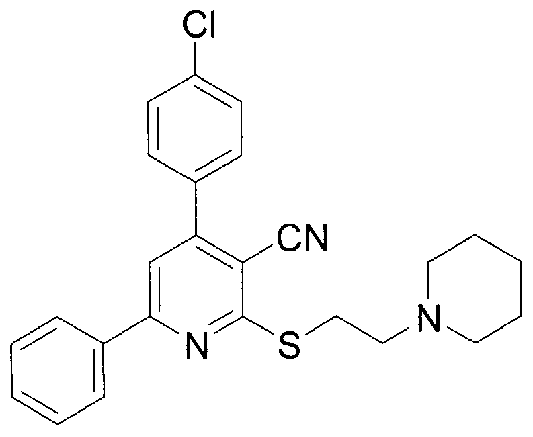
· · ·式 (8)
式 (8)で表される化合物は、例えば、ピリジン環に置換基を導入することにより得る ことができる。また、市販品をそのまま利用することも可能である。市販品としては、例 えば、 AKos Consulting and Solutions社(ドイツ) AKR 7131480、 Ambint er社(フランス) PHAR 041282、 AsInEx社(ロシア) BAS 1883847、 Interbios
creen社(ロシア) STOCK2S— 83093、 Interchim社(フランス) BAS 01883847 、 PHARMEKS社(ロシア) PHAR 041282、 SPECS社 (オランダ) AK—777Z1 0805024、 TimTec社(米国) ST 5031751などを挙げることができる。
[0056] [化 17]
…式 (9)
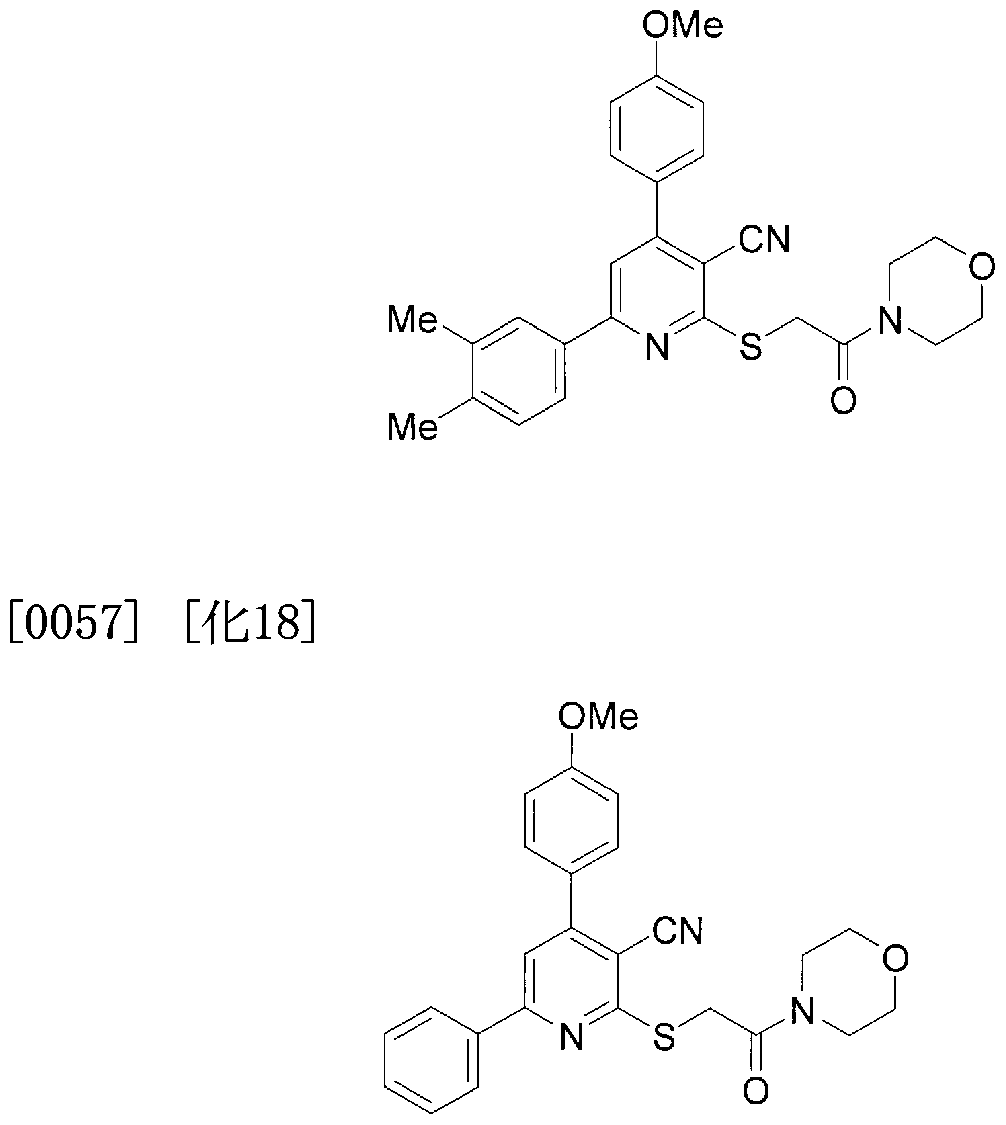
式(10)
[0058] [化 19]

'式 (11)
[0059] [化 20]

'式(12)
[0060] [化 21]
···式(13)

···式 (14)
式(14)で表される化合物は、例えば、ピリジン環に置換基を導入することにより得 ることができる。また、市販品をそのまま利用することも可能である。市販品としては、 例えば、 Interchim社(フランス) BAS 01816413、 AsInEx社(ロシア) BAS 181 6413、 SPECS社 (オランダ) AG— 690,40750093、 TimTec社(米国) OVS 2 310379などを挙げることができる。
[化 23]

···式(15)
[化 24]

[0064] [化 25]

· · ·式 (17)
式(17)で表される化合物は、例えば、ピリジン環に置換基を導入することにより得 ることができる。また、市販品をそのまま利用することも可能である。市販品としては、 例えば、 Ambinter社(フランス) PHAR 003307、 Chemical Block社(ロシア) A 1168/0054379, Interbioscreen社(ロシア;) STOCK1S— 20782、 Interchim 社(フランス) STOCK1S— 20782、 PHARMEKS社(ロシア) PHAR 003307、 Z elinsky Institute社(米国) A1168Z0054379などを挙げることができる。
[化 26]
· · ·式(18)

· · ·式(19)
[0067] [化 28]

···式(20)

···式(21)

···式(22)

···式(23)
式(23)で表される化合物は、例えば、ピリジン環に置換基を導入することにより得 ることができる。また、市販品をそのまま利用することも可能である。市販品としては、 例えば、 AsInEx社(ロシア) BAS 1816427、 Interchim社(フランス) BAS 0181 6427、 TimTec社(米国) OVS 2251452などを挙げることができる。
[0071] [化 32]

· · ·式(101)
[0072] 式(101)で、表される化合物は、例えば、ピリジン環に置換基を導入することにより 得ることができる。また、市販品をそのまま利用することも可能である。市販品としては 、例えば、 AsInEx社(ロシア) BAS 1842546などを挙げることができる。
[0073] [化 33]

· · ·式(102)
[0074] 式(102)で、表される化合物は、例えば、ピリジン環に置換基を導入することにより 得ることができる。また、市販品をそのまま利用することも可能である。市販品としては 、例えば、 AsInEx社(ロシア) ASN 1403434、 Interchim社(フランス) ASN 01 403434、TimTec社(米国) OVS 2339368、 SPECS社 (オランダ) AG— 690Z 40749483などを挙げることができる。
[0075] ウィルスによる感染症は、 DNAウィルスや RNAウィルスなどのウィルスが、宿主に 感染すること〖こよって生じる。
[0076] DNAウィルスの例としては、二本鎖 DNAウィルスと一本鎖 DNAウィルスがある。
二本鎖 DNAウィルスの例としては、例えば、ボックスウィルス科、イリドウィルス科、バ キュロウィルス科、ヘルぺスウィルス科、アデノウイルス科、パポーパウィルス科、ポリ ドナウィルス科、へパドナウィルス科に属するウィルスなどがある。一本鎖 DNAウィル
スの例としては、シルコウィルス科、パルボウイルス科に属するウィルスなどがある。
[0077] RNAウィルスの例としては、二本鎖 RNAウィルス、一本鎖( + )RNAウィルス、一 本鎖(―) RNAウィルスなどがある。二本鎖 RN Aウィルスの例としては、レオウィルス 科、ビルナウィルス科に属するウィルスがある。また、一本鎖( + )RNAウィルスの例 としては、ヒトコロナウィルス、ブタコロナウィルス、重症急性呼吸器症候群(SARS)ゥ ィルスなどのコロナウィルス科、ピコルナウィルス科、力リシウィルス科、ァストロウィル ス科、ノダウィルス科、テトラウィルス科、フラビウィルス科、トガウィルス科、レトロウイ ルス科に属するウィルスなどがある。一本鎖(一) RNAウィルスの例としては、パラミク ソウィルス科、ラブドウィルス科、フイロウィルス科、オルトミクソウィルス科、ブ-ャウイ ルス科、ァレナウィルス科に属するウィルスなどがある。
[0078] なお、コロナウィルス科に属するウィルス由来のプロテアーゼは、非常に類似してい ることが知られている(Anand K, Ziebuhr J, Wadhwani P, Mesters JR, Hilgenfeld R. Coronavirus main proteinase (3CLpro) structure: b asis for design of anti— SARS drugs. Science. 2003 Jun 13 ; 300 (5626) : 1763— 7)。
[0079] これらの DNAウィルスや RNAウィルスなどによるウィルス感染は、正常宿主細胞 膜にある受容体タンパクにウィルスが結合するところ力 始まる。例えば、 RNAウィル スは、受容体を介して細胞内に入り、細胞質内で RNAウィルス由来の RNAから一本 鎖のタンパク質への翻訳を行う。
[0080] この一本鎖のタンパク質は、プロテアーゼとして機能する部位を有する。細胞質内 において、この一本鎖のタンパク質が複数翻訳されると、これらの複数の一本鎖のタ ンパク質は、一方の一本鎖のタンパク質のプロテアーゼとして機能する部位によって 、他方の一本鎖のタンパク質を切断する。このように翻訳された一本鎖のタンパク質 が切断されることによって、例えば、プロテアーゼゃキヤプシドなどのウィルス増殖に 必要なタンパク質が作られる。
[0081] このため、ウィルスの増殖において、プロテアーゼによるタンパク質の分解は重要で ある。プロテアーゼインヒビターによって、プロテアーゼによるタンパク質の分解を阻 害することによりウィルスの増殖を抑えることが可能である。なお、プロテアーゼは、ゥ
ィルス由来のプロテアーゼ以外に、宿主細胞由来のプロテアーゼの場合がある。
[0082] なお、ウィルスごとにプロテアーゼのタイプ(例えば、セリンプロテアーゼ、システィン プロテアーゼ、ァスパラギン酸プロテアーゼ、メタ口プロテアーゼなど)が決まっている 力 例えば、 HIVのプロテアーゼ(ァスパラギン酸プロテアーゼ)に対するプロテア一 ゼインヒビターであるネルフィナビルがシスティンプロテアーゼを阻害するなど、あるタ イブのプロテアーゼに対するプロテアーゼインヒビターが、別のタイプのプロテアーゼ に対するプロテアーゼインヒビターとして機能し得ることが知られている。
[0083] 本発明に係る式(1)の化合物は、プロテアーゼの活性中心に結合するプロテア一 ゼインヒビタ一として機能し、化合物の反応部位と、プロテアーゼ側の活性中心とが 結合して、安定的な複合体を形成する。このため、これらの化合物は、プロテアーゼ の活性部位と結合することにより、このプロテア一ゼの基質となるタンパク質と結合す ることを阻害することができる。また、シァノ基が SH基と反応し得るため、本発明に係 る式(1)の化合物によって阻害されるプロテアーゼは、活性部位に SH基を有するプ 口テアーゼが好ましい。
[0084] また、本発明に係る式(1)の化合物によって阻害されるプロテアーゼは、宿主細胞 由来のプロテアーゼゃウィルス由来のプロテアーゼが好ましぐさらに、一本鎖( + )R
NAウィルス由来のプロテアーゼがより好ましい。さらに、コロナウィルス科に属するゥ ィルス由来のプロテアーゼがより好ましい。
[0085] 感染細胞内において、例えば、キヤプシドなどのタンパク質が十分に生産され、 RN Aの複製が十分に行われると、ウィルスは、感染細胞を破壊し、細胞外に放出され、 新たな正常宿主細胞膜にある受容体タンパクに結合し得る。このため、ウィルス増殖 に必要なタンパク質が産出されるためには、ウィルス感染から 5〜6時間かかる。本発 明に係る式(1)の化合物は、ウィルス感染後に投与されると、細胞内において、ウイ ルス増殖に必要なプロテアーゼによるタンパク質分解反応を阻害し、ウィルスの増殖 を抑えることが可能である。このため、このプロテアーゼインヒビターは抗ウィルス剤の 有効成分として、ウィルス感染症の治療及び予防に使用することができる。
[0086] 本発明のプロテアーゼインヒビターを抗ウィルス剤として用いる場合、任意の剤型に することができる。又、投与も各経路で行なわれる。経口投与の場合には、それに適
用される錠剤、顆粒剤、散剤、カプセル剤などは、それらの組成物中に製剤上一般 に使用される結合剤、包含剤、賦形剤、潤滑剤、崩壊剤、湿潤剤のような添加物を含 有していてもよぐ又経口用液体製剤として用いる場合は、内用水剤、振盪合剤、懸 濁液剤、乳剤、シロップ剤の形態であってもよぐ又使用する前に再溶解させる乾燥 生成物の形態であってもよい。さらに、このような液体製剤は普通用いられる添加剤、 保存剤のいずれを含有してもよい。注射用の場合には、その組成物は安定剤、緩衝 剤、保存剤、等張化剤などの添加剤を含んでいてもよぐ単位投与量アンプル、又は 多投与量容器中で提供される。なお、上記組成物は水溶液、懸濁液、溶液、乳液な どのような形態であってもよぐ一方活性成分は使用する前に適当な滅菌した水など で再溶解させる粉末であってもよ 、。
[0087] 本発明の抗ウィルス剤は人間及び動物に経口的または非経口的に投与される。経 口的投与は舌下投与を包含する。非経口的投与は注射例えば皮下、筋肉、静脈注 射、点滴などを含む。本発明の抗ウィルス剤の投与量は動物か人間により、また年齢 、個人差、病状などに影響されるので、場合によっては下記範囲外の量を投与する 場合も生ずるが、一般に人間を対象とする場合、本物質の経口投与量は体重 lKg、 1曰当り 0. 1〜: LOOOmg、好ましくは 1〜: LOOmgを 1回力ら 3回に分けて投与する。 実施例
[0088] 以下、本発明を実施例、試験例に基づいて説明するが、本発明は、これらの例に 限定されるものではない。
[0089] 実施例 1 SARSウィルスプロテアーゼ阻害効果比較実験
大腸菌から抽出した S 30画分を用 Vヽた無細胞タンパク質合成系により S ARSウィル スプロテアーゼを作製した。基質として、 SARSウィルスプロテアーゼ活性による切断 の結果、蛍光を発する消光性蛍光色素標識ペプチドを合成して使用した。酵素反応 は、最終濃度が 400nMとなるプロテアーゼ酵素タンパク質に最終濃度が 0. lmM、 0. 3mMあるいは ImMとなるように化合物を混和し、 30°Cで 15分間反応させた後、 最終濃度が 30 Mとなるように基質を加えて、 30°Cで 1時間反応させた。基質切断 によって生じた蛍光の強度を測定した。
[0090] 図 1は、式(2)の化合物(図 1中の R046)、式(8)の化合物(図 1中の R148)、式(1
4)の化合物(図 1中の R154)、式(16)の化合物(図 1中の R156)、式(17)の化合 物(図 1中の R158)、式(23)の化合物(図 1中の R164)、式(101)の化合物(図 1中 の R325)と SARS— CoVメインプロテアーゼとの反応の結果を示している。コント口 ールである DMSOを添カ卩したプロテアーゼ活性を 100%とする。式(2)の化合物は 基質の 10倍濃度の 0. 3mMで、プロテアーゼの活性を 50%阻害した。また、式 (8) の化合物は、基質の 10倍濃度の 0. 3mMで、プロテアーゼの活性を 86%阻害した 。また、式(14)の化合物は、基質の 33倍濃度の ImMで、プロテアーゼの活性を 98 %阻害した。また、式(16)の化合物は、基質の 33倍濃度の ImMで、プロテアーゼ の活性を 87%阻害した。また、式(17)の化合物は、基質の 10倍濃度の 0. 3mMで 、プロテアーゼの活性を 79%阻害した。また、式(23)の化合物は、基質の 10倍濃度 の 0. 3mMで、プロテアーゼの活性を 84%阻害した。式(101)の化合物は、基質の 10倍濃度の 0. 3mMで、プロテアーゼの活性を 63%阻害した。
[0091] これらの実験結果より、式(2)の化合物、式 (8)の化合物、式(14)の化合物、式(1 6)の化合物、式(17)の化合物、式(23)の化合物、式(101)の化合物が SARS— C oVメインプロテアーゼと結合することによって、プロテアーゼインヒビターとして機能 することが分力つた。
[0092] 実施例 2 SARSウィルス増殖阻害効果比較実験
Vero E6細胞に SARS— CoVをMOI 0. 01で感染させ、 24時間後に培養上清 を回収し、 ISOGEN (Nippongene)試薬でウィルス RNAを回収した。次にこの RN Aを 1 step RT-PCR kit (ABI)と ABI7700 sequence detector systemを 用いて定量した。そのときに用いたプライマー ·プローブの配列は ORF1— F (配列番 号 1)、 ORF1— R (配列番号 2)、 ORF1— probe (配列番号 3)である。
[0093] 図 2は、様々な濃度の式(2)の化合物(図中の R00046)を投与した SARSウィルス 増殖阻害効果の比較結果を示して!/、る。コントロール (Control)を添カ卩した PCRの ウィルス RNA量を 100%とする。 0. 01 μ Μの式(2)の化合物は、 RNAの増加をコ ントロールと比較して 88. 6%阻害している。 0. l iu Mの式(2)の化合物は、RNAの 増加をコントロールと比較して 95. 0%阻害している。: Mの式(2)の化合物は、 R ΝΑの増加をコントロールと比較して 99. 6%阻害している。 10 /ζ Μの式(2)の化合
物は、 RNAの増加をコントロールと比較して 99. 9%阻害している。
[0094] これらの実験結果より、式(2)の化合物が SARSウィルスの RNAの増加を阻害する ことが分力つた。
[0095] 実施例 3 SARSウィルス感染後に起こる細胞変性 (CPE)実験
Vero E6細胞に SARS— CoVを MOI 0. 01で感染させ、 60時間後に 3— (4, 5 — dimethylthiazol— 2— yl)—2, 5― diphenyltetrazolium bromideをカロ;^ァこ 。 3時間 37°Cでインキュベーションしたあと、 Triton/HCl - isopropyl alcoholで 細胞を溶解し生成した Formazanの濃度を測定した。
[0096] 表 1は、様々な濃度の式(2)の化合物(表中の R46)を投与した SARSウィルス感 染後に起こる細胞変性 (CPE)実験の結果を示している。 EC50は、 50%CPE抑制 濃度を表している。 CC50は、 50%細胞障害濃度を表している。
[表 1]

[0097] 図 3は、様々な濃度の式(2)の化合物(図中の R46)を投与した SARSウィルス感 染後に起こる細胞変性 (cytopathic effect CPE)実験による細胞の写真を示して いる。式(2)の化合物を非投与 (O /z M)の場合、 CPEが生じている。また、式(2)の 化合物を 0. 1 μ Μ以上の濃度で投与した場合、 CPEが非常に抑制されている。
[0098] これらの実験結果より、式(2)の化合物が SARSウィルスの増加を阻害することが 分かった。
[0099] 実施例4 MTT分析実験
式(2)の化合物(図 4中の 46)、式(3)の化合物(図 4中の 157)、式(6)の化合物( 図 4中の 146)、式(7)の化合物(図 4中の 147)、式(8)の化合物(図 4中の 148)、式 (9)の化合物(図 4中の 149)、式(10)の化合物(図 4中の 150)、式(11)の化合物( 図 4中の 151)、式(12)の化合物(図 4中の 152)、式(13)の化合物(図 4中の 153) 、式(14)の化合物(図 4中の 154)、式(15)の化合物(図 4中の 155)、式(16)の化 合物(図 4中の 156)、式(17)の化合物(図 4中の 158)、式(18)の化合物(図 4中の 159)、式(19)の化合物(図 4中の 160)、式(20)の化合物(図 4中の 161)、式(21) の化合物(図 4中の 162)、式(22)の化合物(図 4中の 163)、式(23)の化合物(図 4
中の 164)に対して、 MTT分析を行った。 MTT分析は、市販の試薬を用いて、それ ぞれ 5 μ Μの濃度の化合物に対して行った。
[0100] 図 4は、式(2)の化合物、式(3)の化合物、式 (6)の化合物、式(7)の化合物、式( 8)の化合物、式(9)の化合物、式(10)の化合物、式(11)の化合物、式(12)の化合 物、式(13)の化合物、式(14)の化合物、式(15)の化合物、式(16)の化合物、式( 17)の化合物、式(18)の化合物、式(19)の化合物、式(20)の化合物、式(21)の 化合物、式(22)の化合物、式(23)の化合物に対する ΜΤΤ分析の結果を示してい る。
[0101] これらの実験結果より、式(2)、式(3)、式 (6)、式(7)、式 (8)、式(9)、式(10)、式( 11)、式(12)、式(13)、式(14)、式(15)、式(16)、式(17)、式(18)、式(19)、式 (20)、式(21)、式(22)、及び式(23)の化合物がウィルスによる CPEを抑制し、 つ細胞の活性を阻害しな 、ことが分力つた。
[0102] 実施例 5 SARSウィルス増殖阻害効果比較実験
ΜΤΤ分析の結果、特に高い抑制活性を示した、式(2)の化合物(図 4中の 46)、式 (3)の化合物(図 4中の 157)、式(8)の化合物(図 4中の 148)、式(9)の化合物(図 4中の 149)、式(13)の化合物(図 4中の 153)、式(14)の化合物(図 4中の 154)、 式(15)の化合物(図 4中の 155)、式(16)の化合物(図 4中の 156)、式(17)の化合 物(図 4中の 158)、式(19)の化合物(図 4中の 160)、式(21)の化合物(図 4中の 16 2)、式(22)の化合物(図 4中の 163)に対して、以下のように SARSウィルス増殖阻 害効果比較実験を行った。
[0103] Vero E6細胞に SARS— CoVをMOI 0. 01で感染させ、 24時間後に培養上清 を回収し、 ISOGEN (Nippongene)試薬でウィルス RNAを回収した。次にこの RN Aを 1 step RT-PCR kit (ABI)と ABI7700 sequence detector system を用いて定量した。そのときに用いたプライマー ·プローブの配列は ORF1— F (配列 番号 1)、 ORF1— R (配列番号 2)、 ORF1— probe (配列番号 3)である。
[0104] 図 5は、式(2)の化合物(図 5中の R46)、式(3)の化合物(図 5中の R157)、式(8) の化合物(図 5中の R148)、式(9)の化合物(図 5中の R149)、式(13)の化合物(図 5中の R153)、式(14)の化合物(図 5中の R154)、式(15)の化合物(図 5中の R15
5)、式(16)の化合物(図 5中の R156)、式(17)の化合物(図 5中の R158)、式(19 )の化合物(図 5中の R160)、式(21)の化合物(図 5中の R162)、式(22)の化合物 (図 5中の R163)を投与した S ARSウィルス増殖阻害効果の比較結果を示して 、る。 コントロール(Control)を添カ卩した PCRのウィルス RNA量を 100%とする。 5 μ Μの 式(2)の化合物は、 RNAの増加をコントロールと比較して 99. 9%阻害している。 5 μ Μの式(3)の化合物は、 RNAの増加をコントロールと比較して 99. 9%阻害してい る。 5 Μの式(8)の化合物は、 RNAの増加をコントロールと比較して 99. 9%阻害 している。 5 Μの式(9)の化合物は、 RNAの増加をコントロールと比較して 99. 9% 阻害している。 5 μ Μの式(13)の化合物は、 RNAの増加をコントロールと比較して 9 9. 6%阻害している。 5 Μの式(14)の化合物は、 RNAの増加をコントロールと比 較して 99. 9%阻害している。 5 Μの式(15)の化合物は、 RNAの増加をコントロー ルと比較して 99. 9%阻害している。 5 Μの式(16)の化合物は、 RNAの増加をコ ントロールと比較して 99. 2%阻害している。 の式(17)の化合物は、 RNAの増 加をコントロールと比較して 99. 9%阻害している。 5 Μの式(19)の化合物は、 RN Αの増加をコントロールと比較して 93. 6%阻害している。 5 Mの式(21)の化合物 は、 RNAの増加をコントロールと比較して 99. 9%阻害している。 の式(22)の 化合物は、 RNAの増加をコントロールと比較して 90. 3%阻害している。
[0105] これらの実験結果より、式(2)、式(3)、式(8)、式(9)、式(13)、式(14)、式(15) 、式(16)、式(17)、式(19)、式(21)、及び式(22)の化合物が SARSウィルスの R NAの増加を阻害することが分力つた。
[0106] 実施例 6 SARSウィルス感染後に起こる細胞変性 (CPE)の化合物による阻害効果 および細胞毒性効果の MTT分析による比較実験
式(2)の化合物(図 6中の R046)、式(3)の化合物(図 6中の R157)、式(8)の化 合物(図 6中の R148)、式(9)の化合物(図 6中の R149)、式(13)の化合物(図 6中 の R153)、式(14)の化合物(図 6中の R154)、式(15)の化合物(図 6中の R155)、 式(16)の化合物(図 6中の R156)、式(17)の化合物(図 6中の R158)、式(19)の 化合物(図 6中の R160)、式(22)の化合物(図 6中の R163)、式(102)の化合物( 図 6中の R326)に対して MTT分析を行った。さまざまな濃度の上記化合物を投与し
た Vero E6細胞に SARS— CoVを MOI 0. 01で感染させる力 あるいは感染させ ずに 60時間 37°Cで培養し、 3— (4, 5 - dimethylthiazo 1 - 2 -yl) - 2, 5— diph enyltetrazolium bromideを加えた。 3時間 37°Cでインキュベートした後、 Triton /HCl-isopropyl alcoholで細胞を溶解し生成した Formazanの濃度を測定した 。 MTT分析結果力 各化合物の SARSウィルス感染後に起こる細胞変性 (CPE)の 50%抑制濃度 (EC50)および 50%細胞障害濃度 (CC50)を算出した。
[0107] 図 6は式(2)の化合物、式(3)の化合物、式 (8)の化合物、式(9)の化合物、式(13 )の化合物、式(14)の化合物、式(15)の化合物、式(16)の化合物、式(17)の化合 物、式(19)の化合物、式(22)の化合物、式(102)の化合物の 50%CPE抑制濃度 (EC50)および 50%細胞障害濃度(CC50)を示して 、る。
[0108] これらの実験結果より、式(2)の化合物が細胞の活性を阻害しない 580nMでウイ ルスによる CPEを 50%抑制することが分力つた。また、式(3)の化合物が細胞の活 性を阻害しな 、680nMでウィルスによる CPEを 50%抑制することが分かった。また 、式(8)の化合物が細胞の活性を阻害しな 、280nMでウィルスによる CPEを 50% 抑制することが分力つた。また、式(9)の化合物が細胞の活性を阻害しない 770nM でウィルスによる CPEを 50%抑制することが分力つた。また、式(13)の化合物が細 胞の活性を阻害しない 70nMでウィルスによる CPEを 50%抑制することが分かった。 また、式(14)の化合物が細胞の活性を阻害しない 300nMでウィルスによる CPEを 5 0%抑制することが分力つた。また、式(15)の化合物が細胞の活性を阻害しない 17 OnMでウィルスによる CPEを 50%抑制することが分かった。また、式(16)の化合物 が細胞の活性を阻害しない 500nMでウィルスによる CPEを 50%抑制することが分 かった。また、式(17)の化合物が細胞の活性を阻害しない 210nMでウィルスによる CPEを 50%抑制することが分力つた。また、式(19)の化合物が細胞の活性を阻害し ない 510nMでウィルスによる CPEを 50%抑制することが分かった。また、式(22)の 化合物が細胞の活性を阻害しない 470nMでウィルスによる CPEを 50%抑制するこ とが分力つた。また、式(102)の化合物が細胞の活性を阻害しない 48nMでウィルス による CPEを 50%抑制することが分力つた。
Claims
[化 1]

…式 (1)
(式中、
Aは、
(a)置換基として低級アルキル基または水酸基を有して 、てもよ 、ジメチレン基、トリ メチレン基、テトラメチレン基のいずれ力 あるいは
(b) (CH ) CO—(nは 1から 3の整数)で示される基、のいずれかを示し、
2 n
Rは、
窒素原子を介して Aと結合し、置換基としてアルキル基を有して 、てもよ 、含窒素飽 和の 4から 8員環基のいずれかを示し、ここで、前記環を形成するメチレン基の少なく とも 1個は、酸素原子、硫黄原子、窒素原子、または低級アルキル基を有する窒素原 子で置換されていてもよぐ
Rおよび Rは、それぞれ独立して、
2 3
(c)水素原子、または
(d)フエ-ル基、または
(e)ハロゲン基、ハロゲノメチル基、低級アルキル基、低級アルコキシ基、低級アルキ レンジォキシ基、ァラルキルォキシ基、あるいはこれらの複数個で置換されたフエ- ル基のいずれか、から選ばれる原子または基を示す。 )
[2] 前記ピリジンカルボ-トリル系化合物又はその薬学的に許容され得る塩における R は、 4 モルホリニル基または 1ーピペリジル基である請求項 1に記載のプロテアーゼ インヒビター。
[3] 下記式(2)で表されるピリジンカルボ-トリル系化合物又はその薬学的に許容され
得る塩であるプロテアーゼインヒビター。
[化 2]

···式 (2)
[4] 下記式(3)で表されるピリジンカルボ-トリル系化合物又はその薬学的に許容され 得る塩であるプロテアーゼインヒビター。
[化 3]

···式 (3)
[5] 下記式 (8)で表されるピリジンカルボ-トリル系化合物又はその薬学的に許容され 得る塩であるプロテアーゼインヒビター。
[化 4]

···式 (8)
[6] 下記式(14)で表されるピリジンカルボ-トリル系化合物又はその薬学的に許容さ れ得る塩であるプロテアーゼインヒビター。
[化 5]

···式 (14)
[7] 下記式( 17)で表されるピリジンカルボ-トリル系化合物又はその薬学的に許容さ れ得る塩であるプロテアーゼインヒビター。
[化 6]

···式 (17)
[8] 下記式(23)で表されるピリジンカルボ-トリル系化合物又はその薬学的に許容さ れ得る塩であるプロテアーゼインヒビター。
[化 7]

···式(23)
[9] 下記式(102)で表されるピリジンカルボ-トリル系化合物又はその薬学的に許容さ れ得る塩であるプロテアーゼインヒビター。
[化 8]

· · ·式(102)
[10] 活性中心に SH基を有するプロテアーゼの活性を阻害する請求項 1から 9いずれか に記載のプロテアーゼインヒビター。
[11] ウィルス由来のプロテアーゼの活性を阻害する請求項 1から 10いずれかに記載の プロテアーゼインヒビター。
[12] 前記ウイノレス由来のプロテアーゼ力 RNAウイノレス由来のプロテアーゼである請求 項 11に記載のプロテアーゼインヒビター。
[13] 前記 RNAウィルス由来のプロテアーゼ力 一本鎖(+)RNAウィルス由来のプロテ ァーゼである請求項 12に記載のプロテアーゼインヒビター。
[14] 前記一本鎖 (+)RNAウィルス由来のプロテアーゼ力 コロナウィルス科に属するゥ ィルス由来のプロテアーゼである請求項 13に記載のプロテアーゼインヒビター。
[15] 前記コロナウィルス科に属するウィルス由来のプロテアーゼ力 ヒトコロナウィルス、 ブタコロナウィルス、重症急性呼吸器症候群(SARS)ウィルスの 、ずれかのウィルス 由来のプロテアーゼである請求項 14に記載のプロテアーゼインヒビター。
[16] 請求項 1から 15いずれかに記載のプロテアーゼインヒビターを有効成分として含む 抗ウィルス剤。
Applications Claiming Priority (2)
| Application Number | Priority Date | Filing Date | Title |
|---|---|---|---|
| JP2005064664A JP2008133190A (ja) | 2005-03-08 | 2005-03-08 | プロテアーゼインヒビター |
| JP2005-064664 | 2005-03-08 |
Publications (1)
| Publication Number | Publication Date |
|---|---|
| WO2006095624A1 true WO2006095624A1 (ja) | 2006-09-14 |
Family
ID=36953224
Family Applications (1)
| Application Number | Title | Priority Date | Filing Date |
|---|---|---|---|
| PCT/JP2006/303905 Ceased WO2006095624A1 (ja) | 2005-03-08 | 2006-03-01 | プロテアーゼインヒビター |
Country Status (2)
| Country | Link |
|---|---|
| JP (1) | JP2008133190A (ja) |
| WO (1) | WO2006095624A1 (ja) |
Cited By (1)
| Publication number | Priority date | Publication date | Assignee | Title |
|---|---|---|---|---|
| US20130039944A1 (en) * | 2010-04-23 | 2013-02-14 | Kineta, Inc. | Anti-Viral Compounds |
Citations (2)
| Publication number | Priority date | Publication date | Assignee | Title |
|---|---|---|---|---|
| JPS4962477A (ja) * | 1972-06-22 | 1974-06-17 | ||
| WO2003011210A2 (en) * | 2001-07-31 | 2003-02-13 | Astrazeneca Ab | Arylheteroalkylamine derivatives and their use as inhibitors of nitric oxide synthase |
-
2005
- 2005-03-08 JP JP2005064664A patent/JP2008133190A/ja active Pending
-
2006
- 2006-03-01 WO PCT/JP2006/303905 patent/WO2006095624A1/ja not_active Ceased
Patent Citations (2)
| Publication number | Priority date | Publication date | Assignee | Title |
|---|---|---|---|---|
| JPS4962477A (ja) * | 1972-06-22 | 1974-06-17 | ||
| WO2003011210A2 (en) * | 2001-07-31 | 2003-02-13 | Astrazeneca Ab | Arylheteroalkylamine derivatives and their use as inhibitors of nitric oxide synthase |
Non-Patent Citations (7)
| Title |
|---|
| DATABASE REGISTRY [online] XP003000019, accession no. STN * |
| DATABASE REGISTRY [online] XP003000020, accession no. STN * |
| DATABASE REGISTRY [online] XP003000021, accession no. STN * |
| DATABASE REGISTRY [online] XP003000022, accession no. STN * |
| DATABASE REGISTRY [online] XP003000023, accession no. STN * |
| DATABASE REGISTRY [online] XP003000024, accession no. STN * |
| DATABASE REGISTRY [online] XP003000025, accession no. STN * |
Cited By (2)
| Publication number | Priority date | Publication date | Assignee | Title |
|---|---|---|---|---|
| US20130039944A1 (en) * | 2010-04-23 | 2013-02-14 | Kineta, Inc. | Anti-Viral Compounds |
| US9301952B2 (en) * | 2010-04-23 | 2016-04-05 | Kineta, Inc. | Diarylpyridine anti-viral compounds |
Also Published As
| Publication number | Publication date |
|---|---|
| JP2008133190A (ja) | 2008-06-12 |
Similar Documents
| Publication | Publication Date | Title |
|---|---|---|
| Kaddoura et al. | COVID-19 therapeutic options under investigation | |
| Campagna et al. | Sulfamoylbenzamide derivatives inhibit the assembly of hepatitis B virus nucleocapsids | |
| Feil et al. | An orally available 3-ethoxybenzisoxazole capsid binder with clinical activity against human rhinovirus | |
| TW201139419A (en) | Anti-viral compounds | |
| WO2007139150A1 (ja) | TNFα阻害物質を含有してなる抗インフルエンザウイルス剤 | |
| Xu et al. | Structure–activity relationship studies on diversified salicylamide derivatives as potent inhibitors of human adenovirus infection | |
| TW201121958A (en) | Methods of treating hepatitis C virus with oxoacetamide compounds | |
| US20230226043A1 (en) | Use of masitinib for the treatment of coronavirus disease 2019 (covid-19) | |
| CN113350330B (zh) | 杨梅素类化合物在制备防治新冠肺炎药物中的应用 | |
| Rivero-Buceta et al. | Optimization of a class of tryptophan dendrimers that inhibit HIV replication leads to a selective, specific, and low-nanomolar inhibitor of clinical isolates of enterovirus A71 | |
| WO2021164689A1 (zh) | 奈非那韦在制备防治新冠肺炎药物中的应用 | |
| Kabi et al. | Overview of Hydroxychloroquine and Remdesivir on severe acute respiratory syndrome coronavirus 2 (SARS‐CoV‐2) | |
| EP2922596B1 (en) | Heterocyclyl carboxamides for treating viral diseases | |
| JP2009524585A (ja) | ウイルス感染を処置するためのジアリールウレア | |
| CN117320748A (zh) | Covid-19进入抑制剂对covid-19复制的遏制 | |
| JP2008133190A (ja) | プロテアーゼインヒビター | |
| RU2825648C1 (ru) | Способы лечения коронавирусных инфекций | |
| US10016377B2 (en) | Treatment of hepatitis C using histone deacetylase inhibitors | |
| US20230241067A1 (en) | Targeting papain-like protease for broad-spectrum coronaviruses inhibition | |
| TWI800146B (zh) | 魚針草酸用於製備抑制新型冠狀病毒與變異株等感染與複製之醫藥組合物的用途 | |
| JP2024064068A (ja) | ウイルス増殖阻害剤 | |
| Rahman et al. | Repurposable Drug Candidates are Potential Therapeutic Target against Global SARS-CoV-2 Crisis. | |
| WO2013086133A1 (en) | Methods and compositions for treating viral diseases | |
| TW202207916A (zh) | 治療病毒感染之方法及組合物 | |
| WO2021188709A1 (en) | Treating sars-cov-2 infected subjects with small molecule compounds |
Legal Events
| Date | Code | Title | Description |
|---|---|---|---|
| 121 | Ep: the epo has been informed by wipo that ep was designated in this application | ||
| NENP | Non-entry into the national phase |
Ref country code: DE |
|
| NENP | Non-entry into the national phase |
Ref country code: RU |
|
| 122 | Ep: pct application non-entry in european phase |
Ref document number: 06715021 Country of ref document: EP Kind code of ref document: A1 |
|
| NENP | Non-entry into the national phase |
Ref country code: JP |