WO2006045246A1 - Cyclopentane carboxylate compounds, process and intermediates for preparing the same and use thereof - Google Patents
Cyclopentane carboxylate compounds, process and intermediates for preparing the same and use thereof Download PDFInfo
- Publication number
- WO2006045246A1 WO2006045246A1 PCT/CN2005/001765 CN2005001765W WO2006045246A1 WO 2006045246 A1 WO2006045246 A1 WO 2006045246A1 CN 2005001765 W CN2005001765 W CN 2005001765W WO 2006045246 A1 WO2006045246 A1 WO 2006045246A1
- Authority
- WO
- WIPO (PCT)
- Prior art keywords
- ethyl
- cyclopentane carboxylate
- carboxylate
- methylbenzoyloxy
- butyl
- Prior art date
- Legal status (The legal status is an assumption and is not a legal conclusion. Google has not performed a legal analysis and makes no representation as to the accuracy of the status listed.)
- Ceased
Links
- 0 *C(OCC1(CO*)c2ccccc2-c2c1cccc2)=O Chemical compound *C(OCC1(CO*)c2ccccc2-c2c1cccc2)=O 0.000 description 1
Classifications
-
- C—CHEMISTRY; METALLURGY
- C07—ORGANIC CHEMISTRY
- C07C—ACYCLIC OR CARBOCYCLIC COMPOUNDS
- C07C67/00—Preparation of carboxylic acid esters
- C07C67/30—Preparation of carboxylic acid esters by modifying the acid moiety of the ester, such modification not being an introduction of an ester group
- C07C67/31—Preparation of carboxylic acid esters by modifying the acid moiety of the ester, such modification not being an introduction of an ester group by introduction of functional groups containing oxygen only in singly bound form
-
- C—CHEMISTRY; METALLURGY
- C07—ORGANIC CHEMISTRY
- C07C—ACYCLIC OR CARBOCYCLIC COMPOUNDS
- C07C67/00—Preparation of carboxylic acid esters
- C07C67/08—Preparation of carboxylic acid esters by reacting carboxylic acids or symmetrical anhydrides with the hydroxy or O-metal group of organic compounds
-
- C—CHEMISTRY; METALLURGY
- C07—ORGANIC CHEMISTRY
- C07C—ACYCLIC OR CARBOCYCLIC COMPOUNDS
- C07C67/00—Preparation of carboxylic acid esters
- C07C67/14—Preparation of carboxylic acid esters from carboxylic acid halides
-
- C—CHEMISTRY; METALLURGY
- C07—ORGANIC CHEMISTRY
- C07C—ACYCLIC OR CARBOCYCLIC COMPOUNDS
- C07C67/00—Preparation of carboxylic acid esters
- C07C67/30—Preparation of carboxylic acid esters by modifying the acid moiety of the ester, such modification not being an introduction of an ester group
- C07C67/333—Preparation of carboxylic acid esters by modifying the acid moiety of the ester, such modification not being an introduction of an ester group by isomerisation; by change of size of the carbon skeleton
- C07C67/343—Preparation of carboxylic acid esters by modifying the acid moiety of the ester, such modification not being an introduction of an ester group by isomerisation; by change of size of the carbon skeleton by increase in the number of carbon atoms
-
- C—CHEMISTRY; METALLURGY
- C07—ORGANIC CHEMISTRY
- C07C—ACYCLIC OR CARBOCYCLIC COMPOUNDS
- C07C69/00—Esters of carboxylic acids; Esters of carbonic or haloformic acids
- C07C69/74—Esters of carboxylic acids having an esterified carboxyl group bound to a carbon atom of a ring other than a six-membered aromatic ring
- C07C69/757—Esters of carboxylic acids having an esterified carboxyl group bound to a carbon atom of a ring other than a six-membered aromatic ring having any of the groups OH, O—metal, —CHO, keto, ether, acyloxy, groups, groups, or in the acid moiety
-
- C—CHEMISTRY; METALLURGY
- C07—ORGANIC CHEMISTRY
- C07C—ACYCLIC OR CARBOCYCLIC COMPOUNDS
- C07C69/00—Esters of carboxylic acids; Esters of carbonic or haloformic acids
- C07C69/76—Esters of carboxylic acids having a carboxyl group bound to a carbon atom of a six-membered aromatic ring
- C07C69/78—Benzoic acid esters
-
- C—CHEMISTRY; METALLURGY
- C08—ORGANIC MACROMOLECULAR COMPOUNDS; THEIR PREPARATION OR CHEMICAL WORKING-UP; COMPOSITIONS BASED THEREON
- C08F—MACROMOLECULAR COMPOUNDS OBTAINED BY REACTIONS ONLY INVOLVING CARBON-TO-CARBON UNSATURATED BONDS
- C08F10/00—Homopolymers and copolymers of unsaturated aliphatic hydrocarbons having only one carbon-to-carbon double bond
-
- C—CHEMISTRY; METALLURGY
- C08—ORGANIC MACROMOLECULAR COMPOUNDS; THEIR PREPARATION OR CHEMICAL WORKING-UP; COMPOSITIONS BASED THEREON
- C08F—MACROMOLECULAR COMPOUNDS OBTAINED BY REACTIONS ONLY INVOLVING CARBON-TO-CARBON UNSATURATED BONDS
- C08F4/00—Polymerisation catalysts
- C08F4/42—Metals; Metal hydrides; Metallo-organic compounds; Use thereof as catalyst precursors
- C08F4/44—Metals; Metal hydrides; Metallo-organic compounds; Use thereof as catalyst precursors selected from light metals, zinc, cadmium, mercury, copper, silver, gold, boron, gallium, indium, thallium, rare earths or actinides
- C08F4/60—Metals; Metal hydrides; Metallo-organic compounds; Use thereof as catalyst precursors selected from light metals, zinc, cadmium, mercury, copper, silver, gold, boron, gallium, indium, thallium, rare earths or actinides together with refractory metals, iron group metals, platinum group metals, manganese, rhenium technetium or compounds thereof
- C08F4/62—Refractory metals or compounds thereof
- C08F4/64—Titanium, zirconium, hafnium or compounds thereof
- C08F4/647—Catalysts containing a specific non-metal or metal-free compound
- C08F4/649—Catalysts containing a specific non-metal or metal-free compound organic
- C08F4/6494—Catalysts containing a specific non-metal or metal-free compound organic containing oxygen
-
- C—CHEMISTRY; METALLURGY
- C07—ORGANIC CHEMISTRY
- C07C—ACYCLIC OR CARBOCYCLIC COMPOUNDS
- C07C2601/00—Systems containing only non-condensed rings
- C07C2601/06—Systems containing only non-condensed rings with a five-membered ring
- C07C2601/08—Systems containing only non-condensed rings with a five-membered ring the ring being saturated
-
- C—CHEMISTRY; METALLURGY
- C08—ORGANIC MACROMOLECULAR COMPOUNDS; THEIR PREPARATION OR CHEMICAL WORKING-UP; COMPOSITIONS BASED THEREON
- C08F—MACROMOLECULAR COMPOUNDS OBTAINED BY REACTIONS ONLY INVOLVING CARBON-TO-CARBON UNSATURATED BONDS
- C08F110/00—Homopolymers of unsaturated aliphatic hydrocarbons having only one carbon-to-carbon double bond
- C08F110/04—Monomers containing three or four carbon atoms
- C08F110/06—Propene
Definitions
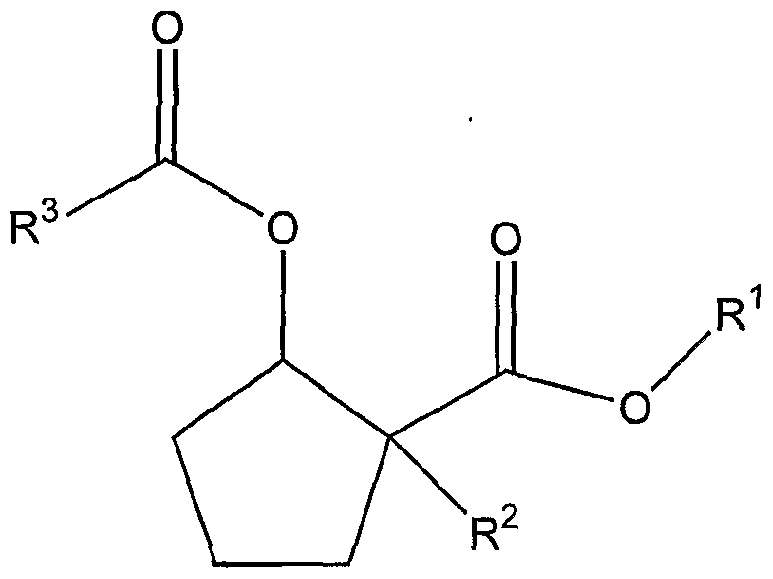
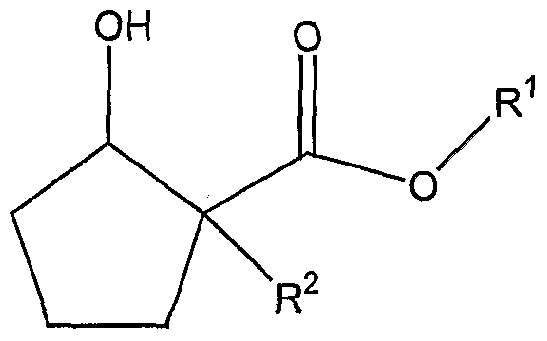
- the present invention relates to cyclopentane carboxylate compounds, to a process and intermediates for preparing the same, and to use thereof. More specifically, the present invention relates to l-hydrocarbyl-2-acyloxy-cyclopentane carboxylate compounds (I), to process for preparing the same, to the intermediate 2-hydrocarbyl-2-hydrocarbyloxycarbonylcyclopentanols (II), and to use of 1 -hydrocarbyl-2-acyloxy-cyclopentane carboxylate compound (I).
- EP0361493 and EP0728724 disclose 1,3-diether compounds
- CN1105671A discloses 1,3-diketone compounds
- CN1236372A and CN1292800 discloses specific substituted malonate compounds
- WO03022894 discloses diesters of maleic acid as electron donor compound.
- CN1446787A and CN1490340A disclose ⁇ -acyloxy-substituted ether compounds having a formula (III), and catalysts for propylene polymerization and exhibiting excellent performance can be prepared using said compounds as internal electron donor added during the preparation of solid component of catalytic system for olefin polymerization through a preparation process similar to that used in the preparation of N-Catalysts (trade name of polypropylene catalyst by Beijing Research Institute of Chemical Industry, SINOPEC, China).
- An object of the invention is to provide novel cyclopentane carboxylate compounds, i.e. l-hydrocarbyl-2-acyloxy-cyclo ⁇ entane carboxylate compounds of formula (I).
- Another object of the invention is to provide a process for preparing the compounds of the formula (I) as well as the intermediates used therein.
- Still another object of the invention is to provide use of said compounds in the preparation of olefin polymerization catalysts, especially Ziegler-Natta type polypropylene catalysts.
- cyclopentane carboxylate compounds according to the invention l-hydrocarbyl-2-acyloxy-cyclopentane carboxylate compounds, have a structure represented by the general formula (I):
- groups R , R and R which are identical or different, are independently selected from the group consisting of linear or branched C 1 -C 2O aIlCyI, C 3 -C 20 cycloalkyl, C 6 -C 20 aryl, C 7 -C 2 oalkaryl and C 7 -C 20 aralkyl.
- R 1 is preferably Ci-C 8 alkyl, and more preferably methyl, ethyl or iso-butyl;
- R 2 is preferably selected from the group consisting of CpCioalkyl, C 3 -C 10 cycloalkyl, C 4 -C 9 alkylcycloalkyl, C 4 -C 9 cycloalkylalkyl, C 6 -Ci 0 aryl, C 7 -Ci O alkaryl and C 7 -Ci 0 aralkyl; and
- R 3 is preferably selected from the group consisting of Ci-Ci O alkyl, C 3 -C 10 cycloalkyl, C 6 -C 10 aryl, C 7 -C 10 alkaryl and C 7 -Ci o aralkyl.
- R 1 is methyl, ethyl or iso-butyl
- R 2 is preferably selected from the group consisting of C r Ci O alkyl, C 3 -C 8 cycloalkyl, Cs-G / cycloalkylmethyl, C 6 -C 9 aryl, C 7 -Ci 0 alkaryl and C 7 -C 1 o aralkyl, and more preferably selected from the group consisting of Ci-C 6 alkyl, C 5 -C 8 cycloalkyl, C 6 -C 8 aryl, benzyl, p-methylbenzyl and phenethyl; and R 3 is preferably selected from the group consisting of Ci-C 4 alkyl, C 5 -C 8 cycloalkyl, phenyl, p-methylphenyl, o-methylphenyl, m-methylphenyl and benzyl.
- R 1 is methyl or ethyl
- R 2 is methyl, ethyl, n-propyl, iso-propyl, n-butyl, iso-butyl, n-pentyl, iso-pentyl, n-hexyl, benzyl, p-methylbenzyl or phenethyl
- R 3 is methyl, ethyl, n-propyl 5 iso-propyl, n-butyl, phenyl, p-methylphenyl, o-methylphenyl, m-methylphenyl or benzyl.
- cyclopentane carboxylate compounds include, but are not limited to, ethyl l-benzyl-2-benzoyloxy-cyclopentane carboxylate; ethyl 1 -benzyl-2-p-methylbenzoyloxy-cyclopentane carboxylate; ethyl l-benzyl-2-m-methylbenzoyloxy-cyclopentane carboxylate; ethyl l-benzyl-2-o-methylbenzoyloxy-cyclopentane carboxylate; methyl l-p-methylbenzyl-2-benzoyloxy-cyclopentane carboxylate; methyl 1 -p-methylbenzyl-2-p-methylbenzoyloxy-cyclo ⁇ entane carboxylate; methyl 1 -p-methylbenzyl-2-m-methylbenzoyloxy-cyclopentane carboxylate; methyl 1 -p-methylbenzyl-2-o-methylbenzoyloxy-cyclo
- the process for preparing l-hydrocarbyl-2-acyloxy-cyclopentane carboxylate compounds of the formula (I) according to the invention comprises, in turn, the steps of :
- the starting material, 2-oxocyclopentane carboxylate, used in the step 1) may be prepared through known synthesis methods disclosed in the literatures (see, for example, Org. Synth, Coll. Vol.,2, 116(1943)).
- a phase-transfer catalyst may or may not be used depending on the kind of the used halohydrocarbon (R 2 X).
- the halohydrocarbon (R 2 X) used in the hydrocarbylation on the ⁇ -carbon is a branched- or cyclic group-containing haloalkane
- phase-transfer catalyst such as benzyl triethyl ammonium chloride, tetra-n-butyl ammonium bromide or combination thereof, is preferably used.
- known operation methods for hydrocarbylation on carbon atom for example, the method disclosed in Tetrahedron 32, 2979 (1976) can be followed with aprotic solvent used.
- the aprotic solvent is preferably selected from the group consisting of acetone; N,N-dimethyl formamide; dimethyl sulfoxide; tetrahydrofuran; aliphatic hydrocarbons, such as pentane and hexane; and aromatic hydrocarbons, such as benzene, toluene, and xylene; and combination thereof, and more preferably aprotic polar solvents, such as acetone; N,N-dimethyl formamide; dimethyl sulfoxide; and combination thereof.
- the base is preferably selected from the group consisting of an alkali metal, an alkaline earth ' metal, a hydride of alkali metal or alkaline earth metal, a carbonate of alkali metal or alkaline earth metal, and combination thereof, and more preferably a carbonate of alkali metal.
- molar ratio of the 2-oxocyclopentane carboxylate to the halohydrocarbon (R 2 X) is preferably in a range of from 1 : 0.5 to 1 : 5, and more preferably from 1 : 1 to 1 : 2; and molar ratio of the 2-oxocyclo ⁇ entane carboxylate to the base is preferably in a range of from 1 : 0.5 to 1 : 5, and more preferably from 1 : 1.2 to 1 : 3.
- Reaction pressure is preferably in a range of from atmosphere pressure to 3 atm, and more preferably atmosphere pressure.
- reaction time is preferably in a range of from 1 to 24 hours, and the exact reaction time can be determined by GC-MS analysis on the reaction liquid.
- the l-hydrocarbyl-2-oxocyclopentane carboxylate obtained can be reduced by a reducing agent in an alcoholic solvent, to further form a compound of the general formula (II).
- the used reducing agent can be selected from the group consisting of metal borohydrides, such as lithium borohydride, sodium borohydride, potassium borohydride, and zinc borohydride; aluminum alkoxides, such as aluminum isopropoxide; and combination thereof.
- a metal borohydride is used, then sodium borohydride or potassium borohydride as well as methanol solvent is preferably used; and if an aluminum alkoxide is used, then aluminum isopropoxide as well as iso-propanol solvent is preferably used.
- molar ratio of the l-hydrocarbyl-2-oxocyclopentane carboxylate to the reducing agent is preferably in a range of from 1 : 0.5 to 1 : 2, and more preferably from 1 : 1.2 to 1 : 2.
- Reaction pressure is preferably in a range of from atmosphere pressure to 3 atm, and more preferably atmosphere pressure.
- the reaction is preferably carried out at a temperature of from -20 to 100 0 C, and more preferably from -10 to 78 0 C.
- Reaction time is preferably in a range of from 0.1 to 10 hours.
- the reaction is carried out at a temperature of from -20 to 65 0 C, and preferably from -10 to 40 0 C; molar ratio of the l-hydrocarbyl-2-oxocyclopentane carboxylate to sodium borohydride is preferably in a range of from 1 : 1 to 1 : 2, and more preferably 1 : 1.2; reaction pressure is preferably in a range of from atmosphere pressure to 3 atm, and more preferably atmosphere pressure; the reactants are preferably added in such a way that sodium borohydride is batchwise added to a solution of l-hydrocarbyl-2-oxocyclopentane carboxylate in methanol, and reaction time is preferably in a range of from 0.5 to 2 hours.
- the l-hydrocarbyl-2-oxocyclopentane carboxylate obtained can also be selectively reduced in a solvent under catalytic hydrogenation conditions, to form a compound of the general formula (II) (see, for example, J. Fuhrhop, G. Penzlin, Organic Synthesis-Concepts, Methods, Starting Materials, verlag chemie, 90, 1983).
- the used catalyst contains generally a transition metal element, and can be, selected from the group consisting of nickel-containing catalysts such as Raney nickel, palladium-containing catalysts, Adams' catalyst, and ruthenium-containing catalysts. Adams' catalyst is preferred.
- Reaction pressure is preferably in a range of from 1 to 10 atm, and more preferably from 1 to 3 atm.
- the reaction is preferably carried out at a temperature of from 0 to 200 0 C, and more preferably from 10 0 C to room temperature.
- the solvent is preferably alcohols (for example, methanol, ethanol, etc.), ethers (for example, tetrahydrofuran, 1 ,2-dimethoxy ethane, etc.), and esters (for example, ethyl acetate, butyl acetate), or combination thereof, and more preferably ethanol.
- reaction time is preferably from 0.5 to 24 hours.
- the catalyst is generally used in an amount of from 0.1 to 5 percent by mole with respect to the reactant.
- (II) is acylated with an acyl halide as acylating agent in the presence of a base, or with an acid anhydride as acylating agent in the presence of an acid (wherein R 3 is as defined in the general formula (I); and X represents Cl, Br or I), to form l-hydrocarbyl-2-acyloxy-cyclopentane carboxylate compound.
- the acylating agent is preferably acyl halide.
- the molar ratio of the acylating agent to the intermediate (II) is preferably in a range of from 1:1 to 15:1, and more preferably from 1.5:1 to 5:1.
- the base is preferably pyridine or triethyl amine, and molar ratio of the base to the acylating agent is preferably in a range of from 1:1 to 10:1, and more preferably from 1 :1 to 3:1.
- the solvent used in the acylation reaction is generally aprotic solvent, and can be selected from the group consisting of pyridine, tetrahydrofuran, haloalkanes (such as methylene chloride, chloroform, etc.), aliphatic hydrocarbons (such as pentane, hexane, etc.) and aromatic hydrocarbons (such as benzene, toluene, xylene, etc.), and combination thereof, with methylene chloride and chloroform being preferred.
- Reaction temeperature is preferably in a range of from -20 to 200 0 C, and preferably from -5 to 100 0 C.
- reaction pressure is preferably in a range of from atmosphere pressure to 3 arm, and more preferably atmosphere pressure.
- the acylation reaction is carried out in the presence of an acid catalyst, and commonly used acid catalysts include sulfuric acid, zinc chloride, etc., with a catalytic amount of sulfuric acid being preferred (see, for example, Vogel's Textbook of Practical Organic Chemistry 5th ed., 1988).
- the lasting time of the acylation reaction can be varied or adjusted depending on the used intermediate (II) and the acylating agent, and the reaction can be monitored by thin-layer chromatography.
- l-hydrocarbyl-2-acyloxy-cyclopentane carboxylate compound of formula (I) can be obtained through conventional separation and purification processes, such as extraction, distillation, crystallization, recrystallization, thin-layer chromatography, or column chromatography.
- R Ci-C 4 alkyl
- R is selected from the group consisting of Cj-Ci O alkyl, C 3 -C 10 cycloalkyl, C 4 -C 9 alkylcycloalkyl, C 4 -C 9 cycloalkylalkyl, C 6 -C 10 aryl, C 7 -C 10 alkaryl and C 7 -Ci 0 aralkyl, with the proviso that R 2 is not one of methyl, propyl and benzyl, are novel compounds synthesized by the inventors.
- the present invention is also directed to use of l-hydrocarbyl-2-acyloxy-cyclopentane carboxylate compounds of the formula (I) in the preparation of catalysts for olefin polymerization, such as Ziegler-Natta type polypropylene catalysts.
- catalysts for olefin polymerization such as Ziegler-Natta type polypropylene catalysts.
- l-hydrocarbyl-2-acyloxy-cyclopentane carboxylate compounds of the formula (I) exhibit excellent performance in enhancing activity and stereospecificity of the catalysts in polymerization.
- Said compounds are particularly suitably used as internal electron donor in the preparation of spherical polypropylene catalyst.
- the target alkylated product as a distillate cut of 138-142°C/18mmHg was obtained following the procedure as described in Example 4, except that n-propyl iodide was used to replace ethyl iodide as haloalkane agent.
- Example 13 2-benzyl-2-methoxycarbonyl-cyclopentanol (or methyl 1 -benzyl-2-hydroxy-cyclo ⁇ entane carboxylate) 2.77 grams of methyl l-benzyl-2-oxocyclopentane carboxylate obtained from Example 1 were dissolved in 120 ml of methanol, and to the solution was added 2.64 g of anhydrous calcium chloride. The reaction mixture was cooled to about 2 0 C using an ice-salt bath, then 0.54 g of sodium borohydride was slowly and batchwise added with stirring, and additional 0.1 g of sodium borohydride was added to the mixture. The reaction mixture was stirred for further 30 minutes and concentrated then to give a white slurry.
- reaction mixture was stirred at room temperature for 30 minutes to give a clear solution.
- the temperature of reaction mixture was reduced to about 0 0 C using an ice-salt bath, and 1.824g of sodium borohydride was batchwise added.
- the reaction was stirred for 30 minutes, and then the solvent was removed. The residue was extracted using diethyl ether and water, then the organic phase was dried. Removing the solvent gave 19.2 Ig of colorless liquid.
- Example 18 2-p-methylbenzyl-2-ethoxycarbonyl-cyclo ⁇ entanol (or ethyl l-p-methylbenzyl-2-hydroxy-cyclopentane carboxylate) 31.2 grams of ethyl l-p-methylbenzyl-2-oxocyclopentane carboxylate obtained from Example 9 were weighed into a one-neck flask and then diluted using 60ml of dry methanol. Then to the mixture was added 21.15 g of anhydrous calcium chloride, and the reaction mixture was stirred at room temperature for 30 minutes to give a clear solution.
- reaction mixture was reduced to about 0 0 C using an ice-salt bath, and 5.53 g of sodium borohydride was batchwise added. The reaction was stirred for 30 minutes, and then the solvent was removed. The residue was extracted using diethyl ether and water, then the organic phase was dried. Removing the solvent gave 29.56 g of colorless liquid.
- the target product as a colorless liquid was obtained according to the procedure as described in Example 16 except that ethyl 1 -iso-butyl-2-oxocyclopentane carboxylate obtained in Example 7 was used to replace ethyl l-n-butyl-2-oxocyclo ⁇ entane carboxylate.
- Example 30 Methyl l- ⁇ -methylbenzyl-2-o-methylbenzoyloxy-cyclopentane carboxylate 8.32 grams of target product as a brown liquid were obtained following the procedure as described in Example 27 except that 4.00 ml of 2-methyl-benzoyl chloride was used to replace benzoyl chloride.
- Example 17 12.1 grams of ethyl l-n-hexyl-2-hydroxy-cyclopentane carboxylate obtained in Example 17 were diluted with 60ml of methylene chloride. At room temperature and with magnetic stirring, 6.108ml of pyridine was slowly added, then 8.876ml of benzoyl chloride was dropwise added. Then the procedure as described in Example 23 was followed, to give 18.16 g of yellow liquid.
- Ethyl 2-hydroxy-l-ethyl-cyclopentane carboxylate (4.9Og) was diluted using 60ml of methylene chloride. At room temperature and with magnetic stirring, pyridine (3.22ml) was slowly added, then benzoyl chloride (4.68ml) was dropwise added. Upon the completion of the addition, the reaction was continued for 12 hours. Then solvent was removed, and the residue was extracted using ethyl acetate and water. Organic layer was washed in turn using 10% hydrochloric acid aqueous solution to pH of about 2, using saline solution to neutrality, using 10% aqueous solution of sodium carbonate for three times, and then using saline solution to neutrality. The organic layer was dried, and removing solvent gave 8.86 g of yellow liquid. MS: m/e 290(M + ), 261, 216, 185, 168, 139, 105(base) 5 77.
- Ethyl 2-hydroxy-l-ethyl-cyclopentane carboxylate (4.9Og) was diluted using 60ml of methylene chloride. At room temperature and with magnetic stirring, pyridine (3.22ml) was slowly added, then 2-methyl-benzoyl chloride (5.28ml) was dropwise added. Upon the completion of the addition, the reaction was continued for 12 hours. Then solvent was removed, and the residue was extracted using ethyl acetate and water. Organic layer was washed, in turn, using 10% hydrochloric acid aqueous solution to pH of about 2, using saline solution to neutrality, using 10% aqueous solution of sodium carbonate for three times, and then using saline solution to neutrality. The organic layer was dried, and removing solvent gave 8.99 g of yellow liquid. MS: m/e 304(M + "), 261, 244, 139, 119(base), 91.
- Ethyl 2-hydroxy-l-n-propyl-cyclopentane carboxylate (6.0Og) was diluted using 60ml of methylene chloride. At room temperature and with magnetic stirring, pyridine (3.67ml) was slowly added, then benzoyl chloride (5.33ml, 0.045mol) was dropwise added. Upon the completion of the addition, the reaction was continued for 12 hours. Then solvent was removed, and the residue was extracted using ethyl acetate and water. Organic layer was washed, in turn, using 10% hydrochloric acid aqueous solution to pH of about 2, using saline solution to neutrality, using 10% aqueous solution of sodium carbonate for three times, and then using saline solution to neutrality. The organic layer was dried, and removing solvent gave 10.00 g of yellow liquid. MS: m/e 305(M + "+l), 304(M + ), 259, 230, 199, 182, 153, 105(base), 77.
- Ethyl 2-hydroxy-l-n-propyl-cyclo ⁇ entane carboxylate (6.0Og) was diluted using 60ml of methylene chloride. At room temperature and with magnetic stirring, pyridine (3.66ml) was slowly added, then 2-methyl-benzoyl chloride (5.95ml) was dropwise added. Upon the completion of the addition, the reaction was continued for 12 hours. Then solvent was removed, and the residue was extracted using ethyl acetate and water. Organic layer was washed, in turn, using 10% hydrochloric acid aqueous solution to pH of about 2, using saline solution to neutrality, using 10% aqueous solution of sodium carbonate for three times, and then using saline solution to neutrality.
- Ethyl 2-hydroxy-l-n-propyl-cyclopentane carboxylate (6.0Og) was diluted using 60ml of methylene chloride. At room temperature and with magnetic stirring, pyridine (3.66ml) was slowly added, then 3-methyl-benzoyl chloride (6.00ml) was dropwise added. Upon the completion of the addition, the reaction was continued for 12 hours. Then solvent was removed, and the residue was extracted using ethyl acetate and water. Organic layer was washed, in turn, using 10% hydrochloric acid aqueous solution to pH of about 2, using saline solution to neutrality, using 10% aqueous solution of sodium carbonate for three times, and then using saline solution to neutrality.
- Ethyl 2-hydroxy-l-n-propyl-cyclopentane carboxylate (6.0Og) was diluted using 60ml of methylene chloride. At room temperature and with magnetic stirring, pyridine (3.66ml) was slowly added, then 4-methyl-benzoyl chloride (6.12ml) was dropwise added. Upon the completion of the addition, the reaction was continued for 12 hours. Then solvent was removed, and the residue was extracted using ethyl acetate and water. Organic layer was washed, in turn, using 10% hydrochloric acid aqueous solution to pH of about 2, using saline solution to neutrality, using 10% aqueous solution of sodium carbonate for three times, and then using saline solution to neutrality.
- Ethyl 2-hydroxy-l-n-butyl-cyclopentane carboxylate (6.42g) was diluted using 60ml of methylene chloride, At room temperature and with magnetic stirring, pyridine (3.66ml) was slowly added, then 3-methyl-benzoyl chloride (6.01ml) was dropwise added. Upon the completion of the addition, the reaction was continued for 12 hours. Then solvent was removed, and the residue was extracted using ethyl acetate and water. Organic layer was washed, in turn, using 10% hydrochloric acid aqueous solution to pH of about 2, using saline solution to neutrality, and then using 10% aqueous solution of sodium carbonate for three times, then using saline solution to neutrality. The organic layer was dried, and removing solvent gave 11.99 g of brown liquid. MS: m/e 332(M + ), 287, 213, 196, 167, 119(base), 99.
- Example 45 Ethyl l-n-butyl-2-o-methylbenzoyloxy-cyclopentane carboxylate
- the target product as a yellow liquid was obtained according to the procedure as described in Example 44 except that 2-methylbenzoyl chloride was used to replace
- Ethyl 2-hydroxy-l-iso-butyl-cyclopentane carboxylate (5.0Og) was diluted using 60ml of methylene chloride. At room temperature and with magnetic stirring, pyridine (2.85ml) was slowly added, then benzoyl chloride (4.15ml,) was dropwise added. Upon the completion of the addition, the reaction was continued for 12 hours. Then solvent was removed, and the residue was extracted using ethyl acetate and water. Organic layer was washed, in turn, using 10% hydrochloric acid aqueous solution to pH of about 2, using saline solution to neutrality, using 10% aqueous solution of sodium carbonate for three times, and then using saline solution to neutrality. The organic layer was dried, and removing solvent gave 7.70 g of brown liquid. MS: m/e 319(M + +1), 318(M + ), 273, 244, 213, 196, 105(base), 77.
- Ethyl 2-hydroxy-l-iso-butyl-cyclopentane carboxylate (5.0Og) was diluted using 60ml of methylene chloride. At room temperature and with magnetic stirring, pyridine (2.85ml) was slowly added, then 2-methyl-benzoyl chloride (4.64ml) was dropwise added. Upon the completion of the addition, the reaction was continued for 12 hours. Then solvent was removed, and the residue was extracted using ethyl acetate and water. Organic layer was washed, in turn, using 10% hydrochloric acid aqueous solution to pH of about 2, using saline solution to neutrality, using 10% aqueous solution of sodium carbonate for three times, and then using saline solution to neutrality.
- Ethyl 2-hydroxy-l- iso-butyl-cyclopentane carboxylate (5.0Og) was diluted using 60ml of methylene chloride. At room temperature and with magnetic stirring, pyridine (2.85ml) was slowly added, then 3-methyl-benzoyl chloride (4.68ml) was dropwise added. Upon the completion of the addition, the reaction was continued for 12 hours. Then solvent was removed, and the residue was extracted using ethyl acetate and water. Organic layer was washed, in turn, using 10% hydrochloric acid aqueous solution to pH of about 2, using saline solution to neutrality, using 10% aqueous solution of sodium carbonate for three times, and then using saline solution to neutrality.
- Example 49 Ethyl l-iso-pentyl-2-benzoyloxy-cyclopentane carboxylate . .
- Ethyl 2-hydroxy-l -iso-pentyl-cyclopentane carboxylate (6.84g) was diluted using 60ml of methylene chloride. At room temperature and with magnetic stirring, pyridine (3.66ml) was slowly added, then benzoyl chloride (5.33ml) was dropwise added. Upon the completion of the addition, the reaction was continued for 12 hours. Then solvent was removed, and the residue was extracted using ethyl acetate and water. Organic layer was washed, in turn, using 10% hydrochloric acid aqueous solution to pH of about 2, using saline solution to neutrality, using 10% aqueous solution of sodium carbonate for three times, and then using saline solution to neutrality.
- the reaction mixture was heated to 100 0 C and maintained at that temperature for 2 hours, then the liquid when hot was filtered off by suction.
- To the reactor was added additional 100 ml Of TiCl 4 .
- the reaction mixture was heated to 120 0 C and maintained at that temperature for 2 hours, then the liquid when hot was filtered off by suction.
- the solids were washed with hexane at 50-60 0 C for three times, and at room temperature for two times, with the amount of hexane used being 60 ml for each time. Then the spherical solids were dried at 40 0 C under vacuum for 2 hours, to give a spherical solid catalyst component.
- Example 50-55 and electron donor compound used therein were shown in Table 1.
Landscapes
- Chemical & Material Sciences (AREA)
- Organic Chemistry (AREA)
- Health & Medical Sciences (AREA)
- Chemical Kinetics & Catalysis (AREA)
- Medicinal Chemistry (AREA)
- Polymers & Plastics (AREA)
- Emergency Medicine (AREA)
- Engineering & Computer Science (AREA)
- Materials Engineering (AREA)
- Organic Low-Molecular-Weight Compounds And Preparation Thereof (AREA)
- Low-Molecular Organic Synthesis Reactions Using Catalysts (AREA)
- Catalysts (AREA)
Abstract
Description



Claims


Priority Applications (2)
| Application Number | Priority Date | Filing Date | Title |
|---|---|---|---|
| JP2007538245A JP4881312B2 (en) | 2004-10-29 | 2005-10-26 | Cyclopentanecarboxylate compounds, processes and intermediates for their preparation and uses thereof |
| GB0708339A GB2433504B (en) | 2004-10-29 | 2005-10-26 | Cyclopentane carboxylate compounds, process and intermediates for preparing the same and use thereof |
Applications Claiming Priority (2)
| Application Number | Priority Date | Filing Date | Title |
|---|---|---|---|
| CNB200410086289XA CN100338018C (en) | 2004-10-29 | 2004-10-29 | Cyclopentyl ester analog compound and its synthesis method and uses |
| CN200410086289.X | 2004-10-29 |
Publications (1)
| Publication Number | Publication Date |
|---|---|
| WO2006045246A1 true WO2006045246A1 (en) | 2006-05-04 |
Family
ID=36227222
Family Applications (1)
| Application Number | Title | Priority Date | Filing Date |
|---|---|---|---|
| PCT/CN2005/001765 Ceased WO2006045246A1 (en) | 2004-10-29 | 2005-10-26 | Cyclopentane carboxylate compounds, process and intermediates for preparing the same and use thereof |
Country Status (6)
| Country | Link |
|---|---|
| US (1) | US7388103B2 (en) |
| JP (1) | JP4881312B2 (en) |
| KR (1) | KR101210510B1 (en) |
| CN (1) | CN100338018C (en) |
| GB (1) | GB2433504B (en) |
| WO (1) | WO2006045246A1 (en) |
Cited By (1)
| Publication number | Priority date | Publication date | Assignee | Title |
|---|---|---|---|---|
| CN106674011A (en) * | 2016-12-09 | 2017-05-17 | 南京理工大学 | Method of synthesizing indanone derivative from dimethyl sulfoxide |
Families Citing this family (1)
| Publication number | Priority date | Publication date | Assignee | Title |
|---|---|---|---|---|
| CN109180472B (en) * | 2018-09-20 | 2021-03-19 | 武汉海斯普林科技发展有限公司 | Preparation method of 2-hexyl adipic acid |
Citations (2)
| Publication number | Priority date | Publication date | Assignee | Title |
|---|---|---|---|---|
| CN1446787A (en) * | 2002-03-21 | 2003-10-08 | 中国石油化工股份有限公司 | Gamma-acyloxy group substituted ether compound utilized for preparing olefinic polymerization catalyst |
| CN1490340A (en) * | 2002-10-16 | 2004-04-21 | 中国石油化工股份有限公司 | Solid catalytic agent component for alkene polymerization |
Family Cites Families (12)
| Publication number | Priority date | Publication date | Assignee | Title |
|---|---|---|---|---|
| NL162664B (en) | 1969-06-20 | 1980-01-15 | Montedison Spa | PROCESS FOR PREPARING A CATALYST FOR THE POLYMERIZATION OF OLEFINS-1. |
| IT1209255B (en) | 1980-08-13 | 1989-07-16 | Montedison Spa | CATALYSTS FOR THE POLYMERIZATION OF OLEFINE. |
| IT1227260B (en) | 1988-09-30 | 1991-03-28 | Himont Inc | DIETTERS THAT CAN BE USED IN THE PREPARATION OF ZIEGLER-NATTA CATALYSTS |
| JP2931388B2 (en) * | 1990-10-15 | 1999-08-09 | 昭和電工株式会社 | Method for producing propylene block copolymer |
| IT1270842B (en) * | 1993-10-01 | 1997-05-13 | Himont Inc | COMPONENTS AND CATALYSTS FOR THE POLYMERIZATION OF OLEFINE |
| JPH08253441A (en) * | 1995-01-20 | 1996-10-01 | Showa Shell Sekiyu Kk | Liquid crystal compound having asymmetric carbon in five-membered ring and liquid crystal composition containing the same |
| IT1274250B (en) | 1995-02-21 | 1997-07-15 | Himont Inc | DIETTERS THAT CAN BE USED IN THE PREPARATION OF ZIEGLER-NATTA CATALYSTS |
| IT1292109B1 (en) | 1997-06-09 | 1999-01-25 | Montell North America Inc | COMPONENTS AND CATALYSTS FOR THE POLYMERIZATION OF OLEFINE |
| ES2167829T3 (en) * | 1997-11-11 | 2002-05-16 | Firmenich & Cie | NITRILS AND ALDEHIDS DERIVED FROM 3-ISOPROPENYL-1,2-DIMETHYL-1-CYCLOPENTANOL AND ITS USE IN PERFUMERIA. |
| BR9907140A (en) | 1998-11-04 | 2000-10-17 | Montell Technology Company Bv | Solid catalytic components, catalysts and process for the (co)polymerization of ch2=chr olefins. |
| WO2003022894A1 (en) | 2001-09-13 | 2003-03-20 | Basell Poliolefine Italia S.P.A. | Components and catalysts for the polymerization of olefins |
| US7351778B2 (en) * | 2004-04-30 | 2008-04-01 | China Petroleum & Chemical Corporation | Catalyst component for olefin polymerization and catalyst comprising the same |
-
2004
- 2004-10-29 CN CNB200410086289XA patent/CN100338018C/en not_active Expired - Lifetime
-
2005
- 2005-10-26 GB GB0708339A patent/GB2433504B/en not_active Expired - Lifetime
- 2005-10-26 JP JP2007538245A patent/JP4881312B2/en not_active Expired - Lifetime
- 2005-10-26 WO PCT/CN2005/001765 patent/WO2006045246A1/en not_active Ceased
- 2005-10-26 KR KR1020077011756A patent/KR101210510B1/en not_active Expired - Lifetime
- 2005-10-27 US US11/258,919 patent/US7388103B2/en not_active Expired - Lifetime
Patent Citations (2)
| Publication number | Priority date | Publication date | Assignee | Title |
|---|---|---|---|---|
| CN1446787A (en) * | 2002-03-21 | 2003-10-08 | 中国石油化工股份有限公司 | Gamma-acyloxy group substituted ether compound utilized for preparing olefinic polymerization catalyst |
| CN1490340A (en) * | 2002-10-16 | 2004-04-21 | 中国石油化工股份有限公司 | Solid catalytic agent component for alkene polymerization |
Non-Patent Citations (8)
| Title |
|---|
| 23RD KOEN YOSHISHU - KORYO, TERUPEN OYOBI SEIYU KAGAKU NI KANSURU TORONKAI, 1979, pages 167 - 168 * |
| ADKINS H. ET AL: "Synthesis of cyclopentanohydro-naphthalenes and hydrophenanthrenes with substituents in an angular position", JOURNAL OF THE AMERICAN CHEMICAL SOCIETY, vol. 71, 1949, pages 2965 - 2968 * |
| DATABASE CA [online] TORII S. ET AL: "Synthesis of cis-jasmone by electrolytic decarboxyacetoxy-lation", Database accession no. 93:46006 * |
| GIBSON K.H. ET AL: "Synthesis of ()-homoeburnamenine, ()-21-epihomoeburnamenine, ()-eburnamine, and ()-21-epi-eburnamine", JOURNAL OF THE CHEMICAL SOCIETY, PERKIN TRANSACTIONS 1: ORGANIC AND BIO-ORGANIC CHEMISTRY, vol. 21, 1972, pages 2776 - 2787 * |
| HARIHARAN V. ET AL: "Benzylic Stabilization as a Mechanistic Tool for Studying Radical Rearrangements", JOURNAL OF ORGANIC CHEMISTRY, vol. 60, no. 4, 1995, pages 1053 - 1059 * |
| LI J.-H. ET AL: "Diehers used in Ziegler-Natta catalysts and their synthesis research", LIAONING CHEMICAL INDUSTRY, vol. 31, no. 9, September 2002 (2002-09-01) * |
| SATO T. ET AL: "Asymmetric synthesis of (-)-malyngolide and (-)-frontalin by utilizing bakers'yeast reduction of S-ethyl 2-cyclopentanonecarboxylthioate", CHEMISTRY LETTERS, vol. 10, 1988, pages 1739 - 1742 * |
| SIGERU T. ET AL: "Electrolytic decarboxylation reactions. 4.Electrosyntheses of 3-alkyl-2-cycloalken-1-ol acatates from 1-alkyl-2-cycloalkene-1-carboxylic acids. Preparation of dl-muscone from cyclopentadecanone", JOURNAL OF ORGANIC CHEMISTRY, vol. 44, no. 13, 1979, pages 2303 - 2307 * |
Cited By (2)
| Publication number | Priority date | Publication date | Assignee | Title |
|---|---|---|---|---|
| CN106674011A (en) * | 2016-12-09 | 2017-05-17 | 南京理工大学 | Method of synthesizing indanone derivative from dimethyl sulfoxide |
| CN106674011B (en) * | 2016-12-09 | 2019-05-07 | 南京理工大学 | A kind of method for synthesizing indanone derivatives by dimethyl sulfoxide |
Also Published As
| Publication number | Publication date |
|---|---|
| US7388103B2 (en) | 2008-06-17 |
| CN1765871A (en) | 2006-05-03 |
| GB0708339D0 (en) | 2007-06-06 |
| JP4881312B2 (en) | 2012-02-22 |
| KR20070069216A (en) | 2007-07-02 |
| GB2433504B (en) | 2010-04-28 |
| US20060094843A1 (en) | 2006-05-04 |
| KR101210510B1 (en) | 2012-12-10 |
| CN100338018C (en) | 2007-09-19 |
| GB2433504A (en) | 2007-06-27 |
| JP2008517957A (en) | 2008-05-29 |
Similar Documents
| Publication | Publication Date | Title |
|---|---|---|
| CZ554689A3 (en) | Diethers used in the preparation of ziegler-natt catalysts | |
| CN1328293C (en) | Catalyst component for olefinic polymerization and its catalyst | |
| US6608170B1 (en) | Syndiotactic poly(lactic acid) | |
| US4053380A (en) | 1,1,1-trihalogeno-4-methylpentenes, method of preparing the same and use of the same in the preparation of 1,1-dihalogeno-4-methyl-1,3-pentadienes | |
| KR100738302B1 (en) | Method for producing 2-alkyl-2-adamantyl ester | |
| EP0589474B1 (en) | Components and catalysts for the polymerization of olefins | |
| EP3505506B1 (en) | Method for producing 3,7-dimethyl-7-octenol and method for producing 3,7-dimethyl-7-octenyl carboxylate compound | |
| RU2290406C1 (en) | Method for preparing 2,3,4,5-tetraalkylmagnesa-cyclopenta-2,4-dienes | |
| EP1213279B1 (en) | Venlafaxine production process | |
| US7388103B2 (en) | Cyclopentane carboxylate compounds, process and intermediates for preparing the same and use thereof | |
| RU2313531C1 (en) | Method for preparing 1-ethyl-3,4-di-(7-octenyl)-aluminacyclopentane | |
| IL133121A (en) | Process for making 2-alkyl-3-hydroxybenzoic acids | |
| JP2004026691A (en) | Method for producing, polymerizable monomer of fluorine-containing styrene polymer and intermediate compound used therefor | |
| US6914153B2 (en) | Process for preparing alkylidene substituted succinic acid esters | |
| US7091151B2 (en) | Catalytic system for aldol reactions | |
| US20050261513A1 (en) | Process for producing indenol esters or ethers | |
| CN117396489A (en) | Method for preparing alkylated metallocenes having one or more tetrahydropentenyl groups | |
| RU2397174C2 (en) | 2,3,4,5-tetraalkylmagnesacyclopenta-2,4-diene synthesis method | |
| EP1574509A1 (en) | Process for the production of 1-acetoxy-3-(substituted phenyl)propenes | |
| US5569780A (en) | Dialkyl 2-haloethyl malonates | |
| RU2342396C1 (en) | Method of diethyl[(2-ethyl-1,2-dialkylcyclopropyl)ethyl]alans production | |
| RU2375364C2 (en) | Method of producing 11-magnesatricyclo[10.7.01,12.02,10]nonadeca-9,12-diene | |
| RU2373213C2 (en) | Method of producing diethyl[2-(1-alkylcyclopropyl)-2-alkylbutyl]-alanes | |
| EP3275855A1 (en) | Methods for producing 2,6-dimethyl-1,5-heptadien-3-ol and 2,6-dimethyl-1,5-heptadien-3-yl acetate | |
| RU2423365C2 (en) | Method for synthesis of 2,3,4-trialkylmagnesacyclopent-2-enes |
Legal Events
| Date | Code | Title | Description |
|---|---|---|---|
| AK | Designated states |
Kind code of ref document: A1 Designated state(s): AE AG AL AM AT AU AZ BA BB BG BW BY BZ CA CH CN CO CR CU CZ DK DM DZ EC EE EG ES FI GB GD GH GM HR HU ID IL IN IS JP KE KG KP KR KZ LC LK LR LS LT LU LV LY MD MG MK MN MW MX MZ NA NG NO NZ OM PG PH PL PT RO RU SC SD SG SK SL SM SY TJ TM TN TR TT TZ UG US UZ VC VN YU ZA ZM |
|
| AL | Designated countries for regional patents |
Kind code of ref document: A1 Designated state(s): GM KE LS MW MZ NA SD SZ TZ UG ZM ZW AM AZ BY KG MD RU TJ TM AT BE BG CH CY DE DK EE ES FI FR GB GR HU IE IS IT LU LV MC NL PL PT RO SE SI SK TR BF BJ CF CG CI CM GA GN GQ GW MR NE SN TD TG |
|
| 121 | Ep: the epo has been informed by wipo that ep was designated in this application | ||
| WWE | Wipo information: entry into national phase |
Ref document number: 2986/DELNP/2007 Country of ref document: IN |
|
| WWE | Wipo information: entry into national phase |
Ref document number: 2007538245 Country of ref document: JP |
|
| ENP | Entry into the national phase |
Ref document number: 0708339 Country of ref document: GB Kind code of ref document: A Free format text: PCT FILING DATE = 20051026 |
|
| WWE | Wipo information: entry into national phase |
Ref document number: 0708339.7 Country of ref document: GB |
|
| NENP | Non-entry into the national phase |
Ref country code: DE |
|
| WWE | Wipo information: entry into national phase |
Ref document number: 1020077011756 Country of ref document: KR |
|
| 122 | Ep: pct application non-entry in european phase |
Ref document number: 05802006 Country of ref document: EP Kind code of ref document: A1 |
|
| WWW | Wipo information: withdrawn in national office |
Ref document number: 0708339.7 Country of ref document: GB |