WO2005016331A1 - N−(ベンゾイル)アミノ酸誘導体を有効成分とするニューロパシー性疼痛治療剤 - Google Patents

N−(ベンゾイル)アミノ酸誘導体を有効成分とするニューロパシー性疼痛治療剤 Download PDF

Info

Publication number
WO2005016331A1
WO2005016331A1 PCT/JP2004/011594 JP2004011594W WO2005016331A1 WO 2005016331 A1 WO2005016331 A1 WO 2005016331A1 JP 2004011594 W JP2004011594 W JP 2004011594W WO 2005016331 A1 WO2005016331 A1 WO 2005016331A1
Authority
WO
WIPO (PCT)
Prior art keywords
compound
pain
group
formula
methylalanine
Prior art date
Legal status (The legal status is an assumption and is not a legal conclusion. Google has not performed a legal analysis and makes no representation as to the accuracy of the status listed.)
Ceased
Application number
PCT/JP2004/011594
Other languages
English (en)
French (fr)
Inventor
Yasushige Akada
Takuo Ogihara
Akihiro Okano
Yasushi Matsumura
Current Assignee (The listed assignees may be inaccurate. Google has not performed a legal analysis and makes no representation or warranty as to the accuracy of the list.)
Mochida Pharmaceutical Co Ltd
Original Assignee
Mochida Pharmaceutical Co Ltd
Priority date (The priority date is an assumption and is not a legal conclusion. Google has not performed a legal analysis and makes no representation as to the accuracy of the date listed.)
Filing date
Publication date
Application filed by Mochida Pharmaceutical Co Ltd filed Critical Mochida Pharmaceutical Co Ltd
Publication of WO2005016331A1 publication Critical patent/WO2005016331A1/ja
Anticipated expiration legal-status Critical
Ceased legal-status Critical Current

Links

Classifications

    • AHUMAN NECESSITIES
    • A61MEDICAL OR VETERINARY SCIENCE; HYGIENE
    • A61KPREPARATIONS FOR MEDICAL, DENTAL OR TOILETRY PURPOSES
    • A61K31/00Medicinal preparations containing organic active ingredients
    • A61K31/21Esters, e.g. nitroglycerine, selenocyanates
    • A61K31/215Esters, e.g. nitroglycerine, selenocyanates of carboxylic acids
    • A61K31/22Esters, e.g. nitroglycerine, selenocyanates of carboxylic acids of acyclic acids, e.g. pravastatin
    • A61K31/223Esters, e.g. nitroglycerine, selenocyanates of carboxylic acids of acyclic acids, e.g. pravastatin of alpha-aminoacids
    • AHUMAN NECESSITIES
    • A61MEDICAL OR VETERINARY SCIENCE; HYGIENE
    • A61KPREPARATIONS FOR MEDICAL, DENTAL OR TOILETRY PURPOSES
    • A61K31/00Medicinal preparations containing organic active ingredients
    • A61K31/185Acids; Anhydrides, halides or salts thereof, e.g. sulfur acids, imidic, hydrazonic or hydroximic acids
    • A61K31/19Carboxylic acids, e.g. valproic acid
    • A61K31/195Carboxylic acids, e.g. valproic acid having an amino group
    • AHUMAN NECESSITIES
    • A61MEDICAL OR VETERINARY SCIENCE; HYGIENE
    • A61KPREPARATIONS FOR MEDICAL, DENTAL OR TOILETRY PURPOSES
    • A61K31/00Medicinal preparations containing organic active ingredients
    • A61K31/185Acids; Anhydrides, halides or salts thereof, e.g. sulfur acids, imidic, hydrazonic or hydroximic acids
    • A61K31/19Carboxylic acids, e.g. valproic acid
    • A61K31/195Carboxylic acids, e.g. valproic acid having an amino group
    • A61K31/197Carboxylic acids, e.g. valproic acid having an amino group the amino and the carboxyl groups being attached to the same acyclic carbon chain, e.g. gamma-aminobutyric acid [GABA], beta-alanine, epsilon-aminocaproic acid or pantothenic acid
    • AHUMAN NECESSITIES
    • A61MEDICAL OR VETERINARY SCIENCE; HYGIENE
    • A61KPREPARATIONS FOR MEDICAL, DENTAL OR TOILETRY PURPOSES
    • A61K31/00Medicinal preparations containing organic active ingredients
    • A61K31/185Acids; Anhydrides, halides or salts thereof, e.g. sulfur acids, imidic, hydrazonic or hydroximic acids
    • A61K31/19Carboxylic acids, e.g. valproic acid
    • A61K31/195Carboxylic acids, e.g. valproic acid having an amino group
    • A61K31/197Carboxylic acids, e.g. valproic acid having an amino group the amino and the carboxyl groups being attached to the same acyclic carbon chain, e.g. gamma-aminobutyric acid [GABA], beta-alanine, epsilon-aminocaproic acid or pantothenic acid
    • A61K31/198Alpha-amino acids, e.g. alanine or edetic acid [EDTA]
    • AHUMAN NECESSITIES
    • A61MEDICAL OR VETERINARY SCIENCE; HYGIENE
    • A61PSPECIFIC THERAPEUTIC ACTIVITY OF CHEMICAL COMPOUNDS OR MEDICINAL PREPARATIONS
    • A61P25/00Drugs for disorders of the nervous system
    • A61P25/04Centrally acting analgesics, e.g. opioids
    • AHUMAN NECESSITIES
    • A61MEDICAL OR VETERINARY SCIENCE; HYGIENE
    • A61PSPECIFIC THERAPEUTIC ACTIVITY OF CHEMICAL COMPOUNDS OR MEDICINAL PREPARATIONS
    • A61P29/00Non-central analgesic, antipyretic or antiinflammatory agents, e.g. antirheumatic agents; Non-steroidal antiinflammatory drugs [NSAID]
    • AHUMAN NECESSITIES
    • A61MEDICAL OR VETERINARY SCIENCE; HYGIENE
    • A61PSPECIFIC THERAPEUTIC ACTIVITY OF CHEMICAL COMPOUNDS OR MEDICINAL PREPARATIONS
    • A61P43/00Drugs for specific purposes, not provided for in groups A61P1/00-A61P41/00

Definitions

  • a therapeutic agent for neuropathic pain containing an N- (benzoyl) amino acid derivative as an active ingredient
  • the present invention provides a method for preventing and / or preventing neuropathic monopathic pain, comprising an N- (benzoyl) amino acid derivative or an optically active form thereof, or a pharmaceutically acceptable salt thereof as an active ingredient. Or regarding therapeutic agents. Further, the present invention provides (1) an N- (benzoinole) amino acid derivative or an optically active form thereof or a pharmaceutically acceptable salt thereof, and (2) gabapentin or pregaparin or a pharmaceutically acceptable form thereof. The present invention relates to a prophylactic and / or therapeutic agent for palsy pain characterized by combining at least one selected from the group consisting of a salt and a salt. Further, the present invention relates to a novel derivative or a salt thereof useful for these medicaments.
  • Pain includes unpleasant sensory-emotional experiences that occur based on substantial or potential injury to the tissue, and also includes sensory-emotional experiences described using such expressions.” Is defined. Pain is classified into nociceptive pain, neuropathic pain, and psychogenic pain.
  • Nociceptive pain is the physiological pain caused by mechanical, thermal, and chemical stimuli, and plays a role as a biosensor based on unpleasant sensory experiences to protect yourself from danger. You.
  • Neuropathic pain is pain caused by temporary damage or dysfunction caused by temporary damage to some part of the nerve transmission system from the periphery to the center (Illustrated Latest Anesthesia Science Series 4, Pain Clinical Chapter 1, Kenniro Dan, 1998, Medical View).
  • Nerve injuries that cause neuropathic pain are typically trauma or injuries to peripheral nerves, plexuses or perineural soft tissue, but may include central somatosensory pathways (spinal cord, brainstem, thalamus). Or ascending somatosensory pathways at the cortical level).
  • central somatosensory pathways spinal cord, brainstem, thalamus.
  • ascending somatosensory pathways at the cortical level For example, neurodegenerative disease, bone degenerative disease, metabolic disorder, cancer, It can be caused by staining, inflammation, post-surgical surgery, trauma, radiation therapy, treatment with anticancer drugs, etc.
  • its pathophysiology, and especially the molecular mechanism of its onset has not been fully elucidated.
  • arodyure is a condition in which a normal person feels pain with a stimulus that does not feel pain.
  • tactile stimulation causes pain, that is, there is a qualitative change in sensory response, and the threshold itself is considered to be a fundamental characteristic of arodinia.
  • post-herpetic neuralgia a representative of neuropathic pain, 87% of patients have arodyure.
  • the pain intensity of postherpetic neuralgia is said to be proportional to the degree of arodiure.
  • arodyure has been attracting attention as a treatment for postherpetic neuralgia.
  • neuropathic pain performing analgesic therapy for a patient who complains of chronic pain symptoms and the pain itself interferes with daily life is directly related to the quality of life (life). Quality of Life). It is said that central analgesics such as morphine, non-steroidal antiphlogistic analgesics and steroids are ineffective for neuropathic pain.
  • antidepressants such as amitriptyline are not used.
  • antiepileptic drugs such as gabapentin, pregabalin, carbamazepine and phenytoin, and antiarrhythmic drugs such as mexiletine have been diverted and prescribed.
  • amitriptyline such as low blood pressure, drowsiness, sedation, constipation, and difficulty urinating.
  • Carbamazepine and phenytoin have lightheadedness, rash, gastrointestinal symptoms, and cardiotoxicity. Is somnolence and dizziness, but mexiletine is known to have dizziness and gastrointestinal symptoms.
  • These drugs are not specific neuropathic pain remedies, and these drugs have a poor dissociation between efficacy and side effects, and their treatment satisfaction is low. Therefore, there is a need for a therapeutic agent for neuropathic pain which shows higher efficacy by oral administration and has fewer side effects.
  • Patent Document 1 discloses an amide derivative useful as a therapeutic agent for neuroretinal degenerative diseases.
  • Patent Document 2 discloses that 2-methyl-N— (4-trifluoro) is used as a synthetic intermediate of a novel acylamino-substituted acylylanilide derivative useful as an antiandrogen drug. It is known that romethylbenzoyl) alanine has been produced. It is known from Patent Document 3 that N-benzoyl-2-methylalanine was produced as a synthetic intermediate of an anticonvulsant.
  • Non-Patent Document 1 discloses that N-4-methylbenzoyl-2-methylalanine was produced as an intermediate in the conversion reaction between benzoic acid and salicylic acid. It is known. However, there is no disclosure in these prior arts for dieuropathy pain.
  • Patent Literature 4 discloses a salicylamide derivative having an analgesic effect, but does not disclose or suggest any effect on neuropathic pain (arodiure). Also, there is no report that these compounds have been successfully developed as pharmaceuticals.
  • Patent Document 5 discloses a therapeutic agent for pain in combination of gabapentin and pregabalin.
  • Patent Document 6 discloses that a compound having an antiepileptic effect and a compound selected from an N-methyl-D-aspartate (NMDA) receptor antagonist, a nonsteroidal anti-inflammatory drug (NSAID), an analgesic, and a combination thereof are disclosed.
  • NMDA N-methyl-D-aspartate
  • NSAID nonsteroidal anti-inflammatory drug
  • an analgesic an analgesic
  • a pain relief composition in combination with is disclosed.
  • the use of gabapentin with N- (benzoyl) amino acid derivatives is well known.
  • neuropathic pain treatments There are always comprehensive issues in the development of these drugs for neuropathic pain treatments.
  • neuropathic agents with less side effects and higher usefulness than those of the conventional drugs currently used for the treatment of neuropathic pain described above are used.
  • pain treatments There is a need for pain treatments
  • Patent Document 1 International Publication No. W099Z21543
  • Patent Document 2 International Publication No. W098Z22432
  • Patent Document 3 GB752692 published in the UK
  • Patent document 4 French publication FR M2137
  • Patent Document 5 International Publication WO01Z001983
  • Patent Document 6 International Publication WO00Z53225
  • Non-Patent Document 1 Synthsis 612-614, 1990
  • An object of the present invention is to provide a compound which is orally administrable, has few side effects, is more safe, and is effective for an analgesic having excellent efficacy and pharmacokinetic properties, especially a therapeutic agent for neuropathic pain.
  • Another object of the present invention is to provide a method for producing them, and a drug and a pharmaceutical composition containing them.
  • the above-mentioned problems in the prior art more specifically, rash and gastrointestinal symptoms, which are side effects of carbamazepine and phenytoin, such as side effects of amitriptyline, drowsiness, sedation, constipation, and difficulty urinating.
  • mexiletine such as somnolence and dizziness
  • gabapentin such as cardiotoxicity, and digestive symptoms. It is an object of the present invention to provide an analgesic which can be orally administered to mammals including humans, in particular, a preventive and / or therapeutic agent for neuropathic pain, which overcomes one or more of the problems.
  • the inventors of the present invention have conducted intensive studies to obtain compounds having an analgesic action with less side effects to solve the above problems, higher safety, and superior efficacy as a result of the formula (I) )so
  • the specified N- (benzoyl) amino acid derivative or its optically active form, or a pharmaceutically acceptable salt thereof has an excellent analgesic effect in the rat formalin test.
  • the first aspect of the present invention is to provide a compound represented by the following formula (I) or an optically active form thereof, or a pharmaceutically acceptable salt thereof, or a solvate thereof. It is a preventive and / or therapeutic agent for neuropathic pain characterized by containing as an ingredient.
  • Z represents -C (CH)-or -CH (CH (CH)) _;
  • n an integer of 02
  • R 1 represents a C 1-4 alkyl group, a hydroxyl group, a trifluoromethyl group or an acetyloxy group, and when n is 2, R 1 may be the same or different;
  • R 2 represents a hydrogen atom or a C 1-4 alkyl group. However, Z gar CH (CH (CH)) - a and, except when R 1 is 2-position of the hydroxy Honoré groups. )
  • R 1 in the above formula (I) is preferably a hydroxyl group, a trifluoromethyl group or an acetyloxy group, more preferably a hydroxy group or a trifluoromethyl group.
  • the substitution position of is expressed with the carbon atom to which CONH is bonded as position 1.
  • n 2, the 2nd and 3rd positions, 2nd and 4th positions, 2nd and 5th positions, 2nd and 6th positions, 3 And 4th, 3rd and 5th, 3rd and 6th, etc. And prefer to be fifth.
  • R 2 in the above formula (I) is preferably a hydrogen atom.
  • Z in the formula (I) is preferably -C (CH2)-.
  • Preferred examples of the compound represented by the formula (I) or an optically active form thereof, or a pharmaceutically acceptable salt thereof, or a solvate thereof are as follows.
  • N-benzoyl 2-methylalanine a pharmaceutically acceptable salt thereof, or a solvate thereof;
  • N- (P-toluoyl) 2-methylalanine a pharmaceutically acceptable salt thereof, or a solvate thereof.
  • the second aspect of the present invention comprises, as an active ingredient, the compound represented by the formula (I) or an optically active form thereof, or a pharmaceutically acceptable salt thereof, or a solvate thereof.
  • An anti-arodiuretic agent characterized by the following:
  • a third aspect of the present invention relates to an agent for preventing and / or treating neuropathic pain
  • a neuropathic pain characterized by combining at least one selected from the group consisting of gabapentin or pregaparin, or a pharmaceutically acceptable salt thereof, or a solvate or a powerful group thereof.
  • a prophylactic and / or therapeutic agent characterized by combining at least one selected from the group consisting of gabapentin or pregaparin, or a pharmaceutically acceptable salt thereof, or a solvate or a powerful group thereof.
  • the compound represented by the formula (I) is preferred, preferred, a substituent or a preferable combination thereof, or a compound or an optically active compound is preferred.
  • the example is the same as the first embodiment.
  • a fourth aspect of the present invention provides:
  • the selected compound or optically active substance, a salt thereof, or a solvate thereof is selected compound or optically active substance, a salt thereof, or a solvate thereof.
  • a fifth aspect of the present invention is a medicament comprising, as an active ingredient, the compound or the optically active substance according to the fourth aspect, or a salt thereof, or a solvate thereof.
  • a sixth aspect of the present invention is characterized in that the compound or the optically active substance according to the fourth aspect, or a salt thereof, or a solvate thereof is contained as an active ingredient, New It is a preventive and / or therapeutic agent for bite-pathic pain.
  • an antibody comprising the compound or the optically active substance according to the fourth aspect, a salt thereof, or a solvate thereof as an active ingredient. It is a diuretic.
  • the "C1_4 alkyl group” means an alkyl group having 1 to 4 carbon atoms, and may be a methyl group, an ethyl group, which may have a linear structure or a branched structure.
  • the compound represented by the formula (I) used in the present invention may form a salt with a base .
  • bases are not particularly limited as long as they are pharmaceutically acceptable salts.
  • bases of metals such as sodium, potassium, magnesium, calcium, aluminum and the like, methinoleamine, ethylamine, ethanolamine And salts with organic bases such as pyridine, lysine, arginine, and ornithine, and ammonium salts.
  • salts can be obtained by a conventional method, for example, by mixing an equivalent amount of the compound of the present invention and a solution containing a desired base, and collecting the desired salt by filtration or distilling off the solvent. Further, the compound of the present invention or a salt thereof may form a solvate with a solvent such as water, ethanol and glycerol. The compound of the present invention or a salt thereof also includes these solvates.
  • the compound of the present invention may be crystalline or non-crystalline. That is, the compound represented by the above formula (I) of the present invention, its optically active form, or a salt or a solvate thereof also includes embodiments of crystals, non-crystals, and solvates thereof. .
  • the crystals also include polymorphs.
  • the present invention also includes the polymorph of the compound of the formula (I), a salt thereof, and a solvate thereof.
  • the compound represented by the formula (I) may have an asymmetric carbon atom, and various mixtures and isolated substances such as all optically active isomers (enantiomers and the like) may exist. Includes all of these.
  • the isolation and purification of such optical isomers can be achieved through preferential crystallization—optical resolution using column chromatography or asymmetric synthesis.
  • gabapentin is a general name of Neurotin commercially available in Europe and the United States, and refers to 2_ [1_ (aminomethyl) cyclohexane] acetic acid.
  • Pregabalin is a general name for (S) -3- (aminomethyl) -5-methylhexanoic acid.
  • the compound represented by the formula (I) in the present invention can be produced by a known method as a starting material by a combination of known methods. Among them, the method for producing the compound represented by the formula (I) is preferably the method described below.
  • R 1 , R 2 and Z have the same meaning as described above.
  • R 3 is an alkyl group, an aralkyl group, an aryl group, or a hydrogen atom Indicates.
  • R represents a C-14 alkyl group, a trifluoromethyl group, an acetyloxy group, or a protected hydroxyl group.
  • the production method comprises condensing an amino acid derivative represented by the formula (II) or a salt thereof with a benzoic acid derivative represented by the formula (III) to form an amide bond.
  • a compound represented by the formula (II) is obtained, and a compound represented by the formula (I) is obtained by converting a substituent (R 1A ) if necessary.
  • the reaction of condensing an amino acid derivative represented by the formula ( ⁇ ) with a benzoic acid derivative represented by the formula (III) to form an amide bond is a reaction commonly used in amide synthesis and peptide synthesis. It can be implemented in a known manner. For example, New Laboratory Chemistry Course “Synthesis and Reaction of Organic Compounds (11)” (Maruzen), Toshio Goto, Tetsuo Shiba, Teruo Matsuura “Supervising Organic Chemistry Experiment 4 -Synthetic Reaction [II]” )), And the like.
  • reaction (1) for forming an amide bond is carried out by a method of mixing and condensing a carboxylic acid or a carboxylic acid ester with an amine
  • the substrate is dissolved in a solvent having a boiling point of room temperature or higher. It is preferable to mix and heat or to condense by dehydration or dealcoholization by azeotropic distillation with a solvent.
  • reaction (2) for forming an amide bond is carried out by a method in which a carboxylic acid is converted into an acid halide or an active ester and reacted with an amine, the corresponding carboxylic acid is converted to a thional chloride-oxalic acid chloride or the like.
  • N-hydroxysuccinate converted to acid chloride using After conversion to various active esters using acid imide, N-hydroxybenzotriazole, 4-nitrophenol, pentafluorophenol, and the like, it is reacted with amine.
  • a base such as triethylamine, diisopropylethylamine, N-methylmorpholine, pyridine, sodium hydroxide, potassium hydroxide, sodium carbonate, and sodium hydrogencarbonate may be present.
  • the condensing agent may be, for example, N, N-dicyclohexylcarbodiimide.
  • DCC 1_ethyl_3_ (3-dimethylaminopropyl) carbodiimide
  • WSC benzotriazono-1-yloxytris (dimethylamino) phosphonium hexafluorophosphate
  • B ⁇ P benzotriazono-1- Oxybenzotrispyrrolidinofosodium hexafluorophosphate
  • BOP-Cl bis (2-oxo-3-oxazolidinyl) phosphinic chloride
  • HBTU pentafluorophenyl diphenylphosphinate FDPP
  • condensation reaction together with the condensing agent, addition of l-hydroxybenzotriazole and 3,4-dihydro-3-hydroxy-14-oxo-1,2,3, benzotriazine, etc., lj, triethylamine, diisopropylamine
  • a base such as min, N-methylmorpholine, pyridine, sodium hydroxide, potassium hydroxide, sodium carbonate or sodium bicarbonate may be present.
  • Examples of more specific protecting groups include lower alkyl groups such as methyl group, ethyl group and t-butyl group; araalkyl groups such as benzyl group and 4-nitrobenzyl group; and substituted silyl groups such as trimethylsilyl group.
  • An acyl group such as an acetyl group or a benzoyl group; an arylsulfonyl group such as a benzenesulfonyl group or a tosyl group; a methoxymethyl group or a tetrahydropyranyl group.
  • the compound in which R 2 in the formula (I) is a hydrogen atom can be converted into an ester in which R 2 is a C 14 alkyl group by a conventional esterich reaction. Further, a compound in which R 2 in the formula (I) is a C14 alkyl group can be converted into a carboxylic acid in which R 2 in the formula (I) is a hydrogen atom by a conventional hydrolysis reaction. This conversion reaction can be appropriately performed in various steps.
  • the method was carried out according to the method of Doak et al. (Eur. J. Pharmacol., P. 281, p. 311, 1995).
  • a good mouth the rat's left paw is injected subcutaneously with 50% L of 0.5% formalin solution into the left paw, and the duration of the licking and pummeling action on the paw started immediately after is measured with a stopwatch. The integrated value of was recorded.
  • a biphasic characteristic pain response was induced by formalin induction, and pain detected within 10 minutes after induction was regarded as phase 1 and pain observed from 10 minutes to 45 minutes as phase 2 pain response .
  • the test compound was orally administered 30 minutes before the injection of formalin.
  • PRtest Pain response time (seconds) for formalin + test compound administration group
  • PRcontrol Pain response time (seconds) for formalin-induced control group
  • the compound of the present invention suppressed the formalin-induced pain response by oral administration. At the same time, there was no abnormality in general symptoms, indicating that the compound of the present invention had low toxicity.
  • Table 2 shows the results of examining the interaction between the test compound and gabapentin orally at the same time 30 minutes before the injection of formalin, and examining the interaction between them.
  • a sciatic nerve ligation model was prepared according to the method of Bennett et al. (Pain 33, 87, 1988). That is, the rat was anesthetized with pentobarbital sodium 4 Omg / kg, ip, the skin was incised, and the left biceps femoris was bluntly incised. Surrounding sciatic nerve After being detached from the weave and loosely squeezed at 4 lmm intervals using a surgical chromic gut (4-10 or 3-0), the operative site was sutured and returned to the breeding cage for rearing. In the sham operation group, the same treatment was performed until the sciatic nerve was detached.
  • the response threshold to tactile stimulation was measured using a von Frey filament.
  • the filament was pressed against the sole (from the vicinity of the heel to the center) in ascending order of stiffness, and the strength at which the elevation reaction was observed was determined as the response threshold (cut-off). : 28. 84 g). Table 3 shows the results.
  • the compound of the present invention increased the response threshold on the injury side where the sciatic nerve was strangled, but had little effect on the response threshold on the normal side.
  • gabapentin and Retin increased not only the injured side but also the normal side response threshold. Therefore, it has been clarified that the compound of the present invention exhibits a selective anti-arodiure effect on a nerve injury site.
  • Example 2 Oral administration of the compound of Example 2, Example 4, Example 5, or Example 6 to a 6-week-old female Wistar Hannover rat at a dose of 1000 mg / kg showed no abnormalities in general symptoms. No deaths were found.
  • Example 2 6-week-old female Wistar Hannover rats were treated with the conjugate of Example 2, Example 4, Example 5, and Example 6 at doses of 250, 500, and 1000 mg / kg / one time.
  • gavage oral administration at any dose no abnormalities were observed in any of the general symptoms observed and body weight and food consumption measurements, with no deaths until 24 hours after the end of the last dose at any dose.
  • No remarkable toxicological findings were observed in hematological tests, blood biochemical tests, weighing of major organs, and pathological composition tests.
  • Example 2 300 ⁇ mol / L
  • Example 5 300 ⁇ mol / L
  • Example 6 100 ⁇ mol / L
  • the compound of the present invention suppresses rat formalin-induced pain response by oral administration, and is effective in the rat sciatic nerve ligation model, which is a model of neuropathic pain. And showed a selective analgesic effect on the injured side. It was also shown that the combined use of the compound of the present invention and gabapentin enhanced the efficacy. Further, no abnormality was observed in the toxicity test, indicating that the compound of the present invention had extremely low toxicity. Further, the compound of the present invention did not show any inhibitory effect on the HERG channel. In addition, the compounds of the present invention were shown to have good pharmacokinetic properties.
  • the compound of the present invention has an excellent analgesic effect in an animal pain model, and has good pharmacokinetic properties with little side effects and high safety. It can be expected as a possible therapeutic agent for neuropathic pain or as a concomitant drug with gabapentin.
  • the compound of the present invention can be used for the following specific pain diseases, central neuropathy (for example, which can be caused by spinal cord injury), peripheral neuropathy (for example, reflex sympathetic dystrophy (RSD)) ), Acute herpes zoster and postherpetic neuralgia, diabetic neuropathy, trigeminal neuralgia, postoperative pain, cancer pain, low back pain-related neuropathy, pain after spinal cord injury, thalamic pain, lower limb pain, cow monkey, reflex sympathy It can be used for, but not limited to, neurogenic atrophy, chronic headache, toothache, shoulder periarthritis, osteoarthritis, arthritis, pain associated with rheumatism, and the like. It can also be used for the purpose of preventing or inhibiting the exacerbation of the signs of these chronic pain diseases over time.
  • central neuropathy for example, which can be caused by spinal cord injury
  • peripheral neuropathy for example, reflex sympathetic dystrophy (RSD)
  • RSD reflex sympathetic dystrophy
  • the compound of the present invention may be hyperalgesic (a phenomenon that excessively responds to a noxious stimulus), arodinia (a state in which even a slight touch is felt as pain), spontaneous pain (pain even though nothing is done). It is also effective for pain diseases showing symptoms such as
  • the compound of the present invention is useful not only for pain diseases, but also for convulsions, epilepsy, dementia (cerebrovascular, senile), acute phase of cerebral infarction, cerebral hemorrhage, transient cerebral ischemia, subarachnoid hemorrhage, head trauma, cerebral bleeding It can also be used for cerebrovascular disorders such as post-operative sequelae, cerebral arteriosclerosis sequelae, itch-related diseases, and irritable bowel syndrome.
  • the combined use of the compound of the present invention and gabapentin synergistically enhances the analgesic effect, especially the neuropathic pain suppressing effect. Therefore, an effect can be expected even for patients in whom gabapentin alone is ineffective. Also, because the dose of gabapentin can be reduced
  • drugs used in combination with the compound of the present invention include, in addition to gabapentin, antidepressants such as pregabalin or amitriptyline; antiepileptic drugs such as rubamazepine and phenytoin; and antiarrhythmic drugs such as mexiletine.
  • Drugs, etc. which are diverted to neuropathic pain and prescribed.
  • it is gabapentin or pregabalin.
  • the relative dose of the active ingredient to be combined (compound of the present invention: drug to be used in combination, mass ratio) can be changed in a wide range.
  • 100: 1 to 1: 100 may be mentioned, preferably 10: 1 to 1:10, and more preferably 5: 1 to 1: 5.
  • the compound of the present invention and a drug to be used in combination are used in combination, they may be separate preparations or a mixture. In the case of separate preparations, it is possible to take both at the same time or to administer them at staggered times.
  • the medicament of the present invention is administered in the form of a pharmaceutical composition.
  • the pharmaceutical composition of the present invention is prepared in combination with a pharmaceutically acceptable excipient containing at least one of the compounds represented by the formula (I) of the present invention. More specifically, excipients (eg, lactose, sucrose, mannitol, crystalline cellulose, caic acid, corn starch, potato starch), binders (eg, celluloses (hydroxypropylcellulose (HPC), hydroxypropyl Methylcellulose (HPMC)), crystalline cellulose, sugars (lactose, mannitol, sucrose, sorbitol, erythritol, xylitol), starches (corn starch, potato starch), pregelatinized starch, dextrin, polyvierpyrrolidone (PVP), macrogol , Polyvinyl alcohol (PVA)), lubricants (eg, magnesium stearate, calcium stearate, talc, carboxymethyl cellulose), disintegrants (eg, starches (corn starch, potato star
  • Various dosage forms include tablets, capsules, granules, powders, pills, ointments, patches, suppositories, injections, sublingual administrations, liquids, powders, suspensions, and nasal administrations. And sustained-release preparations. Oral, subcutaneous, intramuscular, transdermal, intravenous, intraarterial, perineural, epidural, intradural, intraventricular, rectal, intranasal administration And the like.
  • patient-controlled analgesia (PCA) infusers which allow patients to immediately administer analgesics when they feel pain, administration by simple infusers, administration by needle-free injectors, and transdermal administration of drugs by ion photolysis. Such a technique can also be used.
  • PCA patient-controlled analgesia
  • the dose of the compound of the present invention is usually 0.05 mg 30.0 g, preferably 0.1 mg per adult per day.
  • the dose is 5 mg 25 g, more preferably lmg 15 g.
  • the dose can be adjusted appropriately according to the symptoms or administration route.
  • the raw materials and reagents used in the present invention and Examples can be all prepared by a known method, or commercially available ones can be used.
  • the ratio by volume of the solvent in the column chromatography in the examples is shown by volume ratio.
  • N_ (4-acetoxybenzoyl) _2-methinolealanine ethylestenore synthesized in Example 1 A solution of sodium hydroxide (1.64 g) in water (30 mL) was dissolved in 400 g of ethanol (30 mL) at night. Was added, and the mixture was stirred at room temperature for 30 minutes and then heated and refluxed for 30 minutes. After concentrating the reaction solution, the residue was acidified with lmol / L aqueous hydrochloric acid and then extracted three times with ethyl acetate. The organic layer was washed successively with water and saturated saline, dried over anhydrous sodium sulfate, and the solvent was distilled off under reduced pressure. The residue was suspended in getyl ether and collected by filtration to give 2.97 g of the title compound as a white powder. (Yield 98%).
  • This solution was added dropwise to a solution of 2-methylalanine (5.00 g) in water (100 mL) under ice-cooling, and then diisopropylethylamine (16.9 mL) was added thereto, followed by stirring at room temperature for 6 hours.
  • the reaction solution was acidified with a 1 mol / L aqueous hydrochloric acid solution, and then extracted three times with ethyl acetate.
  • the organic layer was washed successively with water (twice) and saturated brine, dried over anhydrous sodium sulfate, and the solvent was distilled off under reduced pressure.
  • the residue was suspended in getyl ether-hexane and collected by filtration to give 6.96 g of the title compound as a white powder. (Yield 42%)
  • Example 3 After weighing the above components, the compound of Example 3, lactose, crystalline cellulose, and partially arsenic starch are added and uniformly mixed, and an aqueous solution of hydroxypropylcellulose (HPC) is added. Produce the granules. The granules or fine granules are dried to obtain granules or fine granules.
  • HPC hydroxypropylcellulose
  • Example 2 After weighing the above components, the compound of Example 2 is dissolved in propylene glycol. Add sterile water for injection to make a total volume of 1, OOOmL, sterilize by filtration, dispense 5mL each into 10mL ampules, and seal to obtain injections.
  • Polyethylene glycolonole 1500 180g
  • Example 7 The compound of Example 7 was sufficiently polished in a mortar to obtain a fine powder, and then 1 g of each suppository was prepared by a melting method. Industrial applicability
  • the compounds of the present invention may be used in the following specific pain disorders, central neuropathy (for example, which may be caused by spinal cord injury), peripheral neuropathy (for example, reflex sympathetic dystrophy (RSD)), acute Herpes zoster and postherpetic neuralgia, diabetic neuropathy, trigeminal neuralgia, postoperative pain, cancer pain, low back pain-related neuropathy, pain after spinal cord injury, thalamic pain, lower limb pain, aubergi, reflex sympathetic atrophy Can be used for illness, chronic headache, toothache, shoulder periarthritis, osteoarthritis, arthritis, pain associated with rheumatism, etc. It can also be used for the purpose of preventing or inhibiting exacerbation of the signs of these chronic pain diseases over time.
  • central neuropathy for example, which may be caused by spinal cord injury
  • peripheral neuropathy for example, reflex sympathetic dystrophy (RSD)
  • RSD reflex sympathetic dystrophy
  • acute Herpes zoster and postherpetic neuralgia diabetic neuropathy,
  • the compound of the present invention can be used not only for pain diseases, but also for convulsions, epilepsy, dementia (cerebrovascular, senile), acute phase of cerebral infarction, cerebral hemorrhage, transient cerebral ischemia, subarachnoid hemorrhage, head trauma, cerebral bleeding It can also be used for cerebrovascular disorders such as post-operative sequelae and sequelae of cerebral atherosclerosis, diseases with itching, and irritable bowel syndrome.
  • the compound of the present invention in combination with gabapentin, it can be used for enhancing the efficacy of gabapentin or reducing side effects.

Landscapes

  • Health & Medical Sciences (AREA)
  • General Health & Medical Sciences (AREA)
  • Life Sciences & Earth Sciences (AREA)
  • Chemical & Material Sciences (AREA)
  • Veterinary Medicine (AREA)
  • Medicinal Chemistry (AREA)
  • Animal Behavior & Ethology (AREA)
  • Public Health (AREA)
  • Pharmacology & Pharmacy (AREA)
  • Epidemiology (AREA)
  • Nuclear Medicine, Radiotherapy & Molecular Imaging (AREA)
  • General Chemical & Material Sciences (AREA)
  • Chemical Kinetics & Catalysis (AREA)
  • Organic Chemistry (AREA)
  • Pain & Pain Management (AREA)
  • Engineering & Computer Science (AREA)
  • Bioinformatics & Cheminformatics (AREA)
  • Emergency Medicine (AREA)
  • Biomedical Technology (AREA)
  • Neurology (AREA)
  • Neurosurgery (AREA)
  • Rheumatology (AREA)
  • Acyclic And Carbocyclic Compounds In Medicinal Compositions (AREA)
  • Organic Low-Molecular-Weight Compounds And Preparation Thereof (AREA)

Description

明 細 書
N - (ベンゾィル)アミノ酸誘導体を有効成分とするニューロパシー性疼痛 治療剤
技術分野
[0001] 本発明は、 N— (ベンゾィル)アミノ酸誘導体もしくはその光学活性体、またはそれら の製薬学的に許容される塩を有効成分として含有することを特徴とするニューロパシ 一性疼痛の予防及び/または治療剤に関する。また、本発明は、(1) N— (ベンゾィ ノレ)アミノ酸誘導体もしくはその光学活性体またはそれらの製薬学的に許容される塩 、及び(2)ガバペンチンもしくはプレガパリンまたはそれらの製薬学的に許容される 塩、力 なる群から各々選ばれる少なくとも一種を組み合わせることを特徴とするニュ 一口パシー性疼痛の予防及び/または治療剤に関する。さらに、これらの医薬に有 用な新規な該誘導体またはその塩に関する。
背景技術
[0002] 「痛みは、組織の実質的あるいは潜在的な傷害に基づいて起こる不快な感覚的- 情動的体験、また、このような表現を使って述べられる感覚 *情動体験も含まれる」と、 定義されている。痛みは、侵害受容性疼痛、ニューロパシー性疼痛、心因性疼痛に 分類される。
侵害受容性疼痛は、機械刺激、温度刺激、化学的刺激によって引き起こされる生 理的な痛みであり、危険から身を守るための不快な感覚体験に基づいた生体センサ 一としての役割を果たしてレ、る。
[0003] ニューロパシー性疼痛は、末梢から中枢への神経伝達系のどこかの部分の一次的 損傷によって惹起される力、、機能異常によって引き起こされる痛みである(図説最新 麻酔科学シリーズ 4、痛みの臨床 第 1章、檀健ニ郎、 1998年、メジカルビユー社)。 ニューロパシー性疼痛を引き起こす原因となる神経の傷害は、代表的には、末梢 神経、神経叢または神経周囲軟組織への外傷または傷害等であるが、中枢性の体 性感覚経路 (脊髄、脳幹、視床または皮質レベルでの上行体性感覚経路など)への 傷害によっても起こる。例えば、神経変性疾患、骨変性疾患、代謝異常疾患、癌、感 染、炎症、外科的手術後、外傷、放射線治療、抗癌剤による治療等いずれによって も発生し得る。しかし、その病態生理学、あるいは、特に発症の分子的メカニズムが 完全に明らかにされているわけではない。
[0004] ニューロパシー性疼痛を特徴づける皮膚の反応異常として、例えばァロディユアが 知られている。ァロディユアとは正常なヒトでは痛みと感じない刺激で痛みを感じる状 態である。ァロディニァでは触刺激により痛みが引き起こされる、すなわち、感覚反応 の質的な転換がある点、及び、その閾値自体が低下している点がァロディユアの基 本的な特性と考えられてレ、る。ニューロパシー性疼痛の代表である帯状疱疹後神経 痛では、 87%の患者にァロディユアが確認されている。そして、帯状疱疹後神経痛 の痛みの強さは、ァロディユアの度合に比例しているとされている。患者の自由を著 しく縛る症状としてァロディユアが帯状疱疹後神経痛の治療対象として注目されてレ、 る。
[0005] ニューロパシー性疼痛において、慢性的な疼痛症状を訴え、疼痛そのものが日常 生活に支障をきたしているような患者に対して鎮痛療法を行うことは、直接、生活(生 命)の質(Quality of Life)を改善することにつながる。し力し、ニューロパシー性疼 痛にはモルヒネを代表とする中枢性鎮痛薬、非ステロイド性消炎鎮痛薬やステロイド は無効であるとされており、実際の薬物療法では、アミトリプチリンなどの抗うつ薬の 処方や、ガバペンチン、プレガバリン、カルバマゼピン、フエニトインなどの抗癲癇薬、 メキシレチンなどの抗不整脈薬が転用、処方されている。ところが、これらの薬物には 、副作用として、アミトリプチリンにはロ渴、眠気、鎮静、便秘、排尿困難などが、カル バマゼピン、フエニトインにはふらつき、発疹、消化器症状、心毒性などが、ガバペン チンには傾眠やめまレ、が、メキシレチンにはめまいや消化器症状などが知られている 。特異的なニューロパシー性疼痛治療薬ではなレ、これらの薬物は、薬効と副作用の 乖離が悪ぐ治療の満足度は低い。従って、経口投与でより高い有効性を示し、副作 用の少ないニューロパシー性疼痛治療剤が求められている。
[0006] 従来技術としては、特許文献 1に、神経網膜変性疾患の治療剤として有用なアミド 誘導体が知られている。また、特許文献 2に、抗アンドロゲン薬として有用な新規ァシ ルァミノ置換ァシルァニリド誘導体の合成中間体として、 2—メチルー N— (4—トリフルォ ロメチルベンゾィル)ァラニンが製造されたことが知られている。また、特許文献 3に、 抗痙攣薬の合成中間体として、 N—べンゾィルー 2—メチルァラニンが製造されたこと が知られている。更に、レイナード(Reinaud)ら力 論文(非特許文献 1)に、ベンゾィ ック酸力、らサリチル酸への変換反応の中間物として、 N—4—メチルベンゾィルー 2—メ チルァラニンが製造されたことが知られている。し力、しながら、これら従来技術には二 ユーロパシー性疼痛に対する開示は全くない。
また、特許文献 4には、鎮痛作用を有するサリチルアミド誘導体が開示されているが 、ニューロパシー性疼痛(ァロディユア)に対する作用については、何ら開示も示唆も ない。また、これら化合物が医薬品として開発に成功したことの報告もない。
[0007] ニューロパシー性疼痛には、前記のような種々の薬物が用いられているが、抗癲癇 薬のガバペンチンについて、特許文献 5にガバペンチンとプレガバリンとの併用にお ける疼痛治療剤が開示されている。また、特許文献 6には、抗癲癇作用を持つ化合 物と N—メチルー D—ァスパルテート (NMDA)受容体拮抗剤、非ステロイド抗炎症薬( NSAID)、鎮痛剤及びこれらの組み合わせから選ばれる化合物との併用における疼 痛軽減組成物が開示されている。し力 ながら、ガバペンチンと N— (ベンゾィル)アミ ノ酸誘導体との併用につレヽては知られてレ、なレ、。
[0008] 医薬品開発においては、 目的とする薬理活性のみでなぐ長期にわたる安全性が 要求される。さらに吸収、分布、代謝、排泄等の各種の面で厳しいクライテリアを満た すことが要求される。例えば、薬物相互作用、脱感受性ないし耐性、経口投与時の 消化管吸収、小腸内への移行速度、吸収速度と初回通過効果、臓器バリアー、蛋白 結合、薬物代謝酵素の誘導、排泄経路や体内クリアランス、適用方法 (適用部位、方 法、 目的)等において種々の検討課題が要求され、これらを満たすものはなかなか見 出されない。安全域がより広ぐ薬物動態学的特性により優れた薬剤が望まれている
[0009] また、近年、医薬品による催不整脈作用、特に心電図における QT間隔延長作用 が注目を集めている。 QT間隔延長作用を予測する評価方法として、 HERG (h醒 an ether-a-go-go related gene)チャネルに対する作用を検討する方法が知られている 。心臓副作用における重要性が認識されている HERG電流に対する作用のない薬 物を見出すことは医薬品開発において重要な課題のひとつである。
ニューロパシー性疼痛治療剤についてもこれら医薬品開発上の総合的課題は常に ある。そして、ニューロパシー性疼痛治療剤については、力 0えて、先述した現在ニュ 一口パシー性疼痛の治療に転用されている従来の薬物より、前出のような副作用の 少ない、且つ有用性の高いニューロパシー性疼痛治療剤が求められているのである
[0010] 特許文献 1:国際公開 W099Z21543号公報
特許文献 2:国際公開 W098Z22432号公報
特許文献 3 :英国公開 GB752692号公報
特許文献 4 :仏国公開 FR M2137号公報
特許文献 5 :国際公開 WO01Z001983号公報
特許文献 6 :国際公開 WO00Z53225号公報
非特許文献 1: Synthsis 612—614頁、 1990年
発明の開示
発明が解決しょうとする課題
[0011] 本発明の目的は、経口投与が可能であり、副作用が少なくより安全性が高ぐ有効 性や薬物動態学的特性に優れた鎮痛剤、とりわけニューロパシー性疼痛治療剤に 有用な化合物を提供することである。また、それらの製造方法、それらを含有する医 薬及び医薬組成物を提供することである。特に、前述のような従来技術における問題 点、より具体的に言えば、アミトリプチリンの副作用であるロ渴、眠気、鎮静、便秘、排 尿困難など、カルバマゼピン、フエニトインの副作用である発疹、消化器症状、心毒 性など、ガバペンチンの副作用である傾眠やめまいなど、メキシレチンの副作用であ るめまレ、や消化器症状などにぉレ、て、あるいは HERG電流の抑制作用がなレ、など、 少なくとも 1つ以上を克服したヒトを含む哺乳動物に対して経口投与可能な鎮痛剤、 とりわけニューロパシー性疼痛の予防及び/または治療剤を提供することである。 課題を解決するための手段
[0012] 本発明者らは、上記課題を解決すベぐ副作用が少なくより安全性が高ぐ有効性 に優れた鎮痛作用を有する化合物を得るベぐ鋭意研究を重ねてきた結果、式 (I)で 表される、特定の N— (ベンゾィル)アミノ酸誘導体もしくはその光学活性体、またはそ れらの製薬学的に許容される塩が、(1)ラットホルマリンテストにおいて、優れた鎮痛作 用を有すること、(2)ラット坐骨神経絞扼モデルにぉレ、て傷害側で低下した触刺激に 対する反応閾値を選択的に上昇させること (選択的な抗ァロディニァ作用)、(3)副作 用が少なく安全性が高いこと、(4)HERGチャネル阻害作用がないこと、(5)良好な薬 物動態学的特性を有すること、あるいは (6)ガバペンチンもしくはプレガパリンと併用 することで鎮痛作用における相乗効果を有すること等の特徴を一つ以上有することを 見出し、本発明を完成した。
[0013] 本発明の第一の態様は、下記式 (I)で表される化合物もしくはその光学活性体、ま たはそれらの製薬学的に許容される塩、またはそれらの溶媒和物を有効成分として 含有することを特徴とするニューロパシー性疼痛の予防及び Zまたは治療剤である。
[化 1]
Figure imgf000007_0001
(式中、 Zは、 -C (CH )―、または- CH (CH (CH ) )_を表し;
nは、 0 2の整数を表し;
R1は、 C1—4アルキル基、ヒドロキシル基、トリフルォロメチル基またはァセトキシ基 を表し、 nが 2である場合には、 R1は同一であっても異なっていても良く;
R2は、水素原子または C 1—4アルキル基を表す。但し、 Zがー CH (CH (CH ) )—で あり、 R1が 2位のヒドロキシノレ基である場合を除く。 )
[0014] 前記式(I)中の R1は、ヒドロキシノレ基、トリフルロメチル基またはァセトキシ基であるこ と力 S好ましく、ヒドロキシ基またはトリフルォロメチル基であることがより好ましレ、。 の 置換位置は、 CONHが結合している炭素原子を 1位として表現される。 n= lの場合 には 4位であることが好ましぐ n= 2の場合には、 2位及び 3位、 2位及び 4位、 2位及 び 5位、 2位及び 6位、 3位及び 4位、 3位及び 5位、 3位及び 6位などが挙げられ、 3位 及び 5位であることが好ましレ、。
前記式 (I)中の R2は、水素原子であることが好ましい。
前記式(I)中の Zは、 -C (CH )—であることが好ましい。
前記式 (I)中で表される化合物もしくはその光学活性体、またはそれらの製薬学的 に許容される塩、またはこれらの溶媒和物の好ましい例として、以下のものが挙げら れる。
N— (4—ァセトキシベンゾィル)_2—メチルァラニン ェチルエステル、その製薬学的 に許容される塩、またはこれらの溶媒和物;
N— (4ーヒドロキシベンゾィル)一 2—メチルァラニン、その製薬学的に許容される塩、ま たはこれらの溶媒和物;
N- (4ーァセトキシベンゾィル) _2—メチルァラニン、その製薬学的に許容される塩、 またはこれらの溶媒和物;
N— [3, 5_ビス(トリフルォロメチル)ベンゾィル ]_2—メチルァラニン、その製薬学的 に許容される塩、またはこれらの溶媒和物;
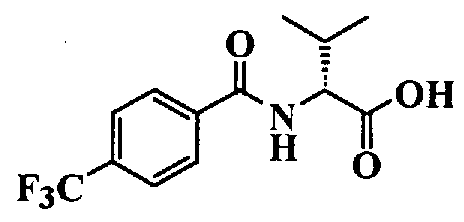
N-[4- (トリフルォロメチル)ベンゾィル] -D-バリン、その製薬学的に許容される塩、 またはこれらの溶媒和物;
N-[4- (トリフルォロメチル)ベンゾィル] 2—メチルァラニン、その製薬学的に許容さ れる塩、またはこれらの溶媒和物;
N—べンゾィルー 2—メチルァラニン、その製薬学的に許容される塩、またはこれらの溶 媒和物;
N— (P-トルオイル) 2—メチルァラニン、その製薬学的に許容される塩、またはこれら の溶媒和物。
本発明の第 2の態様は、前記式 (I)で表される化合物もしくはその光学活性体、ま たはそれらの製薬学的に許容される塩、またはこれらの溶媒和物を有効成分として 含有することを特徴とする抗ァロディユア剤である。
本発明の第 3の態様は、ニューロパシー性疼痛の予防及び Zまたは治療剤であつ て、
(1)前記式 (I)で表される化合物もしくはその光学活性体、またはそれらの製薬学的 に許容される塩、またはこれらの溶媒和物、
及び(2)ガバペンチンもしくはプレガパリン、またはそれらの製薬学的に許容される 塩、またはこれらの溶媒和物、力 なる群から各々選ばれる少なくとも一種を組み合 わせることを特徴とする、ニューロパシー性疼痛の予防及び Zまたは治療剤である。 第 2及び第 3の態様にぉレ、て、前記式 (I)で表される化合物にぉレ、て好ましレ、置換 基またはそれらの好ましい組み合わせ、或いは化合物もしくは光学活性体の好まし い例は、第 1の態様と同じである。
[0016] 本発明の第 4の態様は、
N- (4—ヒドロキシベンゾィル)—2—メチルァラニン;
N- (4—ァセトキシベンゾィル) _2—メチルァラニン;
N— [ 3 , 5_ビス(トリフルォロメチル)ベンゾィル] _2—メチルァラニン;及び
N_[4_ (トリフルォロメチル)ベンゾィル]バリン;
力 選ばれる化合物もしくは光学活性体、またはそれらの塩、またはこれらの溶媒和 物である。
本発明の第 5の態様は、第 4の態様に記載の化合物もしくは光学活性体、またはそ れらの塩、またはこれらの溶媒和物を有効成分とする医薬である。
[0017] 本発明の第 6の態様は、第 4の態様に記載の化合物もしくは光学活性体、またはそ れらの塩、またはこれらの溶媒和物を有効成分として含有することを特徴とする、ニュ 一口パシー性疼痛の予防及び/または治療剤である。
本発明の第 7の態様は、第 4の態様の記載の化合物もしくは光学活性体、またはそ れらの塩、またはこれらの溶媒和物を有効成分として含有することを特徴とする、抗ァ 口ディユア剤である。
[0018] 本発明において、「C1_4アルキル基」とは、炭素原子数 1ないし 4のアルキル基を 意味し、直鎖構造であっても分枝構造であっても良ぐメチル基、ェチル基、プロピル 基、イソプロピル基、ブチル基、イソブチル基、 s_ブチル基、 t_ブチル基等が挙げら れ、メチル基またはェチル基であることが好ましぐメチル基であることがより好ましレ、
本発明に用いられる式 (I)で表される化合物は、塩基との塩を形成する場合がある 。かかる塩基の例としては、製薬学的に許容される塩であれば特に制限されないが、 具体的には、ナトリウム、カリウム、マグネシウム、カルシウム、アルミニウム等の金属の 塩基、メチノレアミン、ェチルァミン、エタノールァミン、ピリジン、リジン、アルギニン、ォ ルニチン等の有機塩基との塩や、アンモニゥム塩等が挙げられる。
これらの塩は、定法、例えば、当量の本発明の化合物と所望の塩基を含む溶液を 混合し、所望の塩をろ取するか溶媒を留去して集めることにより得ることができる。 また、本発明の化合物またはその塩は、水、エタノール、グリセロール等の溶媒と溶 媒和物を形成しうる。本発明の化合物またはその塩にはこれら溶媒和物も含まれる。
[0019] 本発明の化合物は、結晶であっても非結晶であってもよレ、。すなわち、本発明の前 記式 (I)で表される化合物、もしくはその光学活性体、またはそれらの塩またはこれら の溶媒和物に、結晶、非結晶、それらの溶媒和物の態様も含まれる。また、この結晶 には、結晶多形のものも含まれる。
また、本発明には、前記式 (I)の化合物またはその塩、それらの溶媒和物の結晶多 形も含まれる。
式 (I)で表される化合物には、不斉炭素を有する場合があり、光学活性なすべての 異性体 (ェナンチォマー等)など各種混合物や単離された物質が存在しうるが、本発 明においてはこれらすべてが包含される。かかる光学異性体の単離、精製は、優先 晶出ゃカラムクロマトグラフィーを用いた光学分割あるいは不斉合成を通じてもなし 得ること力 Sできる。
本発明において、ガバペンチンとは、欧米で市販されている Neurotinの一般名で あり、 2_[1_ (アミノメチル)シクロへキサン]酢酸のことである。また、プレガバリンとは 、(S) -3- (アミノメチル)—5—メチルへキサン酸の一般名である。
[0020] [製造法]
次に、本発明の化合物の製造方法を示し、反応工程について説明する。本発明に おける式 (I)で表される化合物は、公知の化合物を出発原料として、公知の方法を組 み合わせた方法で製造できる。このうち式 (I)で表される化合物の製造方法としては 、次に説明する方法によるのが好ましい。なお、下式中において、 R1, R2、 Zは前記と 同じ意味を示す。 R3は、アルキル基、アルアルキル基、ァリール基、または水素原子 を示す。 R は CI一 4アルキル基、トリフルォロメチル基、ァセトキシ基、または保護さ れたヒドロキシル基を示す。
[0021] [化 2]
Figure imgf000011_0001
( Π ) ( Ι ') ( I ) 本製造法は、式 (II)で表されるアミノ酸誘導体またはその塩と、式 (III)で表される安 息香酸誘導体を縮合してアミド結合を形成することにより、式 (Γ )で表される化合物 を得て、必要に応じ置換基 (R1A)を変換することにより式( I )で表される化合物を得 る方法である。
[0022] 式 (Π)で表されるアミノ酸誘導体と、式 (III)で表される安息香酸誘導体を縮合して アミド結合を形成する反応は、アミド合成やペプチド合成に一般に用いられている公 知の方法で実施できる。例えば、新実験化学講座「有機化合物の合成と反応 (11)」( 丸善)、後藤俊夫、芝哲夫、松浦輝夫監修「有機化学実験のてびき 4 -合成反応〔II〕 」(ィ匕学同人)などの成書に記載の方法などが挙げられる。例えば、具体的には、(1) 式(ΠΙ)のカルボン酸 (R3 = H)またはカルボン酸エステル (R3 = C 1—4アルキル基)と 式 (Π)のァミンを混合して縮合する方法、 (2)式 (III)のカルボン酸を酸クロリドなどの 酸ハライドや活性エステルに変換して式 (II)のァミンと反応する方法、(3)式 (ΠΙ)の力 ルボン酸と式 (Π)のアミンを縮合剤の存在下に反応する方法、などが挙げられる。
[0023] 上記(1)のアミド結合を形成させる反応を、カルボン酸またはカルボン酸エステルと 、ァミンとを混合して縮合する方法で実施する場合には、基質を室温以上の沸点の 溶媒中に混合して加熱するか、または溶媒と共沸させて脱水または脱アルコールし て縮合するのが好ましい。
上記(2)のアミド結合を形成させる反応を、カルボン酸を酸ハライドや活性エステル に変換してァミンと反応する方法で実施する場合には、対応するカルボン酸をチォニ ルクロリドゃシユウ酸クロリドなどを用いて酸クロリドに変換するカ N—ヒドロキシコハク 酸イミド、 N—ヒドロキシベンゾトリァゾール、 4_ニトロフエノール、及びペンタフルォロ フエノールなどを用いて種々の活性エステルに変換した後、ァミンと反応させる。この ァミンとの反応においては、トリェチルァミン、ジイソプロピルェチルァミン、 N—メチル モルホリン、ピリジン、水酸化ナトリウム、水酸化カリウム、炭酸ナトリウム、炭酸水素ナ トリウムなどの塩基を存在させてもよい。
[0024] (3)のアミド結合を形成させる反応を、カルボン酸とアミンを縮合剤の存在下に反応 させる方法で実施する場合には、縮合剤として、例えば、 N, N—ジシクロへキシルカ ルボジイミド(DCC)、 1_ェチル _3_ (3—ジメチルァミノプロピル)カルボジイミド(WS C)、ベンゾトリァゾーノレ— 1—イロキシトリス(ジメチルァミノ)ホスホニゥム へキサフル ォロホスフェイト(B〇P)、ベンゾトリァゾーノレ一 1—ィル一ォキシトリスピロリジノホソホ二 ゥム へキサフルォロホスフェート(PyBOP)、ビス(2—ォキソ—3—ォキサゾリジニル) ホスフィニッククロリド(BOP— Cl)、 O—ベンゾトリァゾーノレ一 1—ィル一Ν, Ν, Ν,, Ν'— テトラメチルゥロニゥム テトラフルォロホスフェイト(HBTU)、ペンタフルオロフェニル ジフエニルホスフイネイト(FDPP)などが用いられる。縮合反応においては、上記縮 合剤とともに、 Ν—ヒドロキシベンゾトリァゾール、及び 3, 4—ジヒドロ _3—ヒドロキシ一4 —ォキソ—1 , 2, 3_ベンゾトリアジンなどの添加斉 lj、トリェチルァミン、ジイソプロピルァ ミン、 N-メチルモルホリン、ピリジン、水酸化ナトリウム、水酸化カリウム、炭酸ナトリウ ム或いは炭酸水素ナトリウムなどの塩基を存在させてもよい。
[0025] 式 (I)で R1がヒドロキシノレ基である化合物を得る場合には、 R1Aがァセトキシ基または 保護されたヒドロキシノレ基である式 (Γ )の化合物を適宜脱保護する。この場合の保護 基の導入'除去の方法は、保護基のタイプにより適宜行われるが、例えば、プロテク ティブ'グノレープス'イン'オーガニック 'シンセシス (Protective Groups in Orga nic Synthesis)第 3版、 1999年の総説に記載の方法により行うことができる。より具 体的な保護基の例には、メチル基、ェチル基、 t一ブチル基などの低級アルキル基; ベンジル基、 4_ニトロべンジル基などのァラアルキル基;トリメチルシリル基などの置 換シリル基;ァセチル基、ベンゾィル基などのァシル基;ベンゼンスルホニル基、トシ ル基などのァリールスルホニル基;メトキシメチル基、テトラヒドロピラニル基などが挙 げられる。 式 (I)中の R2が水素原子である化合物は、定法のエステルィヒ反応により R2が C1 4 アルキル基であるエステル体に変換することが可能である。また、式 (I)中の R2が C1 4アルキル基である化合物は、定法の加水分解反応により式 (I)中の R2が水素原子 であるカルボン酸に変換することが可能である。この変換反応は、種々の工程で適宜 行うことができる。
[0026] [実験例]
以下に実験例を挙げて、本発明を具体的に説明するが、本発明はこれらによって 何ら限定されるものではない。
[0027] 実験例 1 [ラットホルマリン誘発疼痛反応に対する抑制効果]
ドーク(Doak)らの方法(ョ一口ピアン 'ジャーナノレ 'ォブ 'ファーマコロジー(Eur. J. Pharmacol. ) 281卷, 311頁, 1995年)に従って行った。良口ち、ラットの左足 1¾に 、 0. 5%ホルマリン溶液 50 z Lを皮下注入し、直後より始まる注入足に対する舐める 、嚙む行動の持続時間をストップウォッチで計測し、 5分間毎にそれらの積算値を記 録した。ホルマリン誘発により二相性の特徴ある疼痛反応が認められ、誘発後 10分 以内に認められた疼痛を第 1相、 10分より 45分までに認められた疼痛を第 2相の疼 痛反応とした。被験化合物はホルマリン注入 30分前に経口投与した。そして、被験 化合物のホルマリン誘発による第 2相疼痛反応に対する抑制率を次式により求め、結 果を表 1に示した。ちなみに、対照薬物であるガバペンチン 30mg/kgの経口投与 は第 2相における疼痛反応を 34%、塩酸メキシレチン 30mg/kgの経口投与は第 2 相における疼痛反応を 25%抑制した。
本発明の被験化合物は、後記の各実施例で製法を示した化合物を用いた。 抑制率(%) = [ (PRcontrol-PRtest) / (PRcontrol) ] X 100
PRtest :ホルマリン +被験化合物投与群疼痛反応時間(秒) PRcontrol :ホルマリン誘発対照群疼痛反応時間(秒)
[0028] [表 1] 表 1 ラットホルマリン誘発疼痛反応に対する抑制効果
Figure imgf000014_0001
上記の結果より、本発明化合物は,経口投与によりホルマリン誘発による疼痛反応 を抑制した。同時に,一般症状に何ら異常が認められな力、つたことから、本発明化合 物の低い毒性が示された。
[0029] また、被験化合物とガバペンチンをホルマリン注入 30分前に同時に経口投与し、 それらの相互作用を検討した結果を表 2に示した。
[表 2] 表 2 ラッ トホルマリン誘発疼痛反応に対する
Figure imgf000014_0002
上記の結果より、本発明化合物とガバペンチンとを併用することにより相乗的に鎮 痛作用が強くなることが示された。
[0030] 実験例 2 [ラット坐骨神経絞扼モデルにおける有効性]
ベネット(Bennett)らの方法(ペイン(Pain) 33卷, 87頁, 1988年)に従って坐骨 神経絞扼モデルを作製した。即ち、ラットをペントバルビタールナトリウム4 Omg/kg、 i. p.で麻酔し、皮膚を切開後、左大腿二頭筋を鈍性切開した。坐骨神経を周辺組 織より剥離し、手術用クロミックガット(4一 0あるいは 3— 0)にて約 lmm間隔で 4箇所緩 く絞扼した後、手術部位を縫合して飼育ケージに戻して飼育した。なお、偽手術群は 、坐骨神経を剥離するまでの同様の処置を行った。坐骨神経絞扼手術の 2週間以降 に、フォンフライフィラメント(von Frey filament)を用いて触刺激に対する反応閾値 を測定した。坐骨神経絞扼ラットに被験化合物を経口投与した 1時間後に、剛性強 度の低い順にフィラメントを足底(踵付近から中央部)に押し当て、挙上反応を示した 強度を反応閾値(カットオフ: 28. 84g)とした。結果を表 3に示した。
[0031] [表 3] 表 3 ラット坐骨神経絞扼モデルに対する有効性
A. 実施例 2の有効性
Figure imgf000015_0001
[0032] 本試験において、坐骨神経を絞扼した傷害側のみに、触刺激に対する顕著な反応 閾値の低下、すなわちァロディユアが認められた。
本発明化合物は、坐骨神経を絞扼した傷害側の反応閾値を上昇させたが、正常側 の反応閾値にはほとんど影響を与えなかった。一方、ガバペンチンおよび塩酸メキシ レチンは傷害側だけでなく正常側の反応閾値も上昇させた。したがって、本発明化 合物は、神経の損傷部位に選択的な抗ァロディユア作用を示すことが明らかとなった
[0033] 実験例 3 [毒性試験]
6週齢の Wistar Hannover系の雌性ラットに実施例 2、実施例 4、実施例 5及び実 施例 6の化合物を 1000mg/kgの用量で経口投与したところ、一般症状に異常は認 められず、死亡例も認められなかった。
6週齢の Wistar Hannover系の雌性ラットに実施例 2、実施例 4、実施例 5及び実 施例 6のィ匕合物を 250、 500及び 1000mg/kg/曰の用量で 1曰 1回 14曰間強制 経口投与したところ、いずれの用量においても最終回投与終了後 24時間まで死亡 例はなぐ一般症状観察、体重及び摂餌量測定においても異常は認められなかった 。また、血液学的検査、血液生化学的検査、主要器官の重量測定及び病理組成学 的検査においてめだった毒性的所見は観察されなかった。
[0034] 実験例 4 [HERG K+チャネルに対する影響]
実施例 2 (300 μ mol/L)、実施例 5 (300 μ mol/L)及び実施例 6 ( 100 μ mol/L )の化合物を、それぞれ表記の濃度において CHO— K1/HREG細胞株を用いたパ ツチクランプ (patch— clamp)法により検討した結果、 HERG K+チャネルに対する 阻害は認められなかった。
[0035] 実験例 5 [ファーマコキネテイクス]
8週齢の Wistar Hannover系の雌性ラット,および 2または 3年齢の雄性ビーグル 犬を用いて、実施例 2、実施例 4、実施例 5及び実施例 6の化合物の経口単回投与 後の血漿中濃度の推移を検討したところ、いずれの化合物もバイオアベイラビリティ は良好であった。また、いずれの化合物もヒト薬物代謝酵素に対する阻害作用は認 められなかった。従って、薬物相互作用は起きにくいと考えられる。さらに、ヒト、サル 、ィヌ及びラットの肝ミクロソームにおいて代謝を受けにくかった。従って、肝臓におけ る代謝を受けにくいと考えられる。
[0036] 以上の実験結果から、本発明化合物は、経口投与で、ラットホルマリン誘発疼痛反 応を抑制し、ニューロパシー性疼痛のモデルであるラット坐骨神経絞扼モデルにお いて傷害側選択的な鎮痛効果を示した。また、本発明化合物とガバペンチンとを併 用すると効力を増強させることが示された。さらに、毒性試験において何ら異常が認 められかったことから、本発明化合物の極めて低い毒性が示された。また、本発明化 合物は、 HERGチャネルに対する阻害作用が認められなかった。また、本発明化合 物は良好な薬物動態学的特性を有することが示された。
従って、本発明の化合物は、動物の疼痛モデルで優れた鎮痛効果を有すること、 副作用が少なく安全性が高ぐ良好な薬物動態的特性を有することから、優れた鎮 痛剤、とりわけ、経口投与可能なニューロパシー性疼痛治療剤、あるいはガバペンチ ンとの併用剤として期待できる。
[0037] 本発明化合物は、以下の特定の疼痛疾患、中枢性のニューロパシー(例えば、脊 髄の傷害により生じ得る)、末梢性のニューロパシー(例えば、反射性交感神経性ジ ストロフィー症 (RSD) )、急性期帯状疱疹および帯状疱疹後神経痛、糖尿病性ニュ 一口パシー、三叉神経痛、術後痛、癌性疼痛、腰痛関連ニューロパシー、脊髄損傷 後疼痛、視床痛、下肢痛、カウザルギ一、反射性交感神経性萎縮症、慢性頭痛、歯 痛、肩関節周囲炎、変形性関節症、関節炎、リウマチに伴う疼痛などに使用できるが 、それらに限定されない。また、これらの慢性疼痛疾患における時間経過に伴う徴候 の悪化を防止または阻害する目的にも使用できる。
[0038] また、本発明化合物は、痛覚過敏 (有害刺激に対して過度に反応する現象)、ァロ ディニァ (軽く触られただけでも痛みとして感じる状態)、 自発痛 (何もしないのに痛レヽ )などの症状を示す疼痛疾患にも有効である。
更に、本発明化合物は、疼痛疾患のみならず、痙攣、癲癇、痴呆 (脳血管性、老人 性)、脳梗塞急性期、脳出血、一過性脳虚血、くも膜下出血、頭部外傷、脳手術後遺 症、脳動脈硬化後遺症等の脳血管障害、かゆみを伴う疾患、過敏性腸症候群など にも使用されうる。
[0039] 一方、本発明化合物とガバペンチンとを併用することにより相乗的に鎮痛作用、とり わけニューロパシー性疼痛抑制作用が強くなることから、ガバペンチン単独では無効 な患者に対しても効果が期待できる。また、ガバペンチンの用量を減じられることから
)高用量での傾眠やめまいなどの前述した副作用の発現を抑制ある いは軽減することも期待できる。
ニューロパシー性疼痛治療の観点から、本発明化合物と併用される薬物には、ガ バペンチンの他、プレガバリン、或いはアミトリプチリンなどの抗うつ薬;力ルバマゼピ ン、フエニトインなどの抗癲癇薬;メキシレチンなどの抗不整脈薬等、ニューロパシー 性疼痛に転用し、処方されているものが挙げられる。好ましくは、ガバペンチンまたは プレガバリンである。
本発明化合物とガバペンチンとを併用する場合、組み合わせる活性成分の相対的 用量 (本発明化合物:併用される薬物、質量比)は、広い範囲で変えることができる。 例えば、 100 : 1— 1 : 100が挙げられ、 10 : 1 1 : 10であることが好ましく、 5 : 1— 1 : 5であることがより好ましい。
本発明化合物と併用される薬物とを組み合わせて使用する場合は、別々の製剤で あっても、合剤であっても良い。また、別々の製剤においては、両者を同時に服用す ることも、時間をずらして投与することも可能である。
本発明の医薬は、医薬組成物の形態で投与される。
本発明の医薬組成物は、本発明の式 (I)で表される化合物の少なくとも一つ以上を 含んでいればよぐ医薬上許容される添加剤と組み合わせてつくられる。より詳細に は、賦形剤(例;乳糖、白糖、マンニット、結晶セルロース、ケィ酸、トウモロコシデンプ ン、バレイショデンプン)、結合剤(例;セルロース類(ヒドロキシプロピルセルロース(H PC)、ヒドロキシプロピルメチルセルロース(HPMC) )、結晶セルロース、糖類(乳糖 、マンニット、 白糖、ソルビトール、エリスリトーノレ、キシリトール)、デンプン類(トウモロ コシデンプン、バレイショデンプン)、 α化デンプン、デキストリン、ポリビエルピロリドン (PVP)、マクロゴール、ポリビュルアルコール(PVA) )、滑沢剤(例;ステアリン酸マ グネシゥム、ステアリン酸カルシウム、タルク、カルボキシメチルセルロース)、崩壊剤( 例;デンプン類(トウモロコシデンプン、バレイショデンプン)、カルボキシメチルスター チナトリウム、カルメロース、カルメロースカルシウム、クロスカルメロースナトリウム、ク ロスポピドン)、被膜剤(例;セルロース類 (ヒドロキシプロピルセルロース (HPC)、ヒド ロキシプロピルメチルセルロース(HPMC)、アミノアルキルメタクリレートコポリマー Ε 、メタクリル酸コポリマー LD)、可塑剤(例;タエン酸トリエチル、マクロゴール)、隠蔽 剤 (例;酸化チタン)、着色剤、香味剤、防腐剤 (例;塩化ベンザノレコニゥム、パラォキ シ安息香酸エステル)、等張化剤(例;グリセリン、塩化ナトリウム、塩化カルシウム、マ ンニトール、ブドウ糖)、 pH調節剤(例;水酸化ナトリウム、水酸化カリウム、炭酸ナトリ ゥム、塩酸、硫酸、リン酸緩衝液などの緩衝液)、安定化剤(例;糖、糖アルコール、キ サンタンガム)、分散剤、酸化防止剤(例;ァスコルビン酸、プチルヒドロキシァニソー ル(BHA)、没食子酸プロピル、 dl—ひ—トコフヱロール)、緩衝剤、保存剤(例;パラべ ン、ベンジルアルコール、塩化ベンザルコニゥム)、芳香斉 lj (例;バニリン、 1ーメントー ノレ、ローズ油)、溶解補助剤(例;ポリオキシエチレン硬化ヒマシ油、ポリソルベート 80 、ポリエチレングリコール、リン脂質コレステロール、トリエタノールァミン)、吸収促進 剤(例;グリコール酸ナトリウム、ェデト酸ナトリウム、力プリン酸ナトリウム、ァシルカノレ 二チン類、リモネン)、ゲルィ匕剤、懸濁化剤、または乳化剤、一般的に用いられる適当 な添加剤または溶媒の類を、本発明の化合物と適宜組み合わせて種々の剤形とす ることが出来る。
[0041] 種々の剤形とは、錠剤、カプセル剤、顆粒剤、散剤、丸剤、軟膏剤、パッチ剤、坐 剤、注射剤、舌下投与剤、液剤、粉剤、懸濁剤、鼻腔投与剤、徐放化製剤等があげ られる。また、経口、皮下投与、筋肉内投与、経皮投与、静脈内投与、動脈内投与、 神経周囲投与、硬膜外投与、硬膜下腔内投与、脳室内投与、直腸内投与、鼻腔内 投与等により患者に投与し得る。また、疼痛を感じた時に患者自身が直ちに鎮痛薬 を投与できる patient—controlled analgesia (PCA)専用インフューザや簡易インフ ユーザによる投与、無針注射器による投与、イオンフオトレシスによる薬物の経皮投 与等のような手法を用いることもできる。
[0042] 本発明化合物の投与量は、通常成人 1日当たり 0. 05mg 30. 0g、好ましくは 0.
5mg 25g、より好ましくは lmg 15gである力 症状あるいは投与経路に応じて適 宜増減できる。
全量を 1回あるいは 2_6回に分割して経口または非経口投与することや、点滴静注 等、連続投与することも可能である。
実施例
[0043] 以下に、本発明を更に詳細に説明するために実施例を挙げる力 本発明はこれに 限定されるものではない。
核磁気共鳴スペクトル (NMR)の測定にはジヱオル JNM—LA300 FT— NMR (日 本電子(株)製、 JEOLJNM—LA300)またはジヱオル JNM— EX270 FT— NMR ( 日本電子 (株)製、 JEOLJNM—EX270)を用レ、、融点(m. p. )の測定にはメトラー F P90とメトラー FP82HT (メトラ^ ~ ·トレド(株)製、 METTLERFP90と METTLERFP 82HT)を用レ、、高速液体クロマトグラフィー(HPLC)の測定には島津 LC—10A (島 津製作所 (株)製)をそれぞれ用いた。下記実施例の式中で、 Etはェチル基、 Acは ァセチル基を示す。
なお、本発明および実施例で用いる原料および試薬は、全て公知の手法により調 製するか、または市販のものを使用できる。また、実施例におけるカラムクロマトグラフ ィ一の溶媒の量比は容量比で示す。
[実施例 1]N_ (4—ァセトキシベンゾィル)_2—メチルァラニン ェチルエステルの合 成
[化 3]
Figure imgf000020_0001
4—ァセトキシ安息香酸 10. 8gのトルエン(120mL)懸濁液に、塩化チォニル 8. 8 mL、 N, N—ジメチルホルムアミド 0. 3mLを加え、外温 80— 90。Cで 30分撹拌した。 放冷後、反応液を濃縮し、この濃縮残渣の塩化メチレン(50mL)溶液を、氷冷下、ザ ジャーナル ォブ オルガニック ケミストリー (J. Org. Chem. ),第 47卷, 2982頁 (1982年)に記載されている方法で合成した 2—メチルァラニン ェチルエステル塩 酸塩の塩化メチレン(150mL)懸濁溶液に 10分間で滴下、続いてピリジン 14. 5mL を滴下後室温で 16時間攪拌した。反応液に水 lOOmLを加え、有機層を分液後、 1 mol/L塩酸水溶液、水、飽和食塩水で順次洗浄し、無水硫酸ナトリウムで乾燥後、 減圧下溶媒を留去した。残渣をシリカゲルカラムクロマトグラフィー(へキサン/酢酸 ェチル = 3/1—酢酸ェチル)で精製して標題化合物 14. 3gを白色粉末として得た 。 (収率 81 %) JH-NMR (300MHz, CDC1 ) δ ppm:7.81 (2H, d, J = 9Hz), 7.16 (2H, d,
J = 9Hz), 6.82(1H, s) , 4.24 (2H, q, J = 7Hz), 2.32 (3H, s) , 1.68 (6H, s ), 1.29(3H, t, J = 7Hz)
m. p. :101.2—102.2°C
[0045] [実施例 2] N_ (4—ヒドロキシベンゾィル )_2—メチルァラニンの合成
[化 4]
Figure imgf000021_0001
実施例 1で合成した N_ (4—ァセトキシベンゾィル) _2—メチノレアラニン ェチルエス テノレ 4· 00gのエタノーノレ(30mL)溶夜に、水酸ィ匕ナトリウム(1· 64g)の水(30mL) 溶液を加え、室温で 30分間撹拌後、 30分間加熱還流した。反応液を濃縮後、残渣 を lmol/L塩酸水溶液で酸性とした後、酢酸ェチルで 3回抽出した。有機層を水,飽 和食塩水で順次洗浄し、無水硫酸ナトリウムで乾燥後、減圧下溶媒を留去した。残 渣をジェチルエーテルで懸濁後、濾取して標題化合物 2.97gを白色粉末として得 た。 (収率 98%)。
'H-NMR (300MHz, DMSO-d ) Sppm:12.09 (1H, brs) , 9.97(1H, s) ,
8.17(1H, s), 7.72 (2H, d, J = 9Hz), 6.78 (2H, d, J = 9Hz), 1.42 (6H, s) m. p. :225.8— 227.9°C
[0046] [実施例 3] N—(4ーァセトキシベンゾィル)一 2—メチルァラニンの合成
[化 5]
Figure imgf000021_0002
実施例 2で合成した N_ (4—ヒドロキシベンゾィル) _2—メチルァラニン 1 · 50gの N, N—ジメチルホルムアミド(15mL)溶液に、塩化ァセチル 0.96mL、ピリジン 1.63m Lを順次カ卩え、外温 50°Cで 2時間撹拌した。放冷後、反応液に水 75mLを加え、 1 mol/L塩酸水溶液で酸性とした後、酢酸ェチルで 2回抽出した。有機層を水、飽和 食塩水で洗浄し、無水硫酸ナトリウムで乾燥後、減圧下溶媒を留去した。シリカゲノレ カラムクロマトグラフィー(塩化メチレン/メタノール = 19/1)で精製し、標題化合物 0. 28gを白色粉末として得た。 (収率 16%)。
'H-NMR (270MHz, DMSO— d ) S ppm: 12. 19 (1H, brs) , 8. 48 (1H, s) ,
7. 89 (2H, d, J = 9Hz) , 7. 22 (2H, d, J = 9Hz) , 2. 29 (3H, s) , 1. 45 (6H, s) m. p. : 171. 0 173. 8°C
[0047] [実施例 4]N— [3, 5_ビス(トリフルォロメチル)ベンゾィル ]_2—メチルァラニンの合 成
[化 6]
Figure imgf000022_0001
N—ヒドロキシコハク酸イミド 6· 14gの N, N—ジメチルホルムアミド(50mL)溶液に、 氷冷下、 3, 5_ビス(トリフルォロメチル)ベンゾイルクロリド 9· 67mL、ジイソプロピノレ ェチルァミン 9. 29mLを順次加え、室温で 20分間攪拌した。この溶液を氷冷下、 2— メチルァラニン 5. 00gの水(lOOmL)溶液に滴下した後、ジイソプロピルェチルアミ ン 16. 9mLをカ卩え、室温で 6時間攪拌した。反応液を lmol/L塩酸水溶液で酸性と した後、酢酸ェチルで 3回抽出した。有機層を水(2回)、飽和食塩水で順次洗浄し、 無水硫酸ナトリウムで乾燥後、減圧下溶媒を留去した。残渣をジェチルエーテル -へ キサンで懸濁後、濾取して標題化合物 6. 96gを白色粉末として得た。 (収率 42%)
'H-NMR (270MHz, DMSO— d ) S ppm: 12. 36 (1H, brs) , 9. 01 (1H, s) ,
8. 52 (2H, s) , 8. 34 (1H, s) , 1. 49 (6H, s)
m. p. : 180. 4一 184. 7°C
[0048] [実施例 5]N_[4_ (トリフルォロメチル)ベンゾィル] _D_パリンの合成
[化 7]
Figure imgf000023_0001
N—ヒドロキシコハク酸イミド 0· 22g, 4_ (トリフルォロメチル)ベンゾイルクロリド 0· 2 8mL、および D-パリン 0. 20gから実施例 4と同様にして標題化合物 0. 44gを白色 粉末として得た。 (収率 89%)
'H-NMR (270MHz, DMSO— d ) S ppm: 12. 68 (1H, brs) , 8. 70 (1H, d, J
= 8Hz) , 8. 06 (2H, d, J = 8Hz) , 7. 85 (2H, d, J = 8Hz) , 4. 35—4. 22 (1H, m), 2. 26-2. 10 (1H, m) , 0. 98 (3H, d, J = 4Hz), 0. 95 (3H, d, J = 4Hz) m. p. : 122. 6— 124. 8°C
HPLC光学純度: 99%e. e.
HPLCの測定条件を以下に示す。
カラム; CAIRALPAK WH
溶媒; 0. 25mM硫酸銅水溶液-ァセトニトリル =80 : 20
[0049] [実施例 6] N— [4一(トリフルォロメチル)ベ -2—メチルァラニンの合成
[化 8]
Figure imgf000023_0002
N—ヒドロキシコハク酸イミド 0. 25g, 4_ (トリフルォロメチル)ベンゾイルクロリド 0. 3 2mL、および 2—メチルァラニン 0. 20gから実施例 4と同様にして標題化合物 0. 37g を白色粉末として得た。 (収率 69%)
JH-NMR (270MHz, DMSO—d ) 5 ppm: 12. 26 (1H, brs) , 8. 70 (1H, s) ,
8. 03 (2H, d, J = 8Hz) , 7. 84 (2H, d, J = 8Hz) , 1. 45 (6H, s)
m. p. : 215. 4一 219. 3。C
[0050] [実施例 7] N—べンゾィルー 2—メチルァラニンの合成
[化 9]
Figure imgf000024_0001
N—ヒドロキシコハク酸イミド 0. 25g,ベンゾイルクロリド 0. 25mL、および 2_メチル ァラニン 0. 20gから実施例 4と同様にして標題化合物 0. 18gを白色粉末として得た 。 (収率 45%)
'H-NMR (270MHz, DMSO— d ) S ppm: 12. 14 (1H, brs) , 8. 43 (1H, s) ,
7. 88-7. 76 (2H, m) , 7. 57-7. 35 (3H, m) , 1. 44 (6H, s)
m. p. : 192. 3— 195. 8°C
[0051] [実施例 8] N- (p_トルオイル) _2—メチルァラニンの合成
[化 10]
Figure imgf000024_0002
N—ヒドロキシコハク酸イミド 0. 25g, p—トノレオィノレクロリド 0. 28mL、および 2—メチ ノレァラニン 0. 20gから実施例 4と同様にして標題化合物 0. 13gを白色粉末として得 た。 (収率 30%)
'H-NMR (300MHz, DMSO-d ) S ppm: 12. 15 (1H, brs) , 8. 36 (1H, s) ,
7. 76 (2H, d, J = 7Hz) , 7. 26 (2H, d, J = 7Hz) , 2. 36 (3H, s) , 1. 44 (6H, s) m. p. : 200. 1— 203. 0°C
[0052] [製剤例]
次に、本発明の化合物を含有する製剤例を示すが、本発明はこれらに限定される ものではない。
[0053] 製剤例 1 錠剤
実施例 2の化合物 100g
乳糖 137g
結晶セノレロース 30g
ヒドロキシプロピノレセノレロース 15g カルボキシメチルスターチナトリウム 15g
ステアリン酸マグネシウム 3g
上記成分を秤量した後,均一に混合する。この混合物を打錠して重量 150mgの錠 剤とする。
[0054] 製剤例 2 フィルムコーティング マクロゴーノレ 6000 lg
酸化チタン 2g
上記成分を秤量した後,ヒドロキシプロピルメチルセルロース、マクロゴーノレ 6000を 水に溶解、酸化チタンを分散させる。この液を、製剤例 1の錠剤 300gにフィルムコー ティングし、フィルムコート錠を得る。
[0055] 製剤例 3 カプセル剤
実施例 4の化合物 50g
乳糖 435g
ステアリン酸マグネシウム 15g
上記成分を秤量した後、均一に混合する。混合物をカプセル封入器にて適当なハ ードカプセルに重量 300mgずつ充填し、カプセル剤とする。
[0056] 製剤例 4 カプセル剤
実施例 2の化合物 50g
ガバペンチン 50g
乳糖 63g
25g
-ス 10g
タルク 2g
上記成分を秤量した後、実施例 2の化合物、ガバペンチン、乳糖、トウモロコシデン プンを均一に混合し、ヒドロキシプロピルセルロースの水溶液を加え、湿式造粒法に より顆粒を製造する。この顆粒にタルクを均一に混合し,適当なハードカプセルに重 量 200mgずつ充填し,カプセル剤とする。 [0057] 翻列5 吝1|
実施例 1の化合物 200g
乳糖 790g
ステアリン酸マグネシウム 10g
上記成分をそれぞれ秤量した後、均一に混合し、 20%散剤とする。
[0058] 製剤例 6 顆粒剤、細粒剤
実施例 3の化合物 100g
乳糖 200g
結晶セノレロース 100g
部分 50g
-ス 50g
上記成分を秤量した後、実施例 3の化合物、乳糖、結晶セルロース,部分ひ化デン プンを加えて均一に混合し、ヒドロキシプロピルセルロース(HPC)の水溶液を加え、 湿式造粒法により顆粒又は細粒を製造する。この顆粒又は細粒を乾燥し、顆粒剤又 は細粒剤とする。
[0059] 製剤例 7 注射剤
実施例 2の化合物 2g
プロピレングリコール 200g
注射用蒸留水 適量
上記成分を秤量した後、実施例 2の化合物をプロピレングリコールに溶解する。注 射用滅菌水を加えて全量を 1, OOOmLとし、濾過滅菌後 10mLアンプルに 5mLずつ 分注し、熔封して注射剤とする。
[0060] 製剤例 8 坐剤
実施例 7の化合物 100g
ポリエチレングリコーノレ 1500 180g
ポリエチレングリコール 4000 720g
実施例 7の化合物を乳鉢にて十分研磨して微細な粉末とした後、溶融法によって 1 gずつの坐剤とする。 産業上の利用可能性
本発明化合物は、以下の特定の疼痛疾患、中枢性のニューロパシー(例えば、脊 髄の傷害により生じ得る)、末梢性のニューロパシー(例えば、反射性交感神経性ジ ストロフィー症 (RSD) )、急性期帯状疱疹および帯状疱疹後神経痛、糖尿病性ニュ 一口パシー、三叉神経痛、術後痛、癌性疼痛、腰痛関連ニューロパシー、脊髄損傷 後疼痛、視床痛、下肢痛、カウザルギ一、反射性交感神経性萎縮症、慢性頭痛、歯 痛、肩関節周囲炎、変形性関節症、関節炎、リウマチに伴なう疼痛などに使用できる 力 それらに限定されない。また、これらの慢性疼痛疾患における時間経過に伴なう 徴候の悪化を防止または阻害する目的にも使用できる。
また、本発明化合物は、疼痛疾患のみならず、痙攣、癲癇、痴呆 (脳血管性、老人 性)、脳梗塞急性期、脳出血、一過性脳虚血、くも膜下出血、頭部外傷、脳手術後遺 症、脳動脈硬化後遺症等の脳血管障害、かゆみを伴う疾患、過敏性腸症候群など にも使用できる。
さらに、ニューロパシー性疼痛治療の観点から、本発明化合物とガバペンチンとを 併用することによって、ガバペンチンのその薬効の増強、あるいは副作用の軽減にも 使用されうる。

Claims

請求の範囲 [1] 下記式 (I)で表される化合物もしくはその光学活性体、またはそれらの製薬学的に 許容される塩を有効成分として含有することを特徴とするニューロパシー性疼痛の予 防及び/または治療剤。
[化 1]
Figure imgf000028_0001
(式中、 Ζίま、 -C (CH ) 一、また ίま CH (CH (CH ) )_を表し;
nは、 0— 2の整数を表し;
R1は、 C1—4アルキル基、ヒドロキシル基、トリフルォロメチル基またはァセトキシ基 を表し、 nが 2である場合には、 R1は同一であっても異なっていても良く;
R2は、水素原子または C 1—4アルキル基を表す。但し、 Zがー CH (CH (CH ) )—で あり、 R1が 2位のヒドロキシノレ基である場合を除く。 )
[2] ニューロパシー性疼痛の予防及び/または治療剤であって、
(1)請求項 1に記載の式 (I)で表される化合物もしくはその光学活性体、またはそれ らの製薬学的に許容される塩、
及び(2)ガバペンチンもしくはプレガパリン、またはそれらの製薬学的に許容される 塩からなる群から各々選ばれる少なくとも一種を組み合わせることを特徴とする、ニュ 一口パシー性疼痛の予防及び/または治療剤。
[3] 式 (I)で表される化合物が、
N- (4—ヒドロキシベンゾィル)—2-メチルァラニン;
N- (4—ァセトキシベンゾィル) _2—メチルァラニン;
N— [ 3 , 5 ビス(トリフルォロメチル)ベンゾィル] _2—メチルァラニン;及び
N— [4 (トリフルォロメチル)ベンゾィル]バリン;
力 選ばれる化合物である請求項 1または 2に記載のニューロパシー性疼痛の予防 及び Zまたは治療剤。
[4] N—(4—ヒドロキシベンゾィル)—2—メチルァラニン;
N—(4—ァセトキシベンゾィル) _2—メチルァラニン;
N— [ 3 , 5_ビス(トリフルォロメチル)ベンゾィル] _2—メチルァラニン;及び
N— [4一(トリフルォロメチル)ベンゾィル]バリン;
力 選ばれる化合物もしくはその光学活性体、またはそれらの塩。
PCT/JP2004/011594 2003-08-13 2004-08-12 N−(ベンゾイル)アミノ酸誘導体を有効成分とするニューロパシー性疼痛治療剤 Ceased WO2005016331A1 (ja)

Applications Claiming Priority (2)

Application Number Priority Date Filing Date Title
JP2003-292918 2003-08-13
JP2003292918A JP2005060311A (ja) 2003-08-13 2003-08-13 N−(ベンゾイル)アミノ酸誘導体を有効成分とするニューロパシー性疼痛治療剤

Publications (1)

Publication Number Publication Date
WO2005016331A1 true WO2005016331A1 (ja) 2005-02-24

Family

ID=34190969

Family Applications (1)

Application Number Title Priority Date Filing Date
PCT/JP2004/011594 Ceased WO2005016331A1 (ja) 2003-08-13 2004-08-12 N−(ベンゾイル)アミノ酸誘導体を有効成分とするニューロパシー性疼痛治療剤

Country Status (2)

Country Link
JP (1) JP2005060311A (ja)
WO (1) WO2005016331A1 (ja)

Cited By (3)

* Cited by examiner, † Cited by third party
Publication number Priority date Publication date Assignee Title
WO2006114707A1 (en) * 2005-04-28 2006-11-02 Pfizer Limited Amino acid derivatives
CN103002893A (zh) * 2010-07-30 2013-03-27 东丽株式会社 神经障碍性疼痛的治疗药或预防药
CN111196772A (zh) * 2018-11-16 2020-05-26 沈阳化工研究院有限公司 一种芳酰氨基异丁酰衍生物及其应用

Citations (4)

* Cited by examiner, † Cited by third party
Publication number Priority date Publication date Assignee Title
JPH08291124A (ja) * 1995-04-19 1996-11-05 Microbial Chem Res Found 新規生理活性物質ヒドロスタチンaおよびその製造法と用途
JP2000502318A (ja) * 1995-06-23 2000-02-29 オゥクラホゥマ、メディカル、リサーチ、ファウンデイシャン N−L−α−アスパルチル−L−フェニルアラニン1−メチルエステルの鎮痛剤としての使用
JP2001501179A (ja) * 1996-09-03 2001-01-30 フアルマシア・エ・アツプジヨン・エツセ・ピー・アー キヌレニン―3―ヒドロキシラーゼ抑制活性を有するn―置換―2―アミノ―4―フェニル―4―オキソ―ブタン酸
JP2003503453A (ja) * 1999-07-02 2003-01-28 ワーナー−ランバート・カンパニー 相乗作用組成物:ガバペンチンおよびプレガバリン

Patent Citations (4)

* Cited by examiner, † Cited by third party
Publication number Priority date Publication date Assignee Title
JPH08291124A (ja) * 1995-04-19 1996-11-05 Microbial Chem Res Found 新規生理活性物質ヒドロスタチンaおよびその製造法と用途
JP2000502318A (ja) * 1995-06-23 2000-02-29 オゥクラホゥマ、メディカル、リサーチ、ファウンデイシャン N−L−α−アスパルチル−L−フェニルアラニン1−メチルエステルの鎮痛剤としての使用
JP2001501179A (ja) * 1996-09-03 2001-01-30 フアルマシア・エ・アツプジヨン・エツセ・ピー・アー キヌレニン―3―ヒドロキシラーゼ抑制活性を有するn―置換―2―アミノ―4―フェニル―4―オキソ―ブタン酸
JP2003503453A (ja) * 1999-07-02 2003-01-28 ワーナー−ランバート・カンパニー 相乗作用組成物:ガバペンチンおよびプレガバリン

Non-Patent Citations (1)

* Cited by examiner, † Cited by third party
Title
CHIARUGI A ET AL: "Comparison of the Neurochemical and Behavioral Effects Resulting from the Inhibition of Kynurenine Hydroxylase and/or Kynureninase", JOURNAL OF NEUROCHEMISTRY, vol. 65, no. 3, 1995, pages 1176 - 1183, XP002904257 *

Cited By (10)

* Cited by examiner, † Cited by third party
Publication number Priority date Publication date Assignee Title
WO2006114707A1 (en) * 2005-04-28 2006-11-02 Pfizer Limited Amino acid derivatives
JP2009040767A (ja) * 2005-04-28 2009-02-26 Pfizer Ltd アミノ酸誘導体
US7612226B2 (en) 2005-04-28 2009-11-03 Pfizer Inc. Amino acid derivatives
KR100925900B1 (ko) 2005-04-28 2009-11-09 화이자 리미티드 아미노산 유도체
AU2006238933B2 (en) * 2005-04-28 2011-12-01 Pfizer Limited Amino acid derivatives
CN103002893A (zh) * 2010-07-30 2013-03-27 东丽株式会社 神经障碍性疼痛的治疗药或预防药
RU2544552C2 (ru) * 2010-07-30 2015-03-20 Торэй Индастриз, Инк. Терапевтическое средство или профилактическое средство для нейропатической боли
CN103002893B (zh) * 2010-07-30 2017-05-10 东丽株式会社 神经障碍性疼痛的治疗药或预防药
CN111196772A (zh) * 2018-11-16 2020-05-26 沈阳化工研究院有限公司 一种芳酰氨基异丁酰衍生物及其应用
CN111196772B (zh) * 2018-11-16 2022-09-30 沈阳化工研究院有限公司 一种芳酰氨基异丁酰衍生物及其应用

Also Published As

Publication number Publication date
JP2005060311A (ja) 2005-03-10

Similar Documents

Publication Publication Date Title
EP4172145B1 (en) Tryptamine prodrugs as serotonin receptor activators for the treatment of e.g. depression
US20060183786A1 (en) Injectable long-acting analgesic composition comprising an ester derivative of ketorolac
US8518979B2 (en) Alpha-halo- and alpha-alkyl-cyclopropylcarboxy compounds and uses thereof
ES2802977T3 (es) Compuesto para la modulación inmunológica, uso del mismo y composición farmacéutica que lo comprende
JPH0641475B2 (ja) 置換アルファアミノ酸、その製法および医薬
US20150080473A1 (en) N-Substituted Benzenepropanamide or Benzenepropenamide Derivatives for use in the Treatment of Pain and Inflammation
WO2010050577A1 (ja) シクロヘキサン誘導体及びその医薬用途
TW202337456A (zh) Gm2神經節苷脂症之治療
JP2009545549A (ja) Cpt阻害剤としての4−トリメチルアンモニウム−3−アミノブチレートおよび4−トリメチルフォスフォニウム−3−アミノブチレート誘導体
US20140350099A1 (en) Method of Treating or Preventing Pain
US9802962B2 (en) Tricyclic pyrone compounds reduce amyloid beta aggregates
KR20090088442A (ko) 아미노알코올 유도체 및 그들의 치료적 용도
EP2475361A1 (en) N-substituted benzenepropanamide or benzenepropenamide for use in the treatment of pain and inflammation
KR102235994B1 (ko) 환상 아민 유도체의 결정 및 그 의약 용도
JP2008179541A (ja) 神経因性疼痛治療薬
US10906864B2 (en) Nitroalkene non steroidal anti-inflammatory drugs (NA-NSAIDS) and methods of treating inflammation related conditions
JP6195100B2 (ja) プロテインキナーゼgに対する高阻害活性を有する化合物及びその製造方法
JP2005060311A (ja) N−(ベンゾイル)アミノ酸誘導体を有効成分とするニューロパシー性疼痛治療剤
CN117362200A (zh) 苯甲胺类化合物及其合成方法与应用
JPH08501557A (ja) Acat阻害剤としての1,2−二置換エチルアミド
JPH11509520A (ja) 鎮痛特性を有する新規のn−アセチル化4−ヒドロキシフェニルアミン誘導体及びそれを含む薬理組成物
JP2023518205A (ja) 酸化ストレスと関連した障害の処置およびこの処置のための化合物
US12357610B2 (en) Aryl-substituted acetamide and pyrrolidin-2-one derivatives and their use for the treatment of seizures
JPH0714871B2 (ja) 筋弛緩剤
EP3732162B1 (en) Nitroalkene non steroidal anti-inflammatory drugs (na-nsaids) and methods of treating inflammation related conditions

Legal Events

Date Code Title Description
AK Designated states

Kind code of ref document: A1

Designated state(s): AE AG AL AM AT AU AZ BA BB BG BR BW BY BZ CA CH CN CO CR CU CZ DE DK DM DZ EC EE EG ES FI GB GD GE GH GM HR HU ID IL IN IS KE KG KP KR KZ LC LK LR LS LT LU LV MA MD MG MK MN MW MX MZ NA NI NO NZ OM PG PH PL PT RO RU SC SD SE SG SK SL SY TJ TM TN TR TT TZ UA UG US UZ VC VN YU ZA ZM ZW

AL Designated countries for regional patents

Kind code of ref document: A1

Designated state(s): BW GH GM KE LS MW MZ NA SD SL SZ TZ UG ZM ZW AM AZ BY KG KZ MD RU TJ TM AT BE BG CH CY CZ DE DK EE ES FI FR GB GR HU IE IT LU MC NL PL PT RO SE SI SK TR BF BJ CF CG CI CM GA GN GQ GW ML MR NE SN TD TG

121 Ep: the epo has been informed by wipo that ep was designated in this application
122 Ep: pct application non-entry in european phase