WO2004014312A2 - Small-mer compositions and methods of use - Google Patents

Small-mer compositions and methods of use Download PDF

Info

Publication number
WO2004014312A2
WO2004014312A2 PCT/US2003/025031 US0325031W WO2004014312A2 WO 2004014312 A2 WO2004014312 A2 WO 2004014312A2 US 0325031 W US0325031 W US 0325031W WO 2004014312 A2 WO2004014312 A2 WO 2004014312A2
Authority
WO
WIPO (PCT)
Prior art keywords
small
mer
alkyl
nucleotides
molecule
Prior art date
Legal status (The legal status is an assumption and is not a legal conclusion. Google has not performed a legal analysis and makes no representation as to the accuracy of the status listed.)
Ceased
Application number
PCT/US2003/025031
Other languages
French (fr)
Other versions
WO2004014312A3 (en
Inventor
Shawn Zinnen
Current Assignee (The listed assignees may be inaccurate. Google has not performed a legal analysis and makes no representation or warranty as to the accuracy of the list.)
Sirna Therapeutics Inc
Original Assignee
Sirna Therapeutics Inc
Priority date (The priority date is an assumption and is not a legal conclusion. Google has not performed a legal analysis and makes no representation as to the accuracy of the date listed.)
Filing date
Publication date
Application filed by Sirna Therapeutics Inc filed Critical Sirna Therapeutics Inc
Priority to AU2003259735A priority Critical patent/AU2003259735A1/en
Publication of WO2004014312A2 publication Critical patent/WO2004014312A2/en
Priority to US11/043,673 priority patent/US20050203044A1/en
Anticipated expiration legal-status Critical
Publication of WO2004014312A3 publication Critical patent/WO2004014312A3/en
Ceased legal-status Critical Current

Links

Classifications

    • CCHEMISTRY; METALLURGY
    • C07ORGANIC CHEMISTRY
    • C07HSUGARS; DERIVATIVES THEREOF; NUCLEOSIDES; NUCLEOTIDES; NUCLEIC ACIDS
    • C07H21/00Compounds containing two or more mononucleotide units having separate phosphate or polyphosphate groups linked by saccharide radicals of nucleoside groups, e.g. nucleic acids
    • C07H21/04Compounds containing two or more mononucleotide units having separate phosphate or polyphosphate groups linked by saccharide radicals of nucleoside groups, e.g. nucleic acids with deoxyribosyl as saccharide radical

Definitions

  • Short oligonucleotides have potential as therapeutic agents based upon several observations.
  • the role of nucleotides in the regulation of numerous biological processes, and their pathological conterparts, has lead to the development of nucleoside analogs as antiviral and anti-cancer agents.
  • Adenine dinucleotides are a known set of signalling molecules with divergent biological effects. Analogs of adenine dinucleotides have been shown to be potent enzyme inhibitors as well as suppressors of normal and malignant cell proliferation (Zatorski et al, 1995, J Med Chem., 38, 1098-1105).
  • Thymidine dinucleotides have been shown to inhibit contact hypersensitivity and activate tumor necrosis factor alpha 1 (Cruz et al, 2000, The Journal of Investigative Dermatology, 114, 253-258).
  • the dinucleotide 5'-Cytosine - Guanosine-3' with a phosphorothioate internucleotide linkage is known to cause a non- specific inflammatory response, whereas CG in the context of the hexamer sequences such as NACGTN, when delivered in liposomes, induces interferon and activates natural killer cells, thus exhibiting tumor regression activity (Sonehara et al, 1996, J Interferon Cytokine Res., 16, 799-803).
  • a phosphorothioate oligonucleotide octamer that forms a tetrameric guanosine-quartet structure which binds the HIN envelope protein gpl20, and inhibits cell-to- cell and virus-to-cell infection with an EC of approximately 0.3 - 6.4 uM has been reported (Wyatt et al, 1994, PNAS USA, 91, 1356-60).
  • This oligonucleotide has demonstrated in vivo efficacy in a SCID-hu Thy/Liv Mouse HIN model and has been reported to have toxicology profiles similar to other phosphorothioate oligonucleotides (Stoddart et al, 1998, Antimicrobial Agents and Chemotherapy, 42, 2113-15).
  • a 17-mer oligonucleotide with two phosphorothioate internucleotide linkages has been reported to have anti-HIN activity (Bishop et al, 1996, J Biol Chem., 271, 5698-03).
  • a phenoxazine-substituted phosphorothioate oligonucleotide targeting SN40 large T antigen has been described to have improved cellular penetration and enhanced target R ⁇ A binding properties compared to a 7-mer C-5 propynyl phosphorothioate oligonucleotide (Flanagan et al, 1999, Nature Biotechnology, 17, 48-52).
  • Applicant has applied a high-throughput screening approach to identify small-mers having antiviral and antiproliferative properties.
  • the utility of the method described herein capitalizes on covering all potential sequence space for a small-mer of predetermined length (i.e., examining all combinations of nucleotides for a particular given length) to identify potent inhibitors of viral replication and/or cellular proliferation that are non-toxic to normal cells.
  • the use of small-mer therapeutics of the invention represents a novel approach to treating diseases and conditions related to viral replication and cellular proliferation.
  • the present invention relates to compounds, compositions, and methods useful for inhibiting viral replication and/or cellular proliferation using small-mers.
  • the instant invention features a small-mer having about 3 to about 6 nucleotides and having antiviral or antiproliferative activity or both.
  • the small-mer constructs of the invention can be further optimized to comprise one or more (e.g. about 1, 2, 3, 4, 5, 6 or more) additional nucleotides or non-nucleotides or both to the extent that these nucleotides or non-nucleotides do not significantly decrease the effectiveness of the small-mer construct.
  • the small-mer constructs of the invention can be further optimized to comprise one or more (e.g.
  • the small-mers of the invention can be unmodified or chemically modified.
  • the small-mers of the instant invention can be chemically synthesized.
  • the instant invention features various chemically modified synthetic small-mer molecules capable of inhibiting viral activity, such as HIN-1 activity, in cells.
  • the instant invention also features various chemically modified synthetic small-mer molecules capable of inhibiting cellular proliferation.
  • the use of chemically modified small-mers is expected to improve various properties of native small-mer molecules through increased resistance to nuclease degradation and/or improved cellular uptake in vivo and in vitro.
  • the small-mer molecules of the instant invention provide useful reagents and methods for a variety of therapeutic, diagnostic, agricultural, target validation, genomic discovery, genetic engineering and pharmacogenomic applications.
  • a small-mer of the invention comprises a sequence having any of SEQ ID ⁇ Os. 1-182.
  • the small-mer of the invention comprises one or more 2'-O-alkyl nucleotides, such as 2'-O-allyl nucleotides.
  • a small- mer of the invention comprises one or more phosphorothioate internucleotide linkages.
  • a small-mer of the invention comprises a terminal cap moeity at the 3'- end, 5'-end, or both 3' and 5' ends of the small-mer molecule.
  • a small-mer of the invention comprises one or more (e.g., 1, 2, 3, 4, 5, 6, or more) 2'-O-allyl modified nucleotides.
  • the small-mer of the invention comprises about 3 to about 6 nucleotides in length, for example, about 3, 4, 5, or 6 nucleotides in length.
  • additional nucleotides or non-nucleotides or both can be added to or substituted or both in a small-mer of the invention, for example, about 1 to about 10 additional nucleotides or non-nucleotides or both can be added to the length of the small-mer (e.g. about 1, 2, 3, 4, 5, 6, 7, 8, 9, or 10 additional nucleotides or non-nucleotides or both) to the extent that the specificity or activity of the small-mer is not decreased, for example, where the specificity or activity or the small-mer is increased.
  • the invention features one or more small-mer molecules and methods that independently or in combination inl ibit viral replication or infection or both.
  • the present invention features small-mer molecules with antiviral activity against a virus, for example, viruses including but not limited to Hepatitis C Nirus (HCN, for example Genbank Accession ⁇ os: D11168 , D50483.1, L38318 and S82227), Hepatitis B Nirus (HBN, for example GenBank Accession o. AF100308.1), Human Immunodeficiency Virus type 1 (HIN-1, for example GenBank Accession No. U51188), Human Immunodeficiency Virus type 2 (HIN-2, for example GenBank Accession No.
  • HCN Hepatitis C Nirus
  • HBN Hepatitis B Nirus
  • HIN-1 Human Immunodeficiency Virus type 1
  • HIN-2 Human Immunodeficiency Virus type 2
  • X60667 West Nile Virus (WNV for example GenBank accession No. NC_001563), cytomegalovirus (CMV for example GenBank Accession No. NC_001347), respiratory syncytial virus (RSV for example GenBank Accession No. NC_001781), influenza virus (for example example GenBank Accession No. AF037412, rhinovirus (for example, GenBank accession numbers: D00239, X02316, X01087, L24917, M16248, K02121, X01087), papillomavirus (for example GenBank Accession No. NC_001353), Herpes Simplex Virus (HSV for example GenBank Accession No. NC_001345), and other viruses such as HTLV (for example GenBank Accession No. AJ430458).
  • WNV West Nile Virus
  • CMV GenBank Accession No. NC_001347
  • RSV respiratory syncytial virus
  • influenza virus for example GenBank Accession No
  • the invention features chemically modified small-mer constructs having antiviral or antiproliferative activity or both.
  • chemical modifications include without limitation phosphorothioate internucleotide linkages, 2'-O- allyl ribonucleotides, 2'-O-methyl ribonucleotides, 2'-deoxy-2'-fluoro ribonucleotides, "universal base” nucleotides, locked nucleic acid (LNA) nucleotides, and inverted deoxyabasic residue incorporation.
  • the introduction of chemically modified nucleotides into nucleic acid molecules of the invention will provide a powerful tool in overcoming potential limitations of in vivo stability and bioavailability inherent to native RNA molecules that are delivered exogenously.
  • the use of chemically modified nucleic acid molecules can enable a lower dose of a particular nucleic acid molecule for a given therapeutic effect since chemically modified nucleic acid molecules tend to have a longer half-life in serum.
  • certain chemical modifications can improve the bioavailability of nucleic acid molecules by targeting particular cells or tissues and/or improving cellular uptake of the nucleic acid molecule.
  • the overall activity of the modified nucleic acid molecule can be greater than the native molecule due to improved stability and/or delivery of the molecule.
  • the invention features a chemically modified small-mer molecule having antiviral or antiproliferative activity or both, wherein the chemical modification comprises one or more nucleotides comprising a backbone modified internucleotide linkage having Formula I:
  • each Rl and R2 is independently any nucleotide, non-nucleotide, or small-mer which can be naturally occurring or chemically modified
  • each X and Y is independently O, S, N, alkyl, or substituted alkyl
  • each Z and W is independently O, S, N, alkyl, substituted alkyl, O-alkyl, S-alkyl, alkaryl, or aralkyl
  • W, X, Y and Z are not all O.
  • a small-mer molecule of the invention having internucleotide linkage(s) of Formula I also comprises a chemically modified nucleotide or non-nucleotide having any of Formulae II, III, V, or VI.
  • the invention features a chemically modified small-mer molecule, wherein the chemical modification comprises one or more nucleotides or non-nucleotides having Formula II:
  • each R3, R4, R5, R6, R7, R8, RIO, Rll and R12 is independently H, OH, alkyl, substituted alkyl, alkaryl or aralkyl, F, Cl, Br, CN, CF3, OCF3, OCN, O-alkyl, S-alkyl, N-alkyl, O-alkenyl, S-alkenyl, N-alkenyl, SO-alkyl, alkyl-OSH, alkyl-OH, O-alkyl-OH, O- alkyl-SH, S-alkyl-OH, S-alkyl-SH, alkyl-S-alkyl, alkyl-O-alkyl, ONO2, NO2, N3, NH2, aminoalkyl, aminoacid, aminoacyl, ONH2, O-aminoalkyl, O-aminoacid, O-aminoacyl, heterocycloalkyl, heterocycloalkaryl, aminoalkylamino, polyalkly
  • the invention features a chemically modified small-mer molecule, wherein the chemical modification comprises one or more nucleotides or non-nucleotides having Formula III:
  • each R3, R4, R5, R6, R7, R8, R10, Rll and R12 is independently H, OH, alkyl, substituted alkyl, alkaryl or aralkyl, F, Cl, Br, CN, CF3, OCF3, OCN, O-alkyl, S-alkyl, N-alkyl, O-alkenyl, S-alkenyl, N-alkenyl, SO-alkyl, alkyl-OSH, alkyl-OH, O-alkyl-OH, O- alkyl-SH, S-alkyl-OH, S-alkyl-SH, alkyl-S-alkyl, alkyl-O-alkyl, ONO2, NO2, N3, NH2, aminoalkyl, aminoacid, aminoacyl, ONH2, O-aminoalkyl, O-aminoacid, O-aminoacyl, heterocycloalkyl, heterocycloalkaryl, aminoalkylamino, polyalkly
  • a small-mer molecule of the invention comprises a nucleotide having Formula II or III, wherein the nucleotide having Formula II or III is in an inverted configuration.
  • the nucleotide having Formula II or III is connected to the small-mer construct in a 3',3', 3'-2', 2'-3', or 5',5' configuration, such as at the 3'-end, 5'- end, or both 3' and 5' ends of one or both small-mer strands.
  • the invention features a chemically modified small-mer molecule, wherein the chemical modification comprises a 5 '-terminal phosphate group having Forula TV:
  • each X and Y is independently O, S, N, alkyl, substituted alkyl, or alkylhalo; each Z and W is independently O, S, N, alkyl, substituted alkyl, O-alkyl, S-alkyl, alkaryl, aralkyl, or alkylhalo.
  • the invention features a chemically modified small-mer molecule, wherein the chemical modification comprises one or more phosphorothioate internucleotide linkages.
  • the invention features a chemically modified small-mer having about 1, 2, 3, 4, 5, 6 or more phosphorothioate internucleotide linkages.
  • an exemplary small-mer molecule of the invention can comprise one or more (e.g., about 1, 2, 3, 4, 5, 6 or more) pyrimidine phosphorothioate internucleotide linkages.
  • an exemplary small-mer molecule of the invention can comprise one or more (e.g., about 1, 2, 3, 4, 5, 6 or more) purine phosphorothioate internucleotide linkages.
  • the invention features a small-mer molecule comprising one or more 2'-5' internucleotide linkages, for example about 1, 2, 3, 4, 5, 6 or more 2'-5' internucleotide linkages.
  • a small-mer molecule of the invention comprises one or more abasic residues, for example a compound having Formula V:
  • each R3, R4, R5, R6, R7, R8, RIO, Rll, R12, and R13 is independently H, OH, alkyl, substituted alkyl, alkaryl or aralkyl, F, Cl, Br, CN, CF3, OCF3, OCN, O-alkyl, S- alkyl, N-alkyl, O-alkenyl, S-alkenyl, N-alkenyl, SO-alkyl, alkyl-OSH, alkyl-OH, O-alkyl- OH, O-alkyl-SH, S-alkyl-OH, S-alkyl-SH, alkyl-S-alkyl, alkyl-O-alkyl, ONO2, NO2, N3, NH2, aminoalkyl, aminoacid, aminoacyl, ONH2, O-aminoalkyl, O-aminoacid, O-aminoacyl, heterocycloalkyl, heterocycloalkaryl, aminoalkylamino
  • a small-mer molecule of the invention comprises one or more inverted abasic residues, for example a compound having Formula VI:
  • each R3, R4, R5, R6, R7, R8, R10, Rll, R12, and R13 is independently H, OH, alkyl, substituted alkyl, alkaryl or aralkyl, F, Cl, Br, CN, CF3, OCF3, OCN, O-alkyl, S- alkyl, N-alkyl, O-alkenyl, S-alkenyl, N-alkenyl, SO-alkyl, alkyl-OSH, alkyl-OH, O-alkyl- OH, O-alkyl-SH, S-alkyl-OH, S-alkyl-SH, alkyl-S-alkyl, alkyl-O-alkyl, ONO2, NO2, N3, NH2, aminoalkyl, aminoacid, aminoacyl, ONH2, O-aminoalkyl, O-aminoacid, O-aminoacyl, heterocycloalkyl, heterocycloalkaryl, aminoalkylamino
  • a small-mer molecule of the invention comprises an abasic residue having Formula II or III, wherein the abasic residue having Formula II or III is connected to the small-mer in a 3', 3', 3 '-2', 2 '-3', or 5', 5' configuration, such as at the 3'- end, 5 '-end, or both 3' and 5' ends of the small-mer.
  • a small-mer molecule of the invention comprises one or more locked nucleic acid (LNA) nucleotides, for example at the 5'-end, 3'-end, 5' and 3'-end, or any combination thereof of the small-mer molecule.
  • LNA locked nucleic acid
  • a small-mer molecule of the invention comprises one or more acyclic nucleotides, for example at the 5'-end, 3'-end, 5' and 3'-end, or any combination thereof, of the small-mer molecule.
  • the invention features a chemically modified small-mer molecule, wherein the chemical modification comprises a conjugate covalently attached to the small- mer molecule.
  • the conjugate is covalently attached to the small-mer molecule via a biodegradable linker, hi one embodiment, the conjugate molecule is attached at the 3 '-end of the small-mer. In another embodiment, the conjugate molecule is attached at the 5'-end of the small-mer. In yet another embodiment, the conjugate molecule is attached at both the 3 '-end and 5 '-end of the small-mer.
  • a conjugate molecule of the invention comprises a molecule that facilitates delivery of a small-mer molecule into a biological system such as a cell.
  • the conjugate molecule attached to the small-mer is a polyethylene glycol, human serum albumin, or a ligand for a cellular receptor that can mediate cellular uptake.
  • Examples of specific conjugate molecules contemplated by the instant invention that can be attached to small-mer molecules are described in Vargeese et al, US Serial No. 10/501,394, incorporated by reference herein.
  • the invention features a method for inhibiting viral activity or replication within a cell comprising: (a) synthesizing a small-mer molecule of the invention, which can be chemically modified; and (b) introducing the small-mer molecule into a cell under conditions suitable to inhibit viral activity or replication in the cell.
  • the invention features a method for inhibiting cellular proliferation comprising: (a) synthesizing a small-mer molecule of the invention, which can be chemically modified; and (b) introducing the small-mer molecule into a cell under conditions suitable to inhibit proliferaction of the cell.
  • the invention features a method of inhibiting viral activity or replication in a tissue explant comprising: (a) synthesizing a small-mer molecule of the invention, which can be chemically modified; (b) introducing the small-mer molecule into a cell of the tissue explant derived from a particular organism under conditions suitable to inhibit viral activity or replication in the tissue explant; and (c) optionally introducing the tissue explant back into the organism the tissue was derived from or into another organism under conditions suitable to inhibit viral activity or replication in that organism.
  • the invention features a method of inhibiting cellular proliferation in a tissue explant comprising: (a) synthesizing a small-mer molecule of the invention, which can be chemically modified; (b) introducing the small-mer molecule into a cell of the tissue explant derived from a particular organism under conditions suitable to inhibit cellular proliferation in the tissue explant, and (c) optionally introducing the tissue explant back into the organism the tissue was derived from or into another organism under conditions suitable to inhibit viral activity or replication in that organism.
  • the invention features a method of inhibiting viral activity or replication in an organism comprising: (a) synthesizing a small-mer molecule of the invention, which can be chemically modified; and (b) introducing the small-mer molecule into the organism under conditions suitable to inhibit viral activity or replication in the organism.
  • the invention features a composition comprising a small-mer molecule of the invention, which can be chemically modified, in a pharmaceutically acceptable carrier or diluent.
  • the invention features a pharmaceutical composition comprising small-mer molecules of the invention, which can be chemically modified, targeting one or more viruses or cell types, in a pharmaceutically acceptable carrier or diluent.
  • the invention features a method for treating or preventing a disease or condition in a subject comprising administering to the subject a composition of the invention under conditions suitable for the treatment or prevention of the disease or condition in the subject, alone or in conjunction with one or more other therapeutic compounds.
  • the invention features a method for reducing or preventing tissue rejection in a subject comprising administering to the subject a composition of the invention under conditions suitable for the reduction or prevention of tissue rejection in the subject.
  • the invention features a kit containing a small-mer molecule of the invention, which can be chemically modified, that can be used to inhibit viral activity or replication or both in a cell, tissue, or organism.
  • the invention features a kit containing more than one (e.g. about 1, 2, 3, 4, 5, 6, 7, 8, 9, 10 or more) small- mer molecule of the invention, which can be chemically modified, that can be used to inhibit viral activity or replication or both in a cell, tissue, or organism.
  • the invention features a kit containing a small-mer molecule of the invention, which can be chemically modified, that can be used to inhibit cellular proliferation in a tissue or organism.
  • the invention features a kit containing more than one (e.g. about 1, 2, 3, 4, 5, 6, 7, 8, 9, 10 or more) small-mer molecule of the invention, which can be chemically modified, that can be used to inhibit cellular proliferation in a tissue, or organism.
  • the invention features a cell containing one or more small-mer molecules of the invention, which can be chemically modified.
  • the cell containing a small-mer molecule of the invention is a mammalian cell.
  • the cell containing a small-mer molecule of the invention is a human cell.
  • the invention features a small-mer, wherein the small-mer comprises one or more chemical modifications, for example one or more chemical modifications having Formula I, II, III, IV, or V, that increases the nuclease resistance of the small-mer.
  • the invention features a method for generating small-mer molecules with increased nuclease resistance comprising (a) introducing nucleotides or non- nucleotides having any of Formula I- VI into a small-mer molecule, and (b) assaying the small-mer molecule of step (a) under conditions suitable for isolating small-mer molecules having increased nuclease resistance.
  • the invention features a method for generating small-mer molecules with improved antiviral activity comprising (a) introducing nucleotides or non- nucleotides having any of Formula I- VI into a small-mer molecule, and (b) assaying the small-mer molecule of step (a) under conditions suitable for isolating small-mer molecules having improved antiviral activity.
  • the invention features a method for generating small-mer molecules with improved antiproliferative activity comprising (a) introducing nucleotides or non-nucleotides having any of Formula I- VI into a small-mer molecule, and (b) assaying the small-mer molecule of step (a) under conditions suitable for isolating small-mer molecules having improved antiproliferative activity.
  • the invention features a small-mer molecule, wherein the small- mer comprises one or more chemical modifications described herein that modulates the cellular uptake of the small-mer.
  • the invention features a method for generating small-mer molecules with improved cellular uptake comprising (a) introducing nucleotides or non- nucleotides having any of Formula I- VI into a small-mer molecule, and (b) assaying the small-mer molecule of step (a) under conditions suitable for isolating small-mer molecules having improved cellular uptake.
  • the invention features small-mer molecules with antiviral or antiproliferative activity or both, wherein the small-mer comprises one or more (e.g. about 1, 2, 3, 4, 5, 6, 7, 8, 9, 10 or more) chemical modifications described herein that increases the bioavailability of the small-mer, for example, by attaching polymeric conjugates such as polyethyleneglycol or equivalent conjugates that improve the pharmacokinetics of the small- mer, or by attaching conjugates that target specific tissue types or cell types in vivo.
  • polymeric conjugates such as polyethyleneglycol or equivalent conjugates that improve the pharmacokinetics of the small- mer
  • conjugates that target specific tissue types or cell types in vivo Non- limiting examples of such conjugates are described in Vargeese et al, US Serial No. 10/201,394 incorporated by reference herein.
  • the invention features a method for generating small-mer molecules of the invention with improved bioavailability comprising (a) introducing a conjugate into the structure of a small-mer molecule, and (b) assaying the small-mer molecule of step (a) under conditions suitable for isolating small-mer molecules having improved bioavailability.
  • Such conjugates can include ligands for cellular receptors such as peptides derived from naturally occurring protein ligands, protein localization sequences including cellular ZIP code sequences, antibodies, nucleic acid aptamers, vitamins and other co-factors such as folate and N-acetylgalactosamine, polymers such as polyethyleneglycol (PEG), phospholipids, polyamines such as spermine or spermidine, and others.
  • ligands for cellular receptors such as peptides derived from naturally occurring protein ligands, protein localization sequences including cellular ZIP code sequences, antibodies, nucleic acid aptamers, vitamins and other co-factors such as folate and N-acetylgalactosamine, polymers such as polyethyleneglycol (PEG), phospholipids, polyamines such as spermine or spermidine, and others.
  • PEG polyethyleneglycol
  • phospholipids such as spermine or spermidine
  • the invention features a method for generating small-mer molecules of the invention with improved bioavailability comprising (a) introducing an excipient formulation to a small-mer molecule, and (b) assaying the small-mer molecule of step (a) under conditions suitable for isolating small-mer molecules having improved bioavailability.
  • excipients include polymers such as cyclodextrins, lipids, cationic lipids, polyamines, phospholipids, and others.
  • the invention features a method for generating small-mer molecules of the invention with improved bioavailability comprising (a) introducing nucleotides or non-nucleotides having any of Formula I- VI into a small-mer molecule, and
  • step (b) assaying the small-mer molecule of step (a) under conditions suitable for isolating small- mer molecules having improved bioavailability.
  • polyethylene glycol can be covalently attached to small- mer compounds of the present invention.
  • the attached PEG can be any molecular weight, preferably from about 2,000 to about 50,000 daltons (Da).
  • the invention features a method for generating small-mer molecules with antiviral activity comprising (a) generating a library of all possible nucleotide or non-nucleotide or both combinations for a fixed small-mer length, and (b) assaying the small-mer molecule of step (a) under conditions suitable for isolating small-mer molecules having antiviral activity.
  • the library can comprise small-mers having one or more chemical modifications described herein, for example, in fixed or variable positions of the small-mer.
  • the fixed small-mer length can be about 3 to about 6 or more nucleotides in length, for example 2, 3, 4, 5, 6, 7, 8, 9, 10 or more residues in length.
  • the invention features a method for generating small-mer molecules with improved antiviral activity comprising (a) providing a small-mer of the invention having antiviral activity as a scaffold for additional nucleotides or non-nucleotides or both, (b) generating a library of small-mers by extending the length of the small-mer scaffold using all possible nucleotide or non-nucleotide or both combinations for a fixed additional small-mer length, and (c) assaying the small-mer molecule of step (b) under conditions suitable for isolating small-mer molecules having improved antiviral activity, hi another embodiment, the fixed additional small-mer length is about 1 to about 10 more nucleotides in length, for example 1, 2, 3, 4, 5, 6, 7, 8, 9, 10, or more nucleotides in length, which can be added at the 3 '-end, 5 '-end, or both 3' and 5' ends of the scaffold sequence.
  • the invention features a method for generating small-mer molecules with antiproliferative activity comprising (a) generating a library of all possible nucleotide or non-nucleotide or both combinations for a fixed small-mer length, and (b) assaying the small-mer molecule of step (a) under conditions suitable for isolating small-mer molecules having antiproliferative activity.
  • the library can comprise small-mers having one or more chemical modifications described herein, for example in fixed or variable positions of the small-mer.
  • the fixed small-mer length is about 1 to about 10 or more nucleotides in length, for example about 1, 2, 3, 4, 5, 6, 7, 8, 9, 10, or more nucleotides in length.
  • the invention features a method for generating small-mer molecules with improved antiproliferative activity comprising (a) providing a small-mer of the invention having antiproliferative activity as a scaffold for additional nucleotides and/or non-nucleotides, (b) generating a library of small-mers by extending the length of the small- mer scaffold using all possible nucleotide and/or non-nucleotide combinations for a fixed additional small-mer length, and (c) assaying the small-mer molecule of step (b) under conditions suitable for isolating small-mer molecules having improved antiproliferative activity.
  • the fixed additional small-mer length is about 1 to about 10 or more nucleotides in length, for example, about 1, 2, 3, 4, 5, 6, 7, 8, 9, 10, or more nucleotides in length.
  • a small-mer molecule of the invention having antiviral activity against HIN-1 comprises a compound having Formula VII:
  • G represents any Guanosine nucleotide which can be unmodified or chemically modified as described herein, such as with 2'-O-alkyl modifications
  • N stands for any nucleotide or non-nucleotide
  • X is any integer from about 0 to about 5, for example about 0, 1, 2, 3, 4, or 5.
  • the small-mer molecules of the invention are chemically synthesized on a high-throughput multiwell or multiplate solid phase synthesis format as described herein.
  • small-mer refers to a single stranded nucleic acid molecule having about 3 to about 6 nucleotides or non-nucleotides or both, for example, about 3, 4, 5, or 6 nucleotides or non-nucleotides in length.
  • the nucleotides and non-nucleotides can be naturally occurring or chemically modified as described herein. Additional nucleotides or non-nucleotides or both can be added to a small-mer of the invention, for example, about 1 to about 10 additional nucleotides or non-nucleotides can be added, (eg. about 1, 2, 3, 4, 5, 6, 7, 8, 9, or 10 additional nucleotides or non-nucleotides) to the extent that the specificity or activity of the small-mer is not decreased, for example, where the specificity or activity or the small-mer is increased.
  • fixed small-mer length refers to a predetermined number of nucleotides, non-nucleotides or both present in the small-mer, for example, about 3 to 6 (e.g., about 3, 4, 5, or 6) nucleotides, non-nucleotides or both.
  • the fixed small-mer length can be used to probe or assay all possible combinations of nucleotides, non-nucleotides or both within the small-mer sequence.
  • antiviral refers to the reduction of the activity, infectivity, replication or combination thereof of a virus, for example, in the presence of a small-mer of the invention below a level observed in the absense of the small-mer of the invention.
  • antiproliferative refers to the reduction of proliferation of a cell, for example, in the presence of a small-mer of the invention below a level observed in the absense of the small-mer of the invention.
  • a small-mer of the invention represents a novel therapeutic approach to treat a variety of pathologic indications or other conditions, such as cancers and viral infection and any other diseases or conditions that are related to or will respond to the level of virus in a cell or tissue or the proliferaction of cells, alone or in combination with other therapies.
  • the reduction of virus or cellular proliferaction or both relieves, to some extent, the symptoms of the disease or condition.
  • a small-mer of the invention comprises about 3 to about 6 nucleotides or non-nucleotides, for example is about 3, 4, 5, or 6 nucleotides or non- nucleotides in length.
  • additional nucleotides or non-nucleotides or both can be added to the small-mer of the invention, for example about 1 to about 10 additional nucleotides or non-nucleotides can be added, (e.g. about 1, 2, 3, 4, 5, 6, 7, 8, 9, or 10 additional nucleotides or non-nucleotides) such that the specificity or activity of the small- mer is not decreased, for example, where the specificity or activity or the small-mer is increased.
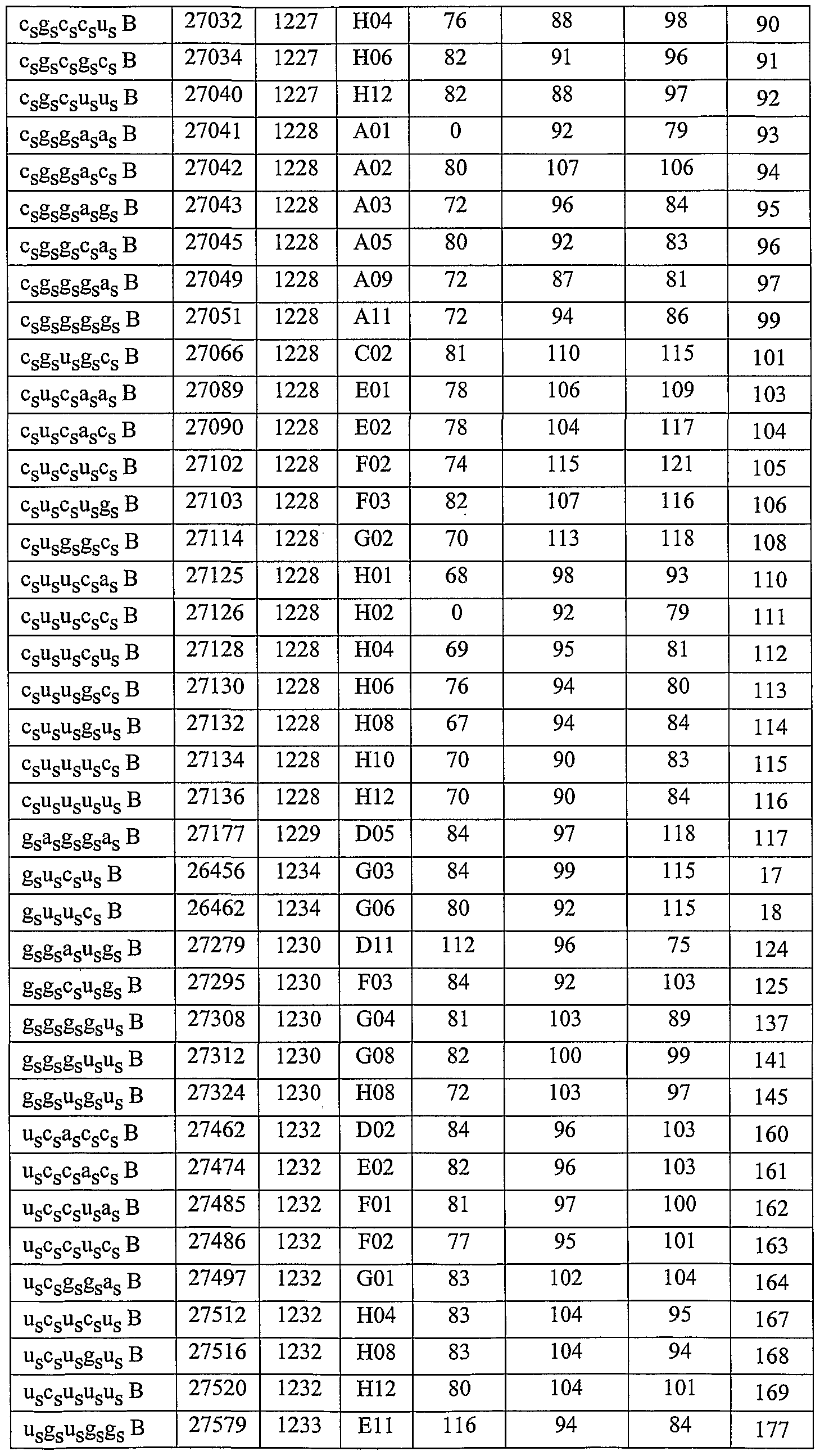
  • Exemplary small-mer molecules of the invention are shown in Table I (all sequences are shown 5' - 3').
  • the term "cell” is used in its usual biological sense, and does not refer to an entire multicellular organism, e.g., specifically does not refer to a human.
  • the cell can be present in an organism, e.g., mammals such as humans, cows, sheep, apes, monkeys, swine, dogs, and cats.
  • the cell can be eukaryotic (e.g., a mammalian cell, such as a human cell).
  • the cell can be of somatic or germ line origin, totipotent or pluripotent, dividing or non-dividing.
  • the cell can also be derived from or can comprise a gamete or embryo, a stem cell, or a fully differentiated cell.
  • the small-mer molecules of the invention are added directly, or can be complexed with cationic lipids, packaged within liposomes, or otherwise delivered to target cells or tissues.
  • the nucleic acid or nucleic acid complexes can be locally administered to relevant tissues ex vivo, or in vivo through injection, infusion pump or stent, with or without their incorporation in biopolymers.
  • the nucleic acid molecules of the invention comprise sequences shown in Table I. Examples of such nucleic acid molecules consist essentially of sequences defined in these tables/figures.
  • the invention provides mammalian cells containing one or more small-mer molecules of this invention.
  • subject is meant an organism, which is a donor or recipient of explanted cells or the cells themselves. “Subject” also refers to an organism to which the nucleic acid molecules of the invention can be administered. In one embodiment, a subject is a mammal or mammalian cells, in another embodiment, a subject is a human or human cells.
  • phosphorothioate refers to an internucleotide linkage having
  • phosphorothioate refers to both phosphorothioate and phosphorodithioate internucleotide linkages.
  • universal base refers to nucleotide base analogs that form base pairs with each of the natural DNA/RNA bases with little discrimination between them.
  • Non-limiting examples of universal bases include C-phenyl, C-naphthyl and other aromatic derivatives, inosine, azole carboxamides, and nitroazole derivatives such as 3-nitropyrrole, 4- nitroindole, 5-nitroindole, and 6-nitroindole as known in the art (see for example Loakes, 2001, Nucleic Acids Research, 29, 2437-2447).
  • acyclic nucleotide refers to any nucleotide having an acyclic ribose sugar, for example, where any of the ribose carbons (Cl, C2, C3, C4, or C5), are independently or in combination absent from the nucleotide.
  • nucleic acid molecules of the instant invention can be used to treat diseases or conditions discussed herein.
  • the small-mer molecules can be administered to a subject or can be administered to other appropriate cells evident to those skilled in the art, individually or in combination with one or more drugs under conditions suitable for the treatment.
  • the small-mer molecules can be used in combination with other known treatments to treat conditions or diseases discussed above.
  • the described molecules could be used in combination with one or more known therapeutic agents to treat a disease or condition.
  • Non-limiting examples of other therapeutic agents that can be readily combined with a small-mer molecule of the invention are enzymatic nucleic acid molecules, allosteric nucleic acid molecules, siRNA, antisense, decoy, or aptamer nucleic acid molecules, antibodies such as monoclonal antibodies, small molecules, nucleotide analogs and other organic or inorganic or both compounds including metals, salts and ions.
  • the invention features an expression vector comprising a nucleic acid sequence encoding at least one small-mer molecule of the invention, in a manner which allows expression of the small-mer molecule.
  • the expression vector of the invention comprises a sequence for a small-mer molecule having any of SEQ ID NOs. 1-182.
  • an expression vector of the invention comprises a nucleic acid sequence encoding two or more small-mer molecules, which can be the same or different.
  • Figure 1 shows a non-limiting example of a scheme for the synthesis of small-mer molecules of the invention. All possible combinations of a fixed sequence space are synthesized via high throughput solid phase synthesis and are then tested for antiviral and/or antiproliferative activity.
  • Figure 2 shows a non-limiting example of a scheme for the combinatorial extension of an active small-mer sequence to a potentially more active sequence
  • a 5-mer small-mer sequence demonstrating 33% reduction of proliferation in MCF-7 cells is extended in length by 1, 2, or 3 nucleotides at the 3' or 5 '-end of the small-mer via a combinatorial approach in which all possible combinations of A, G, C, and U are tested in the extended sequence space, resulting in 168 sequences for screening.
  • the addition of additional small- mers can possibly improve the antiproliferative properties of the original sequence.
  • Figure 3 shows a sequence specific comparison of EC50 values of smallmer molecules of the invention against HIV infectivity as determined by CEM assay. Sequences shown in the Figure are completely 2'-O-allyl modified and further comprise a 3 '-inverted deoxy abasic moiety.
  • Figure 4 shows non-limiting examples of anti-HIV activity of smallmer molecules having GGG and GGGG motifs in CEM and MAGI assays. Sequences shown in the Figure are modified with 2'-O-allyl, 2'-O-methyl, or 2'-deoxy nucleotides as indicated, iB stands for 3 '-inverted deoxy abasic moiety.
  • Figure 5 shows a non-limiting example of a time of addition assay to determine smallmer activity in an anti-HIV MAGI assay.
  • Figure 6 shows a non-limiting example of a time of addition assay to determine smallmer activity in an anti-HIV MAGI assay.
  • Figure 7 shows a non-limiting example of a time of addition assay in MAGI cells indicating that small-mer molecules of the invention inhibit viral entry into cells.
  • Oligonucleotides and small-mers are synthesized using protocols known in the art, for example as described in Caruthers et al, 1992, Methods in Enzymology 211, 3-19, Thompson et al, International PCT Publication No. WO 99/54459, Wincott et al, 1995, Nucleic Acids Res. 23, 2677-2684, Wincott et al, 1997, Methods Mol. Bio., 74, 59, Brennan et al, 1998, Biotechnol Bioeng., 61, 33-45, and Brennan, US patent No. 6,001,311.
  • syntheses at the 0.2 ⁇ mol scale can be performed on a 96-well plate synthesizer, such as the instrument produced by Protogene (Palo Alto, CA) with minimal modification to the cycle.
  • Average coupling yields on the 394 Applied Biosystems, Inc. synthesizer, determined by colorimetric quantitation of the trityl fractions, are typically 97.5- 99%.
  • synthesizer include the following: detritylation solution is 3% TCA in methylene chloride (ABI); capping is performed with 16% N-methyl imidazole in THF (ABI) and 10% acetic anhydride/10% 2,6-lutidine in THF (ABI); and oxidation solution is 16.9 mM I 2 , 49 mM pyridine, 9% water in THF (PERSEPTIVETM). Burdick & Jackson Synthesis Grade acetonitrile is used directly from the reagent bottle. S-Ethyltetrazole solution (0.25 M in acetonitrile) is made up from the solid obtained from American International Chemical, Inc.
  • Beaucage reagent (3H-1,2- Benzodithiol-3-one 1,1 -dioxide, 0.05 M in acetonitrile) is used.
  • Deprotection of the DNA-based small-mers is performed as follows: the polymer- bound trityl-on small-mer is transferred to a 4 mL glass screw top vial and suspended in a solution of 40%) aq. methylamine (1 mL) at 65 °C for 10 minutes. After cooling to -20 °C, the supernatant is removed from the polymer support. The support is washed three times with 1.0 mL of EtOH:MeCN:H2O/3:l:l, vortexed and the supernatant is then added to the first supernatant. The combined supernatants, containing the small-mer, are dried to a white powder.
  • RNA including certain small-mer molecules of the invention follows the procedure as described in Usman et al, 1987, J. Am. Chem. Soc, 109, 7845; Scaringe et al, 1990, Nucleic Acids Res., 18, 5433; and Wincott et al, 1995, Nucleic Acids Res. 23, 2677-2684 Wincott et al, 1997, Methods Mol. Bio., 74, 59, and makes use of common nucleic acid protecting and coupling groups, such as dimethoxytrityl at the 5'-end, and phosphoramidites at the 3'-end.
  • small scale syntheses are conducted on a 394 Applied Biosystems, Inc.
  • synthesizer using a 0.2 ⁇ mol scale protocol with a 7.5 minute coupling step for alkylsilyl protected nucleotides and a 2.5 minute coupling step for 2'-O-methylated nucleotides.
  • Table IV outlines the amounts and the contact times of the reagents used in the synthesis cycle.
  • syntheses at the 0.2 ⁇ mol scale can be done on a 96-well plate synthesizer, such as the instrument produced by Protogene (Palo Alto, CA) with minimal modification to the cycle.
  • Average coupling yields on the 394 Applied Biosystems, Inc. synthesizer, determined by colorimetric quantitation of the trityl fractions, are typically 97.5- 99%.
  • synthesizer include the following: detritylation solution is 3%> TCA in methylene chloride (ABI); capping is performed with 16% N-methyl imidazole in THF (ABI) and 10% acetic anhydride/10% 2,6-lutidine in THF (ABI); oxidation solution is 16.9 mM I2, 49 mM pyridine, 9% water in THF (PERSEPTTVETM). Burdick & Jackson Synthesis Grade acetonitrile is used directly from the reagent bottle. S-Ethyltetrazole solution (0.25 M in acetonitrile) is made up from the solid obtained from American International Chemical, Inc. Alternately, for the introduction of phosphorothioate linkages, Beaucage reagent (3H-1,2- Benzodithiol-3-one l,l-dioxide0.05 M in acetonitrile) is used.
  • Deprotection of the R ⁇ A is performed using either a two-pot or one-pot protocol.
  • the polymer-bound trityl-on small-mer is transferred to a 4 mL glass screw top vial and suspended in a solution of 40%) aq. methylamine (1 mL) at 65 °C for 10 minutes. After cooling to -20 °C, the supernatant is removed from the polymer support. The support is washed three times with 1.0 mL of EtOH:MeC ⁇ :H2O/3:l:l, vortexed and the supernatant is then added to the first supernatant. The combined supematants, containing the small-mer, are dried to a white powder.
  • the base deprotected small-mer is resuspended in anhydrous TEA/HF/NMP solution (300 ⁇ L of a solution of 1.5 mL N-methylpyrrolidinone, 750 ⁇ L TEA and 1 mL TEA ⁇ HF to provide a 1.4 M HF concentration) and heated to 65 °C. After 1.5 hour, the small-mer is quenched with 1.5 M NH4HCO3.
  • the polymer-bound trityl-on small-mer is transferred to a 4 mL glass screw top vial and suspended in a solution of 33 > ethanolic methylamine/DMSO: 1/1 (0.8 mL) at 65 °C for 15 minutes.
  • the vial is brought to r.t. TEA»3HF (0.1 mL) is added and the vial is heated at 65 °C for 15 minutes.
  • the sample is cooled at -20 °C and then quenched with 1.5 M NH4HCO3.
  • the quenched NH4HCO3 solution is loaded onto a C-18 containing cartridge that had been prewashed with acetonitrile followed by 50 mM TEAA. After washing the loaded cartridge with water, the small-mer is detritylated with 0.5%) TFA for 13 minutes. The cartridge is then washed again with water, salt exchanged with 1 M NaCl and washed with water again. The small-mer is then eluted with 30%> acetonitrile.
  • the average stepwise coupling yields are typically >98% (Wincott et al, 1995 Nucleic
  • nucleic acid molecules of the present invention can be synthesized separately and joined together post-synthetically, for example, by ligation (Moore et al., 1992, Science 256, 9923; Draper et al, International PCT publication No. WO 93/23569; Shabarova et al, 1991, Nucleic Acids Research 19, 4247; Bellon et al, 1997, Nucleosides & Nucleotides, 16, 951; Bellon et al, 1997, Bioconjugate Chem. 8, 204), or by hybridization following synthesis or deprotection or both.
  • nucleic acid molecules of the present invention can be modified extensively to enhance stability by modification with nuclease resistant groups, for example, 2'-O-allyl, 2'- amino, 2'-C-allyl, 2'-flouro, 2'-O-methyl, 2'-H (for a review see Usman and Cedergren, 1992, TIBS 17, 34; Usman et al, 1994, Nucleic Acids Symp. Ser. 31, 163).
  • Small-mer constructs can be purified by gel electrophoresis using general methods or can be purified by high pressure liquid chromatography (HPLC; see Wincott et al, supra, the totality of which is hereby incorporated herein by reference) and re-suspended in water.
  • oligonucleotides are modified to enhance stability or enhance biological activity or both by modification with nuclease resistant groups, for example, 2'-amino, 2'-C-allyl, 2'-flouro, 2'-O-methyl, 2'- ⁇ - allyl, 2'-H, nucleotide base modifications (for a review see Usman and Cedergren, 1992, TIBS. 17, 34; Usman et al, 1994, Nucleic Acids Symp. Ser. 31, 163; Burgin et al, 1996, Biochemistry, 35, 14090).
  • nuclease resistant groups for example, 2'-amino, 2'-C-allyl, 2'-flouro, 2'-O-methyl, 2'- ⁇ - allyl, 2'-H, nucleotide base modifications (for a review see Usman and Cedergren, 1992, TIBS. 17, 34; Usman et al, 1994, Nucleic Acids Symp. Ser. 31, 163;
  • nucleic acid is also generally more resistant to nucleases than an unmodified nucleic acid.
  • small-mer molecules of the invention include one or more G- clamp nucleotides.
  • a G-clamp nucleotide is a modified cytosine analog wherein the modifications confer the ability to hydrogen bond both Watson-Crick and Hoogsteen faces of a complementary guanine within a duplex, see for example Lin and Matteucci, 1998, J. Am. Chem. Soc, 120, 8531-8532.
  • a single G-clamp analog substitution within an oligonucleotide can result in substantially enhanced helical thermal stability and mismatch discrimination when hybridized to complementary oligonucleotides.
  • nucleic acid molecules of the invention include one or more LNA "locked nucleic acid" nucleotides such as a 2', 4'-C mythylene bicyclo nucleotide (see for example Wengel et al, International PCT Publication No. WO 00/66604 and WO 99/14226).
  • the invention features conjugates or complexes or both of small-mer molecules of the invention.
  • conjugates or complexes or both can be used to facilitate delivery of small-mer molecules into a biological system, such as a cell.
  • the conjugates and complexes provided by the instant invention can impart therapeutic activity by transferring therapeutic compounds across cellular membranes, altering the pharmacokinetics, or modulating or both the localization of nucleic acid molecules of the invention.
  • the present invention encompasses the design and synthesis of novel conjugates and complexes for the delivery of molecules, including, but not limited to, small molecules, lipids, phospholipids, nucleosides, nucleotides, nucleic acids, antibodies, toxins, negatively charged polymers and other polymers, for example proteins, peptides, hormones, carbohydrates, polyethylene glycols, or polyamines, across cellular membranes.
  • molecules including, but not limited to, small molecules, lipids, phospholipids, nucleosides, nucleotides, nucleic acids, antibodies, toxins, negatively charged polymers and other polymers, for example proteins, peptides, hormones, carbohydrates, polyethylene glycols, or polyamines, across cellular membranes.
  • the transporters described are designed to be used either individually or as part of a multi- component system, with or without degradable linkers.
  • Conjugates of the molecules described herein can be attached to biologically active molecules via linkers that are biodegradable, such as biodegradable nucleic acid linker molecules.
  • biodegradable nucleic acid linker molecule refers to a nucleic acid molecule that is designed as a biodegradable linker to comiect one molecule to another molecule, for example, a biologically active molecule.
  • the stability of the biodegradable nucleic acid linker molecule can be modulated by using various combinations of ribonucleotides, deoxyribonucleotides, and chemically modified nucleotides, for example, 2'-O-methyl, 2'-fluoro, 2'-amino, 2'-O-amino, 2'-C-allyl, 2'-O-allyl, and other 2'-modified or base modified nucleotides.
  • the biodegradable nucleic acid linker molecule can be a dimer, trimer, tetramer or longer nucleic acid molecule or can comprise a single nucleotide with a phosphorus-based linkage, for example, a phosphoramidate or phosphodiester linkage.
  • the biodegradable nucleic acid linker molecule can also comprise nucleic acid backbone, nucleic acid sugar, or nucleic acid base modifications or a combination thereof.
  • biodegradable refers to degradation in a biological system, for example, enzymatic degradation or chemical degradation.
  • biologically active molecule refers to compounds or molecules that are capable of eliciting or modifying a biological response in a system.
  • biologically active small-mer molecules either alone or in combination with the molecules contemplated by the instant invention include therapeutically active molecules such as antibodies, hormones, antivirals, peptides, proteins, chemotherapeutics, small molecules, vitamins, co-factors, nucleosides, nucleotides, oligonucleotides, enzymatic nucleic acids, antisense nucleic acids, triplex forming oligonucleotides, 2,5-A chimeras, small-mer, dsRNA, allozymes, aptamers, decoys and analogs thereof.
  • Biologically active molecules of the invention also include molecules capable of modulating the pharmacokinetics and/or pharmacodynamics of other biologically active molecules, for example, lipids and polymers such as polyamines, polyamides, polyethylene glycol and other polyethers.
  • phospholipid refers to a hydrophobic molecule comprising at least one phosphorus group.
  • a phospholipid can comprise a phosphorus- containing group and saturated or unsaturated alkyl group, optionally substituted with OH, COOH, oxo, amine, or substituted or unsubstituted aryl groups.
  • a small-mer molecule of the invention comprises one or more 5' or
  • 3'- cap structure or both for example, on only the sense small-mer strand, antisense smallmer strand, or both small-mer strands.
  • cap structure is meant chemical modifications, which have been incorporated at either terminus of the oligonucleotide (see, for example, Adamic et al, US 5,998,203, incorporated by reference herein). These terminal modifications protect the nucleic acid molecule from exonuclease degradation, and can help in delivery or localization or both within a cell.
  • the cap can be present at the 5'-terminus (5'-cap) or at the 3'-terminal (3'-cap) or can be present on both termini.
  • the 5 '-cap is selected from an inverted abasic residue (moiety); 4',5'-methylene nucleotide; 1- eta-D-erythrofuranosyl) nucleotide, 4'-thio nucleotide; carbocyclic nucleotide; 1,5-anhydrohexitol nucleotide; L- nucleotides; alpha-nucleotides; modified base nucleotide; phosphorodithioate linkage; threo- pentofuranosyl nucleotide; acyclic 3',4'-seco nucleotide; acyclic 3,4-dihydroxybutyl nucleotide; acyclic 3,5-dihydroxypentyl nucleotide, 3'-3'-inverted nucleotide moiety; 3'-3'- inverted abasic moiety; 3'-2'-inverted nucleotide moiety;
  • the 3 '-cap is selected from a 4',5 '-methylene nucleotide; 1- (beta-D-erythrofuranosyl) nucleotide; 4'-thio nucleotide, carbocyclic nucleotide; 5'-amino- alkyl phosphate; l,3-diamino-2-propyl phosphate; 3-aminopropyl phosphate; 6-aminohexyl phosphate; 1,2-aminododecyl phosphate; hydroxypropyl phosphate; 1,5-anhydrohexitol nucleotide; L-nucleotide; alpha-nucleotide; modified base nucleotide; phosphorodithioate; t/zreo-pentofuranosyl nucleotide; acyclic 3',4'-seco nucleotide; 3,4-dihydroxybutyl nucleot
  • non-nucleotide any group or compound which can be incorporated into a nucleic acid chain in the place of one or more nucleotide units, including either sugar or phosphate substitutions or both, and allows the remaining bases to exhibit their activity.
  • the group or compound is abasic in that it does not contain a commonly recognized nucleotide base, such as adenosine, guanine, cytosine, uracil or thymine and therefore lacks a base at the 1 '-position.
  • alkyl refers to a saturated aliphatic hydrocarbon, including straight-chain, branched-chain, and cyclic alkyl groups.
  • the alkyl group has 1 to 12 carbons. More preferably, it is a lower alkyl of from 1 to 7 carbons, more preferably 1 to 4 carbons.
  • the term also includes alkenyl groups that are unsaturated hydrocarbon groups containing at least one carbon-carbon double bond, including straight-chain, branched-chain, and cyclic groups.
  • the alkenyl group has 1 to 12 carbons. More preferably, it is a lower alkenyl of from 1 to 7 carbons, more preferably 1 to 4 carbons.
  • alkyl also includes alkynyl groups that have an unsaturated hydrocarbon group containing at least one carbon-carbon triple bond, including straight-chain, branched-chain, and cyclic groups. Preferably, the alkynyl group has 1 to 12 carbons.
  • the alkynyl group can be substituted or unsubstituted.
  • alkyl groups can also include aryl, alkylaryl, carbocyclic aryl, heterocyclic aryl, amide and ester groups.
  • An "aryl” group refers to an aromatic group that has at least one ring having a conjugated pi electron system and includes carbocyclic aryl, heterocyclic aryl and biaryl groups, all of which can be optionally substituted.
  • the preferred substituent(s) of aryl groups are halogen, trihalomethyl, hydroxyl, SH, OH, cyano, alkoxy, alkyl, alkenyl, alkynyl, and amino groups.
  • alkylaryl refers to an alkyl group (as described above) covalently joined to an aryl group (as described above).
  • Carbocyclic aryl groups are groups wherein the ring atoms on the aromatic ring are all carbon atoms. The carbon atoms are optionally substituted.
  • Heterocyclic aryl groups are groups having from 1 to 3 heteroatoms as ring atoms in the aromatic ring and the remainder of the ring atoms are carbon atoms.
  • Suitable heteroatoms include oxygen, sulfur, and nitrogen, and include furanyl, thienyl, pyridyl, pyrrolyl, N-lower alkyl pyrrolo, pyrimidyl, pyrazinyl, imidazolyl and the like, all optionally substituted.
  • An "amide” refers to an -C(O)-NH-R, where R is either alkyl, aryl, aikylaryl or hydrogen.
  • An “ester” refers to an -C(O)-OR', where R is either alkyl, aryl, alkylaryl or hydrogen.
  • nucleotide as used herein is as recognized in the art to include natural bases
  • Nucleotides generally comprise a base, sugar and a phosphate group.
  • the nucleotides can be unmodified or modified at the sugar, phosphate and/or base moiety, (also referred to interchangeably as nucleotide analogs, modified nucleotides, non-natural nucleotides, non-standard nucleotides and other; see, for example, Usman and McSwiggen, supra; Eckstein et al, International PCT Publication No. WO 92/07065; Usman et al, International PCT Publication No.
  • base modifications that can be introduced into nucleic acid molecules include, inosine, purine, pyridin-4-one, pyridin-2-one, phenyl, pseudouracil, 2, 4, 6-trimethoxy benzene, 3-methyl uracil, dihydrouridine, naphthyl, aminophenyl, 5-alkylcytidines (e.g., 5-methylcytidine), 5-alkyluridines (e.g., ribothymidine), 5-halouridine (e.g., 5-bromouridine) or 6-azapyrimidines or 6-alkylpyrimidines (e.g.
  • modified bases in this aspect is meant nucleotide bases other than adenine, guanine, cytosine and uracil at 1' position or their equivalents.
  • the invention features modified small-mer molecules, with phosphate backbone modifications comprising one or more phosphorothioate, phosphorodithioate, methylphosphonate, phosphotriester, morpholino, amidate carbamate, carboxymethyl, acetamidate, polyamide, sulfonate, sulfonamide, sulfamate, formacetal, thioformacetal, and/or alkylsilyl, substitutions.
  • phosphate backbone modifications comprising one or more phosphorothioate, phosphorodithioate, methylphosphonate, phosphotriester, morpholino, amidate carbamate, carboxymethyl, acetamidate, polyamide, sulfonate, sulfonamide, sulfamate, formacetal, thioformacetal, and/or alkylsilyl, substitutions.
  • abasic sugar moieties lacking a base or having other chemical groups in place of abase at the 1' position, see for example Adamic et al, US 5,998,203.
  • unmodified nucleoside is meant one of the bases adenine, cytosine, guanine, thymine, uracil joined to the 1' carbon of ⁇ -D-ribo-furanose.
  • modified nucleoside is meant any nucleotide base which contains a modification in the chemical structure of an unmodified nucleotide base, sugar, phosphate or combination thereof.
  • amino 2'-NH 2 or 2'-O- NH 2 , which can be modified or unmodified.
  • modified groups are described, for example, in Eckstein et al, U.S. 5,672,695 and Matulic- Adamic et al, US 6,248,878, which are both incorporated by reference in their entireties.
  • nucleic acid small-mer structure can be made to enhance the utility of these molecules. Such modifications will enhance shelf-life, half-life in vitro, stability, and ease of introduction of such oligonucleotides to the target site, e.g., to enhance penetration of cellular membranes, and confer the ability to recognize and bind to targeted cells.
  • a small-mer molecule of the invention can be adapted for use to treat viral infections such as HIV infection or diseases characterized by cellular proliferaction, such as cancer.
  • a small-mer molecule can comprise a delivery vehicle, including liposomes, for administration to a subject, carriers and diluents and their salts, and/or can be present in pharmaceutically acceptable formulations.
  • Methods for the delivery of nucleic acid molecules are described in Akhtar et al, 1992, Trends Cell Bio., 2, 139; Delivery Strategies for Antisense Oligonucleotide Therapeutics, ed. Akhtar, 1995, Maurer et al, 1999, Mol. Membr. Biol, 16, 129-140; Hofland and Huang, 1999, Handb. Exp.
  • Nucleic acid molecules can be administered to cells by a variety of methods known to those of skill in the art, including, but not restricted to, encapsulation in liposomes, by iontophoresis, or by incorporation into other vehicles, such as biodegradable polymers, hydrogels, cyclodextrins (see for example Gonzalez et al, 1999, Bioconjugate Chem., 10, 1068-1074; Wang et al., International PCT publication Nos. WO 03/47518 and WO 03/46185), ⁇ oly(lactic-co- glycolic)acid (PLGA) and PLCA microspheres (see for example US Patent 6,447,796 and US Patent Application Publication No.
  • encapsulation in liposomes by iontophoresis
  • other vehicles such as biodegradable polymers, hydrogels, cyclodextrins (see for example Gonzalez et al, 1999, Bioconjugate Chem., 10, 1068-1074; Wang et al.,
  • nucleic acid molecules or the invention are administered via biodegradable implant materials, such as elastic shape memory polymers (see for example Lendelein and Langer, 2002, Science, 296, 1673).
  • the nucleic acid/vehicle combination is locally delivered by direct injection or by use of an infusion pump.
  • nucleic acid molecules of the invention can take place using standard needle and syringe methodologies, or by needle-free technologies such as those described in Conry et al, 1999, Clin. Cancer Res., 5, 2330-2337 and Barry et al, International PCT Publication No. WO 99/31262.
  • the molecules of the instant invention can be used as pharmaceutical agents. Pharmaceutical agents prevent, modulate the occurrence of, or treat (alleviate a symptom to some extent, preferably all of the symptoms) a disease state in a subject.
  • the invention features a pharmaceutical composition
  • a pharmaceutical composition comprising one or more nucleic acid(s) of the invention in an acceptable carrier, such as a stabilizer, buffer, and the like.
  • the small-mers of the invention can be administered (e.g., RNA, DNA or protein) and introduced into a subject by any standard means, with or without stabilizers, buffers, and the like, to form a pharmaceutical composition.
  • standard protocols for formation of liposomes can be followed.
  • the compositions of the present invention can also be formulated and used as tablets, capsules or elixirs for oral administration, suppositories for rectal administration, sterile solutions, suspensions for injectable administration, and the other compositions known in the art.
  • the present invention also includes pharmaceutically acceptable formulations of the compounds described.
  • formulations include salts of the above compounds, e.g., acid addition salts, for example, salts of hydrochloric, hydrobromic, acetic acid, and benzene sulfonic acid.
  • a pharmacological composition or formulation refers to a composition or formulation in a form suitable for administration, e.g., systemic administration, into a cell or subject, including for example a human. Suitable forms, in part, depend upon the use or the route of entry, for example oral, transdermal, or by injection. Such forms should not prevent the composition or formulation from reaching a target cell (i.e., a cell to which the negatively charged nucleic acid is desirable for delivery). For example, pharmacological compositions injected into the blood stream should be soluble. Other factors are known in the art, and include considerations such as toxicity and forms that prevent the composition or formulation from exerting its effect.
  • systemic administration in vivo systemic absorption or accumulation of drugs in the blood stream followed by distribution throughout the entire body.
  • Administration routes which lead to systemic absorption include, without limitation: intravenous, subcutaneous, intraperitoneal, inhalation, oral, intrapulmonary and intramuscular.
  • Each of these administration routes expose the small-mer molecules of the invention to an accessible diseased tissue.
  • the rate of entry of a drug into the circulation has been shown to be a function of molecular weight or size.
  • the use of a liposome or other drug carrier comprising the compounds of the instant invention can potentially localize the drug, for example, in certain tissue types, such as the tissues of the reticular endothelial system (RES).
  • RES reticular endothelial system
  • a liposome formulation that can facilitate the association of drag with the surface of cells, such as, lymphocytes and macrophages is also useful. This approach can provide enhanced delivery of the drug to target cells by taking advantage of the specificity of macrophage and lymphocyte immune recognition of abnormal cells, such as cancer cells.
  • compositions or formulation that allows for the effective distribution of the nucleic acid molecules of the instant invention in the physical location most suitable for their desired activity.
  • agents suitable for formulation with the nucleic acid molecules of the instant invention include: P-glycoprotein inhibitors (such as Pluronic P85), which can enhance entry of drags into the CNS (Jolliet-Riant and Tillement, 1999, Fundam. Clin. Pharmacol, 13, 16-26); biodegradable polymers, such as poly (DL-lactide-coglycolide) microspheres for sustained release delivery after intracerebral implantation (Emerich, DF et al, 1999, Cell Transplant, 8, 47-58) (Alkermes, Inc.
  • nanoparticles such as those made of polybutylcyanoacrylate, which can deliver drugs across the blood brain barrier and can alter neuronal uptake mechanisms (Prog Neuropsychopharmacol Biol Psychiatry, 23, 941-949, 1999).
  • Other non-limiting examples of delivery strategies for the nucleic acid molecules of the instant invention include material described in Boado et al, 1998, J. Pharm. Sci, 87, 1308-1315; Tyler et al, 1999, FEBS Lett, 421, 280-284; Pardridge et al, 1995, PNAS USA., 92, 5592-5596; Boado, 1995, Adv.
  • the invention also features the use of the composition comprising surface-modified liposomes containing poly (ethylene glycol) lipids (PEG-modified, or long-circulating liposomes or stealth liposomes). These formulations offer a method for increasing the accumulation of drags in target tissues.
  • This class of drag carriers resists opsonization and elimination by the mononuclear phagocytic system (MPS or RES), thereby enabling longer blood circulation times and enhanced tissue exposure for the encapsulated drag (Lasic et al. Chem. Rev. 1995, 95, 2601-2627; Ishiwata et al, Chem. Pharm. Bull. 1995, 43, 1005-1011).
  • Such liposomes have been shown to accumulate selectively in tumors, presumably by extravasation and capture in the neovascularized target tissues (Lasic et al, Science 1995, 267, 1275-1276; Oku et ⁇ /.,1995, Biochim. Biophys. Ada, 1238, 86-90).
  • the long-circulating liposomes enhance the pharmacokinetics and pharmacodynamics of DNA and RNA, particularly compared to conventional cationic liposomes which are known to accumulate in tissues of the MPS (Liu et al., J. Biol. Chem. 1995, 42, 24864-24870; Choi et al, International PCT Publication No. WO 96/10391; Ansell et al, International PCT Publication No. WO 96/10390; Holland et al, International PCT Publication No. WO 96/10392).
  • Long- circulating liposomes are also likely to protect drugs from nuclease degradation to a greater extent compared to cationic liposomes, based on their ability to avoid accumulation in metabohcally aggressive MPS tissues such as the liver and spleen.
  • compositions prepared for storage or administration which include a pharmaceutically effective amount of the desired compounds in a pharmaceutically acceptable carrier or diluent.
  • Acceptable carriers or diluents for therapeutic use are well known in the pharmaceutical art, and are described, for example, in Remington's Pharmaceutical Sciences, Mack Publishing Co. (A.R. Gennaro edit. 1985) hereby incorporated by reference herein.
  • preservatives, stabilizers, dyes and flavoring agents can be provided. These include sodium benzoate, sorbic acid and esters of /?-hydroxybenzoic acid.
  • antioxidants and suspending agents can be used.
  • a pharmaceutically effective dose is that dose required to prevent, inhibit the occurrence of, or treat (alleviate a symptom to some extent, preferably all of the symptoms) a disease state.
  • the pharmaceutically effective dose depends on the type of disease, the composition used, the route of administration, the type of mammal being treated, the physical characteristics of the specific mammal under consideration, concurrent medication, and other factors that those skilled in the medical arts will recognize. Generally, an amount between about 0.1 mg/kg and about 100 mg/kg body weight/day of active ingredients is administered dependent upon potency of the negatively charged polymer.
  • nucleic acid molecules of the invention and formulations thereof can be administered orally, topically, parenterally, by inhalation or spray, or rectally in dosage unit formulations containing conventional non-toxic pharmaceutically acceptable carriers, adjuvants and/or vehicles.
  • parenteral as used herein includes percutaneous, subcutaneous, intravascular (e.g., intravenous), intramuscular, or intrathecal injection or infusion techniques and the like.
  • a pharmaceutical formulation comprising a nucleic acid molecule of the invention and a pharmaceutically acceptable carrier.
  • One or more nucleic acid molecules of the invention can be present in association with one or more non-toxic pharmaceutically acceptable, carriers and/or diluents and/or adjuvants, and if desired other active ingredients.
  • compositions containing nucleic acid molecules of the invention can be in a form suitable for oral use, for example, as tablets, troches, lozenges, aqueous or oily suspensions, dispersible powders or granules, emulsion, hard or soft capsules, or syrups or elixirs.
  • compositions intended for oral use can be prepared according to any method known to the art for the manufacture of pharmaceutical compositions and such compositions can contain one or more such sweetening agents, flavoring agents, coloring agents or preservative agents in order to provide pharmaceutically elegant and palatable preparations.
  • Tablets contain the active ingredient in admixture with non-toxic pharmaceutically acceptable excipients that are suitable for the manufacture of tablets.
  • excipients can be, for example, inert diluents; such as calcium carbonate, sodium carbonate, lactose, calcium phosphate or sodium phosphate; granulating and disintegrating agents, for example, corn starch, or alginic acid; binding agents, for example starch, gelatin or acacia; and lubricating agents, for example magnesium stearate, stearic acid or talc.
  • the tablets can be uncoated or they can be coated by known techniques. In some cases such coatings can be prepared by known techniques to delay disintegration and absorption in the gastrointestinal tract and thereby provide a sustained action over a longer period.
  • a time delay material such as glyceryl monosterate or glyceryl distearate can be employed.
  • Formulations for oral use can also be presented as hard gelatin capsules wherein the active ingredient is mixed with an inert solid diluent, for example, calcium carbonate, calcium phosphate or kaolin, or as soft gelatin capsules wherein the active ingredient is mixed with water or an oil medium, for example peanut oil, liquid paraffin or olive oil.
  • an inert solid diluent for example, calcium carbonate, calcium phosphate or kaolin
  • water or an oil medium for example peanut oil, liquid paraffin or olive oil.
  • Aqueous suspensions contain the active materials in admixture with excipients suitable for the manufacture of aqueous suspensions.
  • excipients are suspending agents, for example sodium carboxymethylcellulose, methylcellulose, hydropropyl-methylcellulose, sodium alginate, polyvinylpyrrolidone, gum tragacanth and gum acacia; dispersing or wetting agents can be a naturally-occurring phosphatide, for example, lecithin, or condensation products of an alkylene oxide with fatty acids, for example polyoxyethylene stearate, or condensation products of ethylene oxide with long chain aliphatic alcohols, for example heptadecaethyleneoxycetanol, or condensation products of ethylene oxide with partial esters derived from fatty acids and a hexitol such as polyoxyethylene sorbitol monooleate, or condensation products of ethylene oxide with partial esters derived from fatty acids and hexitol anhydrides, for example polyethylene sorbitan monoole
  • the aqueous suspensions can also contain one or more preservatives, for example ethyl, or n-propyl p- hydroxybenzoate, one or more coloring agents, one or more flavoring agents, and one or more sweetening agents, such as sucrose or saccharin.
  • preservatives for example ethyl, or n-propyl p- hydroxybenzoate
  • coloring agents for example ethyl, or n-propyl p- hydroxybenzoate
  • flavoring agents for example ethyl, or n-propyl p- hydroxybenzoate
  • sweetening agents such as sucrose or saccharin.
  • Oily suspensions can be formulated by suspending the active ingredients in a vegetable oil, for example arachis oil, olive oil, sesame oil or coconut oil, or in a mineral oil such as liquid paraffin.
  • the oily suspensions can contain a thickening agent, for example beeswax, hard paraffin or cetyl alcohol.
  • Sweetening agents and flavoring agents can be added to provide palatable oral preparations.
  • These compositions can be preserved by the addition of an anti-oxidant such as ascorbic acid.
  • Dispersible powders and granules suitable for preparation of an aqueous suspension by the addition of water provide the active ingredient in admixture with a dispersing or wetting agent, suspending agent and one or more preservatives.
  • a dispersing or wetting agent e.g., glycerol, glycerol, glycerol, glycerol, glycerol, glycerol, glycerin, glycerin, glycerin, glycerin, glycerin, sorbitol, sorbitol, sorbitol, sorbitol, sorbitol, sorbitol, sorbitol, sorbitol, sorbitol, sorbitol, glycerol, glycerol, glycerol, glycerol, glycerol, glycerol, glycerol, glycerol, glycerol
  • compositions of the invention can also be in the form of oil-in-water emulsions.
  • the oily phase can be a vegetable oil or a mineral oil or mixtures of these.
  • Suitable emulsifying agents can be naturally-occurring gums, for example, gum acacia or gum tragacanth, naturally-occurring phosphatides, for example soy bean, lecithin, and esters or partial esters derived from fatty acids and hexitol, anhydrides, for example sorbitan monooleate, and condensation products of the said partial esters with ethylene oxide, for example, polyoxyethylene sorbitan monooleate.
  • the emulsions can also contain sweetening and flavoring agents.
  • Syrups and elixirs can be formulated with sweetening agents, for example, glycerol, propylene glycol, sorbitol, glucose or sucrose. Such formulations can also contain a demulcent, a preservative and flavoring and coloring agents.
  • the pharmaceutical compositions can be in the form of a sterile injectable aqueous or oleaginous suspension. This suspension can be formulated according to the known art using those suitable dispersing or wetting agents and suspending agents that have been mentioned above.
  • the sterile injectable preparation can also be a sterile injectable solution or suspension in a non-toxic parentally acceptable diluent or solvent, for example as a solution in 1,3-butanediol.
  • Suitable vehicles and solvents that can be employed are water, Ringer's solution and isotonic sodium chloride solution, hi addition, sterile, fixed oils are conventionally employed as a solvent or suspending medium.
  • any bland fixed oil can be employed including synthetic mono-or diglycerides.
  • fatty acids such as oleic acid find use in the preparation of injectables.
  • the nucleic acid molecules of the invention can also be administered in the form of suppositories, e.g., for rectal administration of the drag.
  • suppositories e.g., for rectal administration of the drag.
  • These compositions can be prepared by mixing the drug with a suitable non-irritating excipient that is solid at ordinary temperatures but liquid at the rectal temperature and will therefore melt in the rectum to release the drag.
  • suitable non-irritating excipient that is solid at ordinary temperatures but liquid at the rectal temperature and will therefore melt in the rectum to release the drag.
  • Such materials include cocoa butter and polyethylene glycols.
  • Nucleic acid molecules of the invention can be administered parenterally in a sterile medium.
  • the drug depending on the vehicle and concentration used, can either be suspended or dissolved in the vehicle.
  • adjuvants such as local anesthetics, preservatives and buffering agents can be dissolved in the vehicle.
  • Dosage levels of the order of from about 0.1 mg to about 140 mg per kilogram of body weight per day are useful in the treatment of the above-indicated conditions (about 0.5 mg to about 7 g per subject per day).
  • the amount of active ingredient that can be combined with the carrier materials to produce a single dosage form varies depending upon the host treated and the particular mode of administration.
  • Dosage unit forms generally contain between from about 1 mg to about 500 mg of an active ingredient.
  • the specific dose level for any particular subject depends upon a variety of factors including the activity of the specific compound employed, the age, body weight, general health, sex, diet, time of administration, route of administration, and rate of excretion, drug combination and the severity of the particular disease undergoing therapy.
  • the composition can also be added to the animal feed or drinking water. It can be convenient to formulate the animal feed and drinking water compositions so that the animal takes in a therapeutically appropriate quantity of the composition along with its diet. It can also be convenient to present the composition as a premix for addition to the feed or drinking water.
  • nucleic acid molecules of the present invention can also be administered to a subject in combination with other therapeutic compounds to increase the overall therapeutic effect.
  • the use of multiple compounds to treat an indication can increase the beneficial effects while reducing the presence of side effects.
  • the invention compositions are suitable for administering nucleic acid molecules of the invention to specific cell types.
  • ASGPr asialoglycoprotein receptor
  • ASOR asialoorosomucoid
  • Binding of such glycoproteins or synthetic glycoconjugates to the receptor takes place with an affinity that strongly depends on the degree of branching of the oligosacchari.de chain, for example, triatennary structures are bound with greater affinity than biatenarry or monoatennary chains (Baenziger and Fiete, 1980, Cell, 22, 611-620; Connolly et al, 1982, J. Biol. Chem., 257, 939-945).
  • Lee and Lee, 1987, Glycoconjugate J., 4, 317-328 obtained this high specificity through the use of N-acetyl-D-galactosamine as the carbohydrate moiety, which has higher affinity for the receptor, compared to galactose.
  • bioconjugates are described in Vargeese et al, USSN 10/201,394, filed August 13, 2001; and Matulic-Adamic et al, International PCT Publication No. WO 02/094185.
  • the human tumor cell lines of the cancer screening panel are grown in RPMI 1640 medium containing 5%> fetal bovine serum and 2 mM L-glutamine.
  • cells are inoculated into 96 well microtiter plates in 100 ⁇ L at plating densities ranging from 5,000 to 40,000 cells/well depending on the doubling time of individual cell lines. After cell inoculation, the microtiter plates are incubated at 37° C, 5 % CO2, 95 % air and 100 % relative humidity for 24 hours prior to addition of experimental drags.
  • the plates are incubated for an additional 48 hours at 37°C, 5 % CO2, 95 % air, and 100 %> relative humidity.
  • the assay is terminated by the addition of cold TCA.
  • Cells are fixed in situ by the gentle addition of 50 ⁇ l of cold 50 %> (w/v) TCA (final concentration, 10 % TCA) and incubated for 60 minutes at 4°C. The supernatant is discarded, and the plates are washed five times with tap water and air dried.
  • Sulforhodamine B (SRB) solution (100 ⁇ l) at 0.4 % (w/v) in 1 %> acetic acid is added to each well, and plates are incubated for 10 minutes at room temperature.
  • GI50 Growth inhibition of 50 %
  • C-Tz C-Tz
  • TGI total growth inhibition
  • the LC50 concentration of drug resulting in a 50% reduction in the measured protein at the end of the drag treatment as compared to that at the beginning
  • the anti-Human immunodeficieny virus (HIN) assay is a relatively simple method to determine the ability of a drag to protect cells against the cytopathic effects of HIN.
  • T-lymphocyte-derived CEM cells are added to 96-well microtiter plates along with cell-free HIN and the test agent at 1/2-log dilutions over a multi-dose range.
  • a tetrazolium reagent, XTT is added to the wells, hi the presence of viable cells, XTT is metabolized to an orange colored formazan, such that the quantity of viable cells, and thus, the protective ability of the test agent, is proportional to the depth of the color. Uninfected cells are also treated with drag in order to detennine the cytotoxicity of the drug, if any, to the CEM cells.
  • the high tliroughput version of the assay was developed to allow the evaluation of chemical libraries. It is performed in 384-well plates at a single high dose, and does not include an addition of test agent to uninfected cells. Sequences and data obtained from this screen are shown in Table II.
  • Example 5 Anti-HIN Screen Results The anti-HIN screen identified 88 sequences providing a >80%> level of protection from
  • MAGI cells are CD4+HeLa cells that have been engineered to express beta gal gene via Tat-mediated LTR transactivation.
  • the number of HIN infected cells is counted in the assay, which was optimized to examine just one round of HIV infection. As such, the assay involves one round of HIV infection from viral entry to viral integration. No multiplicity of infection results because the assay is stopped before the second round takes place.
  • EC50 values were determined based on smallmer sequence (see Figure 3, sequences are shown without the terminal 3 '-deoxyabasic moiety).
  • IC50 values in the MAGI assay tend to be higher than in the CEM based assay, because higher viral inoculum is used to get an acceptable endpoint.
  • the activities of various smallmers with differing chemical modifications was determined (see Figure 4). After confirming the activity of GGGGC smallmers (47082, 47083, and 47086 all shown without terminal 3'- deoxyabasic moiety), these smallmers were tested in a time of addition assay in MAGI cells (see Figures 5 and 6). In a repeated experiment it was observed that the smallmers drastically lost antiviral activity when the addition was delayed for 2 to 4 hours, suggesting that the smallmers are blocking viral entry (see Figure 7).
  • DS stands for dextran sulfate, a reference drug for viral entry blockade
  • NVP stands for nevirapine, a reverse transcriptase inhibitor.
  • Wait time does not include contact time during delivery.
  • Tandem synthesis utilizes double coupling of linker molecule

Landscapes

  • Chemical & Material Sciences (AREA)
  • Organic Chemistry (AREA)
  • Life Sciences & Earth Sciences (AREA)
  • Biochemistry (AREA)
  • Molecular Biology (AREA)
  • Health & Medical Sciences (AREA)
  • Engineering & Computer Science (AREA)
  • Biotechnology (AREA)
  • General Health & Medical Sciences (AREA)
  • Genetics & Genomics (AREA)
  • Pharmaceuticals Containing Other Organic And Inorganic Compounds (AREA)
  • Acyclic And Carbocyclic Compounds In Medicinal Compositions (AREA)
  • Medicines That Contain Protein Lipid Enzymes And Other Medicines (AREA)

Abstract

The present invention concerns small-mer compositions and methods useful in a variety of applications, including use in therapeutic, diagnostic, target validation, and genomic discovery applications. Specifically, the invention relates to small-mer compositions capable of inhibiting viral replication, useful in treating diseases and conditions related to viral infection, and/or capable of inhibiting cellular proliferation, useful in treating diseases and conditions related to cellular proliferation.

Description

DESCRIPTION
SMALL-MER COMPOSITIONS AND METHODS OF USE
Field Of The Invention
This application claims the benefit of U.S. Provisional Application No. 60/402,093, filed August 8, 2003, incorporated by reference herein in its entirety including the drawings.
Background Of The Invention
The following is a discussion of relevant art pertaining to short oligonucleotides. The discussion is provided only for understanding of the invention that follows. The summary is not an admission that any of the work described below is prior art to the claimed invention.
Short oligonucleotides have potential as therapeutic agents based upon several observations. The role of nucleotides in the regulation of numerous biological processes, and their pathological conterparts, has lead to the development of nucleoside analogs as antiviral and anti-cancer agents. Adenine dinucleotides are a known set of signalling molecules with divergent biological effects. Analogs of adenine dinucleotides have been shown to be potent enzyme inhibitors as well as suppressors of normal and malignant cell proliferation (Zatorski et al, 1995, J Med Chem., 38, 1098-1105). Thymidine dinucleotides have been shown to inhibit contact hypersensitivity and activate tumor necrosis factor alpha 1 (Cruz et al, 2000, The Journal of Investigative Dermatology, 114, 253-258). The dinucleotide 5'-Cytosine - Guanosine-3' with a phosphorothioate internucleotide linkage is known to cause a non- specific inflammatory response, whereas CG in the context of the hexamer sequences such as NACGTN, when delivered in liposomes, induces interferon and activates natural killer cells, thus exhibiting tumor regression activity (Sonehara et al, 1996, J Interferon Cytokine Res., 16, 799-803). An investigation of all possible dinucleotides effecting HIV Integrase activity revealed three potent inhibitors (pAC, pAT, and pCT), (Mazumder et al, 1997, Molecular Pharmacology, 51, 567-575). These three dinucleotide constructs did not demonstrate antiviral activity, even though they were able to inhibit the integrase enzyme process.
There are currently few reports of any small-mers (e.g. having three or more nucleotide or non-nucleotide moieties) of less than eighteen residues in length having therpeutic activity. An anti-HIN octamer was identified by the combinatorial selection stratagy known as SURF (synthetic unrandomization of randomized fragmants), (Ecker et al, 1993, Nucleic Acids Research, 21, 1853-56). A phosphorothioate oligonucleotide octamer that forms a tetrameric guanosine-quartet structure which binds the HIN envelope protein gpl20, and inhibits cell-to- cell and virus-to-cell infection with an EC of approximately 0.3 - 6.4 uM has been reported (Wyatt et al, 1994, PNAS USA, 91, 1356-60). This oligonucleotide has demonstrated in vivo efficacy in a SCID-hu Thy/Liv Mouse HIN model and has been reported to have toxicology profiles similar to other phosphorothioate oligonucleotides (Stoddart et al, 1998, Antimicrobial Agents and Chemotherapy, 42, 2113-15). A 17-mer oligonucleotide with two phosphorothioate internucleotide linkages has been reported to have anti-HIN activity (Bishop et al, 1996, J Biol Chem., 271, 5698-03). This viral inhibition is proposed to be through the interaction with the HIN viral integrase, however, the similar GT content can suggest a mechanism similar to the T2G4T octamer described above. A 15-mer thiophosphoramidate oligonucleotide designed to interact with the telomerase RΝA subunit has been shown to inhibit telomerase activity (Pruzan et al, 2002, Nucleic Acids Research, 30, 559-568). Similarly, a 13-mer thiophosphoramidate oligonucleotide designed to interact with the telomerase RΝA subunit has been shown to inhibit telomerase activity as well (Herbert et al, 2002, Oncogene, 21, 638-42). A phenoxazine-substituted phosphorothioate oligonucleotide targeting SN40 large T antigen has been described to have improved cellular penetration and enhanced target RΝA binding properties compared to a 7-mer C-5 propynyl phosphorothioate oligonucleotide (Flanagan et al, 1999, Nature Biotechnology, 17, 48-52).
Applicant has applied a high-throughput screening approach to identify small-mers having antiviral and antiproliferative properties. The utility of the method described herein capitalizes on covering all potential sequence space for a small-mer of predetermined length (i.e., examining all combinations of nucleotides for a particular given length) to identify potent inhibitors of viral replication and/or cellular proliferation that are non-toxic to normal cells. The use of small-mer therapeutics of the invention represents a novel approach to treating diseases and conditions related to viral replication and cellular proliferation.
Kao et al, International PCT Publication No. WO 00/04141, describes linear single stranded nucleic acid molecules capable of specifically binding to viral polymerases and inhibiting the activity of the viral polymerase. Summary Of The Invention
The present invention relates to compounds, compositions, and methods useful for inhibiting viral replication and/or cellular proliferation using small-mers. In particular, the instant invention features a small-mer having about 3 to about 6 nucleotides and having antiviral or antiproliferative activity or both. The small-mer constructs of the invention can be further optimized to comprise one or more (e.g. about 1, 2, 3, 4, 5, 6 or more) additional nucleotides or non-nucleotides or both to the extent that these nucleotides or non-nucleotides do not significantly decrease the effectiveness of the small-mer construct. The small-mer constructs of the invention can be further optimized to comprise one or more (e.g. about 1, 2, 3, 4, 5, 6 or more) fewer nucleotides or non-nucleotides or both to the extent that these nucleotides or non-nucleotides do not significantly decrease the effectiveness of the small- mer construct. The small-mers of the invention can be unmodified or chemically modified. The small-mers of the instant invention can be chemically synthesized. The instant invention features various chemically modified synthetic small-mer molecules capable of inhibiting viral activity, such as HIN-1 activity, in cells. The instant invention also features various chemically modified synthetic small-mer molecules capable of inhibiting cellular proliferation. The use of chemically modified small-mers is expected to improve various properties of native small-mer molecules through increased resistance to nuclease degradation and/or improved cellular uptake in vivo and in vitro. The small-mer molecules of the instant invention provide useful reagents and methods for a variety of therapeutic, diagnostic, agricultural, target validation, genomic discovery, genetic engineering and pharmacogenomic applications.
h one embodiment, a small-mer of the invention comprises a sequence having any of SEQ ID ΝOs. 1-182. In another embodiment, the small-mer of the invention comprises one or more 2'-O-alkyl nucleotides, such as 2'-O-allyl nucleotides. hi another example, a small- mer of the invention comprises one or more phosphorothioate internucleotide linkages. In yet another embodiment, a small-mer of the invention comprises a terminal cap moeity at the 3'- end, 5'-end, or both 3' and 5' ends of the small-mer molecule.
In one embodiment, a small-mer of the invention comprises one or more (e.g., 1, 2, 3, 4, 5, 6, or more) 2'-O-allyl modified nucleotides.
In one embodiment, the small-mer of the invention comprises about 3 to about 6 nucleotides in length, for example, about 3, 4, 5, or 6 nucleotides in length. In another embodiment, additional nucleotides or non-nucleotides or both can be added to or substituted or both in a small-mer of the invention, for example, about 1 to about 10 additional nucleotides or non-nucleotides or both can be added to the length of the small-mer (e.g. about 1, 2, 3, 4, 5, 6, 7, 8, 9, or 10 additional nucleotides or non-nucleotides or both) to the extent that the specificity or activity of the small-mer is not decreased, for example, where the specificity or activity or the small-mer is increased.
In one embodiment, the invention features one or more small-mer molecules and methods that independently or in combination inl ibit viral replication or infection or both. Specifically, the present invention features small-mer molecules with antiviral activity against a virus, for example, viruses including but not limited to Hepatitis C Nirus (HCN, for example Genbank Accession Νos: D11168 , D50483.1, L38318 and S82227), Hepatitis B Nirus (HBN, for example GenBank Accession o. AF100308.1), Human Immunodeficiency Virus type 1 (HIN-1, for example GenBank Accession No. U51188), Human Immunodeficiency Virus type 2 (HIN-2, for example GenBank Accession No. X60667), West Nile Virus (WNV for example GenBank accession No. NC_001563), cytomegalovirus (CMV for example GenBank Accession No. NC_001347), respiratory syncytial virus (RSV for example GenBank Accession No. NC_001781), influenza virus (for example example GenBank Accession No. AF037412, rhinovirus (for example, GenBank accession numbers: D00239, X02316, X01087, L24917, M16248, K02121, X01087), papillomavirus (for example GenBank Accession No. NC_001353), Herpes Simplex Virus (HSV for example GenBank Accession No. NC_001345), and other viruses such as HTLV (for example GenBank Accession No. AJ430458).
In one embodiment, the invention features chemically modified small-mer constructs having antiviral or antiproliferative activity or both. Non-limiting examples of such chemical modifications include without limitation phosphorothioate internucleotide linkages, 2'-O- allyl ribonucleotides, 2'-O-methyl ribonucleotides, 2'-deoxy-2'-fluoro ribonucleotides, "universal base" nucleotides, locked nucleic acid (LNA) nucleotides, and inverted deoxyabasic residue incorporation.
In a non-limiting example, the introduction of chemically modified nucleotides into nucleic acid molecules of the invention will provide a powerful tool in overcoming potential limitations of in vivo stability and bioavailability inherent to native RNA molecules that are delivered exogenously. For example, the use of chemically modified nucleic acid molecules can enable a lower dose of a particular nucleic acid molecule for a given therapeutic effect since chemically modified nucleic acid molecules tend to have a longer half-life in serum. Furthermore, certain chemical modifications can improve the bioavailability of nucleic acid molecules by targeting particular cells or tissues and/or improving cellular uptake of the nucleic acid molecule. Therefore, even if the activity of a chemically modified nucleic acid molecule is reduced as compared to a native nucleic acid molecule, for example when compared to an all RNA nucleic acid molecule, the overall activity of the modified nucleic acid molecule can be greater than the native molecule due to improved stability and/or delivery of the molecule.
In one embodiment, the invention features a chemically modified small-mer molecule having antiviral or antiproliferative activity or both, wherein the chemical modification comprises one or more nucleotides comprising a backbone modified internucleotide linkage having Formula I:
Figure imgf000006_0001
wherein each Rl and R2 is independently any nucleotide, non-nucleotide, or small-mer which can be naturally occurring or chemically modified, each X and Y is independently O, S, N, alkyl, or substituted alkyl, each Z and W is independently O, S, N, alkyl, substituted alkyl, O-alkyl, S-alkyl, alkaryl, or aralkyl, and wherein W, X, Y and Z are not all O. another embodiment, a small-mer molecule of the invention having internucleotide linkage(s) of Formula I also comprises a chemically modified nucleotide or non-nucleotide having any of Formulae II, III, V, or VI.
In one embodiment, the invention features a chemically modified small-mer molecule, wherein the chemical modification comprises one or more nucleotides or non-nucleotides having Formula II:
Figure imgf000007_0001
wherein each R3, R4, R5, R6, R7, R8, RIO, Rll and R12 is independently H, OH, alkyl, substituted alkyl, alkaryl or aralkyl, F, Cl, Br, CN, CF3, OCF3, OCN, O-alkyl, S-alkyl, N-alkyl, O-alkenyl, S-alkenyl, N-alkenyl, SO-alkyl, alkyl-OSH, alkyl-OH, O-alkyl-OH, O- alkyl-SH, S-alkyl-OH, S-alkyl-SH, alkyl-S-alkyl, alkyl-O-alkyl, ONO2, NO2, N3, NH2, aminoalkyl, aminoacid, aminoacyl, ONH2, O-aminoalkyl, O-aminoacid, O-aminoacyl, heterocycloalkyl, heterocycloalkaryl, aminoalkylamino, polyalklylamino, substituted silyl, or group having Formula I; R9 is O, S, CH2, S=O, CHF, or CF2, and B is a nucleosidic base such as adenine, guanine, uracil, cytosine, thymine, 2-aminoadenosine, 5-methylcytosine, 2,6-diaminopurine, or any other non-naturally occurring base or a non-nucleosidic base such as phenyl, naphthyl, 3-nitropyrrole, 5-nitroindole, nebularine, pyridone, pyridinone, or any other non-naturally occurring universal base.
one embodiment, the invention features a chemically modified small-mer molecule, wherein the chemical modification comprises one or more nucleotides or non-nucleotides having Formula III:
Figure imgf000007_0002
wherein each R3, R4, R5, R6, R7, R8, R10, Rll and R12 is independently H, OH, alkyl, substituted alkyl, alkaryl or aralkyl, F, Cl, Br, CN, CF3, OCF3, OCN, O-alkyl, S-alkyl, N-alkyl, O-alkenyl, S-alkenyl, N-alkenyl, SO-alkyl, alkyl-OSH, alkyl-OH, O-alkyl-OH, O- alkyl-SH, S-alkyl-OH, S-alkyl-SH, alkyl-S-alkyl, alkyl-O-alkyl, ONO2, NO2, N3, NH2, aminoalkyl, aminoacid, aminoacyl, ONH2, O-aminoalkyl, O-aminoacid, O-aminoacyl, heterocycloalkyl, heterocycloalkaryl, aminoalkylamino, polyalklylamino, substituted silyl, or group having Formula I; R9 is O, S, CH2, S=O, CHF, or CF2, and B is a nucleosidic base such as adenine, guanine, uracil, cytosine, thymine, 2-aminoadenosine, 5-methylcytosine, 2,6-diaminopurine, or any other non-naturally occurring base or a non-nucleosidic base such as phenyl, naphthyl, 3-nitiopyrrole, 5-nitroindole, nebularine, pyridone, pyridinone, or any other non-naturally occurring universal base.
In another embodiment, a small-mer molecule of the invention comprises a nucleotide having Formula II or III, wherein the nucleotide having Formula II or III is in an inverted configuration. For example, the nucleotide having Formula II or III is connected to the small-mer construct in a 3',3', 3'-2', 2'-3', or 5',5' configuration, such as at the 3'-end, 5'- end, or both 3' and 5' ends of one or both small-mer strands.
In one embodiment, the invention features a chemically modified small-mer molecule, wherein the chemical modification comprises a 5 '-terminal phosphate group having Forula TV:
Figure imgf000008_0001
wherein each X and Y is independently O, S, N, alkyl, substituted alkyl, or alkylhalo; each Z and W is independently O, S, N, alkyl, substituted alkyl, O-alkyl, S-alkyl, alkaryl, aralkyl, or alkylhalo.
In one embodiment, the invention features a chemically modified small-mer molecule, wherein the chemical modification comprises one or more phosphorothioate internucleotide linkages. For example, in a non-limiting example, the invention features a chemically modified small-mer having about 1, 2, 3, 4, 5, 6 or more phosphorothioate internucleotide linkages. In another non-limiting example, an exemplary small-mer molecule of the invention can comprise one or more (e.g., about 1, 2, 3, 4, 5, 6 or more) pyrimidine phosphorothioate internucleotide linkages. In yet another non-limiting example, an exemplary small-mer molecule of the invention can comprise one or more (e.g., about 1, 2, 3, 4, 5, 6 or more) purine phosphorothioate internucleotide linkages. In another embodiment, the invention features a small-mer molecule comprising one or more 2'-5' internucleotide linkages, for example about 1, 2, 3, 4, 5, 6 or more 2'-5' internucleotide linkages.
In one embodiment, a small-mer molecule of the invention comprises one or more abasic residues, for example a compound having Formula V:
Figure imgf000009_0001
wherein each R3, R4, R5, R6, R7, R8, RIO, Rll, R12, and R13 is independently H, OH, alkyl, substituted alkyl, alkaryl or aralkyl, F, Cl, Br, CN, CF3, OCF3, OCN, O-alkyl, S- alkyl, N-alkyl, O-alkenyl, S-alkenyl, N-alkenyl, SO-alkyl, alkyl-OSH, alkyl-OH, O-alkyl- OH, O-alkyl-SH, S-alkyl-OH, S-alkyl-SH, alkyl-S-alkyl, alkyl-O-alkyl, ONO2, NO2, N3, NH2, aminoalkyl, aminoacid, aminoacyl, ONH2, O-aminoalkyl, O-aminoacid, O-aminoacyl, heterocycloalkyl, heterocycloalkaryl, aminoalkylamino, polyalklylamino, substituted silyl, or group having Formula I; R9 is O, S, CH2, S=O, CHF, or CF2.
In one embodiment, a small-mer molecule of the invention comprises one or more inverted abasic residues, for example a compound having Formula VI:
Figure imgf000009_0002
wherein each R3, R4, R5, R6, R7, R8, R10, Rll, R12, and R13 is independently H, OH, alkyl, substituted alkyl, alkaryl or aralkyl, F, Cl, Br, CN, CF3, OCF3, OCN, O-alkyl, S- alkyl, N-alkyl, O-alkenyl, S-alkenyl, N-alkenyl, SO-alkyl, alkyl-OSH, alkyl-OH, O-alkyl- OH, O-alkyl-SH, S-alkyl-OH, S-alkyl-SH, alkyl-S-alkyl, alkyl-O-alkyl, ONO2, NO2, N3, NH2, aminoalkyl, aminoacid, aminoacyl, ONH2, O-aminoalkyl, O-aminoacid, O-aminoacyl, heterocycloalkyl, heterocycloalkaryl, aminoalkylamino, polyalklylamino, substituted silyl, or group having Formula I; R9 is O, S, CH2, S=O, CHF, or CF2, and either R2, R3, R8 or R13 serve as points of attachment to the small-mer molecule of the invention.
In another embodiment, a small-mer molecule of the invention comprises an abasic residue having Formula II or III, wherein the abasic residue having Formula II or III is connected to the small-mer in a 3', 3', 3 '-2', 2 '-3', or 5', 5' configuration, such as at the 3'- end, 5 '-end, or both 3' and 5' ends of the small-mer.
In one embodiment, a small-mer molecule of the invention comprises one or more locked nucleic acid (LNA) nucleotides, for example at the 5'-end, 3'-end, 5' and 3'-end, or any combination thereof of the small-mer molecule.
In another embodiment, a small-mer molecule of the invention comprises one or more acyclic nucleotides, for example at the 5'-end, 3'-end, 5' and 3'-end, or any combination thereof, of the small-mer molecule.
In one embodiment, the invention features a chemically modified small-mer molecule, wherein the chemical modification comprises a conjugate covalently attached to the small- mer molecule. In another embodiment, the conjugate is covalently attached to the small-mer molecule via a biodegradable linker, hi one embodiment, the conjugate molecule is attached at the 3 '-end of the small-mer. In another embodiment, the conjugate molecule is attached at the 5'-end of the small-mer. In yet another embodiment, the conjugate molecule is attached at both the 3 '-end and 5 '-end of the small-mer. In one embodiment, a conjugate molecule of the invention comprises a molecule that facilitates delivery of a small-mer molecule into a biological system such as a cell. In another embodiment, the conjugate molecule attached to the small-mer is a polyethylene glycol, human serum albumin, or a ligand for a cellular receptor that can mediate cellular uptake. Examples of specific conjugate molecules contemplated by the instant invention that can be attached to small-mer molecules are described in Vargeese et al, US Serial No. 10/501,394, incorporated by reference herein.
In one embodiment, the invention features a method for inhibiting viral activity or replication within a cell comprising: (a) synthesizing a small-mer molecule of the invention, which can be chemically modified; and (b) introducing the small-mer molecule into a cell under conditions suitable to inhibit viral activity or replication in the cell. In another embodiment, the invention features a method for inhibiting cellular proliferation comprising: (a) synthesizing a small-mer molecule of the invention, which can be chemically modified; and (b) introducing the small-mer molecule into a cell under conditions suitable to inhibit proliferaction of the cell.
In one embodiment, the invention features a method of inhibiting viral activity or replication in a tissue explant comprising: (a) synthesizing a small-mer molecule of the invention, which can be chemically modified; (b) introducing the small-mer molecule into a cell of the tissue explant derived from a particular organism under conditions suitable to inhibit viral activity or replication in the tissue explant; and (c) optionally introducing the tissue explant back into the organism the tissue was derived from or into another organism under conditions suitable to inhibit viral activity or replication in that organism.
In one embodiment, the invention features a method of inhibiting cellular proliferation in a tissue explant comprising: (a) synthesizing a small-mer molecule of the invention, which can be chemically modified; (b) introducing the small-mer molecule into a cell of the tissue explant derived from a particular organism under conditions suitable to inhibit cellular proliferation in the tissue explant, and (c) optionally introducing the tissue explant back into the organism the tissue was derived from or into another organism under conditions suitable to inhibit viral activity or replication in that organism.
hi one embodiment, the invention features a method of inhibiting viral activity or replication in an organism comprising: (a) synthesizing a small-mer molecule of the invention, which can be chemically modified; and (b) introducing the small-mer molecule into the organism under conditions suitable to inhibit viral activity or replication in the organism.
In one embodiment, the invention features a composition comprising a small-mer molecule of the invention, which can be chemically modified, in a pharmaceutically acceptable carrier or diluent. In another embodiment, the invention features a pharmaceutical composition comprising small-mer molecules of the invention, which can be chemically modified, targeting one or more viruses or cell types, in a pharmaceutically acceptable carrier or diluent. In another embodiment, the invention features a method for treating or preventing a disease or condition in a subject comprising administering to the subject a composition of the invention under conditions suitable for the treatment or prevention of the disease or condition in the subject, alone or in conjunction with one or more other therapeutic compounds. In yet another embodiment, the invention features a method for reducing or preventing tissue rejection in a subject comprising administering to the subject a composition of the invention under conditions suitable for the reduction or prevention of tissue rejection in the subject.
In one embodiment, the invention features a kit containing a small-mer molecule of the invention, which can be chemically modified, that can be used to inhibit viral activity or replication or both in a cell, tissue, or organism. In another embodiment, the invention features a kit containing more than one (e.g. about 1, 2, 3, 4, 5, 6, 7, 8, 9, 10 or more) small- mer molecule of the invention, which can be chemically modified, that can be used to inhibit viral activity or replication or both in a cell, tissue, or organism.
In another embodiment, the invention features a kit containing a small-mer molecule of the invention, which can be chemically modified, that can be used to inhibit cellular proliferation in a tissue or organism. In another embodiment, the invention features a kit containing more than one (e.g. about 1, 2, 3, 4, 5, 6, 7, 8, 9, 10 or more) small-mer molecule of the invention, which can be chemically modified, that can be used to inhibit cellular proliferation in a tissue, or organism.
In one embodiment, the invention features a cell containing one or more small-mer molecules of the invention, which can be chemically modified. In another embodiment, the cell containing a small-mer molecule of the invention is a mammalian cell. In yet another embodiment, the cell containing a small-mer molecule of the invention is a human cell.
h one embodiment, the invention features a small-mer, wherein the small-mer comprises one or more chemical modifications, for example one or more chemical modifications having Formula I, II, III, IV, or V, that increases the nuclease resistance of the small-mer.
In another embodiment, the invention features a method for generating small-mer molecules with increased nuclease resistance comprising (a) introducing nucleotides or non- nucleotides having any of Formula I- VI into a small-mer molecule, and (b) assaying the small-mer molecule of step (a) under conditions suitable for isolating small-mer molecules having increased nuclease resistance. In another embodiment, the invention features a method for generating small-mer molecules with improved antiviral activity comprising (a) introducing nucleotides or non- nucleotides having any of Formula I- VI into a small-mer molecule, and (b) assaying the small-mer molecule of step (a) under conditions suitable for isolating small-mer molecules having improved antiviral activity.
In another embodiment, the invention features a method for generating small-mer molecules with improved antiproliferative activity comprising (a) introducing nucleotides or non-nucleotides having any of Formula I- VI into a small-mer molecule, and (b) assaying the small-mer molecule of step (a) under conditions suitable for isolating small-mer molecules having improved antiproliferative activity.
In one embodiment, the invention features a small-mer molecule, wherein the small- mer comprises one or more chemical modifications described herein that modulates the cellular uptake of the small-mer.
In another embodiment, the invention features a method for generating small-mer molecules with improved cellular uptake comprising (a) introducing nucleotides or non- nucleotides having any of Formula I- VI into a small-mer molecule, and (b) assaying the small-mer molecule of step (a) under conditions suitable for isolating small-mer molecules having improved cellular uptake.
In one embodiment, the invention features small-mer molecules with antiviral or antiproliferative activity or both, wherein the small-mer comprises one or more (e.g. about 1, 2, 3, 4, 5, 6, 7, 8, 9, 10 or more) chemical modifications described herein that increases the bioavailability of the small-mer, for example, by attaching polymeric conjugates such as polyethyleneglycol or equivalent conjugates that improve the pharmacokinetics of the small- mer, or by attaching conjugates that target specific tissue types or cell types in vivo. Non- limiting examples of such conjugates are described in Vargeese et al, US Serial No. 10/201,394 incorporated by reference herein.
In one embodiment, the invention features a method for generating small-mer molecules of the invention with improved bioavailability comprising (a) introducing a conjugate into the structure of a small-mer molecule, and (b) assaying the small-mer molecule of step (a) under conditions suitable for isolating small-mer molecules having improved bioavailability. Such conjugates can include ligands for cellular receptors such as peptides derived from naturally occurring protein ligands, protein localization sequences including cellular ZIP code sequences, antibodies, nucleic acid aptamers, vitamins and other co-factors such as folate and N-acetylgalactosamine, polymers such as polyethyleneglycol (PEG), phospholipids, polyamines such as spermine or spermidine, and others.
hi another embodiment, the invention features a method for generating small-mer molecules of the invention with improved bioavailability comprising (a) introducing an excipient formulation to a small-mer molecule, and (b) assaying the small-mer molecule of step (a) under conditions suitable for isolating small-mer molecules having improved bioavailability. Such excipients include polymers such as cyclodextrins, lipids, cationic lipids, polyamines, phospholipids, and others.
hi another embodiment, the invention features a method for generating small-mer molecules of the invention with improved bioavailability comprising (a) introducing nucleotides or non-nucleotides having any of Formula I- VI into a small-mer molecule, and
(b) assaying the small-mer molecule of step (a) under conditions suitable for isolating small- mer molecules having improved bioavailability.
In another embodiment, polyethylene glycol (PEG) can be covalently attached to small- mer compounds of the present invention. The attached PEG can be any molecular weight, preferably from about 2,000 to about 50,000 daltons (Da).
In one embodiment, the invention features a method for generating small-mer molecules with antiviral activity comprising (a) generating a library of all possible nucleotide or non-nucleotide or both combinations for a fixed small-mer length, and (b) assaying the small-mer molecule of step (a) under conditions suitable for isolating small-mer molecules having antiviral activity. The library can comprise small-mers having one or more chemical modifications described herein, for example, in fixed or variable positions of the small-mer. The fixed small-mer length can be about 3 to about 6 or more nucleotides in length, for example 2, 3, 4, 5, 6, 7, 8, 9, 10 or more residues in length.
hi another embodiment, the invention features a method for generating small-mer molecules with improved antiviral activity comprising (a) providing a small-mer of the invention having antiviral activity as a scaffold for additional nucleotides or non-nucleotides or both, (b) generating a library of small-mers by extending the length of the small-mer scaffold using all possible nucleotide or non-nucleotide or both combinations for a fixed additional small-mer length, and (c) assaying the small-mer molecule of step (b) under conditions suitable for isolating small-mer molecules having improved antiviral activity, hi another embodiment, the fixed additional small-mer length is about 1 to about 10 more nucleotides in length, for example 1, 2, 3, 4, 5, 6, 7, 8, 9, 10, or more nucleotides in length, which can be added at the 3 '-end, 5 '-end, or both 3' and 5' ends of the scaffold sequence.
In one embodiment, the invention features a method for generating small-mer molecules with antiproliferative activity comprising (a) generating a library of all possible nucleotide or non-nucleotide or both combinations for a fixed small-mer length, and (b) assaying the small-mer molecule of step (a) under conditions suitable for isolating small-mer molecules having antiproliferative activity. The library can comprise small-mers having one or more chemical modifications described herein, for example in fixed or variable positions of the small-mer. hi another embodiment, the fixed small-mer length is about 1 to about 10 or more nucleotides in length, for example about 1, 2, 3, 4, 5, 6, 7, 8, 9, 10, or more nucleotides in length.
In another embodiment, the invention features a method for generating small-mer molecules with improved antiproliferative activity comprising (a) providing a small-mer of the invention having antiproliferative activity as a scaffold for additional nucleotides and/or non-nucleotides, (b) generating a library of small-mers by extending the length of the small- mer scaffold using all possible nucleotide and/or non-nucleotide combinations for a fixed additional small-mer length, and (c) assaying the small-mer molecule of step (b) under conditions suitable for isolating small-mer molecules having improved antiproliferative activity. In another embodiment, the fixed additional small-mer length is about 1 to about 10 or more nucleotides in length, for example, about 1, 2, 3, 4, 5, 6, 7, 8, 9, 10, or more nucleotides in length.
In one embodiment, a small-mer molecule of the invention having antiviral activity against HIN-1 comprises a compound having Formula VII:
(Ν)X-G-G-G-(Ν)X
wherein G represents any Guanosine nucleotide which can be unmodified or chemically modified as described herein, such as with 2'-O-alkyl modifications; N stands for any nucleotide or non-nucleotide; and wherein X is any integer from about 0 to about 5, for example about 0, 1, 2, 3, 4, or 5. In one embodiment, the small-mer molecules of the invention are chemically synthesized on a high-throughput multiwell or multiplate solid phase synthesis format as described herein.
The term "small-mer" as used herein refers to a single stranded nucleic acid molecule having about 3 to about 6 nucleotides or non-nucleotides or both, for example, about 3, 4, 5, or 6 nucleotides or non-nucleotides in length. The nucleotides and non-nucleotides can be naturally occurring or chemically modified as described herein. Additional nucleotides or non-nucleotides or both can be added to a small-mer of the invention, for example, about 1 to about 10 additional nucleotides or non-nucleotides can be added, (eg. about 1, 2, 3, 4, 5, 6, 7, 8, 9, or 10 additional nucleotides or non-nucleotides) to the extent that the specificity or activity of the small-mer is not decreased, for example, where the specificity or activity or the small-mer is increased.
The term "fixed small-mer length" as used herein refers to a predetermined number of nucleotides, non-nucleotides or both present in the small-mer, for example, about 3 to 6 (e.g., about 3, 4, 5, or 6) nucleotides, non-nucleotides or both. The fixed small-mer length can be used to probe or assay all possible combinations of nucleotides, non-nucleotides or both within the small-mer sequence.
The term "antiviral" as used herein refers to the reduction of the activity, infectivity, replication or combination thereof of a virus, for example, in the presence of a small-mer of the invention below a level observed in the absense of the small-mer of the invention.
The term "antiproliferative" as used herein refers to the reduction of proliferation of a cell, for example, in the presence of a small-mer of the invention below a level observed in the absense of the small-mer of the invention.
The small-mer molecules of the invention represent a novel therapeutic approach to treat a variety of pathologic indications or other conditions, such as cancers and viral infection and any other diseases or conditions that are related to or will respond to the level of virus in a cell or tissue or the proliferaction of cells, alone or in combination with other therapies. The reduction of virus or cellular proliferaction or both relieves, to some extent, the symptoms of the disease or condition. In one embodiment, a small-mer of the invention comprises about 3 to about 6 nucleotides or non-nucleotides, for example is about 3, 4, 5, or 6 nucleotides or non- nucleotides in length. In another embodiment, additional nucleotides or non-nucleotides or both can be added to the small-mer of the invention, for example about 1 to about 10 additional nucleotides or non-nucleotides can be added, (e.g. about 1, 2, 3, 4, 5, 6, 7, 8, 9, or 10 additional nucleotides or non-nucleotides) such that the specificity or activity of the small- mer is not decreased, for example, where the specificity or activity or the small-mer is increased. Exemplary small-mer molecules of the invention are shown in Table I (all sequences are shown 5' - 3').
As used herein, the term "cell" is used in its usual biological sense, and does not refer to an entire multicellular organism, e.g., specifically does not refer to a human. The cell can be present in an organism, e.g., mammals such as humans, cows, sheep, apes, monkeys, swine, dogs, and cats. The cell can be eukaryotic (e.g., a mammalian cell, such as a human cell). The cell can be of somatic or germ line origin, totipotent or pluripotent, dividing or non-dividing. The cell can also be derived from or can comprise a gamete or embryo, a stem cell, or a fully differentiated cell.
The small-mer molecules of the invention are added directly, or can be complexed with cationic lipids, packaged within liposomes, or otherwise delivered to target cells or tissues. The nucleic acid or nucleic acid complexes can be locally administered to relevant tissues ex vivo, or in vivo through injection, infusion pump or stent, with or without their incorporation in biopolymers. In particular embodiments, the nucleic acid molecules of the invention comprise sequences shown in Table I. Examples of such nucleic acid molecules consist essentially of sequences defined in these tables/figures.
In another aspect, the invention provides mammalian cells containing one or more small-mer molecules of this invention.
By "subject" is meant an organism, which is a donor or recipient of explanted cells or the cells themselves. "Subject" also refers to an organism to which the nucleic acid molecules of the invention can be administered. In one embodiment, a subject is a mammal or mammalian cells, in another embodiment, a subject is a human or human cells.
The term "phosphorothioate" as used herein refers to an internucleotide linkage having
Formula I, wherein Z or W or both comprise a sulfur atom. Hence, the term phosphorothioate refers to both phosphorothioate and phosphorodithioate internucleotide linkages.
The term "universal base" as used herein refers to nucleotide base analogs that form base pairs with each of the natural DNA/RNA bases with little discrimination between them. Non-limiting examples of universal bases include C-phenyl, C-naphthyl and other aromatic derivatives, inosine, azole carboxamides, and nitroazole derivatives such as 3-nitropyrrole, 4- nitroindole, 5-nitroindole, and 6-nitroindole as known in the art (see for example Loakes, 2001, Nucleic Acids Research, 29, 2437-2447).
The term "acyclic nucleotide" as used herein refers to any nucleotide having an acyclic ribose sugar, for example, where any of the ribose carbons (Cl, C2, C3, C4, or C5), are independently or in combination absent from the nucleotide.
The nucleic acid molecules of the instant invention, individually, or in combination or in conjunction with other drugs, can be used to treat diseases or conditions discussed herein. For example, to treat a particular disease or condition, the small-mer molecules can be administered to a subject or can be administered to other appropriate cells evident to those skilled in the art, individually or in combination with one or more drugs under conditions suitable for the treatment.
In a further embodiment, the small-mer molecules can be used in combination with other known treatments to treat conditions or diseases discussed above. For example, the described molecules could be used in combination with one or more known therapeutic agents to treat a disease or condition. Non-limiting examples of other therapeutic agents that can be readily combined with a small-mer molecule of the invention are enzymatic nucleic acid molecules, allosteric nucleic acid molecules, siRNA, antisense, decoy, or aptamer nucleic acid molecules, antibodies such as monoclonal antibodies, small molecules, nucleotide analogs and other organic or inorganic or both compounds including metals, salts and ions.
In one embodiment, the invention features an expression vector comprising a nucleic acid sequence encoding at least one small-mer molecule of the invention, in a manner which allows expression of the small-mer molecule. In yet another embodiment, the expression vector of the invention comprises a sequence for a small-mer molecule having any of SEQ ID NOs. 1-182.
h one embodiment, an expression vector of the invention comprises a nucleic acid sequence encoding two or more small-mer molecules, which can be the same or different.
Other features and advantages of the invention will be apparent from the following description of the preferred embodiments thereof, and from the claims.
Brief Description of the Drawings
Figure 1 shows a non-limiting example of a scheme for the synthesis of small-mer molecules of the invention. All possible combinations of a fixed sequence space are synthesized via high throughput solid phase synthesis and are then tested for antiviral and/or antiproliferative activity.
Figure 2 shows a non-limiting example of a scheme for the combinatorial extension of an active small-mer sequence to a potentially more active sequence, hi this example, a 5-mer small-mer sequence demonstrating 33% reduction of proliferation in MCF-7 cells is extended in length by 1, 2, or 3 nucleotides at the 3' or 5 '-end of the small-mer via a combinatorial approach in which all possible combinations of A, G, C, and U are tested in the extended sequence space, resulting in 168 sequences for screening. The addition of additional small- mers can possibly improve the antiproliferative properties of the original sequence.
Figure 3 shows a sequence specific comparison of EC50 values of smallmer molecules of the invention against HIV infectivity as determined by CEM assay. Sequences shown in the Figure are completely 2'-O-allyl modified and further comprise a 3 '-inverted deoxy abasic moiety.
Figure 4 shows non-limiting examples of anti-HIV activity of smallmer molecules having GGG and GGGG motifs in CEM and MAGI assays. Sequences shown in the Figure are modified with 2'-O-allyl, 2'-O-methyl, or 2'-deoxy nucleotides as indicated, iB stands for 3 '-inverted deoxy abasic moiety.
Figure 5 shows a non-limiting example of a time of addition assay to determine smallmer activity in an anti-HIV MAGI assay. Figure 6 shows a non-limiting example of a time of addition assay to determine smallmer activity in an anti-HIV MAGI assay.
Figure 7 shows a non-limiting example of a time of addition assay in MAGI cells indicating that small-mer molecules of the invention inhibit viral entry into cells.
Detailed Description of the Invention
Synthesis of Nucleic acid Molecules
Oligonucleotides and small-mers (e.g., certain modified oligonucleotides or portions of oligonucleotides lacking ribonucleotides) are synthesized using protocols known in the art, for example as described in Caruthers et al, 1992, Methods in Enzymology 211, 3-19, Thompson et al, International PCT Publication No. WO 99/54459, Wincott et al, 1995, Nucleic Acids Res. 23, 2677-2684, Wincott et al, 1997, Methods Mol. Bio., 74, 59, Brennan et al, 1998, Biotechnol Bioeng., 61, 33-45, and Brennan, US patent No. 6,001,311. All of these references are incorporated herein by reference. The synthesis of small-mers makes use of common nucleic acid protecting and coupling groups, such as dimethoxytrityl at the 5'- end, and phosphoramidites at the 3'-end. h a non-limiting example, small scale syntheses are conducted on a 394 Applied Biosystems, Inc. synthesizer using a 0.2 μmol scale protocol with a 2.5 min coupling step for 2'-O-methylated nucleotides and a 45 second coupling step for 2'-deoxy nucleotides or 2'-deoxy-2'-fluoro nucleotides. Table IN outlines the amounts and the contact times of the reagents used in the synthesis cycle. Alternatively, syntheses at the 0.2 μmol scale can be performed on a 96-well plate synthesizer, such as the instrument produced by Protogene (Palo Alto, CA) with minimal modification to the cycle. A 33-fold excess (60 μL of 0.11 M = 6.6 μmol) of 2'-O-methyl phosphoramidite and a 105-fold excess of S-ethyl tetrazole (60 μL of 0.25 M = 15 μmol) can be used in each coupling cycle of 2'-O- methyl nucleotides relative to polymer-bound 5 '-hydroxyl. A 22-fold excess (40 μL of 0.11 M = 4.4 μmol) of deoxy phosphoramidite and a 70-fold excess of S-ethyl tetrazole (40 μL of 0.25 M = 10 μmol) can be used in each coupling cycle of deoxy nucleotides relative to polymer-bound 5'-hydroxyl. Average coupling yields on the 394 Applied Biosystems, Inc. synthesizer, determined by colorimetric quantitation of the trityl fractions, are typically 97.5- 99%. Other oligonucleotide synthesis reagents for the 394 Applied Biosystems, hie. synthesizer include the following: detritylation solution is 3% TCA in methylene chloride (ABI); capping is performed with 16% N-methyl imidazole in THF (ABI) and 10% acetic anhydride/10% 2,6-lutidine in THF (ABI); and oxidation solution is 16.9 mM I2, 49 mM pyridine, 9% water in THF (PERSEPTIVE™). Burdick & Jackson Synthesis Grade acetonitrile is used directly from the reagent bottle. S-Ethyltetrazole solution (0.25 M in acetonitrile) is made up from the solid obtained from American International Chemical, Inc. Alternately, for the introduction of phosphorothioate linkages, Beaucage reagent (3H-1,2- Benzodithiol-3-one 1,1 -dioxide, 0.05 M in acetonitrile) is used.
Deprotection of the DNA-based small-mers is performed as follows: the polymer- bound trityl-on small-mer is transferred to a 4 mL glass screw top vial and suspended in a solution of 40%) aq. methylamine (1 mL) at 65 °C for 10 minutes. After cooling to -20 °C, the supernatant is removed from the polymer support. The support is washed three times with 1.0 mL of EtOH:MeCN:H2O/3:l:l, vortexed and the supernatant is then added to the first supernatant. The combined supernatants, containing the small-mer, are dried to a white powder.
The method of synthesis used for RNA including certain small-mer molecules of the invention follows the procedure as described in Usman et al, 1987, J. Am. Chem. Soc, 109, 7845; Scaringe et al, 1990, Nucleic Acids Res., 18, 5433; and Wincott et al, 1995, Nucleic Acids Res. 23, 2677-2684 Wincott et al, 1997, Methods Mol. Bio., 74, 59, and makes use of common nucleic acid protecting and coupling groups, such as dimethoxytrityl at the 5'-end, and phosphoramidites at the 3'-end. In a non-limiting example, small scale syntheses are conducted on a 394 Applied Biosystems, Inc. synthesizer using a 0.2 μmol scale protocol with a 7.5 minute coupling step for alkylsilyl protected nucleotides and a 2.5 minute coupling step for 2'-O-methylated nucleotides. Table IV outlines the amounts and the contact times of the reagents used in the synthesis cycle. Alternatively, syntheses at the 0.2 μmol scale can be done on a 96-well plate synthesizer, such as the instrument produced by Protogene (Palo Alto, CA) with minimal modification to the cycle. A 33-fold excess (60 μL of 0.11 M = 6.6 μmol) of 2'-O-methyl phosphoramidite and a 75-fold excess of S-ethyl tetrazole (60 μL of 0.25 M = 15 μmol) can be used in each coupling cycle of 2'-O-methyl nucleotides relative to polymer-bound 5'-hydroxyl. A 66-fold excess (120 μL of 0.11 M = 13.2 μmol) of alkylsilyl (ribo) protected phosphoramidite and a 150-fold excess of S-ethyl tetrazole (120 μL of 0.25 M = 30 μmol) can be used in each coupling cycle of ribo nucleotides relative to polymer- bound 5'-hydroxyl. Average coupling yields on the 394 Applied Biosystems, Inc. synthesizer, determined by colorimetric quantitation of the trityl fractions, are typically 97.5- 99%. Other oligonucleotide synthesis reagents for the 394 Applied Biosystems, Inc. synthesizer include the following: detritylation solution is 3%> TCA in methylene chloride (ABI); capping is performed with 16% N-methyl imidazole in THF (ABI) and 10% acetic anhydride/10% 2,6-lutidine in THF (ABI); oxidation solution is 16.9 mM I2, 49 mM pyridine, 9% water in THF (PERSEPTTVE™). Burdick & Jackson Synthesis Grade acetonitrile is used directly from the reagent bottle. S-Ethyltetrazole solution (0.25 M in acetonitrile) is made up from the solid obtained from American International Chemical, Inc. Alternately, for the introduction of phosphorothioate linkages, Beaucage reagent (3H-1,2- Benzodithiol-3-one l,l-dioxide0.05 M in acetonitrile) is used.
Deprotection of the RΝA is performed using either a two-pot or one-pot protocol. For the two-pot protocol, the polymer-bound trityl-on small-mer is transferred to a 4 mL glass screw top vial and suspended in a solution of 40%) aq. methylamine (1 mL) at 65 °C for 10 minutes. After cooling to -20 °C, the supernatant is removed from the polymer support. The support is washed three times with 1.0 mL of EtOH:MeCΝ:H2O/3:l:l, vortexed and the supernatant is then added to the first supernatant. The combined supematants, containing the small-mer, are dried to a white powder. The base deprotected small-mer is resuspended in anhydrous TEA/HF/NMP solution (300 μL of a solution of 1.5 mL N-methylpyrrolidinone, 750 μL TEA and 1 mL TEAβHF to provide a 1.4 M HF concentration) and heated to 65 °C. After 1.5 hour, the small-mer is quenched with 1.5 M NH4HCO3.
Alternatively, for the one-pot protocol, the polymer-bound trityl-on small-mer is transferred to a 4 mL glass screw top vial and suspended in a solution of 33 > ethanolic methylamine/DMSO: 1/1 (0.8 mL) at 65 °C for 15 minutes. The vial is brought to r.t. TEA»3HF (0.1 mL) is added and the vial is heated at 65 °C for 15 minutes. The sample is cooled at -20 °C and then quenched with 1.5 M NH4HCO3.
For purification of the trityl-on small-mer, the quenched NH4HCO3 solution is loaded onto a C-18 containing cartridge that had been prewashed with acetonitrile followed by 50 mM TEAA. After washing the loaded cartridge with water, the small-mer is detritylated with 0.5%) TFA for 13 minutes. The cartridge is then washed again with water, salt exchanged with 1 M NaCl and washed with water again. The small-mer is then eluted with 30%> acetonitrile. The average stepwise coupling yields are typically >98% (Wincott et al, 1995 Nucleic
Acids Res. 23, 2677-2684). Those of ordinary skill in the art will recognize that the scale of synthesis can be adapted to be larger or smaller than the example described above including but not limited to 96-well format, all that is important is the ratio of chemicals used in the reaction.
Alternatively, the nucleic acid molecules of the present invention can be synthesized separately and joined together post-synthetically, for example, by ligation (Moore et al., 1992, Science 256, 9923; Draper et al, International PCT publication No. WO 93/23569; Shabarova et al, 1991, Nucleic Acids Research 19, 4247; Bellon et al, 1997, Nucleosides & Nucleotides, 16, 951; Bellon et al, 1997, Bioconjugate Chem. 8, 204), or by hybridization following synthesis or deprotection or both.
The nucleic acid molecules of the present invention can be modified extensively to enhance stability by modification with nuclease resistant groups, for example, 2'-O-allyl, 2'- amino, 2'-C-allyl, 2'-flouro, 2'-O-methyl, 2'-H (for a review see Usman and Cedergren, 1992, TIBS 17, 34; Usman et al, 1994, Nucleic Acids Symp. Ser. 31, 163). Small-mer constructs can be purified by gel electrophoresis using general methods or can be purified by high pressure liquid chromatography (HPLC; see Wincott et al, supra, the totality of which is hereby incorporated herein by reference) and re-suspended in water.
Optimizing Activity of the small-mers of the invention. Chemically synthesizing nucleic acid molecules with modifications (base, sugar and/or phosphate) can prevent their degradation by serum ribonucleases, which can increase their potency (see e.g., Eckstein et al, International Publication No. WO 92/07065; Perrault et al, 1990 Nature 344, 565; Pieken et al., 1991, Science 253, 314; Usman and Cedergren, 1992, Trends in Biochem. Sci. 17, 334; Usman et al, International Publication No. WO 93/15187; and Rossi et al, International Publication No. WO 91/03162; Sproat, US Patent No. 5,334,711; Gold et al, US Pat. No. 6,300,074; and Burgin et al, supra; all of which are incorporated by reference herein). All of the above references describe various chemical modifications that can be made to the base, phosphate or sugar moieties or both of the nucleic acid molecules described herein. Modifications that enhance their efficacy in cells, and removal of bases from nucleic acid molecules to shorten oligonucleotide synthesis times and reduce chemical requirements are desired. There are several examples in the art describing sugar, base and phosphate modifications that can be introduced into nucleic acid molecules with significant enhancement in their nuclease stability and efficacy. For example, oligonucleotides are modified to enhance stability or enhance biological activity or both by modification with nuclease resistant groups, for example, 2'-amino, 2'-C-allyl, 2'-flouro, 2'-O-methyl, 2'-Ο- allyl, 2'-H, nucleotide base modifications (for a review see Usman and Cedergren, 1992, TIBS. 17, 34; Usman et al, 1994, Nucleic Acids Symp. Ser. 31, 163; Burgin et al, 1996, Biochemistry, 35, 14090). Sugar modification of nucleic acid molecules have been extensively described in the art (see Eckstein et al, International Publication PCT No. WO 92/07065; Perrault et al. Nature, 1990, 344, 565-568; Pieken et al. Science, 1991, 253, 314- 317; Usman and Cedergren, Trends in Biochem. Sci. , 1992, 17, 334-339; Usman et al. International Publication PCT No. WO 93/15187; Sproat, US Patent No. 5,334,711 and Beigelman et al, 1995, J. Biol. Chem., 270, 25702; Beigelman et al, International PCT publication No. WO 97/26270; Beigelman et al, US Patent No. 5,716,824; Usman et al, US patent No. 5,627,053; Woolf et al, International PCT Publication No. WO 98/13526; Thompson et al, USSN 60/082,404 which was filed on April 20, 1998; Karpeisky et al, 1998, Tetrahedron Lett., 39, 1131; Earnshaw and Gait, 1998, Biopolymers (Nucleic Acid Sciences), 48, 39-55; Verma and Eckstein, 1998, Annu. Rev. Biochem., 67, 99-134; and Burlina et al, 1997, Bioorg. Med. Chem., 5, 1999-2010; all of the references are hereby incorporated in their totality by reference herein). Such publications describe general methods and strategies to determine the location of incorporation of sugar, base or phosphate or a combination thereof modifications and the like into nucleic acid molecules without modulating catalysis, and are incorporated by reference herein. In view of such teachings, similar modifications can be used as described herein to modify the small-mer nucleic acid molecules of the instant invention so long as the antiviral and/or antiproliferative activity of the small-mer cells is not significantly inhibited.
Small-mer molecules having chemical modifications that maintain or enhance activity are provided. Such a nucleic acid is also generally more resistant to nucleases than an unmodified nucleic acid.
In one embodiment, small-mer molecules of the invention include one or more G- clamp nucleotides. A G-clamp nucleotide is a modified cytosine analog wherein the modifications confer the ability to hydrogen bond both Watson-Crick and Hoogsteen faces of a complementary guanine within a duplex, see for example Lin and Matteucci, 1998, J. Am. Chem. Soc, 120, 8531-8532. A single G-clamp analog substitution within an oligonucleotide can result in substantially enhanced helical thermal stability and mismatch discrimination when hybridized to complementary oligonucleotides. The inclusion of such nucleotides in nucleic acid molecules of the invention results in both enhanced affinity and specificity to nucleic acid targets, complementary sequences, or template strands. In another embodiment, nucleic acid molecules of the invention include one or more LNA "locked nucleic acid" nucleotides such as a 2', 4'-C mythylene bicyclo nucleotide (see for example Wengel et al, International PCT Publication No. WO 00/66604 and WO 99/14226).
In another embodiment, the invention features conjugates or complexes or both of small-mer molecules of the invention. Such conjugates or complexes or both can be used to facilitate delivery of small-mer molecules into a biological system, such as a cell. The conjugates and complexes provided by the instant invention can impart therapeutic activity by transferring therapeutic compounds across cellular membranes, altering the pharmacokinetics, or modulating or both the localization of nucleic acid molecules of the invention. The present invention encompasses the design and synthesis of novel conjugates and complexes for the delivery of molecules, including, but not limited to, small molecules, lipids, phospholipids, nucleosides, nucleotides, nucleic acids, antibodies, toxins, negatively charged polymers and other polymers, for example proteins, peptides, hormones, carbohydrates, polyethylene glycols, or polyamines, across cellular membranes. In general, the transporters described are designed to be used either individually or as part of a multi- component system, with or without degradable linkers. These compounds are expected to improve delivery or localization or both of nucleic acid molecules of the invention into a number of cell types originating from different tissues, in the presence or absence of serum (see Sullenger and Cech, US 5,854,038). Conjugates of the molecules described herein can be attached to biologically active molecules via linkers that are biodegradable, such as biodegradable nucleic acid linker molecules.
The term "biodegradable nucleic acid linker molecule" as used herein, refers to a nucleic acid molecule that is designed as a biodegradable linker to comiect one molecule to another molecule, for example, a biologically active molecule. The stability of the biodegradable nucleic acid linker molecule can be modulated by using various combinations of ribonucleotides, deoxyribonucleotides, and chemically modified nucleotides, for example, 2'-O-methyl, 2'-fluoro, 2'-amino, 2'-O-amino, 2'-C-allyl, 2'-O-allyl, and other 2'-modified or base modified nucleotides. The biodegradable nucleic acid linker molecule can be a dimer, trimer, tetramer or longer nucleic acid molecule or can comprise a single nucleotide with a phosphorus-based linkage, for example, a phosphoramidate or phosphodiester linkage. The biodegradable nucleic acid linker molecule can also comprise nucleic acid backbone, nucleic acid sugar, or nucleic acid base modifications or a combination thereof.
The term "biodegradable" as used herein, refers to degradation in a biological system, for example, enzymatic degradation or chemical degradation.
The term "biologically active molecule" as used herein, refers to compounds or molecules that are capable of eliciting or modifying a biological response in a system. Non- limiting examples of biologically active small-mer molecules either alone or in combination with the molecules contemplated by the instant invention include therapeutically active molecules such as antibodies, hormones, antivirals, peptides, proteins, chemotherapeutics, small molecules, vitamins, co-factors, nucleosides, nucleotides, oligonucleotides, enzymatic nucleic acids, antisense nucleic acids, triplex forming oligonucleotides, 2,5-A chimeras, small-mer, dsRNA, allozymes, aptamers, decoys and analogs thereof. Biologically active molecules of the invention also include molecules capable of modulating the pharmacokinetics and/or pharmacodynamics of other biologically active molecules, for example, lipids and polymers such as polyamines, polyamides, polyethylene glycol and other polyethers.
The term "phospholipid" as used herein, refers to a hydrophobic molecule comprising at least one phosphorus group. For example, a phospholipid can comprise a phosphorus- containing group and saturated or unsaturated alkyl group, optionally substituted with OH, COOH, oxo, amine, or substituted or unsubstituted aryl groups.
In another aspect a small-mer molecule of the invention comprises one or more 5' or
3'- cap structure or both, for example, on only the sense small-mer strand, antisense smallmer strand, or both small-mer strands.
By "cap structure" is meant chemical modifications, which have been incorporated at either terminus of the oligonucleotide (see, for example, Adamic et al, US 5,998,203, incorporated by reference herein). These terminal modifications protect the nucleic acid molecule from exonuclease degradation, and can help in delivery or localization or both within a cell. The cap can be present at the 5'-terminus (5'-cap) or at the 3'-terminal (3'-cap) or can be present on both termini. In non-limiting examples, the 5 '-cap is selected from an inverted abasic residue (moiety); 4',5'-methylene nucleotide; 1- eta-D-erythrofuranosyl) nucleotide, 4'-thio nucleotide; carbocyclic nucleotide; 1,5-anhydrohexitol nucleotide; L- nucleotides; alpha-nucleotides; modified base nucleotide; phosphorodithioate linkage; threo- pentofuranosyl nucleotide; acyclic 3',4'-seco nucleotide; acyclic 3,4-dihydroxybutyl nucleotide; acyclic 3,5-dihydroxypentyl nucleotide, 3'-3'-inverted nucleotide moiety; 3'-3'- inverted abasic moiety; 3'-2'-inverted nucleotide moiety; 3'-2'-inverted abasic moiety; 1,4- butanediol phosphate; 3 '-phosphoramidate; hexylphosphate; aminohexyl phosphate; 3'- phosphate; 3'-phosphorothioate; phosphorodithioate; or bridging or non-bridging methylphosphonate moiety.
In another embodiment, the 3 '-cap is selected from a 4',5 '-methylene nucleotide; 1- (beta-D-erythrofuranosyl) nucleotide; 4'-thio nucleotide, carbocyclic nucleotide; 5'-amino- alkyl phosphate; l,3-diamino-2-propyl phosphate; 3-aminopropyl phosphate; 6-aminohexyl phosphate; 1,2-aminododecyl phosphate; hydroxypropyl phosphate; 1,5-anhydrohexitol nucleotide; L-nucleotide; alpha-nucleotide; modified base nucleotide; phosphorodithioate; t/zreo-pentofuranosyl nucleotide; acyclic 3',4'-seco nucleotide; 3,4-dihydroxybutyl nucleotide; 3,5-dihydroxypentyl nucleotide, 5'-5'-inverted nucleotide moiety; 5'-5'-inverted abasic moiety; 5'-phosphoramidate; 5'-phosphorothioate; 1,4-butanediol phosphate; 5'-amino; bridging or non-bridging or both 5 '-phosphoramidate, phosphorothioate and/or phosphorodithioate, bridging or non bridging methylphosphonate and 5'-mercapto moieties (for more details see Beaucage and Iyer, 1993, Tetrahedron 49, 1925; incorporated by reference herein).
By the term "non-nucleotide" is meant any group or compound which can be incorporated into a nucleic acid chain in the place of one or more nucleotide units, including either sugar or phosphate substitutions or both, and allows the remaining bases to exhibit their activity. The group or compound is abasic in that it does not contain a commonly recognized nucleotide base, such as adenosine, guanine, cytosine, uracil or thymine and therefore lacks a base at the 1 '-position.
An "alkyl" group refers to a saturated aliphatic hydrocarbon, including straight-chain, branched-chain, and cyclic alkyl groups. Preferably, the alkyl group has 1 to 12 carbons. More preferably, it is a lower alkyl of from 1 to 7 carbons, more preferably 1 to 4 carbons. The alkyl group can be substituted or unsubstituted. When substituted the substituted group(s) is preferably, hydroxyl, cyano, alkoxy, =O, =S, NO2 or N(CH3)2, amino, or SH. The term also includes alkenyl groups that are unsaturated hydrocarbon groups containing at least one carbon-carbon double bond, including straight-chain, branched-chain, and cyclic groups. Preferably, the alkenyl group has 1 to 12 carbons. More preferably, it is a lower alkenyl of from 1 to 7 carbons, more preferably 1 to 4 carbons. The alkenyl group can be substituted or unsubstituted. When substituted the substituted group(s) is preferably, hydroxyl, cyano, alkoxy, =O, =S, NO2, halogen, N(CH3)2, amino, or SH. The term "alkyl" also includes alkynyl groups that have an unsaturated hydrocarbon group containing at least one carbon-carbon triple bond, including straight-chain, branched-chain, and cyclic groups. Preferably, the alkynyl group has 1 to 12 carbons. More preferably, it is a lower alkynyl of from 1 to 7 carbons, more preferably 1 to 4 carbons. The alkynyl group can be substituted or unsubstituted. When substituted the substituted group(s) is preferably, hydroxyl, cyano, alkoxy, =O, =S, NO2 or N(CH3)2, amino or SH.
Such alkyl groups can also include aryl, alkylaryl, carbocyclic aryl, heterocyclic aryl, amide and ester groups. An "aryl" group refers to an aromatic group that has at least one ring having a conjugated pi electron system and includes carbocyclic aryl, heterocyclic aryl and biaryl groups, all of which can be optionally substituted. The preferred substituent(s) of aryl groups are halogen, trihalomethyl, hydroxyl, SH, OH, cyano, alkoxy, alkyl, alkenyl, alkynyl, and amino groups. An "alkylaryl" group refers to an alkyl group (as described above) covalently joined to an aryl group (as described above). Carbocyclic aryl groups are groups wherein the ring atoms on the aromatic ring are all carbon atoms. The carbon atoms are optionally substituted. Heterocyclic aryl groups are groups having from 1 to 3 heteroatoms as ring atoms in the aromatic ring and the remainder of the ring atoms are carbon atoms. Suitable heteroatoms include oxygen, sulfur, and nitrogen, and include furanyl, thienyl, pyridyl, pyrrolyl, N-lower alkyl pyrrolo, pyrimidyl, pyrazinyl, imidazolyl and the like, all optionally substituted. An "amide" refers to an -C(O)-NH-R, where R is either alkyl, aryl, aikylaryl or hydrogen. An "ester" refers to an -C(O)-OR', where R is either alkyl, aryl, alkylaryl or hydrogen.
The term "nucleotide" as used herein is as recognized in the art to include natural bases
(standard), and modified bases known in the art. Such bases are generally located at the 1' position of a nucleotide sugar moiety. Nucleotides generally comprise a base, sugar and a phosphate group. The nucleotides can be unmodified or modified at the sugar, phosphate and/or base moiety, (also referred to interchangeably as nucleotide analogs, modified nucleotides, non-natural nucleotides, non-standard nucleotides and other; see, for example, Usman and McSwiggen, supra; Eckstein et al, International PCT Publication No. WO 92/07065; Usman et al, International PCT Publication No. WO 93/15187; Uhlman & Peyman, supra, all are hereby incorporated by reference herein). There are several examples of modified nucleic acid bases known in the art as summarized by Limbach et al, 1994, Nucleic Acids Res. 22, 2183. Some of the non-limiting examples of base modifications that can be introduced into nucleic acid molecules include, inosine, purine, pyridin-4-one, pyridin-2-one, phenyl, pseudouracil, 2, 4, 6-trimethoxy benzene, 3-methyl uracil, dihydrouridine, naphthyl, aminophenyl, 5-alkylcytidines (e.g., 5-methylcytidine), 5-alkyluridines (e.g., ribothymidine), 5-halouridine (e.g., 5-bromouridine) or 6-azapyrimidines or 6-alkylpyrimidines (e.g. 6-methyluridine), propyne, and others (Burgin et al, 1996, Biochemistry, 35, 14090; Uhlman & Peyman, supra). By "modified bases" in this aspect is meant nucleotide bases other than adenine, guanine, cytosine and uracil at 1' position or their equivalents.
In one embodiment, the invention features modified small-mer molecules, with phosphate backbone modifications comprising one or more phosphorothioate, phosphorodithioate, methylphosphonate, phosphotriester, morpholino, amidate carbamate, carboxymethyl, acetamidate, polyamide, sulfonate, sulfonamide, sulfamate, formacetal, thioformacetal, and/or alkylsilyl, substitutions. For a review of oligonucleotide backbone modifications, see Hunziker and Leumann, 1995, Nucleic Acid Analogues: Synthesis and Properties, in Modern Synthetic Methods, VCH, 331-417, and Mesmaeker et al, 1994, Novel Backbone Replacements for Oligonucleotides, in Carbohydrate Modifications in Antisense Research, ACS, 24-39.
By "abasic" is meant sugar moieties lacking a base or having other chemical groups in place of abase at the 1' position, see for example Adamic et al, US 5,998,203.
By "unmodified nucleoside" is meant one of the bases adenine, cytosine, guanine, thymine, uracil joined to the 1' carbon of β-D-ribo-furanose. By "modified nucleoside" is meant any nucleotide base which contains a modification in the chemical structure of an unmodified nucleotide base, sugar, phosphate or combination thereof.
In connection with 2'-modified nucleotides as described for the present invention, by "amino" is meant 2'-NH2 or 2'-O- NH2, which can be modified or unmodified. Such modified groups are described, for example, in Eckstein et al, U.S. 5,672,695 and Matulic- Adamic et al, US 6,248,878, which are both incorporated by reference in their entireties.
Various modifications to nucleic acid small-mer structure can be made to enhance the utility of these molecules. Such modifications will enhance shelf-life, half-life in vitro, stability, and ease of introduction of such oligonucleotides to the target site, e.g., to enhance penetration of cellular membranes, and confer the ability to recognize and bind to targeted cells.
Administration of Nucleic Acid Molecules
A small-mer molecule of the invention can be adapted for use to treat viral infections such as HIV infection or diseases characterized by cellular proliferaction, such as cancer. For example, a small-mer molecule can comprise a delivery vehicle, including liposomes, for administration to a subject, carriers and diluents and their salts, and/or can be present in pharmaceutically acceptable formulations. Methods for the delivery of nucleic acid molecules are described in Akhtar et al, 1992, Trends Cell Bio., 2, 139; Delivery Strategies for Antisense Oligonucleotide Therapeutics, ed. Akhtar, 1995, Maurer et al, 1999, Mol. Membr. Biol, 16, 129-140; Hofland and Huang, 1999, Handb. Exp. Pharmacol, 137, 165- 192; and Lee et al, 2000, ACS Symp. Ser., 752, 184-192, all of which are incorporated herein by reference. Beigelman et al, U.S. Pat. No. 6,395,713 and Sullivan et al, PCT WO 94/02595 further describe the general methods for delivery of nucleic acid molecules. These protocols can be utilized for the delivery of virtually any nucleic acid molecule. Nucleic acid molecules can be administered to cells by a variety of methods known to those of skill in the art, including, but not restricted to, encapsulation in liposomes, by iontophoresis, or by incorporation into other vehicles, such as biodegradable polymers, hydrogels, cyclodextrins (see for example Gonzalez et al, 1999, Bioconjugate Chem., 10, 1068-1074; Wang et al., International PCT publication Nos. WO 03/47518 and WO 03/46185), ρoly(lactic-co- glycolic)acid (PLGA) and PLCA microspheres (see for example US Patent 6,447,796 and US Patent Application Publication No. US 2002130430), biodegradable nanocapsules, and bioadhesive microspheres, or by proteinaceous vectors (OΗare and Normand, International PCT Publication No. WO 00/53722). In one embodiment, nucleic acid molecules or the invention are administered via biodegradable implant materials, such as elastic shape memory polymers (see for example Lendelein and Langer, 2002, Science, 296, 1673). Alternatively, the nucleic acid/vehicle combination is locally delivered by direct injection or by use of an infusion pump. Direct injection of the nucleic acid molecules of the invention, whether subcutaneous, intramuscular, or intradermal, can take place using standard needle and syringe methodologies, or by needle-free technologies such as those described in Conry et al, 1999, Clin. Cancer Res., 5, 2330-2337 and Barry et al, International PCT Publication No. WO 99/31262. The molecules of the instant invention can be used as pharmaceutical agents. Pharmaceutical agents prevent, modulate the occurrence of, or treat (alleviate a symptom to some extent, preferably all of the symptoms) a disease state in a subject.
Thus, the invention features a pharmaceutical composition comprising one or more nucleic acid(s) of the invention in an acceptable carrier, such as a stabilizer, buffer, and the like. The small-mers of the invention can be administered (e.g., RNA, DNA or protein) and introduced into a subject by any standard means, with or without stabilizers, buffers, and the like, to form a pharmaceutical composition. When it is desired to use a liposome delivery mechanism, standard protocols for formation of liposomes can be followed. The compositions of the present invention can also be formulated and used as tablets, capsules or elixirs for oral administration, suppositories for rectal administration, sterile solutions, suspensions for injectable administration, and the other compositions known in the art.
The present invention also includes pharmaceutically acceptable formulations of the compounds described. These formulations include salts of the above compounds, e.g., acid addition salts, for example, salts of hydrochloric, hydrobromic, acetic acid, and benzene sulfonic acid.
A pharmacological composition or formulation refers to a composition or formulation in a form suitable for administration, e.g., systemic administration, into a cell or subject, including for example a human. Suitable forms, in part, depend upon the use or the route of entry, for example oral, transdermal, or by injection. Such forms should not prevent the composition or formulation from reaching a target cell (i.e., a cell to which the negatively charged nucleic acid is desirable for delivery). For example, pharmacological compositions injected into the blood stream should be soluble. Other factors are known in the art, and include considerations such as toxicity and forms that prevent the composition or formulation from exerting its effect.
By "systemic administration" is meant in vivo systemic absorption or accumulation of drugs in the blood stream followed by distribution throughout the entire body. Administration routes which lead to systemic absorption include, without limitation: intravenous, subcutaneous, intraperitoneal, inhalation, oral, intrapulmonary and intramuscular. Each of these administration routes expose the small-mer molecules of the invention to an accessible diseased tissue. The rate of entry of a drug into the circulation has been shown to be a function of molecular weight or size. The use of a liposome or other drug carrier comprising the compounds of the instant invention can potentially localize the drug, for example, in certain tissue types, such as the tissues of the reticular endothelial system (RES). A liposome formulation that can facilitate the association of drag with the surface of cells, such as, lymphocytes and macrophages is also useful. This approach can provide enhanced delivery of the drug to target cells by taking advantage of the specificity of macrophage and lymphocyte immune recognition of abnormal cells, such as cancer cells.
By "pharmaceutically acceptable formulation" is meant, a composition or formulation that allows for the effective distribution of the nucleic acid molecules of the instant invention in the physical location most suitable for their desired activity. Non-limiting examples of agents suitable for formulation with the nucleic acid molecules of the instant invention include: P-glycoprotein inhibitors (such as Pluronic P85), which can enhance entry of drags into the CNS (Jolliet-Riant and Tillement, 1999, Fundam. Clin. Pharmacol, 13, 16-26); biodegradable polymers, such as poly (DL-lactide-coglycolide) microspheres for sustained release delivery after intracerebral implantation (Emerich, DF et al, 1999, Cell Transplant, 8, 47-58) (Alkermes, Inc. Cambridge, MA); and loaded nanoparticles, such as those made of polybutylcyanoacrylate, which can deliver drugs across the blood brain barrier and can alter neuronal uptake mechanisms (Prog Neuropsychopharmacol Biol Psychiatry, 23, 941-949, 1999). Other non-limiting examples of delivery strategies for the nucleic acid molecules of the instant invention include material described in Boado et al, 1998, J. Pharm. Sci, 87, 1308-1315; Tyler et al, 1999, FEBS Lett, 421, 280-284; Pardridge et al, 1995, PNAS USA., 92, 5592-5596; Boado, 1995, Adv. Drug Delivery Rev., 15, 73-107; Aldrian-Herrada et al, 1998, Nucleic Acids Res., 26, 4910-4916; and Tyler et al, 1999, PNAS USA., 96, 7053-7058. The invention also features the use of the composition comprising surface-modified liposomes containing poly (ethylene glycol) lipids (PEG-modified, or long-circulating liposomes or stealth liposomes). These formulations offer a method for increasing the accumulation of drags in target tissues. This class of drag carriers resists opsonization and elimination by the mononuclear phagocytic system (MPS or RES), thereby enabling longer blood circulation times and enhanced tissue exposure for the encapsulated drag (Lasic et al. Chem. Rev. 1995, 95, 2601-2627; Ishiwata et al, Chem. Pharm. Bull. 1995, 43, 1005-1011). Such liposomes have been shown to accumulate selectively in tumors, presumably by extravasation and capture in the neovascularized target tissues (Lasic et al, Science 1995, 267, 1275-1276; Oku et α/.,1995, Biochim. Biophys. Ada, 1238, 86-90). The long-circulating liposomes enhance the pharmacokinetics and pharmacodynamics of DNA and RNA, particularly compared to conventional cationic liposomes which are known to accumulate in tissues of the MPS (Liu et al., J. Biol. Chem. 1995, 42, 24864-24870; Choi et al, International PCT Publication No. WO 96/10391; Ansell et al, International PCT Publication No. WO 96/10390; Holland et al, International PCT Publication No. WO 96/10392). Long- circulating liposomes are also likely to protect drugs from nuclease degradation to a greater extent compared to cationic liposomes, based on their ability to avoid accumulation in metabohcally aggressive MPS tissues such as the liver and spleen.
The present invention also includes compositions prepared for storage or administration, which include a pharmaceutically effective amount of the desired compounds in a pharmaceutically acceptable carrier or diluent. Acceptable carriers or diluents for therapeutic use are well known in the pharmaceutical art, and are described, for example, in Remington's Pharmaceutical Sciences, Mack Publishing Co. (A.R. Gennaro edit. 1985) hereby incorporated by reference herein. For example, preservatives, stabilizers, dyes and flavoring agents can be provided. These include sodium benzoate, sorbic acid and esters of /?-hydroxybenzoic acid. In addition, antioxidants and suspending agents can be used.
A pharmaceutically effective dose is that dose required to prevent, inhibit the occurrence of, or treat (alleviate a symptom to some extent, preferably all of the symptoms) a disease state. The pharmaceutically effective dose depends on the type of disease, the composition used, the route of administration, the type of mammal being treated, the physical characteristics of the specific mammal under consideration, concurrent medication, and other factors that those skilled in the medical arts will recognize. Generally, an amount between about 0.1 mg/kg and about 100 mg/kg body weight/day of active ingredients is administered dependent upon potency of the negatively charged polymer.
The nucleic acid molecules of the invention and formulations thereof can be administered orally, topically, parenterally, by inhalation or spray, or rectally in dosage unit formulations containing conventional non-toxic pharmaceutically acceptable carriers, adjuvants and/or vehicles. The term parenteral as used herein includes percutaneous, subcutaneous, intravascular (e.g., intravenous), intramuscular, or intrathecal injection or infusion techniques and the like. In addition, there is provided a pharmaceutical formulation comprising a nucleic acid molecule of the invention and a pharmaceutically acceptable carrier. One or more nucleic acid molecules of the invention can be present in association with one or more non-toxic pharmaceutically acceptable, carriers and/or diluents and/or adjuvants, and if desired other active ingredients. The pharmaceutical compositions containing nucleic acid molecules of the invention can be in a form suitable for oral use, for example, as tablets, troches, lozenges, aqueous or oily suspensions, dispersible powders or granules, emulsion, hard or soft capsules, or syrups or elixirs.
Compositions intended for oral use can be prepared according to any method known to the art for the manufacture of pharmaceutical compositions and such compositions can contain one or more such sweetening agents, flavoring agents, coloring agents or preservative agents in order to provide pharmaceutically elegant and palatable preparations. Tablets contain the active ingredient in admixture with non-toxic pharmaceutically acceptable excipients that are suitable for the manufacture of tablets. These excipients can be, for example, inert diluents; such as calcium carbonate, sodium carbonate, lactose, calcium phosphate or sodium phosphate; granulating and disintegrating agents, for example, corn starch, or alginic acid; binding agents, for example starch, gelatin or acacia; and lubricating agents, for example magnesium stearate, stearic acid or talc. The tablets can be uncoated or they can be coated by known techniques. In some cases such coatings can be prepared by known techniques to delay disintegration and absorption in the gastrointestinal tract and thereby provide a sustained action over a longer period. For example, a time delay material such as glyceryl monosterate or glyceryl distearate can be employed.
Formulations for oral use can also be presented as hard gelatin capsules wherein the active ingredient is mixed with an inert solid diluent, for example, calcium carbonate, calcium phosphate or kaolin, or as soft gelatin capsules wherein the active ingredient is mixed with water or an oil medium, for example peanut oil, liquid paraffin or olive oil.
Aqueous suspensions contain the active materials in admixture with excipients suitable for the manufacture of aqueous suspensions. Such excipients are suspending agents, for example sodium carboxymethylcellulose, methylcellulose, hydropropyl-methylcellulose, sodium alginate, polyvinylpyrrolidone, gum tragacanth and gum acacia; dispersing or wetting agents can be a naturally-occurring phosphatide, for example, lecithin, or condensation products of an alkylene oxide with fatty acids, for example polyoxyethylene stearate, or condensation products of ethylene oxide with long chain aliphatic alcohols, for example heptadecaethyleneoxycetanol, or condensation products of ethylene oxide with partial esters derived from fatty acids and a hexitol such as polyoxyethylene sorbitol monooleate, or condensation products of ethylene oxide with partial esters derived from fatty acids and hexitol anhydrides, for example polyethylene sorbitan monooleate. The aqueous suspensions can also contain one or more preservatives, for example ethyl, or n-propyl p- hydroxybenzoate, one or more coloring agents, one or more flavoring agents, and one or more sweetening agents, such as sucrose or saccharin.
Oily suspensions can be formulated by suspending the active ingredients in a vegetable oil, for example arachis oil, olive oil, sesame oil or coconut oil, or in a mineral oil such as liquid paraffin. The oily suspensions can contain a thickening agent, for example beeswax, hard paraffin or cetyl alcohol. Sweetening agents and flavoring agents can be added to provide palatable oral preparations. These compositions can be preserved by the addition of an anti-oxidant such as ascorbic acid.
Dispersible powders and granules suitable for preparation of an aqueous suspension by the addition of water provide the active ingredient in admixture with a dispersing or wetting agent, suspending agent and one or more preservatives. Suitable dispersing or wetting agents or suspending agents are exemplified by those already mentioned above. Additional excipients, for example sweetening, flavoring and coloring agents, can also be present.
Pharmaceutical compositions of the invention can also be in the form of oil-in-water emulsions. The oily phase can be a vegetable oil or a mineral oil or mixtures of these. Suitable emulsifying agents can be naturally-occurring gums, for example, gum acacia or gum tragacanth, naturally-occurring phosphatides, for example soy bean, lecithin, and esters or partial esters derived from fatty acids and hexitol, anhydrides, for example sorbitan monooleate, and condensation products of the said partial esters with ethylene oxide, for example, polyoxyethylene sorbitan monooleate. The emulsions can also contain sweetening and flavoring agents.
Syrups and elixirs can be formulated with sweetening agents, for example, glycerol, propylene glycol, sorbitol, glucose or sucrose. Such formulations can also contain a demulcent, a preservative and flavoring and coloring agents. The pharmaceutical compositions can be in the form of a sterile injectable aqueous or oleaginous suspension. This suspension can be formulated according to the known art using those suitable dispersing or wetting agents and suspending agents that have been mentioned above. The sterile injectable preparation can also be a sterile injectable solution or suspension in a non-toxic parentally acceptable diluent or solvent, for example as a solution in 1,3-butanediol. Among the acceptable vehicles and solvents that can be employed are water, Ringer's solution and isotonic sodium chloride solution, hi addition, sterile, fixed oils are conventionally employed as a solvent or suspending medium. For this purpose, any bland fixed oil can be employed including synthetic mono-or diglycerides. In addition, fatty acids such as oleic acid find use in the preparation of injectables.
The nucleic acid molecules of the invention can also be administered in the form of suppositories, e.g., for rectal administration of the drag. These compositions can be prepared by mixing the drug with a suitable non-irritating excipient that is solid at ordinary temperatures but liquid at the rectal temperature and will therefore melt in the rectum to release the drag. Such materials include cocoa butter and polyethylene glycols.
Nucleic acid molecules of the invention can be administered parenterally in a sterile medium. The drug, depending on the vehicle and concentration used, can either be suspended or dissolved in the vehicle. Advantageously, adjuvants such as local anesthetics, preservatives and buffering agents can be dissolved in the vehicle.
Dosage levels of the order of from about 0.1 mg to about 140 mg per kilogram of body weight per day are useful in the treatment of the above-indicated conditions (about 0.5 mg to about 7 g per subject per day). The amount of active ingredient that can be combined with the carrier materials to produce a single dosage form varies depending upon the host treated and the particular mode of administration. Dosage unit forms generally contain between from about 1 mg to about 500 mg of an active ingredient.
It is understood that the specific dose level for any particular subject depends upon a variety of factors including the activity of the specific compound employed, the age, body weight, general health, sex, diet, time of administration, route of administration, and rate of excretion, drug combination and the severity of the particular disease undergoing therapy.
For administration to non-human animals, the composition can also be added to the animal feed or drinking water. It can be convenient to formulate the animal feed and drinking water compositions so that the animal takes in a therapeutically appropriate quantity of the composition along with its diet. It can also be convenient to present the composition as a premix for addition to the feed or drinking water.
The nucleic acid molecules of the present invention can also be administered to a subject in combination with other therapeutic compounds to increase the overall therapeutic effect. The use of multiple compounds to treat an indication can increase the beneficial effects while reducing the presence of side effects.
In one embodiment, the invention compositions are suitable for administering nucleic acid molecules of the invention to specific cell types. For example, the asialoglycoprotein receptor (ASGPr) (Wu and Wu, 1987, J. Biol. Chem. 262, 4429-4432) is unique to hepatocytes and binds branched galactose-terminal glycoproteins, such as asialoorosomucoid (ASOR). Binding of such glycoproteins or synthetic glycoconjugates to the receptor takes place with an affinity that strongly depends on the degree of branching of the oligosacchari.de chain, for example, triatennary structures are bound with greater affinity than biatenarry or monoatennary chains (Baenziger and Fiete, 1980, Cell, 22, 611-620; Connolly et al, 1982, J. Biol. Chem., 257, 939-945). Lee and Lee, 1987, Glycoconjugate J., 4, 317-328, obtained this high specificity through the use of N-acetyl-D-galactosamine as the carbohydrate moiety, which has higher affinity for the receptor, compared to galactose. This "clustering effect" has also been described for the binding and uptake of mannosyl-terminating glycoproteins or glycoconjugates (Ponpipom et al, 1981, J. Med. Chem., 24, 1388-1395). The use of galactose and galactosamine based conjugates to transport exogenous compounds across cell membranes can provide a targeted delivery approach to the treatment of liver disease such as HBN infection or hepatocellular carcinoma. The use of bioconjugates can also provide a reduction in the required dose of therapeutic compounds required for treatment. Furthermore, therapeutic bioavialability, pharmacodynamics, and pharmacokinetic parameters can be modulated through the use of nucleic acid bioconjugates of the invention. Non-limiting examples of such bioconjugates are described in Vargeese et al, USSN 10/201,394, filed August 13, 2001; and Matulic-Adamic et al, International PCT Publication No. WO 02/094185.
Examples:
The following are non-limiting examples showing the selection, isolation, synthesis and activity of nucleic acids of the instant invention.
Example 1: Design of small-mers
A high throughput combinatorial screening approach was used to develop small-mer having antiviral or antiproliferative activity. 2'-O-allyl modified nucleoside phosphoramidites were used to synthesize all possible sequence combinations (A, G, C, and U, see Figure 1) of sequence space spanning 2 nucleotides to 5 nucleotides, all including phosphorothioate internucletide linkages and a 3'-terminal inverted deoxyabasic cap. Sequences were synthesized using solid phase oligonucleotide synthesis in a 96 well plate format as described herein. The resulting 1360 sequences were tested in a three cell line oncology screen provided by the National Cancer Institute (NCI) and a anti-HIV screen provided by (NCI). Methods suggested by NCI are described in Examples 4 and 5, however, these methods were modified such that the small-mers were resuspended in their growth medium and delivered at a final concentration of 5 uM for both the oncology and anti-HIV screenings.
Example 2: Oncology Screen
The following process in made avaiable by the Developmental Therapeutics Program NCI/NIH. The human tumor cell lines of the cancer screening panel are grown in RPMI 1640 medium containing 5%> fetal bovine serum and 2 mM L-glutamine. For a typical screening experiment, cells are inoculated into 96 well microtiter plates in 100 μL at plating densities ranging from 5,000 to 40,000 cells/well depending on the doubling time of individual cell lines. After cell inoculation, the microtiter plates are incubated at 37° C, 5 % CO2, 95 % air and 100 % relative humidity for 24 hours prior to addition of experimental drags. After 24 hours, two plates of each cell line are fixed in situ with TCA, to represent a measurement of the cell population for each cell line at the time of drug addition (Tz). Experimental drags are solubilized in dimethyl sulfoxide at 400-fold the desired final maximum test concentration and stored frozen prior to use. At the time of drag addition, an aliquot of frozen concentrate is thawed and diluted to twice the desired final maximum test concentration with complete medium containing 50 μg/ml gentamicin. Additional four, 10- fold or Vi log serial dilutions are made to provide a total of five drag concentrations plus control. Aliquots of 100 μl of these different drug dilutions are added to the appropriate microtiter wells already containing 100 μl of medium, resulting in the required final drag concentrations .
Following drug addition, the plates are incubated for an additional 48 hours at 37°C, 5 % CO2, 95 % air, and 100 %> relative humidity. For adherent cells, the assay is terminated by the addition of cold TCA. Cells are fixed in situ by the gentle addition of 50 μl of cold 50 %> (w/v) TCA (final concentration, 10 % TCA) and incubated for 60 minutes at 4°C. The supernatant is discarded, and the plates are washed five times with tap water and air dried. Sulforhodamine B (SRB) solution (100 μl) at 0.4 % (w/v) in 1 %> acetic acid is added to each well, and plates are incubated for 10 minutes at room temperature. After staining, unbound dye is removed by washing five times with 1 % acetic acid and the plates are air dried. Bound stain is subsequently solubilized with 10 mM TRIZMA base, and the absorbance is read on an automated plate reader at a wavelength of 515 nm. For suspension cells, the methodology is the same except that the assay is terminated by fixing settled cells at the bottom of the wells by gently adding 50 μl of 80 % TCA (final concentration, 16 % TCA). Using the seven absorbance measurements [time zero, (Tz), control growth, (C), and test growth in the presence of drag at the five concentration levels (Ti)], the percentage growth is calculated at each of the drag concentrations levels. Percentage growth inhibition is calculated as:
[(Ti-Tz)/(C-Tz)] x 100 for concentrations for which Ti>/=Tz
[(Ti-Tz)/Tz] x 100 for concentrations for which Ti<Tz.
Three dose response parameters are calculated for each experimental agent. Growth inhibition of 50 % (GI50) is calculated from [(Ti-Tz)/(C-Tz)] x 100 = 50, which is the drag concentration resulting in a 50% reduction in the net protein increase (as measured by SRB staining) in control cells during the drag incubation. The drag concentration resulting in total growth inhibition (TGI) is calculated from Ti = Tz. The LC50 (concentration of drug resulting in a 50% reduction in the measured protein at the end of the drag treatment as compared to that at the beginning) indicating a net loss of cells following treatment is calculated from [(Ti-Tz)/Tz] x 100 = -50. Values are calculated for each of these three parameters if the level of activity is reached; however, if the effect is not reached or is exceeded, the value for that parameter is expressed as greater or less than the maximum or minimum concentration tested. Sequences and data obtained from this screen are shown in Table III.
Three Cell Line Prescreen In early 1995, during the course of reviewing data from the cancer screen, it became obvious that many agents were completely inactive under the conditions of the assay. A protocol for a 3 cell line prescreen was developed in collaboration with the Information Technology Branch (ITB, DTP). This prescreen tests for the presence of toxicity at 10"4M drug concentration and eliminates a large proportion of the inactive agents, but preserves "active" agents for multi-dose 60 cell line testing. Computer modeling indicated that approximately 50%> of drags could be eliminated by this prescreen without a significant decrease in ability to identify active agents, and should increase the throughput and efficiency of the main cancer screen with limited loss of information.
Cell Line Tumor Type
MCF7 Breast
NCI-H460 Lung
SF-268 CNS
Example 3: Oncology Screen Results
Of the fifteen 96-well plates of small-mers generated in Example 1, small-mers demonstrating 15%> or more inhibition of proliferation in one of three cell types (MCF7, NCI-H460, or SF-268) are shown in Table III (92 oligos met this cutoff). These small- mers were resynthesized, and those molecules that repeated their level of anti proliferation activity were ranked in order of activity. The five most active were used as scaffold sequences for larger combinatorial libraries to improve antiproliverative activity. See Figure 2 for an example sequence and the method of sequence extension.
An alternative approach is to extend the sequences that show activity to see if their effects are additive or synergistic. The order of sequences in a catanate can be tested in a combinatorial fashion and the method of linking the sequences can be optimized as well. Three possibilities are as follows: (1) direct linkage via phosphate or phosphorothioate bonds; (2)addition of unstructured sequence (any homopolymer of 2-20 bases) between active sequences; and (3) polyethylene glycol linkages of various lengths are placed between active sequences.
Example 4: Anti HIN Screen
The following process in made avaiable by the Developmental Therapeutics Program ΝCI/ΝIH . The anti-Human immunodeficieny virus (HIN) assay is a relatively simple method to determine the ability of a drag to protect cells against the cytopathic effects of HIN. T-lymphocyte-derived CEM cells are added to 96-well microtiter plates along with cell-free HIN and the test agent at 1/2-log dilutions over a multi-dose range. Six days after infection, a tetrazolium reagent, XTT, is added to the wells, hi the presence of viable cells, XTT is metabolized to an orange colored formazan, such that the quantity of viable cells, and thus, the protective ability of the test agent, is proportional to the depth of the color. Uninfected cells are also treated with drag in order to detennine the cytotoxicity of the drug, if any, to the CEM cells. The high tliroughput version of the assay was developed to allow the evaluation of chemical libraries. It is performed in 384-well plates at a single high dose, and does not include an addition of test agent to uninfected cells. Sequences and data obtained from this screen are shown in Table II.
Example 5: Anti-HIN Screen Results The anti-HIN screen identified 88 sequences providing a >80%> level of protection from
HIV infection in CEM-ss cells, CD4+ T lymphocytes. A sequence alignment of these sequences indicates prominent homologies. Most notably, the family is defined by the presence of a GGG triplet. Dose responses are perfonned for ranking and revealing the most potent sequences. The five most active sequences are then tested in many different chemical variants; for example, all ribonucleotides, all deoxyribonucleotides, all 2'-Ome nucleotides, all 2'-F nucleotides, all 2'-ΝH2 nucleotides, +/- phosphorothioate linkages, dithioate linkages, or phosphonate linkages. In addition, the same combinatorial approach to improving potency as outlined above for the anti-cancer sequences can be applied to the anti- HIV sequences.
Smallmer sequences were also tested for anti-HIV activity in a multinuclear activation of galactosidase-indicator gene (MAGI) assay. MAGI cells are CD4+HeLa cells that have been engineered to express beta gal gene via Tat-mediated LTR transactivation. The number of HIN infected cells is counted in the assay, which was optimized to examine just one round of HIV infection. As such, the assay involves one round of HIV infection from viral entry to viral integration. No multiplicity of infection results because the assay is stopped before the second round takes place. EC50 values were determined based on smallmer sequence (see Figure 3, sequences are shown without the terminal 3 '-deoxyabasic moiety). IC50 values in the MAGI assay tend to be higher than in the CEM based assay, because higher viral inoculum is used to get an acceptable endpoint. The activities of various smallmers with differing chemical modifications was determined (see Figure 4). After confirming the activity of GGGGC smallmers (47082, 47083, and 47086 all shown without terminal 3'- deoxyabasic moiety), these smallmers were tested in a time of addition assay in MAGI cells (see Figures 5 and 6). In a repeated experiment it was observed that the smallmers drastically lost antiviral activity when the addition was delayed for 2 to 4 hours, suggesting that the smallmers are blocking viral entry (see Figure 7). In Figure 7, DS stands for dextran sulfate, a reference drug for viral entry blockade and NVP stands for nevirapine, a reverse transcriptase inhibitor.
All patents and publications mentioned in the specification are indicative of the levels of skill of those skilled in the art to which the invention pertains. All references cited in this disclosure are incorporated by reference to the same extent as if each reference had been incorporated by reference in its entirety individually.
One skilled in the art would readily appreciate that the present invention is well adapted to carry out the objects and obtain the ends and advantages mentioned, as well as those inherent therein. The methods and compositions described herein as presently representative of preferred embodiments are exemplary and are not intended as limitations on the scope of the invention. Changes therein and other uses will occur to those skilled in the art, which are encompassed within the spirit of the invention, are defined by the scope of the claims. It will be readily apparent to one skilled in the art that varying substitutions and modifications can be made to the invention disclosed herein without departing from the scope and spirit of the invention. Thus, such additional embodiments are within the scope of the present invention and the following claims.
The invention illustratively described herein suitably can be practiced in the absence of any element or elements, limitation or limitations that are not specifically disclosed herein. Thus, for example, in each instance herein any of the terms "comprising", "consisting essentially of and "consisting of can be replaced with either of the other two terms. The terms and expressions which have been employed are used as terms of description and not of limitation, and there is no intention that in the use of such terms and expressions of excluding any equivalents of the features shown and described or portions thereof, but it is recognized that various modifications are possible within the scope of the invention claimed. Thus, it should be understood that although the present invention has been specifically disclosed by preferred embodiments, optional features, modification and variation of the concepts herein disclosed can be resorted to by those skilled in the art, and that such modifications and variations are considered to be within the scope of this invention as defined by the description and the appended claims.
In addition, where features or aspects of the invention are described in terms of Markush groups or other grouping of alternatives, those skilled in the art will recognize that the invention is also thereby described in terms of any individual member or subgroup of members of the Markush group or other group.
(600/029)
Table I small-mer sequences
Figure imgf000044_0001
(600/029)
Figure imgf000045_0001
(600/029)
Figure imgf000046_0001
(600/029)
Figure imgf000047_0001
(600/029)
27627 ususgggsgg B 182 a = 2'-0-allyl adenosine g = 2'-0-allyl guanosine u = 2'-0-allyl uridine c = 2'-0-allyl cytidine
B = inverted deoxyabasic
S = phosphorothioate internucleotide linkage
(600/029)
Table II small-mer anti-HIV sequences
Figure imgf000049_0001
(600/029)
Figure imgf000050_0001
(600/029)
Figure imgf000051_0001
a = 2'-0-allyl adenosine g = 2'-0-allyl guanosine u = 2'-0-allyl uridine c = 2'-0-allyl cytidine
B = inverted deoxyabasic
S = phosphorothioate internucleotide linkage (600/029)
Table III small-mer anti-oncology sequences
Figure imgf000052_0001
(600/029)
Figure imgf000053_0001
(600/029)
Figure imgf000054_0001
a = 2'-0-allyl adenosine g = 2'-0-allyl guanosine u = 2'-0-allyl uridine c = 2'-0-allyl cytidine
B = inverted deoxyabasic
S = phosphorothioate internucleotide linkage
(600/029)
Table IV
Figure imgf000055_0001
Wait time does not include contact time during delivery.
• Tandem synthesis utilizes double coupling of linker molecule

Claims

(600/029)CLAIMSWhat we claim is:
1. A small-mer molecule having anti-HIN activity, wherein said small-mer comprises about 3 to about 6 nucleotides.
2. A small-mer molecule having anti-proliferative activity, wherem said small-mer comprises about 3 to about 6 nucleotides.
3. The small-mer molecule of claim 1, wherein said small-mer molecule is adapted for use to treat HIN infection.
4. The small-mer molecule of claim 2, wherein said small-mer molecule is adapted for use to treat cancer.
5. A small-mer molecule having any of SEQ ID ΝOs. 1-182.
6. The small-mer molecule of claim 1, wherein said small-mer molecule comprises one or more internucleotide linkages having Formula I:
Figure imgf000056_0001
wherein each Rl and R2 is independently any nucleotide, non-nucleotide, or small-mer which can be naturally occurring or chemically modified, each X and Y is independently O, S, Ν, alkyl, or substituted alkyl, each Z and W is independently O, S, Ν, alkyl, substituted alkyl, O-alkyl, S-alkyl, alkaryl, or aralkyl, and wherein W, X, Y and Z are not all O.
7. The small-mer molecule of claim 2, wherein said small-mer molecule comprises one or more internucleotide linkages having Formula I:
Figure imgf000056_0002
(600/029)
wherein each Rl and R2 is independently any nucleotide, non-nucleotide, or small-mer which can be naturally occurring or chemically modified, each X and Y is independently O, S, N, alkyl, or substituted alkyl, each Z and W is independently O, S, N, alkyl, substituted alkyl, O-alkyl, S-alkyl, alkaryl, or aralkyl, and wherein W, X, Y and Z are not all O.
The small-mer molecule of claim 1, wherein said small-mer comprises one or more nucleotides or non-nucleotides having Formula II:
Figure imgf000057_0001
wherein each R3, R4, R5, R6, R7, R8, R10, Rll and R12 is independently H, OH, alkyl, substituted alkyl, alkaryl or aralkyl, F, Cl, Br, CN, CF3, OCF3, OCN, O-alkyl, S-alkyl, N-alkyl, O-alkenyl, S-alkenyl, N-alkenyl, SO-alkyl, alkyl-OSH, alkyl-OH, O-alkyl-OH, O-alkyl-SH, S-alkyl-OH, S-alkyl-SH, alkyl-S-alkyl, alkyl-O-alkyl, ONO2, NO2, N3, NH2, aminoalkyl, aminoacid, aminoacyl, ONH2, O-aminoalkyl, O-aminoacid, O- aminoacyl, heterocycloalkyl, heterocycloalkaryl, aminoalkylamino, polyalklylamino, substituted silyl, or group having Formula I; R9 is O, S, CH2, S=O, CHF, or CF2, and B is a nucleosidic base or any other non-naturally occurring base or a non-nucleosidic base or any other non-naturally occurring universal base.
The small-mer molecule of claim 2, wherein said small-mer comprises one or more nucleotides or non-nucleotides having Formula II:
Figure imgf000057_0002
(600/029)
wherein each R3, R4, R5, R6, R7, R8, RIO, Rl 1 and R12 is independently H, OH, alkyl, substituted alkyl, alkaryl or aralkyl, F, Cl, Br, CN, CF3, OCF3, OCN, O-alkyl, S-alkyl, N-alkyl, O-alkenyl, S-alkenyl, N-alkenyl, SO-alkyl, alkyl-OSH, alkyl-OH, O-alkyl-OH, O-alkyl-SH, S-alkyl-OH, S-alkyl-SH, alkyl-S-alkyl, alkyl-O-alkyl, ON02, NO2, N3, NH2, aminoalkyl, aminoacid, aminoacyl, ONH2, O-aminoalkyl, O-aminoacid, O- aminoacyl, heterocycloalkyl, heterocycloalkaryl, aminoalkylamino, polyalklylamino, substituted silyl, or group having Formula I; R9 is O, S, CH2, S=O, CHF, or CF2, and B is a nucleosidic base or any other non-naturally occurring base or a non-nucleosidic base or any other non-naturally occurring universal base.
10. A composition comprising the small-mer of claim 1 and a pharmaceutically acceptable carrier or diluent.
11. A composition comprising the small-mer of claim 2 and a pharmaceutically acceptable carrier or diluent.
12. A method for generating a small-mer with improved antiviral activity comprising:
(a) providing the small-mer of claim 1 as a scaffold for additional nucleotides and/or non-nucleotides, (b) generating a library of small-mers by extending the length of the scaffold using all possible nucleotide and/or non-nucleotide combinations for a fixed additional small-mer length, and (c) assaying the small-mer molecule of (b) under conditions suitable for isolating a small-mer having improved antiviral activity.
13. A method generating a small-mer with improved antiproliferative activity comprising:
(a) providing the small-mer of claim 2 as a scaffold for additional nucleotides and/or non-nucleotides, (b) generating a library of small-mers by extending the length of the scaffold using all possible nucleotide and/or non-nucleotide combinations for a fixed additional small-mer length, and (c) assaying the small-mer molecule of (b) under conditions suitable for isolating a small-mer having improved antiproliferative activity.
14. The method of claim 12, wherem the fixed additional length is about 1 to about 10 additional nucleotides and/or non-nucleotides.
15. The method of claim 13, wherein the fixed additional length is about 1 to about 10 additional nucleotides and/or non-nucleotides. (600/029)
16. The small-mer of claim 1 or claim 2 comprising a 5 '-cap, 3 '-cap, or a 5' and 3 '-cap moiety.
17. The small-mer ofclaim 1 or claim 2 comprising one or more abasic moiety.
18. The small-mer of claim 16, wherem said 5 ' -cap is an inverted abasic moiety.
19. The small-mer of claim 16, wherein said 3 '-cap is an inverted abasic moiety.
20. The small-mer of claim 16, wherein said 5'-cap and said 3'-cap is an inverted abasic moiety.
PCT/US2003/025031 2002-08-08 2003-08-08 Small-mer compositions and methods of use Ceased WO2004014312A2 (en)

Priority Applications (2)

Application Number Priority Date Filing Date Title
AU2003259735A AU2003259735A1 (en) 2002-08-08 2003-08-08 Small-mer compositions and methods of use
US11/043,673 US20050203044A1 (en) 2002-08-08 2005-01-26 Small-mer compositions and methods of use

Applications Claiming Priority (2)

Application Number Priority Date Filing Date Title
US40209302P 2002-08-08 2002-08-08
US60/402,093 2002-08-08

Related Child Applications (1)

Application Number Title Priority Date Filing Date
US11/043,673 Continuation US20050203044A1 (en) 2002-08-08 2005-01-26 Small-mer compositions and methods of use

Publications (2)

Publication Number Publication Date
WO2004014312A2 true WO2004014312A2 (en) 2004-02-19
WO2004014312A3 WO2004014312A3 (en) 2005-02-17

Family

ID=31715788

Family Applications (1)

Application Number Title Priority Date Filing Date
PCT/US2003/025031 Ceased WO2004014312A2 (en) 2002-08-08 2003-08-08 Small-mer compositions and methods of use

Country Status (3)

Country Link
US (1) US20050203044A1 (en)
AU (1) AU2003259735A1 (en)
WO (1) WO2004014312A2 (en)

Cited By (33)

* Cited by examiner, † Cited by third party
Publication number Priority date Publication date Assignee Title
WO2011019423A2 (en) 2009-05-20 2011-02-17 Schering Corporation Modulation of pilr receptors to treat microbial infections
WO2011031600A1 (en) 2009-09-10 2011-03-17 Schering Corporation Use of il-33 antagonists to treat fibrotic disease
WO2011084357A1 (en) 2009-12-17 2011-07-14 Schering Corporation Modulation of pilr to treat immune disorders
US8227431B2 (en) 2008-03-17 2012-07-24 Hetero Drugs Limited Nucleoside derivatives
US8877731B2 (en) 2010-09-22 2014-11-04 Alios Biopharma, Inc. Azido nucleosides and nucleotide analogs
US9073960B2 (en) 2011-12-22 2015-07-07 Alios Biopharma, Inc. Substituted nucleosides, nucleotides and analogs thereof
US9243022B2 (en) 2012-12-21 2016-01-26 Alios Biopharma, Inc. Substituted nucleosides, nucleotides and analogs thereof
US9249176B2 (en) 2013-05-16 2016-02-02 Riboscience Llc 4′-azido, 3′-deoxy-3′-fluoro substituted nucleoside derivatives as inhibitors of HCV RNA replication
US9422323B2 (en) 2012-05-25 2016-08-23 Janssen Sciences Ireland Uc Uracyl spirooxetane nucleosides
US9708357B2 (en) 2011-12-20 2017-07-18 Riboscience, LLC 4′-azido, 3′-fluoro substituted nucleoside derivatives as inhibitors of HCV RNA replication
US9828410B2 (en) 2015-03-06 2017-11-28 Atea Pharmaceuticals, Inc. β-D-2′-deoxy-2′-α-fluoro-2′-β-C-substituted-2-modified-N6-substituted purine nucleotides for HCV treatment
US9862743B2 (en) 2013-10-11 2018-01-09 Alios Biopharma, Inc. Substituted nucleosides, nucleotides and analogs thereof
US10160969B2 (en) 2014-01-16 2018-12-25 Wave Life Sciences Ltd. Chiral design
US10167309B2 (en) 2012-07-13 2019-01-01 Wave Life Sciences Ltd. Asymmetric auxiliary group
US10280192B2 (en) 2011-07-19 2019-05-07 Wave Life Sciences Ltd. Methods for the synthesis of functionalized nucleic acids
US10307434B2 (en) 2009-07-06 2019-06-04 Wave Life Sciences Ltd. Nucleic acid prodrugs and methods of use thereof
US10329318B2 (en) 2008-12-02 2019-06-25 Wave Life Sciences Ltd. Method for the synthesis of phosphorus atom modified nucleic acids
US10428019B2 (en) 2010-09-24 2019-10-01 Wave Life Sciences Ltd. Chiral auxiliaries
US10485815B2 (en) 2012-03-21 2019-11-26 Alios Biopharma, Inc. Substituted nucleosides, nucleotides and analogs thereof
USRE48171E1 (en) 2012-03-21 2020-08-25 Janssen Biopharma, Inc. Substituted nucleosides, nucleotides and analogs thereof
US10874687B1 (en) 2020-02-27 2020-12-29 Atea Pharmaceuticals, Inc. Highly active compounds against COVID-19
US10946033B2 (en) 2016-09-07 2021-03-16 Atea Pharmaceuticals, Inc. 2′-substituted-N6-substituted purine nucleotides for RNA virus treatment
US11198699B2 (en) 2019-04-02 2021-12-14 Aligos Therapeutics, Inc. Compounds targeting PRMT5
US11597744B2 (en) 2017-06-30 2023-03-07 Sirius Therapeutics, Inc. Chiral phosphoramidite auxiliaries and methods of their use
US11690860B2 (en) 2018-04-10 2023-07-04 Atea Pharmaceuticals, Inc. Treatment of HCV infected patients with cirrhosis
US11697666B2 (en) 2021-04-16 2023-07-11 Gilead Sciences, Inc. Methods of preparing carbanucleosides using amides
US11767337B2 (en) 2020-02-18 2023-09-26 Gilead Sciences, Inc. Antiviral compounds
US11981703B2 (en) 2016-08-17 2024-05-14 Sirius Therapeutics, Inc. Polynucleotide constructs
US12006340B2 (en) 2017-02-01 2024-06-11 Atea Pharmaceuticals, Inc. Nucleotide hemi-sulfate salt for the treatment of hepatitis c virus
US12030903B2 (en) 2020-02-18 2024-07-09 Gilead Sciences, Inc. Antiviral compounds
US12054507B2 (en) 2020-02-18 2024-08-06 Gilead Sciences, Inc. Antiviral compounds
US12116380B2 (en) 2021-08-18 2024-10-15 Gilead Sciences, Inc. Phospholipid compounds and methods of making and using the same
US12458656B2 (en) 2021-06-17 2025-11-04 Atea Pharmaceuticals, Inc. Advantageous anti-HCV combination therapy

Families Citing this family (12)

* Cited by examiner, † Cited by third party
Publication number Priority date Publication date Assignee Title
EP1694842B1 (en) 2003-11-04 2011-03-23 Geron Corporation Rna amidates and thioamidates for rnai
CA2561741C (en) 2004-04-05 2016-09-27 Alnylam Pharmaceuticals, Inc. Processes and reagents for oligonucleotide synthesis and purification
EP1768998A2 (en) 2004-04-27 2007-04-04 Alnylam Pharmaceuticals Inc. Single-stranded and double-stranded oligonucleotides comprising a 2-arylpropyl moiety
CA2562151C (en) 2004-04-30 2016-09-06 Alnylam Pharmaceuticals, Inc. Oligonucleotides comprising a c5-modified pyrimidine
EP1789553B1 (en) 2004-06-30 2014-03-26 Alnylam Pharmaceuticals Inc. Oligonucleotides comprising a non-phosphate backbone linkage
AU2005328382C1 (en) 2004-07-21 2013-01-24 Alnylam Pharmaceuticals, Inc. Oligonucleotides comprising a modified or non-natural nucleobase
WO2006112872A2 (en) 2004-08-04 2006-10-26 Alnylam Pharmaceuticals, Inc. Oligonucleotides comprising a ligand tethered to a modified or non-natural nucleobase
AP2011005929A0 (en) 2009-03-20 2011-10-31 Alios Biopharma Inc Substituted nucleoside and nucleotide analogs.
SG188497A1 (en) 2010-09-22 2013-05-31 Alios Biopharma Inc Substituted nucleotide analogs
EP2794630A4 (en) 2011-12-22 2015-04-01 Alios Biopharma Inc Substituted phosphorothioate nucleotide analogs
WO2013142124A1 (en) 2012-03-21 2013-09-26 Vertex Pharmaceuticals Incorporated Solid forms of a thiophosphoramidate nucleotide prodrug
HK1203356A1 (en) 2012-03-22 2015-10-30 艾丽奥斯生物制药有限公司 Pharmaceutical combinations comprising a thionucleotide analog

Family Cites Families (6)

* Cited by examiner, † Cited by third party
Publication number Priority date Publication date Assignee Title
US5792608A (en) * 1991-12-12 1998-08-11 Gilead Sciences, Inc. Nuclease stable and binding competent oligomers and methods for their use
US5633360A (en) * 1992-04-14 1997-05-27 Gilead Sciences, Inc. Oligonucleotide analogs capable of passive cell membrane permeation
US6447796B1 (en) * 1994-05-16 2002-09-10 The United States Of America As Represented By The Secretary Of The Army Sustained release hydrophobic bioactive PLGA microspheres
US5656612A (en) * 1994-05-31 1997-08-12 Isis Pharmaceuticals, Inc. Antisense oligonucleotide modulation of raf gene expression
US6395713B1 (en) * 1997-07-23 2002-05-28 Ribozyme Pharmaceuticals, Inc. Compositions for the delivery of negatively charged molecules
DE60231986D1 (en) * 2001-08-17 2009-05-28 Bioniche Life Sciences Inc OLIGONUCLEOTIDE COMPOSITIONS AND THEIR USE FOR THE INDUCTION OF APOPTOSIS

Cited By (66)

* Cited by examiner, † Cited by third party
Publication number Priority date Publication date Assignee Title
US8227431B2 (en) 2008-03-17 2012-07-24 Hetero Drugs Limited Nucleoside derivatives
US10329318B2 (en) 2008-12-02 2019-06-25 Wave Life Sciences Ltd. Method for the synthesis of phosphorus atom modified nucleic acids
WO2011019423A2 (en) 2009-05-20 2011-02-17 Schering Corporation Modulation of pilr receptors to treat microbial infections
US10307434B2 (en) 2009-07-06 2019-06-04 Wave Life Sciences Ltd. Nucleic acid prodrugs and methods of use thereof
WO2011031600A1 (en) 2009-09-10 2011-03-17 Schering Corporation Use of il-33 antagonists to treat fibrotic disease
WO2011084357A1 (en) 2009-12-17 2011-07-14 Schering Corporation Modulation of pilr to treat immune disorders
US9346848B2 (en) 2010-09-22 2016-05-24 Alios Biopharma, Inc. Azido nucleosides and nucleotide analogs
US8877731B2 (en) 2010-09-22 2014-11-04 Alios Biopharma, Inc. Azido nucleosides and nucleotide analogs
US10428019B2 (en) 2010-09-24 2019-10-01 Wave Life Sciences Ltd. Chiral auxiliaries
US10280192B2 (en) 2011-07-19 2019-05-07 Wave Life Sciences Ltd. Methods for the synthesis of functionalized nucleic acids
US9708357B2 (en) 2011-12-20 2017-07-18 Riboscience, LLC 4′-azido, 3′-fluoro substituted nucleoside derivatives as inhibitors of HCV RNA replication
US10464965B2 (en) 2011-12-22 2019-11-05 Alios Biopharma, Inc. Substituted nucleosides, nucleotides and analogs thereof
US9073960B2 (en) 2011-12-22 2015-07-07 Alios Biopharma, Inc. Substituted nucleosides, nucleotides and analogs thereof
US11021509B2 (en) 2011-12-22 2021-06-01 Janssen Biopharma, Inc. Substituted nucleosides, nucleotides and analogs thereof
USRE48171E1 (en) 2012-03-21 2020-08-25 Janssen Biopharma, Inc. Substituted nucleosides, nucleotides and analogs thereof
US10485815B2 (en) 2012-03-21 2019-11-26 Alios Biopharma, Inc. Substituted nucleosides, nucleotides and analogs thereof
US10774106B2 (en) 2012-05-25 2020-09-15 Janssen Sciences Ireland Unlimited Company Uracyl spirooxetane nucleosides
US9845336B2 (en) 2012-05-25 2017-12-19 Janssen Sciences Ireland Uc Uracyl spirooxetane nucleosides
US10040814B2 (en) 2012-05-25 2018-08-07 Janssen Sciences Ireland Uc Uracyl spirooxetane nucleosides
US10301347B2 (en) 2012-05-25 2019-05-28 Janssen Sciences Ireland Unlimited Company Uracyl spirooxetane nucleosides
US9422323B2 (en) 2012-05-25 2016-08-23 Janssen Sciences Ireland Uc Uracyl spirooxetane nucleosides
US10544184B2 (en) 2012-05-25 2020-01-28 Janssen Sciences Ireland Unlimited Company Uracyl spirooxetane nucleosides
US10167309B2 (en) 2012-07-13 2019-01-01 Wave Life Sciences Ltd. Asymmetric auxiliary group
US12173025B2 (en) 2012-12-21 2024-12-24 Janssen Pharmaceuticals, Inc. Substituted nucleosides, nucleotides and analogs thereof
US10144755B2 (en) 2012-12-21 2018-12-04 Alios Biopharma, Inc. Substituted nucleosides, nucleotides and analogs thereof
US10112966B2 (en) 2012-12-21 2018-10-30 Alios Biopharma, Inc. Substituted nucleosides, nucleotides and analogs thereof
US11485753B2 (en) 2012-12-21 2022-11-01 Janssen Pharmaceutica Nv Substituted nucleosides, nucleotides and analogs thereof
US9243022B2 (en) 2012-12-21 2016-01-26 Alios Biopharma, Inc. Substituted nucleosides, nucleotides and analogs thereof
US10683320B2 (en) 2012-12-21 2020-06-16 Janssen Biopharma, Inc. Substituted nucleosides, nucleotides and analogs thereof
US10487104B2 (en) 2012-12-21 2019-11-26 Janssen Biopharma, Inc. Substituted nucleosides, nucleotides and analogs thereof
US10793591B2 (en) 2012-12-21 2020-10-06 Janssen Biopharma, Inc. Substituted nucleosides, nucleotides and analogs thereof
US9249174B2 (en) 2012-12-21 2016-02-02 Alios Biopharma, Inc. Substituted nucleosides, nucleotides and analogs thereof
US9249176B2 (en) 2013-05-16 2016-02-02 Riboscience Llc 4′-azido, 3′-deoxy-3′-fluoro substituted nucleoside derivatives as inhibitors of HCV RNA replication
US9694028B2 (en) 2013-05-16 2017-07-04 Riboscience Llc 4′-azido, 3′-deoxy-3′-fluoro substituted nucleoside derivatives as inhibitors of HCV RNA replication
US10370401B2 (en) 2013-10-11 2019-08-06 Janssen Biopharma, Inc. Substituted nucleosides, nucleotides and analogs thereof
US9862743B2 (en) 2013-10-11 2018-01-09 Alios Biopharma, Inc. Substituted nucleosides, nucleotides and analogs thereof
US10160969B2 (en) 2014-01-16 2018-12-25 Wave Life Sciences Ltd. Chiral design
US10000523B2 (en) 2015-03-06 2018-06-19 Atea Pharmaceuticals, Inc. β-D-2′-deoxy-2′-α-fluoro-2′-β-C-substituted-2-modified-N6-substituted purine nucleotides for HCV treatment
US10239911B2 (en) 2015-03-06 2019-03-26 Atea Pharmaceuticals, Inc. Beta-D-2′-deoxy-2′-alpha-fluoro-2′-beta-C-substituted-2-modified-N6-substituted purine nucleotides for HCV treatment
US10870673B2 (en) 2015-03-06 2020-12-22 Atea Pharmaceuticals, Inc. β-D-2′-deoxy-2′-α-fluoro-2′-β-C-substituted-2-modified-N6-substituted purine nucleotides for HCV treatment
US10870672B2 (en) 2015-03-06 2020-12-22 Atea Pharmaceuticals, Inc. β-D-2′-deoxy-2′-α-fluoro-2′-β-C-substituted-2-modified-N6-substituted purine nucleotides for HCV treatment
US10875885B2 (en) 2015-03-06 2020-12-29 Atea Pharmaceuticals, Inc. β-d-2′-deoxy-2′-α-fluoro-2′-β-c-substituted-2-modified-n6-substituted purine nucleotides for HCV treatment
US12084473B2 (en) 2015-03-06 2024-09-10 Atea Pharmaceuticals, Inc. β-D-2′-deoxy-2′-α-fluoro-2′-β-C-substituted-2-modified-N6-substituted purine nucleotides for HCV treatment
US9828410B2 (en) 2015-03-06 2017-11-28 Atea Pharmaceuticals, Inc. β-D-2′-deoxy-2′-α-fluoro-2′-β-C-substituted-2-modified-N6-substituted purine nucleotides for HCV treatment
US10005811B2 (en) 2015-03-06 2018-06-26 Atea Pharmaceuticals, Inc. β-D-2′-deoxy-2′-α-fluoro-2′β-C-substituted-2-modified-N6-substituted purine nucleotides for HCV treatment
US10815266B2 (en) 2015-03-06 2020-10-27 Atea Pharmaceuticals, Inc. β-D-2′-deoxy-2′-α-fluoro-2′-β-C-substituted-2-modified-N6-substituted purine nucleotides for HCV treatment
US11981703B2 (en) 2016-08-17 2024-05-14 Sirius Therapeutics, Inc. Polynucleotide constructs
US11975016B2 (en) 2016-09-07 2024-05-07 Atea Pharmaceuticals, Inc. 2′-substituted-N6-substituted purine nucleotides for RNA virus treatment
US10946033B2 (en) 2016-09-07 2021-03-16 Atea Pharmaceuticals, Inc. 2′-substituted-N6-substituted purine nucleotides for RNA virus treatment
US12006340B2 (en) 2017-02-01 2024-06-11 Atea Pharmaceuticals, Inc. Nucleotide hemi-sulfate salt for the treatment of hepatitis c virus
US11597744B2 (en) 2017-06-30 2023-03-07 Sirius Therapeutics, Inc. Chiral phosphoramidite auxiliaries and methods of their use
US12269839B2 (en) 2017-06-30 2025-04-08 Sirius Therapeutics, Inc. Chiral phosphoramidite auxiliaries and methods of their use
US11690860B2 (en) 2018-04-10 2023-07-04 Atea Pharmaceuticals, Inc. Treatment of HCV infected patients with cirrhosis
US11198699B2 (en) 2019-04-02 2021-12-14 Aligos Therapeutics, Inc. Compounds targeting PRMT5
US11767337B2 (en) 2020-02-18 2023-09-26 Gilead Sciences, Inc. Antiviral compounds
US12030903B2 (en) 2020-02-18 2024-07-09 Gilead Sciences, Inc. Antiviral compounds
US12054507B2 (en) 2020-02-18 2024-08-06 Gilead Sciences, Inc. Antiviral compounds
US12264173B2 (en) 2020-02-18 2025-04-01 Gilead Sciences, Inc. Antiviral compounds
US11813278B2 (en) 2020-02-27 2023-11-14 Atea Pharmaceuticals, Inc. Highly active compounds against COVID-19
US11738038B2 (en) 2020-02-27 2023-08-29 Atea Pharmaceuticals, Inc. Highly active compounds against COVID-19
US11707480B2 (en) 2020-02-27 2023-07-25 Atea Pharmaceuticals, Inc. Highly active compounds against COVID-19
US12226429B2 (en) 2020-02-27 2025-02-18 Atea Pharmaceuticals, Inc. Highly active compounds against COVID-19
US10874687B1 (en) 2020-02-27 2020-12-29 Atea Pharmaceuticals, Inc. Highly active compounds against COVID-19
US11697666B2 (en) 2021-04-16 2023-07-11 Gilead Sciences, Inc. Methods of preparing carbanucleosides using amides
US12458656B2 (en) 2021-06-17 2025-11-04 Atea Pharmaceuticals, Inc. Advantageous anti-HCV combination therapy
US12116380B2 (en) 2021-08-18 2024-10-15 Gilead Sciences, Inc. Phospholipid compounds and methods of making and using the same

Also Published As

Publication number Publication date
US20050203044A1 (en) 2005-09-15
AU2003259735A8 (en) 2004-02-25
AU2003259735A1 (en) 2004-02-25
WO2004014312A3 (en) 2005-02-17

Similar Documents

Publication Publication Date Title
WO2004014312A2 (en) Small-mer compositions and methods of use
EP2415486B1 (en) Conjugates and compositions for cellular delivery
US20030170891A1 (en) RNA interference mediated inhibition of epidermal growth factor receptor gene expression using short interfering nucleic acid (siNA)
US20040209831A1 (en) RNA interference mediated inhibition of hepatitis C virus (HCV) gene expression using short interfering nucleic acid (siNA)
US20030206887A1 (en) RNA interference mediated inhibition of hepatitis B virus (HBV) using short interfering nucleic acid (siNA)
US20030143732A1 (en) RNA interference mediated inhibition of adenosine A1 receptor (ADORA1) gene expression using short interfering RNA
EP2278004A1 (en) RNA interference mediated inhibition of gene expression using short interfering nucleic acid (siNA)
US20050106726A1 (en) RNA interference mediated inhibition of platelet-derived endothelial cell growth factor (ECGF1) gene expression using short interfering nucleic acid (siNA)
AU2002316135A1 (en) Conjugates and compositions for cellular delivery
EP1442143A2 (en) RNA INTERFERENCE MEDIATED INHIBITION OF BCL2 GENE EXPRESSION USING SHORT INTERFERING NUCLEIC ACID (siNA)
WO2003070912A2 (en) RNA INTERFERENCE MEDIATED INHIBITION OF EPIDERMAL GROWTH FACTOR RECEPTOR GENE EXPRESSION USING SHORT INTERFERING NUCLEIC ACID (siNA)
EP1478730A2 (en) RNA INTERFERENCE MEDIATED INHIBITION OF TNF AND TNF RECEPTOR SUPERFAMILY GENE EXPRESSION USING SHORT INTERFERING NUCLEIC ACID (siNA)
EP1430157A2 (en) RNA INTERFERENCE MEDIATED INHIBITION OF HEPATITIS C VIRUS (HCV) GENE EXPRESSION USING SHORT INTERFERING NUCLEIC ACID (siNA)
AU2003216245A1 (en) RNA INTERFERENCE MEDIATED INHIBITION OF PROTEIN TYPROSINE PHOSPHATASE-1B (PTP-1B) GENE EXPRESSION USING SHORT INTERFERING NUCLEIC ACID (siNA)
US20070270360A1 (en) Rna Interference Mediated Inhibition of Severe Acute Respiratory Syndrome (Sars) Gene Expression Using Short Interfering Nucleic Acid
EP1436314A2 (en) RNA INTERFERENCE MEDIATED INHIBITION OF CYCLIN D1 GENE EXPRESSION USING SHORT INTERFERING NUCLEIC ACID &amp;lpar;SINA&amp;rpar;
EP1472265A2 (en) Rna interference mediated inhibition of polycomb group protein ezh2 gene expression using short interfering nucleic acid (sina)
EP3222294A1 (en) Conjugates and compositions for cellular delivery
US20100305191A1 (en) Rna interference mediated inhibition of adenosine a1 receptor (adora1) gene expression using short interfering rna
EP1465910A2 (en) Rna interference mediated inhibition of checkpoint kinase-1 (chk-1) gene expression using short interfering nucleic acid
WO2003070743A1 (en) RNA INTERFERENCE MEDIATED INHIBITION OF G72 AND D-AMINO ACID OXIDASE (DAAO) GENE EXPRESSION USING SHORT INTERFERING NUCLEIC ACID (siNA)
US20090298914A1 (en) RNA Interference Mediated Inhibition of Severe Acute Respiratory Syndrome (SARS) Virus Gene Expression Using Short Interfering Nucleic Acid (siNA)
EP1501853A2 (en) RNA INTERFERENCE MEDIATED INHIBITION OF EPIDERMAL GROWTH FACTOR RECEPTOR GENE EXPRESSION USING SHORT INTERFERING NUCLEIC ACID (siNA)

Legal Events

Date Code Title Description
AK Designated states

Kind code of ref document: A2

Designated state(s): AE AG AL AM AT AU AZ BA BB BG BR BY BZ CA CH CN CO CR CU CZ DE DK DM DZ EC EE ES FI GB GD GE GH GM HR HU ID IL IN IS JP KE KG KP KR KZ LC LK LR LS LT LU LV MA MD MG MK MN MW MX MZ NI NO NZ OM PG PH PL PT RO RU SD SE SG SK SL SY TJ TM TR TT TZ UA UG US UZ VC VN YU ZA ZW

AL Designated countries for regional patents

Kind code of ref document: A2

Designated state(s): GH GM KE LS MW MZ SD SL SZ TZ UG ZM ZW AM AZ BY KG KZ MD RU TJ TM AT BE BG CH CY CZ DE DK EE ES FI FR GB GR HU IE IT LU MC NL PT RO SE SI SK TR BF BJ CF CG CI CM GA GN GQ GW ML MR NE SN TD TG

121 Ep: the epo has been informed by wipo that ep was designated in this application
WWE Wipo information: entry into national phase

Ref document number: 11043673

Country of ref document: US

122 Ep: pct application non-entry in european phase
NENP Non-entry into the national phase

Ref country code: JP

WWW Wipo information: withdrawn in national office

Country of ref document: JP