USPP39P - Brambleberry - Google Patents
Brambleberry Download PDFInfo
- Publication number
- USPP39P USPP39P US PP39 P USPP39 P US PP39P
- Authority
- US
- United States
- Prior art keywords
- brambleberry
- fruit
- loganberry
- new
- variety
- Prior art date
Links
- 235000013399 edible fruits Nutrition 0.000 description 14
- 241001092459 Rubus Species 0.000 description 8
- 235000017848 Rubus fruticosus Nutrition 0.000 description 8
- 235000021029 blackberry Nutrition 0.000 description 8
- 241000196324 Embryophyta Species 0.000 description 6
- 239000000796 flavoring agent Substances 0.000 description 6
- 235000019634 flavors Nutrition 0.000 description 6
- 235000021028 berry Nutrition 0.000 description 4
- 241000209134 Arundinaria Species 0.000 description 2
- 241000252254 Catostomidae Species 0.000 description 2
- 241000689227 Cora <basidiomycete fungus> Species 0.000 description 2
- 241000238631 Hexapoda Species 0.000 description 2
- 235000010701 Lavanda vera Nutrition 0.000 description 2
- 240000002809 Lavandula angustifolia Species 0.000 description 2
- 235000003515 Lavandula officinalis Nutrition 0.000 description 2
- 241001503485 Mammuthus Species 0.000 description 2
- 240000003497 Rubus idaeus Species 0.000 description 2
- 239000002253 acid Substances 0.000 description 2
- 238000009924 canning Methods 0.000 description 2
- 201000010099 disease Diseases 0.000 description 2
- 230000002708 enhancing Effects 0.000 description 2
- 239000000945 filler Substances 0.000 description 2
- 235000015203 fruit juice Nutrition 0.000 description 2
- 235000015810 grayleaf red raspberry Nutrition 0.000 description 2
- 235000015110 jellies Nutrition 0.000 description 2
- 239000008274 jelly Substances 0.000 description 2
- 239000001102 lavandula vera Substances 0.000 description 2
- 235000018219 lavender Nutrition 0.000 description 2
- 238000004519 manufacturing process Methods 0.000 description 2
- 235000015108 pies Nutrition 0.000 description 2
- 230000002062 proliferating Effects 0.000 description 2
- 230000005070 ripening Effects 0.000 description 2
Images
Definitions
- the present invention relates to a new and distinct variety of brambleberry which I discovered growing in a field of loganberries which hybrid is apparently one of the parents.
- the new variety is especially valuable because of its unusual productivity and large size.
- the fruit berries are comparatively unaffected by hot and dry periods in the ripening season, and do not cook on the vines as do most of the known cultivated berries.
- the juice is considerably sweeter than that of the loganberry and may be readily used as are other fruit juices.
- the fruit of my new brambleberry resembles the Mammoth or Cora thornless black berry in appearance, but is materially different in flavor.
- the vine Owing to the fact that the vine trails on the ground, it resembles the loganberry in this respect rather than the blackberry which generally grows upright.
- the vine is larger than that of the loganberry and becomes red in color towards the tip.
- the canes are lavender in color near their base, resembling the loganberry in this respect.
- the color of the fruit is substantially jet black and is therefore different from the 50 longanberry.
- the fruit is more firm, sweeter, and less acid than the loganberry. It is distinct from the blackberry in that it possesses a loganberry or red raspberry flavor;
- brambleberry substantially as shown and herein described.
Description
Oct. 25, 1932. P. w. MEREDITH Plant Pat. 39
BRAMBLEBERRY Filed NOV. 30. 1931 Patented Oct. 25, 1932 UNITED STATES Plant Pat. '39
PATENT OFFICE BRAMBLEBERRY Application filed November 30, 1931. Serial No. 578,178.
The present invention relates to a new and distinct variety of brambleberry which I discovered growing in a field of loganberries which hybrid is apparently one of the parents.
After further development of the original plant, I found that the distinctiveness of variety was maintained throughout. Owing to the resemblance to the blackberry, it is presumed that this is the other parent, al-
though the flavor of the fruit is materially different.
From the commercial standpoint, the new variety is especially valuable because of its unusual productivity and large size. In addition,the fruit berries are comparatively unaffected by hot and dry periods in the ripening season, and do not cook on the vines as do most of the known cultivated berries.
The fact that the fruit of the new variety ships far better than the longanberry greatly enhances its value. 'It is especially adapted for use as a canning fruit and also makes excellent pie filler, jelly, jams, wine, etc.
The juice is considerably sweeter than that of the loganberry and may be readily used as are other fruit juices.
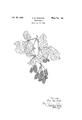
Having generally described the new variety which has been asexually reproduced, I will now more particularly set forth the prominent distinctions and characteristics which will be more clearly understood and will become apparent by reference to the accompanying drawing.
The fruit of my new brambleberry resembles the Mammoth or Cora thornless black berry in appearance, but is materially different in flavor.
Owing to the fact that the vine trails on the ground, it resembles the loganberry in this respect rather than the blackberry which generally grows upright. The vine is larger than that of the loganberry and becomes red in color towards the tip. The canes are lavender in color near their base, resembling the loganberry in this respect.
The color of the fruit is substantially jet black and is therefore different from the 50 longanberry. In addition, the fruit is more firm, sweeter, and less acid than the loganberry. It is distinct from the blackberry in that it possesses a loganberry or red raspberry flavor;
The color of the leaves varies with the season, and for this reason is not shown or 55. described.
The propagation of my new brambleberry is accomplished by tips as in the case of the loganberry, but I have found that my new variety possesses a very great advantage in that it produces very few suckers. As hereinbefore mentioned, it is very prolific in production. The vine is very vigorous and the plant resists disease and insects exceptionally well, having never been attacked by either since its discovery and propagation of thousands of plants.
I claim A new variety of brambleberry substantially as shown and herein described.
In testimony whereof I affix my signature.
PERCY W. MEREDITH.
Family
ID=
Similar Documents
| Publication | Publication Date | Title |
|---|---|---|
| Waldo et al. | ORIGIN OF THE LOGAN AND THE MAMMOTH BLACKBERRIES: New Genetic Evidence Regarding This Perennial Horticultural Mystery | |
| USPP2343P (en) | Certificate of correction | |
| Ruehle | Promising new guava varieties | |
| USPP1895P (en) | Grapevine | |
| USPP1975P (en) | ||
| USPP3116P (en) | Avocado tree | |
| USPP46P (en) | By hannah e | |
| USPP113P (en) | Raspberry variety | |
| USPP4873P (en) | Grape vine | |
| USPP929P (en) | Strawberry plant | |
| Popenoe | The Andes berry | |
| USPP42P (en) | Grape | |
| USPP1449P (en) | Peach tree | |
| USPP364P (en) | Gardenia plant | |
| USPP3634P (en) | Raspberry plant | |
| USPP667P (en) | Avocado tree | |
| USPP635P (en) | Thornless blackberry plant | |
| USPP413P (en) | Plum tree | |
| USPP761P (en) | Strawberry plant | |
| Laxton | On Raising Seedling Apples. | |
| USPP65P (en) | By elizabeth | |
| USPP233P (en) | Peach | |
| USPP119P (en) | Mango | |
| USPP692P (en) | Grapevine | |
| USPP1589P (en) | Rubus plant |