US9909173B2 - Biomolecular processing platform and uses thereof - Google Patents
Biomolecular processing platform and uses thereof Download PDFInfo
- Publication number
- US9909173B2 US9909173B2 US14/763,972 US201414763972A US9909173B2 US 9909173 B2 US9909173 B2 US 9909173B2 US 201414763972 A US201414763972 A US 201414763972A US 9909173 B2 US9909173 B2 US 9909173B2
- Authority
- US
- United States
- Prior art keywords
- nucleic acid
- acid molecules
- dna
- sample
- complements
- Prior art date
- Legal status (The legal status is an assumption and is not a legal conclusion. Google has not performed a legal analysis and makes no representation as to the accuracy of the status listed.)
- Active, expires
Links
- MCHWDHAIYSWRPI-QHDHIJBQSA-N C.N.N.N.N.[3HH].[3HH] Chemical compound C.N.N.N.N.[3HH].[3HH] MCHWDHAIYSWRPI-QHDHIJBQSA-N 0.000 description 3
- PMTGXDAKINWIEX-UHFFFAOYSA-N N.N.N.N Chemical compound N.N.N.N PMTGXDAKINWIEX-UHFFFAOYSA-N 0.000 description 1
Images




Classifications
-
- C—CHEMISTRY; METALLURGY
- C12—BIOCHEMISTRY; BEER; SPIRITS; WINE; VINEGAR; MICROBIOLOGY; ENZYMOLOGY; MUTATION OR GENETIC ENGINEERING
- C12Q—MEASURING OR TESTING PROCESSES INVOLVING ENZYMES, NUCLEIC ACIDS OR MICROORGANISMS; COMPOSITIONS OR TEST PAPERS THEREFOR; PROCESSES OF PREPARING SUCH COMPOSITIONS; CONDITION-RESPONSIVE CONTROL IN MICROBIOLOGICAL OR ENZYMOLOGICAL PROCESSES
- C12Q1/00—Measuring or testing processes involving enzymes, nucleic acids or microorganisms; Compositions therefor; Processes of preparing such compositions
- C12Q1/68—Measuring or testing processes involving enzymes, nucleic acids or microorganisms; Compositions therefor; Processes of preparing such compositions involving nucleic acids
- C12Q1/6869—Methods for sequencing
-
- B—PERFORMING OPERATIONS; TRANSPORTING
- B01—PHYSICAL OR CHEMICAL PROCESSES OR APPARATUS IN GENERAL
- B01L—CHEMICAL OR PHYSICAL LABORATORY APPARATUS FOR GENERAL USE
- B01L3/00—Containers or dishes for laboratory use, e.g. laboratory glassware; Droppers
- B01L3/50—Containers for the purpose of retaining a material to be analysed, e.g. test tubes
- B01L3/502—Containers for the purpose of retaining a material to be analysed, e.g. test tubes with fluid transport, e.g. in multi-compartment structures
- B01L3/5027—Containers for the purpose of retaining a material to be analysed, e.g. test tubes with fluid transport, e.g. in multi-compartment structures by integrated microfluidic structures, i.e. dimensions of channels and chambers are such that surface tension forces are important, e.g. lab-on-a-chip
- B01L3/502761—Containers for the purpose of retaining a material to be analysed, e.g. test tubes with fluid transport, e.g. in multi-compartment structures by integrated microfluidic structures, i.e. dimensions of channels and chambers are such that surface tension forces are important, e.g. lab-on-a-chip specially adapted for handling suspended solids or molecules independently from the bulk fluid flow, e.g. for trapping or sorting beads, for physically stretching molecules
-
- G—PHYSICS
- G01—MEASURING; TESTING
- G01N—INVESTIGATING OR ANALYSING MATERIALS BY DETERMINING THEIR CHEMICAL OR PHYSICAL PROPERTIES
- G01N27/00—Investigating or analysing materials by the use of electric, electrochemical, or magnetic means
- G01N27/26—Investigating or analysing materials by the use of electric, electrochemical, or magnetic means by investigating electrochemical variables; by using electrolysis or electrophoresis
- G01N27/416—Systems
- G01N27/447—Systems using electrophoresis
- G01N27/44704—Details; Accessories
- G01N27/44717—Arrangements for investigating the separated zones, e.g. localising zones
- G01N27/4473—Arrangements for investigating the separated zones, e.g. localising zones by electric means
-
- G—PHYSICS
- G01—MEASURING; TESTING
- G01N—INVESTIGATING OR ANALYSING MATERIALS BY DETERMINING THEIR CHEMICAL OR PHYSICAL PROPERTIES
- G01N27/00—Investigating or analysing materials by the use of electric, electrochemical, or magnetic means
- G01N27/26—Investigating or analysing materials by the use of electric, electrochemical, or magnetic means by investigating electrochemical variables; by using electrolysis or electrophoresis
- G01N27/416—Systems
- G01N27/447—Systems using electrophoresis
- G01N27/44756—Apparatus specially adapted therefor
- G01N27/44791—Microapparatus
-
- G—PHYSICS
- G01—MEASURING; TESTING
- G01N—INVESTIGATING OR ANALYSING MATERIALS BY DETERMINING THEIR CHEMICAL OR PHYSICAL PROPERTIES
- G01N33/00—Investigating or analysing materials by specific methods not covered by groups G01N1/00 - G01N31/00
- G01N33/48—Biological material, e.g. blood, urine; Haemocytometers
- G01N33/483—Physical analysis of biological material
- G01N33/487—Physical analysis of biological material of liquid biological material
- G01N33/48707—Physical analysis of biological material of liquid biological material by electrical means
- G01N33/48721—Investigating individual macromolecules, e.g. by translocation through nanopores
-
- G—PHYSICS
- G01—MEASURING; TESTING
- G01N—INVESTIGATING OR ANALYSING MATERIALS BY DETERMINING THEIR CHEMICAL OR PHYSICAL PROPERTIES
- G01N33/00—Investigating or analysing materials by specific methods not covered by groups G01N1/00 - G01N31/00
- G01N33/48—Biological material, e.g. blood, urine; Haemocytometers
- G01N33/50—Chemical analysis of biological material, e.g. blood, urine; Testing involving biospecific ligand binding methods; Immunological testing
- G01N33/68—Chemical analysis of biological material, e.g. blood, urine; Testing involving biospecific ligand binding methods; Immunological testing involving proteins, peptides or amino acids
- G01N33/6803—General methods of protein analysis not limited to specific proteins or families of proteins
-
- H—ELECTRICITY
- H01—ELECTRIC ELEMENTS
- H01J—ELECTRIC DISCHARGE TUBES OR DISCHARGE LAMPS
- H01J49/00—Particle spectrometers or separator tubes
- H01J49/004—Combinations of spectrometers, tandem spectrometers, e.g. MS/MS, MSn
- H01J49/009—Spectrometers having multiple channels, parallel analysis
-
- B—PERFORMING OPERATIONS; TRANSPORTING
- B01—PHYSICAL OR CHEMICAL PROCESSES OR APPARATUS IN GENERAL
- B01L—CHEMICAL OR PHYSICAL LABORATORY APPARATUS FOR GENERAL USE
- B01L2200/00—Solutions for specific problems relating to chemical or physical laboratory apparatus
- B01L2200/02—Adapting objects or devices to another
- B01L2200/026—Fluid interfacing between devices or objects, e.g. connectors, inlet details
- B01L2200/027—Fluid interfacing between devices or objects, e.g. connectors, inlet details for microfluidic devices
-
- B—PERFORMING OPERATIONS; TRANSPORTING
- B01—PHYSICAL OR CHEMICAL PROCESSES OR APPARATUS IN GENERAL
- B01L—CHEMICAL OR PHYSICAL LABORATORY APPARATUS FOR GENERAL USE
- B01L2200/00—Solutions for specific problems relating to chemical or physical laboratory apparatus
- B01L2200/06—Fluid handling related problems
- B01L2200/0647—Handling flowable solids, e.g. microscopic beads, cells, particles
- B01L2200/0663—Stretching or orienting elongated molecules or particles
-
- B—PERFORMING OPERATIONS; TRANSPORTING
- B01—PHYSICAL OR CHEMICAL PROCESSES OR APPARATUS IN GENERAL
- B01L—CHEMICAL OR PHYSICAL LABORATORY APPARATUS FOR GENERAL USE
- B01L2300/00—Additional constructional details
- B01L2300/06—Auxiliary integrated devices, integrated components
- B01L2300/0627—Sensor or part of a sensor is integrated
- B01L2300/0645—Electrodes
-
- B—PERFORMING OPERATIONS; TRANSPORTING
- B01—PHYSICAL OR CHEMICAL PROCESSES OR APPARATUS IN GENERAL
- B01L—CHEMICAL OR PHYSICAL LABORATORY APPARATUS FOR GENERAL USE
- B01L2300/00—Additional constructional details
- B01L2300/08—Geometry, shape and general structure
- B01L2300/0809—Geometry, shape and general structure rectangular shaped
- B01L2300/0816—Cards, e.g. flat sample carriers usually with flow in two horizontal directions
-
- B—PERFORMING OPERATIONS; TRANSPORTING
- B01—PHYSICAL OR CHEMICAL PROCESSES OR APPARATUS IN GENERAL
- B01L—CHEMICAL OR PHYSICAL LABORATORY APPARATUS FOR GENERAL USE
- B01L2300/00—Additional constructional details
- B01L2300/08—Geometry, shape and general structure
- B01L2300/0896—Nanoscaled
-
- B—PERFORMING OPERATIONS; TRANSPORTING
- B01—PHYSICAL OR CHEMICAL PROCESSES OR APPARATUS IN GENERAL
- B01L—CHEMICAL OR PHYSICAL LABORATORY APPARATUS FOR GENERAL USE
- B01L2400/00—Moving or stopping fluids
- B01L2400/04—Moving fluids with specific forces or mechanical means
- B01L2400/0403—Moving fluids with specific forces or mechanical means specific forces
- B01L2400/0415—Moving fluids with specific forces or mechanical means specific forces electrical forces, e.g. electrokinetic
-
- B—PERFORMING OPERATIONS; TRANSPORTING
- B01—PHYSICAL OR CHEMICAL PROCESSES OR APPARATUS IN GENERAL
- B01L—CHEMICAL OR PHYSICAL LABORATORY APPARATUS FOR GENERAL USE
- B01L2400/00—Moving or stopping fluids
- B01L2400/04—Moving fluids with specific forces or mechanical means
- B01L2400/0403—Moving fluids with specific forces or mechanical means specific forces
- B01L2400/0415—Moving fluids with specific forces or mechanical means specific forces electrical forces, e.g. electrokinetic
- B01L2400/0421—Moving fluids with specific forces or mechanical means specific forces electrical forces, e.g. electrokinetic electrophoretic flow
Definitions
- the present invention relates to a device and methods suitable for nucleic acid sequencing and protein/polypeptide identification.
- SMS Single molecule sequencing
- SMS approach involved synthesis of a polymerase-generated complementary DNA strand composed of fluorescently-labeled deoxynucleotides (Davis et al., “Rapid DNA Sequencing Based Upon Single Molecule Detection,” Genetic Analysis - Biomolecular Engineering 8:1-7 (1991); Goodwin et al., “Application of Single Molecule Detection to DNA Sequencing,” Nucleosides & Nucleotides 16:543-550 (1997); Goodwin et al., “DNA Sequencing by Single Molecule Detection,” Prog. Biophys. Mol. Biol. 65:SMI02-SMI02 (1996)).
- the complementary DNA strand is anchored to a microbead using a streptavidin:biotin linkage.
- Optical trapping is used to suspend the bead:DNA complex in a flow stream filled with a highly processive exonuclease, which sequentially clips the terminal mononucleotides (dNMPs) sending them through an excitation laser beam that produce fluorescent photon bursts with the color providing the mechanism for identification.
- dNMPs terminal mononucleotides
- nanopore technologies have been proposed to allow for the direct read of DNA sequence data from electrical signatures of mononucleotides comprising the target DNA, obviating the need for fluorescence (Akeson et al., “Microsecond Time-Scale Discrimination Among Polycytidylic Acid, Polyadenylic Acid, and Polyuridylic Acid as Homopolymers or as Segments Within Single RNA Molecules,” Biophys. J. 77:3227-3233 (1999); Deamer & Branton, “Characterization of Nucleic Acids by Nanopore Analysis,” Acc. Chem. Res.
- the nanopore is ⁇ -hemolysin, which is a proteinaceous membrane channel produced by the bacterium, S.
- this pore has several limitations: (1) its mechanical and chemical stability are in many cases, inadequate; (2) it has a fixed pore size that allows transduction of only selected types of molecules; and (3) the ability to manufacture high-density arrays of such nanopores can be problematic.
- These ⁇ -hemolysin limitations have led to the use of synthetic nanopores (Rhee & Burns, “Nanopore Sequencing Technology: Research Trends and Applications,” Trends Biotechnol. 24:580-586 (2006) and Storm et al., “Fabrication of Solid-State Nanopores With Single-Nanometer Precision,” Nat. Mater.
- the attractive feature of the synthetic nanopores is the ability to adopt different readout modalities, such as the use of transverse electrodes decorating the synthetic pore to monitor perturbations in the tunneling current or conductance changes (Lagerqvist et al., “Fast DNA Sequencing Via Transverse Electronic Transport,” Nano Lett. 6:779-782 (2006); Lagerqvist et al., “Influence of the Environment and Probes on Rapid DNA Sequencing Via Transverse Electronic Transport,” Biophys. J.
- DNA sequencing approach In principle, structural information of DNA, whether using a natural or synthetic nanopore, is obtained by deducing the identity of a nucleotide from the blockage current magnitude as an intact DNA molecule is moved through the pore.
- the advantages of this DNA sequencing approach include; (1) the ability to sequence large DNA fragments ( ⁇ 50 kbp); (2) does not require the use of amplification or sub-cloning techniques; (3) does not require the use of deoxynucleotides or dideoxynucleotides that are fluorescently labeled; (4) small input DNA sample sizes are required, on the order of 1 ⁇ 10 8 copies for whole genome sequencing and; (5) the rate at which DNA sequence information can be obtained could provide near real-time readout.
- a working demonstration of DNA sequencing directly from a nanopore has yet to be demonstrated.
- the readout resolution requires a pore thickness equal to or less than the single base spacing of DNA molecules, ⁇ 0.34 nm. Because the thickness of both synthetic and ⁇ -hemolysin pores is much larger (5-15 nm) than this spacing, multiple bases simultaneously reside within the pore. Even if nanopores could be fabricated with this prerequisite thickness, the effective electric field read region would extend approximately 1 pore diameter unit on either side of the pore (Liu et al., “The Effect of Translocating Cylindrical Particles on the Ionic Current Through a Nanopore,” Biophys. J. 92:1164-1177 (2007)).
- the production of arrays of nanopores must be done in a high production mode reproducibly with the prerequisite size dimensions and at low-cost to accommodate the intended application.
- high quality genomic DNA must be extracted from a diverse array of samples (blood, tissue, bone marrow, urine, saliva, etc) and then processed to produce DNA fragments ( ⁇ 50 kbp), which are used as the input for sequencing.
- the sample preparation and sequencing steps should be integrated into a single platform and operate in a basic turn-key mode to allow a broad user base.
- Readout resolution limitations can be mitigated if nucleotides are physically separated from each other while maintaining their original order following clipping from the DNA, for example through the use of an exonuclease enzyme (Davis et al., “Rapid DNA Sequencing Based on Single Molecule Detection,” In Los Alamos Science (1992)). This has been demonstrated to be feasible using a highly processive exonuclease enzyme, which sequentially clips individual nucleotides from an intact DNA fragment and directing these bases through an ⁇ -hemolysin nanopore fitted with a cyclodextrin collar (Wu et al., “Protein Nanopores With Covalently Attached Molecular Adapters,” J. Am. Chem.
- the present invention overcomes these and other deficiencies in the art.
- a first aspect of the present invention is directed to a device comprising a biomolecular processor.
- Each biomolecular processor comprises one or more bioreactor chambers defined by a solid substrate, and a support structure within each bioreactor chamber that is attached to the solid substrate.
- the biomolecular processor also has a cleaving enzyme immobilized to the support structure and operatively positioned within said bioreactor chamber to cleave monomer or multimer units of a biopolymer molecule operatively engaged by the cleaving enzyme.
- the biomolecular processor also has one or more time-of-flight channels formed in the solid substrate and fluidically coupled to the one or more bioreactor chambers.
- Each of the one or more time-of-flight channels has an input end and an output end, where each of the one or more time-of-flight channels has two or more sensors including at least (i) a first sensor contacting the one or more time-of-flight channels proximate to the input end of the one or more time-of-flight channels and (ii) a second sensor contacting the one or more time-of-flight channels proximate to the output end of the one or more time-of-flight channels.
- Another aspect of the present invention is directed to a method for identifying one or more of a plurality of nucleic acid molecules in a sample.
- This method involves providing a sample containing one or more nucleic acid molecules each hybridized to its respective complementary nucleic acid molecule, wherein each of the one or more nucleic acid molecules and its hybridized complement thereof comprise a target specific portion and a singled stranded 3′ adapter portion suitable for hairpin formation.
- the sample is subjected to conditions effective for the 3′ adapter portions of the one or more nucleic acid molecules and complements thereof to form a hairpin.
- the method further involves providing a polymerase and blending the one or more 3′ hairpinned nucleic acid molecules and complements thereof with the polymerase to form an extension mixture.
- the one or more nucleic acid molecules and complements thereof are extended from their respective 3′ hairpinned regions to form one or more full-length hairpinned nucleic acid molecules.
- the method further involves sequencing at least a portion of the one or more full-length hairpinned nucleic acid molecules to identify one or more nucleic acid molecules in the sample.
- Another aspect of the present invention is directed to a method for identifying one or more of a plurality of nucleic acid molecules in a sample that involves immobilization on a solid support to achieve target specific enrichment of one or more desired nucleic acid molecules.
- This method involves providing a sample containing one or more nucleic acid molecules each hybridized to its respective complementary nucleic acid molecule, wherein each of the one or more nucleic acid molecules and its hybridized complement thereof comprise a target specific portion, a 5′ adapter portion, and a 3′ adapter portion, wherein each of the 5′ and 3′ adapter portions are suitable for hairpin formation.
- the method further involves denaturing the one or more nucleic acid molecules from their complements thereof to form a collection of one or more single-stranded nucleic acid molecules and complements thereof, wherein the hairpin sequences of the 5′ and 3′ adapter portions of each of the one or more single stranded nucleic acid molecules and complements thereof form hairpins.
- a solid support is provided that comprises a plurality of immobilized capture oligonucleotide probes, said capture oligonucleotide probes comprising a nucleotide sequence that is complementary to a region of the target specific portion of the one or more nucleic acid molecules or complements thereof.
- the one or more denatured single stranded nucleic acid molecules and complements thereof are hybridized to their complementary immobilized capture oligonucleotides on the solid support.
- This method further involves providing a polymerase and contacting the polymerase with the solid support containing the one or more hybridized nucleic acid molecules and complements thereof.
- the one or more nucleic acid molecules and complements thereof are extended from their respective 3′ hairpinned regions to form one or more full-length hairpinned target nucleic acid molecules, thereby causing the one or more nucleic acid molecule to be released from the capture oligonucleotides and from the solid support.
- At least a portion of the one or more nucleic acid molecules is sequenced to identify the one or more nucleic acid molecules in the sample.
- Another aspect of the present invention is directed to a method a method for identifying one or more of a plurality of nucleic acid molecules in a sample.
- This method involves providing a sample containing one or more nucleic acid molecules each hybridized to its respective complementary nucleic acid molecule, wherein each of the one or more nucleic acid molecules and its hybridized complement thereof comprise a target specific portion, a 5′ adapter portion, and a 3′ adapter portion comprising a single stranded homopolymer repeat sequence.
- the method further involves denaturing the one or more nucleic acid molecules from its complement thereof to form a collection of single-stranded nucleic acid molecules and complements thereof.
- a plurality of oligonucleotide primers that are complementary to the 3′ ends of the one or more nucleic acid molecules or complements thereof and a polymerase are provided, and the one or more nucleic acid molecules and complements thereof are blended with the polymerase and primers to form an extension mixture.
- the method further involves hybridizing the oligonucleotide primers to their complementary 3′ ends of the one or more nucleic acid molecule and complements thereof, and extending the hybridized primers to form full-length double stranded nucleic acid molecules. At least a portion of the one or more full-length double stranded nucleic acid molecules is sequenced to identify the one or more nucleic acid molecules in the sample.
- the present invention relates to a biopolymer sequencing platform, referred to herein as a biomolecular processor, that can substantially reduce the cost, labor and time associated with acquiring sequencing information using a fully automated platform.
- the platform uses nano-scale sensors that identify monomer and multimer units of a biopolymer molecule, based on their characteristic flight-time through a 2-dimensional (2D) time-of-flight channel fabricated in a moldable solid support using low-cost micro- and nano-replication techniques.
- the monomer and multimer units are generated from an intact biopolymer, e.g., nucleic acid molecule or protein, using a cleavage enzyme, which is covalently anchored to a support structure contained within a bioreactor chamber of the biomolecular processor.
- the cleaved monomer or multimer units are fed into a time-of-flight channel, where the identity of the monomer or multimer is deduced from a molecular-dependent flight-time through the time-of-flight channel.
- the flight-time is transduced using at least two pairs of sensors poised at each end of the channel with the signal resulting from perturbations in an electrical response induced by the monomer or multimer units.
- nucleotide spacing would be 100 nm.
- the single base resolution requirement for nanopores to be ⁇ 0.34 nm in thickness is not necessary because of the exonuclease-imposed spacing of the dNMPs and the fact that blockage currents are not being used to identify the nucleotide base.
- the identity of the nucleotides is based on well-established chromatographic or electrophorectic properties of these entities (Czarnecka et al., “Application of Solid Phase Extraction and High-Performance Liquid Chromatography to Qualitative and Quantitative Analysis of Nucleotides and Nucleosides in Human Cerebrospinal Fluid,” J. Chromatogr. B 822:85-90 (2005), which is hereby incorporated by reference in its entirety).
- the biomolecular processor of the present invention can be interfaced to micro-scale modules as described herein to generate autonomous systems for processing the sample prior to submission for sequence analysis.
- the DNA can be selected from target cells, purified and sheared prior to sequencing in a fully automated fashion.
- the material property flexibility afforded by the vast array of moldable materials as well as the modular approach adopted, will allow the building of these systems with selection of the substrate material optimized for the application.
- the low-cost production of these modules and their straight-forward assembly as well as the high functionality of the assembled system will provide low-cost platforms and their automation capabilities will produce a platform for resequencing or de novo sequencing directly within a clinical setting or a small discovery-based laboratory.
- FIG. 1 is a top view schematic of a biomolecular processor of the present invention.
- FIG. 2A is a perspective view of a biomolecular processor of the present invention.
- FIG. 2B shows the cleaving enzyme 36 immobilized to the bioreactor support structure 16 and operatively engaged with a nucleic acid molecule 15 .
- FIGS. 3A-3D are scanning electron micrograph (SEM) images of various portions of the biomolecular processor of the present invention.
- FIG. 3A is a SEM image of a v-shaped feeder channel inlet 28 containing an array of micro- and/or nanopillars.
- FIG. 3B is an SEM image of the feeder channel 20 containing an entropic trap 30 and coupled to the bioreactor chamber 14 .
- FIG. 3C is an SEM image of the bioreactor chamber 14 containing the solid support 16 with the immobilized cleaving enzyme 36 .
- the bioreactor chamber is fluidically coupled to the feeder channel 20 and the time-of-flight channel 24 .
- 3D shows the time-of-flight channel 24 with a first 32 and second 34 pair of nanosensing electrodes located within the channel 24 . As shown the nanosensing electrodes are each connected to microcontact pads 40 that couple the nanosensing electrodes to external electronic components of the device.
- FIGS. 4A-4B show various designs of the feeder channel sample inlets.
- FIG. 4A shows SEM images of various inlets, including a groove inlet, V-shaped micro/sub-micron groove inlet, a pillar inlet with an array of micro/nanopillars, and a funnel inlet.
- FIG. 4B is a graph showing the enhancement of DNA capture using the various inlet designs of FIG. 4A as compared to an abrupt microfluidic-to-nanochannel interface (“original”).
- FIGS. 5A-5B are schematics showing alternative approaches for immobilizing a cleaving enzyme or enzymes to a solid support in the bioreactor chamber of the device of the present invention.
- FIG. 6A-6B show a biomolecular processor of the present invention having a time-of-flight channel that contains three nanosensing electrodes.
- FIG. 6A is a top-view of a biomolecular processor 10 comprising the feeder channel 20 , bioreactor chamber 14 , and time-of-flight channel 24 containing a first 32 , second 34 , and third 33 pair of nanosensing electrodes.
- FIG. 6B is a perspective view showing a mononucleotide 46 entering and exiting a time-of-flight channel 24 containing three pairs of nanosensing electrodes 32 , 33 , 34 .
- FIG. 7 is a top view of a biomolecular processor of the present invention where the time-of-flight channel contains multiple flight tubes, each flight tube having two pairs of nanosensing electrodes separated by a portion of the time-of-flight channel having a unique surface chemistry.
- the first and second sensors of each flight tube detect the flight time of a biopolymer unit as a function of the particular flight tube surface chemistry.
- FIGS. 8A-8B are schematics showing alternative methods of preparing both strands of double-stranded genomic DNA for sequence analysis in accordance with the methods of the present invention.
- FIG. 9 is a schematic overview of a method for enriching a sample for target genomic DNA and preparing both strands of the enriched double stranded DNA for sequence analysis in accordance with the methods of the present invention.
- FIG. 10 is a schematic showing a method of preparing both strands of double-stranded genomic DNA for sequence analysis in accordance with the methods of the present invention.
- FIG. 11 is a schematic overview of a method for enriching a sample for target genomic DNA and preparing both strands of the enriched double stranded DNA for sequence analysis in accordance with the methods of the present invention.
- FIG. 12 is a schematic overview of a first suitable process for fabricating the biomolecular processor of the present invention.
- FIG. 13 is a schematic overview of a second suitable process for fabricating the biomolecular processor of the present invention.
- FIG. 14 is a schematic overview of a third suitable process for fabricating the biomolecular processor of the present invention.
- FIG. 15 is a schematic overview of the formation of a silicon master stamp used to fabricate the biomolecular processor of the present invention.
- FIGS. 16A-16B depict the nanoimprint lithography processes used to form a resin stamp from the silicon master stamp ( FIG. 16A ) that is subsequently used to fabricate the micro- and nanofluidic network and other structures associated with the biomolecular processor of the present invention ( FIG. 16B ).
- FIGS. 17A-17B show the process of forming single phase nanowires suitable for use in the biomolecular processor of the present invention ( FIG. 17A ) and a scanning electron microscopy (SEM) image of the nanowires produced in this process ( FIG. 17B ).
- FIG. 18 shows the process of forming segmented nanowires suitable for use in the biomolecular processor of the present invention.
- FIG. 19 is a schematic showing a process for forming ultrathin nanowires suitable for use in the biomolecular processor of the present invention.
- FIG. 20 shows a process of nanowire thinning using selective etching.
- FIG. 21 is a schematic illustrating the positioning of nanowires using chemical patches at sensing electrode locations on the biomolecular processor of the present invention.
- FIG. 22 is a schematic overview showing the formation of chemical patches on the substrate of the biomolecular processor using molecular assembly patterning by lift-off (MAPL) technique.
- MPL lift-off
- FIG. 23 is schematic overview showing the formation of chemical patches on the substrate of the biomolecular processor using a nanostencil mask.
- FIG. 24 is a schematic overview showing the use of the nanostencil mask to position nanowires at electrode sensor locations on the biomolecular processor.
- FIG. 25 is a schematic overview showing the process of magnetically directing nanowires to their electrode sensor locations without using an applied magnetic field.
- FIG. 26 is schematic overview showing the process of magnetically directing nanowires to their electrode sensor locations using an externally applied magnetic field.
- FIG. 27 depicts a process of simultaneous nanogap and nanochannel formation using nanoimprint lithography.
- FIG. 28 shows a process of nanogap formation using nanoimprint lithography when the nanochannels and other fluidic networks are preformed in the substrate.
- FIGS. 29A-29B schematically illustrate alternative processes for forming the microcontact pads that couple the nanosensing electrodes of the flight time sensor to external electronic components.
- FIGS. 30A-30C show a process for thermally assembling a cover plate to the biomolecular processor while minimizing structural deformation.
- FIG. 30A is a schematic of the assembly process.
- FIG. 30B is a schematic of the pressure heater used in the assembly process.
- FIG. 30C are images of the bonded coverplate.
- FIG. 31 depicts the process of making various electrical connections between the micro-contact pads and a printed circuit board (PCB) with on-board signal processing electronics.
- PCB printed circuit board
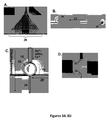
- FIG. 32 shows the electronics of the biomolecular processor of the present invention.
- FIGS. 33A-33D show dNMP structures containing the four nucleobases: FIG. 33A shows protonated 3′ dAMP; FIG. 33B shows nonprotonated 3′ dGMP; FIG. 33C protonated 5′ dCMP; and FIG. 33D shows nonprotonated 5′ dTMP.
- FIG. 33A shows protonated 3′ dAMP; FIG. 33B shows nonprotonated 3′ dGMP; FIG. 33C protonated 5′ dCMP; and FIG. 33D shows nonprotonated 5′ dTMP.
- the differences between the partial charges on the encircled atoms in the structure of FIG. 33B and the corresponding atoms in the structure of FIG. 33A were applied to the structure of FIG. 33C to get the partial charges on the encircled atoms in the structure of FIG. 33D .
- 33B and 33D is at the C3′ and C5′ atoms. Structures like FIG. 33D with the four different nucleobases were used in the simulations. The identity of the nucleobase does not affect the partial charges on the phosphate group.
- the axes labeled axis 1 on the nucleobases were used in the analysis of dNMP adsorption and desorption to the slit walls and are discussed in.
- FIG. 34A-34B shows the system used for both the equilibrium and non-equilibrium simulations and the chemical structure of DNA.
- FIG. 34A shows the simulation system containing water, sodium chloride, and a dNMP in a nanoslit. Gray spheres represent wall atoms, green represents chloride, tan represents phosphorus, yellow represents sodium, red represents non-water oxygen, white represents non-water hydrogen, cyan represents non-wall carbon, blue represents nitrogen, and purple represents water molecules. Some of the wall atoms are not shown for clarity. There are periodic boundary conditions in the x and y directions.
- FIG. 34B shows two dNMPs (only polar hydrogens are shown).
- Single ring pyrimidine (C, T) and two ring purine (A, G) nucleobases are attached to the sugar-phosphate backbone.
- ⁇ -exonucleases can digest one strand of a double-stranded DNA one nucleotide at a time starting from the 5′ end and leaving the phosphate on the 5′ end of each released nucleotide.
- FIG. 35 depicts the steps in the algorithm to determine adsorption and desorption times. For calculation of the energy between the dNMPs and the wall during adsorption periods, a different definition was used for adsorption. If the energy was less than ⁇ 2.0 kcal/mol, then the dNMP was considered adsorbed.
- FIG. 36 shows the free energies of the four dNMPs as a function of the distance from the hydrophobic walls, d w . These curves are averages over all the different sets of wall configurations.
- FIG. 37 shows the typical 50 ns trajectories of the center of mass of the dNMPs in the z direction (perpendicular to the wall surfaces)
- FIG. 38 shows the angle of Axis 1 with the surface plane as a function of d w for adsorption in the equilibrium case (gray) and non-equilibrium case (black).
- FIG. 39 shows the angle of Axis 1 with the surface plane as a function of d w for desorption in the equilibrium case (gray) and non-equilibrium case (black).
- FIGS. 40A-40D depict the definitions of Axis 2 , which lies in the plane of the nucleobases.
- FIG. 40A depicts dAMP.
- FIG. 40B depicts dGMP.
- FIG. 40C depicts dCMP.
- FIG. 40D depicts dTMP.
- FIG. 41 shows the angle of Axis 2 with the surface plane as a function of d w for adsorption in the equilibrium case (gray) and non-equilibrium case (black).
- FIG. 42 show the angle of Axis 2 with the surface plane as a function of d w for desorption in the equilibrium case (gray) and non-equilibrium case (black).
- FIG. 44 is a graph showing the estimated time-of-flight distributions for a center line velocity (v max ) of 0.048 cm/s and a channel length of 2.47 mm.
- FIG. 45 is a schematic showing the process of immobilizing ⁇ -Exonuclease ( ⁇ -Exo) to a poly(methylmethacrylate) (PMMA) surface.
- FIGS. 46A-46C demonstrate ⁇ -Exo immobilization on PMMA surface.
- FIGS. 46A and 46B are Atomic Force Microscopy (AFM) scans of PMMA surfaces exposed to ⁇ -Exo alone ( FIG. 46A ) or ⁇ -Exo in combination with 3-(3-dimethylaminopropyl) carbodiimide (EDC)/N-hydroxysuccinimide (NHS) coupling reagents ( FIG. 46B ).
- FIG. 46C is a histogram showing the size distribution of immobilized ⁇ -Exo enzymes across the polymer surface.
- FIG. 47 shows the fluorescence spectra of ⁇ -DNA following free solution ⁇ -Exo digestion and solid phase reactor ⁇ -Exo digestion.
- the fluorescence spectra of undigested ⁇ -DNA is also shown as a control.
- FIG. 48 is a graph showing real-time fluorescence monitoring of ⁇ -Exo digestion activity. Fluorescently labeled ⁇ -DNA was incubated with immobilized ⁇ -Exo in the presence ( ⁇ ) and absence ( ⁇ ) of MgCl 2 co-factor, and the decrease in relative fluorescence intensity, indicative of ⁇ -Exo digestion activity, was monitored over the course of the reaction time.
- FIG. 49 is a graph showing the baseline resolution of native deoxynucleotide monophosphates (dNMPs) by capillary electrophoresis (CE).
- dNMPs native deoxynucleotide monophosphates
- CE capillary electrophoresis
- FIGS. 50A-50B show the effect of thermoplastic (PMMA) surface treatment on electoosmotic flow (EOF).
- FIG. 50A shows EOF in a native unmodified PMMA nanochannel ( ⁇ ), and a PMMA nanochannel treated with an O 2 plasma ( ⁇ ).
- FIG. 50B shows EOF in a native unmodified PMMA nanochannel ( ⁇ ), and a PMMA nanochannel that was plasma oxidized and treated with ethylene diamine in the presence of EDC/NHS coupling reagents ( ⁇ ).
- FIGS. 51A-51C demonstrate single entity electrophoretic mobility through PMMA nanochannels.
- FIG. 51A is a histogram showing for the single entity electrophoretic driven translocation times through PMMA nanochannels performed at an electric field strength of 4000 V/cm. Comparison of this data to that performed at lower field strengths indicated that the spread in the translocation time was inversely related field strength due to reduced dispersion effects at higher electric fields.
- FIG. 51B is an image (3D-plot) of a single silver nanoparticle (Ag-NP) placed in a PMMA nanochannel in the absence of an electric field.
- FIG. 51C is a graph showing the electrophoretic mobility and the plate numbers (measure of width of histogram shown in FIG. 51A ) for the electrically driven translocation of the single entities in the PMMA nanochannel.
- FIGS. 52A-52I depict optical and electrical measurements of T4 DNA translocation events through PMMA nanochannels.
- FIGS. 52A and 52B show ionic current spikes generated by translocation of short DNA molecules ( ⁇ 5 ⁇ m).
- FIG. 52C is a schematic showing the short DNA molecule translocating through the nanopillar array and nanochannel of a nanofluidic device.
- FIGS. 52D-52F and 52G-52I show the ionic current spikes generated by translocation of longer DNAs (not full length T4 DNA) and full length T4 DNA molecules, respectively. As described herein the length of the DNA molecule correlates to the length of the generated current transient.
- FIGS. 53A-53B are images of segmented nanowires containing nanogaps that were produced by electrochemical etching.
- a first aspect of the present invention is directed to a device comprising a biomolecular processor.
- Each biomolecular processor comprises one or more bioreactor chambers defined by a solid substrate, and a support structure within each bioreactor chamber that is attached to the solid substrate.
- the biomolecular processor also has a cleaving enzyme immobilized to the support structure and operatively positioned within said bioreactor chamber to cleave monomer or multimer units of a biopolymer molecule operatively engaged by the cleaving enzyme.
- the biomolecular processor also has one or more time-of-flight channels formed in the solid substrate and fluidically coupled to the one or more bioreactor chambers.
- Each of the one or more time-of-flight channels has an input end and an output end, where each of the one or more time-of-flight channels has two or more sensors including at least (i) a first sensor contacting the one or more time-of-flight channels proximate to the input end of the one or more time-of-flight channels and (ii) a second sensor contacting the one or more time-of-flight channels proximate to the output end of the one or more time-of-flight channels.
- the biomolecular processor of the device may further contain a feeder channel that is also defined by walls of said solid substrate.
- the feeder channel has a length extending from an input end proximate to the surface of the solid substrate to an output end that is proximate to one or more of the bioreactor chambers.
- the device of the present invention comprises 100-1,000 biomolecular processors, 1,000-10,000 biomolecular processors, or 10,000-100,000 biomolecular processors. In another embodiment, the device of the present invention comprises more than 100,000 biomolecular processors.
- FIG. 1 is a top view schematic of a biomolecular processor 10 of a device of the present invention.
- the biomolecular processor comprises various multi-scale fluidic networks and micro- and nanostructures that function together to identify and/or sequence a biopolymer molecule present in a sample.
- the biomolecular processor has a sample inlet 28 located at the input end of a feeder channel 20 that is capable of receiving a sample containing a biopolymer molecule, such as a nucleic acid molecule or protein.
- the feeder channel 20 is fluidically coupled at its output end to a bioreactor chamber 14 that contains a cleaving enzyme immobilized to a solid support structure 16 within the bioreactor chamber 14 .
- the cleaving enzyme engages and cleaves the biopolymer into monomer or multimer units as it enters the bioreactor chamber from the feeding channel 20 .
- the cleaved monomer or multimer units subsequently enter the fluidically coupled time-of-flight channel 24 .
- the time-of-flight channel contains at least two sensors 32 , 34 that detect the cleaved monomer or multimer units as they are electrokinetically transported through the channel.
- the time it takes for a cleaved monomer or multimer unit to pass the first and second sensors in the time-of-flight channel is the “flight time” of the monomer or multimer unit.
- the flight time of the cleaved units is used to characterize and/or identify the monomer or multimer unit and/or the biopolymer molecule.
- FIG. 2 is a perspective view of the biomolecular processor of the device of the present invention. Not shown in this Figure is the coverplate of the biomolecular processor which fully encloses the microfluidic components of the device.
- the solid substrate 12 of the biomolecular processor 10 may be a polymeric material or other moldable material. Suitable polymeric materials include, without limitation, poly(methyl methacrylate) (PMMA), polycarbonates (PC), epoxy-based resins, copolymers, polysulfones, elastomers, cyclic olefin copolymer (COC), and polymeric organosilicons.
- the solid substrate 12 of the biomolecular processor 10 may be glass, silica or a fused silica substrate material.
- the feeder channel 20 of the biomolecular processor 10 is defined by walls within the solid substrate 12 .
- the feeder channel 20 has a sample inlet 28 at the input end, and is fluidically coupled to a bioreactor chamber 14 at its output end 18 .
- the feeder channel receives and orientates a biopolymer molecule, e.g., a nucleic acid molecule 15 , prior to feeding it into the bioreactor chamber for enzymatic processing.
- a sample containing one or more biopolymer molecules enters the biomolecular processor via a feeder channel inlet 28 .
- the sample inlet may be modified structurally in various ways to facilitate capture and loading of a biopolymer molecule into the biomolecular processor from another module or component of the device.
- the sample inlet may be a simple micro/sub-micron groove inlet, a V-shape micro/sub-micron groove inlet, a pillar inlet with an array of micro/nanopillars, or a funnel inlet as shown in FIGS. 3A and 4A .
- FIG. 4B is a graph showing that modified inlet structures significantly increase the rate of DNA capture and loading into a feeder channel at various driving voltages as compared to an abrupt microfluidic network to nanochannel interface (labeled as “original” in FIG. 4B ).
- the dimensions of the feeder channel are less than or equal to 100 nm wide and less than or equal to 100 nm deep. In another embodiment of the present invention, the dimensions of the feeder channel are less than or equal to 75 nm wide and less than or equal to 75 nm deep. In another embodiment of the present invention, the dimensions of the feeder channel are less than or equal to 50 nm wide and less than or equal to 50 nm deep.
- the length of the feeder channel is preferably in the range of about 1 ⁇ m to about 100 ⁇ m or longer, although longer and shorter feeder channel lengths are also suitable for the biomolecular processor of the present invention.
- the feeder channel may have any desired geometrical cross-section, i.e., circle, triangle, square, rectangle, pentagon, hexagon, heptagon, or octagon.
- the feeder channel of the biomolecular processor may further comprise one or more entropic traps 30 that are used for shaping, stretching, and positioning a biopolymer molecule, such as a nucleic acid molecule 15 , within the feeder channel 20 .
- Suitable entropic nucleic acid traps are known in the art, see e.g., Han and Craighead, “Separation of Long DNA Molecules in Microfabricated Entropic Trap Array,” Science 288: 1026-1029 (2000), O'Donnell et al., “Pressure-driven DNA Transport Across an Artificial Nanotopography,” New Journal of Physics 11: 075032 (2009), and Reisner et al., “Direct Self-Organization of Single DNA Molecules in a Nanoslit via Embedded Nanopt Arrays,” Proc. Natl. Acad. Sci. USA 106: 79-84 (2009), which are hereby incorporated by reference in their entirety.
- the feeder channel may further contain one or more pre-processing chambers or traps used to orient or process the biopolymer molecule prior to downstream enzymatic cleavage in the bioreactor chamber.
- the biopolymer is an mRNA molecule
- the molecule may need to be decapped or deadenylated to create a suitable substrate for enzymatic cleavage.
- Suitable processing enzymes can be tethered or coupled to the walls of the feeder channel or walls of a pre-bioreactor processing chamber located in the feeder channel upstream of the bioreactor chamber.
- the entropic trap, feeder channel, and any other pre-bioreactor processing chamber may also contain immobilized capture oligonucleotides.
- These capture oligonucleotides immobilized to the walls or support structures within the channel, traps, or chambers may comprise a homopolymer repeat sequence that is complementary to an end of the biopolymer molecule, e.g., a nucleic acid, that is fed through the channel.
- Hybridization between the immobilized capture oligonucleotides and complementary regions of the bipolymer molecule help orient the molecule as it traverses the feeder channel.
- the feeder channel 20 may also comprise one or more sensors 26 that intersect the feeder channel. As shown in the embodiments depicted in FIGS. 1 and 2 , the feeder channel 20 comprises a sensor 26 , e.g., a pair of sensing electrodes, proximate to the input end of the feeder channel 20 that is capable of measuring electrical signals perpendicular to the feeder channel 20 . Each of the sensing electrodes 26 is coupled to a micro-contact pad 40 that provides a connection to the external electrical components of the biomolecular processor.
- a sensor 26 e.g., a pair of sensing electrodes
- FIG. 3B is a scanning electron micrograph (SEM) showing a portion of the feeder channel 20 containing an entropic trap 30 coupled to the bioreactor chamber 14 .
- the bioreactor chamber 14 is also defined by walls of the solid substrate of the biomolecular processor and is about 100 to about 1000 nm wide.
- the bioreactor chamber 14 contains a support structure 16 , such as a pillar, having one or more cleaving enzymes 36 , e.g., an exonuclease, exoribonuclease, or protease, covalently attached.
- the support structure of the bioreactor chamber may comprise the same or different material as the solid substrate of the biomolecular processor.
- the support structure is a polymer support structure (e.g., PMMA, PC, or COC polymer).
- the support structure of the bioreactor chamber is about 50 nm to about 900 nm in width and about 10 nm to about 100 nm tall.
- the surface area of the support structure is about 1500 to about 285,000 nm 2 .
- the cleaving enzyme immobilized on the support structure engages and cleaves a biopolymer molecule that enters the bioreactor chamber 14 from the output end 18 of the feeder channel 20 .
- the cleaving enzyme may require activation. Buffers containing activating agents, e.g., Mg +2 , or electrophoresis buffers are stored in a storage chamber 42 that is fluidically coupled to the bioreactor chamber 14 ( FIG. 2 ).
- FIG. 2B shows the cleaving enzyme 36 immobilized on the bioreactor support structure 16 and engaged with a nucleic acid molecule 15 .
- the cleaving enzyme may be tethered to the support structure of the bioreactor chamber using standard coupling chemistry known in the art. In one embodiment, the enzyme is tethered to the support structure via adventitious immobilization ( FIG. 5A ).
- cleavage enzymes such as exonucleases (New England Biolabs) or other enzymes can be immobilized using well-established carbodiimide (1-ethyl-3-(3-dimethylaminopropyl)carbodiimide, EDC) chemistries routinely utilized for a variety of antibodies
- EDC carbodiimide
- the cleaving enzyme is tethered to the support structure via the immobilization of a suitable capture moiety, where the enzyme contains or is engineered to contain a capture moiety binding partner.
- the surface of the support structure contains a plurality of capture ligands bound to Ni(II) that allow for enzyme immobilization using a hexahistidine tag engineered enzyme ( FIG. 5B ) (Dapprich, J., “Single-Molecule DNA Digestion by Lambda-Exonuclease,” Cytometry 36:163-168 (1999), which is hereby incorporated by reference in its entirety).
- Ni(II) surfaces can be generated by coordinating Ni(II) to CT-PMMA that has been modified with 1-acetato-4-benzyl-triazacyclononane (Acbztacn) (Johnson & Martin, “Controlling Protein Orientation at Interfaces Using Histidine Tags: An Alternative to Ni/NTA,” J. Am. Chem. Soc. 127:2018-2019 (2005); Warden et al., “Synthesis of Novel Derivatives of 1,4,7-Triazacyclononane,” Organic Lett. 3:2855-2858 (2001), which are hereby incorporated by reference in their entirety) or nitrilotriacetic acid (NTA).
- NTA nitrilotriacetic acid
- Acbztacn-PMMA surfaces can be formed by exposure of CT-PMMA surfaces to EDC/Acbztacn to form amide linkages of the Acbztacn to the PMMA through the secondary amine of the triazacyclononane (see FIG. 5B ) (Johnson & Martin, “Controlling Protein Orientation at Interfaces Using Histidine Tags: An Alternative to Ni/NTA,” J. Am. Chem. Soc. 127:2018-2019 (2005), which is hereby incorporated by reference in its entirety).
- Alternative capture and binding partners that can be used to tether the cleaving enzyme or enzymes to the support structure include, without limitation, biotin and streptavidin, maltose and maltose binding protein, chitin and chitin binding protein, amylase and MBP, glutathione transferase and glutathione-S-transferase, integrin and integrin binding peptides, nucleic acid oligonucleotides or nucleic acid analogue oligonucleotides and their complementary oligonucleotides.
- the enzyme is tethered to the support structure using immobilized antibodies.
- the cleaving enzyme which has been engineered to contain a hexahistidine tag, can be immobilized to the support structure via anti-His-Tag antibodies (Perkins et al., “Sequence-Dependent Pausing of Single Lambda Exonuclease Molecules,” Science 301:1914-1918 (2003), which is hereby incorporated by reference in its entirety).
- Immobilization of commercially-available anti-histidine-Tag antibodies can be achieved using well-established carbodiimide (1-ethyl-3-(3-dimethylaminopropyl)carbodiimide, EDC) chemistries routinely utilized for a variety of antibodies
- carbodiimide 1-ethyl-3-(3-dimethylaminopropyl)carbodiimide, EDC
- EDC carbodiimide
- Additional embodiments of antibody capture of enzyme containing an engineered peptide capture sequence include but are not limited to: FLAG epitope with Anti-FLAG antibody; and Myc tag epitope with Anti-Myc Tag antibody.
- the immobilized cleaving enzyme of the bioreactor chamber is an exonuclease.
- an “exonuclease” encompasses any enzyme capable of catalyzing the hydrolysis of a single nucleotide from the end of a DNA or RNA molecule.
- the exonuclease is a processive enzyme, i.e., it catalyzes a series of successive cleavage events of a template without releasing the template.
- exonucleases can be monomeric enzymes, multimeric enzymes, or enzyme complexes comprised of multiple subunits.
- Suitable exonucleases include, without limitation, lambda exonuclease, which cleaves double-stranded and single-stranded DNA substrates in the 5′-3′ direction; exonuclease I, which cleaves single-stranded DNA substrates in the 3′-5′ direction; exonuclease III, which cleaves double-stranded DNA substrates in the 3′-5′ direction; T7 exonuclease, which cleaves double-stranded DNA substrates, or RNA/DNA hybrid substrates in the 5′-3′ direction; XRN-1, which cleaves single-stranded RNA substrates in the 5′-3′ direction (Geisler and Coller, “XRN1: A Major 5′ to 3′ Exoribonuclease in Eukaryotic Cells,” Enzymes 31:97-110 (2012), Jinek et al., “Coupled 5′ Nucleotide Recognition and Processivity in Xrn1-Mediated m
- the support structure of the bioreactor chamber may comprise any one or more of the aforementioned exonuclease enzymes.
- a combination of enzymes such as, e.g., an exosome complex in combination with XRN-1, ensures cleavage of an RNA molecule regardless of RNA orientation (i.e., 5′-3′ or 3′-5′) as it enters the bioreactor chamber.
- a prior processing step may be needed, for example decapping messenger RNA to create a 5′ phosphorylated substrate for XRN-1, or deadenylation of messenger RNA to create a suitable substrate for the Exosome complex.
- additional enzymes may be present in pre-reaction chambers, the feeder channel, or attached to the support structure of the bioreactor chamber.
- the immobilized cleaving enzyme of the bioreactor chamber is a protease or peptidase.
- protease or peptidase.
- protease and peptidase are used interchangeably to refer to any enzyme capable of proteolysis by hydrolysis of peptide bonds.
- Suitable proteases include, without limitation, serine proteases, threonine proteases, cysteine proteases, aspartate proteases (cleave at the amino side of aspartate residues), asparagine proteases, lysine proteases (cleaves at the carboxyl side of lysine residues), metalloproteases, and glutamic acid proteases (cleaves at the carboxyl side of glutamate or aspartate).
- Particular proteases that are suitable for use in the present invention include, without limitation, proteinase K, which cleaves at the carboxyl side of aliphatic, aromatic, and hydrophobic residues; S.
- aureus V-8 Protease which cleaves at the carboxyl side of aspartate and glutamate residues
- trypsin which cleaves at the carboxyl side of arginine and lysine residues
- chymotrypsin which cleaves at the carboxyl side of tyrosine, phenylalanine, tryptophan and leucine.
- the bioreactor chamber 14 is fluidically coupled to output channel 44 that runs opposite the feeder channel 20 .
- the output channel 44 may serve to collect non-cleaved biopolymer components, e.g., when the biopolymer molecule is a double stranded DNA molecule and only one strand of the DNA is cleaved by the cleaving enzyme, the output channel collects the non-digested strand of DNA.
- the output channel may serve as a second feeder channel, collecting non-digested biopolymer units and transporting them downstream to one or more other bioreactor chambers for cleavage.
- the bioreactor chamber 14 is also fluidically coupled to a time-of-flight channel 24 that is defined by walls of the solid substrate 12 of the biomolecular processor 10 .
- the dimensions of the time-of-flight channel are less than or equal to 50 nm wide and less than or equal to 50 nm deep. In another embodiment of the present invention, the dimensions of the time-of-flight channel are less than or equal to 25 nm wide and less than or equal to 25 nm deep. In another embodiment of the present invention, the dimensions of the time-of-flight channel are less than or equal to 15 nm wide and less than or equal to 15 nm deep.
- the dimensions of the time-of-flight channel are less than or equal to 10 nm wide and less than or equal to 10 nm deep. In another embodiment of the present invention, the dimensions of the time-of-flight channel are less than or equal to 5 nm wide and less than or equal to 5 nm deep.
- the time-of-flight channel can be 1 ⁇ m to >250 ⁇ m in length or 5 ⁇ m to 250 ⁇ m in length, and may have any desired geometrical cross-section, i.e., hemispherical, triangle, square, rectangle, pentagon, hexagon, heptagon, or octagon.
- the time-of-flight channel 24 has at least a first sensor 32 , e.g., a pair of nanosensing electrodes that intersect the time-of-flight channel 24 proximate to the input end 22 of the time-of-flight channel 24 , and a second sensor 34 , e.g., a pair of nanosensing electrodes that intersect the time-of-flight 24 channel proximate to the output end 38 of the time-of-flight channel 24 .
- Each of the nanosensing electrodes is coupled to a microcontact pad 40 that provides a connection to the external electrical and detector components of the biomolecular processor.
- the time-of-flight channel may contain more than two sensors. As shown in FIG. 6A , the time-of-flight channel 24 may comprise at least a first 32 , second 34 , and third 33 sensor, e.g. three pairs of nanosensing electrodes. As shown in FIG. 7 , the time-of-flight channel may comprise more than three sensors.
- the device of the present invention also has an electric field generator operatively positioned to create an electric field in the one or more bioreactor chambers and along the length of the one or more time-of-flight channels.
- the electric field is applied to the bioreactor chamber 14 and time-of-flight channel 24 , to electrokinetically transport cleaved units of a biopolymer molecule out of the bioreactor chamber 14 and through the time-of-flight channel 24 .
- the cleaved monomer or multimer units move through the time-of-flight channel 24 they are detected by at least the first 32 and second 34 sensors, and any additional sensors in the time-of-flight channel.
- FIG. 6B A three-dimensional depiction of mononucleotides cleaved from a nucleic acid molecule traversing a time-of-flight channel containing three sensors is shown in FIG. 6B .
- the flight time of each biopolymer unit between two or more sensors e.g., between a first and second pair of nanoelectrode and/or between a second and third pair of nanoelectrodes
- the electrical peak amplitude of a cleaved unit as detected by the first and/or second or more sensors is also used to help identify and/or characterize the cleaved biopolymer unit.
- the travel time of a biopolymer unit through the time-of-flight channel is determined by the applied electric field, the length of the time-of-flight channel and the number of biopolymer unit-to-channel wall interactions or differences in the electrophoretic mobility of the individual biopolymer units.
- the flight-times will provide a direct indicator of the identity of the biopolymer unit.
- Molecular specific interactions between a biopolymer unit and the wall or walls of the time-of-flight channel can be controlled by the composition and functionalization of the time-of-flight channel walls.
- the walls of the time-of-flight channel comprise the same composition as the substrate, with or without modification.
- the wall or walls of the flight channel may comprise a different composition than the substrate, with or without modification.
- the molecular-dependent flight time is determined by unique electrophoretic mobilities of each cleaved biopolymer unit and as such, no wall interactions are required.
- the time-of-flight channel comprises a polymeric material, e.g., PMMA, PC, epoxy-based resins, copolymers, polysulfones, elastomers, and polymeric organosilicons, or any combination of these materials.
- the polymeric material may be in its native state, or, alternatively, surface modified to enhance biopolymer unit discrimination.
- a polymeric time-of-flight channel wall may comprise a neutral, hydrophobic, hydrocarbon surface with different degrees of chain order.
- the time-of-flight channel wall surface may comprise a charge neutral, hydrophilic surface.
- the time-of-flight channel wall surface may comprise a charged, hydrophilic surface.
- a time-of-flight channel wall surface comprising a neutral, hydrophobic, hydrocarbon surface with different degrees of chain order can be formed from monolayers of methyl-terminated alkane chains having various lengths that are built on the polymer nanochannel surfaces (Henry et al., “Surface Modification of Poly(methyl methacrylate) Used in the Fabrication of Microanalytical Devices,” Anal. Chem. 72:5331-5337(2000), which is hereby incorporated by reference in its entirety).
- the monolayers can be formed by attachment of amino-alkanes to carboxylic acid-terminated surfaces (McCarley et al., “Resist-Free Patterning of Surface Architectures in Polymer-Based Microanalytical Devices,” J. Am.
- the monolayers can be formed from urea-linked alkane layers on amine functionalities attached to the polymer via amide bonds (Henry, A. C., “Surface Modification and Characterization of PMMA Used in the Construction of Microelectromechanical Systems,” In Chemistry , pp.
- octadecyl monolayers can be formed on PMMA surfaces by reaction of n-octadecylisocyanate with amine-terminated PMMA surfaces (Henry & McCarley, “Selective Deposition of Metals on Plastics Used in the Construction of Microanalytical Devices: Photo-Directed Formation of Metal Features on PMMA,” J. Phys. Chem.
- the latter two objectives are accomplished by attaching materials possessing (a) glycol and (b) organic acid or amine termini to carboxyl- or amine-terminated polymer surfaces.
- One approach for creating hydrophilic, charge neutral surfaces involves reacting properly activated carboxylic-acid terminated polymer surfaces with ethanolamine or amino-tri(ethyleneglycol) (Wei, S., “Multianalyte Detection of Breast Cancer by Fabrication of Hybridmicroarrays on Polymer-based Microanalytical Devices,” In Chemistry . Louisiana State University, Baton Rouge (2005), which is hereby incorporated by reference in its entirety).
- amine-terminated PMMA and PC surfaces can be modified with glycols having surface generated carboxylic groups, such as glycolic acid or carboxyl-tri(ethyleneglycol).
- Cationic surfaces at the pH conditions used for the exonucleases can be formed using well-established methods for production of amine-terminated polymers (Henry & McCarley, “Selective Deposition of Metals on Plastics Used in the Construction of Microanalytical Devices: Photo-Directed Formation of Metal Features on PMMA,” J. Phys. Chem. B 105:8755-8761 (2001); Henry et al., “Surface Modification of Poly(methyl methacrylate) Used in the Fabrication of Microanalytical Devices,” Anal.
- modification chemistries are based on creating a scaffold, for example carboxy groups, comprised of functional groups that can be regio-specifically patterned in that only certain locations are activated on the substrate by masking areas that are not intended to be activated and UV exposing this assembly
- a scaffold for example carboxy groups
- functional groups that can be regio-specifically patterned in that only certain locations are activated on the substrate by masking areas that are not intended to be activated and UV exposing this assembly
- McCarley et al. “Resist-Free Patterning of Surface Architectures in Polymer-Based Microanalytical Devices,” J. Am. Chem. Soc. 127:842-843 (2005)
- Wei et al. “Photochemically Patterned Poly(methyl methacrylate) Surfaces Used in the Fabrication of Microanalytical Devices. J. Phys. Chem.
- Monolayer elements can be selectively immobilized to only the nanochannel domains through masking, leaving the rest of the solid support substrate and structures therein in their native form. Even though the nanochannel dimensions are below the diffraction limit of the activating light (254 nm), the length of the channel is well above the diffraction limit and this is the critical dimension.
- time-of-flight channels with two or more sensors and/or two or more flight tubes having different wall surface chemistries to generate one or more flight time measurements per channel creates a very sophisticated peptide fingerprint, for example a 2-dimensional (using 4 sensors), 3-dimensional (using 6 sensors), or 4-dimensional fingerprint (using 8 sensors) to distinguish essentially all possible proteins and their modifications from a given fraction (See FIG. 7 ).
- each sensor comprises a pair of sensing electrodes formed from a pair of noble metal nanowires, segmented nanowires, or nanoparticles separated by a nanogap across the channel.
- each pair of sensing electrodes have a narrow cross-section where they contact the time-of-flight channel.
- the nanowires have a diameter that is less than 50 nm, more preferably, less than about 30 nm, more preferably, less than about 10 nm.
- the nanowires have a diameter between about 5 nm and about 20 nm.
- the space between the sensing electrodes, i.e., the nanogap, is between 1 nm and 10 nm, and in some embodiments, between 1 nm and 5 nm.
- the sensing electrode and gap dimensions control the signal-to-noise ratio for multimer or monomer units, with smaller nanowire and gap dimensions giving a higher signal-to-noise ratio (Liang et al., “Nanogap Detector Inside Nanofluidic Channel for Fast Real-Time Label-free DNA Analysis,” Nano Letters 8: 1472-1476 (2008), Tsutsui et al., “Identifying Single Nucleotides by Tunneling Current,” Nature Nanotechnology 5: 286-290 (2010); Ohshiro et al., “Single-Molecule Electrical Random Resequencing of DNA and RNA,” Scientific Reports 2: 1-7 (2012); which are hereby incorporated by reference in their entirety).
- the nanowires may be segmented nanowires formed from a combination of metallic component.
- Exemplary combinations include, without limitation, gold (Au) and cobalt (Co) (Au/Co) and Au and platinum (Pt).
- the biomolecular processor is one module or component of the device of the present invention, and as noted above, the device may contain 100-100,000 biomolecular processors or more that 100,000 biomolecular processors.
- the biomolecular processor can interface with one or more front-end processing modules of the device to generate a highly integrated system for biopolymer analysis.
- the modular design approach allows the opportunity to mix-and-match different modules in a system to suit the application need.
- the modules are autonomous, they can be optimized in terms of their performance metrics prior to system-level integration.
- Front end processing modules of the device include, for example and without limitation, a module for solid-phase extraction of nucleic acids from cell lysates, both DNA and RNA (Witek et al., “96-Well Polycarbonate-Based Microfluidic Titer Plate for High-Throughput Purification of DNA and RNA,” Analytical Chemistry 80:3483-3491 (2008); Park et al., “A Titer Plate-Based Polymer Microfluidic Platform for High Throughput Nucleic Acid Purification,” Biomedical Microdevices 10:21-33 (2008), which are hereby incorporated by reference in their entirety) or a module for protein/polypeptide isolation and enrichment, a module for shearing nucleic acids to the appropriate size for entry into the biomolecular processor, a thermal amplification module (Hashimoto et al., “Rapid PCR in a Continuous Flow Device,” Lab On A Chip 4:638-645 (2004); Hashimoto et al., “Ligase Detection Re
- Another aspect of the present invention is directed to a method for nucleic acid molecule sequencing using a device of the present invention that contains a biomolecular processor.
- the method involves feeding a sample containing one or more nucleic acid molecules into the biomolecular processor of the device under conditions effective for the immobilized cleaving enzyme to engage the one or more nucleic acid molecules in the sample and to cleave the one or more nucleic acid molecules into monomer nucleotides that individually enter the input end of the one or more time-of-flight channels.
- the method further involves applying an electric field across the one or more bioreactor chambers and along the length of the one or more time-of-flight channels to transport the cleaved monomer nucleotides through the one or more time-of-flight channels.
- the cleaved monomer nucleotides are detected, based on said applying, as they pass at least the first and second sensors in the one or more time-of-flight channels. How long it takes for each cleaved monomer nucleotide to pass at least the first and second sensors in the one or more time-of-flight channels is measured, and the cleaved monomer nucleotides are identified based on the measurements.
- the biomolecular processor of the device may further contain a feeder channel that is fluidically coupled to the bioreactor chamber.
- the feeder channel can contain one or more entropic traps and preprocessing chambers that orientate and elongate the nucleic acid molecule prior to cleavage in the bioreactor chamber.
- the sample comprising the one or more nucleic acid molecule is introduced into the channel sample inlet of a feeder channel.
- An electric field is applied along the length of the feeder channel to elongate the nucleic acid molecule through the feeder channel before it enters the bioreactor chamber.
- Nucleic acid molecules that can be sequenced using the method and device of the present invention include, without limitation, deoxyribonucleic acid (DNA) molecules and ribonucleic acid (RNA) molecules. Specifically, double stranded DNA, single stranded DNA molecules, DNA and RNA molecules comprising one or more methylated nucleotide bases, DNA and RNA molecules comprising one or more modified or damaged nucleotide bases.
- the method of the present invention can readily identify DNA and RNA molecules comprising one or more nucleotide base insertions, deletions, translocations, and mutations, especially when present in a sample in low abundance.
- RNA molecules that can be sequenced using the method of the present invention include, e.g., long non-coding RNA (lncRNA), ribosomal RNA (rRNA), small nuclear RNA (snoRNA), microRNA (miRNA), transfer RNA (tRNA), and small interfering RNA (siRNA)), and RNA/DNA hybrid molecules.
- the one or more nucleic acid molecules can be isolated from any biological source, including, without limitation, tissue, cells, serum, plasma, blood, or exosomes.
- the cleaving enzyme in the bioreactor chamber is an exonuclease or exoribonuclease. Suitable exonucleases and exoribonucleases are described supra.
- the cleaving enzyme is preferably a processive exonuclease or exoribonuclease that engages the nucleic acid molecule as it enters the bioreactor chamber and sequentially cleaves the nucleic acid molecule into monomer units, i.e., individual nucleotide bases.
- the cleaved monomer units are electrokinetically transported out of the bioreactor chamber and into and through the time-of-flight channel where they are detected by the sensors and identified based on their flight time through the channel.
- each nucleotide base e.g., a deoxynucleotide 5′-monophosphate base
- each nucleotide base moves through the time-of-flight channel, interacting with the walls of the channel, in a manner that is dependent upon its individual molecular identity, size, and the chemical identity of the surface of the channel (e.g., a neutral, hydrophobic, hydrocarbon surface with different degrees of chain order vs. a charge neutral, hydrophilic surface vs. a charged, hydrophilic surface as described supra).
- each mononucleotide base is distinguished based on its transit time through the time-of-flight channel, which is detected and measured by at least two spatially separated sensors of the channel. Since the electrical peak amplitude of each mononucleotide can differ (Tsutsui et al., “Identifying Single Nucleotides by Tunneling Current,” Nat. Nanotech. 5:286-290 (2010), which is hereby incorporated by reference in its entirety), the electrical peak amplitude of each cleaved mononucleotide as it passes at least one of the sensors can also be measured. This measurement can be used in conjunction with the mononucleotide's flight time to identify the base as it traverses the flight channel.
- the single mononucleotides may not interact with the flight tube, but still show molecular dependent time-of-flights. Because the mononucleotides are electrically driven through the flight tube, they can show differences in their electrophoretic mobility, thereby showing a unique time-of-flight that is dependent on the particular mononucleotide without requiring wall interactions. In ether format, the time-of-flight is deduced from the travel time between the pair of sensing electrodes.
- the time-of-flight channel has two sensors, e.g., two pairs of nanosensing electrodes, which measure the flight time of the individual nucleotide monomers as they traverse the time-of-flight channel.
- two sensors e.g., two pairs of nanosensing electrodes, which measure the flight time of the individual nucleotide monomers as they traverse the time-of-flight channel.
- the spacing between the two electrodes is 10 ⁇ m (microns) and the voltage applied is 10,000 V/cm
- the four mononucleotides would have the following average time-of-flight values (based on traditional capillary electrophoresis results):
- GMP 242 ⁇ s (microseconds) AMP 246 ⁇ s CMP 254 ⁇ s TMP 266 ⁇ s
- a given mononucleotide will have a defined time-of-flight value.
- the time-of-flight channel contains three or more sensors, e.g., three or more pairs of nanosensing electrodes, approximately equally spaced along the nanochannel (see FIGS. 6A-6B ).
- a cleaved biopolymer unit enters the time-of-flight channel, it passes by the first sensor which causes a first electrical signature that can be measured to give a first signal.
- the first signal occurs at a certain time, and also has a given shape and amplitude.
- the biopolymer unit continues to pass through the time-of-flight channel, it passes by the second sensor, and this generates a second electrical signature, which can be measured to give a second signal.
- the second signal occurs at a certain time, and also has a given shape and amplitude. This process repeats to the third, and up to the nth sensor.
- three signals are obtained and the time-of-flight between each sensors (1, 2 or 1, 3, or 2, 3) can be calculated. This provides three time-of-flight numbers, as well as three independent signal signatures.
- the three time-of-flight numbers are dependent on each other, because the time-of-flight between sensors 1 and 3 represents the sum of the time-of-flight between sensors 1 and 2 and sensors 2 and 3. Nevertheless, if the time-of-flight is divided by distance traveled, two independent speeds are obtained, as well as an average speed for each biopolymer unit. For n electrodes, n ⁇ 1 independent speeds are obtained, and by controlling the number of electrodes the statistical integrity of each average value is controlled. This allows for significantly improving the call accuracy for a given biopolymer unit that enters the time-of-flight nanochannel (reducing the error rate to 0.25%). Further, the additional characteristics of amplitude and shape (rise and fall of signal) provide an opportunity for potentially further verification of biopolymer unit call. For example, if the time-of-flight for AMP and CMP overlap 2% of the time, a three signal signature will aid in further discrimination.
- the time-of-flight channel may further comprise more than one flight tube coupled together, each flight tube consists of at least two sensors separated by a portion of the time-of-flight channel having a unique wall surface chemistry.
- Various configurations of coupled time-of-flight tubes within a time-of-flight channel provides multidimensional separations (see FIG. 7 ). Obtaining flight time measurements of biopolymer units through channels comprising different surface chemistries will enhance discrimination between very similar mononucleotides, e.g., methylated or hydroxymethylated vs. non-methylated bases
- This process is repeated for each of the sequentially cleaved monomer nucleotide bases to obtain at least a portion of the nucleotide sequence of at least a portion of the one or more nucleic acid molecules in the sample.
- the entire nucleotide sequence of at least a portion of the one or more nucleic acid molecules in the sample is obtained.
- Repeating the applying, detecting, measuring and identifying steps of the method is carried out to obtain at least partial nucleotide sequences of more than one nucleic acid molecule in the sample.
- the method is capable of obtaining the entire, or substantially the entire nucleotide sequence of the more than one nucleic acid molecule in the sample.
- a problem plaguing some of the currently available sequencing technologies is the inability to accurately detect rare mutational or methylation events, e.g., promoter hypermethylation or hypomethylation or a mutation present at 1% to 0.01% of total DNA.
- rare mutational or methylation events e.g., promoter hypermethylation or hypomethylation or a mutation present at 1% to 0.01% of total DNA.
- a sample will contain a majority of cell-free DNA arising from normal cells, where the tumor DNA may only comprise 0.01% of the total cell-free DNA.
- another aspect of the present invention is directed to a method for identifying one or more of a plurality of nucleic acid molecules in a sample.
- the method allows for identifying one or more sequence differences in the plurality of nucleic acid molecules in the sample.
- This method involves providing a sample containing one or more nucleic acid molecules each hybridized to its respective complementary nucleic acid molecule, wherein each of the one or more nucleic acid molecules and its hybridized complement thereof comprise a target specific portion and a singled stranded 3′ adapter portion suitable for hairpin formation.
- the sample is subjected to conditions effective for the 3′ adapter portions of the one or more nucleic acid molecules and complements thereof to form a hairpin.
- the method further involves providing a polymerase and blending the one or more 3′ hairpinned nucleic acid molecules and complements thereof with the polymerase to form an extension mixture.
- the one or more nucleic acid molecules and complements thereof are extended from their respective 3′ hairpinned regions to form one or more full-length hairpinned nucleic acid molecules.
- the method further involves sequencing at least a portion of the one or more full-length hairpinned nucleic acid molecules to identify one or more of the one or more nucleic acid molecules in the sample.
- the sample provided contains one or more nucleic acid molecules, and complements thereof, containing one or more potential sequence differences to be identified.
- the nucleic acid molecules in the sample may be randomly fragmented and treated so as to append the adapters (i.e., the 3′ adapter portions suitable for hairpin formation) to each end of the fragmented nucleic acid molecules.
- the ends of a DNA molecule can be phosphorylated using a variety of enzymes, such as T4 polymerase or E. coli polymerase and T4 Kinase.
- a polymerase without 3′ to 5′ proofreading activity (such as Klenow (exo)) is used to add an extra “A” to the 3′ end, creating a single base 3′ overhang.
- Appending adapter portions to a nucleic acid molecule and complement thereof is achieved using anyone of a variety of enzymatic reactions known in the art.
- Suitable enzymes include, without limitation, ligases (e.g., E. coli ligase or T4 DNA ligase), polymerases (e.g., Taq polymerase, T4 polymerase, or E. coli polymerase), recombinases, terminal transferases, endonucleases, DNA repair enzymes, and reverse transcriptases.
- the 3′ adapter portions contain a sequence suitable for hairpin formation. Additionally, the adapter portions may contain one or more unique nucleotide sequence tags, for example, a patient identifying sequence tag and/or a strand identifying sequence tag.
- Another optional feature is to design the adapters with interspersed random sequences, such that once the adapters are extended and rendered single-stranded, they do not form panhandle structures due to the adapters on each end hybridizing to each other. This also reduces the chance of accidentally destroying an adapter identifier region on one side of the fragment during extension of the 3′ hairpinned end if using a polymerase with 5′-3′ exonuclease activity.
- an adapter portion suitable for use in this aspect of the invention is depicted below.
- the optional patient identifying sequence is 6 bases, i.e., CGTGAC (allowing for 4,096 different identifier tags) and is underlined.
- the patient identifying sequence contains interspersed random nucleotides (i.e., the “N” bases within the patient identification region (CG N T N G N A N C; nucleotides 1-10 of SEQ ID NO: 1).
- the use of 4 “Ns” provides a 256-fold diversity, significantly reducing the chance of having the same adapter sequence on both ends of the fragment.
- the fragment identification sequence is 10 bases (allowing for 1,048,576 different combinations) and is indicated by the string of boxed Ns.
- the hairpin sequence is indicated in bold.
- the shorter oligonucleotide i.e., SEQ ID NO: 2 contains an extra “T” on the 3′ end, such that the adapter is suitable for ligation to A-tailed fragments
- oligonucleotide adapters are synthesized with the patient identifier sequence and hairpin sequence defined for each set, but the rest of the bases are added as a mix of all four bases to provide the diversity needed to give each fragment a unique identifier combination.
- FIG. 8A is a schematic illustration of this aspect of the present invention.
- the adapter portions containing a patient identifier sequence and the hairpinned region are appended to the ends of each DNA fragment (i.e., each of the one or more nucleic acid molecules and complements thereof) in Step 2 .
- the 3′ hairpinned ends of the each fragment can be extended using a polymerase that has 5′ to 3′ exonuclease activity or strand displacement activity (Step 3 ), thereby dissociating the one or more nucleic acid molecules from their respective complement nucleic acid molecule.
- the 3′ hairpinned nucleic acid molecules can be denatured from their hybridized complement prior to extension by a polymerase enzyme.
- a polymerase lacking exonuclease activity or strand displacement activity can be utilized. Following extension of the 3′ hairpinned end, the resultant double-stranded hairpinned DNA molecules are ideally suited for sequencing using the device of the present invention.
- Sequence reads sharing a unique set of tags are grouped into paired families with members having strand identifiers in either the top-strand or bottom-strand orientation. Each family pair reflects the amplification of one double-stranded DNA fragment. Mutations present in only one or a few family members represent sequencing mistakes or PCR-introduced errors occurring late in amplification. Mutations occurring in many or all members of one family in a pair arise from PCR errors during the first round of amplification such as might occur when copying across sites of mutagenic DNA damage. On the other hand, true mutations present on both strands of a DNA fragment appear in all members of a family pair.
- the above approach for appending unique sequence adapters to the end of targets may be modified for use in the present invention.
- an alternative adapter portion suitable for use in this aspect of the invention is depicted below.
- the optional patient identifying sequence is 6 bases, i.e., CGTGAC (allowing for 4,096 different identifier tags) and is underlined.
- the patient identifying sequence contains interspersed random nucleotides (i.e., the “N” bases within the patient identification region (CG N T N G N A N C; nucleotides 13-22 of SEQ ID NO: 3 below)).
- the use of 4 “Ns” provides a 256-fold diversity, significantly reducing the chance of having the same adapter sequence on both ends of the fragment.
- the fragment identification sequence is 10 bases (allowing for 1,048,576 different combinations) and is indicated by the string of boxed Ns.
- the hairpin sequence is indicated in bold.
- the smaller oligonucleotide of the adapter i.e., SEQ ID NO: 4 contains either a 5′OH or a 5′ tail (i.e. TTT, bold) to prevent ligation to the hairpin on the longer adapter strand.
- the 3′ end of the smaller oligonucleotide of the adapter are extended with a polymerase (i.e. Klenow (exo-)), which lacks exonuclease or strand-displacing activity.
- Klenow exo-
- Complete adapter A-tailing is ensured by extended incubation with polymerase and dATP.
- the oligonucleotide adapters are synthesized with the patient identifier sequence and hairpin sequence defined for each set, but the rest of the bases are added as a mix of all four bases to provide the diversity needed to give each fragment a unique identifier combination. Since the above procedure appends an A to the oligonucleotides, the target DNA will be tailed by a single 3′ “T” base on both sides.
- FIG. 8B is a schematic illustration of this aspect of the present invention.
- the adapter portions containing a patient identifier sequence and the hairpinned region are appended to the ends of each DNA fragments (i.e., the one or more nucleic acid molecules and complements thereof) in Step 2 .
- the 3′ hairpinned ends of each fragment are extended using a polymerase that has strand displacement activity (Step 3 ).
- the resultant double-stranded hairpinned DNA molecules are ideally suited for sequencing using the device of the present invention.
- This approach has an advantage over the prior art because (i) it does not require PCR amplification, (ii) it requires sequencing only the original strands from each fragment, not 10 copies, and (iii) since the original strand is sequenced, it preserves CpG methylation information.
- the full-length hairpinned double-stranded DNA containing a 5′ phosphate is ideally suited for sequencing using the device of the present invention, particularly when a cleaving enzyme such as lambda exonuclease is tethered to the solid support of the bioreactor chamber.
- the hairpinned region provides an opportunity to orient the DNA fragment such that the free (5′ phosphorylated) end is the first to encounter the exonuclease.
- the end containing the hairpin is impeded in its movement, such that the opposite (free end) moves faster, and thus is first to reach the exonuclease in the bioreactor chamber.
- the hairpin sequence can be designed to contain a simple repeat sequence (e.g., A n or CA n ) suitable for transient hybridization to immobilized oligonucleotides containing the complementary sequence (i.e., T n or TG n ) located within the feeder channel, entropic trap, or other chamber upstream of the bioreactor chamber.
- a simple repeat sequence e.g., A n or CA n
- the complementary sequence i.e., T n or TG n
- the hairpin sequence is designed to contain a longer known sequence, suitable for hybridization to an oligonucleotide containing the known complementary sequence.
- the complementary oligonucleotide is coupled to a “mobility drag” or “mobility modifier”.
- mobility modifiers that can impede mobility of DNA include, without limitation, peptides, proteins, PEG, other high molecular weight polymers.
- the complementary oligonucleotide containing the mobility modifier is appended, e.g., via hybridization, to the hairpinned molecule.
- the hairpinned end burdened with the hybridized mobility modifier migrates more slowly in the electrophoretic field than the free end, providing an additional energy barrier (besides the entropic trap) for entering the bioreactor channel with the free end preferentially entering first.
- the method for identifying one or more sequence differences of a plurality of nucleic acid molecules in a sample described above further involves nucleic acid molecule immobilization on a solid support to achieve sequence specific enrichment of one or more desired nucleic acid molecules.
- This method involves providing a sample containing one or more nucleic acid molecules each hybridized to its respective complementary nucleic acid molecule, wherein each of the one or more nucleic acid molecules and its hybridized complement thereof comprise a target specific portion, a 5′ adapter portion, and a 3′ adapter portion, wherein each of the 5′ and 3′ adapter portions are suitable for hairpin formation.
- the method further involves denaturing the one or more nucleic acid molecules from their complements thereof to form a collection of one or more single-stranded nucleic acid molecules and complements thereof, wherein the hairpin sequences of the 5′ and 3′ adapter portions of each of the one or more single stranded nucleic acid molecules and complements thereof form hairpins.
- a solid support is provided that comprises a plurality of immobilized capture oligonucleotide probes, said capture oligonucleotide probes comprising a nucleotide sequence that is complementary to a region of the target specific portion of the one or more nucleic acid molecules or complements thereof.
- the one or more denatured single stranded nucleic acid molecules and complements thereof are hybridized to their complementary immobilized capture oligonucleotides on the solid support.
- This method further involves providing a polymerase and contacting the polymerase with the solid support containing the one or more hybridized nucleic acid molecules and complements thereof.
- the one or more nucleic acid molecules and complements thereof are extended from their respective 3′ hairpinned regions to form one or more full-length hairpinned target nucleic acid molecules, thereby causing the one or more nucleic acid molecule to be released from the capture oligonucleotides and from the solid support.
- At least a portion of the one or more full-length hairpinned nucleic acid molecule is sequenced to identify the one or more nucleic acid molecules in the sample.
- FIG. 9 is a schematic illustration of this embodiment of the present invention.
- adapter portions containing a patient identifier sequence tag, strand identifier sequence tag, and hairpin region are appended to the ends of a double stranded DNA of interest such that the hairpinned sequence is appended to the 5′ end of each fragment ( FIG. 9 , Step 2 ).
- the 3′ ends of the double stranded DNA contain a linker region.
- the 3′ linker ends are extended through the hairpin using a polymerase lacking 5′ to 3′ activity to form double stranded DNA products that contain a target specific portion, a 5′ adapter portion, and a 3′ adapter portion, where each of the 5′ and 3′ adapter portions are suitable for hairpin formation as shown in FIG.
- Step 3 the double stranded DNA is denatured into single stranded DNA.
- Both the sense and antisense DNA strands are captured by hybridization to complementary capture oligonucleotides immobilized on a solid support.
- Hybridization time on a solid support in a microfabricated device is rapid, on the order of 30-60 seconds, compared to a conventional array (on the order of 3-5 hours) (Wang et al., “Microarrays Assembled in Microfluidic Chips Fabricated From Poly(methyl methacrylate) for the Detection of Low-Abundant DNA Mutations,” Anal. Chem. 75:1130-1140 (2003), which is hereby incorporated by reference in its entirety).
- the complementary strands are spatially separated to avoid rehybridization between them.
- the hairpin regions of the immobilized single stranded DNAs form hairpins, and the 3′ hairpinned ends of the immobilized DNA strands are extended using a polymerase with 5′-3′ exonuclease activity or strand displacement activity (Step 5 , FIG. 9 ), which releases the double-stranded hairpinned DNA from the solid support.
- the immobilized nucleic acid molecules are denatured from their complementary capture oligonucleotides prior to extension.
- a polymerase lacking exonuclease or strand displacement activity can be utilized.
- Another aspect of the present invention is directed to another approach for identifying one or more of a plurality of target nucleic acid molecules or sequence differences in the plurality of target nucleic acid molecules in a sample that does not involve hairpin formation, yet allows for direct capture and sequencing of target regions on both strands of a nucleic acid molecule.
- This method involves providing a sample containing one or more nucleic acid molecules each hybridized to its respective complementary nucleic acid molecule, wherein each of the one or more nucleic acid molecules and its hybridized complement thereof comprise a target specific portion, a 5′ adapter portion, and a 3′ adapter portion comprising a single stranded homopolymer repeat sequence.
- the method further involves denaturing the one or more nucleic acid molecules from its complement thereof to form a collection of single-stranded nucleic acid molecules and complements thereof.
- a plurality of oligonucleotide primers that are complementary to the 3′ ends of the one or more nucleic acid molecules or complements thereof, and a polymerase are provided, and the one or more nucleic acid molecules and complements thereof are blended with the polymerase and primers to form an extension mixture.
- the method further involves hybridizing the oligonucleotide primers to their complementary 3′ ends of the one or more nucleic acid molecule and complements thereof, and extending the hybridized primers to form full-length double stranded nucleic acid molecules. At least a portion of the one or more full-length double stranded nucleic acid molecules is sequenced to identify the one or more nucleic acid molecules in the sample.
- FIG. 10 is a schematic illustration of this aspect of the present invention.
- double stranded genomic DNA is an exemplary nucleic acid molecule that can be identified using this method.
- the genomic DNA is randomly fragmented and treated so as to append the adapters to each end of the molecule ( FIG. 10 , Step 2 ).
- the ends of the DNA either blunt ended or made flush are phosphorylated as described above, and a polymerase is used to add an extra “A” to the 3′ end, creating a single base 3′ overhang.
- the adapter portions containing, e.g., strand identifier sequences or tags, are appended to each end of the DNA fragment ( FIG. 10 , Step 2 ).
- the 3′ adapter ends are extended using a polymerase and then tailed with a terminal transferase ( FIG. 10 , Step 3 ).
- Tailing is used to introduce a homopolymer repeat sequence, such as a polyA tail, to the end of the 3′ adapter portion.
- the double stranded DNA is denatured and primers are hybridized to the 3′ ends of the tailed adapter strands ( FIG. 10 , Step 4 ).
- the hybridized primers are extended using a polymerase to generate a double-stranded DNA that is ideally suited for sequencing using the device of the present invention.
- the sequenced strand contains a strand identifier sequence on both ends, allowing unique verification of its origin. In addition, since the original genomic strand is sequenced, all base modifications are preserved.
- FIG. 11 A schematic illustration of this embodiment is shown in FIG. 11 .
- Adapter portions are appended to each end of the DNA fragment as described above ( FIG. 11 , Step 2 ).
- the adapter portions also contain a patient identifier sequence tag.
- the 3′ adapter ends are extended with a polymerase and tailed using a transferase as described above ( FIG. 11 , Step 3 ).
- the double stranded DNA is denatured into single stranded DNA.
- Both the upper and lower target strands are captured by hybridization to complementary oligonucleotide probes immobilized to a solid support ( FIG. 11 , Step 4 ).
- the complementary strands are spatially separated so that neither they nor the target strands will rehybridize to each other.
- Oligonucleotide primers are hybridized to the 3′ ends of the immobilized single stranded DNA, and extended using a polymerase to generate double-stranded DNA molecules that are ideally suited for sequencing ( FIG. 11 , step 5 ).
- the single stranded DNA immobilized to the solid support is denatured from its complementary capture probe prior to primer extension.
- the single stranded immobilized DNA is liberated during primer extension by using a strand-displacement polymerase (leaving the complementary capture strands intact), or using a polymerase with 5′ ⁇ 3′ exonuclease activity (that digests away the complementary capture strands).
- the oligonucleotide primers utilized in this aspect of the present invention overlap with the known sequence of the strand identifier portion as well as the homopolymer repeat sequence of the adapter segments.
- the primers do not have a 5′ phosphate and are recessed relative to the 3′ end of the homopolymer repeat sequence, thus this end is not a substrate for a cleaving enzyme like lambda exonuclease when the generated full-length double stranded DNA is sequenced using the device of the present invention.
- the 3′ single-stranded homopolymer repeat (e.g., A n ) provides an opportunity to orient the fragment within the biomolecular processor of the present invention such that the blunt (5′ phosphorylated) end will be first to encounter the cleaving enzyme, i.e., an exonuclease.
- the cleaving enzyme i.e., an exonuclease.
- the end containing the 3′ single-stranded homopolymer repeat is impeded in its movement, such that the free end has a higher probability of entering the bioreactor chamber first and encountering the exonuclease.
- a complementary homopolymer sequence (i.e., T n ) can be immobilized within the feeder channel or entropic trap such that the 3′ single-stranded homopolymer repeat will transiently hybridize to and denature from it causing the 3′ single stranded end to migrate more slowly in the electrophoretic field than the free end.
- a longer oligonucleotide that is complementary to the 3′ single-stranded homopolymer repeat and also contains an attachment that serves as a mobility drag in an electrical field may be used as described above to slow the migration of the 3′end.
- Appending adapters containing the sequence design described above provides an excess capacity to uniquely identify each nucleic acid fragment based on: (i) the random fragment ID sequence on the 5′ side; (ii) the patient ID sequence on the 5′ side; (iii) the junction site on the 5′ side of the target sequence; (iv) the sequence of the captured target; (v) the junction site on the 3′ side of the target sequence; (vi) the patient ID sequence on the 3′ side; and (vii) the random fragment ID sequence on the 3′ side.
- the two random sequences (assuming 10 bases each) alone provide in excess of 1 ⁇ 10 12 degree of diversity, sufficient to uniquely distinguish target DNA from 100,000 genome equivalents.
- a true mutation will be verified by identifying the same mutant base on both the top and bottom strand of the same sequence.
- a true 5-methyl-dC or 5-hydroxymethyl-dC at a given CpG dinucleotide will be manifest as presence of 5-methyl-dCMP or 5-hydroxymethyl-dCMP base call on both the top and bottom strand of a given CpG dinucleotide.
- a high consensus accuracy can be achieved in the presence of high error rates by sequencing the same region of DNA over and over again.
- a high error rate makes it extremely difficult to identify a sequence variant in low abundance, for example when trying to identify a cancer mutation in the presence of normal DNA. Therefore, a low error rate is required to detect a mutation in relatively low abundance.
- the device and methods of the present invention afford a number of approaches to achieve the low error rate required to accurately detect low abundance mutations, i.e., the method of the present invention is capable of distinguishing low abundance nucleic acid molecules, e.g., RNA and DNA, containing one or more nucleotide base insertions, deletions, translocations, mutations, or damaged bases from a 100-fold to 10,000-fold or greater excess of nucleic acid molecules in the sample having a similar nucleotide sequence as the low abundance nucleic acid molecule but without the corresponding one or more nucleotide base insertions, deletions, translocations, mutations and/or damaged bases.
- the method of the present invention is capable of distinguishing low abundance nucleic acid molecules, e.g., RNA and DNA, containing one or more nucleotide base insertions, deletions, translocations, mutations, or damaged bases from a 100-fold to 10,000-fold or greater excess of nucleic acid molecules in the sample having a similar
- Lambda exonuclease is utilized as the cleavage enzyme to digest the 5′ end of dsDNA, where both strands contain unique sequence identifiers (adapters as described above) so they may be identified as arising from the same original target DNA.
- the error rate for sequencing both strands is substantially lower than for just one strand, since the probability of a mis-call on one strand matching the complementary mis-call at the same position on the other strand is 4-fold lower, than just any mis-call.
- the error and accuracy rates are shown in Table 1 below. Note that this approach holds independent of which enzyme is used to generate the mononucleotides.
- the DNA may be denatured and rendered single stranded, suitable for digestion from the 3′ ends with Exonuclease I, and the appropriate mate strands identified by their unique sequence identifiers.
- Another approach involves the use of Lambda exonuclease to digest the 5′ end of dsDNA, followed by Exonuclease I to digest the resultant single-stranded DNA from the 3′ end.
- the resultant single-stranded DNA would be introduced into a second feeder channel leading to a second bioreactor chamber containing Exonuclease I.
- the digested mononucleotides would be shuttled through a second time-of-flight channel to separate and identify nucleotides released by the second digestion.
- the calculations below assume that error rates in distinguishing the nucleotides in the time-of-flight channel do not different, even though generated by different exonucleases.
- Another approach involves Lambda exonuclease digestion of dsDNA, with use of single sensing (two nanoelectrode pairs to obtain a single time-of-flight measurement) compared with double sensing (three nanoelectrode pairs to obtain three time-of-flight measurements).
- the comparison is between the same potential error rates for the same nucleotide being cleaved off only one strand.
- the error rate is slightly higher than the approaches above where both strands of the same original target molecule are interrogated.
- d5meCMP vs. dCMP Distinguishing methylated or hydroxymethylated bases from their unmethylated counterparts (i.e., d5meCMP vs. dCMP) may be more difficult than simply distinguishing two natural bases from each other. Consequently the classification error rate for distinguishing d5meCMP from dCMP may be higher. Shown in Table 4 below are the calculated error rates for distinguishing methylated and unmethylated C bases.
- Double Sensing Accuracy 20.0% 80.0% 4.0000% 96.0000% 10.0% 90.0% 1.0000% 99.0000% 5.0% 95.0% 0.2500% 99.7500% 2.0% 98.0% 0.0400% 99.9600% 1.0% 99.0% 0.0100% 99.9900%
- the method of the present invention is capable of distinguishing low abundance nucleic acid molecules with one or more unmethylated or unmodified nucleotide bases from a 100 to 10,000-fold or greater excess of nucleic acid molecules in the sample having a similar nucleotide sequence as the low abundance nucleic acid molecule with methylated or modified nucleotide bases.
- the method of the present invention is capable of distinguishing low abundance nucleic acid molecules with one or more methylated or modified nucleotide bases from a 100-fold to 10,000-fold or greater excess of nucleic acid molecules in the sample having a similar nucleotide sequence as the low abundance nucleic acid molecule with unmethylated or unmodified nucleotide bases.
- the device and methods described herein will overcome the above noted problems plaguing currently available sequencing technologies.
- the device and methods of the present invention can identify the presence of one or more mutations in 100 genes or one or more methylation changes in 100 promoters arising from tumor DNA in cell-free DNA in the plasma, where the tumor DNA containing mutational or methylation changes represents 10 genomes in 100,000 genomes of normal DNA.
- the average gene represents 2,000 bases of sequence, and the average promoter region 500 bases, then capture probes (average length of 50 bases) will be synthesized to capture 250,000 bases of unique sequence. That represents 5,000 probes to capture “top” strand sequence and 5,000 probes to capture “bottom” strand sequence.
- Each set of 5,000 probes may be synthesized in bulk (or on an Agilent chip and cleaved from the chip), and then attached to spatially separated regions of the microfabricated device, for example on pillars or other high-aspect ratio features in that region of the chip used for oligonucleotide attachment.
- the methods and device of the present invention provide a number of advantages over previous methods and devices for nucleic acid molecule sequencing.
- the methods of the present invention achieve long read lengths (200 to 50,000 bases) with a high level of accuracy from first to last base, uniform coverage and fast throughput at a low cost per run.
- the device of the present invention can evaluate 10 serum samples simultaneously, to provide a comprehensive evaluation of the mutational status of 100 cancer genes and 100 promoter regions whose methylation status correlates with cancer or outcome status. If there were a screening test, of only 20 genes and 20 promoter regions, then 50 serum samples would easily be evaluated in a single run.
- Sequencing reads obtained using the device and methods of the present invention do not have the context-specific errors that plague other sequencing technologies (e.g., high GC; homopolymer stretches).
- the ability to achieve single molecule resolution facilitates characterization of heterogeneous samples and enables identification of variation that can be invisible to other sequencing technologies.
- Direct capture and sequencing of target regions on both strands providesaki proof-reading, and confirmation of very low abundance mutations.
- the ability to sequence long stretches of nucleotide sequences can resolve SNPs, haplotype, and large scale structural rearrangements with high sensitivity and specificity. Long reads also simplify and improve genomic assembly by reducing the number of contigs and producing better consensus accuracy compared to shorter read sequencing technologies at the same depth of coverage.
- direct sequencing of input DNA without amplification enables identification of original base modification (e.g., 5-methyl-C, 5-hydroxy-methyl-C, or damaged DNA bases) without bisulfite conversion.
- original base modification e.g., 5-methyl-C, 5-hydroxy-methyl-C, or damaged DNA bases
- the present device has the capability to generate highly accurate calls on the natural and unnatural bases in a single sequencing run due to flight-time identification protocol as well as unique electrical signatures generated by each monomer unit.
- sequencing nucleic acid molecules isolated from blood will provide (i) accurate identification of various genetically-related diseases (e.g., cancer) by high sensitivity detection of promoter hypermethylation and hypomethylation (when present at 1% to 0.01% of cell-free DNA), (ii) accurate identification of genetically-related diseases by high sensitivity detection of single base mutations, small insertions, and small deletions in known genes (when present at 1% to 0.01% of cell-free DNA), (iii) accurate identification of early disease onset by quantification of specific mRNA and miRNA isolated from blood, (iv) accurate identification of specific copy changes in DNA, and (v) accurate identification of early disease by quantification of mutations, promoter hypermethylation and hypomethylation in DNA isolated from particular circulating disease related cells.
- various genetically-related diseases e.g., cancer
- the biomolecular processing device and methods of the present invention are particularly well suited for carrying out a variety of diagnostic assays.
- the biomolecular processing device and methods of the present invention are well suited for carrying out prenatal diagnostic assays using a maternal serum sample.
- fetal DNA as a percentage of maternal DNA in the serum is at approximately 6%, 20%, and 26% in the 1 st , 2 nd , and 3 rd trimester, respectively. Due to how DNA is degraded, maternal DNA is usually about 160 bases and still associated with the H1 histone, while fetal DNA is about 140 bases and not associated with histone.
- tests may be developed with sufficient sensitivity to detect fetal DNA in the appropriate trimester.
- the sequencing methods of the present invention may be used to rapidly identify differentially expressed genes on chromosomes 21, 13, and 18, e.g., identify those genes that are turned off in the fetus as a consequence of methylation silencing, but are on in the adult. Similar regions are identified on three control chromosomes, i.e., chromosomes 2, 5, 7.
- the device of the present invention is able to evaluate approximately 8,300 serum samples simultaneously.
- Sequence analysis readily determines presence of the recessive allele in both parents. If the mutation is different in the parents, it is possible to determine if the child is a compound heterozygote for the disease by evaluating cell-free DNA from the maternal serum. Obtaining the full answer from analysis of fetal DNA in the maternal serum may require a two part assay. The first is to establish phase for the maternal SNPs or polymorphisms in repeat regions that surround the disease gene.
- This may be accomplished by isolating high molecular weight DNA from white blood cells of the mother, or from saliva of the father. Since the nucleic acid sequencing methods of the present invention are capable of sequencing long stretches of DNA, this may be used to establish neighboring SNPs or polymorphisms in repeat regions associated with the disease gene as well as chromosomal phase (haplotype). It will also establish if there are deletions, e.g., the mother is a carrier for a deletion in the DMD gene.
- the device of the present invention would evaluate 330 genome equivalents, and if 15% of that originates from the fetus, that is about 50 genomes, or coverage of about 25 of each haplotype. This approach is the most comprehensive and will be able to detect genetic diseases arising from both inherited changes as well as those that are de novo changes in the fetus. This approach will detect not only DMD deletions, but also other small copy number anomalies, such as those responsible for autism.
- triplet repeat changes responsible for diseases such as Huntington's disease and Fragile X syndrome may be properly scored.
- the ability of the present invention to also perform protein and polypeptide identification and quantitative proteomics as described below will allow it to be used in the measurement of fetal proteins in maternal serum is a part of prenatal screening for fetal aneuploidy and neural tube defects.
- the disease genes may be divided into the 20 most common inherited diseases, and then divided into 17 groups of less commonly mutated sequences covering an average of 200 genes each. Each group of genes would be covered by sets of capture probes for both strands, and then depending on the results from the parental sequencing analysis, the maternal blood would be given proper patient identifiers and evaluated on one or more of the 17 specialty chips. If on average a given gene is about 2,500 bases in length, then for 200 genes, for both strands is 1 MB of capturing probes on the chip. If 1,000 genome equivalents are to be sequenced, then one serum sample will require 1 GB of sequence. At the maximum capacity of 500 GB of DNA in a single 1.4 hour run, the device would evaluate 500 serum samples in a single run.
- the first of the above approaches will identify both inherited and sporadic mutations, as well as determine if the fetus inherited a mutation-bearing region from the mother. This approach should also be able to determine the presence of deletions for x-linked inherited diseases, other chromosomal deletions, aberrant methylation in the fetus, diseases arising from triplet repeats, and diseases arising from chromosomal translocations or other rearrangements.
- the second approach will identify disease conditions for the genes interrogated. The key issue will be how important is it for the family to get the right answer. It is straightforward to determine if both parents are carriers, and if the mutations are different, relatively straightforward to determine if the father's disease allele is present in the fetus. If it is absent, then the fetus will be either disease free or a carrier. If it is present, then the chances of inheriting the maternal allele and getting the disease are 50%. If haplotype for the maternal allele has been determined, then haplotype markers may be used to verify presence or absence of the inherited maternal allele. It may also be prudent to do an amniocentesis and directly test for the presence of the maternal allele. The current recommendation is to sequence the gene as outlined above, and score for the paternal disease allele. If present, or if the paternal and maternal disease-specific mutations are identical, then the physician recommends amniocentesis.
- the methods and device of the present invention can achieve long read lengths making it ideal for non-invasive prenatal diagnosis and preimplantation genetic diagnosis (PGD) of chromosomal translocations.
- PGD genetic diagnosis
- Individuals that carry chromosomal translocations are at increased risk for infertility, miscarriage, stillbirth, and/or having a child with birth defects.
- Preimplantation genetic diagnosis is able to distinguish between embryos that have the correct amount of genetic material (balanced/normal) and embryos that are missing genetic material as a result of the translocation (unbalanced).
- Many couples in which one member is a translocation carrier have experienced miscarriages or have had to face difficult decisions when learning about a pregnancy with an unbalanced set of chromosomes.
- the methods and device of the present invention based PGD would reduce the likelihood of having to deal with these particular circumstances by knowing prior to conception that the embryo(s) transferred have balanced chromosomal translocations.
- RNA sequencing can provide critically important information such as literally counting each and every messenger RNA, including all splice-site variants, all long non-coding RNA (lncRNA) molecules, all microRNA (miRNA) molecules present in a sample—be it from circulating tumor cells or cancer-specific exosomes isolated from serum.
- lncRNA long non-coding RNA
- miRNA microRNA
- sequencing single-stranded RNA substrates does not demand the same high fidelity as double-stranded DNA substrates, but because the readout is still based on the time-of-flight channel detection, the ability to quantify unusual or modified bases in the RNA is retained.
- the device of the present invention presents advantages over other technology in sequencing all mRNA.
- Current microarray technology can identify expression of different exons in a transcript, but lacks the ability to accurately determine or quantify all the splice-site variants.
- the current next-generation quantification of mRNA generates representations on the 3′ end and sequences short fragments of cDNA, which are then used to count the number of copies of each mRNA species.
- the current embodiment described herein allows for sequencing the entire original mRNA strand, independent if it is 14,000 bases or 400 bases. This method allows the device to determine both normal splicing and aberrant splicing in cancer cells, with the potential to identify tumor-specific targets of therapy.
- RNA modifications may also play a role in cancer and in neurological disorders such as autism, Alzheimer's disease, and schizophrenia.
- Another aspect of the present invention relates to a method for identifying one or more proteins or polypeptides in a sample using the device of the present invention.
- This method involves feeding a sample comprising one or more proteins or polypeptides into the biomolecular processor of the device under conditions effective for the immobilized cleaving enzyme within the bioreactor chamber to engage the one or more proteins or polypeptides in the sample and to cleave the one or more proteins or polypeptides into smaller peptide fragments that enter the input end of the one or more time-of-flight channels.
- An electric field is applied across the one or more bioreactor chambers and along the length of the one or more time-of-flight channels to transport the cleaved peptide fragments through the one or more time-of-flight channels, and, based on the applied electric field, the peptide fragments are detected as they pass at least the first and second sensors in the one or more time-of-flight channels.
- the method further involves measuring, based on the detecting, (i) how long it takes for each peptide fragment to pass at least the first and second sensors of the one or more time-of-flight channels, and/or (ii) electrical peak amplitude of each peptide fragment as it passes at least one of the first or second sensors in the one or more time-of-flight channels. At least a portion of the one or more proteins or polypeptides in the sample is identified based on the measured peptide fragments.
- the measurements obtained for the cleaved peptide fragments are compared to a database containing the corresponding measurements of peptide fragments generated by cleavage of known proteins or polypeptides to identify or characterize the one or more unknown proteins or polypeptides in a sample.
- the human genome has identified about 21,000 protein coding genes, and with alternative splicing these yield about 100,000 different cellular proteins.
- the vast majority of these proteins undergo post-translational modifications such as phosphorylation, acetylation, and methylation, and such modifications often play a critical role in the function and active state of the protein.
- the complexity of the analysis can be reduced by adding an initial step to fractionate or enrich the desired proteins from a sample containing a plurality of proteins.
- This fractionation step is easily added by integrating discrete modules into the device of the present invention that using a modular integration approach.
- This fractionation step may be dependent on a physical property, such as separation by size, charge, or hydrophobicity, using for example chromatography.
- the fractionation may also depend on affinity to an antibody, a small molecule, or a macromolecule. For example an antibody enrichment step, or isolating the proteins associated with a given transcription factor (also pulled down by specific antibodies).
- proteins may be enriched for by binding to one or more of a family of phosphorylated, methylated, or acetylated peptides, or other protein domains, or methylated DNA, or specific DNA sequences, or a family of DNA sequences, or common substrates such as ATP or GTP or their analogues, and may be fractionated by affinity purification on a solid support containing covalently attached substrates or their analogues.
- Other approaches to fractionate the input proteins include separation by subcellular compartment such as nucleus, cytoplasm, mitochondria, endoplasmic reticulum, golgi, cell membrane, nuclear membrane, lysozome, or association with DNA, RNA, chromatin, other protein scaffolds.
- Fractionation may be designed to enrich for a group of proteins including, but not limited to: G-protein coupled receptors, nuclear receptors, voltage gated ion channels, ligand gated ion channels, receptor tyrosine kinases, growth factors, proteases, sequence specific proteases, phosphatases, protein kinases, bioactive lipids, cytokines, chemokines, ubiquitin ligases, viral regulators, cell division proteins, scaffold proteins, DNA repair proteins, bacterial ribosomes, histone deacetylases, apoptosis regulators, chaperone proteins, serine/threonine protein kinases, cyclin dependent kinases, growth factor receptors, proteasome, signaling protein complexes, protein/nucleic acid transporters, and viral capsids
- proteins including, but not limited to: G-protein coupled receptors, nuclear receptors, voltage gated ion channels, ligand gated ion channels, receptor tyrosine
- the immobilized cleaving enzyme i.e., a protease
- digests the protein to completion and the fragments are separated and detected in one or more time-of-flight nanochannels using either capillary electrophoresis or capillary electrochromatography.
- This separation and detection creates a fingerprint for that given protein. If a certain residue is modified, e.g., a lysine is acetylated, the mobility of that fragment will be modified compared to the same fragment containing a non-acetylated lysine.
- the acetylation may prevent enzyme cleavage at that position that would normally occur (e.g., trypsin will not cleave at an acetylated residue), changing the peptide fingerprint.
- trypsin will not cleave at an acetylated residue
- the acetylation may prevent enzyme cleavage at that position that would normally occur (e.g., trypsin will not cleave at an acetylated residue), changing the peptide fingerprint.
- trypsin will not cleave at an acetylated residue
- the utilization of one or more time-of-flight nanochannels with two or more sensing electrode pairs and/or two or more flight tubes having different wall surface chemistries to generate one or more flight time measurements per channel creates a very sophisticated fingerprint, for example a 2-dimensional, 3-dimensional, or 4-dimensional fingerprint to distinguish essentially all possible proteins and their modifications.
- An example of device architecture for generating n-dimensional fingerprints with two or more flight tubes having different wall surface chemistries is provided in FIG. 7 .
- Modifications include, but are not limited to, methylation, acetylation, phosphorylation, glycosylation and any other post translational modification of one or more amino acid residues of threonine or tyrosine.
- protease For the protein fingerprinting to be effective in distinguishing individual proteins, the protease needs to generate the same fragments the vast majority of the time—i.e. it needs to demonstrate specific cleavage. The easiest way to achieve this is to use proteases that require a specific type of residue in the recognition pocket. Particular proteases that are suitable for use in the present invention are described supra.
- Protein/polypeptide analysis using the methods and device of the present invention can be used to accurately identify, i.e., diagnose and prognose, diseases arising from changes in protein levels or covalent modifications of a protein in a sample enriched from a subcellular component, for proteins associated with cellular DNA, RNA, chromatin, or other protein scaffolds, for proteins that bind a substrate or its analogue, or for proteins that bind to macromolecules such proteins, carbohydrates, lipids, methylated DNA, specific DNA sequences, or a family of DNA sequences.
- the use of the device of the present invention for protein analysis will play a crucial role in advancing knowledge and understanding in a wide variety of health related research arenas, including studies of reproduction and longevity mechanisms, pathogenic bacteria, infertility, cancer transformation, diabetes, age-related diseases, Crohn's disease, Alzheimer's disease, insulin resistance, pathogenic fungal progression, and prostate cancer prognosis.
- the present invention will also be central to the success of shotgun quantitative proteomics to maximize protein sequence coverage, accurate quantitation and high confidence identification for low abundance proteins in complex samples.
- the methods of the present invention will provide accurate quantitation of protein complexes and sensitive measurement of the dynamic modulation of protein modifications within different tissues, cells and organelles where often proteins and complexes of interest are of very low abundance and within a low dynamic range.
- the methods and device of the present invention can be used to detect serum markers to distinguish benign from malignant prostatic disease.
- Prostate cancer CaP
- PSA prostate-specific antigen
- the present invention can be used for the detection of additional serum markers that predict the presence and progression of CaP and differentiate benign from malignant disease with high sensitivity and specificity.
- the present invention can be used for the detection of prostate specific biomarkers that are detectable in an easily accessible biological fluid and distinguish between normal, benign prostatic hyperplasia (BPH), prostatic intraepithelial neoplasia and cancerous prostate tissues.
- BPH benign prostatic hyperplasia
- BPH benign prostatic intraepithelial neoplasia
- Serum biomarkers that display altered expression between benign and malignant disease and have the potential to supplement or fulfill the role of PSA include thrombospondin-1 (TSP-1), engrailed-2 (EN2), BCL-2, Ki-67, ERK5, chromogranin-A (CgA), human glandular kallikrein 2 (hK2), urokinase-type plasminogen activator (u-PA), transforming growth factor- ⁇ 1 (TGF- ⁇ 1), interleukin-6 (IL-6), prostate membrane-specific antigen, prostate-specific cell antigen, ⁇ -methylacyl-CoA racemase (AMACR) autoantibodies, early prostate cancer antigen (EPCA), GSTP1 hypermethylation, sex hormones and sex hormone-binding globulin (SHBG).
- TSP-1 thrombospondin-1
- EN2 engrailed-2
- BCL-2 BCL-2
- Ki-67 Ki-67
- ERK5 chromogranin-A
- EPCA and hK2 are possible diagnostic factors and CgA, IL-6 and TGF- ⁇ are possible prognostic predictors.
- No single marker is likely to achieve the desired level of sensitivity and specificity.
- a combination of markers or serum profile will improve the diagnostic accuracy of CaP screening as well as the prognostic accuracy for improving treatment.
- the high sensitivity and high sampling rate of the method and device of the present invention make it ideal for this multi-factor diagnostic and prognostic approach.
- Use of the present invention for the detection and identification of blood protein markers that provide accurate or early diagnosis of prostate cancer has the potential to reduce the number of unnecessary prostatic biopsies and to significantly improve prostate cancer treatment and management.
- the methods and device of the present invention can be used to identify N-glycosylated protein sites in different tissues of patients with Alzheimer's disease.
- N-linked glycosylation is the attachment of oligosaccharides to a nitrogen atom, usually the N4 of asparagine residues, and occurs on secreted or membrane bound proteins.
- a direct link between site-specific glycosylation and Alzheimer's disease has been made, through Presenilin-1, a protein that is part of the gamma secretase protein complex, which is one of the proteases involved in processing amyloid precursor protein (APP) to the short Alzheimer's disease-associated peptide amyloid beta.
- APP amyloid precursor protein
- the methods of the present invention can be used to build on discoveries that N-glycosylated sites on proteins may play an important role in Alzheimer's disease and thus further understanding and improve diagnosis and prognosis of the disease.
- liver biopsy to assess fibrosis stage and necroinflammatory activity and to detect cirrhosis.
- cirrhosis is a major risk factor for the development of hepatocellular carcinoma.
- serum markers that can routinely assess progression of liver fibrosis and reliably detect the stage of liver cirrhosis.
- the total serum protein N-glycome is an excellent biomarker for the detection of liver cirrhosis.
- the methods and device of the present invention can be used to detect serum markers for liver cirrhosis with high specificity and good sensitivity, such as N-glycome, and thus provide an alternative to biopsy in cirrhosis patients.
- the methods and device of the present invention can also be used in the evaluation of therapeutic protein products.
- Monoclonal antibodies are important therapeutics, targeting a variety of diseases ranging from cancers to neurodegenerative disorders.
- the methods of the present invention can be used in developmental stages and prior to clinical use, for characterization of these molecules, an aim that presents serious challenges for current analytical techniques.
- therapeutic proteins produced using recombinant DNA technologies are generally complex, heterogeneous, and subject to a variety of enzymatic or chemical modifications during expression, purification, and long-term storage.
- the use of the present invention for the evaluation of recombinant protein sequences could provide information regarding amino acid modifications and sequence alterations that have the potential to affect the safety and activity of therapeutic protein products.
- the device could be used for evaluation of recombinant protein heterogeneity resulting from post-translational modifications, sequence variations generated from proteolysis or transcriptional/translational errors, and degradation products which are formed during processing or final product storage.
- the methods and device of the present invention can be used for the analysis of monoclonal antibody glycosylation, deamidation, and disulfide mapping for a wide variety of heterogeneous therapeutic protein products.
- the methods and device of the present invention can also be used to detect foodborne illness.
- the bacterium Listeria monocytogenes causes about 1,600 human listeriosis cases and 250 deaths annually in the US, representing about 10% of all US deaths from foodborne illnesses.
- the present invention can be used to identify L. monocytogenes proteins that co-regulate genes contributing to transmission and virulence.
- the methods of the present invention allow sensitive detection with accurate quantitation in complex samples of low abundance proteins which could be important parts of the regulatory network and help define regulons controlled by the L. monocytogenes regulatory proteins.
- the present invention can aid in determining Clostridium difficile virulence.
- C. difficile is a gram positive spore forming anaerobic bacterium which is responsible for a wide spectrum of diseases in human and a variety of animal species. Clinical manifestations range from asymptomatic colonization and mild diarrhea to life-threatening pseudomembranous colitis and death. Although C. difficile toxins have been well-studied, C. difficile virulence is not well understood.
- the present invention can be used to determine C. difficile time-dependent protein expression changes under in vitro conditions that mimic in vivo infection, with the aim of identifying potential candidates for diagnostic or therapeutic measures.
- CD Crohn's disease
- IL-12 and IL-23 are cytokines produced by antigen-presenting cells in response to intracellular microbial invasion.
- directly targeting IL-12/IL-23 in therapy may have undesirable consequences, so other targets may be more efficacious.
- the methods and device of the present invention can be used to help identify extracellular, soluble factors from CD patient plasma that stimulate IL-12/IL-23 production.
- the fabrication process generally consists of the following steps (1) fabrication of nanofluidic structures including microfluidic networks and nanochannels in a substrate, (2) positioning of nanowires on the substrate, (3) formation of nanogaps in nanowires at the nanochannel/nanowire junctions, (4) formation of micro-contacts to nanowire sensors, and (5) bonding with a cover plate to complete the nanofluidic sensor device.
- the fabrication process sequence for steps (1)-(3) can be arbitrarily chosen and/or two of them can be arbitrarily combined. Each of the steps are described in more detail infra.
- Step 1 involves building micro- and nanochannel structures in a substrate (e.g., a polymer substrate) using a single step nanoimprint lithography (NIL) process with a pre-structured stamp.
- NIL nanoimprint lithography
- Step 2 nanowires or nanoparticles are positioned perpendicular to the formed channels of the substrate, these channels becoming the feeder and time-of-flight channels.
- Step 3 nanogaps are formed in the positioned nanowires positioned over the channels to form a pair of sensing electrodes that intersect a respective time-of-flight channel.
- the sensing electrodes are connected to micro-contacts for external lead connections.
- Step 5 the fabricated structure is bonded with a cover plate to complete the enclosed fluidic device.
- Step 1 involves positioning nanowires or nanoparticles at the sensor locations prior to nanochannel formation.
- Step 2 the micro- and nanofluidic structures, channels are formed using NIL. Nanogaps can be formed during or after the NIL process, or are partially formed during the NIL process and completed in follow-up processes.
- the sensor electrodes are connected to micro-contact pads for external lead connections (Step 3 ), and the fabricated structure is bonded with a cover plate to enclose the fluidic device (Step 4 ).
- FIG. 14 Another alternative fabrication process sequence is depicted in FIG. 14 .
- This process involves building the nanofluidic device using transverse liquid ion core electrodes that can be subsequently filled with conductive metal nanoparticles to improve their conductivity.
- NIL is employed to fabricate the micro/nanofluidic network, structures and channels and the liquid core nanoelectrode structures (Step 1 ).
- the fabricated structure is then bonded with a cover plate to enclose the fluidic device (Step 2 ), and metallic nanoparticles are added to the liquid core electrodes (Step 3 ).
- a size reduction process step can be included following the fabrication of nanofluidic structures by NIL to reduce the size of the fluidic network, in particular the time-of-flight channel(s).
- this process step may include applying pressure with a blank platen at an elevated temperature below the glass transition temperature (T g ) of the substrate polymer, which will both reduce the size of nanofluidic structures and reduce the sidewall roughness of the nanofluidic structures.
- FIG. 15 depicts an exemplary fabrication process for master stamp structures in a silicon substrate.
- Step 1 photolithography and chromium etching in combination with a Si etching step, either using reactive ion etching or wet chemical etching, are carried out to define and form microstructures of the fluidic networks in the silicon substrate. If microstructures with different depths are needed, the photolithography and Si etching steps are repeated.
- Step 2 focused ion beam milling or electron beam lithography can be employed to form the nanostructures of the sensor device including the nanochannels (e.g., time-of-flight channels), nanochannel inlet structures, and the support structure of the bioreactor chamber.
- the fabricated master stamps are used directly as NIL stamps to produce the fluidic structures in a polymer substrate, or they are used as master molds to produce resin NIL stamps with negative tone structures with respect to the structures in the master stamp.
- fabricated master stamps can be replicated into various materials via thermal or UV NIL process which will subsequently be used as NIL stamps to produce the fluidic structures in polymer substrates as described by Wu et al., “Complete Plastic Nanofluidic Devices for DNA Analysis via Direct Imprinting with Polymer Stamps,” Lab Chip 11(17):2984-9 (2011), which is hereby incorporated by reference in its entirety).
- the materials for NIL resin stamps include, for example, thermoplastic polymer sheets, thermoplastic polymer layers coated on a substrate, UV curable resins coated on a substrate, and sol-gel materials coated on a substrate.
- the substrates that can be used include polymer sheets, metal, silicon, glass, quartz, and composite materials.
- Use of UV curable resins coated on a polymer substrate is one preferable material because it results in low adhesion to the molded polymer substrate by lowering Young's moduli of the materials in contact during molding. Thermal stress is also reduced due to the similar thermal expansion coefficients of the UV resin/polymer stamp and polymer substrate.
- FIG. 16A shows a process to produce a resin stamp from a silicon master stamp via UV nanoimprint lithography.
- an appropriate amount of low viscous curable UV resin is first dispensed or spin-coated on a glass substrate (Step 1 ).
- the UV curable resin/substrate is then gently pressed on a silicon master (Step 2 ).
- UV light is used to cure or polymerize the UV resin.
- the cured UV resin/substrate is demolded from the silicon master to complete fabrication of a UV resin stamp from the silicon master stamp (Step 3 ).
- FIG. 16B shows the process of producing the micro/nanofluidic network structures of the biomolecular processor in a thermoplastic polymer substrate via thermal NIL using the fabricated resin stamp.
- the stamp/substrate assembly is heated above the glass transition temperature (T g ) of the substrate polymer, usually 10-100° C. above the T g (Step 1 ). This is followed by applying pressure on top of the stamp surface (Step 2 ). Pressure can be applied by either force application using two parallel platens, or by compressed air. Compressed air is desirable to achieve homogeneous pressure application and conformal contacts between the NIL stamp and polymer substrate.
- Suitable polymer substrates for thermal NIL include, without limitation, PMMA, PC, and COC.
- FIG. 17A A schematic overview of the general fabrication process is shown in FIG. 17A .
- a nanoporous template or membrane is formed from a plastic or aluminum oxide substrate using electron beam lithography, and a conductive substrate, e.g., silver, gold, or indiumtin oxide, is deposited on the base of the membrane by sputtering (Step 1 ).
- the nanowires are formed by electrodeposition of a metal or alloy into the nanoporous membrane having a conductive substrate (Step 2 ).
- the nanoporous membrane is dissolved away (Step 3 ) and conductive substrate is removed (Step 4 ) to release the nanowires.
- FIG. 17B is an SEM of NiW nanowires having a 10 nm diameter formed via this process.
- the electrodeposition of one or more dissimilar metals or alloys into the nanoporous template to form segmented nanowires is typically carried out using two different techniques, e.g., a dual bath approach where different electrolytic solutions and different plating conditions are used, or a single bath approach, using one solution and pulsing either the current or potential to create the dissimilar layer (see e.g., Liu et al., “Perpendicular Giant Magnetoresistance of Multilayered Co/Cu Nanowires,” Physical Review B 51: 7381-7384 (1995); Blondel et al., “Wire-Shaped Magnetic Multilayers for ‘Current Perpendicular to Plane’ Magnetoresistance Measurements,” Journal of Magnetism and Magnetic Materials 148:317-318 (1995); Blondel et al., “Comparative Study of the Magnetoresistance of Electrodeposited Co/Cu Multilayered Nanowires Made by Single and Dual Bath Techniques,” Journal of Magnetism and Magnetic Materials 165:34 (1997); Piraux e
- An annealing step can help to create large grains and thus reduce the nanowire resistance increasing the ability to make electrode measurements of single monomer units.
- a challenge is to match the coefficient of thermal expansion of the adjacent segments.
- applicants have developed conditions to electrodeposit FeNiCo as a nanowire using pulsed electrodeposition with a controlled composition. By changing the applied current density or adding an additive, such as 2-butyne-1,4-diol (BD), the deposit composition can be altered, thus tailoring the coefficient of thermal expansion.
- Gold (or silver) segments are electrodeposited from a separate electrolyte, in a dual bath configuration, and a sulfuric acid treatment is included to create robust, segmented nanowires between the Au and the FeNiCo step.
- FIG. 18 is a schematic overview of the above described process and conditions used to generate robust segmented nanowires suitable for use in the biomolecular processor of the present invention.
- a conductive substrate e.g., silver
- the surface is exposed to air (Step 2 ) prior to electrochemical pulsed deposition of FeNiCo (Step 3 ).
- the pulsed deposition can be carried out with a 50% duty cycle (2 sec. on/2 sec. off) and an applied current density equal to or less than 25 mA/cm 2 .
- a higher current density can be used to decrease the amount of Fe but the pulse deposition off time should be increased.
- Step 4 Au is electrochemically deposited from a separate electrolyte using DC plating. The surface is treated with a sulfuric acid solution (5 vol %) (Step 5 ) prior to the subsequent electrochemical deposition of FeNiCo (Step 6 ). Steps 4 - 6 are repeated to form fully segmented wires (Step 7 ). The membrane is dissolved and nanowires released (Step 8 ).
- the nanowires of the biomolecular processor preferably have diameters ranging from 5-20 nm. While methodologies involving electrodepositing in nanoporous membranes for the production of 20-200 nm wires are known in the art, the fabrication of thinner wires requires refinement of the nanoporous membrane or an alternative technique.
- FIG. 19 is a schematic showing a process for the fabrication of ultrathin nanowires using sacrificial nanotubes (i.e., a modified nanoporous membrane).
- the nanotubes consisting of a dissimilar metal or polymer, such as copper or polypyrrole, are deposited into the nanoporous template (Step 1 ) by control of the plating conditions to be under mass transport control.
- the wires and their segments are then electrochemically deposited into the nanotubes (Step 2 ).
- Superfilling additives are used that promote bottom-up filling.
- the tube-wire composite is released by dissolving the membrane (Step 3 ) and the wires are released by preferentially etching the tube (Step 4 ).
- ultrathin electrodes are formed using an electrochemical etching approach that is depicted in FIG. 20 .
- the segmented nanowires, fabricated as described supra, are positioned at the sensor locations on the device (Step 1 ).
- the sacrificial gap region is first chemically etched within the channel (Step 2 ).
- the sharp edge on the remaining electrode provides a preferential region for electrochemical etching provided the current distribution is largely primary (e.g., low Wagner number) and/or the etching is driven by diffusion.
- Each side is etched using the electrical contacts built into the device (Step 3 ) to create the ultrathin electrodes suitable for use in the biomolecular processor.
- Another integral component of the fabrication process involves methods of positioning the nanowires or nanoparticles at the sensor locations of the biomolecular processor. This is particularly challenging with sub-20 nm nanowires.
- surface-programmed assembly is used. In surface-programmed assembly, chemical patches to which the nanowires will specifically “adhere” to are formed on the surface of the substrate as shown in FIG. 21 . The substrate containing the chemical patches is exposed to a solution of dispersed nanowires or nanoparticles which position themselves on the surface of the substrate at the locations of the chemical patches.
- Chemical patches can be formed on the surface of the substrate using molecular-assembly patterning by lift-off (MAPL) technique (see e.g., Falconnet et al., “A Novel Approach to Produce Protein Nanopatterns by Combining Nanoimprint Lithography and Molecular Self-Assembly,” Nano Lett. 4(10):1909-1914 (2004); Park et al., “Nanostructuring of Anti-Adhesive Layers by Hot Embossing Lithography,” Micorelectron Eng. 67-68: 252-258 (2003); Park et al., “Chemical Patterning of Sub-50-nm Half Pitches Via Nanoimprint Lithography,” Microelectron. Eng.
- MPL lift-off
- FIG. 22 shows as an example, the generation of chemical patches consisting of alkanes terminated with thiol groups that have a high affinity for gold-based materials.
- a resist with a lower glass transition temperature (Tg) compared to the substrate (High Tg material) is spin coated on this substrate (Step 1 ).
- Tg glass transition temperature
- Step 2 thermal NIL is utilized to transfer patterns into this low Tg resist.
- Step 3 an reactiv-ion etching step to break through the remaining resist, which also creates functional groups on the polymer substrate.
- Step 4 Following chemical reaction of the pendant —COOH surface functional groups with alkane thiols (Step 4 ), the remaining resist is lift off from the surface (Step 5 ). These thiols serve as anchoring points for gold or silver nanowires through self assembly.
- chemical patches are formed on the surface of the substrate via a stencil mask as shown in FIG. 23 .
- Thermoplastics such as PMMA and PC, are exemplary substrates.
- this process involves applying a nanostencil mask to the surface of the substrate to mask the areas of the surface where a chemical patch is not desired ( FIG. 23 , Step 1 ).
- the exposed surface is subject to reactive ion etching (RIE) and/or other chemical modification for the addition of chemical patches (Steps 2 and 3 ).
- RIE reactive ion etching
- Step 4 Upon removal of the mask (Step 4 ), the chemical patches are located at the desired positions.
- FIG. 24 An alternative embodiment is depicted in FIG. 24 .
- nanowires are deposited (Step 3 ) with the mask still intact.
- the mask is then removed following nanowire positioning on the substrate surface (Step 4 ).
- the nanowires can also be magnetically directed to the nanosensing locations on the substrate in the absence or presence of an applied field as depicted in FIGS. 25 and 26 , respectfully.
- nanoimprint lithography is used to form micro/nanofluidic channels and structures within the substrate.
- gold contacts are deposited onto the substrate surface at sensor locations on either side of the nanochannels (Step 1 ).
- Iron is deposited over the gold contacts to create the magnetic field (Step 2 ), and the nanowires align perpendicularly to the channels (Step 3 ).
- gold contacts are deposited onto the substrate surface at sensor locations on either side of the nanochannels (Step 1 ).
- the nanowires are aligned parallel to an external magnetic field that is applied after gold contact deposition (Step 2 ).
- Nanogap formation in the positioned wires can be achieved in various ways as depicted in FIGS. 27 and 28 .
- FIG. 27 shows simultaneous formation of the micro/nanofluidic network (i.e., channels and structures) and nanogap formation using nanoimprint lithography.
- the nanowires are positioned on the substrate using any of the suitable methods described above (Step 1 ).
- Step 2 a thin resin stamp suitable for forming the nanogap and nanochannel is applied to the substrate containing the positioned wires with pressure (e.g., compressed air). Depending on the stress concentration, either complete or partial breakage is achieved.
- pressure e.g., compressed air
- micro-contacts are deposited on the substrate surface and the coverplate is bonded to enclose the nanofluidic device (Step 3 ). If only partial breakage is achieved, complete breakage is formed by subsequent electrical breakdown (i.e., applying high electrical field through the nanowire), chemical etching, or other suitable means (Step 4 ).
- FIG. 28 depicts the process of nanogap formation by nanoimprint lithography when the micro/nanofluidic networks (i.e., channels and structures) are preformed in the substrate.
- the nanowires are positioned over the channel using the methods described supra (Step 1 ).
- the positioned nanowire is sandwiched between a thin polymer and the substrate and pressure is applied to achieve either complete or partial breakage of the nanowire across the channel (Step 2 ).
- the micro-contacts are deposited on the substrate surface and the coverplate is bonded to enclose the nanofluidic device (Step 3 ). If only partial nanogap formation is achieved, complete breakage is formed by subsequent electrical breakdown, chemical etching, or other suitable means (Step 4 ).
- Nanogaps can also be fabricated by methods known in the art, including, e.g., scanning probes, wire crossings, template-synthesized materials, shadow mask evaporation, mechanical break junction techniques, electroplating, and local oxidative cutting of carbon nanotubes (Chen et al., “On-Wire Lithography-Generated Molecule-Based Transport Junctions: A New Testbed for Molecular Electronics,” J. Am. Chem. Soc.
- Micro-contact pads are formed on substrate surfaces as a means for coupling the nanowires or sensing electrodes to external electronic components that will transduce the signals detected by the electrodes.
- the micro-contact pads can be formed using an electroless deposition process with noble metal nanoparticles patterned onto the substrate to serve as a “seed” layer to allow for the electroless deposition of thin films of Au (gold), as an example, only where the nanoparticles have been positioned.
- FIGS. 29A and 29B The process of micro-contact pad formation is depicted in FIGS. 29A and 29B using two different possible process strategies.
- the polymer substrate following NIL to form the fluidic network and positioning of the nanowires and gap formation, is UV exposed (254 nm) through a conventional photomask (Step 1 ). This generates carboxylic acids at only sites where the polymer was irradiated with the UV light.
- Step 2 the entire wafer is reacted with ethylenediamine in the presence of EDC/NHS—this forms amine terminated groups by generating an amide bond between the surface carboxylic acids and one amine terminus of ethylene diamine.
- Amine terminated groups are formed only at sites that were exposed to the UV radiation.
- the wafer is soaked in a solution containing Ag nanoparticles (Step 3 ), which form strong complexes with amine groups as well established in the literature.
- the Ag nanoparticles do not adhere to the polymer substrate not exposed to the UV radiation due to the hydrophobicity of these surfaces and the lack of anchoring points, in this case amine groups.
- the final step involves placing the wafer in a Au electroless plating bath and forming the desired Au-based microcontact pads.
- Step 1 various direct deposition techniques can be used to form the metal micro-contacts that are well noted for those trained in the art. These techniques include, but are not limited to, electron beam deposition, sputtering of metal targets, or magnetron deposition. Following deposition, the stencil mask is removed (Step 2 ).
- the final step in the fabrication process of the biomolecular processor of the present invention involves bonding of a coverplate to enclose the micro/nanofluidic device.
- the coverplate bonding procedure is depicted in FIG. 30A .
- the process involves assembling the coverplate with the molded substrate and placing the assembled product into vacuum sealed bags. Vacuum sealing minimizes structure deformation through the entire thermal process.
- the degassed vacuum sealed bag is placed in a pressure heater ( FIG. 30B ), heated to the solvent boiling point, which is near the glass transition temperature of the substrate and cover plate and following bonding, the assembly is then cooled.
- Boiling solvent provides uniform temperature and vapor pressure, which ensures pressure evenly distributed over the entire device. Results using this process show no structural deformation for bonding cover plate to low-aspect ratio microstructures, even at the nanometer scale ( FIG. 30C ).
- the micro-contacts in the assembled device can be interconnected to the appropriate signal-processing electronics shown in FIG. 32 using either lateral, top or bottom electronic connections ( FIG. 31 ). Lateral connections are made by sealing wires to the micro-contacts directly on the nanosensing device. Top or bottom connections have metal contacts that are made vertical to the micro-contacts and contained on additional electronic chips described in FIG. 32 .
- the electronic components necessary for signal processing are poised on printed circuit boards (PCBs) using techniques common to those well trained in the art.
- the equivalent circuit for the integrated dual electrode nanogap device is shown in FIG. 32 .
- the major contributors to the electrical readout are the nanogap resistance (R N ), capacitance (C ne ) of the nanoelectrode surface in contact with the buffer and the electrical resistance of the nanoelectrode (R ne ).
- Opto-isolators are electronic devices designed to transfer electrical signals from their input to the output ends by utilizing light. They provide coupling with electrical isolation and prevent changes at one end of the circuitry from affecting the other.
- Each opto-isolator circuitry comprises an opto-chip and four operational amplifiers.
- Plastic shielded BNC cables and connectors are used in all connections between the digitizer and the I-E converter.
- a core component of an I-E converter is the preamplifier. Although any current meter should have low input impedance, all electronic components in the I-E converter must possess high input impedances because the currents to be measured are very small (typically pico-amps; pA). Two-stage amplifiers can be used to achieve a gain of 1,000 and maintain a high bandwidth ( ⁇ 80 kHz). A digitally selectable feedback capacitor, C F (1 pF) can also be connected in parallel to R f to prevent any oscillation. The non-inverting input of the amplifier is connected to the nanogap electrodes through a shielded triaxial cable, which provides the command voltage, received the output current and shielding the signal line from any capacitive coupling from external noise. Shielding from external noise is achieved using a dual Faraday cage connected to the common of one amplifier and isolated from the other.
- the above circuit design can be multiplexed in a single chip using practices common to those well versed in the art (see FIG. 32 ).
- a peak detection circuit is used in a single chip with the peak amplitude also recorded.
- the multiplexing chip can be interfaced to a field programmable gate arra (FPGA) to process the output from this multiplexing chip.
- FPGA field programmable gate arra
- the following example and simulation results represent a process for flight time identification of a single mononucleotides using electrochromatography.
- the CHARMM27 force field (Foloppe & MacKerell, “All-Atom Empirical Force Field for Nucleic Acids: I. Parameter Optimization Based on Small Molecule and Condensed Phase Macromolecular Target Data,” J. Comput. Chem. 21:86-104 (2000), which is hereby incorporated by reference in its entirety) was used for the dNMP and ion interactions with the rigid CHARMM TIP3P model for water.
- the short range cutoff for the electrostatics was 1.0 nm.
- the Lennard-Jones interactions were switched to zero in the interval between 0.8 to 1.0 nm.
- deoxynucleotide monophosphates or dNMPs (dAMP, dCMP, dGMP, dTMP) with a phosphate group on their 5′ end can be produced from the cutting of an intact double-stranded or single-stranded DNA using, for example, ⁇ -exonuclease for double-stranded DNA.
- dNMPs were simulated as non-protonated because their pKa's are approximately 6.8 ( Nucleic Acids in Chemistry and Biology ; Blackburn, Eds.; IRL Press:Oxford, (1990), which is hereby incorporated by reference in its entirety), giving them a net charge of ⁇ 2e, where e is the electron charge.
- the CHARMM27 topology file does not contain a terminal segment for DNA with a non-protonated phosphate on the 5′ end. Patches are used to modify an existing topology by adding or subtracting atoms and modifying partial charges.
- the topology file does contain terminal patches for DNA with a protonated phosphate on the 5′ end, a protonated phosphate on the 3′ end, and a non-protonated phosphate on the 3′ end. Therefore, the difference in partial charges on the affected atoms between the non-protonated and protonated 3′ versions was added to the partial charges for the non-protonated 5′ versions.
- the affected atoms included only the phosphate group and the carbon atom directly attached to it.
- FIG. 33 shows dNMPs with all four of the termini and the affected atoms labeled.
- the mass of the atoms was increased from 12.011 to 14.30226 amu so that it was equal to the mass of the average mass of the atoms in a united atom (no hydrogen atoms, but increased mass of atoms that would have hydrogen atoms attached to them) representation of PMMA.
- This simulation was run at 5000 K, to ensure that it was a fluid, and at a density near that of amorphous PMMA.
- the size of the simulation box in the x and y directions was chosen to be 5.0 nm in order to match the desired size of the slit walls.
- the slit wall initial configurations were taken from 5.0 ⁇ 5.0 ⁇ 1.2 nm3 rectangular regions of this fluid. If the atom centers were inside the rectangular region, they were included in the wall.
- the dNMPs were moved between the slit walls and water and ions were added using VMD.38 NPT simulations could not be performed in LAMMPS for the geometry that was used, so the amount of water was determined by trial and error.
- the wall atoms were attached to their initial positions by springs with spring constants of 83 860 kcal/mol ⁇ nm2.
- springs spring constants of 83 860 kcal/mol ⁇ nm2.
- the fluid temperatures during flow at steady state were about 3 K higher than the temperature of the thermostatted walls due to heating of the fluid by viscous flow.
- an additional thermostat was used for the fluid with the same time constant.
- three or four simulations were run with different wall configurations to reduce any bias due to particular wall configurations. Flow was induced by applying a constant body force in the x direction (see FIG.
- the applied forces generate an approximately parabolic velocity profile across the z direction characterized by a maximum flow velocity of about 1.5 m/s. Simulation at such high velocities relative to velocities typical of nanoscale flows is necessary in MD simulations due to the relatively short time that is accessible, usually just few hundred nanoseconds. As discussed later, despite the very high velocities, the characteristic parameters describing the adsorption and desorption of dNMPs to and from the wall do not seem to be affected substantially by the flow. The first 15 ns of each flow simulation were discarded from the analysis to allow for steady state conditions to be achieved. In the equilibrium simulations, a 1 ns equilibration period was discarded.
- FIG. 35 The algorithm used for determining adsorption and desorption times is illustrated in FIG. 35 for a single adsorption and desorption event from the lower wall, and was carried out as follows. First d w was smoothed (labeled d smooth ) using a running average of length 0.5 ns. The points labeled d 1 were defined where d smooth crossed ⁇ 0.8 nm. This is approximately where the PMF curves begin to flatten out ( FIG. 36 ). These points were assumed to precede an adsorption event or follow a desorption event depending on which direction they crossed the ⁇ 0.8 nm boundaries. The rest of the steps used the original, non-smoothed d w .
- a set of points (labeled d 2 ) were defined with the same times as for d 1 , but corresponded to d w .
- the data were traced forward (desorption) or backward (adsorption) in time until the value of d w ⁇ 1.0 nm, far from the minima in the PMF curves ( FIG. 36 ).
- the direction of the tracing was then reversed and performed until d w ⁇ d upper (when approaching the upper wall), d w ⁇ d lower (when approaching the lower wall), or until the beginning or end of the data was reached.
- d upper and d lower were set to 0.42 nm, which was slightly closer to the walls than the global minima in the PMF curves ( FIG. 36 ). In some cases, one of them had to be modified slightly so that obvious adsorption and desorption events were not missed. This was necessary because the configuration of atoms in each wall was different, so the adsorption on each wall was slightly different. Of course an algorithm might be devised to determine the initial d upper and d lower such that they would never have to be manually adjusted to capture the events properly. However, the exact starting values did not influence the final values of adsorption and desorption times. The points resulting from this tracing were denoted as d 3 .
- the uncertainties in the PMFs were calculated by dividing the production time in each bin into three pieces. Furthermore, for each mononucleotide three PMF curves were then generated from these pieces. This allowed to evaluate the mean and the standard deviations from the mean for each point on the resulting averaged PMF curve. In order to estimate the uncertainty in the positions of the maxima in the four PMFs and in the average adsorption free energies, the following numerical error propagation methodology was used: i) assumed that the mean and standard deviations of the mean for each point on the curve defined a normal distribution for each bin, ii) 100,000 random samples from the distributions for each point were taken to generate 100,000 PMF curves.
- w i ′ w i / min ⁇ ( w i ) ( S1 )
- the variance of the weighted mean was calculated dividing by the effective base (b) which reduces to n in the case of equal weights, and the uncertainty (u) was taken as two times the standard deviation of the weighted mean.
- FIG. 41 The average angles of Axis 2 defined in FIG. 35 with the nearest wall surface plane as a function of dw are shown in FIG. 41 for adsorption and FIG. 42 for desorption in both the equilibrium and non equilibrium cases.
- Table 7 shows the average Axis 2 angles calculated while the dNMPs were adsorbed, regardless of whether this was during an adsorption or desorption period.
- the adsorption and desorption curves for a given nucleotide shown in FIG. 41 and FIG. 42 for Axis 2 are not easily distinguishable from each other because the change in the angles is comparable to the noise.
- the side of the dNMP that is most hydrophobic is generally closer to the wall; dTMP is an exception.
- the non-planar methyl group causes the side of the nucleotide it is on to be farther from the wall even though the methyl group is hydrophobic.
- the orientation of Axis 2 near the wall is not as strong during desorption. Given the level of noise, there are no significant minima or maxima in the Axis 2 angle for dAMP, dCMP, or dGMP.
- the hydrophobic methyl-surface interaction causes a significant maximum in the Axis 2 angle during adsorption and desorption.
- the dTMP maximum angle for desorption is smaller than for adsorption in the equilibrium case. This maximum is also smaller in the equilibrium case compared to the non-equilibrium case. For the desorption of dTMP, there is also a minimum in the Axis 2 angle following the maximum.
- the details for the determination of the minimum channel length, L, required to separate the mononucleotides time of flight (TOF) distributions are as follows. No prior form for the time of flight distributions was assumed. Instead, the continuous distribution functions (CDF) were estimated by numerical integration of the probability histograms of the times of flight distribution over 0.5 nm (d TOF ) long trajectory segments using the trapezoidal rule. Subsequently, the points where each CDF reached the values 0.00135 ( ⁇ ⁇ ) and 0.99865 ( ⁇ + ⁇ + ), where ⁇ is the mean TOF, were estimated by linear interpolation. These points define the width of the sample distributions. In the equations below, these points were considered the edges of the TOF distributions.
- the numbers 0.00135 and 0.99865 define how much overlap is allowed and can be changed to get more or less accuracy in separating the distributions.
- the DTOF 0.5 ⁇ N defined in the main text, were used in the normalized form (that is the values of the random variables, TOFs, were all divided by N). Consequently, in the normalized form the DTOF 0.5 ⁇ N for any nucleotide ⁇ is characterized by the mean TOF value, ⁇ ⁇ , and has a width that decrease with the square root of N.
- Equation (S11) The minimum values of N ⁇ , ⁇ required so that the distributions for each pair of nucleotides ( ⁇ , ⁇ ) do not overlap are given by equation (S11), which is a combination of equations (S9) and (S10).
- the minimum required channel length (L) is given by equation (S12).
- ⁇ is the mean
- ⁇ and ⁇ + are the distances from the mean to the points where the CDF is equal to 0.00135 and 0.99865.
- the number of samples required for nucleotide types ⁇ (N ⁇ ) and ⁇ (N ⁇ ) have many possible combinations which satisfy equation (S1).
- the goal of the equilibrium simulations was to investigate the mechanism and the energetics of individual dNMPs adsorption and desorption in the absence of flow.
- For each dNMP several simulations were run with different wall configurations (see Table 8). Each simulation lasted for about 65 ns, while the total simulation time for all four dNMPs and all of the various wall configurations was about 966 ns.
- the interaction of individual dNMPs with the slit walls is best described by their free energy profiles across the nanoslit.
- the free energy difference relative to a reference state, ⁇ F, as a function of a reaction coordinate (potential of mean force or PMF) is related to the probability, Pr, of the dNMP being located at a given value of the reaction coordinate.
- Pr(d w ) the free energy profile is given by
- ⁇ ⁇ ⁇ F ⁇ ( d w ) - kT ⁇ ⁇ ln ⁇ [ Pr ⁇ ( d w ) Pr ⁇ ( d w , ref ) ] ( 1 )
- k Boltzmann's constant
- T is the temperature
- the dNMPs were mobile in the directions tangential to the wall plane even when adsorbed to a wall which allowed them to sample more of the wall surface. This is an indication that there are not any strong adsorption sites for the dNMPs on the wall surfaces and that there is little variation in adsorption strengths across the surfaces. These are characteristics of the wall surfaces that are desired in order to make time-of-flight-based sequencing feasible. However, the wall surfaces are not made of a real material and are smoother than a real surface. It has been found that adsorption at different sites on amorphous silica surfaces varied in strength from 0 to 10 kT (Can et al., J. Phys. Chem. Lett. 2: 1804-1807 (2011), which is hereby incorporated by reference in its entirety). The variation of dNMP adsorption strengths on PMMA surfaces is the subject of future work.
- FIG. 36 shows the profiles of the free energy as function of d w for all four dNMPs.
- the profiles are similar and are characterized by the presence of well-defined minima.
- the existence of potential wells with depths of at most a few times the thermal energy, kT, reflects the fact that the dNMPs adsorb to the hydrophobic walls, but not strongly.
- the minima for the four curves are approximately located at the same distance, about 0.475 nm from the wall.
- dNMPs when adsorbed to the wall and are located in their minimum free energy state two of their main molecular units, the nitrogenous base and the sugar group, are in similar geometrical arrangement with respect to the wall surface, and therefore, they all have their center of mass located at about the same distance from the wall. All four curves show the presence of small barriers, of up to kT, located between the adsorption region and the bulk solvent close to the center of the slit.
- the adsorption region is defined as the region close to the wall in which the dNMP experience pulling force toward the minima of their potential well.
- the outward extent of the adsorption regions for the four nucleotides can be delimited by the locations of the corresponding peaks, d w M , of the small energy barriers. While the profiles of the free energies and the corresponding global minima, ⁇ F min , (shown in Table 6), give a direct measure of the strength of dNMPs interaction with the walls, the scalar parameter, ⁇ F ads , the so called net free energy of adsorption, is more appropriate for a comparison with experiment (Raut et al., “Molecular Dynamics Simulations of Peptide-Surface Interactions,” Langmuir 21:1629-1639 (2005), which is hereby incorporated by reference in its entirety). From the free energy profile, the net free energy of adsorption, ⁇ F ads is obtained by evaluating the weighted sum of the free energies of all states characterizing dNMPs in the adsorbed state as
- ⁇ F ads and ⁇ F are expressed in units of kT.
- C ads is concentration in the adsorption region
- C bulk concentration in the bulk solution far from the walls.
- the subscript i denotes the bin number.
- (d w ) i is the location of bin i, which has a width of ( ⁇ d w ) i .
- Pr i represents the probability of the dNMP being in a given bin.
- PD i Pr i /( ⁇ d w ) i represents the normalized probability density in a given bin.
- Table 6 gives a summary of the relevant quantities characterizing the energetics and the extent of the adsorption regions of dNMPs adsorption to the slit hydrophobic walls.
- FIG. 37 shows 50 ns segments of the z-component of the trajectories of the dNMPs center of mass during flow simulations. Trajectories for equilibrium simulations are similar. There are clear differences between the trajectories of the four dNMPs as indicated by the differences in the frequency and the length of the adsorption events. In order to quantify the adsorption and desorption statistics, a methodology for determining adsorption and desorption times was introduced and is explained in detail above.
- the global minima and the small barriers in the PMF curves are related to the adsorption and desorption mechanism. Because the planar rings of the dNMPs tend to adsorb to the walls, the angles between two axes defined in the plane of the nucleobases and the wall surface planes are useful for looking at the adsorption/desorption mechanism.
- the average angles of an axis pointing from or near the atom in the nucleobase where the sugar attaches to the other end of the nucleobase (Axis 1 ) with the nearest wall surface plane as a function of d w are shown in FIG. 38 for adsorption and FIG. 39 for desorption in both the equilibrium and non-equilibrium cases.
- the average angles of an axis orthogonal to Axis 1 and in the plane of the nucleobase (Axis 2 ) with the nearest wall surface as a function of d w are shown in FIG. 41 for adsorption and FIG. 42 for desorption in both the equilibrium and non-equilibrium cases.
- the axes are shown in FIG. 33 (axis 1 ) and FIG. 40 (Axis 2 ) as well as on the plot insets.
- the periods for adsorption were from halfway between the previous desorption time and a given adsorption time to halfway between that adsorption time and the next desorption time.
- Table 7 shows the average Axis 1 and Axis 2 angles calculated while the dNMPs were adsorbed, regardless of whether this was during an adsorption or desorption period.
- the curves in FIG. 38 and FIG. 39 show that the ends of the nucleobases attached to the sugar adsorb last and desorb first. This is because the sugar and phosphate groups are more hydrophilic than the nucleobases, which more favorably interact with the hydrophobic slit walls.
- the magnitudes of the global minima in the Axis 1 angles follow the same trend as the hydrophobicities of the nucleobases (G ⁇ C ⁇ A ⁇ T) (Shih et al., “Hydrophobicities of the Nucleic Acid Bases: Distribution Coefficients from Water to Cyclohexane,” J. Mol. Biol.
- the adsorption and desorption curves for a given dNMP shown in FIG. 38 and FIG. 39 for Axis 1 are not identical.
- dAMP, dCMP, and dGMP the magnitudes of the global minima in the Axis 1 angles were larger for desorption than for adsorption.
- dTMP the magnitude of the global minimum in the Axis 1 angles was smaller for desorption than adsorption, and there was a significant maximum in the desorption curve.
- the larger magnitudes of the minima for dTMP were due to the hydrophobic methyl group sticking to the surface.
- the adsorption and desorption curves for a given nucleotide shown in FIG. 41 and FIG. 42 for Axis 2 are not easily distinguishable from each other because the change in the angles is comparable to the noise.
- the side of the dNMP that is most hydrophobic is generally closer to the wall; dTMP is an exception.
- the non-planar methyl group causes the side of the nucleotide it is on to be farther from the wall even though the methyl group is hydrophobic.
- the orientation of Axis 2 near the wall is not as strong during desorption.
- the angles of the axis 1 with the wall surface usually have the same qualitative and often quantitatively very similar behavior in the non-equilibrium case compared to the equilibrium case.
- the exception in the qualitative behavior is that during desorption for the pyrimidine bases (dAMP and dGMP) there is a maximum in the non-equilibrium case, but not in the equilibrium case.
- a quantitative exception is that the maximum for the Axis 2 angle during desorption of dTMP is smaller in the equilibrium case.
- Table 8 shows various quantities calculated from the simulations. These show, among others, that: i) For each of the four dNMPs the fraction of time adsorbed for the non-equilibrium case is nearly the same as in the equilibrium case. This is an indication that the adsorption/desorption behavior of the dNMPs is not significantly altered by the relatively high flow velocities used in these simulations. The flow velocities used are still small compared to the largest instantaneous thermal velocities of the molecules, which are on the order of hundreds of meters per second.
- Thymine has a hydrophobic methyl group
- cytosine has a hydrophilic amine group.
- iii) The increasing hydrophobicity trend matched the increasing time-of-flight trend except that the order of dGMP and dCMP was reversed. This was due to dNMP-wall interactions; the magnitude of the dGMP-wall energy (V nuc-wall ) while adsorbed was larger than the dCMP-wall energy while adsorbed.
- V nuc-wall follows the same trend as the solvent accessible surface area of the nucleobases (A base ). Because guanine has a larger area than cytosine, dGMP has a larger area in contact with the wall than dCMP and a larger V nuc-wall . iv) dAMP had adsorbed only twice as many adsorption events as did dGMP, but it was for a slightly smaller fraction of time and had a time-of-flight that was longer than that of dGMP.
- the required channel length to achieve reliable separation of the times of flight of the dNMPs was calculated from the distributions of the times of flight (DTOF 0.5 ) of the dNMPs over 0.5 nm segments sampled from the total length of the corresponding MD trajectories.
- the total lengths of these trajectories are 128 nm for dTMP and dAMP, 150 nm for dCMP, and 192 nm for dGMP (see Table 8, rows 1 and 3).
- the choice of 0.5 nm is arbitrary, and using any other length between 0.5 and 50.0 nm gives approximately the same result.
- ⁇ and ⁇ 2 are the mean and the variance, respectively, characterizing the DTOF 0.5 , which needs not necessarily be a normal or even symmetric distribution, in the limit of large values of N the DTOF 0.5N will approximate the normal distribution and will be characterized by the mean value N ⁇ and by the variance N ⁇ 2 (or standard deviation equal to (N) 1/2 ⁇ ).
- Table 9 shows the values of distances required to separate times of flight for each of the six different dNMP pairs.
- the length required to fully distinguish all of the dNMPs is the distance required to separate the times of flight of dAMP and dGMP, 5.9 ⁇ m. Although approximate, and for the conditions of the simulation which would be difficult to replicate in a real system, this number may be used as the basis for comparison of different surfaces.
- the diffusivities of all of the dNMPs at any distance from the walls are the same and equal to the diffusivity of cyclic AMP which is 4.44 ⁇ 10 ⁇ 6 cm 2 /s (Dworkin et al., J. Biol. Chem. 252:864-865 (1977), which is hereby incorporated by reference in its entirety).
- the velocity profile of the dNMPs is parabolic with a maximum velocity (v max ) of 0.048 cm/s, which is about the speed that the dNMPs would travel by electrophoresis in bulk aqueous solution under an electric field of 1000 V/cm, and a velocity of zero for values of d w less than or equal to the average dNMP position while adsorbed.
- FIG. 44 shows the time-of-flight distributions over the 2.5 mm distance.
- ⁇ t analysis For a given v max , there is a minimum possible ⁇ t analysis which can be estimated.
- the third and fourth types to have even smaller velocities ( v x,4 ⁇ v x,3 ⁇ v x,2 ) such that all of the distributions are crowded against each other as far as possible given assumption 5 above.
- the minimum ⁇ t analysis is about 5.0 s and L is about 1.29 mm.
- the minimum ⁇ t analysis is about 50 ms and L is about 129 ⁇ m.
- the four deoxydNMP 5′-monophosphates commonly found in DNA were simulated in aqueous solution in 3 nm wide nanoslits composed of disordered Lennard-Jones carbon atoms in order to compare their times of flight and dynamics.
- the solution was driven by body forces, which are known to induce flow that is similar to that induced by pressure difference or capillary forces.
- body forces which are known to induce flow that is similar to that induced by pressure difference or capillary forces.
- the free energy for adsorbing the dNMPs onto the slit walls a case with no external forces was also considered.
- the dNMPs adsorb and desorb within nanoseconds even with no flow.
- the flow did not have a large effect on the adsorption and desorption behavior of the dNMPs, and the fractions of time that the dNMPs were adsorbed were nearly the same in equilibrium and nonequilibrium simulations.
- the times of flight of the most hydrophobic dNMP (dTMP) and one of the most hydrophilic dNMP (dCMP) were easily separated using hydrophobic carbon slit walls, indicating that modifying the wettability properties of the wall material may be a promising way to achieve high reliability in discriminating between dNMPs on the basis of their flight times through nanochannels, although interactions of specific chemical groups in dAMP and dGMP with groups on the wall surface will also be important for their separation since their times of flight were nearly the same.
- dAMP and dGMP Important questions regarding dAMP and dGMP are whether their qualitatively different behavior during desorption under flow conditions compared to equilibrium conditions plays a role in the ability to separate their times of flight and whether this behavior persists at the much lower velocities that would be used in a real device. Analysis of the effect of diffusion at realistic flow rates indicates that the dNMP velocity should be relatively high in order to get a reasonable minimum analysis time per dNMP.
- ⁇ -Exonuclease ( ⁇ -Exo) was immobilized on a thermoplastic (PMMA) solid phase surface.
- ⁇ -Exo was provided with a 10 ⁇ reaction buffer (670 mM glycine-KOH, pH 9.4, 25 mM MgCl 2 , 0.1% (v/v) Triton X-100) (Fermentas Life Sciences, Glen Burnie, Md.). No purification steps were performed prior to use.
- succinimidyl ester intermediates were formed to facilitate enzyme attachment.
- FIG. 45 is a schematic summarizing the process of ⁇ -Exo immobilization.
- Characterization of the surface-immobilized ⁇ -Exo was performed using an Asylum Research MFP3D Atomic Force Microscopy (AFM) at a 1.00 Hz scanning rate in AC (tapping) mode.
- the samples used for AFM consisted of PMMA sheets containing the immobilized ⁇ -Exo enzyme.
- the PMMA sheets were cut into 1.7 cm ⁇ 1.7 cm squares and were 3 mm in thickness. Following cutting, the substrates were cleaned, dried, and UV activated as previously described.
- the sheets were subjected to EDC/NHS coupling with enzyme addition completed as described above. Samples were rinsed with reaction buffer, ddH 2 O, and gently dried with compressed air prior to AFM analysis.
- FIG. 46A is an AFM scan of the PMMA/ ⁇ -Exo reaction performed in the absence of the EDC/NHS coupling reagents.
- FIG. 46B is an AFM image of the PMMA/ ⁇ -Exo reaction performed in the presence of the EDC/NHS coupling reagents. As compared to the scan of FIG. 46A , the scan of FIG. 46B shows surface features consistent with the size of ⁇ -Exo. Substrates containing covalently attached protein had an average RMS roughness of 1.58 ⁇ 0.18 nm as compared to 0.34 ⁇ 0.01 nm for substrates where enzyme with no EDC/NHS coupling agents were present.
- FIG. 46C is histogram of feature heights created to determine the size distribution of these features. From this data, 71% of the features detected fell within a height range of 14.3 ⁇ 2.3 nm. The height variations could be due to the non-contact mode of imaging used to reduce sample disruption or displacement during analysis.
- Duplex ⁇ -DNA (48,502 bp) (New England Biolabs, Ipswich, Mass.), was incubated in the ⁇ -Exo-modified reactor for various reaction times, which were selected by hydrodynamically pumping the ⁇ -DNA solution through the solid-phase reactor at the appropriate velocity to provide the desired residence time. Hydrodynamic pumping was controlled using a mechanical pump (PHD2000 syringe pump, Harvard Apparatus, Holliston, Mass.). Reactor assays were temperature controlled at 37° C. via a custom-built thermocouple heating stage. The effluent was collected at the device outlet for downstream analyses.
- PLD2000 syringe pump Harvard Apparatus, Holliston, Mass.
- PicoGreen® (Life Technologies, Grand Island, N.Y.), a double-stranded DNA (dsDNA) intercalating dye, was used for determining the amount of dsDNA remaining following passage through the enzyme reactor.
- Picrogreen® shows high specificity for binding to dsDNA with a resultant fluorescence enhancement (approximate 1,000-fold increase in its fluorescence quantum efficiency when intercalated to dsDNA). Because the dye does not bind to single stranded DNA (ssDNA) or mononucleotides with an associated fluorescence increase, it is suitable for determining specifically the dsDNA content from a ⁇ -Exo solid-phase reaction, which should consist of ssDNA, dsDNA, and mononucleotides.
- the dye was added post-digestion for quantification of intact dsDNA amount. Post-digestion addition was performed as opposed to pre-digestion because previous reports noted a decrease in enzymatic activity of ⁇ -Exo upon nuclear staining (Subramanian et al., “The enzyme bias of processivity in lambda exonuclease,” Nucleic Acids Research 31: 1585-96 (2003), which is hereby incorporated by reference in its entirety).
- the dye-labeled samples were excited at 480 nm and fluorescence spectra were collected from 490 nm to 700 nm using a Fluorolog-3 spectrofluorometer (Horiba JobinYvon, Edison, N.J.) and DataMax Software 2.20.
- FIG. 47 shows fluorescence spectra of a free solution ⁇ -Exo digested ⁇ -DNA and a solid-phase reactor ⁇ -Exo digested ⁇ -DNA (same effective reaction times).
- a nuclear staining dye was added to the reactor bed effluent or the free enzyme reaction solution, and fluorescence spectra was acquired indicating the amount of dsDNA remaining in solution.
- the amount of fluorescence observed for the free solution digestion was considerably higher than that detected from the solid-phase reactor digestion, indicating that more dsDNA was present in the free solution digestion compared to the solid phase digestion.
- ⁇ -Exo 10 ⁇ reaction buffer without co-factor (glycine-KOH in ultra-pure water at pH 9.4, 0.1% (v/v) Triton X-100) was prepared for use in these experiments to control initiation of enzyme digestion of dsDNA.
- YOYO®-1 labeled ⁇ -DNA in a 1:50 dye-to-base pair ratio was incubated in the reactor for ⁇ 3 hours to create an enzyme-DNA complex.
- Reaction buffer (1 ⁇ ) containing 25 mM MgCl 2 co-factor was introduced into the device and heated to 37° C. followed by imaging for real time monitoring of enzyme activity (see FIG. 48 ).
- a PHD2000 syringe pump (Harvard Apparatus, Holliston, Mass.) was used.
- the pump was connected to the reactor by sealing peak tubing to inlet/outlet reservoirs via epoxy with the inlet tube connected to a syringe using a leur-lock connector.
- CE Capillary electrophoresis
- the CE running buffer also contained a cationic surfactant, in this case cetyltrimethylammonium bromide (CTAB).
- CTAB cetyltrimethylammonium bromide
- Sample introduction was performed by electrokinetic injection at 10 kV for 180 s.
- the CE was performed on the native deoxynucleotide monophosphates (dNMPs, 4 including the methylated C) at a concentration of 1 ⁇ M.
- the nanochannel-based fluidic device consisted of three major parts: (a) a microfluidic network, which included reservoirs and transport channels of 75 ⁇ m in width and 20 ⁇ m in depth; (b) a gradient interface at the inlet of the nanochannels, the funnel-like inlet consisting of 16 trapezoidal prisms with widths decreasing from 30 ⁇ m to 75 nm and a depth decreasing from 10 ⁇ m to 75 nm; and (c) an array of nanochannels that were 75 nm in width and 75 nm in depth.
- the fabrication steps can be divided into four key steps: (1) forming the silicon master with recessed nanochannels and hierarchical microscale fluidic networks; (2) transferring the silicon master pattern into a UV-curable resin layer coated onto a cyloolefin copolymer (COC) substrate via UV-NIL to produce polymer stamps with protrusive structures; (3) nanoimprinting with the UV-resin stamp into PMMA substrates to generate the nanofluidic structure; and (4) bonding a PMMA cover slip to the substrate to form the fluidic system.
- COC cyloolefin copolymer
- FIB focused ion beam
- the silicon mold was coated with the UV resin by dispensing with a pipette. Then, a COC substrate (COC-TOPAS 6017, TOPAS Advanced Polymers, Florence Ky.) was placed on the UV resin-coated stamp and was gently pressed in order to ensure complete filling of the resin into mold cavities. This was followed by an exposure of UV light for 20 sec for curing.
- the UV lamp used for curing had an intensity of 1.8 W/cm 2 ; the broadband wavelength with a cut-off angle of 400 nm and the maximum wavelength intensity at ⁇ 365 nm. After curing, the UV-curable resin was gently demolded from the silicon mold to get the negative copy on UV-curable resin.
- the patterned UV-curable resin was then used as stamp to hot impress into a 3 mm-thick PMMA sheet (Lucite CP) with previous milled holes for reservoirs.
- the imprinting was carried out at 130° C. and 20 bar for 5 min by NIL (Obducat nanoimprint system), which applied pressure to the stamp and substrate using compressed air, ensuring pressure uniformity over the entire imprint area.
- the pressure was added after the 30 s preheating of both the stamp and substrate at the desired molding temperature, and was kept during the imprinting process until the system had been cooled to 70° C. After the stamp and substrate were cooled to room temperature, a PMMA copy could be easily demolded from the UV-resin stamp.
- a 125 mm thick PMMA sheet (Goodfellow Corporation) was used as the cover slip. Both the patterned PMMA sheet and cover slip were treated by oxygen plasma under 15 W for 15 s to activate the surface. The thermal bonding was done immediately after plasma treatment. A pressure of 20 bar, temperature of 80° C. and time of 10 min was used to achieve a desirable bonding strength without affecting the structures on PMMA. The NIL machine was employed to give a homogeneous pressure during bonding process.
- the electroosmotic flow was measured using a discontinuous buffer system in which the anodic reservoir was filled with 2 ⁇ M KCl and the cathodic reservoir was filled with 1 ⁇ M KCl following filling of the nanochannel with the 1 ⁇ M KCl solution.
- electrophoresis in which an electric field of 200 V/cm was applied, the current was monitored continuously using an AxoPatch current amplifier.
- the EOF unless otherwise stated, flowed toward the cathodic reservoir due to the negative charge on the channel walls. In the case of the amine-modified PMMA nanochannel wall, the EOF flowed in the direction of the anode.
- the EOF moved in the direction of the cathode at all pH values. As can be seen, the EOF was fairly independent of solution pH, consistent with previous results for microchannels. However, when the PMMA nanochannel was treated with an O 2 plasma, the EOF became substantially higher at a pH>3. This significant EOF increase can be attributed to deprotonation of surface confined carboxylic acids, because the O 2 plasma induces oxidation of the PMMA surface creating surface confined carboxylic acid groups. When these groups become deprotonated, the surface charge density increases resulting in significant changes in the EOF. Therefore, the surface charge density on polymer nanochannels can be modified using O 2 plasma treatment.
- EDA ethylene diamine
- FIG. 50B When the PMMA nanochannel is plasma oxidized followed by treatment with ethylene diamine (EDA) in the presence of EDC/NHS coupling reagents ( FIG. 50B ), one of the amine groups of EDA is covalently anchored to the pendant carboxylic acid groups generated on the PMMA nanochannel surface.
- EDA ethylene diamine
- This modification results in a reversal of the EOF (travels from cathode to anode) indicating a surface charge that is positive, compared to negative for the EOF running from anode to cathode.
- the trends observed in this data are similar to what has previously been observed in PMMA microchannels.
- Nanochannels were prepared as described above. In this case, however, the channels were fabricated in cyclic olefin copolymer (COC) using thermal NIL. The nanochannels were 100 nm ⁇ 100 nm with a length of 100 ⁇ m. The channels were treated with an O 2 plasma as well as the cover plate, also made from COC, and the device was thermally assembled at a temperature of 78° C., which is slightly below the glass transition temperature of the native thermoplastic. For these experiments, single molecules were tracked using dark field microscopy. The molecules consisted of single silver (Ag) nanoparticles (NP) that were 10 nm in diameter and were coated with citrate ions, which imparts a negative charge on the Ag-NP.
- Ca silver
- NP nanoparticles
- the Ag-NPs were placed in the cathodic reservoir and electrophoresed at different electric field strengths into the anodic reservoir.
- FIG. 51B is an image (3D-plot) of a single Ag-NP showing high intensity for the particle when placed (stationary) in the polymer nanochannel.
- the single molecules were electrophoresed through the polymer nanochannel at different electric field strengths and their motion was optically tracked. Translocation times were histogrammed to determine the variance in the measured flight times as a function of the electric field strengths. The smallest variance was noted for the highest electric field strength (4000 V/cm) as shown in FIG. 51A .
- the electrophoretic mobility of the Ag-NP (10 nm) was independent of the applied electric field, but the plate numbers, which inversely relate to the variance in the flight time distribution, increased with higher electric field strengths.
- PMMA nanofluidic device fabrication was carried out as described supra. Optical measurements of DNA translocation events through the device were made using an inverted microscope (Zeiss Axiovert 200). The fluorescence microscope was fitted with an EMCCD camera (iXon3 888 Andor). Two Faraday Cages were used for shielding the fluidic chip for electrical measurements, one was used to shield the sample stage, and the other covered the entire microscope. Video images were recorded and processed by MetaMorph (Molecular Devices). Overlap mode of the EMCCD was used during video recording with shutter time ranging from 5 ms to 20 ms.
- T4 DNA solutions (0.5 ⁇ g/ml) were prepared in 1 ⁇ TBE buffer (89 mM tris-borate and 2 mM EDTA, pH 8.3). DNA was stained with YOYO®-1 in a 20:1 ratio (bp/dye). ⁇ -mercaptoethanol (3%) was added as an anti-photobleaching agent and an enzymatic oxygen scavenger system consisting of 0.2 mg/ml glucose oxidase, 0.04 mg/mL catalase, and 4 mg/ml ⁇ -D-glucose was also added to the buffer to remove oxygen. A vacuum pump was used to initially wet the channels and to introduce the DNA solution into the device.
- FIGS. 52A-H are optical and electrical depictions of DNA translocation events for T4 DNA, moving electrically through PMMA nanochannels. These translocation events generated current responses, with the spikes occurring exactly when the DNA translocated through the nanochannel as observed optically.
- the DNA molecule moved slowly in the microchannel due to the low electric field strength.
- the DNA molecule threaded into the nanopillar array which was placed at the input end to the nanochannel, the molecule elongated by colliding with and hooking with the nanopillars.
- the DNA passed rapidly through the nanochannel due to the strong electric field, which was concentrated inside nanochannel due to its high resistance. After leaving the nanochannel, the DNA molecule slowed down and recoiled quickly.
- FIGS. 52D-52F show longer DNAs translocating through the nanochannel. Those DNA passed in 20 ⁇ 60 ms and I D was around 15 pA. They were assumed to be nicked DNA molecules, but did not correspond to full length T4 DNA molecules. Full length T4 DNA molecules translocating through the nanochannel are shown in FIGS. 52G-52I . Here, the time duration of the current transients was more in line with full length T4 DNA molecules.
- a two-step methodology was developed to create nanogaps in segmented nanowires. These steps include (1) electrodepositing multisegmented nanowires, and (2) electrochemically etch a gap from an embedded sacrificial layer.
- electrodeposition technique a nanoporous, polycarbonate template (Whatman, ⁇ 10 8 nanopores/cm 2 with a stated pore diameter of 100 nm) was used as the cathode in a two electrode cell.
- To create a conductive electrode one side of the polycarbonate template was sputtered with gold.
- the anode was a platinum mesh. Five nanowire segments were fabricated in the following sequential order: FeNiCo/Au/Cu/Au/FeNiCo.
- the FeNiCo nanowire segments were at the top and bottom of the nanowires, and served as a way to magnetically manipulate the resulting nanowires.
- the FeNiCo was an Fe-rich alloy ( ⁇ 64 wt % Fe, 31 wt % Ni, 5 wt % Co) deposited from an electrolyte containing: 0.72 M nickel sulfamate, 0.155 M ferrous sulfate, 0.005 M cobalt sulfate, 0.5 M boric acid, 0.001 M sodium lauryl sulfate, 0.011 M ascorbic acid, at a pH of 2 and temperature of 40° C., using a pulse deposition of ⁇ 25 mA/cm 2 (20% porosity), duty cycle of 0.5, and on/off times of 2 seconds.
- Gold segments were fabricated at a current density of ⁇ 1 mA/cm 2 at temperature of 60° C. by using a commercial gold solution (TG-25E RTU, Technic Inc.).
- a copper middle layer was deposited galvanostatically at ⁇ 3 mA/cm 2 .
- the copper electrolyte contained 0.15 M copper sulfate, 0.01 M sodium sulfate, 0.45 M sodium citrate, and 0.40 M boric acid. After deposition, the membrane was dissolved in dichloromethane and then washed with ethanol three times. The copper served as the sacrificial layer and the time of deposition was proportional to the gap size.
- dissolution of the copper layer was controlled electrochemically by etching the nanowires placed on a conductive carbon surface.
- the applied working potential was +0.1 V vs SCE, and the solution was the same citrate-boric acid electrolyte as used for copper plating.
- a critical feature is that during etching the FeNiCo and Au regions are not attacked, based on the selection of the applied potential. The Au is not dissolved because it is more noble than copper, and the FeNiCo is not attacked because the potential and electrolyte is selected to create a passive film onto its surface in a core-shell type of configuration. Thick, large diameter nanowires were used to develop the technique and will be extended to smaller diameter wires. To create more discrete gaps and thinner gap sizes the deposition of the copper layer is being examined with a pulse and pulse-reverse plating scheme.
Landscapes
- Health & Medical Sciences (AREA)
- Life Sciences & Earth Sciences (AREA)
- Chemical & Material Sciences (AREA)
- Engineering & Computer Science (AREA)
- Physics & Mathematics (AREA)
- Molecular Biology (AREA)
- Analytical Chemistry (AREA)
- Immunology (AREA)
- General Health & Medical Sciences (AREA)
- Biomedical Technology (AREA)
- Biochemistry (AREA)
- Pathology (AREA)
- General Physics & Mathematics (AREA)
- Hematology (AREA)
- Urology & Nephrology (AREA)
- Chemical Kinetics & Catalysis (AREA)
- Proteomics, Peptides & Aminoacids (AREA)
- Biophysics (AREA)
- Medicinal Chemistry (AREA)
- Food Science & Technology (AREA)
- Dispersion Chemistry (AREA)
- Electrochemistry (AREA)
- Organic Chemistry (AREA)
- Microbiology (AREA)
- Biotechnology (AREA)
- Bioinformatics & Cheminformatics (AREA)
- Zoology (AREA)
- Wood Science & Technology (AREA)
- Spectroscopy & Molecular Physics (AREA)
- Nanotechnology (AREA)
- Clinical Laboratory Science (AREA)
- Bioinformatics & Computational Biology (AREA)
- Cell Biology (AREA)
- Fluid Mechanics (AREA)
- General Engineering & Computer Science (AREA)
- Genetics & Genomics (AREA)
- Measuring Or Testing Involving Enzymes Or Micro-Organisms (AREA)
- Apparatus Associated With Microorganisms And Enzymes (AREA)
- Investigating Or Analysing Biological Materials (AREA)
- Enzymes And Modification Thereof (AREA)
Priority Applications (1)
| Application Number | Priority Date | Filing Date | Title |
|---|---|---|---|
| US14/763,972 US9909173B2 (en) | 2013-02-08 | 2014-02-10 | Biomolecular processing platform and uses thereof |
Applications Claiming Priority (3)
| Application Number | Priority Date | Filing Date | Title |
|---|---|---|---|
| US201361762671P | 2013-02-08 | 2013-02-08 | |
| PCT/US2014/015574 WO2014124365A2 (en) | 2013-02-08 | 2014-02-10 | Biomolecular processing platform and uses thereof |
| US14/763,972 US9909173B2 (en) | 2013-02-08 | 2014-02-10 | Biomolecular processing platform and uses thereof |
Related Parent Applications (1)
| Application Number | Title | Priority Date | Filing Date |
|---|---|---|---|
| PCT/US2014/015574 A-371-Of-International WO2014124365A2 (en) | 2013-02-08 | 2014-02-10 | Biomolecular processing platform and uses thereof |
Related Child Applications (1)
| Application Number | Title | Priority Date | Filing Date |
|---|---|---|---|
| US15/898,943 Continuation US10870881B2 (en) | 2013-02-08 | 2018-02-19 | Biomolecular processing platform and uses thereof |
Publications (2)
| Publication Number | Publication Date |
|---|---|
| US20150361489A1 US20150361489A1 (en) | 2015-12-17 |
| US9909173B2 true US9909173B2 (en) | 2018-03-06 |
Family
ID=51300273
Family Applications (2)
| Application Number | Title | Priority Date | Filing Date |
|---|---|---|---|
| US14/763,972 Active 2034-05-29 US9909173B2 (en) | 2013-02-08 | 2014-02-10 | Biomolecular processing platform and uses thereof |
| US15/898,943 Active 2034-08-18 US10870881B2 (en) | 2013-02-08 | 2018-02-19 | Biomolecular processing platform and uses thereof |
Family Applications After (1)
| Application Number | Title | Priority Date | Filing Date |
|---|---|---|---|
| US15/898,943 Active 2034-08-18 US10870881B2 (en) | 2013-02-08 | 2018-02-19 | Biomolecular processing platform and uses thereof |
Country Status (7)
| Country | Link |
|---|---|
| US (2) | US9909173B2 (enExample) |
| EP (1) | EP2954103B1 (enExample) |
| JP (1) | JP6388605B2 (enExample) |
| CN (1) | CN105026002B (enExample) |
| AU (1) | AU2014214709B2 (enExample) |
| CA (1) | CA2896674C (enExample) |
| WO (1) | WO2014124365A2 (enExample) |
Cited By (1)
| Publication number | Priority date | Publication date | Assignee | Title |
|---|---|---|---|---|
| US12280374B2 (en) | 2018-07-13 | 2025-04-22 | University Of Kansas | Nanofluidic analytical devices and methods of using thereof |
Families Citing this family (34)
| Publication number | Priority date | Publication date | Assignee | Title |
|---|---|---|---|---|
| EP3024582A4 (en) * | 2013-07-22 | 2017-03-08 | President and Fellows of Harvard College | Microfluidic cartridge assembly |
| US10058895B2 (en) * | 2014-11-26 | 2018-08-28 | International Business Machines Corporation | Continuous flow, size-based separation of entities down to the nanometer scale using nanopillar arrays |
| DE102014226138A1 (de) | 2014-12-16 | 2016-06-16 | Fraunhofer-Gesellschaft zur Förderung der angewandten Forschung e.V. | Verfahren zum Herstellen einer Vorrichtung mit einer dreidimensionalen magnetischen Struktur |
| US20160187282A1 (en) * | 2014-12-26 | 2016-06-30 | Intel Corporation | Device for single molecule detection and fabrication methods thereof |
| US10393726B2 (en) | 2015-03-23 | 2019-08-27 | The University Of North Carolina At Chapel Hill | Universal molecular processor for precision medicine |
| US10829804B2 (en) | 2015-03-23 | 2020-11-10 | The University Of North Carolina At Chapel Hill | Method for identification and enumeration of nucleic acid sequences, expression, splice variant, translocation, copy, or DNA methylation changes using combined nuclease, ligase, polymerase, terminal transferase, and sequencing reactions |
| DE102015219023B3 (de) | 2015-10-01 | 2017-02-23 | Technische Universität München | Vorrichtung zum Analysieren von biologischen Substanzen in einer Testlösung, Herstellungsverfahren und Betriebsverfahren |
| CN105466896A (zh) * | 2015-11-23 | 2016-04-06 | 江南大学 | 核酸适配体功能化磁纳米颗粒分离富集-激光诱导荧光检测金黄色葡萄球菌 |
| CA3014773C (en) | 2016-03-07 | 2025-11-18 | Father Flanagan's Boys' Home Doing Business As Boys Town National Research Hospital | NON-INVASIVE MOLECULAR WITRS |
| CN105806897B (zh) * | 2016-03-21 | 2019-03-26 | 蔡俊豪 | 一种奶瓶消毒提醒装置及奶瓶消毒提醒方法 |
| DE102016215616B4 (de) | 2016-08-19 | 2020-02-20 | Fraunhofer-Gesellschaft zur Förderung der angewandten Forschung e.V. | Verfahren zum Herstellen einer magnetischen Struktur und Vorrichtung |
| DE102016215617A1 (de) | 2016-08-19 | 2018-02-22 | Fraunhofer-Gesellschaft zur Förderung der angewandten Forschung e.V. | Verfahren zum Herstellen eines Hohlraums mit poröser Struktur |
| US11565258B2 (en) * | 2016-10-03 | 2023-01-31 | Genvida Technology Company Limited | Method and apparatus for the analysis and identification of molecules |
| EP3559628B1 (en) * | 2016-12-22 | 2021-08-18 | Ventana Medical Systems, Inc. | System and method for sample processing |
| US20190064061A1 (en) * | 2017-08-26 | 2019-02-28 | Innovative Micro Technology | Gas sensor using vcsel |
| SG11202010093QA (en) * | 2018-05-07 | 2020-11-27 | Applied Materials Inc | Substrate deformation detection and correction |
| US11185861B2 (en) * | 2018-06-13 | 2021-11-30 | International Business Machines Corporation | Multistage deterministic lateral displacement device for particle separation |
| WO2020023417A1 (en) * | 2018-07-23 | 2020-01-30 | Enclear Therapies, Inc. | Methods of treating neurological disorders |
| CN113164557A (zh) | 2018-07-23 | 2021-07-23 | 因柯利尔疗法公司 | 治疗神经性病症的方法 |
| CN110794141B (zh) * | 2018-08-01 | 2021-05-18 | 清华大学 | 鉴定生物分子链中多对生物分子间相互作用调控因子的方法 |
| US10704094B1 (en) | 2018-11-14 | 2020-07-07 | Element Biosciences, Inc. | Multipart reagents having increased avidity for polymerase binding |
| US10876148B2 (en) | 2018-11-14 | 2020-12-29 | Element Biosciences, Inc. | De novo surface preparation and uses thereof |
| EP3917392B1 (en) * | 2019-01-28 | 2024-09-18 | Abbott Diabetes Care Inc. | Analyte sensors and sensing methods for detecting creatinine |
| EP3952947A4 (en) | 2019-04-11 | 2024-07-03 | Enclear Therapies, Inc. | METHODS FOR IMPROVING CSF AND DEVICES AND SYSTEMS THEREFOR |
| US11543429B2 (en) * | 2019-04-25 | 2023-01-03 | Morgan State University | Nanoscale scanning electrochemical microscopy electrode method |
| CN110097927B (zh) * | 2019-05-10 | 2022-09-02 | 青岛理工大学 | 基于分子动力学测试电场作用下离子扩散系数的方法 |
| EP3845667A1 (en) | 2019-12-30 | 2021-07-07 | Industrial Technology Research Institute | Method of amplifying and determining target nucleotide sequence |
| CN111521766B (zh) * | 2020-04-10 | 2022-02-15 | 浙江大学 | 人工合成的大环结构分子纳米孔结构及制备方法及应用 |
| AU2021355470A1 (en) | 2020-09-29 | 2023-06-01 | Enclear Therapies, Inc. | Subarachnoid fluid management method and system |
| CN112501267B (zh) * | 2020-11-17 | 2022-08-26 | 中国科学院北京基因组研究所(国家生物信息中心) | 一种rna外切酶-纳米孔复合体及其制备方法和应用 |
| JP2024510408A (ja) * | 2021-03-02 | 2024-03-07 | アイデックス ラボラトリーズ インコーポレイテッド | エポキシ系樹脂に付着した生化学プローブ |
| US11845079B2 (en) | 2021-12-08 | 2023-12-19 | International Business Machines Corporation | Integrated silicon platform for electronic biosensors |
| CN114415056B (zh) * | 2022-01-17 | 2025-07-04 | 四川轻化工大学 | 一种分布式电源孤岛故障的检测方法 |
| WO2025049705A1 (en) * | 2023-09-01 | 2025-03-06 | Han Cao | Devices and methods for preparing macromolecule spreads |
Citations (8)
| Publication number | Priority date | Publication date | Assignee | Title |
|---|---|---|---|---|
| EP1047107A2 (en) | 1999-04-06 | 2000-10-25 | Micromass Limited | Improved methods of identifying peptides and protein by mass spectrometry |
| US6489121B1 (en) | 1999-04-06 | 2002-12-03 | Micromass Limited | Methods of identifying peptides and proteins by mass spectrometry |
| WO2005076837A2 (en) | 2004-02-10 | 2005-08-25 | Cornell Research Foundation, Inc. | Method for detection of promoter methylation status |
| US20070190546A1 (en) | 2005-11-22 | 2007-08-16 | Siddiqi Suhaib M | Methods and compositions for sequencing a nucleic acid |
| US20090023146A1 (en) | 2007-06-22 | 2009-01-22 | Sony Deutschland Gmbh | Device for processing an analyte and a method of processing and/or detecting an analyte using said device |
| US20120129716A1 (en) | 1999-05-21 | 2012-05-24 | Illumina, Inc. | Use of microfluidic systems in the detection of target analytes using microsphere arrays |
| US20120305760A1 (en) * | 2011-06-02 | 2012-12-06 | Robert Blick | Membrane Detector for Time-of-Flight Mass Spectrometry |
| WO2013012440A2 (en) | 2011-07-21 | 2013-01-24 | Cornell University | Methods and devices for dna sequencing and molecular diagnostics |
Family Cites Families (1)
| Publication number | Priority date | Publication date | Assignee | Title |
|---|---|---|---|---|
| US7422866B2 (en) * | 2005-08-10 | 2008-09-09 | Agilent Technologies, Inc. | On-line enzymatic digestion in separation-detection methods |
-
2014
- 2014-02-10 EP EP14749210.2A patent/EP2954103B1/en active Active
- 2014-02-10 WO PCT/US2014/015574 patent/WO2014124365A2/en not_active Ceased
- 2014-02-10 CA CA2896674A patent/CA2896674C/en active Active
- 2014-02-10 US US14/763,972 patent/US9909173B2/en active Active
- 2014-02-10 JP JP2015557162A patent/JP6388605B2/ja active Active
- 2014-02-10 AU AU2014214709A patent/AU2014214709B2/en active Active
- 2014-02-10 CN CN201480008025.4A patent/CN105026002B/zh active Active
-
2018
- 2018-02-19 US US15/898,943 patent/US10870881B2/en active Active
Patent Citations (8)
| Publication number | Priority date | Publication date | Assignee | Title |
|---|---|---|---|---|
| EP1047107A2 (en) | 1999-04-06 | 2000-10-25 | Micromass Limited | Improved methods of identifying peptides and protein by mass spectrometry |
| US6489121B1 (en) | 1999-04-06 | 2002-12-03 | Micromass Limited | Methods of identifying peptides and proteins by mass spectrometry |
| US20120129716A1 (en) | 1999-05-21 | 2012-05-24 | Illumina, Inc. | Use of microfluidic systems in the detection of target analytes using microsphere arrays |
| WO2005076837A2 (en) | 2004-02-10 | 2005-08-25 | Cornell Research Foundation, Inc. | Method for detection of promoter methylation status |
| US20070190546A1 (en) | 2005-11-22 | 2007-08-16 | Siddiqi Suhaib M | Methods and compositions for sequencing a nucleic acid |
| US20090023146A1 (en) | 2007-06-22 | 2009-01-22 | Sony Deutschland Gmbh | Device for processing an analyte and a method of processing and/or detecting an analyte using said device |
| US20120305760A1 (en) * | 2011-06-02 | 2012-12-06 | Robert Blick | Membrane Detector for Time-of-Flight Mass Spectrometry |
| WO2013012440A2 (en) | 2011-07-21 | 2013-01-24 | Cornell University | Methods and devices for dna sequencing and molecular diagnostics |
Non-Patent Citations (11)
| Title |
|---|
| Clarke et al., "Continuous Base Identification for Single-Molecule Nanopore DNA Sequencing," Nature Nanotechnology 4:265-270 (2009). |
| Extended Search Report and Opinion for EP14749210.2 dated Feb. 8, 2017. |
| First Office Action CN201480008025.4 dated Aug. 9, 2016. |
| International Search Report and Written Opinion for corresponding application No. PCT/U52014/015574 dated May 14, 2014. |
| Japanese Patent Application Kokai Publication No. (JP-A) 2007-044043 (English abstract). |
| Langecker et al., "Electrophoretic Time-of-Flight Measurements of Single DNA Molecules with Two Stacked Nanapores," Nano Lett. 11:5002-5007 (2011). |
| Lee et al., "Development of an Automated Digestion and Droplet Deposition Microfluidic Chip for MALDI-TOF MS," J Am Sac Mass Spectrom 19(7):964-72 (2008). |
| NIH Project Information 1R21HG006278-01, "Polymer Based Modular Systems with Nanosensors for DNA/RNA Sequencing". |
| Notice of Reasons for Rejection in JP 2015-557162 dated Dec. 28, 2017 (English translation). |
| Novak et al., "Distinguishing Single DNA Nucleotides Based on Their Times of Flight Through Nanoslits: A Molecular Dynamics Simulation Study," J. Phys. Chem. B 117:3271-3279 (2013). |
| Uba et al., "Nanogap Electrical Detection of Single Molecules Translocating Through Nanochannel with Transverse Nanoelectrodes and Funnels Populated with an Array of Nanopillars," 15th International Conference on Miniaturized Systems for Chemistry and Life Sciences, pp. 401-403 (2011). |
Cited By (1)
| Publication number | Priority date | Publication date | Assignee | Title |
|---|---|---|---|---|
| US12280374B2 (en) | 2018-07-13 | 2025-04-22 | University Of Kansas | Nanofluidic analytical devices and methods of using thereof |
Also Published As
| Publication number | Publication date |
|---|---|
| CN105026002B (zh) | 2017-05-24 |
| AU2014214709A1 (en) | 2015-07-23 |
| US20180187257A1 (en) | 2018-07-05 |
| WO2014124365A3 (en) | 2015-10-29 |
| CA2896674A1 (en) | 2014-08-14 |
| AU2014214709B2 (en) | 2018-05-31 |
| CN105026002A (zh) | 2015-11-04 |
| JP2016510218A (ja) | 2016-04-07 |
| US20150361489A1 (en) | 2015-12-17 |
| EP2954103A2 (en) | 2015-12-16 |
| WO2014124365A2 (en) | 2014-08-14 |
| EP2954103B1 (en) | 2019-01-09 |
| CA2896674C (en) | 2021-07-06 |
| US10870881B2 (en) | 2020-12-22 |
| EP2954103A4 (en) | 2017-03-08 |
| JP6388605B2 (ja) | 2018-09-12 |
Similar Documents
| Publication | Publication Date | Title |
|---|---|---|
| US10870881B2 (en) | Biomolecular processing platform and uses thereof | |
| US10830757B2 (en) | Universal molecular processor for precision medicine | |
| Tang et al. | Nanopore-based strategy for selective detection of single carcinoembryonic antigen (CEA) molecules | |
| CN104379761B (zh) | 纳米孔的制备方法和其用途 | |
| EP3449247B1 (en) | Systems and methods for measurement and sequencing of bio-molecules | |
| CN103282518B (zh) | 使用经修饰的核苷酸和纳米孔检测的dna边合成边测序 | |
| US20180346973A1 (en) | Method for identification and enumeration of nucleic acid sequences, expression, splice variant, translocation, copy, or dna methylation changes using combined nuclease, ligase, polymerase, terminal transferase, and sequencing reactions | |
| US20150276709A1 (en) | Methods and kit for nucleic acid sequencing | |
| US12280374B2 (en) | Nanofluidic analytical devices and methods of using thereof | |
| KR20140027906A (ko) | 재사용 가능한 자동화 평행 생물 반응 시스템 및 방법 | |
| Xu et al. | Controllable shrinking of glass capillary nanopores down to sub-10 nm by wet-chemical silanization for signal-enhanced DNA translocation | |
| Zhu et al. | Solid-state nanopore single-molecule sensing of DNAzyme cleavage reaction assisted with nucleic acid nanostructure | |
| Lee et al. | dCas9-mediated PCR-free detection of oncogenic mutation by nonequilibrium nanoelectrokinetic selective preconcentration | |
| Barany et al. | Biomolecular Processing Platform and Uses Thereof | |
| Irving | Sterically controlled nuclease enhanced DNA assembly in rapid sepsis diagnostics | |
| Cui et al. | Nanopore‐Based Label‐Free and Single‐Molecule Sequencing toward Precision Diagnosis | |
| HK1243080A1 (en) | Method of preparation of nanopore and uses thereof | |
| Class et al. | Patent application title: METHOD OF PREPARATION OF NANOPORE AND USES THEREOF Inventors: Jingyue Ju (Englewood Cliffs, NJ, US) Shiv Kumar (Belle Mead, NJ, US) Shiv Kumar (Belle Mead, NJ, US) Chuanjuan Tao (New York, NY, US) Minchen Chien (Tenafly, NJ, US) James J. Russo (New York, NY, US) John J. Kasianowicz (Darnestown, MD, US) Joseph Wf Robertson (Washington, DC, US) Assignees: THE TRUSTEES OF COLUMBIA UNIVERSITY IN THE CITY OF NEW YORK GOVERNMENT OF THE UNITED STATES OF AMERICA, AS REPRESENTED BY THE SECRETARY OF COMMERCE |
Legal Events
| Date | Code | Title | Description |
|---|---|---|---|
| AS | Assignment |
Owner name: NORTHEASTERN UNIVERSITY, MASSACHUSETTS Free format text: ASSIGNMENT OF ASSIGNORS INTEREST;ASSIGNOR:PODLAHA-MURPHY, ELIZABETH;REEL/FRAME:033079/0047 Effective date: 20140311 Owner name: UNIVERSITY OF NORTH CAROLINA AT CHAPEL HILL, NORTH Free format text: ASSIGNMENT OF ASSIGNORS INTEREST;ASSIGNOR:MCKINNEY, COLLIN J.;REEL/FRAME:033079/0145 Effective date: 20140311 Owner name: UNIVERSITY OF NORTH CAROLINA AT CHAPEL HILL, NORTH Free format text: ASSIGNMENT OF ASSIGNORS INTEREST;ASSIGNOR:SOPER, STEVEN A.;REEL/FRAME:033079/0086 Effective date: 20140311 Owner name: BOARD OF SUPERVISORS OF LOUISIANA STATE UNIVERSITY Free format text: ASSIGNMENT OF ASSIGNORS INTEREST;ASSIGNOR:SOPER, STEVEN A.;REEL/FRAME:033079/0086 Effective date: 20140311 Owner name: CORNELL UNIVERSITY, NEW YORK Free format text: ASSIGNMENT OF ASSIGNORS INTEREST;ASSIGNORS:BARANY, FRANCIS;GRILLS, GEORGE;SIGNING DATES FROM 20140508 TO 20140520;REEL/FRAME:033079/0251 Owner name: BOARD OF SUPERVISORS OF LOUISIANA STATE UNIVERSITY Free format text: ASSIGNMENT OF ASSIGNORS INTEREST;ASSIGNORS:MCCARLEY, ROBIN;MOLDOVAN, DOREL;MURPHY, MICHAEL;AND OTHERS;SIGNING DATES FROM 20140303 TO 20140404;REEL/FRAME:033079/0169 |
|
| AS | Assignment |
Owner name: UNIVERSITY OF NORTH CAROLINA AT CHAPEL HILL, NORTH Free format text: ASSIGNMENT OF ASSIGNORS INTEREST;ASSIGNOR:MCKINNEY, COLLIN J.;REEL/FRAME:036220/0495 Effective date: 20140311 Owner name: CORNELL UNIVERSITY, NEW YORK Free format text: ASSIGNMENT OF ASSIGNORS INTEREST;ASSIGNORS:BARANY, FRANCIS;GRILLS, GEORGE;SIGNING DATES FROM 20140508 TO 20140520;REEL/FRAME:036220/0259 Owner name: UNIVERSITY OF NORTH CAROLINA AT CHAPEL HILL, NORTH Free format text: ASSIGNMENT OF ASSIGNORS INTEREST;ASSIGNOR:SOPER, STEVEN A.;REEL/FRAME:036220/0641 Effective date: 20140311 Owner name: BOARD OF SUPERVISORS OF LOUISIANA STATE UNIVERSITY Free format text: ASSIGNMENT OF ASSIGNORS INTEREST;ASSIGNOR:SOPER, STEVEN A.;REEL/FRAME:036220/0641 Effective date: 20140311 Owner name: NORTHEASTERN UNIVERSITY, MASSACHUSETTS Free format text: ASSIGNMENT OF ASSIGNORS INTEREST;ASSIGNOR:PODLAHA-MURPHY, ELIZABETH;REEL/FRAME:036220/0743 Effective date: 20140311 Owner name: BOARD OF SUPERVISORS OF LOUISIANA STATE UNIVERSITY Free format text: ASSIGNMENT OF ASSIGNORS INTEREST;ASSIGNORS:MCCARLEY, ROBIN;MOLDOVAN, DOREL;MURPHY, MICHAEL;AND OTHERS;SIGNING DATES FROM 20140303 TO 20140404;REEL/FRAME:036235/0693 |
|
| AS | Assignment |
Owner name: NATIONAL INSTITUTES OF HEALTH (NIH), U.S. DEPT. OF Free format text: CONFIRMATORY LICENSE;ASSIGNOR:CORNELL UNIVERSITY;REEL/FRAME:039508/0774 Effective date: 20160727 |
|
| STCF | Information on status: patent grant |
Free format text: PATENTED CASE |
|
| FEPP | Fee payment procedure |
Free format text: ENTITY STATUS SET TO SMALL (ORIGINAL EVENT CODE: SMAL) |
|
| AS | Assignment |
Owner name: NATIONAL INSTITUTES OF HEALTH (NIH), U.S. DEPT. OF Free format text: CONFIRMATORY LICENSE;ASSIGNOR:CORNELL UNIVERSITY;REEL/FRAME:045689/0146 Effective date: 20180321 |
|
| MAFP | Maintenance fee payment |
Free format text: PAYMENT OF MAINTENANCE FEE, 4TH YR, SMALL ENTITY (ORIGINAL EVENT CODE: M2551); ENTITY STATUS OF PATENT OWNER: SMALL ENTITY Year of fee payment: 4 |
|
| MAFP | Maintenance fee payment |
Free format text: PAYMENT OF MAINTENANCE FEE, 8TH YR, SMALL ENTITY (ORIGINAL EVENT CODE: M2552); ENTITY STATUS OF PATENT OWNER: SMALL ENTITY Year of fee payment: 8 |