US9655249B2 - Substrate with built-in capacitor and method for manufacturing substrate with built-in capacitor - Google Patents

Substrate with built-in capacitor and method for manufacturing substrate with built-in capacitor Download PDF

Info

Publication number
US9655249B2
US9655249B2 US14/644,289 US201514644289A US9655249B2 US 9655249 B2 US9655249 B2 US 9655249B2 US 201514644289 A US201514644289 A US 201514644289A US 9655249 B2 US9655249 B2 US 9655249B2
Authority
US
United States
Prior art keywords
layer
build
capacitor
substrate
built
Prior art date
Legal status (The legal status is an assumption and is not a legal conclusion. Google has not performed a legal analysis and makes no representation as to the accuracy of the status listed.)
Active, expires
Application number
US14/644,289
Other versions
US20150264815A1 (en
Inventor
Toyotaka Shimabe
Masahiro Kaneko
Toshiki Furutani
Takeshi Tashima
Yasuyuki Shimada
Naoki Shimizu
Current Assignee (The listed assignees may be inaccurate. Google has not performed a legal analysis and makes no representation or warranty as to the accuracy of the list.)
Ibiden Co Ltd
Murata Manufacturing Co Ltd
Original Assignee
Ibiden Co Ltd
Murata Manufacturing Co Ltd
Priority date (The priority date is an assumption and is not a legal conclusion. Google has not performed a legal analysis and makes no representation as to the accuracy of the date listed.)
Filing date
Publication date
Application filed by Ibiden Co Ltd, Murata Manufacturing Co Ltd filed Critical Ibiden Co Ltd
Assigned to IBIDEN CO., LTD. reassignment IBIDEN CO., LTD. ASSIGNMENT OF ASSIGNORS INTEREST (SEE DOCUMENT FOR DETAILS). Assignors: SHIMABE, TOYOTAKA, FURUTANI, TOSHIKI, KANEKO, MASAHIRO
Publication of US20150264815A1 publication Critical patent/US20150264815A1/en
Assigned to MURATA MANUFACTURING CO., LTD. reassignment MURATA MANUFACTURING CO., LTD. ASSIGNMENT OF ASSIGNORS INTEREST (SEE DOCUMENT FOR DETAILS). Assignors: SHIMIZU, NAOKI, SHIMADA, YASUYUKI, TASHIMA, TAKESHI
Application granted granted Critical
Publication of US9655249B2 publication Critical patent/US9655249B2/en
Active legal-status Critical Current
Adjusted expiration legal-status Critical

Links

Images

Classifications

    • HELECTRICITY
    • H05ELECTRIC TECHNIQUES NOT OTHERWISE PROVIDED FOR
    • H05KPRINTED CIRCUITS; CASINGS OR CONSTRUCTIONAL DETAILS OF ELECTRIC APPARATUS; MANUFACTURE OF ASSEMBLAGES OF ELECTRICAL COMPONENTS
    • H05K1/00Printed circuits
    • H05K1/18Printed circuits structurally associated with non-printed electric components
    • H05K1/182Printed circuits structurally associated with non-printed electric components associated with components mounted in the printed circuit board, e.g. insert mounted components [IMC]
    • H05K1/185Components encapsulated in the insulating substrate of the printed circuit or incorporated in internal layers of a multilayer circuit
    • HELECTRICITY
    • H01ELECTRIC ELEMENTS
    • H01GCAPACITORS; CAPACITORS, RECTIFIERS, DETECTORS, SWITCHING DEVICES, LIGHT-SENSITIVE OR TEMPERATURE-SENSITIVE DEVICES OF THE ELECTROLYTIC TYPE
    • H01G2/00Details of capacitors not covered by a single one of groups H01G4/00-H01G11/00
    • H01G2/02Mountings
    • H01G2/06Mountings specially adapted for mounting on a printed-circuit support
    • HELECTRICITY
    • H01ELECTRIC ELEMENTS
    • H01GCAPACITORS; CAPACITORS, RECTIFIERS, DETECTORS, SWITCHING DEVICES, LIGHT-SENSITIVE OR TEMPERATURE-SENSITIVE DEVICES OF THE ELECTROLYTIC TYPE
    • H01G4/00Fixed capacitors; Processes of their manufacture
    • H01G4/002Details
    • H01G4/005Electrodes
    • H01G4/008Selection of materials
    • HELECTRICITY
    • H01ELECTRIC ELEMENTS
    • H01LSEMICONDUCTOR DEVICES NOT COVERED BY CLASS H10
    • H01L23/00Details of semiconductor or other solid state devices
    • H01L23/48Arrangements for conducting electric current to or from the solid state body in operation, e.g. leads, terminal arrangements ; Selection of materials therefor
    • H01L23/50Arrangements for conducting electric current to or from the solid state body in operation, e.g. leads, terminal arrangements ; Selection of materials therefor for integrated circuit devices, e.g. power bus, number of leads
    • H10W72/00
    • HELECTRICITY
    • H01ELECTRIC ELEMENTS
    • H01GCAPACITORS; CAPACITORS, RECTIFIERS, DETECTORS, SWITCHING DEVICES, LIGHT-SENSITIVE OR TEMPERATURE-SENSITIVE DEVICES OF THE ELECTROLYTIC TYPE
    • H01G4/00Fixed capacitors; Processes of their manufacture
    • H01G4/002Details
    • H01G4/018Dielectrics
    • H01G4/06Solid dielectrics
    • H01G4/08Inorganic dielectrics
    • H01G4/12Ceramic dielectrics
    • H01G4/1209Ceramic dielectrics characterised by the ceramic dielectric material
    • H01G4/1218Ceramic dielectrics characterised by the ceramic dielectric material based on titanium oxides or titanates
    • H01G4/1227Ceramic dielectrics characterised by the ceramic dielectric material based on titanium oxides or titanates based on alkaline earth titanates
    • HELECTRICITY
    • H01ELECTRIC ELEMENTS
    • H01GCAPACITORS; CAPACITORS, RECTIFIERS, DETECTORS, SWITCHING DEVICES, LIGHT-SENSITIVE OR TEMPERATURE-SENSITIVE DEVICES OF THE ELECTROLYTIC TYPE
    • H01G4/00Fixed capacitors; Processes of their manufacture
    • H01G4/30Stacked capacitors
    • HELECTRICITY
    • H01ELECTRIC ELEMENTS
    • H01LSEMICONDUCTOR DEVICES NOT COVERED BY CLASS H10
    • H01L23/00Details of semiconductor or other solid state devices
    • H01L23/48Arrangements for conducting electric current to or from the solid state body in operation, e.g. leads, terminal arrangements ; Selection of materials therefor
    • H01L23/488Arrangements for conducting electric current to or from the solid state body in operation, e.g. leads, terminal arrangements ; Selection of materials therefor consisting of soldered or bonded constructions
    • H01L23/498Leads, i.e. metallisations or lead-frames on insulating substrates, e.g. chip carriers
    • H01L23/49811Additional leads joined to the metallisation on the insulating substrate, e.g. pins, bumps, wires, flat leads
    • H01L23/49816Spherical bumps on the substrate for external connection, e.g. ball grid arrays [BGA]
    • HELECTRICITY
    • H01ELECTRIC ELEMENTS
    • H01LSEMICONDUCTOR DEVICES NOT COVERED BY CLASS H10
    • H01L23/00Details of semiconductor or other solid state devices
    • H01L23/48Arrangements for conducting electric current to or from the solid state body in operation, e.g. leads, terminal arrangements ; Selection of materials therefor
    • H01L23/488Arrangements for conducting electric current to or from the solid state body in operation, e.g. leads, terminal arrangements ; Selection of materials therefor consisting of soldered or bonded constructions
    • H01L23/498Leads, i.e. metallisations or lead-frames on insulating substrates, e.g. chip carriers
    • H01L23/49822Multilayer substrates
    • HELECTRICITY
    • H01ELECTRIC ELEMENTS
    • H01LSEMICONDUCTOR DEVICES NOT COVERED BY CLASS H10
    • H01L23/00Details of semiconductor or other solid state devices
    • H01L23/48Arrangements for conducting electric current to or from the solid state body in operation, e.g. leads, terminal arrangements ; Selection of materials therefor
    • H01L23/488Arrangements for conducting electric current to or from the solid state body in operation, e.g. leads, terminal arrangements ; Selection of materials therefor consisting of soldered or bonded constructions
    • H01L23/498Leads, i.e. metallisations or lead-frames on insulating substrates, e.g. chip carriers
    • H01L23/49827Via connections through the substrates, e.g. pins going through the substrate, coaxial cables
    • HELECTRICITY
    • H01ELECTRIC ELEMENTS
    • H01LSEMICONDUCTOR DEVICES NOT COVERED BY CLASS H10
    • H01L2924/00Indexing scheme for arrangements or methods for connecting or disconnecting semiconductor or solid-state bodies as covered by H01L24/00
    • HELECTRICITY
    • H01ELECTRIC ELEMENTS
    • H01LSEMICONDUCTOR DEVICES NOT COVERED BY CLASS H10
    • H01L2924/00Indexing scheme for arrangements or methods for connecting or disconnecting semiconductor or solid-state bodies as covered by H01L24/00
    • H01L2924/0001Technical content checked by a classifier
    • H01L2924/0002Not covered by any one of groups H01L24/00, H01L24/00 and H01L2224/00
    • HELECTRICITY
    • H05ELECTRIC TECHNIQUES NOT OTHERWISE PROVIDED FOR
    • H05KPRINTED CIRCUITS; CASINGS OR CONSTRUCTIONAL DETAILS OF ELECTRIC APPARATUS; MANUFACTURE OF ASSEMBLAGES OF ELECTRICAL COMPONENTS
    • H05K2201/00Indexing scheme relating to printed circuits covered by H05K1/00
    • H05K2201/06Thermal details
    • H05K2201/068Thermal details wherein the coefficient of thermal expansion is important
    • HELECTRICITY
    • H05ELECTRIC TECHNIQUES NOT OTHERWISE PROVIDED FOR
    • H05KPRINTED CIRCUITS; CASINGS OR CONSTRUCTIONAL DETAILS OF ELECTRIC APPARATUS; MANUFACTURE OF ASSEMBLAGES OF ELECTRICAL COMPONENTS
    • H05K2201/00Indexing scheme relating to printed circuits covered by H05K1/00
    • H05K2201/10Details of components or other objects attached to or integrated in a printed circuit board
    • H05K2201/10007Types of components
    • H05K2201/10015Non-printed capacitor
    • HELECTRICITY
    • H05ELECTRIC TECHNIQUES NOT OTHERWISE PROVIDED FOR
    • H05KPRINTED CIRCUITS; CASINGS OR CONSTRUCTIONAL DETAILS OF ELECTRIC APPARATUS; MANUFACTURE OF ASSEMBLAGES OF ELECTRICAL COMPONENTS
    • H05K3/00Apparatus or processes for manufacturing printed circuits
    • H05K3/46Manufacturing multilayer circuits
    • H05K3/4602Manufacturing multilayer circuits characterized by a special circuit board as base or central core whereon additional circuit layers are built or additional circuit boards are laminated
    • H10W70/635
    • H10W70/685
    • H10W90/701
    • YGENERAL TAGGING OF NEW TECHNOLOGICAL DEVELOPMENTS; GENERAL TAGGING OF CROSS-SECTIONAL TECHNOLOGIES SPANNING OVER SEVERAL SECTIONS OF THE IPC; TECHNICAL SUBJECTS COVERED BY FORMER USPC CROSS-REFERENCE ART COLLECTIONS [XRACs] AND DIGESTS
    • Y10TECHNICAL SUBJECTS COVERED BY FORMER USPC
    • Y10TTECHNICAL SUBJECTS COVERED BY FORMER US CLASSIFICATION
    • Y10T29/00Metal working
    • Y10T29/43Electric condenser making

Definitions

  • the present invention relates to a substrate with a built-in capacitor, in which a capacitor is built in the substrate, and to a method for manufacturing the substrate with the built-in capacitor.
  • Japanese Patent Laid-Open Publication No. 2001-352141 describes a substrate with a built-in capacitor, a chip capacitor being built in the substrate.
  • electrodes of the chip capacitor are each formed from a metal metalized film, a conductive paste is provided on the metal metalized film, and further the conductive paste is covered by a plating film. Further, in a small chip capacitor, the metalized film is removed, a Cu paste containing a glass component is provided, and a plating film is provided on the Cu paste.
  • a substrate with a built-in capacitor includes an insulating base material layer, a build-up layer formed on the insulating base material layer and including a conductor layer and an insulating layer, and a multilayer ceramic capacitor positioned in an opening portion of the insulating base material layer and including internal electrodes, ceramic dielectric layers and a pair of external electrodes.
  • the multilayer ceramic capacitor has a cuboid shape having long sides and short sides, the pair of external electrodes is formed on opposing long-side sides such that the external electrodes are separated by a distance in a range of 30 ⁇ m to 200 ⁇ m and that each of the external electrodes includes a conductive paste layer connected to a respective group of the internal electrodes and a copper plated layer covering the conductive paste layer, and the conductive paste layer includes a Ni paste or a Cu paste including a glass component in a range of 5% to 40%.
  • a method for manufacturing a substrate with a built-in capacitor includes preparing a multilayer ceramic capacitor including internal electrodes, ceramic dielectric layers and a pair of external electrodes, and positioning the multilayer ceramic capacitor in an opening portion of an insulating base material layer, and forming on the insulating base material layer a build-up layer including a conductor layer and an insulating layer.
  • the multilayer ceramic capacitor has a cuboid shape having long sides and short sides, the pair of external electrodes is formed on opposing long-side sides such that the external electrodes are separated by a distance in a range of 30 ⁇ m to 200 ⁇ m and that each of the external electrodes includes a conductive paste layer connected to a respective group of the internal electrodes and a copper plated layer covering the conductive paste layer, and the conductive paste layer includes a Ni paste or a Cu paste including a glass component in a range of 5% to 40%.
  • FIG. 1 illustrates a cross-sectional view of a substrate with a built-in capacitor according to a first embodiment of the present invention
  • FIG. 2A-2F illustrate manufacturing process diagrams of the substrate with the built-in capacitor of the first embodiment
  • FIG. 3A-3E illustrate manufacturing process diagrams of the substrate with the built-in capacitor of the first embodiment
  • FIG. 4A-4D illustrate manufacturing process diagrams of the substrate with the built-in capacitor of the first embodiment
  • FIG. 5A-5D illustrate manufacturing process diagrams of the substrate with the built-in capacitor of the first embodiment
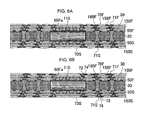
  • FIGS. 6A and 6B illustrate manufacturing process diagrams of the substrate with the built-in capacitor of the first embodiment
  • FIG. 7A-7C illustrate a plan view and cross-sectional views of the capacitor of the first embodiment
  • FIG. 8A-8D illustrate manufacturing process diagrams of the capacitor of the first embodiment
  • FIG. 9A-9C illustrate a plan view and cross-sectional views of a capacitor of a second embodiment
  • FIG. 10A-10D illustrate manufacturing process diagrams of the capacitor of the second embodiment
  • FIG. 11A-11C illustrate a plan view and cross-sectional views of a capacitor according to a modified embodiment of the second embodiment.
  • FIG. 1 A cross section of a substrate 10 with a built-in capacitor according to a first embodiment of the present invention is illustrated in FIG. 1 .
  • the substrate 10 with the built-in capacitor has a core substrate 30 that has a first surface (F) and a second surface (S) that is on an opposite side of the first surface.
  • the core substrate 30 has a cavity (opening part) 20 .
  • the cavity 20 penetrates through the core substrate 30 .
  • a capacitor 110 is accommodated inside the cavity 20 .
  • a resin 50 is filled in a spacing between a side wall of the cavity 20 and the capacitor 110 .
  • the capacitor 110 is fixed inside the cavity 20 .
  • a conductor layer ( 34 F) is formed on the first surface (F) of the core substrate 30
  • a conductor layer ( 34 S) is formed on the second surface (S) of the core substrate 30 .
  • the core substrate 30 has multiple through holes 31 , and inside each of the through holes 31 , a through-hole conductor 36 connecting the conductor layers ( 34 F, 34 S) is formed.
  • the through-hole conductor 36 is formed by filling the through hole 31 by plating.
  • the through hole 31 is formed by a first opening part ( 31 f ) that opens to the first surface (F) of the core substrate 30 and a second opening part ( 31 s ) that opens to the second surface (S).
  • the first opening part ( 31 f ) is tapered from the first surface toward the second surface
  • the second opening part ( 31 s ) is tapered from the second surface toward the first surface.
  • the first opening part ( 310 and the second opening part ( 31 s ) are connected inside the core substrate 30 .
  • the upper side build-up layer includes an insulating layer ( 50 F) that is formed on the first surface (F) of the core substrate 30 and on the capacitor 110 , a conductor layer ( 58 F) on the insulating layer ( 50 F), and a via conductor ( 60 F) that is provided inside the insulating layer ( 50 F) and connects the conductor layer ( 58 F) and the conductor layer ( 34 F).
  • a via conductor ( 60 Fa) is further provided that connects the conductor layer ( 58 F) and an electrode of the capacitor 110 (to be described later).
  • the upper side build-up layer ( 55 F) further includes an insulating layer ( 150 F) that is provided on the insulating layer ( 50 F) and on the conductor layer ( 58 F), a conductor pattern ( 158 F) on the insulating layer ( 150 F), and a via conductor ( 160 F) that is provided inside the insulating layer ( 150 F) and connects the conductor layer ( 58 F) and the conductor pattern ( 158 F).
  • a lower side build-up layer ( 55 S) is formed on the second surface (S) of the core substrate 30 and on the capacitor 110 . That is, a structure of the lower side build-up layer ( 55 S) is the same as that of the upper side build-up layer ( 55 F) and thus description thereof is omitted.
  • solder resist layer ( 70 F) having an opening ( 71 F) is formed on the upper side build-up layer 55 F.
  • a solder resist layer ( 70 S) having an opening ( 71 S) is formed on the lower side build-up layer ( 55 S).
  • Conductor patterns ( 158 F, 158 S) that are exposed from the openings ( 71 F, 71 S) of the solder resist layers ( 70 F, 70 S) function as pads on which solder bumps (to be described later) are formed.
  • metal films ( 72 , 74 ) such as those of Ni/Au or Ni/Pd/Au are formed, and on the metal films, solder bumps ( 76 F, 76 S) are formed.
  • solder bumps ( 76 F) that are formed on the upper side build-up layer an IC chip is mounted on the substrate 10 with the built-in capacitor.
  • solder bumps ( 76 S) that are formed on the lower side build-up layer the substrate 10 with the built-in capacitor is mounted on a motherboard.
  • FIG. 7A illustrates a plan view of the capacitor that is built in the substrate with the built-in capacitor.
  • FIG. 7B illustrates a b 1 -b 1 cross section of FIG. 7A .
  • FIG. 7C illustrates a c 1 -c 1 cross section of FIG. 7A .
  • FIG. 7C corresponds to the cross section of the capacitor in FIG. 1 .
  • the capacitor 110 is formed from a multilayer ceramic capacitor (MLCC) of a small size and a large capacity.
  • the capacitor includes a body part 120 and electrodes ( 112 P, 112 M), the body part 120 being formed by alternately laminating dielectric layers 122 that are formed mainly from BaTiO 3 and internal electrodes 124 that are made of Ni.
  • the body part 120 has a cuboid shape with long sides ( 120 L) and short sides ( 120 S).
  • the laterally-long electrodes ( 112 P, 112 M) are provided on the long side ( 120 L) sides.
  • a distance (d 1 ) between the electrode ( 112 P) and the electrode ( 112 M) is 70 ⁇ m or more and 150 ⁇ m or less.
  • the electrodes ( 112 P, 112 M) are provided on the long sides ( 120 L) of the cuboid shape. Therefore, the electrodes are elongated and, as illustrated by dashed lines in FIG. 7A , a bottom part ( 60 Fab) of the via conductor ( 60 Fa) can be connected at five places (see FIG. 1 ). That is, multiple via conductors can be connected to one electrode. Therefore, impedance of a power source wiring can be reduced.
  • a Ni paste 116 is provided on each of the long side ( 120 L) sides in a manner in contact with the internal electrodes 124 that extend to an end part of the body part 120 and the Ni paste 116 is covered by a Cu plating film 114 so that migration does not occur between the electrodes ( 112 P, 112 M) even when the distance is 150 ⁇ m or less.
  • FIG. 8A-8D illustrate a manufacturing process of the capacitor of the first embodiment.
  • Dielectric layers ( 122 ⁇ ) that are formed from BaTiO 3 and internal electrode layers ( 124 ⁇ ) that are made of Ni are alternately laminated and a laminated body ( 120 ⁇ ) is formed ( FIG. 8A ).
  • a Ni paste layer ( 116 ⁇ ) is coated on each of the long side ( 120 L) sides of the laminated body in a manner in contact with the internal electrode layers ( 124 ⁇ ) that extend to an end part of the laminated body ( 120 ⁇ ) ( FIG. 8B ).
  • the Ni paste layer is mainly made of Ni powder and a titanium barium base component.
  • the built-in capacitor 110 is a multilayer ceramic capacitor of a large capacity.
  • the capacitor has the cuboid shape with the long sides ( 120 L) and the short sides ( 120 S).
  • the pair of the electrodes ( 112 P, 112 M) are provided on the opposing long side ( 120 L) sides. Therefore, the electrodes each have a long length, and the multiple via conductors ( 60 Fa) can be connected, and thus the impedance of the power source wiring can be reduced.
  • the distance between the electrodes ( 112 P, 112 M) is 150 ⁇ m or less.
  • the electrodes are formed from the Ni pastes 116 that are connected to the internal electrodes of the capacitor body and the copper platings 114 that cover the conductive pastes.
  • the Ni paste does not contain a glass component, even in a vacuum state when the capacitor is built in the substrate in a manufacturing process (to be described later), there is no scattering of potassium ions so that migration does not occur.
  • the distance between the electrodes is less than 70 ⁇ m, an insulation distance is too short so that reliability is reduced.
  • the distance between the electrodes exceeds 150 ⁇ m, even when an existing conductive paste containing a glass component is used, migration is unlikely to occur.
  • the Ni paste layers ( 116 ⁇ ) are coated on the long sides of the laminated body ( 120 ⁇ ); the laminated body and the pastes are simultaneously fired; the Cu plating films 114 are respectively formed on the Ni pastes 116 by copper pyrophosphate plating to form the electrodes ( 112 P, 112 M); and the multilayer ceramic capacitor is completed.
  • the Cu plating film 114 having high adhesion to the Ni paste 116 can be formed.
  • the multilayer ceramic capacitor is accommodated in an opening of an insulating layer and, in a vacuum state, an interlayer resin insulating layer is laminated on the insulating layer.
  • the Ni paste is used, which does not contain a glass component. Therefore, even in a vacuum state when lamination is performed, there is no scattering of potassium ions so that migration does not occur.
  • the via conductors ( 60 Fa, 60 Sa) that penetrate through the interlayer resin insulating layers ( 50 F, 50 S) and reach the electrodes are respectively formed with respect to the electrodes ( 112 P, 112 M).
  • the electrodes are provided on the long sides of the laminated body. Therefore, the electrodes each have a long length and the multiple via conductors can be connected, and thus the impedance of the power source wiring can be reduced.
  • FIG. 2A-6B A method for manufacturing the substrate 10 with the built-in capacitor of the first embodiment is illustrated in FIG. 2A-6B .
  • the insulating base material has a first surface (F) and a second surface (S) that is on an opposite side of the first surface (F).
  • a surface of the copper foil 32 is subjected to a blackening treatment (not illustrated in the drawings) ( FIG. 2A ).
  • a second opening part ( 31 s ) that tapers from the second surface of the insulating base material toward the first surface is formed ( FIG. 2C ).
  • the second opening part ( 31 s ) is connected to the first opening part ( 31 f ) inside the insulating base material, and a through hole 31 for a through-hole conductor is formed.
  • an electroless plating film 33 is formed on an inner wall of the through hole 31 and on the copper foil 32 ( FIG. 2D ).
  • an electrolytic plating film 37 is formed on the electroless plating film 33 .
  • a through-hole conductor 36 is formed in the through hole.
  • the through-hole conductor 36 is formed by the electroless plating film 33 that is formed on the inner wall of the through hole and the electrolytic plating film 37 that fills the through hole ( FIG. 2E ).
  • An etching resist 35 of a predetermined pattern is formed on the electrolytic plating film 37 of the surface of the core substrate 30 ( FIG. 2F ).
  • an opening 20 for accommodating a capacitor is formed using laser, and the core substrate 30 is completed ( FIG. 3B ).
  • a tape 94 is affixed to the second surface (S) of the core substrate 30 .
  • the opening 20 is closed by the tape ( FIG. 3C ).
  • An example of the tape 94 is a PET film.
  • the capacitor 110 is placed ( FIG. 3D ).
  • the capacitor accommodated in the opening 20 of the core substrate has a thickness of 30%-100% of that of the core substrate.
  • a prepreg ( 50 F ⁇ ) of a B-stage is laminated on the first surface (F) of the core substrate 30 .
  • resin seeps out from the prepreg into the opening, and the opening 20 is filled with a filler (resin filler) 50 ( FIG. 3F ).
  • a spacing between an inner wall of the opening and the capacitor is filled with a filler.
  • the capacitor is fixed on the core substrate.
  • a resin film for an interlayer insulating layer is laminated.
  • the prepreg has a reinforcing material such as a glass cloth.
  • the resin film for an interlayer resin layer does not have a reinforcing material. It is preferable that both the prepreg and the resin film contain inorganic particles such as glass particles.
  • the filler contains inorganic particles such as silica.
  • an electroless plating film 52 is formed on inner walls of the openings for the via conductors and on the insulating layers ( FIG. 4D ).
  • a plating resist 54 is formed on the electroless plating film 52 ( FIG. 5A ).
  • an electrolytic plating film 56 is formed on the electroless plating film that is exposed from the plating resist ( FIG. 5B ).
  • the plating resist 54 is removed using an amine solution. Thereafter, the electroless plating film 52 that is exposed from the electrolytic copper plating film is removed by etching, and the conductor layers ( 58 F, 58 S) that are formed from the electroless plating film 52 and the electrolytic plating film 56 are formed.
  • the conductor layers ( 58 F, 58 S) include multiple conductor circuits and via conductor lands. At the same time, the via conductors ( 60 F, 60 S) and the connection via conductors ( 60 Fa, 60 Sa) are formed ( FIG. 5C ).
  • the via conductors ( 60 F, 60 S) connect the conductor layer and the through-hole conductor of the core substrate to the conductor layers ( 58 F, 58 S) on the insulating layers.
  • the connection via conductors ( 60 Fa, 60 Sa) connect the electrodes ( 112 P, 112 M) of the capacitor illustrated in FIG. 7A to the conductor layer ( 58 F) on the insulating layer.
  • the processes of the FIG. 4A-5C are repeated, and the uppermost and lowermost insulating layers ( 150 F, 150 S) are respectively formed on the insulating layers ( 50 F, 50 S).
  • the conductor layers ( 158 F, 158 S) are respectively formed on the uppermost and lowermost insulating layers ( 150 F, 150 S).
  • the via conductors ( 160 F, 160 S) are formed in the uppermost and lowermost insulating layers ( 150 F, 150 S).
  • the conductor layers ( 58 F, 58 S) and the conductor layers ( 158 F, 158 S) are connected by the via conductors ( 160 F, 160 S) ( FIG. 5D ).
  • the solder resist layer ( 70 F) having the openings ( 71 F) is formed on the upper side build-up layer ( 55 F).
  • the solder resist layer ( 70 S) having the openings ( 71 S) is formed on the lower side build-up layer ( 55 S).
  • the openings ( 71 F, 71 S) expose upper surfaces of the conductor layers and the via conductors. The exposed portions function as pads.
  • a metal film is formed that includes a nickel layer 72 and a gold layer 74 on the nickel layer 72 ( FIG. 6B ).
  • a metal film formed from nickel-palladium-gold layers may also be adopted.
  • solder bumps ( 76 F) are formed on the pads of the upper side build-up layer ( 55 F); and the solder bumps ( 76 S) are formed on the pads of the lower side build-up layer ( 55 S).
  • the substrate 10 with the built-in capacitor having the solder bumps is completed ( FIG. 1 ).
  • solder bumps ( 76 F) an IC chip (not illustrated in the drawings) is mounted on the substrate 10 with the built-in capacitor. Thereafter, via the solder bumps ( 76 S), the substrate with the built-in capacitor is mounted on a motherboard.
  • a capacitor of a substrate with a built-in capacitor of a second embodiment is different from the capacitor of the first embodiment.
  • FIG. 9A illustrates a plan view of the capacitor that is built in the substrate with the built-in capacitor.
  • FIG. 9B illustrates a b 2 -b 2 cross section of FIG. 9A .
  • FIG. 9C illustrates a c 2 -c 2 cross section of FIG. 9A .
  • a capacitor 110 is formed from a multilayer ceramic capacitor (MLCC) of a small size and a large capacity.
  • the capacitor includes a body part 120 and electrodes ( 112 P, 112 M), the body part 120 being formed by alternately laminating dielectric layers 122 that are formed mainly from BaTiO 3 and internal electrodes 124 that are made of Ni.
  • the body part 120 has a cuboid shape with long sides ( 120 L) and short sides ( 120 S).
  • the laterally-long electrodes ( 112 P, 112 M) are provided on the long side ( 120 L) sides.
  • a distance (d 2 ) between the electrode ( 112 P) and the electrode ( 112 M) is 70 ⁇ m or more and 150 ⁇ m or less.
  • the electrodes ( 112 P, 112 M) are provided on the long sides ( 120 L) of the cuboid shape. Therefore, the electrodes are elongated and, as illustrated by dashed lines in FIG. 9A , the bottom part ( 60 Fab) of the via conductor ( 60 Fa) can be connected at five places. That is, multiple via conductors can be connected to one electrode. Therefore, the impedance of a power source wiring can be reduced.
  • a Cu paste 118 is provided on each of the long side ( 120 L) sides in a manner in contact with the internal electrodes 124 that extend to an end part of the body part 120 and the Cu paste 118 is covered by a Cu plating film 114 so that migration does not occur between the electrodes ( 112 P, 112 M) even when the distance is 150 ⁇ m or less.
  • FIG. 10A-10D illustrate a manufacturing process of the capacitor of the second embodiment.
  • Dielectric layers ( 122 ⁇ ) that are formed from BaTiO 3 and internal electrode layers ( 124 ⁇ ) that are made of Ni are alternately laminated and a laminated body ( 120 ⁇ ) is formed ( FIG. 10A ).
  • the Cu paste layer 118 is coated on each of the long side ( 120 L) sides of the laminated body in a manner in contact with the internal electrodes 124 that extend to an end part of the body part 120 ( FIG. 10C ).
  • the Cu paste layer is mainly made of Cu powder and a glass component of 5-40%.
  • the built-in capacitor 110 is a multilayer ceramic capacitor of a large capacity.
  • the capacitor has the cuboid shape with the long sides ( 120 L) and the short sides ( 120 S).
  • the pair of the electrodes ( 112 P, 112 M) are provided on the opposing long side ( 120 L) sides. Therefore, the electrodes each have a long length and the multiple via conductors ( 60 Fa) can be connected, and thus the impedance of the power source wiring can be reduced.
  • the distance between the electrodes ( 112 P, 112 M) is 150 ⁇ m or less.
  • the electrodes are each formed from the Cu paste 118 that is connected to the internal electrodes of the capacitor body and the copper plating 114 that covers the conductive paste.
  • the Cu paste does not contain a glass component of 40% or more, even in a vacuum state when the capacitor is built in the substrate in a manufacturing process, a scattering amount of potassium ions is small and does not become a factor causing migration.
  • the glass component in the Cu paste is less than 5%, adhesion between the Cu paste and the dielectric layers that are formed from BaTiO 3 in the multilayer ceramic capacitor is reduced.
  • FIG. 11A-11C illustrate a capacitor of a substrate with a built-in capacitor according to a modified embodiment of the second embodiment.
  • FIG. 11A illustrates a plan view of the capacitor that is built in the substrate with the built-in capacitor.
  • FIG. 11B illustrates a b 3 -b 3 cross section of FIG. 11A .
  • FIG. 11C illustrates a c 3 -c 3 cross section of FIG. 11A .
  • the Cu paste 118 on lateral sides of the capacitor is not covered by the Cu plating film 114 .
  • a chip capacitor or the like may be surface-mounted. To shorten a wiring length between the CPU and the chip capacitor and further to stabilize a voltage of the supply power, a chip capacitor may be built in the package substrate.
  • the Cu paste containing a glass component pores originating from the glass component are formed on a surface of the Cu paste.
  • potassium ions remain in the pores.
  • the potassium ions are drawn out from the pores and are scattered and adhere to a surface of the capacitor between the electrodes. The migration occurs due to the potassium ions.
  • a substrate with a built-in capacitor In a substrate with a built-in capacitor according to an embodiment of the present invention, migration does not occur between electrodes of the capacitor, and another embodiment of the present invention is a method for manufacturing such a substrate with the built-in capacitor.
  • a substrate with a built-in capacitor according to an embodiment of the present invention is formed by laminating a conductor layer and an insulating layer on an insulating base material, and a capacitor is built in the insulating base material.
  • the capacitor is a multilayer ceramic capacitor that is formed by alternately laminating internal electrodes and ceramic dielectric layers and is provided with a pair of external electrodes.
  • the capacitor has a cuboid shape with long sides and short sides, and the pair of the external electrodes are provided on opposing long-side sides.
  • a distance between the pair of the external electrodes is 30 ⁇ m or more and 200 ⁇ m or less.
  • the external electrodes are each formed from a conductive paste that is connected to the internal electrodes and a copper plating that covers the conductive paste.
  • the conductive paste is a Ni paste or a Cu paste, the Cu paste containing a glass component of 5-40%.
  • a method for manufacturing a substrate with a built-in capacitor includes: forming a laminated body in a cuboid shape with long sides and short sides by laminating a dielectric paste and internal electrodes; coating a Ni paste on long sides of the laminated body; simultaneously firing the laminated body and the Ni paste; forming a Cu plating film on the Ni paste by copper pyrophosphate plating to form external electrodes and thereby completing a multilayer ceramic capacitor; accommodating the multilayer ceramic capacitor in an opening of an insulating layer; laminating an interlayer resin insulating layer on the insulating layer in a vacuum state; and forming multiple via conductors that penetrate through the interlayer resin insulating layer and reach the electrodes with respect to each of the electrodes.
  • a capacitor that is built in the substrate with the built-in capacitor according to an embodiment of the present invention is a multilayer ceramic capacitor of a large capacity.
  • the capacitor has a cuboid shape with long sides and short sides.
  • the pair of the electrodes is provided on the opposing long-side sides. Therefore, the electrodes each have a long length, and multiple via conductors can be connected and thus impedance of a power source wiring can be reduced.
  • a distance between the electrodes is 150 ⁇ m or less.
  • the electrodes are each formed from a conductive paste that is connected to the internal electrodes of the capacitor body and copper plating that covers the conductive paste.
  • the conductive paste is formed from a Ni paste.
  • the Ni paste is coated on the long sides of the laminated body; the laminated body and the paste are simultaneously fired; the Cu plating film is formed on the Ni paste by copper pyrophosphate plating to form the electrodes; and the multilayer ceramic capacitor is completed.
  • the copper pyrophosphate plating the Cu plating film having high adhesion to the Ni paste can be formed.
  • the multilayer ceramic capacitor is accommodated in an opening of the insulating layer and in vacuum state the interlayer resin insulating layer is laminated on the insulating layer. Therefore, adhesion between the insulating layer and the interlayer resin insulating layer is high.
  • the conductive paste is formed from the Ni paste and does not contain a glass component. Therefore, even in a vacuum state when lamination is performed, there is no scattering of potassium ions so that migration does not occur.
  • the multiple via conductors that penetrate through the interlayer resin insulating layer and reach the electrodes are formed with respect to each of the electrodes.
  • the electrodes are provided on the long sides of the laminated body. Therefore, the electrodes each have a long length and the multiple via conductors can be connected, and thus the impedance of the power source wiring can be reduced.

Landscapes

  • Engineering & Computer Science (AREA)
  • Power Engineering (AREA)
  • Microelectronics & Electronic Packaging (AREA)
  • Manufacturing & Machinery (AREA)
  • Chemical & Material Sciences (AREA)
  • Materials Engineering (AREA)
  • Production Of Multi-Layered Print Wiring Board (AREA)
  • Ceramic Engineering (AREA)
  • Inorganic Chemistry (AREA)
  • Fixed Capacitors And Capacitor Manufacturing Machines (AREA)
  • Physics & Mathematics (AREA)
  • Condensed Matter Physics & Semiconductors (AREA)
  • General Physics & Mathematics (AREA)
  • Computer Hardware Design (AREA)

Abstract

A substrate with a built-in capacitor includes an insulating base material layer, a build-up layer formed on the insulating base material layer and including a conductor layer and an insulating layer, and a multilayer ceramic capacitor positioned in an opening of the base material layer and including internal electrodes, ceramic dielectric layers and a pair of external electrodes. The ceramic capacitor has a cuboid shape having long sides and short sides, the pair of external electrodes is formed on opposing long-side sides such that the external electrodes are separated by a distance in range of 30 μm to 200 μm and that each external electrode includes a conductive paste layer connected to a respective group of the internal electrodes and a copper plated layer covering the conductive paste layer, and the conductive paste layer includes Ni paste or Cu paste including glass component in range of 5% to 40%.

Description

CROSS-REFERENCE TO RELATED APPLICATIONS
The present application is based upon and claims the benefit of priority to Japanese Patent Application No. 2014-047430, filed Mar. 11, 2014, the entire contents of which are incorporated herein by reference.
BACKGROUND OF THE INVENTION
Field of the Invention
The present invention relates to a substrate with a built-in capacitor, in which a capacitor is built in the substrate, and to a method for manufacturing the substrate with the built-in capacitor.
Description of Background Art
Japanese Patent Laid-Open Publication No. 2001-352141 describes a substrate with a built-in capacitor, a chip capacitor being built in the substrate. In Japanese Patent Laid-Open Publication No. 2001-352141, electrodes of the chip capacitor are each formed from a metal metalized film, a conductive paste is provided on the metal metalized film, and further the conductive paste is covered by a plating film. Further, in a small chip capacitor, the metalized film is removed, a Cu paste containing a glass component is provided, and a plating film is provided on the Cu paste. The entire contents of this publication are incorporated herein by reference.
SUMMARY OF THE INVENTION
According to one aspect of the present invention, a substrate with a built-in capacitor includes an insulating base material layer, a build-up layer formed on the insulating base material layer and including a conductor layer and an insulating layer, and a multilayer ceramic capacitor positioned in an opening portion of the insulating base material layer and including internal electrodes, ceramic dielectric layers and a pair of external electrodes. The multilayer ceramic capacitor has a cuboid shape having long sides and short sides, the pair of external electrodes is formed on opposing long-side sides such that the external electrodes are separated by a distance in a range of 30 μm to 200 μm and that each of the external electrodes includes a conductive paste layer connected to a respective group of the internal electrodes and a copper plated layer covering the conductive paste layer, and the conductive paste layer includes a Ni paste or a Cu paste including a glass component in a range of 5% to 40%.
According to another aspect of the present invention, a method for manufacturing a substrate with a built-in capacitor includes preparing a multilayer ceramic capacitor including internal electrodes, ceramic dielectric layers and a pair of external electrodes, and positioning the multilayer ceramic capacitor in an opening portion of an insulating base material layer, and forming on the insulating base material layer a build-up layer including a conductor layer and an insulating layer. The multilayer ceramic capacitor has a cuboid shape having long sides and short sides, the pair of external electrodes is formed on opposing long-side sides such that the external electrodes are separated by a distance in a range of 30 μm to 200 μm and that each of the external electrodes includes a conductive paste layer connected to a respective group of the internal electrodes and a copper plated layer covering the conductive paste layer, and the conductive paste layer includes a Ni paste or a Cu paste including a glass component in a range of 5% to 40%.
BRIEF DESCRIPTION OF THE DRAWINGS
A more complete appreciation of the invention and many of the attendant advantages thereof will be readily obtained as the same becomes better understood by reference to the following detailed description when considered in connection with the accompanying drawings, wherein:
FIG. 1 illustrates a cross-sectional view of a substrate with a built-in capacitor according to a first embodiment of the present invention;
FIG. 2A-2F illustrate manufacturing process diagrams of the substrate with the built-in capacitor of the first embodiment;
FIG. 3A-3E illustrate manufacturing process diagrams of the substrate with the built-in capacitor of the first embodiment;
FIG. 4A-4D illustrate manufacturing process diagrams of the substrate with the built-in capacitor of the first embodiment;
FIG. 5A-5D illustrate manufacturing process diagrams of the substrate with the built-in capacitor of the first embodiment;
FIGS. 6A and 6B illustrate manufacturing process diagrams of the substrate with the built-in capacitor of the first embodiment;
FIG. 7A-7C illustrate a plan view and cross-sectional views of the capacitor of the first embodiment;
FIG. 8A-8D illustrate manufacturing process diagrams of the capacitor of the first embodiment;
FIG. 9A-9C illustrate a plan view and cross-sectional views of a capacitor of a second embodiment;
FIG. 10A-10D illustrate manufacturing process diagrams of the capacitor of the second embodiment; and
FIG. 11A-11C illustrate a plan view and cross-sectional views of a capacitor according to a modified embodiment of the second embodiment.
DETAILED DESCRIPTION OF THE EMBODIMENTS
The embodiments will now be described with reference to the accompanying drawings, wherein like reference numerals designate corresponding or identical elements throughout the various drawings.
First Embodiment
A cross section of a substrate 10 with a built-in capacitor according to a first embodiment of the present invention is illustrated in FIG. 1. The substrate 10 with the built-in capacitor has a core substrate 30 that has a first surface (F) and a second surface (S) that is on an opposite side of the first surface.
The core substrate 30 has a cavity (opening part) 20. In the present embodiment, the cavity 20 penetrates through the core substrate 30.
Inside the cavity 20, a capacitor 110 is accommodated. A resin 50 is filled in a spacing between a side wall of the cavity 20 and the capacitor 110. As a result, the capacitor 110 is fixed inside the cavity 20.
A conductor layer (34F) is formed on the first surface (F) of the core substrate 30, and a conductor layer (34S) is formed on the second surface (S) of the core substrate 30. The core substrate 30 has multiple through holes 31, and inside each of the through holes 31, a through-hole conductor 36 connecting the conductor layers (34F, 34S) is formed.
The through-hole conductor 36 is formed by filling the through hole 31 by plating. The through hole 31 is formed by a first opening part (31 f) that opens to the first surface (F) of the core substrate 30 and a second opening part (31 s) that opens to the second surface (S). The first opening part (31 f) is tapered from the first surface toward the second surface, and the second opening part (31 s) is tapered from the second surface toward the first surface. The first opening part (310 and the second opening part (31 s) are connected inside the core substrate 30.
An upper side build-up layer (55F) is formed on the first surface (F) of the core substrate 30 and on the capacitor 110. The upper side build-up layer includes an insulating layer (50F) that is formed on the first surface (F) of the core substrate 30 and on the capacitor 110, a conductor layer (58F) on the insulating layer (50F), and a via conductor (60F) that is provided inside the insulating layer (50F) and connects the conductor layer (58F) and the conductor layer (34F). Inside the insulating layer (50F), a via conductor (60Fa) is further provided that connects the conductor layer (58F) and an electrode of the capacitor 110 (to be described later).
The upper side build-up layer (55F) further includes an insulating layer (150F) that is provided on the insulating layer (50F) and on the conductor layer (58F), a conductor pattern (158F) on the insulating layer (150F), and a via conductor (160F) that is provided inside the insulating layer (150F) and connects the conductor layer (58F) and the conductor pattern (158F).
A lower side build-up layer (55S) is formed on the second surface (S) of the core substrate 30 and on the capacitor 110. That is, a structure of the lower side build-up layer (55S) is the same as that of the upper side build-up layer (55F) and thus description thereof is omitted.
On the upper side build-up layer 55F, a solder resist layer (70F) having an opening (71F) is formed. On the lower side build-up layer (55S), a solder resist layer (70S) having an opening (71S) is formed. Conductor patterns (158F, 158S) that are exposed from the openings (71F, 71S) of the solder resist layers (70F, 70S) function as pads on which solder bumps (to be described later) are formed. On the pads, metal films (72, 74) such as those of Ni/Au or Ni/Pd/Au are formed, and on the metal films, solder bumps (76F, 76S) are formed. Via the solder bumps (76F) that are formed on the upper side build-up layer, an IC chip is mounted on the substrate 10 with the built-in capacitor. Via the solder bumps (76S) that are formed on the lower side build-up layer, the substrate 10 with the built-in capacitor is mounted on a motherboard.
FIG. 7A illustrates a plan view of the capacitor that is built in the substrate with the built-in capacitor. FIG. 7B illustrates a b1-b1 cross section of FIG. 7A. FIG. 7C illustrates a c1-c1 cross section of FIG. 7A. FIG. 7C corresponds to the cross section of the capacitor in FIG. 1.
The capacitor 110 is formed from a multilayer ceramic capacitor (MLCC) of a small size and a large capacity. The capacitor includes a body part 120 and electrodes (112P, 112M), the body part 120 being formed by alternately laminating dielectric layers 122 that are formed mainly from BaTiO3 and internal electrodes 124 that are made of Ni.
The body part 120 has a cuboid shape with long sides (120L) and short sides (120S). The laterally-long electrodes (112P, 112M) are provided on the long side (120L) sides. A distance (d1) between the electrode (112P) and the electrode (112M) is 70 μm or more and 150 μm or less. In the first embodiment, the electrodes (112P, 112M) are provided on the long sides (120L) of the cuboid shape. Therefore, the electrodes are elongated and, as illustrated by dashed lines in FIG. 7A, a bottom part (60Fab) of the via conductor (60Fa) can be connected at five places (see FIG. 1). That is, multiple via conductors can be connected to one electrode. Therefore, impedance of a power source wiring can be reduced.
On the other hand, as compared to a case where the electrodes are provided on the short sides, the distance between the electrodes is shorter even in a capacitor of the same size. Therefore, in the first embodiment, a Ni paste 116 is provided on each of the long side (120L) sides in a manner in contact with the internal electrodes 124 that extend to an end part of the body part 120 and the Ni paste 116 is covered by a Cu plating film 114 so that migration does not occur between the electrodes (112P, 112M) even when the distance is 150 μm or less.
FIG. 8A-8D illustrate a manufacturing process of the capacitor of the first embodiment.
(1) Dielectric layers (122α) that are formed from BaTiO3 and internal electrode layers (124α) that are made of Ni are alternately laminated and a laminated body (120α) is formed (FIG. 8A).
(2) A Ni paste layer (116α) is coated on each of the long side (120L) sides of the laminated body in a manner in contact with the internal electrode layers (124α) that extend to an end part of the laminated body (120α) (FIG. 8B). The Ni paste layer is mainly made of Ni powder and a titanium barium base component.
(3) The laminated body (120α) and the Ni paste layers (116α) are simultaneously fired, and the body part 120 and the Ni pastes 116 are formed (FIG. 8C).
(4) By copper pyrophosphate plating using copper pyrophosphate (Cu7P2O7) and potassium pyrophosphate (K4P2O7), the Cu plating film 114 is coated on the Ni paste 116 and, after a water-washing step, the capacitor 110 is completed (FIG. 8D).
In the substrate with the built-in capacitor of the first embodiment, the built-in capacitor 110 is a multilayer ceramic capacitor of a large capacity. The capacitor has the cuboid shape with the long sides (120L) and the short sides (120S). The pair of the electrodes (112P, 112M) are provided on the opposing long side (120L) sides. Therefore, the electrodes each have a long length, and the multiple via conductors (60Fa) can be connected, and thus the impedance of the power source wiring can be reduced. Here, the distance between the electrodes (112P, 112M) is 150 μm or less. However, the electrodes are formed from the Ni pastes 116 that are connected to the internal electrodes of the capacitor body and the copper platings 114 that cover the conductive pastes. Even when the high adhesion copper pyrophosphate plating is used for the formation of the copper plating, since the Ni paste does not contain a glass component, even in a vacuum state when the capacitor is built in the substrate in a manufacturing process (to be described later), there is no scattering of potassium ions so that migration does not occur. Here, when the distance between the electrodes is less than 70 μm, an insulation distance is too short so that reliability is reduced. On the other hand, when the distance between the electrodes exceeds 150 μm, even when an existing conductive paste containing a glass component is used, migration is unlikely to occur.
In the method for manufacturing the substrate with the built-in capacitor of the first embodiment, the Ni paste layers (116α) are coated on the long sides of the laminated body (120α); the laminated body and the pastes are simultaneously fired; the Cu plating films 114 are respectively formed on the Ni pastes 116 by copper pyrophosphate plating to form the electrodes (112P, 112M); and the multilayer ceramic capacitor is completed. By the copper pyrophosphate plating, the Cu plating film 114 having high adhesion to the Ni paste 116 can be formed. In a process to be described later, the multilayer ceramic capacitor is accommodated in an opening of an insulating layer and, in a vacuum state, an interlayer resin insulating layer is laminated on the insulating layer. Therefore, adhesion between the insulating layer and the interlayer resin insulating layer is high. Here, the Ni paste is used, which does not contain a glass component. Therefore, even in a vacuum state when lamination is performed, there is no scattering of potassium ions so that migration does not occur. The via conductors (60Fa, 60Sa) that penetrate through the interlayer resin insulating layers (50F, 50S) and reach the electrodes are respectively formed with respect to the electrodes (112P, 112M). The electrodes are provided on the long sides of the laminated body. Therefore, the electrodes each have a long length and the multiple via conductors can be connected, and thus the impedance of the power source wiring can be reduced.
A method for manufacturing the substrate 10 with the built-in capacitor of the first embodiment is illustrated in FIG. 2A-6B.
(1) A double-sided copper-clad laminated plate (30 z), which is formed from an insulating base material 18 and a copper foil 32 that is laminated on both sides of the insulating base material 18, is a starting material. The insulating base material has a first surface (F) and a second surface (S) that is on an opposite side of the first surface (F). A surface of the copper foil 32 is subjected to a blackening treatment (not illustrated in the drawings) (FIG. 2A).
(2) Laser is irradiated to the first surface (F) side of the insulating base material 18. A first opening part (31 f) that tapers from the first surface of the insulating base material toward the second surface is formed (FIG. 2B).
(3) Laser is irradiated to the second surface (S) side of the insulating base material 18. A second opening part (31 s) that tapers from the second surface of the insulating base material toward the first surface is formed (FIG. 2C). The second opening part (31 s) is connected to the first opening part (31 f) inside the insulating base material, and a through hole 31 for a through-hole conductor is formed.
(4) By an electroless plating treatment, an electroless plating film 33 is formed on an inner wall of the through hole 31 and on the copper foil 32 (FIG. 2D).
(5) By an electrolytic plating treatment, an electrolytic plating film 37 is formed on the electroless plating film 33. A through-hole conductor 36 is formed in the through hole. The through-hole conductor 36 is formed by the electroless plating film 33 that is formed on the inner wall of the through hole and the electrolytic plating film 37 that fills the through hole (FIG. 2E).
(6) An etching resist 35 of a predetermined pattern is formed on the electrolytic plating film 37 of the surface of the core substrate 30 (FIG. 2F).
(7) The electrolytic plating film 37, the electroless plating film 33 and the copper foil 32 that are exposed from the etching resist are removed. Thereafter, the etching resist is removed, and the conductor layers (34F, 34S) and the through-hole conductor 36 are formed (FIG. 3A).
(8) At a central part of the insulating base material 18, an opening 20 for accommodating a capacitor is formed using laser, and the core substrate 30 is completed (FIG. 3B).
(9) A tape 94 is affixed to the second surface (S) of the core substrate 30. The opening 20 is closed by the tape (FIG. 3C). An example of the tape 94 is a PET film.
(10) On the tape 94 that is exposed by the opening 20, the capacitor 110 is placed (FIG. 3D). The capacitor accommodated in the opening 20 of the core substrate has a thickness of 30%-100% of that of the core substrate.
(11) Vacuuming is performed, and a prepreg (50Fα) of a B-stage is laminated on the first surface (F) of the core substrate 30. By hot pressing, resin seeps out from the prepreg into the opening, and the opening 20 is filled with a filler (resin filler) 50 (FIG. 3F). A spacing between an inner wall of the opening and the capacitor is filled with a filler. The capacitor is fixed on the core substrate. Instead of the prepreg, it is also possible that a resin film for an interlayer insulating layer is laminated. The prepreg has a reinforcing material such as a glass cloth. However, the resin film for an interlayer resin layer does not have a reinforcing material. It is preferable that both the prepreg and the resin film contain inorganic particles such as glass particles. The filler contains inorganic particles such as silica.
(12) After the tape is peeled off (FIG. 4A), vacuuming is performed, and a prepreg of a B-stage is laminated on the second surface (S) of the core substrate 30. The prepregs on the first surface and the second surface of the core substrate are cured. The insulating layers (interlayer resin insulating layers) (50F, 50S) are formed on the first surface and the second surface of the core substrate (FIG. 4B). Here, when the core substrate and the interlayer resin insulating layer are laminated, vacuuming is performed. Therefore, adhesion between the two is high. On the other hand, as described above, the Ni paste is used for the electrodes of the capacitor. Since the Ni paste does not contain a glass component, even in a vacuum state when the lamination is performed, there is no scattering of potassium ions so that it does not become a factor causing migration.
(13) Openings (51F) for via conductors reaching the electrodes (112P, 112M) (see FIG. 7A) of the capacitor 110, the conductor layer (34F) and the through-hole conductor 36 are formed on the insulating layer (50F) using CO2 gas laser from the first surface side. Openings (51S) for via conductors reaching the electrodes (112P, 112M) (see FIG. 7A) of the capacitor 110, the conductor layer (34S) and the through-hole conductor 36 are formed on the insulating layer (50S) from the second surface side (FIG. 4C). Rough surfaces (not illustrated in the drawings) are formed on the insulating layers (50F, 50S).
(14) By an electroless plating treatment, an electroless plating film 52 is formed on inner walls of the openings for the via conductors and on the insulating layers (FIG. 4D).
(15) A plating resist 54 is formed on the electroless plating film 52 (FIG. 5A).
(16) Next, by an electrolytic plating treatment, an electrolytic plating film 56 is formed on the electroless plating film that is exposed from the plating resist (FIG. 5B).
(17) Next, the plating resist 54 is removed using an amine solution. Thereafter, the electroless plating film 52 that is exposed from the electrolytic copper plating film is removed by etching, and the conductor layers (58F, 58S) that are formed from the electroless plating film 52 and the electrolytic plating film 56 are formed. The conductor layers (58F, 58S) include multiple conductor circuits and via conductor lands. At the same time, the via conductors (60F, 60S) and the connection via conductors (60Fa, 60Sa) are formed (FIG. 5C). The via conductors (60F, 60S) connect the conductor layer and the through-hole conductor of the core substrate to the conductor layers (58F, 58S) on the insulating layers. The connection via conductors (60Fa, 60Sa) connect the electrodes (112P, 112M) of the capacitor illustrated in FIG. 7A to the conductor layer (58F) on the insulating layer.
(18) The processes of the FIG. 4A-5C are repeated, and the uppermost and lowermost insulating layers (150F, 150S) are respectively formed on the insulating layers (50F, 50S). The conductor layers (158F, 158S) are respectively formed on the uppermost and lowermost insulating layers (150F, 150S). The via conductors (160F, 160S) are formed in the uppermost and lowermost insulating layers (150F, 150S). The conductor layers (58F, 58S) and the conductor layers (158F, 158S) are connected by the via conductors (160F, 160S) (FIG. 5D).
(19) On the upper side build-up layer (55F), the solder resist layer (70F) having the openings (71F) is formed. On the lower side build-up layer (55S), the solder resist layer (70S) having the openings (71S) is formed (FIG. 6A). The openings (71F, 71S) expose upper surfaces of the conductor layers and the via conductors. The exposed portions function as pads.
(20) On a pad, a metal film is formed that includes a nickel layer 72 and a gold layer 74 on the nickel layer 72 (FIG. 6B). Other than the nickel-gold layers, a metal film formed from nickel-palladium-gold layers may also be adopted.
(21) Thereafter, the solder bumps (76F) are formed on the pads of the upper side build-up layer (55F); and the solder bumps (76S) are formed on the pads of the lower side build-up layer (55S). The substrate 10 with the built-in capacitor having the solder bumps is completed (FIG. 1).
Via the solder bumps (76F), an IC chip (not illustrated in the drawings) is mounted on the substrate 10 with the built-in capacitor. Thereafter, via the solder bumps (76S), the substrate with the built-in capacitor is mounted on a motherboard.
Second Embodiment
A capacitor of a substrate with a built-in capacitor of a second embodiment is different from the capacitor of the first embodiment.
FIG. 9A illustrates a plan view of the capacitor that is built in the substrate with the built-in capacitor. FIG. 9B illustrates a b2-b2 cross section of FIG. 9A. FIG. 9C illustrates a c2-c2 cross section of FIG. 9A.
A capacitor 110 is formed from a multilayer ceramic capacitor (MLCC) of a small size and a large capacity. The capacitor includes a body part 120 and electrodes (112P, 112M), the body part 120 being formed by alternately laminating dielectric layers 122 that are formed mainly from BaTiO3 and internal electrodes 124 that are made of Ni. The body part 120 has a cuboid shape with long sides (120L) and short sides (120S). The laterally-long electrodes (112P, 112M) are provided on the long side (120L) sides. A distance (d2) between the electrode (112P) and the electrode (112M) is 70 μm or more and 150 μm or less. In the second embodiment, the electrodes (112P, 112M) are provided on the long sides (120L) of the cuboid shape. Therefore, the electrodes are elongated and, as illustrated by dashed lines in FIG. 9A, the bottom part (60Fab) of the via conductor (60Fa) can be connected at five places. That is, multiple via conductors can be connected to one electrode. Therefore, the impedance of a power source wiring can be reduced.
On the other hand, as compared to the case where the electrodes are provided on the short sides, the distance between the electrodes is shorter even in a capacitor of the same size. Therefore, in the second embodiment, a Cu paste 118 is provided on each of the long side (120L) sides in a manner in contact with the internal electrodes 124 that extend to an end part of the body part 120 and the Cu paste 118 is covered by a Cu plating film 114 so that migration does not occur between the electrodes (112P, 112M) even when the distance is 150 μm or less.
FIG. 10A-10D illustrate a manufacturing process of the capacitor of the second embodiment.
(1) Dielectric layers (122α) that are formed from BaTiO3 and internal electrode layers (124α) that are made of Ni are alternately laminated and a laminated body (120α) is formed (FIG. 10A).
(2) The laminated body (120α) is fired and the body part 120 is formed (FIG. 10B).
(3) The Cu paste layer 118 is coated on each of the long side (120L) sides of the laminated body in a manner in contact with the internal electrodes 124 that extend to an end part of the body part 120 (FIG. 10C). The Cu paste layer is mainly made of Cu powder and a glass component of 5-40%.
(4) By copper pyrophosphate plating using copper pyrophosphate (Cu7P2O7) and potassium pyrophosphate (K4P2O7), the Cu plating film 114 is coated on the Cu paste 118 and, after a water-washing step, the capacitor 110 is completed (FIG. 10D).
In the substrate with the built-in capacitor of the second embodiment, the built-in capacitor 110 is a multilayer ceramic capacitor of a large capacity. The capacitor has the cuboid shape with the long sides (120L) and the short sides (120S). The pair of the electrodes (112P, 112M) are provided on the opposing long side (120L) sides. Therefore, the electrodes each have a long length and the multiple via conductors (60Fa) can be connected, and thus the impedance of the power source wiring can be reduced. Here, the distance between the electrodes (112P, 112M) is 150 μm or less. However, the electrodes are each formed from the Cu paste 118 that is connected to the internal electrodes of the capacitor body and the copper plating 114 that covers the conductive paste. Even when the high adhesion copper pyrophosphate plating is used for the formation of the copper plating, since the Cu paste does not contain a glass component of 40% or more, even in a vacuum state when the capacitor is built in the substrate in a manufacturing process, a scattering amount of potassium ions is small and does not become a factor causing migration. When the glass component in the Cu paste is less than 5%, adhesion between the Cu paste and the dielectric layers that are formed from BaTiO3 in the multilayer ceramic capacitor is reduced.
Modified Embodiment of Second Embodiment
FIG. 11A-11C illustrate a capacitor of a substrate with a built-in capacitor according to a modified embodiment of the second embodiment.
FIG. 11A illustrates a plan view of the capacitor that is built in the substrate with the built-in capacitor. FIG. 11B illustrates a b3-b3 cross section of FIG. 11A. FIG. 11C illustrates a c3-c3 cross section of FIG. 11A. In the modified embodiment of the second embodiment, the Cu paste 118 on lateral sides of the capacitor is not covered by the Cu plating film 114.
In a package substrate or the like for mounting a CPU, in order to enhance supply power to the CPU, a chip capacitor or the like may be surface-mounted. To shorten a wiring length between the CPU and the chip capacitor and further to stabilize a voltage of the supply power, a chip capacitor may be built in the package substrate.
In a case where a chip capacitor in which a metalized film is removed, a Cu paste containing a glass component is directly provided on a capacitor body and a Cu plating film is provided on the Cu paste is built in a substrate with a built-in capacitor, test results have revealed that migration occurs between two electrodes when a distance between the electrodes is 150 μm or less.
In the case where the Cu paste containing a glass component is used, pores originating from the glass component are formed on a surface of the Cu paste. When high adhesion copper pyrophosphate plating is formed on the Cu paste, potassium ions remain in the pores. During lamination of an interlayer resin insulating layer on the chip capacitor, when a vacuum state is achieved in order to enhance adhesion, the potassium ions are drawn out from the pores and are scattered and adhere to a surface of the capacitor between the electrodes. The migration occurs due to the potassium ions.
In a substrate with a built-in capacitor according to an embodiment of the present invention, migration does not occur between electrodes of the capacitor, and another embodiment of the present invention is a method for manufacturing such a substrate with the built-in capacitor.
A substrate with a built-in capacitor according to an embodiment of the present invention is formed by laminating a conductor layer and an insulating layer on an insulating base material, and a capacitor is built in the insulating base material. The capacitor is a multilayer ceramic capacitor that is formed by alternately laminating internal electrodes and ceramic dielectric layers and is provided with a pair of external electrodes. The capacitor has a cuboid shape with long sides and short sides, and the pair of the external electrodes are provided on opposing long-side sides. A distance between the pair of the external electrodes is 30 μm or more and 200 μm or less. The external electrodes are each formed from a conductive paste that is connected to the internal electrodes and a copper plating that covers the conductive paste. The conductive paste is a Ni paste or a Cu paste, the Cu paste containing a glass component of 5-40%.
A method for manufacturing a substrate with a built-in capacitor according to an embodiment of the present invention includes: forming a laminated body in a cuboid shape with long sides and short sides by laminating a dielectric paste and internal electrodes; coating a Ni paste on long sides of the laminated body; simultaneously firing the laminated body and the Ni paste; forming a Cu plating film on the Ni paste by copper pyrophosphate plating to form external electrodes and thereby completing a multilayer ceramic capacitor; accommodating the multilayer ceramic capacitor in an opening of an insulating layer; laminating an interlayer resin insulating layer on the insulating layer in a vacuum state; and forming multiple via conductors that penetrate through the interlayer resin insulating layer and reach the electrodes with respect to each of the electrodes.
A capacitor that is built in the substrate with the built-in capacitor according to an embodiment of the present invention is a multilayer ceramic capacitor of a large capacity. The capacitor has a cuboid shape with long sides and short sides. The pair of the electrodes is provided on the opposing long-side sides. Therefore, the electrodes each have a long length, and multiple via conductors can be connected and thus impedance of a power source wiring can be reduced. Here, a distance between the electrodes is 150 μm or less. However, the electrodes are each formed from a conductive paste that is connected to the internal electrodes of the capacitor body and copper plating that covers the conductive paste. The conductive paste is formed from a Ni paste. Even when high adhesion copper pyrophosphate plating is used for the formation of the copper plating, since a glass component is not contained, even in a vacuum state when the capacitor is built in the substrate, there is no scattering of potassium ions so that migration does not occur. Here, when the distance between the electrodes is less than 70 an insulation distance is too short so that reliability is reduced. Further, even when the Cu paste is used as the conductive paste, by keeping the glass component to 5-40%, scattering of potassium ions can be suppressed.
In a method for manufacturing the substrate with the built-in capacitor according to an embodiment of the present invention, the Ni paste is coated on the long sides of the laminated body; the laminated body and the paste are simultaneously fired; the Cu plating film is formed on the Ni paste by copper pyrophosphate plating to form the electrodes; and the multilayer ceramic capacitor is completed. By the copper pyrophosphate plating, the Cu plating film having high adhesion to the Ni paste can be formed. The multilayer ceramic capacitor is accommodated in an opening of the insulating layer and in vacuum state the interlayer resin insulating layer is laminated on the insulating layer. Therefore, adhesion between the insulating layer and the interlayer resin insulating layer is high. Here, the conductive paste is formed from the Ni paste and does not contain a glass component. Therefore, even in a vacuum state when lamination is performed, there is no scattering of potassium ions so that migration does not occur. The multiple via conductors that penetrate through the interlayer resin insulating layer and reach the electrodes are formed with respect to each of the electrodes. The electrodes are provided on the long sides of the laminated body. Therefore, the electrodes each have a long length and the multiple via conductors can be connected, and thus the impedance of the power source wiring can be reduced.
Obviously, numerous modifications and variations of the present invention are possible in light of the above teachings. It is therefore to be understood that within the scope of the appended claims, the invention may be practiced otherwise than as specifically described herein.

Claims (20)

What is claimed is:
1. A substrate with a built-in capacitor, comprising:
an insulating base material layer;
a build-up layer formed on the insulating base material layer and comprising a conductor layer and an insulating layer; and
a multilayer ceramic capacitor positioned in an opening portion of the insulating base material layer and comprising a plurality of internal electrodes, a plurality of ceramic dielectric layers and a pair of external electrodes,
wherein the multilayer ceramic capacitor has a cuboid shape having long sides and short sides, the pair of external electrodes is formed on opposing long-side sides such that the external electrodes are separated by a distance in a range of 30 μm to 200 μm and that each of the external electrodes comprises a conductive paste layer connected to a respective group of the internal electrodes and a copper plated layer covering the conductive paste layer, the conductive paste layer comprises one of a Ni paste and a Cu paste including a glass component in a range of 5% to 40%, and the build-up layer has a plurality of first via conductors and a plurality of second via conductors such that the first via conductors are connected to one of the external electrodes of the multilayer ceramic capacitor and the second via conductors are connected to the other one of the external electrodes of the multilayer ceramic capacitor.
2. A substrate with a built-in capacitor according to claim 1, wherein the copper plated layer comprises copper pyrophosphate plating.
3. A substrate with a built-in capacitor according to claim 2, wherein the insulating base material layer forms a core substrate having a coefficient of thermal expansion in an X-Y direction which is lower than a coefficient of thermal expansion of the multilayer ceramic capacitor in the X-Y direction.
4. A substrate with a built-in capacitor according to claim 3, further comprising:
a second build-up layer formed on the insulating base material layer on an opposite side with respect to the build-up layer,
wherein the build-up layer has a plurality of via conductors connected to the external electrodes of the multilayer ceramic capacitor, and the second build-up layer has a plurality of via conductors connected to the external electrodes of the multilayer ceramic capacitor on the opposite side with respect to the build-up layer.
5. A substrate with a built-in capacitor according to claim 3, further comprising:
a second build-up layer formed on the insulating base material layer on an opposite side with respect to the build-up layer,
wherein the build-up layer has a plurality of pads formed such that the plurality of pads in the build-up layer is positioned to mount an IC chip on the build-up layer, and the second build-up layer has a plurality of pads formed such that the plurality of pads in the second build-up layer is positioned to mount a motherboard on the second build-up layer.
6. A substrate with a built-in capacitor according to claim 2, further comprising:
a second build-up layer formed on the insulating base material layer on an opposite side with respect to the build-up layer,
wherein the build-up layer has a plurality of via conductors connected to the external electrodes of the multilayer ceramic capacitor, and the second build-up layer has a plurality of via conductors connected to the external electrodes of the multilayer ceramic capacitor on the opposite side with respect to the build-up layer.
7. A substrate with a built-in capacitor according to claim 2, further comprising:
a second build-up layer formed on the insulating base material layer on an opposite side with respect to the build-up layer,
wherein the build-up layer has a plurality of pads formed such that the plurality of pads in the build-up layer is positioned to mount an IC chip on the build-up layer, and the second build-up layer has a plurality of pads formed such that the plurality of pads in the second build-up layer is positioned to mount a motherboard on the second build-up layer.
8. A substrate with a built-in capacitor according to claim 1, wherein the insulating base material layer forms a core substrate having a coefficient of thermal expansion in an X-Y direction which is lower than a coefficient of thermal expansion of the multilayer ceramic capacitor in the X-Y direction.
9. A substrate with a built-in capacitor according to claim 8, further comprising:
a second build-up layer formed on the insulating base material layer on an opposite side with respect to the build-up layer,
wherein the build-up layer has a plurality of via conductors connected to the external electrodes of the multilayer ceramic capacitor, and the second build-up layer has a plurality of via conductors connected to the external electrodes of the multilayer ceramic capacitor on the opposite side with respect to the build-up layer.
10. A substrate with a built-in capacitor according to claim 8, further comprising:
a second build-up layer formed on the insulating base material layer on an opposite side with respect to the build-up layer,
wherein the build-up layer has a plurality of pads formed such that the plurality of pads in the build-up layer is positioned to mount an IC chip on the build-up layer, and the second build-up layer has a plurality of pads formed such that the plurality of pads in the second build-up layer is positioned to mount a motherboard on the second build-up layer.
11. A substrate with a built-in capacitor according to claim 1, further comprising:
a second build-up layer formed on the insulating base material layer on an opposite side with respect to the build-up layer,
wherein the build-up layer has a plurality of via conductors connected to the external electrodes of the multilayer ceramic capacitor, and the second build-up layer has a plurality of via conductors connected to the external electrodes of the multilayer ceramic capacitor on the opposite side with respect to the build-up layer.
12. A substrate with a built-in capacitor according to claim 11, wherein the build-up layer has a plurality of pads formed such that the plurality of pads in the build-up layer is positioned to mount an IC chip on the build-up layer, and the second build-up layer has a plurality of pads formed such that the plurality of pads in the second build-up layer is positioned to mount a motherboard on the second build-up layer.
13. A substrate with a built-in capacitor according to claim 1, wherein the conductive paste layer comprises the Ni paste formed by firing a paste comprising Ni powder and a titanium barium base component.
14. A substrate with a built-in capacitor according to claim 1, wherein the plurality of ceramic dielectric layers comprises BaTiO3.
15. A substrate with a built-in capacitor according to claim 1, further comprising:
a second build-up layer formed on the insulating base material layer on an opposite side with respect to the build-up layer,
wherein the build-up layer has a plurality of pads formed such that the plurality of pads in the build-up layer is positioned to mount an IC chip on the build-up layer, and the second build-up layer has a plurality of pads formed such that the plurality of pads in the second build-up layer is positioned to mount a motherboard on the second build-up layer.
16. A substrate with a built-in capacitor according to claim 1, wherein the conductive paste layer comprises the Ni paste formed by firing a paste comprising Ni powder and a titanium barium base component, and the plurality of ceramic dielectric layers comprises BaTiO3.
17. A method for manufacturing a substrate with a built-in capacitor, comprising:
preparing a multilayer ceramic capacitor comprising a plurality of internal electrodes, a plurality of ceramic dielectric layers and a pair of external electrodes;
positioning the multilayer ceramic capacitor in an opening portion of an insulating base material layer; and
forming on the insulating base material layer a build-up layer comprising a conductor layer and an insulating layer,
wherein the multilayer ceramic capacitor has a cuboid shape having long sides and short sides, the pair of external electrodes is formed on opposing long-side sides such that the external electrodes are separated by a distance in a range of 30 μm to 200 μm and that each of the external electrodes comprises a conductive paste layer connected to a respective group of the internal electrodes and a copper plated layer covering the conductive paste layer, the conductive paste layer comprises one of a Ni paste and a Cu paste including a glass component in a range of 5% to 40%, and the forming of the build-up layer includes forming a plurality of first via conductors and a plurality of second via conductors such that the first via conductors are connected to one of the external electrodes of the multilayer ceramic capacitor and the second via conductors are connected to the other one of the external electrodes of the multilayer ceramic capacitor.
18. A method for manufacturing a substrate with a built-in capacitor according to claim 17, wherein the preparing of the multilayer ceramic capacitor includes laminating a plurality of dielectric paste layers and the plurality of internal electrodes such that a laminated body comprising the dielectric paste layers and the internal electrodes in a cuboid shape having long sides and short sides is formed, coating one of the Ni paste and the Cu paste on the opposing long sides of the laminated body, simultaneously firing the laminated body and the one of the Ni paste and the Cu paste coated on the laminated body, and applying copper pyrophosphate plating on the one of the Ni paste and the Cu paste such that the pair of external electrodes each comprising the conductive paste layer and the copper plated layer is formed, and the forming of the build-up layer includes laminating the insulating layer on the insulating base material layer in vacuum state.
19. A method for manufacturing a substrate with a built-in capacitor according to claim 17, wherein the insulating base material layer forms a core substrate having a coefficient of thermal expansion in an X-Y direction which is lower than a coefficient of thermal expansion of the multilayer ceramic capacitor in the X-Y direction.
20. A method for manufacturing a substrate with a built-in capacitor according to claim 17, further comprising:
forming a second build-up layer on the insulating base material layer on an opposite side with respect to the build-up layer,
wherein the forming of the second build-up layer includes forming a plurality of via conductors connected to the external electrodes of the multilayer ceramic capacitor on the opposite side with respect to the build-up layer.
US14/644,289 2014-03-11 2015-03-11 Substrate with built-in capacitor and method for manufacturing substrate with built-in capacitor Active 2035-04-04 US9655249B2 (en)

Applications Claiming Priority (2)

Application Number Priority Date Filing Date Title
JP2014-047430 2014-03-11
JP2014047430A JP2015173141A (en) 2014-03-11 2014-03-11 Capacitor built-in substrate and method of manufacturing capacitor built-in substrate

Publications (2)

Publication Number Publication Date
US20150264815A1 US20150264815A1 (en) 2015-09-17
US9655249B2 true US9655249B2 (en) 2017-05-16

Family

ID=54070602

Family Applications (1)

Application Number Title Priority Date Filing Date
US14/644,289 Active 2035-04-04 US9655249B2 (en) 2014-03-11 2015-03-11 Substrate with built-in capacitor and method for manufacturing substrate with built-in capacitor

Country Status (2)

Country Link
US (1) US9655249B2 (en)
JP (1) JP2015173141A (en)

Cited By (1)

* Cited by examiner, † Cited by third party
Publication number Priority date Publication date Assignee Title
US20170020000A1 (en) * 2015-07-17 2017-01-19 Fujitsu Limited Component-mounted board, method of manufacturing component-mounted board and component-embedded board

Families Citing this family (4)

* Cited by examiner, † Cited by third party
Publication number Priority date Publication date Assignee Title
JP7083225B2 (en) 2016-05-12 2022-06-10 株式会社村田製作所 Manufacturing method of electronic parts
US11315843B2 (en) * 2016-12-28 2022-04-26 Intel Corporation Embedded component and methods of making the same
JP2019067858A (en) * 2017-09-29 2019-04-25 イビデン株式会社 Printed wiring board and manufacturing method thereof
US11943869B2 (en) * 2020-02-04 2024-03-26 Kemet Electronics Corporation Electrically functional circuit board core material

Citations (6)

* Cited by examiner, † Cited by third party
Publication number Priority date Publication date Assignee Title
JP2001352141A (en) 2000-04-05 2001-12-21 Ibiden Co Ltd Printed wiring board and method of manufacturing printed wiring board
US20050073803A1 (en) * 2000-06-27 2005-04-07 Hag-Ju Cho Methods of manufacturing integrated circuit devices that include a metal oxide layer disposed on another layer to protect the other layer from diffusion of impurities and integrated circuit devices manufactured using same
US20100328843A1 (en) * 2009-06-30 2010-12-30 Murata Manufacturing Co., Ltd. Laminated ceramic electronic component and manufacturing method therefor
US20120186866A1 (en) * 2011-01-20 2012-07-26 Ibiden Co., Ltd. Wiring board and method for manufacturing the same
US20140292142A1 (en) * 2013-03-26 2014-10-02 Murata Manufacturing Co., Ltd. Ceramic electronic component and glass paste
US20140367152A1 (en) * 2013-06-14 2014-12-18 Samsung Electro-Mechanics Co., Ltd. Multilayer ceramic capacitor and board having the same mounted thereon

Family Cites Families (4)

* Cited by examiner, † Cited by third party
Publication number Priority date Publication date Assignee Title
JP5078759B2 (en) * 2008-06-03 2012-11-21 日本特殊陶業株式会社 Wiring board built-in electronic components and wiring board
WO2012124673A1 (en) * 2011-03-16 2012-09-20 株式会社 村田製作所 Substrate with integrated component
JP2012253077A (en) * 2011-05-31 2012-12-20 Tdk Corp Manufacturing method of electronic component, and electronic component
JP5348302B2 (en) * 2012-09-28 2013-11-20 株式会社村田製作所 Multilayer ceramic electronic component and manufacturing method thereof

Patent Citations (6)

* Cited by examiner, † Cited by third party
Publication number Priority date Publication date Assignee Title
JP2001352141A (en) 2000-04-05 2001-12-21 Ibiden Co Ltd Printed wiring board and method of manufacturing printed wiring board
US20050073803A1 (en) * 2000-06-27 2005-04-07 Hag-Ju Cho Methods of manufacturing integrated circuit devices that include a metal oxide layer disposed on another layer to protect the other layer from diffusion of impurities and integrated circuit devices manufactured using same
US20100328843A1 (en) * 2009-06-30 2010-12-30 Murata Manufacturing Co., Ltd. Laminated ceramic electronic component and manufacturing method therefor
US20120186866A1 (en) * 2011-01-20 2012-07-26 Ibiden Co., Ltd. Wiring board and method for manufacturing the same
US20140292142A1 (en) * 2013-03-26 2014-10-02 Murata Manufacturing Co., Ltd. Ceramic electronic component and glass paste
US20140367152A1 (en) * 2013-06-14 2014-12-18 Samsung Electro-Mechanics Co., Ltd. Multilayer ceramic capacitor and board having the same mounted thereon

Cited By (1)

* Cited by examiner, † Cited by third party
Publication number Priority date Publication date Assignee Title
US20170020000A1 (en) * 2015-07-17 2017-01-19 Fujitsu Limited Component-mounted board, method of manufacturing component-mounted board and component-embedded board

Also Published As

Publication number Publication date
JP2015173141A (en) 2015-10-01
US20150264815A1 (en) 2015-09-17

Similar Documents

Publication Publication Date Title
US9307643B2 (en) Substrate with built-in electronic component and method for manufacturing substrate with built-in electronic component
US9119322B2 (en) Wiring board and method for manufacturing the same
JP5404312B2 (en) Electronic equipment
KR101095161B1 (en) Electronic component embedded printed circuit board
TWI670803B (en) Interposer, semiconductor device, interposer manufacturing method, and semiconductor device manufacturing method
US9773747B2 (en) Wiring substrate and method for manufacturing wiring subtrate
US20150213946A1 (en) Printed wiring board
US20140153205A1 (en) Wiring board and method for manufacturing the same
US9554462B2 (en) Printed wiring board
US9655249B2 (en) Substrate with built-in capacitor and method for manufacturing substrate with built-in capacitor
CN105517344B (en) Embedded circuit board and method of manufacturing same
US9723728B2 (en) Wiring board with built-in electronic component and method for manufacturing the same
JP7334878B2 (en) Printed circuit board with built-in electronic components
TW201429326A (en) Circuit board with embedded components, manufacturing method thereof and package structure
JP2017063176A (en) Printed circuit board and printed circuit board manufacturing method
US20140209361A1 (en) Wiring board and method for manufacturing the same
JP5286072B2 (en) Wiring board and manufacturing method thereof
JP5436177B2 (en) Wiring board built-in component, manufacturing method thereof, and wiring board
JP6512366B2 (en) Circuit board, method of manufacturing circuit board and electronic device
US9433108B2 (en) Method of fabricating a circuit board structure having an embedded electronic element
JP4814129B2 (en) Wiring board with built-in components, Wiring board built-in components
US9245856B2 (en) Semiconductor device
KR100653247B1 (en) Printed circuit board with built-in electric element and manufacturing method thereof
JP2009290043A (en) Wiring substrate
JP2010171348A (en) Wiring board and stacked ceramic capacitor

Legal Events

Date Code Title Description
AS Assignment

Owner name: IBIDEN CO., LTD., JAPAN

Free format text: ASSIGNMENT OF ASSIGNORS INTEREST;ASSIGNORS:SHIMABE, TOYOTAKA;KANEKO, MASAHIRO;FURUTANI, TOSHIKI;SIGNING DATES FROM 20150311 TO 20150312;REEL/FRAME:035308/0848

AS Assignment

Owner name: MURATA MANUFACTURING CO., LTD., JAPAN

Free format text: ASSIGNMENT OF ASSIGNORS INTEREST;ASSIGNORS:TASHIMA, TAKESHI;SHIMADA, YASUYUKI;SHIMIZU, NAOKI;SIGNING DATES FROM 20161028 TO 20161101;REEL/FRAME:040589/0154

STCF Information on status: patent grant

Free format text: PATENTED CASE

MAFP Maintenance fee payment

Free format text: PAYMENT OF MAINTENANCE FEE, 4TH YEAR, LARGE ENTITY (ORIGINAL EVENT CODE: M1551); ENTITY STATUS OF PATENT OWNER: LARGE ENTITY

Year of fee payment: 4

MAFP Maintenance fee payment

Free format text: PAYMENT OF MAINTENANCE FEE, 8TH YEAR, LARGE ENTITY (ORIGINAL EVENT CODE: M1552); ENTITY STATUS OF PATENT OWNER: LARGE ENTITY

Year of fee payment: 8