US9617502B2 - Detergent compositions containing salts of polyetheramines and polymeric acid - Google Patents
Detergent compositions containing salts of polyetheramines and polymeric acid Download PDFInfo
- Publication number
- US9617502B2 US9617502B2 US14/486,478 US201414486478A US9617502B2 US 9617502 B2 US9617502 B2 US 9617502B2 US 201414486478 A US201414486478 A US 201414486478A US 9617502 B2 US9617502 B2 US 9617502B2
- Authority
- US
- United States
- Prior art keywords
- acid
- detergent composition
- formula
- alkyl
- polymeric
- Prior art date
- Legal status (The legal status is an assumption and is not a legal conclusion. Google has not performed a legal analysis and makes no representation as to the accuracy of the status listed.)
- Active, expires
Links
- 0 *C(N)COCC(*)OCC(*)N Chemical compound *C(N)COCC(*)OCC(*)N 0.000 description 10
- OTMSDBZUPAUEDD-UHFFFAOYSA-N CC Chemical compound CC OTMSDBZUPAUEDD-UHFFFAOYSA-N 0.000 description 2
- HTXMLJJCYPLCEU-ZCQZRIQZSA-N CC(C)[C@H](NC(=O)C1=CC=NC=C1)C(=O)CCCC(=O)[C@@H](NC(=O)C1=CC=NC=C1)C(C)C.CC(C)[C@H](NC(=O)OCC1=CC=CC=C1)C(=O)CCCC(=O)[C@@H](NC(=O)OCC1=CC=CC=C1)C(C)C.O=C(N[C@@H](CC1=CC=CC=C1)C(=O)CCCC(=O)[C@H](CC1=CC=CC=C1)NC(=O)OCC1=CC=CC=C1)OCC1=CC=CC=C1 Chemical compound CC(C)[C@H](NC(=O)C1=CC=NC=C1)C(=O)CCCC(=O)[C@@H](NC(=O)C1=CC=NC=C1)C(C)C.CC(C)[C@H](NC(=O)OCC1=CC=CC=C1)C(=O)CCCC(=O)[C@@H](NC(=O)OCC1=CC=CC=C1)C(C)C.O=C(N[C@@H](CC1=CC=CC=C1)C(=O)CCCC(=O)[C@H](CC1=CC=CC=C1)NC(=O)OCC1=CC=CC=C1)OCC1=CC=CC=C1 HTXMLJJCYPLCEU-ZCQZRIQZSA-N 0.000 description 1
- WFZBBLRMRJUPDJ-UHFFFAOYSA-N CCC(COCC(C)N)(COCC(C)N)COCC(C)N.CCC(N)COC(C)COCC(COCC(C)OCC(N)CC)OCC(C)OCC(N)CC.CCC(N)COC(CC)COCC(COCC(CC)OCC(N)CC)OCC(CC)OCC(N)CC Chemical compound CCC(COCC(C)N)(COCC(C)N)COCC(C)N.CCC(N)COC(C)COCC(COCC(C)OCC(N)CC)OCC(C)OCC(N)CC.CCC(N)COC(CC)COCC(COCC(CC)OCC(N)CC)OCC(CC)OCC(N)CC WFZBBLRMRJUPDJ-UHFFFAOYSA-N 0.000 description 1
- YSZUKWLZJXGOTF-UHFFFAOYSA-N CCC.CCC Chemical compound CCC.CCC YSZUKWLZJXGOTF-UHFFFAOYSA-N 0.000 description 1
- XYILRQWBHRVFDF-CMDGGOBGSA-N COS(=O)(=O)C1=C(/C=C/C2=C(CS(=O)(=O)O)C=C(CC3=NC(C)=NC(C)=N3)C=C2)C=CC(NC2=NC(C)=NC(C)=N2)=C1 Chemical compound COS(=O)(=O)C1=C(/C=C/C2=C(CS(=O)(=O)O)C=C(CC3=NC(C)=NC(C)=N3)C=C2)C=CC(NC2=NC(C)=NC(C)=N2)=C1 XYILRQWBHRVFDF-CMDGGOBGSA-N 0.000 description 1
Classifications
-
- C—CHEMISTRY; METALLURGY
- C11—ANIMAL OR VEGETABLE OILS, FATS, FATTY SUBSTANCES OR WAXES; FATTY ACIDS THEREFROM; DETERGENTS; CANDLES
- C11D—DETERGENT COMPOSITIONS; USE OF SINGLE SUBSTANCES AS DETERGENTS; SOAP OR SOAP-MAKING; RESIN SOAPS; RECOVERY OF GLYCEROL
- C11D3/00—Other compounding ingredients of detergent compositions covered in group C11D1/00
- C11D3/16—Organic compounds
- C11D3/37—Polymers
- C11D3/3746—Macromolecular compounds obtained by reactions only involving carbon-to-carbon unsaturated bonds
- C11D3/3757—(Co)polymerised carboxylic acids, -anhydrides, -esters in solid and liquid compositions
- C11D3/3761—(Co)polymerised carboxylic acids, -anhydrides, -esters in solid and liquid compositions in solid compositions
-
- C—CHEMISTRY; METALLURGY
- C11—ANIMAL OR VEGETABLE OILS, FATS, FATTY SUBSTANCES OR WAXES; FATTY ACIDS THEREFROM; DETERGENTS; CANDLES
- C11D—DETERGENT COMPOSITIONS; USE OF SINGLE SUBSTANCES AS DETERGENTS; SOAP OR SOAP-MAKING; RESIN SOAPS; RECOVERY OF GLYCEROL
- C11D3/00—Other compounding ingredients of detergent compositions covered in group C11D1/00
- C11D3/16—Organic compounds
- C11D3/37—Polymers
- C11D3/3703—Macromolecular compounds obtained otherwise than by reactions only involving carbon-to-carbon unsaturated bonds
- C11D3/3723—Polyamines or polyalkyleneimines
-
- C—CHEMISTRY; METALLURGY
- C11—ANIMAL OR VEGETABLE OILS, FATS, FATTY SUBSTANCES OR WAXES; FATTY ACIDS THEREFROM; DETERGENTS; CANDLES
- C11D—DETERGENT COMPOSITIONS; USE OF SINGLE SUBSTANCES AS DETERGENTS; SOAP OR SOAP-MAKING; RESIN SOAPS; RECOVERY OF GLYCEROL
- C11D1/00—Detergent compositions based essentially on surface-active compounds; Use of these compounds as a detergent
-
- C11D11/0017—
-
- C—CHEMISTRY; METALLURGY
- C11—ANIMAL OR VEGETABLE OILS, FATS, FATTY SUBSTANCES OR WAXES; FATTY ACIDS THEREFROM; DETERGENTS; CANDLES
- C11D—DETERGENT COMPOSITIONS; USE OF SINGLE SUBSTANCES AS DETERGENTS; SOAP OR SOAP-MAKING; RESIN SOAPS; RECOVERY OF GLYCEROL
- C11D17/00—Detergent materials or soaps characterised by their shape or physical properties
- C11D17/0039—Coated compositions or coated components in the compositions, (micro)capsules
-
- C—CHEMISTRY; METALLURGY
- C11—ANIMAL OR VEGETABLE OILS, FATS, FATTY SUBSTANCES OR WAXES; FATTY ACIDS THEREFROM; DETERGENTS; CANDLES
- C11D—DETERGENT COMPOSITIONS; USE OF SINGLE SUBSTANCES AS DETERGENTS; SOAP OR SOAP-MAKING; RESIN SOAPS; RECOVERY OF GLYCEROL
- C11D3/00—Other compounding ingredients of detergent compositions covered in group C11D1/00
- C11D3/16—Organic compounds
- C11D3/20—Organic compounds containing oxygen
- C11D3/2075—Carboxylic acids-salts thereof
- C11D3/2082—Polycarboxylic acids-salts thereof
-
- C—CHEMISTRY; METALLURGY
- C11—ANIMAL OR VEGETABLE OILS, FATS, FATTY SUBSTANCES OR WAXES; FATTY ACIDS THEREFROM; DETERGENTS; CANDLES
- C11D—DETERGENT COMPOSITIONS; USE OF SINGLE SUBSTANCES AS DETERGENTS; SOAP OR SOAP-MAKING; RESIN SOAPS; RECOVERY OF GLYCEROL
- C11D3/00—Other compounding ingredients of detergent compositions covered in group C11D1/00
- C11D3/16—Organic compounds
- C11D3/26—Organic compounds containing nitrogen
- C11D3/32—Amides; Substituted amides
-
- C—CHEMISTRY; METALLURGY
- C11—ANIMAL OR VEGETABLE OILS, FATS, FATTY SUBSTANCES OR WAXES; FATTY ACIDS THEREFROM; DETERGENTS; CANDLES
- C11D—DETERGENT COMPOSITIONS; USE OF SINGLE SUBSTANCES AS DETERGENTS; SOAP OR SOAP-MAKING; RESIN SOAPS; RECOVERY OF GLYCEROL
- C11D3/00—Other compounding ingredients of detergent compositions covered in group C11D1/00
- C11D3/16—Organic compounds
- C11D3/37—Polymers
- C11D3/3703—Macromolecular compounds obtained otherwise than by reactions only involving carbon-to-carbon unsaturated bonds
- C11D3/3707—Polyethers, e.g. polyalkyleneoxides
-
- C—CHEMISTRY; METALLURGY
- C11—ANIMAL OR VEGETABLE OILS, FATS, FATTY SUBSTANCES OR WAXES; FATTY ACIDS THEREFROM; DETERGENTS; CANDLES
- C11D—DETERGENT COMPOSITIONS; USE OF SINGLE SUBSTANCES AS DETERGENTS; SOAP OR SOAP-MAKING; RESIN SOAPS; RECOVERY OF GLYCEROL
- C11D3/00—Other compounding ingredients of detergent compositions covered in group C11D1/00
- C11D3/16—Organic compounds
- C11D3/37—Polymers
- C11D3/3746—Macromolecular compounds obtained by reactions only involving carbon-to-carbon unsaturated bonds
- C11D3/3757—(Co)polymerised carboxylic acids, -anhydrides, -esters in solid and liquid compositions
-
- C—CHEMISTRY; METALLURGY
- C11—ANIMAL OR VEGETABLE OILS, FATS, FATTY SUBSTANCES OR WAXES; FATTY ACIDS THEREFROM; DETERGENTS; CANDLES
- C11D—DETERGENT COMPOSITIONS; USE OF SINGLE SUBSTANCES AS DETERGENTS; SOAP OR SOAP-MAKING; RESIN SOAPS; RECOVERY OF GLYCEROL
- C11D2111/00—Cleaning compositions characterised by the objects to be cleaned; Cleaning compositions characterised by non-standard cleaning or washing processes
- C11D2111/10—Objects to be cleaned
- C11D2111/12—Soft surfaces, e.g. textile
Definitions
- the present invention relates generally to detergent compositions and, more specifically, to detergent compositions containing salts of polyetheramines and polymeric acid, particularly salts of polyetheramines and polycarboxylic acid, which are suitable for removal of stains from soiled materials.
- linear, primary polyoxyalkyleneamines e.g., Jeffamine® D-230
- high-moleculer-weight molecular weight of at least about 1000
- branched, trifunctional, primary amines e.g., Jeffamine® T-5000 polyetheramine
- an etheramine mixture containing a monoether diamine e.g., at least 10% by weight of the etheramine mixture
- methods for its production and its use as a curing agent or as a raw material in the synthesis of polymers are known.
- compounds derived from the reaction of diamines or polyamines with alkylene oxides and compounds derived from the reaction of amine terminated polyethers with epoxide functional compounds to suppress suds is known.
- Such known polyetheramines are generally liquid at room temperature and do not crystallize.
- solid detergents such as powders or granules, or for shipping, solid ingredients may be advantageous.
- a polyetheramine in the form of a powder or a granule may render the shipping of such material easier as well as simplify the production process of solid detergents.
- Shale hydration inhibition agents having the following formula are known: H 2 N—R— ⁇ OR′ ⁇ x —Y.[H + B ⁇ ] d in which R and R′ are alkylene groups having 1 to 6 carbon atoms; x is a value from about 1 to about 25; the Y group may be an amine or alkoxy group; and the H+B ⁇ may be a Bronsted-Lowry protic acid that may be either organic or inorganic in nature, with illustrative examples of suitable protic acids including hydrochloric, hydrobromic, sulfuric, phosphoric, nitric, boric, perchloric, formic, acetic, halogenated acetic, propionic, butyric, maleic, fumeric, glycolic, lactic, citric and combinations of these.
- suitable protic acids including hydrochloric, hydrobromic, sulfuric, phosphoric, nitric, boric, perchloric, formic, acetic, halogenated acetic
- Polyetherdiamines based on propoxylated or butoxylated diols may be protonated with inorganic or organic acids, such as hydrochloric acid, sulfuric acid, acetic acid, lactic acid, or phosphoric acid, but the ammonium salts formed do not crystallize.
- inorganic or organic acids such as hydrochloric acid, sulfuric acid, acetic acid, lactic acid, or phosphoric acid, but the ammonium salts formed do not crystallize.
- Reaction products of a polymeric acid and a hydrophilic amine, for use in aqueous dispersion applications, are known.
- the hydrophilic amine is described as a polyethermonoamine having ethylene oxide to propylene oxide (EO/PO) ratios from about 58:8 to about 19:3.
- the polymeric acid is described as comprising a copolymer of acrylic acid and maleic acid.
- a detergent additive in the form of a powder or of a granule that can improve cleaning performance at low wash temperatures, e.g., at 30° C. or even lower, without interfering with the production and the quality of the laundry detergents in any way. More specifically, there is a need for a detergent additive in the form of a powder or of a granule that can improve cold water grease cleaning, without adversely affecting particulate cleaning.
- a detergent composition containing a salt of a polyetheramine and a polymeric acid provides increased grease removal (particularly in cold water), while providing for easier shipping of the polyetheramine material and/or simplifying production of the detergent composition, in the case of solid detergent compositions.
- the present invention attempts to solve one more of the needs by providing a detergent composition comprising from about 1% to about 70% by weight of a surfactant and from about 0.1% to about 10% by weight of a salt of a polyetheramine and a polymeric acid, where the polyetheramine contains at least two propylene oxide units and/or at least two butylene oxide units.
- the detergent compositions may further comprise one or more adjunct cleaning additives.
- the present invention further relates to methods of pretreating or treating a soiled fabric comprising contacting the soiled fabric with the detergent composition of the invention.
- hydrophobic polyetheramine means that the sum of propylene oxide units and butylene oxide units in the polyol prior to the amination reaction is greater than the number of ethylene oxide units.
- compositions that is “substantially free” of/from a component means that the composition comprises less than about 0.5%, 0.25%, 0.1%, 0.05%, or 0.01%, or even 0%, by weight of the composition, of the component.
- the term “soiled material” is used non-specifically and may refer to any type of flexible material consisting of a network of natural or artificial fibers, including natural, artificial, and synthetic fibers, such as, but not limited to, cotton, linen, wool, polyester, nylon, silk, acrylic, and the like, as well as various blends and combinations.
- Soiled material may further refer to any type of hard surface, including natural, artificial, or synthetic surfaces, such as, but not limited to, tile, granite, grout, glass, composite, vinyl, hardwood, metal, cooking surfaces, plastic, and the like, as well as blends and combinations.
- detergent composition includes compositions and formulations designed for cleaning soiled material.
- Such compositions include but are not limited to, laundry cleaning compositions and detergents, fabric softening compositions, fabric enhancing compositions, fabric freshening compositions, laundry prewash, laundry pretreat, laundry additives, spray products, dry cleaning agent or composition, laundry rinse additive, wash additive, post-rinse fabric treatment, ironing aid, dish washing compositions, hard surface cleaning compositions, unit dose formulation, delayed delivery formulation, detergent contained on or in a porous substrate or nonwoven sheet, and other suitable forms that may be apparent to one skilled in the art in view of the teachings herein.
- compositions may be used as a pre-laundering treatment, a post-laundering treatment, or may be added during the rinse or wash cycle of the laundering operation.
- the detergent compositions may have a form selected from liquid, powder, single-phase or multi-phase unit dose, pouch, tablet, gel, paste, bar, or flake.
- a salt of a polyetheramine and a polymeric acid where the polyetheramine contains at least two propylene oxide units and/or at least two butylene oxide units, is solid at room temperature, forms a white, amorphous powder, and can be used to formulate powder or granulated detergents.
- the detergent compositions described herein may include from about 0.1% to about 10%, or from about 0.2% to about 5%, or from about 0.5% to about 3%, or about 2%, by weight the composition, of a salt of a polyetheramine and a polymeric acid.
- the polyetheramine may be a hydrophobic polyetheramine.
- the polyetheramine may be free or substantially free of ethylene oxide units.
- the polyetheramine may be a polyetherdiamine or a polyethertriamine.
- the polyetheramine may be partially or fully neutralized with the polymeric acid.
- the polyetheramine may be represented by the structure of Formula (D):
- each R group is independently selected from the group consisting of H, a methyl group, and an ethyl group, where at least one R group is a methyl group
- x is in the range of about 2 to about 300.
- x indicates the average number of repeated units or basic building blocks that constitute the polymer.
- x may be a whole number or a fraction.
- x may be in the range of about 2 and about 10.
- Examples of Suitable polyetheramines of Formula (D) are marketed by Huntsman Corp. Texas under the trade name Jeffamine® D-230 and by BASF under the trade name Baxxodur EC301.
- the polyetheramine may be a polyetheramine of formula (I), formula (II), or a mixture thereof,
- each of R 1 -R 12 is independently selected from H, alkyl, cycloalkyl, aryl, alkylaryl, or arylalkyl, where at least one of R 1 -R 6 and at least one of R 7 -R 12 is different from H
- each of A 1 -A 9 is independently selected from linear or branched propylene or linear or branched butylene, where the sum of x+y is in the range of from about 2 to about 200, where x ⁇ 1 and y ⁇ 1, and the sum of x 1 +y 1 is in the range of from about 2 to about 200, where x 1 ⁇ 1 and y 1 ⁇ 1.
- At least one of A 1 to A 6 and at least one of A 7 to A 9 may be linear or branched propylene.
- Each and every one of A 1 to A 9 may be linear or branched propylene.
- the sum of x+y may be in the range of from about 2, or from about 3, or from about 4 to about 20, or to about 10, or to about 8, or to about 6.
- the sum of x+y may be in the range of from about 4 to about 6.
- the sum of x 1 +y 1 may be in the range of from about 2, or from about 3, or from about 4 to about 20, or to about 10, or to about 8, or to about 6.
- the sum of x+y may be in the range of from about 4 to about 6.
- R 1 , R 2 , R 5 , R 6 , R 7 , R 8 , R 11 , and R 12 may each be H and R 3 , R 4 , R 9 , and R 10 may be independently selected from a C1-C16 alkyl or aryl.
- R 1 , R 2 , R 5 , R 6 , R 7 , R 8 , R 11 , and R 12 may each be H and R 3 , R 4 , R 9 , and R 10 may be independently selected from a butyl group, an ethyl group, a methyl group, a propyl group, a pentyl group, or a phenyl group.
- R 1 , R 2 , R 5 , R 6 , R 7 , R 8 , R 11 , and R 12 may each be H
- R 3 and R 9 may each be an ethyl group
- R 4 and R 10 may each be a butyl group.
- x, x 1 , y, and/or y 1 may each be independently equal to 3 or greater, meaning that the polyetheramine of Formula (I) or Formula (II) may respectively have more than one [A 2 -O] group, more than one [A 3 -O] group, more than one [A 4 -O] group, more than one [A 5 -O] group, more than one [A 7 -O] group, and/or more than one [A 8 -O] group.
- a 2 may be selected from ethylene, propylene, butylene, or mixtures thereof.
- a 3 may be selected from ethylene, propylene, butylene, or mixtures thereof.
- a 4 may be selected from ethylene, propylene, butylene, or mixtures thereof.
- a 5 may be selected from ethylene, propylene, butylene, or mixtures thereof.
- a 7 may be is selected from ethylene, propylene, butylene, or mixtures thereof.
- a 8 may be selected from ethylene, propylene, butylene, or mixtures thereof.
- [A 2 -O] may be selected from ethylene oxide, propylene oxide, butylene oxide, or mixtures thereof.
- [A 3 -O] may be selected from ethylene oxide, propylene oxide, butylene oxide, or mixtures thereof.
- [A 4 -O] may be selected from ethylene oxide, propylene oxide, butylene oxide, or mixtures thereof.
- [A 5 -O] may be selected from ethylene oxide, propylene oxide, butylene oxide, or mixtures thereof.
- [A 7 -O] may be selected from ethylene oxide, propylene oxide, butylene oxide, or mixtures thereof.
- [A 8 -O] may be selected from ethylene oxide, propylene oxide, butylene oxide, or mixtures thereof.
- the resulting alkoxylate may have a block-wise structure or a random structure.
- a 7 and/or A 8 are mixtures of ethylene, propylene, and/or butylenes, the resulting alkoxylate may have a block-wise structure or a random structure.
- the polyetheramine comprises six [A 4 -O] groups. If A 4 comprises a mixture of ethylene groups and propylene groups, then the resulting polyetheramine would comprise a mixture of ethoxy (EO) groups and propoxy (PO) groups. These groups may be arranged in a random structure (e.g., EO-EO-PO-EO-PO-PO) or a block-wise structure (EO-EO-EO-PO-PO-PO).
- the polyetheramine comprises alkoxy groups in a block-wise structure
- the polyetheramine may comprise two blocks, as shown in the illustrative example (where the three EO groups form one block and the three PO groups form another block), or the polyetheramine may comprise more than two blocks.
- the above discussion also applies to polyethermines according to Formula (D), Formula (II), Formula (IV), Formula (V), and Formula (VI).
- the polyetheramine may comprise a mixture of the various compounds of Formula (I) and/or Formula (II).
- the polyetheramine of Formula (I) or Formula (II) may have a weight average molecular weight of from about 290 to about 1000 grams/mole, or about 300 to about 700 grams/mole, or about 300 to about 500 grams/mole.
- the molecular mass of a polymer differs from typical molecules in that polymerization reactions produce a distribution of molecular weights, which is summarized by the weight average molecular weight.
- the polyetheramine polymers of the invention are thus distributed over a range of molecular weights. Differences in the molecular weights are primarily attributable to differences in the number of monomer units that sequence together during synthesis.
- the monomer units are the alkylene oxides, e.g., propylene oxide or butylene oxide, that react with a 1,3-diol of formula (III), glycerine or 1,1,1-trimethylolpropane, or a 1,2-dialcohol of Formula (VII), to form an alkoxylated 1,3-diol, an alkoxylated glycerine or alkoxylated 1,1,1-trimethylolpropane, or an alkoxylated 1,2-dialcohol, respectively, which is then aminated to form the resulting polyetheramine polymer.
- the resulting polyetheramine polymers are characterized by the sequence of alkylene oxide units.
- the alkoxylation reaction results in a distribution of sequences of alkylene oxide and, hence, a distribution of molecular weights.
- the alkoxylation reaction also produces unreacted alkylene oxide monomer (“unreacted monomers”) that do not react during the reaction and remain in the composition.
- the polyetheramine of Formula (I) and/or the polyetheramine of Formula (II) may be obtained by:
- each of R 1 -R 6 is independently selected from H, alkyl, cycloalkyl, aryl, alkylaryl, or arylalkyl, where at least one of R 1 -R 6 is different from H,
- step b) aminating the alkoxylated 1,3-diol formed in step a) with ammonia.
- the molar ratio of 1,3-diol to propylene oxide and/or butylene oxide may be in the range of about 1:3 to about 1:8 or about 1:4 to about 1:6.
- R 1 , R 2 , R 5 , R 6 may be H and R 3 , R 4 may be a C1-16 alkyl or aryl.
- the 1,3-diol of Formula (III) may be selected from the group consisting of 2-butyl-2-ethyl-1,3-propanediol, 2-methyl-2-propyl-1,3-propanediol, 2-methyl-2-phenyl-1,3-propanediol, 2,2-dimethyl-1,3-propandiol, 2-ethyl-1,3-hexandiol, 2-pentyl-2-propyl-1,3-propanediol, and mixtures thereof.
- 1,3-diols are synthesized according to WO10026030, WO10026066, WO09138387, WO09153193, WO10010075.
- Suitable 1,3-diols are for example: 2,2-dimethyl-1,3-propane diol, 2-butyl-2-ethyl-1,3-propane diol, 2-pentyl-2-propyl-1,3-propane diol, 2-(2-methyl)butyl-2-propyl-1,3-propane diol, 2,2,4-trimethyl-1,3-propane diol, 2,2-diethyl-1,3-propane diol, 2-methyl-2-propyl-1,3-propane diol, 2-ethyl-1,3-hexane diol, 2-phenyl-2-methyl-1,3-propane diol, 2-methyl-1,3-propane diol di
- Preferred 1,3-diols are 2-butyl-2-ethyl-1,3-propanediol, 2-methyl-2-propyl-1,3-propanediol, 2-methyl-2-phenyl-1,3-propanediol.
- the polyetheramine may be a polyetheramine of Formula (IV),
- R is selected from H or a C1-C6 alkyl group
- k is selected from 0 or 1
- the A groups may be the same or different and the A groups are selected from linear or branched propylene groups or linear or branched butylene groups, x ⁇ 1, y ⁇ 1, and z ⁇ 1, and the sum of x+y+z is in the range of from about 3 to about 100.
- R may be selected from H or an ethyl group.
- At least two or at least three of the A groups may be linear or branched butylene groups.
- Each and every one of the A groups may be a linear or branched butylene group.
- the sum of x+y+z may be in the range of from about 3 to about 30, or from about 3 to about 10, or from about 5 to about 10.
- the polyetheramine may be selected from the group consisting of Formula A, Formula B, Formula C, and mixtures thereof:
- n is from about 0.5 to about 5.
- the polyetheramine of Formula (IV) may be obtained by a process comprising the following steps:
- step b) aminating the alkoxylated glycerine or alkoxylated 1,1,1-trimethylolpropane of step a) with ammonia.
- the molar ratio of glycerine or 1,1,1-trimethylolpropane to butylene oxide and/or propylene oxide may be in the range of about 1:3 to about 1:6, or about 1:4 to about 1:6, or about 1:5 to about 1:10.
- the polyetheramine may be a polyetheramine of Formula (V), Formula (VI), or a mixture thereof:
- each of R 1 , R 2 , R 3 and R 4 is independently selected from H or a linear or branched alkyl group with 2 to 16 carbon atoms; where each of A 1 , A 2 , A 3 , and A 4 , is independently selected from linear or branched propylene or linear or branched butylene; where the sum of x+y is in the range about 2 to about 100 and where x ⁇ 1 and y ⁇ 1.
- a 1 , A 2 , A 3 , and A 4 may be identical or different. At least two of the A 1 -A 4 groups may be the same, or at least two of the A 1 -A 4 groups may be different, or all the A 1 -A 4 groups may be different from each other.
- a 1 , A 2 , A 3 , and A 4 are a mixture of propylene and butylene groups, the resulting alkoxylate may have a block-wise structure or a random structure.
- Each and every one of A 1 , A 2 , A 3 , and A 4 may be propylene.
- R 1 may be a linear alkyl group having 2 to 8 carbon atoms and R 2 , R 3 , and R 4 may each be hydrogen.
- Each of R 1 , R 2 , R 3 and R 4 may be independently selected from H, a methyl group, or an ethyl group and each of A 1 , A 2 , A 3 , and A 4 may be a linear or branched butylene.
- the sum of x+y may be from about 2 to about 25, or from about 3 to about 10, or about 3 to about 8, or from about 4 to about 6.
- the polyetheramine of Formula (V) or Formula (VI) may have a weight average molecular weight of about 250 to about 700 grams/mole.
- the polyetheramine of Formula (V) or Formula (VI) may have a weight average molecular weight of about about 270 to about 700 grams/mole.
- the polyetheramine of Formula (V) or Formula (VI) may have a weight average molecular weight of 370 to about 570 grams/mole.
- the polyetheramine of Formula (V) and/or the polyetheramine of Formula (VI) may be obtained by a process comprising the following steps:
- R 1 , R 2 , R 3 and R 4 is independently selected from H or a linear or branched alkyl group with 2 to 16 carbon atoms
- step b) aminating the alkoxylated 1,2-dialcohol of step a) with ammonia.
- the molar ratio of 1,2-dialcohol to propylene oxide and/or butylene oxide may be in the range of about 1:3 to about 1:8.
- the molar ratio of 1,2-dialcohol to propylene oxide and/or butylene oxide may be in the range of about 1:3 to about 1:6.
- the molar ratio of 1,2-dialcohol to propylene oxide and/or butylene oxide may be in the range of in the range of about 1:3 to about 1:4.
- R 1 may be a linear alkyl group with 3 to 8 carbon atoms and each of R 2 , R 3 , and R 4 may be H.
- R 1 may be a methyl group and each of R 2 , R 3 and R 4 may be H.
- R 1 may be an ethyl group and each of R 2 , R 3 and R 4 may be H.
- Each of R 1 and R 3 may be a methyl group and each of R 2 and R 4 may be H.
- the 1,2-dialcohol of Formula (VII) may be selected from the group consisting of 1,2-propanediol, 1,2-butanediol, 1,2-ethanediol, 3,4-hexanediol, 2,3-pentanediol, and mixtures thereof.
- the 1,2-dialcohol of Formula (VII) may be selected from the group consisting of 1,2-pentanediol, 1,2-hexanediol, 1,2-heptanediol, 1,2-octanediol, 1,2-nonanediol, 1,2-decanediol and 1,2-dodecanediol, 1,2-tetradecandiol, 1,2 hexadecandiol, 1,2 octadecandiol, and mixtures thereof.
- the 1,3-diol of Formula (III), the glycerine or 1,1,1-trimethylolpropane, or the 1,2-dialcohol of Formula (VII) may be reacted with an alkylene oxide, e.g., propylene oxide, butylene oxide, according to general alkoxylation procedures known in the art to form an alkoxylated 1,3-diol, an alkoxylated glycerine or alkoxylated 1,1,1-trimethylolpropane, or an alkoxylated 1,2-dialcohol, respectively.
- an alkylene oxide e.g., propylene oxide, butylene oxide
- the molar ratio of the 1,3-diol of Formula (III) to propylene oxide and/or butylene oxide at which the alkoxylation reaction may be carried out may be in the range of about 1:2 to about 1:10, or about 1:3 to about 1:8, or about 1:4 to about 1:6.
- the molar ratio of glycerine or 1,1,1-trimethylolpropane to butylene oxide and/or propylene oxide at which the alkoxylation reaction may be carried out may be in the range of about 1:3 to about 1:10, or in the range of about 1:3 to about 1:6, or in the range of about 1:5 to about 1:10.
- the molar ratio of the 1,2-dialcohol of Formula (VII) to propylene oxide and/or butylene oxide at which the alkoxylation reaction is carried out may be in the range of about 1:3 to about 1:10, or in the range of about 1:3 to about 1:8, or in the range of about 1:3 to about 1:4.
- the alkoxylation reaction is undertaken generally in the presence of a catalyst in an aqueous solution at a reaction temperature from about 70 to about 200° C. and typically from about 80 to about 160° C. This reaction may be affected at a pressure of up to about 10 bar, and in particular up to about 8 bar.
- Suitable catalysts are basic catalysts such as alkali metal and alkaline earth metal hydroxides such as sodium hydroxide, potassium hydroxide and calcium hydroxide, alkali metal alkoxides, in particular sodium and potassium C 1 -C 4 -alkoxides, such as sodium methoxide, sodium ethoxide and potassium tert-butoxide, alkali metal and alkaline earth metal hydrides such as sodium hydride and calcium hydride, and alkali metal carbonates such as sodium carbonate and potassium carbonate. Preference is given to alkali metal hydroxides, particular preference being given to potassium hydroxide and sodium hydroxide.
- Typical use amounts for the base are from about 0.05 to about 10% by weight, in particular from about 0.1 to about 2% by weight, based on the total amount of 1,3-diol of Formula (III) and alkylene oxide, or glycerine and alkylene oxide, or 1,1,1-trimethylolpropane and alkylene oxide, or 1,2-dialcohol of Formula (VII) and alkylene oxide.
- the catalytically active material of the catalysts before the reduction thereof with hydrogen, comprises oxygen compounds of aluminum, of copper, of nickel and of cobalt, and is in the range from about 0.2 to about 5.0% by weight of oxygen compounds of tin, calculated as SnO.
- the alkoxylated 1,3-diol, the alkoxylated glycerine or alkoxylated 1,1,1-trimethylolpropane, or the alkoxylated 1,2-dialcohol may be reductively aminated with ammonia in the presence of hydrogen and a catalyst containing nickel. Suitable catalysts are described in WO 2011/067199 A1 and in WO2011/067200 A1, and in EP0696572 B1.
- Preferred catalysts are supported copper-, nickel- and cobalt-containing catalysts, wherein the catalytically active material of the catalysts, before the reduction thereof with hydrogen, comprises oxygen compounds of aluminium, of copper, of nickel and of cobalt, and in the range from about 0.2 to about 5.0% by weight of oxygen compounds of tin, calculated as SnO.
- catalysts are supported copper-, nickel- and cobalt-containing catalysts, wherein the catalytically active material of the catalysts, before the reduction thereof with hydrogen, comprises oxygen compounds of aluminium, of copper, of nickel, of cobalt and of tin, and in the range from about 0.2 to about 5.0% by weight of oxygen compounds of yttrium, of lanthanum, of cerium and/or of hafnium, each calculated as Y 2 O 3 , La 2 O 3 , Ce 2 O 3 and Hf 2 O 3 respectively.
- Another preferred catalyst is a zirconium, copper, nickel catalyst, wherein the catalytically active composition comprises from about 20 to about 85% by weight of oxygen-containing zirconium compounds, calculated as ZrO2, from about 1 to about 30% by weight of oxygen-containing compounds of copper, calculated as CuO, from about 30 to about 70% by weight of oxygen-containing compounds of nickel, calculated as NiO, from about 0.1 to about 5% by weight of oxygen-containing compounds of aluminium and/or manganese, calculated as Al 2 O 3 and MnO 2 respectively.
- a supported as well as a non-supported catalyst can be used.
- the supported catalyst may be obtained by deposition of the metallic components of the catalyst compositions onto support materials known to those skilled in the art, using techniques which are well-known in the art including, without limitation, known forms of alumina, silica, charcoal, carbon, graphite, clays, mordenites; and molecular sieves, to provide supported catalysts as well.
- the support particles of the catalyst may have any geometric shape, for example, the shape of spheres, tablets or cylinders in a regular or irregular version.
- the process can be carried out in a continuous or discontinuous mode, e.g., in a stirred tank reactor or tube reactor or fixed-bed reactor.
- the reactor design is also not narrowly critical.
- the feed thereto may be upflowing or downflowing, and design features in the reactor which optimize plug flow in the reactor may be employed.
- Byproducts which contain secondary or tertiary amino functions may be formed under amination reaction conditions.
- Secondary amines are, for example, obtained from a reaction of a fully or partially aminated diol with another fully and/or partially aminated diol.
- Tertiary amines are formed, for example, via a reaction of a secondary amine with another fully or partially aminated diol.
- the degree of amination may be between about 50 to about 100%, or from about 60% to about 100%, or from about 70% to about 100% or from about 90 to about 100%.
- the degree of amination is calculated from the total amine value (AZ) divided by sum of the total acetylables value (AC) and tertiary amine value (tert. AZ) multiplied by 100: (Total AZ: (AC+tert. AZ)) ⁇ 100).
- the total amine value (AZ) is determined according to DIN 16945.
- the total acetylables value (AC) is determined according to DIN 53240.
- the secondary and tertiary amine are determined according to ASTM D2074-07.
- the hydroxyl value is calculated from (total acetylables value+tertiary amine value) ⁇ total amine value.
- the salt of the polyetheramine and a polymeric acid may be obtained by a process comprising the following steps:
- polyetheramine e.g., polyetheramine of Formula D, Formula I, Formula II, Formula IV, Formula V, and/or Formula VI
- a polymeric acid e.g., polycarboxylic acid
- the polyetheramine (e.g., polyetheramine of Formula D, Formula I, Formula II, Formula IV, Formula V, and/or Formula VI) is mixed to an aqueous solution of a polymeric acid (e.g., polycarboxylic acid) at 25° C., where the molar ratio of the polymeric acid groups to amino groups in the polyetheramine may be in the range of about 100:1 to about 1:1, typically in the range of about 10:1 to about 2:1.
- a polymeric acid e.g., polycarboxylic acid
- the polymeric acid may be a polycarboxylic acid.
- the polymeric acid may be a homopolymer of a C3-C6 carboxylic acid or dicarboxylic acid or a copolymer of acrylic acid and maleic acid.
- the polymeric acid may be partly neutralized, e.g. with sodium hydroxide, and, therefore, the polymeric acid may also contain sodium salts of carboxylic acid groups.
- the polymeric acid may be an alkoxylated homopolymer of a C3-C6 carboxylic acid or an alkoxylated copolymer of acrylic acid and maleic acid.
- Alkoxylated polycarboxylates may be prepared from, for example, poly(meth)acrylates. Chemically, these materials comprise poly(meth)acrylates having one ethoxy side-chain per every 7-8 (meth)acrylate units.
- the side-chains are of the formula —(CH 2 CH 2 O) m (CH 2 ) n CH 3 wherein m is 2-3 and n is 6-12.
- the side-chains are ester-linked to the polyacrylate “backbone” to provide a “comb” polymer type structure.
- the molecular weight can vary, but is typically in the range of about 2000 to about 50,000.
- the polymeric acid may be a sulfonated homopolymer of a carboxylic acid or sulfonated copolymer of acrylic acid and maleic acid.
- the polymeric acid may be a carboxylic acid terpolymer including a structural unit derived from an ether-bond-containing monomer and a structural unit derived from a sulfonic-acid-group-containing monomer.
- the polymeric acid may be a polyacrylic acid with a molecular weight Mn of from about 1,000 g/mol to about 1,000,000 g/mol, as determined by gel permeation chromatography and referring to the free acid.
- the polymeric acid may be a copolymer of acrylic acid and maleic acid, having a molecular weight of from about 1000 g/mol to about 1,000,000 g/mol.
- Polyetheramine e.g., polyetheramine of Formula D, Formula I, Formula II, Formula IV, Formula V, and/or Formula VI
- the mixing can be conducted in a way that an aqueous solution of the polymeric acid and an aqueous solution or emulsion of the polyetheramine (e.g., polyetheramine of Formula D, Formula I, Formula II, Formula IV, Formula V, and/or Formula VI) are combined in a vessel, typically while stirring.
- a solution of the polymeric acid may be provided at ambient temperature, and the polyetheramine (e.g., polyetheramine of Formula D, Formula I, Formula II, Formula IV, Formula V, and/or Formula VI) may be added as a solution.
- the total solids content of such solution formed as result of the mixing may be in the range of from about 10 to about 90%.
- Such solution or slurry formed as result of the mixing may have a pH value in the range of from about 3 to about 9, or from about 5 to about 8, or from about 6 to about 8.
- Mixing may be performed with mechanical support, for example shaking or stirring.
- step d) a spray-drying or spray granulation is performed, using a gas with an inlet temperature of at least about 125° C.
- the gas hereinafter also being referred to as “hot gas”, may be nitrogen, a rare gas, or air.
- hot gas may be nitrogen, a rare gas, or air.
- most of the water present in the solution of step c) may be removed, for example at least about 55%, or at least about 65% of the water. About 99% of the water at most may be removed.
- the water may be removed via distillation, typically under reduced pressure. A portion of the water may be removed before the distillation via a phase separation. Optionally, the resulting solid is milled.
- a drying vessel for example, a spray chamber or a spray tower, may be used, in which a spray-granulating process is being performed by using a fluidized bed.
- a drying vessel may be charged with a fluidized bed of a solid mixture of the polyetheramine (e.g., polyetheramine of Formula D, Formula I, Formula II, Formula IV, Formula V, and/or Formula VI) and the polymeric acid, obtained by any drying method, such as spray drying or evaporation crystallization, and a solution of the polyetheramine (e.g., polyetheramine of Formula D, Formula I, Formula II, Formula IV, Formula V, and/or Formula VI) and the polymeric acid is sprayed onto or into such fluidized bed together with a hot gas stream.
- the hot gas inlet stream may have a temperature in the range of from about 125° C. to about 350° C., or about 160° C. to about 220° C.
- the fluidized bed may have a temperature in the range of from about 80° C. to about 150° C., or about 100° C. to about 120° C.
- Spraying is performed through one or more nozzles per drying vessel.
- Suitable nozzles are, for example, high-pressure rotary drum atomizers, rotary atomizers, single-fluid nozzles and two-fluid nozzles, two-fluid nozzles.
- the first fluid is the solution obtained after step c)
- the second fluid is compressed gas, for example with a pressure of about 1.1 to about 7 bar.
- the droplets formed during the spray-granulating may have an average diameter in the range of from about 10 to about 500 ⁇ m, or from about 20 to about 180 ⁇ m, or from about 30 to about 100 ⁇ m.
- the off-gas departing the drying vessel may have a temperature in the range of from about 40 to about 140° C., or about 80 to about 110° C. but in any way colder than the hot gas stream.
- the temperature of the off-gas departing the drying vessel and the temperature of the solid product present in the drying vessel may be identical.
- Spray-granulation may be performed by performing two or more consecutive spray-drying processes, for example in a cascade of at least two spray dryers, for example in a cascade of at least two consecutive spray towers or a combination of a spray tower and a spray chamber, where the spray chamber contains a fluidized bed.
- a spray-drying process is being performed in the way as follows.
- Spray-drying may be performed in a spray dryer, for example a spray chamber or a spray tower.
- a solution obtained after step c) with a temperature typically higher than ambient temperature, for example in the range of from about 50 to about 95° C., is introduced into the spray dryer through one or more spray nozzles into a hot gas inlet stream, for example nitrogen or air, the solution or slurry being converted into droplets and the water being vaporized.
- the hot gas inlet stream may have a temperature in the range of from about 125 to about 350° C.
- the second spray dryer is charged with a fluidized bed with solid from the first spray dryer and solution or slurry obtained according to the above step is sprayed onto or into the fluidized bed, together with a hot gas inlet stream.
- the hot gas inlet stream may have a temperature in the range of from about 125 to about 350° C., typically about 160 to about 220° C.
- the average residence time of the polyetheramine (e.g., polyetheramine of Formula D, Formula I, Formula II, Formula IV, Formula V, and/or Formula VI) and the polymeric acid, respectively, in step d) is in the range of from about 2 minutes to about 4 hours, typically from about 30 minutes to about 2 hours.
- the pressure in the drying vessel in step d) may be normal pressure ⁇ 100 mbar, typically normal pressure ⁇ 20 mbar, for example, one mbar less than normal pressure.
- One or more additives can be added to the solution obtained according to step c) before performing step d).
- a two-phase system is obtained and the water phase is discarded.
- the organic phase is dried at 60° C. under vacuum (0.7 mbar). After milling, 71.0 g white odorless crystals are obtained.
- the pH of a 10% solution in water is 4.1, water content: 0.9%.
- the detergent composition comprises one or more surfactants.
- the detergent composition may comprise, by weight of the composition, from about 1% to about 70% of a surfactant.
- the detergent composition may comprise, by weight of the composition, from about 2% to about 60% of a surfactant.
- the detergent composition may comprise, by weight of the composition, from about 5% to about 30% of a surfactant.
- the surfactant may be selected from the group consisting of anionic surfactants, nonionic surfactants, cationic surfactants, zwitterionic surfactants, amphoteric surfactants, ampholytic surfactants, and mixtures thereof.
- the surfactant may be a detersive surfactant, which encompasses any surfactant or mixture of surfactants that provide cleaning, stain removing, or laundering benefit to soiled material.
- the detergent composition may comprise an anionic surfactant.
- the detergent composition may consist essentially of, or even consist of, an anionic surfactant.
- suitable anionic surfactants include any conventional anionic surfactant. This may include a sulfate detersive surfactant, for e.g., alkoxylated and/or non-alkoxylated alkyl sulfate materials, and/or sulfonic detersive surfactants, e.g., alkyl benzene sulfonates.
- a sulfate detersive surfactant for e.g., alkoxylated and/or non-alkoxylated alkyl sulfate materials
- sulfonic detersive surfactants e.g., alkyl benzene sulfonates.
- Alkoxylated alkyl sulfate materials comprise ethoxylated alkyl sulfate surfactants, also known as alkyl ether sulfates or alkyl polyethoxylate sulfates.
- ethoxylated alkyl sulfates include water-soluble salts, particularly the alkali metal, ammonium and alkylolammonium salts, of organic sulfuric reaction products having in their molecular structure an alkyl group containing from about 8 to about 30 carbon atoms and a sulfonic acid and its salts. (Included in the term “alkyl” is the alkyl portion of acyl groups.
- the alkyl group contains from about 15 carbon atoms to about 30 carbon atoms.
- the alkyl ether sulfate surfactant may be a mixture of alkyl ether sulfates, said mixture having an average (arithmetic mean) carbon chain length within the range of about 12 to 30 carbon atoms, and in some examples an average carbon chain length of about 25 carbon atoms, and an average (arithmetic mean) degree of ethoxylation of from about 1 mol to 4 mols of ethylene oxide, and in some examples an average (arithmetic mean) degree of ethoxylation of 1.8 mols of ethylene oxide.
- the alkyl ether sulfate surfactant may have a carbon chain length between about 10 carbon atoms to about 18 carbon atoms, and a degree of ethoxylation of from about 1 to about 6 mols of ethylene oxide. In yet further examples, the alkyl ether sulfate surfactant may contain a peaked ethoxylate distribution.
- Non-alkoxylated alkyl sulfates may also be added to the disclosed detergent compositions and used as an anionic surfactant component.
- non-alkoxylated, e.g., non-ethoxylated, alkyl sulfate surfactants include those produced by the sulfation of higher C 8 -C 20 fatty alcohols.
- primary alkyl sulfate surfactants have the general formula: ROSO 3 ⁇ M + , wherein R is typically a linear C 8 -C 20 hydrocarbyl group, which may be straight chain or branched chain, and M is a water-solubilizing cation.
- R is a C 10 -C 15 alkyl
- M is an alkali metal.
- R is a C 12 -C 14 alkyl and M is sodium.
- alkyl benzene sulfonates in which the alkyl group contains from about 9 to about 15 carbon atoms, in straight chain (linear) or branched chain configuration.
- the alkyl group is linear.
- Such linear alkylbenzene sulfonates are known as “LAS.”
- the linear alkylbenzene sulfonate may have an average number of carbon atoms in the alkyl group of from about 11 to 14.
- the linear straight chain alkyl benzene sulfonates may have an average number of carbon atoms in the alkyl group of about 11.8 carbon atoms, which may be abbreviated as C11.8 LAS.
- Suitable alkyl benzene sulphonate may be obtained, by sulphonating commercially available linear alkyl benzene (LAB); suitable LAB includes low 2-phenyl LAB, such as those supplied by Sasol under the tradename Isochem® or those supplied by Petresa under the tradename Petrelab®, other suitable LAB include high 2-phenyl LAB, such as those supplied by Sasol under the tradename Hyblene®.
- a suitable anionic detersive surfactant is alkyl benzene sulphonate that is obtained by DETAL catalyzed process, although other synthesis routes, such as HF, may also be suitable.
- a magnesium salt of LAS may be used.
- the detersive surfactant may be a mid-chain branched detersive surfactant, e.g., a mid-chain branched anionic detersive surfactant, such as a mid-chain branched alkyl sulphate and/or a mid-chain branched alkyl benzene sulphonate.
- a mid-chain branched detersive surfactant e.g., a mid-chain branched anionic detersive surfactant, such as a mid-chain branched alkyl sulphate and/or a mid-chain branched alkyl benzene sulphonate.
- anionic surfactants useful herein are the water-soluble salts of: paraffin sulfonates and secondary alkane sulfonates containing from about 8 to about 24 (and in some examples about 12 to 18) carbon atoms; alkyl glyceryl ether sulfonates, especially those ethers of C 8-18 alcohols (e.g., those derived from tallow and coconut oil). Mixtures of the alkylbenzene sulfonates with the above-described paraffin sulfonates, secondary alkane sulfonates and alkyl glyceryl ether sulfonates are also useful. Further suitable anionic surfactants include methyl ester sulfonates and alkyl ether carboxylates.
- the anionic surfactants may exist in an acid form, and the acid form may be neutralized to form a surfactant salt.
- Typical agents for neutralization include metal counterion bases, such as hydroxides, e.g., NaOH or KOH.
- Further suitable agents for neutralizing anionic surfactants in their acid forms include ammonia, amines, or alkanolamines.
- alkanolamines include monoethanolamine, diethanolamine, triethanolamine, and other linear or branched alkanolamines known in the art; suitable alkanolamines include 2-amino-1-propanol, 1-aminopropanol, monoisopropanolamine, or 1-amino-3-propanol.
- Amine neutralization may be done to a full or partial extent, e.g., part of the anionic surfactant mix may be neutralized with sodium or potassium and part of the anionic surfactant mix may be neutralized with amines or alkanolamines.
- the detergent composition may comprise a nonionic surfactant.
- the detergent composition may comprise from about 0.1% to about 50%, by weight of the detergent composition, of a nonionic surfactant.
- the detergent composition may comprise from about 0.1% to about 25% or about 0.1% to about 15%, by weight of the detergent composition, of a nonionic surfactant.
- the detergent composition may comprise from about 0.3% to about 10%, by weight of the detergent composition, of a nonionic surfactant.
- Suitable nonionic surfactants useful herein can comprise any conventional nonionic surfactant. These can include, for e.g., alkoxylated fatty alcohols and amine oxide surfactants. In some examples, the detergent compositions may contain an ethoxylated nonionic surfactant.
- the nonionic surfactant may be selected from the ethoxylated alcohols and ethoxylated alkyl phenols of the formula R(OC 2 H 4 ) n OH, wherein R is selected from the group consisting of aliphatic hydrocarbon radicals containing from about 8 to about 15 carbon atoms and alkyl phenyl radicals in which the alkyl groups contain from about 8 to about 12 carbon atoms, and the average value of n is from about 5 to about 15.
- the nonionic surfactant may b selected from ethoxylated alcohols having an average of about 24 carbon atoms in the alcohol and an average degree of ethoxylation of about 9 moles of ethylene oxide per mole of alcohol.
- nonionic surfactants useful herein include: C 8 -C 18 alkyl ethoxylates, such as, NEODOL® nonionic surfactants from Shell; C 6 -C 12 alkyl phenol alkoxylates where the alkoxylate units may be ethyleneoxy units, propyleneoxy units, or a mixture thereof; C 12 -C 18 alcohol and C 6 -C 12 alkyl phenol condensates with ethylene oxide/propylene oxide block polymers such as Pluronic® from BASF; C 14 -C 22 mid-chain branched alcohols, BA; C 14 -C 22 mid-chain branched alkyl alkoxylates, BAE x , wherein x is from 1 to 30; alkylpolysaccharides; specifically alkylpolyglycosides; polyhydroxy fatty acid amides; and ether capped poly(oxyalkylated) alcohol surfactants.
- C 8 -C 18 alkyl ethoxylates such as,
- Suitable nonionic detersive surfactants also include alkyl polyglucoside and alkyl alkoxylated alcohol. Suitable nonionic surfactants also include those sold under the tradename Lutensol® from BASF.
- the nonionic surfactant may be selected from alkyl alkoxylated alcohols, such as a C 8-18 alkyl alkoxylated alcohol, for example, a C 8-18 alkyl ethoxylated alcohol.
- the alkyl alkoxylated alcohol may have an average degree of alkoxylation of from about 1 to about 50, or from about 1 to about 30, or from about 1 to about 20, or from about 1 to about 10, or from about 1 to about 7, or from about 1 to about 5, or from about 3 to about 7.
- the alkyl alkoxylated alcohol can be linear or branched, substituted or unsubstituted.
- the detergent composition may comprise a cationic surfactant.
- the detergent composition may comprise from about 0.1% to about 10%, or from about 0.1% to about 7%, or from about 0.1% to about 5%, or from about 1% to about 4%, by weight of the detergent composition, of a cationic surfactant.
- the detergent compositions of the invention may be substantially free of cationic surfactants and surfactants that become cationic below a pH of 7 or below a pH of 6.
- Non-limiting examples of cationic surfactants include: the quaternary ammonium surfactants, which can have up to 26 carbon atoms include: alkoxylate quaternary ammonium (AQA) surfactants; dimethyl hydroxyethyl quaternary ammonium; dimethyl hydroxyethyl lauryl ammonium chloride; polyamine cationic surfactants; cationic ester surfactants; and amino surfactants, e.g., amido propyldimethyl amine (APA).
- AQA alkoxylate quaternary ammonium
- APA amido propyldimethyl amine
- Suitable cationic detersive surfactants also include alkyl pyridinium compounds, alkyl quaternary ammonium compounds, alkyl quaternary phosphonium compounds, alkyl ternary sulphonium compounds, and mixtures thereof.
- Suitable cationic detersive surfactants are quaternary ammonium compounds having the general formula: (R)(R 1 )(R 2 )(R 3 )N + X ⁇
- R is a linear or branched, substituted or unsubstituted C 6-18 alkyl or alkenyl moiety
- R 1 and R 2 are independently selected from methyl or ethyl moieties
- R 3 is a hydroxyl, hydroxymethyl or a hydroxyethyl moiety
- X is an anion which provides charge neutrality
- suitable anions include: halides, for example chloride; sulphate; and sulphonate.
- Suitable cationic detersive surfactants are mono-C 6-18 alkyl mono-hydroxyethyl di-methyl quaternary ammonium chlorides.
- Highly suitable cationic detersive surfactants are mono-C 8-10 alkyl mono-hydroxyethyl di-methyl quaternary ammonium chloride, mono-C 10-12 alkyl mono-hydroxyethyl di-methyl quaternary ammonium chloride and mono-C 10 alkyl mono-hydroxyethyl di-methyl quaternary ammonium chloride.
- the detergent composition may comprise a zwitterionic surfactant.
- zwitterionic surfactants include: derivatives of secondary and tertiary amines, derivatives of heterocyclic secondary and tertiary amines, or derivatives of quaternary ammonium, quaternary phosphonium or tertiary sulfonium compounds.
- zwitterionic surfactants include betaines, including alkyl dimethyl betaine and cocodimethyl amidopropyl betaine, C 8 to C 18 (for example from C 12 to C 18 ) amine oxides, and sulfo and hydroxy betaines, such as N-alkyl-N,N-dimethylammino-1-propane sulfonate where the alkyl group can be C 8 to C 18 .
- the detergent composition may comprise an amphoteric surfactant.
- amphoteric surfactants include aliphatic derivatives of secondary or tertiary amines, or aliphatic derivatives of heterocyclic secondary and tertiary amines in which the aliphatic radical may be straight or branched-chain and where one of the aliphatic substituents contains at least about 8 carbon atoms, or from about 8 to about 18 carbon atoms, and at least one of the aliphatic substituents contains an anionic water-solubilizing group, e.g. carboxy, sulfonate, sulfate.
- Examples of compounds falling within this definition are sodium 3-(dodecylamino)propionate, sodium 3-(dodecylamino) propane-1-sulfonate, sodium 2-(dodecylamino)ethyl sulfate, sodium 2-(dimethylamino) octadecanoate, disodium 3-(N-carboxymethyldodecylamino)propane 1-sulfonate, disodium octadecyl-imminodiacetate, sodium 1-carboxymethyl-2-undecylimidazole, and sodium N,N-bis(2-hydroxyethyl)-2-sulfato-3-dodecoxypropylamine.
- Suitable amphoteric surfactants also include sarcosinates, glycinates, taurinates, and mixtures thereof.
- the detergent composition may comprise a branched surfactant.
- Suitable branched surfactants include anionic branched surfactants selected from branched sulphate or branched sulphonate surfactants, e.g., branched alkyl sulphate, branched alkyl alkoxylated sulphate, and branched alkyl benzene sulphonates, comprising one or more random alkyl branches, e.g., C 1-4 alkyl groups, typically methyl and/or ethyl groups.
- the branched detersive surfactant may be a mid-chain branched detersive surfactant, e.g., a mid-chain branched anionic detersive surfactant, such as a mid-chain branched alkyl sulphate and/or a mid-chain branched alkyl benzene sulphonate.
- a mid-chain branched detersive surfactant e.g., a mid-chain branched anionic detersive surfactant, such as a mid-chain branched alkyl sulphate and/or a mid-chain branched alkyl benzene sulphonate.
- the branched surfactant may comprise a longer alkyl chain, mid-chain branched surfactant compound of the formula: A b -X—B where:
- a b is a hydrophobic C9 to C22 (total carbons in the moiety), typically from about C12 to about C18, mid-chain branched alkyl moiety having: (1) a longest linear carbon chain attached to the —X—B moiety in the range of from 8 to 21 carbon atoms; (2) one or more C1-C3 alkyl moieties branching from this longest linear carbon chain; (3) at least one of the branching alkyl moieties is attached directly to a carbon of the longest linear carbon chain at a position within the range of position 2 carbon (counting from carbon #1 which is attached to the —X—B moiety) to position ⁇ -2 carbon (the terminal carbon minus 2 carbons, i.e., the third carbon from the end of the longest linear carbon chain); and (4) the surfactant composition has an average total number of carbon atoms in the A b -X moiety in the above formula within the range of greater than 14.5 to about 17.5 (typically from about 15 to about 17);
- B is a hydrophilic moiety selected from sulfates, sulfonates, amine oxides, polyoxyalkylene (such as polyoxyethylene and polyoxypropylene), alkoxylated sulfates, polyhydroxy moieties, phosphate esters, glycerol sulfonates, polygluconates, polyphosphate esters, phosphonates, sulfosuccinates, sulfosuccaminates, polyalkoxylated carboxylates, glucamides, taurinates, sarcosinates, glycinates, isethionates, dialkanolamides, mono alkanolamides, monoalkanolamide sulfates, diglycolamides, diglycolamide sulfates, glycerol esters, glycerol ester sulfates, glycerol ethers, glycerol ether sulfates, polyglycerol
- X is selected from —CH2- and —C(O)—.
- the A b moiety does not have any quaternary substituted carbon atoms (i.e., 4 carbon atoms directly attached to one carbon atom).
- the resultant surfactant may be anionic, nonionic, cationic, zwitterionic, amphoteric, or ampholytic.
- B may be a sulfate and the resultant surfactant may be anionic.
- the branched surfactant may comprise a longer alkyl chain, mid-chain branched surfactant compound of the above formula wherein the A b moiety is a branched primary alkyl moiety having the formula:
- R, R1, and R2 are each independently selected from hydrogen and C1-C3 alkyl (typically methyl), provided R, R1, and R2 are not all hydrogen and, when z is 0, at least R or R1 is not hydrogen; w is an integer from 0 to 13; x is an integer from 0 to 13; y is an integer from 0 to 13; z is an integer from 0 to 13; and w+x+y+z is from 7 to 13.
- the branched surfactant may comprise a longer alkyl chain, mid-chain branched surfactant compound of the above formula wherein the A b moiety is a branched primary alkyl moiety having the formula selected from:
- mid-chain branched surfactant compounds described above, certain points of branching (e.g., the location along the chain of the R, R 1 , and/or R 2 moieties in the above formula) are preferred over other points of branching along the backbone of the surfactant.
- the formula below illustrates the mid-chain branching range (i.e., where points of branching occur), preferred mid-chain branching range, and more preferred mid-chain branching range for mono-methyl branched alkyl A b moieties.
- the branched anionic surfactant may comprise a branched modified alkylbenzene sulfonate (MLAS).
- MLAS branched modified alkylbenzene sulfonate
- the branched anionic surfactant may comprise a C12/13 alcohol-based surfactant comprising a methyl branch randomly distributed along the hydrophobe chain, e.g., Safol®, Marlipal® available from Sasol.
- Additional suitable branched anionic detersive surfactants include surfactant derivatives of isoprenoid-based polybranched detergent alcohols. Isoprenoid-based surfactants and isoprenoid derivatives are also described in the book entitled “Comprehensive Natural Products Chemistry: Isoprenoids Including Carotenoids and Steroids (Vol. two)”, Barton and Nakanishi, ⁇ 1999, Elsevier Science Ltd and are included in the structure E, and are hereby incorporated by reference.
- branched anionic detersive surfactants include those derived from anteiso and iso-alcohols.
- Suitable branched anionic surfactants also include Guerbet-alcohol-based surfactants.
- Guerbet alcohols are branched, primary monofunctional alcohols that have two linear carbon chains with the branch point always at the second carbon position. Guerbet alcohols are chemically described as 2-alkyl-1-alkanols. Guerbet alcohols generally have from 12 carbon atoms to 36 carbon atoms.
- the Guerbet alcohols may be represented by the following formula: (R1)(R2)CHCH 2 OH, where R1 is a linear alkyl group, R2 is a linear alkyl group, the sum of the carbon atoms in R1 and R2 is 10 to 34, and both R1 and R2 are present. Guerbet alcohols are commercially available from Sasol as Isofol® alcohols and from Cognis as Guerbetol.
- Each of the branched surfactants described above may include a bio-based content.
- the branched surfactant may have a bio-based content of at least about 50%, at least about 60%, at least about 70%, at least about 80%, at least about 90%, at least about 95%, at least about 97%, or about 100%.
- the detergent composition may comprise a combination of anionic and nonionic surfactants.
- the weight ratio of anionic surfactant to nonionic surfactant may be at least about 2:1.
- the weight ratio of anionic surfactant to nonionic surfactant may be at least about 5:1.
- the weight ratio of anionic surfactant to nonionic surfactant may be at least about 10:1.
- the detergent composition may comprise an anionic surfactant and a nonionic surfactant, for example, a C 12 -C 18 alkyl ethoxylate.
- the detergent composition may comprise C 10 -C 15 alkyl benzene sulfonates (LAS) and another anionic surfactant, e.g., C 10 -C 18 alkyl alkoxy sulfates (AE x S), where x is from 1-30.
- the detergent composition may comprise an anionic surfactant and a cationic surfactant, for example, dimethyl hydroxyethyl lauryl ammonium chloride.
- the detergent composition may comprise an anionic surfactant and a zwitterionic surfactant, for example, C12-C14 dimethyl amine oxide.
- adjunct cleaning additives include builders, structurants or thickeners, clay soil removal/anti-redeposition agents, polymeric soil release agents, polymeric dispersing agents, polymeric grease cleaning agents, enzymes, enzyme stabilizing systems, bleaching compounds, bleaching agents, bleach activators, bleach catalysts, brighteners, dyes, hueing agents, dye transfer inhibiting agents, chelating agents, suds supressors, softeners, and perfumes.
- the detergent compositions described herein may comprise one or more enzymes which provide cleaning performance and/or fabric care benefits.
- suitable enzymes include, but are not limited to, hemicellulases, peroxidases, proteases, cellulases, xylanases, lipases, phospholipases, esterases, cutinases, pectinases, mannanases, pectate lyases, keratinases, reductases, oxidases, phenoloxidases, lipoxygenases, ligninases, pullulanases, tannases, pentosanases, malanases, ⁇ -glucanases, arabinosidases, hyaluronidase, chondroitinase, laccase, and amylases, or mixtures thereof.
- a typical combination is an enzyme cocktail that may comprise, for example, a protease and lipase in conjunction with amylase.
- the aforementioned additional enzymes may be present at levels from about 0.00001% to about 2%, from about 0.0001% to about 1% or even from about 0.001% to about 0.5% enzyme protein by weight of the detergent composition.
- the enzyme may be a protease.
- Suitable proteases include metalloproteases and serine proteases, including neutral or alkaline microbial serine proteases, such as subtilisins (EC 3.4.21.62).
- Suitable proteases include those of animal, vegetable or microbial origin.
- a suitable protease may be of microbial origin.
- the suitable proteases include chemically or genetically modified mutants of the aforementioned suitable proteases.
- the suitable protease may be a serine protease, such as an alkaline microbial protease or/and a trypsin-type protease.
- suitable neutral or alkaline proteases include:
- subtilisins (EC 3.4.21.62), including those derived from Bacillus , such as Bacillus lentus, B. alkalophilus, B. subtilis, B. amyloliquefaciens, Bacillus pumilus and Bacillus gibsonii described in U.S. Pat. No. 6,312,936 B1, U.S. Pat. No. 5,679,630, U.S. Pat. No. 4,760,025, U.S. Pat. No. 7,262,042 and WO09/021867.
- Bacillus lentus such as Bacillus lentus, B. alkalophilus, B. subtilis, B. amyloliquefaciens, Bacillus pumilus and Bacillus gibsonii described in U.S. Pat. No. 6,312,936 B1, U.S. Pat. No. 5,679,630, U.S. Pat. No. 4,760,025, U.S. Pat. No. 7,262,042 and WO09/02
- trypsin-type or chymotrypsin-type proteases such as trypsin (e.g., of porcine or bovine origin), including the Fusarium protease described in WO 89/06270 and the chymotrypsin proteases derived from Cellumonas described in WO 05/052161 and WO 05/052146.
- metalloproteases including those derived from Bacillus amyloliquefaciens described in WO 07/044993A2.
- Preferred proteases include those derived from Bacillus gibsonii or Bacillus Lentus.
- Suitable commercially available protease enzymes include those sold under the trade names Alcalase®, Savinase®, Primase®, Durazym®, Polarzyme®, Kannase®, Liquanase®, Liquanase Ultra®, Savinase Ultra®, Ovozyme®, Neutrase®, Everlase® and Esperase® by Novozymes A/S (Denmark), those sold under the tradename Maxatase®, Maxacal®, Maxapem®, Properase®, Purafect®, Purafect Prime®, Purafect Ox®, FN3®, FN4®, Excellase® and Purafect OXP by Genencor International, those sold under the tradename Opticlean® and Optimase® by Solvay Enzymes, those available from Henkel/Kemira, namely BLAP—all from Henkel/Kemira; and KAP ( Bacillus alkalophilus subtilisin with mutations from Kao
- Suitable alpha-amylases include those of bacterial or fungal origin. Chemically or genetically modified mutants (variants) are included.
- a preferred alkaline alpha-amylase is derived from a strain of Bacillus , such as Bacillus licheniformis, Bacillus amyloliquefaciens, Bacillus stearothermophilus, Bacillus subtilis , or other Bacillus sp., such as Bacillus sp. NCIB 12289, NCIB 12512, NCIB 12513, DSM 9375 (U.S. Pat. No. 7,153,818) DSM 12368, DSMZ no. 12649, KSM AP1378 (WO 97/00324), KSM K36 or KSM K38 (EP 1,022,334).
- Preferred amylases include:
- Suitable commercially available alpha-amylases include DURAMYL®, LIQUEZYME®, TERMAMYL®, TERMAMYL ULTRA®, NATALASE®, SUPRAMYL®, STAINZYME®, STAINZYME PLUS®, FUNGAMYL® and BAN® (Novozymes A/S, Bagsvaerd, Denmark), KEMZYM® AT 9000 Biozym Biotech Trading GmbH Wehlistrasse 27b A-1200 Wien Austria, RAPIDASE®, PURASTAR®, ENZYSIZE®, OPTISIZE HT PLUS®, POWERASE® and PURASTAR OXAM® (Genencor International Inc., Palo Alto, Calif.) and KAM® (Kao, 14-10 Nihonbashi Kayabacho, 1-chome, Chuo-ku Tokyo 103-8210, Japan).
- Suitable amylases include NATALASE®, STAINZYME® and STAINZYME PLUS® and mixture
- Such enzymes may be selected from the group consisting of: lipases, including “first cycle lipases” such as those described in U.S. Pat. No. 6,939,702 B1 and US PA 2009/0217464.
- the lipase is a first-wash lipase, preferably a variant of the wild-type lipase from Thermomyces lanuginosus
- Preferred lipases would include those sold under the tradenames Lipex® and Lipolex®.
- enzymes include microbial-derived endoglucanases exhibiting endo-beta-1,4-glucanase activity (E.C. 3.2.1.4), including a bacterial polypeptide endogenous to a member of the genus Bacillus and mixtures thereof. Suitable endoglucanases are sold under the tradenames Celluclean® and Whitezyme® (Novozymes A/S, Bagsvaerd, Denmark).
- Pectate lyases sold under the tradenames Pectawash®, Pectaway®, Xpect® and mannanases sold under the tradenames Mannaway® (all from Novozymes A/S, Bagsvaerd, Denmark), and Purabrite® (Genencor International Inc., Palo Alto, Calif.).
- the detergent compositions may optionally comprise from about 0.001% to about 10%, in some examples from about 0.005% to about 8%, and in other examples, from about 0.01% to about 6%, by weight of the composition, of an enzyme stabilizing system.
- the enzyme stabilizing system can be any stabilizing system which is compatible with the detersive enzyme. Such a system may be inherently provided by other formulation actives, or be added separately, e.g., by the formulator or by a manufacturer of detergent-ready enzymes.
- Such stabilizing systems can, for example, comprise calcium ion, boric acid, propylene glycol, short chain carboxylic acids, boronic acids, chlorine bleach scavengers and mixtures thereof, and are designed to address different stabilization problems depending on the type and physical form of the detergent composition.
- a reversible protease inhibitor such as a boron compound, including borate, 4-formyl phenylboronic acid, phenylboronic acid and derivatives thereof, or compounds such as calcium formate, sodium formate and 1,2-propane diol may be added to further improve stability.
- the detergent compositions of the present invention may optionally comprise a builder.
- Built detergent compositions typically comprise at least about 1% builder, based on the total weight of the composition.
- Liquid detergent compositions may comprise up to about 10% builder, and in some examples up to about 8% builder, of the total weight of the composition.
- Granular detergent compositions may comprise up to about 30% builder, and in some examples up to about 5% builder, by weight of the composition.
- aluminosilicates e.g., zeolite builders, such as zeolite A, zeolite P, and zeolite MAP
- silicates assist in controlling mineral hardness in wash water, especially calcium and/or magnesium, or to assist in the removal of particulate soils from surfaces.
- Suitable builders may be selected from the group consisting of phosphates, such as polyphosphates (e.g., sodium tri-polyphosphate), especially sodium salts thereof; carbonates, bicarbonates, sesquicarbonates, and carbonate minerals other than sodium carbonate or sesquicarbonate; organic mono-, di-, tri-, and tetracarboxylates, especially water-soluble nonsurfactant carboxylates in acid, sodium, potassium or alkanolammonium salt form, as well as oligomeric or water-soluble low molecular weight polymer carboxylates including aliphatic and aromatic types; and phytic acid.
- phosphates such as polyphosphates (e.g., sodium tri-polyphosphate), especially sodium salts thereof
- carbonates, bicarbonates, sesquicarbonates, and carbonate minerals other than sodium carbonate or sesquicarbonate e.g., sodium tri-polyphosphate
- organic mono-, di-, tri-, and tetracarboxylates especially water-
- borates e.g., for pH-buffering purposes, or by sulfates, especially sodium sulfate and any other fillers or carriers which may be important to the engineering of stable surfactant and/or builder-containing detergent compositions.
- Additional suitable builders may be selected from citric acid, lactic acid, fatty acid, polycarboxylate builders, for example, copolymers of acrylic acid, copolymers of acrylic acid and maleic acid, and copolymers of acrylic acid and/or maleic acid, and other suitable ethylenic monomers with various types of additional functionalities.
- crystalline ion exchange materials or hydrates thereof having chain structure and a composition represented by the following general anhydride form: x(M 2 O).ySiO 2 .zM′O wherein M is Na and/or K, M′ is Ca and/or Mg; y/x is 0.5 to 2.0; and z/x is 0.005 to 1.0 as taught in U.S. Pat. No. 5,427,711.
- the composition may be substantially free of builder.
- the fluid detergent composition may comprise from about 0.01% to about 1% by weight of a dibenzylidene polyol acetal derivative (DBPA), or from about 0.05% to about 0.8%, or from about 0.1% to about 0.6%, or even from about 0.3% to about 0.5%.
- DBPA derivative may comprise a dibenzylidene sorbitol acetal derivative (DBS).
- Said DBS derivative may be selected from the group consisting of: 1,3:2,4-dibenzylidene sorbitol; 1,3:2,4-di(p-methylbenzylidene) sorbitol; 1,3:2,4-di(p-chlorobenzylidene) sorbitol; 1,3:2,4-di(2,4-dimethyldibenzylidene) sorbitol; 1,3:2,4-di(p-ethylbenzylidene) sorbitol; and 1,3:2,4-di(3,4-dimethyldibenzylidene) sorbitol or mixtures thereof.
- the fluid detergent composition may also comprise from about 0.005% to about 1% by weight of a bacterial cellulose network.
- bacterial cellulose encompasses any type of cellulose produced via fermentation of a bacteria of the genus Acetobacter such as CELLULON® by CPKelco U.S. and includes materials referred to popularly as microfibrillated cellulose, reticulated bacterial cellulose, and the like.
- said fibres have cross sectional dimensions of 1.6 nm to 3.2 nm by 5.8 nm to 133 nm.
- the bacterial cellulose fibres have an average microfibre length of at least about 100 nm, or from about 100 to about 1,500 nm.
- the bacterial cellulose microfibres have an aspect ratio, meaning the average microfibre length divided by the widest cross sectional microfibre width, of from about 100:1 to about 400:1, or even from about 200:1 to about 300:1.
- the bacterial cellulose is at least partially coated with a polymeric thickener.
- the at least partially coated bacterial cellulose comprises from about 0.1% to about 5%, or even from about 0.5% to about 3%, by weight of bacterial cellulose; and from about 10% to about 90% by weight of the polymeric thickener.
- Suitable bacterial cellulose may include the bacterial cellulose described above and suitable polymeric thickeners include: carboxymethylcellulose, cationic hydroxymethylcellulose, and mixtures thereof.
- the composition may further comprise from about 0.01 to about 5% by weight of the composition of a cellulosic fiber.
- Said cellulosic fiber may be extracted from vegetables, fruits or wood.
- Commercially available examples are Avicel® from FMC, Citri-Fi from Fiberstar or Betafib from Cosun.
- the composition may further comprise from about 0.01 to about 1% by weight of the composition of a non-polymeric crystalline, hydroxyl functional structurant.
- Said non-polymeric crystalline, hydroxyl functional structurants generally may comprise a crystallizable glyceride which can be pre-emulsified to aid dispersion into the final fluid detergent composition.
- crystallizable glycerides may include hydrogenated castor oil or “HCO” or derivatives thereof, provided that it is capable of crystallizing in the liquid detergent composition.
- Fluid detergent compositions of the present invention may comprise from about 0.01% to about 5% by weight of a naturally derived and/or synthetic polymeric structurant.
- Naturally derived polymeric structurants of use in the present invention include: hydroxyethyl cellulose, hydrophobically modified hydroxyethyl cellulose, carboxymethyl cellulose, polysaccharide derivatives and mixtures thereof.
- Suitable polysaccharide derivatives include: pectine, alginate, arabinogalactan (gum Arabic), carrageenan, gellan gum, xanthan gum, guar gum and mixtures thereof.
- Examples of synthetic polymeric structurants of use in the present invention include: polycarboxylates, polyacrylates, hydrophobically modified ethoxylated urethanes, hydrophobically modified non-ionic polyols and mixtures thereof.
- said polycarboxylate polymer is a polyacrylate, polymethacrylate or mixtures thereof.
- the polyacrylate is a copolymer of unsaturated mono- or di-carbonic acid and C 1 -C 30 alkyl ester of the (meth)acrylic acid. Said copolymers are available from Noveon inc under the tradename Carbopol Aqua 30.
- the external structuring system may comprise a di-amido gellant having a molecular weight from about 150 g/mol to about 1,500 g/mol, or even from about 500 g/mol to about 900 g/mol.
- Such di-amido gellants may comprise at least two nitrogen atoms, wherein at least two of said nitrogen atoms form amido functional substitution groups.
- the amido groups are different.
- the amido functional groups are the same.
- the di-amido gellant has the following formula:
- R 1 and R 2 is an amino functional end-group, or even amido functional end-group, in one aspect R 1 and R 2 may comprise a pH-tuneable group, wherein the pH tuneable amido-gellant may have a pKa of from about 1 to about 30, or even from about 2 to about 10.
- the pH tuneable group may comprise a pyridine.
- R 1 and R 2 may be different.
- L is a linking moeity of molecular weight from 14 to 500 g/mol.
- L may comprise a carbon chain comprising between 2 and 20 carbon atoms.
- L may comprise a pH-tuneable group.
- the pH tuneable group is a secondary amine.
- at least one of R 1 , R 2 or L may comprise a pH-tuneable group.
- Non-limiting examples of di-amido gellants are:
- the detergent composition may comprise one or more polymeric dispersing agents.
- polymeric dispersing agents include carboxymethylcellulose, poly(vinyl-pyrrolidone), poly(ethylene glycol), poly(vinyl alcohol), poly(vinylpyridine-N-oxide), poly(vinylimidazole), polycarboxylates such as polyacrylates, maleic/acrylic acid copolymers and lauryl methacrylate/acrylic acid co-polymers.
- the detergent composition may comprise amphiphilic alkoxylated grease cleaning polymers which have balanced hydrophilic and hydrophobic properties such that they remove grease particles from fabrics and surfaces.
- the amphiphilic alkoxylated grease cleaning polymers may comprise a core structure and a plurality of alkoxylate groups attached to that core structure. These may comprise alkoxylated polyalkylenimines, for example, having an inner polyethylene oxide block and an outer polypropylene oxide block. Such compounds may include, but are not limited to, ethoxylated polyethyleneimine, ethoxylated hexamethylene diamine, and sulfated versions thereof. Polypropoxylated derivatives may also be included.
- a wide variety of amines and polyalklyeneimines can be alkoxylated to various degrees.
- a useful example is 600 g/mol polyethyleneimine core ethoxylated to 20 EO groups per NH and is available from BASF.
- the detergent compositions described herein may comprise from about 0.1% to about 10%, and in some examples, from about 0.1% to about 8%, and in other examples, from about 0.1% to about 6%, by weight of the detergent composition, of alkoxylated polyamines.
- Carboxylate polymer The detergent composition of the present invention may also include one or more carboxylate polymers, which may optionally be sulfonated. Suitable carboxylate polymers include a maleate/acrylate random copolymer or a poly(meth)acrylate homopolymer. In one aspect, the carboxylate polymer is a poly(meth)acrylate homopolymer having a molecular weight from 4,000 Da to 9,000 Da, or from 6,000 Da to 9,000 Da.
- Alkoxylated polycarboxylates may also be used in the detergent compositions herein to provide grease removal. Such materials are described in WO 91/08281 and PCT 90/01815. Chemically, these materials comprise poly(meth)acrylates having one ethoxy side-chain per every 7-8 (meth)acrylate units.
- the side-chains are of the formula —(CH 2 CH 2 O) m (CH 2 ) n CH 3 wherein m is 2-3 and n is 6-12.
- the side-chains are ester-linked to the polyacrylate “backbone” to provide a “comb” polymer type structure.
- the molecular weight can vary, but may be in the range of about 2000 to about 50,000.
- the detergent compositions described herein may comprise from about 0.1% to about 10%, and in some examples, from about 0.25% to about 5%, and in other examples, from about 0.3% to about 2%, by weight of the detergent composition, of alkoxylated polycarboxylates.
- the detergent compositions may include an amphiphilic graft co-polymer.
- a suitable amphiphilic graft co-polymer comprises (i) a polyethyelene glycol backbone; and (ii) and at least one pendant moiety selected from polyvinyl acetate, polyvinyl alcohol and mixtures thereof.
- a suitable amphilic graft co-polymer is Sokalan® HP22, supplied from BASF.
- Suitable polymers include random graft copolymers, preferably a polyvinyl acetate grafted polyethylene oxide copolymer having a polyethylene oxide backbone and multiple polyvinyl acetate side chains.
- the molecular weight of the polyethylene oxide backbone is typically about 6000 and the weight ratio of the polyethylene oxide to polyvinyl acetate is about 40 to 60 and no more than 1 grafting point per 50 ethylene oxide units.
- the detergent compositions described herein may include from about 0.01% to about 10.0%, typically from about 0.1% to about 5%, in some aspects from about 0.2% to about 3.0%, by weight of the composition, of a soil release polymer (also known as a polymeric soil release agents or “SRA”).
- a soil release polymer also known as a polymeric soil release agents or “SRA”.
- Suitable soil release polymers typically have hydrophilic segments to hydrophilize the surface of hydrophobic fibers, such as polyester and nylon, and hydrophobic segments to deposit on hydrophobic fibers and remain adhered thereto through completion of washing and rinsing cycles, thereby serving as an anchor for the hydrophilic segments. This may enable stains occurring subsequent to treatment with a soil release agent to be more easily cleaned in later washing procedures.
- Soil release agents may include a variety of charged, e.g., anionic or cationic (see, e.g., U.S. Pat. No. 4,956,447), as well as non-charged monomer units.
- the structure of the soil release agent may be linear, branched, or star-shaped.
- the soil release polymer may include a capping moiety, which is especially effective in controlling the molecular weight of the polymer or altering the physical or surface-active properties of the polymer.
- the structure and charge distribution of the soil release polymer may be tailored for application to different fibers or textile types and for formulation in different detergent or detergent additive products.
- Suitable polyester soil release polymers have a structure as defined by one of the following structures (III), (IV) or (V): —[(OCHR 1 —CHR 2 ) a —O—OC—Ar—CO—] d (III) [(OCHR 3 CHR 4 ) b —O—OC— s Ar—CO] e (IV) —[(OCHR 5 —CHR 6 ),OR 7 ] f (V) wherein: a, b and c are from 1 to 200; d, e and f are from 1 to 50; Ar is a 1,4-substituted phenylene; sAr is 1,3-substituted phenylene substituted in position 5 with SO 3 Me; Me is H, Na, Li, K, Mg+2, Ca+2, Al+3, ammonium, mono-, di-, tri-, or tetra-alkylammonium wherein the alkyl groups are C1-C18 alkyl or C2-
- Suitable polyester soil release polymers are terephthalate polymers having the structure (III) or (IV) above.
- Other suitable soil release polymers may include, for example sulphonated and unsulphonated PET/POET polymers, both end-capped and non-end-capped.
- Examples of suitable polyester soil release polymers are the REPEL-O-TEX® line of polymers supplied by Rhodia, including REPEL-O-TEX® SRP6 and REPEL-O-TEX® SF-2.
- Suitable soil release polymers include TexCare® polymers, including TexCare® SRA-100, TexCare® SRA-300, TexCare® SRN-100, TexCare® SRN-170, TexCare® SRN-240, TexCare® SRN-300, and TexCare® SRN-325, all supplied by Clariant.
- Especially useful soil release polymers are the sulphonated non-end-capped polyesters described in WO 95/32997A (Rhodia Chimie)
- Other suitable soil release polymers are Marloquest® polymers, such as Marloquest® SL supplied by Sasol. Examples of SRAs are described in U.S. Pat. Nos.
- the detergent compositions described herein may include from about 0.1% to about 10%, typically from about 0.5% to about 7%, in some aspects from about 3% to about 5%, by weight of the composition, of a cellulosic polymer.
- Suitable cellulosic polymers include alkyl cellulose, alkylalkoxyalkyl cellulose, carboxyalkyl cellulose, and alkyl carboxyalkyl cellulose.
- the cellulosic polymer is selected from carboxymethyl cellulose, methyl cellulose, methyl hydroxyethyl cellulose, methyl carboxymethyl cellulose, or mixtures thereof.
- the cellulosic polymer is a carboxymethyl cellulose having a degree of carboxymethyl substitution of from about 0.5 to about 0.9 and a molecular weight from about 100,000 Da to about 300,000 Da.
- Carboxymethylcellulose polymers include Finnfix® GDA (sold by CP Kelko), a hydrophobically modified carboxymethylcellulose, e.g., the alkyl ketene dimer derivative of carboxymethylcellulose sold under the tradename Finnfix® SH1 (CP Kelko), or the blocky carboxymethylcellulose sold under the tradename Finnfix®V (sold by CP Kelko).
- Finnfix® GDA sold by CP Kelko
- a hydrophobically modified carboxymethylcellulose e.g., the alkyl ketene dimer derivative of carboxymethylcellulose sold under the tradename Finnfix® SH1 (CP Kelko)
- Finnfix®V sold by CP Kelko
- Additional amines may be used in the detergent compositions described herein for added removal of grease and particulates from soiled materials.
- the detergent compositions described herein may comprise from about 0.1% to about 10%, in some examples, from about 0.1% to about 4%, and in other examples, from about 0.1% to about 2%, by weight of the detergent composition, of additional amines.
- additional amines may include, but are not limited to, polyamines, oligoamines, triamines, diamines, pentamines, tetraamines, or combinations thereof.
- suitable additional amines include tetraethylenepentamine, triethylenetetraamine, diethylenetriamine, or a mixture thereof
- the detergent compositions of the present invention may comprise one or more bleaching agents. Suitable bleaching agents other than bleaching catalysts include photobleaches, bleach activators, hydrogen peroxide, sources of hydrogen peroxide, pre-formed peracids and mixtures thereof. In general, when a bleaching agent is used, the detergent compositions of the present invention may comprise from about 0.1% to about 50% or even from about 0.1% to about 25% bleaching agent by weight of the detergent composition.
- bleaching agents include: photobleaches; preformed peracids; sources of hydrogen peroxide; bleach activators having R—(C ⁇ O)-L wherein R is an alkyl group, optionally branched, having, when the bleach activator is hydrophobic, from 6 to 14 carbon atoms, or from 8 to 12 carbon atoms and, when the bleach activator is hydrophilic, less than 6 carbon atoms or even less than 4 carbon atoms; and L is leaving group.
- Suitable bleach activators include dodecanoyl oxybenzene sulphonate, decanoyl oxybenzene sulphonate, decanoyl oxybenzoic acid or salts thereof, 3,5,5-trimethyl hexanoyloxybenzene sulphonate, tetraacetyl ethylene diamine (TAED) and nonanoyloxybenzene sulphonate (NOBS).
- dodecanoyl oxybenzene sulphonate decanoyl oxybenzene sulphonate
- decanoyl oxybenzoic acid or salts thereof 3,5,5-trimethyl hexanoyloxybenzene sulphonate
- TAED tetraacetyl ethylene diamine
- NOBS nonanoyloxybenzene sulphonate
- the detergent compositions of the present invention may also include one or more bleach catalysts capable of accepting an oxygen atom from a peroxyacid and/or salt thereof, and transferring the oxygen atom to an oxidizeable substrate.
- Suitable bleach catalysts include, but are not limited to: iminium cations and polyions; iminium zwitterions; modified amines; modified amine oxides; N-sulphonyl imines; N-phosphonyl imines; N-acyl imines; thiadiazole dioxides; perfluoroimines; cyclic sugar ketones and mixtures thereof.
- Optical brighteners or other brightening or whitening agents may be incorporated at levels of from about 0.01% to about 1.2%, by weight of the composition, into the detergent compositions described herein.
- Commercial fluorescent brighteners suitable for the present invention can be classified into subgroups, including but not limited to: derivatives of stilbene, pyrazoline, coumarin, benzoxazoles, carboxylic acid, methinecyanines, dibenzothiophene-5,5-dioxide, azoles, 5- and 6-membered-ring heterocycles, and other miscellaneous agents. Examples of such brighteners are disclosed in “The Production and Application of Fluorescent Brightening Agents”, M. Zahradnik, Published by John Wiley & Sons, New York (1982).
- optical brighteners which are useful in the present compositions are those identified in U.S. Pat. No. 4,790,856, U.S. Pat. No. 3,646,015 U.S. Pat. No. 7,863,236 and its CN equivalent No. 1764714.
- the fluorescent brightener herein comprises a compound of formula (1):
- X 1 , X 2 , X 3 , and X 4 are —N(R 1 )R 2 , wherein R 1 and R 2 are independently selected from a hydrogen, a phenyl, hydroxyethyl, or an unsubstituted or substituted C 1 -C 8 alkyl, or —N(R 1 )R 2 form a heterocyclic ring, preferably R 1 and R 2 are independently selected from a hydrogen or phenyl, or —N(R 1 )R 2 form a unsubstituted or substituted morpholine ring; and M is a hydrogen or a cation, preferably M is sodium or potassium, more preferably M is sodium.
- the fluorescent brightener is selected from the group consisting of disodium 4,4′-bis ⁇ [4-anilino-6-morpholino-s-triazin-2-yl]-amino ⁇ -2,2′-stilbenedisulfonate (brightener 15, commercially available under the tradename Tinopal AMS-GX by Ciba Geigy Corporation), disodium4,4′-bis ⁇ [4-anilino-6-(N-2-bis-hydroxyethyl)-s-triazine-2-yl]-amino ⁇ -2,2′-stilbenedisulonate (commercially available under the tradename Tinopal UNPA-GX by Ciba-Geigy Corporation), disodium 4,4′-bis ⁇ [4-anilino-6-(N-2-hydroxyethyl-N-methylamino)-s-triazine-2-yl]-amino ⁇ -2,2′-stilbenedisulfonate (commercially available under
- the brighteners may be added in particulate form or as a premix with a suitable solvent, for example nonionic surfactant, monoethanolamine, propane diol.
- a suitable solvent for example nonionic surfactant, monoethanolamine, propane diol.
- the composition may comprise a fabric hueing agent (sometimes referred to as shading, bluing or whitening agents).
- hueing agent provides a blue or violet shade to fabric.
- Hueing agents can be used either alone or in combination to create a specific shade of hueing and/or to shade different fabric types. This may be provided for example by mixing a red and green-blue dye to yield a blue or violet shade.
- Hueing agents may be selected from any known chemical class of dye, including but not limited to acridine, anthraquinone (including polycyclic quinones), azine, azo (e.g., monoazo, disazo, trisazo, tetrakisazo, polyazo), including premetallized azo, benzodifurane and benzodifuranone, carotenoid, coumarin, cyanine, diazahemicyanine, diphenylmethane, formazan, hemicyanine, indigoids, methane, naphthalimides, naphthoquinone, nitro and nitroso, oxazine, phthalocyanine, pyrazoles, stilbene, styryl, triarylmethane, triphenylmethane, xanthenes and mixtures thereof.
- acridine e.g., monoazo, disazo, trisazo, tetrakisazo, polyazo
- Suitable fabric hueing agents include dyes, dye-clay conjugates, and organic and inorganic pigments.
- Suitable dyes include small molecule dyes and polymeric dyes.
- Suitable small molecule dyes include small molecule dyes selected from the group consisting of dyes falling into the Colour Index (C.I.) classifications of Direct, Basic, Reactive or hydrolysed Reactive, Solvent or Disperse dyes for example that are classified as Blue, Violet, Red, Green or Black, and provide the desired shade either alone or in combination.
- C.I. Colour Index
- suitable small molecule dyes include small molecule dyes selected from the group consisting of Colour Index (Society of Dyers and Colourists, Bradford, UK) numbers Direct Violet dyes such as 9, 35, 48, 51, 66, and 99, Direct Blue dyes such as 1, 71, 80 and 279, Acid Red dyes such as 17, 73, 52, 88 and 150, Acid Violet dyes such as 15, 17, 24, 43, 49 and 50, Acid Blue dyes such as 15, 17, 25, 29, 40, 45, 75, 80, 83, 90 and 113, Acid Black dyes such as 1, Basic Violet dyes such as 1, 3, 4, 10 and 35, Basic Blue dyes such as 3, 16, 22, 47, 66, 75 and 159, Disperse or Solvent dyes such as those described in EP1794275 or EP1794276, or dyes as disclosed in U.S.
- Colour Index Society of Dyers and Colourists, Bradford, UK
- Direct Violet dyes such as 9, 35, 48, 51, 66, and 99
- Direct Blue dyes such as 1, 71, 80 and
- suitable small molecule dyes include small molecule dyes selected from the group consisting of C. I. numbers Acid Violet 17, Direct Blue 71, Direct Violet 51, Direct Blue 1, Acid Red 88, Acid Red 150, Acid Blue 29, Acid Blue 113 or mixtures thereof.
- Suitable polymeric dyes include polymeric dyes selected from the group consisting of polymers containing covalently bound (sometimes referred to as conjugated) chromogens, (dye-polymer conjugates), for example polymers with chromogens co-polymerized into the backbone of the polymer and mixtures thereof.
- Polymeric dyes include those described in WO2011/98355, WO2011/47987, US2012/090102, WO2010/145887, WO2006/055787 and WO2010/142503.
- suitable polymeric dyes include polymeric dyes selected from the group consisting of fabric-substantive colorants sold under the name of Liquitint® (Milliken, Spartanburg, S.C., USA), dye-polymer conjugates formed from at least one reactive dye and a polymer selected from the group consisting of polymers comprising a moiety selected from the group consisting of a hydroxyl moiety, a primary amine moiety, a secondary amine moiety, a thiol moiety and mixtures thereof.
- Liquitint® Moquitint®
- dye-polymer conjugates formed from at least one reactive dye and a polymer selected from the group consisting of polymers comprising a moiety selected from the group consisting of a hydroxyl moiety, a primary amine moiety, a secondary amine moiety, a thiol moiety and mixtures thereof.
- suitable polymeric dyes include polymeric dyes selected from the group consisting of Liquitint® Violet CT, carboxymethyl cellulose (CMC) covalently bound to a reactive blue, reactive violet or reactive red dye such as CMC conjugated with C.I. Reactive Blue 19, sold by Megazyme, Wicklow, Ireland under the product name AZO-CM-CELLULOSE, product code S-ACMC, alkoxylated triphenyl-methane polymeric colourants, alkoxylated thiophene polymeric colourants, and mixtures thereof.
- CMC carboxymethyl cellulose
- Preferred hueing dyes include the whitening agents found in WO 08/87497 A1, WO2011/011799 and WO2012/054835.
- Preferred hueing agents for use in the present invention may be the preferred dyes disclosed in these references, including those selected from Examples 1-42 in Table 5 of WO2011/011799.
- Other preferred dyes are disclosed in U.S. Pat. No. 8,138,222.
- Other preferred dyes are disclosed in WO2009/069077.
- Suitable dye clay conjugates include dye clay conjugates selected from the group comprising at least one cationic/basic dye and a smectite clay, and mixtures thereof.
- suitable dye clay conjugates include dye clay conjugates selected from the group consisting of one cationic/basic dye selected from the group consisting of C.I. Basic Yellow 1 through 108, C.I. Basic Orange 1 through 69, C.I. Basic Red 1 through 118, C.I. Basic Violet 1 through 51, C.I. Basic Blue 1 through 164, C.I. Basic Green 1 through 14, C.I. Basic Brown 1 through 23, CI Basic Black 1 through 11, and a clay selected from the group consisting of Montmorillonite clay, Hectorite clay, Saponite clay and mixtures thereof.
- suitable dye clay conjugates include dye clay conjugates selected from the group consisting of: Montmorillonite Basic Blue B7 C.I. 42595 conjugate, Montmorillonite Basic Blue B9 C.I. 52015 conjugate, Montmorillonite Basic Violet V3 C.I. 42555 conjugate, Montmorillonite Basic Green G1 C.I. 42040 conjugate, Montmorillonite Basic Red R1 C.I. 45160 conjugate, Montmorillonite C.I. Basic Black 2 conjugate, Hectorite Basic Blue B7 C.I. 42595 conjugate, Hectorite Basic Blue B9 C.I. 52015 conjugate, Hectorite Basic Violet V3 C.I.
- Suitable pigments include pigments selected from the group consisting of flavanthrone, indanthrone, chlorinated indanthrone containing from 1 to 4 chlorine atoms, pyranthrone, dichloropyranthrone, monobromodichloropyranthrone, dibromodichloropyranthrone, tetrabromopyranthrone, perylene-3,4,9,10-tetracarboxylic acid diimide, wherein the imide groups may be unsubstituted or substituted by C1-C3-alkyl or a phenyl or heterocyclic radical, and wherein the phenyl and heterocyclic radicals may additionally carry substituents which do not confer solubility in water, anthrapyrimidinecarboxylic acid amides, violanthrone, isoviolanthrone, dioxazine pigments, copper phthalocyanine which may contain up to 2 chlorine atoms per molecule, polychloro-
- suitable pigments include pigments selected from the group consisting of Ultramarine Blue (C.I. Pigment Blue 29), Ultramarine Violet (C.I. Pigment Violet 15) and mixtures thereof.
- the aforementioned fabric hueing agents can be used in combination (any mixture of fabric hueing agents can be used).
- compositions may comprise an encapsulate.
- the encapsulate may comprise a core, a shell having an inner and outer surface, where the shell encapsulates the core.
- the encapsulate may comprise a core and a shell, where the core comprises a material selected from perfumes; brighteners; dyes; insect repellants; silicones; waxes; flavors; vitamins; fabric softening agents; skin care agents, e.g., paraffins; enzymes; anti-bacterial agents; bleaches; sensates; or mixtures thereof; and where the shell comprises a material selected from polyethylenes; polyamides; polyvinylalcohols, optionally containing other co-monomers; polystyrenes; polyisoprenes; polycarbonates; polyesters; polyacrylates; polyolefins; polysaccharides, e.g., alginate and/or chitosan; gelatin; shellac; epoxy resins; vinyl polymers; water insoluble inorganics; silicone; aminoplasts, or mixtures thereof.
- the aminoplast may comprise polyurea, polyurethane, and/or polyureaurethane.
- the polyurea may comprise
- the encapsulate may comprise a core, and the core may comprise a perfume.
- the encapsulate may comprise a shell, and the shell may comprise melamine formaldehyde and/or cross linked melamine formaldehyde.
- the encapsulate may comprise a core comprising a perfume and a shell comprising melamine formaldehyde and/or cross linked melamine formaldehyde
- Suitable encapsulates may comprise a core material and a shell, where the shell at least partially surrounds the core material. At least 75%, or at least 85%, or even at least 90% of the encapsulates may have a fracture strength of from about 0.2 MPa to about 10 MPa, from about 0.4 MPa to about 5 MPa, from about 0.6 MPa to about 3.5 MPa, or even from about 0.7 MPa to about 3 MPa; and a benefit agent leakage of from 0% to about 30%, from 0% to about 20%, or even from 0% to about 5%.
- At least 75%, 85% or even 90% of said encapsulates may have a particle size of from about 1 microns to about 80 microns, about 5 microns to 60 microns, from about 10 microns to about 50 microns, or even from about 15 microns to about 40 microns.
- At least 75%, 85% or even 90% of said encapsulates may have a particle wall thickness of from about 30 nm to about 250 nm, from about 80 nm to about 180 nm, or even from about 100 nm to about 160 nm.
- the core of the encapsulate comprises a material selected from a perfume raw material and/or optionally a material selected from vegetable oil, including neat and/or blended vegetable oils including caster oil, coconut oil, cottonseed oil, grape oil, rapeseed, soybean oil, corn oil, palm oil, linseed oil, safflower oil, olive oil, peanut oil, coconut oil, palm kernel oil, castor oil, lemon oil and mixtures thereof; esters of vegetable oils, esters, including dibutyl adipate, dibutyl phthalate, butyl benzyl adipate, benzyl octyl adipate, tricresyl phosphate, trioctyl phosphate and mixtures thereof; straight or branched chain hydrocarbons, including those straight or branched chain hydrocarbons having a boiling point of greater than about 80° C.; partially hydrogenated terphenyls, dialkyl phthalates, alkyl biphenyls, including monoisopropyl
- the wall of the encapsulate may comprise a suitable resin, such as the reaction product of an aldehyde and an amine.
- suitable aldehydes include formaldehyde.
- Suitable amines include melamine, urea, benzoguanamine, glycoluril, or mixtures thereof.
- Suitable melamines include methylol melamine, methylated methylol melamine, imino melamine and mixtures thereof.
- Suitable ureas include, dimethylol urea, methylated dimethylol urea, urea-resorcinol, or mixtures thereof.
- Suitable formaldehyde scavengers may be employed with the encapsulates, for example, in a capsule slurry and/or added to a composition before, during, or after the encapsulates are added to such composition.
- Suitable capsules can be purchased from Appleton Papers Inc. of Appleton, Wis. USA.
- the materials for making the aforementioned encapsulates can be obtained from Solutia Inc. (St Louis, Mo. U.S.A.), Cytec Industries (West Paterson, N.J. U.S.A.), sigma-Aldrich (St. Louis, Mo. U.S.A.), CP Kelco Corp. of San Diego, Calif., USA; BASF AG of Ludwigshafen, Germany; Rhodia Corp. of Cranbury, N.J., USA; Hercules Corp. of Wilmington, Del., USA; Agrium Inc.
- perfume and perfumery ingredients may be used in the detergent compositions described herein.
- perfume and perfumery ingredients include, but are not limited to, aldehydes, ketones, esters, and the like.
- Other examples include various natural extracts and essences which can comprise complex mixtures of ingredients, such as orange oil, lemon oil, rose extract, lavender, musk, patchouli, balsamic essence, sandalwood oil, pine oil, cedar, and the like.
- Finished perfumes can comprise extremely complex mixtures of such ingredients. Finished perfumes may be included at a concentration ranging from about 0.01% to about 2% by weight of the detergent composition.
- Fabric detergent compositions may also include one or more materials effective for inhibiting the transfer of dyes from one fabric to another during the cleaning process.
- dye transfer inhibiting agents may include polyvinyl pyrrolidone polymers, polyamine N-oxide polymers, copolymers of N-vinylpyrrolidone and N-vinylimidazole, manganese phthalocyanine, peroxidases, and mixtures thereof. If used, these agents may be used at a concentration of about 0.0001% to about 10%, by weight of the composition, in some examples, from about 0.01% to about 5%, by weight of the composition, and in other examples, from about 0.05% to about 2% by weight of the composition.
- the detergent compositions described herein may also contain one or more metal ion chelating agents.
- Suitable molecules include copper, iron and/or manganese chelating agents and mixtures thereof.
- Such chelating agents can be selected from the group consisting of phosphonates, amino carboxylates, amino phosphonates, succinates, polyfunctionally-substituted aromatic chelating agents, 2-pyridinol-N-oxide compounds, hydroxamic acids, carboxymethyl inulins and mixtures thereof.
- Chelating agents can be present in the acid or salt form including alkali metal, ammonium, and substituted ammonium salts thereof, and mixtures thereof.
- Suitable chelating agents for use herein are the commercial DEQUEST series, and chelants from Monsanto, Akzo-Nobel, DuPont, Dow, the Trilon® series from BASF and Nalco.
- the chelant may be present in the detergent compositions disclosed herein at from about 0.005% to about 15% by weight, about 0.01% to about 5% by weight, about 0.1% to about 3.0% by weight, or from about 0.2% to about 0.7% by weight, or from about 0.3% to about 0.6% by weight of the detergent compositions disclosed herein.
- suds suppressors A wide variety of materials may be used as suds suppressors, and suds suppressors are well known to those skilled in the art. See, for example, Kirk Othmer Encyclopedia of Chemical Technology, Third Edition, Volume 7, pages 430-447 (John Wiley & Sons, Inc., 1979).
- suds supressors include monocarboxylic fatty acid and soluble salts therein, high molecular weight hydrocarbons such as paraffin, fatty acid esters (e.g., fatty acid triglycerides), fatty acid esters of monovalent alcohols, aliphatic C 18 -C 40 ketones (e.g., stearone), N-alkylated amino triazines, waxy hydrocarbons preferably having a melting point below about 100° C., silicone suds suppressors, and secondary alcohols.
- high molecular weight hydrocarbons such as paraffin, fatty acid esters (e.g., fatty acid triglycerides), fatty acid esters of monovalent alcohols, aliphatic C 18 -C 40 ketones (e.g., stearone), N-alkylated amino triazines, waxy hydrocarbons preferably having a melting point below about 100° C., silicone suds suppressors, and secondary alcohols.
- antifoams are those derived from phenylpropylmethyl substituted polysiloxanes.
- the detergent composition comprises a suds suppressor selected from organomodified silicone polymers with aryl or alkylaryl substituents combined with silicone resin and a primary filler, which is modified silica.
- the detergent compositions may comprise from about 0.001% to about 4.0%, by weight of the composition, of such a suds suppressor.
- the detergent composition comprises a suds suppressor selected from: a) mixtures of from about 80 to about 92% ethylmethyl, methyl(2-phenylpropyl) siloxane; from about 5 to about 14% MQ resin in octyl stearate; and from about 3 to about 7% modified silica; b) mixtures of from about 78 to about 92% ethylmethyl, methyl(2-phenylpropyl) siloxane; from about 3 to about 10% MQ resin in octyl stearate; from about 4 to about 12% modified silica; or c) mixtures thereof, where the percentages are by weight of the anti-foam.
- a suds suppressor selected from: a) mixtures of from about 80 to about 92% ethylmethyl, methyl(2-phenylpropyl) siloxane; from about 5 to about 14% MQ resin in octyl stearate; and from about 3 to about 7%
- the detergent compositions herein may comprise from 0.1% to about 10%, by weight of the composition, of suds suppressor.
- monocarboxylic fatty acids, and salts thereof may be present in amounts of up to about 5% by weight of the detergent composition, and in some examples, from about 0.5% to about 3% by weight of the detergent composition.
- Silicone suds suppressors may be utilized in amounts of up to about 2.0% by weight of the detergent composition, although higher amounts may be used.
- Monostearyl phosphate suds suppressors may be utilized in amounts ranging from about 0.1% to about 2% by weight of the detergent composition.
- Hydrocarbon suds suppressors may be utilized in amounts ranging from about 0.01% to about 5.0% by weight of the detergent composition, although higher levels can be used.
- Alcohol suds suppressors may be used at a concentration ranging from about 0.2% to about 3% by weight of the detergent composition.
- suds boosters such as the C 10 -C 16 alkanolamides may be incorporated into the detergent compositions at a concentration ranging from about 1% to about 10% by weight of the detergent composition. Some examples include the C 10 -C 14 monoethanol and diethanol amides. If desired, water-soluble magnesium and/or calcium salts such as MgCl 2 , MgSO 4 , CaCl 2 , CaSO 4 , and the like, may be added at levels of about 0.1% to about 2% by weight of the detergent composition, to provide additional suds and to enhance grease removal performance.
- the composition of the present invention may include a high melting point fatty compound.
- the high melting point fatty compound useful herein has a melting point of 25° C. or higher, and is selected from the group consisting of fatty alcohols, fatty acids, fatty alcohol derivatives, fatty acid derivatives, and mixtures thereof. Such compounds of low melting point are not intended to be included in this section.
- Non-limiting examples of the high melting point compounds are found in International Cosmetic Ingredient Dictionary, Fifth Edition, 1993, and CTFA Cosmetic Ingredient Handbook, Second Edition, 1992.
- the high melting point fatty compound is included in the composition at a level of from about 0.1% to about 40%, preferably from about 1% to about 30%, more preferably from about 1.5% to about 16% by weight of the composition, from about 1.5% to about 8% in view of providing improved conditioning benefits such as slippery feel during the application to wet hair, softness and moisturized feel on dry hair.
- compositions of the present invention may contain a cationic polymer.
- Concentrations of the cationic polymer in the composition typically range from about 0.05% to about 3%, or from about 0.075% to about 2.0%, or from about 0.1% to about 1.0%.
- Suitable cationic polymers will have cationic charge densities of from about 0.5 meq/gm to about 7 meq/gm, at the pH of intended use of the composition, which pH will generally range from about pH 3 to about pH 9.
- “cationic charge density” of a polymer refers to the ratio of the number of positive charges on the polymer to the molecular weight of the polymer. The average molecular weight of such suitable cationic polymers will generally be between about 10,000 and 10 million.
- Suitable cationic polymers for use in the composition include polysaccharide polymers, cationic guar gum derivatives, quaternary nitrogen-containing cellulose ethers, synthetic polymers, copolymers of etherified cellulose, guar and starch.
- the cationic polymers herein are either soluble in the composition or are soluble in a complex coacervate phase in the composition formed by the cationic polymer and the anionic, amphoteric and/or zwitterionic surfactant component described hereinbefore.
- Complex coacervates of the cationic polymer can also be formed with other charged materials in the composition.
- composition of the present invention may include a nonionic polymer as a conditioning agent.
- Suitable conditioning agents for use in the composition include those conditioning agents characterized generally as silicones (e.g., silicone oils, cationic silicones, silicone gums, high refractive silicones, and silicone resins), organic conditioning oils (e.g., hydrocarbon oils, polyolefins, and fatty esters) or combinations thereof, or those conditioning agents which otherwise form liquid, dispersed particles in the aqueous surfactant matrix herein.
- silicones e.g., silicone oils, cationic silicones, silicone gums, high refractive silicones, and silicone resins
- organic conditioning oils e.g., hydrocarbon oils, polyolefins, and fatty esters
- the concentration of the silicone conditioning agent typically ranges from about 0.01% to about 10%.
- compositions of the present invention may also comprise from about 0.05% to about 3% of at least one organic conditioning oil as the conditioning agent, either alone or in combination with other conditioning agents, such as the silicones (described herein).
- Suitable conditioning oils include hydrocarbon oils, polyolefins, and fatty esters.
- the laundry detergent compositions of the invention may comprise a pearlescent agent.
- pearlescent agents include: mica; titanium dioxide coated mica; bismuth oxychloride; fish scales; mono and diesters of alkylene glycol of the formula:
- compositions of the present invention may also comprise one or more of zinc ricinoleate, thymol, quaternary ammonium salts such as Bardac®, polyethylenimines (such as Lupasol® from BASF) and zinc complexes thereof, silver and silver compounds, especially those designed to slowly release Ag + or nano-silver dispersions.
- Fillers and carriers may be used in the detergent compositions described herein.
- the terms “filler” and “carrier” have the same meaning and can be used interchangeably.
- Liquid detergent compositions and other forms of detergent compositions that include a liquid component may contain water and other solvents as fillers or carriers. Suitable solvents also include lipophilic fluids, including siloxanes, other silicones, hydrocarbons, glycol ethers, glycerine derivatives such as glycerine ethers, perfluorinated amines, perfluorinated and hydrofluoroether solvents, low-volatility nonfluorinated organic solvents, diol solvents, and mixtures thereof.
- lipophilic fluids including siloxanes, other silicones, hydrocarbons, glycol ethers, glycerine derivatives such as glycerine ethers, perfluorinated amines, perfluorinated and hydrofluoroether solvents, low-volatility nonfluorinated organic solvents, diol solvents, and mixtures thereof.
- Low molecular weight primary or secondary alcohols exemplified by methanol, ethanol, propanol, and isopropanol are suitable.
- Monohydric alcohols may be used in some examples for solubilizing surfactants, and polyols such as those containing from 2 to about 6 carbon atoms and from 2 to about 6 hydroxy groups (e.g., 1,3-propanediol, ethylene glycol, glycerine, and 1,2-propanediol) may also be used.
- Amine-containing solvents such as monoethanolamine, diethanolamine and triethanolamine, may also be used.
- the detergent compositions may contain from about 5% to about 90%, and in some examples, from about 10% to about 50%, by weight of the composition, of such carriers.
- the use of water may be lower than about 40% by weight of the composition, or lower than about 20%, or lower than about 5%, or less than about 4% free water, or less than about 3% free water, or less than about 2% free water, or substantially free of free water (i.e., anhydrous).
- suitable fillers may include, but are not limited to, sodium sulfate, sodium chloride, clay, or other inert solid ingredients. Fillers may also include biomass or decolorized biomass. Fillers in granular, bar, or other solid detergent compositions may comprise less than about 80% by weight of the detergent composition, and in some examples, less than about 50% by weight of the detergent composition. Compact or supercompact powder or solid detergent compositions may comprise less than about 40% filler by weight of the detergent composition, or less than about 20%, or less than about 10%.
- the level of liquid or solid filler in the product may be reduced, such that either the same amount of active chemistry is delivered to the wash liquor as compared to noncompacted detergent compositions, or in some examples, the detergent composition is more efficient such that less active chemistry is delivered to the wash liquor as compared to noncompacted compositions.
- the wash liquor may be formed by contacting the detergent composition to water in such an amount so that the concentration of detergent composition in the wash liquor is from above 0 g/1 to 6 g/l.
- the concentration may be from about 0.5 g/1 to about 5 g/1, or to about 3.0 g/1, or to about 2.5 g/1, or to about 2.0 g/1, or to about 1.5 g/1, or from about 0 g/1 to about 1.0 g/1, or from about 0 g/1 to about 0.5 g/l.
- the detergent compositions described herein may be formulated such that, during use in aqueous cleaning operations, the wash water will have a pH of between about 7.0 and about 12, and in some examples, between about 7.0 and about 11.
- Techniques for controlling pH at recommended usage levels include the use of buffers, alkalis, or acids, and are well known to those skilled in the art. These include, but are not limited to, the use of sodium carbonate, citric acid or sodium citrate, lactic acid or lactate, monoethanol amine or other amines, boric acid or borates, and other pH-adjusting compounds well known in the art.
- the detergent compositions herein may comprise dynamic in-wash pH profiles.
- Such detergent compositions may use wax-covered citric acid particles in conjunction with other pH control agents such that (i) about 3 minutes after contact with water, the pH of the wash liquor is greater than 10; (ii) about 10 minutes after contact with water, the pH of the wash liquor is less than 9.5; (iii) about 20 minutes after contact with water, the pH of the wash liquor is less than 9.0; and (iv) optionally, wherein, the equilibrium pH of the wash liquor is in the range of from about 7.0 to about 8.5.
- the detergent compositions may include catalytic metal complexes.
- One type of metal-containing bleach catalyst is a catalyst system comprising a transition metal cation of defined bleach catalytic activity, such as copper, iron, titanium, ruthenium, tungsten, molybdenum, or manganese cations, an auxiliary metal cation having little or no bleach catalytic activity, such as zinc or aluminum cations, and a sequestrate having defined stability constants for the catalytic and auxiliary metal cations, particularly ethylenediaminetetraacetic acid, ethylenediaminetetra(methylenephos-phonic acid) and water-soluble salts thereof.
- compositions of the present invention may also be encapsulated within a water-soluble film.
- Preferred film materials are preferably polymeric materials.
- the film material can, for example, be obtained by casting, blow-moulding, extrusion or blown extrusion of the polymeric material, as known in the art.
- Preferred polymers, copolymers or derivatives thereof suitable for use as pouch material are selected from polyvinyl alcohols, polyvinyl pyrrolidone, polyalkylene oxides, acrylamide, acrylic acid, cellulose, cellulose ethers, cellulose esters, cellulose amides, polyvinyl acetates, polycarboxylic acids and salts, polyaminoacids or peptides, polyamides, polyacrylamide, copolymers of maleic/acrylic acids, polysaccharides including starch and gelatine, natural gums such as xanthum and carragum.
- More preferred polymers are selected from polyacrylates and water-soluble acrylate copolymers, methylcellulose, carboxymethylcellulose sodium, dextrin, ethylcellulose, hydroxyethyl cellulose, hydroxypropyl methylcellulose, maltodextrin, polymethacrylates, and most preferably selected from polyvinyl alcohols, polyvinyl alcohol copolymers and hydroxypropyl methyl cellulose (HPMC), and combinations thereof.
- the level of polymer in the pouch material for example a PVA polymer, is at least 60%.
- the polymer can have any weight average molecular weight, preferably from about 1000 to 1,000,000, more preferably from about 10,000 to 300,000 yet more preferably from about 20,000 to 150,000. Mixtures of polymers can also be used as the pouch material.
- compartments of the present invention may be employed in making the compartments of the present invention.
- a benefit in selecting different films is that the resulting compartments may exhibit different solubility or release characteristics.
- Suitable film materials are PVA films known under the MonoSol trade reference M8630, M8900, H8779 and PVA films of corresponding solubility and deformability characteristics.
- the film material herein can also comprise one or more additive ingredients.
- plasticisers for example glycerol, ethylene glycol, diethyleneglycol, propylene glycol, sorbitol and mixtures thereof.
- Other additives include functional detergent additives to be delivered to the wash water, for example organic polymeric dispersants, etc.
- the film is soluble or dispersible in water, and preferably has a water-solubility of at least 50%, preferably at least 75% or even at least 95%, as measured by the method set out here after using a glass-filter with a maximum pore size of 20 microns: 50 grams ⁇ 0.1 gram of film material is added in a pre-weighed 400 ml beaker and 245 ml*1 ml of distilled water is added. This is stirred vigorously on a magnetic stirrer set at 600 rpm, for 30 minutes. Then, the mixture is filtered through a folded qualitative sintered-glass filter with a pore size as defined above (max. 20 micron). The water is dried off from the collected filtrate by any conventional method, and the weight of the remaining material is determined (which is the dissolved or dispersed fraction). Then, the percentage solubility or dispersability can be calculated.
- the film may comprise an aversive agent, for example a bittering agent.
- Suitable bittering agents include, but are not limited to, naringin, sucrose octaacetate, quinine hydrochloride, denatonium benzoate, or mixtures thereof.
- Any suitable level of aversive agent may be used in the film. Suitable levels include, but are not limited to, 1 to 5000 ppm, or even 100 to 2500 ppm, or even 250 to 2000 rpm.
- the film may comprise an area of print.
- the area of print may cover the entire film or part thereof.
- the area of print may comprise a single colour or maybe comprise multiple colours, even three colours.
- the area of print may comprise white, black and red colours.
- the area of print may comprise pigments, dyes, blueing agents or mixtures thereof.
- the print may be present as a layer on the surface of the film or may at least partially penetrate into the film.
- ingredients may be used in the detergent compositions herein, including other active ingredients, carriers, hydrotropes, processing aids, dyes or pigments, solvents for liquid formulations, and solid or other liquid fillers, erythrosine, colliodal silica, waxes, probiotics, surfactin, aminocellulosic polymers, Zinc Ricinoleate, perfume microcapsules, rhamnolipids, sophorolipids, glycopeptides, methyl ester sulfonates, methyl ester ethoxylates, sulfonated estolides, cleavable surfactants, biopolymers, silicones, modified silicones, aminosilicones, deposition aids, locust bean gum, cationic hydroxyethylcellulose polymers, cationic guars, hydrotropes (especially cumenesulfonate salts, toluenesulfonate salts, xylenesulfonate salts,
- the detergent compositions described herein may also contain vitamins and amino acids such as: water soluble vitamins and their derivatives, water soluble amino acids and their salts and/or derivatives, water insoluble amino acids viscosity modifiers, dyes, nonvolatile solvents or diluents (water soluble and insoluble), pearlescent aids, foam boosters, additional surfactants or nonionic cosurfactants, pediculocides, pH adjusting agents, perfumes, preservatives, chelants, proteins, skin active agents, sunscreens, UV absorbers, vitamins, niacinamide, caffeine, and minoxidil.
- vitamins and amino acids such as: water soluble vitamins and their derivatives, water soluble amino acids and their salts and/or derivatives, water insoluble amino acids viscosity modifiers, dyes, nonvolatile solvents or diluents (water soluble and insoluble), pearlescent aids, foam boosters, additional surfactants or nonionic cosurfactants, pediculocides, pH adjusting agents, perfume
- the detergent compositions of the present invention may also contain pigment materials such as nitroso, monoazo, disazo, carotenoid, triphenyl methane, triaryl methane, xanthene, quinoline, oxazine, azine, anthraquinone, indigoid, thionindigoid, quinacridone, phthalocianine, botanical, and natural colors, including water soluble components such as those having C.I. Names.
- the detergent compositions of the present invention may also contain antimicrobial agents.
- detergent compositions of the present invention can be formulated into any suitable form and prepared by any process chosen by the formulator.
- the method of making a unit dose article or pouch may be continuous or intermittent.
- the method comprises the general steps of forming an open pouch, preferably by forming a water-soluble film into a mould to form said open pouch, filling the open pouch with a composition, closing the open pouch filled with a composition, preferably using a second water-soluble film to form the unit dose article.
- the second film may also comprise compartments, which may or may not comprise compositions.
- the second film may be a second closed pouch containing one or more compartments, used to close the open pouch.
- the process may be one in which a web of unit dose article are made, said web is then cut to form individual unit dose articles.
- the first film may be formed into an open pouch comprising more than one compartment.
- the compartments formed from the first pouch may are in a side-by-side or ‘tyre and rim’ orientation.
- the second film may also comprise compartments, which may or may not comprise compositions.
- the second film may be a second closed pouch used to close the multicompartment open pouch.
- the unit dose article may be made by thermoforming, vacuum-forming or a combination thereof.
- Unit dose articles may be sealed using any sealing method known in the art. Suitable sealing methods may include heat sealing, solvent sealing, pressure sealing, ultrasonic sealing, pressure sealing, laser sealing or a combination thereof.
- the unit dose articles may be dusted with a dusting agent.
- Dusting agents can include talc, silica, zeolite, carbonate or mixtures thereof.
- An exemplary means of making the unit dose article of the present invention is a continuous process for making an article according to any preceding claims, comprising the steps of:
- the second water-soluble film may comprise at least one open or closed compartment.
- a first web of open pouches is combined with a second web of closed pouches preferably wherein the first and second webs are brought together and sealed together via a suitable means, and preferably wherein the second web is a rotating drum set-up.
- the closed pouches come down to meet the first web of pouches, preferably open pouches, formed preferably on a horizontal forming surface. It has been found especially suitable to place the rotating drum unit above the horizontal forming surface unit.
- the resultant web of closed pouches are cut to produce individual unit dose articles.
- the unit dose article may comprise an area of print.
- the area of print may be present on the outside of the unit dose article, or maybe on the inner surface of the film, i.e. in contact with the liquid laundry detergent composition. Alternatively, the area of print may be present ion both the outside and the inside of the unit dose article.
- the unit dose article may comprise at least two films, or even at least three films, wherein the films are sealed together.
- the area of print may be present on one film, or on more than film, e.g. on two films, or even on three films.
- the area of print may be achieved using standard techniques, such as flexographic printing or inkjet printing.
- the area of print is achieved via flexographic printing, in which a film is printed, then moulded into a unit dose article via steps a-e above. Printing may be on the inside or the outside of the unit dose article.
- the unit dose article may comprise an aversive agent.
- the unit dose article may rupture between 10 seconds and 5 minutes once the unit dose article has been added to 950 ml of deionised water at 20-21° C. in a 1 L beaker, wherein the water is stirred at 350 rpm with a 5 cm magnetic stirrer bar.
- rupture we herein mean the film is seen to visibly break or split. Shortly after the film breaks or splits the internal liquid detergent composition may be seen to exit the unit dose article into the surrounding water.
- the present invention includes methods for cleaning soiled material.
- the detergent compositions of the present invention are suited for use in laundry pretreatment applications, laundry cleaning applications, and home care applications.
- Such methods include, but are not limited to, the steps of contacting detergent compositions in neat form or diluted in wash liquor, with at least a portion of a soiled material and then optionally rinsing the soiled material.
- the soiled material may be subjected to a washing step prior to the optional rinsing step.
- the method may include contacting the detergent compositions described herein with soiled fabric. Following pretreatment, the soiled fabric may be laundered in a washing machine or otherwise rinsed.
- Machine laundry methods may comprise treating soiled laundry with an aqueous wash solution in a washing machine having dissolved or dispensed therein an effective amount of a machine laundry detergent composition in accord with the invention.
- An “effective amount” of the detergent composition means from about 20 g to about 300 g of product dissolved or dispersed in a wash solution of volume from about 5 L to about 65 L.
- the water temperatures may range from about 5° C. to about 100° C.
- the water to soiled material (e.g., fabric) ratio may be from about 1:1 to about 30:1.
- the compositions may be employed at concentrations of from about 500 ppm to about 15,000 ppm in solution.
- usage levels may also vary depending not only on the type and severity of the soils and stains, but also on the wash water temperature, the volume of wash water, and the type of washing machine (e.g., top-loading, front-loading, top-loading, vertical-axis Japanese-type automatic washing machine).
- the detergent compositions herein may be used for laundering of fabrics at reduced wash temperatures.
- These methods of laundering fabric comprise the steps of delivering a laundry detergent composition to water to form a wash liquor and adding a laundering fabric to said wash liquor, wherein the wash liquor has a temperature of from about 0° C. to about 20° C., or from about 0° C. to about 15° C., or from about 0° C. to about 9° C.
- the fabric may be contacted to the water prior to, or after, or simultaneous with, contacting the laundry detergent composition with water.
- nonwoven substrate can comprise any conventionally fashioned nonwoven sheet or web having suitable basis weight, caliper (thickness), absorbency, and strength characteristics.
- suitable commercially available nonwoven substrates include those marketed under the tradenames SONTARA® by DuPont and POLYWEB® by James River Corp.
- Hand washing/soak methods and combined handwashing with semi-automatic washing machines, are also included.
- One method for machine dishwashing comprises treating soiled dishes, tableware, silverware, or other kitchenware with an aqueous liquid having dissolved or dispensed therein an effective amount of a machine dishwashing composition in accord with the invention.
- an effective amount of the machine dishwashing composition it is meant from about 8 g to about 60 g of product dissolved or dispersed in a wash solution of volume from about 3 L to about 10 L.
- One method for hand dishwashing comprises dissolution of the detergent composition into a receptacle containing water, followed by contacting soiled dishes, tableware, silverware, or other kitchenware with the dishwashing liquor, then hand scrubbing, wiping, or rinsing the soiled dishes, tableware, silverware, or other kitchenware.
- Another method for hand dishwashing comprises direct application of the detergent composition onto soiled dishes, tableware, silverware, or other kitchenware, then hand scrubbing, wiping, or rinsing the soiled dishes, tableware, silverware, or other kitchenware.
- an effective amount of detergent composition for hand dishwashing is from about 0.5 ml. to about 20 ml. diluted in water.
- detergent compositions described herein can be packaged in any suitable container including those constructed from paper, cardboard, plastic materials, and any suitable laminates.
- the detergent compositions described herein may also be packaged as a multi-compartment detergent composition.
- the individual ingredients within the detergent compositions are expressed as percentages by weight of the detergent compositions.
- Powder Powder Detergent A Detergent B (wt %) (wt %) Sodium Linear alkylbenzenesulfonate 1 11.0 11.0 AE3S 2 4.3 4.3 Sodium Carbonate 3 15.0 15.0 Soil release agent 4 0.23 0.23 Carboxymethylcellulose 5 1.0 1.0 Protease - Purafect ® (84 mg active/g) 6 0.17 0.17 Amylase - Stainzyme Plus ® 0.22 0.22 (20 mg active/g) 7 Lipase - Lipex ® 100T 7 0.24 0.24 Salt of Polyetheramine and Polymeric Acid 8 — 2.0 TAED 9 6.0 6.0 Sodium Percarbonate 10 18.0 18.0 Hydroxyethane di phosphonate (HEDP) 11 0.52 0.52 Suds suppressor agglomerate 12 0.41 0.41 Fluorescent Whitening Agent 13 0.30 0.30 Sulfate/Water & Miscellaneous Balance Balance 1 Linear alkylbenzenesulfonate having an average aliphatic carbon chain length C
- TAED tetraacetylethylenediamine, supplied under the Peractive ® brand name by Clariant GmbH, Sulzbach, Germany 10
- Sodium percarbonate is supplied by Solvay, Houston, Texas, USA
- Hydroxyethane di phosphonate (HEDP) is supplied by Dow Chemical, Midland, Michigan, USA
- Image analysis is used to compare each stain to an unstained fabric control.
- Software converts images taken into standard colorimetric values and compares these to standards based on the commonly used Macbeth Colour Rendition Chart, assigning each stain a colorimetric value (Stain Level). Eight replicates of each stain type are prepared. The SRI values shown below are the averaged SRI values for each stain type.
- the stain removal index is then calculated according to the SRI formula shown below.
- Stain removal from the swatches is measured as follows:
- Powder Detergent B LSD Bacon Grease 65.2 +4.1 s 4.1 Burnt Beef 64.7 +1.9 s 3.4 Burnt Butter 72.6 +4.2 s 4.9 Bacon Grease 51.9 +1.7 s 3.9 Beef Fat 54.4 +0.1 5.2 Lard 48.0 +2.7 6.2 Taco Grease 53.2 +17.1 s 9.2 Make up 46.2 +6.6 s 6.4 Tea 30.9 +4.3 s 2.8 Wine 58.9 +2.5 s 1.0 Spaghetti 84.1 +4.9 s
- Proteases may be supplied by Genencor International, Palo Alto, California, USA (e.g. Purafect Prime ®) or by Novozymes, Bagsvaerd, Denmark (e.g. Liquanase ®, Coronase ®). 10 Salt of Polyetheramine and Polymeric Acid of synthesis Examples 1, 2, 3, 4, or 5.
- TAED is tetraacetylethylenediamine, supplied under the Peractive ® brand name by Clariant GmbH, Sulzbach, Germany 12 Sodium percarbonate supplied by Solvay, Houston, Texas, USA 13 Na salt of Ethylenediamine-N,N′-disuccinic acid, (S,S) isomer (EDDS) is supplied by Octel, Ellesmere Port, UK 14 Hydroxyethane di phosphonate (HEDP) is supplied by Dow Chemical, Midland, Michigan, USA 15 Suds suppressor agglomerate is supplied by Dow Corning, Midland, Michigan, USA 16 Fluorescent Brightener 1 is Tinopal ® AMS, Fluorescent Brightener 2 is Tinopal ® CBS-X, Sulphonated zinc phthalocyanine and Direct Violet 9 is Pergasol ® Violet BN-Z all supplied by Ciba Specialty Chemicals, Basel, Switzerland
- Granular laundry detergent compositions designed for hand washing or top-loading washing machines may be added to sufficient water to form a paste for direct contact with the surface to be treated, forming a concentrated cleaning composition.
- Granular laundry detergent compositions designed for front-loading automatic washing machines may be added to sufficient water to form a paste for direct contact with the surface to be treated, forming a concentrated cleaning composition.
- the unit dose has three compartments, but similar compositions can be made with two, four or five compartments.
- the film used to encapsulate the compartments is polyvinyl alcohol.
- Solid non-active filler 2 Add to 100% Base Composition 1 Add to Add to 100% 100% 1 Salt of Polyetheramine and Polymeric Acid of synthesis Examples 1, 2, 3, 4, or 5. 2 Solid non-active fillers include sodium sulfate, silica, silicates, zeolite.
Landscapes
- Chemical & Material Sciences (AREA)
- Life Sciences & Earth Sciences (AREA)
- Engineering & Computer Science (AREA)
- Chemical Kinetics & Catalysis (AREA)
- Oil, Petroleum & Natural Gas (AREA)
- Wood Science & Technology (AREA)
- Organic Chemistry (AREA)
- Health & Medical Sciences (AREA)
- Emergency Medicine (AREA)
- Detergent Compositions (AREA)
Abstract
Description
H2N—R—{OR′}x—Y.[H+B−]d
in which R and R′ are alkylene groups having 1 to 6 carbon atoms; x is a value from about 1 to about 25; the Y group may be an amine or alkoxy group; and the H+B− may be a Bronsted-Lowry protic acid that may be either organic or inorganic in nature, with illustrative examples of suitable protic acids including hydrochloric, hydrobromic, sulfuric, phosphoric, nitric, boric, perchloric, formic, acetic, halogenated acetic, propionic, butyric, maleic, fumeric, glycolic, lactic, citric and combinations of these.

where each R group is independently selected from the group consisting of H, a methyl group, and an ethyl group, where at least one R group is a methyl group, x is in the range of about 2 to about 300. x indicates the average number of repeated units or basic building blocks that constitute the polymer. x may be a whole number or a fraction. x may be in the range of about 2 and about 10. Examples of Suitable polyetheramines of Formula (D) are marketed by Huntsman Corp. Texas under the trade name Jeffamine® D-230 and by BASF under the trade name Baxxodur EC301.

where each of R1-R12 is independently selected from H, alkyl, cycloalkyl, aryl, alkylaryl, or arylalkyl, where at least one of R1-R6 and at least one of R7-R12 is different from H, each of A1-A9 is independently selected from linear or branched propylene or linear or branched butylene, where the sum of x+y is in the range of from about 2 to about 200, where x≧1 and y≧1, and the sum of x1+y1 is in the range of from about 2 to about 200, where x1≧1 and y1≧1.

where each of R1-R6 is independently selected from H, alkyl, cycloalkyl, aryl, alkylaryl, or arylalkyl, where at least one of R1-R6 is different from H,

where R is selected from H or a C1-C6 alkyl group, k is selected from 0 or 1, the A groups may be the same or different and the A groups are selected from linear or branched propylene groups or linear or branched butylene groups, x≧1, y≧1, and z≧1, and the sum of x+y+z is in the range of from about 3 to about 100.

where the average n is from about 0.5 to about 5.

where each of R1, R2, R3 and R4 is independently selected from H or a linear or branched alkyl group with 2 to 16 carbon atoms; where each of A1, A2, A3, and A4, is independently selected from linear or branched propylene or linear or branched butylene; where the sum of x+y is in the range about 2 to about 100 and where x≧1 and y≧1.

where each of R1, R2, R3 and R4 is independently selected from H or a linear or branched alkyl group with 2 to 16 carbon atoms,
The molar ratio of the 1,3-diol of Formula (III) to propylene oxide and/or butylene oxide at which the alkoxylation reaction may be carried out may be in the range of about 1:2 to about 1:10, or about 1:3 to about 1:8, or about 1:4 to about 1:6.
The molar ratio of glycerine or 1,1,1-trimethylolpropane to butylene oxide and/or propylene oxide at which the alkoxylation reaction may be carried out may be in the range of about 1:3 to about 1:10, or in the range of about 1:3 to about 1:6, or in the range of about 1:5 to about 1:10.
The molar ratio of the 1,2-dialcohol of Formula (VII) to propylene oxide and/or butylene oxide at which the alkoxylation reaction is carried out may be in the range of about 1:3 to about 1:10, or in the range of about 1:3 to about 1:8, or in the range of about 1:3 to about 1:4.
The alkoxylation reaction is undertaken generally in the presence of a catalyst in an aqueous solution at a reaction temperature from about 70 to about 200° C. and typically from about 80 to about 160° C. This reaction may be affected at a pressure of up to about 10 bar, and in particular up to about 8 bar.
Examples of suitable catalysts are basic catalysts such as alkali metal and alkaline earth metal hydroxides such as sodium hydroxide, potassium hydroxide and calcium hydroxide, alkali metal alkoxides, in particular sodium and potassium C1-C4-alkoxides, such as sodium methoxide, sodium ethoxide and potassium tert-butoxide, alkali metal and alkaline earth metal hydrides such as sodium hydride and calcium hydride, and alkali metal carbonates such as sodium carbonate and potassium carbonate. Preference is given to alkali metal hydroxides, particular preference being given to potassium hydroxide and sodium hydroxide. Typical use amounts for the base are from about 0.05 to about 10% by weight, in particular from about 0.1 to about 2% by weight, based on the total amount of 1,3-diol of Formula (III) and alkylene oxide, or glycerine and alkylene oxide, or 1,1,1-trimethylolpropane and alkylene oxide, or 1,2-dialcohol of Formula (VII) and alkylene oxide.
Step b): Amination
The amination is carried out in the presence of copper-, nickel- and cobalt-containing catalyst.
The catalytically active material of the catalysts, before the reduction thereof with hydrogen, comprises oxygen compounds of aluminum, of copper, of nickel and of cobalt, and is in the range from about 0.2 to about 5.0% by weight of oxygen compounds of tin, calculated as SnO.
The alkoxylated 1,3-diol, the alkoxylated glycerine or alkoxylated 1,1,1-trimethylolpropane, or the alkoxylated 1,2-dialcohol may be reductively aminated with ammonia in the presence of hydrogen and a catalyst containing nickel. Suitable catalysts are described in WO 2011/067199 A1 and in WO2011/067200 A1, and in EP0696572 B1. Preferred catalysts are supported copper-, nickel- and cobalt-containing catalysts, wherein the catalytically active material of the catalysts, before the reduction thereof with hydrogen, comprises oxygen compounds of aluminium, of copper, of nickel and of cobalt, and in the range from about 0.2 to about 5.0% by weight of oxygen compounds of tin, calculated as SnO. Other preferred catalysts are supported copper-, nickel- and cobalt-containing catalysts, wherein the catalytically active material of the catalysts, before the reduction thereof with hydrogen, comprises oxygen compounds of aluminium, of copper, of nickel, of cobalt and of tin, and in the range from about 0.2 to about 5.0% by weight of oxygen compounds of yttrium, of lanthanum, of cerium and/or of hafnium, each calculated as Y2O3, La2O3, Ce2O3 and Hf2O3 respectively. Another preferred catalyst is a zirconium, copper, nickel catalyst, wherein the catalytically active composition comprises from about 20 to about 85% by weight of oxygen-containing zirconium compounds, calculated as ZrO2, from about 1 to about 30% by weight of oxygen-containing compounds of copper, calculated as CuO, from about 30 to about 70% by weight of oxygen-containing compounds of nickel, calculated as NiO, from about 0.1 to about 5% by weight of oxygen-containing compounds of aluminium and/or manganese, calculated as Al2O3 and MnO2 respectively.
For the reductive amination step, a supported as well as a non-supported catalyst can be used. The supported catalyst may be obtained by deposition of the metallic components of the catalyst compositions onto support materials known to those skilled in the art, using techniques which are well-known in the art including, without limitation, known forms of alumina, silica, charcoal, carbon, graphite, clays, mordenites; and molecular sieves, to provide supported catalysts as well. When the catalyst is supported, the support particles of the catalyst may have any geometric shape, for example, the shape of spheres, tablets or cylinders in a regular or irregular version.
The process can be carried out in a continuous or discontinuous mode, e.g., in a stirred tank reactor or tube reactor or fixed-bed reactor. The reactor design is also not narrowly critical. The feed thereto may be upflowing or downflowing, and design features in the reactor which optimize plug flow in the reactor may be employed.
Byproducts which contain secondary or tertiary amino functions may be formed under amination reaction conditions. Secondary amines are, for example, obtained from a reaction of a fully or partially aminated diol with another fully and/or partially aminated diol. Tertiary amines are formed, for example, via a reaction of a secondary amine with another fully or partially aminated diol.
The degree of amination may be between about 50 to about 100%, or from about 60% to about 100%, or from about 70% to about 100% or from about 90 to about 100%.
Surfactant
(R)(R1)(R2)(R3)N+X−
Ab-X—B
where:

wherein the total number of carbon atoms in the branched primary alkyl moiety of this formula (including the R, R1, and R2 branching) is from 13 to 19; R, R1, and R2 are each independently selected from hydrogen and C1-C3 alkyl (typically methyl), provided R, R1, and R2 are not all hydrogen and, when z is 0, at least R or R1 is not hydrogen; w is an integer from 0 to 13; x is an integer from 0 to 13; y is an integer from 0 to 13; z is an integer from 0 to 13; and w+x+y+z is from 7 to 13.

or mixtures thereof; wherein a, b, d, and e are integers, a+b is from 10 to 16, d+e is from 8 to 14 and wherein further
when a+b=10, a is an integer from 2 to 9 and b is an integer from 1 to 8;
when a+b=11, a is an integer from 2 to 10 and b is an integer from 1 to 9;
when a+b=12, a is an integer from 2 to 11 and b is an integer from 1 to 10;
when a+b=13, a is an integer from 2 to 12 and b is an integer from 1 to 11;
when a+b=14, a is an integer from 2 to 13 and b is an integer from 1 to 12;
when a+b=15, a is an integer from 2 to 14 and b is an integer from 1 to 13;
when a+b=16, a is an integer from 2 to 15 and b is an integer from 1 to 14;
when d+e=8, d is an integer from 2 to 7 and e is an integer from 1 to 6;
when d+e=9, d is an integer from 2 to 8 and e is an integer from 1 to 7;
when d+e=10, d is an integer from 2 to 9 and e is an integer from 1 to 8;
when d+e=11, d is an integer from 2 to 10 and e is an integer from 1 to 9;
when d+e=12, d is an integer from 2 to 11 and e is an integer from 1 to 10;
when d+e=13, d is an integer from 2 to 12 and e is an integer from 1 to 11;
when d+e=14, d is an integer from 2 to 13 and e is an integer from 1 to 12.

For mono-methyl substituted surfactants, these ranges exclude the two terminal carbon atoms of the chain and the carbon atom immediately adjacent to the —X—B group.


wherein:
R1 and R2 is an amino functional end-group, or even amido functional end-group, in one aspect R1 and R2 may comprise a pH-tuneable group, wherein the pH tuneable amido-gellant may have a pKa of from about 1 to about 30, or even from about 2 to about 10. In one aspect, the pH tuneable group may comprise a pyridine. In one aspect, R1 and R2 may be different. In another aspect, may be the same.
L is a linking moeity of molecular weight from 14 to 500 g/mol. In one aspect, L may comprise a carbon chain comprising between 2 and 20 carbon atoms. In another aspect, L may comprise a pH-tuneable group. In one aspect, the pH tuneable group is a secondary amine.
In one aspect, at least one of R1, R2 or L may comprise a pH-tuneable group.
Non-limiting examples of di-amido gellants are:

—[(OCHR1—CHR2)a—O—OC—Ar—CO—]d (III)
[(OCHR3CHR4)b—O—OC—sAr—CO]e (IV)
—[(OCHR5—CHR6),OR7]f (V)
wherein:
a, b and c are from 1 to 200;
d, e and f are from 1 to 50;
Ar is a 1,4-substituted phenylene;
sAr is 1,3-substituted phenylene substituted in position 5 with SO3Me;
Me is H, Na, Li, K, Mg+2, Ca+2, Al+3, ammonium, mono-, di-, tri-, or tetra-alkylammonium wherein the alkyl groups are C1-C18 alkyl or C2-C10 hydroxyalkyl, or any mixture thereof;
R1, R2, R3, R4, R5 and R6 are independently selected from H or C, —C18 n- or iso-alkyl; and R7 is a linear or branched C1-C18 alkyl, or a linear or branched C2-C30 alkenyl, or a cycloalkyl group with 5 to 9 carbon atoms, or a C6-C30 aryl group, or a C6-C30 arylalkyl group.

wherein: X1, X2, X3, and X4 are —N(R1)R2, wherein R1 and R2 are independently selected from a hydrogen, a phenyl, hydroxyethyl, or an unsubstituted or substituted C1-C8 alkyl, or —N(R1)R2 form a heterocyclic ring, preferably R1 and R2 are independently selected from a hydrogen or phenyl, or —N(R1)R2 form a unsubstituted or substituted morpholine ring; and M is a hydrogen or a cation, preferably M is sodium or potassium, more preferably M is sodium.
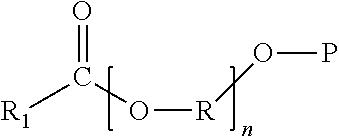
-
- a. R1 is linear or branched C12-C22 alkyl group;
- b. R is linear or branched C2-C4 alkylene group;
- c. P is selected from H; C1-C4 alkyl; or —COR2; and
- d. n=1-3.
The pearlescent agent may be ethyleneglycoldistearate (EGDS).
b. forming from the film on the horizontal portion of the continuously moving surface, and in the moulds on the surface, a continuously moving, horizontally positioned web of open pouches;
c. filling the continuously moving, horizontally positioned web of open pouches with a product, to obtain a horizontally positioned web of open, filled pouches;
d. preferably continuously, closing the web of open pouches, to obtain closed pouches, preferably by feeding a second water-soluble film onto the horizontally positioned web of open, filed pouches, to obtain closed pouches; and
e. optionally sealing the closed pouches to obtain a web of closed pouches.
| Powder | Powder | |
| Detergent A | Detergent B | |
| (wt %) | (wt %) | |
| Sodium Linear alkylbenzenesulfonate1 | 11.0 | 11.0 |
| AE3S2 | 4.3 | 4.3 |
| Sodium Carbonate3 | 15.0 | 15.0 |
| Soil release agent4 | 0.23 | 0.23 |
| Carboxymethylcellulose5 | 1.0 | 1.0 |
| Protease - Purafect ® (84 mg active/g)6 | 0.17 | 0.17 |
| Amylase - Stainzyme Plus ® | 0.22 | 0.22 |
| (20 mg active/g)7 | ||
| Lipase - Lipex ® 100T7 | 0.24 | 0.24 |
| Salt of Polyetheramine and Polymeric Acid8 | — | 2.0 |
| TAED9 | 6.0 | 6.0 |
| Sodium Percarbonate10 | 18.0 | 18.0 |
| Hydroxyethane di phosphonate (HEDP)11 | 0.52 | 0.52 |
| Suds suppressor agglomerate12 | 0.41 | 0.41 |
| Fluorescent Whitening Agent13 | 0.30 | 0.30 |
| Sulfate/Water & Miscellaneous | Balance | Balance |
| 1Linear alkylbenzenesulfonate having an average aliphatic carbon chain length C11-C12 supplied by Stepan, Northfield, Illinois, USA | ||
| 2AE3S is C12-15 alkyl ethoxy (3) sulfate supplied by Stepan, Northfield, Illinois, USA | ||
| 3Sodium Carbonate is supplied by Solvay, Houston, Texas, USA | ||
| 4Soil release agent is Repel-o-tex ® PF, supplied by Rhodia, Paris, France | ||
| 5Finnfix ® V supplied by CP Kelco, Arnhem, Netherlands | ||
| 6Protease supplied by Genencor International, Palo Alto, California, USA | ||
| 7Stainzyme ®, Lipex ®, are all products of Novozymes, Bagsvaerd, Denmark | ||
| 8Salt of polyetherdiamine from 2-butyl-2-ethyl-1,3-propandiol, alkoxylated with 2.8 mol propylene oxide per OH, and aminated (amine value 278.2 mg KOH/g) and copolymer of acrylic acid and maleic acid, sold under the tradename Sokalan ® CP 45. | ||
| 9TAED is tetraacetylethylenediamine, supplied under the Peractive ® brand name by Clariant GmbH, Sulzbach, Germany | ||
| 10Sodium percarbonate is supplied by Solvay, Houston, Texas, USA | ||
| 11Hydroxyethane di phosphonate (HEDP) is supplied by Dow Chemical, Midland, Michigan, USA | ||
Results are summarized in the following table:
| Powder Detergent A | Powder Detergent B | LSD | |
| Bacon Grease | 65.2 | +4.1 s | 4.1 |
| Burnt Beef | 64.7 | +1.9 s | 3.4 |
| Burnt Butter | 72.6 | +4.2 s | 4.9 |
| Bacon Grease | 51.9 | +1.7 s | 3.9 |
| Beef Fat | 54.4 | +0.1 | 5.2 |
| Lard | 48.0 | +2.7 | 6.2 |
| Taco Grease | 53.2 | +17.1 s | 9.2 |
| Make up | 46.2 | +6.6 s | 6.4 |
| Tea | 30.9 | +4.3 s | 2.8 |
| Wine | 58.9 | +2.5 s | 1.0 |
| Spaghetti | 84.1 | +4.9 s | 1.1 |
These results illustrate the surprising benefits of the salt of polyetheramine and polymeric acid according to the present disclosure (Powder Detergent B) as compared to conventional (nil-salt of polyetheramine and polymeric acid) (Powder Detergent A), especially on difficult-to-remove, high-frequency consumer stains, such as grease and make up.
| 1 | |
| (wt %) | |
| Linear alkylbenzenesulfonate1 | 8.2 | |
| AE3S2 | 1.9 | |
| Zeolite A3 | 1.8 | |
| Citric Acid | 1.5 | |
| Sodium Carbonate5 | 29.7 | |
| Silicate 1.6R (SiO2:Na2O)4 | 3.4 | |
| Soil release agent6 | 0.2 | |
| Acrylic Acid/Maleic Acid Copolymer7 | 2.2 | |
| Carboxymethylcellulose | 0.9 | |
| Protease - Purafect ® (84 mg active/g)9 | 0.08 | |
| Amylase - Stainzyme Plus ® (20 mg active/g)8 | 0.16 | |
| Lipase - Lipex ® (18.00 mg active/g)8 | 0.24 | |
| Cellulase - Celluclean ™ (15.6 mg active/g)8 | 0.1 | |
| Salt of Polyetheramine and Polymeric Acid10 | 2.0 | |
| TAED11 | 3.26 | |
| Percarbonate12 | 14.1 | |
| Na salt of Ethylenediamine-N,N′-disuccinic acid, (S,S) | 2.19 | |
| isomer (EDDS)13 | ||
| Hydroxyethane di phosphonate (HEDP)14 | 0.54 | |
| MgSO4 | 0.38 | |
| Perfume | 0.38 | |
| Suds suppressor agglomerate15 | 0.04 | |
| Sulphonated zinc phthalocyanine (active)16 | 0.0012 | |
| Sulfate/Water & Miscellaneous | Balance | |
| 1Linear alkylbenzenesulfonate having an average aliphatic carbon chain length C11-C12 supplied by Stepan, Northfield, Illinois, USA | ||
| 2AE3S is C12-15 alkyl ethoxy (3) sulfate supplied by Stepan, Northfield, Illinois, USA | ||
| 3Zeolite A is supplied by Industrial Zeolite (UK) Ltd, Grays, Essex, UK | ||
| 41.6R Silicate is supplied by Koma, Nestemica, Czech Republic | ||
| 5Sodium Carbonate is supplied by Solvay, Houston, Texas, USA | ||
| 6Soil release agent is Repel-o-tex ® PF, supplied by Rhodia, Paris, France | ||
| 7Acrylic Acid/Maleic Acid Copolymer is molecular weight 70,000 and acrylate:maleate ratio 70:30, supplied by BASF, Ludwigshafen, Germany | ||
| 8Savinase ®, Natalase ®, Stainzyme ®, Lipex ®, Celluclean ™, Mannaway ® and Whitezyme ® are all products of Novozymes, Bagsvaerd, Denmark. | ||
| 9Proteases may be supplied by Genencor International, Palo Alto, California, USA (e.g. Purafect Prime ®) or by Novozymes, Bagsvaerd, Denmark (e.g. Liquanase ®, Coronase ®). | ||
| 10Salt of Polyetheramine and Polymeric Acid of synthesis Examples 1, 2, 3, 4, or 5. | ||
| 11TAED is tetraacetylethylenediamine, supplied under the Peractive ® brand name by Clariant GmbH, Sulzbach, Germany | ||
| 12Sodium percarbonate supplied by Solvay, Houston, Texas, USA | ||
| 13Na salt of Ethylenediamine-N,N′-disuccinic acid, (S,S) isomer (EDDS) is supplied by Octel, Ellesmere Port, UK | ||
| 14Hydroxyethane di phosphonate (HEDP) is supplied by Dow Chemical, Midland, Michigan, USA | ||
| 15Suds suppressor agglomerate is supplied by Dow Corning, Midland, Michigan, USA | ||
| 16Fluorescent Brightener 1 is Tinopal ® AMS, Fluorescent Brightener 2 is Tinopal ® CBS-X, Sulphonated zinc phthalocyanine and Direct Violet 9 is Pergasol ® Violet BN-Z all supplied by Ciba Specialty Chemicals, Basel, Switzerland | ||
| 2 | 3 | 4 | 5 | 6 | 7 | |
| (wt %) | (wt %) | (wt %) | (wt %) | (wt %) | (wt %) | |
| Linear alkylbenzenesulfonate | 20 | 22 | 20 | 15 | 20 | 20 |
| C12-14 Dimethylhydroxyethyl | 0.7 | 0.2 | 1 | 0.6 | 0.0 | 0 |
| ammonium chloride | ||||||
| AE3S | 0.9 | 1 | 0.9 | 0.0 | 0.5 | 0.9 |
| AE7 | 0.0 | 0.0 | 0.0 | 1 | 0.0 | 3 |
| Sodium tripolyphosphate | 5 | 0.0 | 4 | 9 | 2 | 0.0 |
| Zeolite A | 0.0 | 1 | 0.0 | 1 | 4 | 1 |
| 1.6R Silicate (SiO2:Na2O | 7 | 5 | 2 | 3 | 3 | 5 |
| at ratio 1.6:1) | ||||||
| Sodium carbonate | 25 | 20 | 25 | 17 | 18 | 19 |
| Polyacrylate MW 4500 | 1 | 0.6 | 1 | 1 | 1.5 | 1 |
| Random graft copolymer | 0.1 | 0.2 | 0.0 | 0.0 | 0.0 | 0.0 |
| Carboxymethyl cellulose | 1 | 0.3 | 1 | 1 | 1 | 1 |
| Stainzyme ® (20 mg active/g) | 0.1 | 0.2 | 0.1 | 0.2 | 0.1 | 0.1 |
| Bacterial protease | 0.1 | 0.1 | 0.1 | 0.1 | 0.1 | |
| (Savinase ®, 32.89 mg active/g) | ||||||
| Natalase ® (8.65 mg active/g) | 0.1 | 0.0 | 0.1 | 0.0 | 0.1 | 0.1 |
| Lipex ® (18 mg active/g) | 0.03 | 0.07 | 0.3 | 0.1 | 0.07 | 0.4 |
| Biotouch ® ROC | 0.1 | 0.2 | 0.2 | 0.2 | 0.1 | 0.4 |
| (20 mg active/g) | ||||||
| *Salt of Polyetheramine and | 2.0 | 3.0 | 2.0 | 2.0 | 3.0 | 2.0 |
| Polymeric Acid | ||||||
| Fluorescent Brightener 1 | 0.06 | 0.0 | 0.06 | 0.18 | 0.06 | 0.06 |
| Fluorescent Brightener 2 | 0.1 | 0.06 | 0.1 | 0.0 | 0.1 | 0.1 |
| DTPA | 0.6 | 0.8 | 0.6 | 0.25 | 0.6 | 0.6 |
| MgSO4 | 1 | 1 | 1 | 0.5 | 1 | 1 |
| Sodium Percarbonate | 0.0 | 5.2 | 0.1 | 0.0 | 0.0 | 0.0 |
| Sodium Perborate | 4.4 | 0.0 | 3.85 | 2.09 | 0.78 | 3.63 |
| Monohydrate | ||||||
| NOBS | 1.9 | 0.0 | 1.66 | 0.0 | 0.33 | 0.75 |
| TAED | 0.58 | 1.2 | 0.51 | 0.0 | 0.015 | 0.28 |
| Sulphonated zinc | 0.0030 | 0.0 | 0.0012 | 0.0030 | 0.0021 | 0.0 |
| phthalocyanine | ||||||
| S-ACMC | 0.1 | 0.0 | 0.0 | 0.0 | 0.06 | 0.0 |
| Direct Violet 9 | 0.0 | 0.0 | 0.0003 | 0.0005 | 0.0003 | 0.0 |
| Acid Blue 29 | 0.0 | 0.0 | 0.0 | 0.0 | 0.0 | 0.0003 |
| Sulfate/Moisture | Balance |
| 8 | 9 | 10 | 11 | 12 | 13 | |
| (wt %) | (wt %) | (wt %) | (wt %) | (wt %) | (wt %) | |
| Linear alkylbenzenesulfonate | 8 | 7.1 | 7 | 6.5 | 7.5 | 7.5 |
| AE3S | 0 | 4.8 | 0 | 5.2 | 4 | 4 |
| C12-14 Alkylsulfate | 1 | 0 | 1 | 0 | 0 | 0 |
| AE7 | 2.2 | 0 | 3.2 | 0 | 0 | 0 |
| C10-12Dimethyl | 0.75 | 0.94 | 0.98 | 0.98 | 0 | 0 |
| hydroxyethylammonium chloride | ||||||
| Crystalline layered silicate | 4.1 | 0 | 4.8 | 0 | 0 | 0 |
| (δ-Na2Si2O5) | ||||||
| Zeolite A | 5 | 0 | 5 | 0 | 2 | 2 |
| Citric Acid | 3 | 5 | 3 | 4 | 2.5 | 3 |
| Sodium Carbonate | 15 | 20 | 14 | 20 | 23 | 23 |
| Silicate 2R (SiO2:Na2O at ratio | 0.08 | 0 | 0.11 | 0 | 0 | 0 |
| 2:1) | ||||||
| *Salt of Polyetheramine and | 2.0 | 3.0 | 2.0 | 3.0 | 3.0 | 2.0 |
| Polymeric Acid | ||||||
| Soil release agent | 0.75 | 0.72 | 0.71 | 0.72 | 0 | 0 |
| Acrylic Acid/Maleic | 1.1 | 3.7 | 1.0 | 3.7 | 2.6 | 3.8 |
| Acid Copolymer | ||||||
| Carboxymethylcellulose | 0.15 | 1.4 | 0.2 | 1.4 | 1 | 0.5 |
| Bacterial protease (84 mg active/g) | 0.2 | 0.2 | 0.3 | 0.15 | 0.12 | 0.13 |
| Stainzyme ® (20 mg active/g) | 0.2 | 0.15 | 0.2 | 0.3 | 0.15 | 0.15 |
| Lipex ® (18.00 mg active/g) | 0.05 | 0.15 | 0.1 | 0 | 0 | 0 |
| Natalase ® (8.65 mg active/g) | 0.1 | 0.2 | 0 | 0 | 0.15 | 0.15 |
| Celluclean ™ (15.6 mg active/g) | 0 | 0 | 0 | 0 | 0.1 | 0.1 |
| Biotouch ® ROC (20 mg active/g) | 0.2 | 0.1 | 0.2 | 0.2 | 0.2 | 0.2 |
| TAED | 3.6 | 4.0 | 3.6 | 4.0 | 2.2 | 1.4 |
| Percarbonate | 13 | 13.2 | 13 | 13.2 | 16 | 14 |
| Na salt of Ethylenediamine-N,N′- | 0.2 | 0.2 | 0.2 | 0.2 | 0.2 | 0.2 |
| disuccinic acid, (S,S) isomer (EDDS) | ||||||
| Hydroxyethane | 0.2 | 0.2 | 0.2 | 0.2 | 0.2 | 0.2 |
| di phosphonate (HEDP) | ||||||
| MgSO4 | 0.42 | 0.42 | 0.42 | 0.42 | 0.4 | 0.4 |
| Perfume | 0.5 | 0.6 | 0.5 | 0.6 | 0.6 | 0.6 |
| Suds suppressor agglomerate | 0.05 | 0.1 | 0.05 | 0.1 | 0.06 | 0.05 |
| Soap | 0.45 | 0.45 | 0.45 | 0.45 | 0 | 0 |
| Sulphonated | 0.0007 | 0.0012 | 0.0007 | 0 | 0 | 0 |
| zinc phthalocyanine (active) | ||||||
| S-ACMC | 0.01 | 0.01 | 0 | 0.01 | 0 | 0 |
| Direct Violet 9 (active) | 0 | 0 | 0.0001 | 0.0001 | 0 | 0 |
| Sulfate/Water & Miscellaneous | Balance |
-
- *Salt of Polyetheramine and Polymeric Acid of synthesis Examples 1, 2, 3, 4, or 5.
- Linear alkylbenzenesulfonate having an average aliphatic carbon chain length C11-C12 supplied by Stepan, Northfield, Ill., USA
- C12-14 Dimethylhydroxyethyl ammonium chloride, supplied by Clariant GmbH, Sulzbach, Germany
- AE3S is C12-15 alkyl ethoxy (3) sulfate supplied by Stepan, Northfield, Ill., USA
- AE7 is C12-15 alcohol ethoxylate, with an average degree of ethoxylation of 7, supplied by Huntsman, Salt Lake City, Utah, USA
- AE9 is C12-13 alcohol ethoxylate, with an average degree of ethoxylation of 9, supplied by Huntsman, Salt Lake City, Utah, USA
- HSAS is a mid-branched primary alkyl sulfate with carbon chain length of about 16-17
- Sodium tripolyphosphate is supplied by Rhodia, Paris, France
- Zeolite A is supplied by Industrial Zeolite (UK) Ltd, Grays, Essex, UK
- 1.6R Silicate is supplied by Koma, Nestemica, Czech Republic
- Sodium Carbonate is supplied by Solvay, Houston, Tex., USA
- Polyacrylate MW 4500 is supplied by BASF, Ludwigshafen, Germany
- Carboxymethyl cellulose is Finnfix® V supplied by CP Kelco, Arnhem, Netherlands
- Suitable chelants are, for example, diethylenetetraamine pentaacetic acid (DTPA) supplied by Dow Chemical, Midland, Mich., USA or Hydroxyethane di phosphonate (HEDP) supplied by Solutia, St Louis, Mo., USA Bagsvaerd, Denmark
- Savinase®, Natalase®, Stainzyme®, Lipex®, Celluclean™, Mannaway® and Whitezyme® are all products of Novozymes, Bagsvaerd, Denmark.
- Biotouch® ROC is a product of AB Enzymes, Darmstadt, Germany.
- Bacterial protease (examples 8-13) described in U.S. Pat. No. 6,312,936 B1 supplied by Genencor International, Palo Alto, Calif., USA
- Bacterial protease (examples 14-20) described in U.S. Pat. No. 4,760,025 is supplied by Genencor International, Palo Alto, Calif., USA
- Fluorescent Brightener 1 is Tinopal® AMS, Fluorescent Brightener 2 is Tinopal® CBS-X, Sulphonated zinc phthalocyanine and Direct Violet 9 is Pergasol® Violet BN-Z all supplied by Ciba Specialty Chemicals, Basel, Switzerland
- Sodium percarbonate supplied by Solvay, Houston, Tex., USA
- Sodium perborate is supplied by Degussa, Hanau, Germany
- NOBS is sodium nonanoyloxybenzenesulfonate, supplied by Future Fuels, Batesville, Ark., USA
- TAED is tetraacetylethylenediamine, supplied under the Peractive® brand name by Clariant GmbH, Sulzbach, Germany
- S-ACMC is carboxymethylcellulose conjugated with C.I. Reactive Blue 19, sold by
- Megazyme, Wicklow, Ireland under the product name AZO-CM-CELLULOSE, product code S-ACMC.
- Soil release agent is Repel-o-tex® PF, supplied by Rhodia, Paris, France
- Acrylic Acid/Maleic Acid Copolymer is molecular weight 70,000 and acrylate:maleate ratio 70:30, supplied by BASF, Ludwigshafen, Germany
- Na salt of Ethylenediamine-N,N′-disuccinic acid, (S,S) isomer (EDDS) is supplied by Octel, Ellesmere Port, UK
- Hydroxyethane di phosphonate (HEDP) is supplied by Dow Chemical, Midland, Mich., USA
- Suds suppressor agglomerate is supplied by Dow Corning, Midland, Mich., USA
- HSAS is mid-branched alkyl sulfate as disclosed in U.S. Pat. No. 6,020,303 and U.S. Pat. No. 6,060,443
- C12-14 dimethyl Amine Oxide is supplied by Procter & Gamble Chemicals, Cincinnati, Ohio, USA
- Liquitint® Violet CT is supplied by Milliken, Spartanburg, S.C., USA.
| Base Composition 1 |
| Ingredients | % |
| Glycerol | 5.3 |
| 1,2-propanediol | 10.0 |
| Citric Acid | 0.5 |
| Monoethanolamine | 10.0 |
| Caustic soda | — |
| Hydroxyethane diphosphonic acid | 1.1 |
| Potassium sulfite | 0.2 |
| Nonionic Marlipal C24EO7 | 20.1 |
| HLAS | 24.6 |
| Fluorescent Brightener 2 | 0.2 |
| C12-15 Fatty acid | 16.4 |
| A compound having the following general structure: | 2.9 |
| bis((C2H5O)(C2H4O)n)(CH3)—N+—CxH2x—N+—(CH3)- | |
| bis((C2H5O)(C2H4O)n), | |
| wherein n = from 20 to 30, and x = from 3 to 8, or sulphated | |
| or sulphonated variants thereof | |
| Polyethyleneimine ethoxylate PEI600 E20 | 1.1 |
| MgCl2 | 0.2 |
| Solvents (1,2 propanediol, ethanol) | To 100% |
| Composition 1 |
| Compartment |
| A | B | C | |
| Volume of each compartment | 40 ml | 5 ml | 5 ml |
| Active material in Wt. % | |||
| Perfume | 1.6 | 1.6 | |
| Dyes | <0.01 | <0.01 | |
| TiO2 | 0.1 | ||
| Sodium Sulfite | 0.4 | 0.4 | |
| Salt of Polyetheramine and | 4-40% | ||
| Polymeric Acid1 | |||
| Acusol 305, Rohm&Haas | 1.2 | ||
| Hydrogenated castor oil | 0.14 | 0.14 | |
| Solid non-active filler2 | Add to | ||
| 100% | |||
| Base Composition 1 | Add to | Add to | |
| 100% | 100% | ||
| 1Salt of Polyetheramine and Polymeric Acid of synthesis Examples 1, 2, 3, 4, or 5. | |||
| 2Solid non-active fillers include sodium sulfate, silica, silicates, zeolite. | |||
Claims (10)

Priority Applications (4)
| Application Number | Priority Date | Filing Date | Title |
|---|---|---|---|
| US14/486,478 US9617502B2 (en) | 2014-09-15 | 2014-09-15 | Detergent compositions containing salts of polyetheramines and polymeric acid |
| EP15770754.8A EP3212753B1 (en) | 2014-09-15 | 2015-09-15 | Detergent compositions containing salts of polyetheramines and polymeric acid |
| CN201580047119.7A CN106661515B (en) | 2014-09-15 | 2015-09-15 | Detergent composition comprising salt of polyetheramine and polymeric acid |
| PCT/US2015/050074 WO2016044200A1 (en) | 2014-09-15 | 2015-09-15 | Detergent compositions containing salts of polyetheramines and polymeric acid |
Applications Claiming Priority (1)
| Application Number | Priority Date | Filing Date | Title |
|---|---|---|---|
| US14/486,478 US9617502B2 (en) | 2014-09-15 | 2014-09-15 | Detergent compositions containing salts of polyetheramines and polymeric acid |
Publications (2)
| Publication Number | Publication Date |
|---|---|
| US20160075975A1 US20160075975A1 (en) | 2016-03-17 |
| US9617502B2 true US9617502B2 (en) | 2017-04-11 |
Family
ID=54197118
Family Applications (1)
| Application Number | Title | Priority Date | Filing Date |
|---|---|---|---|
| US14/486,478 Active 2034-10-11 US9617502B2 (en) | 2014-09-15 | 2014-09-15 | Detergent compositions containing salts of polyetheramines and polymeric acid |
Country Status (4)
| Country | Link |
|---|---|
| US (1) | US9617502B2 (en) |
| EP (1) | EP3212753B1 (en) |
| CN (1) | CN106661515B (en) |
| WO (1) | WO2016044200A1 (en) |
Cited By (12)
| Publication number | Priority date | Publication date | Assignee | Title |
|---|---|---|---|---|
| US20170121635A1 (en) * | 2015-10-29 | 2017-05-04 | The Procter & Gamble Company | Liquid detergent composition |
| US20170121638A1 (en) * | 2015-10-29 | 2017-05-04 | The Procter & Gamble Company | Liquid detergent composition |
| US20170121642A1 (en) * | 2014-09-25 | 2017-05-04 | The Procter & Gamble Company | Cleaning compositions containing a polyetheramine |
| US20170183609A1 (en) * | 2014-09-25 | 2017-06-29 | The Procter & Gamble Company | Liquid laundry detergent composition |
| US20170298174A1 (en) * | 2014-09-25 | 2017-10-19 | Basf Se | Polyetheramines based on 1,3-dialcohols |
| US20190071619A1 (en) * | 2015-07-03 | 2019-03-07 | Novozymes A/S | Sulfite compositions |
| US10611985B2 (en) | 2015-10-29 | 2020-04-07 | The Procter & Gamble Company | Liquid detergent composition |
| US10689598B2 (en) | 2015-10-29 | 2020-06-23 | The Procter & Gamble Company | Liquid detergent composition |
| US10835456B2 (en) | 2016-07-19 | 2020-11-17 | Basf Se | Propyl gallate-containing vitamin preparations |
| US20210155754A1 (en) * | 2018-04-19 | 2021-05-27 | Basf Se | Compositions and polymers useful for such compositions |
| US11268047B2 (en) | 2016-03-24 | 2022-03-08 | The Procter & Gamble Company | Compositions containing an etheramine |
| US11634621B2 (en) | 2016-12-06 | 2023-04-25 | Evonik Corporation | Organophilic clays and drilling fluids containing them |
Families Citing this family (9)
| Publication number | Priority date | Publication date | Assignee | Title |
|---|---|---|---|---|
| JP2017528586A (en) | 2014-09-15 | 2017-09-28 | ビーエーエスエフ ソシエタス・ヨーロピアBasf Se | Etheramine and polycarboxylic acid salts |
| US20180371379A1 (en) * | 2015-08-19 | 2018-12-27 | Beratherm Ag | Aqueous cleaning solution for removal of rouging deposits on media-contacted surfaces of stainless steels, use thereof and process for production thereof |
| EP3170886B1 (en) * | 2015-11-20 | 2019-01-02 | The Procter and Gamble Company | Cleaning product |
| US20170275566A1 (en) * | 2016-03-24 | 2017-09-28 | The Procter & Gamble Company | Compositions containing an etheramine |
| MX2019006673A (en) * | 2016-12-09 | 2019-09-26 | Evonik Degussa Gmbh | SEDIMENTARY ROCKS HYDRATION INHIBITION AGENT. |
| EP3806739A1 (en) * | 2018-06-13 | 2021-04-21 | Abbott Diabetes Care Inc. | Temperature-insensitive membrane materials and analyte sensors containing the same |
| WO2020030760A1 (en) * | 2018-08-10 | 2020-02-13 | Unilever Plc | Detergent |
| CN108949394B (en) * | 2018-08-14 | 2020-09-11 | 广州立白企业集团有限公司 | Concentrated liquid detergent composition substantially free of solubilizer |
| US12084633B2 (en) * | 2020-12-15 | 2024-09-10 | Henkel Ag & Co. Kgaa | Unit dose laundry detergent compositions containing soil release polymers |
Citations (64)
| Publication number | Priority date | Publication date | Assignee | Title |
|---|---|---|---|---|
| GB581994A (en) | 1943-07-28 | 1946-10-31 | Wingfoot Corp | Amino ethers |
| DE1643426A1 (en) | 1966-12-16 | 1972-03-16 | Jefferson Chem Co Inc | Polyoxyalkylene polyamines |
| US3654370A (en) | 1970-08-28 | 1972-04-04 | Jefferson Chem Co Inc | Process for preparing polyoxyalkylene polyamines |
| US4450091A (en) | 1983-03-31 | 1984-05-22 | Basf Wyandotte Corporation | High foaming liquid shampoo composition |
| US4537705A (en) | 1984-04-25 | 1985-08-27 | Economics Laboratory, Inc. | Aqueous alkaline polyamine paint stripping compositions |
| US4556509A (en) | 1984-10-09 | 1985-12-03 | Colgate-Palmolive Company | Light duty detergents containing an organic diamine diacid salt |
| US4609683A (en) | 1985-06-21 | 1986-09-02 | Texaco Inc. | Quasi-prepolymers from isatoic anhydride derivatives of polyoxyalkylene polyamines and rim products made therefrom |
| WO1986007603A1 (en) | 1985-06-22 | 1986-12-31 | Henkel Kommanditgesellschaft Auf Aktien | Washing agent for low washing temperatures |
| US4764291A (en) | 1985-05-16 | 1988-08-16 | Colgate-Palmolive Company | Process for treating laundry with multiamide antistatic agents |
| WO1990003423A1 (en) | 1988-09-24 | 1990-04-05 | Henkel Kommanditgesellschaft Auf Aktien | Washing agents for low temperatures |
| US5317076A (en) | 1993-04-12 | 1994-05-31 | Texaco Chemical Co. | Polyurea elastomer with reduced moisture vapor transmission |
| US5571286A (en) | 1989-07-24 | 1996-11-05 | Precision Processes (Textiles) Limited | Polymers and prepolymers and their use in a method for the treatment of wool |
| WO1997030103A2 (en) | 1996-02-15 | 1997-08-21 | The Dow Chemical Company | Preparation of polyetheramines and polyetheramine derivatives |
| WO1998028393A1 (en) | 1996-12-20 | 1998-07-02 | The Procter & Gamble Company | Dishwashing detergent compositions containing organic diamines |
| US5863886A (en) | 1997-09-03 | 1999-01-26 | Rhodia Inc. | Nonionic gemini surfactants having multiple hydrophobic and hydrophilic sugar groups |
| US5948744A (en) | 1994-12-01 | 1999-09-07 | Baillely; Gerard Marcel | Detergent composition containing combination of nonionic polysaccharide ether with synthetic oxyalkylene-containing soil release agent |
| US5977275A (en) | 1998-02-17 | 1999-11-02 | National Starch And Chemical Investment Holding Corporation | Polymers having pendant polysaccharide moieties and uses thereof |
| DE19854592A1 (en) | 1998-11-26 | 2000-05-31 | Henkel Kgaa | Metalworking and cleaning processes |
| WO2000063334A1 (en) | 1999-04-19 | 2000-10-26 | The Procter & Gamble Company | Dishwashing detergent compositions containing organic polyamines |
| US6146427A (en) | 1997-12-04 | 2000-11-14 | Crutcher; Terry | Method for cleaning hydrocarbon-containing greases and oils from fabric in laundry washing applications |
| US6172021B1 (en) | 1996-12-20 | 2001-01-09 | The Procter & Gamble Company | Dishwashing detergent compositions containing alkanolamine |
| US6172024B1 (en) | 2000-04-17 | 2001-01-09 | Colgate-Palmolive Co. | High foaming grease cutting light duty liquid detergent comprising a poly (oxyethylene) diamine |
| US6191099B1 (en) | 1997-12-04 | 2001-02-20 | Tomah Products, Inc. | Method for cleaning hydrocarbon-containing soils from surfaces |
| WO2001027232A1 (en) | 1999-10-08 | 2001-04-19 | Unilever Plc | Fabric care composition |
| WO2001076729A2 (en) | 2000-04-06 | 2001-10-18 | Huntsman Petrochemical Corporation | Defoamer compositions and uses therefor |
| US6347055B1 (en) | 1999-06-24 | 2002-02-12 | Nec Corporation | Line buffer type semiconductor memory device capable of direct prefetch and restore operations |
| US6365561B1 (en) | 1996-12-20 | 2002-04-02 | Procter & Gamble Company | Dishwashing detergent compositions containing organic diamines for improved grease cleaning sudsing, low temperature stability and dissolution |
| US6369024B1 (en) | 1997-09-15 | 2002-04-09 | The Procter & Gamble Company | Laundry detergent compositions with linear amine based polymers to provide appearance and integrity benefits to fabrics laundered therewith |
| US6437055B1 (en) | 2000-04-07 | 2002-08-20 | Ppg Industries Ohio, Inc. | Electrodepositable coating from gelled epoxy-polyester and amine |
| US6462008B1 (en) | 1999-03-05 | 2002-10-08 | Case Western Reserve University | Detergent compositions comprising photobleaching delivery systems |
| US20020147368A1 (en) | 2000-12-18 | 2002-10-10 | Wei Li | Branched reaction products of alcohols and aldehydes |
| US6506716B1 (en) | 1997-07-29 | 2003-01-14 | The Procter & Gamble Company | Aqueous, gel laundry detergent composition |
| US6589926B1 (en) | 1998-06-02 | 2003-07-08 | Procter & Gamble Company | Dishwashing detergent compositions containing organic diamines |
| US6652667B2 (en) | 2002-01-23 | 2003-11-25 | Chevron Oronite Company Llc | Method for removing engine deposits in a gasoline internal combustion engine |
| US6703523B1 (en) | 1999-07-16 | 2004-03-09 | Basf Aktiengesellschaft | Zwitterionic polyetherpolyamines and process for their production |
| US6710023B1 (en) | 1999-04-19 | 2004-03-23 | Procter & Gamble Company | Dishwashing detergent compositions containing organic polyamines |
| US20050027141A1 (en) | 2003-07-30 | 2005-02-03 | Kao Corporation | Process for producing polyoxyalkylene triamine |
| US6857485B2 (en) | 2000-02-11 | 2005-02-22 | M-I Llc | Shale hydration inhibition agent and method of use |
| US6951710B2 (en) | 2003-05-23 | 2005-10-04 | Air Products And Chemicals, Inc. | Compositions suitable for removing photoresist, photoresist byproducts and etching residue, and use thereof |
| US20060074004A1 (en) | 2004-10-04 | 2006-04-06 | Johnson Andress K | Light duty liquid detergent composition |
| US7037883B2 (en) | 2003-09-17 | 2006-05-02 | Unilever Home & Personal Care Usa Division Of Conopco, Inc. | Process of making a liquid laundry detergent with polyanionic ammonium surfactant |
| EP1664254B9 (en) | 2003-09-17 | 2008-03-05 | Unilever N.V. | Liquid laundry detergent with polyanionic ammonium surfactant |
| US7387992B2 (en) | 2005-03-15 | 2008-06-17 | Unilever Home & Personal Care Usa Division Of Conopco, Inc. | Laundry detergent with polyamine mono-anionic surfactant |
| EP1436374B1 (en) | 2001-10-19 | 2008-08-20 | The Procter & Gamble Company | Benefit agent delivery systems |
| WO2009065738A2 (en) | 2007-11-22 | 2009-05-28 | Henkel Ag & Co. Kgaa | Polyoxyalkylenamines for improved fragrance yield |
| US7816481B2 (en) | 2002-08-30 | 2010-10-19 | Huntsman Petrochemical Llc | Polyether polyamine agents and mixtures thereof |
| US20100323943A1 (en) | 2009-06-19 | 2010-12-23 | Marc Francois Theophile Evers | Liquid Hand Dishwashing Detergent Composition |
| JP2011001504A (en) | 2009-06-22 | 2011-01-06 | Sanyo Chem Ind Ltd | Detergent composition for kitchen use |
| US20110009670A1 (en) | 2008-03-10 | 2011-01-13 | Huntsman Petrochemical Llc | Cyclohexanedimethanamine by direct amination of cyclohexanedimethanol |
| US8097577B2 (en) | 2007-11-09 | 2012-01-17 | The Procter & Gamble Company | Cleaning compositions with alkoxylated polyalkanolamines |
| US8193144B2 (en) | 2007-10-01 | 2012-06-05 | Ethox Chemicals Llc | Alkoxylated polyamines and polyetheramine polyol compositions for foam control |
| US8247368B2 (en) | 2007-11-09 | 2012-08-21 | The Procter & Gamble Company | Cleaning compositions comprising a multi-polymer system comprising at least one alkoxylated grease cleaning polymer |
| WO2012126665A1 (en) | 2011-03-21 | 2012-09-27 | Unilever Plc | Dye polymer |
| US20120259075A1 (en) | 2009-12-22 | 2012-10-11 | Huntsman Petrochemical Llc | Etheramines and their use as intermediates for polymer synthesis |
| US20120309884A1 (en) | 2009-12-02 | 2012-12-06 | Huntsman Petrochemical Llc | Preparation and use of polymeric dispersant compositions |
| US8471065B2 (en) | 2007-03-15 | 2013-06-25 | Huntsman Petrochemical Llc | High functionality amine compounds and uses therefor |
| US20130291315A1 (en) | 2008-06-16 | 2013-11-07 | Conopco, Inc., D/B/A Unilever | Fabric cleaning |
| US8586039B2 (en) | 2000-10-20 | 2013-11-19 | Chugai Seiyaku Kabushiki Kaisha | Degraded TPO agonist antibody |
| US20140255330A1 (en) | 2013-03-05 | 2014-09-11 | The Procter & Gamble Company | Mixed Sugar Compositions |
| US20140296124A1 (en) * | 2013-03-28 | 2014-10-02 | The Procter & Gamble Company | Cleaning compositions containing a polyetheramine, a soil release polymer, and a carboxymethylcellulose |
| US20150057212A1 (en) | 2013-08-26 | 2015-02-26 | The Procter & Gamble Company | Cleaning compositions containing a polyetheramine |
| US20150275144A1 (en) | 2014-03-27 | 2015-10-01 | The Procter & Gamble Company | Cleaning compositions containing a polyetheramine |
| US20150275142A1 (en) | 2014-03-27 | 2015-10-01 | The Procter & Gamble Company | Cleaning compositions containing a polyetheramine |
| US20150315524A1 (en) * | 2014-04-30 | 2015-11-05 | The Procter & Gamble Company | Cleaning composition containing a polyetheramine |
Family Cites Families (83)
| Publication number | Priority date | Publication date | Assignee | Title |
|---|---|---|---|---|
| US6093A (en) | 1849-02-06 | Horatio allen | ||
| US562A (en) | 1838-01-09 | Scale beam and weight | ||
| US3646015A (en) | 1969-07-31 | 1972-02-29 | Procter & Gamble | Optical brightener compounds and detergent and bleach compositions containing same |
| CA989557A (en) | 1971-10-28 | 1976-05-25 | The Procter And Gamble Company | Compositions and process for imparting renewable soil release finish to polyester-containing fabrics |
| GB1440913A (en) | 1972-07-12 | 1976-06-30 | Unilever Ltd | Detergent compositions |
| US3959230A (en) | 1974-06-25 | 1976-05-25 | The Procter & Gamble Company | Polyethylene oxide terephthalate polymers |
| US4000093A (en) | 1975-04-02 | 1976-12-28 | The Procter & Gamble Company | Alkyl sulfate detergent compositions |
| US4201824A (en) | 1976-12-07 | 1980-05-06 | Rhone-Poulenc Industries | Hydrophilic polyurethanes and their application as soil-release, anti-soil redeposition, and anti-static agents for textile substrates |
| FR2407980A1 (en) | 1977-11-02 | 1979-06-01 | Rhone Poulenc Ind | NEW ANTI-SOILING AND ANTI-REDEPOSITION COMPOSITIONS FOR USE IN DETERGENCE |
| US4489574A (en) | 1981-11-10 | 1984-12-25 | The Procter & Gamble Company | Apparatus for highly efficient laundering of textiles |
| US4489455A (en) | 1982-10-28 | 1984-12-25 | The Procter & Gamble Company | Method for highly efficient laundering of textiles |
| US4760025A (en) | 1984-05-29 | 1988-07-26 | Genencor, Inc. | Modified enzymes and methods for making same |
| US4525524A (en) | 1984-04-16 | 1985-06-25 | The Goodyear Tire & Rubber Company | Polyester composition |
| US4790856A (en) | 1984-10-17 | 1988-12-13 | Colgate-Palmolive Company | Softening and anti-static nonionic detergent composition with sulfosuccinamate detergent |
| US4579681A (en) | 1984-11-08 | 1986-04-01 | Gaf Corporation | Laundry detergent composition |
| US4702857A (en) | 1984-12-21 | 1987-10-27 | The Procter & Gamble Company | Block polyesters and like compounds useful as soil release agents in detergent compositions |
| DE3536530A1 (en) | 1985-10-12 | 1987-04-23 | Basf Ag | USE OF POLYALKYLENE OXIDES AND VINYL ACETATE GRAFT COPOLYMERISATS AS GRAY INHIBITORS IN THE WASHING AND TREATMENT OF TEXTILE GOODS CONTAINING SYNTHESIS FIBERS |
| US4711730A (en) | 1986-04-15 | 1987-12-08 | The Procter & Gamble Company | Capped 1,2-propylene terephthalate-polyoxyethylene terephthalate polyesters useful as soil release agents |
| EP0279134B1 (en) | 1986-12-24 | 1990-10-24 | Rhone-Poulenc Chimie | Antiredeposition latex for washing textiles |
| US4721580A (en) | 1987-01-07 | 1988-01-26 | The Procter & Gamble Company | Anionic end-capped oligomeric esters as soil release agents in detergent compositions |
| US4877896A (en) | 1987-10-05 | 1989-10-31 | The Procter & Gamble Company | Sulfoaroyl end-capped ester of oligomers suitable as soil-release agents in detergent compositions and fabric-conditioner articles |
| WO1989006270A1 (en) | 1988-01-07 | 1989-07-13 | Novo-Nordisk A/S | Enzymatic detergent |
| US4787989A (en) | 1988-01-13 | 1988-11-29 | Gaf Corporation | Anionic soil release compositions |
| DE3826670C2 (en) | 1988-08-05 | 1994-11-17 | Framatome Connectors Int | Flat contact socket |
| US4968451A (en) | 1988-08-26 | 1990-11-06 | The Procter & Gamble Company | Soil release agents having allyl-derived sulfonated end caps |
| US4956447A (en) | 1989-05-19 | 1990-09-11 | The Procter & Gamble Company | Rinse-added fabric conditioning compositions containing fabric sofening agents and cationic polyester soil release polymers and preferred cationic soil release polymers therefor |
| DE69033388T2 (en) | 1989-08-25 | 2000-05-11 | Henkel Research Corp., Santa Rosa | ALKALINE PROTEOLYTIC ENZYME AND METHOD FOR PRODUCING THE SAME |
| GB8927361D0 (en) | 1989-12-04 | 1990-01-31 | Unilever Plc | Liquid detergents |
| DE4016002A1 (en) | 1990-05-18 | 1991-11-21 | Basf Ag | USE OF WATER-SOLUBLE OR WATER-DISPERSIBLE PEPPER PROTEINS AS ADDITION TO WASHING AND CLEANING AGENTS |
| US5427711A (en) | 1991-12-29 | 1995-06-27 | Kao Corporation | Synthesized inorganic ion exchange material and detergent composition containing the same |
| DE69334295D1 (en) | 1992-07-23 | 2009-11-12 | Novo Nordisk As | MUTIER -g (a) -AMYLASE, DETERGENT AND DISHWASHER |
| WO1994018314A1 (en) | 1993-02-11 | 1994-08-18 | Genencor International, Inc. | Oxidatively stable alpha-amylase |
| US5415807A (en) | 1993-07-08 | 1995-05-16 | The Procter & Gamble Company | Sulfonated poly-ethoxy/propoxy end-capped ester oligomers suitable as soil release agents in detergent compositions |
| DE69434962T2 (en) | 1993-10-14 | 2008-01-17 | The Procter & Gamble Company, Cincinnati | PROTEASE-CONTAINING DETERGENTS |
| JPH09510617A (en) | 1994-03-29 | 1997-10-28 | ノボ ノルディスク アクティーゼルスカブ | Alkaline bacillus amylase |
| FR2720400B1 (en) | 1994-05-30 | 1996-06-28 | Rhone Poulenc Chimie | New sulfonated polyesters and their use as an anti-fouling agent in detergent, rinsing, softening and textile treatment compositions. |
| DE4428004A1 (en) | 1994-08-08 | 1996-02-15 | Basf Ag | Process for the production of amines |
| KR100511499B1 (en) | 1995-02-03 | 2005-12-21 | 노보자임스 에이/에스 | A method of designing alpha-amylase mutants with predetermined properties |
| AR000862A1 (en) | 1995-02-03 | 1997-08-06 | Novozymes As | VARIANTS OF A MOTHER-AMYLASE, A METHOD TO PRODUCE THE SAME, A DNA STRUCTURE AND A VECTOR OF EXPRESSION, A CELL TRANSFORMED BY SUCH A DNA STRUCTURE AND VECTOR, A DETERGENT ADDITIVE, DETERGENT COMPOSITION, A COMPOSITION FOR AND A COMPOSITION FOR THE ELIMINATION OF |
| JP3025627B2 (en) | 1995-06-14 | 2000-03-27 | 花王株式会社 | Liquefied alkaline α-amylase gene |
| EG21623A (en) | 1996-04-16 | 2001-12-31 | Procter & Gamble | Mid-chain branced surfactants |
| PH11997056158B1 (en) | 1996-04-16 | 2001-10-15 | Procter & Gamble | Mid-chain branched primary alkyl sulphates as surfactants |
| US5763385A (en) | 1996-05-14 | 1998-06-09 | Genencor International, Inc. | Modified α-amylases having altered calcium binding properties |
| MA24811A1 (en) | 1997-10-23 | 1999-12-31 | Procter & Gamble | WASHING COMPOSITIONS CONTAINING MULTISUBSTITUTED PROTEASE VARIANTS |
| AU9737398A (en) | 1997-10-30 | 1999-05-24 | Novo Nordisk A/S | Alpha-amylase mutants |
| US6403355B1 (en) | 1998-12-21 | 2002-06-11 | Kao Corporation | Amylases |
| JP4523178B2 (en) | 1999-03-31 | 2010-08-11 | ノボザイムス アクティーゼルスカブ | Lipase mutant |
| MXPA01009706A (en) | 1999-03-31 | 2002-05-14 | Novozymes As | Polypeptides having alkaline alpha-amylase activity and nucleic acids encoding same. |
| EP1307547B1 (en) | 2000-07-28 | 2005-10-26 | Henkel Kommanditgesellschaft auf Aktien | Novel amylolytic enzyme extracted from bacillus sp. a 7-7 (dsm 12368) and washing and cleaning agents containing this novel amylolytic enzyme |
| US7041488B2 (en) | 2001-06-06 | 2006-05-09 | Novozymes A/S | Endo-beta-1,4-glucanase from bacillus |
| DE10162728A1 (en) | 2001-12-20 | 2003-07-10 | Henkel Kgaa | New alkaline protease from Bacillus gibsonii (DSM 14393) and washing and cleaning agents containing this new alkaline protease |
| ES2283997T3 (en) | 2003-03-24 | 2007-11-01 | Ciba Specialty Chemicals Holding Inc. | DETERGENT COMPOSITIONS. |
| US8535927B1 (en) | 2003-11-19 | 2013-09-17 | Danisco Us Inc. | Micrococcineae serine protease polypeptides and compositions thereof |
| US7208459B2 (en) | 2004-06-29 | 2007-04-24 | The Procter & Gamble Company | Laundry detergent compositions with efficient hueing dye |
| EP3620523A3 (en) | 2004-07-05 | 2020-08-19 | Novozymes A/S | Alpha-amylase variants with altered properties |
| PL1794275T3 (en) | 2004-09-23 | 2009-12-31 | Unilever Nv | Laundry treatment compositions |
| ES2322864T3 (en) | 2004-09-23 | 2009-06-30 | Unilever N.V. | COMPOSITIONS OF TREATMENT OF DIRTY CLOTHING. |
| US7686892B2 (en) | 2004-11-19 | 2010-03-30 | The Procter & Gamble Company | Whiteness perception compositions |
| TWI444478B (en) | 2005-10-12 | 2014-07-11 | Genencor Int | Use and production of storage-stable neutral metalloprotease |
| ATE486927T1 (en) | 2007-01-19 | 2010-11-15 | Procter & Gamble | LAUNDRY CARE WITH WHITE TONER FOR CELLULOSE-CONTAINING SUBSTRATES |
| US7642282B2 (en) | 2007-01-19 | 2010-01-05 | Milliken & Company | Whitening agents for cellulosic substrates |
| DE102007038031A1 (en) | 2007-08-10 | 2009-06-04 | Henkel Ag & Co. Kgaa | Agents containing proteases |
| MX2010005335A (en) | 2007-11-26 | 2010-05-27 | Basf Se | Improved shading process. |
| JP2011513539A (en) | 2008-02-29 | 2011-04-28 | ザ プロクター アンド ギャンブル カンパニー | Detergent composition containing lipase |
| EP2279219B1 (en) | 2008-05-14 | 2013-04-17 | Basf Se | Use of a cyclohexane diol mixture for manufacturing polymers |
| CN105483099B (en) | 2008-06-06 | 2020-06-23 | 丹尼斯科美国公司 | Geobacillus stearothermophilus α -Amylase (AMYS) variants with improved properties |
| ES2391072T3 (en) | 2008-06-16 | 2012-11-21 | Basf Se | Use of a c11 diol or mixture of c11 diols for the production of polymers |
| JP2011528745A (en) | 2008-07-23 | 2011-11-24 | ビーエーエスエフ ソシエタス・ヨーロピア | Use of 2-isopropyl-2-alkyl-1,3-propanediol to produce polymers |
| EP2321242A1 (en) | 2008-08-26 | 2011-05-18 | Basf Se | Use of 1,1-dimethylol cycloalkanes or 1,1-dimethylol cycloalkenes for the production of polymers |
| JP2012502124A (en) | 2008-09-04 | 2012-01-26 | ビーエーエスエフ ソシエタス・ヨーロピア | Use of substituted 2-aryl-2-alkyl-1,3-propanediol or substituted 2-cyclohexyl-2-alkyl-1,3-propanediol for the preparation of polymers |
| CN102803459B (en) | 2009-06-12 | 2016-04-06 | 荷兰联合利华有限公司 | Cationic dyestuff polymkeric substance |
| MY159432A (en) | 2009-06-15 | 2017-01-13 | Unilever Plc | Anionic dye polymers |
| US20120225803A1 (en) | 2009-10-23 | 2012-09-06 | Stephen Norman Batchelor | Dye polymers |
| JP5755236B2 (en) | 2009-12-03 | 2015-07-29 | ビーエーエスエフ ソシエタス・ヨーロピアBasf Se | Catalyst for production of amine and method for producing amine |
| CN102781571B (en) | 2009-12-03 | 2015-06-17 | 巴斯夫欧洲公司 | Catalyst and method for producing an amine |
| CN102741357B (en) | 2010-02-09 | 2014-05-28 | 荷兰联合利华有限公司 | Dye polymers |
| US20120101018A1 (en) | 2010-10-22 | 2012-04-26 | Gregory Scot Miracle | Bis-azo colorants for use as bluing agents |
| CN103210073B (en) | 2010-11-12 | 2016-06-08 | 宝洁公司 | Thiophene azo dyes and laundry care compositions containing them |
| BR112013019381B1 (en) | 2011-01-31 | 2021-04-20 | Unilever Ip Holdings B.V | Linear polymer for release of dirt and alkaline detergent liquid |
| JP6165245B2 (en) | 2012-06-27 | 2017-07-19 | フィリップス ライティング ホールディング ビー ヴィ | Method and apparatus for automatically adapting the light output of a lighting unit |
| ES2854623T3 (en) | 2012-07-31 | 2021-09-22 | Clariant Int Ltd | Polyesters |
| EP2692842B1 (en) | 2012-07-31 | 2014-07-30 | Unilever PLC | Concentrated liquid detergent compositions |
| DE102012016462A1 (en) | 2012-08-18 | 2014-02-20 | Clariant International Ltd. | Use of polyesters in detergents and cleaners |
-
2014
- 2014-09-15 US US14/486,478 patent/US9617502B2/en active Active
-
2015
- 2015-09-15 WO PCT/US2015/050074 patent/WO2016044200A1/en not_active Ceased
- 2015-09-15 CN CN201580047119.7A patent/CN106661515B/en not_active Expired - Fee Related
- 2015-09-15 EP EP15770754.8A patent/EP3212753B1/en active Active
Patent Citations (69)
| Publication number | Priority date | Publication date | Assignee | Title |
|---|---|---|---|---|
| GB581994A (en) | 1943-07-28 | 1946-10-31 | Wingfoot Corp | Amino ethers |
| DE1643426A1 (en) | 1966-12-16 | 1972-03-16 | Jefferson Chem Co Inc | Polyoxyalkylene polyamines |
| US3654370A (en) | 1970-08-28 | 1972-04-04 | Jefferson Chem Co Inc | Process for preparing polyoxyalkylene polyamines |
| US4450091A (en) | 1983-03-31 | 1984-05-22 | Basf Wyandotte Corporation | High foaming liquid shampoo composition |
| US4537705A (en) | 1984-04-25 | 1985-08-27 | Economics Laboratory, Inc. | Aqueous alkaline polyamine paint stripping compositions |
| US4556509A (en) | 1984-10-09 | 1985-12-03 | Colgate-Palmolive Company | Light duty detergents containing an organic diamine diacid salt |
| US4764291A (en) | 1985-05-16 | 1988-08-16 | Colgate-Palmolive Company | Process for treating laundry with multiamide antistatic agents |
| US4609683A (en) | 1985-06-21 | 1986-09-02 | Texaco Inc. | Quasi-prepolymers from isatoic anhydride derivatives of polyoxyalkylene polyamines and rim products made therefrom |
| WO1986007603A1 (en) | 1985-06-22 | 1986-12-31 | Henkel Kommanditgesellschaft Auf Aktien | Washing agent for low washing temperatures |
| US4820436A (en) | 1985-06-22 | 1989-04-11 | Henkel Kommanditgesellschaft Auf Aktien | Detergents for low laundering temperatures |
| WO1990003423A1 (en) | 1988-09-24 | 1990-04-05 | Henkel Kommanditgesellschaft Auf Aktien | Washing agents for low temperatures |
| US5571286A (en) | 1989-07-24 | 1996-11-05 | Precision Processes (Textiles) Limited | Polymers and prepolymers and their use in a method for the treatment of wool |
| US5317076A (en) | 1993-04-12 | 1994-05-31 | Texaco Chemical Co. | Polyurea elastomer with reduced moisture vapor transmission |
| US5948744A (en) | 1994-12-01 | 1999-09-07 | Baillely; Gerard Marcel | Detergent composition containing combination of nonionic polysaccharide ether with synthetic oxyalkylene-containing soil release agent |
| WO1997030103A2 (en) | 1996-02-15 | 1997-08-21 | The Dow Chemical Company | Preparation of polyetheramines and polyetheramine derivatives |
| WO1998028393A1 (en) | 1996-12-20 | 1998-07-02 | The Procter & Gamble Company | Dishwashing detergent compositions containing organic diamines |
| US6365561B1 (en) | 1996-12-20 | 2002-04-02 | Procter & Gamble Company | Dishwashing detergent compositions containing organic diamines for improved grease cleaning sudsing, low temperature stability and dissolution |
| US6172021B1 (en) | 1996-12-20 | 2001-01-09 | The Procter & Gamble Company | Dishwashing detergent compositions containing alkanolamine |
| US6506716B1 (en) | 1997-07-29 | 2003-01-14 | The Procter & Gamble Company | Aqueous, gel laundry detergent composition |
| US5863886A (en) | 1997-09-03 | 1999-01-26 | Rhodia Inc. | Nonionic gemini surfactants having multiple hydrophobic and hydrophilic sugar groups |
| US6369024B1 (en) | 1997-09-15 | 2002-04-09 | The Procter & Gamble Company | Laundry detergent compositions with linear amine based polymers to provide appearance and integrity benefits to fabrics laundered therewith |
| US6146427A (en) | 1997-12-04 | 2000-11-14 | Crutcher; Terry | Method for cleaning hydrocarbon-containing greases and oils from fabric in laundry washing applications |
| US6191099B1 (en) | 1997-12-04 | 2001-02-20 | Tomah Products, Inc. | Method for cleaning hydrocarbon-containing soils from surfaces |
| US5977275A (en) | 1998-02-17 | 1999-11-02 | National Starch And Chemical Investment Holding Corporation | Polymers having pendant polysaccharide moieties and uses thereof |
| US6589926B1 (en) | 1998-06-02 | 2003-07-08 | Procter & Gamble Company | Dishwashing detergent compositions containing organic diamines |
| DE19854592A1 (en) | 1998-11-26 | 2000-05-31 | Henkel Kgaa | Metalworking and cleaning processes |
| US6462008B1 (en) | 1999-03-05 | 2002-10-08 | Case Western Reserve University | Detergent compositions comprising photobleaching delivery systems |
| WO2000063334A1 (en) | 1999-04-19 | 2000-10-26 | The Procter & Gamble Company | Dishwashing detergent compositions containing organic polyamines |
| US6710023B1 (en) | 1999-04-19 | 2004-03-23 | Procter & Gamble Company | Dishwashing detergent compositions containing organic polyamines |
| US6347055B1 (en) | 1999-06-24 | 2002-02-12 | Nec Corporation | Line buffer type semiconductor memory device capable of direct prefetch and restore operations |
| US6703523B1 (en) | 1999-07-16 | 2004-03-09 | Basf Aktiengesellschaft | Zwitterionic polyetherpolyamines and process for their production |
| WO2001027232A1 (en) | 1999-10-08 | 2001-04-19 | Unilever Plc | Fabric care composition |
| US6857485B2 (en) | 2000-02-11 | 2005-02-22 | M-I Llc | Shale hydration inhibition agent and method of use |
| WO2001076729A2 (en) | 2000-04-06 | 2001-10-18 | Huntsman Petrochemical Corporation | Defoamer compositions and uses therefor |
| US6437055B1 (en) | 2000-04-07 | 2002-08-20 | Ppg Industries Ohio, Inc. | Electrodepositable coating from gelled epoxy-polyester and amine |
| US6172024B1 (en) | 2000-04-17 | 2001-01-09 | Colgate-Palmolive Co. | High foaming grease cutting light duty liquid detergent comprising a poly (oxyethylene) diamine |
| US8586039B2 (en) | 2000-10-20 | 2013-11-19 | Chugai Seiyaku Kabushiki Kaisha | Degraded TPO agonist antibody |
| US20020147368A1 (en) | 2000-12-18 | 2002-10-10 | Wei Li | Branched reaction products of alcohols and aldehydes |
| EP1436374B1 (en) | 2001-10-19 | 2008-08-20 | The Procter & Gamble Company | Benefit agent delivery systems |
| US6652667B2 (en) | 2002-01-23 | 2003-11-25 | Chevron Oronite Company Llc | Method for removing engine deposits in a gasoline internal combustion engine |
| US7816481B2 (en) | 2002-08-30 | 2010-10-19 | Huntsman Petrochemical Llc | Polyether polyamine agents and mixtures thereof |
| US6951710B2 (en) | 2003-05-23 | 2005-10-04 | Air Products And Chemicals, Inc. | Compositions suitable for removing photoresist, photoresist byproducts and etching residue, and use thereof |
| US20050027141A1 (en) | 2003-07-30 | 2005-02-03 | Kao Corporation | Process for producing polyoxyalkylene triamine |
| EP1664254B9 (en) | 2003-09-17 | 2008-03-05 | Unilever N.V. | Liquid laundry detergent with polyanionic ammonium surfactant |
| US7037883B2 (en) | 2003-09-17 | 2006-05-02 | Unilever Home & Personal Care Usa Division Of Conopco, Inc. | Process of making a liquid laundry detergent with polyanionic ammonium surfactant |
| US20060074004A1 (en) | 2004-10-04 | 2006-04-06 | Johnson Andress K | Light duty liquid detergent composition |
| US7387992B2 (en) | 2005-03-15 | 2008-06-17 | Unilever Home & Personal Care Usa Division Of Conopco, Inc. | Laundry detergent with polyamine mono-anionic surfactant |
| US8471065B2 (en) | 2007-03-15 | 2013-06-25 | Huntsman Petrochemical Llc | High functionality amine compounds and uses therefor |
| US8815007B2 (en) | 2007-10-01 | 2014-08-26 | Ethox Chemicals, Llc | Alkoxylated polyamines and polyetheramine polyol compositions for foam control |
| US8193144B2 (en) | 2007-10-01 | 2012-06-05 | Ethox Chemicals Llc | Alkoxylated polyamines and polyetheramine polyol compositions for foam control |
| US8097577B2 (en) | 2007-11-09 | 2012-01-17 | The Procter & Gamble Company | Cleaning compositions with alkoxylated polyalkanolamines |
| US8247368B2 (en) | 2007-11-09 | 2012-08-21 | The Procter & Gamble Company | Cleaning compositions comprising a multi-polymer system comprising at least one alkoxylated grease cleaning polymer |
| WO2009065738A2 (en) | 2007-11-22 | 2009-05-28 | Henkel Ag & Co. Kgaa | Polyoxyalkylenamines for improved fragrance yield |
| WO2009065738A3 (en) | 2007-11-22 | 2009-09-24 | Henkel Ag & Co. Kgaa | Polyoxyalkylenamines for improved fragrance yield |
| US20110009670A1 (en) | 2008-03-10 | 2011-01-13 | Huntsman Petrochemical Llc | Cyclohexanedimethanamine by direct amination of cyclohexanedimethanol |
| US20130291315A1 (en) | 2008-06-16 | 2013-11-07 | Conopco, Inc., D/B/A Unilever | Fabric cleaning |
| US20100323943A1 (en) | 2009-06-19 | 2010-12-23 | Marc Francois Theophile Evers | Liquid Hand Dishwashing Detergent Composition |
| JP2011001504A (en) | 2009-06-22 | 2011-01-06 | Sanyo Chem Ind Ltd | Detergent composition for kitchen use |
| US20120309884A1 (en) | 2009-12-02 | 2012-12-06 | Huntsman Petrochemical Llc | Preparation and use of polymeric dispersant compositions |
| US20120259075A1 (en) | 2009-12-22 | 2012-10-11 | Huntsman Petrochemical Llc | Etheramines and their use as intermediates for polymer synthesis |
| WO2012126665A1 (en) | 2011-03-21 | 2012-09-27 | Unilever Plc | Dye polymer |
| US20140255330A1 (en) | 2013-03-05 | 2014-09-11 | The Procter & Gamble Company | Mixed Sugar Compositions |
| US20140296124A1 (en) * | 2013-03-28 | 2014-10-02 | The Procter & Gamble Company | Cleaning compositions containing a polyetheramine, a soil release polymer, and a carboxymethylcellulose |
| US20140296127A1 (en) | 2013-03-28 | 2014-10-02 | The Procter & Gamble Company | Cleaning compositions containing a polyetheramine |
| US9193939B2 (en) * | 2013-03-28 | 2015-11-24 | The Procter & Gamble Company | Cleaning compositions containing a polyetheramine, a soil release polymer, and a carboxymethylcellulose |
| US20150057212A1 (en) | 2013-08-26 | 2015-02-26 | The Procter & Gamble Company | Cleaning compositions containing a polyetheramine |
| US20150275144A1 (en) | 2014-03-27 | 2015-10-01 | The Procter & Gamble Company | Cleaning compositions containing a polyetheramine |
| US20150275142A1 (en) | 2014-03-27 | 2015-10-01 | The Procter & Gamble Company | Cleaning compositions containing a polyetheramine |
| US20150315524A1 (en) * | 2014-04-30 | 2015-11-05 | The Procter & Gamble Company | Cleaning composition containing a polyetheramine |
Non-Patent Citations (9)
| Title |
|---|
| International Search Report for PCT/US2014/031939, dated Jul. 7, 2014, containing 14 pages. |
| International Search Report for PCT/US2014/031941, dated Jul. 3, 2014, containing 14 pages. |
| International Search Report for PCT/US2014/051165, dated Dec. 1, 2014, containing 10 pages. |
| International Search Report for PCT/US2015/021968, dated Jul. 9, 2015, containing 11 pages. |
| International Search Report for PCT/US2015/021970, dated Jul. 8, 2015, containing 13 pages. |
| International Search Report for PCT/US2015/022927, dated Sep. 11, 2015, containing 12 pages. |
| International Search Report for PCT/US2015/050074, dated Jan. 20, 2016, 14 pages. |
| International Search Report for PCT/US2015/052082, dated Dec. 17, 2015, containing 13 pages. |
| www.huntsman.com/portal/page/ . . . /jeffamine—polyetheramines, downloaded on Sep. 6, 2015 (PDF Attached). |
Cited By (18)
| Publication number | Priority date | Publication date | Assignee | Title |
|---|---|---|---|---|
| US10676696B2 (en) * | 2014-09-25 | 2020-06-09 | The Procter & Gamble Company | Liquid laundry detergent composition |
| US20170121642A1 (en) * | 2014-09-25 | 2017-05-04 | The Procter & Gamble Company | Cleaning compositions containing a polyetheramine |
| US20170183609A1 (en) * | 2014-09-25 | 2017-06-29 | The Procter & Gamble Company | Liquid laundry detergent composition |
| US20170298174A1 (en) * | 2014-09-25 | 2017-10-19 | Basf Se | Polyetheramines based on 1,3-dialcohols |
| US10174274B2 (en) * | 2014-09-25 | 2019-01-08 | The Procter & Gamble Company | Cleaning compositions containing a polyetheramine |
| US10414856B2 (en) * | 2014-09-25 | 2019-09-17 | Basf Se | Polyetheramines based on 1,3-dialcohols |
| US10760037B2 (en) * | 2015-07-03 | 2020-09-01 | Novozymes A/S | Sulfite compositions |
| US20190071619A1 (en) * | 2015-07-03 | 2019-03-07 | Novozymes A/S | Sulfite compositions |
| US10611985B2 (en) | 2015-10-29 | 2020-04-07 | The Procter & Gamble Company | Liquid detergent composition |
| US20170121635A1 (en) * | 2015-10-29 | 2017-05-04 | The Procter & Gamble Company | Liquid detergent composition |
| US10689598B2 (en) | 2015-10-29 | 2020-06-23 | The Procter & Gamble Company | Liquid detergent composition |
| US20170121638A1 (en) * | 2015-10-29 | 2017-05-04 | The Procter & Gamble Company | Liquid detergent composition |
| US11268047B2 (en) | 2016-03-24 | 2022-03-08 | The Procter & Gamble Company | Compositions containing an etheramine |
| US11274267B2 (en) | 2016-03-24 | 2022-03-15 | The Procter & Gamble Company | Compositions containing an etheramine |
| US10835456B2 (en) | 2016-07-19 | 2020-11-17 | Basf Se | Propyl gallate-containing vitamin preparations |
| US11634621B2 (en) | 2016-12-06 | 2023-04-25 | Evonik Corporation | Organophilic clays and drilling fluids containing them |
| US12466985B2 (en) | 2016-12-06 | 2025-11-11 | Evonik Corporation | Organophilic clays and drilling fluids containing them |
| US20210155754A1 (en) * | 2018-04-19 | 2021-05-27 | Basf Se | Compositions and polymers useful for such compositions |
Also Published As
| Publication number | Publication date |
|---|---|
| CN106661515B (en) | 2019-08-13 |
| US20160075975A1 (en) | 2016-03-17 |
| EP3212753B1 (en) | 2019-07-31 |
| EP3212753A1 (en) | 2017-09-06 |
| CN106661515A (en) | 2017-05-10 |
| WO2016044200A1 (en) | 2016-03-24 |
Similar Documents
| Publication | Publication Date | Title |
|---|---|---|
| US9617502B2 (en) | Detergent compositions containing salts of polyetheramines and polymeric acid | |
| US10174274B2 (en) | Cleaning compositions containing a polyetheramine | |
| EP3197993B1 (en) | Detergent compositions containing a polyetheramine and an anionic soil release polymer | |
| EP3039112B1 (en) | Cleaning compositions containing a polyetheramine | |
| US9771547B2 (en) | Cleaning compositions containing a polyetheramine | |
| EP2978830B1 (en) | Cleaning compositions containing a polyetheramine | |
| EP3122849B1 (en) | Cleaning compositions containing a polyetheramine | |
| US9388368B2 (en) | Cleaning compositions containing a polyetheramine |
Legal Events
| Date | Code | Title | Description |
|---|---|---|---|
| AS | Assignment |
Owner name: THE PROCTER & GAMBLE COMPANY, OHIO Free format text: ASSIGNMENT OF ASSIGNORS INTEREST;ASSIGNORS:LOUGHNANE, BRIAN JOSEPH;HULSKOTTER, FRANK;SCIALLA, STEFANO;AND OTHERS;SIGNING DATES FROM 20140818 TO 20140930;REEL/FRAME:033907/0412 |
|
| STCF | Information on status: patent grant |
Free format text: PATENTED CASE |
|
| MAFP | Maintenance fee payment |
Free format text: PAYMENT OF MAINTENANCE FEE, 4TH YEAR, LARGE ENTITY (ORIGINAL EVENT CODE: M1551); ENTITY STATUS OF PATENT OWNER: LARGE ENTITY Year of fee payment: 4 |
|
| MAFP | Maintenance fee payment |
Free format text: PAYMENT OF MAINTENANCE FEE, 8TH YEAR, LARGE ENTITY (ORIGINAL EVENT CODE: M1552); ENTITY STATUS OF PATENT OWNER: LARGE ENTITY Year of fee payment: 8 |