US9568422B2 - Light beam incident device and reflected light measurement device - Google Patents

Light beam incident device and reflected light measurement device Download PDF

Info

Publication number
US9568422B2
US9568422B2 US13/783,549 US201313783549A US9568422B2 US 9568422 B2 US9568422 B2 US 9568422B2 US 201313783549 A US201313783549 A US 201313783549A US 9568422 B2 US9568422 B2 US 9568422B2
Authority
US
United States
Prior art keywords
light beam
light beams
light
incident
parallel
Prior art date
Legal status (The legal status is an assumption and is not a legal conclusion. Google has not performed a legal analysis and makes no representation as to the accuracy of the status listed.)
Expired - Fee Related, expires
Application number
US13/783,549
Other versions
US20140168652A1 (en
Inventor
Tomoyu Yamashita
Akiyoshi IRISAWA
Current Assignee (The listed assignees may be inaccurate. Google has not performed a legal analysis and makes no representation or warranty as to the accuracy of the list.)
Advantest Corp
Original Assignee
Advantest Corp
Priority date (The priority date is an assumption and is not a legal conclusion. Google has not performed a legal analysis and makes no representation as to the accuracy of the date listed.)
Filing date
Publication date
Application filed by Advantest Corp filed Critical Advantest Corp
Priority to US13/783,549 priority Critical patent/US9568422B2/en
Assigned to ADVANTEST CORPORATION reassignment ADVANTEST CORPORATION ASSIGNMENT OF ASSIGNORS INTEREST (SEE DOCUMENT FOR DETAILS). Assignors: IRISAWA, AKIYOSHI, YAMASHITA, TOMOYU
Priority to JP2013193742A priority patent/JP5809674B2/en
Publication of US20140168652A1 publication Critical patent/US20140168652A1/en
Application granted granted Critical
Publication of US9568422B2 publication Critical patent/US9568422B2/en
Assigned to ADVANTEST CORPORATION reassignment ADVANTEST CORPORATION CHANGE OF ADDRESS Assignors: ADVANTEST CORPORATION
Expired - Fee Related legal-status Critical Current
Adjusted expiration legal-status Critical

Links

Images

Classifications

    • GPHYSICS
    • G01MEASURING; TESTING
    • G01NINVESTIGATING OR ANALYSING MATERIALS BY DETERMINING THEIR CHEMICAL OR PHYSICAL PROPERTIES
    • G01N21/00Investigating or analysing materials by the use of optical means, i.e. using sub-millimetre waves, infrared, visible or ultraviolet light
    • G01N21/17Systems in which incident light is modified in accordance with the properties of the material investigated
    • G01N21/55Specular reflectivity
    • GPHYSICS
    • G01MEASURING; TESTING
    • G01NINVESTIGATING OR ANALYSING MATERIALS BY DETERMINING THEIR CHEMICAL OR PHYSICAL PROPERTIES
    • G01N21/00Investigating or analysing materials by the use of optical means, i.e. using sub-millimetre waves, infrared, visible or ultraviolet light
    • G01N21/17Systems in which incident light is modified in accordance with the properties of the material investigated
    • G01N21/25Colour; Spectral properties, i.e. comparison of effect of material on the light at two or more different wavelengths or wavelength bands
    • G01N21/31Investigating relative effect of material at wavelengths characteristic of specific elements or molecules, e.g. atomic absorption spectrometry
    • G01N21/35Investigating relative effect of material at wavelengths characteristic of specific elements or molecules, e.g. atomic absorption spectrometry using infrared light
    • G01N21/3581Investigating relative effect of material at wavelengths characteristic of specific elements or molecules, e.g. atomic absorption spectrometry using infrared light using far infrared light; using Terahertz radiation

Definitions

  • the present invention relates to light irradiation onto an object to be measured.
  • FIG. 4 shows an optical system of a conventional reflection measurement device which measures optical characteristics of a flat-shape sample.
  • terahertz waves electromagnetically waves having a frequency of 0.01 THz-10 THz
  • the terahertz waves output from a terahertz wave generator are reflected by an off-axial parabolic mirror, resulting in condensed terahertz waves.
  • the terahertz waves are reflected by a flat surface mirror on the way, and are condensed on a sample surface.
  • the terahertz waves reflected by the sample surface are again reflected by the flat surface mirror, are formed into collimated terahertz waves by an off-axis parabolic mirror, and are input into a terahertz detector.
  • the measurement may be carried out while an incident angle ⁇ of the measuring light entering the sample is changed. This is because, for example, the refractive index of the sample can be calculated highly precisely by acquiring the optical characteristics at various incident angles.
  • the incident angle ( ⁇ ) is constant according to the related art shown in FIG. 4 .
  • an angle of a tilted surface of a flat surface mirror with respect to the incident light needs to be changed, accordingly.
  • the flat surface mirror itself needs to be replaced, which requires a large amount of labor.
  • a light beam incident device includes: a light beam converging device that receives parallel light beams, and converges the parallel light beams at one point on an object to be measured; and a light beam feeding device that feeds the parallel light beams to the light beam converging device, wherein: an angle between the object to be measured and converged light beams obtained by converging the parallel light beams changes in accordance with a light reception portion at which the light beam converging device receives the parallel light beams; and the light beam feeding device is capable of changing the light reception portion.
  • a light beam converging device receives parallel light beams, and converges the parallel light beams at one point on an object to be measured.
  • a light beam feeding device feeds the parallel light beams to the light beam converging device.
  • An angle between the object to be measured and converged light beams obtained by converging the parallel light beams changes in accordance with a light reception portion at which the light beam converging device receives the parallel light beams.
  • the light beam feeding device is capable of changing the light reception portion.
  • the light beam incident device may include a paralleling device that changes travel directions of reflected light beams obtained by reflecting the converged light beams at the one point, thereby obtaining reflected parallel light beams traveling in parallel.
  • the light beam converging device and the paralleling device may be unified with each other.
  • the light beam converging device and the paralleling device may be independent from each other.
  • the light beam converging device may be any one of an off-axis parabolic mirror and an aspherical lens.
  • the light beam feeding device may receive the incident light beams travelling in parallel and change the travel direction by the right angle, thereby obtaining the parallel light beams.
  • the light beam feeding device may be capable of changing the light reception portion by moving with respect to the light beam converging device.
  • the light beam incident device may include a travel direction changing device that receives the reflected parallel light beams, and changes the travel direction thereof by the right angle, thereby obtaining light beams with a changed travel direction.
  • the light beam feeding device may receive the incident light beams travelling in parallel and changes the travel direction thereof by the right angle, thereby obtaining the parallel light beams; and the travel direction of the incident light beams and the travel direction of the light beams with a changed travel direction may be the same.
  • the light beam feeding device and the travel direction changing device may be unified with each other.
  • a reflected light measurement device includes: the light beam incident device according to the present invention; a light source that feeds the incident light beams to the light beam incident device; and a detector that detects the light beams with a changed travel direction.
  • FIG. 1 is a front view showing a configuration of a reflected light measurement device according to an embodiment of the present invention, and shows a case where a mirror 12 is moved downward (refer to FIG. 1( a ) ) and a case where the mirror 12 is moved upward (refer to FIG. 1( b ) );
  • FIG. 2 is a front view showing a configuration of the reflected light measurement device according to a first variation of an embodiment of the present invention, and shows a case where the mirror 12 is moved downward (refer to FIG. 2( a ) ) and a case where the mirror 12 is moved upward (refer to FIG. 2( b ) );
  • FIG. 3 is a front view showing a configuration of the reflected light measurement device according to a second variation of an embodiment of the present invention, and shows a case where the mirror 12 is moved downward (refer to FIG. 3( a ) ) and a case where the mirror 12 is moved upward (refer to FIG. 3( b ) ); and
  • FIG. 4 shows an optical system of a conventional reflection measurement device which measures optical characteristics of a flat-shape sample.
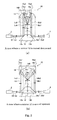
  • FIG. 1 is a front view showing a configuration of a reflected light measurement device according to an embodiment of the present invention, and shows a case where a mirror 12 is moved downward (refer to FIG. 1( a ) ) and a case where the mirror 12 is moved upward (refer to FIG. 1( b ) ).
  • the reflected light measurement device includes a light beam incident device 10 , a light source 2 , and a detector 4 .
  • the light source 2 provides (a mirror 12 of) the light beam incident device 10 with incident light beams E 1 and E 2 .
  • Terahertz waves electromagnettic waves having frequencies of 0.01 THz-10 THz
  • Beams of the terahertz wave are output from the light source 2 , and contours of the beams on the page of FIG. 1 are illustrated as the incident light beams E 1 and E 2 for the sake of illustration. It should be noted that the beams are collimated, and the incident light beams E 1 and E 2 travel in parallel to each other.
  • the detector 4 detects detected light beams (light beams with a changed travel direction) Da 1 and Da 2 (or Db 1 and Db 2 ). As a result, characteristics (such as optical characteristics and refractive index) of an object to be measured 1 can be measured.
  • the object to be measured 1 may be a thin film or a film such as an antireflection film, a protection film, and a transparent electrically conductive film, for example. Refer to FIG. 1( a ) for the detected light beams Da 1 and Da 2 , and refer to FIG. 1( b ) for the detected light beams Db 1 and Db 2 .
  • the light beam incident device 10 is provided with the mirror (a light beam feeding device and a travel direction changing device) 12 , an off-axis parabolic mirror (light beam converging device) 14 a , and an off-axis parabolic mirror (paralleling device) 14 b . It should be noted that the off-axis parabolic mirror (light beam converging device) 14 a and the off-axis parabolic mirror (paralleling device) 14 b are independent from each other.
  • the mirror 12 includes an incident-side light reception surface (light beam feeding device) 12 a , and an emission-side light reception surface (travel direction changing device) 12 b .
  • the incident-side light reception surface (light beam feeding device) 12 a and the emission-side light reception surface (travel direction changing device) 12 b may be surfaces on independent members; they are unified and are surfaces on the same member (mirror 12 ), according to an embodiment of the present invention.
  • the incident-side light reception surface (light beam feeding device) 12 a is a flat surface inclined by 45 degrees with respect to the incident light beams E 1 and E 2 , and is a surface that reflects the incident light beams E 1 and E 2 .
  • the incident-side light reception surface (light beam feeding device) 12 a receives and reflects the incident light beams E 1 and E 2 travelling in parallel from the light source 2 , and changes the travel direction by the right angle.
  • the light beams E 1 and E 2 of which travel direction has been changed by the right angle are referred to as parallel light beams La 1 and La 2 (or Lb 1 and Lb 2 ), respectively.
  • the incident light beam E 1 is reflected by the incident-side light reception surface 12 a and becomes the parallel light beam La 1 (or Lb 1 ).
  • the incident light beam E 2 is reflected by the incident-side light reception surface 12 a and becomes the parallel light beam La 2 (or Lb 2 ).
  • FIG. 1( a ) for the parallel light beams La 1 and La 2
  • FIG. 1( b ) for the parallel light beams Lb 1 and Lb 2 .
  • the parallel light beams L 1 and L 2 travel toward the off-axis parabolic mirror (light beam converging device) 14 a .
  • the incident-side light reception surface (light beam feeding device) 12 a feeds the parallel light beams La 1 and La 2 (or Lb 1 and Lb 2 ) to the off-axis parabolic mirror (light beam converging device) 14 a.
  • the off-axis parabolic mirror (light beam converging device) 14 a receives the parallel light beams La 1 and La 2 (or Lb 1 and Lb 2 ), thereby converging the parallel light beams La 1 and La 2 (or Lb 1 and Lb 2 ) at one point 1 a on the surface of the object to be measured 1 .
  • the off-axis parabolic mirror 14 a includes a reflective parabolic surface 140 a , and receives and reflects the parallel light beams La 1 and La 2 (or Lb 1 and Lb 2 ) on the reflective parabolic surface 140 a .
  • the one point 1 a on the surface of the object to be measured 1 is arranged at the focal point of the reflective parabolic surface 140 a.
  • the one point 1 a is on the surface of the object to be measured 1
  • the one point 1 a may be inside the object to be measured 1 .
  • Respective angles between the object to be measured 1 and the converged light beams Fa 1 and Fa 2 (or Fb 1 and Fb 2 ) (such as incident angles ⁇ a 1 and ⁇ a 2 (or ⁇ b 1 and ⁇ b 2 ) of the converged light beams to the object to be measured 1 ) change in accordance with light reception portions at which the off-axis parabolic mirror (light beam converging device) 14 a receives the parallel light beams La 1 and La 2 (or Lb 1 and Lb 2 ).
  • the light reception portions are on the right end side of the reflective parabolic surface 140 a .
  • the incident angles of the converged light beams Fa 1 and Fa 2 to the object to be measured 1 are ⁇ a 1 and ⁇ a 2 , respectively.
  • the light reception portions are on the left end side of the reflective parabolic surface 140 a .
  • the incident angles of the converged light beams Fb 1 and Fb 2 to the object to be measured 1 are ⁇ b 1 and ⁇ b 2 , respectively.
  • ⁇ a 1 , ⁇ a 2 , ⁇ b 1 , and ⁇ b 2 are different from each other.
  • the incident-side light reception surface (light beam feeding device) 12 a of the mirror 12 can move upward and downward in the travel direction of the parallel light beams La 1 and La 2 (and Lb 1 and Lb 2 ) with respect to the off-axis parabolic mirror (light beam converging device) 14 a (the incident-side light reception surface 12 a can move along an up-down arrow near the mirror 12 in FIG. 1 ), thereby changing the light reception portions on the reflective parabolic surface 140 a.
  • the mirror 12 is not necessarily arranged only at the two locations illustrated in FIG. 1( a ) and FIG. 1( b ) .
  • the mirror 12 may be arranged at an arbitrary position between the position illustrated in FIG. 1( a ) and the position illustrated in FIG. 1( b ) . If the mirror 12 is moved finely and continuously from the position illustrated in FIG. 1( a ) to the position illustrated in FIG. 1( b ) (or from the position illustrated in FIG. 1( b ) to the position illustrated in FIG. 1( a ) ), the light reception portion on the reflective parabolic surface 140 a can be changed finely and continuously.
  • the converged light beams Fa 1 and Fa 2 (or Fb 1 and Fb 2 ) are reflected at the one point 1 a on the surface of the object to be measured 1 .
  • the reflected light beams are referred to as reflected light beams Ra 1 and Ra 2 (or Rb 1 and Rb 2 ).
  • the off-axis parabolic mirror (paralleling device) 14 b includes a reflective parabolic surface 140 b , and receives and reflects the reflected light beams Ra 1 and Ra 2 (or Rb 1 and Rb 2 ) on the reflective parabolic surface 140 b .
  • the one point 1 a on the surface of the object to be measured 1 is arranged at the focal point of the reflective parabolic surface 140 b.
  • the off-axis parabolic mirror (paralleling device) 14 b changes the travel directions of the reflected light beams Ra 1 and Ra 2 (or Rb 1 and Rb 2 ) thereby obtaining light beams travelling in parallel.
  • the light beams obtained by the off-axis parabolic mirror 14 b changing the travel directions of the reflected light beams Ra 1 and Ra 2 (or Rb 1 and Rb 2 ) to be parallel are referred to as reflected parallel light beams Ma 1 and Ma 2 (or Mb 1 and Mb 2 ).
  • the emission-side light reception surface (travel direction changing device) 12 b is a flat surface inclined by 45 degrees with respect to the reflected parallel light beams Ma 1 and Ma 2 (and Mb 1 and Mb 2 ), and a surface that reflects the reflected parallel light beams Ma 1 and Ma 2 (and Mb 1 and Mb 2 ).
  • the emission-side light reception surface (travel direction changing device) 12 b receives and reflects the reflected parallel light beams Ma 1 and Ma 2 (or Mb 1 and Mb 2 ), thereby changing the travel direction by the right angle.
  • the light beams obtained by changing, by the right angle, the travel direction of the reflected parallel light beams Ma 1 and Ma 2 (or Mb 1 and Mb 2 ) are referred to as light beams with a changed travel direction Da 1 and Da 2 (or Db 1 and Db 2 ).
  • the travel direction of the incident light beams E 1 and E 2 and the travel direction of the light beams with a changed travel direction Da 1 and Da 2 (and Db 1 and Db 2 ) are the same.
  • the light beams with a changed travel direction Da 1 and Da 2 (and Db 1 and Db 2 ) exist on the extensions of the incident light beams E 1 and E 2 .
  • the case where the mirror 12 is moved downward is considered.
  • the collimated beams of the terahertz wave are output from the light source 2 , and the incident light beams E 1 and E 2 parallel to each other are fed to the incident-side light reception surface 12 a.
  • the incident light beams E 1 and E 2 are reflected by the incident-side light reception surface 12 a , the travel direction thereof is changed by the right angle, and become the parallel light beams La 1 and La 2 .
  • the parallel light beams La 1 and La 2 are fed on the right end side of the reflective parabolic surface 140 a of the off-axis parabolic mirror 14 a.
  • the incident angles of the converged light beams Fa 1 and Fa 2 onto the object to be measured 1 are ⁇ a 1 and ⁇ a 2 , respectively.
  • the converged light beams Fa 1 and Fa 2 are reflected at the one point 1 a on the surface of the object to be measured 1 , become the reflected light beams Ra 1 and Ra 2 , hit on the reflective parabolic surface 140 b of the off-axis parabolic mirror 14 b , and become the reflected parallel light beams Ma 1 and Ma 2 .
  • the reflected parallel light beams Ma 1 and Ma 2 are reflected by the emission-side light reception surface 12 b , the travel direction thereof is changed in the travel direction by the right angle, and become the light beams with a changed travel direction Da 1 and Da 2 .
  • the light beams with a changed travel direction Da 1 and Da 2 are detected by the detector 4 .
  • the case where the mirror 12 is moved upward is considered.
  • the beams of the terahertz wave are output from the light source 2 , and the incident light beams E 1 and E 2 parallel to each other are fed to the incident-side light reception surface 12 a.
  • the incident light beams E 1 and E 2 are reflected by the incident-side light reception surface 12 a , the travel direction thereof is changed by the right angle, and become the parallel light beams Lb 1 and Lb 2 .
  • the parallel light beams Lb 1 and Lb 2 are fed on the left end side of the reflective parabolic surface 140 b of the off-axis parabolic mirror 14 b.
  • the incident angles of the converged light beams Fb 1 and Fb 2 to the object to be measured 1 are ⁇ b 1 and ⁇ b 2 , respectively. It should be noted that ⁇ b 2 > ⁇ b 1 > ⁇ a 2 > ⁇ a 1 .
  • the converged light beams Fb 1 and Fb 2 are reflected at the one point 1 a on the surface of the object to be measured 1 , become the reflected light beams Rb 1 and Rb 2 , hit on the reflective parabolic surface 140 b of the off-axis parabolic mirror 14 b , and become the reflected parallel light beams Mb 1 and Mb 2 .
  • the reflected parallel light beams Mb 1 and Mb 2 are reflected by the emission-side light reception surface 12 b , the travel direction thereof is changed by the right angle, and become the light beams with a changed travel direction Db 1 and Db 2 .
  • the light beams with a changed travel direction Db 1 and Db 2 are detected by the detector 4 .
  • the incident angles ⁇ a 1 and ⁇ a 2 (and ⁇ b 1 and ⁇ b 2 ) of the converged light beams Fa 1 and Fa 2 (and Fb 1 and Fb 2 ) onto the object to be measured 1 can be changed by moving the mirror 12 upward and downward, the mirror 12 itself does not need to be replaced and the incident angles can easily be changed.
  • FIG. 2 is a front view showing a configuration of the reflected light measurement device according to a first variation of an embodiment of the present invention, and shows a case where the mirror 12 is moved downward (refer to FIG. 2( a ) ) and a case where the mirror 12 is moved upward (refer to FIG. 2( b ) ).
  • the off-axis parabolic mirror (light beam converging device) 14 a and the off-axis parabolic mirror (paralleling device) 14 b according to an embodiment of the present invention are unified into an off-axis parabolic mirror 14 .
  • the off-axis parabolic mirror 14 includes a reflective parabolic surface 140 .
  • FIG. 3 is a front view showing a configuration of the reflected light measurement device according to a second variation of an embodiment of the present invention, and shows a case where the mirror 12 is moved downward (refer to FIG. 3( a ) ) and a case where the mirror 12 is moved upward (refer to FIG. 3( b ) ).
  • the beam converging device and the paralleling device are unified into the off-axis parabolic mirror 14 according to the first variation, the unified devices are not limited thereto.
  • the light beam converging device and the paralleling device are unified into an aspherical lens 16 in the reflected light measurement device according to the second variation.
  • the aspherical lens 16 includes an aspherical curved surface 160 and a flat surface 162 .
  • the aspherical lens 16 is arranged between the object to be measured 1 and the mirror 12 .
  • the aspherical curved surface 160 is arranged on the mirror 12 side, and the flat surface 162 is arranged on a side of the one point 1 a on the surface of the object to be measured 1 .
  • the one point 1 a on the surface of the object to be measured 1 is arranged at the focal point of the aspherical lens 16 .
  • the aspherical lens 16 receives and refracts the parallel light beams La 1 and La 2 at a portion on the left side with respect to the center of the aspherical curved surface 160 , and converges the parallel light beams La 1 and La 2 at the one point 1 a on the surface of the object to be measured 1 (refer to the converged light beams Fa 1 and Fa 2 ).
  • the converged light beams Fa 1 and Fa 2 are reflected at the one point 1 a on the surface of the object to be measured 1 (refer to the reflected light beams Ra 1 and Ra 2 ).
  • the aspherical lens 16 receives and refracts the reflected light beams Ra 1 and Ra 2 at a portion on the right side with respect to the center of the flat surface 162 , thereby obtaining light beams traveling in parallel (refer to reflected parallel light beams Ma 1 and Ma 2 ).
  • the aspherical lens 16 receives and refracts the parallel light beams Lb 1 and Lb 2 at a portion on the left end of the aspherical curved surface 160 , and converges the parallel light beams Lb 1 and Lb 2 at the one point 1 a on the surface of the object to be measured 1 (refer to converged light beams Fb 1 and Fb 2 ).
  • the converged light beams Fb 1 and Fb 2 are reflected at the one point 1 a on the surface of the object to be measured 1 (refer to the reflected light beams Rb 1 and Rb 2 ).
  • the aspherical lens 16 receives and refracts the reflected light beams Rb 1 and Rb 2 at a portion on the right end of the flat surface 162 , thereby obtaining light beams traveling in parallel (refer to the reflected parallel light beams Mb 1 and Mb 2 ).

Landscapes

  • Physics & Mathematics (AREA)
  • Health & Medical Sciences (AREA)
  • General Physics & Mathematics (AREA)
  • Life Sciences & Earth Sciences (AREA)
  • Chemical & Material Sciences (AREA)
  • Analytical Chemistry (AREA)
  • Biochemistry (AREA)
  • General Health & Medical Sciences (AREA)
  • Immunology (AREA)
  • Pathology (AREA)
  • Spectroscopy & Molecular Physics (AREA)
  • Toxicology (AREA)
  • Investigating Or Analysing Materials By Optical Means (AREA)

Abstract

Provided is a light beam incident device including an off-axis parabolic mirror that receives parallel light beams and converges the parallel light beams at one point on an object to be measured, and an incident-side light reception surface of a mirror that feeds the parallel light beams to the off-axis parabolic mirror. An angle (incident angle) between the object to be measured and converged light beams obtained by converging the parallel light beams changes in accordance with a light reception portion at which the off-axis parabolic mirror receives the parallel light beams. The incident side light reception surface of the mirror can change the light reception portion by moving with respect to the off-axis parabolic mirror.

Description

BACKGROUND ART
1. Technical Field of the Invention
The present invention relates to light irradiation onto an object to be measured.
2. Related Art
FIG. 4 shows an optical system of a conventional reflection measurement device which measures optical characteristics of a flat-shape sample. A description will now be given for the case where terahertz waves (electromagnetic waves having a frequency of 0.01 THz-10 THz) are measuring light, as an example. The terahertz waves output from a terahertz wave generator are reflected by an off-axial parabolic mirror, resulting in condensed terahertz waves. The terahertz waves are reflected by a flat surface mirror on the way, and are condensed on a sample surface. The terahertz waves reflected by the sample surface are again reflected by the flat surface mirror, are formed into collimated terahertz waves by an off-axis parabolic mirror, and are input into a terahertz detector.
For measuring the optical characteristics of a thin film or film as a sample, the measurement may be carried out while an incident angle θ of the measuring light entering the sample is changed. This is because, for example, the refractive index of the sample can be calculated highly precisely by acquiring the optical characteristics at various incident angles.
There is known a technique of irradiating a specimen with terahertz waves and detecting the reflected terahertz waves reflected by the respective layers (refer to the Abstract of JP 2012-237657 A, for example).
SUMMARY OF THE INVENTION
On this occasion, for measuring an incident angle (θ) dependency of an optical characteristic of the sample, it is necessary to detect the terahertz waves reflected on the sample for various values of the incident angle (θ).
However, the incident angle (θ) is constant according to the related art shown in FIG. 4. In order to change the value of the incident angle (θ), an angle of a tilted surface of a flat surface mirror with respect to the incident light needs to be changed, accordingly. In order to do so, the flat surface mirror itself needs to be replaced, which requires a large amount of labor.
It is therefore an object of the present invention to enable a readily change of a light incident angle to a sample.
According to the present invention, a light beam incident device includes: a light beam converging device that receives parallel light beams, and converges the parallel light beams at one point on an object to be measured; and a light beam feeding device that feeds the parallel light beams to the light beam converging device, wherein: an angle between the object to be measured and converged light beams obtained by converging the parallel light beams changes in accordance with a light reception portion at which the light beam converging device receives the parallel light beams; and the light beam feeding device is capable of changing the light reception portion.
According to the thus constructed light beam incident device, a light beam converging device receives parallel light beams, and converges the parallel light beams at one point on an object to be measured. A light beam feeding device feeds the parallel light beams to the light beam converging device. An angle between the object to be measured and converged light beams obtained by converging the parallel light beams changes in accordance with a light reception portion at which the light beam converging device receives the parallel light beams. The light beam feeding device is capable of changing the light reception portion.
According to the present invention, the light beam incident device may include a paralleling device that changes travel directions of reflected light beams obtained by reflecting the converged light beams at the one point, thereby obtaining reflected parallel light beams traveling in parallel.
According to the light beam incident device of the present invention, the light beam converging device and the paralleling device may be unified with each other.
According to the light beam incident device of the present invention, the light beam converging device and the paralleling device may be independent from each other.
According to the light beam incident device of the present invention, the light beam converging device may be any one of an off-axis parabolic mirror and an aspherical lens.
According to the light beam incident device of the present invention, the light beam feeding device may receive the incident light beams travelling in parallel and change the travel direction by the right angle, thereby obtaining the parallel light beams.
According to the light beam incident device of the present invention, the light beam feeding device may be capable of changing the light reception portion by moving with respect to the light beam converging device.
According to the present invention, the light beam incident device may include a travel direction changing device that receives the reflected parallel light beams, and changes the travel direction thereof by the right angle, thereby obtaining light beams with a changed travel direction.
According to the light beam incident device of the present invention, the light beam feeding device may receive the incident light beams travelling in parallel and changes the travel direction thereof by the right angle, thereby obtaining the parallel light beams; and the travel direction of the incident light beams and the travel direction of the light beams with a changed travel direction may be the same.
According to the light beam incident device of the present invention, the light beam feeding device and the travel direction changing device may be unified with each other.
According to the present invention, a reflected light measurement device includes: the light beam incident device according to the present invention; a light source that feeds the incident light beams to the light beam incident device; and a detector that detects the light beams with a changed travel direction.
BRIEF DESCRIPTION OF DRAWINGS
FIG. 1 is a front view showing a configuration of a reflected light measurement device according to an embodiment of the present invention, and shows a case where a mirror 12 is moved downward (refer to FIG. 1(a)) and a case where the mirror 12 is moved upward (refer to FIG. 1(b));
FIG. 2 is a front view showing a configuration of the reflected light measurement device according to a first variation of an embodiment of the present invention, and shows a case where the mirror 12 is moved downward (refer to FIG. 2(a)) and a case where the mirror 12 is moved upward (refer to FIG. 2(b));
FIG. 3 is a front view showing a configuration of the reflected light measurement device according to a second variation of an embodiment of the present invention, and shows a case where the mirror 12 is moved downward (refer to FIG. 3(a)) and a case where the mirror 12 is moved upward (refer to FIG. 3(b)); and
FIG. 4 shows an optical system of a conventional reflection measurement device which measures optical characteristics of a flat-shape sample.
MODES FOR CARRYING OUT THE INVENTION
A description will now be given of an embodiment of the present invention referring to drawings.
FIG. 1 is a front view showing a configuration of a reflected light measurement device according to an embodiment of the present invention, and shows a case where a mirror 12 is moved downward (refer to FIG. 1(a)) and a case where the mirror 12 is moved upward (refer to FIG. 1(b)).
The reflected light measurement device according to an embodiment of the present invention includes a light beam incident device 10, a light source 2, and a detector 4.
The light source 2 provides (a mirror 12 of) the light beam incident device 10 with incident light beams E1 and E2. Terahertz waves (electromagnetic waves having frequencies of 0.01 THz-10 THz), for example, are assumed as the incident light beams E1 and E2. Beams of the terahertz wave are output from the light source 2, and contours of the beams on the page of FIG. 1 are illustrated as the incident light beams E1 and E2 for the sake of illustration. It should be noted that the beams are collimated, and the incident light beams E1 and E2 travel in parallel to each other.
The detector 4 detects detected light beams (light beams with a changed travel direction) Da1 and Da2 (or Db1 and Db2). As a result, characteristics (such as optical characteristics and refractive index) of an object to be measured 1 can be measured. The object to be measured 1 may be a thin film or a film such as an antireflection film, a protection film, and a transparent electrically conductive film, for example. Refer to FIG. 1(a) for the detected light beams Da1 and Da2, and refer to FIG. 1(b) for the detected light beams Db1 and Db2.
The light beam incident device 10 is provided with the mirror (a light beam feeding device and a travel direction changing device) 12, an off-axis parabolic mirror (light beam converging device) 14 a, and an off-axis parabolic mirror (paralleling device) 14 b. It should be noted that the off-axis parabolic mirror (light beam converging device) 14 a and the off-axis parabolic mirror (paralleling device) 14 b are independent from each other.
The mirror 12 includes an incident-side light reception surface (light beam feeding device) 12 a, and an emission-side light reception surface (travel direction changing device) 12 b. Although the incident-side light reception surface (light beam feeding device) 12 a and the emission-side light reception surface (travel direction changing device) 12 b may be surfaces on independent members; they are unified and are surfaces on the same member (mirror 12), according to an embodiment of the present invention.
The incident-side light reception surface (light beam feeding device) 12 a is a flat surface inclined by 45 degrees with respect to the incident light beams E1 and E2, and is a surface that reflects the incident light beams E1 and E2. The incident-side light reception surface (light beam feeding device) 12 a receives and reflects the incident light beams E1 and E2 travelling in parallel from the light source 2, and changes the travel direction by the right angle. The light beams E1 and E2 of which travel direction has been changed by the right angle are referred to as parallel light beams La1 and La2 (or Lb1 and Lb2), respectively. The incident light beam E1 is reflected by the incident-side light reception surface 12 a and becomes the parallel light beam La1 (or Lb1). The incident light beam E2 is reflected by the incident-side light reception surface 12 a and becomes the parallel light beam La2 (or Lb2). Refer to FIG. 1(a) for the parallel light beams La1 and La2, and refer to FIG. 1(b) for the parallel light beams Lb1 and Lb2.
The parallel light beams L1 and L2 travel toward the off-axis parabolic mirror (light beam converging device) 14 a. Namely, the incident-side light reception surface (light beam feeding device) 12 a feeds the parallel light beams La1 and La2 (or Lb1 and Lb2) to the off-axis parabolic mirror (light beam converging device) 14 a.
The off-axis parabolic mirror (light beam converging device) 14 a receives the parallel light beams La1 and La2 (or Lb1 and Lb2), thereby converging the parallel light beams La1 and La2 (or Lb1 and Lb2) at one point 1 a on the surface of the object to be measured 1. The off-axis parabolic mirror 14 a includes a reflective parabolic surface 140 a, and receives and reflects the parallel light beams La1 and La2 (or Lb1 and Lb2) on the reflective parabolic surface 140 a. The one point 1 a on the surface of the object to be measured 1 is arranged at the focal point of the reflective parabolic surface 140 a.
Although, according to an embodiment of the present invention, the one point 1 a is on the surface of the object to be measured 1, the one point 1 a may be inside the object to be measured 1.
On this occasion, light beams that is obtained by converging the parallel light beams La1 and La2 (or Lb1 and Lb2) with the off-axis parabolic mirror 14 a are referred to as converged light beams Fa1 and Fa2 (or Fb1 and Fb2).
Respective angles between the object to be measured 1 and the converged light beams Fa1 and Fa2 (or Fb1 and Fb2) (such as incident angles θa1 and θa2 (or θb1 and θb2) of the converged light beams to the object to be measured 1) change in accordance with light reception portions at which the off-axis parabolic mirror (light beam converging device) 14 a receives the parallel light beams La1 and La2 (or Lb1 and Lb2).
For example, referring to FIG. 1(a), if the mirror 12 is moved downward, the light reception portions are on the right end side of the reflective parabolic surface 140 a. In this case, the incident angles of the converged light beams Fa1 and Fa2 to the object to be measured 1 are θa1 and θa2, respectively.
Moreover, referring to FIG. 1(b), if the mirror 12 is moved upward, the light reception portions are on the left end side of the reflective parabolic surface 140 a. In this case, the incident angles of the converged light beams Fb1 and Fb2 to the object to be measured 1 are θb1 and θb2, respectively. It should be noted that θa1, θa2, θb1, and θb2 are different from each other. For example, θb2>θb1>θa2>θa1.
As described above, the incident-side light reception surface (light beam feeding device) 12 a of the mirror 12 can move upward and downward in the travel direction of the parallel light beams La1 and La2 (and Lb1 and Lb2) with respect to the off-axis parabolic mirror (light beam converging device) 14 a (the incident-side light reception surface 12 a can move along an up-down arrow near the mirror 12 in FIG. 1), thereby changing the light reception portions on the reflective parabolic surface 140 a.
It should be noted that the mirror 12 is not necessarily arranged only at the two locations illustrated in FIG. 1(a) and FIG. 1(b). For example, the mirror 12 may be arranged at an arbitrary position between the position illustrated in FIG. 1(a) and the position illustrated in FIG. 1(b). If the mirror 12 is moved finely and continuously from the position illustrated in FIG. 1(a) to the position illustrated in FIG. 1(b) (or from the position illustrated in FIG. 1(b) to the position illustrated in FIG. 1(a)), the light reception portion on the reflective parabolic surface 140 a can be changed finely and continuously.
The converged light beams Fa1 and Fa2 (or Fb1 and Fb2) are reflected at the one point 1 a on the surface of the object to be measured 1. The reflected light beams are referred to as reflected light beams Ra1 and Ra2 (or Rb1 and Rb2).
The off-axis parabolic mirror (paralleling device) 14 b includes a reflective parabolic surface 140 b, and receives and reflects the reflected light beams Ra1 and Ra2 (or Rb1 and Rb2) on the reflective parabolic surface 140 b. The one point 1 a on the surface of the object to be measured 1 is arranged at the focal point of the reflective parabolic surface 140 b.
The off-axis parabolic mirror (paralleling device) 14 b changes the travel directions of the reflected light beams Ra1 and Ra2 (or Rb1 and Rb2) thereby obtaining light beams travelling in parallel. The light beams obtained by the off-axis parabolic mirror 14 b changing the travel directions of the reflected light beams Ra1 and Ra2 (or Rb1 and Rb2) to be parallel are referred to as reflected parallel light beams Ma1 and Ma2 (or Mb1 and Mb2).
The emission-side light reception surface (travel direction changing device) 12 b is a flat surface inclined by 45 degrees with respect to the reflected parallel light beams Ma1 and Ma2 (and Mb1 and Mb2), and a surface that reflects the reflected parallel light beams Ma1 and Ma2 (and Mb1 and Mb2). The emission-side light reception surface (travel direction changing device) 12 b receives and reflects the reflected parallel light beams Ma1 and Ma2 (or Mb1 and Mb2), thereby changing the travel direction by the right angle. The light beams obtained by changing, by the right angle, the travel direction of the reflected parallel light beams Ma1 and Ma2 (or Mb1 and Mb2) are referred to as light beams with a changed travel direction Da1 and Da2 (or Db1 and Db2).
It should be noted that the travel direction of the incident light beams E1 and E2 and the travel direction of the light beams with a changed travel direction Da1 and Da2 (and Db1 and Db2) are the same. For example, as illustrated in FIG. 1, the light beams with a changed travel direction Da1 and Da2 (and Db1 and Db2) exist on the extensions of the incident light beams E1 and E2. Moreover, for example, even if the light beams with a changed travel direction Da1 and Da2 (and Db1 and Db2) do not exist on the extensions of the incident light beams E1 and E2, as long as the incident light beams E1 and E2 and the light beams with a changed travel direction Da1 and Da2 (and Db1 and Db2) are parallel to each other, it is considered that these beams “travel in the same direction”.
A description will now be given of an operation of an embodiment of the present invention.
First, referring to FIG. 1(a), the case where the mirror 12 is moved downward is considered. In this case, the collimated beams of the terahertz wave are output from the light source 2, and the incident light beams E1 and E2 parallel to each other are fed to the incident-side light reception surface 12 a.
The incident light beams E1 and E2 are reflected by the incident-side light reception surface 12 a, the travel direction thereof is changed by the right angle, and become the parallel light beams La1 and La2. The parallel light beams La1 and La2 are fed on the right end side of the reflective parabolic surface 140 a of the off-axis parabolic mirror 14 a.
The parallel light beams La1 and La2 hit on the right end side of the reflective parabolic surface 140 a of the off-axis parabolic mirror 14 a, are reflected, and converge at the one point 1 a on the surface of the object to be measured 1 arranged at the focal point of the reflective parabolic surface 140 a (refer to the converged light beams Fa1 and Fa2). On this occasion, the incident angles of the converged light beams Fa1 and Fa2 onto the object to be measured 1 are θa1 and θa2, respectively.
The converged light beams Fa1 and Fa2 are reflected at the one point 1 a on the surface of the object to be measured 1, become the reflected light beams Ra1 and Ra2, hit on the reflective parabolic surface 140 b of the off-axis parabolic mirror 14 b, and become the reflected parallel light beams Ma1 and Ma2.
The reflected parallel light beams Ma1 and Ma2 are reflected by the emission-side light reception surface 12 b, the travel direction thereof is changed in the travel direction by the right angle, and become the light beams with a changed travel direction Da1 and Da2.
The light beams with a changed travel direction Da1 and Da2 are detected by the detector 4.
Then, referring to FIG. 1(b), the case where the mirror 12 is moved upward is considered. In this case, the beams of the terahertz wave are output from the light source 2, and the incident light beams E1 and E2 parallel to each other are fed to the incident-side light reception surface 12 a.
The incident light beams E1 and E2 are reflected by the incident-side light reception surface 12 a, the travel direction thereof is changed by the right angle, and become the parallel light beams Lb1 and Lb2. The parallel light beams Lb1 and Lb2 are fed on the left end side of the reflective parabolic surface 140 b of the off-axis parabolic mirror 14 b.
The parallel light beams Lb1 and Lb2 hit on the left end side of the reflective parabolic surface 140 b of the off-axis parabolic mirror 14 b, are reflected, and converge at the one point 1 a on the surface of the object to be measured 1 arranged at the focal point of the reflective parabolic surface 140 b (refer to converged light beams Fb1 and Fb2). On this occasion, the incident angles of the converged light beams Fb1 and Fb2 to the object to be measured 1 are θb1 and θb2, respectively. It should be noted that θb2>θb1>θa2>θa1.
The converged light beams Fb1 and Fb2 are reflected at the one point 1 a on the surface of the object to be measured 1, become the reflected light beams Rb1 and Rb2, hit on the reflective parabolic surface 140 b of the off-axis parabolic mirror 14 b, and become the reflected parallel light beams Mb1 and Mb2.
The reflected parallel light beams Mb1 and Mb2 are reflected by the emission-side light reception surface 12 b, the travel direction thereof is changed by the right angle, and become the light beams with a changed travel direction Db1 and Db2.
The light beams with a changed travel direction Db1 and Db2 are detected by the detector 4.
According to an embodiment of the present invention, since the incident angles θa1 and θa2 (and θb1 and θb2) of the converged light beams Fa1 and Fa2 (and Fb1 and Fb2) onto the object to be measured 1 can be changed by moving the mirror 12 upward and downward, the mirror 12 itself does not need to be replaced and the incident angles can easily be changed.
It should be noted that various variations of an embodiment of the present invention are conceivable.
FIG. 2 is a front view showing a configuration of the reflected light measurement device according to a first variation of an embodiment of the present invention, and shows a case where the mirror 12 is moved downward (refer to FIG. 2(a)) and a case where the mirror 12 is moved upward (refer to FIG. 2(b)).
In the reflected light measurement device according to the first variation, the off-axis parabolic mirror (light beam converging device) 14 a and the off-axis parabolic mirror (paralleling device) 14 b according to an embodiment of the present invention are unified into an off-axis parabolic mirror 14. The off-axis parabolic mirror 14 includes a reflective parabolic surface 140. The parallel light beams La1 and La2 (and Lb1 and Lb2) hit on and are reflected by the reflective parabolic surface 140 (refer to the converged light beams Fa1 and Fa2 (and Fb1 and Fb2)). The reflected light beams Ra1 and Ra2 (and Rb1 and Rb2) hit on and are reflected by the reflective parabolic surface 140 (refer to the reflected parallel light beams Ma1 and Ma2 (and Mb1 and Mb2)). It should be noted that the one point 1 a on the surface of the object to be measured 1 is arranged at the focal point of the reflective parabolic surface 140.
FIG. 3 is a front view showing a configuration of the reflected light measurement device according to a second variation of an embodiment of the present invention, and shows a case where the mirror 12 is moved downward (refer to FIG. 3(a)) and a case where the mirror 12 is moved upward (refer to FIG. 3(b)).
Although the beam converging device and the paralleling device are unified into the off-axis parabolic mirror 14 according to the first variation, the unified devices are not limited thereto. The light beam converging device and the paralleling device are unified into an aspherical lens 16 in the reflected light measurement device according to the second variation.
The aspherical lens 16 includes an aspherical curved surface 160 and a flat surface 162. The aspherical lens 16 is arranged between the object to be measured 1 and the mirror 12. The aspherical curved surface 160 is arranged on the mirror 12 side, and the flat surface 162 is arranged on a side of the one point 1 a on the surface of the object to be measured 1. The one point 1 a on the surface of the object to be measured 1 is arranged at the focal point of the aspherical lens 16.
Although refraction on the aspherical curved surface 160 is not shown in FIG. 3, refraction actually occurs.
Referring to FIG. 3(a), the aspherical lens 16 receives and refracts the parallel light beams La1 and La2 at a portion on the left side with respect to the center of the aspherical curved surface 160, and converges the parallel light beams La1 and La2 at the one point 1 a on the surface of the object to be measured 1 (refer to the converged light beams Fa1 and Fa2).
The converged light beams Fa1 and Fa2 are reflected at the one point 1 a on the surface of the object to be measured 1 (refer to the reflected light beams Ra1 and Ra2).
Further, the aspherical lens 16 receives and refracts the reflected light beams Ra1 and Ra2 at a portion on the right side with respect to the center of the flat surface 162, thereby obtaining light beams traveling in parallel (refer to reflected parallel light beams Ma1 and Ma2).
Referring to FIG. 3(b), the aspherical lens 16 receives and refracts the parallel light beams Lb1 and Lb2 at a portion on the left end of the aspherical curved surface 160, and converges the parallel light beams Lb1 and Lb2 at the one point 1 a on the surface of the object to be measured 1 (refer to converged light beams Fb1 and Fb2).
The converged light beams Fb1 and Fb2 are reflected at the one point 1 a on the surface of the object to be measured 1 (refer to the reflected light beams Rb1 and Rb2).
Further, the aspherical lens 16 receives and refracts the reflected light beams Rb1 and Rb2 at a portion on the right end of the flat surface 162, thereby obtaining light beams traveling in parallel (refer to the reflected parallel light beams Mb1 and Mb2).
Even if the light converging device and the paralleling device are unified into the aspherical lens 16 as in the second variation, the same effects can be achieved as in the above-described embodiment of the present invention.

Claims (9)

The invention claimed is:
1. A light beam incident device comprising:
a light beam converging device that receives parallel light beams, and converges the parallel light beams at one point on an object to be measured; and
a light beam feeding device that is positioned farther from a top portion of the light beam converging device than the object to be measured, and feeds the parallel light beams to the light beam converging device, wherein:
the light beam feeding device receives incident light beams travelling in parallel and changes a travel direction of the incident light beams by a right angle, to feed the parallel light beams to the light beam converging device,
the light beam converging device changes an angle between the object to be measured and converged light beams obtained by converging the parallel light beams, in accordance with a light reception position at which the light beam converging device receives the parallel light beams;
the light beam feeding device moves parallel to an emission direction of the parallel light beams output from the light beam feeding device to the light beam converging device, to change the light reception position on the light beam converging device; and
the object to be measured is positioned between the light beam converging device and the light beam feeding device.
2. The light beam incident device according to claim 1, comprising a paralleling device that changes travel directions of reflected light beams obtained by reflecting the converged light beams at the one point on the object to be measured, to obtain reflected parallel light beams traveling in parallel.
3. The light beam incident device according to claim 2, wherein the light beam converging device and the paralleling device are unified with each other.
4. The light beam incident device according to claim 3, wherein the light beam converging device is one of an off-axis parabolic mirror and an aspherical lens.
5. The light beam incident device according to claim 2, wherein the light beam converging device and the paralleling device are distinct from each other.
6. The light beam incident device according to claim 2, comprising a travel direction changing device that receives the reflected parallel light beams, and changes a travel direction of the reflected parallel light beams by the right angle, to obtain light beams with a changed travel direction.
7. The light beam incident device according to claim 6, wherein:
the travel direction of the incident light beams and the travel direction of the light beams with the changed travel direction are the same.
8. The light beam incident device according to claim 6, wherein the light beam feeding device and the travel direction changing device are unified with each other.
9. A reflected light measurement device comprising:
the light beam incident device according to claim 1;
a light source that feeds the incident light beams to the light beam incident device; and
a detector that detects light beams with a changed travel direction from the light beam incident device.
US13/783,549 2012-12-17 2013-03-04 Light beam incident device and reflected light measurement device Expired - Fee Related US9568422B2 (en)

Priority Applications (2)

Application Number Priority Date Filing Date Title
US13/783,549 US9568422B2 (en) 2012-12-17 2013-03-04 Light beam incident device and reflected light measurement device
JP2013193742A JP5809674B2 (en) 2012-12-17 2013-09-19 Light incident device and reflected light measuring device

Applications Claiming Priority (2)

Application Number Priority Date Filing Date Title
US201261737991P 2012-12-17 2012-12-17
US13/783,549 US9568422B2 (en) 2012-12-17 2013-03-04 Light beam incident device and reflected light measurement device

Publications (2)

Publication Number Publication Date
US20140168652A1 US20140168652A1 (en) 2014-06-19
US9568422B2 true US9568422B2 (en) 2017-02-14

Family

ID=50930511

Family Applications (1)

Application Number Title Priority Date Filing Date
US13/783,549 Expired - Fee Related US9568422B2 (en) 2012-12-17 2013-03-04 Light beam incident device and reflected light measurement device

Country Status (2)

Country Link
US (1) US9568422B2 (en)
JP (1) JP5809674B2 (en)

Cited By (1)

* Cited by examiner, † Cited by third party
Publication number Priority date Publication date Assignee Title
US10769803B2 (en) * 2018-11-16 2020-09-08 Industrial Technology Research Institute Sight vector detecting method and device

Families Citing this family (1)

* Cited by examiner, † Cited by third party
Publication number Priority date Publication date Assignee Title
WO2017138061A1 (en) * 2016-02-08 2017-08-17 パイオニア株式会社 Measurement device

Citations (10)

* Cited by examiner, † Cited by third party
Publication number Priority date Publication date Assignee Title
US6288841B1 (en) * 1999-12-30 2001-09-11 National Science Council Optical mechanism for precisely controlling the angle of an incident light beam within a large incident angle range
US20020101585A1 (en) 1999-03-31 2002-08-01 Norbert Benesch Apparatus for rapidly measuring angle-dependent diffraction effects on finely patterned surfaces
JP2003005238A (en) 2001-06-21 2003-01-08 Inst Of Physical & Chemical Res Terahertz wave generator and high-speed tuning method
US20060164642A1 (en) * 2002-06-17 2006-07-27 Pascal Amary Achromatic spectroscopie ellipsometer with high spatial resolution
US20070235650A1 (en) * 2006-04-06 2007-10-11 Federici John F Non-Linear Terahertz Spectroscopy for Defect Density Identification in High K Dielectric Films
US20100053627A1 (en) 2008-09-02 2010-03-04 Industrial Technology Research Institute Reflective scatterometer
US20100059677A1 (en) * 2008-09-10 2010-03-11 Rainer Leonhardt Aspheric Lenses for Imaging
WO2010106589A1 (en) 2009-03-18 2010-09-23 株式会社村田製作所 Optical measuring instrument and optical measurement method
JP2010217473A (en) 2009-03-17 2010-09-30 Nikon Corp Lighting system and microscope including the same
US20120286797A1 (en) 2011-05-12 2012-11-15 Advantest Corporation Electromagnetic wave measurement device, measurement method, and recording medium

Family Cites Families (9)

* Cited by examiner, † Cited by third party
Publication number Priority date Publication date Assignee Title
DE3147689C2 (en) * 1981-12-02 1984-04-26 Bruker Analytische Meßtechnik GmbH, 7512 Rheinstetten Additional device for performing reflection measurements with an IR spectrometer
JPH04212005A (en) * 1990-09-11 1992-08-03 Sharp Corp Inspecting apparatus for printed state of solder paste
JP3311497B2 (en) * 1994-06-29 2002-08-05 日本電子株式会社 Fourier transform spectral phase modulation ellipsometry
US6078047A (en) * 1997-03-14 2000-06-20 Lucent Technologies Inc. Method and apparatus for terahertz tomographic imaging
JP4131248B2 (en) * 2004-03-29 2008-08-13 株式会社島津製作所 Spectrophotometer
TWI276425B (en) * 2005-03-23 2007-03-21 Ind Tech Res Inst System for detecting the burned degree of a skin
US7897924B2 (en) * 2007-04-12 2011-03-01 Imra America, Inc. Beam scanning imaging method and apparatus
JP5231538B2 (en) * 2008-04-30 2013-07-10 浜松ホトニクス株式会社 Total reflection terahertz wave measuring device
JP5472675B2 (en) * 2009-02-03 2014-04-16 アイシン精機株式会社 Non-contact film thickness measuring device

Patent Citations (13)

* Cited by examiner, † Cited by third party
Publication number Priority date Publication date Assignee Title
US20020101585A1 (en) 1999-03-31 2002-08-01 Norbert Benesch Apparatus for rapidly measuring angle-dependent diffraction effects on finely patterned surfaces
JP2002540422A (en) 1999-03-31 2002-11-26 インフィネオン テクノロジース エスシー300 ゲゼルシャフト ミット ベシュレンクテル ハフツング ウント コンパニー コマンディートゲゼルシャフト High-speed measurement device for angle-dependent diffraction effects on microstructured surfaces
US6288841B1 (en) * 1999-12-30 2001-09-11 National Science Council Optical mechanism for precisely controlling the angle of an incident light beam within a large incident angle range
JP2003005238A (en) 2001-06-21 2003-01-08 Inst Of Physical & Chemical Res Terahertz wave generator and high-speed tuning method
US20060164642A1 (en) * 2002-06-17 2006-07-27 Pascal Amary Achromatic spectroscopie ellipsometer with high spatial resolution
US20070235650A1 (en) * 2006-04-06 2007-10-11 Federici John F Non-Linear Terahertz Spectroscopy for Defect Density Identification in High K Dielectric Films
US20100053627A1 (en) 2008-09-02 2010-03-04 Industrial Technology Research Institute Reflective scatterometer
JP2010060543A (en) 2008-09-02 2010-03-18 Ind Technol Res Inst Reflective type scatterometer
US20100059677A1 (en) * 2008-09-10 2010-03-11 Rainer Leonhardt Aspheric Lenses for Imaging
JP2010217473A (en) 2009-03-17 2010-09-30 Nikon Corp Lighting system and microscope including the same
WO2010106589A1 (en) 2009-03-18 2010-09-23 株式会社村田製作所 Optical measuring instrument and optical measurement method
US20120286797A1 (en) 2011-05-12 2012-11-15 Advantest Corporation Electromagnetic wave measurement device, measurement method, and recording medium
JP2012237657A (en) 2011-05-12 2012-12-06 Advantest Corp Electromagnetic wave measuring device, measuring method, program and recording medium

Non-Patent Citations (1)

* Cited by examiner, † Cited by third party
Title
Japanese Office Action mailed Jun. 25, 2015 in Japanese Patent Application No. 2013-193742.

Cited By (1)

* Cited by examiner, † Cited by third party
Publication number Priority date Publication date Assignee Title
US10769803B2 (en) * 2018-11-16 2020-09-08 Industrial Technology Research Institute Sight vector detecting method and device

Also Published As

Publication number Publication date
JP5809674B2 (en) 2015-11-11
US20140168652A1 (en) 2014-06-19
JP2014119448A (en) 2014-06-30

Similar Documents

Publication Publication Date Title
US12332173B2 (en) Resolve path optical sampling architectures
US9285266B2 (en) Object detector including a light source with light emitting region of a first size in a first direction and a second size in a second direction
US10788574B2 (en) LIDAR device and LIDAR system including the same
KR101088360B1 (en) Optical waveguide having a plurality of independent optical paths and NDR gas sensor using the same
JP2009210421A (en) Terahertz spectrometer
CN115136025B (en) A laser detection system and vehicle
JP2015059850A (en) Laser radar device
US20190115666A1 (en) Horn antenna array
KR20180021956A (en) Optical wave guide using parabolic reflectors and an Infrared gas sensor containing the same
US9568422B2 (en) Light beam incident device and reflected light measurement device
JP2017211293A (en) Image acquisition device and film thickness measurement method
KR102562630B1 (en) Apparatus of vision chromatic confocal sensor based on a geometrical phase lens
KR101911601B1 (en) Optical rangefinder
US20190011353A1 (en) Measuring device
KR20160060845A (en) Optical system for sensors with optical method and sensors including the same optical system
CN108363072A (en) A kind of new pattern laser radar and its manufacturing method
WO2003036362A1 (en) Terahertz light supplying optical system, terahertz light detecting optical system, and terahertz optical device using this
CN110045388A (en) A kind of laser radar
US20150048063A1 (en) Laser machining apparatus
CN114813623A (en) Terahertz near-field optical path debugging device and debugging method thereof
CN106443642B (en) Assembly and adjustment method of coherent lidar FC/APC fiber-coupled off-axis transceiver telescope
US11372109B1 (en) Lidar with non-circular spatial filtering
CN222825691U (en) A super lens, uniform light emitting device and TOF sensor
JP2012002762A (en) Color sensor
US20260036516A1 (en) System and method for measuring bidirectional reflectance distribution function

Legal Events

Date Code Title Description
AS Assignment

Owner name: ADVANTEST CORPORATION, JAPAN

Free format text: ASSIGNMENT OF ASSIGNORS INTEREST;ASSIGNORS:YAMASHITA, TOMOYU;IRISAWA, AKIYOSHI;REEL/FRAME:030551/0749

Effective date: 20130322

STCF Information on status: patent grant

Free format text: PATENTED CASE

AS Assignment

Owner name: ADVANTEST CORPORATION, JAPAN

Free format text: CHANGE OF ADDRESS;ASSIGNOR:ADVANTEST CORPORATION;REEL/FRAME:047987/0626

Effective date: 20181112

FEPP Fee payment procedure

Free format text: MAINTENANCE FEE REMINDER MAILED (ORIGINAL EVENT CODE: REM.); ENTITY STATUS OF PATENT OWNER: LARGE ENTITY

LAPS Lapse for failure to pay maintenance fees

Free format text: PATENT EXPIRED FOR FAILURE TO PAY MAINTENANCE FEES (ORIGINAL EVENT CODE: EXP.); ENTITY STATUS OF PATENT OWNER: LARGE ENTITY

STCH Information on status: patent discontinuation

Free format text: PATENT EXPIRED DUE TO NONPAYMENT OF MAINTENANCE FEES UNDER 37 CFR 1.362

FP Lapsed due to failure to pay maintenance fee

Effective date: 20210214