US9551237B2 - Vehicular fluid power transmitting device - Google Patents
Vehicular fluid power transmitting device Download PDFInfo
- Publication number
- US9551237B2 US9551237B2 US14/348,124 US201214348124A US9551237B2 US 9551237 B2 US9551237 B2 US 9551237B2 US 201214348124 A US201214348124 A US 201214348124A US 9551237 B2 US9551237 B2 US 9551237B2
- Authority
- US
- United States
- Prior art keywords
- damper
- radially inner
- pump
- radially outer
- shell
- Prior art date
- Legal status (The legal status is an assumption and is not a legal conclusion. Google has not performed a legal analysis and makes no representation as to the accuracy of the status listed.)
- Expired - Fee Related, expires
Links
- 239000012530 fluid Substances 0.000 title claims abstract description 23
- 230000010349 pulsation Effects 0.000 claims description 3
- 230000005540 biological transmission Effects 0.000 description 16
- 238000005192 partition Methods 0.000 description 6
- 230000008878 coupling Effects 0.000 description 3
- 238000010168 coupling process Methods 0.000 description 3
- 238000005859 coupling reaction Methods 0.000 description 3
- 230000007423 decrease Effects 0.000 description 2
- 238000003466 welding Methods 0.000 description 2
- 229910000639 Spring steel Inorganic materials 0.000 description 1
- 238000002485 combustion reaction Methods 0.000 description 1
- 230000005484 gravity Effects 0.000 description 1
- 239000004519 grease Substances 0.000 description 1
- 239000000314 lubricant Substances 0.000 description 1
- 239000002184 metal Substances 0.000 description 1
- XLYOFNOQVPJJNP-UHFFFAOYSA-N water Substances O XLYOFNOQVPJJNP-UHFFFAOYSA-N 0.000 description 1
Images


Classifications
-
- F—MECHANICAL ENGINEERING; LIGHTING; HEATING; WEAPONS; BLASTING
- F01—MACHINES OR ENGINES IN GENERAL; ENGINE PLANTS IN GENERAL; STEAM ENGINES
- F01D—NON-POSITIVE DISPLACEMENT MACHINES OR ENGINES, e.g. STEAM TURBINES
- F01D25/00—Component parts, details, or accessories, not provided for in, or of interest apart from, other groups
- F01D25/24—Casings; Casing parts, e.g. diaphragms, casing fastenings
-
- F—MECHANICAL ENGINEERING; LIGHTING; HEATING; WEAPONS; BLASTING
- F16—ENGINEERING ELEMENTS AND UNITS; GENERAL MEASURES FOR PRODUCING AND MAINTAINING EFFECTIVE FUNCTIONING OF MACHINES OR INSTALLATIONS; THERMAL INSULATION IN GENERAL
- F16H—GEARING
- F16H41/00—Rotary fluid gearing of the hydrokinetic type
- F16H41/24—Details
-
- F—MECHANICAL ENGINEERING; LIGHTING; HEATING; WEAPONS; BLASTING
- F16—ENGINEERING ELEMENTS AND UNITS; GENERAL MEASURES FOR PRODUCING AND MAINTAINING EFFECTIVE FUNCTIONING OF MACHINES OR INSTALLATIONS; THERMAL INSULATION IN GENERAL
- F16H—GEARING
- F16H45/00—Combinations of fluid gearings for conveying rotary motion with couplings or clutches
- F16H45/02—Combinations of fluid gearings for conveying rotary motion with couplings or clutches with mechanical clutches for bridging a fluid gearing of the hydrokinetic type
-
- F—MECHANICAL ENGINEERING; LIGHTING; HEATING; WEAPONS; BLASTING
- F16—ENGINEERING ELEMENTS AND UNITS; GENERAL MEASURES FOR PRODUCING AND MAINTAINING EFFECTIVE FUNCTIONING OF MACHINES OR INSTALLATIONS; THERMAL INSULATION IN GENERAL
- F16H—GEARING
- F16H45/00—Combinations of fluid gearings for conveying rotary motion with couplings or clutches
- F16H45/02—Combinations of fluid gearings for conveying rotary motion with couplings or clutches with mechanical clutches for bridging a fluid gearing of the hydrokinetic type
- F16H2045/0205—Combinations of fluid gearings for conveying rotary motion with couplings or clutches with mechanical clutches for bridging a fluid gearing of the hydrokinetic type two chamber system, i.e. without a separated, closed chamber specially adapted for actuating a lock-up clutch
-
- F—MECHANICAL ENGINEERING; LIGHTING; HEATING; WEAPONS; BLASTING
- F16—ENGINEERING ELEMENTS AND UNITS; GENERAL MEASURES FOR PRODUCING AND MAINTAINING EFFECTIVE FUNCTIONING OF MACHINES OR INSTALLATIONS; THERMAL INSULATION IN GENERAL
- F16H—GEARING
- F16H45/00—Combinations of fluid gearings for conveying rotary motion with couplings or clutches
- F16H45/02—Combinations of fluid gearings for conveying rotary motion with couplings or clutches with mechanical clutches for bridging a fluid gearing of the hydrokinetic type
- F16H2045/0221—Combinations of fluid gearings for conveying rotary motion with couplings or clutches with mechanical clutches for bridging a fluid gearing of the hydrokinetic type with damping means
- F16H2045/0252—Combinations of fluid gearings for conveying rotary motion with couplings or clutches with mechanical clutches for bridging a fluid gearing of the hydrokinetic type with damping means having a damper arranged on input side of the lock-up clutch
-
- F—MECHANICAL ENGINEERING; LIGHTING; HEATING; WEAPONS; BLASTING
- F16—ENGINEERING ELEMENTS AND UNITS; GENERAL MEASURES FOR PRODUCING AND MAINTAINING EFFECTIVE FUNCTIONING OF MACHINES OR INSTALLATIONS; THERMAL INSULATION IN GENERAL
- F16H—GEARING
- F16H45/00—Combinations of fluid gearings for conveying rotary motion with couplings or clutches
- F16H45/02—Combinations of fluid gearings for conveying rotary motion with couplings or clutches with mechanical clutches for bridging a fluid gearing of the hydrokinetic type
- F16H2045/0273—Combinations of fluid gearings for conveying rotary motion with couplings or clutches with mechanical clutches for bridging a fluid gearing of the hydrokinetic type characterised by the type of the friction surface of the lock-up clutch
- F16H2045/0294—Single disk type lock-up clutch, i.e. using a single disc engaged between friction members
Definitions
- the invention relates to a fluid power transmitting device provided in a vehicle.
- a vehicular fluid power transmitting device provided in a power transmission path between a power source of a vehicle and an automatic transmission is known.
- This vehicular fluid power transmitting device transmits' torque generated by the power source to an input shaft of the automatic transmission via fluid.
- a vehicular fluid power transmitting device is a fluid coupling.
- a fluid coupling is provided with a pump impeller and a turbine runner.
- the pump impeller is rotatably driven about an axis by a drive source such as an engine.
- the turbine runner is rotated about this axis by operating fluid that is pushed out by the pump impeller.
- JP 2010-084852 A a torque converter is described as a vehicular fluid power transmitting device.
- the torque converter is provided with not only a pump impeller and a turbine runner, but also a stator that is arranged between the pump impeller and the turbine runner, in a manner rotatable about the axis.
- an input device such as a damper device or a drive plate that inputs torque from an engine that serves as the drive source of the vehicle to the pump impeller is fixed to a pump shell of the pump impeller by a plurality of set bolts.
- the plurality of set bolts are screwed into a plurality of set blocks that are fixed to the pump shell at predetermined intervals on the circumference of a circle by welding or the like.
- damper that has a damper shell that is a damper input member that is connected to the engine, a spring that is an elastic member that is housed in this damper shell, and a driven plate that is a damper output member that is connected to the pump shell. Furthermore, this damper may be provided with a bearing that positions the damper input member and the damper output member in the radial and axial directions.
- this type of damper when the driven plate is used for centering with respect to the torque converter, the damper input member that has a large mass is supported via the driven plate and the bearing. Therefore, the centering accuracy of the damper input member decreases, which is problematic. If the centering accuracy of the damper input member decreases in this way, the mass unbalance when the damper rotates will increase, causing the vehicle to vibrate.
- the invention thus provides a vehicular fluid power transmitting device that improves centering accuracy of a damper input member that forms a damper.
- a vehicular fluid power transmitting device that includes a pump impeller, a turbine runner, and a damper device, an annular set member and a bearing assembly.
- the pump impeller has a plurality of pump blades inside of a pump shell to which torque from a drive source is input.
- the turbine runner has a plurality of turbine blades provided in positions opposite the pump blades, and a hub portion that supports the turbine blades.
- the turbine runner is supported by a shaft end portion of an output shaft, and is rotated by receiving operating fluid pushed out by the pump blades.
- the damper device is provided between the drive source and the pump shell in an axial direction of the output shaft, and has a damper input member that is connected to the drive source, an elastic member housed inside the damper input member, and a damper output member that is connected to the pump shell.
- the damper device suppresses pulsation of torque that is transmitted from the drive source to the pump shell.
- the damper output member is connected to the annular set member that is fixed to the pump shell.
- the damper input member is relatively rotatably supported via the bearing assembly by the annular set member.
- the damper output member is fixed to the annular set member that is fixed to the pump shell, and the damper input member is relatively rotatably supported via the bearing assembly. Therefore, the damper input member is directly and rotatably supported by the annular set member that is fixed to the pump shell, via the bearing assembly.
- the damper input member is a part that has a relatively large mass, among the parts that form the damper. Therefore, the centering accuracy of the damper input member is able to be increased, so vibration produced when the damper rotates is able to be suppressed.
- the damper output member may have a radially outer portion to which torque from the damper input member is transmitted via the elastic member, and a radially inner portion that is fixed to an end surface on the drive source side of the annular set member in the axial direction.
- the damper input member may have a second radially outer portion within which the elastic member and the first radially outer portion are housed, and a cylindrical boss portion that is curved so as to reach farther toward a radially inner side of the radially inner portion.
- the annular bearing may be fitted in between a radially outer surface of the cylindrical boss portion and a radially inner surface of the annular set member.
- the bearing assembly is provided on the radially inner side of the annular set member, so mounting space on the radially outer side of the annular set member can be ensured regardless of the plate thickness of the damper output member, and consequently, mountability of the damper can be increased.
- the annular set member may have a plurality of female threaded holes into which a plurality of set bolts screw, and the plurality of female threaded holes may extend in the axial direction.
- the radially inner portion may be fastened to the annular set member by the set bolts.
- the damper input member may have the through-holes that are opposite, in the axial direction, the set bolts. Accordingly, mounting space on the radially outer side of the annular set member can be ensured regardless of the plate thickness of the damper output member, so mountability of the damper can be increased.
- the bearing assembly may be fitted to the radially inner surface of the annular set member, as well as fitted to a radially inner surface of the radially inner portion. Accordingly, the centering accuracy between the damper input member and the damper output member can be increased, so vibration of the vehicle can be even further suppressed.
- FIG. 1 is a sectional view of the structure of a vehicular torque converter according to one example embodiment of the invention
- FIG. 2 is an enlarged view of the vehicular torque converter in FIG. 1 inside of a housing;
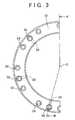
- FIG. 3 is a front view showing the structure of an annular set member that is fixed to a pump shell of the vehicular torque converter in FIG. 1 , in which half of the annular set member has been cut away;
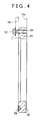
- FIG. 4 is a sectional view taken along line III-III in FIG. 3 , illustrating a through-groove formed in the annular set member.
- FIG. 1 is a sectional view of the structure of a torque converter 10 that is a vehicular fluid power transmitting device according to one example embodiment of the invention.
- FIG. 2 is an enlarged view of the vehicular torque converter in FIG. 1 inside of a housing, showing the torque converter 10 provided inside a cylindrical housing 8 of the vehicle.
- the torque converter 10 is provided with a pump impeller 12 , a turbine runner 14 , a lock-up clutch 16 , a one-way clutch 18 , and a stator 20 .
- the torque converter 10 multiplies torque input from a crankshaft 22 of an engine 21 that serves as a drive source, and outputs the multiplied torque from an input shaft 26 of a transmission 24 that serves as an output shaft of the torque converter 10 .
- the pump impeller 12 includes a disc-shaped front shell 12 a , a rear shell 12 b , a pump shell 12 c , and pump blades 12 d .
- the pump shell 12 c is connected to the crankshaft 22 of the engine 21 via a drive plate 32 and a damper device 34 . Also, the pump shell 12 c is rotated about an axis C at the same rotation speed as the crankshaft 22 .
- the plurality of pump blades 12 d are arranged overlapping each another in the circumferential direction inside of a radially outer portion of the rear shell 12 b .
- the turbine runner 14 includes a disc-shaped hub portion 14 a , a cylindrical shaft portion 14 b , a turbine shell 14 c , and turbine blades 14 d .
- the disc-shaped hub portion 14 a is spline-engaged with a shaft end portion of the input shaft 26 , and is relatively rotatably abutted against the front shell 12 a via a sliding ring 12 e (i.e., abutted against the front shell 12 a via the sliding ring 12 e in a manner so as to be able to rotate relative to the front shell 12 a ).
- the cylindrical shaft portion 14 b protrudes from the center of the hub portion 14 a and is spline-engaged with the shaft end portion of the input shaft 26 .
- the plurality of turbine blades 14 d are fixed to a radially outer portion of the hub portion 14 a , in a manner overlapping with each other in the circumferential direction and opposing the pump blades 12 d .
- the turbine runner 14 is provided so as to rotate, together with the input shaft 26 , about the axis C.
- the stator 20 includes a circular disc portion 20 a and a circular cylindrical portion 20 b .
- a radially outer portion of the circular disc portion 20 a constitutes stator blades 20 d .
- These stator blades 20 d are positioned between the pump blades 12 d of the pump impeller 12 and the turbine blades 14 d of the turbine runner 14 in the axial direction of the input shaft 26 .
- a radially inner portion of the stator 20 constitutes the circular cylindrical portion 20 b .
- the circular cylindrical portion 20 b is fitted with the one-way clutch 18 .
- the stator 20 is rotatably supported about the axis C via the one-way clutch 18 by a cylindrical fixed shaft 28 that is a non-rotatable member that is fixed to the housing 8 .
- a first thrust bearing 44 on a front side is interposed between the stator 20 and the hub portion 14 a of the turbine runner 14
- a second thrust bearing 46 on a rear side is interposed between the stator 20 and the rear shell 12 b. Therefore, the position of the stator 20 in the direction of the axis C is determined.
- the front side refers to the side that is relatively closer to the engine 21 in the direction along the axis C.
- the rear side refers to the side that is relatively closer to the transmission 24 in the direction along the axis C.
- the direction along the axis C may also be simply referred to as the “axial direction”. That is, the axial direction of the output shall of the torque converter 10 may also be regarded as the direction along the axis C.
- a partition wall 24 a is provided inside the housing 8 .
- the partition wall 24 a divides the housing 8 into a space in which the transmission 24 is housed and a space in which the torque converter 10 is housed.
- a hydraulic pump 30 is provided on this partition wall 24 a .
- the hydraulic pump 30 includes a pump body 30 a , a pump cover 30 b , an inner ring gear 30 c , and an outer ring gear 30 d .
- the pump body 30 a is fixed to the partition wall 24 a .
- the pump cover 30 b is fixed to the pump body 30 a .
- the inner ring gear 30 c and the outer ring gear 30 d are rotatably housed in a space formed between the pump body 30 a and the pump cover 30 b , and are in mesh with each other.
- a shaft end of a cylindrical shaft 12 f is engaged in a relatively non-rotatable manner with the inner ring gear 30 c , i.e., in a manner so as not to be able to rotate relative to the inner ring gear 30 c .
- the cylindrical shaft 12 f is arranged radially inward of the rear shell 12 b of the pump impeller and protrudes in the axial direction. As a result, the hydraulic pump 30 is rotatably driven by the engine 21 .
- the hydraulic pump 30 protrudes out from the partition wall 24 a in a conical shape in the axial direction toward the torque converter 10 side, i.e., the engine 21 side or the input side.
- the input shaft 26 protrudes out into the space in which the torque converter 10 is housed, and supports the torque converter 10 , in a state rotatably supported by the partition wall 24 a via a bearing, not shown.
- the rear shell 12 b of the pump impeller 12 constitutes a portion of the pump impeller 12 on the output side of the pump shell 12 c , i.e., on the side that is relatively close to the transmission 24 in the axial direction.
- the front shell 12 a constitutes a portion of the pump impeller 12 on the input side of the pump shell 12 c , i.e., on the side that is relatively close to the engine 21 in the axial direction.
- the output side or the transmission 24 side refers to the side relatively close to the transmission 24 in the axial direction.
- the input side or the engine 21 side refers to the side relatively close to the engine 21 in the axial direction.
- the radially outer portion of the rear shell 12 b and the radially outer portion of the front shell 12 a are offset so as to protrude toward the output side of the pump shell 12 c , i.e., the transmission 24 side. Therefore, the radially inner portion of the rear shell 12 b is concave-shaped toward the input side and receives a tip end portion of the pump body 30 a . That is, the tip end portion of the pump body 30 a overlaps in the radial direction with the radially outer portion of the rear shell 12 b . As a result, space is able to be utilized efficiently, so the dimension of the torque converter 10 in the direction of the axis C is short.
- the pump blades 12 d are also offset toward the output side.
- the pump blades 12 d are arranged on an inside wall surface of the radially outer portion of the rear shell 12 b that protrudes toward the transmission 24 side. Therefore, the stator blades 20 d and the turbine blades 14 d are also similarly offset toward the output side, i.e., the transmission 24 side, while maintaining a constant relative positional relationship with the pump blades 12 d .
- the circular disc portion 20 a of the stator 20 is formed in a conical shape. The radially outer portion of the circular disc portion 20 a is positioned closer to the transmission 24 than the circular cylindrical portion 20 b in the axial direction.
- stator blades 20 d are offset toward the output side of the torque converter 10 so as not to overlap in the radial direction with the one-way clutch 18 .
- the hub portion 14 a of the turbine runner 14 is formed in a conical shape. The radially outer portion of the hub portion 14 a overlaps in the radial direction with the one-way clutch 18 . Therefore, the turbine blades 14 d are offset toward the output side such that a portion of the turbine blades 14 d does not overlap in the radial direction with the one-way clutch 18 , and a portion of the turbine blades 14 d does overlap in the radial direction with the one-way clutch 18 .
- the lock-up clutch 16 includes a circular disc-shaped piston 16 a and an annular friction element 16 b .
- the radially center portion of the piston 16 a is slidably engaged with the radially outer surface of the cylindrical shaft portion 14 b that protrudes from the radially inner portion of the hub portion 14 a of the turbine runner 14 .
- the hub portion 14 a is relatively non-rotatably engaged with the shaft end portion of the input shaft 26 .
- the piston 16 a is relatively non-rotatably engaged with an engaging protrusion 14 e that protrudes from the turbine shell 14 c .
- the annular friction element 16 b is fixed to radially outer portion of the piston 16 a , or a portion of the inside of the front shell 12 a opposing the radially outer portion of the piston 16 a .
- the annular friction element 16 b directly connects the turbine runner 14 and the pump impeller 12 to each other by frictional force.
- the radially outer portion of the front shell 12 a constitutes a portion of the pump shell 12 c that is relatively close to the input side of the pump shell 12 c , i.e., the engine 21 side in the axial direction. In this configuration, the radially outer portion of the front shell 12 a is offset so as to protrude toward the output side, i.e., the transmission 24 side in the axial direction.
- the radially outer portion of the piston 16 a is also similarly offset so as to protrude toward the output side, i.e., the transmission 24 side in the axial direction, thus preventing interference with the front shell 12 a and the turbine runner 14 .
- the radially outer portions of the front shell 12 a and the piston 16 a of the lock-up clutch 16 are offset toward the output side in the axial direction, such that the radially outer portion of the piston 16 a and the friction element 16 b that is fixed thereto overlap in the radial direction with the one-way clutch 18 .
- the drive plate 32 that is fixed to the shaft end of the crankshaft 22 of the engine 21 includes a circular disc-shaped portion 32 a and a ring gear 32 b .
- the ring gear 32 b is fixed to a radially outer portion of the circular disc-shaped portion 32 a so as to be in mesh with a pinion of a stator motor, not shown.
- the damper device 34 is provided between this drive plate 32 and the front shell 12 a that forms a front portion of the pump shell 12 c.
- the damper device 34 includes a circular disc-shaped driven plate 38 and a damper shell 42 .
- a radially inner portion of the driven plate 38 is fixed to the front shell 12 a via a ring-shaped annular set member 35 that is concentric with the axis C.
- notches 38 a are formed in a plurality of locations at equidistant intervals in the radially outer portion of the driven plate 38 .
- the notches 38 a are open to the radially outer side so as to receive two types of damper springs, i.e., a large damper spring 36 a and a small damper spring 36 b .
- the large damper spring 36 a and the small damper spring 36 b are wound in coil-shapes such that the circumferential direction of the damper device 34 is a longitudinal direction of the large damper spring 36 a and the small damper spring 36 b , and are concentric with each other.
- the damper shell 42 is rotatably supported about the axis C via an annular bearing 40 by the annular set member 35 that is fixed to the front shell 12 a , as well as fixed to the circular disc-shaped portion 32 a of the drive plate 32 .
- the damper shell 42 includes circular columnar-shaped spaces that extend in the circumferential direction for receiving the pair of damper springs, i.e., the large damper spring 36 a and the small damper spring 36 b , so as to cover the outer peripheries thereof. These circular columnar-shaped spaces are formed in a plurality of locations at equidistant intervals in the circumferential direction. Pulsation of torque transmitted from the engine 21 is absorbed by the large damper spring 36 a and the small damper spring 36 b contracting in the circumferential direction, i.e., the longitudinal direction thereof, in response to an offset in the rotational phase between the driven plate 38 and the damper shell 42 .
- the damper shell 42 serves as a damper input member
- the driven plate 38 serves as a damper output member
- the annular bearing 40 serves as a bearing assembly
- the large damper spring 36 a and the small damper spring 36 b each serve as an elastic member.
- the damper shell 42 has the largest mass.
- the damper shell 42 is relatively rotatably supported via the annular bearing 40 by the annular set member 35 that is fixed to the front shell 12 a , such that the centering accuracy of this damper shell 42 is increased and vibration produced during rotation is consequently suppressed.
- the driven plate 38 is housed inside the damper shell 42 , and has a radially outer portion to which torque from the damper shell 42 is transmitted via the large damper spring 36 a and the small damper spring 36 b , and a radially inner portion that is fixed to an end surface on the drive source side of the annular set member 35 .
- the damper shell 42 has a radially outer portion 42 a and a cylindrical boss portion 42 b .
- the radially outer portion 42 a houses the large damper spring 36 a , the small damper spring 36 b , and the radially outer portion of the driven plate 38 .
- the cylindrical boss portion 42 b is curved so as to reach farther toward a radially inner side than the radially inner portion of the driven plate 38 .
- the annular bearing 40 is fitted in between the radially outer surface of the cylindrical boss portion 42 b and the radially inner surface of the annular set member 35 .
- an outer race of this annular bearing 40 is also fitted to the radially inner surface of the radially inner portion of the driven plate 38 , so the centering accuracy between the damper shell 42 and the driven plate 38 is also increased.
- the radially inner portion of the driven plate 38 is fastened to the annular set member 35 by set bolts 52 .
- the damper shell 42 has through-holes 42 c that are opposite, in the axial direction, the set bolts 52 .
- a tool for fastening the set bolts 52 passes through the through-holes 42 c .
- This kind of structure ensures mounting space on the radially outer side of the annular set member 35 regardless of the plate thickness of the driven plate 38 , and thus increases mountability of the damper device 34 .
- the radially outer portion of the driven plate 38 serves as a first radially outer portion
- the radially outer portion of the damper shell 42 serves as a second radially outer portion.
- the damper shell 42 is provided with a spring housing space S and a radially inner side opening K.
- the spring housing space S includes the plurality of circular columnar spaces described above and a communication space that communicates the plurality of circular columnar spaces with each other in the circumferential direction.
- the opening width in the axial direction of the radially inner side opening K is smaller than the diameter of the large damper spring 36 a .
- the radially inner side of the communication space is open to the radially inner side opening K.
- the radially outer portion of the driven plate 38 is fit into this opening K.
- a pair of spring steel seal members 50 that is fixed by rivets 48 on both sides of the driven plate 38 seals this opening K.
- a lubricant such as grease, for example, is filled into the spring housing space S.
- the radially outer portion of the front shell 12 a that constitutes the input side portion, i.e., the engine 21 side portion, of the pump shell 12 c is offset so as to protrude toward the output side, i.e., the transmission 24 side. Therefore, an annular space X is formed between the radially outer portion of the front shell 12 a and the drive plate 32 , on the input side of the front shell 12 a , i.e., on the engine 21 side.
- the damper device 34 is arranged in this annular space X.
- a center position PD of the damper device 34 in the direction of the axis C is positioned farther to the output side than the shaft end of the input shaft 26 .
- the center position PD passes through the center of the large damper spring 36 a and the small damper spring 36 b . Also, the center position PD is positioned farther to the output side than an end surface of the input side of the cylindrical shaft portion 14 b that is positioned on the radially inner portion of the turbine runner 14 . Furthermore, the center position PD is positioned farther to the output side than a tip end on the input side of the radially inner portion of the front shell 12 a .
- the damper device 34 is positioned so as to overlap in the radial direction with the shaft end portion of the input shaft 26 , the radially inner portion of the turbine runner 14 , i.e., the cylindrical shaft portion 14 b , and the radially inner portion of the front shell 12 a . Accordingly, the radially inner portion of the front shell 12 a that constitutes the input side portion of the pump shell 12 c protrudes farther toward the input side, i.e., the engine 21 side, than the radially outer portion of the front shell 12 a , and overlaps with almost the entire damper device 34 in the radial direction.
- the damper device 34 has good flexible damper performance, with a large torsion angle with respect to a change in torque. As a result of the damper device 34 having such good damper performance, torque vibration is able to be effectively reduced, so the engine 21 can be operated in a low speed, high load operating range with good combustion efficiency.
- the torque converter 10 when running in a locked-up (i.e., direct drive) state by the lock-up clutch 16 , the torque converter 10 is supported by the input shaft 26 via the piston 16 a and the turbine runner 14 .
- the damper device 34 overlaps with the input shaft 26 , so when a disturbance such as vibration is input, vibration of the damper device 34 is suppressed.
- the damper device 34 is able to be even more stably supported.
- the damper device 34 is positioned such that the center position PD in the direction of the axis C overlaps in the radial direction with the shaft end of the input shaft 26 and the cylindrical shaft portion 14 b of the turbine runner 14 . Therefore, good operability is able to be achieved during assembly when supporting the torque converter 10 and fitting the one-way clutch 18 and the input shaft 26 .
- FIG. 3 is a front view, from the engine 21 side, of the annular set member 35 that is fixed to the front shell 12 a by welding or the like.
- FIG. 4 is a sectional view taken along line III-III in FIG. 3 of a cross section of the annular set member 35 .
- a plurality of female threaded holes 54 are formed in (i.e., through) the annular set member 35 to fix the driven plate 38 to the front shell 12 a .
- the set bolts 52 that pass through the driven plate 38 are screwed into the female threaded holes 54 .
- a plurality of interference preventing holes 56 for preventing interference with the rivets 48 are formed as blind holes in the annular set member 35 .
- through-grooves 58 that extend through in the radial direction are formed in the surface on the front shell 12 a side of the annular set member 35 .
- the through-grooves 58 are formed in positions where the interference preventing holes 56 are formed.
- an annular space SS is formed by being surrounded by the radially inner surface of the annular set member 35 , the annular bearing 40 , and the front shell 12 a , and opens to the radially inner side.
- These through-grooves 58 serve as communication paths that discharge water collected in the annular space SS to the radially outer side by centrifugal force or gravity.
- the damper shell 42 that has the largest mass of all of the parts that make up the damper device 34 is relatively rotatably supported via the annular bearing 40 by the annular set member 35 that is fixed to the front shell 12 a . Therefore, the centering accuracy of the damper shell 42 is increased, so vibration produced during rotation is able to be suppressed.
- the driven plate 38 includes the radially outer portion that is housed inside the damper shell 42 , and the radially inner portion that is fixed to the end surface on the drive source side of the annular set member 35 .
- Torque from the damper shell 42 is transmitted via the large damper spring 36 a and the small damper spring 36 b to the radially outer portion of the driven plate 38 .
- the damper shell 42 includes the radially outer portion 42 a and the cylindrical boss portion 42 b .
- the radially outer portion 42 a houses the large damper spring 36 a , the small damper spring 36 b , and the radially outer portion of the driven plate 38 ,
- the cylindrical boss portion 42 b is curved so as to reach farther toward the radial inside than the radially inner portion of the driven plate 38 .
- the annular bearing 40 is fitted in between the radially outer surface of the cylindrical boss portion 42 b and the radially inner surface of the annular set member 35 . In this way, the annular bearing 40 is provided on the radially inner side of the annular set member 35 .
- mounting space on the radially outer side of the annular set member 35 can be ensured regardless of the plate thickness of the driven plate 38 , so mountability of the damper can be increased.
- the plurality of female threaded holes 54 that the plurality of set bolts 52 screw into are formed in the direction of the axis C in the annular set member 35 .
- the radially inner portion of the driven plate 38 is fastened to the annular set member 35 by the set bolts 52 .
- the damper shell 42 has the through-holes 42 c that are opposite the set bolts 52 . Therefore, mounting space on the radially outer side of the annular set member 35 can be ensured regardless of the plate thickness of the driven plate 38 , so mountability of the damper device 34 can be increased.
- the annular bearing 40 is fitted to the radially inner surface of the annular set member 35 , as well as fitted to the radially inner surface of the radially inner portion of the driven plate 38 . Therefore, the centering accuracy between the damper shell 42 and the driven plate 38 is able to be increased, so vibration of the vehicle is able to be further suppressed.
- the torque converter 10 is given as one example of the vehicular fluid power transmitting device, but the vehicular fluid power transmitting device may also be a fluid coupling.
- the annular bearing 40 that is formed by a ball bearing is used as the bearing assembly, but it may also be formed by a metal bearing or a roller bearing or the like.
- the damper device 34 has two types of damper springs, i.e., the large damper spring 36 a and the small damper spring 36 b , but it may also have one type or three types of damper springs. Also, the damper device 34 may have another structure or shape, e.g., the sizes and/or positions of the damper springs may be different.
- the blades 12 d of the pump impeller 12 , the blades 14 d of the turbine runner 14 , and the blades 20 d of the stator 20 are offset toward the output side.
- the offset amount does not necessarily have to be such that the blades 20 d of the stator 20 are offset to a position where they do not overlap with the one-way clutch 18 .
Landscapes
- Engineering & Computer Science (AREA)
- General Engineering & Computer Science (AREA)
- Mechanical Engineering (AREA)
- Arrangement Of Transmissions (AREA)
- Structures Of Non-Positive Displacement Pumps (AREA)
- Support Of The Bearing (AREA)
Abstract
Description
Claims (2)
Applications Claiming Priority (3)
| Application Number | Priority Date | Filing Date | Title |
|---|---|---|---|
| JP2011214878A JP5767067B2 (en) | 2011-09-29 | 2011-09-29 | Fluid transmission device for vehicles |
| JP2011-214878 | 2011-09-29 | ||
| PCT/IB2012/001864 WO2013045994A1 (en) | 2011-09-29 | 2012-09-25 | Vehicular fluid power transmitting device |
Publications (2)
| Publication Number | Publication Date |
|---|---|
| US20140255163A1 US20140255163A1 (en) | 2014-09-11 |
| US9551237B2 true US9551237B2 (en) | 2017-01-24 |
Family
ID=47018270
Family Applications (1)
| Application Number | Title | Priority Date | Filing Date |
|---|---|---|---|
| US14/348,124 Expired - Fee Related US9551237B2 (en) | 2011-09-29 | 2012-09-25 | Vehicular fluid power transmitting device |
Country Status (5)
| Country | Link |
|---|---|
| US (1) | US9551237B2 (en) |
| JP (1) | JP5767067B2 (en) |
| CN (1) | CN103906950B (en) |
| DE (1) | DE112012004081B4 (en) |
| WO (1) | WO2013045994A1 (en) |
Cited By (1)
| Publication number | Priority date | Publication date | Assignee | Title |
|---|---|---|---|---|
| US10393248B2 (en) | 2014-10-23 | 2019-08-27 | Valeo Embrayages | Hydrokinetic torque coupling device having turbine-piston lockup clutch, and related methods |
Families Citing this family (4)
| Publication number | Priority date | Publication date | Assignee | Title |
|---|---|---|---|---|
| KR101693988B1 (en) * | 2015-05-14 | 2017-01-09 | 현대자동차주식회사 | Apparatus for reducing vibration of vehicle |
| US10816068B2 (en) * | 2017-11-29 | 2020-10-27 | Schaeffler Technologies AG & Co. KG | Torque converter including stator and turbine assembly for limiting radial movement of the stator |
| CN108050224A (en) * | 2017-12-04 | 2018-05-18 | 陕西航天动力高科技股份有限公司 | A kind of automobile using fluid torque-converter for shortening axial dimension |
| JP7502944B2 (en) * | 2020-09-08 | 2024-06-19 | 株式会社エクセディ | Drive unit |
Citations (7)
| Publication number | Priority date | Publication date | Assignee | Title |
|---|---|---|---|---|
| JPH0550202U (en) | 1991-12-16 | 1993-07-02 | 株式会社ユニシアジェックス | Power transmission device |
| US5259191A (en) * | 1991-03-20 | 1993-11-09 | Mazda Motor Corporation | Torque converter |
| US6840041B2 (en) * | 2001-09-28 | 2005-01-11 | Jatco Ltd | Torque converter |
| JP2008075843A (en) | 2006-09-25 | 2008-04-03 | Mazda Motor Corp | Torque converter |
| JP2010084852A (en) | 2008-09-30 | 2010-04-15 | Toyota Motor Corp | Driving force transmitting device |
| US20100178172A1 (en) * | 2007-09-03 | 2010-07-15 | Toyota Jidosha Kabushiki Kaisha | Torque converter |
| JP2010255753A (en) | 2009-04-24 | 2010-11-11 | Toyota Motor Corp | Power transmission device |
Family Cites Families (10)
| Publication number | Priority date | Publication date | Assignee | Title |
|---|---|---|---|---|
| FR2618865B1 (en) * | 1987-07-29 | 1991-07-05 | Valeo | TORQUE DAMPING DEVICE |
| JPH04171340A (en) * | 1990-10-31 | 1992-06-18 | Toyota Motor Corp | Torsional vibration damper device for hydraulic transmission device |
| JP3243746B2 (en) * | 1991-04-30 | 2002-01-07 | 日産自動車株式会社 | Torsion damper |
| JP2582854Y2 (en) * | 1991-09-27 | 1998-10-15 | 株式会社ユニシアジェックス | Power transmission for automatic transmission |
| US5398562A (en) * | 1993-05-18 | 1995-03-21 | General Motors Corporation | Engine/transmission drive connection with bridging starter gear |
| IN189877B (en) * | 1997-08-04 | 2003-05-03 | Luk Lamellen & Kupplungsbau | |
| JP2002195378A (en) * | 2000-12-26 | 2002-07-10 | Exedy Corp | Lockup device for fluid type torque transmission device |
| DE102005034933A1 (en) * | 2005-07-27 | 2007-02-01 | Zf Friedrichshafen Ag | Connection arrangement for drive, clutch has axial securing device coaxial with drive output for limiting clutch mobility relative to drive, displacement arrangement axially fixed to part on drive output to protrude into stop working area |
| CN102177368B (en) * | 2008-10-10 | 2013-11-27 | 丰田自动车株式会社 | Fluid transmission device |
| CN101988569B (en) * | 2010-11-16 | 2013-02-27 | 浙江吉利汽车研究院有限公司 | Automobile dual-mass hydraulic torque converter |
-
2011
- 2011-09-29 JP JP2011214878A patent/JP5767067B2/en not_active Expired - Fee Related
-
2012
- 2012-09-25 DE DE112012004081.3T patent/DE112012004081B4/en not_active Expired - Fee Related
- 2012-09-25 CN CN201280047711.3A patent/CN103906950B/en not_active Expired - Fee Related
- 2012-09-25 US US14/348,124 patent/US9551237B2/en not_active Expired - Fee Related
- 2012-09-25 WO PCT/IB2012/001864 patent/WO2013045994A1/en not_active Ceased
Patent Citations (8)
| Publication number | Priority date | Publication date | Assignee | Title |
|---|---|---|---|---|
| US5259191A (en) * | 1991-03-20 | 1993-11-09 | Mazda Motor Corporation | Torque converter |
| JPH0550202U (en) | 1991-12-16 | 1993-07-02 | 株式会社ユニシアジェックス | Power transmission device |
| US6840041B2 (en) * | 2001-09-28 | 2005-01-11 | Jatco Ltd | Torque converter |
| JP2008075843A (en) | 2006-09-25 | 2008-04-03 | Mazda Motor Corp | Torque converter |
| US20100178172A1 (en) * | 2007-09-03 | 2010-07-15 | Toyota Jidosha Kabushiki Kaisha | Torque converter |
| JP2010084852A (en) | 2008-09-30 | 2010-04-15 | Toyota Motor Corp | Driving force transmitting device |
| US20110195795A1 (en) | 2008-09-30 | 2011-08-11 | Toyota Jidosha Kabushiki Kaisha | Driving force transmission apparatus |
| JP2010255753A (en) | 2009-04-24 | 2010-11-11 | Toyota Motor Corp | Power transmission device |
Cited By (1)
| Publication number | Priority date | Publication date | Assignee | Title |
|---|---|---|---|---|
| US10393248B2 (en) | 2014-10-23 | 2019-08-27 | Valeo Embrayages | Hydrokinetic torque coupling device having turbine-piston lockup clutch, and related methods |
Also Published As
| Publication number | Publication date |
|---|---|
| DE112012004081B4 (en) | 2017-01-05 |
| DE112012004081T5 (en) | 2014-07-10 |
| JP2013076417A (en) | 2013-04-25 |
| JP5767067B2 (en) | 2015-08-19 |
| CN103906950B (en) | 2016-10-12 |
| US20140255163A1 (en) | 2014-09-11 |
| WO2013045994A1 (en) | 2013-04-04 |
| CN103906950A (en) | 2014-07-02 |
Similar Documents
| Publication | Publication Date | Title |
|---|---|---|
| US10288158B2 (en) | Fluid transmission device for vehicle | |
| RU2640938C2 (en) | Hydrodynamic coupling | |
| US10174823B2 (en) | Vibration reduction device | |
| KR101529727B1 (en) | A fluid dynamic coupling device comprising a friction disk supported by a rotating coupling element of a turbine wheel and a damper plate | |
| US20140255163A1 (en) | Vehicular fluid power transmitting device | |
| US9435389B2 (en) | Vehicular fluid power transmitting device | |
| JP6176997B2 (en) | Torque converter lockup device | |
| US9695797B2 (en) | Vehicular fluid power transmitting device | |
| US9303746B2 (en) | Vehicular torque converter | |
| JP2012077810A (en) | Hydraulic transmission apparatus and method of manufacturing the same | |
| JP6344326B2 (en) | Fluid transmission device | |
| JP5642647B2 (en) | Fluid transmission device for vehicles | |
| WO2012144009A1 (en) | Vehicle torque converter | |
| JP2017114436A (en) | Vehicular driving device | |
| JP2012167788A (en) | Device for reducing torsional vibration | |
| JP2013072541A (en) | Torque variation absorbing apparatus | |
| JP2017116058A (en) | Drive unit for vehicle |
Legal Events
| Date | Code | Title | Description |
|---|---|---|---|
| AS | Assignment |
Owner name: TOYOTA JIDOSHA KABUSHIKI KAISHA, JAPAN Free format text: ASSIGNMENT OF ASSIGNORS INTEREST;ASSIGNORS:YAMASHITA, TOSHIYA;ITAZU, NAOKI;NAKASHIMA, YOICHI;AND OTHERS;SIGNING DATES FROM 20140217 TO 20140314;REEL/FRAME:032826/0798 Owner name: EXEDY CORPORATION, JAPAN Free format text: ASSIGNMENT OF ASSIGNORS INTEREST;ASSIGNORS:YAMASHITA, TOSHIYA;ITAZU, NAOKI;NAKASHIMA, YOICHI;AND OTHERS;SIGNING DATES FROM 20140217 TO 20140314;REEL/FRAME:032826/0798 Owner name: AISIN AW CO., LTD., JAPAN Free format text: ASSIGNMENT OF ASSIGNORS INTEREST;ASSIGNORS:YAMASHITA, TOSHIYA;ITAZU, NAOKI;NAKASHIMA, YOICHI;AND OTHERS;SIGNING DATES FROM 20140217 TO 20140314;REEL/FRAME:032826/0798 |
|
| STCF | Information on status: patent grant |
Free format text: PATENTED CASE |
|
| MAFP | Maintenance fee payment |
Free format text: PAYMENT OF MAINTENANCE FEE, 4TH YEAR, LARGE ENTITY (ORIGINAL EVENT CODE: M1551); ENTITY STATUS OF PATENT OWNER: LARGE ENTITY Year of fee payment: 4 |
|
| FEPP | Fee payment procedure |
Free format text: MAINTENANCE FEE REMINDER MAILED (ORIGINAL EVENT CODE: REM.); ENTITY STATUS OF PATENT OWNER: LARGE ENTITY |
|
| LAPS | Lapse for failure to pay maintenance fees |
Free format text: PATENT EXPIRED FOR FAILURE TO PAY MAINTENANCE FEES (ORIGINAL EVENT CODE: EXP.); ENTITY STATUS OF PATENT OWNER: LARGE ENTITY |
|
| STCH | Information on status: patent discontinuation |
Free format text: PATENT EXPIRED DUE TO NONPAYMENT OF MAINTENANCE FEES UNDER 37 CFR 1.362 |
|
| FP | Lapsed due to failure to pay maintenance fee |
Effective date: 20250124 |