US9532282B2 - Home nodeB (HNB) mobility in a cell forward access channel (Cell—FACH)state - Google Patents
Home nodeB (HNB) mobility in a cell forward access channel (Cell—FACH)state Download PDFInfo
- Publication number
- US9532282B2 US9532282B2 US13/162,690 US201113162690A US9532282B2 US 9532282 B2 US9532282 B2 US 9532282B2 US 201113162690 A US201113162690 A US 201113162690A US 9532282 B2 US9532282 B2 US 9532282B2
- Authority
- US
- United States
- Prior art keywords
- wtru
- cell
- extended
- fach
- measurement occasion
- Prior art date
- Legal status (The legal status is an assumption and is not a legal conclusion. Google has not performed a legal analysis and makes no representation as to the accuracy of the status listed.)
- Active
Links
Images




Classifications
-
- H—ELECTRICITY
- H04—ELECTRIC COMMUNICATION TECHNIQUE
- H04W—WIRELESS COMMUNICATION NETWORKS
- H04W36/00—Hand-off or reselection arrangements
- H04W36/0005—Control or signalling for completing the hand-off
- H04W36/0083—Determination of parameters used for hand-off, e.g. generation or modification of neighbour cell lists
- H04W36/0085—Hand-off measurements
- H04W36/0088—Scheduling hand-off measurements
-
- H—ELECTRICITY
- H04—ELECTRIC COMMUNICATION TECHNIQUE
- H04W—WIRELESS COMMUNICATION NETWORKS
- H04W36/00—Hand-off or reselection arrangements
- H04W36/34—Reselection control
- H04W36/36—Reselection control by user or terminal equipment
-
- H—ELECTRICITY
- H04—ELECTRIC COMMUNICATION TECHNIQUE
- H04W—WIRELESS COMMUNICATION NETWORKS
- H04W8/00—Network data management
- H04W8/02—Processing of mobility data, e.g. registration information at HLR [Home Location Register] or VLR [Visitor Location Register]; Transfer of mobility data, e.g. between HLR, VLR or external networks
-
- H—ELECTRICITY
- H04—ELECTRIC COMMUNICATION TECHNIQUE
- H04W—WIRELESS COMMUNICATION NETWORKS
- H04W84/00—Network topologies
- H04W84/02—Hierarchically pre-organised networks, e.g. paging networks, cellular networks, WLAN [Wireless Local Area Network] or WLL [Wireless Local Loop]
- H04W84/04—Large scale networks; Deep hierarchical networks
- H04W84/042—Public Land Mobile systems, e.g. cellular systems
- H04W84/045—Public Land Mobile systems, e.g. cellular systems using private Base Stations, e.g. femto Base Stations, home Node B
-
- H—ELECTRICITY
- H04—ELECTRIC COMMUNICATION TECHNIQUE
- H04W—WIRELESS COMMUNICATION NETWORKS
- H04W88/00—Devices specially adapted for wireless communication networks, e.g. terminals, base stations or access point devices
- H04W88/02—Terminal devices
-
- H—ELECTRICITY
- H04—ELECTRIC COMMUNICATION TECHNIQUE
- H04W—WIRELESS COMMUNICATION NETWORKS
- H04W88/00—Devices specially adapted for wireless communication networks, e.g. terminals, base stations or access point devices
- H04W88/08—Access point devices
Definitions
- HNB mobility in UTRAN R9 may apply in cases when a wireless transmit/receive unit (WTRU) (also referred to herein as user equipment (UE)) is in either an idle or connected mode.
- WTRU wireless transmit/receive unit
- UE user equipment
- the WTRU may move into (or out of) an HNB by performing cell reselection that may need to fulfill several criteria, which may include signal strength and membership status.
- the WTRU may know whether or not it is a member of a closed subscriber group (CSG) cell or hybrid cell to which a HNB belongs by comparing a CSG identity (CSG ID) that it has in its whitelist with the CSG ID that is broadcast by a CSG cell.
- CSG closed subscriber group
- the WTRU may be handed over to an HNB based on possible proximity indications and measurement reporting.
- a proximity indication (which may indicate that the WTRU is entering or leaving a location where a CSG cell or hybrid cell may exist)
- the WTRU may first be configured to do so via radio resource control (RRC) messaging.
- RRC radio resource control
- the WTRU sends a proximity indication the NB may send a request to the WTRU to perform measurements on certain cells and may read and report the CSG ID from the cell and whether the WTRU is a member or not.
- a WTRU transmitting in Cell_FACH typically does not perform measurement reporting to a base station (e.g., NB or HNB).
- the WTRU may still measure other cells (e.g., inter-frequency or inter-RAT) for example for the purpose of performing cell reselection.
- the WTRU if it reselects to another cell, may then perform a cell update procedure for example to let a UTRAN know about its new location at the cell level as the WTRU can receive user plane and control plane data in Cell_FACH.
- the WTRU can perform a cell update procedure (e.g., upon expiration of a periodic cell update timer).
- the WTRU In order to perform measurements in Cell_FACH, the WTRU typically makes use of occasions during which no data will be sent to the WTRU—known as FACH measurement occasions.
- FACH measurement occasions typically have a fixed length that is a multiple of 10 milliseconds and are repeated according to some parameters that are known to the WTRU.
- a WTRU may need to read the MIB and SIB3 of a HNB for the purpose of identifying the CSG ID and thereafter verify if it is a member or not (based on comparison with the IDs in the WTRU's whitelist).
- Two problems that may arise are: (1) the FACH measurement occasions may not be long enough for the WTRU to read the MIB and/or SIB3 of the target cell in the other frequency or RAT; and (2) the FACH measurement occasion may not coincide with the time that the MIB and/or SIB3 of the (potential) target HNB are broadcasted.
- the WTRU may autonomously choose to prolong its measurement occasions in order to acquire the MIB/SIB3 of the HNB cell, it may lose data while doing so since the HNB in the source cell may be unaware of the WTRU's absence.
- Another difficulty associated with Cell_FACH mobility involves the procedure of fetching a WTRU's context by a target HNB (i.e., from the source HNB, both of which are connected to the same HNB gateway (HNB-GW)). This difficulty may arise due to the assignment of the same U-RNTI to two or more WTRUs by different HNBs that are connected to the same HNB GW.
- the contents of the U-RNTI may include a radio network controller identifier (RNC ID) and the serving RNTI (S-RNTI).
- RNC ID is the HNB GW's identity.
- the S-RNTI is allocated by the HNB.
- the target HNB may initially contact the HNB GW and may then provide the U-RNTI of the WTRU in question.
- the HNB GW may then try to map a context ID based on the provided U-RNTI. However, if two or more WTRUs have the same U-RNTI, then the HNB GW may get two context IDs, one for each of the WTRUs that is allocated to the same U-RNTI. At this point, the HNB GW/target HNB may not fetch the appropriate context of the WTRU due to the non-uniqueness of the U-RNTI.
- NCLs neighbor cell lists
- a method may be implemented at WTRU. The method may include determining whether to communicate an indication to a network node for extended measurement occasion. Further, the method may include communicating the indication to the network node in response to determining to communicate the indication.
- FIG. 2 is a system diagram of an example WTRU, e.g., a UE, that may be used within the communications system illustrated in FIG. 1 ;
- WTRU e.g., a UE
- FIG. 5 is a flow chart of an example method of handling a neighbor cell list in accordance with embodiments of the present disclosure.
- the HNB may require query of the core network (CN) to perform access control.
- CN core network
- systems and methods are provided for querying the CN to perform access control outside of a typical HO procedure. Furthermore, it may be needed to perform cell reselection that is transparent to the CN. Disclosed herein are systems and methods for ensuring that the WTRU has membership to the CSG of the target HNB in a manner that does not require CN involvement.
- the WTRUs 102 a , 102 b , 102 c , 102 d may be configured to transmit and/or receive wireless signals and may include user equipment (UE), a mobile station, a fixed or mobile subscriber unit, a pager, a cellular telephone, a personal digital assistant (PDA), a smartphone, a laptop, a netbook, a personal computer, a wireless sensor, consumer electronics, and the like.
- UE user equipment
- PDA personal digital assistant
- smartphone a laptop
- netbook a personal computer
- a wireless sensor consumer electronics, and the like.
- the base station 114 a may be part of the RAN 104 , which may also include other base stations and/or network elements (not shown), such as a base station controller (BSC), a radio network controller (RNC), relay nodes, etc.
- BSC base station controller
- RNC radio network controller
- the base station 114 a and/or the base station 114 b may be configured to transmit and/or receive wireless signals within a particular geographic region, which may be referred to as a cell (not shown).
- the cell may further be divided into cell sectors.
- the cell associated with the base station 114 a may be divided into three sectors.
- the base station 114 a may include three transceivers, i.e., one for each sector of the cell.
- the base station 114 a may employ multiple-input multiple output (MIMO) technology and, therefore, may utilize multiple transceivers for each sector of the cell.
- MIMO multiple-input multiple output
- the communications system 100 may be a multiple access system and may employ one or more channel access schemes, such as CDMA, TDMA, FDMA, OFDMA, SC-FDMA, and the like.
- the base station 114 a in the RAN 104 and the WTRUs 102 a , 102 b , 102 c may implement a radio technology such as Universal Mobile Telecommunications System (UMTS) Terrestrial Radio Access (UTRA), which may establish the air interface 116 using wideband CDMA (WCDMA).
- WCDMA may include communication protocols such as High-Speed Packet Access (HSPA) and/or Evolved HSPA (HSPA+).
- HSPA may include High-Speed Downlink Packet Access (HSDPA) and/or High-Speed Uplink Packet Access (HSUPA).
- the base station 114 a and the WTRUs 102 a , 102 b , 102 c may implement a radio technology such as Evolved UMTS Terrestrial Radio Access (E-UTRA), which may establish the air interface 116 using Long Term Evolution (LTE) and/or LTE-Advanced (LTE-A).
- E-UTRA Evolved UMTS Terrestrial Radio Access
- LTE Long Term Evolution
- LTE-A LTE-Advanced
- the base station 114 b in FIG. 1 may be a wireless router, Home Node B, Home eNode B, or access point, for example, and may utilize any suitable RAT for facilitating wireless connectivity in a localized area, such as a place of business, a home, a vehicle, a campus, and the like.
- the base station 114 b and the WTRUs 102 c , 102 d may implement a radio technology such as IEEE 802.11 to establish a wireless local area network (WLAN).
- the base station 114 b and the WTRUs 102 c , 102 d may implement a radio technology such as IEEE 802.15 to establish a wireless personal area network (WPAN).
- WPAN wireless personal area network
- the base station 114 b and the WTRUs 102 c , 102 d may utilize a cellular-based RAT (e.g., WCDMA, CDMA2000, GSM, LTE, LTE-A, etc.) to establish a picocell or femtocell.
- a cellular-based RAT e.g., WCDMA, CDMA2000, GSM, LTE, LTE-A, etc.
- the base station 114 b may have a direct connection to the Internet 110 .
- the base station 114 b may not be required to access the Internet 110 via the core network 106 .
- the core network 106 may also serve as a gateway for the WTRUs 102 a , 102 b , 102 c , 102 d to access the PSTN 108 , the Internet 110 , and/or other networks 112 .
- the PSTN 108 may include circuit-switched telephone networks that provide plain old telephone service (POTS).
- POTS plain old telephone service
- the Internet 110 may include a global system of interconnected computer networks and devices that use common communication protocols, such as the transmission control protocol (TCP), user datagram protocol (UDP) and the internet protocol (IP) in the TCP/IP internet protocol suite.
- the networks 112 may include wired or wireless communications networks owned and/or operated by other service providers.
- the networks 112 may include another core network connected to one or more RANs, which may employ the same RAT as the RAN 104 or a different RAT.
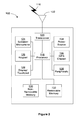
- FIG. 2 is a system diagram of an example WTRU 102 .
- the WTRU 102 may include a processor 118 , a transceiver 120 , a transmit/receive element 122 , a speaker/microphone 124 , a keypad 126 , a display/touchpad 128 , non-removable memory 130 , removable memory 132 , a power source 134 , a global positioning system (GPS) chipset 136 , and other peripherals 138 .
- GPS global positioning system
- the processor 118 may be a general purpose processor, a special purpose processor, a conventional processor, a digital signal processor (DSP), a plurality of microprocessors, one or more microprocessors in association with a DSP core, a controller, a microcontroller, Application Specific Integrated Circuits (ASICs), Field Programmable Gate Array (FPGAs) circuits, any other type of integrated circuit (IC), a state machine, and the like.
- the processor 118 may perform signal coding, data processing, power control, input/output processing, and/or any other functionality that enables the WTRU 102 to operate in a wireless environment.
- the processor 118 may be coupled to the transceiver 120 , which may be coupled to the transmit/receive element 122 . While FIG. 2 depicts the processor 118 and the transceiver 120 as separate components, it will be appreciated that the processor 118 and the transceiver 120 may be integrated together in an electronic package or chip.
- the transmit/receive element 122 may be configured to transmit signals to, or receive signals from, a base station (e.g., the base station 114 a ) over the air interface 116 .
- a base station e.g., the base station 114 a
- the transmit/receive element 122 may be an antenna configured to transmit and/or receive RF signals.
- the transmit/receive element 122 may be an emitter/detector configured to transmit and/or receive IR, UV, or visible light signals, for example.
- the transmit/receive element 122 may be configured to transmit and receive both RF and light signals. It will be appreciated that the transmit/receive element 122 may be configured to transmit and/or receive any combination of wireless signals.
- the transceiver 120 may be configured to modulate the signals that are to be transmitted by the transmit/receive element 122 and to demodulate the signals that are received by the transmit/receive element 122 .
- the WTRU 102 may have multi-mode capabilities.
- the transceiver 120 may include multiple transceivers for enabling the WTRU 102 to communicate via multiple RATs, such as UTRA and IEEE 802.11, for example.
- the processor 118 of the WTRU 102 may be coupled to, and may receive user input data from, the speaker/microphone 124 , the keypad 126 , and/or the display/touchpad 128 (e.g., a liquid crystal display (LCD) display unit or organic light-emitting diode (OLED) display unit).
- the processor 118 may also output user data to the speaker/microphone 124 , the keypad 126 , and/or the display/touchpad 128 .
- the processor 118 may access information from, and store data in, any type of suitable memory, such as the non-removable memory 130 and/or the removable memory 132 .
- the non-removable memory 130 may include random-access memory (RAM), read-only memory (ROM), a hard disk, or any other type of memory storage device.
- the removable memory 132 may include a subscriber identity module (SIM) card, a memory stick, a secure digital (SD) memory card, and the like.
- SIM subscriber identity module
- SD secure digital
- the processor 118 may access information from, and store data in, memory that is not physically located on the WTRU 102 , such as on a server or a home computer (not shown).
- the processor 118 may receive power from the power source 134 , and may be configured to distribute and/or control the power to the other components in the WTRU 102 .
- the power source 134 may be any suitable device for powering the WTRU 102 .
- the power source 134 may include one or more dry cell batteries (e.g., nickel-cadmium (NiCd), nickel-zinc (NiZn), nickel metal hydride (NiMH), lithium-ion (Li-ion), etc.), solar cells, fuel cells, and the like.
- the processor 118 may also be coupled to the GPS chipset 136 , which may be configured to provide location information (e.g., longitude and latitude) regarding the current location of the WTRU 102 .
- location information e.g., longitude and latitude
- the WTRU 102 may receive location information over the air interface 116 from a base station (e.g., base stations 114 a , 114 b ) and/or determine its location based on the timing of the signals being received from two or more nearby base stations. It will be appreciated that the WTRU 102 may acquire location information by way of any suitable location-determination method while remaining consistent with an embodiment.
- the processor 118 may further be coupled to other peripherals 138 , which may include one or more software and/or hardware modules that provide additional features, functionality and/or wired or wireless connectivity.
- the peripherals 138 may include an accelerometer, an e-compass, a satellite transceiver, a digital camera (for photographs or video), a universal serial bus (USB) port, a vibration device, a television transceiver, a hands free headset, a BLUETOOTH® module, a frequency modulated (FM) radio unit, a digital music player, a media player, a video game player module, an Internet browser, and the like.
- an accelerometer an e-compass, a satellite transceiver, a digital camera (for photographs or video), a universal serial bus (USB) port, a vibration device, a television transceiver, a hands free headset, a BLUETOOTH® module, a frequency modulated (FM) radio unit, a digital music player, a media player, a video game
- FIG. 3 is a system diagram of the RAN 104 and the core network 106 according to an embodiment.
- the RAN 104 may employ a UTRA radio technology to communicate with the WTRUs 102 a , 102 b , 102 c over the air interface 116 .
- the RAN 104 may also be in commuication with the core network 106 .
- the RAN 104 may include Node-Bs 140 a , 140 b , 140 c , which may each include one or more transceivers for communicating with the WTRUs 102 a , 102 b , 102 c over the air interface 116 .
- the Node-Bs 140 a , 140 b may be in communication with the RNC 142 a .
- the Node-B 140 c may be in communication with the RNC 142 b .
- the Node-Bs 140 a , 140 b , 140 c may communicate with respective RNCs 142 a , 142 b via an Iub interface.
- the RNCs 142 a , 142 b may be in communication with one another via an Iur interface.
- Each of the RNCs 142 a , 142 b may be configured to control the respective Node-Bs 140 a , 140 b , 140 c to which it is connected.
- each of the RNCs 142 a , 142 b may be configured to carry out or support other functionality, such as outer loop power control, load control, admission control, packet scheduling, handover control, macrodiversity, security functions, data encryption, and the like.
- the core network 106 shown in FIG. 3 may include a media gateway (MGW) 144 , a mobile switching center (MSC) 146 , a serving GPRS support node (SGSN) 148 , and/or a gateway GPRS support node (GGSN) 150 . While each of the foregoing elements are depicted as part of the core network 106 , it will be appreciated that any one of these elements may be owned and/or operated by an entity other than the core network operator.
- MGW media gateway
- MSC mobile switching center
- SGSN serving GPRS support node
- GGSN gateway GPRS support node
- the RNC 142 a in the RAN 104 may be connected to the MSC 146 in the core network 106 via an IuCS interface.
- the MSC 146 may be connected to the MGW 144 .
- the MSC 146 and the MGW 144 may provide the WTRUs 102 a , 102 b , 102 c with access to the circuit-switched networks, such as the PSTN 108 , to facilitate communications between the WTRUs 102 a , 102 b , 102 c and traditional land-line communications devices.
- the core network 106 may also be connected to the networks 112 , which may include other wired or wireless networks that are owned and/or operated by other service providers.
- FIG. 4 illustrates a flow chart of an example method of sending an indication to a network for one or more extended measurement occasions in accordance with embodiments of the present disclosure.
- the method of FIG. 4 may be implemented by suitable WTRU such as the WTRU shown in FIG. 2 .
- the method may include determining whether to communicate an indication to a network node for extended measurement occasion (step 400 ).
- the processor 118 may implement instructions for determining whether to communicate an indication to a network node for one or more extended measurement occasions.
- One or more events configurations, and the like disclosed herein may act as triggers for the WTRU to determine to communicate the indication to the network node.
- the method of FIG. 4 may also include communicating the indication to the network node in response to determining to communicate the indication (step 402 ).
- the processor 118 may implement instructions to control the transmit/receive element 122 to communicate a message to the base station that contains the indication for an extended measurement occasion. The message may be communicated to any network node servicing the WTRU.
- the method of FIG. 4 may include receiving an indication from the WTRU for extended measurement occasion (step 404 ).
- the base station 114 a may receive a message from the WTRU 102 a that contains an indication for one or more extended measurement occasions for the WTRU 102 a .
- the message may include an identifier of the WTRU 102 a.
- the method of FIG. 4 may include preventing traffic from being sent to the WTRU in response to receiving the indication (step 406 ).
- the base station 114 a shown in FIG. 1 may include one or more processors for determining that a received message includes an indication for one or more measurement occasions for a WTRU. In response to receipt of the message, the base station 114 a may prevent communications from being sent to the WTRU.
- Example events, configurations, and the like that may act as triggers to thereby cause a WTRU to send an indication to the network node for one or more extended measurement occasions are described in this section.
- a WTRU may be configured to send such indications while in a Cell_FACH state.
- Such configuration can be implemented via dedicated (RRC) signaling (note that the actual type of indication may be, e.g., a proximity indication, a cell update, etc., as described in more detail herein. It is noted that the indications described herein may be applied to any type of actual indications sent).
- the indications may be part of handover (HO) messages, e.g., during both intra-UTRAN and inter-RAT HO from a GSM EDGE radio access network (GERAN)/E-UTRAN.
- HO handover
- triggering can occur in response to a request to perform a manual CSG scan and selection while in the Cell_FACH mode.
- triggering can occur in response to a determination that the WTRU is in close proximity of a CSG cell or hybrid cell that is in the WTRU's whitelist and upon detection of a suitable cell on the corresponding other frequency.
- the WTRU may use the FACH measurement occasions or any other type of measurement occasions, such as discontinuous reception (DRX) to measure the channel quality of the primary scrambling code (PSC) on the other frequency or RAT. If a suitable cell is found on that frequency and the WTRU determines that it is in proximity, the WTRU may send the indication to the network.
- DRX discontinuous reception
- PSC primary scrambling code
- a WTRU may send a cell update message to a source network node as an indication. This message may be sent even if the periodic cell update timer has not expired, but one or more of the above-mentioned triggers have been met.
- the message may include a new update cause, e.g. a proximity indication in Cell_FACH on another frequency or RAT.
- an RRC message may be sent to a network node for providing indication in Cell_FACH.
- a source node/network may respond to an indication from an WTRU with an acknowledgement as disclosed herein.
- the response can either be positive (i.e., the WTRU is allowed to perform extended measurements) or negative (i.e., the WTRU should keep using the current measurement occasions).
- the response may be based on, for example, the network node having downlink data for the WTRU.
- the network node may include the extended time that the WTRU can use for measurement in Cell_FACH.
- This time can be interpreted as the total time allotted or the extended time that is allotted in addition to the current measurement occasion length.
- Such details of how the time is interpreted by the WTRU may be preconfigured in the WTRU.
- the time can be in the form of an integer which can be interpreted by the WTRU as a multiple of a preconfigured time interval or a multiple of the WTRU's current measurement duration.
- the WTRU can apply an extended measurement occasion based on an FACH measurement occasion cycle length coefficient that is broadcast by the cell. Even though it is broadcast, the WTRU may not apply the coefficient until the WTRU receives a positive response, or the WTRU may apply the coefficient if it has successfully sent an indication to the source HNB/RNC, for example, as per a lower layer acknowledgement.
- the coefficient can be transmitted, for example, as part of SIB11 or SIB12 and it can, for example, be used such that it is first added to the current measurement coefficient and the result can then be used to calculate the extended period. In another example, the product of the coefficient and the current FACH measurement occasion length may be used as the extended occasion.
- the network may indicate an extended measurement occasion as suggested from the WTRU.
- a suggested extended measurement occasion can be included by the WTRU based, for example, on one or more prior attempts to read the MIB/SIB3 of a potential target HNB/CSG/hybrid cell.
- the FACH measurement occasion cycle length coefficient or the actual length of the extended period can also be communicated to the WTRU in a response sent to the WTRU, for example, as part of a cell update confirm message or any other response message that acknowledges the WTRU's extended measurement occasion request.
- the above-described actions and/or responses from the network to indications from a WTRU can take the form of any RRC message such as a cell update confirm, a cell update reject, a new RRC message, a measurement configuration message, and the like, which may be used as a positive or negative response accordingly.
- RRC message such as a cell update confirm, a cell update reject, a new RRC message, a measurement configuration message, and the like, which may be used as a positive or negative response accordingly.
- a WTRU's list of CSG cells may be modified such that the operator CSG list (OCL) is empty, so the allowed CSG list (ACL) is empty, or both.
- OCL operator CSG list
- ACL allowed CSG list
- a WTRU may be informed that the use of the ACL and/or the OCL is prohibited.
- a WTRU may receive a request, for example, from upper layers to go to a connected mode for uplink user data.
- a WTRU may have a data volume report to send, for example, if the traffic load on the current cell is above a threshold.
- the WTRU may determine that it is not a member of a HNB as part of the SIB3 reading during an extended measurement occasion, where N is an integer that has either a default value or can be preconfigured with signaling.
- a WTRU may stop performing extended FACH measurement occasions after a predefined period of time expires and the WTRU has not been able to find a cell which is in the WTRU's whitelist.
- the timer may be predefined or configured by the network.
- a WTRU may determine that it is leaving the proximity of the home NodeB cell.
- a WTRU may receive an earthquake and tsunami warning system (ETWS) PRIMARY NOTIFICATION WITH SECURITY over a FACH or an enhanced FACH (HS-DSCH) channel as a trigger.
- EWS earthquake and tsunami warning system
- a WTRU may receive a system information change indication message (with ETWS information and the change of SIBs).
- a WTRU may be triggered on determining that it is leaving proximity of the home NodeB cell.
- a WTRU may report that it will not send indications for extended FACH measurements if it was expected, required, requested, or configured to do so, for example, as described in suitable example provided herein.
- the WTRU can send such notification if it is no longer within HNB coverage, for example, as per its fingerprint information, or if, for example, the WTRU needs to build a new fingerprint data base and the like.
- a WTRU may take one or more actions in response to the WTRU being handed over, for example, in Cell_DCH, or performs cell reselection in Cell_FACH or any other state.
- a WTRU may indicate to the target HNB/RNC the status of sending the proposed indication in the source HNB/RNC.
- the WTRU may include a status such as a part of the handover complete message that is sent to the target HNB/RNC. It is noted that the handover complete refers to any message that is sent after a handover, for example, an active set update complete.
- a WTRU may continue with the configuration, for example, the normal or extended measurement occasion that it had in the source HNB/RNC if, for example, it has not received a new configuration or indication about whether or not it is allowed to send such indications. Moreover, if the sending of the indication is guarded by a timer, as described above, the WTRU may optionally reset the timer upon handover or reselection.
- the network may provide a configuration of a WTRU to a target HNB/RNC.
- the WTRU may reselect and send a cell update message to that cell if the WTRU is not a member of that CSG cell.
- the WTRU may actually be a member of that cell but does not have the CSG ID in its whitelist due to an unsynchronized membership list between the WTRU and the network.
- the WTRU can, in addition to sending a cell update, send a NAS message, such as a routing or location area update message, in order to know whether it is a member of a particular CSG or not, for example, based on the response it gets from the core network.
- a new cell update cause may be introduced for this purpose and the HNB can then either perform an access check itself or request the membership status from the core network, for example, an SGSN, and then reject or accept the request based on this membership information.
- a new reject cause may be introduced for the cell update reject to inform the WTRU that the reason of rejection is due to membership status. If the cell update is accepted, the WTRU may then add the CSG ID to its whitelist.
- the WTRU may send an indication to the network (at the RRC or NAS layer, or both) to indicate that extended FACH measurement occasions are supported by the WTRU. This can be done at initial access to the system, for example, at first attach, or at handover, or at every connection establishment and/or certain connection establishment, and the like.
- a WTRU in CELL_FACH when a WTRU in CELL_FACH performs a cell update, e.g., for causes stated in 3GPP TS 25.331-V9.2.0, for the scenarios where the cell is a CSG cell, the cell may proceed to query the CN for an access control. Similarly, if the cell is a hybrid cell, the cell may proceed to query the CN for membership status verification.
- the CSG cell or the hybrid cell may query the CN for an access control or membership verification respectively for a subset of the causes leading a WTRU in CELL_FACH mode to perform a cell update.
- the CSG cell may query the CN for access control if the cause of the cell update is cell reselection or re-entering service area.
- the cause of the cell update is cell reselection or re-entering service area.
- access control may be needed since the WTRU may not be a member of the new CSG cell.
- access control may be required since the WTRU's membership to the CSG cell may have expired while the WTRU was out of service.
- a cell update message may be modified to include information necessary for access control or membership verification such as message type, membership check cause, or access control cause, WTRU identity and WTRU capabilities, target cell CSG ID and WTRU initial access control/membership verification result (e.g., member, non-member check).
- information necessary for access control or membership verification such as message type, membership check cause, or access control cause, WTRU identity and WTRU capabilities, target cell CSG ID and WTRU initial access control/membership verification result (e.g., member, non-member check).
- a CSG cell or a hybrid cell when a CSG cell or a hybrid cell receives a cell update from a WTRU it may elect to have the CN perform access control in the case of CSG cell or membership verification in the case of hybrid cell.
- a cell may initiate a new HNBAP procedure (e.g., access control procedure or membership verification procedure).
- the parameters for this may be similar to the WTRU register request message of 3GPP TS 25.469-V9.2.0 (message type, membership check cause or access control cause, WTRU identity, WTRU capabilities, WTRU initial access control/membership verification result, e.g., member, non-member check).
- the HNB-GW may initiate a suitable HNBAP procedure to state the validity of the membership (e.g., CSG membership validity).
- the parameters of this procedure may include the message type, the WTRU identity and the membership status (member or not).
- a cell may initiate a RANAP procedure (e.g., access control procedure or membership verification procedure).
- the parameters for this may include message type, membership check cause, or access control cause WTRU identity and WTRU Capabilities, possibly WTRU initial access control/membership verification result, e.g., member, non-member check.
- the CN may indicate the membership validity by use of a RANAP procedure (e.g., CSG membership validity, access control confirm or membership verification confirm).
- the parameters may include a message Type, the WTRU identity and the membership status (i.e., member or not-member).
- the access control may be performed at the HNB-GW.
- a cell update when a WTRU is in Cell_FACH, a cell update may be accepted and may not lead to an access control procedure.
- the WTRU's cell update procedure may be accepted and transparent to either the HNB-GW (the node playing the GW role to the target cell) or the CN or both.
- the cell Once the WTRU is moved to Cell_DCH, the cell may handover to the WTRU to a CSG cell where the WTRU is a member, or to a hybrid cell or to an open cell.
- successful reselection of a WTRU into a CSG cell may not lead to updating its whitelist.
- the cell update confirm message to the WTRU may include an IE indicating that the WTRU may not add the CSG ID to its whitelist.
- a cell update when a WTRU is in Cell_FACH, a cell update may be accepted on the basis of a temporary membership granted by the target cell, the node playing the HNB GW role for the target cell or the CN.
- the WTRU may be informed to add to its whitelist the CSG to which the target cell (of the cell update procedure) belongs to.
- a cell update procedure initiated by a WTRU in Cell_FACH mode may not be successful due to access control result or membership verification result stating that the WTRU does not have valid membership.
- the HNB may, for example, use the RRC connection release procedure. In such a case a new cause may be used (e.g., invalid membership).
- the HNB may use an RRC procedure (e.g., cell update reject). This procedure may inform the WTRU that the cell update procedure has been rejected due to invalid membership and thus implicitly instructs the WTRU to reselect to another cell while remaining in Cell_FACH mode.
- the HNB may instruct the WTRU to enter Cell_DCH mode.
- the CSG/hybrid cell may begin HO to either a non-CSG cell or to a CSG cell where the WTRU has membership. It is noted that in this case the CSG/hybrid cell should inform the WTRU that even though it has been granted temporary membership to the cell it may not add the CSG ID to its whitelist.
- a cell update confirm message may include an IE indicating to the WTRU that access control was done and that it should add the CSG ID to its whitelist.
- CSG/hybrid cell to CSG/hybrid cell (example HNB to HNB) mobility may be transparent to the CN and anchored at the target cell or at the node playing the HNB-GW role to the target cell.
- signaling to the CN may be avoided.
- a method is disclosed herein for allowing a modified access control to occur without CN intervention. For example, upon reselecting into a CSG cell, a WTRU may inform the target CSG/hybrid cell (e.g., as a new information element, IE, in the cell update procedure) that its previous cell had the same CSG ID and that it had been accepted as a valid member.
- IE new information element
- the WTRU may provide its previous cell's PCI.
- HNBAP procedure i.e. HNB-HNB CSG membership check
- the target cell may query the source cell to see what the source cell's CSG ID is and whether the WTRU was recently deemed a member of that CSG ID.
- the source CSG/hybrid cell may respond with the HNBAP procedure (CSG/hybrid cell access control or membership verification response or confirm message) which can confirm the CSG ID of the source HNB and whether the WTRU was deemed a valid member. It may also include an IE stating when the last access control occurred.
- proximity indication can be used to inform the HNB that the previous cell with the same CSG ID was a valid cell.
- a WTRU may provide an identification of the source HNB when it performs a cell update with the target HNB. This identification may be, for example, the primary synchronization code (PSC) of the source HNB.
- PSC primary synchronization code
- the target HNB then may use the identity of the source HNB together with the U-RNTI to uniquely identify the source HNB that allocated the U-RNTI in question.
- This information may be forwarded by the target HNB to the HNB GW which may use both identities (source HNB ID and the U-RNTI) to fetch the WTRU context which is unique as the assignee can also be identified (source HNB identity).
- source HNB ID identities
- U-RNTI U-RNTI
- the context ID may be unique and the correct WTRU context may be fetched.
- Other identities that may be provided by the WTRU include the cell ID, or the nodeB ID.
- the WTRU may provide the target HNB an additional identification with the U-RNTI. For example, this may be the WTRU's IMSI, or P-TMSI, or TMSI.
- the target HNB (or alternatively the HNB GW) may use this additional identification in conjunction with the U-RNTI to uniquely fetch a WTRU's context (and/or context ID).
- the target HNB or the HNB GW may propose to have such WTRU identities saved locally.
- the WTRU may be provided its context ID that is used by its serving HNB (or macro NB). This, for example, may occur every time the WTRU transitions from idle to connected mode, and/or at other instances.
- the WTRU may include its context ID, together with the U-RNTI, in the cell update message that is sent to the target HNB. The latter may use both identities to fetch the correct WTRU context (this may also be done by the HNB GW after the target forwards the required message towards the HNB GW).
- the WTRU may not perform Cell_FACH mobility to HNBs during an ongoing emergency call (e.g., IMS emergency call). This would avoid the issue caused by non-unique U-RNTI and hence the dropping of the RRC connection with a target HNB as a consequence.
- the WTRU may first be transitioned to other RRC state, e.g,. Cell_DCH, in which regular handover can occur, for example, inbound handover to CSG.
- a CSG capable WTRU or non-CSG capable WTRU when a CSG capable WTRU or non-CSG capable WTRU detects a cell in a neighbor cell list that it is not a member of, it may restrict activity with the cell. For example, the WTRU may consider the the cell as being barred for a time period, remove the cell from the NCL, or combinations thereof. A value of the time period may be either signaled by the network, be based on an autonomous WTRU determination, or combinations thereof.
- Membership verification can be implemented by the WTRU or the network. Membership verification time or performance may be improved by adding the CSG ID for each CSG cell or hybrid cell in the NCL. The WTRU may then immediately perform membership verification and ignore cells that the WTRU is not a member without needing to perform cell detection or making usage of the FACH measurement opportunities for that purpose.
- FIG. 5 illustrates a flow chart of an example method of handling a neighbor cell list in accordance with embodiments of the present disclosure.
- the method of FIG. 5 may be implemented by suitable WTRU such as the WTRU shown in FIG. 2 .
- the method may include determining that the WTRU is not a member of a cell in an NCL (step 500 ).
- the WTRU 102 shown in FIG. 2 may determine that it is not a member of a cell in an NCL.
- the WTRU may restrict activity with the cell (step 502 ).
- ROM read only memory
- RAM random access memory
- register cache memory
- semiconductor memory devices magnetic media such as internal hard disks and removable disks, magneto-optical media, and optical media such as CD-ROM disks, and digital versatile disks (DVDs).
- a processor in association with software may be used to implement a radio frequency transceiver for use in a WTRU, WTRU, terminal, base station, RNC, or any host computer.
Landscapes
- Engineering & Computer Science (AREA)
- Computer Networks & Wireless Communication (AREA)
- Signal Processing (AREA)
- Databases & Information Systems (AREA)
- Mobile Radio Communication Systems (AREA)
Priority Applications (2)
| Application Number | Priority Date | Filing Date | Title |
|---|---|---|---|
| US13/162,690 US9532282B2 (en) | 2010-06-18 | 2011-06-17 | Home nodeB (HNB) mobility in a cell forward access channel (Cell—FACH)state |
| US15/357,343 US20170135002A1 (en) | 2010-06-18 | 2016-11-21 | Home Nodeb (HNB) Mobility In A Cell Forward Access Channel (Cell_Fach) State |
Applications Claiming Priority (5)
| Application Number | Priority Date | Filing Date | Title |
|---|---|---|---|
| US35648110P | 2010-06-18 | 2010-06-18 | |
| US37418010P | 2010-08-16 | 2010-08-16 | |
| US38898910P | 2010-10-01 | 2010-10-01 | |
| US201161470726P | 2011-04-01 | 2011-04-01 | |
| US13/162,690 US9532282B2 (en) | 2010-06-18 | 2011-06-17 | Home nodeB (HNB) mobility in a cell forward access channel (Cell—FACH)state |
Related Child Applications (1)
| Application Number | Title | Priority Date | Filing Date |
|---|---|---|---|
| US15/357,343 Continuation US20170135002A1 (en) | 2010-06-18 | 2016-11-21 | Home Nodeb (HNB) Mobility In A Cell Forward Access Channel (Cell_Fach) State |
Publications (2)
| Publication Number | Publication Date |
|---|---|
| US20120064903A1 US20120064903A1 (en) | 2012-03-15 |
| US9532282B2 true US9532282B2 (en) | 2016-12-27 |
Family
ID=44627721
Family Applications (2)
| Application Number | Title | Priority Date | Filing Date |
|---|---|---|---|
| US13/162,690 Active US9532282B2 (en) | 2010-06-18 | 2011-06-17 | Home nodeB (HNB) mobility in a cell forward access channel (Cell—FACH)state |
| US15/357,343 Abandoned US20170135002A1 (en) | 2010-06-18 | 2016-11-21 | Home Nodeb (HNB) Mobility In A Cell Forward Access Channel (Cell_Fach) State |
Family Applications After (1)
| Application Number | Title | Priority Date | Filing Date |
|---|---|---|---|
| US15/357,343 Abandoned US20170135002A1 (en) | 2010-06-18 | 2016-11-21 | Home Nodeb (HNB) Mobility In A Cell Forward Access Channel (Cell_Fach) State |
Country Status (9)
| Country | Link |
|---|---|
| US (2) | US9532282B2 (de) |
| EP (1) | EP2583498A2 (de) |
| JP (3) | JP2013532445A (de) |
| KR (2) | KR20140009541A (de) |
| CN (2) | CN102948210B (de) |
| AU (1) | AU2011268180B2 (de) |
| MX (1) | MX2012014878A (de) |
| TW (2) | TW201639393A (de) |
| WO (1) | WO2011160009A2 (de) |
Families Citing this family (21)
| Publication number | Priority date | Publication date | Assignee | Title |
|---|---|---|---|---|
| US7471948B2 (en) * | 2003-09-29 | 2008-12-30 | M-Stack Limited | Wireless telecommunication system |
| US8639243B2 (en) | 2009-08-21 | 2014-01-28 | Qualcomm Incorporated | Systems, methods and apparatus configured to manage neighbor cell lists |
| US8838117B2 (en) | 2010-04-23 | 2014-09-16 | Qualcomm Incorporated | Active macro-femto hand-in with help from out-of-band proxy |
| US8954051B2 (en) | 2010-04-23 | 2015-02-10 | Qualcomm Incorporated | Uniquely identifying target femtocell to facilitate femto-assisted active hand-in |
| EP2583498A2 (de) * | 2010-06-18 | 2013-04-24 | InterDigital Patent Holdings, Inc. | Heimatknoten b (hnb)-mobilität in einem cell-fach-status |
| CN102413493A (zh) * | 2010-09-21 | 2012-04-11 | 北京三星通信技术研究有限公司 | 决定重定位过程的方法和决定切换过程的方法 |
| US20120094666A1 (en) * | 2010-10-15 | 2012-04-19 | Qualcomm Incorporated | Uniquely identifying target femtocell to facilitate femto-assisted active hand-in |
| US9113368B2 (en) | 2011-03-25 | 2015-08-18 | Qualcomm Incorporated | Maintaining neighbor cell list |
| JP5451675B2 (ja) * | 2011-04-04 | 2014-03-26 | 株式会社Nttドコモ | 移動機及び方法 |
| CN103380635B (zh) | 2011-07-14 | 2017-02-15 | Lg电子株式会社 | 在无线通信系统中执行成员资格验证或者接入控制的方法和装置 |
| CN103096398B (zh) * | 2011-11-08 | 2016-08-03 | 华为技术有限公司 | 一种网络切换的方法和装置 |
| GB2498721B (en) * | 2012-01-24 | 2014-10-15 | Broadcom Corp | Apparatus,method and computer program for wireless communication |
| GB2498805A (en) * | 2012-01-30 | 2013-07-31 | Renesas Mobile Corp | UE requesting an increase to the gap length in closed subscriber group (csg) mobility procedures |
| CN102905287B (zh) | 2012-02-14 | 2016-03-09 | 展讯通信(上海)有限公司 | 通信终端及其测量方法与测量装置 |
| EP3687229B1 (de) * | 2013-01-17 | 2021-12-29 | Huawei Technologies Co., Ltd. | Kommunikationssynchronisationsverfahren und vorrichtung für diskontinuierlichen empfang |
| US10390271B2 (en) | 2013-05-20 | 2019-08-20 | Nokia Technologies Oy | Indication of TDM extension pattern for dual connectivity |
| DK3031261T3 (da) | 2013-08-09 | 2022-01-24 | Ericsson Telefon Ab L M | Systeminformation-broadcast til maskintypekommunikation |
| US9591608B2 (en) * | 2014-01-31 | 2017-03-07 | Qualcomm Incorporated | Methods and systems for discovery of home node B gateway support of positioning |
| US9949297B2 (en) * | 2014-03-19 | 2018-04-17 | Sharp Kabushiki Kaisha | Terminal device, base station apparatus, communication system, communication method, and integrated circuit |
| US10356839B2 (en) | 2014-11-04 | 2019-07-16 | Qualcomm Incorporated | Low power discontinuous reception with a second receiver |
| US10986693B2 (en) * | 2018-01-11 | 2021-04-20 | Mediatek Inc. | Apparatuses and methods for performing a cell measurement |
Citations (21)
| Publication number | Priority date | Publication date | Assignee | Title |
|---|---|---|---|---|
| WO1999062203A2 (en) | 1998-05-27 | 1999-12-02 | Ericsson Inc. | Measurement techniques for diversity and inter-frequency mobile assisted handoff |
| US20030185162A1 (en) * | 2002-03-28 | 2003-10-02 | General Motors Corporation | Method and system for dynamically determining sleep cycle values in a quiescent mobile vehicle |
| US20050117533A1 (en) * | 2003-11-07 | 2005-06-02 | Interdigital Technology Corporation | Wireless communication method and apparatus for implementing call admission control based on common measurements |
| EP1646261A2 (de) | 2005-11-02 | 2006-04-12 | Siemens Aktiengesellschaft | Verfahren zur Steuerung des Messungsverfahrens einer Mobilstation |
| US20060079262A1 (en) * | 2002-12-31 | 2006-04-13 | Harris John M | Method and apparatus for providing dispatch-type services in a cellular communication system |
| CN1794864A (zh) | 2005-04-21 | 2006-06-28 | 华为技术有限公司 | 多媒体广播组播业务中的异频/异系统测量方法 |
| US20070111741A1 (en) * | 2004-02-09 | 2007-05-17 | M-Stack Limited | Apparatus and method, for making measurements in universal mobile telecommunications system user equipment |
| WO2008085952A1 (en) | 2007-01-08 | 2008-07-17 | Interdigital Technology Corporation | Measurement gap pattern scheduling to support mobility |
| US20080220792A1 (en) * | 2005-08-30 | 2008-09-11 | Patrick Fischer | Method for Efficient Radio Resource Management |
| US20090092097A1 (en) * | 2007-10-03 | 2009-04-09 | Tomas Nylander | Method and arrangement in a telecommunication system |
| US20090131081A1 (en) * | 2007-11-19 | 2009-05-21 | Research In Motion Limited | Adjusting wlan scanning parameters based on rate of change of location of mobile device |
| JP2009117658A (ja) | 2007-11-07 | 2009-05-28 | Tokyo Denki Univ | 太陽光発電制御装置及び太陽光発電制御における電力評価方法 |
| US20090163199A1 (en) * | 2007-12-21 | 2009-06-25 | Telefonaktiebolaget L M Ericsson (Publ) | Method Apparatus and Network Node for Applying Conditional CQI Reporting |
| US20090196197A1 (en) | 2008-01-31 | 2009-08-06 | Interdigital Patent Holdings, Inc. | Method and apparatus for performing discontinuous reception and downlink inter-frequency and inter-radio access technology measurements in cell_fach state |
| US20090239533A1 (en) | 2008-03-21 | 2009-09-24 | Interdigital Patent Holdings, Inc. | Method and apparatus for searching for closed subscriber group cells |
| WO2009116427A1 (ja) | 2008-03-19 | 2009-09-24 | シャープ株式会社 | 移動通信システム、基地局装置、移動局装置及び移動通信方法 |
| US20090285166A1 (en) | 2008-05-13 | 2009-11-19 | At&T Mobility Ii Llc | Interactive white list prompting to share content and services associated with a femtocell |
| US20100120426A1 (en) * | 2008-11-07 | 2010-05-13 | Qualcomm Incorporated | Optimized signaling of primary scrambling codes and frequency lists in wireless communications |
| US20120051258A1 (en) * | 2009-05-15 | 2012-03-01 | St-Ericsson (France) Sas | Method and Apparatus for Performing Inter Radio Access Technology Measurements |
| US20120164979A1 (en) * | 2009-06-30 | 2012-06-28 | Panasonic Corporation | Inter-vplmn handover via a handover proxy node |
| JP2013532445A (ja) | 2010-06-18 | 2013-08-15 | インターデイジタル パテント ホールディングス インコーポレイテッド | セルフォワードアクセスチャネル(cellfach)状態におけるホームノードb(hnb)モビリティのための方法 |
Family Cites Families (6)
| Publication number | Priority date | Publication date | Assignee | Title |
|---|---|---|---|---|
| GB0522031D0 (en) * | 2005-10-28 | 2005-12-07 | Koninkl Philips Electronics Nv | Radio communication apparatus and method of control |
| EP1978761A1 (de) * | 2007-04-02 | 2008-10-08 | Nokia Siemens Networks Oy | Verfahren, Netzwerk und Vorrichtung zur Informationsbereitstellung mittels Paging und Zellrundfunkdiensten |
| US9271174B2 (en) * | 2007-08-07 | 2016-02-23 | Intel Deutschland Gmbh | Communication device performing measurements using assigned time slots |
| BR112012015276A2 (pt) * | 2009-12-23 | 2017-10-03 | Koninl Philips Electronics Nv | Membro de orientação para um aparelho de spray de gotículas líquidas para limpeza dentária |
| US9526048B2 (en) * | 2010-05-04 | 2016-12-20 | Acer Incorporated | Method of handling measurement gap configuration and communication device thereof |
| JP2015134530A (ja) * | 2014-01-16 | 2015-07-27 | 公益財団法人鉄道総合技術研究所 | 列車への動物接触位置・接触状況の把握方法およびそのための動物排障器兼排障位置・接触状況の表示装置 |
-
2011
- 2011-06-17 EP EP11728981.9A patent/EP2583498A2/de not_active Withdrawn
- 2011-06-17 TW TW105101291A patent/TW201639393A/zh unknown
- 2011-06-17 WO PCT/US2011/040871 patent/WO2011160009A2/en not_active Ceased
- 2011-06-17 KR KR1020137032187A patent/KR20140009541A/ko not_active Withdrawn
- 2011-06-17 TW TW100121222A patent/TWI555344B/zh active
- 2011-06-17 CN CN201180030130.4A patent/CN102948210B/zh active Active
- 2011-06-17 MX MX2012014878A patent/MX2012014878A/es active IP Right Grant
- 2011-06-17 US US13/162,690 patent/US9532282B2/en active Active
- 2011-06-17 JP JP2013515545A patent/JP2013532445A/ja active Pending
- 2011-06-17 AU AU2011268180A patent/AU2011268180B2/en not_active Ceased
- 2011-06-17 CN CN201510782823.9A patent/CN105307223A/zh active Pending
- 2011-06-17 KR KR1020137001418A patent/KR101554397B1/ko active Active
-
2015
- 2015-07-03 JP JP2015134530A patent/JP2015195600A/ja active Pending
-
2016
- 2016-11-21 US US15/357,343 patent/US20170135002A1/en not_active Abandoned
-
2017
- 2017-03-01 JP JP2017038751A patent/JP2017103821A/ja active Pending
Patent Citations (36)
| Publication number | Priority date | Publication date | Assignee | Title |
|---|---|---|---|---|
| US6212368B1 (en) | 1998-05-27 | 2001-04-03 | Ericsson Inc. | Measurement techniques for diversity and inter-frequency mobile assisted handoff (MAHO) |
| JP2002517126A (ja) | 1998-05-27 | 2002-06-11 | エリクソン インコーポレイテッド | ダイバーシティおよび周波数間移動体支援ハンドオフ(maho)用の測定技術 |
| WO1999062203A2 (en) | 1998-05-27 | 1999-12-02 | Ericsson Inc. | Measurement techniques for diversity and inter-frequency mobile assisted handoff |
| US20030185162A1 (en) * | 2002-03-28 | 2003-10-02 | General Motors Corporation | Method and system for dynamically determining sleep cycle values in a quiescent mobile vehicle |
| US20060079262A1 (en) * | 2002-12-31 | 2006-04-13 | Harris John M | Method and apparatus for providing dispatch-type services in a cellular communication system |
| US20050117533A1 (en) * | 2003-11-07 | 2005-06-02 | Interdigital Technology Corporation | Wireless communication method and apparatus for implementing call admission control based on common measurements |
| US20070111741A1 (en) * | 2004-02-09 | 2007-05-17 | M-Stack Limited | Apparatus and method, for making measurements in universal mobile telecommunications system user equipment |
| US8111628B2 (en) | 2005-04-21 | 2012-02-07 | Huawei Technologies Co., Ltd. | Method for measuring different frequencies/systems in MBMS and a device for setting measuring time |
| CN1794864A (zh) | 2005-04-21 | 2006-06-28 | 华为技术有限公司 | 多媒体广播组播业务中的异频/异系统测量方法 |
| US20080170557A1 (en) | 2005-04-21 | 2008-07-17 | Yin Liyan | Method For Measuring Different Frequencies/Systems in Mbms and a Device For Setting Measuring Time |
| US20080220792A1 (en) * | 2005-08-30 | 2008-09-11 | Patrick Fischer | Method for Efficient Radio Resource Management |
| EP1646261A2 (de) | 2005-11-02 | 2006-04-12 | Siemens Aktiengesellschaft | Verfahren zur Steuerung des Messungsverfahrens einer Mobilstation |
| US20080189970A1 (en) * | 2007-01-08 | 2008-08-14 | Interdigital Technology Corporation | Measurement gap pattern scheduling to support mobility |
| WO2008085952A1 (en) | 2007-01-08 | 2008-07-17 | Interdigital Technology Corporation | Measurement gap pattern scheduling to support mobility |
| CN101682852A (zh) | 2007-01-08 | 2010-03-24 | 交互数字技术公司 | 用于支持移动性的测量间隙图像调度 |
| US20090092097A1 (en) * | 2007-10-03 | 2009-04-09 | Tomas Nylander | Method and arrangement in a telecommunication system |
| WO2009045149A1 (en) | 2007-10-03 | 2009-04-09 | Telefonaktiebolaget L M Ericsson (Publ) | Access control during relocation of a user equipment into a femto base station |
| EP2196059A1 (de) | 2007-10-03 | 2010-06-16 | Telefonaktiebolaget LM Ericsson (PUBL) | Zugangskontrolle während der relokalisierung eines benutzergeräts in eine femto-basisstation |
| JP2009117658A (ja) | 2007-11-07 | 2009-05-28 | Tokyo Denki Univ | 太陽光発電制御装置及び太陽光発電制御における電力評価方法 |
| US20090131081A1 (en) * | 2007-11-19 | 2009-05-21 | Research In Motion Limited | Adjusting wlan scanning parameters based on rate of change of location of mobile device |
| US20090163199A1 (en) * | 2007-12-21 | 2009-06-25 | Telefonaktiebolaget L M Ericsson (Publ) | Method Apparatus and Network Node for Applying Conditional CQI Reporting |
| US20090196197A1 (en) | 2008-01-31 | 2009-08-06 | Interdigital Patent Holdings, Inc. | Method and apparatus for performing discontinuous reception and downlink inter-frequency and inter-radio access technology measurements in cell_fach state |
| US8400934B2 (en) | 2008-01-31 | 2013-03-19 | Interdigital Patent Holdings, Inc. | Method and apparatus for performing discontinuous reception and downlink inter-frequency and inter-radio access technology measurements in cell—fach state |
| WO2009099938A2 (en) | 2008-01-31 | 2009-08-13 | Interdigital Patent Holdings, Inc. | Method and apparatus for performing discontinuous reception and downlink inter-frequency and inter-radio access technology measurements in cell_fach state |
| JP2011515031A (ja) | 2008-01-31 | 2011-05-12 | インターデイジタル パテント ホールディングス インコーポレイテッド | Cell_fach状態において不連続受信およびダウンリンクの周波数間および無線アクセス技術間の測定を行うための方法および装置 |
| US20110009095A1 (en) | 2008-03-19 | 2011-01-13 | Sharp Kabushiki Kaisha | Mobile communication system, base station device, mobile station device and mobile communication method |
| WO2009116427A1 (ja) | 2008-03-19 | 2009-09-24 | シャープ株式会社 | 移動通信システム、基地局装置、移動局装置及び移動通信方法 |
| JP2011518471A (ja) | 2008-03-21 | 2011-06-23 | インターデイジタル パテント ホールディングス インコーポレイテッド | 近接加入者グループセルを探索するための方法および装置 |
| WO2009117658A1 (en) | 2008-03-21 | 2009-09-24 | Interdigital Patent Holdings, Inc. | Method and apparatus for searching for closed subscriber group cells |
| US20090239533A1 (en) | 2008-03-21 | 2009-09-24 | Interdigital Patent Holdings, Inc. | Method and apparatus for searching for closed subscriber group cells |
| CN102027727A (zh) | 2008-05-13 | 2011-04-20 | At&T移动第二有限责任公司 | 毫微微蜂窝网络中的室内内容和设备管理 |
| US20090285166A1 (en) | 2008-05-13 | 2009-11-19 | At&T Mobility Ii Llc | Interactive white list prompting to share content and services associated with a femtocell |
| US20100120426A1 (en) * | 2008-11-07 | 2010-05-13 | Qualcomm Incorporated | Optimized signaling of primary scrambling codes and frequency lists in wireless communications |
| US20120051258A1 (en) * | 2009-05-15 | 2012-03-01 | St-Ericsson (France) Sas | Method and Apparatus for Performing Inter Radio Access Technology Measurements |
| US20120164979A1 (en) * | 2009-06-30 | 2012-06-28 | Panasonic Corporation | Inter-vplmn handover via a handover proxy node |
| JP2013532445A (ja) | 2010-06-18 | 2013-08-15 | インターデイジタル パテント ホールディングス インコーポレイテッド | セルフォワードアクセスチャネル(cellfach)状態におけるホームノードb(hnb)モビリティのための方法 |
Non-Patent Citations (8)
| Title |
|---|
| 3rd Generation Partnership Project (3GPP), R2-092424, "Issues with UE autonomous search function for Home-eNB cells", Samsung, 3GPP TSG-RAN WG2 Meeting #65bis, Seoul, Rep. Korea, Mar. 23-27, 2009, 2 pages. |
| 3rd Generation Partnership Project (3GPP), R4-081075, "Considerations on mobility for Enhanced Uplink for CELL-FACH state and Enhanced UE DRX", TSG-RAN WG4 Meeting #47, Kansas City, Kansas, USA, May 4-9, 2008, 4 pages. |
| 3rd Generation Partnership Project (3GPP), R4-100214, "LS on CSG mobility performance", TSG-RAN WG2, 3GPP TSG RAN WG4 Meeting #AH01, Sophia Antipolis, Jan. 18-22, 2010, 2 pages. |
| 3rd Generation Partnership Project (3GPP), Tdoc R2-097463, "LS on CSG Mobility Performance", Rel-9, 3GPP TSG-RAN WG2 Meeting #68 Jeju, Korea, Nov. 9-13, 2009, 2 pages. |
| 3rd Generation Partnership Project (3GPP), TS 25.331 V9.2.0, "3rd Generation Partnership Project; Technical Specification Group Radio Access Network; Radio Resource Control (RRC); Protocol Specification (Release 9)", Mar. 2010, 1784 pages. |
| 3rd Generation Partnership Project (3GPP), TS 25.469 V9.2.0, "3rd Generation Partnership Project; Technical Specification Group Radio Access Network; UTRAN luh interface Home Node B (HNB) Application Part (HNBAP) signalling (Release 9)", Jun. 2010, 62 pages. |
| European Telecommunications Standards Institute (ETSI), TS 125 367 V9.4.0, "Universal Mobile Telecommunications System (UMTS); Mobility procedures for Home Node B (HNB); Overall description; Stage 2 (3GPP TS 25.367 version 9.4.0 Release 9)", Jun. 2010, 18 pages. |
| European Telecommunications Standards Institute (ETSI), TS 136 304 V9.2.0, "LTE; Evolved Universal Terrestrial Radio Access (E-UTRA); User Equipment (UE) procedures in idle mode (3GPP TS 36.304 version 9.2.0 Release 9)", Apr. 2010, 34 pages. |
Also Published As
| Publication number | Publication date |
|---|---|
| TW201214992A (en) | 2012-04-01 |
| CN102948210A (zh) | 2013-02-27 |
| WO2011160009A9 (en) | 2012-04-26 |
| TW201639393A (zh) | 2016-11-01 |
| JP2017103821A (ja) | 2017-06-08 |
| KR20130032361A (ko) | 2013-04-01 |
| TWI555344B (zh) | 2016-10-21 |
| KR101554397B1 (ko) | 2015-09-18 |
| CN102948210B (zh) | 2015-12-16 |
| JP2013532445A (ja) | 2013-08-15 |
| JP2015195600A (ja) | 2015-11-05 |
| AU2011268180B2 (en) | 2015-09-03 |
| CN105307223A (zh) | 2016-02-03 |
| KR20140009541A (ko) | 2014-01-22 |
| AU2011268180A1 (en) | 2013-01-10 |
| WO2011160009A3 (en) | 2012-03-22 |
| EP2583498A2 (de) | 2013-04-24 |
| US20170135002A1 (en) | 2017-05-11 |
| US20120064903A1 (en) | 2012-03-15 |
| MX2012014878A (es) | 2013-06-05 |
| WO2011160009A2 (en) | 2011-12-22 |
Similar Documents
| Publication | Publication Date | Title |
|---|---|---|
| AU2011268180B2 (en) | Methods for home node B (HNB) mobility in a cell forward access channel (Cell FACH) state | |
| US10165481B2 (en) | Method and apparatus for adding CSG identities to a white list in connected mode | |
| US9549370B2 (en) | Home node identification, interference reduction, and energy savings | |
| CN103283289A (zh) | 对未附着至无线网络的装置进行触发 | |
| AU2015202427A1 (en) | Home Node identification, interference reduction, and energy savings |
Legal Events
| Date | Code | Title | Description |
|---|---|---|---|
| AS | Assignment |
Owner name: INTERDIGITAL PATENT HOLDINGS, INC., DELAWARE Free format text: ASSIGNMENT OF ASSIGNORS INTEREST;ASSIGNORS:PANI, DIANA;WATFA, MAHMOUD;MARINIER, PAUL;AND OTHERS;SIGNING DATES FROM 20110816 TO 20110831;REEL/FRAME:027462/0407 |
|
| STCF | Information on status: patent grant |
Free format text: PATENTED CASE |
|
| MAFP | Maintenance fee payment |
Free format text: PAYMENT OF MAINTENANCE FEE, 4TH YEAR, LARGE ENTITY (ORIGINAL EVENT CODE: M1551); ENTITY STATUS OF PATENT OWNER: LARGE ENTITY Year of fee payment: 4 |
|
| MAFP | Maintenance fee payment |
Free format text: PAYMENT OF MAINTENANCE FEE, 8TH YEAR, LARGE ENTITY (ORIGINAL EVENT CODE: M1552); ENTITY STATUS OF PATENT OWNER: LARGE ENTITY Year of fee payment: 8 |