US9511256B2 - Supine cycle - Google Patents
Supine cycle Download PDFInfo
- Publication number
- US9511256B2 US9511256B2 US14/713,915 US201514713915A US9511256B2 US 9511256 B2 US9511256 B2 US 9511256B2 US 201514713915 A US201514713915 A US 201514713915A US 9511256 B2 US9511256 B2 US 9511256B2
- Authority
- US
- United States
- Prior art keywords
- subject
- extremity
- electrical stimulation
- extremities
- support
- Prior art date
- Legal status (The legal status is an assumption and is not a legal conclusion. Google has not performed a legal analysis and makes no representation as to the accuracy of the status listed.)
- Expired - Fee Related
Links
- 210000003205 muscle Anatomy 0.000 claims abstract description 32
- 230000000638 stimulation Effects 0.000 claims abstract description 30
- 230000001225 therapeutic effect Effects 0.000 claims abstract description 3
- 210000003414 extremity Anatomy 0.000 claims description 29
- 230000001351 cycling effect Effects 0.000 claims description 22
- 238000000034 method Methods 0.000 claims description 12
- 238000005096 rolling process Methods 0.000 claims description 6
- 210000003141 lower extremity Anatomy 0.000 claims description 5
- 210000001364 upper extremity Anatomy 0.000 claims description 5
- 230000004118 muscle contraction Effects 0.000 claims description 3
- 230000003247 decreasing effect Effects 0.000 claims 1
- 210000002414 leg Anatomy 0.000 description 8
- 230000008602 contraction Effects 0.000 description 5
- 238000010586 diagram Methods 0.000 description 5
- 230000008901 benefit Effects 0.000 description 4
- 244000309466 calf Species 0.000 description 4
- 230000004048 modification Effects 0.000 description 4
- 238000012986 modification Methods 0.000 description 4
- 230000000763 evoking effect Effects 0.000 description 3
- 210000000707 wrist Anatomy 0.000 description 3
- 208000028399 Critical Illness Diseases 0.000 description 2
- 206010049565 Muscle fatigue Diseases 0.000 description 2
- 230000004913 activation Effects 0.000 description 2
- 230000007704 transition Effects 0.000 description 2
- 208000019901 Anxiety disease Diseases 0.000 description 1
- 206010065687 Bone loss Diseases 0.000 description 1
- 208000028698 Cognitive impairment Diseases 0.000 description 1
- 206010028289 Muscle atrophy Diseases 0.000 description 1
- 230000001154 acute effect Effects 0.000 description 1
- 210000003423 ankle Anatomy 0.000 description 1
- 230000036506 anxiety Effects 0.000 description 1
- 230000000712 assembly Effects 0.000 description 1
- 238000000429 assembly Methods 0.000 description 1
- 230000037182 bone density Effects 0.000 description 1
- 208000010877 cognitive disease Diseases 0.000 description 1
- 230000004633 cognitive health Effects 0.000 description 1
- 150000001875 compounds Chemical class 0.000 description 1
- 230000006735 deficit Effects 0.000 description 1
- 230000009977 dual effect Effects 0.000 description 1
- 230000004064 dysfunction Effects 0.000 description 1
- 230000000694 effects Effects 0.000 description 1
- 210000002683 foot Anatomy 0.000 description 1
- 210000003127 knee Anatomy 0.000 description 1
- 230000005923 long-lasting effect Effects 0.000 description 1
- 230000007246 mechanism Effects 0.000 description 1
- 230000004630 mental health Effects 0.000 description 1
- 230000020763 muscle atrophy Effects 0.000 description 1
- 201000000585 muscular atrophy Diseases 0.000 description 1
- 230000002232 neuromuscular Effects 0.000 description 1
- 210000000578 peripheral nerve Anatomy 0.000 description 1
- 230000002085 persistent effect Effects 0.000 description 1
- 208000028173 post-traumatic stress disease Diseases 0.000 description 1
- 208000024891 symptom Diseases 0.000 description 1
- 208000011580 syndromic disease Diseases 0.000 description 1
Images




Classifications
-
- A—HUMAN NECESSITIES
- A63—SPORTS; GAMES; AMUSEMENTS
- A63B—APPARATUS FOR PHYSICAL TRAINING, GYMNASTICS, SWIMMING, CLIMBING, OR FENCING; BALL GAMES; TRAINING EQUIPMENT
- A63B22/00—Exercising apparatus specially adapted for conditioning the cardio-vascular system, for training agility or co-ordination of movements
- A63B22/06—Exercising apparatus specially adapted for conditioning the cardio-vascular system, for training agility or co-ordination of movements with support elements performing a rotating cycling movement, i.e. a closed path movement
- A63B22/0605—Exercising apparatus specially adapted for conditioning the cardio-vascular system, for training agility or co-ordination of movements with support elements performing a rotating cycling movement, i.e. a closed path movement performing a circular movement, e.g. ergometers
-
- A—HUMAN NECESSITIES
- A61—MEDICAL OR VETERINARY SCIENCE; HYGIENE
- A61H—PHYSICAL THERAPY APPARATUS, e.g. DEVICES FOR LOCATING OR STIMULATING REFLEX POINTS IN THE BODY; ARTIFICIAL RESPIRATION; MASSAGE; BATHING DEVICES FOR SPECIAL THERAPEUTIC OR HYGIENIC PURPOSES OR SPECIFIC PARTS OF THE BODY
- A61H1/00—Apparatus for passive exercising; Vibrating apparatus; Chiropractic devices, e.g. body impacting devices, external devices for briefly extending or aligning unbroken bones
- A61H1/02—Stretching or bending or torsioning apparatus for exercising
- A61H1/0214—Stretching or bending or torsioning apparatus for exercising by rotating cycling movement
-
- A—HUMAN NECESSITIES
- A61—MEDICAL OR VETERINARY SCIENCE; HYGIENE
- A61H—PHYSICAL THERAPY APPARATUS, e.g. DEVICES FOR LOCATING OR STIMULATING REFLEX POINTS IN THE BODY; ARTIFICIAL RESPIRATION; MASSAGE; BATHING DEVICES FOR SPECIAL THERAPEUTIC OR HYGIENIC PURPOSES OR SPECIFIC PARTS OF THE BODY
- A61H1/00—Apparatus for passive exercising; Vibrating apparatus; Chiropractic devices, e.g. body impacting devices, external devices for briefly extending or aligning unbroken bones
- A61H1/02—Stretching or bending or torsioning apparatus for exercising
- A61H1/0237—Stretching or bending or torsioning apparatus for exercising for the lower limbs
-
- A—HUMAN NECESSITIES
- A61—MEDICAL OR VETERINARY SCIENCE; HYGIENE
- A61H—PHYSICAL THERAPY APPARATUS, e.g. DEVICES FOR LOCATING OR STIMULATING REFLEX POINTS IN THE BODY; ARTIFICIAL RESPIRATION; MASSAGE; BATHING DEVICES FOR SPECIAL THERAPEUTIC OR HYGIENIC PURPOSES OR SPECIFIC PARTS OF THE BODY
- A61H1/00—Apparatus for passive exercising; Vibrating apparatus; Chiropractic devices, e.g. body impacting devices, external devices for briefly extending or aligning unbroken bones
- A61H1/02—Stretching or bending or torsioning apparatus for exercising
- A61H1/0274—Stretching or bending or torsioning apparatus for exercising for the upper limbs
-
- A—HUMAN NECESSITIES
- A61—MEDICAL OR VETERINARY SCIENCE; HYGIENE
- A61N—ELECTROTHERAPY; MAGNETOTHERAPY; RADIATION THERAPY; ULTRASOUND THERAPY
- A61N1/00—Electrotherapy; Circuits therefor
- A61N1/18—Applying electric currents by contact electrodes
- A61N1/32—Applying electric currents by contact electrodes alternating or intermittent currents
- A61N1/36—Applying electric currents by contact electrodes alternating or intermittent currents for stimulation
- A61N1/36003—Applying electric currents by contact electrodes alternating or intermittent currents for stimulation of motor muscles, e.g. for walking assistance
-
- A—HUMAN NECESSITIES
- A61—MEDICAL OR VETERINARY SCIENCE; HYGIENE
- A61N—ELECTROTHERAPY; MAGNETOTHERAPY; RADIATION THERAPY; ULTRASOUND THERAPY
- A61N1/00—Electrotherapy; Circuits therefor
- A61N1/18—Applying electric currents by contact electrodes
- A61N1/32—Applying electric currents by contact electrodes alternating or intermittent currents
- A61N1/36—Applying electric currents by contact electrodes alternating or intermittent currents for stimulation
- A61N1/36014—External stimulators, e.g. with patch electrodes
-
- A—HUMAN NECESSITIES
- A61—MEDICAL OR VETERINARY SCIENCE; HYGIENE
- A61N—ELECTROTHERAPY; MAGNETOTHERAPY; RADIATION THERAPY; ULTRASOUND THERAPY
- A61N1/00—Electrotherapy; Circuits therefor
- A61N1/18—Applying electric currents by contact electrodes
- A61N1/32—Applying electric currents by contact electrodes alternating or intermittent currents
- A61N1/36—Applying electric currents by contact electrodes alternating or intermittent currents for stimulation
- A61N1/36014—External stimulators, e.g. with patch electrodes
- A61N1/3603—Control systems
-
- A—HUMAN NECESSITIES
- A63—SPORTS; GAMES; AMUSEMENTS
- A63B—APPARATUS FOR PHYSICAL TRAINING, GYMNASTICS, SWIMMING, CLIMBING, OR FENCING; BALL GAMES; TRAINING EQUIPMENT
- A63B21/00—Exercising apparatus for developing or strengthening the muscles or joints of the body by working against a counterforce, with or without measuring devices
- A63B21/00178—Exercising apparatus for developing or strengthening the muscles or joints of the body by working against a counterforce, with or without measuring devices for active exercising, the apparatus being also usable for passive exercising
-
- A—HUMAN NECESSITIES
- A63—SPORTS; GAMES; AMUSEMENTS
- A63B—APPARATUS FOR PHYSICAL TRAINING, GYMNASTICS, SWIMMING, CLIMBING, OR FENCING; BALL GAMES; TRAINING EQUIPMENT
- A63B21/00—Exercising apparatus for developing or strengthening the muscles or joints of the body by working against a counterforce, with or without measuring devices
- A63B21/00181—Exercising apparatus for developing or strengthening the muscles or joints of the body by working against a counterforce, with or without measuring devices comprising additional means assisting the user to overcome part of the resisting force, i.e. assisted-active exercising
-
- A—HUMAN NECESSITIES
- A63—SPORTS; GAMES; AMUSEMENTS
- A63B—APPARATUS FOR PHYSICAL TRAINING, GYMNASTICS, SWIMMING, CLIMBING, OR FENCING; BALL GAMES; TRAINING EQUIPMENT
- A63B21/00—Exercising apparatus for developing or strengthening the muscles or joints of the body by working against a counterforce, with or without measuring devices
- A63B21/005—Exercising apparatus for developing or strengthening the muscles or joints of the body by working against a counterforce, with or without measuring devices using electromagnetic or electric force-resisters
- A63B21/0058—Exercising apparatus for developing or strengthening the muscles or joints of the body by working against a counterforce, with or without measuring devices using electromagnetic or electric force-resisters using motors
-
- A—HUMAN NECESSITIES
- A63—SPORTS; GAMES; AMUSEMENTS
- A63B—APPARATUS FOR PHYSICAL TRAINING, GYMNASTICS, SWIMMING, CLIMBING, OR FENCING; BALL GAMES; TRAINING EQUIPMENT
- A63B21/00—Exercising apparatus for developing or strengthening the muscles or joints of the body by working against a counterforce, with or without measuring devices
- A63B21/16—Supports for anchoring force-resisters
- A63B21/1672—Supports for anchoring force-resisters for anchoring on beds or mattresses
-
- A—HUMAN NECESSITIES
- A63—SPORTS; GAMES; AMUSEMENTS
- A63B—APPARATUS FOR PHYSICAL TRAINING, GYMNASTICS, SWIMMING, CLIMBING, OR FENCING; BALL GAMES; TRAINING EQUIPMENT
- A63B22/00—Exercising apparatus specially adapted for conditioning the cardio-vascular system, for training agility or co-ordination of movements
- A63B22/0002—Exercising apparatus specially adapted for conditioning the cardio-vascular system, for training agility or co-ordination of movements involving an exercising of arms
- A63B22/0005—Exercising apparatus specially adapted for conditioning the cardio-vascular system, for training agility or co-ordination of movements involving an exercising of arms with particular movement of the arms provided by handles moving otherwise than pivoting about a horizontal axis parallel to the body-symmetrical-plane
-
- A—HUMAN NECESSITIES
- A63—SPORTS; GAMES; AMUSEMENTS
- A63B—APPARATUS FOR PHYSICAL TRAINING, GYMNASTICS, SWIMMING, CLIMBING, OR FENCING; BALL GAMES; TRAINING EQUIPMENT
- A63B22/00—Exercising apparatus specially adapted for conditioning the cardio-vascular system, for training agility or co-ordination of movements
- A63B22/0002—Exercising apparatus specially adapted for conditioning the cardio-vascular system, for training agility or co-ordination of movements involving an exercising of arms
- A63B22/0007—Exercising apparatus specially adapted for conditioning the cardio-vascular system, for training agility or co-ordination of movements involving an exercising of arms by alternatively exercising arms or legs, e.g. with a single set of support elements driven either by the upper or the lower limbs
-
- A—HUMAN NECESSITIES
- A63—SPORTS; GAMES; AMUSEMENTS
- A63B—APPARATUS FOR PHYSICAL TRAINING, GYMNASTICS, SWIMMING, CLIMBING, OR FENCING; BALL GAMES; TRAINING EQUIPMENT
- A63B22/00—Exercising apparatus specially adapted for conditioning the cardio-vascular system, for training agility or co-ordination of movements
- A63B22/06—Exercising apparatus specially adapted for conditioning the cardio-vascular system, for training agility or co-ordination of movements with support elements performing a rotating cycling movement, i.e. a closed path movement
- A63B22/0694—Exercising apparatus specially adapted for conditioning the cardio-vascular system, for training agility or co-ordination of movements with support elements performing a rotating cycling movement, i.e. a closed path movement without integral seat, e.g. portable mini ergometers being placed in front of a chair, on a table or on a bed
-
- A—HUMAN NECESSITIES
- A63—SPORTS; GAMES; AMUSEMENTS
- A63B—APPARATUS FOR PHYSICAL TRAINING, GYMNASTICS, SWIMMING, CLIMBING, OR FENCING; BALL GAMES; TRAINING EQUIPMENT
- A63B24/00—Electric or electronic controls for exercising apparatus of preceding groups; Controlling or monitoring of exercises, sportive games, training or athletic performances
- A63B24/0087—Electric or electronic controls for exercising apparatus of groups A63B21/00 - A63B23/00, e.g. controlling load
-
- A—HUMAN NECESSITIES
- A61—MEDICAL OR VETERINARY SCIENCE; HYGIENE
- A61H—PHYSICAL THERAPY APPARATUS, e.g. DEVICES FOR LOCATING OR STIMULATING REFLEX POINTS IN THE BODY; ARTIFICIAL RESPIRATION; MASSAGE; BATHING DEVICES FOR SPECIAL THERAPEUTIC OR HYGIENIC PURPOSES OR SPECIFIC PARTS OF THE BODY
- A61H2201/00—Characteristics of apparatus not provided for in the preceding codes
- A61H2201/01—Constructive details
- A61H2201/0119—Support for the device
- A61H2201/0138—Support for the device incorporated in furniture
- A61H2201/0142—Beds
-
- A—HUMAN NECESSITIES
- A61—MEDICAL OR VETERINARY SCIENCE; HYGIENE
- A61H—PHYSICAL THERAPY APPARATUS, e.g. DEVICES FOR LOCATING OR STIMULATING REFLEX POINTS IN THE BODY; ARTIFICIAL RESPIRATION; MASSAGE; BATHING DEVICES FOR SPECIAL THERAPEUTIC OR HYGIENIC PURPOSES OR SPECIFIC PARTS OF THE BODY
- A61H2201/00—Characteristics of apparatus not provided for in the preceding codes
- A61H2201/01—Constructive details
- A61H2201/0157—Constructive details portable
-
- A—HUMAN NECESSITIES
- A61—MEDICAL OR VETERINARY SCIENCE; HYGIENE
- A61H—PHYSICAL THERAPY APPARATUS, e.g. DEVICES FOR LOCATING OR STIMULATING REFLEX POINTS IN THE BODY; ARTIFICIAL RESPIRATION; MASSAGE; BATHING DEVICES FOR SPECIAL THERAPEUTIC OR HYGIENIC PURPOSES OR SPECIFIC PARTS OF THE BODY
- A61H2201/00—Characteristics of apparatus not provided for in the preceding codes
- A61H2201/10—Characteristics of apparatus not provided for in the preceding codes with further special therapeutic means, e.g. electrotherapy, magneto therapy or radiation therapy, chromo therapy, infrared or ultraviolet therapy
-
- A—HUMAN NECESSITIES
- A61—MEDICAL OR VETERINARY SCIENCE; HYGIENE
- A61H—PHYSICAL THERAPY APPARATUS, e.g. DEVICES FOR LOCATING OR STIMULATING REFLEX POINTS IN THE BODY; ARTIFICIAL RESPIRATION; MASSAGE; BATHING DEVICES FOR SPECIAL THERAPEUTIC OR HYGIENIC PURPOSES OR SPECIFIC PARTS OF THE BODY
- A61H2201/00—Characteristics of apparatus not provided for in the preceding codes
- A61H2201/12—Driving means
- A61H2201/1207—Driving means with electric or magnetic drive
- A61H2201/1215—Rotary drive
-
- A—HUMAN NECESSITIES
- A61—MEDICAL OR VETERINARY SCIENCE; HYGIENE
- A61H—PHYSICAL THERAPY APPARATUS, e.g. DEVICES FOR LOCATING OR STIMULATING REFLEX POINTS IN THE BODY; ARTIFICIAL RESPIRATION; MASSAGE; BATHING DEVICES FOR SPECIAL THERAPEUTIC OR HYGIENIC PURPOSES OR SPECIFIC PARTS OF THE BODY
- A61H2201/00—Characteristics of apparatus not provided for in the preceding codes
- A61H2201/16—Physical interface with patient
- A61H2201/1602—Physical interface with patient kind of interface, e.g. head rest, knee support or lumbar support
- A61H2201/1635—Hand or arm, e.g. handle
- A61H2201/1638—Holding means therefor
-
- A—HUMAN NECESSITIES
- A61—MEDICAL OR VETERINARY SCIENCE; HYGIENE
- A61H—PHYSICAL THERAPY APPARATUS, e.g. DEVICES FOR LOCATING OR STIMULATING REFLEX POINTS IN THE BODY; ARTIFICIAL RESPIRATION; MASSAGE; BATHING DEVICES FOR SPECIAL THERAPEUTIC OR HYGIENIC PURPOSES OR SPECIFIC PARTS OF THE BODY
- A61H2201/00—Characteristics of apparatus not provided for in the preceding codes
- A61H2201/16—Physical interface with patient
- A61H2201/1602—Physical interface with patient kind of interface, e.g. head rest, knee support or lumbar support
- A61H2201/164—Feet or leg, e.g. pedal
- A61H2201/1642—Holding means therefor
-
- A—HUMAN NECESSITIES
- A61—MEDICAL OR VETERINARY SCIENCE; HYGIENE
- A61H—PHYSICAL THERAPY APPARATUS, e.g. DEVICES FOR LOCATING OR STIMULATING REFLEX POINTS IN THE BODY; ARTIFICIAL RESPIRATION; MASSAGE; BATHING DEVICES FOR SPECIAL THERAPEUTIC OR HYGIENIC PURPOSES OR SPECIFIC PARTS OF THE BODY
- A61H2203/00—Additional characteristics concerning the patient
- A61H2203/04—Position of the patient
- A61H2203/0425—Sitting on the buttocks
- A61H2203/0437—Sitting on the buttocks with stretched legs, like in a bed
-
- A—HUMAN NECESSITIES
- A63—SPORTS; GAMES; AMUSEMENTS
- A63B—APPARATUS FOR PHYSICAL TRAINING, GYMNASTICS, SWIMMING, CLIMBING, OR FENCING; BALL GAMES; TRAINING EQUIPMENT
- A63B22/00—Exercising apparatus specially adapted for conditioning the cardio-vascular system, for training agility or co-ordination of movements
- A63B22/0025—Particular aspects relating to the orientation of movement paths of the limbs relative to the body; Relative relationship between the movements of the limbs
- A63B2022/0038—One foot moving independently from the other, i.e. there is no link between the movements of the feet
-
- A—HUMAN NECESSITIES
- A63—SPORTS; GAMES; AMUSEMENTS
- A63B—APPARATUS FOR PHYSICAL TRAINING, GYMNASTICS, SWIMMING, CLIMBING, OR FENCING; BALL GAMES; TRAINING EQUIPMENT
- A63B22/00—Exercising apparatus specially adapted for conditioning the cardio-vascular system, for training agility or co-ordination of movements
- A63B22/06—Exercising apparatus specially adapted for conditioning the cardio-vascular system, for training agility or co-ordination of movements with support elements performing a rotating cycling movement, i.e. a closed path movement
- A63B22/0605—Exercising apparatus specially adapted for conditioning the cardio-vascular system, for training agility or co-ordination of movements with support elements performing a rotating cycling movement, i.e. a closed path movement performing a circular movement, e.g. ergometers
- A63B2022/0611—Particular details or arrangement of cranks
- A63B2022/0617—Particular details or arrangement of cranks with separate crank axis for each limb, e.g. being separately adjustable or non parallel
-
- A—HUMAN NECESSITIES
- A63—SPORTS; GAMES; AMUSEMENTS
- A63B—APPARATUS FOR PHYSICAL TRAINING, GYMNASTICS, SWIMMING, CLIMBING, OR FENCING; BALL GAMES; TRAINING EQUIPMENT
- A63B22/00—Exercising apparatus specially adapted for conditioning the cardio-vascular system, for training agility or co-ordination of movements
- A63B22/06—Exercising apparatus specially adapted for conditioning the cardio-vascular system, for training agility or co-ordination of movements with support elements performing a rotating cycling movement, i.e. a closed path movement
- A63B22/0605—Exercising apparatus specially adapted for conditioning the cardio-vascular system, for training agility or co-ordination of movements with support elements performing a rotating cycling movement, i.e. a closed path movement performing a circular movement, e.g. ergometers
- A63B2022/0635—Exercising apparatus specially adapted for conditioning the cardio-vascular system, for training agility or co-ordination of movements with support elements performing a rotating cycling movement, i.e. a closed path movement performing a circular movement, e.g. ergometers specially adapted for a particular use
- A63B2022/0652—Exercising apparatus specially adapted for conditioning the cardio-vascular system, for training agility or co-ordination of movements with support elements performing a rotating cycling movement, i.e. a closed path movement performing a circular movement, e.g. ergometers specially adapted for a particular use for cycling in a recumbent position
-
- A—HUMAN NECESSITIES
- A63—SPORTS; GAMES; AMUSEMENTS
- A63B—APPARATUS FOR PHYSICAL TRAINING, GYMNASTICS, SWIMMING, CLIMBING, OR FENCING; BALL GAMES; TRAINING EQUIPMENT
- A63B71/00—Games or sports accessories not covered in groups A63B1/00 - A63B69/00
- A63B71/02—Games or sports accessories not covered in groups A63B1/00 - A63B69/00 for large-room or outdoor sporting games
- A63B71/023—Supports, e.g. poles
- A63B2071/025—Supports, e.g. poles on rollers or wheels
-
- A—HUMAN NECESSITIES
- A63—SPORTS; GAMES; AMUSEMENTS
- A63B—APPARATUS FOR PHYSICAL TRAINING, GYMNASTICS, SWIMMING, CLIMBING, OR FENCING; BALL GAMES; TRAINING EQUIPMENT
- A63B21/00—Exercising apparatus for developing or strengthening the muscles or joints of the body by working against a counterforce, with or without measuring devices
- A63B21/40—Interfaces with the user related to strength training; Details thereof
- A63B21/4001—Arrangements for attaching the exercising apparatus to the user's body, e.g. belts, shoes or gloves specially adapted therefor
- A63B21/4017—Arrangements for attaching the exercising apparatus to the user's body, e.g. belts, shoes or gloves specially adapted therefor to the upper limbs
- A63B21/4019—Arrangements for attaching the exercising apparatus to the user's body, e.g. belts, shoes or gloves specially adapted therefor to the upper limbs to the hand
-
- A—HUMAN NECESSITIES
- A63—SPORTS; GAMES; AMUSEMENTS
- A63B—APPARATUS FOR PHYSICAL TRAINING, GYMNASTICS, SWIMMING, CLIMBING, OR FENCING; BALL GAMES; TRAINING EQUIPMENT
- A63B21/00—Exercising apparatus for developing or strengthening the muscles or joints of the body by working against a counterforce, with or without measuring devices
- A63B21/40—Interfaces with the user related to strength training; Details thereof
- A63B21/4001—Arrangements for attaching the exercising apparatus to the user's body, e.g. belts, shoes or gloves specially adapted therefor
- A63B21/4017—Arrangements for attaching the exercising apparatus to the user's body, e.g. belts, shoes or gloves specially adapted therefor to the upper limbs
- A63B21/4021—Arrangements for attaching the exercising apparatus to the user's body, e.g. belts, shoes or gloves specially adapted therefor to the upper limbs to the wrist
-
- A—HUMAN NECESSITIES
- A63—SPORTS; GAMES; AMUSEMENTS
- A63B—APPARATUS FOR PHYSICAL TRAINING, GYMNASTICS, SWIMMING, CLIMBING, OR FENCING; BALL GAMES; TRAINING EQUIPMENT
- A63B2208/00—Characteristics or parameters related to the user or player
- A63B2208/02—Characteristics or parameters related to the user or player posture
- A63B2208/0228—Sitting on the buttocks
- A63B2208/0238—Sitting on the buttocks with stretched legs, like on a bed
-
- A—HUMAN NECESSITIES
- A63—SPORTS; GAMES; AMUSEMENTS
- A63B—APPARATUS FOR PHYSICAL TRAINING, GYMNASTICS, SWIMMING, CLIMBING, OR FENCING; BALL GAMES; TRAINING EQUIPMENT
- A63B2213/00—Exercising combined with therapy
- A63B2213/004—Exercising combined with therapy with electrotherapy
-
- A—HUMAN NECESSITIES
- A63—SPORTS; GAMES; AMUSEMENTS
- A63B—APPARATUS FOR PHYSICAL TRAINING, GYMNASTICS, SWIMMING, CLIMBING, OR FENCING; BALL GAMES; TRAINING EQUIPMENT
- A63B23/00—Exercising apparatus specially adapted for particular parts of the body
- A63B23/035—Exercising apparatus specially adapted for particular parts of the body for limbs, i.e. upper or lower limbs, e.g. simultaneously
- A63B23/03508—For a single arm or leg
Definitions
- This invention relates to a training device for rehabilitation of individuals confined to a bed. More particularly, the present invention relates to a device to assist patients perform leg or arm exercises while lying on their back.
- ICU-acquired weakness is one of the most important and common results of critical illness. More than 50% of ICU survivors suffer cognitive impairment, and 30% report anxiety and depression, or have persistent post-traumatic-stress disorder symptoms in the 2 years following their ICU discharge. Only 50% resume work by 1 year and 69% are still restricted in performing daily activities. These issues are collectively called “post-intensive care syndrome.” They affect up to 70% of Intensive Care Unit (ICU) survivors, are often long-lasting. Acute ICU-based rehabilitation has been shown to be feasible, safe and to improve patient important outcomes.
- One object of the present invention is to provide an exercise device that allows a patient to maintain leg muscle tone and abilities without requiring repositioning of the patient in bed.
- one embodiment of the present invention provides an exercise machine that can slide above the surface of a patient's bed in order to allow the patient to conduct supine leg or arm cycle training. The machine does not require that the patient be moved onto a machine or repositioned in bed and, thus, makes it much easier to treat patients who require treatment without the risks and time involved with moving the patient.
- FIG. 1 is a perspective picture of a device in accordance with one embodiment of the invention.
- FIG. 2 is a picture of one embodiment of the present invention in use.
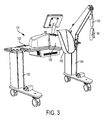
- FIG. 3 is a perspective diagram of one embodiment of the present invention.
- FIG. 4 is a front diagram of a device in accordance with one embodiment of the present invention.
- FIG. 5 is a top diagram of a device in accordance with one embodiment of the present invention.
- FIG. 6 is a rear diagram of a device in accordance with one embodiment of the present invention.
- FIG. 7 is a top diagram of a device with extended sides in accordance with one embodiment of the present invention.
- FIG. 8 is a side view of another embodiment of the invention.
- one embodiment of the present invention comprises a therapeutic muscle exercise device 100 , (also referred to herein as a supine cycle), used to treat patients who are not capable of walking, sitting, or standing.
- the supine cycle 100 comprises a cycling base 105 that is mounted on a mobile support 103 .
- the mobile support 103 is an expandable table (as explained in more detail below) that fits over a hospital bed, allowing the cycle to be brought to the patient.
- the cycling base 105 has a first extremity support 108 and a second extremity support 109 . It is contemplated that in some embodiments a single extremity support may be included to facilitate treatment of subjects who have lost a limb.
- Each extremity support 108 and 109 are attached to the cycling base by a first rotating arm 114 and a second rotating arm 115 , respectively.
- Each rotating arm as a extremity support end 120 , 121 and a base end 125 , 126 .
- the rotating arms 114 and 115 attach to the extremity supports 108 and 109 at a extremity support pivot point 130 and 131 .
- the configuration allows the foot of the subject to rotate as normally as it would when performing a cycling motion naturally.
- the base ends 125 and 126 connect to the cycling base 105 at a base pivot point 140 .
- the base pivot point 140 comprises a shaft that passes through a channel that extends through the base; the shaft connects the base end 125 of the first rotating arm 114 to the base end 126 of the second rotating arm 115 . In such embodiment, the shaft then rotates uniformly around the base pivot point 140 .
- the rotating arms 114 , 115 may connect to two independently rotatable shafts at the base pivot point 140 allowing the extremity supports 108 and 109 to rotate independently of one-another.
- the cycling base 105 also includes a support boom 145 that provides support for two calf supports 148 , 149 .
- the calf supports 148 and 149 are connected to the extremity supports 108 and 109 though an attachment link 153 , 154 .
- the calf supports 148 and 149 may not be linked to the extremity supports 108 and 109 .
- the support boom 145 in some embodiments includes a set of pulleys that allow a support cord 158 , 159 to provide support for the calf supports 148 and 149 .
- the support boom 145 provides support for a lead cable 156 that encases the various leads 159 used to provide functional electrical stimulation (FES) to the subject's muscles.
- FES functional electrical stimulation
- the device 100 also includes a functional electrical stimulation controller 175 .
- the controller 175 manages the electrical impulses provided to the subject's muscles through a series of leads 159 , which are connected to the controller 175 through a lead cable 156 .
- the controller 175 also controls a motor (not shown) that controls the speed of rotation of the rotating arms 114 and 115 .
- the controller 175 coordinates the rotation of the rotating arms 114 and 115 in conjunction with functional electrical stimulation through the leads 159 depending on the level of need of the subject. In some instances, the controller 175 will direct full movement of the rotating arms 114 and 115 in conjunction with electrical stimulation resulting in fully FES evoked movement.
- the controller 175 may reduce the level of assistance provided by the motor and the electrical stimulation allowing volitional movement by the subject. In yet a further embodiment, the controller 175 will not provide any assistance in order to allow the subject to rotate the extremity supports 108 , 109 without assistance. The controller 175 provides such assistance as needed by the subject and directed by the user.
- the cycling base 105 is mounted on a mobile support 103 .
- the purpose of the mobile support 103 is to allow a practitioner to slide the cycling base 105 above the bed where a subject is laying without having to remove the base and place it on the bed.
- Many different types of mobile support 103 combinations may be used.
- mobile support 103 has a main base 180 and two horizontally extendible arms 183 and 184 .
- the extendible arms 183 and 184 are attached to two rolling and telescoping legs 189 , 190 .
- the dual telescoping legs 189 , 190 provide significant stability to device 100 .
- the telescoping legs 189 , 190 in one preferred embodiment are placed on rolling boards 197 , 198 .
- the rolling boards 197 , 198 may be placed on rolling wheels 155 .
- any types of wheels 155 may be used, including wheels that have breaking mechanisms to prevent the unit from moving once engaged.
- the mobile support 103 may also include latches 193 , 194 that allow the user to lock the unit in place and prevent it from sliding, even when the wheel brakes are engaged.
- One particular advantage of the supine cycle described herein is the capability to expand the table in order to avoid obstacles under the bed.
- the supine cycles is placed on a moveable base or table that can slide over the patient's bed. It is configured, however, so that it will have no protrusions under the bed that may interfere with the use of the supine cycle.
- the controller is configured to optionally provide FES.
- FES relates to electrical stimulation applied to peripheral nerves to produce a function. Reversing muscle atrophy and bone loss are the primary clinical benefits of neuromuscular electrical stimulation. Increases in bone density are directly related to the level of torque generated by the muscle.
- a method for exercising a subject's lower extremities is provided.
- the system continuously rotates at the set speed and it either assists or resists the patient's efforts.
- the patient's efforts are either volitional or evoked by FES.
- the system's motor moves the subject's lower extremities and the controller provides initial muscle electrical stimulation. This first step can be referred to as a warm up step.
- the controller increases muscle electrical stimulation and reduces motor assistance until the muscle takes over movement of the extremity supports or 100% stimulation threshold is reached.
- a subsequent step referred to as the active step
- electrical stimulation evokes coordinated muscle contractions as the rotating arms 114 and 115 turn around the pivot point 140 resulting in the subject's muscles performing the cycling motion.
- the combination of the rotating arms 114 and 115 connected at the pivot point 140 is also referred to herein as the crank.
- electrical stimulation is reduced and the motor of the cycling base takes over for cycling motion.
- cool down the motor completely takes over cycling motion allowing subject's muscles to rest while permitting movement through the range of motion.
- the cycle crank moves to set positions to position the muscles for isometric contractions which are FES evoked.
- the approximate length for optimal contraction is determined for each muscle.
- the length-tension curve determines the force generated by the muscle at a given electrical activation.
- a muscle should be at the peak of the length tension curve in order to gain the optimal increase in muscle mass.
- an isometric contraction generates a greater force per a given activation of the muscle by electrical stimulation because of the resistance to the contraction provided.
- the cycle is positioned at the coordinates that places each muscle group at their optimal muscle length and stops so an isometric contraction occurs. For each individual the coordinates are determined based on extensors and flexors of each joint for each joint. Muscles are stimulated when the crank reaches the coordinates relative the joint position. Multiple muscles of the right and left leg are stimulated simultaneously as appropriate.
- a device and method for exercising a subject's upper extremities is provided.
- the present embodiment may have an overall configuration similar to the lower extremity embodiment described with reference to FIGS. 1-7 , but wrist and hand supports 208 and 209 may be provided in place of extremity supports 108 and 109 .
- wrist and hand supports may be configured to attach to rotating arms 114 and 115 in place of extremity supports 108 and 109 .
- a shorter or longer set of rotating arms 214 and 215 may be substituted for rotating arms 114 and 115 at base pivot point 140 , and subsequent attachment to wrist and hand supports 208 and 209 .
- boom 145 may be rotated out of the way as shown in FIG. 8 .
- a first step of the method in a first step of the method the system's motor moves the subject's upper extremities and the controller provides initial muscle electrical stimulation.
- This first step can be referred to as a warm up step.
- the controller increases muscle stimulation and reduces motor assistance until the muscle takes over movement of the arm supports or 100% stimulation threshold is reached.
- electrical stimulation evokes coordinated muscle contractions as the crank rotates resulting in the subject's muscles performing the arm cycling motion. Once muscle fatigue is reached and/or detected by the controller, electrical stimulation is reduced and the motor of the cycling base takes over for cycling motion.
- the motor completely takes over cycling motion allowing subject's muscles to rest while permitting movement through the range of motion.
- the patient can we supine with different angles of back support, for example the patient could be arm cycling while fully supine, propped up at a 45 degree angle or fully seated at close to a 90 degree angle.
- the electrical stimulation control algorithm make allowance for the seating angle. This is done by rotating the position of top dead center for the stimulation counter clockwise with respect to the position of mechanical top dead center. As an example, if the patient is lying in bed with their back propped up to a 45 degree angle the position of electrical top dead center will be rotated counter clockwise by 45 degrees with respect to mechanical top dead center.
Landscapes
- Health & Medical Sciences (AREA)
- General Health & Medical Sciences (AREA)
- Physical Education & Sports Medicine (AREA)
- Life Sciences & Earth Sciences (AREA)
- Biophysics (AREA)
- Public Health (AREA)
- Veterinary Medicine (AREA)
- Animal Behavior & Ethology (AREA)
- Vascular Medicine (AREA)
- Cardiology (AREA)
- Orthopedic Medicine & Surgery (AREA)
- Epidemiology (AREA)
- Pain & Pain Management (AREA)
- Rehabilitation Therapy (AREA)
- Radiology & Medical Imaging (AREA)
- Nuclear Medicine, Radiotherapy & Molecular Imaging (AREA)
- Biomedical Technology (AREA)
- Engineering & Computer Science (AREA)
- Heart & Thoracic Surgery (AREA)
- Physics & Mathematics (AREA)
- Electromagnetism (AREA)
- Rehabilitation Tools (AREA)
Abstract
Description
| Hip | Knee | Ankle | ||
| Soleus | n/a | n/a | 90 degrees | ||
| Gastrocnemius | n/a | 45 degrees | 90 degrees | ||
| Tibialis Anterior | n/a | n/a | 45 degrees | ||
| Medial | 45 |
60 degrees | n/a | ||
| Hamstrings | |||||
| Quadriceps | n/a | 60 degrees | n/a | ||
| Gluteals | 45 degrees | n/a | n/a | ||
Claims (10)
Priority Applications (3)
| Application Number | Priority Date | Filing Date | Title |
|---|---|---|---|
| US14/713,915 US9511256B2 (en) | 2014-05-18 | 2015-05-15 | Supine cycle |
| EP15168037.8A EP2946761B1 (en) | 2014-05-18 | 2015-05-18 | Supine cycle |
| HK16105970.5A HK1218065B (en) | 2014-05-18 | 2016-05-25 | Supine cycle |
Applications Claiming Priority (2)
| Application Number | Priority Date | Filing Date | Title |
|---|---|---|---|
| US201461994957P | 2014-05-18 | 2014-05-18 | |
| US14/713,915 US9511256B2 (en) | 2014-05-18 | 2015-05-15 | Supine cycle |
Publications (2)
| Publication Number | Publication Date |
|---|---|
| US20160016036A1 US20160016036A1 (en) | 2016-01-21 |
| US9511256B2 true US9511256B2 (en) | 2016-12-06 |
Family
ID=53188914
Family Applications (1)
| Application Number | Title | Priority Date | Filing Date |
|---|---|---|---|
| US14/713,915 Expired - Fee Related US9511256B2 (en) | 2014-05-18 | 2015-05-15 | Supine cycle |
Country Status (2)
| Country | Link |
|---|---|
| US (1) | US9511256B2 (en) |
| EP (1) | EP2946761B1 (en) |
Cited By (1)
| Publication number | Priority date | Publication date | Assignee | Title |
|---|---|---|---|---|
| WO2018085770A1 (en) | 2016-11-04 | 2018-05-11 | Restorative Therapies | Functional electrical stimulation ergometer including automatic spasm control |
Families Citing this family (8)
| Publication number | Priority date | Publication date | Assignee | Title |
|---|---|---|---|---|
| US10744362B2 (en) * | 2015-03-06 | 2020-08-18 | United States Government As Represented By The Department Of Veterans Affairs | Exercise machine |
| US10018298B2 (en) * | 2015-03-06 | 2018-07-10 | U.S. Department Of Veterans Affairs | Exercise machine and method for use in a supine position |
| CN109843373B (en) * | 2016-11-04 | 2023-05-30 | 恢复治疗公司 | Functional electro-stimulation load cell including automatic spasmodic control |
| CN107583194B (en) * | 2017-09-08 | 2020-10-30 | 长安大学 | A wearable lower limb training device |
| US11446191B2 (en) | 2019-04-19 | 2022-09-20 | Hill-Rom Services, Inc. | Patient bed having exercise therapy apparatus |
| CN110314070B (en) * | 2019-08-07 | 2021-06-22 | 山东中医药大学第二附属医院 | Passive rehabilitation device for paralytic patient |
| CN111494161B (en) * | 2020-04-27 | 2022-04-01 | 宁波得益机电设备有限公司 | Nursing limb swinging device and bed with detachable limb swinging device |
| CN113509354B (en) * | 2021-05-29 | 2022-04-01 | 吉林大学 | A rehabilitation exercise device for interventional nursing |
Citations (5)
| Publication number | Priority date | Publication date | Assignee | Title |
|---|---|---|---|---|
| US3488088A (en) * | 1968-03-20 | 1970-01-06 | Melvin J Goldberg | Therapeutic ambulatory and exercise aid |
| US4601464A (en) * | 1984-08-24 | 1986-07-22 | Mousel Canellen K | Legs exercising physical therapy device |
| US6152855A (en) * | 1999-02-03 | 2000-11-28 | Synergy Innovations, Inc. | In-bed exercise machine and method of use |
| US6695795B2 (en) * | 1999-12-27 | 2004-02-24 | Medireha Gmbh | Therapeutic device |
| US20150190667A1 (en) * | 2013-01-28 | 2015-07-09 | Balandis Taft Patents, Llc | Multi Function Exercise Apparatus With Resistance Mechanism |
Family Cites Families (9)
| Publication number | Priority date | Publication date | Assignee | Title |
|---|---|---|---|---|
| US3310817A (en) * | 1965-02-08 | 1967-03-28 | Dale A Harding | Invalid aid stand |
| DE2121877A1 (en) * | 1971-05-04 | 1972-12-07 | ||
| US3693614A (en) * | 1971-05-28 | 1972-09-26 | Kenneth A Schon | Exercise apparatus and method for paralytic patients |
| US4499900A (en) * | 1982-11-26 | 1985-02-19 | Wright State University | System and method for treating paralyzed persons |
| DE4113135A1 (en) * | 1991-04-22 | 1992-10-29 | Anton Reck | Physiotherapy device for passive limb movement - has wheeled frame with vertical column supporting crank mechanism rotating pedals |
| US5478299A (en) * | 1991-05-10 | 1995-12-26 | Harmon; Larry S. | Adaptable exercise apparatus |
| US20060247095A1 (en) * | 2001-09-21 | 2006-11-02 | Rummerfield Patrick D | Method and apparatus for promoting nerve regeneration in paralyzed patients |
| DE202007013826U1 (en) * | 2007-10-02 | 2008-02-07 | Reck, Anton | Training device with a frame for the installation of the training device |
| CN201423119Y (en) * | 2009-06-17 | 2010-03-17 | 刘爱萍 | Bicycle trainer |
-
2015
- 2015-05-15 US US14/713,915 patent/US9511256B2/en not_active Expired - Fee Related
- 2015-05-18 EP EP15168037.8A patent/EP2946761B1/en not_active Not-in-force
Patent Citations (5)
| Publication number | Priority date | Publication date | Assignee | Title |
|---|---|---|---|---|
| US3488088A (en) * | 1968-03-20 | 1970-01-06 | Melvin J Goldberg | Therapeutic ambulatory and exercise aid |
| US4601464A (en) * | 1984-08-24 | 1986-07-22 | Mousel Canellen K | Legs exercising physical therapy device |
| US6152855A (en) * | 1999-02-03 | 2000-11-28 | Synergy Innovations, Inc. | In-bed exercise machine and method of use |
| US6695795B2 (en) * | 1999-12-27 | 2004-02-24 | Medireha Gmbh | Therapeutic device |
| US20150190667A1 (en) * | 2013-01-28 | 2015-07-09 | Balandis Taft Patents, Llc | Multi Function Exercise Apparatus With Resistance Mechanism |
Cited By (3)
| Publication number | Priority date | Publication date | Assignee | Title |
|---|---|---|---|---|
| WO2018085770A1 (en) | 2016-11-04 | 2018-05-11 | Restorative Therapies | Functional electrical stimulation ergometer including automatic spasm control |
| US10857359B2 (en) | 2016-11-04 | 2020-12-08 | Restorative Therapies, Inc. | Functional electrical stimulation ergometer including automatic spasm control |
| US11660451B2 (en) | 2016-11-04 | 2023-05-30 | Restorative Therapies, Inc. | Functional electrical stimulation ergometer including automatic spasm control |
Also Published As
| Publication number | Publication date |
|---|---|
| US20160016036A1 (en) | 2016-01-21 |
| EP2946761A1 (en) | 2015-11-25 |
| EP2946761B1 (en) | 2020-07-22 |
| HK1218065A1 (en) | 2017-02-03 |
Similar Documents
| Publication | Publication Date | Title |
|---|---|---|
| EP2946761B1 (en) | Supine cycle | |
| CN110664584B (en) | Rehabilitation training bed | |
| Rawat et al. | Effect of rotator cuff strengthening as an adjunct to standard care in subjects with adhesive capsulitis: A randomized controlled trial | |
| Jung et al. | Effects of sit-to-stand training combined with transcutaneous electrical stimulation on spasticity, muscle strength and balance ability in patients with stroke: A randomized controlled study | |
| US20110177917A1 (en) | Assisted stair training machine and methods of using | |
| Monaco et al. | Design and evaluation of NEUROBike: A neurorehabilitative platform for bedridden post-stroke patients | |
| Cherry | Review of physical therapy alternatives for reducing muscle contracture | |
| US11660451B2 (en) | Functional electrical stimulation ergometer including automatic spasm control | |
| US10981035B2 (en) | Portable lower limb therapy device | |
| KR102091675B1 (en) | Rehabilitation apparatus for neurological disease and nuscular skeletal disease | |
| RU145508U1 (en) | SIMULATOR MULTI-FUNCTIONAL REHABILITATION | |
| Neblett et al. | A clinical guide to surface-EMG-assisted stretching as an adjunct to chronic musculoskeletal pain rehabilitation | |
| EP3535021B1 (en) | Functional electrical stimulation ergometer including automatic spasm control | |
| Zhou et al. | On the design of a robot-assisted rehabilitation system for ankle joint with contracture and/or spasticity based on proprioceptive neuromuscular facilitation | |
| KR102104262B1 (en) | Riding Type Apparatus for Training Walk | |
| HK1218065B (en) | Supine cycle | |
| US20060041205A1 (en) | ISOROM portable isometric and passive range of motion device | |
| KR101419187B1 (en) | Arm exercising apparatus for rotator cuff | |
| McCain et al. | A clinical framework for functional recovery in a person with chronic traumatic brain injury: a case study | |
| CN107583194B (en) | A wearable lower limb training device | |
| McAtee | An overview of facilitated stretching | |
| CN201870779U (en) | Omnidirectional bandy leg osteopathy correction bed | |
| US20260041912A1 (en) | Diagnostic Methods and Therapeutic Exercises and Equipment | |
| RU2305534C1 (en) | Method of recovery of vertical position for handicapped persons suffering from affection in central nervous system | |
| van de Rakt et al. | Diagonals part three: Pathology. The stroke patient: how we can train the diagonals to create a better result |
Legal Events
| Date | Code | Title | Description |
|---|---|---|---|
| AS | Assignment |
Owner name: RESTORATIVE THERAPIES, INC., MARYLAND Free format text: ASSIGNMENT OF ASSIGNORS INTEREST;ASSIGNORS:BARRISKILL, ANDREW BRUCE;SIMCOX, SCOTT;FLESHER, ROBERT;AND OTHERS;SIGNING DATES FROM 20160920 TO 20161019;REEL/FRAME:040065/0146 |
|
| STCF | Information on status: patent grant |
Free format text: PATENTED CASE |
|
| MAFP | Maintenance fee payment |
Free format text: PAYMENT OF MAINTENANCE FEE, 4TH YR, SMALL ENTITY (ORIGINAL EVENT CODE: M2551); ENTITY STATUS OF PATENT OWNER: SMALL ENTITY Year of fee payment: 4 |
|
| FEPP | Fee payment procedure |
Free format text: MAINTENANCE FEE REMINDER MAILED (ORIGINAL EVENT CODE: REM.); ENTITY STATUS OF PATENT OWNER: SMALL ENTITY |
|
| LAPS | Lapse for failure to pay maintenance fees |
Free format text: PATENT EXPIRED FOR FAILURE TO PAY MAINTENANCE FEES (ORIGINAL EVENT CODE: EXP.); ENTITY STATUS OF PATENT OWNER: SMALL ENTITY |
|
| STCH | Information on status: patent discontinuation |
Free format text: PATENT EXPIRED DUE TO NONPAYMENT OF MAINTENANCE FEES UNDER 37 CFR 1.362 |
|
| FP | Lapsed due to failure to pay maintenance fee |
Effective date: 20241206 |