US9455396B2 - Piezoelectric/electrostrictive element and wiring substrate - Google Patents

Piezoelectric/electrostrictive element and wiring substrate Download PDF

Info

Publication number
US9455396B2
US9455396B2 US14/224,507 US201414224507A US9455396B2 US 9455396 B2 US9455396 B2 US 9455396B2 US 201414224507 A US201414224507 A US 201414224507A US 9455396 B2 US9455396 B2 US 9455396B2
Authority
US
United States
Prior art keywords
adhesive layer
conductive layer
piezoelectric
substrate
anchor portion
Prior art date
Legal status (The legal status is an assumption and is not a legal conclusion. Google has not performed a legal analysis and makes no representation as to the accuracy of the status listed.)
Active, expires
Application number
US14/224,507
Other versions
US20140292156A1 (en
Inventor
Toshikatsu Kashiwaya
Current Assignee (The listed assignees may be inaccurate. Google has not performed a legal analysis and makes no representation or warranty as to the accuracy of the list.)
NGK Insulators Ltd
Original Assignee
NGK Insulators Ltd
Priority date (The priority date is an assumption and is not a legal conclusion. Google has not performed a legal analysis and makes no representation as to the accuracy of the date listed.)
Filing date
Publication date
Application filed by NGK Insulators Ltd filed Critical NGK Insulators Ltd
Assigned to NGK INSULATORS, LTD. reassignment NGK INSULATORS, LTD. ASSIGNMENT OF ASSIGNORS INTEREST (SEE DOCUMENT FOR DETAILS). Assignors: KASHIWAYA, TOSHIKATSU
Publication of US20140292156A1 publication Critical patent/US20140292156A1/en
Application granted granted Critical
Publication of US9455396B2 publication Critical patent/US9455396B2/en
Active legal-status Critical Current
Adjusted expiration legal-status Critical

Links

Images

Classifications

    • H01L41/047
    • CCHEMISTRY; METALLURGY
    • C04CEMENTS; CONCRETE; ARTIFICIAL STONE; CERAMICS; REFRACTORIES
    • C04BLIME, MAGNESIA; SLAG; CEMENTS; COMPOSITIONS THEREOF, e.g. MORTARS, CONCRETE OR LIKE BUILDING MATERIALS; ARTIFICIAL STONE; CERAMICS; REFRACTORIES; TREATMENT OF NATURAL STONE
    • C04B35/00Shaped ceramic products characterised by their composition; Ceramics compositions; Processing powders of inorganic compounds preparatory to the manufacturing of ceramic products
    • C04B35/01Shaped ceramic products characterised by their composition; Ceramics compositions; Processing powders of inorganic compounds preparatory to the manufacturing of ceramic products based on oxide ceramics
    • C04B35/48Shaped ceramic products characterised by their composition; Ceramics compositions; Processing powders of inorganic compounds preparatory to the manufacturing of ceramic products based on oxide ceramics based on zirconium or hafnium oxides, zirconates, zircon or hafnates
    • CCHEMISTRY; METALLURGY
    • C04CEMENTS; CONCRETE; ARTIFICIAL STONE; CERAMICS; REFRACTORIES
    • C04BLIME, MAGNESIA; SLAG; CEMENTS; COMPOSITIONS THEREOF, e.g. MORTARS, CONCRETE OR LIKE BUILDING MATERIALS; ARTIFICIAL STONE; CERAMICS; REFRACTORIES; TREATMENT OF NATURAL STONE
    • C04B35/00Shaped ceramic products characterised by their composition; Ceramics compositions; Processing powders of inorganic compounds preparatory to the manufacturing of ceramic products
    • C04B35/01Shaped ceramic products characterised by their composition; Ceramics compositions; Processing powders of inorganic compounds preparatory to the manufacturing of ceramic products based on oxide ceramics
    • C04B35/48Shaped ceramic products characterised by their composition; Ceramics compositions; Processing powders of inorganic compounds preparatory to the manufacturing of ceramic products based on oxide ceramics based on zirconium or hafnium oxides, zirconates, zircon or hafnates
    • C04B35/49Shaped ceramic products characterised by their composition; Ceramics compositions; Processing powders of inorganic compounds preparatory to the manufacturing of ceramic products based on oxide ceramics based on zirconium or hafnium oxides, zirconates, zircon or hafnates containing also titanium oxides or titanates
    • C04B35/491Shaped ceramic products characterised by their composition; Ceramics compositions; Processing powders of inorganic compounds preparatory to the manufacturing of ceramic products based on oxide ceramics based on zirconium or hafnium oxides, zirconates, zircon or hafnates containing also titanium oxides or titanates based on lead zirconates and lead titanates, e.g. PZT
    • CCHEMISTRY; METALLURGY
    • C04CEMENTS; CONCRETE; ARTIFICIAL STONE; CERAMICS; REFRACTORIES
    • C04BLIME, MAGNESIA; SLAG; CEMENTS; COMPOSITIONS THEREOF, e.g. MORTARS, CONCRETE OR LIKE BUILDING MATERIALS; ARTIFICIAL STONE; CERAMICS; REFRACTORIES; TREATMENT OF NATURAL STONE
    • C04B41/00After-treatment of mortars, concrete, artificial stone or ceramics; Treatment of natural stone
    • C04B41/009After-treatment of mortars, concrete, artificial stone or ceramics; Treatment of natural stone characterised by the material treated
    • CCHEMISTRY; METALLURGY
    • C04CEMENTS; CONCRETE; ARTIFICIAL STONE; CERAMICS; REFRACTORIES
    • C04BLIME, MAGNESIA; SLAG; CEMENTS; COMPOSITIONS THEREOF, e.g. MORTARS, CONCRETE OR LIKE BUILDING MATERIALS; ARTIFICIAL STONE; CERAMICS; REFRACTORIES; TREATMENT OF NATURAL STONE
    • C04B41/00After-treatment of mortars, concrete, artificial stone or ceramics; Treatment of natural stone
    • C04B41/45Coating or impregnating, e.g. injection in masonry, partial coating of green or fired ceramics, organic coating compositions for adhering together two concrete elements
    • C04B41/4505Coating or impregnating, e.g. injection in masonry, partial coating of green or fired ceramics, organic coating compositions for adhering together two concrete elements characterised by the method of application
    • C04B41/4529Coating or impregnating, e.g. injection in masonry, partial coating of green or fired ceramics, organic coating compositions for adhering together two concrete elements characterised by the method of application applied from the gas phase
    • CCHEMISTRY; METALLURGY
    • C04CEMENTS; CONCRETE; ARTIFICIAL STONE; CERAMICS; REFRACTORIES
    • C04BLIME, MAGNESIA; SLAG; CEMENTS; COMPOSITIONS THEREOF, e.g. MORTARS, CONCRETE OR LIKE BUILDING MATERIALS; ARTIFICIAL STONE; CERAMICS; REFRACTORIES; TREATMENT OF NATURAL STONE
    • C04B41/00After-treatment of mortars, concrete, artificial stone or ceramics; Treatment of natural stone
    • C04B41/45Coating or impregnating, e.g. injection in masonry, partial coating of green or fired ceramics, organic coating compositions for adhering together two concrete elements
    • C04B41/4505Coating or impregnating, e.g. injection in masonry, partial coating of green or fired ceramics, organic coating compositions for adhering together two concrete elements characterised by the method of application
    • C04B41/4535Coating or impregnating, e.g. injection in masonry, partial coating of green or fired ceramics, organic coating compositions for adhering together two concrete elements characterised by the method of application applied as a solution, emulsion, dispersion or suspension
    • CCHEMISTRY; METALLURGY
    • C04CEMENTS; CONCRETE; ARTIFICIAL STONE; CERAMICS; REFRACTORIES
    • C04BLIME, MAGNESIA; SLAG; CEMENTS; COMPOSITIONS THEREOF, e.g. MORTARS, CONCRETE OR LIKE BUILDING MATERIALS; ARTIFICIAL STONE; CERAMICS; REFRACTORIES; TREATMENT OF NATURAL STONE
    • C04B41/00After-treatment of mortars, concrete, artificial stone or ceramics; Treatment of natural stone
    • C04B41/45Coating or impregnating, e.g. injection in masonry, partial coating of green or fired ceramics, organic coating compositions for adhering together two concrete elements
    • C04B41/4505Coating or impregnating, e.g. injection in masonry, partial coating of green or fired ceramics, organic coating compositions for adhering together two concrete elements characterised by the method of application
    • C04B41/455Coating or impregnating, e.g. injection in masonry, partial coating of green or fired ceramics, organic coating compositions for adhering together two concrete elements characterised by the method of application the coating or impregnating process including a chemical conversion or reaction
    • C04B41/4554Coating or impregnating, e.g. injection in masonry, partial coating of green or fired ceramics, organic coating compositions for adhering together two concrete elements characterised by the method of application the coating or impregnating process including a chemical conversion or reaction the coating or impregnating material being an organic or organo-metallic precursor of an inorganic material
    • CCHEMISTRY; METALLURGY
    • C04CEMENTS; CONCRETE; ARTIFICIAL STONE; CERAMICS; REFRACTORIES
    • C04BLIME, MAGNESIA; SLAG; CEMENTS; COMPOSITIONS THEREOF, e.g. MORTARS, CONCRETE OR LIKE BUILDING MATERIALS; ARTIFICIAL STONE; CERAMICS; REFRACTORIES; TREATMENT OF NATURAL STONE
    • C04B41/00After-treatment of mortars, concrete, artificial stone or ceramics; Treatment of natural stone
    • C04B41/45Coating or impregnating, e.g. injection in masonry, partial coating of green or fired ceramics, organic coating compositions for adhering together two concrete elements
    • C04B41/4572Partial coating or impregnation of the surface of the substrate
    • CCHEMISTRY; METALLURGY
    • C04CEMENTS; CONCRETE; ARTIFICIAL STONE; CERAMICS; REFRACTORIES
    • C04BLIME, MAGNESIA; SLAG; CEMENTS; COMPOSITIONS THEREOF, e.g. MORTARS, CONCRETE OR LIKE BUILDING MATERIALS; ARTIFICIAL STONE; CERAMICS; REFRACTORIES; TREATMENT OF NATURAL STONE
    • C04B41/00After-treatment of mortars, concrete, artificial stone or ceramics; Treatment of natural stone
    • C04B41/45Coating or impregnating, e.g. injection in masonry, partial coating of green or fired ceramics, organic coating compositions for adhering together two concrete elements
    • C04B41/50Coating or impregnating, e.g. injection in masonry, partial coating of green or fired ceramics, organic coating compositions for adhering together two concrete elements with inorganic materials
    • C04B41/5022Coating or impregnating, e.g. injection in masonry, partial coating of green or fired ceramics, organic coating compositions for adhering together two concrete elements with inorganic materials with vitreous materials
    • CCHEMISTRY; METALLURGY
    • C04CEMENTS; CONCRETE; ARTIFICIAL STONE; CERAMICS; REFRACTORIES
    • C04BLIME, MAGNESIA; SLAG; CEMENTS; COMPOSITIONS THEREOF, e.g. MORTARS, CONCRETE OR LIKE BUILDING MATERIALS; ARTIFICIAL STONE; CERAMICS; REFRACTORIES; TREATMENT OF NATURAL STONE
    • C04B41/00After-treatment of mortars, concrete, artificial stone or ceramics; Treatment of natural stone
    • C04B41/45Coating or impregnating, e.g. injection in masonry, partial coating of green or fired ceramics, organic coating compositions for adhering together two concrete elements
    • C04B41/50Coating or impregnating, e.g. injection in masonry, partial coating of green or fired ceramics, organic coating compositions for adhering together two concrete elements with inorganic materials
    • C04B41/5025Coating or impregnating, e.g. injection in masonry, partial coating of green or fired ceramics, organic coating compositions for adhering together two concrete elements with inorganic materials with ceramic materials
    • C04B41/5027Oxide ceramics in general; Specific oxide ceramics not covered by C04B41/5029 - C04B41/5051
    • CCHEMISTRY; METALLURGY
    • C04CEMENTS; CONCRETE; ARTIFICIAL STONE; CERAMICS; REFRACTORIES
    • C04BLIME, MAGNESIA; SLAG; CEMENTS; COMPOSITIONS THEREOF, e.g. MORTARS, CONCRETE OR LIKE BUILDING MATERIALS; ARTIFICIAL STONE; CERAMICS; REFRACTORIES; TREATMENT OF NATURAL STONE
    • C04B41/00After-treatment of mortars, concrete, artificial stone or ceramics; Treatment of natural stone
    • C04B41/45Coating or impregnating, e.g. injection in masonry, partial coating of green or fired ceramics, organic coating compositions for adhering together two concrete elements
    • C04B41/50Coating or impregnating, e.g. injection in masonry, partial coating of green or fired ceramics, organic coating compositions for adhering together two concrete elements with inorganic materials
    • C04B41/5025Coating or impregnating, e.g. injection in masonry, partial coating of green or fired ceramics, organic coating compositions for adhering together two concrete elements with inorganic materials with ceramic materials
    • C04B41/5049Zinc or bismuth oxides
    • CCHEMISTRY; METALLURGY
    • C04CEMENTS; CONCRETE; ARTIFICIAL STONE; CERAMICS; REFRACTORIES
    • C04BLIME, MAGNESIA; SLAG; CEMENTS; COMPOSITIONS THEREOF, e.g. MORTARS, CONCRETE OR LIKE BUILDING MATERIALS; ARTIFICIAL STONE; CERAMICS; REFRACTORIES; TREATMENT OF NATURAL STONE
    • C04B41/00After-treatment of mortars, concrete, artificial stone or ceramics; Treatment of natural stone
    • C04B41/45Coating or impregnating, e.g. injection in masonry, partial coating of green or fired ceramics, organic coating compositions for adhering together two concrete elements
    • C04B41/50Coating or impregnating, e.g. injection in masonry, partial coating of green or fired ceramics, organic coating compositions for adhering together two concrete elements with inorganic materials
    • C04B41/51Metallising, e.g. infiltration of sintered ceramic preforms with molten metal
    • C04B41/5116Ag or Au
    • CCHEMISTRY; METALLURGY
    • C04CEMENTS; CONCRETE; ARTIFICIAL STONE; CERAMICS; REFRACTORIES
    • C04BLIME, MAGNESIA; SLAG; CEMENTS; COMPOSITIONS THEREOF, e.g. MORTARS, CONCRETE OR LIKE BUILDING MATERIALS; ARTIFICIAL STONE; CERAMICS; REFRACTORIES; TREATMENT OF NATURAL STONE
    • C04B41/00After-treatment of mortars, concrete, artificial stone or ceramics; Treatment of natural stone
    • C04B41/45Coating or impregnating, e.g. injection in masonry, partial coating of green or fired ceramics, organic coating compositions for adhering together two concrete elements
    • C04B41/52Multiple coating or impregnating multiple coating or impregnating with the same composition or with compositions only differing in the concentration of the constituents, is classified as single coating or impregnation
    • CCHEMISTRY; METALLURGY
    • C04CEMENTS; CONCRETE; ARTIFICIAL STONE; CERAMICS; REFRACTORIES
    • C04BLIME, MAGNESIA; SLAG; CEMENTS; COMPOSITIONS THEREOF, e.g. MORTARS, CONCRETE OR LIKE BUILDING MATERIALS; ARTIFICIAL STONE; CERAMICS; REFRACTORIES; TREATMENT OF NATURAL STONE
    • C04B41/00After-treatment of mortars, concrete, artificial stone or ceramics; Treatment of natural stone
    • C04B41/45Coating or impregnating, e.g. injection in masonry, partial coating of green or fired ceramics, organic coating compositions for adhering together two concrete elements
    • C04B41/52Multiple coating or impregnating multiple coating or impregnating with the same composition or with compositions only differing in the concentration of the constituents, is classified as single coating or impregnation
    • C04B41/522Multiple coatings, for one of the coatings of which at least one alternative is described
    • CCHEMISTRY; METALLURGY
    • C04CEMENTS; CONCRETE; ARTIFICIAL STONE; CERAMICS; REFRACTORIES
    • C04BLIME, MAGNESIA; SLAG; CEMENTS; COMPOSITIONS THEREOF, e.g. MORTARS, CONCRETE OR LIKE BUILDING MATERIALS; ARTIFICIAL STONE; CERAMICS; REFRACTORIES; TREATMENT OF NATURAL STONE
    • C04B41/00After-treatment of mortars, concrete, artificial stone or ceramics; Treatment of natural stone
    • C04B41/80After-treatment of mortars, concrete, artificial stone or ceramics; Treatment of natural stone of only ceramics
    • C04B41/81Coating or impregnation
    • C04B41/89Coating or impregnation for obtaining at least two superposed coatings having different compositions
    • C04B41/90Coating or impregnation for obtaining at least two superposed coatings having different compositions at least one coating being a metal
    • HELECTRICITY
    • H01ELECTRIC ELEMENTS
    • H01LSEMICONDUCTOR DEVICES NOT COVERED BY CLASS H10
    • H01L21/00Processes or apparatus adapted for the manufacture or treatment of semiconductor or solid state devices or of parts thereof
    • H01L21/02Manufacture or treatment of semiconductor devices or of parts thereof
    • H01L21/04Manufacture or treatment of semiconductor devices or of parts thereof the devices having potential barriers, e.g. a PN junction, depletion layer or carrier concentration layer
    • H01L21/48Manufacture or treatment of parts, e.g. containers, prior to assembly of the devices, using processes not provided for in a single one of the groups H01L21/18 - H01L21/326 or H10D48/04 - H10D48/07
    • H01L21/4814Conductive parts
    • H01L21/4846Leads on or in insulating or insulated substrates, e.g. metallisation
    • H01L41/0477
    • HELECTRICITY
    • H10SEMICONDUCTOR DEVICES; ELECTRIC SOLID-STATE DEVICES NOT OTHERWISE PROVIDED FOR
    • H10NELECTRIC SOLID-STATE DEVICES NOT OTHERWISE PROVIDED FOR
    • H10N30/00Piezoelectric or electrostrictive devices
    • H10N30/80Constructional details
    • H10N30/87Electrodes or interconnections, e.g. leads or terminals
    • HELECTRICITY
    • H10SEMICONDUCTOR DEVICES; ELECTRIC SOLID-STATE DEVICES NOT OTHERWISE PROVIDED FOR
    • H10NELECTRIC SOLID-STATE DEVICES NOT OTHERWISE PROVIDED FOR
    • H10N30/00Piezoelectric or electrostrictive devices
    • H10N30/80Constructional details
    • H10N30/87Electrodes or interconnections, e.g. leads or terminals
    • H10N30/877Conductive materials
    • H10W70/05
    • CCHEMISTRY; METALLURGY
    • C04CEMENTS; CONCRETE; ARTIFICIAL STONE; CERAMICS; REFRACTORIES
    • C04BLIME, MAGNESIA; SLAG; CEMENTS; COMPOSITIONS THEREOF, e.g. MORTARS, CONCRETE OR LIKE BUILDING MATERIALS; ARTIFICIAL STONE; CERAMICS; REFRACTORIES; TREATMENT OF NATURAL STONE
    • C04B2111/00Mortars, concrete or artificial stone or mixtures to prepare them, characterised by specific function, property or use
    • C04B2111/00474Uses not provided for elsewhere in C04B2111/00
    • C04B2111/00844Uses not provided for elsewhere in C04B2111/00 for electronic applications
    • HELECTRICITY
    • H01ELECTRIC ELEMENTS
    • H01LSEMICONDUCTOR DEVICES NOT COVERED BY CLASS H10
    • H01L2924/00Indexing scheme for arrangements or methods for connecting or disconnecting semiconductor or solid-state bodies as covered by H01L24/00
    • HELECTRICITY
    • H01ELECTRIC ELEMENTS
    • H01LSEMICONDUCTOR DEVICES NOT COVERED BY CLASS H10
    • H01L2924/00Indexing scheme for arrangements or methods for connecting or disconnecting semiconductor or solid-state bodies as covered by H01L24/00
    • H01L2924/0001Technical content checked by a classifier
    • H01L2924/0002Not covered by any one of groups H01L24/00, H01L24/00 and H01L2224/00
    • H01L41/29
    • HELECTRICITY
    • H10SEMICONDUCTOR DEVICES; ELECTRIC SOLID-STATE DEVICES NOT OTHERWISE PROVIDED FOR
    • H10NELECTRIC SOLID-STATE DEVICES NOT OTHERWISE PROVIDED FOR
    • H10N30/00Piezoelectric or electrostrictive devices
    • H10N30/01Manufacture or treatment
    • H10N30/06Forming electrodes or interconnections, e.g. leads or terminals

Definitions

  • the technology disclosed herein relates to a piezoelectric/electrostrictive element and a wiring substrate provided with a ceramic substrate and a conductive layer.
  • Japanese Patent Application Laid-Open No. 2004-87378 discloses an organic metallic composition containing an organic gold compounds, and organic rhodium, organic bismuth and organic zinc in a predetermined ratio.
  • the object of the technology disclosed herein is to provide a piezoelectric/electrostrictive element and a wiring substrate that enhances the adhesion of the conductive layer to the ceramic substrate.
  • a piezoelectric/electrostrictive element includes a substrate, an adhesive layer, a first conductive layer, an anchor portion and a second conductive layer.
  • the substrate contains a ceramic as a main component.
  • the substrate has a main surface.
  • the adhesive layer is formed on the main surface of the substrate.
  • the adhesive layer contains a metal oxide as a main component.
  • the first conductive layer is formed on the adhesive layer.
  • the anchor portion is formed on the adhesive layer.
  • the anchor portion is embedded in the conductive layer.
  • the anchor portion contains glass as a main component.
  • the second conductive layer is disposed opposite to the first conductive layer with the substrate located in-between.
  • the piezoelectric/electrostrictive element and wiring substrate according to the technology disclosed herein enhances the adhesion of a conductive layer to a ceramic substrate.
  • FIG. 1 is a sectional view of a configuration of a piezoelectric/electrostrictive element.
  • FIG. 2 is a partial enlargement of FIG. 1 .
  • FIG. 3 is a SEM image of a cross section of an example.
  • FIG. 4 is an optical photomicrograph illustrating a surface of sample No. 3 after a scratch test.
  • FIG. 5 is an optical photomicrograph illustrating a surface of sample No. 4 after a scratch test.
  • FIG. 6 is an optical photomicrograph illustrating a surface of sample No. 19 after a scratch test.
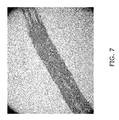
  • FIG. 7 is an optical photomicrograph illustrating a surface of sample No. 20 after a scratch test.
  • the piezoelectric/electrostrictive element can be used for example in an inkjet head actuator, a gyro sensor, an oscillator, an injector actuator, or the like.
  • FIG. 1 is a sectional view of a configuration of a piezoelectric/electrostrictive element.
  • FIG. 2 is a partial enlargement of FIG. 1 .
  • the piezoelectric/electrostrictive element 100 includes a piezoelectric body 10 , a first adhesive layer 20 , a first conductive layer 30 , a plurality of first anchor portions 40 , a second adhesive layer 50 , a second conductive layer 60 , and a plurality of second anchor portions 70 .
  • the piezoelectric body 10 is disposed between the first conductive layer 30 and the second conductive layer 60 .
  • the piezoelectric body 10 is formed in a tabular configuration, and includes a first main surface 10 S and a second main surface 10 T.
  • the first adhesive layer 20 is formed on the first main surface 10 S, and a second conductive layer 50 is disposed on the second main surface 10 T.
  • the thickness of the piezoelectric body 10 is from 3 microns to 500 microns.
  • the piezoelectric body 10 includes a conventional piezoelectric ceramic material as a main component.
  • the piezoelectric ceramic includes barium titanate, bismuth sodium titanate, sodium potassium niobate, strontium bismuth tantalite, or the like.
  • a lead based ceramic includes for example lead zirconate titanate (PZT), lead zirconate, lead titanate, lead-magnesium niobate, lead nickel niobate, lead zinc niobate, lead manganese niobate, lead antimony stanate, lead manganese tungstate, lead cobalt niobate, or the like.
  • the piezoelectric body 10 when the first adhesive layer 20 and the second adhesive layer 50 contain bismuth (Bi) and lead (Pb), the piezoelectric body 10 preferably contains a lead-based piezoelectric ceramic that exhibits superior reactivity with Bi or Pb as a main component.
  • composition X “contains” substance Y “as a main component” means that substance Y occupies preferably at least 60 wt %, more preferably at least 70 wt %, still more preferably at least 90 wt % of the overall composition X.
  • the piezoelectric body 10 may include at least one additive such as lanthanum, calcium, strontium, molybdenum, tungsten, barium, niobium, zinc, nickel, manganese, cerium, cadmium, chrome, cobalt, antimony, iron, iridium, tantalum, lithium, bismuth, and tin.
  • the coercive electric field or the piezoelectric characteristics can be adjusted by addition of lanthanum or strontium to the lead-based piezoelectric ceramic.
  • the first adhesive layer 20 is formed on the first main surface 10 S of the piezoelectric body 10 .
  • the first adhesive layer 20 is sandwiched between the piezoelectric body 10 and the first conductive layer 30 .
  • the thickness of the first adhesive layer 20 is 2 nm to 200 nm, and more preferably 5 nm to 100 nm.
  • the first adhesive layer 20 preferably covers substantially the whole surface of the adhesive surface 30 S of the first conductive layer 30 that adheres to the piezoelectric body 10 .
  • a localized space may be formed in the first adhesive layer 20 , and the piezoelectric body 10 and the first conductive layer 30 may be configured to make direct contact in that space.
  • the coverage of the adhesive surface 30 S by the first adhesive layer 20 is preferably at least 90%.
  • the first adhesive layer 20 contains a metal oxide as a main component.
  • the metal oxide contained in the first adhesive layer 20 includes at least one of bismuth oxide, lead oxide and vanadium oxide.
  • the metal oxide is preferably chemically bonded to the ceramic contained in the piezoelectric body 10 . In this manner, the adhesion of the first adhesive layer 20 to the piezoelectric body 10 is enhanced.
  • the first adhesive layer 20 may be crystalline. That is to say, the particles that configure the first adhesive layer 20 may be configured in a repetitive regular array.
  • the first conductive layer 30 is formed on the first adhesive layer 20 .
  • the first conductive layer 30 is disposed opposite to the second conductive layer 60 with the piezoelectric body 10 located in-between.
  • the first conductive layer 30 functions as an electrode for the piezoelectric/electrostrictive element 100 .
  • the thickness of the first conductive layer 30 is 50 nm to 5 microns.
  • the first conductive layer 30 contains a conventionally used electrode material as a main component.
  • the electrode material includes at least one of gold (Au), silver (Ag), copper (Cu), and platinum (Pt), or an alloy thereof.
  • Au gold
  • Ag silver
  • Cu copper
  • Pt platinum
  • the first anchor portion 40 is formed on the first adhesive layer 20 , and is embedded into the first conductive layer 30 .
  • the first anchor portion 40 may be positioned at a triple junction of the crystal grain of the first conductive layer 30 .
  • the sectional shape of the first anchor portion 40 may be semi oval, semicircular, or wedge shaped. However, deep embedding into an inner portion of the first conductive layer 30 is preferred. The depth of embedding of the first anchor portion 40 may be 5 nm to 50 nm. The anchoring effect of the first anchor portion 40 enables the first conductive layer 30 to adhere to the first adhesive layer 20 .
  • the first anchor portion 40 contains glass as a main component.
  • the glass preferably includes boron oxide (B 2 O 3 ) and silicon oxide (SiO 2 ). Examples of that glass include SiO 2 —B 2 O 3 —ZnO based glass, SiO 2 —B 2 O 3 —Na 2 O based glass, SiO 2 —B 2 O 3 —K 2 O based glass and SiO 2 —B 2 O 3 —Al 2 O 3 based glass.
  • the glass that is contained in the first anchor portion 40 is preferably chemically bonded with the metal oxide that is included in the first adhesive layer 20 . In this manner, the adhesion of the first anchor portion 40 to the first adhesive layer 20 can be enhanced.
  • the ratio (hereinafter referred to as “weight concentration ratio”) of the Si concentration (wt %) to the B concentration (weight %) in the first anchor portion 40 is preferably at least 2.5.
  • the second adhesive layer 50 is formed on the second main surface 10 T of the piezoelectric body 10 .
  • the second adhesive layer 50 exhibits the same configuration as the first adhesive layer 20 .
  • the second adhesive layer 50 contains the metal oxide that configures the first adhesive layer 20 as a main component.
  • the second conductive layer 60 is formed on the second adhesive layer 50 .
  • the second conductive layer 60 is disposed opposite to the first conductive layer 30 with the piezoelectric body 10 located in-between.
  • the second conductive layer 60 functions as an electrode of the piezoelectric/electrostrictive element 100 .
  • the main component of the second conductive layer 60 is the electrode material used to configure the first conductive layer 30 .
  • the second anchor portion 70 is formed on the second adhesive layer 50 , and is embedded into the second conductive layer 60 .
  • the main component of the second anchor portion 70 is the glass that configures the first anchor portion 40 .
  • a green sheet that includes a piezoelectric ceramic powder, a carrier, a dispersant and a plasticizing agent is heated and degreased at a predetermined temperature.
  • the green sheet is placed into an electric furnace and fired under predetermined conditions (900 degrees C. to 1300 degrees C., 1 hour to 10 hours) to thereby manufacture the piezoelectric body 10 .
  • an organic metal compound paste is manufactured by dissolving an organic metal compound of each constituent element in an organic solvent to thereby obtain the glass of the first anchor portion 40 , the electrode material of the first conductive layer 30 and the metallic oxide of the first adhesive layer 20 at a predetermined ratio.
  • an organic metal compound paste is manufactured by dissolving an organic metal compound of each constituent element in an organic solvent to thereby obtain the glass of the second anchor portion 70 , the electrode material of the second conductive layer 60 and the metal oxide of the second adhesive layer 50 at a predetermined ratio.
  • a screen printing method, a spin coating method, a spray coating method, or the like is used to coat the organic metal compound paste onto the first and the second main surfaces 10 S, 10 T of the piezoelectric body 10 .
  • the paste may be patterned by use of a photolithography method or the like. The patterning may be performed after firing of the organic metallic compound.
  • the paste of the organic metallic compound is fired under predetermined conditions (550 degrees C. to 900 degrees C., 0.1 hour to 1 hour) to thereby form the first adhesive layer 20 , the first conductive layer 30 and the first anchor layer 40 on the first main surface 10 S side of the piezoelectric body 10 , and the second adhesive layer 50 , the second conductive layer 60 and the second anchor layer 70 on the second main surface 10 T side of the piezoelectric body 10 .
  • the piezoelectric/electrostrictive element 100 includes the piezoelectric body 10 (example of a substrate), a first adhesive layer 20 (example of an adhesive layer), a first conductive layer 30 (example of a conductive layer) and a first anchor portion 40 (example of an anchor portion).
  • the piezoelectric body 10 contains a ceramic as a main component.
  • the first adhesive layer 20 is formed on the first main surface 10 S (example of a main surface) of the piezoelectric body 10 and contains a metal oxide as a main component.
  • the first conductive layer 30 is formed on the first adhesive layer 20 .
  • the first anchor portion 40 is formed on the first adhesive layer 20 and is embedded into the first conductive layer 30 .
  • the first anchor portion 40 contains glass as a main component.
  • the first anchor portion 40 adheres to the first adhesive layer 20 , and the first adhesive layer adheres to the piezoelectric body 10 .
  • the first conductive layer 30 adheres to the first adhesive layer 20 due to the anchoring effect of the first anchor portion 40 . In this manner, the adhesion of the first conductive layer 30 to the piezoelectric body 10 can be enhanced through the first adhesive layer 20 and the first anchor layer 40 .
  • the piezoelectric/electrostrictive element 100 may be configured without the second adhesive layer 50 and the second anchor portion 70 .
  • the second conductive layer 60 may be formed on the second main surface 10 T of the piezoelectric body 10 .
  • the adhesive layer 20 was formed naturally between the piezoelectric body 10 and the first conductive layer 30 by firing the organic metallic compound paste that includes the constituent elements of the adhesive layer 20 .
  • the adhesive layer 20 can be formed by a sputtering method or the like that uses a target that includes the constituent elements of the adhesive layer 20 .
  • the electrode structure according to the present invention can also be applied to a wiring substrate that includes electrical wiring (an example of a conductive layer) formed on a ceramic substrate.
  • the electrical wiring may include the first adhesive layer 20 and the first conductive layer 30 .
  • This type of wiring substrate includes a printed substrate in which printed wiring is formed on a ceramic substrate.
  • the ceramic substrate may be configured by a material other than a piezoelectric ceramic material (for example, an yttria-stabilized zirconia (YSZ).
  • Samples No. 1 and No. 3 to 20 are prepared as shown below.
  • a green sheet is prepared by using a slurry formed by mixing a carrier, a dispersant and a plasticizer with a ceramic.
  • a slurry formed by mixing a carrier, a dispersant and a plasticizer with a ceramic As shown in Table 1, sample No. 1, No. 3 to 14, and No. 16 to 20 use PZT, and sample No. 15 uses YSZ (ZrO 2 -6 wt %Y 2 O 3 ).
  • the green sheet is placed in an electric oven and samples No. 1, No. 3 to 14, and No. 16 to 20 are fired for two hours at 1200 degrees C., and sample No. 15 is fired for two hours at 1400 degrees C. to thereby prepare a substrate.
  • an organic metal compound paste is prepared by dissolving the organic metal compound at the ratio shown in Table 1 in an organic solvent.
  • screen printing is used to coat the organic metal compound paste onto a first main surface of a substrate.
  • a conductive layer is formed by firing the organic metal compound paste for 10 minutes at 700 degrees C.
  • samples No. 1, and No. 3 to 18 form an Au film and an adhesive layer (bismuth oxide, vanadium oxide), and borosilicate glass grains that are embedded into the Au film.
  • sample No. 19 does not form an adhesive layer
  • sample No. 20 does not form glass grains.
  • the thickness of the adhesive layer correlates with the added amount of Bi or V.
  • Sample No. 2 is prepared as described below.
  • a substrate is prepared in the same manner as for samples No. 1, and No. 3 to 20 described above.
  • a sputtering method is used to form a Bi 2 O 3 film having a thickness of 10 nm on a main surface of the substrate as an adhesive layer.
  • an organic metal compound paste is prepared by dissolving the organic metal compound at the ratio shown in Table 1 in an organic solvent.
  • screen printing is used to coat the organic metal compound paste onto the Bi 2 O 3 film.
  • the organic metal compound paste is fired for 10 minutes at 700 degrees C. to form the conductive layer and glass grains on the Bi 2 O 3 film.
  • the Au film surface of each sample is scratched using a needle point and the scratch is confirmed by use of an optical microscope.
  • the peeling conditions of the Au film are summarized in Table 1.
  • FIG. 4 is an optical photomicrograph illustrating a scratch on sample No. 3.
  • FIG. 5 is an optical photomicrograph illustrating a scratch on sample No. 4.
  • FIG. 6 is an optical photomicrograph illustrating a scratch on sample No. 19.
  • FIG. 7 is an optical photomicrograph illustrating a scratch on sample No. 20.
  • samples No. 1 to No. 18 form glass grains and an adhesive layer (bismuth oxide and vanadium oxide) between the Au film and the ceramic substrate (PZT substrate, YSZ substrate).
  • the peeling resulting from the scratch testing was suppressed.
  • This feature is due to the fact that the respective adhesive layers and the glass grains and the ceramic substrate adhere through a chemical bond in addition to the fact that the Au film and the adhesive layer adhere as a result of the anchoring effect of the glass grains to thereby enhance the adhesive properties with the Au film.
  • Sample No. 3 in FIG. 4 exhibits almost no peeling of the Au film. In contrast, sample No. 4 in FIG. 4 exhibits greater Au film peeling than sample No. 3. This feature is due to the fact that the hardness of the glass grains is maintained during firing as a result of the increase in the silicon ratio and therefore the glass grains are deeply embedded into the Au film. Therefore, it can be shown that the weight concentration ratio of the silicon to boron is preferably at least 2.5.
  • sample No. 13 exhibits the superior result. This feature is thought to result from the greater increase in the adhesion between bismuth oxide and PZT when compared to vanadium oxide. Therefore, the adhesion of bismuth oxide on a substrate of a lead-based bismuth compound is shown to be superior.
  • sample No. 1 exhibits the superior result. From this fact, it is shown that the adhesion of the Au film can be further enhanced by a configuration in the thickness of the adhesion layer (bismuth oxide) of at least 10 nm.
  • sample No. 10 exhibits the superior result. This feature is thought to be due to the fact that the adhesive layer is overly thick in sample No. 11, and that the adhesive layer itself was damaged during the scratch test. Consequently, it is shown that the adhesion of the Au film can be further enhanced by limiting the adhesive layer (bismuth oxide) to a thickness of no more than 100 nm.
  • the coverage of the Au film by the adhesion layer was measured using a sectional TEM image of sample No. 1 and sample No. 16. More specifically, the ratio covered by bismuth oxide of the substrate side surface of the Au film is calculated as the coverage. As result, the coverage of sample No. 1 is 91%, whereas the coverage of sample No. 16 is 78%. When the results of coverage are collated with those for the scratch test, it is shown that the adhesion of the Au film can be enhanced as the coverage increases.

Landscapes

  • Chemical & Material Sciences (AREA)
  • Engineering & Computer Science (AREA)
  • Ceramic Engineering (AREA)
  • Materials Engineering (AREA)
  • Structural Engineering (AREA)
  • Organic Chemistry (AREA)
  • Inorganic Chemistry (AREA)
  • Laminated Bodies (AREA)
  • Manufacturing & Machinery (AREA)
  • Compositions Of Oxide Ceramics (AREA)
  • Composite Materials (AREA)
  • Computer Hardware Design (AREA)
  • Power Engineering (AREA)
  • Microelectronics & Electronic Packaging (AREA)
  • General Physics & Mathematics (AREA)
  • Chemical Kinetics & Catalysis (AREA)
  • Dispersion Chemistry (AREA)
  • Condensed Matter Physics & Semiconductors (AREA)
  • Physics & Mathematics (AREA)
  • Parts Printed On Printed Circuit Boards (AREA)

Abstract

A piezoelectric/electrostrictive element includes a substrate, an adhesive layer, a first conductive layer, an anchor portion and a second conductive layer. The substrate contains a ceramic as a main component. The substrate has a main surface. The adhesive layer is formed on the main surface of the substrate. The adhesive layer contains a metal oxide as a main component. The first conductive layer is formed on the adhesive layer. The anchor portion is formed on the adhesive layer. The anchor portion is embedded in the conductive layer. The anchor portion contains glass as a main component. The second conductive layer is disposed opposite to the first conductive layer with the substrate located in-between.

Description

CROSS-REFERENCE TO RELATED APPLICATIONS
This application claims priority under 35 U.S.C. §119 to Japanese Patent Application No. 2013-063483, filed on Mar. 26, 2013. The entire disclosure of Japanese Patent Application No. 2013-063483 is hereby incorporated herein by reference.
BACKGROUND
1. Technical Field
The technology disclosed herein relates to a piezoelectric/electrostrictive element and a wiring substrate provided with a ceramic substrate and a conductive layer.
2. Background Information
Japanese Patent Application Laid-Open No. 2004-87378 discloses an organic metallic composition containing an organic gold compounds, and organic rhodium, organic bismuth and organic zinc in a predetermined ratio.
The organic metallic composition enhances film formation characteristics when forming a conductive layer on the surface of a glass-based substrate
SUMMARY
However, when a conductive layer is formed on a ceramic substrate by use of the organic metal composition in Japanese Patent Application Laid-Open No. 2004-87378, the conductive layer exhibits a tendency to peel due to the low adhesion of the conductive layer to the ceramic substrate.
In light of the problems in the conventional techniques as described above, the object of the technology disclosed herein is to provide a piezoelectric/electrostrictive element and a wiring substrate that enhances the adhesion of the conductive layer to the ceramic substrate.
A piezoelectric/electrostrictive element according to the technology disclosed herein includes a substrate, an adhesive layer, a first conductive layer, an anchor portion and a second conductive layer. The substrate contains a ceramic as a main component. The substrate has a main surface. The adhesive layer is formed on the main surface of the substrate. The adhesive layer contains a metal oxide as a main component. The first conductive layer is formed on the adhesive layer. The anchor portion is formed on the adhesive layer. The anchor portion is embedded in the conductive layer. The anchor portion contains glass as a main component. The second conductive layer is disposed opposite to the first conductive layer with the substrate located in-between.
The piezoelectric/electrostrictive element and wiring substrate according to the technology disclosed herein enhances the adhesion of a conductive layer to a ceramic substrate.
BRIEF DESCRIPTION OF DRAWINGS
Referring now to the attached drawings which form a part of this original disclosure:
FIG. 1 is a sectional view of a configuration of a piezoelectric/electrostrictive element.
FIG. 2 is a partial enlargement of FIG. 1.
FIG. 3 is a SEM image of a cross section of an example.
FIG. 4 is an optical photomicrograph illustrating a surface of sample No. 3 after a scratch test.
FIG. 5 is an optical photomicrograph illustrating a surface of sample No. 4 after a scratch test.
FIG. 6 is an optical photomicrograph illustrating a surface of sample No. 19 after a scratch test.
FIG. 7 is an optical photomicrograph illustrating a surface of sample No. 20 after a scratch test.
DETAILED DESCRIPTION OF EMBODIMENTS
Next, a piezoelectric/electrostrictive element configured with an electrode structure will be described making reference to the drawings. The piezoelectric/electrostrictive element can be used for example in an inkjet head actuator, a gyro sensor, an oscillator, an injector actuator, or the like.
The same or similar portions disclosed in the following figures are denoted by the same or similar reference numerals. However, the figures are merely schematic, and the ratios of the respective dimensions or the like may differ from the actual values. Therefore, the actual dimensions or the like should be determined by making reference to the following description. In addition, it is naturally the case that portions are included that exhibit differences in relation to ratios or in relation to the relationship between mutual dimensions in different figures.
Configuration of Piezoelectric/electrostrictive Element 100
The configuration of a piezoelectric/electrostrictive element 100 will be described making reference to the figures. FIG. 1 is a sectional view of a configuration of a piezoelectric/electrostrictive element. FIG. 2 is a partial enlargement of FIG. 1.
The piezoelectric/electrostrictive element 100 includes a piezoelectric body 10, a first adhesive layer 20, a first conductive layer 30, a plurality of first anchor portions 40, a second adhesive layer 50, a second conductive layer 60, and a plurality of second anchor portions 70.
The piezoelectric body 10 is disposed between the first conductive layer 30 and the second conductive layer 60. The piezoelectric body 10 is formed in a tabular configuration, and includes a first main surface 10S and a second main surface 10T. The first adhesive layer 20 is formed on the first main surface 10S, and a second conductive layer 50 is disposed on the second main surface 10T. The thickness of the piezoelectric body 10 is from 3 microns to 500 microns.
The piezoelectric body 10 includes a conventional piezoelectric ceramic material as a main component. In addition to a lead-based piezoelectric ceramic, the piezoelectric ceramic includes barium titanate, bismuth sodium titanate, sodium potassium niobate, strontium bismuth tantalite, or the like. A lead based ceramic includes for example lead zirconate titanate (PZT), lead zirconate, lead titanate, lead-magnesium niobate, lead nickel niobate, lead zinc niobate, lead manganese niobate, lead antimony stanate, lead manganese tungstate, lead cobalt niobate, or the like.
In particular, when the first adhesive layer 20 and the second adhesive layer 50 contain bismuth (Bi) and lead (Pb), the piezoelectric body 10 preferably contains a lead-based piezoelectric ceramic that exhibits superior reactivity with Bi or Pb as a main component. In the present embodiment, the disclosure that composition X “contains” substance Y “as a main component” means that substance Y occupies preferably at least 60 wt %, more preferably at least 70 wt %, still more preferably at least 90 wt % of the overall composition X.
The piezoelectric body 10 may include at least one additive such as lanthanum, calcium, strontium, molybdenum, tungsten, barium, niobium, zinc, nickel, manganese, cerium, cadmium, chrome, cobalt, antimony, iron, iridium, tantalum, lithium, bismuth, and tin. The coercive electric field or the piezoelectric characteristics can be adjusted by addition of lanthanum or strontium to the lead-based piezoelectric ceramic.
The first adhesive layer 20 is formed on the first main surface 10S of the piezoelectric body 10. The first adhesive layer 20 is sandwiched between the piezoelectric body 10 and the first conductive layer 30. The thickness of the first adhesive layer 20 is 2 nm to 200 nm, and more preferably 5 nm to 100 nm.
The first adhesive layer 20 preferably covers substantially the whole surface of the adhesive surface 30S of the first conductive layer 30 that adheres to the piezoelectric body 10. However, a localized space may be formed in the first adhesive layer 20, and the piezoelectric body 10 and the first conductive layer 30 may be configured to make direct contact in that space. The coverage of the adhesive surface 30S by the first adhesive layer 20 is preferably at least 90%.
The first adhesive layer 20 contains a metal oxide as a main component. The metal oxide contained in the first adhesive layer 20 includes at least one of bismuth oxide, lead oxide and vanadium oxide. The metal oxide is preferably chemically bonded to the ceramic contained in the piezoelectric body 10. In this manner, the adhesion of the first adhesive layer 20 to the piezoelectric body 10 is enhanced.
The first adhesive layer 20 may be crystalline. That is to say, the particles that configure the first adhesive layer 20 may be configured in a repetitive regular array.
The first conductive layer 30 is formed on the first adhesive layer 20. The first conductive layer 30 is disposed opposite to the second conductive layer 60 with the piezoelectric body 10 located in-between. The first conductive layer 30 functions as an electrode for the piezoelectric/electrostrictive element 100. The thickness of the first conductive layer 30 is 50 nm to 5 microns.
The first conductive layer 30 contains a conventionally used electrode material as a main component. The electrode material includes at least one of gold (Au), silver (Ag), copper (Cu), and platinum (Pt), or an alloy thereof. There is no particular limitation in relation to the planar shape of the first conductive layer 30, and a configuration in a rectangular, comb shape, round shape, or the like is possible.
The first anchor portion 40 is formed on the first adhesive layer 20, and is embedded into the first conductive layer 30. The first anchor portion 40 may be positioned at a triple junction of the crystal grain of the first conductive layer 30.
The sectional shape of the first anchor portion 40 may be semi oval, semicircular, or wedge shaped. However, deep embedding into an inner portion of the first conductive layer 30 is preferred. The depth of embedding of the first anchor portion 40 may be 5 nm to 50 nm. The anchoring effect of the first anchor portion 40 enables the first conductive layer 30 to adhere to the first adhesive layer 20.
The first anchor portion 40 contains glass as a main component. The glass preferably includes boron oxide (B2O3) and silicon oxide (SiO2). Examples of that glass include SiO2—B2O3—ZnO based glass, SiO2—B2O3—Na2O based glass, SiO2—B2O3—K2O based glass and SiO2—B2O3—Al2O3 based glass. The glass that is contained in the first anchor portion 40 is preferably chemically bonded with the metal oxide that is included in the first adhesive layer 20. In this manner, the adhesion of the first anchor portion 40 to the first adhesive layer 20 can be enhanced.
The ratio (hereinafter referred to as “weight concentration ratio”) of the Si concentration (wt %) to the B concentration (weight %) in the first anchor portion 40 is preferably at least 2.5.
The second adhesive layer 50 is formed on the second main surface 10T of the piezoelectric body 10. The second adhesive layer 50 exhibits the same configuration as the first adhesive layer 20. The second adhesive layer 50 contains the metal oxide that configures the first adhesive layer 20 as a main component.
The second conductive layer 60 is formed on the second adhesive layer 50. The second conductive layer 60 is disposed opposite to the first conductive layer 30 with the piezoelectric body 10 located in-between. The second conductive layer 60 functions as an electrode of the piezoelectric/electrostrictive element 100. The main component of the second conductive layer 60 is the electrode material used to configure the first conductive layer 30.
The second anchor portion 70 is formed on the second adhesive layer 50, and is embedded into the second conductive layer 60. The main component of the second anchor portion 70 is the glass that configures the first anchor portion 40.
Method of Manufacturing Piezoelectric/Electrostrictive Element 100
Next, the method of manufacturing the piezoelectric/electrostrictive element 100 will be described.
Firstly, a green sheet that includes a piezoelectric ceramic powder, a carrier, a dispersant and a plasticizing agent is heated and degreased at a predetermined temperature.
Next, the green sheet is placed into an electric furnace and fired under predetermined conditions (900 degrees C. to 1300 degrees C., 1 hour to 10 hours) to thereby manufacture the piezoelectric body 10.
Next, an organic metal compound paste is manufactured by dissolving an organic metal compound of each constituent element in an organic solvent to thereby obtain the glass of the first anchor portion 40, the electrode material of the first conductive layer 30 and the metallic oxide of the first adhesive layer 20 at a predetermined ratio. In the same manner, an organic metal compound paste is manufactured by dissolving an organic metal compound of each constituent element in an organic solvent to thereby obtain the glass of the second anchor portion 70, the electrode material of the second conductive layer 60 and the metal oxide of the second adhesive layer 50 at a predetermined ratio.
Next, a screen printing method, a spin coating method, a spray coating method, or the like is used to coat the organic metal compound paste onto the first and the second main surfaces 10S, 10T of the piezoelectric body 10. If required, the paste may be patterned by use of a photolithography method or the like. The patterning may be performed after firing of the organic metallic compound.
Next, the paste of the organic metallic compound is fired under predetermined conditions (550 degrees C. to 900 degrees C., 0.1 hour to 1 hour) to thereby form the first adhesive layer 20, the first conductive layer 30 and the first anchor layer 40 on the first main surface 10S side of the piezoelectric body 10, and the second adhesive layer 50, the second conductive layer 60 and the second anchor layer 70 on the second main surface 10T side of the piezoelectric body 10.
Operation and Effect
The piezoelectric/electrostrictive element 100 includes the piezoelectric body 10 (example of a substrate), a first adhesive layer 20 (example of an adhesive layer), a first conductive layer 30 (example of a conductive layer) and a first anchor portion 40 (example of an anchor portion). The piezoelectric body 10 contains a ceramic as a main component. The first adhesive layer 20 is formed on the first main surface 10S (example of a main surface) of the piezoelectric body 10 and contains a metal oxide as a main component. The first conductive layer 30 is formed on the first adhesive layer 20. The first anchor portion 40 is formed on the first adhesive layer 20 and is embedded into the first conductive layer 30. The first anchor portion 40 contains glass as a main component.
Therefore, the first anchor portion 40 adheres to the first adhesive layer 20, and the first adhesive layer adheres to the piezoelectric body 10. The first conductive layer 30 adheres to the first adhesive layer 20 due to the anchoring effect of the first anchor portion 40. In this manner, the adhesion of the first conductive layer 30 to the piezoelectric body 10 can be enhanced through the first adhesive layer 20 and the first anchor layer 40.
Other Embodiments
The present invention is not limited to the above embodiments and may be changed or varied in various ways within a scope that does not depart from the spirit of the invention.
For example, in the above embodiment, although the piezoelectric/electrostrictive element 100 includes the second adhesive layer 50 and the second anchor portion 70, the piezoelectric/electrostrictive element 100 may be configured without the second adhesive layer 50 and the second anchor portion 70. In this configuration, the second conductive layer 60 may be formed on the second main surface 10T of the piezoelectric body 10.
In the above embodiment, the adhesive layer 20 was formed naturally between the piezoelectric body 10 and the first conductive layer 30 by firing the organic metallic compound paste that includes the constituent elements of the adhesive layer 20. However, the invention is not thereby limited. For example, the adhesive layer 20 can be formed by a sputtering method or the like that uses a target that includes the constituent elements of the adhesive layer 20.
In the above embodiments, although a configuration was described in which the electrode structure according to the present invention was applied to the piezoelectric/electrostrictive element 100, the invention is not thereby limited. The electrode structure according to the present invention can also be applied to a wiring substrate that includes electrical wiring (an example of a conductive layer) formed on a ceramic substrate. In this configuration, the electrical wiring may include the first adhesive layer 20 and the first conductive layer 30. This type of wiring substrate includes a printed substrate in which printed wiring is formed on a ceramic substrate. The ceramic substrate may be configured by a material other than a piezoelectric ceramic material (for example, an yttria-stabilized zirconia (YSZ).
EXAMPLES
Although the example of the present invention will be described hereafter, the invention is not thereby limited to the description of those examples.
Preparation of Samples No. 1 and No. 3 to 20
Samples No. 1 and No. 3 to 20 are prepared as shown below.
Firstly, a green sheet is prepared by using a slurry formed by mixing a carrier, a dispersant and a plasticizer with a ceramic. As shown in Table 1, sample No. 1, No. 3 to 14, and No. 16 to 20 use PZT, and sample No. 15 uses YSZ (ZrO2-6 wt %Y2O3).
Next, the green sheet is placed in an electric oven and samples No. 1, No. 3 to 14, and No. 16 to 20 are fired for two hours at 1200 degrees C., and sample No. 15 is fired for two hours at 1400 degrees C. to thereby prepare a substrate.
Next, an organic metal compound paste is prepared by dissolving the organic metal compound at the ratio shown in Table 1 in an organic solvent.
Next, screen printing is used to coat the organic metal compound paste onto a first main surface of a substrate.
Next, a conductive layer is formed by firing the organic metal compound paste for 10 minutes at 700 degrees C. In this manner, as shown by the sectional SEM image in FIG. 3, samples No. 1, and No. 3 to 18 form an Au film and an adhesive layer (bismuth oxide, vanadium oxide), and borosilicate glass grains that are embedded into the Au film. On the other hand, sample No. 19 does not form an adhesive layer, and sample No. 20 does not form glass grains.
As shown in Table 1, the thickness of the adhesive layer correlates with the added amount of Bi or V.
Preparation of Sample No. 2
Sample No. 2 is prepared as described below.
Firstly, a substrate is prepared in the same manner as for samples No. 1, and No. 3 to 20 described above.
Next, a sputtering method is used to form a Bi2O3 film having a thickness of 10 nm on a main surface of the substrate as an adhesive layer.
Next, an organic metal compound paste is prepared by dissolving the organic metal compound at the ratio shown in Table 1 in an organic solvent.
Next, screen printing is used to coat the organic metal compound paste onto the Bi2O3 film.
Next, the organic metal compound paste is fired for 10 minutes at 700 degrees C. to form the conductive layer and glass grains on the Bi2O3 film.
Peeling due to Scratch Testing
The Au film surface of each sample is scratched using a needle point and the scratch is confirmed by use of an optical microscope. The peeling conditions of the Au film are summarized in Table 1.
FIG. 4 is an optical photomicrograph illustrating a scratch on sample No. 3. FIG. 5 is an optical photomicrograph illustrating a scratch on sample No. 4. FIG. 6 is an optical photomicrograph illustrating a scratch on sample No. 19. FIG. 7 is an optical photomicrograph illustrating a scratch on sample No. 20. These optical photomicrographs illustrate the peeling position on the Au film as a black colored region in the scratch that is drawn with a slope.
TABLE 1
Organic Metal Compound Si/B
(wt % Conversion Weight Thickness of
of Element Component) Concentration Adhesive Layer Peeling due to
Sample No. Ceramic Au Rh Bi V Si B Ratio (nm) Scratch Test
1 PZT 20 0.06 0.5 0.04 0.024 1.6 10 Little
2 PZT 20 0.06 0.04 0.024 1.6 10 Little
3 PZT 20 0.06 0.5 0.06 0.024 2.5 10 Almost none
4 PZT 20 0.06 0.5 0.06 0.036 1.6 10 Little
5 PZT 20 0.06 0.5 0.12 0.048 2.5 10 Almost none
6 PZT 20 0.06 0.5 0.12 0.072 1.6 10 Little
7 PZT 20 0.06 0.1 0.06 0.024 2.5 2 Partial peeling
8 PZT 20 0.06 0.2 0.06 0.024 2.5 4 Partial peeling
9 PZT 20 0.06 1 0.06 0.024 2.5 25 Almost none
10 PZT 20 0.06 1.5 0.06 0.024 2.5 100 Little
11 PZT 20 0.06 2 0.06 0.024 2.5 200 Partial peeling
12 PZT 20 0.06 2 0.04 0.048 0.8 200 Partial peeling
13 PZT 20 0.06 0.5 0.04 0.024 1.6 10 Little
14 PZT 20 0.06 0.5 0.04 0.024 1.6 10 Partial peeling
15 YSZ 20 0.06 0.5 0.04 0.024 1.6 10 Little
16 PZT 20 0.06 0.3 0.04 0.024 1.6 6 Partial peeling
17 PZT 20 0.06 0.5 0.02 0.012 1.6 10 Partial peeling
18 PZT 20 0.06 0.5 0.01 0.006 1.6 10 Partial peeling
19 PZT 20 0.06 0.04 0.024 0.16 Complete peeling
20 PZT 20 0.06 0.5 10 Complete peeling
As shown by Table 1 and FIG. 4 to FIG. 7, samples No. 1 to No. 18 form glass grains and an adhesive layer (bismuth oxide and vanadium oxide) between the Au film and the ceramic substrate (PZT substrate, YSZ substrate). In those samples, the peeling resulting from the scratch testing was suppressed. This feature is due to the fact that the respective adhesive layers and the glass grains and the ceramic substrate adhere through a chemical bond in addition to the fact that the Au film and the adhesive layer adhere as a result of the anchoring effect of the glass grains to thereby enhance the adhesive properties with the Au film.
Sample No. 3 in FIG. 4 exhibits almost no peeling of the Au film. In contrast, sample No. 4 in FIG. 4 exhibits greater Au film peeling than sample No. 3. This feature is due to the fact that the hardness of the glass grains is maintained during firing as a result of the increase in the silicon ratio and therefore the glass grains are deeply embedded into the Au film. Therefore, it can be shown that the weight concentration ratio of the silicon to boron is preferably at least 2.5.
The scratch testing of sample No. 1 and sample No. 2 both obtained a good result. Therefore, the adhesion of the Au film is shown to be enhanced irrespective of the method of formation of the adhesive layer.
In the scratch testing of sample No. 13 and sample No. 14, sample No. 13 exhibits the superior result. This feature is thought to result from the greater increase in the adhesion between bismuth oxide and PZT when compared to vanadium oxide. Therefore, the adhesion of bismuth oxide on a substrate of a lead-based bismuth compound is shown to be superior.
The scratch testing of sample No. 13 and sample No. 15 both obtained a good result. Therefore, the adhesion of the Au film is shown to be enhanced irrespective of the material of the substrate.
Since a superior result is also obtained in the scratch testing of sample No. 17 and sample No. 18, the number of glass grains is shown to enable at least sufficient enhancement of the adhesion of the Au film.
In the scratch testing of sample No. 1 and sample No. 16, sample No. 1 exhibits the superior result. From this fact, it is shown that the adhesion of the Au film can be further enhanced by a configuration in the thickness of the adhesion layer (bismuth oxide) of at least 10 nm.
In the scratch testing of sample No. 10 and sample No. 11, sample No. 10 exhibits the superior result. This feature is thought to be due to the fact that the adhesive layer is overly thick in sample No. 11, and that the adhesive layer itself was damaged during the scratch test. Consequently, it is shown that the adhesion of the Au film can be further enhanced by limiting the adhesive layer (bismuth oxide) to a thickness of no more than 100 nm.
Although not shown in Table 1, the coverage of the Au film by the adhesion layer (bismuth oxide) was measured using a sectional TEM image of sample No. 1 and sample No. 16. More specifically, the ratio covered by bismuth oxide of the substrate side surface of the Au film is calculated as the coverage. As result, the coverage of sample No. 1 is 91%, whereas the coverage of sample No. 16 is 78%. When the results of coverage are collated with those for the scratch test, it is shown that the adhesion of the Au film can be enhanced as the coverage increases.

Claims (8)

What is claimed is:
1. A piezoelectric/electrostrictive element comprising,
a substrate containing ceramic as a main component, the substrate having a main surface;
an adhesive layer formed on the main surface of the substrate, the adhesive layer containing a metal oxide as a main component;
a first conductive layer formed on the adhesive layer;
an anchor portion formed on the adhesive layer, the anchor portion embedded in the first conductive layer, the anchor portion containing glass as a main component; and
a second conductive layer disposed opposite to the first conductive layer with the substrate located in-between.
2. The piezoelectric/electrostrictive element according to claim 1, wherein
the metal oxide contained in the adhesive layer includes at least one of bismuth oxide, lead oxide and vanadium oxide.
3. The piezoelectric/electrostrictive element according to claim 1, wherein
the glass contained in the anchor portion includes silicon oxide and boron oxide.
4. The piezoelectric/electrostrictive element according to claim 3, wherein
a weight concentration ratio of silicon to boron in the anchor portion is at least 2.5.
5. The piezoelectric/electrostrictive element according to claim 1, wherein
the anchor portion is positioned at a triple junction of a crystal grain of the conductive layer.
6. The piezoelectric/electrostrictive element according to claim 1, wherein
the ceramic contained in the substrate is lead-based piezoelectric ceramic.
7. The piezoelectric/electrostrictive element according to claim 1, wherein
the conductive layer contains at least one of gold, silver, copper and platinum as a main component.
8. A wiring substrate comprising,
a substrate containing ceramic as a main component, the substrate having a main surface;
an adhesive layer formed on the main surface of the substrate, the adhesive layer containing a metal oxide as a main component;
a conductive layer formed on the adhesive layer; and
an anchor portion formed on the adhesive layer, the anchor portion embedded in the conductive layer, the anchor portion containing glass as a main component.
US14/224,507 2013-03-26 2014-03-25 Piezoelectric/electrostrictive element and wiring substrate Active 2035-02-26 US9455396B2 (en)

Applications Claiming Priority (2)

Application Number Priority Date Filing Date Title
JP2013063483A JP5830050B2 (en) 2013-03-26 2013-03-26 Piezoelectric / electrostrictive element and wiring board
JP2013-063483 2013-03-26

Publications (2)

Publication Number Publication Date
US20140292156A1 US20140292156A1 (en) 2014-10-02
US9455396B2 true US9455396B2 (en) 2016-09-27

Family

ID=50732764

Family Applications (1)

Application Number Title Priority Date Filing Date
US14/224,507 Active 2035-02-26 US9455396B2 (en) 2013-03-26 2014-03-25 Piezoelectric/electrostrictive element and wiring substrate

Country Status (3)

Country Link
US (1) US9455396B2 (en)
EP (1) EP2784837B1 (en)
JP (1) JP5830050B2 (en)

Families Citing this family (2)

* Cited by examiner, † Cited by third party
Publication number Priority date Publication date Assignee Title
JP6783528B2 (en) * 2016-02-29 2020-11-11 日本碍子株式会社 Ceramic structure, its manufacturing method and members for semiconductor manufacturing equipment
WO2018164047A1 (en) * 2017-03-06 2018-09-13 コニカミノルタ株式会社 Piezoelectric member, ultrasonic oscillation element, ultrasonic probe, ultrasound diagnostic system, and method for producing piezoelectric member

Citations (7)

* Cited by examiner, † Cited by third party
Publication number Priority date Publication date Assignee Title
US4795512A (en) 1986-02-26 1989-01-03 Matsushita Electric Industrial Co., Ltd. Method of manufacturing a multilayer ceramic body
JPH05298918A (en) 1992-04-22 1993-11-12 Murata Mfg Co Ltd Conductive paste composition
JPH05298919A (en) 1992-02-19 1993-11-12 Chichibu Cement Co Ltd Composite substrate and its manufacture
JP2004087378A (en) 2002-08-28 2004-03-18 Noritake Co Ltd Organic metal conductor composition and its utilization
US20050046312A1 (en) * 2003-09-01 2005-03-03 Fuji Photo Film Co., Ltd. Laminated structure, piezoelectric actuator and method of manufacturing the same
US20050233112A1 (en) 2004-04-20 2005-10-20 Ih-Houng Loh Ceramic composite
US20120225197A1 (en) 2011-03-01 2012-09-06 Ngk Insulators, Ltd. Terminal electrode forming method and manufacturing method of piezoelectric/electrostrictive element by use thereof

Family Cites Families (2)

* Cited by examiner, † Cited by third party
Publication number Priority date Publication date Assignee Title
JP2000331866A (en) * 1999-03-17 2000-11-30 Hitachi Metals Ltd Laminated ceramic electronic component
JP5361635B2 (en) * 2008-09-25 2013-12-04 京セラ株式会社 Vibrator

Patent Citations (8)

* Cited by examiner, † Cited by third party
Publication number Priority date Publication date Assignee Title
US4795512A (en) 1986-02-26 1989-01-03 Matsushita Electric Industrial Co., Ltd. Method of manufacturing a multilayer ceramic body
JPH05298919A (en) 1992-02-19 1993-11-12 Chichibu Cement Co Ltd Composite substrate and its manufacture
JPH05298918A (en) 1992-04-22 1993-11-12 Murata Mfg Co Ltd Conductive paste composition
JP2004087378A (en) 2002-08-28 2004-03-18 Noritake Co Ltd Organic metal conductor composition and its utilization
US20050046312A1 (en) * 2003-09-01 2005-03-03 Fuji Photo Film Co., Ltd. Laminated structure, piezoelectric actuator and method of manufacturing the same
US20050233112A1 (en) 2004-04-20 2005-10-20 Ih-Houng Loh Ceramic composite
US20120225197A1 (en) 2011-03-01 2012-09-06 Ngk Insulators, Ltd. Terminal electrode forming method and manufacturing method of piezoelectric/electrostrictive element by use thereof
JP2012182288A (en) 2011-03-01 2012-09-20 Ngk Insulators Ltd Formation method of terminal electrode and manufacturing method of piezoelectric/electrostrictive element using the same

Non-Patent Citations (2)

* Cited by examiner, † Cited by third party
Title
Extended European Search Report (Application No. 14161599.7) dated Aug. 26, 2014.
Japanese Office Action, Japanese Application No. 2013-063483, dated Apr. 14, 2015 (4 pages).

Also Published As

Publication number Publication date
EP2784837B1 (en) 2016-03-23
US20140292156A1 (en) 2014-10-02
EP2784837A1 (en) 2014-10-01
JP2014192186A (en) 2014-10-06
JP5830050B2 (en) 2015-12-09

Similar Documents

Publication Publication Date Title
JP5714361B2 (en) Terminal electrode forming method and method for manufacturing piezoelectric / electrostrictive element using the same
JP5641683B2 (en) 1200 ° C film resistor
EP0615295B1 (en) Piezoelectric/electrostrictive element having electrode film(s) with specified surface roughness
CN107210102B (en) Ceramic multilayer device and method for manufacturing ceramic multilayer device
JPH05267742A (en) Piezoelectric/electrostrictive film element
KR101022980B1 (en) Ceramic electronic components
US7484278B2 (en) Method of manufacturing a multi-layered piezoelectric
US20050212388A1 (en) Piezoelectric ceramic and piezoelectric device
US9455396B2 (en) Piezoelectric/electrostrictive element and wiring substrate
US8339017B2 (en) Multi-layer piezoelectric element and injection apparatus using the same
US20060066176A1 (en) Piezoelectric/electrostrictive film type device and method of manufacturing the same
EP1796183A1 (en) Piezoelectric/electrostriction film type element and production method therefor
JP3894112B2 (en) Piezoelectric / electrostrictive membrane element
JPH05270912A (en) Piezoelectric/electrostrictive film type element
US20070220724A1 (en) Manufacturing method of piezoelectric/electrostrictive device
EP1387416A2 (en) Piezoelectric/electrostrictive film type device
US20150015123A1 (en) Piezoelectric/electrostrictive film type element and method for producing piezoelectric/electrostrictive film type element
JP7388177B2 (en) Piezoelectric element
JP3207315B2 (en) Piezoelectric / electrostrictive film type element
US9412930B2 (en) Laminated body and piezoelectric/electrostrictive element
JP2007123353A (en) Piezoelectric / electrostrictive film and manufacturing method thereof
US9831018B2 (en) Electronic component
JPH08162304A (en) Electronic component and manufacturing method thereof
JP2013089862A (en) Film-type piezoelectric/electrostrictive element and method for manufacturing the same
JP2006049806A (en) Multilayer piezoelectric ceramic structure and manufacturing method thereof

Legal Events

Date Code Title Description
AS Assignment

Owner name: NGK INSULATORS, LTD., JAPAN

Free format text: ASSIGNMENT OF ASSIGNORS INTEREST;ASSIGNOR:KASHIWAYA, TOSHIKATSU;REEL/FRAME:032518/0632

Effective date: 20140306

STCF Information on status: patent grant

Free format text: PATENTED CASE

MAFP Maintenance fee payment

Free format text: PAYMENT OF MAINTENANCE FEE, 4TH YEAR, LARGE ENTITY (ORIGINAL EVENT CODE: M1551); ENTITY STATUS OF PATENT OWNER: LARGE ENTITY

Year of fee payment: 4

MAFP Maintenance fee payment

Free format text: PAYMENT OF MAINTENANCE FEE, 8TH YEAR, LARGE ENTITY (ORIGINAL EVENT CODE: M1552); ENTITY STATUS OF PATENT OWNER: LARGE ENTITY

Year of fee payment: 8