US929042A - Binder for books. - Google Patents
Binder for books. Download PDFInfo
- Publication number
- US929042A US929042A US41740408A US1908417404A US929042A US 929042 A US929042 A US 929042A US 41740408 A US41740408 A US 41740408A US 1908417404 A US1908417404 A US 1908417404A US 929042 A US929042 A US 929042A
- Authority
- US
- United States
- Prior art keywords
- binding
- book
- plates
- books
- binder
- Prior art date
- Legal status (The legal status is an assumption and is not a legal conclusion. Google has not performed a legal analysis and makes no representation as to the accuracy of the status listed.)
- Expired - Lifetime
Links
Images
Classifications
-
- B—PERFORMING OPERATIONS; TRANSPORTING
- B42—BOOKBINDING; ALBUMS; FILES; SPECIAL PRINTED MATTER
- B42F—SHEETS TEMPORARILY ATTACHED TOGETHER; FILING APPLIANCES; FILE CARDS; INDEXING
- B42F3/00—Sheets temporarily attached together involving perforations; Means therefor; Sheet details therefor
Definitions
- the objects of my improvement are, to provide a binder which may be easily applied by any one to an assemblage of checks and stubs arranged in the form of a pad, from which the pad of stubs may be easily removed after the checks have been used, which may be applied to a new pad, and to provide a strong and handsome binder,
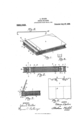
- FIG. 1 is a perspective view of the binder applied to a book Fig. 2, a transverse sectional view on the line A-B of Fig. 1; Fig. 3, a partial longitudinal sectional view on the line O-D of Fig. 2; Fig. 4, a top plan view of a check book 5 Fig. 5, a detail view of the hinge-bar; and Fig. 6, a detail view showe ing another construction of the hinge-bar.
- the check or other book 1 is made up of plain sheets piled one upon the other in the usual way.
- the book is preferably gummed on the back so as to form a pad, although this is not necessary and for some purposes is preferably omitted.
- Perforations 2 may be made through the pile of stubs near the back, and the stubs may be fastened together by means of the conventional paper fastener 3 which has a round head and a double tongue, which is bent over in opposite directions on top of the book.
- Notches 4 are cut in the back of the book to accommodate binding screws.
- the check book may be perforated or scored at 5 in the usual way, to facilitate removing the checks from the stubs.
- Cover boards 6 are provided, preferably made quite heavy and attractive.
- Two binding-plates of metal, 7 and 8, are provided. These have screw-posts 9 and 10 respectively riveted or otherwise rigidly secured in them.
- the screw-posts 9 and 1() are threaded right and left, and nuts correspondingly threaded right and left are screwed on them.
- nuts 11 When nuts 11 are turned they spread apart or bring together posts 9 and 10 and their attached binding-plates 7 and 8.
- the nuts 11 are provided with faces, being preferably heXagon, and each face is provided with a wrench hole 12 by which the nuts may be turned with a common wire nail or piece of wire.
- the notches 4 are made of sufficient size so that the initial tightening of nuts 11 may be done with the fingers.
- Binding-plate 7 is provided with holding-lugs 13, preferably cone shaped, at positions corresponding with the location of the holes 2 and fasteners 3 of the book.
- Binding-plate 8 is correspondingly provided with depressions 111, to receive the heads of fasteners 3. ln this way the book is firmly locked in the binding plates against falling out or displacement.
- binding plates 7 and 8 Ahold merely by pressure and friction.
- hinge-rods 15 are made ⁇ preferably of round stock and U shaped, as shown in Fig. 5, although, if preferred, the two hinge-rods may be made integral, as shown in Fig. 6, the rod extending entirely across the rear edge of cover 6 and then having a return bend at each end.
- One leg of the U shaped hinge-bar is preferably secured rigidly to the back 6 by means of a spring clamp, 16, that extends the entire width of the cover 6 and forward on each side of the cover a distance sufficient to secure a firm frictional hold thereon, and the other end is inserted to have pivotal movement in a socket formed longitudinally in each end of bars 7 and 8.
- the back may be folded over to open perfectly flat, as shown by the dotted line in Fig. 3, so that it is entirely out of the way and gives perfect access to the leaves of the book. 1
- the binding plates 7 and 8 may be of polished metal. There may also be a polished metal binding on the rear edge of backs 6, and the backs may be handsomely embellished and suitably printed, because they are substantially made and can be used repeatedly.
- a binder for books, backs, bindingplates, clamping-screws forV clamping said inding-plates on the back of a book a book provided with open notches in its back to receive and accommodate said binding-screws, said book being provided with holes for fasteners, and paper fasteners in said book, one of said binding-plates being provided with depressions to receive the heads of said paper fasteners, and the other of said bindingplates being provided with lugs to enter between the tongues of said paper fasteners so as to locate and securely hold said book.
- covers In a binder for books, covers, bindingplates, right and left threaded binding-posts secured in adjacent sides of said bindingplates, nuts correspondingly threaded and joining said binding-plates to clamp said binding-plates and compress a book between them, and a book provided with notches in its back to receive and accommodate said binding-posts and nuts, said covers attached to said binding-plates by hinge members consisting of a rod extending entirely across the cover and then having a return bend at each end thereof to pivotally engage said binding plates, said hinge rods being secured to the rear edges of said covers by means of spring clam s frictionally engaging said covers.
- a binder for books, covers, bindingplates, clamping-screws for clamping said binding-plates on the back of a book a book provided with open notches in its back to receive and accommodate said binding-screws, said book being provided with holes for fasteners, and paper fasteners in said book, one of said binding-plates being provided with depressions to receive the heads of said paper fasteners, and the other of said binding-plates being provided with lugs to enter between the tongues of said paper fasteners, so as to locate and securely hold said book, a hinge member consisting of a rod extending entirely across the cover and then having a return bend at each end thereof to pivotally engage said binding plates, said hinge rods being secured to the rear edges of said covers by means of spring clamps frictionally engaging said covers.
Landscapes
- Sheet Holders (AREA)
Description
A. SPAHN. BINDER FOB BOOKS. APPLIOATIon FILED rm. a4, 190s.
Patented July 27, 1909.
,afg-'S- WTNESSES.'
, @6M/Zw.
ADAM SPAHN, OF LOUISVILLE, KENTUCKY.
BINDER FOR BOOKS.
Specification of Letters Patent.
Application filed February 24, 1308.
Patented July 27, 1909.
serial No. 417,404.
To all whom it may concern:
Be it known that l, ADAM SPAHN, a citizen of the United States, residing at Louisville, in the county of Jefferson and State of Kentucky, have invented certain new and useful Improvements in Binders for Books, of which the following is a specification.
As is well known, blank checks furnished by banks are bound together in books, and each check is provided with a stub upon which the record of the check is kept and which is left in the book when the check is removed. Order books are also frequently arranged inthe same manner. The binding of check books is a considerable item of eX- pense to the banks, especially if it is desired to furnish them in a neat and substantial binding, which is desired in the case of large business institutions.
The objects of my improvement are, to provide a binder which may be easily applied by any one to an assemblage of checks and stubs arranged in the form of a pad, from which the pad of stubs may be easily removed after the checks have been used, which may be applied to a new pad, and to provide a strong and handsome binder,
which may be used over and over again.V
These objects I attain by means of the device illustrated in the accompanying drawings in which- Figure 1, is a perspective view of the binder applied to a book Fig. 2, a transverse sectional view on the line A-B of Fig. 1; Fig. 3, a partial longitudinal sectional view on the line O-D of Fig. 2; Fig. 4, a top plan view of a check book 5 Fig. 5, a detail view of the hinge-bar; and Fig. 6, a detail view showe ing another construction of the hinge-bar.
Similar reference numerals refer to similar parts throughout the several views of the drawings.
The check or other book 1 is made up of plain sheets piled one upon the other in the usual way. The book is preferably gummed on the back so as to form a pad, although this is not necessary and for some purposes is preferably omitted. Perforations 2 may be made through the pile of stubs near the back, and the stubs may be fastened together by means of the conventional paper fastener 3 which has a round head and a double tongue, which is bent over in opposite directions on top of the book. Notches 4 are cut in the back of the book to accommodate binding screws. The check book may be perforated or scored at 5 in the usual way, to facilitate removing the checks from the stubs. Cover boards 6 are provided, preferably made quite heavy and attractive. Two binding-plates of metal, 7 and 8, are provided. These have screw-posts 9 and 10 respectively riveted or otherwise rigidly secured in them. The screw-posts 9 and 1() are threaded right and left, and nuts correspondingly threaded right and left are screwed on them. When nuts 11 are turned they spread apart or bring together posts 9 and 10 and their attached binding-plates 7 and 8. The nuts 11 are provided with faces, being preferably heXagon, and each face is provided with a wrench hole 12 by which the nuts may be turned with a common wire nail or piece of wire. The notches 4 are made of sufficient size so that the initial tightening of nuts 11 may be done with the fingers. Binding-plate 7 is provided with holding-lugs 13, preferably cone shaped, at positions corresponding with the location of the holes 2 and fasteners 3 of the book. Binding-plate 8 is correspondingly provided with depressions 111, to receive the heads of fasteners 3. ln this way the book is firmly locked in the binding plates against falling out or displacement. When the holes 2 and fasteners 3 are not used, binding plates 7 and 8 Ahold merely by pressure and friction.
The backs 6 are attached to plates 7 and 8 by means of hinge-rods 15, which are made `preferably of round stock and U shaped, as shown in Fig. 5, although, if preferred, the two hinge-rods may be made integral, as shown in Fig. 6, the rod extending entirely across the rear edge of cover 6 and then having a return bend at each end. One leg of the U shaped hinge-bar is preferably secured rigidly to the back 6 by means of a spring clamp, 16, that extends the entire width of the cover 6 and forward on each side of the cover a distance sufficient to secure a firm frictional hold thereon, and the other end is inserted to have pivotal movement in a socket formed longitudinally in each end of bars 7 and 8. It will be understood that with this construction of the hinge, the back may be folded over to open perfectly flat, as shown by the dotted line in Fig. 3, so that it is entirely out of the way and gives perfect access to the leaves of the book. 1
The use of my improved binder is now obvious. The check books, or other books, are furnished in the form of pads.'4 Binding plates 7 and 8 are opened or separated by turning nuts 11 in the proper direction. The back 1 is inserted between the binding-plates, nuts l1 are manipulated with the fingers until plates 7 and 8 come into firm contact with the book and are then screwed up tight with any suitable instrument, such as a wrench, or any round piece of metal that may be at hand. After the checks in that particular book have been all used, the book of stubs may be removed from the binder and a new book inserted.
The binding plates 7 and 8 may be of polished metal. There may also be a polished metal binding on the rear edge of backs 6, and the backs may be handsomely embellished and suitably printed, because they are substantially made and can be used repeatedly.
Having thus described my invention I claim 1. In a binder for books, backs, bindingplates, said backs being hinged to saidbinding-plates, right 'and left threaded bindingposts secured in adjacent sides of said binding-plates, nuts correspondingly threaded and joining said binding-plates to clamp said binding-plates and compress a book between them, and a book provided with notches in its back to receive and accommodate said binding-posts and nuts.
2. In a binder for books, backs, bindingplates, clamping-screws forV clamping said inding-plates on the back of a book, a book provided with open notches in its back to receive and accommodate said binding-screws, said book being provided with holes for fasteners, and paper fasteners in said book, one of said binding-plates being provided with depressions to receive the heads of said paper fasteners, and the other of said bindingplates being provided with lugs to enter between the tongues of said paper fasteners so as to locate and securely hold said book.
3. In a binder for books, covers,binding plates for clamping the rear edge of the book etween them, and hinges joining said covers to said binding plates consisting of a rod eX- tending entirely across the cover and then having a return bend at each end thereof to pivotally engage said binding plates, said 'nge rods being secured to the rear edges of said covers by means of spring clamps frictionally engaging said covers.
4. In a binder for books, covers, bindingplates, right and left threaded binding-posts secured in adjacent sides of said bindingplates, nuts correspondingly threaded and joining said binding-plates to clamp said binding-plates and compress a book between them, and a book provided with notches in its back to receive and accommodate said binding-posts and nuts, said covers attached to said binding-plates by hinge members consisting of a rod extending entirely across the cover and then having a return bend at each end thereof to pivotally engage said binding plates, said hinge rods being secured to the rear edges of said covers by means of spring clam s frictionally engaging said covers.
5. n a binder for books, covers, bindingplates, clamping-screws for clamping said binding-plates on the back of a book, a book provided with open notches in its back to receive and accommodate said binding-screws, said book being provided with holes for fasteners, and paper fasteners in said book, one of said binding-plates being provided with depressions to receive the heads of said paper fasteners, and the other of said binding-plates being provided with lugs to enter between the tongues of said paper fasteners, so as to locate and securely hold said book, a hinge member consisting of a rod extending entirely across the cover and then having a return bend at each end thereof to pivotally engage said binding plates, said hinge rods being secured to the rear edges of said covers by means of spring clamps frictionally engaging said covers.
ADAM SPAHN. Witnesses:
D. B. MEDANICH, M. C. RoLLwAGE.
Priority Applications (1)
| Application Number | Priority Date | Filing Date | Title |
|---|---|---|---|
| US41740408A US929042A (en) | 1908-02-24 | 1908-02-24 | Binder for books. |
Applications Claiming Priority (1)
| Application Number | Priority Date | Filing Date | Title |
|---|---|---|---|
| US41740408A US929042A (en) | 1908-02-24 | 1908-02-24 | Binder for books. |
Publications (1)
| Publication Number | Publication Date |
|---|---|
| US929042A true US929042A (en) | 1909-07-27 |
Family
ID=2997467
Family Applications (1)
| Application Number | Title | Priority Date | Filing Date |
|---|---|---|---|
| US41740408A Expired - Lifetime US929042A (en) | 1908-02-24 | 1908-02-24 | Binder for books. |
Country Status (1)
| Country | Link |
|---|---|
| US (1) | US929042A (en) |
-
1908
- 1908-02-24 US US41740408A patent/US929042A/en not_active Expired - Lifetime
Similar Documents
| Publication | Publication Date | Title |
|---|---|---|
| US5941569A (en) | Album binding system | |
| US4269530A (en) | Document retaining system | |
| US10173456B2 (en) | Articulated sheet binder apparatus | |
| US485814A (en) | Cover for manuscripts | |
| US861228A (en) | Holder for manifold writing. | |
| US2744530A (en) | Separable ring fastener | |
| US660304A (en) | Binding for books. | |
| US825474A (en) | File-binder. | |
| US214588A (en) | Improvement in bill-files | |
| US920508A (en) | File, temporary binder, loose-leaf book, and the like. | |
| US931816A (en) | Binder for loose-leaf books. | |
| US930783A (en) | Loose-leaf binder. | |
| US2423817A (en) | Bound book | |
| US778070A (en) | Loose-leaf book. | |
| US928342A (en) | Loose-leaf binder. | |
| US1161619A (en) | Loose-leaf binder. | |
| US640578A (en) | Temporary cover and binder for papers. | |
| US500482A (en) | Binder for sheet-music | |
| US793735A (en) | Lock for loose-leaf binders. | |
| US1071500A (en) | Loose-leaf binder. | |
| US971441A (en) | Temporary binder. | |
| US453574A (en) | Temporary binder | |
| US828297A (en) | Binder. | |
| US1200591A (en) | Loose-leaf binder. | |
| US762184A (en) | Book cover and binder. |