US9228620B2 - Dual clutch device - Google Patents

Dual clutch device Download PDF

Info

Publication number
US9228620B2
US9228620B2 US14/235,698 US201114235698A US9228620B2 US 9228620 B2 US9228620 B2 US 9228620B2 US 201114235698 A US201114235698 A US 201114235698A US 9228620 B2 US9228620 B2 US 9228620B2
Authority
US
United States
Prior art keywords
piston
plate
section
returning
plates
Prior art date
Legal status (The legal status is an assumption and is not a legal conclusion. Google has not performed a legal analysis and makes no representation as to the accuracy of the status listed.)
Active
Application number
US14/235,698
Other versions
US20140209424A1 (en
Inventor
Cheol Jin Kim
Current Assignee (The listed assignees may be inaccurate. Google has not performed a legal analysis and makes no representation or warranty as to the accuracy of the list.)
Hyundai Transys Inc
Original Assignee
Hyundai Powertech Co Ltd
Priority date (The priority date is an assumption and is not a legal conclusion. Google has not performed a legal analysis and makes no representation as to the accuracy of the date listed.)
Filing date
Publication date
Application filed by Hyundai Powertech Co Ltd filed Critical Hyundai Powertech Co Ltd
Assigned to LG INNOTEK CO., LTD. reassignment LG INNOTEK CO., LTD. ASSIGNMENT OF ASSIGNORS INTEREST (SEE DOCUMENT FOR DETAILS). Assignors: KIM, CHEOL JIN
Assigned to Hyundai Powertech Co., Ltd. reassignment Hyundai Powertech Co., Ltd. CORRECTIVE ASSIGNMENT TO CORRECT THE CORRECT THE RECEIVING PARTY DATA, ASSIGNEE NAME, FROM LG INNOTEK CO., LTD. TO HYUNDAI POWERTECH CO., LTD. PREVIOUSLY RECORDED ON REEL 032075 FRAME 0393. ASSIGNOR(S) HEREBY CONFIRMS THE ASSIGNMENT OF ENTIRE INTEREST. Assignors: KIM, CHEOL JIN
Publication of US20140209424A1 publication Critical patent/US20140209424A1/en
Application granted granted Critical
Publication of US9228620B2 publication Critical patent/US9228620B2/en
Active legal-status Critical Current
Anticipated expiration legal-status Critical

Links

Images

Classifications

    • FMECHANICAL ENGINEERING; LIGHTING; HEATING; WEAPONS; BLASTING
    • F16ENGINEERING ELEMENTS AND UNITS; GENERAL MEASURES FOR PRODUCING AND MAINTAINING EFFECTIVE FUNCTIONING OF MACHINES OR INSTALLATIONS; THERMAL INSULATION IN GENERAL
    • F16DCOUPLINGS FOR TRANSMITTING ROTATION; CLUTCHES; BRAKES
    • F16D21/00Systems comprising a plurality of actuated clutches
    • FMECHANICAL ENGINEERING; LIGHTING; HEATING; WEAPONS; BLASTING
    • F16ENGINEERING ELEMENTS AND UNITS; GENERAL MEASURES FOR PRODUCING AND MAINTAINING EFFECTIVE FUNCTIONING OF MACHINES OR INSTALLATIONS; THERMAL INSULATION IN GENERAL
    • F16DCOUPLINGS FOR TRANSMITTING ROTATION; CLUTCHES; BRAKES
    • F16D21/00Systems comprising a plurality of actuated clutches
    • F16D21/02Systems comprising a plurality of actuated clutches for interconnecting three or more shafts or other transmission members in different ways
    • F16D21/06Systems comprising a plurality of actuated clutches for interconnecting three or more shafts or other transmission members in different ways at least two driving shafts or two driven shafts being concentric
    • FMECHANICAL ENGINEERING; LIGHTING; HEATING; WEAPONS; BLASTING
    • F16ENGINEERING ELEMENTS AND UNITS; GENERAL MEASURES FOR PRODUCING AND MAINTAINING EFFECTIVE FUNCTIONING OF MACHINES OR INSTALLATIONS; THERMAL INSULATION IN GENERAL
    • F16DCOUPLINGS FOR TRANSMITTING ROTATION; CLUTCHES; BRAKES
    • F16D25/00Fluid-actuated clutches
    • F16D25/06Fluid-actuated clutches in which the fluid actuates a piston incorporated in, i.e. rotating with the clutch
    • F16D25/062Fluid-actuated clutches in which the fluid actuates a piston incorporated in, i.e. rotating with the clutch the clutch having friction surfaces
    • F16D25/063Fluid-actuated clutches in which the fluid actuates a piston incorporated in, i.e. rotating with the clutch the clutch having friction surfaces with clutch members exclusively moving axially
    • F16D25/0635Fluid-actuated clutches in which the fluid actuates a piston incorporated in, i.e. rotating with the clutch the clutch having friction surfaces with clutch members exclusively moving axially with flat friction surfaces, e.g. discs
    • F16D25/0638Fluid-actuated clutches in which the fluid actuates a piston incorporated in, i.e. rotating with the clutch the clutch having friction surfaces with clutch members exclusively moving axially with flat friction surfaces, e.g. discs with more than two discs, e.g. multiple lamellae
    • FMECHANICAL ENGINEERING; LIGHTING; HEATING; WEAPONS; BLASTING
    • F16ENGINEERING ELEMENTS AND UNITS; GENERAL MEASURES FOR PRODUCING AND MAINTAINING EFFECTIVE FUNCTIONING OF MACHINES OR INSTALLATIONS; THERMAL INSULATION IN GENERAL
    • F16HGEARING
    • F16H63/00Control outputs from the control unit to change-speed- or reversing-gearings for conveying rotary motion or to other devices than the final output mechanism
    • F16H63/02Final output mechanisms therefor; Actuating means for the final output mechanisms
    • F16H63/30Constructional features of the final output mechanisms
    • FMECHANICAL ENGINEERING; LIGHTING; HEATING; WEAPONS; BLASTING
    • F16ENGINEERING ELEMENTS AND UNITS; GENERAL MEASURES FOR PRODUCING AND MAINTAINING EFFECTIVE FUNCTIONING OF MACHINES OR INSTALLATIONS; THERMAL INSULATION IN GENERAL
    • F16DCOUPLINGS FOR TRANSMITTING ROTATION; CLUTCHES; BRAKES
    • F16D21/00Systems comprising a plurality of actuated clutches
    • F16D21/02Systems comprising a plurality of actuated clutches for interconnecting three or more shafts or other transmission members in different ways
    • F16D21/06Systems comprising a plurality of actuated clutches for interconnecting three or more shafts or other transmission members in different ways at least two driving shafts or two driven shafts being concentric
    • F16D2021/0607Double clutch with torque input plate in-between the two clutches, i.e. having a central input plate
    • FMECHANICAL ENGINEERING; LIGHTING; HEATING; WEAPONS; BLASTING
    • F16ENGINEERING ELEMENTS AND UNITS; GENERAL MEASURES FOR PRODUCING AND MAINTAINING EFFECTIVE FUNCTIONING OF MACHINES OR INSTALLATIONS; THERMAL INSULATION IN GENERAL
    • F16DCOUPLINGS FOR TRANSMITTING ROTATION; CLUTCHES; BRAKES
    • F16D21/00Systems comprising a plurality of actuated clutches
    • F16D21/02Systems comprising a plurality of actuated clutches for interconnecting three or more shafts or other transmission members in different ways
    • F16D21/06Systems comprising a plurality of actuated clutches for interconnecting three or more shafts or other transmission members in different ways at least two driving shafts or two driven shafts being concentric
    • F16D2021/0661Hydraulically actuated multiple lamellae clutches
    • FMECHANICAL ENGINEERING; LIGHTING; HEATING; WEAPONS; BLASTING
    • F16ENGINEERING ELEMENTS AND UNITS; GENERAL MEASURES FOR PRODUCING AND MAINTAINING EFFECTIVE FUNCTIONING OF MACHINES OR INSTALLATIONS; THERMAL INSULATION IN GENERAL
    • F16DCOUPLINGS FOR TRANSMITTING ROTATION; CLUTCHES; BRAKES
    • F16D21/00Systems comprising a plurality of actuated clutches
    • F16D21/02Systems comprising a plurality of actuated clutches for interconnecting three or more shafts or other transmission members in different ways
    • F16D21/06Systems comprising a plurality of actuated clutches for interconnecting three or more shafts or other transmission members in different ways at least two driving shafts or two driven shafts being concentric
    • F16D2021/0692Systems comprising a plurality of actuated clutches for interconnecting three or more shafts or other transmission members in different ways at least two driving shafts or two driven shafts being concentric with two clutches arranged axially without radial overlap
    • FMECHANICAL ENGINEERING; LIGHTING; HEATING; WEAPONS; BLASTING
    • F16ENGINEERING ELEMENTS AND UNITS; GENERAL MEASURES FOR PRODUCING AND MAINTAINING EFFECTIVE FUNCTIONING OF MACHINES OR INSTALLATIONS; THERMAL INSULATION IN GENERAL
    • F16DCOUPLINGS FOR TRANSMITTING ROTATION; CLUTCHES; BRAKES
    • F16D25/00Fluid-actuated clutches
    • F16D25/10Clutch systems with a plurality of fluid-actuated clutches

Definitions

  • the present invention relates to a dual clutch device, and more particularly, to a dual clutch device capable of using a balance chamber and a return spring in common.
  • an automatic transmission uses a planetary gear device as a multiple-stage speed change mechanism which changes the rotation force transferred from an input shaft and transfers changed rotation force to a driving shaft.
  • the planetary gear device is constructed such that an element serves as an input element and another element serves as a reaction element to transfer speed-changed rotation force to an output element.
  • a certain element of the planetary gear device is connected by a hydraulically acting friction element, and the hydraulically acting friction element is actuated or deactuated by application or release of a control pressure from a hydraulic control system.
  • the hydraulically acting friction element is constituted by a clutch which transfers the rotation power of an input shaft and a brake which secures one element of the planetary gear device.
  • the plates are spline-coupled to a retainer and the disks are spline-coupled to a hub, if the plates and the disks are brought into close contact, the power of the retainer is transferred to the hub.
  • a balance chamber and a return spring are arranged between the piston and the retainer. Since a lubricant is filled in the balance chamber, centrifugal force in a piston-acting direction by a working fluid may be offset.
  • a dual clutch device two pistons are used, and a balance chamber and a return spring are provided for each of the two pistons.
  • a conventional dual clutch device has a problem in that, since a balance chamber and a return spring should be provided for each clutch section, a volume for constructing the device increases and a flow path is complicated.
  • An embodiment of the present disclosure relates to a dual clutch device in which clutch sections commonly use a balance chamber and a return spring so that a flow path and a structure may be designed simply.
  • the present invention provides a dual clutch device, including a retainer section to which rotation force is transferred; a plate section which is mounted to the retainer section; a disk section which is disposed on the plate section; a hub section which is connected to the disk section; a piston section which presses the plate section; a driving section which moves the piston section; and a returning section which is disposed between parts of the driving section and provides returning force to the piston section.
  • the retainer section includes an input shaft to which rotation force is inputted; a connection part which is connected to the input shaft; a coupling part which is coupled to the connection part; a bent part which is bent from the coupling part; and a mounting part which is coupled to the bent part and to which the plate section is mounted.
  • the plate section according to the first aspect of the present disclosure includes a plurality of first plates which are mounted to the mounting part; and a plurality of second plates which are mounted to the mounting part and are disposed to be separated from the first plates.
  • the disk section according to the first aspect of the present disclosure includes first disks which are disposed alternately with the first plates; and second disks which are disposed alternately with the second plates.
  • the hub section according to the first aspect of the present disclosure includes a first hub to which the first disks are coupled; and a second hub to which the second disks are coupled.
  • the piston section according to the first aspect of the present disclosure includes a first piston which presses the first plates; and a second piston which presses the second plates.
  • the driving section includes a first actuating plate which has one end which is brought into close contact with the first piston, and which defines a first working space between it and the first piston; a second actuating plate which has one end which is brought into close contact with the second piston, and which defines a second working space between it and the second piston; and a base plate to which the other end of the first actuating plate and the other end of the second actuating plate are connected, and which is defined with a first hole which communicates with the first working space and into and from which a working fluid is introduced and discharged and a second hole which communicates with the second working space and into and from which the working fluid is introduced and discharged.
  • the returning section includes a first returning plate which has one end which is brought into close contact with the mounting part and the other end which is brought into close contact with the first piston; a second returning plate which has one end which is brought into close contact with the mounting part and the other end which is brought into close contact with the second piston; a balance chamber which communicates with a lubricant hole which is defined through the base plate, which is defined between the first returning plate and the second returning plate, and in which a lubricant is filled; and an elastic element which has one end which is supported by the first returning plate and the other end which is supported by the second returning plate, and which provides elastic force by elasticity thereof.
  • the retainer section includes an input shaft to which rotation force is inputted; a connection part which is connected to the input shaft; a first mounting part which is coupled to the connection part; a bent part which is bent from the first mounting part; and a second mounting part which is connected to the bent part and which faces the first mounting part.
  • the plate section according to the second aspect of the present disclosure includes a plurality of first plates which are mounted to the first mounting part; and a plurality of second plates which are mounted to the second mounting part.
  • the disk section according to the second aspect of the present disclosure includes first disks which are disposed alternately with the first plates; and second disks which are disposed alternately with the second plates.
  • the hub section according to the second aspect of the present disclosure includes a first hub to which the first disks are coupled; and a second hub to which the second disks are coupled.
  • the piston section according to the second aspect of the present disclosure includes a first piston which presses the first plates; and a second piston which presses the second plates.
  • the driving section includes a first actuating plate which has one end which is brought into close contact with the first piston, and which defines a first working space between it and the first piston; a second actuating plate which has one end which is brought into close contact with the second piston, and which defines a second working space between it and the second piston; and a base plate to which the other end of the first actuating plate and the other end of the second actuating plate are connected, and which is defined with a first hole which communicates with the first working space and into and from which a working fluid is introduced and discharged and a second hole which communicates with the second working space and into and from which the working fluid is introduced and discharged.
  • the returning section includes a first returning plate which is mounted to the second mounting part and is brought into close contact with the first piston; a second returning plate which has one end which is brought into close contact with the second mounting part and the other end which is brought into close contact with the second piston; a balance chamber which communicates with a lubricant hole which is defined through the base plate, which is defined between the first returning plate and the second returning plate, and in which a lubricant is filled; and an elastic element which has one end which is supported by the first piston and the other end which is supported by the second returning plate, and which provides elastic force by elasticity thereof.
  • the size of a product may be decreased and a manufacturing cost may be reduced.
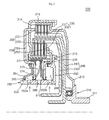
  • FIG. 1 is a cross-sectional view schematically illustrating a dual clutch device in accordance with a first embodiment of the present disclosure
  • FIG. 2 is a cross-sectional view schematically illustrating a dual clutch device in accordance with a second embodiment of the present disclosure.
  • FIG. 1 is a cross-sectional view schematically illustrating a dual clutch device in accordance with a first embodiment of the present disclosure
  • FIG. 2 is a cross-sectional view schematically illustrating a dual clutch device in accordance with a second embodiment of the present disclosure.
  • dual clutch devices 100 and 200 in accordance with a first embodiment and a second embodiment of the present disclosure include retainer sections 110 and 210 , plate sections 120 and 220 , disk sections 130 and 230 , hub sections 140 and 240 , piston sections 150 and 250 , driving sections 160 and 260 , and returning sections 170 and 270 .
  • the retainer sections 110 and 210 are rotated as rotation force is transferred thereto.
  • Each of the plate sections 120 and 220 is disposed as a pair of parts, on each of the retainer sections 110 and 210 .
  • the disk sections 130 and 230 are disposed adjacent to the plate sections 120 and 220 , and transfer power by close contact of disks.
  • the hub sections 140 and 240 are connected to the disk sections 130 and 230 .
  • the piston sections 150 and 250 selectively press the plate sections 120 and 220 , and bring the plates of the plate sections 120 and 220 and the disks of the disk sections 130 and 230 disposed adjacent to the plate sections 120 and 220 , into close contact.
  • the driving sections 160 and 260 move the respective pistons 150 and 250 by a working fluid
  • the returning sections 170 and 270 are disposed between parts of the driving sections 160 and 260 and provide returning force to the piston sections 150 and 250 .
  • a transverse dual clutch device in accordance with the first embodiment of the present disclosure will be described below with reference to FIG. 1 .
  • the retainer section 110 in accordance with the first embodiment of the present disclosure includes an input shaft 111 , a connection part 112 , a coupling part 113 , a bent part 114 , and a mounting part 115 .
  • the input shaft 111 is linked with an engine and is transferred with rotation force, and the connection part 112 is connected with the input shaft 111 .
  • the coupling part 113 is coupled to the connection part 112 and is horizontally disposed to extend parallel to the input shaft 111 .
  • the bent part 114 is bent vertically from the end of the coupling part 113 and extends downwards.
  • the mounting part 115 is coupled to the end of the bent part 114 and extends parallel to the coupling part 113 .
  • the pair of parts of the plate section 120 are disposed on the mounting part 115 in the lengthwise direction of the mounting part 115 .
  • the plate section 120 in accordance with the first embodiment of the present disclosure includes first plates 121 and second plates 122 .
  • the plate section 120 is spline-coupled to the retainer section 110 .
  • a plurality of first plates 121 are mounted to the mounting part 115
  • a plurality of second plates 122 are mounted to the mounting part 115 in such a way as to be separated from the first plates 121 .
  • the disk section 130 in accordance with the first embodiment of the present disclosure includes first disks 131 and second disks 132 .
  • the first disks 131 are alternately disposed with the first plates 121
  • the second disks 132 are alternately disposed with the second plates 122 .
  • the disk section 130 is spline-coupled to the hub section 140 .
  • the hub section 140 in accordance with the first embodiment of the present disclosure includes a first hub 141 and a second hub 142 .
  • the hub section 140 transfers the rotation force inputted thereto through the retainer section 110 , to an output shaft.
  • the first disks 131 are coupled to the first hub 141
  • the second disks 132 are coupled to the second hub 142 .
  • the first hub 141 is disposed inward of the retainer section 110
  • the second hub 142 is disposed inward of the first hub 141 .
  • the piston section 150 in accordance with the first embodiment of the present disclosure includes a first piston 151 and a second piston 152 .
  • the first piston 151 functions to press the first plates 121 .
  • the first piston 151 has one end which is disposed adjacent to the left side of the first plates 121 and the other end which is bent to extend downward and is positioned below the mounting part 115 .
  • the second piston 152 functions to press the second plates 122 .
  • the second piston 152 has one end which is disposed adjacent to the right side of the second plates 122 and the other end which is bent to extend downward and is positioned below the mounting part 115 .
  • the first piston 151 and the second piston 152 are disposed to face each other below the mounting part 115 .
  • the driving section 160 in accordance with the first embodiment of the present disclosure includes a first actuating plate 161 , a second actuating plate 162 , and a base plate 163 .
  • the first actuating plate 161 has one end which is brought into close contact with the first piston 151 . As the first actuating plate 161 has a flexed shape, a portion of the first actuating plate 161 is separated from the first piston 151 . Thus, a first working space 165 is defined between the first actuating plate 161 and the first piston 151 .
  • the second actuating plate 162 has one end which is brought into close contact with the second piston 152 . As the second actuating plate 162 has a flexed shape, a portion of the second actuating plate 162 is separated from the second piston 152 . Thus, a second working space 166 is defined between the second actuating plate 162 and the second piston 152 .
  • first actuating plate 161 and the second actuating plate 162 are connected to the base plate 163 .
  • a first hole 163 a and a second hole 163 b are defined through the base plate 163 .
  • the first hole 163 a communicates with the first working space 165 so that the working fluid may be introduced into and discharged from the first working space 165
  • the second hole 163 b communicates with the second working space 166 so that the working fluid may be introduced into and discharged from the second working space 166 .
  • the returning section 170 in accordance with the first embodiment of the present disclosure includes a first returning plate 171 , a second returning plate 172 , a balance chamber 173 , and an elastic element 174 .
  • the returning section 170 is disposed between the first piston 151 and the second piston 152 .
  • the first returning plate 171 has one end which is brought into close contact with the mounting part 115 and the other end which is brought into close contact with the inner surface of the first piston 151 .
  • the second returning plate 172 has one end which is brought into close contact with the mounting part 115 and the other end which is brought into close contact with the inner surface of the second piston 152 .
  • the balance chamber 173 is defined between the first returning plate 171 and the second returning plate 172 and is filled with a lubricant.
  • a lubricant hole 169 is defined through the base plate 163 to communicate with the balance chamber 173 , such that the lubricant can be introduced into and discharged from the balance chamber 173 .
  • the elastic element 174 has one end which is supported by the first returning plate 171 and the other end which is supported by the second returning plate 172 .
  • the elastic element 174 provides returning force by elasticity thereof.
  • seals are provided at the boundary regions of the piston section 150 and the driving section 160 . Further, in order to prevent the lubricant from leaking from the balance chamber 173 , the returning section 170 is sealed.
  • the first piston 151 is moved toward the first plates 121 while pressing the returning section 170 by the hydraulic pressure of the first working space 165 .
  • the lubricant filled in the balance chamber 173 of the returning section 170 offsets the centrifugal force of the working fluid introduced into the first working space 165 . If the introduction of the working fluid into the first working space 165 is interrupted, the first piston 151 is returned to its original position by the returning force of the elastic element 174 .
  • the second piston 152 is moved toward the second plates 122 while pressing the returning section 170 by the hydraulic pressure of the second working space 166 .
  • the lubricant filled in the balance chamber 173 of the returning section 170 offsets the centrifugal force of the working fluid introduced into the second working space 166 . If the introduction of the working fluid into the second working space 166 is interrupted, the second piston 152 is returned to its original position by the returning force of the elastic element 174 .
  • the lubricant overflows from the balance chamber 173 , the lubricant reaches the mounting part 115 through gaps between the piston section 150 and the returning section 170 , and cools the plate section 120 and the disk section 130 .
  • the lubricant having passed through the gaps between the piston section 150 and the returning section 170 is scattered by centrifugal force, and is evenly distributed over the plate section 120 and the disk section 130 .
  • a longitudinal dual clutch device in accordance with the second embodiment of the present disclosure will be described below with reference to FIG. 2 .
  • the retainer section 210 in accordance with the second embodiment of the present disclosure includes an input shaft 211 , a connection part 212 , a first mounting part 213 , a bent part 214 , and a second mounting part 215 .
  • the input shaft 211 is linked with an engine and is transferred with rotation force, and the connection part 212 is connected with the side of the input shaft 211 .
  • the first mounting part 213 is coupled to the connection part 212 and is horizontally disposed to extend parallel to the input shaft 211 .
  • the bent part 214 is bent vertically from the end of the first mounting part 213 and extends downwards.
  • the second mounting part 215 is coupled to the end of the bent part 214 and extends parallel to the first mounting part 213 .
  • the first mounting part 213 and the second mounting part 215 are disposed to face each other.
  • the plate section 220 is disposed on the first mounting part 213 and the second mounting part 215 in the lengthwise directions of the first mounting part 213 and the second mounting part 215 .
  • the plate section 220 in accordance with the second embodiment of the present disclosure includes first plates 221 and second plates 222 .
  • the plate section 220 is spline-coupled to the retainer section 210 .
  • a plurality of first plates 221 are mounted to the first mounting part 213
  • a plurality of second plates 222 are mounted to the second mounting part 215 .
  • the disk section 230 in accordance with the second embodiment of the present disclosure includes first disks 231 and second disks 232 .
  • the first disks 231 are alternately disposed with the first plates 221
  • the second disks 232 are alternately disposed with the second plates 222 .
  • the disk section 230 is spline-coupled to the hub section 240 .
  • the hub section 240 in accordance with the second embodiment of the present disclosure includes a first hub 241 and a second hub 242 .
  • the hub section 240 transfers the rotation force inputted thereto through the retainer section 210 , to an output shaft.
  • the first disks 231 are coupled to the first hub 241
  • the second disks 232 are coupled to the second hub 242 .
  • the first hub 241 is disposed inward of the retainer section 210
  • the second hub 242 is disposed inward of the first hub 241 .
  • the piston section 250 in accordance with the second embodiment of the present disclosure includes a first piston 251 and a second piston 252 .
  • the first piston 251 functions to press the first plates 221 .
  • the first piston 251 has one end which is disposed adjacent to the left side of the first plates 221 and the other end which is bent to extend downward and is positioned below the second mounting part 215 .
  • the second piston 252 functions to press the second plates 222 .
  • the second piston 252 has one end which is disposed adjacent to the right side of the second plates 222 and the other end which is bent to extend downward and is positioned below the second mounting part 215 .
  • the first piston 251 and the second piston 252 are disposed to face each other below the second mounting part 215 .
  • the driving section 260 in accordance with the second embodiment of the present disclosure includes a first actuating plate 261 , a second actuating plate 262 , and a base plate 263 .
  • the first actuating plate 261 has one end which is brought into close contact with the first piston 251 . As the first actuating plate 261 has a flexed shape, a portion of the first actuating plate 261 is separated from the first piston 251 . Thus, a first working space 265 is defined between the first actuating plate 261 and the first piston 251 .
  • the second actuating plate 262 is brought into close contact with the second piston 252 at a sidewardly projecting portion thereof, and has one end which is coupled to the second mounting part 215 .
  • the second actuating plate 262 is separated from the second piston 252 .
  • a second working space 266 is defined between the second actuating plate 262 and the second piston 252 .
  • first actuating plate 261 and the second actuating plate 262 are connected to the base plate 263 .
  • a first hole 263 a and a second hole 263 b are defined through the base plate 263 .
  • the first hole 263 a communicates with the first working space 265 so that the working fluid may be introduced into and discharged from the first working space 265
  • the second hole 263 b communicates with the second working space 266 so that the working fluid may be introduced into and discharged from the second working space 266 .
  • the returning section 270 in accordance with the second embodiment of the present disclosure includes a first returning plate 271 , a second returning plate 272 , a balance chamber 273 , and an elastic element 274 .
  • the returning section 270 is disposed between the first piston 251 and the second piston 252 .
  • the first returning plate 271 is mounted to the second mounting part 215 and is brought into close contact with the inner surface of the first piston 251 .
  • the second returning plate 272 has one end which is brought into close contact with the second mounting part 215 and the other end which is brought into close contact with the inner surface of the second piston 252 .
  • the second returning plate 272 may have one end which is brought into close contact with the first returning plate 271 .
  • the balance chamber 273 is defined among the first returning plate 271 , the second returning plate 272 and the first piston 251 , and is filled with a lubricant.
  • a lubricant hole 269 is defined through the base plate 263 to communicate with the balance chamber 273 , such that the lubricant can be introduced into and discharged from the balance chamber 273 .
  • the elastic element 274 has one end which is supported by the first piston 251 and the other end which is supported by the second returning plate 272 .
  • the elastic element 274 provides returning force by elasticity thereof.
  • seals are provided at the boundary regions of the piston section 250 and the driving section 260 . Further, in order to prevent the lubricant from leaking from the balance chamber 273 , the returning section 270 is sealed.
  • the first piston 251 is moved toward the first plates 221 while pressing the returning section 270 by the hydraulic pressure of the first working space 265 .
  • the lubricant filled in the balance chamber 273 of the returning section 270 offsets the centrifugal force of the working fluid introduced into the first working space 265 . If the introduction of the working fluid into the first working space 265 is interrupted, the first piston 251 is returned to its original position by the returning force of the elastic element 274 .
  • the second piston 252 is moved toward the second plates 222 while pressing the returning section 270 by the hydraulic pressure of the second working space 266 .
  • the lubricant filled in the balance chamber 273 of the returning section 270 offsets the centrifugal force of the working fluid introduced into the second working space 266 . If the introduction of the working fluid into the second working space 266 is interrupted, the second piston 252 is returned to its original position by the returning force of the elastic element 274 .
  • the lubricant When the lubricant overflows from the balance chamber 273 , the lubricant reaches the second mounting part 215 through the gaps between the piston section 250 and the returning section 270 , thus cooling the plate section 220 and the disk section 230 .
  • the lubricant passing through the gaps between the piston section 250 and the returning section 270 is scattered by the centrifugal force, thus uniformly reaching the plate section 220 and the disk section 230 .

Landscapes

  • Engineering & Computer Science (AREA)
  • General Engineering & Computer Science (AREA)
  • Mechanical Engineering (AREA)
  • Hydraulic Clutches, Magnetic Clutches, Fluid Clutches, And Fluid Joints (AREA)

Abstract

The present invention relates to a dual clutch device which comprises: a retainer portion to which a rotation force is transmitted; a pair of plate portions provided to the retainer portion; disc portions which are respectively arranged at the plate portions; a hub portion connected to the disc portion; piston portions which respectively apply pressure to the plate portions; driving portions which respectively move the piston portions; and a restoration portion which is arranged between the driving portions and provides a restoration force to the piston portions. The dual clutch device, according to the invention, uses one restoration portion, thereby simplifying a flow path and reducing the size of a product.

Description

CROSS-REFERENCE TO RELATED APPLICATIONS
This application is the U.S. national stage application of International Patent Application No. PCT/KR2011/006713, filed Sep. 9, 2011, which claims priority to Korean Application No. 10-2011-0075550, filed Jul. 29, 2011, the disclosures of each of which are incorporated herein by reference in their entirety.
TECHNICAL FIELD
The present invention relates to a dual clutch device, and more particularly, to a dual clutch device capable of using a balance chamber and a return spring in common.
BACKGROUND ART
In general, an automatic transmission uses a planetary gear device as a multiple-stage speed change mechanism which changes the rotation force transferred from an input shaft and transfers changed rotation force to a driving shaft.
The planetary gear device is constructed such that an element serves as an input element and another element serves as a reaction element to transfer speed-changed rotation force to an output element.
In the planetary gear device, in order to allow respective elements to serve as the input element, the reaction element and the output element, a certain element of the planetary gear device is connected by a hydraulically acting friction element, and the hydraulically acting friction element is actuated or deactuated by application or release of a control pressure from a hydraulic control system.
The hydraulically acting friction element is constituted by a clutch which transfers the rotation power of an input shaft and a brake which secures one element of the planetary gear device.
If a hydraulic pressure is supplied to the clutch, a piston is moved and brings multiple clutch plates and multiple clutch disks into close contact.
Since the plates are spline-coupled to a retainer and the disks are spline-coupled to a hub, if the plates and the disks are brought into close contact, the power of the retainer is transferred to the hub.
A balance chamber and a return spring are arranged between the piston and the retainer. Since a lubricant is filled in the balance chamber, centrifugal force in a piston-acting direction by a working fluid may be offset.
Accordingly, if the pressure of the working fluid is released, the piston is returned to its original position by the returning force of the return spring.
Meanwhile, in a dual clutch device, two pistons are used, and a balance chamber and a return spring are provided for each of the two pistons.
The background art of the present disclosure is disclosed in Korean Unexamined Patent Publication No. 10-1996-031833 (published on Sep. 17, 1996 and entitled ‘Clutch Assembly Structure of Multiple Disk Clutch’).
DISCLOSURE Technical Problem
A conventional dual clutch device has a problem in that, since a balance chamber and a return spring should be provided for each clutch section, a volume for constructing the device increases and a flow path is complicated.
Therefore, it is necessary to cope with this problem.
An embodiment of the present disclosure relates to a dual clutch device in which clutch sections commonly use a balance chamber and a return spring so that a flow path and a structure may be designed simply.
Technical Solution
In order to achieve the object, the present invention provides a dual clutch device, including a retainer section to which rotation force is transferred; a plate section which is mounted to the retainer section; a disk section which is disposed on the plate section; a hub section which is connected to the disk section; a piston section which presses the plate section; a driving section which moves the piston section; and a returning section which is disposed between parts of the driving section and provides returning force to the piston section.
The retainer section according to a first aspect of the present disclosure includes an input shaft to which rotation force is inputted; a connection part which is connected to the input shaft; a coupling part which is coupled to the connection part; a bent part which is bent from the coupling part; and a mounting part which is coupled to the bent part and to which the plate section is mounted.
The plate section according to the first aspect of the present disclosure includes a plurality of first plates which are mounted to the mounting part; and a plurality of second plates which are mounted to the mounting part and are disposed to be separated from the first plates.
The disk section according to the first aspect of the present disclosure includes first disks which are disposed alternately with the first plates; and second disks which are disposed alternately with the second plates.
The hub section according to the first aspect of the present disclosure includes a first hub to which the first disks are coupled; and a second hub to which the second disks are coupled.
The piston section according to the first aspect of the present disclosure includes a first piston which presses the first plates; and a second piston which presses the second plates.
The driving section according to the first aspect of the present disclosure includes a first actuating plate which has one end which is brought into close contact with the first piston, and which defines a first working space between it and the first piston; a second actuating plate which has one end which is brought into close contact with the second piston, and which defines a second working space between it and the second piston; and a base plate to which the other end of the first actuating plate and the other end of the second actuating plate are connected, and which is defined with a first hole which communicates with the first working space and into and from which a working fluid is introduced and discharged and a second hole which communicates with the second working space and into and from which the working fluid is introduced and discharged.
The returning section according to the first aspect of the present disclosure includes a first returning plate which has one end which is brought into close contact with the mounting part and the other end which is brought into close contact with the first piston; a second returning plate which has one end which is brought into close contact with the mounting part and the other end which is brought into close contact with the second piston; a balance chamber which communicates with a lubricant hole which is defined through the base plate, which is defined between the first returning plate and the second returning plate, and in which a lubricant is filled; and an elastic element which has one end which is supported by the first returning plate and the other end which is supported by the second returning plate, and which provides elastic force by elasticity thereof.
The retainer section according to a second aspect of the present disclosure includes an input shaft to which rotation force is inputted; a connection part which is connected to the input shaft; a first mounting part which is coupled to the connection part; a bent part which is bent from the first mounting part; and a second mounting part which is connected to the bent part and which faces the first mounting part.
The plate section according to the second aspect of the present disclosure includes a plurality of first plates which are mounted to the first mounting part; and a plurality of second plates which are mounted to the second mounting part.
The disk section according to the second aspect of the present disclosure includes first disks which are disposed alternately with the first plates; and second disks which are disposed alternately with the second plates.
The hub section according to the second aspect of the present disclosure includes a first hub to which the first disks are coupled; and a second hub to which the second disks are coupled.
The piston section according to the second aspect of the present disclosure includes a first piston which presses the first plates; and a second piston which presses the second plates.
The driving section according to the second aspect of the present disclosure includes a first actuating plate which has one end which is brought into close contact with the first piston, and which defines a first working space between it and the first piston; a second actuating plate which has one end which is brought into close contact with the second piston, and which defines a second working space between it and the second piston; and a base plate to which the other end of the first actuating plate and the other end of the second actuating plate are connected, and which is defined with a first hole which communicates with the first working space and into and from which a working fluid is introduced and discharged and a second hole which communicates with the second working space and into and from which the working fluid is introduced and discharged.
The returning section according to the second aspect of the present disclosure includes a first returning plate which is mounted to the second mounting part and is brought into close contact with the first piston; a second returning plate which has one end which is brought into close contact with the second mounting part and the other end which is brought into close contact with the second piston; a balance chamber which communicates with a lubricant hole which is defined through the base plate, which is defined between the first returning plate and the second returning plate, and in which a lubricant is filled; and an elastic element which has one end which is supported by the first piston and the other end which is supported by the second returning plate, and which provides elastic force by elasticity thereof.
Advantageous Effects
In the dual clutch device according to the embodiments of the present disclosure, since one balance chamber and one elastic element are commonly used, the design of a flow path may be simplified.
In the dual clutch device according to the embodiments of the present disclosure, since one balance chamber and one elastic element are commonly used, the size of a product may be decreased and a manufacturing cost may be reduced.
DESCRIPTION OF DRAWINGS
The above and other aspects, features and advantages of the present disclosure will become apparent from the following detailed description in conjunction with the accompanying drawings, in which:
FIG. 1 is a cross-sectional view schematically illustrating a dual clutch device in accordance with a first embodiment of the present disclosure; and
FIG. 2 is a cross-sectional view schematically illustrating a dual clutch device in accordance with a second embodiment of the present disclosure.
BEST MODE
Embodiments of the present disclosure will hereinafter be described in detail with reference to the accompanying drawings. It should be noted that the drawings are not to precise scale and may be exaggerated in thickness of lines or sizes of components for descriptive convenience and clarity only. Furthermore, the terms as used herein are defined by taking functions of the present disclosure into account and can be changed according to the custom or intention of users or operators. Therefore, definition of the terms should be made according to the overall disclosures set forth herein.
FIG. 1 is a cross-sectional view schematically illustrating a dual clutch device in accordance with a first embodiment of the present disclosure, and FIG. 2 is a cross-sectional view schematically illustrating a dual clutch device in accordance with a second embodiment of the present disclosure.
Referring to FIGS. 1 and 2, dual clutch devices 100 and 200 in accordance with a first embodiment and a second embodiment of the present disclosure include retainer sections 110 and 210, plate sections 120 and 220, disk sections 130 and 230, hub sections 140 and 240, piston sections 150 and 250, driving sections 160 and 260, and returning sections 170 and 270.
The retainer sections 110 and 210 are rotated as rotation force is transferred thereto. Each of the plate sections 120 and 220 is disposed as a pair of parts, on each of the retainer sections 110 and 210. The disk sections 130 and 230 are disposed adjacent to the plate sections 120 and 220, and transfer power by close contact of disks. The hub sections 140 and 240 are connected to the disk sections 130 and 230.
Accordingly, if the plates of the plate sections 120 and 220 and the disks of the disk sections 130 and 230 are brought into close contact, the rotation force of the retainer sections 110 and 210 is transferred to the hub sections 140 and 240.
The piston sections 150 and 250 selectively press the plate sections 120 and 220, and bring the plates of the plate sections 120 and 220 and the disks of the disk sections 130 and 230 disposed adjacent to the plate sections 120 and 220, into close contact.
The driving sections 160 and 260 move the respective pistons 150 and 250 by a working fluid, and the returning sections 170 and 270 are disposed between parts of the driving sections 160 and 260 and provide returning force to the piston sections 150 and 250.
A transverse dual clutch device in accordance with the first embodiment of the present disclosure will be described below with reference to FIG. 1.
The retainer section 110 in accordance with the first embodiment of the present disclosure includes an input shaft 111, a connection part 112, a coupling part 113, a bent part 114, and a mounting part 115.
The input shaft 111 is linked with an engine and is transferred with rotation force, and the connection part 112 is connected with the input shaft 111.
The coupling part 113 is coupled to the connection part 112 and is horizontally disposed to extend parallel to the input shaft 111. The bent part 114 is bent vertically from the end of the coupling part 113 and extends downwards.
The mounting part 115 is coupled to the end of the bent part 114 and extends parallel to the coupling part 113. The pair of parts of the plate section 120 are disposed on the mounting part 115 in the lengthwise direction of the mounting part 115.
The plate section 120 in accordance with the first embodiment of the present disclosure includes first plates 121 and second plates 122. The plate section 120 is spline-coupled to the retainer section 110.
A plurality of first plates 121 are mounted to the mounting part 115, and a plurality of second plates 122 are mounted to the mounting part 115 in such a way as to be separated from the first plates 121.
The disk section 130 in accordance with the first embodiment of the present disclosure includes first disks 131 and second disks 132.
The first disks 131 are alternately disposed with the first plates 121, and the second disks 132 are alternately disposed with the second plates 122. The disk section 130 is spline-coupled to the hub section 140.
The hub section 140 in accordance with the first embodiment of the present disclosure includes a first hub 141 and a second hub 142. The hub section 140 transfers the rotation force inputted thereto through the retainer section 110, to an output shaft.
The first disks 131 are coupled to the first hub 141, and the second disks 132 are coupled to the second hub 142. The first hub 141 is disposed inward of the retainer section 110, and the second hub 142 is disposed inward of the first hub 141.
The piston section 150 in accordance with the first embodiment of the present disclosure includes a first piston 151 and a second piston 152.
The first piston 151 functions to press the first plates 121. The first piston 151 has one end which is disposed adjacent to the left side of the first plates 121 and the other end which is bent to extend downward and is positioned below the mounting part 115.
The second piston 152 functions to press the second plates 122. The second piston 152 has one end which is disposed adjacent to the right side of the second plates 122 and the other end which is bent to extend downward and is positioned below the mounting part 115.
The first piston 151 and the second piston 152 are disposed to face each other below the mounting part 115.
The driving section 160 in accordance with the first embodiment of the present disclosure includes a first actuating plate 161, a second actuating plate 162, and a base plate 163.
The first actuating plate 161 has one end which is brought into close contact with the first piston 151. As the first actuating plate 161 has a flexed shape, a portion of the first actuating plate 161 is separated from the first piston 151. Thus, a first working space 165 is defined between the first actuating plate 161 and the first piston 151.
The second actuating plate 162 has one end which is brought into close contact with the second piston 152. As the second actuating plate 162 has a flexed shape, a portion of the second actuating plate 162 is separated from the second piston 152. Thus, a second working space 166 is defined between the second actuating plate 162 and the second piston 152.
The other ends of the first actuating plate 161 and the second actuating plate 162 are connected to the base plate 163. A first hole 163 a and a second hole 163 b are defined through the base plate 163.
The first hole 163 a communicates with the first working space 165 so that the working fluid may be introduced into and discharged from the first working space 165, and the second hole 163 b communicates with the second working space 166 so that the working fluid may be introduced into and discharged from the second working space 166.
The returning section 170 in accordance with the first embodiment of the present disclosure includes a first returning plate 171, a second returning plate 172, a balance chamber 173, and an elastic element 174. The returning section 170 is disposed between the first piston 151 and the second piston 152.
The first returning plate 171 has one end which is brought into close contact with the mounting part 115 and the other end which is brought into close contact with the inner surface of the first piston 151.
The second returning plate 172 has one end which is brought into close contact with the mounting part 115 and the other end which is brought into close contact with the inner surface of the second piston 152.
The balance chamber 173 is defined between the first returning plate 171 and the second returning plate 172 and is filled with a lubricant. A lubricant hole 169 is defined through the base plate 163 to communicate with the balance chamber 173, such that the lubricant can be introduced into and discharged from the balance chamber 173.
The elastic element 174 has one end which is supported by the first returning plate 171 and the other end which is supported by the second returning plate 172. The elastic element 174 provides returning force by elasticity thereof.
In order to prevent the working fluid from leaking from the first working space 165 and the second working space 166, seals are provided at the boundary regions of the piston section 150 and the driving section 160. Further, in order to prevent the lubricant from leaking from the balance chamber 173, the returning section 170 is sealed.
Operations of the dual clutch device in accordance with the first embodiment of the present disclosure, constructed as mentioned above, will be described below.
If the working fluid is introduced into the first working space 165 through the first hole 163 a, the first piston 151 is moved toward the first plates 121 while pressing the returning section 170 by the hydraulic pressure of the first working space 165.
Because the first plates 121 and the first disks 131 are brought into close contact with each other due to such movement of the first piston 151, the rotation force of the retainer section 110 is transferred to the first hub 141.
The lubricant filled in the balance chamber 173 of the returning section 170 offsets the centrifugal force of the working fluid introduced into the first working space 165. If the introduction of the working fluid into the first working space 165 is interrupted, the first piston 151 is returned to its original position by the returning force of the elastic element 174.
If the working fluid is introduced into the second working space 166 through the second hole 163 b, the second piston 152 is moved toward the second plates 122 while pressing the returning section 170 by the hydraulic pressure of the second working space 166.
Because the second plates 122 and the second disks 132 are brought into close contact with each other due to such movement of the second piston 152, the rotation force of the retainer section 110 is transferred to the second hub 142.
The lubricant filled in the balance chamber 173 of the returning section 170 offsets the centrifugal force of the working fluid introduced into the second working space 166. If the introduction of the working fluid into the second working space 166 is interrupted, the second piston 152 is returned to its original position by the returning force of the elastic element 174.
If the lubricant overflows from the balance chamber 173, the lubricant reaches the mounting part 115 through gaps between the piston section 150 and the returning section 170, and cools the plate section 120 and the disk section 130. The lubricant having passed through the gaps between the piston section 150 and the returning section 170 is scattered by centrifugal force, and is evenly distributed over the plate section 120 and the disk section 130.
A longitudinal dual clutch device in accordance with the second embodiment of the present disclosure will be described below with reference to FIG. 2.
The retainer section 210 in accordance with the second embodiment of the present disclosure includes an input shaft 211, a connection part 212, a first mounting part 213, a bent part 214, and a second mounting part 215.
The input shaft 211 is linked with an engine and is transferred with rotation force, and the connection part 212 is connected with the side of the input shaft 211.
The first mounting part 213 is coupled to the connection part 212 and is horizontally disposed to extend parallel to the input shaft 211. The bent part 214 is bent vertically from the end of the first mounting part 213 and extends downwards.
The second mounting part 215 is coupled to the end of the bent part 214 and extends parallel to the first mounting part 213. The first mounting part 213 and the second mounting part 215 are disposed to face each other.
The plate section 220 is disposed on the first mounting part 213 and the second mounting part 215 in the lengthwise directions of the first mounting part 213 and the second mounting part 215.
The plate section 220 in accordance with the second embodiment of the present disclosure includes first plates 221 and second plates 222. The plate section 220 is spline-coupled to the retainer section 210.
A plurality of first plates 221 are mounted to the first mounting part 213, and a plurality of second plates 222 are mounted to the second mounting part 215.
The disk section 230 in accordance with the second embodiment of the present disclosure includes first disks 231 and second disks 232.
The first disks 231 are alternately disposed with the first plates 221, and the second disks 232 are alternately disposed with the second plates 222. The disk section 230 is spline-coupled to the hub section 240.
The hub section 240 in accordance with the second embodiment of the present disclosure includes a first hub 241 and a second hub 242. The hub section 240 transfers the rotation force inputted thereto through the retainer section 210, to an output shaft.
The first disks 231 are coupled to the first hub 241, and the second disks 232 are coupled to the second hub 242. The first hub 241 is disposed inward of the retainer section 210, and the second hub 242 is disposed inward of the first hub 241.
The piston section 250 in accordance with the second embodiment of the present disclosure includes a first piston 251 and a second piston 252.
The first piston 251 functions to press the first plates 221. The first piston 251 has one end which is disposed adjacent to the left side of the first plates 221 and the other end which is bent to extend downward and is positioned below the second mounting part 215.
The second piston 252 functions to press the second plates 222. The second piston 252 has one end which is disposed adjacent to the right side of the second plates 222 and the other end which is bent to extend downward and is positioned below the second mounting part 215.
The first piston 251 and the second piston 252 are disposed to face each other below the second mounting part 215.
The driving section 260 in accordance with the second embodiment of the present disclosure includes a first actuating plate 261, a second actuating plate 262, and a base plate 263.
The first actuating plate 261 has one end which is brought into close contact with the first piston 251. As the first actuating plate 261 has a flexed shape, a portion of the first actuating plate 261 is separated from the first piston 251. Thus, a first working space 265 is defined between the first actuating plate 261 and the first piston 251.
The second actuating plate 262 is brought into close contact with the second piston 252 at a sidewardly projecting portion thereof, and has one end which is coupled to the second mounting part 215. The second actuating plate 262 is separated from the second piston 252. Thus, a second working space 266 is defined between the second actuating plate 262 and the second piston 252.
The other ends of the first actuating plate 261 and the second actuating plate 262 are connected to the base plate 263. A first hole 263 a and a second hole 263 b are defined through the base plate 263.
The first hole 263 a communicates with the first working space 265 so that the working fluid may be introduced into and discharged from the first working space 265, and the second hole 263 b communicates with the second working space 266 so that the working fluid may be introduced into and discharged from the second working space 266.
The returning section 270 in accordance with the second embodiment of the present disclosure includes a first returning plate 271, a second returning plate 272, a balance chamber 273, and an elastic element 274. The returning section 270 is disposed between the first piston 251 and the second piston 252.
The first returning plate 271 is mounted to the second mounting part 215 and is brought into close contact with the inner surface of the first piston 251.
The second returning plate 272 has one end which is brought into close contact with the second mounting part 215 and the other end which is brought into close contact with the inner surface of the second piston 252. The second returning plate 272 may have one end which is brought into close contact with the first returning plate 271.
The balance chamber 273 is defined among the first returning plate 271, the second returning plate 272 and the first piston 251, and is filled with a lubricant. A lubricant hole 269 is defined through the base plate 263 to communicate with the balance chamber 273, such that the lubricant can be introduced into and discharged from the balance chamber 273.
The elastic element 274 has one end which is supported by the first piston 251 and the other end which is supported by the second returning plate 272. The elastic element 274 provides returning force by elasticity thereof.
In order to prevent the working fluid from leaking from the first working space 265 and the second working space 266, seals are provided at the boundary regions of the piston section 250 and the driving section 260. Further, in order to prevent the lubricant from leaking from the balance chamber 273, the returning section 270 is sealed.
Operations of the dual clutch device in accordance with the second embodiment of the present disclosure, constructed as mentioned above, will be described below.
If the working fluid is introduced into the first working space 265 through the first hole 263 a, the first piston 251 is moved toward the first plates 221 while pressing the returning section 270 by the hydraulic pressure of the first working space 265.
Because the first plates 221 and the first disks 231 are brought into close contact with each other due to such movement of the first piston 251, the rotation force of the retainer section 210 is transferred to the first hub 241.
The lubricant filled in the balance chamber 273 of the returning section 270 offsets the centrifugal force of the working fluid introduced into the first working space 265. If the introduction of the working fluid into the first working space 265 is interrupted, the first piston 251 is returned to its original position by the returning force of the elastic element 274.
If the working fluid is introduced into the second working space 266 through the second hole 263 b, the second piston 252 is moved toward the second plates 222 while pressing the returning section 270 by the hydraulic pressure of the second working space 266.
Since the second plates 222 and the second disks 232 are brought into close contact with each other by such a movement of the second piston 252, the rotation force of the retainer section 210 is transferred to the second hub 242.
The lubricant filled in the balance chamber 273 of the returning section 270 offsets the centrifugal force of the working fluid introduced into the second working space 266. If the introduction of the working fluid into the second working space 266 is interrupted, the second piston 252 is returned to its original position by the returning force of the elastic element 274.
When the lubricant overflows from the balance chamber 273, the lubricant reaches the second mounting part 215 through the gaps between the piston section 250 and the returning section 270, thus cooling the plate section 220 and the disk section 230. Here, the lubricant passing through the gaps between the piston section 250 and the returning section 270 is scattered by the centrifugal force, thus uniformly reaching the plate section 220 and the disk section 230.
Although some embodiments have been provided to illustrate the present disclosure in conjunction with the drawings, it will be apparent to those skilled in the art that the embodiments are given by way of illustration only, and that various modifications and equivalent embodiments can be made without departing from the spirit and scope of the present disclosure. The scope of the present disclosure should be limited only by the accompanying claims.

Claims (15)

The invention claimed is:
1. A dual clutch device comprising:
a retainer section to which rotation force is transferred;
a plate section which is mounted to the retainer section;
a disk section which is disposed on the plate section;
a hub section which is connected to the disk section;
a piston section which presses the plate section;
a driving section which moves the piston section; and
a returning section which is disposed between parts of the driving section and provides returning force to the piston section;
wherein the piston section comprises:
a first piston; and
a second piston;
wherein the returning section comprises:
a first returning plate having one end in contact with the first piston;
a second returning plate having one end in contact with the second piston;
a balance chamber defined between the first returning plate and the second returning plate; and
an elastic element having one end supported by the first piston and another end supported by the second returning plate, the elastic element providing elastic force by elasticity.
2. The dual clutch device according to claim 1, wherein the retainer section comprises:
an input shaft to which rotation force is inputted;
a connection part which is connected to the input shaft;
a coupling part which is coupled to the connection part;
a bent part which is bent from the coupling part; and
a mounting part which is coupled to the bent part and to which the plate section is mounted.
3. The dual clutch device according to claim 2, wherein the plate section comprises:
a plurality of first plates which are mounted to the mounting part; and
a plurality of second plates which are mounted to the mounting part and are disposed to be separated from the first plates.
4. The dual clutch device according to claim 3, wherein the disk section comprises:
first disks which are disposed alternately with the first plates; and
second disks which are disposed alternately with the second plates.
5. The dual clutch device according to claim 4, wherein the hub section comprises:
a first hub to which the first disks are coupled; and
a second hub to which the second disks are coupled.
6. The dual clutch device according to claim 5, wherein the first piston presses the first plates; and
the second piston presses the second plates.
7. The dual clutch device according to claim 6, wherein the driving section comprises:
a first actuating plate which has one end which is brought into close contact with the first piston, and which defines a first working space between it and the first piston;
a second actuating plate which has one end which is brought into close contact with the second piston, and which defines a second working space between it and the second piston; and
a base plate to which the other end of the first actuating plate and the other end of the second actuating plate are connected, and which is defined with a first hole which communicates with the first working space and into and from which a working fluid is introduced and discharged and a second hole which communicates with the second working space and into and from which the working fluid is introduced and discharged.
8. The dual clutch device according to claim 7, wherein the first returning plate has one end which is brought into close contact with the mounting part and the other end which is brought into close contact with the first piston;
the second returning plate has one end which is brought into close contact with the mounting part and the other end which is brought into close contact with the second piston;
the balance chamber communicates with a lubricant hole which is defined through the base plate, which is defined between the first returning plate and the second returning plate, and in which a lubricant is filled; and
the elastic element has one end which is supported by the first returning plate and another end which is supported by the second returning plate, and provides elastic force by elasticity thereof.
9. The dual clutch device according to claim 1, wherein the retainer section comprises:
an input shaft to which rotation force is inputted;
a connection part which is connected to the input shaft;
a first mounting part which is coupled to the connection part;
a bent part which is bent from the first mounting part; and
a second mounting part which is connected to the bent part and which faces the first mounting part.
10. The dual clutch device according to claim 9, wherein the plate section comprises:
a plurality of first plates which are mounted to the first mounting part; and
a plurality of second plates which are mounted to the second mounting part.
11. The dual clutch device according to claim 10, wherein the disk section comprises:
first disks which are disposed alternately with the first plates; and
second disks which are disposed alternately with the second plates.
12. The dual clutch device according to claim 11, wherein the hub section comprises:
a first hub to which the first disks are coupled; and
a second hub to which the second disks are coupled.
13. The dual clutch device according to claim 12, wherein the piston section comprises:
a first piston which presses the first plates; and
a second piston which presses the second plates.
14. The dual clutch device according to claim 13, wherein the driving section comprises:
a first actuating plate which has one end which is brought into close contact with the first piston, and which defines a first working space between it and the first piston;
a second actuating plate which has one end which is brought into close contact with the second piston, and which defines a second working space between it and the second piston; and
a base plate to which the other end of the first actuating plate and the other end of the second actuating plate are connected, and which is defined with a first hole which communicates with the first working space and into and from which a working fluid is introduced and discharged and a second hole which communicates with the second working space and into and from which the working fluid is introduced and discharged.
15. The dual clutch device according to claim 14, wherein the returning section comprises:
a first returning plate which is mounted to the second mounting part and is brought into close contact with the first piston;
a second returning plate which has one end which is brought into close contact with the second mounting part and the other end which is brought into close contact with the second piston;
a balance chamber which communicates with a lubricant hole which is defined through the base plate, which is defined between the first returning plate and the second returning plate, and in which a lubricant is filled; and
an elastic element which has one end which is supported by the first piston and another end which is supported by the second returning plate, and which provides elastic force by elasticity thereof.
US14/235,698 2011-07-29 2011-09-09 Dual clutch device Active US9228620B2 (en)

Applications Claiming Priority (3)

Application Number Priority Date Filing Date Title
KR10-2011-0075550 2011-07-29
KR1020110075550A KR101305157B1 (en) 2011-07-29 2011-07-29 Dual clutch device
PCT/KR2011/006713 WO2013018953A1 (en) 2011-07-29 2011-09-09 Dual clutch device

Publications (2)

Publication Number Publication Date
US20140209424A1 US20140209424A1 (en) 2014-07-31
US9228620B2 true US9228620B2 (en) 2016-01-05

Family

ID=47629452

Family Applications (1)

Application Number Title Priority Date Filing Date
US14/235,698 Active US9228620B2 (en) 2011-07-29 2011-09-09 Dual clutch device

Country Status (6)

Country Link
US (1) US9228620B2 (en)
JP (1) JP5791804B2 (en)
KR (1) KR101305157B1 (en)
CN (1) CN103797263B (en)
DE (1) DE112011105477B4 (en)
WO (1) WO2013018953A1 (en)

Families Citing this family (10)

* Cited by examiner, † Cited by third party
Publication number Priority date Publication date Assignee Title
FR3027077B1 (en) * 2014-10-09 2018-01-26 Valeo Embrayages TRANSMISSION SYSTEM COMPRISING A WET DOUBLE CLUTCH MECHANISM
KR101664579B1 (en) * 2014-11-11 2016-10-11 현대자동차주식회사 Shared structure of return spring for automatic transmission
JP6384761B2 (en) 2014-12-11 2018-09-05 いすゞ自動車株式会社 Dual clutch device
CN104482172B (en) * 2014-12-18 2017-09-15 重庆隆旺机电有限责任公司 Double-clutch speed changer
DE102016216322A1 (en) * 2015-09-01 2017-03-02 Schaeffler Technologies AG & Co. KG coupling device
DE102016118423A1 (en) * 2016-09-07 2018-03-08 Lsp Innovative Automotive Systems Gmbh Electro-hydraulic system for the actuation of clutch (s) and gear (s) of manual transmissions
DE112017004713A5 (en) * 2016-09-20 2019-06-13 Schaeffler Technologies AG & Co. KG Actuation system and coupling device for a motor vehicle
KR102487159B1 (en) * 2016-12-14 2023-01-10 현대자동차 주식회사 Double clutch system
KR102618258B1 (en) * 2018-12-28 2023-12-27 주식회사 카펙발레오 Dual clutch device for vehicle
CN111237356B (en) * 2020-03-30 2021-08-27 中国北方车辆研究所 Multi-cone double clutch of one-stage oil cylinder

Citations (4)

* Cited by examiner, † Cited by third party
Publication number Priority date Publication date Assignee Title
JP2005133937A (en) 2003-09-30 2005-05-26 Borgwarner Inc Oil management system for dual clutch transmission
US20050205378A1 (en) 2002-06-18 2005-09-22 Toyota Jidosha Kabushiki Kaisha Dual connecting and disconnecting apparatus
US7121392B2 (en) * 2003-10-11 2006-10-17 Borgwarner Inc. Hydraulic double clutch
JP2008540977A (en) 2005-05-17 2008-11-20 ボーグワーナー・インコーポレーテッド Dual clutch mechanism for transmission

Family Cites Families (7)

* Cited by examiner, † Cited by third party
Publication number Priority date Publication date Assignee Title
DE4324809A1 (en) * 1993-07-23 1995-01-26 Zahnradfabrik Friedrichshafen Rotational pressure balanced, hydrodynamic multi-plate clutch
JPH08219176A (en) * 1995-02-08 1996-08-27 Jatco Corp Clutch assembling body structure of multiple disk clutch
JP2003343666A (en) * 2002-05-29 2003-12-03 Aisin Aw Co Ltd Multiple clutch device of transmission
EP1522752A1 (en) * 2003-10-11 2005-04-13 BorgWarner Inc. Drive train
DE102004013265A1 (en) * 2004-03-18 2005-03-10 Zahnradfabrik Friedrichshafen Double clutch for automobile drive train with common centrifugal pressure equalization space between operating pistons for respective clutch mechanisms
DE102004055361B4 (en) * 2004-11-05 2008-10-30 Getrag Getriebe- Und Zahnradfabrik Hermann Hagenmeyer Gmbh & Cie Kg Dual clutch assembly
DE112008001561B4 (en) * 2007-07-02 2017-09-21 Schaeffler Technologies AG & Co. KG Coupling arrangement, in particular wet-running dual clutch arrangement

Patent Citations (4)

* Cited by examiner, † Cited by third party
Publication number Priority date Publication date Assignee Title
US20050205378A1 (en) 2002-06-18 2005-09-22 Toyota Jidosha Kabushiki Kaisha Dual connecting and disconnecting apparatus
JP2005133937A (en) 2003-09-30 2005-05-26 Borgwarner Inc Oil management system for dual clutch transmission
US7121392B2 (en) * 2003-10-11 2006-10-17 Borgwarner Inc. Hydraulic double clutch
JP2008540977A (en) 2005-05-17 2008-11-20 ボーグワーナー・インコーポレーテッド Dual clutch mechanism for transmission

Non-Patent Citations (1)

* Cited by examiner, † Cited by third party
Title
International Search Report dated Jun. 19, 2012 in International Application No. PCT/KR2011/006713.

Also Published As

Publication number Publication date
KR101305157B1 (en) 2013-09-12
CN103797263A (en) 2014-05-14
WO2013018953A1 (en) 2013-02-07
US20140209424A1 (en) 2014-07-31
JP2014521896A (en) 2014-08-28
CN103797263B (en) 2016-11-23
JP5791804B2 (en) 2015-10-07
DE112011105477B4 (en) 2021-05-20
DE112011105477T5 (en) 2014-04-17
KR20130013762A (en) 2013-02-06

Similar Documents

Publication Publication Date Title
US9228620B2 (en) Dual clutch device
KR101236152B1 (en) Lever applied dry clutch
CN106662167B (en) Axial multi-plate clutch
CN106015380A (en) Axial multiplate clutch
KR20130032160A (en) Hydraulic Clutch
KR20140003817A (en) Structure for assembling brake in automatic transmission
KR100718342B1 (en) Hydraulic clutch of automatic transmission and automatic transmission with same
KR101349566B1 (en) Lubricant structure for clutch
KR101194348B1 (en) Hydraulic brake
KR101469530B1 (en) Auto transmission
KR20120125414A (en) Clutch
KR20200079737A (en) Dual wet clutch
CN105443745A (en) Gear shifting executing mechanism of dual clutch transmission
JP7753543B2 (en) Actuation assembly and method for hydraulically actuating at least two sub-clutches/brakes - Patent Application 20070122997
KR100953315B1 (en) Automotive automatic transmission
CN204458904U (en) Clutch and there is the speed variator system of this clutch
KR20190100575A (en) Multi-plate clutch device
KR100949837B1 (en) Leaf spring of automatic transmission and clutch of automatic transmission using the same
KR100279460B1 (en) Multi-plate Clutch for Automatic Transmission
KR102007642B1 (en) Clutch assembly for automatic transmission
KR101155287B1 (en) Clutch for auto transmission
KR101551111B1 (en) Lubrication structure of clutch drum assembly
KR20120032819A (en) Clutch for automatic transmission
KR20210062996A (en) Clutch device for automatic transmission
JP2014119009A (en) Friction fastening device of automatic transmission and change method for torque capacity thereof

Legal Events

Date Code Title Description
AS Assignment

Owner name: LG INNOTEK CO., LTD., KOREA, REPUBLIC OF

Free format text: ASSIGNMENT OF ASSIGNORS INTEREST;ASSIGNOR:KIM, CHEOL JIN;REEL/FRAME:032075/0393

Effective date: 20140124

AS Assignment

Owner name: HYUNDAI POWERTECH CO., LTD., KOREA, REPUBLIC OF

Free format text: CORRECTIVE ASSIGNMENT TO CORRECT THE CORRECT THE RECEIVING PARTY DATA, ASSIGNEE NAME, FROM LG INNOTEK CO., LTD. TO HYUNDAI POWERTECH CO., LTD. PREVIOUSLY RECORDED ON REEL 032075 FRAME 0393. ASSIGNOR(S) HEREBY CONFIRMS THE ASSIGNMENT OF ENTIRE INTEREST;ASSIGNOR:KIM, CHEOL JIN;REEL/FRAME:032385/0602

Effective date: 20140124

STCF Information on status: patent grant

Free format text: PATENTED CASE

MAFP Maintenance fee payment

Free format text: PAYMENT OF MAINTENANCE FEE, 4TH YEAR, LARGE ENTITY (ORIGINAL EVENT CODE: M1551); ENTITY STATUS OF PATENT OWNER: LARGE ENTITY

Year of fee payment: 4

MAFP Maintenance fee payment

Free format text: PAYMENT OF MAINTENANCE FEE, 8TH YEAR, LARGE ENTITY (ORIGINAL EVENT CODE: M1552); ENTITY STATUS OF PATENT OWNER: LARGE ENTITY

Year of fee payment: 8