US9225698B2 - Fine grain rights management of streaming content - Google Patents
Fine grain rights management of streaming content Download PDFInfo
- Publication number
- US9225698B2 US9225698B2 US11/127,780 US12778005A US9225698B2 US 9225698 B2 US9225698 B2 US 9225698B2 US 12778005 A US12778005 A US 12778005A US 9225698 B2 US9225698 B2 US 9225698B2
- Authority
- US
- United States
- Prior art keywords
- key
- content
- rights
- encrypted
- keys
- Prior art date
- Legal status (The legal status is an assumption and is not a legal conclusion. Google has not performed a legal analysis and makes no representation as to the accuracy of the status listed.)
- Active, expires
Links
Images




Classifications
-
- G—PHYSICS
- G06—COMPUTING OR CALCULATING; COUNTING
- G06Q—INFORMATION AND COMMUNICATION TECHNOLOGY [ICT] SPECIALLY ADAPTED FOR ADMINISTRATIVE, COMMERCIAL, FINANCIAL, MANAGERIAL OR SUPERVISORY PURPOSES; SYSTEMS OR METHODS SPECIALLY ADAPTED FOR ADMINISTRATIVE, COMMERCIAL, FINANCIAL, MANAGERIAL OR SUPERVISORY PURPOSES, NOT OTHERWISE PROVIDED FOR
- G06Q50/00—Information and communication technology [ICT] specially adapted for implementation of business processes of specific business sectors, e.g. utilities or tourism
- G06Q50/10—Services
- G06Q50/18—Legal services
- G06Q50/184—Intellectual property management
-
- H—ELECTRICITY
- H04—ELECTRIC COMMUNICATION TECHNIQUE
- H04L—TRANSMISSION OF DIGITAL INFORMATION, e.g. TELEGRAPHIC COMMUNICATION
- H04L9/00—Cryptographic mechanisms or cryptographic arrangements for secret or secure communications; Network security protocols
- H04L9/08—Key distribution or management, e.g. generation, sharing or updating, of cryptographic keys or passwords
-
- H—ELECTRICITY
- H04—ELECTRIC COMMUNICATION TECHNIQUE
- H04L—TRANSMISSION OF DIGITAL INFORMATION, e.g. TELEGRAPHIC COMMUNICATION
- H04L63/00—Network architectures or network communication protocols for network security
- H04L63/04—Network architectures or network communication protocols for network security for providing a confidential data exchange among entities communicating through data packet networks
- H04L63/0428—Network architectures or network communication protocols for network security for providing a confidential data exchange among entities communicating through data packet networks wherein the data content is protected, e.g. by encrypting or encapsulating the payload
- H04L63/0457—Network architectures or network communication protocols for network security for providing a confidential data exchange among entities communicating through data packet networks wherein the data content is protected, e.g. by encrypting or encapsulating the payload wherein the sending and receiving network entities apply dynamic encryption, e.g. stream encryption
-
- H—ELECTRICITY
- H04—ELECTRIC COMMUNICATION TECHNIQUE
- H04L—TRANSMISSION OF DIGITAL INFORMATION, e.g. TELEGRAPHIC COMMUNICATION
- H04L63/00—Network architectures or network communication protocols for network security
- H04L63/06—Network architectures or network communication protocols for network security for supporting key management in a packet data network
- H04L63/062—Network architectures or network communication protocols for network security for supporting key management in a packet data network for key distribution, e.g. centrally by trusted party
-
- H—ELECTRICITY
- H04—ELECTRIC COMMUNICATION TECHNIQUE
- H04L—TRANSMISSION OF DIGITAL INFORMATION, e.g. TELEGRAPHIC COMMUNICATION
- H04L63/00—Network architectures or network communication protocols for network security
- H04L63/06—Network architectures or network communication protocols for network security for supporting key management in a packet data network
- H04L63/068—Network architectures or network communication protocols for network security for supporting key management in a packet data network using time-dependent keys, e.g. periodically changing keys
-
- H—ELECTRICITY
- H04—ELECTRIC COMMUNICATION TECHNIQUE
- H04L—TRANSMISSION OF DIGITAL INFORMATION, e.g. TELEGRAPHIC COMMUNICATION
- H04L63/00—Network architectures or network communication protocols for network security
- H04L63/10—Network architectures or network communication protocols for network security for controlling access to devices or network resources
- H04L63/104—Grouping of entities
-
- H—ELECTRICITY
- H04—ELECTRIC COMMUNICATION TECHNIQUE
- H04L—TRANSMISSION OF DIGITAL INFORMATION, e.g. TELEGRAPHIC COMMUNICATION
- H04L9/00—Cryptographic mechanisms or cryptographic arrangements for secret or secure communications; Network security protocols
- H04L9/08—Key distribution or management, e.g. generation, sharing or updating, of cryptographic keys or passwords
- H04L9/0816—Key establishment, i.e. cryptographic processes or cryptographic protocols whereby a shared secret becomes available to two or more parties, for subsequent use
- H04L9/0819—Key transport or distribution, i.e. key establishment techniques where one party creates or otherwise obtains a secret value, and securely transfers it to the other(s)
- H04L9/0822—Key transport or distribution, i.e. key establishment techniques where one party creates or otherwise obtains a secret value, and securely transfers it to the other(s) using key encryption key
-
- H—ELECTRICITY
- H04—ELECTRIC COMMUNICATION TECHNIQUE
- H04N—PICTORIAL COMMUNICATION, e.g. TELEVISION
- H04N21/00—Selective content distribution, e.g. interactive television or video on demand [VOD]
- H04N21/20—Servers specifically adapted for the distribution of content, e.g. VOD servers; Operations thereof
- H04N21/23—Processing of content or additional data; Elementary server operations; Server middleware
- H04N21/234—Processing of video elementary streams, e.g. splicing of video streams or manipulating encoded video stream scene graphs
- H04N21/2347—Processing of video elementary streams, e.g. splicing of video streams or manipulating encoded video stream scene graphs involving video stream encryption
-
- H—ELECTRICITY
- H04—ELECTRIC COMMUNICATION TECHNIQUE
- H04N—PICTORIAL COMMUNICATION, e.g. TELEVISION
- H04N21/00—Selective content distribution, e.g. interactive television or video on demand [VOD]
- H04N21/20—Servers specifically adapted for the distribution of content, e.g. VOD servers; Operations thereof
- H04N21/25—Management operations performed by the server for facilitating the content distribution or administrating data related to end-users or client devices, e.g. end-user or client device authentication, learning user preferences for recommending movies
- H04N21/254—Management at additional data server, e.g. shopping server, rights management server
- H04N21/2541—Rights Management
-
- H—ELECTRICITY
- H04—ELECTRIC COMMUNICATION TECHNIQUE
- H04N—PICTORIAL COMMUNICATION, e.g. TELEVISION
- H04N21/00—Selective content distribution, e.g. interactive television or video on demand [VOD]
- H04N21/20—Servers specifically adapted for the distribution of content, e.g. VOD servers; Operations thereof
- H04N21/25—Management operations performed by the server for facilitating the content distribution or administrating data related to end-users or client devices, e.g. end-user or client device authentication, learning user preferences for recommending movies
- H04N21/258—Client or end-user data management, e.g. managing client capabilities, user preferences or demographics, processing of multiple end-users preferences to derive collaborative data
- H04N21/25866—Management of end-user data
- H04N21/25875—Management of end-user data involving end-user authentication
-
- H—ELECTRICITY
- H04—ELECTRIC COMMUNICATION TECHNIQUE
- H04N—PICTORIAL COMMUNICATION, e.g. TELEVISION
- H04N21/00—Selective content distribution, e.g. interactive television or video on demand [VOD]
- H04N21/20—Servers specifically adapted for the distribution of content, e.g. VOD servers; Operations thereof
- H04N21/25—Management operations performed by the server for facilitating the content distribution or administrating data related to end-users or client devices, e.g. end-user or client device authentication, learning user preferences for recommending movies
- H04N21/266—Channel or content management, e.g. generation and management of keys and entitlement messages in a conditional access system, merging a VOD unicast channel into a multicast channel
- H04N21/26606—Channel or content management, e.g. generation and management of keys and entitlement messages in a conditional access system, merging a VOD unicast channel into a multicast channel for generating or managing entitlement messages, e.g. Entitlement Control Message [ECM] or Entitlement Management Message [EMM]
-
- H—ELECTRICITY
- H04—ELECTRIC COMMUNICATION TECHNIQUE
- H04N—PICTORIAL COMMUNICATION, e.g. TELEVISION
- H04N21/00—Selective content distribution, e.g. interactive television or video on demand [VOD]
- H04N21/20—Servers specifically adapted for the distribution of content, e.g. VOD servers; Operations thereof
- H04N21/25—Management operations performed by the server for facilitating the content distribution or administrating data related to end-users or client devices, e.g. end-user or client device authentication, learning user preferences for recommending movies
- H04N21/266—Channel or content management, e.g. generation and management of keys and entitlement messages in a conditional access system, merging a VOD unicast channel into a multicast channel
- H04N21/26613—Channel or content management, e.g. generation and management of keys and entitlement messages in a conditional access system, merging a VOD unicast channel into a multicast channel for generating or managing keys in general
-
- H—ELECTRICITY
- H04—ELECTRIC COMMUNICATION TECHNIQUE
- H04N—PICTORIAL COMMUNICATION, e.g. TELEVISION
- H04N21/00—Selective content distribution, e.g. interactive television or video on demand [VOD]
- H04N21/40—Client devices specifically adapted for the reception of or interaction with content, e.g. set-top-box [STB]; Operations thereof
- H04N21/43—Processing of content or additional data, e.g. demultiplexing additional data from a digital video stream; Elementary client operations, e.g. monitoring of home network or synchronising decoder's clock; Client middleware
- H04N21/44—Processing of video elementary streams, e.g. splicing a video clip retrieved from local storage with an incoming video stream or rendering scenes according to encoded video stream scene graphs
- H04N21/4405—Processing of video elementary streams, e.g. splicing a video clip retrieved from local storage with an incoming video stream or rendering scenes according to encoded video stream scene graphs involving video stream decryption
-
- H—ELECTRICITY
- H04—ELECTRIC COMMUNICATION TECHNIQUE
- H04N—PICTORIAL COMMUNICATION, e.g. TELEVISION
- H04N21/00—Selective content distribution, e.g. interactive television or video on demand [VOD]
- H04N21/40—Client devices specifically adapted for the reception of or interaction with content, e.g. set-top-box [STB]; Operations thereof
- H04N21/43—Processing of content or additional data, e.g. demultiplexing additional data from a digital video stream; Elementary client operations, e.g. monitoring of home network or synchronising decoder's clock; Client middleware
- H04N21/44—Processing of video elementary streams, e.g. splicing a video clip retrieved from local storage with an incoming video stream or rendering scenes according to encoded video stream scene graphs
- H04N21/4408—Processing of video elementary streams, e.g. splicing a video clip retrieved from local storage with an incoming video stream or rendering scenes according to encoded video stream scene graphs involving video stream encryption, e.g. re-encrypting a decrypted video stream for redistribution in a home network
-
- H—ELECTRICITY
- H04—ELECTRIC COMMUNICATION TECHNIQUE
- H04N—PICTORIAL COMMUNICATION, e.g. TELEVISION
- H04N21/00—Selective content distribution, e.g. interactive television or video on demand [VOD]
- H04N21/40—Client devices specifically adapted for the reception of or interaction with content, e.g. set-top-box [STB]; Operations thereof
- H04N21/45—Management operations performed by the client for facilitating the reception of or the interaction with the content or administrating data related to the end-user or to the client device itself, e.g. learning user preferences for recommending movies, resolving scheduling conflicts
- H04N21/462—Content or additional data management e.g. creating a master electronic programme guide from data received from the Internet and a Head-end or controlling the complexity of a video stream by scaling the resolution or bit-rate based on the client capabilities
- H04N21/4623—Processing of entitlement messages, e.g. ECM [Entitlement Control Message] or EMM [Entitlement Management Message]
-
- H—ELECTRICITY
- H04—ELECTRIC COMMUNICATION TECHNIQUE
- H04N—PICTORIAL COMMUNICATION, e.g. TELEVISION
- H04N21/00—Selective content distribution, e.g. interactive television or video on demand [VOD]
- H04N21/40—Client devices specifically adapted for the reception of or interaction with content, e.g. set-top-box [STB]; Operations thereof
- H04N21/45—Management operations performed by the client for facilitating the reception of or the interaction with the content or administrating data related to the end-user or to the client device itself, e.g. learning user preferences for recommending movies, resolving scheduling conflicts
- H04N21/462—Content or additional data management e.g. creating a master electronic programme guide from data received from the Internet and a Head-end or controlling the complexity of a video stream by scaling the resolution or bit-rate based on the client capabilities
- H04N21/4627—Rights management associated to the content
-
- H—ELECTRICITY
- H04—ELECTRIC COMMUNICATION TECHNIQUE
- H04N—PICTORIAL COMMUNICATION, e.g. TELEVISION
- H04N21/00—Selective content distribution, e.g. interactive television or video on demand [VOD]
- H04N21/60—Network structure or processes for video distribution between server and client or between remote clients; Control signalling between clients, server and network components; Transmission of management data between server and client, e.g. sending from server to client commands for recording incoming content stream; Communication details between server and client
- H04N21/63—Control signaling related to video distribution between client, server and network components; Network processes for video distribution between server and clients or between remote clients, e.g. transmitting basic layer and enhancement layers over different transmission paths, setting up a peer-to-peer communication via Internet between remote STB's; Communication protocols; Addressing
- H04N21/633—Control signals issued by server directed to the network components or client
- H04N21/6332—Control signals issued by server directed to the network components or client directed to client
- H04N21/6334—Control signals issued by server directed to the network components or client directed to client for authorisation, e.g. by transmitting a key
-
- H—ELECTRICITY
- H04—ELECTRIC COMMUNICATION TECHNIQUE
- H04N—PICTORIAL COMMUNICATION, e.g. TELEVISION
- H04N21/00—Selective content distribution, e.g. interactive television or video on demand [VOD]
- H04N21/60—Network structure or processes for video distribution between server and client or between remote clients; Control signalling between clients, server and network components; Transmission of management data between server and client, e.g. sending from server to client commands for recording incoming content stream; Communication details between server and client
- H04N21/63—Control signaling related to video distribution between client, server and network components; Network processes for video distribution between server and clients or between remote clients, e.g. transmitting basic layer and enhancement layers over different transmission paths, setting up a peer-to-peer communication via Internet between remote STB's; Communication protocols; Addressing
- H04N21/633—Control signals issued by server directed to the network components or client
- H04N21/6332—Control signals issued by server directed to the network components or client directed to client
- H04N21/6334—Control signals issued by server directed to the network components or client directed to client for authorisation, e.g. by transmitting a key
- H04N21/63345—Control signals issued by server directed to the network components or client directed to client for authorisation, e.g. by transmitting a key by transmitting keys
-
- H—ELECTRICITY
- H04—ELECTRIC COMMUNICATION TECHNIQUE
- H04N—PICTORIAL COMMUNICATION, e.g. TELEVISION
- H04N21/00—Selective content distribution, e.g. interactive television or video on demand [VOD]
- H04N21/80—Generation or processing of content or additional data by content creator independently of the distribution process; Content per se
- H04N21/83—Generation or processing of protective or descriptive data associated with content; Content structuring
- H04N21/835—Generation of protective data, e.g. certificates
-
- H—ELECTRICITY
- H04—ELECTRIC COMMUNICATION TECHNIQUE
- H04N—PICTORIAL COMMUNICATION, e.g. TELEVISION
- H04N7/00—Television systems
- H04N7/16—Analogue secrecy systems; Analogue subscription systems
- H04N7/167—Systems rendering the television signal unintelligible and subsequently intelligible
- H04N7/1675—Providing digital key or authorisation information for generation or regeneration of the scrambling sequence
-
- H—ELECTRICITY
- H04—ELECTRIC COMMUNICATION TECHNIQUE
- H04L—TRANSMISSION OF DIGITAL INFORMATION, e.g. TELEGRAPHIC COMMUNICATION
- H04L2209/00—Additional information or applications relating to cryptographic mechanisms or cryptographic arrangements for secret or secure communication H04L9/00
- H04L2209/56—Financial cryptography, e.g. electronic payment or e-cash
-
- H—ELECTRICITY
- H04—ELECTRIC COMMUNICATION TECHNIQUE
- H04L—TRANSMISSION OF DIGITAL INFORMATION, e.g. TELEGRAPHIC COMMUNICATION
- H04L2209/00—Additional information or applications relating to cryptographic mechanisms or cryptographic arrangements for secret or secure communication H04L9/00
- H04L2209/60—Digital content management, e.g. content distribution
- H04L2209/603—Digital right managament [DRM]
-
- H—ELECTRICITY
- H04—ELECTRIC COMMUNICATION TECHNIQUE
- H04L—TRANSMISSION OF DIGITAL INFORMATION, e.g. TELEGRAPHIC COMMUNICATION
- H04L2463/00—Additional details relating to network architectures or network communication protocols for network security covered by H04L63/00
- H04L2463/101—Additional details relating to network architectures or network communication protocols for network security covered by H04L63/00 applying security measures for digital rights management
Definitions
- This invention relates to delivering protected multi-media content.
- the invention provides apparatuses and methods for use in providing improved control over user rights to portions of the protected content.
- Video streaming, data streaming, and broadband digital broadcast programming are increasing in popularity in wireless network applications, e.g., Internet Protocol (IP) multicast services.
- IP Internet Protocol
- wireless broadcast systems transmit data content that support data services to many wireless terminals simultaneously.
- Digital media content or other data is broadcasted using various application protocols, transport protocols and network protocols.
- a broadcast system provides IP data broadcast where audio-visual service is transmitted so that MPEG4-AVC video, MPEG4-AAC audio and auxiliary data components are packetized and encapsulated to RTP and/or ALC.
- the packets are subsequently formatted to UDP and IP and transmitted over MPE in MPEG2-TS (for example DVB-H).
- the concept of a multi-media session may require that one or more session components (audio, video and auxiliary data in above case) are logically bound together.
- the portions of the multi-media session are sent between a common start time and end time.
- all receivers that are able to receive the broadcast signal can receive the data carried by the broadcast signal. It is important that the content seller limits access to multi-media content so that only entitled receivers can present the multi-media content to users.
- Digital Rights Management (DRM) systems like Open Mobile Alliance (OMA) DRM system, are being used for selling access to discrete files, like OMA DRM Digital Content Files (DCF).
- DCF Digital Content Files
- a device (as instructed by its human user) from a Content Provider obtains the DCF (e.g. an MP3 music file), which is encrypted by a content key.
- the device separately obtains (i.e. purchases) from a Rights Issuer (RI) a Rights Object (RO) that may include (among other things) two parts: the content key for decrypting the DCF, and usage rights for the DCF.
- RI Rights Issuer
- RO Rights Object
- Usage rights control the way in which the device (and thus its human user) may use the decrypted DCF content; for instance, time limits for using the content, whether the content may be copied, etcetera. Different RIs may sell ROs for the same DCF at different prices and with different usage rights.
- REL Rights Expression Language
- ODRL Open Digital Rights Language
- XrML eXtensible rights Markup Language
- DRM systems are being deployed for selling streaming services, too, in addition to discrete DCF files.
- a special case of such streaming services is true radio broadcast streaming services (broadcast services hereinafter), where multiple devices receive the same broadcast stream.
- radio broadcast streaming services broadcast services hereinafter
- IPDC IP datacast
- DVB Digital Video Broadcasting
- Typical organizational roles in broadcast services include: 1) a broadcaster who obtains the streaming content from content providers and broadcasts it encrypted over the radio path, and 2) multiple RIs, who sell ROs for decrypting the content and setting the usage rights for it in the devices receiving the broadcast.
- the ROs may be delivered over the same broadcast radio path as the encrypted content itself, or via separate interaction channels such as cellular data carriers (e.g. GSM GPRS, General Packet Radio Service).
- KSM Key Stream Message
- SK service key
- receiving devices may use the service key in the ROs to decrypt the traffic keys in the KSMs.
- the receiving devices may then use the traffic keys to decrypt the streaming content.
- the KSMs must be broadcast very frequently so as to enable quick “channel switch” from one service to another.
- the service key also changes periodically, although the frequency of change is typically much lower. A new service key is then required for the device to continue to decrypt the streaming content. Therefore, a new RO with the new service key may be obtained by devices to replace old ones. Accordingly, ROs have a certain validity period, which equals the time during which the service key can be used to decrypt the traffic keys so as to decrypt the streaming content.
- a RO for a broadcast service serves to decrypt and make accessible streaming content, for the validity period of the RO.
- the RO can also be used to state usage rights expressed in REL for the same validity period.
- usage rights may state what the device/user may do with the streaming content, which may be the television service. For example, the usage rights may provide that the content may be recorded, may be played back at a later time, may be copied to another device, may only be viewed or whatever rights are desired to be provided.
- rights to certain content may vary depending on the time of day or the day of the week.
- a user may have different rights for different portions of the content. For example, in order to enhance revenue collections, a user is often permitted to access premium multi-media services only if the user subscribes to the service or orders the service (e.g., pay per view).
- the content may also be separated into time periods. Thus, for example, a user may decide to subscribe to a weekend edition rather than a full week subscription. The RIs may wish to allow some of the content available in the weekend edition subscription to be saved and forwarded freely to others while limiting other portions of the content to a single use or to a more controlled distribution set.
- a selector consisting of a few bits, transmitted frequently, can select the rights for a particular portion of content from a set of rights previously acquired and contained within one or more ROs.
- the selector is relatively small, frequent transmission of the selector has little impact on the available bandwidth.
- the one or more ROs which change much less frequently, can provide the details of the rights, therefore resulting in bandwidth savings in the broadcast channel.
- the one or more RO can still utilize the full richness of the REL to define what the rights are for each portion of the content.
- time slice bursts are sent from a transmitting apparatus to a receiving device by a communications system that includes a DVB-H system, a DVB-T system, an ATSC system, and an ISDB-T system.
- the KSMs which are sent very frequently, each contain a small amount of program category information which translates into a REL variable and thereby selects conditional usage rights from the ROs of all RIs, or (as another implementation) from the RO of each RI individually.
- the selection may be television program specific.
- the program category information sent in the KSM could be used to select one of a set of complete ROs, or possibly one of several child ROs related to the same parent RO.
- FIG. 1 shows transmission of Internet Protocol (IP) services utilizing time slice transmission in accordance with an embodiment of the invention
- FIG. 2 shows a protocol stack that supports transmission of multi-media data in accordance with an embodiment of the invention
- FIG. 3 shows a component configuration for a multi-media session according to an embodiment of the invention
- FIG. 4 shows a component configuration for a multi-media session shown according to an embodiment of the invention
- FIG. 5 shows a variation of the component configuration shown in FIG. 4 according to an embodiment of the invention
- FIG. 6 shows a variation of the component configuration shown in FIG. 4 according to an embodiment of the invention
- FIG. 7 shows a variation of the component configuration shown in FIG. 4 according to an embodiment of the invention.
- FIG. 8 shows a variation of the component configuration shown in FIG. 4 according to an embodiment of the invention.
- FIG. 9 shows a variation of the component configuration shown in FIG. 4 according to an embodiment of the invention.
- FIG. 10 shows a component configuration for a multi-media session according to an embodiment of the invention
- FIG. 11 shows a variation of the component configuration shown in FIG. 10 according to an embodiment of the invention.
- FIG. 12 shows a variation of the component configuration shown in FIG. 10 according to an embodiment of the invention.
- FIG. 13 shows a variation of the component configuration shown in FIG. 10 according to an embodiment of the invention.
- FIG. 14 shows a variation of the component configuration shown in FIG. 10 according to an embodiment of the invention.
- FIG. 15 shows a variation of the component configuration shown in FIG. 10 according to an embodiment of the invention.
- FIG. 16 shows a variation of the component configuration shown in FIG. 10 according to an embodiment of the invention.
- FIG. 17 shows a procedure for receiving a multi-media session in accordance with an embodiment of the invention
- FIG. 18 shows a flow diagram for the architecture shown in FIG. 17 in accordance with an embodiment of the invention.
- FIG. 19 shows a system for protected content transfer that supports DVB-H IPDC (IP datacast) services according to prior art
- FIG. 20 shows a system that supports DVB-H IPDC services in accordance with an embodiment of the invention
- FIG. 21 show a flow diagram for transmitting data for DVB-H IPDC services in the system shown in FIG. 20 in accordance with an embodiment of the invention
- FIG. 22 shows a system that supports DVB-H IPDC services in accordance with an embodiment of the invention
- FIG. 23 shows a system that supports DVB-H IPDC services in accordance with an embodiment of the invention
- FIG. 24 shows an apparatus for that supports a transmission module as shown in FIGS. 20 , 22 , and 23 in accordance with an embodiment of the invention
- FIG. 25 shows an apparatus that receives a multi-media broadcast and that applies IPSec keys in accordance with an embodiment of the invention
- FIG. 26 shows an apparatus that receives a multi-media broadcast and that decrypts the IPSec keys in accordance with an embodiment of the invention
- FIG. 27 shows a system for deploying a security plug-in software module in accordance with an embodiment of the invention
- FIG. 28 shows and example of a prior art method of providing encrypted content
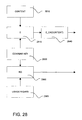
- FIG. 29 shows a method of providing encrypted streaming content in accordance with an embodiment of the invention.
- FIG. 30 shows a method of broadcasting streaming content in accordance with an embodiment of the invention
- FIG. 31 shows a timeline of changes to traffic keys in accordance with an embodiment of the invention.
- FIG. 32 shows a division of program segments in accordance with an embodiment of the invention.
- FIG. 33 shows a system for providing using a plurality of rights objects in accordance with an embodiment of the invention.
- FIGS. 1-27 details regarding methods of sending and receiving content in accordance with aspects of the present invention are provided.
- FIGS. 28-33 details regarding methods and apparatus for controlling usage rights for portions of content are disclosed.
- FIG. 1 shows transmission of Internet Protocol (IP) services utilizing time slice transmission in accordance with an embodiment of the invention.
- a base station broadcasts data packets for a plurality of IP services using data streams 101 , 103 , 105 , and 107 . (Each data stream is allocated a portion of a data rate capacity.)
- the base station may support functionality that is typically assumed by a base transceiver station (BTS), a base station controller (BSC), a combination of a BTS and a BSC, and a node B, which is a third Generation (3G) designation of a base transceiver station.
- BTS base transceiver station
- BSC base station controller
- 3G third Generation
- data streams 101 , 103 , 105 , and 107 are mapped by base stations into bursts of data packets 109 , 111 , 113 , and 115 , respectively, in which bursts are transmitted over radio channels rather than data streams 101 , 103 , 105 , and 107 .
- Each data stream ( 101 , 103 , 105 , and 107 ), and consequently each burst ( 109 , 111 , 113 , and 115 ) supports at least one data service.
- each burst may support a plurality of data services (e.g., a group of related data services).
- Data rates associated with bursts 109 , 111 , 113 , and 115 are typically greater than data rates that are associated with data streams 101 , 103 , 105 , and 107 so that a corresponding number of data packets can be sent in a shorter amount of time.
- data streams 101 , 103 , 105 , and 107 correspond to continuous data rates of approximately 100 Kbit/sec.
- Bursts 109 , 111 , 113 , and 115 typically correspond to approximately 4 Mbit/sec (but may be in excess of 10 Mbit/sec) with an approximate one second duration.
- other embodiments may use different data rates for data streams 101 - 107 and for bursts 109 - 115 .
- the entire data rate capacity is allocated to a burst at a given time.
- bursts 109 , 111 , 113 , and 115 are interleaved in time.
- An idle time duration (during which data packets are not transmitted for the particular data service) occurs between consecutive transmissions of a burst (e.g., burst 109 ).
- a wireless broadcast system can utilize the idle time duration during which the wireless terminal can be instructed to transfer to another base station to complete a handover.
- the other base station may transmit the same data as the base station previously serving the wireless terminal using a different center frequency and a different amount of phase shift.
- the utilization of time slicing enables a terminal to reduce the consumption of electrical power that is provided by a power source (typically a battery).
- Bursts are typically transmitted periodically by a base station. For example, a subsequent burst may occur T seconds after burst 109 , in which a burst is transmitted every T seconds.
- the wireless terminal may maintain precise timing, as with the Global Positioning System (GPS), to determine an absolute time at which each burst occurs.
- the wireless terminal is provided information about a time period in each burst, informing the wireless terminal about the subsequent burst.
- the time period information includes a real-time parameter (corresponding to “delta-t” with DVB-H) that indicates a time interval from the beginning of a time slice burst to the beginning of the next time slice burst of the same service and that is signaled in a MPE section header.
- the time period may be included in an IP packet, a multiprotocol encapsulated frame, any other packet frame, and a third generation (3G) or General Packet Radio Service (GPRS) channel or modulation data, such as transmitter parameter signaling.
- the wireless terminal may detect an occurrence of a burst by receiving a signal preamble, which may be a data sequence that is known a priori to the wireless terminal.
- the wireless terminal may receive an overhead message on an overhead channel from a base station.
- the overhead message may contain timing information regarding the occurrence of bursts.
- the overhead channel may be logically or physically distinct from the downlink radio channel that supports the transmission of bursts.
- Bursts 109 , 111 , 113 , and 115 may be formatted by using a multi-protocol encapsulation in accordance with Section 7 of European Standard EN 301 192 “Digital Video Broadcasting (DVB), DVB specification for data broadcasting.”
- the encapsulation may conform to Internet Protocol (IP) standards.
- a Digital Video Broadcast provides mobile media services to wireless terminals, e.g., handheld wireless units.
- the DVB-H system is compatible with DVB-T (digital video broadcast for terrestrial operation) and supports enhancements to better support operation of wireless handheld terminals.
- the DVB-H system supports Internet Protocol (IP) based data services in which the information may be transmitted as IP datagrams.
- IP Internet Protocol
- the DVB-H system incorporates enhancements (with respect to a DVB-T system) that facilitates access to IP based DVB services on wireless handheld wireless terminals.
- DVB-H enhancements are based on the physical layer of the DVB-T physical layer with a number of service layer enhancements aimed at improving battery life and reception in the handheld environment.
- the DVB-H enhancements compliment existing digital terrestrial services, offering service providers the possibility to extend the market to the wireless handheld market.
- FIG. 2 shows an internet protocol (IP) stack 200 that supports transmission of multi-media data in accordance with an embodiment of the invention.
- IP internet protocol
- Digital media content or other data is broadcasted using various application protocols, transport protocols and network protocols.
- IP stack 200 an IP data broadcast supports an audio-visual service having MPEG4-AVC video 201 , MPEG4-AAC audio 203 and auxiliary data 205 components.
- Each component ( 201 , 203 , or 205 ) is processed by coder 207 , coder 209 , or coder 211 in order to obtain packets that are formatted for Real Time Protocol (RTP) layer 213 .
- the packets (datagrams) are subsequently processed by UDP (user datagram protocol) layer 215 and Internet Protocol (IP) layer 217 .
- UDP user datagram protocol
- IP Internet Protocol
- Datagrams are associated with time slice bursts by formatting the datagrams using a multi-protocol encapsulation (typically corresponding to a link layer in the OSI model) such as, for example, in accordance with Section 7 of European Standard EN 301 192 “Digital Video Broadcasting (DVB), DVB specification for data broadcasting.”
- the encapsulation may conform to Internet Protocol (IP) standards.
- a multi-media session typically is associated with one or more session components (audio, video and auxiliary data in above case) that are logically bound together.
- the parts of the session are sent between a common start time and end time. Both start time and/or end time of can be either defined or undefined.
- FIG. 3 shows a component configuration 300 for a multi-media session 301 according to an embodiment of the invention.
- Component 303 corresponds to a plurality of datagrams (including datagrams 309 and 315 ); component 305 corresponds to a plurality of datagrams (including datagrams 311 and 317 ); and component 307 corresponds to a plurality of datagrams (including datagrams 313 and 319 ).
- Components 303 , 305 , and 307 are transmitted within IP packets that are encapsulated to messaging of an underlying bearer layer.
- Each component 303 , 305 , and 307 has a defined source IP address, destination IP address, and port used in the IP packets that carry data associated with the component. Different components may have an independently defined source IP address, a destination IP address, and a port.
- a multi-media session may have a different number of components.
- exemplary component configuration 300 shows datagram alignment between components 303 , 305 , 307
- the embodiment supports configurations in which the datagrams are not aligned and the number of datagrams for each component is different from that of the other components.
- the number of datagrams for an audio component is typically less than the number of datagrams for a video component during a given time interval.
- FIG. 4 shows a component configuration 400 for a multi-media session 401 according to an embodiment of the invention.
- Components 403 , 405 , and 407 are encrypted with the same key that changes periodically in keystream 409 during multi-media session 401 .
- a datagram that is encrypted with key k i is denoted as E i .
- Keystream 409 is a logical channel that contains key information and that is separate from the media components.
- E ji a datagram associated with the j th component and that is encrypted with the i th key associated with the j th component.
- the embodiment supports different encryption methods that are applied to component 403 , 405 , or 407 , including:
- Components 403 , 405 , and 407 correspond to a different plurality of content datagrams.
- Keystream 409 includes a plurality of associated datagrams, each associated datagram corresponding to an encryption key. Encryption is typically performed on an individual datagram (e.g., packet) basis. For example, content datagrams 415 , 425 , 427 , 435 , and 437 are encrypted with key k 1 (corresponding to associated datagram 411 ) and content datagram 417 is encrypted with k 2 (corresponding to associated datagram 413 ).
- Keystream 409 utilizes a delivery protocol such as RTP, ALC/FLUTE, UHTTP, DVBSTP, IP with a payload, and UDP with a payload.
- the keys delivered in keystream 409 are typically protected by another key that the entitled receiver has in order to access the contents of keystream 409 that carries keys, thus enabling access to the components 403 , 405 , and 407 .
- the delivery of keystream 409 is optionally synchronized with components 403 , 405 , and 407 , e.g., RTP timestamps with the use of RTP Control Protocol).
- FIG. 5 shows a variation of the component configuration shown in FIG. 4 according to an embodiment of the invention.
- Component configuration 500 is similar to component configuration 400 .
- Multi-media session 501 includes components 503 , 505 , and 507 and keystream 509 .
- Component 505 is encrypted with keys from keystream 509 , while components 503 and 507 are not.
- FIG. 6 shows a variation of the component configuration shown in FIG. 4 according to an embodiment of the invention.
- Component configuration 600 is similar to component configuration 400 .
- keystream 609 includes three series of keys 611 , 613 , and 615 that correspond to components 603 , 605 , and 607 , respectively.
- the keys may change periodically but independently during multi-media session 601 but may be synchronized with each other.
- FIG. 7 shows a variation of the component configuration shown in FIG. 4 according to an embodiment of the invention.
- Component configuration 700 is similar to component configuration 600 except that keys for each component are carried on different keystreams that change during multi-media session 701 . Rather than having one keystream, component configuration 700 utilizes three keystreams 709 , 711 , and 713 . Keystreams 709 , 711 , and 713 correspond to components 703 , 705 , and 707 , respectively.
- FIG. 8 shows a variation of the component configuration shown in FIG. 4 according to an embodiment of the invention.
- component 805 is encrypted with keys from keystream 809 .
- keystream 809 provides keys that are currently applicable to decrypting component 805 as well as keys that will be subsequently used in decrypting component 805 .
- key k 1 (corresponding to datagram 811 ) is currently applied while keys k 2 (corresponding to datagram 813 ) and k 3 (corresponding to datagram 815 ) are subsequently applied.
- components 803 and 807 are not encrypted during multi-media session 801
- components 803 and 807 may be encrypted with other variations of the embodiment.
- Having keys that will be subsequently applied enables a receiver device to smoothen key transitions during multi-media session 801 .
- the receiver device can configure the IP stack with a new key to reduce interruptions in decrypting content datagrams.
- FIG. 9 shows a variation of the component configuration shown in FIG. 4 according to an embodiment of the invention.
- Keystream 909 includes the key currently being applied to component 905 for encryption as well as keys that will be subsequently applied when the key transition is within a predetermined incremental time of the current time. For example, before key transition 951 , keystream 909 includes both keys k 1 (corresponding to datagram 911 ) and k 2 (corresponding to datagram 913 ) and includes only k 2 (corresponding to datagram 915 ) after the key transition 951 .
- component configuration 900 assists the receiver device to smoothen the effects of key transitions.
- FIG. 10 shows a component configuration 1000 for a multi-media session 1001 according to an embodiment of the invention.
- keys are carried in one or more of the components rather than having a separate keystream for transmitting the keys.
- component 1005 includes content datagrams (e.g., content datagram 1011 ) as well as datagram 1009 that provides key k 1 that has been used for encrypting components 1003 , 1005 , and 1007 .
- FIG. 11 shows a variation of the component configuration shown in FIG. 10 according to an embodiment of the invention.
- component 1107 provides key k 1 (corresponding to datagram 1109 ) and key k 2 (corresponding to datagram 1111 ) that are applied to component 1105 during multi-media session 1101 .
- components 1103 and 1107 are not encrypted with the keys provided by component 1107 .
- FIG. 12 shows a variation of the component configuration shown in FIG. 10 according to an embodiment of the invention.
- Component configuration 1200 is similar to component configuration 1100 .
- keys are applied to both the component carrying key information (component 1205 ) as well another component (component 1203 ) during multi-media session 1201 .
- component 1207 is not encrypted.
- FIG. 13 shows a variation of the component configuration shown in FIG. 10 according to an embodiment of the invention.
- each component 1303 , 1305 , and 1307 carries keys that are applied to the same component during multi-media session 1301 .
- keys k 11 (corresponding to datagram 1309 ) and k 12 (corresponding to datagram 1311 ) are applied to component 1303 .
- Keys k 21 (corresponding to datagram 1313 ) and k 22 (corresponding to datagram 1315 ) are applied to component 1305 .
- Keys k 31 (corresponding to datagram 1317 ) and k 32 (corresponding to datagram 1319 ) are applied to component 1307 .
- FIG. 14 shows a variation of the component configuration shown in FIG. 10 according to an embodiment of the invention.
- each component 1403 , 1405 , and 1407 carries keys that are applied to a different component during multi-media session 1401 .
- keys k 11 (corresponding to datagram 1413 and carried by component 1405 ) and k 12 (corresponding to datagram 1419 and carried by component 1407 ) are applied to component 1403 .
- Keys k 21 (corresponding to datagram 1417 and carried by component 1407 ) and k 22 (corresponding to datagram 1411 and carried by component 1403 ) are applied to component 1405 .
- Keys k 31 (corresponding to datagram 1409 and carried by component 1403 ) and k 32 (corresponding to datagram 1415 and carried by component 1405 ) are applied to component 1407 .
- FIG. 15 shows a variation of the component configuration shown in FIG. 10 according to an embodiment of the invention.
- key information is carried in a content datagram rather than in a separate datagram.
- key k 1 is included in content datagram 1509 within a concatenated portion (or with a special header) 1511 and k 2 is included in content datagram 1513 within a concatenated portion (or with a special header) 1515 .
- Keys k 1 and k 2 are applied to datagrams in components 1503 , 1505 , and 1507 .
- FIG. 16 shows a variation of the component configuration shown in FIG. 10 according to an embodiment of the invention.
- Component configuration 1600 is similar to component configuration 800 , in which both the current key as well as subsequent keys are provided.
- component 1605 carries key k 1 (corresponding to datagram 1609 ) and key k 2 (corresponding to datagram 1611 ), where key k 1 is currently applied to components 1603 and 1607 and key k 2 is subsequently applied during multi-media session 1601 .
- key k 2 (corresponding to datagram 1613 ) and key k 3 (corresponding to datagram 1615 ) are subsequently carried in component 1605 .
- component configuration 1600 assists the receiver device to smoothen key transitions.
- FIG. 17 shows an architecture 1700 for receiving a multi-media session in accordance with an embodiment of the invention.
- a receiving device receives time slice burst of data 1701 containing both the IP session components and the keystream related to the session components.
- Pluralities of content datagrams 1705 , 1707 , and 1709 correspond to component 1 , component 2 , and component 3 , respectively.
- a plurality of datagrams 1711 corresponds to the keystream.
- Time slice burst 1701 is stored in interim buffer 1713 before forwarding the datagrams (packets) to IP stack 1721 .
- the receiving device first extracts the keys (corresponding to datagram 1717 ) for the received time slice burst 1701 from interim buffer 1713 .
- the receiving device installs the extracted keys to IPSec Security Association (SA) database 1719 . Also, the receiving device extracts remaining datagrams 1715 from the interim buffer and forwards them to IP stack 1721 . After decryption, the processed datagrams are passed to applications 1723 for the presentation of the multi-media content. Consequently, IP stack 1721 does not reject the content datagrams (unless there are content datagrams that the receiving device did not have a corresponding key as delivered in the current time slice or a previous time slice burst). The process is repeated for a next received time slice burst 1703 .
- SA IPSec Security Association
- FIG. 18 shows flow diagram 1800 for the architecture shown in FIG. 17 in accordance with an embodiment of the invention.
- a receiving device receives a time slice burst over a communications channel, e.g., a wireless channel.
- the receiving device separates components (e.g., an audio component and a video component) from the received time slice burst.
- the receiving device extracts the associated set of keys from the keystream. The extracted keys may be applied to content datagrams contained in the time slice burst or in subsequent time slice bursts.
- the embodiment supports configurations in which different keys are used for different datagrams in the time slice burst.
- the extracted keys are applied to an IPSec Security Association (SA) database (e.g., SA DB 1719 shown in FIG. 17 ) in step 1807 .
- SA IPSec Security Association
- the content datagrams are extracted from a buffer (e.g., interim buffer 1713 ) and sent to an IP stack (e.g., stack 1721 ) in step 1811 .
- the content datagrams are subsequently decrypted and sent to the corresponding application.
- FIG. 19 shows a system 1900 for protected content transfer that supports DVB-H IPDC (IP datacast) services according to prior art.
- System 1900 provides protected content transfer for DVB-H services using IPDC as specified in “Interim DVB-H IP Datacast Specifications: IP Datacast Baseline Specification: Specification of Interface I_MT”, DVB Document A080, April 2004.
- portions of security associated data are transmitted in an electronic service directory (ESG) in SA carousel 1921 as DRM protected SA file 1919 (which is provided by digital rights manager (DRM) 1909 by performing the protection function) and IPSec policy file 1911 .
- ESG electronic service directory
- DRM protected SA file 1919 which is provided by digital rights manager (DRM) 1909 by performing the protection function
- IPSec policy file 1911 As the carousel data is typically updated infrequently (e.g., once a day) system 1900 does not provide an efficient solution for key delivery, especially if one or more of the keys is updated or frequently changes.
- Multi-media content 1901 (corresponding to IP datagrams) is encrypted by encryption module 1903 with IPSec keys 1905 and transmitted (as performed by transmission system 1925 ) as time slice packets (after multi-protocol encapsulation, FEC encoding, and time slice burst formation) to receiving device 1926 .
- Rights object (RO) 1923 (which is provided by rights object generation 1922 ) is transmitted to receiving device 1926 through an interaction channel, in which receiving device 1926 is provided with a means for bidirectional communications, e.g., mobile phone functionality.
- a user of receiving device 1926 may order service (content) and consequently receive the corresponding rights object (RO) 1933 , which allows the user to decrypt the content of the ordered service.
- rights object 1933 typically does not contain IPSec keys 1905 .
- Receiving device 1926 processes time slice bursts with burst processing module 1927 .
- Received packets are decrypted by decryption module 1929 with a key provided by key extraction module 1931 in order to obtain content 1935 .
- the keys are determined from rights object 1933 .
- the keys are typically delivered in a SA carousel as DRM protected SA files.
- Rights object 1933 allows receiving device 1926 to extract the keys.
- FIG. 20 shows a system 2000 that supports DVB-H IPDC services in accordance with an embodiment of the invention.
- Multi-media content 2001 (corresponding to content datagrams) is encrypted by encryption module 2003 by applying IPSec keys 2005 .
- Transmission system 2025 obtains both encrypted content datagrams from encryption module 2003 and the corresponding keys from DRM 2009 .
- Transmission system 2025 forms corresponding datagrams that contain the keys corresponding to encrypting the content datagrams.
- Transmission system 2025 inserts both the encrypted content datagrams and the corresponding datagrams into a time slice burst, which is transmitted to receiving device 2026 over a communications channel. While FIG. 20 does not explicitly show a radio module, the embodiment may provide wireless signal capability in order to transmit the time slice burst to receiving device 2026 over a wireless channel.
- Receiving device 2026 processes a received time slice burst, in which the encrypted content datagrams and corresponding datagrams (containing the corresponding keys that are used for encrypting the received content datagrams) are separated (demultiplexed) by burst processing module 2027 .
- receiving device 2026 comprises a broadband receiver for receiving DVB signals that include time slice bursts and a transceiver for bidirectional communications in a wireless network.
- the bidirectional communications supports service ordering by a user, OMA messaging, and security plug-in module installation.
- the embodiment supports different signal configurations, in which the keys are included in a separate keystream or in which keys are included in multi-media components as previously discussed with FIGS. 4-16 .
- Key extraction module 2031 extracts the keys from the corresponding datagrams in order to decrypt the content datagrams, as performed by decryption module 2029 .
- Decryption module provides decrypted content 2035 to an application (not shown) so that the content can be presented.
- rights management object 2023 (as determined by rights object generator 2022 ) is separately transmitted to receiving device 2026 in response to a purchase order. Consequently, receiving device 2026 receives rights object 2033 to determine if receiving device 2026 is permitted to process the received content.
- FIG. 21 show a flow diagram 2100 for transmitting data for DVB-H IPDC services in system 2000 in accordance with an embodiment of the invention.
- transmitting apparatus e.g., transmission system 2025
- step 2103 determines the corresponding key and encrypts the content datagram with the key in step 2105 .
- step 2107 the encrypted content datagram and the corresponding key information (corresponding to a corresponding datagram that may be included in multi-media component or in a keystream) is inserted in the current time slice burst.
- FIG. 22 shows a system 2200 that supports DVB-H IPDC services in accordance with an embodiment of the invention.
- elements 2201 , 2203 , 2205 , 2222 , 2223 , 2227 , 2229 , 2231 , 2233 , and 2235 correspond to elements 2001 , 2003 , 2005 , 2022 , 2023 , 2027 , 2029 , 2031 , 2033 , and 2035 as shown in FIG. 20 .
- system 2200 transmits content datagrams and corresponding key information in the same time slice burst. Key information is provided to transmission system 2225 by key message generator 2206 .
- Key message generator may further encrypt the keys so that encrypted key information is transmitted to receiving device 2226 by transmission system 2225 .
- DRM 2209 in conjunction with rights object generator 2222 , provides rights object 2233 that corresponds to the desired DVB-H IPDC service to receiving device 2226 .
- IPSec policy files 2211 are separately transmitted in SA carousel 2221 from the service (content) and key messages that are multiplexed and transmitted using IPDC time slicing.
- SA carousel 2221 is transmitted as part of the electronic service guide (ESG).
- FIG. 23 shows a system 2300 that supports DVB-H IPDC services in accordance with an embodiment of the invention.
- System 2300 supports conditional access (CA) that can provide a second-level of encryption using a corresponding private key.
- CA conditional access
- IPSec keys may be encrypted by digital rights management (DRM) as well as by a CA module.
- Receiving device 2326 comprises a receiver section and a terminal section.
- the receiver section performs burst processing, demultiplexing, and key management.
- the receiver section also includes CA plug-in installation and key decryption.
- DRM 2351 sends CA plug-in installation package 2353 to DRM 2314 so that a new CA plug-in module is installed at receiving device 2326 as will be further discussed with FIG. 27 .
- the key decryption is performed in a secure processing environment.
- the terminal section performs key management and key decryption in addition to the decryption (corresponding to decryption module 2329 ) and content rendering (
- Encryption of keys 2305 (which are used to encrypt content 2301 by encryption module 2303 ) is performed by key encryption module 2311 .
- Key encryption module 2311 comprises CA module 2308 and DRM 2309 .
- key encryption module 2311 may provide two levels of encryption. Both the encrypted key information and the content datagrams are included in the same time slice burst by transmission system 2325 .
- decryption of the received key information is performed by key decryption module 2317 .
- Key decryption module 2317 comprises DRM 2314 and CA module 2315 .
- Key decryption module 2317 performs two levels of decryption that correspond to the two levels of encryption.
- Burst processing module 2327 decrypts the received content datagrams using the decrypted keys provided by key manager 2313 .
- Received content datagrams are decrypted by decryption module 2329 of the terminal section.
- Key manager 2313 receives the key information that is demultiplexed by module 2327 and forwards the key information to key decryption module 2317 (which is associated with a trusted environment) for DRM and CA decryption.
- the rights object (RO) is transmitted as an OMA DRM 2 message (according to the proposed Open Mobile Alliance Digital Rights Management Version 2.0) from DRM 2309 to DRM 2314 .
- the rights object is typically transmitted separately from the time slice bursts.
- FIG. 24 shows apparatus 2400 that supports a transmission system (e.g., 2025 , 2225 , and 2325 ) as shown in FIGS. 20 , 22 , and 23 in accordance with an embodiment of the invention.
- apparatus 2400 performs functions typically associated with a link layer (the second layer of the OSI protocol model).
- Processor 2405 obtains encrypted datagrams from an encryption module (not shown) through encryption interface 2401 and corresponding key information from a key generator (not shown) through key interface 2403 .
- Transmission interface 2407 encodes the datagrams for forward error correction at the receiving device, performs multi-protocol encapsulation, and formats the time slice burst with the encoded datagrams. (In the embodiment, the datagrams include both content datagrams and corresponding datagrams containing the keys.)
- FIG. 25 shows apparatus 2500 for a receiving device (e.g., receiving devices 1926 , 2026 , 2226 , and 2326 as shown in FIGS. 19 , 20 , 22 , and 23 , respectively) that receives a multi-media broadcast and that applies IPSec keys in accordance with an embodiment of the invention.
- Apparatus 2500 processes a time slice burst (e.g., time slice bursts 2501 and 2503 ) in order to extract the content datagrams and associated keystream.
- a time slice burst e.g., time slice bursts 2501 and 2503
- time slice burst 2501 or time slice burst 2503 has content datagrams (e.g., content datagrams 2505 , 2507 , and 2509 ) with ESP capsulated IP-packets containing service content and corresponding key datagrams (e.g., corresponding datagram 2511 ) comprising UDP key-messages.
- content datagrams e.g., content datagrams 2505 , 2507 , and 2509
- ESP capsulated IP-packets containing service content
- corresponding key datagrams e.g., corresponding datagram 2511
- the keys in an UDP key-message may be protected with DRM.
- Apparatus 2500 is capable of distinguishing between service content and key-messages. Consequently, receiver module 2551 separates content datagrams from key datagrams.
- key datagrams are given a higher priority level than content datagrams by the transmitting apparatus (not shown).
- the priority level associated with a datagram is indicated by a field, e.g., a type of service (ToS) field or a differentiated services field.
- ToS type of service
- Key decryption module is presented encrypted keys from IP stack 2553 through key manager 2559 .
- FIGS. 17 and 25 include the keys in the same time slice burst as the associated content datagram.
- keys in a time slice burst are associated with decrypting content datagrams that are contained in the next time slice burst, thus allowing more time for key processing.
- Other variations are possible. For example, a number of keys for use in decrypting content may be provided in a single time slice burst and the keys may then be used for a plurality of subsequent time slice bursts.
- the decrypted keys are presented to IPSec module 2557 so that the associated content datagrams in IP stack 2553 can be decrypted and presented to client 2561 .
- FIG. 26 shows apparatus 2600 that receives a multi-media broadcast and that decrypts received IPSec keys 2601 in accordance with an embodiment of the invention.
- Key manager 2653 routes the encrypted IPSec key to DRM server 2655 to decrypt a second-level of encryption using a public decryption algorithm and private key 2603 .
- DRM server 2655 returns second-level decrypted key 2607 to key manager 2653 . If the key manager 2653 determines that the key is encrypted with a first-level of encryption, key manager 2653 routes the second-level decrypted key to CA plug-in software module 2657 .
- CA plug-in module 2657 utilizes a secret decryption algorithm and private key 2605 to decrypt second-level decrypted key 2607 .
- the secret decryption algorithm corresponds to a DVB common scrambling algorithm (CSA), which is available from the European Telecommunications Standards Institute (ETSI).
- CSA DVB common scrambling algorithm
- ETSI European Telecommunications Standards Institute
- CA plug-in software module 2657 returns decrypted key 2609 to key manager 2653 , which forwards decrypted key 2609 to IP stack 2651 .
- CA plug-in module 2657 performs a first-level of decryption that is optional and that is based on an operator-specific CA-method that includes an associated private key and an associated decryption algorithm.
- the second-level of encryption is based on an open standard, e.g., OMA DRM2. Because the first-level of encryption is optional, key manager 2653 determines whether a first-level of encryption has been applied to second-level decrypted key 2607 . If so, key manager 2653 routes second-level decrypted key 2607 to CA plug-in software module 2657 . If not, key manager 2653 routes second-level decrypted key 2607 directly to IP stack 2651 because second-level decrypted key 2607 is completely decrypted.
- key manager 2653 determines whether second-level decrypted key 2607 has been first-level encrypted by examining an associated encryption indicator (not shown), e.g., a header or a message field.
- the associated encryption indicator indicates ‘YES’ if second-level decrypted key 2607 has been first-level encrypted and ‘NO’ if second-level decrypted key 2607 has not been first-level encrypted. If second-level decrypted key 2607 has been first-level encrypted, the associated encryption indicator is not first-level encrypted.
- FIG. 27 shows system 2700 for deploying a new security plug-in software module 2701 at receiving device 2750 in accordance with an embodiment of the invention.
- Security plug-in software module 2701 is formatted as an installation package 2705 (e.g., a SIS file as supported by Symbian).
- Installation package 2705 is protected (e.g., with OMA-DRM2) to form protected package 2707 and delivered to a receiving device using a delivery mechanism.
- the embodiment supports different communications channels in a delivery mechanism, including a wireless communications channel in which the receiving device is a wireless terminal.
- the received protected package 2707 is directed to application installer 2751 , which is a trusted application.
- Application installer 2751 extracts new security plug-in software module 2701 from protected package 2707 and replaces current security plug-in software module 2755 that is currently installed at the receiving device 2750 with new security plug-in software module 2701 .
- receiving device 2750 receives rights object 2703 that is processed by DRM 2753 . Consequently, DRM 2753 indicates to application installer 2751 that security plug-in software module replacement is permitted.
- component configurations as shown in FIGS. 3-16 may be incorporated in systems as shown in FIGS. 20 , 22 , and 23 .
- ROs or just right expressions could be delivered in KSMs. Sending complete ROs frequently in the KSM would consume quite a bit of bandwidth however, as they must be addressed to each subscriber (or a group of subscribers) individually, so that only those who have paid get the rights.
- the content is encrypted (E) with a content key (CK) and provided to a receiver (not shown).
- the receiver separately obtains a RO 2860 that includes the CK along with a set of usage rights.
- the received encrypted content may then be viewed or otherwise used as provided for in the RO according to the usage rights obtained.
- this prior art method is not particularly suitable to streaming content.
- Streaming content 2910 is provided to a broadcaster and is encrypted in encryption 2915 using TK 2925 .
- the receiver (not shown) is provided with the TK 2925 via a KSM 2940 , the KSM 2940 being formed by encryption 2930 using the SK 2950 along with TK 2925 .
- the keystream, which provides the KSM is announced to the users with IP address and port number.
- the device uses RO 2960 , which contains the SK 2950 , to decrypt the KSM 2940 so as to be able to decrypt the streaming content 2910 .
- the RO 2960 also provides usage rights 2965 .
- the TK will periodically change.
- FIG. 31 provides an example of this.
- the TK changes several times while the SK is valid. In practice, the number of changes in the TK may be much higher.
- a new KSM 2940 FIG. 29
- the RO 2960 will allow the receiver to decrypt the streaming content.
- a new RO is needed so that the KSMs sent to the device may be decrypted and the streaming content used as permitted.
- ROs purchased from RIs must have relatively long validity periods to make the DRM mechanism feasible.
- the child ROs may also be obtained.
- the TKs are delivered in the KSM prior to their validity period so that the user (device) may decrypt the key(s) and bit combination before the actual streaming content (or segment of it) is received.
- the RO may be acquired prior to the validity period.
- the rights are typically expressed in REL.
- a new REL variable called program category may be used.
- the program category variable can be small, for example 2 bits, while still providing sufficient usage rights control for some applications. Using three or more bits, however, provides finer-grain control and therefore may desirable. The size of variable, however, is somewhat dependent on the method of delivery.
- the program category information is embedded in or concatenated with some other identifier, such as the content, program or service identifier.
- various content providers provide content to a broadcaster.
- various RIs communicate with the broadcaster, either to determine the program categories or to provide the program categories, as will be discussed below. It should be noted that the RIs and CPs may or may not be the same entities.
- the content is encrypted and then broadcast to the receivers. It should be noted that the content encryption can be made by the content provider or by the broadcaster and the encryption keys are delivered accordingly between the encrypter and rights issuer (RI).
- the device From a particular RI, the device obtains a RO from a particular RI to access certain content, and there is a REL description of the usage rights for the content in the RO. While the description is static for the validity period, the REL may contain usage rights which are conditional to the program category REL variable. Thus, as KSMs change the value of the program category REL variable, the (conditional) usage rights currently in effect may change.
- the value of the program category variable may be derived from the KSMs of the broadcast service in question in two alternative ways, discussed below. Since KSMs are sent very frequently, the changes of program category REL variable value and hence the changes in currently effective usage rights may be very fine grained in time. To save broadcast bandwidth, however, the amount of new data added to the KSMs for indicating the program category REL variable preferably is minimized.
- streaming content 3210 may include a news category 3215 , a sports category 3217 , a documentary category 3219 and a movie category 3221 .
- the news category may be further divided into n categories 3215 - 1 , 3215 - 2 , . . . , 3215 - n .
- These categories may, for example but without limitation, represent headlines, domestic news, foreign news, etc. . . .
- the sports categories 3217 could also be further divided into categories such as highlights, scores, live broadcasting, etc. . . .
- the categories may not have anything to do with the type of content, but are simply defined for each different set of different usage rights.
- the categories could be ‘highly restricted’, ‘somewhat restricted’, ‘normal’ and ‘liberal’, reflecting the permissions given to the user.
- the broadcaster “sorts” the streaming content into different categories.
- the number of program category may be relatively small, such as 4 different categories, or may be relatively large, such as 256 different program categories.
- additional bits will be needed as the number of program categories increases, thus two bits can provide information regarding four program categories while 8 bits are needed to provide 256 program categories.
- each television program is categorized into one of a number of program categories, which may include news, low value (lv) shows, high value (hv) shows, lv sports, hv sports, old movies, new movies, etc.
- RIs cannot influence the categories (set by the broadcaster and common to all RIs), but they can freely use the wide program category REL variable value range (for example, from 0 . . . 255) in their usage rights expressed in REL in the RO they provide to the device. Typically, however, a smaller number, such as 12-16 program categories will be more practical. No extra communication between the broadcaster and the RIs is needed.
- Each of such program segments may be associated a set usage rights (in the invention report: program category) including ‘live rendering’, ‘storage and display for 48 hours’, ‘storage and display indefinitely’, ‘relay and copying (forwarding) indefinitely’ or some other similar types.
- the RO may include conditional rights expressed in REL that depend on the value of the program category.
- a user might purchase complete rights such that the RO provides the maximum allowable rights for the content.
- the user may select a promotional free RO that provides much more limited rights and may only allow the display of portions of the streaming content.
- usage rights can vary from RO to RO.
- the user receives the one or more ROs when ordering/purchasing/subscribing/renewing the service or parts of it.
- the user may first receive a ‘parent’ RO and further ‘child’ ROs may be acquired or created later. If the user has not ordered (purchased/subscribed) the program segment that is being received, the user is informed on that (‘You do not have rights to this program/(program segment)’) and/or he is informed how to buy the rights.
- the RIs set the categories and communicate them to the broadcaster, which then puts the categories into the KSMs. Since there are multiple RIs, it may be useful to limit the number of bits that are allowed per RI to two bits. In such a case, the program category range could be 0 . . . 3. That range, however, would be RI specific, and could therefore directly relate to the usage rights of a particular portion of streaming content (rather than streaming content type in a more generic fashion). In such a case, rather then provide a single RO, four ROs may be provided, each with a set of usage rights configured by the RI.
- each KSM 3340 contains a vector of N category values (for some N) where each category value may be two bits. In another embodiment of the invention, the category values may be more than two bits.
- the ROs provided to the receiver contains an RI index in the range 1 . . . N so that the category value in each of the RI_ 1 through RI-N corresponds to a set of ROs. Still in other embodiments of the invention one or more bits or combinations of bits within KSM may be used for category values. While the KSM may include the vector, other formats and protocols may be used to provide the category value associated with the RI. In addition, in an embodiment a number of bits and/or bit combinations within the vector may be reserved for future use.
- a number of bits and/or bit combinations in the KSM may be mapped to category values or interpreted as category values.
- certain locations within the KSM could be used to provide an indication as to whether a type of program could be viewed.
- An RO could determine what the category value based on the category value provided by the KSM and then look at the appropriate place in the KSM to determine what usage right existed, such as whether the content could be displayed. As each RO could be configured to look in different locations with the KSM to determine the usage rights, individualized control that may vary with each KSM could readily be provided.
- the user has received in this case four ROs from the RI #I, each with a user rights class.
- the advantage of using usage rights classes is that the total number and size of rights objects can be smaller than in the case of a complete set of ROs if the usage rights are offered for purchasing on the level of program segments.
- the bit combination at the position corresponding to the position RI #I allows the user to select the RO that corresponds to his purchase. For example a value of 0 at RI #I would indicate RO 1 , a value of 1 would indicate RO 2 , a value of 2 would indicate RO 3 and a value of 3 would indicate the RO 4 .
- the TKs may be changed from program segment to program segment, the user may use his rights in the way that he has ordered (purchased). It should be noted that the user is ‘listening’ to the KSM that has been announced to him (IP address and port number).
- RIs choose one of the 4 categories for each program, communicate them to the broadcaster, and the broadcaster then includes the categories into the KSMs.
- the four categories might be 1) live rendering only allowed, 2) storage and replay allowed for 48 hours, 3) storage and replay allowed indefinitely and 4) storage, replay and copying to other devices allowed indefinitely. This example, however, is merely illustrative and other usage right combinations may be provided.
- RI#J in the KSM 3340 may correspond to a particular package deal while a second RI#J+1 may correspond to a different package deal.
- program category for each RI is particular to the TK, thus the same set of ROs can provide different usage rights for different TKs, and furthermore, different sets of ROs may provide different sets and/or combinations of usage rights.
- the RO 1 may provide view only usage rights while in another set of ROs the RO 1 may provide for time shifting.
- the program category information sent in the KSM can alternatively be used to select one of a set of complete ROs, or possibly one of several child ROs related to the same parent RO.
- aspects of the present invention provide a bandwidth-efficient way of delivering rights applicable to all subscribers, but which may vary program-by-program and time period by time period, while still allowing the full richness of the REL for defining those rights for each program category.
- the invention can be applied to IPDC services over DVB-T, DVB-H, MediaFLO, OMA Broadcast and other systems.
- the computer system may include at least one computer such as a microprocessor, digital signal processor, and associated peripheral electronic circuitry.
Landscapes
- Engineering & Computer Science (AREA)
- Signal Processing (AREA)
- Computer Security & Cryptography (AREA)
- Multimedia (AREA)
- Databases & Information Systems (AREA)
- Computer Networks & Wireless Communication (AREA)
- Computer Hardware Design (AREA)
- General Engineering & Computer Science (AREA)
- Computing Systems (AREA)
- Business, Economics & Management (AREA)
- Tourism & Hospitality (AREA)
- Technology Law (AREA)
- Computer Graphics (AREA)
- Health & Medical Sciences (AREA)
- Marketing (AREA)
- General Physics & Mathematics (AREA)
- Theoretical Computer Science (AREA)
- Physics & Mathematics (AREA)
- Strategic Management (AREA)
- Primary Health Care (AREA)
- General Business, Economics & Management (AREA)
- Human Resources & Organizations (AREA)
- General Health & Medical Sciences (AREA)
- Economics (AREA)
- Operations Research (AREA)
- Entrepreneurship & Innovation (AREA)
- Two-Way Televisions, Distribution Of Moving Picture Or The Like (AREA)
Priority Applications (17)
| Application Number | Priority Date | Filing Date | Title |
|---|---|---|---|
| US11/127,780 US9225698B2 (en) | 2005-05-12 | 2005-05-12 | Fine grain rights management of streaming content |
| AU2006245453A AU2006245453B2 (en) | 2005-05-12 | 2006-04-13 | Fine grain rights management of streaming content |
| EP16171043.9A EP3076581A1 (en) | 2005-05-12 | 2006-04-13 | Method and apparatus for fine grain rights management of streaming content |
| EP06727549.5A EP1880505B8 (en) | 2005-05-12 | 2006-04-13 | Method and apparatus for fine grain rights management of streaming content |
| KR1020077028060A KR101011521B1 (ko) | 2005-05-12 | 2006-04-13 | 스트리밍 콘텐츠의 권한 미세 관리 |
| RU2007144827/09A RU2403681C2 (ru) | 2005-05-12 | 2006-04-13 | Избирательное управление правами на потоковый контент |
| PL06727549.5T PL1880505T3 (pl) | 2005-05-12 | 2006-04-13 | Sposób i urządzenie do zarządzania z wysoką dokładnością prawami do treści przesyłu strumieniowego |
| MX2007013885A MX2007013885A (es) | 2005-05-12 | 2006-04-13 | Administracion de derechos de grano fino de contenido de canalizacion. |
| ES06727549.5T ES2579179T3 (es) | 2005-05-12 | 2006-04-13 | Método y aparato para gestión de derechos de grano fino de contenido de flujo continuo |
| CN2006800209487A CN101199157B (zh) | 2005-05-12 | 2006-04-13 | 流式内容的精细粒度版权管理 |
| BRPI0612027-0A BRPI0612027B1 (pt) | 2005-05-12 | 2006-04-13 | método para transmitir um fluxo de dados para o dispositivo, dispositivo de leitura de computador, método para receber um fluxo de dados de um sistema de comunicação durante a sessão de multimídia, método para obter o fluxo de dados do sistema de comunicação, e, método para transmitir os dados de fluxos continuos para o receptor |
| JP2008510658A JP2008545289A (ja) | 2005-05-12 | 2006-04-13 | ストリーミングコンテンツの微粒度権利(finegrainrights)マネージメント |
| PCT/IB2006/001047 WO2006120516A2 (en) | 2005-05-12 | 2006-04-13 | Fine grain rights management of streaming content |
| TW095115684A TWI455589B (zh) | 2005-05-12 | 2006-05-03 | 串流內容之精緻權利管理方法 |
| ZA200710452A ZA200710452B (en) | 2005-05-12 | 2007-12-03 | Fine grain rights management of streaming content |
| US14/966,655 US20160099921A1 (en) | 2005-05-12 | 2015-12-11 | Fine grain rights management of streaming content |
| US17/508,549 US11627119B2 (en) | 2005-05-12 | 2021-10-22 | Fine grain rights management of streaming content |
Applications Claiming Priority (1)
| Application Number | Priority Date | Filing Date | Title |
|---|---|---|---|
| US11/127,780 US9225698B2 (en) | 2005-05-12 | 2005-05-12 | Fine grain rights management of streaming content |
Related Child Applications (1)
| Application Number | Title | Priority Date | Filing Date |
|---|---|---|---|
| US14/966,655 Continuation US20160099921A1 (en) | 2005-05-12 | 2015-12-11 | Fine grain rights management of streaming content |
Publications (2)
| Publication Number | Publication Date |
|---|---|
| US20060259433A1 US20060259433A1 (en) | 2006-11-16 |
| US9225698B2 true US9225698B2 (en) | 2015-12-29 |
Family
ID=37396925
Family Applications (3)
| Application Number | Title | Priority Date | Filing Date |
|---|---|---|---|
| US11/127,780 Active 2032-04-07 US9225698B2 (en) | 2005-05-12 | 2005-05-12 | Fine grain rights management of streaming content |
| US14/966,655 Abandoned US20160099921A1 (en) | 2005-05-12 | 2015-12-11 | Fine grain rights management of streaming content |
| US17/508,549 Expired - Lifetime US11627119B2 (en) | 2005-05-12 | 2021-10-22 | Fine grain rights management of streaming content |
Family Applications After (2)
| Application Number | Title | Priority Date | Filing Date |
|---|---|---|---|
| US14/966,655 Abandoned US20160099921A1 (en) | 2005-05-12 | 2015-12-11 | Fine grain rights management of streaming content |
| US17/508,549 Expired - Lifetime US11627119B2 (en) | 2005-05-12 | 2021-10-22 | Fine grain rights management of streaming content |
Country Status (14)
| Country | Link |
|---|---|
| US (3) | US9225698B2 (pl) |
| EP (2) | EP1880505B8 (pl) |
| JP (1) | JP2008545289A (pl) |
| KR (1) | KR101011521B1 (pl) |
| CN (1) | CN101199157B (pl) |
| AU (1) | AU2006245453B2 (pl) |
| BR (1) | BRPI0612027B1 (pl) |
| ES (1) | ES2579179T3 (pl) |
| MX (1) | MX2007013885A (pl) |
| PL (1) | PL1880505T3 (pl) |
| RU (1) | RU2403681C2 (pl) |
| TW (1) | TWI455589B (pl) |
| WO (1) | WO2006120516A2 (pl) |
| ZA (1) | ZA200710452B (pl) |
Families Citing this family (34)
| Publication number | Priority date | Publication date | Assignee | Title |
|---|---|---|---|---|
| US9225698B2 (en) | 2005-05-12 | 2015-12-29 | Nokia Technologies Oy | Fine grain rights management of streaming content |
| CN1322388C (zh) * | 2005-08-15 | 2007-06-20 | 华为技术有限公司 | 对具有拷贝导出权限的版权进行限制的方法及装置 |
| US8893302B2 (en) * | 2005-11-09 | 2014-11-18 | Motorola Mobility Llc | Method for managing security keys utilized by media devices in a local area network |
| US20070107011A1 (en) * | 2005-11-10 | 2007-05-10 | Zhi Li | System and method for differentiated service levels in an internet protocol television network |
| EP1977563B1 (en) * | 2006-01-11 | 2018-01-03 | QUALCOMM Incorporated | Encoding beacon signals to provide identification in peer-to-peer communication |
| KR100809292B1 (ko) * | 2006-02-24 | 2008-03-07 | 삼성전자주식회사 | 디지털 저작권 관리 장치 및 방법 |
| US8160252B2 (en) * | 2006-02-27 | 2012-04-17 | Samsung Electronics Co., Ltd | Method and system for protecting broadcast service/content in a mobile broadcast system, and method for generating short term key message therefor |
| WO2008002208A1 (en) * | 2006-06-29 | 2008-01-03 | Telefonaktiebolaget Lm Ericsson (Publ) | A method and arrangement for purchasing streamed media. |
| US20080059409A1 (en) * | 2006-09-06 | 2008-03-06 | Marie Jose Montpetit | Method and Apparatus for Controlling Access to Content Streamed to Remote Devices |
| US8752199B2 (en) * | 2006-11-10 | 2014-06-10 | Sony Computer Entertainment Inc. | Hybrid media distribution with enhanced security |
| US8739304B2 (en) * | 2006-11-10 | 2014-05-27 | Sony Computer Entertainment Inc. | Providing content using hybrid media distribution scheme with enhanced security |
| US20080219436A1 (en) | 2007-03-05 | 2008-09-11 | General Instrument Corporation | Method and apparatus for providing a digital rights management engine |
| KR20090029634A (ko) * | 2007-09-18 | 2009-03-23 | 한국전자통신연구원 | 콘텐츠 보호 제공방법과 보호된 콘텐츠 소비방법 및 그 장치 |
| CN101132414A (zh) * | 2007-09-28 | 2008-02-27 | 中兴通讯股份有限公司 | 移动多媒体广播业务中传输密钥的加密方法及系统 |
| US9209983B2 (en) * | 2007-11-19 | 2015-12-08 | Cisco Technology, Inc. | Generating a single advice of charge request for multiple sessions in a network environment |
| US9202237B2 (en) * | 2007-11-27 | 2015-12-01 | Cisco Technology, Inc. | Generating a single billing record for multiple sessions in a network environment |
| US9892390B2 (en) * | 2007-12-12 | 2018-02-13 | Microsoft Technology Licensing, Llc | Digital content packaging, licensing and consumption |
| KR20090076765A (ko) * | 2008-01-09 | 2009-07-13 | 삼성전자주식회사 | 방송 모바일 통합 서비스 시스템에서의 전자 서비스 가이드발견 방법 및 장치 |
| KR101407196B1 (ko) | 2008-01-28 | 2014-06-13 | 삼성전자주식회사 | 방송통신 시스템에서 방송 서비스 데이터 송수신 방법 및 장치와 상기 방송 서비스 데이터 구성 방법 및 상기 방송 서비스 데이터를 포함하는 프레임 |
| US9628205B2 (en) * | 2008-01-28 | 2017-04-18 | Samsung Electronics Co., Ltd. | Method and apparatus for transmitting and receiving broadcast service data in a broadcasting communication system, method for configuring the broadcast service data, and frame including the broadcast service data |
| EP2259544B1 (en) * | 2009-06-02 | 2012-08-08 | Irdeto Access B.V. | Controlling the validity period of a decryption key |
| US8571994B2 (en) * | 2009-06-26 | 2013-10-29 | Disney Enterprises, Inc. | Method and system for allocating access to digital media content |
| EP2280544A1 (en) * | 2009-07-07 | 2011-02-02 | Irdeto Access B.V. | Secure transmition and recording of a content |
| KR101273142B1 (ko) * | 2011-10-21 | 2013-06-17 | 주식회사 캐스트이즈 | 서비스 키를 사용한 주문형 비디오 서비스용 스트리밍 파일 목록 결정 장치 및 방법 |
| US9549024B2 (en) * | 2012-12-07 | 2017-01-17 | Remote Media, Llc | Routing and synchronization system, method, and manager |
| US10339288B2 (en) * | 2013-12-12 | 2019-07-02 | Mcafee, Llc | User authentication for mobile devices using behavioral analysis |
| US11234105B2 (en) * | 2014-09-29 | 2022-01-25 | Visa International Service Association | Methods and systems for asset obfuscation |
| JP6921075B2 (ja) * | 2015-11-20 | 2021-08-18 | ジェネテック インコーポレイテッド | データストリームの安全な階層暗号 |
| WO2017083985A1 (en) | 2015-11-20 | 2017-05-26 | Genetec Inc. | Media streaming |
| US20180212766A1 (en) * | 2017-01-24 | 2018-07-26 | Six Degrees Space Ltd | Asymmetric content protection of large datastreams |
| US11423161B1 (en) | 2018-05-26 | 2022-08-23 | Genetec Inc. | System and media recording device with secured encryption |
| US12282917B2 (en) * | 2019-04-12 | 2025-04-22 | Jpmorgan Chase Bank, N.A. | System and method for implementing a market data hub via distributed ledger technology |
| WO2021026763A1 (en) * | 2019-08-13 | 2021-02-18 | Nokia Shanghai Bell Co., Ltd. | Data security for network slice management |
| US11184417B2 (en) * | 2019-10-08 | 2021-11-23 | Qualcomm Incorporated | System and apparatus for providing network assistance for traffic handling in downlink streaming |
Citations (8)
| Publication number | Priority date | Publication date | Assignee | Title |
|---|---|---|---|---|
| WO2003055219A2 (en) | 2001-12-11 | 2003-07-03 | Telefonaktiebolaget Lm Ericsson (Publ.) | Method of rights management for streaming media |
| US20030140083A1 (en) * | 2002-01-24 | 2003-07-24 | Daniel Watkins | Enhanced personal video recorder including user play programming |
| WO2004077911A2 (en) | 2003-03-03 | 2004-09-16 | Sony Ericsson Mobile Communications Ab | Rights request method |
| WO2004114099A1 (en) | 2003-06-25 | 2004-12-29 | Nokia Corporation | Digital rights management |
| GB2407947A (en) | 2003-11-05 | 2005-05-11 | Nokia Corp | Distributing digital rights for DVB broadcast data to mobile terminals over, and in response to requests over, a separate PLMN cellular network |
| US7050583B2 (en) * | 2001-03-29 | 2006-05-23 | Etreppid Technologies, Llc | Method and apparatus for streaming data using rotating cryptographic keys |
| US20060206708A1 (en) * | 2005-01-14 | 2006-09-14 | Lg Electronics Inc. | Method for managing digital rights in broadcast/multicast service |
| AU2006245453A1 (en) | 2005-05-12 | 2006-11-16 | Nokia Technologies Oy | Fine grain rights management of streaming content |
Family Cites Families (13)
| Publication number | Priority date | Publication date | Assignee | Title |
|---|---|---|---|---|
| US7069451B1 (en) * | 1995-02-13 | 2006-06-27 | Intertrust Technologies Corp. | Systems and methods for secure transaction management and electronic rights protection |
| JPH10301492A (ja) * | 1997-04-23 | 1998-11-13 | Sony Corp | 暗号化装置および方法、復号装置および方法、並びに情報処理装置および方法 |
| AUPO894297A0 (en) * | 1997-09-02 | 1997-09-25 | Nec Australia Pty Ltd | A distribution system |
| US7277941B2 (en) * | 1998-03-11 | 2007-10-02 | Commvault Systems, Inc. | System and method for providing encryption in a storage network by storing a secured encryption key with encrypted archive data in an archive storage device |
| EP0984629B1 (en) | 1998-09-01 | 2006-05-03 | Irdeto Access B.V. | System for broadcasting data signals in a secure manner |
| KR20010017048A (ko) * | 1999-08-06 | 2001-03-05 | 박종섭 | 이동전화를 이용한 듀얼모드 폰 |
| US20030018581A1 (en) * | 2000-02-16 | 2003-01-23 | Bratton Timothy R. | Delivering media data to portable computing devices |
| WO2001069384A2 (en) | 2000-03-14 | 2001-09-20 | Buzzpad, Inc. | Method and apparatus for forming linked multi-user groups of shared software applications |
| JP2003152698A (ja) | 2001-11-15 | 2003-05-23 | Nippon Hoso Kyokai <Nhk> | コンテンツ利用制御送信方法、コンテンツ利用制御受信方法およびコンテンツ利用制御送信装置、コンテンツ利用制御受信装置ならびにコンテンツ利用制御送信プログラム、コンテンツ利用制御受信プログラム |
| WO2003098919A1 (en) | 2002-05-21 | 2003-11-27 | Koninklijke Philips Electronics N.V. | Conditional access system |
| EP1499061A1 (en) | 2003-07-17 | 2005-01-19 | Deutsche Thomson-Brandt Gmbh | Individual video encryption system and method |
| JP2007511946A (ja) * | 2003-11-11 | 2007-05-10 | ノキア コーポレイション | 放送ディジタルコンテンツの限定受信制御のためにdrmを用いるためのシステム及び方法 |
| US7734042B2 (en) * | 2003-12-22 | 2010-06-08 | Aol Inc. | System and method for using a streaming protocol |
-
2005
- 2005-05-12 US US11/127,780 patent/US9225698B2/en active Active
-
2006
- 2006-04-13 MX MX2007013885A patent/MX2007013885A/es active IP Right Grant
- 2006-04-13 KR KR1020077028060A patent/KR101011521B1/ko not_active Expired - Lifetime
- 2006-04-13 PL PL06727549.5T patent/PL1880505T3/pl unknown
- 2006-04-13 RU RU2007144827/09A patent/RU2403681C2/ru active
- 2006-04-13 BR BRPI0612027-0A patent/BRPI0612027B1/pt active IP Right Grant
- 2006-04-13 WO PCT/IB2006/001047 patent/WO2006120516A2/en not_active Ceased
- 2006-04-13 CN CN2006800209487A patent/CN101199157B/zh not_active Expired - Lifetime
- 2006-04-13 AU AU2006245453A patent/AU2006245453B2/en not_active Expired
- 2006-04-13 ES ES06727549.5T patent/ES2579179T3/es not_active Expired - Lifetime
- 2006-04-13 EP EP06727549.5A patent/EP1880505B8/en not_active Expired - Lifetime
- 2006-04-13 EP EP16171043.9A patent/EP3076581A1/en not_active Withdrawn
- 2006-04-13 JP JP2008510658A patent/JP2008545289A/ja active Pending
- 2006-05-03 TW TW095115684A patent/TWI455589B/zh active
-
2007
- 2007-12-03 ZA ZA200710452A patent/ZA200710452B/xx unknown
-
2015
- 2015-12-11 US US14/966,655 patent/US20160099921A1/en not_active Abandoned
-
2021
- 2021-10-22 US US17/508,549 patent/US11627119B2/en not_active Expired - Lifetime
Patent Citations (9)
| Publication number | Priority date | Publication date | Assignee | Title |
|---|---|---|---|---|
| US7050583B2 (en) * | 2001-03-29 | 2006-05-23 | Etreppid Technologies, Llc | Method and apparatus for streaming data using rotating cryptographic keys |
| WO2003055219A2 (en) | 2001-12-11 | 2003-07-03 | Telefonaktiebolaget Lm Ericsson (Publ.) | Method of rights management for streaming media |
| US20030140083A1 (en) * | 2002-01-24 | 2003-07-24 | Daniel Watkins | Enhanced personal video recorder including user play programming |
| WO2004077911A2 (en) | 2003-03-03 | 2004-09-16 | Sony Ericsson Mobile Communications Ab | Rights request method |
| WO2004114099A1 (en) | 2003-06-25 | 2004-12-29 | Nokia Corporation | Digital rights management |
| GB2407947A (en) | 2003-11-05 | 2005-05-11 | Nokia Corp | Distributing digital rights for DVB broadcast data to mobile terminals over, and in response to requests over, a separate PLMN cellular network |
| US20060206708A1 (en) * | 2005-01-14 | 2006-09-14 | Lg Electronics Inc. | Method for managing digital rights in broadcast/multicast service |
| AU2006245453A1 (en) | 2005-05-12 | 2006-11-16 | Nokia Technologies Oy | Fine grain rights management of streaming content |
| WO2006120516A2 (en) | 2005-05-12 | 2006-11-16 | Nokia Corporation | Fine grain rights management of streaming content |
Non-Patent Citations (15)
| Title |
|---|
| Chinese Office action of corresponding CN App. No. 200680020948.7 dated Jan. 20, 2011, China, pp. 1-10. |
| Chinese Office action of corresponding CN App. No. 200680020948.7 dated Jul. 7, 2010, China, pp. 1-9. |
| Chinese Office action of corresponding CN App. No. 200680020948.7 dated Oct. 12, 2010, China, pp. 1-6. |
| Doc #OMA-BCAST-2004-0128RO3-CR-AD-four-layer-model.doc Change Request submitted Nov. 9, 2004, 2004 Open Mobile Alliance Ltd., 2 pages, available at http://member.openmobilealliacne.org/ftp/public-documents/bac/BCAST/2004/OMA-BCAST-2004-0128RO3-CR-AD-four-layer-model.doc, Retrieved Oct. 6, 2005. |
| Doc #OMA-BCAST-2005-0122-Service-Content-Protection-Architecture.doc, Change Request submitted Mar. 15, 2005, 2005 Open Mobile Alliance Ltd., 5 pages, available at http://member.openmobilealliance.org/ftp/public-documents/bac/BCAST/2005/OMA-BCAST-2005-0122-Service-Content-Protection-Architecture.doc, Retrieved Oct. 6, 2005. |
| ETSI EN 301 192, "Digital Video Broadcasting (DVB); DVB specification for data broadcasting", Final draft ETSI EN 301 192, ETSI European Standard, V1.4.1, Jun. 2004, pp. 78. |
| European Office Action for related European Application No. 06727549.5-1853 dated Jan. 5, 2015, 7 pages. |
| Japanese Office action for corresponding JP application No. 2008-510658 dated Jan. 31, 2011, pp. 1-4. |
| Korean Office Action for corresponding KR Application No. 10-2007-7028060, Apr. 26, 2010, Korea, pp. 1-10. |
| Korean Office Action for corresponding KR Application No. 10-2007-7028060, Oct. 30, 2009, Korea. |
| Office Action for related European Patent Application No. 06 727 549.5 dated Dec. 3, 2013. |
| Office Action of corresponding Chinese Application No. 200680020948.7 dated Jan. 22, 2010, China. pp. 1-16. |
| Office Action of corresponding Mexican Application No. MX/a/2007/013885, dated Jan. 26, 2010, Mexico. English Translation of Relevant Portion. pp. 1-3. |
| PCT Written Opinion of the International Searching Authority for International Application No. PCT/IB2006/001047, mailed Oct. 16, 2006, 7 pages. |
| Service/Content Protection Architecture, Verma, et al., Open Mobile Alliance, OMA-BCAST-2005-0122R01-Service-Content-Protection-Architecture.doc, Change Request, Apr. 2, 2005, pp. 1-8. |
Also Published As
| Publication number | Publication date |
|---|---|
| US20060259433A1 (en) | 2006-11-16 |
| EP1880505A2 (en) | 2008-01-23 |
| EP3076581A1 (en) | 2016-10-05 |
| TWI455589B (zh) | 2014-10-01 |
| ZA200710452B (en) | 2008-11-26 |
| PL1880505T3 (pl) | 2016-10-31 |
| AU2006245453A1 (en) | 2006-11-16 |
| KR101011521B1 (ko) | 2011-01-31 |
| AU2006245453B2 (en) | 2009-12-17 |
| KR20080007654A (ko) | 2008-01-22 |
| JP2008545289A (ja) | 2008-12-11 |
| RU2403681C2 (ru) | 2010-11-10 |
| CN101199157A (zh) | 2008-06-11 |
| BRPI0612027A2 (pt) | 2010-10-13 |
| BRPI0612027B1 (pt) | 2020-11-03 |
| RU2007144827A (ru) | 2009-06-20 |
| TW200711475A (en) | 2007-03-16 |
| WO2006120516A2 (en) | 2006-11-16 |
| ES2579179T8 (es) | 2016-09-13 |
| WO2006120516A3 (en) | 2007-01-04 |
| US20160099921A1 (en) | 2016-04-07 |
| EP1880505B8 (en) | 2016-09-14 |
| CN101199157B (zh) | 2012-10-03 |
| US11627119B2 (en) | 2023-04-11 |
| EP1880505A4 (en) | 2013-12-04 |
| ES2579179T3 (es) | 2016-08-05 |
| US20220116368A1 (en) | 2022-04-14 |
| MX2007013885A (es) | 2008-01-24 |
| EP1880505B1 (en) | 2016-05-25 |
Similar Documents
| Publication | Publication Date | Title |
|---|---|---|
| US11627119B2 (en) | Fine grain rights management of streaming content | |
| BRPI0612046A2 (pt) | método e programa para operar um elemento de rede, elemento de rede, aparelho, método para operar a estação móvel, estação móvel, e, método para alocar a potência de transmissão para a estação móvel | |
| EP1766843B1 (en) | Methods and devices for managing traffic keys during a multi-media session | |
| US8379864B2 (en) | Software plug-in framework to modify decryption methods in terminals | |
| US20060034321A1 (en) | Method for receiving a time slice burst of data | |
| HK1229574A1 (en) | Method and apparatus for fine grain rights management of streaming content | |
| HK1120685A (en) | Fine grain rights management of streaming content | |
| KR100895027B1 (ko) | 단말들에서의 해독 방법들을 변형하는 소프트웨어 플러그인프레임워크 | |
| Lee et al. | Effective multiplexing method for conditional access system in terrestrial DMB | |
| HK1104888B (en) | Method and apparatus for managing traffic keys during a multi-media session | |
| Standard | Part 6–Service Protection |
Legal Events
| Date | Code | Title | Description |
|---|---|---|---|
| AS | Assignment |
Owner name: NOKIA CORPORATION, FINLAND Free format text: ASSIGNMENT OF ASSIGNORS INTEREST;ASSIGNORS:LAHTINEN, PEKKA;ALVE, JUKKA;REEL/FRAME:016612/0264 Effective date: 20050725 |
|
| FEPP | Fee payment procedure |
Free format text: PAYOR NUMBER ASSIGNED (ORIGINAL EVENT CODE: ASPN); ENTITY STATUS OF PATENT OWNER: LARGE ENTITY Free format text: PAYER NUMBER DE-ASSIGNED (ORIGINAL EVENT CODE: RMPN); ENTITY STATUS OF PATENT OWNER: LARGE ENTITY |
|
| AS | Assignment |
Owner name: NOKIA TECHNOLOGIES OY, FINLAND Free format text: ASSIGNMENT OF ASSIGNORS INTEREST;ASSIGNOR:NOKIA CORPORATION;REEL/FRAME:035570/0846 Effective date: 20150116 |
|
| STCF | Information on status: patent grant |
Free format text: PATENTED CASE |
|
| MAFP | Maintenance fee payment |
Free format text: PAYMENT OF MAINTENANCE FEE, 4TH YEAR, LARGE ENTITY (ORIGINAL EVENT CODE: M1551); ENTITY STATUS OF PATENT OWNER: LARGE ENTITY Year of fee payment: 4 |
|
| MAFP | Maintenance fee payment |
Free format text: PAYMENT OF MAINTENANCE FEE, 8TH YEAR, LARGE ENTITY (ORIGINAL EVENT CODE: M1552); ENTITY STATUS OF PATENT OWNER: LARGE ENTITY Year of fee payment: 8 |