US9200023B2 - Method for producing complex of trisortho-metalated iridium, light-emitting material using said complex, and light-emitting element - Google Patents
Method for producing complex of trisortho-metalated iridium, light-emitting material using said complex, and light-emitting element Download PDFInfo
- Publication number
- US9200023B2 US9200023B2 US13/876,937 US201113876937A US9200023B2 US 9200023 B2 US9200023 B2 US 9200023B2 US 201113876937 A US201113876937 A US 201113876937A US 9200023 B2 US9200023 B2 US 9200023B2
- Authority
- US
- United States
- Prior art keywords
- group
- complex
- ring
- iridium
- tris
- Prior art date
- Legal status (The legal status is an assumption and is not a legal conclusion. Google has not performed a legal analysis and makes no representation as to the accuracy of the status listed.)
- Expired - Fee Related, expires
Links
- 0 CCCCC*(CCN)C1(CCC)*C1 Chemical compound CCCCC*(CCN)C1(CCC)*C1 0.000 description 11
- IKLYVDVNKNFKDE-UHFFFAOYSA-N C.C.C.CCCCC[Ir](C)N Chemical compound C.C.C.CCCCC[Ir](C)N IKLYVDVNKNFKDE-UHFFFAOYSA-N 0.000 description 3
- RTEONBZDERQOCQ-UHFFFAOYSA-N C.CCCCC[Ir]N Chemical compound C.CCCCC[Ir]N RTEONBZDERQOCQ-UHFFFAOYSA-N 0.000 description 2
- VMLIVDZYRNMEKB-IAUUKGNJSA-N C1=CC2=C3C4=C(C=CC=C4C=C2)[Ir]2(Cl[Ir]4(Cl2)C2=CC=CC5=C2C2=N4C=CC=C2/C=C\5)N3=C1.C1=CC2=C3C4=C(C=CC=C4C=C2)[Ir]24(C5=C6C(=CC=C5)C=CC5=C6N2=CC=C5)(C2=C5C(=CC=C2)/C=C\C2=C5N4=CC=C2)N3=C1.C1=CC2=C3C4=C(C=CC=C4C=C2)[Ir]24(C5=CC=CC6=C5C5=N2C=CC=C5/C=C\6)(C2=C5C(=CC=C2)C=CC2=C5N4=CC=C2)N3=C1.C1=CN=C2C(=C1)C=CC1=C2C=CC=C1.[2H-9] Chemical compound C1=CC2=C3C4=C(C=CC=C4C=C2)[Ir]2(Cl[Ir]4(Cl2)C2=CC=CC5=C2C2=N4C=CC=C2/C=C\5)N3=C1.C1=CC2=C3C4=C(C=CC=C4C=C2)[Ir]24(C5=C6C(=CC=C5)C=CC5=C6N2=CC=C5)(C2=C5C(=CC=C2)/C=C\C2=C5N4=CC=C2)N3=C1.C1=CC2=C3C4=C(C=CC=C4C=C2)[Ir]24(C5=CC=CC6=C5C5=N2C=CC=C5/C=C\6)(C2=C5C(=CC=C2)C=CC2=C5N4=CC=C2)N3=C1.C1=CN=C2C(=C1)C=CC1=C2C=CC=C1.[2H-9] VMLIVDZYRNMEKB-IAUUKGNJSA-N 0.000 description 2
- GDMGOWUPYWZKTF-UHFFFAOYSA-N CCCCC[Ir]1(N)C[Ir](N)(CCCCC)C1 Chemical compound CCCCC[Ir]1(N)C[Ir](N)(CCCCC)C1 GDMGOWUPYWZKTF-UHFFFAOYSA-N 0.000 description 2
- YMNIAFCFXHKBLI-YWQSAXMBSA-N C.CC(C)(C)C1=CC2=C(C=C1)C1=N(C=CC=C1)[Ir]213(C2=C(C=CC(C(C)(C)C)=C2)C2=N1C=CC=C2)C1=C(C=CC(C(C)(C)C)=C1)C1=N3C=CC=C1.CC(C)(C)C1=CC2=C(C=C1)C1=N(C=CC=C1)[Ir]213(C2=C(C=CC(C(C)(C)C)=C2)C2=N1C=CC=C2)C1=C(C=CC(C(C)(C)C)=C1)C1=N3C=CC=C1.CC(C)(C)C1=CC=C(C2=CC=CC=N2)C=C1.CC(C)(C)C1=CC=C2C3=CC=CC=N3[Ir]3(Cl[Ir]4(Cl3)C3C=C(C(C)(C)C)C=CC3C3=CC=CC=N34)C2=C1.[2H-3] Chemical compound C.CC(C)(C)C1=CC2=C(C=C1)C1=N(C=CC=C1)[Ir]213(C2=C(C=CC(C(C)(C)C)=C2)C2=N1C=CC=C2)C1=C(C=CC(C(C)(C)C)=C1)C1=N3C=CC=C1.CC(C)(C)C1=CC2=C(C=C1)C1=N(C=CC=C1)[Ir]213(C2=C(C=CC(C(C)(C)C)=C2)C2=N1C=CC=C2)C1=C(C=CC(C(C)(C)C)=C1)C1=N3C=CC=C1.CC(C)(C)C1=CC=C(C2=CC=CC=N2)C=C1.CC(C)(C)C1=CC=C2C3=CC=CC=N3[Ir]3(Cl[Ir]4(Cl3)C3C=C(C(C)(C)C)C=CC3C3=CC=CC=N34)C2=C1.[2H-3] YMNIAFCFXHKBLI-YWQSAXMBSA-N 0.000 description 1
- LEZNGVUZVWQRSO-UHFFFAOYSA-N C.CCCCC.N Chemical compound C.CCCCC.N LEZNGVUZVWQRSO-UHFFFAOYSA-N 0.000 description 1
- RRWGQHBCJXTWKR-YWQSAXMBSA-N C.FC1=CC(F)=C(C2=CC=CC=N2)C=C1.FC1=CC2=C(C(F)=C1)C1=CC=CC=N1[Ir]213(C2=C(C(F)=CC(F)=C2)C2=N1C=CC=C2)C1=C(C(F)=CC(F)=C1)C1=N3C=CC=C1.FC1=CC2=C(C(F)=C1)C1=CC=CC=N1[Ir]21Cl[Ir]2(Cl1)C1C=C(F)C=C(F)C1C1=CC=CC=N12.FC1=CC2=C(C(F)=C1)C1=N(C=CC=C1)[Ir]213(C2=C(C(F)=CC(F)=C2)C2=N1C=CC=C2)C1=C(C(F)=CC(F)=C1)C1=N3C=CC=C1.[2H-6] Chemical compound C.FC1=CC(F)=C(C2=CC=CC=N2)C=C1.FC1=CC2=C(C(F)=C1)C1=CC=CC=N1[Ir]213(C2=C(C(F)=CC(F)=C2)C2=N1C=CC=C2)C1=C(C(F)=CC(F)=C1)C1=N3C=CC=C1.FC1=CC2=C(C(F)=C1)C1=CC=CC=N1[Ir]21Cl[Ir]2(Cl1)C1C=C(F)C=C(F)C1C1=CC=CC=N12.FC1=CC2=C(C(F)=C1)C1=N(C=CC=C1)[Ir]213(C2=C(C(F)=CC(F)=C2)C2=N1C=CC=C2)C1=C(C(F)=CC(F)=C1)C1=N3C=CC=C1.[2H-6] RRWGQHBCJXTWKR-YWQSAXMBSA-N 0.000 description 1
- ZHEGLLMWJGOUGX-PLNGDYQASA-N C/C=C\N[O](C)=C Chemical compound C/C=C\N[O](C)=C ZHEGLLMWJGOUGX-PLNGDYQASA-N 0.000 description 1
- HPIMZNCELHSFND-UHFFFAOYSA-N C/C=N/[Ir]1(/N=C/C)C2=CC=CC=C2C2=N1C=CC=C2.C1=CC=C(C2=NC=CC=C2)C=C1.C1=CC=C(C2=NC=CC=C2)C=C1.C1=CC=C2C(=C1)C1=N(C=CC=C1)[Ir]21Cl[Ir]2(Cl1)C1=C(C=CC=C1)C1=CC=CC=N12.C1=CC=N2[Ir]C3=C(C=CC=C3)C2=C1.CC#N Chemical compound C/C=N/[Ir]1(/N=C/C)C2=CC=CC=C2C2=N1C=CC=C2.C1=CC=C(C2=NC=CC=C2)C=C1.C1=CC=C(C2=NC=CC=C2)C=C1.C1=CC=C2C(=C1)C1=N(C=CC=C1)[Ir]21Cl[Ir]2(Cl1)C1=C(C=CC=C1)C1=CC=CC=N12.C1=CC=N2[Ir]C3=C(C=CC=C3)C2=C1.CC#N HPIMZNCELHSFND-UHFFFAOYSA-N 0.000 description 1
- DOXWMPVIBFTLTA-UHFFFAOYSA-N C1=CC2=C(C=C1)C1=C3C4=C2C=CC=C4[Ir]N3=CC=C1.C1=CC2=C3C(=C1)[Ir]N1=CC=CC(=C31)/C=C\2.C1=CC=C2C(=C1)[Ir]N1=C3/C=C\C=C/C3=CC=C21.C1=CC=C2C(=C1)[Ir]N1=CC3=C(C=CC=C3)C=C21.C1=CC=C2C(=C1)[Ir]N1=CC=C3C=CC=CC3=C21 Chemical compound C1=CC2=C(C=C1)C1=C3C4=C2C=CC=C4[Ir]N3=CC=C1.C1=CC2=C3C(=C1)[Ir]N1=CC=CC(=C31)/C=C\2.C1=CC=C2C(=C1)[Ir]N1=C3/C=C\C=C/C3=CC=C21.C1=CC=C2C(=C1)[Ir]N1=CC3=C(C=CC=C3)C=C21.C1=CC=C2C(=C1)[Ir]N1=CC=C3C=CC=CC3=C21 DOXWMPVIBFTLTA-UHFFFAOYSA-N 0.000 description 1
- BALZFQOHCRVSPE-UHFFFAOYSA-N C1=CC2=CC=N3[Ir]C4=CC5=C(C=CC=C5)C=C4C3=C2C=C1.C1=CC=C2C(=C1)[Ir]N1=CC=CN21.C1=CC=C2[Ir]N3=CC=CC=C3CC2=C1.C1=CC=N2[Ir]C3=C(SC4=C3C=CC=C4)C2=C1.C1=CC=N2[Ir]C3=C(SC=C3)C2=C1 Chemical compound C1=CC2=CC=N3[Ir]C4=CC5=C(C=CC=C5)C=C4C3=C2C=C1.C1=CC=C2C(=C1)[Ir]N1=CC=CN21.C1=CC=C2[Ir]N3=CC=CC=C3CC2=C1.C1=CC=N2[Ir]C3=C(SC4=C3C=CC=C4)C2=C1.C1=CC=N2[Ir]C3=C(SC=C3)C2=C1 BALZFQOHCRVSPE-UHFFFAOYSA-N 0.000 description 1
- DIZRJCDIVGAHRB-UHFFFAOYSA-N C1=CC=C(C2=NC=CC=C2)C=C1.C1=CC=C(C2=NC=CC=C2)C=C1.C1=CC=C2C(=C1)C1=N(C=CC=C1)[Ir]21Cl[Ir]2(Cl1)C1=C(C=CC=C1)C1=CC=CC=N12.C1=CC=N2[Ir]C3=C(C=CC=C3)C2=C1 Chemical compound C1=CC=C(C2=NC=CC=C2)C=C1.C1=CC=C(C2=NC=CC=C2)C=C1.C1=CC=C2C(=C1)C1=N(C=CC=C1)[Ir]21Cl[Ir]2(Cl1)C1=C(C=CC=C1)C1=CC=CC=N12.C1=CC=N2[Ir]C3=C(C=CC=C3)C2=C1 DIZRJCDIVGAHRB-UHFFFAOYSA-N 0.000 description 1
- AKDQEKHNRWIIFN-WDRRQQRSSA-M C1=CC=C(C2=NC=CC=C2)C=C1.C1=CC=C(C2=NC=CC=C2)C=C1.C1=CC=C2C(=C1)C1=N(C=CC=C1)[Ir]21Cl[Ir]2(Cl1)C1=C(C=CC=C1)C1=CC=CC=N12.C1=CC=N2[Ir]C3=C(C=CC=C3)C2=C1.CC(=O)/C=C(/C)O.CC1=CC(C)=O[Ir]2(O1)C1=CC=CC=C1C1=N2C=CC=C1 Chemical compound C1=CC=C(C2=NC=CC=C2)C=C1.C1=CC=C(C2=NC=CC=C2)C=C1.C1=CC=C2C(=C1)C1=N(C=CC=C1)[Ir]21Cl[Ir]2(Cl1)C1=C(C=CC=C1)C1=CC=CC=N12.C1=CC=N2[Ir]C3=C(C=CC=C3)C2=C1.CC(=O)/C=C(/C)O.CC1=CC(C)=O[Ir]2(O1)C1=CC=CC=C1C1=N2C=CC=C1 AKDQEKHNRWIIFN-WDRRQQRSSA-M 0.000 description 1
- GWYJNDSAJDKTMS-IAUUKGNJSA-N C1=CC=C(C2=NC=CC=C2)C=C1.C1=CC=C2C(=C1)C1=N(C=CC=C1)[Ir]213(C2=C(C=CC=C2)C2=CC=CC=N21)C1=C(C=CC=C1)C1=CC=CC=N13.C1=CC=C2C(=C1)C1=N(C=CC=C1)[Ir]21Cl[Ir]2(Cl1)C1=C(C=CC=C1)C1=CC=CC=N12.C1=CC=N2C(=C1)C1=C(C=CC=C1)[Ir]213(C2=C(C=CC=C2)C2=CC=CC=N21)C1=C(C=CC=C1)C1=CC=CC=N13.[2H-] Chemical compound C1=CC=C(C2=NC=CC=C2)C=C1.C1=CC=C2C(=C1)C1=N(C=CC=C1)[Ir]213(C2=C(C=CC=C2)C2=CC=CC=N21)C1=C(C=CC=C1)C1=CC=CC=N13.C1=CC=C2C(=C1)C1=N(C=CC=C1)[Ir]21Cl[Ir]2(Cl1)C1=C(C=CC=C1)C1=CC=CC=N12.C1=CC=N2C(=C1)C1=C(C=CC=C1)[Ir]213(C2=C(C=CC=C2)C2=CC=CC=N21)C1=C(C=CC=C1)C1=CC=CC=N13.[2H-] GWYJNDSAJDKTMS-IAUUKGNJSA-N 0.000 description 1
- SGKGWVLLKDGQDF-UHFFFAOYSA-N C1=CC=C2C(=C1)[Ir]N1=CC=CC=C21.CC(C)(C)C1=CC=C2C(=C1)[Ir]N1=CC=CC=C21.CC1=C2C3=CC=CC=C3[Ir]N2=CC=C1.CC1=CC=C2C(=C1)[Ir]N1=CC=CC=C21.FC1=CC(F)=C2C(=C1)[Ir]N1=CC=CC=C21.FC1=CC=C2C(=C1)[Ir]N1=CC=CC=C21 Chemical compound C1=CC=C2C(=C1)[Ir]N1=CC=CC=C21.CC(C)(C)C1=CC=C2C(=C1)[Ir]N1=CC=CC=C21.CC1=C2C3=CC=CC=C3[Ir]N2=CC=C1.CC1=CC=C2C(=C1)[Ir]N1=CC=CC=C21.FC1=CC(F)=C2C(=C1)[Ir]N1=CC=CC=C21.FC1=CC=C2C(=C1)[Ir]N1=CC=CC=C21 SGKGWVLLKDGQDF-UHFFFAOYSA-N 0.000 description 1
- OFBQJSOFQDEBGM-UHFFFAOYSA-N CCCCC.N Chemical compound CCCCC.N OFBQJSOFQDEBGM-UHFFFAOYSA-N 0.000 description 1
Classifications
-
- C—CHEMISTRY; METALLURGY
- C07—ORGANIC CHEMISTRY
- C07F—ACYCLIC, CARBOCYCLIC OR HETEROCYCLIC COMPOUNDS CONTAINING ELEMENTS OTHER THAN CARBON, HYDROGEN, HALOGEN, OXYGEN, NITROGEN, SULFUR, SELENIUM OR TELLURIUM
- C07F15/00—Compounds containing elements of Groups 8, 9, 10 or 18 of the Periodic Table
- C07F15/0006—Compounds containing elements of Groups 8, 9, 10 or 18 of the Periodic Table compounds of the platinum group
- C07F15/0033—Iridium compounds
-
- H—ELECTRICITY
- H10—SEMICONDUCTOR DEVICES; ELECTRIC SOLID-STATE DEVICES NOT OTHERWISE PROVIDED FOR
- H10K—ORGANIC ELECTRIC SOLID-STATE DEVICES
- H10K85/00—Organic materials used in the body or electrodes of devices covered by this subclass
- H10K85/30—Coordination compounds
- H10K85/341—Transition metal complexes, e.g. Ru(II)polypyridine complexes
- H10K85/342—Transition metal complexes, e.g. Ru(II)polypyridine complexes comprising iridium
-
- C—CHEMISTRY; METALLURGY
- C09—DYES; PAINTS; POLISHES; NATURAL RESINS; ADHESIVES; COMPOSITIONS NOT OTHERWISE PROVIDED FOR; APPLICATIONS OF MATERIALS NOT OTHERWISE PROVIDED FOR
- C09K—MATERIALS FOR MISCELLANEOUS APPLICATIONS, NOT PROVIDED FOR ELSEWHERE
- C09K11/00—Luminescent materials, e.g. electroluminescent or chemiluminescent
- C09K11/06—Luminescent materials, e.g. electroluminescent or chemiluminescent containing organic luminescent materials
-
- H01L51/0085—
-
- H—ELECTRICITY
- H05—ELECTRIC TECHNIQUES NOT OTHERWISE PROVIDED FOR
- H05B—ELECTRIC HEATING; ELECTRIC LIGHT SOURCES NOT OTHERWISE PROVIDED FOR; CIRCUIT ARRANGEMENTS FOR ELECTRIC LIGHT SOURCES, IN GENERAL
- H05B33/00—Electroluminescent light sources
- H05B33/12—Light sources with substantially two-dimensional [2D] radiating surfaces
- H05B33/14—Light sources with substantially two-dimensional [2D] radiating surfaces characterised by the chemical or physical composition or the arrangement of the electroluminescent material, or by the simultaneous addition of the electroluminescent material in or onto the light source
-
- H—ELECTRICITY
- H10—SEMICONDUCTOR DEVICES; ELECTRIC SOLID-STATE DEVICES NOT OTHERWISE PROVIDED FOR
- H10K—ORGANIC ELECTRIC SOLID-STATE DEVICES
- H10K50/00—Organic light-emitting devices
- H10K50/10—OLEDs or polymer light-emitting diodes [PLED]
- H10K50/11—OLEDs or polymer light-emitting diodes [PLED] characterised by the electroluminescent [EL] layers
-
- H—ELECTRICITY
- H10—SEMICONDUCTOR DEVICES; ELECTRIC SOLID-STATE DEVICES NOT OTHERWISE PROVIDED FOR
- H10K—ORGANIC ELECTRIC SOLID-STATE DEVICES
- H10K71/00—Manufacture or treatment specially adapted for the organic devices covered by this subclass
-
- C—CHEMISTRY; METALLURGY
- C09—DYES; PAINTS; POLISHES; NATURAL RESINS; ADHESIVES; COMPOSITIONS NOT OTHERWISE PROVIDED FOR; APPLICATIONS OF MATERIALS NOT OTHERWISE PROVIDED FOR
- C09K—MATERIALS FOR MISCELLANEOUS APPLICATIONS, NOT PROVIDED FOR ELSEWHERE
- C09K2211/00—Chemical nature of organic luminescent or tenebrescent compounds
- C09K2211/10—Non-macromolecular compounds
- C09K2211/1003—Carbocyclic compounds
- C09K2211/1007—Non-condensed systems
-
- C—CHEMISTRY; METALLURGY
- C09—DYES; PAINTS; POLISHES; NATURAL RESINS; ADHESIVES; COMPOSITIONS NOT OTHERWISE PROVIDED FOR; APPLICATIONS OF MATERIALS NOT OTHERWISE PROVIDED FOR
- C09K—MATERIALS FOR MISCELLANEOUS APPLICATIONS, NOT PROVIDED FOR ELSEWHERE
- C09K2211/00—Chemical nature of organic luminescent or tenebrescent compounds
- C09K2211/10—Non-macromolecular compounds
- C09K2211/1003—Carbocyclic compounds
- C09K2211/1011—Condensed systems
-
- C—CHEMISTRY; METALLURGY
- C09—DYES; PAINTS; POLISHES; NATURAL RESINS; ADHESIVES; COMPOSITIONS NOT OTHERWISE PROVIDED FOR; APPLICATIONS OF MATERIALS NOT OTHERWISE PROVIDED FOR
- C09K—MATERIALS FOR MISCELLANEOUS APPLICATIONS, NOT PROVIDED FOR ELSEWHERE
- C09K2211/00—Chemical nature of organic luminescent or tenebrescent compounds
- C09K2211/10—Non-macromolecular compounds
- C09K2211/1018—Heterocyclic compounds
- C09K2211/1025—Heterocyclic compounds characterised by ligands
- C09K2211/1029—Heterocyclic compounds characterised by ligands containing one nitrogen atom as the heteroatom
-
- C—CHEMISTRY; METALLURGY
- C09—DYES; PAINTS; POLISHES; NATURAL RESINS; ADHESIVES; COMPOSITIONS NOT OTHERWISE PROVIDED FOR; APPLICATIONS OF MATERIALS NOT OTHERWISE PROVIDED FOR
- C09K—MATERIALS FOR MISCELLANEOUS APPLICATIONS, NOT PROVIDED FOR ELSEWHERE
- C09K2211/00—Chemical nature of organic luminescent or tenebrescent compounds
- C09K2211/10—Non-macromolecular compounds
- C09K2211/1018—Heterocyclic compounds
- C09K2211/1025—Heterocyclic compounds characterised by ligands
- C09K2211/1092—Heterocyclic compounds characterised by ligands containing sulfur as the only heteroatom
-
- C—CHEMISTRY; METALLURGY
- C09—DYES; PAINTS; POLISHES; NATURAL RESINS; ADHESIVES; COMPOSITIONS NOT OTHERWISE PROVIDED FOR; APPLICATIONS OF MATERIALS NOT OTHERWISE PROVIDED FOR
- C09K—MATERIALS FOR MISCELLANEOUS APPLICATIONS, NOT PROVIDED FOR ELSEWHERE
- C09K2211/00—Chemical nature of organic luminescent or tenebrescent compounds
- C09K2211/18—Metal complexes
- C09K2211/185—Metal complexes of the platinum group, i.e. Os, Ir, Pt, Ru, Rh or Pd
-
- H01L51/5016—
-
- H—ELECTRICITY
- H10—SEMICONDUCTOR DEVICES; ELECTRIC SOLID-STATE DEVICES NOT OTHERWISE PROVIDED FOR
- H10K—ORGANIC ELECTRIC SOLID-STATE DEVICES
- H10K2101/00—Properties of the organic materials covered by group H10K85/00
- H10K2101/10—Triplet emission
Definitions
- the present disclosure relates to a method for producing a complex of tris-orthometallated iridium that is suitably used as a material for an organic electroluminescence device, and particularly to a complex of tris-orthometallated iridium capable of increasing the production yield of a facial isomer of tris-orthometallated iridium which has high light emission efficiency and is excellent in thermal stability.
- organic electroluminescence devices receive attention as a next-generation display technique or lighting technique, and development of light emitting materials for organic electroluminescence devices are extensively conducted.
- Light emitting material can be classified into two types: fluorescence materials and phosphorescence materials, but attention is focused on phosphorescence materials which show higher light emission efficiency.
- complexes of tris-orthometallated iridium represented by tris(2-phenylpyridinato)iridium are a promising group of materials because they show high light emission efficiency and good thermal stability. So far, many production methods have been disclosed for obtaining such complexes of tris-orthometallated iridium (see, for example, Patent Documents 1 to 5).
- Patent Document 1 discloses a method, wherein as shown in the reaction formula (chemical formula 1), a chlorine-bridged iridium dimer is synthesized from iridium trichloride n-hydrate, and used as a raw material to produce a complex of tris-orthometallated iridium.
- Patent Document 2 discloses a method, wherein as shown in the reaction formula (chemical formula 2), a chlorine-bridged iridium dimer is synthesized from iridium trichloride n-hydrate, and an iridium complex coordinated with acetylacetone is synthesized from the chlorine-bridged iridium dimer, and used as a raw material to produce a complex of tris-orthometallated iridium.
- Patent Document 3 discloses a method, wherein as shown in the reaction formula (chemical formula 3), a chlorine-bridged iridium dimer is synthesized from iridium trichloride n-hydrate, and an iridium complex coordinated with acetonitrile is synthesized from the chlorine-bridged iridium dimer, and used as a raw material to produce a complex of tris-orthometallated iridium.
- Patent Documents 1 to 3 are methods in which a complex of orthometallated iridium such as a chlorine-bridged iridium dimer is mixed with a bidentate organic ligand such as 2-phenylpyridinato, and the mixture is thereafter reacted under heating.
- orthometallated iridium such as a chlorine-bridged iridium dimer
- a bidentate organic ligand such as 2-phenylpyridinato
- Patent Document 4 discloses a method, wherein glycerol as a reaction solvent is heated at 130° C. to 140° C. for 2 hours, and thereafter cooled to 100° C., 1-phenylisoquinoline and Ir(acac) 3 (acac: acetylacetone) are placed in the cooled glycerol, and the mixture is reacted under heating at around 210° C. for 7 hours to produce a complex of tris-orthometallated iridium.
- Patent Document 5 discloses a method, wherein a mixture of a bidentate organic ligand and glycerol is heated at 150° C. for about 60 minutes, and cooled, Ir(acac) 3 is thereafter added, and the mixture is heated to 200° C. to produce a complex of tris-orthometallated iridium.
- Patent Document 1 Japanese Patent Application Laid-Open (JP-A) No. 2004-168756
- Patent Document 2 JP-A No. 2002-105055
- Patent Document 3 Japanese Patent Application National Publication No. 2008-505076
- Patent Document 4 International Publication No. 02/044189
- Patent Document 5 JP-A No. 2010-189453
- Non-Patent Document 1 J. Am. Chem. Soc., 2003, Vol. 125, page 7377
- Patent Documents 1 to 3 are methods in which a complex of orthometallated iridium such as a chlorine-bridged iridium dimer is mixed with a bidentate organic ligand such as 2-phenylpyridinato, and the mixture is thereafter reacted under heating.
- a complex of orthometallated iridium such as a chlorine-bridged iridium dimer
- a bidentate organic ligand such as 2-phenylpyridinato
- the production method described in Patent Document 4 is a method in which glycerol as a reaction solvent is heated beforehand and cooled, an iridium raw material and a bidentate organic ligand are thereafter added to the cooled glycerol, and the mixture is reacted under heating.
- the production method described in Patent Document 5 is a method in which glycerol containing a bidentate organic ligand is heated beforehand and cooled, an iridium raw material is thereafter added to the cooled glycerol, and the mixture is reacted under heating.
- Patent Documents 4 and 5 are similar to the method of the present disclosure, but the heating of glycerol as a reaction solvent, which is carried out beforehand, is intended for removing water contained in glycerol, and these production methods are different in the purpose of preliminary heating itself from the method of the present disclosure.
- these methods may not be production methods of high generality, and the reaction thereof is completely different from that in the production method according to the present disclosure.
- the complex of tris-orthometallated iridium has two geometrical isomers: facial isomer and meridional isomer, and it has been revealed that the facial isomer is superior in light emission efficiency and stability (see, for example, Non-Patent Document 1).
- the production methods described in the aforementioned Patent Documents 1 to 3 may not completely solve the problem that the meridional isomer as a geometrical isomer is generated as a by-product.
- the present disclosure has been devised in view of the circumstances of the aforementioned prior arts. It is an object of the present disclosure to provide a new production method for obtaining, with high selectivity as compared to a conventional method of mixing reaction substrates and thereafter reacting the mixture under heating, a facial isomer of tris-orthometallated iridium that is suitably used particularly as an organic electroluminescence device material, among complexes of tris-orthometallated iridium.
- the present inventors extensively conducted studies on a method for producing a complex of tris-orthometallated iridium.
- the production yield of a facial isomer and a meridional isomer in the foregoing known production methods significantly depends on a method for adding a complex of orthometallated iridium as an iridium raw material and a bidentate organic ligand. That is, it has been revealed that by preliminarily heating at least one of two reaction substrates, i.e.
- the facial isomer of tris-orthometallated iridium is superior in light emission efficiency and stability to its geometrical isomer, i.e. the meridional isomer
- a method for producing a complex of tris-orthometallated iridium according to the present disclosure is a method in which a complex of orthometallated iridium represented by general formula (chemical formula 4) and a bidentate organic ligand represented by general formula (chemical formula 5) are reacted as reaction substrates to produce a complex of tris-orthometallated iridium represented by general formula (chemical formula 6), wherein the method includes, in order, a step (1) of preliminarily heating at least one of the complex of orthometallated iridium or the bidentate organic ligand; a step (2) of mixing the complex of orthometallated iridium and the bidentate organic ligand; and a step (3) of reacting the complex of orthometallated iridium and the bidentate organic ligand.
- L a represents a ligand.
- a 1 represents a counter anion.
- m 1 represents 1 or 2.
- m 2 represents 0 or 1.
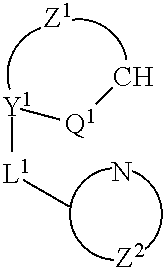
- Z 1 and Z 2 each independently represent a group of non-metal atoms required for forming a five-membered ring or six-membered ring. Further, the ring formed may form a fused ring with still another ring.
- L 1 represents a single bond or a divalent group.
- Y 1 represents a nitrogen atom or a carbon atom. When Y 1 is a nitrogen atom, Q 1 indicates that a carbon atom and Y 1 are bonded to each other by a single bond. When Y 1 is a carbon atom, Q 1 indicates that a carbon atom and Y 1 are bonded to each other by a double bond.
- the step (1) is preferably a step of preliminarily heating one of the complex of orthometallated iridium and the bidentate organic ligand. The reaction can be carried out more efficiently.
- the method for producing a complex of tris-orthometallated iridium according to the present disclosure encompasses such a form that the complex of orthometallated iridium is a compound represented by general formula (chemical formula 7).
- X represents a halogen atom.
- Z 1 , Z 2 , Y 1 , Q 1 and L 1 each have the same meaning as in general formula (chemical formula 4).
- the method for producing a complex of tris-orthometallated iridium according to the present disclosure encompasses such a form that the L a is a monoanionic ligand.
- the method for producing a complex of tris-orthometallated iridium according to the present disclosure encompasses such a form that the L a is a neutral ligand.
- the method for producing a complex of tris-orthometallated iridium according to the present disclosure encompasses such a form that the complex of orthometallated iridium is a compound represented by general formula (chemical formula 8).
- R 1 to R 3 each represent a hydrogen atom, a deuterium atom or a substituent.
- Z 1 , Z 2 , Y 1 , Q 1 and L 1 each have the same meaning as in general formula (chemical formula 4).
- the method for producing a complex of tris-orthometallated iridium according to the present disclosure encompasses such a form that the complex of orthometallated iridium is a compound represented by general formula (chemical formula 9).
- the method for producing a complex of tris-orthometallated iridium according to the present disclosure encompasses such a form that the bidentate organic ligand is at least one selected from compounds (7) to (17) shown in general formula (chemical formula 10).
- R 4 to R 102 each represent a hydrogen atom, a deuterium atom or a substituent.
- the reaction temperature in the step (3) is preferably in a range of 100 to 300° C.
- the production yield of the facial isomer can be further increased.
- the preliminary heating temperature in the step (1) is preferably equal to or lower than the reaction temperature in the step (3) and in a range of 100 to 300° C.
- the production yield of the facial isomer can be further increased.
- the step (1) is preferably a step of preliminarily heating the bidentate organic ligand.
- the step (3) is preferably carried out under irradiation of a microwave. Since the temperature can be elevated in a short time, the production yield of the facial isomer can be further increased.
- a light-emitting material according to the present disclosure includes the complex of tris-orthometallated iridium produced by the production method according to the present disclosure.
- a light-emitting device uses the light-emitting material according to the present disclosure.
- the present disclosure can provide a new production method for obtaining, with high selectivity as compared to a conventional method of mixing reaction substrates and thereafter reacting the mixture under heating, a facial isomer of tris-orthometallated iridium that is suitably used particularly as an organic electroluminescence device material, among complexes of tris-orthometallated iridium.
- the present disclosure can also provide a light-emitting material excellent in light emission efficiency and durability using a complex of tris-orthometallated iridium containing a facial isomer of tris-orthometallated iridium at a high ratio, and a light-emitting device using the light-emitting material.
- Z 1 and Z 2 each independently represent a group of non-metal atoms required for forming a five-membered ring or six-membered ring.
- the ring formed may have a substituent, or may form a fused ring with still another ring.
- the substituent is, for example, a halogen atom, an alkyl group, a substituted alkyl group, a phenoxy group, a substituted phenoxy group, an aryl group, a substituted aryl group, an alkoxy group, a substituted alkoxy group, a dialkylamino group or a substituted dialkylamino group.
- Preferable is a halogen atom, an alkyl group having 1 to 30 carbon atoms, a substituted alkyl group having 1 to 30 carbon atoms, a phenoxy group having 6 to 30 carbon atoms, a substituted phenoxy group having 6 to 30 carbon atoms, an aryl group having 6 to 30 carbon atoms, a substituted aryl group having 6 to 30 carbon atoms, an alkoxy group having 1 to 30 carbon atoms, a substituted alkoxy group having 1 to 30 carbon atoms, a dialkylamino group having 2 to 30 carbon atoms or a substituted dialkylamino group having 2 to 30 carbon atoms.
- a halogen atom an alkyl group having 1 to 10 carbon atoms, a substituted alkyl group having 1 to 10 carbon atoms, an aryl group having 6 to 10 carbon atoms, a substituted aryl group having 6 to 10 carbon atoms, an alkoxy group having 1 to 10 carbon atoms or a substituted alkoxy group having 1 to 10 carbon atoms.
- a halogen atom an alkyl group having 1 to 4 carbon atoms or a substituted alkyl group having 1 to 4 carbon atoms.
- the five-membered ring or six-membered ring formed by Z 1 is preferably an aromatic ring or a heteroaromatic ring, more preferably an aromatic ring.
- the five-membered ring or six-membered ring formed by Z 1 is, for example, a quinoline ring, a benzoquinoline ring, a quinoxaline ring, an isoquinoline ring, a phenanthridine ring, a phenazine ring, an acridine ring, a triazole ring, an imidazophenanthridine ring, a phthalazine ring, a quinazoline ring, a naphthyridine ring, a cinnoline ring, a perimidine ring, a phenanthroline ring, a benzimidazole ring, a benzoxazole ring, a benzthiazole ring, an imidazole ring,
- a pyrrole ring, a pyridine ring, a naphthalene ring, a fluorene ring, a dibenzothiophene ring, a dibenzofuran ring, a carbazole ring or a benzene ring is preferable.
- a naphthalene ring, a fluorene ring, a dibenzothiophene ring, a dibenzofuran ring, a carbazole ring or a benzene ring is more preferable, and a benzene ring is especially preferable.
- the five-membered ring or six-membered ring formed by Z 2 is preferably a heteroaromatic ring.
- the five-membered ring or six-membered ring formed by Z 2 is, for example, an imidazole ring, a thiazole ring, an oxazole ring, a pyrrole ring, an oxadiazole ring, a thiadiazole ring, a pyrazole ring, a 1,2,3-triazole ring, a 1,2,4-triazole ring, a selenazole ring, a pyridine ring, a pyrimidine ring, a pyrazine ring or a pyridazine ring.
- an imidazole ring, a thiazole ring, a 1,2,3-triazole ring, a 1,2,4-triazole ring, an oxazole ring, a pyrrole ring, a pyrazole ring, a pyridine ring or a pyrimidine ring is preferable, and a pyrazole ring or a pyridine ring is further preferable.
- L 1 represents a single bond or a divalent group.
- the divalent group is, for example, —C(R)(R′)—, —N(R)—, —O—, —P(R)— or —S—.
- R and R′ each represent a hydrogen atom or a substituent.
- the substituent is, for example, a halogen atom, an aliphatic group, an aromatic group, a heterocyclic group, a cyano group or a nitro group.
- L 1 is preferably a single bond, or —C(R)(R′)— where R and R′ each are a hydrogen atom, an aliphatic group or an aromatic group.
- L 1 is especially preferably a single bond.
- Y 1 represents a nitrogen atom or a carbon atom.
- Q 1 indicates that the bond between a carbon atom and Y 1 is a single bond.
- Q 1 indicates that the bond between a carbon atom and Y 1 is a double bond.
- Q 1 represents a bond between atoms.
- Y 1 is a nitrogen atom
- Q 1 indicates that a carbon atom and Y 1 are bonded to each other by a single bond.
- Y 1 is a carbon atom
- Q 1 indicates that a carbon atom and Y 1 are bonded to each other by a double bond.
- L a is a ligand, it may be a monodentate ligand or a bidentate ligand.
- L a may contain a metal (for example iridium), and may form so called a dinuclear complex.
- L a is preferably an anionic ligand or a neutral ligand.
- L a is especially preferably a monoanionic ligand or a neutral ligand.
- the monodentate anionic ligand is, for example, a halogen ligand, a hydroxy ligand, an alkoxide ligand, a phenoxide ligand, a thiocyanate ligand, a cyanate ligand or an isocyanate ligand.
- the bidentate anionic ligand is, for example, a ⁇ -diketonate ligand, an acetylacetonate ligand, an acetate ligand or a picolinate ligand.
- the monodentate neutral ligand is a nitrile ligand (for example, acetonitrile ligand or propionitrile ligand), a sulfoxide ligand (for example, dimethylsulfoxide ligand), an amide ligand (for example, dimethylformamide ligand), an ether ligand (for example, tetrahydrofuran ligand), a water ligand, an ammonia ligand, an amine ligand, a piperidine ligand, a pyridine ligand or a pyrazine ligand.
- the bidentate neutral ligand is, for example, a bipyridine ligand, a phenanthroline ligand, a dipyridylamine ligand or an ethylenediamine ligand.
- m 1 represents 1 or 2.
- m 2 represents 0 or 1.
- a 1 represents a counter anion.
- the counter anion is not particularly limited as long as it is anionic, but a counter monoanion is preferable.
- the counter anion is, for example, F ⁇ , Cl ⁇ , Br ⁇ , I ⁇ , BF 4 ⁇ , PF 6 ⁇ , ClO 4 ⁇ , CF 3 CF 2 CF 2 COO ⁇ , CF 3 SO 3 ⁇ , CF 3 CO 2 ⁇ , CH 3 CO 2 ⁇ , SCN ⁇ , CH 3 SO 3 ⁇ or SbF 6 ⁇ .
- Cl ⁇ , PF 6 ⁇ , BF 4 ⁇ or CF 3 SO 3 ⁇ is preferable.
- X represents a halogen atom.
- a chlorine atom or a bromine atom Preferable is a chlorine atom.
- R 1 to R 102 each represent a hydrogen atom, a deuterium atom or a substituent.
- the substituent is, for example, an alkyl group (the alkyl group has preferably 1 to 30 carbon atoms, more preferably 1 to 20 carbon atoms, especially preferably 1 to 10 carbon atoms, with examples thereof including methyl, ethyl, iso-propyl, tert-butyl, n-octyl, n-decyl, n-hexadecyl, cyclopropyl, cyclopentyl and cyclohexyl), an alkenyl group (the alkenyl group has preferably 2 to 30 carbon atoms, more preferably 2 to 20 carbon atoms, especially preferably 2 to 10 carbon atoms, with examples thereof including vinyl, allyl, 2-butenyl and 3-pentenyl), an alkynyl group (the alkynyl group has preferably 2 to 30 carbon atoms, more
- R 1 and R 3 are more preferably an alkyl group having 1 to 10 carbon atoms, especially preferably an alkyl group having 1 to 5 carbon atoms, among those shown above as an example as R 1 to R 102 .
- the alkyl group is, for example, methyl, ethyl, iso-propyl or tert-butyl. Among them, methyl and tert-butyl are more preferable, and methyl is most preferable.
- R 2 is more preferably a hydrogen atom, a deuterium atom or an alkyl group having 1 to 10 carbon atoms, especially preferably a hydrogen atom or an alkyl group having 1 to 5 carbon atoms, most preferably a hydrogen atom, among those shown above as an example as R 1 to R 102 .
- R 4 to R 102 are more preferably a hydrogen atom, a deuterium atom, a cyano group, a trifluoromethyl group, a fluorine atom, an alkyl group having 1 to 30 carbon atoms, an alkoxy group having 1 to 30 carbon atoms, an aryl group having 6 to 30 carbon atoms, or an amino group having 0 to 30 carbon atoms, especially preferably a hydrogen atom, a fluorine atom, an alkyl group having 1 to 20 carbon atoms, an aryl group having 6 to 20 carbon atoms, or an amino group having 0 to 20 carbon atoms, among those shown above as an example as R 1 to R 102 .
- a method for producing a complex of tris-orthometallated iridium is a method in which a complex of orthometallated iridium represented by general formula (chemical formula 4) and a bidentate organic ligand represented by general formula (chemical formula 5) are reacted as reaction substrates to produce a complex of tris-orthometallated iridium represented by general formula (chemical formula 6), wherein the method includes, in order, a step (1) of preliminarily heating at least one of the complex of orthometallated iridium or the bidentate organic ligand; a step (2) of mixing the complex of orthometallated iridium and the bidentate organic ligand; and a step (3) of reacting the complex of orthometallated iridium and the bidentate organic ligand.
- the complex of orthometallated iridium represented by general formula (chemical formula 4) is preferably a compound represented by general formula (chemical formula 7), a compound represented by general formula (chemical formula 8) or a compound represented by general formula (chemical formula 9).
- the compound represented by general formula (chemical formula 7) is an iridium binuclear complex in which a halogen ligand is coordinated as L a .
- the halogen ligand is, for example, chlorine, bromine, iodine or fluorine. Among them, a structure in which chlorine is coordinated (hereinafter, referred to as chlorine-bridged iridium dimer in some cases) is especially preferable.
- the compound represented by general formula (chemical formula 8) is a complex of orthometallated iridium in which a ⁇ -diketonate ligand is coordinated as L a .
- the compound represented by general formula (chemical formula 9) is a complex of orthometallated iridium in which an acetonitrile ligand is coordinated as L a .
- the bidentate organic ligand represented by general formula (chemical formula 5) is a bidentate organic ligand which can form an iridium-nitrogen bond or an iridium-carbon bond.
- the bidentate organic ligand is preferably at least one selected from compounds (7) to (17) shown in general formula (chemical formula 10).
- a bidentate organic ligand represented by (7), (8), (9) or (15) shown in general formula (chemical formula 10) is more preferable, a bidentate organic ligand represented by (7), (9) or (15) shown in general formula (chemical formula 10) is especially preferable, and a bidentate organic ligand represented by (7) or (15) shown in general formula (chemical formula 10) is particularly preferable.
- Other examples of the bidentate organic ligand may include bidentate organic ligands described in International Publication No. 01/041512, International Publication No. 02/15645 and JP-A No. 2001-247859.
- heating means for elevating the temperature to a predetermined reaction temperature in the step (3) is not particularly limited, and either a conventional external heating system such as an oil bath, a mantle heater, a block heater or a heat medium circulating jacket, or a microwave irradiation system can be applied.
- a conventional external heating system such as an oil bath, a mantle heater, a block heater or a heat medium circulating jacket, or a microwave irradiation system
- the microwave irradiation system is preferably selected for obtaining a higher facial isomer selectivity in a shorter time.
- the frequency of the microwave is not particularly limited, but is preferably 300 MHz to 300 GHz, more preferably 500 MHz to 10000 MHz, especially preferably 2000 MHz to 3000 MHz, particularly preferably 2400 MHz to 2500 MHz.
- the reaction time for heating by the microwave irradiation system depends on the output of a microwave reaction apparatus, the organic ligand, the type of a solvent used, and the liquid amount, but is preferably 1 minute to 180 minutes, more preferably 3 minutes to 120 minutes, especially preferably 5 minutes to 90 minutes, particularly preferably 10 minutes to 60 minutes.
- the microwave is preferably continuously applied at a predetermined constant output without varying (reducing) the output even when a predetermined reaction temperature is reached.
- the output of the microwave is preferably 1 W to 15 kW. It is more preferably 100 W to 10 kW, especially preferably 500 W to 8 kW, particularly preferably 1 kW to 6 kW.
- the reaction time depends on the organic ligand, the type of a solvent used and the liquid amount, but is preferably 10 minutes to 96 hours, more preferably 1 hour to 72 hours, especially preferably 1 hour to 48 hours, particularly preferably 1 hour to 24 hours.
- a reaction solvent is preferably used for ensuring that the reaction proceeds smoothly.
- the reaction solvent is not particularly limited, but an alcohol-based solvent, a protic solvent, an aprotic solvent, a hydrocarbon-based solvent, a nitrile-based solvent, an ionic solvent or the like is suitably used.
- the boiling point of a reaction solvent used is preferably 100° C. to 300° C., more preferably 150° C. to 285° C., especially preferably 160° C. to 250° C., particularly preferably 180° C. to 230° C.
- reaction solvent examples include 2-ethoxyethanol, DMF (N,N-dimethylformamide), diglyme, dodecane, ethylene glycol, 1,2-propanediol, 1,3-propanediol, 1,3-butanediol and glycerol.
- 2-ethoxyethanol, DMF, diglyme, dodecane, ethylene glycol, 1,2-propanediol, 1,3-propanediol and 1,3-butanediol are preferable, and diols such as ethylene glycol, 1,2-propanediol, 1,3-propanediol and 1,3-butanediol are especially preferable.
- These reaction solvents can be used alone or as a mixed solvent including two or more kinds.
- At least one of two reaction substrates a complex of orthometallated iridium represented by general formula (chemical formula 4) and a bidentate organic ligand represented by general formula (chemical formula 5) is preliminarily heated, and at this time, at least one reaction substrate may uniformly dissolved or uniformly dispersed in a dispersion medium beforehand.
- a dispersion medium one or more of those shown as an example in the aforementioned reaction solvents may be mixed and used, but one homogeneous to the reaction solvent is preferably selected.
- the step (1) is preferably a step of preliminarily heating one of the complex of orthometallated iridium and the bidentate organic ligand.
- the reaction substrate that is preliminarily heated is preferably a bidentate organic ligand represented by general formula (chemical formula 5).
- a bidentate organic ligand represented by general formula (chemical formula 5) or a reaction solution containing a bidentate organic ligand represented by general formula (chemical formula 5) is preliminarily heated, and thereto is added a complex of orthometallated iridium represented by general formula (chemical formula 4) or a reaction solution containing a complex of orthometallated iridium represented by general formula (chemical formula 4), and the mixture is reacted under heating.
- the reaction substrate which is not preliminarily heated is added as a powder, or the amount of dispersion medium dissolving or dispersing the reaction substrate, which is not preliminarily heated, is minimized. Consequently, a decrease in the temperature of the preliminarily heated reaction solution can be suppressed.
- steps (1) to (3) are carried out preferably under an inert gas atmosphere, especially preferably under a nitrogen atmosphere or an argon atmosphere.
- the reaction temperature in the step (3) is preferably in a range of 100° C. to 300° C.
- the reaction temperature is more preferably in a range of 155° C. to 300° C., especially preferably 155° C. to 285° C., further especially preferably 160° C. to 250° C., particularly preferably 180° C. to 230° C. If the reaction temperature is lower than 100° C., the production yield of the meridional isomer may be increased. If the reaction temperature is higher than 300° C., a decomposition reaction may easily proceed to reduce the yield.
- the preliminary heating temperature in the step (1) is equal to or lower than the reaction temperature in the step (3) and a difference between the preliminary heating temperature and the reaction temperature is small.
- the difference between the preliminary heating temperature and the reaction temperature is preferably 100° C. or lower, more preferably 50° C. or lower, especially preferably 20° C. or lower, particularly preferably 10° C. or lower. If the difference in temperature is higher than 100° C., it may take a long time to reach the reaction temperature, and the production yield of the meridional isomer may be increased, leading to a reduction in the production yield of the facial isomer.
- the preliminary heating temperature in the step (1) is preferably equal to or lower than the reaction temperature in the step (3) and in a range of 100° C. to 300° C.
- the preliminary heating temperature is more preferably in a range of 155° C. to 300° C., especially preferably 155° C. to 285° C., further especially preferably 160° C. to 250° C., particularly preferably 180° C. to 230° C. If the preliminary heating temperature is lower than 100° C., the production yield of the meridional isomer may be increased. If the preliminary heating temperature is higher than 300° C., a decomposition reaction may easily proceed to reduce the yield.
- the preliminary heating temperature is preferably less than 60 minutes, more preferably less than 30 minutes, especially preferably less than 15 minutes, further especially preferably less than 5 minutes after a desired temperature is reached.
- preliminary heating is not intended for removing water in, for example, a reaction solvent, but is a preparation step for the step (2), and therefore it is preferable to proceed to the next step (2) immediately when a desired temperature is reached.
- cooling does not include a temporary temperature decrease, such as a temperature decrease resulting from interruption of irradiation of a microwave between the step (1) and the step (2) or a temperature decrease resulting from addition of a chemical.
- the cooling step in this specification refers to a step of intentionally causing a temperature decrease by standing or cooling down a subject until a predetermined temperature is reached.
- the temperature fall is preferably less than 30° C., more preferably less than 20° C., especially preferably less than 10° C.
- the production method increases the production yield of the facial isomer by using the fact that the temperature at which the facial isomer is higher than the reaction temperature at which the meridional isomer is generated.
- the temperature of the mixture be set at a higher temperature.
- the temperature of the mixture (reaction solution when a solvent is used) when reaction substrates are mixed is preferably 105° C. or higher.
- the temperature of the mixture is more preferably 155° C. or higher, especially preferably 180° C. or higher.
- the production method according to this embodiment is usually carried out at a normal pressure, but may carried out under pressure or under a reduced pressure as necessary.
- a base such as an inorganic base containing an alkali metal (for example, potassium carbonate, sodium carbonate, sodium hydroxide or potassium hydrogen carbonate) or an organic amine (for example, diethylamine, triethylamine, triisobutylamine or triethanolamine) may be added for promoting the reaction.
- an alkali metal for example, potassium carbonate, sodium carbonate, sodium hydroxide or potassium hydrogen carbonate
- an organic amine for example, diethylamine, triethylamine, triisobutylamine or triethanolamine
- a silver compound such as AgCF 3 SO 3 , AgCF 3 COO, AgClO 4 , AgBF 4 , AgBPh 4 or AgPF 6 may be added for promoting the reaction.
- the used amount of a bidentate organic ligand represented by general formula (chemical formula 5) is not particularly limited as long as it is equal to or more than a stoichiometric ratio with respect to a complex of orthometallated iridium represented by general formula (chemical formula 4), but the used amount of the bidentate organic ligand is preferably 1 to 100 equivalents.
- the complex of orthometallated iridium represented by general formula (chemical formula 4) is a compound represented by general formula (chemical formula 7)
- the used amount of the bidentate organic ligand is more preferably 2 to 100 equivalents, especially preferably 5 to 80 equivalents, particularly preferably 10 to 70 equivalents.
- the used amount of the bidentate organic ligand is more preferably 1 to 30 equivalents, especially preferably 1 to 10 equivalents, particularly preferably 1 to 5 equivalents.
- the used amount of the bidentate organic ligand is more preferably 1 to 30 equivalents, especially preferably 1 to 10 equivalents, particularly preferably 1 to 5 equivalents.
- the method for preliminary heating in the step (1) is not particularly limited, and is, for example, a conventional external heating system such as an oil bath, a mantle heater, a block heater or a heat medium circulating jacket, or a microwave irradiation system.
- a microwave irradiation system is preferable because the temperature can be elevated in a shorter time.
- the output of the microwave is preferably in a range of 0.2 kW to 100 kW per liter of reaction solution, more preferably in a range of 0.5 kW to 50 kW per liter of reaction solution, especially preferably in a range of 2 kW to 20 kW per liter of reaction solution.
- the method for stirring the reaction solution is not particularly limited, but for example, a method of stirring by passing an inert gas, or a method using a magnetic stirrer, a stirring blade or the like is suitably used.
- the complex of tris-orthometallated iridium obtained by the production method according to this embodiment has geometrical isomers, i.e. the facial isomer and the meridional isomer, and the production yields thereof can be analyzed using proton nuclear magnetic resonance (proton NMR), high performance liquid chromatography (HPLC) or the like.
- the method for irradiation of a microwave is a single mode or a multi mode.
- either of the modes can be used, but the multi mode is more desirable.
- the valence number of iridium of an iridium raw material used in the production method according to this embodiment and a complex of tris-orthometallated iridium as a product is preferably three.
- any commercially available or previously known product can be used.
- the reaction is preferably carried out with a cooling pipe attached on the top of the microwave irradiation apparatus.
- the material of a reaction vessel used in the production method according to this embodiment is not particularly limited, and examples thereof include borosilicate glass, quartz glass and polytetrafluoroethylene (for example, Teflon (registered trademark)).
- the complexes of tris-orthometallated iridium represented by general formulae (chemical formula 4) and (chemical formula 7) to (chemical formula 9) can be produced by a known method.
- the known method is, for example, the method described in JP-A No. 2002-105055, Japanese Patent Application National Publication No. 2008-505076 or WO 2009/073246.
- the production method according to this embodiment has a high practical value when a microwave irradiation method is employed as heating means.
- the temperature elevation rate of the reaction solution is low, so that it takes a long time for a desired reaction temperature to be reached as compared to production before being scaled up if the microwave output is unchanged.
- the meridional isomer is more easily generated than the facial isomer at a low reaction temperature, and the meridional isomer may be easily generated when production is scaled up.
- At least one reaction substrate is preliminarily heated, and thereafter the two reaction substrates are mixed and reacted, so that the temperature can be quickly elevated to a desired reaction temperature, thus making it possible to improve the selectivity of the facial isomer.
- a light-emitting material according to this embodiment includes the complex of tris-orthometallated iridium produced by the production method according to this embodiment.
- the light-emitting material is suitable as, for example, a material of a light-emitting layer of an organic electroluminescence device.
- a light-emitting device uses the light-emitting material according to this embodiment.
- the organic electroluminescence device usually has a structure in which an anode, a hole transport layer, a light-emitting layer, an electron transport layer and a cathode are stacked in order on a substrate formed of a glass plate, a plastic plate or the like.
- the method for forming the light-emitting layer is not particularly limited, and can be formed by a well-known method such as a vapor deposition method or a wet deposition method.
- the light-emitting device according to this embodiment can be applied to, for example, OA computers, flat panel displays of wall-mounted televisions, vehicle-mounted display devices, cellular phone displays, copiers, liquid crystal displays, light sources that make use of the feature as a plane light emitter, such as backlight light sources of measuring instruments, display boards and marker lamps.
- reaction solution was cooled to room temperature, and thereafter the reaction solution was filtered to obtain a yellow solid.
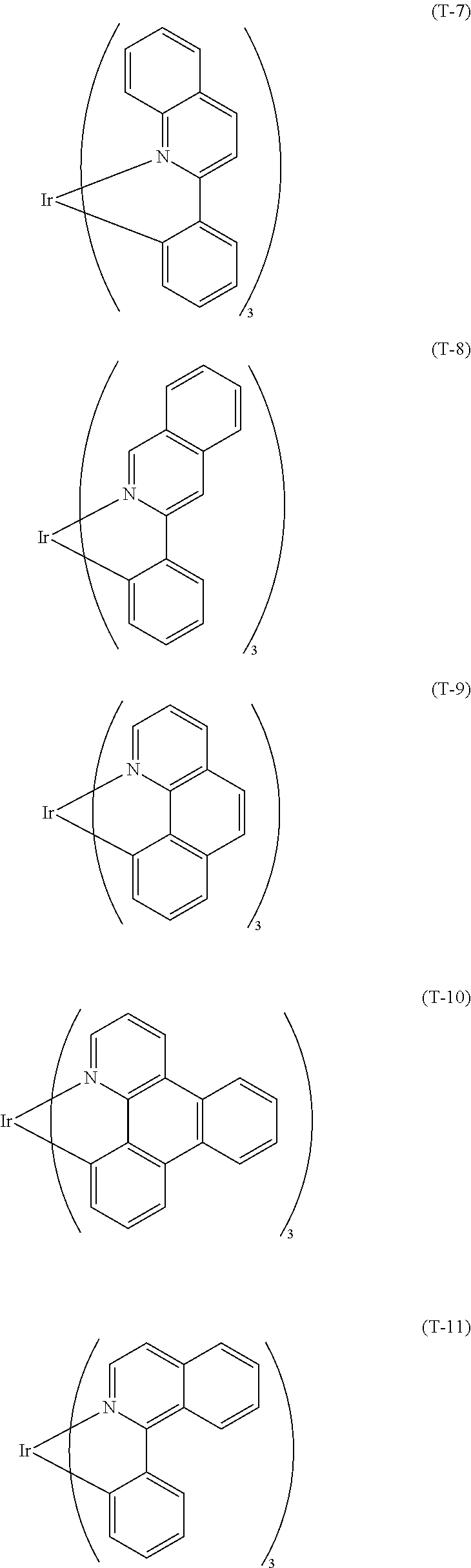
- the yellow solid was washed with methanol, pure water and methanol again, and thereafter dried in a vacuum to obtain a complex of tris-orthometallated iridium (T-9) described in chemical formula (chemical formula 11) (yield amount: 0.584 g; yield: 94%).
- the product was analyzed by proton NMR (manufactured by JEOL Ltd.; JNM-ECX400: 400 MHz; in DMSO-d 6 ), and resultantly found to be a mixture of a facial isomer and a meridional isomer at a ratio of 88:12 (molar ratio).
- the reaction scheme is shown in reaction formula (chemical formula 12).
- the yellow solid was washed with methanol, pure water and methanol again, and thereafter dried in a vacuum to obtain a complex of tris-orthometallated iridium (T-9) described in chemical formula (chemical formula 11) (yield amount: 0.561 g; yield: 90%).
- the product was analyzed by proton NMR (manufactured by JEOL Ltd.; JNM-ECX400: 400 MHz; in DMSO-d 6 ), and resultantly found to be a mixture of a facial isomer and a meridional isomer at a ratio of 80:20 (molar ratio).
- the yellow solid was washed with methanol, pure water and methanol again, and thereafter dried in a vacuum to obtain a complex of tris-orthometallated iridium (T-9) described in chemical formula (chemical formula 11) (yield amount: 3.54 g; yield: 95%).
- the product was analyzed by proton NMR (manufactured by JEOL Ltd.; JNM-ECX400: 400 MHz; in DMSO-d 6 ), and resultantly found to be a mixture of a facial isomer and a meridional isomer at a ratio of 81:19 (molar ratio).
- the reaction scheme is shown in reaction formula (chemical formula 13).
- reaction solution was further irradiated with a microwave at 1 kW for 20 minutes under an argon atmosphere, and reacted at around 198° C. to 200° C.
- the reaction solution was cooled to room temperature, and thereafter the reaction solution was filtered to obtain a yellow solid.
- the yellow solid was washed with methanol, pure water and methanol again, and thereafter dried in a vacuum to obtain a complex of tris-orthometallated iridium (T-9) described in chemical formula (chemical formula 11) (yield amount: 3.48 g; yield: 94%).
- the product was analyzed by proton NMR (manufactured by JEOL Ltd.; JNM-ECX400: 400 MHz; in DMSO-d 6 ), and resultantly found to be a mixture of a facial isomer and a meridional isomer at a ratio of 66:34 (molar ratio).
- reaction solution was cooled to room temperature, and thereafter the reaction solution was filtered to obtain a yellow solid.
- the yellow solid was washed with methanol, pure water and methanol again, and thereafter dried in a vacuum to obtain a complex of tris-orthometallated iridium (T-9) described in chemical formula (chemical formula 11) (yield amount: 0.575 g; yield: 93%).
- the product was analyzed by proton NMR (manufactured by JEOL Ltd.; JNM-ECX400: 400 MHz; in DMSO-d 6 ), and resultantly found to be a mixture of a facial isomer and a meridional isomer at a ratio of 15:85 (molar ratio).
- the reaction scheme is shown in reaction formula (chemical formula 14).
- the yellow solid was washed with methanol, pure water and methanol again, and thereafter dried in a vacuum to obtain a complex of tris-orthometallated iridium (T-9) described in chemical formula (chemical formula 11) (yield amount: 0.587 g; yield: 94%).
- the product was analyzed by proton NMR (manufactured by JEOL Ltd.; JNM-ECX400: 400 MHz; in DMSO-d 6 ), and resultantly found to be a mixture of a facial isomer and a meridional isomer at a ratio of 9:91 (molar ratio).
- the yellow solid was washed with methanol, pure water and methanol again, thereafter dried in a vacuum, and recrystallized from a mixed solvent of DMF and methanol to obtain a complex of tris-orthometallated iridium (T-1) described in chemical formula (chemical formula 11) (yield amount: 33.5 g; yield: 90.0%).
- the product was analyzed by HPLC (Prominence manufactured by Shimadzu Corporation; detected wavelength: 300 nm), and resultantly found to be a mixture of a facial isomer and a meridional isomer at a ratio of 99.8:0.2 (molar ratio).
- the reaction scheme is shown in reaction formula (chemical formula 15).
- reaction solution was further irradiated with a microwave at 6 kW for an hour under an argon atmosphere, and reacted at around 198° C. to 200° C.
- the reaction solution was cooled to room temperature, and thereafter the reaction solution was filtered to obtain a yellow solid.
- the yellow solid was washed with methanol, pure water and methanol again, thereafter dried in a vacuum, and recrystallized from a mixed solvent of DMF and methanol to obtain a complex of tris-orthometallated iridium (T-1) described in chemical formula (chemical formula 11) (yield amount: 33.5 g; yield: 90.4%).
- reaction solution was cooled to room temperature, and thereafter the reaction solution was filtered to obtain a light-yellow solid.
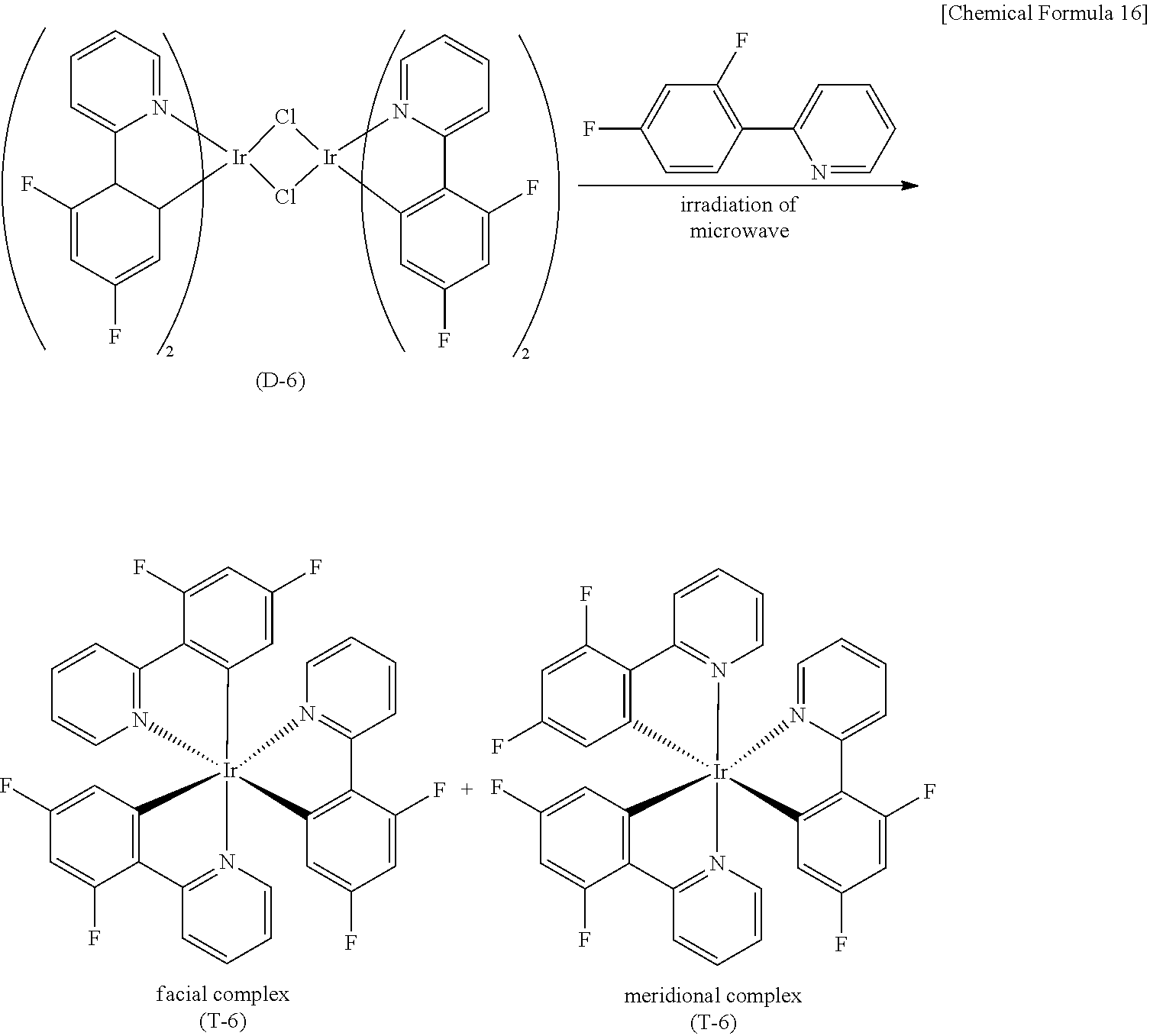
- the light-yellow solid was washed with methanol, pure water and methanol again, and thereafter dried in a vacuum to obtain a complex of tris-orthometallated iridium (T-6) described in chemical formula (chemical formula 11) (yield amount: 0.584 g; yield: 93%).
- the product was analyzed by proton NMR (manufactured by JEOL Ltd.; JNM-ECX400: 400 MHz; in CDCl 3 ), and resultantly found to be a mixture of a facial isomer and a meridional isomer at a ratio of 82:18 (molar ratio).
- the reaction scheme is shown in reaction formula (chemical formula 16).
- the light-yellow solid was washed with methanol, pure water and methanol again, and thereafter dried in a vacuum to obtain a complex of tris-orthometallated iridium (T-6) described in chemical formula (chemical formula 11) (yield amount: 0.582 g; yield: 93%).
- the product was analyzed by proton NMR (manufactured by JEOL Ltd.; JNM-ECX400: 400 MHz; in CDCl 3 ), and resultantly found to be a mixture of a facial isomer and a meridional isomer at a ratio of 76:24 (molar ratio).
- reaction solution was cooled to room temperature, and thereafter the reaction solution was filtered to obtain a yellow solid.
- the yellow solid was washed with methanol, pure water and methanol again, and thereafter dried in a vacuum to obtain a complex of tris-orthometallated iridium (T-3) described in chemical formula (chemical formula 11) (yield amount: 0.453 g; yield: 71%).
- the product was analyzed by proton NMR (manufactured by JEOL Ltd.; JNM-ECX400: 400 MHz; in CDCl 3 ), and resultantly found that the ratio of a facial isomer and a meridional isomer was 100:0 (molar ratio).
- the reaction scheme is shown in reaction formula (chemical formula 17).
- the yellow solid was washed with methanol, pure water and methanol again, and thereafter dried in a vacuum to obtain a complex of tris-orthometallated iridium (T-3) described in chemical formula (chemical formula 11) (yield amount: 0.422 g; yield: 67%).
- the product was analyzed by proton NMR (manufactured by JEOL Ltd.; JNM-ECX400: 400 MHz; in CDCl 3 ), and resultantly found that the ratio of a facial isomer and a meridional isomer was 100:0 (molar ratio).
- the production method according to the present disclosure can highly contribute to reduction of production costs, leading to a significant practical advantage.
- the production yield of the facial isomer is 100% in both Example 6 and Comparative Example 6, but the yield of the facial isomer of the complex of tris-orthometallated iridium (value obtained by multiplying the yield of the resulting complex of tris-orthometallated iridium by the production yield of the facial isomer) is higher in Example 6 than in Comparative Example 6.
Landscapes
- Chemical & Material Sciences (AREA)
- Organic Chemistry (AREA)
- Engineering & Computer Science (AREA)
- Materials Engineering (AREA)
- Crystallography & Structural Chemistry (AREA)
- Inorganic Chemistry (AREA)
- Manufacturing & Machinery (AREA)
- Physics & Mathematics (AREA)
- Optics & Photonics (AREA)
- Electroluminescent Light Sources (AREA)
Abstract
Description


(In general formula (chemical formula 4), La represents a ligand. A1 represents a counter anion. m1 represents 1 or 2. m2 represents 0 or 1. Z1 and Z2 each independently represent a group of non-metal atoms required for forming a five-membered ring or six-membered ring. Further, the ring formed may form a fused ring with still another ring. L1 represents a single bond or a divalent group. Y1 represents a nitrogen atom or a carbon atom. When Y1 is a nitrogen atom, Q1 indicates that a carbon atom and Y1 are bonded to each other by a single bond. When Y1 is a carbon atom, Q1 indicates that a carbon atom and Y1 are bonded to each other by a double bond.)

(In general formula (chemical formula 5), Z1, Z2, Y1, Q1 and L1 each have the same meaning as in general formula (chemical formula 4).)

(In general formula (chemical formula 6), Z1, Z2, Y1, Q1 and L1 each have the same meaning as in general formula (chemical formula 4).)

(In general formula (chemical formula 7), X represents a halogen atom. Z1, Z2, Y1, Q1 and L1 each have the same meaning as in general formula (chemical formula 4).)

(In general formula (chemical formula 8), R1 to R3 each represent a hydrogen atom, a deuterium atom or a substituent. Z1, Z2, Y1, Q1 and L1 each have the same meaning as in general formula (chemical formula 4).)

(In general formula (chemical formula 9), A1, Z1, Z2, Y1, Q1 and L1 each have the same meaning as in general formula (chemical formula 4).)


(In (7) to (17) shown in general formula (chemical formula 10), R4 to R102 each represent a hydrogen atom, a deuterium atom or a substituent.)




Claims (3)



Applications Claiming Priority (3)
| Application Number | Priority Date | Filing Date | Title |
|---|---|---|---|
| JP2010-242751 | 2010-10-28 | ||
| JP2010242751 | 2010-10-28 | ||
| PCT/JP2011/074550 WO2012057138A1 (en) | 2010-10-28 | 2011-10-25 | Method for producing complex of trisortho-metalated iridium, light-emitting material using said complex, and light-emitting element |
Publications (2)
| Publication Number | Publication Date |
|---|---|
| US20130203997A1 US20130203997A1 (en) | 2013-08-08 |
| US9200023B2 true US9200023B2 (en) | 2015-12-01 |
Family
ID=45993845
Family Applications (1)
| Application Number | Title | Priority Date | Filing Date |
|---|---|---|---|
| US13/876,937 Expired - Fee Related US9200023B2 (en) | 2010-10-28 | 2011-10-25 | Method for producing complex of trisortho-metalated iridium, light-emitting material using said complex, and light-emitting element |
Country Status (5)
| Country | Link |
|---|---|
| US (1) | US9200023B2 (en) |
| JP (1) | JP5881215B2 (en) |
| KR (1) | KR101611015B1 (en) |
| DE (1) | DE112011103600B4 (en) |
| WO (1) | WO2012057138A1 (en) |
Cited By (1)
| Publication number | Priority date | Publication date | Assignee | Title |
|---|---|---|---|---|
| US11267835B2 (en) * | 2017-02-14 | 2022-03-08 | Merck Patent Gmbh | Process for preparing ortho-metallated metal compounds |
Families Citing this family (9)
| Publication number | Priority date | Publication date | Assignee | Title |
|---|---|---|---|---|
| WO2014007564A1 (en) * | 2012-07-04 | 2014-01-09 | 제일모직 주식회사 | Composite for organic light-emitting diode, organic light-emitting layer including same, and organic light-emitting diode |
| KR101344787B1 (en) | 2012-07-04 | 2013-12-26 | 제일모직주식회사 | Compound for organic optoelectronic device, organic light emitting diode including the same and display including the organic light emitting diode |
| KR102145982B1 (en) * | 2012-10-24 | 2020-08-19 | 엘지디스플레이 주식회사 | Method for mnufacturing of blue phosphorescence composition and organic light emittin diode comprising the same |
| JP6663143B2 (en) * | 2015-03-10 | 2020-03-11 | 国立大学法人大阪大学 | Method for arylating carbon-hydrogen bonds of iridium complexes |
| CN106318377A (en) | 2015-07-02 | 2017-01-11 | 昆山国显光电有限公司 | Vapor-depositable ionic organic functional materials and their applications in organic electroluminescent devices |
| CN109790195A (en) * | 2016-10-05 | 2019-05-21 | 三菱化学株式会社 | Iridium complex compound, composition containing the same, organic electroluminescent element, display device, and lighting device |
| US12312367B2 (en) | 2020-04-09 | 2025-05-27 | Canon Kabushiki Kaisha | Iridium complex-containing composition, organic light emitting device having the same, display apparatus, imaging apparatus, electronic equipment, lighting apparatus, and moving body |
| JP7520571B2 (en) | 2020-05-15 | 2024-07-23 | キヤノン株式会社 | Composition containing an iridium complex, organic light-emitting element having the same, display device, imaging device, electronic device, lighting device, and mobile object |
| PL442410A1 (en) * | 2022-09-29 | 2024-04-02 | Uniwersytet Łódzki | New compound of the Ir(4-nitro-N-(2-phenylpyridin-4-yl)benzamide(ppy)2 complex (ppy-2-phenylpyridine) |
Citations (7)
| Publication number | Priority date | Publication date | Assignee | Title |
|---|---|---|---|---|
| JP2002105055A (en) | 2000-09-29 | 2002-04-10 | Fuji Photo Film Co Ltd | Method for manufacturing indium complex or its tautomer |
| WO2002044189A1 (en) | 2000-11-30 | 2002-06-06 | Canon Kabushiki Kaisha | Luminescent element and display |
| JP2004168756A (en) | 2002-11-06 | 2004-06-17 | National Institute Of Advanced Industrial & Technology | Method for producing orthometallated iridium complex |
| US20050288507A1 (en) | 2004-06-29 | 2005-12-29 | Eastman Kodak Company | Synthesis of organometallic cyclometallated transition metal complexes |
| JP2007070290A (en) | 2005-09-07 | 2007-03-22 | Tama Tlo Kk | Method for producing ortho-metalated iridium complex, iodine-crosslinked iridium dimer complex and method for producing the same |
| US20080131730A1 (en) | 2006-11-28 | 2008-06-05 | Canon Kabushiki Kaisha | Metal complex compound, electroluminescent device and display apparatus |
| JP2010189453A (en) | 2009-02-13 | 2010-09-02 | Mitsubishi Chemicals Corp | Organometallic complex composition, composition containing organometallic complex, organic electroluminescent element, organic el display, and organic el illumination |
Family Cites Families (2)
| Publication number | Priority date | Publication date | Assignee | Title |
|---|---|---|---|---|
| JP3929690B2 (en) | 1999-12-27 | 2007-06-13 | 富士フイルム株式会社 | Light emitting device material, light emitting device and novel iridium complex comprising orthometalated iridium complex |
| WO2009073246A1 (en) | 2007-12-06 | 2009-06-11 | Universal Display Corporation | Method for the synthesis of iridium (iii) complexes with sterically demanding ligands |
-
2011
- 2011-10-25 WO PCT/JP2011/074550 patent/WO2012057138A1/en not_active Ceased
- 2011-10-25 US US13/876,937 patent/US9200023B2/en not_active Expired - Fee Related
- 2011-10-25 KR KR1020137013148A patent/KR101611015B1/en not_active Expired - Fee Related
- 2011-10-25 DE DE112011103600.0T patent/DE112011103600B4/en not_active Expired - Fee Related
- 2011-10-25 JP JP2012540877A patent/JP5881215B2/en active Active
Patent Citations (8)
| Publication number | Priority date | Publication date | Assignee | Title |
|---|---|---|---|---|
| JP2002105055A (en) | 2000-09-29 | 2002-04-10 | Fuji Photo Film Co Ltd | Method for manufacturing indium complex or its tautomer |
| WO2002044189A1 (en) | 2000-11-30 | 2002-06-06 | Canon Kabushiki Kaisha | Luminescent element and display |
| JP2004168756A (en) | 2002-11-06 | 2004-06-17 | National Institute Of Advanced Industrial & Technology | Method for producing orthometallated iridium complex |
| US20050288507A1 (en) | 2004-06-29 | 2005-12-29 | Eastman Kodak Company | Synthesis of organometallic cyclometallated transition metal complexes |
| JP2008505076A (en) | 2004-06-29 | 2008-02-21 | イーストマン コダック カンパニー | Synthesis of organometallic cyclometalated transition metal complexes |
| JP2007070290A (en) | 2005-09-07 | 2007-03-22 | Tama Tlo Kk | Method for producing ortho-metalated iridium complex, iodine-crosslinked iridium dimer complex and method for producing the same |
| US20080131730A1 (en) | 2006-11-28 | 2008-06-05 | Canon Kabushiki Kaisha | Metal complex compound, electroluminescent device and display apparatus |
| JP2010189453A (en) | 2009-02-13 | 2010-09-02 | Mitsubishi Chemicals Corp | Organometallic complex composition, composition containing organometallic complex, organic electroluminescent element, organic el display, and organic el illumination |
Non-Patent Citations (4)
| Title |
|---|
| German Office Action dated Jul. 28, 2015 corresponding to German Patent Application No. 11 2011 103 600.0; 10 pages. |
| International Patentability Report on Patentability dated May 10, 2013 corresponding to Japanese Patent Application No. PCT/JP2011/074550. |
| International Search Report dated Dec. 13, 2011 for corresponding International Patent Application No. PCT/JP2011/074550 with English translation (3 pages). |
| Tamayo, et al., "Synthesis and Characterization of Facial and Meridional Tris-cyclometalated Iridium(III) Complexes", J. Am. Chem. Soc., 125, 2003, pp. 7377-7387. |
Cited By (1)
| Publication number | Priority date | Publication date | Assignee | Title |
|---|---|---|---|---|
| US11267835B2 (en) * | 2017-02-14 | 2022-03-08 | Merck Patent Gmbh | Process for preparing ortho-metallated metal compounds |
Also Published As
| Publication number | Publication date |
|---|---|
| JPWO2012057138A1 (en) | 2014-05-12 |
| KR101611015B1 (en) | 2016-04-08 |
| DE112011103600T5 (en) | 2013-09-12 |
| JP5881215B2 (en) | 2016-03-09 |
| WO2012057138A1 (en) | 2012-05-03 |
| KR20130109160A (en) | 2013-10-07 |
| US20130203997A1 (en) | 2013-08-08 |
| DE112011103600B4 (en) | 2018-05-03 |
Similar Documents
| Publication | Publication Date | Title |
|---|---|---|
| US9200023B2 (en) | Method for producing complex of trisortho-metalated iridium, light-emitting material using said complex, and light-emitting element | |
| JP4496357B2 (en) | Fluorine-substituted iridium complex and light emitting material using the same | |
| JP4198654B2 (en) | Iridium compound and organic electroluminescence device employing the same | |
| US20110301351A1 (en) | Platinum (II) Di (2-Pyrazolyl) Benzene Chloride Analogs and Uses | |
| US8415032B2 (en) | Material for organic electroluminescence device and organic electroluminescence device | |
| US20060252936A1 (en) | Method for the production of highly pure tris-ortho-metalated organo-iridium compounds | |
| JP5692805B2 (en) | Method for producing iridium complex and light emitting material comprising produced iridium complex | |
| US10109808B2 (en) | Method of forming metal complex compound, and organic electroluminescence device | |
| WO2012141109A1 (en) | Organic electroluminescent element, material for organic electroluminescent element, film, and manufacturing method for organic electroluminescent element | |
| JP4756273B2 (en) | Method for producing orthometalated iridium complex and luminescent material comprising produced iridium complex | |
| US10053479B2 (en) | Raw material and production method for cyclometalated iridium complex | |
| WO2011024977A1 (en) | Organic electroluminescent element | |
| US20120184743A1 (en) | Material selecting method upon purifying iridium complex by sublimation | |
| US10533027B2 (en) | Method for producing cyclometalated iridium complex | |
| Babón et al. | Two synthetic tools to deepen the understanding of the influence of stereochemistry on the properties of Iridium (III) heteroleptic emitters | |
| US8034934B2 (en) | Process for producing ortho-metalated complex of iridium with homoligand | |
| JP5881216B2 (en) | Method for producing trisorthometalated iridium complex, light emitting material and light emitting device using the same | |
| US10844086B2 (en) | Method for producing halogen-crosslinked iridium dimer | |
| JP4035604B2 (en) | Method for producing orthometalated iridium complex | |
| US11008352B2 (en) | Method for producing cyclometalated iridium complex | |
| KR102942551B1 (en) | Preparation and Application of Tetralogic Platinum (II) Complexes | |
| TW201333020A (en) | Heteroleptic light emitting complexes |
Legal Events
| Date | Code | Title | Description |
|---|---|---|---|
| AS | Assignment |
Owner name: FURUYA METAL CO. LTD., JAPAN Free format text: ASSIGNMENT OF ASSIGNORS INTEREST;ASSIGNORS:KONNO, HIDEO;ITO, TAKASHI;SUGITA, YOSHIRO;REEL/FRAME:030114/0623 Effective date: 20130325 Owner name: NATIONAL INSTITUTE OF ADVANCED INDUSTRIAL SCIENCE Free format text: ASSIGNMENT OF ASSIGNORS INTEREST;ASSIGNORS:KONNO, HIDEO;ITO, TAKASHI;SUGITA, YOSHIRO;REEL/FRAME:030114/0623 Effective date: 20130325 |
|
| STCF | Information on status: patent grant |
Free format text: PATENTED CASE |
|
| FEPP | Fee payment procedure |
Free format text: MAINTENANCE FEE REMINDER MAILED (ORIGINAL EVENT CODE: REM.); ENTITY STATUS OF PATENT OWNER: SMALL ENTITY |
|
| LAPS | Lapse for failure to pay maintenance fees |
Free format text: PATENT EXPIRED FOR FAILURE TO PAY MAINTENANCE FEES (ORIGINAL EVENT CODE: EXP.); ENTITY STATUS OF PATENT OWNER: SMALL ENTITY |
|
| STCH | Information on status: patent discontinuation |
Free format text: PATENT EXPIRED DUE TO NONPAYMENT OF MAINTENANCE FEES UNDER 37 CFR 1.362 |
|
| FP | Lapsed due to failure to pay maintenance fee |
Effective date: 20191201 |