US9139687B2 - Soluble imide skeleton resin, soluble imide skeleton resin solution composition, curable resin composition, and cured product thereof - Google Patents

Soluble imide skeleton resin, soluble imide skeleton resin solution composition, curable resin composition, and cured product thereof Download PDF

Info

Publication number
US9139687B2
US9139687B2 US13/063,587 US200913063587A US9139687B2 US 9139687 B2 US9139687 B2 US 9139687B2 US 200913063587 A US200913063587 A US 200913063587A US 9139687 B2 US9139687 B2 US 9139687B2
Authority
US
United States
Prior art keywords
resin
formula
imide skeleton
group
soluble imide
Prior art date
Legal status (The legal status is an assumption and is not a legal conclusion. Google has not performed a legal analysis and makes no representation as to the accuracy of the status listed.)
Active, expires
Application number
US13/063,587
Other versions
US20120043508A1 (en
Inventor
Takayoshi Hirai
Tetsurou Imura
Makoto Takahashi
Current Assignee (The listed assignees may be inaccurate. Google has not performed a legal analysis and makes no representation or warranty as to the accuracy of the list.)
Mitsubishi Chemical Corp
Original Assignee
Mitsubishi Chemical Corp
Priority date (The priority date is an assumption and is not a legal conclusion. Google has not performed a legal analysis and makes no representation as to the accuracy of the date listed.)
Filing date
Publication date
Application filed by Mitsubishi Chemical Corp filed Critical Mitsubishi Chemical Corp
Assigned to MITSUBISHI CHEMICAL CORPORATION reassignment MITSUBISHI CHEMICAL CORPORATION ASSIGNMENT OF ASSIGNORS INTEREST (SEE DOCUMENT FOR DETAILS). Assignors: HIRAI, TAKAYOSHI, TAKAHASHI, MAKOTO, IMURA, TETSUROU
Publication of US20120043508A1 publication Critical patent/US20120043508A1/en
Application granted granted Critical
Publication of US9139687B2 publication Critical patent/US9139687B2/en
Assigned to MITSUBISHI RAYON CO., LTD. reassignment MITSUBISHI RAYON CO., LTD. MERGER Assignors: MITSUBISHI CHEMICAL CORPORATION
Assigned to MITSUBISHI CHEMICAL CORPORATION reassignment MITSUBISHI CHEMICAL CORPORATION CHANGE OF NAME Assignors: MITSUBISHI RAYON CO., LTD.
Active legal-status Critical Current
Adjusted expiration legal-status Critical

Links

Images

Classifications

    • CCHEMISTRY; METALLURGY
    • C08ORGANIC MACROMOLECULAR COMPOUNDS; THEIR PREPARATION OR CHEMICAL WORKING-UP; COMPOSITIONS BASED THEREON
    • C08GMACROMOLECULAR COMPOUNDS OBTAINED OTHERWISE THAN BY REACTIONS ONLY INVOLVING UNSATURATED CARBON-TO-CARBON BONDS
    • C08G59/00Polycondensates containing more than one epoxy group per molecule; Macromolecules obtained by polymerising compounds containing more than one epoxy group per molecule using curing agents or catalysts which react with the epoxy groups
    • C08G59/18Macromolecules obtained by polymerising compounds containing more than one epoxy group per molecule using curing agents or catalysts which react with the epoxy groups ; e.g. general methods of curing
    • C08G59/20Macromolecules obtained by polymerising compounds containing more than one epoxy group per molecule using curing agents or catalysts which react with the epoxy groups ; e.g. general methods of curing characterised by the epoxy compounds used
    • C08G59/22Di-epoxy compounds
    • BPERFORMING OPERATIONS; TRANSPORTING
    • B32LAYERED PRODUCTS
    • B32BLAYERED PRODUCTS, i.e. PRODUCTS BUILT-UP OF STRATA OF FLAT OR NON-FLAT, e.g. CELLULAR OR HONEYCOMB, FORM
    • B32B15/00Layered products comprising a layer of metal
    • B32B15/04Layered products comprising a layer of metal comprising metal as the main or only constituent of a layer, which is next to another layer of the same or of a different material
    • B32B15/08Layered products comprising a layer of metal comprising metal as the main or only constituent of a layer, which is next to another layer of the same or of a different material of synthetic resin
    • BPERFORMING OPERATIONS; TRANSPORTING
    • B32LAYERED PRODUCTS
    • B32BLAYERED PRODUCTS, i.e. PRODUCTS BUILT-UP OF STRATA OF FLAT OR NON-FLAT, e.g. CELLULAR OR HONEYCOMB, FORM
    • B32B15/00Layered products comprising a layer of metal
    • B32B15/20Layered products comprising a layer of metal comprising aluminium or copper
    • BPERFORMING OPERATIONS; TRANSPORTING
    • B32LAYERED PRODUCTS
    • B32BLAYERED PRODUCTS, i.e. PRODUCTS BUILT-UP OF STRATA OF FLAT OR NON-FLAT, e.g. CELLULAR OR HONEYCOMB, FORM
    • B32B27/00Layered products comprising a layer of synthetic resin
    • B32B27/28Layered products comprising a layer of synthetic resin comprising synthetic resins not wholly covered by any one of the sub-groups B32B27/30 - B32B27/42
    • B32B27/281Layered products comprising a layer of synthetic resin comprising synthetic resins not wholly covered by any one of the sub-groups B32B27/30 - B32B27/42 comprising polyimides
    • BPERFORMING OPERATIONS; TRANSPORTING
    • B32LAYERED PRODUCTS
    • B32BLAYERED PRODUCTS, i.e. PRODUCTS BUILT-UP OF STRATA OF FLAT OR NON-FLAT, e.g. CELLULAR OR HONEYCOMB, FORM
    • B32B3/00Layered products comprising a layer with external or internal discontinuities or unevennesses, or a layer of non-planar shape; Layered products comprising a layer having particular features of form
    • B32B3/02Layered products comprising a layer with external or internal discontinuities or unevennesses, or a layer of non-planar shape; Layered products comprising a layer having particular features of form characterised by features of form at particular places, e.g. in edge regions
    • B32B3/08Layered products comprising a layer with external or internal discontinuities or unevennesses, or a layer of non-planar shape; Layered products comprising a layer having particular features of form characterised by features of form at particular places, e.g. in edge regions characterised by added members at particular parts
    • B32B3/085Layered products comprising a layer with external or internal discontinuities or unevennesses, or a layer of non-planar shape; Layered products comprising a layer having particular features of form characterised by features of form at particular places, e.g. in edge regions characterised by added members at particular parts spaced apart pieces on the surface of a layer
    • BPERFORMING OPERATIONS; TRANSPORTING
    • B32LAYERED PRODUCTS
    • B32BLAYERED PRODUCTS, i.e. PRODUCTS BUILT-UP OF STRATA OF FLAT OR NON-FLAT, e.g. CELLULAR OR HONEYCOMB, FORM
    • B32B7/00Layered products characterised by the relation between layers; Layered products characterised by the relative orientation of features between layers, or by the relative values of a measurable parameter between layers, i.e. products comprising layers having different physical, chemical or physicochemical properties; Layered products characterised by the interconnection of layers
    • B32B7/04Interconnection of layers
    • B32B7/12Interconnection of layers using interposed adhesives or interposed materials with bonding properties
    • CCHEMISTRY; METALLURGY
    • C08ORGANIC MACROMOLECULAR COMPOUNDS; THEIR PREPARATION OR CHEMICAL WORKING-UP; COMPOSITIONS BASED THEREON
    • C08GMACROMOLECULAR COMPOUNDS OBTAINED OTHERWISE THAN BY REACTIONS ONLY INVOLVING UNSATURATED CARBON-TO-CARBON BONDS
    • C08G59/00Polycondensates containing more than one epoxy group per molecule; Macromolecules obtained by polymerising compounds containing more than one epoxy group per molecule using curing agents or catalysts which react with the epoxy groups
    • C08G59/02Polycondensates containing more than one epoxy group per molecule
    • C08G59/04Polycondensates containing more than one epoxy group per molecule of polyhydroxy compounds with epihalohydrins or precursors thereof
    • C08G59/06Polycondensates containing more than one epoxy group per molecule of polyhydroxy compounds with epihalohydrins or precursors thereof of polyhydric phenols
    • C08G59/066Polycondensates containing more than one epoxy group per molecule of polyhydroxy compounds with epihalohydrins or precursors thereof of polyhydric phenols with chain extension or advancing agents
    • CCHEMISTRY; METALLURGY
    • C08ORGANIC MACROMOLECULAR COMPOUNDS; THEIR PREPARATION OR CHEMICAL WORKING-UP; COMPOSITIONS BASED THEREON
    • C08GMACROMOLECULAR COMPOUNDS OBTAINED OTHERWISE THAN BY REACTIONS ONLY INVOLVING UNSATURATED CARBON-TO-CARBON BONDS
    • C08G59/00Polycondensates containing more than one epoxy group per molecule; Macromolecules obtained by polymerising compounds containing more than one epoxy group per molecule using curing agents or catalysts which react with the epoxy groups
    • C08G59/18Macromolecules obtained by polymerising compounds containing more than one epoxy group per molecule using curing agents or catalysts which react with the epoxy groups ; e.g. general methods of curing
    • C08G59/20Macromolecules obtained by polymerising compounds containing more than one epoxy group per molecule using curing agents or catalysts which react with the epoxy groups ; e.g. general methods of curing characterised by the epoxy compounds used
    • C08G59/22Di-epoxy compounds
    • C08G59/26Di-epoxy compounds heterocyclic
    • CCHEMISTRY; METALLURGY
    • C08ORGANIC MACROMOLECULAR COMPOUNDS; THEIR PREPARATION OR CHEMICAL WORKING-UP; COMPOSITIONS BASED THEREON
    • C08GMACROMOLECULAR COMPOUNDS OBTAINED OTHERWISE THAN BY REACTIONS ONLY INVOLVING UNSATURATED CARBON-TO-CARBON BONDS
    • C08G59/00Polycondensates containing more than one epoxy group per molecule; Macromolecules obtained by polymerising compounds containing more than one epoxy group per molecule using curing agents or catalysts which react with the epoxy groups
    • C08G59/18Macromolecules obtained by polymerising compounds containing more than one epoxy group per molecule using curing agents or catalysts which react with the epoxy groups ; e.g. general methods of curing
    • C08G59/40Macromolecules obtained by polymerising compounds containing more than one epoxy group per molecule using curing agents or catalysts which react with the epoxy groups ; e.g. general methods of curing characterised by the curing agents used
    • C08G59/62Alcohols or phenols
    • C08G59/621Phenols
    • CCHEMISTRY; METALLURGY
    • C08ORGANIC MACROMOLECULAR COMPOUNDS; THEIR PREPARATION OR CHEMICAL WORKING-UP; COMPOSITIONS BASED THEREON
    • C08GMACROMOLECULAR COMPOUNDS OBTAINED OTHERWISE THAN BY REACTIONS ONLY INVOLVING UNSATURATED CARBON-TO-CARBON BONDS
    • C08G59/00Polycondensates containing more than one epoxy group per molecule; Macromolecules obtained by polymerising compounds containing more than one epoxy group per molecule using curing agents or catalysts which react with the epoxy groups
    • C08G59/18Macromolecules obtained by polymerising compounds containing more than one epoxy group per molecule using curing agents or catalysts which react with the epoxy groups ; e.g. general methods of curing
    • C08G59/68Macromolecules obtained by polymerising compounds containing more than one epoxy group per molecule using curing agents or catalysts which react with the epoxy groups ; e.g. general methods of curing characterised by the catalysts used
    • C08G59/686Macromolecules obtained by polymerising compounds containing more than one epoxy group per molecule using curing agents or catalysts which react with the epoxy groups ; e.g. general methods of curing characterised by the catalysts used containing nitrogen
    • CCHEMISTRY; METALLURGY
    • C08ORGANIC MACROMOLECULAR COMPOUNDS; THEIR PREPARATION OR CHEMICAL WORKING-UP; COMPOSITIONS BASED THEREON
    • C08GMACROMOLECULAR COMPOUNDS OBTAINED OTHERWISE THAN BY REACTIONS ONLY INVOLVING UNSATURATED CARBON-TO-CARBON BONDS
    • C08G73/00Macromolecular compounds obtained by reactions forming a linkage containing nitrogen with or without oxygen or carbon in the main chain of the macromolecule, not provided for in groups C08G12/00 - C08G71/00
    • C08G73/06Polycondensates having nitrogen-containing heterocyclic rings in the main chain of the macromolecule
    • C08G73/10Polyimides; Polyester-imides; Polyamide-imides; Polyamide acids or similar polyimide precursors
    • CCHEMISTRY; METALLURGY
    • C08ORGANIC MACROMOLECULAR COMPOUNDS; THEIR PREPARATION OR CHEMICAL WORKING-UP; COMPOSITIONS BASED THEREON
    • C08GMACROMOLECULAR COMPOUNDS OBTAINED OTHERWISE THAN BY REACTIONS ONLY INVOLVING UNSATURATED CARBON-TO-CARBON BONDS
    • C08G73/00Macromolecular compounds obtained by reactions forming a linkage containing nitrogen with or without oxygen or carbon in the main chain of the macromolecule, not provided for in groups C08G12/00 - C08G71/00
    • C08G73/06Polycondensates having nitrogen-containing heterocyclic rings in the main chain of the macromolecule
    • C08G73/10Polyimides; Polyester-imides; Polyamide-imides; Polyamide acids or similar polyimide precursors
    • C08G73/1039Polyimides; Polyester-imides; Polyamide-imides; Polyamide acids or similar polyimide precursors comprising halogen-containing substituents
    • CCHEMISTRY; METALLURGY
    • C08ORGANIC MACROMOLECULAR COMPOUNDS; THEIR PREPARATION OR CHEMICAL WORKING-UP; COMPOSITIONS BASED THEREON
    • C08GMACROMOLECULAR COMPOUNDS OBTAINED OTHERWISE THAN BY REACTIONS ONLY INVOLVING UNSATURATED CARBON-TO-CARBON BONDS
    • C08G73/00Macromolecular compounds obtained by reactions forming a linkage containing nitrogen with or without oxygen or carbon in the main chain of the macromolecule, not provided for in groups C08G12/00 - C08G71/00
    • C08G73/06Polycondensates having nitrogen-containing heterocyclic rings in the main chain of the macromolecule
    • C08G73/10Polyimides; Polyester-imides; Polyamide-imides; Polyamide acids or similar polyimide precursors
    • C08G73/1046Polyimides containing oxygen in the form of ether bonds in the main chain
    • C08G73/105Polyimides containing oxygen in the form of ether bonds in the main chain with oxygen only in the diamino moiety
    • CCHEMISTRY; METALLURGY
    • C08ORGANIC MACROMOLECULAR COMPOUNDS; THEIR PREPARATION OR CHEMICAL WORKING-UP; COMPOSITIONS BASED THEREON
    • C08GMACROMOLECULAR COMPOUNDS OBTAINED OTHERWISE THAN BY REACTIONS ONLY INVOLVING UNSATURATED CARBON-TO-CARBON BONDS
    • C08G73/00Macromolecular compounds obtained by reactions forming a linkage containing nitrogen with or without oxygen or carbon in the main chain of the macromolecule, not provided for in groups C08G12/00 - C08G71/00
    • C08G73/06Polycondensates having nitrogen-containing heterocyclic rings in the main chain of the macromolecule
    • C08G73/10Polyimides; Polyester-imides; Polyamide-imides; Polyamide acids or similar polyimide precursors
    • C08G73/1057Polyimides containing other atoms than carbon, hydrogen, nitrogen or oxygen in the main chain
    • C08G73/1064Polyimides containing other atoms than carbon, hydrogen, nitrogen or oxygen in the main chain containing sulfur
    • CCHEMISTRY; METALLURGY
    • C08ORGANIC MACROMOLECULAR COMPOUNDS; THEIR PREPARATION OR CHEMICAL WORKING-UP; COMPOSITIONS BASED THEREON
    • C08GMACROMOLECULAR COMPOUNDS OBTAINED OTHERWISE THAN BY REACTIONS ONLY INVOLVING UNSATURATED CARBON-TO-CARBON BONDS
    • C08G73/00Macromolecular compounds obtained by reactions forming a linkage containing nitrogen with or without oxygen or carbon in the main chain of the macromolecule, not provided for in groups C08G12/00 - C08G71/00
    • C08G73/06Polycondensates having nitrogen-containing heterocyclic rings in the main chain of the macromolecule
    • C08G73/10Polyimides; Polyester-imides; Polyamide-imides; Polyamide acids or similar polyimide precursors
    • C08G73/1067Wholly aromatic polyimides, i.e. having both tetracarboxylic and diamino moieties aromatically bound
    • CCHEMISTRY; METALLURGY
    • C08ORGANIC MACROMOLECULAR COMPOUNDS; THEIR PREPARATION OR CHEMICAL WORKING-UP; COMPOSITIONS BASED THEREON
    • C08GMACROMOLECULAR COMPOUNDS OBTAINED OTHERWISE THAN BY REACTIONS ONLY INVOLVING UNSATURATED CARBON-TO-CARBON BONDS
    • C08G73/00Macromolecular compounds obtained by reactions forming a linkage containing nitrogen with or without oxygen or carbon in the main chain of the macromolecule, not provided for in groups C08G12/00 - C08G71/00
    • C08G73/06Polycondensates having nitrogen-containing heterocyclic rings in the main chain of the macromolecule
    • C08G73/10Polyimides; Polyester-imides; Polyamide-imides; Polyamide acids or similar polyimide precursors
    • C08G73/1067Wholly aromatic polyimides, i.e. having both tetracarboxylic and diamino moieties aromatically bound
    • C08G73/1071Wholly aromatic polyimides containing oxygen in the form of ether bonds in the main chain
    • CCHEMISTRY; METALLURGY
    • C08ORGANIC MACROMOLECULAR COMPOUNDS; THEIR PREPARATION OR CHEMICAL WORKING-UP; COMPOSITIONS BASED THEREON
    • C08LCOMPOSITIONS OF MACROMOLECULAR COMPOUNDS
    • C08L63/00Compositions of epoxy resins; Compositions of derivatives of epoxy resins
    • CCHEMISTRY; METALLURGY
    • C08ORGANIC MACROMOLECULAR COMPOUNDS; THEIR PREPARATION OR CHEMICAL WORKING-UP; COMPOSITIONS BASED THEREON
    • C08LCOMPOSITIONS OF MACROMOLECULAR COMPOUNDS
    • C08L79/00Compositions of macromolecular compounds obtained by reactions forming in the main chain of the macromolecule a linkage containing nitrogen with or without oxygen or carbon only, not provided for in groups C08L61/00 - C08L77/00
    • C08L79/04Polycondensates having nitrogen-containing heterocyclic rings in the main chain; Polyhydrazides; Polyamide acids or similar polyimide precursors
    • C08L79/08Polyimides; Polyester-imides; Polyamide-imides; Polyamide acids or similar polyimide precursors
    • BPERFORMING OPERATIONS; TRANSPORTING
    • B32LAYERED PRODUCTS
    • B32BLAYERED PRODUCTS, i.e. PRODUCTS BUILT-UP OF STRATA OF FLAT OR NON-FLAT, e.g. CELLULAR OR HONEYCOMB, FORM
    • B32B2307/00Properties of the layers or laminate
    • B32B2307/50Properties of the layers or laminate having particular mechanical properties
    • B32B2307/546Flexural strength; Flexion stiffness
    • BPERFORMING OPERATIONS; TRANSPORTING
    • B32LAYERED PRODUCTS
    • B32BLAYERED PRODUCTS, i.e. PRODUCTS BUILT-UP OF STRATA OF FLAT OR NON-FLAT, e.g. CELLULAR OR HONEYCOMB, FORM
    • B32B2307/00Properties of the layers or laminate
    • B32B2307/70Other properties
    • B32B2307/732Dimensional properties
    • BPERFORMING OPERATIONS; TRANSPORTING
    • B32LAYERED PRODUCTS
    • B32BLAYERED PRODUCTS, i.e. PRODUCTS BUILT-UP OF STRATA OF FLAT OR NON-FLAT, e.g. CELLULAR OR HONEYCOMB, FORM
    • B32B2457/00Electrical equipment
    • B32B2457/08PCBs, i.e. printed circuit boards
    • CCHEMISTRY; METALLURGY
    • C08ORGANIC MACROMOLECULAR COMPOUNDS; THEIR PREPARATION OR CHEMICAL WORKING-UP; COMPOSITIONS BASED THEREON
    • C08LCOMPOSITIONS OF MACROMOLECULAR COMPOUNDS
    • C08L2666/00Composition of polymers characterized by a further compound in the blend, being organic macromolecular compounds, natural resins, waxes or and bituminous materials, non-macromolecular organic substances, inorganic substances or characterized by their function in the composition
    • C08L2666/02Organic macromolecular compounds, natural resins, waxes or and bituminous materials
    • C08L2666/14Macromolecular compounds according to C08L59/00 - C08L87/00; Derivatives thereof
    • C08L2666/20Macromolecular compounds having nitrogen in the main chain according to C08L75/00 - C08L79/00; Derivatives thereof
    • HELECTRICITY
    • H05ELECTRIC TECHNIQUES NOT OTHERWISE PROVIDED FOR
    • H05KPRINTED CIRCUITS; CASINGS OR CONSTRUCTIONAL DETAILS OF ELECTRIC APPARATUS; MANUFACTURE OF ASSEMBLAGES OF ELECTRICAL COMPONENTS
    • H05K1/00Printed circuits
    • H05K1/02Details
    • H05K1/03Use of materials for the substrate
    • H05K1/0313Organic insulating material
    • H05K1/0353Organic insulating material consisting of two or more materials, e.g. two or more polymers, polymer + filler, + reinforcement
    • HELECTRICITY
    • H05ELECTRIC TECHNIQUES NOT OTHERWISE PROVIDED FOR
    • H05KPRINTED CIRCUITS; CASINGS OR CONSTRUCTIONAL DETAILS OF ELECTRIC APPARATUS; MANUFACTURE OF ASSEMBLAGES OF ELECTRICAL COMPONENTS
    • H05K3/00Apparatus or processes for manufacturing printed circuits
    • H05K3/46Manufacturing multilayer circuits
    • H05K3/4611Manufacturing multilayer circuits by laminating two or more circuit boards
    • H05K3/4626Manufacturing multilayer circuits by laminating two or more circuit boards characterised by the insulating layers or materials

Definitions

  • the present invention relates to a resin containing an imide skeleton structure as an essential component, a resin solution composition containing the resin, a curable resin composition containing the resin, a cured product thereof, and a laminated product containing the cured product.
  • a soluble imide skeleton resin according to the present invention can provide a curable resin composition that is suitable for use as a constituent material of an electrical laminate, such as a printed wiring board, having a high glass transition temperature and a low thermal expansion coefficient.
  • electrical laminate refers to a laminate for use in insulating substrates, including printed wiring boards, build-up laminates, flexible laminates, resist materials, and sealing materials.
  • Epoxy resin has high heat resistance, excellent adhesive properties, high water resistance, high mechanical strength, and excellent electrical characteristics and is therefore used in various fields, such as adhesives, paints, civil engineering and construction materials, and insulating materials for electrical and electronic components.
  • epoxy resin is widely used in insulating casting, laminated materials, sealing materials, and the like.
  • polyimide resin is the mainstream in the field of flexible printed wiring boards.
  • polyimide resin is difficult to process because of its high heat resistance.
  • polyimide resin is very difficult to handle during processing because polyimide resin dissolves only in particular polar solvents.
  • polyimide resin has various limitations.
  • hitherto known imide skeleton compounds have insufficient solubility in common organic solvents, such as ketone solvents, and dissolve only in polar solvents, such as dimethylformamide and N-methylpyrrolidone (Patent Literature 1).
  • epoxy resin has better processability and higher solubility in solvents than polyimide resin.
  • epoxy resin is unsatisfactory with respect to the coefficient of linear expansion.
  • anthracene skeleton epoxy resin a bisphenol S skeleton epoxy resin, and a naphthalene skeleton epoxy resin are conventionally known as epoxy resins having a low coefficient of linear expansion, these resins have still higher coefficients of linear expansion than polyimide resin.
  • Patent Literatures 2 and 3 describe imide skeleton epoxy resins that are structurally different from a soluble imide skeleton resin according to the present invention.
  • Patent Literature 1 relates to a thermoplastic polymer produced by the reaction between imidophenol and an epoxy resin. This thermoplastic polymer dissolves in polar solvents, such as dimethylformamide and N-methylpyrrolidone, but does not dissolve in ketone solvents.
  • Patent Literature 4 also describes a composition produced by the reaction between imidophenol and an epoxy resin. This resin has low solubility in a polar solvent N-methylpyrrolidone, and it goes without saying that the resin does not dissolve in ketone solvents.
  • a soluble imide skeleton resin that has a coefficient of linear expansion as low as that of polyimide resin, excellent processability like epoxy resin, and sufficient solubility in common ketone solvents and that is useful for resin compositions for use in electrical laminates.
  • the present invention includes the following embodiments.
  • A denotes a linking group represented by the following general formula (2-1), (3-1), or (4-1), and the (n+1) A's may be the same or different, provided that 5% by mole or more of the entirety of the A component is a linking group having an imide skeleton represented by the following general formula (4-1),
  • B denotes a hydrogen atom or a group represented by the following structural formula (5), and the two B's may be the same or different, and
  • n denotes an integer in the range of 0 to 200, provided that n denotes an integer of 1 or more when both of the B's are hydrogen atoms.
  • R 1 denotes a hydrogen atom, a hydrocarbon group containing 1 to 10 carbon atoms, or a halogen element, a plurality of R 1 's may be the same or different, and two R 1 's bonded to adjacent carbon atoms on a benzene ring may be bound together to form a cyclic group containing 4 to 20 carbon atoms and the cyclic group may include aromatic ring(s),
  • n 0 or 1
  • X denotes a single bond, a divalent hydrocarbon group containing 1 to 20 carbon atoms, —O—, —S—, —SO 2 —, or CO—.
  • R 2 denotes a hydrogen atom, a hydrocarbon group containing 1 to 10 carbon atoms, or a halogen element, a plurality of R 2 's may be the same or different, and two R 2 's bonded to adjacent carbon atoms on the naphthalene ring may be bound together to form a cyclic group containing 4 to 20 carbon atoms and the cyclic group may include aromatic ring(s).
  • R 3 denotes a hydrogen atom, a hydrocarbon group containing 1 to 10 carbon atoms, or a halogen element, a plurality of R 3 's may be the same or different, and two R 3 's bonded to adjacent carbon atoms on a benzene ring may be bound together to form a cyclic group containing 4 to 20 carbon atoms and the cyclic group may include aromatic ring(s),
  • R 4 , R 5 , and R 6 independently denote a hydrogen atom, a phenyl group, or a hydrocarbon group containing 1 to 10 carbon atoms
  • two R 4 's may be the same or different
  • two R 5 's may be the same or different
  • two R 6 's may be the same or different
  • R 5 and R 6 bonded to adjacent carbon atoms on a benzene ring may be bound together to form a cyclic group containing 4 to 20 carbon atoms and the cyclic group may include aromatic ring(s)
  • Y denotes a group selected from a single bond, —SO 2 —, —O—, —CO—, —C(CF 3 ) 2 —, —S—, or a divalent hydrocarbon group containing 1 to 20 carbon atoms.
  • R 7 denotes a hydrogen atom, a hydrocarbon group containing 1 to 10 carbon atoms, or a halogen element, a plurality of R 7 's may be the same or different, and two R 7 's bonded to adjacent carbon atoms on a benzene ring may be bound together to form a cyclic group containing 4 to 20 carbon atoms and the cyclic group may include aromatic ring(s), and
  • Y denotes the same as in the general formula (4-1).
  • R 1 , X, and m denote the same as in the general formula (2-1).
  • R 2 denotes the same as in the general formula (3-1).
  • R 3 , R 4 , R 5 , R 6 , and Y denote the same as in the general formula (4-1).
  • R 1 and X denote the same as in the general formula (2-1), 1 is 0 or 1, and p denotes an integer in the range of 0 to 10.
  • R 2 denotes the same as in the general formula (3-1), and q denotes an integer in the range of 0 to 10.
  • R 3 , R 4 , R 5 , R 6 , and Y denote the same as in the general formula (4-1), and r denotes an integer in the range of 0 to 10.
  • R 1 , X, and m denote the same as in the general formula (2-1).
  • R 2 denotes the same as in the general formula (3-1).
  • R 3 , R 4 , R 5 , R 6 , and Y denote the same as in the general formula (4-1).
  • a soluble imide skeleton resin according to the present invention has high solubility in various solvents.
  • This soluble imide skeleton resin and a curable resin composition containing the soluble imide skeleton resin have a low coefficient of linear expansion, high heat resistance (glass transition temperature), and excellent processability, and are particularly useful for electrical laminate applications that require a low coefficient of linear expansion.
  • the present invention provides a cured resin useful for electrical laminates, particularly printed wiring boards, and a laminated product.
  • FIG. 1 is an explanatory drawing of a build-up process.
  • FIG. 2 is a GPC chart of a soluble imide skeleton resin according to Example 6.
  • FIG. 3 is an IR chart of a soluble imide skeleton resin according to Example 6.
  • FIG. 4 is a TMA chart of a particular cured product of a soluble imide skeleton resin according to Example 6.
  • a soluble imide skeleton resin according to a first embodiment of the present invention is represented by the following general formula (1) and has a solubility of 1% by weight or more in cyclohexanone at 60° C.
  • a soluble imide skeleton resin according to a second embodiment of the present invention is an imide skeleton resin having an epoxy group and an imide group and has a solubility of 1% by weight or more in cyclohexanone at 60° C. (this solubility is hereinafter also referred to as “cyclohexanone solubility”), wherein a cured product formed by the soluble imide skeleton resin being blended only with a curing agent and a curing accelerator has a glass transition temperature of 130° C. or more and a coefficient of linear expansion at the glass transition temperature or less of less than 75 ppm/° C.
  • A denotes a linking group represented by the following general formula (2-1), (3-1), or (4-1), and the (n+1) A's may be the same or different, provided that 5% by mole or more of the entirety of the A component is a linking group having an imide skeleton represented by the following general formula (4-1),
  • B denotes a hydrogen atom or a group represented by the following structural formula (5), and the two B's may be the same or different, and
  • n denotes an integer in the range of 0 to 200
  • n denotes an integer of 1 or more when both of the B's are hydrogen atoms.
  • R 1 denotes a hydrogen atom, a hydrocarbon group containing 1 to 10 carbon atoms, or a halogen element, a plurality of R 1 's may be the same or different, and two R 1 's bonded to adjacent carbon atoms on a benzene ring may be bound together to form a cyclic group containing 4 to 20 carbon atoms and the cyclic group may include aromatic ring(s),
  • n 0 or 1
  • X denotes a single bond, a divalent hydrocarbon group containing 1 to 20 carbon atoms, —O—, —S—, —SO 2 —, or CO—.
  • R 2 denotes a hydrogen atom, a hydrocarbon group containing 1 to 10 carbon atoms, or a halogen element, a plurality of R 2 's may be the same or different, and two R 2 's bonded to adjacent carbon atoms on the naphthalene ring may be bound together to form a cyclic group containing 4 to 20 carbon atoms and the cyclic group may include aromatic ring(s).
  • R 3 denotes a hydrogen atom, a hydrocarbon group containing 1 to 10 carbon atoms, or a halogen element, a plurality of R 3 's may be the same or different, and two R 3 's bonded to adjacent carbon atoms on a benzene ring may be bound together to form a cyclic group containing 4 to 20 carbon atoms and the cyclic group may include aromatic ring(s),
  • R 4 , R 5 , and R 6 independently denote a hydrogen atom, a phenyl group, or a hydrocarbon group containing 1 to 10 carbon atoms, two R 4 's may be the same or different, two R 5 's may be the same or different, and two R 6 's may be the same or different, R 5 and R 6 bonded to adjacent carbon atoms on a benzene ring may be bound together to form a cyclic group having an aromatic ring containing 4 to 20 carbon atoms, and
  • Y denotes a group selected from a single bond, —SO 2 ⁇ , —O—, —CO—, —C(CF 3 ) 2 —, —S—, or a divalent hydrocarbon group containing 1 to 20 carbon atoms.
  • A denotes a linking group represented by the general formula (2-1), the general formula (3-1), or the general formula (4-1).
  • R 1 preferably denotes a hydrogen atom or a methyl group
  • X preferably denotes a single bond or a methylene group or propylene group, optionally substituted with an alkyl group containing 1 to 6 carbon atoms.
  • the linking group represented by the general formula (2-1) may be a linking group represented by the following structural formula (2-3), (2-4), or (2-5).
  • the linking group represented by the structural formula (2-5) is a linking group represented by the following structural formula (2-5a).
  • R 2 preferably denotes a hydrogen atom, a methyl group, or a cyclic group that contains four carbon atoms and that is bonded to adjacent carbon atoms on the naphthalene ring.
  • the linking group represented by the general formula (3-1) may be a linking group represented by the following structural formula (3-2) or (3-3).
  • R 3 preferably denotes a hydrogen atom or a methyl group.
  • the bonding site of the hydrogen atom is preferably a meta position and/or a para position relative to the bonding site of an imide group on the benzene ring.
  • the bonding site of the methyl group is preferably an ortho position and/or a meta position relative to the bonding site of an imide group on the benzene ring.
  • R 4 , R 5 , and R 6 independently denote a hydrogen atom or a methyl group.
  • Y denotes a single bond, —SO 2 —, —O—, —CO—, or C(CF 3 ) 2 —.
  • a linking group having an imide skeleton represented by the general formula (4-1) is preferably represented by the following general formula (6-1), wherein R 7 preferably denotes a hydrogen atom or a methyl group, and the bonding site of the hydrogen atom or the methyl group is preferably a meta position and/or a para position relative to the bonding site of an imide group on the benzene ring.
  • the linking group represented by the general formula (6-1) is a linking group represented by the following general formula (10-1).
  • R 7 denotes a hydrogen atom, a hydrocarbon group containing 1 to 10 carbon atoms, or a halogen element, a plurality of R 7 's may be the same or different, and two R 7 's bonded to adjacent carbon atoms on a benzene ring may be bound together to form a cyclic group containing 4 to 20 carbon atoms and the cyclic group may include aromatic ring(s), and
  • Y denotes the same as in the general formula (4-1).
  • Y preferably denotes a single bond, —SO 2 —, —O—, —CO—, or C(CF 2 ) 2 —.
  • the A component of the soluble imide skeleton resin represented by the general formula (1) according to the first embodiment is the linking group represented by the general formula (2-1), (3-1), or (4-1).
  • the proportion of a linking group having an imide skeleton represented by the general formula (4-1) in the entirety of the A component of the general formula (1) is 5% by mole or more, preferably 10% by mole or more, more preferably 15% by mole or more.
  • An imide skeleton molar content of A below 5% by mole results in an insufficient coefficient of linear expansion and insufficient heat resistance.
  • the upper limit of the imide skeleton molar content of A is 100% by mole, a high imide skeleton content results in poor solubility.
  • the upper limit of the imide skeleton molar content of A is preferably 95% by mole or less, more preferably 90% by mole or less.
  • B in the general formula (1) denotes a hydrogen atom or a group represented by the following structural formula (5), and the two B's may be the same or different.
  • the proportion of the group represented by the structural formula (5) in the entirety of the B component is not particularly limited and may be higher or lower than the proportion of a hydrogen atom.
  • the entirety of the B component may be a hydrogen atom or the group represented by the structural formula (5).
  • a soluble imide skeleton resin in which both of the B's are hydrogen atoms or a soluble imide skeleton resin containing a high proportion of a hydrogen atom can be used as a phenolic curing agent.
  • a soluble imide skeleton resin in which both of the B's are the groups represented by the structural formula (5) or a soluble imide skeleton resin containing a high proportion of the group represented by the structural formula (5) can be used as epoxy resin.
  • the epoxy equivalent weight is preferably 190 g/eq. or more.
  • the upper limit of the epoxy equivalent weight is not particularly limited but generally 100,000 g/eq. or less.
  • the proportion of a hydrogen atom in the entirety of the B component is, for example, 50% to 100% by mole, preferably 70% to 100% by mole, more preferably 90% to 100% by mole.
  • the proportion of the group represented by the structural formula (5) in the entirety of the B component is, for example, 50% to 100% by mole, preferably 70% to 100% by mole, more preferably 90% to 100% by mole.
  • the imide group of the soluble imide skeleton resin according to the second embodiment refers to a residue derived from an imide, wherein the imide refers to a cyclic compound having —CONHCO—.
  • the imide group of the soluble imide skeleton resin examples include a phthalimide group, a succinimide group, a maleimide group, and these imide groups substituted with a substituent, such as a phenyl group or a hydrocarbon group containing 1 to 10 carbon atoms.
  • the imide group of the soluble imide skeleton resin is a phthalimide group substituted with the substituent or an unsubstituted phthalimide group.
  • the imide group may be present as a divalent organic group on the main chain of the soluble imide skeleton resin or as a monovalent organic group on a side chain provided that the imide group satisfies the cyclohexanone solubility, the glass transition temperature, and the coefficient of linear expansion defined in the second embodiment.
  • the imide group content of the soluble imide skeleton resin is also not particularly limited provided that the imide group satisfies the cyclohexanone solubility, the glass transition temperature, and the coefficient of linear expansion defined in the second embodiment.
  • the epoxy group of the soluble imide skeleton resin according to the second embodiment is preferably a glycidyl group.
  • the epoxy group is preferably present as part of a glycidyl group.
  • the epoxy group may be present on an end of the main chain or on a side chain.
  • the epoxy group content of the soluble imide skeleton resin is not particularly limited provided that the epoxy group satisfies the cyclohexanone solubility, the glass transition temperature, and the coefficient of linear expansion defined in the second embodiment.
  • the soluble imide skeleton resin according to the second embodiment has the imide group and a hydroxyethylene group on the main chain.
  • the imide group and the hydroxyethylene group may be bonded directly or through a heteroatom, such as oxygen, or another atomic group.
  • hydroxyethylene group may be present on the main chain as part of a hydroxypolymethylene group, such as a 2-hydroxytrimethylene group.
  • a soluble imide skeleton resin according to the present invention generally has a number-average molecular weight of 300 or more, more preferably 350 or more. A number-average molecular weight above 120,000 unfavorably results in a very high viscosity and poor handling of the resin. In terms of both the heat resistance and the handleability of the resin, a soluble imide skeleton resin according to the present invention preferably has a number-average molecular weight of 100,000 or less, more preferably 80,000 or less.
  • a soluble imide skeleton resin having such a number-average molecular weight generally has an n value in the range of 0 to 200 in the general formula (1).
  • a soluble imide skeleton resin having n below 10 can be treated as epoxy or phenolic resin and is easy to handle because of low resin viscosity.
  • a soluble imide skeleton resin having n of 10 or more can be formed into a film and has excellent film formability.
  • a soluble imide skeleton resin having n of 10 or more can be used as thermoplastic resin.
  • the molar ratio of epihalohydrin to a divalent phenol compound to be charged or the molar ratio of a bifunctional epoxy resin to a divalent phenol compound to be charged may be controlled to produce an imide skeleton resin having a target value.
  • the number-average molecular weight and the n values and the mean value thereof of an imide skeleton resin can be determined by the methods described below in the examples.
  • a soluble imide skeleton resin according to the present invention has a solubility of 1% by weight or more, preferably 1.5% by weight or more, more preferably 2.0% by weight or more, particularly preferred 2.5% by weight or more, most preferably 3.0% by weight or more, in cyclohexanone at 60° C.
  • a soluble imide skeleton resin according to the present invention In order for a soluble imide skeleton resin according to the present invention to have such solubility, the following must be controlled: the types, numbers, and positions of R 3 , R 4 , R 5 , R 6 , and Y of the general formula (4-1), the combination of the general formulae (2-1), (3-1), and (4-1), the proportion of a linking group having an imide skeleton represented by the general formula (4-1) in the general formula (1), the number of n, the type of B, and the like.
  • This control is described above in ⁇ A Component>, ⁇ Imide Skeleton Molar Content of A>, ⁇ B Component>, and ⁇ n Value and Number-Average Molecular Weight>.
  • a sample bottle is charged with an imide skeleton resin and cyclohexanone and is heated in an oil bath at 60° C. for two hours while sometimes being shaken by hand.
  • the solubility is visually observed. The observation is started at a high concentration. When undissolved resin is observed, a small amount of solvent is gradually added to reduce the concentration. The concentration for complete dissolution is taken as solubility.
  • the glass transition temperature (Tg) of a cured product formed by blending the soluble imide skeleton resin only with a curing agent and a curing accelerator is 130° C. or more, and the coefficient of linear expansion (CTE) at the glass transition temperature or less is less than 75 ppm/° C.
  • a particular cured product to be subjected to the measurements of the glass transition temperature and the coefficient of linear expansion is produced as specifically described below in accordance with the epoxy equivalent weight of a soluble imide skeleton resin.
  • Curing Method I for Soluble Imide Skeleton Resin Having Epoxy Equivalent Weight of 5000 g/eq. or More
  • a coating film is formed with an applicator having a slit width of 300 ⁇ m on a Teflon film (Nichias Co., Teflon tape TOMBO9001) and is held in a hot-air dryer at 170° C. for 30 minutes and at 200° C. for 90 minutes, forming a particular cured product having a thickness in the range of 60 to 100 ⁇ m.
  • the glass transition temperature and the coefficient of linear expansion of the particular cured product thus produced are determined by the methods described below in the examples.
  • the glass transition temperature is preferably 140° C. or more, more preferably 150° C. or more. Although the glass transition temperature is preferably high, the glass transition temperature is generally 250° C. or less.
  • the coefficient of linear expansion is preferably low, more preferably 70 ppm/° C. or more, still more preferably 65 ppm/° C. or less. Although the coefficient of linear expansion is preferably low, the coefficient of linear expansion is generally 30 ppm/° C. or more.
  • a soluble imide skeleton resin produced by a one-step process described below requires the use of epihalohydrin in the reaction.
  • use of halogen, particularly epichlorohydrin results in the formation of residual saponifiable chlorine as an end group impurity.
  • the amount of saponifiable chlorine is preferably low.
  • the amount of saponifiable chlorine in a soluble imide skeleton resin is preferably 900 ppm or less, preferably 700 ppm or less.
  • a large amount of saponifiable chlorine, for example, above 1000 ppm unfavorably results in poor electrical characteristics.
  • the amounts of saponifiable chlorine in industrial products are generally 10 ppm or more.
  • the amounts of saponifiable chlorine in certain industrial products may be smaller than 10 ppm, for example, 2 to 4 ppm.
  • the soluble imide skeleton resin can be produced by the following one- or two-step process.
  • epihalohydrin such as epichlorohydrin or epibromohydrin
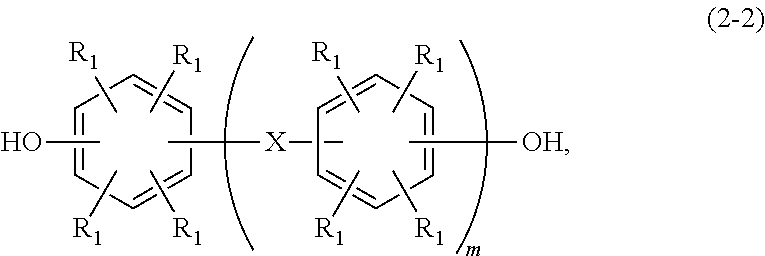
  • R 1 , X, and m denote the same as in the general formula (2-1).
  • R 2 denotes the same as in the general formula (3-1).
  • R 3 , R 4 , R 5 , R 6 , and Y denote the same as in the general formula (4-1).
  • a method for reacting a bifunctional epoxy resin represented by any of the following general formulae (7), (8), and (9) with a divalent phenol compound represented by any of the general formulae (2-2), (3-2), and (4-2) in the presence of a catalyst is a method for reacting a bifunctional epoxy resin represented by any of the following general formulae (7), (8), and (9) with a divalent phenol compound represented by any of the general formulae (2-2), (3-2), and (4-2) in the presence of a catalyst.
  • R 1 and X denote the same as in the general formula (2-1), 1 is 0 or 1, and p denotes an integer in the range of 0 to 10.
  • R 2 denotes the same as in the general formula (3-1), and q denotes an integer in the range of 0 to 10.
  • R 3 , R 4 , R 5 , R 6 , and Y denote the same as in the general formula (4-1), and r denotes an integer in the range of 0 to 10.
  • the divalent phenol compounds for use in the production by the one-step process and the two-step process are any of the divalent phenol compounds represented by the general formulae (2-2), (3-2), and (4-2). In the present invention, these may be used alone or in combination. Without compromising the objects of the present invention, a divalent phenol compound, which has two hydroxy groups bonded to an aromatic ring in the molecule, other than these divalent phenol compounds may be used in combination.
  • Examples of the divalent phenol compounds represented by the general formula (2-2) include bisphenols, such as bisphenol A, bisphenol F, bisphenol S, bisphenol acetophenone, bisphenol fluorenone, bisphenol B, and bisphenol AD, biphenols, such as 4,4′-biphenol and 3,3′,5,5′-tetramethyl-4,4′-biphenol, catechol, resorcin, and hydroquinone. Particularly preferred are bisphenol A, bisphenol F, 4,4′-biphenol, 3,3′,5,5′-tetramethyl-4,4′-biphenol, bisphenol acetophenone, and bisphenol fluorenone.
  • bisphenols such as bisphenol A, bisphenol F, bisphenol S, bisphenol acetophenone, bisphenol fluorenone, bisphenol B, and bisphenol AD
  • biphenols such as 4,4′-biphenol and 3,3′,5,5′-tetramethyl-4,4′-biphenol, catechol, resorcin
  • Examples of the divalent phenol compounds represented by the general formula (3-2) include dihydroxynaphthalene, dihydroxyanthracene, and dihydroxydihydroanthracene. Particularly preferred are dihydroxynaphthalene and dihydroxydihydroanthracene.
  • Examples of the divalent phenol compounds represented by the general formula (4-2) preferably include compounds represented by the following general formula (6-2), more preferably compounds represented by the following general formula (10-2), particularly preferably compounds represented by the following structural formulae (10-3), (10-4), (10-5), (10-6), (10-7), and (10-8).
  • R 7 and Y denote the same as in the general formula (6-1).
  • Y preferably denotes a single bond, —SO 2 —, —O—, —CO—, or —C(CF 3 ) 2 —.
  • the bifunctional epoxy resin for use in the production by the two-step process is an epoxy resin represented by the general formula (7), (8), or (9). In the present invention, these may be used alone or in combination. Without compromising the objects of the present invention, a bifunctional epoxy resin, which has two epoxy groups in the molecule, other than these bifunctional epoxy resins may be used in combination.
  • bifunctional epoxy resins represented by the general formula (7) include bisphenol epoxy resins, such as bisphenol A epoxy resins, bisphenol F epoxy resins, and bisphenol S epoxy resins, biphenol epoxy resins, bisphenol acetophenone epoxy resins, bisphenol fluorenone epoxy resins, and diglycidyl ethers of monocyclic divalent phenols, such as catechol, resorcin, and hydroquinone.
  • bisphenol epoxy resins such as bisphenol A epoxy resins, bisphenol F epoxy resins, 4,4′-biphenol epoxy resins, and 3,3′,5,5′-tetramethyl-4,4′-biphenol epoxy resins.
  • bifunctional epoxy resins represented by the general formula (8) examples include dihydroxynaphthalene epoxy resins and dihydroxydihydroanthracene epoxy resins.
  • Examples of the bifunctional epoxy resins represented by the general formula (9) include imide skeleton epoxy resins.
  • Examples of the bifunctional epoxy resin that can be used in combination other than the bifunctional epoxy resins represented by the general formulae (7), (8), and (9) include alicyclic epoxy resins, diglycidyl ethers of dihydric alcohols, and diglycidyl esters of divalent carboxylic acids, such as phthalic acid, isophthalic acid, tetrahydrophthalic acid, and hexahydrophthalic acid. These epoxy resins may be substituted with a substituent having no adverse effect, such as an alkyl group, an aryl group, an ether group, or an ester group. These epoxy compounds may be used in combination. Preferably, the amount of these epoxy compounds to be used is 30% by weight or less of the entirety of the bifunctional epoxy resins.
  • the starting material compounds (or the starting material resins) described above are used in a predetermined ratio such that an imide skeleton resin having the target chemical structure, the target imide skeleton molar content of A, the target number-average molecular weight, and the target solvent solubility can be produced.
  • the alkaline that can be used in the one-step process is one or two or more selected from sodium hydroxide, potassium hydroxide, and the like and is generally used as an approximately 20% to 50% by weight aqueous solution at a molar ratio in the range of approximately 0.2 to 2.0 relative to the phenol compound.
  • the catalyst used in the two-step process may be any compound having catalytic activity promoting a reaction between an epoxy group and a phenolic hydroxy group, for example, alkali metal compounds, organophosphorus compounds, tertiary amines, quaternary ammonium salts, cyclic amines, and imidazoles, preferably organophosphorus compound and quaternary ammonium salts.
  • alkali metal compounds include alkali metal hydroxides, such as sodium hydroxide, lithium hydroxide, and potassium hydroxide; alkali metal salts, such as sodium carbonate, sodium bicarbonate, sodium chloride, lithium chloride, and potassium chloride; alkaline metal alkoxides, such as sodium methoxide and sodium ethoxide; alkali metal phenoxide, sodium hydride, and lithium hydride; and alkali metal salts of organic acids, such as sodium acetate and sodium stearate.
  • alkali metal hydroxides such as sodium hydroxide, lithium hydroxide, and potassium hydroxide
  • alkali metal salts such as sodium carbonate, sodium bicarbonate, sodium chloride, lithium chloride, and potassium chloride
  • alkaline metal alkoxides such as sodium methoxide and sodium ethoxide
  • alkali metal phenoxide sodium hydride, and lithium hydride
  • alkali metal salts of organic acids such as sodium acetate and sodium
  • organophosphorus compound examples include tri-n-propylphosphine, tri-n-butylphosphine, triphenylphosphine, tetramethylphosphonium bromide, tetramethylphosphonium iodide, tetramethylphosphonium hydroxide, trimethylcyclohexylphosphonium chloride, trimethylcyclohexylphosphonium bromide, trimethylbenzylphosphonium chloride, trimethylbenzylphosphonium bromide, tetraphenylphosphonium bromide, triphenylmethylphosphonium bromide, triphenylmethylphosphonium iodide, triphenylethylphosphonium chloride, triphenylethylphosphonium bromide, triphenylethylphosphonium iodide, triphenylbenzylphosphonium chloride, and triphenylbenzylphosphonium bromide.
  • tertiary amine examples include triethylamine, tri-n-propylamine, tri-n-butylamine, triethanolamine, and benzyldimethylamine.
  • quaternary ammonium salts include tetramethylammonium chloride, tetramethylammonium bromide, tetramethylammonium hydroxide, triethylmethylammonium chloride, tetraethylammonium chloride, tetraethylammonium bromide, tetraethylammonium iodide, tetrapropylammonium bromide, tetrapropylammonium hydroxide, tetrabutylammonium chloride, tetrabutylammonium bromide, tetrabutylammonium iodide, benzyltrimethylammonium chloride, benzyltrimethylammonium bromide, benzyltrimethylammonium hydroxide, benzyltributylammonium chloride, and phenyltrimethylammonium chloride.
  • cyclic amines include 1,8-diazabicyclo(5,4,0)undecene-7,1,5-diazabicyclo(4,3,0)nonene-5.
  • imidazoles include 2-methylimidazole, 2-ethyl-4-methylimidazole, and 2-phenylimidazole.
  • These catalysts may be used alone or in combination.
  • the amount of these catalysts to be used ranges from 0.001% to 1% by weight of the reactant solid content.
  • a solvent may be used in a synthetic reaction process in the production.
  • the solvent may be any solvent that can dissolve the imide skeleton resin without adverse effects on the reaction.
  • the solvent include aromatic hydrocarbons, aprotic polar solvents, alcohols, ketones, and glycol ethers, preferably aprotic polar solvents, alcohols, ketones, and amide solvents.
  • aromatic hydrocarbons include benzene, toluene, and xylene.
  • Examples of the alcohols include methanol, ethanol, propanol, and butanol.
  • ketones examples include acetone, methyl ethyl ketone (MEK), methyl isobutyl ketone (MIBK), diisopropyl ketone, di-tert-butyl ketone, 2-heptanone, 4-heptanone, 2-octanone, cyclopentanone, cyclohexanone, cyclohexyl methyl ketone, acetophenone, acetylacetone, and dioxane.
  • MEK methyl ethyl ketone
  • MIBK methyl isobutyl ketone
  • 2-octanone 2-octanone
  • 2-octanone cyclopentanone
  • cyclohexanone cyclohexyl methyl ketone
  • acetophenone acetylacetone
  • dioxane examples include acetone, methyl ethyl ketone (MEK), methyl isobutyl ketone
  • aprotic polar solvents include dimethyl sulfoxide (DMSO), formamide, N-methylformamide, N,N-dimethylformamide, acetamide, N-methylacetamide, N,N-dimethylacetamide, 2-pyrrolidone, and N-methylpyrrolidone.
  • DMSO dimethyl sulfoxide
  • formamide N-methylformamide, N,N-dimethylformamide
  • acetamide N-methylacetamide
  • N,N-dimethylacetamide N,N-dimethylacetamide
  • 2-pyrrolidone 2-pyrrolidone
  • N-methylpyrrolidone N-methylpyrrolidone
  • glycol ethers include ethylene glycol monomethyl ether, ethylene glycol monoethyl ether, ethylene glycol mono-n-butyl ether, ethylene glycol dimethyl ether, ethylene glycol monoethyl ether acetate, diethylene glycol monomethyl ether, diethylene glycol monoethyl ether, diethylene glycol mono-n-butyl ether, diethylene glycol dimethyl ether, diethylene glycol monoethyl ether acetate, propylene glycol monomethyl ether, propylene glycol mono-n-butyl ether, and propylene glycol monomethyl ether acetate.
  • solvents may be used alone or in combination.
  • the amount of solvent to be used is appropriately determined in accordance with the reaction conditions.
  • the amount of solvent to be used is preferably determined such that the solid content ranges from 35% to 95% by weight.
  • the solvent is preferably used at a molar ratio in the range of approximately 0.2 to 2.0 relative to epihalohydrin.
  • a solvent may be added to continue the reaction. After the completion of the reaction, the solvent may be removed by distillation if necessary or may be further added.
  • the reaction temperature in the production of a soluble imide skeleton resin according to the present invention by the one-step process ranges from approximately 40° C. to 130° C.
  • the reaction temperature preferably ranges from 40° C. to 80° C., more preferably 45° C. to 70° C.
  • the reaction time generally ranges from approximately 30 to 240 minutes.
  • the reaction temperature in the production of a soluble imide skeleton resin according to the present invention by the two-step process is in such a range that the catalyst used is not decomposed.
  • the reaction temperature preferably ranges from 50° C. to 230° C., more preferably 120° C. to 200° C.
  • a low-boiling solvent such as acetone or methyl ethyl ketone
  • the reaction time generally ranges from approximately 1 to 12 hours.
  • a soluble imide skeleton resin according to the present invention has excellent solvent solubility and can consequently be treated as a soluble imide skeleton resin solution composition.
  • a solvent used contains 10% by weight or more ketone solvent and/or dimethylacetamide, preferably 20% by weight or more ketone solvent and/or dimethylacetamide, more preferably 30% by weight or more, of the entirety of the solvent components.
  • An excessively small amount of ketone solvent and/or dimethylacetamide in the solvent may result in low solution stability.
  • the ketone solvent refers to a liquid having a ketone group.
  • the ketone solvent include acetone, methyl ethyl ketone (MEK), methyl isobutyl ketone (MIBK), diisopropyl ketone, di-tert-butyl ketone, 2-heptanone, 4-heptanone, 2-octanone, cyclopentanone, cyclohexanone, cyclohexyl methyl ketone, acetophenone, acetylacetone, and dioxane.
  • MEK methyl ethyl ketone
  • MIBK methyl isobutyl ketone
  • diisopropyl ketone di-tert-butyl ketone
  • 2-heptanone 4-heptanone
  • 2-octanone 2-octanone
  • cyclopentanone cyclohexanone
  • methyl ethyl ketone (MEK), methyl isobutyl ketone (MIBK), cyclopentanone, and cyclohexanone are preferred, and methyl isobutyl ketone (MIBK) and cyclohexanone are more preferred.
  • MEK methyl ethyl ketone
  • MIBK methyl isobutyl ketone
  • MIBK methyl isobutyl ketone
  • MIBK methyl isobutyl ketone
  • cyclohexanone are more preferred.
  • These ketone solvents may be used alone or in combination.
  • the solvent(s) of the soluble imide skeleton resin solution composition other than the ketone solvent and/or dimethylacetamide may be one or two or more of the solvents exemplified as solvents usable in the synthetic reaction process in the method for producing a soluble imide skeleton resin according to the present invention described above.
  • the content of the soluble imide skeleton resin in the soluble imide skeleton resin solution composition ranges from 1% to 90% by weight, preferably 10% to 90% by weight, more preferably 20% to 80% by weight, still more preferably 25% to 75% by weight.
  • An excessively low content of the soluble imide skeleton resin results in an increase in the amount of solvent used and is uneconomical.
  • An excessively high content of the soluble imide skeleton resin results in an increase in viscosity and poor handling.
  • a curable resin composition according to the present invention contains a soluble imide skeleton resin according to the present invention.
  • a curable resin composition according to the present invention can further contain an epoxy resin other than the imide skeleton resin, a curing agent, a curing accelerator, a thermosetting resin other than epoxy resins, a solvent, inorganic filler, a fibrous base material, and other various additive components.
  • Examples of the epoxy resin other than a soluble imide skeleton resin that may be contained in a curable resin composition according to the present invention include, but are not limited to, bisphenol A epoxy resins, bisphenol F epoxy resins, bisphenol S epoxy resins, biphenyl epoxy resins, phenol novolak epoxy resins, cresol novolak epoxy resins, bisphenol A novolak epoxy resins, glycidyl ether epoxy resins, such as epoxy resins produced by reacting novolaks from the condensation between phenols and aldehydes, such as glyoxal, hydroxybenzaldehyde, and crotonaldehyde, with epihalohydrin, glycidyl ester epoxy resins, glycidyl amine epoxy resins, linear aliphatic epoxy resins, alicyclic epoxy resins, and heterocyclic epoxy resins. These may be used alone or in combination.
  • the amount of epoxy resin may depend on the application of the curable resin composition and the characteristics required for the curable resin composition and, in general, is preferably 40 parts by weight or less, for example, in the range of 20 to 30 parts by weight, per 100 parts by weight of the entirety of the epoxy resins (the total of the imide skeleton resin and the epoxy resin other than the imide skeleton resin).
  • Blending an epoxy resin other than a soluble imide skeleton resin according to the present invention can produce the effects of improving flexibility and compatibility.
  • An excessively large amount of the epoxy resin may reduce the effects of the heat resistance and the low linear expansivity, particularly the low linear expansivity, of a soluble imide skeleton resin according to the present invention.
  • examples of the curing agent for the soluble imide skeleton resin include curing agents for common epoxy resins, for example, polyvalent phenols, such as bisphenol A, bisphenol F, bisphenol AD, hydroquinone, resorcin, methylresorcin, biphenol, tetramethylbiphenol, dihydroxynaphthalene, dihydroxydiphenyl ether, thiodiphenols, phenol novolak resins, cresol novolak resins, phenol aralkyl resins, terpene phenolic resins, dicyclopentadiene phenolic resins, bisphenol A novolak resins, naphthol novolak resins, biphenyl phenolic resins, brominated bisphenol A, and brominated phenol novolak resins, polyvalent phenolic resins produced by condensation reactions between various phenols and various aldehydes, such as benzal
  • Cationic polymerization initiators can also be used as curing agents for epoxy resins.
  • the cationic polymerization initiators may be active energy beam cationic polymerization initiators, which generate cationic species or Lewis acids by an active energy beam latent cationic polymerization initiators, or thermal latent cationic polymerization initiators, which generate cationic species or Lewis acids by heat.
  • the active energy beam latent cationic polymerization initiators include one or more of metal fluoroboron complex salts and boron trifluoride complex compounds as described in U.S. Pat. No. 3,379,653; bis(perfluoroalkylsulfonyl)methane metal salts as described in U.S. Pat. No. 3,586,616; aryldiazonium compounds as described in U.S. Pat. No. 3,708,296; aromatic onium salts of periodic table VIa group elements as described in U.S. Pat. No. 4,058,400; aromatic onium salts of periodic table Va group elements as described in U.S. Pat. No.
  • Preferred active energy beam latent cationic polymerization initiators include arylsulfonium complex salts, aromatic sulfonium or iodonium salts of halogen-containing complex ions, and aromatic onium salts of periodic table II, V, and VI group elements. Some of these salts can be obtained as commercial products: FX-512 (3M Co.), UVR-6990 and UVR-6974 (Union Carbide Co.), UVE-1014 and UVE-1016 (General Electric Co.), KI-85 (Degussa AG), SP-150 and SP-170 (ADEKA Co.), and San-Aid SI-60L, SI-80L, and SI-100L (Sanshin Chemical Industry Co., Ltd.).
  • Cationic or protonic acid catalysts such as triflic acid salts, boron trifluoride ether complex compounds, and boron trifluoride, can be used as thermal cationic polymerization initiators.
  • Preferred thermal cationic polymerization initiators are triflic acid salts, such as diethylammonium triflate, which is available from 3M Co. as FC-520, triethylammonium triflate, diisopropylammonium triflate, and ethyldiisopropylammonium triflate (most of these are described in R. R. Alm, Modern Coatings, October, 1980).
  • aromatic onium salts which can also be used as active energy beam cationic polymerization initiators, produce cationic species by heat and can also be used as thermal cationic polymerization initiators.
  • an epoxy resin is preferably used as a curing agent.
  • the epoxy resin include various polyvalent phenol novolak epoxy resins, such as phenol novolak epoxy resins, cresol novolak epoxy resins, bisphenol A novolak epoxy resins, naphthol novolak epoxy resins, biphenyl phenolic epoxy resins, and brominated phenol novolak epoxy resins.
  • the amount of curing agent in a curable resin composition depends on the type of the curing agent used and generally ranges from 0.5 to 100 parts by weight, preferably 1 to 95 parts by weight, per 100 parts by weight of the entirety of epoxy resins.
  • the curing accelerator may be any curing accelerator for common epoxy resin compositions, for example, amines, such as benzyldimethylamine and various imidazole compounds, and tertiary phosphines, such as triphenylphosphine. These may be used alone or in combination.
  • amines such as benzyldimethylamine and various imidazole compounds
  • tertiary phosphines such as triphenylphosphine.
  • 0.1 to 5.0 parts by weight of the curing accelerator per 100 parts by weight of the entirety of epoxy resins is blended.
  • thermosetting resin other than epoxy resins may be a cyanate ester resin, a thermosetting polyimide resin, or a thermosetting poly(phenylene ether) resin. These may be used alone or in combination.
  • thermosetting resin in the case that a curable resin composition according to the present invention contains such a thermosetting resin, the amount of thermosetting resin is preferably 40 parts by weight or less, for example, 10 to 30 parts by weight, per 100 parts by weight of the entirety of epoxy resins.
  • a curable resin composition containing a thermosetting resin other than epoxy resins can have low water absorbency. An excessively large amount of thermosetting resin, however, may compromise the advantageous effects of using a soluble imide skeleton resin according to the present invention and even the characteristics of epoxy resins.
  • Solvents that can be contained in a curable resin composition according to the present invention may be the solvents for use in a soluble imide skeleton resin solution composition, for example, ketones, such as acetone, methyl ethyl ketone, methyl isobutyl ketone, cyclopentanone, and cyclohexanone, aromatics, such as toluene and xylene, esters, such as ethyl acetate, ethers, such as ethylene glycol monomethyl ether, amides, such as N,N-dimethylformamide and N,N-dimethylacetamide, and alcohols, such as methanol and ethanol. In order to achieve excellent formability, ketone solvents having high solubility are preferred.
  • solvents may be used alone or in combination.
  • the amount of solvent to be used is appropriately determined in accordance with the intended use of a curable resin composition.
  • the total solids of the curable resin composition except the solvent(s) range from approximately 40% to 70% by weight.
  • the total solids of the curable resin composition except the solvent(s) range from approximately 35% to 75% by weight.
  • the inorganic filler examples include metal oxides, such as aluminum oxide and magnesium oxide, silicon compounds, such as fine-powdered silica, fused silica, and crystalline silica, transparent filler, such as glass beads, and metal hydroxides, such as aluminum hydroxide and magnesium hydroxide, as well as calcium carbonate, kaolin, mica, a quartz powder, graphite, and molybdenum disulfide. These may be used alone or in combination.
  • inorganic filler having an excessively large particle size causes deterioration in the surface profile of a cured product. Inorganic filler having an excessively small particle size tends to aggregate, causing deterioration in dispersibility.
  • inorganic filler preferably has an average particle size in the range of approximately 1 to 30 ⁇ m.
  • the amount of inorganic filler is preferably 80 parts by weight or less, for example, 10 to 60 parts by weight, per 100 parts by weight of the entirety of epoxy resins.
  • Inclusion of inorganic filler in a curable resin composition has the effects of improving flame resistance, lowering water absorbency, and lowering the coefficient of linear expansion.
  • an excessively large amount of inorganic filler may cause deterioration in formability.
  • the resin base material examples include inorganic fiber cloths, such as glass fiber cloths, glass fiber nonwoven fabrics, and organic fiber nonwoven fabrics. These may be used alone or in combination.
  • a curable resin composition containing such a fibrous base material can be formed by various methods, for example, the coating or impregnation of the fibrous base material with the curable resin composition.
  • the fibrous base material content can be altered with the method.
  • a curable resin composition according to the present invention can be blended with various additives that can be blended with common epoxy resin compositions, such as an ultraviolet absorber for improving storage stability, a plasticizer, a coupling agent, such as a silane coupling agent or a titanate coupling agent, a colorant or a pigment, a halogen, phosphorus, nitrogen, or silicon flame retardant for providing flame resistance, and a reinforcing material, such as a glass fiber, without compromising the objects of the present invention.
  • an ultraviolet absorber for improving storage stability
  • a plasticizer such as a silane coupling agent or a titanate coupling agent, a colorant or a pigment, a halogen, phosphorus, nitrogen, or silicon flame retardant for providing flame resistance
  • a reinforcing material such as a glass fiber
  • a curable resin composition according to the present invention can be prepared by mixing predetermined amounts of the components described above.
  • a curable resin composition containing a soluble imide skeleton resin according to the present invention can be effectively utilized in various fields, such as adhesives, paints, civil engineering and construction materials, and insulating materials for electrical and electronic components.
  • a curable resin composition containing a soluble imide skeleton resin according to the present invention can be suitably used in multilayer electrical laminates and printed wiring boards of a new system, such as a build-up process.
  • a curable resin composition containing a soluble imide skeleton resin according to the present invention is preferably used in the form of resin-coated copper foil or an adhesive film used as a multilayer printed wiring board material of a build-up process.
  • a curable resin composition containing a soluble imide skeleton resin according to the present invention can be used in flexible laminate applications, resist materials, and sealing materials.
  • a soluble imide skeleton resin according to the present invention may be modified with acrylic acid, methacrylic acid, or the like.
  • films (insulating layers) each having a thickness in the range of 40 to 90 ⁇ m or copper-foil-laminated films 3 in which a copper foil 2 A (the copper foil thickness: 9 to 18 ⁇ m) is disposed on a film 2 are stacked on an inner-layer circuit board (a core substrate; 1 A denotes a circuit) 1 , in which glass prepregs are stacked.
  • the build-up process involves this laminating press step and other two steps, that is, a boring (laser or drilling) step and a desmear/plating step, thus forming a circuit.
  • Laminates manufactured by the build-up process have the same performance as conventional laminates and the mounting area and the weight equal to an approximately quarter of those of the conventional laminates. Thus, the build-up process can reduce the size and the weight of the laminates.
  • a curable resin composition containing a soluble imide skeleton resin according to the present invention is useful as a resin material for a copper-foil-laminated film or a film used in the build-up process.
  • a cured resin according to the present invention is formed by curing a curable resin composition according to the present invention.
  • a method for curing a curable resin composition according to the present invention depends on the components to be blended and their amounts in the curable resin composition and generally involves heating conditions of 100° C. to 200° C. for 60 to 180 minutes. In order to reduce incomplete curing, heating preferably involves two stages: first heating at 100° C. to 130° C. for 10 to 30 minutes and second heating at 150° C. to 200° C., which is 50° C. to 80° C. higher than the first heating temperature, for 60 to 150 minutes.
  • a laminated product according to the present invention is a laminated product of a cured resin according to the present invention formed by curing a curable resin composition according to the present invention and a conducting metal and is preferably a conducting-metallic-foil-laminated film serving as a build-up layer for use in the build-up process.
  • Conducting metallic foil of the electroconductive-conducting-foil-laminated film may be metallic foil of copper, aluminum, or the like and generally has a thickness in the range of approximately 9 to 19 ⁇ m.
  • the film generally has a thickness in the range of approximately 40 to 90 ⁇ m.
  • the laminated product can be manufactured by preparing a coating solution having an appropriate viscosity from a curable resin composition according to the present invention using a solvent, applying the coating solution to metallic foil, such as copper foil, and semi-curing the curable resin composition under the first heating conditions described above.
  • a required number of the laminated products the resin side of which is semi-cured can be stacked on the core substrate 1 , as illustrated in FIG. 1 , and can be completely cured and integrated at a pressure in the range of 2 to 5 MPa under the second heating conditions described above, thereby forming a printed wiring board.
  • a 2-L three-neck flask equipped with a thermometer, a stirrer, and a condenser was charged with 45 g of an imide skeleton phenol compound represented by the structural formula (10-3), 149 g of bisphenol A, 620 g of epichlorohydrin, 241 g of 2-propanol, and 90 g of water and was heated to 50° C. to dissolve the mixture. 141 g of 48.5% by weight aqueous sodium hydroxide was added dropwise to the mixture over one hour. During the dropping, the flask was gradually heated. When the dropping was completed, the temperature in the system reached 70° C. The temperature was then held at 70° C. for 30 minutes to continue a reaction.
  • an imide skeleton phenol compound represented by the structural formula (10-3) was charged with 45 g of an imide skeleton phenol compound represented by the structural formula (10-3), 149 g of bisphenol A, 620 g of epichlorohydrin, 241 g of 2-propano
  • the crude epoxy resin was dissolved in 410 g of methyl isobutyl ketone, to which 7 g of 48.5% by weight aqueous sodium hydroxide was then added. The mixture was allowed to react at a temperature of 70° C. for one hour. After the completion of the reaction, sodium dihydrogen phosphate was added to neutralize excessive sodium hydroxide, and the product was washed with water to remove a by-product salt. Methyl isobutyl ketone was then completely removed during heating under reduced pressure, thus yielding a target soluble imide skeleton epoxy resin (I).
  • a 2-L three-neck flask equipped with a thermometer, a stirrer, and a condenser was charged with 75 g of an imide skeleton phenol compound represented by the structural formula (10-4), 120 g of bisphenol A, 550 g of epichlorohydrin, 241 g of 2-propanol, and 80 g of water and was heated to 50° C. to dissolve the mixture. 125 g of 48.5% by weight aqueous sodium hydroxide was added dropwise to the mixture over one hour. During the dropping, the flask was gradually heated. When the dropping was completed, the temperature in the system reached 70° C. The temperature was then held at 70° C. for 30 minutes to continue a reaction.
  • an imide skeleton phenol compound represented by the structural formula (10-4) 120 g of bisphenol A, 550 g of epichlorohydrin, 241 g of 2-propanol, and 80 g of water and was heated to 50° C. to dissolve the mixture.
  • the crude epoxy resin was dissolved in 400 g of methyl isobutyl ketone, to which 7 g of 48.5% by weight aqueous sodium hydroxide was then added. The mixture was allowed to react at a temperature of 70° C. for one hour. After the completion of the reaction, sodium dihydrogen phosphate was added to neutralize excessive sodium hydroxide, and the product was washed with water to remove a by-product salt. Methyl isobutyl ketone was then completely removed during heating under reduced pressure, thus yielding a target soluble imide skeleton epoxy resin (II).
  • a 2-L three-neck flask equipped with a thermometer, a stirrer, and a condenser was charged with 20 g of an imide skeleton phenol compound represented by the structural formula (10-5), 167 g of bisphenol A, 640 g of epichlorohydrin, 250 g of 2-propanol, and 90 g of water and was heated to 50° C. to dissolve the mixture. 146 g of 48.5% by weight aqueous sodium hydroxide was added dropwise to the mixture over one hour. During the dropping, the flask was gradually heated. When the dropping was completed, the temperature in the system reached 70° C. The temperature was then held at 70° C. for 30 minutes to continue a reaction.
  • the crude epoxy resin was dissolved in 410 g of methyl isobutyl ketone, to which 7 g of 48.5% by weight aqueous sodium hydroxide was then added. The mixture was allowed to react at a temperature of 70° C. for one hour. After the completion of the reaction, sodium dihydrogen phosphate was added to neutralize excessive sodium hydroxide, and the product was washed with water to remove a by-product salt. Methyl isobutyl ketone was then completely removed during heating under reduced pressure, thus yielding a target soluble imide skeleton epoxy resin (III).
  • a 2-L three-neck flask equipped with a thermometer, a stirrer, and a condenser was charged with 40 g of an imide skeleton phenol compound represented by the structural formula (10-6), 154 g of bisphenol A, 417 g of epichlorohydrin, 163 g of 2-propanol, and 62 g of water and was heated to 50° C. to dissolve the mixture. 143 g of 48.5% by weight aqueous sodium hydroxide was added dropwise to the mixture over one hour. During the dropping, the flask was gradually heated. When the dropping was completed, the temperature in the system reached 70° C. The temperature was then held at 70° C. for 30 minutes to continue a reaction.
  • an imide skeleton phenol compound represented by the structural formula (10-6) was charged with 40 g of an imide skeleton phenol compound represented by the structural formula (10-6), 154 g of bisphenol A, 417 g of epichlorohydrin, 163 g of 2-propan
  • the crude epoxy resin was dissolved in 420 g of methyl isobutyl ketone, to which 7 g of 48.5% by weight aqueous sodium hydroxide was then added. The mixture was allowed to react at a temperature of 70° C. for one hour. After the completion of the reaction, sodium dihydrogen phosphate was added to neutralize excessive sodium hydroxide, and the product was washed with water to remove a by-product salt. Methyl isobutyl ketone was then completely removed during heating under reduced pressure, thus yielding a target soluble imide skeleton epoxy resin (IV).
  • a 2-L three-neck flask equipped with a thermometer, a stirrer, and a condenser was charged with 200 g of an imide skeleton phenol compound represented by the structural formula (10-7), 254 g of epichlorohydrin, 100 g of 2-propanol, and 40 g of water and was heated to 50° C. to dissolve the mixture. 58 g of 48.5% by weight aqueous sodium hydroxide was added dropwise to the mixture over one hour. During the dropping, the flask was gradually heated. When the dropping was completed, the temperature in the system reached 70° C. The temperature was then held at 70° C. for 30 minutes to continue a reaction.
  • the crude epoxy resin was dissolved in 351 g of methyl isobutyl ketone, to which 6 g of 48.5% by weight aqueous sodium hydroxide was then added. The mixture was allowed to react at a temperature of 70° C. for one hour. After the completion of the reaction, sodium dihydrogen phosphate was added to neutralize excessive sodium hydroxide, and the product was washed with water to remove a by-product salt. Methyl isobutyl ketone was then completely removed during heating under reduced pressure, thus yielding a target soluble imide skeleton epoxy resin (V).
  • V target soluble imide skeleton epoxy resin
  • the chemical structure and the imide skeleton molar content of A were calculated from the proportions of the raw materials charged.
  • the n values and the mean value thereof were calculated from the number-average molecular weight measured by the following method.
  • a calibration curve was prepared with an HLC-8120 GPC apparatus manufactured by Tosoh Co. using TSK Standard Polystyrene F-128 (Mw 1,090,000, Mn 1,030,000), F-10 (Mw 106,000, Mn 103,000), F-4 (Mw 43,000, Mn 42,700), F-2 (Mw 17,200, Mn 16,900), A-5000 (Mw 6,400, Mn 6,100), A-2500 (Mw 2,800, Mn 2,700), and A-300 (Mw 453, Mn 387) as standard polystyrenes.
  • the number-average molecular weight was measured as a polystyrene equivalent molecular weight.
  • the epoxy equivalent was measured in accordance with JIS K 7236 and was shown in terms of solid content.
  • the amount of saponifiable chlorine was measured in accordance with JIS K 7242-2 and was expressed in terms of solid content.
  • a particular cured product was prepared by the following curing method II.
  • a soluble imide skeleton resin, a curing agent jER Cure YLH129 (trade name of Japan Epoxy Resins Co., Ltd., a bisphenol A novolak resin, hydroxyl equivalent 117 (g/eq.), softening point 115 (° C.)), and a curing accelerator 2-ethyl-4-methylimidazole in the amounts described below in Table 1 were placed in a 200-ml beaker, were heated on a hot plate at 260° C., and were melt-blended. After the melt-blended resin was degassed under reduced pressure, the resin was heated in a Safeven dryer at 170° C. for 30 minutes and then 200° C. for 90 minutes to produce a particular cured product.
  • the glass transition temperature and the mean coefficient of linear expansion of the particular cured product were examined by the following method.
  • the glass transition temperature (Tg) was measured with a 2010 DSC thermal analysis system manufactured by TA Instruments while the temperature was raised from 20° C. to 300° C. at 10° C./min.
  • the mean coefficient of linear expansion was measured with a TMA/SS6100 apparatus manufactured by SII NanoTechnology Inc. in a compression mode at a temperature in the range of 30° C. to 130° C. while the temperature was increased from 20° C. to 250° C. at 5° C./min.
  • solubility at 60° C. was visually observed using cyclohexanone (manufactured by Wako Pure Chemical Industries, Ltd., grade S, purity 99% or more) as a solvent in accordance with the method for measuring solubility described above.
  • a crude epoxy resin was produced in the same manner as in Example 1 except that a 2-L three-neck flask was charged with 188 g of bisphenol F, 385 g of epichlorohydrin, and 149 g of 2-propanol as starting materials.
  • the crude epoxy resin was purified in the same manner as in Example 1 to produce a target epoxy resin (VI).
  • a 2-L three-neck flask equipped with a thermometer, a stirrer, and a condenser was charged with 200 g of an imide skeleton phenol compound represented by the following structural formula (11), 290 g of epichlorohydrin, 100 g of 2-propanol, and 40 g of water and was heated to 50° C. The mixture was not dissolved. Thus, 100 g of N-methylpyrrolidone was added, and the flask was heated to 50° C. to dissolve the mixture. 55 g of 48.5% by weight aqueous sodium hydroxide was added dropwise over one hour. During the dropping, the flask was gradually heated. When the dropping was completed, the temperature in the system reached 70° C.
  • Table 3 shows the structure, the physical properties, and other properties of the epoxy resin (VI) and the imide skeleton epoxy resin (VII) measured and evaluated in the same manner as in Example 1.
  • a compound (X), a compound (Y), a catalyst, and a solvent in amounts described in Tables 4 and 5 were placed in a pressure-resistant reaction vessel equipped with a stirrer and were allowed to react in a nitrogen gas atmosphere at 180° C. for five hours to produce an imide skeleton resin solution composition.
  • a solvent was removed from the imide skeleton resin solution composition by a routine method, and the properties of the resulting resin were analyzed by the following method. Tables 4 and 5 show the results.
  • a calibration curve was prepared with an HLC-8120 GPC apparatus manufactured by Tosoh Co. using TSK Standard Polystyrene F-128 (Mw 1,090,000, Mn 1,030,000), F-10 (Mw 106,000, Mn 103,000), F-4 (Mw 43,000, Mn 42,700), F-2 (Mw 17,200, Mn 16,900), A-5000 (Mw 6,400, Mn 6,100), A-2500 (Mw 2,800, Mn 2,700), and A-300 (Mw 453, Mn 387) as standard polystyrenes.
  • the number-average molecular weight was measured as a polystyrene equivalent molecular weight.
  • FIG. 2 shows a GPC chart of a resin according to Example 6.
  • the imide skeleton molar content of A was calculated from the proportions of the raw materials charged.
  • n values and the mean value thereof in the general formula (1) were calculated from the number-average molecular weight.
  • the epoxy equivalent weight was measured in accordance with JIS K 7236 and was shown in terms of solid content.
  • the amount of saponifiable chlorine was measured in accordance with JIS K 7242-2 and was shown in terms of solid content.
  • the IR measurement of the resin according to Example 6 was performed with FT/1R-460 Plus manufactured by JAS.CO JASCO Co.
  • FIG. 3 shows the IR chart.
  • a particular cured product was prepared by the following curing method I.
  • a coating film was formed with an applicator having a slit width of 300 ⁇ m on a Teflon film (Nichias Co., Teflon tape TOMBO9001) and was held in a hot-air dryer at 170° C. for 30 minutes and at 200° C. for 90 minutes, forming a particular cured product having a thickness in the range of 60 to 100 ⁇ m.
  • the glass transition temperature and the coefficient of linear expansion (a mean value in the range of 30° C. to 130° C.) of the resulting particular cured product were measured by the following method.
  • FIG. 4 shows a TMA chart of the particular cured product according to Example 6.
  • jER 828 (trade name of Japan Epoxy Resins Co., Ltd., a bisphenol A epoxy resin, epoxy equivalent weight 186 g/eq., saponifiable chlorine concentration 40 ppm)
  • jER YX8800 (trade name of Japan Epoxy Resins Co., Ltd., a dihydroxyanthracene epoxy resin, epoxy equivalent weight 178 g/eq., saponifiable chlorine concentration 38 ppm)
  • HP4032 trade name of Dainippon Ink and Chemicals, Inc., a 1,6-dihydroxynaphthalene epoxy resin, epoxy equivalent weight 142 g/eq.
  • Example 1 The imide skeleton resins prepared in Example 1, Examples 5 to 10, and Comparative Example 4 were dissolved in cyclohexanone, methyl ethyl ketone, dimethylacetamide, and dimethylformamide at the proportions described in Table 6 to prepare brown transparent imide skeleton resin solution compositions.
  • Varnishes were prepared in accordance with the formulations described in Table 7 using the imide skeleton resins prepared in Example 1, Examples 6 to 10, and Comparative Example 3 and commercial epoxy resins.
  • a coating film was formed on copper foil (F3-WS) with a 300 ⁇ m applicator and was placed in a hot-air dryer at 170° C. for 30 minutes and then at 200° C. for 90 minutes, yielding a copper-foil-laminated cured resin having a thickness in the range of 60 to 100 ⁇ m.
  • varnishes having the formulations described in Table 7 were applied to copper foil (F3-WS) with a 300 gm applicator to form coating films, which were placed in a hot-air dryer at 170° C. for 30 minutes, forming copper-foil-laminated B-stage semi-cured resins.
  • Two copper-foil-laminated B-stage semi-cured resins were stacked and were held in a hot press at 200° C. and a pressure of 2.9 MPa for 90 minutes to form a laminated product.
  • jER YX4000 trade name of Japan Epoxy Resins Co., Ltd., a tetramethylbiphenyl epoxy resin, epoxy equivalent weight 186 (g/eq.)
  • jER 157S70 trade name of Japan Epoxy Resins Co., Ltd., a bisphenol A novolak epoxy resin, epoxy equivalent weight 210 (g/eq.)
  • jER Cure YLH129 trade name of Japan Epoxy Resins Co., Ltd., a bisphenol A novolak resin, hydroxyl equivalent weight 117 (g/eq.), softening point 115 (° C.)
  • AroCy B-30 trade name of Huntsman International LLC., a bisphenol A dicyanate resin
  • F3-WS trade name of Furukawa Circuit Foil Co., Ltd., electrolytic copper foil, thickness 18 ⁇ m
  • the physical properties of the copper-foil-laminated cured resins thus prepared were measured by the following methods.
  • the copper foil peel strength was measured with a laminated product.
  • the other physical properties were measured with cured resin alone, prepared by removing the copper foil from the copper-foil-laminated cured resin. Table 7 shows the results.
  • the mean coefficient of linear expansion at a temperature in the range of 30° C. to 130° C. and the glass transition temperature were measured with a TMA/SS6100 apparatus manufactured by SII NanoTechnology Inc. in a film tensile mode while the temperature was increased from 20° C. to 250° C. at 5° C./min.
  • the water absorption rate of a film was measured under measurement conditions of 85° C./85% RH/168 hours with an EHS-211MD apparatus manufactured by ESPEC Corp.
  • the copper foil peel strength was measured in accordance with JIS C6481.
  • Table 7 shows that the cured films formed of the soluble imide skeleton resins according to the present invention have a low coefficient of linear expansion and high heat resistance (glass transition temperature).
  • Japanese Patent Application Japanese Patent Application No. 2008-233543 filed on Sep. 11, 2008 and Japanese Patent Application (Japanese Patent Application No. 2009-182613) filed on Aug. 5, 2009, which are incorporated herein by reference in their entirety.

Landscapes

  • Chemical & Material Sciences (AREA)
  • Health & Medical Sciences (AREA)
  • Chemical Kinetics & Catalysis (AREA)
  • Medicinal Chemistry (AREA)
  • Polymers & Plastics (AREA)
  • Organic Chemistry (AREA)
  • Epoxy Resins (AREA)
  • Compositions Of Macromolecular Compounds (AREA)
  • Materials For Photolithography (AREA)

Abstract

An imide skeleton resin represented by the following general formula (1) has a coefficient of linear expansion as low as that of polyimide resin and excellent processability like epoxy resin, and is useful as a resin composition for electrical laminates. Five percent by mole or more of the entirety of the A component is a linking group having an imide skeleton represented by the following general formula (4-1). B denotes a hydrogen atom or a group represented by the following structural formula (5). n denotes an integer in the range of 0 to 200. If both of the B's are hydrogen atoms, then n denotes an integer of 1 or more.
Figure US09139687-20150922-C00001

Description

FIELD OF INVENTION
The present invention relates to a resin containing an imide skeleton structure as an essential component, a resin solution composition containing the resin, a curable resin composition containing the resin, a cured product thereof, and a laminated product containing the cured product.
A soluble imide skeleton resin according to the present invention can provide a curable resin composition that is suitable for use as a constituent material of an electrical laminate, such as a printed wiring board, having a high glass transition temperature and a low thermal expansion coefficient. The term “electrical laminate”, as used herein, refers to a laminate for use in insulating substrates, including printed wiring boards, build-up laminates, flexible laminates, resist materials, and sealing materials.
BACKGROUND ART
Epoxy resin has high heat resistance, excellent adhesive properties, high water resistance, high mechanical strength, and excellent electrical characteristics and is therefore used in various fields, such as adhesives, paints, civil engineering and construction materials, and insulating materials for electrical and electronic components. In particular, in electrical and electronic fields, epoxy resin is widely used in insulating casting, laminated materials, sealing materials, and the like.
In printed wiring boards for use in electrical and electronic devices, particularly multilayer printed wiring boards, with recent reductions in the size and weight and increases in the functionality of devices, there are demands for further increases in the number of layers and packaging density, reductions in thickness and weight, and improvements in reliability and molding processability.
Thus, as wiring becomes finer, among the characteristics of resins serving as substrate materials, there are particular demands for further improvement in heat resistance and reduction in the coefficient of linear expansion.
At present, one of low linear expansion thermosetting resins is polyimide resin. Polyimide resin is the mainstream in the field of flexible printed wiring boards. However, polyimide resin is difficult to process because of its high heat resistance. Furthermore, polyimide resin is very difficult to handle during processing because polyimide resin dissolves only in particular polar solvents. Thus, polyimide resin has various limitations. For example, hitherto known imide skeleton compounds have insufficient solubility in common organic solvents, such as ketone solvents, and dissolve only in polar solvents, such as dimethylformamide and N-methylpyrrolidone (Patent Literature 1).
In contrast, epoxy resin has better processability and higher solubility in solvents than polyimide resin. However, epoxy resin is unsatisfactory with respect to the coefficient of linear expansion.
Although an anthracene skeleton epoxy resin, a bisphenol S skeleton epoxy resin, and a naphthalene skeleton epoxy resin are conventionally known as epoxy resins having a low coefficient of linear expansion, these resins have still higher coefficients of linear expansion than polyimide resin.
Patent Literatures 2 and 3 describe imide skeleton epoxy resins that are structurally different from a soluble imide skeleton resin according to the present invention.
Patent Literature 1 relates to a thermoplastic polymer produced by the reaction between imidophenol and an epoxy resin. This thermoplastic polymer dissolves in polar solvents, such as dimethylformamide and N-methylpyrrolidone, but does not dissolve in ketone solvents. Patent Literature 4 also describes a composition produced by the reaction between imidophenol and an epoxy resin. This resin has low solubility in a polar solvent N-methylpyrrolidone, and it goes without saying that the resin does not dissolve in ketone solvents.
CITATION LIST Patent Literature
PTL 1: U.S. Pat. No. 5,246,751
PTL 2: Japanese Unexamined Patent Application Publication No. 4-62522
PTL 3: Japanese Unexamined Patent Application Publication No. 4-62991
PTL 4: Japanese Unexamined Patent Application Publication No. 62-292822
OBJECT AND SUMMARY OF INVENTION
When existing epoxy resins are used in resin compositions for electrical laminates, a coefficient of linear expansion as low as that of polyimide resin cannot be achieved. On the other hand, polyimide resin has low solubility in common organic solvents and consequently insufficient processability.
Accordingly, it is an object of the present invention to provide a soluble imide skeleton resin that has a coefficient of linear expansion as low as that of polyimide resin, excellent processability like epoxy resin, and sufficient solubility in common ketone solvents and that is useful for resin compositions for use in electrical laminates.
It is another object of the present invention to provide a soluble imide skeleton resin solution composition and a curable resin composition each containing the imide skeleton resin, a cured product thereof, and a laminated product containing the cured product.
The present invention includes the following embodiments.
  • [1] A soluble imide skeleton resin that is represented by the following general formula (1) and has a solubility of 1% by weight or more in cyclohexanone at 60° C.
Figure US09139687-20150922-C00002
In the Formula (1), A denotes a linking group represented by the following general formula (2-1), (3-1), or (4-1), and the (n+1) A's may be the same or different, provided that 5% by mole or more of the entirety of the A component is a linking group having an imide skeleton represented by the following general formula (4-1),
B denotes a hydrogen atom or a group represented by the following structural formula (5), and the two B's may be the same or different, and
n denotes an integer in the range of 0 to 200, provided that n denotes an integer of 1 or more when both of the B's are hydrogen atoms.
Figure US09139687-20150922-C00003
In the formula (2-1), R1 denotes a hydrogen atom, a hydrocarbon group containing 1 to 10 carbon atoms, or a halogen element, a plurality of R1's may be the same or different, and two R1's bonded to adjacent carbon atoms on a benzene ring may be bound together to form a cyclic group containing 4 to 20 carbon atoms and the cyclic group may include aromatic ring(s),
m is 0 or 1, and
X denotes a single bond, a divalent hydrocarbon group containing 1 to 20 carbon atoms, —O—, —S—, —SO2—, or CO—.
Figure US09139687-20150922-C00004
In the formula (3-1), R2 denotes a hydrogen atom, a hydrocarbon group containing 1 to 10 carbon atoms, or a halogen element, a plurality of R2's may be the same or different, and two R2's bonded to adjacent carbon atoms on the naphthalene ring may be bound together to form a cyclic group containing 4 to 20 carbon atoms and the cyclic group may include aromatic ring(s).
Figure US09139687-20150922-C00005
In the formula (4-1), R3 denotes a hydrogen atom, a hydrocarbon group containing 1 to 10 carbon atoms, or a halogen element, a plurality of R3's may be the same or different, and two R3's bonded to adjacent carbon atoms on a benzene ring may be bound together to form a cyclic group containing 4 to 20 carbon atoms and the cyclic group may include aromatic ring(s),
R4, R5, and R6 independently denote a hydrogen atom, a phenyl group, or a hydrocarbon group containing 1 to 10 carbon atoms, two R4's may be the same or different, two R5's may be the same or different, and two R6's may be the same or different, and R5 and R6 bonded to adjacent carbon atoms on a benzene ring may be bound together to form a cyclic group containing 4 to 20 carbon atoms and the cyclic group may include aromatic ring(s), and
Y denotes a group selected from a single bond, —SO2—, —O—, —CO—, —C(CF3)2—, —S—, or a divalent hydrocarbon group containing 1 to 20 carbon atoms.
Figure US09139687-20150922-C00006
  • [2] The soluble imide skeleton resin according to [1], wherein a linking group having an imide skeleton represented by the general formula (4-1) is represented by the following general formula (6-1).
Figure US09139687-20150922-C00007
In the formula (6-1), R7 denotes a hydrogen atom, a hydrocarbon group containing 1 to 10 carbon atoms, or a halogen element, a plurality of R7's may be the same or different, and two R7's bonded to adjacent carbon atoms on a benzene ring may be bound together to form a cyclic group containing 4 to 20 carbon atoms and the cyclic group may include aromatic ring(s), and
Y denotes the same as in the general formula (4-1).
  • [3] The soluble imide skeleton resin according to [1] or [2], wherein a cured product formed by the soluble imide skeleton resin being blended only with a curing agent and a curing accelerator has a glass transition temperature of 130° C. or more and a coefficient of linear expansion at the glass transition temperature or less of less than 75 ppm/° C.
  • [4] A soluble imide skeleton resin that has an epoxy group(s) and an imide group(s) and has a solubility of 1% by weight or more in cyclohexanone at 60° C., wherein a cured product formed by the soluble imide skeleton resin being blended only with a curing agent and a curing accelerator has a glass transition temperature of 130° C. or more and a coefficient of linear expansion at the glass transition temperature or less of less than 75 ppm/° C.
  • [5] The soluble imide skeleton resin according to [4], wherein the imide group is a substituted or unsubstituted phthalimide group.
  • [6] The soluble imide skeleton resin according to [4] or [5], wherein the imide skeleton resin has an imide group(s) and a hydroxyethylene group(s) on the main chain.
  • [7] A method for producing a soluble imide skeleton resin according to any one of [1] to [3], comprising reacting a divalent phenol compound represented by any of the following general formulae (2-2), (3-2), and (4-2) with epihalohydrin in the presence of an alkaline.
Figure US09139687-20150922-C00008
In the formula (2-2), R1, X, and m denote the same as in the general formula (2-1).
Figure US09139687-20150922-C00009
In the formula (3-2), R2 denotes the same as in the general formula (3-1).
Figure US09139687-20150922-C00010
In the formula (4-2), R3, R4, R5, R6, and Y denote the same as in the general formula (4-1).
  • [8] A method for producing a soluble imide skeleton resin according to any one of [1] to [3], comprising reacting a bifunctional epoxy resin represented by any of the following general formulae (7), (8), and (9) with a divalent phenol compound represented by any of the following general formulae (2-2), (3-2), and (4-2) in the presence of a catalyst(s).
Figure US09139687-20150922-C00011
In the formula (7), R1 and X denote the same as in the general formula (2-1), 1 is 0 or 1, and p denotes an integer in the range of 0 to 10.
Figure US09139687-20150922-C00012
In the formula (8), R2 denotes the same as in the general formula (3-1), and q denotes an integer in the range of 0 to 10.
Figure US09139687-20150922-C00013
In the formula (9), R3, R4, R5, R6, and Y denote the same as in the general formula (4-1), and r denotes an integer in the range of 0 to 10.
Figure US09139687-20150922-C00014
In the formula (2-2), R1, X, and m denote the same as in the general formula (2-1).
Figure US09139687-20150922-C00015
In the formula (3-2), R2 denotes the same as in the general formula (3-1).
Figure US09139687-20150922-C00016
In the formula (4-2), R3, R4, R5, R6, and Y denote the same as in the general formula (4-1).
  • [9] A soluble imide skeleton resin solution composition, comprising 1% to 90% by weight of a soluble imide skeleton resin according to any one of [1] to [6] dissolved in a solvent containing a ketone solvent and/or dimethylacetamide, the ketone solvent and/or dimethylacetamide accounting for 10% by weight or more of the entirety of the solvent components.
  • [10] A curable resin composition, comprising an imide skeleton resin according to any one of [1] to [6].
  • [11] The curable resin composition according to [10], further comprising a curing agent and a curing accelerator.
  • [12] The curable resin composition according to [10] or [11], further comprising one or two or more selected from the group consisting of epoxy resins other than the imide skeleton resin, thermosetting resins other than epoxy resins, and inorganic filler.
  • [13] The curable resin composition according to any one of [10] to [12], wherein the curable resin composition is used in a printed wiring board.
  • [14] A cured resin, produced by curing a curable resin composition according to any one of [10] to [13].
  • [15] A laminated product, comprising a cured resin according to [14] and a conducting metal.
Advantageous Effects of Invention
A soluble imide skeleton resin according to the present invention has high solubility in various solvents. This soluble imide skeleton resin and a curable resin composition containing the soluble imide skeleton resin have a low coefficient of linear expansion, high heat resistance (glass transition temperature), and excellent processability, and are particularly useful for electrical laminate applications that require a low coefficient of linear expansion.
The present invention provides a cured resin useful for electrical laminates, particularly printed wiring boards, and a laminated product.
BRIEF DESCRIPTION OF DRAWINGS
FIG. 1 is an explanatory drawing of a build-up process.
FIG. 2 is a GPC chart of a soluble imide skeleton resin according to Example 6.
FIG. 3 is an IR chart of a soluble imide skeleton resin according to Example 6.
FIG. 4 is a TMA chart of a particular cured product of a soluble imide skeleton resin according to Example 6.
DESCRIPTION OF EMBODIMENTS
Embodiments of the present invention will be described below in detail.
[Soluble Imide Skeleton Resin]
A soluble imide skeleton resin according to a first embodiment of the present invention is represented by the following general formula (1) and has a solubility of 1% by weight or more in cyclohexanone at 60° C.
A soluble imide skeleton resin according to a second embodiment of the present invention is an imide skeleton resin having an epoxy group and an imide group and has a solubility of 1% by weight or more in cyclohexanone at 60° C. (this solubility is hereinafter also referred to as “cyclohexanone solubility”), wherein a cured product formed by the soluble imide skeleton resin being blended only with a curing agent and a curing accelerator has a glass transition temperature of 130° C. or more and a coefficient of linear expansion at the glass transition temperature or less of less than 75 ppm/° C.
Figure US09139687-20150922-C00017
In the formula (1), A denotes a linking group represented by the following general formula (2-1), (3-1), or (4-1), and the (n+1) A's may be the same or different, provided that 5% by mole or more of the entirety of the A component is a linking group having an imide skeleton represented by the following general formula (4-1),
B denotes a hydrogen atom or a group represented by the following structural formula (5), and the two B's may be the same or different, and
n denotes an integer in the range of 0 to 200,
provided that n denotes an integer of 1 or more when both of the B's are hydrogen atoms.
Figure US09139687-20150922-C00018
In the formula (2-1), R1 denotes a hydrogen atom, a hydrocarbon group containing 1 to 10 carbon atoms, or a halogen element, a plurality of R1's may be the same or different, and two R1's bonded to adjacent carbon atoms on a benzene ring may be bound together to form a cyclic group containing 4 to 20 carbon atoms and the cyclic group may include aromatic ring(s),
m is 0 or 1, and
X denotes a single bond, a divalent hydrocarbon group containing 1 to 20 carbon atoms, —O—, —S—, —SO2—, or CO—.
Figure US09139687-20150922-C00019
In the formula (3-1), R2 denotes a hydrogen atom, a hydrocarbon group containing 1 to 10 carbon atoms, or a halogen element, a plurality of R2's may be the same or different, and two R2's bonded to adjacent carbon atoms on the naphthalene ring may be bound together to form a cyclic group containing 4 to 20 carbon atoms and the cyclic group may include aromatic ring(s).
Figure US09139687-20150922-C00020
In the formula (4-1), R3 denotes a hydrogen atom, a hydrocarbon group containing 1 to 10 carbon atoms, or a halogen element, a plurality of R3's may be the same or different, and two R3's bonded to adjacent carbon atoms on a benzene ring may be bound together to form a cyclic group containing 4 to 20 carbon atoms and the cyclic group may include aromatic ring(s),
R4, R5, and R6 independently denote a hydrogen atom, a phenyl group, or a hydrocarbon group containing 1 to 10 carbon atoms, two R4's may be the same or different, two R5's may be the same or different, and two R6's may be the same or different, R5 and R6 bonded to adjacent carbon atoms on a benzene ring may be bound together to form a cyclic group having an aromatic ring containing 4 to 20 carbon atoms, and
Y denotes a group selected from a single bond, —SO2 , —O—, —CO—, —C(CF3)2—, —S—, or a divalent hydrocarbon group containing 1 to 20 carbon atoms.
Figure US09139687-20150922-C00021

[Soluble Imide Skeleton Resin According to First Embodiment]
<A Component>
In the general formula (1) representing the soluble imide skeleton resin according to the first embodiment, A denotes a linking group represented by the general formula (2-1), the general formula (3-1), or the general formula (4-1). In the general formula (2-1), R1 preferably denotes a hydrogen atom or a methyl group, and X preferably denotes a single bond or a methylene group or propylene group, optionally substituted with an alkyl group containing 1 to 6 carbon atoms.
Particularly preferably, the linking group represented by the general formula (2-1) may be a linking group represented by the following structural formula (2-3), (2-4), or (2-5). Particularly preferably, the linking group represented by the structural formula (2-5) is a linking group represented by the following structural formula (2-5a).
Figure US09139687-20150922-C00022
In the general formula (3-1), R2 preferably denotes a hydrogen atom, a methyl group, or a cyclic group that contains four carbon atoms and that is bonded to adjacent carbon atoms on the naphthalene ring. Particularly preferably, the linking group represented by the general formula (3-1) may be a linking group represented by the following structural formula (3-2) or (3-3).
Figure US09139687-20150922-C00023
In the general formula (4-1), R3 preferably denotes a hydrogen atom or a methyl group. In the case that R3 denotes a hydrogen atom, the bonding site of the hydrogen atom is preferably a meta position and/or a para position relative to the bonding site of an imide group on the benzene ring. In the case that R3 denotes a methyl group, principally in terms of solubility, the bonding site of the methyl group is preferably an ortho position and/or a meta position relative to the bonding site of an imide group on the benzene ring.
Preferably, R4, R5, and R6 independently denote a hydrogen atom or a methyl group.
Preferably, Y denotes a single bond, —SO2—, —O—, —CO—, or C(CF3)2—.
In particular, a linking group having an imide skeleton represented by the general formula (4-1) is preferably represented by the following general formula (6-1), wherein R7 preferably denotes a hydrogen atom or a methyl group, and the bonding site of the hydrogen atom or the methyl group is preferably a meta position and/or a para position relative to the bonding site of an imide group on the benzene ring.
Particularly preferably, the linking group represented by the general formula (6-1) is a linking group represented by the following general formula (10-1).
Figure US09139687-20150922-C00024
In the formula (6-1), R7 denotes a hydrogen atom, a hydrocarbon group containing 1 to 10 carbon atoms, or a halogen element, a plurality of R7's may be the same or different, and two R7's bonded to adjacent carbon atoms on a benzene ring may be bound together to form a cyclic group containing 4 to 20 carbon atoms and the cyclic group may include aromatic ring(s), and
Y denotes the same as in the general formula (4-1).
Figure US09139687-20150922-C00025
In the formula (10-1), Y preferably denotes a single bond, —SO2—, —O—, —CO—, or C(CF2)2—.
<Imide Skeleton Molar Content of A>
The A component of the soluble imide skeleton resin represented by the general formula (1) according to the first embodiment is the linking group represented by the general formula (2-1), (3-1), or (4-1). The proportion of a linking group having an imide skeleton represented by the general formula (4-1) in the entirety of the A component of the general formula (1) (this proportion is hereinafter also referred to as “the imide skeleton molar content of A”) is 5% by mole or more, preferably 10% by mole or more, more preferably 15% by mole or more.
An imide skeleton molar content of A below 5% by mole results in an insufficient coefficient of linear expansion and insufficient heat resistance.
Although the upper limit of the imide skeleton molar content of A is 100% by mole, a high imide skeleton content results in poor solubility. Thus, the upper limit of the imide skeleton molar content of A is preferably 95% by mole or less, more preferably 90% by mole or less.
<B Component>
B in the general formula (1) denotes a hydrogen atom or a group represented by the following structural formula (5), and the two B's may be the same or different.
Figure US09139687-20150922-C00026
In the general formula (1), the proportion of the group represented by the structural formula (5) in the entirety of the B component is not particularly limited and may be higher or lower than the proportion of a hydrogen atom. The entirety of the B component may be a hydrogen atom or the group represented by the structural formula (5).
A soluble imide skeleton resin in which both of the B's are hydrogen atoms or a soluble imide skeleton resin containing a high proportion of a hydrogen atom can be used as a phenolic curing agent.
A soluble imide skeleton resin in which both of the B's are the groups represented by the structural formula (5) or a soluble imide skeleton resin containing a high proportion of the group represented by the structural formula (5) can be used as epoxy resin. In this case, the epoxy equivalent weight is preferably 190 g/eq. or more. The upper limit of the epoxy equivalent weight is not particularly limited but generally 100,000 g/eq. or less.
When the soluble imide skeleton resin according to the first embodiment is used as a phenolic curing agent, the proportion of a hydrogen atom in the entirety of the B component is, for example, 50% to 100% by mole, preferably 70% to 100% by mole, more preferably 90% to 100% by mole. When a soluble imide skeleton resin according to the present invention is used as epoxy resin, the proportion of the group represented by the structural formula (5) in the entirety of the B component is, for example, 50% to 100% by mole, preferably 70% to 100% by mole, more preferably 90% to 100% by mole.
[Soluble Imide Skeleton Resin According to Second Embodiment]
<Imide Group>
The imide group of the soluble imide skeleton resin according to the second embodiment refers to a residue derived from an imide, wherein the imide refers to a cyclic compound having —CONHCO—.
Examples of the imide group of the soluble imide skeleton resin include a phthalimide group, a succinimide group, a maleimide group, and these imide groups substituted with a substituent, such as a phenyl group or a hydrocarbon group containing 1 to 10 carbon atoms. Preferably, the imide group of the soluble imide skeleton resin is a phthalimide group substituted with the substituent or an unsubstituted phthalimide group.
The imide group may be present as a divalent organic group on the main chain of the soluble imide skeleton resin or as a monovalent organic group on a side chain provided that the imide group satisfies the cyclohexanone solubility, the glass transition temperature, and the coefficient of linear expansion defined in the second embodiment.
The imide group content of the soluble imide skeleton resin is also not particularly limited provided that the imide group satisfies the cyclohexanone solubility, the glass transition temperature, and the coefficient of linear expansion defined in the second embodiment.
<Epoxy Group>
The epoxy group of the soluble imide skeleton resin according to the second embodiment is preferably a glycidyl group. Thus, the epoxy group is preferably present as part of a glycidyl group.
The epoxy group may be present on an end of the main chain or on a side chain.
The epoxy group content of the soluble imide skeleton resin is not particularly limited provided that the epoxy group satisfies the cyclohexanone solubility, the glass transition temperature, and the coefficient of linear expansion defined in the second embodiment.
<Preferred Structure>
Preferably, the soluble imide skeleton resin according to the second embodiment has the imide group and a hydroxyethylene group on the main chain. The imide group and the hydroxyethylene group may be bonded directly or through a heteroatom, such as oxygen, or another atomic group.
Furthermore, the hydroxyethylene group may be present on the main chain as part of a hydroxypolymethylene group, such as a 2-hydroxytrimethylene group.
{n Value and Number-Average Molecular Weight}
A soluble imide skeleton resin according to the present invention generally has a number-average molecular weight of 300 or more, more preferably 350 or more. A number-average molecular weight above 120,000 unfavorably results in a very high viscosity and poor handling of the resin. In terms of both the heat resistance and the handleability of the resin, a soluble imide skeleton resin according to the present invention preferably has a number-average molecular weight of 100,000 or less, more preferably 80,000 or less.
A soluble imide skeleton resin having such a number-average molecular weight generally has an n value in the range of 0 to 200 in the general formula (1).
A soluble imide skeleton resin having n below 10 can be treated as epoxy or phenolic resin and is easy to handle because of low resin viscosity. A soluble imide skeleton resin having n of 10 or more can be formed into a film and has excellent film formability. Furthermore, a soluble imide skeleton resin having n of 10 or more can be used as thermoplastic resin.
In a soluble imide skeleton resin according to the present invention, in the case that both of the B's in the general formula (1) are hydrogen atoms, n is 1 or more. In the case that both of the B's are hydrogen atoms, n=0 results in strong crystallinity and poor handling.
With respect to the number-average molecular weight of a soluble imide skeleton resin according to the present invention, in a method for producing a soluble imide skeleton resin described below, the molar ratio of epihalohydrin to a divalent phenol compound to be charged or the molar ratio of a bifunctional epoxy resin to a divalent phenol compound to be charged may be controlled to produce an imide skeleton resin having a target value.
The number-average molecular weight and the n values and the mean value thereof of an imide skeleton resin can be determined by the methods described below in the examples.
{Solubility in Ketone Solvent}
A soluble imide skeleton resin according to the present invention has a solubility of 1% by weight or more, preferably 1.5% by weight or more, more preferably 2.0% by weight or more, particularly preferred 2.5% by weight or more, most preferably 3.0% by weight or more, in cyclohexanone at 60° C.
In order for a soluble imide skeleton resin according to the present invention to have such solubility, the following must be controlled: the types, numbers, and positions of R3, R4, R5, R6, and Y of the general formula (4-1), the combination of the general formulae (2-1), (3-1), and (4-1), the proportion of a linking group having an imide skeleton represented by the general formula (4-1) in the general formula (1), the number of n, the type of B, and the like. This control is described above in <A Component>, <Imide Skeleton Molar Content of A>, <B Component>, and <n Value and Number-Average Molecular Weight>.
A method for measuring the solubility of a soluble imide skeleton resin according to the present invention in cyclohexanone is described below.
Method for Measuring Solubility
A sample bottle is charged with an imide skeleton resin and cyclohexanone and is heated in an oil bath at 60° C. for two hours while sometimes being shaken by hand. The solubility is visually observed. The observation is started at a high concentration. When undissolved resin is observed, a small amount of solvent is gradually added to reduce the concentration. The concentration for complete dissolution is taken as solubility.
{Glass Transition Temperature and Coefficient of Linear Expansion of Particular Cured Product}
In a soluble imide skeleton resin according to the present invention, preferably, the glass transition temperature (Tg) of a cured product formed by blending the soluble imide skeleton resin only with a curing agent and a curing accelerator (this cured product is hereinafter also referred to as a “particular cured product”) is 130° C. or more, and the coefficient of linear expansion (CTE) at the glass transition temperature or less is less than 75 ppm/° C.
A particular cured product to be subjected to the measurements of the glass transition temperature and the coefficient of linear expansion is produced as specifically described below in accordance with the epoxy equivalent weight of a soluble imide skeleton resin.
Curing Method I: for Soluble Imide Skeleton Resin Having Epoxy Equivalent Weight of 5000 g/eq. or More
100 g (solid) of a soluble imide skeleton resin, 5 g of a curing agent jER 157S70 (trade name of Japan Epoxy Resins Co., Ltd., a bisphenol A novolak epoxy resin, epoxy equivalent weight 210 (g/eq.)), 2 g of jER Cure YLH129 (trade name of Japan Epoxy Resins Co., Ltd., a bisphenol A novolak resin, hydroxyl equivalent weight 117 (g/eq.), softening point 115 (° C.)), 0.5 g of a curing accelerator 2-ethyl-4-methylimidazole, 80 g of cyclohexane, and 80 g of dimethylacetamide are mixed in a 1000-ml beaker. A coating film is formed with an applicator having a slit width of 300 μm on a Teflon film (Nichias Co., Teflon tape TOMBO9001) and is held in a hot-air dryer at 170° C. for 30 minutes and at 200° C. for 90 minutes, forming a particular cured product having a thickness in the range of 60 to 100 μm.
Curing Method II: for Soluble Imide Skeleton Resin Having Epoxy Equivalent below 5000 g/eq.
100 g (solid) of a soluble imide skeleton resin, [(100×117)/(epoxy equivalent of imide skeleton resin)] g of a curing agent jER Cure YLH129 (trade name of Japan Epoxy Resins Co., Ltd., a bisphenol A novolak resin, hydroxyl equivalent 117 (g/eq.), softening point 115 (° C.)), and 0.3 g of a curing accelerator 2-ethyl-4-methylimidazole are placed in a 200-ml beaker, are heated on a hot plate at 260° C., and are melt-blended. After the melt-blended resin is degassed under reduced pressure, the resin is heated in a Safeven dryer at 170° C. for 30 minutes and then 200° C. for 90 minutes to produce a particular cured product.
The glass transition temperature and the coefficient of linear expansion of the particular cured product thus produced are determined by the methods described below in the examples.
When this glass transition temperature is below 130° C., a heat-resistant resin intended by the present invention cannot be produced. The glass transition temperature is preferably 140° C. or more, more preferably 150° C. or more. Although the glass transition temperature is preferably high, the glass transition temperature is generally 250° C. or less.
When the coefficient of linear expansion is 75 ppm/° C. or more, a resin having a low coefficient of linear expansion intended by the present invention cannot be produced. The coefficient of linear expansion is preferably low, more preferably 70 ppm/° C. or more, still more preferably 65 ppm/° C. or less. Although the coefficient of linear expansion is preferably low, the coefficient of linear expansion is generally 30 ppm/° C. or more.
{Amount of Saponifiable Chloride}
In the production of a soluble imide skeleton resin according to the present invention, a soluble imide skeleton resin produced by a one-step process described below requires the use of epihalohydrin in the reaction. Thus, use of halogen, particularly epichlorohydrin, results in the formation of residual saponifiable chlorine as an end group impurity. The amount of saponifiable chlorine is preferably low. The amount of saponifiable chlorine in a soluble imide skeleton resin is preferably 900 ppm or less, preferably 700 ppm or less. A large amount of saponifiable chlorine, for example, above 1000 ppm unfavorably results in poor electrical characteristics. Although the amount of saponifiable chlorine is preferably small, the amounts of saponifiable chlorine in industrial products are generally 10 ppm or more. The amounts of saponifiable chlorine in certain industrial products may be smaller than 10 ppm, for example, 2 to 4 ppm.
[Method for Producing Soluble Imide Skeleton Resin]
Although a method for producing a soluble imide skeleton resin according to the present invention is not particularly limited, the soluble imide skeleton resin can be produced by the following one- or two-step process.
<One-Step Process>
A method for reacting a divalent phenol compound represented by any of the following general formulae (2-2), (3-2), and (4-2) with epihalohydrin, such as epichlorohydrin or epibromohydrin, in the presence of an alkaline.
Figure US09139687-20150922-C00027
In the formula (2-2), R1, X, and m denote the same as in the general formula (2-1).
Figure US09139687-20150922-C00028
In the formula (3-2), R2 denotes the same as in the general formula (3-1).
Figure US09139687-20150922-C00029
In the formula (4-2), R3, R4, R5, R6, and Y denote the same as in the general formula (4-1).
<Two-Step Process>
A method for reacting a bifunctional epoxy resin represented by any of the following general formulae (7), (8), and (9) with a divalent phenol compound represented by any of the general formulae (2-2), (3-2), and (4-2) in the presence of a catalyst.
Figure US09139687-20150922-C00030
In the formula (7), R1 and X denote the same as in the general formula (2-1), 1 is 0 or 1, and p denotes an integer in the range of 0 to 10.
Figure US09139687-20150922-C00031
In the formula (8), R2 denotes the same as in the general formula (3-1), and q denotes an integer in the range of 0 to 10.
Figure US09139687-20150922-C00032
In the formula (9), R3, R4, R5, R6, and Y denote the same as in the general formula (4-1), and r denotes an integer in the range of 0 to 10.
The divalent phenol compounds for use in the production by the one-step process and the two-step process are any of the divalent phenol compounds represented by the general formulae (2-2), (3-2), and (4-2). In the present invention, these may be used alone or in combination. Without compromising the objects of the present invention, a divalent phenol compound, which has two hydroxy groups bonded to an aromatic ring in the molecule, other than these divalent phenol compounds may be used in combination.
Examples of the divalent phenol compounds represented by the general formula (2-2) include bisphenols, such as bisphenol A, bisphenol F, bisphenol S, bisphenol acetophenone, bisphenol fluorenone, bisphenol B, and bisphenol AD, biphenols, such as 4,4′-biphenol and 3,3′,5,5′-tetramethyl-4,4′-biphenol, catechol, resorcin, and hydroquinone. Particularly preferred are bisphenol A, bisphenol F, 4,4′-biphenol, 3,3′,5,5′-tetramethyl-4,4′-biphenol, bisphenol acetophenone, and bisphenol fluorenone.
Examples of the divalent phenol compounds represented by the general formula (3-2) include dihydroxynaphthalene, dihydroxyanthracene, and dihydroxydihydroanthracene. Particularly preferred are dihydroxynaphthalene and dihydroxydihydroanthracene.
Examples of the divalent phenol compounds represented by the general formula (4-2) preferably include compounds represented by the following general formula (6-2), more preferably compounds represented by the following general formula (10-2), particularly preferably compounds represented by the following structural formulae (10-3), (10-4), (10-5), (10-6), (10-7), and (10-8).
Figure US09139687-20150922-C00033
In the formula (6-2), R7 and Y denote the same as in the general formula (6-1).
Figure US09139687-20150922-C00034
In the formula (10-2), Y preferably denotes a single bond, —SO2—, —O—, —CO—, or —C(CF3)2—.
Figure US09139687-20150922-C00035
The bifunctional epoxy resin for use in the production by the two-step process is an epoxy resin represented by the general formula (7), (8), or (9). In the present invention, these may be used alone or in combination. Without compromising the objects of the present invention, a bifunctional epoxy resin, which has two epoxy groups in the molecule, other than these bifunctional epoxy resins may be used in combination.
Examples of the bifunctional epoxy resins represented by the general formula (7) include bisphenol epoxy resins, such as bisphenol A epoxy resins, bisphenol F epoxy resins, and bisphenol S epoxy resins, biphenol epoxy resins, bisphenol acetophenone epoxy resins, bisphenol fluorenone epoxy resins, and diglycidyl ethers of monocyclic divalent phenols, such as catechol, resorcin, and hydroquinone. Among these epoxy resins, particularly preferred are bisphenol A epoxy resins, bisphenol F epoxy resins, 4,4′-biphenol epoxy resins, and 3,3′,5,5′-tetramethyl-4,4′-biphenol epoxy resins.
Examples of the bifunctional epoxy resins represented by the general formula (8) include dihydroxynaphthalene epoxy resins and dihydroxydihydroanthracene epoxy resins.
Examples of the bifunctional epoxy resins represented by the general formula (9) include imide skeleton epoxy resins.
Examples of the bifunctional epoxy resin that can be used in combination other than the bifunctional epoxy resins represented by the general formulae (7), (8), and (9) include alicyclic epoxy resins, diglycidyl ethers of dihydric alcohols, and diglycidyl esters of divalent carboxylic acids, such as phthalic acid, isophthalic acid, tetrahydrophthalic acid, and hexahydrophthalic acid. These epoxy resins may be substituted with a substituent having no adverse effect, such as an alkyl group, an aryl group, an ether group, or an ester group. These epoxy compounds may be used in combination. Preferably, the amount of these epoxy compounds to be used is 30% by weight or less of the entirety of the bifunctional epoxy resins.
The starting material compounds (or the starting material resins) described above are used in a predetermined ratio such that an imide skeleton resin having the target chemical structure, the target imide skeleton molar content of A, the target number-average molecular weight, and the target solvent solubility can be produced.
The alkaline that can be used in the one-step process is one or two or more selected from sodium hydroxide, potassium hydroxide, and the like and is generally used as an approximately 20% to 50% by weight aqueous solution at a molar ratio in the range of approximately 0.2 to 2.0 relative to the phenol compound.
The catalyst used in the two-step process may be any compound having catalytic activity promoting a reaction between an epoxy group and a phenolic hydroxy group, for example, alkali metal compounds, organophosphorus compounds, tertiary amines, quaternary ammonium salts, cyclic amines, and imidazoles, preferably organophosphorus compound and quaternary ammonium salts.
Specific example of the alkali metal compounds include alkali metal hydroxides, such as sodium hydroxide, lithium hydroxide, and potassium hydroxide; alkali metal salts, such as sodium carbonate, sodium bicarbonate, sodium chloride, lithium chloride, and potassium chloride; alkaline metal alkoxides, such as sodium methoxide and sodium ethoxide; alkali metal phenoxide, sodium hydride, and lithium hydride; and alkali metal salts of organic acids, such as sodium acetate and sodium stearate.
Specific examples of the organophosphorus compound include tri-n-propylphosphine, tri-n-butylphosphine, triphenylphosphine, tetramethylphosphonium bromide, tetramethylphosphonium iodide, tetramethylphosphonium hydroxide, trimethylcyclohexylphosphonium chloride, trimethylcyclohexylphosphonium bromide, trimethylbenzylphosphonium chloride, trimethylbenzylphosphonium bromide, tetraphenylphosphonium bromide, triphenylmethylphosphonium bromide, triphenylmethylphosphonium iodide, triphenylethylphosphonium chloride, triphenylethylphosphonium bromide, triphenylethylphosphonium iodide, triphenylbenzylphosphonium chloride, and triphenylbenzylphosphonium bromide.
Specific examples of the tertiary amine include triethylamine, tri-n-propylamine, tri-n-butylamine, triethanolamine, and benzyldimethylamine.
Specific examples of the quaternary ammonium salts include tetramethylammonium chloride, tetramethylammonium bromide, tetramethylammonium hydroxide, triethylmethylammonium chloride, tetraethylammonium chloride, tetraethylammonium bromide, tetraethylammonium iodide, tetrapropylammonium bromide, tetrapropylammonium hydroxide, tetrabutylammonium chloride, tetrabutylammonium bromide, tetrabutylammonium iodide, benzyltrimethylammonium chloride, benzyltrimethylammonium bromide, benzyltrimethylammonium hydroxide, benzyltributylammonium chloride, and phenyltrimethylammonium chloride.
Specific examples of the cyclic amines include 1,8-diazabicyclo(5,4,0)undecene-7,1,5-diazabicyclo(4,3,0)nonene-5.
Specific examples of the imidazoles include 2-methylimidazole, 2-ethyl-4-methylimidazole, and 2-phenylimidazole.
These catalysts may be used alone or in combination.
Preferably, the amount of these catalysts to be used ranges from 0.001% to 1% by weight of the reactant solid content.
In the one- or two-step process, a solvent may be used in a synthetic reaction process in the production. The solvent may be any solvent that can dissolve the imide skeleton resin without adverse effects on the reaction. Examples of the solvent include aromatic hydrocarbons, aprotic polar solvents, alcohols, ketones, and glycol ethers, preferably aprotic polar solvents, alcohols, ketones, and amide solvents.
Specific examples of the aromatic hydrocarbons include benzene, toluene, and xylene.
Examples of the alcohols include methanol, ethanol, propanol, and butanol.
Examples of the ketones include acetone, methyl ethyl ketone (MEK), methyl isobutyl ketone (MIBK), diisopropyl ketone, di-tert-butyl ketone, 2-heptanone, 4-heptanone, 2-octanone, cyclopentanone, cyclohexanone, cyclohexyl methyl ketone, acetophenone, acetylacetone, and dioxane.
Specific examples of the aprotic polar solvents include dimethyl sulfoxide (DMSO), formamide, N-methylformamide, N,N-dimethylformamide, acetamide, N-methylacetamide, N,N-dimethylacetamide, 2-pyrrolidone, and N-methylpyrrolidone.
Specific examples of the glycol ethers include ethylene glycol monomethyl ether, ethylene glycol monoethyl ether, ethylene glycol mono-n-butyl ether, ethylene glycol dimethyl ether, ethylene glycol monoethyl ether acetate, diethylene glycol monomethyl ether, diethylene glycol monoethyl ether, diethylene glycol mono-n-butyl ether, diethylene glycol dimethyl ether, diethylene glycol monoethyl ether acetate, propylene glycol monomethyl ether, propylene glycol mono-n-butyl ether, and propylene glycol monomethyl ether acetate.
These solvents may be used alone or in combination.
The amount of solvent to be used is appropriately determined in accordance with the reaction conditions. For example, in the production by the two-step process, the amount of solvent to be used is preferably determined such that the solid content ranges from 35% to 95% by weight. In the production by the one-step process, the solvent is preferably used at a molar ratio in the range of approximately 0.2 to 2.0 relative to epihalohydrin. When a viscous product is produced during the reaction, a solvent may be added to continue the reaction. After the completion of the reaction, the solvent may be removed by distillation if necessary or may be further added.
The reaction temperature in the production of a soluble imide skeleton resin according to the present invention by the one-step process ranges from approximately 40° C. to 130° C. The reaction temperature preferably ranges from 40° C. to 80° C., more preferably 45° C. to 70° C.
The reaction time generally ranges from approximately 30 to 240 minutes.
The reaction temperature in the production of a soluble imide skeleton resin according to the present invention by the two-step process is in such a range that the catalyst used is not decomposed. The reaction temperature preferably ranges from 50° C. to 230° C., more preferably 120° C. to 200° C. When a low-boiling solvent, such as acetone or methyl ethyl ketone, is used, the reaction can be performed in an autoclave under high pressure to ensure the reaction temperature.
The reaction time generally ranges from approximately 1 to 12 hours.
[Soluble Imide Skeleton Resin Solution Composition]
A soluble imide skeleton resin according to the present invention has excellent solvent solubility and can consequently be treated as a soluble imide skeleton resin solution composition.
In this case, a solvent used contains 10% by weight or more ketone solvent and/or dimethylacetamide, preferably 20% by weight or more ketone solvent and/or dimethylacetamide, more preferably 30% by weight or more, of the entirety of the solvent components. An excessively small amount of ketone solvent and/or dimethylacetamide in the solvent may result in low solution stability.
The ketone solvent, as used herein, refers to a liquid having a ketone group. Examples of the ketone solvent include acetone, methyl ethyl ketone (MEK), methyl isobutyl ketone (MIBK), diisopropyl ketone, di-tert-butyl ketone, 2-heptanone, 4-heptanone, 2-octanone, cyclopentanone, cyclohexanone, cyclohexyl methyl ketone, acetophenone, acetylacetone, and dioxane. Among these, methyl ethyl ketone (MEK), methyl isobutyl ketone (MIBK), cyclopentanone, and cyclohexanone are preferred, and methyl isobutyl ketone (MIBK) and cyclohexanone are more preferred. These ketone solvents may be used alone or in combination.
The solvent(s) of the soluble imide skeleton resin solution composition other than the ketone solvent and/or dimethylacetamide may be one or two or more of the solvents exemplified as solvents usable in the synthetic reaction process in the method for producing a soluble imide skeleton resin according to the present invention described above.
The content of the soluble imide skeleton resin in the soluble imide skeleton resin solution composition ranges from 1% to 90% by weight, preferably 10% to 90% by weight, more preferably 20% to 80% by weight, still more preferably 25% to 75% by weight. An excessively low content of the soluble imide skeleton resin results in an increase in the amount of solvent used and is uneconomical. An excessively high content of the soluble imide skeleton resin results in an increase in viscosity and poor handling. Furthermore, it is also important that the solution of the soluble imide skeleton resin solution composition should not form a gel (solidification) during long-term storage.
[Curable Resin Composition]
A curable resin composition according to the present invention contains a soluble imide skeleton resin according to the present invention. In addition to a soluble imide skeleton resin according to the present invention, a curable resin composition according to the present invention can further contain an epoxy resin other than the imide skeleton resin, a curing agent, a curing accelerator, a thermosetting resin other than epoxy resins, a solvent, inorganic filler, a fibrous base material, and other various additive components.
<Epoxy Resin Other than Soluble Imide Skeleton Resin>
Examples of the epoxy resin other than a soluble imide skeleton resin that may be contained in a curable resin composition according to the present invention include, but are not limited to, bisphenol A epoxy resins, bisphenol F epoxy resins, bisphenol S epoxy resins, biphenyl epoxy resins, phenol novolak epoxy resins, cresol novolak epoxy resins, bisphenol A novolak epoxy resins, glycidyl ether epoxy resins, such as epoxy resins produced by reacting novolaks from the condensation between phenols and aldehydes, such as glyoxal, hydroxybenzaldehyde, and crotonaldehyde, with epihalohydrin, glycidyl ester epoxy resins, glycidyl amine epoxy resins, linear aliphatic epoxy resins, alicyclic epoxy resins, and heterocyclic epoxy resins. These may be used alone or in combination.
In the case that a curable resin composition according to the present invention contains an epoxy resin other than a soluble imide skeleton resin according to the present invention, the amount of epoxy resin may depend on the application of the curable resin composition and the characteristics required for the curable resin composition and, in general, is preferably 40 parts by weight or less, for example, in the range of 20 to 30 parts by weight, per 100 parts by weight of the entirety of the epoxy resins (the total of the imide skeleton resin and the epoxy resin other than the imide skeleton resin). Blending an epoxy resin other than a soluble imide skeleton resin according to the present invention can produce the effects of improving flexibility and compatibility. An excessively large amount of the epoxy resin, however, may reduce the effects of the heat resistance and the low linear expansivity, particularly the low linear expansivity, of a soluble imide skeleton resin according to the present invention.
<Curing Agent>
In the case that an end group of a soluble imide skeleton resin is an epoxy group, examples of the curing agent for the soluble imide skeleton resin include curing agents for common epoxy resins, for example, polyvalent phenols, such as bisphenol A, bisphenol F, bisphenol AD, hydroquinone, resorcin, methylresorcin, biphenol, tetramethylbiphenol, dihydroxynaphthalene, dihydroxydiphenyl ether, thiodiphenols, phenol novolak resins, cresol novolak resins, phenol aralkyl resins, terpene phenolic resins, dicyclopentadiene phenolic resins, bisphenol A novolak resins, naphthol novolak resins, biphenyl phenolic resins, brominated bisphenol A, and brominated phenol novolak resins, polyvalent phenolic resins produced by condensation reactions between various phenols and various aldehydes, such as benzaldehyde, hydroxybenzaldehyde, crotonaldehyde, and glyoxal, various phenolic resins, such as co-condensation resins between heavy oil or pitch, phenol, and formaldehyde, activated ester compounds produced by the esterification, such as benzoylation or acetylation, of all or part of the phenolic hydroxy groups of the various phenols (phenolic resins), acid anhydrides, such as methyltetrahydrophthalic anhydride, hexahydrophthalic anhydride, pyromellitic dianhydride, and methylnadic anhydride, and amines, such as diethylenetriamine, isophoronediamine, diaminodiphenylmethane, diaminodiphenyl sulfone, dicyandiamide, aliphatic polyamine, and polyamide.
Examples of curing agents that can initiate the polymerization of epoxy groups include phosphine compounds, such as triphenylphosphine, phosphonium salts, such as tetraphenylphosphonium tetraphenylborate, imidazoles, such as 2-methylimidazole, 2-phenylimidazole, 2-ethyl-4-methylimidazole, 2-undecylimidazole, 1-cyanoethyl-2-methylimidazole, and 2,4-dicyano-6-[2-methylimidazolyl-(1)]-ethyl-5-triazine, imidazolium salts, such as 1-cyanoethyl-2-undecylimidazolium trimellitate, 2-methylimidazolium isocyanurate, 2-ethyl-4-methylimidazolium tetraphenylborate, and 2-ethyl-1,4-dimethylimidazolium tetraphenylborate, amines, such as 2,4,6-tris(dimethylaminomethyl)phenol and benzyldimethylamine, ammonium salts, triethylammonium tetraphenylborate, and diazabicyclo compounds, such as 1,5-diazabicyclo(5,4,0)-7-undecene and 1,5-diazabicyclo(4,3,0)-5-nonene. Tetraphenylborates, phenolates, phenol novolak salts, and 2-ethylhexanoates of these diazabicyclo compounds, as well as triflic acid salts, boron trifluoride ether complex compounds, metal fluoroboron complex salts, bis(perfluoroalkylsulfonyl)methane metal salts, aryldiazonium compounds, aromatic onium salts, dicarbonyl chelates of periodic table IIIa to Va group elements, thiopyrylium salts, periodic table VIb group elements in the form of MF6 anions (wherein M is selected from phosphorus, antimony, and arsenic), arylsulfonium complex salts, aromatic iodonium complex salts, aromatic sulfonium complex salts, bis[4-(diphenylsulfonio)phenyl]sulfide-bis-hexafluoro metal salts (for example, phosphates, arsenates, antimonates, and the like), arylsulfonium complex salts, and aromatic sulfonium or iodonium salts of halogen-containing complex ions can be used.
Cationic polymerization initiators can also be used as curing agents for epoxy resins. The cationic polymerization initiators may be active energy beam cationic polymerization initiators, which generate cationic species or Lewis acids by an active energy beam latent cationic polymerization initiators, or thermal latent cationic polymerization initiators, which generate cationic species or Lewis acids by heat.
The active energy beam latent cationic polymerization initiators include one or more of metal fluoroboron complex salts and boron trifluoride complex compounds as described in U.S. Pat. No. 3,379,653; bis(perfluoroalkylsulfonyl)methane metal salts as described in U.S. Pat. No. 3,586,616; aryldiazonium compounds as described in U.S. Pat. No. 3,708,296; aromatic onium salts of periodic table VIa group elements as described in U.S. Pat. No. 4,058,400; aromatic onium salts of periodic table Va group elements as described in U.S. Pat. No. 4,069,055; dicarbonyl chelates of periodic table IIIa to Va group elements as described in U.S. Pat. No. 4,068,091; thiopyrylium salts as described in U.S. Pat. No. 4,139,655; periodic table VIb group elements in the form of MFC anions (wherein M is selected from phosphorus, antimony, and arsenic) as described in U.S. Pat. No. 4,161,478; arylsulfonium complex salts as described in U.S. Pat. No. 4,231,951; aromatic iodonium complex salts and aromatic sulfonium complex salts as described in U.S. Pat. No. 4,256,828; and bis[4-(diphenylsulfonio)phenyl]sulfide-bis-hexafluoro metal salts (for example, phosphates, arsenates, antimonates, and the like) as described in W. R. Watt et al., “Journal of Polymer Science, Polymer Chemistry”, vol. 22, 1789 (1984). Furthermore, mixed ligand metal salts of iron compounds and silanol-aluminum complexes can also be used.
Preferred active energy beam latent cationic polymerization initiators include arylsulfonium complex salts, aromatic sulfonium or iodonium salts of halogen-containing complex ions, and aromatic onium salts of periodic table II, V, and VI group elements. Some of these salts can be obtained as commercial products: FX-512 (3M Co.), UVR-6990 and UVR-6974 (Union Carbide Co.), UVE-1014 and UVE-1016 (General Electric Co.), KI-85 (Degussa AG), SP-150 and SP-170 (ADEKA Co.), and San-Aid SI-60L, SI-80L, and SI-100L (Sanshin Chemical Industry Co., Ltd.).
Cationic or protonic acid catalysts, such as triflic acid salts, boron trifluoride ether complex compounds, and boron trifluoride, can be used as thermal cationic polymerization initiators. Preferred thermal cationic polymerization initiators are triflic acid salts, such as diethylammonium triflate, which is available from 3M Co. as FC-520, triethylammonium triflate, diisopropylammonium triflate, and ethyldiisopropylammonium triflate (most of these are described in R. R. Alm, Modern Coatings, October, 1980).
Some of aromatic onium salts, which can also be used as active energy beam cationic polymerization initiators, produce cationic species by heat and can also be used as thermal cationic polymerization initiators.
These may be used alone or in combination.
In the case that an end group of a soluble imide skeleton resin according to the present invention is an OH group (that is, B in the general formula (1) is a hydrogen atom), an epoxy resin is preferably used as a curing agent. Examples of the epoxy resin include various polyvalent phenol novolak epoxy resins, such as phenol novolak epoxy resins, cresol novolak epoxy resins, bisphenol A novolak epoxy resins, naphthol novolak epoxy resins, biphenyl phenolic epoxy resins, and brominated phenol novolak epoxy resins.
These may be used alone or in combination.
The amount of curing agent in a curable resin composition depends on the type of the curing agent used and generally ranges from 0.5 to 100 parts by weight, preferably 1 to 95 parts by weight, per 100 parts by weight of the entirety of epoxy resins.
<Curing Accelerator>
The curing accelerator may be any curing accelerator for common epoxy resin compositions, for example, amines, such as benzyldimethylamine and various imidazole compounds, and tertiary phosphines, such as triphenylphosphine. These may be used alone or in combination.
Preferably, 0.1 to 5.0 parts by weight of the curing accelerator per 100 parts by weight of the entirety of epoxy resins is blended.
<Thermosetting Resin Other than Epoxy Resins>
The thermosetting resin other than epoxy resins may be a cyanate ester resin, a thermosetting polyimide resin, or a thermosetting poly(phenylene ether) resin. These may be used alone or in combination.
In the case that a curable resin composition according to the present invention contains such a thermosetting resin, the amount of thermosetting resin is preferably 40 parts by weight or less, for example, 10 to 30 parts by weight, per 100 parts by weight of the entirety of epoxy resins. A curable resin composition containing a thermosetting resin other than epoxy resins can have low water absorbency. An excessively large amount of thermosetting resin, however, may compromise the advantageous effects of using a soluble imide skeleton resin according to the present invention and even the characteristics of epoxy resins.
<Solvent>
Solvents that can be contained in a curable resin composition according to the present invention may be the solvents for use in a soluble imide skeleton resin solution composition, for example, ketones, such as acetone, methyl ethyl ketone, methyl isobutyl ketone, cyclopentanone, and cyclohexanone, aromatics, such as toluene and xylene, esters, such as ethyl acetate, ethers, such as ethylene glycol monomethyl ether, amides, such as N,N-dimethylformamide and N,N-dimethylacetamide, and alcohols, such as methanol and ethanol. In order to achieve excellent formability, ketone solvents having high solubility are preferred.
These solvents may be used alone or in combination.
The amount of solvent to be used is appropriately determined in accordance with the intended use of a curable resin composition. For laminate applications, in the formation of a prepreg by the impregnation of a glass fiber nonwoven fabric with a curable resin composition, the total solids of the curable resin composition except the solvent(s) range from approximately 40% to 70% by weight. For built-up applications, the total solids of the curable resin composition except the solvent(s) range from approximately 35% to 75% by weight.
<Inorganic Filler>
Examples of the inorganic filler include metal oxides, such as aluminum oxide and magnesium oxide, silicon compounds, such as fine-powdered silica, fused silica, and crystalline silica, transparent filler, such as glass beads, and metal hydroxides, such as aluminum hydroxide and magnesium hydroxide, as well as calcium carbonate, kaolin, mica, a quartz powder, graphite, and molybdenum disulfide. These may be used alone or in combination.
Inorganic filler having an excessively large particle size causes deterioration in the surface profile of a cured product. Inorganic filler having an excessively small particle size tends to aggregate, causing deterioration in dispersibility. Thus, inorganic filler preferably has an average particle size in the range of approximately 1 to 30 μm.
In the case that a curable resin composition according to the present invention contains such inorganic filler, the amount of inorganic filler is preferably 80 parts by weight or less, for example, 10 to 60 parts by weight, per 100 parts by weight of the entirety of epoxy resins. Inclusion of inorganic filler in a curable resin composition has the effects of improving flame resistance, lowering water absorbency, and lowering the coefficient of linear expansion. However, an excessively large amount of inorganic filler may cause deterioration in formability.
<Resin Base Material>
Examples of the resin base material include inorganic fiber cloths, such as glass fiber cloths, glass fiber nonwoven fabrics, and organic fiber nonwoven fabrics. These may be used alone or in combination.
A curable resin composition containing such a fibrous base material can be formed by various methods, for example, the coating or impregnation of the fibrous base material with the curable resin composition. The fibrous base material content can be altered with the method.
<Other Components>
A curable resin composition according to the present invention can be blended with various additives that can be blended with common epoxy resin compositions, such as an ultraviolet absorber for improving storage stability, a plasticizer, a coupling agent, such as a silane coupling agent or a titanate coupling agent, a colorant or a pigment, a halogen, phosphorus, nitrogen, or silicon flame retardant for providing flame resistance, and a reinforcing material, such as a glass fiber, without compromising the objects of the present invention.
A curable resin composition according to the present invention can be prepared by mixing predetermined amounts of the components described above.
[Applications]
A curable resin composition containing a soluble imide skeleton resin according to the present invention can be effectively utilized in various fields, such as adhesives, paints, civil engineering and construction materials, and insulating materials for electrical and electronic components. In particular, because of its high heat resistance, low linear expansivity, and processability, a curable resin composition containing a soluble imide skeleton resin according to the present invention can be suitably used in multilayer electrical laminates and printed wiring boards of a new system, such as a build-up process. In particular, a curable resin composition containing a soluble imide skeleton resin according to the present invention is preferably used in the form of resin-coated copper foil or an adhesive film used as a multilayer printed wiring board material of a build-up process. Furthermore, a curable resin composition containing a soluble imide skeleton resin according to the present invention can be used in flexible laminate applications, resist materials, and sealing materials.
A soluble imide skeleton resin according to the present invention may be modified with acrylic acid, methacrylic acid, or the like.
As illustrated in FIG. 1, in the build-up process, films (insulating layers) each having a thickness in the range of 40 to 90 μm or copper-foil-laminated films 3 in which a copper foil 2A (the copper foil thickness: 9 to 18 μm) is disposed on a film 2 are stacked on an inner-layer circuit board (a core substrate; 1A denotes a circuit) 1, in which glass prepregs are stacked. In general, the build-up process involves this laminating press step and other two steps, that is, a boring (laser or drilling) step and a desmear/plating step, thus forming a circuit. Laminates manufactured by the build-up process have the same performance as conventional laminates and the mounting area and the weight equal to an approximately quarter of those of the conventional laminates. Thus, the build-up process can reduce the size and the weight of the laminates.
A curable resin composition containing a soluble imide skeleton resin according to the present invention is useful as a resin material for a copper-foil-laminated film or a film used in the build-up process.
[Cured Resin]
A cured resin according to the present invention is formed by curing a curable resin composition according to the present invention.
A method for curing a curable resin composition according to the present invention depends on the components to be blended and their amounts in the curable resin composition and generally involves heating conditions of 100° C. to 200° C. for 60 to 180 minutes. In order to reduce incomplete curing, heating preferably involves two stages: first heating at 100° C. to 130° C. for 10 to 30 minutes and second heating at 150° C. to 200° C., which is 50° C. to 80° C. higher than the first heating temperature, for 60 to 150 minutes.
[Laminated Product]
A laminated product according to the present invention is a laminated product of a cured resin according to the present invention formed by curing a curable resin composition according to the present invention and a conducting metal and is preferably a conducting-metallic-foil-laminated film serving as a build-up layer for use in the build-up process.
Conducting metallic foil of the electroconductive-conducting-foil-laminated film may be metallic foil of copper, aluminum, or the like and generally has a thickness in the range of approximately 9 to 19 μm. The film generally has a thickness in the range of approximately 40 to 90 μm.
As described in the examples described below, the laminated product can be manufactured by preparing a coating solution having an appropriate viscosity from a curable resin composition according to the present invention using a solvent, applying the coating solution to metallic foil, such as copper foil, and semi-curing the curable resin composition under the first heating conditions described above. A required number of the laminated products the resin side of which is semi-cured can be stacked on the core substrate 1, as illustrated in FIG. 1, and can be completely cured and integrated at a pressure in the range of 2 to 5 MPa under the second heating conditions described above, thereby forming a printed wiring board.
EXAMPLES
Although the present invention is further described in the following examples and comparative examples, the present invention is not limited to these examples without departing from the gist of the present invention.
Example 1
A 2-L three-neck flask equipped with a thermometer, a stirrer, and a condenser was charged with 45 g of an imide skeleton phenol compound represented by the structural formula (10-3), 149 g of bisphenol A, 620 g of epichlorohydrin, 241 g of 2-propanol, and 90 g of water and was heated to 50° C. to dissolve the mixture. 141 g of 48.5% by weight aqueous sodium hydroxide was added dropwise to the mixture over one hour. During the dropping, the flask was gradually heated. When the dropping was completed, the temperature in the system reached 70° C. The temperature was then held at 70° C. for 30 minutes to continue a reaction. After the completion of the reaction, the product was washed with water to remove a by-product salt and excessive sodium hydroxide. Excessive epichlorohydrin and 2-propanol were then evaporated from the product under reduced pressure to yield a crude epoxy resin.
The crude epoxy resin was dissolved in 410 g of methyl isobutyl ketone, to which 7 g of 48.5% by weight aqueous sodium hydroxide was then added. The mixture was allowed to react at a temperature of 70° C. for one hour. After the completion of the reaction, sodium dihydrogen phosphate was added to neutralize excessive sodium hydroxide, and the product was washed with water to remove a by-product salt. Methyl isobutyl ketone was then completely removed during heating under reduced pressure, thus yielding a target soluble imide skeleton epoxy resin (I).
Example 2
A 2-L three-neck flask equipped with a thermometer, a stirrer, and a condenser was charged with 75 g of an imide skeleton phenol compound represented by the structural formula (10-4), 120 g of bisphenol A, 550 g of epichlorohydrin, 241 g of 2-propanol, and 80 g of water and was heated to 50° C. to dissolve the mixture. 125 g of 48.5% by weight aqueous sodium hydroxide was added dropwise to the mixture over one hour. During the dropping, the flask was gradually heated. When the dropping was completed, the temperature in the system reached 70° C. The temperature was then held at 70° C. for 30 minutes to continue a reaction. After the completion of the reaction, the product was washed with water to remove a by-product salt and excessive sodium hydroxide. Excessive epichlorohydrin and 2-propanol were then evaporated from the product under reduced pressure to yield a crude epoxy resin.
The crude epoxy resin was dissolved in 400 g of methyl isobutyl ketone, to which 7 g of 48.5% by weight aqueous sodium hydroxide was then added. The mixture was allowed to react at a temperature of 70° C. for one hour. After the completion of the reaction, sodium dihydrogen phosphate was added to neutralize excessive sodium hydroxide, and the product was washed with water to remove a by-product salt. Methyl isobutyl ketone was then completely removed during heating under reduced pressure, thus yielding a target soluble imide skeleton epoxy resin (II).
Example 3
A 2-L three-neck flask equipped with a thermometer, a stirrer, and a condenser was charged with 20 g of an imide skeleton phenol compound represented by the structural formula (10-5), 167 g of bisphenol A, 640 g of epichlorohydrin, 250 g of 2-propanol, and 90 g of water and was heated to 50° C. to dissolve the mixture. 146 g of 48.5% by weight aqueous sodium hydroxide was added dropwise to the mixture over one hour. During the dropping, the flask was gradually heated. When the dropping was completed, the temperature in the system reached 70° C. The temperature was then held at 70° C. for 30 minutes to continue a reaction. After the completion of the reaction, the product was washed with water to remove a by-product salt and excessive sodium hydroxide. Excessive epichlorohydrin and 2-propanol were then evaporated from the product under reduced pressure to yield a crude epoxy resin.
The crude epoxy resin was dissolved in 410 g of methyl isobutyl ketone, to which 7 g of 48.5% by weight aqueous sodium hydroxide was then added. The mixture was allowed to react at a temperature of 70° C. for one hour. After the completion of the reaction, sodium dihydrogen phosphate was added to neutralize excessive sodium hydroxide, and the product was washed with water to remove a by-product salt. Methyl isobutyl ketone was then completely removed during heating under reduced pressure, thus yielding a target soluble imide skeleton epoxy resin (III).
Example 4
A 2-L three-neck flask equipped with a thermometer, a stirrer, and a condenser was charged with 40 g of an imide skeleton phenol compound represented by the structural formula (10-6), 154 g of bisphenol A, 417 g of epichlorohydrin, 163 g of 2-propanol, and 62 g of water and was heated to 50° C. to dissolve the mixture. 143 g of 48.5% by weight aqueous sodium hydroxide was added dropwise to the mixture over one hour. During the dropping, the flask was gradually heated. When the dropping was completed, the temperature in the system reached 70° C. The temperature was then held at 70° C. for 30 minutes to continue a reaction. After the completion of the reaction, the product was washed with water to remove a by-product salt and excessive sodium hydroxide. Excessive epichlorohydrin and 2-propanol were then evaporated from the product under reduced pressure to yield a crude epoxy resin.
The crude epoxy resin was dissolved in 420 g of methyl isobutyl ketone, to which 7 g of 48.5% by weight aqueous sodium hydroxide was then added. The mixture was allowed to react at a temperature of 70° C. for one hour. After the completion of the reaction, sodium dihydrogen phosphate was added to neutralize excessive sodium hydroxide, and the product was washed with water to remove a by-product salt. Methyl isobutyl ketone was then completely removed during heating under reduced pressure, thus yielding a target soluble imide skeleton epoxy resin (IV).
Example 5
A 2-L three-neck flask equipped with a thermometer, a stirrer, and a condenser was charged with 200 g of an imide skeleton phenol compound represented by the structural formula (10-7), 254 g of epichlorohydrin, 100 g of 2-propanol, and 40 g of water and was heated to 50° C. to dissolve the mixture. 58 g of 48.5% by weight aqueous sodium hydroxide was added dropwise to the mixture over one hour. During the dropping, the flask was gradually heated. When the dropping was completed, the temperature in the system reached 70° C. The temperature was then held at 70° C. for 30 minutes to continue a reaction. After the completion of the reaction, the product was washed with water to remove a by-product salt and excessive sodium hydroxide. Excessive epichlorohydrin and 2-propanol were then evaporated from the product under reduced pressure to yield a crude epoxy resin.
The crude epoxy resin was dissolved in 351 g of methyl isobutyl ketone, to which 6 g of 48.5% by weight aqueous sodium hydroxide was then added. The mixture was allowed to react at a temperature of 70° C. for one hour. After the completion of the reaction, sodium dihydrogen phosphate was added to neutralize excessive sodium hydroxide, and the product was washed with water to remove a by-product salt. Methyl isobutyl ketone was then completely removed during heating under reduced pressure, thus yielding a target soluble imide skeleton epoxy resin (V).
The structures, the physical properties, and other properties of the imide skeleton resins (I), (II), (III), (IV), and (V) were examined by the following methods. The results are shown in Tables 2 and 3.
<Chemical Structure, Imide Skeleton Molar Content of A>
The chemical structure and the imide skeleton molar content of A were calculated from the proportions of the raw materials charged. The n values and the mean value thereof were calculated from the number-average molecular weight measured by the following method.
<Number-Average Molecular Weight>
A calibration curve was prepared with an HLC-8120 GPC apparatus manufactured by Tosoh Co. using TSK Standard Polystyrene F-128 (Mw 1,090,000, Mn 1,030,000), F-10 (Mw 106,000, Mn 103,000), F-4 (Mw 43,000, Mn 42,700), F-2 (Mw 17,200, Mn 16,900), A-5000 (Mw 6,400, Mn 6,100), A-2500 (Mw 2,800, Mn 2,700), and A-300 (Mw 453, Mn 387) as standard polystyrenes. The number-average molecular weight was measured as a polystyrene equivalent molecular weight. Column: TSKGEL Super HM-H+ H5000+H4000+H3000+H2000 manufactured by Tosoh Co. Eluent: THF. Flow rate: 0.6 ml/min. Detection: UV (254 nm). Temperature: 40° C. Sample concentration: 0.1%. Injection amount: 10 μl.
<Epoxy Equivalent>
The epoxy equivalent was measured in accordance with JIS K 7236 and was shown in terms of solid content.
<Amount of Saponifiable Chlorine>
The amount of saponifiable chlorine was measured in accordance with JIS K 7242-2 and was expressed in terms of solid content.
<Glass Transition Temperature and Coefficient of Linear Expansion of Particular Cured Product>
Preparation of Particular Cured Product
A particular cured product was prepared by the following curing method II.
A soluble imide skeleton resin, a curing agent jER Cure YLH129 (trade name of Japan Epoxy Resins Co., Ltd., a bisphenol A novolak resin, hydroxyl equivalent 117 (g/eq.), softening point 115 (° C.)), and a curing accelerator 2-ethyl-4-methylimidazole in the amounts described below in Table 1 were placed in a 200-ml beaker, were heated on a hot plate at 260° C., and were melt-blended. After the melt-blended resin was degassed under reduced pressure, the resin was heated in a Safeven dryer at 170° C. for 30 minutes and then 200° C. for 90 minutes to produce a particular cured product.
The glass transition temperature and the mean coefficient of linear expansion of the particular cured product were examined by the following method.
<Glass Transition Temperature>
The glass transition temperature (Tg) was measured with a 2010 DSC thermal analysis system manufactured by TA Instruments while the temperature was raised from 20° C. to 300° C. at 10° C./min.
<Coefficient of Linear Expansion>
The mean coefficient of linear expansion was measured with a TMA/SS6100 apparatus manufactured by SII NanoTechnology Inc. in a compression mode at a temperature in the range of 30° C. to 130° C. while the temperature was increased from 20° C. to 250° C. at 5° C./min.
<Solubility>
The solubility at 60° C. was visually observed using cyclohexanone (manufactured by Wako Pure Chemical Industries, Ltd., grade S, purity 99% or more) as a solvent in accordance with the method for measuring solubility described above.
Comparative Example 1
A crude epoxy resin was produced in the same manner as in Example 1 except that a 2-L three-neck flask was charged with 188 g of bisphenol F, 385 g of epichlorohydrin, and 149 g of 2-propanol as starting materials. The crude epoxy resin was purified in the same manner as in Example 1 to produce a target epoxy resin (VI).
Comparative Example 2
A 2-L three-neck flask equipped with a thermometer, a stirrer, and a condenser was charged with 200 g of an imide skeleton phenol compound represented by the following structural formula (11), 290 g of epichlorohydrin, 100 g of 2-propanol, and 40 g of water and was heated to 50° C. The mixture was not dissolved. Thus, 100 g of N-methylpyrrolidone was added, and the flask was heated to 50° C. to dissolve the mixture. 55 g of 48.5% by weight aqueous sodium hydroxide was added dropwise over one hour. During the dropping, the flask was gradually heated. When the dropping was completed, the temperature in the system reached 70° C. The temperature was then held at 70° C. for 30 minutes to continue a reaction. After the completion of the reaction, the product was washed with water to remove a by-product salt and excessive sodium hydroxide. Excessive epichlorohydrin and 2-propanol were then evaporated from the product under reduced pressure to yield a crude epoxy resin solution (containing N-methylpyrrolidone).
Figure US09139687-20150922-C00036
200 g of N-methylpyrrolidone and 6 g of 48.5% by weight aqueous sodium hydroxide were added to the crude epoxy resin solution. The mixture was allowed to react at a temperature of 70° C. for one hour. After the completion of the reaction, sodium dihydrogen phosphate was added to neutralize excessive sodium hydroxide, and the product was washed with water to remove a by-product salt. N-methylpyrrolidone was then completely removed during heating under reduced pressure, thus yielding an imide skeleton epoxy resin (VII).
Table 3 shows the structure, the physical properties, and other properties of the epoxy resin (VI) and the imide skeleton epoxy resin (VII) measured and evaluated in the same manner as in Example 1.
TABLE 1
Amount (g)
Curing
Resin Curing agent accelerator
Soluble imide skeleton resin (I) 100 58.5 0.3
Soluble imide skeleton resin (II) 100 50.9 0.3
Soluble imide skeleton resin (III) 100 59.1 0.3
Soluble imide skeleton resin (IV) 100 40.3 0.3
Soluble imide skeleton resin (V) 100 28.7 0.3
Epoxy resin (VI) 100 69.2 0.3
Imide skeleton resin (VII) 100 30.8 0.3
TABLE 2
Example 1 Example 2 Example 3 Example 4
Resin Soluble imide Soluble imide Soluble imide Soluble imide
skeleton resin (I) skeleton resin (II) skeleton resin (III) skeleton resin (IV)
Chemical structure of A Formula (10-1) Formula (10-1) Formula (10-1) Formula (10-1)
general formula (1) (Y = single bond) + (Y = —SO2—) + (Y = —O—) + (Y = —CO—) +
Formula (2-4) Formula (2-4) Formula (2-4) Formula (2-4)
B Formula (5) Formula (5) Formula (5) Formula (5)
n 0-4, average 0.08 0-4, average 0.09 0-4, average 0.08 0-5, average 0.20
Epoxy equivalent weight 200 g/eq. 230 g/eq. 198 g/eq. 290 g/eq.
Saponifiable chlorine 450 ppm 440 ppm 430 ppm 500 ppm
Imide skeleton 12% by mol 20% by mol 5% by mol 10% by mol
molar content of A
Cyclohexanone solubility 40% by weight 40% by weight 40% by weight 40% by weight
Glass transition temperature 150° C. 151° C. 143° C. 146° C.
of particular cured product
Mean linear expansion 66 ppm/° C. 65 ppm/° C. 69 ppm/° C. 67 ppm/° C.
coefficient of particular
cured product
TABLE 3
Comparative Comparative
Example 5 example 1 example 2
Resin Soluble imide Epoxy resin Imide skeleton
skeleton resin (V) (VI) resin (VII)
Chemical A Formula (10-1) Formula (2-5) Formula (11)
structure of (Y = —C(CF3)2)
general formula B Formula (5) Formula (5) Formula (5)
(1) n 0-4, 0-4, 0-5,
average 0.11 average 0.09 average 0.24
Epoxy equivalent 408 g/eq. 169 g/eq. 380 g/eq.
weight
Saponifiable 560 ppm 550 ppm 950 ppm
chlorine
Imide skeleton 100% by mol 0% by mol 100% by mol
molar content of A
Cyclohexanone 40% 40% <1.0%
solubility by weight by weight by weight
Glass transition 178° C. 98° C. 169° C.
temperature
of particular cured
product
Mean linear 55 ppm/° C. 86 ppm/° C. 63 ppm/° C.
expansion
coefficient of
particular cured
product
Examples 6 to 10 and Comparative Examples 3 and 4
A compound (X), a compound (Y), a catalyst, and a solvent in amounts described in Tables 4 and 5 were placed in a pressure-resistant reaction vessel equipped with a stirrer and were allowed to react in a nitrogen gas atmosphere at 180° C. for five hours to produce an imide skeleton resin solution composition. In order to analyze the properties of the resulting resin, a solvent was removed from the imide skeleton resin solution composition by a routine method, and the properties of the resulting resin were analyzed by the following method. Tables 4 and 5 show the results.
<Number-Average Molecular Weight>
A calibration curve was prepared with an HLC-8120 GPC apparatus manufactured by Tosoh Co. using TSK Standard Polystyrene F-128 (Mw 1,090,000, Mn 1,030,000), F-10 (Mw 106,000, Mn 103,000), F-4 (Mw 43,000, Mn 42,700), F-2 (Mw 17,200, Mn 16,900), A-5000 (Mw 6,400, Mn 6,100), A-2500 (Mw 2,800, Mn 2,700), and A-300 (Mw 453, Mn 387) as standard polystyrenes. The number-average molecular weight was measured as a polystyrene equivalent molecular weight. Column: TSKGEL Super HM-H+ H5000+H4000+H3000+H2000 manufactured by Tosoh Co. Eluent: THF. Flow rate: 0.6 ml/min. Detection: UV (254 nm). Temperature: 40° C. Sample concentration: 0.1%. Injection amount: 10 μl.
FIG. 2 shows a GPC chart of a resin according to Example 6.
<Imide Skeleton Molar Content of A>
The imide skeleton molar content of A was calculated from the proportions of the raw materials charged.
<n>
The n values and the mean value thereof in the general formula (1) were calculated from the number-average molecular weight.
<Epoxy Equivalent>
The epoxy equivalent weight was measured in accordance with JIS K 7236 and was shown in terms of solid content.
<Amount of Saponifiable Chlorine>
The amount of saponifiable chlorine was measured in accordance with JIS K 7242-2 and was shown in terms of solid content.
<Infrared Analysis>
The IR measurement of the resin according to Example 6 was performed with FT/1R-460 Plus manufactured by JAS.CO JASCO Co. FIG. 3 shows the IR chart.
<Glass Transition Temperature and Coefficient of Linear Expansion of Particular Cured Product>
Preparation of Particular Cured Product
A particular cured product was prepared by the following curing method I.
100 g (solid) of an imide skeleton resin, 5 g of a curing agent jER 157S70 (trade name of Japan Epoxy Resins Co., Ltd., a bisphenol A novolak epoxy resin, the epoxy equivalent 210 (g/eq.)), 2 g of jER Cure YLH129 (trade name of Japan Epoxy Resins Co., Ltd., a bisphenol A novolak resin, the hydroxyl equivalent 117 (g/eq.), the softening point 115 (° C.)), 0.5 g of a curing accelerator 2-ethyl-4-methylimidazole, 80 g of cyclohexane, and 80 g of dimethylacetamide were mixed in a 1000-ml beaker. A coating film was formed with an applicator having a slit width of 300 μm on a Teflon film (Nichias Co., Teflon tape TOMBO9001) and was held in a hot-air dryer at 170° C. for 30 minutes and at 200° C. for 90 minutes, forming a particular cured product having a thickness in the range of 60 to 100 μm.
Measurement of Glass Transition Temperature and Coefficient of Linear Expansion
The glass transition temperature and the coefficient of linear expansion (a mean value in the range of 30° C. to 130° C.) of the resulting particular cured product were measured by the following method.
The mean coefficient of linear expansion at a temperature in the range of 30° C. to 130° C. and the glass transition temperature were measured with a TMA/SS6100 apparatus manufactured by SII NanoTechnology Inc. in a film tensile mode while the temperature was increased from 20° C. to 250° C. at 5° C./min. FIG. 4 shows a TMA chart of the particular cured product according to Example 6.
In Tables 4 and 5, a to p represent the following.
a: jER YX4000 (trade name of Japan Epoxy Resins Co., Ltd., a tetramethylbiphenol epoxy resin, epoxy equivalent weight 186 g/eq., saponifiable chlorine concentration 40 ppm)
b: jER 828 (trade name of Japan Epoxy Resins Co., Ltd., a bisphenol A epoxy resin, epoxy equivalent weight 186 g/eq., saponifiable chlorine concentration 40 ppm)
c: jER YX8800 (trade name of Japan Epoxy Resins Co., Ltd., a dihydroxyanthracene epoxy resin, epoxy equivalent weight 178 g/eq., saponifiable chlorine concentration 38 ppm)
d: HP4032 (trade name of Dainippon Ink and Chemicals, Inc., a 1,6-dihydroxynaphthalene epoxy resin, epoxy equivalent weight 142 g/eq.)
e: an imide skeleton phenol compound represented by the structural formula (10-3) (phenolic hydroxyl equivalent weight 252 g/eq.)
f: an imide skeleton phenol compound represented by the structural formula (10-4) (phenolic hydroxyl equivalent weight 284 g/eq.)
g: an imide skeleton phenol compound represented by the structural formula (10-5) (phenolic hydroxyl equivalent weight 260 g/eq.)
h: an imide skeleton phenol compound represented by the structural formula (10-6) (phenolic hydroxyl equivalent weight 266 g/eq.)
i: an imide skeleton phenol compound represented by the structural formula (10-7) (phenolic hydroxyl equivalent weight 328 g/eq.)
j: an imide skeleton phenol compound represented by the structural formula (11) (phenolic hydroxyl equivalent weight 252 g/eq.)
k: bisphenol A (phenolic hydroxyl equivalent weight 114 g/eq.)
l: cyclohexanone
m: N,N-dimethylacetamide
n: dimethylformamide
O: 50% by weight tetramethylammonium chloride aqueous solution (nitrogen content 6.39%)
p: 29% by weight tetramethylammonium hydroxide aqueous solution (nitrogen content 4.46%)
TABLE 4
Example 6 Example 7 Example 8 Example 9
Raw materials Compound (X) a a b a c a d
(parts by weight) (100) (50) (50) (50) (48) (50) (36)
Compound (Y) e f k g h
(130.3) (47) (38) (133.1) (141.0)
Solvent l m l l l m
(268) (268) (427) (693) (259) (259)
Catalyst p o p o
(0.80) (0.36) (0.83) (0.80)
Chemical A Formula (2-3) Formula (2-3) Formula (2-3) Formula (2-3)
structure of + + + +
general Formula (10-1) Formula (2-4) Formula (3-3) Formula (3-4)
formula (1) (Y = single bond) + + +
Formula (10-1) Formula (10-1) Formula (10-1)
(Y = —SO2—) (Y = —O—) (Y = —CO—)
B Formula (5) Formula (5) Formula (5) Hydrogen atom
n (average) 0~30(13.0) 0~12(3.8) 0~31(13.3) 0~71(23.7)
Analysis results Number-average 11560 4900 11930 21310
of imide skeleton molecular weight
resin Epoxy equivalent 13600 5100 9000 101000
weight (g/eq.)
Imide skeleton 49.0 16.0 48.9 50.5
molar content of
A (% by mol)
Saponifiable 640 600 710 590
chlorine (ppm)
Glass transition 192 146 190 172
temperature (° C.)
Cyclohexanone 30 30 30 30
solubility
(% by weight)
Glass transition temperature of 210 150 201 176
particular cured product (° C.)
Linear expansion coefficient of 52 68 59 56
particular cured product (ppm/° C.)
TABLE 5
Comparative Comparative
Example 10 example 3 example 4
Raw materials Compound (X) a b a
(parts by weight) (100)   (100)   (100)  
Compound (Y) i e k j
(173.0)   (10.0)  (53.0) (132.0) 
Solvent l l m n
(637)   (190)   (190)   (541)  
Catalyst p p p
 (0.98)  (0.75)  (0.80)
Chemical structure A Formula (2-3) + Formula (2-4) + Formula (2-3) +
of general Formula (10-1) Formula (10-1) Formula (11)
formula (1) (Y = —C(CF3)2—) (Y = single bond)
B Formula (5) Formula (5) Formula (5)
n (average) 0~200(70.0) 0~40(18.1) 0~30(12.9)
Analysis results Number-average 71000 11245 10040
of imide skeleton molecular weight
resin Epoxy equivalent 57000 9800 9020
weight (g/eq.)
Imide skeleton molar 49.8 4.3 48.8
content of A
(% by mol)
Saponifiable chlorine 650 900 870
(ppm)
Glass transition 175 99 171
temperature (° C.)
Cyclohexanone 30 30 <1.0
solubility (% by
weight)
Glass transition temperature of 180 106 175
particular cured product (° C.)
Linear expansion coefficient of 50 87 60
particular cured product (ppm/° C.)
These results show that a soluble imide skeleton resin according to the present invention has high heat resistance and a low coefficient of linear expansion.
Examples 11 to 17 and Comparative Example 5
The imide skeleton resins prepared in Example 1, Examples 5 to 10, and Comparative Example 4 were dissolved in cyclohexanone, methyl ethyl ketone, dimethylacetamide, and dimethylformamide at the proportions described in Table 6 to prepare brown transparent imide skeleton resin solution compositions.
These imide skeleton resin solution compositions were placed in sample bottles and were stored in a circulating hot-air oven at a constant temperature of 40° C. for 30 days. After 30 days, the gelation or solidification of the imide skeleton resin solution compositions was visually inspected while shaking the sample bottles by hand. Table 6 shows the results.
TABLE 6
Comparative
example
Example 5
11 12 13 14 15 16 17 Resin of
Resin of Resin of Resin of Resin of Resin of Resin of Resin of Comparative
Type of imide skeleton resin Example 1 Example 5 Example 6 Example 7 Example 8 Example 9 Example 10 example 4
Resin content Imide skeleton 75 50 30 30 25 30 30 30
and solvent resin
content of Cyclohexanone 15 30 35 70 75 35 70
imide skeleton Methyl ethyl  5
resin solution ketone
composition Dimethylacetamide  5 20 35 35
(% by weight) Dimethylformamide 70
Gelation after storage at No No No No No No No Gelation
40° C. for 30 days gelation gelation gelation gelation gelation gelation gelation
These results show that a soluble imide skeleton resin solution composition according to the present invention has excellent storage stability.
Examples 18 to 23 and Comparative Example 6
Varnishes were prepared in accordance with the formulations described in Table 7 using the imide skeleton resins prepared in Example 1, Examples 6 to 10, and Comparative Example 3 and commercial epoxy resins. A coating film was formed on copper foil (F3-WS) with a 300 μm applicator and was placed in a hot-air dryer at 170° C. for 30 minutes and then at 200° C. for 90 minutes, yielding a copper-foil-laminated cured resin having a thickness in the range of 60 to 100 μm.
At the same time, varnishes having the formulations described in Table 7 were applied to copper foil (F3-WS) with a 300 gm applicator to form coating films, which were placed in a hot-air dryer at 170° C. for 30 minutes, forming copper-foil-laminated B-stage semi-cured resins. Two copper-foil-laminated B-stage semi-cured resins were stacked and were held in a hot press at 200° C. and a pressure of 2.9 MPa for 90 minutes to form a laminated product.
The commercial epoxy resins, the curing agents, and the copper foil used are described below.
jER YX4000: trade name of Japan Epoxy Resins Co., Ltd., a tetramethylbiphenyl epoxy resin, epoxy equivalent weight 186 (g/eq.)
jER 157S70: trade name of Japan Epoxy Resins Co., Ltd., a bisphenol A novolak epoxy resin, epoxy equivalent weight 210 (g/eq.)
jER Cure YLH129: trade name of Japan Epoxy Resins Co., Ltd., a bisphenol A novolak resin, hydroxyl equivalent weight 117 (g/eq.), softening point 115 (° C.)
B103: trade name of Nippon Light Metal Co., Ltd., aluminum hydroxide, average particle size 8 μm
AroCy B-30: trade name of Huntsman International LLC., a bisphenol A dicyanate resin
F3-WS: trade name of Furukawa Circuit Foil Co., Ltd., electrolytic copper foil, thickness 18 μm
The physical properties of the copper-foil-laminated cured resins thus prepared were measured by the following methods. The copper foil peel strength was measured with a laminated product. The other physical properties were measured with cured resin alone, prepared by removing the copper foil from the copper-foil-laminated cured resin. Table 7 shows the results.
<Coefficient of Linear Expansion and Glass Transition Temperature>
The mean coefficient of linear expansion at a temperature in the range of 30° C. to 130° C. and the glass transition temperature were measured with a TMA/SS6100 apparatus manufactured by SII NanoTechnology Inc. in a film tensile mode while the temperature was increased from 20° C. to 250° C. at 5° C./min.
<Water Absorption Rate>
The water absorption rate of a film was measured under measurement conditions of 85° C./85% RH/168 hours with an EHS-211MD apparatus manufactured by ESPEC Corp.
<Copper Foil Peel Strength>
The copper foil peel strength was measured in accordance with JIS C6481.
TABLE 7
Comparative
Example example
18 19 20 21 22 23 6
Formulation Curable resin (solids) Imide skeleton resin of 63
of curable Example 1
resin Imide skeleton resin of 45 40
composition Example 6
(parts by Imide skeleton resin of 100
weight) Example 7
Imide skeleton resin of 100
Example 8
Imide skeleton resin of 80
Example 9
Imide skeleton resin of 100
Example 10
Imide skeleton resin of 100
Comparative example 3
Commercial epoxy resin 50 4 3 10
(jER YX4000)
Commercial epoxy resin 5 10 6 8 4 5
(jER 157S70)
Epoxy resin curing agent jER Cure YLH129 37 34.6 10.4 2 2 4.3 10.3
Curing accelerator 2-ethyl-4- 0.9 0.7 0.7 0.7 0.9 0.7 0.7
methylimidazole
Solvent Cyclohexanone 30 30 30 30 30 30 30
Methyl cellosolve 5 5 5 5 5 5 5
N,N-dimethylacetamide 30 30 30 30 30 30 30
Inorganic filler B103 10
(aluminum hydroxide)
Thermosetting resin AroCy B-30 15
Curing Glass transition temperature (° C.) 175 167 155 209 188 187 110
physical Mean linear expansion coefficient at 69 74 70 59 58 53 88
properties 30° C. to 130° C. (ppm/° C.)
Water absorption rate (%) 0.99 1.12 0.98 0.96 0.95 0.90 1.21
Copper foil peel strength (kN/m) 1.0 1.1 1.4 1.2 1.1 1.0 0.9
Table 7 shows that the cured films formed of the soluble imide skeleton resins according to the present invention have a low coefficient of linear expansion and high heat resistance (glass transition temperature).
Although the present invention has been described in detail with reference to particular embodiments, it is apparent to a person skilled in the art that various modifications can be made without departing from the spirit and scope of the present invention.
The present application is based on Japanese Patent Application (Japanese Patent Application No. 2008-233543) filed on Sep. 11, 2008 and Japanese Patent Application (Japanese Patent Application No. 2009-182613) filed on Aug. 5, 2009, which are incorporated herein by reference in their entirety.

Claims (11)

The invention claimed is:
1. A curable resin composition, comprising:
a soluble imide skeleton resin;
a curing agent; and
a curing accelerator,
wherein the soluble imide skeleton resin has a solubility of 1% by weight or more in cyclohexanone at 60° C., the soluble imide skeleton resin has a structure of formula (1):
Figure US09139687-20150922-C00037
wherein
A is a linking group of formula (2-1), (3-1), or (10-1),
each A is the same or different, provided that 5% by mole or more of all A groups are a linking group having an imide skeleton of formula (10-1),
B is a group of formula (5):
Figure US09139687-20150922-C00038
 and
n is an integer of from 1 to 200,
Figure US09139687-20150922-C00039
wherein
R1 is a hydrogen atom, a hydrocarbon group containing from 1 to 10 carbon atoms, or a halogen element,
R1 groups are the same or different, and two R1 groups bonded to adjacent carbon atoms on a benzene ring are optionally bound together to form a cyclic group containing from 4 to 20 carbon atoms and the cyclic group is optionally at least one aromatic ring;
m is 0 or 1, and
X is a single bond, a divalent hydrocarbon group containing from 1 to 20 carbon atoms, —O—, —S—, —SO2—, or —CO—,
Figure US09139687-20150922-C00040
wherein
R2 is a hydrogen atom, a hydrocarbon group containing from 1 to 10 carbon atoms, or a halogen element,
R2 groups are the same or different, and two R2 groups bonded to adjacent carbon atoms on the naphthalene ring are optionally bound together to form a cyclic group containing from 4 to 20 carbon atoms and the cyclic group is optionally at least one aromatic ring; and
Figure US09139687-20150922-C00041
wherein
Y is selected from the group consisting of a single bond, —SO2—, —O—, —C(CF3)2—, —S—, and a divalent hydrocarbon group containing from 1 to 20 carbon atoms.
2. The composition of claim 1, wherein a cured product formed by the soluble imide skeleton resin, being blended only with a curing agent and a curing accelerator, has a glass transition temperature of 130° C. or more and a coefficient of linear expansion at the glass transition temperature or less, of less than 75 ppm/° C.
3. A method for producing the composition of claim 1, the method comprising:
reacting at least one divalent phenol compound selected from the group consisting of formula (2-2), a compound of formula (3-2), and a compound of formula (10-2) with epihalohydrin in the presence of an alkaline:
Figure US09139687-20150922-C00042
wherein R1, X, and m are as in formula (2-1);
Figure US09139687-20150922-C00043
wherein R2 is as in formula (3-1);
Figure US09139687-20150922-C00044
wherein Y is as in formula (10-1)
thereby obtaining the soluble imide resin skeleton,
then mixing the soluble imide resin skeleton with the curing agent and the curing accelerator, thereby obtaining the curable resin composition.
4. A method for producing the composition of claim 1, the method comprising:
reacting at least one bifunctional epoxy resin selected from the group consisting of a compound of formula (7), a compound of formula (8), and a compound of formula (9), with at least one divalent phenol compound selected from the group consisting of a compound of formula (2-2), a compound of formula (3-2), and a compound of formula (10-2) in the presence of at least one catalyst:
Figure US09139687-20150922-C00045
wherein
R1 and X are as in formula (2-1),
l is 0 or 1, and
p is an integer of from 0 to 10;
Figure US09139687-20150922-C00046
wherein
R2 is as in formula (3-1), and
q is an integer of from 0 to 10;
Figure US09139687-20150922-C00047
wherein
each R3 is a hydrogen atom or a methyl group,
R4, R5, and R6 are hydrogen atoms,
Y is as in formula (10-1), and
r is an integer of from 0 to 10;
Figure US09139687-20150922-C00048
wherein R1, X, and m are as in formula (2-1);
Figure US09139687-20150922-C00049
wherein R2 is as in formula (3-1);
Figure US09139687-20150922-C00050
wherein Y is as in formula (10-1)
thereby obtaining the soluble imide resin skeleton,
then mixing the soluble imide resin skeleton with the curing agent and the curing accelerator, thereby obtaining the curable resin composition.
5. The composition of claim 1, comprising:
1% to 90% by weight of the soluble imide skeleton resin dissolved in a solvent comprising at least one selected from the group consisting of a ketone solvent and dimethylacetamide,
wherein the at least one selected from the group consisting of the ketone solvent and dimethylacetamide account for 10% by weight or more of all solvent components.
6. The curable resin composition of claim 1, further comprising:
at least one selected from the group consisting of an epoxy resin other than the soluble imide skeleton resin, a thermosetting resin other than epoxy resin, and an inorganic filler.
7. The curable resin composition of claim 1, wherein the curable resin composition is suitable for a printed wiring board.
8. A method of obtaining a cured resin, the method comprising curing the curable resin composition of claim 1.
9. A method of obtaining a laminated product, the method comprising:
preparing a coating solution from the curable resin composition of claim 1 and a solvent,
applying the coating solution to metallic foil comprising an electroconductive metal, and
curing the curable resin composition, thereby obtaining the laminated product,
wherein the laminated product comprises:
the cured resin, and
the electroconductive metal.
10. The composition of claim 1, wherein at least one A group is a group of formula (2-1) or of formula (3-1).
11. The composition of claim 1, wherein m is 0.
US13/063,587 2008-09-11 2009-08-27 Soluble imide skeleton resin, soluble imide skeleton resin solution composition, curable resin composition, and cured product thereof Active 2030-10-07 US9139687B2 (en)

Applications Claiming Priority (7)

Application Number Priority Date Filing Date Title
JP2008-233543 2008-09-11
JP2008233543 2008-09-11
JP2009-182613 2009-08-05
JP2009182613 2009-08-05
JP2009182613A JP5655284B2 (en) 2008-09-11 2009-08-05 Soluble imide skeleton resin, soluble imide skeleton resin solution composition, curable resin composition, and cured product thereof
PCT/JP2009/064949 WO2010029855A1 (en) 2008-09-11 2009-08-27 Soluble imide-skeleton resin, soluble imide-skeleton resin solution composition, curable resin composition, and cured product of same

Publications (2)

Publication Number Publication Date
US20120043508A1 US20120043508A1 (en) 2012-02-23
US9139687B2 true US9139687B2 (en) 2015-09-22

Family

ID=42005114

Family Applications (1)

Application Number Title Priority Date Filing Date
US13/063,587 Active 2030-10-07 US9139687B2 (en) 2008-09-11 2009-08-27 Soluble imide skeleton resin, soluble imide skeleton resin solution composition, curable resin composition, and cured product thereof

Country Status (6)

Country Link
US (1) US9139687B2 (en)
JP (1) JP5655284B2 (en)
KR (1) KR101641485B1 (en)
CN (1) CN102282192B (en)
TW (1) TWI466911B (en)
WO (1) WO2010029855A1 (en)

Families Citing this family (14)

* Cited by examiner, † Cited by third party
Publication number Priority date Publication date Assignee Title
JP2011173827A (en) * 2010-02-24 2011-09-08 Mitsubishi Chemicals Corp Bisimide phenol derivative and method for producing the same, and polymer compound
JP5672073B2 (en) * 2010-03-08 2015-02-18 三菱化学株式会社 Curing agent for epoxy resin, curable resin composition, and cured product thereof
JP6314456B2 (en) * 2012-12-06 2018-04-25 三菱ケミカル株式会社 Epoxy resin, epoxy resin composition, cured product, and laminate for electric / electronic circuit
WO2014115637A1 (en) * 2013-01-22 2014-07-31 東レ株式会社 Adhesive composition and adhesive sheet, and cured material and semiconductor device using same
CN103834168B (en) 2014-02-25 2016-09-07 广东生益科技股份有限公司 A kind of halogen-free flame resistance resin composite
CN105778414B (en) 2014-12-26 2018-05-29 广东生益科技股份有限公司 A kind of composition epoxy resin and use its prepreg and laminate
KR102560883B1 (en) * 2015-06-16 2023-07-31 미쯔비시 케미컬 주식회사 Alignment film and composition for alignment film
CN106916282B (en) 2015-12-28 2019-07-26 广东生益科技股份有限公司 A kind of composition epoxy resin and prepreg and laminate using it
JP6686666B2 (en) * 2016-04-21 2020-04-22 三菱ケミカル株式会社 Epoxy resin, epoxy resin composition, cured product, laminate for electric / electronic circuit, and method for producing epoxy resin
JP7263925B2 (en) * 2018-06-07 2023-04-25 東レ株式会社 Resin composition, cured film, method for producing cured film, interlayer insulating film or semiconductor protective film, thin film transistor, and liquid crystal display device or organic EL display device
CN110698644A (en) * 2019-10-08 2020-01-17 东华大学 Phthalimide glycidyl ester epoxy resin and preparation method thereof
JP7748855B2 (en) * 2021-11-12 2025-10-03 日鉄ケミカル&マテリアル株式会社 Dihydroxy compound, epoxy resin, production method thereof, epoxy resin composition, and cured product
JP2023118158A (en) * 2022-02-15 2023-08-25 日鉄ケミカル&マテリアル株式会社 Dihydroxy resin, epoxy resin, production method thereof, epoxy resin composition and cured product
CN116041964B (en) * 2023-02-11 2023-07-11 泰安亚荣生物科技有限公司 Polymer composite flame retardant and preparation method thereof

Citations (13)

* Cited by examiner, † Cited by third party
Publication number Priority date Publication date Assignee Title
JPS51131526A (en) 1975-05-12 1976-11-16 Mitsubishi Electric Corp Resin composition for use in powder coating
JPS62145063A (en) 1985-12-19 1987-06-29 Mitsui Toatsu Chem Inc Novel diphenol having imide ring and production thereof
JPS62292822A (en) 1986-06-09 1987-12-19 シエル・インタ−ナシヨネイル・リサ−チ・マ−チヤツピイ・ベ−・ウイ Thermoplastic polymer composition having thermosetting processing characteristic
JPH03275669A (en) 1990-03-23 1991-12-06 Mitsui Toatsu Chem Inc New bisphenols containing imide ring and production thereof
JPH0433925A (en) 1990-05-29 1992-02-05 Mitsubishi Petrochem Co Ltd Liquid crystal polyester ether imide and production thereof
JPH0462991A (en) 1990-07-02 1992-02-27 Toshiba Chem Corp Deposited film circuit board
JPH0462522A (en) 1990-07-02 1992-02-27 Toshiba Chem Corp Electrooptical electrode substrate
US5145942A (en) * 1990-09-28 1992-09-08 The United States Of America As Represented By The Administrator Of The National Aeronautics And Space Administration Methyl substituted polyimides containing carbonyl and ether connecting groups
US5246751A (en) 1992-05-18 1993-09-21 The Dow Chemical Company Poly(hydroxy ether imides) as barrier packaging materials
US6436593B1 (en) 1999-09-28 2002-08-20 Hitachi Chemical Dupont Microsystems Ltd. Positive photosensitive resin composition, process for producing pattern and electronic parts
JP2003252951A (en) 2002-03-06 2003-09-10 Japan Epoxy Resin Kk High molecular weight epoxy resin, method for producing the same, resin composition for electric laminate using the epoxy resin, and electric laminate
JP2003342350A (en) 2002-05-30 2003-12-03 Japan Epoxy Resin Kk High molecular weight epoxy resin, resin composition for electric laminate, and electric laminate
CN1978488A (en) 2006-10-27 2007-06-13 江苏大学 Polyimide containing fluorine, and its preparing method and use

Patent Citations (14)

* Cited by examiner, † Cited by third party
Publication number Priority date Publication date Assignee Title
JPS51131526A (en) 1975-05-12 1976-11-16 Mitsubishi Electric Corp Resin composition for use in powder coating
JPS62145063A (en) 1985-12-19 1987-06-29 Mitsui Toatsu Chem Inc Novel diphenol having imide ring and production thereof
JPS62292822A (en) 1986-06-09 1987-12-19 シエル・インタ−ナシヨネイル・リサ−チ・マ−チヤツピイ・ベ−・ウイ Thermoplastic polymer composition having thermosetting processing characteristic
US4786668A (en) * 1986-06-09 1988-11-22 Shell Oil Company Resin materials
JPH03275669A (en) 1990-03-23 1991-12-06 Mitsui Toatsu Chem Inc New bisphenols containing imide ring and production thereof
JPH0433925A (en) 1990-05-29 1992-02-05 Mitsubishi Petrochem Co Ltd Liquid crystal polyester ether imide and production thereof
JPH0462991A (en) 1990-07-02 1992-02-27 Toshiba Chem Corp Deposited film circuit board
JPH0462522A (en) 1990-07-02 1992-02-27 Toshiba Chem Corp Electrooptical electrode substrate
US5145942A (en) * 1990-09-28 1992-09-08 The United States Of America As Represented By The Administrator Of The National Aeronautics And Space Administration Methyl substituted polyimides containing carbonyl and ether connecting groups
US5246751A (en) 1992-05-18 1993-09-21 The Dow Chemical Company Poly(hydroxy ether imides) as barrier packaging materials
US6436593B1 (en) 1999-09-28 2002-08-20 Hitachi Chemical Dupont Microsystems Ltd. Positive photosensitive resin composition, process for producing pattern and electronic parts
JP2003252951A (en) 2002-03-06 2003-09-10 Japan Epoxy Resin Kk High molecular weight epoxy resin, method for producing the same, resin composition for electric laminate using the epoxy resin, and electric laminate
JP2003342350A (en) 2002-05-30 2003-12-03 Japan Epoxy Resin Kk High molecular weight epoxy resin, resin composition for electric laminate, and electric laminate
CN1978488A (en) 2006-10-27 2007-06-13 江苏大学 Polyimide containing fluorine, and its preparing method and use

Non-Patent Citations (6)

* Cited by examiner, † Cited by third party
Title
Chinese Office Action Issued Jun. 19, 2013 in Patent Application No. 200980136094.2 (with English translation).
Combined Chinese Office Action and Search Report Issued Oct. 30, 2012 in Patent Application No. 200980136094.2 (with English translation).
International Search Report issued Nov. 17, 2009 in PCT/JP09/064949 filed Aug. 27, 2009.
Office Action and Search Report issued on Jan. 22, 2014 in the corresponding Taiwanese Application No. 098130558 (with English Translation).
Office Action issued Feb. 12, 2014 in Japanese Patent Application No. 2009-182613 (with English language translation).
Virginia Cádiz et al., "Preparation of prepolymers from diglycidylether of Bisphenol A containing imide groups", Die Angewandte Makromolekulare Chemie, vol. 195, 1992, pp. 129-137.

Also Published As

Publication number Publication date
JP5655284B2 (en) 2015-01-21
CN102282192B (en) 2014-08-06
JP2010090360A (en) 2010-04-22
WO2010029855A1 (en) 2010-03-18
KR101641485B1 (en) 2016-07-22
TWI466911B (en) 2015-01-01
CN102282192A (en) 2011-12-14
TW201026733A (en) 2010-07-16
US20120043508A1 (en) 2012-02-23
KR20110048049A (en) 2011-05-09

Similar Documents

Publication Publication Date Title
US9139687B2 (en) Soluble imide skeleton resin, soluble imide skeleton resin solution composition, curable resin composition, and cured product thereof
JP5382761B2 (en) Epoxy resin, epoxy resin composition, prepreg and laminate using the same
JP6429569B2 (en) Epoxy resin composition and cured product thereof
JP5234962B2 (en) Prepreg, laminated board and printed wiring board
JP6022230B2 (en) High molecular weight epoxy resin, resin composition and cured product using the same
JP5386352B2 (en) Liquid epoxy resin, epoxy resin composition, and cured product
KR101408535B1 (en) Modified liquid epoxy resin, and epoxy resin composition using the same and cured product thereof
JP2008195843A (en) Phenolic resin, epoxy resin, epoxy resin composition, and cured product of the same
JP5486505B2 (en) Phenol resin mixture, epoxy resin mixture, epoxy resin composition, and cured product
JP4144732B2 (en) High molecular weight epoxy resin, resin composition for electric laminate and electric laminate
JP6183918B2 (en) Polyhydroxy polyether resin, method for producing polyhydroxy polyether resin, resin composition containing polyhydroxy polyether resin, and cured product obtained therefrom
JP5142180B2 (en) Epoxy resin composition and cured product thereof
JP5195107B2 (en) Imide skeleton resin, curable resin composition, and cured product thereof
JP7185383B2 (en) Curable resin composition and its cured product
JP6429570B2 (en) Epoxy resin composition and cured product thereof
JP5435641B2 (en) Phenol resin, epoxy resin, epoxy resin composition, and cured product thereof
KR101799365B1 (en) Epoxy resin, method for manufacturing the same, intermediate, epoxy resin composition and cured product
JP2008231428A (en) High molecular weight epoxy resin, resin composition for electric laminate and electric laminate
JP5131961B2 (en) Epoxy resin, epoxy resin composition, and cured product thereof
JP5881202B2 (en) Phenol resin, epoxy resin, epoxy resin composition, and cured product thereof
JP5254036B2 (en) Phenol resin, epoxy resin, curable resin composition, cured product thereof, and method for producing phenol resin
WO2023276851A1 (en) Epoxy resin, epoxy resin composition, and cured product of same
WO2025142532A1 (en) Polyfunctional vinyl resin, polyvalent hydroxy resin, epoxy resin, composition thereof, and cured product
JP2000256245A (en) Biphenol derivative, epoxy resin, epoxy resin composition and its cured product

Legal Events

Date Code Title Description
AS Assignment

Owner name: MITSUBISHI CHEMICAL CORPORATION, JAPAN

Free format text: ASSIGNMENT OF ASSIGNORS INTEREST;ASSIGNORS:HIRAI, TAKAYOSHI;IMURA, TETSUROU;TAKAHASHI, MAKOTO;SIGNING DATES FROM 20110226 TO 20110301;REEL/FRAME:025956/0025

STCF Information on status: patent grant

Free format text: PATENTED CASE

AS Assignment

Owner name: MITSUBISHI RAYON CO., LTD., JAPAN

Free format text: MERGER;ASSIGNOR:MITSUBISHI CHEMICAL CORPORATION;REEL/FRAME:043750/0207

Effective date: 20170401

AS Assignment

Owner name: MITSUBISHI CHEMICAL CORPORATION, JAPAN

Free format text: CHANGE OF NAME;ASSIGNOR:MITSUBISHI RAYON CO., LTD.;REEL/FRAME:043750/0834

Effective date: 20170401

MAFP Maintenance fee payment

Free format text: PAYMENT OF MAINTENANCE FEE, 4TH YEAR, LARGE ENTITY (ORIGINAL EVENT CODE: M1551); ENTITY STATUS OF PATENT OWNER: LARGE ENTITY

Year of fee payment: 4

MAFP Maintenance fee payment

Free format text: PAYMENT OF MAINTENANCE FEE, 8TH YEAR, LARGE ENTITY (ORIGINAL EVENT CODE: M1552); ENTITY STATUS OF PATENT OWNER: LARGE ENTITY

Year of fee payment: 8