US9112196B2 - Fuel, fuel cell system, fuel cell vehicle and operating method for fuel cell system - Google Patents
Fuel, fuel cell system, fuel cell vehicle and operating method for fuel cell system Download PDFInfo
- Publication number
- US9112196B2 US9112196B2 US12/097,432 US9743206A US9112196B2 US 9112196 B2 US9112196 B2 US 9112196B2 US 9743206 A US9743206 A US 9743206A US 9112196 B2 US9112196 B2 US 9112196B2
- Authority
- US
- United States
- Prior art keywords
- fuel
- groups
- fuel cell
- acid imide
- antioxidant
- Prior art date
- Legal status (The legal status is an assumption and is not a legal conclusion. Google has not performed a legal analysis and makes no representation as to the accuracy of the status listed.)
- Expired - Fee Related, expires
Links
- 0 [1*]n([2*])c Chemical compound [1*]n([2*])c 0.000 description 20
- AQDXBJGQHMKWBB-UHFFFAOYSA-P NO.NO.O.O.O.O.O=C(O)C1=CC=CC=C1C(=O)O.O=C(O)CCCC(=O)O.O=C1C2=CC=CC=C2C(=O)N1O.O=C1CCCC(=O)N1O.[H+].[H+] Chemical compound NO.NO.O.O.O.O.O=C(O)C1=CC=CC=C1C(=O)O.O=C(O)CCCC(=O)O.O=C1C2=CC=CC=C2C(=O)N1O.O=C1CCCC(=O)N1O.[H+].[H+] AQDXBJGQHMKWBB-UHFFFAOYSA-P 0.000 description 1
Images




Classifications
-
- H—ELECTRICITY
- H01—ELECTRIC ELEMENTS
- H01M—PROCESSES OR MEANS, e.g. BATTERIES, FOR THE DIRECT CONVERSION OF CHEMICAL ENERGY INTO ELECTRICAL ENERGY
- H01M8/00—Fuel cells; Manufacture thereof
- H01M8/04—Auxiliary arrangements, e.g. for control of pressure or for circulation of fluids
- H01M8/04082—Arrangements for control of reactant parameters, e.g. pressure or concentration
-
- H—ELECTRICITY
- H01—ELECTRIC ELEMENTS
- H01M—PROCESSES OR MEANS, e.g. BATTERIES, FOR THE DIRECT CONVERSION OF CHEMICAL ENERGY INTO ELECTRICAL ENERGY
- H01M8/00—Fuel cells; Manufacture thereof
- H01M8/04—Auxiliary arrangements, e.g. for control of pressure or for circulation of fluids
- H01M8/04082—Arrangements for control of reactant parameters, e.g. pressure or concentration
- H01M8/04186—Arrangements for control of reactant parameters, e.g. pressure or concentration of liquid-charged or electrolyte-charged reactants
-
- H—ELECTRICITY
- H01—ELECTRIC ELEMENTS
- H01M—PROCESSES OR MEANS, e.g. BATTERIES, FOR THE DIRECT CONVERSION OF CHEMICAL ENERGY INTO ELECTRICAL ENERGY
- H01M8/00—Fuel cells; Manufacture thereof
- H01M8/10—Fuel cells with solid electrolytes
- H01M8/1009—Fuel cells with solid electrolytes with one of the reactants being liquid, solid or liquid-charged
-
- H—ELECTRICITY
- H01—ELECTRIC ELEMENTS
- H01M—PROCESSES OR MEANS, e.g. BATTERIES, FOR THE DIRECT CONVERSION OF CHEMICAL ENERGY INTO ELECTRICAL ENERGY
- H01M8/00—Fuel cells; Manufacture thereof
- H01M8/10—Fuel cells with solid electrolytes
- H01M8/1016—Fuel cells with solid electrolytes characterised by the electrolyte material
- H01M8/1018—Polymeric electrolyte materials
- H01M8/102—Polymeric electrolyte materials characterised by the chemical structure of the main chain of the ion-conducting polymer
- H01M8/1023—Polymeric electrolyte materials characterised by the chemical structure of the main chain of the ion-conducting polymer having only carbon, e.g. polyarylenes, polystyrenes or polybutadiene-styrenes
-
- H—ELECTRICITY
- H01—ELECTRIC ELEMENTS
- H01M—PROCESSES OR MEANS, e.g. BATTERIES, FOR THE DIRECT CONVERSION OF CHEMICAL ENERGY INTO ELECTRICAL ENERGY
- H01M8/00—Fuel cells; Manufacture thereof
- H01M8/10—Fuel cells with solid electrolytes
- H01M8/1016—Fuel cells with solid electrolytes characterised by the electrolyte material
- H01M8/1018—Polymeric electrolyte materials
- H01M8/102—Polymeric electrolyte materials characterised by the chemical structure of the main chain of the ion-conducting polymer
- H01M8/1032—Polymeric electrolyte materials characterised by the chemical structure of the main chain of the ion-conducting polymer having sulfur, e.g. sulfonated-polyethersulfones [S-PES]
-
- H—ELECTRICITY
- H01—ELECTRIC ELEMENTS
- H01M—PROCESSES OR MEANS, e.g. BATTERIES, FOR THE DIRECT CONVERSION OF CHEMICAL ENERGY INTO ELECTRICAL ENERGY
- H01M8/00—Fuel cells; Manufacture thereof
- H01M8/10—Fuel cells with solid electrolytes
- H01M8/1016—Fuel cells with solid electrolytes characterised by the electrolyte material
- H01M8/1018—Polymeric electrolyte materials
- H01M8/1039—Polymeric electrolyte materials halogenated, e.g. sulfonated polyvinylidene fluorides
-
- H—ELECTRICITY
- H01—ELECTRIC ELEMENTS
- H01M—PROCESSES OR MEANS, e.g. BATTERIES, FOR THE DIRECT CONVERSION OF CHEMICAL ENERGY INTO ELECTRICAL ENERGY
- H01M2250/00—Fuel cells for particular applications; Specific features of fuel cell system
- H01M2250/20—Fuel cells in motive systems, e.g. vehicle, ship, plane
-
- H—ELECTRICITY
- H01—ELECTRIC ELEMENTS
- H01M—PROCESSES OR MEANS, e.g. BATTERIES, FOR THE DIRECT CONVERSION OF CHEMICAL ENERGY INTO ELECTRICAL ENERGY
- H01M8/00—Fuel cells; Manufacture thereof
- H01M8/10—Fuel cells with solid electrolytes
- H01M8/1009—Fuel cells with solid electrolytes with one of the reactants being liquid, solid or liquid-charged
- H01M8/1011—Direct alcohol fuel cells [DAFC], e.g. direct methanol fuel cells [DMFC]
-
- Y—GENERAL TAGGING OF NEW TECHNOLOGICAL DEVELOPMENTS; GENERAL TAGGING OF CROSS-SECTIONAL TECHNOLOGIES SPANNING OVER SEVERAL SECTIONS OF THE IPC; TECHNICAL SUBJECTS COVERED BY FORMER USPC CROSS-REFERENCE ART COLLECTIONS [XRACs] AND DIGESTS
- Y02—TECHNOLOGIES OR APPLICATIONS FOR MITIGATION OR ADAPTATION AGAINST CLIMATE CHANGE
- Y02E—REDUCTION OF GREENHOUSE GAS [GHG] EMISSIONS, RELATED TO ENERGY GENERATION, TRANSMISSION OR DISTRIBUTION
- Y02E60/00—Enabling technologies; Technologies with a potential or indirect contribution to GHG emissions mitigation
- Y02E60/30—Hydrogen technology
- Y02E60/50—Fuel cells
-
- Y02E60/523—
-
- Y02T90/32—
-
- Y—GENERAL TAGGING OF NEW TECHNOLOGICAL DEVELOPMENTS; GENERAL TAGGING OF CROSS-SECTIONAL TECHNOLOGIES SPANNING OVER SEVERAL SECTIONS OF THE IPC; TECHNICAL SUBJECTS COVERED BY FORMER USPC CROSS-REFERENCE ART COLLECTIONS [XRACs] AND DIGESTS
- Y02—TECHNOLOGIES OR APPLICATIONS FOR MITIGATION OR ADAPTATION AGAINST CLIMATE CHANGE
- Y02T—CLIMATE CHANGE MITIGATION TECHNOLOGIES RELATED TO TRANSPORTATION
- Y02T90/00—Enabling technologies or technologies with a potential or indirect contribution to GHG emissions mitigation
- Y02T90/40—Application of hydrogen technology to transportation, e.g. using fuel cells
Definitions
- An electrolyte membrane that has a now widest application is made of a perfluorosulfonic acid polymer, which is typified by the Nafion® film commercially available from Du Pont Co., U.S.A., and has a history, where it has been developed as a membrane having a tolerance to active oxygen that the fuel cell generates at the air electrode (anode as positive-pole). Long endurance tests have not yet revealed a sufficient tolerance.
- a fuel cell system comprises a direct type fuel cell, and a fuel supply configured to supply the fuel cell with a fuel according to the invention.
- FIG. 3 is a sectional view of a membrane-electrode assembly (referred herein sometimes to “MEA”) of the unit cell of FIG. 2 ;
- MEA membrane-electrode assembly
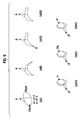
- FIG. 10 is a cyclic flow diagram showing the mechanism of disappearance of active oxygen by TEMPO
- FIG. 13 is a graph showing results of a start and stop repeating endurance test.
- the separator 7 on the air electrode side of MEA 3 is configured as a carbon or metal member of a plate shape that has: air channels 8 formed in one side; liquid fuel channels 10 , in the opposite side; and coolant (e.g. cooling water) channels (not shown), in between.
- each air channel 8 is defined by and between the air electrode 5 and the air electrode side separator 7 , for supplying the air electrode 5 with air as a reactant gas.
- Each liquid fuel channel 10 is defined by and between the fuel electrode 6 and the fuel electrode side separator 9 , for supplying the fuel electrode 6 with a liquid fuel according to the invention.
- the fuel channel 10 is connected via an adequate manifold to the connection line 15 of the fuel supply line 11 .
- the antioxidative liquid fuel (containing antioxidant) is supplied from the fuel supply line 11 to the fuel cell stack 1 , where it is distributed to the fuel electrode 9 side of MEA 3 of each unit cell 2 , via associated distribution channels and fuel channels 10 .
- the antioxidant as it has been changed by reaction with active oxygen into an oxidant, unstable radical, or peroxide, is thus kept from acting as an initiator of additional oxidation, causing a deterioration of electrolyte membrane 4 .
- the stability, durability, and heat resistance of compound are important.
- the stability and durability of compound are most important for the decomposition of active oxygen to be maintained to use a fuel cell over a long term.
- hydrolysate of oxidant of antioxidant should also be chemically stable.
- the antioxidant supplied to the fuel electrode should be kept stable till its discharge from the air electrode.
- Antioxidant used for decomposition of active oxygen is discharged together with produced water, and for a long-term operation of the system, the hydrolysate of antioxidant may preferably be stable without generating radicals.
- the antioxidant may preferably be stable in heat resistance up to a temperature about 120° C.
- the antioxidant may preferably have a standard redox potential to NHE (normal hydrogen electrode) within a range of 0.68V or more and 2.85V or less.
- 0.68V is a standard redox potential of hydrogen peroxide, so that any compound that has a greater standard redox potential than 0.68V and has oxidizing power can act as an oxidizing agent on hydrogen peroxide.
- hydrogen peroxide becomes oxygen, while the compound whose standard redox potential is greater than 0.68V is reduced by hydrogen peroxide.
- 2.85V is a standard redox potential of hydroxyl radical. For any compound that has a high standard redox potential of 2.85V or more, it therefore is difficult to act as a reducing agent on hydroxyl radical, thus constituting a undesirable difficulty in reduction of hydroxyl radical to be efficient.
- the above-noted compound is supplied as antioxidant to the fuel cell stack 1 , where it efficiently reduces hydroxyl radical to water, thereby suppressing a deterioration of electrolyte membrane, through an elementary process shown by formula (B11) below.
- the compound represented by the general formula (II) may preferably comprise an imide compound represented by a general formula (III) below
- R3 and R4 respectively denote elements of a set of hydrogen atoms, halogen atoms, alkyl groups, aryl groups, cycloalkyl groups, hydroxyl groups, alkoxyl groups, carboxyl groups, alkoxycarbonyl groups, or acyl groups, mutually identical or different
- X denotes an oxygen atom or hydroxyl group
- n denotes an integer within 1 to 3.
- the acyl groups may preferably include those acyl groups having carbon numbers within a range of 1 to 6 or near, for example, a formyl, an acetyl, a propionyl, a butyryl, an isobutyryl, a valeryl, an isovaleryl, and a pivaloyl group.
- the substituents R3 and R4 may be combined with each other to form any ring selective from a set of a cycloalkane, a cycloalkene, a bridged hydrocarbon ring, and an aromatic ring, and substitutions thereof.
- rings there may be taken, for example: nonaromatic hydrocarbon rings, such as cycloalkane rings, e.g, cyclohexane ring, and cycloalkene rings, e.g. cyclohexene ring; nonaromatic bridging rings, such as bridging type hydrocarbon rings, e.g. five-norbornene ring; and aromatic rings, such as benzene rings and naphthalene rings. Those rings may have substituent groups.
- the acyl groups may preferably include those acyl groups having carbon numbers within a range of 1 to 6 or near, for example, a formyl, an acetyl, a propionyl, a butyryl, an isobutyryl, a valeryl, an isovaleryl, and a pivaloyl group.
- the compound represented by the general formula (IX) may preferably comprise a compound represented by a general formula (XI) below
- the TEMPO 30 again acts to reduce hydroxy radical.
- reductant TEMPO 30 and oxidant TEMPO + 31 , whereby hydroxy radical as well as hydrogen peroxide is decomposed, so that oxidation of electrolyte is commensurately suppressed, allowing for a prevented deterioration of electrolyte membrane with a maintained durability.
- methanol is used as the hydrocarbon fuel, which however is not limited thereto, and may well be any type of fuel available for implementation of oxidation at the fuel electrode with emission of hydrogen ion, for example: liquid hydrocarbon fuels, such as ethanol, isopropyl alcohol, ethylene glycol, formic acid, dimethyl ether, and cyclohexane; and an ascorbic acid aqueous solution in which solid hydrocarbon is dissolved.
- liquid hydrocarbon fuels such as ethanol, isopropyl alcohol, ethylene glycol, formic acid, dimethyl ether, and cyclohexane
- an ascorbic acid aqueous solution in which solid hydrocarbon is dissolved.
- platinum-ruthenium-supporting carbon (Pt—Ru support carbon catalyst, model: HiSPEC7000, Johnson Matthey Co.) was coated on the fuel electrode side, and platinum-supporting carbon (20 wt % Pt/Vulcan XC-72, Cabot Co.), on the air electrode side, to fabricate a membrane electrode assembly (MEA). Coated quantities of catalyst were 1.0 g/cm 2 of platinum. Fabricated MEA was assembled in a single cell, to provide a unit cell for PEFC to be 5 cm 2 .
- Pt—Ru support carbon catalyst model: HiSPEC7000, Johnson Matthey Co.
- S-PES sulfonated polyethersulfone
- Redox potentials of the compounds employed in those examples were measured by using: glassy carbon as an acting electrode; platinum as a counter electrode; a saturated calomel electrode (SCE) as a reference electrode; and 1M sulfuric acid as an electrolytic solution.
- FIG. 11 shows exemplary measurements of NHPI as a typical imide system compound
- FIG. 12 exemplary measurements of TEMPO as a typical TEMPO system compound.
- E°(NHE) E(SCE)+0.24V (C1)
- This operation was repeated, counting the number of times of repetition, and the durability of unit cell to be compared was defined as the number of repetition times counted upon a voltage drop to a level of 0.1 V or less under a condition of power generation with a current density of 0.3 mA/cm 3 .
- the start-stop repetition time number was within 220 to 350, proving a suppressed deterioration of solid polymer electrolyte membrane by addition of the antioxidant, with an enhanced durability.
- perfluorosulfonic acid system polymers typified by the Nafion® film having wide application to an electrolyte membrane of a fuel cell in a fuel cell system, as well as hydrocarbon system polymers referred to S-PES, are put in a situation where they are unsuccessfully considered having a sufficient tolerance by generation of active oxygen at an air electrode of the fuel cell, as will be seen from the foregoing description, by mixing or dissolving an antioxidant to a liquid fuel according to an embodiment of the invention, active oxygen can be decomposed even if the generation is continuous, thus enabling a prevention of deterioration of the electrolyte membrane, allowing for an enhanced durability of fuel cell system.
Landscapes
- Chemical & Material Sciences (AREA)
- Chemical Kinetics & Catalysis (AREA)
- Manufacturing & Machinery (AREA)
- Sustainable Development (AREA)
- Sustainable Energy (AREA)
- Engineering & Computer Science (AREA)
- Life Sciences & Earth Sciences (AREA)
- Electrochemistry (AREA)
- General Chemical & Material Sciences (AREA)
- Crystallography & Structural Chemistry (AREA)
- Fuel Cell (AREA)
- Anti-Oxidant Or Stabilizer Compositions (AREA)
- Liquid Carbonaceous Fuels (AREA)
Abstract
Description
O2+4H++4e −→2H2O (A1)
O2+2H+2e −→H2O2 (A2)
H2O2→2.OH (A3)
H2O2→.H+.OOH (A4)
Fe2++H2O2→Fe3++OH−+.OH (A5)
At the fuel electrode: CH3OH+H2O→CO2+6H++6e − (B1)
At the air electrode: (3/2)O2+6H++6e −→3H2O (B2)
O2 +e −→O2 − (B3)
O2 −+H+→.OOH (B4)
O2+2H++2e −→H2O2 (B5)
H2O2+H+ +e −→H2O+.OH (B6)
H2O2→2.OH (B7)
.OOH+H+ +e −→H2O2, E°=1.50 V (B8)
H2O2+2H++2e −→2H2O, E°=1.77 V (B9)
.OH+H+ +e −→H2O, E°=2.85 V (B10)

where R1 and R2 respectively denote elements of a set of arbitrary substituent groups mutually identical or different, and X denotes an oxygen atom or hydroxyl group. More preferably, R1 and R2 are combined with each other, to form a double bond, an aromatic ring, or a nonaromatic ring.

where a ring Y1 comprises any ring of a set of 5-membered to 12-membered rings double-bonded and aromatic or nonaromatic.
>NOH+.OH→>NO.+H2O (B11)
2(>NO.)+H2O2→2(>NOH)+O2 (B12)

where R3 and R4 respectively denote elements of a set of hydrogen atoms, halogen atoms, alkyl groups, aryl groups, cycloalkyl groups, hydroxyl groups, alkoxyl groups, carboxyl groups, alkoxycarbonyl groups, or acyl groups, mutually identical or different, X denotes an oxygen atom or hydroxyl group, and n denotes an integer within 1 to 3.

where R3 to R6 respectively denote elements of a set of hydrogen atoms, halogen atoms, alkyl groups, hydroxyl groups, alkoxyl groups, carboxyl groups, alkoxycarbonyl groups, acyl groups, nitro groups, cyano groups, or amino groups, mutually identical or different.

where R7 to R12 respectively denote elements of a set of hydrogen atoms, alkyl groups, aryl groups, cycloalkyl groups, hydroxyl groups, alkoxyl groups, carboxyl groups, substituent carbonyl groups, acyl groups, or acyloxy groups, mutually identical or different. This compound has an N-substitution cyclic imide frame in the form of a six membered-ring.


where R13 to R18 respectively denote elements of a set of hydrogen atoms, alkyl groups, hydroxyl groups, alkoxyl groups, carboxyl groups, alkoxycarbonyl groups, acyl groups, nitro groups, cyano groups, or amino groups, mutually identical or different.

where R19 to R21 each respectively denote an alkyl group, or an alkyl group substituted in part by an arbitrary radical, wherein: at least one of R19 to R21 may preferably be chained, ringed, or branched; at least two of R19 to R21 may preferably be mutually combined to form a ring; and at least one of R19 to R21 may preferably have oxygen and nitrogen atoms.

where R19 to R24 each respectively denote an alkyl group, or an alkyl group substituted in part by an arbitrary radical, wherein: at least one of R19 to R24 may preferably be chained, ringed, or branched; R20 and R21, or R23 and R24 may preferably be mutually combined to form a ring; and at least one of R19 to R24 may preferably include oxygen and nitrogen atoms.

where a ring Y2 denotes a 5-membered or 6-membered ring formed by R19 and R22 mutually combined.

where Z denotes an element of a set of alkyl groups, aryl groups, alkoxy groups, carboxyl groups, alkoxycarbonyl groups, cyano groups, hydroxyl groups, nitro groups, amino groups, and substituent groups including a hydrogen atom, wherein: Z may preferably be an alkyl group substituted in part by an arbitrary radical; wherein Z may preferably be an alkyl group chained, ringed, or branched in part; Z may preferably be an alkyl group including oxygen and nitrogen atoms; Z may preferably be an aryl group substituted in part by an arbitrary radical; and Z may preferably be an aryl group including oxygen and nitrogen atoms.

where Z denotes an element of a set of alkyl groups, aryl groups, alkoxy groups, carboxyl groups, alkoxycarbonyl groups, cyano groups, hydroxyl groups, nitro groups, amino groups, and substituent groups including a hydrogen atom, wherein: Z may preferably be an alkyl group substituted in part by an arbitrary radical; Z may preferably be an alkyl group chained, ringed, or branched in part; Z may preferably be an alkyl group including oxygen and nitrogen atoms; Z may preferably be an aryl group substituted in part by an arbitrary radical; and Z may preferably be an aryl group including oxygen and nitrogen atoms.

where Z denotes an element of a set of alkyl groups, aryl groups, alkoxy groups, carboxyl groups, alkoxycarbonyl groups, cyano groups, hydroxyl groups, nitro groups, amino groups, and substituent groups including a hydrogen atom, wherein: Z may preferably be an alkyl group substituted in part by an arbitrary radical; Z may preferably be an alkyl group chained, ringed, or branched in part; Z may preferably be an alkyl group including oxygen and nitrogen atoms; Z may preferably be an aryl group substituted in part by an arbitrary radical; and Z may preferably be an aryl group including oxygen and nitrogen atoms.
H2O2→O2+2H++2e −, E°=0.68 V (B15)
TEMPO+ +e −→TEMPO, E°=0.81 V (B16)
TEMPO→TEMPO+ +e −, E°=0.81 V (B17)
TEMPO+.OH→TEMPO++OH− (B18)
2TEMPO++H2O2→2TEMPO+2H++O2 (B19)
TEMPO++H2O2→TEMPO-H+H++O2 (B20)
TEMPO-H+.OH→TEMPO+H2O (B21)
E°(NHE)=E(SCE)+0.24V (C1)
| TABLE 1 | |||||||
| Repe- | |||||||
| Electrolyte | Anti- | Redox | tition | Fluoride | Sulfate | ||
| membrane | oxidant | potential | time no. | Ion*) | Ion*) | ||
| Example 1 | Nafion ® | NHPI | 1.34 | 300 | X | X |
| Example 2 | Nafion ® | NHMI | 1.34 | 250 | X | X |
| Example 3 | Nafion ® | NHSI | 1.36 | 220 | X | X |
| Example 4 | Nafion ® | NHGI | 1.38 | 350 | X | X |
| Example 5 | Nafion ® | THICA | 1.40 | 350 | X | X |
| Com. |
Nafion ® | none | — | 80 | ◯ | ◯ |
| *)◯: present, X: absent | ||||||
| TABLE 2 | |||||||
| Electrolyte | Redox | Repetition | Fluoride | Sulfate | |||
| membrane | Antioxidant | potential | time no. | Ion*) | Ion*) | ||
| Example 6 | S-PES | TEMPO-OH | 0.81 | 160 | X | X | |
| Example 7 | S-PES | TEMPO-COOH | 0.81 | 180 | X | X | |
| Example 8 | S-PES | TEMPO | 0.81 | 180 | X | X | |
| Example 9 | S-PES | PROXYL-CONH2 | 0.85 | 180 | X | X | |
| Example | S-PES | PROXYL-COOH | 0.86 | 170 | | X | |
| 10 | |||||||
| Example | S-PES | **) | 0.95 | 130 | | X | |
| 11 | |||||||
| Example | S-PES | DTEN | 0.80 | 140 | | X | |
| 12 | |||||||
| Com. Ex 2 | S-PES | none | — | 50 | X | ◯ | |
| *)◯: present, X: absent | |||||||
| **) 3-carbamoyl-2,2,5,5-tetramethylpyrroline-1-yloxy | |||||||
Claims (26)


Applications Claiming Priority (4)
| Application Number | Priority Date | Filing Date | Title |
|---|---|---|---|
| JP2005362185A JP5205694B2 (en) | 2005-12-15 | 2005-12-15 | Fuel, fuel cell system and fuel cell vehicle |
| JP2005-362185 | 2005-12-15 | ||
| JP2005362185 | 2005-12-15 | ||
| PCT/JP2006/324321 WO2007069504A1 (en) | 2005-12-15 | 2006-11-29 | Fuel, fuel cell system, fuel cell vehicle and operating method for fuel cell system |
Publications (2)
| Publication Number | Publication Date |
|---|---|
| US20090233128A1 US20090233128A1 (en) | 2009-09-17 |
| US9112196B2 true US9112196B2 (en) | 2015-08-18 |
Family
ID=37719442
Family Applications (1)
| Application Number | Title | Priority Date | Filing Date |
|---|---|---|---|
| US12/097,432 Expired - Fee Related US9112196B2 (en) | 2005-12-15 | 2006-11-29 | Fuel, fuel cell system, fuel cell vehicle and operating method for fuel cell system |
Country Status (5)
| Country | Link |
|---|---|
| US (1) | US9112196B2 (en) |
| EP (1) | EP1966849A1 (en) |
| JP (1) | JP5205694B2 (en) |
| CA (1) | CA2633926C (en) |
| WO (1) | WO2007069504A1 (en) |
Families Citing this family (9)
| Publication number | Priority date | Publication date | Assignee | Title |
|---|---|---|---|---|
| US9434198B2 (en) | 2009-03-02 | 2016-09-06 | Kodak Alaris Inc. | Heat transferable material for improved image stability |
| US8318271B2 (en) * | 2009-03-02 | 2012-11-27 | Eastman Kodak Company | Heat transferable material for improved image stability |
| US8304044B2 (en) * | 2009-09-23 | 2012-11-06 | Eastman Kodak Company | Dye transferable material with improved image stability |
| US10633590B2 (en) | 2015-09-04 | 2020-04-28 | Dic Corporation | Liquid crystal composition and liquid crystal display device including the same |
| JP6879305B2 (en) * | 2016-07-26 | 2021-06-02 | 株式会社村田製作所 | Electrolytes and electrochemical devices |
| CN111430547B (en) * | 2020-03-19 | 2023-10-17 | 电子科技大学 | An organic solar cell based on astaxanthin cathode buffer layer and preparation method thereof |
| KR20220019865A (en) | 2020-08-10 | 2022-02-18 | 현대자동차주식회사 | Fuel cell system |
| JP7690926B2 (en) * | 2022-06-06 | 2025-06-11 | トヨタ自動車株式会社 | System and method for estimating durability for fuel cell system |
| CN116247232A (en) * | 2023-04-06 | 2023-06-09 | 上海捷氢科技股份有限公司 | Method and device for improving durability of PEMFC |
Citations (31)
| Publication number | Priority date | Publication date | Assignee | Title |
|---|---|---|---|---|
| US3556748A (en) * | 1966-07-05 | 1971-01-19 | Universal Oil Prod Co | Antioxidant mixture of n-phenyl-n'-sec-alkyl-ortho-phenylene-diamine and n,n'-di-sec-alkyl-ortho-phenylenediamine,and use thereof |
| US4398505A (en) | 1981-10-22 | 1983-08-16 | Standard Oil Company (Indiana) | Diesel fuel composition |
| JPS59185787A (en) | 1983-04-06 | 1984-10-22 | Masaichiro Masui | Mediator for electrode oxidation reaction and oxidation method |
| US5205945A (en) | 1991-10-18 | 1993-04-27 | Mobil Oil Corporation | Multifunctional additives |
| WO2000024796A1 (en) | 1998-08-28 | 2000-05-04 | Foster-Miller, Inc. | Novel ion-conducting materials suitable for use in electrochemical applications and methods related thereto |
| JP2000223135A (en) | 1999-01-27 | 2000-08-11 | Aisin Seiki Co Ltd | Solid polymer electrolyte membrane and fuel cell |
| JP2000251906A (en) | 1999-03-01 | 2000-09-14 | Agency Of Ind Science & Technol | Solid polymer electrolyte membrane and bipolar membrane fuel cell using it |
| JP2001118591A (en) | 1999-10-19 | 2001-04-27 | Toyota Central Res & Dev Lab Inc | Highly durable solid polymer electrolyte |
| EP1151994A1 (en) | 2000-05-01 | 2001-11-07 | Ethyl Corporation | Succinimide-acid compounds and derivatives thereof |
| JP2002053888A (en) | 2000-06-02 | 2002-02-19 | Chevron Oronite Ltd | Lubricating oil composition |
| US6375922B1 (en) * | 1999-02-08 | 2002-04-23 | Daicel Chemical Industries, Ltd. | Process for producing hydrogen peroxide |
| US20030008196A1 (en) | 2001-06-27 | 2003-01-09 | Helge Wessel | Fuel cell |
| US6518419B1 (en) | 1998-05-07 | 2003-02-11 | Nederlandse Organisatie Voor Toegepast-Natuurwetenschappelijk Onderzoek Tno | Process for selective oxidation of primary alcohols |
| JP2003109623A (en) | 2001-09-28 | 2003-04-11 | Matsushita Electric Ind Co Ltd | Polymer electrolyte fuel cell |
| JP2003117398A (en) | 2001-10-12 | 2003-04-22 | Toyota Motor Corp | WC supported catalyst and method for producing the same |
| US20030078308A1 (en) | 2001-05-15 | 2003-04-24 | Ballard Power Systems Inc. | Ion-exchange materials with improved ion conductivity |
| JP2003201352A (en) | 2002-01-08 | 2003-07-18 | Honda Motor Co Ltd | Polymer electrolyte membrane, membrane electrode structure provided with the polymer electrolyte membrane, and solid polymer fuel cell provided with the membrane electrode structure |
| JP2003226743A (en) | 2001-11-30 | 2003-08-12 | Sanyo Chem Ind Ltd | Method of producing conductive polymer |
| JP2003336089A (en) | 2002-05-22 | 2003-11-28 | Chevron Texaco Japan Ltd | Lubricating oil composition |
| JP2004134269A (en) | 2002-10-11 | 2004-04-30 | Toyota Motor Corp | Highly durable polymer electrolyte, composition thereof, and fuel cell |
| JP2004227865A (en) | 2003-01-21 | 2004-08-12 | Nec Corp | Liquid fuel for fuel cell, method of using fuel cell, and fuel cell |
| US6777516B2 (en) | 2000-01-14 | 2004-08-17 | North Carolina State University | Substrates carrying polymers of linked sandwich coordination compounds and methods of use thereof |
| JP2005190752A (en) | 2003-12-25 | 2005-07-14 | Nissan Motor Co Ltd | Membrane electrode assembly for fuel cell and solid polymer fuel cell using the same |
| EP1574559A1 (en) | 2004-03-10 | 2005-09-14 | Afton Chemical Corporation | Dispersants for lubricants and fuels |
| WO2006006501A1 (en) | 2004-07-09 | 2006-01-19 | Nissan Motor Co., Ltd. | Fuel cell system and composition for electrode |
| WO2006006502A1 (en) | 2004-07-09 | 2006-01-19 | Nissan Motor Co., Ltd. | Fuel cell system and solid polymer electrolyte film |
| JP2006049263A (en) | 2004-07-09 | 2006-02-16 | Nissan Motor Co Ltd | Electrolyte for polymer electrolyte fuel cell, polymer electrolyte fuel cell, polymer electrolyte fuel cell system and fuel cell vehicle |
| JP2006100251A (en) | 2004-09-06 | 2006-04-13 | Nissan Motor Co Ltd | Solid polymer fuel cell system and fuel cell vehicle |
| JP2006156295A (en) | 2004-12-01 | 2006-06-15 | Ricoh Co Ltd | Composite electrolyte membrane, method for producing the same, fuel cell and portable device |
| JP2006249122A (en) | 2005-03-08 | 2006-09-21 | Konica Minolta Holdings Inc | Fuel composition for fuel cell |
| US20070191634A1 (en) * | 2004-04-08 | 2007-08-16 | Naruhisa Hirai | Methods for producing aromatic carboxylic acids |
-
2005
- 2005-12-15 JP JP2005362185A patent/JP5205694B2/en not_active Expired - Fee Related
-
2006
- 2006-11-29 WO PCT/JP2006/324321 patent/WO2007069504A1/en not_active Ceased
- 2006-11-29 US US12/097,432 patent/US9112196B2/en not_active Expired - Fee Related
- 2006-11-29 EP EP20060834076 patent/EP1966849A1/en not_active Withdrawn
- 2006-11-29 CA CA2633926A patent/CA2633926C/en not_active Expired - Fee Related
Patent Citations (34)
| Publication number | Priority date | Publication date | Assignee | Title |
|---|---|---|---|---|
| US3556748A (en) * | 1966-07-05 | 1971-01-19 | Universal Oil Prod Co | Antioxidant mixture of n-phenyl-n'-sec-alkyl-ortho-phenylene-diamine and n,n'-di-sec-alkyl-ortho-phenylenediamine,and use thereof |
| US4398505A (en) | 1981-10-22 | 1983-08-16 | Standard Oil Company (Indiana) | Diesel fuel composition |
| JPS59185787A (en) | 1983-04-06 | 1984-10-22 | Masaichiro Masui | Mediator for electrode oxidation reaction and oxidation method |
| US5205945A (en) | 1991-10-18 | 1993-04-27 | Mobil Oil Corporation | Multifunctional additives |
| US6518419B1 (en) | 1998-05-07 | 2003-02-11 | Nederlandse Organisatie Voor Toegepast-Natuurwetenschappelijk Onderzoek Tno | Process for selective oxidation of primary alcohols |
| WO2000024796A1 (en) | 1998-08-28 | 2000-05-04 | Foster-Miller, Inc. | Novel ion-conducting materials suitable for use in electrochemical applications and methods related thereto |
| JP2000223135A (en) | 1999-01-27 | 2000-08-11 | Aisin Seiki Co Ltd | Solid polymer electrolyte membrane and fuel cell |
| US6375922B1 (en) * | 1999-02-08 | 2002-04-23 | Daicel Chemical Industries, Ltd. | Process for producing hydrogen peroxide |
| JP2000251906A (en) | 1999-03-01 | 2000-09-14 | Agency Of Ind Science & Technol | Solid polymer electrolyte membrane and bipolar membrane fuel cell using it |
| JP2001118591A (en) | 1999-10-19 | 2001-04-27 | Toyota Central Res & Dev Lab Inc | Highly durable solid polymer electrolyte |
| US6777516B2 (en) | 2000-01-14 | 2004-08-17 | North Carolina State University | Substrates carrying polymers of linked sandwich coordination compounds and methods of use thereof |
| EP1151994A1 (en) | 2000-05-01 | 2001-11-07 | Ethyl Corporation | Succinimide-acid compounds and derivatives thereof |
| JP2002053888A (en) | 2000-06-02 | 2002-02-19 | Chevron Oronite Ltd | Lubricating oil composition |
| US20030078308A1 (en) | 2001-05-15 | 2003-04-24 | Ballard Power Systems Inc. | Ion-exchange materials with improved ion conductivity |
| JP2003086188A (en) | 2001-06-27 | 2003-03-20 | Basf Ag | Fuel cell |
| US20030008196A1 (en) | 2001-06-27 | 2003-01-09 | Helge Wessel | Fuel cell |
| JP2003109623A (en) | 2001-09-28 | 2003-04-11 | Matsushita Electric Ind Co Ltd | Polymer electrolyte fuel cell |
| JP2003117398A (en) | 2001-10-12 | 2003-04-22 | Toyota Motor Corp | WC supported catalyst and method for producing the same |
| JP2003226743A (en) | 2001-11-30 | 2003-08-12 | Sanyo Chem Ind Ltd | Method of producing conductive polymer |
| JP2003201352A (en) | 2002-01-08 | 2003-07-18 | Honda Motor Co Ltd | Polymer electrolyte membrane, membrane electrode structure provided with the polymer electrolyte membrane, and solid polymer fuel cell provided with the membrane electrode structure |
| JP2003336089A (en) | 2002-05-22 | 2003-11-28 | Chevron Texaco Japan Ltd | Lubricating oil composition |
| JP2004134269A (en) | 2002-10-11 | 2004-04-30 | Toyota Motor Corp | Highly durable polymer electrolyte, composition thereof, and fuel cell |
| JP2004227865A (en) | 2003-01-21 | 2004-08-12 | Nec Corp | Liquid fuel for fuel cell, method of using fuel cell, and fuel cell |
| JP2005190752A (en) | 2003-12-25 | 2005-07-14 | Nissan Motor Co Ltd | Membrane electrode assembly for fuel cell and solid polymer fuel cell using the same |
| EP1574559A1 (en) | 2004-03-10 | 2005-09-14 | Afton Chemical Corporation | Dispersants for lubricants and fuels |
| US20070191634A1 (en) * | 2004-04-08 | 2007-08-16 | Naruhisa Hirai | Methods for producing aromatic carboxylic acids |
| WO2006006501A1 (en) | 2004-07-09 | 2006-01-19 | Nissan Motor Co., Ltd. | Fuel cell system and composition for electrode |
| WO2006006502A1 (en) | 2004-07-09 | 2006-01-19 | Nissan Motor Co., Ltd. | Fuel cell system and solid polymer electrolyte film |
| JP2006049263A (en) | 2004-07-09 | 2006-02-16 | Nissan Motor Co Ltd | Electrolyte for polymer electrolyte fuel cell, polymer electrolyte fuel cell, polymer electrolyte fuel cell system and fuel cell vehicle |
| US20080044709A1 (en) | 2004-07-09 | 2008-02-21 | Nissan Motor Co., Ltd. | Fuel Cell System and Solid Polymer Electrolyte Film |
| US20080050631A1 (en) | 2004-07-09 | 2008-02-28 | Nissan Motor Co., Ltd. | Fuel Cell System and Composition for Electrode |
| JP2006100251A (en) | 2004-09-06 | 2006-04-13 | Nissan Motor Co Ltd | Solid polymer fuel cell system and fuel cell vehicle |
| JP2006156295A (en) | 2004-12-01 | 2006-06-15 | Ricoh Co Ltd | Composite electrolyte membrane, method for producing the same, fuel cell and portable device |
| JP2006249122A (en) | 2005-03-08 | 2006-09-21 | Konica Minolta Holdings Inc | Fuel composition for fuel cell |
Non-Patent Citations (17)
| Title |
|---|
| "Researches and Developments of Proton-Exchange Membraane Fuel Cell", Kyoto University Graduate School of Engineering as entrustee from the New Energy and Industrial Technology Development Organization, Mar. 2002, pp. 1-44. |
| Daniel N. Prater, John H. Rusek, Energy Density of a methanol/hydrogen peroxide fuel cell, 2003, Applied Energy, 74, 135-140. * |
| Daniel N. Prater, John H. Rusek, Energy density of a methanol/ydroen peroxide fuel cell, 2003, Applied Energy, 74, 135-140. * |
| De Jonge, "Synergism of Antioxidants," Pure and Applied Chemistry,1983, pp. 1637-1650, vol. 55, No. 10. |
| European Office Action dated May 6, 2015 issued in Application No. 06834076.9. |
| Ezerskis et al., Oxidation of Chlorophenols on Pt Electrode in Alkaline Solution Studied by Cyclic Voltammetry, Galvanostatic Electrolyis, and Gas Chromatography-Mass Spectometry, Pure and Applied Chemistry, 2001, pp. 1929-1940, vol. 73, No. 12. |
| Hitachi Ltd As Entrustee From the New Energy and Industrial Technology Development Organization, "Researches and developments of a durability-elevated hydrocarbon system electrolyte membrane for Proton-Exchange membrane fuel cells in the Proton-Exchange Membrane Fuel Cell Elements Technology Development and Like Program in the Proton-Exchange Membrane Fuel Cell System Technology Project", Report in Mar. 2003, 10 pgs. |
| Ito et al., "Fuel cell system for fuel cell vehicle, has fuel cell having electrodes and antioxidant, which is provided in electrodes or contacted with electrodes", Database WPI Week 2006, Derwent Publications Ltd., An 2006-110140, XP-002421613, 3 pgs. |
| Ito et al., "Fuel cell system vehicle solid'polymer electrolytic film antioxidant contact", Database WPI, Derwent Publications Ltd., An 2006-110141, XP-002421614, 3 pgs. |
| Kyoto University Graduate School of Engineering As Entrustee From the New Energy and Industrial Technology Development Organization, "Researches and Developments of Proton-Exchange Membrane Fuel Cell", 2001 Yearly Result Report, 50 pgs. |
| Machine Translation of JP2004-227865. * |
| Masashi Ito et al., USPTO Notice of Allowance, U.S. Appl. No. 11/571,865, May 18, 2010, 9 pages. |
| Masashi Ito et al., USPTO Office Action, U.S. Appl. No. 11/571,865, Jan. 6, 2010, 10 pages. |
| Masashi Ito, USPTO Office Action, U.S. Appl. No. 11/631,943, Feb. 4, 2010, 10 pages. |
| Notification of Reasons for Refusal in JP Appln No:2005-362185 dated Oct. 4, 2011. |
| Ota et al., "Development of Fuel Cell Vehicles & Their Materials", CMC Publishers Co., Ltd., Dec. 2002, pp. 20-21. |
| Watanabe, "For Development of a High-Temperature Operable Direct Methanol Fuel Cell", Representative of a fiscal 1999 adopted study 'Resources Recycling, Energy Minimum Type System Technology', 20 pgs. |
Also Published As
| Publication number | Publication date |
|---|---|
| CA2633926C (en) | 2011-01-18 |
| WO2007069504A1 (en) | 2007-06-21 |
| JP5205694B2 (en) | 2013-06-05 |
| EP1966849A1 (en) | 2008-09-10 |
| JP2007165197A (en) | 2007-06-28 |
| CA2633926A1 (en) | 2007-06-21 |
| US20090233128A1 (en) | 2009-09-17 |
Similar Documents
| Publication | Publication Date | Title |
|---|---|---|
| US8252481B2 (en) | Fuel cell system and solid polymer electrolyte film | |
| US7799485B2 (en) | Fuel cell system and composition for electrode | |
| CA2630571C (en) | Fuel cell system, fuel cell vehicle, and operating method for fuel cell system | |
| US20120156582A1 (en) | Fuel cell | |
| BRPI0710697A2 (en) | fuel cell | |
| US9112196B2 (en) | Fuel, fuel cell system, fuel cell vehicle and operating method for fuel cell system | |
| WO2005088752A1 (en) | Fuel cell system | |
| Han | Nuclear magnetic resonance investigations on electrochemical reactions of low temperature fuel cells operating in acidic conditions | |
| Zaidi et al. | Fuel cell fundamentals | |
| JP4830357B2 (en) | Solid polymer fuel cell system and fuel cell vehicle | |
| JP4876389B2 (en) | Electrolyte for polymer electrolyte fuel cell, polymer electrolyte fuel cell, polymer electrolyte fuel cell system and fuel cell vehicle | |
| CN112436167A (en) | Direct type polyether compound fuel cell and system | |
| WO2012007727A1 (en) | Fuel cell | |
| JPWO2014020764A1 (en) | Alkaline fuel cell, fuel composition for alkaline fuel cell, and fuel cartridge for alkaline fuel cell | |
| JP2006236935A (en) | Electrolyte for polymer electrolyte fuel cell, polymer electrolyte fuel cell, polymer electrolyte fuel cell system and fuel cell vehicle | |
| JP5002928B2 (en) | Fuel cell system | |
| CN119627123A (en) | A catalyst slurry containing carboxyl porphyrin and its preparation method and application | |
| Mergel et al. | Current Status of and Recent Developments in Direct Liquid Fuel Cells | |
| Stroh et al. | Low-Temperature Fuel Cells: Revolutionizing Energy Use | |
| Park et al. | Operating Characteristics on Coupling of Fuel-Cell System with Natural Gas Reformer | |
| KR20060131030A (en) | Method for producing catalyst for fuel cell |
Legal Events
| Date | Code | Title | Description |
|---|---|---|---|
| AS | Assignment |
Owner name: NISSAN MOTOR CO., LTD., JAPAN Free format text: ASSIGNMENT OF ASSIGNORS INTEREST;ASSIGNOR:ITO, MASASHI;REEL/FRAME:021098/0727 Effective date: 20080228 |
|
| STCF | Information on status: patent grant |
Free format text: PATENTED CASE |
|
| FEPP | Fee payment procedure |
Free format text: MAINTENANCE FEE REMINDER MAILED (ORIGINAL EVENT CODE: REM.); ENTITY STATUS OF PATENT OWNER: LARGE ENTITY |
|
| LAPS | Lapse for failure to pay maintenance fees |
Free format text: PATENT EXPIRED FOR FAILURE TO PAY MAINTENANCE FEES (ORIGINAL EVENT CODE: EXP.); ENTITY STATUS OF PATENT OWNER: LARGE ENTITY |
|
| STCH | Information on status: patent discontinuation |
Free format text: PATENT EXPIRED DUE TO NONPAYMENT OF MAINTENANCE FEES UNDER 37 CFR 1.362 |
|
| FP | Lapsed due to failure to pay maintenance fee |
Effective date: 20190818 |