US9054929B2 - Constructing very high throughput signal (VHT-SIG) fields for reduced peak-to-average power ratio (PAPR) - Google Patents
Constructing very high throughput signal (VHT-SIG) fields for reduced peak-to-average power ratio (PAPR) Download PDFInfo
- Publication number
- US9054929B2 US9054929B2 US13/206,343 US201113206343A US9054929B2 US 9054929 B2 US9054929 B2 US 9054929B2 US 201113206343 A US201113206343 A US 201113206343A US 9054929 B2 US9054929 B2 US 9054929B2
- Authority
- US
- United States
- Prior art keywords
- vht
- bits
- sig field
- scrambling
- papr
- Prior art date
- Legal status (The legal status is an assumption and is not a legal conclusion. Google has not performed a legal analysis and makes no representation as to the accuracy of the status listed.)
- Expired - Fee Related, expires
Links
- 230000005540 biological transmission Effects 0.000 claims abstract description 74
- 238000000034 method Methods 0.000 claims abstract description 46
- 238000004891 communication Methods 0.000 claims description 40
- 230000004044 response Effects 0.000 claims description 4
- 238000012545 processing Methods 0.000 description 37
- 230000006870 function Effects 0.000 description 12
- 238000005516 engineering process Methods 0.000 description 11
- 238000012549 training Methods 0.000 description 11
- 238000004590 computer program Methods 0.000 description 8
- 230000006872 improvement Effects 0.000 description 6
- 239000000969 carrier Substances 0.000 description 5
- 238000010586 diagram Methods 0.000 description 5
- 230000008901 benefit Effects 0.000 description 4
- 230000001413 cellular effect Effects 0.000 description 4
- 238000013461 design Methods 0.000 description 4
- 230000003287 optical effect Effects 0.000 description 4
- 238000010276 construction Methods 0.000 description 3
- 239000005022 packaging material Substances 0.000 description 3
- 238000013459 approach Methods 0.000 description 2
- 239000000835 fiber Substances 0.000 description 2
- 230000002093 peripheral effect Effects 0.000 description 2
- 230000008685 targeting Effects 0.000 description 2
- 238000012546 transfer Methods 0.000 description 2
- 101100421503 Arabidopsis thaliana SIGA gene Proteins 0.000 description 1
- 101100042610 Arabidopsis thaliana SIGB gene Proteins 0.000 description 1
- 241001591005 Siga Species 0.000 description 1
- 238000003491 array Methods 0.000 description 1
- 239000003795 chemical substances by application Substances 0.000 description 1
- 238000012937 correction Methods 0.000 description 1
- 230000008878 coupling Effects 0.000 description 1
- 238000010168 coupling process Methods 0.000 description 1
- 238000005859 coupling reaction Methods 0.000 description 1
- 230000001186 cumulative effect Effects 0.000 description 1
- 125000004122 cyclic group Chemical group 0.000 description 1
- 230000000977 initiatory effect Effects 0.000 description 1
- 230000007774 longterm Effects 0.000 description 1
- 239000011159 matrix material Substances 0.000 description 1
- 238000010295 mobile communication Methods 0.000 description 1
- 238000012986 modification Methods 0.000 description 1
- 230000004048 modification Effects 0.000 description 1
- 238000005457 optimization Methods 0.000 description 1
- 238000005192 partition Methods 0.000 description 1
- 230000008569 process Effects 0.000 description 1
- 239000000523 sample Substances 0.000 description 1
- 101150117326 sigA gene Proteins 0.000 description 1
- 230000008054 signal transmission Effects 0.000 description 1
- 230000011664 signaling Effects 0.000 description 1
Images




Classifications
-
- H—ELECTRICITY
- H04—ELECTRIC COMMUNICATION TECHNIQUE
- H04L—TRANSMISSION OF DIGITAL INFORMATION, e.g. TELEGRAPHIC COMMUNICATION
- H04L27/00—Modulated-carrier systems
- H04L27/26—Systems using multi-frequency codes
-
- H—ELECTRICITY
- H04—ELECTRIC COMMUNICATION TECHNIQUE
- H04L—TRANSMISSION OF DIGITAL INFORMATION, e.g. TELEGRAPHIC COMMUNICATION
- H04L27/00—Modulated-carrier systems
- H04L27/26—Systems using multi-frequency codes
- H04L27/2601—Multicarrier modulation systems
- H04L27/2614—Peak power aspects
- H04L27/2615—Reduction thereof using coding
-
- H—ELECTRICITY
- H04—ELECTRIC COMMUNICATION TECHNIQUE
- H04W—WIRELESS COMMUNICATION NETWORKS
- H04W52/00—Power management, e.g. Transmission Power Control [TPC] or power classes
- H04W52/02—Power saving arrangements
-
- Y—GENERAL TAGGING OF NEW TECHNOLOGICAL DEVELOPMENTS; GENERAL TAGGING OF CROSS-SECTIONAL TECHNOLOGIES SPANNING OVER SEVERAL SECTIONS OF THE IPC; TECHNICAL SUBJECTS COVERED BY FORMER USPC CROSS-REFERENCE ART COLLECTIONS [XRACs] AND DIGESTS
- Y02—TECHNOLOGIES OR APPLICATIONS FOR MITIGATION OR ADAPTATION AGAINST CLIMATE CHANGE
- Y02D—CLIMATE CHANGE MITIGATION TECHNOLOGIES IN INFORMATION AND COMMUNICATION TECHNOLOGIES [ICT], I.E. INFORMATION AND COMMUNICATION TECHNOLOGIES AIMING AT THE REDUCTION OF THEIR OWN ENERGY USE
- Y02D30/00—Reducing energy consumption in communication networks
- Y02D30/70—Reducing energy consumption in communication networks in wireless communication networks
Definitions
- Certain aspects of the present disclosure generally relate to wireless communications and, more particularly, to construction of a signal field within a transmission preamble that may help reduce peak-to-average power ratio (PAPR) of the transmission.
- PAPR peak-to-average power ratio
- the Institute of Electrical and Electronics Engineers (IEEE) 802.11 Wide Local Area Network (WLAN) standards body established specifications for transmissions based on the very high throughput (VHT) approach using a carrier frequency of 5 GHz (i.e., the IEEE 802.11ac specification), or using a carrier frequency of 60 GHz (i.e., the IEEE 802.11ad specification) targeting aggregate throughputs larger than 1 Gigabits per second.
- VHT 5 GHz i.e., the IEEE 802.11ac specification
- 60 GHz i.e., the IEEE 802.11ad specification
- PHY physical layer
- VHT-SIG VHT Signal
- Certain aspects of the present disclosure provide a method for wireless communications.
- the method generally includes constructing a very high throughput signal (VHT-SIG) field, scrambling one or more bits of the VHT-SIG field, and transmitting the VHT-SIG field with one or more scrambled bits over a wireless channel.
- VHT-SIG very high throughput signal
- the apparatus generally includes means for constructing a very high throughput signal (VHT-SIG) field, means for scrambling one or more bits of the VHT-SIG field, and means for transmitting the VHT-SIG field with one or more scrambled bits over a wireless channel.
- VHT-SIG very high throughput signal
- the apparatus generally includes a circuit configured to construct a very high throughput signal (VHT-SIG) field, an encoder configured to scramble one or more bits of the VHT-SIG field, and a transmitter configured to transmit the VHT-SIG field with one or more scrambled bits over a wireless channel.
- VHT-SIG very high throughput signal
- the executable instructions generally include instructions for constructing a very high throughput signal (VHT-SIG) field, scrambling one or more bits of the VHT-SIG field, and transmitting the VHT-SIG field with one or more scrambled bits over a wireless channel by utilizing a bandwidth of a first size.
- VHT-SIG very high throughput signal
- the access point generally includes at least one antenna, a circuit configured to construct a very high throughput signal (VHT-SIG) field, an encoder configured to scramble one or more bits of the VHT-SIG field, and a transmitter configured to transmit via the at least one antenna the VHT-SIG field with one or more scrambled bits over a wireless channel.
- VHT-SIG very high throughput signal
- Certain aspects of the present disclosure provide a method for wireless communications.
- the method generally includes receiving, over a wireless channel, a transmission containing a very high throughput signal (VHT-SIG) field with one or more bits altered via scrambling prior to transmission and de-scrambling the one or more scrambled bits of the VHT-SIG field.
- VHT-SIG very high throughput signal
- the apparatus generally includes means for receiving, over a wireless channel, a transmission containing a very high throughput signal (VHT-SIG) field with one or more bits altered via scrambling prior to transmission and means for de-scrambling the one or more scrambled bits of the VHT-SIG field.
- VHT-SIG very high throughput signal
- the apparatus generally includes a receiver configured to receive, over a wireless channel, a transmission containing a very high throughput signal (VHT-SIG) field with one or more bits altered via scrambling prior to transmission, and a decoder configured to de-scramble the one or more scrambled bits of the VHT-SIG field scramble one or more bits of the VHT-SIG field.
- VHT-SIG very high throughput signal
- the executable instructions generally include instructions for receiving, over a wireless channel, a transmission containing a very high throughput signal (VHT-SIG) field with one or more bits altered via scrambling prior to transmission and de-scrambling the one or more scrambled bits of the VHT-SIG field.
- VHT-SIG very high throughput signal
- the access terminal generally includes at least one antenna, a receiver configured to receive, over a wireless channel via the at least one antenna, a transmission containing a very high throughput signal (VHT-SIG) field with one or more bits altered via scrambling prior to transmission, and a decoder configured to de-scramble the one or more scrambled bits of the VHT-SIG field scramble one or more bits of the VHT-SIG field.
- VHT-SIG very high throughput signal
- FIG. 1 illustrates a diagram of a wireless communications network in accordance with certain aspects of the present disclosure.
- FIG. 2 illustrates a block diagram of an example of signal processing functions of a physical layer (PHY) of a wireless node in the wireless communications network of FIG. 1 in accordance with certain aspects of the present disclosure.
- PHY physical layer
- FIG. 3 illustrates a block diagram of an exemplary hardware configuration for a processing system in a wireless node in the wireless communications network of FIG. 1 in accordance with certain aspects of the present disclosure.
- FIG. 4 illustrates example operations for constructing and transmitting a very high throughput signal (VHT-SIG) field in accordance with certain aspects of the present disclosure.
- VHT-SIG very high throughput signal
- FIG. 4A illustrates example components capable of performing the operations illustrated in FIG. 4 .
- FIG. 5 illustrates example operations for receiving and processing a very high throughput signal (VHT-SIG) field in accordance with certain aspects of the present disclosure.
- VHT-SIG very high throughput signal
- FIG. 5A illustrates example components capable of performing the operations illustrated in FIG. 5 .
- FIG. 6 illustrates example VHT-SIG field values in accordance with certain aspects of the present disclosure.
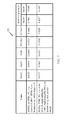
- FIG. 7 illustrates a table of example peak-to-average power ratio (PAPR) results for different packet types in accordance with certain aspects of the present disclosure.
- PAPR peak-to-average power ratio
- FIG. 8 illustrates example PAPR results for data in accordance with certain aspects of the present disclosure.
- FIGS. 9-11 illustrate example PAPR results for different Association Identifier (AID) sequences in the VHT-SIG field in accordance with certain aspects of the present disclosure.
- AID Association Identifier
- FIGS. 12A-12E illustrate example PAPR results for different AID sequences in the VHT-SIG field transmitted from a user station to an access point in accordance with certain aspects of the present disclosure.
- FIGS. 13A-13E illustrate example worst case PAPR results for different AID sequences in the VHT-SIG field in accordance with certain aspects of the present disclosure.
- FIGS. 14A-14B illustrate example PAPR results of VHT-SIGA1 and VHT-SIGA2 fields in accordance with certain aspects of the present disclosure.
- FIGS. 15A-15B illustrate example PAPR results of VHT-SIGA when most fields of the VHT-SIGA are zeros in accordance with certain aspects of the present disclosure.
- FIGS. 16A-16B illustrate example PAPR results of VHT-SIGB when most fields of the VHT-SIGB are zeros in accordance with certain aspects of the present disclosure.
- FIGS. 17A-17B illustrate example PAPR results of the VHT-SIG field when the VHT-SIG comprises all ones in accordance with certain aspects of the present disclosure.
- FIGS. 18A-18D illustrate example PAPR results of VHT-SIGA1 and VHT-SIGA2 fields in accordance with certain aspects of the present disclosure.
- FIGS. 19A-19B illustrate example PAPR results of VHT-SIGA1 and VHT-SIGA2 fields in accordance with certain aspects of the present disclosure for Single-User (SU) communication in accordance with certain aspects of the present disclosure.
- SU Single-User
- the techniques described herein may be used for various broadband wireless communication systems, including communication systems that are based on an orthogonal multiplexing scheme.
- Examples of such communication systems include Spatial Division Multiple Access (SDMA), Time Division Multiple Access (TDMA), Orthogonal Frequency Division Multiple Access (OFDMA) systems, Single-Carrier Frequency Division Multiple Access (SC-FDMA) systems, and so forth.
- SDMA Spatial Division Multiple Access
- TDMA Time Division Multiple Access
- OFDMA Orthogonal Frequency Division Multiple Access
- SC-FDMA Single-Carrier Frequency Division Multiple Access
- An SDMA system may utilize sufficiently different directions to simultaneously transmit data belonging to multiple user terminals.
- a TDMA system may allow multiple user terminals to share the same frequency channel by dividing the transmission signal into different time slots, each time slot being assigned to different user terminal.
- a TDMA system may implement GSM or some other standards known in the art.
- An OFDMA system utilizes orthogonal frequency division multiplexing (OFDM), which is a modulation technique that partitions the overall system bandwidth into multiple orthogonal sub-carriers. These sub-carriers may also be called tones, bins, etc. With OFDM, each sub-carrier may be independently modulated with data.
- An OFDM system may implement IEEE 802.11 or some other standards known in the art.
- An SC-FDMA system may utilize interleaved FDMA (IFDMA) to transmit on sub-carriers that are distributed across the system bandwidth, localized FDMA (LFDMA) to transmit on a block of adjacent sub-carriers, or enhanced FDMA (EFDMA) to transmit on multiple blocks of adjacent sub-carriers.
- IFDMA interleaved FDMA
- LFDMA localized FDMA
- EFDMA enhanced FDMA
- modulation symbols are sent in the frequency domain with OFDM and in the time domain with SC-FDMA.
- a SC-FDMA system may implement
- a node comprises a wireless node.
- Such wireless node may provide, for example, connectivity for or to a network (e.g., a wide area network such as the Internet or a cellular network) via a wired or wireless communication link.
- a wireless node implemented in accordance with the teachings herein may comprise an access point or an access terminal.
- An access point may comprise, be implemented as, or known as NodeB, Radio Network Controller (“RNC”), eNodeB, Base Station Controller (“BSC”), Base Transceiver Station (“BTS”), Base Station (“BS”), Transceiver Function (“TF”), Radio Router, Radio Transceiver, Basic Service Set (“BSS”), Extended Service Set (“ESS”), Radio Base Station (“RBS”), or some other terminology.
- RNC Radio Network Controller
- BSC Base Station Controller
- BTS Base Station
- TF Transceiver Function
- Radio Router Radio Transceiver
- BSS Basic Service Set
- ESS Extended Service Set
- RBS Radio Base Station
- an access point may comprise a set top box kiosk, a media center, or any other suitable device that is configured to communicate via a wireless or wired medium.
- the access point may operate in accordance with the Institute of Electrical and Electronics Engineers (IEEE)802.11 family of wireless communications standards.
- IEEE Institute of Electrical and Electronics Engineers
- An access terminal may comprise, be implemented as, or known as an access terminal, a subscriber station, a subscriber unit, a mobile station, a remote station, a remote terminal, a user terminal, a user agent, a user device, user equipment, a user station, or some other terminology.
- an access terminal may comprise a cellular telephone, a cordless telephone, a Session Initiation Protocol (“SIP”) phone, a wireless local loop (“WLL”) station, a personal digital assistant (“PDA”), a handheld device having wireless connection capability, a Station (“STA”), or some other suitable processing device connected to a wireless modem.
- SIP Session Initiation Protocol
- WLL wireless local loop
- PDA personal digital assistant
- STA Station
- a phone e.g., a cellular phone or smart phone
- a computer e.g., a laptop
- a portable communication device e.g., a portable computing device (e.g., a personal data assistant), a tablet
- an entertainment device e.g., a music or video device, or a satellite radio
- a television display e.g., a flip-cam, a security video camera, a digital video recorder (DVR), a global positioning system device, or any other suitable device that is configured to communicate via a wireless or wired medium.
- the access terminal may operate in accordance with the IEEE 802.11 family of wireless communications standards.
- the wireless network 100 is shown with several wireless nodes, generally designated as nodes 110 and 120 .
- Each wireless node is capable of receiving and/or transmitting.
- the term “receiving node” may be used to refer to a node that is receiving and the term “transmitting node” may be used to refer to a node that is transmitting. Such a reference does not imply that the node is incapable of performing both transmit and receive operations.
- an access point is used to designate a transmitting node and the term “access terminal” is used to designate a receiving node for downlink communications
- the term “access point” is used to designate a receiving node
- the term “access terminal” is used to designate a transmitting node for uplink communications.
- an access point may be referred to as a base station, a base transceiver station, a station, a terminal, a node, an access terminal acting as an access point, or some other suitable terminology.
- An access terminal may be referred to as a user terminal, a mobile station, a subscriber station, a station, a wireless device, a terminal, a node or some other suitable terminology.
- a user terminal a mobile station, a subscriber station, a station, a wireless device, a terminal, a node or some other suitable terminology.
- the various concepts described throughout this disclosure are intended to apply to all suitable wireless nodes regardless of their specific nomenclature.
- the wireless network 100 may support any number of access points distributed throughout a geographic region to provide coverage for access terminals 120 .
- a system controller 130 may be used to provide coordination and control of the access points, as well as access to other networks (e.g., Internet) for the access terminals 120 .
- one access point 110 is shown.
- An access point is generally a fixed terminal that provides backhaul services to access terminals in the geographic region of coverage; however, the access point may be mobile in some applications.
- An access terminal which may be fixed or mobile, utilizes the backhaul services of an access point or engages in peer-to-peer communications with other access terminals.
- access terminals include a telephone (e.g., cellular telephone), a laptop computer, a desktop computer, a Personal Digital Assistant (PDA), a digital audio player (e.g., MP3 player), a camera, a game console or any other suitable wireless node.
- a telephone e.g., cellular telephone
- laptop computer e.g., a laptop computer
- desktop computer e.g., a desktop computer
- PDA Personal Digital Assistant
- digital audio player e.g., MP3 player
- camera e.g., a game console or any other suitable wireless node.
- One or more access terminals 120 may be equipped with multiple antennas to enable certain functionality. With this configuration, multiple antennas at the access point 110 may be used to communicate with a multiple antenna access terminal to improve data throughput without additional bandwidth or transmit power. This may be achieved by splitting a high data rate signal at the transmitter into multiple lower rate data streams with different spatial signatures, thus enabling the receiver to separate these streams into multiple channels and properly combine the streams to recover the high rate data signal.
- the access point 110 may also be configured to support access terminals that do not support MIMO technology.
- This approach may allow older versions of access terminals (i.e., “legacy” terminals) to remain deployed in a wireless network, extending their useful lifetime, while allowing newer MIMO access terminals to be introduced as appropriate.
- OFDM Orthogonal Frequency Division Multiplexing
- CDMA Code Division Multiple Access
- TDMA Time Division Multiple Access
- suitable wireless technologies include, by way of example, Code Division Multiple Access (CDMA), Time Division Multiple Access (TDMA), or any other suitable wireless technology, or any combination of suitable wireless technologies.
- a CDMA system may implement with IS-2000, IS-95, IS-856, Wideband-CDMA (WCDMA) or some other suitable air interface standard.
- WCDMA Wideband-CDMA
- a TDMA system may implement Global System for Mobile Communications (GSM) or some other suitable air interface standard.
- GSM Global System for Mobile Communications
- a training sequence may be constructed at the access point 110 .
- the construction of training sequence may provide a desired level of peak-to-average power ratio (PAPR) when the training sequence is being transmitted within a preamble of a frame to user terminals 120 .
- PAPR peak-to-average power ratio
- a training sequence may be constructed at the user terminal 120 such that the PAPR of training sequence transmitted within a preamble to the access point 110 may be at a desired level.
- FIG. 2 illustrates a conceptual block diagram illustrating an example of the signal processing functions of the Physical (PHY) layer.
- a TX data processor 202 may be used to receive data from the Media Access Control (MAC) layer and encode (e.g., Turbo code) the data to facilitate forward error correction (FEC) at the receiving node.
- the encoding process results in a sequence of code symbols that that may be blocked together and mapped to a signal constellation by the TX data processor 202 to produce a sequence of modulation symbols.
- MAC Media Access Control
- FEC forward error correction
- the modulation symbols from the TX data processor 202 may be provided to an OFDM modulator 204 .
- the OFDM modulator splits the modulation symbols into parallel streams. Each stream is then mapped to an OFDM subcarrier and then combined together using an Inverse Fast Fourier Transform (IFFT) to produce a time domain OFDM stream.
- IFFT Inverse Fast Fourier Transform
- a TX spatial processor 206 performs spatial processing on the OFDM stream. This may be accomplished by spatially precoding each OFDM and then providing each spatially precoded stream to a different antenna 208 via a transceiver 206 . Each transmitter 206 modulates an RF carrier with a respective precoded stream for transmission over the wireless channel.
- each transceiver 206 receives a signal through its respective antenna 208 .
- Each transceiver 206 may be used to recover the information modulated onto an RF carrier and provide the information to a RX spatial processor 210 .
- the RX spatial processor 210 performs spatial processing on the information to recover any spatial streams destined for the wireless node 200 .
- the spatial processing may be performed in accordance with Channel Correlation Matrix Inversion (CCMI), Minimum Mean Square Error (MMSE), Soft Interference Cancellation (SIC) or some other suitable technique. If multiple spatial streams are destined for the wireless node 200 , they may be combined by the RX spatial processor 210 .
- CCMI Channel Correlation Matrix Inversion
- MMSE Minimum Mean Square Error
- SIC Soft Interference Cancellation
- the stream (or combined stream) from the RX spatial processor 210 is provided to an OFDM demodulator 212 .
- the OFDM demodulator 212 converts the stream (or combined stream) from time-domain to the frequency domain using a Fast Fourier Transform (FFT).
- the frequency domain signal comprises a separate stream for each subcarrier of the OFDM signal.
- the OFDM demodulator 212 recovers the data (i.e., modulation symbols) carried on each subcarrier and multiplexes the data into a stream of modulation symbols.
- a RX data processor 214 may be used to translate the modulation symbols back to the correct point in the signal constellation. Because of noise and other disturbances in the wireless channel, the modulation symbols may not correspond to an exact location of a point in the original signal constellation. The RX data processor 214 detects which modulation symbol was most likely transmitted by finding the smallest distance between the received point and the location of a valid symbol in the signal constellation. These soft decisions may be used, in the case of Turbo codes, for example, to compute a Log-Likelihood Ratio (LLR) of the code symbols associated with the given modulation symbols. The RX data processor 214 then uses the sequence of code symbol LLRs in order to decode the data that was originally transmitted before providing the data to the MAC layer.
- LLR Log-Likelihood Ratio
- the TX data processor 202 of the wireless node 200 may be configured to construct a training sequence.
- the construction of training sequence may be such that to provide a desired level of PAPR when the training sequence is being transmitted within a preamble of a frame to other wireless nodes (not shown in FIG. 2 ).
- FIG. 3 illustrates a conceptual diagram illustrating an example of a hardware configuration for a processing system in a wireless node.
- the processing system 300 may be implemented with a bus architecture represented generally by bus 302 .
- the bus 302 may include any number of interconnecting buses and bridges depending on the specific application of the processing system 300 and the overall design constraints.
- the bus links together various circuits including a processor 304 , machine-readable media 306 and a bus interface 308 .
- the bus interface 308 may be used to connect a network adapter 310 , among other things, to the processing system 300 via the bus 302 .
- the network adapter 310 may be used to implement the signal processing functions of the PHY layer. In the case of an access terminal 110 (see FIG.
- a user interface 312 (e.g., keypad, display, mouse, joystick, etc.) may also be connected to the bus.
- the bus 302 may also link various other circuits such as timing sources, peripherals, voltage regulators, power management circuits, and the like, which are well known in the art, and therefore, will not be described any further.
- the processor 304 is responsible for managing the bus and general processing, including the execution of software stored on the machine-readable media 306 .
- the processor 304 may be implemented with one or more general-purpose and/or special-purpose processors. Examples include microprocessors, microcontrollers, DSP processors and other circuitry that can execute software.
- Software shall be construed broadly to mean instructions, data or any combination thereof, whether referred to as software, firmware, middleware, microcode, hardware description language, or otherwise.
- Machine-readable media may include, by way of example, RAM (Random Access Memory), flash memory, ROM (Read Only Memory), PROM (Programmable Read-Only Memory), EPROM (Erasable Programmable Read-Only Memory), EEPROM (Electrically Erasable Programmable Read-Only Memory), registers, magnetic disks, optical disks, hard drives, or any other suitable storage medium, or any combination thereof.
- RAM Random Access Memory
- ROM Read Only Memory
- PROM Programmable Read-Only Memory
- EPROM Erasable Programmable Read-Only Memory
- EEPROM Electrically Erasable Programmable Read-Only Memory
- registers magnetic disks, optical disks, hard drives, or any other suitable storage medium, or any combination thereof.
- the machine-readable media may be embodied in a computer-program product.
- the computer-program product may comprise packaging materials.
- the machine-readable media 306 is shown as part of the processing system 300 separate from the processor 304 .
- the machine-readable media 306 may be external to the processing system 300 .
- the machine-readable media 306 may include a transmission line, a carrier wave modulated by data, and/or a computer product separate from the wireless node, all which may be accessed by the processor 304 through the bus interface 308 .
- the machine readable media 306 may be integrated into the processor 304 , such as the case may be with cache and/or general register files.
- the processing system 300 may be configured as a general-purpose processing system with one or more microprocessors providing the processor functionality and external memory providing at least a portion of the machine-readable media 306 , all linked together with other supporting circuitry through an external bus architecture.
- the processing system 300 may be implemented with an ASIC (Application Specific Integrated Circuit) with the processor 304 , the bus interface 308 , the user interface 312 in the case of an access terminal), supporting circuitry (not shown), and at least a portion of the machine-readable media 306 integrated into a single chip, or with one or more FPGAs (Field Programmable Gate Array), PLDs (Programmable Logic Device), controllers, state machines, gated logic, discrete hardware components, or any other suitable circuitry, or any combination of circuits that can perform the various functionality described throughout this disclosure.
- FPGAs Field Programmable Gate Array
- PLDs Programmable Logic Device
- controllers state machines, gated logic, discrete hardware components, or any other suitable circuitry, or any combination of circuit
- the wireless network 100 from FIG. 1 may represent the IEEE 802.11 Wide Local Area Network (WLAN) utilizing the very high throughput (VHT) protocol for signal transmissions with a carrier frequency of 5 GHz (i.e., IEEE 802.11ac) or with a carrier frequency of 60 GHz (i.e., IEEE 802.11ad) targeting aggregate throughputs larger than 1 Gigabits per second.
- VHT 5 GHz specification may utilize a wider channel bandwidth, which may comprise two 40 MHz channels to achieve 80 MHz bandwidth therefore doubling the PHY data rate with negligible increase in cost compared to IEEE 802.11n.
- Certain aspects of the present disclosure support constructing a training sequence within a preamble for the VHT-based transmissions that may provide a lower peak-to-average power ratio (PAPR) than the training sequences utilized in the art.
- the training sequence may be constructed by the processor 304 of the processing system 300 from FIG. 3 .
- VHT-SIG Very High Throughput Signal
- a preamble may comprise different types of VHT-SIG fields, which may be contained in different portions of a preamble.
- a preamble may comprise a VHT-SIGA field (Very High Throughput Signal field type A) in a “legacy” portion of a preamble (e.g., in accordance with one or more earlier versions of a standard) and a VHT-SIGB field (Very High Throughput Signal field type B) in a “non-legacy” portion of a preamble (e.g., that may be precoded in accordance with one or more later versions of a standard).
- VHT-SIGA field Very High Throughput Signal field type A
- VHT-SIGB field Very High Throughput Signal field type B
- a SIGA1 sub-field of the VHT-SIGA field may comprise almost all “zeros” for a practical packet (as illustrated in FIG. 6 ).
- the encoded bit stream may comprise mostly zeros. In some cases, this may result in high level of Peak-to-average power ratio (PAPR).
- PAPR Peak-to-average power ratio
- portions of the VHT-SIG field may be scrambled in a manner that may help reduce PAPR.
- FIG. 4 illustrates example operations 400 for constructing and transmitting a VHT-SIG field of a preamble in accordance with certain aspects of the present disclosure.
- the operations may be performed, for example, at any transmitting device. According to certain aspects, the operations may be performed when an expected PAPR of transmitting the VHT-SIG field is above a certain threshold.
- the operations 400 begin, at 402 , by constructing a VHT-SIG field.
- one or more bits of the VHT-SIG field may be scrambled.
- the VHT-SIG field with one or more scrambled bits may be transmitted over a wireless channel.
- FIG. 5 illustrates example operations 500 for receiving and processing a VHT-SIG field of a preamble in accordance with certain aspects of the present disclosure.
- the operations may be performed, for example, at any device receiving a VHT-SIG field transmitted in accordance with the operations 400 described above.
- the operations 500 begin, at 502 , by receiving, over a wireless channel, a transmission containing a VHT-SIG field with one or more bits altered via scrambling prior to transmission.
- the one or more scrambled bits of the VHT-SIG field may be de-scrambled.
- FIG. 6 illustrates example VHT-SIG field values in accordance with certain aspects of the present disclosure. As illustrated, a majority of the bits may have a zero value. However, transmitting an encoded bit stream with almost all zeros may result into a high level of PAPR.
- FIG. 7 illustrates a table of example PAPR results for different packet types in accordance with certain aspects of the present disclosure. As illustrated, the PAPR results are provided for two cases: the case 702 when all sub-fields in the SIG fields have zero values, and the Case 704 with ones in many places of the SIG fields while still forming a meaningful packet. As illustrated, PAPR may be reduced by scrambling one or more bits of SIG fields.
- Scrambling of one or more bits in a VHT-SIG field may help reduce PAPR and may be performed in various manners.
- the scrambling may involve reversing one or more bits in some fields (e.g., zeros become ones).
- a scrambling algorithm in accordance with IEEE 802.11 family of wireless communications standards based on a known seed may be utilized.
- a scrambling algorithm may utilize a new (e.g., short) variable seed.
- the scrambling may involve re-locating one or more reserved bits in an effort to lower PAPR.
- the scrambling may involve inverting one or more (or all) bits in one or more fields of a VHT-SIGA.
- the scrambling may also involve scrambling (e.g., with an 802.11a scrambling algorithm) of a VHT-SIGB field.
- An error check field e.g., a Cyclic Redundancy Check (CRC)
- CRC Cyclic Redundancy Check
- FIG. 8 illustrates examples 802 and 804 for PAPR of transmission data in accordance with certain aspects of the present disclosure.
- a value of Association Identifier (AID) subfield of the VHT-SIGA field may be set to one of a plurality of special values. It should be noted that a Group ID subfield within the VHT-SIGA field may have a binary value equal to ‘111111’ since all STA-to-AP transmissions represent single user (SU) transmissions. Certain aspects of the present disclosure propose selecting AID values for STA-to-AP transmissions such that VHT-SIGA PAPR statistics has preferred values.
- Every AID value may result in a set of PAPR values for a combination of various bandwidths (BW), space-time block codes (STBC) and a number of space-time streams (N STS ).
- the AID value may be chosen in an effort to reduce at least one of: a largest value among a plurality of values for PAPR of the transmitted VHT-SIGA field (i.e., to reduce the worst case PAPR), an average value of the plurality of values for PAPR of the transmitted VHT-SIG field (i.e., to reduce the mean PAPR), or to reduce a sum of the largest value and the average value.
- the effort to reduce the at least one of the largest PAPR value, the average PAPR value or the sum may comprise an effort to minimize the at least one of the largest PAPR value, the average PAPR value or the sum.
- the worst case PAPR may be as high as 18 dB.
- the worst case PAPR may be reduced below 10.5 dB.
- the following 9-bit AID sequences (least significant bit (LSB) is the one being first from the left) may result in at least one of: a lowest value for the maximum PAPR, a lowest value for the average PAPR, or a lowest value for a sum of the maximum PAPR and the average PAPR.
- LSB least significant bit
- IFFT Inverse Fast Fourier Transform
- the AID value of ‘000011010’ may result in a lowest maximum (worst case) PAPR for the transmitted VHT-SIGA1 field. It should be noted that AID decimal values of 176, 688, 1200 and 1712 may be marked/reserved for STA-to-AP packets. In this aspect, the worst case PAPR for the transmitted VHT-SIGA1 field may be equal to 10.4334 dB.
- the AID value of ‘100100010’ (i.e., decimal value of 137) may result in a lowest average PAPR for the transmitted VHT-SIGA1 field. It should be noted that AID decimal values of 137, 649, 1161 and 1673 may be marked/reserved for STA-to-AP packets. In this aspect, the average PAPR for the transmitted VHT-SIGA1 field may be equal to 8.3487 dB.
- the AID value of ‘000011010’ (i.e., decimal value of 176) may result in a lowest value for a sum of the maximum PAPR and the average PAPR for the transmitted VHT-SIGA1 field. It should be noted that AID decimal values of 176, 688, 1200 and 1712 may be marked/reserved for STA-to-AP packets.
- the worst case PAPR for the transmitted VHT-SIGA1 field may be equal to 18.8869 dB. It can be observed that minimizing the worst case PAPR and minimizing the sum of the maximum PAPR and the average PAPR may result in the same AID sequences. This may be because the maximum PAPR may fluctuate faster and with a larger range than the average PAPR.
- Certain aspects of the present disclosure support AID value selection for Multiple Basic Service Sets (M-BSS) with Power Save (PS) feature.
- M-BSS Multiple Basic Service Sets
- PS Power Save
- a different BSS may utilize a different AID sequence.
- five or more preferred AID sequences may be chosen in an effort to reduce at least one of the maximum (worst case) PAPR, the average PAPR, or the sum of maximum (worst case) PAPR and the average PAPR.
- the effort to reduce the at least one of the maximum PAPR, the average PAPR or the sum may comprise an effort to minimize the at least one of the maximum PAPR, the average PAPR or the sum.
- FIG. 9 illustrates an example 900 of values for AID subfield of the VHT-SIGA field of the preamble in accordance with certain aspects of the present disclosure.
- the AID sequences given in FIG. 9 may be selected for M-BSS with PS to reduce or minimize a worst case PAPR of the transmitted VHT-SIGA field.
- the best 16 AID sequences listed in FIG. 9 may allow fast identification of 16 different access points (APs).
- APs access points
- Four times oversampled IFFT may be applied before transmitting the VHT-SIGA1 field with one of the listed AID sequences within the preamble of STA-to-AP transmission packet.
- the third column in FIG. 9 lists all decimal AID values comprising the 9 LSBs in the second column.
- FIG. 10 illustrates an example 1000 of values for AID subfield of the VHT-SIGA field in accordance with certain aspects of the present disclosure.
- the AID sequences given in FIG. 10 may be selected for M-BSS with PS to reduce or minimize an average PAPR of the transmitted VHT-SIGA field.
- Four times oversampled IFFT may be applied before transmitting the VHT-SIGA1 field with one of the listed AID sequences within the preamble of STA-to-AP transmission packet.
- the third column in FIG. 10 lists all decimal AID values comprising the 9 LSBs in the second column.
- FIG. 11 illustrates an example 1100 of values for AID subfield of the VHT-SIGA field in accordance with certain aspects of the present disclosure.
- the AID sequences given in FIG. 11 may be selected for M-BSS with PS to reduce or minimize a sum of the maximum PAPR and the average PAPR of the transmitted VHT-SIGA field.
- Four times oversampled IFFT may be applied before transmitting the VHT-SIGA1 field with one of the listed AID sequences within the preamble of STA-to-AP transmission packet.
- the third column in FIG. 11 lists all decimal AID values comprising the 9 LSBs in the second column.
- FIGS. 12A-12E illustrate examples of values for AID subfield of the VHT-SIGA1 field of the preamble that may be transmitted from a STA to an AP in accordance with certain aspects of the present disclosure.
- the AID sequences given in FIGS. 12A-12E may be determined in an effort to reduce or minimize a worst case PAPR of the transmitted VHT-SIGA1 field.
- Four times oversampled IFFT may be applied before transmitting the VHT-SIGA1 field with one of the listed AID sequences within the preamble of STA-to-AP transmission packet.
- the third columns in FIGS. 12A-12E list all decimal AID values comprising the 9 LSBs in the corresponding second columns.
- the AID selection results illustrated in FIG. 12A may be obtained for the case when reserved bits in VHT-SIGA1 field comprises all 1s.
- the AID selection results illustrated in FIG. 12B may be obtained for the case when the reserved bits comprises all 0s.
- the AID selection results illustrated in FIG. 12C may be obtained for the case when the reserved bits are all random.
- the AID selection results illustrated in FIG. 12D may be obtained for the case when last two reserved bits in VHT-SIGA1 field comprise all 0s.
- the AID selection results illustrated in FIG. 12E may be obtained for the case when all reserved bits in VHT-SIGA1 field comprises all 1s, while Group ID subfield may be equal to zero.
- Avoiding worst case PAPR and reducing (or minimizing) worst case PAPR can be as important for station-to-access point (STA-to-AP) transmissions as for AP-to-STA transmissions.
- Certain aspects of the present disclosure support choosing an AID value associated with an access point (AP) in the same way as choosing an AID value associated with a station (STA).
- the AP may assign itself a random AID value from the same range as the AIDs selected for its associated STAs.
- the range of AID values may be determined as previously described for the STA side.
- the range of AID values may be received at the AP from its associated STA.
- the AID of the AP may be signaled in at least one of: a Beacon frame, a Probe Response frame, or an Association Response frame.
- FIGS. 13A-13E illustrate examples of values for AID subfield of the VHT-SIGA1 field of a packet that may be transmitted from an AP to a STA and/or from a STA to an AP in accordance with certain aspects of the present disclosure.
- the AID sequences given in FIGS. 13A-13E may result in the highest maximum PAPR of the transmitted VHT-SIGA1 field. Therefore, the AID values listed in FIGS. 13A-13E may need to be avoided for AP-to-STA transmissions and/or STA-to-AP transmissions.
- four times oversampled IFFT may be applied before transmitting the VHT-SIGA1 field.
- the third columns in FIGS. 13A-13E list all decimal AID values comprising the 9 LSBs in the corresponding second columns.
- the AID sequences illustrated in FIG. 13A may be obtained for the case when reserved bits in VHT-SIGA1 field comprises all 1s.
- the AID sequences illustrated in FIG. 13B may be obtained for the case when the reserved bits comprises all 0s.
- the AID sequences illustrated in FIG. 13C may be obtained for the case when the reserved bits are all random.
- the AID sequences illustrated in FIG. 13D may be obtained for the case when last two reserved bits in VHT-SIGA1 field comprise all 0s.
- the AID sequences illustrated in FIG. 13E may be obtained for the case when all reserved bits in VHT-SIGA1 field comprises all 1s, while Group ID subfield may be equal to zero that may indicate Multi User (MU) transmission from an AP to STAs.
- MU Multi User
- information bits of at least one of VHT-SIG-A or VHT-SIG-B may be utilized for performing XOR operation with a “magic” sequence to minimize (or at least reduce) PAPR when transmitting the VHT-SIG.
- the “magic” sequence may be obtained by exhaustive search and identifying a sequence of bits with the lowest PAPR, while assuming all zeros in the at least one of VHT-SIG-A or VHT-SIG-B.
- the following 34-bit pattern may result in PAPR for VHT-SIGA1 of 3.0345 dB and PAPR for VHT-SIGA2 of 4.4206 dB: ⁇ 1,1,0,1,1,0,1,0,1,0,1,0,1,0,1,0,0,0,1,1,1,1,0,0,0,0,0,1,1,0,0,0,0,0,0,0,0,1,1,0 ⁇ .
- the following 20/21/23 bits sequences may result in the lowest PAPR when using four times oversampled inverse fast Fourier transform (IFFT).
- IFFT inverse fast Fourier transform
- the “magic” sequence may be ⁇ 0, 0,0,0,0,1,1,1,0,1,0,0,0,0,1,0,0,0,0,1,0 ⁇
- the PAPR may be equal to 3.16 dB.
- the “magic” sequence may be ⁇ 1,0,1,0,0,1,0,1,1,0,1,0,0,0,0,0,0,1,1 ⁇
- the PAPR may be equal to 5.42 dB.
- the “magic” sequence may be ⁇ 0,1,0,1,0,0,1,1,0,0,1,0,1,0,1,1,1,1,1,1,1,0,0,1,0 ⁇ , and the PAPR may be equal to 5.13 dB.
- FIG. 14A illustrates example PAPR results of VHT-SIGA1 in accordance with certain aspects of the present disclosure.
- FIG. 14B illustrates example PAPR results of VHT-SIGA2 in accordance with certain aspects of the present disclosure.
- FIGS. 15A-15B illustrate examples of PAPR results of VHT-SIGA when most fields of the VHT-SIGA are zeros in accordance with certain aspects of the present disclosure. It can be observed substantial improvement in PAPR when the “magic” sequence of bits is applied on the VHT-SIGA (e.g., PAPR results in column 1502 when the “magic” sequence is applied on VHT-SIGA2 versus PAPR results in column 1504 when the “magic” sequence is not applied).
- FIG. 16A illustrates example PAPR results of VHT-SIGB when most fields of the VHT-SIGB are zeros and wherein Multi-User (MU) communication is utilized in accordance with certain aspects of the present disclosure.
- MU Multi-User
- FIG. 16B illustrates example PAPR results of VHT-SIGB when most fields of the VHT-SIGB are zeros and wherein Single-User (SU) communication is used with 20 MHz bandwidth in accordance with certain aspects of the present disclosure. It can be observed substantial improvement in PAPR when the “magic” sequence is applied on the VHT-SIGB (e.g., PAPR results in column 1606 when the “magic” sequence is applied on VHT-SIGB versus PAPR results in column 1608 when the “magic” sequence is not applied). Reserved bits of the VHT-SIGB may be set to all 1 s and may not be used. In an aspect, in the case of SU communication, a receiver may not be required to decode the VHT-SIGB.
- SU Single-User
- FIG. 17A illustrate example PAPR results of the VHT-SIGA when the VHT-SIGA comprises all ones in accordance with certain aspects of the present disclosure. It can be observed substantial improvement in PAPR results when the “magic” sequence is applied on the VHT-SIGA1 (e.g., PAPR results in column 1702 when the “magic” sequence is applied on VHT-SIGA1 versus PAPR results in column 1704 when the “magic” sequence is not applied).
- PAPR results in column 1706 when the “magic” sequence is applied on VHT-SIGA2 versus PAPR results in column 1708 when the “magic” sequence is not applied.
- FIG. 17B illustrate example PAPR results of the VHT-SIGB when the VHT-SIGB comprises all ones in accordance with certain aspects of the present disclosure. It can be observed substantial improvement in PAPR when the “magic” sequence is applied on the VHT-SIGB, e.g., PAPR results in column 1710 when the “magic” sequence is applied on VHT-SIGB versus PAPR results in column 1712 when the “magic” sequence is not applied.
- a transmitter may be configured to choose two reserved bits in VHT-SIGA1.
- a receiver may be configured to decode the VHT-SIG field without utilizing these reserved bits.
- the transmitter may be able to reduce PAPR on packet-by-packet basis by choosing the optimal two reserved bits. For example, this may be achieved by using a look-up table.
- the optimization may be based on a location of the two reserved bits (e.g., an end of the VHT-SIGA1), and on minimizing the PAPR of VHT-SIGA1.
- FIGS. 18A-18D may be summarized as follows.
- VHT-SIGA1 has medium PAPR higher than BPSK data, and VHT-SIGA2 is worse than data.
- inverting the GID field may improve PAPR of VHT-SIG-A1.
- Changing the location of the reserved bits in VHT-SIGA1 may make PAPR worse.
- Changing the values of the reserved bits in VHT-SIGA1 may make PAPR worse.
- inverting SGI, coding, SU BF fields may not be substantially helpful to PAPR statistics. Changing the location/value of the reserved bit in VHT-SIGA2 may not make a substantial difference.
- VHT-SIGA1 may have medium PAPR higher than BPSK data, and VHT-SIGA2 may have PAPR worse than data.
- VHT-SIGA1 inverting GID may not make a substantial difference in PAPR statistics.
- VHT-SIGA2 changing the location of the reserved 6 bits in VHT-SIGA2 may make PAPR slightly worse.
- FIGS. 19A-19B illustrate example PAPR results of VHT-SIGA1 and VHT-SIGA2 fields respectively in accordance with certain aspects of the present disclosure for SU communication in accordance with certain aspects of the present disclosure. It can be assumed that AID may be all ones for uplink (UL) transmission, or AID may be equal to 1 or 3 (which may often happen in practice).
- CDF cumulative density function
- a transmitter side may be configured to perform scrambling of VHT-SIG field before transmission to minimize (or at least reduce) the PAPR of transmitted VHT-SIG field.
- the scrambling may comprise: scrambling all bits of the VHT-SIG field with one of a plurality of scrambling sequences (e.g., one of four scrambling sequences), and including an identifier (ID) of that scrambling sequence in RESERVED bits of the VHT-SIG field.
- the plurality of scrambling sequences may be determined in an effort to reduce PAPR of the transmitted VHT-SIG field, and that scrambling sequence may provide a smallest value for the PAPR among a plurality of values for the PAPR associated with the plurality of scrambling sequences.
- a receiver side may receive the VHT-SIG field with all bits scrambled prior to transmission of the VHT-SIG field using one of the plurality of scrambling sequences, wherein an ID of that scrambling sequence was included in RESERVED bits of the transmitted VHT-SIG field.
- the receiver may determine that scrambling sequence based on the ID, and perform de-scrambling of the VHT-SIG field according to that scrambling sequence.
- the various operations of methods described above may be performed by any suitable means capable of performing the corresponding functions.
- the means may include various hardware and/or software component(s) and/or module(s), including, but not limited to a circuit, an application specific integrate circuit (ASIC), or processor.
- ASIC application specific integrate circuit
- those operations may have corresponding counterpart means-plus-function components with similar numbering.
- operations 400 and 500 illustrated in FIGS. 4 and 5 may correspond to components 400 A and 500 A illustrated in FIGS. 4A and 5A .
- the means for constructing may comprise an application specific integrated circuit, e.g., the TX data processor 202 of the wireless node 200 from FIG. 2 , or the RX data processor 214 of the wireless node 200 , or the processor 304 of the processing system 300 from FIG. 3 .
- the means for scrambling may comprise an encoder, e.g., the TX data processor 202 , or the processor 304 .
- the means for transmitting may comprise a transmitter, e.g., the transceiver 206 of the wireless node 200 from FIG. 2 .
- the means for inverting may comprise an application specific integrated circuit, e.g., the TX data processor 202 , or the RX data processor 214 of the wireless node 200 , or the processor 304 .
- the means for computing may comprise an application specific integrated circuit, e.g., the TX data processor 202 o, or the RX data processor 214 , or the processor 304 .
- the means for inserting may comprise an application specific integrated circuit, e.g., the TX data processor 202 , or the RX data processor 214 , or the processor 304 .
- the means for re-locating may comprise an application specific integrated circuit, e.g., the TX data processor 202 , or the RX data processor 214 , or the processor 304 .
- the means for setting may comprise an application specific integrated circuit, e.g., the TX data processor 202 , or the RX data processor 214 , or the processor 304 .
- the means for determining may comprise an application specific integrated circuit, e.g., the TX data processor 202 , or the RX data processor 214 , or the processor 304 .
- the means for evaluating may comprise an application specific integrated circuit, e.g., the TX data processor 202 , or the RX data processor 214 , or the processor 304 .
- the means for identifying may comprise an application specific integrated circuit, e.g., the TX data processor 202 , or the RX data processor 214 , or the processor 304 .
- the means for receiving may comprise a receiver, e.g., the transceiver 206 of the wireless node 200 from FIG. 2 .
- the means for de-scrambling may comprise a decoder, e.g., the RX data processor 214 , or the processor 304 .
- the means for calculating may comprise an application specific integrated circuit, e.g., the TX data processor 202 , or the RX data processor 214 , or the processor 304 .
- the means for comparing may comprise an application specific integrated circuit, e.g., the TX data processor 202 , or the RX data processor 214 , or the processor 304 .
- the means for signaling may comprise a transmitter, e.g., the transceiver 206 of the wireless node 200 from FIG. 2 .
- the means for decoding may comprise a decoder, e.g., the RX data processor 214 , or the processor 304 .
- the means for identifying may comprise an application specific integrated circuit, e.g., the RX data processor 214 , or the processor 304 .
- determining encompasses a wide variety of actions. For example, “determining” may include calculating, computing, processing, deriving, investigating, looking up (e.g., looking up in a table, a database or another data structure), ascertaining and the like. Also, “determining” may include receiving (e.g., receiving information), accessing (e.g., accessing data in a memory) and the like. Also, “determining” may include resolving, selecting, choosing, establishing and the like.
- a phrase referring to “at least one of a list of items refers to any combination of those items, including single members.
- “at least one of: a, b, or c” is intended to cover: a, b, c, a-b, a-c, b-c, and a-b-c.
- DSP digital signal processor
- ASIC application specific integrated circuit
- FPGA field programmable gate array
- PLD programmable logic device
- a general-purpose processor may be a microprocessor, but in the alternative, the processor may be any commercially available processor, controller, microcontroller, or state machine.
- a processor may also be implemented as a combination of computing devices, e.g., a combination of a DSP and a microprocessor, a plurality of microprocessors, one or more microprocessors in conjunction with a DSP core, or any other such configuration.
- a software module may reside in any form of storage medium that is known in the art. Some examples of storage media that may be used include random access memory (RAM), read only memory (ROM), flash memory, EPROM memory, EEPROM memory, registers, a hard disk, a removable disk, a CD-ROM and so forth.
- RAM random access memory
- ROM read only memory
- flash memory EPROM memory
- EEPROM memory EEPROM memory
- registers a hard disk, a removable disk, a CD-ROM and so forth.
- a software module may comprise a single instruction, or many instructions, and may be distributed over several different code segments, among different programs, and across multiple storage media.
- a storage medium may be coupled to a processor such that the processor can read information from, and write information to, the storage medium. In the alternative, the storage medium may be integral to the processor.
- the methods disclosed herein comprise one or more steps or actions for achieving the described method.
- the method steps and/or actions may be interchanged with one another without departing from the scope of the claims.
- the order and/or use of specific steps and/or actions may be modified without departing from the scope of the claims.
- an example hardware configuration may comprise a processing system in a wireless node.
- the processing system may be implemented with a bus architecture.
- the bus may include any number of interconnecting buses and bridges depending on the specific application of the processing system and the overall design constraints.
- the bus may link together various circuits including a processor, machine-readable media, and a bus interface.
- the bus interface may be used to connect a network adapter, among other things, to the processing system via the bus.
- the network adapter may be used to implement the signal processing functions of the PHY layer.
- a user terminal 120 see FIG.
- a user interface e.g., keypad, display, mouse, joystick, etc.
- the bus may also link various other circuits such as timing sources, peripherals, voltage regulators, power management circuits, and the like, which are well known in the art, and therefore, will not be described any further.
- the processor may be responsible for managing the bus and general processing, including the execution of software stored on the machine-readable media.
- the processor may be implemented with one or more general-purpose and/or special-purpose processors. Examples include microprocessors, microcontrollers, DSP processors, and other circuitry that can execute software.
- Software shall be construed broadly to mean instructions, data, or any combination thereof, whether referred to as software, firmware, middleware, microcode, hardware description language, or otherwise.
- Machine-readable media may include, by way of example, RAM (Random Access Memory), flash memory, ROM (Read Only Memory), PROM (Programmable Read-Only Memory), EPROM (Erasable Programmable Read-Only Memory), EEPROM (Electrically Erasable Programmable Read-Only Memory), registers, magnetic disks, optical disks, hard drives, or any other suitable storage medium, or any combination thereof.
- RAM Random Access Memory
- ROM Read Only Memory
- PROM Programmable Read-Only Memory
- EPROM Erasable Programmable Read-Only Memory
- EEPROM Electrically Erasable Programmable Read-Only Memory
- registers magnetic disks, optical disks, hard drives, or any other suitable storage medium, or any combination thereof.
- the machine-readable media may be embodied in a computer-program product.
- the computer-program product may comprise packaging materials.
- the machine-readable media may be part of the processing system separate from the processor.
- the machine-readable media, or any portion thereof may be external to the processing system.
- the machine-readable media may include a transmission line, a carrier wave modulated by data, and/or a computer product separate from the wireless node, all which may be accessed by the processor through the bus interface.
- the machine-readable media, or any portion thereof may be integrated into the processor, such as the case may be with cache and/or general register files.
- the processing system may be configured as a general-purpose processing system with one or more microprocessors providing the processor functionality and external memory providing at least a portion of the machine-readable media, all linked together with other supporting circuitry through an external bus architecture.
- the processing system may be implemented with an ASIC (Application Specific Integrated Circuit) with the processor, the bus interface, the user interface in the case of an access terminal), supporting circuitry, and at least a portion of the machine-readable media integrated into a single chip, or with one or more FPGAs (Field Programmable Gate Arrays), PLDs (Programmable Logic Devices), controllers, state machines, gated logic, discrete hardware components, or any other suitable circuitry, or any combination of circuits that can perform the various functionality described throughout this disclosure.
- FPGAs Field Programmable Gate Arrays
- PLDs Programmable Logic Devices
- controllers state machines, gated logic, discrete hardware components, or any other suitable circuitry, or any combination of circuits that can perform the various functionality described throughout this disclosure.
- the machine-readable media may comprise a number of software modules.
- the software modules include instructions that, when executed by the processor, cause the processing system to perform various functions.
- the software modules may include a transmission module and a receiving module.
- Each software module may reside in a single storage device or be distributed across multiple storage devices.
- a software module may be loaded into RAM from a hard drive when a triggering event occurs.
- the processor may load some of the instructions into cache to increase access speed.
- One or more cache lines may then be loaded into a general register file for execution by the processor.
- Computer-readable media include both computer storage media and communication media including any medium that facilitates transfer of a computer program from one place to another.
- a storage medium may be any available medium that can be accessed by a computer.
- such computer-readable media can comprise RAM, ROM, EEPROM, CD-ROM or other optical disk storage, magnetic disk storage or other magnetic storage devices, or any other medium that can be used to carry or store desired program code in the form of instructions or data structures and that can be accessed by a computer.
- any connection is properly termed a computer-readable medium.
- Disk and disc include compact disc (CD), laser disc, optical disc, digital versatile disc (DVD), floppy disk, and Blu-ray® disc where disks usually reproduce data magnetically, while discs reproduce data optically with lasers.
- computer-readable media may comprise non-transitory computer-readable media (e.g., tangible media).
- computer-readable media may comprise transitory computer-readable media (e.g., a signal). Combinations of the above should also be included within the scope of computer-readable media.
- certain aspects may comprise a computer program product for performing the operations presented herein.
- a computer program product may comprise a computer-readable medium having instructions stored (and/or encoded) thereon, the instructions being executable by one or more processors to perform the operations described herein.
- the computer program product may include packaging material.
- modules and/or other appropriate means for performing the methods and techniques described herein can be downloaded and/or otherwise obtained by a user terminal and/or base station as applicable.
- a user terminal and/or base station can be coupled to a server to facilitate the transfer of means for performing the methods described herein.
- various methods described herein can be provided via storage means (e.g., RAM, ROM, a physical storage medium such as a compact disc (CD) or floppy disk, etc.), such that a user terminal and/or base station can obtain the various methods upon coupling or providing the storage means to the device.
- storage means e.g., RAM, ROM, a physical storage medium such as a compact disc (CD) or floppy disk, etc.
- CD compact disc
- floppy disk etc.
- any other suitable technique for providing the methods and techniques described herein to a device can be utilized.
Landscapes
- Engineering & Computer Science (AREA)
- Computer Networks & Wireless Communication (AREA)
- Signal Processing (AREA)
- Mobile Radio Communication Systems (AREA)
- Transmitters (AREA)
- Radio Transmission System (AREA)
Priority Applications (20)
| Application Number | Priority Date | Filing Date | Title |
|---|---|---|---|
| US13/206,343 US9054929B2 (en) | 2010-08-11 | 2011-08-09 | Constructing very high throughput signal (VHT-SIG) fields for reduced peak-to-average power ratio (PAPR) |
| EP11752372.0A EP2604010A1 (de) | 2010-08-11 | 2011-08-10 | Konstruktion von vht-sig-feldern für verringertes verhältnis der spitzen- zur mittelleistung |
| JP2013524205A JP2013539629A (ja) | 2010-08-11 | 2011-08-10 | 低減されたピーク対平均電力比(papr)のための超高速スループット信号(vht−sig)フィールド構築 |
| KR1020137006192A KR101488275B1 (ko) | 2010-08-11 | 2011-08-10 | 감소된 피크―대―평균 전력비(papr)를 위해 초고 스루풋 신호(vht―sig) 필드들을 구성 |
| CN201611018056.5A CN106899535A (zh) | 2010-08-11 | 2011-08-10 | 构建用于降低峰均功率比(papr)的极高吞吐量信号(vht‑sig)字段 |
| EP14177026.3A EP2800326A3 (de) | 2010-08-11 | 2011-08-10 | Konstruktion von Feldern von Signalen mit sehr hohem Durchsatz (VHT-SIG) für verringertes Verhältnis der Spitzen- zur Mittelleistung (PAPR) |
| PCT/US2011/047256 WO2012021624A1 (en) | 2010-08-11 | 2011-08-10 | Constructing very high throughput signal (vht-sig) fields for reduced peak-to-average power ratio (papr) |
| PH1/2013/500138A PH12013500138A1 (en) | 2010-08-11 | 2011-08-10 | Constructing very high throughput signal (vht-sig) fields for reduced peak-to-average power ratio (papr) |
| RU2013110050/08A RU2533309C2 (ru) | 2010-08-11 | 2011-08-10 | Построение полей сигнала с очень высокой пропускной способностью (vht-sig) для уменьшенного отношения пиковой к средней мощности (papr) |
| RU2014133710/08A RU2582545C1 (ru) | 2010-08-11 | 2011-08-10 | Построение полей сигнала с очень высокой пропускной способностью (vht-sig) для уменьшенного отношения пиковой к средней мощности (papr) |
| CA2806235A CA2806235C (en) | 2010-08-11 | 2011-08-10 | Constructing very high throughput signal (vht-sig) fields for reduced peak-to-average power ratio (papr) |
| CN201180039030.8A CN103069762B (zh) | 2010-08-11 | 2011-08-10 | 构建用于降低峰均功率比(papr)的极高吞吐量信号(vht-sig)字段 |
| EP15183103.9A EP2985965A1 (de) | 2010-08-11 | 2011-08-10 | Konstruktion von vht-sig-feldern für verringertes verhältnis der spitzen- zur mittelleistung |
| BR112013003108A BR112013003108A2 (pt) | 2010-08-11 | 2011-08-10 | Construção de campos de sinal com capacidade de transmissão muito alta (vht-sig) para razão de potência de pico para média reduzida. |
| IL224405A IL224405A (en) | 2010-08-11 | 2013-01-24 | Construction of very high output signal fields (vht-sig) for reduced peak-to-average power ratio (papr) |
| JP2015084355A JP2015173460A (ja) | 2010-08-11 | 2015-04-16 | 低減されたピーク対平均電力比(papr)のための超高速スループット信号(vht−sig)フィールド構築 |
| US14/734,614 US20150271000A1 (en) | 2010-08-11 | 2015-06-09 | Constructing very high throughput signal (vht-sig) fields for reduced peak-to-average power ratio (papr) |
| RU2016106324A RU2016106324A (ru) | 2010-08-11 | 2016-02-25 | Построение полей сигнала с очень высокой пропускной способностью (vht-sig) для уменьшенного отношения пиковой к средней мощности (papr) |
| PH12016500740A PH12016500740A1 (en) | 2010-08-11 | 2016-04-20 | Constructing very high throughput signal (vht-sig) fields for reduced peak-to-average power ratio (papr) |
| JP2016141218A JP6325029B2 (ja) | 2010-08-11 | 2016-07-19 | 低減されたピーク対平均電力比(papr)のための超高速スループット信号(vht−sig)フィールド構築 |
Applications Claiming Priority (6)
| Application Number | Priority Date | Filing Date | Title |
|---|---|---|---|
| US37279010P | 2010-08-11 | 2010-08-11 | |
| US38539010P | 2010-09-22 | 2010-09-22 | |
| US39054310P | 2010-10-06 | 2010-10-06 | |
| US40690310P | 2010-10-26 | 2010-10-26 | |
| US41965210P | 2010-12-03 | 2010-12-03 | |
| US13/206,343 US9054929B2 (en) | 2010-08-11 | 2011-08-09 | Constructing very high throughput signal (VHT-SIG) fields for reduced peak-to-average power ratio (PAPR) |
Related Child Applications (1)
| Application Number | Title | Priority Date | Filing Date |
|---|---|---|---|
| US14/734,614 Continuation US20150271000A1 (en) | 2010-08-11 | 2015-06-09 | Constructing very high throughput signal (vht-sig) fields for reduced peak-to-average power ratio (papr) |
Publications (2)
| Publication Number | Publication Date |
|---|---|
| US20120039198A1 US20120039198A1 (en) | 2012-02-16 |
| US9054929B2 true US9054929B2 (en) | 2015-06-09 |
Family
ID=45564760
Family Applications (2)
| Application Number | Title | Priority Date | Filing Date |
|---|---|---|---|
| US13/206,343 Expired - Fee Related US9054929B2 (en) | 2010-08-11 | 2011-08-09 | Constructing very high throughput signal (VHT-SIG) fields for reduced peak-to-average power ratio (PAPR) |
| US14/734,614 Abandoned US20150271000A1 (en) | 2010-08-11 | 2015-06-09 | Constructing very high throughput signal (vht-sig) fields for reduced peak-to-average power ratio (papr) |
Family Applications After (1)
| Application Number | Title | Priority Date | Filing Date |
|---|---|---|---|
| US14/734,614 Abandoned US20150271000A1 (en) | 2010-08-11 | 2015-06-09 | Constructing very high throughput signal (vht-sig) fields for reduced peak-to-average power ratio (papr) |
Country Status (11)
| Country | Link |
|---|---|
| US (2) | US9054929B2 (de) |
| EP (3) | EP2985965A1 (de) |
| JP (3) | JP2013539629A (de) |
| KR (1) | KR101488275B1 (de) |
| CN (2) | CN103069762B (de) |
| BR (1) | BR112013003108A2 (de) |
| CA (1) | CA2806235C (de) |
| IL (1) | IL224405A (de) |
| PH (2) | PH12013500138A1 (de) |
| RU (3) | RU2582545C1 (de) |
| WO (1) | WO2012021624A1 (de) |
Cited By (1)
| Publication number | Priority date | Publication date | Assignee | Title |
|---|---|---|---|---|
| US10129069B2 (en) * | 2014-02-14 | 2018-11-13 | Huawei Technologies Co., Ltd. | Data transmission method and apparatus |
Families Citing this family (31)
| Publication number | Priority date | Publication date | Assignee | Title |
|---|---|---|---|---|
| US10931338B2 (en) | 2001-04-26 | 2021-02-23 | Genghiscomm Holdings, LLC | Coordinated multipoint systems |
| US10644916B1 (en) | 2002-05-14 | 2020-05-05 | Genghiscomm Holdings, LLC | Spreading and precoding in OFDM |
| US11431386B1 (en) | 2004-08-02 | 2022-08-30 | Genghiscomm Holdings, LLC | Transmit pre-coding |
| US8824441B2 (en) * | 2011-05-12 | 2014-09-02 | Electronics And Telecommunications Research Institute | Method for transmitting data frame in wireless local area network and apparatus for the same |
| US9807617B2 (en) * | 2011-09-29 | 2017-10-31 | Intel Corporation | Higher order MU-MIMO for LTE-A |
| US9001930B2 (en) | 2012-02-21 | 2015-04-07 | Futurewei Technologies, Inc. | Dual-stream signal (SIG) field encoding with higher order modulation |
| KR20130142932A (ko) * | 2012-06-19 | 2013-12-30 | 한국전자통신연구원 | 무선랜 시스템의 오에프디엠 전송 방법 및 장치 |
| EP2918034A1 (de) * | 2012-11-09 | 2015-09-16 | Interdigital Patent Holdings, Inc. | Verfahren und vorrichtung für koordinierten orthogonalen kanalzugriff |
| US8867538B2 (en) * | 2012-12-20 | 2014-10-21 | Broadcom Corporation | Ethernet media converter supporting high-speed wireless access |
| CN103916353B (zh) * | 2013-01-07 | 2017-11-17 | 华为技术有限公司 | 一种降低峰均比的方法及装置 |
| US12224860B1 (en) | 2014-01-30 | 2025-02-11 | Genghiscomm Holdings, LLC | Linear coding in decentralized networks |
| WO2016208830A1 (ko) * | 2015-06-26 | 2016-12-29 | 엘지전자 주식회사 | 무선랜 시스템에서 신호를 송수신하는 방법 및 이를 위한 장치 |
| US9832058B2 (en) * | 2015-11-03 | 2017-11-28 | Newracom, Inc. | Apparatus and method for scrambling control field information for wireless communications |
| US10516562B2 (en) | 2015-12-21 | 2019-12-24 | Intel IP Corporation | Communication device and method for performing radio communication |
| GB2547041A (en) * | 2016-02-05 | 2017-08-09 | Tcl Communication Ltd | Uplink peak average power ratio reduction |
| US10063302B2 (en) * | 2016-04-15 | 2018-08-28 | Huawei Technologies Co., Ltd. | Short SSW frame format for SLS beamforming process between enabled, associated stations and method of preparing wireless communication |
| US10292101B2 (en) * | 2016-05-11 | 2019-05-14 | Qualcomm Incorporated | Peak-to-average power management in wireless local area network signaling |
| US10637705B1 (en) | 2017-05-25 | 2020-04-28 | Genghiscomm Holdings, LLC | Peak-to-average-power reduction for OFDM multiple access |
| US10243773B1 (en) | 2017-06-30 | 2019-03-26 | Genghiscomm Holdings, LLC | Efficient peak-to-average-power reduction for OFDM and MIMO-OFDM |
| US11671151B2 (en) | 2017-07-25 | 2023-06-06 | Tybalt, Llc | Efficient peak-to-average-power reduction for OFDM and MIMO-OFDM |
| US20190166592A1 (en) * | 2017-11-29 | 2019-05-30 | Qualcomm Incorporated | Signal generation using low cross-correlation sequences |
| US10637544B1 (en) | 2018-04-24 | 2020-04-28 | Genghiscomm Holdings, LLC | Distributed radio system |
| US11343823B2 (en) | 2020-08-16 | 2022-05-24 | Tybalt, Llc | Orthogonal multiple access and non-orthogonal multiple access |
| US12206535B1 (en) | 2018-06-17 | 2025-01-21 | Tybalt, Llc | Artificial neural networks in wireless communication systems |
| EP3808046A4 (de) | 2018-06-17 | 2022-02-23 | Genghiscomm Holdings, LLC | Verteiltes funksystem |
| US11917604B2 (en) | 2019-01-25 | 2024-02-27 | Tybalt, Llc | Orthogonal multiple access and non-orthogonal multiple access |
| CN109525372A (zh) * | 2018-12-24 | 2019-03-26 | 深圳市华星光电技术有限公司 | 终端数据传输方法、装置及存储介质 |
| WO2020154550A1 (en) | 2019-01-25 | 2020-07-30 | Genghiscomm Holdings, LLC | Orthogonal multiple access and non-orthogonal multiple access |
| CN109996320B (zh) * | 2019-03-29 | 2020-11-20 | 联想(北京)有限公司 | 控制方法、控制装置以及控制系统 |
| WO2020242898A1 (en) | 2019-05-26 | 2020-12-03 | Genghiscomm Holdings, LLC | Non-orthogonal multiple access |
| CN112565152A (zh) * | 2020-12-25 | 2021-03-26 | 重庆理工大学 | 一种可见光通信ofdm系统的峰均比降低方法及装置 |
Citations (21)
| Publication number | Priority date | Publication date | Assignee | Title |
|---|---|---|---|---|
| EP0341801A2 (de) * | 1985-10-29 | 1989-11-15 | Payview Limited | Fernsehverschlüsselungssysteme |
| JPH08293818A (ja) | 1995-02-20 | 1996-11-05 | Canon Inc | スペクトラム拡散通信装置 |
| US5796774A (en) | 1995-02-20 | 1998-08-18 | Canon Kabushiki Kaisha | Spread spectrum communication apparatus with conversion of input patterns to uniform spectral patterns |
| US20020172184A1 (en) * | 2001-03-27 | 2002-11-21 | Kim Je-Woo | Orthogonal frequency division multiplexing/modulation communication system for improving ability of data transmission and method thereof |
| WO2003034674A1 (en) | 2001-10-10 | 2003-04-24 | Telefonaktiebolaget Lm Ericsson (Publ) | Receiver with adaptive detection threshold for tdma communications |
| US20050089116A1 (en) * | 2003-10-23 | 2005-04-28 | Moffatt Christopher D. | System and method for reducing peak-to-average power ratio for multi-carrier communication systems |
| US20060120269A1 (en) * | 2004-12-03 | 2006-06-08 | Nam-Il Kim | Transmitting apparatus of OFDM system and method thereof |
| US20060140296A1 (en) * | 2001-12-14 | 2006-06-29 | Samsung Electronics Co., Ltd. | Apparatus and method for reducing the peak-to-average power ratio of OFDM/OFDMA signals |
| WO2006102252A1 (en) | 2005-03-18 | 2006-09-28 | Qualcomm Incorporated | Space-time scrambling for cellular systems |
| US20070133804A1 (en) * | 2005-12-12 | 2007-06-14 | Intel Corporation | Techniques to scramble wireless communications |
| WO2007125591A1 (ja) | 2006-04-28 | 2007-11-08 | Mitsubishi Denki Kabushiki Kaisha | 無線通信装置 |
| JP2008118687A (ja) | 2007-12-03 | 2008-05-22 | Sumitomo Electric Ind Ltd | 伝送装置 |
| US20090031185A1 (en) | 2007-07-23 | 2009-01-29 | Texas Instruments Incorporated | Hybrid arq systems and methods for packet-based networks |
| US20090190039A1 (en) * | 2008-01-29 | 2009-07-30 | Samsung Electronics Co. Ltd. | Apparatus and method for transmitting and receiving preambles in a digital video broadcasting system |
| US20090310692A1 (en) | 2008-06-12 | 2009-12-17 | Nokia Corporation | Channel access protocol for wireless communication |
| WO2010117816A1 (en) | 2009-03-31 | 2010-10-14 | Marvell World Trade Ltd. | Sounding and steering protocols for wireless communications |
| US20100309834A1 (en) * | 2009-06-05 | 2010-12-09 | Broadcom Corporation | Channel characterization and training within multiple user, multiple access, and/or mimo wireless communications |
| US20110002219A1 (en) * | 2009-06-05 | 2011-01-06 | Broadcom Corporation | Group identification and definition within multiple user, multiple access, and/or mimo wireless communications |
| US20110096797A1 (en) | 2009-10-23 | 2011-04-28 | Hongyuan Zhang | Training sequence indication for wlan |
| US20110110348A1 (en) | 2009-11-09 | 2011-05-12 | Lg Electronics Inc. | Method and apparatus for transmitting plcp frame in wireless local area network system |
| US20110128947A1 (en) * | 2009-12-02 | 2011-06-02 | Yong Liu | Method and Apparatus for Sounding Multiple Stations |
Family Cites Families (5)
| Publication number | Priority date | Publication date | Assignee | Title |
|---|---|---|---|---|
| TWI347102B (en) * | 2005-03-18 | 2011-08-11 | Qualcomm Inc | Space-time scrambling for cellular systems |
| US7903818B2 (en) * | 2008-03-13 | 2011-03-08 | Lg Electronics Inc. | Random access method for improving scrambling efficiency |
| KR20090117560A (ko) * | 2008-05-09 | 2009-11-12 | 엘지전자 주식회사 | 멀티-채널 무선 통신 네트워크에서의 다이렉트 링크 설정절차와 채널 할당 메커니즘 |
| KR101536773B1 (ko) * | 2008-07-31 | 2015-07-16 | 엘지전자 주식회사 | Vht 무선랜 시스템에서의 파워 세이브 멀티-폴 절차와이를 위한 psmp 프레임 포맷, 및 이를 지원하는스테이션 |
| US8503377B2 (en) * | 2008-09-25 | 2013-08-06 | Intel Corporation | Methods for multi-band wireless communication and bandwidth management |
-
2011
- 2011-08-09 US US13/206,343 patent/US9054929B2/en not_active Expired - Fee Related
- 2011-08-10 CA CA2806235A patent/CA2806235C/en not_active Expired - Fee Related
- 2011-08-10 JP JP2013524205A patent/JP2013539629A/ja active Pending
- 2011-08-10 PH PH1/2013/500138A patent/PH12013500138A1/en unknown
- 2011-08-10 WO PCT/US2011/047256 patent/WO2012021624A1/en not_active Ceased
- 2011-08-10 CN CN201180039030.8A patent/CN103069762B/zh not_active Expired - Fee Related
- 2011-08-10 EP EP15183103.9A patent/EP2985965A1/de not_active Withdrawn
- 2011-08-10 EP EP11752372.0A patent/EP2604010A1/de not_active Withdrawn
- 2011-08-10 RU RU2014133710/08A patent/RU2582545C1/ru not_active IP Right Cessation
- 2011-08-10 BR BR112013003108A patent/BR112013003108A2/pt not_active IP Right Cessation
- 2011-08-10 CN CN201611018056.5A patent/CN106899535A/zh active Pending
- 2011-08-10 KR KR1020137006192A patent/KR101488275B1/ko not_active Expired - Fee Related
- 2011-08-10 RU RU2013110050/08A patent/RU2533309C2/ru not_active IP Right Cessation
- 2011-08-10 EP EP14177026.3A patent/EP2800326A3/de not_active Withdrawn
-
2013
- 2013-01-24 IL IL224405A patent/IL224405A/en active IP Right Grant
-
2015
- 2015-04-16 JP JP2015084355A patent/JP2015173460A/ja not_active Withdrawn
- 2015-06-09 US US14/734,614 patent/US20150271000A1/en not_active Abandoned
-
2016
- 2016-02-25 RU RU2016106324A patent/RU2016106324A/ru not_active Application Discontinuation
- 2016-04-20 PH PH12016500740A patent/PH12016500740A1/en unknown
- 2016-07-19 JP JP2016141218A patent/JP6325029B2/ja active Active
Patent Citations (23)
| Publication number | Priority date | Publication date | Assignee | Title |
|---|---|---|---|---|
| EP0341801A2 (de) * | 1985-10-29 | 1989-11-15 | Payview Limited | Fernsehverschlüsselungssysteme |
| JPH08293818A (ja) | 1995-02-20 | 1996-11-05 | Canon Inc | スペクトラム拡散通信装置 |
| US5796774A (en) | 1995-02-20 | 1998-08-18 | Canon Kabushiki Kaisha | Spread spectrum communication apparatus with conversion of input patterns to uniform spectral patterns |
| US20020172184A1 (en) * | 2001-03-27 | 2002-11-21 | Kim Je-Woo | Orthogonal frequency division multiplexing/modulation communication system for improving ability of data transmission and method thereof |
| WO2003034674A1 (en) | 2001-10-10 | 2003-04-24 | Telefonaktiebolaget Lm Ericsson (Publ) | Receiver with adaptive detection threshold for tdma communications |
| US20060140296A1 (en) * | 2001-12-14 | 2006-06-29 | Samsung Electronics Co., Ltd. | Apparatus and method for reducing the peak-to-average power ratio of OFDM/OFDMA signals |
| US20050089116A1 (en) * | 2003-10-23 | 2005-04-28 | Moffatt Christopher D. | System and method for reducing peak-to-average power ratio for multi-carrier communication systems |
| US20060120269A1 (en) * | 2004-12-03 | 2006-06-08 | Nam-Il Kim | Transmitting apparatus of OFDM system and method thereof |
| US8340216B2 (en) | 2005-03-18 | 2012-12-25 | Qualcomm Incorporated | Space-time scrambling for cellular systems |
| WO2006102252A1 (en) | 2005-03-18 | 2006-09-28 | Qualcomm Incorporated | Space-time scrambling for cellular systems |
| US20070133804A1 (en) * | 2005-12-12 | 2007-06-14 | Intel Corporation | Techniques to scramble wireless communications |
| WO2007125591A1 (ja) | 2006-04-28 | 2007-11-08 | Mitsubishi Denki Kabushiki Kaisha | 無線通信装置 |
| US20090202008A1 (en) | 2006-04-28 | 2009-08-13 | Mitsubishi Electric Corporation | Wireless communication apparatus |
| US20090031185A1 (en) | 2007-07-23 | 2009-01-29 | Texas Instruments Incorporated | Hybrid arq systems and methods for packet-based networks |
| JP2008118687A (ja) | 2007-12-03 | 2008-05-22 | Sumitomo Electric Ind Ltd | 伝送装置 |
| US20090190039A1 (en) * | 2008-01-29 | 2009-07-30 | Samsung Electronics Co. Ltd. | Apparatus and method for transmitting and receiving preambles in a digital video broadcasting system |
| US20090310692A1 (en) | 2008-06-12 | 2009-12-17 | Nokia Corporation | Channel access protocol for wireless communication |
| WO2010117816A1 (en) | 2009-03-31 | 2010-10-14 | Marvell World Trade Ltd. | Sounding and steering protocols for wireless communications |
| US20100309834A1 (en) * | 2009-06-05 | 2010-12-09 | Broadcom Corporation | Channel characterization and training within multiple user, multiple access, and/or mimo wireless communications |
| US20110002219A1 (en) * | 2009-06-05 | 2011-01-06 | Broadcom Corporation | Group identification and definition within multiple user, multiple access, and/or mimo wireless communications |
| US20110096797A1 (en) | 2009-10-23 | 2011-04-28 | Hongyuan Zhang | Training sequence indication for wlan |
| US20110110348A1 (en) | 2009-11-09 | 2011-05-12 | Lg Electronics Inc. | Method and apparatus for transmitting plcp frame in wireless local area network system |
| US20110128947A1 (en) * | 2009-12-02 | 2011-06-02 | Yong Liu | Method and Apparatus for Sounding Multiple Stations |
Non-Patent Citations (9)
| Title |
|---|
| "IEEE P802.11 Wireless LANs: Specification Framework for TGac" [Online] 2011, pp. 1-50. Retrieved from https://mentor.ieee.org/802.11/dcn/09/11-09-0992-21-00ac-proposed-specification-framework-for-tgac.doc. |
| Ardash B. Narasimhamurthy, et al, "OFDM Systems for Wireless Communications," (Mar. 10, 2010), Morgan & Claypool Publishers, pp. 32, line 14 and 16. |
| Butt U L ., et al., "A Study on the Tone-Reservation Technique for Peak-to-Average Power Ratio Reduction in OFDM Systems", Jan. 1, 2008, Dissertation.com, ISBN: 159942360X, pp. 28-31. |
| European Search Report-EP14177026-Search Authority-Berlin-Jan. 20, 2015. |
| Hemanth Sampath, et al.,"802.11ac Preamble" (Jul. 13, 2010) pp. 1-18, Retrieved Aug. 31, 2011 from the Internet https/mentorieee.org/802.11.dcb.10/11-10-0876-00-00ac-11ac-preamble.pptx. |
| Lanante L, et al., "IEEE802.11ac Preamble with Legacy 802.11a/n Backward Compatibility, IEEE 802.11-YY/0847R0, [Online] Jul. 14, 2009, pp. 1-18, XP002606794, Retrieved from the Internet: URL:http://www.google.de/url"sa=t&source=web&cd=3&ved=0CBgQFjAC&url=https%3A%2F% 2Fmentor.ieee.org%2F802.11%2Fdcn%2F10%2F11-10-0791-02-00ac-pha se-rotation-for-the-80-mhz-802-11ac-mixed-mode-packet.ppt&ei=u3bFT07TE8qh4QbZko26Aw&usg=AFQjCNHYliVI8HNnsZmesHd33saVGqWp0 w> [retrieved on Oct. 25, 2010] pp. 3-12. |
| PCT Search Report and Written Opinion for PCT/US11/047256, dated Nov. 21, 2011. |
| Sampath H., et al., "802.11ac Preamble", Internet Citation, Jul. 13, 2010, pp. 1-18, XP002657958, Retrieved from the Internet: URL:https://mentor.ieee.org/802.11/dcn/10/11-10-0876-00-00ac-llac-preamble.pptx. |
| Van Waes, "IEEE 802.16 Broadband Wireless Access Working Group: OFDM Based 802.16 PHY Proposal," [Online] 2001, pp. 1-13. Retrieved from http://www.ieee802.org/16/tg3/contrib/802163c-01-10r2.pdf. |
Cited By (1)
| Publication number | Priority date | Publication date | Assignee | Title |
|---|---|---|---|---|
| US10129069B2 (en) * | 2014-02-14 | 2018-11-13 | Huawei Technologies Co., Ltd. | Data transmission method and apparatus |
Also Published As
| Publication number | Publication date |
|---|---|
| WO2012021624A1 (en) | 2012-02-16 |
| RU2582545C1 (ru) | 2016-04-27 |
| KR101488275B1 (ko) | 2015-01-30 |
| CN103069762B (zh) | 2016-12-07 |
| RU2016106324A (ru) | 2017-08-30 |
| US20120039198A1 (en) | 2012-02-16 |
| PH12013500138A1 (en) | 2016-09-30 |
| JP2016226000A (ja) | 2016-12-28 |
| JP6325029B2 (ja) | 2018-05-16 |
| JP2013539629A (ja) | 2013-10-24 |
| CN103069762A (zh) | 2013-04-24 |
| CA2806235A1 (en) | 2012-02-16 |
| CA2806235C (en) | 2017-03-07 |
| KR20130050973A (ko) | 2013-05-16 |
| BR112013003108A2 (pt) | 2024-02-20 |
| EP2604010A1 (de) | 2013-06-19 |
| CN106899535A (zh) | 2017-06-27 |
| EP2985965A1 (de) | 2016-02-17 |
| PH12016500740A1 (en) | 2017-07-17 |
| RU2533309C2 (ru) | 2014-11-20 |
| JP2015173460A (ja) | 2015-10-01 |
| US20150271000A1 (en) | 2015-09-24 |
| EP2800326A2 (de) | 2014-11-05 |
| EP2800326A3 (de) | 2015-02-18 |
| IL224405A (en) | 2017-02-28 |
| RU2013110050A (ru) | 2014-09-20 |
Similar Documents
| Publication | Publication Date | Title |
|---|---|---|
| US9054929B2 (en) | Constructing very high throughput signal (VHT-SIG) fields for reduced peak-to-average power ratio (PAPR) | |
| US10153933B2 (en) | Method and apparatus for constructing very high throughput long training field sequences | |
| US8867574B2 (en) | Format of VHT-SIG-B and service fields in IEEE 802.11AC | |
| US9094175B2 (en) | Method and apparatus for saving power by using signal field of preamble | |
| US9485783B2 (en) | Enhanced multichannel access for very high throughput | |
| US8743784B2 (en) | VHT-SIG-B field in null data packets (NDPs) | |
| US9268633B2 (en) | Guard interval signaling for data symbol number determination | |
| US9860037B2 (en) | Method and apparatus for ordering sub-fields of VHT-SIG-A and VIT-SIG-B fields | |
| US9119110B2 (en) | Request to send (RTS) and clear to send (CTS) for multichannel operations | |
| US8982812B2 (en) | Group ID allocation for direct link service (DLS) | |
| HK1184604A (en) | Constructing very high throughput signal (vht-sig) fields for reduced peak-to-average power ratio (papr) | |
| HK1184604B (en) | Constructing very high throughput signal (vht-sig) fields for reduced peak-to-average power ratio (papr) |
Legal Events
| Date | Code | Title | Description |
|---|---|---|---|
| AS | Assignment |
Owner name: QUALCOMM INCORPORATED, CALIFORNIA Free format text: ASSIGNMENT OF ASSIGNORS INTEREST;ASSIGNORS:YANG, LIN;JONES, VINCENT KNOWLES, IV;VAN ZELST, ALBERT;AND OTHERS;SIGNING DATES FROM 20110818 TO 20110902;REEL/FRAME:027067/0044 |
|
| FEPP | Fee payment procedure |
Free format text: PAYOR NUMBER ASSIGNED (ORIGINAL EVENT CODE: ASPN); ENTITY STATUS OF PATENT OWNER: LARGE ENTITY |
|
| STCF | Information on status: patent grant |
Free format text: PATENTED CASE |
|
| MAFP | Maintenance fee payment |
Free format text: PAYMENT OF MAINTENANCE FEE, 4TH YEAR, LARGE ENTITY (ORIGINAL EVENT CODE: M1551); ENTITY STATUS OF PATENT OWNER: LARGE ENTITY Year of fee payment: 4 |
|
| FEPP | Fee payment procedure |
Free format text: MAINTENANCE FEE REMINDER MAILED (ORIGINAL EVENT CODE: REM.); ENTITY STATUS OF PATENT OWNER: LARGE ENTITY |
|
| LAPS | Lapse for failure to pay maintenance fees |
Free format text: PATENT EXPIRED FOR FAILURE TO PAY MAINTENANCE FEES (ORIGINAL EVENT CODE: EXP.); ENTITY STATUS OF PATENT OWNER: LARGE ENTITY |
|
| STCH | Information on status: patent discontinuation |
Free format text: PATENT EXPIRED DUE TO NONPAYMENT OF MAINTENANCE FEES UNDER 37 CFR 1.362 |
|
| FP | Lapsed due to failure to pay maintenance fee |
Effective date: 20230609 |