US8942914B2 - Methods and systems for managing air traffic - Google Patents
Methods and systems for managing air traffic Download PDFInfo
- Publication number
- US8942914B2 US8942914B2 US13/032,176 US201113032176A US8942914B2 US 8942914 B2 US8942914 B2 US 8942914B2 US 201113032176 A US201113032176 A US 201113032176A US 8942914 B2 US8942914 B2 US 8942914B2
- Authority
- US
- United States
- Prior art keywords
- aircraft
- sta
- trajectory
- modified
- atc
- Prior art date
- Legal status (The legal status is an assumption and is not a legal conclusion. Google has not performed a legal analysis and makes no representation as to the accuracy of the status listed.)
- Active
Links
Images


Classifications
-
- G08G5/0013—
-
- G—PHYSICS
- G08—SIGNALLING
- G08G—TRAFFIC CONTROL SYSTEMS
- G08G5/00—Traffic control systems for aircraft
- G08G5/20—Arrangements for acquiring, generating, sharing or displaying traffic information
- G08G5/26—Transmission of traffic-related information between aircraft and ground stations
-
- G08G5/0043—
-
- G08G5/0082—
-
- G08G5/02—
-
- G—PHYSICS
- G08—SIGNALLING
- G08G—TRAFFIC CONTROL SYSTEMS
- G08G5/00—Traffic control systems for aircraft
- G08G5/50—Navigation or guidance aids
- G08G5/54—Navigation or guidance aids for approach or landing
-
- G—PHYSICS
- G08—SIGNALLING
- G08G—TRAFFIC CONTROL SYSTEMS
- G08G5/00—Traffic control systems for aircraft
- G08G5/50—Navigation or guidance aids
- G08G5/56—Navigation or guidance aids for two or more aircraft
-
- G—PHYSICS
- G08—SIGNALLING
- G08G—TRAFFIC CONTROL SYSTEMS
- G08G5/00—Traffic control systems for aircraft
- G08G5/70—Arrangements for monitoring traffic-related situations or conditions
- G08G5/72—Arrangements for monitoring traffic-related situations or conditions for monitoring traffic
- G08G5/727—Arrangements for monitoring traffic-related situations or conditions for monitoring traffic from a ground station
Definitions
- the present invention generally relates to methods and systems for managing air traffic. More particularly, aspects of this invention include methods and systems for negotiating and processing air traffic trajectory modification requests received from multiple aircraft, and methods and systems for scheduling air traffic arriving at airports.
- TBO Trajectory Based Operations
- NextGen Next Generation Air Transport System
- SESAR Single European Sky ATM Research
- Trajectory synchronization and negotiation implemented in TBO also enable airspace users (including flight operators (airlines), flight dispatchers, flight deck personnel, Unmanned Aerial Systems, and military users) to regularly fly trajectories close to their preferred (user-preferred) trajectories, enabling business objectives, including fuel and time savings, wind-optimal routing, and direction to go around weather cells, to be incorporated into TBO concepts.
- airspace users including flight operators (airlines), flight dispatchers, flight deck personnel, Unmanned Aerial Systems, and military users
- business objectives including fuel and time savings, wind-optimal routing, and direction to go around weather cells
- the trajectory of an aircraft is a time-ordered sequence of three-dimensional positions an aircraft follows from takeoff to landing, and can be described mathematically by a time-ordered set of trajectory vectors.
- the flight plan of an aircraft will be referred to as documents that are filed by a pilot or a flight dispatcher with the local civil aviation authority prior to departure, and include such information as departure and arrival points, estimated time en route, and other general information that can be used by air traffic control (ATC) to provide tracking and routing services. Included in the concept of flight trajectory is that there is a trajectory path having a centerline, and position and time uncertainties surrounding this centerline.
- Trajectory synchronization may be defined as a process of resolving discrepancies between different representations of an aircraft's trajectory, such that any remaining differences are operationally insignificant. What constitutes an operationally insignificant difference depends on the intended use of the trajectory. Relatively larger differences may be acceptable for strategic demand estimates, whereas the differences must be much smaller for use in tactical separation management.
- An overarching goal of TBO is to reduce the uncertainty associated with the prediction of an aircraft's future location through use of an accurate four-dimensional trajectory (4DT) in space (latitude, longitude, altitude) and time.
- trajectory negotiation is a process by which information is exchanged to balance the user preferences with safety, capacity and business objectives and constraints of operators or Air Navigation Service Providers (ANSPs).
- ANSPs Air Navigation Service Providers
- trajectory negotiation is a key component of existing TBO concepts, there are many different viewpoints on what trajectory negotiation is and involves. Depending on the time-frame and the desired outcome of the negotiation, different actors will be involved in the negotiation, and different information will be exchanged.
- the concept of trajectory negotiation has been described as an aircraft operator's desire to negotiate an optimal or preferred trajectory, balanced with the desire to ensure safe separation of aircraft and optimal sequencing of those aircraft during departure and arrival, while providing a framework of equity.
- Trajectory negotiation concepts also allow for airspace users to submit trajectory preferences to resolve conflicts, including proposed modifications to an aircraft's 4D trajectory (lateral route, altitude and speed).
- TBO concepts require the generation, negotiation, communication, and management of 4DTs from individual aircraft and aggregate flows representing the trajectories of multiple aircraft within a given airspace.
- Trajectory management of multiple aircraft can be most reliably achieved through automated assistance to negotiate pilot trajectory change requests with properly equipped aircraft operators, allowing for the negotiation of four-dimensional trajectories between the pilot/operator of an aircraft and the ANSP.
- Trajectory negotiation has been described as having four phases: pre-negotiation, negotiation, agreement, and execution. See, for example, Joint Planning and Development Office, October, 2008, NextGen Avionics Roadmap, Version 1.
- the user-preferred trajectories of all relevant aircraft are known or inferred by an air traffic management (ATM) system. Any conflicts between these user-preferred trajectories or with airspace constraints leads to the negotiation phase.
- modifications to one or more user-preferred trajectories may be negotiated between the flight operator and the ANSP to make best of use of the airspace from the ANSP perspective while minimizing the deviation from the operator's objectives for that flight.
- the agreement phase results in a negotiated 4DT for the aircraft, at least a portion of which is cleared by the ANSP.
- the aircraft flies the agreed and cleared 4DT, and the ANSP monitors adherence to this 4DT.
- AMAN Arrival Managers
- TMA Traffic Management Advisor
- EDA En-Route Decent Advisor
- NAA National Aeronautics and Space Administration's
- CAS Center-TRACON Automation System
- TMA is discussed in H. N. Swenson et al., “Design and Operational Evaluation of the Traffic Management Advisor at the Fort Worth Air Route Traffic Control Center,” 1st USA/Europe Air Traffic Management Research & Development Seminar, Saclay, France (Jun. 17-19, 1997), and EDA is discussed in R. A.
- TMA time-of-arrival
- ETA estimated time-of-arrival
- ATCo air traffic controllers
- EDA primarily makes use of speed adjustments and then, if necessary, adds lateral distance to absorb more delay via path stretches. EDA also incorporates conflict detection and conflict resolution through simultaneous adjustments to both cruise and decent speeds. However, user preferences are not incorporated into the EDA concept.
- JSRI Joint Strategic Research Initiative
- FMS Flight Management System
- EAM En Route Automation Modernization
- Ground automation systems typically provide a four-dimensional trajectory model capable of predicting the paths of aircraft in time and space, providing information that is required for planning and performing critical air traffic control and traffic flow management functions, such as scheduling, conflict prediction, separation management and conformance monitoring.
- the FMS can use a trajectory for closed-loop guidance by way of the automatic flight control system (AFCS) of the aircraft.
- AFCS automatic flight control system
- Many modern FMSs are also capable of meeting a required time-of-arrival (RTA), which may be assigned to an aircraft by ground systems.
- RTA time-of-arrival
- the present invention provides a method and system suitable for negotiating air traffic comprising multiple aircraft that are within an airspace surrounding an airport and scheduled to arrive at a point, such as a runway of the airport or at an intermediate metering fix.
- the method includes using an air traffic control (ATC) system to monitor the altitude, speed and lateral route of each aircraft of the multiple aircraft as the aircraft enters the airspace, generating with the ATC system a scheduled time-of-arrival (STA) for each of the multiple aircraft at least one metering fix point associated with the airport, storing the STA for each aircraft, receiving or inferring data with the ATC system for at least a first of the multiple aircraft wherein the data comprise a minimum fuel-cost speed and predicted trajectory parameters of the first aircraft and the predicted trajectory parameters comprise predicted altitude, speed and lateral route of the first aircraft based on current values of the existing trajectory parameters of the first aircraft modified by any unintentional modifications thereto, receiving or generating auxiliary data for the first aircraft using the predicted trajectory parameters of the first aircraft wherein the auxiliary data comprise an earliest estimated time-of-arrival (ETA min ) and a latest estimated time-of-arrival (ETA max ) for the first aircraft at the metering fix point, performing
- ATC air traffic control
- Another aspect of the invention is a system adapted to carry out the method described above.
- the system includes means for monitoring of the altitude, speed and lateral route of each aircraft of the multiple aircraft as the aircraft enters the airspace, means for generating a scheduled time-of-arrival (STA) for each of the multiple aircraft at least one metering fix point associated with the airport, means for storing the STA for each aircraft in a queue, means for receiving or inferring data for at least a first of the multiple aircraft wherein the data comprising a minimum fuel-cost speed and predicted trajectory parameters of the first aircraft and the predicted trajectory parameters comprise predicted altitude, speed and lateral route of the first aircraft based on current values of the existing trajectory parameters of the first aircraft modified by any unintentional modifications thereto, means for receiving or generating auxiliary data for the first aircraft using the predicted trajectory parameters of the first aircraft wherein the auxiliary data comprising an earliest estimated time-of-arrival (ETA min ) and a latest estimated time-of-arrival (ETA max ) for the first aircraft at the metering fix point, means for performing a computation to
- a technical effect of the invention is that the schedule management method and system can be employed to enable an ATC system to facilitate one or more aircraft flying in a given airspace to achieve system-preferred time targets and/or schedules which significantly reduce operational costs such as fuel burn, flight time, missed passenger connections, etc.
- the schedule management method and system can facilitate an improvement in ATC operations in an environment with different types of aircraft performance capabilities (Mixed Equipage).
- McExed Equipage a technical effect of the invention.
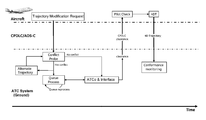
- FIG. 1 is a block diagram of a preference management method and system for managing four-dimensional trajectories of aircraft within an airspace in accordance with a first aspect of this invention.
- FIG. 2 represents a software information flow diagram suitable for implementing the preference management method of FIG. 1 .
- FIG. 3 represents a software module and interface diagram suitable for implementing the preference management method of FIG. 1 .
- FIG. 4 represents a process flow for the queue processor of FIG. 1 and the queue processor and queue optimization blocks of FIG. 2 .
- FIGS. 5 through 10 illustrate an example of implementing the preference management method and system of FIG. 1 .
- FIG. 11 is a block diagram of a schedule management method and system for modifying the paths and/or speeds of aircraft so that they may meet scheduled times-of-arrival (STAs) at an airport in accordance with another aspect of this invention.
- STAs scheduled times-of-arrival
- FIGS. 12 and 13 are block diagrams indicating processes performed by an advisory tool of the schedule management method and system of FIG. 11 .
- FIG. 14 is a flow chart representing operations performed by the advisory tool of the schedule management method and system of FIG. 11 .
- FIG. 15 illustrates an example of a scenario for implementing the schedule management method of this invention.
- ATC system will refer to anyone or any apparatus responsible for monitoring and managing air traffic in a given airspace, including air traffic controllers (ATCo) and the automation they use, and “aircraft” will be used to encompass not only the aircraft itself but also anyone or anything responsible for the planning and altering of the 4D trajectory of the aircraft, including but not limited to flight dispatchers, flight operators (airlines), and flight deck personnel.
- ATC system will refer to anyone or any apparatus responsible for monitoring and managing air traffic in a given airspace, including air traffic controllers (ATCo) and the automation they use
- aircraft will be used to encompass not only the aircraft itself but also anyone or anything responsible for the planning and altering of the 4D trajectory of the aircraft, including but not limited to flight dispatchers, flight operators (airlines), and flight deck personnel.
- a second aspect of this invention is referred to as schedule management, involving communications between ATC systems and aircraft to determine trajectory modifications needed to meet an arrival schedule of aircraft within an airspace surrounding an airport.
- Schedule management also incorporates trajectory negotiations between ATC systems and aircraft so that system preferred time schedules may be met without violating flight safety restrictions while preferably minimizing airspace users' costs.
- a trajectory negotiation will refer to a process, potentially iterative, between an ATC system and an aircraft to arrive at a set of trajectory changes that are acceptable for the aircraft and do not pose conflicts with other aircraft in a given airspace, including the ability to meet operators business objectives while maintaining ANSP safety and schedule needs.
- preference management methods and systems are provided to facilitate one or more aircraft flying in a given airspace to achieve user-preferred four-dimensional (altitude, latitude, longitude, time) trajectories (4DT) during flight so that safety objectives can be met and business costs relevant to the aircraft operator can be minimized.
- Preference management entails trajectory negotiations, which may be initiated by a trajectory modification request from an aircraft, including requests for changes in altitude, lateral route (latitude and longitude), and speed.
- a nonlimiting example is when an aircraft transmits a trajectory modification request that will enable the aircraft to pass a slower aircraft ahead.
- Preferences management provides the capability to process International Civil Aviation Organization (ICAO) compliant amendments through the ability to analyze and grant trajectory modification requests.
- IICAO International Civil Aviation Organization
- observations on the ground can initiate a trajectory negotiation, for example, if the paths of a given set of aircraft are in conflict and must be modified for conflict-free flight.
- FIG. 1 is a block diagram of the user-preference scenario, and represents an aircraft within an airspace of interest.
- the preference management method is initiated with the transmission by the aircraft of a trajectory modification request, which may include a cruise altitude change (due to decreasing mass or changing winds) during flight, a lateral (latitude/longitude) route change (for example, a “Direct-To” or weather avoidance re-route), and/or speed change to decrease fuel use or alter the arrival time of the aircraft, for example, to make up for a delay.
- a trajectory modification request may include a cruise altitude change (due to decreasing mass or changing winds) during flight, a lateral (latitude/longitude) route change (for example, a “Direct-To” or weather avoidance re-route), and/or speed change to decrease fuel use or alter the arrival time of the aircraft, for example, to make up for a delay.
- the aircraft may provide (for example, via digital downlink from the aircraft, a voice request, or a digital exchange from the flight dispatcher) the trajectory modification request to the “Ground,” which includes the ATC system and its ATCos, their graphic/user interfaces (“Interface”), and automation (“Conflict Probe” and “Queue Process”).
- the modification request may be a specific trajectory amendment, for example using a Controller-Pilot Data Link Communications (CPDLC) mechanism which automation of the ATC system converts into a predicted 4DT using supplementary flight plan and state data.
- CPDLC Controller-Pilot Data Link Communications
- the trajectory amendment may be embodied in a proposed alternate trajectory, possibly using existing technologies such as, for example, using an Automatic Dependant Surveillance-Contract (ADS-C).
- ADS-C Automatic Dependant Surveillance-Contract
- the invention is able to leverage existing standards, such as ADS-C and CPDLC messages defined by the Radio Technical Commission for Aeronautics (RTCA) Special Committee-214 (SC-214), though the air-ground negotiation process of this invention is not limited to such communication formats or controlled times-of-arrival (CTAS).
- RTCA Radio Technical Commission for Aeronautics
- SC-214 Special Committee-214
- the ATC system may either choose to manually consider the trajectory modification request (ATCo & Interface), though a preferred aspect of the invention is to delegate the request processing to automation, as represented in FIG. 1 .
- the Conflict Probe of the ATC system compares the 4DTs resulting from the trajectory modification requests to an aggregate of other trajectories for a sub-set or entirety of all known traffic in a given airspace for which the ATC system is responsible. Each comparison identifies any conflicts (for example, a violation of minimum separation between predicted aircraft states correlating to the trajectories, or conflicts relating to airspace congestion or flow) between the resulting 4DT and the 4DTs of all relevant background air traffic, which are maintained in the ATC system.
- conflicts for example, a violation of minimum separation between predicted aircraft states correlating to the trajectories, or conflicts relating to airspace congestion or flow
- the ATC system may initiate an automatic uplink to the aircraft that its trajectory modification request has been cleared (granted), or may provide the negotiated request and other related clearance information to the ATCo (ATCo & Interface) for further action, including granting or holding the negotiated request.
- the modification request has been noted (“Pilot Check”) and implemented (“4DT”) by the aircraft, the ATC system monitors the trajectory of the aircraft for conformance to the negotiated modification request.
- the result of the trajectory negotiation process is preferably a synchronized trajectory that is close to the user-preferred trajectory (in terms of business costs) while honoring all ATC system objectives relating to safe separation, traffic flow, etc.
- the ATC system may place the trajectory modification request in a computer memory data queue for future consideration (“Queue Process”), and then process the next trajectory modification request that had been submitted by a different aircraft.
- the queuing process involves periodically processing the queue to identify those queued requests that can be granted, for example, because circumstances that had previously resulted in a conflict no longer exist.
- the aircraft that transmitted the granted requests can then be notified that their requests have been granted, and the granted requests can be cleared from the queue.
- the queuing process utilizes an optimization algorithm to identify and grant queued requests, preferably in a manner that maximally clears out pending queued requests and guarantees fairness across all airspace users.
- the queuing process may utilize a combinatorial optimization method, for example, combinatorial heuristics.
- the queuing process preferably allows trajectory modification requests to be purged by aircraft request, and trajectory modification requests preferably have a finite time duration within the queue after which they can be purged from the queue.
- the ATC system may identify and perform a conflict probe on an alternate trajectory modification request and, if appropriate, propose the alternate trajectory modification to the aircraft if conflict-free.
- the alternate trajectory modification may be based on information provided from the aircraft relative to the impact (positive or negative) on the flight operator's business objectives of various trajectory changes, such as a lateral distance change, a cruise altitude increase or decrease, or a speed change. This allows an alternative trajectory that may be more preferable than the currently cleared trajectory to be assigned, even if the original (most optimal) request cannot be granted.
- the aircraft may accept or reject the alternative trajectory modification. If the alternative trajectory modification is rejected by the aircraft, its original trajectory modification request is returned to the queue for subsequent processing. If the alternative trajectory modification is accepted by the aircraft, its original trajectory modification request can be purged from the queue.
- FIGS. 2 and 3 Flow charts of a preferred management module are described in FIGS. 2 and 3 .
- FIG. 2 represents the preferences management software information flow
- FIG. 3 represents the preferences management software modules and interfaces.
- the preferences management module reads flight and event data from data storage media of a central controller, which synchronizes the information between air and ground, in a dynamic manner. This information, including trajectory parameters of the aircraft, is updated and stored on the data storage media.
- the process flow for the queue processor of the preferences management module including the representation of alternative optimization algorithms, is represented in FIG. 4 .
- the queue processor utilizes predicted trajectories, for example, obtained through a ground automation trajectory predictor, to detect conflicts between existing 4D trajectories of aircraft within the airspace and the 4D trajectory resulting from each trajectory modification request.
- the queue process is particularly important in the typical situation in which multiple aircraft occupy the airspace monitored by an ATC system, and two or more of the aircraft desire modifications to their trajectories in order to achieve certain objectives. In existing practice, these preference requests would be either minimally considered or likely denied without further consideration due to the information overload that air traffic controllers typically experience.
- T i and P i be, respectively, the current trajectory and the preferred trajectory for a given aircraft A i , which is one of n aircraft in an airspace monitored by an ATC system.
- the ideal goal is to potentially achieve a conflict-free trajectory portfolio ⁇ P 1 , P 2 , . . . , P n ⁇ , where all P i 's of aircraft requesting trajectory modifications have replaced the T i 's of those aircraft following a conflict probe that does not detect any conflicts.
- this may not be feasible in practice due to potential conflicts, in which case the goal is to identify a portfolio that grants the maximum number of conflict-free preferences and, for example, strive to meet certain business objectives or minimize operational costs (for example, fuel usage) among the aircraft (A n ).
- Such a process may entail considering trajectory portfolios where one or more T i 's in the set are selectively replaced with the P i 's and tested for conflicts.
- This selective replacement and testing process is a combinatorial problem, and for n trajectory modification requests there are 2n options. Even with a very modest queue size of five flights, there are thirty-two possibilities, which cannot be readily evaluated manually by the ATCo.
- the objective is to employ an approach to dynamically handle multiple trajectory modification requests, so that the queue is periodically processed in an optimal manner under operational restrictions, with each periodic process performing a conflict assessment on the queued trajectory modification requests to determine which if any of the requests still pose conflicts with the 4D trajectories of other aircraft within the airspace.
- each periodic process performing a conflict assessment on the queued trajectory modification requests to determine which if any of the requests still pose conflicts with the 4D trajectories of other aircraft within the airspace.
- more recent requests can be given higher priority to maximize the total time that aircrafts fly according to their preferences.
- the preferences management module represented in FIGS. 1 through 3 would be more readily capable of accommodating user preferences through trajectory modification requests via en-route negotiations.
- the queue process module ( FIG. 4 ) of the preferences management module must be configured to accept trajectory modification requests that cannot be immediately cleared by the ATC system due to situational conflicts, and capable of efficiently processing the queued (pending) requests on a timely basis.
- the queue process module ( FIG. 4 ) of the preferences management module must be configured to accept trajectory modification requests that cannot be immediately cleared by the ATC system due to situational conflicts, and capable of efficiently processing the queued (pending) requests on a timely basis.
- the queue process module ( FIG. 4 ) of the preferences management module must be configured to accept trajectory modification requests that cannot be immediately cleared by the ATC system due to situational conflicts, and capable of efficiently processing the queued (pending) requests on a timely basis.
- FMS flight management system
- the preferences, expressed as trajectory modification requests are down-linked to the ATC system on the ground.
- the ATC system must then identify a combination of trajectory modification requests that will by conflict free.
- various algorithms for this purpose are possible, including heuristic algorithms, to efficiently process a set of queued requests, though it should be understood that other algorithms could be developed in the future.
- a first heuristic solution views the above selective replacement and test process as a binary combinatorial assignment problem.
- the assignment ⁇ P 1 , P 2 , . . . P n ⁇ is first conflict-probed, and if the result is a conflict-free trajectory portfolio, then the entire portfolio is cleared via communications with the aircraft.
- an n-bit truth table can be constructed to explore the options with n-k bits active, where k is an integer greater than or equal to 1 but less than n.
- each option in the truth table corresponds to a trajectory portfolio ⁇ P 1 , P 2 , . . . T m , . . .
- trajectory modification requests (P n ) for all but one aircraft (request T m for aircraft A m ) are tentatively granted.
- the trajectory modification request(s) that is/are not tentatively granted is/are different for each portfolio.
- Each of these alternate trajectory portfolios is conflict-probed, and those portfolios that result in a conflict are eliminated. If a single portfolio exists that is conflict-free, the trajectory modification requests associated with that portfolio are granted and cleared via communications with the aircraft that transmitted the granted requests.
- a cost computation can be performed that compares relative operational costs associated with granting each of the conflict-free portfolios, including the additional benefits associated with granting more recent requests, so that the portfolio with the lowest cost can be selected.
- the relative operational costs can take into account fuel-related and/or time-related costs.
- the trajectory modification requests associated with the selected portfolio are then granted and cleared via communications with the aircraft that transmitted the granted requests, and the granted modification requests can be purged from the queue.
- the process can be repeated with n ⁇ 2 preferences active. This process can be repeated with n ⁇ 3, n ⁇ 4, and so on until all the possible trajectory portfolios have been explored.
- the worst-case situation is that all 2n trajectory portfolios result in a conflict.
- the worst-case computational complexity for this heuristic is also exponential.
- Another heuristic solution is to consider alternate preferences for one or more of the aircraft according to some consideration sequence.
- a flight's preference (trajectory modification requests, P i )
- all other flight trajectories are held at their current or tentatively accepted state.
- a tentatively accepted state corresponds to a modified trajectory that has been temporarily cleared but which has not been communicated to the aircraft as a cleared modification.
- For each flight its modification preference is considered, and it is checked if accepting that preference would ensure a conflict-free flight. If a conflict is detected, that preference is discarded from consideration, and the next flight's modification preference is considered and a similar conflict probe is performed. This process can be continued until the modification preference of each flight in the portfolio has been considered in trial planning.
- each flight whose modification preference was discarded earlier is considered in sequence until no further conflict-free acceptances are possible. This iterative process can be repeated until no further modification preferences can be accepted. At this point, a final conflict probe is performed and the set of tentative modifications are granted and cleared via communications with the aircraft. In the situation that a given aircraft can provide more than one modification request, and its first preferred modification request results in a conflict, its other preferences may be considered in sequence.
- T denote some time window that is decided upon by the ATCo.
- Every aircraft a′ ⁇ A′ will have a node in V 2 that represents the requested trajectory for that aircraft. All nodes in V 1 alone are conflict-free as they represent the original trajectories. Therefore, all flights represented in V 2 must be conflict probed with both (a) all nodes in V 1 and (b) all other nodes in V 2 . For every conflict that exists between v′ ⁇ V 2 and v′′ ⁇ V 1 ⁇ V 2 , draw an edge between v′ and v′′. The result is a conflict graph. As an edge represent a conflict within T, then no more than one node can be “chosen” for every edge. This is precisely the set of constraints that define the node packing problem.
- the graph will consist of two sets of nodes: aircraft corresponding with original trajectories and aircraft corresponding with requested trajectories.
- k′ denote the node in the graph that represents the trajectory request for aircraft k ⁇ 1 , 2 , . . . , 5 ⁇ .
- Edges are constructed between every pairwise conflict. For a given weight vector w the maximum-weight node packing problem would be solved.
- Two algorithms have been implemented for solving the max-weight node packing problem.
- One of the algorithms is LP-Heuristic: the MWNPP is solved, let x denote an optimal solution. Clearly if x is integral, then x is optimal for the original problem. Otherwise, a feasible solution is returned by rounding the fractional component with the highest weight up to 1, and its neighbors down to zero. This is done for all fractional components until the rounded vector is integral.
- the other algorithm is a “Greedy” approach: the weight vector is sorted in non-increasing order. The node with the highest weight is assigned value 1, and all of its neighbors are assigned to 0. Then the next highest-weight node is chosen that has not been assigned a value, and the process is repeated until every node has been assigned a value of 0 or 1.
- the queuing process greatly facilitates the ability of the ATC system to accommodate trajectory modification requests from multiple aircraft in a given airspace.
- utilization of the queuing process within the preference management method enables aircraft to achieve preferred cruise altitudes and/or trajectories during flight so that business costs associated with the aircraft can be reduced and possibly minimized while ensuring safe separation between all flights in the airspace.
- FIGS. 5 through 10 help to illustrate the implementation of the preference management method of this invention.
- FIG. 5 represents a set of five aircraft, designated as 1 , 2 , 3 , 4 and 5 , identified as departing from airports designated as KSJC, KOAK or KSFO, and all destined for an airport designated as KSEA.
- all flights follow their flight plan cruise altitudes, designated as FL 320 , FL 340 , FL 360 and FL 380 . All flights are altitude-separated except for the two KSFO flights ( 2 and 5 ), which are time separated at the same altitude (FL 360 ).
- all flights are assumed to be flying at the same true airspeed in this scenario.
- Flight 2 from KSFO makes a request to climb from altitude FL 360 to FL 380 , but that request is denied because granting the request would result in a separation conflict with Flight 1 from KSJC cruising at FL 380 .
- This request is queued, as represented by its request being entered in a queue box in FIG. 6 .
- Flight 3 from KOAK makes a request to climb from FL 340 to FL 360 , but that request is also denied because granting the request would result in a separation conflict with Flight 2 from KSFO cruising at FL 360 .
- this second request is also queued, and shown in the queue box in FIG. 7 .
- Flight 4 from KSJC makes a request to climb from FL 320 to FL 340 , but that request is denied because granting the request would result in a separation conflict with Flight 3 from KOAK cruising at FL 340 .
- This third request is then queued, and shown in the queue box in FIG. 8 .
- FIG. 9 Flight 5 from KSFO has made a request to climb from FL 360 to FL 380 , and that request is immediately granted as it is conflict free.
- FIG. 10 represents the result of queue processing performed on the queue, in which three of the pending requests are cleared for cruise climb because the altitude change granted for Flight 5 has facilitated a conflict constraints resolution. Even so, the request from Flight 2 remains pending in the queue and cannot be granted unless further changes in circumstances occur.
- preference management can be employed to enable an ATC system to facilitate one or more aircraft flying in a given airspace to achieve user-preferred 4D (altitude, latitude, longitude and time) trajectories (4DTs) during flight, so that operational costs associated with the aircraft (for example, fuel burn, flight time, missed passenger connections, etc.) may be reduced or minimized while ensuring safe separation between all flights in the airspace.
- Preference management further allows ATC systems to support national airspace-wide fuel savings and reduce delays.
- trajectory negotiations can also be initiated as a result of observations on the ground that the paths and/or speeds of one or more aircraft must be modified so that they may meet their scheduled times-of-arrival (STAB).
- STAB scheduled times-of-arrival
- the negotiation framework to address this event type is the aforementioned schedule management method of this invention, which can be implemented as a module used in combination with the preference management module described above.
- the schedule management framework provides a method and system by which one or more aircraft flying in a given airspace can more readily achieve system preferred time targets such that business costs relevant to the aircraft operator are minimized and system delay costs are minimized without violating flight safety restrictions.
- trajectory negotiations occur between aircraft and an ATC system (as these terms were previously defined under the discussion of the preference management method and system).
- the schedule management module comprises sub-modules, two of which are identified as a “Scheduler” and “DA” (descent advisor).
- An Arrival Manager (AMAN) is commonly used in congested airspace to compute an arrival schedule for aircraft at a particular airport.
- the DA function is related in principle to NASA's En Route Descent Advisor (EDA), although there are key additions to this functionality.
- the schedule management module uses aircraft surveillance data and/or a predicted trajectory from the aircraft to construct a schedule for aircraft arriving at a point, typically a metering fix located at the terminal airspace boundary. Today, this function is performed by the FAA's Traffic Management Advisor (TMA) in the USA, while other AMANs are used internationally.
- TMA Traffic Management Advisor
- this invention makes use of an arrival scheduler tool that monitors the aircraft based on aircraft data and continually computes the sequences and STAs to the metering fix.
- schedulers compute STAs using a first-come first-served algorithm
- alternative schedule means including a best-equipped best-served type of schedule.
- DA is an advisory tool used to generate maneuver advisories to aircraft that will enable the aircraft to accurately perform maneuvers (speed changes and/or path stretches) that will deliver the aircraft to the metering fix according to the STA computed by the Scheduler.
- one or more aircraft within an airspace of interest are monitored by an ATC system.
- the ATC system monitors the 4D (altitude, lateral route, and time) trajectory (4DT) of each aircraft as it enters the airspace being monitored by the ATC system.
- the Scheduler For each aircraft of interest, the Scheduler generates an STA at one or more metering fix points, which may be associated with the aircraft's destination airport. STA's for multiple aircraft are stored in a queue that is part of a computer-based data storage that can be accessed by the Scheduler and DA. The DA then performs a computation to determine if, based on information inferred or downlinked from the aircraft, the aircraft will be able to meet its STA.
- the ATC system transmits instructions to the aircraft to ensure that the aircraft will arrive at the metering fix point at the STA and, as may be necessary, will update the STA for each aircraft stored in the queue.
- the computations of the DA delivered to a Schedule Reasoner discussed below in reference to FIG. 13 ) prior to being passed on to an ATCo interface (such as a graphic/user interface), which performs the task of transmitting the instructions to the aircraft.
- auxiliary data may include one or more of the following: preferred time-of-arrival (TOA), earliest estimated time-of-arrival (ETA Min ), latest estimated time-of-arrival (ETA Max ), current planned speeds (where speeds could be a calibrated airspeed (CAS) and/or Mach number for one or more flight phases (climb, cruise, or descent)), preferred speeds (which may be minimum fuel-cost speeds), minimum and maximum possible speeds, and alternate proposed 4DTs for minimum fuel speeds along the current lateral route and current cruise altitude.
- TOA preferred time-of-arrival
- ETA Min earliest estimated time-of-arrival
- ETA Max latest estimated time-of-arrival
- current planned speeds where speeds could be a calibrated airspeed (CAS) and/or Mach number for one or more flight phases (climb, cruise, or descent)
- preferred speeds which may be minimum fuel-cost speeds
- minimum and maximum possible speeds and alternate proposed 4DTs for minimum fuel speeds along the current lateral route and current cruise altitude.
- Aircraft with appropriate equipment are capable of providing this auxiliary data directly to the ATC system.
- FMS and Data Communication are capable of providing this auxiliary data directly to the ATC system.
- dataComm Data Communication
- many advanced FMS are able to accurately compute this data, which can be exchanged with the ATC system using CPDLC, ADS-C, or another data communications mechanism between the aircraft and ATC system, or another digital exchange from the flight dispatcher.
- auxiliary data In practice, it is likely that many aircraft will be unable to provide some or all of this auxiliary data because the aircraft are not properly equipped or, for business-related reasons, flight operators have imposed restraints as to what information can be shared by the aircraft. Under such circumstances, some or all of this information will need to be computed or inferred by the ATC system. Because fuel-optimal speeds and in particular the predicted 4DT are dependent on aircraft performance characteristics to which the ATC system does not have access (such as aircraft mass, engine rating, and engine life), auxiliary data provided by appropriately equipped aircraft are expected to be more accurate than auxiliary data generated by the ATC system.
- the ATC system needs to be taken to enable the ATC system to more accurately infer data relating to aircraft performance characteristics that will assist the ATC system in predicting certain auxiliary data, including fuel-optimal speeds, predicted 4DT, and factors that influence them when this data is not provided from the aircraft itself.
- the aircraft performance parameters of interest will be derived in part from aircraft state data and trajectory intent information typically included with the auxiliary data provided by the aircraft via a communication datalink.
- surveillance information can also be used to improve the inference process.
- the inferred parameters are then used to model the behavior of the aircraft by the ATC system, specifically for trajectory prediction purposes, trial planning, and estimating operational costs associated with different trial plans or trajectory maneuvers.
- the ATC system In order to predict the trajectory of an aircraft, the ATC system must rely on a performance model of the aircraft that can be used to generate the current planned 4DT of the aircraft and/or various “what if” 4DTs representing unintentional changes in the flight plan for the aircraft.
- Such ground-based trajectory predictions are largely physics-based and utilize a model of the aircraft's performance, which includes various parameters and possibly associated uncertainties.
- Some parameters that are considered to be general to the type of aircraft under consideration may be obtained from manufacturers' specifications or from commercially available performance data. Other specific parameters that tend to be more variable may also be known, for example, they may be included in the filed flight plan or provided directly by the aircraft operator. However, other parameters are not provided directly and must be inferred by the ATC system from information obtained from the aircraft, and optionally, from surveillance information. The manner in which these parameters can be inferred is discussed below.
- Aircraft performance parameters such as engine thrust, aerodynamic drag, fuel flow, etc., are commonly used for trajectory prediction. Furthermore, these parameters are the primary influences on the vertical (altitude) profile and speed of an aircraft. Thus, performance parameter inference has the greatest relevance to the vertical portion of the 4DT of an aircraft.
- the aircraft thrust, drag, and fuel flow characteristics can vary significantly based on the age of the aircraft and time since maintenance, which the ATC system will not likely know.
- airline performance information such as gross weight and cost index cannot be shared directly with ground automation because of concerns related to information that is considered strategic and proprietary to the operator.
- the along-route distance corresponding to the top of climb point can be expressed as a function of takeoff weight (TWO).
- TWO takeoff weight
- a weight range is also known from the aircraft manufacturer specifications, which may be further enhanced with knowledge originating from the filed flight plan and from applicable regulations (distance between airports, distance to alternate airport, minimum reserves, etc.). Additional inputs to the prediction model, including aircraft speeds, assumed wind speeds, and roll angles can be derived from lateral profile information and used to predict a vertical profile for the aircraft.
- knowledge of an aircraft's predicted trajectory during takeoff and climb can be used to infer the takeoff weight (mass) of the aircraft. If an estimate of the aircraft's fuel flow is available, this can be used to predict the weight of the aircraft during its subsequent operation, including its approach to a metering fix. Subsequent measurements of the aircraft state (such as speeds and rate of climb or descent) relative to the predicted trajectory can be used to refine the estimate of the fuel flow and predicted weight. The weight of the aircraft can then be used to infer auxiliary data, such as the minimum fuel-cost speed and predicted trajectory parameters of the aircraft, since they are known to depend on the mass of the aircraft.
- the weight of the aircraft is inferred by correlating the takeoff weight of the aircraft to the distance to the top of climb that occurred during takeoff.
- a plurality of generation steps can then be used to predict a vertical profile of the aircraft during and following takeoff.
- Each generation step comprises comparing the predicted altitude of the aircraft obtained from one of the generation steps with a current altitude of the aircraft reported by the aircraft. The difference between the current and predicted altitudes is then used to generate a subsequent predicted altitude of the first aircraft.
- the STA and aircraft data are inputs to the DA automation, which is responsible for generating the maneuver advisories for the aircraft, if necessary, to meet the STA.
- the DA uses predicted earliest and latest time of arrival values (ETA Min and ETA Max ) to determine the type of maneuver required to meet the STA. These time bounds may be further padded to account for potential uncertainty in the ETA Min and ETA Max computation, or uncertainty in the winds that will be encountered while flying to the metering fix which could cause the true time of arrival to fall outside of the predicted time bounds.
- the STA is between the (potentially padded) ETA Min and ETA Max bounds of the aircraft, this can be achieved by simply assigning the STA to the aircraft as a time constraint and allowing the aircraft's TOA control (TOAC) function (often referred to as a required time-of-arrival (RTA)) to guide and deliver the aircraft to the metering fix at its STA.
- TOAC TOA control
- RTA required time-of-arrival
- the 4DT associated with assigning the STA as an RTA is either provided from the aircraft (for example, via data link) or computed by the ATC automation using the inferred aircraft parameters described previously.
- a speed advisory with potentially different speeds for each phase of flight
- RTA assignment possibly combined with an alternative lateral route (specified by lateral fixes or procedures (path stretches)) and possibly vertical constraints (such as cruise altitude or waypoint altitude restrictions) can be computed by the DA that will result in the aircraft meeting the system desired STA while honoring all relevant ATC constraints (such as staying within the necessary arrival corridor, or passing over a set of fixes).
- the DA can generate a path stretch maneuver that involves a modified lateral route that sufficiently extends the ETA max so that the aircraft will achieve its STA at the metering fix point.
- a vertical maneuver that requires the aircraft to descend to a lower intermediate altitude where it is able to fly at lower speeds (due to a higher air density) may be used, potentially in combination with a lateral path stretch.
- the most accessible solution will typically involve assigning the ETA min as the RTA for the aircraft at the metering fix point, and then allowing the FMS of the aircraft to modify its speed to achieve the RTA at the metering fix point.
- the DA forwards the results of its computations to the Schedule Reasoner which then, depending which of the above scenarios exists, issues the appropriate information to the ATCo interface.
- the interface may initiate an automatic uplink of the clearance to the aircraft or provide the clearance information to the ATCo for further action.
- FIG. 13 is a block diagram representing scenarios in which modifications to the lateral route or vertical path are necessary, as represented by the node 1 in FIG. 12 and carried over as the input in FIG. 13 .
- the DA can generate one or more alternative 4DTs characterized by different changes to altitude, speed and/or lateral route, for example, alternative path-stretch trajectories or a descent to a lower altitude with alternative speeds to delay the arrival of the aircraft at its metering fix.
- the process of generating alternative trajectories may be guided by user preferences, as described above for the preference management method and system of this invention.
- the DA compares each alternate 4DT to an aggregate of other trajectories for a sub-set or entirety of all known traffic in the given airspace.
- the comparison identifies any conflicts (a violation of minimum separation between predicted aircraft states correlating to the trajectories) between each potential 4DT from the initial set and all relevant background traffic.
- the 4DTs of the background traffic are maintained in the data storage of the ATC system. If no conflict is identified, or if the probability of the potential conflict is below a certain threshold, for two or more 4DTs in the initial set, the alternative 4DTs can be forwarded to a module that performs a maneuver cost evaluation, by which the normalized cost of the speed and/or trajectory modification maneuver is computed for each alternate 4DT.
- This cost computation may further utilize aircraft performance models and/or cost information provided directly from the aircraft or inferred from auxiliary data to compute fuel usage profiles.
- the ATC system preferably ranks the alternative 4DTs according to their normalized cost, and the ranked list is input to the Schedule Reasoner, which selects the lowest cost (highest ranked) trajectory modification that does not pose a conflict with 4DTs of other aircraft or violate any airspace constraints. These trajectory modifications may include lateral path changes, altitude changes, and either speed assignments or an RTA time constraint.
- This information is then input to the ATCo interface, which initiates an automatic uplink of the clearance to the aircraft or provides the clearance information to the ATCo for further action.
- the schedule management module has an initial and final scheduling horizon.
- the initial scheduling horizon is a spatial horizon, which is the position at which each aircraft enters the given airspace, for example, the airspace within about 200 nautical miles (370.4 km) of the arrival airport.
- the ATM manager monitors the positions of aircraft, and is triggered once an aircraft enters the initial scheduling horizon.
- the final scheduling horizon referred to as the STA freeze horizon, is defined by a specific time-to-arriving metering fix.
- the STA freeze horizon may be defined as an aircraft's metering fix ETA of less than or equal to twenty minutes in the future.
- FIG. 14 is a flow chart representing operations performed by the DA module.
- the DA module monitors the scheduling queue maintained by the Scheduler in the data storage of the ATC system.
- the DA module could be event driven and invoked by the Scheduler as needed, for example, when an aircraft penetrates the final scheduling horizon.
- the DA then collects speed information from the aircraft, the predicted trajectory of the aircraft (either provided directly from the aircraft or predicted on the ground), and the schedule plan from the Scheduler.
- the DA then generates one or more meet-time maneuvers (speed adjustment or time constraint, altitude adjustment, and/or path stretches) for the aircraft, performs a conflict probe of each generated meet-time maneuver with existing active predicted trajectories, and eliminates any meet-time maneuvers with conflicts.
- a cost evaluation process is performed (for example, by the maneuver cost evaluation module) from which the DA selects a preferred meet-time maneuver.
- the selected maneuver is then output to an interface, where it may be uplinked to the aircraft or provided to another user for further processing.
- the schedule management module may utilize a traditional voice/manual operation ( FIG. 13 ).
- the Scheduler obtains information from the ground and potentially equipped aircraft which are capable of providing trajectory information. This creates a predicted aircraft trajectory and contains dynamically evolving aircraft state information (for example, 4D position, ground speed, course, and altitude rate).
- the Scheduler generates a schedule plan for the DA, which collects information from both air (aircraft) and ground, and provides information to both the air and ground. This process may also use the inferred data described previously if data cannot be provided directly from the aircraft itself.
- the schedule algorithm implemented in the Scheduler may be, for example, a dynamic first-come first-served algorithm based on the order of estimated times of arrival at the scheduled metering fix or it could give preference to better equipped aircraft which can provide more accurate trajectory information and meet the STA using airborne TOAC algorithms.
- the Scheduler When the Scheduler is initialized, the algorithm constructs an empty queue for each managed metering fix. When an aircraft enters the initial scheduling horizon, this aircraft is pushed into the corresponding scheduling queue and the algorithm updates the STA for each aircraft in the queue if needed. When an aircraft is in the scheduling queue and its ETA is changed, the same process will be performed to the whole scheduling queue. When an aircraft is in the scheduling queue and it penetrates the freeze horizon, its STA will remain unchanged in the queue until it leaves the queue.
- the scheduling algorithm receives data for each aircraft in the scheduling queue, for example, ETA (minimum and maximum), aircraft weight class, aircraft identification, etc.
- ETA minimum and maximum
- the STA update process can be described as follows. If there are no aircraft with their STA frozen, the aircraft is processed based on the order of its ETA at metering fix. The processed aircraft is assigned a time equal to its ETA or the earliest time that ensures the minimum time-separation required for the types of aircraft that are scheduled earlier in the queue, whichever is larger. If there are some aircraft with frozen STAs, the aircraft are sorted with frozen STAs based on their STAs, and these aircraft are treated as pre-scheduled aircraft. The aircraft with unfrozen STAs are then processed based on the order of their ETAs at metering fix. The Scheduler algorithm checks the status of each scheduling queue every loop cycle, keeping the STAs constantly updated until they are frozen.
- FIG. 15 helps to illustrate a scenario in which the schedule management method of this invention can be implemented.
- FIG. 15 represents a set of five aircraft, designated as FLT # 1 through # 5 , identified as departing from airports designated as KSFO, KDEN, KDFW, and KDCA, and all destined for an airport designated as KSEA.
- OLM metering fix point
- the Scheduler generates STAs at the metering fix for all five flights, the DA associated with the metering fix generates speed changes or meet-time advisories from the freeze horizon (twenty flying minutes prior to metering fix) to the metering fix. All five flights are scheduled by this process to arrive at OLM within a two-minute relative time window in the order indicated by the flight number, FLT # 1 through # 5 .
- the schedule management method and system can be employed to enable an ATC system to facilitate one or more aircraft flying in a given airspace to achieve system-preferred time targets and schedules which significantly reduce operating costs such as fuel burn, flight time, missed passenger connections, etc.
- the schedule management method and system can facilitate an improvement in ATC operations in an environment with different types of aircraft performance capabilities (Mixed Equipage).
- McExed Equipage By providing more optimum solutions to aircraft with better capabilities, this schedule management method and system encourages aircraft operators to consider the installation of advanced flight management systems (AFMS) that support air-ground negotiations.
- AFMS advanced flight management systems
Landscapes
- Engineering & Computer Science (AREA)
- Aviation & Aerospace Engineering (AREA)
- Physics & Mathematics (AREA)
- General Physics & Mathematics (AREA)
- Traffic Control Systems (AREA)
- Management, Administration, Business Operations System, And Electronic Commerce (AREA)
- Radar, Positioning & Navigation (AREA)
- Remote Sensing (AREA)
Priority Applications (8)
| Application Number | Priority Date | Filing Date | Title |
|---|---|---|---|
| US13/032,176 US8942914B2 (en) | 2011-02-22 | 2011-02-22 | Methods and systems for managing air traffic |
| CA2768456A CA2768456A1 (en) | 2011-02-22 | 2012-02-16 | Methods and systems for managing air traffic |
| IN440DE2012 IN2012DE00440A (enExample) | 2011-02-22 | 2012-02-16 | |
| BR102012003746A BR102012003746A2 (pt) | 2011-02-22 | 2012-02-17 | método de nogociação de trafego aéreo e sistema |
| JP2012032228A JP6050591B2 (ja) | 2011-02-22 | 2012-02-17 | 航空交通を管理する方法およびシステム |
| EP12156074.2A EP2492889B8 (en) | 2011-02-22 | 2012-02-17 | Methods and systems for managing air traffic |
| CN201210050379.8A CN102651176B (zh) | 2011-02-22 | 2012-02-22 | 用于管理空中交通的方法和系统 |
| US13/786,858 US9177480B2 (en) | 2011-02-22 | 2013-03-06 | Schedule management system and method for managing air traffic |
Applications Claiming Priority (1)
| Application Number | Priority Date | Filing Date | Title |
|---|---|---|---|
| US13/032,176 US8942914B2 (en) | 2011-02-22 | 2011-02-22 | Methods and systems for managing air traffic |
Related Child Applications (1)
| Application Number | Title | Priority Date | Filing Date |
|---|---|---|---|
| US13/786,858 Continuation-In-Part US9177480B2 (en) | 2011-02-22 | 2013-03-06 | Schedule management system and method for managing air traffic |
Publications (2)
| Publication Number | Publication Date |
|---|---|
| US20120215435A1 US20120215435A1 (en) | 2012-08-23 |
| US8942914B2 true US8942914B2 (en) | 2015-01-27 |
Family
ID=45656120
Family Applications (1)
| Application Number | Title | Priority Date | Filing Date |
|---|---|---|---|
| US13/032,176 Active US8942914B2 (en) | 2011-02-22 | 2011-02-22 | Methods and systems for managing air traffic |
Country Status (7)
| Country | Link |
|---|---|
| US (1) | US8942914B2 (enExample) |
| EP (1) | EP2492889B8 (enExample) |
| JP (1) | JP6050591B2 (enExample) |
| CN (1) | CN102651176B (enExample) |
| BR (1) | BR102012003746A2 (enExample) |
| CA (1) | CA2768456A1 (enExample) |
| IN (1) | IN2012DE00440A (enExample) |
Cited By (14)
| Publication number | Priority date | Publication date | Assignee | Title |
|---|---|---|---|---|
| US20150379875A1 (en) * | 2014-06-27 | 2015-12-31 | The Boeing Company | Automatic aircraft monitoring and operator preferred rerouting system and method |
| CN105259916A (zh) * | 2015-10-30 | 2016-01-20 | 杨珊珊 | 无人飞行器的调度装置及其调度方法 |
| US20160343258A1 (en) * | 2013-12-31 | 2016-11-24 | The Boeing Company | System and Method for Defining and Predicting Aircraft Trajectories |
| US9536435B1 (en) | 2015-07-13 | 2017-01-03 | Double Black Aviation Technology L.L.C. | System and method for optimizing an aircraft trajectory |
| US9950791B2 (en) | 2016-03-08 | 2018-04-24 | International Business Machines Corporation | Drone receiver |
| US20180130360A1 (en) * | 2016-11-04 | 2018-05-10 | Architecture Technology Corporation | Integrated multi-mode automation for air traffic control |
| US10013886B2 (en) | 2016-03-08 | 2018-07-03 | International Business Machines Corporation | Drone carrier |
| US10062292B2 (en) | 2016-03-08 | 2018-08-28 | International Business Machines Corporation | Programming language for execution by drone |
| US10096252B2 (en) * | 2016-06-29 | 2018-10-09 | General Electric Company | Methods and systems for performance based arrival and sequencing and spacing |
| US10417917B2 (en) | 2016-03-08 | 2019-09-17 | International Business Machines Corporation | Drone management data structure |
| US10540900B2 (en) | 2016-03-08 | 2020-01-21 | International Business Machines Corporation | Drone air traffic control and flight plan management |
| US10689107B2 (en) | 2017-04-25 | 2020-06-23 | International Business Machines Corporation | Drone-based smoke detector |
| US11320842B2 (en) * | 2018-10-01 | 2022-05-03 | Rockwell Collins, Inc. | Systems and methods for optimized cruise vertical path |
| US11379920B2 (en) * | 2015-12-23 | 2022-07-05 | Swiss Reinsurance Company Ltd. | Flight trajectory prediction system and flight trajectory-borne automated delay risk transfer system and corresponding method thereof |
Families Citing this family (56)
| Publication number | Priority date | Publication date | Assignee | Title |
|---|---|---|---|---|
| FR2969124A1 (fr) * | 2010-12-17 | 2012-06-22 | Thales Sa | Procede d'affichage temporel de la mission d'un aeronef |
| ITRM20110651A1 (it) * | 2010-12-20 | 2012-06-21 | Selex Sistemi Integrati Spa | Metodo di previsione rapida del profilo verticale della traiettoria per la gestione del traffico aereo, e relativo sistema atm. |
| US8463535B2 (en) * | 2011-01-21 | 2013-06-11 | Lockheed Martin Corporation | Method and apparatus for encoding and using user preferences in air traffic management operations |
| US8606491B2 (en) * | 2011-02-22 | 2013-12-10 | General Electric Company | Methods and systems for managing air traffic |
| US8467918B2 (en) * | 2011-07-05 | 2013-06-18 | Universal Avionics Systems Corporation | Heuristic method for computing performance of an aircraft |
| US8798898B2 (en) * | 2011-10-31 | 2014-08-05 | General Electric Company | Methods and systems for inferring aircraft parameters |
| CA2856439A1 (en) * | 2011-12-06 | 2013-06-13 | Airservices Australia | A flight prediction system |
| US10013236B2 (en) * | 2013-03-06 | 2018-07-03 | The Boeing Company | Real-time adaptive speed scheduler |
| US9177479B2 (en) * | 2013-03-13 | 2015-11-03 | General Electric Company | System and method for determining aircraft operational parameters and enhancing aircraft operation |
| US9047763B2 (en) | 2013-03-15 | 2015-06-02 | Honeywell International Inc. | Methods and systems for representing time of arrival information on a cockpit display |
| FR3018364B1 (fr) * | 2014-03-04 | 2016-04-01 | Thales Sa | Procede de determination d'une loi de guidage d'evitement d'obstacle par un aeronef, produit programme d'ordinateur, systeme electronique et aeronef associes |
| CN103942623B (zh) * | 2014-04-22 | 2017-01-18 | 中国民航大学 | 一种基于需求与容量不确定性的机场拥挤风险预测方法 |
| US9704405B2 (en) * | 2014-06-12 | 2017-07-11 | Honeywell International Inc. | Aircraft display systems and methods for providing an aircraft display for use with airport departure and arrival procedures |
| WO2016048698A1 (en) * | 2014-09-22 | 2016-03-31 | Sikorsky Aircraft Corporation | Coordinated planning with graph sharing over networks |
| US10068488B2 (en) * | 2015-04-30 | 2018-09-04 | Ge Aviation Systems Llc | Systems and methods of providing a data update to an aircraft |
| US10144505B2 (en) * | 2015-05-18 | 2018-12-04 | The Boeing Company | Aircraft flight control using a required time of arrival index |
| CN111532427B (zh) * | 2015-07-17 | 2023-07-28 | 松下电器(美国)知识产权公司 | 无人飞行器、方法和存储介质 |
| US9773421B2 (en) * | 2015-10-19 | 2017-09-26 | Honeywell International Inc. | Aircraft maneuver data management system |
| EP3211621A1 (en) * | 2016-02-29 | 2017-08-30 | The Boeing Company | Method and electronic device for optimizing a flight trajectory of an aircraft subject to time of arrival control constraints |
| SG11201807429UA (en) * | 2016-03-18 | 2018-09-27 | Betria Interactive Llc | Real-time multimodal travel estimation and routing system |
| US10170007B2 (en) | 2016-06-23 | 2019-01-01 | Ge Aviation Systems Llc | Trajectory amendment system |
| US10424209B2 (en) | 2016-06-23 | 2019-09-24 | GB Aviation Systems LLC | Trajectory amendment system |
| US9852643B1 (en) * | 2016-06-23 | 2017-12-26 | Ge Aviation Systems Llc | Trajectory amendment and arrival time slot provision system |
| FR3055433B1 (fr) * | 2016-08-26 | 2018-09-21 | Thales | Procede d'aide au pilotage d'un aeronef, produit programme d'ordinateur et dispositif d'aide au pilotage associes |
| CN107783428A (zh) * | 2016-08-31 | 2018-03-09 | 圣速医疗器械江苏有限公司 | 一种智能平衡飞行器的控制系统 |
| US10037704B1 (en) * | 2017-02-01 | 2018-07-31 | David Myr | Automatic real-time air traffic control system and method for maximizing landings / takeoffs capacity of the airport and minimizing aircrafts landing times |
| US10115315B2 (en) * | 2017-03-13 | 2018-10-30 | Honeywell International Inc. | Systems and methods for requesting flight plan changes onboard an aircraft during flight |
| US20210097870A1 (en) * | 2017-07-14 | 2021-04-01 | Nec Corporation | Flight management system, method, and program |
| US10497267B2 (en) * | 2018-01-23 | 2019-12-03 | Textron Innovations Inc. | Blockchain airspace management for air taxi services |
| WO2019167161A1 (ja) * | 2018-02-28 | 2019-09-06 | 日本電気株式会社 | 領域評価システム、方法および記録媒体 |
| CN108417097A (zh) * | 2018-03-01 | 2018-08-17 | 中国航空无线电电子研究所 | 一种用于初始4d空地协同运行的方法 |
| JP2021532524A (ja) * | 2018-08-03 | 2021-11-25 | ネクストイオン テクノロジーズ インコーポレイテッド | 航路途中でルート変更を提供するためのシステム及び方法 |
| CN109215398B (zh) * | 2018-11-05 | 2022-03-11 | 飞牛智能科技(南京)有限公司 | 一种无人机航路规划方法及装置 |
| JP6734998B1 (ja) * | 2018-12-14 | 2020-08-05 | 楽天株式会社 | 無人航空機の制御方法、管理方法、制御装置、管理装置、及び無人航空機システム |
| JP7228229B2 (ja) | 2018-12-20 | 2023-02-24 | 国立研究開発法人宇宙航空研究開発機構 | プログラム、情報処理装置及び情報処理方法 |
| US20200284643A1 (en) * | 2019-03-04 | 2020-09-10 | The Boeing Company | Aircraft landing weight determination systems and methods |
| AT522205B1 (de) * | 2019-03-08 | 2021-05-15 | Frequentis Ag | Verfahren zur Erkennung und Wiedergabe von einer Mehrzahl von Sendern über Funk abgegebenen Sprechfunkmeldungen sowie Vorrichtung hierzu |
| CN110321401B (zh) * | 2019-07-09 | 2023-05-26 | 中国人民解放军海军航空大学 | 时空数据关联深度学习方法 |
| WO2021046015A1 (en) * | 2019-09-02 | 2021-03-11 | Skygrid, Llc | Flight path deconfliction among unmanned aerial vehicles |
| EP3809395B1 (en) * | 2019-10-17 | 2026-01-28 | The Boeing Company | Method and system for policy-based traffic encounter assessment to detect and avoid traffic |
| US20230028792A1 (en) * | 2019-12-23 | 2023-01-26 | A^3 By Airbus, Llc | Machine learning architectures for camera-based detection and avoidance on aircrafts |
| CN111831753B (zh) * | 2020-07-20 | 2023-10-17 | 成都民航空管科技发展有限公司 | 一种多节点参数同步管理的系统及方法 |
| CN112002147B (zh) * | 2020-09-22 | 2021-08-27 | 成都民航空管科技发展有限公司 | Atc系统与itwr系统相关一致性检查方法及装置 |
| CN112133137B (zh) * | 2020-09-22 | 2021-11-02 | 成都民航空管科技发展有限公司 | Itwr系统与atc系统相关一致性检查方法及装置 |
| CN112700681B (zh) * | 2020-12-25 | 2022-11-22 | 中国航空无线电电子研究所 | 一种支持tbo运行的4d航迹协同管理方法 |
| US11282398B1 (en) * | 2021-10-04 | 2022-03-22 | Airspeed Systems LLC | Autonomous aircraft separation system and method |
| CN116956526B (zh) * | 2022-04-06 | 2026-06-26 | 中国人民解放军93236部队 | 一种双机编队2v2协同空战辅助决策生成方法 |
| US20230386346A1 (en) * | 2022-05-26 | 2023-11-30 | The Boeing Company | Aircraft flight management systems and methods |
| CN116009571B (zh) * | 2022-07-18 | 2025-02-07 | 中国人民解放军海军航空大学 | 飞机机群起飞调度方法、装置、设备和存储介质 |
| CN115115278B (zh) * | 2022-08-25 | 2022-11-22 | 北京航空航天大学 | 一种离场航班推出速率动态自适应决策方法 |
| US12444312B2 (en) * | 2023-03-14 | 2025-10-14 | The Boeing Company | Message arbitrator for aircraft trajectory management |
| CN116187719B (zh) * | 2023-04-24 | 2023-09-01 | 广东工业大学 | 民航机场地面保障资源调度方法及系统 |
| CN116959295B (zh) * | 2023-08-23 | 2024-03-01 | 民航局空管局技术中心 | 一种基于航迹运行的无冲突航班时隙分配方法 |
| CN116884276B (zh) * | 2023-09-08 | 2023-11-21 | 中国民航管理干部学院 | 一种多运营人多类型无人机交通管理系统 |
| CN117745108B (zh) * | 2024-02-20 | 2024-05-07 | 中国民用航空飞行学院 | 一种先进空中交通的客流需求预测方法和系统 |
| CN119920128B (zh) * | 2024-12-17 | 2025-10-17 | 中电莱斯信息系统有限公司 | 一种基于空地协商的多航空器无冲突航迹优选方法 |
Citations (30)
| Publication number | Priority date | Publication date | Assignee | Title |
|---|---|---|---|---|
| US5574647A (en) | 1993-10-04 | 1996-11-12 | Honeywell Inc. | Apparatus and method for computing wind-sensitive optimum altitude steps in a flight management system |
| US5961568A (en) | 1997-07-01 | 1999-10-05 | Farahat; Ayman | Cooperative resolution of air traffic conflicts |
| US6148259A (en) | 1997-03-18 | 2000-11-14 | Aerospatiale Societe Nationale Industrielle | Process and device for determining an optimal flight path of an aircraft |
| US6314362B1 (en) | 1999-02-02 | 2001-11-06 | The United States Of America As Represented By The Administrator Of The National Aeronautics And Space Administration | Method and system for an automated tool for en route traffic controllers |
| US6463383B1 (en) | 1999-04-16 | 2002-10-08 | R. Michael Baiada | Method and system for aircraft flow management by airlines/aviation authorities |
| US20030050746A1 (en) * | 2001-09-07 | 2003-03-13 | Baiada R. Michael | Method and system for tracking and prediction of aircraft trajectories |
| US20030139875A1 (en) * | 1999-04-16 | 2003-07-24 | Baiada R. Michael | Method and system for allocating aircraft arrival/departure slot times |
| US6604044B1 (en) | 2002-02-14 | 2003-08-05 | The Mitre Corporation | Method for generating conflict resolutions for air traffic control of free flight operations |
| US6606553B2 (en) | 2001-10-19 | 2003-08-12 | The Mitre Corporation | Traffic flow management method and system for weather problem resolution |
| US6721714B1 (en) | 1999-04-16 | 2004-04-13 | R. Michael Baiada | Method and system for tactical airline management |
| GB2404468A (en) | 2003-04-29 | 2005-02-02 | Blaga N Iordanova | A 4D air traffic control system using satellite communication and GPS |
| US20060224318A1 (en) | 2005-03-30 | 2006-10-05 | Wilson Robert C Jr | Trajectory prediction |
| US7248963B2 (en) | 2003-03-25 | 2007-07-24 | Baiada R Michael | Method and system for aircraft flow management |
| US7248949B2 (en) | 2004-10-22 | 2007-07-24 | The Mitre Corporation | System and method for stochastic aircraft flight-path modeling |
| US7313475B2 (en) | 2005-02-01 | 2007-12-25 | United States Of America As Represented By The Administrator Of The National Aeronautics And Space Administration (Nasa) | Delay banking for air traffic management |
| US7333887B2 (en) | 2003-08-08 | 2008-02-19 | Baiada R Michael | Method and system for tactical gate management by aviation entities |
| US7457690B2 (en) | 2005-12-14 | 2008-11-25 | Boeing Co | Systems and methods for representation of a flight vehicle in a controlled environment |
| US20090005960A1 (en) | 2005-12-23 | 2009-01-01 | Alison Laura Udal Roberts | Air Traffic Control |
| US20090012660A1 (en) | 2005-12-23 | 2009-01-08 | Nats (En Route) Public Limited Company | Air Traffic Control |
| US20090037091A1 (en) | 2007-08-01 | 2009-02-05 | Arinc Incorporated | Method and apparatus for generating a four-dimensional (4d) flight plan |
| WO2009042405A2 (en) | 2007-09-21 | 2009-04-02 | The Boeing Company | Predicting aircraft trajectory |
| US20090125221A1 (en) | 2007-11-12 | 2009-05-14 | The Boeing Company | Automated separation manager |
| EP2071542A2 (en) | 2007-12-12 | 2009-06-17 | The Boeing Company | Determination of an air traffic control delay factor |
| US20090259351A1 (en) | 2008-04-14 | 2009-10-15 | Airbus France | Method and device for guiding an aircraft |
| US7606658B2 (en) | 2007-09-12 | 2009-10-20 | Honeywell International Inc. | Financial decision aid for 4-D navigation |
| US7623957B2 (en) | 2006-08-31 | 2009-11-24 | The Boeing Company | System, method, and computer program product for optimizing cruise altitudes for groups of aircraft |
| US20100049382A1 (en) | 2008-01-25 | 2010-02-25 | Avtech Sweden Ab | Flight control method |
| US7788027B2 (en) | 2004-09-10 | 2010-08-31 | Cotares Limited | Apparatus for and method of predicting a future behaviour of an object |
| US7877197B2 (en) | 2007-05-15 | 2011-01-25 | The Boeing Company | Systems and methods for real-time conflict-checked, operationally preferred flight trajectory revision recommendations |
| US20120004837A1 (en) * | 2007-12-28 | 2012-01-05 | Airservices Australia | method and system of controlling air traffic |
Family Cites Families (10)
| Publication number | Priority date | Publication date | Assignee | Title |
|---|---|---|---|---|
| US4642775A (en) * | 1984-05-25 | 1987-02-10 | Sundstrand Data Control, Inc. | Airborne flight planning and information system |
| US4774670A (en) * | 1985-04-29 | 1988-09-27 | Lockheed Corporation | Flight management system |
| US6885917B2 (en) * | 2002-11-07 | 2005-04-26 | The Boeing Company | Enhanced flight control systems and methods for a jet powered tri-mode aircraft |
| FR2916842B1 (fr) * | 2007-06-01 | 2010-02-26 | Thales Sa | Procede d'optimisation d'un plan de vol |
| FR2938327B1 (fr) * | 2008-11-07 | 2010-12-10 | Thales Sa | Procede pour la determination de la vitesse d'un aeronef |
| US8150588B2 (en) * | 2008-11-25 | 2012-04-03 | General Electric Company | Methods and system for time of arrival control using time of arrival uncertainty |
| FR2938939B1 (fr) * | 2008-11-25 | 2015-10-02 | Thales Sa | Procede d'aide a la gestion du vol d'un aeronef en vue de tenir une contrainte de temps |
| CN101465064B (zh) * | 2009-01-15 | 2011-03-30 | 北京航空航天大学 | 终端区飞行冲突解脱方法和系统 |
| JP5369774B2 (ja) * | 2009-03-10 | 2013-12-18 | トヨタ自動車株式会社 | 航空機における危険度判定装置 |
| CN101527086B (zh) * | 2009-04-24 | 2011-04-13 | 中国民航大学 | 航班时隙分配的实现方法 |
-
2011
- 2011-02-22 US US13/032,176 patent/US8942914B2/en active Active
-
2012
- 2012-02-16 IN IN440DE2012 patent/IN2012DE00440A/en unknown
- 2012-02-16 CA CA2768456A patent/CA2768456A1/en not_active Abandoned
- 2012-02-17 BR BR102012003746A patent/BR102012003746A2/pt not_active IP Right Cessation
- 2012-02-17 EP EP12156074.2A patent/EP2492889B8/en active Active
- 2012-02-17 JP JP2012032228A patent/JP6050591B2/ja active Active
- 2012-02-22 CN CN201210050379.8A patent/CN102651176B/zh active Active
Patent Citations (33)
| Publication number | Priority date | Publication date | Assignee | Title |
|---|---|---|---|---|
| US5574647A (en) | 1993-10-04 | 1996-11-12 | Honeywell Inc. | Apparatus and method for computing wind-sensitive optimum altitude steps in a flight management system |
| US6148259A (en) | 1997-03-18 | 2000-11-14 | Aerospatiale Societe Nationale Industrielle | Process and device for determining an optimal flight path of an aircraft |
| US5961568A (en) | 1997-07-01 | 1999-10-05 | Farahat; Ayman | Cooperative resolution of air traffic conflicts |
| US6314362B1 (en) | 1999-02-02 | 2001-11-06 | The United States Of America As Represented By The Administrator Of The National Aeronautics And Space Administration | Method and system for an automated tool for en route traffic controllers |
| US6721714B1 (en) | 1999-04-16 | 2004-04-13 | R. Michael Baiada | Method and system for tactical airline management |
| US6463383B1 (en) | 1999-04-16 | 2002-10-08 | R. Michael Baiada | Method and system for aircraft flow management by airlines/aviation authorities |
| US20030139875A1 (en) * | 1999-04-16 | 2003-07-24 | Baiada R. Michael | Method and system for allocating aircraft arrival/departure slot times |
| US6789011B2 (en) | 1999-04-16 | 2004-09-07 | R. Michael Baiada | Method and system for allocating aircraft arrival/departure slot times |
| US6873903B2 (en) | 2001-09-07 | 2005-03-29 | R. Michael Baiada | Method and system for tracking and prediction of aircraft trajectories |
| US20030050746A1 (en) * | 2001-09-07 | 2003-03-13 | Baiada R. Michael | Method and system for tracking and prediction of aircraft trajectories |
| US6606553B2 (en) | 2001-10-19 | 2003-08-12 | The Mitre Corporation | Traffic flow management method and system for weather problem resolution |
| US6604044B1 (en) | 2002-02-14 | 2003-08-05 | The Mitre Corporation | Method for generating conflict resolutions for air traffic control of free flight operations |
| US7248963B2 (en) | 2003-03-25 | 2007-07-24 | Baiada R Michael | Method and system for aircraft flow management |
| GB2404468A (en) | 2003-04-29 | 2005-02-02 | Blaga N Iordanova | A 4D air traffic control system using satellite communication and GPS |
| US7333887B2 (en) | 2003-08-08 | 2008-02-19 | Baiada R Michael | Method and system for tactical gate management by aviation entities |
| US7788027B2 (en) | 2004-09-10 | 2010-08-31 | Cotares Limited | Apparatus for and method of predicting a future behaviour of an object |
| US7248949B2 (en) | 2004-10-22 | 2007-07-24 | The Mitre Corporation | System and method for stochastic aircraft flight-path modeling |
| US7313475B2 (en) | 2005-02-01 | 2007-12-25 | United States Of America As Represented By The Administrator Of The National Aeronautics And Space Administration (Nasa) | Delay banking for air traffic management |
| US20060224318A1 (en) | 2005-03-30 | 2006-10-05 | Wilson Robert C Jr | Trajectory prediction |
| US7457690B2 (en) | 2005-12-14 | 2008-11-25 | Boeing Co | Systems and methods for representation of a flight vehicle in a controlled environment |
| US20090005960A1 (en) | 2005-12-23 | 2009-01-01 | Alison Laura Udal Roberts | Air Traffic Control |
| US20090012660A1 (en) | 2005-12-23 | 2009-01-08 | Nats (En Route) Public Limited Company | Air Traffic Control |
| US7623957B2 (en) | 2006-08-31 | 2009-11-24 | The Boeing Company | System, method, and computer program product for optimizing cruise altitudes for groups of aircraft |
| US7877197B2 (en) | 2007-05-15 | 2011-01-25 | The Boeing Company | Systems and methods for real-time conflict-checked, operationally preferred flight trajectory revision recommendations |
| US20090037091A1 (en) | 2007-08-01 | 2009-02-05 | Arinc Incorporated | Method and apparatus for generating a four-dimensional (4d) flight plan |
| US7606658B2 (en) | 2007-09-12 | 2009-10-20 | Honeywell International Inc. | Financial decision aid for 4-D navigation |
| WO2009042405A2 (en) | 2007-09-21 | 2009-04-02 | The Boeing Company | Predicting aircraft trajectory |
| US20090125221A1 (en) | 2007-11-12 | 2009-05-14 | The Boeing Company | Automated separation manager |
| US20090157288A1 (en) | 2007-12-12 | 2009-06-18 | The Boeing Company | Air Traffic Control Delay Factor |
| EP2071542A2 (en) | 2007-12-12 | 2009-06-17 | The Boeing Company | Determination of an air traffic control delay factor |
| US20120004837A1 (en) * | 2007-12-28 | 2012-01-05 | Airservices Australia | method and system of controlling air traffic |
| US20100049382A1 (en) | 2008-01-25 | 2010-02-25 | Avtech Sweden Ab | Flight control method |
| US20090259351A1 (en) | 2008-04-14 | 2009-10-15 | Airbus France | Method and device for guiding an aircraft |
Non-Patent Citations (29)
| Title |
|---|
| Adan E. Vela and Senay Solak; Eric Feron, Karen Feign, and William Singhose; "A Fuel Optimal and Reduced Controller Workload Optimization Model for Conflict Resolution", Aug. 2009, 978-1-4244-4078. |
| Coppenbarger et al., "Design and Development of the En Route Descent Advisor (EDA) for Conflict-Free Arrival Metering", Aug. 2004, American Institute of Aeronautics and Astronautics, pp. 1-19. * |
| Coppenbarger et al., "Development and Testing of Automation for Efficient Arrivals in Constrained Airspace", 27th International Congress of the Aeronautical Sciences, pp. 1-14, 2010. |
| Coppenbarger: "Climb trajectory prediction enhancement using airline flight-planning information", American Institute of Aeronautics and Astronautics, pp. 1-11, 1999. |
| Daniel B. Kirk, "Enhanced Trial Planning and Problem Resolution Tools to Support Free Flight Operations"; Aug. 2000; Project No. 02001301-U1; MITRE Paper. |
| Daniel B. Kirk, Karen C. Bowen, Winfield S. Heagy, Nicholas E. Rozen, Karen J. Viets; "Development and Assessment of Problem Resolution Capabilities for the En Route Sector Controller"; The Mitre Corporation; American Institute of Aeronautics and Astronautics, AIAA-2001-5255. |
| Daniel B. Kirk, Karen C. Bowen, Winfield S. Heagy, Nicholas E. Rozen, Karen J. Viets; "Problem Analysis, Resolution and Ranking (PARR) Development and Assessment"; The MITRE Corporation; 4th USA/Europe Air Traffic Management R&D Seminar, Dec. 3-7, 2001. |
| Daniel B. Kirk, Winfield S. Heagy, and Michael J. Yablonski; "Problem Resolution Support for Free Flight Operations"; IEEE Transactions on Intelligent Transportation Systems, vol. 2, No. 2, Jun. 2001. |
| Dr. Daniel B. Kirk, Winfield S. Heagy, Alvin L. McFarland, Michael J. Yablonski; "Preliminary Observations About Providing Problem Resolution Advisories to Air Traffic Controllers"; The MITRE Corporation, 2000. |
| Eric Mueller, Sandy Lozito; "Flight Deck Procedural Guidelines for Datalink Trajectory Negotiation"; American Institute of Aeronautics and Astronautics. |
| Eurocontrol, ADAPT2 Aircraft Data Aiming at Predicting the Trajectory, Data analysis report, Issued Dec. 2009. |
| European Search Report and Written Opinion issued in connection with corresponding EP Application No. 12156074.2-1803 dated Nov. 8, 2013. |
| G. J. Couluris; "Detailed Description for CE6 En route Trajectory Negotiation"; Technical Research in Advanced Air Transportation Technologies; Nov. 2000; NAS2-98005 RTO-41. |
| Hagen et al., "Stratway: A Modular Approach to Strategic Conflict Resolution", pp. 1-13, Jan. 1, 2011. |
| Harry N. Swenson, Ty Hoang, Shawn Engelland, Danny Vincent, Tommy Sanders, Beverly Sanford, Karen Heere; "Design and Operational Evaluation of the Traffic Management Advisory at the Fort Worth Air Route Traffic Control Center"; 1st USA/Europe Air Traffic Management Research Development Seminar; France, Jun. 17-19, 1997. |
| Iab Wilson, "Trajectory Negotiation in a Multi-sector Environment", EuroControl, Bruxelles, Doc 97-70-14. |
| Joel Klooster, Sergio Torres, Daniel Earman, Mauricio-Castillo-Effen, Raj Subbu, Leonardo Kammer, David Chan, Tom Tomlinson; "Trajectory Synchronization and Negotiation in Trajectory Based Operations". |
| John P. Wangermann and Robert F. Stengel; "Optimization and Coordination of Multiagent Systems Using Principled Negotiation"; Journal of Guidance, Control and Dynamics, vol. 22, No. 1, Jan.-Feb. 1999. |
| Joint Planning and Development Office, Concept of Operations for the Next Generation Air Transportation System, Version 2.0, Jun. 13, 2007. |
| Karr et al., "Experimental Performance of a Genetic Algorithm for Airborne Strategic Conflict Resolution", American Institute of Aeronautics and Astronautics, pp. 1-15, Jan. 1, 2009. |
| Liling Ren and John-Paul B. Clarke; "Flight-Test Evaluation of the Tool for Analysis of Separation and Throughput"; Journal of Aircraft; vol. 45, No. 1, Jan.-Feb. 2008. |
| Liling Ren and John-Paul B. Clarke; "Separation Analysis Methodology for Designing Area Navigation Arrival Procedures"; Journal of Guidance, Control, and Dynamics; vol. 30, No. 5, Sep.-Oct. 2007. |
| Marcus B. Lowther, Dr. John-Paul B. Clarke, and Dr. Liling Ren; "En Route Speed Change Optimization for Spacing Continuous Descent Arrivals"; Agifors Student Paper Submission. |
| NextGen Avionics Roadmap; Joint Planning and Development Office, Version 1.0, Oct. 24, 2008. |
| Paul U. Lee, Jean-Francois D'Arcy, Paul Mafera, Nancy Smith, Vernol Battiste, Walter Johnson, Joey Mercer, Everett A. Palmer, Thomas Prevot; "Trajectory Negotiation via Data Link: Evaluation of Human-in-the-loop Simulation". |
| Peter M. Moertl and Emily K. Beaton; Paul U. Lee, Vernol Battiste, and Nancy M. Smith; "An Operational Concept and Evaluation of Airline Based En Route Sequencing and Spacing". |
| Rich Coppenbarger; "Trajectory Negotiation & En Route Data Exchange DAG CE-6"; DAG Workshop, May 22-24, 2000. |
| Richard A. Coppenbarger, Richard Lanier, Doug Sweet and Susan Dorsky; "Design and Development of the En Route Descent Advisor (EDA) for Conflict-Free Arrival Metering"; American Institute of Aeronautics and Astronautics. |
| Steven M. Green, Dr. Tsuyoshi Goka, David H. Williams; "Enabling User Preferences Through Data Exchange". |
Cited By (28)
| Publication number | Priority date | Publication date | Assignee | Title |
|---|---|---|---|---|
| US20160343258A1 (en) * | 2013-12-31 | 2016-11-24 | The Boeing Company | System and Method for Defining and Predicting Aircraft Trajectories |
| US9741254B2 (en) * | 2013-12-31 | 2017-08-22 | The Boeing Company | System and method for defining and predicting aircraft trajectories |
| US20150379875A1 (en) * | 2014-06-27 | 2015-12-31 | The Boeing Company | Automatic aircraft monitoring and operator preferred rerouting system and method |
| US10339816B2 (en) * | 2014-06-27 | 2019-07-02 | The Boeing Company | Automatic aircraft monitoring and operator preferred rerouting system and method |
| US10170008B2 (en) | 2015-07-13 | 2019-01-01 | Double Black Aviation Technology L.L.C. | System and method for optimizing an aircraft trajectory |
| US9536435B1 (en) | 2015-07-13 | 2017-01-03 | Double Black Aviation Technology L.L.C. | System and method for optimizing an aircraft trajectory |
| US9728091B2 (en) | 2015-07-13 | 2017-08-08 | Double Black Aviation Technology L.L.C. | System and method for optimizing an aircraft trajectory |
| US11978348B2 (en) | 2015-07-13 | 2024-05-07 | Double Black Aviation Technology L.L.C. | System and method for optimizing an aircraft trajectory |
| US10916148B2 (en) | 2015-07-13 | 2021-02-09 | Double Black Aviation Technology L.L.C. | System and method for optimizing an aircraft trajectory |
| CN105259916A (zh) * | 2015-10-30 | 2016-01-20 | 杨珊珊 | 无人飞行器的调度装置及其调度方法 |
| US11379920B2 (en) * | 2015-12-23 | 2022-07-05 | Swiss Reinsurance Company Ltd. | Flight trajectory prediction system and flight trajectory-borne automated delay risk transfer system and corresponding method thereof |
| US11151885B2 (en) | 2016-03-08 | 2021-10-19 | International Business Machines Corporation | Drone management data structure |
| US10899444B2 (en) | 2016-03-08 | 2021-01-26 | International Business Machines Corporation | Drone receiver |
| US10081425B2 (en) | 2016-03-08 | 2018-09-25 | International Business Machines Corporation | Drone receiver |
| US10417917B2 (en) | 2016-03-08 | 2019-09-17 | International Business Machines Corporation | Drone management data structure |
| US10540900B2 (en) | 2016-03-08 | 2020-01-21 | International Business Machines Corporation | Drone air traffic control and flight plan management |
| US9950791B2 (en) | 2016-03-08 | 2018-04-24 | International Business Machines Corporation | Drone receiver |
| US11217106B2 (en) | 2016-03-08 | 2022-01-04 | International Business Machines Corporation | Drone air traffic control and flight plan management |
| US11183072B2 (en) | 2016-03-08 | 2021-11-23 | Nec Corporation | Drone carrier |
| US10062292B2 (en) | 2016-03-08 | 2018-08-28 | International Business Machines Corporation | Programming language for execution by drone |
| US10922983B2 (en) | 2016-03-08 | 2021-02-16 | International Business Machines Corporation | Programming language for execution by drone |
| US10013886B2 (en) | 2016-03-08 | 2018-07-03 | International Business Machines Corporation | Drone carrier |
| US10096252B2 (en) * | 2016-06-29 | 2018-10-09 | General Electric Company | Methods and systems for performance based arrival and sequencing and spacing |
| US11598650B1 (en) | 2016-11-04 | 2023-03-07 | Architecture Technology Corporation | Integrated multi-mode automation for air traffic control |
| US10859398B2 (en) * | 2016-11-04 | 2020-12-08 | Architecture Technology Corporation | Integrated multi-mode automation for air traffic control |
| US20180130360A1 (en) * | 2016-11-04 | 2018-05-10 | Architecture Technology Corporation | Integrated multi-mode automation for air traffic control |
| US10689107B2 (en) | 2017-04-25 | 2020-06-23 | International Business Machines Corporation | Drone-based smoke detector |
| US11320842B2 (en) * | 2018-10-01 | 2022-05-03 | Rockwell Collins, Inc. | Systems and methods for optimized cruise vertical path |
Also Published As
| Publication number | Publication date |
|---|---|
| EP2492889A2 (en) | 2012-08-29 |
| JP2012174270A (ja) | 2012-09-10 |
| EP2492889A3 (en) | 2013-12-11 |
| EP2492889B1 (en) | 2017-10-25 |
| CN102651176B (zh) | 2017-03-01 |
| IN2012DE00440A (enExample) | 2015-06-05 |
| BR102012003746A2 (pt) | 2017-03-21 |
| CN102651176A (zh) | 2012-08-29 |
| JP6050591B2 (ja) | 2016-12-21 |
| CA2768456A1 (en) | 2012-08-22 |
| EP2492889B8 (en) | 2018-04-04 |
| US20120215435A1 (en) | 2012-08-23 |
Similar Documents
| Publication | Publication Date | Title |
|---|---|---|
| EP2492889B1 (en) | Methods and systems for managing air traffic | |
| US8606491B2 (en) | Methods and systems for managing air traffic | |
| US20120215434A1 (en) | Methods and systems for managing air traffic | |
| EP2587464B1 (en) | Methods and systems for inferring aircraft parameters | |
| US9177480B2 (en) | Schedule management system and method for managing air traffic | |
| EP2867880B1 (en) | Schedule management system and method for managing air traffic | |
| WO2002099769A1 (en) | Air traffic management system and method | |
| Henderson | Traffic aware strategic aircrew requests (TASAR) concept of operations | |
| Torres et al. | An integrated approach to air traffic management to achieve trajectory based operations | |
| Wing et al. | Autonomous Flight Rules-a concept for self-separation in US domestic airspace | |
| Johnson et al. | NextGen far-term concept exploration for integrated gate-to-gate trajectory-based operations | |
| Pamplona et al. | Mitigating Air Delay: An analysis of the Collaborative Trajectory Options Program. | |
| Leiden et al. | Managing aircraft by trajectory: Literature review and lessons learned | |
| Leiden et al. | Management by Trajectory: Trajectory Management Study Report | |
| BR102012003742A2 (pt) | Method for the negotiation of requests for modification of air traffic trajectory received from multiple aircraft and system for carrying out the method | |
| Gatsinzi | A method of ATFCM based on trajectory based operations | |
| Timar | Methods of Increasing Terminal Airspace Flexibility and Control Authority | |
| Provan et al. | Field evaluation of an airport configuration management decision support tool | |
| SARKAR et al. | INTEGRATION OF CLOUD COMPUTING SYSTEMS IN ADVANCED AIR MOBILITY: UBER FLIGHT TAXI |
Legal Events
| Date | Code | Title | Description |
|---|---|---|---|
| AS | Assignment |
Owner name: GENERAL ELECTRIC COMPANY, NEW YORK Free format text: ASSIGNMENT OF ASSIGNORS INTEREST;ASSIGNORS:SUBBU, RAJESH VENKAT;XUE, FENG;CASTILLO-EFFEN, MAURICIO;AND OTHERS;SIGNING DATES FROM 20110216 TO 20110221;REEL/FRAME:025847/0127 Owner name: LOCKHEED MARTIN CORPORATION, MARYLAND Free format text: ASSIGNMENT OF ASSIGNORS INTEREST;ASSIGNOR:TORRES, SERGIO;REEL/FRAME:025847/0276 Effective date: 20110218 |
|
| FEPP | Fee payment procedure |
Free format text: PAYOR NUMBER ASSIGNED (ORIGINAL EVENT CODE: ASPN); ENTITY STATUS OF PATENT OWNER: LARGE ENTITY |
|
| STCF | Information on status: patent grant |
Free format text: PATENTED CASE |
|
| MAFP | Maintenance fee payment |
Free format text: PAYMENT OF MAINTENANCE FEE, 4TH YEAR, LARGE ENTITY (ORIGINAL EVENT CODE: M1551) Year of fee payment: 4 |
|
| AS | Assignment |
Owner name: LEIDOS INNOVATIONS TECHNOLOGY, INC., VIRGINIA Free format text: NUNC PRO TUNC ASSIGNMENT;ASSIGNOR:LOCKHEED MARTIN CORPORATION;REEL/FRAME:052399/0388 Effective date: 20200113 |
|
| MAFP | Maintenance fee payment |
Free format text: PAYMENT OF MAINTENANCE FEE, 8TH YEAR, LARGE ENTITY (ORIGINAL EVENT CODE: M1552); ENTITY STATUS OF PATENT OWNER: LARGE ENTITY Year of fee payment: 8 |
|
| MAFP | Maintenance fee payment |
Free format text: PAYMENT OF MAINTENANCE FEE, 12TH YEAR, LARGE ENTITY (ORIGINAL EVENT CODE: M1553); ENTITY STATUS OF PATENT OWNER: LARGE ENTITY Year of fee payment: 12 |