US8824420B2 - Method and system for generating antenna selection signals in OFDM tranceivers with fewer RF chains than antennas in MIMO wireless networks - Google Patents
Method and system for generating antenna selection signals in OFDM tranceivers with fewer RF chains than antennas in MIMO wireless networks Download PDFInfo
- Publication number
- US8824420B2 US8824420B2 US11/953,452 US95345207A US8824420B2 US 8824420 B2 US8824420 B2 US 8824420B2 US 95345207 A US95345207 A US 95345207A US 8824420 B2 US8824420 B2 US 8824420B2
- Authority
- US
- United States
- Prior art keywords
- antenna
- antennas
- subset
- signals
- signal
- Prior art date
- Legal status (The legal status is an assumption and is not a legal conclusion. Google has not performed a legal analysis and makes no representation as to the accuracy of the status listed.)
- Active, expires
Links
Images




Classifications
-
- H—ELECTRICITY
- H04—ELECTRIC COMMUNICATION TECHNIQUE
- H04B—TRANSMISSION
- H04B7/00—Radio transmission systems, i.e. using radiation field
- H04B7/02—Diversity systems; Multi-antenna system, i.e. transmission or reception using multiple antennas
- H04B7/04—Diversity systems; Multi-antenna system, i.e. transmission or reception using multiple antennas using two or more spaced independent antennas
- H04B7/06—Diversity systems; Multi-antenna system, i.e. transmission or reception using multiple antennas using two or more spaced independent antennas at the transmitting station
- H04B7/0602—Diversity systems; Multi-antenna system, i.e. transmission or reception using multiple antennas using two or more spaced independent antennas at the transmitting station using antenna switching
- H04B7/0608—Antenna selection according to transmission parameters
- H04B7/061—Antenna selection according to transmission parameters using feedback from receiving side
-
- H—ELECTRICITY
- H04—ELECTRIC COMMUNICATION TECHNIQUE
- H04B—TRANSMISSION
- H04B7/00—Radio transmission systems, i.e. using radiation field
- H04B7/02—Diversity systems; Multi-antenna system, i.e. transmission or reception using multiple antennas
- H04B7/04—Diversity systems; Multi-antenna system, i.e. transmission or reception using multiple antennas using two or more spaced independent antennas
- H04B7/06—Diversity systems; Multi-antenna system, i.e. transmission or reception using multiple antennas using two or more spaced independent antennas at the transmitting station
- H04B7/0686—Hybrid systems, i.e. switching and simultaneous transmission
- H04B7/0691—Hybrid systems, i.e. switching and simultaneous transmission using subgroups of transmit antennas
-
- H—ELECTRICITY
- H04—ELECTRIC COMMUNICATION TECHNIQUE
- H04L—TRANSMISSION OF DIGITAL INFORMATION, e.g. TELEGRAPHIC COMMUNICATION
- H04L25/00—Baseband systems
- H04L25/02—Details ; arrangements for supplying electrical power along data transmission lines
- H04L25/0202—Channel estimation
- H04L25/0204—Channel estimation of multiple channels
-
- H—ELECTRICITY
- H04—ELECTRIC COMMUNICATION TECHNIQUE
- H04L—TRANSMISSION OF DIGITAL INFORMATION, e.g. TELEGRAPHIC COMMUNICATION
- H04L25/00—Baseband systems
- H04L25/02—Details ; arrangements for supplying electrical power along data transmission lines
- H04L25/0202—Channel estimation
- H04L25/0224—Channel estimation using sounding signals
- H04L25/0228—Channel estimation using sounding signals with direct estimation from sounding signals
-
- H—ELECTRICITY
- H04—ELECTRIC COMMUNICATION TECHNIQUE
- H04L—TRANSMISSION OF DIGITAL INFORMATION, e.g. TELEGRAPHIC COMMUNICATION
- H04L5/00—Arrangements affording multiple use of the transmission path
- H04L5/0001—Arrangements for dividing the transmission path
- H04L5/0014—Three-dimensional division
- H04L5/0023—Time-frequency-space
Definitions
- This invention relates generally to generating antenna selection signals in wireless communication networks, and more particularly to selecting antennas in transceivers where the number of RF chains is less than the number of antennas.
- a wireless communication network such as the 3 rd generation (3G) wireless cellular communication standard and the 3GPP long term evolution (LTE) standard
- 3G 3 rd generation
- LTE long term evolution
- One scheme adaptively modulates and codes symbols before transmission based on current channel estimates.
- OFDMA orthogonal frequency division multiplexed access
- Another option available in LTE, which uses orthogonal frequency division multiplexed access (OFDMA) is to exploit multi-user frequency diversity by assigning different sub-carriers or groups of sub-carriers to different users or UEs (user equipment).
- the system bandwidth can vary, for example, from 1.25 MHz to 20 MHz.
- the system bandwidth is partitioned into a number of subcarriers, e.g., 1024 subcarriers for a 5 MHz bandwidth.
- multiple-input-multiple-output (MIMO) antenna technology can be used to increase the capacity of the system without an increase in bandwidth. Because the channels for different antennas can be quite different, MIMO increases robustness to fading and also enables multiple data streams to be transmitted concurrently.
- each receive antenna requires a receive radio frequency (RF) chain, which typically comprises a low noise amplifier, a frequency down-converter, and an analog to digital converter.
- RF radio frequency
- each transmit antenna element requires an RF chain that comprises a digital to analog converter, a frequency up-converter, and a power amplifier.
- processing the signals received in spatial multiplexing schemes or with space-time trellis codes requires receivers where the complexity can increase exponentially as a function of the number of antenna.
- Antennas are relatively simple and cheap, while RF chains are considerably more complex and expensive. Antenna selection reduces some of the complexity drawbacks associated with MIMO systems. Antenna selection reduces the hardware complexity of transmitters and receivers by using fewer RF chains than the number of antennas.
- a subset of the set of available antennas is adaptively selected by a switch, and only signals for the selected subset of antennas are connected to the available RF chains for signal processing, which can be either transmitting or receiving.
- the selected subset in all cases, means one or more of all the available antennas in the set of antennas. Note, that invention also allows multiple subsets to be used for training. For example, there can be four antennas and one RF chain, or eight antennas and two RF chains, which includes four subsets.
- antenna selections signals e.g., pilot tones, also called reference signals
- the different antenna subsets can transmit either the same pilot tones or use different ones.
- N t denote the number of transmit antennas
- N r the number of receive antennas
- R t N t /L t
- R r N r /L r be integers.
- the available transmit (receive) antenna elements can be partitioned into R t (R r ) disjoint subsets.
- the pilot repetition approach repeats, for R t ⁇ R r times, a training sequence that is suitable for an L t ⁇ L r MIMO system.
- the transmit RF chains are connected to different subsets of antennas.
- the receiver has a complete estimate of all the channels from the various transmit antennas to the various receive antennas.
- the receiver feeds back the optimal set of the selected subset of antennas to the transmitter.
- TDD reciprocal time division duplex
- antenna selection can be performed using a media access (MAC) layer protocol, see IEEE 802.11n wireless LAN draft specification, I. P802.11n/D1.0, “Draft amendment to Wireless LAN media access control (MAC) and physical layer (PHY) specifications: Enhancements for higher throughput,” Tech. Rep., Mar. 2006.
- MAC media access
- PHY physical layer
- antenna selection training is done by the MAC layer by issuing commands to the physical layer to transmit and receive packets by different antenna subsets.
- the training information which is a single standard training sequence for a L t ⁇ L r MIMO system, is embedded in the MAC header field.
- the basic uplink transmission scheme is described in 3GPP TR 25.814, v.1.2.2 “Physical Layer Aspects for Evolved UTRA.”
- the scheme is a single-carrier transmission (SC-OFDMA) with cyclic prefix (CP) to achieve uplink inter-user orthogonality and to enable efficient frequency-domain equalization at the receiver side.
- SC-OFDMA single-carrier transmission
- CP cyclic prefix
- 3GPP LTE envisages using two kinds of reference signals. Both the reference signals are transmitted in one or more of the long blocks (LB) of the TTI, or its short blocks, if available.
- LB long blocks
- the data modulation (DM) reference signal is transmitted along with data in the subcarriers assigned to the user equipment. These signals help the eNodeB (Base station) receiver to acquire an accurate estimate of the channel, and thereby coherently decode the received signal.
- eNodeB Base station
- SRS Broadband Sounding Reference Signals
- the broadband SRS is meant to help the eNodeB to estimate the entire frequency domain response of the uplink channel from the user to the eNodeB.
- This helps frequency-domain scheduling, in which a subcarrier is assigned, in principle, to the user with the best uplink channel gain for that subcarrier. Therefore, the broadband SRS can occupy the entire system bandwidth, e.g., 5 MHz or 10 MHz.
- Alternatives have also been proposed in which the broadband SRS occupies a fraction of the system bandwidth and is frequency hopped over multiple transmissions in order to cover the entire system bandwidth.
- a method generates antenna selection signal in a wireless communication network.
- the antenna selection signals are used to select an optimal subset of antennas from a set of available antennas.
- the selected subset can then be used for transmitting or receiving signals.
- User data are transmitted during a first transmission time intervals (TTI) using a first subset of antennas.
- Pilot tones are transmitted during a second TTI using a second subset of antennas. Additional pilot tones may be transmitted thereafter using another subset of antennas as needed.
- the pilot tones transmitted from the antenna subset that has been used for data transmission most recently and the other antenna subsets may be differ in how often they are transmitted.
- Corresponding channels are estimated for the first subset of antennas and the second subset of antennas from the user data and the pilot tones. Then, based on the estimated channels, an optimal subset of antennas is selected from the first subset of antennas and the second subset of antennas to transmit the user data during a sequent TTI. Note, that both user data and pilot tones are usable as the antenna selection signals.
- FIG. 1A is a block diagram of a baseband transmission chain according to an embodiment of the invention.
- FIG. 1B-1E are block diagrams of transmit time intervals according to embodiments of the invention.
- FIG. 1F is a block diagram of a resource block according to an embodiment of the invention.
- FIG. 2-13 are block diagrams of antenna selection signals according to embodiments of the invention.
- FIGS. 14 and 15 are block diagrams of antenna selection packets according to an embodiment of the invention.
- FIG. 16 is a flow diagram of an antenna selection method according to an embodiment of the invention.
- FIG. 17 is a block diagram of four ways that antennas can be switched after they have been selected.
- FIG. 18 is a block diagram of transmitting a sounding reference signal alternatively by different antennas according to an embodiment of the invention.
- FIG. 19 is a block diagram of transmitting a sounding reference signal from unselected antennas less frequently than from selected antennas according to an embodiment of the invention.
- FIG. 20 is a block diagram of transmitting a sounding reference signal from unselected antennas less frequently even when no data are transmitted from the selected antenna according to an embodiment of the invention.
- the embodiments of the invention provide a method and system for generating and transmitting antenna selection signals selection in wireless networks. More specifically, the invention can be used in transceivers where the number of RF chains is less than the number of antennas, e.g., one transmit RF chains for two transmit antennas, or two transmit RF chains for four transmit antennas. It should be understood that the receive antennas can also be coupled to correspondingly fewer receive RF chains. It should be noted that the techniques described herein can work with receivers that have only a single antenna. The invention is applicable to networks designed according to 3GPP, 4G cellular, WLAN, WiBro, WiMAX, and IEEE 802.20 standards.
- FIG. 1A shows a portion of a transmit RF chain 10 for a discrete Fourier transform (DFT)-spread OFDM transceiver used by the embodiments of the invention.
- Symbols 11 are encoded using a DFT 12 , followed by sub-carrier mapping 13 , and an inverse fast Fourier transform (IFFT) 14 , followed by cyclic prefix (CP) insertion 14 to produce the transmitted signal 15 .
- the sub-carrier mapping 13 determines the frequencies used for transmission.
- FIG. 1B shows the basic structure of a transmission subframe or time interval (TTI) 20 .
- the transmission is divided into time slots of duration 0.5 ms.
- a frame is 10 ms long.
- TTI and subframe are used interchangeably.
- a TTI includes one or more time slots.
- the TTI 21 includes long blocks (LB) 22 and short blocks (SB) separated by CPs 24 . In the case the TTI is 1.0 ms long, the frame has 12 LBs and 4 SBs.
- FIG. 1C shows a TTI with, one time slot considered for 3GPP LTE.
- the TTI has a duration of 0.5 ms.
- the TTI includes cyclic prefixes (CP) 24 , long blocks (LB) 22 , and short blocks (SB) 23 .
- the symbols in the short blocks can be used to transmit pilot tones 25 .
- the long blocks are used to transmit information or control symbols (user data).
- the TTI includes six LBs and two SBs.
- FIG. 1C shows another 0.5 ms TTI with one time slot considered for 3GPP LTE.
- all the OFDM symbols are of the same length and are long blocks.
- One or more of the LBs in the time slot are used to transmit pilot tones, while the other LBs are used to transmit information (data).
- this TTI consists of seven LBs.
- FIG. 1E shows a TTI with multiple time slots 26 .
- the TTI is 1.0 ms long and includes two time slots 26 .
- the time slots can be partitioned as in FIGS. 1B-1D .
- the TTI consists of 14 LBs.
- FIG. 1F shows the basic structure of a resource block (RB) 21 during the transmission time interval (TTI) 20 according to an embodiment of the invention.
- the vertical axis indicates frequency, and the horizontal axis time, which is partitioned as per the earlier description of a TTI. Therefore, the RB is partitioned in time into the long blocks (unshaded) 22 , and the short blocks (shaded) 23 , e.g., 6 or 12 long blocks, and 2 or 4 short blocks.
- the long blocks are used for control and data signals, and the short blocks are used for data modulation (DM) reference signals.
- DM data modulation
- the resource block includes only long blocks and no short blocks, e.g., 7 LBs in a 0.5 ms slot or 14 LBs in a 1.0 ms duration.
- the resource block consists of a number of subcarriers, e.g., 14 subcarriers.
- SBs are present, they are used for DM and broadband SRSs. If only LBs are present in the RB, then one or more of the LBs is used for the DM RS and broadband SRS. Multiple RBs can be assigned to an uplink user. These RBs can but need not be contiguous. Furthermore, the subcarriers that comprise an RB can be contiguous or distributed over the system bandwidth or a portion thereof.
- the DM and broadband sounding reference signals can also be used for the purpose of antenna selection training.
- the DM/broadband RS and AS RS can be the same, it is only their use that differs.
- DM signals are used to demodulate the data in the other long blocks, while the AS RSs are used for channel estimation for the purpose of antenna selection.
- the use of the broadband SRS for antenna selection has the advantage of facilitating joint frequency domain scheduling and antenna selection. It should be noted, that channel estimation in a receiver is well known. It should be noted that the invention is not limited to a specific number of long and short blocks during the TTI. For clarity, the CPs are not shown in FIG. 1F .
- the antenna selection signals according to one embodiment of the invention can use orthogonal frequency division multiplexing (OFDM).
- OFDM orthogonal frequency division multiplexing
- the UE transmits DM RS or broadband SRSs from subsets of available transmit antennas.
- the BS estimates the channels and selects an optimal (best) subset of the transmit antennas, in case of an FDD system, the BS also feeds back information related to the selected subset of antennas to the UE. Then, the UE uses the selected transmit antennas for future transmissions to the BS.
- the selecting can be performed periodically, or on demand. In the later case, notification is required before training or selecting can commence. It should be noted, that the selection can be for the same antenna subset that was previously used.
- the selected antennas can also be used for receiving user data, which is well suited for a slow-varying TDD system in which the uplink and downlink channels are reciprocal.
- the pilot tones are transmitted by different sets of antennas using frequency division multiplexing (FDM) or code division multiplexing (CDM) in a time division multiplexed (TDM) manner, consistent with the basic RB structure shown in FIG. 1F .
- FDM frequency division multiplexing
- CDM code division multiplexing
- the selected antenna subset most recently transmitted user data while the unselected antenna subsets usually only transmit the antenna selection signals.
- the unselected antenna subsets transmit the AS signals less frequently than the selected antenna subset.
- antenna training and selection occur within one TTI, and antenna training and selection occur between multiple TTIs.
- antenna selection and training can be performed by generating the AS signal periodically.
- FIG. 2A shows antenna selection every second TTI
- FIG. 2B shows antenna selection every third TTI.
- the UE begins by transmitting most of the RB 221 , including all long blocks and the DM signal 201 in SB 1 with a selected antenna, e.g., the antenna Tx 1 to be used is known to the BS.
- a selected antenna e.g., the antenna Tx 1 to be used is known to the BS.
- the AS signal 202 of the RB 221 is transmitted from an unselected antenna (Tx 2 ) in SB 2 .
- unselected means using another subset of antennas than the subset of antennas used for transmitting the data symbols in the RB most recently. That is, the UE transmits symbols in one TTI with different subsets of antennas.
- the UE For the 1 ms TTI, which includes 3 slots with 2 LBs used for DM signals, the UE begins by transmitting most of the RB, including all the LBs ( 1 - 3 , 5 - 14 ) for data and LB 4 for DM signal. However, the AS signal of the RB is transmitted from an unselected antenna in LB 11 .
- the AS signal 202 can be a “low overhead” signal because it either uses fewer reference signal carriers, e.g., half the number as shown in FIG. 2A , in the case of FDM signals tones, or a lower power for CDM signals.
- the BS selects 210 a subset (one in the case of two antennas) of antennas using the DM signal 201 for Tx 1 and the AS signal 202 for Tx 2 . Some time after making the selection, the BS feeds back the selection, e.g., “use Tx 2 205 ,” to the UE. The UE switches to the selected transmit antenna Tx 2 for the next TTI after receiving the feedback. As shown in FIG. 2A and 2B , this training process is repeated periodically.
- FIGS. 2A-2B also show that the amount of overhead, in terms of return path forwarding (RPF) for FDM signals and power for COM signals, can be reduced because the estimation accuracy required for antenna selection is less than required for coherent demodulation.
- the amount of overhead reduction involves a trade-off between selection accuracy and pilot tone overhead reduction.
- antenna training and selection can also be implemented using broadband sounding RS 302 .
- These signals are known as channel quality indicator (CQI) pilot signals.
- CQI signals are transmitted to enable channel selection and frequency domain allocation at the BS. Note, the bandwidth of the CQI pilots is greater than the bandwidth of the RB.
- FIGS. 3A-3R one block (SB 1 ) is used for the data signals (long blocks) and the DM signals 301 of most of the RB, and the other block (SB 2 ) is used for the CQI signals 302 .
- FIG. 3A shows joint antenna selection and resource block assignment using the CQI signals 302 for every TTI.
- FIG. 3B shows joint antenna selection and resource block assignment using the CQI signals transmitted every multiple TTIs, e.g., two or more.
- the CQI signals are transmitted in every TTI, or periodically every multiple TTIs.
- the UE can switch transmit antennas as well as frequencies used in the RB.
- the AS signals can be transmitted only when the performance of the current antenna falls below a desired threshold as shown in FIGS. 4 .
- a history of signal interference and noise ratio (SINR) estimates, hybrid automatic repeat-request (HARQ) state, or modulation and coding scheme (MCS) processes can be maintained to determine when antenna selection is required.
- the history can be collected by either the UE or the BS.
- the UE After a decision has been made, by either the UE or the BS, to perform antenna training and selection, using e.g., a selection trigger signal 401 , the UE transmits the AS signals during the next TTI, by using either the AS signal 202 or the CQI signals as described above. Then, the BS can estimate the channels for both antennas, select an antenna 210 , and send the decision to use Tx 2 205 back to the UE. In this case, the performance improves when the UE explicitly informs the BS about the form of the AS signal.
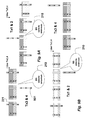
- FIG. 5 and 6 shows how transmit antenna selection and training can be implemented when the UE can only switch antennas between the TTIs.
- the UE transmits the RBs 221 normally using the selected antenna.
- the RB is transmitted periodically using the unselected antenna Tx 2 .
- the BS can now select 210 the optimal antenna for the UE, and feed back its decision Tx 2 205 back to the UE.
- This mechanism shows that a TTI can be used for antenna training and selection, as well as user data transmission.
- FIG. 6 shows the same process for CQI signals 602 .
- the TTI 601 that is transmitted with the unselected antenna includes data and the broadband sounding RSs 602 , and DM pilots, if present.
- using the TTI with the CQI signals also enables a joint resource block reassignment and antenna selection. It should be noted, that the periodicity of using the unselected antenna can vary from what is described above.
- the transmission with the unselected antenna Tx 2 needs to be done with a conservative lower rate MCS because the channel for Tx 2 may not be known at either the BS or UE.
- the RB that is transmitted with the unselected antenna includes data and pilot tones. While the initial transmission with the unselected antenna requires a conservative choice of the MCS, previous channel estimates coupled with the current channel estimate can be used to obtain a more reliable, and perhaps less conservative MCS choice for sequent transmissions of RBs from the unselected antenna.
- FIGS. 7A and 7B show on-demand adaptive antenna selection in response to the selection trigger 401 .
- the UE transmits using the selected antenna (Tx 1 ) until the performance of that antenna is less than a pre-determined threshold, measured as described above.
- the UE sends the trigger signal 401 , and in the next TTI the UE initiates training by either sending just the AS pilot signal 701 with the unselected antenna as shown in FIG. 7A , or the entire RB 702 as shown in FIG. 7B .
- the UE reverts back to Tx 1 for the sequent TTI, and for the select signal 205 . In another embodiment, the UE continues to use antenna Tx 2 , unless the BS directs the UE to switch to another subset of antennas.
- antenna selection can be implemented in a UE with two RF chains and four transmit antennas.
- the reference signals of two antennas are sent simultaneously in a FDM or CDM manner as described above.
- the reference signal sub-carriers for the different antennas are shown using two different patterns.
- FIG. 8A shows periodically sending the AS signal 801 during every other TTI via a pair of unselected antennas (Tx 3 and Tx 4 ), while FIG. 8B shows the AS signal 801 in every third TTI.
- FIGS. 9A-9B show antenna training and selection with periodic FDM broadband sounding reference signals 901 and RB assignment, for every other TTI and every third TTI, respectively using a pair of unselected antennas, e.g., Tx 3 and Tx 4 .
- FIGS. 10A-10B show antenna set selection by using periodic CDM data modulation signals.
- the two pilots 1001 - 1002 transmitted concurrently are orthogonal to each other. Similar schemes are possible when the UE switches between TTIs, and for on demand (adaptive) antenna selection.
- FIG. 11 An embodiment for one RF chain and four antennas as shown in FIG. 11 .
- the UE transmits the training information for four antennas, such that only one transmit antenna is active at any one time.
- the UE sends a data packet in the first TTI 1101 from Tx 1 , and uses SB 2 to send the AS signal 202 for Tx 2 . Then, the BS can determine which of the antennas Tx 1 and Tx 2 is better, and feeds its decision, e.g., use Tx 2 1105 , back to the UE. This feedback is received by the UE after the third TTI. In the meantime, the UE retransmits the second data packet in the second TTI 1102 from Tx 1 , and uses SB 2 of the RB to send the AS signal for Tx 3 .
- the transmitter switches to Tx 2 , as earlier indicated by the BS, and transmits the third data packet in TTI 1103 using Tx 2 .
- the UE uses the SB 2 to send the antenna selection signals for the last remaining antenna Tx 4 .
- the BS determines, for example, that Tx 3 is the optimal of all four antennas, and indicates to UE to transmit using Tx 3 .
- the UE then transmits the data packets 1104 using Tx 3 1103 .
- a similar mechanism can be described for the 1 ms TTI with 14 LBs in which 2 LBs carry reference signals.
- the BS updates its selection decision and feeds the decision back while estimating the channels for the different antennas.
- the BS only feed back its final decision, without incremental selection updates.
- the feedback to use Tx 2 is absent, and the UE transmits the third TTI using Tx 1 .
- FIG. 12 shows another option to speed up the selection process.
- This option uses a combination of selecting within a TTI and selecting between TTIs.
- the UE transmits a data packet using antenna Tx 1 in the first TTI 1201 , and uses SB 2 to send the AS signal 1202 from antenna Tx 2 .
- the UE switches to antenna Tx 3 to transmit the data packet in the second TTI 1203 , and sends the AS signal 1204 for antenna Tx 4 in SB 2 .
- the BS can determine and compare the channel estimates from all the four transmit antennas and feeds back its selection decision to the UE, e.g., Tx 3 1205 .
- the UE continues to transmit data packets from antenna Tx 1 , while waiting for the selection decision, and switches to antenna Tx 3 thereafter.
- the BS send an incremental update when the BS can estimate only a set of the channels of the multiple available antennas.
- the BS compares the channel estimates for antennas Tx 1 and Tx 2 after the first TTI, and sends the selection decision 1301 back to the UE. For example, the BS selects Tx 2 1301 .
- This decision is received by the UE after the second TTI.
- the UE uses antenna Tx 3 to transmit its data packet and antenna Tx 4 for the AS signal.
- the UE switches to Tx 2 to transmit the data packet.
- the BS can compare all the four antennas after the second TTI, and send it selection decision, e.g., Tx 3 1302 , back to the UE.
- the UE switches to Tx 3 after the third TTI.
- the antenna selection process can also use an antenna selection (AS) packet 1400 as shown in FIG. 14 .
- the AS packet embeds antenna selection control (ASC) information 1401 in, e.g., the first long block (LB 1 ) and the DM pilot (P) signal 1402 in the first short block SB 1 in case of a slot with 2 SBs, or in LB 4 in case of a TTI with 14 LBs.
- ASC antenna selection control
- the ASC information 1401 can indicate which subsets of antennas are being used by the UE to transmit the signals.
- the BS can directly associate its channel estimate with a specific antenna.
- the ASC information can also indicate an antenna selection request by the UE, and that pilot tone in the second short block SB 2 should be used for training by the BS.
- the BS does not need to receive the pilot tones before selecting an antenna.
- the BS can select immediately after receiving the first two OFDM symbols of the uplink TTI. This involves the following steps and timing delays.
- the BS receives the first and second OFDM symbols of the UL TTI from the UE and performs channel estimation and antenna selection with delay T 0 .
- the first long and short blocks of the DL TTI are received by the UE, and the UE then switches to the selected antenna with delay T 2 .
- the UE can use control packets, such as packets with ACK or NACK 1501 in LB 1 , for antenna selection.
- This type of packet is sent on the uplink after the UE receives a packet from the BS, even when the UE has no other uplink packets to transmit to the BS.
- the ACS field 1401 can be sent with some packets on otherwise unselected antennas. Therefore, this scheme requires no additional packets to be sent.
- the AS information can be piggybacked either in a periodic manner or adaptively, as described above. Furthermore, either the UE or the BS can initiate this process.
- FIG. 16 shows an antenna selection method according to an embodiment of the invention.
- a first antenna is selected 1610 for transmitting signals from the UE to the BS, e.g., the selected antenna Tx 1 is the last used antenna. It is assumed that the previous selection is known to the UE and the BS.
- the UE transmits 1620 a data packet to the BS via the selected antenna (Tx 1 ) during a TTI.
- the data (or control information) are carried in long blocks of the data packet.
- the UE also transmits 1630 an AS signal, as described above, using an unselected antenna, e.g., Tx 2 .
- the sending of the AS signal can be periodic every k TTIs, or on demand.
- the AS signal is carried in a short block of the packet, or a subsequent data packet.
- the AS signal can be a FDM or CDM signal.
- the AS signal can even be a low overhead signal. If the signal is a FDM signals, then low overhead implies a smaller number of signal sub-carriers. For CDM signals, low overhead signals have reduced power.
- the BS In response to receiving the data packet and the AS signal, the BS estimates the channel and selects an antenna, and transmits the selection to the UE in step 1640 .
- the BS can also reassign the carrier frequencies of the resource blocks used by the UE. Then, after receiving 1650 the selection, and perhaps the RB assignment, the UE switches to the selected antenna for transmitting sequent packets.
- the selection process can be initiated by either the UE or BS based on the SINR, MCS, or HARQ history.
- FIG. 17 shows four ways ( 1701 - 1704 ) that antennas can be switched (SW) after they have been selected.
- the time required to switch antennas can be measured in terms of nanoseconds, e.g., 10 to 100 nanoseconds depending on the exact implementation. This is orders of magnitude shorter than the length of the symbol, e.g., 10 ms.
- the antennas are switched substantially between the symbols. That is, the switching can take place at the end of the block of the previous symbol, or at the beginning of the CP of the next symbol.
- the four ways include: switching entirely within an LB/SB used to send signals, and use CP 1710 and LB or SB data part for switching— 1701 ; switching using CP of LB/SB used to send pilot tones and CP of adjacent LB— 1702 : switching using CP of LB/SB used to send pilot tones and CP of adjacent LB— 1703 ; and switching using CP of adjacent LBs and not using the CP of the LB/SB used to send pilot tones— 1704 .
- the first method in which the LB/SB that contains pilot tones for transmission, is used for the switching times leads to the least loss in performance because data LBs are not affected.
- the base station can transmit its decision about which antenna the UE should use any time, including instances when the UE has not transmitted the sounding reference signal from the unselected antenna subset.
- the broadband sounding RS 1801 is transmitted alternatively from the two antennas.
- the broadband SRS may be transmitted even when the UE does not transmit data.
- the base station estimates the channels for the two antennas and performs resource block and antenna scheduling.
- the sounding RS period is two TTI 1802 , and the UE starts transmitting from TTI # 1 .
- the sounding RS of TTI # 1 , 5 , 9 , . . . is transmitted from the first antenna and the sounding RS of TTI # 3 , 7 11 , . . . is transmitted from the second antenna.
- One embodiment of the invention described below reduces the antenna sounding overhead when the sounding RS is used as AS RS.
- the sounding RS 1901 is again transmitted periodically. However, we now distinguish between the selected antenna that has most recently been selected by the eNodeB for data transmission and the other unselected antenna. Now, only one in every k sounding RSs is transmitted from the unselected antenna and the rest RSs are transmitted from the selected antenna, where k is greater than 1, for example five, ten or fifteen.
- the optimal parameter value for k depends on the UE speed, the Doppler spread of the uplink wireless channel, scheduling constraints of the eNodeB, interference environment, etc. As before, the eNodeB performs resource block assignment and decides which antenna the UE should use for data transmission.
- the parameter k is known to the eNodeB and the UE a priori.
- the advantage of this scheme is that the eNodeB can estimate the channel for the selected antenna more frequently. This is often the optimal antenna when the UE is moving slowly, or not at all. In both of the above mechanisms, the eNodeB can know a priori when the unselected antenna transmits the sounding RS.
- the sounding RS can be transmitted by the UE even when the UE does not have data to transmit.
- a reduction in the AS sounding overhead when the DM RS is used for AS can be achieved in a similar manner.
- the transmission interval of the sounding RS is set to either 2 ms or 10 ms.
- the gains of adaptive antenna selection experienced by the user over single antenna selection are summarized in Table 2.
- the gains of adaptive antenna selection experienced by the user equipment over single antenna selection are summarized in Table 3.
- Table 3 the SNR gain experienced by a UE with adaptive antenna selection capability over a UE with a single transmit antenna for the TTI sounding interval.
- the transmission interval of the sounding RS is 2 ms. Sending the sounding RS from the unselected antenna less frequently, e.g., in only one out of five instances, has negligible loss in performance. Even adaptive antenna selection based on the other more extreme cases, in which the sounding RS is sent from the unselected antenna in one out of ten, or one out of fifteen instances, still results in significant performance gains.
- the embodiments of the invention provide for antenna selection in the uplink from user equipment to a base station in a MIMO network, where the number of RF chains in the UE is less than the number of antennas.
- the invention also provides means for selecting antennas adaptively.
Landscapes
- Engineering & Computer Science (AREA)
- Signal Processing (AREA)
- Computer Networks & Wireless Communication (AREA)
- Power Engineering (AREA)
- Mobile Radio Communication Systems (AREA)
- Radio Transmission System (AREA)
Priority Applications (10)
| Application Number | Priority Date | Filing Date | Title |
|---|---|---|---|
| US11/953,452 US8824420B2 (en) | 2007-03-22 | 2007-12-10 | Method and system for generating antenna selection signals in OFDM tranceivers with fewer RF chains than antennas in MIMO wireless networks |
| JP2009521660A JP2010510692A (ja) | 2007-03-22 | 2008-03-14 | 無線通信ネットワークにおいてアンテナ選択信号を生成する方法およびシステム |
| CN200880009408A CN101730979A (zh) | 2007-03-22 | 2008-03-14 | 在无线通信网络中生成天线选择信号的方法及系统 |
| EP08722564A EP2106637A2 (en) | 2007-03-22 | 2008-03-14 | Method and system for generating antenna selection signals in wireless communication network |
| PCT/JP2008/055199 WO2008126655A2 (en) | 2007-03-22 | 2008-03-14 | Method and system for generating antenna selection signals in wireless communication network |
| US12/495,334 US8331297B2 (en) | 2007-12-10 | 2009-06-30 | Method and system for generating antenna selection signals in wireless networks |
| US12/495,207 US8228858B2 (en) | 2007-03-22 | 2009-06-30 | Method and system for generating antenna selection signals in wireless networks |
| US12/495,147 US8223723B2 (en) | 2007-03-22 | 2009-06-30 | Method and system for generating antenna selection signals in wireless networks |
| US12/495,275 US8483186B2 (en) | 2007-12-10 | 2009-06-30 | Method and system for generating antenna selection signals in wireless networks |
| US12/562,485 US8229294B2 (en) | 2007-12-10 | 2009-09-18 | Cameras with varying spatio-angular-temporal resolutions |
Applications Claiming Priority (2)
| Application Number | Priority Date | Filing Date | Title |
|---|---|---|---|
| US89639007P | 2007-03-22 | 2007-03-22 | |
| US11/953,452 US8824420B2 (en) | 2007-03-22 | 2007-12-10 | Method and system for generating antenna selection signals in OFDM tranceivers with fewer RF chains than antennas in MIMO wireless networks |
Related Child Applications (7)
| Application Number | Title | Priority Date | Filing Date |
|---|---|---|---|
| US12/495,147 Continuation US8223723B2 (en) | 2007-03-22 | 2009-06-30 | Method and system for generating antenna selection signals in wireless networks |
| US12/495,275 Continuation-In-Part US8483186B2 (en) | 2007-12-10 | 2009-06-30 | Method and system for generating antenna selection signals in wireless networks |
| US12/495,275 Continuation US8483186B2 (en) | 2007-12-10 | 2009-06-30 | Method and system for generating antenna selection signals in wireless networks |
| US12/495,334 Continuation-In-Part US8331297B2 (en) | 2007-12-10 | 2009-06-30 | Method and system for generating antenna selection signals in wireless networks |
| US12/495,334 Continuation US8331297B2 (en) | 2007-12-10 | 2009-06-30 | Method and system for generating antenna selection signals in wireless networks |
| US12/495,207 Continuation US8228858B2 (en) | 2007-03-22 | 2009-06-30 | Method and system for generating antenna selection signals in wireless networks |
| US12/562,485 Continuation-In-Part US8229294B2 (en) | 2007-12-10 | 2009-09-18 | Cameras with varying spatio-angular-temporal resolutions |
Publications (2)
| Publication Number | Publication Date |
|---|---|
| US20080232325A1 US20080232325A1 (en) | 2008-09-25 |
| US8824420B2 true US8824420B2 (en) | 2014-09-02 |
Family
ID=39774603
Family Applications (3)
| Application Number | Title | Priority Date | Filing Date |
|---|---|---|---|
| US11/953,452 Active 2030-08-08 US8824420B2 (en) | 2007-03-22 | 2007-12-10 | Method and system for generating antenna selection signals in OFDM tranceivers with fewer RF chains than antennas in MIMO wireless networks |
| US12/495,147 Expired - Fee Related US8223723B2 (en) | 2007-03-22 | 2009-06-30 | Method and system for generating antenna selection signals in wireless networks |
| US12/495,207 Expired - Fee Related US8228858B2 (en) | 2007-03-22 | 2009-06-30 | Method and system for generating antenna selection signals in wireless networks |
Family Applications After (2)
| Application Number | Title | Priority Date | Filing Date |
|---|---|---|---|
| US12/495,147 Expired - Fee Related US8223723B2 (en) | 2007-03-22 | 2009-06-30 | Method and system for generating antenna selection signals in wireless networks |
| US12/495,207 Expired - Fee Related US8228858B2 (en) | 2007-03-22 | 2009-06-30 | Method and system for generating antenna selection signals in wireless networks |
Country Status (5)
| Country | Link |
|---|---|
| US (3) | US8824420B2 (enExample) |
| EP (1) | EP2106637A2 (enExample) |
| JP (1) | JP2010510692A (enExample) |
| CN (1) | CN101730979A (enExample) |
| WO (1) | WO2008126655A2 (enExample) |
Cited By (3)
| Publication number | Priority date | Publication date | Assignee | Title |
|---|---|---|---|---|
| US20140185551A1 (en) * | 2013-01-02 | 2014-07-03 | Wilocity Ltd. | Techniques for rate selection in millimeter-wave communication systems |
| US9197304B2 (en) | 2008-02-04 | 2015-11-24 | Nokia Technologies Oy | Method and apparatus for conveying antenna configuration information via masking |
| USRE50890E1 (en) | 2008-01-04 | 2026-05-12 | Nokia Technologies Oy | Method and apparatus for conveying antenna configuration information |
Families Citing this family (74)
| Publication number | Priority date | Publication date | Assignee | Title |
|---|---|---|---|---|
| US8824420B2 (en) * | 2007-03-22 | 2014-09-02 | Mitsubishi Electric Research Laboratories, Inc. | Method and system for generating antenna selection signals in OFDM tranceivers with fewer RF chains than antennas in MIMO wireless networks |
| WO2008135975A2 (en) | 2007-05-02 | 2008-11-13 | Visonic Ltd. | Wireless communication system |
| WO2009017363A2 (en) | 2007-07-30 | 2009-02-05 | Samsung Electronics Co., Ltd. | Method and apparatus for transmitting and receiving different signal types in communication systems |
| CN104468067B (zh) | 2007-08-08 | 2017-11-24 | 知识产权之桥一号有限责任公司 | 基站装置和接收方法 |
| US8798183B2 (en) * | 2007-08-13 | 2014-08-05 | Qualcomm Incorporated | Feedback and rate adaptation for MIMO transmission in a time division duplexed (TDD) communication system |
| EP2806568B1 (en) * | 2008-02-01 | 2015-12-30 | BlackBerry Limited | System and method for uplink timing synchronization in conjunction with discontinuous reception |
| WO2009120047A2 (ko) * | 2008-03-28 | 2009-10-01 | 한국전자통신연구원 | 셀룰러 시스템에서 가변 품질 서비스를 위한 계층적 전송 장치 및 방법 |
| US8199836B2 (en) * | 2008-05-02 | 2012-06-12 | Nec Laboratories America, Inc. | Multi-resolution precoding codebook |
| US8842554B2 (en) * | 2008-05-07 | 2014-09-23 | Mitsubishi Electric Research Laboratories, Inc. | Antenna selection with frequency-hopped sounding reference signals |
| US9025471B2 (en) * | 2008-05-07 | 2015-05-05 | Mitsubishi Electric Research Laboratories, Inc. | Antenna selection with frequency-hopped sounding reference signals |
| US8238405B2 (en) * | 2009-03-31 | 2012-08-07 | Mitsubishi Electric Research Laboratories, Inc. | Antenna selection with frequency-hopped sounding reference signals |
| KR101306735B1 (ko) * | 2008-10-15 | 2013-09-11 | 엘지전자 주식회사 | 복수개의 안테나를 이용한 사운딩 기준 신호 시퀀스 전송 방법 |
| EP2648469B1 (en) | 2008-11-04 | 2015-03-11 | Huawei Technologies Co., Ltd. | Method and apparatus for determining resource indices |
| US9225414B2 (en) * | 2008-12-31 | 2015-12-29 | Intellectual Discovery Co., Ltd. | Transmission device and method using space-frequency transmission diversity |
| CN101778065B (zh) * | 2009-01-12 | 2013-08-07 | 中兴通讯股份有限公司 | 一种下行数据载波映射的方法及系统 |
| KR101639810B1 (ko) * | 2009-01-13 | 2016-07-25 | 엘지전자 주식회사 | 무선통신 시스템에서 사운딩 참조신호의 전송방법 |
| KR20100089758A (ko) * | 2009-02-04 | 2010-08-12 | 엘지전자 주식회사 | 무선 통신 시스템에서 신호 전송 장치 및 방법 |
| KR101689597B1 (ko) | 2009-02-09 | 2016-12-26 | 엘지전자 주식회사 | 하향링크 mimo 시스템에 있어서, 참조 신호 전송 방법 |
| US8532211B2 (en) * | 2009-02-20 | 2013-09-10 | Qualcomm Incorporated | Methods and apparatus for power control based antenna switching |
| US8824584B2 (en) * | 2009-02-24 | 2014-09-02 | Lg Electronics Inc. | Method for transmitting sounding reference signal in MIMO wireless communication system and apparatus therefor |
| AR075865A1 (es) | 2009-03-17 | 2011-05-04 | Interdigital Patent Holdings | Metodo y aparato para control de potencia de transmision de senal de referencia de sonido (srs) |
| US20100238984A1 (en) * | 2009-03-19 | 2010-09-23 | Motorola, Inc. | Spatial Information Feedback in Wireless Communication Systems |
| JP5378848B2 (ja) * | 2009-03-26 | 2013-12-25 | 京セラ株式会社 | 無線基地局、無線基地局におけるサウンディング制御方法、および無線基地局におけるサウンディング制御プログラム |
| CN101873698B (zh) * | 2009-04-23 | 2012-12-26 | 中国移动通信集团公司 | 信号传送方法及其相关设备 |
| WO2010148550A1 (en) | 2009-06-22 | 2010-12-29 | Huawei Technologies Co., Ltd. | A method and system for assigning reference signals in multi antenna context |
| US20110085588A1 (en) * | 2009-10-09 | 2011-04-14 | Motorola-Mobility, Inc. | Method for precoding based on antenna grouping |
| US8873650B2 (en) | 2009-10-12 | 2014-10-28 | Motorola Mobility Llc | Configurable spatial channel information feedback in wireless communication system |
| KR101668601B1 (ko) * | 2009-11-02 | 2016-10-25 | 주식회사 팬택 | 복수의 셀 고유 dm―rs 생성방법 및 그를 이용하는 통신단말장치와 기지국 장치 |
| GB2475307B (en) * | 2009-11-13 | 2012-05-16 | Toshiba Res Europ Ltd | Wireless communications apparatus and method |
| JP5538930B2 (ja) * | 2010-02-04 | 2014-07-02 | シャープ株式会社 | 移動局装置、基地局装置、無線通信システムおよび無線通信方法 |
| US8811513B2 (en) * | 2010-02-05 | 2014-08-19 | Qualcomm Incorporated | Antenna switching in a closed loop transmit diversity system |
| US9407409B2 (en) * | 2010-02-23 | 2016-08-02 | Qualcomm Incorporated | Channel state information reference signals |
| US9203489B2 (en) | 2010-05-05 | 2015-12-01 | Google Technology Holdings LLC | Method and precoder information feedback in multi-antenna wireless communication systems |
| US8472943B1 (en) * | 2010-06-03 | 2013-06-25 | Sprint Spectrum L.P. | Method and system for using multiple channel elements |
| US8918057B2 (en) * | 2010-07-26 | 2014-12-23 | Mediatek Inc. | Intelligent transmission antenna selection method and communications apparatus utilizing the same |
| WO2012026604A1 (ja) * | 2010-08-27 | 2012-03-01 | 京セラ株式会社 | 無線基地局、無線端末及び通信制御方法 |
| CN102412889A (zh) * | 2010-10-09 | 2012-04-11 | 普天信息技术研究院有限公司 | 一种增强上行侦听参考信号的方法 |
| US8867500B2 (en) * | 2011-06-09 | 2014-10-21 | Qualcomm Incorporated | Systems and methods for reducing acknowledgment message overhead |
| US9042941B2 (en) * | 2011-12-28 | 2015-05-26 | Nokia Solutions And Networks Oy | Uplink grouping and aperture apparatus |
| US8934561B2 (en) | 2011-12-28 | 2015-01-13 | Nokia Siemens Networks Oy | Cell clustering and aperture selection |
| US9276653B2 (en) | 2012-04-10 | 2016-03-01 | Lattice Semiconductor Corporation | Antenna selection and pilot compression in MIMO systems |
| US9439173B2 (en) * | 2012-05-06 | 2016-09-06 | Lg Electronics Inc. | Method and apparatus for transmitting data |
| US8913972B2 (en) | 2012-10-11 | 2014-12-16 | Nokia Siemens Networks Oy | Antenna clustering for multi-antenna aperture selection |
| US9813262B2 (en) | 2012-12-03 | 2017-11-07 | Google Technology Holdings LLC | Method and apparatus for selectively transmitting data using spatial diversity |
| US9591508B2 (en) | 2012-12-20 | 2017-03-07 | Google Technology Holdings LLC | Methods and apparatus for transmitting data between different peer-to-peer communication groups |
| US9979531B2 (en) | 2013-01-03 | 2018-05-22 | Google Technology Holdings LLC | Method and apparatus for tuning a communication device for multi band operation |
| KR102087039B1 (ko) * | 2013-01-18 | 2020-03-10 | 삼성전자 주식회사 | 이차원 평면 배열 안테나를 사용하는 무선 통신 시스템에서 채널 상태 정보 기준 신호 전송 및 하이브리드 공간분할 다중화와 공간분할 다중 접속 방법 및 장치 |
| US10229697B2 (en) | 2013-03-12 | 2019-03-12 | Google Technology Holdings LLC | Apparatus and method for beamforming to obtain voice and noise signals |
| US9379789B2 (en) | 2013-07-03 | 2016-06-28 | Qualcomm Incorporated | Antenna selection adjustment |
| US9386542B2 (en) | 2013-09-19 | 2016-07-05 | Google Technology Holdings, LLC | Method and apparatus for estimating transmit power of a wireless device |
| JP5550774B2 (ja) * | 2013-09-24 | 2014-07-16 | 京セラ株式会社 | 無線端末、サウンディング情報送信方法、およびサウンディング情報送信プログラム |
| US10420118B2 (en) | 2013-09-27 | 2019-09-17 | Qualcomm Incorporated | Multiflow with antenna selection |
| US9549290B2 (en) | 2013-12-19 | 2017-01-17 | Google Technology Holdings LLC | Method and apparatus for determining direction information for a wireless device |
| US9491007B2 (en) | 2014-04-28 | 2016-11-08 | Google Technology Holdings LLC | Apparatus and method for antenna matching |
| US9478847B2 (en) | 2014-06-02 | 2016-10-25 | Google Technology Holdings LLC | Antenna system and method of assembly for a wearable electronic device |
| WO2015186026A1 (en) * | 2014-06-04 | 2015-12-10 | Telefonaktiebolaget L M Ericsson (Publ) | Efficient uplink transmission of channel state information |
| US9831963B2 (en) * | 2014-06-06 | 2017-11-28 | Sony Corporation | MIMO communication method, terminal, and base station apparatus for transmitting and receiving pilot signals to estimate a channel |
| CN105577254B (zh) * | 2014-10-10 | 2018-10-26 | 启碁科技股份有限公司 | 天线控制方法与使用此方法的装置 |
| US10123323B2 (en) | 2014-10-24 | 2018-11-06 | Qualcomm Incorporated | Dynamic uplink/downlink frame structure for enhanced component carriers |
| WO2016095110A1 (zh) * | 2014-12-16 | 2016-06-23 | 富士通株式会社 | 基于探测参考信号的下行信道估计方法、装置以及通信系统 |
| US9572130B2 (en) * | 2014-12-18 | 2017-02-14 | Intel IP Corporation | User equipment and method for transmitting a data stream to an evolved node B |
| CN106105311B (zh) * | 2015-02-28 | 2019-11-26 | 华为技术有限公司 | 一种数据传输的方法、装置和用户设备及系统 |
| CN105007111B (zh) * | 2015-06-09 | 2018-02-23 | 香港应用科技研究院有限公司 | 具有动态训练设计的大规模mimo系统中的信道估计的方法和设备 |
| CN106411375B (zh) * | 2015-07-31 | 2021-06-15 | 中兴通讯股份有限公司 | Srs的指示发送方法、srs的发送方法和装置 |
| WO2017070956A1 (zh) * | 2015-10-30 | 2017-05-04 | 华为技术有限公司 | 一种数据传输方法及装置 |
| CN106817156A (zh) * | 2015-11-27 | 2017-06-09 | 中兴通讯股份有限公司 | 天线选择信息的指示方法及装置 |
| US11076411B2 (en) | 2015-12-31 | 2021-07-27 | Huawei Technologies Co., Ltd. | Method for selecting management frame antenna based on master-slave network and apparatus |
| US10200097B2 (en) * | 2016-03-28 | 2019-02-05 | Qualcomm Incorporated | Enhanced antenna array training |
| US10715233B2 (en) * | 2017-08-31 | 2020-07-14 | Qualcomm Incorporated | Sounding reference signal (SRS) transmit antenna selection |
| CN110071749B (zh) * | 2018-01-22 | 2021-08-31 | 华为技术有限公司 | 一种天线选择指示方法、装置和系统 |
| EP3895482A4 (en) * | 2018-12-13 | 2022-07-20 | Telefonaktiebolaget Lm Ericsson (Publ) | METHOD AND DEVICE FOR MULTIPLE ANTENNA SYSTEMS |
| US11764850B2 (en) * | 2020-05-07 | 2023-09-19 | Qualcomm Incorporated | Compensating for transmit-receive spatial filter asymmetries in upper millimeter wave bands |
| US12328273B2 (en) * | 2020-05-13 | 2025-06-10 | Qualcomm Incorporated | Code block-based resource mapping for transmissions with data-modulated demodulation reference signals |
| CN111817745B (zh) * | 2020-07-28 | 2022-08-05 | 惠州Tcl移动通信有限公司 | 射频装置及移动终端 |
Citations (20)
| Publication number | Priority date | Publication date | Assignee | Title |
|---|---|---|---|---|
| US6600934B1 (en) * | 1998-06-20 | 2003-07-29 | Samsung Electronics Co., Ltd. | Device and method for providing selection transmit diversity in mobile communication system |
| US20030148738A1 (en) * | 2002-02-07 | 2003-08-07 | Lucent Technologies Inc. | Method and apparatus for feedback error detection in a wireless communications systems |
| US20050090205A1 (en) * | 2003-10-01 | 2005-04-28 | Severine Catreux-Erceg | System and method for channel-adaptive antenna selection |
| US20050207367A1 (en) * | 2004-03-22 | 2005-09-22 | Onggosanusi Eko N | Method for channel quality indicator computation and feedback in a multi-carrier communications system |
| US20060056357A1 (en) * | 2002-11-26 | 2006-03-16 | Koninklijke Philips Electronics N.V. | Low-if pre-preamble antenna diversity receiver |
| US20060111056A1 (en) * | 2004-11-19 | 2006-05-25 | Santanu Dutta | Electronic antenna beam steering using ancillary receivers and related methods |
| US7125963B2 (en) * | 2004-03-03 | 2006-10-24 | En N Tech Inc | Treatments for contaminant reduction in lactoferrin preparations and lactoferrin containing compositions |
| US20070004465A1 (en) * | 2005-06-29 | 2007-01-04 | Aris Papasakellariou | Pilot Channel Design for Communication Systems |
| WO2007024214A1 (en) | 2005-08-19 | 2007-03-01 | Mitsubishi Electric Research Laboratories | Optimal signaling and selection verification for transmit antenna selection with erroneous feedback |
| US20070058584A1 (en) * | 2005-09-12 | 2007-03-15 | Ilan Sutskover | Techniques to transmit and duplex with channel knowledge at a base station |
| US20070135161A1 (en) * | 2005-10-06 | 2007-06-14 | Telefonaktiebolaget Lm Ericsson (Publ) | Signaling Support for Antenna Selection Using Subset Lists and Subset Masks |
| US20080032630A1 (en) * | 2006-03-20 | 2008-02-07 | Byoung-Hoon Kim | Uplink channel estimation using a signaling channel |
| US20080039098A1 (en) * | 2006-08-14 | 2008-02-14 | Texas Instruments Incorporated | Methods and apparatus to schedule uplink transmissions in wireless communication systems |
| WO2008023811A1 (en) | 2006-08-22 | 2008-02-28 | Mitsubishi Electric Corporation | Method and system for antenna selection in wireless networks |
| US20080063116A1 (en) * | 2005-03-30 | 2008-03-13 | Hitoshi Yokoyama | Mobile terminal, radio communication apparatus and radio communication method |
| US7471702B2 (en) * | 2005-03-09 | 2008-12-30 | Qualcomm Incorporated | Methods and apparatus for implementing, using, transmitting, and/or receiving signals at least some of which include intentional null tones |
| US20090274074A1 (en) * | 2006-06-16 | 2009-11-05 | Telefonaktiebolaget L M Ericsson (Publ) | Method for Channel Quality Measures in a Multiple Antenna System |
| US20100069028A1 (en) * | 2007-02-02 | 2010-03-18 | Jin Soo Choi | Antenna switching method and method for transmitting and receiving signals for the same |
| US20100111216A1 (en) * | 2003-09-10 | 2010-05-06 | Panasonic Corporation | Secure Communication Method, Transmission Apparatus and Reception Apparatus |
| US20100296591A1 (en) * | 2006-10-31 | 2010-11-25 | Hao Xu | Unified design and centralized scheduling for dynamic simo, su-mimo and mu-mimo operation for rl transmissions |
Family Cites Families (26)
| Publication number | Priority date | Publication date | Assignee | Title |
|---|---|---|---|---|
| US5848357A (en) * | 1997-03-31 | 1998-12-08 | Motorola, Inc. | Method and apparatus in a radio communication system for implementing a frequency reuse plan |
| US7079499B1 (en) * | 1999-09-08 | 2006-07-18 | Nortel Networks Limited | Internet protocol mobility architecture framework |
| US6769000B1 (en) * | 1999-09-08 | 2004-07-27 | Nortel Networks Limited | Unified directory services architecture for an IP mobility architecture framework |
| US7082130B2 (en) * | 2002-06-13 | 2006-07-25 | Utstarcom, Inc. | System and method for point-to-point protocol device redundancey |
| JP4111793B2 (ja) * | 2002-09-26 | 2008-07-02 | 富士通株式会社 | 中継システム |
| US7385957B2 (en) * | 2002-11-14 | 2008-06-10 | Qualcomm Incorporated | Methods and apparatus for extending mobile IP |
| US7937578B2 (en) * | 2002-11-14 | 2011-05-03 | Qualcomm Incorporated | Communications security methods for supporting end-to-end security associations |
| US7738871B2 (en) * | 2004-11-05 | 2010-06-15 | Interdigital Technology Corporation | Wireless communication method and system for implementing media independent handover between technologically diversified access networks |
| WO2008005102A2 (en) * | 2006-05-13 | 2008-01-10 | Sap Ag | Consistent set of interfaces derived from a business object model |
| WO2007145371A1 (en) * | 2006-06-14 | 2007-12-21 | Panasonic Corporation | Filtering policy in nemo mobile router |
| US8571120B2 (en) * | 2006-09-22 | 2013-10-29 | Texas Instruments Incorporated | Transmission of acknowledge/not acknowledge (ACK/NACK) bits and their embedding in the reference signal |
| CN101578801B (zh) * | 2006-11-01 | 2013-06-19 | 高通股份有限公司 | 在sc-fdma系统中的使用可变功率偏移的控制与数据的复用 |
| AU2007316434B2 (en) * | 2006-11-06 | 2011-08-04 | Qualcomm Incorporated | Methods and apparatus for power allocation and/or rate selection for UL MIMO/SIMO operations with par considerations |
| US7957759B2 (en) * | 2006-12-08 | 2011-06-07 | Texas Instruments Incorporated | Wideband reference signal transmission in SC-FDMA communication systems |
| US7697623B2 (en) * | 2007-01-05 | 2010-04-13 | Mitsubishi Electric Research Laboratories, Inc. | Method and system for switching antennas during transmission time intervals in OFDMA systems |
| US8451915B2 (en) * | 2007-03-21 | 2013-05-28 | Samsung Electronics Co., Ltd. | Efficient uplink feedback in a wireless communication system |
| US8824420B2 (en) * | 2007-03-22 | 2014-09-02 | Mitsubishi Electric Research Laboratories, Inc. | Method and system for generating antenna selection signals in OFDM tranceivers with fewer RF chains than antennas in MIMO wireless networks |
| US8086272B2 (en) * | 2007-08-06 | 2011-12-27 | Mitsubishi Electric Research Laboratories, Inc. | Wireless networks incorporating antenna selection based on received sounding reference signals |
| US8055301B2 (en) * | 2007-08-06 | 2011-11-08 | Mitsubishi Electric Research Laboratories, Inc. | Wireless networks incorporating implicit antenna selection based on received sounding reference signals |
| US8798183B2 (en) * | 2007-08-13 | 2014-08-05 | Qualcomm Incorporated | Feedback and rate adaptation for MIMO transmission in a time division duplexed (TDD) communication system |
| US8009617B2 (en) * | 2007-08-15 | 2011-08-30 | Qualcomm Incorporated | Beamforming of control information in a wireless communication system |
| US8483186B2 (en) * | 2007-12-10 | 2013-07-09 | Mitsubishi Electric Research Laboratories, Inc. | Method and system for generating antenna selection signals in wireless networks |
| US8331297B2 (en) * | 2007-12-10 | 2012-12-11 | Mitsubishi Electric Research Laboratories, Inc. | Method and system for generating antenna selection signals in wireless networks |
| KR101441500B1 (ko) * | 2008-06-20 | 2014-11-04 | 삼성전자주식회사 | 다중 안테나 및 사운딩 레퍼런스 신호 호핑을 사용하는상향링크 무선 통신 시스템에서의 사운딩 레퍼런스 신호전송 장치 및 방법 |
| US8548406B2 (en) * | 2009-05-05 | 2013-10-01 | Lg Electronics Inc. | Method of transmitting reference signal in multiple antenna system |
| US9820273B2 (en) * | 2010-03-02 | 2017-11-14 | Xiaoxia Zhang | Uplink coordinated multipoint communications in a wireless network |
-
2007
- 2007-12-10 US US11/953,452 patent/US8824420B2/en active Active
-
2008
- 2008-03-14 EP EP08722564A patent/EP2106637A2/en not_active Withdrawn
- 2008-03-14 WO PCT/JP2008/055199 patent/WO2008126655A2/en not_active Ceased
- 2008-03-14 JP JP2009521660A patent/JP2010510692A/ja active Pending
- 2008-03-14 CN CN200880009408A patent/CN101730979A/zh active Pending
-
2009
- 2009-06-30 US US12/495,147 patent/US8223723B2/en not_active Expired - Fee Related
- 2009-06-30 US US12/495,207 patent/US8228858B2/en not_active Expired - Fee Related
Patent Citations (20)
| Publication number | Priority date | Publication date | Assignee | Title |
|---|---|---|---|---|
| US6600934B1 (en) * | 1998-06-20 | 2003-07-29 | Samsung Electronics Co., Ltd. | Device and method for providing selection transmit diversity in mobile communication system |
| US20030148738A1 (en) * | 2002-02-07 | 2003-08-07 | Lucent Technologies Inc. | Method and apparatus for feedback error detection in a wireless communications systems |
| US20060056357A1 (en) * | 2002-11-26 | 2006-03-16 | Koninklijke Philips Electronics N.V. | Low-if pre-preamble antenna diversity receiver |
| US20100111216A1 (en) * | 2003-09-10 | 2010-05-06 | Panasonic Corporation | Secure Communication Method, Transmission Apparatus and Reception Apparatus |
| US20050090205A1 (en) * | 2003-10-01 | 2005-04-28 | Severine Catreux-Erceg | System and method for channel-adaptive antenna selection |
| US7125963B2 (en) * | 2004-03-03 | 2006-10-24 | En N Tech Inc | Treatments for contaminant reduction in lactoferrin preparations and lactoferrin containing compositions |
| US20050207367A1 (en) * | 2004-03-22 | 2005-09-22 | Onggosanusi Eko N | Method for channel quality indicator computation and feedback in a multi-carrier communications system |
| US20060111056A1 (en) * | 2004-11-19 | 2006-05-25 | Santanu Dutta | Electronic antenna beam steering using ancillary receivers and related methods |
| US7471702B2 (en) * | 2005-03-09 | 2008-12-30 | Qualcomm Incorporated | Methods and apparatus for implementing, using, transmitting, and/or receiving signals at least some of which include intentional null tones |
| US20080063116A1 (en) * | 2005-03-30 | 2008-03-13 | Hitoshi Yokoyama | Mobile terminal, radio communication apparatus and radio communication method |
| US20070004465A1 (en) * | 2005-06-29 | 2007-01-04 | Aris Papasakellariou | Pilot Channel Design for Communication Systems |
| WO2007024214A1 (en) | 2005-08-19 | 2007-03-01 | Mitsubishi Electric Research Laboratories | Optimal signaling and selection verification for transmit antenna selection with erroneous feedback |
| US20070058584A1 (en) * | 2005-09-12 | 2007-03-15 | Ilan Sutskover | Techniques to transmit and duplex with channel knowledge at a base station |
| US20070135161A1 (en) * | 2005-10-06 | 2007-06-14 | Telefonaktiebolaget Lm Ericsson (Publ) | Signaling Support for Antenna Selection Using Subset Lists and Subset Masks |
| US20080032630A1 (en) * | 2006-03-20 | 2008-02-07 | Byoung-Hoon Kim | Uplink channel estimation using a signaling channel |
| US20090274074A1 (en) * | 2006-06-16 | 2009-11-05 | Telefonaktiebolaget L M Ericsson (Publ) | Method for Channel Quality Measures in a Multiple Antenna System |
| US20080039098A1 (en) * | 2006-08-14 | 2008-02-14 | Texas Instruments Incorporated | Methods and apparatus to schedule uplink transmissions in wireless communication systems |
| WO2008023811A1 (en) | 2006-08-22 | 2008-02-28 | Mitsubishi Electric Corporation | Method and system for antenna selection in wireless networks |
| US20100296591A1 (en) * | 2006-10-31 | 2010-11-25 | Hao Xu | Unified design and centralized scheduling for dynamic simo, su-mimo and mu-mimo operation for rl transmissions |
| US20100069028A1 (en) * | 2007-02-02 | 2010-03-18 | Jin Soo Choi | Antenna switching method and method for transmitting and receiving signals for the same |
Non-Patent Citations (2)
| Title |
|---|
| 36.211, 3rd Generation Partnership Project; Technical Specification Group Radio Access Network; Physical Channels and Modulation (Release 8), v 1.0.0 (Mar. 2007). |
| LG Electronics: "R1-071119: A New DM-RS Transmission Scheme for Adaptive Antenna Switching in E-Utra Uplink" 3GPP Tsg-Ran WG1 #48, [Online] Feb. 9, 2007 , XP002495441 St. Louis. |
Cited By (4)
| Publication number | Priority date | Publication date | Assignee | Title |
|---|---|---|---|---|
| USRE50890E1 (en) | 2008-01-04 | 2026-05-12 | Nokia Technologies Oy | Method and apparatus for conveying antenna configuration information |
| US9197304B2 (en) | 2008-02-04 | 2015-11-24 | Nokia Technologies Oy | Method and apparatus for conveying antenna configuration information via masking |
| US20140185551A1 (en) * | 2013-01-02 | 2014-07-03 | Wilocity Ltd. | Techniques for rate selection in millimeter-wave communication systems |
| US9312985B2 (en) * | 2013-01-02 | 2016-04-12 | Qualcomm Incorporated | Techniques for rate selection in millimeter-wave communication systems |
Also Published As
| Publication number | Publication date |
|---|---|
| US8228858B2 (en) | 2012-07-24 |
| WO2008126655A3 (en) | 2008-12-31 |
| EP2106637A2 (en) | 2009-10-07 |
| US8223723B2 (en) | 2012-07-17 |
| US20090274110A1 (en) | 2009-11-05 |
| CN101730979A (zh) | 2010-06-09 |
| US20080232325A1 (en) | 2008-09-25 |
| US20100002657A1 (en) | 2010-01-07 |
| JP2010510692A (ja) | 2010-04-02 |
| WO2008126655A2 (en) | 2008-10-23 |
Similar Documents
| Publication | Publication Date | Title |
|---|---|---|
| US8228858B2 (en) | Method and system for generating antenna selection signals in wireless networks | |
| US8331297B2 (en) | Method and system for generating antenna selection signals in wireless networks | |
| US8483186B2 (en) | Method and system for generating antenna selection signals in wireless networks | |
| US7583939B2 (en) | Method and system for antenna selection in wireless networks | |
| CN102017453B (zh) | 利用跳频探测参考信号的天线选择 | |
| CN102017455B (zh) | 利用跳频探测参考信号的天线选择 | |
| US8238405B2 (en) | Antenna selection with frequency-hopped sounding reference signals | |
| US20120178502A1 (en) | Method for Selecting Antennas in a Wireless Networks | |
| US20200274567A1 (en) | System and Method for Orthogonal Frequency Division Multiple Access (OFDMA) Transmission | |
| WO2008081954A1 (en) | Method and system for switching antennas during transmission time intervals in ofdma systems | |
| JP5631425B2 (ja) | 送受信機のアンテナ選択方法 | |
| CN101507140A (zh) | 无线网络中的天线选择方法及系统 |
Legal Events
| Date | Code | Title | Description |
|---|---|---|---|
| AS | Assignment |
Owner name: MITSUBISHI ELECTRIC RESEARCH LABORATORIES, INC., M Free format text: ASSIGNMENT OF ASSIGNORS INTEREST;ASSIGNORS:MEHTA, NEELESH B.;BALA, ERDEM;ZHANG, JINYUN;REEL/FRAME:020543/0163;SIGNING DATES FROM 20080123 TO 20080211 Owner name: MITSUBISHI ELECTRIC RESEARCH LABORATORIES, INC., M Free format text: ASSIGNMENT OF ASSIGNORS INTEREST;ASSIGNORS:MEHTA, NEELESH B.;BALA, ERDEM;ZHANG, JINYUN;SIGNING DATES FROM 20080123 TO 20080211;REEL/FRAME:020543/0163 |
|
| STCF | Information on status: patent grant |
Free format text: PATENTED CASE |
|
| FEPP | Fee payment procedure |
Free format text: SURCHARGE FOR LATE PAYMENT, LARGE ENTITY (ORIGINAL EVENT CODE: M1554) |
|
| MAFP | Maintenance fee payment |
Free format text: PAYMENT OF MAINTENANCE FEE, 4TH YEAR, LARGE ENTITY (ORIGINAL EVENT CODE: M1551) Year of fee payment: 4 |
|
| FEPP | Fee payment procedure |
Free format text: 7.5 YR SURCHARGE - LATE PMT W/IN 6 MO, LARGE ENTITY (ORIGINAL EVENT CODE: M1555); ENTITY STATUS OF PATENT OWNER: LARGE ENTITY |
|
| MAFP | Maintenance fee payment |
Free format text: PAYMENT OF MAINTENANCE FEE, 8TH YEAR, LARGE ENTITY (ORIGINAL EVENT CODE: M1552); ENTITY STATUS OF PATENT OWNER: LARGE ENTITY Year of fee payment: 8 |
|
| FEPP | Fee payment procedure |
Free format text: MAINTENANCE FEE REMINDER MAILED (ORIGINAL EVENT CODE: REM.); ENTITY STATUS OF PATENT OWNER: LARGE ENTITY |