US8552799B2 - Power amplifying circuit - Google Patents

Power amplifying circuit Download PDF

Info

Publication number
US8552799B2
US8552799B2 US13/418,594 US201213418594A US8552799B2 US 8552799 B2 US8552799 B2 US 8552799B2 US 201213418594 A US201213418594 A US 201213418594A US 8552799 B2 US8552799 B2 US 8552799B2
Authority
US
United States
Prior art keywords
operational amplifier
feedback resistor
input terminal
inverting input
output terminal
Prior art date
Legal status (The legal status is an assumption and is not a legal conclusion. Google has not performed a legal analysis and makes no representation as to the accuracy of the status listed.)
Active, expires
Application number
US13/418,594
Other versions
US20130038395A1 (en
Inventor
Hiroyuki Tsurumi
Current Assignee (The listed assignees may be inaccurate. Google has not performed a legal analysis and makes no representation or warranty as to the accuracy of the list.)
Toshiba Corp
Original Assignee
Toshiba Corp
Priority date (The priority date is an assumption and is not a legal conclusion. Google has not performed a legal analysis and makes no representation as to the accuracy of the date listed.)
Filing date
Publication date
Application filed by Toshiba Corp filed Critical Toshiba Corp
Assigned to KABUSHIKI KAISHA TOSHIBA reassignment KABUSHIKI KAISHA TOSHIBA ASSIGNMENT OF ASSIGNORS INTEREST (SEE DOCUMENT FOR DETAILS). Assignors: TSURUMI, HIROYUKI
Publication of US20130038395A1 publication Critical patent/US20130038395A1/en
Application granted granted Critical
Publication of US8552799B2 publication Critical patent/US8552799B2/en
Active legal-status Critical Current
Adjusted expiration legal-status Critical

Links

Images

Classifications

    • HELECTRICITY
    • H03ELECTRONIC CIRCUITRY
    • H03FAMPLIFIERS
    • H03F3/00Amplifiers with only discharge tubes or only semiconductor devices as amplifying elements
    • H03F3/68Combinations of amplifiers, e.g. multi-channel amplifiers for stereophonics
    • HELECTRICITY
    • H03ELECTRONIC CIRCUITRY
    • H03FAMPLIFIERS
    • H03F1/00Details of amplifiers with only discharge tubes, only semiconductor devices or only unspecified devices as amplifying elements
    • H03F1/02Modifications of amplifiers to raise the efficiency, e.g. gliding Class A stages, use of an auxiliary oscillation
    • H03F1/0205Modifications of amplifiers to raise the efficiency, e.g. gliding Class A stages, use of an auxiliary oscillation in transistor amplifiers
    • H03F1/0211Modifications of amplifiers to raise the efficiency, e.g. gliding Class A stages, use of an auxiliary oscillation in transistor amplifiers with control of the supply voltage or current
    • H03F1/0244Stepped control
    • HELECTRICITY
    • H03ELECTRONIC CIRCUITRY
    • H03FAMPLIFIERS
    • H03F1/00Details of amplifiers with only discharge tubes, only semiconductor devices or only unspecified devices as amplifying elements
    • H03F1/02Modifications of amplifiers to raise the efficiency, e.g. gliding Class A stages, use of an auxiliary oscillation
    • H03F1/0205Modifications of amplifiers to raise the efficiency, e.g. gliding Class A stages, use of an auxiliary oscillation in transistor amplifiers
    • H03F1/0277Selecting one or more amplifiers from a plurality of amplifiers
    • HELECTRICITY
    • H03ELECTRONIC CIRCUITRY
    • H03FAMPLIFIERS
    • H03F3/00Amplifiers with only discharge tubes or only semiconductor devices as amplifying elements
    • H03F3/181Low-frequency amplifiers, e.g. audio preamplifiers
    • H03F3/183Low-frequency amplifiers, e.g. audio preamplifiers with semiconductor devices only
    • H03F3/187Low-frequency amplifiers, e.g. audio preamplifiers with semiconductor devices only in integrated circuits
    • HELECTRICITY
    • H03ELECTRONIC CIRCUITRY
    • H03FAMPLIFIERS
    • H03F3/00Amplifiers with only discharge tubes or only semiconductor devices as amplifying elements
    • H03F3/45Differential amplifiers
    • H03F3/45071Differential amplifiers with semiconductor devices only
    • H03F3/45076Differential amplifiers with semiconductor devices only characterised by the way of implementation of the active amplifying circuit in the differential amplifier
    • H03F3/45475Differential amplifiers with semiconductor devices only characterised by the way of implementation of the active amplifying circuit in the differential amplifier using IC blocks as the active amplifying circuit
    • HELECTRICITY
    • H03ELECTRONIC CIRCUITRY
    • H03FAMPLIFIERS
    • H03F2203/00Indexing scheme relating to amplifiers with only discharge tubes or only semiconductor devices as amplifying elements covered by H03F3/00
    • H03F2203/45Indexing scheme relating to differential amplifiers
    • H03F2203/45138Two or more differential amplifiers in IC-block form are combined, e.g. measuring amplifiers

Definitions

  • Embodiments described herein relate generally to a power amplifying circuit.
  • the idling stop and start function is to prevent the audio output from the car audio system from being interrupted by an instantaneous drop of the battery voltage caused by an abrupt load change when the engine is restarted.
  • the idling stop and start function allows a user to comfortably listen to the audio output from the car audio system even when the engine is restarted.
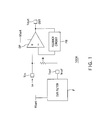
  • FIG. 1 is a diagram showing a configuration of a power amplifying circuit 100 X according to a comparative example that is not adapted for idling stop;
  • FIG. 2 is a diagram showing a waveform of an operation of the power amplifying circuit 100 X according to the comparative example shown in FIG. 1 ;
  • FIG. 3 is a diagram showing an example of a configuration of a power amplifying circuit 100 according to a first embodiment
  • FIG. 4 is a diagram showing an example of a specific circuit configuration of the midpoint potential controlling circuit 1 shown in FIG. 3 ;
  • FIG. 5 is a diagram showing an example of a specific waveform of an operation of the power amplifying circuit 100 according to the first embodiment shown in FIG. 3 .
  • a power amplifying circuit includes a first operational amplifier connected to a first signal input terminal at a non-inverting input terminal thereof.
  • the power amplifying circuit includes a first feedback resistor connected between an output terminal of the first operational amplifier and an inverting input terminal of the first operational amplifier.
  • the power amplifying circuit includes a second feedback resistor connected to the inverting input terminal of the first operational amplifier at a first end thereof.
  • the power amplifying circuit includes a second operational amplifier connected to a second signal input terminal at a non-inverting input terminal thereof.
  • the power amplifying circuit includes a third feedback resistor connected to an inverting input terminal of the second operational amplifier at a first end thereof and to a second end of the second feedback resistor at a second end thereof.
  • the power amplifying circuit includes a fourth feedback resistor connected between an output terminal of the second operational amplifier and an inverting input terminal of the second operational amplifier.
  • the power amplifying circuit includes a fully differential operational amplifier that is connected to the output terminal of the first operational amplifier at a non-inverting input terminal thereof, to the output terminal of the second operational amplifier at an inverting input terminal thereof, to a first signal output terminal at a non-inverting output terminal thereof, and to a second signal output terminal at an inverting output terminal thereof and maintains a constant differential gain.
  • the power amplifying circuit includes a switching circuit connected between the second end of the second feedback resistor and the ground.
  • the power amplifying circuit includes a first input resistor connected between the first signal input terminal and a reference terminal to which a reference voltage is applied.
  • the power amplifying circuit includes a second input resistor connected between the second signal input terminal and the reference terminal.
  • the power amplifying circuit includes a midpoint potential controlling circuit that monitors a power supply voltage and controls the switching circuit based on the value of the power supply voltage.
  • the midpoint potential controlling circuit turns on the switching circuit when the power supply voltage is equal to or higher than a preset switching threshold.
  • the midpoint potential controlling circuit turns off the switching circuit when the power supply voltage is lower than the switching threshold.
  • FIG. 1 is a diagram showing a configuration of a power amplifying circuit 100 X according to a comparative example that is not adapted for idling stop.
  • FIG. 2 is a diagram showing a waveform of an operation of the power amplifying circuit 100 X according to the comparative example shown in FIG. 1 .
  • the power amplifying circuit 100 X includes an operational amplifier OP, a feedback circuit “FB”, and a resistor R.
  • a reference voltage “Vref” is supplied through a supply voltage rejection (SVR) filter F to a reference terminal (SVR terminal) “Tref” of the power amplifying circuit 100 X.
  • SVR supply voltage rejection
  • the potential at an output terminal Tout of the power amplifying circuit 100 X is approximately equal to the reference voltage “Vref” at the reference terminal Tref and is set at an intermediate voltage of a power supply voltage (battery voltage) “Vbat”.
  • the power amplifying circuit 100 X cannot keep a desired output waveform.
  • the car audio system that incorporates the power amplifying circuit 100 X according to the comparative example that is not adapted for idling stop interrupts the audio output and makes the user feel discomfort when the engine is restarted and the battery voltage instantaneously drops because of the abrupt load change.
  • FIG. 3 is a diagram showing an example of a configuration of a power amplifying circuit 100 according to a first embodiment.
  • the power amplifying circuit 100 includes a midpoint potential controlling circuit 1 , a fully differential operational amplifier 3 , a first feedback resistor R 1 , a second feedback resistor R 2 , a third feedback resistor R 3 , a fourth feedback resistor R 4 , a first input resistor R 11 , a second input resistor R 12 , a first operational amplifier OP 1 , a second operational amplifier OP 2 , and a switching circuit SW.
  • the first operational amplifier OP 1 is connected to a first signal input terminal Tin 1 at a non-inverting input terminal thereof.
  • the first feedback resistor R 1 is connected between an output terminal of the first operational amplifier OP 1 and an inverting input terminal of the first operational amplifier OP 1 .
  • the second feedback resistor R 2 is connected to the inverting input terminal of the first operational amplifier OP 1 at one end thereof.
  • the second operational amplifier OP 2 is connected to a second signal input terminal Tin 2 at a non-inverting input terminal thereof.
  • the third feedback resistor R 3 is connected to an inverting input terminal of the second operational amplifier OP 2 at one end thereof and to the other end of the second feedback resistor R 2 at the other end thereof.
  • the fourth feedback resistor R 4 is connected between an output terminal of the second operational amplifier OP 2 and the inverting input terminal of the second operational amplifier OP 2 .
  • the first to fourth feedback resistors R 1 to R 4 have a same first resistance Ra, for example.
  • the fully differential operational amplifier 3 is connected to the output terminal of the first operational amplifier OP 1 at a non-inverting input terminal thereof, to the output terminal of the second operational amplifier OP 2 at an inverting input terminal thereof, to a first signal output terminal Tout 1 at a non-inverting output terminal thereof, and to a second signal output terminal at an inverting output terminal thereof.
  • the fully differential operational amplifier 3 is configured to maintain a constant differential gain.
  • the fully differential operational amplifier 3 includes a fifth feedback resistor R 5 , a sixth feedback resistor R 6 , a seventh feedback resistor R 7 , an eighth feedback resistor R 8 , a ninth feedback resistor R 9 , a tenth feedback resistor R 10 , a third operational amplifier OP 3 , and a fourth operational amplifier OP 4 , for example.
  • the fifth feedback resistor “R 5 ” is connected to the non-inverting input terminal of the fully differential operational amplifier 3 (the output terminal of the first operational amplifier OP 1 ) at one end thereof.
  • the sixth feedback resistor R 6 is connected to the inverting input terminal of the fully differential operational amplifier 3 (the output terminal of the second operational amplifier OP 2 ) at one end thereof.
  • the seventh feedback resistor R 7 is connected to the other end of the fifth feedback resistor R 5 at one end thereof.
  • the eighth feedback resistor R 8 is connected to the other end of the sixth feedback resistor R 6 at one end thereof.
  • the third operational amplifier OP 3 is connected to the other end of the fifth feedback resistor R 5 at a non-inverting input terminal thereof, to the other end of the eighth feedback resistor R 8 at an inverting input terminal thereof, and to the non-inverting output terminal of the fully differential operational amplifier 3 (the first signal output terminal Tout 1 ) at an output terminal thereof.
  • the ninth feedback resistor R 9 is connected between the output terminal of the third operational amplifier OP 3 and the inverting input terminal of the third operational amplifier OP 3 .
  • the fourth operational amplifier OP 4 is connected to the other end of the sixth feedback resistor R 6 at a non-inverting input terminal thereof, to the other end of the seventh feedback resistor R 7 at an inverting input terminal thereof, and to the inverting output terminal of the fully differential operational amplifier 3 (the second signal output terminal Tout 2 ) at an output terminal thereof.
  • the tenth feedback resistor R 10 is connected between the output terminal of the fourth operational amplifier OP 4 and the inverting input terminal of the fourth operational amplifier OP 4 .
  • the fifth and sixth feedback resistors R 5 and R 6 have a same second resistance “Rb”, for example.
  • the ninth and tenth feedback resistors R 9 and R 10 have a same third resistance “Rc”, for example.
  • the resistances of the seventh and eighth feedback resistors R 7 and R 8 are negligibly small compared with the third resistance “Rc”, for example.
  • the switching circuit SW is connected between the other end of the second feedback resistor R 2 and the ground.
  • the first input resistor R 11 is connected between the first signal input terminal Tin 1 and the reference terminal (SVR terminal) Tref to which the reference voltage “Vref” is applied.
  • the second input resistor R 12 is connected between the second signal input terminal Tin 2 and the reference terminal Tref.
  • the reference voltage “Vref” is supplied to the reference terminal Tref from an SVR filter 2 .
  • the SVR filter 2 generates the reference voltage “Vref” by dividing the power supply voltage “Vbat” into values lower than the intermediate voltage of the power supply voltage “Vbat” and raises the supply voltage rejection ratio with respect to the generated reference voltage “Vref” with a capacitor (not shown) connected between the reference terminal Tref and the ground.
  • the reference voltage “Vref” is steady even if the power supply voltage “Vbat” varies due to idling stop or the like.
  • the reference voltage “Vref” is set to be a quarter of the power supply voltage “Vbat”, for example.
  • the midpoint potential controlling circuit 1 is configured to monitor the reference voltage “Vref” and the power supply voltage (battery voltage) “Vbat” and control the switching circuit SW according to the value of the power supply voltage “Vbat”.
  • the midpoint potential controlling circuit 1 turns on the switching circuit SW if the power supply voltage “Vbat” is equal to or higher than a preset switching threshold “Vth” (if the power supply voltage “Vbat” is in a steady state), and turns off the switching circuit SW if the power supply voltage “Vbat” is lower than the switching threshold “Vth” (if the power supply voltage “Vbat” instantaneously drops).
  • the switching threshold “Vth” for the power supply voltage “Vbat” is set at a value with which the first and second operational amplifiers OP 1 and OP 2 can operate to output a predetermined signal.
  • the switching threshold “Vth” is set based on the reference voltage “Vref”.
  • the switching threshold “Vth” is set to be higher than a half of the power supply voltage “Vbat” in the steady state.
  • the midpoint potential controlling circuit 1 controls the switching circuit SW based on the result of comparison between the power supply voltage “Vbat” and the reference voltage “Vref”.
  • FIG. 4 is a diagram showing an example of a specific circuit configuration of the midpoint potential controlling circuit 1 shown in FIG. 3 .
  • the midpoint potential controlling circuit 1 includes resistors 1 a , 1 b , 1 e , 1 h , 1 j and 1 k , PNP-type bipolar transistors 1 c and 1 i , NPN-type bipolar transistors 1 d and 1 g , a constant current source 1 f , a Zener diode 1 l , an nMOS transistor 1 m , an output terminal 1 n , and a level shift circuit 1 o.
  • the resistor 1 a is connected to the power supply (battery) at one end thereof.
  • the resistor 1 b is connected between the other end of the resistor 1 a and the ground.
  • the PNP-type bipolar transistor 1 c is connected to the power supply at the emitter thereof and is diode-connected.
  • the NPN-type bipolar transistor 1 d is connected to the collector of the PNP-type bipolar transistor 1 c at the collector thereof and to the other end of the resistor 1 a at the base thereof.
  • the resistor 1 e is connected to the emitter of the NPN-type bipolar transistor at one end thereof.
  • the constant current source 1 f is connected between the other end of the resistor 1 e and the ground.
  • the level shift circuit 1 o is configured to output a voltage level-shifted from the reference voltage “Vref” input to the reference terminal Tref.
  • the NPN-type bipolar transistor 1 g is connected to the power supply at the collector thereof and to the output of the level shift circuit 1 o at the base thereof.
  • the resistor 1 h is connected between the emitter of the NPN-type bipolar transistor 1 g and one end of the constant current source 1 f.
  • the PNP-type bipolar transistor 1 i is connected to the power supply at the emitter thereof and to the base of the PNP-type bipolar transistor 1 c at the base thereof.
  • the PNP-type bipolar transistor 1 i and the PNP-type bipolar transistor 1 c form a current mirror circuit.
  • the resistor 1 j is connected to the collector of the PNP-type bipolar transistor 1 i at one end thereof.
  • the resistor 1 k is connected between the other end of the resistor 1 j and the ground.
  • the nMOS transistor 1 m is connected between the output terminal 1 n and the ground and connected to the other end of the resistor 1 j at the gate thereof.
  • the Zener diode 1 l is connected to the gate of the nMOS transistor 1 m at the cathode thereof and to the source of the nMOS transistor 1 m at the anode thereof.
  • the midpoint potential controlling circuit 1 configured as described above compares a voltage resulting from division of the power supply voltage “Vbat” by the resistors 1 a and 1 b with the voltage level-shifted from the reference voltage “Vref” by the level shift circuit 1 o and outputs a control signal Sc responsive to the result of the comparison from the output terminal 1 n.
  • the midpoint potential controlling circuit 1 indirectly compares the power supply voltage “Vbat” with the switching threshold “Vth” based on the reference voltage “Vref” by the operation described above, and outputs the control signal Sc based on the result of the comparison.
  • the power supply voltage “Vbat” is the battery voltage.
  • the reference terminal Tref is a terminal at which a voltage lower than the intermediate voltage of the power supply voltage “Vbat”, for example, a quarter of the power supply voltage “Vbat”, is generated, and the supply voltage rejection ratio is raised by an external capacitor.
  • the input signal is applied to the first signal input terminal Tin 1 , and the second signal input terminal Tin 2 is a virtually grounded point.
  • a gain “K 1 ” of the first operational amplifier OP 1 is 2 as shown by the following formula (1).
  • a gain K 2 of the second operational amplifier OP 2 can be determined in the same way.
  • a differential gain “KA” of the differential output of the first operational amplifier OP 1 and the second operational amplifier OP 2 is also 2 as shown by the following formula (2) because the output of the second operational amplifier OP 2 is an alternating-current ground point since the second signal input terminal Tin 2 is a virtually grounded point.
  • the first operational amplifier OP 1 and the second operational amplifier OP 2 are multiply-by-two DC amplifiers, and the reference voltage “Vref” at the reference terminal Tref is set to be a quarter of the power supply voltage “Vbat” in the steady state. Therefore, the output potentials of the first operational amplifier OP 1 and the second operational amplifier OP 2 are a half of the power supply voltage “Vbat”, that is, the intermediate potential of the power supply voltage “Vbat”.
  • the differential gain of the fully differential operational amplifier 3 that is, the differential gain from the outputs of the first operational amplifier OP 1 and the second operational amplifier OP 2 to the first signal output terminal Tout 1 and the second signal output terminal Tout 2 , is denoted by “KB”. Since the resistances of the seventh and eighth feedback resistors are negligibly small compared with the resistances of the ninth and tenth feedback resistors as described above, the differential gain “KB” is approximately equal to Rc/Rb.
  • the output potentials at the first signal output terminal Tout 1 and the second signal output terminal Tout 2 are close to the output potentials of the first operational amplifier OP 1 and the second operational amplifier OP 2 because of the action of the seventh and eighth feedback resistors R 7 and R 8 . If there were not the resistors R 7 and R 8 , the DC gains of the first operational amplifier OP 1 and the second operational amplifier OP 2 would be substantially infinite, and the output potentials at the terminals Tout 1 and Tout 2 would not be fixed at a desired voltage.
  • the output potentials at the first signal output terminal Tout 1 and the second signal output terminal Tout 2 are approximately the intermediate potential of the power supply voltage “Vbat”.
  • the differential gain “KA” of the outputs of the first operational amplifier OP 1 and the second operational amplifier OP 2 is 2 as shown by the following formula (5).
  • the output potentials of the first operational amplifier OP 1 and the second operational amplifier OP 2 are approximately equal to the potential at the reference terminal Tref and are a quarter of the power supply voltage “Vbat”.
  • the output potentials at the first signal output terminal Tout 1 and the second signal output terminal Tout 2 are close to the output potentials of the first operational amplifier OP 1 and the second operational amplifier OP 2 because of the action of the seventh and eighth feedback resistors R 7 and R 8 . Therefore, the output potentials at the first signal output terminal Tout 1 and the second signal output terminal Tout 2 are approximately a quarter of the power supply voltage “Vbat”.
  • the differential gain “KB” of the fully differential operational amplifier 3 is approximately equal to Rc/Rb.
  • the differential gain “K” of the power amplifying circuit 100 is always fixed at 2Rc/Rb regardless of whether the switching circuit SW is in the on state or off state. Depending on whether the switching circuit SW is in the on state or off state, only the direct-current output potentials at the first signal output terminal Tout 1 and the second signal output terminal Tout 2 change to the intermediate voltage of the power supply voltage “Vbat” or a quarter of the power supply voltage “Vbat”.
  • FIG. 5 is a diagram showing an example of a specific waveform of an operation of the power amplifying circuit 100 according to the first embodiment shown in FIG. 3 .
  • the switching threshold “Vth” is set as shown by the following formula (6).
  • Vref denotes the reference voltage
  • Vhr denotes a fixed voltage.
  • Vth 2 Vref+Vhr (6)
  • the waveform of the power supply voltage “Vbat” shows a typical instantaneous drop of the battery voltage that occurs when the engine is restarted after the idling stop state (from a time “t 1 ” to a time “t 4 ”).
  • the power supply voltage (battery voltage) “Vbat” is in the steady state before the time “t 1 ” and after the time “t 4 ”.
  • a direct-current output voltage “VoutDC” is the potential at the first signal output terminal Tout 1 and the second signal output terminal Tout 2 .
  • the midpoint potential controlling circuit 1 turns on the switching circuit SW, thereby changing the direct-current output voltage “VoutDC” to a half of the power supply voltage “Vbat”.
  • the midpoint potential controlling circuit 1 turns off the switching circuit SW, thereby changing the direct-current output voltage “VoutDC” to a quarter of the power supply voltage “Vbat”.
  • a positive-phase output signal and a negative-phase output signal are output.
  • clipping may occur at one of the output terminals (as shown by the arrow A in FIG. 5 ).
  • the power amplifying circuit 100 maintains a constant differential gain, the differential output at the first signal output terminal Tout 1 and the second signal output terminal Tout 2 always exhibits a desired output waveform even before or after the instantaneous drop of the battery voltage (as shown by the arrow B in FIG. 5 ).
  • the power amplifying circuit according to the first embodiment can keep a desired output waveform even when an instantaneous drop of the power supply voltage occurs.
  • the car audio system incorporating the power amplifying circuit according to the first embodiment can prevent the audio output from interrupting when the engine is restarted after the idling stop state and the battery voltage instantaneously drops because of an abrupt load change. That is, the user can comfortably listen to the audio output from the car audio system even when the engine is restarted.

Landscapes

  • Engineering & Computer Science (AREA)
  • Power Engineering (AREA)
  • Microelectronics & Electronic Packaging (AREA)
  • Multimedia (AREA)
  • Amplifiers (AREA)

Abstract

A power amplifying circuit includes first and second operational amplifiers. The power amplifying circuit includes first to fourth feedback resistor. The power amplifying circuit includes a fully differential operational amplifier that is connected to the output terminal of the first operational amplifier at a non-inverting input terminal thereof, to the output terminal of the second operational amplifier at an inverting input terminal thereof, to a first signal output terminal at a non-inverting output terminal thereof, and to a second signal output terminal at an inverting output terminal thereof and maintains a constant differential gain. The power amplifying circuit includes a switching circuit. The power amplifying circuit includes first and second input resistors. The power amplifying circuit includes a midpoint potential controlling circuit that monitors a power supply voltage and controls the switching circuit.

Description

CROSS-REFERENCE TO RELATED APPLICATION
This application is based upon and claims the benefit of priority from the prior Japanese Patent Application No. 2011-176970, filed on Aug. 12, 2011, the entire contents of which are incorporated herein by reference.
BACKGROUND
1. Field
Embodiments described herein relate generally to a power amplifying circuit.
2. Background Art
Recently, automobiles that stop their engines when they are not running have become popular. Car audio systems for these automobiles need to be adapted to have an idling stop and start function.
The idling stop and start function is to prevent the audio output from the car audio system from being interrupted by an instantaneous drop of the battery voltage caused by an abrupt load change when the engine is restarted.
The idling stop and start function allows a user to comfortably listen to the audio output from the car audio system even when the engine is restarted.
BRIEF DESCRIPTION OF THE DRAWINGS
FIG. 1 is a diagram showing a configuration of a power amplifying circuit 100X according to a comparative example that is not adapted for idling stop;
FIG. 2 is a diagram showing a waveform of an operation of the power amplifying circuit 100X according to the comparative example shown in FIG. 1;
FIG. 3 is a diagram showing an example of a configuration of a power amplifying circuit 100 according to a first embodiment;
FIG. 4 is a diagram showing an example of a specific circuit configuration of the midpoint potential controlling circuit 1 shown in FIG. 3; and
FIG. 5 is a diagram showing an example of a specific waveform of an operation of the power amplifying circuit 100 according to the first embodiment shown in FIG. 3.
DETAILED DESCRIPTION
A power amplifying circuit according to an embodiment includes a first operational amplifier connected to a first signal input terminal at a non-inverting input terminal thereof. The power amplifying circuit includes a first feedback resistor connected between an output terminal of the first operational amplifier and an inverting input terminal of the first operational amplifier. The power amplifying circuit includes a second feedback resistor connected to the inverting input terminal of the first operational amplifier at a first end thereof. The power amplifying circuit includes a second operational amplifier connected to a second signal input terminal at a non-inverting input terminal thereof. The power amplifying circuit includes a third feedback resistor connected to an inverting input terminal of the second operational amplifier at a first end thereof and to a second end of the second feedback resistor at a second end thereof. The power amplifying circuit includes a fourth feedback resistor connected between an output terminal of the second operational amplifier and an inverting input terminal of the second operational amplifier. The power amplifying circuit includes a fully differential operational amplifier that is connected to the output terminal of the first operational amplifier at a non-inverting input terminal thereof, to the output terminal of the second operational amplifier at an inverting input terminal thereof, to a first signal output terminal at a non-inverting output terminal thereof, and to a second signal output terminal at an inverting output terminal thereof and maintains a constant differential gain. The power amplifying circuit includes a switching circuit connected between the second end of the second feedback resistor and the ground. The power amplifying circuit includes a first input resistor connected between the first signal input terminal and a reference terminal to which a reference voltage is applied. The power amplifying circuit includes a second input resistor connected between the second signal input terminal and the reference terminal. The power amplifying circuit includes a midpoint potential controlling circuit that monitors a power supply voltage and controls the switching circuit based on the value of the power supply voltage.
The midpoint potential controlling circuit turns on the switching circuit when the power supply voltage is equal to or higher than a preset switching threshold.
The midpoint potential controlling circuit turns off the switching circuit when the power supply voltage is lower than the switching threshold.
Comparative Example
First, as a reference against which an embodiment is compared, a basic power amplifying circuit that is not adapted for idling stop will be described.
FIG. 1 is a diagram showing a configuration of a power amplifying circuit 100X according to a comparative example that is not adapted for idling stop. FIG. 2 is a diagram showing a waveform of an operation of the power amplifying circuit 100X according to the comparative example shown in FIG. 1.
As shown in FIG. 1, the power amplifying circuit 100X includes an operational amplifier OP, a feedback circuit “FB”, and a resistor R. A reference voltage “Vref” is supplied through a supply voltage rejection (SVR) filter F to a reference terminal (SVR terminal) “Tref” of the power amplifying circuit 100X.
As shown in FIG. 2, the potential at an output terminal Tout of the power amplifying circuit 100X is approximately equal to the reference voltage “Vref” at the reference terminal Tref and is set at an intermediate voltage of a power supply voltage (battery voltage) “Vbat”.
When the power supply voltage “Vbat” is steady, an output waveform Out is normally output (before a time “t1 a”).
However, when the power supply voltage “Vbat” instantaneously drops (from the time “t1 a”), the potential at the reference terminal cannot follow the change (from a time “t2 a”). As a result, the output waveform Out collapses.
Thus, when the power supply voltage instantaneously drops, the power amplifying circuit 100X cannot keep a desired output waveform.
That is, the car audio system that incorporates the power amplifying circuit 100X according to the comparative example that is not adapted for idling stop interrupts the audio output and makes the user feel discomfort when the engine is restarted and the battery voltage instantaneously drops because of the abrupt load change.
In the following, a power amplifying circuit capable of keeping a desired output waveform despite an instantaneous drop of a power supply voltage will be proposed by referring to an embodiment.
Now, the embodiment will be described with reference to the drawings.
First Embodiment
FIG. 3 is a diagram showing an example of a configuration of a power amplifying circuit 100 according to a first embodiment.
As shown in FIG. 3, the power amplifying circuit 100 includes a midpoint potential controlling circuit 1, a fully differential operational amplifier 3, a first feedback resistor R1, a second feedback resistor R2, a third feedback resistor R3, a fourth feedback resistor R4, a first input resistor R11, a second input resistor R12, a first operational amplifier OP1, a second operational amplifier OP2, and a switching circuit SW.
The first operational amplifier OP1 is connected to a first signal input terminal Tin1 at a non-inverting input terminal thereof.
The first feedback resistor R1 is connected between an output terminal of the first operational amplifier OP1 and an inverting input terminal of the first operational amplifier OP1.
The second feedback resistor R2 is connected to the inverting input terminal of the first operational amplifier OP1 at one end thereof.
The second operational amplifier OP2 is connected to a second signal input terminal Tin2 at a non-inverting input terminal thereof.
The third feedback resistor R3 is connected to an inverting input terminal of the second operational amplifier OP2 at one end thereof and to the other end of the second feedback resistor R2 at the other end thereof.
The fourth feedback resistor R4 is connected between an output terminal of the second operational amplifier OP2 and the inverting input terminal of the second operational amplifier OP2.
The first to fourth feedback resistors R1 to R4 have a same first resistance Ra, for example.
The fully differential operational amplifier 3 is connected to the output terminal of the first operational amplifier OP1 at a non-inverting input terminal thereof, to the output terminal of the second operational amplifier OP2 at an inverting input terminal thereof, to a first signal output terminal Tout1 at a non-inverting output terminal thereof, and to a second signal output terminal at an inverting output terminal thereof. The fully differential operational amplifier 3 is configured to maintain a constant differential gain.
As shown in FIG. 3, the fully differential operational amplifier 3 includes a fifth feedback resistor R5, a sixth feedback resistor R6, a seventh feedback resistor R7, an eighth feedback resistor R8, a ninth feedback resistor R9, a tenth feedback resistor R10, a third operational amplifier OP3, and a fourth operational amplifier OP4, for example.
The fifth feedback resistor “R5” is connected to the non-inverting input terminal of the fully differential operational amplifier 3 (the output terminal of the first operational amplifier OP1) at one end thereof.
The sixth feedback resistor R6 is connected to the inverting input terminal of the fully differential operational amplifier 3 (the output terminal of the second operational amplifier OP2) at one end thereof.
The seventh feedback resistor R7 is connected to the other end of the fifth feedback resistor R5 at one end thereof.
The eighth feedback resistor R8 is connected to the other end of the sixth feedback resistor R6 at one end thereof.
The third operational amplifier OP3 is connected to the other end of the fifth feedback resistor R5 at a non-inverting input terminal thereof, to the other end of the eighth feedback resistor R8 at an inverting input terminal thereof, and to the non-inverting output terminal of the fully differential operational amplifier 3 (the first signal output terminal Tout1) at an output terminal thereof.
The ninth feedback resistor R9 is connected between the output terminal of the third operational amplifier OP3 and the inverting input terminal of the third operational amplifier OP3.
The fourth operational amplifier OP4 is connected to the other end of the sixth feedback resistor R6 at a non-inverting input terminal thereof, to the other end of the seventh feedback resistor R7 at an inverting input terminal thereof, and to the inverting output terminal of the fully differential operational amplifier 3 (the second signal output terminal Tout2) at an output terminal thereof.
The tenth feedback resistor R10 is connected between the output terminal of the fourth operational amplifier OP4 and the inverting input terminal of the fourth operational amplifier OP4.
In this embodiment, the fifth and sixth feedback resistors R5 and R6 have a same second resistance “Rb”, for example.
In this embodiment, the ninth and tenth feedback resistors R9 and R10 have a same third resistance “Rc”, for example.
In this embodiment, the resistances of the seventh and eighth feedback resistors R7 and R8 are negligibly small compared with the third resistance “Rc”, for example.
The switching circuit SW is connected between the other end of the second feedback resistor R2 and the ground.
The first input resistor R11 is connected between the first signal input terminal Tin1 and the reference terminal (SVR terminal) Tref to which the reference voltage “Vref” is applied.
The second input resistor R12 is connected between the second signal input terminal Tin2 and the reference terminal Tref.
The reference voltage “Vref” is supplied to the reference terminal Tref from an SVR filter 2. The SVR filter 2 generates the reference voltage “Vref” by dividing the power supply voltage “Vbat” into values lower than the intermediate voltage of the power supply voltage “Vbat” and raises the supply voltage rejection ratio with respect to the generated reference voltage “Vref” with a capacitor (not shown) connected between the reference terminal Tref and the ground.
That is, the reference voltage “Vref” is steady even if the power supply voltage “Vbat” varies due to idling stop or the like. The reference voltage “Vref” is set to be a quarter of the power supply voltage “Vbat”, for example.
The midpoint potential controlling circuit 1 is configured to monitor the reference voltage “Vref” and the power supply voltage (battery voltage) “Vbat” and control the switching circuit SW according to the value of the power supply voltage “Vbat”.
For example, the midpoint potential controlling circuit 1 turns on the switching circuit SW if the power supply voltage “Vbat” is equal to or higher than a preset switching threshold “Vth” (if the power supply voltage “Vbat” is in a steady state), and turns off the switching circuit SW if the power supply voltage “Vbat” is lower than the switching threshold “Vth” (if the power supply voltage “Vbat” instantaneously drops).
The switching threshold “Vth” for the power supply voltage “Vbat” is set at a value with which the first and second operational amplifiers OP1 and OP2 can operate to output a predetermined signal. For example, the switching threshold “Vth” is set based on the reference voltage “Vref”. For example, the switching threshold “Vth” is set to be higher than a half of the power supply voltage “Vbat” in the steady state. In this case, the midpoint potential controlling circuit 1 controls the switching circuit SW based on the result of comparison between the power supply voltage “Vbat” and the reference voltage “Vref”.
FIG. 4 is a diagram showing an example of a specific circuit configuration of the midpoint potential controlling circuit 1 shown in FIG. 3.
As shown in FIG. 4, the midpoint potential controlling circuit 1 includes resistors 1 a, 1 b, 1 e, 1 h, 1 j and 1 k, PNP-type bipolar transistors 1 c and 1 i, NPN-type bipolar transistors 1 d and 1 g, a constant current source 1 f, a Zener diode 1 l, an nMOS transistor 1 m, an output terminal 1 n, and a level shift circuit 1 o.
The resistor 1 a is connected to the power supply (battery) at one end thereof.
The resistor 1 b is connected between the other end of the resistor 1 a and the ground.
The PNP-type bipolar transistor 1 c is connected to the power supply at the emitter thereof and is diode-connected.
The NPN-type bipolar transistor 1 d is connected to the collector of the PNP-type bipolar transistor 1 c at the collector thereof and to the other end of the resistor 1 a at the base thereof.
The resistor 1 e is connected to the emitter of the NPN-type bipolar transistor at one end thereof.
The constant current source 1 f is connected between the other end of the resistor 1 e and the ground.
The level shift circuit 1 o is configured to output a voltage level-shifted from the reference voltage “Vref” input to the reference terminal Tref.
The NPN-type bipolar transistor 1 g is connected to the power supply at the collector thereof and to the output of the level shift circuit 1 o at the base thereof.
The resistor 1 h is connected between the emitter of the NPN-type bipolar transistor 1 g and one end of the constant current source 1 f.
The PNP-type bipolar transistor 1 i is connected to the power supply at the emitter thereof and to the base of the PNP-type bipolar transistor 1 c at the base thereof.
That is, the PNP-type bipolar transistor 1 i and the PNP-type bipolar transistor 1 c form a current mirror circuit.
The resistor 1 j is connected to the collector of the PNP-type bipolar transistor 1 i at one end thereof.
The resistor 1 k is connected between the other end of the resistor 1 j and the ground.
The nMOS transistor 1 m is connected between the output terminal 1 n and the ground and connected to the other end of the resistor 1 j at the gate thereof.
The Zener diode 1 l is connected to the gate of the nMOS transistor 1 m at the cathode thereof and to the source of the nMOS transistor 1 m at the anode thereof.
The midpoint potential controlling circuit 1 configured as described above compares a voltage resulting from division of the power supply voltage “Vbat” by the resistors 1 a and 1 b with the voltage level-shifted from the reference voltage “Vref” by the level shift circuit 1 o and outputs a control signal Sc responsive to the result of the comparison from the output terminal 1 n.
That is, the midpoint potential controlling circuit 1 indirectly compares the power supply voltage “Vbat” with the switching threshold “Vth” based on the reference voltage “Vref” by the operation described above, and outputs the control signal Sc based on the result of the comparison.
Next, an operation, a gain and a DC operating point of the power amplifying circuit configured as described above will be described.
As described above, the power supply voltage “Vbat” is the battery voltage. And it is assumed that the reference terminal Tref is a terminal at which a voltage lower than the intermediate voltage of the power supply voltage “Vbat”, for example, a quarter of the power supply voltage “Vbat”, is generated, and the supply voltage rejection ratio is raised by an external capacitor. In addition, it is assumed that the input signal is applied to the first signal input terminal Tin1, and the second signal input terminal Tin2 is a virtually grounded point.
First, when the switching circuit SW is in the on state, a gain “K1” of the first operational amplifier OP1 is 2 as shown by the following formula (1).
K1=1+R1/R2=1+Ra/Ra=2  (1)
A gain K2 of the second operational amplifier OP2 can be determined in the same way. A differential gain “KA” of the differential output of the first operational amplifier OP1 and the second operational amplifier OP2 is also 2 as shown by the following formula (2) because the output of the second operational amplifier OP2 is an alternating-current ground point since the second signal input terminal Tin2 is a virtually grounded point.
KA=K1−K2=2−0=2  (2)
The first operational amplifier OP1 and the second operational amplifier OP2 are multiply-by-two DC amplifiers, and the reference voltage “Vref” at the reference terminal Tref is set to be a quarter of the power supply voltage “Vbat” in the steady state. Therefore, the output potentials of the first operational amplifier OP1 and the second operational amplifier OP2 are a half of the power supply voltage “Vbat”, that is, the intermediate potential of the power supply voltage “Vbat”.
The differential gain of the fully differential operational amplifier 3, that is, the differential gain from the outputs of the first operational amplifier OP1 and the second operational amplifier OP2 to the first signal output terminal Tout1 and the second signal output terminal Tout2, is denoted by “KB”. Since the resistances of the seventh and eighth feedback resistors are negligibly small compared with the resistances of the ninth and tenth feedback resistors as described above, the differential gain “KB” is approximately equal to Rc/Rb.
Therefore, the differential gain (the differential output gain of the first signal output terminal Tout1 and the second signal output terminal Tout2) “K” of the power amplifying circuit 100 when the input signal is input to the first signal input terminal Tin1 is calculated according to K=KA×KB=2Rc/Rb.
The output potentials at the first signal output terminal Tout1 and the second signal output terminal Tout2 are close to the output potentials of the first operational amplifier OP1 and the second operational amplifier OP2 because of the action of the seventh and eighth feedback resistors R7 and R8. If there were not the resistors R7 and R8, the DC gains of the first operational amplifier OP1 and the second operational amplifier OP2 would be substantially infinite, and the output potentials at the terminals Tout1 and Tout2 would not be fixed at a desired voltage. The output potentials at the first signal output terminal Tout1 and the second signal output terminal Tout2 are approximately the intermediate potential of the power supply voltage “Vbat”.
On the other hand, when the switching circuit SW is in the off state, the gain “K1” of the first operational amplifier OP1 is 1.5 as shown by the following formula (3).
K1=1+R1/(R2+R3)=1+Ra/(2Ra)=1.5  (3)
Similarly, when the switching circuit SW is in the off state, the gain “K2” of the second operational amplifier OP2 is −0.5 as shown by the following formula (4).
K2=−R4/(R2+R3)=−Ra/2Ra=−0.5  (4)
Therefore, the differential gain “KA” of the outputs of the first operational amplifier OP1 and the second operational amplifier OP2 is 2 as shown by the following formula (5).
KA=K1−K2=1.5−(−0.5)=2  (5)
Since the switching circuit SW is in the off state, the output potentials of the first operational amplifier OP1 and the second operational amplifier OP2 are approximately equal to the potential at the reference terminal Tref and are a quarter of the power supply voltage “Vbat”.
The output potentials at the first signal output terminal Tout1 and the second signal output terminal Tout2 are close to the output potentials of the first operational amplifier OP1 and the second operational amplifier OP2 because of the action of the seventh and eighth feedback resistors R7 and R8. Therefore, the output potentials at the first signal output terminal Tout1 and the second signal output terminal Tout2 are approximately a quarter of the power supply voltage “Vbat”.
In addition, since the resistances of the seventh and eighth feedback resistors are negligibly small compared with the resistances of the ninth and tenth feedback resistors as described above, the differential gain “KB” of the fully differential operational amplifier 3 is approximately equal to Rc/Rb.
Therefore, the differential gain (the differential output gain of the first signal output terminal Tout1 and the second signal output terminal Tout2) “K” of the power amplifying circuit 100 when the input signal is input to the first signal input terminal “Tin1” is calculated according to K=KA×KB=2Rc/Rb.
In this way, the differential gain “K” of the power amplifying circuit 100 is always fixed at 2Rc/Rb regardless of whether the switching circuit SW is in the on state or off state. Depending on whether the switching circuit SW is in the on state or off state, only the direct-current output potentials at the first signal output terminal Tout1 and the second signal output terminal Tout2 change to the intermediate voltage of the power supply voltage “Vbat” or a quarter of the power supply voltage “Vbat”.
Next, an example of a specific waveform of an operation of the power amplifying circuit 100 will be described.
FIG. 5 is a diagram showing an example of a specific waveform of an operation of the power amplifying circuit 100 according to the first embodiment shown in FIG. 3.
In this example, the switching threshold “Vth” is set as shown by the following formula (6). In the formula (6), “Vref” denotes the reference voltage, and “Vhr” denotes a fixed voltage.
Vth=2Vref+Vhr  (6)
In FIG. 5, the waveform of the power supply voltage “Vbat” shows a typical instantaneous drop of the battery voltage that occurs when the engine is restarted after the idling stop state (from a time “t1” to a time “t4”). The power supply voltage (battery voltage) “Vbat” is in the steady state before the time “t1” and after the time “t4”.
A direct-current output voltage “VoutDC” is the potential at the first signal output terminal Tout1 and the second signal output terminal Tout2.
For example, if the power supply voltage “Vbat” is higher than the switching threshold “Vth” (before a time “t2” or after a time “t3”), the midpoint potential controlling circuit 1 turns on the switching circuit SW, thereby changing the direct-current output voltage “VoutDC” to a half of the power supply voltage “Vbat”.
On the other hand, if the power supply voltage “Vbat” is lower than the switching threshold “Vth” (from the time “t2” to the time “t3”), the midpoint potential controlling circuit 1 turns off the switching circuit SW, thereby changing the direct-current output voltage “VoutDC” to a quarter of the power supply voltage “Vbat”.
Then, at the first signal output terminal Tout1 and the second signal output terminal Tout2, a positive-phase output signal and a negative-phase output signal are output. When the instantaneous drop or rise of the waveform of the power supply voltage “Vbat” occurs, clipping may occur at one of the output terminals (as shown by the arrow A in FIG. 5).
However, since the power amplifying circuit 100 according to the first embodiment maintains a constant differential gain, the differential output at the first signal output terminal Tout1 and the second signal output terminal Tout2 always exhibits a desired output waveform even before or after the instantaneous drop of the battery voltage (as shown by the arrow B in FIG. 5).
As described above, the power amplifying circuit according to the first embodiment can keep a desired output waveform even when an instantaneous drop of the power supply voltage occurs.
The car audio system incorporating the power amplifying circuit according to the first embodiment can prevent the audio output from interrupting when the engine is restarted after the idling stop state and the battery voltage instantaneously drops because of an abrupt load change. That is, the user can comfortably listen to the audio output from the car audio system even when the engine is restarted.
While certain embodiments have been described, these embodiments have been presented by way of example only, and are not intended to limit the scope of the inventions. Indeed, the novel methods and systems described herein may be embodied in a variety of other forms; furthermore, various omissions, substitutions and changes in the form of the methods and systems described herein may be made without departing from the spirit of the inventions. The accompanying claims and their equivalents are intended to cover such forms or modifications as would fall within the scope and spirit of the inventions.

Claims (20)

What is claimed is:
1. A power amplifying circuit, comprising:
a first operational amplifier connected to a first signal input terminal at a non-inverting input terminal thereof;
a first feedback resistor connected between an output terminal of the first operational amplifier and an inverting input terminal of the first operational amplifier;
a second feedback resistor connected to the inverting input terminal of the first operational amplifier at a first end thereof;
a second operational amplifier connected to a second signal input terminal at a non-inverting input terminal thereof;
a third feedback resistor connected to an inverting input terminal of the second operational amplifier at a first end thereof and to a second end of the second feedback resistor at a second end thereof;
a fourth feedback resistor connected between an output terminal of the second operational amplifier and an inverting input terminal of the second operational amplifier;
a fully differential operational amplifier that is connected to the output terminal of the first operational amplifier at a non-inverting input terminal thereof, to the output terminal of the second operational amplifier at an inverting input terminal thereof, to a first signal output terminal at a non-inverting output terminal thereof, and to a second signal output terminal at an inverting output terminal thereof and maintains a constant differential gain;
a switching circuit connected between the second end of the second feedback resistor and the ground;
a first input resistor connected between the first signal input terminal and a reference terminal to which a reference voltage is applied;
a second input resistor connected between the second signal input terminal and the reference terminal; and
a midpoint potential controlling circuit that monitors a power supply voltage and controls the switching circuit based on the value of the power supply voltage,
wherein the midpoint potential controlling circuit
turns on the switching circuit when the power supply voltage is equal to or higher than a preset switching threshold, and
turns off the switching circuit when the power supply voltage is lower than the switching threshold.
2. The power amplifying circuit according to claim 1, wherein the switching threshold for the power supply voltage is set at a value with which the first and second operational amplifiers can operate to output a predetermined signal.
3. The power amplifying circuit according to claim 1, wherein the switching threshold is set based on the reference voltage.
4. The power amplifying circuit according to claim 2, wherein the switching threshold is set based on the reference voltage.
5. The power amplifying circuit according to claim 3, wherein the midpoint potential controlling circuit controls the switching circuit based on the result of comparison between the power supply voltage and the reference voltage.
6. The power amplifying circuit according to claim 4, wherein the midpoint potential controlling circuit controls the switching circuit based on the result of comparison between the power supply voltage and the reference voltage.
7. The power amplifying circuit according to claim 1, wherein the switching threshold is set to be higher than a half of the power supply voltage in a steady state.
8. The power amplifying circuit according to claim 2, wherein the switching threshold is set to be higher than a half of the power supply voltage in a steady state.
9. The power amplifying circuit according to claim 1, wherein the reference voltage is supplied to the reference terminal by an SVR filter, and
the SVR filter generates the reference voltage by dividing the power supply voltage into values lower than an intermediate voltage of the power supply voltage and raises the supply voltage rejection ratio with respect to the generated reference voltage with a capacitor connected between the reference terminal and the ground.
10. The power amplifying circuit according to claim 2, wherein the reference voltage is supplied to the reference terminal by an SVR filter, and
the SVR filter generates the reference voltage by dividing the power supply voltage into values lower than an intermediate voltage of the power supply voltage and raises the supply voltage rejection ratio with respect to the generated reference voltage with a capacitor connected between the reference terminal and the ground.
11. The power amplifying circuit according to claim 3, wherein the reference voltage is supplied to the reference terminal by an SVR filter, and
the SVR filter generates the reference voltage by dividing the power supply voltage into values lower than an intermediate voltage of the power supply voltage and raises the supply voltage rejection ratio with respect to the generated reference voltage with a capacitor connected between the reference terminal and the ground.
12. The power amplifying circuit according to claim 1, wherein the switching threshold is set to a quarter of the power supply voltage.
13. The power amplifying circuit according to claim 1, wherein the first to fourth feedback resistors have a same first resistance.
14. The power amplifying circuit according to claim 1, wherein the fully differential operational amplifier comprises:
a fifth feedback resistor connected to the non-inverting input terminal of the fully differential operational amplifier at a first end thereof;
a sixth feedback resistor connected to the inverting input terminal of the fully differential operational amplifier at a first end thereof;
a seventh feedback resistor connected to a second end of the fifth feedback resistor at a first end thereof;
an eighth feedback resistor connected to a second end of the sixth feedback resistor at first end thereof;
a third operational amplifier connected to the second end of the fifth feedback resistor at a non-inverting input terminal thereof, to a second end of the eighth feedback resistor at an inverting input terminal thereof, and to the non-inverting output terminal of the fully differential operational amplifier at an output terminal thereof;
a ninth feedback resistor connected between the output terminal of the third operational amplifier and the inverting input terminal of the third operational amplifier;
a fourth operational amplifier connected to the second end of the sixth feedback resistor at a non-inverting input terminal thereof, to a second end of the seventh feedback resistor at an inverting input terminal thereof, and to the inverting output terminal of the fully differential operational amplifier at an output terminal thereof; and
a tenth feedback resistor connected between the output terminal of the fourth operational amplifier and the inverting input terminal of the fourth operational amplifier.
15. The power amplifying circuit according to claim 2, wherein the fully differential operational amplifier comprises:
a fifth feedback resistor connected to the non-inverting input terminal of the fully differential operational amplifier at a first end thereof;
a sixth feedback resistor connected to the inverting input terminal of the fully differential operational amplifier at a first end thereof;
a seventh feedback resistor connected to a second end of the fifth feedback resistor at a first end thereof;
an eighth feedback resistor connected to a second end of the sixth feedback resistor at first end thereof;
a third operational amplifier connected to the second end of the fifth feedback resistor at a non-inverting input terminal thereof, to a second end of the eighth feedback resistor at an inverting input terminal thereof, and to the non-inverting output terminal of the fully differential operational amplifier at an output terminal thereof;
a ninth feedback resistor connected between the output terminal of the third operational amplifier and the inverting input terminal of the third operational amplifier;
a fourth operational amplifier connected to the second end of the sixth feedback resistor at a non-inverting input terminal thereof, to a second end of the seventh feedback resistor at an inverting input terminal thereof, and to the inverting output terminal of the fully differential operational amplifier at an output terminal thereof; and
a tenth feedback resistor connected between the output terminal of the fourth operational amplifier and the inverting input terminal of the fourth operational amplifier.
16. The power amplifying circuit according to claim 3, wherein the fully differential operational amplifier comprises:
a fifth feedback resistor connected to the non-inverting input terminal of the fully differential operational amplifier at a first end thereof;
a sixth feedback resistor connected to the inverting input terminal of the fully differential operational amplifier at a first end thereof;
a seventh feedback resistor connected to a second end of the fifth feedback resistor at a first end thereof;
an eighth feedback resistor connected to a second end of the sixth feedback resistor at first end thereof;
a third operational amplifier connected to the second end of the fifth feedback resistor at a non-inverting input terminal thereof, to a second end of the eighth feedback resistor at an inverting input terminal thereof, and to the non-inverting output terminal of the fully differential operational amplifier at an output terminal thereof;
a ninth feedback resistor connected between the output terminal of the third operational amplifier and the inverting input terminal of the third operational amplifier;
a fourth operational amplifier connected to the second end of the sixth feedback resistor at a non-inverting input terminal thereof, to a second end of the seventh feedback resistor at an inverting input terminal thereof, and to the inverting output terminal of the fully differential operational amplifier at an output terminal thereof; and
a tenth feedback resistor connected between the output terminal of the fourth operational amplifier and the inverting input terminal of the fourth operational amplifier.
17. The power amplifying circuit according to claim 4, wherein the fully differential operational amplifier comprises:
a fifth feedback resistor connected to the non-inverting input terminal of the fully differential operational amplifier at a first end thereof;
a sixth feedback resistor connected to the inverting input terminal of the fully differential operational amplifier at a first end thereof;
a seventh feedback resistor connected to a second end of the fifth feedback resistor at a first end thereof;
an eighth feedback resistor connected to a second end of the sixth feedback resistor at first end thereof;
a third operational amplifier connected to the second end of the fifth feedback resistor at a non-inverting input terminal thereof, to a second end of the eighth feedback resistor at an inverting input terminal thereof, and to the non-inverting output terminal of the fully differential operational amplifier at an output terminal thereof;
a ninth feedback resistor connected between the output terminal of the third operational amplifier and the inverting input terminal of the third operational amplifier;
a fourth operational amplifier connected to the second end of the sixth feedback resistor at a non-inverting input terminal thereof, to a second end of the seventh feedback resistor at an inverting input terminal thereof, and to the inverting output terminal of the fully differential operational amplifier at an output terminal thereof; and
a tenth feedback resistor connected between the output terminal of the fourth operational amplifier and the inverting input terminal of the fourth operational amplifier.
18. The power amplifying circuit according to claim 14, wherein the fifth and sixth feedback resistors have a same second resistance,
the ninth and tenth feedback resistors have a same third resistance, and
the resistances of the seventh and eighth feedback resistors are small compared with the third resistance.
19. The power amplifying circuit according to claim 15, wherein the fifth and sixth feedback resistors have a same second resistance,
the ninth and tenth feedback resistors have a same third resistance, and
the resistances of the seventh and eighth feedback resistors are small compared with the third resistance.
20. The power amplifying circuit according to claim 16, wherein the fifth and sixth feedback resistors have a same second resistance,
the ninth and tenth feedback resistors have a same third resistance, and
the resistances of the seventh and eighth feedback resistors are small compared with the third resistance.
US13/418,594 2011-08-12 2012-03-13 Power amplifying circuit Active 2032-04-28 US8552799B2 (en)

Applications Claiming Priority (2)

Application Number Priority Date Filing Date Title
JP2011176970A JP5498998B2 (en) 2011-08-12 2011-08-12 Power amplifier circuit
JP2011-176970 2011-08-12

Publications (2)

Publication Number Publication Date
US20130038395A1 US20130038395A1 (en) 2013-02-14
US8552799B2 true US8552799B2 (en) 2013-10-08

Family

ID=47646659

Family Applications (1)

Application Number Title Priority Date Filing Date
US13/418,594 Active 2032-04-28 US8552799B2 (en) 2011-08-12 2012-03-13 Power amplifying circuit

Country Status (3)

Country Link
US (1) US8552799B2 (en)
JP (1) JP5498998B2 (en)
CN (1) CN102931929B (en)

Cited By (3)

* Cited by examiner, † Cited by third party
Publication number Priority date Publication date Assignee Title
US20140176240A1 (en) * 2012-10-24 2014-06-26 Ipgoal Microelectronics (Sichuan) Co., Ltd. High-frequency bandwidth amplifying circuit
US9602070B2 (en) 2015-03-16 2017-03-21 Kabushiki Kaisha Toshiba Power amplifying device
US11171617B2 (en) 2018-11-21 2021-11-09 Kabushiki Kaisha Toshiba Power amplifying device and audio equipment

Families Citing this family (7)

* Cited by examiner, † Cited by third party
Publication number Priority date Publication date Assignee Title
JP6970644B2 (en) * 2018-06-11 2021-11-24 日立Astemo株式会社 Semiconductor devices and sensor systems
CN109995343B (en) * 2019-03-27 2023-06-30 无锡海斯凯尔医学技术有限公司 Impedance matching device and ultrasonic imaging system
US11190154B2 (en) * 2019-06-14 2021-11-30 Murata Manufacturing Co., Ltd. Power amplifier circuit
CN113720962B (en) * 2020-05-25 2025-02-07 深圳市特安电子有限公司 A dual-range gas detection device and a gas detector
JP7657687B2 (en) * 2021-09-22 2025-04-07 株式会社東芝 Power Amplifier
CN116008646B (en) * 2023-02-24 2025-12-05 北京鸿智电通科技有限公司 Current detection circuit, current detection equipment and fast charging device
CN116760379B (en) * 2023-08-21 2024-12-27 长春精意科技有限公司 Signal power control circuit of communication system equipment

Citations (8)

* Cited by examiner, † Cited by third party
Publication number Priority date Publication date Assignee Title
JPH03283804A (en) 1990-03-30 1991-12-13 Hitachi Ltd Audio amplifier
US6107886A (en) 1998-03-31 2000-08-22 Kabushiki Kaisha Toshiba High-efficiency power amplifier
JP3283804B2 (en) 1996-10-07 2002-05-20 ビステオン・テクノロジーズ,エル・エル・シー Method and apparatus for selecting a destination in a vehicle navigation system
US7227409B2 (en) * 2004-11-25 2007-06-05 Sunplus Technology Co., Ltd. Apparatus for removing DC offset and amplifying signal with variable gain simultaneously
US7230482B2 (en) * 2003-12-23 2007-06-12 Stmicroelectronics S.R.L. Method of preventing abrupt voltage changes at the outputs of a pair of amplifiers and control circuit for a pair of amplifiers self-configuring in a bridge configuration
US7420413B2 (en) 2005-08-05 2008-09-02 Kabushiki Kaisha Toshiba Amplifier circuit of BTL system
US7525375B2 (en) * 2005-12-20 2009-04-28 Mettler-Toledo Ag Method of correcting the output signal of an analog amplifier, amplifier module and measuring device
US20110193631A1 (en) 2010-02-05 2011-08-11 Kabushiki Kaisha Toshiba Amplifier

Family Cites Families (9)

* Cited by examiner, † Cited by third party
Publication number Priority date Publication date Assignee Title
US4337441A (en) * 1980-02-11 1982-06-29 Tektronix, Inc. Supply-voltage driver for a differential amplifier
JPH0112411Y2 (en) * 1980-09-22 1989-04-11
JPH0736499B2 (en) * 1989-10-06 1995-04-19 日本電気アイシーマイコンシステム株式会社 Power amplifier circuit
JP2665072B2 (en) * 1991-05-21 1997-10-22 日本電気アイシーマイコンシステム株式会社 Amplifier circuit
JP3260098B2 (en) * 1997-06-03 2002-02-25 松下電器産業株式会社 BTL amplifier
JP3071700U (en) * 2000-03-13 2000-09-14 船井電機株式会社 Audio signal output circuit
JP2003273655A (en) * 2002-03-13 2003-09-26 Nec Saitama Ltd Driving circuit control device and mobile terminal equipment
JP4342245B2 (en) * 2003-08-26 2009-10-14 三洋電機株式会社 Shock noise suppression circuit
JP2009278583A (en) * 2008-05-19 2009-11-26 Toshiba Corp Btl amplifier

Patent Citations (8)

* Cited by examiner, † Cited by third party
Publication number Priority date Publication date Assignee Title
JPH03283804A (en) 1990-03-30 1991-12-13 Hitachi Ltd Audio amplifier
JP3283804B2 (en) 1996-10-07 2002-05-20 ビステオン・テクノロジーズ,エル・エル・シー Method and apparatus for selecting a destination in a vehicle navigation system
US6107886A (en) 1998-03-31 2000-08-22 Kabushiki Kaisha Toshiba High-efficiency power amplifier
US7230482B2 (en) * 2003-12-23 2007-06-12 Stmicroelectronics S.R.L. Method of preventing abrupt voltage changes at the outputs of a pair of amplifiers and control circuit for a pair of amplifiers self-configuring in a bridge configuration
US7227409B2 (en) * 2004-11-25 2007-06-05 Sunplus Technology Co., Ltd. Apparatus for removing DC offset and amplifying signal with variable gain simultaneously
US7420413B2 (en) 2005-08-05 2008-09-02 Kabushiki Kaisha Toshiba Amplifier circuit of BTL system
US7525375B2 (en) * 2005-12-20 2009-04-28 Mettler-Toledo Ag Method of correcting the output signal of an analog amplifier, amplifier module and measuring device
US20110193631A1 (en) 2010-02-05 2011-08-11 Kabushiki Kaisha Toshiba Amplifier

Non-Patent Citations (1)

* Cited by examiner, † Cited by third party
Title
U.S. Appl. No. 13/489,098, filed Jun. 5, 2012, Yamauchi, et al.

Cited By (4)

* Cited by examiner, † Cited by third party
Publication number Priority date Publication date Assignee Title
US20140176240A1 (en) * 2012-10-24 2014-06-26 Ipgoal Microelectronics (Sichuan) Co., Ltd. High-frequency bandwidth amplifying circuit
US9397620B2 (en) * 2012-10-24 2016-07-19 Ipgoal Microelectronics (Sichuan) Co., Ltd. High-frequency bandwidth amplifying circuit
US9602070B2 (en) 2015-03-16 2017-03-21 Kabushiki Kaisha Toshiba Power amplifying device
US11171617B2 (en) 2018-11-21 2021-11-09 Kabushiki Kaisha Toshiba Power amplifying device and audio equipment

Also Published As

Publication number Publication date
JP5498998B2 (en) 2014-05-21
CN102931929B (en) 2015-09-02
JP2013042285A (en) 2013-02-28
CN102931929A (en) 2013-02-13
US20130038395A1 (en) 2013-02-14

Similar Documents

Publication Publication Date Title
US8552799B2 (en) Power amplifying circuit
US10067520B2 (en) Linear power supply circuit
US9389620B2 (en) Apparatus and method for a voltage regulator with improved output voltage regulated loop biasing
US8908886B2 (en) Power amplifying apparatus and audio system
JP6316632B2 (en) Voltage regulator
US20090224737A1 (en) Voltage regulator with local feedback loop using control currents for compensating load transients
US20140055112A1 (en) Low dropout voltage regulator with a floating voltage reference
US20210034087A1 (en) Low drop-out (ldo) voltage regulator circuit
US8884594B2 (en) Voltage regulator
KR20120109358A (en) Voltage regulator
JP2015141720A (en) Low dropout voltage regulator and method
US9831757B2 (en) Voltage regulator
US20020125866A1 (en) Voltage regulator with an improved efficiency
JP2020030737A (en) Constant voltage circuit
US8674671B2 (en) Constant-voltage power supply circuit
JP7420738B2 (en) linear power supply
US20160363945A1 (en) Linear regulator circuit
JP2014006794A (en) Regulator
JP4552569B2 (en) Constant voltage power circuit
US9152156B2 (en) Step-down regulator
US9692371B2 (en) Current feedback output circuit
JP2008282313A (en) Power supply circuit
JP6108617B2 (en) Voltage regulator circuit
US10211839B2 (en) System and method of automatic power control system and bias current control circuit
JP2017083992A (en) Constant voltage power circuit

Legal Events

Date Code Title Description
AS Assignment

Owner name: KABUSHIKI KAISHA TOSHIBA, JAPAN

Free format text: ASSIGNMENT OF ASSIGNORS INTEREST;ASSIGNOR:TSURUMI, HIROYUKI;REEL/FRAME:027853/0921

Effective date: 20120301

STCF Information on status: patent grant

Free format text: PATENTED CASE

FEPP Fee payment procedure

Free format text: PAYOR NUMBER ASSIGNED (ORIGINAL EVENT CODE: ASPN); ENTITY STATUS OF PATENT OWNER: LARGE ENTITY

FPAY Fee payment

Year of fee payment: 4

MAFP Maintenance fee payment

Free format text: PAYMENT OF MAINTENANCE FEE, 8TH YEAR, LARGE ENTITY (ORIGINAL EVENT CODE: M1552); ENTITY STATUS OF PATENT OWNER: LARGE ENTITY

Year of fee payment: 8

MAFP Maintenance fee payment

Free format text: PAYMENT OF MAINTENANCE FEE, 12TH YEAR, LARGE ENTITY (ORIGINAL EVENT CODE: M1553); ENTITY STATUS OF PATENT OWNER: LARGE ENTITY

Year of fee payment: 12