US8433749B2 - Method and system for client-side scaling of web server farm architectures in a cloud data center - Google Patents
Method and system for client-side scaling of web server farm architectures in a cloud data center Download PDFInfo
- Publication number
- US8433749B2 US8433749B2 US12/697,854 US69785410A US8433749B2 US 8433749 B2 US8433749 B2 US 8433749B2 US 69785410 A US69785410 A US 69785410A US 8433749 B2 US8433749 B2 US 8433749B2
- Authority
- US
- United States
- Prior art keywords
- web
- web servers
- web server
- static
- application
- Prior art date
- Legal status (The legal status is an assumption and is not a legal conclusion. Google has not performed a legal analysis and makes no representation as to the accuracy of the status listed.)
- Active, expires
Links
Images



Classifications
-
- H—ELECTRICITY
- H04—ELECTRIC COMMUNICATION TECHNIQUE
- H04L—TRANSMISSION OF DIGITAL INFORMATION, e.g. TELEGRAPHIC COMMUNICATION
- H04L67/00—Network arrangements or protocols for supporting network services or applications
- H04L67/01—Protocols
- H04L67/10—Protocols in which an application is distributed across nodes in the network
- H04L67/1001—Protocols in which an application is distributed across nodes in the network for accessing one among a plurality of replicated servers
- H04L67/1004—Server selection for load balancing
- H04L67/1008—Server selection for load balancing based on parameters of servers, e.g. available memory or workload
-
- G—PHYSICS
- G06—COMPUTING OR CALCULATING; COUNTING
- G06F—ELECTRIC DIGITAL DATA PROCESSING
- G06F9/00—Arrangements for program control, e.g. control units
- G06F9/06—Arrangements for program control, e.g. control units using stored programs, i.e. using an internal store of processing equipment to receive or retain programs
- G06F9/46—Multiprogramming arrangements
- G06F9/50—Allocation of resources, e.g. of the central processing unit [CPU]
- G06F9/5005—Allocation of resources, e.g. of the central processing unit [CPU] to service a request
- G06F9/5027—Allocation of resources, e.g. of the central processing unit [CPU] to service a request the resource being a machine, e.g. CPUs, Servers, Terminals
- G06F9/505—Allocation of resources, e.g. of the central processing unit [CPU] to service a request the resource being a machine, e.g. CPUs, Servers, Terminals considering the load
-
- H—ELECTRICITY
- H04—ELECTRIC COMMUNICATION TECHNIQUE
- H04L—TRANSMISSION OF DIGITAL INFORMATION, e.g. TELEGRAPHIC COMMUNICATION
- H04L43/00—Arrangements for monitoring or testing data switching networks
- H04L43/04—Processing captured monitoring data, e.g. for logfile generation
-
- H—ELECTRICITY
- H04—ELECTRIC COMMUNICATION TECHNIQUE
- H04L—TRANSMISSION OF DIGITAL INFORMATION, e.g. TELEGRAPHIC COMMUNICATION
- H04L67/00—Network arrangements or protocols for supporting network services or applications
- H04L67/01—Protocols
- H04L67/10—Protocols in which an application is distributed across nodes in the network
- H04L67/1001—Protocols in which an application is distributed across nodes in the network for accessing one among a plurality of replicated servers
-
- H—ELECTRICITY
- H04—ELECTRIC COMMUNICATION TECHNIQUE
- H04L—TRANSMISSION OF DIGITAL INFORMATION, e.g. TELEGRAPHIC COMMUNICATION
- H04L67/00—Network arrangements or protocols for supporting network services or applications
- H04L67/01—Protocols
- H04L67/02—Protocols based on web technology, e.g. hypertext transfer protocol [HTTP]
-
- H—ELECTRICITY
- H04—ELECTRIC COMMUNICATION TECHNIQUE
- H04L—TRANSMISSION OF DIGITAL INFORMATION, e.g. TELEGRAPHIC COMMUNICATION
- H04L67/00—Network arrangements or protocols for supporting network services or applications
- H04L67/01—Protocols
- H04L67/10—Protocols in which an application is distributed across nodes in the network
- H04L67/1001—Protocols in which an application is distributed across nodes in the network for accessing one among a plurality of replicated servers
- H04L67/1029—Protocols in which an application is distributed across nodes in the network for accessing one among a plurality of replicated servers using data related to the state of servers by a load balancer
Definitions
- Cloud technology infrastructures are positioned to fundamentally change the economics of computing by offering several advantages over traditional enterprise technology infrastructures.
- technology infrastructure clouds provide practically unlimited infrastructure capacity (e.g., computing servers, storage) on demand. This capability is especially valuable for hosting high-performance web applications. Because certain web applications can have a dramatic difference between their peak loads and their normal loads, a traditional infrastructure may be ill-suited to support them.
- Traditional enterprise infrastructures would either grossly over-provision to account for the potential peak (thereby wasting valuable capital during off-peak hours), or, alternatively, provision according to “normal” loads and be unable to handle peak loads when they materialize. Instead of grossly over or under provisioning upfront due to uncertain or unpredictable demands, users can elastically provision infrastructure resources from the cloud provider's pool only when needed.
- the pay-per-use model allows users to pay for the actual consumption instead of for estimated peak capacity.
- a cloud data center infrastructure is much larger than most enterprise data centers. The economy of scale, both in terms of hardware procurement and infrastructure management and maintenance, helps to drive down the cost of the technology infrastructure further.
- an application owner may choose to host or operate a portion or all of an application in a web server farm in a cloud data center.
- a cloud data center can offer strong value propositions, it is very different from a traditional enterprise infrastructures, and migrating an application from a traditional enterprise infrastructure to a cloud data center is not trivial.
- Many performance optimization techniques rely on the choice and control of the specific infrastructure components. For example, to scale a web application, application owners typically either ask for a hardware load balancer or ask for the ability to assign the same IP address to all web servers to achieve load balancing. Unfortunately, neither option is available through popular cloud computing vendors. To take full advantage of a cloud data center, the application owners typically must understand the capabilities and limitations of individual cloud components, and may be required to re-design and re-architect their application to be cloud-friendly.
- cloud data centers are owned and maintained by the cloud providers. Due to the typical commodity business model, cloud computing providers generally offer only a limited set of infrastructure components. Commonly, these components are limited to: (virtualized) web servers, dedicated web application engines, and data storage/static hosts. However, each of these cloud components has significant limitations. For example, a typical virtual machine offered through a cloud infrastructure may have only limited types of virtual servers available. Furthermore, these servers will generally operate according to specifications that cannot be customized by or for the applications executing on the servers. In addition, application owners have little or no control of the underlying infrastructure.
- ARP Address Resolution Protocol
- IP spoofing IP multicast
- a storage host Another cloud component commonly offered by a cloud provider and used for hosting web presences is a storage host.
- typical cloud-offered storage hosts also have a few limitations. Specifically, these storage host components are able to host only static content. Often, in order to use a storage host as a web hosting platform, a cloud user can only access the non-SSL end point of the platform, thus compromising the security of the interaction.
- Typical dedicated application engines offered by popular cloud technology infrastructure providers also suffer from significant flaws. For example, one popular application engine is limited to supporting only a few programming languages. In addition, these application engines may have performance limits. For example, incoming and outgoing requests may be limited in size to 10 MB per request. Naturally, these limitations can negatively affect a user experience by prohibiting a significant portion of a user's desired service.
- the commonly used cloud components have significant limitations.
- none of the components are able to host a high traffic web presence (for example, web presences exceeding 800 Mbps of aggregate in and out traffic).
- DNS Domain Name System
- One potential approach to the need for greater scaling is to use a traditional Domain Name System (DNS) load balancing technique to scale beyond the limitations (e.g., above 800 Mpbs).
- DNS Domain Name System
- a user browses to a domain, the browser first asks its local DNS server for the IP address corresponding to the domain. Once the address is received, the browser contacts the IP address directly. In cases where the local DNS server does not have the IP address information for the requested domain, the local DNS server will contact other DNS servers that may have the information.
- the request will percolate to the original DNS server that the web server farm (corresponding to the domain) directly manages.
- the original DNS server can hand out different IP addresses (but directing to the same web application) to different requesting DNS servers so that the load could be distributed out among the servers sitting at each IP address.
- DNS load balancing also has drawbacks of its own: a lack of load balancing granularity and adaptability.
- DNS load balancing typically does a poor job of actually balancing the load amongst different web servers.
- a local DNS server caches the IP address information.
- all browsers contacting the same DNS server would get the same IP address.
- certain DNS servers could be responsible for a significantly larger number of hosts (browsers) relative to other DNS servers, and thus loads may not be effectively distributed between all DNS servers.
- load balancing techniques include both dedicated hardware load balancers and load balancing software.
- Dedicated hardware load balancers intercept data packets en route to a web server and distribute the packets among web servers according to some packet balancing scheme (typically round-robin), ideally effecting a corresponding balance of load.
- Some packet balancing scheme typically round-robin
- hardware load balancers are not typically available as cloud computing components.
- Load balancing software implementations are typically executed from a non-dedicated platform (e.g., a virtual server) and perform similarly to hardware load balancers.
- Migrating existing enterprise applications to a cloud is not as simple as measuring the capabilities of cloud components and identifying their limitations.
- the performance of individual web servers offered through cloud vendors can be an entire order of magnitude lower than available state-of-the-art web server hardware solutions.
- the traditional load balancing-based approach may not work on public cloud environments because the network bandwidth available to the software load balancer is limited.
- load balancing is not typically scalable and, even when implemented, often incurs many severe limitations, such as very limited program language support and limits on the size of transferred files.
- static content hosts which are superior for scalability but, regrettably, are only viable options for static content.
- this architecture includes a storage host for static content hosting, a cluster of virtual machines (operating as web servers) for dynamic content hosting, and a dedicated application engine for monitoring the load of the virtual machines.
- a browser or end-application user of a web application is first routed to a static anchor page hosted on the storage host.
- the browser is subsequently presented with a list of virtual machines and data corresponding to their respective current loads.
- the browser is able to select from the virtual machines based in large part on the reported current loads of the virtual machines.
- the browser may communicate directly with the selected web server.
- the qualities of superior scalability may be leveraged and additional storage hosts may be requisitioned (or deactivated) as necessary.
- the browser since the browser is enabled to perform the load balancing, adaptability is achievable on a finer level.
- a method for hosting an application in a cloud data center that enables scalability and adaptability is provided that comprises overcoming a load balancer's network bandwidth limit issue by allowing a client-side web browser to choose an optimal web server by exposing the list of web server IP addresses and their individual load information.
- this information is delivered initially through a static content host.
- a dedicated application hosting engine is used to collect server load information, to make auto-scaling decisions and to visualize performance history to administrators.
- the method comprises presenting the individual load information of a multitude of available web servers to a client-side web browser and soliciting a selection from the browser.
- the selection may be made automatically via a random selection process that weights the likelihood of each web server to correspond inversely with the load of the particular web server.
- a method for establishing a connection between a client-side browser and a target web server to facilitate client-side scaling of a web server farm architecture in a cloud data center that achieves client-side scaling by receiving a data request from a client browser, determining the appropriate target web server to establish a connection with the client browser based on current load, forwarding the request to a proxy hosted on the same virtual machine as the web server, constructing the request as a separate request within the proxy, sending the request from the proxy to the target web server, processing the request in the target web server, and returning the result of processing to the client browser.
- the ability to load-balance a web application hosted on a plurality of web servers is allocated to a client-browser, thus enabling load balancing on a granular level.
- Each of the above described novel methods and system feature the ability to provide a technology architecture comprising cloud computing devices commonly offered by cloud computing vendors that offers scalability and load balancing beyond that which is available through the components on an individual level.
- a user's application-operating experience in a cloud computing infrastructure is more consistently and effectively performed based on novel and specific combination of cloud computing components.
- FIG. 1 depicts a graphical depiction of an exemplary cloud computing environment, in accordance with embodiments of the present invention.
- FIG. 2 depicts a block diagram of an exemplary storage host for hosting static content in a cloud computing environment, in accordance with embodiments of the present invention.
- FIG. 3 depicts a block diagram of an exemplary web server for hosting dynamic content in a cloud computing environment, in accordance with embodiments of the present invention.
- FIG. 4 depicts a flowchart of a method for hosting an application in a cloud data center that enables scalability and adaptability, in accordance with embodiments of the present invention.
- FIG. 5 depicts a data flow diagram of a client-side load balanced web server system in a cloud computing infrastructure, in accordance with embodiments of the present invention.
- FIG. 6 depicts a method for establishing a connection between a client-side browser and a target web server to facilitate client-side scaling of a web server farm architecture in a cloud data center, in accordance with embodiments of the present invention.
- FIG. 7 depicts an exemplary computing environment from which various components may be executed, in accordance with embodiments of the present invention.
- the claimed subject matter is directed to a method and system for enabling client-side load balancing in cloud-hosted web applications to improve upon conventional techniques for load balanced, scalable implementations.
- an architecture for a cloud-hosted web application that allows load balancing on a granular level while maintaining the scalability that is the hallmark of cloud data centers, web server farms, and cloud computing in general.
- environment 100 includes a plurality of communicatively interconnected computing environments to each other and/or to the Internet.
- environment 100 may include a personal computer 101 , a network routing device 103 , one or more domain name system (DNS) servers 105 a , 105 b , 105 c , and a plurality of cloud computing components (e.g., hardware servers 109 , 111 , and virtual machines 113 , 115 ).
- DNS domain name system
- a communicative coupling may be established between a personal computer 101 and one or more virtualized instances (e.g., virtual machines 113 , 115 ) of a cloud data center 107 .
- a web application may be hosted on an instance of a virtual machine 113 , 115 and accessible through a client-browser executing on a personal computer 101 .
- cloud computing environment 107 includes a portion of an exemplary cloud computing data center.
- This graphical representation may be suitable to represent any organization or arrangement of networked computing devices.
- additional computing resources may be requisitioned from the cloud data center dynamically, as needed. Likewise, when resources are over-provisioned, additional computing resources may be relinquished to manage operating costs.
- a graphical representation may represent the infrastructure of a typical cloud data center.
- a personal computer 101 may display content from a web application hosted on a virtualized instance of a web server 113 , 115 on a web browser.
- a user of the personal computer 101 may navigate to a website corresponding to the web application via a URL web address registered to the web application with one or more DNS servers.
- the personal computer 101 may be itself communicatively coupled to a networking device such as a router 103 and further coupled to the Internet 199 through a vast network of interconnected computing devices.
- the local DNS server e.g., DNS server 105 a
- the local DNS server is queried to resolve the domain name resolution and determine the specific IP address of the requested website.
- the website may not be registered with the local DNS server 105 a , and additional DNS servers 105 b , 105 c may be sequentially queried to determine the address of the web application.
- data requests may be received in a computing system operating as a storage host (e.g., storage host 109 ). Specifically, the data request may be hosted in a static anchor page executing on the storage host 109 .
- dynamic content is stored on one or more disparate web servers. The storage host 109 may direct requests directly to the web server (e.g., web server 111 ). In still further embodiments, the dynamic content is hosted on a plurality of virtual machine instances (e.g., instances 113 , 115 ) hosted on a web server 111 .
- data requests may be received in a proxy web server hosted on the same physical web server 111 as the virtual web server 113 , 115 containing the requested data.
- a dedicated application engine (not shown) coupled to the plurality of (virtual) web servers may be executed on a cloud computing resource (e.g., another web server) and used to monitor current load information of the web servers.
- static content may be generated or provided for display to the end users (e.g., clients via a client browser) of the web application.
- the web application may be hosted in a cloud computing infrastructure (e.g., on a cloud computing component or virtualized machine hosted from a cloud computing component).
- the aforementioned static content provided by a web application may be hosted in a dedicated storage host.
- This storage host may be implemented as, for example, a storage system available through conventional internet-based storage services operating and/or in a cloud computing environment.
- Data may be stored in a storage host as objects or units of up to a pre-defined size and further organized or delineated to distinguish ownership between various users.
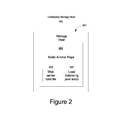
- FIG. 2 depicts a block diagram 200 of such an exemplary storage host for hosting static content in a cloud data center, in accordance with embodiments of the present invention.
- the storage host 201 of FIG. 2 includes a static anchor page 203 further comprising a web server load file 205 , and a load balancing java script 207 .
- a static anchor page 203 is created to correspond to the specific dynamic page.
- Clients of the web application may access the static content directly by establishing a connection to the static anchor page 203 .
- the IP address (or, alternatively, the re-directed URL) corresponding to the web application connects to the static anchor page 203 .
- the web browser may choose from a plurality of web servers hosting the dynamic content to access.
- the ability to load balance is provided by allowing the web browser to choose from among the plurality of web servers based on load information available through the storage host and/or static anchor page.
- the server file 205 and the load balance file 207 may be implemented as two static javascript files.
- the server file 205 contains the list of IP addresses of a number of web servers containing the dynamic content of the web application and the respective individual load (such as CPU, memory, bandwidth, etc.) information of each web server.
- the list may be filtered to provide only the currently available (e.g., operating web servers).
- the server file 205 may consist of a set of pre-defined javascript function calls which, when invoked, return the number of web servers, their IP addresses and their load, respectively.
- the load balance file 207 may contain the client side load balancing logic code in javascript.
- the load balance file 207 and the web server file 205 may be comprised in a single file or distributed among a multitude of files. To achieve high scalability in delivering the anchor page, the server and load balance file are all hosted on the static host component. According to some embodiments, the data comprised in the load balance file 207 and the server file 205 may be updated periodically by an application engine monitoring the web servers wherein the dynamic content of the web application is hosted.
- a web application may also generate or provide dynamic content for display to its users in addition to the static content described above.
- the dynamic content provided by the web application may be hosted among one or more web servers in a web server farm, for example.
- a web server farm may be implemented as a collection of both actual physical computing systems (e.g., server “blades” or the like) as well as virtual machines operating as web servers.
- these web servers comprise cloud computing components, and are therefore capable of being dynamically requisitioned by the application (or other monitoring agent) and allocated within the cloud data center.
- a single web application may provide dynamic content on separate, complete and individually integrated (e.g., fully capable) instances, with each instance executing in a separate virtual machine of a plurality of virtual machines.
- FIG. 3 depicts a block diagram 300 of such an exemplary web server for hosting dynamic content in a cloud data center, in accordance with embodiments of the present invention.
- the web server 301 of FIG. 3 includes a proxy server 303 , and server hosting normal dynamic web content 307 .
- communication requests received from client browsers requesting access to dynamic content of a web application may be received and processed through an intermediary such as a proxy server 303 .
- the client browser may request some service or other dynamic content, such as a file, connection, web page, or other resource, available from the application.
- the proxy server 303 may evaluate the received requests according to pre-determined filtering “rules.” For example, the proxy server 303 may filter traffic by IP address or protocol. If the request is validated by the filter, the proxy may provide the resource by connecting to the relevant web server 305 and requesting the service on behalf of the client.
- filtering traffic requests through a proxy server 303 the web application is able to benefit from improved security and access speed.
- regional restrictions may be bypassed, thereby allowing an improved allocation of the load experienced at certain DNS servers due to aforementioned disparities in regional population and usage demographics.
- user-accessible content may be stored in dynamically scalable computing resources, such as a cloud computing environment.
- a user of the web application (or “client”) may navigate to the content provided by the web application by navigating (e.g., via a browser) to a URL or IP address corresponding to the web application.
- DNS resolution of a web address may resolve to the IP address of the web application.
- an application-side load balancer may receive a data request from a client and determine the appropriate web server to forward the data request to.
- this technique suffers from significant flaws, not least among them, an inability to effect proper scaling in a cloud computing environment, and load balancing that is ineffective to address extreme or significant traffic flux during time periods of less than the duration of a DNS server's cache, possibly lasting up to a few days or more.
- a method for hosting an application in a cloud data center that enables client-side load balancing of the application's computing resources to avoid the limitations of conventional cloud computing architecture paradigms.
- FIG. 4 a flowchart of an exemplary method 400 for hosting an application in cloud data center is depicted, in accordance with embodiments of the present invention. Steps 401 - 413 describe exemplary steps comprising the method 400 in accordance with the various embodiments herein described.
- static content for the web application is hosted on a storage host.
- the static content may be hosted by employing an online-storage service, such as those available through cloud computing vendors.
- the static content may be stored on a computing system operating as a dedicated storage host such as the storage host 201 as described above with respect to FIG. 2 , including a static anchor page displaying the static content and one or more files corresponding to the location of the dynamic content corresponding to the web application.
- the dynamic content of the web application is hosted in a plurality of web servers.
- Dynamic content may, according to some embodiments, consist of a plurality of dynamic web pages, with each page corresponding to a static anchor page hosted in a storage host at step 401 .
- the dynamic content may be similarly hosted by employing online-web hosting services, such as a web server farm available through cloud computing vendors.
- the dynamic content is hosted on one or more computing systems operating as web servers such as the web server 301 as described above with respect to FIG. 3 , which may include a proxy web server 303 and the dynamic content 305 (e.g., stored in memory of a computing system).
- the proxy web server e.g., proxy web server 303
- the computing system hosting the dynamic content 305 may be implemented as instances of virtual machines executing from the same physical computing system and/or web server, with each instance communicatively coupled to other components in the cloud and accessible to browsers through the Internet.
- the normal web content e.g., web content 305
- the static anchor page hosted in step 401 in some cases through proxy 303 .
- a plurality of physical computing systems may execute a larger host of individual instances of virtual machines hosting the dynamic content and/or a corresponding proxy server. Client browsers attempting to access the dynamic content (e.g., via an IP address) may be directed to one of the individual instances.
- load information is collected for the web servers (either virtual or physical) hosting the dynamic web content of the application in step 403 .
- the load information for a particular web server may comprise, for example, the bandwidth available to a network connection for that specific web server. Load information may also include the total, available and consumed memory and processing capabilities of the individual web server.
- the load information may also comprise a representation of the available bandwidth and/or bandwidth consumed with respect to the total estimated bandwidth available, expressed as a percentage, for example.
- the load information may also comprise an estimation derived from determining the latency (e.g., ping) for a data communication performed with the particular web server.
- the load information is collected by a dedicated application engine monitoring the web servers.
- the load information may be periodically updated according to pre-determined intervals.
- the application engine may be executed from the storage host, from the computing system(s) upon which instances of the web server are hosted, and/or on a discrete computing system separate from both storage host and the plurality of web servers.
- the application engine may also be capable of providing additional features, such as providing a visualization of the performance history (in terms of load experience) of requisitioned web servers.
- steps 401 - 405 have been depicted in sequential order, it is to be understood that steps 401 - 405 may be performed in a different order, or simultaneously, according to various embodiments. In alternate embodiments, steps 401 - 405 may be continuously performed while an application is hosted, with steps 407 - 413 being performed whenever a request for data is initiated by a client browser.
- an initial contact is received by the web application.
- the initial contact may be received as an HTTP request from a web browser of a client of the web application, for example.
- the contact may be initiated by a client through a web-browser by navigating to the web address (e.g., URL) or the IP address of the web application.
- the contact may be received in the storage host corresponding to the web application, and static content from a static anchor page (e.g., static anchor page 203 ) may be loaded (e.g., displayed on the client's web-browser).
- the load information collected in step 405 is presented to the client browser from whom contact is received previously at step 407 .
- the load information collected at step 405 is used to update a web server file 205 stored on the static anchor page 203 .
- a load balancing file 207 may be used to present the load information to the client browser via a plurality of function calls comprised in the balancing file 207 .
- the load information may be further displayed to the actual client (e.g., the user of the web browser). In alternate embodiments, the load information may not be visible to the client.
- the load information presented to the client may also comprise a list of the available (e.g., active) web servers and the respective IP addresses corresponding to the list of available web servers.
- presenting load information may be performed by one or more function calls comprised in a load balancing file 207 .
- a web server hosting dynamic content is selected.
- the web server may be selected based on the load information presented at step 409 .
- the web server may be selected automatically by the web browser. For example, the web browser may automatically select the web server with the “lightest” estimated load or experienced traffic (e.g., the web server with the least amount of bandwidth usage. Alternatively, the web browser may select the web server with the least proportional load (e.g., as a percentage in terms bandwidth consumed over total bandwidth).
- client-side load balancing may be facilitated that enables load-balancing on a granular (per client) level, thereby
- the client may be prompted to select the web servers.
- the web browser may be automatically selected by the web browser randomly.
- each available web browser may be assigned a weighted likelihood of being selected that is inversely proportional to the current estimated load of the web server. Thus, a web server with a lighter load would have a greater likelihood of being selected relative to a web server with a greater load.
- dynamic content hosted on the selected web server may be accessed at step 413 .
- Accessing the dynamic content may be performed by, for example, facilitating communication between a web-browser of a client and the selected web server.
- load information presented to the client browser at step 409 may include the IP addresses of the computing systems or virtual instances of the web servers.
- the dynamic content of the web application may be accessed at step 413 by forwarding and/or directing a data request from the client browser to the IP address of the web server selected at step 411 .
- the forwarded (and/or directed) data requests may be received in an intermediary such as a proxy web server communicatively coupled to the dynamic content.
- the web server filters data access requests and fetches the requested data for filtered requests.
- multiple data requests from a corresponding number of client web-browsers may be processed and allocated to selected web servers according to method 400 simultaneously.
- the number of web servers may be automatically scaled. For example, if all or a substantial majority of the web servers experience heavy load, additional computing resources (e.g., storage hosts, web servers, application engines, etc.) may be dynamically requisitioned from the cloud infrastructure to accommodate the larger number of clients. Conversely, if a plurality of web servers are idle and/or a majority experience only light load, the computing resources corresponding to one or more web servers may be relinquished.
- additional computing resources e.g., storage hosts, web servers, application engines, etc.
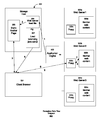
- FIG. 5 depicts a data flow diagram 500 of a client-side load balanced web server system in a cloud data center performing the method 400 of hosting an application in cloud data center, in accordance with embodiments of the present invention.
- data flow may include interaction between a client browser (e.g., client browser 401 ) and a plurality of cloud components (e.g., storage host 201 , application engine 403 , and plurality of web servers Web Server 1 301 a , Web Server 2 301 b , and Web Server 3 301 c ).
- a client browser e.g., client browser 401
- cloud components e.g., storage host 201 , application engine 403 , and plurality of web servers Web Server 1 301 a , Web Server 2 301 b , and Web Server 3 301 c .
- load information from the plurality of web servers Web Server 1 301 a , Web Server 2 301 b , and Web Server 3 301 c is collected by an application engine 403 .
- the load information may be collected repeatedly at periodic intervals.
- the load information is used to update the web server load file 205 at Time 1 of FIG. 5 .
- a data request (e.g., initial contact) seeking access to the content of the web application from a client browser 401 is received in the static anchor page 203 at Time 2 .
- the static content may be loaded to the client browser at Time 2 of FIG. 5 .
- the web server load file 205 is examined to determine the current load information of the plurality of web servers hosting the dynamic content at Time 3 , and the one or more function calls of the load balancing file 207 is used at Time 4 to present the load information (which may include the IP address of the web servers) to the client browser 401 at Time 5 .
- a selection of a target web server is determined, and the selected web server is contacted directly (via its IP address) at Time 7 .
- data requests to the selected web server may be filtered by an interposing proxy server (e.g., 303 b ) at Time 6 .
- Data requests from the client browser 401 in such embodiments may be intercepted and repackaged in the proxy 303 b prior to sending to the web server containing the requested web content (e.g., normal web content 305 b ) at Time 7 .
- the data requested may be returned to the proxy 303 b at Time 8 , before being repackaged again and transmitted to the Client Browser 401 at time 9 .
- the anchor static page may include two static javascript files: the server file and the load balance file.
- the server file contains the list of IP addresses and the individual load information (such as CPU, memory, bandwidth, etc.) of the web servers in the web server farm hosting the dynamic content and corresponding to the web application.
- the server file may consist of a set of pre-defined function calls which return the number of web servers, their IP addresses and their load.
- the function calls may be programmed in javascript, for example.
- the load balance file may contain the programming instructions to perform client side load balancing (e.g., processing load information and selecting a web server based on the load information).
- the load balance file may also be implemented in javascript, for example. To achieve high scalability in delivering the anchor page, the server and load balance file are all hosted on the static host component.
- FIG. 6 depicts a method 600 for establishing a connection between a client-side browser and a target web server to facilitate client-side scaling of a web server farm in a cloud data center, in accordance with embodiments of the present invention.
- Steps 601 - 609 describe exemplary steps comprising the method 600 performed in response to receiving a communication request from a client browser in a static anchor page of a web application, in accordance with the various embodiments herein described.
- the static anchor page is loaded in client browser by a static anchor page.
- Loading the static anchor page may be performed by, for example, transmitting the static data allocated for client access to the web-browser of the client seeking access.
- a target web server is determined based on load information corresponding to the web server(s). Determining the target web server may be performed by, for example, examining the load file to determine to which web server to receive the actual request from a client browser. In one embodiment, the target web server may be determined by automatically selecting the web server with the lowest current load according to various metrics described above. In alternate embodiments, the user of the client browser may be solicited for a selection of the target web server. In still further embodiments, the target web server may be selected at random according to an algorithm wherein the probability of choosing any one is inversely proportional to its relative load. In one embodiment, the weighted random distribution algorithm is designed to avoid all client browsers flashing to the same web server at the same time.
- a data request from the client browser requesting access to dynamic content is received and.
- the data requests may be filtered through a proxy server (for performance and/or security reasons).
- the data request from a client browser may be sent to a proxy server at step 605 before ultimately being relayed to the target web server.
- the proxy server may comprise a separate (virtual) server executing in the same physical machine or platform as the associated web server.
- function calls in the load balance file e.g., load balance file 207
- the function calls in the load balance file may be implemented as javascript.
- the content from the chosen web server may also be loaded as javascript.
- the data request sent to the proxy on the target web server platform may include three pieces of information: the browser cookie associated with the website of the application; the parameters used when the browser queried the anchor page; and the html POST data in the request, if any.
- the POST data may include, for example, a URL web address corresponding to the website, and a message body specifying information for an action being requested.
- the proxy may also perform some filtering on the data requests (e.g., IP address and/or protocol). For accepted requests, the proxy uses the cookie, parameters and POST data to re-construct a new http request to fetch the data requested, which it then sends to the dynamic content web server (sitting on the same virtual machine instance in some embodiments).
- the target web server processes the received data request. Processing the received data request may include, for example; invoking a dynamic script processor as necessary.
- a proxy server is featured, once the target web server processes the data request, the result of the processing is returned to the proxy.
- the proxy server may re-constructs the result into a browser-compatible file (e.g., javascript) and send the re-constructed result on to the client browser.
- a browser-compatible file e.g., javascript
- the client browser executes the returned result from the target web server.
- the returned result may consist of javascript from the proxy. Executing the returned result may also include updating the page display in the web browser to display the dynamic content received from the web application and/or updating any browser cookies if a set-cookie header has been returned.
- an exemplary computing environment upon which embodiments of the present invention may be implemented includes a general purpose computing system environment, such as computing system 700 .
- computing system 700 typically includes at least one processing unit 701 and memory, and an address/data bus 709 (or other interface) for communicating information.
- Individual components of a cloud data center may comprise computing environments such as the one described in FIG. 7 .
- a storage host, a web server and an application engine may individually or collectively be implemented as or hosted on one or more such computing systems.
- one or more instances of virtual computing environments may be hosted on computing environments as herein described.
- memory may be volatile (such as RAM 702 ), non-volatile (such as ROM 703 , flash memory, etc.) or some combination of the two.
- Computer system 700 may also comprise an optional graphics subsystem 705 for presenting information to the computer user, e.g., by displaying information on an attached display device 710 , connected by a video cable 711 .
- computing system 700 may also have additional features/functionality.
- computing system 700 may also include additional storage (removable and/or non-removable) including, but not limited to, magnetic or optical disks or tape.
- additional storage is illustrated in FIG. 7 by data storage device 707 .
- Computer storage media includes volatile and nonvolatile, removable and non-removable media implemented in any method or technology for storage of information such as computer readable instructions, data structures, program modules or other data.
- RAM 702 , ROM 703 , and data storage device 707 are all examples of computer storage media.
- Computer system 700 also comprises an optional alphanumeric input device 706 , an optional cursor control or directing device 707 , and one or more signal communication interfaces (input/output devices, e.g., a network interface card) 708 .
- Optional alphanumeric input device 706 can communicate information and command selections to central processor 701 .
- Optional cursor control or directing device 707 is coupled to bus 709 for communicating user input information and command selections to central processor 701 .
- Signal communication interface (input/output device) 708 also coupled to bus 709 , can be a serial port.
- Communication interface 709 may also include wireless communication mechanisms.
- computer system 700 can be communicatively coupled to other computer systems over a communication network such as the Internet or an intranet (e.g., a local area network), or can receive data (e.g., a digital television signal).
Landscapes
- Engineering & Computer Science (AREA)
- Computer Networks & Wireless Communication (AREA)
- Signal Processing (AREA)
- General Engineering & Computer Science (AREA)
- Software Systems (AREA)
- Theoretical Computer Science (AREA)
- Computer Hardware Design (AREA)
- Physics & Mathematics (AREA)
- General Physics & Mathematics (AREA)
- Data Mining & Analysis (AREA)
- Information Transfer Between Computers (AREA)
- Computer And Data Communications (AREA)
Priority Applications (7)
| Application Number | Priority Date | Filing Date | Title |
|---|---|---|---|
| US12/697,854 US8433749B2 (en) | 2009-04-15 | 2010-02-01 | Method and system for client-side scaling of web server farm architectures in a cloud data center |
| CA2699852A CA2699852C (en) | 2009-04-15 | 2010-04-13 | A method and system for client-side scaling of web server farm architectures in a cloud data center |
| EP10250766.2A EP2241976B1 (de) | 2009-04-15 | 2010-04-13 | Verfahren und System zur clientseitigen Skalierung von Webserver-FARM-Architektur in einem Cloud-Datencenter |
| AU2010201466A AU2010201466B2 (en) | 2009-04-15 | 2010-04-14 | A method and system for client-side scaling of web server farm architectures in a cloud data center |
| CN201010209788.9A CN101883103B (zh) | 2009-04-15 | 2010-04-15 | 云数据中心内Web服务器群架构的客户端侧扩展的方法和系统 |
| US13/612,137 US8782130B2 (en) | 2009-04-15 | 2012-09-12 | Method and system for client-side scaling of web server farm architectures in a cloud data center |
| US14/293,087 US9270745B2 (en) | 2009-04-15 | 2014-06-02 | Method and system for client-side scaling of web server farm architectures in a cloud data center |
Applications Claiming Priority (2)
| Application Number | Priority Date | Filing Date | Title |
|---|---|---|---|
| US16952209P | 2009-04-15 | 2009-04-15 | |
| US12/697,854 US8433749B2 (en) | 2009-04-15 | 2010-02-01 | Method and system for client-side scaling of web server farm architectures in a cloud data center |
Related Child Applications (1)
| Application Number | Title | Priority Date | Filing Date |
|---|---|---|---|
| US13/612,137 Division US8782130B2 (en) | 2009-04-15 | 2012-09-12 | Method and system for client-side scaling of web server farm architectures in a cloud data center |
Publications (2)
| Publication Number | Publication Date |
|---|---|
| US20100268764A1 US20100268764A1 (en) | 2010-10-21 |
| US8433749B2 true US8433749B2 (en) | 2013-04-30 |
Family
ID=43033583
Family Applications (3)
| Application Number | Title | Priority Date | Filing Date |
|---|---|---|---|
| US12/697,854 Active 2031-05-10 US8433749B2 (en) | 2009-04-15 | 2010-02-01 | Method and system for client-side scaling of web server farm architectures in a cloud data center |
| US13/612,137 Active 2030-04-07 US8782130B2 (en) | 2009-04-15 | 2012-09-12 | Method and system for client-side scaling of web server farm architectures in a cloud data center |
| US14/293,087 Active US9270745B2 (en) | 2009-04-15 | 2014-06-02 | Method and system for client-side scaling of web server farm architectures in a cloud data center |
Family Applications After (2)
| Application Number | Title | Priority Date | Filing Date |
|---|---|---|---|
| US13/612,137 Active 2030-04-07 US8782130B2 (en) | 2009-04-15 | 2012-09-12 | Method and system for client-side scaling of web server farm architectures in a cloud data center |
| US14/293,087 Active US9270745B2 (en) | 2009-04-15 | 2014-06-02 | Method and system for client-side scaling of web server farm architectures in a cloud data center |
Country Status (5)
| Country | Link |
|---|---|
| US (3) | US8433749B2 (de) |
| EP (1) | EP2241976B1 (de) |
| CN (1) | CN101883103B (de) |
| AU (1) | AU2010201466B2 (de) |
| CA (1) | CA2699852C (de) |
Cited By (87)
| Publication number | Priority date | Publication date | Assignee | Title |
|---|---|---|---|---|
| US20130111467A1 (en) * | 2011-10-27 | 2013-05-02 | Cisco Technology, Inc. | Dynamic Server Farms |
| US9130756B2 (en) | 2009-09-04 | 2015-09-08 | Amazon Technologies, Inc. | Managing secure content in a content delivery network |
| US9135048B2 (en) | 2012-09-20 | 2015-09-15 | Amazon Technologies, Inc. | Automated profiling of resource usage |
| US9154551B1 (en) | 2012-06-11 | 2015-10-06 | Amazon Technologies, Inc. | Processing DNS queries to identify pre-processing information |
| US9160703B2 (en) | 2010-09-28 | 2015-10-13 | Amazon Technologies, Inc. | Request routing management based on network components |
| US9176894B2 (en) | 2009-06-16 | 2015-11-03 | Amazon Technologies, Inc. | Managing resources using resource expiration data |
| US9185012B2 (en) | 2010-09-28 | 2015-11-10 | Amazon Technologies, Inc. | Latency measurement in resource requests |
| US9191458B2 (en) | 2009-03-27 | 2015-11-17 | Amazon Technologies, Inc. | Request routing using a popularity identifier at a DNS nameserver |
| US9191338B2 (en) | 2010-09-28 | 2015-11-17 | Amazon Technologies, Inc. | Request routing in a networked environment |
| US9210235B2 (en) | 2008-03-31 | 2015-12-08 | Amazon Technologies, Inc. | Client side cache management |
| US9208097B2 (en) | 2008-03-31 | 2015-12-08 | Amazon Technologies, Inc. | Cache optimization |
| US9237114B2 (en) | 2009-03-27 | 2016-01-12 | Amazon Technologies, Inc. | Managing resources in resource cache components |
| US9246776B2 (en) | 2009-10-02 | 2016-01-26 | Amazon Technologies, Inc. | Forward-based resource delivery network management techniques |
| US9251112B2 (en) | 2008-11-17 | 2016-02-02 | Amazon Technologies, Inc. | Managing content delivery network service providers |
| US9253065B2 (en) | 2010-09-28 | 2016-02-02 | Amazon Technologies, Inc. | Latency measurement in resource requests |
| US9270745B2 (en) | 2009-04-15 | 2016-02-23 | Accenture Global Services Limited | Method and system for client-side scaling of web server farm architectures in a cloud data center |
| US9294391B1 (en) | 2013-06-04 | 2016-03-22 | Amazon Technologies, Inc. | Managing network computing components utilizing request routing |
| US9323577B2 (en) | 2012-09-20 | 2016-04-26 | Amazon Technologies, Inc. | Automated profiling of resource usage |
| US9332078B2 (en) | 2008-03-31 | 2016-05-03 | Amazon Technologies, Inc. | Locality based content distribution |
| US9391949B1 (en) | 2010-12-03 | 2016-07-12 | Amazon Technologies, Inc. | Request routing processing |
| US9407699B2 (en) | 2008-03-31 | 2016-08-02 | Amazon Technologies, Inc. | Content management |
| US9407681B1 (en) | 2010-09-28 | 2016-08-02 | Amazon Technologies, Inc. | Latency measurement in resource requests |
| US9444759B2 (en) | 2008-11-17 | 2016-09-13 | Amazon Technologies, Inc. | Service provider registration by a content broker |
| US9451046B2 (en) | 2008-11-17 | 2016-09-20 | Amazon Technologies, Inc. | Managing CDN registration by a storage provider |
| US9479476B2 (en) | 2008-03-31 | 2016-10-25 | Amazon Technologies, Inc. | Processing of DNS queries |
| US9495338B1 (en) * | 2010-01-28 | 2016-11-15 | Amazon Technologies, Inc. | Content distribution network |
| US9497259B1 (en) | 2010-09-28 | 2016-11-15 | Amazon Technologies, Inc. | Point of presence management in request routing |
| US9515949B2 (en) | 2008-11-17 | 2016-12-06 | Amazon Technologies, Inc. | Managing content delivery network service providers |
| US9525659B1 (en) | 2012-09-04 | 2016-12-20 | Amazon Technologies, Inc. | Request routing utilizing point of presence load information |
| US9544394B2 (en) | 2008-03-31 | 2017-01-10 | Amazon Technologies, Inc. | Network resource identification |
| US9565072B2 (en) | 2013-12-19 | 2017-02-07 | Sap Se | Moving median usage frequency based maintenance of server instances |
| US9571389B2 (en) | 2008-03-31 | 2017-02-14 | Amazon Technologies, Inc. | Request routing based on class |
| US9608957B2 (en) | 2008-06-30 | 2017-03-28 | Amazon Technologies, Inc. | Request routing using network computing components |
| US9628554B2 (en) | 2012-02-10 | 2017-04-18 | Amazon Technologies, Inc. | Dynamic content delivery |
| US9712484B1 (en) | 2010-09-28 | 2017-07-18 | Amazon Technologies, Inc. | Managing request routing information utilizing client identifiers |
| US9734472B2 (en) | 2008-11-17 | 2017-08-15 | Amazon Technologies, Inc. | Request routing utilizing cost information |
| US9742795B1 (en) | 2015-09-24 | 2017-08-22 | Amazon Technologies, Inc. | Mitigating network attacks |
| US9774619B1 (en) | 2015-09-24 | 2017-09-26 | Amazon Technologies, Inc. | Mitigating network attacks |
| US9787775B1 (en) | 2010-09-28 | 2017-10-10 | Amazon Technologies, Inc. | Point of presence management in request routing |
| US9794281B1 (en) | 2015-09-24 | 2017-10-17 | Amazon Technologies, Inc. | Identifying sources of network attacks |
| US9800539B2 (en) | 2010-09-28 | 2017-10-24 | Amazon Technologies, Inc. | Request routing management based on network components |
| US9819567B1 (en) | 2015-03-30 | 2017-11-14 | Amazon Technologies, Inc. | Traffic surge management for points of presence |
| US9832141B1 (en) | 2015-05-13 | 2017-11-28 | Amazon Technologies, Inc. | Routing based request correlation |
| US9887932B1 (en) | 2015-03-30 | 2018-02-06 | Amazon Technologies, Inc. | Traffic surge management for points of presence |
| US9887931B1 (en) | 2015-03-30 | 2018-02-06 | Amazon Technologies, Inc. | Traffic surge management for points of presence |
| US9912740B2 (en) | 2008-06-30 | 2018-03-06 | Amazon Technologies, Inc. | Latency measurement in resource requests |
| US9930131B2 (en) | 2010-11-22 | 2018-03-27 | Amazon Technologies, Inc. | Request routing processing |
| US9954934B2 (en) | 2008-03-31 | 2018-04-24 | Amazon Technologies, Inc. | Content delivery reconciliation |
| US9979780B1 (en) * | 2012-06-25 | 2018-05-22 | EMC IP Holding Company LLC | Method and apparatus for selection between multiple candidate clouds for job processing |
| US9985927B2 (en) | 2008-11-17 | 2018-05-29 | Amazon Technologies, Inc. | Managing content delivery network service providers by a content broker |
| US9992303B2 (en) | 2007-06-29 | 2018-06-05 | Amazon Technologies, Inc. | Request routing utilizing client location information |
| US9992086B1 (en) | 2016-08-23 | 2018-06-05 | Amazon Technologies, Inc. | External health checking of virtual private cloud network environments |
| US10015237B2 (en) | 2010-09-28 | 2018-07-03 | Amazon Technologies, Inc. | Point of presence management in request routing |
| US10021179B1 (en) | 2012-02-21 | 2018-07-10 | Amazon Technologies, Inc. | Local resource delivery network |
| US10027582B2 (en) | 2007-06-29 | 2018-07-17 | Amazon Technologies, Inc. | Updating routing information based on client location |
| US10033691B1 (en) | 2016-08-24 | 2018-07-24 | Amazon Technologies, Inc. | Adaptive resolution of domain name requests in virtual private cloud network environments |
| US10033627B1 (en) | 2014-12-18 | 2018-07-24 | Amazon Technologies, Inc. | Routing mode and point-of-presence selection service |
| US10049051B1 (en) | 2015-12-11 | 2018-08-14 | Amazon Technologies, Inc. | Reserved cache space in content delivery networks |
| US10075551B1 (en) | 2016-06-06 | 2018-09-11 | Amazon Technologies, Inc. | Request management for hierarchical cache |
| US10091096B1 (en) | 2014-12-18 | 2018-10-02 | Amazon Technologies, Inc. | Routing mode and point-of-presence selection service |
| US10097566B1 (en) | 2015-07-31 | 2018-10-09 | Amazon Technologies, Inc. | Identifying targets of network attacks |
| US10097448B1 (en) | 2014-12-18 | 2018-10-09 | Amazon Technologies, Inc. | Routing mode and point-of-presence selection service |
| US10110694B1 (en) | 2016-06-29 | 2018-10-23 | Amazon Technologies, Inc. | Adaptive transfer rate for retrieving content from a server |
| US10205698B1 (en) | 2012-12-19 | 2019-02-12 | Amazon Technologies, Inc. | Source-dependent address resolution |
| US10225326B1 (en) | 2015-03-23 | 2019-03-05 | Amazon Technologies, Inc. | Point of presence based data uploading |
| US10223234B2 (en) | 2016-08-15 | 2019-03-05 | Microsoft Technology Licensing, Llc | Monitoring a web application using an outside-in strategy |
| US10230819B2 (en) | 2009-03-27 | 2019-03-12 | Amazon Technologies, Inc. | Translation of resource identifiers using popularity information upon client request |
| US10257307B1 (en) | 2015-12-11 | 2019-04-09 | Amazon Technologies, Inc. | Reserved cache space in content delivery networks |
| US10270878B1 (en) | 2015-11-10 | 2019-04-23 | Amazon Technologies, Inc. | Routing for origin-facing points of presence |
| US10348639B2 (en) | 2015-12-18 | 2019-07-09 | Amazon Technologies, Inc. | Use of virtual endpoints to improve data transmission rates |
| US10372499B1 (en) | 2016-12-27 | 2019-08-06 | Amazon Technologies, Inc. | Efficient region selection system for executing request-driven code |
| US10447648B2 (en) | 2017-06-19 | 2019-10-15 | Amazon Technologies, Inc. | Assignment of a POP to a DNS resolver based on volume of communications over a link between client devices and the POP |
| US10469513B2 (en) | 2016-10-05 | 2019-11-05 | Amazon Technologies, Inc. | Encrypted network addresses |
| US10505864B1 (en) | 2013-09-30 | 2019-12-10 | EMC IP Holding Company LLC | Method for running HPC jobs |
| US10503613B1 (en) | 2017-04-21 | 2019-12-10 | Amazon Technologies, Inc. | Efficient serving of resources during server unavailability |
| US10592578B1 (en) | 2018-03-07 | 2020-03-17 | Amazon Technologies, Inc. | Predictive content push-enabled content delivery network |
| US10601767B2 (en) | 2009-03-27 | 2020-03-24 | Amazon Technologies, Inc. | DNS query processing based on application information |
| US10616179B1 (en) | 2015-06-25 | 2020-04-07 | Amazon Technologies, Inc. | Selective routing of domain name system (DNS) requests |
| US10623408B1 (en) | 2012-04-02 | 2020-04-14 | Amazon Technologies, Inc. | Context sensitive object management |
| US10831549B1 (en) | 2016-12-27 | 2020-11-10 | Amazon Technologies, Inc. | Multi-region request-driven code execution system |
| US10862852B1 (en) | 2018-11-16 | 2020-12-08 | Amazon Technologies, Inc. | Resolution of domain name requests in heterogeneous network environments |
| US10938884B1 (en) | 2017-01-30 | 2021-03-02 | Amazon Technologies, Inc. | Origin server cloaking using virtual private cloud network environments |
| US10958501B1 (en) | 2010-09-28 | 2021-03-23 | Amazon Technologies, Inc. | Request routing information based on client IP groupings |
| US11025747B1 (en) | 2018-12-12 | 2021-06-01 | Amazon Technologies, Inc. | Content request pattern-based routing system |
| US11075987B1 (en) | 2017-06-12 | 2021-07-27 | Amazon Technologies, Inc. | Load estimating content delivery network |
| US11290418B2 (en) | 2017-09-25 | 2022-03-29 | Amazon Technologies, Inc. | Hybrid content request routing system |
| US11604667B2 (en) | 2011-04-27 | 2023-03-14 | Amazon Technologies, Inc. | Optimized deployment based upon customer locality |
Families Citing this family (122)
| Publication number | Priority date | Publication date | Assignee | Title |
|---|---|---|---|---|
| US8843630B1 (en) * | 2008-08-27 | 2014-09-23 | Amazon Technologies, Inc. | Decentralized request routing |
| US8788519B2 (en) | 2008-10-24 | 2014-07-22 | John C. Canessa | System and methods for metadata management in content addressable storage |
| US20110072442A1 (en) * | 2009-09-22 | 2011-03-24 | International Business Machines Corporation | Event-handler for selecting responsive actions |
| US8880679B2 (en) * | 2009-12-07 | 2014-11-04 | Oracle International Corporation | Techniques for web server management |
| US8959217B2 (en) | 2010-01-15 | 2015-02-17 | Joyent, Inc. | Managing workloads and hardware resources in a cloud resource |
| US8504400B2 (en) | 2010-03-24 | 2013-08-06 | International Business Machines Corporation | Dynamically optimized distributed cloud computing-based business process management (BPM) system |
| US8219646B2 (en) * | 2010-03-31 | 2012-07-10 | Oracle International Corporation | Dynamic intelligent mirror host selection |
| WO2011133917A2 (en) * | 2010-04-23 | 2011-10-27 | Datcard Systems, Inc. | Event notification in interconnected content-addressable storage systems |
| US8627426B2 (en) * | 2010-04-26 | 2014-01-07 | Vmware, Inc. | Cloud platform architecture |
| US8402127B2 (en) * | 2010-06-28 | 2013-03-19 | Bmc Software, Inc. | System and method for offering virtual private clouds within a public cloud environment |
| WO2012023050A2 (en) | 2010-08-20 | 2012-02-23 | Overtis Group Limited | Secure cloud computing system and method |
| US8904511B1 (en) * | 2010-08-23 | 2014-12-02 | Amazon Technologies, Inc. | Virtual firewalls for multi-tenant distributed services |
| US8327373B2 (en) | 2010-08-24 | 2012-12-04 | Novell, Inc. | System and method for structuring self-provisioning workloads deployed in virtualized data centers |
| US8949410B2 (en) | 2010-09-10 | 2015-02-03 | Cisco Technology, Inc. | Server load balancer scaling for virtual servers |
| US8621058B2 (en) * | 2010-10-28 | 2013-12-31 | Hewlett-Packard Development Company, L.P. | Providing cloud-based computing services |
| US8533285B2 (en) * | 2010-12-01 | 2013-09-10 | Cisco Technology, Inc. | Directing data flows in data centers with clustering services |
| US8755283B2 (en) | 2010-12-17 | 2014-06-17 | Microsoft Corporation | Synchronizing state among load balancer components |
| FR2969886A1 (fr) * | 2010-12-24 | 2012-06-29 | France Telecom | Procede d'execution d'une action par un terminal de communication, terminal, serveur, systeme de communication et programme d'ordinateur correspondants |
| US8689235B2 (en) * | 2011-01-18 | 2014-04-01 | Gbc Industries | System and method for enabling interaction between a cloud application and a local application |
| CN102143215B (zh) * | 2011-01-20 | 2013-04-10 | 中国人民解放军理工大学 | 一种基于网络的pb级云存储系统及其处理方法 |
| CN102143218B (zh) * | 2011-01-24 | 2014-07-02 | 上海红神信息技术有限公司 | web接入云体系结构及接入方法 |
| CN102624757A (zh) * | 2011-01-26 | 2012-08-01 | 中山爱科数字家庭产业孵化基地有限公司 | 一种云计算环境下的数据安全访问的方法 |
| US20120198065A1 (en) * | 2011-02-01 | 2012-08-02 | Chih-Hsing Sung | Method of Accessing a Cloud Service and Related Device |
| US8612550B2 (en) | 2011-02-07 | 2013-12-17 | Microsoft Corporation | Proxy-based cache content distribution and affinity |
| US9712340B2 (en) | 2011-02-28 | 2017-07-18 | Red Hat, Inc. | Using a shared data store for peer discovery |
| US8555276B2 (en) * | 2011-03-11 | 2013-10-08 | Joyent, Inc. | Systems and methods for transparently optimizing workloads |
| US9043767B2 (en) * | 2011-04-12 | 2015-05-26 | Pivotal Software, Inc. | Release management system for a multi-node application |
| US8806015B2 (en) | 2011-05-04 | 2014-08-12 | International Business Machines Corporation | Workload-aware placement in private heterogeneous clouds |
| CN102170476B (zh) * | 2011-05-09 | 2015-07-22 | 中兴通讯股份有限公司 | 一种基于云节点自主学习的云计算方法和装置 |
| US8719627B2 (en) | 2011-05-20 | 2014-05-06 | Microsoft Corporation | Cross-cloud computing for capacity management and disaster recovery |
| EP2719124B1 (de) | 2011-06-07 | 2018-04-11 | Hewlett-Packard Enterprise Development LP | Skalierbare mehrteilnehmer-netzwerkarchitektur für virtualisierte datenzentren |
| US9081619B2 (en) * | 2011-06-30 | 2015-07-14 | Microsoft Technology Licensing, Llc | Provisioning a web hosting resource using a cloud service |
| US9208344B2 (en) | 2011-09-09 | 2015-12-08 | Lexisnexis, A Division Of Reed Elsevier Inc. | Database access using a common web interface |
| US10136165B2 (en) * | 2011-09-14 | 2018-11-20 | Mobitv, Inc. | Distributed scalable encoder resources for live streams |
| US20130132971A1 (en) * | 2011-11-22 | 2013-05-23 | International Business Machines Corporation | System, method and program product for streamlined virtual machine desktop display |
| US8782224B2 (en) | 2011-12-29 | 2014-07-15 | Joyent, Inc. | Systems and methods for time-based dynamic allocation of resource management |
| WO2013109274A1 (en) * | 2012-01-19 | 2013-07-25 | Empire Technology Development, Llc | Iterative simulation of requirement metrics for assumption and schema-free configuration management |
| US20130198362A1 (en) * | 2012-01-26 | 2013-08-01 | International Business Machines Corporation | System for Identifying a Server to be Decommissioned |
| US9158568B2 (en) | 2012-01-30 | 2015-10-13 | Hewlett-Packard Development Company, L.P. | Input/output operations at a virtual block device of a storage server |
| US9098325B2 (en) | 2012-02-28 | 2015-08-04 | Hewlett-Packard Development Company, L.P. | Persistent volume at an offset of a virtual block device of a storage server |
| CN102624914B (zh) * | 2012-03-22 | 2014-05-14 | 北京快网科技有限公司 | 通过Web方式探测客户端使用的本地DNS服务器的方法 |
| CN103369014A (zh) * | 2012-03-30 | 2013-10-23 | 北京千橡网景科技发展有限公司 | 非堵塞的客户端、服务器调整通信连接的方法及设备 |
| CN102647468A (zh) * | 2012-04-01 | 2012-08-22 | 成都静水飞云科技有限责任公司 | 云计算负载均衡评估系统及评估方法 |
| US9086929B2 (en) | 2012-04-06 | 2015-07-21 | International Business Machines Corporation | Dynamic allocation of a workload across a plurality of clouds |
| US9071613B2 (en) * | 2012-04-06 | 2015-06-30 | International Business Machines Corporation | Dynamic allocation of workload deployment units across a plurality of clouds |
| CN102750324A (zh) | 2012-05-28 | 2012-10-24 | 华为技术有限公司 | 文件存储系统、装置及文件存取方法 |
| US9106578B2 (en) * | 2012-05-31 | 2015-08-11 | Hewlett-Packard Development Company, L.P. | Core network architecture |
| US8856341B2 (en) | 2012-05-31 | 2014-10-07 | Hewlett-Packard Development Company, L.P. | Balancing management duties in a cloud system |
| US8805990B2 (en) | 2012-07-12 | 2014-08-12 | Microsoft Corporation | Load balancing for single-address tenants |
| CN102882932A (zh) * | 2012-09-04 | 2013-01-16 | 健雄职业技术学院 | 基于云服务器的信息安全虚拟实验系统 |
| US9712402B2 (en) * | 2012-10-10 | 2017-07-18 | Alcatel Lucent | Method and apparatus for automated deployment of geographically distributed applications within a cloud |
| US9331891B2 (en) | 2012-10-11 | 2016-05-03 | International Business Machines Corporation | Virtual consolidated appliance |
| US9246998B2 (en) | 2012-10-16 | 2016-01-26 | Microsoft Technology Licensing, Llc | Load balancer bypass |
| US20140115371A1 (en) * | 2012-10-18 | 2014-04-24 | International Business Machines Corporation | Decommission of a Server in Wireless Environment |
| CN102946429A (zh) * | 2012-11-07 | 2013-02-27 | 浪潮电子信息产业股份有限公司 | 一种基于云存储的高效资源动态调度方法 |
| GB2508598A (en) * | 2012-12-04 | 2014-06-11 | Ibm | Splitting the processing logic of a distributed application page between client and server |
| CN103905472B (zh) * | 2012-12-25 | 2017-12-01 | 中国移动通信集团江苏有限公司 | 一种通过网页方式访问的云存储方法和系统 |
| EP2775399A4 (de) | 2012-12-26 | 2015-04-29 | Huawei Tech Co Ltd | Betriebsmittelverwaltungsverfahren eines virtuellen maschinensystems, virtuelles maschinensystem und vorrichtung dafür |
| CN103093034B (zh) * | 2012-12-28 | 2016-01-20 | 浙江理工大学 | 基于云计算的产品协同设计方法 |
| US8881279B2 (en) | 2013-03-14 | 2014-11-04 | Joyent, Inc. | Systems and methods for zone-based intrusion detection |
| US9104456B2 (en) | 2013-03-14 | 2015-08-11 | Joyent, Inc. | Zone management of compute-centric object stores |
| US8677359B1 (en) | 2013-03-14 | 2014-03-18 | Joyent, Inc. | Compute-centric object stores and methods of use |
| US8943284B2 (en) | 2013-03-14 | 2015-01-27 | Joyent, Inc. | Systems and methods for integrating compute resources in a storage area network |
| US8826279B1 (en) | 2013-03-14 | 2014-09-02 | Joyent, Inc. | Instruction set architecture for compute-based object stores |
| US8793688B1 (en) | 2013-03-15 | 2014-07-29 | Joyent, Inc. | Systems and methods for double hulled virtualization operations |
| US8775485B1 (en) | 2013-03-15 | 2014-07-08 | Joyent, Inc. | Object store management operations within compute-centric object stores |
| US9092238B2 (en) | 2013-03-15 | 2015-07-28 | Joyent, Inc. | Versioning schemes for compute-centric object stores |
| US10469558B2 (en) | 2013-04-18 | 2019-11-05 | Microsoft Technology Licensing, Llc | Website server request rerouting |
| US9264289B2 (en) * | 2013-06-27 | 2016-02-16 | Microsoft Technology Licensing, Llc | Endpoint data centers of different tenancy sets |
| US10346148B2 (en) * | 2013-08-12 | 2019-07-09 | Amazon Technologies, Inc. | Per request computer system instances |
| US9280372B2 (en) | 2013-08-12 | 2016-03-08 | Amazon Technologies, Inc. | Request processing techniques |
| US9348634B2 (en) | 2013-08-12 | 2016-05-24 | Amazon Technologies, Inc. | Fast-booting application image using variation points in application source code |
| US9705755B1 (en) | 2013-08-14 | 2017-07-11 | Amazon Technologies, Inc. | Application definition deployment with request filters employing base groups |
| US9843520B1 (en) | 2013-08-15 | 2017-12-12 | Avi Networks | Transparent network-services elastic scale-out |
| US10110684B1 (en) | 2013-08-15 | 2018-10-23 | Avi Networks | Transparent network service migration across service devices |
| US9386086B2 (en) | 2013-09-11 | 2016-07-05 | Cisco Technology Inc. | Dynamic scaling for multi-tiered distributed systems using payoff optimization of application classes |
| US9154492B2 (en) * | 2013-09-27 | 2015-10-06 | The University Of North Carolina At Charlotte | Moving target defense against cross-site scripting |
| US9654580B2 (en) * | 2013-10-08 | 2017-05-16 | Microsoft Technology Licensing, Llc | Proxy-based web application monitoring through script instrumentation |
| US9407644B1 (en) * | 2013-11-26 | 2016-08-02 | Symantec Corporation | Systems and methods for detecting malicious use of digital certificates |
| EP3089410A4 (de) * | 2013-12-24 | 2016-12-07 | Le Holdings Beijing Co Ltd | Knotenverteilungsverfahren und steuerzentrale |
| US20150186541A1 (en) * | 2013-12-31 | 2015-07-02 | Nxp B.V. | Nfc product identification and order request redirection |
| CN103780696A (zh) * | 2014-01-23 | 2014-05-07 | 北京荣之联科技股份有限公司 | 基于分布式推送的云监控方法、装置及系统 |
| US9477648B1 (en) * | 2014-02-28 | 2016-10-25 | Intuit Inc. | Optimized web application user experience |
| CN104967630B (zh) * | 2014-04-10 | 2017-09-22 | 腾讯科技(深圳)有限公司 | 网页访问请求的处理方法及装置 |
| US20150304414A1 (en) * | 2014-04-17 | 2015-10-22 | Go Daddy Operating Company, LLC | Allocating hosting server resources via migration paths |
| US9501211B2 (en) * | 2014-04-17 | 2016-11-22 | GoDaddy Operating Company, LLC | User input processing for allocation of hosting server resources |
| US9660933B2 (en) * | 2014-04-17 | 2017-05-23 | Go Daddy Operating Company, LLC | Allocating and accessing hosting server resources via continuous resource availability updates |
| US10355942B1 (en) * | 2014-09-29 | 2019-07-16 | Amazon Technologies, Inc. | Scaling of remote network directory management resources |
| CN104270443B (zh) * | 2014-09-29 | 2017-12-12 | 北京掌中经纬技术有限公司 | 一种能够动态解析Web应用的云计算系统及方法 |
| JP2016081119A (ja) * | 2014-10-10 | 2016-05-16 | 富士通株式会社 | 情報処理システム、情報処理システムの制御方法および制御装置の制御プログラム |
| CN104468832B (zh) * | 2014-12-25 | 2018-05-25 | 广东电子工业研究院有限公司 | 一种基于http协议的轻便分布式架构 |
| WO2016137277A1 (en) | 2015-02-27 | 2016-09-01 | Samsung Electronics Co., Ltd. | Electronic device providing electronic payment function and operating method thereof |
| US11283697B1 (en) | 2015-03-24 | 2022-03-22 | Vmware, Inc. | Scalable real time metrics management |
| CN104902001B (zh) * | 2015-04-07 | 2018-04-06 | 杭州电子科技大学 | 基于操作系统虚拟化的Web请求负载均衡方法 |
| US9848041B2 (en) | 2015-05-01 | 2017-12-19 | Amazon Technologies, Inc. | Automatic scaling of resource instance groups within compute clusters |
| CN105187512A (zh) * | 2015-08-13 | 2015-12-23 | 航天恒星科技有限公司 | 一种虚拟机集群负载均衡方法及系统 |
| US10699274B2 (en) | 2015-08-24 | 2020-06-30 | Samsung Electronics Co., Ltd. | Apparatus and method for secure electronic payment |
| US10846696B2 (en) | 2015-08-24 | 2020-11-24 | Samsung Electronics Co., Ltd. | Apparatus and method for trusted execution environment based secure payment transactions |
| CN105426767B (zh) * | 2015-10-30 | 2019-04-05 | 四川星空奇迹科技有限公司 | 数据存储方法 |
| CN105262834A (zh) * | 2015-10-30 | 2016-01-20 | 南京秦杜明视信息技术有限公司 | 数据存储方法 |
| CN105426783B (zh) * | 2015-10-30 | 2019-04-05 | 四川星空奇迹科技有限公司 | 多备份数据存储方法 |
| CN106708621B (zh) | 2015-11-16 | 2020-10-27 | 阿里巴巴集团控股有限公司 | 一种获得应用集群容量的方法和装置 |
| CN105516261A (zh) * | 2015-11-26 | 2016-04-20 | 深圳市深信服电子科技有限公司 | 网页页面加载控制方法及负载均衡器 |
| US9864624B2 (en) * | 2015-12-21 | 2018-01-09 | International Business Machines Corporation | Software-defined computing system remote support |
| US10412168B2 (en) * | 2016-02-17 | 2019-09-10 | Latticework, Inc. | Implementing a storage system using a personal user device and a data distribution device |
| US10382518B2 (en) * | 2016-03-22 | 2019-08-13 | Google Llc | Low latency applications using multiple servers |
| CN106131164B (zh) * | 2016-07-01 | 2018-07-03 | 北京百度网讯科技有限公司 | 在云端进行协议解析的数据处理方法和装置 |
| US10637960B2 (en) | 2016-10-21 | 2020-04-28 | Infiswift Technologies, Inc. | Method for bridging publish/subscribe brokers for guaranteed low-latency delivery |
| US11030271B2 (en) | 2016-10-31 | 2021-06-08 | Microsoft Technoiogy Licensing, LLC | Content caching for fast load time |
| US10834176B2 (en) | 2017-03-10 | 2020-11-10 | The Directv Group, Inc. | Automated end-to-end application deployment in a data center |
| US10708360B2 (en) * | 2017-03-14 | 2020-07-07 | Infiswift Technologies, Inc. | Method for transport agnostic communication between internet of things client and broker |
| CN107172192A (zh) * | 2017-06-19 | 2017-09-15 | 西安工程大学 | 基于混合存储的SaaS网络管理系统数据管理框架 |
| US11102171B2 (en) * | 2017-11-21 | 2021-08-24 | Vmware, Inc. | Virtual distributed domain name server |
| CN116560970A (zh) * | 2018-05-07 | 2023-08-08 | 谷歌有限责任公司 | 用于基于数字助理的应用的沉浸式基于web的模拟器 |
| CN110958182B (zh) * | 2018-09-26 | 2023-04-28 | 华为技术有限公司 | 一种通信方法及相关设备 |
| US10942769B2 (en) | 2018-11-28 | 2021-03-09 | International Business Machines Corporation | Elastic load balancing prioritization |
| CN110442454B (zh) * | 2019-08-02 | 2022-06-24 | 联想(北京)有限公司 | 一种资源调度方法、装置及计算机设备 |
| CN110868361A (zh) * | 2019-11-01 | 2020-03-06 | 云深互联(北京)科技有限公司 | 网关负载均衡的方法、装置及设备 |
| US11271996B1 (en) * | 2020-04-09 | 2022-03-08 | Parallels International Gmbh | Client-side load balancing for remote application servers |
| CN112822287A (zh) * | 2021-01-28 | 2021-05-18 | 广东浩云长盛网络股份有限公司 | 一种云集群服务器系统监控方法 |
| CN113691625A (zh) * | 2021-08-24 | 2021-11-23 | 上海洪朴信息科技有限公司 | 分布式任务集群调度系统、方法及光伏组件检测系统 |
| CN117076257B (zh) * | 2023-09-14 | 2024-03-05 | 研华科技(中国)有限公司 | 一种基于服务器集群的管理方法、管理服务器及管理系统 |
Citations (7)
| Publication number | Priority date | Publication date | Assignee | Title |
|---|---|---|---|---|
| US5774660A (en) | 1996-08-05 | 1998-06-30 | Resonate, Inc. | World-wide-web server with delayed resource-binding for resource-based load balancing on a distributed resource multi-node network |
| US6697849B1 (en) * | 1999-08-13 | 2004-02-24 | Sun Microsystems, Inc. | System and method for caching JavaServer Pages™ responses |
| US7039709B1 (en) * | 2000-05-31 | 2006-05-02 | International Business Machines Corporation | Dynamically selection of most efficient transmission medium and route from a client browser |
| US20090157678A1 (en) * | 2007-12-18 | 2009-06-18 | Mladen Turk | Content Based Load Balancer |
| US7636917B2 (en) * | 2003-06-30 | 2009-12-22 | Microsoft Corporation | Network load balancing with host status information |
| US20100088205A1 (en) * | 2008-10-02 | 2010-04-08 | Verizon Business Network Services Inc. | Methods, Systems and Computer Program Products for a Cloud Computing Spot Market Platform |
| US8020203B2 (en) * | 2007-12-03 | 2011-09-13 | Novell, Inc. | Techniques for high availability of virtual private networks (VPN's) |
Family Cites Families (15)
| Publication number | Priority date | Publication date | Assignee | Title |
|---|---|---|---|---|
| US699615A (en) * | 1902-01-27 | 1902-05-06 | Jeremiah W Dimick Jr | Warping-machine. |
| AU8903498A (en) * | 1997-08-11 | 1999-03-01 | Thomas C. Amon | Provider-selected message in response to user request |
| US6078960A (en) * | 1998-07-03 | 2000-06-20 | Acceleration Software International Corporation | Client-side load-balancing in client server network |
| US6374297B1 (en) * | 1999-08-16 | 2002-04-16 | International Business Machines Corporation | Method and apparatus for load balancing of web cluster farms |
| US7139813B1 (en) | 1999-11-01 | 2006-11-21 | Nokia Networks Oy | Timedependent hyperlink system in videocontent |
| US7480705B2 (en) * | 2001-07-24 | 2009-01-20 | International Business Machines Corporation | Dynamic HTTP load balancing method and apparatus |
| US8484348B2 (en) * | 2004-03-05 | 2013-07-09 | Rockstar Consortium Us Lp | Method and apparatus for facilitating fulfillment of web-service requests on a communication network |
| EP1662405A1 (de) * | 2004-11-30 | 2006-05-31 | Alcatel | Methode zur Anzeige von Daten auf einem Client-Computer |
| EP1973037B1 (de) * | 2005-12-28 | 2012-08-29 | International Business Machines Corporation | Lastverteilung in einem client-server-system |
| US8856276B2 (en) * | 2006-05-11 | 2014-10-07 | International Business Machines Corporation | Method, system and program product for collecting web metric data |
| US8260940B1 (en) * | 2007-06-29 | 2012-09-04 | Amazon Technologies, Inc. | Service request management |
| CN101370030B (zh) * | 2008-09-24 | 2011-03-16 | 东南大学 | 基于内容复制的资源负载平衡方法 |
| US8433749B2 (en) | 2009-04-15 | 2013-04-30 | Accenture Global Services Limited | Method and system for client-side scaling of web server farm architectures in a cloud data center |
| US8412832B2 (en) * | 2009-12-23 | 2013-04-02 | Citrix Systems, Inc. | Systems and methods for GSLB MEP connection management across multiple core appliances |
| US9407692B2 (en) * | 2013-11-27 | 2016-08-02 | Avi Networks | Method and system for distributed load balancing |
-
2010
- 2010-02-01 US US12/697,854 patent/US8433749B2/en active Active
- 2010-04-13 CA CA2699852A patent/CA2699852C/en active Active
- 2010-04-13 EP EP10250766.2A patent/EP2241976B1/de active Active
- 2010-04-14 AU AU2010201466A patent/AU2010201466B2/en active Active
- 2010-04-15 CN CN201010209788.9A patent/CN101883103B/zh active Active
-
2012
- 2012-09-12 US US13/612,137 patent/US8782130B2/en active Active
-
2014
- 2014-06-02 US US14/293,087 patent/US9270745B2/en active Active
Patent Citations (7)
| Publication number | Priority date | Publication date | Assignee | Title |
|---|---|---|---|---|
| US5774660A (en) | 1996-08-05 | 1998-06-30 | Resonate, Inc. | World-wide-web server with delayed resource-binding for resource-based load balancing on a distributed resource multi-node network |
| US6697849B1 (en) * | 1999-08-13 | 2004-02-24 | Sun Microsystems, Inc. | System and method for caching JavaServer Pages™ responses |
| US7039709B1 (en) * | 2000-05-31 | 2006-05-02 | International Business Machines Corporation | Dynamically selection of most efficient transmission medium and route from a client browser |
| US7636917B2 (en) * | 2003-06-30 | 2009-12-22 | Microsoft Corporation | Network load balancing with host status information |
| US8020203B2 (en) * | 2007-12-03 | 2011-09-13 | Novell, Inc. | Techniques for high availability of virtual private networks (VPN's) |
| US20090157678A1 (en) * | 2007-12-18 | 2009-06-18 | Mladen Turk | Content Based Load Balancer |
| US20100088205A1 (en) * | 2008-10-02 | 2010-04-08 | Verizon Business Network Services Inc. | Methods, Systems and Computer Program Products for a Cloud Computing Spot Market Platform |
Cited By (167)
| Publication number | Priority date | Publication date | Assignee | Title |
|---|---|---|---|---|
| US10027582B2 (en) | 2007-06-29 | 2018-07-17 | Amazon Technologies, Inc. | Updating routing information based on client location |
| US9992303B2 (en) | 2007-06-29 | 2018-06-05 | Amazon Technologies, Inc. | Request routing utilizing client location information |
| US11451472B2 (en) | 2008-03-31 | 2022-09-20 | Amazon Technologies, Inc. | Request routing based on class |
| US9479476B2 (en) | 2008-03-31 | 2016-10-25 | Amazon Technologies, Inc. | Processing of DNS queries |
| US10530874B2 (en) | 2008-03-31 | 2020-01-07 | Amazon Technologies, Inc. | Locality based content distribution |
| US10511567B2 (en) | 2008-03-31 | 2019-12-17 | Amazon Technologies, Inc. | Network resource identification |
| US10645149B2 (en) | 2008-03-31 | 2020-05-05 | Amazon Technologies, Inc. | Content delivery reconciliation |
| US11245770B2 (en) | 2008-03-31 | 2022-02-08 | Amazon Technologies, Inc. | Locality based content distribution |
| US10771552B2 (en) | 2008-03-31 | 2020-09-08 | Amazon Technologies, Inc. | Content management |
| US10305797B2 (en) | 2008-03-31 | 2019-05-28 | Amazon Technologies, Inc. | Request routing based on class |
| US9210235B2 (en) | 2008-03-31 | 2015-12-08 | Amazon Technologies, Inc. | Client side cache management |
| US9208097B2 (en) | 2008-03-31 | 2015-12-08 | Amazon Technologies, Inc. | Cache optimization |
| US10157135B2 (en) | 2008-03-31 | 2018-12-18 | Amazon Technologies, Inc. | Cache optimization |
| US10158729B2 (en) | 2008-03-31 | 2018-12-18 | Amazon Technologies, Inc. | Locality based content distribution |
| US10554748B2 (en) | 2008-03-31 | 2020-02-04 | Amazon Technologies, Inc. | Content management |
| US9544394B2 (en) | 2008-03-31 | 2017-01-10 | Amazon Technologies, Inc. | Network resource identification |
| US11194719B2 (en) | 2008-03-31 | 2021-12-07 | Amazon Technologies, Inc. | Cache optimization |
| US9954934B2 (en) | 2008-03-31 | 2018-04-24 | Amazon Technologies, Inc. | Content delivery reconciliation |
| US9571389B2 (en) | 2008-03-31 | 2017-02-14 | Amazon Technologies, Inc. | Request routing based on class |
| US9332078B2 (en) | 2008-03-31 | 2016-05-03 | Amazon Technologies, Inc. | Locality based content distribution |
| US9894168B2 (en) | 2008-03-31 | 2018-02-13 | Amazon Technologies, Inc. | Locality based content distribution |
| US9407699B2 (en) | 2008-03-31 | 2016-08-02 | Amazon Technologies, Inc. | Content management |
| US9888089B2 (en) | 2008-03-31 | 2018-02-06 | Amazon Technologies, Inc. | Client side cache management |
| US9887915B2 (en) | 2008-03-31 | 2018-02-06 | Amazon Technologies, Inc. | Request routing based on class |
| US11909639B2 (en) | 2008-03-31 | 2024-02-20 | Amazon Technologies, Inc. | Request routing based on class |
| US10797995B2 (en) | 2008-03-31 | 2020-10-06 | Amazon Technologies, Inc. | Request routing based on class |
| US12452205B2 (en) | 2008-03-31 | 2025-10-21 | Amazon Technologies, Inc. | Request routing based on class |
| US9621660B2 (en) | 2008-03-31 | 2017-04-11 | Amazon Technologies, Inc. | Locality based content distribution |
| US9608957B2 (en) | 2008-06-30 | 2017-03-28 | Amazon Technologies, Inc. | Request routing using network computing components |
| US9912740B2 (en) | 2008-06-30 | 2018-03-06 | Amazon Technologies, Inc. | Latency measurement in resource requests |
| US11283715B2 (en) | 2008-11-17 | 2022-03-22 | Amazon Technologies, Inc. | Updating routing information based on client location |
| US9451046B2 (en) | 2008-11-17 | 2016-09-20 | Amazon Technologies, Inc. | Managing CDN registration by a storage provider |
| US10742550B2 (en) | 2008-11-17 | 2020-08-11 | Amazon Technologies, Inc. | Updating routing information based on client location |
| US9590946B2 (en) | 2008-11-17 | 2017-03-07 | Amazon Technologies, Inc. | Managing content delivery network service providers |
| US9515949B2 (en) | 2008-11-17 | 2016-12-06 | Amazon Technologies, Inc. | Managing content delivery network service providers |
| US10523783B2 (en) | 2008-11-17 | 2019-12-31 | Amazon Technologies, Inc. | Request routing utilizing client location information |
| US11115500B2 (en) | 2008-11-17 | 2021-09-07 | Amazon Technologies, Inc. | Request routing utilizing client location information |
| US10116584B2 (en) | 2008-11-17 | 2018-10-30 | Amazon Technologies, Inc. | Managing content delivery network service providers |
| US9251112B2 (en) | 2008-11-17 | 2016-02-02 | Amazon Technologies, Inc. | Managing content delivery network service providers |
| US9734472B2 (en) | 2008-11-17 | 2017-08-15 | Amazon Technologies, Inc. | Request routing utilizing cost information |
| US11811657B2 (en) | 2008-11-17 | 2023-11-07 | Amazon Technologies, Inc. | Updating routing information based on client location |
| US9985927B2 (en) | 2008-11-17 | 2018-05-29 | Amazon Technologies, Inc. | Managing content delivery network service providers by a content broker |
| US9787599B2 (en) | 2008-11-17 | 2017-10-10 | Amazon Technologies, Inc. | Managing content delivery network service providers |
| US9444759B2 (en) | 2008-11-17 | 2016-09-13 | Amazon Technologies, Inc. | Service provider registration by a content broker |
| US10491534B2 (en) | 2009-03-27 | 2019-11-26 | Amazon Technologies, Inc. | Managing resources and entries in tracking information in resource cache components |
| US9237114B2 (en) | 2009-03-27 | 2016-01-12 | Amazon Technologies, Inc. | Managing resources in resource cache components |
| US10230819B2 (en) | 2009-03-27 | 2019-03-12 | Amazon Technologies, Inc. | Translation of resource identifiers using popularity information upon client request |
| US10264062B2 (en) | 2009-03-27 | 2019-04-16 | Amazon Technologies, Inc. | Request routing using a popularity identifier to identify a cache component |
| US9191458B2 (en) | 2009-03-27 | 2015-11-17 | Amazon Technologies, Inc. | Request routing using a popularity identifier at a DNS nameserver |
| US10601767B2 (en) | 2009-03-27 | 2020-03-24 | Amazon Technologies, Inc. | DNS query processing based on application information |
| US10574787B2 (en) | 2009-03-27 | 2020-02-25 | Amazon Technologies, Inc. | Translation of resource identifiers using popularity information upon client request |
| US9270745B2 (en) | 2009-04-15 | 2016-02-23 | Accenture Global Services Limited | Method and system for client-side scaling of web server farm architectures in a cloud data center |
| US10521348B2 (en) | 2009-06-16 | 2019-12-31 | Amazon Technologies, Inc. | Managing resources using resource expiration data |
| US10783077B2 (en) | 2009-06-16 | 2020-09-22 | Amazon Technologies, Inc. | Managing resources using resource expiration data |
| US9176894B2 (en) | 2009-06-16 | 2015-11-03 | Amazon Technologies, Inc. | Managing resources using resource expiration data |
| US9130756B2 (en) | 2009-09-04 | 2015-09-08 | Amazon Technologies, Inc. | Managing secure content in a content delivery network |
| US10785037B2 (en) | 2009-09-04 | 2020-09-22 | Amazon Technologies, Inc. | Managing secure content in a content delivery network |
| US10135620B2 (en) | 2009-09-04 | 2018-11-20 | Amazon Technologis, Inc. | Managing secure content in a content delivery network |
| US9712325B2 (en) | 2009-09-04 | 2017-07-18 | Amazon Technologies, Inc. | Managing secure content in a content delivery network |
| US9893957B2 (en) | 2009-10-02 | 2018-02-13 | Amazon Technologies, Inc. | Forward-based resource delivery network management techniques |
| US10218584B2 (en) | 2009-10-02 | 2019-02-26 | Amazon Technologies, Inc. | Forward-based resource delivery network management techniques |
| US9246776B2 (en) | 2009-10-02 | 2016-01-26 | Amazon Technologies, Inc. | Forward-based resource delivery network management techniques |
| US11205037B2 (en) | 2010-01-28 | 2021-12-21 | Amazon Technologies, Inc. | Content distribution network |
| US9495338B1 (en) * | 2010-01-28 | 2016-11-15 | Amazon Technologies, Inc. | Content distribution network |
| US10506029B2 (en) | 2010-01-28 | 2019-12-10 | Amazon Technologies, Inc. | Content distribution network |
| US10225322B2 (en) | 2010-09-28 | 2019-03-05 | Amazon Technologies, Inc. | Point of presence management in request routing |
| US9794216B2 (en) | 2010-09-28 | 2017-10-17 | Amazon Technologies, Inc. | Request routing in a networked environment |
| US10778554B2 (en) | 2010-09-28 | 2020-09-15 | Amazon Technologies, Inc. | Latency measurement in resource requests |
| US9800539B2 (en) | 2010-09-28 | 2017-10-24 | Amazon Technologies, Inc. | Request routing management based on network components |
| US10931738B2 (en) | 2010-09-28 | 2021-02-23 | Amazon Technologies, Inc. | Point of presence management in request routing |
| US11632420B2 (en) | 2010-09-28 | 2023-04-18 | Amazon Technologies, Inc. | Point of presence management in request routing |
| US10079742B1 (en) | 2010-09-28 | 2018-09-18 | Amazon Technologies, Inc. | Latency measurement in resource requests |
| US9787775B1 (en) | 2010-09-28 | 2017-10-10 | Amazon Technologies, Inc. | Point of presence management in request routing |
| US9497259B1 (en) | 2010-09-28 | 2016-11-15 | Amazon Technologies, Inc. | Point of presence management in request routing |
| US10097398B1 (en) | 2010-09-28 | 2018-10-09 | Amazon Technologies, Inc. | Point of presence management in request routing |
| US9253065B2 (en) | 2010-09-28 | 2016-02-02 | Amazon Technologies, Inc. | Latency measurement in resource requests |
| US10015237B2 (en) | 2010-09-28 | 2018-07-03 | Amazon Technologies, Inc. | Point of presence management in request routing |
| US9712484B1 (en) | 2010-09-28 | 2017-07-18 | Amazon Technologies, Inc. | Managing request routing information utilizing client identifiers |
| US9160703B2 (en) | 2010-09-28 | 2015-10-13 | Amazon Technologies, Inc. | Request routing management based on network components |
| US9407681B1 (en) | 2010-09-28 | 2016-08-02 | Amazon Technologies, Inc. | Latency measurement in resource requests |
| US10958501B1 (en) | 2010-09-28 | 2021-03-23 | Amazon Technologies, Inc. | Request routing information based on client IP groupings |
| US11108729B2 (en) | 2010-09-28 | 2021-08-31 | Amazon Technologies, Inc. | Managing request routing information utilizing client identifiers |
| US9185012B2 (en) | 2010-09-28 | 2015-11-10 | Amazon Technologies, Inc. | Latency measurement in resource requests |
| US9191338B2 (en) | 2010-09-28 | 2015-11-17 | Amazon Technologies, Inc. | Request routing in a networked environment |
| US11336712B2 (en) | 2010-09-28 | 2022-05-17 | Amazon Technologies, Inc. | Point of presence management in request routing |
| US10951725B2 (en) | 2010-11-22 | 2021-03-16 | Amazon Technologies, Inc. | Request routing processing |
| US9930131B2 (en) | 2010-11-22 | 2018-03-27 | Amazon Technologies, Inc. | Request routing processing |
| US9391949B1 (en) | 2010-12-03 | 2016-07-12 | Amazon Technologies, Inc. | Request routing processing |
| US11604667B2 (en) | 2011-04-27 | 2023-03-14 | Amazon Technologies, Inc. | Optimized deployment based upon customer locality |
| US20130111467A1 (en) * | 2011-10-27 | 2013-05-02 | Cisco Technology, Inc. | Dynamic Server Farms |
| US9154549B2 (en) * | 2011-10-27 | 2015-10-06 | Cisco Technology, Inc. | Dynamic server farms |
| US9628554B2 (en) | 2012-02-10 | 2017-04-18 | Amazon Technologies, Inc. | Dynamic content delivery |
| US10021179B1 (en) | 2012-02-21 | 2018-07-10 | Amazon Technologies, Inc. | Local resource delivery network |
| US10623408B1 (en) | 2012-04-02 | 2020-04-14 | Amazon Technologies, Inc. | Context sensitive object management |
| US11303717B2 (en) | 2012-06-11 | 2022-04-12 | Amazon Technologies, Inc. | Processing DNS queries to identify pre-processing information |
| US12273428B2 (en) | 2012-06-11 | 2025-04-08 | Amazon Technologies, Inc. | Processing DNS queries to identify pre-processing information |
| US10225362B2 (en) | 2012-06-11 | 2019-03-05 | Amazon Technologies, Inc. | Processing DNS queries to identify pre-processing information |
| US11729294B2 (en) | 2012-06-11 | 2023-08-15 | Amazon Technologies, Inc. | Processing DNS queries to identify pre-processing information |
| US9154551B1 (en) | 2012-06-11 | 2015-10-06 | Amazon Technologies, Inc. | Processing DNS queries to identify pre-processing information |
| US9979780B1 (en) * | 2012-06-25 | 2018-05-22 | EMC IP Holding Company LLC | Method and apparatus for selection between multiple candidate clouds for job processing |
| US9525659B1 (en) | 2012-09-04 | 2016-12-20 | Amazon Technologies, Inc. | Request routing utilizing point of presence load information |
| US9323577B2 (en) | 2012-09-20 | 2016-04-26 | Amazon Technologies, Inc. | Automated profiling of resource usage |
| US9135048B2 (en) | 2012-09-20 | 2015-09-15 | Amazon Technologies, Inc. | Automated profiling of resource usage |
| US10542079B2 (en) | 2012-09-20 | 2020-01-21 | Amazon Technologies, Inc. | Automated profiling of resource usage |
| US10015241B2 (en) | 2012-09-20 | 2018-07-03 | Amazon Technologies, Inc. | Automated profiling of resource usage |
| US10205698B1 (en) | 2012-12-19 | 2019-02-12 | Amazon Technologies, Inc. | Source-dependent address resolution |
| US10645056B2 (en) | 2012-12-19 | 2020-05-05 | Amazon Technologies, Inc. | Source-dependent address resolution |
| US9929959B2 (en) | 2013-06-04 | 2018-03-27 | Amazon Technologies, Inc. | Managing network computing components utilizing request routing |
| US9294391B1 (en) | 2013-06-04 | 2016-03-22 | Amazon Technologies, Inc. | Managing network computing components utilizing request routing |
| US10374955B2 (en) | 2013-06-04 | 2019-08-06 | Amazon Technologies, Inc. | Managing network computing components utilizing request routing |
| US10505864B1 (en) | 2013-09-30 | 2019-12-10 | EMC IP Holding Company LLC | Method for running HPC jobs |
| US9565072B2 (en) | 2013-12-19 | 2017-02-07 | Sap Se | Moving median usage frequency based maintenance of server instances |
| US12309048B2 (en) | 2014-12-18 | 2025-05-20 | Amazon Technologies, Inc. | Routing mode and point-of-presence selection service |
| US10091096B1 (en) | 2014-12-18 | 2018-10-02 | Amazon Technologies, Inc. | Routing mode and point-of-presence selection service |
| US10097448B1 (en) | 2014-12-18 | 2018-10-09 | Amazon Technologies, Inc. | Routing mode and point-of-presence selection service |
| US11863417B2 (en) | 2014-12-18 | 2024-01-02 | Amazon Technologies, Inc. | Routing mode and point-of-presence selection service |
| US11381487B2 (en) | 2014-12-18 | 2022-07-05 | Amazon Technologies, Inc. | Routing mode and point-of-presence selection service |
| US10033627B1 (en) | 2014-12-18 | 2018-07-24 | Amazon Technologies, Inc. | Routing mode and point-of-presence selection service |
| US10728133B2 (en) | 2014-12-18 | 2020-07-28 | Amazon Technologies, Inc. | Routing mode and point-of-presence selection service |
| US11297140B2 (en) | 2015-03-23 | 2022-04-05 | Amazon Technologies, Inc. | Point of presence based data uploading |
| US10225326B1 (en) | 2015-03-23 | 2019-03-05 | Amazon Technologies, Inc. | Point of presence based data uploading |
| US9887931B1 (en) | 2015-03-30 | 2018-02-06 | Amazon Technologies, Inc. | Traffic surge management for points of presence |
| US9887932B1 (en) | 2015-03-30 | 2018-02-06 | Amazon Technologies, Inc. | Traffic surge management for points of presence |
| US10469355B2 (en) | 2015-03-30 | 2019-11-05 | Amazon Technologies, Inc. | Traffic surge management for points of presence |
| US9819567B1 (en) | 2015-03-30 | 2017-11-14 | Amazon Technologies, Inc. | Traffic surge management for points of presence |
| US10180993B2 (en) | 2015-05-13 | 2019-01-15 | Amazon Technologies, Inc. | Routing based request correlation |
| US10691752B2 (en) | 2015-05-13 | 2020-06-23 | Amazon Technologies, Inc. | Routing based request correlation |
| US9832141B1 (en) | 2015-05-13 | 2017-11-28 | Amazon Technologies, Inc. | Routing based request correlation |
| US11461402B2 (en) | 2015-05-13 | 2022-10-04 | Amazon Technologies, Inc. | Routing based request correlation |
| US10616179B1 (en) | 2015-06-25 | 2020-04-07 | Amazon Technologies, Inc. | Selective routing of domain name system (DNS) requests |
| US10097566B1 (en) | 2015-07-31 | 2018-10-09 | Amazon Technologies, Inc. | Identifying targets of network attacks |
| US9742795B1 (en) | 2015-09-24 | 2017-08-22 | Amazon Technologies, Inc. | Mitigating network attacks |
| US9774619B1 (en) | 2015-09-24 | 2017-09-26 | Amazon Technologies, Inc. | Mitigating network attacks |
| US9794281B1 (en) | 2015-09-24 | 2017-10-17 | Amazon Technologies, Inc. | Identifying sources of network attacks |
| US10200402B2 (en) | 2015-09-24 | 2019-02-05 | Amazon Technologies, Inc. | Mitigating network attacks |
| US10270878B1 (en) | 2015-11-10 | 2019-04-23 | Amazon Technologies, Inc. | Routing for origin-facing points of presence |
| US11134134B2 (en) | 2015-11-10 | 2021-09-28 | Amazon Technologies, Inc. | Routing for origin-facing points of presence |
| US10257307B1 (en) | 2015-12-11 | 2019-04-09 | Amazon Technologies, Inc. | Reserved cache space in content delivery networks |
| US10049051B1 (en) | 2015-12-11 | 2018-08-14 | Amazon Technologies, Inc. | Reserved cache space in content delivery networks |
| US10348639B2 (en) | 2015-12-18 | 2019-07-09 | Amazon Technologies, Inc. | Use of virtual endpoints to improve data transmission rates |
| US10666756B2 (en) | 2016-06-06 | 2020-05-26 | Amazon Technologies, Inc. | Request management for hierarchical cache |
| US10075551B1 (en) | 2016-06-06 | 2018-09-11 | Amazon Technologies, Inc. | Request management for hierarchical cache |
| US11463550B2 (en) | 2016-06-06 | 2022-10-04 | Amazon Technologies, Inc. | Request management for hierarchical cache |
| US11457088B2 (en) | 2016-06-29 | 2022-09-27 | Amazon Technologies, Inc. | Adaptive transfer rate for retrieving content from a server |
| US10110694B1 (en) | 2016-06-29 | 2018-10-23 | Amazon Technologies, Inc. | Adaptive transfer rate for retrieving content from a server |
| US10223234B2 (en) | 2016-08-15 | 2019-03-05 | Microsoft Technology Licensing, Llc | Monitoring a web application using an outside-in strategy |
| US9992086B1 (en) | 2016-08-23 | 2018-06-05 | Amazon Technologies, Inc. | External health checking of virtual private cloud network environments |
| US10516590B2 (en) | 2016-08-23 | 2019-12-24 | Amazon Technologies, Inc. | External health checking of virtual private cloud network environments |
| US10033691B1 (en) | 2016-08-24 | 2018-07-24 | Amazon Technologies, Inc. | Adaptive resolution of domain name requests in virtual private cloud network environments |
| US10469442B2 (en) | 2016-08-24 | 2019-11-05 | Amazon Technologies, Inc. | Adaptive resolution of domain name requests in virtual private cloud network environments |
| US10505961B2 (en) | 2016-10-05 | 2019-12-10 | Amazon Technologies, Inc. | Digitally signed network address |
| US11330008B2 (en) | 2016-10-05 | 2022-05-10 | Amazon Technologies, Inc. | Network addresses with encoded DNS-level information |
| US10469513B2 (en) | 2016-10-05 | 2019-11-05 | Amazon Technologies, Inc. | Encrypted network addresses |
| US10616250B2 (en) | 2016-10-05 | 2020-04-07 | Amazon Technologies, Inc. | Network addresses with encoded DNS-level information |
| US10372499B1 (en) | 2016-12-27 | 2019-08-06 | Amazon Technologies, Inc. | Efficient region selection system for executing request-driven code |
| US11762703B2 (en) | 2016-12-27 | 2023-09-19 | Amazon Technologies, Inc. | Multi-region request-driven code execution system |
| US10831549B1 (en) | 2016-12-27 | 2020-11-10 | Amazon Technologies, Inc. | Multi-region request-driven code execution system |
| US10938884B1 (en) | 2017-01-30 | 2021-03-02 | Amazon Technologies, Inc. | Origin server cloaking using virtual private cloud network environments |
| US12052310B2 (en) | 2017-01-30 | 2024-07-30 | Amazon Technologies, Inc. | Origin server cloaking using virtual private cloud network environments |
| US10503613B1 (en) | 2017-04-21 | 2019-12-10 | Amazon Technologies, Inc. | Efficient serving of resources during server unavailability |
| US11075987B1 (en) | 2017-06-12 | 2021-07-27 | Amazon Technologies, Inc. | Load estimating content delivery network |
| US10447648B2 (en) | 2017-06-19 | 2019-10-15 | Amazon Technologies, Inc. | Assignment of a POP to a DNS resolver based on volume of communications over a link between client devices and the POP |
| US11290418B2 (en) | 2017-09-25 | 2022-03-29 | Amazon Technologies, Inc. | Hybrid content request routing system |
| US10592578B1 (en) | 2018-03-07 | 2020-03-17 | Amazon Technologies, Inc. | Predictive content push-enabled content delivery network |
| US11362986B2 (en) | 2018-11-16 | 2022-06-14 | Amazon Technologies, Inc. | Resolution of domain name requests in heterogeneous network environments |
| US10862852B1 (en) | 2018-11-16 | 2020-12-08 | Amazon Technologies, Inc. | Resolution of domain name requests in heterogeneous network environments |
| US11025747B1 (en) | 2018-12-12 | 2021-06-01 | Amazon Technologies, Inc. | Content request pattern-based routing system |
Also Published As
| Publication number | Publication date |
|---|---|
| US20100268764A1 (en) | 2010-10-21 |
| CN101883103A (zh) | 2010-11-10 |
| EP2241976A3 (de) | 2013-05-29 |
| EP2241976A2 (de) | 2010-10-20 |
| CA2699852A1 (en) | 2010-10-15 |
| AU2010201466B2 (en) | 2012-08-02 |
| AU2010201466A1 (en) | 2010-11-04 |
| US20130007114A1 (en) | 2013-01-03 |
| CN101883103B (zh) | 2015-04-15 |
| US9270745B2 (en) | 2016-02-23 |
| EP2241976B1 (de) | 2019-11-06 |
| US20140280925A1 (en) | 2014-09-18 |
| US8782130B2 (en) | 2014-07-15 |
| CA2699852C (en) | 2016-12-06 |
Similar Documents
| Publication | Publication Date | Title |
|---|---|---|
| US8782130B2 (en) | Method and system for client-side scaling of web server farm architectures in a cloud data center | |
| EP4026301B1 (de) | Lenkung des netzwerkverkehrs auf bereiche eines cloud-computing-systems | |
| US10904204B2 (en) | Incompatible network gateway provisioned through DNS | |
| US10791168B1 (en) | Traffic aware network workload management system | |
| US11316786B2 (en) | Systems and methods for directly responding to distributed network traffic | |
| US8438240B2 (en) | Distributing transmission of requests across multiple IP addresses of a proxy server in a cloud-based proxy service | |
| US9032081B1 (en) | System and method for load balancing cloud-based accelerated transfer servers | |
| US20070094361A1 (en) | Multipath routing process | |
| EP3989496B1 (de) | Vorrichtung zur festlegung von richtlinien, verfahren zur festlegung von richtlinien und programm | |
| KR20150121713A (ko) | 네트워크 노드 기능을 제공하기 위한 네트워크 노드들 사이의 할당 리소스 | |
| KR20110026303A (ko) | 분산 서버 기반의 그리드 시스템 및 동작 방법 | |
| CN114268631B (zh) | 低延迟网络系统及其通信连接方法及可读存储介质 | |
| Srilakshmi et al. | A Survey on Web Server Load Balancing Using SSL Back-End Forwarding Method | |
| Kungumaraj et al. | Load balancing as a strategy learning task |
Legal Events
| Date | Code | Title | Description |
|---|---|---|---|
| AS | Assignment |
Owner name: ACCENTURE GLOBAL SERVICES GMBH, SWITZERLAND Free format text: ASSIGNMENT OF ASSIGNORS INTEREST;ASSIGNORS:WEE, SEWOOK;LIU, HUAN;REEL/FRAME:023880/0013 Effective date: 20100201 |
|
| AS | Assignment |
Owner name: ACCENTURE GLOBAL SERVICES LIMITED, IRELAND Free format text: ASSIGNMENT OF ASSIGNORS INTEREST;ASSIGNOR:ACCENTURE GLOBAL SERVICES GMBH;REEL/FRAME:025700/0287 Effective date: 20100901 |
|
| STCF | Information on status: patent grant |
Free format text: PATENTED CASE |
|
| FPAY | Fee payment |
Year of fee payment: 4 |
|
| MAFP | Maintenance fee payment |
Free format text: PAYMENT OF MAINTENANCE FEE, 8TH YEAR, LARGE ENTITY (ORIGINAL EVENT CODE: M1552); ENTITY STATUS OF PATENT OWNER: LARGE ENTITY Year of fee payment: 8 |
|
| MAFP | Maintenance fee payment |
Free format text: PAYMENT OF MAINTENANCE FEE, 12TH YEAR, LARGE ENTITY (ORIGINAL EVENT CODE: M1553); ENTITY STATUS OF PATENT OWNER: LARGE ENTITY Year of fee payment: 12 |