US8189906B2 - Information processing apparatus and method - Google Patents
Information processing apparatus and method Download PDFInfo
- Publication number
- US8189906B2 US8189906B2 US12/731,032 US73103210A US8189906B2 US 8189906 B2 US8189906 B2 US 8189906B2 US 73103210 A US73103210 A US 73103210A US 8189906 B2 US8189906 B2 US 8189906B2
- Authority
- US
- United States
- Prior art keywords
- feature amounts
- evaluation values
- information processing
- feature
- processing apparatus
- Prior art date
- Legal status (The legal status is an assumption and is not a legal conclusion. Google has not performed a legal analysis and makes no representation as to the accuracy of the status listed.)
- Expired - Fee Related, expires
Links
Images




Classifications
-
- G—PHYSICS
- G06—COMPUTING OR CALCULATING; COUNTING
- G06F—ELECTRIC DIGITAL DATA PROCESSING
- G06F16/00—Information retrieval; Database structures therefor; File system structures therefor
- G06F16/50—Information retrieval; Database structures therefor; File system structures therefor of still image data
- G06F16/58—Retrieval characterised by using metadata, e.g. metadata not derived from the content or metadata generated manually
- G06F16/583—Retrieval characterised by using metadata, e.g. metadata not derived from the content or metadata generated manually using metadata automatically derived from the content
- G06F16/5838—Retrieval characterised by using metadata, e.g. metadata not derived from the content or metadata generated manually using metadata automatically derived from the content using colour
-
- G—PHYSICS
- G06—COMPUTING OR CALCULATING; COUNTING
- G06V—IMAGE OR VIDEO RECOGNITION OR UNDERSTANDING
- G06V10/00—Arrangements for image or video recognition or understanding
- G06V10/40—Extraction of image or video features
- G06V10/44—Local feature extraction by analysis of parts of the pattern, e.g. by detecting edges, contours, loops, corners, strokes or intersections; Connectivity analysis, e.g. of connected components
- G06V10/443—Local feature extraction by analysis of parts of the pattern, e.g. by detecting edges, contours, loops, corners, strokes or intersections; Connectivity analysis, e.g. of connected components by matching or filtering
- G06V10/446—Local feature extraction by analysis of parts of the pattern, e.g. by detecting edges, contours, loops, corners, strokes or intersections; Connectivity analysis, e.g. of connected components by matching or filtering using Haar-like filters, e.g. using integral image techniques
Definitions
- the present invention relates to an information processing apparatus for selecting, from a plurality of feature amounts that are extracted from input data items, feature amounts that are to be used to classify the input data items, and relates to an information processing method and so forth.
- Non Patent Document 1 a scheme is disclosed, in which an evaluation value for evaluating a degree of separation is determined for each of feature amounts, and in which the feature amounts are selected on the basis of the evaluation values in the order from more favorable ones.
- the scheme is a feature selection scheme in which selection criteria are determined using Bayes-error-probability estimation values or ratios of within-class variances to between-class variances.
- a Bayes-error-probability estimation value will be described in detail.
- a Bayes-error-probability estimation value is represented by the following equation.
- the Bayes-error-probability estimation value is determined for each of the feature amounts.
- a lower Bayes-error-probability estimation value indicates that it is better to be used to separate the two classes from each other. Accordingly, the feature amounts can be selected in ascending order of the Bayes-error-probability estimation values.
- a ratio of a within-class variance to a between-class variance will be described in detail.
- a set of patterns belonging to the class w 1 is denoted by A i .
- the number of patterns included in A i is denoted by n i .
- n The mean of x k of the patterns belonging to the class w 1 is denoted by m i . Furthermore, the number of all patterns is denoted by n, and the mean of x k of all of the patterns is denoted by m.
- ⁇ 2 W a within-class variance
- ⁇ 2 B a between-class variance [Expression 2] are represented by the following equations.
- a ratio of the within-class variance to the between-class variance can be represented by the following expression. ⁇ B 2 / ⁇ W 2 [Expression 5]
- Non Patent Document 2 a scheme is disclosed, in which combinations of two feature amounts are generated, in which the combinations of two feature amounts are evaluated in a two-dimensional feature space, and in which the feature amounts are selected in units of two. It is described that, using the scheme in which combinations of two feature amounts are generated, features can be selected with an accuracy that is higher than an accuracy with which the feature amounts are selected on a one-by-one basis.
- Non Patent Document 1
- Non Patent Document 2
- An information processing apparatus is an information processing apparatus for selecting, from a plurality of feature amounts that are extracted from input data items, feature amounts that are to be used to classify the input data items.
- the information processing apparatus includes generating means for generating a plurality of combinations by generating combinations of feature amounts that are selected from the plurality of feature amounts; first calculating means for calculating, for each of the plurality of combinations, a first evaluation value for evaluating a suitability for classification of the input data items; and second calculating means for obtaining, on the basis of the first evaluation values, for each of the plurality of feature amounts, a second evaluation value for evaluating a suitability for classification of the input data items.
- An object of the present invention is to, with the information processing apparatus for selecting feature amounts that are to be used to classify input data items from a plurality of feature amounts that are extracted from the input data items, select feature amounts suitable for classification of the input data items in consideration of compatibility among the feature amounts within the combinations.
- FIG. 1 is a diagram illustrating a configuration of an information processing apparatus according to a first embodiment.
- FIG. 2 is a flowchart illustrating information processing that is performed by the information processing apparatus 101 in the first embodiment.
- FIG. 3 include diagrams illustrating examples of gray-scale images having 128 ⁇ 128 pixels that are picked-up and cut-out images of surfaces of rubber plates subjected to surface roughing.
- FIG. 4 is a diagram illustrating a specific process of extracting a plurality of feature amounts in a first embodiment.
- FIG. 7 is a diagram illustrating a flowchart of a process of calculating scores in the first embodiment.
- FIG. 8 is a flowchart illustrating information processing that is performed by the information processing apparatus 101 in the second embodiment.
- FIG. 9 is a diagram illustrating a flowchart of a process of calculating scores in the second embodiment.
- FIG. 10 is a flowchart illustrating information processing that is performed by the information processing apparatus 101 in a third embodiment.
- FIG. 11 is a diagram illustrating an overview of a process of calculating the second evaluation values in the third embodiment.
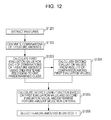
- FIG. 12 is a diagram illustrating a flow of a process in a fourth embodiment.
- FIG. 13 is a diagram illustrating the details of a process in step 1203 in the fourth embodiment.
- FIG. 14 is a diagram illustrating a feature space in which patterns belonging to one class w 1 are plotted.
- FIG. 1 is a diagram illustrating a configuration of an information processing apparatus according to the first embodiment.
- Reference numeral 101 denotes an information processing apparatus that performs information processing for appearance inspection in the present embodiment.
- the information processing apparatus 101 includes a CPU (central processing unit), an RAM (random-access memory), an HDD (hard disk drive), and so forth.
- the CPU executes a computer program for appearance inspection.
- the HDD and the RAM the computer program for appearance inspection and data items are stored.
- Reference numeral 102 denotes an inspection target object that is an appearance inspection target in the present embodiment.
- the inspection target object 102 is, for example, a rubber plate utilized in an industrial product.
- the surfaces of the rubber plates of some inspection target objects 102 have asperities or flows. The asperities or flows are detected by appearance inspection, and the rubber plates are classified into non-defective products and defective products.
- Reference numeral 103 denotes an image pickup apparatus for picking up images of the inspection target objects 102 in the present embodiment.
- the image pickup apparatus 103 is configured using a video camera capable of obtaining a video image (image patterns) of the surfaces of the inspection target objects 102 or the like.
- the image pickup apparatus 103 transmits the obtained video image to the information processing apparatus 101 .
- the information processing apparatus 101 performs information processing for appearance inspection using the transmitted video image.
- Reference numeral 104 denotes a display apparatus for displaying results of appearance inspection.
- the display apparatus 104 is configured using a monitor or the like.
- the display apparatus 104 displays results of appearance inspection that have been transmitted from the information processing apparatus 101 .
- FIG. 2 is a flowchart illustrating information processing that is performed by the information processing apparatus 101 in the present embodiment.
- appearance inspection will be described, in which determination of whether or not parts are non-defective (classification into two classes, non-defective products and defective products) is performed using the picked-up images of the inspection target objects 102 .
- a plurality of hierarchical images are generated from input image patterns.
- a plurality of feature amounts are extracted from the plurality of generated hierarchical images.
- Feature amounts that are suitable for appearance inspection are selected from the plurality of extracted feature amounts.
- Step 201 a plurality of feature amounts that are to be used for appearance inspection are extracted from input image patterns that are obtained by the image pickup apparatus 103 .
- Step 202 the information processing apparatus 101 functions as generating means for generating a plurality of combinations.
- the information processing apparatus 101 generates combinations of n (n ⁇ 2) feature amounts using the plurality of feature amounts that have been extracted in step 201 .
- Step 203 the information processing apparatus 101 functions as first calculating means for calculating first evaluation values for evaluating suitabilities for classification of input image data items.
- a first evaluation value is calculated for each of the plurality of combinations of n feature amounts that have been set in step 202 .
- the first evaluation value in the present embodiment indicates that the feature amounts are suitable for appearance inspection.
- the combination of feature amounts (the combination of n feature amounts) whose first evaluation value for the feature amount is most favorable is determined.
- Step 204 the information processing apparatus 101 functions as second calculating means.
- the information processing apparatus 101 compares the plurality of first evaluation values with one another, thereby calculating second evaluation values for evaluating suitabilities for classification of the input image data items.
- Step 205 scores are calculated using the second evaluation values, and feature selection criteria are determined.
- Step 206 the feature amount whose score is most favorable and the combination of feature amounts (the combination of n feature amounts) that has been evaluated in step 204 as a combination in which the feature amount is included are selected. Feature selection is repeated using the feature selection criteria for the feature amounts excluding the selected feature amounts.
- step 201 The details of a process in step 201 will be described.
- FIG. 3 include diagrams illustrating examples of gray-scale images having 128 ⁇ 128 pixels that are picked-up and cut-out images of surfaces of rubber plates subjected to surface roughing which are examples of the inspection target objects 102 .
- Parts (f) and (g) illustrate patterns in which an inconsistency in the form of a black spot exists.
- Part (h) illustrates a pattern the entirety of which has a gradation.
- part (i) illustrates a pattern in which an inconsistency in the form of a white spot exists.
- Part (j) illustrates a pattern one portion of which has a low contrast. In this step, a plurality of feature amounts indicating such features of patterns are calculated.
- FIG. 4 is a diagram illustrating a specific process of extracting a plurality of feature amounts in the present embodiment.
- wavelet transformation which is a scheme for transforming a pattern into a pattern in a frequency domain, is used for the image patterns in order to emphasize defects.
- FIG. 4 illustrates Haar wavelet transformation that is one type of wavelet transformation.
- inner products are computed using four types of filters for an input pattern prior to being transformed.
- four types of patterns a vertical-direction high-frequency-element extraction pattern (HL), a diagonal-direction high-frequency-element extraction pattern (HH), a horizontal-direction high-frequency-element extraction pattern (LH), and a low-frequency-element extraction pattern (LL).
- HL vertical-direction high-frequency-element extraction pattern
- HH diagonal-direction high-frequency-element extraction pattern
- LH horizontal-direction high-frequency-element extraction pattern
- LL low-frequency-element extraction pattern
- the four types of patterns are generated so that the resolution is halved. Furthermore, the next-level Haar wavelet transformation is performed on the four types of patterns starting with the low-frequency-element extraction pattern, thereby generating the four types of patterns so that the resolution is further halved. In this manner, the frequency of the patterns is transformed into a lower frequency in a hierarchical manner.
- the pattern prior to being transformed includes 128 ⁇ 128 pixels. Accordingly, a pattern having 64 ⁇ 64 pixels is generated by a first transformation. A pattern having 32 ⁇ 32 pixels is generated by a second transformation. After that, a pattern having 16 ⁇ 16 pixels, a pattern having 8 ⁇ 8 pixels, a pattern having 4 ⁇ 4 pixels, and a pattern having 2 ⁇ 2 pixels are generated.
- a pattern having 1 ⁇ 1 pixel is generated by the last seventh transformation.
- each image has a size of a pixels in a vertical direction and b pixels in a horizontal direction, and a pixel value that is an i-th pixel value in the vertical direction and a j-th pixel value in the horizontal direction of the image is denoted by p (i, j).
- a histogram of p is constructed, for each bin, a number, a value, and a frequency are denoted by k, X k , and M k , respectively.
- Equations 5 to 9 The maximum value and the six types of feature amounts that are represented by Equations 5 to 9 are extracted from the input pattern prior to being transformed, which has not been subjected to Haar wavelet transformation, and the 29 types of images, which are individual hierarchical images that have been subjected to Haar wavelet transformation.
- N feature amounts are extracted from each of pn patterns that are used as the input patterns.
- a scheme using Haar wavelet transformation is described.
- other transformation schemes such as schemes using another wavelet transformation, edge extraction, Fourier transformation, and Gabor transformation may be used.
- other statistics such as a contrast, a value obtained by subtracting the minimum from the maximum, and a standard deviation may be used as the macroscopic feature amounts.
- Step 202 generation of combinations of n feature amounts
- the feature amounts are not selected on a one-by-one basis, and are selected in units of n by generating combinations of n feature amounts.
- the number n of feature amounts included in each combination may be determined in accordance with a user instruction or the like. Alternatively, the number n of feature amounts included in each combination may be set in advance for each of the inspection target objects 102 .
- the number of feature amounts that have been extracted from the input image patterns is N, combinations of n feature amounts are generated, thereby generating N C n combinations.
- Step 203 calculation of first evaluation value for each of combinations of n feature amounts
- step 203 a first evaluation value is calculated for each of the N C n combinations that have been generated in step 202 .
- the first evaluation value in the present embodiment is an evaluation value for evaluating whether or not the combination of n feature amounts is suitable for determination for classification of the input data items. More specifically, the first evaluation value indicates whether or not the combination of feature amounts is suitable as a combination of feature amounts that is to be used for a case in which determination of whether the inspection target objects 102 are non-defective products or defective products is performed.
- an n-dimensional Bayes-error-probability estimation value is determined as one example of the first evaluation value.
- each of the two classes is denoted by a corresponding one of w 1 and w 2
- a distribution of a probability that x belongs to each of w 1 and w 2 i.e., an n-dimensional histogram for each of w 1 and w 2 , is generated.
- Each of the histograms is denoted by a corresponding one of P(w 1
- a Bayes-error-probability estimation value is represented by the following equation.
- Calculation of a probability estimation value in this manner is performed for each of the combinations of n feature amounts.
- the calculated Bayes-error-probability estimation value as in the one-dimensional case, it can be considered that the lower the value of a combination is, the more suitable for classification into non-defective products or defective products the combination is.
- Bayes-error-probability estimation value can be applied for multiple classes.
- a ratio of a within-class variance to a between-class variance is used instead of the Bayes-error-probability estimation value.
- a i a set of patterns belonging to the class w 1 is denoted by A i .
- the number of patterns included in A i is denoted by pn i .
- the mean of x of the patterns belonging to the class w 1 is denoted by m i .
- the number of all patterns is denoted by pn, and the mean vector of x of all of the patterns is denoted by m. Accordingly, a within-class variance ( ⁇ 2 W ) and a between-class variance ( ⁇ 2 B ) [Expression 16] can be represented by the following equations.
- a ratio of the within-class variance to the between-class variance can be represented by the following expression. ⁇ B 2 / ⁇ W 2 [Expression 19]
- a ratio of a within-class variance to a between-class variance is determined, and considered as the first evaluation value.
- the ratio of the within-class variance to the between-class variance can be applied for multiple classes.
- a Bayes-error-probability estimation value or a ratio of a within-class variance to a between-class variance, with which a degree of separation of classes from each other can be evaluated is used as the first evaluation value.
- any evaluation value with which a suitability for classification can be evaluated may be used.
- Step 204 calculation of second evaluation values from results (determination results) of comparison among first evaluation values
- step 204 the first evaluation values of the combinations of the plurality of feature amounts are compared with one another, thereby calculating, for each of the plurality of feature amounts, a second evaluation value for evaluating whether or not the feature amount is suitable for classification of the input data items.
- one feature amount is focused on.
- the combination whose first evaluation value is most favorable is determined.
- the combination of feature amounts whose Bayes-error-probability estimation value is lowest is determined.
- a predetermined value is added to a second evaluation value of each of the feature amounts included in the combination whose first evaluation value is most favorable.
- the other feature amounts are sequentially focused on, and the predetermined value is added to a second evaluation value of each of the feature amounts. In this manner, all of the feature amounts are focused on, and the second evaluation value, to which the predetermined value has been added, is calculated as a sum for each of the feature amounts.
- FIG. 5 a case in which there are four types of feature amounts, feature amounts A, B, C, and D, is described as an example.
- the value of one is added to a second evaluation value of the feature amount C.
- the value of one is added to the second evaluation value of the feature amount B.
- the feature amount D there are two types of combinations that are most suitable for classification into non-defective products or defective products, the combination of the feature amounts D and B and the combination of the feature amounts D and C. Accordingly, a value of 0.5 is added to each of the second evaluation values of the feature amounts B and C.
- a combination of three feature amounts may be generated by selecting the feature amounts B and C in combination with the feature amount D.
- the second evaluation values of the feature amounts A, B, C and D become 0, 2.5, 1.5, and 0, respectively. In other words, the largest the number of times a feature amount is determined as a feature amount that is most suitable for classification, the higher the second value.
- a process similar to the above-described process is performed for all combinations of the feature amounts, thereby calculating second evaluation values of all of the feature amounts.
- Step 205 calculation of scores using function based on second evaluation value, and determination of selection criteria
- scores to be used as criteria for selecting the feature amounts are determined using a function based on a second evaluation value (referred to as “Ln”).
- any function in which the score increases with the second evaluation value may be used. Note that, regarding calculation of scores, a score is determined for each of the N (the types of feature amounts that are targets to be selected) feature amounts.
- Step 206 Selection of Feature Amounts in Units of N
- n feature amounts are selected using the feature amount whose score, which has been determined in step 205 , is most favorable, i.e., whose score is highest, and the combination of feature amounts that has been evaluated in step 204 as a combination in which the feature amount is included.
- Feature selection is repeated using the above-described feature selection criteria for the feature amounts excluding the selected feature amounts.
- the second evaluation values of the feature amounts A, B, C, and D are 0, 2.5, 1.5, and 0, respectively. Accordingly, the feature amount B whose second evaluation value is highest is selected first.
- the feature amount C in the combination whose first evaluation value is most favorable is selected at the same time.
- the feature amount C whose second evaluation value is second highest is selected. However, because the feature amount C has already been selected, the next feature amount is selected.
- the feature amount B in the combination whose first evaluation value is most favorable is selected. However, because the feature amount B has already been selected, the next feature amount is selected. Because the next highest second evaluation value is zero, the feature amounts are selected in ascending order of the first evaluation values, i.e., the Bayes-error-probability estimation values.
- the lowest first evaluation value is 0.08 that is the first evaluation value of the combination of the feature amounts A and B.
- the lowest first evaluation value is 0.05 that is each of the first evaluation value of the combination of the feature amounts D and B and the first evaluation value of the combination of the feature amounts D and C.
- the first evaluation value in a case in which the feature amount A is focused on is lower than the first evaluation value in a case in which the feature amount D is focused on. Accordingly, the feature amount A is selected first, and, then, the feature amount D is selected.
- Extraction of N features from the input patterns can be performed in an off-line state because the extraction is performed using training patterns. In an on-line process, it is only necessary to perform extraction of m feature amounts from test patterns. Accordingly, the speed of arithmetic processing can be increased. Furthermore, because m feature amounts are selected in consideration of the combinations of feature amounts, the number m of feature amounts that are finally selected can be decreased, compared with the number of feature amounts in a feature selection scheme of the related art in which only the first evaluation values are considered, and performance equivalent to that of the feature selection scheme of the related art can be maintained.
- feature amounts can be selected from a group of various feature amounts in consideration of combinations of feature amounts in an off-line state. As a result, a problem that occurs in a particular dimension can be prevented from easily occurring, and the speed of arithmetic processing can be increased.
- FIG. 7 is a diagram illustrating a flowchart of the process of calculating scores in the present embodiment.
- a case is described, in which feature amounts are selected in units of two from the N (the types of feature amounts that are targets to be selected) feature amounts.
- the first evaluation values i.e., Bayes-error-probability estimation values Bayes
- Feature amounts are selected from the N feature amounts in units of two.
- a Bayes-error-probability estimation value Bayes ij i denotes a first feature amount
- j denotes a second feature amount.
- i is changed from 1 to N
- j is changed between i+1 and N in such a manner that a feature amount which has been selected by i is not selected by j.
- N C 2 combinations are generated.
- Step 702 Setting of Initialization Value of i
- step 702 the first feature amount i is set to one, and the value thereof is gradually changed, thereby changing the feature amount.
- Step 703 calculation of
- Bayes ik min j ⁇ ( Bayes ij ) [ Expression ⁇ ⁇ 20 ] and k)
- the feature amount i is considered as a fixed number
- the feature amount j is considered as a variable number.
- the minimum value of the first evaluation value, i.e., of the Bayes-error-probability estimation value, and j in a case in which the Bayes-error-probability estimation value is the minimum are determined.
- j in this case is set as k.
- the feature amounts i and k are considered as a set of two feature amounts.
- step 704 one is added to the second evaluation value Ln k of the feature amount k.
- step 707 When the value of i becomes N, the process proceeds to step 707 .
- step S 706 When the value of i is smaller than N, the process proceeds to step S 706 .
- step 706 one is added to i, and the process returns to step 703 .
- step 707 the second evaluation value Ln of each of the features is determined as a score.
- the feature amounts are selected in accordance with each of the sets that have been determined in step 5703 .
- step 205 illustrated in FIG. 2 in the first embodiment is changed to step 805 illustrated in FIG. 8 . Accordingly, only a process in step 805 , which is the difference between the present embodiment and the first embodiment, will be described. Note that, as in the first embodiment, the process in the present embodiment is performed by the information processing apparatus 101 illustrated in FIG. 1 .
- Step 805 calculation of scores based on first evaluation values and second evaluation values, and determination of feature selection criteria
- step 805 differently from the first embodiment, not only on the basis of the second evaluation values, but on the basis of both the first evaluation values and the second evaluation values, feature selection criteria are determined. Scores are determined using a function based on a first evaluation value and a second evaluation value, and feature selection criteria are determined. In this case, the scores are calculated using a function such as Equation 14 given below. However, any other function in which the score decreases with the Bayes-error-probability estimation value, and in which the score increases with the second evaluation value may be used.
- Equation 14 There is a case in which the Bayes-error-probability estimation value Bayes, which is the first evaluation value, becomes zero, and in which the second evaluation value Ln becomes zero. Accordingly, a and b that are values which are not zero are added in Equation 14. For example, if 1000 feature amounts exist, the minimum of the first evaluation value Bayes for each of the feature amounts is zero, and the maximum is one. Furthermore, the minimum of the second evaluation value Ln is zero, and the maximum is 1000. In this case, an appropriate value of a is approximately 1, and an appropriate value of b is approximately 0.001.
- feature selection can be performed in consideration of evaluations of feature amounts and evaluations of combinations of the feature amounts. Accordingly, only necessary feature amounts can be selected. A problem that occurs in a particular dimension can be prevented from easily occurring, and the speed of arithmetic processing can be increased.
- FIG. 9 illustrates a case in which feature amounts are selected in units of two from the N feature amounts.
- Step 908 that is the difference between a flowchart illustrated in FIG. 9 and the flowchart illustrated in FIG. 7 is as follows.
- Scores are calculated using a function using the first evaluation value Bayes, which has been calculated in step 903 , and the second evaluation value Ln. As in the first embodiment, the feature amounts are selected for each of sets of the feature amounts that have been determined in step 903 .
- a process in the present embodiment will be described with reference to a flowchart illustrated in FIG. 10 .
- the difference between the present embodiment and the second embodiment is that step 804 illustrated in FIG. 8 in the second embodiment is changed to step 1004 . Accordingly, only step 1004 , which is the difference between the present embodiment and the second embodiment, will be described.
- a scheme in the third embodiment can be applied to the first embodiment, here, a description thereof is omitted. Note that, as in the second embodiment, the process in the present embodiment is performed by the information processing apparatus 101 illustrated in FIG. 1 .
- a degree of suitability for an evaluation criterion that is set in advance is determined for each of the plurality of first evaluation values. Then, a predetermined value is added more times to the second evaluation value of each feature amount constituting the combination whose first evaluation value corresponds to a higher degree of suitability, thereby calculating the second evaluation values.
- the first evaluation values (here, the Bayes-error-probability estimation values) are determined for all of the combinations of feature amounts.
- combinations of feature amounts are generated by selecting at least two feature amounts at the same time.
- the value of one is added to the second evaluation value of the feature amount included in the combination whose first evaluation value is most favorable.
- the value of one is added to the second evaluation value of the feature amount B.
- the above-described process is performed for all of the feature amounts.
- a value of w (0 ⁇ w ⁇ 1) is added to the second evaluation value of the feature amount included in the combination whose first evaluation value is second most favorable.
- the value of w is added to the second evaluation value of the feature amount C.
- a smaller value may be added to the second evaluation value.
- the value is added to the second evaluation value of the feature amount that is second most favorable.
- the value of w is added to the second evaluation value of the feature amount D.
- the value of w is added to the second evaluation value of the feature amount D.
- the predetermined value is not added to the second evaluation value of the feature amount in included in the combination whose first evaluation value is second most favorable. Consequently, when the second evaluation values to which the predetermined value has been added are calculated as sums, the second evaluation values of the feature amounts A, B, C and D are 0, 2.5, 1.5+w, and 2w, respectively. In this manner, more accurate second evaluation values can be calculated.
- a case is considered, in which only the values of the patterns belonging to the class w 1 are known, and in which the values of the patterns belonging to the class w 2 are unknown.
- An example of the case includes a case in which, in inspection for non-defective products, the values of patterns belonging to defective products are unknown, and in which only the values of patterns belonging to non-defective products are known. For this reason, in the present embodiment, a process using evaluation values indicating degrees of separation that can be calculated using only the patterns belonging to the class w 1 is performed.
- the distribution density of the class w 1 can be considered as an evaluation value indicating a degree of separation of the class w 1 from the class w 2 . Supposing that the distribution density of the class w 1 is high, a range in which the distribution of the class w 1 diverges in a feature space becomes narrow, so that a probability that the distribution of the class w 1 and the distribution of the class w 2 overlap each other becomes low. In contrast, the range in which the distribution of the class w 1 diverges in the feature space becomes wide, so that the probability that the distribution of the class w 1 and the distribution of the class w 2 overlap each other becomes high. As described above, the number of patterns that overlap one another changes in accordance with the distribution density of w 1 .
- the distribution density of the class w 1 is high, when there are overlaps, a large number of patterns in the distribution overlap one another because the distribution density of the class w 1 is high. Furthermore, even in a case in which the distribution density of the class w 1 is low, if there are overlaps, the number of patterns that overlap one another is small because the distribution density of the class w 1 is low.
- a Euclidean distance between a centroid of the patterns belonging to the class w 1 and the pattern that is farthest from the centroid is used as an evaluation value indicating the distribution of the patterns belonging to the class w 1 .
- a standard deviation of Euclidean distances between the centroid and all of the patterns can be used as an evaluation value.
- concepts of other distances including a Manhattan distance and so forth may be used.
- FIG. 12 is a diagram illustrating the flow of the process in the present embodiment.
- step 803 illustrated in FIG. 8 in the second embodiment is changed to step 1203 .
- step 1203 which is the difference between the present embodiment and the second embodiment, will be described. Note that, as in the second embodiment, the process in the present embodiment is performed by the information processing apparatus 101 illustrated in FIG. 1 .
- FIG. 13 is a diagram illustrating the details of a process in step 1203 in the present embodiment.
- the details of the process in step 1203 will be described with reference to FIG. 13 . Note that, because step 1301 corresponds to step 1202 , a description thereof is omitted.
- Step 1302 normalization of only all of patterns belonging to predetermined class w 1 for each of feature amounts
- step 1302 all of the patterns belonging to the class w 1 are normalized for each of the feature amounts using a standard deviation of the feature amount.
- the reason for this is that, in the present embodiment, it is necessary to evaluate the feature amounts using Euclidean distances in an n-dimensional feature space.
- Step 1303 plotting of only patterns belonging to one predetermined class w 1 for each of combinations of n feature amounts in n-dimensional feature space
- step 1303 the patterns belonging to the one class w 1 are plotted in the n-dimensional feature space for each of the combinations of n feature amounts that have been generated.
- Step 1304 calculation of centroid of patterns belonging to one predetermined class w 1 )
- step 1304 a centroid G of the patterns that have been plotted in the feature space is calculated.
- Step 1305 considering degree of divergence as first evaluation value, calculation of first evaluation value also for each of combinations of n feature amounts
- a Euclidean distance d max between the centroid G, which has been determined in step 1304 , and the pattern that is farthest from the centroid G is determined.
- the Euclidean distance is considered as a degree of divergence.
- a standard deviation of d i between the centroid G and all of the patterns is considered as a degree of divergence.
- the degree of divergence that has been calculated using the above-described process is considered as the first evaluation value as in the above-described embodiments.
- a lower degree of divergence indicates that it is better to be used as a feature amount for separating classes. Accordingly, the Euclidean distance in the n-dimensional feature space can be considered as the degree of divergence, and the degree of divergence can be used as the first evaluation value as in the case of the Bayes-error-probability estimation value. According to the present embodiment, feature amounts can be selected using only data items concerning one class.
- a one-class issue is described in the above description, the present embodiment can also be applied to a multiple-class issue.
- a Euclidean distance between a centroid and a pattern that is farthest from the centroid in the n-dimensional feature space can be utilized as the degree of divergence.
- the present invention can also be used for a case in which feature amounts to be used in face recognition or in an issue of classification of patterns, such as multimodal multi-dimensional data items including moving images, are selected from various feature amounts. Note that the present invention can also be used in other pattern recognition or in a field of data mining.
- each of the feature amounts is evaluated using the Bayes-error-probability estimation value, and the feature amounts are selected.
- a scheme in which feature amounts are evaluated in advance before a classifier performs classification using the feature amounts is called a filter scheme.
- a scheme in which a classifier that classifies non-defective products, defective products, and so forth performs classification using feature amounts in reality to evaluate the performance of the classifier, and in which whether or not the feature amounts are to be used is determined is called a wrapper scheme. Because classification results are considered in the wrapper scheme, the performance of the wrapper scheme is higher than that of the filter scheme. However, the wrapper scheme has a disadvantage that an enormous amount of calculation time is necessary.
- the processes in the above-described embodiments can be realized by processing, with a computer, a computer program that is recorded in a recording medium such as a CD-ROM.
- the present invention can be applied to an information processing apparatus that performs appearance inspection on industrial products.
Landscapes
- Engineering & Computer Science (AREA)
- Theoretical Computer Science (AREA)
- General Physics & Mathematics (AREA)
- Library & Information Science (AREA)
- Physics & Mathematics (AREA)
- Databases & Information Systems (AREA)
- General Engineering & Computer Science (AREA)
- Data Mining & Analysis (AREA)
- Computer Vision & Pattern Recognition (AREA)
- Multimedia (AREA)
- Image Analysis (AREA)
- Image Processing (AREA)
- Information Retrieval, Db Structures And Fs Structures Therefor (AREA)
- Investigating Materials By The Use Of Optical Means Adapted For Particular Applications (AREA)
Applications Claiming Priority (3)
| Application Number | Priority Date | Filing Date | Title |
|---|---|---|---|
| JP2008-244194 | 2008-09-24 | ||
| JP2008244194 | 2008-09-24 | ||
| PCT/JP2009/066079 WO2010035659A1 (ja) | 2008-09-24 | 2009-09-15 | 入力データの分類に用いる特徴を選択するための情報処理装置 |
Related Parent Applications (1)
| Application Number | Title | Priority Date | Filing Date |
|---|---|---|---|
| PCT/JP2009/066079 Continuation WO2010035659A1 (ja) | 2008-09-24 | 2009-09-15 | 入力データの分類に用いる特徴を選択するための情報処理装置 |
Publications (2)
| Publication Number | Publication Date |
|---|---|
| US20100239154A1 US20100239154A1 (en) | 2010-09-23 |
| US8189906B2 true US8189906B2 (en) | 2012-05-29 |
Family
ID=42059660
Family Applications (1)
| Application Number | Title | Priority Date | Filing Date |
|---|---|---|---|
| US12/731,032 Expired - Fee Related US8189906B2 (en) | 2008-09-24 | 2010-03-24 | Information processing apparatus and method |
Country Status (5)
| Country | Link |
|---|---|
| US (1) | US8189906B2 (de) |
| EP (1) | EP2333719B1 (de) |
| JP (1) | JP5414416B2 (de) |
| CN (1) | CN102165488B (de) |
| WO (1) | WO2010035659A1 (de) |
Cited By (2)
| Publication number | Priority date | Publication date | Assignee | Title |
|---|---|---|---|---|
| US9959482B2 (en) | 2014-11-28 | 2018-05-01 | Canon Kabushiki Kaisha | Classifying method, storage medium, inspection method, and inspection apparatus |
| US10248888B2 (en) | 2014-11-28 | 2019-04-02 | Canon Kabushiki Kaisha | Classifying method, storage medium, inspection method, and inspection apparatus |
Families Citing this family (21)
| Publication number | Priority date | Publication date | Assignee | Title |
|---|---|---|---|---|
| BR112013011107A2 (pt) * | 2010-11-12 | 2016-08-02 | 3M Innovative Properties Co | ''processamento e detecção rápidos de não uniformidades em materiais á base de manta'' |
| JP5836095B2 (ja) * | 2011-12-05 | 2015-12-24 | キヤノン株式会社 | 画像処理装置、画像処理方法 |
| JP5799817B2 (ja) * | 2012-01-12 | 2015-10-28 | 富士通株式会社 | 指位置検出装置、指位置検出方法及び指位置検出用コンピュータプログラム |
| JP2014142213A (ja) * | 2013-01-22 | 2014-08-07 | Canon Inc | 撮影パラメータ決定装置及びその制御方法 |
| CN105512117B (zh) * | 2014-09-22 | 2020-05-26 | 联想(北京)有限公司 | 一种信息处理方法及电子设备 |
| JP6643856B2 (ja) * | 2014-11-28 | 2020-02-12 | キヤノン株式会社 | 分類方法、検査方法、検査装置、およびプログラム |
| JP6616645B2 (ja) * | 2014-11-28 | 2019-12-04 | キヤノン株式会社 | 分類方法、検査方法、検査装置、およびプログラム |
| WO2016092779A1 (en) * | 2014-12-12 | 2016-06-16 | Canon Kabushiki Kaisha | Information processing apparatus, information processing method, and program |
| JP6632288B2 (ja) | 2014-12-12 | 2020-01-22 | キヤノン株式会社 | 情報処理装置、情報処理方法、プログラム |
| JP2017049974A (ja) * | 2015-09-04 | 2017-03-09 | キヤノン株式会社 | 識別器生成装置、良否判定方法、およびプログラム |
| JP6624963B2 (ja) | 2016-02-12 | 2019-12-25 | キヤノン株式会社 | 情報処理装置、情報処理方法及びプログラム |
| JP6889428B2 (ja) * | 2016-02-26 | 2021-06-18 | 国立大学法人山口大学 | 情報処理装置と情報処理プログラム並びに情報処理方法 |
| JP6193428B1 (ja) * | 2016-03-17 | 2017-09-06 | 株式会社東芝 | 特徴選択装置、特徴選択方法およびプログラム |
| JP6884517B2 (ja) | 2016-06-15 | 2021-06-09 | キヤノン株式会社 | 情報処理装置、情報処理方法及びプログラム |
| JP6680666B2 (ja) * | 2016-11-24 | 2020-04-15 | ヤフー株式会社 | 情報解析装置、情報解析システム、情報解析方法、および情報解析プログラム |
| EP3404593A1 (de) * | 2017-05-15 | 2018-11-21 | Tata Consultancy Services Limited | Verfahren und system zur datenbasierten optimierung von leistungsindikatoren in prozess- und fertigungsindustrien |
| JP2019039727A (ja) * | 2017-08-23 | 2019-03-14 | 富士通株式会社 | 画像検査装置、画像検査方法および画像検査プログラム |
| JP2019067194A (ja) * | 2017-10-02 | 2019-04-25 | Soinnホールディングス合同会社 | 自律学習装置、自律学習方法及びプログラム |
| JP6674581B1 (ja) * | 2019-07-16 | 2020-04-01 | 株式会社ジャパン・カレント | 画像分類システム及び画像分類方法 |
| US11176324B2 (en) * | 2019-09-26 | 2021-11-16 | Sap Se | Creating line item information from free-form tabular data |
| US11151710B1 (en) * | 2020-05-04 | 2021-10-19 | Applied Materials Israel Ltd. | Automatic selection of algorithmic modules for examination of a specimen |
Citations (8)
| Publication number | Priority date | Publication date | Assignee | Title |
|---|---|---|---|---|
| US6421463B1 (en) * | 1998-04-01 | 2002-07-16 | Massachusetts Institute Of Technology | Trainable system to search for objects in images |
| JP2005115525A (ja) | 2003-10-06 | 2005-04-28 | Fuji Photo Film Co Ltd | 識別処理に用いる特徴量の種類と識別条件を決定する装置、プログラムならびにプログラムを記録した記録媒体、および特定内容のデータを選別する装置 |
| US20050185835A1 (en) * | 2004-01-29 | 2005-08-25 | Canon Kabushiki Kaisha | Learning method and device for pattern recognition |
| US6983065B1 (en) * | 2001-12-28 | 2006-01-03 | Cognex Technology And Investment Corporation | Method for extracting features from an image using oriented filters |
| US7369686B2 (en) * | 2001-08-23 | 2008-05-06 | Sony Corporation | Robot apparatus, face recognition method, and face recognition apparatus |
| EP1930842A1 (de) | 2006-12-08 | 2008-06-11 | Sony Corporation | Informationsklassifizierung |
| CN101196992A (zh) | 2006-12-08 | 2008-06-11 | 索尼株式会社 | 信息处理装置和方法、识别装置和信息识别方法及程序 |
| US20090116734A1 (en) * | 2004-03-15 | 2009-05-07 | Bae Systems Plc | Image classification |
Family Cites Families (5)
| Publication number | Priority date | Publication date | Assignee | Title |
|---|---|---|---|---|
| JP2002073994A (ja) * | 2000-08-31 | 2002-03-12 | Nri & Ncc Co Ltd | 保険契約のためのリスク分析支援装置 |
| JP3683906B1 (ja) * | 2005-03-18 | 2005-08-17 | 松下電器産業株式会社 | 情報検索装置 |
| JP4715389B2 (ja) * | 2005-08-24 | 2011-07-06 | 日本電信電話株式会社 | パターン認識方法及び装置及びプログラム |
| CN100523746C (zh) * | 2006-05-09 | 2009-08-05 | 欧姆龙株式会社 | 检查装置及检查方法 |
| CN101216436A (zh) * | 2008-01-03 | 2008-07-09 | 东华大学 | 一种基于支持向量数据描述理论的织物瑕疵自动检测方法 |
-
2009
- 2009-08-06 JP JP2009183717A patent/JP5414416B2/ja not_active Expired - Fee Related
- 2009-09-15 WO PCT/JP2009/066079 patent/WO2010035659A1/ja not_active Ceased
- 2009-09-15 EP EP09816074.0A patent/EP2333719B1/de not_active Not-in-force
- 2009-09-15 CN CN2009801375825A patent/CN102165488B/zh not_active Expired - Fee Related
-
2010
- 2010-03-24 US US12/731,032 patent/US8189906B2/en not_active Expired - Fee Related
Patent Citations (11)
| Publication number | Priority date | Publication date | Assignee | Title |
|---|---|---|---|---|
| US6421463B1 (en) * | 1998-04-01 | 2002-07-16 | Massachusetts Institute Of Technology | Trainable system to search for objects in images |
| US7369686B2 (en) * | 2001-08-23 | 2008-05-06 | Sony Corporation | Robot apparatus, face recognition method, and face recognition apparatus |
| US6983065B1 (en) * | 2001-12-28 | 2006-01-03 | Cognex Technology And Investment Corporation | Method for extracting features from an image using oriented filters |
| JP2005115525A (ja) | 2003-10-06 | 2005-04-28 | Fuji Photo Film Co Ltd | 識別処理に用いる特徴量の種類と識別条件を決定する装置、プログラムならびにプログラムを記録した記録媒体、および特定内容のデータを選別する装置 |
| US20050185835A1 (en) * | 2004-01-29 | 2005-08-25 | Canon Kabushiki Kaisha | Learning method and device for pattern recognition |
| US20090116734A1 (en) * | 2004-03-15 | 2009-05-07 | Bae Systems Plc | Image classification |
| EP1930842A1 (de) | 2006-12-08 | 2008-06-11 | Sony Corporation | Informationsklassifizierung |
| CN101196992A (zh) | 2006-12-08 | 2008-06-11 | 索尼株式会社 | 信息处理装置和方法、识别装置和信息识别方法及程序 |
| US20080137917A1 (en) | 2006-12-08 | 2008-06-12 | Atsushi Okubo | Information Processing Apparatus and Information Processing Method, Recognition Apparatus and Information Recognition Method, and Program |
| KR20080053191A (ko) | 2006-12-08 | 2008-06-12 | 소니 가부시끼 가이샤 | 정보처리 장치 및 정보처리 방법, 인식 장치 및 정보 인식방법, 및 , 프로그램 |
| JP2008165731A (ja) | 2006-12-08 | 2008-07-17 | Sony Corp | 情報処理装置および情報処理方法、認識装置および情報認識方法、並びに、プログラム |
Non-Patent Citations (2)
| Title |
|---|
| Bo, Trond H., and Inge Jonassen. "New Feature Subset Selection Procedures for Classification of Expression Profiles," Genome Biology vol. 3 No. 4 (2002). |
| Ishi, Kenichiro, Naonori Ueda, Eisaku Maeda, and You Murase. "Easy-to-understand Pattern Recognition," Ohmsha, Tokyo, pp. 74-79 (1998). |
Cited By (2)
| Publication number | Priority date | Publication date | Assignee | Title |
|---|---|---|---|---|
| US9959482B2 (en) | 2014-11-28 | 2018-05-01 | Canon Kabushiki Kaisha | Classifying method, storage medium, inspection method, and inspection apparatus |
| US10248888B2 (en) | 2014-11-28 | 2019-04-02 | Canon Kabushiki Kaisha | Classifying method, storage medium, inspection method, and inspection apparatus |
Also Published As
| Publication number | Publication date |
|---|---|
| CN102165488B (zh) | 2013-11-06 |
| EP2333719A1 (de) | 2011-06-15 |
| WO2010035659A1 (ja) | 2010-04-01 |
| JP5414416B2 (ja) | 2014-02-12 |
| EP2333719B1 (de) | 2020-12-30 |
| CN102165488A (zh) | 2011-08-24 |
| EP2333719A4 (de) | 2017-11-29 |
| US20100239154A1 (en) | 2010-09-23 |
| JP2010102690A (ja) | 2010-05-06 |
Similar Documents
| Publication | Publication Date | Title |
|---|---|---|
| US20100239154A1 (en) | Information processing apparatus and method | |
| CN110276342B (zh) | 车牌辨识方法以及其系统 | |
| Pham et al. | A comparative study for classification of skin cancer | |
| US8340439B2 (en) | Image conversion method and apparatus, and pattern identification method and apparatus | |
| Al-Waisy et al. | A multimodal deep learning framework using local feature representations for face recognition | |
| EP2808827B1 (de) | System und Verfahren OCR-Ausgabeprüfung | |
| US20110158535A1 (en) | Image processing apparatus and image processing method | |
| US9697439B2 (en) | Efficient object detection with patch-level window processing | |
| US12112522B2 (en) | Defect detecting method based on dimensionality reduction of data, electronic device, and storage medium | |
| CN102473298B (zh) | 提取代表特征的系统和方法 | |
| US12260613B2 (en) | Electronic device and method for recognizing images based on texture classification | |
| CN106778687A (zh) | 基于局部评估和全局优化的注视点检测方法 | |
| CN103186790A (zh) | 对象检测系统和方法 | |
| Veeramuthu et al. | Brain image classification using learning machine approach and brain structure analysis | |
| CN110070485A (zh) | 一种高光谱图像降维方法 | |
| Song et al. | Bone texture characterization with fisher encoding of local descriptors | |
| Kalakech et al. | A new LBP histogram selection score for color texture classification | |
| Zhou et al. | Feature extraction based on local directional pattern with svm decision-level fusion for facial expression recognition | |
| CN103136536A (zh) | 对象检测系统和方法、图像的特征提取方法 | |
| Dinu et al. | Local patch dissimilarity for images | |
| Nguyen et al. | An alternative approach to reduce massive false positives in mammograms using block variance of local coefficients features and support vector machine | |
| Mei et al. | Greensaliency: A lightweight and efficient image saliency detection method | |
| Hapsari et al. | Identification of Indonesian Rupiah Paper Currency Denominations Using First Order Statistical Feature Extraction and k-Nearest Neighbor | |
| CN116385403B (zh) | 一种基于深度特征直方图的图像异常检测方法 | |
| Bhagyalakshmi et al. | Image retrieval using color and texture binary patterns |
Legal Events
| Date | Code | Title | Description |
|---|---|---|---|
| AS | Assignment |
Owner name: CANON KABUSHIKI KAISHA, JAPAN Free format text: ASSIGNMENT OF ASSIGNORS INTEREST;ASSIGNORS:FUJIMORI, TOMOTAKA;MATSUGU, MASAKAZU;MITARAI, YUSUKE;SIGNING DATES FROM 20100215 TO 20100219;REEL/FRAME:026304/0787 |
|
| ZAAA | Notice of allowance and fees due |
Free format text: ORIGINAL CODE: NOA |
|
| ZAAB | Notice of allowance mailed |
Free format text: ORIGINAL CODE: MN/=. |
|
| STCF | Information on status: patent grant |
Free format text: PATENTED CASE |
|
| FEPP | Fee payment procedure |
Free format text: PAYOR NUMBER ASSIGNED (ORIGINAL EVENT CODE: ASPN); ENTITY STATUS OF PATENT OWNER: LARGE ENTITY |
|
| CC | Certificate of correction | ||
| FPAY | Fee payment |
Year of fee payment: 4 |
|
| MAFP | Maintenance fee payment |
Free format text: PAYMENT OF MAINTENANCE FEE, 8TH YEAR, LARGE ENTITY (ORIGINAL EVENT CODE: M1552); ENTITY STATUS OF PATENT OWNER: LARGE ENTITY Year of fee payment: 8 |
|
| FEPP | Fee payment procedure |
Free format text: MAINTENANCE FEE REMINDER MAILED (ORIGINAL EVENT CODE: REM.); ENTITY STATUS OF PATENT OWNER: LARGE ENTITY |
|
| STCH | Information on status: patent discontinuation |
Free format text: PATENT EXPIRED DUE TO NONPAYMENT OF MAINTENANCE FEES UNDER 37 CFR 1.362 |
|
| FP | Lapsed due to failure to pay maintenance fee |
Effective date: 20240529 |