US809572A - Tufting-machine. - Google Patents
Tufting-machine. Download PDFInfo
- Publication number
- US809572A US809572A US14626003A US1903146260A US809572A US 809572 A US809572 A US 809572A US 14626003 A US14626003 A US 14626003A US 1903146260 A US1903146260 A US 1903146260A US 809572 A US809572 A US 809572A
- Authority
- US
- United States
- Prior art keywords
- tufting
- button
- washer
- machine
- prongs
- Prior art date
- Legal status (The legal status is an assumption and is not a legal conclusion. Google has not performed a legal analysis and makes no representation as to the accuracy of the status listed.)
- Expired - Lifetime
Links
- 230000007246 mechanism Effects 0.000 description 13
- 230000007480 spreading Effects 0.000 description 13
- 238000010276 construction Methods 0.000 description 6
- 239000000463 material Substances 0.000 description 4
- 239000004744 fabric Substances 0.000 description 2
- 241001351439 Oneida Species 0.000 description 1
- 238000005452 bending Methods 0.000 description 1
- 230000003028 elevating effect Effects 0.000 description 1
- 239000010985 leather Substances 0.000 description 1
- 238000004519 manufacturing process Methods 0.000 description 1
- 238000000034 method Methods 0.000 description 1
- 230000004048 modification Effects 0.000 description 1
- 238000012986 modification Methods 0.000 description 1
- 230000008569 process Effects 0.000 description 1
Images

Classifications
-
- B—PERFORMING OPERATIONS; TRANSPORTING
- B68—SADDLERY; UPHOLSTERY
- B68G—METHODS, EQUIPMENT, OR MACHINES FOR USE IN UPHOLSTERING; UPHOLSTERY NOT OTHERWISE PROVIDED FOR
- B68G7/00—Making upholstery
- B68G7/08—Quilting; Elements therefor
-
- Y—GENERAL TAGGING OF NEW TECHNOLOGICAL DEVELOPMENTS; GENERAL TAGGING OF CROSS-SECTIONAL TECHNOLOGIES SPANNING OVER SEVERAL SECTIONS OF THE IPC; TECHNICAL SUBJECTS COVERED BY FORMER USPC CROSS-REFERENCE ART COLLECTIONS [XRACs] AND DIGESTS
- Y10—TECHNICAL SUBJECTS COVERED BY FORMER USPC
- Y10T—TECHNICAL SUBJECTS COVERED BY FORMER US CLASSIFICATION
- Y10T29/00—Metal working
- Y10T29/48—Upholstered article making
- Y10T29/482—Tufting
- Y10T29/484—Tufting with means to insert guide pin or fastener
Definitions
- the object of my invention is to provide in tufting-machines mechanism by means of which the tufting-buttons may be easily, conveniently, and expeditiously applied and secured in the manufacture of cushions and similar covers.
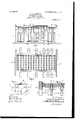
- Figure 1 shows a side elevation of a machine embodying my improvements, a portion, however, being broken out and shown in section to better illustrate the construction.
- Fig. 2 shows a plan view of the machine with the sliding or removable table arranged substantially in its central position.
- Fig. 3 shows, on an enlarged scale, details, partially in section, of certain features of the invention.
- Figs. 4 and 5 show in edge view and plan, respectively, a plate or device for holding the Washers employed in securing the parts of the covering or cushion.
- Fig. 6 shows, on an enlarged scale, a cross-section of the machine.
- Figf7 shows, on an' enlarged scale, details of the staple bending or clenching mechanism.
- Fig. 8 shows the same in position at right angles to that shown in Fig. 7 in the normal position.
- Fig. 9 shows the same parts shown in Fig. 7 in the open or expanding position.
- 1 and 2 indicate end frames of similar construction, which are connected by longitudinal framebars 3 at the top and 4 and 5 at the bottom.
- the end frames 1 and 2 include particularlyextended portions which form tracks or ways 1a' and 2a, in which the tufting-table 6 is mounted and adapted to slide or move transversely of the machine.
- no mechanism is provided for moving the table transversely of the machine in the said ways 1El 2a, it being moved by the hand of the operator. It is obvious, however, that numerous constructions of mechanism may be provided for moving the table.
- the table consists, mainly, of a number of transverse slats a a, separated by suitable intervals of space.
- tuftingbutton-holding plates or devices 7 Spanning these spaces and arranged in suitable positions are the tuftingbutton-holding plates or devices 7.
- These tufting-button-holding plates or devices consist, preferably, of two circular parts 7 a 7a, connected by a comparatively small neck, on which is mounted and which constitutes in part the projection 7b, having channels or grooves extending along its opposite sides and adapted to be received inthe opening of the washer, which constitutes a portion of the securing device.
- the staple clenching or spreading device consists, mainly, of a lazy-tongs construction, having the jaws or operative parts 8 8 and the connecting or spreading arms 9 9, pivoted together at 10, 11, 11, and 12, the latter pivot being mounted upon the vertical movable bar or rod 13 and the former pivot 10 having its outer ends secured or mounted in the supporting-arms 14 from the frame-bar 3.
- the location of the pivot 1() is such as to take a position immediately below the projection 7 b on the several button-holding devices when the table is shifted transversely ol ⁇ the machine in proper position to make these parts register.
- the bar 13 is mounted to slide vertically in a bearing 25, supported from the bar 3.
- treadles 15 For operating the clenching or spreading device there is provided a series of treadles 15, projecting to opposite sides of the machine in suitable positions for convenient operation.
- treadles are pivoted on the bars 4 and 5, respectively, and operate on vertical moving frames 16.
- These frames 16 as the device is shown each have three of the upwardly-extending connecting-bars 13 attached thereto, so that when the treadles are operated to move the frame 16 upwardly three sets of the button clenching or expanding devices will be IOO simultaneously operated.
- This arrangement is not vital, but a matter of convenience. It dispenses with a great number of levers, as 15, although a separate lever and treadle might be employed in connection with each clenching device, or all the clenching devices might be arranged to be operated simultaneously by one treadle or other mechanism. For a hand-operated machine l nd the arrangement shown in this respect very convenient and satisfactory.
- springs 17, For drawing down the frame 16 and elevating the treadle end of the levers 15 there are provided springs 17, attached at their upper ends to the frame 16 and at their lower ends to one of the lower frame-bars. These springs of course operate to withdraw and close the staple clenching or expanding device.
- the process of making a tufted cushion on this machine may be briefly described as follows:
- the tufting-washers, as A are first placed in position on the tufting-table on the projections 7 b, which are passed through the hole in the washer. Over the tufting-table is then stretched the foundation or base of the proposed cushion, as usually a piece of heavy canvas. This canvas will be stretched usually by means of pegs or tacks, securing its ends to the table.
- the covering material of leather, good quality of cloth, or other material, as y is then placed over the base or foundation before mentioned and secured at intervals longitudinally of the table by means of the tufting-buttons, as B.
- tufting-buttons are the well-known tuftingbutton having two prongs, which ordinarily stand a slight distance apart.
- the operator locates the position by feeling for the projections 7b and when located forces the button through the material and astride of the projection 7 b. Previous to this time he will have adjusted the table so as to bring the button plates or holders which he is aboutA to employ directly over the clenching or spreading devices.
- the button is forced through the fabric, as before stated, it passes astride of the projection 7b on the holding device and to each side of the jaws 8 S of the expanding device.
- the operator holds it down and then operates the proper treadle 15 to operate the expanding devices.
- the expanding consists in spreading the prongs of the button, so that they take the position shown in Fig. 9 of the drawings, with a comparatively sharp bend outwardly where they pass through the opening in the washer.
- the treadle is at once relieved and the clenching devices are closed into their normal position. It is evident that the operator could clench two or even three buttons, as the device is shown, simultaneously; but ordinarily he will only clench one button at a time,
- buttons which operate at the same time, serving no purpose at that operation.
- the operator or operators will take the cushion-covering and introduce a quantity of stuffing material, which being worked into suitable shapes and positions the cover is then drawn over it and the table shifted to bring into position other button-holding plates.
- the tufting-buttons are then inserted in their proper places and clenched, as before described.
- the outer row of tufting-button plates or projections are preferably made adjustable toward and from the center of the table, and accordingly to accommodate this adjustment there is provided in the ends of the bars 18 a number of notches, as 18a, the suitable one being employed to correspond with the position of the adjustment of the outer row, as before stated.
- a tufting-machine the combination of a tufting-table having holders for securing the washers in definite locations thereon, of a mechanism arranged under the table for spreading the prongs of the staple, after being passed through the washer, the table and staple-spreading mechanism being relatively movable to provide for having the staples and spreading mechanism register with more than one washer-holder, substantially as set forth.
- a tufting-machine the combination of a series of staple-expanders supported and arranged in the machine, of a movable table having washer-holders adapted to be shifted with reference to the expanding devices to cause the washer positions to register with the expanders, substantially as set forth.
- a tufting-machine 'the combination of a tufting-table, having means for securing the tufting-button washer in position thereon7 an opening through the table at the washer position and a spreader forthe prongs of the tufting-button, consisting of a pair of simultaneously-opening jaws, and mechanism for operating same, substantially as set forth.
- a tufting-machine of a movable table having means for securing the washers of tuftingbuttons in position therein, with an opening beneath the washer positions, a spreading vmechanism for the prongs of the tu'ftingbuttons, consisting of a pair of simultaneously-opening jaws hinged together, and said hinging-point being supported close to the under side of the table by an arm from the main frame, substantially as set forth.
- a holder for a tufting-button washer for tufting-machines consisting of a base, having a projection adapted to pass into or through the opening in the washer, elongated in one direction to substantially fill the opening in the washer diametrically, while affording clearances for the prongs ofthe tuftingbutton at either side, said base being cut away to make provision for placing the button without spreading the prongs materially, and to permit the removal of the button and washer after the prongs have been spread, substantially as set forth.
Landscapes
- Engineering & Computer Science (AREA)
- Manufacturing & Machinery (AREA)
- Mechanical Engineering (AREA)
- Dental Tools And Instruments Or Auxiliary Dental Instruments (AREA)
Description
PATENTED JAN. 9, 1906.
W. E. LATIMBR.
L T E E H s y T L H .o H i s Z u 3. o -N m... In. UWM Am ML I GTA NN IM 6 TA Wm ..4/ TP P. A
NVENTOJT 'VWLLMMELJITJMEJL 3fm @jl T :z' OJNEY.
mi maw fw www d PATENTED JAN. 9, 1906.
W. E. LATIMER. TUFTING MACHINE. APPLICATION FILED Mmm, 190s.
Fig.
2 SHEETS-SHEET 2.
WTNEJJEJ IINITED sTATEs PATENT oEEIcE.
WIIILIAM E. LATIMER. OF UTICA, NEW YORK, ASSIGNOR TO E. R. LATIMER, OF UTIOA, NEW YORK.
Specicaton of Letters Patent.
Patented Jan. 9, 1906.
Application filed MaiI'Gll 5, 1903. Sellitl N0- 146,260.
T0 a/ZZ whom t 'lmtjl/ con/cern: y
Beit known that I, WILLIAM E. LATIMER, of Utica, in the county of Oneida and State of New York, have inventedcertain new and useful Improvements in Tufting-Machines; and I do hereby declare that the following is a full, clear, and exact description of the invention, which will enable others skilled in the art to which it appertains to make and use the same, reference being had to the accompanying drawings, and to the characters of reference marked thereon, which form part of this specification.
The object of my invention is to provide in tufting-machines mechanism by means of which the tufting-buttons may be easily, conveniently, and expeditiously applied and secured in the manufacture of cushions and similar covers.
In the drawings, Figure 1 shows a side elevation of a machine embodying my improvements, a portion, however, being broken out and shown in section to better illustrate the construction. Fig. 2 shows a plan view of the machine with the sliding or removable table arranged substantially in its central position. Fig. 3 shows, on an enlarged scale, details, partially in section, of certain features of the invention. Figs. 4 and 5 show in edge view and plan, respectively, a plate or device for holding the Washers employed in securing the parts of the covering or cushion. Fig. 6 shows, on an enlarged scale, a cross-section of the machine. Figf7 shows, on an' enlarged scale, details of the staple bending or clenching mechanism. Fig. 8 shows the same in position at right angles to that shown in Fig. 7 in the normal position. Fig. 9 shows the same parts shown in Fig. 7 in the open or expanding position.
Referring to the reference letters and iigures in a more particular description, 1 and 2 indicate end frames of similar construction, which are connected by longitudinal framebars 3 at the top and 4 and 5 at the bottom. The end frames 1 and 2 include particularlyextended portions which form tracks or ways 1a' and 2a, in which the tufting-table 6 is mounted and adapted to slide or move transversely of the machine. In the construction as shown no mechanism is provided for moving the table transversely of the machine in the said ways 1El 2a, it being moved by the hand of the operator. It is obvious, however, that numerous constructions of mechanism may be provided for moving the table. The table consists, mainly, of a number of transverse slats a a, separated by suitable intervals of space. Spanning these spaces and arranged in suitable positions are the tuftingbutton-holding plates or devices 7. These tufting-button-holding plates or devices consist, preferably, of two circular parts 7 a 7a, connected by a comparatively small neck, on which is mounted and which constitutes in part the projection 7b, having channels or grooves extending along its opposite sides and adapted to be received inthe opening of the washer, which constitutes a portion of the securing device.
Arranged longitudinally of the central portion of the machine is a series of staple clenching or spreading devices. These devices are supported on the frame-bar 3 and are arranged so that their operative ends are received in the spaces or slots between the bars a a of the tu'fting-table. The staple clenching or spreading device consists, mainly, of a lazy-tongs construction, having the jaws or operative parts 8 8 and the connecting or spreading arms 9 9, pivoted together at 10, 11, 11, and 12, the latter pivot being mounted upon the vertical movable bar or rod 13 and the former pivot 10 having its outer ends secured or mounted in the supporting-arms 14 from the frame-bar 3. The location of the pivot 1() is such as to take a position immediately below the projection 7 b on the several button-holding devices when the table is shifted transversely ol` the machine in proper position to make these parts register. The bar 13 is mounted to slide vertically in a bearing 25, supported from the bar 3.
For operating the clenching or spreading device there is provided a series of treadles 15, projecting to opposite sides of the machine in suitable positions for convenient operation.-
These treadles are pivoted on the bars 4 and 5, respectively, and operate on vertical moving frames 16. These frames 16 as the device is shown each have three of the upwardly-extending connecting-bars 13 attached thereto, so that when the treadles are operated to move the frame 16 upwardly three sets of the button clenching or expanding devices will be IOO simultaneously operated. This arrangement is not vital, but a matter of convenience. It dispenses with a great number of levers, as 15, although a separate lever and treadle might be employed in connection with each clenching device, or all the clenching devices might be arranged to be operated simultaneously by one treadle or other mechanism. For a hand-operated machine l nd the arrangement shown in this respect very convenient and satisfactory.
For drawing down the frame 16 and elevating the treadle end of the levers 15 there are provided springs 17, attached at their upper ends to the frame 16 and at their lower ends to one of the lower frame-bars. These springs of course operate to withdraw and close the staple clenching or expanding device.
The process of making a tufted cushion on this machine may be briefly described as follows: The tufting-washers, as A, are first placed in position on the tufting-table on the projections 7 b, which are passed through the hole in the washer. Over the tufting-table is then stretched the foundation or base of the proposed cushion, as usually a piece of heavy canvas. This canvas will be stretched usually by means of pegs or tacks, securing its ends to the table. The covering material of leather, good quality of cloth, or other material, as y, is then placed over the base or foundation before mentioned and secured at intervals longitudinally of the table by means of the tufting-buttons, as B. These tufting-buttons are the well-known tuftingbutton having two prongs, which ordinarily stand a slight distance apart. In applying the first tufting-buttons the operator locates the position by feeling for the projections 7b and when located forces the button through the material and astride of the projection 7 b. Previous to this time he will have adjusted the table so as to bring the button plates or holders which he is aboutA to employ directly over the clenching or spreading devices. When the button is forced through the fabric, as before stated, it passes astride of the projection 7b on the holding device and to each side of the jaws 8 S of the expanding device. When a button has been forced into position, the operator holds it down and then operates the proper treadle 15 to operate the expanding devices. The expanding consists in spreading the prongs of the button, so that they take the position shown in Fig. 9 of the drawings, with a comparatively sharp bend outwardly where they pass through the opening in the washer. After the button is spread or clenched the treadle is at once relieved and the clenching devices are closed into their normal position. It is evident that the operator could clench two or even three buttons, as the device is shown, simultaneously; but ordinarily he will only clench one button at a time,
the other two expanding devices, which operate at the same time, serving no purpose at that operation. When the middle row of buttons has been placed, the operator or operators, as there may be more than one at the same table, will take the cushion-covering and introduce a quantity of stuffing material, which being worked into suitable shapes and positions the cover is then drawn over it and the table shifted to bring into position other button-holding plates. The tufting-buttons are then inserted in their proper places and clenched, as before described.
For securing the tufting-table in its transverse movements in proper positions, so that the plates 7, with their projections 7 b, will register with the clenching mechanism, there are provided on the ends of the table bars 18, having notches adapted to be engaged by the catch- levers 19 and 20, respectively. rl`he lever 19 is relatively a long lever pivoted at 21, while the lever 2() is a short lever pivoted at 22, and at their meeting ends are attached to a vertical connecting-bar 23, which is operated by means of treadles 24, extending to opposite sides of the machine, respectively. A spring (shown in dotted lines in Fig. 6) is provided for drawing down the connectingbar 23 and causing the extreme ends of the levers 19 and 20 to engage in the notches of the bar 18, and thus lock the tufting-table. The outer row of tufting-button plates or projections are preferably made adjustable toward and from the center of the table, and accordingly to accommodate this adjustment there is provided in the ends of the bars 18 a number of notches, as 18a, the suitable one being employed to correspond with the position of the adjustment of the outer row, as before stated.
lt is evident that numerous modifications and changes in and from the construction described may be made without departing from the spirit of my invention.
What l claim as new, and desire to secure by Letters Patent, is-
1. ln a tufting-machine, the combination of a tufting-table having holders for securing the washers in definite locations thereon, of a mechanism arranged under the table for spreading the prongs of the staple, after being passed through the washer, the table and staple-spreading mechanism being relatively movable to provide for having the staples and spreading mechanism register with more than one washer-holder, substantially as set forth.
2. In a tufting-machine, the combination of a series of staple-expanders supported and arranged in the machine, of a movable table having washer-holders adapted to be shifted with reference to the expanding devices to cause the washer positions to register with the expanders, substantially as set forth.
3. A washer-holder for tufting-machines,
IOO
IIO
having a base part and a projection adapted to be received` in the opening of the washer and substantially fill the same diametrically, said projection being grooved or cut away on its sides to provide passages for the tuftingbutton prongs, and the base part cut away to afford clearance-spaces, for the expanded tufting-button prongs when being removed, substantially as set forth.
4. The combination in a tufting-machine of a table,'having a washer-receiving projection adapted to be received in the opening of the tufting-button washer, said projection being elongated in one direction to substantially fill the opening in the washer diametrically, and being comparatively narrow in the other direction, whereby openings are provided for the prongs of the tufting-button, and a clenching device arranged below said projection, consisting of a pair of simultaneously-opening jaws ada ted to engage and spread the prongs of t e button, substantially as set forth.
5. In a tufting-machine, 'the combination of a tufting-table, having means for securing the tufting-button washer in position thereon7 an opening through the table at the washer position and a spreader forthe prongs of the tufting-button, consisting of a pair of simultaneously-opening jaws, and mechanism for operating same, substantially as set forth.
6. The combination in a tufting-machine of a table, having an opening, a point or proection supported in said opening adapted to be received in the opening of the tufting-button washer and fill the washer-opening diametrically in one direction, while affording openings for the prongs of the tufting-button at the sides of the diametrical line, a pair of simultaneously-opening spreading jaws 1ocated beneath the said projection and having their hinging-joint substantially parallel with the plane of the said projection, substantially as set forth.
7. The combination in a tufting-machine of a table movably supported, having means for securing tufting-button Vwashers in position thereon, with an opening beneath said washer when in position, spreading mechanism for the prongs of the tufting-button supported on the frame in position to operate on the prongs of the tufting-button, the said tufting-table being movable to bring one or more of the washer positions to register with the spreading mechanism, substantially as set forth.
8. The combination in a tufting-machine of a movable table, having means for securing the washers of tuftingbuttons in position therein, with an opening beneath the washer positions, a spreading vmechanism for the prongs of the tu'ftingbuttons, consisting of a pair of simultaneously-opening jaws hinged together, and said hinging-point being supported close to the under side of the table by an arm from the main frame, substantially as set forth.
9. The combination of a tufting-table having projections adapted to pass into or through the openings in the tufting-washers, and locate and hold them, of an expanding mechanism arranged below the table and adapted to operate after the button is placed in its iinal position simultaneously on both prongs of the tuftingbutton to bend the prongs to secure the washer, substantially as set forth.
10. The combination in a tufting-machine of a table, washer-holders having a iixed projection adapted to be received in the washeropening and of a form to substantially fill the washer-opening diametrically and afford passages at each side for the prongs of the button through the washer-opening, and a movable button-prong bender arranged immediately beneath the washer-holder, substantially as set forth.
Il. A holder for a tufting-button washer for tufting-machines, consisting of a base, having a projection adapted to pass into or through the opening in the washer, elongated in one direction to substantially fill the opening in the washer diametrically, while affording clearances for the prongs ofthe tuftingbutton at either side, said base being cut away to make provision for placing the button without spreading the prongs materially, and to permit the removal of the button and washer after the prongs have been spread, substantially as set forth.
In witness wherof I have aiiiXed my signature, in presence of two witnesses, this 28th day of February, 1903.
WILLIAM E. LATIMER.
Witnesses:`
E. WILLARD JONES, S. A. BROWN.
IOO
Priority Applications (1)
| Application Number | Priority Date | Filing Date | Title |
|---|---|---|---|
| US14626003A US809572A (en) | 1903-03-05 | 1903-03-05 | Tufting-machine. |
Applications Claiming Priority (1)
| Application Number | Priority Date | Filing Date | Title |
|---|---|---|---|
| US14626003A US809572A (en) | 1903-03-05 | 1903-03-05 | Tufting-machine. |
Publications (1)
| Publication Number | Publication Date |
|---|---|
| US809572A true US809572A (en) | 1906-01-09 |
Family
ID=2878053
Family Applications (1)
| Application Number | Title | Priority Date | Filing Date |
|---|---|---|---|
| US14626003A Expired - Lifetime US809572A (en) | 1903-03-05 | 1903-03-05 | Tufting-machine. |
Country Status (1)
| Country | Link |
|---|---|
| US (1) | US809572A (en) |
-
1903
- 1903-03-05 US US14626003A patent/US809572A/en not_active Expired - Lifetime
Similar Documents
| Publication | Publication Date | Title |
|---|---|---|
| US809572A (en) | Tufting-machine. | |
| US750690A (en) | Upholstering device | |
| US1993799A (en) | Curtain plaiting and stitching machine | |
| US1220237A (en) | Tufting-machine. | |
| US1361664A (en) | Machine for piercing plies of fabrics | |
| US218143A (en) | Improvement in apparatus for inserting wire staples | |
| US226417A (en) | peters | |
| US266074A (en) | Machine for crimping and preparing elastic fabric | |
| US952189A (en) | Tufting apparatus. | |
| US1289759A (en) | Buttonhole-cutting machine. | |
| US411703A (en) | Button-hole clamp for sewing-machines | |
| US561609A (en) | Trustees | |
| US319700A (en) | Clamp for button-hole sewing-machines | |
| US1001550A (en) | Brush-machine. | |
| US710027A (en) | Machine for stringing tobacco-leaves. | |
| US267342A (en) | Machine for attaching buttons | |
| US729588A (en) | Tufting-frame. | |
| US1127605A (en) | Bow-making machine. | |
| US770669A (en) | Book-clamp | |
| US290181A (en) | Implement for attaching buttons | |
| US676884A (en) | Upholstering apparatus. | |
| US1046520A (en) | Attachment for sewing-machines. | |
| US1125385A (en) | Machine for making mops, brushes, and the like. | |
| US384287A (en) | Leather-trimming machine | |
| US1248556A (en) | Cord-laying device for embroidery-machines. |