US8091377B2 - Simultaneous heating/cooling multi air conditioner - Google Patents
Simultaneous heating/cooling multi air conditioner Download PDFInfo
- Publication number
- US8091377B2 US8091377B2 US11/829,352 US82935207A US8091377B2 US 8091377 B2 US8091377 B2 US 8091377B2 US 82935207 A US82935207 A US 82935207A US 8091377 B2 US8091377 B2 US 8091377B2
- Authority
- US
- United States
- Prior art keywords
- heat exchangers
- refrigerant
- outdoor heat
- pipe
- compressor
- Prior art date
- Legal status (The legal status is an assumption and is not a legal conclusion. Google has not performed a legal analysis and makes no representation as to the accuracy of the status listed.)
- Expired - Fee Related, expires
Links
Images




Classifications
-
- F—MECHANICAL ENGINEERING; LIGHTING; HEATING; WEAPONS; BLASTING
- F25—REFRIGERATION OR COOLING; COMBINED HEATING AND REFRIGERATION SYSTEMS; HEAT PUMP SYSTEMS; MANUFACTURE OR STORAGE OF ICE; LIQUEFACTION SOLIDIFICATION OF GASES
- F25B—REFRIGERATION MACHINES, PLANTS OR SYSTEMS; COMBINED HEATING AND REFRIGERATION SYSTEMS; HEAT PUMP SYSTEMS
- F25B13/00—Compression machines, plants or systems, with reversible cycle
-
- F—MECHANICAL ENGINEERING; LIGHTING; HEATING; WEAPONS; BLASTING
- F24—HEATING; RANGES; VENTILATING
- F24F—AIR-CONDITIONING; AIR-HUMIDIFICATION; VENTILATION; USE OF AIR CURRENTS FOR SCREENING
- F24F11/00—Control or safety arrangements
-
- F—MECHANICAL ENGINEERING; LIGHTING; HEATING; WEAPONS; BLASTING
- F25—REFRIGERATION OR COOLING; COMBINED HEATING AND REFRIGERATION SYSTEMS; HEAT PUMP SYSTEMS; MANUFACTURE OR STORAGE OF ICE; LIQUEFACTION SOLIDIFICATION OF GASES
- F25B—REFRIGERATION MACHINES, PLANTS OR SYSTEMS; COMBINED HEATING AND REFRIGERATION SYSTEMS; HEAT PUMP SYSTEMS
- F25B1/00—Compression machines, plants or systems with non-reversible cycle
-
- F—MECHANICAL ENGINEERING; LIGHTING; HEATING; WEAPONS; BLASTING
- F25—REFRIGERATION OR COOLING; COMBINED HEATING AND REFRIGERATION SYSTEMS; HEAT PUMP SYSTEMS; MANUFACTURE OR STORAGE OF ICE; LIQUEFACTION SOLIDIFICATION OF GASES
- F25B—REFRIGERATION MACHINES, PLANTS OR SYSTEMS; COMBINED HEATING AND REFRIGERATION SYSTEMS; HEAT PUMP SYSTEMS
- F25B49/00—Arrangement or mounting of control or safety devices
- F25B49/02—Arrangement or mounting of control or safety devices for compression type machines, plants or systems
-
- F—MECHANICAL ENGINEERING; LIGHTING; HEATING; WEAPONS; BLASTING
- F25—REFRIGERATION OR COOLING; COMBINED HEATING AND REFRIGERATION SYSTEMS; HEAT PUMP SYSTEMS; MANUFACTURE OR STORAGE OF ICE; LIQUEFACTION SOLIDIFICATION OF GASES
- F25B—REFRIGERATION MACHINES, PLANTS OR SYSTEMS; COMBINED HEATING AND REFRIGERATION SYSTEMS; HEAT PUMP SYSTEMS
- F25B2313/00—Compression machines, plants or systems with reversible cycle not otherwise provided for
- F25B2313/007—Compression machines, plants or systems with reversible cycle not otherwise provided for three pipes connecting the outdoor side to the indoor side with multiple indoor units
-
- F—MECHANICAL ENGINEERING; LIGHTING; HEATING; WEAPONS; BLASTING
- F25—REFRIGERATION OR COOLING; COMBINED HEATING AND REFRIGERATION SYSTEMS; HEAT PUMP SYSTEMS; MANUFACTURE OR STORAGE OF ICE; LIQUEFACTION SOLIDIFICATION OF GASES
- F25B—REFRIGERATION MACHINES, PLANTS OR SYSTEMS; COMBINED HEATING AND REFRIGERATION SYSTEMS; HEAT PUMP SYSTEMS
- F25B2313/00—Compression machines, plants or systems with reversible cycle not otherwise provided for
- F25B2313/023—Compression machines, plants or systems with reversible cycle not otherwise provided for using multiple indoor units
- F25B2313/0231—Compression machines, plants or systems with reversible cycle not otherwise provided for using multiple indoor units with simultaneous cooling and heating
-
- F—MECHANICAL ENGINEERING; LIGHTING; HEATING; WEAPONS; BLASTING
- F25—REFRIGERATION OR COOLING; COMBINED HEATING AND REFRIGERATION SYSTEMS; HEAT PUMP SYSTEMS; MANUFACTURE OR STORAGE OF ICE; LIQUEFACTION SOLIDIFICATION OF GASES
- F25B—REFRIGERATION MACHINES, PLANTS OR SYSTEMS; COMBINED HEATING AND REFRIGERATION SYSTEMS; HEAT PUMP SYSTEMS
- F25B2313/00—Compression machines, plants or systems with reversible cycle not otherwise provided for
- F25B2313/023—Compression machines, plants or systems with reversible cycle not otherwise provided for using multiple indoor units
- F25B2313/0233—Compression machines, plants or systems with reversible cycle not otherwise provided for using multiple indoor units in parallel arrangements
-
- F—MECHANICAL ENGINEERING; LIGHTING; HEATING; WEAPONS; BLASTING
- F25—REFRIGERATION OR COOLING; COMBINED HEATING AND REFRIGERATION SYSTEMS; HEAT PUMP SYSTEMS; MANUFACTURE OR STORAGE OF ICE; LIQUEFACTION SOLIDIFICATION OF GASES
- F25B—REFRIGERATION MACHINES, PLANTS OR SYSTEMS; COMBINED HEATING AND REFRIGERATION SYSTEMS; HEAT PUMP SYSTEMS
- F25B2313/00—Compression machines, plants or systems with reversible cycle not otherwise provided for
- F25B2313/025—Compression machines, plants or systems with reversible cycle not otherwise provided for using multiple outdoor units
- F25B2313/0253—Compression machines, plants or systems with reversible cycle not otherwise provided for using multiple outdoor units in parallel arrangements
-
- F—MECHANICAL ENGINEERING; LIGHTING; HEATING; WEAPONS; BLASTING
- F25—REFRIGERATION OR COOLING; COMBINED HEATING AND REFRIGERATION SYSTEMS; HEAT PUMP SYSTEMS; MANUFACTURE OR STORAGE OF ICE; LIQUEFACTION SOLIDIFICATION OF GASES
- F25B—REFRIGERATION MACHINES, PLANTS OR SYSTEMS; COMBINED HEATING AND REFRIGERATION SYSTEMS; HEAT PUMP SYSTEMS
- F25B2313/00—Compression machines, plants or systems with reversible cycle not otherwise provided for
- F25B2313/027—Compression machines, plants or systems with reversible cycle not otherwise provided for characterised by the reversing means
- F25B2313/02742—Compression machines, plants or systems with reversible cycle not otherwise provided for characterised by the reversing means using two four-way valves
-
- F—MECHANICAL ENGINEERING; LIGHTING; HEATING; WEAPONS; BLASTING
- F25—REFRIGERATION OR COOLING; COMBINED HEATING AND REFRIGERATION SYSTEMS; HEAT PUMP SYSTEMS; MANUFACTURE OR STORAGE OF ICE; LIQUEFACTION SOLIDIFICATION OF GASES
- F25B—REFRIGERATION MACHINES, PLANTS OR SYSTEMS; COMBINED HEATING AND REFRIGERATION SYSTEMS; HEAT PUMP SYSTEMS
- F25B2400/00—Component parts or details not otherwise provided for in this subclass
- F25B2400/07—Details of compressors or related parts
- F25B2400/075—Details of compressors or related parts with parallel compressors
- F25B2400/0751—Details of compressors or related parts with parallel compressors the compressors having different capacities
-
- F—MECHANICAL ENGINEERING; LIGHTING; HEATING; WEAPONS; BLASTING
- F25—REFRIGERATION OR COOLING; COMBINED HEATING AND REFRIGERATION SYSTEMS; HEAT PUMP SYSTEMS; MANUFACTURE OR STORAGE OF ICE; LIQUEFACTION SOLIDIFICATION OF GASES
- F25B—REFRIGERATION MACHINES, PLANTS OR SYSTEMS; COMBINED HEATING AND REFRIGERATION SYSTEMS; HEAT PUMP SYSTEMS
- F25B2600/00—Control issues
- F25B2600/02—Compressor control
- F25B2600/021—Inverters therefor
-
- Y—GENERAL TAGGING OF NEW TECHNOLOGICAL DEVELOPMENTS; GENERAL TAGGING OF CROSS-SECTIONAL TECHNOLOGIES SPANNING OVER SEVERAL SECTIONS OF THE IPC; TECHNICAL SUBJECTS COVERED BY FORMER USPC CROSS-REFERENCE ART COLLECTIONS [XRACs] AND DIGESTS
- Y02—TECHNOLOGIES OR APPLICATIONS FOR MITIGATION OR ADAPTATION AGAINST CLIMATE CHANGE
- Y02B—CLIMATE CHANGE MITIGATION TECHNOLOGIES RELATED TO BUILDINGS, e.g. HOUSING, HOUSE APPLIANCES OR RELATED END-USER APPLICATIONS
- Y02B30/00—Energy efficient heating, ventilation or air conditioning [HVAC]
- Y02B30/70—Efficient control or regulation technologies, e.g. for control of refrigerant flow, motor or heating
Definitions
- the application relates to an air conditioning system that includes a plurality of indoor units for separately heating and cooling multiple different rooms of a building.
- An air conditioner is a device for heating or cooling an internal space of, for example, a building.
- a multi air conditioner includes a few large heating and cooling units which are used to generate refrigerant flows that can be used to heat or cool many separate rooms in the building.
- the multi air conditioner includes an outdoor unit, and a plurality of indoor units connected to the outdoor unit and installed in the respective rooms.
- the related art multi air conditioners can only operate in one of a cooling or heating mode. Because the related art multi air conditioner operates in only one of the cooling and heating modes, there is a problem when heating is required for some rooms, while cooling is required for others.
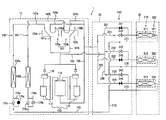
- FIG. 1 is a view illustrating a configuration of a simultaneous heating/cooling multi air conditioner
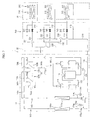
- FIG. 2 is a view illustrating an operational state of the multi air conditioner when the multi air conditioner operates in a full cooling mode
- FIG. 3 is a view illustrating a first operational state of a switching unit of the multi air conditioner of FIG. 1 ;
- FIG. 4 is a view illustrating an operational state of the multi air conditioner when the multi air conditioner operates in a cooling-dominant mode
- FIG. 5 is a view illustrating an operational state of the multi air conditioner when the multi air conditioner operates in a heating dominant mode
- FIG. 7 is a view illustrating an operational state of the multi air conditioner when the multi air conditioner operates in a full heating mode
- FIG. 8 is a view illustrating an operational state of the multi air conditioner when the multi air conditioner operates in a heating-dominant mode
- FIG. 9 is a view illustrating an operational state of the multi air conditioner when the multi air conditioner operates in a full heating mode or a heating-dominant mode.
- FIG. 1 is a view illustrating a configuration of a simultaneous heating/cooling multi air conditioner.
- the simultaneous heating/cooling multi air conditioner can cool or heat all of rooms, but also can cool some of rooms, while heating others. That is, the simultaneous heating/cooling multi air conditioner includes a full heating mode for heating each of the rooms, a heating-dominant mode for cooling some of the rooms while dominantly heating others, a full cooling mode for cooling all of the rooms, and a cooling-dominant mode for heating some of the rooms while dominantly cooling others.
- the simultaneous heating/cooling multi air conditioner includes an outdoor unit 10 installed outdoors, a plurality of indoor units 30 installed in respective rooms, and a divider 20 connecting the outdoor unit 10 with the indoor units 30 .
- the outdoor unit 10 includes a compressor 110 and outdoor heat exchangers 130 a 130 b .
- the divider 20 includes a guide pipe unit connecting the outdoor unit 10 with the indoor units 30 , and a valve unit controlling the refrigerant flow in the guide pipe part.
- Each of the indoor units 30 includes an indoor heat exchanger 310 , and an electronic expansion valve 320 .
- the outdoor unit 10 includes the compressor 110 which compresses refrigerant. Typically, multiple individual compressors would be used in the multi air conditioner.
- An accumulator 119 allows gaseous refrigerant to flow into the compressor 110 .
- One or more oil separators 116 separate oil from refrigerant discharged from the compressors 110 , and route the separated oil back into the compressors 110 .
- a pipe unit connected to the compressor 110 guides refrigerant to the divider 20 and guides refrigerant from the divider 20 back to the compressor 110 .
- a switching unit 120 is provided on the pipe unit within the outdoor unit 10 , and switches the flow of refrigerant depending on an operational state of the air conditioner.
- the compressor 110 includes an inverter compressor 112 operating at a variable speed, and a constant-speed compressor 114 operating at a constant speed.
- the inverter compressor 112 When the capacity of the indoor units 30 being used is small, the inverter compressor 112 is activated. When the capacity of the indoor units 30 gradually increases and exceeds the capacity of the inverter compressor 112 , the constant-speed compressor 114 is activated.
- additional compressors could also be used. Also, all the compressors might be of the same type. Further, additional other types of compressors could also be used.
- the pipe unit includes a first connection pipe 140 connecting a discharge end of the compressor 110 with the outdoor heat exchanger 130 .
- a second connection pipe 150 connects a front end side 141 of the first connection pipe 140 with the divider 20 to guide only a high-pressure gaseous refrigerant to the divider 20 .
- a third connection pipe 160 connects a suction end of the compressor 110 with the divider 20 .
- the outdoor heat exchanger 130 includes a first outdoor heat exchanger 130 a and a second outdoor heat exchanger 130 b that are connected together in parallel.
- the switching unit 120 also includes the first switching unit 120 a and the second switching unit 120 b .
- the first switching unit 120 a selectively connects the first outdoor heat exchanger 130 a with the compressor 110
- the second switching unit 120 b selectively connects the second outdoor heat exchanger 130 b with the compressor 110 .
- the plurality of outdoor heat exchangers 130 and the plurality of switching units 120 are provided so as to change functions of the plurality of outdoor heat exchangers 130 and thus meet a requited heating/cooling ratio when a heating/cooling ratio changes while the simultaneous heating/cooling multi air conditioner is operating in a predetermined mode. Accordingly, the heating/cooling performance can be constantly maintained, and the heating/cooling can be continuously performed.
- all of the outdoor heat exchangers 130 may operate as evaporators, all may operate as condensers, or some of the outdoor heat exchangers may operate as condensers while others operate as evaporators. The detailed description thereof will be described later with reference to accompanying drawings.
- the first switching unit 120 a includes a 4-way valve 122 a provided at the first connection pipe 140 on a section between the second connection pipe 150 and the first outdoor heat exchanger 130 a .
- An auxiliary connection pipe 124 a connects the 4-way valve 122 a with the third connection pipe 160 .
- a closed pipe 126 a is also connected to the valve 122 a for pressurization such that one side of a valve body ( 128 of FIG. 3 ) is continuously pressurized during a full heating operation or a heating-dominant operation. An operation of the valve body will be described later with reference to accompanying drawings.
- the second switching unit 120 b includes a four-way valve 122 b .
- An auxiliary connection pipe 124 b leads to the third pipe 160 , and a closed pipe 126 b is coupled to the valve 122 b for pressurization.
- a section 143 of the first connection pipe 140 between the outdoor heat exchanger 130 and the divider 20 is defined as a ‘high-pressure liquefied refrigerant section’ through which high-pressure liquefied refrigerant flows.
- the second connection pipe 150 is defined as a ‘high-pressure gaseous refrigerant section. Refrigerant in a high-pressure gaseous state passes through the second connection pipe 150 after leaving the compressors 110 .
- the third connection pipe 160 is defined as a low-pressure gaseous refrigerant section. Low-pressure gaseous refrigerant flows through the third connection pipe 160 . This will be clearly understood through the description of an operation to be made later in detail.
- refrigerant being discharged from the outdoor heat exchanger 130 may be continuously introduced to the divider 20 through the high-pressure liquefied refrigerant section of the first connection pipe 140 .
- refrigerant having expanded may be introduced to the outdoor heat exchanger 130 .
- Check valves 172 a and 172 b , parallel pipes 174 a and 174 b , and outdoor electronic expansion valves 176 a and 176 b are also coupled to one side of the outdoor heat exchangers 130 a , 130 b .
- the check valves 172 a and 172 b are provided in the high-pressure liquefied refrigerant section, and they act to cut off refrigerant flow when the outdoor heat exchanger 130 operates as an evaporator. They pass the refrigerant when the outdoor heat exchanger 130 operates as a condenser.
- the parallel pipes 174 a and 174 b are connected to the high-pressure liquefied refrigerant section in front of and at the rear of the respective check valves 172 a and 172 b .
- the parallel pipes 174 a , 174 b guide refrigerant flow when the outdoor heat exchanger 130 operates as an evaporator.
- the outdoor electronic expansion valves 176 a and 176 b are provided in the parallel pipes 174 a and 174 b , and expand refrigerant being introduced to the outdoor heat exchangers 130 , respectively.
- the divider 20 includes a guide pipe unit and a valve unit 240 .
- the guide pipe unit guides to the indoor unit 30 refrigerant introduced to the first connection pipe 140 or the second connection pipe 150 of the outdoor unit 10 , and also guides refrigerant heat-exchanged in the indoor units 30 to the first connection pipe 140 or the third connection pipe 160 of the outdoor unit 10 .
- the valve unit 240 controls refrigerant flow of the guide pipe unit depending on operation conditions.
- the guide pipe unit includes a high-pressure liquefied refrigerant connection pipe 210 connected to the high-pressure liquefied refrigerant section of the first connection pipe 140 .
- High-pressure liquefied refrigerant branch pipes 211 , 212 and 213 branch from the high-pressure liquefied refrigerant connection pipe 210 , and connect to the respective indoor units 30 .
- a high-pressure gaseous refrigerant connection pipe 230 connects the second connection pipe 150 to high-pressure gaseous refrigerant branch pipes 231 , 232 and 233 , which themselves are connected to the respective indoor units 30 .
- Low-pressure gaseous refrigerant branch pipes 221 , 222 and 223 are connected in parallel with the high-pressure gaseous refrigerant branch pipes 231 , 232 and 233 , and guide low-pressure gaseous refrigerant into a low-pressure gaseous refrigerant connection pipe 220 .
- the low-pressure gaseous refrigerant connection pipe 220 is connected to the third connection pipe 160 .
- the valve unit 240 includes high-pressure side valves 241 , 242 and 243 provided on the respective high-pressure gaseous refrigerant branch pipes 231 , 232 and 233 .
- Low-pressure side valves 244 , 245 and 246 are provided on the respective low-pressure gaseous refrigerant branch pipes 221 , 222 and 223 .
- the high-pressure and low-pressure side valves are individually selectively turned ON/OFF depending on operational states of the respective indoor units 30 .
- Each indoor unit 30 includes an indoor heat exchanger 310 and an indoor electronic expansion valve 320 provided between the high-pressure liquefied refrigerant branch pipe and the gaseous refrigerant branch pipe.
- An indoor fan (not shown) forcibly blows air over the indoor heat exchangers to either heat or cool the indoor spaces.
- Refrigerant flows through the low-pressure gaseous refrigerant pipes during a full cooling operation, and refrigerant flows through the high-pressure gaseous refrigerant pipes during a full heating operation. That is, in the full cooling operation, the high-pressure side valves 241 , 242 and 243 are closed, and the low-pressure side valves 244 , 245 and 246 are opened, so that the refrigerant flows to the low-pressure gaseous refrigerant branch pipes 221 , 222 and 223 .
- the low-pressure side valves 244 , 245 and 246 are closed, and the high-pressure side valves 241 , 242 and 243 are opened, so that the refrigerant flows to the high-pressure gaseous refrigerant branch pipes 231 , 232 and 233 .
- FIG. 2 is a view illustrating an operational state when the simultaneous heating/cooling multi air conditioner operates in a full cooling mode.
- FIG. 3 is a view illustrating a first operational state of the switching units of the simultaneous heating/cooling multi air conditioner.
- the high-pressure side valves 241 , 242 and 243 of the respective high-pressure gaseous refrigerant branch pipes 231 , 232 and 233 are closed, and the low-pressure side valves 244 , 245 and 246 of the low-pressure gaseous refrigerant branch pipes 221 , 222 and 223 are opened.
- High-pressure gaseous refrigerant discharged from the compressor 110 flows along the front end sides 141 a and 141 b of the first connection pipe 140 , and is introduced to rear end sides 142 a and 142 b of the first connection pipe 140 via the switching units 120 a and 120 b , respectively.
- the refrigerant introduced to the rear end sides 142 a and 142 b of the first connection pipe 140 is condensed while passing through the outdoor heat exchangers 130 a and 130 b , respectively. That is, the outdoor heat exchangers 130 a and 130 b operate as condensers.
- the refrigerant condensed while passing through the outdoor heat exchangers 130 a and 130 b is introduced to the divider 20 via the check valves 172 a and 172 b along the high-pressure liquefied refrigerant section 143 of the first connection pipe 140 .
- the outdoor electronic expansion valves 176 a and 176 b are in a closed state.
- the refrigerant introduced to the divider 20 is introduced to the high-pressure liquefied refrigerant connection pipe 210 , and the refrigerant introduced to the high-pressure liquefied refrigerant connection pipe 210 is divided into the high-pressure liquefied refrigerant branch pipes 211 , 212 and 213 . Then, the refrigerant is expanded while passing through each indoor electronic expansion valve 321 , 322 , 323 and is evaporated while passing through each indoor heat exchanger 310 . The air introduced into each indoor unit 30 is cooled while passing through each indoor heat exchanger 310 , and the cool air is discharged to each room, thereby performing cooling on each room.
- the evaporated refrigerant passes through each of the low-pressure gaseous refrigerant branch pipes 221 , 222 and 223 , and the refrigerant merges at the low-pressure gaseous refrigerant connection pipe 220 , and then is introduced to the third connection pipe 160 .
- the refrigerant introduced to the third connection pipe 160 passes through the accumulator 119 and then is sucked into the compressor 110 .
- the valve body 128 within the switching units 120 a and 120 b is located to the right, to connect the front end side 141 of the first connection pipe 140 to the rear end side 142 thereof.
- An electric force such as provided by a solenoid, (i.e., a force used for an initial operation of the valve body) and pressure of refrigerant being discharged from the compressor 110 is used to move the valve body.
- the refrigerant is discharged to the rear end side 142 of the first connection pipe 140 , and it continuously presses the valve body 128 to the right such that, refrigerant discharged from the compressor flows toward the outdoor heat exchanger 130 .
- the auxiliary connection pipes 124 a and 124 b respectively communicate with the closed pipes 126 a and 126 b , thereby blocking the flow of the refrigerant.
- the refrigerant introduced to the third connection pipe 160 from the low pressure gas refrigerant pipe 220 can smoothly flow toward the compressor 110 .
- FIG. 4 is a view illustrating an operational state when the simultaneous heating/cooling multi air conditioner operates in the cooling-dominant mode. In this mode, the majority of the indoor spaces are being cooled, but some are being heated.
- the low-pressure side valves 244 and 245 of the low-pressure gaseous refrigerant branch pipes 221 and 222 are opened for rooms requiring cooling so as to introduce refrigerant to the low-pressure gaseous refrigerant branch pipes 221 and 222 .
- the high-pressure side valve 243 of the high-pressure gaseous refrigerant branch pipe 233 is opened so as to introduce refrigerant to the high-pressure gaseous refrigerant branch pipe 233 .
- low pressure side valve 246 of the low-pressure gaseous refrigerant branch pipe 223 is closed.
- a portion of high-pressure gaseous refrigerant discharged from the compressor 110 is introduced from the front end side 141 of the first connection pipe 140 to the high-pressure gaseous refrigerant connection pipe 230 of the divider 20 along the second connection pipe 150 .
- the remaining high-pressure gaseous refrigerant discharged from the compressor 110 is introduced to the rear end sides 142 a and 142 b of the first connection pipe 140 by the respective switching units 120 a and 120 b .
- the high-pressure gaseous refrigerant introduced to the rear end sides 142 a and 142 b is introduced to the respective outdoor heat exchangers 130 a and 130 b and is condensed. That is, the outdoor heat exchangers 130 a and 130 b operate as condensers.
- the refrigerant introduced to the high-pressure liquefied refrigerant connection pipe 210 of the divider 20 is divided into the first and second high-pressure liquefied refrigerant branch pipes 211 and 212 .
- the divided refrigerant is expanded while passing through the first and second indoor electronic expansion valves 321 , and 322 , and is evaporated while passing through the first and second indoor heat exchangers 311 and 312 .
- the indoor air is blown across the first and second indoor heat exchangers 311 and 312 , and the cool air is discharged to the inside, thereby cooling rooms that requires cooling.
- the evaporated refrigerant passes through the first and second low-pressure gaseous refrigerant branch pipes 221 and 222 , is collected at the low-pressure gaseous refrigerant connection pipe 220 , and then is sucked into the compressor 110 .
- the refrigerant introduced to the high-pressure gaseous refrigerant connection pipe 230 of the divider 20 is introduced to the third high-pressure gaseous refrigerant branch pipe 233 , and is condensed through the third indoor heat exchanger 313 .
- the indoor air blown through the third indoor heat exchanger 313 is discharged to a third room, thereby heating the room requiring heat.
- the refrigerant is collected at the high-pressure liquefied refrigerant connection pipe 210 via the opened third indoor electronic expansion valve 323 and the third high-pressure liquefied refrigerant branch pipe 213 .
- the refrigerant used for heating the third room joins the refrigerant in the high pressure liquefied refrigerant pipe 210 and is divided into the first and second high-pressure liquefied refrigerant branch pipes 211 and 212 if necessary, and then is used to cool the first and second rooms.
- FIG. 5 is a view illustrating an operational state when a heating ratio increases while the simultaneous heating/cooling multi air conditioner operates in the full cooling mode or the heating-dominant mode.
- FIG. 6 is a view illustrating a second operational state of the switching unit of the air conditioner. Referring to FIGS. 5 and 6 , when the heating ratio increases while the simultaneous heating/cooling multi air conditioner operates in the full cooling mode or the cooling-dominant mode, some of the outdoor heat exchangers 130 operate as condensers, and others operate as evaporators.
- each of the outdoor heat exchangers 130 operates as a condenser as described with reference to FIGS. 2 and 4 .
- An indoor heat exchanger of a room operating for cooling serves as an evaporator
- an indoor heat exchanger of a room operating for heating serves as a condenser.
- a high-pressure gaseous refrigerant discharged from the compressor 110 is divided and flows to the first end side 141 a and the second end side 141 b of the first connection pipe 140 , and through the second connection pipe 150 .
- the refrigerant introduced to the first end side 141 a of the first connection pipe 140 is introduced to the first rear end side 142 a of the first connection pipe 140 by the first switching unit 120 a .
- the second switching unit 120 b is switched to a configuration shown in FIG. 6 . In this configuration, since the second front end side 141 b is connected to the second closed pipe 126 b for pressurization.
- the refrigerant introduced to the second front end side 141 b of the first connection pipe 140 cannot flow any longer.
- the refrigerant introduced to the second connection pipe 150 flows to the high-pressure gaseous refrigerant connection pipe 230 of the divider 20 .
- the refrigerant introduced to the first rear end side 142 a of the first connection pipe 140 is condensed while passing through the first outdoor heat exchanger 130 a . That is, the first outdoor heat exchanger 130 a operates as a condenser.
- the refrigerant condensed while passing through the first outdoor heat exchanger 130 a is introduced to the high-pressure liquefied refrigerant connection pipe 210 of the divider 20 via the first check valve 172 a along the high-pressure liquefied refrigerant section 143 of the first connection pipe 140 .
- the first outdoor electronic expansion valve 176 a is closed.
- the refrigerant introduced to the high-pressure liquefied refrigerant connection pipe 210 of the divider 20 is routed to the first high-pressure liquefied refrigerant branch pipe 211 , and is then is expanded while passing through the first indoor electronic expansion valve 321 , and is evaporated while passing through the first indoor heat exchanger 311 .
- the indoor air that is blown through the first indoor heat exchanger 311 is discharged to the inside, thereby cooling a room that requires cooling.
- the evaporated refrigerant passes through the first low-pressure gaseous refrigerant branch pipe 221 , is introduced to the low-pressure gaseous refrigerant connection pipe 220 , and then is sucked into the compressor 110 via the third pipe 160 .
- the refrigerant introduced to the high-pressure gaseous refrigerant connection pipe 230 of the divider 20 is introduced to the second and third high-pressure gaseous refrigerant branch pipes 232 and 233 , and then is condensed while passing through the second and third indoor heat exchangers 312 and 313 .
- the indoor air blown through the second and third indoor heat exchangers 312 and 323 is discharged to the inside at a temperature increased by heat-exchange, thereby heating the second and third rooms that require heating.
- the condensed refrigerant passes through the opened second and third indoor electronic expansion valves 322 and 323 , and the second and third high-pressure liquefied refrigerant branch pipes 212 and 213 , and then merges into the high-pressure liquefied refrigerant connection pipe 210 .
- the refrigerant used for the heating is introduced to the high-pressure liquefied refrigerant branch pipe of a room that requires cooling, and then the introduced refrigerant is used to cool the room.
- a portion of refrigerant introduced to the high-pressure liquefied refrigerant section 143 via the first outdoor heat exchanger 130 a and the first check valve 172 a is introduced to the second parallel pipe 174 b .
- the refrigerant introduced to the second parallel pipe 174 b is expanded while passing through the second outdoor electronic expansion valve 176 b , and is evaporated while passing through the second outdoor heat exchanger 130 b . That is, the second outdoor heat exchanger 130 b operates as an evaporator.
- the refrigerant evaporated while passing through the second outdoor heat exchanger 130 b flows along the second rear end side 142 b of the first connection pipe 140 , and is introduced to the compressor 110 after sequentially passing through the second auxiliary connection pipe 124 b and the third connection pipe 160 by the second 4-way valve 122 b.
- the valve body 128 of the second switching unit 120 b is moved to the left by an electronic force and pressure of the refrigerant flowing through the second switching unit 122 b .
- the front end side 141 of the first connection pipe 140 communicates with the closed pipe 126 for pressurization.
- a predetermined amount of refrigerant is moved to the closed pipe 126 for pressurization, thereby continuously pressurizing the valve body 128 b to the left.
- the rear end side 142 of the first connection pipe 140 and the auxiliary connection pipe 124 communicate with each other through a passage 129 within the valve body 128 , thereby moving a low-pressure gaseous refrigerant being discharged from the second outdoor heat exchanger 130 b toward a suction side of the compressor 110 .
- the plurality of outdoor heat exchangers 130 are constructed such that some of the outdoor heat exchangers 130 operate as condensers and others operate as evaporators depending on the heating/cooling ratio. Accordingly, deterioration of the heating/cooling performance is prevented even if the heating/cooling ratio changes. Also, continuous heating/cooling operations can be performed without stopping a system when an operation mode changes.
- FIG. 7 is a view illustrating an operational state when the simultaneous heating/cooling multi air conditioner operates in a full heating mode.
- the low-pressure side valves 244 , 245 and 26 of the respective low-pressure gaseous refrigerant branch pipes 221 , 222 and 223 are closed, and the high-pressure side valves 241 , 242 and 243 of the respective high-pressure gaseous refrigerant branch pipes 231 , 232 and 233 are opened.
- a high-pressure gaseous refrigerant discharged from the compressor 110 flows along the front end side 141 of the first connection pipe 140 .
- the refrigerant introduced to the high-pressure gaseous refrigerant connection pipe 230 of the divider 20 is introduced to the high-pressure gaseous refrigerant branch pipes 231 , 232 and 233 , and is condensed while passing through each indoor heat exchanger 311 , 312 , 313 .
- the air blown through the indoor heat exchangers 311 , 312 , 313 increases in temperature while passing through each indoor heat exchanger, and then is discharged to the inside to heat each room.
- the condensed refrigerant passes through the indoor electronic expansion valves 311 , 312 , 313 , and then flows along the high-pressure liquefied refrigerant branch pipes 211 , 212 , and 213 , and into the high-pressure liquefied refrigerant connection pipe 210 .
- the refrigerant in the high-pressure liquefied refrigerant connection pipe 210 flows along the high-pressure liquefied refrigerant section 143 of the first connection pipe 140 , and is expanded while passing through the outdoor electronic expansion valves 176 a and 176 b .
- the check valves 172 a and 172 b ensure that the refrigerant must pass through the expansion valves 176 a , 176 b .
- the expanded refrigerant is evaporated while passing through each outdoor heat exchanger 130 .
- Each outdoor heat exchanger 130 operates as an evaporator.
- the evaporated refrigerant flows along the rear end side 142 a and 142 b of the first connection pipe 140 , sequentially passes through the auxiliary connection pipes 124 a and 124 b and the third connection pipe 160 by the 4-way valves 122 a and 122 b , and then is introduced to the compressor 110 . Because the operation of the switching unit 120 is the same as that described with reference to FIG. 6 , a detailed description thereof will be omitted.
- FIG. 8 is a view illustrating an operational state when the simultaneous heating/cooling multi air conditioner operates in a heating-dominant mode.
- the low-pressure side valve 246 of the low-pressure gaseous refrigerant branch pipe 223 is opened for a room that requires cooling, so that refrigerant flows to the low-pressure gaseous refrigerant branch pipe 223 .
- the high-pressure side valves 241 and 242 of the respective high-pressure gaseous refrigerant branch pipes 231 and 232 are opened for rooms that require heating, so that refrigerant flows to the high-pressure gaseous refrigerant branch pipes 231 and 232 .
- the refrigerant introduced to the high-pressure gaseous refrigerant connection pipe 230 is divided into the first and second high-pressure gaseous refrigerant branch pipes 231 and 232 , and is condensed while passing through the first and second indoor heat exchangers 311 and 312 , respectively.
- the air blown through the first and second indoor heat exchangers 311 and 322 is discharged to the inside of the first and second rooms at a temperature increased by heat-exchange, thereby heating rooms that require heating.
- the condensed refrigerant passes through the first and second indoor electronic expansion valves 321 and 322 , passes through the first and second high-pressure liquefied refrigerant branch pipes 211 and 212 , and merges into the high-pressure liquefied refrigerant connection pipe 210 .
- a portion of the condensed refrigerant is introduced from the high-pressure liquefied refrigerant connection pipe 210 to the high-pressure liquefied refrigerant section 143 of the first connection pipe 140 .
- the introduced refrigerant is expanded while passing through the outdoor electronic expansion valves 176 a and 176 b .
- the check valves 172 a and 172 b ensure that the refrigerant must pass through the expansion valves 176 a , 176 b .
- the expanded refrigerant is evaporated while passing through each outdoor heat exchanger 130 a , 130 b.
- the evaporated refrigerant is introduced to the rear end sides 142 a and 142 b of the first connection pipe 140 , sequentially passes through the auxiliary connection pipes 124 a and 124 b and the third connection pipe 160 by the 4-way valves 122 a and 122 b , and is introduced to the compressor 110 .
- a remaining portion of the condensed refrigerant is introduced from the high-pressure liquefied refrigerant connection pipe 210 to the third high-pressure liquefied refrigerant branch pipe 213 , and is expanded while passing through the third indoor electronic expansion valve 323 .
- the air indoor air cooled in the third indoor heat exchanger 313 is discharged to the inside of the third room, thereby cooling a room that requires cooling.
- the evaporated refrigerant is introduced to the low-pressure gaseous refrigerant connection pipe 220 via the third low-pressure gaseous refrigerant branch pipe 223 .
- the refrigerant introduced to the low-pressure gaseous refrigerant connection pipe 220 is sucked to the compressor 110 .
- FIG. 9 is a view illustrating an operational state for the system which is adopted when a cooling ratio increases while the simultaneous heating/cooling multi air conditioner was previously operating in the full heating mode or the heating-dominant mode.
- the cooling ratio increases while the simultaneous heating/cooling multi air conditioner operates in the full heating mode or the heating-dominant mode, some of the outdoor heat exchangers 130 operate as evaporators, and others operate as condensers.
- each outdoor heat exchanger 130 operates as an evaporator as described above with reference to FIGS. 7 and 8 .
- An indoor heat exchanger of a room requiring cooling serves as an evaporator
- an indoor heat exchanger of a room operating for heating serves as a condenser.
- the number of heat exchangers operating as condensers decreases within the entire system, thereby lowering condensing performance and deteriorating heating and cooling performance.
- some of the plurality of outdoor heat exchangers operating as evaporators are switched so that they operate as condensers instead.
- a high-pressure gaseous refrigerant discharged from the compressor 110 flows to the first front end side 141 a and the second front end side 141 b of the first connection pipe 140 , and into the second connection pipe 150 .
- the refrigerant introduced to the first front end side 141 a of the first connection pipe 140 cannot flow further because the first switching unit 120 a is configured as shown in FIG. 6 .
- the refrigerant introduced to the second front end side 141 b of the first connection pipe 140 is introduced to the second rear end side 142 b of the first connection pipe 140 by the second switching unit 120 b.
- the refrigerant introduced to the second connection pipe 150 is introduced to the high-pressure gaseous refrigerant connection pipe 230 of the divider 20 .
- the refrigerant introduced to the high-pressure gaseous refrigerant connection pipe 230 flows to the first high-pressure gaseous refrigerant branch pipe 231 , and is condensed while passing through the first indoor heat exchanger 311 .
- the air blown through the first indoor heat exchanger 311 is discharged to the inside at a temperature increased by heat exchange, thereby heating a room that requires heating.
- the condensed refrigerant passes through the first indoor electronic expansion valve 321 , then flows along the first high-pressure liquefied refrigerant branch pipe 211 , and a portion of the refrigerant is introduced to the high-pressure liquefied refrigerant connection pipe 210 .
- the portion of the condensed refrigerant flowing along the high-pressure liquefied refrigerant connection pipe 210 is introduced to the high-pressure liquefied refrigerant section 143 of the first connection pipe 140 .
- the introduced refrigerant is expanded while passing through the first outdoor electronic expansion valve 176 a .
- the first check valve 172 a ensures that the refrigerant must pass through the first expansion valve 176 a .
- the refrigerant is then evaporated while passing through the first outdoor heat exchanger 130 a . That is, the first outdoor heat exchanger 130 a operates as an evaporator.
- the evaporated refrigerant is introduced to the first rear end side 142 a of the first connection pipe 140 , and sequentially passes through the first auxiliary connection pipe 124 a and the third connection pipe 160 by the first 4-way valve 122 a . Then, the refrigerant is introduced to the compressor 110 .
- the remaining portion of the condensed refrigerant coming from the first high pressure liquefied refrigerant branch pipe 211 is introduced into the second and third liquefied refrigerant branch pipes 212 and 213 .
- the introduced refrigerant is expanded while passing through the second and third indoor electronic expansion valves 322 and 323 , and is evaporated while passing through the second and third indoor heat exchangers 312 and 313 .
- the indoor air blown through the second and third indoor heat exchangers 312 and 313 is discharged to the inside, thereby cooling rooms that require cooling.
- the evaporated refrigerant is introduced to the low-pressure gaseous refrigerant connection pipe 220 via the second and third low-pressure gaseous refrigerant branch pipes 222 and 223 .
- the refrigerant introduced to the low-pressure gaseous refrigerant connection pipe 220 is sucked to the compressor 110 .
- the refrigerant discharged from the compressor 110 and introduced to the second rear end side 142 b of the first connection pipe 140 by the second switching unit 120 b is condensed while passing through the second outdoor heat exchanger 130 b . That is, the second outdoor heat exchanger 130 b operates as a condenser.
- the refrigerant condensed while passing through the second outdoor heat exchanger 130 b is introduced to the high-pressure liquefied refrigerant section 143 of the first connection pipe 140 via the second check valve 172 b , and then flows toward the first outdoor heat exchanger 130 a .
- the second outdoor electronic expansion valve 176 b is closed.
- the simultaneous heating/cooling multi air conditioner described above can operate in the full heating mode for heating all rooms, the heating-dominant mode for cooling some of rooms while dominantly heating other rooms, the full cooling mode for cooling all of the rooms, and the cooling-dominant mode for heating some of the rooms while dominantly cooling other rooms.
- each outdoor heat exchanger selectively operates as a condenser or an evaporator.
- the cooling performance and the heating performance can be optimally maintained.
- a plurality of outdoor heat exchangers are configured to operate individually as condensers or evaporators, depending on a desired heating/cooling ratio, heating/cooling performance is not deteriorated even if the heating/cooling ratio changes, and continuous heating/cooling operations can be performed without stopping a system when the operation mode changes. Performance is not lowered even if the heating/cooling ratio changes. Also, even if the operation mode changes, continuous heating/cooling operation can be implemented without stopping the system. For this reason, the industrial applicability is high.
- any reference in this specification to “one embodiment,” “an embodiment,” “example embodiment,” etc. means that a particular feature, structure, or characteristic described in connection with the embodiment is included in at least one embodiment of the invention.
- the appearances of such phrases in various places in the specification are not necessarily all referring to the same embodiment.
Landscapes
- Engineering & Computer Science (AREA)
- Mechanical Engineering (AREA)
- General Engineering & Computer Science (AREA)
- Physics & Mathematics (AREA)
- Thermal Sciences (AREA)
- Chemical & Material Sciences (AREA)
- Combustion & Propulsion (AREA)
- Compression-Type Refrigeration Machines With Reversible Cycles (AREA)
- Air Conditioning Control Device (AREA)
Abstract
Description
Claims (27)
Applications Claiming Priority (2)
| Application Number | Priority Date | Filing Date | Title |
|---|---|---|---|
| KR1020060071811A KR101282565B1 (en) | 2006-07-29 | 2006-07-29 | Multi-type air conditioner for cooling/heating the same time |
| KR10-2006-0071811 | 2006-07-29 |
Publications (2)
| Publication Number | Publication Date |
|---|---|
| US20080022710A1 US20080022710A1 (en) | 2008-01-31 |
| US8091377B2 true US8091377B2 (en) | 2012-01-10 |
Family
ID=38984761
Family Applications (1)
| Application Number | Title | Priority Date | Filing Date |
|---|---|---|---|
| US11/829,352 Expired - Fee Related US8091377B2 (en) | 2006-07-29 | 2007-07-27 | Simultaneous heating/cooling multi air conditioner |
Country Status (4)
| Country | Link |
|---|---|
| US (1) | US8091377B2 (en) |
| EP (1) | EP2047183B1 (en) |
| KR (1) | KR101282565B1 (en) |
| WO (1) | WO2008016233A1 (en) |
Cited By (12)
| Publication number | Priority date | Publication date | Assignee | Title |
|---|---|---|---|---|
| US20080190130A1 (en) * | 2005-06-03 | 2008-08-14 | Springer Carrier Ltda | Heat Pump System with Auxiliary Water Heating |
| US20100101256A1 (en) * | 2007-01-23 | 2010-04-29 | Satoshi Kawano | Air conditioner |
| US20100132390A1 (en) * | 2008-09-18 | 2010-06-03 | Multistack Llc | Variable four pipe heatpump chiller |
| US20100146994A1 (en) * | 2008-12-11 | 2010-06-17 | Fujitsu General Limited | Refrigeration apparatus and method for controlling the same |
| US20130186126A1 (en) * | 2010-11-19 | 2013-07-25 | Mitsubishi Electric Corporation | Air-conditioning apparatus |
| US20150285545A1 (en) * | 2012-12-20 | 2015-10-08 | Mitsubishi Electric Corporation | Air-conditioning apparatus |
| US20160131402A1 (en) * | 2014-11-10 | 2016-05-12 | Samsung Electronics Co., Ltd. | Heat pump |
| US9851132B2 (en) * | 2012-12-28 | 2017-12-26 | Daikin Industries, Ltd. | Air conditioner |
| US11274863B2 (en) * | 2017-09-29 | 2022-03-15 | Daikin Industries, Ltd. | Air conditioning system |
| US11486616B2 (en) * | 2018-03-30 | 2022-11-01 | Daikin Industries, Ltd. | Refrigeration device |
| US11821458B2 (en) * | 2017-07-21 | 2023-11-21 | Daikin Industries, Ltd. | Refrigerant-channel branching component, and refrigeration apparatus including refrigerant-channel branching component |
| US12130054B2 (en) * | 2019-06-25 | 2024-10-29 | Mitsubishi Electric Corporation | Air-conditioning apparatus |
Families Citing this family (29)
| Publication number | Priority date | Publication date | Assignee | Title |
|---|---|---|---|---|
| KR100854829B1 (en) * | 2007-02-13 | 2008-08-27 | 엘지전자 주식회사 | Air Conditioning System and Its Control Method |
| WO2010137120A1 (en) * | 2009-05-26 | 2010-12-02 | 三菱電機株式会社 | Heat pump type hot water supply device |
| ES2711250T3 (en) * | 2009-10-27 | 2019-04-30 | Mitsubishi Electric Corp | Air conditioner |
| KR101153513B1 (en) * | 2010-01-15 | 2012-06-11 | 엘지전자 주식회사 | A refrigerant system and the method of controlling for the same |
| KR101641245B1 (en) * | 2010-02-04 | 2016-07-20 | 엘지전자 주식회사 | Chiller |
| EP2369255B1 (en) * | 2010-03-15 | 2018-05-02 | LG Electronics Inc. | Air conditioning system and communication method thereof |
| US20120055185A1 (en) * | 2010-09-02 | 2012-03-08 | Ran Luo | Refrigeration apparatus |
| KR101712213B1 (en) * | 2011-04-22 | 2017-03-03 | 엘지전자 주식회사 | Multi type air conditiner and method of controlling the same |
| US9046284B2 (en) * | 2011-09-30 | 2015-06-02 | Fujitsu General Limited | Air conditioning apparatus |
| KR101877986B1 (en) * | 2011-10-27 | 2018-07-12 | 엘지전자 주식회사 | Air conditioner |
| US20130145785A1 (en) * | 2011-12-12 | 2013-06-13 | Samsung Electronics Co., Ltd. | Air conditioner |
| JP2013122354A (en) * | 2011-12-12 | 2013-06-20 | Samsung Electronics Co Ltd | Air conditioner |
| WO2013144994A1 (en) * | 2012-03-27 | 2013-10-03 | 三菱電機株式会社 | Air conditioning device |
| JP6155907B2 (en) * | 2012-08-28 | 2017-07-05 | 株式会社デンソー | Thermal management system for vehicles |
| CN103062841B (en) * | 2013-01-18 | 2015-08-19 | 四川长虹电器股份有限公司 | A kind of air-conditioning system, control system and air conditioning control method |
| JP5772904B2 (en) * | 2013-09-02 | 2015-09-02 | ダイキン工業株式会社 | Heat recovery type refrigeration system |
| JP5907212B2 (en) * | 2014-05-28 | 2016-04-26 | ダイキン工業株式会社 | Heat recovery type refrigeration system |
| CN104154673B (en) * | 2014-09-01 | 2016-04-20 | 广东志高暖通设备股份有限公司 | A kind of refrigerating method of Three-pipe heat recovery multi-connected machine system and system |
| CN104197581A (en) * | 2014-09-01 | 2014-12-10 | 广东志高暖通设备股份有限公司 | Refrigerating and heating method and system of three-pipe heat recovery multiple-on-line system |
| CN104197572B (en) * | 2014-09-01 | 2016-04-13 | 广东志高暖通设备股份有限公司 | A kind of Three-pipe heat recovery multi-connected machine system |
| JP2016056992A (en) * | 2014-09-09 | 2016-04-21 | 株式会社富士通ゼネラル | Air conditioner |
| US10365025B2 (en) * | 2014-11-25 | 2019-07-30 | Lennox Industries, Inc. | Methods and systems for operating HVAC systems in low load conditions |
| CN104879852A (en) * | 2015-05-20 | 2015-09-02 | 广东志高暖通设备股份有限公司 | Three-pipe heat recovery multi-split air conditioner and outdoor unit thereof |
| CN105588362A (en) * | 2015-11-09 | 2016-05-18 | 青岛海信日立空调系统有限公司 | Multi-split air-conditioning system and control method thereof |
| JP6678332B2 (en) * | 2016-03-07 | 2020-04-08 | パナソニックIpマネジメント株式会社 | Outdoor unit and control method for air conditioner |
| CN108489134A (en) * | 2018-04-09 | 2018-09-04 | 珠海格力电器股份有限公司 | Air Conditioning System |
| CN109405102B (en) | 2018-10-08 | 2024-01-16 | 珠海格力电器股份有限公司 | Air Conditioning System |
| KR102789599B1 (en) * | 2019-04-09 | 2025-04-03 | 엘지전자 주식회사 | Air conditioning apparatus |
| KR102266359B1 (en) * | 2020-01-16 | 2021-06-17 | 엘지전자 주식회사 | Control Method of the Air Conditioner System for Simultaneous Cooling and Heating and Air Conditioner System using the same |
Citations (10)
| Publication number | Priority date | Publication date | Assignee | Title |
|---|---|---|---|---|
| US5720179A (en) * | 1994-09-27 | 1998-02-24 | Samsung Electronics Co., Ltd. | Methods and apparatus for controlling the temperatures of a plurality of rooms |
| EP1275913A2 (en) | 2001-06-26 | 2003-01-15 | Mitsubishi Heavy Industries, Ltd. | Multiform gas heat pump type air conditioning system |
| US20040035135A1 (en) * | 2002-08-24 | 2004-02-26 | Lg Electronics Inc. | Multi-air conditioner and operation method thereof |
| US6755038B2 (en) * | 2002-06-12 | 2004-06-29 | Lg Electronics Inc. | Multi-unit air conditioner and method for controlling the same |
| US20040134205A1 (en) * | 2003-01-13 | 2004-07-15 | Lg Electronics Inc. | Multi-type air conditioner with defrosting device |
| US20050284163A1 (en) * | 2004-04-12 | 2005-12-29 | Lg Electronics Inc. | Cooling cycle apparatus and method of controlling linear expansion valve of the same |
| US20060090495A1 (en) * | 2004-11-03 | 2006-05-04 | Lg Electronics Inc. | Air-conditioning system and apparatus for protecting the same |
| EP1655555A2 (en) | 2004-11-03 | 2006-05-10 | LG Electronics Inc. | Air conditioner |
| US20060137381A1 (en) | 2004-12-28 | 2006-06-29 | Lg Electronics Inc. | Supercooling apparatus of simultaneous cooling and heating type multiple air conditioner |
| EP1793179A1 (en) | 2004-06-30 | 2007-06-06 | Toshiba Carrier Corporation | Multi-type air conditioner |
Family Cites Families (3)
| Publication number | Priority date | Publication date | Assignee | Title |
|---|---|---|---|---|
| US4878357A (en) * | 1987-12-21 | 1989-11-07 | Sanyo Electric Co., Ltd. | Air-conditioning apparatus |
| KR100447202B1 (en) * | 2002-08-22 | 2004-09-04 | 엘지전자 주식회사 | Multi-type air conditioner for cooling/heating the same time and method for controlling the same |
| JP2006125761A (en) * | 2004-10-29 | 2006-05-18 | Mitsubishi Heavy Ind Ltd | Indoor machine and air conditioner comprising the same |
-
2006
- 2006-07-29 KR KR1020060071811A patent/KR101282565B1/en not_active Expired - Fee Related
-
2007
- 2007-07-26 WO PCT/KR2007/003593 patent/WO2008016233A1/en not_active Ceased
- 2007-07-26 EP EP07793255.6A patent/EP2047183B1/en not_active Not-in-force
- 2007-07-27 US US11/829,352 patent/US8091377B2/en not_active Expired - Fee Related
Patent Citations (10)
| Publication number | Priority date | Publication date | Assignee | Title |
|---|---|---|---|---|
| US5720179A (en) * | 1994-09-27 | 1998-02-24 | Samsung Electronics Co., Ltd. | Methods and apparatus for controlling the temperatures of a plurality of rooms |
| EP1275913A2 (en) | 2001-06-26 | 2003-01-15 | Mitsubishi Heavy Industries, Ltd. | Multiform gas heat pump type air conditioning system |
| US6755038B2 (en) * | 2002-06-12 | 2004-06-29 | Lg Electronics Inc. | Multi-unit air conditioner and method for controlling the same |
| US20040035135A1 (en) * | 2002-08-24 | 2004-02-26 | Lg Electronics Inc. | Multi-air conditioner and operation method thereof |
| US20040134205A1 (en) * | 2003-01-13 | 2004-07-15 | Lg Electronics Inc. | Multi-type air conditioner with defrosting device |
| US20050284163A1 (en) * | 2004-04-12 | 2005-12-29 | Lg Electronics Inc. | Cooling cycle apparatus and method of controlling linear expansion valve of the same |
| EP1793179A1 (en) | 2004-06-30 | 2007-06-06 | Toshiba Carrier Corporation | Multi-type air conditioner |
| US20060090495A1 (en) * | 2004-11-03 | 2006-05-04 | Lg Electronics Inc. | Air-conditioning system and apparatus for protecting the same |
| EP1655555A2 (en) | 2004-11-03 | 2006-05-10 | LG Electronics Inc. | Air conditioner |
| US20060137381A1 (en) | 2004-12-28 | 2006-06-29 | Lg Electronics Inc. | Supercooling apparatus of simultaneous cooling and heating type multiple air conditioner |
Non-Patent Citations (1)
| Title |
|---|
| European Search Report dated Feb. 9, 2011. |
Cited By (17)
| Publication number | Priority date | Publication date | Assignee | Title |
|---|---|---|---|---|
| US8220531B2 (en) * | 2005-06-03 | 2012-07-17 | Carrier Corporation | Heat pump system with auxiliary water heating |
| US20080190130A1 (en) * | 2005-06-03 | 2008-08-14 | Springer Carrier Ltda | Heat Pump System with Auxiliary Water Heating |
| US20100101256A1 (en) * | 2007-01-23 | 2010-04-29 | Satoshi Kawano | Air conditioner |
| US8302413B2 (en) * | 2007-01-23 | 2012-11-06 | Daikin Industries, Ltd. | Air conditioner |
| US20100132390A1 (en) * | 2008-09-18 | 2010-06-03 | Multistack Llc | Variable four pipe heatpump chiller |
| US20100146994A1 (en) * | 2008-12-11 | 2010-06-17 | Fujitsu General Limited | Refrigeration apparatus and method for controlling the same |
| US8312731B2 (en) * | 2008-12-11 | 2012-11-20 | Fujitsu General Limited | Refrigeration apparatus and method for controlling the same |
| US9303906B2 (en) * | 2010-11-19 | 2016-04-05 | Mitsubishi Electric Corporation | Air-conditioning apparatus |
| US20130186126A1 (en) * | 2010-11-19 | 2013-07-25 | Mitsubishi Electric Corporation | Air-conditioning apparatus |
| US20150285545A1 (en) * | 2012-12-20 | 2015-10-08 | Mitsubishi Electric Corporation | Air-conditioning apparatus |
| US10094604B2 (en) * | 2012-12-20 | 2018-10-09 | Mitsubishi Electric Corporation | Air-conditioning apparatus with a plurality of indoor units and a cooling and heating mixed mode of operation |
| US9851132B2 (en) * | 2012-12-28 | 2017-12-26 | Daikin Industries, Ltd. | Air conditioner |
| US20160131402A1 (en) * | 2014-11-10 | 2016-05-12 | Samsung Electronics Co., Ltd. | Heat pump |
| US11821458B2 (en) * | 2017-07-21 | 2023-11-21 | Daikin Industries, Ltd. | Refrigerant-channel branching component, and refrigeration apparatus including refrigerant-channel branching component |
| US11274863B2 (en) * | 2017-09-29 | 2022-03-15 | Daikin Industries, Ltd. | Air conditioning system |
| US11486616B2 (en) * | 2018-03-30 | 2022-11-01 | Daikin Industries, Ltd. | Refrigeration device |
| US12130054B2 (en) * | 2019-06-25 | 2024-10-29 | Mitsubishi Electric Corporation | Air-conditioning apparatus |
Also Published As
| Publication number | Publication date |
|---|---|
| KR101282565B1 (en) | 2013-07-04 |
| EP2047183B1 (en) | 2014-01-15 |
| KR20080011258A (en) | 2008-02-01 |
| US20080022710A1 (en) | 2008-01-31 |
| EP2047183A4 (en) | 2011-03-09 |
| WO2008016233A1 (en) | 2008-02-07 |
| EP2047183A1 (en) | 2009-04-15 |
Similar Documents
| Publication | Publication Date | Title |
|---|---|---|
| US20080022710A1 (en) | Simultaneous heating/cooling multi air conditioner | |
| US20060162353A1 (en) | Multi-type air conditioner for simultaneous heating and cooling use and method for withdrawing refrigerant therefrom | |
| JP4909093B2 (en) | Multi-type air conditioner | |
| EP4012276B1 (en) | Air conditioner and control method therefor | |
| EP3159630B1 (en) | Air conditioner | |
| EP3217121A1 (en) | Outdoor unit for air conditioner and method for controlling air conditioner | |
| WO2006013834A1 (en) | Freezing apparatus | |
| US10465948B2 (en) | Air conditioner | |
| US7272943B2 (en) | Control method for multiple heat pump | |
| KR20190088692A (en) | Method for controlling multi-type air conditioner | |
| KR100619756B1 (en) | Outdoor unit with adjustable heat exchange capacity and air conditioner | |
| KR20040037085A (en) | Refrigeration equipment | |
| KR102915885B1 (en) | Air conditioning apparatus | |
| KR102082881B1 (en) | Multi-air conditioner for heating and cooling operations at the same time | |
| WO2021014520A1 (en) | Air-conditioning device | |
| AU2006258762A1 (en) | Refrigeration system | |
| US20060156751A1 (en) | Heat pump air conditioner | |
| KR100854829B1 (en) | Air Conditioning System and Its Control Method | |
| KR100524719B1 (en) | By-pass device with variable flow rate of multi air-conditioner system | |
| EP2006618A1 (en) | Refrigeration device | |
| KR20080060756A (en) | Air Conditioning Synchronous Multi Air Conditioner | |
| KR101218862B1 (en) | Multi-type air conditioner for cooling/heating the same time | |
| JPH09310931A (en) | Air conditioner | |
| KR20180117935A (en) | Multi-type air conditioner | |
| KR20080075579A (en) | Control Method of Air Conditioning System |
Legal Events
| Date | Code | Title | Description |
|---|---|---|---|
| AS | Assignment |
Owner name: LG ELECTRONICS INC., KOREA, REPUBLIC OF Free format text: ASSIGNMENT OF ASSIGNORS INTEREST;ASSIGNORS:JEONG, HO JOONG;HWANG, IL NAHM;CHUNG, BAIK YOUNG;REEL/FRAME:019936/0085;SIGNING DATES FROM 20070725 TO 20070801 Owner name: LG ELECTRONICS INC., KOREA, REPUBLIC OF Free format text: ASSIGNMENT OF ASSIGNORS INTEREST;ASSIGNORS:JEONG, HO JOONG;HWANG, IL NAHM;CHUNG, BAIK YOUNG;SIGNING DATES FROM 20070725 TO 20070801;REEL/FRAME:019936/0085 |
|
| ZAAA | Notice of allowance and fees due |
Free format text: ORIGINAL CODE: NOA |
|
| ZAAB | Notice of allowance mailed |
Free format text: ORIGINAL CODE: MN/=. |
|
| FEPP | Fee payment procedure |
Free format text: PAYOR NUMBER ASSIGNED (ORIGINAL EVENT CODE: ASPN); ENTITY STATUS OF PATENT OWNER: LARGE ENTITY |
|
| STCF | Information on status: patent grant |
Free format text: PATENTED CASE |
|
| FPAY | Fee payment |
Year of fee payment: 4 |
|
| MAFP | Maintenance fee payment |
Free format text: PAYMENT OF MAINTENANCE FEE, 8TH YEAR, LARGE ENTITY (ORIGINAL EVENT CODE: M1552); ENTITY STATUS OF PATENT OWNER: LARGE ENTITY Year of fee payment: 8 |
|
| FEPP | Fee payment procedure |
Free format text: MAINTENANCE FEE REMINDER MAILED (ORIGINAL EVENT CODE: REM.); ENTITY STATUS OF PATENT OWNER: LARGE ENTITY |
|
| LAPS | Lapse for failure to pay maintenance fees |
Free format text: PATENT EXPIRED FOR FAILURE TO PAY MAINTENANCE FEES (ORIGINAL EVENT CODE: EXP.); ENTITY STATUS OF PATENT OWNER: LARGE ENTITY |
|
| STCH | Information on status: patent discontinuation |
Free format text: PATENT EXPIRED DUE TO NONPAYMENT OF MAINTENANCE FEES UNDER 37 CFR 1.362 |
|
| FP | Lapsed due to failure to pay maintenance fee |
Effective date: 20240110 |