US8072117B2 - Thermal-mechanical signal processing - Google Patents
Thermal-mechanical signal processing Download PDFInfo
- Publication number
- US8072117B2 US8072117B2 US11/358,917 US35891706A US8072117B2 US 8072117 B2 US8072117 B2 US 8072117B2 US 35891706 A US35891706 A US 35891706A US 8072117 B2 US8072117 B2 US 8072117B2
- Authority
- US
- United States
- Prior art keywords
- mechanical
- bolometer
- actuator
- signal
- fabricated
- Prior art date
- Legal status (The legal status is an assumption and is not a legal conclusion. Google has not performed a legal analysis and makes no representation as to the accuracy of the status listed.)
- Expired - Fee Related, expires
Links
Images


Classifications
-
- H—ELECTRICITY
- H03—ELECTRONIC CIRCUITRY
- H03D—DEMODULATION OR TRANSFERENCE OF MODULATION FROM ONE CARRIER TO ANOTHER
- H03D1/00—Demodulation of amplitude-modulated oscillations
-
- G—PHYSICS
- G02—OPTICS
- G02B—OPTICAL ELEMENTS, SYSTEMS OR APPARATUS
- G02B26/00—Optical devices or arrangements for the control of light using movable or deformable optical elements
- G02B26/08—Optical devices or arrangements for the control of light using movable or deformable optical elements for controlling the direction of light
- G02B26/0816—Optical devices or arrangements for the control of light using movable or deformable optical elements for controlling the direction of light by means of one or more reflecting elements
- G02B26/0833—Optical devices or arrangements for the control of light using movable or deformable optical elements for controlling the direction of light by means of one or more reflecting elements the reflecting element being a micromechanical device, e.g. a MEMS mirror, DMD
- G02B26/0858—Optical devices or arrangements for the control of light using movable or deformable optical elements for controlling the direction of light by means of one or more reflecting elements the reflecting element being a micromechanical device, e.g. a MEMS mirror, DMD the reflecting means being moved or deformed by piezoelectric means
-
- H—ELECTRICITY
- H03—ELECTRONIC CIRCUITRY
- H03C—MODULATION
- H03C1/00—Amplitude modulation
- H03C1/46—Modulators with mechanically-driven or acoustically-driven parts
-
- H—ELECTRICITY
- H03—ELECTRONIC CIRCUITRY
- H03D—DEMODULATION OR TRANSFERENCE OF MODULATION FROM ONE CARRIER TO ANOTHER
- H03D1/00—Demodulation of amplitude-modulated oscillations
- H03D1/02—Details
-
- H—ELECTRICITY
- H03—ELECTRONIC CIRCUITRY
- H03D—DEMODULATION OR TRANSFERENCE OF MODULATION FROM ONE CARRIER TO ANOTHER
- H03D3/00—Demodulation of angle-, frequency- or phase- modulated oscillations
- H03D3/34—Demodulation of angle-, frequency- or phase- modulated oscillations by means of electromechanical devices
-
- H—ELECTRICITY
- H03—ELECTRONIC CIRCUITRY
- H03H—IMPEDANCE NETWORKS, e.g. RESONANT CIRCUITS; RESONATORS
- H03H3/00—Apparatus or processes specially adapted for the manufacture of impedance networks, resonating circuits, resonators
- H03H3/007—Apparatus or processes specially adapted for the manufacture of impedance networks, resonating circuits, resonators for the manufacture of electromechanical resonators or networks
- H03H3/0072—Apparatus or processes specially adapted for the manufacture of impedance networks, resonating circuits, resonators for the manufacture of electromechanical resonators or networks of microelectro-mechanical resonators or networks
-
- H—ELECTRICITY
- H03—ELECTRONIC CIRCUITRY
- H03H—IMPEDANCE NETWORKS, e.g. RESONANT CIRCUITS; RESONATORS
- H03H9/00—Networks comprising electromechanical or electro-acoustic elements; Electromechanical resonators
- H03H9/02—Details
- H03H9/02244—Details of microelectro-mechanical resonators
- H03H9/02259—Driving or detection means
-
- H—ELECTRICITY
- H03—ELECTRONIC CIRCUITRY
- H03H—IMPEDANCE NETWORKS, e.g. RESONANT CIRCUITS; RESONATORS
- H03H9/00—Networks comprising electromechanical or electro-acoustic elements; Electromechanical resonators
- H03H9/24—Constructional features of resonators of material which is not piezoelectric, electrostrictive, or magnetostrictive
- H03H9/2405—Constructional features of resonators of material which is not piezoelectric, electrostrictive, or magnetostrictive of microelectro-mechanical resonators
-
- H—ELECTRICITY
- H03—ELECTRONIC CIRCUITRY
- H03H—IMPEDANCE NETWORKS, e.g. RESONANT CIRCUITS; RESONATORS
- H03H9/00—Networks comprising electromechanical or electro-acoustic elements; Electromechanical resonators
- H03H9/24—Constructional features of resonators of material which is not piezoelectric, electrostrictive, or magnetostrictive
- H03H9/2405—Constructional features of resonators of material which is not piezoelectric, electrostrictive, or magnetostrictive of microelectro-mechanical resonators
- H03H9/2436—Disk resonators
-
- H—ELECTRICITY
- H03—ELECTRONIC CIRCUITRY
- H03B—GENERATION OF OSCILLATIONS, DIRECTLY OR BY FREQUENCY-CHANGING, BY CIRCUITS EMPLOYING ACTIVE ELEMENTS WHICH OPERATE IN A NON-SWITCHING MANNER; GENERATION OF NOISE BY SUCH CIRCUITS
- H03B5/00—Generation of oscillations using amplifier with regenerative feedback from output to input
- H03B5/30—Generation of oscillations using amplifier with regenerative feedback from output to input with frequency-determining element being electromechanical resonator
-
- H—ELECTRICITY
- H03—ELECTRONIC CIRCUITRY
- H03H—IMPEDANCE NETWORKS, e.g. RESONANT CIRCUITS; RESONATORS
- H03H9/00—Networks comprising electromechanical or electro-acoustic elements; Electromechanical resonators
- H03H9/02—Details
- H03H9/02244—Details of microelectro-mechanical resonators
- H03H2009/02488—Vibration modes
-
- H—ELECTRICITY
- H03—ELECTRONIC CIRCUITRY
- H03H—IMPEDANCE NETWORKS, e.g. RESONANT CIRCUITS; RESONATORS
- H03H9/00—Networks comprising electromechanical or electro-acoustic elements; Electromechanical resonators
- H03H9/02—Details
- H03H9/02244—Details of microelectro-mechanical resonators
- H03H2009/02488—Vibration modes
- H03H2009/02511—Vertical, i.e. perpendicular to the substrate plane
Definitions
- signals are used to separate carrier signals and extract base-band information from signals, such as broadcast signals.
- Prior devices consumed more power and space than desired, and were not easy to implement on a single-chip transceiver.
- a source signal is converted into a time-variant temperature field which is used to produce mechanical motion.
- the conversion of a source signal into the time-variant temperature field is provided by utilizing a micro-fabricated fast response, bolometer-type radio frequency power meter.
- a resonant-type micromechanical actuator may be utilized for temperature read-out.
- partial or full signal processing necessary for separating a carrier, and extracting base-band information from a broadcast signal is accomplished.
- Thermal-mechanical processing is used for frequency reference generation and frequency modulation of the carrier signal by a base-band signal in a transmitter path. Power savings and the ability to implement such signal processing on a single-chip transceiver may be provided.
- FIG. 1 is a block diagram of a signal processing device for converting heat into motion according to an example embodiment.
- FIG. 2 is a block diagram showing an oscillating disc with a bolometer for converting heat into motion according to an example embodiment.
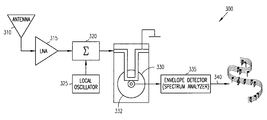
- FIG. 3 is a block diagram showing an FM receiver using a microheater and resonator according to an example embodiment.
- FIG. 4 is a block diagram of a frequency generator having a heat converting feedback loop according to an example embodiment.
- FIG. 1 is block diagram illustrating an example embodiment of a system 100 for converting a signal into mechanical motion.
- a bolometer 110 such as a micron or nanometer scale bolometer is used to receive RF signals 115 .
- an antenna converts the RF electromagnetic signal into an electrical signal, which is then converted into heat, by the bolometer 110 , such as by a small resistor.
- the bolometer may be any type of device that receives RF electrical signals and converts it into heat.
- the bolometer 110 in one embodiment has an antenna that converts the RF signal into an electrical signal, which is then converted into heat, such as by a small resistor.
- the bolometer may be any type of device that receives RF and converts it into heat.
- the bolometer 110 in one embodiment has a very small heat capacity, and exhibits heating/cooling rates well above the MHz frequency range. This enables high frequency thermal operation for RF signal processing.
- the bolometer may also be selected to provide mixing capabilities.
- thermo-mechanical actuator at 120 is used.
- the bolometer 110 is placed in contact with the actuator 120 , such to provide local temperature variations and hence local thermomechanical stress on the actuator. This causes the actuator 120 to exhibit distortions, resulting in detectable mechanical motion or displacement. Such motion is detected by a sensor 130 . The motion is thus a function of the frequency of the signal that heats the bolometer 110 .
- the sensitivity of the thermal-to-mechanical transduction or induction can be enhanced by utilizing the resonant properties of the thermo-mechanical actuator. Matching the frequency of the temperature oscillations with a resonant frequency of the actuator provides an increase in the amplitude of the resulting mechanical motion by a factor Q, which describes the quality factor of the resonator.
- the resonant properties of the thermal actuator may also be employed to filter out unwanted frequency components of the incoming RF signal 115 .
- FIG. 2A is a side view representation of a micromechanical oscillator 200 that serves as an actuator 120 of FIG. 1 .
- FIG. 2B is a top view.
- the oscillator 200 oscillates in the radio frequency (RF) range and is fabricated in the form of a concave membrane 210 , which is generally circular or disc shape, and has a hole 215 proximate the center. The membrane is clamped on the periphery to the surrounding polysilicon film.
- RF radio frequency
- Other types of resonators may be used, such as discs supported by pillars, cantilevered beams, and other devices.
- Oscillator 200 may be fabricated by growing an approximately 1 um layer of silicon oxide 250 on a surface of silicon wafer, or similar substrate 220 .
- the oxide is used as a sacrificial layer.
- Polycrystalline silicon film 255 is then deposited on the surface of the oxide 250 by low pressure chemical vapor deposition (LPCVD) at 590° C. After the deposition, the wafer is annealed for approximately 15 minutes at approximately 1050° C. Photolithography, followed by a CF4 dry etch is used to create an approximately 2 um-diameter hole 215 through the top polysilicon layer 225 .
- LPCVD low pressure chemical vapor deposition
- the structure is dipped into concentrated hydrofluoric acid (HF 49%).
- HF 49%) concentrated hydrofluoric acid
- Dissolving the sacrificial silicon dioxide (etch rate approximately 1 um/minute) results in a suspended membrane-like structure with a hole in the center.
- the etching time determines the outer diameter of the cavity 260 underneath the polysilicon film. This is provided as one example of a method of making such an oscillator. As will be apparent to one of average skill, many of the parameters and materials may be varied significantly to make dome shaped oscillators.
- the released membrane would be flat.
- significant compressive stress incorporated in the polysilicon film as a result of deposition and annealing parameters makes the planar configuration unstable and leads to a buckled membrane.
- the resulting structure has a dome shape with a hold at the top.
- Using a critical point dry (CPD) process to avoid surface tension provides a high yield for the dome-type resonators, and prevents stiction of the membrane to the substrate.
- CPD critical point dry
- a modified method of fabrication of the shell membrane 210 begins with a CF 4 plasma dry etch of the self aligned apex hole 215 in the device layer.
- the opened hole provides a way to dissolve an underlying 1.5 ⁇ m silicon dioxide layer 250 with hydrofluoric acid, creating a suspended membrane above the substrate.
- the resulting membrane 210 has non-zero curvature due to large compressive stress incorporated into the device layer through high temperature post process annealing.
- the in-plane stress produces out of plane buckling, forming a shallow shell.
- the resonator used in the present study is a 200 nm thick polysilicon shallow spherical shell segment, 30 ⁇ m in diameter, projecting approximately 1 ⁇ m out of plane at the apex.
- the out-of-plane component in the dome-like membrane significantly increases the resonant frequency several fold over a two dimensional structure.
- the natural frequency of a flat annulus clamped on the periphery and free in the center is described by
- ⁇ is the radius of curvature of the dome.
- the increased stiffness allows large radial dimension structures to achieve significantly higher frequencies.
- the aforementioned 30 ⁇ m diameter dome may display a 17.8 MHz ⁇ 11 resonance with a quality factor of ⁇ 10,000.
- Numerical modeling suggests that deeper shells with smaller lateral dimensions have the potential to reach into the GHz range. Operation in air may occur; however, viscous damping forces over the large surface area reduce the Q to ⁇ 70.
- a bolometer 240 or other type of resistive heating element is placed on the membrane 210 near the periphery in one embodiment. It may be placed in any position on a membrane that will result in a modulation of the vibration of the membrane in response to heating and cooling of the bolometer 240 .
- Transduction between electrical signals and mechanical motion is accomplished by creating a non-homogeneous thermal mechanical stress in the dome structure by means of the resistive heating element 240 dissipating Joule heat into the oscillator.
- the high rigidity of the dome structure allows use of a second layer of lithography to create a metallic resistor on the top of the prefabricated shell resonator.
- optical lithography is performed on the polysilicon, followed by image reversal in a YES oven.
- An electron gun evaporator is used to deposit a 5 nm titanium adhesion layer and a subsequent 20 nm film of gold on the polysilicon surface. Liftoff is performed with an acetone soak and IPA rinse.
- the quality factor of the resonator may be tailored by placing the heater at locations with different displacement amplitudes. At the same time, matching of the input impedance to that of the corresponding circuitry can be achieved by changing the geometry of the resistor.
- the bolometer comprises a 50 ⁇ , 70 ⁇ 3 ⁇ m resistor 240 on the periphery of the dome, allowing the resonator to be undamped by the 2 nd layer metallization.
- the process of heat diffusion within the resonator can be modeled by a one dimensional heat equation
- u n ⁇ ( r , t ) B n ⁇ sin ⁇ ⁇ ( n ⁇ ⁇ ⁇ ⁇ ⁇ r R ) ⁇ e - ⁇ n ⁇ t ( 3 ) with time constant,
- ⁇ n K C ⁇ ⁇ ⁇ ⁇ ( n ⁇ ⁇ ⁇ R ) 2 ( 4 )
- K is the thermal conductivity
- C is the heat capacity
- R is the radius of a 2D plate
- the driving force which is proportional to the power dissipated in the resistor, is, after removing 2f components: F drive ⁇ V DC V AC sin( ⁇ o t) (5)
- F drive ⁇ V DC V AC sin( ⁇ o t) (5)
- sufficient mechanical displacement may be obtained with a 20 mV AC signal, reducing power consumption of the transducer.
- Post production resonator tuning is possible by controlling the DC voltage level through the resistor.
- the 30 ⁇ m dome showed a (2 Hz/ ⁇ W) dependence on the applied DC bias.
- the vertical displacement of the vibrating shell is detected optically by measuring reflectivity of a 632.8 nm HeNe laser beam focused on the device in a 10 ⁇ 6 Torr vacuum chamber.
- the modulation of the reflected light introduced by a moving Fabry-Perot interferometer (created by the substrate and the suspended structure) was detected by a New Focus 1601 high-speed photodetector and analyzed in an Agilent 4396B spectrum/network analyzer.
- FIG. 3 is a block diagram of an FM radio receiver 300 .
- An amplified signal received via and antenna 310 is linearly superimposed at 320 with a reference signal from a local oscillator 325 .
- This combined signal is provided to a device 330 formed of a shell or dome type disc with a microheater formed on a downslope or periphery of the disc.
- the combined signal is used to modulate the temperature of the microheater 332 , which in one embodiment comprises a metal resistive element that dissipates heat in response to electrical current.
- the amplified signal received via antenna 310 is amplified by 40 dB, and linearly superimposed with a 0 dB reference signal from the local oscillator 325 .
- the dome resonator passes the down-converted signal within the f resonator /Q band, filtering out all unwanted carrier frequencies. Due to high quality factors (Q ⁇ 3,000) of the dome, only a fraction ( ⁇ f FM ⁇ 3 kHz) of the FM modulated ( ⁇ f ⁇ 100 kHz) signal passes through the mechanical filter.
- a slope detection method is provided to demodulate the FM carrier.
- the envelope detector comprises an interferometer focused on the disc. In further embodiments capacitive detection or piezoelectric detection methods may be employed.
- FIG. 4 is a block diagram of a frequency generator 400 .
- the frequency generator comprises a disc 410 , such as a shell or dome, that vibrates at a selected desirable frequency.
- a heating/cooling element such as a resistive bolometer 420 is thermally coupled to an edge or other desired portion of the disc 410 to cause the oscillation of the disc in response to temperature changes.
- a detector 430 provides an output signal 435 responsive to such oscillation of the disc. Output signal 435 is amplified, phase shifted and fed back along a feedback line 440 to the bolometer 420 , providing a positive feedback loop.
- the disc becomes self-oscillating at a desired frequency.
- a self-sustained oscillation of the dome resonator is obtained with frequency stability of 1.5 ppm.
- the bolometer and actuator may also serve as a RF signal demodulator.
- thermally driven MEMS resonators can simulate development of new methods of modulation applied to a carrier signal for information broadcasting.
- RF amplitude-modulated (AM) signals are applied directly to the micro-fabricated resistive heater or bolometer. If the thermal inertia of the bolometer is small enough (1/f carrier ⁇ cool ⁇ 1/f modul ), the temperature of the bolometer will follow the modulation of the RF power (i.e. AM) while being unaffected by the carrier frequency and thus, carry all the base band information.
- Another method of thermal signal processing mimicking a superheterodyne RF receiver, is achieved by employing an intrinsic nonlinearity of the resistive bolometer.
- the temperature modulation is determined by the power of the RF signal and hence by the square of the applied voltage.
- the resistive bolometer performs as a frequency mixer:
- small amplitude temperature oscillations of the bolometer are converted into mechanical motion by using a micro-fabricated thermo-mechanical actuator, such as a shell or dome oscillator.
- a micro-fabricated thermo-mechanical actuator such as a shell or dome oscillator.
- the bolometer or resistive heater is placed on a slope of a micro-fabricated dome-type structure. RF signals are applied to it. Local variations of the dome result in detectable mechanical motion, such as by an interferometer.
- thermo-to-mechanical actuator The sensitivity of the thermal-to-mechanical transduction can be enhanced greatly if resonant properties of the thermo-mechanical actuator are employed.
- the amplitude of the resulting motion is amplified by the factor Q, which describes the quality factor of the resonator.
- the resonant properties of the thermal actuator are also employed to filter out unwanted frequency components of the incoming RF signal. Parametric amplification may also be employed by pumping the actuator at twice its resonant frequency.
- thermo-mechanical actuator-resonator can perform as a combination of a filter (IF filter in particular) and demodulator. After converting the mechanical motion of the actuator into an electrical signal, it can be applied to a hearing device or base-band electronics for further processing.
- the radio receiver 300 is a practical example of an FM radio receiver.
- dome-shaped, radio frequency, micromechanical resonators are with integrated thermo-elastic actuators.
- Such resonators can be used as the frequency-determining element of a local oscillator or as a combination of a mixer and IF filter in a superheterodyne transceiver.
- a MEMS-based method and apparatus may be used to implement mixing, filtering, demodulation, frequency reference and frequency modulation.
- a method and apparatus are provided by converting a source signal into a time-variant temperature field with consequent transduction into mechanical motion.
- the first conversion (signal into temperature) is provided by utilizing a micro-fabricated fast response, bolometer type radio frequency power meter.
- a resonant type micromechanical thermal actuator is utilized for temperature read-out, filtering and demodulation.
- the method may be applied to a wireless communication device, and can accomplish partially or in full, the signal processing necessary for separating the carrier and extracting base-band information from the broadcast signal. Similar thermal mechanical processing can be used for frequency reference generation and frequency modulation of the carrier signal by a base-band signal in the transmitter path.
- the primary benefits are savings in power consumption, reduced size of components and single-chip transceiver solutions.
- Converting an RF signal into heat and measuring the resulting temperature rise constitute a basic bolometric method for measuring RF power.
- Micron-size and nano-scale bolometers provide heating/cooling rates well above MHz frequency range and enable high frequency thermal operation for RF signal processing.
- a heat actuated mixer and mechanical resonator device may be implemented in a wireless communicating device that eliminates the necessity of bulky off-chip components, and shrinks dimensions drastically.
- a low power PHEAT-30 uW for 10 MHz dome-type device) and low voltages used to operate the device may be very beneficial in such microminiaturized wireless communicating devices.
- the low impedance of the ohmic drive may simplify RF matching considerably.
- the dome resonators comprise shallow shell segments clamped on the periphery. They may be fabricated utilizing pre-stressed thin polysilicon film over sacrificial silicon dioxide.
- the shell geometry enhances the rigidity of the structure, providing a resonant frequency several times higher than a flat membrane of the same dimensions.
- the finite curvature of the shell also couples out-of-plane deflection with in-plane stress, providing an actuation mechanism. Out-of-plane motion is induced by employing non-homogeneous, thermomechanical stress, generated in plane by local heating.
- a metal resistor lithographically defined on the surface of the dome, provides thermal stress by dissipating heat.
- the diminished heat capacity of the MEMS device enables a heating/cooling rate comparable to the frequency of mechanical resonance and allows operation of the resonator by applying AC current through the microheater.
- Resistive actuation can be readily incorporated into integrated circuit processing and provides significant advantages over traditional electrostatic actuation, such as low driving voltages, matched impedance, and reduced cross talk between drive and detection.
- the shell type resonator is but one example of a resonator for temperature readout.
- Example resonators that will couple to the thermal actuator may be in the form of a cantilever, disk supported by a pillar or a clamped beam. Still further resonators will be apparent to those of skill in the art after reading the detailed description.
Landscapes
- Physics & Mathematics (AREA)
- Engineering & Computer Science (AREA)
- Acoustics & Sound (AREA)
- Power Engineering (AREA)
- General Physics & Mathematics (AREA)
- Optics & Photonics (AREA)
- Manufacturing & Machinery (AREA)
- Micromachines (AREA)
- Mechanical Light Control Or Optical Switches (AREA)
- Control Of Motors That Do Not Use Commutators (AREA)
- Lasers (AREA)
- Measuring Temperature Or Quantity Of Heat (AREA)
Priority Applications (2)
| Application Number | Priority Date | Filing Date | Title |
|---|---|---|---|
| US11/358,917 US8072117B2 (en) | 2003-08-20 | 2006-02-20 | Thermal-mechanical signal processing |
| US13/292,658 US8330323B2 (en) | 2003-08-20 | 2011-11-09 | Thermal-mechanical signal processing |
Applications Claiming Priority (5)
| Application Number | Priority Date | Filing Date | Title |
|---|---|---|---|
| US49642103P | 2003-08-20 | 2003-08-20 | |
| US49643003P | 2003-08-20 | 2003-08-20 | |
| US49643103P | 2003-08-20 | 2003-08-20 | |
| PCT/US2004/027229 WO2005020482A2 (en) | 2003-08-20 | 2004-08-20 | Thermal-mechanical signal processing |
| US11/358,917 US8072117B2 (en) | 2003-08-20 | 2006-02-20 | Thermal-mechanical signal processing |
Related Parent Applications (1)
| Application Number | Title | Priority Date | Filing Date |
|---|---|---|---|
| PCT/US2004/027229 Continuation WO2005020482A2 (en) | 2003-08-20 | 2004-08-20 | Thermal-mechanical signal processing |
Related Child Applications (1)
| Application Number | Title | Priority Date | Filing Date |
|---|---|---|---|
| US13/292,658 Division US8330323B2 (en) | 2003-08-20 | 2011-11-09 | Thermal-mechanical signal processing |
Publications (2)
| Publication Number | Publication Date |
|---|---|
| US20060238239A1 US20060238239A1 (en) | 2006-10-26 |
| US8072117B2 true US8072117B2 (en) | 2011-12-06 |
Family
ID=34222368
Family Applications (4)
| Application Number | Title | Priority Date | Filing Date |
|---|---|---|---|
| US11/358,917 Expired - Fee Related US8072117B2 (en) | 2003-08-20 | 2006-02-20 | Thermal-mechanical signal processing |
| US11/358,299 Expired - Fee Related US7812502B2 (en) | 2003-08-20 | 2006-02-20 | Shell type actuator |
| US11/358,689 Abandoned US20070109656A1 (en) | 2003-08-20 | 2006-02-20 | MEMS device annealing |
| US13/292,658 Expired - Fee Related US8330323B2 (en) | 2003-08-20 | 2011-11-09 | Thermal-mechanical signal processing |
Family Applications After (3)
| Application Number | Title | Priority Date | Filing Date |
|---|---|---|---|
| US11/358,299 Expired - Fee Related US7812502B2 (en) | 2003-08-20 | 2006-02-20 | Shell type actuator |
| US11/358,689 Abandoned US20070109656A1 (en) | 2003-08-20 | 2006-02-20 | MEMS device annealing |
| US13/292,658 Expired - Fee Related US8330323B2 (en) | 2003-08-20 | 2011-11-09 | Thermal-mechanical signal processing |
Country Status (4)
| Country | Link |
|---|---|
| US (4) | US8072117B2 (de) |
| EP (2) | EP1661245A2 (de) |
| CN (2) | CN101015120B (de) |
| WO (3) | WO2005020434A2 (de) |
Families Citing this family (18)
| Publication number | Priority date | Publication date | Assignee | Title |
|---|---|---|---|---|
| EP1661245A2 (de) | 2003-08-20 | 2006-05-31 | Cornell Research Foundation, Inc. | Stellglied des schalentyps |
| DE102004011030B4 (de) * | 2004-03-04 | 2006-04-13 | Siemens Ag | Verkleidung mit integriertem Polymeraktor zur Verformung derselben |
| WO2006055960A2 (en) * | 2004-11-20 | 2006-05-26 | Scenterra, Inc. | Device for emission of high frequency signals |
| US7280078B2 (en) * | 2004-11-20 | 2007-10-09 | Scenterra, Inc. | Sensor for detecting high frequency signals |
| WO2007149621A2 (en) * | 2006-04-19 | 2007-12-27 | Cornell Research Foundation, Inc. | Methods and systems for object identification and for authentication |
| DE102008013098B4 (de) * | 2007-04-02 | 2012-02-09 | Fraunhofer-Gesellschaft zur Förderung der angewandten Forschung e.V. | Mikromechanisches System mit Temperaturstabilisierung |
| US20100086735A1 (en) * | 2008-10-03 | 2010-04-08 | The United States Of America As Represented By The Secretary Of The Navy | Patterned Functionalization of Nanomechanical Resonators for Chemical Sensing |
| JP4858547B2 (ja) * | 2009-01-09 | 2012-01-18 | 株式会社デンソー | 半導体装置およびその製造方法 |
| US8158448B2 (en) * | 2009-04-27 | 2012-04-17 | The Boeing Company | Resonator and methods of making resonators |
| US9036951B2 (en) | 2010-01-26 | 2015-05-19 | Cornell University | Silicon acousto-optic modulator structure and method |
| US10285396B2 (en) | 2014-07-03 | 2019-05-14 | William K. Boyd | Game tracking device |
| CN108700542A (zh) * | 2015-12-14 | 2018-10-23 | 瓦伦汀·杜布瓦 | 裂纹结构、使用裂纹结构的隧穿结以及制作其的方法 |
| US10686425B2 (en) | 2017-06-30 | 2020-06-16 | Texas Instruments Incorporated | Bulk acoustic wave resonators having convex surfaces, and methods of forming the same |
| US10615772B2 (en) | 2017-06-30 | 2020-04-07 | Texas Instruments Incorporated | Acoustic wave resonators having Fresnel surfaces |
| US10622966B2 (en) | 2017-07-26 | 2020-04-14 | Texas Instruments Incorporated | Bulk acoustic wave resonators having a phononic crystal acoustic mirror |
| US10855251B2 (en) | 2017-08-08 | 2020-12-01 | Texas Instruments Incorporated | Unreleased plane acoustic wave resonators |
| CN111811426B (zh) * | 2020-06-29 | 2021-07-30 | 中国人民解放军军事科学院国防科技创新研究院 | 微机电系统结构的调控方法及装置 |
| CN112047296B (zh) * | 2020-09-18 | 2022-07-29 | 南开大学 | 一种光控基底热膨胀实现双向原子开关的方法 |
Citations (8)
| Publication number | Priority date | Publication date | Assignee | Title |
|---|---|---|---|---|
| US5839062A (en) | 1994-03-18 | 1998-11-17 | The Regents Of The University Of California | Mixing, modulation and demodulation via electromechanical resonators |
| US6222304B1 (en) * | 1999-07-28 | 2001-04-24 | The Charles Stark Draper Laboratory | Micro-shell transducer |
| US6271052B1 (en) * | 2000-10-19 | 2001-08-07 | Axsun Technologies, Inc. | Process for integrating dielectric optical coatings into micro-electromechanical devices |
| US6605487B2 (en) * | 2000-12-21 | 2003-08-12 | Infineon Technologies Aktiengesellschaft | Method for the manufacture of micro-mechanical components |
| US6762668B2 (en) * | 2000-10-13 | 2004-07-13 | Honeywell International, Inc. | Laser adjusted set-point of bimetallic thermal disc |
| WO2005020482A2 (en) | 2003-08-20 | 2005-03-03 | Cornell Research Foundation, Inc. | Thermal-mechanical signal processing |
| US7238621B2 (en) * | 2005-05-17 | 2007-07-03 | The Board Of Trustees Of The Leland Stanford Junior University | Integrated optical MEMS devices |
| US7566582B2 (en) * | 2005-10-25 | 2009-07-28 | The Charles Stark Draper Laboratory, Inc. | Systems, methods and devices relating to actuatably moveable machines |
Family Cites Families (16)
| Publication number | Priority date | Publication date | Assignee | Title |
|---|---|---|---|---|
| US3575657A (en) * | 1969-05-14 | 1971-04-20 | Us Navy | Microwave detector mount and power bridge circuit |
| US4276491A (en) * | 1979-10-02 | 1981-06-30 | Ausonics Pty. Limited | Focusing piezoelectric ultrasonic medical diagnostic system |
| US5188983A (en) * | 1990-04-11 | 1993-02-23 | Wisconsin Alumni Research Foundation | Polysilicon resonating beam transducers and method of producing the same |
| US5090254A (en) * | 1990-04-11 | 1992-02-25 | Wisconsin Alumni Research Foundation | Polysilicon resonating beam transducers |
| DE4119955C2 (de) * | 1991-06-18 | 2000-05-31 | Danfoss As | Miniatur-Betätigungselement |
| US5963788A (en) * | 1995-09-06 | 1999-10-05 | Sandia Corporation | Method for integrating microelectromechanical devices with electronic circuitry |
| US6249073B1 (en) * | 1999-01-14 | 2001-06-19 | The Regents Of The University Of Michigan | Device including a micromechanical resonator having an operating frequency and method of extending same |
| US6174820B1 (en) * | 1999-02-16 | 2001-01-16 | Sandia Corporation | Use of silicon oxynitride as a sacrificial material for microelectromechanical devices |
| CN1159208C (zh) * | 2000-07-21 | 2004-07-28 | 中国科学院上海冶金研究所 | 玻璃衬底上可动硅微机械结构集成化的制作方法 |
| JP2002207182A (ja) * | 2001-01-10 | 2002-07-26 | Sony Corp | 光学多層構造体およびその製造方法、光スイッチング素子、並びに画像表示装置 |
| US6803697B1 (en) * | 2001-06-19 | 2004-10-12 | Brian I. Ashkenazi | Heat injected magnetically balanced engine |
| US20030020565A1 (en) * | 2001-07-24 | 2003-01-30 | Motorola, Inc. | MEMS resonators and methods for manufacturing MEMS resonators |
| US6698201B1 (en) * | 2001-08-16 | 2004-03-02 | Zyvex Corporation | Cascaded bimorph rotary actuator |
| US7654140B2 (en) * | 2002-03-12 | 2010-02-02 | Cornell Research Foundation, Inc. | Heat pumped parametric MEMS device |
| CA2595473A1 (en) * | 2005-02-03 | 2006-08-10 | University Of Manitoba | Micro heat engine and method of manufacturing |
| US20080143320A1 (en) * | 2006-10-27 | 2008-06-19 | Agilent Technologies, Inc. | Power Sensor with Switched-In Signal Amplification Path |
-
2004
- 2004-08-20 EP EP04786550A patent/EP1661245A2/de not_active Withdrawn
- 2004-08-20 CN CN2004800307599A patent/CN101015120B/zh not_active Expired - Fee Related
- 2004-08-20 EP EP04786553A patent/EP1661240B1/de not_active Expired - Lifetime
- 2004-08-20 WO PCT/US2004/027162 patent/WO2005020434A2/en not_active Ceased
- 2004-08-20 WO PCT/US2004/027226 patent/WO2005035436A2/en not_active Ceased
- 2004-08-20 WO PCT/US2004/027229 patent/WO2005020482A2/en not_active Ceased
- 2004-08-20 CN CNA2004800308680A patent/CN1951007A/zh active Pending
-
2006
- 2006-02-20 US US11/358,917 patent/US8072117B2/en not_active Expired - Fee Related
- 2006-02-20 US US11/358,299 patent/US7812502B2/en not_active Expired - Fee Related
- 2006-02-20 US US11/358,689 patent/US20070109656A1/en not_active Abandoned
-
2011
- 2011-11-09 US US13/292,658 patent/US8330323B2/en not_active Expired - Fee Related
Patent Citations (10)
| Publication number | Priority date | Publication date | Assignee | Title |
|---|---|---|---|---|
| US5839062A (en) | 1994-03-18 | 1998-11-17 | The Regents Of The University Of California | Mixing, modulation and demodulation via electromechanical resonators |
| US6222304B1 (en) * | 1999-07-28 | 2001-04-24 | The Charles Stark Draper Laboratory | Micro-shell transducer |
| US6762668B2 (en) * | 2000-10-13 | 2004-07-13 | Honeywell International, Inc. | Laser adjusted set-point of bimetallic thermal disc |
| US6271052B1 (en) * | 2000-10-19 | 2001-08-07 | Axsun Technologies, Inc. | Process for integrating dielectric optical coatings into micro-electromechanical devices |
| US6605487B2 (en) * | 2000-12-21 | 2003-08-12 | Infineon Technologies Aktiengesellschaft | Method for the manufacture of micro-mechanical components |
| WO2005020482A2 (en) | 2003-08-20 | 2005-03-03 | Cornell Research Foundation, Inc. | Thermal-mechanical signal processing |
| WO2005020482A3 (en) | 2003-08-20 | 2005-06-23 | Cornell Res Foundation Inc | Thermal-mechanical signal processing |
| US7812502B2 (en) * | 2003-08-20 | 2010-10-12 | Cornell Research Foundation, Inc. | Shell type actuator |
| US7238621B2 (en) * | 2005-05-17 | 2007-07-03 | The Board Of Trustees Of The Leland Stanford Junior University | Integrated optical MEMS devices |
| US7566582B2 (en) * | 2005-10-25 | 2009-07-28 | The Charles Stark Draper Laboratory, Inc. | Systems, methods and devices relating to actuatably moveable machines |
Non-Patent Citations (13)
| Title |
|---|
| "Chinese Application Serial No. 200480030759.9 ,Office Action Mailed on Feb. 24, 2010", 6. |
| "Chinese Application Serial No. 200480030759.9, Response filed Jun. 11, 2010 to Office Action dated Feb. 24, 2010", (w/ English Translation of Claims), 10 pgs. |
| 04786553.0, "European Application No. 04786553.0 Office Action Mailed Feb. 23, 2009", 2 pgs. |
| 200480030759.9, "Chinese Application Serial No. 200480030759.9 , Office Action mailed May 8, 2009", 11 pgs. |
| Baltes, H. , et al., "Micromachined Thermally Based CMOS Microsensors", Proceedings of the IEEE, 86 (8), (Aug. 1998),1660-1678. |
| Kazinczi, R. , "3-D Resonator Bridges as Sensing Elements", Sesens Workshop on Semiconductor Sensors, (Dec. 1, 2000),804-805. |
| Reichenbach, R. B., "Resistively Actuated Micromechanical Dome Resonators", Proceedings of the SPIE-The International Society for Optical Engineering SPIE-INT, 5344 (1), (Jan. 27, 2004),51-58. |
| Remtema, T. , et al., "Active Frequency Tuning for Micro Resonators by Localized Thermal Stressing Effects", Sensors and Actuators A, 91 (3), Elsevier Sequoia,(Jul. 15, 2001),332-338. |
| Stemme, G, "Resonant silicon sensors", J. Micromech. Microeng., 1, (1991), 113-125. |
| Stemme, G. , "Resonant Silicon Sensors", Journal of Micromechanics & Microengineering, 1, IOP Publishing Ltd.,(Jan. 1991),113-125. |
| Syms, R. R., "Electrothermal Frequency Tuning of Folded and Coupled Vibrating Micromechanical Resonators", Journal of Micromechanical Systems, 7 (2), IEEE Inc.,(Jun. 1998),164-171. |
| Zalalutdinov, M. , "Shell-type Micromechanical Oscillator", Proceedings of the SPIE, vol. 5116, (May 19, 2003),229-236. |
| Zalalutdinov, M. , et al., "Autoparametric Optical Drive for Micromechanical Oscillators", Applied Physics Letters, American Institute of Physics, 79 (5), (Jul. 30, 2001),695-697. |
Also Published As
| Publication number | Publication date |
|---|---|
| US20060239635A1 (en) | 2006-10-26 |
| WO2005020434A2 (en) | 2005-03-03 |
| EP1661240A2 (de) | 2006-05-31 |
| WO2005020482A2 (en) | 2005-03-03 |
| US7812502B2 (en) | 2010-10-12 |
| WO2005020482A3 (en) | 2005-06-23 |
| WO2005020434A3 (en) | 2005-05-06 |
| US20120058741A1 (en) | 2012-03-08 |
| EP1661245A2 (de) | 2006-05-31 |
| EP1661240B1 (de) | 2013-01-02 |
| CN1951007A (zh) | 2007-04-18 |
| US20060238239A1 (en) | 2006-10-26 |
| WO2005035436A2 (en) | 2005-04-21 |
| US20070109656A1 (en) | 2007-05-17 |
| US8330323B2 (en) | 2012-12-11 |
| WO2005035436A3 (en) | 2005-11-10 |
| CN101015120B (zh) | 2010-12-22 |
| CN101015120A (zh) | 2007-08-08 |
Similar Documents
| Publication | Publication Date | Title |
|---|---|---|
| US8330323B2 (en) | Thermal-mechanical signal processing | |
| US8049580B2 (en) | MEMS controlled oscillator | |
| US7818871B2 (en) | Disc resonator gyroscope fabrication process requiring no bonding alignment | |
| US6808954B2 (en) | Vacuum-cavity MEMS resonator | |
| EP0852708B1 (de) | Mechanischer signalprozessor auf basis von mikromechanischen oszillatoren und intelligenten akustischen detektoren und darauf aufgebaute systeme | |
| US7880364B2 (en) | Parametric resonator and filter using the same | |
| US20070017287A1 (en) | Disc resonator gyroscopes | |
| JP2002094328A (ja) | 通信信号ミキシング/フィルタリング・デバイスおよびその製造方法 | |
| Van Toan et al. | Fabrication of an hermetically packaged silicon resonator on LTCC substrate | |
| Elsayed et al. | Bulk mode disk resonator with transverse piezoelectric actuation and electrostatic tuning | |
| US6455980B1 (en) | Resonator with preferred oscillation mode | |
| Elsayed et al. | Piezoelectric bulk mode disk resonator post-processed for enhanced quality factor performance | |
| US7654140B2 (en) | Heat pumped parametric MEMS device | |
| Reichenbach et al. | Resistively actuated micromechanical dome resonators | |
| KR100394016B1 (ko) | 탄소나노튜브를 이용한 mems 공진기 및 그 제조방법,상기 공진기를 이용한 주파수 발생기 | |
| Elsayed et al. | 18-MHz silicon Lamé mode resonators with corner and central anchor architectures in a dual-wafer SOI technology | |
| Zalalutdinov et al. | Shell-type micromechanical oscillator | |
| Mastropaolo et al. | Electrothermal actuation of silicon carbide ring resonators | |
| Zalalutdinov et al. | Light-activated self-generation and parametric amplification for MEMS oscillators | |
| Hsu et al. | Design and fabrication procedure for high Q RF MEMS resonators | |
| Wu et al. | A high Q micromachined single crystal silicon bulk mode resonator with pre-etched cavity | |
| Aubin | Radio frequency nano/microelectromechanical resonators: Thermal and nonlinear dynamics studies | |
| Kubena et al. | Arrays of high-Q high stability ultrahigh-frequency resonators for chemical/biological sensors | |
| Zalalutdinov et al. | Light-activated self-generation and parametric amplification for | |
| Reichenbach et al. | A MEMS RF phase and frequency modulator |
Legal Events
| Date | Code | Title | Description |
|---|---|---|---|
| AS | Assignment |
Owner name: CORNELL RESEARCH FOUNDATON, INC., NEW YORK Free format text: ASSIGNMENT OF ASSIGNORS INTEREST;ASSIGNORS:ZALALUTDINOV, MAXIM;REICHENBACH, ROBERT B.;AUBIN, KEITH;AND OTHERS;SIGNING DATES FROM 20060427 TO 20060523;REEL/FRAME:017838/0326 Owner name: CORNELL RESEARCH FOUNDATON, INC., NEW YORK Free format text: ASSIGNMENT OF ASSIGNORS INTEREST;ASSIGNORS:ZALALUTDINOV, MAXIM;REICHENBACH, ROBERT B.;AUBIN, KEITH;AND OTHERS;REEL/FRAME:017838/0326;SIGNING DATES FROM 20060427 TO 20060523 |
|
| AS | Assignment |
Owner name: NATIONAL SCIENCE FOUNDATION, VIRGINIA Free format text: CONFIRMATORY LICENSE;ASSIGNOR:CORNELL RESEARCH FOUNDATION;REEL/FRAME:018198/0195 Effective date: 20060505 |
|
| AS | Assignment |
Owner name: NAVAL RESEARCH LABORATORY, DISTRICT OF COLUMBIA Free format text: ASSIGNMENT OF ASSIGNORS INTEREST;ASSIGNOR:HOUSTON, BRIAN H.;REEL/FRAME:018516/0390 Effective date: 20060203 |
|
| FEPP | Fee payment procedure |
Free format text: PAYOR NUMBER ASSIGNED (ORIGINAL EVENT CODE: ASPN); ENTITY STATUS OF PATENT OWNER: LARGE ENTITY |
|
| ZAAA | Notice of allowance and fees due |
Free format text: ORIGINAL CODE: NOA |
|
| ZAAB | Notice of allowance mailed |
Free format text: ORIGINAL CODE: MN/=. |
|
| STCF | Information on status: patent grant |
Free format text: PATENTED CASE |
|
| FPAY | Fee payment |
Year of fee payment: 4 |
|
| MAFP | Maintenance fee payment |
Free format text: PAYMENT OF MAINTENANCE FEE, 8TH YEAR, LARGE ENTITY (ORIGINAL EVENT CODE: M1552); ENTITY STATUS OF PATENT OWNER: LARGE ENTITY Year of fee payment: 8 |
|
| FEPP | Fee payment procedure |
Free format text: MAINTENANCE FEE REMINDER MAILED (ORIGINAL EVENT CODE: REM.); ENTITY STATUS OF PATENT OWNER: LARGE ENTITY |
|
| LAPS | Lapse for failure to pay maintenance fees |
Free format text: PATENT EXPIRED FOR FAILURE TO PAY MAINTENANCE FEES (ORIGINAL EVENT CODE: EXP.); ENTITY STATUS OF PATENT OWNER: LARGE ENTITY |
|
| STCH | Information on status: patent discontinuation |
Free format text: PATENT EXPIRED DUE TO NONPAYMENT OF MAINTENANCE FEES UNDER 37 CFR 1.362 |
|
| FP | Lapsed due to failure to pay maintenance fee |
Effective date: 20231206 |