US8024072B2 - Method for self-localization of robot based on object recognition and environment information around recognized object - Google Patents
Method for self-localization of robot based on object recognition and environment information around recognized object Download PDFInfo
- Publication number
- US8024072B2 US8024072B2 US12/292,715 US29271508A US8024072B2 US 8024072 B2 US8024072 B2 US 8024072B2 US 29271508 A US29271508 A US 29271508A US 8024072 B2 US8024072 B2 US 8024072B2
- Authority
- US
- United States
- Prior art keywords
- robot
- node
- sin
- weighted value
- cos
- Prior art date
- Legal status (The legal status is an assumption and is not a legal conclusion. Google has not performed a legal analysis and makes no representation as to the accuracy of the status listed.)
- Active, expires
Links
Images


Classifications
-
- B—PERFORMING OPERATIONS; TRANSPORTING
- B25—HAND TOOLS; PORTABLE POWER-DRIVEN TOOLS; MANIPULATORS
- B25J—MANIPULATORS; CHAMBERS PROVIDED WITH MANIPULATION DEVICES
- B25J13/00—Controls for manipulators
- B25J13/08—Controls for manipulators by means of sensing devices, e.g. viewing or touching devices
- B25J13/088—Controls for manipulators by means of sensing devices, e.g. viewing or touching devices with position, velocity or acceleration sensors
-
- B—PERFORMING OPERATIONS; TRANSPORTING
- B25—HAND TOOLS; PORTABLE POWER-DRIVEN TOOLS; MANIPULATORS
- B25J—MANIPULATORS; CHAMBERS PROVIDED WITH MANIPULATION DEVICES
- B25J19/00—Accessories fitted to manipulators, e.g. for monitoring, for viewing; Safety devices combined with or specially adapted for use in connection with manipulators
- B25J19/02—Sensing devices
- B25J19/021—Optical sensing devices
- B25J19/023—Optical sensing devices including video camera means
-
- B—PERFORMING OPERATIONS; TRANSPORTING
- B25—HAND TOOLS; PORTABLE POWER-DRIVEN TOOLS; MANIPULATORS
- B25J—MANIPULATORS; CHAMBERS PROVIDED WITH MANIPULATION DEVICES
- B25J5/00—Manipulators mounted on wheels or on carriages
-
- B—PERFORMING OPERATIONS; TRANSPORTING
- B25—HAND TOOLS; PORTABLE POWER-DRIVEN TOOLS; MANIPULATORS
- B25J—MANIPULATORS; CHAMBERS PROVIDED WITH MANIPULATION DEVICES
- B25J9/00—Program-controlled manipulators
- B25J9/16—Program controls
-
- G—PHYSICS
- G05—CONTROLLING; REGULATING
- G05D—SYSTEMS FOR CONTROLLING OR REGULATING NON-ELECTRIC VARIABLES
- G05D1/00—Control of position, course, altitude or attitude of land, water, air or space vehicles, e.g. using automatic pilots
- G05D1/02—Control of position or course in two dimensions
- G05D1/021—Control of position or course in two dimensions specially adapted to land vehicles
- G05D1/0231—Control of position or course in two dimensions specially adapted to land vehicles using optical position detecting means
- G05D1/0246—Control of position or course in two dimensions specially adapted to land vehicles using optical position detecting means using a video camera in combination with image processing means
- G05D1/0251—Control of position or course in two dimensions specially adapted to land vehicles using optical position detecting means using a video camera in combination with image processing means extracting 3D information from a plurality of images taken from different locations, e.g. stereo vision
-
- G—PHYSICS
- G05—CONTROLLING; REGULATING
- G05D—SYSTEMS FOR CONTROLLING OR REGULATING NON-ELECTRIC VARIABLES
- G05D1/00—Control of position, course, altitude or attitude of land, water, air or space vehicles, e.g. using automatic pilots
- G05D1/02—Control of position or course in two dimensions
- G05D1/021—Control of position or course in two dimensions specially adapted to land vehicles
- G05D1/0268—Control of position or course in two dimensions specially adapted to land vehicles using internal positioning means
- G05D1/0274—Control of position or course in two dimensions specially adapted to land vehicles using internal positioning means using mapping information stored in a memory device
-
- G—PHYSICS
- G05—CONTROLLING; REGULATING
- G05D—SYSTEMS FOR CONTROLLING OR REGULATING NON-ELECTRIC VARIABLES
- G05D1/00—Control of position, course, altitude or attitude of land, water, air or space vehicles, e.g. using automatic pilots
- G05D1/20—Control system inputs
- G05D1/24—Arrangements for determining position or orientation
- G05D1/243—Means capturing signals occurring naturally from the environment, e.g. ambient optical, acoustic, gravitational or magnetic signals
-
- G—PHYSICS
- G05—CONTROLLING; REGULATING
- G05D—SYSTEMS FOR CONTROLLING OR REGULATING NON-ELECTRIC VARIABLES
- G05D1/00—Control of position, course, altitude or attitude of land, water, air or space vehicles, e.g. using automatic pilots
- G05D1/20—Control system inputs
- G05D1/24—Arrangements for determining position or orientation
- G05D1/246—Arrangements for determining position or orientation using environment maps, e.g. simultaneous localisation and mapping [SLAM]
-
- G—PHYSICS
- G06—COMPUTING OR CALCULATING; COUNTING
- G06T—IMAGE DATA PROCESSING OR GENERATION, IN GENERAL
- G06T7/00—Image analysis
- G06T7/80—Analysis of captured images to determine intrinsic or extrinsic camera parameters, i.e. camera calibration
-
- G—PHYSICS
- G06—COMPUTING OR CALCULATING; COUNTING
- G06T—IMAGE DATA PROCESSING OR GENERATION, IN GENERAL
- G06T2207/00—Indexing scheme for image analysis or image enhancement
- G06T2207/10—Image acquisition modality
- G06T2207/10016—Video; Image sequence
- G06T2207/10021—Stereoscopic video; Stereoscopic image sequence
-
- G—PHYSICS
- G06—COMPUTING OR CALCULATING; COUNTING
- G06T—IMAGE DATA PROCESSING OR GENERATION, IN GENERAL
- G06T2207/00—Indexing scheme for image analysis or image enhancement
- G06T2207/30—Subject of image; Context of image processing
- G06T2207/30248—Vehicle exterior or interior
- G06T2207/30252—Vehicle exterior; Vicinity of vehicle
Definitions
- the present invention relates to a method for self-localization of a mobile robot under an operation with a predetermined reference coordinate, and in particular, to a method for self-localization of a mobile robot, which recognizes each individual objects in an environment by using a vision sensor, and analyze recognized objects and environment information around the recognized objects on the basis of a predetermined map to perform self-localization.
- Robots which have been used as industrial robots, are increasingly applied as intelligent robots that can be operated in any environment.
- the intelligent robots include a cleaning robot, a guard robot, a hazardous material detection robot, a domestic assistant robot, and an education robot.
- robot navigation technologies need to be ensured.
- a self-localization technology for self-localization of a robot is particularly important.
- Self-localization is based on a map, and accordingly various changes may be made in accordance with how the map representation to be used by the robot is constructed and what sensor is used.
- Recent development of associated technology focuses on a combination of a numerical map, such as a lattice map, and a topological map, and a vision sensor, instead of a laser or ultrasonic sensor. This is because the vision sensor is increasingly used in that it can provide abundant additional information, such as color, object, and human recognition, based on distance information and images.
- Korean Patent Laid-open Application No. 10-2006-0102389 in which an active tag is attached to an object and is recognized by a vision sensor, to thereby obtain the positions of the object and the robot
- Korean Patent Laid-open Application No. 10-2005-0062713 a position control system of a mobile robot based on vision.
- Korean Patent Laid-open Application No. 10-2006-0102389 it is inconvenient in that an artificial tag is attached to an object on a traveling path of a robot.
- a vision sensor is attached to the environment, not the robot, and accordingly the robot is only recognized, whereby position estimation is performed. For this reason, a vision sensor is needed in accordance with an environment, and as a result, a plurality of vision sensors.
- U.S. Pat. No. 7,015,831 Another example of the related art is U.S. Pat. No. 7,015,831 in which self-localization and map implementation are performed simultaneously.
- U.S. Pat. No. 7,015,831 while recognition using a vision sensor is not performed in an object unit, three-dimensional local feature points are extracted, and self-localization is performed based on the extracted local feature points. Accordingly, there is no countermeasure against a subsequent change in the environment, and it becomes problematic, like a case where a laser sensor is used.
- Yuta et al have suggested a method that constructs a topological map around an object based on object recognition, and estimates the position of the robot by recognizing an object one by one and then recognizing another object while moving the robot (M. Tomoyo and S. Yuta, “Object-based Localization and Mapping Using Loop Constraints and Geometric Prior Knowledge,” International Conference on Robotics and Automation, pp. 862 to 867, 2003).
- This method is related to local localization tracking in a method for self-localization of a robot.
- it may not be applied to global self-localization for new estimation of the position of the robot when the robot is unexpectedly moved to any position or when local position estimation is failed.
- Park et al have suggested a method that represents an indoor environment as a topological map around a local area, recognizes an object in each local area to acquire a local area where the robot is located, and calculate the position of the robot from a local coordinate system defined in the local area (S. Park, M. Park, and S. K. Park, “Vision-based Global Localization for Mobile Robots with an Object Entity-based Hybrid Map,” International Conference on Advanced Robotics, pp. 761 to 766, 2007).
- the position of the robot is calculated by using only three-dimensional information of the recognized object. Accordingly, when the three-dimensional of the recognized object is insufficient, the position may be inaccurately calculated.
- the present invention provides a method for self-localization of a robot that, in a state where an object and environment information around the object for environment recognition of the robot are stored in the form of a topological map, together with three-dimensional information, recognizes an object in the environment by a vision sensor, and when an object is recognized, performs self-localization of the robot by using the object and three-dimensional information of the environment around the object.
- the present invention provides a method for self-localization of a robot in which, on an assumption that an object recognition time by a vision sensor is rarely applied to position estimation while the robot is traveling, the robot recognizes an individual object in an environment, position estimation is performed on the recognized object and global position estimation is performed at a position where the robot is stationary.
- a method for self-localization of a robot including a camera unit formed of a stereo video device, a database storing a map around a robot traveling path, and a position arithmetic unit estimating the position of the robot on the basis of image information acquired by the camera unit.
- the method includes: acquiring an image around the robot in the camera unit; recognizing, in the position arithmetic unit, an individual object in the image acquired by the camera unit, to generate position values on a camera coordinate system of local feature points of the individual objects and local feature points of a surrounding environment including the individual objects; and estimating, in the position arithmetic unit, the position of the robot on the basis of the map stored in the database and the position values on the camera coordinate system of local feature points of the individual objects and local feature points of a surrounding environment including the individual objects.
- Estimating the position of the robot may include: selecting nodes, on which at least recognized object is included, from the map stored in the database as candidate nodes, wherein the robot can be located on the candidate node; calculating temporary positions of the robot for all the candidate nodes on the basis of the position values; and applying particle filtering to each candidate node with the calculated temporary position as an initial position value to estimate the position of the robot.
- estimating the position of the robot may include selecting nodes, on which at least recognized object is included, from the map stored in the database as candidate nodes, wherein the robot can be located on the candidate node; calculating temporary positions of the robot for all the candidate nodes on the basis of the position values; selecting a final candidate node from among the candidate nodes; and applying particle filtering to the final candidate node with the temporary position of the robot for the final candidate node as an initial position value to estimate the position of the robot.
- a method for self-localization of a robot including a camera unit formed by a stereo video device having a viewing angle smaller than 360°, a rotating device rotating the camera unit by a predetermined angle, a database storing a map around a robot traveling path, and a position arithmetic unit estimating the position of the robot on the basis of image information acquired by the camera unit.
- the method includes: acquiring, in the camera unit, an image around the robot in a predetermined direction; when no object is recognized in the image acquired by the camera unit, rotating, in the position arithmetic unit, the camera unit and repeatedly acquiring an image in another direction until an object is recognized in the acquired image, and generating position values on a camera coordinate system of the local feature points of the recognized individual objects and the local feature points of the surrounding environment including the individual objects; selecting, in the position arithmetic unit, nodes on which at least recognized object is included, from the map stored in the database as candidate nodes, wherein the robot can be located on the candidate nodes; giving a priority to each candidate node by the position arithmetic unit; calculating, in the position arithmetic unit, a distance between objects on said each candidate node and the robot, and a highest priority object; confirming, in the position arithmetic unit, the highest priority object on said each candidate node by rotating the camera unit; and applying particle filtering to the respective candidate nodes having confirmed highest priority objects
- estimating the position of the robot may include, if a highest priority object in a candidate node is not recognized, confirming a highest priority object of a next highest priority candidate node from among the candidate nodes according to the given priority.
- FIG. 1 is a structural diagram of a robot, which performs self-localization based on object recognition and environment information around a recognized object, in accordance with the present invention
- FIG. 2 is a basic flowchart illustrating a method for self-localization of a robot based on object recognition and environment information around a recognized object in, accordance with the present invention
- FIG. 3 is a conceptual view of objects recognized by a robot and the environment around the recognized object in accordance with the present invention
- FIG. 4 is a conceptual view of robot-oriented object recognition, object position, and environment around a recognized object in accordance with the present invention
- FIG. 5 is a conceptual view of environment-oriented object position and environment around an object in accordance with the present invention.
- FIG. 6 shows the relationship between robot-oriented object and environment around a recognized object and environment-oriented object and environment around an object in accordance with the present invention
- FIG. 7 shows an example of a topological map, which is used in a method for self-localization of a robot based on object recognition and an environment around a recognized object in accordance with the present invention
- FIG. 8 is a flowchart illustrating a method for position estimation based on particle filtering
- FIG. 9 is a flowchart illustrating a method for self-localization of a robot based on object recognition and an environment around a recognized object in accordance with a first embodiment of the present invention
- FIG. 10 is a flowchart illustrating a method for self-localization of a robot based on object recognition and an environment around a recognized object in accordance with a second embodiment of the present invention.
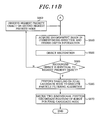
- FIGS. 11A and 11B are flowcharts illustrating a method for self-localization of a robot based on object recognition and an environment around a recognized object in accordance with a third embodiment of the present invention.
- FIG. 1 is a structural diagram of a robot, which performs self-localization based on object recognition and environment information around a recognized object, in accordance with the present invention.
- the robot which performs self-localization based on object recognition and environment information around a recognized object in accordance with the present invention, includes a camera unit 100 , a robot body 200 and a robot moving unit 300 .
- the camera unit 100 is used to estimate the position of the robot, and formed of a stereo image input device.
- the camera unit 100 may have a camera having a viewing angle in a predetermined range, or may have a camera having an omni-directional viewing angle.
- a pan/tilt device 110 for rotating the camera by a predetermined angle is further provided to rotate the camera, such that an omni-directional image can be input.
- the pan/tilt device 110 is a rotating device that can execute panning, which is a rotation operation left and right in a horizontal direction, and tilting, which is a nod operation up and down.
- the robot body 200 is provided with manipulators 210 , which are mechanical arms for external operations, at its outer surface.
- the robot body 200 includes a database (not shown) that stores a map around a robot traveling path, and a position arithmetic unit (not shown) that compares image information input from the camera unit 100 with the map stored in the database to recognize an object and estimates the position of the robot.
- the map stored in the database is produced beforehand in the form of a topological map.
- the three-dimensional position of each object on the map and the three-dimensional positions of local feature points in the environment around each object are stored.
- the robot moving unit 300 moves the robot along a traveling path.
- any device including a wheel or a caterpillar, may be used insofar as it can move the body of the robot.
- FIG. 2 is a basic flowchart illustrating a method for self-localization of a robot based on object recognition and environment information around a recognized object in accordance with the present invention.
- a method for self-localization of a robot based on object recognition and environment information around a recognized object includes: receiving an image from the camera unit 100 (hereinafter, referred to an image input step S 110 ; recognizing individual objects in the image input in the image input step S 110 and generating information regarding the three-dimensional positions of the individual objects and the three-dimensional positions of local feature points in the environment around each object (hereinafter, referred to as an object recognition and information extraction step S 120 ); and estimating the position of the robot based on a pre-registered object-based map by using the information extracted in the object recognition and information extraction step S 120 (hereinafter, referred to as a robot position estimation step S 130 ). Therefore, in accordance with the present invention, the individual objects in the environment are first recognized, and three-dimensional distance information regarding an object and environment around the recognized object is extracted, thereby estimating the position of the robot.
- object recognition is performed using a collection of local feature points.
- the object recognition is performed by extracting the local feature points from the environment image acquired by the camera unit 100 , and comparing the feature points with the local feature points of an object model stored in the database.
- FIG. 3 shows an object 410 recognized by the robot and an environment 400 around the recognized object.
- R P i denotes, as shown in FIG. 4 , a three-dimensional distance value between each of the local feature points of an object and an environment around the object and the camera unit 100 .
- N V i denotes, as shown in FIG. 5 , a three-dimensional distance value between each of the local feature points of the object and the environment around the object shown in FIG. 4 and the center coordinate system of the environment map.
- the relationship between R P i and N V i is as shown in FIG. 6 .
- Equation 2 The homogenous transformation matrix of the two distance values is expressed by N R T in Equation 1, and the relationship therebetween is expressed by Equation 2.
- N R T can be estimated by Equation 2
- the position of the robot can be estimated by Equation 1.
- the map which is used to estimate the position of the robot in the robot position estimation step (S 130 ), is stored in the database of the robot body 200 .
- a topological map based on the traveling path of the robot is used.
- A, B, C, and the like are nodes, and each node has an independent reference coordinate system.
- Each edge for connecting the nodes has relative distance information of each node coordinate system.
- a specific object may be observed on various nodes, as well as a specific node.
- an object a, an object b, and an object c are all observed on the nodes L and N.
- FIG. 8 is a flowchart illustrating position estimation based on particle filtering.
- the position estimation based on particle filtering includes, as shown in FIG. 8 , a sampling step S 210 , an error calculation step S 220 , a weighted value calculation step S 230 , a repetition condition confirmation step S 240 , and a position estimation step S 250 .
- estimation is made that the robot is located at a position where the object can be observed.
- sampling step S 210 random sampling is performed for the positions of the robot where the object can be observed.
- a new sample collection ⁇ s t (n) , ⁇ t (n) ,c t (n) ⁇ of a current repetition step t is selected from a sample collection ⁇ s t ⁇ 1 (n) , ⁇ t ⁇ 1 (n) ,c t ⁇ 1 (n) ⁇ of a previous step t ⁇ 1 as follows.
- ⁇ t (n) is a weighted value of a sample s t (n) in the repetition step t
- c t (n) is a cumulative weighted value.
- an error range caused by an operation error due to the movement of the robot, a measurement error of the vision sensor, an error in object recognition, and the like is applied to a position sample generated in the sampling step S 210 by using Equation 5.
- s t (n) As t ′ (n) +Bw t (n) [Equation 5]
- A denotes a dynamic model of the robot. However, since position estimation is performed in a state where the robot is stationary, A is set to 1.
- Bw t (n) denotes a robot position measurement error caused by the measurement error of the vision sensor and the error in object recognition.
- the weighted value of each random sample at the position predicted in the error calculation step S 220 is calculated by Equation 6.
- Equation 6 the right side can be obtained by setting similarity between the position of each object from the environment map on an assumption that the predicted sample position is accurate, and the measurement value by the sensor.
- the value may be normalized so as to be
- the repetition condition confirmation step S 240 it is confirmed whether or not the sampling step S 210 , the error calculation step S 220 , and the weighted value calculation step S 230 are repeatedly performed until a predetermined condition is satisfied.
- a predetermined condition a condition that the number of repetitions reaches a predetermined value ‘T’ may be used.
- a condition that the weighted value of a sample, which has a maximum weighted value, from among the samples in Equation 6 is equal to or more than a threshold value (for example, 0.9 when normalized) may be used.
- the steps may be configured so as to be repeatedly performed until the number of repetitions reaches the value T or the weighted value of a sample, which has a maximum weighted value, is equal to or more than a threshold value (for example, 0.9 when normalized).
- a threshold value for example, 0.9 when normalized
- the sampling step S 210 , the error calculation step S 220 , and the weighted value calculation step S 230 are repeatedly performed T times, the samples are converged to one candidate position.
- the position estimation step S 250 the position is estimated on the basis of a weighted average by Equation 8.
- [S] denotes the estimated position of the robot
- s t (n) denotes a sample of the robot position to be predicted
- ⁇ t (n) denotes a weighted value of the sample s t (n) in the repetition step t.
- FIG. 9 is a flowchart illustrating a method for self-localization of a robot based on object recognition and an environment information around a recognized object in accordance with a first embodiment of the present invention.
- a method for self-localization of a robot based on object recognition and environment information around a recognized object in accordance with the first embodiment of the invention is applied to a case where a sensor provided in the camera unit 100 is an omni-directional stereo vision sensor. As shown in FIG.
- the method for self-localization of a robot in accordance with the first embodiment of the invention includes an acquisition step S 310 of acquiring an omni-directional environment image and stereo depth information, an object recognition step S 320 , a candidate node selection step S 330 of selecting candidate nodes on which one or more objects are recognized, a three-dimensional position calculation step S 340 of calculating the three-dimensional positions of the robot for all the candidate nodes, a particle filtering step S 350 of performing sampling for all the candidate nodes to execute a particle filtering algorithm S 350 , and a two-dimensional position decision step S 360 of deciding an optimum node and the two-dimensional position of the robot on the optimum node.
- the camera unit 100 acquires an omni-directional environment image around the robot and distance information based on stereo vision for the omni-directional environment image.
- the position arithmetic unit extracts the local feature points of an object and an environment around the object from the omni-directional environment image acquired in the acquisition step S 310 .
- the position arithmetic unit also calculates the three-dimensional position values (based on the camera coordinate system) of the extracted local feature points using stereo distance information, and compares the local feature points with the local feature points of an object model stored in the database of the robot body 200 . In this way, object recognition is performed.
- the position arithmetic unit selects nodes, on which one or more objects are recognized in the object recognition step S 320 , from the map stored in the database as candidate nodes, on which the robot can be located.
- the position arithmetic unit calculates temporary positions of the robot for all the candidate nodes, and calculates a node proximity weighted value on the basis of the calculated positions of the robot.
- the temporary positions of the robot can be obtained by Equations 1 and 2. If the number of matched local feature points is three or more, calculation is performed by a least-squares method.
- N R T in Equation 2 represents the pose relationship (x,y,z, ⁇ x , ⁇ y , ⁇ z ) of the robot coordinate system ⁇ R ⁇ with respect to the node coordinate system ⁇ N ⁇ .
- the obtained temporary positions are used as initial position values when an accurate position is finally estimated by subsequent particle filtering.
- the position arithmetic unit calculates the node proximity weighted value ⁇ V (N k ) , indicating a node around which the robot is located, from among the weighted values in Equation 6 based on a recognized object and an environment around the object.
- the node proximity weighted value is calculated on the basis of an object existence weighted value, an object-environment feature weighted value, and an object-environment distance weighted value.
- the object-environment distance weighted value the three-dimensional position of the robot for each candidate node is used.
- the object existence weighted value varies depending on how many the objects on each candidate node overlap the objects recognized by the robot, and is calculated by Equation 9.
- ⁇ E (N k ) is an object existence weighted value of a candidate node N k
- n N is the number of candidate nodes.
- E (R) is a collection of objects recognized by the robot
- E (N k ) is a collection of objects on the candidate node N k
- n E (R ⁇ N k ) is the number of same objects from among the objects recognized by the robot and the objects on the candidate node N k .
- the object-environment feature weighted value represents how much the local feature points of an object model on each candidate node and the local feature points of an environment model extracted from the environment around the object are matched with the local feature points of an object recognized by the robot and the environment around the object (for example, the number of matched local feature points, or the like).
- the object-environment feature weighted value is calculated by Equation 10.
- ⁇ F (N k ) is an object-environment feature weighted value of a candidate node N k
- F (R) is a collection of the local feature points of all objects recognized by the robot and the local feature points of the environment around the objects
- F (N k ) is a collection of the local feature points of objects on the candidate node N k and the local feature points of the environment around the objects
- n F (R) is the total number of local feature points of all objects recognized by the robot and the environment around the objects.
- n F (R ⁇ N k ) is the number of matched local feature points between the local feature points of all objects recognized by the robot and the environment around the objects, and the local feature points of the same objects on the candidate node N k as the objects recognized by the robot and the environment around the objects.
- the three-dimensional values of the local feature points of an object recognized by the robot and the environment around the object are fitted to the three-dimensional values of the local feature points of the same object on a candidate node and the environment around the object.
- the object-environment distance weighted value represents a distance difference between the three-dimensional values of the fitted local feature points and the three-dimensional values of the same local feature points on the candidate node.
- the object-environment distance weighted value is calculated by Equation 11.
- ⁇ D (N k ) is an object-environment distance weighted value of the candidate node N k
- d f (N k ) is a distance difference between the three-dimensional values of the fitted local feature points and the three-dimensional values of the same local feature points on the candidate node.
- the node proximity weighted value represents how much the robot is proximate to the candidate node.
- the node proximity weighted value is calculated by Equation 12 on the basis of the object existence weighted value, the object-environment feature weighted value, and the object-environment distance weighted value calculated by Equations 9, 10, and 11, respectively.
- ⁇ V (N k ) is a node proximity weighted value of the robot for a node N k .
- the position arithmetic unit performs the sampling step S 210 , the error calculation step S 220 , the weighted value calculation step S 230 , and the repetition condition confirmation step S 240 of the particle filtering algorithm shown in FIG. 7 for the temporary positions of all the candidate nodes calculated in the three-dimensional position calculation step S 340 . In this way, a final weighted value required for accurate position estimation is calculated.
- the node proximity weighted value ⁇ V (N k ) calculated in the three-dimensional position calculation step S 340 and a three-dimensional feature point weighted value ⁇ P (n) of a sample s t (n) according to a distance difference between the three-dimensional feature points of an object recognized by the robot and the environment around the object and the three-dimensional feature points of the same object on a candidate node and the environment around the object are combined, as expressed by Equation 13.
- Equation 13 a final weighted value ⁇ (n) of the sample s t (n) is obtained.
- the position of a random sample s t (n) on the candidate node N k is expressed in the form of a three-dimensional homogeneous transformation matrix as follows.
- Equation 15 the distance difference between the three-dimensional feature points N k P i transformed by Equation 14 and the three-dimensional feature points N k V i of the same object on the candidate node N k and the environment image around the object is calculated by Equation 15.
- d i ⁇ N k V i ⁇ N k P i ⁇ [Equation 15]
- the three-dimensional feature point weighted value ⁇ P (n) of the sample s t (n) according to the distance difference between the three-dimensional feature points of the object recognized by the robot and the environment around the object and the three-dimensional feature points of the same object on the candidate node and the environment around the object is calculated by Equation 16.
- n F is the number of matched local feature points between the local feature points of all objects recognized by the robot and the environment around the objects and the local feature points of the same objects as the objects recognized by the robot from among the objects on the candidate node N k and the environment around the objects.
- the two-dimensional position decision step S 360 is identical to the position estimation step S 250 of FIG. 8 . That is, in the two-dimensional position decision step S 360 , the position of the robot is estimated on the basis of only the samples on a node, on which samples are most converged, by Equation 8.
- FIG. 10 is a flowchart illustrating a method for self-localization of a robot based on object recognition and the environment around a recognized object in accordance with a second embodiment of the present invention.
- a method for self-localization of a robot based on object recognition and the environment around a recognized object in accordance with the second embodiment of the present invention is applied to a case where a sensor provided in the camera unit 100 is an omni-directional stereo vision sensor, and a final node on which the robot is located is predefined. As shown in FIG.
- the method for self-localization of a robot in accordance with the second embodiment of the present invention includes an acquisition step S 410 of acquiring an omni-directional environment image and stereo depth information, an object recognition step S 420 , a candidate node selection step S 430 of selecting candidate nodes on which one or more objects are recognized, a three-dimensional position calculation step S 440 of calculating the three-dimensional positions of the robot for all the candidate nodes, a final candidate node selection step S 450 , a particle filtering step S 460 of performing sampling for the final candidate node to execute a particle filtering algorithm, and a two-dimensional position decision step S 470 of deciding an optimum node and the two-dimensional position of the robot for the optimum node.
- the acquisition step S 410 , the object recognition step S 420 , and the candidate node selection step S 430 , and the three-dimensional position calculation step S 440 are the same as the acquisition step S 310 , the object recognition step S 320 , the candidate node selection step S 330 , and the three-dimensional position calculation step S 340 , respectively, and thus detailed descriptions thereof will be omitted.
- a node having a maximum node proximity weighted value calculated in the three-dimensional position calculation step S 440 is selected as the final candidate node.
- the position arithmetic unit performs the sampling step S 210 , the error calculation step S 220 , the weighted value calculation step S 230 , and the repetition condition confirmation step S 240 for the final candidate node selected in the final candidate node selection step S 450 . In this way, a final weighted value required for accurate position estimation is calculated.
- Equation 8 is applied to the node that is selected in the final candidate node selection step S 450 , and the final weighted value of which is calculated in the particle filtering step S 460 . In this way, the position of the robot is estimated.
- FIGS. 11A and 11B are flowcharts illustrating a method for self-localization of a robot based on object recognition and an environment around a recognized object in accordance with a third embodiment of the present invention.
- a method for self-localization of a robot based on object recognition and the environment around a recognized object in accordance with the third embodiment of the present invention is applied to a case where a sensor provided in the camera unit 100 is a stereo camera having a viewing angle in a predetermined range, not 360°, and the position of the robot is estimated by recognition of two-objects in the environment in order to reduce a position estimation time of the robot. As shown in FIGS.
- the method for self-localization of a robot in accordance with the third embodiment of the present invention includes an acquisition step S 510 of acquiring an environment image in a direction and stereo depth information, an object recognition step S 515 , a confirmation step S 520 of confirming whether or not an object is recognized, a candidate node selection step S 525 of selecting candidate nodes on which one or more objects are recognized, a three-dimensional position calculation step S 530 of calculating the three-dimensional positions of the robot for all the candidate nodes, a priority calculation step S 535 of calculating the priority of each candidate node, a position and priority calculation step S 540 of calculating the positions of objects on the candidate nodes with respect to the robot and the priority of each object, an observation step S 545 of observing a highest priority object on a highest priority candidate node, an acquisition step S 550 of acquiring an environment image in the observation direction and stereo depth information, an object recognition step S 555 , a confirmation step S 560 of confirming whether or not a recognized object is
- the camera unit 100 acquires an environment image in a turn direction thereof, and distance information based on stereo vision for the environment image are acquired.
- the position arithmetic unit extracts the local feature points of an object and the environment around the object from the environment image acquired in the acquisition step S 510 .
- the position arithmetic unit also obtains the three-dimensional position values (based on the camera coordinate system) of the extracted local feature point on the basis of the stereo distance information, and compares the extracted local feature points with the local feature points of an object model stored in the database of the robot body 200 , thereby recognizing the object.
- the position arithmetic unit confirms whether an object is recognized in the object recognition step S 515 or not. If no object is recognized, the pan/tilt device 110 is operated, and the camera unit 110 is pinned to turn in another direction.
- the position arithmetic unit selects nodes, on which one or more objects are recognized in the object recognition step S 515 , from the map stored in the database as candidate nodes, on which the robot can be located.
- the three-dimensional position calculation step S 530 is the same as the three-dimensional position calculation step S 340 in the first embodiment, and a detailed description thereof will be omitted.
- the priority of each node is calculated on the basis of the node proximity weighted value calculated in the three-dimensional position calculation step S 530 .
- the position arithmetic unit calculates the positions of the objects on the candidate nodes, on which one or more objects are recognized, selected in the candidate node selection step S 525 , and decides an object, which is closest to the temporary position of the robot, as a verified object.
- the position arithmetic unit operates the pan/tilt device 110 to pan the camera unit 100 in a direction, in which the verified object selected in the position and priority calculation step S 540 is predicted to be present.
- the position arithmetic unit operates the pan/tilt device 110 to enable the camera to be panned left and right or to be tilted up and down.
- the camera unit 100 acquires an environment image in a direction, in which it turns, and distance information based on stereo vision for the environment image.
- the position arithmetic unit extracts the local feature points from the environment image acquired in the acquisition step S 550 , and compares the extracted local feature points with the local feature points of an object model corresponding to the highest priority object stored in the database of the robot body 200 , thereby recognizing an object.
- the position arithmetic unit compares the object recognized in the object recognition step S 555 with the verified object selected in the position and priority calculation step S 540 , and if both are the same, selects the corresponding candidate node as the final node.
- the position arithmetic unit moves the camera unit 100 to a verified object selected by the position and priority calculation step S 540 , in which the positions of objects on a second highest priority candidate node selected in the priority calculation step S 535 and the priority of each object are calculated.
- the highest priority node is the node A.
- the robot turns in a direction in which the object a 1 is predicted to be present, and object recognition is performed. If the object a 1 is not recognized, the robot turns toward the highest priority object on the second highest priority candidate node B, and object recognition is performed.
- the position arithmetic unit performs the sampling step S 210 , the error calculation step S 220 , the weighted value calculation step S 230 , and the repetition condition confirmation step S 240 in the particle filtering algorithm of FIG. 8 for the final node selected in the confirmation step S 560 . In this way, a final weighted value required for accurate position estimation is calculated.
- Equation 8 is applied to the node, which is selected in the confirmation step S 560 and the final weighted value of which is calculated in the particle filtering step S 565 . In this way, the position of the robot is estimated.
Landscapes
- Engineering & Computer Science (AREA)
- Physics & Mathematics (AREA)
- General Physics & Mathematics (AREA)
- Mechanical Engineering (AREA)
- Radar, Positioning & Navigation (AREA)
- Robotics (AREA)
- Computer Vision & Pattern Recognition (AREA)
- Aviation & Aerospace Engineering (AREA)
- Remote Sensing (AREA)
- Automation & Control Theory (AREA)
- Multimedia (AREA)
- Theoretical Computer Science (AREA)
- Electromagnetism (AREA)
- Human Computer Interaction (AREA)
- Manipulator (AREA)
- Control Of Position, Course, Altitude, Or Attitude Of Moving Bodies (AREA)
Abstract
Description
NVi=N RTRPi [Equation 2]
-
- when t=1 (an initial stage)
s t′(n)=(x,y,θ)(n) [Equation 3]
Here, n is in a range of 1 to ns. ns is the total number of random samples. - when t>1
- when t=1 (an initial stage)
s t′(n)=(x n ,y n,θn)(n) [Equation 4]
s t (n) =As t′(n) +Bw t (n) [Equation 5]
πt (n) =p(d t |s t (n)) [Equation 6]
ct (1)=0
c t (n) =c t (n−1)+πt (n) [Equation 7]
N
d i=∥N
Claims (12)
NVi=N RTRPi [Equation 2]
NVi=N RTRPi [Equation 2]
Applications Claiming Priority (2)
| Application Number | Priority Date | Filing Date | Title |
|---|---|---|---|
| KR10-2008-0013832 | 2008-02-15 | ||
| KR1020080013832A KR100926783B1 (en) | 2008-02-15 | 2008-02-15 | A method for estimating the magnetic position of the robot based on the environment information including object recognition and recognized object |
Publications (2)
| Publication Number | Publication Date |
|---|---|
| US20090210092A1 US20090210092A1 (en) | 2009-08-20 |
| US8024072B2 true US8024072B2 (en) | 2011-09-20 |
Family
ID=40955846
Family Applications (1)
| Application Number | Title | Priority Date | Filing Date |
|---|---|---|---|
| US12/292,715 Active 2030-01-26 US8024072B2 (en) | 2008-02-15 | 2008-11-25 | Method for self-localization of robot based on object recognition and environment information around recognized object |
Country Status (3)
| Country | Link |
|---|---|
| US (1) | US8024072B2 (en) |
| JP (1) | JP4942733B2 (en) |
| KR (1) | KR100926783B1 (en) |
Cited By (12)
| Publication number | Priority date | Publication date | Assignee | Title |
|---|---|---|---|---|
| US20100168913A1 (en) * | 2008-12-29 | 2010-07-01 | Samsung Electronics Co., Ltd. | Robot and method for controlling the same |
| US20120288202A1 (en) * | 2011-05-13 | 2012-11-15 | International Business Machines Corporation | Interior location identification |
| US8463541B2 (en) | 2010-12-15 | 2013-06-11 | Electronics And Telecommunications Research Institute | Camera-based indoor position recognition apparatus and method |
| US20160008982A1 (en) * | 2012-02-08 | 2016-01-14 | RobArt GmbH | Method for automatically triggering a self-positioning process |
| US9911041B2 (en) * | 2011-08-29 | 2018-03-06 | Hitachi, Ltd. | Monitoring device, monitoring system and monitoring method |
| US9989969B2 (en) | 2015-01-19 | 2018-06-05 | The Regents Of The University Of Michigan | Visual localization within LIDAR maps |
| US10055667B2 (en) * | 2016-08-03 | 2018-08-21 | X Development Llc | Generating a model for an object encountered by a robot |
| CN109471443A (en) * | 2018-11-30 | 2019-03-15 | 上海物景智能科技有限公司 | A wheeled robot positioning method and wheeled robot |
| US10511926B2 (en) | 2007-10-17 | 2019-12-17 | Symbol Technologies, Llc | Self-localization and self-orientation of a ceiling-mounted device |
| US11500391B2 (en) | 2017-06-13 | 2022-11-15 | Lg Electronics Inc. | Method for positioning on basis of vision information and robot implementing same |
| US12314053B2 (en) | 2021-02-23 | 2025-05-27 | Hyundai Motor Company | Apparatus for estimating position of target, robot system having the same, and method thereof |
| US12560926B2 (en) | 2020-08-14 | 2026-02-24 | Samsung Electronics Co., Ltd. | Robot and method for controlling same |
Families Citing this family (55)
| Publication number | Priority date | Publication date | Assignee | Title |
|---|---|---|---|---|
| CN102596517B (en) * | 2009-07-28 | 2015-06-17 | 悠进机器人股份公司 | Control method for localization and navigation of mobile robot and mobile robot using same |
| JP5444952B2 (en) * | 2009-08-28 | 2014-03-19 | 富士通株式会社 | Apparatus, method, and program for automatic generation of map by sensor fusion, and movement of moving object using such automatically generated map |
| KR101054520B1 (en) * | 2009-09-02 | 2011-08-05 | 한국과학기술원 | How to recognize the location and direction of the indoor mobile robot |
| KR101157103B1 (en) * | 2009-09-16 | 2012-06-22 | 동국대학교 산학협력단 | Apparatus and Method for estimating position based on self organization algorithm, and Recording medium thereof |
| KR101134316B1 (en) | 2009-10-09 | 2012-04-13 | 한양대학교 산학협력단 | Active localization of robot using spatial semantics of objects |
| KR20110097140A (en) * | 2010-02-24 | 2011-08-31 | 삼성전자주식회사 | Position estimation device and method of mobile robot |
| JP5218479B2 (en) * | 2010-06-10 | 2013-06-26 | 株式会社安川電機 | Mobile system |
| WO2012040644A1 (en) * | 2010-09-24 | 2012-03-29 | Evolution Robotics, Inc. | Systems and methods for vslam optimization |
| KR20120044768A (en) * | 2010-10-28 | 2012-05-08 | 엘지전자 주식회사 | Robot cleaner and controlling method of the same |
| BR112013026178A2 (en) | 2011-04-11 | 2019-10-01 | Crown Equipment Ltd | method and system for coordinating route planning |
| JP5609760B2 (en) * | 2011-04-27 | 2014-10-22 | トヨタ自動車株式会社 | Robot, robot operation method, and program |
| US20140058634A1 (en) | 2012-08-24 | 2014-02-27 | Crown Equipment Limited | Method and apparatus for using unique landmarks to locate industrial vehicles at start-up |
| AU2015203030B2 (en) * | 2011-08-26 | 2016-10-20 | Crown Equipment Corporation | Method and apparatus for using unique landmarks to locate industrial vehicles at start-up |
| KR101830379B1 (en) | 2011-09-27 | 2018-02-21 | 한국전자통신연구원 | Method and apparatus for recognizing space based of environmental information, space recognizing system |
| KR101941844B1 (en) * | 2012-01-10 | 2019-04-11 | 삼성전자주식회사 | Robot and Control method thereof |
| WO2015049717A1 (en) * | 2013-10-01 | 2015-04-09 | 株式会社日立製作所 | Device for estimating position of moving body and method for estimating position of moving body |
| US10311731B1 (en) | 2014-09-16 | 2019-06-04 | Knightscope, Inc. | Autonomous parking monitor |
| US10127439B2 (en) | 2015-01-15 | 2018-11-13 | Samsung Electronics Co., Ltd. | Object recognition method and apparatus |
| CN104772748B (en) * | 2015-04-03 | 2016-11-09 | 华东师范大学 | A kind of social robot |
| KR102410300B1 (en) | 2015-06-26 | 2022-06-20 | 한국전자통신연구원 | Apparatus for measuring position of camera using stereo camera and method using the same |
| US10421559B2 (en) * | 2015-08-30 | 2019-09-24 | Farzad Soudbakhsh | Robotic handling system (RHS) |
| CN108139758A (en) | 2015-10-09 | 2018-06-08 | 深圳市大疆创新科技有限公司 | Salient feature based vehicle localization |
| CN105919517B (en) * | 2016-06-15 | 2019-04-23 | 上海未来伙伴机器人有限公司 | Automatic cleaning robot device |
| JP2018028489A (en) * | 2016-08-18 | 2018-02-22 | トヨタ自動車株式会社 | Position estimation device and position estimation method |
| JP6725675B2 (en) * | 2016-10-07 | 2020-07-22 | 富士フイルム株式会社 | Self-position estimating device, self-position estimating method, program, and image processing device |
| KR101866660B1 (en) * | 2016-10-19 | 2018-06-12 | 한국과학기술원 | Method and apparatus for rgb-d dense visual odometry based on background model in a dynamic environment |
| EP3530417B1 (en) * | 2016-10-20 | 2021-06-30 | LG Electronics Inc. | Mobile robot and control method of mobile robot |
| CN107065861A (en) * | 2017-02-24 | 2017-08-18 | 珠海金萝卜智动科技有限公司 | Robot collection intelligence is carried, is loaded and unloaded on integral method and apparatus |
| KR101912361B1 (en) * | 2017-03-27 | 2018-10-26 | (주)엔스퀘어 | Autonomous mobile robot to implement logistics automation systems and method for map building and localization of the robot |
| KR102318841B1 (en) * | 2017-05-19 | 2021-10-29 | (주)랜도르아키텍쳐 | Movable Marking System, Controlling Method For Movable Marking Apparatus and Computer Readable Recording Medium |
| KR101853127B1 (en) | 2017-05-19 | 2018-04-27 | 주식회사 랜도르아키텍쳐 | Movable Marking System, Controlling Method For Movable Marking Apparatus and Computer Readable Recording Medium |
| CN108036786B (en) * | 2017-12-01 | 2021-02-09 | 安徽优思天成智能科技有限公司 | Pose detection method and device based on auxiliary line and computer readable storage medium |
| KR102084059B1 (en) * | 2018-03-08 | 2020-03-03 | 삼성중공업 주식회사 | Welding method using welding robot |
| KR102434523B1 (en) * | 2018-04-13 | 2022-08-22 | (주)랜도르아키텍쳐 | Movable Marking System, Controlling Method For Movable Marking Apparatus and Computer Readable Recording Medium |
| DE102018109329B4 (en) * | 2018-04-19 | 2019-12-05 | Gottfried Wilhelm Leibniz Universität Hannover | Multi-unit actuated kinematics, preferably robots, particularly preferably articulated robots |
| KR102202244B1 (en) * | 2018-06-29 | 2021-01-13 | (주)디에이치로지스틱스 | Logistics transport system using the autonomous driving unit and logistics transport method using the same |
| CN109085605A (en) * | 2018-08-29 | 2018-12-25 | 长春博立电子科技有限公司 | It automatically explores unknown space and establishes the method and system of map |
| KR102147210B1 (en) * | 2018-10-22 | 2020-08-24 | 엘지전자 주식회사 | Controlling method for Artificial intelligence Moving robot |
| KR102181815B1 (en) * | 2018-11-23 | 2020-11-24 | 한국전자기술연구원 | Personalized arrangement robot and arrangement method using the same |
| CN109696908B (en) * | 2019-01-18 | 2022-06-21 | 南方科技大学 | Robot and flight path setting method and system thereof |
| CN109668568A (en) * | 2019-01-25 | 2019-04-23 | 天津煋鸟科技有限公司 | A kind of method carrying out location navigation using panoramic imagery is looked around |
| CN112596508B (en) * | 2019-08-29 | 2022-04-12 | 美智纵横科技有限责任公司 | Control method and device of sensor and storage medium |
| KR102272641B1 (en) * | 2019-11-29 | 2021-07-02 | 포항공과대학교 산학협력단 | Object identification apparatus and method, system comprising the same |
| KR102830221B1 (en) * | 2020-01-08 | 2025-07-07 | 엘지전자 주식회사 | Localization of robot |
| CN111422231B (en) * | 2020-03-09 | 2021-07-02 | 江苏理工学院 | A vehicle seat towel placement device |
| CN112388601A (en) * | 2020-11-11 | 2021-02-23 | 吉林工程技术师范学院 | Education robot convenient to multiple mode is adjusted |
| CN113095227B (en) * | 2021-04-13 | 2023-11-07 | 京东科技信息技术有限公司 | A robot positioning method, device, electronic equipment and storage medium |
| US12105514B1 (en) * | 2021-08-17 | 2024-10-01 | Amazon Technologies, Inc. | System for planning exploration by autonomous mobile device |
| KR102684219B1 (en) | 2021-09-29 | 2024-07-10 | 한국기술교육대학교 산학협력단 | Object posture estimation system and method based on machine learning |
| CN114131599B (en) * | 2021-11-30 | 2023-08-29 | 珠海格力电器股份有限公司 | Robot programming control method and device, storage medium and demonstrator |
| KR102431122B1 (en) | 2021-12-30 | 2022-08-10 | 주식회사 버넥트 | Method and system for map tartet tracking |
| US12592156B2 (en) * | 2022-05-04 | 2026-03-31 | California Institute Of Technology | Method and system for on-board localization |
| CN115328161B (en) * | 2022-09-15 | 2024-04-26 | 安徽工程大学 | Welding robot path planning method based on K vision ant colony algorithm |
| CN116931583B (en) * | 2023-09-19 | 2023-12-19 | 深圳市普渡科技有限公司 | Method, device, equipment and storage medium for determining and avoiding moving object |
| CN119178438B (en) * | 2024-11-11 | 2025-02-25 | 辽宁新次元人形机器人研究院有限公司 | A self-positioning method for robot visual environment perception |
Citations (5)
| Publication number | Priority date | Publication date | Assignee | Title |
|---|---|---|---|---|
| JPH07200777A (en) | 1993-12-28 | 1995-08-04 | Hitachi Ltd | Position estimation method in mobile |
| JP2006209644A (en) | 2005-01-31 | 2006-08-10 | Matsushita Electric Works Ltd | Cleaning robot |
| US20070276541A1 (en) | 2006-05-26 | 2007-11-29 | Fujitsu Limited | Mobile robot, and control method and program for the same |
| JP2008014742A (en) | 2006-07-05 | 2008-01-24 | Japan Advanced Institute Of Science & Technology Hokuriku | Mobile object position estimation system and mobile object position estimation method |
| US7337040B2 (en) * | 2002-04-26 | 2008-02-26 | Honda Giken Kogyo Kabushiki Kaisha | Self-position estimating device for leg type movable robots |
Family Cites Families (6)
| Publication number | Priority date | Publication date | Assignee | Title |
|---|---|---|---|---|
| JP2002296010A (en) | 2001-03-29 | 2002-10-09 | Fujitsu Ltd | Self-localization method using images |
| JP4100239B2 (en) * | 2003-04-22 | 2008-06-11 | 松下電工株式会社 | Obstacle detection device and autonomous mobile robot using the same device, obstacle detection method, and obstacle detection program |
| JP2005186193A (en) * | 2003-12-25 | 2005-07-14 | Nachi Fujikoshi Corp | Robot calibration method and three-dimensional position measurement method |
| JP4564447B2 (en) * | 2004-12-14 | 2010-10-20 | 本田技研工業株式会社 | Autonomous mobile robot |
| KR100702663B1 (en) * | 2005-08-27 | 2007-04-02 | 한국과학기술원 | Method for Direction Estimation and Mapping Based on Omnidirectional Visual Sensor in Particle Filter Framework |
| KR100966875B1 (en) * | 2006-09-26 | 2010-06-29 | 삼성전자주식회사 | Robot positioning using omnidirectional image |
-
2008
- 2008-02-15 KR KR1020080013832A patent/KR100926783B1/en active Active
- 2008-11-25 US US12/292,715 patent/US8024072B2/en active Active
- 2008-12-26 JP JP2008335345A patent/JP4942733B2/en active Active
Patent Citations (6)
| Publication number | Priority date | Publication date | Assignee | Title |
|---|---|---|---|---|
| JPH07200777A (en) | 1993-12-28 | 1995-08-04 | Hitachi Ltd | Position estimation method in mobile |
| US7337040B2 (en) * | 2002-04-26 | 2008-02-26 | Honda Giken Kogyo Kabushiki Kaisha | Self-position estimating device for leg type movable robots |
| JP2006209644A (en) | 2005-01-31 | 2006-08-10 | Matsushita Electric Works Ltd | Cleaning robot |
| US20070276541A1 (en) | 2006-05-26 | 2007-11-29 | Fujitsu Limited | Mobile robot, and control method and program for the same |
| JP2007316966A (en) | 2006-05-26 | 2007-12-06 | Fujitsu Ltd | Mobile robot, its control method and program |
| JP2008014742A (en) | 2006-07-05 | 2008-01-24 | Japan Advanced Institute Of Science & Technology Hokuriku | Mobile object position estimation system and mobile object position estimation method |
Non-Patent Citations (1)
| Title |
|---|
| Office Action issued in Japanese Patent Application No. 2008-335345, dated May 31, 2011, 3 pages. |
Cited By (21)
| Publication number | Priority date | Publication date | Assignee | Title |
|---|---|---|---|---|
| US10511926B2 (en) | 2007-10-17 | 2019-12-17 | Symbol Technologies, Llc | Self-localization and self-orientation of a ceiling-mounted device |
| US8660696B2 (en) * | 2008-12-29 | 2014-02-25 | Samsung Electronics Co., Ltd. | Robot and method for controlling the same |
| US20100168913A1 (en) * | 2008-12-29 | 2010-07-01 | Samsung Electronics Co., Ltd. | Robot and method for controlling the same |
| US8463541B2 (en) | 2010-12-15 | 2013-06-11 | Electronics And Telecommunications Research Institute | Camera-based indoor position recognition apparatus and method |
| US20120288202A1 (en) * | 2011-05-13 | 2012-11-15 | International Business Machines Corporation | Interior location identification |
| US20130243326A1 (en) * | 2011-05-13 | 2013-09-19 | International Business Machines Corporation | Interior location identification |
| US8891816B2 (en) * | 2011-05-13 | 2014-11-18 | International Business Machines Corporation | Interior location identification |
| US8908923B2 (en) * | 2011-05-13 | 2014-12-09 | International Business Machines Corporation | Interior location identification |
| US9911041B2 (en) * | 2011-08-29 | 2018-03-06 | Hitachi, Ltd. | Monitoring device, monitoring system and monitoring method |
| US20160008982A1 (en) * | 2012-02-08 | 2016-01-14 | RobArt GmbH | Method for automatically triggering a self-positioning process |
| US9527212B2 (en) * | 2012-02-08 | 2016-12-27 | RobArt GmbH | Method for automatically triggering a self-positioning process |
| US9989969B2 (en) | 2015-01-19 | 2018-06-05 | The Regents Of The University Of Michigan | Visual localization within LIDAR maps |
| US10055667B2 (en) * | 2016-08-03 | 2018-08-21 | X Development Llc | Generating a model for an object encountered by a robot |
| US10671874B2 (en) | 2016-08-03 | 2020-06-02 | X Development Llc | Generating a model for an object encountered by a robot |
| US11195041B2 (en) | 2016-08-03 | 2021-12-07 | X Development Llc | Generating a model for an object encountered by a robot |
| US11691273B2 (en) | 2016-08-03 | 2023-07-04 | X Development Llc | Generating a model for an object encountered by a robot |
| US12103178B2 (en) | 2016-08-03 | 2024-10-01 | Google Llc | Generating a model for an object encountered by a robot |
| US11500391B2 (en) | 2017-06-13 | 2022-11-15 | Lg Electronics Inc. | Method for positioning on basis of vision information and robot implementing same |
| CN109471443A (en) * | 2018-11-30 | 2019-03-15 | 上海物景智能科技有限公司 | A wheeled robot positioning method and wheeled robot |
| US12560926B2 (en) | 2020-08-14 | 2026-02-24 | Samsung Electronics Co., Ltd. | Robot and method for controlling same |
| US12314053B2 (en) | 2021-02-23 | 2025-05-27 | Hyundai Motor Company | Apparatus for estimating position of target, robot system having the same, and method thereof |
Also Published As
| Publication number | Publication date |
|---|---|
| JP4942733B2 (en) | 2012-05-30 |
| KR20090088516A (en) | 2009-08-20 |
| US20090210092A1 (en) | 2009-08-20 |
| KR100926783B1 (en) | 2009-11-13 |
| JP2009190164A (en) | 2009-08-27 |
Similar Documents
| Publication | Publication Date | Title |
|---|---|---|
| US20090210092A1 (en) | Method for self-localization of robot based on object recognition and environment information around recognized object | |
| KR100866380B1 (en) | Estimation method of robot's magnetic position based on object recognition | |
| Li et al. | Multivehicle cooperative local mapping: A methodology based on occupancy grid map merging | |
| Röwekämper et al. | On the position accuracy of mobile robot localization based on particle filters combined with scan matching | |
| Westman et al. | Feature-based SLAM for imaging sonar with under-constrained landmarks | |
| Sabe et al. | Obstacle avoidance and path planning for humanoid robots using stereo vision | |
| EP2460629B1 (en) | Control method for localization and navigation of mobile robot and mobile robot using same | |
| Rodríguez Flórez et al. | Multi-modal object detection and localization for high integrity driving assistance | |
| WO2013032192A2 (en) | Method for recognizing position of mobile robot by using features of arbitrary shapes on ceiling | |
| Rodrigues et al. | Low-level active visual navigation: Increasing robustness of vision-based localization using potential fields | |
| US12235658B2 (en) | Information processing device, information processing system, method, and program | |
| McGreavy et al. | Next best view planning for object recognition in mobile robotics | |
| WO2024232947A1 (en) | Location based change detection within image data by a mobile robot | |
| Gao et al. | Multi-view sensor fusion by integrating model-based estimation and graph learning for collaborative object localization | |
| CN120122709A (en) | A UAV perception obstacle avoidance method, system, device and medium | |
| Alves et al. | Cost-effective indoor localization for autonomous robots using kinect and wifi sensors | |
| Xie et al. | A real-time robust global localization for autonomous mobile robots in large environments | |
| Rituerto et al. | Comparison of omnidirectional and conventional monocular systems for visual SLAM | |
| Dailey et al. | Simultaneous localization and mapping with stereo vision | |
| Bai et al. | Stereovision based obstacle detection approach for mobile robot navigation | |
| Pal et al. | Evolution of simultaneous localization and mapping framework for autonomous robotics—a comprehensive review | |
| Choi et al. | Autonomous homing based on laser-camera fusion system | |
| Giri et al. | Particle filter enhanced by cnn-lstm for localization of autonomous robot in indoor environment | |
| JP2839281B2 (en) | Mobile object self-localization method | |
| Morioka et al. | Simplified map representation and map learning system for autonomous navigation of mobile robots |
Legal Events
| Date | Code | Title | Description |
|---|---|---|---|
| AS | Assignment |
Owner name: KOREA INSTITUTE OF SCIENCE AND TECHNOLOGY, KOREA, Free format text: ASSIGNMENT OF ASSIGNORS INTEREST;ASSIGNORS:PARK, SUNG KEE;PARK, SOON YONG;REEL/FRAME:021937/0287 Effective date: 20081110 |
|
| STCF | Information on status: patent grant |
Free format text: PATENTED CASE |
|
| FEPP | Fee payment procedure |
Free format text: PAYOR NUMBER ASSIGNED (ORIGINAL EVENT CODE: ASPN); ENTITY STATUS OF PATENT OWNER: SMALL ENTITY |
|
| FPAY | Fee payment |
Year of fee payment: 4 |
|
| MAFP | Maintenance fee payment |
Free format text: PAYMENT OF MAINTENANCE FEE, 8TH YR, SMALL ENTITY (ORIGINAL EVENT CODE: M2552); ENTITY STATUS OF PATENT OWNER: SMALL ENTITY Year of fee payment: 8 |
|
| MAFP | Maintenance fee payment |
Free format text: PAYMENT OF MAINTENANCE FEE, 12TH YR, SMALL ENTITY (ORIGINAL EVENT CODE: M2553); ENTITY STATUS OF PATENT OWNER: SMALL ENTITY Year of fee payment: 12 |