US7910164B2 - Bifunctional magnetic core-semiconductor shell nanoparticles and manufacturing method thereof - Google Patents
Bifunctional magnetic core-semiconductor shell nanoparticles and manufacturing method thereof Download PDFInfo
- Publication number
- US7910164B2 US7910164B2 US11/860,002 US86000207A US7910164B2 US 7910164 B2 US7910164 B2 US 7910164B2 US 86000207 A US86000207 A US 86000207A US 7910164 B2 US7910164 B2 US 7910164B2
- Authority
- US
- United States
- Prior art keywords
- mixture solution
- magnetic core
- material precursors
- semiconductor shell
- reducing agent
- Prior art date
- Legal status (The legal status is an assumption and is not a legal conclusion. Google has not performed a legal analysis and makes no representation as to the accuracy of the status listed.)
- Active, expires
Links
Images




Classifications
-
- B—PERFORMING OPERATIONS; TRANSPORTING
- B82—NANOTECHNOLOGY
- B82B—NANOSTRUCTURES FORMED BY MANIPULATION OF INDIVIDUAL ATOMS, MOLECULES, OR LIMITED COLLECTIONS OF ATOMS OR MOLECULES AS DISCRETE UNITS; MANUFACTURE OR TREATMENT THEREOF
- B82B3/00—Manufacture or treatment of nanostructures by manipulation of individual atoms or molecules, or limited collections of atoms or molecules as discrete units
-
- B—PERFORMING OPERATIONS; TRANSPORTING
- B22—CASTING; POWDER METALLURGY
- B22F—WORKING METALLIC POWDER; MANUFACTURE OF ARTICLES FROM METALLIC POWDER; MAKING METALLIC POWDER; APPARATUS OR DEVICES SPECIALLY ADAPTED FOR METALLIC POWDER
- B22F9/00—Making metallic powder or suspensions thereof
- B22F9/16—Making metallic powder or suspensions thereof using chemical processes
- B22F9/18—Making metallic powder or suspensions thereof using chemical processes with reduction of metal compounds
- B22F9/24—Making metallic powder or suspensions thereof using chemical processes with reduction of metal compounds starting from liquid metal compounds, e.g. solutions
-
- B—PERFORMING OPERATIONS; TRANSPORTING
- B22—CASTING; POWDER METALLURGY
- B22F—WORKING METALLIC POWDER; MANUFACTURE OF ARTICLES FROM METALLIC POWDER; MAKING METALLIC POWDER; APPARATUS OR DEVICES SPECIALLY ADAPTED FOR METALLIC POWDER
- B22F1/00—Metallic powder; Treatment of metallic powder, e.g. to facilitate working or to improve properties
- B22F1/16—Metallic particles coated with a non-metal
-
- B—PERFORMING OPERATIONS; TRANSPORTING
- B82—NANOTECHNOLOGY
- B82Y—SPECIFIC USES OR APPLICATIONS OF NANOSTRUCTURES; MEASUREMENT OR ANALYSIS OF NANOSTRUCTURES; MANUFACTURE OR TREATMENT OF NANOSTRUCTURES
- B82Y25/00—Nanomagnetism, e.g. magnetoimpedance, anisotropic magnetoresistance, giant magnetoresistance or tunneling magnetoresistance
-
- H—ELECTRICITY
- H01—ELECTRIC ELEMENTS
- H01F—MAGNETS; INDUCTANCES; TRANSFORMERS; SELECTION OF MATERIALS FOR THEIR MAGNETIC PROPERTIES
- H01F1/00—Magnets or magnetic bodies characterised by the magnetic materials therefor; Selection of materials for their magnetic properties
- H01F1/0036—Magnets or magnetic bodies characterised by the magnetic materials therefor; Selection of materials for their magnetic properties showing low dimensional magnetism, i.e. spin rearrangements due to a restriction of dimensions, e.g. showing giant magnetoresistivity
- H01F1/0045—Zero dimensional, e.g. nanoparticles, soft nanoparticles for medical/biological use
- H01F1/0054—Coated nanoparticles, e.g. nanoparticles coated with organic surfactant
-
- B—PERFORMING OPERATIONS; TRANSPORTING
- B22—CASTING; POWDER METALLURGY
- B22F—WORKING METALLIC POWDER; MANUFACTURE OF ARTICLES FROM METALLIC POWDER; MAKING METALLIC POWDER; APPARATUS OR DEVICES SPECIALLY ADAPTED FOR METALLIC POWDER
- B22F2998/00—Supplementary information concerning processes or compositions relating to powder metallurgy
-
- B—PERFORMING OPERATIONS; TRANSPORTING
- B82—NANOTECHNOLOGY
- B82Y—SPECIFIC USES OR APPLICATIONS OF NANOSTRUCTURES; MEASUREMENT OR ANALYSIS OF NANOSTRUCTURES; MANUFACTURE OR TREATMENT OF NANOSTRUCTURES
- B82Y40/00—Manufacture or treatment of nanostructures
-
- C—CHEMISTRY; METALLURGY
- C22—METALLURGY; FERROUS OR NON-FERROUS ALLOYS; TREATMENT OF ALLOYS OR NON-FERROUS METALS
- C22C—ALLOYS
- C22C2202/00—Physical properties
- C22C2202/02—Magnetic
-
- Y—GENERAL TAGGING OF NEW TECHNOLOGICAL DEVELOPMENTS; GENERAL TAGGING OF CROSS-SECTIONAL TECHNOLOGIES SPANNING OVER SEVERAL SECTIONS OF THE IPC; TECHNICAL SUBJECTS COVERED BY FORMER USPC CROSS-REFERENCE ART COLLECTIONS [XRACs] AND DIGESTS
- Y10—TECHNICAL SUBJECTS COVERED BY FORMER USPC
- Y10T—TECHNICAL SUBJECTS COVERED BY FORMER US CLASSIFICATION
- Y10T428/00—Stock material or miscellaneous articles
- Y10T428/29—Coated or structually defined flake, particle, cell, strand, strand portion, rod, filament, macroscopic fiber or mass thereof
- Y10T428/2982—Particulate matter [e.g., sphere, flake, etc.]
- Y10T428/2991—Coated
Definitions
- the present invention relates generally to a method for synthesizing magnetic core-semiconductor shell nanocrystals, and in particular, to magnetic core-semiconductor shell nanoparticles with high crystallization degree, uniform size, and high chemical stability and a manufacturing method thereof.
- Magnetic nanoparticles are applicable to various fields such as high-density magnetic recorder, sensor, and catalyst owing to their possibility for chemical synthesis.
- magnetite (Fe 3 O 4 ) nanoparticles occupy a singular position in the field of magnetic materials owing to their special physiochemical properties.
- Many researches have been conducted for physical phenomena such as charge ordering, mixed valence, and metal-insulator transition known as the Verwey transition.
- magnetic nanoparticles are coated with semiconductors, they incorporate the functions of catalysis, enhanced photoluminescence, protective layers, enhanced processibility, engineered band structures, improved stability against photochemical oxidation, and conjugation layers with biological molecules.
- Such magnetic-semiconductor core-shell structures can have magnetic properties, semiconductor properties, physical properties of inorganic and organic materials, and versatile functions ranging from metallic to dielectric materials.
- the magnetic-semiconductor core-shell structure is expected to deliver various potential functionalities in areas such as high-density data storage, biomedical applications, magnetic refrigeration, catalysts, and ferrofluids.
- Cadmium selenide (CdSe) is a highly efficient luminescent semiconductor quantum-dot material. It is anticipated that the fusion of these two materials into a core-shell nanostructure should produce a new nanostructured material which retains the optical and magnetic properties of respective components, providing synergistically enhanced performance and functionalities which go beyond those of the individual components.
- Fe 3 O 4 /CdSe core-shell nanoparticles applicable to bio-separation, bio-manipulation, bio-assaying, vector delivery, and specific detection owing to their optical element sensing and magnetic actuation.
- magnetic-semiconductor core-shell nanoparticles such as Fe 3 O 4 @CdTe, Fe 3 O 4 @CdS, CoPt@CdSe, and FePt@CdSe.
- An aspect of the present invention is to substantially solve at least the above problems and/or disadvantages and to provide at least the advantages below. Accordingly, an aspect of the present invention is to provide bifunctional magnetic-semiconductor core-shell nanoparticles having both magnetic properties and semiconductor properties and a manufacturing method for synthesizing the same.
- Another aspect of the present invention is to provide bifunctional magnetic-semiconductor core-shell nanoparticles having high crystallization degree, uniform size, and high chemical stability and a manufacturing method for synthesizing the same.
- a method for manufacturing bifunctional magnetic core-semiconductor shell nanoparticles by a sequential process includes mixing magnetic core material precursors and a reducing agent for the core material precursors; mixing the resultant with a solvent for the magnetic core material precursors and the reducing agent and preparing a first mixture solution; heating the first mixture solution to a first temperature and maintaining the first mixture solution for a first period; cooling the first mixture solution to a room temperature and preparing magnetic core materials; mixing the magnetic core materials with semiconductor shell material precursors and a reducing agent for the semiconductor shell material precursors; mixing the resultant with a solvent for the semiconductor shell material precursors and the reducing agent and preparing a second mixture solution; heating the second mixture solution to a second temperature and maintaining the second mixture solution for a second period; and cooling the second mixture solution to a room temperature and coating the magnetic core materials with the semiconductor shell materials.
- bifunctional magnetic core-semiconductor shell nanoparticles manufactured by a sequential process.
- the process includes mixing magnetic core material precursors, a reducing agent for the magnetic core material precursors, and a solvent for the core material precursors and the reducing agent to prepare a first mixture solution and heating and cooling the first mixture solution to prepare magnetic core materials; and in the same location where the magnetic core materials are prepared, mixing semiconductor shell material precursors, a reducing agent for the semiconductor shell material precursors, and a solvent for the semiconductor shell material precursors and the reducing agent to prepare a second mixture solution and heating and cooling the second mixture solution to coat the magnetic core materials with semiconductor shell materials.
- FIGS. 1A and 1B each are diagrams illustrating a device and a procedure for synthesizing magnetic core-semiconductor shell nanocrystals according to the present invention
- FIGS. 2A to 2D each show an X-ray diffraction pattern for Fe 3 O 4 nanoparticles, an X-ray diffraction pattern for Fe 3 O 4 @CdSe core-shell nanocrystals synthesized according to the present invention, a Joint Committee on Powder Diffraction Standards (JCPDS) graph for Fe 3 O 4 , and a JCPDS graph for CdSe;
- JCPDS Joint Committee on Powder Diffraction Standards
- FIGS. 3A to 3D each show Transmission Electron Microscopy (TEM) morphology of Fe 3 O 4 nanoparticles, High Resolution Transmission Electron Microscopy (HRTEM) image demonstrating the monocrystalline nature of a seed particle, TEM morphology of Fe 3 O 4 @CdSe core-shell nanocrystals synthesized according to the present invention, and HRTEM image showing the monocrystalline nature of a nanocrystal;
- TEM Transmission Electron Microscopy
- HRTEM High Resolution Transmission Electron Microscopy
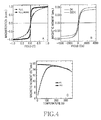
- FIGS. 4A to 4C each show hysteresis curves measured at room temperature for Fe 3 O 4 and Fe 3 O 4 @CdSe core-shell nanocrystals synthesized according to the present invention, a field dependent magnetization for Fe 3 O 4 @CdSe core-shell nanocrystals synthesized according to the present invention, measured at 5 K and 300 K, a temperature dependent magnetization for field cooled (red) and zero field cooled (black) Fe 3 O 4 @CdSe core-shell nanocrystals synthesized according to the present invention;
- FIG. 5A shows optical properties of Fe 3 O 4 @CdSe core-shell nanocrystals synthesized according to the present invention: UV absorption and photoluminescence (PL) spectra and
- FIG. 5B is a graph showing photoluminescent properties before (upper curve) and after (lower curve) surface modification of Fe 3 O 4 @CdSe core-shell nanocrystals with oleic acid.
- FIGS. 6A and 6B each are graphs illustrating deconvolution of photoluminescent spectrum of Fe 3 O 4 @CdSe core-shell nanocrystals synthesized according to the present invention without the addition of oleic acid and a deconvolution of photoluminescent spectrum of Fe 3 O 4 @CdSe core-shell nanocrystals with the addition of oleic acid;
- FIGS. 7A and 7B each are photograph images of magnetic-luminescent Fe 3 O 4 @CdSe core-shell nanocrystals synthesized according to the present invention: (a) absence of magnetic field and (b) presence of magnetic field.
- FIG. 8 is a graph illustrating luminescence spectrum of Fe 3 O 4 @ZnO core-shell nanocrystals.
- FIG. 9 shows Transmission Electron Microscopy (TEM) morphology of Fe 3 O 4 @ZnO core-shell nanocrystals synthesized according to the present invention.
- the present invention relates to a method for synthesizing magnetic core-semiconductor shell nanocrystals, and in particular, to magnetic core-semiconductor shell nanocrystals with high crystallization degree, uniform size, and high chemical stability and a manufacturing method thereof.
- Fe 3 O 4 @CdSe nanoparticles that are a result of coating magnetite (Fe 3 O 4 ) nanoparticles, magnetic materials, with CdSe that is a highly efficient luminescent semiconductor quantum-dot material will be described below.
- Fe 3 O 4 @CdSe, Fe 3 O 4 /CdSe, and Fe 3 O 4 —CdSe are merely different in expression method.
- a magnetic core-semiconductor shell nanostructure of the present invention is completed through two sequential processes of manufacturing a magnetite core in a polyol preparation method and coating the magnetite core with CdSe by the reduction of cadmium (Cd) and selenium (Se).
- magnetic/semiconductor core-shell nanoparticles with magnetite (Fe 3 O 4 ) core and CdSe shell are prepared through a sequential preparation method by the reduction of appropriate precursors in the presence of solution containing polymer surfactants.
- FIGS. 1A and 1B show a Fe 3 O 4 @CdSe nanocrystals synthesis procedure according to the present invention.
- a gent 1,2-hexadecanediol (0.6468 g, 2.5 mmol)
- the mixed solution is slowly heated to approximately 120° C. to 130° C. for about 1 hour and is circulated at approximately 120° C. to 130° C. for about 1 to 2 hours.
- the mixed solution is quickly heated for about 15 minutes to about 300° C. and is circulated for about 1 to 2 hours at about 300° C. Preparation at such a high temperature is to consider refluxing.
- the mixed solution is cooled to a room temperature to prepare the magnetic core materials.
- the reaction mixture is heated using a heater 103 .
- Argon gas, inertia gas, is injected through a gas injection unit 107 .
- Gas generated during the synthesis process is exhausted through an exhaust unit 109 .
- Cadmium acetate (0.7 mmol, 186.6 mg) and selenium (1 mmol, 78.9 mg) dissolved in trioctyl phosphine (TOP, 99%; ⁇ 3 ml) are added to the mixed solution.
- TOP trioctyl phosphine
- the reaction mixture is heated up to about 60° C. to 80° C. and about 100° C. using the heater 103 and is stirred with magnetic stirring for about 1 to 2 hours. Temperature is measured using a thermometer 105 .
- CdSe The formation of CdSe is completed by heating the mixture to about 130° C. and 160° C. and maintaining the mixture at about 130° C. and 160° C. for about 1 to 2 hours.
- argon gas, inertia gas is injected through the gas injection unit 107 , and gas generated during the synthesis process is exhausted through the exhaust unit 109 .
- Fe 3 O 4 @CdSe core-shell nanoparticles are precipitated by the addition of anhydrous ethanol, usually accelerated by centrifugation, and redispersed in hexane. This process is typically repeated twice to remove solvent molecules and other residuals from the nanocrystals.
- the thus prepared core-shell nanoparticles can be stored in a solution for a long time without quality change. This means that heterogeneous materials are densely coated on a nanocrystal surface of a core portion.
- Octyl ether rather than phenyl ethyl that is a general solvent is used.
- the dioctyl ether prepares FeO x (Fe and Fe 3 O 4 mixture among which a majority is Fe 3 O 4 ) as well as makes magnetite (Fe 3 O 4 ).
- the surfactants are tri-block copolymer (PEO-PPO-PEO), not small molecular surfactants.
- Step 120 is a process of creating a magnetite core
- Step 130 is a process of coating the magnetite core with CdSe
- Step 140 is a process of washing the coated result with ethanol/hexane.
- FIGS. 2A to 2D each show an X-ray diffraction pattern for Fe 3 O 4 nanoparticles, an X-ray diffraction pattern for Fe 3 O 4 @CdSe core-shell nanocrystals, a JCPDS graph for Fe 3 O 4 synthesized according to the present invention, and a JCPDS graph for CdSe.
- FIG. 2A shows Fe 3 O 4 seed nanocrystals.
- FIG. 2B shows Fe 3 O 4 @CdSe core-shell nanocrystals with the identification of CdSe peaks and Fe 3 O 4 peaks.
- FIG. 2C is a JCPDS graph for bulk Fe 3 O 4 .
- FIG. 2D is a JCPDS graph for bulk CdSe.
- FIGS. 3A to 3D each show TEM morphology of Fe 3 O 4 nanoparticles synthesized according to the present invention, HRTEM image demonstrating the monocrystalline nature of a seed particle, TEM morphology of Fe 3 O 4 @CdSe core-shell nanocrystals synthesized according to the present invention, and HRTEM image showing the monocrystalline nature of a nanocrystal.
- FIG. 3A is TEM morphology of Fe 3 O 4 nanoparticles.
- FIG. 3B is HRTEM image showing the monocrystalline nature of a seed particle.
- FIG. 3C is TEM morphology of Fe 3 O 4 @CdSe core-shell nanocrystals synthesized according to the present invention.
- white arrows indicate CdSe shells.
- FIG. 3D is HRTEM image showing the monocrystalline nature of a nanocrystal. Here, scales each are shown at lower left corners of the images.
- FIG. 4A show hysteresis curves measured at room temperature for Fe 3 O 4 @CdSe core-shell nanocrystals synthesized according to the present invention wherein the curve more vertical to Y-axis is a hysteresis curve for Fe 3 O 4 @CdSe core-shell nanocrystals and the comparison curve less vertical is a hysteresis curve for Fe 3 O 4 .
- FIG. 4B shows a field dependent magnetization for Fe 3 O 4 @CdSe core-shell nanocrystals synthesized according to the present invention, measured at 5 K and 300 K.
- FIG. 4A show hysteresis curves measured at room temperature for Fe 3 O 4 @CdSe core-shell nanocrystals synthesized according to the present invention wherein the curve more vertical to Y-axis is a hysteresis curve for Fe 3 O 4 @CdSe core-shell nanocrystals and the comparison curve less vertical is a
- FIG. 4C shows a temperature dependent magnetization for field cooled (red) and zero field cooled (black) Fe 3 O 4 @CdSe core-shell nanocrystals synthesized according to the present invention.
- the two curves converge at the blocking temperature, at which the transition from su perparamagnetic to ferromagnetic behavior ensues.
- magnetization suddenly decreases below the blocking temperature.
- FIG. 5A shows optical properties of Fe 3 O 4 @CdSe core-shell nanocrystals synthesized according to the present invention: UV absorption and photoluminescence (PL) spectra.
- FIG. 5B is a graph showing photoluminescent properties before (upper curve) and after (lower curve) surface modification of Fe 3 O 4 @CdSe core-shell nanocrystals with oleic acid.
- FIGS. 6A and 6B each are graphs illustrating deconvolution of photoluminescent spectrum of Fe 3 O 4 @CdSe core-shell nanocrystals synthesized according to the present invention without the addition of oleic acid and a deconvolution of photoluminescent spectrum of Fe 3 O 4 @CdSe core-shell nanocrystals with the addition of oleic acid.
- FIG. 6A shows deconvolution of photoluminescent spectrum of Fe 3 O 4 @CdSe core-shell nanocrystals synthesized according to the present invention without the addition of oleic acid. From this, it can be appreciated that the experimental data (bold curve) are in good agreement with the deconvolution of the spectrum into three Gaussian curves representing the emissions as demonstrated by their sum (in circles).
- FIG. 6B shows deconvolution of photoluminescent spectrum of Fe 3 O 4 @CdSe core-shell nanocrystals with the addition of oleic acid. From this, it can be appreciated that the experimental data (bold curve) are in good agreement with the deconvolution of the spectrum into four Gaussian curves representing the emissions as demonstrated by their sum (in circles).
- FIGS. 7A and 7B each are photograph images of magnetic-luminescent Fe 3 O 4 @CdSe core-shell nanocrystals synthesized according to the present invention: (a) absence of magnetic field and (b) presence of magnetic field.
- FIG. 7A is a photograph image of the dispersion of core-shell nanoparticles with the absence of magnetic field
- FIG. 7B is a photograph image showing a figure in which nanoparticles are attracted to a magnet with the presence of magnetic field.
- Table 1 shows a comparison of peak positions, FWHM (Full Width at Half Maximum) values, and relative intensities of photoluminescent spectra of Fe 3 O 4 @CdSe core-shell nanocrystals after deconvolution with (data in brackets) and without addition of oleic acid.
- bifunctional core-shell nanoparticles with semiconductor shells such as Fe 3 O 4 @CdTe and Fe 3 O 4 @CdS can be manufactured according to the present invention.
- Cadmium telluride (CdTe) and cadmium sulfide (CdS) have similar physical properties to CdSe.
- bifunctional core-shell nanoparticles with magnetic cores such as CoPt@CdSe, FePt@CdSe, CoPt@CdS, FePt@CdS, CoPt@CdTe and FePt@CdTe can be manufactured according to the present invention.
- magnetic core-semiconductor shell nanoparticles with high crystallization degree, uniform size, and high chemical stability can be synthesized in sequential processes.
- a magnetite-cadmium selenide (Fe 3 O 4 @CdSe) core-shell structure bifunctional magnetite-cadmium selenide nanocrystals can be synthesized by a procedure of preparing magnetite seeds corresponding to cores by the reduction of magnetite precursors and then, coating the magnetite with CdSe by the sequential reduction of CdSe precursors.
- magnetite-zinc oxide Fe 3 O 4 @ ZnO core-shell nanocrystals
- Fe 3 O 4 @ ZnO core-shell nanocrystals is produced as follows.
- mixed Iron(III) acetylacetonate Fe(acac) 3
- 10 ⁇ 15 ml octyl ether C 8 H 17 OC 8 H 17 , 99%
- 1,2-hexadecanediol C 14 H 29 CH(OH)CH 2 (OH), 90%
- surfactant and co-surfactant such as polyvinylpyrrolidone (PVP) (0.5 g), tri-block copolymer poly(ethylene glycol)-block-poly (propylene glycol)-block-poly(ethylene glycol) (PEO-PPO-PEO) (0.4
- the reaction mixture was slowly heated to 125° C. within 10 min, refluxed for 1 h at 125° C., rapidly heated to 300° C. within 15 min and refluxed at the temperature for 1 h.
- Zn(acac) 2 (0.0659 g or 0.25 mmol)
- 1.2-hexadecanediol (0.88 g, 1.25 mmol)
- 5 ml octyl ether were added to the flask.
- the reaction mixture was heated to 80° C. within 10 min, refluxed for 2 h at 80° C., then rapidly heated to 300° C. within 15 min. and refluxed for 1 h at 300° C.
- ethanol was added into the reactant mixture to precipitate the nanoparticles.
- the precipitated product was washed with ethanol/hexane (1:2) twice, and re-dispersed in hexane for further use.
- FIG. 8 is a graph illustrating luminescence spectrum of Fe 3 O 4 @ZnO core-shell nanocrystals according to the present invention.
- FIG. 9 shows Transmission Electron Microscopy (TEM) morphology of Fe 3 O 4 @ZnO core-shell nanocrystals synthesized according to the present invention.
Landscapes
- Chemical & Material Sciences (AREA)
- Engineering & Computer Science (AREA)
- Nanotechnology (AREA)
- Crystallography & Structural Chemistry (AREA)
- Health & Medical Sciences (AREA)
- General Chemical & Material Sciences (AREA)
- Inorganic Chemistry (AREA)
- Chemical Kinetics & Catalysis (AREA)
- Life Sciences & Earth Sciences (AREA)
- Biomedical Technology (AREA)
- General Health & Medical Sciences (AREA)
- Molecular Biology (AREA)
- Power Engineering (AREA)
- Manufacturing & Machinery (AREA)
- Compounds Of Iron (AREA)
- Manufacture Of Metal Powder And Suspensions Thereof (AREA)
Applications Claiming Priority (3)
| Application Number | Priority Date | Filing Date | Title |
|---|---|---|---|
| KR10-2006-0093351 | 2006-09-26 | ||
| KR2006-0093351 | 2006-09-26 | ||
| KR1020060093351A KR100759716B1 (ko) | 2006-09-26 | 2006-09-26 | 복합기능 자성체 코어 - 반도체 쉘 나노 입자 및 그의제조방법 |
Publications (2)
| Publication Number | Publication Date |
|---|---|
| US20080075957A1 US20080075957A1 (en) | 2008-03-27 |
| US7910164B2 true US7910164B2 (en) | 2011-03-22 |
Family
ID=39225357
Family Applications (1)
| Application Number | Title | Priority Date | Filing Date |
|---|---|---|---|
| US11/860,002 Active 2029-03-22 US7910164B2 (en) | 2006-09-26 | 2007-09-24 | Bifunctional magnetic core-semiconductor shell nanoparticles and manufacturing method thereof |
Country Status (3)
| Country | Link |
|---|---|
| US (1) | US7910164B2 (ja) |
| JP (1) | JP4745306B2 (ja) |
| KR (1) | KR100759716B1 (ja) |
Cited By (2)
| Publication number | Priority date | Publication date | Assignee | Title |
|---|---|---|---|---|
| US20100307556A1 (en) * | 2007-10-18 | 2010-12-09 | Lg Chem, Ltd | Process for preparation of compound containing 6a group element using reductant |
| US20230079702A1 (en) * | 2021-09-14 | 2023-03-16 | Korea University Research And Business Foundation | Multifunctional magnetic-optical nanoparticles |
Families Citing this family (17)
| Publication number | Priority date | Publication date | Assignee | Title |
|---|---|---|---|---|
| WO2007059630A1 (en) * | 2005-11-28 | 2007-05-31 | National Research Council Of Canada | Multifunctional nanostructure and method |
| KR101101832B1 (ko) * | 2008-05-20 | 2012-01-05 | 연세대학교 산학협력단 | 열방출 나노 물질 |
| WO2010040109A2 (en) * | 2008-10-03 | 2010-04-08 | Life Technologies Corporation | Methods for preparation of nanocrystals using a weak electron transfer agent and mismatched shell precursors |
| EP2416776A4 (en) * | 2009-04-09 | 2012-09-26 | Baylor Res Inst | USE OF TETRAHYDROBIOPTERIN AS A MARKER AND THERAPEUTIC AGENT IN FABRY'S DISEASE |
| JP2010285644A (ja) * | 2009-06-10 | 2010-12-24 | Fuji Electric Holdings Co Ltd | 微粒子の表面処理方法及び微粒子 |
| US8697181B2 (en) * | 2010-03-26 | 2014-04-15 | Board Of Trustees Of The University Of Arkansas | Multifunctional Fe3O4 cored magnetic-quantum dot fluorescent nanocomposites for RF nano-hyperthermia of cancer cells |
| KR101264193B1 (ko) | 2010-11-22 | 2013-05-14 | 한국기계연구원 | 코어-쉘 구조의 저독성 반도체 나노입자의 제조 방법 |
| KR101379971B1 (ko) * | 2011-01-31 | 2014-04-10 | 고려대학교 산학협력단 | 생체 적합 온도 내에서 큐리 온도를 가지는 자성 나노입자 및 그 제조 방법 |
| CN102861921B (zh) * | 2011-07-08 | 2016-01-06 | 西南民族大学 | 一种核壳型磁/金纳米粒子的制备方法 |
| JPWO2013069732A1 (ja) * | 2011-11-08 | 2015-04-02 | 公益財団法人神奈川科学技術アカデミー | 磁気ナノ粒子 |
| CN102744419B (zh) * | 2012-06-20 | 2015-04-29 | 中国科学院宁波材料技术与工程研究所 | 一种磁性纳米颗粒形貌控制的方法 |
| CN102744420B (zh) * | 2012-06-20 | 2015-04-22 | 中国科学院宁波材料技术与工程研究所 | 一种粒径可调控的磁性纳米颗粒的制备方法 |
| CN102941045B (zh) * | 2012-11-16 | 2014-12-17 | 浙江师范大学 | 一种大量制备大小均一的三瓣花状Cds-c核-壳结构纳米复合球的方法 |
| CN105081345B (zh) * | 2015-08-28 | 2017-04-12 | 东北大学 | 一种超薄金属壳层纳米粒子的制备方法 |
| WO2020080833A1 (ko) * | 2018-10-17 | 2020-04-23 | 주식회사 이지다이아텍 | 생체물질 검출용 미세 입자 및 이를 이용한 생체물질 검출방법 |
| CN110202166B (zh) * | 2019-06-24 | 2021-08-24 | 东北大学 | 液相辅助固相烧结合成fct-FePt纳米粒子的化学方法 |
| KR102936897B1 (ko) | 2023-11-10 | 2026-03-11 | 한국생산기술연구원 | 자성 미세분말 제조 시스템 및 제조방법 |
Citations (13)
| Publication number | Priority date | Publication date | Assignee | Title |
|---|---|---|---|---|
| US6576291B2 (en) * | 2000-12-08 | 2003-06-10 | Massachusetts Institute Of Technology | Preparation of nanocrystallites |
| US20030129608A1 (en) | 2001-05-25 | 2003-07-10 | Mirkin Chad A | Non-alloying core shell nanoparticles |
| US20040208825A1 (en) | 2003-04-15 | 2004-10-21 | Carpenter Everett E. | Fluorescent-magnetic nanoparticles with core-shell structure |
| KR20050026227A (ko) | 2003-09-09 | 2005-03-15 | 삼성전자주식회사 | 화합물 반도체 나노결정의 표면 처리를 통한 양자효율 향상 |
| US6962685B2 (en) * | 2002-04-17 | 2005-11-08 | International Business Machines Corporation | Synthesis of magnetite nanoparticles and the process of forming Fe-based nanomaterials |
| US6992155B2 (en) * | 2001-09-18 | 2006-01-31 | Sony Corporation | Method for producing magnetic particle, magnetic particle and magnetic material |
| US20060070491A1 (en) | 2003-03-17 | 2006-04-06 | University Of Rochester | Core-shell magnetic nanoparticles and nanocomposite materials formed therefrom |
| KR20060051411A (ko) | 2004-10-01 | 2006-05-19 | 한국과학기술연구원 | 입도가 균일한 친수성 금속산화물 나노분말 및 그 제조방법 |
| US7147712B2 (en) * | 2001-10-02 | 2006-12-12 | Invitrogen Corporation | Method of semiconductor nanoparticle synthesis |
| US7229497B2 (en) * | 2003-08-26 | 2007-06-12 | Massachusetts Institute Of Technology | Method of preparing nanocrystals |
| US7261940B2 (en) * | 2004-12-03 | 2007-08-28 | Los Alamos National Security, Llc | Multifunctional nanocrystals |
| US7592042B1 (en) * | 2005-12-19 | 2009-09-22 | Fujifilm Corporation | Reverse micelle method of producing core/shell particles |
| US7670679B2 (en) * | 2006-05-30 | 2010-03-02 | General Electric Company | Core-shell ceramic particulate and method of making |
Family Cites Families (1)
| Publication number | Priority date | Publication date | Assignee | Title |
|---|---|---|---|---|
| JP2006508793A (ja) * | 2002-12-09 | 2006-03-16 | イーテーエン ナノヴェイション ゲゼルシャフト ミット ベシュレンクテル ハフツング | ナノスケールのコア/シェル粒子およびその製造 |
-
2006
- 2006-09-26 KR KR1020060093351A patent/KR100759716B1/ko active Active
-
2007
- 2007-09-24 US US11/860,002 patent/US7910164B2/en active Active
- 2007-09-26 JP JP2007248543A patent/JP4745306B2/ja active Active
Patent Citations (14)
| Publication number | Priority date | Publication date | Assignee | Title |
|---|---|---|---|---|
| US6576291B2 (en) * | 2000-12-08 | 2003-06-10 | Massachusetts Institute Of Technology | Preparation of nanocrystallites |
| US20030129608A1 (en) | 2001-05-25 | 2003-07-10 | Mirkin Chad A | Non-alloying core shell nanoparticles |
| US6992155B2 (en) * | 2001-09-18 | 2006-01-31 | Sony Corporation | Method for producing magnetic particle, magnetic particle and magnetic material |
| US7147712B2 (en) * | 2001-10-02 | 2006-12-12 | Invitrogen Corporation | Method of semiconductor nanoparticle synthesis |
| US6962685B2 (en) * | 2002-04-17 | 2005-11-08 | International Business Machines Corporation | Synthesis of magnetite nanoparticles and the process of forming Fe-based nanomaterials |
| US20060070491A1 (en) | 2003-03-17 | 2006-04-06 | University Of Rochester | Core-shell magnetic nanoparticles and nanocomposite materials formed therefrom |
| US20040208825A1 (en) | 2003-04-15 | 2004-10-21 | Carpenter Everett E. | Fluorescent-magnetic nanoparticles with core-shell structure |
| US7235228B2 (en) * | 2003-04-15 | 2007-06-26 | The United States Of America As Represented By The Secretary Of The Navy | Fluorescent-magnetic nanoparticles with core-shell structure |
| US7229497B2 (en) * | 2003-08-26 | 2007-06-12 | Massachusetts Institute Of Technology | Method of preparing nanocrystals |
| KR20050026227A (ko) | 2003-09-09 | 2005-03-15 | 삼성전자주식회사 | 화합물 반도체 나노결정의 표면 처리를 통한 양자효율 향상 |
| KR20060051411A (ko) | 2004-10-01 | 2006-05-19 | 한국과학기술연구원 | 입도가 균일한 친수성 금속산화물 나노분말 및 그 제조방법 |
| US7261940B2 (en) * | 2004-12-03 | 2007-08-28 | Los Alamos National Security, Llc | Multifunctional nanocrystals |
| US7592042B1 (en) * | 2005-12-19 | 2009-09-22 | Fujifilm Corporation | Reverse micelle method of producing core/shell particles |
| US7670679B2 (en) * | 2006-05-30 | 2010-03-02 | General Electric Company | Core-shell ceramic particulate and method of making |
Cited By (3)
| Publication number | Priority date | Publication date | Assignee | Title |
|---|---|---|---|---|
| US20100307556A1 (en) * | 2007-10-18 | 2010-12-09 | Lg Chem, Ltd | Process for preparation of compound containing 6a group element using reductant |
| US8679249B2 (en) * | 2007-10-18 | 2014-03-25 | Lg Chem, Ltd. | Process for preparation of compound containing 6A group element using reductant |
| US20230079702A1 (en) * | 2021-09-14 | 2023-03-16 | Korea University Research And Business Foundation | Multifunctional magnetic-optical nanoparticles |
Also Published As
| Publication number | Publication date |
|---|---|
| US20080075957A1 (en) | 2008-03-27 |
| JP4745306B2 (ja) | 2011-08-10 |
| KR100759716B1 (ko) | 2007-10-04 |
| JP2008081399A (ja) | 2008-04-10 |
Similar Documents
| Publication | Publication Date | Title |
|---|---|---|
| US20080075957A1 (en) | Bifunctional magnetic core-semiconductor shell nanoparticles and manufacturing method thereof | |
| US7029514B1 (en) | Core-shell magnetic nanoparticles and nanocomposite materials formed therefrom | |
| JP3989868B2 (ja) | マグネタイト・ナノ粒子の合成および鉄をベースとするナノ材料形成方法 | |
| JP4729045B2 (ja) | 磁性または金属酸化物ナノ粒子の製造方法 | |
| US20060133990A1 (en) | Process for large-scale production of monodisperse nanoparticles | |
| Gonçalves et al. | Synthesis of colloidal magnetite nanocrystals using high molecular weight solvent | |
| Salazar-Alvarez et al. | Two-, three-, and four-component magnetic multilayer onion nanoparticles based on iron oxides and manganese oxides | |
| CN102786299A (zh) | 掺杂Mn和Zn元素的超顺磁性铁氧体纳米微球及其制备方法 | |
| Peng et al. | Synthesis of Co/MFe2O4 (M= Fe, Mn) core/shell nanocomposite particles | |
| CN100382884C (zh) | 尺寸均匀的亲水性金属氧化物纳米颗粒及其制备方法 | |
| Ohnishi et al. | Phase selective preparations and surface modifications of spherical hollow nanomagnets | |
| Souza et al. | Multifunctional luminomagnetic FePt@ Fe3O4/SiO2/Rhodamine B/SiO2 nanoparticles with high magnetic emanation for biomedical applications | |
| Zhang et al. | Controlled synthesis of monodisperse magnetic nanoparticles in solution phase | |
| KR20170124347A (ko) | 탄소층으로 코팅된 금속이 포함된 전자파 차폐재 | |
| Varanda et al. | Iron Oxide Versus Fe $ _ {55} $ Pt $ _ {45} $/Fe $ _ {3} $ O $ _ {4} $: Improved Magnetic Properties of Core/Shell Nanoparticles for Biomedical Applications | |
| Zhao et al. | Formation of monodisperse FePt alloy nanocrystals using air-stable precursors: fatty acids as alloying mediator and reductant for Fe3+ precursors | |
| Gautam et al. | Solvothermal routes to capped oxide and chalcogenide nanoparticles | |
| Chiang et al. | Structural characterization and self-assembly into superlattices of iron oxide–gold core–shell nanoparticles synthesized via a high-temperature organometallic route | |
| EP3996116B1 (fr) | Procédé de production de nanocomposites magnétiques et nanocomposites magnétiques obtenus | |
| US8414678B2 (en) | Method for making cobalt nanomaterials | |
| Chen et al. | Colloidal syntheses of FePt nanoparticles | |
| Zhu et al. | Synthesis of hollow magnetic and luminescent bifunctional composite nanoparticles | |
| KR101889901B1 (ko) | 내열성이 향상된 전자파차폐재 제조방법 | |
| Fujii et al. | Formation and superparamagnetic behaviors of LaFeO3 nanoparticles | |
| Liu et al. | A free-standing magneto-fluorescent La1-xSrxMnO3@ ZnO nanoparticle: Synthesis, properties and sharp Curie transition |
Legal Events
| Date | Code | Title | Description |
|---|---|---|---|
| AS | Assignment |
Owner name: KOREA UNIVERSITY FOUNDATION, KOREA, REPUBLIC OF Free format text: ASSIGNMENT OF ASSIGNORS INTEREST;ASSIGNORS:KIM, YOUNG KEUN;LIU, HONG LING;WU, JUN HUA;AND OTHERS;REEL/FRAME:020448/0839;SIGNING DATES FROM 20070919 TO 20070920 Owner name: KOREA UNIVERSITY FOUNDATION, KOREA, REPUBLIC OF Free format text: ASSIGNMENT OF ASSIGNORS INTEREST;ASSIGNORS:KIM, YOUNG KEUN;LIU, HONG LING;WU, JUN HUA;AND OTHERS;SIGNING DATES FROM 20070919 TO 20070920;REEL/FRAME:020448/0839 |
|
| STCF | Information on status: patent grant |
Free format text: PATENTED CASE |
|
| FEPP | Fee payment procedure |
Free format text: PAYOR NUMBER ASSIGNED (ORIGINAL EVENT CODE: ASPN); ENTITY STATUS OF PATENT OWNER: SMALL ENTITY |
|
| FPAY | Fee payment |
Year of fee payment: 4 |
|
| FEPP | Fee payment procedure |
Free format text: PAT HOLDER NO LONGER CLAIMS SMALL ENTITY STATUS, ENTITY STATUS SET TO UNDISCOUNTED (ORIGINAL EVENT CODE: STOL); ENTITY STATUS OF PATENT OWNER: SMALL ENTITY |
|
| AS | Assignment |
Owner name: AMOGREENTECH CO., LTD., KOREA, REPUBLIC OF Free format text: ASSIGNMENT OF ASSIGNORS INTEREST;ASSIGNOR:KOREA UNIVERSITY FOUNDATION;REEL/FRAME:035929/0009 Effective date: 20150618 |
|
| FEPP | Fee payment procedure |
Free format text: PAT HOLDER CLAIMS SMALL ENTITY STATUS, ENTITY STATUS SET TO SMALL (ORIGINAL EVENT CODE: LTOS); ENTITY STATUS OF PATENT OWNER: SMALL ENTITY |
|
| AS | Assignment |
Owner name: AMOLIFESCIENCE CO., LTD., KOREA, REPUBLIC OF Free format text: ASSIGNMENT OF ASSIGNORS INTEREST;ASSIGNOR:AMOGREENTECH CO., LTD.;REEL/FRAME:041272/0879 Effective date: 20170213 |
|
| MAFP | Maintenance fee payment |
Free format text: PAYMENT OF MAINTENANCE FEE, 8TH YR, SMALL ENTITY (ORIGINAL EVENT CODE: M2552); ENTITY STATUS OF PATENT OWNER: SMALL ENTITY Year of fee payment: 8 |
|
| MAFP | Maintenance fee payment |
Free format text: PAYMENT OF MAINTENANCE FEE, 12TH YR, SMALL ENTITY (ORIGINAL EVENT CODE: M2553); ENTITY STATUS OF PATENT OWNER: SMALL ENTITY Year of fee payment: 12 |