US7312347B2 - Substituted optically active disphosphine compound - Google Patents
Substituted optically active disphosphine compound Download PDFInfo
- Publication number
- US7312347B2 US7312347B2 US11/526,252 US52625206A US7312347B2 US 7312347 B2 US7312347 B2 US 7312347B2 US 52625206 A US52625206 A US 52625206A US 7312347 B2 US7312347 B2 US 7312347B2
- Authority
- US
- United States
- Prior art keywords
- group
- catalyst
- optionally substituted
- compound
- optically active
- Prior art date
- Legal status (The legal status is an assumption and is not a legal conclusion. Google has not performed a legal analysis and makes no representation as to the accuracy of the status listed.)
- Expired - Fee Related
Links
- 150000001875 compounds Chemical class 0.000 title claims abstract description 125
- -1 diphosphine compound Chemical class 0.000 claims abstract description 304
- VURFVHCLMJOLKN-UHFFFAOYSA-N Diphosphine Natural products PP VURFVHCLMJOLKN-UHFFFAOYSA-N 0.000 claims abstract description 105
- 239000003054 catalyst Substances 0.000 claims abstract description 86
- 229910052723 transition metal Inorganic materials 0.000 claims abstract description 76
- 150000003624 transition metals Chemical class 0.000 claims abstract description 76
- 239000003446 ligand Substances 0.000 claims abstract description 45
- 238000011914 asymmetric synthesis Methods 0.000 claims abstract description 40
- 238000004519 manufacturing process Methods 0.000 claims abstract description 26
- 125000000623 heterocyclic group Chemical group 0.000 claims description 48
- 230000009467 reduction Effects 0.000 claims description 28
- 125000000217 alkyl group Chemical group 0.000 claims description 23
- 125000006850 spacer group Chemical group 0.000 claims description 14
- 239000002243 precursor Substances 0.000 claims description 13
- 125000001183 hydrocarbyl group Chemical group 0.000 claims 4
- 238000009876 asymmetric hydrogenation reaction Methods 0.000 abstract description 39
- 125000001424 substituent group Chemical group 0.000 description 81
- 150000002430 hydrocarbons Chemical group 0.000 description 62
- 125000004432 carbon atom Chemical group C* 0.000 description 57
- 125000004435 hydrogen atom Chemical group [H]* 0.000 description 45
- 239000002904 solvent Substances 0.000 description 43
- LFQSCWFLJHTTHZ-UHFFFAOYSA-N Ethanol Chemical compound CCO LFQSCWFLJHTTHZ-UHFFFAOYSA-N 0.000 description 41
- 238000006243 chemical reaction Methods 0.000 description 40
- UHOVQNZJYSORNB-UHFFFAOYSA-N Benzene Chemical compound C1=CC=CC=C1 UHOVQNZJYSORNB-UHFFFAOYSA-N 0.000 description 36
- YMWUJEATGCHHMB-UHFFFAOYSA-N Dichloromethane Chemical compound ClCCl YMWUJEATGCHHMB-UHFFFAOYSA-N 0.000 description 33
- WYURNTSHIVDZCO-UHFFFAOYSA-N Tetrahydrofuran Chemical compound C1CCOC1 WYURNTSHIVDZCO-UHFFFAOYSA-N 0.000 description 32
- BDAGIHXWWSANSR-UHFFFAOYSA-N methanoic acid Natural products OC=O BDAGIHXWWSANSR-UHFFFAOYSA-N 0.000 description 32
- 238000000034 method Methods 0.000 description 31
- 125000003277 amino group Chemical group 0.000 description 29
- 239000010948 rhodium Substances 0.000 description 28
- XEKOWRVHYACXOJ-UHFFFAOYSA-N Ethyl acetate Chemical compound CCOC(C)=O XEKOWRVHYACXOJ-UHFFFAOYSA-N 0.000 description 27
- OKKJLVBELUTLKV-UHFFFAOYSA-N Methanol Chemical compound OC OKKJLVBELUTLKV-UHFFFAOYSA-N 0.000 description 27
- BJMPSYHNUKWPGQ-UHFFFAOYSA-N 4-methoxy-1,3-benzodioxole Chemical compound COC1=CC=CC2=C1OCO2 BJMPSYHNUKWPGQ-UHFFFAOYSA-N 0.000 description 26
- ZMXDDKWLCZADIW-UHFFFAOYSA-N N,N-Dimethylformamide Chemical compound CN(C)C=O ZMXDDKWLCZADIW-UHFFFAOYSA-N 0.000 description 25
- YXFVVABEGXRONW-UHFFFAOYSA-N Toluene Chemical compound CC1=CC=CC=C1 YXFVVABEGXRONW-UHFFFAOYSA-N 0.000 description 25
- 150000001721 carbon Chemical group 0.000 description 25
- 229910052799 carbon Inorganic materials 0.000 description 25
- VLKZOEOYAKHREP-UHFFFAOYSA-N n-Hexane Chemical compound CCCCCC VLKZOEOYAKHREP-UHFFFAOYSA-N 0.000 description 25
- 125000002252 acyl group Chemical group 0.000 description 24
- 238000003756 stirring Methods 0.000 description 24
- KFZMGEQAYNKOFK-UHFFFAOYSA-N Isopropanol Chemical compound CC(C)O KFZMGEQAYNKOFK-UHFFFAOYSA-N 0.000 description 22
- 125000002947 alkylene group Chemical group 0.000 description 22
- 125000005530 alkylenedioxy group Chemical group 0.000 description 22
- 239000000460 chlorine Substances 0.000 description 21
- 0 *P([3*])C1=CC(C)=C2OCOC2=C1C1=C(P([2*])[3*])C=C(C)C2=C1OCO2 Chemical compound *P([3*])C1=CC(C)=C2OCOC2=C1C1=C(P([2*])[3*])C=C(C)C2=C1OCO2 0.000 description 20
- 125000003118 aryl group Chemical group 0.000 description 20
- 230000003287 optical effect Effects 0.000 description 20
- HFPZCAJZSCWRBC-UHFFFAOYSA-N p-cymene Chemical compound CC(C)C1=CC=C(C)C=C1 HFPZCAJZSCWRBC-UHFFFAOYSA-N 0.000 description 20
- WEVYAHXRMPXWCK-UHFFFAOYSA-N Acetonitrile Chemical compound CC#N WEVYAHXRMPXWCK-UHFFFAOYSA-N 0.000 description 19
- 239000002585 base Substances 0.000 description 19
- 229910052751 metal Inorganic materials 0.000 description 19
- 239000002184 metal Substances 0.000 description 19
- CSCPPACGZOOCGX-UHFFFAOYSA-N Acetone Chemical compound CC(C)=O CSCPPACGZOOCGX-UHFFFAOYSA-N 0.000 description 18
- RTZKZFJDLAIYFH-UHFFFAOYSA-N Diethyl ether Chemical compound CCOCC RTZKZFJDLAIYFH-UHFFFAOYSA-N 0.000 description 18
- XYFCBTPGUUZFHI-UHFFFAOYSA-N Phosphine Chemical compound P XYFCBTPGUUZFHI-UHFFFAOYSA-N 0.000 description 18
- KDLHZDBZIXYQEI-UHFFFAOYSA-N Palladium Chemical compound [Pd] KDLHZDBZIXYQEI-UHFFFAOYSA-N 0.000 description 17
- 125000003710 aryl alkyl group Chemical group 0.000 description 17
- 125000002102 aryl alkyloxo group Chemical group 0.000 description 17
- 229910052740 iodine Inorganic materials 0.000 description 17
- OSWFIVFLDKOXQC-UHFFFAOYSA-N 4-(3-methoxyphenyl)aniline Chemical compound COC1=CC=CC(C=2C=CC(N)=CC=2)=C1 OSWFIVFLDKOXQC-UHFFFAOYSA-N 0.000 description 16
- IJGRMHOSHXDMSA-UHFFFAOYSA-N Atomic nitrogen Chemical compound N#N IJGRMHOSHXDMSA-UHFFFAOYSA-N 0.000 description 16
- UFHFLCQGNIYNRP-UHFFFAOYSA-N Hydrogen Chemical compound [H][H] UFHFLCQGNIYNRP-UHFFFAOYSA-N 0.000 description 16
- HEDRZPFGACZZDS-MICDWDOJSA-N Trichloro(2H)methane Chemical compound [2H]C(Cl)(Cl)Cl HEDRZPFGACZZDS-MICDWDOJSA-N 0.000 description 16
- GPAYUJZHTULNBE-UHFFFAOYSA-N diphenylphosphine Chemical compound C=1C=CC=CC=1PC1=CC=CC=C1 GPAYUJZHTULNBE-UHFFFAOYSA-N 0.000 description 16
- 235000019253 formic acid Nutrition 0.000 description 16
- 125000001997 phenyl group Chemical group [H]C1=C([H])C([H])=C(*)C([H])=C1[H] 0.000 description 16
- 239000000243 solution Substances 0.000 description 16
- ZWEHNKRNPOVVGH-UHFFFAOYSA-N 2-Butanone Chemical compound CCC(C)=O ZWEHNKRNPOVVGH-UHFFFAOYSA-N 0.000 description 15
- WVDDGKGOMKODPV-UHFFFAOYSA-N Benzyl alcohol Chemical compound OCC1=CC=CC=C1 WVDDGKGOMKODPV-UHFFFAOYSA-N 0.000 description 15
- HEDRZPFGACZZDS-UHFFFAOYSA-N Chloroform Chemical compound ClC(Cl)Cl HEDRZPFGACZZDS-UHFFFAOYSA-N 0.000 description 15
- ZMANZCXQSJIPKH-UHFFFAOYSA-N Triethylamine Chemical compound CCN(CC)CC ZMANZCXQSJIPKH-UHFFFAOYSA-N 0.000 description 15
- 125000005161 aryl oxy carbonyl group Chemical group 0.000 description 15
- 125000004104 aryloxy group Chemical group 0.000 description 15
- 229910052801 chlorine Inorganic materials 0.000 description 15
- 229910052757 nitrogen Inorganic materials 0.000 description 15
- 125000004430 oxygen atom Chemical group O* 0.000 description 15
- 125000004453 alkoxycarbonyl group Chemical group 0.000 description 14
- 125000004414 alkyl thio group Chemical group 0.000 description 14
- 125000005098 aryl alkoxy carbonyl group Chemical group 0.000 description 14
- ZSWFCLXCOIISFI-UHFFFAOYSA-N cyclopentadiene Chemical compound C1C=CC=C1 ZSWFCLXCOIISFI-UHFFFAOYSA-N 0.000 description 14
- ZUOUZKKEUPVFJK-UHFFFAOYSA-N diphenyl Chemical group C1=CC=CC=C1C1=CC=CC=C1 ZUOUZKKEUPVFJK-UHFFFAOYSA-N 0.000 description 14
- 125000005843 halogen group Chemical group 0.000 description 14
- 238000000746 purification Methods 0.000 description 14
- 238000003786 synthesis reaction Methods 0.000 description 14
- 238000011282 treatment Methods 0.000 description 14
- 239000002253 acid Substances 0.000 description 13
- 125000004423 acyloxy group Chemical group 0.000 description 13
- 125000003545 alkoxy group Chemical group 0.000 description 13
- 125000004659 aryl alkyl thio group Chemical group 0.000 description 13
- 125000005110 aryl thio group Chemical group 0.000 description 13
- 230000015572 biosynthetic process Effects 0.000 description 13
- 229910052794 bromium Inorganic materials 0.000 description 13
- 125000005842 heteroatom Chemical group 0.000 description 13
- 239000011541 reaction mixture Substances 0.000 description 13
- 125000002827 triflate group Chemical group FC(S(=O)(=O)O*)(F)F 0.000 description 13
- IAZDPXIOMUYVGZ-UHFFFAOYSA-N Dimethylsulphoxide Chemical compound CS(C)=O IAZDPXIOMUYVGZ-UHFFFAOYSA-N 0.000 description 12
- LRHPLDYGYMQRHN-UHFFFAOYSA-N N-Butanol Chemical compound CCCCO LRHPLDYGYMQRHN-UHFFFAOYSA-N 0.000 description 12
- IMNFDUFMRHMDMM-UHFFFAOYSA-N N-Heptane Chemical compound CCCCCCC IMNFDUFMRHMDMM-UHFFFAOYSA-N 0.000 description 12
- OFBQJSOFQDEBGM-UHFFFAOYSA-N Pentane Chemical compound CCCCC OFBQJSOFQDEBGM-UHFFFAOYSA-N 0.000 description 12
- UIIMBOGNXHQVGW-UHFFFAOYSA-M Sodium bicarbonate Chemical compound [Na+].OC([O-])=O UIIMBOGNXHQVGW-UHFFFAOYSA-M 0.000 description 12
- HEMHJVSKTPXQMS-UHFFFAOYSA-M Sodium hydroxide Chemical compound [OH-].[Na+] HEMHJVSKTPXQMS-UHFFFAOYSA-M 0.000 description 12
- 125000004122 cyclic group Chemical group 0.000 description 12
- 239000001257 hydrogen Substances 0.000 description 12
- 229910052739 hydrogen Inorganic materials 0.000 description 12
- 238000002955 isolation Methods 0.000 description 12
- 150000002576 ketones Chemical class 0.000 description 12
- 150000003839 salts Chemical class 0.000 description 12
- VZGDMQKNWNREIO-UHFFFAOYSA-N tetrachloromethane Chemical compound ClC(Cl)(Cl)Cl VZGDMQKNWNREIO-UHFFFAOYSA-N 0.000 description 12
- PXHVJJICTQNCMI-UHFFFAOYSA-N Nickel Chemical compound [Ni] PXHVJJICTQNCMI-UHFFFAOYSA-N 0.000 description 11
- JUJWROOIHBZHMG-UHFFFAOYSA-N Pyridine Chemical compound C1=CC=NC=C1 JUJWROOIHBZHMG-UHFFFAOYSA-N 0.000 description 11
- 150000001298 alcohols Chemical class 0.000 description 11
- 125000004685 alkoxythiocarbonyl group Chemical group 0.000 description 11
- 125000004691 alkyl thio carbonyl group Chemical group 0.000 description 11
- 239000003795 chemical substances by application Substances 0.000 description 11
- 229910001914 chlorine tetroxide Inorganic materials 0.000 description 11
- 150000008282 halocarbons Chemical group 0.000 description 11
- 230000002140 halogenating effect Effects 0.000 description 11
- 125000005553 heteroaryloxy group Chemical group 0.000 description 11
- 125000005368 heteroarylthio group Chemical group 0.000 description 11
- VLTRZXGMWDSKGL-UHFFFAOYSA-M perchlorate Chemical compound [O-]Cl(=O)(=O)=O VLTRZXGMWDSKGL-UHFFFAOYSA-M 0.000 description 11
- 239000000126 substance Substances 0.000 description 11
- 125000005415 substituted alkoxy group Chemical group 0.000 description 11
- RFFLAFLAYFXFSW-UHFFFAOYSA-N 1,2-dichlorobenzene Chemical compound ClC1=CC=CC=C1Cl RFFLAFLAYFXFSW-UHFFFAOYSA-N 0.000 description 10
- YCKRFDGAMUMZLT-UHFFFAOYSA-N Fluorine atom Chemical compound [F] YCKRFDGAMUMZLT-UHFFFAOYSA-N 0.000 description 10
- MZRVEZGGRBJDDB-UHFFFAOYSA-N N-Butyllithium Chemical compound [Li]CCCC MZRVEZGGRBJDDB-UHFFFAOYSA-N 0.000 description 10
- 150000007513 acids Chemical class 0.000 description 10
- 125000003917 carbamoyl group Chemical group [H]N([H])C(*)=O 0.000 description 10
- DIOQZVSQGTUSAI-UHFFFAOYSA-N decane Chemical compound CCCCCCCCCC DIOQZVSQGTUSAI-UHFFFAOYSA-N 0.000 description 10
- HBIHVBJJZAHVLE-UHFFFAOYSA-L dibromoruthenium Chemical compound Br[Ru]Br HBIHVBJJZAHVLE-UHFFFAOYSA-L 0.000 description 10
- HRSOSLBSWOHVPK-UHFFFAOYSA-L diiodoruthenium Chemical compound I[Ru]I HRSOSLBSWOHVPK-UHFFFAOYSA-L 0.000 description 10
- 229910052731 fluorine Inorganic materials 0.000 description 10
- 239000011737 fluorine Substances 0.000 description 10
- 229910001220 stainless steel Inorganic materials 0.000 description 10
- 239000010935 stainless steel Substances 0.000 description 10
- 229910052717 sulfur Inorganic materials 0.000 description 10
- 125000004434 sulfur atom Chemical group 0.000 description 10
- XLYOFNOQVPJJNP-UHFFFAOYSA-N water Substances O XLYOFNOQVPJJNP-UHFFFAOYSA-N 0.000 description 10
- WMFOQBRAJBCJND-UHFFFAOYSA-M Lithium hydroxide Chemical compound [Li+].[OH-] WMFOQBRAJBCJND-UHFFFAOYSA-M 0.000 description 9
- SJRJJKPEHAURKC-UHFFFAOYSA-N N-Methylmorpholine Chemical compound CN1CCOCC1 SJRJJKPEHAURKC-UHFFFAOYSA-N 0.000 description 9
- KWYUFKZDYYNOTN-UHFFFAOYSA-M Potassium hydroxide Chemical compound [OH-].[K+] KWYUFKZDYYNOTN-UHFFFAOYSA-M 0.000 description 9
- 125000001931 aliphatic group Chemical group 0.000 description 9
- 150000001412 amines Chemical class 0.000 description 9
- DKPFZGUDAPQIHT-UHFFFAOYSA-N butyl acetate Chemical compound CCCCOC(C)=O DKPFZGUDAPQIHT-UHFFFAOYSA-N 0.000 description 9
- UAOMVDZJSHZZME-UHFFFAOYSA-N diisopropylamine Chemical compound CC(C)NC(C)C UAOMVDZJSHZZME-UHFFFAOYSA-N 0.000 description 9
- 125000001841 imino group Chemical group [H]N=* 0.000 description 9
- 125000000962 organic group Chemical group 0.000 description 9
- WQIQNKQYEUMPBM-UHFFFAOYSA-N pentamethylcyclopentadiene Chemical compound CC1C(C)=C(C)C(C)=C1C WQIQNKQYEUMPBM-UHFFFAOYSA-N 0.000 description 9
- 229910000073 phosphorus hydride Inorganic materials 0.000 description 9
- 229910006400 μ-Cl Inorganic materials 0.000 description 9
- ZCYVEMRRCGMTRW-UHFFFAOYSA-N 7553-56-2 Chemical compound [I] ZCYVEMRRCGMTRW-UHFFFAOYSA-N 0.000 description 8
- ZHNUHDYFZUAESO-UHFFFAOYSA-N Formamide Chemical compound NC=O ZHNUHDYFZUAESO-UHFFFAOYSA-N 0.000 description 8
- VEXZGXHMUGYJMC-UHFFFAOYSA-N Hydrochloric acid Chemical compound Cl VEXZGXHMUGYJMC-UHFFFAOYSA-N 0.000 description 8
- 229910052784 alkaline earth metal Inorganic materials 0.000 description 8
- JHIVVAPYMSGYDF-UHFFFAOYSA-N cyclohexanone Chemical compound O=C1CCCCC1 JHIVVAPYMSGYDF-UHFFFAOYSA-N 0.000 description 8
- DHCWLIOIJZJFJE-UHFFFAOYSA-L dichlororuthenium Chemical compound Cl[Ru]Cl DHCWLIOIJZJFJE-UHFFFAOYSA-L 0.000 description 8
- 125000004433 nitrogen atom Chemical group N* 0.000 description 8
- YLQBMQCUIZJEEH-UHFFFAOYSA-N tetrahydrofuran Natural products C=1C=COC=1 YLQBMQCUIZJEEH-UHFFFAOYSA-N 0.000 description 8
- WSLDOOZREJYCGB-UHFFFAOYSA-N 1,2-Dichloroethane Chemical compound ClCCCl WSLDOOZREJYCGB-UHFFFAOYSA-N 0.000 description 7
- FTNJQNQLEGKTGD-UHFFFAOYSA-N 1,3-benzodioxole Chemical compound C1=CC=C2OCOC2=C1 FTNJQNQLEGKTGD-UHFFFAOYSA-N 0.000 description 7
- RYHBNJHYFVUHQT-UHFFFAOYSA-N 1,4-Dioxane Chemical compound C1COCCO1 RYHBNJHYFVUHQT-UHFFFAOYSA-N 0.000 description 7
- JLTDJTHDQAWBAV-UHFFFAOYSA-N N,N-dimethylaniline Chemical compound CN(C)C1=CC=CC=C1 JLTDJTHDQAWBAV-UHFFFAOYSA-N 0.000 description 7
- 150000001336 alkenes Chemical class 0.000 description 7
- 125000004397 aminosulfonyl group Chemical group NS(=O)(=O)* 0.000 description 7
- 125000006615 aromatic heterocyclic group Chemical group 0.000 description 7
- 239000004305 biphenyl Substances 0.000 description 7
- 235000010290 biphenyl Nutrition 0.000 description 7
- 125000004093 cyano group Chemical group *C#N 0.000 description 7
- 238000001704 evaporation Methods 0.000 description 7
- 238000010438 heat treatment Methods 0.000 description 7
- 150000002466 imines Chemical class 0.000 description 7
- 229910052741 iridium Inorganic materials 0.000 description 7
- 150000007966 ketoalkenes Chemical class 0.000 description 7
- 125000002950 monocyclic group Chemical group 0.000 description 7
- 125000003367 polycyclic group Chemical group 0.000 description 7
- 229910052703 rhodium Inorganic materials 0.000 description 7
- 125000003808 silyl group Chemical group [H][Si]([H])([H])[*] 0.000 description 7
- 125000000472 sulfonyl group Chemical group *S(*)(=O)=O 0.000 description 7
- RFXWSCVCWQKXAL-UHFFFAOYSA-N (3,5-dimethylphenyl)phosphane Chemical compound CC1=CC(C)=CC(P)=C1 RFXWSCVCWQKXAL-UHFFFAOYSA-N 0.000 description 6
- DNIAPMSPPWPWGF-GSVOUGTGSA-N (R)-(-)-Propylene glycol Chemical compound C[C@@H](O)CO DNIAPMSPPWPWGF-GSVOUGTGSA-N 0.000 description 6
- WNXJIVFYUVYPPR-UHFFFAOYSA-N 1,3-dioxolane Chemical compound C1COCO1 WNXJIVFYUVYPPR-UHFFFAOYSA-N 0.000 description 6
- GQHTUMJGOHRCHB-UHFFFAOYSA-N 2,3,4,6,7,8,9,10-octahydropyrimido[1,2-a]azepine Chemical compound C1CCCCN2CCCN=C21 GQHTUMJGOHRCHB-UHFFFAOYSA-N 0.000 description 6
- JWUJQDFVADABEY-UHFFFAOYSA-N 2-methyltetrahydrofuran Chemical compound CC1CCCO1 JWUJQDFVADABEY-UHFFFAOYSA-N 0.000 description 6
- VHYFNPMBLIVWCW-UHFFFAOYSA-N 4-Dimethylaminopyridine Chemical compound CN(C)C1=CC=NC=C1 VHYFNPMBLIVWCW-UHFFFAOYSA-N 0.000 description 6
- WKBOTKDWSSQWDR-UHFFFAOYSA-N Bromine atom Chemical compound [Br] WKBOTKDWSSQWDR-UHFFFAOYSA-N 0.000 description 6
- OSCPXKXMLXJOQQ-UHFFFAOYSA-N CC1=CC(C)=CC(P(C2=CC(C)=CC(C)=C2)C2=CC(C)=C3OC(F)(F)OC3=C2C2=C(P(C3=CC(C)=CC(C)=C3)C3=CC(C)=CC(C)=C3)C=C(C)C3=C2OC(F)(F)O3)=C1.CC1=CC=C(P(C2=CC=C(C)C=C2)C2=CC(C)=C3OC(F)(F)OC3=C2C2=C(P(C3=CC=C(C)C=C3)C3=CC=C(C)C=C3)C=C(C)C3=C2OC(F)(F)O3)C=C1.COC1=C(C)C=C(P(C2=CC(C)=C(OC)C(C)=C2)C2=CC(C)=C3OC(F)(F)OC3=C2C2=C(P(C3=CC(C)=C(OC)C(C)=C3)C3=CC(C)=C(OC)C(C)=C3)C=C(C)C3=C2OC(F)(F)O3)C=C1C Chemical compound CC1=CC(C)=CC(P(C2=CC(C)=CC(C)=C2)C2=CC(C)=C3OC(F)(F)OC3=C2C2=C(P(C3=CC(C)=CC(C)=C3)C3=CC(C)=CC(C)=C3)C=C(C)C3=C2OC(F)(F)O3)=C1.CC1=CC=C(P(C2=CC=C(C)C=C2)C2=CC(C)=C3OC(F)(F)OC3=C2C2=C(P(C3=CC=C(C)C=C3)C3=CC=C(C)C=C3)C=C(C)C3=C2OC(F)(F)O3)C=C1.COC1=C(C)C=C(P(C2=CC(C)=C(OC)C(C)=C2)C2=CC(C)=C3OC(F)(F)OC3=C2C2=C(P(C3=CC(C)=C(OC)C(C)=C3)C3=CC(C)=C(OC)C(C)=C3)C=C(C)C3=C2OC(F)(F)O3)C=C1C OSCPXKXMLXJOQQ-UHFFFAOYSA-N 0.000 description 6
- VTYYLEPIZMXCLO-UHFFFAOYSA-L Calcium carbonate Chemical compound [Ca+2].[O-]C([O-])=O VTYYLEPIZMXCLO-UHFFFAOYSA-L 0.000 description 6
- ZAFNJMIOTHYJRJ-UHFFFAOYSA-N Diisopropyl ether Chemical compound CC(C)OC(C)C ZAFNJMIOTHYJRJ-UHFFFAOYSA-N 0.000 description 6
- XTHFKEDIFFGKHM-UHFFFAOYSA-N Dimethoxyethane Chemical compound COCCOC XTHFKEDIFFGKHM-UHFFFAOYSA-N 0.000 description 6
- LYCAIKOWRPUZTN-UHFFFAOYSA-N Ethylene glycol Chemical compound OCCO LYCAIKOWRPUZTN-UHFFFAOYSA-N 0.000 description 6
- BZLVMXJERCGZMT-UHFFFAOYSA-N Methyl tert-butyl ether Chemical compound COC(C)(C)C BZLVMXJERCGZMT-UHFFFAOYSA-N 0.000 description 6
- JGFZNNIVVJXRND-UHFFFAOYSA-N N,N-Diisopropylethylamine (DIPEA) Chemical compound CCN(C(C)C)C(C)C JGFZNNIVVJXRND-UHFFFAOYSA-N 0.000 description 6
- SECXISVLQFMRJM-UHFFFAOYSA-N N-Methylpyrrolidone Chemical compound CN1CCCC1=O SECXISVLQFMRJM-UHFFFAOYSA-N 0.000 description 6
- CTQNGGLPUBDAKN-UHFFFAOYSA-N O-Xylene Chemical compound CC1=CC=CC=C1C CTQNGGLPUBDAKN-UHFFFAOYSA-N 0.000 description 6
- NQRYJNQNLNOLGT-UHFFFAOYSA-N Piperidine Chemical compound C1CCNCC1 NQRYJNQNLNOLGT-UHFFFAOYSA-N 0.000 description 6
- CDBYLPFSWZWCQE-UHFFFAOYSA-L Sodium Carbonate Chemical compound [Na+].[Na+].[O-]C([O-])=O CDBYLPFSWZWCQE-UHFFFAOYSA-L 0.000 description 6
- WQDUMFSSJAZKTM-UHFFFAOYSA-N Sodium methoxide Chemical compound [Na+].[O-]C WQDUMFSSJAZKTM-UHFFFAOYSA-N 0.000 description 6
- 239000013543 active substance Substances 0.000 description 6
- 150000001338 aliphatic hydrocarbons Chemical class 0.000 description 6
- 125000003342 alkenyl group Chemical group 0.000 description 6
- 125000005138 alkoxysulfonyl group Chemical group 0.000 description 6
- 125000000304 alkynyl group Chemical group 0.000 description 6
- 150000004945 aromatic hydrocarbons Chemical class 0.000 description 6
- 150000001732 carboxylic acid derivatives Chemical class 0.000 description 6
- 238000005859 coupling reaction Methods 0.000 description 6
- 150000002170 ethers Chemical class 0.000 description 6
- 150000004820 halides Chemical class 0.000 description 6
- 150000004678 hydrides Chemical group 0.000 description 6
- 238000005984 hydrogenation reaction Methods 0.000 description 6
- 125000002887 hydroxy group Chemical group [H]O* 0.000 description 6
- 150000007529 inorganic bases Chemical class 0.000 description 6
- 239000011630 iodine Substances 0.000 description 6
- 150000002642 lithium compounds Chemical class 0.000 description 6
- SKTCDJAMAYNROS-UHFFFAOYSA-N methoxycyclopentane Chemical compound COC1CCCC1 SKTCDJAMAYNROS-UHFFFAOYSA-N 0.000 description 6
- 229910052759 nickel Inorganic materials 0.000 description 6
- TVMXDCGIABBOFY-UHFFFAOYSA-N octane Chemical compound CCCCCCCC TVMXDCGIABBOFY-UHFFFAOYSA-N 0.000 description 6
- 150000007530 organic bases Chemical class 0.000 description 6
- SCVFZCLFOSHCOH-UHFFFAOYSA-M potassium acetate Chemical compound [K+].CC([O-])=O SCVFZCLFOSHCOH-UHFFFAOYSA-M 0.000 description 6
- BWHMMNNQKKPAPP-UHFFFAOYSA-L potassium carbonate Chemical compound [K+].[K+].[O-]C([O-])=O BWHMMNNQKKPAPP-UHFFFAOYSA-L 0.000 description 6
- 125000002924 primary amino group Chemical group [H]N([H])* 0.000 description 6
- 125000006239 protecting group Chemical group 0.000 description 6
- 150000003242 quaternary ammonium salts Chemical class 0.000 description 6
- 235000017557 sodium bicarbonate Nutrition 0.000 description 6
- 229910000030 sodium bicarbonate Inorganic materials 0.000 description 6
- 239000007787 solid Substances 0.000 description 6
- 239000008096 xylene Substances 0.000 description 6
- LZDKZFUFMNSQCJ-UHFFFAOYSA-N 1,2-diethoxyethane Chemical compound CCOCCOCC LZDKZFUFMNSQCJ-UHFFFAOYSA-N 0.000 description 5
- VYXHVRARDIDEHS-UHFFFAOYSA-N 1,5-cyclooctadiene Chemical compound C1CC=CCCC=C1 VYXHVRARDIDEHS-UHFFFAOYSA-N 0.000 description 5
- 239000004912 1,5-cyclooctadiene Substances 0.000 description 5
- 238000005160 1H NMR spectroscopy Methods 0.000 description 5
- 238000004679 31P NMR spectroscopy Methods 0.000 description 5
- XDTMQSROBMDMFD-UHFFFAOYSA-N Cyclohexane Chemical compound C1CCCCC1 XDTMQSROBMDMFD-UHFFFAOYSA-N 0.000 description 5
- YFPJFKYCVYXDJK-UHFFFAOYSA-N Diphenylphosphine oxide Chemical compound C=1C=CC=CC=1[P+](=O)C1=CC=CC=C1 YFPJFKYCVYXDJK-UHFFFAOYSA-N 0.000 description 5
- WHXSMMKQMYFTQS-UHFFFAOYSA-N Lithium Chemical compound [Li] WHXSMMKQMYFTQS-UHFFFAOYSA-N 0.000 description 5
- FYYHWMGAXLPEAU-UHFFFAOYSA-N Magnesium Chemical compound [Mg] FYYHWMGAXLPEAU-UHFFFAOYSA-N 0.000 description 5
- CSNNHWWHGAXBCP-UHFFFAOYSA-L Magnesium sulfate Chemical compound [Mg+2].[O-][S+2]([O-])([O-])[O-] CSNNHWWHGAXBCP-UHFFFAOYSA-L 0.000 description 5
- NTIZESTWPVYFNL-UHFFFAOYSA-N Methyl isobutyl ketone Chemical compound CC(C)CC(C)=O NTIZESTWPVYFNL-UHFFFAOYSA-N 0.000 description 5
- UIHCLUNTQKBZGK-UHFFFAOYSA-N Methyl isobutyl ketone Natural products CCC(C)C(C)=O UIHCLUNTQKBZGK-UHFFFAOYSA-N 0.000 description 5
- FXHOOIRPVKKKFG-UHFFFAOYSA-N N,N-Dimethylacetamide Chemical compound CN(C)C(C)=O FXHOOIRPVKKKFG-UHFFFAOYSA-N 0.000 description 5
- XBDQKXXYIPTUBI-UHFFFAOYSA-M Propionate Chemical compound CCC([O-])=O XBDQKXXYIPTUBI-UHFFFAOYSA-M 0.000 description 5
- 239000012327 Ruthenium complex Substances 0.000 description 5
- KXKVLQRXCPHEJC-UHFFFAOYSA-N acetic acid trimethyl ester Natural products COC(C)=O KXKVLQRXCPHEJC-UHFFFAOYSA-N 0.000 description 5
- 150000001408 amides Chemical class 0.000 description 5
- 125000000732 arylene group Chemical group 0.000 description 5
- 235000019445 benzyl alcohol Nutrition 0.000 description 5
- 125000002915 carbonyl group Chemical group [*:2]C([*:1])=O 0.000 description 5
- 150000001768 cations Chemical class 0.000 description 5
- 239000007795 chemical reaction product Substances 0.000 description 5
- 239000003638 chemical reducing agent Substances 0.000 description 5
- 150000002148 esters Chemical class 0.000 description 5
- 125000000524 functional group Chemical group 0.000 description 5
- 229910052736 halogen Inorganic materials 0.000 description 5
- 150000002367 halogens Chemical class 0.000 description 5
- 125000005549 heteroarylene group Chemical group 0.000 description 5
- 239000000852 hydrogen donor Substances 0.000 description 5
- GKOZUEZYRPOHIO-UHFFFAOYSA-N iridium atom Chemical compound [Ir] GKOZUEZYRPOHIO-UHFFFAOYSA-N 0.000 description 5
- 229910052749 magnesium Inorganic materials 0.000 description 5
- 239000011777 magnesium Substances 0.000 description 5
- 238000005259 measurement Methods 0.000 description 5
- 239000011259 mixed solution Substances 0.000 description 5
- 239000012299 nitrogen atmosphere Substances 0.000 description 5
- SJYNFBVQFBRSIB-UHFFFAOYSA-N norbornadiene Chemical compound C1=CC2C=CC1C2 SJYNFBVQFBRSIB-UHFFFAOYSA-N 0.000 description 5
- AUONHKJOIZSQGR-UHFFFAOYSA-N oxophosphane Chemical compound P=O AUONHKJOIZSQGR-UHFFFAOYSA-N 0.000 description 5
- 229910052763 palladium Inorganic materials 0.000 description 5
- 125000005328 phosphinyl group Chemical group [PH2](=O)* 0.000 description 5
- 230000035484 reaction time Effects 0.000 description 5
- MHOVAHRLVXNVSD-UHFFFAOYSA-N rhodium atom Chemical compound [Rh] MHOVAHRLVXNVSD-UHFFFAOYSA-N 0.000 description 5
- 125000004469 siloxy group Chemical group [SiH3]O* 0.000 description 5
- 125000003107 substituted aryl group Chemical group 0.000 description 5
- 150000003462 sulfoxides Chemical class 0.000 description 5
- AUHZEENZYGFFBQ-UHFFFAOYSA-N 1,3,5-trimethylbenzene Chemical compound CC1=CC(C)=CC(C)=C1 AUHZEENZYGFFBQ-UHFFFAOYSA-N 0.000 description 4
- ZNQVEEAIQZEUHB-UHFFFAOYSA-N 2-ethoxyethanol Chemical compound CCOCCO ZNQVEEAIQZEUHB-UHFFFAOYSA-N 0.000 description 4
- 229940093475 2-ethoxyethanol Drugs 0.000 description 4
- ZSDHVERWANFGMA-UHFFFAOYSA-N 4-butoxy-1,3-benzodioxole Chemical compound CCCCOC1=CC=CC2=C1OCO2 ZSDHVERWANFGMA-UHFFFAOYSA-N 0.000 description 4
- SLYLGRJSTYUVPU-UHFFFAOYSA-N 4-ethoxy-1,3-benzodioxole Chemical compound CCOC1=CC=CC2=C1OCO2 SLYLGRJSTYUVPU-UHFFFAOYSA-N 0.000 description 4
- MZNTYUJBEAENQS-UHFFFAOYSA-N 4-phenoxy-1,3-benzodioxole Chemical compound C=12OCOC2=CC=CC=1OC1=CC=CC=C1 MZNTYUJBEAENQS-UHFFFAOYSA-N 0.000 description 4
- CPTBAZKGLILZOQ-UHFFFAOYSA-N 4-propoxy-1,3-benzodioxole Chemical compound CCCOC1=CC=CC2=C1OCO2 CPTBAZKGLILZOQ-UHFFFAOYSA-N 0.000 description 4
- CACXQDBNPFWDHK-UHFFFAOYSA-N CC1=CC(C)=CC(P(C2=CC(C)=CC(C)=C2)C2=CC(C)=C3OC(C)(C)OC3=C2C2=C(P(C3=CC(C)=CC(C)=C3)C3=CC(C)=CC(C)=C3)C=C(C)C3=C2OC(C)(C)O3)=C1.CC1=CC=C(P(C2=CC=C(C)C=C2)C2=CC(C)=C3OC(C)(C)OC3=C2C2=C(P(C3=CC=C(C)C=C3)C3=CC=C(C)C=C3)C=C(C)C3=C2OC(C)(C)O3)C=C1.COC1=C(C)C=C(P(C2=CC(C)=C(OC)C(C)=C2)C2=CC(C)=C3OC(C)(C)OC3=C2C2=C(P(C3=CC(C)=C(OC)C(C)=C3)C3=CC(C)=C(OC)C(C)=C3)C=C(C)C3=C2OC(C)(C)O3)C=C1C Chemical compound CC1=CC(C)=CC(P(C2=CC(C)=CC(C)=C2)C2=CC(C)=C3OC(C)(C)OC3=C2C2=C(P(C3=CC(C)=CC(C)=C3)C3=CC(C)=CC(C)=C3)C=C(C)C3=C2OC(C)(C)O3)=C1.CC1=CC=C(P(C2=CC=C(C)C=C2)C2=CC(C)=C3OC(C)(C)OC3=C2C2=C(P(C3=CC=C(C)C=C3)C3=CC=C(C)C=C3)C=C(C)C3=C2OC(C)(C)O3)C=C1.COC1=C(C)C=C(P(C2=CC(C)=C(OC)C(C)=C2)C2=CC(C)=C3OC(C)(C)OC3=C2C2=C(P(C3=CC(C)=C(OC)C(C)=C3)C3=CC(C)=C(OC)C(C)=C3)C=C(C)C3=C2OC(C)(C)O3)C=C1C CACXQDBNPFWDHK-UHFFFAOYSA-N 0.000 description 4
- ZAMOUSCENKQFHK-UHFFFAOYSA-N Chlorine atom Chemical compound [Cl] ZAMOUSCENKQFHK-UHFFFAOYSA-N 0.000 description 4
- PEDCQBHIVMGVHV-UHFFFAOYSA-N Glycerine Chemical compound OCC(O)CO PEDCQBHIVMGVHV-UHFFFAOYSA-N 0.000 description 4
- 229910021640 Iridium dichloride Inorganic materials 0.000 description 4
- RJUFJBKOKNCXHH-UHFFFAOYSA-N Methyl propionate Chemical compound CCC(=O)OC RJUFJBKOKNCXHH-UHFFFAOYSA-N 0.000 description 4
- FEWJPZIEWOKRBE-UHFFFAOYSA-N Tartaric acid Natural products [H+].[H+].[O-]C(=O)C(O)C(O)C([O-])=O FEWJPZIEWOKRBE-UHFFFAOYSA-N 0.000 description 4
- RZZDRSHFIVOQAF-UHFFFAOYSA-N [4-(5-diphenylphosphanyl-1,3-benzodioxol-4-yl)-1,3-benzodioxol-5-yl]-diphenylphosphane Chemical compound C=12OCOC2=CC=C(P(C=2C=CC=CC=2)C=2C=CC=CC=2)C=1C1=C2OCOC2=CC=C1P(C=1C=CC=CC=1)C1=CC=CC=C1 RZZDRSHFIVOQAF-UHFFFAOYSA-N 0.000 description 4
- 150000001342 alkaline earth metals Chemical class 0.000 description 4
- QVGXLLKOCUKJST-UHFFFAOYSA-N atomic oxygen Chemical compound [O] QVGXLLKOCUKJST-UHFFFAOYSA-N 0.000 description 4
- WPYMKLBDIGXBTP-UHFFFAOYSA-N benzoic acid Chemical compound OC(=O)C1=CC=CC=C1 WPYMKLBDIGXBTP-UHFFFAOYSA-N 0.000 description 4
- GDTBXPJZTBHREO-UHFFFAOYSA-N bromine Substances BrBr GDTBXPJZTBHREO-UHFFFAOYSA-N 0.000 description 4
- 125000003178 carboxy group Chemical group [H]OC(*)=O 0.000 description 4
- 150000004985 diamines Chemical class 0.000 description 4
- OHLRLMWUFVDREV-UHFFFAOYSA-N ethyl 4-chloro-3-oxobutanoate Chemical compound CCOC(=O)CC(=O)CCl OHLRLMWUFVDREV-UHFFFAOYSA-N 0.000 description 4
- YUWFEBAXEOLKSG-UHFFFAOYSA-N hexamethylbenzene Chemical compound CC1=C(C)C(C)=C(C)C(C)=C1C YUWFEBAXEOLKSG-UHFFFAOYSA-N 0.000 description 4
- 229910052744 lithium Inorganic materials 0.000 description 4
- 125000000956 methoxy group Chemical group [H]C([H])([H])O* 0.000 description 4
- 229940017219 methyl propionate Drugs 0.000 description 4
- 239000000203 mixture Substances 0.000 description 4
- 150000002894 organic compounds Chemical class 0.000 description 4
- 239000012074 organic phase Substances 0.000 description 4
- 229910052760 oxygen Inorganic materials 0.000 description 4
- 239000001301 oxygen Substances 0.000 description 4
- 150000004714 phosphonium salts Chemical group 0.000 description 4
- UMJSCPRVCHMLSP-UHFFFAOYSA-N pyridine Natural products COC1=CC=CN=C1 UMJSCPRVCHMLSP-UHFFFAOYSA-N 0.000 description 4
- 125000004076 pyridyl group Chemical group 0.000 description 4
- MFRIHAYPQRLWNB-UHFFFAOYSA-N sodium tert-butoxide Chemical compound [Na+].CC(C)(C)[O-] MFRIHAYPQRLWNB-UHFFFAOYSA-N 0.000 description 4
- 125000000547 substituted alkyl group Chemical group 0.000 description 4
- 125000005156 substituted alkylene group Chemical group 0.000 description 4
- 125000000475 sulfinyl group Chemical group [*:2]S([*:1])=O 0.000 description 4
- 125000000020 sulfo group Chemical group O=S(=O)([*])O[H] 0.000 description 4
- SGUVLZREKBPKCE-UHFFFAOYSA-N 1,5-diazabicyclo[4.3.0]-non-5-ene Chemical compound C1CCN=C2CCCN21 SGUVLZREKBPKCE-UHFFFAOYSA-N 0.000 description 3
- 125000003903 2-propenyl group Chemical group [H]C([*])([H])C([H])=C([H])[H] 0.000 description 3
- QTBSBXVTEAMEQO-UHFFFAOYSA-N Acetic acid Chemical compound CC(O)=O QTBSBXVTEAMEQO-UHFFFAOYSA-N 0.000 description 3
- LSNNMFCWUKXFEE-UHFFFAOYSA-M Bisulfite Chemical compound OS([O-])=O LSNNMFCWUKXFEE-UHFFFAOYSA-M 0.000 description 3
- KYCSZXFBSXJEOF-UHFFFAOYSA-N C1=CC=C(OC2=CC(P(C3=CC=CC=C3)C3=CC=CC=C3)=C(C3=C4OCOC4=C(OC4=CC=CC=C4)C=C3P(C3=CC=CC=C3)C3=CC=CC=C3)C3=C2OCO3)C=C1.CC1=CC(P(C2=CC=CC=C2)C2=CC=CC=C2)=C(C2=C3OCOC3=C(C)C=C2P(C2=CC=CC=C2)C2=CC=CC=C2)C2=C1OCO2.CC1=CC(P(C2=CC=CC=C2)C2=CC=CC=C2)=C(C2=C3OCOC3=C(C)C=C2P(C2=CC=CC=C2)C2=CC=CC=C2)C2=C1OCO2.CCOC1=CC(P(C2=CC=CC=C2)C2=CC=CC=C2)=C(C2=C3OCOC3=C(OCC)C=C2P(C2=CC=CC=C2)C2=CC=CC=C2)C2=C1OCO2.COC1=CC(P(C2=CC=C(C)C=C2)C2=CC=C(C)C=C2)=C(CC2=C3OCOC3=C(OC)C=C2P(C2=CC=C(C)C=C2)C2=CC=C(C)C=C2)C2=C1OCO2.COC1=CC(P(C2=CC=CC=C2)C2=CC=CC=C2)=C(C2=C3OCOC3=C(OC)C=C2P(C2=CC=CC=C2)C2=CC=CC=C2)C2=C1OCO2 Chemical compound C1=CC=C(OC2=CC(P(C3=CC=CC=C3)C3=CC=CC=C3)=C(C3=C4OCOC4=C(OC4=CC=CC=C4)C=C3P(C3=CC=CC=C3)C3=CC=CC=C3)C3=C2OCO3)C=C1.CC1=CC(P(C2=CC=CC=C2)C2=CC=CC=C2)=C(C2=C3OCOC3=C(C)C=C2P(C2=CC=CC=C2)C2=CC=CC=C2)C2=C1OCO2.CC1=CC(P(C2=CC=CC=C2)C2=CC=CC=C2)=C(C2=C3OCOC3=C(C)C=C2P(C2=CC=CC=C2)C2=CC=CC=C2)C2=C1OCO2.CCOC1=CC(P(C2=CC=CC=C2)C2=CC=CC=C2)=C(C2=C3OCOC3=C(OCC)C=C2P(C2=CC=CC=C2)C2=CC=CC=C2)C2=C1OCO2.COC1=CC(P(C2=CC=C(C)C=C2)C2=CC=C(C)C=C2)=C(CC2=C3OCOC3=C(OC)C=C2P(C2=CC=C(C)C=C2)C2=CC=C(C)C=C2)C2=C1OCO2.COC1=CC(P(C2=CC=CC=C2)C2=CC=CC=C2)=C(C2=C3OCOC3=C(OC)C=C2P(C2=CC=CC=C2)C2=CC=CC=C2)C2=C1OCO2 KYCSZXFBSXJEOF-UHFFFAOYSA-N 0.000 description 3
- MNTXPKHWGZYHSD-UHFFFAOYSA-N CC1=CC(C)=CC(P(C2=CC(C)=CC(C)=C2)C2=CC(C)=C3OCOC3=C2C2=C(P(C3=CC(C)=CC(C)=C3)C3=CC(C)=CC(C)=C3)C=C(C)C3=C2OCO3)=C1.CC1=CC=C(P(C2=CC=C(C)C=C2)C2=CC(C)=C3OCOC3=C2C2=C(P(C3=CC=C(C)C=C3)C3=CC=C(C)C=C3)C=C(C)C3=C2OCO3)C=C1.CCOC1=CC(P(C2=CC(C)=C(OC)C(C)=C2)C2=CC(C)=C(OC)C(C)=C2)=C(C2=C3OCOC3=C(OCC)C=C2P(C2=CC(C)=C(OC)C(C)=C2)C2=CC(C)=C(OC)C(C)=C2)C2=C1OCO2 Chemical compound CC1=CC(C)=CC(P(C2=CC(C)=CC(C)=C2)C2=CC(C)=C3OCOC3=C2C2=C(P(C3=CC(C)=CC(C)=C3)C3=CC(C)=CC(C)=C3)C=C(C)C3=C2OCO3)=C1.CC1=CC=C(P(C2=CC=C(C)C=C2)C2=CC(C)=C3OCOC3=C2C2=C(P(C3=CC=C(C)C=C3)C3=CC=C(C)C=C3)C=C(C)C3=C2OCO3)C=C1.CCOC1=CC(P(C2=CC(C)=C(OC)C(C)=C2)C2=CC(C)=C(OC)C(C)=C2)=C(C2=C3OCOC3=C(OCC)C=C2P(C2=CC(C)=C(OC)C(C)=C2)C2=CC(C)=C(OC)C(C)=C2)C2=C1OCO2 MNTXPKHWGZYHSD-UHFFFAOYSA-N 0.000 description 3
- SJDQMMOMDIKDOQ-UHFFFAOYSA-N CC1=CC(C)=CC(P(C2=CC(C)=CC(C)=C2)C2=CC(C)=C3OCOC3=C2C2=C(P(C3=CC(C)=CC(C)=C3)C3=CC(C)=CC(C)=C3)C=C(C)C3=C2OCO3)=C1.COC1=C(C)C=C(P(C2=CC(C)=C(OC)C(C)=C2)C2=CC(C)=C3OCOC3=C2C2=C(P(C3=CC(C)=C(OC)C(C)=C3)C3=CC(C)=C(OC)C(C)=C3)C=C(C)C3=C2OCO3)C=C1C.COC1=C(C)C=C(P(C2=CC(C)=C(OC)C(C)=C2)C2=CC(C)=C3OCOC3=C2C2=C(P(C3=CC(C)=C(OC)C(C)=C3)C3=CC(C)=C(OC)C(C)=C3)C=C(C)C3=C2OCO3)C=C1C Chemical compound CC1=CC(C)=CC(P(C2=CC(C)=CC(C)=C2)C2=CC(C)=C3OCOC3=C2C2=C(P(C3=CC(C)=CC(C)=C3)C3=CC(C)=CC(C)=C3)C=C(C)C3=C2OCO3)=C1.COC1=C(C)C=C(P(C2=CC(C)=C(OC)C(C)=C2)C2=CC(C)=C3OCOC3=C2C2=C(P(C3=CC(C)=C(OC)C(C)=C3)C3=CC(C)=C(OC)C(C)=C3)C=C(C)C3=C2OCO3)C=C1C.COC1=C(C)C=C(P(C2=CC(C)=C(OC)C(C)=C2)C2=CC(C)=C3OCOC3=C2C2=C(P(C3=CC(C)=C(OC)C(C)=C3)C3=CC(C)=C(OC)C(C)=C3)C=C(C)C3=C2OCO3)C=C1C SJDQMMOMDIKDOQ-UHFFFAOYSA-N 0.000 description 3
- URYKJWVPPRKIJS-UHFFFAOYSA-N CC1=CC(C)=CC(P(C2=CC(C)=CC(C)=C2)C2=CC(OC3=CC=CC=C3)=C3OC(F)(F)OC3=C2C2=C(P(C3=CC(C)=CC(C)=C3)C3=CC(C)=CC(C)=C3)C=C(OC3=CC=CC=C3)C3=C2OC(F)(F)O3)=C1.COC1=C(C)C=C(P(C2=CC(C)=C(OC)C(C)=C2)C2=CC(OC3=CC=CC=C3)=C3OC(F)(F)OC3=C2C2=C(P(C3=CC(C)=C(OC)C(C)=C3)C3=CC(C)=C(OC)C(C)=C3)C=C(OC3=CC=CC=C3)C3=C2OC(F)(F)O3)C=C1C.COC1=C(C)C=C(P(C2=CC(C)=C(OC)C(C)=C2)C2=CC(OC3=CC=CC=C3)=C3OC(F)(F)OC3=C2C2=C(P(C3=CC(C)=C(OC)C(C)=C3)C3=CC(C)=C(OC)C(C)=C3)C=C(OC3=CC=CC=C3)C3=C2OC(F)(F)O3)C=C1C Chemical compound CC1=CC(C)=CC(P(C2=CC(C)=CC(C)=C2)C2=CC(OC3=CC=CC=C3)=C3OC(F)(F)OC3=C2C2=C(P(C3=CC(C)=CC(C)=C3)C3=CC(C)=CC(C)=C3)C=C(OC3=CC=CC=C3)C3=C2OC(F)(F)O3)=C1.COC1=C(C)C=C(P(C2=CC(C)=C(OC)C(C)=C2)C2=CC(OC3=CC=CC=C3)=C3OC(F)(F)OC3=C2C2=C(P(C3=CC(C)=C(OC)C(C)=C3)C3=CC(C)=C(OC)C(C)=C3)C=C(OC3=CC=CC=C3)C3=C2OC(F)(F)O3)C=C1C.COC1=C(C)C=C(P(C2=CC(C)=C(OC)C(C)=C2)C2=CC(OC3=CC=CC=C3)=C3OC(F)(F)OC3=C2C2=C(P(C3=CC(C)=C(OC)C(C)=C3)C3=CC(C)=C(OC)C(C)=C3)C=C(OC3=CC=CC=C3)C3=C2OC(F)(F)O3)C=C1C URYKJWVPPRKIJS-UHFFFAOYSA-N 0.000 description 3
- HJRFMYUNONJAPY-UHFFFAOYSA-N CC1=CC(C)=CC(P(C2=CC(C)=CC(C)=C2)C2=CC(OC3=CC=CC=C3)=C3OCOC3=C2C2=C(P(C3=CC(C)=CC(C)=C3)C3=CC(C)=CC(C)=C3)C=C(OC3=CC=CC=C3)C3=C2OCO3)=C1.CC1=CC=C(P(C2=CC=C(C)C=C2)C2=CC(OC3=CC=CC=C3)=C3OCOC3=C2C2=C(P(C3=CC=C(C)C=C3)C3=CC=C(C)C=C3)C=C(OC3=CC=CC=C3)C3=C2OCO3)C=C1.COC1=C(C)C=C(P(C2=CC(C)=C(OC)C(C)=C2)C2=CC(OC3=CC=CC=C3)=C3OCOC3=C2C2=C(P(C3=CC(C)=C(OC)C(C)=C3)C3=CC(C)=C(OC)C(C)=C3)C=C(OC3=CC=CC=C3)C3=C2OCO3)C=C1C Chemical compound CC1=CC(C)=CC(P(C2=CC(C)=CC(C)=C2)C2=CC(OC3=CC=CC=C3)=C3OCOC3=C2C2=C(P(C3=CC(C)=CC(C)=C3)C3=CC(C)=CC(C)=C3)C=C(OC3=CC=CC=C3)C3=C2OCO3)=C1.CC1=CC=C(P(C2=CC=C(C)C=C2)C2=CC(OC3=CC=CC=C3)=C3OCOC3=C2C2=C(P(C3=CC=C(C)C=C3)C3=CC=C(C)C=C3)C=C(OC3=CC=CC=C3)C3=C2OCO3)C=C1.COC1=C(C)C=C(P(C2=CC(C)=C(OC)C(C)=C2)C2=CC(OC3=CC=CC=C3)=C3OCOC3=C2C2=C(P(C3=CC(C)=C(OC)C(C)=C3)C3=CC(C)=C(OC)C(C)=C3)C=C(OC3=CC=CC=C3)C3=C2OCO3)C=C1C HJRFMYUNONJAPY-UHFFFAOYSA-N 0.000 description 3
- OJMNAJUMIWTDHB-UHFFFAOYSA-N CC1=CC=C(P(C2=CC=C(C)C=C2)C2=CC(C)=C3OCOC3=C2C2=C(P(C3=CC=C(C)C=C3)C3=CC=C(C)C=C3)C=C(C)C3=C2OCO3)C=C1.COC1=C(C)C=C(P(C2=CC(C)=C(OC)C(C)=C2)C2=CC(C)=C3OCOC3=C2C2=C(P(C3=CC(C)=C(OC)C(C)=C3)C3=CC(C)=C(OC)C(C)=C3)C=C(C)C3=C2OCO3)C=C1C.COC1=C(C)C=C(P(C2=CC(C)=C(OC)C(C)=C2)C2=CC(C)=C3OCOC3=C2C2=C(P(C3=CC(C)=C(OC)C(C)=C3)C3=CC(C)=C(OC)C(C)=C3)C=C(C)C3=C2OCO3)C=C1C Chemical compound CC1=CC=C(P(C2=CC=C(C)C=C2)C2=CC(C)=C3OCOC3=C2C2=C(P(C3=CC=C(C)C=C3)C3=CC=C(C)C=C3)C=C(C)C3=C2OCO3)C=C1.COC1=C(C)C=C(P(C2=CC(C)=C(OC)C(C)=C2)C2=CC(C)=C3OCOC3=C2C2=C(P(C3=CC(C)=C(OC)C(C)=C3)C3=CC(C)=C(OC)C(C)=C3)C=C(C)C3=C2OCO3)C=C1C.COC1=C(C)C=C(P(C2=CC(C)=C(OC)C(C)=C2)C2=CC(C)=C3OCOC3=C2C2=C(P(C3=CC(C)=C(OC)C(C)=C3)C3=CC(C)=C(OC)C(C)=C3)C=C(C)C3=C2OCO3)C=C1C OJMNAJUMIWTDHB-UHFFFAOYSA-N 0.000 description 3
- QGNUNXMNKIDARX-UHFFFAOYSA-N CC1=CC=C(P(C2=CC=C(C)C=C2)C2=CC(OC3=CC=CC=C3)=C3OC(F)(F)OC3=C2C2=C(P(C3=CC=C(C)C=C3)C3=CC=C(C)C=C3)C=C(OC3=CC=CC=C3)C3=C2OC(F)(F)O3)C=C1.COC1=C(C)C=C(P(C2=CC(C)=C(OC)C(C)=C2)C2=CC(C)=C3OC(F)(F)OC3=C2C2=C(P(C3=CC(C)=C(OC)C(C)=C3)C3=CC(C)=C(OC)C(C)=C3)C=C(C)C3=C2OC(F)(F)O3)C=C1C.COC1=C(C)C=C(P(C2=CC(C)=C(OC)C(C)=C2)C2=CC(C)=C3OC(F)(F)OC3=C2C2=C(P(C3=CC(C)=C(OC)C(C)=C3)C3=CC(C)=C(OC)C(C)=C3)C=C(C)C3=C2OC(F)(F)O3)C=C1C Chemical compound CC1=CC=C(P(C2=CC=C(C)C=C2)C2=CC(OC3=CC=CC=C3)=C3OC(F)(F)OC3=C2C2=C(P(C3=CC=C(C)C=C3)C3=CC=C(C)C=C3)C=C(OC3=CC=CC=C3)C3=C2OC(F)(F)O3)C=C1.COC1=C(C)C=C(P(C2=CC(C)=C(OC)C(C)=C2)C2=CC(C)=C3OC(F)(F)OC3=C2C2=C(P(C3=CC(C)=C(OC)C(C)=C3)C3=CC(C)=C(OC)C(C)=C3)C=C(C)C3=C2OC(F)(F)O3)C=C1C.COC1=C(C)C=C(P(C2=CC(C)=C(OC)C(C)=C2)C2=CC(C)=C3OC(F)(F)OC3=C2C2=C(P(C3=CC(C)=C(OC)C(C)=C3)C3=CC(C)=C(OC)C(C)=C3)C=C(C)C3=C2OC(F)(F)O3)C=C1C QGNUNXMNKIDARX-UHFFFAOYSA-N 0.000 description 3
- PDTLNVSYFLGVNC-UHFFFAOYSA-N CCOC1=CC(P(C2=CC(C)=C(OC)C(C)=C2)C2=CC(C)=C(OC)C(C)=C2)=C(C2=C3OC(F)(F)OC3=C(OCC)C=C2P(C2=CC(C)=C(OC)C(C)=C2)C2=CC(C)=C(OC)C(C)=C2)C2=C1OC(F)(F)O2.CCOC1=CC(P(C2=CC(C)=C(OC)C(C)=C2)C2=CC(C)=C(OC)C(C)=C2)=C(C2=C3OC(F)(F)OC3=C(OCC)C=C2P(C2=CC(C)=C(OC)C(C)=C2)C2=CC(C)=C(OC)C(C)=C2)C2=C1OC(F)(F)O2.CCOC1=CC(P(C2=CC(C)=CC(C)=C2)C2=CC(C)=CC(C)=C2)=C(C2=C3OC(F)(F)OC3=C(OCC)C=C2P(C2=CC(C)=CC(C)=C2)C2=CC(C)=CC(C)=C2)C2=C1OC(F)(F)O2 Chemical compound CCOC1=CC(P(C2=CC(C)=C(OC)C(C)=C2)C2=CC(C)=C(OC)C(C)=C2)=C(C2=C3OC(F)(F)OC3=C(OCC)C=C2P(C2=CC(C)=C(OC)C(C)=C2)C2=CC(C)=C(OC)C(C)=C2)C2=C1OC(F)(F)O2.CCOC1=CC(P(C2=CC(C)=C(OC)C(C)=C2)C2=CC(C)=C(OC)C(C)=C2)=C(C2=C3OC(F)(F)OC3=C(OCC)C=C2P(C2=CC(C)=C(OC)C(C)=C2)C2=CC(C)=C(OC)C(C)=C2)C2=C1OC(F)(F)O2.CCOC1=CC(P(C2=CC(C)=CC(C)=C2)C2=CC(C)=CC(C)=C2)=C(C2=C3OC(F)(F)OC3=C(OCC)C=C2P(C2=CC(C)=CC(C)=C2)C2=CC(C)=CC(C)=C2)C2=C1OC(F)(F)O2 PDTLNVSYFLGVNC-UHFFFAOYSA-N 0.000 description 3
- ILDWVSKUOMIKLA-UHFFFAOYSA-N CCOC1=CC(P(C2=CC=C(C)C=C2)C2=CC=C(C)C=C2)=C(C2=C3OC(F)(F)OC3=C(OCC)C=C2P(C2=CC=C(C)C=C2)C2=CC=C(C)C=C2)C2=C1OC(F)(F)O2.COC1=CC(P(C2=CC(C)=C(OC)C(C)=C2)C2=CC(C)=C(OC)C(C)=C2)=C(C2=C3OC(F)(F)OC3=C(OC)C=C2P(C2=CC(C)=C(OC)C(C)=C2)C2=CC(C)=C(OC)C(C)=C2)C2=C1OC(F)(F)O2.COC1=CC(P(C2=CC(C)=C(OC)C(C)=C2)C2=CC(C)=C(OC)C(C)=C2)=C(C2=C3OC(F)(F)OC3=C(OC)C=C2P(C2=CC(C)=C(OC)C(C)=C2)C2=CC(C)=C(OC)C(C)=C2)C2=C1OC(F)(F)O2 Chemical compound CCOC1=CC(P(C2=CC=C(C)C=C2)C2=CC=C(C)C=C2)=C(C2=C3OC(F)(F)OC3=C(OCC)C=C2P(C2=CC=C(C)C=C2)C2=CC=C(C)C=C2)C2=C1OC(F)(F)O2.COC1=CC(P(C2=CC(C)=C(OC)C(C)=C2)C2=CC(C)=C(OC)C(C)=C2)=C(C2=C3OC(F)(F)OC3=C(OC)C=C2P(C2=CC(C)=C(OC)C(C)=C2)C2=CC(C)=C(OC)C(C)=C2)C2=C1OC(F)(F)O2.COC1=CC(P(C2=CC(C)=C(OC)C(C)=C2)C2=CC(C)=C(OC)C(C)=C2)=C(C2=C3OC(F)(F)OC3=C(OC)C=C2P(C2=CC(C)=C(OC)C(C)=C2)C2=CC(C)=C(OC)C(C)=C2)C2=C1OC(F)(F)O2 ILDWVSKUOMIKLA-UHFFFAOYSA-N 0.000 description 3
- JTAJRWVHZQTBML-UHFFFAOYSA-N COC1=CC(P(C2=CC(C)=C(OC)C(C)=C2)C2=CC(C)=C(OC)C(C)=C2)=C(CC2=C3OCOC3=C(OC)C=C2P(C2=CC(C)=C(OC)C(C)=C2)C2=CC(C)=C(OC)C(C)=C2)C2=C1OCO2.COC1=CC(P(C2=CC(C)=C(OC)C(C)=C2)C2=CC(C)=C(OC)C(C)=C2)=C(CC2=C3OCOC3=C(OC)C=C2P(C2=CC(C)=C(OC)C(C)=C2)C2=CC(C)=C(OC)C(C)=C2)C2=C1OCO2.COC1=CC(P(C2=CC(C)=CC(C)=C2)C2=CC(C)=CC(C)=C2)=C(CC2=C3OCOC3=C(OC)C=C2P(C2=CC(C)=CC(C)=C2)C2=CC(C)=CC(C)=C2)C2=C1OCO2 Chemical compound COC1=CC(P(C2=CC(C)=C(OC)C(C)=C2)C2=CC(C)=C(OC)C(C)=C2)=C(CC2=C3OCOC3=C(OC)C=C2P(C2=CC(C)=C(OC)C(C)=C2)C2=CC(C)=C(OC)C(C)=C2)C2=C1OCO2.COC1=CC(P(C2=CC(C)=C(OC)C(C)=C2)C2=CC(C)=C(OC)C(C)=C2)=C(CC2=C3OCOC3=C(OC)C=C2P(C2=CC(C)=C(OC)C(C)=C2)C2=CC(C)=C(OC)C(C)=C2)C2=C1OCO2.COC1=CC(P(C2=CC(C)=CC(C)=C2)C2=CC(C)=CC(C)=C2)=C(CC2=C3OCOC3=C(OC)C=C2P(C2=CC(C)=CC(C)=C2)C2=CC(C)=CC(C)=C2)C2=C1OCO2 JTAJRWVHZQTBML-UHFFFAOYSA-N 0.000 description 3
- RYGMFSIKBFXOCR-UHFFFAOYSA-N Copper Chemical compound [Cu] RYGMFSIKBFXOCR-UHFFFAOYSA-N 0.000 description 3
- FEWJPZIEWOKRBE-JCYAYHJZSA-N Dextrotartaric acid Chemical compound OC(=O)[C@H](O)[C@@H](O)C(O)=O FEWJPZIEWOKRBE-JCYAYHJZSA-N 0.000 description 3
- DGAQECJNVWCQMB-PUAWFVPOSA-M Ilexoside XXIX Chemical compound C[C@@H]1CC[C@@]2(CC[C@@]3(C(=CC[C@H]4[C@]3(CC[C@@H]5[C@@]4(CC[C@@H](C5(C)C)OS(=O)(=O)[O-])C)C)[C@@H]2[C@]1(C)O)C)C(=O)O[C@H]6[C@@H]([C@H]([C@@H]([C@H](O6)CO)O)O)O.[Na+] DGAQECJNVWCQMB-PUAWFVPOSA-M 0.000 description 3
- MUBZPKHOEPUJKR-UHFFFAOYSA-N Oxalic acid Chemical compound OC(=O)C(O)=O MUBZPKHOEPUJKR-UHFFFAOYSA-N 0.000 description 3
- ZLMJMSJWJFRBEC-UHFFFAOYSA-N Potassium Chemical compound [K] ZLMJMSJWJFRBEC-UHFFFAOYSA-N 0.000 description 3
- VYPSYNLAJGMNEJ-UHFFFAOYSA-N Silicium dioxide Chemical compound O=[Si]=O VYPSYNLAJGMNEJ-UHFFFAOYSA-N 0.000 description 3
- KEAYESYHFKHZAL-UHFFFAOYSA-N Sodium Chemical compound [Na] KEAYESYHFKHZAL-UHFFFAOYSA-N 0.000 description 3
- VMHLLURERBWHNL-UHFFFAOYSA-M Sodium acetate Chemical compound [Na+].CC([O-])=O VMHLLURERBWHNL-UHFFFAOYSA-M 0.000 description 3
- 239000000654 additive Substances 0.000 description 3
- 239000003905 agrochemical Substances 0.000 description 3
- 150000001335 aliphatic alkanes Chemical class 0.000 description 3
- 229910052783 alkali metal Inorganic materials 0.000 description 3
- 150000001340 alkali metals Chemical group 0.000 description 3
- 150000001450 anions Chemical class 0.000 description 3
- 150000001491 aromatic compounds Chemical class 0.000 description 3
- JFDZBHWFFUWGJE-UHFFFAOYSA-N benzonitrile Chemical compound N#CC1=CC=CC=C1 JFDZBHWFFUWGJE-UHFFFAOYSA-N 0.000 description 3
- 125000001797 benzyl group Chemical group [H]C1=C([H])C([H])=C(C([H])=C1[H])C([H])([H])* 0.000 description 3
- VSGNNIFQASZAOI-UHFFFAOYSA-L calcium acetate Chemical compound [Ca+2].CC([O-])=O.CC([O-])=O VSGNNIFQASZAOI-UHFFFAOYSA-L 0.000 description 3
- 239000001639 calcium acetate Substances 0.000 description 3
- 235000011092 calcium acetate Nutrition 0.000 description 3
- 229960005147 calcium acetate Drugs 0.000 description 3
- 229910000019 calcium carbonate Inorganic materials 0.000 description 3
- 150000007942 carboxylates Chemical group 0.000 description 3
- KRKNYBCHXYNGOX-UHFFFAOYSA-N citric acid Chemical compound OC(=O)CC(O)(C(O)=O)CC(O)=O KRKNYBCHXYNGOX-UHFFFAOYSA-N 0.000 description 3
- 238000001816 cooling Methods 0.000 description 3
- 125000000113 cyclohexyl group Chemical group [H]C1([H])C([H])([H])C([H])([H])C([H])(*)C([H])([H])C1([H])[H] 0.000 description 3
- 125000001511 cyclopentyl group Chemical group [H]C1([H])C([H])([H])C([H])([H])C([H])(*)C1([H])[H] 0.000 description 3
- 229940043279 diisopropylamine Drugs 0.000 description 3
- 239000003814 drug Substances 0.000 description 3
- BLHLJVCOVBYQQS-UHFFFAOYSA-N ethyllithium Chemical compound [Li]CC BLHLJVCOVBYQQS-UHFFFAOYSA-N 0.000 description 3
- 238000004128 high performance liquid chromatography Methods 0.000 description 3
- JILPJDVXYVTZDQ-UHFFFAOYSA-N lithium methoxide Chemical compound [Li+].[O-]C JILPJDVXYVTZDQ-UHFFFAOYSA-N 0.000 description 3
- UBJFKNSINUCEAL-UHFFFAOYSA-N lithium;2-methylpropane Chemical compound [Li+].C[C-](C)C UBJFKNSINUCEAL-UHFFFAOYSA-N 0.000 description 3
- UEGPKNKPLBYCNK-UHFFFAOYSA-L magnesium acetate Chemical compound [Mg+2].CC([O-])=O.CC([O-])=O UEGPKNKPLBYCNK-UHFFFAOYSA-L 0.000 description 3
- 239000011654 magnesium acetate Substances 0.000 description 3
- 235000011285 magnesium acetate Nutrition 0.000 description 3
- 229940069446 magnesium acetate Drugs 0.000 description 3
- ZLNQQNXFFQJAID-UHFFFAOYSA-L magnesium carbonate Chemical compound [Mg+2].[O-]C([O-])=O ZLNQQNXFFQJAID-UHFFFAOYSA-L 0.000 description 3
- 239000001095 magnesium carbonate Substances 0.000 description 3
- 229910000021 magnesium carbonate Inorganic materials 0.000 description 3
- 125000001827 mesitylenyl group Chemical group [H]C1=C(C(*)=C(C([H])=C1C([H])([H])[H])C([H])([H])[H])C([H])([H])[H] 0.000 description 3
- 229910052987 metal hydride Inorganic materials 0.000 description 3
- 150000004681 metal hydrides Chemical class 0.000 description 3
- DVSDBMFJEQPWNO-UHFFFAOYSA-N methyllithium Chemical compound C[Li] DVSDBMFJEQPWNO-UHFFFAOYSA-N 0.000 description 3
- DNIAPMSPPWPWGF-UHFFFAOYSA-N monopropylene glycol Natural products CC(O)CO DNIAPMSPPWPWGF-UHFFFAOYSA-N 0.000 description 3
- 230000007935 neutral effect Effects 0.000 description 3
- 125000000449 nitro group Chemical group [O-][N+](*)=O 0.000 description 3
- JRZJOMJEPLMPRA-UHFFFAOYSA-N olefin Natural products CCCCCCCC=C JRZJOMJEPLMPRA-UHFFFAOYSA-N 0.000 description 3
- 125000005499 phosphonyl group Chemical group 0.000 description 3
- 229910052700 potassium Inorganic materials 0.000 description 3
- 229960003975 potassium Drugs 0.000 description 3
- 239000011591 potassium Substances 0.000 description 3
- 235000011056 potassium acetate Nutrition 0.000 description 3
- 229960004109 potassium acetate Drugs 0.000 description 3
- 239000011736 potassium bicarbonate Substances 0.000 description 3
- 235000015497 potassium bicarbonate Nutrition 0.000 description 3
- 229910000028 potassium bicarbonate Inorganic materials 0.000 description 3
- 229910000027 potassium carbonate Inorganic materials 0.000 description 3
- 235000011181 potassium carbonates Nutrition 0.000 description 3
- TYJJADVDDVDEDZ-UHFFFAOYSA-M potassium hydrogencarbonate Chemical compound [K+].OC([O-])=O TYJJADVDDVDEDZ-UHFFFAOYSA-M 0.000 description 3
- 229940086066 potassium hydrogencarbonate Drugs 0.000 description 3
- NLKNQRATVPKPDG-UHFFFAOYSA-M potassium iodide Chemical compound [K+].[I-] NLKNQRATVPKPDG-UHFFFAOYSA-M 0.000 description 3
- BDAWXSQJJCIFIK-UHFFFAOYSA-N potassium methoxide Chemical compound [K+].[O-]C BDAWXSQJJCIFIK-UHFFFAOYSA-N 0.000 description 3
- LPNYRYFBWFDTMA-UHFFFAOYSA-N potassium tert-butoxide Chemical compound [K+].CC(C)(C)[O-] LPNYRYFBWFDTMA-UHFFFAOYSA-N 0.000 description 3
- 235000013772 propylene glycol Nutrition 0.000 description 3
- 238000010992 reflux Methods 0.000 description 3
- 229910052708 sodium Inorganic materials 0.000 description 3
- 239000011734 sodium Substances 0.000 description 3
- 239000001632 sodium acetate Substances 0.000 description 3
- 235000017281 sodium acetate Nutrition 0.000 description 3
- 229960004249 sodium acetate Drugs 0.000 description 3
- 229910000029 sodium carbonate Inorganic materials 0.000 description 3
- QDRKDTQENPPHOJ-UHFFFAOYSA-N sodium ethoxide Chemical compound [Na+].CC[O-] QDRKDTQENPPHOJ-UHFFFAOYSA-N 0.000 description 3
- 239000012312 sodium hydride Substances 0.000 description 3
- 229910000104 sodium hydride Inorganic materials 0.000 description 3
- MDDUHVRJJAFRAU-YZNNVMRBSA-N tert-butyl-[(1r,3s,5z)-3-[tert-butyl(dimethyl)silyl]oxy-5-(2-diphenylphosphorylethylidene)-4-methylidenecyclohexyl]oxy-dimethylsilane Chemical compound C1[C@@H](O[Si](C)(C)C(C)(C)C)C[C@H](O[Si](C)(C)C(C)(C)C)C(=C)\C1=C/CP(=O)(C=1C=CC=CC=1)C1=CC=CC=C1 MDDUHVRJJAFRAU-YZNNVMRBSA-N 0.000 description 3
- IMFACGCPASFAPR-UHFFFAOYSA-N tributylamine Chemical compound CCCCN(CCCC)CCCC IMFACGCPASFAPR-UHFFFAOYSA-N 0.000 description 3
- 125000001889 triflyl group Chemical group FC(F)(F)S(*)(=O)=O 0.000 description 3
- 229910052727 yttrium Inorganic materials 0.000 description 3
- DNIAPMSPPWPWGF-VKHMYHEASA-N (+)-propylene glycol Chemical compound C[C@H](O)CO DNIAPMSPPWPWGF-VKHMYHEASA-N 0.000 description 2
- LAXRNWSASWOFOT-UHFFFAOYSA-J (cymene)ruthenium dichloride dimer Chemical compound [Cl-].[Cl-].[Cl-].[Cl-].[Ru+2].[Ru+2].CC(C)C1=CC=C(C)C=C1.CC(C)C1=CC=C(C)C=C1 LAXRNWSASWOFOT-UHFFFAOYSA-J 0.000 description 2
- YPFDHNVEDLHUCE-UHFFFAOYSA-N 1,3-propanediol Substances OCCCO YPFDHNVEDLHUCE-UHFFFAOYSA-N 0.000 description 2
- 125000006218 1-ethylbutyl group Chemical group [H]C([H])([H])C([H])([H])C([H])([H])C([H])(*)C([H])([H])C([H])([H])[H] 0.000 description 2
- 125000004343 1-phenylethyl group Chemical group [H]C1=C([H])C([H])=C(C([H])=C1[H])C([H])(*)C([H])([H])[H] 0.000 description 2
- 125000004825 2,2-dimethylpropylene group Chemical group [H]C([H])([H])C(C([H])([H])[H])(C([H])([H])[*:1])C([H])([H])[*:2] 0.000 description 2
- 125000004828 2-ethylpropylene group Chemical group [H]C([H])([H])C([H])([H])C([H])(C([H])([H])[*:1])C([H])([H])[*:2] 0.000 description 2
- 125000004493 2-methylbut-1-yl group Chemical group CC(C*)CC 0.000 description 2
- 125000005916 2-methylpentyl group Chemical group 0.000 description 2
- 125000000094 2-phenylethyl group Chemical group [H]C1=C([H])C([H])=C(C([H])=C1[H])C([H])([H])C([H])([H])* 0.000 description 2
- 125000005917 3-methylpentyl group Chemical group 0.000 description 2
- PQIWDZBUHXVOKA-UHFFFAOYSA-N 6-bromo-4-methoxy-1,3-benzodioxole Chemical compound COC1=CC(Br)=CC2=C1OCO2 PQIWDZBUHXVOKA-UHFFFAOYSA-N 0.000 description 2
- KWOLFJPFCHCOCG-UHFFFAOYSA-N Acetophenone Chemical compound CC(=O)C1=CC=CC=C1 KWOLFJPFCHCOCG-UHFFFAOYSA-N 0.000 description 2
- QGZKDVFQNNGYKY-UHFFFAOYSA-N Ammonia Chemical compound N QGZKDVFQNNGYKY-UHFFFAOYSA-N 0.000 description 2
- QGZKDVFQNNGYKY-UHFFFAOYSA-O Ammonium Chemical compound [NH4+] QGZKDVFQNNGYKY-UHFFFAOYSA-O 0.000 description 2
- XKRFYHLGVUSROY-UHFFFAOYSA-N Argon Chemical compound [Ar] XKRFYHLGVUSROY-UHFFFAOYSA-N 0.000 description 2
- TYZFDVPFIVBADT-UHFFFAOYSA-N CC1=CC(P(C2=CC=CC=C2)C2=CC=CC=C2)=C(C2=C3OC(F)(F)OC3=C(C)C=C2P(C2=CC=CC=C2)C2=CC=CC=C2)C2=C1OC(F)(F)O2.CC1=CC(P(C2=CC=CC=C2)C2=CC=CC=C2)=C(C2=C3OC(F)(F)OC3=C(C)C=C2P(C2=CC=CC=C2)C2=CC=CC=C2)C2=C1OC(F)(F)O2.CCOC1=CC(P(C2=CC=CC=C2)C2=CC=CC=C2)=C(C2=C3OC(F)(F)OC3=C(OCC)C=C2P(C2=CC=CC=C2)C2=CC=CC=C2)C2=C1OC(F)(F)O2.COC1=CC(P(C2=CC=CC=C2)C2=CC=CC=C2)=C(C2=C3OC(F)(F)OC3=C(OC)C=C2P(C2=CC=CC=C2)C2=CC=CC=C2)C2=C1OC(F)(F)O2 Chemical compound CC1=CC(P(C2=CC=CC=C2)C2=CC=CC=C2)=C(C2=C3OC(F)(F)OC3=C(C)C=C2P(C2=CC=CC=C2)C2=CC=CC=C2)C2=C1OC(F)(F)O2.CC1=CC(P(C2=CC=CC=C2)C2=CC=CC=C2)=C(C2=C3OC(F)(F)OC3=C(C)C=C2P(C2=CC=CC=C2)C2=CC=CC=C2)C2=C1OC(F)(F)O2.CCOC1=CC(P(C2=CC=CC=C2)C2=CC=CC=C2)=C(C2=C3OC(F)(F)OC3=C(OCC)C=C2P(C2=CC=CC=C2)C2=CC=CC=C2)C2=C1OC(F)(F)O2.COC1=CC(P(C2=CC=CC=C2)C2=CC=CC=C2)=C(C2=C3OC(F)(F)OC3=C(OC)C=C2P(C2=CC=CC=C2)C2=CC=CC=C2)C2=C1OC(F)(F)O2 TYZFDVPFIVBADT-UHFFFAOYSA-N 0.000 description 2
- CTBGZABBDLSMCL-UHFFFAOYSA-N CC1=CC=C(P(C2=CC=C(C)C=C2)C2=CC(OC3=CC=CC=C3)=C3OC(C)(C)OC3=C2C2=C(P(C3=CC=C(C)C=C3)C3=CC=C(C)C=C3)C=C(OC3=CC=CC=C3)C3=C2OC(C)(C)O3)C=C1.COC1=C(C)C=C(P(C2=CC(C)=C(OC)C(C)=C2)C2=CC(C)=C3OC(C)(C)OC3=C2C2=C(P(C3=CC(C)=C(OC)C(C)=C3)C3=CC(C)=C(OC)C(C)=C3)C=C(C)C3=C2OC(C)(C)O3)C=C1C.COC1=C(C)C=C(P(C2=CC(C)=C(OC)C(C)=C2)C2=CC(C)=C3OC(C)(C)OC3=C2C2=C(P(C3=CC(C)=C(OC)C(C)=C3)C3=CC(C)=C(OC)C(C)=C3)C=C(C)C3=C2OC(C)(C)O3)C=C1C Chemical compound CC1=CC=C(P(C2=CC=C(C)C=C2)C2=CC(OC3=CC=CC=C3)=C3OC(C)(C)OC3=C2C2=C(P(C3=CC=C(C)C=C3)C3=CC=C(C)C=C3)C=C(OC3=CC=CC=C3)C3=C2OC(C)(C)O3)C=C1.COC1=C(C)C=C(P(C2=CC(C)=C(OC)C(C)=C2)C2=CC(C)=C3OC(C)(C)OC3=C2C2=C(P(C3=CC(C)=C(OC)C(C)=C3)C3=CC(C)=C(OC)C(C)=C3)C=C(C)C3=C2OC(C)(C)O3)C=C1C.COC1=C(C)C=C(P(C2=CC(C)=C(OC)C(C)=C2)C2=CC(C)=C3OC(C)(C)OC3=C2C2=C(P(C3=CC(C)=C(OC)C(C)=C3)C3=CC(C)=C(OC)C(C)=C3)C=C(C)C3=C2OC(C)(C)O3)C=C1C CTBGZABBDLSMCL-UHFFFAOYSA-N 0.000 description 2
- XUWKYHODQUQBFS-UHFFFAOYSA-N CCOC1=CC(P(C2=CC(C)=C(OC)C(C)=C2)C2=CC(C)=C(OC)C(C)=C2)=C(C2=C3OC(C)(C)OC3=C(OCC)C=C2P(C2=CC(C)=C(OC)C(C)=C2)C2=CC(C)=C(OC)C(C)=C2)C2=C1OC(C)(C)O2.CCOC1=CC(P(C2=CC(C)=C(OC)C(C)=C2)C2=CC(C)=C(OC)C(C)=C2)=C(C2=C3OC(C)(C)OC3=C(OCC)C=C2P(C2=CC(C)=C(OC)C(C)=C2)C2=CC(C)=C(OC)C(C)=C2)C2=C1OC(C)(C)O2.CCOC1=CC(P(C2=CC(C)=CC(C)=C2)C2=CC(C)=CC(C)=C2)=C(C2=C3OC(C)(C)OC3=C(OCC)C=C2P(C2=CC(C)=CC(C)=C2)C2=CC(C)=CC(C)=C2)C2=C1OC(C)(C)O2 Chemical compound CCOC1=CC(P(C2=CC(C)=C(OC)C(C)=C2)C2=CC(C)=C(OC)C(C)=C2)=C(C2=C3OC(C)(C)OC3=C(OCC)C=C2P(C2=CC(C)=C(OC)C(C)=C2)C2=CC(C)=C(OC)C(C)=C2)C2=C1OC(C)(C)O2.CCOC1=CC(P(C2=CC(C)=C(OC)C(C)=C2)C2=CC(C)=C(OC)C(C)=C2)=C(C2=C3OC(C)(C)OC3=C(OCC)C=C2P(C2=CC(C)=C(OC)C(C)=C2)C2=CC(C)=C(OC)C(C)=C2)C2=C1OC(C)(C)O2.CCOC1=CC(P(C2=CC(C)=CC(C)=C2)C2=CC(C)=CC(C)=C2)=C(C2=C3OC(C)(C)OC3=C(OCC)C=C2P(C2=CC(C)=CC(C)=C2)C2=CC(C)=CC(C)=C2)C2=C1OC(C)(C)O2 XUWKYHODQUQBFS-UHFFFAOYSA-N 0.000 description 2
- RLCDVIOXIBJSIF-UHFFFAOYSA-N CCOC1=CC(P(C2=CC(C)=C(OC)C(C)=C2)C2=CC(C)=C(OC)C(C)=C2)=C(C2=C3OCOC3=C(OCC)C=C2P(C2=CC(C)=C(OC)C(C)=C2)C2=CC(C)=C(OC)C(C)=C2)C2=C1OCO2.CCOC1=CC(P(C2=CC(C)=CC(C)=C2)C2=CC(C)=CC(C)=C2)=C(C2=C3OCOC3=C(OCC)C=C2P(C2=CC(C)=CC(C)=C2)C2=CC(C)=CC(C)=C2)C2=C1OCO2.CCOC1=CC(P(C2=CC=C(C)C=C2)C2=CC=C(C)C=C2)=C(C2=C3OCOC3=C(OCC)C=C2P(C2=CC=C(C)C=C2)C2=CC=C(C)C=C2)C2=C1OCO2 Chemical compound CCOC1=CC(P(C2=CC(C)=C(OC)C(C)=C2)C2=CC(C)=C(OC)C(C)=C2)=C(C2=C3OCOC3=C(OCC)C=C2P(C2=CC(C)=C(OC)C(C)=C2)C2=CC(C)=C(OC)C(C)=C2)C2=C1OCO2.CCOC1=CC(P(C2=CC(C)=CC(C)=C2)C2=CC(C)=CC(C)=C2)=C(C2=C3OCOC3=C(OCC)C=C2P(C2=CC(C)=CC(C)=C2)C2=CC(C)=CC(C)=C2)C2=C1OCO2.CCOC1=CC(P(C2=CC=C(C)C=C2)C2=CC=C(C)C=C2)=C(C2=C3OCOC3=C(OCC)C=C2P(C2=CC=C(C)C=C2)C2=CC=C(C)C=C2)C2=C1OCO2 RLCDVIOXIBJSIF-UHFFFAOYSA-N 0.000 description 2
- OKTJSMMVPCPJKN-UHFFFAOYSA-N Carbon Chemical group [C] OKTJSMMVPCPJKN-UHFFFAOYSA-N 0.000 description 2
- BDAGIHXWWSANSR-UHFFFAOYSA-M Formate Chemical compound [O-]C=O BDAGIHXWWSANSR-UHFFFAOYSA-M 0.000 description 2
- AEMRFAOFKBGASW-UHFFFAOYSA-N Glycolic acid Chemical compound OCC(O)=O AEMRFAOFKBGASW-UHFFFAOYSA-N 0.000 description 2
- QIGBRXMKCJKVMJ-UHFFFAOYSA-N Hydroquinone Chemical compound OC1=CC=C(O)C=C1 QIGBRXMKCJKVMJ-UHFFFAOYSA-N 0.000 description 2
- 239000002841 Lewis acid Substances 0.000 description 2
- OFOBLEOULBTSOW-UHFFFAOYSA-N Malonic acid Chemical compound OC(=O)CC(O)=O OFOBLEOULBTSOW-UHFFFAOYSA-N 0.000 description 2
- AFVFQIVMOAPDHO-UHFFFAOYSA-N Methanesulfonic acid Chemical compound CS(O)(=O)=O AFVFQIVMOAPDHO-UHFFFAOYSA-N 0.000 description 2
- PCLIMKBDDGJMGD-UHFFFAOYSA-N N-bromosuccinimide Chemical compound BrN1C(=O)CCC1=O PCLIMKBDDGJMGD-UHFFFAOYSA-N 0.000 description 2
- JRNVZBWKYDBUCA-UHFFFAOYSA-N N-chlorosuccinimide Chemical compound ClN1C(=O)CCC1=O JRNVZBWKYDBUCA-UHFFFAOYSA-N 0.000 description 2
- 229910021586 Nickel(II) chloride Inorganic materials 0.000 description 2
- NBIIXXVUZAFLBC-UHFFFAOYSA-N Phosphoric acid Chemical compound OP(O)(O)=O NBIIXXVUZAFLBC-UHFFFAOYSA-N 0.000 description 2
- ABLZXFCXXLZCGV-UHFFFAOYSA-N Phosphorous acid Chemical compound OP(O)=O ABLZXFCXXLZCGV-UHFFFAOYSA-N 0.000 description 2
- KJTLSVCANCCWHF-UHFFFAOYSA-N Ruthenium Chemical compound [Ru] KJTLSVCANCCWHF-UHFFFAOYSA-N 0.000 description 2
- QAOWNCQODCNURD-UHFFFAOYSA-N Sulfuric acid Chemical compound OS(O)(=O)=O QAOWNCQODCNURD-UHFFFAOYSA-N 0.000 description 2
- DKGAVHZHDRPRBM-UHFFFAOYSA-N Tert-Butanol Chemical compound CC(C)(C)O DKGAVHZHDRPRBM-UHFFFAOYSA-N 0.000 description 2
- DTQVDTLACAAQTR-UHFFFAOYSA-N Trifluoroacetic acid Chemical compound OC(=O)C(F)(F)F DTQVDTLACAAQTR-UHFFFAOYSA-N 0.000 description 2
- QPQGTZMAQRXCJW-UHFFFAOYSA-N [chloro(phenyl)phosphoryl]benzene Chemical compound C=1C=CC=CC=1P(=O)(Cl)C1=CC=CC=C1 QPQGTZMAQRXCJW-UHFFFAOYSA-N 0.000 description 2
- 125000002777 acetyl group Chemical group [H]C([H])([H])C(*)=O 0.000 description 2
- 125000000641 acridinyl group Chemical group C1(=CC=CC2=NC3=CC=CC=C3C=C12)* 0.000 description 2
- 230000000996 additive effect Effects 0.000 description 2
- 150000007933 aliphatic carboxylic acids Chemical class 0.000 description 2
- 150000004703 alkoxides Chemical class 0.000 description 2
- HSFWRNGVRCDJHI-UHFFFAOYSA-N alpha-acetylene Natural products C#C HSFWRNGVRCDJHI-UHFFFAOYSA-N 0.000 description 2
- VSCWAEJMTAWNJL-UHFFFAOYSA-K aluminium trichloride Chemical compound Cl[Al](Cl)Cl VSCWAEJMTAWNJL-UHFFFAOYSA-K 0.000 description 2
- 150000003863 ammonium salts Chemical class 0.000 description 2
- 125000005428 anthryl group Chemical group [H]C1=C([H])C([H])=C2C([H])=C3C(*)=C([H])C([H])=C([H])C3=C([H])C2=C1[H] 0.000 description 2
- 239000012298 atmosphere Substances 0.000 description 2
- 125000004429 atom Chemical group 0.000 description 2
- 125000004618 benzofuryl group Chemical group O1C(=CC2=C1C=CC=C2)* 0.000 description 2
- 125000005872 benzooxazolyl group Chemical group 0.000 description 2
- 125000001164 benzothiazolyl group Chemical group S1C(=NC2=C1C=CC=C2)* 0.000 description 2
- 125000004196 benzothienyl group Chemical group S1C(=CC2=C1C=CC=C2)* 0.000 description 2
- ILAHWRKJUDSMFH-UHFFFAOYSA-N boron tribromide Chemical compound BrB(Br)Br ILAHWRKJUDSMFH-UHFFFAOYSA-N 0.000 description 2
- WTEOIRVLGSZEPR-UHFFFAOYSA-N boron trifluoride Chemical compound FB(F)F WTEOIRVLGSZEPR-UHFFFAOYSA-N 0.000 description 2
- BTANRVKWQNVYAZ-UHFFFAOYSA-N butan-2-ol Chemical compound CCC(C)O BTANRVKWQNVYAZ-UHFFFAOYSA-N 0.000 description 2
- 125000004369 butenyl group Chemical group C(=CCC)* 0.000 description 2
- 125000000480 butynyl group Chemical group [*]C#CC([H])([H])C([H])([H])[H] 0.000 description 2
- 229910052792 caesium Inorganic materials 0.000 description 2
- TVFDJXOCXUVLDH-UHFFFAOYSA-N caesium atom Chemical compound [Cs] TVFDJXOCXUVLDH-UHFFFAOYSA-N 0.000 description 2
- MIOPJNTWMNEORI-UHFFFAOYSA-N camphorsulfonic acid Chemical compound C1CC2(CS(O)(=O)=O)C(=O)CC1C2(C)C MIOPJNTWMNEORI-UHFFFAOYSA-N 0.000 description 2
- 230000003197 catalytic effect Effects 0.000 description 2
- 230000008859 change Effects 0.000 description 2
- 125000001309 chloro group Chemical group Cl* 0.000 description 2
- 125000000259 cinnolinyl group Chemical group N1=NC(=CC2=CC=CC=C12)* 0.000 description 2
- 238000004440 column chromatography Methods 0.000 description 2
- 150000004696 coordination complex Chemical class 0.000 description 2
- 239000013256 coordination polymer Substances 0.000 description 2
- 229910052802 copper Inorganic materials 0.000 description 2
- 239000010949 copper Substances 0.000 description 2
- 239000007822 coupling agent Substances 0.000 description 2
- 125000000753 cycloalkyl group Chemical group 0.000 description 2
- 125000001995 cyclobutyl group Chemical group [H]C1([H])C([H])([H])C([H])(*)C1([H])[H] 0.000 description 2
- MGNZXYYWBUKAII-UHFFFAOYSA-N cyclohexa-1,3-diene Chemical compound C1CC=CC=C1 MGNZXYYWBUKAII-UHFFFAOYSA-N 0.000 description 2
- 125000001559 cyclopropyl group Chemical group [H]C1([H])C([H])([H])C1([H])* 0.000 description 2
- 125000003493 decenyl group Chemical group [H]C([*])=C([H])C([H])([H])C([H])([H])C([H])([H])C([H])([H])C([H])([H])C([H])([H])C([H])([H])C([H])([H])[H] 0.000 description 2
- 125000002704 decyl group Chemical group [H]C([H])([H])C([H])([H])C([H])([H])C([H])([H])C([H])([H])C([H])([H])C([H])([H])C([H])([H])C([H])([H])C([H])([H])* 0.000 description 2
- JXTHNDFMNIQAHM-UHFFFAOYSA-N dichloroacetic acid Chemical compound OC(=O)C(Cl)Cl JXTHNDFMNIQAHM-UHFFFAOYSA-N 0.000 description 2
- XHFGWHUWQXTGAT-UHFFFAOYSA-N dimethylamine hydrochloride Natural products CNC(C)C XHFGWHUWQXTGAT-UHFFFAOYSA-N 0.000 description 2
- IQDGSYLLQPDQDV-UHFFFAOYSA-N dimethylazanium;chloride Chemical compound Cl.CNC IQDGSYLLQPDQDV-UHFFFAOYSA-N 0.000 description 2
- 229910001873 dinitrogen Inorganic materials 0.000 description 2
- 125000003438 dodecyl group Chemical group [H]C([H])([H])C([H])([H])C([H])([H])C([H])([H])C([H])([H])C([H])([H])C([H])([H])C([H])([H])C([H])([H])C([H])([H])C([H])([H])C([H])([H])* 0.000 description 2
- 125000005448 ethoxyethyl group Chemical group [H]C([H])([H])C([H])([H])OC([H])([H])C([H])([H])* 0.000 description 2
- STPXIOGYOLJXMZ-UHFFFAOYSA-N ethyl 2-oxo-4-phenylbutanoate Chemical compound CCOC(=O)C(=O)CCC1=CC=CC=C1 STPXIOGYOLJXMZ-UHFFFAOYSA-N 0.000 description 2
- ZAJNMXDBJKCCAT-UHFFFAOYSA-N ethyl 4-chloro-3-hydroxybutanoate Chemical compound CCOC(=O)CC(O)CCl ZAJNMXDBJKCCAT-UHFFFAOYSA-N 0.000 description 2
- 125000001495 ethyl group Chemical group [H]C([H])([H])C([H])([H])* 0.000 description 2
- 125000002534 ethynyl group Chemical group [H]C#C* 0.000 description 2
- 239000000706 filtrate Substances 0.000 description 2
- 125000002541 furyl group Chemical group 0.000 description 2
- 238000004817 gas chromatography Methods 0.000 description 2
- 235000011187 glycerol Nutrition 0.000 description 2
- 230000026030 halogenation Effects 0.000 description 2
- 238000005658 halogenation reaction Methods 0.000 description 2
- 125000003187 heptyl group Chemical group [H]C([*])([H])C([H])([H])C([H])([H])C([H])([H])C([H])([H])C([H])([H])C([H])([H])[H] 0.000 description 2
- 125000001072 heteroaryl group Chemical group 0.000 description 2
- FUZZWVXGSFPDMH-UHFFFAOYSA-N hexanoic acid Chemical compound CCCCCC(O)=O FUZZWVXGSFPDMH-UHFFFAOYSA-N 0.000 description 2
- 125000006038 hexenyl group Chemical group 0.000 description 2
- 125000005980 hexynyl group Chemical group 0.000 description 2
- XLSMFKSTNGKWQX-UHFFFAOYSA-N hydroxyacetone Chemical compound CC(=O)CO XLSMFKSTNGKWQX-UHFFFAOYSA-N 0.000 description 2
- 125000002883 imidazolyl group Chemical group 0.000 description 2
- 238000011065 in-situ storage Methods 0.000 description 2
- QNXSIUBBGPHDDE-UHFFFAOYSA-N indan-1-one Chemical compound C1=CC=C2C(=O)CCC2=C1 QNXSIUBBGPHDDE-UHFFFAOYSA-N 0.000 description 2
- 239000011261 inert gas Substances 0.000 description 2
- 125000000959 isobutyl group Chemical group [H]C([H])([H])C([H])(C([H])([H])[H])C([H])([H])* 0.000 description 2
- 125000004491 isohexyl group Chemical group C(CCC(C)C)* 0.000 description 2
- 125000001972 isopentyl group Chemical group [H]C([H])([H])C([H])(C([H])([H])[H])C([H])([H])C([H])([H])* 0.000 description 2
- 125000001449 isopropyl group Chemical group [H]C([H])([H])C([H])(*)C([H])([H])[H] 0.000 description 2
- 125000005956 isoquinolyl group Chemical group 0.000 description 2
- 150000007517 lewis acids Chemical class 0.000 description 2
- 150000002632 lipids Chemical class 0.000 description 2
- 238000004811 liquid chromatography Methods 0.000 description 2
- 239000012280 lithium aluminium hydride Substances 0.000 description 2
- AMXOYNBUYSYVKV-UHFFFAOYSA-M lithium bromide Chemical compound [Li+].[Br-] AMXOYNBUYSYVKV-UHFFFAOYSA-M 0.000 description 2
- ZCSHNCUQKCANBX-UHFFFAOYSA-N lithium diisopropylamide Chemical compound [Li+].CC(C)[N-]C(C)C ZCSHNCUQKCANBX-UHFFFAOYSA-N 0.000 description 2
- LZWQNOHZMQIFBX-UHFFFAOYSA-N lithium;2-methylpropan-2-olate Chemical compound [Li+].CC(C)(C)[O-] LZWQNOHZMQIFBX-UHFFFAOYSA-N 0.000 description 2
- XBEREOHJDYAKDA-UHFFFAOYSA-N lithium;propane Chemical compound [Li+].CC[CH2-] XBEREOHJDYAKDA-UHFFFAOYSA-N 0.000 description 2
- UKZCGMDMXDLAGZ-UHFFFAOYSA-M magnesium;2-methylpropane;bromide Chemical compound [Mg+2].[Br-].C[C-](C)C UKZCGMDMXDLAGZ-UHFFFAOYSA-M 0.000 description 2
- CQRPUKWAZPZXTO-UHFFFAOYSA-M magnesium;2-methylpropane;chloride Chemical compound [Mg+2].[Cl-].C[C-](C)C CQRPUKWAZPZXTO-UHFFFAOYSA-M 0.000 description 2
- NXPHGHWWQRMDIA-UHFFFAOYSA-M magnesium;carbanide;bromide Chemical compound [CH3-].[Mg+2].[Br-] NXPHGHWWQRMDIA-UHFFFAOYSA-M 0.000 description 2
- FRIJBUGBVQZNTB-UHFFFAOYSA-M magnesium;ethane;bromide Chemical compound [Mg+2].[Br-].[CH2-]C FRIJBUGBVQZNTB-UHFFFAOYSA-M 0.000 description 2
- UGVPKMAWLOMPRS-UHFFFAOYSA-M magnesium;propane;bromide Chemical compound [Mg+2].[Br-].CC[CH2-] UGVPKMAWLOMPRS-UHFFFAOYSA-M 0.000 description 2
- IUYHWZFSGMZEOG-UHFFFAOYSA-M magnesium;propane;chloride Chemical compound [Mg+2].[Cl-].C[CH-]C IUYHWZFSGMZEOG-UHFFFAOYSA-M 0.000 description 2
- IWYDHOAUDWTVEP-UHFFFAOYSA-N mandelic acid Chemical compound OC(=O)C(O)C1=CC=CC=C1 IWYDHOAUDWTVEP-UHFFFAOYSA-N 0.000 description 2
- 150000002736 metal compounds Chemical class 0.000 description 2
- 229910001507 metal halide Inorganic materials 0.000 description 2
- 150000005309 metal halides Chemical class 0.000 description 2
- 150000002739 metals Chemical class 0.000 description 2
- 125000004184 methoxymethyl group Chemical group [H]C([H])([H])OC([H])([H])* 0.000 description 2
- NMPPJJIBQQCOOI-UHFFFAOYSA-N methyl 2-hydroxy-3-phenylpropanoate Chemical compound COC(=O)C(O)CC1=CC=CC=C1 NMPPJJIBQQCOOI-UHFFFAOYSA-N 0.000 description 2
- KAOSFPBSWNREAY-UHFFFAOYSA-N methyl 2-oxo-3-phenylpropanoate Chemical compound COC(=O)C(=O)CC1=CC=CC=C1 KAOSFPBSWNREAY-UHFFFAOYSA-N 0.000 description 2
- 125000002496 methyl group Chemical group [H]C([H])([H])* 0.000 description 2
- 125000000325 methylidene group Chemical group [H]C([H])=* 0.000 description 2
- 150000007522 mineralic acids Chemical class 0.000 description 2
- 125000004108 n-butyl group Chemical group [H]C([H])([H])C([H])([H])C([H])([H])C([H])([H])* 0.000 description 2
- 125000001280 n-hexyl group Chemical group C(CCCCC)* 0.000 description 2
- 125000000740 n-pentyl group Chemical group [H]C([H])([H])C([H])([H])C([H])([H])C([H])([H])C([H])([H])* 0.000 description 2
- 125000004123 n-propyl group Chemical group [H]C([H])([H])C([H])([H])C([H])([H])* 0.000 description 2
- 125000001624 naphthyl group Chemical group 0.000 description 2
- 125000004593 naphthyridinyl group Chemical group N1=C(C=CC2=CC=CN=C12)* 0.000 description 2
- 125000001971 neopentyl group Chemical group [H]C([*])([H])C(C([H])([H])[H])(C([H])([H])[H])C([H])([H])[H] 0.000 description 2
- QMMRZOWCJAIUJA-UHFFFAOYSA-L nickel dichloride Chemical compound Cl[Ni]Cl QMMRZOWCJAIUJA-UHFFFAOYSA-L 0.000 description 2
- 125000005187 nonenyl group Chemical group C(=CCCCCCCC)* 0.000 description 2
- 125000001400 nonyl group Chemical group [H]C([*])([H])C([H])([H])C([H])([H])C([H])([H])C([H])([H])C([H])([H])C([H])([H])C([H])([H])C([H])([H])[H] 0.000 description 2
- 125000004365 octenyl group Chemical group C(=CCCCCCC)* 0.000 description 2
- 125000002347 octyl group Chemical group [H]C([*])([H])C([H])([H])C([H])([H])C([H])([H])C([H])([H])C([H])([H])C([H])([H])C([H])([H])[H] 0.000 description 2
- 150000007524 organic acids Chemical class 0.000 description 2
- 239000012044 organic layer Substances 0.000 description 2
- 125000002971 oxazolyl group Chemical group 0.000 description 2
- 125000004043 oxo group Chemical group O=* 0.000 description 2
- 125000002255 pentenyl group Chemical group C(=CCCC)* 0.000 description 2
- 125000005981 pentynyl group Chemical group 0.000 description 2
- VLTRZXGMWDSKGL-UHFFFAOYSA-N perchloric acid Chemical compound OCl(=O)(=O)=O VLTRZXGMWDSKGL-UHFFFAOYSA-N 0.000 description 2
- 239000002304 perfume Substances 0.000 description 2
- ACVYVLVWPXVTIT-UHFFFAOYSA-N phosphinic acid Chemical compound O[PH2]=O ACVYVLVWPXVTIT-UHFFFAOYSA-N 0.000 description 2
- 125000004592 phthalazinyl group Chemical group C1(=NN=CC2=CC=CC=C12)* 0.000 description 2
- XNGIFLGASWRNHJ-UHFFFAOYSA-N phthalic acid Chemical compound OC(=O)C1=CC=CC=C1C(O)=O XNGIFLGASWRNHJ-UHFFFAOYSA-N 0.000 description 2
- 229920000166 polytrimethylene carbonate Polymers 0.000 description 2
- NROKBHXJSPEDAR-UHFFFAOYSA-M potassium fluoride Chemical compound [F-].[K+] NROKBHXJSPEDAR-UHFFFAOYSA-M 0.000 description 2
- ZBJSHDVMDCJOEZ-UHFFFAOYSA-N potassium;1h-naphthalen-1-ide Chemical compound [K+].[C-]1=CC=CC2=CC=CC=C21 ZBJSHDVMDCJOEZ-UHFFFAOYSA-N 0.000 description 2
- WQKGAJDYBZOFSR-UHFFFAOYSA-N potassium;propan-2-olate Chemical compound [K+].CC(C)[O-] WQKGAJDYBZOFSR-UHFFFAOYSA-N 0.000 description 2
- 238000002360 preparation method Methods 0.000 description 2
- BDERNNFJNOPAEC-UHFFFAOYSA-N propan-1-ol Chemical compound CCCO BDERNNFJNOPAEC-UHFFFAOYSA-N 0.000 description 2
- 125000004368 propenyl group Chemical group C(=CC)* 0.000 description 2
- 125000002568 propynyl group Chemical group [*]C#CC([H])([H])[H] 0.000 description 2
- 125000003226 pyrazolyl group Chemical group 0.000 description 2
- 125000005412 pyrazyl group Chemical group 0.000 description 2
- 125000002098 pyridazinyl group Chemical group 0.000 description 2
- 125000000714 pyrimidinyl group Chemical group 0.000 description 2
- 125000002294 quinazolinyl group Chemical group N1=C(N=CC2=CC=CC=C12)* 0.000 description 2
- 125000005493 quinolyl group Chemical group 0.000 description 2
- 125000001567 quinoxalinyl group Chemical group N1=C(C=NC2=CC=CC=C12)* 0.000 description 2
- 239000002994 raw material Substances 0.000 description 2
- 229910052701 rubidium Inorganic materials 0.000 description 2
- IGLNJRXAVVLDKE-UHFFFAOYSA-N rubidium atom Chemical compound [Rb] IGLNJRXAVVLDKE-UHFFFAOYSA-N 0.000 description 2
- 229910052707 ruthenium Inorganic materials 0.000 description 2
- YGSDEFSMJLZEOE-UHFFFAOYSA-N salicylic acid Chemical compound OC(=O)C1=CC=CC=C1O YGSDEFSMJLZEOE-UHFFFAOYSA-N 0.000 description 2
- 125000002914 sec-butyl group Chemical group [H]C([H])([H])C([H])([H])C([H])(*)C([H])([H])[H] 0.000 description 2
- 125000003548 sec-pentyl group Chemical group [H]C([H])([H])C([H])([H])C([H])([H])C([H])(*)C([H])([H])[H] 0.000 description 2
- 150000004756 silanes Chemical class 0.000 description 2
- 239000000741 silica gel Substances 0.000 description 2
- 229910002027 silica gel Inorganic materials 0.000 description 2
- JHJLBTNAGRQEKS-UHFFFAOYSA-M sodium bromide Chemical compound [Na+].[Br-] JHJLBTNAGRQEKS-UHFFFAOYSA-M 0.000 description 2
- 125000004079 stearyl group Chemical group [H]C([*])([H])C([H])([H])C([H])([H])C([H])([H])C([H])([H])C([H])([H])C([H])([H])C([H])([H])C([H])([H])C([H])([H])C([H])([H])C([H])([H])C([H])([H])C([H])([H])C([H])([H])C([H])([H])C([H])([H])C([H])([H])[H] 0.000 description 2
- 125000005017 substituted alkenyl group Chemical group 0.000 description 2
- 125000004426 substituted alkynyl group Chemical group 0.000 description 2
- 239000000758 substrate Substances 0.000 description 2
- 150000005846 sugar alcohols Polymers 0.000 description 2
- BUUPQKDIAURBJP-UHFFFAOYSA-N sulfinic acid Chemical compound OS=O BUUPQKDIAURBJP-UHFFFAOYSA-N 0.000 description 2
- BDHFUVZGWQCTTF-UHFFFAOYSA-M sulfonate Chemical compound [O-]S(=O)=O BDHFUVZGWQCTTF-UHFFFAOYSA-M 0.000 description 2
- 239000011975 tartaric acid Substances 0.000 description 2
- 235000002906 tartaric acid Nutrition 0.000 description 2
- 125000000999 tert-butyl group Chemical group [H]C([H])([H])C(*)(C([H])([H])[H])C([H])([H])[H] 0.000 description 2
- 125000001973 tert-pentyl group Chemical group [H]C([H])([H])C([H])([H])C(*)(C([H])([H])[H])C([H])([H])[H] 0.000 description 2
- NHGXDBSUJJNIRV-UHFFFAOYSA-M tetrabutylammonium chloride Chemical compound [Cl-].CCCC[N+](CCCC)(CCCC)CCCC NHGXDBSUJJNIRV-UHFFFAOYSA-M 0.000 description 2
- FPGGTKZVZWFYPV-UHFFFAOYSA-M tetrabutylammonium fluoride Chemical compound [F-].CCCC[N+](CCCC)(CCCC)CCCC FPGGTKZVZWFYPV-UHFFFAOYSA-M 0.000 description 2
- 125000003718 tetrahydrofuranyl group Chemical group 0.000 description 2
- 125000001412 tetrahydropyranyl group Chemical group 0.000 description 2
- 125000000335 thiazolyl group Chemical group 0.000 description 2
- 125000001544 thienyl group Chemical group 0.000 description 2
- 125000001166 thiolanyl group Chemical group 0.000 description 2
- JOXIMZWYDAKGHI-UHFFFAOYSA-N toluene-4-sulfonic acid Chemical compound CC1=CC=C(S(O)(=O)=O)C=C1 JOXIMZWYDAKGHI-UHFFFAOYSA-N 0.000 description 2
- 125000003944 tolyl group Chemical group 0.000 description 2
- ZDHXKXAHOVTTAH-UHFFFAOYSA-N trichlorosilane Chemical compound Cl[SiH](Cl)Cl ZDHXKXAHOVTTAH-UHFFFAOYSA-N 0.000 description 2
- 239000005052 trichlorosilane Substances 0.000 description 2
- NQPDZGIKBAWPEJ-UHFFFAOYSA-N valeric acid Chemical compound CCCCC(O)=O NQPDZGIKBAWPEJ-UHFFFAOYSA-N 0.000 description 2
- 125000000391 vinyl group Chemical group [H]C([*])=C([H])[H] 0.000 description 2
- 229920002554 vinyl polymer Polymers 0.000 description 2
- 125000005023 xylyl group Chemical group 0.000 description 2
- VNDYJBBGRKZCSX-UHFFFAOYSA-L zinc bromide Chemical compound Br[Zn]Br VNDYJBBGRKZCSX-UHFFFAOYSA-L 0.000 description 2
- JIAARYAFYJHUJI-UHFFFAOYSA-L zinc dichloride Chemical compound [Cl-].[Cl-].[Zn+2] JIAARYAFYJHUJI-UHFFFAOYSA-L 0.000 description 2
- LYXHWHHENVLYCN-QMDOQEJBSA-N (1z,5z)-cycloocta-1,5-diene;rhodium;tetrafluoroborate Chemical compound [Rh].F[B-](F)(F)F.C\1C\C=C/CC\C=C/1.C\1C\C=C/CC\C=C/1 LYXHWHHENVLYCN-QMDOQEJBSA-N 0.000 description 1
- IWYDHOAUDWTVEP-SSDOTTSWSA-N (R)-mandelic acid Chemical compound OC(=O)[C@H](O)C1=CC=CC=C1 IWYDHOAUDWTVEP-SSDOTTSWSA-N 0.000 description 1
- BJEPYKJPYRNKOW-REOHCLBHSA-N (S)-malic acid Chemical compound OC(=O)[C@@H](O)CC(O)=O BJEPYKJPYRNKOW-REOHCLBHSA-N 0.000 description 1
- PCTZLSCYMRXUGW-UHFFFAOYSA-N 1,1,1,2,2-pentafluorobutane Chemical group [CH2]CC(F)(F)C(F)(F)F PCTZLSCYMRXUGW-UHFFFAOYSA-N 0.000 description 1
- BYEAHWXPCBROCE-UHFFFAOYSA-N 1,1,1,3,3,3-hexafluoropropan-2-ol Chemical compound FC(F)(F)C(O)C(F)(F)F BYEAHWXPCBROCE-UHFFFAOYSA-N 0.000 description 1
- SCYULBFZEHDVBN-UHFFFAOYSA-N 1,1-Dichloroethane Chemical compound CC(Cl)Cl SCYULBFZEHDVBN-UHFFFAOYSA-N 0.000 description 1
- WDYGPMAMBXJESZ-UHFFFAOYSA-N 1,1-bis(4-methoxyphenyl)-3-methylbutane-1,2-diamine Chemical compound C1=CC(OC)=CC=C1C(N)(C(N)C(C)C)C1=CC=C(OC)C=C1 WDYGPMAMBXJESZ-UHFFFAOYSA-N 0.000 description 1
- ONUFSRWQCKNVSL-UHFFFAOYSA-N 1,2,3,4,5-pentafluoro-6-(2,3,4,5,6-pentafluorophenyl)benzene Chemical group FC1=C(F)C(F)=C(F)C(F)=C1C1=C(F)C(F)=C(F)C(F)=C1F ONUFSRWQCKNVSL-UHFFFAOYSA-N 0.000 description 1
- QMYUCDBIJSSHEP-UHFFFAOYSA-N 1,2-dicyclohexylethane-1,2-diamine Chemical compound C1CCCCC1C(N)C(N)C1CCCCC1 QMYUCDBIJSSHEP-UHFFFAOYSA-N 0.000 description 1
- PONXTPCRRASWKW-UHFFFAOYSA-N 1,2-diphenylethane-1,2-diamine Chemical compound C=1C=CC=CC=1C(N)C(N)C1=CC=CC=C1 PONXTPCRRASWKW-UHFFFAOYSA-N 0.000 description 1
- AJNDNWYVKZRHBE-UHFFFAOYSA-N 1-(difluoromethyl)-2,3,4,5,6-pentafluorobenzene Chemical group FC(F)C1=C(F)C(F)=C(F)C(F)=C1F AJNDNWYVKZRHBE-UHFFFAOYSA-N 0.000 description 1
- 125000001088 1-naphthoyl group Chemical group C1(=CC=CC2=CC=CC=C12)C(=O)* 0.000 description 1
- XHLHPRDBBAGVEG-UHFFFAOYSA-N 1-tetralone Chemical compound C1=CC=C2C(=O)CCCC2=C1 XHLHPRDBBAGVEG-UHFFFAOYSA-N 0.000 description 1
- 125000004206 2,2,2-trifluoroethyl group Chemical group [H]C([H])(*)C(F)(F)F 0.000 description 1
- PSQZJKGXDGNDFP-UHFFFAOYSA-N 2,2,3,3,3-pentafluoropropan-1-ol Chemical compound OCC(F)(F)C(F)(F)F PSQZJKGXDGNDFP-UHFFFAOYSA-N 0.000 description 1
- NBUKAOOFKZFCGD-UHFFFAOYSA-N 2,2,3,3-tetrafluoropropan-1-ol Chemical compound OCC(F)(F)C(F)F NBUKAOOFKZFCGD-UHFFFAOYSA-N 0.000 description 1
- VOGSDFLJZPNWHY-UHFFFAOYSA-N 2,2-difluoroethanol Chemical compound OCC(F)F VOGSDFLJZPNWHY-UHFFFAOYSA-N 0.000 description 1
- YQTCQNIPQMJNTI-UHFFFAOYSA-N 2,2-dimethylpropan-1-one Chemical group CC(C)(C)[C]=O YQTCQNIPQMJNTI-UHFFFAOYSA-N 0.000 description 1
- UXLDFTUCNFDMOT-UHFFFAOYSA-N 2,3-dihydroxy-2-(2-methylbenzoyl)butanedioic acid Chemical compound CC1=CC=CC=C1C(=O)C(O)(C(O)C(O)=O)C(O)=O UXLDFTUCNFDMOT-UHFFFAOYSA-N 0.000 description 1
- OOKSMYZBWRKRGU-UHFFFAOYSA-N 2-benzoyl-2,3-dihydroxybutanedioic acid Chemical compound OC(=O)C(O)C(O)(C(O)=O)C(=O)C1=CC=CC=C1 OOKSMYZBWRKRGU-UHFFFAOYSA-N 0.000 description 1
- 125000006276 2-bromophenyl group Chemical group [H]C1=C([H])C(Br)=C(*)C([H])=C1[H] 0.000 description 1
- 125000006282 2-chlorobenzyl group Chemical group [H]C1=C([H])C(Cl)=C(C([H])=C1[H])C([H])([H])* 0.000 description 1
- 125000004182 2-chlorophenyl group Chemical group [H]C1=C([H])C(Cl)=C(*)C([H])=C1[H] 0.000 description 1
- 125000004847 2-fluorobenzyl group Chemical group [H]C1=C([H])C(F)=C(C([H])=C1[H])C([H])([H])* 0.000 description 1
- 125000004198 2-fluorophenyl group Chemical group [H]C1=C([H])C(F)=C(*)C([H])=C1[H] 0.000 description 1
- 125000006304 2-iodophenyl group Chemical group [H]C1=C([H])C(I)=C(*)C([H])=C1[H] 0.000 description 1
- 125000001216 2-naphthoyl group Chemical group C1=C(C=CC2=CC=CC=C12)C(=O)* 0.000 description 1
- 125000006494 2-trifluoromethyl benzyl group Chemical group [H]C1=C([H])C([H])=C(C(=C1[H])C([H])([H])*)C(F)(F)F 0.000 description 1
- HDBGBTNNPRCVND-UHFFFAOYSA-N 3,3,3-trifluoropropan-1-ol Chemical compound OCCC(F)(F)F HDBGBTNNPRCVND-UHFFFAOYSA-N 0.000 description 1
- JPMHUDBOKDBBLG-UHFFFAOYSA-N 3,3,4,4,4-pentafluorobutan-1-ol Chemical compound OCCC(F)(F)C(F)(F)F JPMHUDBOKDBBLG-UHFFFAOYSA-N 0.000 description 1
- JCMNMOBHVPONLD-UHFFFAOYSA-N 3,3,4,4,5,5,6,6,6-nonafluorohexan-1-ol Chemical compound OCCC(F)(F)C(F)(F)C(F)(F)C(F)(F)F JCMNMOBHVPONLD-UHFFFAOYSA-N 0.000 description 1
- BMYNFMYTOJXKLE-UHFFFAOYSA-N 3-azaniumyl-2-hydroxypropanoate Chemical compound NCC(O)C(O)=O BMYNFMYTOJXKLE-UHFFFAOYSA-N 0.000 description 1
- 125000006275 3-bromophenyl group Chemical group [H]C1=C([H])C(Br)=C([H])C(*)=C1[H] 0.000 description 1
- 125000003852 3-chlorobenzyl group Chemical group [H]C1=C([H])C(=C([H])C(Cl)=C1[H])C([H])([H])* 0.000 description 1
- 125000004179 3-chlorophenyl group Chemical group [H]C1=C([H])C(*)=C([H])C(Cl)=C1[H] 0.000 description 1
- 125000006284 3-fluorobenzyl group Chemical group [H]C1=C([H])C(=C([H])C(F)=C1[H])C([H])([H])* 0.000 description 1
- 125000004180 3-fluorophenyl group Chemical group [H]C1=C([H])C(*)=C([H])C(F)=C1[H] 0.000 description 1
- 125000006305 3-iodophenyl group Chemical group [H]C1=C([H])C(I)=C([H])C(*)=C1[H] 0.000 description 1
- 125000006495 3-trifluoromethyl benzyl group Chemical group [H]C1=C([H])C(=C([H])C(=C1[H])C([H])([H])*)C(F)(F)F 0.000 description 1
- QROUUECTKRZFHF-UHFFFAOYSA-N 4,4,5,5,5-pentafluoropentan-1-ol Chemical compound OCCCC(F)(F)C(F)(F)F QROUUECTKRZFHF-UHFFFAOYSA-N 0.000 description 1
- 125000006281 4-bromobenzyl group Chemical group [H]C1=C([H])C(=C([H])C([H])=C1Br)C([H])([H])* 0.000 description 1
- 125000004800 4-bromophenyl group Chemical group [H]C1=C([H])C(*)=C([H])C([H])=C1Br 0.000 description 1
- 125000006283 4-chlorobenzyl group Chemical group [H]C1=C([H])C(=C([H])C([H])=C1Cl)C([H])([H])* 0.000 description 1
- 125000004176 4-fluorobenzyl group Chemical group [H]C1=C([H])C(=C([H])C([H])=C1F)C([H])([H])* 0.000 description 1
- 125000001255 4-fluorophenyl group Chemical group [H]C1=C([H])C(*)=C([H])C([H])=C1F 0.000 description 1
- 125000006483 4-iodobenzyl group Chemical group [H]C1=C([H])C(=C([H])C([H])=C1I)C([H])([H])* 0.000 description 1
- 125000006306 4-iodophenyl group Chemical group [H]C1=C([H])C(*)=C([H])C([H])=C1I 0.000 description 1
- 125000000590 4-methylphenyl group Chemical group [H]C1=C([H])C(=C([H])C([H])=C1*)C([H])([H])[H] 0.000 description 1
- 125000001318 4-trifluoromethylbenzyl group Chemical group [H]C1=C([H])C(=C([H])C([H])=C1C([H])([H])*)C(F)(F)F 0.000 description 1
- 125000004199 4-trifluoromethylphenyl group Chemical group [H]C1=C([H])C(=C([H])C([H])=C1*)C(F)(F)F 0.000 description 1
- UEKOJSYLWJADHW-UHFFFAOYSA-N 5,5,6,6,6-pentafluorohexan-1-ol Chemical compound OCCCCC(F)(F)C(F)(F)F UEKOJSYLWJADHW-UHFFFAOYSA-N 0.000 description 1
- JJWTVAHSIROLCU-UHFFFAOYSA-N 6-bromo-4-butoxy-1,3-benzodioxole Chemical compound CCCCOC1=CC(Br)=CC2=C1OCO2 JJWTVAHSIROLCU-UHFFFAOYSA-N 0.000 description 1
- VCPNAMSZWMJMDW-UHFFFAOYSA-N 6-bromo-4-ethoxy-1,3-benzodioxole Chemical compound CCOC1=CC(Br)=CC2=C1OCO2 VCPNAMSZWMJMDW-UHFFFAOYSA-N 0.000 description 1
- HJDYMOXVSXUUIQ-UHFFFAOYSA-N 6-bromo-4-phenoxy-1,3-benzodioxole Chemical compound C=1C(Br)=CC=2OCOC=2C=1OC1=CC=CC=C1 HJDYMOXVSXUUIQ-UHFFFAOYSA-N 0.000 description 1
- SCQIDJDTOVHZEK-UHFFFAOYSA-N 6-bromo-4-propoxy-1,3-benzodioxole Chemical compound CCCOC1=CC(Br)=CC2=C1OCO2 SCQIDJDTOVHZEK-UHFFFAOYSA-N 0.000 description 1
- 229910017048 AsF6 Inorganic materials 0.000 description 1
- 229910015900 BF3 Inorganic materials 0.000 description 1
- 229910015898 BF4 Inorganic materials 0.000 description 1
- 238000005712 Baylis-Hillman reaction Methods 0.000 description 1
- BWHOZHOGCMHOBV-UHFFFAOYSA-N Benzalacetone Natural products CC(=O)C=CC1=CC=CC=C1 BWHOZHOGCMHOBV-UHFFFAOYSA-N 0.000 description 1
- 239000005711 Benzoic acid Substances 0.000 description 1
- KZMGYPLQYOPHEL-UHFFFAOYSA-N Boron trifluoride etherate Chemical compound FB(F)F.CCOCC KZMGYPLQYOPHEL-UHFFFAOYSA-N 0.000 description 1
- VGCVNWKSLMTLLT-UHFFFAOYSA-N BrC1=CC2=C(OCO2)C(OC2=CC=CC=C2)=C1.CC1=CC(Br)=CC2=C1OCO2.CC1=CC(Br)=CC2=C1OCO2.CC1=CC(Cl)=CC2=C1OC(C)(C)O2.CC1=CC(Cl)=CC2=C1OC(C)(C)O2.CC1=CC(Cl)=CC2=C1OCO2.CC1=CC(Cl)=CC2=C1OCO2.CC1=CC(I)=CC2=C1OCO2.CC1=CC(I)=CC2=C1OCO2.CCOC1=CC(Br)=CC2=C1OCO2.CCOC1=CC(Cl)=CC2=C1OC(C)(C)O2.CCOC1=CC(Cl)=CC2=C1OCO2.CCOC1=CC(I)=CC2=C1OCO2.COC1=CC(Br)=CC2=C1OCO2.COC1=CC(Cl)=CC2=C1OC(C)(C)O2.COC1=CC(Cl)=CC2=C1OCO2.COC1=CC(I)=CC2=C1OCO2.ClC1=CC2=C(OCO2)C(OC2=CC=CC=C2)=C1.IC1=CC2=C(OCO2)C(OC2=CC=CC=C2)=C1 Chemical compound BrC1=CC2=C(OCO2)C(OC2=CC=CC=C2)=C1.CC1=CC(Br)=CC2=C1OCO2.CC1=CC(Br)=CC2=C1OCO2.CC1=CC(Cl)=CC2=C1OC(C)(C)O2.CC1=CC(Cl)=CC2=C1OC(C)(C)O2.CC1=CC(Cl)=CC2=C1OCO2.CC1=CC(Cl)=CC2=C1OCO2.CC1=CC(I)=CC2=C1OCO2.CC1=CC(I)=CC2=C1OCO2.CCOC1=CC(Br)=CC2=C1OCO2.CCOC1=CC(Cl)=CC2=C1OC(C)(C)O2.CCOC1=CC(Cl)=CC2=C1OCO2.CCOC1=CC(I)=CC2=C1OCO2.COC1=CC(Br)=CC2=C1OCO2.COC1=CC(Cl)=CC2=C1OC(C)(C)O2.COC1=CC(Cl)=CC2=C1OCO2.COC1=CC(I)=CC2=C1OCO2.ClC1=CC2=C(OCO2)C(OC2=CC=CC=C2)=C1.IC1=CC2=C(OCO2)C(OC2=CC=CC=C2)=C1 VGCVNWKSLMTLLT-UHFFFAOYSA-N 0.000 description 1
- JVEGCGQXRCOAFN-UHFFFAOYSA-N C(C(C)C)[AlH]CC(C)C.[Li] Chemical compound C(C(C)C)[AlH]CC(C)C.[Li] JVEGCGQXRCOAFN-UHFFFAOYSA-N 0.000 description 1
- PPZKNPHDYCPZCX-KRQRBODFSA-N C/C(=C\C1=CC=CC=C1)C1=CC=CC=C1.C/C=C(/C)C(C)=O.C/C=C(\C)C(C)=O.C/C=C(\C)C1=CC=CC=C1.C=C(C)C1=CC=CC=C1.CC.CC.CC.CC(=O)/C(C)=C/C1=CC=CC=C1 Chemical compound C/C(=C\C1=CC=CC=C1)C1=CC=CC=C1.C/C=C(/C)C(C)=O.C/C=C(\C)C(C)=O.C/C=C(\C)C1=CC=CC=C1.C=C(C)C1=CC=CC=C1.CC.CC.CC.CC(=O)/C(C)=C/C1=CC=CC=C1 PPZKNPHDYCPZCX-KRQRBODFSA-N 0.000 description 1
- BJVHDGVZVUUSKE-UPKFXMPPSA-N C/C(=N\C1=CC=CC=C1)C1=CC=CC=C1.C/C(=N\CC1=CC=CC=C1)C1=C2C=CC=CC2=CC=C1.C/C(=N\CC1=CC=CC=C1)C1=CC2=CC=CC=C2C=C1.C/C(=N\CC1=CC=CC=C1)C1=CC=CC=C1.C/N=C(\C)C1=CC=CC=C1.C/N=C1\CCCC2=C1C=CC=C2.CC.CC.CC.CC.CC.CC.CC.CC1=NC2=CC=CC=C2C1(C)C.CC1=NCCC1.CC1=NCCC2=CC(C)=C(C)C=C21.CC1=NCCC2C3=C(C=CC=C3)NC12.CC1=NCCCC1 Chemical compound C/C(=N\C1=CC=CC=C1)C1=CC=CC=C1.C/C(=N\CC1=CC=CC=C1)C1=C2C=CC=CC2=CC=C1.C/C(=N\CC1=CC=CC=C1)C1=CC2=CC=CC=C2C=C1.C/C(=N\CC1=CC=CC=C1)C1=CC=CC=C1.C/N=C(\C)C1=CC=CC=C1.C/N=C1\CCCC2=C1C=CC=C2.CC.CC.CC.CC.CC.CC.CC.CC1=NC2=CC=CC=C2C1(C)C.CC1=NCCC1.CC1=NCCC2=CC(C)=C(C)C=C21.CC1=NCCC2C3=C(C=CC=C3)NC12.CC1=NCCCC1 BJVHDGVZVUUSKE-UPKFXMPPSA-N 0.000 description 1
- BUMBOCQXBFBBFX-FZZLAGPNSA-N C=CCCC(=O)C1=CC=CC=C1.CC.CC.CC(=O)/C=C/C1=C(C)CCCC1(C)C.CC(=O)/C=C/C1=CC=CC=C1.CC(=O)C1=CCCCC1.CC1=CC(=O)CC(C)(C)C1.CC1=CC(C)(C)CCC1=O.COC1=C2C=C(C(C)=O)CCC2=C(OC)C=C1 Chemical compound C=CCCC(=O)C1=CC=CC=C1.CC.CC.CC(=O)/C=C/C1=C(C)CCCC1(C)C.CC(=O)/C=C/C1=CC=CC=C1.CC(=O)C1=CCCCC1.CC1=CC(=O)CC(C)(C)C1.CC1=CC(C)(C)CCC1=O.COC1=C2C=C(C(C)=O)CCC2=C(OC)C=C1 BUMBOCQXBFBBFX-FZZLAGPNSA-N 0.000 description 1
- QWIJXNSRWNWXLD-UHFFFAOYSA-N CC(=O)CC(=O)C1=CC=CC=C1.CC(=O)CC(=O)C1=CC=CO1.CC(=O)CC(=O)C1=CC=CS1.CC(=O)CC(C)=O.CC1CCCC1=O.CCC(C)C Chemical compound CC(=O)CC(=O)C1=CC=CC=C1.CC(=O)CC(=O)C1=CC=CO1.CC(=O)CC(=O)C1=CC=CS1.CC(=O)CC(C)=O.CC1CCCC1=O.CCC(C)C QWIJXNSRWNWXLD-UHFFFAOYSA-N 0.000 description 1
- UDASMAZHZLWAAJ-CAFJVWNPSA-N CC(C(=O)C1=CC=CC=C1)C1=CC=CC=C1.CC1(C)CC(=O)C2=CC=CC=C2O1.COC(=O)C1=CC=CC=C1CCC(=O)C1=CC(/C=C/C2=NC3=CC(Cl)=CC=C3C=C2)=CC=C1.O=C1CCS(=O)(=O)C2=C1C=CS2.O=C1CCSC2=C1C=CS2.[C-]#[N+]C1=CC=C(C(=O)C2=CC=C(OC)C=C2)C=C1 Chemical compound CC(C(=O)C1=CC=CC=C1)C1=CC=CC=C1.CC1(C)CC(=O)C2=CC=CC=C2O1.COC(=O)C1=CC=CC=C1CCC(=O)C1=CC(/C=C/C2=NC3=CC(Cl)=CC=C3C=C2)=CC=C1.O=C1CCS(=O)(=O)C2=C1C=CS2.O=C1CCSC2=C1C=CS2.[C-]#[N+]C1=CC=C(C(=O)C2=CC=C(OC)C=C2)C=C1 UDASMAZHZLWAAJ-CAFJVWNPSA-N 0.000 description 1
- AJBKVWRFFJGCSM-UHFFFAOYSA-N CC.CC.CC(=O)C1=C2C=CC=CC2=CC=C1.CC(=O)C1=CC2=C(C=C1)CC1=C2C=CC=C1.CC(=O)C1=CC2=CC=C3C=CC=CC3=C2C=C1.CC(=O)C1=CC2=CC=CC=C2C=C1.CC(=O)C1=CC=C(C2=CC=CC=C2)C=C1.CC(=O)C1=CC=CC=C1.CC(=O)C1=CC=CN=C1.CC(=O)C1=CC=CO1.CC(=O)C1CCCCC1.CC(=O)CC1=CC=CC=C1.CC1CCCCC1=O.CCCCCC(C)=O.O=C1CCC2=CC=CC=C12.O=C1CCC2=CC=CC=C2C1 Chemical compound CC.CC.CC(=O)C1=C2C=CC=CC2=CC=C1.CC(=O)C1=CC2=C(C=C1)CC1=C2C=CC=C1.CC(=O)C1=CC2=CC=C3C=CC=CC3=C2C=C1.CC(=O)C1=CC2=CC=CC=C2C=C1.CC(=O)C1=CC=C(C2=CC=CC=C2)C=C1.CC(=O)C1=CC=CC=C1.CC(=O)C1=CC=CN=C1.CC(=O)C1=CC=CO1.CC(=O)C1CCCCC1.CC(=O)CC1=CC=CC=C1.CC1CCCCC1=O.CCCCCC(C)=O.O=C1CCC2=CC=CC=C12.O=C1CCC2=CC=CC=C2C1 AJBKVWRFFJGCSM-UHFFFAOYSA-N 0.000 description 1
- QCHJURLTCLALHQ-UHFFFAOYSA-N CC1(C)OC2=C(C3=C(P(=O)(C4=CC=CC=C4)C4=CC=CC=C4)C=C(OC4=CC=CC=C4)C4=C3OC(C)(C)O4)C=C(P(=O)(C3=CC=CC=C3)C3=CC=CC=C3)C(OC3=CC=CC=C3)=C2O1.CC1=CC(P(=O)(C2=CC=CC=C2)C2=CC=CC=C2)=C(C2=C3OC(C)(C)OC3=C(C)C(P(=O)(C3=CC=CC=C3)C3=CC=CC=C3)=C2)C2=C1OC(C)(C)O2.COC1=CC(P(=O)(C2=CC(C)=CC(C)=C2)C2=CC(C)=CC(C)=C2)=C(C2=C3OC(C)(C)OC3=C(OC)C(P(=O)(C3=CC(C)=CC(C)=C3)C3=CC(C)=CC(C)=C3)=C2)C2=C1OC(C)(C)O2.COC1=CC(P(=O)(C2=CC=C(C)C=C2)C2=CC=C(C)C=C2)=C(C2=C3OC(C)(C)OC3=C(OC)C(P(=O)(C3=CC=C(C)C=C3)C3=CC=C(C)C=C3)=C2)C2=C1OC(C)(C)O2 Chemical compound CC1(C)OC2=C(C3=C(P(=O)(C4=CC=CC=C4)C4=CC=CC=C4)C=C(OC4=CC=CC=C4)C4=C3OC(C)(C)O4)C=C(P(=O)(C3=CC=CC=C3)C3=CC=CC=C3)C(OC3=CC=CC=C3)=C2O1.CC1=CC(P(=O)(C2=CC=CC=C2)C2=CC=CC=C2)=C(C2=C3OC(C)(C)OC3=C(C)C(P(=O)(C3=CC=CC=C3)C3=CC=CC=C3)=C2)C2=C1OC(C)(C)O2.COC1=CC(P(=O)(C2=CC(C)=CC(C)=C2)C2=CC(C)=CC(C)=C2)=C(C2=C3OC(C)(C)OC3=C(OC)C(P(=O)(C3=CC(C)=CC(C)=C3)C3=CC(C)=CC(C)=C3)=C2)C2=C1OC(C)(C)O2.COC1=CC(P(=O)(C2=CC=C(C)C=C2)C2=CC=C(C)C=C2)=C(C2=C3OC(C)(C)OC3=C(OC)C(P(=O)(C3=CC=C(C)C=C3)C3=CC=C(C)C=C3)=C2)C2=C1OC(C)(C)O2 QCHJURLTCLALHQ-UHFFFAOYSA-N 0.000 description 1
- LKYYSYVNDVKHMM-UHFFFAOYSA-N CC1(C)OC2=C(O1)C(Br)=C(P(=O)(C1=CC=CC=C1)C1=CC=CC=C1)C=C2OC1=CC=CC=C1.CC1=CC(P(=O)(C2=CC=CC=C2)C2=CC=CC=C2)=C(Br)C2=C1OC(C)(C)O2.CC1=CC(P(=O)(C2=CC=CC=C2)C2=CC=CC=C2)=C(Br)C2=C1OC(C)(C)O2.CCOC1=CC(P(=O)(C2=CC=CC=C2)C2=CC=CC=C2)=C(Br)C2=C1OC(C)(C)O2.COC1=CC(P(=O)(C2=CC=C(C)C=C2)C2=CC=C(C)C=C2)=C(Br)C2=C1OC(C)(C)O2.COC1=CC(P(=O)(C2=CC=CC=C2)C2=CC=CC=C2)=C(Br)C2=C1OC(C)(C)O2 Chemical compound CC1(C)OC2=C(O1)C(Br)=C(P(=O)(C1=CC=CC=C1)C1=CC=CC=C1)C=C2OC1=CC=CC=C1.CC1=CC(P(=O)(C2=CC=CC=C2)C2=CC=CC=C2)=C(Br)C2=C1OC(C)(C)O2.CC1=CC(P(=O)(C2=CC=CC=C2)C2=CC=CC=C2)=C(Br)C2=C1OC(C)(C)O2.CCOC1=CC(P(=O)(C2=CC=CC=C2)C2=CC=CC=C2)=C(Br)C2=C1OC(C)(C)O2.COC1=CC(P(=O)(C2=CC=C(C)C=C2)C2=CC=C(C)C=C2)=C(Br)C2=C1OC(C)(C)O2.COC1=CC(P(=O)(C2=CC=CC=C2)C2=CC=CC=C2)=C(Br)C2=C1OC(C)(C)O2 LKYYSYVNDVKHMM-UHFFFAOYSA-N 0.000 description 1
- KKMOALUGTDAQHX-UHFFFAOYSA-N CC1(C)OC2=C(O1)C(C1=C3OC(C)(C)OC3=C(OC3=CC=CC=C3)C=C1P(C1=CC=CC=C1)C1=CC=CC=C1)=C(P(C1=CC=CC=C1)C1=CC=CC=C1)C=C2OC1=CC=CC=C1.CC1=CC(P(C2=CC=CC=C2)C2=CC=CC=C2)=C(C2=C3OC(C)(C)OC3=C(C)C=C2P(C2=CC=CC=C2)C2=CC=CC=C2)C2=C1OC(C)(C)O2.COC1=CC(P(C2=CC(C)=CC(C)=C2)C2=CC(C)=CC(C)=C2)=C(C2=C3OC(C)(C)OC3=C(OC)C=C2P(C2=CC(C)=CC(C)=C2)C2=CC(C)=CC(C)=C2)C2=C1OC(C)(C)O2.COC1=CC(P(C2=CC=C(C)C=C2)C2=CC=C(C)C=C2)=C(C2=C3OC(C)(C)OC3=C(OC)C=C2P(C2=CC=C(C)C=C2)C2=CC=C(C)C=C2)C2=C1OC(C)(C)O2 Chemical compound CC1(C)OC2=C(O1)C(C1=C3OC(C)(C)OC3=C(OC3=CC=CC=C3)C=C1P(C1=CC=CC=C1)C1=CC=CC=C1)=C(P(C1=CC=CC=C1)C1=CC=CC=C1)C=C2OC1=CC=CC=C1.CC1=CC(P(C2=CC=CC=C2)C2=CC=CC=C2)=C(C2=C3OC(C)(C)OC3=C(C)C=C2P(C2=CC=CC=C2)C2=CC=CC=C2)C2=C1OC(C)(C)O2.COC1=CC(P(C2=CC(C)=CC(C)=C2)C2=CC(C)=CC(C)=C2)=C(C2=C3OC(C)(C)OC3=C(OC)C=C2P(C2=CC(C)=CC(C)=C2)C2=CC(C)=CC(C)=C2)C2=C1OC(C)(C)O2.COC1=CC(P(C2=CC=C(C)C=C2)C2=CC=C(C)C=C2)=C(C2=C3OC(C)(C)OC3=C(OC)C=C2P(C2=CC=C(C)C=C2)C2=CC=C(C)C=C2)C2=C1OC(C)(C)O2 KKMOALUGTDAQHX-UHFFFAOYSA-N 0.000 description 1
- ZSEYSSUTTIXDGF-UHFFFAOYSA-N CC1(C)OC2=C(O1)C(C1=C3OC(C)(C)OC3=C(OC3=CC=CC=C3)C=C1P(C1=CC=CC=C1)C1=CC=CC=C1)=C(P(C1=CC=CC=C1)C1=CC=CC=C1)C=C2OC1=CC=CC=C1.CC1=CC(P(C2=CC=CC=C2)C2=CC=CC=C2)=C(C2=C3OC(C)(C)OC3=C(C)C=C2P(C2=CC=CC=C2)C2=CC=CC=C2)C2=C1OC(C)(C)O2.COC1=CC(P(C2=CC=C(C)C=C2)C2=CC=C(C)C=C2)=C(C2=C3OC(C)(C)OC3=C(OC)C=C2P(C2=CC=C(C)C=C2)C2=CC=C(C)C=C2)C2=C1OC(C)(C)O2 Chemical compound CC1(C)OC2=C(O1)C(C1=C3OC(C)(C)OC3=C(OC3=CC=CC=C3)C=C1P(C1=CC=CC=C1)C1=CC=CC=C1)=C(P(C1=CC=CC=C1)C1=CC=CC=C1)C=C2OC1=CC=CC=C1.CC1=CC(P(C2=CC=CC=C2)C2=CC=CC=C2)=C(C2=C3OC(C)(C)OC3=C(C)C=C2P(C2=CC=CC=C2)C2=CC=CC=C2)C2=C1OC(C)(C)O2.COC1=CC(P(C2=CC=C(C)C=C2)C2=CC=C(C)C=C2)=C(C2=C3OC(C)(C)OC3=C(OC)C=C2P(C2=CC=C(C)C=C2)C2=CC=C(C)C=C2)C2=C1OC(C)(C)O2 ZSEYSSUTTIXDGF-UHFFFAOYSA-N 0.000 description 1
- NUOBYNRNXXKZAS-UHFFFAOYSA-N CC1(C)OC2=C(O1)C(Cl)=C(P(=O)(C1=CC=CC=C1)C1=CC=CC=C1)C=C2OC1=CC=CC=C1.CC1=CC(P(=O)(C2=CC=CC=C2)C2=CC=CC=C2)=C(Cl)C2=C1OC(C)(C)O2.CC1=CC(P(=O)(C2=CC=CC=C2)C2=CC=CC=C2)=C(Cl)C2=C1OC(C)(C)O2.CCOC1=CC(P(=O)(C2=CC=CC=C2)C2=CC=CC=C2)=C(Cl)C2=C1OC(C)(C)O2.COC1=C(C)C=C(P(=O)(C2=CC(C)=C(OC)C(C)=C2)C2=C(Cl)C3=C(OCO3)C(OC3=CC=CC=C3)=C2)C=C1C.COC1=C(C)C=C(P(=O)(C2=CC(C)=C(OC)C(C)=C2)C2=C(Cl)C3=C(OCO3)C(OC3=CC=CC=C3)=C2)C=C1C.COC1=CC(P(=O)(C2=CC=CC=C2)C2=CC=CC=C2)=C(Cl)C2=C1OC(C)(C)O2 Chemical compound CC1(C)OC2=C(O1)C(Cl)=C(P(=O)(C1=CC=CC=C1)C1=CC=CC=C1)C=C2OC1=CC=CC=C1.CC1=CC(P(=O)(C2=CC=CC=C2)C2=CC=CC=C2)=C(Cl)C2=C1OC(C)(C)O2.CC1=CC(P(=O)(C2=CC=CC=C2)C2=CC=CC=C2)=C(Cl)C2=C1OC(C)(C)O2.CCOC1=CC(P(=O)(C2=CC=CC=C2)C2=CC=CC=C2)=C(Cl)C2=C1OC(C)(C)O2.COC1=C(C)C=C(P(=O)(C2=CC(C)=C(OC)C(C)=C2)C2=C(Cl)C3=C(OCO3)C(OC3=CC=CC=C3)=C2)C=C1C.COC1=C(C)C=C(P(=O)(C2=CC(C)=C(OC)C(C)=C2)C2=C(Cl)C3=C(OCO3)C(OC3=CC=CC=C3)=C2)C=C1C.COC1=CC(P(=O)(C2=CC=CC=C2)C2=CC=CC=C2)=C(Cl)C2=C1OC(C)(C)O2 NUOBYNRNXXKZAS-UHFFFAOYSA-N 0.000 description 1
- RJYACWKODHSEPM-UHFFFAOYSA-N CC1(C)OC2=C(O1)C(I)=C(P(=O)(C1=CC=CC=C1)C1=CC=CC=C1)C=C2OC1=CC=CC=C1.CC1=CC(P(=O)(C2=CC=CC=C2)C2=CC=CC=C2)=C(I)C2=C1OC(C)(C)O2.CC1=CC(P(=O)(C2=CC=CC=C2)C2=CC=CC=C2)=C(I)C2=C1OC(C)(C)O2.CCOC1=CC(P(=O)(C2=CC=CC=C2)C2=CC=CC=C2)=C(I)C2=C1OC(C)(C)O2.COC1=CC(P(=O)(C2=CC(C)=CC(C)=C2)C2=CC(C)=CC(C)=C2)=C(I)C2=C1OC(C)(C)O2.COC1=CC(P(=O)(C2=CC=C(C)C=C2)C2=CC=C(C)C=C2)=C(I)C2=C1OC(C)(C)O2.COC1=CC(P(=O)(C2=CC=CC=C2)C2=CC=CC=C2)=C(I)C2=C1OC(C)(C)O2 Chemical compound CC1(C)OC2=C(O1)C(I)=C(P(=O)(C1=CC=CC=C1)C1=CC=CC=C1)C=C2OC1=CC=CC=C1.CC1=CC(P(=O)(C2=CC=CC=C2)C2=CC=CC=C2)=C(I)C2=C1OC(C)(C)O2.CC1=CC(P(=O)(C2=CC=CC=C2)C2=CC=CC=C2)=C(I)C2=C1OC(C)(C)O2.CCOC1=CC(P(=O)(C2=CC=CC=C2)C2=CC=CC=C2)=C(I)C2=C1OC(C)(C)O2.COC1=CC(P(=O)(C2=CC(C)=CC(C)=C2)C2=CC(C)=CC(C)=C2)=C(I)C2=C1OC(C)(C)O2.COC1=CC(P(=O)(C2=CC=C(C)C=C2)C2=CC=C(C)C=C2)=C(I)C2=C1OC(C)(C)O2.COC1=CC(P(=O)(C2=CC=CC=C2)C2=CC=CC=C2)=C(I)C2=C1OC(C)(C)O2 RJYACWKODHSEPM-UHFFFAOYSA-N 0.000 description 1
- VLKBGHFQNPSCNQ-UHFFFAOYSA-N CC1=CC(C)=CC(P(=O)(Br)C2=CC(C)=CC(C)=C2)=C1.CC1=CC(C)=CC(P(=O)(Cl)C2=CC(C)=CC(C)=C2)=C1.CC1=CC=C(P(=O)(Br)C2=CC=C(C)C=C2)C=C1.CC1=CC=C(P(=O)(Cl)C2=CC=C(C)C=C2)C=C1.COC1=C(C)C=C(P(=O)(Br)C2=CC(C)=C(OC)C(C)=C2)C=C1C.COC1=C(C)C=C(P(=O)(Cl)C2=CC(C)=C(C)C(C)=C2)C=C1C.COC1=C(C)C=C(P(=O)(Cl)C2=CC(C)=C(OC)C(C)=C2)C=C1C.O=P(Br)(C1=CC=CC=C1)C1=CC=CC=C1.O=P(Cl)(C1=CC=CC=C1)C1=CC=CC=C1 Chemical compound CC1=CC(C)=CC(P(=O)(Br)C2=CC(C)=CC(C)=C2)=C1.CC1=CC(C)=CC(P(=O)(Cl)C2=CC(C)=CC(C)=C2)=C1.CC1=CC=C(P(=O)(Br)C2=CC=C(C)C=C2)C=C1.CC1=CC=C(P(=O)(Cl)C2=CC=C(C)C=C2)C=C1.COC1=C(C)C=C(P(=O)(Br)C2=CC(C)=C(OC)C(C)=C2)C=C1C.COC1=C(C)C=C(P(=O)(Cl)C2=CC(C)=C(C)C(C)=C2)C=C1C.COC1=C(C)C=C(P(=O)(Cl)C2=CC(C)=C(OC)C(C)=C2)C=C1C.O=P(Br)(C1=CC=CC=C1)C1=CC=CC=C1.O=P(Cl)(C1=CC=CC=C1)C1=CC=CC=C1 VLKBGHFQNPSCNQ-UHFFFAOYSA-N 0.000 description 1
- PIWBZHMRXPFZCR-UHFFFAOYSA-N CC1=CC(C)=CC(P(=O)(C2=CC(C)=CC(C)=C2)C2=C(Br)C3=C(OC(C)(C)O3)C(C)=C2)=C1.CC1=CC=C(P(=O)(C2=CC=C(C)C=C2)C2=C(Br)C3=C(OC(C)(C)O3)C(C)=C2)C=C1.CCOC1=CC(P(=O)(C2=CC(C)=C(OC)C(C)=C2)C2=CC(C)=C(OC)C(C)=C2)=C(Br)C2=C1OC(C)(C)O2.CCOC1=CC(P(=O)(C2=CC(C)=C(OC)C(C)=C2)C2=CC(C)=C(OC)C(C)=C2)=C(Br)C2=C1OC(C)(C)O2.COC1=C(C)C=C(P(=O)(C2=CC(C)=C(OC)C(C)=C2)C2=C(Br)C3=C(OC(C)(C)O3)C(C)=C2)C=C1C Chemical compound CC1=CC(C)=CC(P(=O)(C2=CC(C)=CC(C)=C2)C2=C(Br)C3=C(OC(C)(C)O3)C(C)=C2)=C1.CC1=CC=C(P(=O)(C2=CC=C(C)C=C2)C2=C(Br)C3=C(OC(C)(C)O3)C(C)=C2)C=C1.CCOC1=CC(P(=O)(C2=CC(C)=C(OC)C(C)=C2)C2=CC(C)=C(OC)C(C)=C2)=C(Br)C2=C1OC(C)(C)O2.CCOC1=CC(P(=O)(C2=CC(C)=C(OC)C(C)=C2)C2=CC(C)=C(OC)C(C)=C2)=C(Br)C2=C1OC(C)(C)O2.COC1=C(C)C=C(P(=O)(C2=CC(C)=C(OC)C(C)=C2)C2=C(Br)C3=C(OC(C)(C)O3)C(C)=C2)C=C1C PIWBZHMRXPFZCR-UHFFFAOYSA-N 0.000 description 1
- HPQGAYRBQYYPMI-UHFFFAOYSA-N CC1=CC(C)=CC(P(=O)(C2=CC(C)=CC(C)=C2)C2=C(Br)C3=C(OC(C)(C)O3)C(C)=C2)=C1.CC1=CC=C(P(=O)(C2=CC=C(C)C=C2)C2=C(Br)C3=C(OC(C)(C)O3)C(C)=C2)C=C1.COC1=C(C)C=C(P(=O)(C2=CC(C)=C(OC)C(C)=C2)C2=C(Br)C3=C(OC(C)(C)O3)C(C)=C2)C=C1C.COC1=C(C)C=C(P(=O)(C2=CC(C)=C(OC)C(C)=C2)C2=C(Br)C3=C(OC(C)(C)O3)C(C)=C2)C=C1C.COC1=C(C)C=C(P(=O)(C2=CC(C)=C(OC)C(C)=C2)C2=C(Br)C3=C(OC(C)(C)O3)C(C)=C2)C=C1C Chemical compound CC1=CC(C)=CC(P(=O)(C2=CC(C)=CC(C)=C2)C2=C(Br)C3=C(OC(C)(C)O3)C(C)=C2)=C1.CC1=CC=C(P(=O)(C2=CC=C(C)C=C2)C2=C(Br)C3=C(OC(C)(C)O3)C(C)=C2)C=C1.COC1=C(C)C=C(P(=O)(C2=CC(C)=C(OC)C(C)=C2)C2=C(Br)C3=C(OC(C)(C)O3)C(C)=C2)C=C1C.COC1=C(C)C=C(P(=O)(C2=CC(C)=C(OC)C(C)=C2)C2=C(Br)C3=C(OC(C)(C)O3)C(C)=C2)C=C1C.COC1=C(C)C=C(P(=O)(C2=CC(C)=C(OC)C(C)=C2)C2=C(Br)C3=C(OC(C)(C)O3)C(C)=C2)C=C1C HPQGAYRBQYYPMI-UHFFFAOYSA-N 0.000 description 1
- WOARKYBVQCBQJZ-UHFFFAOYSA-N CC1=CC(C)=CC(P(=O)(C2=CC(C)=CC(C)=C2)C2=C(Br)C3=C(OC(C)(C)O3)C(OC3=CC=CC=C3)=C2)=C1.CC1=CC=C(P(=O)(C2=CC=C(C)C=C2)C2=C(Br)C3=C(OC(C)(C)O3)C(OC3=CC=CC=C3)=C2)C=C1.COC1=C(C)C=C(P(=O)(C2=CC(C)=C(OC)C(C)=C2)C2=C(Br)C3=C(OC(C)(C)O3)C(OC3=CC=CC=C3)=C2)C=C1C.COC1=C(C)C=C(P(=O)(C2=CC(C)=C(OC)C(C)=C2)C2=C(Br)C3=C(OC(C)(C)O3)C(OC3=CC=CC=C3)=C2)C=C1C.COC1=CC(P(=O)(C2=CC=CC=C2)C2=CC=CC=C2)=C(Br)C2=C1OC(F)(F)O2 Chemical compound CC1=CC(C)=CC(P(=O)(C2=CC(C)=CC(C)=C2)C2=C(Br)C3=C(OC(C)(C)O3)C(OC3=CC=CC=C3)=C2)=C1.CC1=CC=C(P(=O)(C2=CC=C(C)C=C2)C2=C(Br)C3=C(OC(C)(C)O3)C(OC3=CC=CC=C3)=C2)C=C1.COC1=C(C)C=C(P(=O)(C2=CC(C)=C(OC)C(C)=C2)C2=C(Br)C3=C(OC(C)(C)O3)C(OC3=CC=CC=C3)=C2)C=C1C.COC1=C(C)C=C(P(=O)(C2=CC(C)=C(OC)C(C)=C2)C2=C(Br)C3=C(OC(C)(C)O3)C(OC3=CC=CC=C3)=C2)C=C1C.COC1=CC(P(=O)(C2=CC=CC=C2)C2=CC=CC=C2)=C(Br)C2=C1OC(F)(F)O2 WOARKYBVQCBQJZ-UHFFFAOYSA-N 0.000 description 1
- KMVJXPCUSFOVGS-UHFFFAOYSA-N CC1=CC(C)=CC(P(=O)(C2=CC(C)=CC(C)=C2)C2=C(Br)C3=C(OC(F)(F)O3)C(C)=C2)=C1.CC1=CC=C(P(=O)(C2=CC=C(C)C=C2)C2=C(Br)C3=C(OC(F)(F)O3)C(C)=C2)C=C1.CC1=CC=C(P(=O)(C2=CC=C(C)C=C2)C2=C(Br)C3=C(OC(F)(F)O3)C(OC3=CC=CC=C3)=C2)C=C1.COC1=C(C)C=C(P(=O)(C2=CC(C)=C(OC)C(C)=C2)C2=C(Br)C3=C(OC(F)(F)O3)C(C)=C2)C=C1C.COC1=C(C)C=C(P(=O)(C2=CC(C)=C(OC)C(C)=C2)C2=C(Br)C3=C(OC(F)(F)O3)C(C)=C2)C=C1C Chemical compound CC1=CC(C)=CC(P(=O)(C2=CC(C)=CC(C)=C2)C2=C(Br)C3=C(OC(F)(F)O3)C(C)=C2)=C1.CC1=CC=C(P(=O)(C2=CC=C(C)C=C2)C2=C(Br)C3=C(OC(F)(F)O3)C(C)=C2)C=C1.CC1=CC=C(P(=O)(C2=CC=C(C)C=C2)C2=C(Br)C3=C(OC(F)(F)O3)C(OC3=CC=CC=C3)=C2)C=C1.COC1=C(C)C=C(P(=O)(C2=CC(C)=C(OC)C(C)=C2)C2=C(Br)C3=C(OC(F)(F)O3)C(C)=C2)C=C1C.COC1=C(C)C=C(P(=O)(C2=CC(C)=C(OC)C(C)=C2)C2=C(Br)C3=C(OC(F)(F)O3)C(C)=C2)C=C1C KMVJXPCUSFOVGS-UHFFFAOYSA-N 0.000 description 1
- BWQSQCYLDOHLNI-UHFFFAOYSA-N CC1=CC(C)=CC(P(=O)(C2=CC(C)=CC(C)=C2)C2=C(Br)C3=C(OC(F)(F)O3)C(C)=C2)=C1.CC1=CC=C(P(=O)(C2=CC=C(C)C=C2)C2=C(Br)C3=C(OC(F)(F)O3)C(C)=C2)C=C1.CCOC1=CC(P(=O)(C2=CC(C)=C(OC)C(C)=C2)C2=CC(C)=C(OC)C(C)=C2)=C(Br)C2=C1OC(F)(F)O2.COC1=C(C)C=C(P(=O)(C2=CC(C)=C(OC)C(C)=C2)C2=C(Br)C3=C(OC(F)(F)O3)C(C)=C2)C=C1C.COC1=C(C)C=C(P(=O)(C2=CC(C)=C(OC)C(C)=C2)C2=C(Br)C3=C(OC(F)(F)O3)C(C)=C2)C=C1C Chemical compound CC1=CC(C)=CC(P(=O)(C2=CC(C)=CC(C)=C2)C2=C(Br)C3=C(OC(F)(F)O3)C(C)=C2)=C1.CC1=CC=C(P(=O)(C2=CC=C(C)C=C2)C2=C(Br)C3=C(OC(F)(F)O3)C(C)=C2)C=C1.CCOC1=CC(P(=O)(C2=CC(C)=C(OC)C(C)=C2)C2=CC(C)=C(OC)C(C)=C2)=C(Br)C2=C1OC(F)(F)O2.COC1=C(C)C=C(P(=O)(C2=CC(C)=C(OC)C(C)=C2)C2=C(Br)C3=C(OC(F)(F)O3)C(C)=C2)C=C1C.COC1=C(C)C=C(P(=O)(C2=CC(C)=C(OC)C(C)=C2)C2=C(Br)C3=C(OC(F)(F)O3)C(C)=C2)C=C1C BWQSQCYLDOHLNI-UHFFFAOYSA-N 0.000 description 1
- ZCRNXIYHVDBDJN-UHFFFAOYSA-N CC1=CC(C)=CC(P(=O)(C2=CC(C)=CC(C)=C2)C2=C(Br)C3=C(OC(F)(F)O3)C(OC3=CC=CC=C3)=C2)=C1.CC1=CC(P(=O)(C2=CC=CC=C2)C2=CC=CC=C2)=C(I)C2=C1OCO2.CC1=CC(P(=O)(C2=CC=CC=C2)C2=CC=CC=C2)=C(I)C2=C1OCO2.CCOC1=CC(P(=O)(C2=CC=CC=C2)C2=CC=CC=C2)=C(I)C2=C1OCO2.COC1=C(C)C=C(P(=O)(C2=CC(C)=C(OC)C(C)=C2)C2=C(Br)C3=C(OC(F)(F)O3)C(OC3=CC=CC=C3)=C2)C=C1C.COC1=C(C)C=C(P(=O)(C2=CC(C)=C(OC)C(C)=C2)C2=C(Br)C3=C(OC(F)(F)O3)C(OC3=CC=CC=C3)=C2)C=C1C.COC1=CC(P(=O)(C2=CC=CC=C2)C2=CC=CC=C2)=C(I)C2=C1OCO2.O=P(C1=CC=CC=C1)(C1=CC=CC=C1)C1=C(I)C2=C(OCO2)C(OC2=CC=CC=C2)=C1 Chemical compound CC1=CC(C)=CC(P(=O)(C2=CC(C)=CC(C)=C2)C2=C(Br)C3=C(OC(F)(F)O3)C(OC3=CC=CC=C3)=C2)=C1.CC1=CC(P(=O)(C2=CC=CC=C2)C2=CC=CC=C2)=C(I)C2=C1OCO2.CC1=CC(P(=O)(C2=CC=CC=C2)C2=CC=CC=C2)=C(I)C2=C1OCO2.CCOC1=CC(P(=O)(C2=CC=CC=C2)C2=CC=CC=C2)=C(I)C2=C1OCO2.COC1=C(C)C=C(P(=O)(C2=CC(C)=C(OC)C(C)=C2)C2=C(Br)C3=C(OC(F)(F)O3)C(OC3=CC=CC=C3)=C2)C=C1C.COC1=C(C)C=C(P(=O)(C2=CC(C)=C(OC)C(C)=C2)C2=C(Br)C3=C(OC(F)(F)O3)C(OC3=CC=CC=C3)=C2)C=C1C.COC1=CC(P(=O)(C2=CC=CC=C2)C2=CC=CC=C2)=C(I)C2=C1OCO2.O=P(C1=CC=CC=C1)(C1=CC=CC=C1)C1=C(I)C2=C(OCO2)C(OC2=CC=CC=C2)=C1 ZCRNXIYHVDBDJN-UHFFFAOYSA-N 0.000 description 1
- HDUCDJAYGUULHF-UHFFFAOYSA-N CC1=CC(C)=CC(P(=O)(C2=CC(C)=CC(C)=C2)C2=C(Br)C3=C(OCO3)C(C)=C2)=C1.CC1=CC=C(P(=O)(C2=CC=C(C)C=C2)C2=C(Br)C3=C(OCO3)C(C)=C2)C=C1.COC1=C(C)C=C(P(=O)(C2=CC(C)=C(OC)C(C)=C2)C2=C(Br)C3=C(OCO3)C(C)=C2)C=C1C.COC1=C(C)C=C(P(=O)(C2=CC(C)=C(OC)C(C)=C2)C2=C(Br)C3=C(OCO3)C(C)=C2)C=C1C.COC1=C(C)C=C(P(=O)(C2=CC(C)=C(OC)C(C)=C2)C2=C(Br)C3=C(OCO3)C(C)=C2)C=C1C Chemical compound CC1=CC(C)=CC(P(=O)(C2=CC(C)=CC(C)=C2)C2=C(Br)C3=C(OCO3)C(C)=C2)=C1.CC1=CC=C(P(=O)(C2=CC=C(C)C=C2)C2=C(Br)C3=C(OCO3)C(C)=C2)C=C1.COC1=C(C)C=C(P(=O)(C2=CC(C)=C(OC)C(C)=C2)C2=C(Br)C3=C(OCO3)C(C)=C2)C=C1C.COC1=C(C)C=C(P(=O)(C2=CC(C)=C(OC)C(C)=C2)C2=C(Br)C3=C(OCO3)C(C)=C2)C=C1C.COC1=C(C)C=C(P(=O)(C2=CC(C)=C(OC)C(C)=C2)C2=C(Br)C3=C(OCO3)C(C)=C2)C=C1C HDUCDJAYGUULHF-UHFFFAOYSA-N 0.000 description 1
- OUQZLGLBGSZWJM-UHFFFAOYSA-N CC1=CC(C)=CC(P(=O)(C2=CC(C)=CC(C)=C2)C2=C(Br)C3=C(OCO3)C(OC3=CC=CC=C3)=C2)=C1.CC1=CC=C(P(=O)(C2=CC=C(C)C=C2)C2=C(Br)C3=C(OCO3)C(OC3=CC=CC=C3)=C2)C=C1.COC1=C(C)C=C(P(=O)(C2=CC(C)=C(OC)C(C)=C2)C2=C(Br)C3=C(OCO3)C(C)=C2)C=C1C.COC1=C(C)C=C(P(=O)(C2=CC(C)=C(OC)C(C)=C2)C2=C(Br)C3=C(OCO3)C(OC3=CC=CC=C3)=C2)C=C1C.COC1=C(C)C=C(P(=O)(C2=CC(C)=C(OC)C(C)=C2)C2=C(Br)C3=C(OCO3)C(OC3=CC=CC=C3)=C2)C=C1C Chemical compound CC1=CC(C)=CC(P(=O)(C2=CC(C)=CC(C)=C2)C2=C(Br)C3=C(OCO3)C(OC3=CC=CC=C3)=C2)=C1.CC1=CC=C(P(=O)(C2=CC=C(C)C=C2)C2=C(Br)C3=C(OCO3)C(OC3=CC=CC=C3)=C2)C=C1.COC1=C(C)C=C(P(=O)(C2=CC(C)=C(OC)C(C)=C2)C2=C(Br)C3=C(OCO3)C(C)=C2)C=C1C.COC1=C(C)C=C(P(=O)(C2=CC(C)=C(OC)C(C)=C2)C2=C(Br)C3=C(OCO3)C(OC3=CC=CC=C3)=C2)C=C1C.COC1=C(C)C=C(P(=O)(C2=CC(C)=C(OC)C(C)=C2)C2=C(Br)C3=C(OCO3)C(OC3=CC=CC=C3)=C2)C=C1C OUQZLGLBGSZWJM-UHFFFAOYSA-N 0.000 description 1
- ORIDVYWHQPBMOD-UHFFFAOYSA-N CC1=CC(C)=CC(P(=O)(C2=CC(C)=CC(C)=C2)C2=C(Cl)C3=C(OC(C)(C)O3)C(C)=C2)=C1.CC1=CC=C(P(=O)(C2=CC=C(C)C=C2)C2=C(Cl)C3=C(OC(C)(C)O3)C(C)=C2)C=C1.COC1=C(C)C=C(P(=O)(C2=CC(C)=C(OC)C(C)=C2)C2=C(Cl)C3=C(OC(C)(C)O3)C(C)=C2)C=C1C.COC1=C(C)C=C(P(=O)(C2=CC(C)=C(OC)C(C)=C2)C2=C(Cl)C3=C(OC(C)(C)O3)C(C)=C2)C=C1C.COC1=C(C)C=C(P(=O)(C2=CC(C)=C(OC)C(C)=C2)C2=C(Cl)C3=C(OC(C)(C)O3)C(C)=C2)C=C1C Chemical compound CC1=CC(C)=CC(P(=O)(C2=CC(C)=CC(C)=C2)C2=C(Cl)C3=C(OC(C)(C)O3)C(C)=C2)=C1.CC1=CC=C(P(=O)(C2=CC=C(C)C=C2)C2=C(Cl)C3=C(OC(C)(C)O3)C(C)=C2)C=C1.COC1=C(C)C=C(P(=O)(C2=CC(C)=C(OC)C(C)=C2)C2=C(Cl)C3=C(OC(C)(C)O3)C(C)=C2)C=C1C.COC1=C(C)C=C(P(=O)(C2=CC(C)=C(OC)C(C)=C2)C2=C(Cl)C3=C(OC(C)(C)O3)C(C)=C2)C=C1C.COC1=C(C)C=C(P(=O)(C2=CC(C)=C(OC)C(C)=C2)C2=C(Cl)C3=C(OC(C)(C)O3)C(C)=C2)C=C1C ORIDVYWHQPBMOD-UHFFFAOYSA-N 0.000 description 1
- YGMIMEOKFNNKQJ-UHFFFAOYSA-N CC1=CC(C)=CC(P(=O)(C2=CC(C)=CC(C)=C2)C2=C(Cl)C3=C(OC(C)(C)O3)C(OC3=CC=CC=C3)=C2)=C1.CC1=CC=C(P(=O)(C2=CC=C(C)C=C2)C2=C(Cl)C3=C(OC(C)(C)O3)C(OC3=CC=CC=C3)=C2)C=C1.CCCOC1=CC(P(=O)(C2=CC(C)=C(OC)C(C)=C2)C2=CC(C)=C(OC)C(C)=C2)=C(Cl)C2=C1OC(C)(C)O2.COC1=C(C)C=C(P(=O)(C2=CC(C)=C(OC)C(C)=C2)C2=C(Cl)C3=C(OC(C)(C)O3)C(C)=C2)C=C1C.COC1=C(C)C=C(P(=O)(C2=CC(C)=C(OC)C(C)=C2)C2=C(Cl)C3=C(OC(C)(C)O3)C(OC3=CC=CC=C3)=C2)C=C1C Chemical compound CC1=CC(C)=CC(P(=O)(C2=CC(C)=CC(C)=C2)C2=C(Cl)C3=C(OC(C)(C)O3)C(OC3=CC=CC=C3)=C2)=C1.CC1=CC=C(P(=O)(C2=CC=C(C)C=C2)C2=C(Cl)C3=C(OC(C)(C)O3)C(OC3=CC=CC=C3)=C2)C=C1.CCCOC1=CC(P(=O)(C2=CC(C)=C(OC)C(C)=C2)C2=CC(C)=C(OC)C(C)=C2)=C(Cl)C2=C1OC(C)(C)O2.COC1=C(C)C=C(P(=O)(C2=CC(C)=C(OC)C(C)=C2)C2=C(Cl)C3=C(OC(C)(C)O3)C(C)=C2)C=C1C.COC1=C(C)C=C(P(=O)(C2=CC(C)=C(OC)C(C)=C2)C2=C(Cl)C3=C(OC(C)(C)O3)C(OC3=CC=CC=C3)=C2)C=C1C YGMIMEOKFNNKQJ-UHFFFAOYSA-N 0.000 description 1
- XBUGFXQNOACMJJ-UHFFFAOYSA-N CC1=CC(C)=CC(P(=O)(C2=CC(C)=CC(C)=C2)C2=C(Cl)C3=C(OC(F)(F)O3)C(C)=C2)=C1.CC1=CC=C(P(=O)(C2=CC=C(C)C=C2)C2=C(Cl)C3=C(OC(F)(F)O3)C(C)=C2)C=C1.CC1=CC=C(P(=O)(C2=CC=C(C)C=C2)C2=C(Cl)C3=C(OC(F)(F)O3)C(OC3=CC=CC=C3)=C2)C=C1.COC1=C(C)C=C(P(=O)(C2=CC(C)=C(OC)C(C)=C2)C2=C(Cl)C3=C(OC(F)(F)O3)C(C)=C2)C=C1C.COC1=C(C)C=C(P(=O)(C2=CC(C)=C(OC)C(C)=C2)C2=C(Cl)C3=C(OC(F)(F)O3)C(C)=C2)C=C1C Chemical compound CC1=CC(C)=CC(P(=O)(C2=CC(C)=CC(C)=C2)C2=C(Cl)C3=C(OC(F)(F)O3)C(C)=C2)=C1.CC1=CC=C(P(=O)(C2=CC=C(C)C=C2)C2=C(Cl)C3=C(OC(F)(F)O3)C(C)=C2)C=C1.CC1=CC=C(P(=O)(C2=CC=C(C)C=C2)C2=C(Cl)C3=C(OC(F)(F)O3)C(OC3=CC=CC=C3)=C2)C=C1.COC1=C(C)C=C(P(=O)(C2=CC(C)=C(OC)C(C)=C2)C2=C(Cl)C3=C(OC(F)(F)O3)C(C)=C2)C=C1C.COC1=C(C)C=C(P(=O)(C2=CC(C)=C(OC)C(C)=C2)C2=C(Cl)C3=C(OC(F)(F)O3)C(C)=C2)C=C1C XBUGFXQNOACMJJ-UHFFFAOYSA-N 0.000 description 1
- HPVGMSVFPDZYJY-UHFFFAOYSA-N CC1=CC(C)=CC(P(=O)(C2=CC(C)=CC(C)=C2)C2=C(Cl)C3=C(OC(F)(F)O3)C(C)=C2)=C1.CC1=CC=C(P(=O)(C2=CC=C(C)C=C2)C2=C(Cl)C3=C(OC(F)(F)O3)C(C)=C2)C=C1.CCOC1=CC(P(=O)(C2=CC(C)=C(OC)C(C)=C2)C2=CC(C)=C(OC)C(C)=C2)=C(Cl)C2=C1OC(F)(F)O2.COC1=C(C)C=C(P(=O)(C2=CC(C)=C(OC)C(C)=C2)C2=C(Cl)C3=C(OC(F)(F)O3)C(C)=C2)C=C1C.COC1=C(C)C=C(P(=O)(C2=CC(C)=C(OC)C(C)=C2)C2=C(Cl)C3=C(OC(F)(F)O3)C(C)=C2)C=C1C Chemical compound CC1=CC(C)=CC(P(=O)(C2=CC(C)=CC(C)=C2)C2=C(Cl)C3=C(OC(F)(F)O3)C(C)=C2)=C1.CC1=CC=C(P(=O)(C2=CC=C(C)C=C2)C2=C(Cl)C3=C(OC(F)(F)O3)C(C)=C2)C=C1.CCOC1=CC(P(=O)(C2=CC(C)=C(OC)C(C)=C2)C2=CC(C)=C(OC)C(C)=C2)=C(Cl)C2=C1OC(F)(F)O2.COC1=C(C)C=C(P(=O)(C2=CC(C)=C(OC)C(C)=C2)C2=C(Cl)C3=C(OC(F)(F)O3)C(C)=C2)C=C1C.COC1=C(C)C=C(P(=O)(C2=CC(C)=C(OC)C(C)=C2)C2=C(Cl)C3=C(OC(F)(F)O3)C(C)=C2)C=C1C HPVGMSVFPDZYJY-UHFFFAOYSA-N 0.000 description 1
- ZDDZFRILFIGMHT-UHFFFAOYSA-N CC1=CC(C)=CC(P(=O)(C2=CC(C)=CC(C)=C2)C2=C(Cl)C3=C(OC(F)(F)O3)C(OC3=CC=CC=C3)=C2)=C1.CC1=CC(P(=O)(C2=CC=CC=C2)C2=CC=CC=C2)=C(Br)C2=C1OCO2.CC1=CC(P(=O)(C2=CC=CC=C2)C2=CC=CC=C2)=C(Br)C2=C1OCO2.CCOC1=CC(P(=O)(C2=CC=CC=C2)C2=CC=CC=C2)=C(Br)C2=C1OCO2.COC1=C(C)C=C(P(=O)(C2=CC(C)=C(OC)C(C)=C2)C2=C(Cl)C3=C(OC(F)(F)O3)C(OC3=CC=CC=C3)=C2)C=C1C.COC1=C(C)C=C(P(=O)(C2=CC(C)=C(OC)C(C)=C2)C2=C(Cl)C3=C(OC(F)(F)O3)C(OC3=CC=CC=C3)=C2)C=C1C.COC1=CC(P(=O)(C2=CC=CC=C2)C2=CC=CC=C2)=C(Br)C2=C1OCO2.O=P(C1=CC=CC=C1)(C1=CC=CC=C1)C1=C(Br)C2=C(OCO2)C(OC2=CC=CC=C2)=C1 Chemical compound CC1=CC(C)=CC(P(=O)(C2=CC(C)=CC(C)=C2)C2=C(Cl)C3=C(OC(F)(F)O3)C(OC3=CC=CC=C3)=C2)=C1.CC1=CC(P(=O)(C2=CC=CC=C2)C2=CC=CC=C2)=C(Br)C2=C1OCO2.CC1=CC(P(=O)(C2=CC=CC=C2)C2=CC=CC=C2)=C(Br)C2=C1OCO2.CCOC1=CC(P(=O)(C2=CC=CC=C2)C2=CC=CC=C2)=C(Br)C2=C1OCO2.COC1=C(C)C=C(P(=O)(C2=CC(C)=C(OC)C(C)=C2)C2=C(Cl)C3=C(OC(F)(F)O3)C(OC3=CC=CC=C3)=C2)C=C1C.COC1=C(C)C=C(P(=O)(C2=CC(C)=C(OC)C(C)=C2)C2=C(Cl)C3=C(OC(F)(F)O3)C(OC3=CC=CC=C3)=C2)C=C1C.COC1=CC(P(=O)(C2=CC=CC=C2)C2=CC=CC=C2)=C(Br)C2=C1OCO2.O=P(C1=CC=CC=C1)(C1=CC=CC=C1)C1=C(Br)C2=C(OCO2)C(OC2=CC=CC=C2)=C1 ZDDZFRILFIGMHT-UHFFFAOYSA-N 0.000 description 1
- NLWAORZATUHQOB-UHFFFAOYSA-N CC1=CC(C)=CC(P(=O)(C2=CC(C)=CC(C)=C2)C2=C(Cl)C3=C(OCO3)C(C)=C2)=C1.CC1=CC(C)=CC(P(=O)(C2=CC(C)=CC(C)=C2)C2=C(Cl)C3=C(OCO3)C(OC3=CC=CC=C3)=C2)=C1.CC1=CC=C(P(=O)(C2=CC=C(C)C=C2)C2=C(Cl)C3=C(OCO3)C(OC3=CC=CC=C3)=C2)C=C1.COC1=C(C)C=C(P(=O)(C2=CC(C)=C(OC)C(C)=C2)C2=C(Cl)C3=C(OCO3)C(C)=C2)C=C1C.COC1=C(C)C=C(P(=O)(C2=CC(C)=C(OC)C(C)=C2)C2=C(Cl)C3=C(OCO3)C(C)=C2)C=C1C Chemical compound CC1=CC(C)=CC(P(=O)(C2=CC(C)=CC(C)=C2)C2=C(Cl)C3=C(OCO3)C(C)=C2)=C1.CC1=CC(C)=CC(P(=O)(C2=CC(C)=CC(C)=C2)C2=C(Cl)C3=C(OCO3)C(OC3=CC=CC=C3)=C2)=C1.CC1=CC=C(P(=O)(C2=CC=C(C)C=C2)C2=C(Cl)C3=C(OCO3)C(OC3=CC=CC=C3)=C2)C=C1.COC1=C(C)C=C(P(=O)(C2=CC(C)=C(OC)C(C)=C2)C2=C(Cl)C3=C(OCO3)C(C)=C2)C=C1C.COC1=C(C)C=C(P(=O)(C2=CC(C)=C(OC)C(C)=C2)C2=C(Cl)C3=C(OCO3)C(C)=C2)C=C1C NLWAORZATUHQOB-UHFFFAOYSA-N 0.000 description 1
- CKIIOXLQZFKUFW-UHFFFAOYSA-N CC1=CC(C)=CC(P(=O)(C2=CC(C)=CC(C)=C2)C2=C(Cl)C3=C(OCO3)C(C)=C2)=C1.CC1=CC=C(P(=O)(C2=CC=C(C)C=C2)C2=C(Cl)C3=C(OCO3)C(C)=C2)C=C1.CC1=CC=C(P(=O)(C2=CC=C(C)C=C2)C2=C(Cl)C3=C(OCO3)C(C)=C2)C=C1.COC1=C(C)C=C(P(=O)(C2=CC(C)=C(OC)C(C)=C2)C2=C(Cl)C3=C(OCO3)C(C)=C2)C=C1C.COC1=C(C)C=C(P(=O)(C2=CC(C)=C(OC)C(C)=C2)C2=C(Cl)C3=C(OCO3)C(C)=C2)C=C1C Chemical compound CC1=CC(C)=CC(P(=O)(C2=CC(C)=CC(C)=C2)C2=C(Cl)C3=C(OCO3)C(C)=C2)=C1.CC1=CC=C(P(=O)(C2=CC=C(C)C=C2)C2=C(Cl)C3=C(OCO3)C(C)=C2)C=C1.CC1=CC=C(P(=O)(C2=CC=C(C)C=C2)C2=C(Cl)C3=C(OCO3)C(C)=C2)C=C1.COC1=C(C)C=C(P(=O)(C2=CC(C)=C(OC)C(C)=C2)C2=C(Cl)C3=C(OCO3)C(C)=C2)C=C1C.COC1=C(C)C=C(P(=O)(C2=CC(C)=C(OC)C(C)=C2)C2=C(Cl)C3=C(OCO3)C(C)=C2)C=C1C CKIIOXLQZFKUFW-UHFFFAOYSA-N 0.000 description 1
- YEBNKSYFQZMNRB-UHFFFAOYSA-N CC1=CC(C)=CC(P(=O)(C2=CC(C)=CC(C)=C2)C2=C(I)C3=C(OC(C)(C)O3)C(C)=C2)=C1.CC1=CC=C(P(=O)(C2=CC=C(C)C=C2)C2=C(I)C3=C(OC(C)(C)O3)C(C)=C2)C=C1.CC1=CC=C(P(=O)(C2=CC=C(C)C=C2)C2=C(I)C3=C(OC(C)(C)O3)C(OC3=CC=CC=C3)=C2)C=C1.COC1=C(C)C=C(P(=O)(C2=CC(C)=C(OC)C(C)=C2)C2=C(I)C3=C(OC(C)(C)O3)C(C)=C2)C=C1C.COC1=C(C)C=C(P(=O)(C2=CC(C)=C(OC)C(C)=C2)C2=C(I)C3=C(OC(C)(C)O3)C(C)=C2)C=C1C Chemical compound CC1=CC(C)=CC(P(=O)(C2=CC(C)=CC(C)=C2)C2=C(I)C3=C(OC(C)(C)O3)C(C)=C2)=C1.CC1=CC=C(P(=O)(C2=CC=C(C)C=C2)C2=C(I)C3=C(OC(C)(C)O3)C(C)=C2)C=C1.CC1=CC=C(P(=O)(C2=CC=C(C)C=C2)C2=C(I)C3=C(OC(C)(C)O3)C(OC3=CC=CC=C3)=C2)C=C1.COC1=C(C)C=C(P(=O)(C2=CC(C)=C(OC)C(C)=C2)C2=C(I)C3=C(OC(C)(C)O3)C(C)=C2)C=C1C.COC1=C(C)C=C(P(=O)(C2=CC(C)=C(OC)C(C)=C2)C2=C(I)C3=C(OC(C)(C)O3)C(C)=C2)C=C1C YEBNKSYFQZMNRB-UHFFFAOYSA-N 0.000 description 1
- AWYOENHWSRTNLD-UHFFFAOYSA-N CC1=CC(C)=CC(P(=O)(C2=CC(C)=CC(C)=C2)C2=C(I)C3=C(OC(C)(C)O3)C(C)=C2)=C1.CC1=CC=C(P(=O)(C2=CC=C(C)C=C2)C2=C(I)C3=C(OC(C)(C)O3)C(C)=C2)C=C1.CCOC1=CC(P(=O)(C2=CC(C)=C(OC)C(C)=C2)C2=CC(C)=C(OC)C(C)=C2)=C(I)C2=C1OC(C)(C)O2.COC1=C(C)C=C(P(=O)(C2=CC(C)=C(OC)C(C)=C2)C2=C(I)C3=C(OC(C)(C)O3)C(C)=C2)C=C1C.COC1=C(C)C=C(P(=O)(C2=CC(C)=C(OC)C(C)=C2)C2=C(I)C3=C(OC(C)(C)O3)C(C)=C2)C=C1C Chemical compound CC1=CC(C)=CC(P(=O)(C2=CC(C)=CC(C)=C2)C2=C(I)C3=C(OC(C)(C)O3)C(C)=C2)=C1.CC1=CC=C(P(=O)(C2=CC=C(C)C=C2)C2=C(I)C3=C(OC(C)(C)O3)C(C)=C2)C=C1.CCOC1=CC(P(=O)(C2=CC(C)=C(OC)C(C)=C2)C2=CC(C)=C(OC)C(C)=C2)=C(I)C2=C1OC(C)(C)O2.COC1=C(C)C=C(P(=O)(C2=CC(C)=C(OC)C(C)=C2)C2=C(I)C3=C(OC(C)(C)O3)C(C)=C2)C=C1C.COC1=C(C)C=C(P(=O)(C2=CC(C)=C(OC)C(C)=C2)C2=C(I)C3=C(OC(C)(C)O3)C(C)=C2)C=C1C AWYOENHWSRTNLD-UHFFFAOYSA-N 0.000 description 1
- VNQISLDPRGEZIS-UHFFFAOYSA-N CC1=CC(C)=CC(P(=O)(C2=CC(C)=CC(C)=C2)C2=C(I)C3=C(OC(C)(C)O3)C(OC3=CC=CC=C3)=C2)=C1.CC1=CC(P(=O)(C2=CC=CC=C2)C2=CC=CC=C2)=C(I)C2=C1OC(F)(F)O2.CCOC1=CC(P(=O)(C2=CC=CC=C2)C2=CC=CC=C2)=C(I)C2=C1OC(F)(F)O2.COC1=C(C)C=C(P(=O)(C2=CC(C)=C(OC)C(C)=C2)C2=C(I)C3=C(OC(C)(C)O3)C(OC3=CC=CC=C3)=C2)C=C1C.COC1=C(C)C=C(P(=O)(C2=CC(C)=C(OC)C(C)=C2)C2=C(I)C3=C(OC(C)(C)O3)C(OC3=CC=CC=C3)=C2)C=C1C.COC1=CC(P(=O)(C2=CC=CC=C2)C2=CC=CC=C2)=C(I)C2=C1OC(F)(F)O2 Chemical compound CC1=CC(C)=CC(P(=O)(C2=CC(C)=CC(C)=C2)C2=C(I)C3=C(OC(C)(C)O3)C(OC3=CC=CC=C3)=C2)=C1.CC1=CC(P(=O)(C2=CC=CC=C2)C2=CC=CC=C2)=C(I)C2=C1OC(F)(F)O2.CCOC1=CC(P(=O)(C2=CC=CC=C2)C2=CC=CC=C2)=C(I)C2=C1OC(F)(F)O2.COC1=C(C)C=C(P(=O)(C2=CC(C)=C(OC)C(C)=C2)C2=C(I)C3=C(OC(C)(C)O3)C(OC3=CC=CC=C3)=C2)C=C1C.COC1=C(C)C=C(P(=O)(C2=CC(C)=C(OC)C(C)=C2)C2=C(I)C3=C(OC(C)(C)O3)C(OC3=CC=CC=C3)=C2)C=C1C.COC1=CC(P(=O)(C2=CC=CC=C2)C2=CC=CC=C2)=C(I)C2=C1OC(F)(F)O2 VNQISLDPRGEZIS-UHFFFAOYSA-N 0.000 description 1
- CHNSZEBBJMYYFS-UHFFFAOYSA-N CC1=CC(C)=CC(P(=O)(C2=CC(C)=CC(C)=C2)C2=C(I)C3=C(OCO3)C(OC3=CC=CC=C3)=C2)=C1.CC1=CC=C(P(=O)(C2=CC=C(C)C=C2)C2=C(I)C3=C(OCO3)C(OC3=CC=CC=C3)=C2)C=C1.COC1=C(C)C=C(P(=O)(C2=CC(C)=C(OC)C(C)=C2)C2=C(I)C3=C(OCO3)C(C)=C2)C=C1C.COC1=C(C)C=C(P(=O)(C2=CC(C)=C(OC)C(C)=C2)C2=C(I)C3=C(OCO3)C(OC3=CC=CC=C3)=C2)C=C1C.COC1=C(C)C=C(P(=O)(C2=CC(C)=C(OC)C(C)=C2)C2=C(I)C3=C(OCO3)C(OC3=CC=CC=C3)=C2)C=C1C Chemical compound CC1=CC(C)=CC(P(=O)(C2=CC(C)=CC(C)=C2)C2=C(I)C3=C(OCO3)C(OC3=CC=CC=C3)=C2)=C1.CC1=CC=C(P(=O)(C2=CC=C(C)C=C2)C2=C(I)C3=C(OCO3)C(OC3=CC=CC=C3)=C2)C=C1.COC1=C(C)C=C(P(=O)(C2=CC(C)=C(OC)C(C)=C2)C2=C(I)C3=C(OCO3)C(C)=C2)C=C1C.COC1=C(C)C=C(P(=O)(C2=CC(C)=C(OC)C(C)=C2)C2=C(I)C3=C(OCO3)C(OC3=CC=CC=C3)=C2)C=C1C.COC1=C(C)C=C(P(=O)(C2=CC(C)=C(OC)C(C)=C2)C2=C(I)C3=C(OCO3)C(OC3=CC=CC=C3)=C2)C=C1C CHNSZEBBJMYYFS-UHFFFAOYSA-N 0.000 description 1
- BKVXLAUESVFBJI-UHFFFAOYSA-N CC1=CC(C)=CC(P(=O)(C2=CC(C)=CC(C)=C2)C2=CC(C3=C(P(=O)(C4=CC(C)=CC(C)=C4)C4=CC(C)=CC(C)=C4)C=C(C)C4=C3OC(F)(F)O4)=C3OC(F)(F)OC3=C2C)=C1.CC1=CC=C(P(=O)(C2=CC=C(C)C=C2)C2=CC(C3=C(P(=O)(C4=CC=C(C)C=C4)C4=CC=C(C)C=C4)C=C(C)C4=C3OC(F)(F)O4)=C3OC(F)(F)OC3=C2C)C=C1.COC1=C(C)C=C(P(=O)(C2=CC(C)=C(OC)C(C)=C2)C2=CC(C3=C(P(=O)(C4=CC(C)=C(OC)C(C)=C4)C4=CC(C)=C(OC)C(C)=C4)C=C(C)C4=C3OC(F)(F)O4)=C3OC(F)(F)OC3=C2C)C=C1C Chemical compound CC1=CC(C)=CC(P(=O)(C2=CC(C)=CC(C)=C2)C2=CC(C3=C(P(=O)(C4=CC(C)=CC(C)=C4)C4=CC(C)=CC(C)=C4)C=C(C)C4=C3OC(F)(F)O4)=C3OC(F)(F)OC3=C2C)=C1.CC1=CC=C(P(=O)(C2=CC=C(C)C=C2)C2=CC(C3=C(P(=O)(C4=CC=C(C)C=C4)C4=CC=C(C)C=C4)C=C(C)C4=C3OC(F)(F)O4)=C3OC(F)(F)OC3=C2C)C=C1.COC1=C(C)C=C(P(=O)(C2=CC(C)=C(OC)C(C)=C2)C2=CC(C3=C(P(=O)(C4=CC(C)=C(OC)C(C)=C4)C4=CC(C)=C(OC)C(C)=C4)C=C(C)C4=C3OC(F)(F)O4)=C3OC(F)(F)OC3=C2C)C=C1C BKVXLAUESVFBJI-UHFFFAOYSA-N 0.000 description 1
- CSUMMDTZWPXXFA-UHFFFAOYSA-N CC1=CC(C)=CC(P(=O)(C2=CC(C)=CC(C)=C2)C2=CC(C3=C(P(=O)(C4=CC(C)=CC(C)=C4)C4=CC(C)=CC(C)=C4)C=C(C)C4=C3OC(F)(F)O4)=C3OC(F)(F)OC3=C2C)=C1.COC1=C(C)C=C(P(=O)(C2=CC(C)=C(OC)C(C)=C2)C2=CC(C3=C(P(=O)(C4=CC(C)=C(OC)C(C)=C4)C4=CC(C)=C(OC)C(C)=C4)C=C(C)C4=C3OC(F)(F)O4)=C3OC(F)(F)OC3=C2C)C=C1C.COC1=C(C)C=C(P(=O)(C2=CC(C)=C(OC)C(C)=C2)C2=CC(C3=C(P(=O)(C4=CC(C)=C(OC)C(C)=C4)C4=CC(C)=C(OC)C(C)=C4)C=C(C)C4=C3OC(F)(F)O4)=C3OC(F)(F)OC3=C2C)C=C1C Chemical compound CC1=CC(C)=CC(P(=O)(C2=CC(C)=CC(C)=C2)C2=CC(C3=C(P(=O)(C4=CC(C)=CC(C)=C4)C4=CC(C)=CC(C)=C4)C=C(C)C4=C3OC(F)(F)O4)=C3OC(F)(F)OC3=C2C)=C1.COC1=C(C)C=C(P(=O)(C2=CC(C)=C(OC)C(C)=C2)C2=CC(C3=C(P(=O)(C4=CC(C)=C(OC)C(C)=C4)C4=CC(C)=C(OC)C(C)=C4)C=C(C)C4=C3OC(F)(F)O4)=C3OC(F)(F)OC3=C2C)C=C1C.COC1=C(C)C=C(P(=O)(C2=CC(C)=C(OC)C(C)=C2)C2=CC(C3=C(P(=O)(C4=CC(C)=C(OC)C(C)=C4)C4=CC(C)=C(OC)C(C)=C4)C=C(C)C4=C3OC(F)(F)O4)=C3OC(F)(F)OC3=C2C)C=C1C CSUMMDTZWPXXFA-UHFFFAOYSA-N 0.000 description 1
- GGIIVUJMGTYXJV-UHFFFAOYSA-N CC1=CC(C)=CC(P(=O)(C2=CC(C)=CC(C)=C2)C2=CC(C3=C(P(=O)(C4=CC(C)=CC(C)=C4)C4=CC(C)=CC(C)=C4)C=C(C)C4=C3OCO4)=C3OCOC3=C2C)=C1.CC1=CC=C(P(=O)(C2=CC=C(C)C=C2)C2=CC(C3=C(P(=O)(C4=CC=C(C)C=C4)C4=CC=C(C)C=C4)C=C(C)C4=C3OCO4)=C3OCOC3=C2C)C=C1.CCOC1=CC(P(=O)(C2=CC(C)=C(OC)C(C)=C2)C2=CC(C)=C(OC)C(C)=C2)=C(C2=C3OCOC3=C(OCC)C(P(=O)(C3=CC(C)=C(OC)C(C)=C3)C3=CC(C)=C(OC)C(C)=C3)=C2)C2=C1OCO2 Chemical compound CC1=CC(C)=CC(P(=O)(C2=CC(C)=CC(C)=C2)C2=CC(C3=C(P(=O)(C4=CC(C)=CC(C)=C4)C4=CC(C)=CC(C)=C4)C=C(C)C4=C3OCO4)=C3OCOC3=C2C)=C1.CC1=CC=C(P(=O)(C2=CC=C(C)C=C2)C2=CC(C3=C(P(=O)(C4=CC=C(C)C=C4)C4=CC=C(C)C=C4)C=C(C)C4=C3OCO4)=C3OCOC3=C2C)C=C1.CCOC1=CC(P(=O)(C2=CC(C)=C(OC)C(C)=C2)C2=CC(C)=C(OC)C(C)=C2)=C(C2=C3OCOC3=C(OCC)C(P(=O)(C3=CC(C)=C(OC)C(C)=C3)C3=CC(C)=C(OC)C(C)=C3)=C2)C2=C1OCO2 GGIIVUJMGTYXJV-UHFFFAOYSA-N 0.000 description 1
- RRBNXYMPLBTFBH-UHFFFAOYSA-N CC1=CC(C)=CC(P(=O)(C2=CC(C)=CC(C)=C2)C2=CC(C3=C(P(=O)(C4=CC(C)=CC(C)=C4)C4=CC(C)=CC(C)=C4)C=C(OC4=CC=CC=C4)C4=C3OC(C)(C)O4)=C3OC(C)(C)OC3=C2OC2=CC=CC=C2)=C1.CC1=CC=C(P(=O)(C2=CC=C(C)C=C2)C2=CC(C3=C(P(=O)(C4=CC=C(C)C=C4)C4=CC=C(C)C=C4)C=C(OC4=CC=CC=C4)C4=C3OC(C)(C)O4)=C3OC(C)(C)OC3=C2OC2=CC=CC=C2)C=C1.COC1=C(C)C=C(P(=O)(C2=CC(C)=C(OC)C(C)=C2)C2=CC(C3=C(P(=O)(C4=CC(C)=C(OC)C(C)=C4)C4=CC(C)=C(OC)C(C)=C4)C=C(C)C4=C3OC(C)(C)O4)=C3OC(C)(C)OC3=C2C)C=C1C Chemical compound CC1=CC(C)=CC(P(=O)(C2=CC(C)=CC(C)=C2)C2=CC(C3=C(P(=O)(C4=CC(C)=CC(C)=C4)C4=CC(C)=CC(C)=C4)C=C(OC4=CC=CC=C4)C4=C3OC(C)(C)O4)=C3OC(C)(C)OC3=C2OC2=CC=CC=C2)=C1.CC1=CC=C(P(=O)(C2=CC=C(C)C=C2)C2=CC(C3=C(P(=O)(C4=CC=C(C)C=C4)C4=CC=C(C)C=C4)C=C(OC4=CC=CC=C4)C4=C3OC(C)(C)O4)=C3OC(C)(C)OC3=C2OC2=CC=CC=C2)C=C1.COC1=C(C)C=C(P(=O)(C2=CC(C)=C(OC)C(C)=C2)C2=CC(C3=C(P(=O)(C4=CC(C)=C(OC)C(C)=C4)C4=CC(C)=C(OC)C(C)=C4)C=C(C)C4=C3OC(C)(C)O4)=C3OC(C)(C)OC3=C2C)C=C1C RRBNXYMPLBTFBH-UHFFFAOYSA-N 0.000 description 1
- RQSADTVUGLQVAT-UHFFFAOYSA-N CC1=CC(C)=CC(P(=O)(C2=CC(C)=CC(C)=C2)C2=CC(C3=C(P(=O)(C4=CC(C)=CC(C)=C4)C4=CC(C)=CC(C)=C4)C=C(OC4=CC=CC=C4)C4=C3OC(F)(F)O4)=C3OC(F)(F)OC3=C2OC2=CC=CC=C2)=C1.CC1=CC=C(P(=O)(C2=CC=C(C)C=C2)C2=CC(C3=C(P(=O)(C4=CC=C(C)C=C4)C4=CC=C(C)C=C4)C=C(OC4=CC=CC=C4)C4=C3OC(F)(F)O4)=C3OC(F)(F)OC3=C2OC2=CC=CC=C2)C=C1.COC1=C(C)C=C(P(=O)(C2=CC(C)=C(OC)C(C)=C2)C2=CC(C3=C(P(=O)(C4=CC(C)=C(OC)C(C)=C4)C4=CC(C)=C(OC)C(C)=C4)C=C(C)C4=C3OC(F)(F)O4)=C3OC(F)(F)OC3=C2C)C=C1C Chemical compound CC1=CC(C)=CC(P(=O)(C2=CC(C)=CC(C)=C2)C2=CC(C3=C(P(=O)(C4=CC(C)=CC(C)=C4)C4=CC(C)=CC(C)=C4)C=C(OC4=CC=CC=C4)C4=C3OC(F)(F)O4)=C3OC(F)(F)OC3=C2OC2=CC=CC=C2)=C1.CC1=CC=C(P(=O)(C2=CC=C(C)C=C2)C2=CC(C3=C(P(=O)(C4=CC=C(C)C=C4)C4=CC=C(C)C=C4)C=C(OC4=CC=CC=C4)C4=C3OC(F)(F)O4)=C3OC(F)(F)OC3=C2OC2=CC=CC=C2)C=C1.COC1=C(C)C=C(P(=O)(C2=CC(C)=C(OC)C(C)=C2)C2=CC(C3=C(P(=O)(C4=CC(C)=C(OC)C(C)=C4)C4=CC(C)=C(OC)C(C)=C4)C=C(C)C4=C3OC(F)(F)O4)=C3OC(F)(F)OC3=C2C)C=C1C RQSADTVUGLQVAT-UHFFFAOYSA-N 0.000 description 1
- BCRQMQLOXJSJDJ-UHFFFAOYSA-N CC1=CC(C)=CC(P(=O)(C2=CC(C)=CC(C)=C2)C2=CC(C3=C(P(=O)(C4=CC(C)=CC(C)=C4)C4=CC(C)=CC(C)=C4)C=C(OC4=CC=CC=C4)C4=C3OCO4)=C3OCOC3=C2OC2=CC=CC=C2)=C1.CC1=CC=C(P(=O)(C2=CC=C(C)C=C2)C2=CC(C3=C(P(=O)(C4=CC=C(C)C=C4)C4=CC=C(C)C=C4)C=C(OC4=CC=CC=C4)C4=C3OCO4)=C3OCOC3=C2OC2=CC=CC=C2)C=C1.COC1=C(C)C=C(P(=O)(C2=CC(C)=C(OC)C(C)=C2)C2=CC(C3=C(P(=O)(C4=CC(C)=C(OC)C(C)=C4)C4=CC(C)=C(OC)C(C)=C4)C=C(OC4=CC=CC=C4)C4=C3OCO4)=C3OCOC3=C2OC2=CC=CC=C2)C=C1C Chemical compound CC1=CC(C)=CC(P(=O)(C2=CC(C)=CC(C)=C2)C2=CC(C3=C(P(=O)(C4=CC(C)=CC(C)=C4)C4=CC(C)=CC(C)=C4)C=C(OC4=CC=CC=C4)C4=C3OCO4)=C3OCOC3=C2OC2=CC=CC=C2)=C1.CC1=CC=C(P(=O)(C2=CC=C(C)C=C2)C2=CC(C3=C(P(=O)(C4=CC=C(C)C=C4)C4=CC=C(C)C=C4)C=C(OC4=CC=CC=C4)C4=C3OCO4)=C3OCOC3=C2OC2=CC=CC=C2)C=C1.COC1=C(C)C=C(P(=O)(C2=CC(C)=C(OC)C(C)=C2)C2=CC(C3=C(P(=O)(C4=CC(C)=C(OC)C(C)=C4)C4=CC(C)=C(OC)C(C)=C4)C=C(OC4=CC=CC=C4)C4=C3OCO4)=C3OCOC3=C2OC2=CC=CC=C2)C=C1C BCRQMQLOXJSJDJ-UHFFFAOYSA-N 0.000 description 1
- PJNJJTXDQMPLJY-UHFFFAOYSA-N CC1=CC(C)=CC(P(=O)(C2=CC(C)=CC(C)=C2)C2=CC3=C(OC(C)(C)O3)C(C)=C2)=C1.CC1=CC=C(P(=O)(C2=CC=C(C)C=C2)C2=CC3=C(OC(C)(C)O3)C(C)=C2)C=C1.CCOC1=CC(P(=O)(C2=CC(C)=C(OC)C(C)=C2)C2=CC(C)=C(OC)C(C)=C2)=CC2=C1OC(C)(C)O2.CCOC1=CC(P(=O)(C2=CC(C)=C(OC)C(C)=C2)C2=CC(C)=C(OC)C(C)=C2)=CC2=C1OC(C)(C)O2.CCOC1=CC(P(=O)(C2=CC(C)=CC(C)=C2)C2=CC(C)=CC(C)=C2)=CC2=C1OC(C)(C)O2 Chemical compound CC1=CC(C)=CC(P(=O)(C2=CC(C)=CC(C)=C2)C2=CC3=C(OC(C)(C)O3)C(C)=C2)=C1.CC1=CC=C(P(=O)(C2=CC=C(C)C=C2)C2=CC3=C(OC(C)(C)O3)C(C)=C2)C=C1.CCOC1=CC(P(=O)(C2=CC(C)=C(OC)C(C)=C2)C2=CC(C)=C(OC)C(C)=C2)=CC2=C1OC(C)(C)O2.CCOC1=CC(P(=O)(C2=CC(C)=C(OC)C(C)=C2)C2=CC(C)=C(OC)C(C)=C2)=CC2=C1OC(C)(C)O2.CCOC1=CC(P(=O)(C2=CC(C)=CC(C)=C2)C2=CC(C)=CC(C)=C2)=CC2=C1OC(C)(C)O2 PJNJJTXDQMPLJY-UHFFFAOYSA-N 0.000 description 1
- ZHBWLZWGWWCNQG-UHFFFAOYSA-N CC1=CC(C)=CC(P(=O)(C2=CC(C)=CC(C)=C2)C2=CC3=C(OC(C)(C)O3)C(C)=C2)=C1.CC1=CC=C(P(=O)(C2=CC=C(C)C=C2)C2=CC3=C(OC(C)(C)O3)C(C)=C2)C=C1.COC1=C(C)C=C(P(=O)(C2=CC(C)=C(OC)C(C)=C2)C2=CC3=C(OC(C)(C)O3)C(C)=C2)C=C1C.COC1=C(C)C=C(P(=O)(C2=CC(C)=C(OC)C(C)=C2)C2=CC3=C(OC(C)(C)O3)C(C)=C2)C=C1C.COC1=C(C)C=C(P(=O)(C2=CC(C)=C(OC)C(C)=C2)C2=CC3=C(OC(C)(C)O3)C(C)=C2)C=C1C Chemical compound CC1=CC(C)=CC(P(=O)(C2=CC(C)=CC(C)=C2)C2=CC3=C(OC(C)(C)O3)C(C)=C2)=C1.CC1=CC=C(P(=O)(C2=CC=C(C)C=C2)C2=CC3=C(OC(C)(C)O3)C(C)=C2)C=C1.COC1=C(C)C=C(P(=O)(C2=CC(C)=C(OC)C(C)=C2)C2=CC3=C(OC(C)(C)O3)C(C)=C2)C=C1C.COC1=C(C)C=C(P(=O)(C2=CC(C)=C(OC)C(C)=C2)C2=CC3=C(OC(C)(C)O3)C(C)=C2)C=C1C.COC1=C(C)C=C(P(=O)(C2=CC(C)=C(OC)C(C)=C2)C2=CC3=C(OC(C)(C)O3)C(C)=C2)C=C1C ZHBWLZWGWWCNQG-UHFFFAOYSA-N 0.000 description 1
- MGHWOIIEEGGQRI-UHFFFAOYSA-N CC1=CC(C)=CC(P(=O)(C2=CC(C)=CC(C)=C2)C2=CC3=C(OC(F)(F)O3)C(OC3=CC=CC=C3)=C2)=C1.COC1=C(C)C=C(P(=O)(C2=CC(C)=C(OC)C(C)=C2)C2=CC3=C(OC(F)(F)O3)C(OC3=CC=CC=C3)=C2)C=C1C.COC1=C(C)C=C(P(=O)(C2=CC(C)=C(OC)C(C)=C2)C2=CC3=C(OC(F)(F)O3)C(OC3=CC=CC=C3)=C2)C=C1C Chemical compound CC1=CC(C)=CC(P(=O)(C2=CC(C)=CC(C)=C2)C2=CC3=C(OC(F)(F)O3)C(OC3=CC=CC=C3)=C2)=C1.COC1=C(C)C=C(P(=O)(C2=CC(C)=C(OC)C(C)=C2)C2=CC3=C(OC(F)(F)O3)C(OC3=CC=CC=C3)=C2)C=C1C.COC1=C(C)C=C(P(=O)(C2=CC(C)=C(OC)C(C)=C2)C2=CC3=C(OC(F)(F)O3)C(OC3=CC=CC=C3)=C2)C=C1C MGHWOIIEEGGQRI-UHFFFAOYSA-N 0.000 description 1
- ATPQDHAGQYPXFE-UHFFFAOYSA-N CC1=CC(C)=CC(P(=O)(C2=CC(C)=CC(C)=C2)C2=CC3=C(OCO3)C(C)=C2)=C1.CC1=CC=C(P(=O)(C2=CC=C(C)C=C2)C2=CC3=C(OCO3)C(C)=C2)C=C1.COC1=C(C)C=C(P(=O)(C2=CC(C)=C(OC)C(C)=C2)C2=CC3=C(OCO3)C(C)=C2)C=C1C.COC1=C(C)C=C(P(=O)(C2=CC(C)=C(OC)C(C)=C2)C2=CC3=C(OCO3)C(C)=C2)C=C1C.COC1=CC=C(P(=O)(C2=CC=C(C)C=C2)C2=CC3=C(OCO3)C(C)=C2)C=C1 Chemical compound CC1=CC(C)=CC(P(=O)(C2=CC(C)=CC(C)=C2)C2=CC3=C(OCO3)C(C)=C2)=C1.CC1=CC=C(P(=O)(C2=CC=C(C)C=C2)C2=CC3=C(OCO3)C(C)=C2)C=C1.COC1=C(C)C=C(P(=O)(C2=CC(C)=C(OC)C(C)=C2)C2=CC3=C(OCO3)C(C)=C2)C=C1C.COC1=C(C)C=C(P(=O)(C2=CC(C)=C(OC)C(C)=C2)C2=CC3=C(OCO3)C(C)=C2)C=C1C.COC1=CC=C(P(=O)(C2=CC=C(C)C=C2)C2=CC3=C(OCO3)C(C)=C2)C=C1 ATPQDHAGQYPXFE-UHFFFAOYSA-N 0.000 description 1
- NQAGKIKEYWUULF-UHFFFAOYSA-N CC1=CC(C)=CC(P(=O)(I)C2=CC(C)=CC(C)=C2)=C1.CC1=CC=C(P(=O)(I)C2=CC=C(C)C=C2)C=C1.COC1=C(C)C=C(P(=O)(Br)C2=CC(C)=C(OC)C(C)=C2)C=C1C.COC1=C(C)C=C(P(=O)(I)C2=CC(C)=C(OC)C(C)=C2)C=C1C.COC1=C(C)C=C(P(=O)(I)C2=CC(C)=C(OC)C(C)=C2)C=C1C.O=P(I)(C1=CC=CC=C1)C1=CC=CC=C1 Chemical compound CC1=CC(C)=CC(P(=O)(I)C2=CC(C)=CC(C)=C2)=C1.CC1=CC=C(P(=O)(I)C2=CC=C(C)C=C2)C=C1.COC1=C(C)C=C(P(=O)(Br)C2=CC(C)=C(OC)C(C)=C2)C=C1C.COC1=C(C)C=C(P(=O)(I)C2=CC(C)=C(OC)C(C)=C2)C=C1C.COC1=C(C)C=C(P(=O)(I)C2=CC(C)=C(OC)C(C)=C2)C=C1C.O=P(I)(C1=CC=CC=C1)C1=CC=CC=C1 NQAGKIKEYWUULF-UHFFFAOYSA-N 0.000 description 1
- ZTMIYVXSERFICW-UHFFFAOYSA-N CC1=CC(C)=CC(P(C2=CC(C)=CC(C)=C2)C2=C(I)C3=C(OC(F)(F)O3)C(OC3=CC=CC=C3)=C2)=C1.CC1=CC=C(P(C2=CC=C(C)C=C2)C2=C(I)C3=C(OC(F)(F)O3)C(OC3=CC=CC=C3)=C2)C=C1.COC1=C(C)C=C(P(C2=CC(C)=C(OC)C(C)=C2)C2=C(I)C3=C(OC(F)(F)O3)C(C)=C2)C=C1C.COC1=C(C)C=C(P(C2=CC(C)=C(OC)C(C)=C2)C2=C(I)C3=C(OC(F)(F)O3)C(C)=C2)C=C1C.COC1=C(C)C=C(P(C2=CC(C)=C(OC)C(C)=C2)C2=C(I)C3=C(OC(F)(F)O3)C(OC3=CC=CC=C3)=C2)C=C1C Chemical compound CC1=CC(C)=CC(P(C2=CC(C)=CC(C)=C2)C2=C(I)C3=C(OC(F)(F)O3)C(OC3=CC=CC=C3)=C2)=C1.CC1=CC=C(P(C2=CC=C(C)C=C2)C2=C(I)C3=C(OC(F)(F)O3)C(OC3=CC=CC=C3)=C2)C=C1.COC1=C(C)C=C(P(C2=CC(C)=C(OC)C(C)=C2)C2=C(I)C3=C(OC(F)(F)O3)C(C)=C2)C=C1C.COC1=C(C)C=C(P(C2=CC(C)=C(OC)C(C)=C2)C2=C(I)C3=C(OC(F)(F)O3)C(C)=C2)C=C1C.COC1=C(C)C=C(P(C2=CC(C)=C(OC)C(C)=C2)C2=C(I)C3=C(OC(F)(F)O3)C(OC3=CC=CC=C3)=C2)C=C1C ZTMIYVXSERFICW-UHFFFAOYSA-N 0.000 description 1
- QSLIIPOJNCBQHQ-UHFFFAOYSA-N CC1=CC(C)=CC(P(C2=CC(C)=CC(C)=C2)C2=CC(OC3=CC=CC=C3)=C3OC(C)(C)OC3=C2C2=C(P(C3=CC(C)=CC(C)=C3)C3=CC(C)=CC(C)=C3)C=C(OC3=CC=CC=C3)C3=C2OC(C)(C)O3)=C1.CC1=CC=C(P(C2=CC=C(C)C=C2)C2=CC(OC3=CC=CC=C3)=C3OC(C)(C)OC3=C2C2=C(P(C3=CC=C(C)C=C3)C3=CC=C(C)C=C3)C=C(OC3=CC=CC=C3)C3=C2OC(C)(C)O3)C=C1.COC1=C(C)C=C(P(C2=CC(C)=C(OC)C(C)=C2)C2=CC(OC3=CC=CC=C3)=C3OC(C)(C)OC3=C2C2=C(P(C3=CC(C)=C(OC)C(C)=C3)C3=CC(C)=C(OC)C(C)=C3)C=C(OC3=CC=CC=C3)C3=C2OC(C)(C)O3)C=C1C Chemical compound CC1=CC(C)=CC(P(C2=CC(C)=CC(C)=C2)C2=CC(OC3=CC=CC=C3)=C3OC(C)(C)OC3=C2C2=C(P(C3=CC(C)=CC(C)=C3)C3=CC(C)=CC(C)=C3)C=C(OC3=CC=CC=C3)C3=C2OC(C)(C)O3)=C1.CC1=CC=C(P(C2=CC=C(C)C=C2)C2=CC(OC3=CC=CC=C3)=C3OC(C)(C)OC3=C2C2=C(P(C3=CC=C(C)C=C3)C3=CC=C(C)C=C3)C=C(OC3=CC=CC=C3)C3=C2OC(C)(C)O3)C=C1.COC1=C(C)C=C(P(C2=CC(C)=C(OC)C(C)=C2)C2=CC(OC3=CC=CC=C3)=C3OC(C)(C)OC3=C2C2=C(P(C3=CC(C)=C(OC)C(C)=C3)C3=CC(C)=C(OC)C(C)=C3)C=C(OC3=CC=CC=C3)C3=C2OC(C)(C)O3)C=C1C QSLIIPOJNCBQHQ-UHFFFAOYSA-N 0.000 description 1
- RZHHDJHHOFFCTM-UHFFFAOYSA-N CC1=CC(C)=CC(P(C2=CC(C)=CC(C)=C2)C2=CC(OC3=CC=CC=C3)=C3OC(C)(C)OC3=C2C2=C(P(C3=CC(C)=CC(C)=C3)C3=CC(C)=CC(C)=C3)C=C(OC3=CC=CC=C3)C3=C2OC(C)(C)O3)=C1.COC1=C(C)C=C(P(C2=CC(C)=C(OC)C(C)=C2)C2=CC(C)=C3OC(C)(C)OC3=C2C2=C(P(C3=CC(C)=C(OC)C(C)=C3)C3=CC(C)=C(OC)C(C)=C3)C=C(OC3=CC=CC=C3)C3=C2OC(C)(C)O3)C=C1C.COC1=C(C)C=C(P(C2=CC(C)=C(OC)C(C)=C2)C2=CC(OC3=CC=CC=C3)=C3OC(C)(C)OC3=C2C2=C(P(C3=CC(C)=C(OC)C(C)=C3)C3=CC(C)=C(OC)C(C)=C3)C=C(OC3=CC=CC=C3)C3=C2OC(C)(C)O3)C=C1C Chemical compound CC1=CC(C)=CC(P(C2=CC(C)=CC(C)=C2)C2=CC(OC3=CC=CC=C3)=C3OC(C)(C)OC3=C2C2=C(P(C3=CC(C)=CC(C)=C3)C3=CC(C)=CC(C)=C3)C=C(OC3=CC=CC=C3)C3=C2OC(C)(C)O3)=C1.COC1=C(C)C=C(P(C2=CC(C)=C(OC)C(C)=C2)C2=CC(C)=C3OC(C)(C)OC3=C2C2=C(P(C3=CC(C)=C(OC)C(C)=C3)C3=CC(C)=C(OC)C(C)=C3)C=C(OC3=CC=CC=C3)C3=C2OC(C)(C)O3)C=C1C.COC1=C(C)C=C(P(C2=CC(C)=C(OC)C(C)=C2)C2=CC(OC3=CC=CC=C3)=C3OC(C)(C)OC3=C2C2=C(P(C3=CC(C)=C(OC)C(C)=C3)C3=CC(C)=C(OC)C(C)=C3)C=C(OC3=CC=CC=C3)C3=C2OC(C)(C)O3)C=C1C RZHHDJHHOFFCTM-UHFFFAOYSA-N 0.000 description 1
- BHKBHUCJMXWPNT-UHFFFAOYSA-N CC1=CC(C)=CC(P(C2=CC(C)=CC(C)=C2)C2=CC(OC3=CC=CC=C3)=C3OC(C)(C)OC3=C2C2=C(P(C3=CC(C)=CC(C)=C3)C3=CC(C)=CC(C)=C3)C=C(OC3=CC=CC=C3)C3=C2OC(C)(C)O3)=C1.COC1=C(C)C=C(P(C2=CC(C)=C(OC)C(C)=C2)C2=CC(OC3=CC=CC=C3)=C3OC(C)(C)OC3=C2C2=C(P(C3=CC(C)=C(OC)C(C)=C3)C3=CC(C)=C(OC)C(C)=C3)C=C(OC3=CC=CC=C3)C3=C2OC(C)(C)O3)C=C1C.COC1=C(C)C=C(P(C2=CC(C)=C(OC)C(C)=C2)C2=CC(OC3=CC=CC=C3)=C3OC(C)(C)OC3=C2C2=C(P(C3=CC(C)=C(OC)C(C)=C3)C3=CC(C)=C(OC)C(C)=C3)C=C(OC3=CC=CC=C3)C3=C2OC(C)(C)O3)C=C1C Chemical compound CC1=CC(C)=CC(P(C2=CC(C)=CC(C)=C2)C2=CC(OC3=CC=CC=C3)=C3OC(C)(C)OC3=C2C2=C(P(C3=CC(C)=CC(C)=C3)C3=CC(C)=CC(C)=C3)C=C(OC3=CC=CC=C3)C3=C2OC(C)(C)O3)=C1.COC1=C(C)C=C(P(C2=CC(C)=C(OC)C(C)=C2)C2=CC(OC3=CC=CC=C3)=C3OC(C)(C)OC3=C2C2=C(P(C3=CC(C)=C(OC)C(C)=C3)C3=CC(C)=C(OC)C(C)=C3)C=C(OC3=CC=CC=C3)C3=C2OC(C)(C)O3)C=C1C.COC1=C(C)C=C(P(C2=CC(C)=C(OC)C(C)=C2)C2=CC(OC3=CC=CC=C3)=C3OC(C)(C)OC3=C2C2=C(P(C3=CC(C)=C(OC)C(C)=C3)C3=CC(C)=C(OC)C(C)=C3)C=C(OC3=CC=CC=C3)C3=C2OC(C)(C)O3)C=C1C BHKBHUCJMXWPNT-UHFFFAOYSA-N 0.000 description 1
- PGGPMZITYLQJHA-UHFFFAOYSA-N CC1=CC(P(=O)(C2=CC=CC=C2)C2=CC=CC=C2)=C(Br)C2=C1OC(F)(F)O2.CC1=CC(P(=O)(C2=CC=CC=C2)C2=CC=CC=C2)=C(Br)C2=C1OC(F)(F)O2.CCOC1=CC(P(=O)(C2=CC=CC=C2)C2=CC=CC=C2)=C(Br)C2=C1OC(F)(F)O2.COC1=CC(P(=O)(C2=CC(C)=CC(C)=C2)C2=CC(C)=CC(C)=C2)=C(Br)C2=C1OC(F)(F)O2.COC1=CC(P(=O)(C2=CC=C(C)C=C2)C2=CC=C(C)C=C2)=C(Br)C2=C1OC(F)(F)O2.O=P(C1=CC=CC=C1)(C1=CC=CC=C1)C1=C(Br)C2=C(OC(F)(F)O2)C(OC2=CC=CC=C2)=C1 Chemical compound CC1=CC(P(=O)(C2=CC=CC=C2)C2=CC=CC=C2)=C(Br)C2=C1OC(F)(F)O2.CC1=CC(P(=O)(C2=CC=CC=C2)C2=CC=CC=C2)=C(Br)C2=C1OC(F)(F)O2.CCOC1=CC(P(=O)(C2=CC=CC=C2)C2=CC=CC=C2)=C(Br)C2=C1OC(F)(F)O2.COC1=CC(P(=O)(C2=CC(C)=CC(C)=C2)C2=CC(C)=CC(C)=C2)=C(Br)C2=C1OC(F)(F)O2.COC1=CC(P(=O)(C2=CC=C(C)C=C2)C2=CC=C(C)C=C2)=C(Br)C2=C1OC(F)(F)O2.O=P(C1=CC=CC=C1)(C1=CC=CC=C1)C1=C(Br)C2=C(OC(F)(F)O2)C(OC2=CC=CC=C2)=C1 PGGPMZITYLQJHA-UHFFFAOYSA-N 0.000 description 1
- NUZQUTUVIOOYFM-UHFFFAOYSA-N CC1=CC(P(=O)(C2=CC=CC=C2)C2=CC=CC=C2)=C(C2=C3OC(C)(C)OC3=C(C)C(P(=O)(C3=CC=CC=C3)C3=CC=CC=C3)=C2)C2=C1OC(C)(C)O2.CCOC1=CC(P(=O)(C2=CC=CC=C2)C2=CC=CC=C2)=C(C2=C3OC(C)(C)OC3=C(OCC)C(P(=O)(C3=CC=CC=C3)C3=CC=CC=C3)=C2)C2=C1OC(C)(C)O2.COC1=C(C)C=C(P(=O)(C2=CC(C)=C(OC)C(C)=C2)C2=CC(C3=C(P(=O)(C4=CC(C)=C(OC)C(C)=C4)C4=CC(C)=C(OC)C(C)=C4)C=C(OC4=CC=CC=C4)C4=C3OCO4)=C3OCOC3=C2OC2=CC=CC=C2)C=C1C.COC1=CC(P(=O)(C2=CC=CC=C2)C2=CC=CC=C2)=C(C2=C3OC(C)(C)OC3=C(OC)C(P(=O)(C3=CC=CC=C3)C3=CC=CC=C3)=C2)C2=C1OC(C)(C)O2 Chemical compound CC1=CC(P(=O)(C2=CC=CC=C2)C2=CC=CC=C2)=C(C2=C3OC(C)(C)OC3=C(C)C(P(=O)(C3=CC=CC=C3)C3=CC=CC=C3)=C2)C2=C1OC(C)(C)O2.CCOC1=CC(P(=O)(C2=CC=CC=C2)C2=CC=CC=C2)=C(C2=C3OC(C)(C)OC3=C(OCC)C(P(=O)(C3=CC=CC=C3)C3=CC=CC=C3)=C2)C2=C1OC(C)(C)O2.COC1=C(C)C=C(P(=O)(C2=CC(C)=C(OC)C(C)=C2)C2=CC(C3=C(P(=O)(C4=CC(C)=C(OC)C(C)=C4)C4=CC(C)=C(OC)C(C)=C4)C=C(OC4=CC=CC=C4)C4=C3OCO4)=C3OCOC3=C2OC2=CC=CC=C2)C=C1C.COC1=CC(P(=O)(C2=CC=CC=C2)C2=CC=CC=C2)=C(C2=C3OC(C)(C)OC3=C(OC)C(P(=O)(C3=CC=CC=C3)C3=CC=CC=C3)=C2)C2=C1OC(C)(C)O2 NUZQUTUVIOOYFM-UHFFFAOYSA-N 0.000 description 1
- ZBLOHFXEGBFCFB-UHFFFAOYSA-N CC1=CC(P(=O)(C2=CC=CC=C2)C2=CC=CC=C2)=C(C2=C3OC(F)(F)OC3=C(C)C(P(=O)(C3=CC=CC=C3)C3=CC=CC=C3)=C2)C2=C1OC(F)(F)O2.CC1=CC(P(=O)(C2=CC=CC=C2)C2=CC=CC=C2)=C(C2=C3OC(F)(F)OC3=C(C)C(P(=O)(C3=CC=CC=C3)C3=CC=CC=C3)=C2)C2=C1OC(F)(F)O2.CCOC1=CC(P(=O)(C2=CC=CC=C2)C2=CC=CC=C2)=C(C2=C3OC(F)(F)OC3=C(OCC)C(P(=O)(C3=CC=CC=C3)C3=CC=CC=C3)=C2)C2=C1OC(F)(F)O2.O=P(C1=CC=CC=C1)(C1=CC=CC=C1)C1=CC(C2=C(P(=O)(C3=CC=CC=C3)C3=CC=CC=C3)C=C(OC3=CC=CC=C3)C3=C2OC(F)(F)O3)=C2OC(F)(F)OC2=C1OC1=CC=CC=C1 Chemical compound CC1=CC(P(=O)(C2=CC=CC=C2)C2=CC=CC=C2)=C(C2=C3OC(F)(F)OC3=C(C)C(P(=O)(C3=CC=CC=C3)C3=CC=CC=C3)=C2)C2=C1OC(F)(F)O2.CC1=CC(P(=O)(C2=CC=CC=C2)C2=CC=CC=C2)=C(C2=C3OC(F)(F)OC3=C(C)C(P(=O)(C3=CC=CC=C3)C3=CC=CC=C3)=C2)C2=C1OC(F)(F)O2.CCOC1=CC(P(=O)(C2=CC=CC=C2)C2=CC=CC=C2)=C(C2=C3OC(F)(F)OC3=C(OCC)C(P(=O)(C3=CC=CC=C3)C3=CC=CC=C3)=C2)C2=C1OC(F)(F)O2.O=P(C1=CC=CC=C1)(C1=CC=CC=C1)C1=CC(C2=C(P(=O)(C3=CC=CC=C3)C3=CC=CC=C3)C=C(OC3=CC=CC=C3)C3=C2OC(F)(F)O3)=C2OC(F)(F)OC2=C1OC1=CC=CC=C1 ZBLOHFXEGBFCFB-UHFFFAOYSA-N 0.000 description 1
- MWIPYAQKUAZNSX-UHFFFAOYSA-N CC1=CC(P(=O)(C2=CC=CC=C2)C2=CC=CC=C2)=C(C2=C3OCOC3=C(C)C(P(=O)(C3=CC=CC=C3)C3=CC=CC=C3)=C2)C2=C1OCO2.CC1=CC(P(=O)(C2=CC=CC=C2)C2=CC=CC=C2)=C(C2=C3OCOC3=C(C)C(P(=O)(C3=CC=CC=C3)C3=CC=CC=C3)=C2)C2=C1OCO2.CCOC1=CC(P(=O)(C2=CC=CC=C2)C2=CC=CC=C2)=C(C2=C3OCOC3=C(OCC)C(P(=O)(C3=CC=CC=C3)C3=CC=CC=C3)=C2)C2=C1OCO2.COC1=CC(P(=O)(C2=CC=C(C)C=C2)C2=CC=C(C)C=C2)=C(C2=C3OCOC3=C(C)C(P(=O)(C3=CC=C(C)C=C3)C3=CC=C(C)C=C3)=C2)C2=C1OCO2.COC1=CC(P(=O)(C2=CC=CC=C2)C2=CC=CC=C2)=C(C2=C3OCOC3=C(OC)C(P(=O)(C3=CC=CC=C3)C3=CC=CC=C3)=C2)C2=C1OCO2.O=P(C1=CC=CC=C1)(C1=CC=CC=C1)C1=CC(C2=C(P(=O)(C3=CC=CC=C3)C3=CC=CC=C3)C=C(OC3=CC=CC=C3)C3=C2OCO3)=C2OCOC2=C1OC1=CC=CC=C1 Chemical compound CC1=CC(P(=O)(C2=CC=CC=C2)C2=CC=CC=C2)=C(C2=C3OCOC3=C(C)C(P(=O)(C3=CC=CC=C3)C3=CC=CC=C3)=C2)C2=C1OCO2.CC1=CC(P(=O)(C2=CC=CC=C2)C2=CC=CC=C2)=C(C2=C3OCOC3=C(C)C(P(=O)(C3=CC=CC=C3)C3=CC=CC=C3)=C2)C2=C1OCO2.CCOC1=CC(P(=O)(C2=CC=CC=C2)C2=CC=CC=C2)=C(C2=C3OCOC3=C(OCC)C(P(=O)(C3=CC=CC=C3)C3=CC=CC=C3)=C2)C2=C1OCO2.COC1=CC(P(=O)(C2=CC=C(C)C=C2)C2=CC=C(C)C=C2)=C(C2=C3OCOC3=C(C)C(P(=O)(C3=CC=C(C)C=C3)C3=CC=C(C)C=C3)=C2)C2=C1OCO2.COC1=CC(P(=O)(C2=CC=CC=C2)C2=CC=CC=C2)=C(C2=C3OCOC3=C(OC)C(P(=O)(C3=CC=CC=C3)C3=CC=CC=C3)=C2)C2=C1OCO2.O=P(C1=CC=CC=C1)(C1=CC=CC=C1)C1=CC(C2=C(P(=O)(C3=CC=CC=C3)C3=CC=CC=C3)C=C(OC3=CC=CC=C3)C3=C2OCO3)=C2OCOC2=C1OC1=CC=CC=C1 MWIPYAQKUAZNSX-UHFFFAOYSA-N 0.000 description 1
- MNIBMCFWYRXAGE-UHFFFAOYSA-N CC1=CC(P(=O)(C2=CC=CC=C2)C2=CC=CC=C2)=C(Cl)C2=C1OC(F)(F)O2.CC1=CC(P(=O)(C2=CC=CC=C2)C2=CC=CC=C2)=C(Cl)C2=C1OC(F)(F)O2.CCOC1=CC(P(=O)(C2=CC=CC=C2)C2=CC=CC=C2)=C(Cl)C2=C1OC(F)(F)O2.COC1=CC(P(=O)(C2=CC(C)=CC(C)=C2)C2=CC(C)=CC(C)=C2)=C(Cl)C2=C1OC(F)(F)O2.COC1=CC(P(=O)(C2=CC=C(C)C=C2)C2=CC=C(C)C=C2)=C(Cl)C2=C1OC(F)(F)O2.COC1=CC(P(=O)(C2=CC=CC=C2)C2=CC=CC=C2)=C(Cl)C2=C1OC(F)(F)O2.O=P(C1=CC=CC=C1)(C1=CC=CC=C1)C1=C(Cl)C2=C(OC(F)(F)O2)C(OC2=CC=CC=C2)=C1 Chemical compound CC1=CC(P(=O)(C2=CC=CC=C2)C2=CC=CC=C2)=C(Cl)C2=C1OC(F)(F)O2.CC1=CC(P(=O)(C2=CC=CC=C2)C2=CC=CC=C2)=C(Cl)C2=C1OC(F)(F)O2.CCOC1=CC(P(=O)(C2=CC=CC=C2)C2=CC=CC=C2)=C(Cl)C2=C1OC(F)(F)O2.COC1=CC(P(=O)(C2=CC(C)=CC(C)=C2)C2=CC(C)=CC(C)=C2)=C(Cl)C2=C1OC(F)(F)O2.COC1=CC(P(=O)(C2=CC=C(C)C=C2)C2=CC=C(C)C=C2)=C(Cl)C2=C1OC(F)(F)O2.COC1=CC(P(=O)(C2=CC=CC=C2)C2=CC=CC=C2)=C(Cl)C2=C1OC(F)(F)O2.O=P(C1=CC=CC=C1)(C1=CC=CC=C1)C1=C(Cl)C2=C(OC(F)(F)O2)C(OC2=CC=CC=C2)=C1 MNIBMCFWYRXAGE-UHFFFAOYSA-N 0.000 description 1
- WBWLSUOPWZDEQB-UHFFFAOYSA-N CC1=CC(P(=O)(C2=CC=CC=C2)C2=CC=CC=C2)=C(Cl)C2=C1OCO2.CC1=CC(P(=O)(C2=CC=CC=C2)C2=CC=CC=C2)=C(Cl)C2=C1OCO2.CCOC1=CC(P(=O)(C2=CC=CC=C2)C2=CC=CC=C2)=C(Cl)C2=C1OCO2.COC1=CC(P(=O)(C2=CC(C)=C(OC)C(C)=C2)C2=CC(C)=C(OC)C(C)=C2)=C(Cl)C2=C1OCO2.COC1=CC(P(=O)(C2=CC(C)=CC(C)=C2)C2=CC(C)=CC(C)=C2)=C(Cl)C2=C1OCO2.COC1=CC(P(=O)(C2=CC=C(C)C=C2)C2=CC=C(C)C=C2)=C(Cl)C2=C1OCO2.COC1=CC(P(=O)(C2=CC=CC=C2)C2=CC=CC=C2)=C(Cl)C2=C1OCO2.O=P(C1=CC=CC=C1)(C1=CC=CC=C1)C1=C(Cl)C2=C(OCO2)C(OC2=CC=CC=C2)=C1 Chemical compound CC1=CC(P(=O)(C2=CC=CC=C2)C2=CC=CC=C2)=C(Cl)C2=C1OCO2.CC1=CC(P(=O)(C2=CC=CC=C2)C2=CC=CC=C2)=C(Cl)C2=C1OCO2.CCOC1=CC(P(=O)(C2=CC=CC=C2)C2=CC=CC=C2)=C(Cl)C2=C1OCO2.COC1=CC(P(=O)(C2=CC(C)=C(OC)C(C)=C2)C2=CC(C)=C(OC)C(C)=C2)=C(Cl)C2=C1OCO2.COC1=CC(P(=O)(C2=CC(C)=CC(C)=C2)C2=CC(C)=CC(C)=C2)=C(Cl)C2=C1OCO2.COC1=CC(P(=O)(C2=CC=C(C)C=C2)C2=CC=C(C)C=C2)=C(Cl)C2=C1OCO2.COC1=CC(P(=O)(C2=CC=CC=C2)C2=CC=CC=C2)=C(Cl)C2=C1OCO2.O=P(C1=CC=CC=C1)(C1=CC=CC=C1)C1=C(Cl)C2=C(OCO2)C(OC2=CC=CC=C2)=C1 WBWLSUOPWZDEQB-UHFFFAOYSA-N 0.000 description 1
- GBMRMDYJNLIOFR-UHFFFAOYSA-N CC1=CC(P(=O)(C2=CC=CC=C2)C2=CC=CC=C2)=C(I)C2=C1OC(F)(F)O2.COC1=CC(P(C2=CC(C)=C(OC)C(C)=C2)C2=CC(C)=C(OC)C(C)=C2)=C(I)C2=C1OC(F)(F)O2.COC1=CC(P(C2=CC(C)=C(OC)C(C)=C2)C2=CC(C)=C(OC)C(C)=C2)=C(I)C2=C1OC(F)(F)O2.COC1=CC(P(C2=CC(C)=CC(C)=C2)C2=CC(C)=CC(C)=C2)=C(I)C2=C1OC(F)(F)O2.COC1=CC(P(C2=CC=C(C)C=C2)C2=CC=C(C)C=C2)=C(I)C2=C1OC(F)(F)O2.O=P(C1=CC=CC=C1)(C1=CC=CC=C1)C1=C(I)C2=C(OC(F)(F)O2)C(OC2=CC=CC=C2)=C1 Chemical compound CC1=CC(P(=O)(C2=CC=CC=C2)C2=CC=CC=C2)=C(I)C2=C1OC(F)(F)O2.COC1=CC(P(C2=CC(C)=C(OC)C(C)=C2)C2=CC(C)=C(OC)C(C)=C2)=C(I)C2=C1OC(F)(F)O2.COC1=CC(P(C2=CC(C)=C(OC)C(C)=C2)C2=CC(C)=C(OC)C(C)=C2)=C(I)C2=C1OC(F)(F)O2.COC1=CC(P(C2=CC(C)=CC(C)=C2)C2=CC(C)=CC(C)=C2)=C(I)C2=C1OC(F)(F)O2.COC1=CC(P(C2=CC=C(C)C=C2)C2=CC=C(C)C=C2)=C(I)C2=C1OC(F)(F)O2.O=P(C1=CC=CC=C1)(C1=CC=CC=C1)C1=C(I)C2=C(OC(F)(F)O2)C(OC2=CC=CC=C2)=C1 GBMRMDYJNLIOFR-UHFFFAOYSA-N 0.000 description 1
- HPSZRDKWXLEYMR-UHFFFAOYSA-N CC1=CC(P(=O)(C2=CC=CC=C2)C2=CC=CC=C2)=CC2=C1OC(F)(F)O2.CC1=CC(P(=O)(C2=CC=CC=C2)C2=CC=CC=C2)=CC2=C1OC(F)(F)O2.CCOC1=CC(P(=O)(C2=CC=CC=C2)C2=CC=CC=C2)=CC2=C1OC(F)(F)O2.COC1=CC(P(=O)(C2=CC(C)=CC(C)=C2)C2=CC(C)=CC(C)=C2)=CC2=C1OC(F)(F)O2.COC1=CC(P(=O)(C2=CC=C(C)C=C2)C2=CC=C(C)C=C2)=CC2=C1OC(F)(F)O2.COC1=CC(P(=O)(C2=CC=CC=C2)C2=CC=CC=C2)=CC2=C1OC(F)(F)O2.O=P(C1=CC=CC=C1)(C1=CC=CC=C1)C1=CC2=C(OC(F)(F)O2)C(OC2=CC=CC=C2)=C1 Chemical compound CC1=CC(P(=O)(C2=CC=CC=C2)C2=CC=CC=C2)=CC2=C1OC(F)(F)O2.CC1=CC(P(=O)(C2=CC=CC=C2)C2=CC=CC=C2)=CC2=C1OC(F)(F)O2.CCOC1=CC(P(=O)(C2=CC=CC=C2)C2=CC=CC=C2)=CC2=C1OC(F)(F)O2.COC1=CC(P(=O)(C2=CC(C)=CC(C)=C2)C2=CC(C)=CC(C)=C2)=CC2=C1OC(F)(F)O2.COC1=CC(P(=O)(C2=CC=C(C)C=C2)C2=CC=C(C)C=C2)=CC2=C1OC(F)(F)O2.COC1=CC(P(=O)(C2=CC=CC=C2)C2=CC=CC=C2)=CC2=C1OC(F)(F)O2.O=P(C1=CC=CC=C1)(C1=CC=CC=C1)C1=CC2=C(OC(F)(F)O2)C(OC2=CC=CC=C2)=C1 HPSZRDKWXLEYMR-UHFFFAOYSA-N 0.000 description 1
- KTXVSZVQFITQIK-UHFFFAOYSA-N CC1=CC(P(C2=CC=CC=C2)C2=CC=CC=C2)=C(C2=C3OC(F)(F)OC3=C(C)C=C2P(C2=CC=CC=C2)C2=CC=CC=C2)C2=C1OC(F)(F)O2.CCOC1=CC(P(C2=CC=CC=C2)C2=CC=CC=C2)=C(C2=C3OC(F)(F)OC3=C(OCC)C=C2P(C2=CC=CC=C2)C2=CC=CC=C2)C2=C1OC(F)(F)O2.COC1=C(C)C=C(P(C2=CC(C)=C(OC)C(C)=C2)C2=CC(OC3=CC=CC=C3)=C3OC(C)(C)OC3=C2C2=C(P(C3=CC(C)=C(OC)C(C)=C3)C3=CC(C)=C(OC)C(C)=C3)C=C(OC3=CC=CC=C3)C3=C2OC(C)(C)O3)C=C1C.COC1=CC(P(C2=CC=CC=C2)C2=CC=CC=C2)=C(C2=C3OC(F)(F)OC3=C(OC)C=C2P(C2=CC=CC=C2)C2=CC=CC=C2)C2=C1OC(F)(F)O2 Chemical compound CC1=CC(P(C2=CC=CC=C2)C2=CC=CC=C2)=C(C2=C3OC(F)(F)OC3=C(C)C=C2P(C2=CC=CC=C2)C2=CC=CC=C2)C2=C1OC(F)(F)O2.CCOC1=CC(P(C2=CC=CC=C2)C2=CC=CC=C2)=C(C2=C3OC(F)(F)OC3=C(OCC)C=C2P(C2=CC=CC=C2)C2=CC=CC=C2)C2=C1OC(F)(F)O2.COC1=C(C)C=C(P(C2=CC(C)=C(OC)C(C)=C2)C2=CC(OC3=CC=CC=C3)=C3OC(C)(C)OC3=C2C2=C(P(C3=CC(C)=C(OC)C(C)=C3)C3=CC(C)=C(OC)C(C)=C3)C=C(OC3=CC=CC=C3)C3=C2OC(C)(C)O3)C=C1C.COC1=CC(P(C2=CC=CC=C2)C2=CC=CC=C2)=C(C2=C3OC(F)(F)OC3=C(OC)C=C2P(C2=CC=CC=C2)C2=CC=CC=C2)C2=C1OC(F)(F)O2 KTXVSZVQFITQIK-UHFFFAOYSA-N 0.000 description 1
- KLHOVHQTGIHOSL-UHFFFAOYSA-N CC1=CC(P(C2=CC=CC=C2)C2=CC=CC=C2)=C(C2=C3OC(F)(F)OC3=C(C)C=C2P(C2=CC=CC=C2)C2=CC=CC=C2)C2=C1OC(F)(F)O2.COC1=CC(P(C2=CC(C)=CC(C)=C2)C2=CC(C)=CC(C)=C2)=C(C2=C3OC(F)(F)OC3=C(OC)C=C2P(C2=CC(C)=CC(C)=C2)C2=CC(C)=CC(C)=C2)C2=C1OC(F)(F)O2.COC1=CC(P(C2=CC=C(C)C=C2)C2=CC=C(C)C=C2)=C(C2=C3OC(F)(F)OC3=C(OC)C=C2P(C2=CC=C(C)C=C2)C2=CC=C(C)C=C2)C2=C1OC(F)(F)O2.FC1(F)OC2=C(O1)C(C1=C3OC(F)(F)OC3=C(OC3=CC=CC=C3)C=C1P(C1=CC=CC=C1)C1=CC=CC=C1)=C(P(C1=CC=CC=C1)C1=CC=CC=C1)C=C2OC1=CC=CC=C1 Chemical compound CC1=CC(P(C2=CC=CC=C2)C2=CC=CC=C2)=C(C2=C3OC(F)(F)OC3=C(C)C=C2P(C2=CC=CC=C2)C2=CC=CC=C2)C2=C1OC(F)(F)O2.COC1=CC(P(C2=CC(C)=CC(C)=C2)C2=CC(C)=CC(C)=C2)=C(C2=C3OC(F)(F)OC3=C(OC)C=C2P(C2=CC(C)=CC(C)=C2)C2=CC(C)=CC(C)=C2)C2=C1OC(F)(F)O2.COC1=CC(P(C2=CC=C(C)C=C2)C2=CC=C(C)C=C2)=C(C2=C3OC(F)(F)OC3=C(OC)C=C2P(C2=CC=C(C)C=C2)C2=CC=C(C)C=C2)C2=C1OC(F)(F)O2.FC1(F)OC2=C(O1)C(C1=C3OC(F)(F)OC3=C(OC3=CC=CC=C3)C=C1P(C1=CC=CC=C1)C1=CC=CC=C1)=C(P(C1=CC=CC=C1)C1=CC=CC=C1)C=C2OC1=CC=CC=C1 KLHOVHQTGIHOSL-UHFFFAOYSA-N 0.000 description 1
- LBRNQJBOHXMZEG-UHFFFAOYSA-N CC1=CC2=C(OCO2)C(C)=C1 Chemical compound CC1=CC2=C(OCO2)C(C)=C1 LBRNQJBOHXMZEG-UHFFFAOYSA-N 0.000 description 1
- BMEUCVADFRZBIL-UHFFFAOYSA-N CC1=CC=C(C=C1)[ClH]P(=O)[ClH]C1=CC=C(C=C1)C Chemical compound CC1=CC=C(C=C1)[ClH]P(=O)[ClH]C1=CC=C(C=C1)C BMEUCVADFRZBIL-UHFFFAOYSA-N 0.000 description 1
- LANIVWCOKTZULK-UHFFFAOYSA-N CC1=CC=C(P(=O)(C2=CC=C(C)C=C2)C2=CC(C3=C(P(=O)(C4=CC=C(C)C=C4)C4=CC=C(C)C=C4)C=C(C)C4=C3OC(F)(F)O4)=C3OC(F)(F)OC3=C2C)C=C1.CCOC1=CC(P(=O)(C2=CC(C)=C(OC)C(C)=C2)C2=CC(C)=C(OC)C(C)=C2)=C(C2=C3OC(F)(F)OC3=C(OCC)C(P(=O)(C3=CC(C)=C(OC)C(C)=C3)C3=CC(C)=C(OC)C(C)=C3)=C2)C2=C1OC(F)(F)O2.CCOC1=CC(P(=O)(C2=CC(C)=C(OC)C(C)=C2)C2=CC(C)=C(OC)C(C)=C2)=C(C2=C3OC(F)(F)OC3=C(OCC)C(P(=O)(C3=CC(C)=C(OC)C(C)=C3)C3=CC(C)=C(OC)C(C)=C3)=C2)C2=C1OC(F)(F)O2 Chemical compound CC1=CC=C(P(=O)(C2=CC=C(C)C=C2)C2=CC(C3=C(P(=O)(C4=CC=C(C)C=C4)C4=CC=C(C)C=C4)C=C(C)C4=C3OC(F)(F)O4)=C3OC(F)(F)OC3=C2C)C=C1.CCOC1=CC(P(=O)(C2=CC(C)=C(OC)C(C)=C2)C2=CC(C)=C(OC)C(C)=C2)=C(C2=C3OC(F)(F)OC3=C(OCC)C(P(=O)(C3=CC(C)=C(OC)C(C)=C3)C3=CC(C)=C(OC)C(C)=C3)=C2)C2=C1OC(F)(F)O2.CCOC1=CC(P(=O)(C2=CC(C)=C(OC)C(C)=C2)C2=CC(C)=C(OC)C(C)=C2)=C(C2=C3OC(F)(F)OC3=C(OCC)C(P(=O)(C3=CC(C)=C(OC)C(C)=C3)C3=CC(C)=C(OC)C(C)=C3)=C2)C2=C1OC(F)(F)O2 LANIVWCOKTZULK-UHFFFAOYSA-N 0.000 description 1
- NCZVLYSBFMLTCP-UHFFFAOYSA-N CC=1C=C(C=C(C=1)C)[ClH]P(=O)[ClH]C1=CC(=CC(=C1)C)C Chemical compound CC=1C=C(C=C(C=1)C)[ClH]P(=O)[ClH]C1=CC(=CC(=C1)C)C NCZVLYSBFMLTCP-UHFFFAOYSA-N 0.000 description 1
- XCJXIIHDCGBDGE-UHFFFAOYSA-N CCOC1=CC(P(=O)(C2=CC(C)=C(OC)C(C)=C2)C2=CC(C)=C(OC)C(C)=C2)=C(Br)C2=C1OC(F)(F)O2.CCOC1=CC(P(=O)(C2=CC(C)=CC(C)=C2)C2=CC(C)=CC(C)=C2)=C(Br)C2=C1OC(F)(F)O2.CCOC1=CC(P(=O)(C2=CC=C(C)C=C2)C2=CC=C(C)C=C2)=C(Br)C2=C1OC(F)(F)O2.COC1=CC(P(=O)(C2=CC(C)=C(OC)C(C)=C2)C2=CC(C)=C(OC)C(C)=C2)=C(Br)C2=C1OC(F)(F)O2.COC1=CC(P(=O)(C2=CC(C)=C(OC)C(C)=C2)C2=CC(C)=C(OC)C(C)=C2)=C(Br)C2=C1OC(F)(F)O2 Chemical compound CCOC1=CC(P(=O)(C2=CC(C)=C(OC)C(C)=C2)C2=CC(C)=C(OC)C(C)=C2)=C(Br)C2=C1OC(F)(F)O2.CCOC1=CC(P(=O)(C2=CC(C)=CC(C)=C2)C2=CC(C)=CC(C)=C2)=C(Br)C2=C1OC(F)(F)O2.CCOC1=CC(P(=O)(C2=CC=C(C)C=C2)C2=CC=C(C)C=C2)=C(Br)C2=C1OC(F)(F)O2.COC1=CC(P(=O)(C2=CC(C)=C(OC)C(C)=C2)C2=CC(C)=C(OC)C(C)=C2)=C(Br)C2=C1OC(F)(F)O2.COC1=CC(P(=O)(C2=CC(C)=C(OC)C(C)=C2)C2=CC(C)=C(OC)C(C)=C2)=C(Br)C2=C1OC(F)(F)O2 XCJXIIHDCGBDGE-UHFFFAOYSA-N 0.000 description 1
- DOOXXJHLJYEZAF-UHFFFAOYSA-N CCOC1=CC(P(=O)(C2=CC(C)=C(OC)C(C)=C2)C2=CC(C)=C(OC)C(C)=C2)=C(C2=C3OC(C)(C)OC3=C(OCC)C(P(=O)(C3=CC(C)=C(OC)C(C)=C3)C3=CC(C)=C(OC)C(C)=C3)=C2)C2=C1OC(C)(C)O2.CCOC1=CC(P(=O)(C2=CC(C)=C(OC)C(C)=C2)C2=CC(C)=C(OC)C(C)=C2)=C(C2=C3OC(C)(C)OC3=C(OCC)C(P(=O)(C3=CC(C)=C(OC)C(C)=C3)C3=CC(C)=C(OC)C(C)=C3)=C2)C2=C1OC(C)(C)O2.CCOC1=CC(P(=O)(C2=CC(C)=CC(C)=C2)C2=CC(C)=CC(C)=C2)=C(C2=C3OC(C)(C)OC3=C(OCC)C(P(=O)(C3=CC(C)=CC(C)=C3)C3=CC(C)=CC(C)=C3)=C2)C2=C1OC(C)(C)O2 Chemical compound CCOC1=CC(P(=O)(C2=CC(C)=C(OC)C(C)=C2)C2=CC(C)=C(OC)C(C)=C2)=C(C2=C3OC(C)(C)OC3=C(OCC)C(P(=O)(C3=CC(C)=C(OC)C(C)=C3)C3=CC(C)=C(OC)C(C)=C3)=C2)C2=C1OC(C)(C)O2.CCOC1=CC(P(=O)(C2=CC(C)=C(OC)C(C)=C2)C2=CC(C)=C(OC)C(C)=C2)=C(C2=C3OC(C)(C)OC3=C(OCC)C(P(=O)(C3=CC(C)=C(OC)C(C)=C3)C3=CC(C)=C(OC)C(C)=C3)=C2)C2=C1OC(C)(C)O2.CCOC1=CC(P(=O)(C2=CC(C)=CC(C)=C2)C2=CC(C)=CC(C)=C2)=C(C2=C3OC(C)(C)OC3=C(OCC)C(P(=O)(C3=CC(C)=CC(C)=C3)C3=CC(C)=CC(C)=C3)=C2)C2=C1OC(C)(C)O2 DOOXXJHLJYEZAF-UHFFFAOYSA-N 0.000 description 1
- CFVHYBSMYAOUCP-UHFFFAOYSA-N CCOC1=CC(P(=O)(C2=CC(C)=C(OC)C(C)=C2)C2=CC(C)=C(OC)C(C)=C2)=C(Cl)C2=C1OC(F)(F)O2.CCOC1=CC(P(=O)(C2=CC(C)=CC(C)=C2)C2=CC(C)=CC(C)=C2)=C(Cl)C2=C1OC(F)(F)O2.CCOC1=CC(P(=O)(C2=CC=C(C)C=C2)C2=CC=C(C)C=C2)=C(Cl)C2=C1OC(F)(F)O2.COC1=CC(P(=O)(C2=CC(C)=C(OC)C(C)=C2)C2=CC(C)=C(OC)C(C)=C2)=C(Cl)C2=C1OC(F)(F)O2.COC1=CC(P(=O)(C2=CC(C)=C(OC)C(C)=C2)C2=CC(C)=C(OC)C(C)=C2)=C(Cl)C2=C1OC(F)(F)O2 Chemical compound CCOC1=CC(P(=O)(C2=CC(C)=C(OC)C(C)=C2)C2=CC(C)=C(OC)C(C)=C2)=C(Cl)C2=C1OC(F)(F)O2.CCOC1=CC(P(=O)(C2=CC(C)=CC(C)=C2)C2=CC(C)=CC(C)=C2)=C(Cl)C2=C1OC(F)(F)O2.CCOC1=CC(P(=O)(C2=CC=C(C)C=C2)C2=CC=C(C)C=C2)=C(Cl)C2=C1OC(F)(F)O2.COC1=CC(P(=O)(C2=CC(C)=C(OC)C(C)=C2)C2=CC(C)=C(OC)C(C)=C2)=C(Cl)C2=C1OC(F)(F)O2.COC1=CC(P(=O)(C2=CC(C)=C(OC)C(C)=C2)C2=CC(C)=C(OC)C(C)=C2)=C(Cl)C2=C1OC(F)(F)O2 CFVHYBSMYAOUCP-UHFFFAOYSA-N 0.000 description 1
- ZNMRSFUBXWLTPZ-UHFFFAOYSA-N CCOC1=CC(P(=O)(C2=CC(C)=C(OC)C(C)=C2)C2=CC(C)=C(OC)C(C)=C2)=C(I)C2=C1OC(C)(C)O2.CCOC1=CC(P(=O)(C2=CC(C)=CC(C)=C2)C2=CC(C)=CC(C)=C2)=C(I)C2=C1OC(C)(C)O2.CCOC1=CC(P(=O)(C2=CC=C(C)C=C2)C2=CC=C(C)C=C2)=C(I)C2=C1OC(C)(C)O2.COC1=CC(P(=O)(C2=CC(C)=C(OC)C(C)=C2)C2=CC(C)=C(OC)C(C)=C2)=C(I)C2=C1OC(C)(C)O2.COC1=CC(P(=O)(C2=CC(C)=C(OC)C(C)=C2)C2=CC(C)=C(OC)C(C)=C2)=C(I)C2=C1OC(C)(C)O2 Chemical compound CCOC1=CC(P(=O)(C2=CC(C)=C(OC)C(C)=C2)C2=CC(C)=C(OC)C(C)=C2)=C(I)C2=C1OC(C)(C)O2.CCOC1=CC(P(=O)(C2=CC(C)=CC(C)=C2)C2=CC(C)=CC(C)=C2)=C(I)C2=C1OC(C)(C)O2.CCOC1=CC(P(=O)(C2=CC=C(C)C=C2)C2=CC=C(C)C=C2)=C(I)C2=C1OC(C)(C)O2.COC1=CC(P(=O)(C2=CC(C)=C(OC)C(C)=C2)C2=CC(C)=C(OC)C(C)=C2)=C(I)C2=C1OC(C)(C)O2.COC1=CC(P(=O)(C2=CC(C)=C(OC)C(C)=C2)C2=CC(C)=C(OC)C(C)=C2)=C(I)C2=C1OC(C)(C)O2 ZNMRSFUBXWLTPZ-UHFFFAOYSA-N 0.000 description 1
- IUNPZYVOZVXOPY-UHFFFAOYSA-N CCOC1=CC(P(=O)(C2=CC(C)=C(OC)C(C)=C2)C2=CC(C)=C(OC)C(C)=C2)=CC2=C1OC(F)(F)O2.CCOC1=CC(P(=O)(C2=CC(C)=CC(C)=C2)C2=CC(C)=CC(C)=C2)=CC2=C1OC(F)(F)O2.CCOC1=CC(P(=O)(C2=CC=C(C)C=C2)C2=CC=C(C)C=C2)=CC2=C1OC(F)(F)O2.COC1=CC(P(=O)(C2=CC(C)=C(OC)C(C)=C2)C2=CC(C)=C(OC)C(C)=C2)=CC2=C1OC(F)(F)O2.COC1=CC(P(=O)(C2=CC(C)=C(OC)C(C)=C2)C2=CC(C)=C(OC)C(C)=C2)=CC2=C1OC(F)(F)O2 Chemical compound CCOC1=CC(P(=O)(C2=CC(C)=C(OC)C(C)=C2)C2=CC(C)=C(OC)C(C)=C2)=CC2=C1OC(F)(F)O2.CCOC1=CC(P(=O)(C2=CC(C)=CC(C)=C2)C2=CC(C)=CC(C)=C2)=CC2=C1OC(F)(F)O2.CCOC1=CC(P(=O)(C2=CC=C(C)C=C2)C2=CC=C(C)C=C2)=CC2=C1OC(F)(F)O2.COC1=CC(P(=O)(C2=CC(C)=C(OC)C(C)=C2)C2=CC(C)=C(OC)C(C)=C2)=CC2=C1OC(F)(F)O2.COC1=CC(P(=O)(C2=CC(C)=C(OC)C(C)=C2)C2=CC(C)=C(OC)C(C)=C2)=CC2=C1OC(F)(F)O2 IUNPZYVOZVXOPY-UHFFFAOYSA-N 0.000 description 1
- SPCJWPONXBCGMS-UHFFFAOYSA-N CCOC1=CC(P(=O)(C2=CC(C)=CC(C)=C2)C2=CC(C)=CC(C)=C2)=C(Br)C2=C1OC(C)(C)O2.CCOC1=CC(P(=O)(C2=CC=C(C)C=C2)C2=CC=C(C)C=C2)=C(Br)C2=C1OC(C)(C)O2.COC1=CC(P(=O)(C2=CC(C)=C(OC)C(C)=C2)C2=CC(C)=C(OC)C(C)=C2)=C(Br)C2=C1OC(C)(C)O2.COC1=CC(P(=O)(C2=CC(C)=C(OC)C(C)=C2)C2=CC(C)=C(OC)C(C)=C2)=C(Br)C2=C1OC(C)(C)O2.COC1=CC(P(=O)(C2=CC(C)=CC(C)=C2)C2=CC(C)=CC(C)=C2)=C(Br)C2=C1OC(C)(C)O2 Chemical compound CCOC1=CC(P(=O)(C2=CC(C)=CC(C)=C2)C2=CC(C)=CC(C)=C2)=C(Br)C2=C1OC(C)(C)O2.CCOC1=CC(P(=O)(C2=CC=C(C)C=C2)C2=CC=C(C)C=C2)=C(Br)C2=C1OC(C)(C)O2.COC1=CC(P(=O)(C2=CC(C)=C(OC)C(C)=C2)C2=CC(C)=C(OC)C(C)=C2)=C(Br)C2=C1OC(C)(C)O2.COC1=CC(P(=O)(C2=CC(C)=C(OC)C(C)=C2)C2=CC(C)=C(OC)C(C)=C2)=C(Br)C2=C1OC(C)(C)O2.COC1=CC(P(=O)(C2=CC(C)=CC(C)=C2)C2=CC(C)=CC(C)=C2)=C(Br)C2=C1OC(C)(C)O2 SPCJWPONXBCGMS-UHFFFAOYSA-N 0.000 description 1
- VKQNCHIFLVQRKY-UHFFFAOYSA-N CCOC1=CC(P(=O)(C2=CC(C)=CC(C)=C2)C2=CC(C)=CC(C)=C2)=C(C2=C3OC(F)(F)OC3=C(OCC)C(P(=O)(C3=CC(C)=CC(C)=C3)C3=CC(C)=CC(C)=C3)=C2)C2=C1OC(F)(F)O2.CCOC1=CC(P(=O)(C2=CC=C(C)C=C2)C2=CC=C(C)C=C2)=C(C2=C3OC(F)(F)OC3=C(OCC)C(P(=O)(C3=CC=C(C)C=C3)C3=CC=C(C)C=C3)=C2)C2=C1OC(F)(F)O2.COC1=CC(P(=O)(C2=CC(C)=C(OC)C(C)=C2)C2=CC(C)=C(OC)C(C)=C2)=C(C2=C3OC(F)(F)OC3=C(OC)C(P(=O)(C3=CC(C)=C(OC)C(C)=C3)C3=CC(C)=C(OC)C(C)=C3)=C2)C2=C1OC(F)(F)O2 Chemical compound CCOC1=CC(P(=O)(C2=CC(C)=CC(C)=C2)C2=CC(C)=CC(C)=C2)=C(C2=C3OC(F)(F)OC3=C(OCC)C(P(=O)(C3=CC(C)=CC(C)=C3)C3=CC(C)=CC(C)=C3)=C2)C2=C1OC(F)(F)O2.CCOC1=CC(P(=O)(C2=CC=C(C)C=C2)C2=CC=C(C)C=C2)=C(C2=C3OC(F)(F)OC3=C(OCC)C(P(=O)(C3=CC=C(C)C=C3)C3=CC=C(C)C=C3)=C2)C2=C1OC(F)(F)O2.COC1=CC(P(=O)(C2=CC(C)=C(OC)C(C)=C2)C2=CC(C)=C(OC)C(C)=C2)=C(C2=C3OC(F)(F)OC3=C(OC)C(P(=O)(C3=CC(C)=C(OC)C(C)=C3)C3=CC(C)=C(OC)C(C)=C3)=C2)C2=C1OC(F)(F)O2 VKQNCHIFLVQRKY-UHFFFAOYSA-N 0.000 description 1
- TXVKYJLMQKPBAF-UHFFFAOYSA-N CCOC1=CC(P(=O)(C2=CC=C(C)C=C2)C2=CC=C(C)C=C2)=C(C2=C3OC(C)(C)OC3=C(OCC)C(P(=O)(C3=CC=C(C)C=C3)C3=CC=C(C)C=C3)=C2)C2=C1OC(C)(C)O2.COC1=CC(P(=O)(C2=CC(C)=C(OC)C(C)=C2)C2=CC(C)=C(OC)C(C)=C2)=C(C2=C3OC(C)(C)OC3=C(OC)C(P(=O)(C3=CC(C)=C(OC)C(C)=C3)C3=CC(C)=C(OC)C(C)=C3)=C2)C2=C1OC(C)(C)O2.COC1=CC(P(=O)(C2=CC(C)=C(OC)C(C)=C2)C2=CC(C)=C(OC)C(C)=C2)=C(C2=C3OC(C)(C)OC3=C(OC)C(P(=O)(C3=CC(C)=C(OC)C(C)=C3)C3=CC(C)=C(OC)C(C)=C3)=C2)C2=C1OC(C)(C)O2 Chemical compound CCOC1=CC(P(=O)(C2=CC=C(C)C=C2)C2=CC=C(C)C=C2)=C(C2=C3OC(C)(C)OC3=C(OCC)C(P(=O)(C3=CC=C(C)C=C3)C3=CC=C(C)C=C3)=C2)C2=C1OC(C)(C)O2.COC1=CC(P(=O)(C2=CC(C)=C(OC)C(C)=C2)C2=CC(C)=C(OC)C(C)=C2)=C(C2=C3OC(C)(C)OC3=C(OC)C(P(=O)(C3=CC(C)=C(OC)C(C)=C3)C3=CC(C)=C(OC)C(C)=C3)=C2)C2=C1OC(C)(C)O2.COC1=CC(P(=O)(C2=CC(C)=C(OC)C(C)=C2)C2=CC(C)=C(OC)C(C)=C2)=C(C2=C3OC(C)(C)OC3=C(OC)C(P(=O)(C3=CC(C)=C(OC)C(C)=C3)C3=CC(C)=C(OC)C(C)=C3)=C2)C2=C1OC(C)(C)O2 TXVKYJLMQKPBAF-UHFFFAOYSA-N 0.000 description 1
- XFSKCEDNNWBBPW-UHFFFAOYSA-N CCOC1=CC(P(C2=CC(C)=C(OC)C(C)=C2)C2=CC(C)=C(OC)C(C)=C2)=C(C2=C3OCOC3=C(C)C=C2P(C2=CC(C)=C(OC)C(C)=C2)C2=CC(C)=C(OC)C(C)=C2)C2=C1OCO2.CCOC1=CC(P(C2=CC(C)=CC(C)=C2)C2=CC(C)=CC(C)=C2)=C(C2=C3OCOC3=C(C)C=C2P(C2=CC(C)=CC(C)=C2)C2=CC(C)=CC(C)=C2)C2=C1OCO2.CCOC1=CC(P(C2=CC=C(C)C=C2)C2=CC=C(C)C=C2)=C(C2=C3OCOC3=C(C)C=C2P(C2=CC=C(C)C=C2)C2=CC=C(C)C=C2)C2=C1OCO2 Chemical compound CCOC1=CC(P(C2=CC(C)=C(OC)C(C)=C2)C2=CC(C)=C(OC)C(C)=C2)=C(C2=C3OCOC3=C(C)C=C2P(C2=CC(C)=C(OC)C(C)=C2)C2=CC(C)=C(OC)C(C)=C2)C2=C1OCO2.CCOC1=CC(P(C2=CC(C)=CC(C)=C2)C2=CC(C)=CC(C)=C2)=C(C2=C3OCOC3=C(C)C=C2P(C2=CC(C)=CC(C)=C2)C2=CC(C)=CC(C)=C2)C2=C1OCO2.CCOC1=CC(P(C2=CC=C(C)C=C2)C2=CC=C(C)C=C2)=C(C2=C3OCOC3=C(C)C=C2P(C2=CC=C(C)C=C2)C2=CC=C(C)C=C2)C2=C1OCO2 XFSKCEDNNWBBPW-UHFFFAOYSA-N 0.000 description 1
- AGCLXTQBLXFSGW-UHFFFAOYSA-N CCOC1=CC(P(C2=CC=C(C)C=C2)C2=CC=C(C)C=C2)=C(C2=C3OC(C)(C)OC3=C(OCC)C=C2P(C2=CC=C(C)C=C2)C2=CC=C(C)C=C2)C2=C1OC(C)(C)O2.COC1=CC(P(C2=CC(C)=C(OC)C(C)=C2)C2=CC(C)=C(OC)C(C)=C2)=C(C2=C3OC(C)(C)OC3=C(OC)C=C2P(C2=CC(C)=C(OC)C(C)=C2)C2=CC(C)=C(OC)C(C)=C2)C2=C1OC(C)(C)O2.COC1=CC(P(C2=CC(C)=C(OC)C(C)=C2)C2=CC(C)=C(OC)C(C)=C2)=C(C2=C3OC(C)(C)OC3=C(OC)C=C2P(C2=CC(C)=C(OC)C(C)=C2)C2=CC(C)=C(OC)C(C)=C2)C2=C1OC(C)(C)O2 Chemical compound CCOC1=CC(P(C2=CC=C(C)C=C2)C2=CC=C(C)C=C2)=C(C2=C3OC(C)(C)OC3=C(OCC)C=C2P(C2=CC=C(C)C=C2)C2=CC=C(C)C=C2)C2=C1OC(C)(C)O2.COC1=CC(P(C2=CC(C)=C(OC)C(C)=C2)C2=CC(C)=C(OC)C(C)=C2)=C(C2=C3OC(C)(C)OC3=C(OC)C=C2P(C2=CC(C)=C(OC)C(C)=C2)C2=CC(C)=C(OC)C(C)=C2)C2=C1OC(C)(C)O2.COC1=CC(P(C2=CC(C)=C(OC)C(C)=C2)C2=CC(C)=C(OC)C(C)=C2)=C(C2=C3OC(C)(C)OC3=C(OC)C=C2P(C2=CC(C)=C(OC)C(C)=C2)C2=CC(C)=C(OC)C(C)=C2)C2=C1OC(C)(C)O2 AGCLXTQBLXFSGW-UHFFFAOYSA-N 0.000 description 1
- GVLMNAMQCYALHN-UHFFFAOYSA-N COC1=C(C)C=C(P(=O)(C2=CC(C)=C(OC)C(C)=C2)C2=CC(C3=C(P(=O)(C4=CC(C)=C(OC)C(C)=C4)C4=CC(C)=C(OC)C(C)=C4)C=C(OC4=CC=CC=C4)C4=C3OC(C)(C)O4)=C3OC(C)(C)OC3=C2OC2=CC=CC=C2)C=C1C.COC1=C(C)C=C(P(=O)(C2=CC(C)=C(OC)C(C)=C2)C2=CC(C3=C(P(=O)(C4=CC(C)=C(OC)C(C)=C4)C4=CC(C)=C(OC)C(C)=C4)C=C(OC4=CC=CC=C4)C4=C3OC(C)(C)O4)=C3OC(C)(C)OC3=C2OC2=CC=CC=C2)C=C1C.COC1=CC(P(=O)(C2=CC=CC=C2)C2=CC=CC=C2)=C(C2=C3OC(F)(F)OC3=C(OC)C(P(=O)(C3=CC=CC=C3)C3=CC=CC=C3)=C2)C2=C1OC(F)(F)O2 Chemical compound COC1=C(C)C=C(P(=O)(C2=CC(C)=C(OC)C(C)=C2)C2=CC(C3=C(P(=O)(C4=CC(C)=C(OC)C(C)=C4)C4=CC(C)=C(OC)C(C)=C4)C=C(OC4=CC=CC=C4)C4=C3OC(C)(C)O4)=C3OC(C)(C)OC3=C2OC2=CC=CC=C2)C=C1C.COC1=C(C)C=C(P(=O)(C2=CC(C)=C(OC)C(C)=C2)C2=CC(C3=C(P(=O)(C4=CC(C)=C(OC)C(C)=C4)C4=CC(C)=C(OC)C(C)=C4)C=C(OC4=CC=CC=C4)C4=C3OC(C)(C)O4)=C3OC(C)(C)OC3=C2OC2=CC=CC=C2)C=C1C.COC1=CC(P(=O)(C2=CC=CC=C2)C2=CC=CC=C2)=C(C2=C3OC(F)(F)OC3=C(OC)C(P(=O)(C3=CC=CC=C3)C3=CC=CC=C3)=C2)C2=C1OC(F)(F)O2 GVLMNAMQCYALHN-UHFFFAOYSA-N 0.000 description 1
- BKJNNTNGZUICPH-UHFFFAOYSA-N COC1=C(C)C=C(P(=O)(C2=CC(C)=C(OC)C(C)=C2)C2=CC(C3=C(P(=O)(C4=CC(C)=C(OC)C(C)=C4)C4=CC(C)=C(OC)C(C)=C4)C=C(OC4=CC=CC=C4)C4=C3OC(F)(F)O4)=C3OC(F)(F)OC3=C2OC2=CC=CC=C2)C=C1C.COC1=C(C)C=C(P(=O)(C2=CC(C)=C(OC)C(C)=C2)C2=CC(C3=C(P(=O)(C4=CC(C)=C(OC)C(C)=C4)C4=CC(C)=C(OC)C(C)=C4)C=C(OC4=CC=CC=C4)C4=C3OC(F)(F)O4)=C3OC(F)(F)OC3=C2OC2=CC=CC=C2)C=C1C Chemical compound COC1=C(C)C=C(P(=O)(C2=CC(C)=C(OC)C(C)=C2)C2=CC(C3=C(P(=O)(C4=CC(C)=C(OC)C(C)=C4)C4=CC(C)=C(OC)C(C)=C4)C=C(OC4=CC=CC=C4)C4=C3OC(F)(F)O4)=C3OC(F)(F)OC3=C2OC2=CC=CC=C2)C=C1C.COC1=C(C)C=C(P(=O)(C2=CC(C)=C(OC)C(C)=C2)C2=CC(C3=C(P(=O)(C4=CC(C)=C(OC)C(C)=C4)C4=CC(C)=C(OC)C(C)=C4)C=C(OC4=CC=CC=C4)C4=C3OC(F)(F)O4)=C3OC(F)(F)OC3=C2OC2=CC=CC=C2)C=C1C BKJNNTNGZUICPH-UHFFFAOYSA-N 0.000 description 1
- RMKSOBNWHIQJLX-UHFFFAOYSA-N COC1=C(C)C=C(P(C2=CC(C)=C(OC)C(C)=C2)C2=C(I)C3=C(OC(F)(F)O3)C(OC3=CC=CC=C3)=C2)C=C1C Chemical compound COC1=C(C)C=C(P(C2=CC(C)=C(OC)C(C)=C2)C2=C(I)C3=C(OC(F)(F)O3)C(OC3=CC=CC=C3)=C2)C=C1C RMKSOBNWHIQJLX-UHFFFAOYSA-N 0.000 description 1
- XJJBNMJCUCBRRT-UHFFFAOYSA-N COC1=C(C=C(C=C1C(C)(C)C)[ClH]P(=O)[ClH]C1=CC(=C(C(=C1)C(C)(C)C)OC)C(C)(C)C)C(C)(C)C Chemical compound COC1=C(C=C(C=C1C(C)(C)C)[ClH]P(=O)[ClH]C1=CC(=C(C(=C1)C(C)(C)C)OC)C(C)(C)C)C(C)(C)C XJJBNMJCUCBRRT-UHFFFAOYSA-N 0.000 description 1
- BDWOLMWENLLOAE-UHFFFAOYSA-N COC1=C(C=C(C=C1C)[ClH]P(=O)[ClH]C1=CC(=C(C(=C1)C)OC)C)C Chemical compound COC1=C(C=C(C=C1C)[ClH]P(=O)[ClH]C1=CC(=C(C(=C1)C)OC)C)C BDWOLMWENLLOAE-UHFFFAOYSA-N 0.000 description 1
- RVRHTFMVUOCXIT-UHFFFAOYSA-N COC1=CC(P(C2=CC(C)=C(OC)C(C)=C2)C2=CC(C)=C(OC)C(C)=C2)=C(C2=C3OC(C)(C)OC3=C(OC)C=C2P(C2=CC(C)=C(OC)C(C)=C2)C2=CC(C)=C(OC)C(C)=C2)C2=C1OC(C)(C)O2.COC1=CC(P(C2=CC(C)=C(OC)C(C)=C2)C2=CC(C)=C(OC)C(C)=C2)=C(C2=C3OC(C)(C)OC3=C(OC)C=C2P(C2=CC(C)=C(OC)C(C)=C2)C2=CC(C)=C(OC)C(C)=C2)C2=C1OC(C)(C)O2.COC1=CC(P(C2=CC(C)=CC(C)=C2)C2=CC(C)=CC(C)=C2)=C(C2=C3OC(C)(C)OC3=C(OC)C=C2P(C2=CC(C)=CC(C)=C2)C2=CC(C)=CC(C)=C2)C2=C1OC(C)(C)O2 Chemical compound COC1=CC(P(C2=CC(C)=C(OC)C(C)=C2)C2=CC(C)=C(OC)C(C)=C2)=C(C2=C3OC(C)(C)OC3=C(OC)C=C2P(C2=CC(C)=C(OC)C(C)=C2)C2=CC(C)=C(OC)C(C)=C2)C2=C1OC(C)(C)O2.COC1=CC(P(C2=CC(C)=C(OC)C(C)=C2)C2=CC(C)=C(OC)C(C)=C2)=C(C2=C3OC(C)(C)OC3=C(OC)C=C2P(C2=CC(C)=C(OC)C(C)=C2)C2=CC(C)=C(OC)C(C)=C2)C2=C1OC(C)(C)O2.COC1=CC(P(C2=CC(C)=CC(C)=C2)C2=CC(C)=CC(C)=C2)=C(C2=C3OC(C)(C)OC3=C(OC)C=C2P(C2=CC(C)=CC(C)=C2)C2=CC(C)=CC(C)=C2)C2=C1OC(C)(C)O2 RVRHTFMVUOCXIT-UHFFFAOYSA-N 0.000 description 1
- PPQSVQKSAYTXBW-UHFFFAOYSA-N COC1=CC(P(C2=CC(C)=CC(C)=C2)C2=CC(C)=CC(C)=C2)=C(C2=C3OC(F)(F)OC3=C(OC)C=C2P(C2=CC(C)=CC(C)=C2)C2=CC(C)=CC(C)=C2)C2=C1OC(F)(F)O2.COC1=CC(P(C2=CC=C(C)C=C2)C2=CC=C(C)C=C2)=C(C2=C3OC(F)(F)OC3=C(OC)C=C2P(C2=CC=C(C)C=C2)C2=CC=C(C)C=C2)C2=C1OC(F)(F)O2.FC1(F)OC2=C(O1)C(C1=C3OC(F)(F)OC3=C(OC3=CC=CC=C3)C=C1P(C1=CC=CC=C1)C1=CC=CC=C1)=C(P(C1=CC=CC=C1)C1=CC=CC=C1)C=C2OC1=CC=CC=C1 Chemical compound COC1=CC(P(C2=CC(C)=CC(C)=C2)C2=CC(C)=CC(C)=C2)=C(C2=C3OC(F)(F)OC3=C(OC)C=C2P(C2=CC(C)=CC(C)=C2)C2=CC(C)=CC(C)=C2)C2=C1OC(F)(F)O2.COC1=CC(P(C2=CC=C(C)C=C2)C2=CC=C(C)C=C2)=C(C2=C3OC(F)(F)OC3=C(OC)C=C2P(C2=CC=C(C)C=C2)C2=CC=C(C)C=C2)C2=C1OC(F)(F)O2.FC1(F)OC2=C(O1)C(C1=C3OC(F)(F)OC3=C(OC3=CC=CC=C3)C=C1P(C1=CC=CC=C1)C1=CC=CC=C1)=C(P(C1=CC=CC=C1)C1=CC=CC=C1)C=C2OC1=CC=CC=C1 PPQSVQKSAYTXBW-UHFFFAOYSA-N 0.000 description 1
- OYPRJOBELJOOCE-UHFFFAOYSA-N Calcium Chemical compound [Ca] OYPRJOBELJOOCE-UHFFFAOYSA-N 0.000 description 1
- WWZKQHOCKIZLMA-UHFFFAOYSA-N Caprylic acid Natural products CCCCCCCC(O)=O WWZKQHOCKIZLMA-UHFFFAOYSA-N 0.000 description 1
- 239000004215 Carbon black (E152) Substances 0.000 description 1
- KZBUYRJDOAKODT-UHFFFAOYSA-N Chlorine Chemical compound ClCl KZBUYRJDOAKODT-UHFFFAOYSA-N 0.000 description 1
- VGGSQFUCUMXWEO-UHFFFAOYSA-N Ethene Chemical compound C=C VGGSQFUCUMXWEO-UHFFFAOYSA-N 0.000 description 1
- 239000005977 Ethylene Substances 0.000 description 1
- PIICEJLVQHRZGT-UHFFFAOYSA-N Ethylenediamine Chemical compound NCCN PIICEJLVQHRZGT-UHFFFAOYSA-N 0.000 description 1
- 229910021638 Iridium(III) chloride Inorganic materials 0.000 description 1
- FEWJPZIEWOKRBE-XIXRPRMCSA-N Mesotartaric acid Chemical compound OC(=O)[C@@H](O)[C@@H](O)C(O)=O FEWJPZIEWOKRBE-XIXRPRMCSA-N 0.000 description 1
- PHSPJQZRQAJPPF-UHFFFAOYSA-N N-alpha-Methylhistamine Chemical compound CNCCC1=CN=CN1 PHSPJQZRQAJPPF-UHFFFAOYSA-N 0.000 description 1
- 238000005481 NMR spectroscopy Methods 0.000 description 1
- 229910021585 Nickel(II) bromide Inorganic materials 0.000 description 1
- 229910021588 Nickel(II) iodide Inorganic materials 0.000 description 1
- NHNBFGGVMKEFGY-UHFFFAOYSA-N Nitrate Chemical compound [O-][N+]([O-])=O NHNBFGGVMKEFGY-UHFFFAOYSA-N 0.000 description 1
- BPQQTUXANYXVAA-UHFFFAOYSA-N Orthosilicate Chemical compound [O-][Si]([O-])([O-])[O-] BPQQTUXANYXVAA-UHFFFAOYSA-N 0.000 description 1
- 229910002666 PdCl2 Inorganic materials 0.000 description 1
- 229910021604 Rhodium(III) chloride Inorganic materials 0.000 description 1
- 229910019891 RuCl3 Inorganic materials 0.000 description 1
- 229910021603 Ruthenium iodide Inorganic materials 0.000 description 1
- KDYFGRWQOYBRFD-UHFFFAOYSA-N Succinic acid Natural products OC(=O)CCC(O)=O KDYFGRWQOYBRFD-UHFFFAOYSA-N 0.000 description 1
- RHQDFWAXVIIEBN-UHFFFAOYSA-N Trifluoroethanol Chemical compound OCC(F)(F)F RHQDFWAXVIIEBN-UHFFFAOYSA-N 0.000 description 1
- HCHKCACWOHOZIP-UHFFFAOYSA-N Zinc Chemical compound [Zn] HCHKCACWOHOZIP-UHFFFAOYSA-N 0.000 description 1
- KURZCZMGELAPSV-UHFFFAOYSA-N [Br].[I] Chemical compound [Br].[I] KURZCZMGELAPSV-UHFFFAOYSA-N 0.000 description 1
- 150000001242 acetic acid derivatives Chemical class 0.000 description 1
- 125000004442 acylamino group Chemical group 0.000 description 1
- 238000005575 aldol reaction Methods 0.000 description 1
- 125000004466 alkoxycarbonylamino group Chemical group 0.000 description 1
- BJEPYKJPYRNKOW-UHFFFAOYSA-N alpha-hydroxysuccinic acid Natural products OC(=O)C(O)CC(O)=O BJEPYKJPYRNKOW-UHFFFAOYSA-N 0.000 description 1
- AZDRQVAHHNSJOQ-UHFFFAOYSA-N alumane Chemical class [AlH3] AZDRQVAHHNSJOQ-UHFFFAOYSA-N 0.000 description 1
- SMZOGRDCAXLAAR-UHFFFAOYSA-N aluminium isopropoxide Chemical compound [Al+3].CC(C)[O-].CC(C)[O-].CC(C)[O-] SMZOGRDCAXLAAR-UHFFFAOYSA-N 0.000 description 1
- 229910000147 aluminium phosphate Inorganic materials 0.000 description 1
- JPUHCPXFQIXLMW-UHFFFAOYSA-N aluminium triethoxide Chemical compound CCO[Al](OCC)OCC JPUHCPXFQIXLMW-UHFFFAOYSA-N 0.000 description 1
- 229910021529 ammonia Inorganic materials 0.000 description 1
- 239000007864 aqueous solution Substances 0.000 description 1
- 229910052786 argon Inorganic materials 0.000 description 1
- 150000004982 aromatic amines Chemical class 0.000 description 1
- 125000005162 aryl oxy carbonyl amino group Chemical group 0.000 description 1
- 229910052788 barium Inorganic materials 0.000 description 1
- DSAJWYNOEDNPEQ-UHFFFAOYSA-N barium atom Chemical compound [Ba] DSAJWYNOEDNPEQ-UHFFFAOYSA-N 0.000 description 1
- YGXMUPKIEHNBNQ-UHFFFAOYSA-J benzene;ruthenium(2+);tetrachloride Chemical compound Cl[Ru]Cl.Cl[Ru]Cl.C1=CC=CC=C1.C1=CC=CC=C1 YGXMUPKIEHNBNQ-UHFFFAOYSA-J 0.000 description 1
- SRSXLGNVWSONIS-UHFFFAOYSA-N benzenesulfonic acid Chemical compound OS(=O)(=O)C1=CC=CC=C1 SRSXLGNVWSONIS-UHFFFAOYSA-N 0.000 description 1
- 229940092714 benzenesulfonic acid Drugs 0.000 description 1
- 235000010233 benzoic acid Nutrition 0.000 description 1
- 125000003236 benzoyl group Chemical group [H]C1=C([H])C([H])=C(C([H])=C1[H])C(*)=O 0.000 description 1
- GONOPSZTUGRENK-UHFFFAOYSA-N benzyl(trichloro)silane Chemical compound Cl[Si](Cl)(Cl)CC1=CC=CC=C1 GONOPSZTUGRENK-UHFFFAOYSA-N 0.000 description 1
- HTZCNXWZYVXIMZ-UHFFFAOYSA-M benzyl(triethyl)azanium;chloride Chemical compound [Cl-].CC[N+](CC)(CC)CC1=CC=CC=C1 HTZCNXWZYVXIMZ-UHFFFAOYSA-M 0.000 description 1
- 125000001584 benzyloxycarbonyl group Chemical group C(=O)(OCC1=CC=CC=C1)* 0.000 description 1
- 150000001638 boron Chemical class 0.000 description 1
- 229910010277 boron hydride Inorganic materials 0.000 description 1
- 125000005997 bromomethyl group Chemical group 0.000 description 1
- KDYFGRWQOYBRFD-NUQCWPJISA-N butanedioic acid Chemical compound O[14C](=O)CC[14C](O)=O KDYFGRWQOYBRFD-NUQCWPJISA-N 0.000 description 1
- 125000004063 butyryl group Chemical group O=C([*])C([H])([H])C([H])([H])C([H])([H])[H] 0.000 description 1
- 229910052791 calcium Inorganic materials 0.000 description 1
- 239000011575 calcium Substances 0.000 description 1
- BVKZGUZCCUSVTD-UHFFFAOYSA-N carbonic acid Chemical class OC(O)=O BVKZGUZCCUSVTD-UHFFFAOYSA-N 0.000 description 1
- 150000004649 carbonic acid derivatives Chemical class 0.000 description 1
- LKRBKNPREDAJJQ-UHFFFAOYSA-M chloro-di(propan-2-yl)alumane Chemical compound [Cl-].CC(C)[Al+]C(C)C LKRBKNPREDAJJQ-UHFFFAOYSA-M 0.000 description 1
- FOCAUTSVDIKZOP-UHFFFAOYSA-N chloroacetic acid Chemical compound OC(=O)CCl FOCAUTSVDIKZOP-UHFFFAOYSA-N 0.000 description 1
- 229940106681 chloroacetic acid Drugs 0.000 description 1
- 125000002603 chloroethyl group Chemical group [H]C([*])([H])C([H])([H])Cl 0.000 description 1
- 125000004218 chloromethyl group Chemical group [H]C([H])(Cl)* 0.000 description 1
- 238000004587 chromatography analysis Methods 0.000 description 1
- 229960004106 citric acid Drugs 0.000 description 1
- 238000002425 crystallisation Methods 0.000 description 1
- 230000008025 crystallization Effects 0.000 description 1
- SSJXIUAHEKJCMH-UHFFFAOYSA-N cyclohexane-1,2-diamine Chemical compound NC1CCCCC1N SSJXIUAHEKJCMH-UHFFFAOYSA-N 0.000 description 1
- 125000002243 cyclohexanonyl group Chemical group *C1(*)C(=O)C(*)(*)C(*)(*)C(*)(*)C1(*)* 0.000 description 1
- CBJYXYXOISWSDQ-UHFFFAOYSA-M cyclopenta-1,3-diene;1-cyclopenta-2,4-dien-1-ylideneethanolate;iron(2+) Chemical compound [Fe+2].C=1C=C[CH-]C=1.CC([O-])=C1C=CC=C1 CBJYXYXOISWSDQ-UHFFFAOYSA-M 0.000 description 1
- BGTOWKSIORTVQH-HOSYLAQJSA-N cyclopentanone Chemical group O=[13C]1CCCC1 BGTOWKSIORTVQH-HOSYLAQJSA-N 0.000 description 1
- 125000004663 dialkyl amino group Chemical group 0.000 description 1
- 125000004986 diarylamino group Chemical group 0.000 description 1
- 229960005215 dichloroacetic acid Drugs 0.000 description 1
- JJSGABFIILQOEY-UHFFFAOYSA-M diethylalumanylium;bromide Chemical compound CC[Al](Br)CC JJSGABFIILQOEY-UHFFFAOYSA-M 0.000 description 1
- YNLAOSYQHBDIKW-UHFFFAOYSA-M diethylaluminium chloride Chemical compound CC[Al](Cl)CC YNLAOSYQHBDIKW-UHFFFAOYSA-M 0.000 description 1
- 125000006001 difluoroethyl group Chemical group 0.000 description 1
- LTVOKYUPTHZZQH-UHFFFAOYSA-N difluoromethane Chemical group F[C]F LTVOKYUPTHZZQH-UHFFFAOYSA-N 0.000 description 1
- 125000001028 difluoromethyl group Chemical group [H]C(F)(F)* 0.000 description 1
- 125000006263 dimethyl aminosulfonyl group Chemical group [H]C([H])([H])N(C([H])([H])[H])S(*)(=O)=O 0.000 description 1
- 230000000694 effects Effects 0.000 description 1
- 239000003480 eluent Substances 0.000 description 1
- 239000011982 enantioselective catalyst Substances 0.000 description 1
- 125000003754 ethoxycarbonyl group Chemical group C(=O)(OCC)* 0.000 description 1
- ZJYKSSGYDPNKQS-UHFFFAOYSA-N ethyl 2-hydroxy-4-phenylbutanoate Chemical compound CCOC(=O)C(O)CCC1=CC=CC=C1 ZJYKSSGYDPNKQS-UHFFFAOYSA-N 0.000 description 1
- 230000008020 evaporation Effects 0.000 description 1
- 238000001914 filtration Methods 0.000 description 1
- 150000002221 fluorine Chemical class 0.000 description 1
- 125000005817 fluorobutyl group Chemical group [H]C([H])(F)C([H])([H])C([H])([H])C([H])([H])* 0.000 description 1
- 125000003784 fluoroethyl group Chemical group [H]C([H])(F)C([H])([H])* 0.000 description 1
- 125000004216 fluoromethyl group Chemical group [H]C([H])(F)* 0.000 description 1
- 125000005816 fluoropropyl group Chemical group [H]C([H])(F)C([H])([H])C([H])([H])* 0.000 description 1
- 238000009472 formulation Methods 0.000 description 1
- 125000002485 formyl group Chemical group [H]C(*)=O 0.000 description 1
- 239000007789 gas Substances 0.000 description 1
- 125000003104 hexanoyl group Chemical group O=C([*])C([H])([H])C([H])([H])C([H])([H])C([H])([H])C([H])([H])[H] 0.000 description 1
- 125000005935 hexyloxycarbonyl group Chemical group 0.000 description 1
- 229930195733 hydrocarbon Natural products 0.000 description 1
- 150000004679 hydroxides Chemical class 0.000 description 1
- 230000006872 improvement Effects 0.000 description 1
- 150000003951 lactams Chemical group 0.000 description 1
- 150000002596 lactones Chemical group 0.000 description 1
- 125000000400 lauroyl group Chemical group O=C([*])C([H])([H])C([H])([H])C([H])([H])C([H])([H])C([H])([H])C([H])([H])C([H])([H])C([H])([H])C([H])([H])C([H])([H])C([H])([H])[H] 0.000 description 1
- 239000010410 layer Substances 0.000 description 1
- 239000007788 liquid Substances 0.000 description 1
- YNESATAKKCNGOF-UHFFFAOYSA-N lithium bis(trimethylsilyl)amide Chemical compound [Li+].C[Si](C)(C)[N-][Si](C)(C)C YNESATAKKCNGOF-UHFFFAOYSA-N 0.000 description 1
- 229910000103 lithium hydride Inorganic materials 0.000 description 1
- WGOPGODQLGJZGL-UHFFFAOYSA-N lithium;butane Chemical compound [Li+].CC[CH-]C WGOPGODQLGJZGL-UHFFFAOYSA-N 0.000 description 1
- AHNJTQYTRPXLLG-UHFFFAOYSA-N lithium;diethylazanide Chemical compound [Li+].CC[N-]CC AHNJTQYTRPXLLG-UHFFFAOYSA-N 0.000 description 1
- AZVCGYPLLBEUNV-UHFFFAOYSA-N lithium;ethanolate Chemical compound [Li+].CC[O-] AZVCGYPLLBEUNV-UHFFFAOYSA-N 0.000 description 1
- SZAVVKVUMPLRRS-UHFFFAOYSA-N lithium;propane Chemical compound [Li+].C[CH-]C SZAVVKVUMPLRRS-UHFFFAOYSA-N 0.000 description 1
- IWCVDCOJSPWGRW-UHFFFAOYSA-M magnesium;benzene;chloride Chemical compound [Mg+2].[Cl-].C1=CC=[C-]C=C1 IWCVDCOJSPWGRW-UHFFFAOYSA-M 0.000 description 1
- LWLPYZUDBNFNAH-UHFFFAOYSA-M magnesium;butane;bromide Chemical compound [Mg+2].[Br-].CCC[CH2-] LWLPYZUDBNFNAH-UHFFFAOYSA-M 0.000 description 1
- WSHFRLGXCNEKRX-UHFFFAOYSA-M magnesium;butane;bromide Chemical compound [Mg+2].[Br-].CC[CH-]C WSHFRLGXCNEKRX-UHFFFAOYSA-M 0.000 description 1
- QUXHCILOWRXCEO-UHFFFAOYSA-M magnesium;butane;chloride Chemical compound [Mg+2].[Cl-].CCC[CH2-] QUXHCILOWRXCEO-UHFFFAOYSA-M 0.000 description 1
- YNLPNVNWHDKDMN-UHFFFAOYSA-M magnesium;butane;chloride Chemical compound [Mg+2].[Cl-].CC[CH-]C YNLPNVNWHDKDMN-UHFFFAOYSA-M 0.000 description 1
- CCERQOYLJJULMD-UHFFFAOYSA-M magnesium;carbanide;chloride Chemical compound [CH3-].[Mg+2].[Cl-] CCERQOYLJJULMD-UHFFFAOYSA-M 0.000 description 1
- YCCXQARVHOPWFJ-UHFFFAOYSA-M magnesium;ethane;chloride Chemical compound [Mg+2].[Cl-].[CH2-]C YCCXQARVHOPWFJ-UHFFFAOYSA-M 0.000 description 1
- LVKCSZQWLOVUGB-UHFFFAOYSA-M magnesium;propane;bromide Chemical compound [Mg+2].[Br-].C[CH-]C LVKCSZQWLOVUGB-UHFFFAOYSA-M 0.000 description 1
- 239000001630 malic acid Substances 0.000 description 1
- 235000011090 malic acid Nutrition 0.000 description 1
- WPBNNNQJVZRUHP-UHFFFAOYSA-L manganese(2+);methyl n-[[2-(methoxycarbonylcarbamothioylamino)phenyl]carbamothioyl]carbamate;n-[2-(sulfidocarbothioylamino)ethyl]carbamodithioate Chemical compound [Mn+2].[S-]C(=S)NCCNC([S-])=S.COC(=O)NC(=S)NC1=CC=CC=C1NC(=S)NC(=O)OC WPBNNNQJVZRUHP-UHFFFAOYSA-L 0.000 description 1
- 229910000000 metal hydroxide Inorganic materials 0.000 description 1
- 150000004692 metal hydroxides Chemical class 0.000 description 1
- 229940098779 methanesulfonic acid Drugs 0.000 description 1
- 125000001160 methoxycarbonyl group Chemical group [H]C([H])([H])OC(*)=O 0.000 description 1
- ZKUUVVYMPUDTGJ-UHFFFAOYSA-N methyl 5-hydroxy-4-methoxy-2-nitrobenzoate Chemical compound COC(=O)C1=CC(O)=C(OC)C=C1[N+]([O-])=O ZKUUVVYMPUDTGJ-UHFFFAOYSA-N 0.000 description 1
- LSEFCHWGJNHZNT-UHFFFAOYSA-M methyl(triphenyl)phosphanium;bromide Chemical compound [Br-].C=1C=CC=CC=1[P+](C=1C=CC=CC=1)(C)C1=CC=CC=C1 LSEFCHWGJNHZNT-UHFFFAOYSA-M 0.000 description 1
- QRPRIOOKPZSVFN-UHFFFAOYSA-M methyl(triphenyl)phosphanium;chloride Chemical compound [Cl-].C=1C=CC=CC=1[P+](C=1C=CC=CC=1)(C)C1=CC=CC=C1 QRPRIOOKPZSVFN-UHFFFAOYSA-M 0.000 description 1
- JNMIXMFEVJHFNY-UHFFFAOYSA-M methyl(triphenyl)phosphanium;iodide Chemical compound [I-].C=1C=CC=CC=1[P+](C=1C=CC=CC=1)(C)C1=CC=CC=C1 JNMIXMFEVJHFNY-UHFFFAOYSA-M 0.000 description 1
- 125000000250 methylamino group Chemical group [H]N(*)C([H])([H])[H] 0.000 description 1
- 125000004170 methylsulfonyl group Chemical group [H]C([H])([H])S(*)(=O)=O 0.000 description 1
- 239000012046 mixed solvent Substances 0.000 description 1
- 238000002156 mixing Methods 0.000 description 1
- IPLJNQFXJUCRNH-UHFFFAOYSA-L nickel(2+);dibromide Chemical compound [Ni+2].[Br-].[Br-] IPLJNQFXJUCRNH-UHFFFAOYSA-L 0.000 description 1
- BFSQJYRFLQUZKX-UHFFFAOYSA-L nickel(ii) iodide Chemical compound I[Ni]I BFSQJYRFLQUZKX-UHFFFAOYSA-L 0.000 description 1
- QJGQUHMNIGDVPM-UHFFFAOYSA-N nitrogen group Chemical group [N] QJGQUHMNIGDVPM-UHFFFAOYSA-N 0.000 description 1
- 231100000989 no adverse effect Toxicity 0.000 description 1
- 235000006408 oxalic acid Nutrition 0.000 description 1
- 125000003854 p-chlorophenyl group Chemical group [H]C1=C([H])C(*)=C([H])C([H])=C1Cl 0.000 description 1
- 125000001037 p-tolyl group Chemical group [H]C1=C([H])C(=C([H])C([H])=C1*)C([H])([H])[H] 0.000 description 1
- PENAXHPKEVTBLF-UHFFFAOYSA-L palladium(2+);prop-1-ene;dichloride Chemical compound [Pd+]Cl.[Pd+]Cl.[CH2-]C=C.[CH2-]C=C PENAXHPKEVTBLF-UHFFFAOYSA-L 0.000 description 1
- PIBWKRNGBLPSSY-UHFFFAOYSA-L palladium(II) chloride Chemical compound Cl[Pd]Cl PIBWKRNGBLPSSY-UHFFFAOYSA-L 0.000 description 1
- FJKROLUGYXJWQN-UHFFFAOYSA-N papa-hydroxy-benzoic acid Natural products OC(=O)C1=CC=C(O)C=C1 FJKROLUGYXJWQN-UHFFFAOYSA-N 0.000 description 1
- 125000006340 pentafluoro ethyl group Chemical group FC(F)(F)C(F)(F)* 0.000 description 1
- 125000001148 pentyloxycarbonyl group Chemical group 0.000 description 1
- 125000005459 perfluorocyclohexyl group Chemical group 0.000 description 1
- 125000005007 perfluorooctyl group Chemical group FC(C(C(C(C(C(C(C(F)(F)F)(F)F)(F)F)(F)F)(F)F)(F)F)(F)F)(F)* 0.000 description 1
- 125000005008 perfluoropentyl group Chemical group FC(C(C(C(C(F)(F)F)(F)F)(F)F)(F)F)(F)* 0.000 description 1
- 125000005062 perfluorophenyl group Chemical group FC1=C(C(=C(C(=C1F)F)F)F)* 0.000 description 1
- KHIWWQKSHDUIBK-UHFFFAOYSA-N periodic acid Chemical compound OI(=O)(=O)=O KHIWWQKSHDUIBK-UHFFFAOYSA-N 0.000 description 1
- 230000000737 periodic effect Effects 0.000 description 1
- 125000006678 phenoxycarbonyl group Chemical group 0.000 description 1
- NHKJPPKXDNZFBJ-UHFFFAOYSA-N phenyllithium Chemical compound [Li]C1=CC=CC=C1 NHKJPPKXDNZFBJ-UHFFFAOYSA-N 0.000 description 1
- ANRQGKOBLBYXFM-UHFFFAOYSA-M phenylmagnesium bromide Chemical compound Br[Mg]C1=CC=CC=C1 ANRQGKOBLBYXFM-UHFFFAOYSA-M 0.000 description 1
- UYWQUFXKFGHYNT-UHFFFAOYSA-N phenylmethyl ester of formic acid Natural products O=COCC1=CC=CC=C1 UYWQUFXKFGHYNT-UHFFFAOYSA-N 0.000 description 1
- 125000003170 phenylsulfonyl group Chemical group C1(=CC=CC=C1)S(=O)(=O)* 0.000 description 1
- 229910052698 phosphorus Inorganic materials 0.000 description 1
- 239000011574 phosphorus Substances 0.000 description 1
- FAIAAWCVCHQXDN-UHFFFAOYSA-N phosphorus trichloride Chemical compound ClP(Cl)Cl FAIAAWCVCHQXDN-UHFFFAOYSA-N 0.000 description 1
- 230000000704 physical effect Effects 0.000 description 1
- 125000004193 piperazinyl group Chemical group 0.000 description 1
- IUBQJLUDMLPAGT-UHFFFAOYSA-N potassium bis(trimethylsilyl)amide Chemical compound C[Si](C)(C)N([K])[Si](C)(C)C IUBQJLUDMLPAGT-UHFFFAOYSA-N 0.000 description 1
- RPDAUEIUDPHABB-UHFFFAOYSA-N potassium ethoxide Chemical compound [K+].CC[O-] RPDAUEIUDPHABB-UHFFFAOYSA-N 0.000 description 1
- 239000011698 potassium fluoride Substances 0.000 description 1
- 235000003270 potassium fluoride Nutrition 0.000 description 1
- NTTOTNSKUYCDAV-UHFFFAOYSA-N potassium hydride Chemical compound [KH] NTTOTNSKUYCDAV-UHFFFAOYSA-N 0.000 description 1
- 229910000105 potassium hydride Inorganic materials 0.000 description 1
- 238000004262 preparative liquid chromatography Methods 0.000 description 1
- HKJYVRJHDIPMQB-UHFFFAOYSA-N propan-1-olate;titanium(4+) Chemical compound CCCO[Ti](OCCC)(OCCC)OCCC HKJYVRJHDIPMQB-UHFFFAOYSA-N 0.000 description 1
- 125000001501 propionyl group Chemical group O=C([*])C([H])([H])C([H])([H])[H] 0.000 description 1
- 230000001681 protective effect Effects 0.000 description 1
- 238000000425 proton nuclear magnetic resonance spectrum Methods 0.000 description 1
- 238000001953 recrystallisation Methods 0.000 description 1
- 238000011160 research Methods 0.000 description 1
- SONJTKJMTWTJCT-UHFFFAOYSA-K rhodium(iii) chloride Chemical compound [Cl-].[Cl-].[Cl-].[Rh+3] SONJTKJMTWTJCT-UHFFFAOYSA-K 0.000 description 1
- YBCAZPLXEGKKFM-UHFFFAOYSA-K ruthenium(iii) chloride Chemical compound [Cl-].[Cl-].[Cl-].[Ru+3] YBCAZPLXEGKKFM-UHFFFAOYSA-K 0.000 description 1
- 229960004889 salicylic acid Drugs 0.000 description 1
- 238000005185 salting out Methods 0.000 description 1
- 229920006395 saturated elastomer Polymers 0.000 description 1
- 238000000926 separation method Methods 0.000 description 1
- WRIKHQLVHPKCJU-UHFFFAOYSA-N sodium bis(trimethylsilyl)amide Chemical compound C[Si](C)(C)N([Na])[Si](C)(C)C WRIKHQLVHPKCJU-UHFFFAOYSA-N 0.000 description 1
- 239000012279 sodium borohydride Substances 0.000 description 1
- 229910000033 sodium borohydride Inorganic materials 0.000 description 1
- AKHNMLFCWUSKQB-UHFFFAOYSA-L sodium thiosulfate Chemical compound [Na+].[Na+].[O-]S([O-])(=O)=S AKHNMLFCWUSKQB-UHFFFAOYSA-L 0.000 description 1
- 235000019345 sodium thiosulphate Nutrition 0.000 description 1
- 238000000638 solvent extraction Methods 0.000 description 1
- 125000003696 stearoyl group Chemical group O=C([*])C([H])([H])C([H])([H])C([H])([H])C([H])([H])C([H])([H])C([H])([H])C([H])([H])C([H])([H])C([H])([H])C([H])([H])C([H])([H])C([H])([H])C([H])([H])C([H])([H])C([H])([H])C([H])([H])C([H])([H])[H] 0.000 description 1
- 229910052712 strontium Inorganic materials 0.000 description 1
- CIOAGBVUUVVLOB-UHFFFAOYSA-N strontium atom Chemical compound [Sr] CIOAGBVUUVVLOB-UHFFFAOYSA-N 0.000 description 1
- 238000006467 substitution reaction Methods 0.000 description 1
- KZNICNPSHKQLFF-UHFFFAOYSA-N succinimide Chemical class O=C1CCC(=O)N1 KZNICNPSHKQLFF-UHFFFAOYSA-N 0.000 description 1
- ISIJQEHRDSCQIU-UHFFFAOYSA-N tert-butyl 2,7-diazaspiro[4.5]decane-7-carboxylate Chemical compound C1N(C(=O)OC(C)(C)C)CCCC11CNCC1 ISIJQEHRDSCQIU-UHFFFAOYSA-N 0.000 description 1
- PUGUQINMNYINPK-UHFFFAOYSA-N tert-butyl 4-(2-chloroacetyl)piperazine-1-carboxylate Chemical compound CC(C)(C)OC(=O)N1CCN(C(=O)CCl)CC1 PUGUQINMNYINPK-UHFFFAOYSA-N 0.000 description 1
- 125000001981 tert-butyldimethylsilyl group Chemical group [H]C([H])([H])[Si]([H])(C([H])([H])[H])[*]C(C([H])([H])[H])(C([H])([H])[H])C([H])([H])[H] 0.000 description 1
- 125000000037 tert-butyldiphenylsilyl group Chemical group [H]C1=C([H])C([H])=C([H])C([H])=C1[Si]([H])([*]C(C([H])([H])[H])(C([H])([H])[H])C([H])([H])[H])C1=C([H])C([H])=C([H])C([H])=C1[H] 0.000 description 1
- 125000005931 tert-butyloxycarbonyl group Chemical group [H]C([H])([H])C(OC(*)=O)(C([H])([H])[H])C([H])([H])[H] 0.000 description 1
- DZLFLBLQUQXARW-UHFFFAOYSA-N tetrabutylammonium Chemical compound CCCC[N+](CCCC)(CCCC)CCCC DZLFLBLQUQXARW-UHFFFAOYSA-N 0.000 description 1
- JRMUNVKIHCOMHV-UHFFFAOYSA-M tetrabutylammonium bromide Chemical compound [Br-].CCCC[N+](CCCC)(CCCC)CCCC JRMUNVKIHCOMHV-UHFFFAOYSA-M 0.000 description 1
- DPKBAXPHAYBPRL-UHFFFAOYSA-M tetrabutylazanium;iodide Chemical compound [I-].CCCC[N+](CCCC)(CCCC)CCCC DPKBAXPHAYBPRL-UHFFFAOYSA-M 0.000 description 1
- BRKFQVAOMSWFDU-UHFFFAOYSA-M tetraphenylphosphanium;bromide Chemical compound [Br-].C1=CC=CC=C1[P+](C=1C=CC=CC=1)(C=1C=CC=CC=1)C1=CC=CC=C1 BRKFQVAOMSWFDU-UHFFFAOYSA-M 0.000 description 1
- AEFPPQGZJFTXDR-UHFFFAOYSA-M tetraphenylphosphanium;iodide Chemical compound [I-].C1=CC=CC=C1[P+](C=1C=CC=CC=1)(C=1C=CC=CC=1)C1=CC=CC=C1 AEFPPQGZJFTXDR-UHFFFAOYSA-M 0.000 description 1
- WAGFXJQAIZNSEQ-UHFFFAOYSA-M tetraphenylphosphonium chloride Chemical compound [Cl-].C1=CC=CC=C1[P+](C=1C=CC=CC=1)(C=1C=CC=CC=1)C1=CC=CC=C1 WAGFXJQAIZNSEQ-UHFFFAOYSA-M 0.000 description 1
- 125000002813 thiocarbonyl group Chemical group *C(*)=S 0.000 description 1
- 150000003608 titanium Chemical class 0.000 description 1
- XJDNKRIXUMDJCW-UHFFFAOYSA-J titanium tetrachloride Chemical compound Cl[Ti](Cl)(Cl)Cl XJDNKRIXUMDJCW-UHFFFAOYSA-J 0.000 description 1
- BWHOZHOGCMHOBV-BQYQJAHWSA-N trans-benzylideneacetone Chemical compound CC(=O)\C=C\C1=CC=CC=C1 BWHOZHOGCMHOBV-BQYQJAHWSA-N 0.000 description 1
- 238000009901 transfer hydrogenation reaction Methods 0.000 description 1
- 125000005270 trialkylamine group Chemical group 0.000 description 1
- 125000004954 trialkylamino group Chemical group 0.000 description 1
- YNJBWRMUSHSURL-UHFFFAOYSA-N trichloroacetic acid Chemical compound OC(=O)C(Cl)(Cl)Cl YNJBWRMUSHSURL-UHFFFAOYSA-N 0.000 description 1
- 229960004319 trichloroacetic acid Drugs 0.000 description 1
- FAQYAMRNWDIXMY-UHFFFAOYSA-N trichloroborane Chemical compound ClB(Cl)Cl FAQYAMRNWDIXMY-UHFFFAOYSA-N 0.000 description 1
- DANYXEHCMQHDNX-UHFFFAOYSA-K trichloroiridium Chemical compound Cl[Ir](Cl)Cl DANYXEHCMQHDNX-UHFFFAOYSA-K 0.000 description 1
- ITMCEJHCFYSIIV-UHFFFAOYSA-N triflic acid Chemical compound OS(=O)(=O)C(F)(F)F ITMCEJHCFYSIIV-UHFFFAOYSA-N 0.000 description 1
- 125000002023 trifluoromethyl group Chemical group FC(F)(F)* 0.000 description 1
- 125000000026 trimethylsilyl group Chemical group [H]C([H])([H])[Si]([*])(C([H])([H])[H])C([H])([H])[H] 0.000 description 1
- MDDPTCUZZASZIQ-UHFFFAOYSA-N tris[(2-methylpropan-2-yl)oxy]alumane Chemical compound [Al+3].CC(C)(C)[O-].CC(C)(C)[O-].CC(C)(C)[O-] MDDPTCUZZASZIQ-UHFFFAOYSA-N 0.000 description 1
- 229940005605 valeric acid Drugs 0.000 description 1
- 125000003774 valeryl group Chemical group O=C([*])C([H])([H])C([H])([H])C([H])([H])C([H])([H])[H] 0.000 description 1
- 239000003643 water by type Substances 0.000 description 1
- 150000003751 zinc Chemical class 0.000 description 1
- 229910052725 zinc Inorganic materials 0.000 description 1
- 239000011701 zinc Substances 0.000 description 1
- 229940102001 zinc bromide Drugs 0.000 description 1
- 239000011592 zinc chloride Substances 0.000 description 1
- 235000005074 zinc chloride Nutrition 0.000 description 1
Classifications
-
- C—CHEMISTRY; METALLURGY
- C07—ORGANIC CHEMISTRY
- C07F—ACYCLIC, CARBOCYCLIC OR HETEROCYCLIC COMPOUNDS CONTAINING ELEMENTS OTHER THAN CARBON, HYDROGEN, HALOGEN, OXYGEN, NITROGEN, SULFUR, SELENIUM OR TELLURIUM
- C07F9/00—Compounds containing elements of Groups 5 or 15 of the Periodic Table
- C07F9/02—Phosphorus compounds
- C07F9/547—Heterocyclic compounds, e.g. containing phosphorus as a ring hetero atom
- C07F9/655—Heterocyclic compounds, e.g. containing phosphorus as a ring hetero atom having oxygen atoms, with or without sulfur, selenium, or tellurium atoms, as the only ring hetero atoms
- C07F9/65515—Heterocyclic compounds, e.g. containing phosphorus as a ring hetero atom having oxygen atoms, with or without sulfur, selenium, or tellurium atoms, as the only ring hetero atoms the oxygen atom being part of a five-membered ring
- C07F9/65517—Heterocyclic compounds, e.g. containing phosphorus as a ring hetero atom having oxygen atoms, with or without sulfur, selenium, or tellurium atoms, as the only ring hetero atoms the oxygen atom being part of a five-membered ring condensed with carbocyclic rings or carbocyclic ring systems
Definitions
- the present invention relates to a novel diphosphine compound characterized by introducing an oxygen-containing functional group bonded via an oxygen atom such as an alkoxy group to the benzene rings of an optically active diphosphine compound having two benzene rings of a biphenyl skeleton at the 4- and 4′-positions thereof, a transition metal complex containing said diphosphine compound, a catalyst for an asymmetric synthesis comprising said transition metal complex, and a method for producing an optically active compound characterized by subjecting an unsaturated compound to an asymmetric reduction in the presence of said transition metal complex.
- Patent literature 1 discloses various diphosphine ligands having a ((5,6),(5′,6′)-bis(methylenedioxy)biphenyl-2,2′-diyl) group, specifically ((5,6),(5′,6′)-bis(methylenedioxy)biphenyl-2,2′-diyl)bis(diphenylphosphine) (hereinafter referred to as SEGPHOS).
- Patent literature 2 describes an asymmetric diphosphine compound introducing a methoxy group to a benzene ring that is different from methylenedioxybenzene, however, it does not describe an example of synthesis of the asymmetric diphosphine compound introducing a methoxy group, nor an example of synthesis of a symmetric diphosphine compound introducing a methoxy group, nor a reaction example of an asymmetric hydrogenation using the diphosphine compound as a ligand.
- Non-patent literature 1 describes synthesis of a SEGPHOS derivative formed by substituting a methylene proton of methylenedioxybenzene with fluorine and its application to asymmetric hydrogenation as a ruthenium complex, but does not show any practical data thereof.
- Non-patent literature 2 describes synthesis of a SEGPHOS derivative formed by substituting a methylene proton of methylenedioxybenzene with an alkyl group and its application to asymmetric hydrogenation as a ruthenium complex, but hardly contributes to improvement of asymmetric recognition.
- Patent literature 3 describes a ligand substituting at the 3- and 3′-positions
- patent literature 2 describes a ligand having different modes of substitution in two benzene rings, however, both ligands have a complicated synthesis route and are difficult to use industrially due to an insufficient substrate/catalyst ratio of about 100 in the symmetric hydrogenation.
- the present invention has been made considering the above-mentioned situations, and an object of the present invention is to provide a method for producing an optically active compound, in more detail, a method for producing an optically active compound by an asymmetric hydrogenation in a high yield and high asymmetry yield.
- the present invention also provides a catalyst for asymmetric synthesis, especially a catalyst for asymmetric hydrogenation containing a transition metal complex used in said production method.
- the present invention provides a new diphosphine compound useful as a ligand for the above transition metal complex and a new transition metal complex containing said diphosphine compound.
- a catalyst containing a transition metal complex of which the ligand is a diphosphine compound introducing an oxygen-containing functional group such as an alkoxy group to the 4- and 4′-positions of two methylenedioxybenzene groups of SEGPHOS has a higher yield, a higher optical purity and better operability and is more economical compared with conventional ones, and has excellent properties as a catalyst for asymmetric synthesis, especially as a catalyst for asymmetric hydrogenation, and thus completed the present invention.
- the present invention relates to a diphosphine compound represented by the following formula (1)
- the diphosphine compound of the present invention represented by the formula (1) is a compound of axial asymmetry due to hindered rotation of two benzene rings, and may be either a racemic form or an optically active compound, but the latter is preferable as a ligand in a catalyst for asymmetric synthesis.
- the present inventors have found that the catalyst containing the diphosphine oxide compound which is the derivative of the above mentioned diphosphine compound has a higher yield, a higher optical purity and better operability and is more economical compared with conventional ones, and has excellent properties as a catalyst for asymmetric synthesis, especially as a catalyst for asymmetric hydrogenation.
- the present invention further relates to a diphenylphosphine oxide compound represented by the following formula (6)
- two R 1 s are the same or different, and represent an optionally substituted hydrocarbon group or an optionally substituted heterocyclic group; two R 2 s and R 3 s each represent independently an optionally substituted hydrocarbon group or an optionally substituted heterocyclic group; and two Qs are the same or different, and represent a spacer).
- the present invention relates to a transition metal complex containing a diphosphine compound represented by the above formula (1) as a ligand thereof.
- the present invention relates to use of a diphosphine compound represented by the above formula (1) as a ligand of a transition metal complex.
- the present invention relates to a catalyst for asymmetric synthesis, preferably a catalyst for asymmetric reduction or a catalyst for asymmetric hydrogenation that contains the above transition metal complex.
- the present invention relates to use of the above transition metal complex as a catalyst for asymmetric synthesis, preferably a catalyst for asymmetric reduction or a catalyst for asymmetric hydrogenation.
- the present invention relates to a method for producing a chiral compound by reacting a compound having a prochiral center in the presence of the above catalyst for asymmetric synthesis of the present invention.
- the present invention relates to a method for producing a chiral compound by reducing a compound having a prochiral center in the presence of the above catalyst for asymmetric reduction of the present invention.
- the present invention relates to a method for producing a chiral compound by hydrogenating a compound having a prochiral center in the presence of the above catalyst for asymmetric hydrogenation of the present invention.
- the ligand of the present invention is characterized by introducing an oxygen-containing functional group bonded via an oxygen atom such as an alkoxy group at the 4- and 4′-positions of the benzene rings of an optically active diphosphine compound having two benzene rings in a biphenyl skeleton.
- the two benzene rings of the diphosphine compound of the present invention represented by the formula (1) have axial asymmetry due to hindered rotation. It is known that change of the dihedral angle between two benzene rings in a biphenyl skeleton of a diphosphine compound contributes to stereoselectivity in asymmetric hydrogenation.
- the present inventors confirmed by chemical calculation that the dihedral angle between two benzene rings in a biphenyl skeleton of a diphosphine compound changed by introducing an oxygen-containing functional group bonded via an oxygen atom such as an alkoxy group at the 4- and 4′-positions of the benzene rings of an optically active diphosphine compound having two benzene rings in a biphenyl skeleton. It is considered that due to this structural change, an optically active compound can be produced in a high yield and a high asymmetric yield by using a catalyst for asymmetric synthesis comprising a transition metal complex containing as a ligand a diphosphine compound of the present invention represented by the formula (1).
- optically active diphosphine compound of the present invention can be easily and selectively subjected to halogenation and coupling reaction by means of substituting in advance an unnecessary reaction site for synthesis, and can be easily treated in reaction and purification after reaction by increasing lipid solubility, and thus an objective optically active diphosphine compound can be produced efficiently.
- two R 1 s represent an optionally substituted hydrocarbon group or an optionally substituted heterocyclic group, and may be the same or different, but preferably the same.
- Two R 2 s and R 3 s each independently represent an optionally substituted hydrocarbon group or an optionally substituted heterocyclic group.
- the optionally substituted hydrocarbon groups represented by R 1 to R 3 include a hydrocarbon group and a substituted hydrocarbon group.
- the hydrocarbon group includes, for example, an alkyl group, an alkenyl group, an alkynyl group, an alkadienyl group, an aryl group, an aralkyl group and the like.
- the alkyl group may be linear, branched or cyclic, and includes, for example, a linear or branched alkyl group having 1 to 20, preferably 1 to 15, more preferably 1 to 10 carbon atom(s), or a monocyclic, polycyclic, fused-cyclic or a cross-linked cycloalkyl group having 3 to 20, preferably 3 to 15, more preferably 3 to 10 carbon atoms.
- Specific examples thereof include methyl, ethyl, n-propyl, 2-propyl, n-butyl, 1-methylpropyl, isobutyl, tert-butyl, n-pentyl, 1-methylbutyl, tert-pentyl, 2-methylbutyl, 3-methylbutyl, 2,2-dimethylpropyl, n-hexyl, 1-methylpentyl, 1-ethylbutyl, tert-hexyl, 2-methylpentyl, 3-methylpentyl, 4-methylpentyl, 2-methylpentane-3-yl, heptyl, octyl, nonyl, decyl, lauryl, stearyl, cyclopropyl, cyclobutyl, cyclopentyl, cyclohexyl and the like.
- the alkenyl group may be linear or branched, and includes, for example, an alkenyl group having 2 to 20, preferably 2 to 15, more preferably 2 to 10 carbon atoms. Specific examples thereof include vinyl, propenyl, butenyl, pentenyl, hexenyl, heptenyl, octenyl, nonenyl, decenyl and the like.
- the alkynyl group may be linear or branched, and includes, for example, an alkynyl group having 2 to 20, preferably 2 to 15, more preferably 2 to 10 carbon atoms. Specific examples thereof include ethynyl, propynyl, butynyl, pentynyl, hexynyl and the like.
- the alkadienyl group may be linear, branched or cyclic, and includes, for example, an alkadienyl group of 4 or more, preferably 4 to 20, more preferably 4 to 15, and still more preferably 4 to 10 carbon atoms that has two double bonds in the chain of the above alkyl group. Specific examples thereof include 1,3-butadienyl, 2,3-dimethyl-1,3-butadienyl and the like.
- the aryl group includes, for example, a monocyclic, polycyclic or fused aryl group having 6 to 20, preferably 6 to 15 carbon atoms. Specific examples thereof include phenyl, naphthyl, anthryl, biphenyl and the like.
- the aralkyl group includes, for example, an aralkyl group having 7 to 20, preferably 7 to 15 carbon atoms wherein at least one hydrogen atom of the above alkyl group is substituted with the above aryl group.
- Specific examples thereof include benzyl, 1-phenylethyl, 2-phenylethyl, 1-phenylpropyl, 3-naphthylpropyl and the like.
- the substituted hydrocarbon group includes a hydrocarbon group wherein at least one hydrogen atom of the above hydrocarbon group is substituted with a substituent, and example thereof includes a substituted alkyl group, a substituted alkenyl group, a substituted alkynyl group, a substituted alkadienyl group, a substituted aryl group, a substituted aralkyl group and the like.
- the substituent is described later.
- the substituted alkyl group include methoxymethyl, ethoxyethyl and the like.
- the substituted aryl group include tolyl (for example, 4-methylphenyl), xylyl (for example, 3,5-dimethylphenyl), 4-methoxy-3,5-dimethylphenyl, 4-methoxy-3,5-di-tert-butylphenyl and the like.
- the optionally substituted heterocyclic group includes a heterocyclic group and a substituted heterocyclic group.
- the heterocyclic group includes an aliphatic heterocyclic group and an aromatic heterocyclic group.
- the aliphatic heterocyclic group includes, for example, a 3- to 8-membered, preferably 5- or 6-membered monocyclic, polycyclic or fused-cyclic heterocyclic group having 2 to 14 carbon atoms and contains at least 1, preferably 1 to 3 heteroatom(s) such as a nitrogen atom, an oxygen atom and/or a sulfur atom.
- heteroatom(s) such as a nitrogen atom, an oxygen atom and/or a sulfur atom.
- Specific examples thereof include pyrrolidyl-2-one, pyperidino, piperazinyl, morpholino, morpholinyl, tetrahydrofuryl, tetrahydropyranyl, thiolanyl and the like.
- the aromatic heterocyclic group includes, for example, a 5- to 8-membered, preferably 5- or 6-membered monocyclic, polycyclic or fused hetero aryl group having 2 to 15 carbon atoms and contains at least 1, preferably 1 to 3 heteroatom(s) such as a nitrogen atom, an oxygen atom and/or a sulfur atom.
- the substituted heterocyclic group includes the above heterocyclic group of which at least one hydrogen atom is substituted with a substituent, and examples thereof include a substituted aliphatic heterocyclic group and a substituted aromatic heterocyclic group.
- the substituent in the above hydrocarbon group and heterocyclic group includes, for example, an optionally substituted hydrocarbon group, an optionally substituted heterocyclic group, a halogen atom, a halogenated hydrocarbon group, an optionally substituted alkoxy group, an optionally substituted aryl group, an optionally substituted aralkyloxy group, an optionally substituted heteroaryloxy group, an optionally substituted alkylthio group, an optionally substituted arylthio group, an optionally substituted aralkylthio group, an optionally substituted heteroarylthio group, an optionally substituted acyl group, an optionally substituted acyloxy group, an optionally substituted alkoxycarbonyl group, an optionally substituted aryloxycarbonyl group, an optionally substituted aralkyloxycarbonyl group, an optionally substituted alkylenedioxy group, a nitro group, an amino group, a substituted amino group, a cyano group, a
- the optionally substituted hydrocarbon group and optionally substituted heterocyclic group used here for explanation are the same as the groups described above. These substituents other than the optionally substituted hydrocarbon group and the optionally substituted heterocyclic group are the same as each group which will be explained in a method for producing an optically active compound mentioned below, provided that the acyl group represents a group where a carbonyl group is bonded to the above described hydrocarbon group and the alkylene group represents a divalent group where one hydrogen atom is removed from the above described alkyl group.
- Two Qs represent a spacer, and may be the same or different, but preferably the same.
- the spacer includes a divalent organic group such as alkylene group, arylene group and heteroarylene group, that may have a substituent (i.e., an optionally substituted divalent organic group).
- the alkylene group is the same as the alkylene group described above, and the arylene group represents a divalent group where one hydrogen atom is removed from the above described aryl group.
- the heteroarylene group represents a divalent group where one hydrogen atom is removed from the above described aromatic heterocyclic group.
- the above divalent organic group may have at least one heteroatom or heteroatom group such as an oxygen atom, a carbonyl group, a sulfur atom, an imino group, a substituted imino group and the like inserted at an optional position in the carbon chain of the organic group. Further, the above divalent organic group may have a substituent. The above substituent and the substituent in the substituted imino group are the same as the above described substituent. Preferably, the above spacer is an alkylene group.
- the alkylene group in the spacer Q is preferably, for example, linear or branched alkylene group having 1 to 10 carbon atom(s). Specific examples thereof include methylene, ethylene, trimethylene, tetramethylene, pentamethylene, hexamethylene, heptamethylene, octamethylene, nonamethylene, decamethylene, propylene, dimethylmethylene and the like.
- alkylene group having a substituent examples include difluoromethylene and the like.
- diphosphine compound represented by the above formula (1) of the present invention include, for example, [4,4′-bi(7-methoxy-1,3-benzodioxol)]-5,5′-diyl-bis(diphenylphosphine), [4,4′-bi(7-ethoxy-1,3-benzodioxol)]-5,5′-diyl-bis(diphenylphosphine), [4,4′-bi(7-n-propoxy-1,3-benzodioxol)]-5,5′-diyl-bis(diphenylphosphine), [4,4′-bi(7-n-butoxy-1,3-benzodioxol)]-5,5′-diyl-bis(diphenylphosphine), [4,4′-bi(7-phenoxy-1,3-benzodioxol)]-5,5′-diyl-bis(diphen
- the diphosphine compound of the present invention also includes the following diphosphine compounds:
- an optically active substance thereof is used.
- the optically active diphosphine compound represented by the formula (1) include, for example, the (+)-compounds such as (+)-[4,4′-bi(7-methoxy-1,3-benzodioxol)]-5,5′-diyl-bis(diphenylphosphine), (+)-[4,4′-bi(7-ethoxy-1,3-benzodioxol)]-5,5′-diyl-bis(diphenylphosphine), (+)-[4,4′-bi(7-n-propoxy-1,3-benzodioxol)]-5,5′-diyl-bis(diphenylphosphine), (+)-[4,4′-bi(7-n-butoxy-1,3-benzo
- (+)-compounds includes the following diphosphine compounds:
- the ( ⁇ ) compounds of the diphosphine compound include, for example, ( ⁇ )-[4,4′-bi(7-methoxy-1,3-benzodioxol)]-5,5′,-diyl-bis(diphenylphosphine), ( ⁇ )-[4,4′-bi(7-ethoxy-1,3-benzodioxol)]-5,5′-diyl-bis(diphenylphosphine), ( ⁇ )[4,4′-bi(7-n-propoxy-1,3-benzodioxol)]-5,5′-diyl-bis(diphenylphosphine), ( ⁇ )-[4,4′-bi(7-n-butoxy-1,3-benzodioxol)]-5,5′-di yl-bis(diphenylphosphine), ( ⁇ )-[4,4′-bi(7-phenoxy-1,3
- the diphosphine compound represented by the above formula (1) of the present invention can be produced by an ordinary method, a method described in the following step 1 to step 4, and the like.
- the phosphine oxide compound represented by the formula (4) obtained in the above step (1) is reacted with a lithium compound and a halogenating agent, in a solvent if necessary, in the presence of a base if necessary, to produce a 4-halogenophosphine oxide compound represented by the following formula (5):
- the 4-halogenophosphine oxide compound represented by the formula (5) obtained in the above step (2) is subjected to coupling reaction in an appropriate solvent to produce a diphenylphosphine oxide compound represented by the following formula (6):
- the diphenylphosphine oxide compound represented by the formula (6) obtained in the above step (3) is reduced in an appropriate solvent to produce an objective diphosphine compound represented by the formula (1).
- the halogen atom represented by X 2 in the above formula (2) and the halogen atom represented by X 3 in the above formula (3) include each independently fluorine, chlorine, bromine, iodine and the like.
- Specific examples of the compound represented by the formula (2) include, for example, 6-bromo-4-methoxy-1,3-benzodioxol, 6-bromo-4-ethoxy-1,3-benzodioxol, 6-bromo-4-n-propoxy-1,3-benzodioxol, 6-bromo-4-n-butoxy-1,3-benzodioxol, 6-bromo-4-phenoxy-1,3-benzodioxol and the like, of which the chemical formulae are shown below together with those of other compounds.
- phosphonic halide represented by the above formula (3) include, for example, diphenyl phosphonic chloride, di(4-methylphenyl)phosphonic chloride, di(3,5-dimethylphenyl)phosphonic chloride, di(4-methoxy-3,5-dimethylphenyl)phosphonic chloride, di(4-methoxy-3,5-di-tert-butylphenyl)phosphonic chloride and the like, of which the chemical formulae are shown below together with those of other compounds.
- the phosphonic halide represented by the formula (3) is appropriately selected usually in the range of 1 to 5 equivalents, preferably 1 to 3 equivalents based on that of the compound represented by the above formula (2).
- the amount of magnesium used is appropriately selected usually in the range of 1 to 5 equivalents, preferably 1 to 3 equivalents based on that of the compound represented by the above formula (2).
- the solvent includes, for example, aliphatic hydrocarbons such as pentane, hexane, heptane, octane, decane and cyclohexane; aromatic hydrocarbons such as benzene, toluene and xylene; halogenated hydrocarbons such as dichloromethane, 1,2-dichloroethane, chloroform, carbon tetrachloride and o-dichlorobenzene; ethers such as diethyl ether, diisopropyl ether, tert-butyl methyl ether, dimethoxyethane, ethylene glycol diethyl ether, tetrahydrofuran, 1,4-dioxane, 1,3-dioxolane, 2-methyltetrahydrofuran and cyclopentyl methyl ether; sulfoxides such as dimethyl sulfoxide; N-methylpyrrolidone; and the like.
- the amount of the solvent used is appropriately selected usually in the range of 1 to 20 times by volume, preferably 2 to 10 times by volume based on that of the compound represented by the above formula (2).
- the reaction temperature is appropriately selected usually in the range of 0° C. to a reflux temperature of the solvent used, preferably 15 to 40° C., depending on the kinds of the raw material and the solvent used.
- the reaction time is appropriately selected usually in the range of 0.1 to 24 hours, preferably 5 to 12 hours.
- the phosphine oxide compound represented by the above formula (4) that is produced in step (1) may be used as it is, or may be used after post-treatment, purification, isolation and the like as needed.
- Specific method for post-treatment, purification and isolation includes a known method, for example, solvent extraction, salting out, crystallization, recrystallization and various kinds of chromatography.
- the compound represented by the formula (2) and the phosphonic halide represented by the formula (3) may be available commercially or produced as appropriate.
- step (2) the phosphine oxide compound represented by the above formula (4) that is produced in step (1) can be reacted with a halogenating agent and lithium compound, in a solvent if necessary, in the presence of a base if necessary, to produce the 4-halogenophosphine oxide compound represented by the above formula (5).
- the halogen atom represented by X 4 in the above formula (5) includes a chlorine atom, a bromine atom, an iodine atom and the like.
- 4-halogenophosphine oxide compound represented by the formula (5) include, for example, (4-iodo-7-methoxy-1,3-benzodioxol)-5-yl-diphenylphosphine oxide, (4-iodo-7-ethoxy-1,3-benzodioxol)-5-yl-diphenylphosphine oxide, (4-iodo-7-n-propoxy-1,3-benzodioxol)-5-yl-diphenylphosphine oxide, (4-iodo-7-n-butoxy-1,3-benzodioxol)-5-yl-diphenylphosphine oxide, (4-iodo-7-phenoxy-1,3-benzodioxol)-5-yl-diphenylphosphine oxide, (4-iodo-7-methoxy-1,3-benzodioxol)-5-yl-di(4-
- the lithium compound used in step (2) includes, for example, organic lithium compounds such as alkyllithium, aryllithium, aralkyllithium and the like.
- alkyllithium is preferable.
- Specific examples of the alkyllithium include methyllithium, ethyllithium, n-butyllithium, tert-butyllithium and the like.
- the above lithium compound may be available commercially or produced as appropriate by, for example, reacting metallic lithium and an organic halide.
- the amount of the lithium compound used is appropriately selected usually in the range of 1 to 5 equivalents, preferably 1 to 3 equivalents based on that of the phosphine oxide compound represented by the above formula (4).
- the halogenating agent includes, for example, inorganic halogenating agents, organic halogenating agents and the like.
- the inorganic halogenating agents include, for example, metal halides such as alkaline metal halides such as lithium bromide, sodium bromide, potassium fluoride, potassium iodide and the like, and phosphorus halides such as phosphorus trichloride and phosphorus tribromide; halogens such as fluorine, chlorine, bromine and iodine; and the like.
- the organic halogenating agents include, for example, succinimides such as N-chlorosuccinimide and N-bromosuccinimide; and the like. Among these halogenating agent, halogens are preferable, and chlorine, bromine, iodine and the like are more preferable.
- the amount of the halogenating agent used is appropriately selected usually in the range of 1 to 5 equivalents, preferably 1 to 3 equivalents based on that of the phosphine oxide compound represented by the above formula (4).
- the base used as needed includes an inorganic base, an organic base and the like.
- the inorganic base includes, for example, salts and hydroxides of alkaline metals or alkaline-earth metals such as potassium carbonate, potassium hydroxide, lithium hydroxide, sodium hydrogencarbonate, sodium carbonate, potassium hydrogencarbonate, sodium hydroxide, magnesium carbonate and calcium carbonate; metal hydrides such as sodium hydride, sodium borohydride and lithium aluminum hydride; and the like.
- alkaline metals or alkaline-earth metals such as potassium carbonate, potassium hydroxide, lithium hydroxide, sodium hydrogencarbonate, sodium carbonate, potassium hydrogencarbonate, sodium hydroxide, magnesium carbonate and calcium carbonate
- metal hydrides such as sodium hydride, sodium borohydride and lithium aluminum hydride
- the organic base includes, for example, alkaline metal alkoxides such as potassium methoxide, sodium methoxide, lithium methoxide, sodium ethoxide, potassium isopropoxide and potassium tert-butoxide; potassium naphthalenide; organic acid salts of alkaline metals or alkaline-earth metals such as sodium acetate, potassium acetate, magnesium acetate and calcium acetate; organic amines such as diisopropylamine, triethylamine, diisopropylethylamine, N,N-dimethylaniline, piperidine, pyridine, 4-dimethylaminopyridine, 1,5-diazabicyclo[4.3.0]non-5-ene, 1,8-diazabicyclo[5.4.0]undec-7-ene, tri-n-butylamine and N-methylmorpholine; quaternary ammonium salts; and the like.
- organic amines are preferred.
- the amount of the base used is appropriately selected usually in the range of 1 to 5 equivalents, preferably 1 to 3 equivalents based on that of the phosphine oxide compound represented by the above formula (4).
- the solvent used as needed includes, for example, aliphatic hydrocarbons such as pentane, hexane, heptane, octane, decane and cyclohexane; aromatic hydrocarbons such as benzene, toluene and xylene; halogenated hydrocarbons such as dichloromethane, 1,2-dichloroethane, chloroform, carbon tetrachloride and o-dichlorobenzene; ethers such as diethyl ether, diisopropyl ether, tert-butyl methyl ether, dimethoxyethane, ethylene glycol diethyl ether, tetrahydrofuran, 1,4-dioxane, 1,3-dioxolane, 2-methyltetrahydrofuran and cyclopentyl methyl ether; ketones such as acetone, methyl ethyl ketone, methyl isobutyl
- the amount of the solvent used is appropriately selected usually in the range of 0.1 to 25 times by volume, preferably 5 to 15 times by volume, depending on the kinds of the raw material, the halogenating agent and the solvent used.
- the reaction temperature is appropriately selected usually in the range of ⁇ 78° C. to a reflux temperature of the solvent used, preferably ⁇ 78 to 0° C., depending on the kinds of the halogenating agent and the solvent used.
- the reaction time is appropriately selected usually in the range of 0.11 to 24 hours, preferably 2 to 10 hours.
- the 4-halogenophosphine oxide compound represented by the above formula (5) that is produced in step (2) may be used for reaction as it is, or may be used after post-treatment, purification, isolation and the like as needed. Specific method for post-treatment, purification and isolation is the same as described above.
- step (3) the 4-halogenophosphine oxide compound represented by the above formula (5) that is produced in step (2) can be subjected to coupling reaction in a suitable solvent to produce the diphenylphosphine oxide compound represented by the above formula (6).
- diphenylphosphine oxide compound represented by the formula (6) include, for example, [4,4′-bi(7-methoxy-1,3-benzodioxol)]-5,5′-diyl-bis(diphenylphosphine oxide), [4,4′-bi(7-ethoxy-1,3-benzodioxol)]-5,5′-diyl-bis(diphenylphosphine oxide), [4,4′-bi(7-n-propoxy-1,3-benzodioxol)]-5,5′-diyl-bis(diphenylphosphine oxide), [4,4′-bi(7-n-butoxy-1,3-benzodioxol)]-5,5′-diyl-bis(diphenylphosphine oxide), [4,4′-bi(7-phenoxy-1,3-benzodioxol)]-5,5′-d
- the coupling reaction of step (3) is preferably carried out in the presence of a coupling agent such as a metal and the like.
- a coupling agent such as a metal and the like.
- the metal includes, for example, copper, zinc, magnesium and manganese, among which copper is preferable.
- the amount of the coupling agent used is appropriately selected usually in the range of 1 to 10 equivalents, preferably 2 to 5 equivalents based on that of the 4-halogenophosphine oxide compound represented by the above formula (5).
- the coupling reaction is preferably carried out in the presence of a solvent.
- the solvent includes, for example, aliphatic hydrocarbons such as pentane, hexane, heptane, octane, decane and cyclohexane; aromatic hydrocarbons such as benzene, toluene and xylene; halogenated hydrocarbons such as dichloromethane, 1,2-dichloroethane, chloroform, carbon tetrachloride and o-dichlorobenzene; ethers such as diethyl ether, diisopropyl ether, tert-butyl methyl ether, dimethoxyethane, ethylene glycol diethyl ether, tetrahydrofuran, 1,4-dioxane, 1,3-dioxolane, 2-methyltetrahydrofuran and cyclopentyl methyl ether; alcohols such as methanol, ethanol
- the amount of the solvent used is appropriately selected usually in the range of 1 to 15 times by volume, preferably 2 to 10 times by volume based on that of the 4-halogenophosphine oxide compound represented by the above formula (5).
- the reaction temperature is appropriately selected usually in the range of 50 to 200° C., preferably 80 to 150° C., depending on the kinds of the metal and the solvent used.
- the reaction time is appropriately selected usually in the range of 1 to 15 hours, preferably 2 to 10 hours.
- the diphenylphosphine oxide compound represented by the above formula (6) that is produced in step (3) may be, if necessary, subjected to optical resolution as it is, or may be subjected to optical resolution after post-treatment, purification, isolation and the like as needed. Specific method for post-treatment, purification and isolation and the like is the same as described above.
- the known optical resolution method includes a method of using a high-performance liquid chromatography with an optically active column, a method of forming a diastereomer salt of an optically active acidic compound in a solvent, and the like.
- the solvent includes, for example, aliphatic hydrocarbons such as pentane, hexane, heptane, octane, decane and cyclohexane; aromatic hydrocarbons such as benzene, toluene and xylene; halogenated hydrocarbons such as dichloromethane, 1,2-dichloroethane, chloroform, carbon tetrachloride and o-dichlorobenzene; ethers such as diethyl ether, diisopropyl ether, tert-butyl methyl ether, dimethoxyethane, ethylene glycol diethyl ether, tetrahydrofuran, 1,4-dioxane, 1,3-dioxolane, 2-methyltetrahydrofuran and cyclopentyl methyl ether; alcohols such as methanol, ethanol, 2-propanol, n-butanol, 2-ethoxy
- the optically active acidic compound includes, for example, (+) or ( ⁇ )-tartaric acid, (+) or ( ⁇ )-benzoyl tartaric acid, (+) or ( ⁇ )-toluoyl tartaric acid, (+) or ( ⁇ )-pyvaloyl tartaric acid, (+) or ( ⁇ )-camphor sulfonic acid, (+) or ( ⁇ )-mandelic acid, and the like.
- diphenylphosphine oxide compound represented by the formula (6) of the present invention is used as the catalyst for asymmetric synthesis itself
- specific examples of the asymmetric synthesis include, for example, an aldol reaction and the like.
- the diphenylphosphine oxide compound represented by the above formula (6) that is produced in step (3) can be subjected to reduction in a suitable solvent to produce the diphosphine compound represented by the formula (1) of the present invention.
- the reduction of step (4) may be carried out in the presence of a reducing agent such as silane compounds.
- a reducing agent such as silane compounds.
- the silane compounds include trichlorosilane and the like.
- the amount of the reducing agent used is appropriately selected usually in the range of 5 to 20 equivalents, preferably 5 to 15 equivalents based on that of the diphenylphosphine oxide compound represented by the above formula (6).
- Reduction is preferably carried out in the presence of a base.
- the base may be the same as the base described in the above step (2).
- the amount of the base used is appropriately selected usually in the range of 5 to 20 equivalents, preferably 5 to 15 equivalents based on that of the diphenylphosphine oxide compound represented by the above formula (6).
- the solvent includes, for example, aliphatic hydrocarbons such as pentane, hexane, heptane, octane, decane and cyclohexane; aromatic hydrocarbons such as benzene, toluene and xylene; halogenated hydrocarbons such as dichloromethane, 1,2-dichloroethane, chloroform, carbon tetrachloride and o-dichlorobenzene; ethers such as diethyl ether, diisopropyl ether, tert-butyl methyl ether, dimethoxyethane, ethylene glycol diethyl ether, tetrahydrofuran, 1,4-dioxane, 1,3-dioxolane, 2-methyltetrahydrofuran and cyclopentyl methyl ether; alcohols such as methanol, ethanol, 2-propanol, n-butanol, 2-ethoxy
- the amount of the solvent used is appropriately selected usually in the range of 0.12 to 25 times by volume, preferably 5 to 15 times by volume based on that of the diphenylphosphine oxide compound represented by the above formula (6).
- the reaction temperature is appropriately selected usually in the range of room temperature to 200° C., preferably 100 to 150° C., depending on the kinds of the base and the solvent used.
- the reaction time is appropriately selected usually in the range of 0.1 to 15 hours, preferably 2 to 10 hours.
- diphosphine compound represented by the formula (1) of the present invention that is produced in step (4) may be used as a chiral ligand as it is or after post-treatment, purification, isolation and the like as needed. Specific method for post-treatment, purification, isolation and the like is the same as described above.
- the inert gas includes an argon gas, a nitrogen gas and the like.
- optically active diphosphine compound represented by the formula (1) of the present invention that is produced by such methods can give a desired optically active compound in a high yield and asymmetry yield, when used as a catalyst for asymmetric synthesis itself, a chiral ligand for asymmetric synthesis carried out in the presence of a transition metal complex and asymmetric synthesis carried out in situ, and the like, especially asymmetric reduction such as asymmetric hydrogenation.
- optically active diphosphine compound represented by the formula (1) of the present invention is used as the catalyst for asymmetric synthesis itself
- specific examples of the asymmetric synthesis include, for example, a Baylis-Hillman reaction and the like.
- the transition metal complex of the present invention includes, for example, a transition metal complex represented by the following formula (11) or (12): M m L n X p Y q (11) [M m L n X p Y q ]Z s (12) (wherein, L represents the diphosphine compound represented by the above formula (1); M represents a transition metal; X represents a halogen atom, a carboxylate group, an allyl group, 1,5-cyclooctadiene or norbornadiene; Y represents a ligand; Z represents an anion or a cation; m and n each independently represents an integer of 1 to 5; and p, q and s each independently represent an integer of 0 to 5).
- M represents a transition metal
- X represents a halogen atom, a carboxylate group, an allyl group, 1,5-cyclooctadiene or norbornadiene
- Y represents a ligand
- Z represents
- the diphosphine compound represented by the above formula (1) of L is preferably an optically active substance.
- the transition metal complex of the present invention is an optically active transition metal complex.
- the transition metal represented by M in the formula (11) and (12) may be the same or different and includes, for example, a transition metal of the groups 8 to 10 of the periodic table. Specific examples thereof include, for example, ruthenium (Ru), rhodium (Rh), iridium (Ir), palladium (Pd), nickel (Ni) and the like.
- the ligand represented by Y may be the same or different and includes a neutral ligand such as an aromatic compound, an olefin compound and the like; amines; and the like.
- the aromatic compound includes benzene, p-cymene, 1,3,5-trimethylbenzene (mesitylene), hexamethylbenzene and the like.
- the olefin compound includes ethylene, 1,5-cyclooctadiene, cyclopentadiene, norbornadiene and the like.
- the other neutral ligand includes N,N-dimethylformamide (DMF), acetonitrile, benzonitrile, acetone, chloroform and the like.
- the amines include diamines such as 1,2-diphenylethylenediamine (DPEN), 1,2-dicyclohexylethylenediamine, 1,2-diaminocyclohexane, ethylenediamine, 1,1-bis(4-methoxyphenyl)-2-isopropylethylenediamine (DAIPEN) and the like; aliphatic amines such as trialkylamine such as triethylamine and the like; aromatic amines such as pyridine and the like; and the like.
- DPEN 1,2-diphenylethylenediamine
- DAIPEN 1,2-dicyclohexylethylenediamine
- 1,2-diaminocyclohexane ethylenediamine
- aliphatic amines such as trialkylamine such as triethylamine and the like
- aromatic amines such as pyridine and the like; and
- the halogen atom represented by X includes a chlorine atom, a bromine atom, an iodine atom and the like.
- the anion represented by Z in the formula (12) includes BF 4 , ClO 4 , OTf, NO 3 , PF 6 , SbF 6 , AsF 6 , BPh 4 , BH 4 , BF 4 , Cl, Br, I, I 3 , a sulfonate and the like.
- Tf represents a triflate group (SO 2 CF 3 ).
- the cation include, for example, a cation represented by the following formula (13): [(R 11 ) 2 NH 2 ] + (13) (wherein, two of R 11 are the same or different and represent a hydrogen atom or a optionally substituted hydrocarbon group).
- the optionally substituted hydrocarbon group represented by R 11 in the formula (13) is similar to the optionally substituted hydrocarbon group described above in the formula (1).
- the optionally substituted hydrocarbon group represented by the above R 11 is preferably an alkyl group of 1 to 5 carbon atom(s), a cycloalkyl group, an optionally substituted phenyl group, an optionally substituted benzyl group and the like.
- Such cation include, for example, [Me 2 NH 2 ] + , [Et 2 NH 2 ] + , and [Pr 2 NH 2 ] + and the like.
- the above transition metal complex of the present invention can be obtained by, for example, reacting an optically active diphosphine compound represented by the above formula (1) and a transition metal complex precursor.
- a transition metal complex obtained by reacting is defined as, for example, a transition metal complex obtained by undergoing post-treatment as needed, a transition metal complex obtained by undergoing isolation and/or purification after post-treatment and a transition metal complex obtained by using a reaction mixture as it is without any post-treatment, isolation, purification and the like.
- the above transition metal complex of the present invention can be obtained by reacting a diphosphine compound of the present invention or a diphosphine compound of the present invention and another chiral ligand with a transition metal complex precursor.
- the transition metal complex precursor includes, for example, a transition metal complex precursor represented by the following formula (15) and the like: [MX p Y q ]Z s (15) (wherein, M, X, Y, Z, p, q and s are the same as described above).
- transition metal complex precursor represented by the above formula (15) used in the present invention wherein the case that a transition metal represented by M in the above formula (15) is ruthenium, rhodium and iridium include, for example, [RuCl 2 (benzene)] 2 , [RuBr 2 (benzene)] 2 , [RuI 2 (benzene)] 2 , [RuCl 2 (p-cymene)] 2 , [RuBr 2 (p-cymene)] 2 , [RuI 2 (p-cymene)] 2 , [RuCl 2 (hexamethylbenzene)] 2 , [RuBr 2 (hexamethylbenzene)] 2 , [RuI 2 (hexamethylbenzene)] 2 , [RuCl 2 (mesitylene)] 2 , [RuBr 2 (mesitylene)] 2 , [RuI 2 (mesitylene)] 2 , [RuCl 2 (pentamethylcycl
- L represents 1) an optically active diphosphine compound of the present invention or 2) an optically active diphosphine compound of the present invention and another chiral ligand
- Tf, Ph and Ac represent a triflate group (SO 2 CF 3 ), a phenyl group and an acetyl group, respectively.
- the rhodium complex can be produced according to, for example, the method described in “Jikken Kagaku Kouza, 4th edition (The 4th series of Experimental Chemistry)” edited by The Chemical Society of Japan, vol. 18, Organic Metal Complex p. 339-344, 1991 (Maruzen) and the like. Specifically, it can be obtained by reacting bis(1,5-cyclooctadiene)rhodium(I) tetrafluoroborate with the diphosphine compound of the present invention or the diphosphine compound of the present invention and another chiral ligand.
- rhodium complex examples include the following complexes: [Rh(L)Cl] 2 , [Rh(L)Br] 2 , [Rh(L)I] 2 , [Rh(cod)(L)]BF 4 , [Rh(cod)(L)]ClO 4 , [Rh(cod)(L)]PF 6 , [Rh(cod)(L)]BPh 4 , [Rh(cod)(L)]OTf, [Rh(nbd)(L)]BF 4 , [Rh(nbd)(L)]ClO 4 , [Rh(nbd)(L)]PF 6 , [Rh(nbd)(L)]BPh 4 , [Rh(nbd)(L)]OTf, [Rh(L) 2 ]ClO 4 , [Rh(L) 2 ]PF 6 , [Rh(L) 2 ]OTf, [Rh(L)
- the ruthenium complex can be produced according to, for example, the method described in T. Ikariya et al., J. Chem. Soc., Chem. Commun., 922, 1985 and the like. Specifically, it can be obtained by heating and refluxing [Ru(cod)Cl 2 ] n and the diphosphine compound of the present invention or the diphosphine compound of the present invention and another chiral ligand in a toluene solvent in the presence of triethylamine. It can be also produced according to the method described in K. Mashima et al., J. Chem. Soc., Chem. Commun., 1208, 1989.
- ruthenium complex examples include the following complexes: Ru(OAc) 2 (L), Ru 2 Cl 4 (L) 2 NEt 3 , [RuCl(benzene)(L)]Cl, [RuBr(benzene)(L)]Br, [RuI(benzene)(L)]I, [RuCl(p-cymene)(L)]Cl, [RuBr(p-cymene)(L)]Br, [RuI(p-cymene)(L)]I, [Ru(L)](BF 4 ) 2 , [Ru(L)](ClO 4 ) 2 , [Ru(L)](PF 6 ) 2 , [Ru(L)](BPh 4 ) 2 , [Ru(L)](OTf) 2 , Ru(OCOCF 3 ) 2 (L), [ ⁇ RuCl(L) 2 ⁇ ( ⁇ -Cl) 3 ][Me 2 NH 2 ], [ ⁇ RuC
- the iridium complex can be produced according to, for example, the method described in K. Mashima et al., J. Organomet. Chem., 428, 213, 1992 and the like. Specifically, it can be obtained by reacting with stirring the diphosphine compound of the present invention or the diphosphine compound of the present invention and another chiral ligand with [Ir(cod)(CH 3 CN) 2 ]BF 4 in tetrahydrofuran.
- the iridium complex include the following complexes: [Ir(L)Cl] 2 , [Ir(L)Br] 2 , [Ir(L)I] 2 , [Ir(cod)(L)]BF 4 , [Ir(cod)(L)]ClO 4 , [Ir(cod)(L)]PF 6 , [Ir(cod)(L)]BPh 4 , [Ir(cod)(L)]OTf, [Ir(nbd)(L)]BF 4 , [Ir(nbd)(L)]ClO 4 , [Ir(nbd)(L)]PF 6 , [Ir(nbd)(L)]BPh 4 , [Ir(nbd)(L)]OTf, etc.
- the palladium complex can be produced according to, for example, the method described in Y. Uozumi et al., J. Am. Chem. Soc. 9887, 1991 and the like. Specifically, it can be obtained by reacting the diphosphine compound of the present invention or the diphosphine compound of the present invention and another chiral ligand with ⁇ -allylpalladium chloride.
- the palladium complex include the following complexes: PdCl 2 (L), ( ⁇ -allyl)Pd(L), [Pd(L)]BF 4 , [Pd(L)]ClO 4 , [Pd(L)]PF 6 , [Pd(L)]BPh 4 , [Pd(L)]OTf, etc.
- the nickel complex can be produced according to, for example, the method described in “Jikken Kagaku Kouza, 4th edition (The 4th series of Experimental Chemistry)” edited by The Chemical Society of Japan, vol. 18, Organic Metal Complex p. 376, 1991 (Maruzen) and the like. It can be obtained also by dissolving the diphosphine compound of the present invention or the diphosphine compound of the present invention and another chiral ligand, and nickel chloride in a mixed solvent of 2-propanol and methanol and heating with stirring the solution according to the method described in Y. Uozumi et al., J. Am. Chem. Soc., 113, 9887, 1991.
- nickel complex examples include the following complexes: NiCl 2 (L), NiBr 2 (L), NiI 2 (L), etc.
- the transition metal complex of the present invention also may be used as a catalyst for asymmetric synthesis, especially as a catalyst for asymmetric reduction as it is, after mixing with the optically active diphosphine compound represented by the above formula (1) and the transition metal complex precursor without being isolated or purified. This is so-called in situ asymmetric reduction.
- the transition metal complex of the present invention is an optically active transition metal complex having the optically active diphosphine compound represented by the above formula (1) as a chiral ligand. Therefore, a desired optically active compound can be obtained in a high yield and a high asymmetry yield by using the above optically active transition metal complex of the present invention as a chiral catalyst such as a catalyst for asymmetric synthesis, especially as a catalyst for asymmetric reduction in asymmetric reduction of an unsaturated compound.
- a catalyst for asymmetric synthesis containing the optically active diphosphine compound represented by the formula (1) of the present invention and the above transition metal complex precursor has the optically active diphosphine compound represented by the formula (1) as a chiral ligand, and thus can give a desired optically active compound in a high yield and a high asymmetry yield similarly to the above, especially when used as a catalyst for asymmetric reduction in asymmetric reduction of an unsaturated compound.
- the method for producing an optically active compound of the present invention is carried out in the presence of a catalyst for asymmetric synthesis of the present invention.
- the method for producing an optically active compound of the present invention includes, for example, a method for producing an optically active compound by asymmetric reduction of an unsaturated compound.
- the method for producing an optically active compound of the present invention is described below, taking as an example a method for producing an optically active compound by asymmetric reduction of an unsaturated compound.
- said asymmetric reduction is carried out using the above catalyst for asymmetric synthesis as a catalyst for asymmetric reduction in the presence of the catalyst for asymmetric reduction.
- the asymmetric reduction is carried out by asymmetric hydrogenation, and the catalyst for the asymmetric reduction is used as a catalyst for the asymmetric hydrogenation.
- the asymmetric reduction is carried out in the presence of a hydrogen source.
- the hydrogen source includes a hydrogen gas, a hydrogen donor and the like.
- the preferable asymmetric reduction in the present invention includes asymmetric hydrogenation, which includes catalytic asymmetric hydrogenation carried out in the presence of the hydrogen gas and asymmetric transfer hydrogenation carried out in the presence of the hydrogen donor.
- the method for producing the optically active compound of the present invention may be carried out, for example, as follows:
- an unsaturated compound can be subjected to asymmetric hydrogenation in the presence of the above catalyst for asymmetric hydrogenation and the above hydrogen source to obtain an optically active compound that is a hydride of the unsaturated compound.
- the transition metal complex of the present invention, the catalyst for asymmetric hydrogenation of the present invention containing a mixture of the chiral ligand of the present invention and the transition metal complex precursor, the chiral ligand of the present invention and/or the transition metal complex precursor may be further added as needed into the above reaction system (into the reaction mixture).
- the unsaturated compound used in the method of the present invention for producing an optically active compound is preferably prochiral compounds such as alkenes, ketones, imines, ketocarboxylic acids, ketoalkenes and the like.
- alkenes are preferably prochiral alkenes and include, for example, alkenes represented by the following formula (21).
- ketones are preferably prochiral ketones and include, for example, ketones represented by the following formula (22).
- the imines are preferably prochiral imines and include, for example, imines represented by the following formula (23).
- ketocarboxylic acids are preferably prochiral ketocarboxylic acids and include, for example, ketocarboxylic acids represented by the following formula (24).
- ketoalkenes are preferably prochiral ketoalkenes and include, for example, ketoalkenes represented by the following formula (25).
- the groups represented by R 31 to R 45 in the above formulae (21) to (25) may be any group that has no adverse effect on the reaction and that the unsaturated compound is able to exist.
- Said groups includes, for example, a hydrogen atom, an optionally substituted hydrocarbon group, an optionally substituted heterocyclic group, a halogen atom, a halogenated hydrocarbon group, an optionally substituted alkoxy group, an optionally substituted aryloxy group, an optionally substituted aralkyloxy group, an optionally substituted heteroaryloxy group, an optionally substituted alkylthio group, an optionally substituted arylthio group, an optionally substituted aralkylthio group, an optionally substituted heteroarylthio group, an optionally substituted acyl group, an optionally substituted acyloxy group, an optionally substituted alkoxycarbonyl group, an optionally substituted aryloxycarbonyl group, an optionally substituted aralkyloxycarbonyl
- Q 11 and Q 12 in the formulae (24) and (25) represent a spacer or a direct link.
- the spacers represented by Q 11 and Q 12 may be the same as the spacer described in the above formula (1).
- the formed ring includes, for example, a ring formed by combination of the alkylene group or the alkylenedioxy group. These formed rings may have a further substituent
- the groups represented by R 31 to R 45 in the above formulae (21) to (25) may be the groups that allow an obtained hydride of the above prochiral compound to become an optically active compound.
- the optionally substituted hydrocarbon group includes a hydrocarbon group and a substituted hydrocarbon group.
- the hydrocarbon group includes, for example, an alkyl group, an alkenyl group, an alkynyl group, an alkadienyl group, an aryl group, an aralkyl group and the like.
- the alkyl group may be linear, branched or cyclic, and includes, for example, an alkyl group having 1 to 20 carbon atom(s), preferably 1 to 15 carbon atom(s), and more preferably 1 to 10 carbon atom(s). Specific examples thereof include methyl, ethyl, n-propyl, 2-propyl, n-butyl, 1-methylpropyl, isobutyl, tert-butyl, n-pentyl, 1-methylbutyl, tert-pentyl, 2-methylbutyl, 3-methylbutyl, 2,2-dimethylpropyl, n-hexyl, 1-methylpentyl, 1-ethylbutyl, tert-hexyl, 2-methylpentyl, 3-methylpentyl, 4-methylpentyl, 2-methylpentane-3-yl, heptyl, octyl, nonyl, decyl, lauryl, stearyl,
- the alkenyl group may be linear or branched, and includes, for example, an alkenyl group having 2 to 20 carbon atoms, preferably 2 to 15 carbon atoms, and more preferably 2 to 10 carbon atoms. Specific examples thereof include vinyl, propenyl, butenyl, pentenyl, hexenyl, heptenyl, octenyl, nonenyl, decenyl and the like.
- the alkynyl group may be linear or branched, and includes, for example, an alkynyl group having 2 to 20 carbon atoms, preferably 2 to 15 carbon atoms, and more preferably 2 to 10 carbon atoms. Specific examples thereof include ethynyl, propynyl, butynyl, pentynyl, hexynyl and the like.
- the alkadienyl group may be linear, branched or cyclic, and includes, for example, an alkadienyl group having 4 or more carbon atoms, preferably 4 to 20 carbon atoms, more preferably 4 to 15 carbon atoms, and still more preferably 4 to 10 carbon atoms that has two double bonds in the chain of the above alkyl group. Specific examples thereof include 1,3-butadienyl, 2,3-dimethyl-1,3-butadienyl and the like.
- the aryl group includes, for example, an aryl group having 6 to 20 carbon atoms, preferably 6 to 15 carbon atoms. Specific examples thereof include phenyl, naphthyl, anthryl, biphenyl, and the like.
- the aralkyl group includes, for example, an aralkyl group having 7 to 20 carbon atoms, preferably 7 to 15 carbon atoms wherein at least one hydrogen atom of the above alkyl group is substituted with the above aryl group.
- Specific examples thereof include, for example, benzyl, 1-phenylethyl, 2-phenylethyl, 1-phenylpropyl, 3-naphthylpropyl and the like.
- the substituted hydrocarbon group includes the above hydrocarbon group of which at least one hydrogen atom is substituted with a substituent, for example, a substituted alkyl group, a substituted alkenyl group, a substituted alkynyl group, a substituted alkadienyl group, a substituted aryl group, a substituted aralkyl group and the like.
- substituted alkyl group among the substituted hydrocarbon groups include methoxymethyl, ethoxyethyl and the like.
- substituted aryl group include tolyl (for example, 4-methylphenyl group), xylyl (for example, 3,5-dimethylphenyl group), 4-methoxy-3,5-dimethylphenyl, 4-methoxy-3,5-di-tert-butylphenyl and the like.
- the optionally substituted heterocyclic group includes a heterocyclic group and a substituted heterocyclic group.
- the heterocyclic group includes an aliphatic heterocyclic group and an aromatic heterocyclic group.
- the aliphatic heterocyclic group includes, for example, an aliphatic monoheterocyclic group, an aliphatic polyheterocyclic or fused heterocyclic group having 2 to 14 carbon atoms that contains at least 1, preferably 1 to 3 heteroatom(s) such as a nitrogen atom, an oxygen atom and/or a sulfur atom and has 3 to 8 members, preferably 5 or 6 members.
- Specific examples thereof include pyrrolidyl-2-one, piperidino, piperazinyl, morpholino, morpholinyl, tetrahydrofuryl, tetrahydropyranyl, thiolanyl and the like.
- the aromatic heterocyclic group includes, for example, a 5- to 8-membered, preferably 5- or 6-membered monocyclic, polycyclic or fused hetero aryl group having 2 to 15 carbon atoms and contains at least 1, preferably 1 to 3 heteroatom(s) such as a nitrogen atom, an oxygen atom and/or a sulfur atom.
- the substituted heterocyclic group includes the above heterocyclic group of which at least one hydrogen atom is substituted with a substituent and examples thereof include a substituted aliphatic heterocyclic group and a substituted aromatic heterocyclic group.
- the halogen atom includes fluorine, chlorine, bromine iodine and the like.
- the halogenated hydrocarbon group includes the above hydrocarbon group of which at least one hydrogen atom is halogenated (for example, fluorinated, chlorinated, brominated and iodinated), that is, the above hydrocarbon group of which at least one hydrogen atom is substituted with the halogen atom.
- halogenated hydrocarbon group includes, for example, a halogenated alkyl group, a halogenated aryl group, a halogenated aralkyl group and the like.
- the halogenated alkyl group includes, for example, a halogenated alkyl group having 1 to 20 carbon atom(s). Specific example thereof includes chloromethyl, bromomethyl, chloroethyl, bromopropyl, fluoromethyl, fluoroethyl, fluoropropyl, fluorobutyl, fluoropentyl, fluorohexyl, fluoroheptyl, fluorooctyl, fluorononyl, fluorodecyl, difluoromethyl, difluoroethyl, fluorocyclohexyl, trifluoromethyl, 2,2,2-trifluoroethyl, 3,3,3-trifluoropropyl, pentafluoroethyl, 3,3,4,4,4-pentafluorobutyl, perfluoro-n-propyl, perfluoroisopropyl, perfluoro-n-butyl, perfluoroisobut
- the halogenated aryl group includes, for example, a halogenated aryl group having 6 to 20 carbon atoms. Specific example thereof includes 2-fluorophenyl, 3-fluorophenyl, 4-fluorophenyl, 2-chlorophenyl, 3-chlorophenyl, 4-chlorophenyl, 2-bromophenyl, 3-bromophenyl, 4-bromophenyl, 2-iodophenyl, 3-iodophenyl, 4-iodophenyl, 2-trifluoromethylphenyl, 3-trifluoromethylphenyl, 4-trifluoromethylphenyl, 2-trichloromethylphenyl, 3-trichloromethylphenyl, 4-trichloromethylphenyl, perfluorophenyl, perfluoronaphthyl, perfluoroanthryl, perfluorobiphenyl and the like.
- a halogenated aryl group having 6 to 15 carbon atoms is
- the halogenated aralkyl group includes, for example, a halogenated aralkyl group having 7 to 20 carbon atoms. Specific example thereof includes 2-fluorobenzyl, 3-fluorobenzyl, 4-fluorobenzyl, 2-chlorobenzyl, 3-chlorobenzyl, 4-chlorobenzyl, 4-bromobenzyl, 4-iodobenzyl, 2-trifluoromethylbenzyl, 3-trifluoromethylbenzyl, 4-trifluoromethylbenzyl, 4-trichloromethylbenzyl, perfluorobenzyl and the like.
- a halogenated aralkyl group having 6 to 15 carbon atoms is preferable among the above halogenated aralkyl groups.
- the optionally substituted alkoxy group includes an alkoxy group and a substituted alkoxy group.
- the alkoxy group may be linear, branched or cyclic, and includes, for example, an alkoxy group having 1 to 20 carbon atom(s). Specific examples thereof include methoxy, ethoxy, n-propoxy, 2-propoxy, n-butoxy, 2-butoxy, isobutoxy, tert-butoxy, n-pentyloxy, 2-methylbutoxy, 3-methylbutoxy, 2,2-dimethylpropyloxy, n-hexyloxy, 2-methylpentyloxy, 3-methylpentyloxy, 4-methylpentyloxy, heptyloxy, octyloxy, nonyloxy, decyloxy, cyclohexyloxy and the like.
- an alkoxy group having 1 to 10 carbon atom(s) is preferable and an alkoxy group having 1 to 6 carbon atom(s) is more preferable.
- the substituted alkoxy group includes the above alkoxy group of which at least one hydrogen atom is substituted with a substituent.
- the optionally substituted aryloxy group includes an aryloxy group and a substituted aryloxy group.
- the aryloxy group includes, for example, an aryloxy group having 6 to 20 carbon atoms. Specific examples thereof include phenyloxy, naphthyloxy, anthryloxy and the like. Among the above aryloxy groups, an aryloxy group having 6 to 14 carbon atoms is preferable.
- the substituted aryloxy group includes the above aryloxy group of which at least one hydrogen atom is substituted with a substituent.
- the optionally substituted aralkyloxy group includes an aralkyloxy group and a substituted aralkyloxy group.
- the aralkyloxy group includes, for example, an aralkyloxy group having 7 to 20 carbon atoms. Specific examples thereof include benzyloxy, 1-phenylethoxy, 2-phenylethoxy, 1-phenylpropoxy, 2-phenylpropoxy, 3-phenylpropoxy, 1-phenylbutoxy, 2-phenylbutoxy, 3-phenylbutoxy, 4-phenylbutoxy, 1-phenylpentyloxy, 2-phenylpentyloxy, 3-phenylpentyloxy, 4-phenylpentyloxy, 5-phenylpentyloxy, 1-phenylhexyloxy, 2-phenylhexyloxy, 3-phenylhexyloxy, 4-phenylhexyloxy, 5-phenylhexyloxy, 6-phenylhexyloxy and the like.
- an aralkyloxy group having 7 to 12 carbon atoms is preferable.
- the substituted aralkyloxy group includes the above aralkyloxy group of which at least one hydrogen atom is substituted with a substituent.
- the optionally substituted heteroaryloxy group includes a heteroaryloxy group and a substituted heteroaryloxy group.
- the heteroaryloxy group includes, for example, a heteroaryloxy group having 2 to 20 carbon atoms, preferably 2 to 15 carbon atoms that contains at least 1, preferably 1 to 3 heteroatom(s) such as a nitrogen atom, an oxygen atom and a sulfur atom.
- a heteroaryloxy group having 2 to 20 carbon atoms preferably 2 to 15 carbon atoms that contains at least 1, preferably 1 to 3 heteroatom(s) such as a nitrogen atom, an oxygen atom and a sulfur atom.
- heteroatom(s) such as a nitrogen atom, an oxygen atom and a sulfur atom.
- Specific examples thereof include 2-pyridyloxy, 2-pyrazyloxy, 2-pyrimidyloxy, 2-quinolyloxy and the like.
- the substituted heteroaryloxy group includes a heteroaryloxy group where at least one hydrogen atom of the above aralkyloxy group is substituted with a substituent.
- the optionally substituted alkylthio group includes an alkylthio group and a substituted alkylthio group.
- the alkylthio group may be linear, branched or cyclic, and includes, for example, an alkylthio group having 1 to 20 carbon atom(s). Specific examples thereof include methylthio, ethylthio, n-propiothio, 2-propiothio, n-butylthio, 2-butylthio, isobutylthio, tert-butylthio, pentylthio, hexylthio, cyclohexylthio and the like.
- an alkylthio group having 1 to 10 carbon atom(s) is preferable and an alkylthio group having 1 to 6 carbon atom(s) is more preferable.
- the substituted alkylthio group includes the above alkylthio group of which at least one hydrogen atom is substituted with a substituent.
- the optionally substituted arylthio group includes an arylthio group and a substituted arylthio group.
- the arylthio group includes, for example, an arylthio group having 6 to 20 carbon atoms. Specific examples thereof include phenylthio, naphthylthio, and the like. Among the above arylthio groups, an arylthio group having 6 to 14 carbon atoms is preferable.
- the substituted arylthio group includes the above arylthio group of which at least one hydrogen atom is substituted with a substituent.
- the optionally substituted aralkylthio group includes an aralkylthio group and a substituted aralkylthio group.
- the aralkylthio group includes, for example, an aralkylthio group having 7 to 20 carbon atoms. Specific examples thereof include benzylthio, 2-phenethylthio, and the like. Among the above aralkylthio groups, an aralkylthio group having 7 to 12 carbon atoms is preferable.
- the substituted aralkylthio group includes the above aralkylthio group of which at least one hydrogen atom is substituted with a substituent.
- the optionally substituted heteroarylthio group includes a heteroarylthio group and a substituted heteroarylthio group.
- the heteroarylthio group includes, for example, a heteroarylthio group having 2 to 20 carbon atoms, preferably 2 to 15 carbon atoms that contains at least 1, preferably 1 to 3 heteroatom(s) such as nitrogen atom, oxygen atom and sulfur atom and the like. Specific examples thereof include 4-pyridylthio, 2-benzimidazolylthio, 2-benzoxazolylthio, 2-benzthiazolylthio and the like.
- the substituted heteroarylthio group includes the above heteroarylthio group of which at least one hydrogen atom is substituted with a substituent.
- the optionally substituted acyl group includes an acyl group and a substituted acyl group.
- the acyl group may be linear, branched or cyclic and includes, for example, an acyl group having 1 to 20 carbon atom(s) that is derived from an acid such as a carboxylic acid, a sulfonic acid, a sulfinic acid, a phosphinic acid, a phosphonic acid and the like.
- the acyl group derived from a carboxylic acid includes an acyl group derived from a carboxylic acid such as an aliphatic carboxylic acid, an aromatic carboxylic acid and the like and is represented by, for example, formula: —COR b [wherein, R b represents a hydrogen atom, an optionally substituted hydrocarbon group or an optionally substituted heterocyclic group (the optionally substituted hydrocarbon group and the optionally substituted heterocyclic may be the same as respective groups described above)].
- acyl group derived from the carboxylic acid examples include formyl, acetyl, propionyl, butyryl, pivaloyl, pentanoyl, hexanoyl, lauroyl, stearoyl, benzoyl, 1-naphthoyl, 2-naphthoyl and the like.
- an acyl group having 2 to 18 carbon atoms is preferable.
- the acyl group derived from a sulfonic acid includes a sulfonyl group.
- the sulfonyl group includes, for example, a substituted sulfonyl group represented by formula: R c —SO 2 — [R c represents an optionally substituted hydrocarbon group or an optionally substituted heterocyclic group (the optionally substituted hydrocarbon group and the optionally substituted heterocyclic group may be the same as respective groups described above)].
- R c represents an optionally substituted hydrocarbon group or an optionally substituted heterocyclic group (the optionally substituted hydrocarbon group and the optionally substituted heterocyclic group may be the same as respective groups described above)].
- Specific examples of the sulfonyl group include methanesulfonyl, trifluoromethanesulfonyl, benzenesulfonyl, p-toluenesulfonyl and the like.
- the acyl group derived from a sulfinic acid includes a sulfinyl group.
- the sulfinyl group includes, for example, a substituted sulfinyl group represented by formula: R d —SO— [R d represents an optionally substituted hydrocarbon group, an optionally substituted heterocyclic group, or a substituted amino group (the optionally substituted hydrocarbon group and the optionally substituted heterocyclic group may be the same as respective groups described above. The substituted amino group is described later)].
- R d represents an optionally substituted hydrocarbon group, an optionally substituted heterocyclic group, or a substituted amino group (the optionally substituted hydrocarbon group and the optionally substituted heterocyclic group may be the same as respective groups described above. The substituted amino group is described later)].
- Specific examples of the sulfinyl group include methanesulfinyl, tert-butylsulfinyl, benzenesulf
- the acyl group derived from a phosphinic acid includes a phosphinyl group.
- the phosphinyl group includes, for example, a substituted phosphinyl group represented by formula: (R e ) 2 —PO— [two of R e s are the same or different and represent an optionally substituted hydrocarbon group (the optionally substituted hydrocarbon group may be the same as the optionally substituted hydrocarbon group described above)].
- Specific examples of the phosphinyl group include dimethylphosphinyl, diphenylphosphinyl and the like.
- the acyl group derived from a phosphonic acid includes a phosphonyl group.
- the phosphonyl group includes, for example, a substituted phosphinyl group represented by (R f O) 2 —PO— [two of R f s are the same or different and represent an optionally substituted hydrocarbon group (the optionally substituted hydrocarbon group may be the same as the optionally substituted hydrocarbon group described above)].
- R f O substituted phosphinyl group represented by (R f O) 2 —PO—
- R f s are the same or different and represent an optionally substituted hydrocarbon group (the optionally substituted hydrocarbon group may be the same as the optionally substituted hydrocarbon group described above)].
- Specific examples of the phosphonyl group include dimethylphosphonyl, diphenylphosphonyl and the like.
- the substituted acyl group includes the above acyl group of which at least one hydrogen atom is substituted with a substituent.
- the optionally substituted acyloxy group includes an acyloxy group and a substituted acyloxy group.
- the acyloxy group includes, for example, an acyloxy group having 2 to 20 carbon atoms derived from a carboxylic acid such as an aliphatic carboxylic acid and an aromatic carboxylic acid. Specific examples thereof include acetoxy, propionyloxy, butyryloxy, pivaloyloxy, pentanoyloxy, hexanoyloxy, lauroyloxy, stearoyloxy, benzoyloxy and the like. Among the above acyloxy groups, an acyloxy group having 2 to 18 carbon atoms is preferable.
- the substituted acyloxy group includes the above acyloxy group of which at least one hydrogen atom is substituted with a substituent.
- the optionally substituted alkoxycarbonyl group includes an alkoxycarbonyl group and a substituted alkoxycarbonyl group.
- the alkoxycarbonyl group may be linear, branched or cyclic, and includes, for example, an alkoxycarbonyl group having 2 to 20 carbon atoms. Specific examples thereof include methoxycarbonyl, ethoxycarbonyl, n-propoxycarbonyl, 2-propoxycarbonyl, n-butoxycarbonyl, tert-butoxycarbonyl, pentyloxycarbonyl, hexyloxycarbonyl, 2-ethylhexyloxycarbonyl, lauryloxycarbonyl, stearyloxycarbonyl, cyclohexyloxycarbonyl and the like.
- the substituted alkoxycarbonyl group includes the above alkoxycarbonyl group of which at least one hydrogen atom is substituted with a substituent.
- the optionally substituted aryloxycarbonyl group includes an aryloxycarbonyl group and a substituted aryloxycarbonyl group.
- the aryloxycarbonyl group includes, for example, an aryloxycarbonyl group having 7 to 20 carbon atoms. Specific examples thereof include phenoxycarbonyl, naphthyloxycarbonyl and the like.
- the substituted aryloxycarbonyl group includes the above aryloxycarbonyl group of which at least one hydrogen atom is substituted with a substituent.
- the optionally substituted aralkyloxycarbonyl group includes an aralkyloxycarbonyl group and a substituted aralkyloxycarbonyl group.
- the aralkyloxycarbonyl group includes, for example, an aralkyloxycarbonyl group having 8 to 20 carbon atoms. Specific examples thereof include benzyloxycarbonyl, phenethyloxycarbonyl, 9-fluorenylmethyloxycarbonyl and the like.
- the substituted aralkyloxycarbonyl group includes the above aralkyloxycarbonyl group of which at least one hydrogen atom is substituted with a substituent.
- the aminosulfonyl group includes, for example, an aminosulfonyl group represented by formula: R g —SO 2 — (R g represents an amino group or a substituted amino group).
- R g represents an amino group or a substituted amino group.
- the substituted amino group represented by R g may be the same as the substituted amino group to be described later.
- Specific examples of the aminosulfonyl group include aminosulfonyl, dimethylaminosulfonyl, diethylaminosulfonyl, diphenylaminosulfonyl and the like.
- the alkoxysulfonyl group includes, for example, an alkoxysulfonyl group represented by formula: R h —SO 2 — (R h represents an optionally substituted alkoxy group, an optionally substituted aryloxy group or an optionally substituted aralkyloxy group).
- R h represents an optionally substituted alkoxy group, an optionally substituted aryloxy group or an optionally substituted aralkyloxy group.
- the optionally substituted alkoxy group, the optionally substituted aryloxy group and the optionally substituted aralkyloxy group, which are represented by R h may be the same as the optionally substituted alkoxy group, the optionally substituted aryloxy group and the optionally substituted aralkyloxy group respectively, all of which are described later.
- Specific examples of the alkoxysulfonyl group include methoxysulfonyl, ethoxysulfonyl, phenoxysulfon
- the substituted amino group includes a chained or cyclic amino group having 1 or 2 hydrogen atom(s) which is substituted with a substituent such as an amino protective group.
- the above amino protective group includes any group that is usually used as an amino protective group, for example, a group described as an amino protective group in “PROTECTIVE GROUPS IN ORGANIC SYNTHESIS THIRD EDITION (JOHN. WILEY & SONS INC. (1999))”.
- amino protective group examples include, for example, an optionally substituted hydrocarbon group such as an alkyl group, an aryl group and an aralkyl group, an optionally substituted acyl group, an optionally substituted alkoxycarbonyl group, an optionally substituted aryloxycarbonyl group, an optionally substituted aralkyloxycarbonyl group, a sulfonyl group and the like.
- the optionally substituted hydrocarbon group such as an alkyl group, an aryl group and an aralkyl group, the optionally substituted acyl group, the optionally substituted alkoxycarbonyl group, the optionally substituted aryloxycarbonyl group, the optionally substituted aralkyloxycarbonyl group and the sulfonyl group which are used as the above amino protective group are the same as the respective groups described above.
- amino group substituted with the alkyl group that is, an alkyl-substituted amino group includes, for example, monoalkylamino or dialkylamino group such as N-methylamino, N,N-dimethylamino, N,N-diethylamino, N,N-diisopropylamino, and N-cyclohexylamino; and the like.
- amino group substituted with the aryl group that is, an aryl-substituted amino group includes, for example, monoarylamino or diarylamino group such as N-phenyllamino, N,N-diphenyllamino, N-naphthylamino, and N-naphthyl-N-phenylamino; and the like.
- amino group substituted with the aralkyl group that is, an aralkyl-substituted amino group includes, for example, monoaralkylamino or diaralkylamino group such as N-benzylamino, and N,N-dibenzylamino; and the like.
- an amino group substituted with two substituents includes, for example, N-methyl-N-phenylamino, N-benzyl-N-methylamino and the like.
- amino group substituted with the acyl group that is, an acylamino group
- an acylamino group include, for example, formylamino, acetylamino, propionylamino, pivaloylamino, pentanoylamino, hexanoylamino, benzoylamino and the like.
- amino group substituted with the alkoxycarbonyl group that is, an alkoxycarbonylamino group
- an alkoxycarbonylamino group include, for example, methoxycarbonylamino, ethoxycarbonylamino, n-propoxycarbonylamino, n-butoxycarbonylamino, tert-butoxycarbonylamino, pentyloxycarbonylamino, hexyloxycarbonylamino group and the like.
- the amino group substituted with the aryloxycarbonyl group includes, for example, an amino group of which one hydrogen atom is substituted with the above aryloxycarbonyl group. Specific examples thereof include, for example, phenoxycarbonylamino, naphthyloxycarbonylamino and the like.
- amino group substituted with the aralkyloxycarbonyl group that is, an aralkyloxycarbonylamino group
- an aralkyloxycarbonylamino group include, for example, benzyloxycarbonylamino, phenethyloxycarbonylamino and the like.
- amino group substituted with the sulfonyl group examples include, for example, —NHSO 2 CH 3 , —NHSO 2 C 6 H 5 , —NHSO 2 C 6 H 4 CH 3 , —NHSO 2 CF 3 and the like.
- the cyclic amino group include a nitrogen-containing ring formed by bonding alkylene groups.
- the alkylene group may be linear or branched, and includes, for example, an alkylene group having 1 to 6 carbon atom(s). Specific examples thereof include methylene, ethylene, propylene, trimethylene, 2-methylpropylene, pentylene, 2,2-dimethylpropylene, 2-ethylpropylene and the like.
- the above alkylene group may contain an oxygen atom, a nitrogen atom, a carbonyl group and the like or a double bond at an end or at an arbitrary position of the alkylene chain.
- the optionally substituted alkoxythiocarbonyl group includes an alkoxythiocarbonyl group and a substituted alkoxythiocarbonyl group.
- the alkoxythiocarbonyl group may be linear, branched or cyclic and includes, for example, alkoxythiocarbonyl group having 2 to 20 carbon atoms. Specific examples thereof include methoxythiocarbonyl, ethoxythiocarbonyl, n-propoxythiocarbonyl, 2-propoxythiocarbonyl, n-butoxythiocarbonyl, tert-butoxythiocarbonyl, pentyloxythiocarbonyl, hexyloxythiocarbonyl, 2-ethylhexyloxythiocarbonyl, lauryloxythiocarbonyl, stearyloxythiocarbonyl, cyclohexyloxythiocarbonyl and the like.
- the substituted alkoxythiocarbonyl group includes the above alkoxythiocarbonyl group of which at least one hydrogen atom is substituted with a substituent.
- the optionally substituted aryloxythiocarbonyl group includes an aryloxythiocarbonyl group and a substituted aryloxythiocarbonyl group.
- the aryloxythiocarbonyl group includes, for example, an aryloxythiocarbonyl group having 7 to 20 carbon atoms. Specific examples thereof include phenoxythiocarbonyl, naphthyloxythiocarbonyl and the like.
- the substituted aryloxythiocarbonyl group includes the above aryloxythiocarbonyl group of which at least one hydrogen atom is substituted with a substituent.
- the optionally substituted aralkyloxythiocarbonyl group includes an aralkyloxythiocarbonyl group and a substituted aralkyloxythiocarbonyl group.
- the aralkyloxythiocarbonyl group includes, for example, aralkyloxythiocarbonyl group having 8 to 20 carbon atoms. Specific examples thereof include benzyloxythiocarbonyl, phenethyloxythiocarbonyl, 9-fluorenylmethyloxythiocarbonyl and the like.
- the substituted aralkyloxythiocarbonyl group includes the above aralkyloxythiocarbonyl group of which at least one hydrogen atom is substituted with a substituent.
- the optionally substituted alkylthiocarbonyl group includes an alkylthiocarbonyl group and a substituted alkylthiocarbonyl group.
- the alkylthiocarbonyl group may be linear, branched or cyclic and includes, for example, alkylthiocarbonyl group having 2 to 20 carbon atoms. Specific examples thereof include methylthiocarbonyl, ethylthiocarbonyl, n-propylthiocarbonyl, 2-propylthiocarbonyl, n-butylthiocarbonyl, tert-butylthiocarbonyl, pentylthiocarbonyl, hexylthiocarbonyl, 2-ethylhexylthiocarbonyl, laurylthiocarbonyl, stearylthiocarbonyl, cyclohexylthiocarbonyl and the like.
- the substituted alkylthiocarbonyl group includes the above alkylthiocarbonyl group of which at least one hydrogen atom is substituted with a substituent.
- the optionally substituted arylthiocarbonyl group includes an arylthiocarbonyl group and a substituted arylthiocarbonyl group.
- the arylthiocarbonyl group includes, for example, an arylthiocarbonyl group having 7 to 20 carbon atoms. Specific examples thereof include phenylthiocarbonyl, naphthylthiocarbonyl and the like.
- the substituted arylthiocarbonyl group includes the above arylthiocarbonyl group of which at least one hydrogen atom is substituted with a substituent.
- the optionally substituted aralkylthiocarbonyl group includes an aralkylthiocarbonyl group and a substituted aralkylthiocarbonyl group.
- the aralkylthiocarbonyl group includes, for example, aralkylthiocarbonyl group having 8 to 20 carbon atoms. Specific examples thereof include benzylthiocarbonyl, phenethylthiocarbonyl, 9-fluorenylmethylthiocarbonyl and the like.
- the substituted aralkylthiocarbonyl group includes the above aralkylthiocarbonyl group of which at least one hydrogen atom is substituted with a substituent.
- the optionally substituted carbamoyl group includes a carbamoyl group and a substituted carbamoyl group.
- the substituted carbamoyl group includes, for example, a carbamoyl group wherein 1 or 2 hydrogen atom(s) of an amino group in the carbamoyl group are substituted with a substituent such as an optionally substituted hydrocarbon group.
- the optionally substituted hydrocarbon group may be the same as the optionally substituted hydrocarbon group described above.
- Specific examples of the substituted carbamoyl group include N-methylcarbamoyl, N,N-diethylcarbamoyl, N-phenylcarbamoyl and the like.
- the substituted phosphino group includes, for example, a phosphino group wherein 1 or 2 hydrogen atom(s) are substituted with a substituent such as an optionally substituted hydrocarbon group.
- the optionally substituted hydrocarbon group may be the same as the optionally substituted hydrocarbon group described above.
- Specific examples of the substituted phosphino group include dimethylphosphino, diethylphosphino, diphenylphosphino, methylphenylphosphino and the like.
- the substituted silyl group includes, for example, a tri-substituted silyl group wherein 3 hydrogen atoms of the silyl group are substituted with substituents such as the above optionally substituted hydrocarbon group and the above optionally substituted alkoxy group.
- substituents such as the above optionally substituted hydrocarbon group and the above optionally substituted alkoxy group.
- Specific examples of the substituted silyl group include trimethylsilyl, triethylsilyl, tri(2-propyl)silyl, tert-butyldimethylsilyl, tert-butyldiphenylsilyl, triphenylsilyl, tert-butylmethoxyphenylsilyl, tert-butoxydiphenylsilyl and the like.
- the substituted silyloxy group includes, for example, a silyloxy group having 1 to 18 carbon atom(s) which is substituted with 3 substituents wherein 1 to 3 hydrogen atom(s) of the silyloxy group are substituted with substituents such as the above optionally substituted hydrocarbon group and the above optionally substituted alkoxy group.
- substituted silyloxy group examples include trimethylsilyloxy, triethylsilyloxy, tri(2-propyl)silyloxy, tert-butyldimethylsilyloxy, tert-butyldiphenylsilyloxy, triphenylsilyloxy, tert-butylmethoxyphenylsilyloxy, tert-butoxydiphenylsilyloxy and the like.
- the group represented by R 41 in the formula (24) may be a metal atom such as an alkali metal atom.
- the above carboxy group and sulfo group may also be a salt of a metal atom such as an alkali metal atom.
- the alkali metal atom includes, for example, lithium, sodium, potassium, rubidium, caesium and the like.
- the ring includes, for example, a ring formed by combination of an optionally substituted alkylene group or an optionally substituted alkylenedioxy group.
- the formed ring may be monocyclic, polycyclic or fused-cyclic and example thereof includes, for example, 4- to 8-membered aliphatic ring and an aromatic ring.
- the optionally substituted alkylene group includes an alkylene group and a substituted alkylene group.
- the alkylene group may be linear or branched and includes, for example, an alkylene group having 1 to 6 carbon atom(s). Specific examples thereof include ethylene, propylene, trimethylene, 2-methylpropylene, 2,2-dimethylpropylene, 2-ethylpropylene and the like.
- the ring may have an oxygen atom, a sulfur atom, an imino group, a substituent imino group, a carbonyl group (C ⁇ O), a thiocarbonyl group (C ⁇ S) and the like in the carbon chain thereof.
- the formed ring include, for example, a cyclopentane ring, a cyclohexane ring, a lactone ring of, for example, 5 to 7 members, a lactam ring of, for example, 5 to 7 members, a cyclopentanone ring, a cyclohexanone ring and the like.
- formed ring is preferably a ring wherein a carbon atom at the position subjected to asymmetric hydrogenation becomes an asymmetric carbon atom in homogeneous asymmetric hydrogenation.
- a substituent in the substituted imino group is the same as the substituent to be described later.
- the substituted alkylene group includes, for example, the above alkylene group of which at least one hydrogen atom is substituted with a substituent.
- the optionally substituted alkylenedioxy group includes an alkylenedioxy group and a substituted alkylenedioxy group.
- the alkylenedioxy group includes, for example, alkylenedioxy group having 1 to 3 carbon atom(s). Specific examples thereof include methylenedioxy, ethylenedioxy, trimethylenedioxy, propylenedioxy and the like.
- the substituted alkylenedioxy group includes the above alkylenedioxy group of which at least one hydrogen atom is substituted with a substituent. Specific examples thereof include difluoromethylenedioxy and the like.
- the spacer includes an optionally substituted divalent organic group, such as an alkylene group, an arylene group and a heteroarylene group.
- the above divalent organic group may have at least one heteroatom or heteroatom group such as an oxygen atom, a carbonyl group, a sulfur atom, an imino group and a substituted imino group.
- a substituent in the substituted imino group is the same as a substituent to be described later.
- the alkylene group includes, for example, an alkylene group having 1 to 10 carbon atom(s). Specific examples thereof include methylene, ethylene, trimethylene, propylene, tetramethylene, pentamethylene, hexamethylene, heptamethylene, octamethylene, nonamethylene, decamethylene and the like.
- the arylene group includes, for example, an arylene group having 6 to 20 carbon atoms. Specific examples thereof include phenylene, biphenyldiyl, binaphthalenediyl, bisbenzodioxoldiyl and the like.
- the heteroarylene group includes, for example, a 3- to 8-membered, preferably 5- or 6-membered monocyclic, polycyclic or fused-cyclic heteroarylene group having 2 to 20 carbon atoms and contains at least 1, preferably 1 to 3 heteroatom(s) such as a nitrogen atom, an oxygen atom and/or a sulfur atom.
- heteroatom(s) such as a nitrogen atom, an oxygen atom and/or a sulfur atom.
- Specific examples thereof include bipyridinediyl, bisbenzothioldiyl, bisthioldiyl and the like.
- the divalent organic group having a heteroatom or a heteroatom group includes, for example, —CH 2 —O—CH 2 —, —C 6 H 4 —O—C 6 H 4 — and the like.
- divalent organic groups may be substituted with a substituent which is described later.
- the substituent includes, for example, an optionally substituted hydrocarbon group, an optionally substituted heterocyclic group, a halogen atom, a halogenated hydrocarbon group, an optionally substituted alkoxy, optionally substituted aryloxy group, an optionally substituted aralkyloxy group, an optionally substituted heteroaryloxy group, an optionally substituted alkylthio group, an optionally substituted arylthio group, an optionally substituted aralkylthio group, an optionally substituted heteroarylthio group, an optionally substituted acyl group, an optionally substituted acyloxy group, an optionally substituted alkoxycarbonyl group, an optionally substituted aryloxycarbonyl group, an optionally substituted aralkyloxycarbonyl group, an optionally substituted alkylenedioxy group, a nitro group, an amino group, a substituted amino group, a cyano group, a sulfo group, a substituted sily
- An optionally substituted alkylenedioxy group as the substituent is substituted with, for example, two adjacent hydrogen atoms in the aromatic ring of the above aryl group or aralkyl group.
- the optionally substituted alkylenedioxy group includes an alkylenedioxy group and a substituted alkylenedioxy group.
- the alkylenedioxy group includes, for example, an alkylenedioxy group having 1 to 3 carbon atom(s). Specific examples thereof include methylenedioxy, ethylenedioxy, trimethylenedioxy, propylenedioxy, and the like.
- the substituted alkylenedioxy group includes the above alkylenedioxy group of which at least one hydrogen atom is substituted with the above substituent. Specific examples thereof include difluoromethylenedioxy and the like.
- alkenes include, for example, the compounds shown below:
- ketones include, for example, methyl ethyl ketone, acetophenone, benzalacetone, 1-indanone, 3,4-dihydro-(2H)-naphthalenone ferrocenyl methyl ketone and, for example, the compounds shown below:
- imines include, for example, the compounds shown below:
- ketocarboxylic acids include, for example, the compounds shown below:
- ketoalkenes include, for example, the compounds shown below:
- the above unsaturated compound may have a chiral center in the molecule.
- the hydride of an unsaturated compound obtainable by the production method of the present invention is an optically active compound.
- hydrogenation in the present invention is preferably asymmetric hydrogenation. Therefore, the optically active compound preferably obtainable in the present invention is an optically active compound corresponding to each unsaturated compound.
- the compounds obtainable in hydrogenation of alkenes are optically active alkanes; the compounds obtainable in asymmetric hydrogenation of ketones are optically active alcohols; the compounds obtainable in hydrogenation of imines are optically active amines; the compounds obtainable in hydrogenation of ketocarboxylic acids are optically active hydroxy esters; and the compounds obtainable in hydrogenation of ketoalkenes are hydroxyalkenes, hydroxyalkanes and/or ketoalkanes.
- optically active alkanes obtainable in asymmetric hydrogenation of alkenes include, for example, optically active alkanes represented by the following formula (31):
- optically active alcohols obtainable in asymmetric hydrogenation of ketones include, for example, optically active alcohols represented by the following formula (32):
- optically active amines obtainable in asymmetric hydrogenation of imines include, for example, optically active amines represented by the following formula (33):
- optically active hydroxy esters obtainable in asymmetric hydrogenation of ketocarboxylic acids include, for example, optically active hydroxy esters represented by the following formula (34):
- optically active hydroxyalkenes the optically active hydroxyalkanes and the optically active ketoalkanes obtainable in asymmetric hydrogenation of ketoalkenes are represented by, for example, the following formulae (35) to (37), respectively:
- R 31 to R 45 , Q 11 and Q 12 are the same as described above.
- optically active compound examples include a hydride obtainable from each unsaturated compound exemplified above (that is, a hydride of unsaturated compound).
- the obtained optically active compound may be subjected to post-treatment such as purification and isolation and the like as needed, or may be subjected to post-treatment such as purification and isolation and the like as needed after protecting a functional group.
- post-treatment such as purification and isolation and the like as needed
- post-treatment such as purification and isolation and the like as needed after protecting a functional group.
- the specific method for post-treatment is the same as described above.
- the pressure of hydrogen gas may be 0.1 MPa or lower, but is appropriately selected usually in the range of 0.1 to 20 MPa, preferably 0.2 to 10 MPa considering economy and operability. High activity can be obtained even at economical 1 MPa or lower.
- the hydrogen donor used as the hydrogen source includes, for example, formic acid or its salts, a combination of formic acid and a base, hydroquinone, cyclohexadiene, phosphorous acid and alcohols and the like.
- formic acid or its salts a combination of formic acid and a base, and alcohols are especially preferable.
- the above salts of formic acid include a metal salt of formic acid such as an alkaline metal salt of formic acid and an alkaline-earth metal salt of formic acid, an ammonium salt and a substituted amine salt and the like.
- the formic acid may be present as a formate or a substantial formate in the reaction system.
- the base to form the above metal salt of formic acid such as the alkaline metal salt of formic acid and the alkaline-earth metal salt of formic acid, the ammonium salt and the substituted amine salt and the bases present in the above combination of formic acid and a base include ammonium, an inorganic base, an organic base and the like.
- the alkaline metal to form a salt by reacting with formic acid includes lithium, sodium, potassium, rubidium and caesium and the like; the alkaline-earth metal includes magnesium, calcium, strontium and barium; and the like.
- the inorganic base includes, for example, an alkaline metal salt or an alkaline-earth metal salt such as potassium carbonate, potassium hydroxide, lithium hydroxide, sodium hydrogencarbonate, sodium carbonate, potassium hydrogencarbonate, sodium hydroxide, magnesium carbonate, calcium carbonate and the like; metal hydrides such as sodium hydride and the like; and the like.
- an alkaline metal salt or an alkaline-earth metal salt such as potassium carbonate, potassium hydroxide, lithium hydroxide, sodium hydrogencarbonate, sodium carbonate, potassium hydrogencarbonate, sodium hydroxide, magnesium carbonate, calcium carbonate and the like
- metal hydrides such as sodium hydride and the like
- the organic base includes, for example, alkaline metal alkoxides such as potassium methoxide, sodium methoxide, lithium methoxide, sodium ethoxide, potassium isopropoxide, lithium tert-butoxide, sodium tert-butoxide, and potassium tert-butoxide; acetates of an alkaline metal or an alkaline-earth metal such as sodium acetate, potassium acetate, magnesium acetate and calcium acetate; organic amines such as triethylamine, diisopropylethylamine, N,N-dimethylaniline, piperidine, pyridine, 4-dimethylaminopyridine, 1,5-diazabicyclo[4.3.0]non-5-ene, 1,8-diazabicyclo[5.4.0]undec-7-ene, tri-n-butylamine and N-methylmorpholine and the like; organic metal compounds such as methylmagnesium bromide, ethylmagnesium
- the alcohol as a hydrogen donor includes preferably a lower alcohol having a hydrogen atom at the a-position.
- Specific examples thereof include, for example, methanol, ethanol, n-propanol, isopropanol, n-butanol, sec-butanol and the like. Among these, isopropanol is preferable.
- the amount of the hydrogen donor used is appropriately selected usually in the range of 0.1 to 100 equivalents, preferably 0.5 to 20 equivalents based on that of the unsaturated compound.
- the asymmetric hydrogenation can be carried out in a solvent as needed.
- the solvent includes, for example, aromatic hydrocarbons such as benzene, toluene and xylene; aliphatic hydrocarbons such as pentane, hexane, heptane and octane; halogenated hydrocarbons such as dichloromethane, chloroform, carbon tetrachloride and dichloroethane; ethers such as diethyl ether, diisopropyl ether, tert-butyl methyl ether, cyclopentyl methyl ether, dimethoxyethane, tetrahydrofuran, dioxane, dioxolane and 2-methyltetrahydrofuran; alcohols such as methanol, ethanol, 2-propanol, n-butanol, tert-butanol and benzyl alcohol; polyhydric alcohols such as ethylene glycol, 1,2-prop
- the amount of the solvent-used is not specified because it depends on the kind and the solubility of the unsaturated compound used and economy. For example, when alcohols are used as a solvent, a range of a low concentration of 1% or lower to a solventless or close-to-solventless condition is allowable depending on the kind of the unsaturated compound used.
- the amount of the solvent used may be appropriately selected, for example, usually in the range of 0 to 200 times, preferably 0 to 40 times based on that of a reaction substrate.
- the reaction temperature is not specified because it depends on the kind and the amount of the above catalyst used and the kind of the unsaturated compound used. However, it is appropriately selected usually in the range of ⁇ 30 to 250° C., preferably 0 to 100° C. from the economical standpoint. A low temperature of ⁇ 30 to 0° C. or a high temperature of 0 to 250° C. is feasible for the reaction.
- the reaction time depends on the kind and the amount of the above catalyst used, the kind and the concentration of the unsaturated compound used as well as the reaction conditions such as reaction temperature and hydrogen pressure, but is appropriately selected usually in the range of 1 minute to 48 hours, preferably 10 minutes to 24 hours.
- the asymmetric hydrogenation can be carried out either in a batch system or in a continuous system and in various types of reactors to be usually used in the art such as a flask, a reaction vessel and an autoclave.
- the asymmetric hydrogenation can be carried out in the presence of an additive as needed.
- the additive includes an acid, a fluorine-containing alcohol, a base, a quaternary ammonium salt, a quaternary phosphonium salt, a halogen, a reducing agent and the like.
- the acid includes an inorganic acid, an organic acid, a Lewis acid and the like.
- the inorganic acid includes, for example, hydrochloric acid, hydrobromic acid, sulfuric acid, phosphoric acid, tetrafluoroboric acid, perchloric acid, periodic acid and the like.
- the organic acid includes, for example, a carboxylic acid such as formic acid, acetic acid, valeric acid, hexanoic acid, citric acid, chloroacetic acid, dichloroacetic acid, trichloroacetic acid, trifluoroacetic acid, benzoic acid, salicylic acid, oxalic acid, succinic acid, malonic acid, phthalic acid, tartaric acid, malic acid and glycolic acid; a sulfonic acid such as methanesulfonic acid, benzenesulfonic acid, p-toluenesulfonic acid and trifluoromethanesulfonic acid; and the like.
- a carboxylic acid such as formic acid, acetic acid, valeric acid, hexanoic acid, citric acid, chloroacetic acid, dichloroacetic acid, trichloroacetic acid, trifluoroacetic acid, benzoic acid, salicylic acid, ox
- the Lewis acid includes, for example, a halogenated aluminum such as aluminum chloride and aluminum bromide; a halogenated dialkylaluminum such as diethylaluminum chloride, diethylaluminum bromide and diisopropylaluminum chloride; a trialkoxyaluminum such as triethoxyaluminum, triisopropoxyaluminum and tri-tert-butoxyaluminum; a halogenated titanium such as titanium tetrachloride and the like; a tetraalkoxytitanium such as tetrapropoxytitanium and the like; a halogenated boron such as boron trifluoride, boron trichloride, boron tribromide and boron trifluoride diethyl ether complex; a halogenated zinc such as zinc chloride and zinc bromide; and the like.
- a halogenated aluminum such as aluminum chloride and aluminum
- the amount of the acid used is appropriately selected usually in the range of 0.0001 to 100 equivalents, preferably 0.001 to 10 equivalents based on that of the unsaturated compound used.
- the fluorine-containing alcohol is preferably a fluorine-containing aliphatic alcohol.
- the fluorine-containing aliphatic alcohol includes, for example, a saturated or unsaturated fluorine-containing aliphatic alcohol of 2 to 10 carbon atoms.
- fluorine-containing aliphatic alcohols may be used alone or in an appropriate combination of two or more thereof.
- the amount of the fluorine-containing alcohol used is appropriately selected usually in the range of 0.01 to 100 equivalents, preferably 0.1 to 10 equivalents based on that of the unsaturated compound used.
- the base includes an inorganic base, an organic base and the like.
- the inorganic base includes, for example, alkaline metal hydroxides such as lithium hydroxide, sodium hydroxide and potassium hydroxide; metal carbonates such as sodium carbonate, potassium carbonate, magnesium carbonate and calcium carbonate; metal hydrogencarbonates such as sodium hydrogencarbonate and potassium hydrogencarbonate; metal hydrides such as lithium hydride, sodium hydride and potassium hydride; ammonia; and the like.
- the organic base includes, for example, alkaline metal or alkaline-earth metal salts such as lithium methoxide, lithium ethoxide, lithium-tert-butoxide, sodium methoxide, sodium ethoxide, sodium-tert-butoxide, potassium methoxide, potassium ethoxide, potassium-tert-butoxide, potassium naphthalenide, sodium acetate, potassium acetate, magnesium acetate, calcium acetate, lithium diethylamide, lithium diisopropylamide, lithium bis(trimethylsilyl)amide, sodium bis(trimethylsilyl)amide, potassium bis(trimethylsilyl)amide, lithium diphenylphosphido, sodium diphenylphosphido and potassium diphenylphosphido; organic amines such as triethylamine, diisopropylethylamine, N,N-dimethylaniline, piperidine, pyridine, 4-dimethylaminopyridine, 1,5-
- the amount of the base used is appropriately selected usually in the range of 0 to 100 equivalents, preferably 0 to 10 equivalents based on that of the unsaturated compound used.
- the quaternary ammonium salt includes, for example, a quaternary ammonium salt having 4 to 24 carbon atoms, and specific example thereof includes tetrabutylammonium fluoride, tetrabutylammonium chloride, tetrabutylammonium bromide, tetrabutylammonium iodide, triethylbenzylammonium chloride, tetrabutylammonium triphenyldifluoro silicate and the like.
- the amount of the quaternary ammonium salt used is appropriately selected usually in the range of 0 to 100 equivalents, preferably 0 to 10 equivalents based on that of the unsaturated compound used.
- the quaternary phosphonium salt includes, for example, a quaternary phosphonium salt having 4 to 36 carbon atoms and specific example thereof includes tetraphenylphosphonium chloride, tetraphenylphosphonium bromide, tetraphenylphosphonium iodide, methyltriphenylphosphonium chloride, methyltriphenylphosphonium bromide, methyltriphenylphosphonium iodide and the like.
- the amount of the quaternary phosphonium salt used is appropriately selected usually in the range of 0 to 100 equivalents, preferably 0 to 10 equivalents based on that of the unsaturated compound used.
- the halogen includes bromine, iodine and the like.
- the amount of the halogen used is appropriately selected usually in the range of 0 to 100 equivalents, preferably 0 to 10 equivalents based on that of the unsaturated compound used.
- the reducing agent includes boron sodium hydride, lithium aluminum hydride, lithium diisobutylaluminum hydride and the like.
- the amount of the reducing agent used is appropriately selected usually in the range of 0 to 100 equivalents, preferably 0 to 10 equivalents based on that of the unsaturated compound used.
- the above additives may be used alone or in an appropriate combination of two or more thereof.
- optically active compound obtained by the production method of the present invention is useful as, for example, an intermediate of medicine and agrochemical, and a perfume.
- the present invention is characterized in that an alkoxy group and the like are introduced into an optically active diphosphine compound having two methylenedioxybenzene groups at the 4- and 4′-positions thereof.
- the optically active diphosphine compound of the present invention is useful as a catalyst component having asymmetric catalytic activity for asymmetric hydrogenation of various unsaturated compounds.
- the optically active diphosphine compound of the present invention can be easily and selectively subjected to halogenation and coupling reaction by means of substituting in advance an unnecessary reaction site for synthesis, and can be easily treated in reaction and purification steps by increasing lipid solubility, and thus an objective optically active diphosphine compound can be produced efficiently. Therefore, a hydride of the above unsaturated compound especially having optical activity that is useful as an intermediate of medicine and agrochemical and a perfume can be obtained not only in a high yield and high optical purity but also in improved operability and economy by the reaction catalyzed by a transition metal complex having the above optically active diphosphine compound as a ligand.
- the transition metal complex having the above optically active diphosphine compound, especially said optically active diphosphine compound introduced a methoxy group is characterized by having brown-color. Therefore, the progress of reaction using the complex of the present invention can be more easily confirmed by sight compared with the conventional complex.
- THF tetrahydrofuran
- reaction mixture was poured slowly under cooling with ice to 11 mL of 1-N hydrochloric acid followed by stirring for 30 minutes.
- the reaction product was extracted 2 times with 20 mL of dichloromethane and then washed 2 times with a 15 mL of 2.5% aqueous solution of sodium hydrogencarbonate and then 2 times with 15 mL of water.
- the organic phase was dried over anhydrous magnesium sulfate.
- a solid obtained by evaporating off the solvent under reduced pressure was dissolved in 32 mL of ethyl acetate under heating and then recrystallized at 0° C. to give 2.65 g of the title compound.
- the organic phase was washed 1 time with 5 mL of 1N-hydrochloric acid, 1 time with 5 mL of 1N-aqueous sodium hydrogencarbonate solution, and then 2 times with 5 mL of water, and was dried over anhydrous magnesium sulfate.
- a solid obtained by evaporating off the solvent under reduced pressure was dissolved in 6 mL of ethyl acetate under heating and then recrystallized at 0° C. to give 0.57 g of the title compound.
- the 1 H-NMR spectra are compatible with the result of the above (2-1).
- reaction product was extracted 2 times with 20 mL of dichloromethane from the obtained filtrate, and the organic phase was dried over anhydrous magnesium sulfate. After evaporating off the solvent under reduced pressure, the residue was purified by column chromatography on silica gel to give 0.9 g of the title compound.
- the reaction product in the aqueous layer was extracted 2 times with 20 mL of toluene and combined with the separated organic layer.
- the obtained organic layer was washed 2 times with 15 mL of 1-N hydrochloric acid and then 2 times with 20 mL of water, and dried over anhydrous magnesium sulfate. After evaporating off the solvent under reduced pressure, the residue was purified by column chromatography on silica gel to give 0.32 g of a white solid of the title compound (yield: 93%).
- the desired optically active ethyl 4-chloro-3-hydroxybutyrate was obtained with a conversion of 85.1% and an optical purity of 95.2% ee.
- the conversion was measured by an ordinary method using HP Innowax, and the optical purity was measured by an ordinary method using CHIRALCEL OJ.
- the desired optically active ethyl 4-chloro-3-hydroxybutyrate was obtained with a conversion of 100% and an optical purity of 94.1% ee.
- the conversion was measured by an ordinary method using HP Innowax, and the optical purity was measured by an ordinary method using CHIRALCEL OJ-H.
- the present invention provides a new diphosphine compound that is useful as a ligand of an asymmetric catalyst for asymmetric synthesis.
- the catalyst for asymmetric synthesis having the diphosphine compound of the present invention as a ligand is useful as a catalyst for producing an optically active compound that is useful as an intermediate of a medicine, an agrochemical and the like in a high yield and high optical purity.
- a diphosphine compound of the present invention, a complex using the compound, a catalyst using the complex and a method for producing an optically active compound using the catalyst have industrial applicability.
Landscapes
- Chemical & Material Sciences (AREA)
- Organic Chemistry (AREA)
- Health & Medical Sciences (AREA)
- Life Sciences & Earth Sciences (AREA)
- Biochemistry (AREA)
- General Health & Medical Sciences (AREA)
- Molecular Biology (AREA)
- Catalysts (AREA)
Abstract

a transition metal complex using the compound, a catalyst for asymmetric synthesis comprising the above transition metal complex and a method for producing an optically active compound using the above catalyst for asymmetric synthesis.
Description
- Patent literature 1: JP-A-10-182678
- Patent literature 2: WO 02/40492 pamphlet
- Patent literature 3: WO 02/40491 pamphlet
- Non-patent literature 1: Synthesis, 2004, 326
- Non-patent literature 2: Tetrahedron: Asymmetry, 2004, 15, 2185

wherein, two R1s are the same or different, and represent an optionally substituted hydrocarbon group or an optionally substituted heterocyclic group; two R2s and R3s each represent independently an optionally substituted hydrocarbon group or an optionally substituted heterocyclic group; and two Qs are the same or different, and represent a spacer. The diphosphine compound of the present invention represented by the formula (1) is a compound of axial asymmetry due to hindered rotation of two benzene rings, and may be either a racemic form or an optically active compound, but the latter is preferable as a ligand in a catalyst for asymmetric synthesis.

(wherein, two R1s are the same or different, and represent an optionally substituted hydrocarbon group or an optionally substituted heterocyclic group; two R2s and R3s each represent independently an optionally substituted hydrocarbon group or an optionally substituted heterocyclic group; and two Qs are the same or different, and represent a spacer).
- (1) a diphosphine compound represented by the above formula (1) (wherein, two R1s are the same or different, and represent an optionally substituted hydrocarbon group or an optionally substituted heterocyclic group; two R2s and R3s each represent independently an optionally substituted hydrocarbon group or an optionally substituted heterocyclic group; and two Qs are the same or different, and represent a spacer)
- (2) the diphosphine compound according to the above item (1), wherein the diphosphine compound represented by the above formula (1) is an optically active diphosphine compound
- (3) a diphenylphosphine oxide compound represented by the above formula (6) (wherein, two R1s are the same or different, and represent an optionally substituted hydrocarbon group or an optionally substituted heterocyclic group; two R2s and R3s each represent independently an optionally substituted hydrocarbon group or an optionally substituted heterocyclic group; and two Qs are the same or different, and represent a spacer)
- (4) the diphenylphosphine oxide compound according to the above item (3), wherein the diphenylphosphine oxide compound represented by the above formula (6) is an optically active diphenylphosphine oxide compound
- (5) a chiral ligand, which comprises the optically active diphosphine compound described in the above item (2)
- (6) a chiral catalyst, which comprises the diphosphine compound described in the above item (2) or the optically active diphenylphosphine oxide compound described in the above item (4)
- (7) a transition metal complex containing the diphosphine compound described in the above item (1) or (2)
- (8) a transition metal complex obtained by reacting the diphosphine compound described in the above item (1) or (2) and a transition metal complex precursor
- (9) the transition metal complex according to the above item (7) or (8), wherein the transition metal complex is an optically active transition metal complex
- (10) a chiral catalyst, which comprises the transition metal complex described in the above item (9)
- (11) a chiral catalyst containing the diphosphine compound described in the above item (2) and a transition metal complex precursor
- (12) the chiral catalyst according to the above item (10) or (11), wherein said catalyst is a catalyst for asymmetric synthesis described in the above item (10) or (11)
- (13) the catalyst for asymmetric synthesis according to the above item (12), wherein the catalyst for asymmetric synthesis is a catalyst for asymmetric reduction
- (14) a method for producing an optically active compound, which comprises reacting a compound having a prochiral center in the presence of the catalyst for asymmetric synthesis described in the above item (10) or (11)
- (15) use of the optically active diphosphine compound described in the above item (2) as a chiral ligand
- (16) the transition metal complex according to the above item (7), wherein the transition metal complex according to the above item (7) is a transition metal complex represented by the following formula (11) or (12):
MmLnXpYq (11)
[MmLnXpYq]Zs (12)
(wherein, L represents an optically active substance of a diphosphine compound represented by the above formula (1); M represents a transition metal; X represents a halogen atom, a carboxylate group, an allyl group, 1,5-cyclooctadiene or norbornadiene; Y represents a ligand; Z represents an anion or a cation; n represents an integer of 1 to 5; and m, p, q and s represent an integer of 0 to 5)





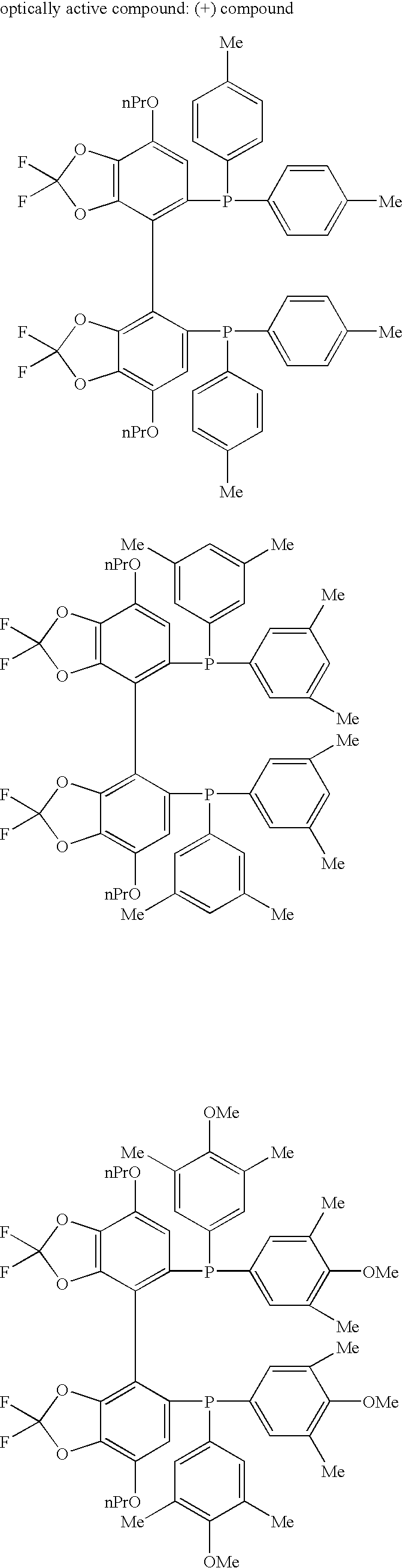


(wherein, X2 represents a halogen atom; R1 and Q are the same as described above) and a phosphonic halide represented by the following formula (3):
PR2R3(═O)X3 (3)
(wherein, X3 represents a halogen atom; R2 and R3 are the same as described above) are reacted in an appropriate solvent in the presence of magnesium to produce a phosphine oxide compound represented by the following formula (4):

(wherein, R1 to R3 and Q are the same as described above).
(2) Step 2

(wherein, X4 represents a halogen atom; R1 to R3 and Q are the same as described above).
(3) Step 3

(wherein, R1 to R3 and Q are the same as described above).
(4) Step 4


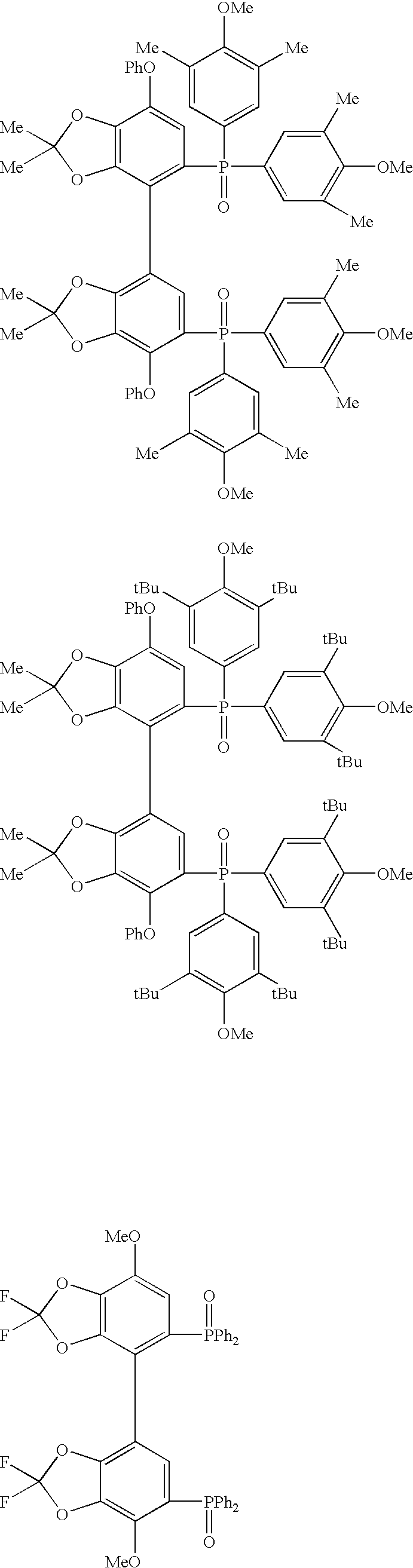


MmLnXpYq (11)
[MmLnXpYq]Zs (12)
(wherein, L represents the diphosphine compound represented by the above formula (1); M represents a transition metal; X represents a halogen atom, a carboxylate group, an allyl group, 1,5-cyclooctadiene or norbornadiene; Y represents a ligand; Z represents an anion or a cation; m and n each independently represents an integer of 1 to 5; and p, q and s each independently represent an integer of 0 to 5).
[(R11)2NH2]+ (13)
(wherein, two of R11 are the same or different and represent a hydrogen atom or a optionally substituted hydrocarbon group).
MmLnXpYq (11)
[MmLnXpYq]Zs (12)
[MXpYq]Zs (15)
(wherein, M, X, Y, Z, p, q and s are the same as described above).


Claims (25)


Applications Claiming Priority (2)
| Application Number | Priority Date | Filing Date | Title |
|---|---|---|---|
| JP2005-275455 | 2005-09-22 | ||
| JP2005275455 | 2005-09-22 |
Publications (2)
| Publication Number | Publication Date |
|---|---|
| US20070073065A1 US20070073065A1 (en) | 2007-03-29 |
| US7312347B2 true US7312347B2 (en) | 2007-12-25 |
Family
ID=37895006
Family Applications (1)
| Application Number | Title | Priority Date | Filing Date |
|---|---|---|---|
| US11/526,252 Expired - Fee Related US7312347B2 (en) | 2005-09-22 | 2006-09-22 | Substituted optically active disphosphine compound |
Country Status (1)
| Country | Link |
|---|---|
| US (1) | US7312347B2 (en) |
Families Citing this family (2)
| Publication number | Priority date | Publication date | Assignee | Title |
|---|---|---|---|---|
| JP6261563B2 (en) * | 2013-03-06 | 2018-01-17 | 高砂香料工業株式会社 | Method for producing optically active aldehyde |
| CN111635435B (en) * | 2020-05-22 | 2023-04-28 | 上海应用技术大学 | A divalent copper complex containing diphosphine ortho-carborane ligand and its preparation method and application |
Citations (3)
| Publication number | Priority date | Publication date | Assignee | Title |
|---|---|---|---|---|
| JPH10182678A (en) | 1996-12-26 | 1998-07-07 | Takasago Internatl Corp | Novel chiral diphosphine compound, intermediate for producing the same, transition metal complex having the diphosphine compound as a ligand, and asymmetric hydrogenation catalyst containing the complex |
| WO2002040492A1 (en) | 2000-11-17 | 2002-05-23 | Ppg-Sipsy | Chiral diphosphines and their metal complexes |
| WO2002040491A1 (en) | 2000-11-17 | 2002-05-23 | The Penn State Research Foundation | Ortho substituted chiral phosphines and phosphinites and their use in asymmetric catayltic reactions |
-
2006
- 2006-09-22 US US11/526,252 patent/US7312347B2/en not_active Expired - Fee Related
Patent Citations (3)
| Publication number | Priority date | Publication date | Assignee | Title |
|---|---|---|---|---|
| JPH10182678A (en) | 1996-12-26 | 1998-07-07 | Takasago Internatl Corp | Novel chiral diphosphine compound, intermediate for producing the same, transition metal complex having the diphosphine compound as a ligand, and asymmetric hydrogenation catalyst containing the complex |
| WO2002040492A1 (en) | 2000-11-17 | 2002-05-23 | Ppg-Sipsy | Chiral diphosphines and their metal complexes |
| WO2002040491A1 (en) | 2000-11-17 | 2002-05-23 | The Penn State Research Foundation | Ortho substituted chiral phosphines and phosphinites and their use in asymmetric catayltic reactions |
Non-Patent Citations (2)
| Title |
|---|
| Leroux et al., Synthesis, 3:326-328 (2004). |
| Sun et al., Tetrahedron: Asymmetry, 15:2185-2188 (2004). |
Also Published As
| Publication number | Publication date |
|---|---|
| US20070073065A1 (en) | 2007-03-29 |
Similar Documents
| Publication | Publication Date | Title |
|---|---|---|
| JP5694275B2 (en) | Catalyst for homogeneous asymmetric hydrogenation | |
| JP5477557B2 (en) | Process for producing alcohols by hydrogen reduction of esters or lactones | |
| US7754889B2 (en) | Optically active transition metal-diamine compound and process for producing optically active alcohol with the same | |
| JP2009514827A (en) | Bidentate C, P-chiral phosphine ligand | |
| US7312347B2 (en) | Substituted optically active disphosphine compound | |
| EP1685092B1 (en) | Asymmetric reductive amination of keto acid derivatives for producing amino acid derivatives | |
| JP4425654B2 (en) | Water-soluble transition metal-diamine complex, method for producing the same, and use thereof | |
| US20060142603A1 (en) | Novel transition metal complex and process for producing optically active alcohol | |
| JP4855196B2 (en) | Substituted optically active diphosphine compounds | |
| US7135582B2 (en) | Transition metal complex having diphosphine compound as ligand | |
| US20070142472A1 (en) | Process for producing optically active 3-(4-hydroxyphenyl)proprionic acids | |
| JP4845470B2 (en) | Process for producing optically active amino alcohols | |
| US7351849B2 (en) | Process for producing optically active β-amino acid derivatives | |
| JP2005239583A (en) | Process for producing optically active 2-alkyl-1-butanoic acids | |
| JP2000198778A (en) | Method for producing optically active cyclic compounds | |
| WO2016047388A1 (en) | Process for producing alcohol analogue | |
| JP2011140469A (en) | New ligand, transition metal complex and method for producing optically active alcohol using the complex as catalyst |
Legal Events
| Date | Code | Title | Description |
|---|---|---|---|
| AS | Assignment |
Owner name: TAKASAGO INTERNATIONAL CORPORATION, JAPAN Free format text: ASSIGNMENT OF ASSIGNORS INTEREST;ASSIGNORS:FUJIHARA, TSUYOSHI;YOKOZAWA, TOHRU;REEL/FRAME:018346/0008 Effective date: 20060829 |
|
| AS | Assignment |
Owner name: TAKASAGO INTERNATIONAL CORPORATION, JAPAN Free format text: ASSIGNMENT OF ASSIGNORS INTEREST;ASSIGNORS:FUJIWARA, TAKAHIRO;YOKOZAWA, TOHRU;REEL/FRAME:018644/0557 Effective date: 20060829 |
|
| STCF | Information on status: patent grant |
Free format text: PATENTED CASE |
|
| FEPP | Fee payment procedure |
Free format text: PAYOR NUMBER ASSIGNED (ORIGINAL EVENT CODE: ASPN); ENTITY STATUS OF PATENT OWNER: LARGE ENTITY |
|
| FPAY | Fee payment |
Year of fee payment: 4 |
|
| FPAY | Fee payment |
Year of fee payment: 8 |
|
| FEPP | Fee payment procedure |
Free format text: MAINTENANCE FEE REMINDER MAILED (ORIGINAL EVENT CODE: REM.); ENTITY STATUS OF PATENT OWNER: LARGE ENTITY |
|
| LAPS | Lapse for failure to pay maintenance fees |
Free format text: PATENT EXPIRED FOR FAILURE TO PAY MAINTENANCE FEES (ORIGINAL EVENT CODE: EXP.); ENTITY STATUS OF PATENT OWNER: LARGE ENTITY |
|
| STCH | Information on status: patent discontinuation |
Free format text: PATENT EXPIRED DUE TO NONPAYMENT OF MAINTENANCE FEES UNDER 37 CFR 1.362 |
|
| FP | Lapsed due to failure to pay maintenance fee |
Effective date: 20191225 |