US7301018B2 - Probe for mass spectrometry of liquid sample - Google Patents
Probe for mass spectrometry of liquid sample Download PDFInfo
- Publication number
- US7301018B2 US7301018B2 US10/332,622 US33262203A US7301018B2 US 7301018 B2 US7301018 B2 US 7301018B2 US 33262203 A US33262203 A US 33262203A US 7301018 B2 US7301018 B2 US 7301018B2
- Authority
- US
- United States
- Prior art keywords
- formula
- compound
- represented
- mass spectrometry
- mmol
- Prior art date
- Legal status (The legal status is an assumption and is not a legal conclusion. Google has not performed a legal analysis and makes no representation as to the accuracy of the status listed.)
- Expired - Fee Related, expires
Links
- 0 [3*][N+]([4*])([5*])C Chemical compound [3*][N+]([4*])([5*])C 0.000 description 37
- BRJYZKWZKKTYDL-UHFFFAOYSA-L C1=CC=C(C2OCCO2)C=C1.C[Si](C)(C)C#N.I[Zn]I.[C-]#[N+]C(OCCO[Si](C)(C)C)C1=CC=CC=C1 Chemical compound C1=CC=C(C2OCCO2)C=C1.C[Si](C)(C)C#N.I[Zn]I.[C-]#[N+]C(OCCO[Si](C)(C)C)C1=CC=CC=C1 BRJYZKWZKKTYDL-UHFFFAOYSA-L 0.000 description 6
- GXWFHOWDZMWGPI-UHFFFAOYSA-M CC(C)(C)OC(=O)NCC(OCCI)C1=CC=CC=C1.CC(C)(C)OC(=O)NCC(OCCOS(C)(=O)=O)C1=CC=CC=C1.[Na]I Chemical compound CC(C)(C)OC(=O)NCC(OCCI)C1=CC=CC=C1.CC(C)(C)OC(=O)NCC(OCCOS(C)(=O)=O)C1=CC=CC=C1.[Na]I GXWFHOWDZMWGPI-UHFFFAOYSA-M 0.000 description 6
- OYTSVVMBBHVNEV-UHFFFAOYSA-N CC(C)(C)OC(=O)NCC(OCCO)C1=CC=CC=C1.CC(C)(C)OC(=O)NCC(OCCOS(C)(=O)=O)C1=CC=CC=C1 Chemical compound CC(C)(C)OC(=O)NCC(OCCO)C1=CC=CC=C1.CC(C)(C)OC(=O)NCC(OCCOS(C)(=O)=O)C1=CC=CC=C1 OYTSVVMBBHVNEV-UHFFFAOYSA-N 0.000 description 6
- AZMIGVQQOASDOS-UHFFFAOYSA-N CC(C)(C)OC(=O)NCC(OCCO)C1=CC=CC=C1.NCC(OCCO)C1=CC=CC=C1 Chemical compound CC(C)(C)OC(=O)NCC(OCCO)C1=CC=CC=C1.NCC(OCCO)C1=CC=CC=C1 AZMIGVQQOASDOS-UHFFFAOYSA-N 0.000 description 6
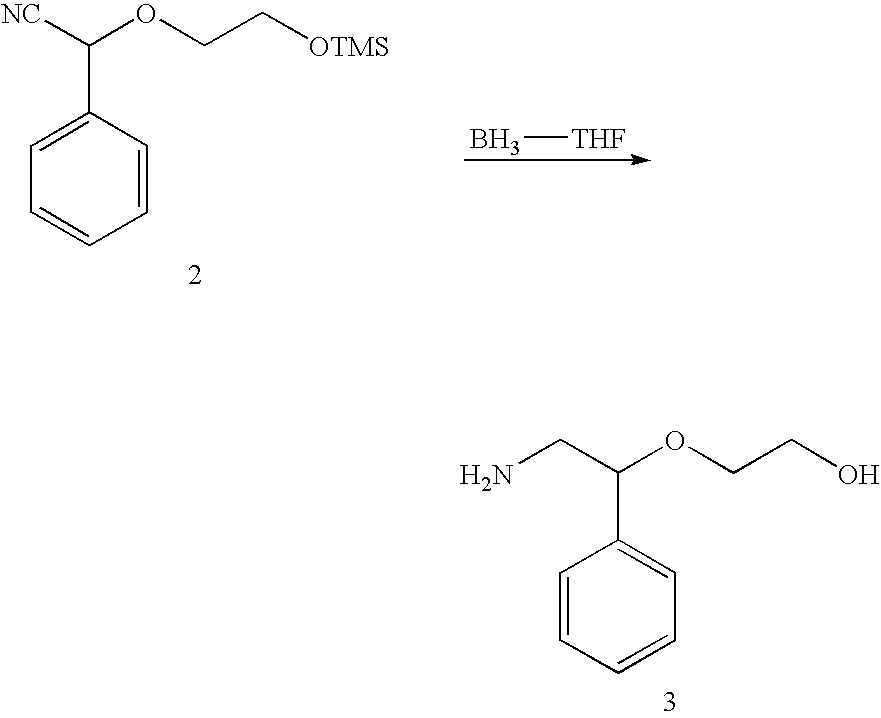
- LUFYETVNAOUKAM-UHFFFAOYSA-N BC1CCCO1.NCC(OCCO)C1=CC=CC=C1.[C-]#[N+]C(OCCO[Si](C)(C)C)C1=CC=CC=C1 Chemical compound BC1CCCO1.NCC(OCCO)C1=CC=CC=C1.[C-]#[N+]C(OCCO[Si](C)(C)C)C1=CC=CC=C1 LUFYETVNAOUKAM-UHFFFAOYSA-N 0.000 description 4
- GJELSGXTNUTXJO-UHFFFAOYSA-O CC(C)(C)OC(=O)NCC(OCCI)C1=CC=CC=C1.CCN(CC)CC.CC[N+](CC)(CC)CCOC(CNC(=O)OC(C)(C)C)C1=CC=CC=C1.[I-] Chemical compound CC(C)(C)OC(=O)NCC(OCCI)C1=CC=CC=C1.CCN(CC)CC.CC[N+](CC)(CC)CCOC(CNC(=O)OC(C)(C)C)C1=CC=CC=C1.[I-] GJELSGXTNUTXJO-UHFFFAOYSA-O 0.000 description 4
- NGULGDVLVIMBGT-UHFFFAOYSA-N CC(C)(C)OC(NCC(c1ccccc1)OCCO)=O Chemical compound CC(C)(C)OC(NCC(c1ccccc1)OCCO)=O NGULGDVLVIMBGT-UHFFFAOYSA-N 0.000 description 3
- SEEYREPSKCQBBF-UHFFFAOYSA-N CN1C(=O)C=CC1=O Chemical compound CN1C(=O)C=CC1=O SEEYREPSKCQBBF-UHFFFAOYSA-N 0.000 description 3
- QSJXEFYPDANLFS-UHFFFAOYSA-N CC(=O)C(C)=O Chemical compound CC(=O)C(C)=O QSJXEFYPDANLFS-UHFFFAOYSA-N 0.000 description 2
- CJWQUWFCTXMXLV-UHFFFAOYSA-N CC(C)(C)OC(NCC(c1ccccc1)OCCOS(C)(=O)=O)=O Chemical compound CC(C)(C)OC(NCC(c1ccccc1)OCCOS(C)(=O)=O)=O CJWQUWFCTXMXLV-UHFFFAOYSA-N 0.000 description 2
- CSCPPACGZOOCGX-UHFFFAOYSA-N CC(C)=O Chemical compound CC(C)=O CSCPPACGZOOCGX-UHFFFAOYSA-N 0.000 description 2
- SKWVTWPYLVXDOJ-UHFFFAOYSA-N CC1=CC(C=O)=C(C)C=C1.CC1=CC(N)=C(N)C=C1 Chemical compound CC1=CC(C=O)=C(C)C=C1.CC1=CC(N)=C(N)C=C1 SKWVTWPYLVXDOJ-UHFFFAOYSA-N 0.000 description 2
- NPPHAHFPMPOLDX-UHFFFAOYSA-N CC1=CC(C=O)=C(C=O)C=C1 Chemical compound CC1=CC(C=O)=C(C=O)C=C1 NPPHAHFPMPOLDX-UHFFFAOYSA-N 0.000 description 2
- DGRGLKZMKWPMOH-UHFFFAOYSA-N CC1=CC(N)=C(N)C=C1 Chemical compound CC1=CC(N)=C(N)C=C1 DGRGLKZMKWPMOH-UHFFFAOYSA-N 0.000 description 2
- AASBXERNXVFUEJ-UHFFFAOYSA-N CCC(=O)ON1C(=O)CCC1=O Chemical compound CCC(=O)ON1C(=O)CCC1=O AASBXERNXVFUEJ-UHFFFAOYSA-N 0.000 description 2
- ZWEHNKRNPOVVGH-UHFFFAOYSA-N CCC(C)=O Chemical compound CCC(C)=O ZWEHNKRNPOVVGH-UHFFFAOYSA-N 0.000 description 2
- XEKOWRVHYACXOJ-UHFFFAOYSA-N CCOC(C)=O Chemical compound CCOC(C)=O XEKOWRVHYACXOJ-UHFFFAOYSA-N 0.000 description 2
- DDYSVDIFCIAQQN-UHFFFAOYSA-P CC[N+](CC)(CC)CCOC(CNC(=O)C1=CC=C(C(=O)CBr)C=C1)C1=CC=CC=C1.CC[N+](CC)(CC)CCOC(CNC(=O)OC(C)(C)C)C1=CC=CC=C1.ClCCl.O=C(O)C(F)(F)F.O=C(O)C1=CC=C(C(=O)CBr)C=C1.[I-].[I-] Chemical compound CC[N+](CC)(CC)CCOC(CNC(=O)C1=CC=C(C(=O)CBr)C=C1)C1=CC=CC=C1.CC[N+](CC)(CC)CCOC(CNC(=O)OC(C)(C)C)C1=CC=CC=C1.ClCCl.O=C(O)C(F)(F)F.O=C(O)C1=CC=C(C(=O)CBr)C=C1.[I-].[I-] DDYSVDIFCIAQQN-UHFFFAOYSA-P 0.000 description 2
- NZLZEDOFKNXQTR-UHFFFAOYSA-N NCC(OCCO)C1=CC=CC=C1.[C-]#[N+]C(OCCO[Si](C)(C)C)C1=CC=CC=C1 Chemical compound NCC(OCCO)C1=CC=CC=C1.[C-]#[N+]C(OCCO[Si](C)(C)C)C1=CC=CC=C1 NZLZEDOFKNXQTR-UHFFFAOYSA-N 0.000 description 2
- FGUNBAYYBGZTAN-UHFFFAOYSA-N NCC(c1ccccc1)OCCO Chemical compound NCC(c1ccccc1)OCCO FGUNBAYYBGZTAN-UHFFFAOYSA-N 0.000 description 2
- AIJULSRZWUXGPQ-UHFFFAOYSA-N [H]C(=O)C(C)=O Chemical compound [H]C(=O)C(C)=O AIJULSRZWUXGPQ-UHFFFAOYSA-N 0.000 description 2
- ROTRBBJJQWFSJQ-UHFFFAOYSA-N BC1CCCO1.C.C.C1=CC=C(C2OCCO2)C=C1.CC(C)(C)OC(=O)NCC(OCCI)C1=CC=CC=C1.CC(C)(C)OC(=O)NCC(OCCO)C1=CC=CC=C1.CC(C)(C)OC(=O)NCC(OCCOS(C)(=O)=O)C1=CC=CC=C1.CCN(CC)CC.CC[N+](CC)(CC)CCOC(CNC(=O)C1=CC=C(C(=O)CBr)C=C1)C1=CC=CC=C1.CC[N+](CC)(CC)CCOC(CNC(=O)OC(C)(C)C)C1=CC=CC=C1.C[Si](C)(C)C#N.ClCCl.I[Zn]I.NCC(OCCO)C1=CC=CC=C1.O=C(O)C(F)(F)F.O=C(O)C1=CC=C(C(=O)CBr)C=C1.[C-]#[N+]C(OCCO[Si](C)(C)C)C1=CC=CC=C1.[H]C(=O)C(=O)C1=CC=C(C(=O)NCC(OCC[N+](CC)(CC)CC)C2=CC=CC=C2)C=C1.[I-].[I-].[I-].[Na]I Chemical compound BC1CCCO1.C.C.C1=CC=C(C2OCCO2)C=C1.CC(C)(C)OC(=O)NCC(OCCI)C1=CC=CC=C1.CC(C)(C)OC(=O)NCC(OCCO)C1=CC=CC=C1.CC(C)(C)OC(=O)NCC(OCCOS(C)(=O)=O)C1=CC=CC=C1.CCN(CC)CC.CC[N+](CC)(CC)CCOC(CNC(=O)C1=CC=C(C(=O)CBr)C=C1)C1=CC=CC=C1.CC[N+](CC)(CC)CCOC(CNC(=O)OC(C)(C)C)C1=CC=CC=C1.C[Si](C)(C)C#N.ClCCl.I[Zn]I.NCC(OCCO)C1=CC=CC=C1.O=C(O)C(F)(F)F.O=C(O)C1=CC=C(C(=O)CBr)C=C1.[C-]#[N+]C(OCCO[Si](C)(C)C)C1=CC=CC=C1.[H]C(=O)C(=O)C1=CC=C(C(=O)NCC(OCC[N+](CC)(CC)CC)C2=CC=CC=C2)C=C1.[I-].[I-].[I-].[Na]I ROTRBBJJQWFSJQ-UHFFFAOYSA-N 0.000 description 1
- VLMFUQMLEJMLBL-UHFFFAOYSA-M BC1CCCO1.C.C.C1=CC=C(C2OCCO2)C=C1.CC(C)(C)OC(=O)NCC(OCCI)C1=CC=CC=C1.CC(C)(C)OC(=O)NCC(OCCO)C1=CC=CC=C1.CC(C)(C)OC(=O)NCC(OCCOS(C)(=O)=O)C1=CC=CC=C1.CCN(CC)CC.CC[N+](CC)(CC)CCOC(CNC(=O)C1=CC=C(C(=O)CBr)C=C1)C1=CC=CC=C1.CC[N+](CC)(CC)CCOC(CNC(=O)OC(C)(C)C)C1=CC=CC=C1.C[Si](C)(C)C#N.ClCCl.I[Zn]I.NCC(OCCO)C1=CC=CC=C1.O=C(O)C(F)(F)F.O=C(O)C1=CC=C(C(=O)CBr)C=C1.[C-]#[N+]C(OCCO[Si](C)(C)C)C1=CC=CC=C1.[I-].[I-].[Na]I Chemical compound BC1CCCO1.C.C.C1=CC=C(C2OCCO2)C=C1.CC(C)(C)OC(=O)NCC(OCCI)C1=CC=CC=C1.CC(C)(C)OC(=O)NCC(OCCO)C1=CC=CC=C1.CC(C)(C)OC(=O)NCC(OCCOS(C)(=O)=O)C1=CC=CC=C1.CCN(CC)CC.CC[N+](CC)(CC)CCOC(CNC(=O)C1=CC=C(C(=O)CBr)C=C1)C1=CC=CC=C1.CC[N+](CC)(CC)CCOC(CNC(=O)OC(C)(C)C)C1=CC=CC=C1.C[Si](C)(C)C#N.ClCCl.I[Zn]I.NCC(OCCO)C1=CC=CC=C1.O=C(O)C(F)(F)F.O=C(O)C1=CC=C(C(=O)CBr)C=C1.[C-]#[N+]C(OCCO[Si](C)(C)C)C1=CC=CC=C1.[I-].[I-].[Na]I VLMFUQMLEJMLBL-UHFFFAOYSA-M 0.000 description 1
- ISZHSEOLFZTJAB-UHFFFAOYSA-M BC1CCCO1.C.C.C1=CC=C(C2OCCO2)C=C1.CC(C)(C)OC(=O)NCC(OCCI)C1=CC=CC=C1.CC(C)(C)OC(=O)NCC(OCCO)C1=CC=CC=C1.CC(C)(C)OC(=O)NCC(OCCOS(C)(=O)=O)C1=CC=CC=C1.CCN(CC)CC.CC[N+](CC)(CC)CCOC(CNC(=O)CCN)C1=CC=CC=C1.CC[N+](CC)(CC)CCOC(CNC(=O)OC(C)(C)C)C1=CC=CC=C1.C[Si](C)(C)C#N.ClCCl.I[Zn]I.NCC(OCCO)C1=CC=CC=C1.NCCC(=O)O.O=C(O)C(F)(F)F.[C-]#[N+]C(OCCO[Si](C)(C)C)C1=CC=CC=C1.[I-].[I-].[Na]I Chemical compound BC1CCCO1.C.C.C1=CC=C(C2OCCO2)C=C1.CC(C)(C)OC(=O)NCC(OCCI)C1=CC=CC=C1.CC(C)(C)OC(=O)NCC(OCCO)C1=CC=CC=C1.CC(C)(C)OC(=O)NCC(OCCOS(C)(=O)=O)C1=CC=CC=C1.CCN(CC)CC.CC[N+](CC)(CC)CCOC(CNC(=O)CCN)C1=CC=CC=C1.CC[N+](CC)(CC)CCOC(CNC(=O)OC(C)(C)C)C1=CC=CC=C1.C[Si](C)(C)C#N.ClCCl.I[Zn]I.NCC(OCCO)C1=CC=CC=C1.NCCC(=O)O.O=C(O)C(F)(F)F.[C-]#[N+]C(OCCO[Si](C)(C)C)C1=CC=CC=C1.[I-].[I-].[Na]I ISZHSEOLFZTJAB-UHFFFAOYSA-M 0.000 description 1
- RRYUXSIBQXIUHY-HLELSEDASA-M BC1CCCO1.C.C.C1=CC=C(C2OCCO2)C=C1.CC(C)(C)OC(=O)NCC(OCCI)C1=CC=CC=C1.CC(C)(C)OC(=O)NCC(OCCOS(C)(=O)=O)C1=CC=CC=C1.CC(C)C[C@H](Br)C(=O)O.CCN(CC)CC.CC[N+](CC)(CC)CCOC(CNC(=O)OC(C)(C)C)C1=CC=CC=C1.CC[N+](CC)(CC)CCOC(CNC(=O)[C@@H](Br)CC(C)C)C1=CC=CC=C1.C[Si](C)(C)C#N.ClCCl.I[Zn]I.NCC(OCCO)C1=CC=CC=C1.NCCC(OCCO)C1=CC=CC=C1.O=C(O)C(F)(F)F.[C-]#[N+]C(OCCO[Si](C)(C)C)C1=CC=CC=C1.[I-].[I-].[Na]I Chemical compound BC1CCCO1.C.C.C1=CC=C(C2OCCO2)C=C1.CC(C)(C)OC(=O)NCC(OCCI)C1=CC=CC=C1.CC(C)(C)OC(=O)NCC(OCCOS(C)(=O)=O)C1=CC=CC=C1.CC(C)C[C@H](Br)C(=O)O.CCN(CC)CC.CC[N+](CC)(CC)CCOC(CNC(=O)OC(C)(C)C)C1=CC=CC=C1.CC[N+](CC)(CC)CCOC(CNC(=O)[C@@H](Br)CC(C)C)C1=CC=CC=C1.C[Si](C)(C)C#N.ClCCl.I[Zn]I.NCC(OCCO)C1=CC=CC=C1.NCCC(OCCO)C1=CC=CC=C1.O=C(O)C(F)(F)F.[C-]#[N+]C(OCCO[Si](C)(C)C)C1=CC=CC=C1.[I-].[I-].[Na]I RRYUXSIBQXIUHY-HLELSEDASA-M 0.000 description 1
- HRBLAWAYXJSMEJ-USZYXSJSSA-K C.C.C/C(N)=C/C(=O)NCC(OCCI)C1=CC=CC=C1.C1=CC=C(C2OCCO2)C=C1.CC(=O)CC(=O)NCC(OCCI)C1=CC=CC=C1.CC(=O)CC(=O)O.CC(C)(C)OC(=O)NCC(OCCI)C1=CC=CC=C1.CC(C)(C)OC(=O)NCC(OCCO)C1=CC=CC=C1.CC(C)(C)OC(=O)NCC(OCCOS(C)(=O)=O)C1=CC=CC=C1.CCCOC(CNC(=O)/C=C(/C)N)C1=CC=CC=C1.C[Si](C)(C)C#N.ClCCl.I[Zn]I.N.NCC(OCCO)C1=CC=CC=C1.O=C(O)C(F)(F)F.[C-]#[N+]C(OCCO[Si](C)(C)C)C1=CC=CC=C1.[Na]I Chemical compound C.C.C/C(N)=C/C(=O)NCC(OCCI)C1=CC=CC=C1.C1=CC=C(C2OCCO2)C=C1.CC(=O)CC(=O)NCC(OCCI)C1=CC=CC=C1.CC(=O)CC(=O)O.CC(C)(C)OC(=O)NCC(OCCI)C1=CC=CC=C1.CC(C)(C)OC(=O)NCC(OCCO)C1=CC=CC=C1.CC(C)(C)OC(=O)NCC(OCCOS(C)(=O)=O)C1=CC=CC=C1.CCCOC(CNC(=O)/C=C(/C)N)C1=CC=CC=C1.C[Si](C)(C)C#N.ClCCl.I[Zn]I.N.NCC(OCCO)C1=CC=CC=C1.O=C(O)C(F)(F)F.[C-]#[N+]C(OCCO[Si](C)(C)C)C1=CC=CC=C1.[Na]I HRBLAWAYXJSMEJ-USZYXSJSSA-K 0.000 description 1
- SEKLPERZUKLYAM-MGANTGTHSA-N C.C/C(N)=C/C(=O)NCC(OCCI)C1=CC=CC=C1.CCCOC(CNC(=O)/C=C(/C)N)C1=CC=CC=C1 Chemical compound C.C/C(N)=C/C(=O)NCC(OCCI)C1=CC=CC=C1.CCCOC(CNC(=O)/C=C(/C)N)C1=CC=CC=C1 SEKLPERZUKLYAM-MGANTGTHSA-N 0.000 description 1
- AYOAIMLZIFKKMY-UHFFFAOYSA-N C.CC(=O)CC(=O)NCC(OCCI)C1=CC=CC=C1.CC(=O)CC(=O)O.CC(C)(C)OC(=O)NCC(OCCI)C1=CC=CC=C1.ClCCl.O=C(O)C(F)(F)F Chemical compound C.CC(=O)CC(=O)NCC(OCCI)C1=CC=CC=C1.CC(=O)CC(=O)O.CC(C)(C)OC(=O)NCC(OCCI)C1=CC=CC=C1.ClCCl.O=C(O)C(F)(F)F AYOAIMLZIFKKMY-UHFFFAOYSA-N 0.000 description 1
- YDITTZCDQJSGIZ-UHFFFAOYSA-N C.CCN(CC)CC.CC[N+](CC)(CC)CCOC(CN=C=S)C1=CC=CC=C1.N#CSCC(OCCI)C1=CC=CC=C1.[I-] Chemical compound C.CCN(CC)CC.CC[N+](CC)(CC)CCOC(CN=C=S)C1=CC=CC=C1.N#CSCC(OCCI)C1=CC=CC=C1.[I-] YDITTZCDQJSGIZ-UHFFFAOYSA-N 0.000 description 1
- ZEBNHACRBMILCI-UHFFFAOYSA-M C.CC[N+](CC)(CC)CCOC(CBr)C1=CC=CC=C1.CC[N+](CC)(CC)CCOC(COS(C)(=O)=O)C1=CC=CC=C1.[I-].[I-].[Li]Br Chemical compound C.CC[N+](CC)(CC)CCOC(CBr)C1=CC=CC=C1.CC[N+](CC)(CC)CCOC(COS(C)(=O)=O)C1=CC=CC=C1.[I-].[I-].[Li]Br ZEBNHACRBMILCI-UHFFFAOYSA-M 0.000 description 1
- HWZZLHURVQARHW-UHFFFAOYSA-P C.CC[N+](CC)(CC)CCOC(CNC(=O)CCN)C1=CC=CC=C1.CC[N+](CC)(CC)CCOC(CNC(=O)OC(C)(C)C)C1=CC=CC=C1.ClCCl.NCCC(=O)O.O=C(O)C(F)(F)F.[I-].[I-] Chemical compound C.CC[N+](CC)(CC)CCOC(CNC(=O)CCN)C1=CC=CC=C1.CC[N+](CC)(CC)CCOC(CNC(=O)OC(C)(C)C)C1=CC=CC=C1.ClCCl.NCCC(=O)O.O=C(O)C(F)(F)F.[I-].[I-] HWZZLHURVQARHW-UHFFFAOYSA-P 0.000 description 1
- CLWFJYLMDKNVEX-KSIDEHCFSA-N C/C(N)=C/C(=O)NCC(OCCI)C1=CC=CC=C1.CC(=O)CC(=O)NCC(OCCI)C1=CC=CC=C1.N Chemical compound C/C(N)=C/C(=O)NCC(OCCI)C1=CC=CC=C1.CC(=O)CC(=O)NCC(OCCI)C1=CC=CC=C1.N CLWFJYLMDKNVEX-KSIDEHCFSA-N 0.000 description 1
- VQFAIAKCILWQPZ-UHFFFAOYSA-N CC(=O)CBr Chemical compound CC(=O)CBr VQFAIAKCILWQPZ-UHFFFAOYSA-N 0.000 description 1
- QRVSGPLYZFAWDK-XOXBZRHCSA-M CC(=O)OCC1O[C@@H](O[C@@H]2C(CN)O[C@H](O)C(OC(C)=O)[C@H]2OC(C)=O)C(OC(C)=O)[C@@H](OC(C)=O)[C@@H]1O.CCC1O[C@H](O)C(O)[C@@H](O)[C@@H]1O[C@@H]1OC(CO)[C@@H](O)[C@H](O)C1O.CCC1O[C@H](O)C(OC(C)=O)[C@@H](OC(C)=O)[C@@H]1O[C@@H]1OC(COC(C)=O)[C@@H](O)[C@H](OC(C)=O)C1OC(C)=O.CCO.NCC1O[C@H](O)C(O)[C@@H](O)[C@@H]1O[C@@H]1OC(CO)[C@@H](O)[C@H](O)C1O.O[Na].[I-].[I-] Chemical compound CC(=O)OCC1O[C@@H](O[C@@H]2C(CN)O[C@H](O)C(OC(C)=O)[C@H]2OC(C)=O)C(OC(C)=O)[C@@H](OC(C)=O)[C@@H]1O.CCC1O[C@H](O)C(O)[C@@H](O)[C@@H]1O[C@@H]1OC(CO)[C@@H](O)[C@H](O)C1O.CCC1O[C@H](O)C(OC(C)=O)[C@@H](OC(C)=O)[C@@H]1O[C@@H]1OC(COC(C)=O)[C@@H](O)[C@H](OC(C)=O)C1OC(C)=O.CCO.NCC1O[C@H](O)C(O)[C@@H](O)[C@@H]1O[C@@H]1OC(CO)[C@@H](O)[C@H](O)C1O.O[Na].[I-].[I-] QRVSGPLYZFAWDK-XOXBZRHCSA-M 0.000 description 1
- JIUOROMCRSCXBW-RBKKACQMSA-N CC(=O)OCC1O[C@@H](O[C@@H]2C(CN)O[C@H](O)C(OC(C)=O)[C@H]2OC(C)=O)C(OC(C)=O)[C@@H](OC(C)=O)[C@@H]1O.CCC1O[C@H](O)C(OC(C)=O)[C@@H](OC(C)=O)[C@@H]1O[C@@H]1OC(COC(C)=O)[C@@H](O)[C@H](OC(C)=O)C1OC(C)=O.[I-] Chemical compound CC(=O)OCC1O[C@@H](O[C@@H]2C(CN)O[C@H](O)C(OC(C)=O)[C@H]2OC(C)=O)C(OC(C)=O)[C@@H](OC(C)=O)[C@@H]1O.CCC1O[C@H](O)C(OC(C)=O)[C@@H](OC(C)=O)[C@@H]1O[C@@H]1OC(COC(C)=O)[C@@H](O)[C@H](OC(C)=O)C1OC(C)=O.[I-] JIUOROMCRSCXBW-RBKKACQMSA-N 0.000 description 1
- FVZACKIFLLUNQZ-YMOUKXHCSA-N CC(=O)OCC1O[C@@H](O[C@@H]2C(CN)O[C@H](O)C(OC(C)=O)[C@H]2OC(C)=O)C(OC(C)=O)[C@@H](OC(C)=O)[C@@H]1O.NCC1O[C@H](O)C(O)[C@@H](O)[C@@H]1O[C@@H]1OC(CO)[C@@H](O)[C@H](O)C1O Chemical compound CC(=O)OCC1O[C@@H](O[C@@H]2C(CN)O[C@H](O)C(OC(C)=O)[C@H]2OC(C)=O)C(OC(C)=O)[C@@H](OC(C)=O)[C@@H]1O.NCC1O[C@H](O)C(O)[C@@H](O)[C@@H]1O[C@@H]1OC(CO)[C@@H](O)[C@H](O)C1O FVZACKIFLLUNQZ-YMOUKXHCSA-N 0.000 description 1
- FJRWCIGNSCXBKS-UHFFFAOYSA-O CC(C)(C)C1=CC=C(CN)C=C1.CC[N+](CC)(CC)CCOC(CN=C=S)C1=CC=CC=C1.CC[N+](CC)(CC)CCOC(CNC(=S)NCC1=CC=C(C(C)(C)C)C=C1)C1=CC=CC=C1.[I-].[I-] Chemical compound CC(C)(C)C1=CC=C(CN)C=C1.CC[N+](CC)(CC)CCOC(CN=C=S)C1=CC=CC=C1.CC[N+](CC)(CC)CCOC(CNC(=S)NCC1=CC=C(C(C)(C)C)C=C1)C1=CC=CC=C1.[I-].[I-] FJRWCIGNSCXBKS-UHFFFAOYSA-O 0.000 description 1
- GJWBWNGOCJMRJX-XNPDZEALSA-N CC(C)(C)[Si](C)(C)Cl.CC(C)(C)[Si](C)(C)OCC(OCCO)C1=CC=CC=C1.OCCOC(CO)C1=CC=CC=C1.[2H]B(C)[U]C#N Chemical compound CC(C)(C)[Si](C)(C)Cl.CC(C)(C)[Si](C)(C)OCC(OCCO)C1=CC=CC=C1.OCCOC(CO)C1=CC=CC=C1.[2H]B(C)[U]C#N GJWBWNGOCJMRJX-XNPDZEALSA-N 0.000 description 1
- KWHYATIZGYHUCX-UHFFFAOYSA-M CC(C)(C)[Si](C)(C)OCC(OCCI)C1=CC=CC=C1.CC(C)(C)[Si](C)(C)OCC(OCCS(C)(=O)=O)C1=CC=CC=C1.[Na]I Chemical compound CC(C)(C)[Si](C)(C)OCC(OCCI)C1=CC=CC=C1.CC(C)(C)[Si](C)(C)OCC(OCCS(C)(=O)=O)C1=CC=CC=C1.[Na]I KWHYATIZGYHUCX-UHFFFAOYSA-M 0.000 description 1
- JDZFXEGWJURHJX-UHFFFAOYSA-N CC(C)(C)[Si](C)(C)OCC(OCCI)C1=CC=CC=C1.CC[N+](CC)(CC)CCOC(CO[Si](C)(C)C(C)(C)C)C1=CC=CC=C1.[I-] Chemical compound CC(C)(C)[Si](C)(C)OCC(OCCI)C1=CC=CC=C1.CC[N+](CC)(CC)CCOC(CO[Si](C)(C)C(C)(C)C)C1=CC=CC=C1.[I-] JDZFXEGWJURHJX-UHFFFAOYSA-N 0.000 description 1
- DQOZQRJRBDDKRD-UHFFFAOYSA-N CC(C)(C)[Si](C)(C)OCC(OCCO)C1=CC=CC=C1.CC(C)(C)[Si](C)(C)OCC(OCCS(C)(=O)=O)C1=CC=CC=C1.CS(=O)(=O)Cl Chemical compound CC(C)(C)[Si](C)(C)OCC(OCCO)C1=CC=CC=C1.CC(C)(C)[Si](C)(C)OCC(OCCS(C)(=O)=O)C1=CC=CC=C1.CS(=O)(=O)Cl DQOZQRJRBDDKRD-UHFFFAOYSA-N 0.000 description 1
- MKSRJNLXWDWVEJ-PRPVJPANSA-P CC(C)C[C@H](Br)C(=O)O.CC[N+](CC)(CC)CCOC(CNC(=O)OC(C)(C)C)C1=CC=CC=C1.CC[N+](CC)(CC)CCOC(CNC(=O)[C@@H](Br)CC(C)C)C1=CC=CC=C1.ClCCl.O=C(O)C(F)(F)F.[I-].[I-] Chemical compound CC(C)C[C@H](Br)C(=O)O.CC[N+](CC)(CC)CCOC(CNC(=O)OC(C)(C)C)C1=CC=CC=C1.CC[N+](CC)(CC)CCOC(CNC(=O)[C@@H](Br)CC(C)C)C1=CC=CC=C1.ClCCl.O=C(O)C(F)(F)F.[I-].[I-] MKSRJNLXWDWVEJ-PRPVJPANSA-P 0.000 description 1
- POMMLNLAWORDBN-UHFFFAOYSA-P CC.CNOCC(=O)NCC1=CC=C(CN)C=C1.CNOCC(=O)NCC1=CC=C(C[N+](C)(C)C)C=C1.CNOCC(=O)O.CNOCC(=O)O.C[N+](C)(C)CC1=CC=C(CNC(=O)CON)C=C1.NCC1=CC=C(CN)C=C1.[I-].[I-] Chemical compound CC.CNOCC(=O)NCC1=CC=C(CN)C=C1.CNOCC(=O)NCC1=CC=C(C[N+](C)(C)C)C=C1.CNOCC(=O)O.CNOCC(=O)O.C[N+](C)(C)CC1=CC=C(CNC(=O)CON)C=C1.NCC1=CC=C(CN)C=C1.[I-].[I-] POMMLNLAWORDBN-UHFFFAOYSA-P 0.000 description 1
- LYZPRBMFOBSOPO-UHFFFAOYSA-N CC.CNOCC(=O)O.CNOCC(=O)O Chemical compound CC.CNOCC(=O)O.CNOCC(=O)O LYZPRBMFOBSOPO-UHFFFAOYSA-N 0.000 description 1
- MVHOAOSHABGEFL-UHFFFAOYSA-N CC1=CC2=C(C=C1)N=C(C)N2 Chemical compound CC1=CC2=C(C=C1)N=C(C)N2 MVHOAOSHABGEFL-UHFFFAOYSA-N 0.000 description 1
- XFMKHBNWJKZGDB-UHFFFAOYSA-N CC1=CC2=NN(C)N=C2C=C1 Chemical compound CC1=CC2=NN(C)N=C2C=C1 XFMKHBNWJKZGDB-UHFFFAOYSA-N 0.000 description 1
- WIMYYXRANPYBED-UHFFFAOYSA-N CC=NNC Chemical compound CC=NNC WIMYYXRANPYBED-UHFFFAOYSA-N 0.000 description 1
- ZVMDUTDWGXQEFL-UHFFFAOYSA-N CCC(=O)ON1C(=O)CCC1=O.CN1C(=O)C=CC1=O Chemical compound CCC(=O)ON1C(=O)CCC1=O.CN1C(=O)C=CC1=O ZVMDUTDWGXQEFL-UHFFFAOYSA-N 0.000 description 1
- WBTUGBIGENQHFS-OAYYUCCTSA-M CCC1O[C@H](O)C(O)[C@@H](O)[C@@H]1O[C@@H]1OC(CO)[C@@H](O)[C@H](O)C1O.CCC1O[C@H](O)C(OC(C)=O)[C@@H](OC(C)=O)[C@@H]1O[C@@H]1OC(COC(C)=O)[C@@H](O)[C@H](OC(C)=O)C1OC(C)=O.CCO.O[Na].[I-].[I-] Chemical compound CCC1O[C@H](O)C(O)[C@@H](O)[C@@H]1O[C@@H]1OC(CO)[C@@H](O)[C@H](O)C1O.CCC1O[C@H](O)C(OC(C)=O)[C@@H](OC(C)=O)[C@@H]1O[C@@H]1OC(COC(C)=O)[C@@H](O)[C@H](OC(C)=O)C1OC(C)=O.CCO.O[Na].[I-].[I-] WBTUGBIGENQHFS-OAYYUCCTSA-M 0.000 description 1
- JKHKTELWFMWASM-MHOIGOBTSA-N CCC1O[C@H](O)C(O)[C@@H](O)[C@@H]1O[C@@H]1OC(CO)[C@@H](O)[C@H](O)C1O.[I-] Chemical compound CCC1O[C@H](O)C(O)[C@@H](O)[C@@H]1O[C@@H]1OC(CO)[C@@H](O)[C@H](O)C1O.[I-] JKHKTELWFMWASM-MHOIGOBTSA-N 0.000 description 1
- PJRLXSJVMOBBSZ-BSTRITROSA-L CCCN.[H]C1([H])[C@]([H])(N2C=NC3=C2N=CN=C3N)O[C@]([H])(COP(=O)([O-])NCCC)[C@]1([H])O.[H]C1([H])[C@]([H])(N2C=NC3=C2N=CN=C3N)O[C@]([H])(COP(=O)([O-])O)[C@]1([H])O Chemical compound CCCN.[H]C1([H])[C@]([H])(N2C=NC3=C2N=CN=C3N)O[C@]([H])(COP(=O)([O-])NCCC)[C@]1([H])O.[H]C1([H])[C@]([H])(N2C=NC3=C2N=CN=C3N)O[C@]([H])(COP(=O)([O-])O)[C@]1([H])O PJRLXSJVMOBBSZ-BSTRITROSA-L 0.000 description 1
- MKBLUARKLLYJCF-BENRWUELSA-N CCCOC(CNC(=O)/C=C(/C)N)C1=CC=CC=C1 Chemical compound CCCOC(CNC(=O)/C=C(/C)N)C1=CC=CC=C1 MKBLUARKLLYJCF-BENRWUELSA-N 0.000 description 1
- GIUHQWBELNDMEC-UHFFFAOYSA-P CCO.C[N+](C)(C)CC1=CC=C(C(=O)NN)C=C1.C[N+](C)(C)CC1=CC=C(C(=O)O)C=C1.NN Chemical compound CCO.C[N+](C)(C)CC1=CC=C(C(=O)NN)C=C1.C[N+](C)(C)CC1=CC=C(C(=O)O)C=C1.NN GIUHQWBELNDMEC-UHFFFAOYSA-P 0.000 description 1
- FKHNGLPLDBBLBA-UHFFFAOYSA-N CCON=C(C)C Chemical compound CCON=C(C)C FKHNGLPLDBBLBA-UHFFFAOYSA-N 0.000 description 1
- UMYFOXYBHMRIOM-UHFFFAOYSA-N CC[N+](CC)(CC)CCOC(CBr)C1=CC=CC=C1.[I-] Chemical compound CC[N+](CC)(CC)CCOC(CBr)C1=CC=CC=C1.[I-] UMYFOXYBHMRIOM-UHFFFAOYSA-N 0.000 description 1
- SHXRAZNJVIIVMH-UHFFFAOYSA-N CC[N+](CC)(CC)CCOC(CN=C=S)C1=CC=CC=C1.[I-] Chemical compound CC[N+](CC)(CC)CCOC(CN=C=S)C1=CC=CC=C1.[I-] SHXRAZNJVIIVMH-UHFFFAOYSA-N 0.000 description 1
- FSVJQSHTSGCAFW-UHFFFAOYSA-P CC[N+](CC)(CC)CCOC(CNC(=O)C1=CC=C(C(=O)CBr)C=C1)C1=CC=CC=C1.[H]C(=O)C(=O)C1=CC=C(C(=O)NCC(OCC[N+](CC)(CC)CC)C2=CC=CC=C2)C=C1.[I-].[I-] Chemical compound CC[N+](CC)(CC)CCOC(CNC(=O)C1=CC=C(C(=O)CBr)C=C1)C1=CC=CC=C1.[H]C(=O)C(=O)C1=CC=C(C(=O)NCC(OCC[N+](CC)(CC)CC)C2=CC=CC=C2)C=C1.[I-].[I-] FSVJQSHTSGCAFW-UHFFFAOYSA-P 0.000 description 1
- WBIHPUOKJBLNEA-UHFFFAOYSA-O CC[N+](CC)(CC)CCOC(CNC(=O)C1=CC=C(C(=O)CBr)C=C1)C1=CC=CC=C1.[I-] Chemical compound CC[N+](CC)(CC)CCOC(CNC(=O)C1=CC=C(C(=O)CBr)C=C1)C1=CC=CC=C1.[I-] WBIHPUOKJBLNEA-UHFFFAOYSA-O 0.000 description 1
- QYTLMGHRHWOKFQ-UHFFFAOYSA-O CC[N+](CC)(CC)CCOC(CNC(=O)CCN)C1=CC=CC=C1.[I-] Chemical compound CC[N+](CC)(CC)CCOC(CNC(=O)CCN)C1=CC=CC=C1.[I-] QYTLMGHRHWOKFQ-UHFFFAOYSA-O 0.000 description 1
- OUKJSCUCQXDBGO-BGERDNNASA-O CC[N+](CC)(CC)CCOC(CNC(=O)[C@@H](Br)CC(C)C)C1=CC=CC=C1.[I-] Chemical compound CC[N+](CC)(CC)CCOC(CNC(=O)[C@@H](Br)CC(C)C)C1=CC=CC=C1.[I-] OUKJSCUCQXDBGO-BGERDNNASA-O 0.000 description 1
- QKADZGNIPYJCPD-LURJTMIESA-N CNC(=O)[C@@H](Br)CC(C)C Chemical compound CNC(=O)[C@@H](Br)CC(C)C QKADZGNIPYJCPD-LURJTMIESA-N 0.000 description 1
- NWAIPJXJPCSKGA-UHFFFAOYSA-O CNOCC(=O)NCC1=CC=C(CN)C=C1.CNOCC(=O)NCC1=CC=C(C[N+](C)(C)C)C=C1.[I-] Chemical compound CNOCC(=O)NCC1=CC=C(CN)C=C1.CNOCC(=O)NCC1=CC=C(C[N+](C)(C)C)C=C1.[I-] NWAIPJXJPCSKGA-UHFFFAOYSA-O 0.000 description 1
- QRBGTKCYVLAHHV-UHFFFAOYSA-N CNOCC(=O)NCC1=CC=C(CN)C=C1.CNOCC(=O)O.NCC1=CC=C(CN)C=C1 Chemical compound CNOCC(=O)NCC1=CC=C(CN)C=C1.CNOCC(=O)O.NCC1=CC=C(CN)C=C1 QRBGTKCYVLAHHV-UHFFFAOYSA-N 0.000 description 1
- WIUGJDFYYYATEK-UHFFFAOYSA-P CNOCC(=O)NCC1=CC=C(C[N+](C)(C)C)C=C1.C[N+](C)(C)CC1=CC=C(CNC(=O)CON)C=C1.[I-].[I-] Chemical compound CNOCC(=O)NCC1=CC=C(C[N+](C)(C)C)C=C1.C[N+](C)(C)CC1=CC=C(CNC(=O)CON)C=C1.[I-].[I-] WIUGJDFYYYATEK-UHFFFAOYSA-P 0.000 description 1
- KXKVLQRXCPHEJC-UHFFFAOYSA-N COC(C)=O Chemical compound COC(C)=O KXKVLQRXCPHEJC-UHFFFAOYSA-N 0.000 description 1
- WKBOPYHYAZYSHO-UHFFFAOYSA-N CSC1CC(=O)N(C)C1=O Chemical compound CSC1CC(=O)N(C)C1=O WKBOPYHYAZYSHO-UHFFFAOYSA-N 0.000 description 1
- ACRMMFRHSYURTQ-UHFFFAOYSA-O C[N+](C)(C)CC1=CC=C(C(=O)NN)C=C1 Chemical compound C[N+](C)(C)CC1=CC=C(C(=O)NN)C=C1 ACRMMFRHSYURTQ-UHFFFAOYSA-O 0.000 description 1
- UWEDRZQHICEUQX-UHFFFAOYSA-O C[N+](C)(C)CC1=CC=C(C(=O)O)C=C1.NCC1=CC=C(C(=O)O)C=C1 Chemical compound C[N+](C)(C)CC1=CC=C(C(=O)O)C=C1.NCC1=CC=C(C(=O)O)C=C1 UWEDRZQHICEUQX-UHFFFAOYSA-O 0.000 description 1
- OVFFMUBNHXKTFT-UHFFFAOYSA-O C[N+](C)(C)CC1=CC=C(CNC(=O)CON)C=C1.[I-] Chemical compound C[N+](C)(C)CC1=CC=C(CNC(=O)CON)C=C1.[I-] OVFFMUBNHXKTFT-UHFFFAOYSA-O 0.000 description 1
- JXXOAAZPDUWDAA-UHFFFAOYSA-O [H]C(=O)C(=O)C1=CC=C(C(=O)NCC(OCC[N+](CC)(CC)CC)C2=CC=CC=C2)C=C1.[I-] Chemical compound [H]C(=O)C(=O)C1=CC=C(C(=O)NCC(OCC[N+](CC)(CC)CC)C2=CC=CC=C2)C=C1.[I-] JXXOAAZPDUWDAA-UHFFFAOYSA-O 0.000 description 1
- KHWCHTKSEGGWEX-FSDSQADBSA-M [H]C1([H])[C@]([H])(N2C=NC3=C2N=CN=C3N)O[C@]([H])(COP(=O)([O-])O)[C@]1([H])O Chemical compound [H]C1([H])[C@]([H])(N2C=NC3=C2N=CN=C3N)O[C@]([H])(COP(=O)([O-])O)[C@]1([H])O KHWCHTKSEGGWEX-FSDSQADBSA-M 0.000 description 1
- QJQAMHYHNCADNR-UHFFFAOYSA-N [H]N(C)C(=O)CC Chemical compound [H]N(C)C(=O)CC QJQAMHYHNCADNR-UHFFFAOYSA-N 0.000 description 1
- FSVMNEZJLZGICK-UHFFFAOYSA-N [H]N(C)O(=S)N([H])C Chemical compound [H]N(C)O(=S)N([H])C FSVMNEZJLZGICK-UHFFFAOYSA-N 0.000 description 1
- UHNHTTIUNATJKL-UHFFFAOYSA-N [H]N(C)S(C)(=O)=O Chemical compound [H]N(C)S(C)(=O)=O UHNHTTIUNATJKL-UHFFFAOYSA-N 0.000 description 1
Images


Classifications
-
- H—ELECTRICITY
- H01—ELECTRIC ELEMENTS
- H01J—ELECTRIC DISCHARGE TUBES OR DISCHARGE LAMPS
- H01J49/00—Particle spectrometers or separator tubes
- H01J49/02—Details
- H01J49/04—Arrangements for introducing or extracting samples to be analysed, e.g. vacuum locks; Arrangements for external adjustment of electron- or ion-optical components
- H01J49/0431—Arrangements for introducing or extracting samples to be analysed, e.g. vacuum locks; Arrangements for external adjustment of electron- or ion-optical components for liquid samples
-
- G—PHYSICS
- G01—MEASURING; TESTING
- G01N—INVESTIGATING OR ANALYSING MATERIALS BY DETERMINING THEIR CHEMICAL OR PHYSICAL PROPERTIES
- G01N2458/00—Labels used in chemical analysis of biological material
- G01N2458/15—Non-radioactive isotope labels, e.g. for detection by mass spectrometry
Definitions
- the present invention relates to a probe for mass spectrometry of liquid samples.
- mass spectrometry one of the methods by which a sample in a specimen may be quantified with the highest sensitivity and accuracy is mass spectrometry. What is important for the measurement of a liquid sample by mass spectrometry is to select an ionization method suited for the characteristics of the compound. For example, when classified based on the factors by which the compound is made unstable, the ionization methods are largely classified into hard ionization and soft ionization.
- the former includes electron ionization method, chemical ionization method and atmospheric pressure ionization method, and the latter includes electrospray ionization method, matrix-assisted laser desorption ionization method and fast atom bombardment ionization.
- the apparatus in which an electrospray ionization mass spectrometer and an apparatus for high performance liquid chromatography are connected on line is most widely used, and well exhibits its power in identification of substances indispensable to the body, such as proteins and saccharides, as well as of environmental hormones.
- the electrospray ionization the possibility that the molecular ion peak of the sample is detected is extremely low, and the sample is detected as a pseudo-molecular ion peak in which sodium is usually attached.
- ionization of the sample is aided by admixing a protic solvent such as ammonium acetate, formic acid or acetic acid to the mobile phase.
- a protic solvent such as ammonium acetate, formic acid or acetic acid
- an object of the present invention is to provide means for effectively ionizing a sample without adding a protic solvent to the mobilize phase in an ionization method in mass spectrometry of a liquid sample.
- the sample compound may be effectively ionized by using as a probe a compound having, in one molecule, a group which is ionized in a solvent, and a functional group which reacts with a functional group in the sample compound to covalently bind thereto, and by making the probe covalently bind to the sample compound, and experimentally confirmed that the sample compound ionized by such a probe can be quantified by electrospray mass spectrometry with high sensitivity, thereby completing the present invention.
- the present invention provides a probe for mass spectrometry of liquid samples, which is represented by the Formula [I]: R 2 -A-R 1 [I] (wherein R 1 represents an ionic functional group which becomes an ion in a solvent, R 2 represents a structure which can bind to other substance, and A represents an arbitrary spacer moiety).
- the present invention also provides a method for mass spectrometry, comprising binding the probe according to the present invention to a sample compound in a sample liquid; and subjecting the obtained bound product to mass spectrometry.
- the present invention further provides a use of the compound represented by the Formula [I] for the production of a probe for mass spectrometry of liquid samples.
- the sample can be effectively ionized without adding a protic solvent in the mobile phase in the electrospray ionization method, so that electrospray ionization mass spectrometry can be carried out for various samples with high sensitivity and high accuracy.
- FIG. 1 shows the mass spectrum obtained in the electrospray ionization mass spectrometry carried out in Example 11 according to the present invention.
- FIG. 2 shows the mass spectrum obtained in the electrospray ionization mass spectrometry carried out in Example 11 according to the present invention, wherein the probe alone was subjected to the electrospray ionization mass spectrometry.
- FIG. 3 schematically shows the constitution of mass spectrometer used in the mass spectrometry carried out in Example 11.
- R 1 represents an ionic functional group which becomes an ion in a solvent.
- R 1 is a group to be ionized in the solvent.
- R 1 may be any group as long as it is ionized in the solvent used, and may be either a group to be positively charged or a group to be negatively charged.
- Examples of R 1 include amines, carboxylic acid and salts thereof, sulfonic acid and salts thereof, and
- R′, R′′ and R′′′ represent arbitrary groups which do not adversely affect the present invention, which may be the same or different, preferably hydrogen, halogen, or C 1 -C 20 linear or branched alkyl), but R 1 is not restricted to thereto (It should be noted that “halogen” may be any of fluorine, chlorine, bromine and iodine, unless otherwise specified).
- halogen may be any of fluorine, chlorine, bromine and iodine, unless otherwise specified.
- amines are preferred, and especially, the amines represented by the following Formula [II] are preferred
- R 3 , R 4 and R 5 independently represent arbitrary groups which do not adversely affect the present invention, and preferably hydrogen, halogen, or C 1 -C 20 linear or branched alkyl
- R 2 represents a structure which can bind to other substance.
- a preferred family of the examples of R 2 are the functional groups which can react with the substance so as to covalently bind to the substance.
- any functional group may be employed as R 2 as long as it can react with the substance so as to covalently bind to the substance.
- R 2 is preferably a functional group which reacts with and covalently bind to a functional group that is often included in these substances, that is, —NH 2 , —SH, —COOH, —OH, —CHO and the like. Examples of such a functional group include SCN—, ClO 2 S—,
- R 2 CH 3 CH(NH 2 ) ⁇ CH— may also preferably be employed.
- 2 molecules of the probe react with the sample compound represented by R—CHO as follows:
- R 2 includes the groups represented by Formula [VI]:
- Formula [VII] —(CH 2 ) n —NH 2 [VII] (wherein n represents an integer of 1 to 5).
- the halogen is preferably bromine.
- R 2 represented by the above-described Formula [VI] reacts with cytosine in a sample compound as follows:
- R represents an arbitrary group such as the sugar moiety of a nucleotide or nucleic acid.
- this R 2 can bind to cytosine moiety of a sample compound, it can bind to cytidine monophosphate, cytidine diphosphate, cytidine triphosphate, deoxycytidine monophosphate, deoxycytidine diphosphate and deoxycytidine triphosphate, as, well as to nucleic acid such as DNA and RNA containing cytosine.
- R represents an arbitrary group such as the sugar moiety of a nucleotide or nucleic acid.
- this R 2 can bind to guanosine monophosphate, guanosine diphosphate, guanosine triphosphate, deoxyguanosine monophosphate, deoxyguanosine diphosphate and deoxyguanosine triphosphate, as well as to nucleic acid such as DNA and RNA containing guanine.
- R 2 is the group represented by the above-described Formula [VII], it reacts with phosphate moiety of a sample compound and bind thereto as follows: (In the example below, the case wherein n is 2 is shown.)
- the base may be any base other than adenine, such as cytosine, guanine, thymine or uracil, and the sugar may be deoxyribose or ribose, because the R 2 binds to phosphate moiety.
- the number of phosphate in the above-described reaction equation is 1, the number of condensed phosphate may be any of 1 to 3 because the R 2 binds to terminal phosphate.
- the R 2 represented by Formula [VII] can bind to any types of nucleoside monophosphate, nucleoside diphosphate and nucleoside triphosphate. Further, since there exists a free phosphate in nucleic acids, the R 2 represented by Formula [VII] can bind to nucleic acids such as DNA and RNA.
- a sample compound having a specific optical activity can be measured by binding the R 2 to the sample compound having optical activity. Moreover, the absolute configuration of the optical center in the sample compound can be determined.
- R 2 having optical activity include the groups represented by Formula [VIII]:
- R 2 represented by Formula [VIII] reacts with an amino acid and bind thereto as follows:
- the amino acid is a mixture (racemate) of D-isomer and L-isomer
- the formed binding products are diastereomers each other.
- the R 2 is not restricted to the functional groups which can react with a functional group in the sample compound and covalently bind thereto, but the groups which bind to the sample compound by intercalation or by coordinate bond, as well as the groups having cyclic structures that clathrate the sample compound may also preferably be employed as R 2 .
- R 2 include those having structures which intercalate into double-stranded nucleic acids.
- R 2 include the groups represented by Formula [IX] below:
- R 11 and R 12 independently represent hydrogen, halogen, C 1 -C 5 alkyl or C 1 -C 5 N,N-dialkylamino).
- a probe having such R 2 may preferably be employed for the measurements of double-stranded nucleic acids.
- R 13 represents hydroxyl, carboxyl or C 1 -C 5 alkyl; and m represents an integer of 5 to 9).
- the cyclodextrin structure shown by Formula [X] is a cyclic oligosaccharide having a truncated cone structure in which hydroxyl groups face outward and carbon chains face inward. Since the hole in the cyclodextrin is a hydrophobic field, it can clathrate an organic molecule in the hole utilizing hydrophobic interaction. Utilizing this phenomenon, a probe having the above-described R 2 may be used for purifying water containing various small amounts of organic molecules, and for identifying the substances contained therein. By adding the probe in an aqueous sample and stirring the mixture, the organic molecules in the aqueous sample are clathrated in the holes of the cyclodextrin molecules.
- R 14 and R 15 independently represent hydrogen, halogen or C 1 -C 5 alkyl
- R 16 represents C 1 -C 5 alkyl or C 1 -C 5 alkyl which has a carboxyl group, ester group or an amide group at its terminal
- p represents an integer of 3 to 7
- the calixarene represented by Formula [XI] is a cyclic oligomer comprising benzene rings.
- the hole encircled by the benzene rings of the calixarene is a hydrophobic field, it can clathrate an organic molecule in the hole utilizing hydrophobic interaction.
- a probe having the above-described R 2 may be used for purifying water containing various small amounts of organic molecules, and for identifying the substances contained therein. By adding the probe in an aqueous sample and stirring the mixture, the organic molecules in the aqueous sample are clathrated in the holes of the calixarene.
- the group having a cyclic structure which clathrate a sample compound is not restricted to those described above.
- a group formed by eliminating one hydrogen atom from crown ether or the like may also be employed.
- R 2 the groups obtained by eliminating one hydrogen atom from a complex-forming compound such as EDTA, which forms a coordinate bond with the sample compound may also be employed.
- A represents an arbitrary spacer moiety. Since the probe according to the present invention binds to the sample compound by R 2 and ionizes the compound after binding to the sample compound by R 1 , the A located between R 1 and R 2 may have an arbitrary structure. It is preferred, however, that A comprise a hydrophobic moiety and hydrophilic moiety because the probe may be used for both hydrophobic solvent and hydrophilic solvent, so that the universality of the probe is increased.
- the hydrophobic moiety include aromatic rings such as benzene ring.
- Examples of the hydrophilic moiety include structures containing ether, amine or ketone. Preferred examples of such A include those represented by Formula [III] below:
- R 6 represents C 1 -C 20 alkylene with the proviso that not less than one and not more than half of the —CH 2 — units therein may be-substituted by one or more groups selected from the group consisting of —O—, —CO— and —NH—, and that the alkylene may be substituted by one or more C 1 -C 20 alkyl; and Ar represents an aromatic ring which may be substituted by 1 to 5 C 1 -C 6 alkyl).
- R 7 may or may not exist, and when it exists, it represents C 1 -C 6 alkylene; and R 8 represents C 1 -C 6 alkylene in which an arbitrary hydrogen is substituted by the benzene ring shown in Formula [IV]), or represented by the following Formula [V]:
- R 7 and R 8 represent the same meanings as in Formula [IV]; R 9 may or may not exist, and when it exists, it represents C 1 -C 6 alkylene).
- R 9 is phenylene group in the above-described Formula [V]
- R 2 is
- R 6 represents the same meanings as R 3 in Formula [III]
- This A may especially preferably be employed when R 2 is a group having the structure which intercalates into double-stranded nucleic acids (e.g., the group represented by the above-described Formula [IX]) and the sample compound is a double-stranded nucleic acid, and when R 2 is a group having a cyclic structure which clathrate other substance (e.g., the group represented by the above-described Formula [X]or [XI]).
- R 6 and Ar represent the, same meanings as in Formula [III]; R 6′ may or may not exist, and when it exists, it represents the same meanings as the R 6 in Formula [III] (with the proviso that R 6 and R 6′ in the formula may be the same or different) may also be preferably employed.
- Preferred examples of such A include those represented by Formula [XII] below:
- R 17 and R 18 independently represent C 1 -C 6 alkylene; and R 19 may or may not exist, and when it exists, it represents C 1 -C 6 alkylene); or represented by the following Formula [XIII]:
- R 20 and R 21 independently represent C 1 -C 6 alkylene; and R 22 may or may not exist, and when it exists, it represents C 1 -C 6 alkylene).
- the A may have an arbitrary structure, if the molecular weight of the overall probe is too large, the percentage of the weight of the probe in the sample compound-probe binding product is large so that the sensitivity of the analysis is decreased. Therefore, the molecular weight of the probe is preferably not more than 1000.
- the probe according to the present invention may easily be produced by those skilled in the art based on known methods. In the Examples below, production processes for producing a plurality of preferred probes are concretely described.
- the reaction between the sample compound and the probe may be carried out under appropriate conditions based on known technologies depending on the R 2 of the probe and the type of the functional group to be bound to R 2 . In the Examples below, conditions for the binding reactions between preferred probes and sample compounds are concretely described.
- R′ is —NH 2
- R′ is —SH
- R′ is —CHO
- R′ is —NH 2
- phosphate buffer pH7.0
- 0.1 to 5.0 ⁇ g of a sample is dissolved, and 200 ⁇ L of 1 mg/mL probe solution in phosphate buffer (pH7.0) is added thereto, followed by stirring the resulting mixture at room temperature for 5 minutes.
- the solvent is evaporated under reduced pressure and the residue is dissolved in an eluent to obtain a sample solution.
- phosphate buffer pH 7.0
- 0.1 to 5.0 ⁇ g of a sample is dissolved, and 200 ⁇ L of 1 mg/mL probe solution in phosphate buffer (pH 7.0) is added thereto, followed by stirring the resulting mixture at room temperature for 5 minutes.
- the solvent is evaporated under reduced pressure and the residue is dissolved in an eluent to obtain a sample solution.
- phosphate buffer pH7.0
- 0.1 to 5.0 ⁇ g of a sample is dissolved, and 200 ⁇ L of 1 mg/mL probe solution in phosphate buffer (pH7.0) and 1-ethyl-3-(3-dimethylaminopropyl)carbodiimide are added, followed by stirring the resulting mixture at room temperature for 30 minutes.
- the solvent is evaporated under reduced pressure and the residue is dissolved in an eluent to obtain a sample solution.
- the mass spectrometry of a liquid sample using the probe according to the present invention may be carried out in exactly the same manner as ordinary mass spectrometry of a liquid sample after reacting a sample compound and the probe of the present invention so as to bind the probe to the sample compound.
- the probe according to the present invention may be applied to mass spectrometry of any liquid sample, which accompanies ionization of the sample.
- Preferred examples of the method for mass spectrometry of liquid samples include electrospray ionization mass spectrometry, atmospheric pressure chemical ionization mass spectrometry, thermospray ionization mass spectrometry, particle beam mass spectrometry and frit fast atom bombardment ionization mass spectrometry, but the method for mass spectrometry is not restricted thereto. Further, the probe may be applied not only to ordinary mass spectrometry, but also to mass spectrometry carried out in an analyzer integral with a reaction bath.
- the probe according to the present invention may be applied to the mass spectrometry carried out at downstream of a reaction bath or reaction coil in an analyzer in which a reaction bath or reaction coil is incorporated, such as post-column type high performance liquid chromatography apparatus or flow injection analyzer.
- the probe is mixed with the sample at upstream of the reaction bath or the reaction coil, and the binding reaction may be carried out in the reaction bath or the reaction coil.
- the mass spectrometry per se may easily be carried out using a commercially available apparatus, and following the instructions attached to the apparatus.
- liquid sample includes both the sample compound in cases where the sample compound to be analyzed is liquid, and the solution of the sample compound in cases where the sample compound is solid.
- the sample compound since the sample compound is surely ionized by binding of the probe to the sample compound and since the mass of the moiety in the bound product is known, which moiety is originated from the probe, the sample compound may be quantified with high sensitivity and high accuracy by ordinary mass spectrometry.
- the molecular weight of the sample compound can be calculated by subtracting the molecular weight of the probe from the observed peak value (m/z value).
- the probe (Compound 1) synthesized in Example 1 and a sample compound (Compound 2) were bound.
- This reaction was carried out by adding 10.0 mM of Compound 1 and a solution of Compound 2 in acetonitrile (or in THF) to a test tube, mixing the reactants, and by stirring the mixture at room temperature for 30 minutes.
- FIG. 1 The results of the measurement are shown in FIG. 1 .
- the probe alone was subjected to the mass spectrometry after dilution to 1.0 ⁇ M.
- FIG. 2 The results are shown in FIG. 2 .
Landscapes
- Chemical & Material Sciences (AREA)
- Analytical Chemistry (AREA)
- Other Investigation Or Analysis Of Materials By Electrical Means (AREA)
- Pyrrole Compounds (AREA)
- Polysaccharides And Polysaccharide Derivatives (AREA)
- Organic Low-Molecular-Weight Compounds And Preparation Thereof (AREA)
Abstract
R2-A-R1[I]
(wherein R1 represents an ionic functional group which becomes an ion in a solvent, R2 represents a structure which can bind to other substance, and A represents an arbitrary spacer moiety).
Description
R2-A-R1 [I]
(wherein R1 represents an ionic functional group which becomes an ion in a solvent, R2 represents a structure which can bind to other substance, and A represents an arbitrary spacer moiety). The present invention also provides a method for mass spectrometry, comprising binding the probe according to the present invention to a sample compound in a sample liquid; and subjecting the obtained bound product to mass spectrometry. The present invention further provides a use of the compound represented by the Formula [I] for the production of a probe for mass spectrometry of liquid samples.

(wherein R′, R″ and R′″ represent arbitrary groups which do not adversely affect the present invention, which may be the same or different, preferably hydrogen, halogen, or C1-C20 linear or branched alkyl),
but R1 is not restricted to thereto (It should be noted that “halogen” may be any of fluorine, chlorine, bromine and iodine, unless otherwise specified). Among these, amines are preferred, and especially, the amines represented by the following Formula [II] are preferred

(wherein R3, R4 and R5 independently represent arbitrary groups which do not adversely affect the present invention, and preferably hydrogen, halogen, or C1-C20 linear or branched alkyl),

BrH2C—, ClOC—, —NH2, —NHNH2, —CH2I, —CH2ONH2(—HCl)(which may or may not be hydrochloric acid salt),

The functional groups (R′) in sample compounds, which react with these functional groups as well as the resulting bonds formed by the reactions are shown in Table 1 below (In cases where R2 is —NH2, it can bind to the R2 listed in Table 1 as the functional group which may be employed when the functional group (R′) in the sample compound is —NH2).
| TABLE 1 | ||
| Functional | Functional | Formed |
| Group (R2) | Group (R′) | Bond |
| SCN— | —NH2 |
 |
| ClO2S— | —NH2 |
 |
 |
—NH2 |
 |
 |
—SH |
 |
| BrH2C— | —COOH |
 |
| IH2C— | —COOH |
 |
| ClOC— | —OH |
 |
 |
—CHO |
 |
 |
—NH2 |
 |
| —CH2ONH2(—HCl) |
 |
 |
| —NHNH2 | —CHO |
 |


(wherein X represents halogen),

and represented by Formula [VII]:
—(CH2)n—NH2 [VII]
(wherein n represents an integer of 1 to 5).
In Formula [VI], the halogen is preferably bromine.

(wherein R represents an arbitrary group such as the sugar moiety of a nucleotide or nucleic acid).

it reacts with guanine in a sample compound and binds thereto as follows:

(wherein R represents an arbitrary group such as the sugar moiety of a nucleotide or nucleic acid).


(wherein X represents halogen, and R10 represents C1-C5 alkyl).
As the halogen, bromine is especially preferred.

(wherein R represents an arbitrary side chain of the amino acid).

(wherein R11 and R12 independently represent hydrogen, halogen, C1-C5 alkyl or C1-C5 N,N-dialkylamino).

(wherein R13 represents hydroxyl, carboxyl or C1-C5 alkyl; and m represents an integer of 5 to 9).

(wherein R14 and R15 independently represent hydrogen, halogen or C1-C5 alkyl; R16 represents C1-C5 alkyl or C1-C5 alkyl which has a carboxyl group, ester group or an amide group at its terminal; and p represents an integer of 3 to 7).

(wherein R6 represents C1-C20 alkylene with the proviso that not less than one and not more than half of the —CH2— units therein may be-substituted by one or more groups selected from the group consisting of —O—, —CO— and —NH—, and that the alkylene may be substituted by one or more C1-C20 alkyl; and Ar represents an aromatic ring which may be substituted by 1 to 5 C1-C6 alkyl).

(wherein R7 may or may not exist, and when it exists, it represents C1-C6 alkylene; and R8 represents C1-C6 alkylene in which an arbitrary hydrogen is substituted by the benzene ring shown in Formula [IV]),
or represented by the following Formula [V]:

(wherein R7 and R8 represent the same meanings as in Formula [IV]; R9 may or may not exist, and when it exists, it represents C1-C6 alkylene).


(wherein R17 and R18 independently represent C1-C6 alkylene; and R19 may or may not exist, and when it exists, it represents C1-C6 alkylene);
or represented by the following Formula [XIII]:

(wherein R20 and R21 independently represent C1-C6 alkylene; and R22 may or may not exist, and when it exists, it represents C1-C6 alkylene).

and R′ is —NH2

and R′ is —SH

and R′ is —CHO

and R′ is —NH2


and R′ is


and R′ is




as R2 was synthesized.


(2) Electrospray Ionization Mass Spectrometry
- Spray tip potential: 3450 V
- Nozzle Potential: 184 V
- Quad RF voltage: 1000 V
- Flow rate of Nebulizer gas (N2): 0.25 L/min.
- Flow rate of Auxiliary gas (N2): 1.0 L/min.
- Temperature of the counter stream: 160° C.
Claims (27)
R2-A-R1 [I]


R2-A-R1 [I]


R2-A-R1 [I]


Applications Claiming Priority (3)
| Application Number | Priority Date | Filing Date | Title |
|---|---|---|---|
| JP2000210592 | 2000-07-11 | ||
| JP2000-210592 | 2000-07-11 | ||
| PCT/JP2001/005961 WO2002004936A1 (en) | 2000-07-11 | 2001-07-10 | Probe for mass spectrometry of liquid sample |
Publications (2)
| Publication Number | Publication Date |
|---|---|
| US20040142378A1 US20040142378A1 (en) | 2004-07-22 |
| US7301018B2 true US7301018B2 (en) | 2007-11-27 |
Family
ID=18706836
Family Applications (1)
| Application Number | Title | Priority Date | Filing Date |
|---|---|---|---|
| US10/332,622 Expired - Fee Related US7301018B2 (en) | 2000-07-11 | 2001-07-10 | Probe for mass spectrometry of liquid sample |
Country Status (4)
| Country | Link |
|---|---|
| US (1) | US7301018B2 (en) |
| JP (1) | JP4212353B2 (en) |
| AU (1) | AU2001269491A1 (en) |
| WO (1) | WO2002004936A1 (en) |
Cited By (1)
| Publication number | Priority date | Publication date | Assignee | Title |
|---|---|---|---|---|
| US20090242756A1 (en) * | 2002-12-19 | 2009-10-01 | Northeastern University | Intensified neutral loss tags and use thereof in mass spectrometry |
Families Citing this family (39)
| Publication number | Priority date | Publication date | Assignee | Title |
|---|---|---|---|---|
| US9130810B2 (en) | 2000-09-13 | 2015-09-08 | Qualcomm Incorporated | OFDM communications methods and apparatus |
| US7295509B2 (en) | 2000-09-13 | 2007-11-13 | Qualcomm, Incorporated | Signaling method in an OFDM multiple access system |
| EP1475632B1 (en) | 2002-02-14 | 2013-05-22 | Ajinomoto Co., Inc. | Method of analyzing aminofunctional compound and analytical reagent |
| GB0306756D0 (en) | 2003-03-24 | 2003-04-30 | Xzillion Gmbh & Co Kg | Mass labels |
| DE112004000613T5 (en) * | 2003-04-14 | 2006-03-09 | Waters Investments Ltd., New Castle | Aromatic phosphonium salts and their use as labeling reagents in mass spectrometry analysis |
| JP2005140755A (en) * | 2003-11-10 | 2005-06-02 | Japan Science & Technology Agency | Probe for mass spectrometry and mass spectrometry method using the same |
| JP4566604B2 (en) * | 2004-03-31 | 2010-10-20 | 塩野義製薬株式会社 | Glycolabeling reagent |
| US7724777B2 (en) | 2004-06-18 | 2010-05-25 | Qualcomm Incorporated | Quasi-orthogonal multiplexing for a multi-carrier communication system |
| US9137822B2 (en) | 2004-07-21 | 2015-09-15 | Qualcomm Incorporated | Efficient signaling over access channel |
| US9148256B2 (en) | 2004-07-21 | 2015-09-29 | Qualcomm Incorporated | Performance based rank prediction for MIMO design |
| JP2006036693A (en) * | 2004-07-27 | 2006-02-09 | Mitsubishi Chemicals Corp | Compound for labeling aldehyde compound, method for analyzing aldehyde compound, and labeled sugar |
| US9246560B2 (en) | 2005-03-10 | 2016-01-26 | Qualcomm Incorporated | Systems and methods for beamforming and rate control in a multi-input multi-output communication systems |
| US9154211B2 (en) | 2005-03-11 | 2015-10-06 | Qualcomm Incorporated | Systems and methods for beamforming feedback in multi antenna communication systems |
| US8446892B2 (en) | 2005-03-16 | 2013-05-21 | Qualcomm Incorporated | Channel structures for a quasi-orthogonal multiple-access communication system |
| US9520972B2 (en) | 2005-03-17 | 2016-12-13 | Qualcomm Incorporated | Pilot signal transmission for an orthogonal frequency division wireless communication system |
| US9143305B2 (en) | 2005-03-17 | 2015-09-22 | Qualcomm Incorporated | Pilot signal transmission for an orthogonal frequency division wireless communication system |
| US9461859B2 (en) | 2005-03-17 | 2016-10-04 | Qualcomm Incorporated | Pilot signal transmission for an orthogonal frequency division wireless communication system |
| US9184870B2 (en) | 2005-04-01 | 2015-11-10 | Qualcomm Incorporated | Systems and methods for control channel signaling |
| US9408220B2 (en) | 2005-04-19 | 2016-08-02 | Qualcomm Incorporated | Channel quality reporting for adaptive sectorization |
| US9036538B2 (en) | 2005-04-19 | 2015-05-19 | Qualcomm Incorporated | Frequency hopping design for single carrier FDMA systems |
| US8611284B2 (en) | 2005-05-31 | 2013-12-17 | Qualcomm Incorporated | Use of supplemental assignments to decrement resources |
| US8565194B2 (en) | 2005-10-27 | 2013-10-22 | Qualcomm Incorporated | Puncturing signaling channel for a wireless communication system |
| US8879511B2 (en) | 2005-10-27 | 2014-11-04 | Qualcomm Incorporated | Assignment acknowledgement for a wireless communication system |
| US8462859B2 (en) | 2005-06-01 | 2013-06-11 | Qualcomm Incorporated | Sphere decoding apparatus |
| US9179319B2 (en) | 2005-06-16 | 2015-11-03 | Qualcomm Incorporated | Adaptive sectorization in cellular systems |
| US8599945B2 (en) | 2005-06-16 | 2013-12-03 | Qualcomm Incorporated | Robust rank prediction for a MIMO system |
| US8885628B2 (en) | 2005-08-08 | 2014-11-11 | Qualcomm Incorporated | Code division multiplexing in a single-carrier frequency division multiple access system |
| US9209956B2 (en) | 2005-08-22 | 2015-12-08 | Qualcomm Incorporated | Segment sensitive scheduling |
| US20070041457A1 (en) | 2005-08-22 | 2007-02-22 | Tamer Kadous | Method and apparatus for providing antenna diversity in a wireless communication system |
| US9136974B2 (en) | 2005-08-30 | 2015-09-15 | Qualcomm Incorporated | Precoding and SDMA support |
| US9172453B2 (en) | 2005-10-27 | 2015-10-27 | Qualcomm Incorporated | Method and apparatus for pre-coding frequency division duplexing system |
| US9088384B2 (en) | 2005-10-27 | 2015-07-21 | Qualcomm Incorporated | Pilot symbol transmission in wireless communication systems |
| US8045512B2 (en) | 2005-10-27 | 2011-10-25 | Qualcomm Incorporated | Scalable frequency band operation in wireless communication systems |
| US9210651B2 (en) | 2005-10-27 | 2015-12-08 | Qualcomm Incorporated | Method and apparatus for bootstraping information in a communication system |
| US9225416B2 (en) | 2005-10-27 | 2015-12-29 | Qualcomm Incorporated | Varied signaling channels for a reverse link in a wireless communication system |
| US9144060B2 (en) | 2005-10-27 | 2015-09-22 | Qualcomm Incorporated | Resource allocation for shared signaling channels |
| US8477684B2 (en) | 2005-10-27 | 2013-07-02 | Qualcomm Incorporated | Acknowledgement of control messages in a wireless communication system |
| US8693405B2 (en) | 2005-10-27 | 2014-04-08 | Qualcomm Incorporated | SDMA resource management |
| US8582548B2 (en) | 2005-11-18 | 2013-11-12 | Qualcomm Incorporated | Frequency division multiple access schemes for wireless communication |
Citations (5)
| Publication number | Priority date | Publication date | Assignee | Title |
|---|---|---|---|---|
| JPH0587794A (en) | 1991-09-30 | 1993-04-06 | Shimadzu Corp | Liquid Chromatograph-Mass Spectrometer |
| JPH06102251A (en) | 1992-09-18 | 1994-04-15 | Hitachi Ltd | Liquid Chromatograph Directly Connected Mass Spectrometer |
| JPH08145949A (en) | 1994-11-25 | 1996-06-07 | Sumitomo Chem Co Ltd | Mass spectrometry of reducing oligosaccharides |
| JPH08145948A (en) | 1994-11-16 | 1996-06-07 | Sumitomo Chem Co Ltd | Mass spectrometry of reducing oligosaccharides |
| WO1999032501A1 (en) * | 1997-12-19 | 1999-07-01 | Brax Group Limited | Compounds for mass spectrometry comprising nucleic acid bases and aryl ether mass markers |
Family Cites Families (1)
| Publication number | Priority date | Publication date | Assignee | Title |
|---|---|---|---|---|
| EP0612994A3 (en) * | 1993-02-26 | 1996-03-06 | Ciba Geigy Ag | Matrix for matrix-assisted laser desorption mass spectroscopy. |
-
2001
- 2001-07-10 US US10/332,622 patent/US7301018B2/en not_active Expired - Fee Related
- 2001-07-10 AU AU2001269491A patent/AU2001269491A1/en not_active Abandoned
- 2001-07-10 WO PCT/JP2001/005961 patent/WO2002004936A1/en not_active Ceased
- 2001-07-10 JP JP2002509756A patent/JP4212353B2/en not_active Expired - Fee Related
Patent Citations (5)
| Publication number | Priority date | Publication date | Assignee | Title |
|---|---|---|---|---|
| JPH0587794A (en) | 1991-09-30 | 1993-04-06 | Shimadzu Corp | Liquid Chromatograph-Mass Spectrometer |
| JPH06102251A (en) | 1992-09-18 | 1994-04-15 | Hitachi Ltd | Liquid Chromatograph Directly Connected Mass Spectrometer |
| JPH08145948A (en) | 1994-11-16 | 1996-06-07 | Sumitomo Chem Co Ltd | Mass spectrometry of reducing oligosaccharides |
| JPH08145949A (en) | 1994-11-25 | 1996-06-07 | Sumitomo Chem Co Ltd | Mass spectrometry of reducing oligosaccharides |
| WO1999032501A1 (en) * | 1997-12-19 | 1999-07-01 | Brax Group Limited | Compounds for mass spectrometry comprising nucleic acid bases and aryl ether mass markers |
Cited By (2)
| Publication number | Priority date | Publication date | Assignee | Title |
|---|---|---|---|---|
| US20090242756A1 (en) * | 2002-12-19 | 2009-10-01 | Northeastern University | Intensified neutral loss tags and use thereof in mass spectrometry |
| US7947511B2 (en) * | 2002-12-19 | 2011-05-24 | Northeastern University | Intensified neutral loss tags and use thereof in mass spectrometry |
Also Published As
| Publication number | Publication date |
|---|---|
| WO2002004936A1 (en) | 2002-01-17 |
| AU2001269491A1 (en) | 2002-01-21 |
| JP4212353B2 (en) | 2009-01-21 |
| US20040142378A1 (en) | 2004-07-22 |
Similar Documents
| Publication | Publication Date | Title |
|---|---|---|
| US7301018B2 (en) | Probe for mass spectrometry of liquid sample | |
| JPWO2002004936A1 (en) | Probe for mass spectrometry of liquid samples | |
| US6582916B1 (en) | Metal ion-binding mass markers for nucleic acids | |
| US7700306B2 (en) | Method for charcterising analytes | |
| US20200216894A1 (en) | Tagged nucleotides useful for nanopore detection | |
| US9023656B2 (en) | Reactive mass labels | |
| JP6452262B2 (en) | Process for the preparation of 1,1-2 substituted ethylene monomers | |
| US11613607B2 (en) | Branched type hetero monodispersed polyethylene glycol, production method thereof, and conjugate thereof | |
| CN101965221A (en) | Compositions and methods for improved mass spectrometry | |
| US20040031122A1 (en) | Wiping device | |
| US20220112548A1 (en) | Enhancement of nucleic acid polymerization by aromatic compounds | |
| JP2004537037A (en) | Methods for identifying small molecules that bind to specific RNA structural motifs | |
| US20090163380A1 (en) | Analyte focusing biochips for affinity mass spectrometry | |
| US12359191B2 (en) | Polyanionic acids to improve recovery and minimize system loss | |
| US10527629B2 (en) | Isobaric mass labels | |
| US20250304606A2 (en) | A deuterated compound, and preparation method and use thereof | |
| JP2006317464A (en) | Probe for mass spectrometry of liquid samples | |
| JP5110424B2 (en) | Ionized labeling agent for mass spectrometry and mass spectrometry using the same | |
| JP2005140755A (en) | Probe for mass spectrometry and mass spectrometry method using the same | |
| JP2004317469A (en) | Nano tubes for mass spectrometric nano spray ionization | |
| CA2325253A1 (en) | High-throughput screening of compounds using electrospray ionization mass spectroscopy | |
| US12291550B2 (en) | Method for functionalization of an aromatic amino acid or a nucleobase | |
| WO2024151257A1 (en) | Nucleotide extension chain verification | |
| WO2025010077A1 (en) | Negative tune standard for mass spectrometry | |
| Yang | Surface-Assisted Affinity Purification Mass Spectrometry (SAAP-MS) for Determination of Enzyme Activities |
Legal Events
| Date | Code | Title | Description |
|---|---|---|---|
| AS | Assignment |
Owner name: KANAGAWA ACADEMY OF SCIENCE AND TECHNOLOGY FOUNDAT Free format text: ASSIGNMENT OF ASSIGNORS INTEREST;ASSIGNORS:SUZUKI, KOJI;SUZUKI, YOSHIO;REEL/FRAME:014988/0329 Effective date: 20030901 Owner name: JAPAN SCIENCE AND TECHNOLOGY CORPORATION, JAPAN Free format text: ASSIGNMENT OF ASSIGNORS INTEREST;ASSIGNORS:SUZUKI, KOJI;SUZUKI, YOSHIO;REEL/FRAME:014458/0994 Effective date: 20030901 Owner name: KANAGAWA ACADEMY OF SCIENCE AND TECHNOLOGY FOUNDAT Free format text: ASSIGNMENT OF ASSIGNORS INTEREST;ASSIGNORS:SUZUKI, KOJI;SUZUKI, YOSHIO;REEL/FRAME:014458/0994 Effective date: 20030901 Owner name: JAPAN SCIENCE AND TECHNOLOGY CORPORATION, JAPAN Free format text: ASSIGNMENT OF ASSIGNORS INTEREST;ASSIGNORS:SUZUKI, KOJI;SUZUKI, YOSHIO;REEL/FRAME:014988/0329 Effective date: 20030901 |
|
| REMI | Maintenance fee reminder mailed | ||
| LAPS | Lapse for failure to pay maintenance fees | ||
| STCH | Information on status: patent discontinuation |
Free format text: PATENT EXPIRED DUE TO NONPAYMENT OF MAINTENANCE FEES UNDER 37 CFR 1.362 |
|
| FP | Expired due to failure to pay maintenance fee |
Effective date: 20111127 |