US6934230B2 - Variable data recording/reproducing control apparatus and method of an optical recording system - Google Patents

Variable data recording/reproducing control apparatus and method of an optical recording system Download PDF

Info

Publication number
US6934230B2
US6934230B2 US10/388,503 US38850303A US6934230B2 US 6934230 B2 US6934230 B2 US 6934230B2 US 38850303 A US38850303 A US 38850303A US 6934230 B2 US6934230 B2 US 6934230B2
Authority
US
United States
Prior art keywords
data
recording
speed
recording medium
optical recording
Prior art date
Legal status (The legal status is an assumption and is not a legal conclusion. Google has not performed a legal analysis and makes no representation as to the accuracy of the status listed.)
Expired - Fee Related, expires
Application number
US10/388,503
Other versions
US20030174609A1 (en
Inventor
Young Do Choi
Current Assignee (The listed assignees may be inaccurate. Google has not performed a legal analysis and makes no representation or warranty as to the accuracy of the list.)
LG Electronics Inc
Original Assignee
LG Electronics Inc
Priority date (The priority date is an assumption and is not a legal conclusion. Google has not performed a legal analysis and makes no representation as to the accuracy of the date listed.)
Filing date
Publication date
Application filed by LG Electronics Inc filed Critical LG Electronics Inc
Priority to US10/388,503 priority Critical patent/US6934230B2/en
Publication of US20030174609A1 publication Critical patent/US20030174609A1/en
Application granted granted Critical
Publication of US6934230B2 publication Critical patent/US6934230B2/en
Adjusted expiration legal-status Critical
Expired - Fee Related legal-status Critical Current

Links

Images

Classifications

    • GPHYSICS
    • G11INFORMATION STORAGE
    • G11BINFORMATION STORAGE BASED ON RELATIVE MOVEMENT BETWEEN RECORD CARRIER AND TRANSDUCER
    • G11B19/00Driving, starting, stopping record carriers not specifically of filamentary or web form, or of supports therefor; Control thereof; Control of operating function ; Driving both disc and head
    • G11B19/02Control of operating function, e.g. switching from recording to reproducing
    • GPHYSICS
    • G11INFORMATION STORAGE
    • G11BINFORMATION STORAGE BASED ON RELATIVE MOVEMENT BETWEEN RECORD CARRIER AND TRANSDUCER
    • G11B19/00Driving, starting, stopping record carriers not specifically of filamentary or web form, or of supports therefor; Control thereof; Control of operating function ; Driving both disc and head
    • G11B19/20Driving; Starting; Stopping; Control thereof
    • G11B19/26Speed-changing arrangements; Reversing arrangements; Drive-transfer means therefor
    • GPHYSICS
    • G11INFORMATION STORAGE
    • G11BINFORMATION STORAGE BASED ON RELATIVE MOVEMENT BETWEEN RECORD CARRIER AND TRANSDUCER
    • G11B20/00Signal processing not specific to the method of recording or reproducing; Circuits therefor
    • G11B20/10Digital recording or reproducing
    • G11B20/10527Audio or video recording; Data buffering arrangements
    • GPHYSICS
    • G11INFORMATION STORAGE
    • G11BINFORMATION STORAGE BASED ON RELATIVE MOVEMENT BETWEEN RECORD CARRIER AND TRANSDUCER
    • G11B27/00Editing; Indexing; Addressing; Timing or synchronising; Monitoring; Measuring tape travel
    • G11B27/005Reproducing at a different information rate from the information rate of recording
    • GPHYSICS
    • G11INFORMATION STORAGE
    • G11BINFORMATION STORAGE BASED ON RELATIVE MOVEMENT BETWEEN RECORD CARRIER AND TRANSDUCER
    • G11B27/00Editing; Indexing; Addressing; Timing or synchronising; Monitoring; Measuring tape travel
    • G11B27/10Indexing; Addressing; Timing or synchronising; Measuring tape travel
    • G11B27/19Indexing; Addressing; Timing or synchronising; Measuring tape travel by using information detectable on the record carrier
    • GPHYSICS
    • G11INFORMATION STORAGE
    • G11BINFORMATION STORAGE BASED ON RELATIVE MOVEMENT BETWEEN RECORD CARRIER AND TRANSDUCER
    • G11B27/00Editing; Indexing; Addressing; Timing or synchronising; Monitoring; Measuring tape travel
    • G11B27/10Indexing; Addressing; Timing or synchronising; Measuring tape travel
    • G11B27/19Indexing; Addressing; Timing or synchronising; Measuring tape travel by using information detectable on the record carrier
    • G11B27/24Indexing; Addressing; Timing or synchronising; Measuring tape travel by using information detectable on the record carrier by sensing features on the record carrier other than the transducing track ; sensing signals or marks recorded by another method than the main recording
    • GPHYSICS
    • G11INFORMATION STORAGE
    • G11BINFORMATION STORAGE BASED ON RELATIVE MOVEMENT BETWEEN RECORD CARRIER AND TRANSDUCER
    • G11B20/00Signal processing not specific to the method of recording or reproducing; Circuits therefor
    • G11B20/10Digital recording or reproducing
    • G11B20/10527Audio or video recording; Data buffering arrangements
    • G11B2020/1062Data buffering arrangements, e.g. recording or playback buffers

Definitions

  • the present invention relates to an optical recording medium recording/reproducing apparatus, and in particular to a data recording speed control apparatus and method for recording data on an optical recording medium.
  • the present invention is capable of converting data inputted from a host into a recording format, recording the reformatted data on an optical medium at an initial speed, variably adjusting a recording format conversion speed of the data when a data input speed is changed, resetting the speed for recording the reformatted data on an optical recording medium, and recording and reproducing the reformatted data at the reset recording speed.
  • FIG. 1 is a view illustrating a conventional optical recording medium recording/reproducing apparatus.
  • the conventional optical recording medium recording/reproducing apparatus includes an interface unit 30 for receiving data from an external host 32 and transferring the same to a buffer 19 , a digital recording signal processor 20 for converting data from the buffer 19 into a certain recording format by providing an error correction code to the data from the buffer 19 , a bit encoder 21 for converting the recording format data into bit stream data, a laser diode driving unit 22 for driving a laser diode by providing a driving voltage corresponding to the bit stream data to the laser diode, an optical pick-up unit 11 for recording data onto an optical recording medium 10 and reading the recorded data, a motor driving unit 18 for driving a spindle motor 12 , an amplifier 13 for amplifying a wobble signal of the optical recording medium 10 read from an auxiliary beam of the optical pick-up unit 11 at a certain level, a wobble data detector 14 for detecting wobble data corresponding to an amplified low frequency wobble signal,
  • the data outputted from the host 32 via the interface unit 30 is temporarily stored in the buffer 19 .
  • the digital recording signal processor 20 sequentially reads out the data temporarily stored in the buffer 19 and outputs it to the bit encoded 21 at an initial speed.
  • the bit encoder 21 converts the processed signal data into a bit stream and outputs it to the laser diode driving unit 22 , and the laser diode driving unit 22 outputs a driving voltage corresponding to the bit stream to a laser diode of the optical pick-up unit 11 . Then, the laser diode scans the main laser beam across the recording surface of the optical recording medium in accordance with the driving voltage corresponding to the bit stream, thereby recording the inputted data.
  • an auxiliary beam formed on the recording surface of the optical recording medium detects a low frequency wobble signal from the optical recording medium together with the main beam, and the detected low frequency wobble signal is amplified to a certain level by the amplifier 13 .
  • corresponding wobble data is detected by the wobble data detector 14 .
  • the ATIP synchronous detector 15 when a reference ATIP synchronous signal is outputted from the reference ATIP synchronous signal generation unit 17 , as shown in FIG. 3B , the ATIP synchronous detector 15 generates an ATIP synchronous signal whenever the ATIP synchronous detector 15 detects a ATIP synchronous signal.
  • the error detector 16 compares a phase difference between the ATIP synchronous signal and the reference ATIP synchronous signal. As shown in FIG. 3C , error amounts e 1 and e 2 are detected.
  • the thusly detected error amounts e 1 and e 2 are applied to the motor driving unit 18 , and as shown in FIG. 3D , the motor driving unit 18 applies a driving voltage corresponding to the error amount to the spindle motor 12 , so that a recording speed of the recording/reproducing apparatus is controlled, and the recording speed based on the main beam is maintained.
  • the ATIP synchronous signal is compared with the reference signal. As a result of the comparison, if the pulse width of the ATIP synchronous signal is larger than the pulse width of the reference signal, as shown in FIG. 3D , the motor driving unit 18 accelerates the spindle motor by the error amount e 1 , and on the contrary, the spindle motor is decelerated by the error amount e 2 . Therefore, the recording/reproducing apparatus of the optical recording medium uniformly maintains the recording speed of the data irrespective of the speed of the data inputted.
  • the reproducing speed variable operation is performed in the same manner as the recording speed variable operation.
  • the recording speed is varied based on the synchronous detection speed of the wobble data detected so that an initial recording speed is maintained and controlled.
  • the data output speed from the host 32 is sharply increased or decreased, an error occurs in the recording operation of the optical recording medium recording/reproducing apparatus which operates at a uniform recording speed.
  • the initial recording speed is high (e.g., 4 ⁇ , 6 ⁇ , 8 ⁇ )
  • the host 32 performs an e-mail transmission or operates based on an internal interrupt operation
  • the data output speed of the host 32 is decreased.
  • the data may be incorrectly recorded, thereby causing a fatal error in the optical recording medium.
  • a data recording speed control apparatus of an optical recording medium recording/reproducing apparatus which includes a storing unit for storing inputted data, a data conversion unit for converting the stored data into a certain recording format at a certain speed, a recording unit for recording the converted data onto an optical recording medium, and a control unit for variably setting the conversion speed based on the amount of data stored in the storing unit.
  • a data recording speed control method of an optical recording medium recording/reproducing apparatus which includes a storing step for storing inputted data, a converting step for converting the inputted data into a certain recording format data, a computing step for computing the speed of the data conversion in the second step and a controlling step for controlling the recording speed of the optical recording medium based on a difference between the computed conversion speed of the third step and a previously set reference speed.
  • FIG. 1 is a view illustrating a data recording speed control apparatus for a conventional optical recording medium recording/reproducing system
  • FIG. 2 is a view illustrating a format in the conventional art of wobble data generated based on a RF signal which is reproduced;
  • FIGS. 3A through 3D are wave form diagrams illustrating a signal inputted and outputted into and from each block of a data recording speed control apparatus for a conventional optical recording medium recording/reproducing system;
  • FIG. 4 is a view illustrating the construction of a data recording speed control apparatus of an optical recording medium recording/reproducing system according to the present invention
  • FIG. 5 is a flow chart illustrating a data recording speed control method for an optical recording medium recording/reproducing system according to the present invention
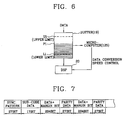
  • FIG. 6 is a view illustrating the construction of an interrelationship for variably controlling data conversion speed in accordance with a data amount which is temporarily stored in a buffer according to the present invention
  • FIG. 7 is a view illustrating a data stream converted based on a recording format according to the present invention.
  • FIGS. 8A through 8D are wave form diagrams illustrating a signal inputted and outputted into and from each block of a data recording speed control apparatus of an optical recording medium recording/reproducing system according to the present invention.
  • FIG. 4 is a view illustrating the construction of a data recording speed control apparatus of an optical recording/reproducing system according to the present invention which includes the conventional circuit blocks of FIG. 1 and further includes a reference frame signal generator 134 for generating reference frame data based on an initial reference speed, a divider 133 for dividing the reference frame data and outputting a reference pulse signal, a frame signal detector 131 for generating a pulse signal whenever frame synchronous data is detected in the data outputted from the digital recording signal processor 20 , an error detector 132 for comparing a phase difference between the pulse signal and the reference pulse signal for detecting an error amount, and a microcomputer 125 for switching the connection state of a switch in accordance with an external recording or reproducing request and variably adjusting the speed so that the digital recording signal processor 20 can variably adjust the variation speed of the data based on the data amount stored in the buffer 19 when requesting a recording operation.
  • a reference frame signal generator 134 for generating reference frame data based on an initial reference speed
  • a divider 133
  • Step S 01 When a recording request is inputted, the initial recording speed is set in Step S 01 , the microcomputer 125 switches a switch to terminal b (when reproducing the data, the terminal of the switch is switched to terminal a), and the reference frame signal generator 134 generates reference frame data corresponding to the set speed.
  • a digital recording signal processing unit 20 reads out the data from the buffer 19 at an initial recording speed and converts the same into a recording format.
  • the recording format converted data is recorded into a recording region of an optical recording medium 10 by an optical pick-up unit 11 via a bit encoder 21 and a laser diode driving unit 22 .
  • the microcomputer 125 checks the data amount remaining (P 1 ) in the buffer 19 in Step S 02 and compares a previously set data amount with an upper limit U 1 and a lower limit L 1 in Step S 03 .
  • the microcomputer 125 maintains a data conversion speed at the digital recording signal processor 20 based on the set recording speed in Step S 05 .
  • the microcomputer 125 increases the data conversion speed by a certain level in Step S 06 or decreases the data conversion speed by a certain level for thereby decreasing the data conversion speed in Step S 07 .
  • the data conversion speed corresponding to an initial recording speed is 1 ⁇ (7.35 MHz), and the data amount P 1 is larger than the upper limit U 1 , the data conversion speed increases to 1.5 times which is 0.5 times higher compared to the initial speed.
  • the data conversion speed decreases to 0.5 times which is lower compared to the initial speed.
  • the data which is format-converted at a set variable set in Step S 08 and is outputted from the digital recording signal processor 20 is inputted into the frame synchronous signal detector 131 , and as shown in FIG. 7 , the frame synchronous signal detector 131 outputs a pulse signal in Step S 09 as shown in FIG. 8A whenever a frame synchronous data at a leading portion in a 588-bit data stream (namely, one frame).
  • the data conversion speed is changed, the data conversion speed is varied at a period of a pulse signal outputted from the frame synchronous signal detector 131 .
  • the reference frame synchronous data outputted from the reference frame signal generator 134 is converted into a reference pulse signal of a certain period through the divider 133 based on an initial recording speed.
  • the error detector 132 compares a phase difference between the reference pulse signal ( FIG. 8B ) and the variable pulse signal ( FIG. 8A ) having a period which is variably outputted for thereby detecting an error amount (E 1 and E 2 of FIG.
  • Step S 10 the resulting amount of error detected is applied to the motor driving unit 18 via a route which is set by the microcomputer, and the motor driving unit 18 increases or decreases the driving voltage based on the received error in Step S 11 , and the initial recording speed is variably adjusted based on the varied format conversion speed of the current data, namely, the varied recording speed in Step S 12 .
  • the pulse width of the reference signal and the pulse width of the pulse signal are compared.
  • the motor driving unit 18 applies the voltage corresponding to the amount of error detected E 1 to the spindle motor 12 for thereby increasing the recording speed. If the pulse width of the variable pulse signal is smaller (E 2 ) than the pulse width of the reference pulse signal, the motor driving unit 18 applies a voltage corresponding to the amount of error detected E 2 to the spindle motor 12 for thereby decreasing the recording speed.
  • the above-described routine (S 02 through S 12 ) is continued until the recording operation is stopped by a user's request in Step S 21 , or the recording operation of corresponding data is stopped in Step S 22 .
  • the speed varying recording apparatus for an optical recording medium recording/reproducing apparatus and a method thereof according to the present invention while the data inputted from an external host 32 is being recorded into the optical recording medium at an initial speed, when the data input speed is varied based on the host 32 or an external environment, the initial recording speed is changed to a varied speed for thereby preventing a recording and reproducing error and implementing a stable recording operation.

Landscapes

  • Engineering & Computer Science (AREA)
  • Multimedia (AREA)
  • Signal Processing (AREA)
  • Optical Recording Or Reproduction (AREA)
  • Signal Processing For Digital Recording And Reproducing (AREA)

Abstract

A data recording speed control apparatus and method for recording a data on an optical recording medium are disclosed. The data recording speed control apparatus for recording a data on an optical recording medium includes a storing unit for storing data inputted, a data conversion unit for converting the stored data into a certain recording format at a certain speed, a recording unit for recording the converted data onto the optical recording medium, and a control unit for variably setting the conversion speed based on the amount of the data stored in the storing unit for thereby converting data inputted from a host into a recording format, recording format converted data on an optical recording medium at an initial speed, variably adjusting a recording format conversion speed of the data when a data input speed is changed, resetting the speed for recording the recording format changed data on an optical recording medium, and recording and reproducing the recording format changed data at a reset recording speed.

Description

This application is a divisional of application Ser. No. 09/428,500, filed on Oct. 28, 1999 now U.S. Pat. No. 6,570,831, the entire contents of which are hereby incorporated by reference and for which priority is claimed under 35 U.S.C. § 120; and this application claims priority of Application Ser. No. 46528/1998 filed in Korea on Oct. 28, 1998 under 35 U.S.C. § 119.
BACKGROUND OF THE INVENTION
1. Field of the Invention
The present invention relates to an optical recording medium recording/reproducing apparatus, and in particular to a data recording speed control apparatus and method for recording data on an optical recording medium. The present invention is capable of converting data inputted from a host into a recording format, recording the reformatted data on an optical medium at an initial speed, variably adjusting a recording format conversion speed of the data when a data input speed is changed, resetting the speed for recording the reformatted data on an optical recording medium, and recording and reproducing the reformatted data at the reset recording speed.
2. Description of the Background Art
FIG. 1 is a view illustrating a conventional optical recording medium recording/reproducing apparatus. As shown therein, the conventional optical recording medium recording/reproducing apparatus includes an interface unit 30 for receiving data from an external host 32 and transferring the same to a buffer 19, a digital recording signal processor 20 for converting data from the buffer 19 into a certain recording format by providing an error correction code to the data from the buffer 19, a bit encoder 21 for converting the recording format data into bit stream data, a laser diode driving unit 22 for driving a laser diode by providing a driving voltage corresponding to the bit stream data to the laser diode, an optical pick-up unit 11 for recording data onto an optical recording medium 10 and reading the recorded data, a motor driving unit 18 for driving a spindle motor 12, an amplifier 13 for amplifying a wobble signal of the optical recording medium 10 read from an auxiliary beam of the optical pick-up unit 11 at a certain level, a wobble data detector 14 for detecting wobble data corresponding to an amplified low frequency wobble signal, a ATIP synchronous signal detector 15 for detecting an ATIP synchronous signal from the detected wobble data, a reference ATIP synchronous signal generation unit 17 for generating a reference ATIP synchronous signal, an error detector 16 for detecting a phase difference between an ATIP synchronous signal from the ATIP synchronous signal detector 15 and a reference ATIP synchronous signal from the reference ATIP synchronous signal generation unit 17, a motor driving unit 18 for varying the data recording speed of an optical recording medium by applying a driving voltage corresponding to the detected phase difference to the spindle motor 12, and a microcomputer 25 for receiving wobble data from the wobble data detector 14, controlling variably the data conversion speed of the digital recording signal processor 20 and controlling operation of the laser diode driving unit 22.
The operation of the thusly constituted optical recording medium recording/reproducing apparatus will now be explained.
First, when a data record is requested from the host 32 (for example, PC) for recording onto an optical recording medium, the data outputted from the host 32 via the interface unit 30 is temporarily stored in the buffer 19. When buffer 19 stores the inputted data, the digital recording signal processor 20 sequentially reads out the data temporarily stored in the buffer 19 and outputs it to the bit encoded 21 at an initial speed.
The bit encoder 21 converts the processed signal data into a bit stream and outputs it to the laser diode driving unit 22, and the laser diode driving unit 22 outputs a driving voltage corresponding to the bit stream to a laser diode of the optical pick-up unit 11. Then, the laser diode scans the main laser beam across the recording surface of the optical recording medium in accordance with the driving voltage corresponding to the bit stream, thereby recording the inputted data.
While the inputted data is being recorded on the optical recording medium, an auxiliary beam formed on the recording surface of the optical recording medium detects a low frequency wobble signal from the optical recording medium together with the main beam, and the detected low frequency wobble signal is amplified to a certain level by the amplifier 13. A shown in FIG. 2, corresponding wobble data is detected by the wobble data detector 14.
As shown in FIG. 3A, when a reference ATIP synchronous signal is outputted from the reference ATIP synchronous signal generation unit 17, as shown in FIG. 3B, the ATIP synchronous detector 15 generates an ATIP synchronous signal whenever the ATIP synchronous detector 15 detects a ATIP synchronous signal. The error detector 16 compares a phase difference between the ATIP synchronous signal and the reference ATIP synchronous signal. As shown in FIG. 3C, error amounts e1 and e2 are detected.
The thusly detected error amounts e1 and e2 are applied to the motor driving unit 18, and as shown in FIG. 3D, the motor driving unit 18 applies a driving voltage corresponding to the error amount to the spindle motor 12, so that a recording speed of the recording/reproducing apparatus is controlled, and the recording speed based on the main beam is maintained. The ATIP synchronous signal is compared with the reference signal. As a result of the comparison, if the pulse width of the ATIP synchronous signal is larger than the pulse width of the reference signal, as shown in FIG. 3D, the motor driving unit 18 accelerates the spindle motor by the error amount e1, and on the contrary, the spindle motor is decelerated by the error amount e2. Therefore, the recording/reproducing apparatus of the optical recording medium uniformly maintains the recording speed of the data irrespective of the speed of the data inputted.
In the conventional recording/reproducing apparatus of the optical recording medium, when reproducing the data recorded on the optical recording medium, the reproducing speed variable operation is performed in the same manner as the recording speed variable operation.
However, when data is inputted from the host 32 and recorded data is reproduced at an initial speed for a certain period, the recording speed is varied based on the synchronous detection speed of the wobble data detected so that an initial recording speed is maintained and controlled.
At this time, when the data output speed from the host 32 is sharply increased or decreased, an error occurs in the recording operation of the optical recording medium recording/reproducing apparatus which operates at a uniform recording speed. In particular, in the case that the initial recording speed is high (e.g., 4×, 6×, 8×), when the host 32 performs an e-mail transmission or operates based on an internal interrupt operation, the data output speed of the host 32 is decreased. At this time, if there is no data inputted in the buffer 30, since a uniform recording speed of the optical recording medium recording/reproducing apparatus is maintained, the data may be incorrectly recorded, thereby causing a fatal error in the optical recording medium.
SUMMARY OF THE INVENTION
Accordingly, it is an object of the present invention to provide a data recording speed control apparatus for an optical recording medium recording/reproducing apparatus which is capable of variably adjusting recording speed for recording data onto an optical recording medium in accordance with the input speed of data by determining the data input speed.
It is another object of the present invention to provide a data recording speed control method of an optical recording medium recording/reproducing apparatus which is capable of variably adjusting the recording speed for recording data onto an optical recording medium in accordance with an input speed of data by determining the data input speed.
To achieve the above objects, there is provided a data recording speed control apparatus of an optical recording medium recording/reproducing apparatus which includes a storing unit for storing inputted data, a data conversion unit for converting the stored data into a certain recording format at a certain speed, a recording unit for recording the converted data onto an optical recording medium, and a control unit for variably setting the conversion speed based on the amount of data stored in the storing unit.
To achieve the above objects, there is provided a data recording speed control method of an optical recording medium recording/reproducing apparatus which includes a storing step for storing inputted data, a converting step for converting the inputted data into a certain recording format data, a computing step for computing the speed of the data conversion in the second step and a controlling step for controlling the recording speed of the optical recording medium based on a difference between the computed conversion speed of the third step and a previously set reference speed.
Additional advantages, objects and features of the invention will become more apparent from the description which follows.
BRIEF DESCRIPTION OF THE DRAWINGS
The present invention will become more fully understood from the detailed description given hereinbelow and the accompanying drawings which are given by way of illustration only, and thus are not limitative of the present invention, and wherein:
FIG. 1 is a view illustrating a data recording speed control apparatus for a conventional optical recording medium recording/reproducing system;
FIG. 2 is a view illustrating a format in the conventional art of wobble data generated based on a RF signal which is reproduced;
FIGS. 3A through 3D are wave form diagrams illustrating a signal inputted and outputted into and from each block of a data recording speed control apparatus for a conventional optical recording medium recording/reproducing system;
FIG. 4 is a view illustrating the construction of a data recording speed control apparatus of an optical recording medium recording/reproducing system according to the present invention;
FIG. 5 is a flow chart illustrating a data recording speed control method for an optical recording medium recording/reproducing system according to the present invention;
FIG. 6 is a view illustrating the construction of an interrelationship for variably controlling data conversion speed in accordance with a data amount which is temporarily stored in a buffer according to the present invention;
FIG. 7 is a view illustrating a data stream converted based on a recording format according to the present invention; and
FIGS. 8A through 8D are wave form diagrams illustrating a signal inputted and outputted into and from each block of a data recording speed control apparatus of an optical recording medium recording/reproducing system according to the present invention.
DETAILED DESCRIPTION OF THE PREFERRED EMBODIMENTS
FIG. 4 is a view illustrating the construction of a data recording speed control apparatus of an optical recording/reproducing system according to the present invention which includes the conventional circuit blocks of FIG. 1 and further includes a reference frame signal generator 134 for generating reference frame data based on an initial reference speed, a divider 133 for dividing the reference frame data and outputting a reference pulse signal, a frame signal detector 131 for generating a pulse signal whenever frame synchronous data is detected in the data outputted from the digital recording signal processor 20, an error detector 132 for comparing a phase difference between the pulse signal and the reference pulse signal for detecting an error amount, and a microcomputer 125 for switching the connection state of a switch in accordance with an external recording or reproducing request and variably adjusting the speed so that the digital recording signal processor 20 can variably adjust the variation speed of the data based on the data amount stored in the buffer 19 when requesting a recording operation.
The operation of the optical recording medium recording/reproducing system according to the present invention will now be explained with reference to the accompanying FIG. 5.
When a recording request is inputted, the initial recording speed is set in Step S01, the microcomputer 125 switches a switch to terminal b (when reproducing the data, the terminal of the switch is switched to terminal a), and the reference frame signal generator 134 generates reference frame data corresponding to the set speed.
When data to be recorded on the optical recording medium 10 is inputted from the host 32 via the interface unit 30, the data is sequentially inputted into the buffer 19. While the data is being stored into a buffer 19, a digital recording signal processing unit 20 reads out the data from the buffer 19 at an initial recording speed and converts the same into a recording format. The recording format converted data is recorded into a recording region of an optical recording medium 10 by an optical pick-up unit 11 via a bit encoder 21 and a laser diode driving unit 22.
While the data is being recorded onto the optical recording medium 10, the microcomputer 125 checks the data amount remaining (P1) in the buffer 19 in Step S02 and compares a previously set data amount with an upper limit U1 and a lower limit L1 in Step S03.
For example, as shown in FIG. 6, if the data amount P1 in the buffer 19 is in a range between the upper limit (U1 of FIG. 6) and the lower limit (L1 of FIG. 6), the microcomputer 125 maintains a data conversion speed at the digital recording signal processor 20 based on the set recording speed in Step S05.
If the data amount P1 is larger than the upper limit U1 or is smaller than the lower limit L1, the microcomputer 125 increases the data conversion speed by a certain level in Step S06 or decreases the data conversion speed by a certain level for thereby decreasing the data conversion speed in Step S07.
If the data conversion speed corresponding to an initial recording speed is 1× (7.35 MHz), and the data amount P1 is larger than the upper limit U1, the data conversion speed increases to 1.5 times which is 0.5 times higher compared to the initial speed.
If the data amount P1 is smaller than the lower limit L1, the data conversion speed decreases to 0.5 times which is lower compared to the initial speed.
The data which is format-converted at a set variable set in Step S08 and is outputted from the digital recording signal processor 20 is inputted into the frame synchronous signal detector 131, and as shown in FIG. 7, the frame synchronous signal detector 131 outputs a pulse signal in Step S09 as shown in FIG. 8A whenever a frame synchronous data at a leading portion in a 588-bit data stream (namely, one frame). As described above, when the data conversion speed is changed, the data conversion speed is varied at a period of a pulse signal outputted from the frame synchronous signal detector 131.
In addition, as shown in FIG. 8B, the reference frame synchronous data outputted from the reference frame signal generator 134 is converted into a reference pulse signal of a certain period through the divider 133 based on an initial recording speed. The error detector 132 compares a phase difference between the reference pulse signal (FIG. 8B) and the variable pulse signal (FIG. 8A) having a period which is variably outputted for thereby detecting an error amount (E1 and E2 of FIG. 8C) in Step S10, and the resulting amount of error detected is applied to the motor driving unit 18 via a route which is set by the microcomputer, and the motor driving unit 18 increases or decreases the driving voltage based on the received error in Step S11, and the initial recording speed is variably adjusted based on the varied format conversion speed of the current data, namely, the varied recording speed in Step S12. As shown in FIG. 8D, the pulse width of the reference signal and the pulse width of the pulse signal are compared. As a result of the comparison, if the pulse width of the variable pulse signal is larger (E1) than the pulse width of the reference pulse signal, the motor driving unit 18 applies the voltage corresponding to the amount of error detected E1 to the spindle motor 12 for thereby increasing the recording speed. If the pulse width of the variable pulse signal is smaller (E2) than the pulse width of the reference pulse signal, the motor driving unit 18 applies a voltage corresponding to the amount of error detected E2 to the spindle motor 12 for thereby decreasing the recording speed. The above-described routine (S02 through S12) is continued until the recording operation is stopped by a user's request in Step S21, or the recording operation of corresponding data is stopped in Step S22.
Therefore, in the speed varying recording apparatus for an optical recording medium recording/reproducing apparatus and a method thereof according to the present invention, while the data inputted from an external host 32 is being recorded into the optical recording medium at an initial speed, when the data input speed is varied based on the host 32 or an external environment, the initial recording speed is changed to a varied speed for thereby preventing a recording and reproducing error and implementing a stable recording operation.
Although the preferred embodiment of the present invention has been disclosed for illustrative purposes, those skilled in the art will appreciate that various modifications, additions and substitutions are possible, without departing from the scope and spirit of the invention as recited in the accompanying claims.

Claims (11)

1. A data recording speed control apparatus of an optical recording medium recording/reproducing system, comprising:
a storing means for storing an inputted data;
a data conversion means for converting the stored data into a predeterminded recording format;
a recording means for recording the converted data onto an optical recording medium; and
a control means for variably controlling a conversion speed based on the amount of the data stored in the storing means.
2. The apparatus of claim 1, wherein said control means increases the conversion speed by a certain level when the amount of data stored in the storing means exceeds a set upper limit and decreases the conversion speed when the amount of data stored is below a lower limit.
3. The apparatus of claim 1, wherein said control means varies a recording speed of the recording means based on the variably set data conversion speed.
4. The apparatus of claim 1, wherein said control means comprises:
a reference frame signal generator to generate a reference frame data based on an initial reference speed;
a divider to divide the reference frame data and outputting a reference pulse signal;
a frame signal detector to generate a pulse signal whenever a frame synchronous data is detected among the data outputted from the data conversion means; and
an error detector for comparing a phase difference between a pulse signal and a reference pulse signal.
5. The apparatus of claim 1, wherein said control means further comprises a swithing means for seleting one of the recording and reproducing modes of the optical recording medium recording/reproducing system.
6. A data recording speed control apparatus of an optical recording medium recording/reproducing system, comprising:
a buffer to store inputted data;
a formatter to convert the stored data into a predeterminded recording format data;
a pick-up to record the predetermined recording format data onto an optical recording medium; and
a microcomputer to check a buffering status of the buffer and control the conversion speed and the recording speed based on the amount of the data stored in the buffer.
7. The apparatus of claim 6, wherein said microcomputer increases the conversion speed by a certain level when the amount of data stored in the buffer exceeds a set upper limit and decreases the conversion speed when the amount of data stored is below a lower limit.
8. The apparatus of claim 6, wherein said microcomputer varies a recording speed of the pick-up based on the variably set data conversion speed.
9. The apparatus of claim 6, wherein said microcomputer comprises:
a reference frame signal generator to generate reference frame data based on an initial reference speed;
a divider to divide the reference frame data and output a reference pulse signal;
a frame signal detector to generate a pulse signal whenever frame synchronous data is detected among the data outputted from the formatter; and
an error detector for comparing a phase difference between a pulse signal and a reference pulse signal.
10. The apparatus of claim 6, wherein said microcomputer further comprises a switch to select one of the recording and reproducing modes of the optical recording medium recording/reproducing system.
11. The apparatus of claim 6, wherein said formatter comprises:
a digital signal processor for converting the stored data into a bit stream; and
a bit encoder to encode the bit stream to a predeteremined recording format data.
US10/388,503 1998-10-28 2003-03-17 Variable data recording/reproducing control apparatus and method of an optical recording system Expired - Fee Related US6934230B2 (en)

Priority Applications (1)

Application Number Priority Date Filing Date Title
US10/388,503 US6934230B2 (en) 1998-10-28 2003-03-17 Variable data recording/reproducing control apparatus and method of an optical recording system

Applications Claiming Priority (4)

Application Number Priority Date Filing Date Title
KR46528/1998 1998-10-28
KR1019980046528A KR100310055B1 (en) 1998-10-28 1998-10-28 Device and method for changing recording speed of optical disc recorder / player
US09/428,500 US6570831B1 (en) 1998-10-28 1999-10-28 Variable data recording/reproducing speed control apparatus and method of an optical recording system
US10/388,503 US6934230B2 (en) 1998-10-28 2003-03-17 Variable data recording/reproducing control apparatus and method of an optical recording system

Related Parent Applications (1)

Application Number Title Priority Date Filing Date
US09/428,500 Division US6570831B1 (en) 1998-10-28 1999-10-28 Variable data recording/reproducing speed control apparatus and method of an optical recording system

Publications (2)

Publication Number Publication Date
US20030174609A1 US20030174609A1 (en) 2003-09-18
US6934230B2 true US6934230B2 (en) 2005-08-23

Family

ID=19556693

Family Applications (2)

Application Number Title Priority Date Filing Date
US09/428,500 Expired - Lifetime US6570831B1 (en) 1998-10-28 1999-10-28 Variable data recording/reproducing speed control apparatus and method of an optical recording system
US10/388,503 Expired - Fee Related US6934230B2 (en) 1998-10-28 2003-03-17 Variable data recording/reproducing control apparatus and method of an optical recording system

Family Applications Before (1)

Application Number Title Priority Date Filing Date
US09/428,500 Expired - Lifetime US6570831B1 (en) 1998-10-28 1999-10-28 Variable data recording/reproducing speed control apparatus and method of an optical recording system

Country Status (3)

Country Link
US (2) US6570831B1 (en)
KR (1) KR100310055B1 (en)
CN (1) CN1147853C (en)

Cited By (1)

* Cited by examiner, † Cited by third party
Publication number Priority date Publication date Assignee Title
US20060245323A1 (en) * 2005-04-27 2006-11-02 Sunplus Technology Co., Ltd. Protective system and method for data write of an optical drive

Families Citing this family (17)

* Cited by examiner, † Cited by third party
Publication number Priority date Publication date Assignee Title
JP3737675B2 (en) 2000-05-24 2006-01-18 株式会社リコー Information recording apparatus, information recording method, recording medium recording information recording processing program, information recording system, optical disc recording apparatus, optical disc recording method, and optical disc recording system
KR20010107397A (en) * 2000-05-27 2001-12-07 구자홍 Method for converting the mode of recoding speed for an optical disc
ES2331111T3 (en) * 2000-11-29 2009-12-22 British Telecommunications Public Limited Company TRANSMISSION AND RECEIPT OF DATA IN REAL TIME.
JP3778806B2 (en) * 2001-03-30 2006-05-24 三洋電機株式会社 Recording control method for optical disc recording / reproducing apparatus
US6862258B2 (en) * 2001-05-01 2005-03-01 Mitsumi Electric Co., Ltd. Recordable optical drive automatically changing a writing speed in accordance with an interface data transfer speed
JP2003016651A (en) * 2001-06-29 2003-01-17 Ricoh Co Ltd Optical disk drive
KR100505634B1 (en) * 2002-02-23 2005-08-03 삼성전자주식회사 Apparatus and method for detecting phase difference between phase reference and wobble signal
TW569184B (en) 2002-03-04 2004-01-01 Asustek Comp Inc Write/record speed adjustment method of data recording device
EP1359722A1 (en) 2002-03-27 2003-11-05 BRITISH TELECOMMUNICATIONS public limited company Data streaming system and method
AU2003216817A1 (en) * 2002-03-27 2003-10-13 British Telecommunications Public Limited Company Data structure for data streaming system
CN1296909C (en) * 2002-08-19 2007-01-24 联发科技股份有限公司 Optical disc recording control method and device with different recording rates
KR100546315B1 (en) * 2003-02-10 2006-01-26 삼성전자주식회사 Apparatus and method for controlling recording speed of optical disc recording device
GB0306296D0 (en) * 2003-03-19 2003-04-23 British Telecomm Data transmission
DE10344130A1 (en) * 2003-09-24 2005-04-21 Bayerische Motoren Werke Ag Headlamp, especially for vehicle, has reflector inner side facing light source formed at least in some regions to form first focal point at first source position; light from source is reflected to output coupling element light entry surface
US7664367B2 (en) * 2004-02-03 2010-02-16 Panasonic Corporation Information processing device
JP4773403B2 (en) * 2007-06-18 2011-09-14 ソニーオプティアーク株式会社 Information reproduction apparatus, reproduction start method, and reproduction start program
TWI338440B (en) * 2007-08-31 2011-03-01 Delta Electronics Inc Motor control device

Citations (7)

* Cited by examiner, † Cited by third party
Publication number Priority date Publication date Assignee Title
US5289440A (en) * 1991-12-30 1994-02-22 U.S. Philips Corporation Optical reading device and optical recording device
US5432769A (en) * 1991-04-18 1995-07-11 Matsushita Electric Industrial Co., Ltd. Apparatus for intermittently recording or reproducing variable length coded video data
US5463607A (en) 1989-11-23 1995-10-31 U.S. Philips Corporation System for recording and reading information on a record carrier at a constant scanning speed independent of the bit rate of such information
US5471450A (en) * 1991-07-12 1995-11-28 Sony Corporation Digital data reproducing apparatus and method employing buffer memories for error compensation and accomodating differences in reproduction and processing rates
US5606539A (en) 1990-06-05 1997-02-25 U.S. Philips Corporation Method and apparatus for encoding and decoding an audio and/or video signal, and a record carrier for use with such apparatus
US5712742A (en) 1986-01-31 1998-01-27 Canon Kabushiki Kaisha Recording and/or reproducing apparatus
US5815472A (en) 1996-08-22 1998-09-29 Pioneer Electronic Corporation Information recording method and apparatus

Family Cites Families (1)

* Cited by examiner, † Cited by third party
Publication number Priority date Publication date Assignee Title
JPH0487069A (en) * 1990-07-31 1992-03-19 Sony Corp Optical disk recording device

Patent Citations (7)

* Cited by examiner, † Cited by third party
Publication number Priority date Publication date Assignee Title
US5712742A (en) 1986-01-31 1998-01-27 Canon Kabushiki Kaisha Recording and/or reproducing apparatus
US5463607A (en) 1989-11-23 1995-10-31 U.S. Philips Corporation System for recording and reading information on a record carrier at a constant scanning speed independent of the bit rate of such information
US5606539A (en) 1990-06-05 1997-02-25 U.S. Philips Corporation Method and apparatus for encoding and decoding an audio and/or video signal, and a record carrier for use with such apparatus
US5432769A (en) * 1991-04-18 1995-07-11 Matsushita Electric Industrial Co., Ltd. Apparatus for intermittently recording or reproducing variable length coded video data
US5471450A (en) * 1991-07-12 1995-11-28 Sony Corporation Digital data reproducing apparatus and method employing buffer memories for error compensation and accomodating differences in reproduction and processing rates
US5289440A (en) * 1991-12-30 1994-02-22 U.S. Philips Corporation Optical reading device and optical recording device
US5815472A (en) 1996-08-22 1998-09-29 Pioneer Electronic Corporation Information recording method and apparatus

Cited By (2)

* Cited by examiner, † Cited by third party
Publication number Priority date Publication date Assignee Title
US20060245323A1 (en) * 2005-04-27 2006-11-02 Sunplus Technology Co., Ltd. Protective system and method for data write of an optical drive
US7835243B2 (en) * 2005-04-27 2010-11-16 Sunplus Technology Co., Ltd. Protective system and method for data write of an optical drive

Also Published As

Publication number Publication date
CN1252601A (en) 2000-05-10
KR100310055B1 (en) 2001-12-17
US6570831B1 (en) 2003-05-27
US20030174609A1 (en) 2003-09-18
KR20000028335A (en) 2000-05-25
CN1147853C (en) 2004-04-28

Similar Documents

Publication Publication Date Title
US6934230B2 (en) Variable data recording/reproducing control apparatus and method of an optical recording system
US6762878B2 (en) Gain control device and method for erbium doped fiber amplifier
EP1003159A1 (en) Drive apparatus for optical recording medium
US4698797A (en) Optical type information reproducing device
EP0923174B1 (en) Apparatus and method for compensating for temperature of laser diode
US20030072231A1 (en) Wobble signal detecting circuit for optical disc system
JPH01135082A (en) Semiconductor laser controller
US5894462A (en) Magnetooptical disk focus and tracking servo for a magnetooptical disk servo device
US7336574B2 (en) Apparatus for detecting abnormal states of laser diode power in an optical disc recording/reproducing device
US5673211A (en) Digital data reproducing apparatus
US20010055253A1 (en) Audio appliance for playing back compressed and uncompressed audio files
KR100447663B1 (en) Device for automatically controlling a cdp focus offset and a method therefor, particularly enabling a reliable automatic control for abnormal conditions such as scars and dust of a disk
KR100210728B1 (en) Light source operating circuit device for optical scanning of recording media
US5939714A (en) Tracking error detector employing phase difference detection method
KR100202574B1 (en) Gain adjuster of a disc reproducer
KR100534462B1 (en) Method and arrangement for controlling the data stream in a vibration-resistant playback device
JP3663099B2 (en) Disk unit
JPH09330528A (en) Laser diode control method in compact disc drive
KR100420040B1 (en) Method for recording a multi level data in optical disc recorder
KR100930358B1 (en) How to adjust recording power of optical disc device
KR100432847B1 (en) An apparatus and method for detecting wobble signal
KR970071540A (en) The focus servo control circuit of the disc recording and reproducing apparatus
JP3018456B2 (en) Gamma correction circuit
KR100238410B1 (en) Variable bit rate data management device and method contained dvdp
JP4065469B2 (en) Reproduction method and apparatus

Legal Events

Date Code Title Description
FEPP Fee payment procedure

Free format text: PAYOR NUMBER ASSIGNED (ORIGINAL EVENT CODE: ASPN); ENTITY STATUS OF PATENT OWNER: LARGE ENTITY

FPAY Fee payment

Year of fee payment: 4

FEPP Fee payment procedure

Free format text: PAYOR NUMBER ASSIGNED (ORIGINAL EVENT CODE: ASPN); ENTITY STATUS OF PATENT OWNER: LARGE ENTITY

FPAY Fee payment

Year of fee payment: 8

REMI Maintenance fee reminder mailed
LAPS Lapse for failure to pay maintenance fees

Free format text: PATENT EXPIRED FOR FAILURE TO PAY MAINTENANCE FEES (ORIGINAL EVENT CODE: EXP.)

STCH Information on status: patent discontinuation

Free format text: PATENT EXPIRED DUE TO NONPAYMENT OF MAINTENANCE FEES UNDER 37 CFR 1.362

FP Lapsed due to failure to pay maintenance fee

Effective date: 20170823