US6650207B1 - Longitudinally coupled surface acoustic wave filter with linearly weighted reflectors - Google Patents

Longitudinally coupled surface acoustic wave filter with linearly weighted reflectors Download PDF

Info

Publication number
US6650207B1
US6650207B1 US10/019,024 US1902401A US6650207B1 US 6650207 B1 US6650207 B1 US 6650207B1 US 1902401 A US1902401 A US 1902401A US 6650207 B1 US6650207 B1 US 6650207B1
Authority
US
United States
Prior art keywords
surface acoustic
reflectors
electrodes
weighted
longitudinally coupled
Prior art date
Legal status (The legal status is an assumption and is not a legal conclusion. Google has not performed a legal analysis and makes no representation as to the accuracy of the status listed.)
Expired - Fee Related
Application number
US10/019,024
Inventor
Hiroshi Tanaka
Current Assignee (The listed assignees may be inaccurate. Google has not performed a legal analysis and makes no representation or warranty as to the accuracy of the list.)
Mitsubishi Electric Corp
Original Assignee
Mitsubishi Electric Corp
Priority date (The priority date is an assumption and is not a legal conclusion. Google has not performed a legal analysis and makes no representation as to the accuracy of the date listed.)
Filing date
Publication date
Application filed by Mitsubishi Electric Corp filed Critical Mitsubishi Electric Corp
Assigned to MITSUBISHI DENKI KABUSHIKI KAISHA reassignment MITSUBISHI DENKI KABUSHIKI KAISHA ASSIGNMENT OF ASSIGNORS INTEREST (SEE DOCUMENT FOR DETAILS). Assignors: TANAKA, HIROSHI
Application granted granted Critical
Publication of US6650207B1 publication Critical patent/US6650207B1/en
Anticipated expiration legal-status Critical
Expired - Fee Related legal-status Critical Current

Links

Images

Classifications

    • HELECTRICITY
    • H03ELECTRONIC CIRCUITRY
    • H03HIMPEDANCE NETWORKS, e.g. RESONANT CIRCUITS; RESONATORS
    • H03H9/00Networks comprising electromechanical or electro-acoustic elements; Electromechanical resonators
    • H03H9/46Filters
    • H03H9/64Filters using surface acoustic waves
    • H03H9/6423Means for obtaining a particular transfer characteristic
    • H03H9/643Means for obtaining a particular transfer characteristic the transfer characteristic being determined by reflective or coupling array characteristics
    • HELECTRICITY
    • H03ELECTRONIC CIRCUITRY
    • H03HIMPEDANCE NETWORKS, e.g. RESONANT CIRCUITS; RESONATORS
    • H03H9/00Networks comprising electromechanical or electro-acoustic elements; Electromechanical resonators
    • H03H9/02Details
    • H03H9/02535Details of surface acoustic wave devices
    • H03H9/02637Details concerning reflective or coupling arrays
    • H03H9/02685Grating lines having particular arrangements
    • HELECTRICITY
    • H03ELECTRONIC CIRCUITRY
    • H03HIMPEDANCE NETWORKS, e.g. RESONANT CIRCUITS; RESONATORS
    • H03H9/00Networks comprising electromechanical or electro-acoustic elements; Electromechanical resonators
    • H03H9/46Filters
    • H03H9/64Filters using surface acoustic waves
    • H03H9/6423Means for obtaining a particular transfer characteristic
    • H03H9/6433Coupled resonator filters
    • H03H9/644Coupled resonator filters having two acoustic tracks
    • H03H9/6456Coupled resonator filters having two acoustic tracks being electrically coupled
    • H03H9/6459Coupled resonator filters having two acoustic tracks being electrically coupled via one connecting electrode
    • H03H9/6463Coupled resonator filters having two acoustic tracks being electrically coupled via one connecting electrode the tracks being electrically cascaded
    • HELECTRICITY
    • H03ELECTRONIC CIRCUITRY
    • H03HIMPEDANCE NETWORKS, e.g. RESONANT CIRCUITS; RESONATORS
    • H03H9/00Networks comprising electromechanical or electro-acoustic elements; Electromechanical resonators
    • H03H9/46Filters
    • H03H9/64Filters using surface acoustic waves
    • H03H9/6423Means for obtaining a particular transfer characteristic
    • H03H9/6433Coupled resonator filters
    • H03H9/644Coupled resonator filters having two acoustic tracks
    • H03H9/6456Coupled resonator filters having two acoustic tracks being electrically coupled
    • H03H9/6469Coupled resonator filters having two acoustic tracks being electrically coupled via two connecting electrodes

Definitions

  • the present invention relates to a surface acoustic wave filter for use in a high-frequency circuit of a mobile communication device typified, for example, by a portable telephone or car telephone and, more particularly, to an easy-to-manufacture surface acoustic wave filter that has an excellent attenuation characteristic in the neighborhood of its pass band.
  • a resonator type surface acoustic wave (hereinafter referred to as SAW) filter is provided with reflectors on both sides of each interdigital transducer (IDT) to reflect surface acoustic waves, thereby generating standing waves.
  • SAW surface acoustic wave
  • spurious pulses develop in the vicinity of the pass band—this is attributable to the reflectors.
  • the sizes and shapes of these spurious pulses depend on the configuration of the SAW filter, such as the number of IDTs used and the IDT spacing.
  • FIG. 20 depicts a transversely-coupled, dual mode SAW filter disclosed in Japanese Patent Application Laid-Open Gazette No. 128519/91.
  • This SAW filter has two resonators 201 and 202 disposed on a piezoelectric substrate (made principally of crystal) 200 across the direction of propagation of surface acoustic waves.
  • the resonators 201 and 202 have reflectors 206 to 209 on both sides of interdigital transducers (IDTs) 203 and 204 , and are excited in fundamental and second-order modes.
  • Each reflector is graded or weighted by a different number of electrodes arranged in the direction of propagation of surface acoustic waves, thereby suppressing high-order modes and hence providing an improved spurious characteristic.
  • the electrodes of the reflectors 203 to 209 in FIG. 20 are weighted along a sine curve, the development of filters encounters much difficulty, for example, in the design of electrode patterns, including simulations and in the creation of data on electrode patterns for use in the fabrication of photomasks.
  • a longitudinal-coupled SAW filter that has at least two interdigital transducers formed over a piezoelectric substrate and reflectors disposed on both sides of the interdigital transducers and in which the reflectors each comprise: a group of electrodes graded so that their number linearly varies with their position in the direction perpendicular to the direction of propagation of surface acoustic waves; and bus bars shorting the electrodes.
  • the present invention allows ease in the design and development of the SAW filter, and permits reduction of the spurious pulses and hence provide improved attenuation in the vicinity of the pass band.
  • FIG. 1 is a schematic diagram illustrating an embodiment of the SAW filter according to the present invention
  • FIG. 3 is a magnified view of FIG. 2;
  • FIG. 4 shows the transmission characteristic of a conventional SAW filter just for comparison use
  • FIG. 5 is a magnified view of FIG. 4;
  • FIG. 7 is a magnified view of FIG. 6;
  • FIG. 9 is a magnified view of FIG. 8;
  • FIG. 11 is a magnified view of FIG. 10
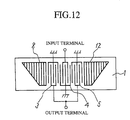
  • FIG. 12 is a diagram schematically illustrating another embodiment of the SAW filter according to the present invention.
  • FIG. 14 is a magnified view of FIG. 13;
  • FIG. 15 is a diagram schematically illustrating another embodiment of the SAW filter according to the present invention.
  • FIG. 16 shows the transmission characteristic of the SAW filter of the FIG. 15
  • FIG. 17 is a magnified view of FIG. 16;
  • FIG. 18 is a diagram schematically illustrating another embodiment of the SAW filter according to the present invention.
  • FIG. 19 is a diagram schematically illustrating still another embodiment of the SAW filter according to the present invention.
  • FIG. 20 is a diagram schematically showing an example of a conventional SAW filter.
  • FIG. 1 schematically illustrates a SAW filter according to a first embodiment (Embodiment 1) of the present invention, which is a longitudinally coupled multi-mode SAW filter in which three IDTs 3 to 5 are arranged on a piezoelectric substrate (LiTaO 3 , LiNbO 3 ) 1 capable of exciting surface acoustic waves and reflectors 2 and 6 are disposed on both sides of the IDTs 3 to 5 .
  • the two reflectors 2 and 6 each have grating electrodes weighted into trapezoidal form.
  • each reflector is weighted so that the number of its electrodes varies linearly with the position in the Y-direction perpendicular to the X-direction.
  • the number of electrodes of the reflector 6 is four at the farthest position and 10 at the nearest position in the Y-direction.
  • the reflector 6 has the electrodes 101 and 102 shorted at both ends by bus bars 103 , 104 and 105 .
  • the reflector 2 is point-symmetrical in construction to the reflector 6 .
  • the reflectors 2 and 6 differ in the pitch of electrodes from the IDTs 3 to 5 .
  • Reference character L denotes the length of the reflector in the direction of propagation of surface acoustic waves
  • M denotes the length of the weighted or graded portion of the reflector in the direction of propagation of surface acoustic waves.
  • FIG. 2 shows the transmission characteristic of the above-mentioned SAW filter measured over a 500 MHz frequency range from 692.5 to 1192.5 MHz with a 942.5 MHz center frequency. In FIG. 2 the ordinate is graduated to 0 dB in 5 dB increments.
  • FIG. 3 shows the central portion of the FIG.
  • FIGS. 4 and 5 show its transmission characteristic. It will be seen that many spike-like spurious pulses are present particularly on the low-frequency side of the pass band in FIG. 4 but that the generation of such spurious pulses is appreciably suppressed in the FIG. 2 transmission characteristic.
  • FIGS. 7, 9 and 11 magnified versions of central portion of the measured characteristics.
  • the value of M/L may preferably be 0.3 or more.
  • spurious pulses are generated due to the high-order mode.
  • the generation of spurious pulses is attributed to the reflection of waves of frequencies outside the pass band by the reflectors.
  • the longitudinally coupled, dual mode SAW filter differs from the transversely-coupled, dual mode SAW filter in the mechanism of generation of spurious pulses, and hence it has a high degree of flexibility in designing the electrode pattern of the reflector. Accordingly, the electrodes need not be weighted along the sine curve as depicted in FIG. 20, but instead they can be weighted linearly.
  • FIG. 12 is a diagrammatic representation of a second embodiment (Embodiment 2) of the present invention, which differs from Embodiment 1 in the shape of the right-hand reflector 12 .
  • the two reflectors are weighted so that they are point-symmetric to each other, whereas in Embodiment 2 the reflectors 8 and 12 are weighted so that they are point-symmetric with respect to a line perpendicular to the direction of propagation of surface acoustic waves.
  • This structure also permits suppression of generation of spurious pulses as is the case with Embodiment 1.
  • FIG. 14 depicts a magnified central portion of the measured characteristic.
  • the numbers of electrodes of each IDT and each reflector are the same as in Embodiment 1.
  • the spurious pulses can similarly be suppressed.
  • FIG. 16 shows a measured transmission characteristic of the longitudinally coupled, multi-mode SAW filter of this embodiment.
  • FIG. 17 shows it magnified central portion of the measured characteristic.
  • the spurious pulses can similarly be suppressed.
  • FIG. 18 is a diagrammatic representation of a fourth embodiment (Embodiment 4) of the present invention.
  • the electrodes of the IDTs and the reflectors are formed of aluminum (Al) and its alloys and are patterned into required form by wet or dry etching. In the case of wet etching, the electrodes are not clearly patterned because those portions in, for example, the reflectors 2 and 6 in FIG. 1 which are to be etched away are entirely surrounded by metal patterns.
  • FIG. 1 embodiment uses three bus bars to short opposite ends of metal grating electrodes of the reflectors 2 and 6 .
  • Embodiment 4 uses a single bus bar to short the metal grating electrodes of each of reflectors 20 and 24 —this prevents each reflector from being entirely surrounded by metal patterns, and hence it provides a structure easy for wet etching.
  • FIG. 19 is a diagrammatic showing of a fifth embodiment (Embodiment 5) of the present invention, which is a two-stage connection of 3-IDT-type longitudinally coupled, multi-mode SAW filters each having three IDTs and a reflector on either side of the IDT assembly.
  • longitudinally coupled, multi-mode SAW filters having differently weighted reflectors generate spurious pulses of different shapes in the vicinity of the pass band.
  • the electrodes of reflectors 26 , 30 and 31 , 35 of the two SAW filters in FIG. 19 are weighted differently from each other so that crests and troughs of spurious pulses in the two SAW filters cancel each other as much as possible.
  • multi-stage connection of such 3-IDT-type longitudinally coupled, multi-mode SAW filters it is possible to further suppress the generation of spurious pulses in the overall transmission characteristic.

Landscapes

  • Physics & Mathematics (AREA)
  • Acoustics & Sound (AREA)
  • Surface Acoustic Wave Elements And Circuit Networks Thereof (AREA)

Abstract

In a longitudinally coupled multi-mode surface acoustic wave filter which has an assembly of more than two interdigital transducers formed on a piezoelectric substrate and reflectors composed of shorted grating electrodes different in pitch from the IDTs. The grating electrodes are weighted so that their numbers vary linearly with the position in the direction perpendicular to the direction of propagation of surface acoustic waves.

Description

TECHNICAL FIELD
The present invention relates to a surface acoustic wave filter for use in a high-frequency circuit of a mobile communication device typified, for example, by a portable telephone or car telephone and, more particularly, to an easy-to-manufacture surface acoustic wave filter that has an excellent attenuation characteristic in the neighborhood of its pass band.
BACKGROUND ART
A resonator type surface acoustic wave (hereinafter referred to as SAW) filter is provided with reflectors on both sides of each interdigital transducer (IDT) to reflect surface acoustic waves, thereby generating standing waves.
With the provision of such reflectors, sawtooth or spike-like spurious pulses develop in the vicinity of the pass band—this is attributable to the reflectors. The sizes and shapes of these spurious pulses depend on the configuration of the SAW filter, such as the number of IDTs used and the IDT spacing.
Further, in recent portable telephone or similar mobile communication systems the necessity for effective use of available frequency has lessened the space between transmitting and receiving frequency bands, that is, what is called a transition bandwidth, and there is the growing demand for SAW filters which provide increased transmission attenuation in the neighborhood of the pass band in such mobile communication systems.
FIG. 20 depicts a transversely-coupled, dual mode SAW filter disclosed in Japanese Patent Application Laid-Open Gazette No. 128519/91. This SAW filter has two resonators 201 and 202 disposed on a piezoelectric substrate (made principally of crystal) 200 across the direction of propagation of surface acoustic waves. The resonators 201 and 202 have reflectors 206 to 209 on both sides of interdigital transducers (IDTs) 203 and 204, and are excited in fundamental and second-order modes. Each reflector is graded or weighted by a different number of electrodes arranged in the direction of propagation of surface acoustic waves, thereby suppressing high-order modes and hence providing an improved spurious characteristic.
Incidentally, since the electrodes of the reflectors 203 to 209 in FIG. 20 are weighted along a sine curve, the development of filters encounters much difficulty, for example, in the design of electrode patterns, including simulations and in the creation of data on electrode patterns for use in the fabrication of photomasks.
DISCLOSURE OF THE INVENTION
It is therefore an object of the present invention to provide a SAW filter that permits suppression or elimination of the aforementioned spurious pulses to improve attenuation in the vicinity of the pass band and has an easy-to-develop and fabricate structure.
According to the present invention, there is provided a longitudinal-coupled SAW filter that has at least two interdigital transducers formed over a piezoelectric substrate and reflectors disposed on both sides of the interdigital transducers and in which the reflectors each comprise: a group of electrodes graded so that their number linearly varies with their position in the direction perpendicular to the direction of propagation of surface acoustic waves; and bus bars shorting the electrodes.
Since the electrode groups of the reflectors are graded so that the number of electrodes of each group varies with their position in the direction perpendicular to the direction of propagation of surface acoustic waves, the present invention allows ease in the design and development of the SAW filter, and permits reduction of the spurious pulses and hence provide improved attenuation in the vicinity of the pass band.
BRIEF DESCRIPTION OF THE DRAWINGS
FIG. 1 is a schematic diagram illustrating an embodiment of the SAW filter according to the present invention;
FIG. 2 shows the transmission characteristic of the SAW filter of Embodiment 1 with M/L=0.5;
FIG. 3 is a magnified view of FIG. 2;
FIG. 4 shows the transmission characteristic of a conventional SAW filter just for comparison use;
FIG. 5 is a magnified view of FIG. 4;
FIG. 6 shows the transmission characteristic of the SAW filter of Embodiment 1 with M/L=0.1;
FIG. 7 is a magnified view of FIG. 6;
FIG. 8 shows the transmission characteristic of the SAW filter of. Embodiment 1 with M/L=0.3;
FIG. 9 is a magnified view of FIG. 8;
FIG. 10 shows the transmission characteristic of the SAW filter of Embodiment 1 with M/L=0.7;
FIG. 11 is a magnified view of FIG. 10;
FIG. 12 is a diagram schematically illustrating another embodiment of the SAW filter according to the present invention;
FIG. 13 shows the transmission characteristic of the SAW filter of the FIG. 12 embodiment with M/L=0.5;
FIG. 14 is a magnified view of FIG. 13;
FIG. 15 is a diagram schematically illustrating another embodiment of the SAW filter according to the present invention;
FIG. 16 shows the transmission characteristic of the SAW filter of the FIG. 15;
FIG. 17 is a magnified view of FIG. 16;
FIG. 18 is a diagram schematically illustrating another embodiment of the SAW filter according to the present invention;
FIG. 19 is a diagram schematically illustrating still another embodiment of the SAW filter according to the present invention; and
FIG. 20 is a diagram schematically showing an example of a conventional SAW filter.
BEST MODE FOR CARRYING OUT THE INVENTION
In order to describe the invention in more detail, the preferred embodiments of the invention will now be described with reference to the accompanying drawings.
Embodiment 1
FIG. 1 schematically illustrates a SAW filter according to a first embodiment (Embodiment 1) of the present invention, which is a longitudinally coupled multi-mode SAW filter in which three IDTs 3 to 5 are arranged on a piezoelectric substrate (LiTaO3, LiNbO3) 1 capable of exciting surface acoustic waves and reflectors 2 and 6 are disposed on both sides of the IDTs 3 to 5. The two reflectors 2 and 6 each have grating electrodes weighted into trapezoidal form. Surface acoustic waves propagate in the direction indicated by X, and each reflector is weighted so that the number of its electrodes varies linearly with the position in the Y-direction perpendicular to the X-direction. For example, the number of electrodes of the reflector 6 is four at the farthest position and 10 at the nearest position in the Y-direction. The reflector 6 has the electrodes 101 and 102 shorted at both ends by bus bars 103, 104 and 105. The reflector 2 is point-symmetrical in construction to the reflector 6. The reflectors 2 and 6 differ in the pitch of electrodes from the IDTs 3 to 5. Reference character L denotes the length of the reflector in the direction of propagation of surface acoustic waves, and M denotes the length of the weighted or graded portion of the reflector in the direction of propagation of surface acoustic waves.
To confirm the reflector weighting effect, the present inventors built a prototype of a longitudinally coupled multi-mode SAW filter of the FIG. 1 structure in which: the IDTs 3 and 5 each had 22 electrodes;,the IDT 4 had 31 electrodes; the reflectors 2 and 5 each had 146 electrodes; and M/L=0.5. FIG. 2 shows the transmission characteristic of the above-mentioned SAW filter measured over a 500 MHz frequency range from 692.5 to 1192.5 MHz with a 942.5 MHz center frequency. In FIG. 2 the ordinate is graduated to 0 dB in 5 dB increments. FIG. 3 shows the central portion of the FIG. 2 transmission characteristic magnified over a 100 MHz range in the direction of frequency, the abscissa being graduated in terms of 3 dB. The same goes for the ordinates and abscissas in the transmission characteristic diagrams and their magnified versions described hereinafter.
For comparison with the SAW filter of this embodiment, the inventors produced a longitudinally coupled multi-mode SAW filter of exactly the same construction as that of the SAW filter of this embodiment except that M/L=0, that is, the reflectors were not weighted and hence were rectangular in shape as in the past. FIGS. 4 and 5 show its transmission characteristic. It will be seen that many spike-like spurious pulses are present particularly on the low-frequency side of the pass band in FIG. 4 but that the generation of such spurious pulses is appreciably suppressed in the FIG. 2 transmission characteristic.
FIGS. 6 to 11 show measured results of transmission characteristics of SAW filters of exactly the same construction as that of the inventors'prototyped SAW filter except that M/L=0.1, 0.3 and 0.7, respectively. FIGS. 6, 8 and 10 show the transmission characteristics measured in the cases of M/L=0.1, 0.3 and 0.7, respectively, and FIGS. 7, 9 and 11 magnified versions of central portion of the measured characteristics.
As can be seen from FIGS. 6 to 11, the generation of spurious pulses diminishes as in the case of FIG. 2, and since the weighted area of each reflector increases with an increase in the value of M/L, the generation of spurious pulses is suppressed accordingly; in particular, attenuation increases toward the pass band.
To provide a sufficient attenuation in the neighborhood of the pass band, the value of M/L may preferably be 0.3 or more.
In the transversely-coupled, dual mode SAW filter of FIG. 20, spurious pulses are generated due to the high-order mode. In contrast thereto, in the longitudinally coupled, dual mode SAW filter as proposed by the present invention, the generation of spurious pulses is attributed to the reflection of waves of frequencies outside the pass band by the reflectors. The longitudinally coupled, dual mode SAW filter differs from the transversely-coupled, dual mode SAW filter in the mechanism of generation of spurious pulses, and hence it has a high degree of flexibility in designing the electrode pattern of the reflector. Accordingly, the electrodes need not be weighted along the sine curve as depicted in FIG. 20, but instead they can be weighted linearly.
Embodiment 2
FIG. 12 is a diagrammatic representation of a second embodiment (Embodiment 2) of the present invention, which differs from Embodiment 1 in the shape of the right-hand reflector 12. In Embodiment 1 the two reflectors are weighted so that they are point-symmetric to each other, whereas in Embodiment 2 the reflectors 8 and 12 are weighted so that they are point-symmetric with respect to a line perpendicular to the direction of propagation of surface acoustic waves. This structure also permits suppression of generation of spurious pulses as is the case with Embodiment 1.
FIG. 13 shows a measured transmission characteristic of the longitudinally coupled, multi-mode SAW filter according to this embodiment with M/L=0.5. FIG. 14 depicts a magnified central portion of the measured characteristic. The numbers of electrodes of each IDT and each reflector are the same as in Embodiment 1.
From FIG. 13 it is evident that the structure of this embodiment effectively suppresses the generation of spurious pulses. Further, it can be seen that since the weighted reflector 12 differ in shape from the counterpart in FIG. 2, spurious pulses also somewhat differ in shape although they are suppressed to the same extent as in the FIG. 2 embodiment.
Moreover, even if the two reflectors are weighted as if they were flipped vertically into trapezoidal form, the spurious pulses can similarly be suppressed.
Embodiment 3
FIG. 15 is a diagrammatic showing of a third embodiment (Embodiment 3) of the present invention. This is a modified form of Embodiment 1, in which M/L=1 and consequently reflectors 14 and 18 are weighted so that they are triangular.
FIG. 16 shows a measured transmission characteristic of the longitudinally coupled, multi-mode SAW filter of this embodiment. FIG. 17 shows it magnified central portion of the measured characteristic. This SAW filter is exactly identical in construction with Embodiment 1 except that M/L=1 as mentioned above. From FIG. 16 it can be seen that since the weighted area of each reflector is maximized by M/L=1, spurious pulses can be suppressed more than in the case of M/L=0.1 to 0.7.
Moreover, even if the two reflectors are weighted as if they were flipped vertically into triangular form, the spurious pulses can similarly be suppressed.
Embodiment 4
FIG. 18 is a diagrammatic representation of a fourth embodiment (Embodiment 4) of the present invention. It is customary in the art that the electrodes of the IDTs and the reflectors are formed of aluminum (Al) and its alloys and are patterned into required form by wet or dry etching. In the case of wet etching, the electrodes are not clearly patterned because those portions in, for example, the reflectors 2 and 6 in FIG. 1 which are to be etched away are entirely surrounded by metal patterns.
To avoid this, the FIG. 1 embodiment uses three bus bars to short opposite ends of metal grating electrodes of the reflectors 2 and 6. On the other hand, Embodiment 4 uses a single bus bar to short the metal grating electrodes of each of reflectors 20 and 24—this prevents each reflector from being entirely surrounded by metal patterns, and hence it provides a structure easy for wet etching.
It is also apparent that even if the two reflectors on both sides of the IDT assembly are both weighted into such a shape as indicated by 20 or 24, an easy-to-wet-etch structure could similarly be obtained.
Moreover, it is evident that such easy-to-wet-etch structures could similarly be obtained using one bus bar to short the metal grating electrodes of each reflector in the embodiments of FIGS. 12 and 15.
Embodiment 5
FIG. 19 is a diagrammatic showing of a fifth embodiment (Embodiment 5) of the present invention, which is a two-stage connection of 3-IDT-type longitudinally coupled, multi-mode SAW filters each having three IDTs and a reflector on either side of the IDT assembly. As previously referred to in connection with Embodiment 2, longitudinally coupled, multi-mode SAW filters having differently weighted reflectors generate spurious pulses of different shapes in the vicinity of the pass band. Accordingly, the electrodes of reflectors 26, 30 and 31, 35 of the two SAW filters in FIG. 19 are weighted differently from each other so that crests and troughs of spurious pulses in the two SAW filters cancel each other as much as possible. With multi-stage connection of such 3-IDT-type longitudinally coupled, multi-mode SAW filters, it is possible to further suppress the generation of spurious pulses in the overall transmission characteristic.
The same results could be obtained by a multi-stage connection of longitudinally coupled, multi-mode SAW filters having one or four or more IDTs.
It will be apparent that many modifications and variations may be effected without departing from the scope of the novel concepts of the present invention.

Claims (3)

What is claimed is:
1. A longitudinally coupled surface acoustic wave filter comprising:
a piezoelectric substrate;
at least two interdigital transducers formed over the piezoelectric substrate; and
reflectors disposed on both sides of said at least two interdigital transducers, wherein:
said reflectors each have at least a weighted portion including electrodes weighted so that a number of said electrodes varies linearly with a position in a direction perpendicular to a direction of propagation of surface acoustic waves, and bus bars for shorting said weighted electrodes, and
a value of M/L is greater than or equal to 0.3,
where M denotes a length of the weighted portion of a respective reflector in the direction of propagation of the surface acoustic waves, and L denotes a total length of the respective reflector in the direction of propagation of the surface acoustic waves.
2. The longitudinally coupled surface acoustic wave filter according to claim 1, wherein said each reflector has only one bus bar for shorting said electrodes.
3. A longitudinally coupled surface acoustic wave filter comprising a multi-stage connection of said filter of claim 1.
US10/019,024 2000-04-24 2000-04-24 Longitudinally coupled surface acoustic wave filter with linearly weighted reflectors Expired - Fee Related US6650207B1 (en)

Applications Claiming Priority (1)

Application Number Priority Date Filing Date Title
PCT/JP2000/002651 WO2001082480A1 (en) 2000-04-24 2000-04-24 Vertical coupling surface acoustic wave filter

Publications (1)

Publication Number Publication Date
US6650207B1 true US6650207B1 (en) 2003-11-18

Family

ID=11735959

Family Applications (1)

Application Number Title Priority Date Filing Date
US10/019,024 Expired - Fee Related US6650207B1 (en) 2000-04-24 2000-04-24 Longitudinally coupled surface acoustic wave filter with linearly weighted reflectors

Country Status (6)

Country Link
US (1) US6650207B1 (en)
EP (1) EP1195896A4 (en)
JP (1) JP3512777B2 (en)
KR (1) KR20020021384A (en)
CA (1) CA2375596A1 (en)
WO (1) WO2001082480A1 (en)

Cited By (10)

* Cited by examiner, † Cited by third party
Publication number Priority date Publication date Assignee Title
US20030231083A1 (en) * 2002-02-15 2003-12-18 Andreas Detlefsen Resonator filter with improved adjacent channel selectivity
US20040077325A1 (en) * 2002-09-20 2004-04-22 Yuichi Takamine Surface acoustic wave device and communication apparatus including the same
US20050001699A1 (en) * 2003-01-24 2005-01-06 Murata Manufacturing Co., Ltd. Saw filter and communication device
US20070029679A1 (en) * 2003-01-20 2007-02-08 Peter Selmeier Electrical component having a reduced substrate area
US20100134203A1 (en) * 2005-08-25 2010-06-03 Fujitsu Media Devices Limited Filter and antenna duplexer
US20180278237A1 (en) * 2017-03-21 2018-09-27 Taiyo Yuden Co., Ltd. Acoustic wave filter
CN114268294A (en) * 2022-03-03 2022-04-01 深圳新声半导体有限公司 SAW device including hybrid weighting type reflection grating and hybrid weighting type reflection grating
US11489513B2 (en) 2018-11-16 2022-11-01 Skyworks Solutions, Inc. Multi-mode surface acoustic wave filter
CN119030497A (en) * 2024-08-29 2024-11-26 浙江星曜半导体有限公司 Surface acoustic wave resonator, filter and electronic device
CN119182373A (en) * 2023-11-13 2024-12-24 上海馨欧集成微电有限公司 High-frequency acoustic wave resonator and communication device using same

Families Citing this family (3)

* Cited by examiner, † Cited by third party
Publication number Priority date Publication date Assignee Title
US6836197B2 (en) * 2003-02-28 2004-12-28 Northrop Grumman Corporation Dual track SAW reflector filter using weighted reflective gratings
JP2011217420A (en) * 2006-02-24 2011-10-27 Panasonic Corp Surface acoustic wave filter, antenna duplexer, high-frequency module using them, and communication apparatus
JP5024388B2 (en) * 2007-12-11 2012-09-12 株式会社村田製作所 Surface wave device and duplexer

Citations (10)

* Cited by examiner, † Cited by third party
Publication number Priority date Publication date Assignee Title
US4350963A (en) * 1979-12-27 1982-09-21 Fujitsu Limited Surface acoustic wave device
JPS57208719A (en) * 1981-06-19 1982-12-21 Hitachi Ltd Surface acoustic wave device
JPS59200519A (en) * 1983-04-28 1984-11-13 Toshiba Corp Surface acoustic wave resonator
JPS614316A (en) 1984-06-19 1986-01-10 Nec Corp Two-port elastic surface wave resonator
US4803448A (en) * 1985-12-05 1989-02-07 Siemens Aktiengesellschaft Cantilever mount of a substrate lamina of a surface wave device
JPH03128519A (en) 1989-09-12 1991-05-31 Seiko Epson Corp Saw resonator and saw filter
JPH0440705A (en) 1990-06-06 1992-02-12 Murata Mfg Co Ltd Longitudinal double mode surface acoustic wave filter
JPH05251984A (en) 1992-03-03 1993-09-28 Kokusai Electric Co Ltd Surface acoustic wave resonator
US5705964A (en) * 1992-09-02 1998-01-06 Mitsubishi Denki Kabushiki Kaisha Surface acoustic wave device
JP3128519B2 (en) 1996-11-06 2001-01-29 リンナイ株式会社 Temperature controller for combined hot water heating system

Family Cites Families (5)

* Cited by examiner, † Cited by third party
Publication number Priority date Publication date Assignee Title
GB2127249A (en) * 1982-09-20 1984-04-04 Philips Electronic Associated Acoustic surface wave device
JPH0666626B2 (en) * 1985-06-07 1994-08-24 株式会社日立製作所 Surface acoustic wave resonator
DE19744948C2 (en) * 1997-10-10 1999-12-09 Siemens Ag Acoustic filter, especially surface wave filter
JP2000196399A (en) 1998-12-25 2000-07-14 Toyo Commun Equip Co Ltd Surface acoustic wave filters and resonators
JP3321443B2 (en) 1999-10-26 2002-09-03 東洋通信機株式会社 Primary-tertiary longitudinally coupled dual-mode SAW filter

Patent Citations (10)

* Cited by examiner, † Cited by third party
Publication number Priority date Publication date Assignee Title
US4350963A (en) * 1979-12-27 1982-09-21 Fujitsu Limited Surface acoustic wave device
JPS57208719A (en) * 1981-06-19 1982-12-21 Hitachi Ltd Surface acoustic wave device
JPS59200519A (en) * 1983-04-28 1984-11-13 Toshiba Corp Surface acoustic wave resonator
JPS614316A (en) 1984-06-19 1986-01-10 Nec Corp Two-port elastic surface wave resonator
US4803448A (en) * 1985-12-05 1989-02-07 Siemens Aktiengesellschaft Cantilever mount of a substrate lamina of a surface wave device
JPH03128519A (en) 1989-09-12 1991-05-31 Seiko Epson Corp Saw resonator and saw filter
JPH0440705A (en) 1990-06-06 1992-02-12 Murata Mfg Co Ltd Longitudinal double mode surface acoustic wave filter
JPH05251984A (en) 1992-03-03 1993-09-28 Kokusai Electric Co Ltd Surface acoustic wave resonator
US5705964A (en) * 1992-09-02 1998-01-06 Mitsubishi Denki Kabushiki Kaisha Surface acoustic wave device
JP3128519B2 (en) 1996-11-06 2001-01-29 リンナイ株式会社 Temperature controller for combined hot water heating system

Cited By (20)

* Cited by examiner, † Cited by third party
Publication number Priority date Publication date Assignee Title
US20030231083A1 (en) * 2002-02-15 2003-12-18 Andreas Detlefsen Resonator filter with improved adjacent channel selectivity
US6894588B2 (en) * 2002-02-15 2005-05-17 Epcos Ag Resonator filter with improved adjacent channel selectivity
US20040077325A1 (en) * 2002-09-20 2004-04-22 Yuichi Takamine Surface acoustic wave device and communication apparatus including the same
US7116189B2 (en) * 2002-09-20 2006-10-03 Murata Manufacturing Co., Ltd. Surface acoustic wave device and communication apparatus including the same
US20070029679A1 (en) * 2003-01-20 2007-02-08 Peter Selmeier Electrical component having a reduced substrate area
US8022556B2 (en) 2003-01-20 2011-09-20 Epcos Ag Electrical component having a reduced substrate area
US20050001699A1 (en) * 2003-01-24 2005-01-06 Murata Manufacturing Co., Ltd. Saw filter and communication device
US7015776B2 (en) * 2003-01-24 2006-03-21 Murata Manufacturing Co., Ltd. Saw filter and communication device utilizing a weighted reflector
US20100134203A1 (en) * 2005-08-25 2010-06-03 Fujitsu Media Devices Limited Filter and antenna duplexer
US8330558B2 (en) * 2005-08-25 2012-12-11 Taiyo Yuden Co., Ltd. Filter and antenna duplexer
US20180278237A1 (en) * 2017-03-21 2018-09-27 Taiyo Yuden Co., Ltd. Acoustic wave filter
US10693441B2 (en) * 2017-03-21 2020-06-23 Taiyo Yuden Co., Ltd. Acoustic wave filter
US11489513B2 (en) 2018-11-16 2022-11-01 Skyworks Solutions, Inc. Multi-mode surface acoustic wave filter
US11502668B2 (en) * 2018-11-16 2022-11-15 Skyworks Solutions, Inc. Multi-mode surface acoustic wave filter with stepped acoustic reflectors
US11545960B2 (en) 2018-11-16 2023-01-03 Skyworks Solutions, Inc. Multi-mode surface acoustic wave filter with slanted acoustic reflectors
US11949404B2 (en) 2018-11-16 2024-04-02 Skyworks Solutions, Inc. Acoustic wave component with stepped and slanted acoustic reflector
CN114268294A (en) * 2022-03-03 2022-04-01 深圳新声半导体有限公司 SAW device including hybrid weighting type reflection grating and hybrid weighting type reflection grating
CN114268294B (en) * 2022-03-03 2022-06-17 深圳新声半导体有限公司 SAW device including hybrid weighting type reflection grating and hybrid weighting type reflection grating
CN119182373A (en) * 2023-11-13 2024-12-24 上海馨欧集成微电有限公司 High-frequency acoustic wave resonator and communication device using same
CN119030497A (en) * 2024-08-29 2024-11-26 浙江星曜半导体有限公司 Surface acoustic wave resonator, filter and electronic device

Also Published As

Publication number Publication date
CA2375596A1 (en) 2001-11-01
EP1195896A1 (en) 2002-04-10
WO2001082480A1 (en) 2001-11-01
KR20020021384A (en) 2002-03-20
JP3512777B2 (en) 2004-03-31
EP1195896A4 (en) 2005-06-01

Similar Documents

Publication Publication Date Title
KR100290204B1 (en) Multimode surface acoustic wave filter
US7728699B2 (en) Acoustic wave filter
JP2010273382A (en) Surface acoustic wave resonator and surface acoustic wave filter using the same
JP3001350B2 (en) Surface acoustic wave filter
US6650207B1 (en) Longitudinally coupled surface acoustic wave filter with linearly weighted reflectors
US6208224B1 (en) Surface acoustic wave filter with parallel arm resonators having different resonant frequencies
JP3419339B2 (en) Surface acoustic wave filters, duplexers, communication equipment
KR100680675B1 (en) Surface acoustic wave apparatus
JP5695191B2 (en) Acoustic wave devices and modules
CN116318036A (en) Surface acoustic wave resonators, surface acoustic wave filters and duplexers
US7482896B2 (en) Surface acoustic wave apparatus
JPWO2001082480A1 (en) Longitudinal coupling surface acoustic wave filter
JP3366477B2 (en) Vertical composite quad mode SAW filter
JPH10261935A (en) Surface acoustic wave element
US6147574A (en) Unidirectional surface acoustic wave transducer and transversal-type saw filter having the same
US6812812B2 (en) Longitudinally coupled surface acoustic wave resonator filter
JP2005295202A (en) Surface acoustic wave filter and duplexer
CN119543877B (en) A temperature-compensated surface acoustic wave resonator and filter
JPH10261936A (en) Surface acoustic wave filter
JP2007124440A (en) Surface acoustic wave element and surface acoustic wave device
JP4548305B2 (en) Dual-mode surface acoustic wave filter
JPH08213869A (en) Interdigital transducer type surface acoustic wave resonator
JP2005278154A (en) Unidirectional surface acoustic wave transducer and surface acoustic wave device using the same
KR100762053B1 (en) Surface acoustic wave device
JP2000224002A (en) Surface acoustic wave device

Legal Events

Date Code Title Description
AS Assignment

Owner name: MITSUBISHI DENKI KABUSHIKI KAISHA, JAPAN

Free format text: ASSIGNMENT OF ASSIGNORS INTEREST;ASSIGNOR:TANAKA, HIROSHI;REEL/FRAME:014109/0033

Effective date: 20011128

FEPP Fee payment procedure

Free format text: PAYER NUMBER DE-ASSIGNED (ORIGINAL EVENT CODE: RMPN); ENTITY STATUS OF PATENT OWNER: LARGE ENTITY

Free format text: PAYOR NUMBER ASSIGNED (ORIGINAL EVENT CODE: ASPN); ENTITY STATUS OF PATENT OWNER: LARGE ENTITY

LAPS Lapse for failure to pay maintenance fees
STCH Information on status: patent discontinuation

Free format text: PATENT EXPIRED DUE TO NONPAYMENT OF MAINTENANCE FEES UNDER 37 CFR 1.362

FP Lapsed due to failure to pay maintenance fee

Effective date: 20071118