US6313308B1 - Methods for the preparation of biphenyl isoxazole sulfonamides - Google Patents
Methods for the preparation of biphenyl isoxazole sulfonamides Download PDFInfo
- Publication number
- US6313308B1 US6313308B1 US09/528,819 US52881900A US6313308B1 US 6313308 B1 US6313308 B1 US 6313308B1 US 52881900 A US52881900 A US 52881900A US 6313308 B1 US6313308 B1 US 6313308B1
- Authority
- US
- United States
- Prior art keywords
- formula
- compound
- salt
- substituted
- alkyl
- Prior art date
- Legal status (The legal status is an assumption and is not a legal conclusion. Google has not performed a legal analysis and makes no representation as to the accuracy of the status listed.)
- Expired - Fee Related
Links
- 238000000034 method Methods 0.000 title claims abstract description 46
- 238000002360 preparation method Methods 0.000 title claims abstract description 11
- KFJGHVOVYDCDOS-UHFFFAOYSA-N 1,1'-biphenyl;1,2-oxazole-3-sulfonamide Chemical class NS(=O)(=O)C=1C=CON=1.C1=CC=CC=C1C1=CC=CC=C1 KFJGHVOVYDCDOS-UHFFFAOYSA-N 0.000 title abstract description 5
- 150000001875 compounds Chemical class 0.000 claims description 135
- 150000003839 salts Chemical class 0.000 claims description 104
- -1 cycloalkenylalkyl Chemical group 0.000 claims description 62
- 125000000217 alkyl group Chemical group 0.000 claims description 51
- 125000003118 aryl group Chemical group 0.000 claims description 30
- 239000000243 solution Substances 0.000 claims description 27
- 239000002585 base Substances 0.000 claims description 22
- 125000000753 cycloalkyl group Chemical group 0.000 claims description 22
- 229910052739 hydrogen Inorganic materials 0.000 claims description 22
- 125000000623 heterocyclic group Chemical group 0.000 claims description 20
- 239000001257 hydrogen Substances 0.000 claims description 20
- KDLHZDBZIXYQEI-UHFFFAOYSA-N Palladium Chemical compound [Pd] KDLHZDBZIXYQEI-UHFFFAOYSA-N 0.000 claims description 18
- 125000005843 halogen group Chemical group 0.000 claims description 18
- 125000003545 alkoxy group Chemical group 0.000 claims description 16
- 125000001997 phenyl group Chemical group [H]C1=C([H])C([H])=C(*)C([H])=C1[H] 0.000 claims description 16
- 125000003342 alkenyl group Chemical group 0.000 claims description 15
- 125000003710 aryl alkyl group Chemical group 0.000 claims description 15
- 125000004432 carbon atom Chemical group C* 0.000 claims description 15
- 238000005859 coupling reaction Methods 0.000 claims description 15
- 125000004450 alkenylene group Chemical group 0.000 claims description 14
- 125000001316 cycloalkyl alkyl group Chemical group 0.000 claims description 14
- 125000002947 alkylene group Chemical group 0.000 claims description 13
- ZADPBFCGQRWHPN-UHFFFAOYSA-N boronic acid Chemical compound OBO ZADPBFCGQRWHPN-UHFFFAOYSA-N 0.000 claims description 13
- UFHFLCQGNIYNRP-UHFFFAOYSA-N Hydrogen Chemical compound [H][H] UFHFLCQGNIYNRP-UHFFFAOYSA-N 0.000 claims description 12
- 238000010168 coupling process Methods 0.000 claims description 12
- 229910052757 nitrogen Inorganic materials 0.000 claims description 12
- 229920006395 saturated elastomer Polymers 0.000 claims description 12
- DGAQECJNVWCQMB-PUAWFVPOSA-M Ilexoside XXIX Chemical compound C[C@@H]1CC[C@@]2(CC[C@@]3(C(=CC[C@H]4[C@]3(CC[C@@H]5[C@@]4(CC[C@@H](C5(C)C)OS(=O)(=O)[O-])C)C)[C@@H]2[C@]1(C)O)C)C(=O)O[C@H]6[C@@H]([C@H]([C@@H]([C@H](O6)CO)O)O)O.[Na+] DGAQECJNVWCQMB-PUAWFVPOSA-M 0.000 claims description 11
- ZLMJMSJWJFRBEC-UHFFFAOYSA-N Potassium Chemical compound [K] ZLMJMSJWJFRBEC-UHFFFAOYSA-N 0.000 claims description 11
- 125000004104 aryloxy group Chemical group 0.000 claims description 11
- 230000008878 coupling Effects 0.000 claims description 11
- 239000011591 potassium Substances 0.000 claims description 11
- 229910052700 potassium Inorganic materials 0.000 claims description 11
- 239000011734 sodium Substances 0.000 claims description 11
- 229910052708 sodium Inorganic materials 0.000 claims description 11
- WHXSMMKQMYFTQS-UHFFFAOYSA-N Lithium Chemical compound [Li] WHXSMMKQMYFTQS-UHFFFAOYSA-N 0.000 claims description 10
- 229910052744 lithium Inorganic materials 0.000 claims description 10
- 125000001424 substituent group Chemical group 0.000 claims description 10
- 125000000304 alkynyl group Chemical group 0.000 claims description 9
- 125000004093 cyano group Chemical group *C#N 0.000 claims description 9
- 229910052736 halogen Inorganic materials 0.000 claims description 9
- 150000002367 halogens Chemical group 0.000 claims description 9
- 239000003054 catalyst Substances 0.000 claims description 8
- 125000000392 cycloalkenyl group Chemical group 0.000 claims description 8
- 125000002887 hydroxy group Chemical group [H]O* 0.000 claims description 8
- CTSLXHKWHWQRSH-UHFFFAOYSA-N oxalyl chloride Chemical compound ClC(=O)C(Cl)=O CTSLXHKWHWQRSH-UHFFFAOYSA-N 0.000 claims description 8
- MFRIHAYPQRLWNB-UHFFFAOYSA-N sodium tert-butoxide Chemical compound [Na+].CC(C)(C)[O-] MFRIHAYPQRLWNB-UHFFFAOYSA-N 0.000 claims description 8
- 125000006267 biphenyl group Chemical group 0.000 claims description 7
- 229910052799 carbon Inorganic materials 0.000 claims description 7
- 125000003178 carboxy group Chemical group [H]OC(*)=O 0.000 claims description 7
- 239000012320 chlorinating reagent Substances 0.000 claims description 7
- 150000002431 hydrogen Chemical class 0.000 claims description 7
- 125000000449 nitro group Chemical group [O-][N+](*)=O 0.000 claims description 7
- CDBYLPFSWZWCQE-UHFFFAOYSA-L Sodium Carbonate Chemical compound [Na+].[Na+].[O-]C([O-])=O CDBYLPFSWZWCQE-UHFFFAOYSA-L 0.000 claims description 6
- 229910052783 alkali metal Inorganic materials 0.000 claims description 6
- 150000001340 alkali metals Chemical group 0.000 claims description 6
- 125000004470 heterocyclooxy group Chemical group 0.000 claims description 6
- BWHMMNNQKKPAPP-UHFFFAOYSA-L potassium carbonate Chemical compound [K+].[K+].[O-]C([O-])=O BWHMMNNQKKPAPP-UHFFFAOYSA-L 0.000 claims description 6
- FYSNRJHAOHDILO-UHFFFAOYSA-N thionyl chloride Chemical compound ClS(Cl)=O FYSNRJHAOHDILO-UHFFFAOYSA-N 0.000 claims description 6
- RIOQSEWOXXDEQQ-UHFFFAOYSA-N triphenylphosphine Chemical compound C1=CC=CC=C1P(C=1C=CC=CC=1)C1=CC=CC=C1 RIOQSEWOXXDEQQ-UHFFFAOYSA-N 0.000 claims description 6
- BMIBJCFFZPYJHF-UHFFFAOYSA-N 2-methoxy-5-methyl-3-(4,4,5,5-tetramethyl-1,3,2-dioxaborolan-2-yl)pyridine Chemical compound COC1=NC=C(C)C=C1B1OC(C)(C)C(C)(C)O1 BMIBJCFFZPYJHF-UHFFFAOYSA-N 0.000 claims description 5
- HBAQYPYDRFILMT-UHFFFAOYSA-N 8-[3-(1-cyclopropylpyrazol-4-yl)-1H-pyrazolo[4,3-d]pyrimidin-5-yl]-3-methyl-3,8-diazabicyclo[3.2.1]octan-2-one Chemical group C1(CC1)N1N=CC(=C1)C1=NNC2=C1N=C(N=C2)N1C2C(N(CC1CC2)C)=O HBAQYPYDRFILMT-UHFFFAOYSA-N 0.000 claims description 5
- QQVDYSUDFZZPSU-UHFFFAOYSA-M chloromethylidene(dimethyl)azanium;chloride Chemical group [Cl-].C[N+](C)=CCl QQVDYSUDFZZPSU-UHFFFAOYSA-M 0.000 claims description 5
- 125000002346 iodo group Chemical group I* 0.000 claims description 5
- LJGUZUROJOJEMI-UHFFFAOYSA-N n-(3,4-dimethyl-1,2-oxazol-5-yl)-2-[4-(1,3-oxazol-2-yl)phenyl]benzenesulfonamide Chemical compound CC1=NOC(NS(=O)(=O)C=2C(=CC=CC=2)C=2C=CC(=CC=2)C=2OC=CN=2)=C1C LJGUZUROJOJEMI-UHFFFAOYSA-N 0.000 claims description 5
- 125000004433 nitrogen atom Chemical group N* 0.000 claims description 5
- XHXFXVLFKHQFAL-UHFFFAOYSA-N phosphoryl trichloride Chemical compound ClP(Cl)(Cl)=O XHXFXVLFKHQFAL-UHFFFAOYSA-N 0.000 claims description 5
- 125000004419 alkynylene group Chemical group 0.000 claims description 4
- 125000004429 atom Chemical group 0.000 claims description 4
- 125000004663 dialkyl amino group Chemical group 0.000 claims description 4
- 229910052760 oxygen Inorganic materials 0.000 claims description 4
- 229910052763 palladium Inorganic materials 0.000 claims description 4
- LPNYRYFBWFDTMA-UHFFFAOYSA-N potassium tert-butoxide Chemical compound [K+].CC(C)(C)[O-] LPNYRYFBWFDTMA-UHFFFAOYSA-N 0.000 claims description 4
- OKTJSMMVPCPJKN-UHFFFAOYSA-N Carbon Chemical compound [C] OKTJSMMVPCPJKN-UHFFFAOYSA-N 0.000 claims description 3
- 125000001246 bromo group Chemical group Br* 0.000 claims description 3
- 229910000027 potassium carbonate Inorganic materials 0.000 claims description 3
- 229910000029 sodium carbonate Inorganic materials 0.000 claims description 3
- 125000004385 trihaloalkyl group Chemical group 0.000 claims description 3
- SBXDENYROQKXBE-UHFFFAOYSA-N 2-phenylbenzenesulfonamide Chemical compound NS(=O)(=O)C1=CC=CC=C1C1=CC=CC=C1 SBXDENYROQKXBE-UHFFFAOYSA-N 0.000 claims description 2
- KEAYESYHFKHZAL-UHFFFAOYSA-N Sodium Chemical compound [Na] KEAYESYHFKHZAL-UHFFFAOYSA-N 0.000 claims description 2
- 125000004171 alkoxy aryl group Chemical group 0.000 claims description 2
- 239000002738 chelating agent Substances 0.000 claims description 2
- ORJRYNKVKJAJPY-UHFFFAOYSA-N n-[[2-[2-[(4,5-dimethyl-1,2-oxazol-3-yl)sulfamoyl]phenyl]-5-(1,3-oxazol-2-yl)phenyl]methyl]-n,3,3-trimethylbutanamide Chemical compound CC(C)(C)CC(=O)N(C)CC1=CC(C=2OC=CN=2)=CC=C1C1=CC=CC=C1S(=O)(=O)NC1=NOC(C)=C1C ORJRYNKVKJAJPY-UHFFFAOYSA-N 0.000 claims description 2
- YJVFFLUZDVXJQI-UHFFFAOYSA-L palladium(ii) acetate Chemical group [Pd+2].CC([O-])=O.CC([O-])=O YJVFFLUZDVXJQI-UHFFFAOYSA-L 0.000 claims description 2
- 229910000104 sodium hydride Inorganic materials 0.000 claims description 2
- 239000012312 sodium hydride Substances 0.000 claims description 2
- 229910052717 sulfur Inorganic materials 0.000 claims description 2
- 125000004952 trihaloalkoxy group Chemical group 0.000 claims description 2
- MUJIDPITZJWBSW-UHFFFAOYSA-N palladium(2+) Chemical group [Pd+2] MUJIDPITZJWBSW-UHFFFAOYSA-N 0.000 claims 2
- FKLJPTJMIBLJAV-UHFFFAOYSA-N Compound IV Chemical compound O1N=C(C)C=C1CCCCCCCOC1=CC=C(C=2OCCN=2)C=C1 FKLJPTJMIBLJAV-UHFFFAOYSA-N 0.000 claims 1
- 239000007983 Tris buffer Substances 0.000 claims 1
- WMKGGPCROCCUDY-PHEQNACWSA-N dibenzylideneacetone Chemical compound C=1C=CC=CC=1\C=C\C(=O)\C=C\C1=CC=CC=C1 WMKGGPCROCCUDY-PHEQNACWSA-N 0.000 claims 1
- 238000011282 treatment Methods 0.000 abstract description 26
- 239000000543 intermediate Substances 0.000 abstract description 9
- 239000005557 antagonist Substances 0.000 abstract description 6
- 102000002045 Endothelin Human genes 0.000 abstract description 5
- 108050009340 Endothelin Proteins 0.000 abstract description 5
- 206010020772 Hypertension Diseases 0.000 abstract description 5
- ZUBDGKVDJUIMQQ-UBFCDGJISA-N endothelin-1 Chemical compound C([C@@H](C(=O)N[C@@H](CC(C)C)C(=O)N[C@@H](CC(O)=O)C(=O)N[C@@H]([C@@H](C)CC)C(=O)N[C@@H]([C@@H](C)CC)C(=O)N[C@@H](CC=1C2=CC=CC=C2NC=1)C(O)=O)NC(=O)[C@H]1NC(=O)[C@H](CC=2C=CC=CC=2)NC(=O)[C@@H](CC=2C=CC(O)=CC=2)NC(=O)[C@H](C(C)C)NC(=O)[C@H]2CSSC[C@@H](C(N[C@H](CO)C(=O)N[C@@H](CO)C(=O)N[C@H](CC(C)C)C(=O)N[C@@H](CCSC)C(=O)N[C@H](CC(O)=O)C(=O)N[C@@H](CCCCN)C(=O)N[C@@H](CCC(O)=O)C(=O)N2)=O)NC(=O)[C@@H](CO)NC(=O)[C@H](N)CSSC1)C1=CNC=N1 ZUBDGKVDJUIMQQ-UBFCDGJISA-N 0.000 abstract description 5
- 206010019280 Heart failures Diseases 0.000 abstract description 4
- 206010007559 Cardiac failure congestive Diseases 0.000 abstract description 3
- 208000010228 Erectile Dysfunction Diseases 0.000 abstract description 2
- 201000001881 impotence Diseases 0.000 abstract description 2
- WYURNTSHIVDZCO-UHFFFAOYSA-N Tetrahydrofuran Chemical compound C1CCOC1 WYURNTSHIVDZCO-UHFFFAOYSA-N 0.000 description 26
- 0 CC.CC.CC.CC1=CC=CC=C1.O=S(=O)(Nc1*[y]cc1)C1=CC=CC=C1 Chemical compound CC.CC.CC.CC1=CC=CC=C1.O=S(=O)(Nc1*[y]cc1)C1=CC=CC=C1 0.000 description 21
- YXFVVABEGXRONW-UHFFFAOYSA-N Toluene Chemical compound CC1=CC=CC=C1 YXFVVABEGXRONW-UHFFFAOYSA-N 0.000 description 21
- BZLVMXJERCGZMT-UHFFFAOYSA-N Methyl tert-butyl ether Chemical compound COC(C)(C)C BZLVMXJERCGZMT-UHFFFAOYSA-N 0.000 description 20
- 239000011541 reaction mixture Substances 0.000 description 20
- LFQSCWFLJHTTHZ-UHFFFAOYSA-N Ethanol Chemical compound CCO LFQSCWFLJHTTHZ-UHFFFAOYSA-N 0.000 description 19
- CSCPPACGZOOCGX-UHFFFAOYSA-N Acetone Chemical compound CC(C)=O CSCPPACGZOOCGX-UHFFFAOYSA-N 0.000 description 17
- 239000000047 product Substances 0.000 description 13
- XLYOFNOQVPJJNP-UHFFFAOYSA-N water Substances O XLYOFNOQVPJJNP-UHFFFAOYSA-N 0.000 description 12
- KFZMGEQAYNKOFK-UHFFFAOYSA-N Isopropanol Chemical compound CC(C)O KFZMGEQAYNKOFK-UHFFFAOYSA-N 0.000 description 11
- 235000019441 ethanol Nutrition 0.000 description 11
- 239000000203 mixture Substances 0.000 description 11
- YLQBMQCUIZJEEH-UHFFFAOYSA-N tetrahydrofuran Natural products C=1C=COC=1 YLQBMQCUIZJEEH-UHFFFAOYSA-N 0.000 description 11
- QAOWNCQODCNURD-UHFFFAOYSA-N Sulfuric acid Chemical compound OS(O)(=O)=O QAOWNCQODCNURD-UHFFFAOYSA-N 0.000 description 10
- 238000006243 chemical reaction Methods 0.000 description 10
- VLKZOEOYAKHREP-UHFFFAOYSA-N n-Hexane Chemical compound CCCCCC VLKZOEOYAKHREP-UHFFFAOYSA-N 0.000 description 10
- YMWUJEATGCHHMB-UHFFFAOYSA-N Dichloromethane Chemical compound ClCCl YMWUJEATGCHHMB-UHFFFAOYSA-N 0.000 description 9
- VEXZGXHMUGYJMC-UHFFFAOYSA-N Hydrochloric acid Chemical compound Cl VEXZGXHMUGYJMC-UHFFFAOYSA-N 0.000 description 9
- 238000004128 high performance liquid chromatography Methods 0.000 description 9
- 239000002002 slurry Substances 0.000 description 9
- MZRVEZGGRBJDDB-UHFFFAOYSA-N N-Butyllithium Chemical compound [Li]CCCC MZRVEZGGRBJDDB-UHFFFAOYSA-N 0.000 description 8
- DHKHKXVYLBGOIT-UHFFFAOYSA-N acetaldehyde Diethyl Acetal Natural products CCOC(C)OCC DHKHKXVYLBGOIT-UHFFFAOYSA-N 0.000 description 8
- 238000002425 crystallisation Methods 0.000 description 8
- 230000008025 crystallization Effects 0.000 description 8
- 208000037265 diseases, disorders, signs and symptoms Diseases 0.000 description 8
- SJRJJKPEHAURKC-UHFFFAOYSA-N N-Methylmorpholine Chemical compound CN1CCOCC1 SJRJJKPEHAURKC-UHFFFAOYSA-N 0.000 description 7
- 239000010410 layer Substances 0.000 description 7
- 229960003975 potassium Drugs 0.000 description 7
- 239000002904 solvent Substances 0.000 description 7
- IJGRMHOSHXDMSA-UHFFFAOYSA-N Atomic nitrogen Chemical compound N#N IJGRMHOSHXDMSA-UHFFFAOYSA-N 0.000 description 6
- KZMGYPLQYOPHEL-UHFFFAOYSA-N Boron trifluoride etherate Chemical compound FB(F)F.CCOCC KZMGYPLQYOPHEL-UHFFFAOYSA-N 0.000 description 6
- AFVFQIVMOAPDHO-UHFFFAOYSA-N Methanesulfonic acid Chemical compound CS(O)(=O)=O AFVFQIVMOAPDHO-UHFFFAOYSA-N 0.000 description 6
- OKKJLVBELUTLKV-UHFFFAOYSA-N Methanol Chemical compound OC OKKJLVBELUTLKV-UHFFFAOYSA-N 0.000 description 6
- JGFZNNIVVJXRND-UHFFFAOYSA-N N,N-Diisopropylethylamine (DIPEA) Chemical compound CCN(C(C)C)C(C)C JGFZNNIVVJXRND-UHFFFAOYSA-N 0.000 description 6
- HEMHJVSKTPXQMS-UHFFFAOYSA-M Sodium hydroxide Chemical compound [OH-].[Na+] HEMHJVSKTPXQMS-UHFFFAOYSA-M 0.000 description 6
- 239000002253 acid Substances 0.000 description 6
- 239000013078 crystal Substances 0.000 description 6
- QTBSBXVTEAMEQO-UHFFFAOYSA-N Acetic acid Chemical compound CC(O)=O QTBSBXVTEAMEQO-UHFFFAOYSA-N 0.000 description 5
- 125000005842 heteroatom Chemical group 0.000 description 5
- 125000002496 methyl group Chemical group [H]C([H])([H])* 0.000 description 5
- 150000007530 organic bases Chemical class 0.000 description 5
- 239000012044 organic layer Substances 0.000 description 5
- 238000002560 therapeutic procedure Methods 0.000 description 5
- CYPYTURSJDMMMP-WVCUSYJESA-N (1e,4e)-1,5-diphenylpenta-1,4-dien-3-one;palladium Chemical compound [Pd].[Pd].C=1C=CC=CC=1\C=C\C(=O)\C=C\C1=CC=CC=C1.C=1C=CC=CC=1\C=C\C(=O)\C=C\C1=CC=CC=C1.C=1C=CC=CC=1\C=C\C(=O)\C=C\C1=CC=CC=C1 CYPYTURSJDMMMP-WVCUSYJESA-N 0.000 description 4
- XKRFYHLGVUSROY-UHFFFAOYSA-N Argon Chemical compound [Ar] XKRFYHLGVUSROY-UHFFFAOYSA-N 0.000 description 4
- 206010016654 Fibrosis Diseases 0.000 description 4
- JUJWROOIHBZHMG-UHFFFAOYSA-N Pyridine Chemical compound C1=CC=NC=C1 JUJWROOIHBZHMG-UHFFFAOYSA-N 0.000 description 4
- FAPWRFPIFSIZLT-UHFFFAOYSA-M Sodium chloride Chemical compound [Na+].[Cl-] FAPWRFPIFSIZLT-UHFFFAOYSA-M 0.000 description 4
- 239000012298 atmosphere Substances 0.000 description 4
- 239000003795 chemical substances by application Substances 0.000 description 4
- 239000000460 chlorine Substances 0.000 description 4
- 229910052801 chlorine Inorganic materials 0.000 description 4
- 230000006378 damage Effects 0.000 description 4
- 201000010099 disease Diseases 0.000 description 4
- 208000035475 disorder Diseases 0.000 description 4
- 239000003112 inhibitor Substances 0.000 description 4
- 229910052740 iodine Inorganic materials 0.000 description 4
- 125000002924 primary amino group Chemical group [H]N([H])* 0.000 description 4
- 238000007363 ring formation reaction Methods 0.000 description 4
- 150000003512 tertiary amines Chemical class 0.000 description 4
- OISVCGZHLKNMSJ-UHFFFAOYSA-N 2,6-dimethylpyridine Chemical compound CC1=CC=CC(C)=N1 OISVCGZHLKNMSJ-UHFFFAOYSA-N 0.000 description 3
- 206010019851 Hepatotoxicity Diseases 0.000 description 3
- 239000002841 Lewis acid Substances 0.000 description 3
- ZMXDDKWLCZADIW-UHFFFAOYSA-N N,N-Dimethylformamide Chemical compound CN(C)C=O ZMXDDKWLCZADIW-UHFFFAOYSA-N 0.000 description 3
- 206010029155 Nephropathy toxic Diseases 0.000 description 3
- 108090000373 Tissue Plasminogen Activator Proteins 0.000 description 3
- 102000003978 Tissue Plasminogen Activator Human genes 0.000 description 3
- 239000013543 active substance Substances 0.000 description 3
- 239000003416 antiarrhythmic agent Substances 0.000 description 3
- 239000007864 aqueous solution Substances 0.000 description 3
- 229910052794 bromium Inorganic materials 0.000 description 3
- 239000006227 byproduct Substances 0.000 description 3
- 125000001309 chloro group Chemical group Cl* 0.000 description 3
- 230000000694 effects Effects 0.000 description 3
- 230000004761 fibrosis Effects 0.000 description 3
- 230000007686 hepatotoxicity Effects 0.000 description 3
- 231100000304 hepatotoxicity Toxicity 0.000 description 3
- 230000007062 hydrolysis Effects 0.000 description 3
- 238000006460 hydrolysis reaction Methods 0.000 description 3
- 208000014674 injury Diseases 0.000 description 3
- 150000007517 lewis acids Chemical class 0.000 description 3
- 229940098779 methanesulfonic acid Drugs 0.000 description 3
- 230000007694 nephrotoxicity Effects 0.000 description 3
- 231100000417 nephrotoxicity Toxicity 0.000 description 3
- YQZZXXKFKTWDPY-UHFFFAOYSA-N propan-2-yl benzenesulfonate Chemical compound CC(C)OS(=O)(=O)C1=CC=CC=C1 YQZZXXKFKTWDPY-UHFFFAOYSA-N 0.000 description 3
- DLYUQMMRRRQYAE-UHFFFAOYSA-N tetraphosphorus decaoxide Chemical compound O1P(O2)(=O)OP3(=O)OP1(=O)OP2(=O)O3 DLYUQMMRRRQYAE-UHFFFAOYSA-N 0.000 description 3
- 229960000187 tissue plasminogen activator Drugs 0.000 description 3
- NHDIQVFFNDKAQU-UHFFFAOYSA-N tripropan-2-yl borate Chemical compound CC(C)OB(OC(C)C)OC(C)C NHDIQVFFNDKAQU-UHFFFAOYSA-N 0.000 description 3
- WZRRRFSJFQTGGB-UHFFFAOYSA-N 1,3,5-triazinane-2,4,6-trithione Chemical compound S=C1NC(=S)NC(=S)N1 WZRRRFSJFQTGGB-UHFFFAOYSA-N 0.000 description 2
- UUUHXMGGBIUAPW-UHFFFAOYSA-N 1-[1-[2-[[5-amino-2-[[1-[5-(diaminomethylideneamino)-2-[[1-[3-(1h-indol-3-yl)-2-[(5-oxopyrrolidine-2-carbonyl)amino]propanoyl]pyrrolidine-2-carbonyl]amino]pentanoyl]pyrrolidine-2-carbonyl]amino]-5-oxopentanoyl]amino]-3-methylpentanoyl]pyrrolidine-2-carbon Chemical compound C1CCC(C(=O)N2C(CCC2)C(O)=O)N1C(=O)C(C(C)CC)NC(=O)C(CCC(N)=O)NC(=O)C1CCCN1C(=O)C(CCCN=C(N)N)NC(=O)C1CCCN1C(=O)C(CC=1C2=CC=CC=C2NC=1)NC(=O)C1CCC(=O)N1 UUUHXMGGBIUAPW-UHFFFAOYSA-N 0.000 description 2
- BHKKSKOHRFHHIN-MRVPVSSYSA-N 1-[[2-[(1R)-1-aminoethyl]-4-chlorophenyl]methyl]-2-sulfanylidene-5H-pyrrolo[3,2-d]pyrimidin-4-one Chemical compound N[C@H](C)C1=C(CN2C(NC(C3=C2C=CN3)=O)=S)C=CC(=C1)Cl BHKKSKOHRFHHIN-MRVPVSSYSA-N 0.000 description 2
- BJNRAXNXFISPNV-UHFFFAOYSA-N 2-(4-iodophenyl)-1,3-oxazole Chemical compound C1=CC(I)=CC=C1C1=NC=CO1 BJNRAXNXFISPNV-UHFFFAOYSA-N 0.000 description 2
- HVAUUPRFYPCOCA-AREMUKBSSA-N 2-O-acetyl-1-O-hexadecyl-sn-glycero-3-phosphocholine Chemical compound CCCCCCCCCCCCCCCCOC[C@@H](OC(C)=O)COP([O-])(=O)OCC[N+](C)(C)C HVAUUPRFYPCOCA-AREMUKBSSA-N 0.000 description 2
- QIXCSHIEHGEJGB-UHFFFAOYSA-N 2-iodo-1,3-oxazole Chemical compound IC1=NC=CO1 QIXCSHIEHGEJGB-UHFFFAOYSA-N 0.000 description 2
- 102000005862 Angiotensin II Human genes 0.000 description 2
- 101800000733 Angiotensin-2 Proteins 0.000 description 2
- 108010058207 Anistreplase Proteins 0.000 description 2
- UZWJHGMLYHIMMV-UHFFFAOYSA-N CB(O)O.COS(=O)(=O)C1=CC=CC=C1.II Chemical compound CB(O)O.COS(=O)(=O)C1=CC=CC=C1.II UZWJHGMLYHIMMV-UHFFFAOYSA-N 0.000 description 2
- SEBGZXPUMQNIPR-UHFFFAOYSA-N CC1=CC=CC=C1.O=S(=O)(Cl)C1=CC=CC=C1.[V] Chemical compound CC1=CC=CC=C1.O=S(=O)(Cl)C1=CC=CC=C1.[V] SEBGZXPUMQNIPR-UHFFFAOYSA-N 0.000 description 2
- ZAMOUSCENKQFHK-UHFFFAOYSA-N Chlorine atom Chemical compound [Cl] ZAMOUSCENKQFHK-UHFFFAOYSA-N 0.000 description 2
- JZUFKLXOESDKRF-UHFFFAOYSA-N Chlorothiazide Chemical compound C1=C(Cl)C(S(=O)(=O)N)=CC2=C1NCNS2(=O)=O JZUFKLXOESDKRF-UHFFFAOYSA-N 0.000 description 2
- 201000004624 Dermatitis Diseases 0.000 description 2
- XTHFKEDIFFGKHM-UHFFFAOYSA-N Dimethoxyethane Chemical compound COCCOC XTHFKEDIFFGKHM-UHFFFAOYSA-N 0.000 description 2
- 108030001679 Endothelin-converting enzyme 1 Proteins 0.000 description 2
- 102000048186 Endothelin-converting enzyme 1 Human genes 0.000 description 2
- CPELXLSAUQHCOX-UHFFFAOYSA-N Hydrogen bromide Chemical compound Br CPELXLSAUQHCOX-UHFFFAOYSA-N 0.000 description 2
- CZGUSIXMZVURDU-JZXHSEFVSA-N Ile(5)-angiotensin II Chemical compound C([C@@H](C(=O)N[C@@H]([C@@H](C)CC)C(=O)N[C@@H](CC=1NC=NC=1)C(=O)N1[C@@H](CCC1)C(=O)N[C@@H](CC=1C=CC=CC=1)C([O-])=O)NC(=O)[C@@H](NC(=O)[C@H](CCCNC(N)=[NH2+])NC(=O)[C@@H]([NH3+])CC([O-])=O)C(C)C)C1=CC=C(O)C=C1 CZGUSIXMZVURDU-JZXHSEFVSA-N 0.000 description 2
- LRHPLDYGYMQRHN-UHFFFAOYSA-N N-Butanol Chemical compound CCCCO LRHPLDYGYMQRHN-UHFFFAOYSA-N 0.000 description 2
- 206010028980 Neoplasm Diseases 0.000 description 2
- 102000003729 Neprilysin Human genes 0.000 description 2
- 108090000028 Neprilysin Proteins 0.000 description 2
- 102000004270 Peptidyl-Dipeptidase A Human genes 0.000 description 2
- 108090000882 Peptidyl-Dipeptidase A Proteins 0.000 description 2
- 208000018262 Peripheral vascular disease Diseases 0.000 description 2
- 108010003541 Platelet Activating Factor Proteins 0.000 description 2
- 206010063897 Renal ischaemia Diseases 0.000 description 2
- 229960000583 acetic acid Drugs 0.000 description 2
- 230000001154 acute effect Effects 0.000 description 2
- 150000004703 alkoxides Chemical class 0.000 description 2
- 125000004453 alkoxycarbonyl group Chemical group 0.000 description 2
- 125000003282 alkyl amino group Chemical group 0.000 description 2
- 125000005233 alkylalcohol group Chemical group 0.000 description 2
- 229950006323 angiotensin ii Drugs 0.000 description 2
- 239000012736 aqueous medium Substances 0.000 description 2
- 229910052786 argon Inorganic materials 0.000 description 2
- 125000004619 benzopyranyl group Chemical group O1C(C=CC2=C1C=CC=C2)* 0.000 description 2
- 239000011230 binding agent Substances 0.000 description 2
- 230000015572 biosynthetic process Effects 0.000 description 2
- 125000006269 biphenyl-2-yl group Chemical group [H]C1=C([H])C([H])=C(C([H])=C1[H])C1=C(*)C([H])=C([H])C([H])=C1[H] 0.000 description 2
- ILAHWRKJUDSMFH-UHFFFAOYSA-N boron tribromide Chemical compound BrB(Br)Br ILAHWRKJUDSMFH-UHFFFAOYSA-N 0.000 description 2
- 125000005620 boronic acid group Chemical group 0.000 description 2
- 150000001721 carbon Chemical group 0.000 description 2
- 150000003857 carboxamides Chemical group 0.000 description 2
- 230000002612 cardiopulmonary effect Effects 0.000 description 2
- 125000004122 cyclic group Chemical group 0.000 description 2
- 229930182912 cyclosporin Natural products 0.000 description 2
- 238000000502 dialysis Methods 0.000 description 2
- ZUOUZKKEUPVFJK-UHFFFAOYSA-N diphenyl Chemical compound C1=CC=CC=C1C1=CC=CC=C1 ZUOUZKKEUPVFJK-UHFFFAOYSA-N 0.000 description 2
- 238000004108 freeze drying Methods 0.000 description 2
- 230000001434 glomerular Effects 0.000 description 2
- 150000002430 hydrocarbons Chemical group 0.000 description 2
- 125000002768 hydroxyalkyl group Chemical group 0.000 description 2
- 230000001631 hypertensive effect Effects 0.000 description 2
- 230000005764 inhibitory process Effects 0.000 description 2
- 239000002609 medium Substances 0.000 description 2
- FKSHNXIYANGOFX-UHFFFAOYSA-N n-(2,2-dimethoxyethyl)-4-iodobenzamide Chemical compound COC(OC)CNC(=O)C1=CC=C(I)C=C1 FKSHNXIYANGOFX-UHFFFAOYSA-N 0.000 description 2
- 201000009925 nephrosclerosis Diseases 0.000 description 2
- 125000002971 oxazolyl group Chemical group 0.000 description 2
- 239000000546 pharmaceutical excipient Substances 0.000 description 2
- NHKJPPKXDNZFBJ-UHFFFAOYSA-N phenyllithium Chemical compound [Li]C1=CC=CC=C1 NHKJPPKXDNZFBJ-UHFFFAOYSA-N 0.000 description 2
- IVDFJHOHABJVEH-UHFFFAOYSA-N pinacol Chemical class CC(C)(O)C(C)(C)O IVDFJHOHABJVEH-UHFFFAOYSA-N 0.000 description 2
- 229920000137 polyphosphoric acid Polymers 0.000 description 2
- 229910000028 potassium bicarbonate Inorganic materials 0.000 description 2
- 235000015497 potassium bicarbonate Nutrition 0.000 description 2
- 239000011736 potassium bicarbonate Substances 0.000 description 2
- 235000011181 potassium carbonates Nutrition 0.000 description 2
- TYJJADVDDVDEDZ-UHFFFAOYSA-M potassium hydrogencarbonate Chemical compound [K+].OC([O-])=O TYJJADVDDVDEDZ-UHFFFAOYSA-M 0.000 description 2
- 239000002244 precipitate Substances 0.000 description 2
- 239000003755 preservative agent Substances 0.000 description 2
- 230000002335 preservative effect Effects 0.000 description 2
- BDERNNFJNOPAEC-UHFFFAOYSA-N propan-1-ol Chemical compound CCCO BDERNNFJNOPAEC-UHFFFAOYSA-N 0.000 description 2
- AISPPKSSOLMHOC-UHFFFAOYSA-N propan-2-yl 2-bromobenzenesulfonate Chemical compound CC(C)OS(=O)(=O)C1=CC=CC=C1Br AISPPKSSOLMHOC-UHFFFAOYSA-N 0.000 description 2
- UMJSCPRVCHMLSP-UHFFFAOYSA-N pyridine Natural products COC1=CC=CN=C1 UMJSCPRVCHMLSP-UHFFFAOYSA-N 0.000 description 2
- 229940044551 receptor antagonist Drugs 0.000 description 2
- 239000002464 receptor antagonist Substances 0.000 description 2
- 239000011780 sodium chloride Substances 0.000 description 2
- 239000003381 stabilizer Substances 0.000 description 2
- 239000007858 starting material Substances 0.000 description 2
- 238000001356 surgical procedure Methods 0.000 description 2
- 239000000725 suspension Substances 0.000 description 2
- 230000000699 topical effect Effects 0.000 description 2
- 230000008733 trauma Effects 0.000 description 2
- NVXFXLSOGLFXKQ-JMSVASOKSA-N (2s)-1-[(2r,4r)-5-ethoxy-2,4-dimethyl-5-oxopentanoyl]-2,3-dihydroindole-2-carboxylic acid Chemical compound C1=CC=C2N(C(=O)[C@H](C)C[C@@H](C)C(=O)OCC)[C@H](C(O)=O)CC2=C1 NVXFXLSOGLFXKQ-JMSVASOKSA-N 0.000 description 1
- BIDNLKIUORFRQP-XYGFDPSESA-N (2s,4s)-4-cyclohexyl-1-[2-[[(1s)-2-methyl-1-propanoyloxypropoxy]-(4-phenylbutyl)phosphoryl]acetyl]pyrrolidine-2-carboxylic acid Chemical compound C([P@@](=O)(O[C@H](OC(=O)CC)C(C)C)CC(=O)N1[C@@H](C[C@H](C1)C1CCCCC1)C(O)=O)CCCC1=CC=CC=C1 BIDNLKIUORFRQP-XYGFDPSESA-N 0.000 description 1
- DXSUORGKJZADET-UHFFFAOYSA-N *.CC(N)C(C)(C)C Chemical compound *.CC(N)C(C)(C)C DXSUORGKJZADET-UHFFFAOYSA-N 0.000 description 1
- WNXJIVFYUVYPPR-UHFFFAOYSA-N 1,3-dioxolane Chemical compound C1COCO1 WNXJIVFYUVYPPR-UHFFFAOYSA-N 0.000 description 1
- IFYLTXNCFVRALQ-UHFFFAOYSA-N 1-[6-amino-2-[hydroxy(4-phenylbutyl)phosphoryl]oxyhexanoyl]pyrrolidine-2-carboxylic acid Chemical compound C1CCC(C(O)=O)N1C(=O)C(CCCCN)OP(O)(=O)CCCCC1=CC=CC=C1 IFYLTXNCFVRALQ-UHFFFAOYSA-N 0.000 description 1
- QKWWDTYDYOFRJL-UHFFFAOYSA-N 2,2-dimethoxyethanamine Chemical compound COC(CN)OC QKWWDTYDYOFRJL-UHFFFAOYSA-N 0.000 description 1
- OBTZDIRUQWFRFZ-UHFFFAOYSA-N 2-(5-methylfuran-2-yl)-n-(4-methylphenyl)quinoline-4-carboxamide Chemical compound O1C(C)=CC=C1C1=CC(C(=O)NC=2C=CC(C)=CC=2)=C(C=CC=C2)C2=N1 OBTZDIRUQWFRFZ-UHFFFAOYSA-N 0.000 description 1
- LKUMAZWMPGZQNY-UHFFFAOYSA-N 2-[4-(1,3-oxazol-2-yl)phenyl]benzenesulfonic acid Chemical compound OS(=O)(=O)C1=CC=CC=C1C1=CC=C(C=2OC=CN=2)C=C1 LKUMAZWMPGZQNY-UHFFFAOYSA-N 0.000 description 1
- VFPWGZNNRSQPBT-UHFFFAOYSA-N 2-bromobenzenesulfonyl chloride Chemical compound ClS(=O)(=O)C1=CC=CC=C1Br VFPWGZNNRSQPBT-UHFFFAOYSA-N 0.000 description 1
- JIVPVXMEBJLZRO-CQSZACIVSA-N 2-chloro-5-[(1r)-1-hydroxy-3-oxo-2h-isoindol-1-yl]benzenesulfonamide Chemical compound C1=C(Cl)C(S(=O)(=O)N)=CC([C@@]2(O)C3=CC=CC=C3C(=O)N2)=C1 JIVPVXMEBJLZRO-CQSZACIVSA-N 0.000 description 1
- XWKFPIODWVPXLX-UHFFFAOYSA-N 2-methyl-5-methylpyridine Natural products CC1=CC=C(C)N=C1 XWKFPIODWVPXLX-UHFFFAOYSA-N 0.000 description 1
- LBLYYCQCTBFVLH-UHFFFAOYSA-M 2-methylbenzenesulfonate Chemical compound CC1=CC=CC=C1S([O-])(=O)=O LBLYYCQCTBFVLH-UHFFFAOYSA-M 0.000 description 1
- 125000006088 2-oxoazepinyl group Chemical group 0.000 description 1
- 125000004638 2-oxopiperazinyl group Chemical group O=C1N(CCNC1)* 0.000 description 1
- 125000004637 2-oxopiperidinyl group Chemical group O=C1N(CCCC1)* 0.000 description 1
- 125000006087 2-oxopyrrolodinyl group Chemical group 0.000 description 1
- 125000004610 3,4-dihydro-4-oxo-quinazolinyl group Chemical group O=C1NC(=NC2=CC=CC=C12)* 0.000 description 1
- PYNDWPFZDQONDV-UHFFFAOYSA-N 3,4-dimethyl-1,2-oxazol-5-amine Chemical compound CC1=NOC(N)=C1C PYNDWPFZDQONDV-UHFFFAOYSA-N 0.000 description 1
- JHNLZOVBAQWGQU-UHFFFAOYSA-N 380814_sial Chemical compound CS(O)(=O)=O.O=P(=O)OP(=O)=O JHNLZOVBAQWGQU-UHFFFAOYSA-N 0.000 description 1
- NJAKCIUOTIPYED-UHFFFAOYSA-N 4-iodobenzoyl chloride Chemical compound ClC(=O)C1=CC=C(I)C=C1 NJAKCIUOTIPYED-UHFFFAOYSA-N 0.000 description 1
- 125000005986 4-piperidonyl group Chemical group 0.000 description 1
- ZCYVEMRRCGMTRW-UHFFFAOYSA-N 7553-56-2 Chemical compound [I] ZCYVEMRRCGMTRW-UHFFFAOYSA-N 0.000 description 1
- 239000005541 ACE inhibitor Substances 0.000 description 1
- 208000009304 Acute Kidney Injury Diseases 0.000 description 1
- 206010001052 Acute respiratory distress syndrome Diseases 0.000 description 1
- FHHHOYXPRDYHEZ-COXVUDFISA-N Alacepril Chemical compound CC(=O)SC[C@@H](C)C(=O)N1CCC[C@H]1C(=O)N[C@H](C(O)=O)CC1=CC=CC=C1 FHHHOYXPRDYHEZ-COXVUDFISA-N 0.000 description 1
- APKFDSVGJQXUKY-KKGHZKTASA-N Amphotericin-B Natural products O[C@H]1[C@@H](N)[C@H](O)[C@@H](C)O[C@H]1O[C@H]1C=CC=CC=CC=CC=CC=CC=C[C@H](C)[C@@H](O)[C@@H](C)[C@H](C)OC(=O)C[C@H](O)C[C@H](O)CC[C@@H](O)[C@H](O)C[C@H](O)C[C@](O)(C[C@H](O)[C@H]2C(O)=O)O[C@H]2C1 APKFDSVGJQXUKY-KKGHZKTASA-N 0.000 description 1
- 239000004475 Arginine Substances 0.000 description 1
- 206010003225 Arteriospasm coronary Diseases 0.000 description 1
- 206010004446 Benign prostatic hyperplasia Diseases 0.000 description 1
- BVKZGUZCCUSVTD-UHFFFAOYSA-M Bicarbonate Chemical compound OC([O-])=O BVKZGUZCCUSVTD-UHFFFAOYSA-M 0.000 description 1
- 201000006474 Brain Ischemia Diseases 0.000 description 1
- WKBOTKDWSSQWDR-UHFFFAOYSA-N Bromine atom Chemical compound [Br] WKBOTKDWSSQWDR-UHFFFAOYSA-N 0.000 description 1
- YBXBIWAHJTZUIW-UHFFFAOYSA-N C.C.CC(=O)N(C)C.CCN(C)C Chemical compound C.C.CC(=O)N(C)C.CCN(C)C YBXBIWAHJTZUIW-UHFFFAOYSA-N 0.000 description 1
- FOQJHZPURACERJ-UHFFFAOYSA-N CB1OC(C)(C)C(C)(C)O1 Chemical compound CB1OC(C)(C)C(C)(C)O1 FOQJHZPURACERJ-UHFFFAOYSA-N 0.000 description 1
- XVNAYEAZFBHADI-UHFFFAOYSA-N CC(C)OS(=O)(=O)C1=C(B(O)O)C=CC=C1 Chemical compound CC(C)OS(=O)(=O)C1=C(B(O)O)C=CC=C1 XVNAYEAZFBHADI-UHFFFAOYSA-N 0.000 description 1
- ALDCDHOYRGTRIF-UHFFFAOYSA-N CC.CC.CC1=CC=C(C(=O)NC(C)C(C)(C)C)C=C1 Chemical compound CC.CC.CC1=CC=C(C(=O)NC(C)C(C)(C)C)C=C1 ALDCDHOYRGTRIF-UHFFFAOYSA-N 0.000 description 1
- QVVVREYTSIKHQW-UHFFFAOYSA-N CC.CC.CC1=CC=C(C2=NC(C)=C(C)O2)C=C1 Chemical compound CC.CC.CC1=CC=C(C2=NC(C)=C(C)O2)C=C1 QVVVREYTSIKHQW-UHFFFAOYSA-N 0.000 description 1
- YLBHXIQIPMYAJW-UHFFFAOYSA-N CC.CC.CC1=CC=C(C2=NC(C)C(C)(C)O2)C=C1 Chemical compound CC.CC.CC1=CC=C(C2=NC(C)C(C)(C)O2)C=C1 YLBHXIQIPMYAJW-UHFFFAOYSA-N 0.000 description 1
- OYPRJOBELJOOCE-UHFFFAOYSA-N Calcium Chemical compound [Ca] OYPRJOBELJOOCE-UHFFFAOYSA-N 0.000 description 1
- 229940127291 Calcium channel antagonist Drugs 0.000 description 1
- 206010007572 Cardiac hypertrophy Diseases 0.000 description 1
- 208000006029 Cardiomegaly Diseases 0.000 description 1
- 208000026005 Central nervous system vascular disease Diseases 0.000 description 1
- 206010008120 Cerebral ischaemia Diseases 0.000 description 1
- 229920001268 Cholestyramine Polymers 0.000 description 1
- 206010009900 Colitis ulcerative Diseases 0.000 description 1
- 206010010071 Coma Diseases 0.000 description 1
- 208000003890 Coronary Vasospasm Diseases 0.000 description 1
- 208000011231 Crohn disease Diseases 0.000 description 1
- 208000019707 Cryoglobulinemic vasculitis Diseases 0.000 description 1
- PMATZTZNYRCHOR-CGLBZJNRSA-N Cyclosporin A Chemical compound CC[C@@H]1NC(=O)[C@H]([C@H](O)[C@H](C)C\C=C\C)N(C)C(=O)[C@H](C(C)C)N(C)C(=O)[C@H](CC(C)C)N(C)C(=O)[C@H](CC(C)C)N(C)C(=O)[C@@H](C)NC(=O)[C@H](C)NC(=O)[C@H](CC(C)C)N(C)C(=O)[C@H](C(C)C)NC(=O)[C@H](CC(C)C)N(C)C(=O)CN(C)C1=O PMATZTZNYRCHOR-CGLBZJNRSA-N 0.000 description 1
- 108010036949 Cyclosporine Proteins 0.000 description 1
- 108010036941 Cyclosporins Proteins 0.000 description 1
- XBPCUCUWBYBCDP-UHFFFAOYSA-N Dicyclohexylamine Chemical compound C1CCCCC1NC1CCCCC1 XBPCUCUWBYBCDP-UHFFFAOYSA-N 0.000 description 1
- 206010013012 Dilatation ventricular Diseases 0.000 description 1
- 208000005171 Dysmenorrhea Diseases 0.000 description 1
- 206010013935 Dysmenorrhoea Diseases 0.000 description 1
- 108010061435 Enalapril Proteins 0.000 description 1
- 208000037487 Endotoxemia Diseases 0.000 description 1
- 102000003951 Erythropoietin Human genes 0.000 description 1
- 108090000394 Erythropoietin Proteins 0.000 description 1
- 208000004248 Familial Primary Pulmonary Hypertension Diseases 0.000 description 1
- PXGOKWXKJXAPGV-UHFFFAOYSA-N Fluorine Chemical compound FF PXGOKWXKJXAPGV-UHFFFAOYSA-N 0.000 description 1
- 208000018522 Gastrointestinal disease Diseases 0.000 description 1
- 206010070538 Gestational hypertension Diseases 0.000 description 1
- 201000005624 HELLP Syndrome Diseases 0.000 description 1
- 229940121710 HMGCoA reductase inhibitor Drugs 0.000 description 1
- 208000006050 Hemangiopericytoma Diseases 0.000 description 1
- 208000032456 Hemorrhagic Shock Diseases 0.000 description 1
- 208000016988 Hemorrhagic Stroke Diseases 0.000 description 1
- 102000007625 Hirudins Human genes 0.000 description 1
- 108010007267 Hirudins Proteins 0.000 description 1
- 206010021143 Hypoxia Diseases 0.000 description 1
- 208000032382 Ischaemic stroke Diseases 0.000 description 1
- 150000000994 L-ascorbates Chemical class 0.000 description 1
- 206010049694 Left Ventricular Dysfunction Diseases 0.000 description 1
- 108010007859 Lisinopril Proteins 0.000 description 1
- 206010067125 Liver injury Diseases 0.000 description 1
- KDXKERNSBIXSRK-UHFFFAOYSA-N Lysine Natural products NCCCCC(N)C(O)=O KDXKERNSBIXSRK-UHFFFAOYSA-N 0.000 description 1
- 239000004472 Lysine Substances 0.000 description 1
- FYYHWMGAXLPEAU-UHFFFAOYSA-N Magnesium Chemical compound [Mg] FYYHWMGAXLPEAU-UHFFFAOYSA-N 0.000 description 1
- CESYKOGBSMNBPD-UHFFFAOYSA-N Methyclothiazide Chemical compound ClC1=C(S(N)(=O)=O)C=C2S(=O)(=O)N(C)C(CCl)NC2=C1 CESYKOGBSMNBPD-UHFFFAOYSA-N 0.000 description 1
- 208000019695 Migraine disease Diseases 0.000 description 1
- PCZOHLXUXFIOCF-UHFFFAOYSA-N Monacolin X Natural products C12C(OC(=O)C(C)CC)CC(C)C=C2C=CC(C)C1CCC1CC(O)CC(=O)O1 PCZOHLXUXFIOCF-UHFFFAOYSA-N 0.000 description 1
- 208000013901 Nephropathies and tubular disease Diseases 0.000 description 1
- 208000012902 Nervous system disease Diseases 0.000 description 1
- 208000025966 Neurological disease Diseases 0.000 description 1
- CWVAVKJPNOBCOV-UHFFFAOYSA-M O=S(=O)(O[Na])C1=C(C2=CC=C(C3=NC=CO3)C=C2)C=CC=C1 Chemical compound O=S(=O)(O[Na])C1=C(C2=CC=C(C3=NC=CO3)C=C2)C=CC=C1 CWVAVKJPNOBCOV-UHFFFAOYSA-M 0.000 description 1
- ZCQWOFVYLHDMMC-UHFFFAOYSA-N Oxazole Chemical compound C1=COC=N1 ZCQWOFVYLHDMMC-UHFFFAOYSA-N 0.000 description 1
- 229910019142 PO4 Inorganic materials 0.000 description 1
- 208000002193 Pain Diseases 0.000 description 1
- 206010033645 Pancreatitis Diseases 0.000 description 1
- ZPHBZEQOLSRPAK-UHFFFAOYSA-N Phosphoramidon Natural products C=1NC2=CC=CC=C2C=1CC(C(O)=O)NC(=O)C(CC(C)C)NP(O)(=O)OC1OC(C)C(O)C(O)C1O ZPHBZEQOLSRPAK-UHFFFAOYSA-N 0.000 description 1
- 239000004698 Polyethylene Substances 0.000 description 1
- CYLWJCABXYDINA-UHFFFAOYSA-N Polythiazide Polymers ClC1=C(S(N)(=O)=O)C=C2S(=O)(=O)N(C)C(CSCC(F)(F)F)NC2=C1 CYLWJCABXYDINA-UHFFFAOYSA-N 0.000 description 1
- 229940127315 Potassium Channel Openers Drugs 0.000 description 1
- TUZYXOIXSAXUGO-UHFFFAOYSA-N Pravastatin Natural products C1=CC(C)C(CCC(O)CC(O)CC(O)=O)C2C(OC(=O)C(C)CC)CC(O)C=C21 TUZYXOIXSAXUGO-UHFFFAOYSA-N 0.000 description 1
- 208000005347 Pregnancy-Induced Hypertension Diseases 0.000 description 1
- OFOBLEOULBTSOW-UHFFFAOYSA-N Propanedioic acid Natural products OC(=O)CC(O)=O OFOBLEOULBTSOW-UHFFFAOYSA-N 0.000 description 1
- 208000004403 Prostatic Hyperplasia Diseases 0.000 description 1
- 201000004681 Psoriasis Diseases 0.000 description 1
- 206010064911 Pulmonary arterial hypertension Diseases 0.000 description 1
- 208000003782 Raynaud disease Diseases 0.000 description 1
- 208000012322 Raynaud phenomenon Diseases 0.000 description 1
- 208000033626 Renal failure acute Diseases 0.000 description 1
- 208000013616 Respiratory Distress Syndrome Diseases 0.000 description 1
- 208000017442 Retinal disease Diseases 0.000 description 1
- 206010038923 Retinopathy Diseases 0.000 description 1
- 201000004239 Secondary hypertension Diseases 0.000 description 1
- 206010040070 Septic Shock Diseases 0.000 description 1
- 206010049771 Shock haemorrhagic Diseases 0.000 description 1
- UIIMBOGNXHQVGW-UHFFFAOYSA-M Sodium bicarbonate Chemical class [Na+].OC([O-])=O UIIMBOGNXHQVGW-UHFFFAOYSA-M 0.000 description 1
- 108010023197 Streptokinase Proteins 0.000 description 1
- 208000006011 Stroke Diseases 0.000 description 1
- 208000032851 Subarachnoid Hemorrhage Diseases 0.000 description 1
- 206010042434 Sudden death Diseases 0.000 description 1
- NINIDFKCEFEMDL-UHFFFAOYSA-N Sulfur Chemical group [S] NINIDFKCEFEMDL-UHFFFAOYSA-N 0.000 description 1
- 201000009594 Systemic Scleroderma Diseases 0.000 description 1
- 206010042953 Systemic sclerosis Diseases 0.000 description 1
- 229940122388 Thrombin inhibitor Drugs 0.000 description 1
- 102000003938 Thromboxane Receptors Human genes 0.000 description 1
- 108090000300 Thromboxane Receptors Proteins 0.000 description 1
- FNYLWPVRPXGIIP-UHFFFAOYSA-N Triamterene Chemical compound NC1=NC2=NC(N)=NC(N)=C2N=C1C1=CC=CC=C1 FNYLWPVRPXGIIP-UHFFFAOYSA-N 0.000 description 1
- 206010067584 Type 1 diabetes mellitus Diseases 0.000 description 1
- 208000025865 Ulcer Diseases 0.000 description 1
- 201000006704 Ulcerative Colitis Diseases 0.000 description 1
- 108090000435 Urokinase-type plasminogen activator Proteins 0.000 description 1
- 102000003990 Urokinase-type plasminogen activator Human genes 0.000 description 1
- 206010047115 Vasculitis Diseases 0.000 description 1
- 208000033774 Ventricular Remodeling Diseases 0.000 description 1
- 206010047370 Vesicoureteric reflux Diseases 0.000 description 1
- 208000027418 Wounds and injury Diseases 0.000 description 1
- QWQONZVLXJGXHV-UHFFFAOYSA-N [chlorosulfonyloxy(dimethyl)silyl]methane Chemical compound C[Si](C)(C)OS(Cl)(=O)=O QWQONZVLXJGXHV-UHFFFAOYSA-N 0.000 description 1
- 150000001241 acetals Chemical group 0.000 description 1
- 150000001242 acetic acid derivatives Chemical class 0.000 description 1
- 125000000641 acridinyl group Chemical group C1(=CC=CC2=NC3=CC=CC=C3C=C12)* 0.000 description 1
- 201000011040 acute kidney failure Diseases 0.000 description 1
- 208000012998 acute renal failure Diseases 0.000 description 1
- 239000000654 additive Substances 0.000 description 1
- 239000000464 adrenergic agent Substances 0.000 description 1
- 229950007884 alacepril Drugs 0.000 description 1
- 150000001298 alcohols Chemical class 0.000 description 1
- 229910000288 alkali metal carbonate Inorganic materials 0.000 description 1
- 150000008041 alkali metal carbonates Chemical class 0.000 description 1
- 229910052784 alkaline earth metal Inorganic materials 0.000 description 1
- 150000001342 alkaline earth metals Chemical class 0.000 description 1
- 125000005115 alkyl carbamoyl group Chemical group 0.000 description 1
- 125000005196 alkyl carbonyloxy group Chemical group 0.000 description 1
- 125000004414 alkyl thio group Chemical group 0.000 description 1
- XSDQTOBWRPYKKA-UHFFFAOYSA-N amiloride Chemical compound NC(=N)NC(=O)C1=NC(Cl)=C(N)N=C1N XSDQTOBWRPYKKA-UHFFFAOYSA-N 0.000 description 1
- 229960002576 amiloride Drugs 0.000 description 1
- 150000001412 amines Chemical class 0.000 description 1
- 150000001413 amino acids Chemical class 0.000 description 1
- APKFDSVGJQXUKY-INPOYWNPSA-N amphotericin B Chemical compound O[C@H]1[C@@H](N)[C@H](O)[C@@H](C)O[C@H]1O[C@H]1/C=C/C=C/C=C/C=C/C=C/C=C/C=C/[C@H](C)[C@@H](O)[C@@H](C)[C@H](C)OC(=O)C[C@H](O)C[C@H](O)CC[C@@H](O)[C@H](O)C[C@H](O)C[C@](O)(C[C@H](O)[C@H]2C(O)=O)O[C@H]2C1 APKFDSVGJQXUKY-INPOYWNPSA-N 0.000 description 1
- 229960003942 amphotericin b Drugs 0.000 description 1
- 238000002399 angioplasty Methods 0.000 description 1
- 229940044094 angiotensin-converting-enzyme inhibitor Drugs 0.000 description 1
- 150000001450 anions Chemical class 0.000 description 1
- 239000004004 anti-anginal agent Substances 0.000 description 1
- 230000000879 anti-atherosclerotic effect Effects 0.000 description 1
- 230000000843 anti-fungal effect Effects 0.000 description 1
- 230000002253 anti-ischaemic effect Effects 0.000 description 1
- 229940124345 antianginal agent Drugs 0.000 description 1
- 239000000924 antiasthmatic agent Substances 0.000 description 1
- 239000003146 anticoagulant agent Substances 0.000 description 1
- 229940125714 antidiarrheal agent Drugs 0.000 description 1
- 239000003793 antidiarrheal agent Substances 0.000 description 1
- 239000003429 antifungal agent Substances 0.000 description 1
- 229940121375 antifungal agent Drugs 0.000 description 1
- 229940030600 antihypertensive agent Drugs 0.000 description 1
- 239000002220 antihypertensive agent Substances 0.000 description 1
- 239000008346 aqueous phase Substances 0.000 description 1
- ODKSFYDXXFIFQN-UHFFFAOYSA-N arginine Natural products OC(=O)C(N)CCCNC(N)=N ODKSFYDXXFIFQN-UHFFFAOYSA-N 0.000 description 1
- 150000001543 aryl boronic acids Chemical class 0.000 description 1
- 125000005199 aryl carbonyloxy group Chemical group 0.000 description 1
- 125000005110 aryl thio group Chemical group 0.000 description 1
- 235000010323 ascorbic acid Nutrition 0.000 description 1
- 208000010668 atopic eczema Diseases 0.000 description 1
- 125000002785 azepinyl group Chemical group 0.000 description 1
- 230000003542 behavioural effect Effects 0.000 description 1
- 229960003515 bendroflumethiazide Drugs 0.000 description 1
- HDWIHXWEUNVBIY-UHFFFAOYSA-N bendroflumethiazidum Chemical compound C1=C(C(F)(F)F)C(S(=O)(=O)N)=CC(S(N2)(=O)=O)=C1NC2CC1=CC=CC=C1 HDWIHXWEUNVBIY-UHFFFAOYSA-N 0.000 description 1
- JUHORIMYRDESRB-UHFFFAOYSA-N benzathine Chemical compound C=1C=CC=CC=1CNCCNCC1=CC=CC=C1 JUHORIMYRDESRB-UHFFFAOYSA-N 0.000 description 1
- SRSXLGNVWSONIS-UHFFFAOYSA-M benzenesulfonate Chemical compound [O-]S(=O)(=O)C1=CC=CC=C1 SRSXLGNVWSONIS-UHFFFAOYSA-M 0.000 description 1
- 229940077388 benzenesulfonate Drugs 0.000 description 1
- CSKNSYBAZOQPLR-UHFFFAOYSA-N benzenesulfonyl chloride Chemical compound ClS(=O)(=O)C1=CC=CC=C1 CSKNSYBAZOQPLR-UHFFFAOYSA-N 0.000 description 1
- 125000003785 benzimidazolyl group Chemical group N1=C(NC2=C1C=CC=C2)* 0.000 description 1
- 125000004618 benzofuryl group Chemical group O1C(=CC2=C1C=CC=C2)* 0.000 description 1
- 150000001558 benzoic acid derivatives Chemical class 0.000 description 1
- 125000001164 benzothiazolyl group Chemical group S1C(=NC2=C1C=CC=C2)* 0.000 description 1
- 125000004196 benzothienyl group Chemical group S1C(=CC2=C1C=CC=C2)* 0.000 description 1
- 125000004541 benzoxazolyl group Chemical group O1C(=NC2=C1C=CC=C2)* 0.000 description 1
- 229960001541 benzthiazide Drugs 0.000 description 1
- NDTSRXAMMQDVSW-UHFFFAOYSA-N benzthiazide Chemical compound C1=C(Cl)C(S(=O)(=O)N)=CC(S(N2)(=O)=O)=C1N=C2CSCC1=CC=CC=C1 NDTSRXAMMQDVSW-UHFFFAOYSA-N 0.000 description 1
- 125000002619 bicyclic group Chemical group 0.000 description 1
- 125000002618 bicyclic heterocycle group Chemical group 0.000 description 1
- 229920000080 bile acid sequestrant Polymers 0.000 description 1
- 229940096699 bile acid sequestrants Drugs 0.000 description 1
- 210000000013 bile duct Anatomy 0.000 description 1
- 239000012455 biphasic mixture Substances 0.000 description 1
- 235000010290 biphenyl Nutrition 0.000 description 1
- 239000004305 biphenyl Substances 0.000 description 1
- 230000036772 blood pressure Effects 0.000 description 1
- 230000010072 bone remodeling Effects 0.000 description 1
- 150000001642 boronic acid derivatives Chemical class 0.000 description 1
- GDTBXPJZTBHREO-UHFFFAOYSA-N bromine Substances BrBr GDTBXPJZTBHREO-UHFFFAOYSA-N 0.000 description 1
- MAEIEVLCKWDQJH-UHFFFAOYSA-N bumetanide Chemical compound CCCCNC1=CC(C(O)=O)=CC(S(N)(=O)=O)=C1OC1=CC=CC=C1 MAEIEVLCKWDQJH-UHFFFAOYSA-N 0.000 description 1
- 229960004064 bumetanide Drugs 0.000 description 1
- 239000011575 calcium Substances 0.000 description 1
- 229910052791 calcium Inorganic materials 0.000 description 1
- 239000000480 calcium channel blocker Substances 0.000 description 1
- 201000011510 cancer Diseases 0.000 description 1
- 230000000711 cancerogenic effect Effects 0.000 description 1
- 239000002775 capsule Substances 0.000 description 1
- FAKRSMQSSFJEIM-RQJHMYQMSA-N captopril Chemical compound SC[C@@H](C)C(=O)N1CCC[C@H]1C(O)=O FAKRSMQSSFJEIM-RQJHMYQMSA-N 0.000 description 1
- 229960000830 captopril Drugs 0.000 description 1
- 125000003917 carbamoyl group Chemical group [H]N([H])C(*)=O 0.000 description 1
- 125000000609 carbazolyl group Chemical group C1(=CC=CC=2C3=CC=CC=C3NC12)* 0.000 description 1
- 125000001589 carboacyl group Chemical group 0.000 description 1
- 231100000315 carcinogenic Toxicity 0.000 description 1
- 230000000747 cardiac effect Effects 0.000 description 1
- 239000008148 cardioplegic solution Substances 0.000 description 1
- 238000006555 catalytic reaction Methods 0.000 description 1
- 230000003915 cell function Effects 0.000 description 1
- 210000003169 central nervous system Anatomy 0.000 description 1
- 206010008118 cerebral infarction Diseases 0.000 description 1
- 230000000973 chemotherapeutic effect Effects 0.000 description 1
- 238000005660 chlorination reaction Methods 0.000 description 1
- 229960002155 chlorothiazide Drugs 0.000 description 1
- 229960001523 chlortalidone Drugs 0.000 description 1
- 208000003167 cholangitis Diseases 0.000 description 1
- 125000004617 chromonyl group Chemical group O1C(=CC(C2=CC=CC=C12)=O)* 0.000 description 1
- 208000037976 chronic inflammation Diseases 0.000 description 1
- 208000037893 chronic inflammatory disorder Diseases 0.000 description 1
- 208000020832 chronic kidney disease Diseases 0.000 description 1
- 208000022831 chronic renal failure syndrome Diseases 0.000 description 1
- 229960001265 ciclosporin Drugs 0.000 description 1
- 125000000259 cinnolinyl group Chemical group N1=NC(=CC2=CC=CC=C12)* 0.000 description 1
- 230000007882 cirrhosis Effects 0.000 description 1
- 208000019425 cirrhosis of liver Diseases 0.000 description 1
- 150000001860 citric acid derivatives Chemical class 0.000 description 1
- 230000008602 contraction Effects 0.000 description 1
- 239000002872 contrast media Substances 0.000 description 1
- 201000011634 coronary artery vasospasm Diseases 0.000 description 1
- 125000000332 coumarinyl group Chemical group O1C(=O)C(=CC2=CC=CC=C12)* 0.000 description 1
- 239000006071 cream Substances 0.000 description 1
- 239000012043 crude product Substances 0.000 description 1
- 201000003278 cryoglobulinemia Diseases 0.000 description 1
- WOUOLAUOZXOLJQ-MBSDFSHPSA-N delapril Chemical compound C([C@@H](C(=O)OCC)N[C@@H](C)C(=O)N(CC(O)=O)C1CC2=CC=CC=C2C1)CC1=CC=CC=C1 WOUOLAUOZXOLJQ-MBSDFSHPSA-N 0.000 description 1
- 229960005227 delapril Drugs 0.000 description 1
- 230000002939 deleterious effect Effects 0.000 description 1
- 230000001419 dependent effect Effects 0.000 description 1
- 125000005117 dialkylcarbamoyl group Chemical group 0.000 description 1
- 125000004611 dihydroisoindolyl group Chemical group C1(NCC2=CC=CC=C12)* 0.000 description 1
- 125000004609 dihydroquinazolinyl group Chemical group N1(CN=CC2=CC=CC=C12)* 0.000 description 1
- 238000004821 distillation Methods 0.000 description 1
- 239000002934 diuretic Substances 0.000 description 1
- 229940030606 diuretics Drugs 0.000 description 1
- 239000002552 dosage form Substances 0.000 description 1
- 230000009977 dual effect Effects 0.000 description 1
- 230000004064 dysfunction Effects 0.000 description 1
- 208000002296 eclampsia Diseases 0.000 description 1
- 230000003073 embolic effect Effects 0.000 description 1
- GBXSMTUPTTWBMN-XIRDDKMYSA-N enalapril Chemical compound C([C@@H](C(=O)OCC)N[C@@H](C)C(=O)N1[C@@H](CCC1)C(O)=O)CC1=CC=CC=C1 GBXSMTUPTTWBMN-XIRDDKMYSA-N 0.000 description 1
- 229960000873 enalapril Drugs 0.000 description 1
- 230000007368 endocrine function Effects 0.000 description 1
- 206010015037 epilepsy Diseases 0.000 description 1
- 229940105423 erythropoietin Drugs 0.000 description 1
- 229960003199 etacrynic acid Drugs 0.000 description 1
- AVOLMBLBETYQHX-UHFFFAOYSA-N etacrynic acid Chemical compound CCC(=C)C(=O)C1=CC=C(OCC(O)=O)C(Cl)=C1Cl AVOLMBLBETYQHX-UHFFFAOYSA-N 0.000 description 1
- 125000001495 ethyl group Chemical group [H]C([H])([H])C([H])([H])* 0.000 description 1
- 239000000284 extract Substances 0.000 description 1
- 239000003527 fibrinolytic agent Substances 0.000 description 1
- 239000000796 flavoring agent Substances 0.000 description 1
- 235000019634 flavors Nutrition 0.000 description 1
- 229960003028 flumethiazide Drugs 0.000 description 1
- RGUQWGXAYZNLMI-UHFFFAOYSA-N flumethiazide Chemical compound C1=C(C(F)(F)F)C(S(=O)(=O)N)=CC2=C1NC=NS2(=O)=O RGUQWGXAYZNLMI-UHFFFAOYSA-N 0.000 description 1
- 239000011737 fluorine Substances 0.000 description 1
- 229910052731 fluorine Inorganic materials 0.000 description 1
- 125000002485 formyl group Chemical group [H]C(*)=O 0.000 description 1
- 229960002490 fosinopril Drugs 0.000 description 1
- 125000004615 furo[2,3-b]pyridinyl group Chemical group O1C(=CC=2C1=NC=CC2)* 0.000 description 1
- 125000004613 furo[2,3-c]pyridinyl group Chemical group O1C(=CC=2C1=CN=CC2)* 0.000 description 1
- 125000006086 furo[3,2-b]pyridinyl] group Chemical group 0.000 description 1
- 125000004612 furopyridinyl group Chemical group O1C(=CC2=C1C=CC=N2)* 0.000 description 1
- ZZUFCTLCJUWOSV-UHFFFAOYSA-N furosemide Chemical compound C1=C(Cl)C(S(=O)(=O)N)=CC(C(O)=O)=C1NCC1=CC=CO1 ZZUFCTLCJUWOSV-UHFFFAOYSA-N 0.000 description 1
- 229960003883 furosemide Drugs 0.000 description 1
- 125000002541 furyl group Chemical group 0.000 description 1
- 210000000232 gallbladder Anatomy 0.000 description 1
- 230000002496 gastric effect Effects 0.000 description 1
- 239000012362 glacial acetic acid Substances 0.000 description 1
- 210000003904 glomerular cell Anatomy 0.000 description 1
- 206010061989 glomerulosclerosis Diseases 0.000 description 1
- 239000003102 growth factor Substances 0.000 description 1
- 238000001631 haemodialysis Methods 0.000 description 1
- 125000005059 halophenyl group Chemical group 0.000 description 1
- 230000000322 hemodialysis Effects 0.000 description 1
- 230000002008 hemorrhagic effect Effects 0.000 description 1
- 201000011200 hepatorenal syndrome Diseases 0.000 description 1
- WQPDUTSPKFMPDP-OUMQNGNKSA-N hirudin Chemical compound C([C@@H](C(=O)N[C@@H](CCC(O)=O)C(=O)N[C@@H](CCC(O)=O)C(=O)N[C@@H]([C@@H](C)CC)C(=O)N1[C@@H](CCC1)C(=O)N[C@@H](CCC(O)=O)C(=O)N[C@@H](CCC(O)=O)C(=O)N[C@@H](CC=1C=CC(OS(O)(=O)=O)=CC=1)C(=O)N[C@@H](CC(C)C)C(=O)N[C@@H](CCC(N)=O)C(O)=O)NC(=O)[C@H](CC(O)=O)NC(=O)CNC(=O)[C@H](CC(O)=O)NC(=O)[C@H](CC(N)=O)NC(=O)[C@H](CC=1NC=NC=1)NC(=O)[C@H](CO)NC(=O)[C@H](CCC(N)=O)NC(=O)[C@H]1N(CCC1)C(=O)[C@H](CCCCN)NC(=O)[C@H]1N(CCC1)C(=O)[C@@H](NC(=O)CNC(=O)[C@H](CCC(O)=O)NC(=O)CNC(=O)[C@@H](NC(=O)[C@@H](NC(=O)[C@H]1NC(=O)[C@H](CCC(N)=O)NC(=O)[C@H](CC(N)=O)NC(=O)[C@H](CCCCN)NC(=O)[C@H](CCC(O)=O)NC(=O)CNC(=O)[C@H](CC(O)=O)NC(=O)[C@H](CO)NC(=O)CNC(=O)[C@H](CC(C)C)NC(=O)[C@H]([C@@H](C)CC)NC(=O)[C@@H]2CSSC[C@@H](C(=O)N[C@@H](CCC(O)=O)C(=O)NCC(=O)N[C@@H](CO)C(=O)N[C@@H](CC(N)=O)C(=O)N[C@H](C(=O)N[C@H](C(NCC(=O)N[C@@H](CCC(N)=O)C(=O)NCC(=O)N[C@@H](CC(N)=O)C(=O)N[C@@H](CCCCN)C(=O)N2)=O)CSSC1)C(C)C)NC(=O)[C@H](CC(C)C)NC(=O)[C@H]1NC(=O)[C@H](CC(C)C)NC(=O)[C@H](CC(N)=O)NC(=O)[C@H](CCC(N)=O)NC(=O)CNC(=O)[C@H](CO)NC(=O)[C@H](CCC(O)=O)NC(=O)[C@H]([C@@H](C)O)NC(=O)[C@@H](NC(=O)[C@H](CC(O)=O)NC(=O)[C@@H](NC(=O)[C@H](CC=2C=CC(O)=CC=2)NC(=O)[C@@H](NC(=O)[C@@H](N)C(C)C)C(C)C)[C@@H](C)O)CSSC1)C(C)C)[C@@H](C)O)[C@@H](C)O)C1=CC=CC=C1 WQPDUTSPKFMPDP-OUMQNGNKSA-N 0.000 description 1
- 229940006607 hirudin Drugs 0.000 description 1
- XGIHQYAWBCFNPY-AZOCGYLKSA-N hydrabamine Chemical compound C([C@@H]12)CC3=CC(C(C)C)=CC=C3[C@@]2(C)CCC[C@@]1(C)CNCCNC[C@@]1(C)[C@@H]2CCC3=CC(C(C)C)=CC=C3[C@@]2(C)CCC1 XGIHQYAWBCFNPY-AZOCGYLKSA-N 0.000 description 1
- 229960002003 hydrochlorothiazide Drugs 0.000 description 1
- 229960003313 hydroflumethiazide Drugs 0.000 description 1
- DMDGGSIALPNSEE-UHFFFAOYSA-N hydroflumethiazide Chemical compound C1=C(C(F)(F)F)C(S(=O)(=O)N)=CC2=C1NCNS2(=O)=O DMDGGSIALPNSEE-UHFFFAOYSA-N 0.000 description 1
- 125000004435 hydrogen atom Chemical group [H]* 0.000 description 1
- 229910000042 hydrogen bromide Inorganic materials 0.000 description 1
- XLYOFNOQVPJJNP-UHFFFAOYSA-M hydroxide Chemical compound [OH-] XLYOFNOQVPJJNP-UHFFFAOYSA-M 0.000 description 1
- CBOIHMRHGLHBPB-UHFFFAOYSA-N hydroxymethyl Chemical compound O[CH2] CBOIHMRHGLHBPB-UHFFFAOYSA-N 0.000 description 1
- 239000002471 hydroxymethylglutaryl coenzyme A reductase inhibitor Substances 0.000 description 1
- 206010020871 hypertrophic cardiomyopathy Diseases 0.000 description 1
- 230000001146 hypoxic effect Effects 0.000 description 1
- 239000012216 imaging agent Substances 0.000 description 1
- 238000003384 imaging method Methods 0.000 description 1
- 125000002632 imidazolidinyl group Chemical group 0.000 description 1
- 125000002636 imidazolinyl group Chemical group 0.000 description 1
- 208000026278 immune system disease Diseases 0.000 description 1
- 229940125721 immunosuppressive agent Drugs 0.000 description 1
- 239000003018 immunosuppressive agent Substances 0.000 description 1
- 239000012535 impurity Substances 0.000 description 1
- 125000003453 indazolyl group Chemical group N1N=C(C2=C1C=CC=C2)* 0.000 description 1
- 125000003406 indolizinyl group Chemical group C=1(C=CN2C=CC=CC12)* 0.000 description 1
- 125000001041 indolyl group Chemical group 0.000 description 1
- 230000000977 initiatory effect Effects 0.000 description 1
- 229910052500 inorganic mineral Inorganic materials 0.000 description 1
- 208000020658 intracerebral hemorrhage Diseases 0.000 description 1
- 208000001286 intracranial vasospasm Diseases 0.000 description 1
- 239000011630 iodine Substances 0.000 description 1
- 150000002500 ions Chemical class 0.000 description 1
- 208000023569 ischemic bowel disease Diseases 0.000 description 1
- 208000023589 ischemic disease Diseases 0.000 description 1
- 125000002183 isoquinolinyl group Chemical group C1(=NC=CC2=CC=CC=C12)* 0.000 description 1
- 125000004628 isothiazolidinyl group Chemical group S1N(CCC1)* 0.000 description 1
- 125000001786 isothiazolyl group Chemical group 0.000 description 1
- 125000003971 isoxazolinyl group Chemical group 0.000 description 1
- 125000000842 isoxazolyl group Chemical group 0.000 description 1
- 230000036723 left ventricular dilatation Effects 0.000 description 1
- 239000007788 liquid Substances 0.000 description 1
- 229960002394 lisinopril Drugs 0.000 description 1
- RLAWWYSOJDYHDC-BZSNNMDCSA-N lisinopril Chemical compound C([C@H](N[C@@H](CCCCN)C(=O)N1[C@@H](CCC1)C(O)=O)C(O)=O)CC1=CC=CC=C1 RLAWWYSOJDYHDC-BZSNNMDCSA-N 0.000 description 1
- 238000006138 lithiation reaction Methods 0.000 description 1
- 208000019423 liver disease Diseases 0.000 description 1
- PCZOHLXUXFIOCF-BXMDZJJMSA-N lovastatin Chemical compound C([C@H]1[C@@H](C)C=CC2=C[C@H](C)C[C@@H]([C@H]12)OC(=O)[C@@H](C)CC)C[C@@H]1C[C@@H](O)CC(=O)O1 PCZOHLXUXFIOCF-BXMDZJJMSA-N 0.000 description 1
- 206010025135 lupus erythematosus Diseases 0.000 description 1
- 239000011777 magnesium Substances 0.000 description 1
- 229910052749 magnesium Inorganic materials 0.000 description 1
- VZCYOOQTPOCHFL-UPHRSURJSA-N maleic acid Chemical compound OC(=O)\C=C/C(O)=O VZCYOOQTPOCHFL-UPHRSURJSA-N 0.000 description 1
- 239000011976 maleic acid Substances 0.000 description 1
- 229940098895 maleic acid Drugs 0.000 description 1
- 150000002688 maleic acid derivatives Chemical class 0.000 description 1
- 230000008774 maternal effect Effects 0.000 description 1
- 210000003584 mesangial cell Anatomy 0.000 description 1
- 208000030159 metabolic disease Diseases 0.000 description 1
- 230000002503 metabolic effect Effects 0.000 description 1
- MBABOKRGFJTBAE-UHFFFAOYSA-N methyl methanesulfonate Chemical compound COS(C)(=O)=O MBABOKRGFJTBAE-UHFFFAOYSA-N 0.000 description 1
- 229940099246 mevacor Drugs 0.000 description 1
- 206010027599 migraine Diseases 0.000 description 1
- 235000010755 mineral Nutrition 0.000 description 1
- 239000011707 mineral Substances 0.000 description 1
- 239000002480 mineral oil Substances 0.000 description 1
- 235000010446 mineral oil Nutrition 0.000 description 1
- 150000007522 mineralic acids Chemical class 0.000 description 1
- 125000002950 monocyclic group Chemical group 0.000 description 1
- 125000002911 monocyclic heterocycle group Chemical group 0.000 description 1
- 125000002757 morpholinyl group Chemical group 0.000 description 1
- 208000010125 myocardial infarction Diseases 0.000 description 1
- 208000031225 myocardial ischemia Diseases 0.000 description 1
- 125000001624 naphthyl group Chemical group 0.000 description 1
- 201000001119 neuropathy Diseases 0.000 description 1
- 230000007823 neuropathy Effects 0.000 description 1
- 150000002823 nitrates Chemical class 0.000 description 1
- QJGQUHMNIGDVPM-UHFFFAOYSA-N nitrogen group Chemical group [N] QJGQUHMNIGDVPM-UHFFFAOYSA-N 0.000 description 1
- 231100000252 nontoxic Toxicity 0.000 description 1
- 230000003000 nontoxic effect Effects 0.000 description 1
- 239000002674 ointment Substances 0.000 description 1
- 150000007524 organic acids Chemical class 0.000 description 1
- 235000020573 organic concentrate Nutrition 0.000 description 1
- 239000003960 organic solvent Substances 0.000 description 1
- 201000008482 osteoarthritis Diseases 0.000 description 1
- 125000001715 oxadiazolyl group Chemical group 0.000 description 1
- 150000002916 oxazoles Chemical class 0.000 description 1
- 125000000160 oxazolidinyl group Chemical group 0.000 description 1
- 125000003566 oxetanyl group Chemical group 0.000 description 1
- 239000001301 oxygen Substances 0.000 description 1
- 125000004430 oxygen atom Chemical group O* 0.000 description 1
- 230000003076 paracrine Effects 0.000 description 1
- 238000007911 parenteral administration Methods 0.000 description 1
- 235000019371 penicillin G benzathine Nutrition 0.000 description 1
- 229950008492 pentopril Drugs 0.000 description 1
- 208000033808 peripheral neuropathy Diseases 0.000 description 1
- 239000012071 phase Substances 0.000 description 1
- 125000004934 phenanthridinyl group Chemical group C1(=CC=CC2=NC=C3C=CC=CC3=C12)* 0.000 description 1
- 125000004625 phenanthrolinyl group Chemical group N1=C(C=CC2=CC=C3C=CC=NC3=C12)* 0.000 description 1
- 235000021317 phosphate Nutrition 0.000 description 1
- BWSDNRQVTFZQQD-AYVHNPTNSA-N phosphoramidon Chemical compound O([P@@](O)(=O)N[C@H](CC(C)C)C(=O)N[C@H](CC=1[C]2C=CC=CC2=NC=1)C(O)=O)[C@H]1O[C@@H](C)[C@H](O)[C@@H](O)[C@@H]1O BWSDNRQVTFZQQD-AYVHNPTNSA-N 0.000 description 1
- 108010072906 phosphoramidon Proteins 0.000 description 1
- 150000003013 phosphoric acid derivatives Chemical class 0.000 description 1
- 125000004193 piperazinyl group Chemical group 0.000 description 1
- 125000003386 piperidinyl group Chemical group 0.000 description 1
- 229940096701 plain lipid modifying drug hmg coa reductase inhibitors Drugs 0.000 description 1
- 229920000573 polyethylene Polymers 0.000 description 1
- 229960005483 polythiazide Drugs 0.000 description 1
- 229920000046 polythiazide Polymers 0.000 description 1
- 208000007232 portal hypertension Diseases 0.000 description 1
- 239000004036 potassium channel stimulating agent Substances 0.000 description 1
- 229940086066 potassium hydrogencarbonate Drugs 0.000 description 1
- OXCMYAYHXIHQOA-UHFFFAOYSA-N potassium;[2-butyl-5-chloro-3-[[4-[2-(1,2,4-triaza-3-azanidacyclopenta-1,4-dien-5-yl)phenyl]phenyl]methyl]imidazol-4-yl]methanol Chemical compound [K+].CCCCC1=NC(Cl)=C(CO)N1CC1=CC=C(C=2C(=CC=CC=2)C2=N[N-]N=N2)C=C1 OXCMYAYHXIHQOA-UHFFFAOYSA-N 0.000 description 1
- TUZYXOIXSAXUGO-PZAWKZKUSA-N pravastatin Chemical compound C1=C[C@H](C)[C@H](CC[C@@H](O)C[C@@H](O)CC(O)=O)[C@H]2[C@@H](OC(=O)[C@@H](C)CC)C[C@H](O)C=C21 TUZYXOIXSAXUGO-PZAWKZKUSA-N 0.000 description 1
- 229960002965 pravastatin Drugs 0.000 description 1
- 201000011461 pre-eclampsia Diseases 0.000 description 1
- 208000036335 preeclampsia/eclampsia 1 Diseases 0.000 description 1
- 201000008312 primary pulmonary hypertension Diseases 0.000 description 1
- PZQSQRCNMZGWFT-QXMHVHEDSA-N propan-2-yl (z)-octadec-9-enoate Chemical compound CCCCCCCC\C=C/CCCCCCCC(=O)OC(C)C PZQSQRCNMZGWFT-QXMHVHEDSA-N 0.000 description 1
- 125000006239 protecting group Chemical group 0.000 description 1
- 208000002815 pulmonary hypertension Diseases 0.000 description 1
- 125000003373 pyrazinyl group Chemical group 0.000 description 1
- 125000003226 pyrazolyl group Chemical group 0.000 description 1
- 125000002098 pyridazinyl group Chemical group 0.000 description 1
- 125000004076 pyridyl group Chemical group 0.000 description 1
- 125000000714 pyrimidinyl group Chemical group 0.000 description 1
- 125000000719 pyrrolidinyl group Chemical group 0.000 description 1
- 125000006085 pyrrolopyridyl group Chemical group 0.000 description 1
- 125000000168 pyrrolyl group Chemical group 0.000 description 1
- 229940073095 questran Drugs 0.000 description 1
- JSDRRTOADPPCHY-HSQYWUDLSA-N quinapril Chemical compound C([C@@H](C(=O)OCC)N[C@@H](C)C(=O)N1[C@@H](CC2=CC=CC=C2C1)C(O)=O)CC1=CC=CC=C1 JSDRRTOADPPCHY-HSQYWUDLSA-N 0.000 description 1
- 229960001455 quinapril Drugs 0.000 description 1
- 125000002943 quinolinyl group Chemical group N1=C(C=CC2=CC=CC=C12)* 0.000 description 1
- 125000001567 quinoxalinyl group Chemical group N1=C(C=NC2=CC=CC=C12)* 0.000 description 1
- 125000004621 quinuclidinyl group Chemical group N12C(CC(CC1)CC2)* 0.000 description 1
- 230000005855 radiation Effects 0.000 description 1
- HDACQVRGBOVJII-JBDAPHQKSA-N ramipril Chemical compound C([C@@H](C(=O)OCC)N[C@@H](C)C(=O)N1[C@@H](C[C@@H]2CCC[C@@H]21)C(O)=O)CC1=CC=CC=C1 HDACQVRGBOVJII-JBDAPHQKSA-N 0.000 description 1
- 229960003401 ramipril Drugs 0.000 description 1
- 238000001953 recrystallisation Methods 0.000 description 1
- 230000021014 regulation of cell growth Effects 0.000 description 1
- 238000007634 remodeling Methods 0.000 description 1
- 230000008085 renal dysfunction Effects 0.000 description 1
- 239000002461 renin inhibitor Substances 0.000 description 1
- 229940086526 renin-inhibitors Drugs 0.000 description 1
- 230000010410 reperfusion Effects 0.000 description 1
- 208000037803 restenosis Diseases 0.000 description 1
- 206010039073 rheumatoid arthritis Diseases 0.000 description 1
- 150000003873 salicylate salts Chemical class 0.000 description 1
- 201000000306 sarcoidosis Diseases 0.000 description 1
- 108010073863 saruplase Proteins 0.000 description 1
- 208000007056 sickle cell anemia Diseases 0.000 description 1
- 238000010583 slow cooling Methods 0.000 description 1
- 159000000000 sodium salts Chemical class 0.000 description 1
- 239000007787 solid Substances 0.000 description 1
- 230000001148 spastic effect Effects 0.000 description 1
- 241000894007 species Species 0.000 description 1
- LXMSZDCAJNLERA-ZHYRCANASA-N spironolactone Chemical compound C([C@@H]1[C@]2(C)CC[C@@H]3[C@@]4(C)CCC(=O)C=C4C[C@H]([C@@H]13)SC(=O)C)C[C@@]21CCC(=O)O1 LXMSZDCAJNLERA-ZHYRCANASA-N 0.000 description 1
- 229960002256 spironolactone Drugs 0.000 description 1
- 239000004059 squalene synthase inhibitor Substances 0.000 description 1
- 239000008174 sterile solution Substances 0.000 description 1
- 229960005202 streptokinase Drugs 0.000 description 1
- 150000003890 succinate salts Chemical class 0.000 description 1
- PXQLVRUNWNTZOS-UHFFFAOYSA-N sulfanyl Chemical class [SH] PXQLVRUNWNTZOS-UHFFFAOYSA-N 0.000 description 1
- 125000005420 sulfonamido group Chemical group S(=O)(=O)(N*)* 0.000 description 1
- 150000003871 sulfonates Chemical class 0.000 description 1
- 125000000472 sulfonyl group Chemical group *S(*)(=O)=O 0.000 description 1
- 125000004434 sulfur atom Chemical group 0.000 description 1
- 229940032330 sulfuric acid Drugs 0.000 description 1
- 239000003826 tablet Substances 0.000 description 1
- 150000003892 tartrate salts Chemical class 0.000 description 1
- YBRBMKDOPFTVDT-UHFFFAOYSA-N tert-butylamine Chemical compound CC(C)(C)N YBRBMKDOPFTVDT-UHFFFAOYSA-N 0.000 description 1
- 125000006092 tetrahydro-1,1-dioxothienyl group Chemical group 0.000 description 1
- 125000003718 tetrahydrofuranyl group Chemical group 0.000 description 1
- 125000003039 tetrahydroisoquinolinyl group Chemical group C1(NCCC2=CC=CC=C12)* 0.000 description 1
- 125000001412 tetrahydropyranyl group Chemical group 0.000 description 1
- 125000000147 tetrahydroquinolinyl group Chemical group N1(CCCC2=CC=CC=C12)* 0.000 description 1
- USFPINLPPFWTJW-UHFFFAOYSA-N tetraphenylphosphonium Chemical compound C1=CC=CC=C1[P+](C=1C=CC=CC=1)(C=1C=CC=CC=1)C1=CC=CC=C1 USFPINLPPFWTJW-UHFFFAOYSA-N 0.000 description 1
- 125000001113 thiadiazolyl group Chemical group 0.000 description 1
- 125000006090 thiamorpholinyl sulfone group Chemical group 0.000 description 1
- 125000006089 thiamorpholinyl sulfoxide group Chemical group 0.000 description 1
- 125000001984 thiazolidinyl group Chemical group 0.000 description 1
- 125000000335 thiazolyl group Chemical group 0.000 description 1
- 125000001544 thienyl group Chemical group 0.000 description 1
- 125000004568 thiomorpholinyl group Chemical group 0.000 description 1
- 239000003868 thrombin inhibitor Substances 0.000 description 1
- 229960000103 thrombolytic agent Drugs 0.000 description 1
- 230000002537 thrombolytic effect Effects 0.000 description 1
- VZCYOOQTPOCHFL-UHFFFAOYSA-N trans-butenedioic acid Natural products OC(=O)C=CC(O)=O VZCYOOQTPOCHFL-UHFFFAOYSA-N 0.000 description 1
- 238000002054 transplantation Methods 0.000 description 1
- 125000005270 trialkylamine group Chemical group 0.000 description 1
- 229960001288 triamterene Drugs 0.000 description 1
- 229960004813 trichlormethiazide Drugs 0.000 description 1
- LMJSLTNSBFUCMU-UHFFFAOYSA-N trichlormethiazide Chemical compound C1=C(Cl)C(S(=O)(=O)N)=CC2=C1NC(C(Cl)Cl)NS2(=O)=O LMJSLTNSBFUCMU-UHFFFAOYSA-N 0.000 description 1
- WRECIMRULFAWHA-UHFFFAOYSA-N trimethyl borate Chemical compound COB(OC)OC WRECIMRULFAWHA-UHFFFAOYSA-N 0.000 description 1
- 208000035408 type 1 diabetes mellitus 1 Diseases 0.000 description 1
- 208000001072 type 2 diabetes mellitus Diseases 0.000 description 1
- 231100000397 ulcer Toxicity 0.000 description 1
- 210000003932 urinary bladder Anatomy 0.000 description 1
- 210000001635 urinary tract Anatomy 0.000 description 1
- 229960005356 urokinase Drugs 0.000 description 1
- 201000008618 vesicoureteral reflux Diseases 0.000 description 1
- 208000031355 vesicoureteral reflux 1 Diseases 0.000 description 1
- 230000029663 wound healing Effects 0.000 description 1
- 125000001834 xanthenyl group Chemical group C1=CC=CC=2OC3=CC=CC=C3C(C12)* 0.000 description 1
- IAIDUHCBNLFXEF-MNEFBYGVSA-N zofenopril Chemical compound C([C@@H](C)C(=O)N1[C@@H](C[C@@H](C1)SC=1C=CC=CC=1)C(O)=O)SC(=O)C1=CC=CC=C1 IAIDUHCBNLFXEF-MNEFBYGVSA-N 0.000 description 1
- 229960002769 zofenopril Drugs 0.000 description 1
Classifications
-
- C—CHEMISTRY; METALLURGY
- C07—ORGANIC CHEMISTRY
- C07D—HETEROCYCLIC COMPOUNDS
- C07D413/00—Heterocyclic compounds containing two or more hetero rings, at least one ring having nitrogen and oxygen atoms as the only ring hetero atoms
- C07D413/02—Heterocyclic compounds containing two or more hetero rings, at least one ring having nitrogen and oxygen atoms as the only ring hetero atoms containing two hetero rings
- C07D413/12—Heterocyclic compounds containing two or more hetero rings, at least one ring having nitrogen and oxygen atoms as the only ring hetero atoms containing two hetero rings linked by a chain containing hetero atoms as chain links
-
- A—HUMAN NECESSITIES
- A61—MEDICAL OR VETERINARY SCIENCE; HYGIENE
- A61P—SPECIFIC THERAPEUTIC ACTIVITY OF CHEMICAL COMPOUNDS OR MEDICINAL PREPARATIONS
- A61P15/00—Drugs for genital or sexual disorders; Contraceptives
- A61P15/10—Drugs for genital or sexual disorders; Contraceptives for impotence
-
- A—HUMAN NECESSITIES
- A61—MEDICAL OR VETERINARY SCIENCE; HYGIENE
- A61P—SPECIFIC THERAPEUTIC ACTIVITY OF CHEMICAL COMPOUNDS OR MEDICINAL PREPARATIONS
- A61P9/00—Drugs for disorders of the cardiovascular system
- A61P9/04—Inotropic agents, i.e. stimulants of cardiac contraction; Drugs for heart failure
-
- A—HUMAN NECESSITIES
- A61—MEDICAL OR VETERINARY SCIENCE; HYGIENE
- A61P—SPECIFIC THERAPEUTIC ACTIVITY OF CHEMICAL COMPOUNDS OR MEDICINAL PREPARATIONS
- A61P9/00—Drugs for disorders of the cardiovascular system
- A61P9/12—Antihypertensives
-
- C—CHEMISTRY; METALLURGY
- C07—ORGANIC CHEMISTRY
- C07C—ACYCLIC OR CARBOCYCLIC COMPOUNDS
- C07C303/00—Preparation of esters or amides of sulfuric acids; Preparation of sulfonic acids or of their esters, halides, anhydrides or amides
- C07C303/02—Preparation of esters or amides of sulfuric acids; Preparation of sulfonic acids or of their esters, halides, anhydrides or amides of sulfonic acids or halides thereof
- C07C303/22—Preparation of esters or amides of sulfuric acids; Preparation of sulfonic acids or of their esters, halides, anhydrides or amides of sulfonic acids or halides thereof from sulfonic acids, by reactions not involving the formation of sulfo or halosulfonyl groups; from sulfonic halides by reactions not involving the formation of halosulfonyl groups
-
- C—CHEMISTRY; METALLURGY
- C07—ORGANIC CHEMISTRY
- C07D—HETEROCYCLIC COMPOUNDS
- C07D261/00—Heterocyclic compounds containing 1,2-oxazole or hydrogenated 1,2-oxazole rings
- C07D261/02—Heterocyclic compounds containing 1,2-oxazole or hydrogenated 1,2-oxazole rings not condensed with other rings
- C07D261/06—Heterocyclic compounds containing 1,2-oxazole or hydrogenated 1,2-oxazole rings not condensed with other rings having two or more double bonds between ring members or between ring members and non-ring members
- C07D261/10—Heterocyclic compounds containing 1,2-oxazole or hydrogenated 1,2-oxazole rings not condensed with other rings having two or more double bonds between ring members or between ring members and non-ring members with hetero atoms or with carbon atoms having three bonds to hetero atoms with at the most one bond to halogen, e.g. ester or nitrile radicals, directly attached to ring carbon atoms
- C07D261/14—Nitrogen atoms
- C07D261/16—Benzene-sulfonamido isoxazoles
-
- C—CHEMISTRY; METALLURGY
- C07—ORGANIC CHEMISTRY
- C07D—HETEROCYCLIC COMPOUNDS
- C07D263/00—Heterocyclic compounds containing 1,3-oxazole or hydrogenated 1,3-oxazole rings
- C07D263/02—Heterocyclic compounds containing 1,3-oxazole or hydrogenated 1,3-oxazole rings not condensed with other rings
- C07D263/30—Heterocyclic compounds containing 1,3-oxazole or hydrogenated 1,3-oxazole rings not condensed with other rings having two or three double bonds between ring members or between ring members and non-ring members
- C07D263/32—Heterocyclic compounds containing 1,3-oxazole or hydrogenated 1,3-oxazole rings not condensed with other rings having two or three double bonds between ring members or between ring members and non-ring members with only hydrogen atoms, hydrocarbon or substituted hydrocarbon radicals, directly attached to ring carbon atoms
-
- C—CHEMISTRY; METALLURGY
- C07—ORGANIC CHEMISTRY
- C07D—HETEROCYCLIC COMPOUNDS
- C07D263/00—Heterocyclic compounds containing 1,3-oxazole or hydrogenated 1,3-oxazole rings
- C07D263/02—Heterocyclic compounds containing 1,3-oxazole or hydrogenated 1,3-oxazole rings not condensed with other rings
- C07D263/30—Heterocyclic compounds containing 1,3-oxazole or hydrogenated 1,3-oxazole rings not condensed with other rings having two or three double bonds between ring members or between ring members and non-ring members
- C07D263/34—Heterocyclic compounds containing 1,3-oxazole or hydrogenated 1,3-oxazole rings not condensed with other rings having two or three double bonds between ring members or between ring members and non-ring members with hetero atoms or with carbon atoms having three bonds to hetero atoms with at the most one bond to halogen, e.g. ester or nitrile radicals, directly attached to ring carbon atoms
- C07D263/48—Nitrogen atoms not forming part of a nitro radical
- C07D263/50—Benzene-sulfonamido oxazoles
Definitions
- the present invention relates to methods for the preparation of biphenyl isoxazole sulfonamides and intermediates thereof.
- the present invention also relates to the novel intermediates prepared by these methods.
- the biphenyl isoxazole sulfonamides prepared by the present methods are endothelin antagonists useful, inter alia, for the treatment of hypertension.
- phenyl rings of the biphenyl group may independently be unsubstituted or substituted with one or more substituent groups, enantiomers and diastereomers, and salts, preferably pharmaceutically acceptable salts, thereof.
- Preferred substituent groups for the biphenyl group include those groups R 11 to R 14 described herein and especially, when the biphenyl group is a 2-biphenyl
- one of X and Y is N and the other is O;
- R 1 , R 2 , R 3 and R 4 are each directly bonded to a ring carbon and are each independently
- R 3 and R 4 together may also be alkylene or alkenylene, either of which may be substituted with Z 1 , Z 2 and Z 3 , completing a 4- to 8-membered saturated, unsaturated or aromatic ring together with the carbon atoms to which they are attached;
- R 5 is alkyl, alkenyl, alkynyl, cycloalkyl, cycloalkylalkyl, cycloalkenyl, cycloalkenylalkyl, aryl or aralkyl, any of which may be substituted with Z 1 , Z 2 and z 3 ;
- R 6 , R 7 , R 8 , R 9 and R 10 are each independently
- R 6 and R 7 together may be alkylene or alkenylene, either of which may be substituted with Z 1 , Z 2 and Z 3 , completing a 3- to 8-membered saturated or unsaturated ring together with the nitrogen atom to which they are attached; or any two of R 8 , R 9 and R 10 together are alkylene or alkenylene, either of which may be substituted with Z 1 , Z 2 and Z 3 , completing a 3- to 8-membered saturated or unsaturated ring together with the atoms to which they are attached;
- R 11 , R 12 , R 13 and R 14 are each independently
- Z 1 , Z 2 and Z 3 are each independently
- Z 4 and Z 5 are each independently
- Z 6 is alkyl; alkyl substituted with one to three groups selected from halogen, aryl, aryloxy and alkoxy; alkenyl; alkynyl; cycloalkyl; cycloalkyl substituted with one to three groups selected from alkyl, aryl, alkenyl and alkoxyaryl; cycloalkyl to which is fused a benzene ring; aryloxy substituted with one or two halogens; cycloalkylalkyl; cycloalkenyl; cycloalkenylalkyl; aryl; aryl substituted with methylenedioxy or one to four groups selected from alkyl, dialkylamino, cyano, halogen, trihaloalkyl, alkoxy and trihaloalkoxy; or heterocycle or substituted heterocycle;
- Z 7 and Z 8 are each independently hydrogen, alkyl, cycloalkyl, cycloalkylalkyl, cycloalkenylalkyl, aryl or aralkyl, or Z 7 and Z 8 together are alkylene or alkenylene, completing a 3- to 8-membered saturated or unsaturated ring together with the nitrogen atom to which they are attached;
- Z 9 and Z 10 are each independently a single bond, alkylene, alkenylene or alkynylene;
- alkyl alkyl substituted with one, two or three halogens, cycloalkyl, cycloalkylalkyl, cycloalkenylalkyl, aryl or aralkyl;
- Z 7 , Z 8 and Z 11 together are alkylene or alkenylene, completing a 3- to 8-membered saturated or unsaturated ring together with the atoms to which they are attached;
- J is O, S, N or NR 15 ;
- K and L are N or C, provided that at least one of K or L is C;
- R 15 is hydrogen, alkyl, hydroxyethoxy methyl or methoxyethoxy methyl
- each m is independently 1 or 2;
- each n is independently 0, 1 or 2;
- p is 0 or an integer from 1 to 2.
- a compound of the formula I or salt thereof may be prepared by a method comprising the steps of:
- R is an alkyl group and where the phenyl ring of said formula II may be further substituted, such as with one or more groups described for the groups R 11 to R 14 herein, with a halophenyl compound of the formula III or salt thereof:
- halo group is preferably bromo or iodo and wherein the phenyl ring of said formula III may be further substituted, such as with one or more groups described for the groups R 11 to R 14 herein, and especially, when the biphenyl group of said compound of the formula I or salt thereof is a 2-biphenyl, the group
- phenyl rings of the biphenyl groups of formulae IV or V may independently be unsubstituted or substituted with one or more substituent groups; and M is sodium, potassium or lithium; and
- a compound of the formula Ia or salt thereof may be prepared by a method comprising the steps of:
- R is an alkyl group, with a halophenyl compound of the formula IIIa or salt thereof:
- the present methods for preparing a compound of the formula I or salt thereof are advantageous in that they provide high yields with minimal or no formation of impurities.
- novel intermediates of the present methods for example, compounds of the formulae II, IV, V, VIII and XII, and novel methods for preparing such intermediates.
- step (b) that is, the coupling of the formulae V and VI compounds, is itself a novel step and a further embodiment of the invention.
- alkyl or “alk-” refers to straight or branched chain hydrocarbon groups having 1 to 10 carbon atoms, preferably 1 to 7 carbon atoms.
- the expression “lower alkyl” refers to alkyl groups of 1 to 4 carbon atoms.
- alkoxyl refers to alkyl-O—.
- chlorinating agent refers to an agent which supplies chlorine, such as dimethylchloromethyleneammonium chloride (also referred to herein as “Vilsmeier reagent”, which may be formed, for example, by the reaction of dimethyl formamide with oxalyl chloride), as well as phosphorus oxychloride, oxalyl chloride, or thionyl chloride.
- dimethylchloromethyleneammonium chloride also referred to herein as “Vilsmeier reagent”
- Vilsmeier reagent which may be formed, for example, by the reaction of dimethyl formamide with oxalyl chloride
- phosphorus oxychloride oxalyl chloride
- thionyl chloride thionyl chloride
- alcohol refers to alcohol of 1 to 7 carbon atoms, especially alkyl alcohols such as methyl alcohol, ethyl alcohol, n-propyl alcohol, isopropyl alcohol, butyl alcohol etc.
- aryl or “ar-” refers to phenyl, naphthyl and biphenyl.
- alkenyl refers to straight or branched chain hydrocarbon groups of 2 to 10 carbon atoms having at least one double bond. Groups of two to four carbon atoms are preferred.
- alkynyl refers to straight or branched chain groups of 2 to 10 carbon atoms having at least one triple bond. Groups of two to four carbon atoms are preferred.
- alkylene refers to a straight chain bridge of 1 to 5 carbon atoms connected by single bonds (e.g., —(CH2) x — wherein x is 1 to 5), which may be substituted with 1 to 3 lower alkyl groups.
- alkenylene refers to a straight chain bridge of 2 to 5 carbon atoms having one or two double bonds that is connected by single bonds and may be substituted with 1 to 3 lower alkyl groups.
- exemplary alkenylene groups are —CH ⁇ CH—CH ⁇ CH—, —CH 2 —CH ⁇ CH—, —CH 2 —CH ⁇ CH—CH 2 —, —C(CH 3 ) 2 CH ⁇ CH—and —CH(C 2 H 5 )—CH ⁇ CH—.
- alkynylene refers to a straight chain bridge of 2 to 5 carbon atoms that has a triple bond therein, is connected by single bonds, and may be substituted with 1 to 3 lower alkyl groups.
- exemplary alkynylene groups are —C ⁇ C—, —CH 2 —C ⁇ C—, —CH(CH 3 )—C ⁇ C—and —C ⁇ C—CH(C 2 H 5 )CH 2 —.
- alkanoyl refers to groups of the formula —C(O)alkyl.
- cycloalkyl and “cycloalkenyll” refer to cyclic hydrocarbon groups of 3 to 8 carbon atoms.
- hydroxyalkyl refers to an alkyl group including one or more hydroxy radicals such as —CH 2 CH 2 OH, —CH 2 CH 2 OHCH 2 OH, —CH(CH 2 OH) 2 and the like.
- halogen and “halo” refer to fluorine, chlorine, bromine and iodine.
- heterocycle refers to an optionally substituted, fully saturated or unsaturated, aromatic or nonaromatic cyclic group, for example, which is a 4 to 7 membered monocyclic, 7 to 11 membered bicyclic, or 10 to 15 membered tricyclic ring system, which has at least one heteroatom in at least one carbon atom-containing ring.
- Each ring of the heterocyclic group containing a heteroatom may have 1, 2 or 3 heteroatoms selected from nitrogen atoms, oxygen atoms or sulfur atoms, where the nitrogen and sulfur heteroatoms may optionally be oxidized and the nitrogen heteroatoms may optionally be quaternized.
- the heterocyclic group may be attached at any heteroatom or carbon atom.
- Exemplary monocyclic heterocyclic groups include pyrrolidinyl, pyrrolyl, pyrazolyl, oxetanyl, pyrazolinyl imidazolyl, imidazolinyl, imidazolidinyl, oxazolyl, oxazolidinyl, isoxazolinyl, isoxazolyl, thiazolyl, thiadiazolyl, thiazolidinyl, isothiazolyl, isothiazolidinyl, furyl, tetrahydrofuryl, thienyl, oxadiazolyl, piperidinyl, piperazinyl, 2-oxopiperazinyl, 2-oxopiperidinyl, 2-oxopyrrolodinyl, 2-oxoazepinyl, azepinyl, 4-piperidonyl, pyridyl, pyrazinyl, pyrimidinyl, pyrida
- bicyclic heterocyclic groups include indolyl, benzothiazolyl, benzoxazolyl, benzothienyl, quinuclidinyl, quinolinyl, tetra-hydroisoquinolinyl, isoquinolinyl, benzimidazolyl, benzopyranyl, indolizinyl, benzofuryl, chromonyl, coumarinyl, benzopyranyl, cinnolinyl, quinoxalinyl, indazolyl, pyrrolopyridyl, furopyridinyl (such as furo[2,3-c]pyridinyl, furo[3,2-b]pyridinyl] or furo[2,3-b]pyridinyl), dihydroisoindolyl, dihydroquinazolinyl (such as 3,4-dihydro-4-oxo-quinazolinyl), tetrahydroquinolin
- Exemplary tricyclic heterocyclic groups include carbazolyl, benzidolyl, phenanthrolinyl, acridinyl, phenanthridinyl, xanthenyl and the like.
- substituted heterocycle refers to a heterocycle substituted with 1, 2 or 3 of the following:
- alkoxycarbonyl such as unsubstituted lower alkoxycarbonyl
- heterocyclooxy denotes a heterocyclic group bonded through an oxygen bridge.
- pinacol ester thereof denotes a compound wherein the group
- the compounds of formula I and intermediates thereof may form salts which are also within the scope of this invention.
- Pharmaceutically acceptable (i.e., non-toxic, physiologically acceptable) salts are preferred, although other salts are also useful, for example, in isolating or purifying the compounds of this invention.
- the compounds of formula I and intermediates thereof may form salts with alkali metals such as sodium, potassium and lithium, with alkaline earth metals such as calcium and magnesium, with organic bases such as dicyclohexylamine, t-butyl amine, benzathine, N-methyl-D-glucamide and hydrabamine, and with amino acids such as arginine, lysine and the like.
- alkali metals such as sodium, potassium and lithium
- alkaline earth metals such as calcium and magnesium
- organic bases such as dicyclohexylamine, t-butyl amine, benzathine, N-methyl-D-glucamide and hydrabamine
- amino acids such as arginine, lysine and the like.
- the compounds of formula I and intermediates thereof may form salts with a variety of organic and inorganic acids.
- Such salts include those formed with hydrochloric acid, hydrogen bromide, methanesulfonic acid, sulfuric acid, acetic acid, maleic acid, benzenesulfonate, toluenesulfonate and various other sulfonates, nitrates, phosphates, borates, acetates, tartrates, maleates, citrates, succinates, benzoates, ascorbates, salicylates and the like.
- Such salts may be formed by reacting these compounds in an equivalent amount of the acid in a medium in which the salt precipitates or in an aqueous medium followed by lyophilization.
- R 1 to R 4 or R 11 to R 14 substituents comprise a basic moiety such as amino, zwitterions (“inner salts”) may be formed.
- R 1 to R 4 and R 11 to R 14 substituents of the compounds of the invention may contain asymmetric carbon atoms.
- the compounds of the invention such as those of the formula I and salts thereof may exist, therefore, in enantiomeric and diastereomeric forms and in racemic mixtures thereof. All are within the scope of this invention. Additionally, compounds such as those of formula I and salts thereof may exist as enantiomers even in the absence of asymmetric carbons. All such enantiomers are within the scope of this invention.
- a compound of the formula I or salt thereof may be prepared by coupling an alkyl boronic acid of the formula II or pinacol ester or salt thereof with a halophenyl compound of the formula III or salt thereof (preferably, where halo is iodo), and then converting the resulting compound of formula IV to the compound of formula V and reacting the compound of formula V with a compound of formula VI.
- Coupling of compounds of the formulae II (or pinacol esters) and III or salts thereof is conducted in the presence of a palladium(0) catalyst, preferably palladium acetate/triphenylphosphine or other palladium (II) salt/triphenylphosphine, tetrakisphenylphosphine palladium or tris(dibenzylideneacetone)dipalladium(0) (also referred to herein as (“Pd 2 (dba)3”), and a base containing an alkali metal atom selected from sodium, potassium or lithium, preferably aqueous potassium carbonate or sodium carbonate, to form a compound of the formula IV or salt thereof. See the conditions for catalysis described by A.
- a palladium(0) catalyst preferably palladium acetate/triphenylphosphine or other palladium (II) salt/triphenylphosphine, tetrakisphenylphosphine palladium or tris
- halophenyl compound III is a compound IIIa
- protection of the heteroatoms J and K or L may be desirable, in certain instances, to facilitate the coupling reaction.
- J and K or L are N
- one of the groups may be protected by a suitable protecting group such as t-butoxycarbonyl, etc.
- Specific R 11 -R 14 groups may be chosen to be compatible with the reaction conditions. Additionally, specific R 11 -R 14 groups may be converted into alternative R 11 -R 14 groups, either before or after coupling, using any suitable methods such as those known in the art.
- the coupling method is preferably conducted at a temperature of from about 25° C. to about 100° C. (most preferably from about 45° C. to about 65° C.), at a pressure of about 1 atm, and under an atmosphere of argon or nitrogen.
- Molar ratios of the boronic acid II (or pinacol ester) or salt thereof to the halophenyl compound III or salt thereof are preferably from about 1:1 to about 1.4:1.
- Amounts of palladium(0) catalyst and base are selected to catalyze the coupling reaction and are preferably from about 2.5 mol % to about 10 mol %, and from about 2.5 equivalents to about 7 equivalents, respectively.
- Solvents are preferably employed which are selected from aqueous or organic liquids such as acetone, ethanol, toluene, tetrahydrofuran, dimethoxyethane and water, or mixtures thereof, preferably a mixture of tetrahydrofuran and dimethoxyethane.
- Residual palladium catalyst is preferably removed, from the compound of formula IV or salt thereof, by contact with a chelating agent such as trithiocyanuric acid (“TMT”).
- TMT trithiocyanuric acid
- oxazole compounds of the formula IIIa or salts thereof are prepared by the novel methods for their preparation described herein.
- boronic acids of the formula II and salts thereof may themselves be formed by novel methods provided herein.
- a boronic acid of the formula II or salt thereof may be prepared by a method comprising the steps of:
- phenyl group of said formula VIII may be further substituted, such as with one or more groups described for the groups R 11 to R 14 herein;
- a boronic acid of the formula IIa or salt thereof may be prepared by a method comprising the steps of:
- Any suitable organic base may be employed in step (a).
- Preferred organic bases include amines, particularly tertiary amines, such as N-methylmorpholine (especially preferred when X is hydrogen), pyridine or a trialkylamine, and aryl or alkyllithium compounds such as n-butyllithium or phenyllithium.
- compounds of the formula VIIIa and salts thereof may be prepared by contacting a compound of the formula VIIa or salt thereof with an alcohol.
- Preferred alcohols include alkyl alcohols, such as methanol, ethanol or i-propyl alcohol.
- the formula VIIIa compound or salt thereof obtained is then lithiated with an alkyl or aryl lithium compound, preferably with n-butyl lithium or phenyl lithium, at temperatures which are preferably from about ⁇ 40° C. to about ⁇ 105° C., especially, from about ⁇ 70° C. to about ⁇ 100° C., to form the compound:
- phenyl group of said compound may be further substituted, such as with one or more groups described for the groups R 11 to R 14 herein, or salt thereof, preferably the compound:
- Lithiation occurs selectively at the position ortho to the sulfonyl group on the phenyl ring.
- phenyl group of said compound may be further substituted, such as with one or more groups described for the groups R 11 to R 14 herein, or salt thereof, preferably the boronate:
- boronic acid IIa or salt thereof which may then be hydrolyzed with a suitable acid, preferably an aqueous mineral acid such as aqueous sulfuric acid to form the boronic acid IIa or salt thereof.
- a suitable acid preferably an aqueous mineral acid such as aqueous sulfuric acid
- the hydrolysis step, forming the boronic acid IIa or salt thereof, is advantageous as the boronic acid possesses enhanced stability relative to the boronate ester from which it is obtained.
- Halophenyl compounds of the formula III and salts thereof may be prepared by methods analogous to those described in U.S. Pat. No. 5,846,990. Preferred compounds of the formula IIIa and salts thereof bearing an oxazole ring may also be formed by novel methods provided herein.
- a formula IIIa(1) oxazole or salt thereof may be prepared by a method comprising the steps of:
- the starting phenyl acid halide IX or salt thereof is commercially available or may readily be prepared by one of ordinary skill in the art.
- the halo group of the acid halide moiety is preferably chloro; the halo group in the position para to the acid halide moiety is preferably bromo, chloro, or iodo, most preferably iodo.
- the starting amine acetal X or salt thereof is also commercially available or may readily be prepared by one of ordinary skill in the art.
- the alkyl groups of the acetal moiety are preferably methyl or ethyl, most preferably, methyl.
- the base employed in step (a) may be any suitable base, and is preferably an alkali metal carbonate, bicarbonate or hydroxide, most preferably, potassium bicarbonate in a solvent such as water and/or acetone or potassium carbonate in a solvent such as methylene chloride.
- Cyclization is conducted by contacting the amide acetal XI or salt thereof with a Lewis acid, for example, borontrifluoride-etherate, borontribromide or trimethylsilylchlorosulfonate, most preferably borontrifluoride-etherate, and a tertiary amine, for example, diisopropylethylamine, 4-methylmorpholine, 2,6-lutidine, most preferably diisopropylethylamine, in an organic solvent such as toluene, dichloromethane or tetrahydrofuran.
- a Lewis acid for example, borontrifluoride-etherate, borontribromide or trimethylsilylchlorosulfonate, most preferably borontrifluoride-etherate
- a tertiary amine for example, diisopropylethylamine, 4-methylmorpholine, 2,6-lutidine, most preferably diisopropyle
- Cyclization conducted according to the present method using a Lewis acid and tertiary amine is advantageous in not requiring the use of high temperatures, and in not generating undesirable by-products, for example, as may occur when employing Eaton's reagent (i.e., methanesulfonic acid and phosphorous pentoxide), or polyphosphoric acid.
- the cyclization is preferably conducted at a temperature of from about 0° C. to about 50° C., at a pressure of about 1 atm, and under an atmosphere of argon or nitrogen.
- the base employed in step (c) may be any suitable base, and is preferably an alkoxide base, most preferably, potassium or sodium tert-butoxide.
- Compounds of the formula IV may be converted to compounds of the formula V by contact with any suitable chlorinating agent, such as dimethylchloromethyleneammonium chloride, phosphorus oxychloride, oxalyl chloride or thionyl chloride, preferably in a solvent such as toluene.
- any suitable chlorinating agent such as dimethylchloromethyleneammonium chloride, phosphorus oxychloride, oxalyl chloride or thionyl chloride, preferably in a solvent such as toluene.
- Compounds of the formula I may be prepared by contacting the formula V compounds with compounds of the formula VI in the presence of a base, preferably sodium hydride or an alkoxide base, most preferably, sodium or potassium tertiary butoxide.
- a base preferably sodium hydride or an alkoxide base, most preferably, sodium or potassium tertiary butoxide.
- the reaction is preferably run at room temperature or lower temperatures; use of lower temperatures (e.g., ⁇ 78° C.) is preferred when potassium t-butoxide is employed.
- the compound of the formula VI may be pre-mixed with the base to form an anion prior to contact with the formula V compound.
- Crystallization provides a suitable crystalline form of the compound of the formula I (especially, Ia) or salt thereof, subsequent to the coupling of the compound of the formula V or salt thereof with the compound VI. Most preferably, crystallization is conducted by the methods of the Examples herein.
- X is O and N is Y;
- R 1 and R 2 are each independently hydrogen, alkyl, alkoxy, aryl, hydroxyalkyl, —CO 2 R 5 or —Z 4 —NR 6 R 7 , most preferably lower alkyl or hydrogen;
- R 3 and R 4 are each independently alkyl, most preferably lower alkyl, especially methyl
- R 11 , R 12 , R 13 and R 14 are each independently hydrogen, hydroxy, amino, heterocyclo, alkenyl, alkoxy, carboxamide or substituted lower alkyl, most preferably, R 12 to R 14 are hydrogen and R 11 is hydrogen, hydroxy, amino, heterocyclo, alkenyl, alkoxy, carboxamide or substituted lower alkyl (such as —CH 2 —N(CH 3 )—C(O)—CH 2 —C(CH 3 ) 3 ).
- Compounds of the formula I of particular interest include N-(3,4-dimethyl-5-isoxazolyl)-4′-(2-oxazolyl)-[1,1′-biphenyl]-2-sulfonamide and salts thereof, and N-[[2′-[[(4,5-dimethyl-3-isoxazolyl)amino]sulfonyl]-4-(2-oxazolyl)[1,1′-biphenyl]-2-yl]methyl]-N,3,3-trimethylbutanamide and salts thereof.
- the compounds of the formula I and salts thereof are antagonists of ET-1, ET-2 and/or ET-3 and are useful in treatment of conditions associated with increased ET levels (e.g., dialysis, trauma and surgery) and of all endothelin-dependent disorders. They are thus useful as antihypertensive agents.
- a composition having one (or a combination) of the compounds of this invention By the administration of a composition having one (or a combination) of the compounds of this invention, the blood pressure of a hypertensive mammalian (e.g., human) host is reduced. They are also useful in pregnancy-induced hypertension and coma (preeclampsia and eclampsia), acute portal hypertension and hypertension secondary to treatment with erythropoietin.
- the compounds of the present invention are also useful in the treatment of disorders related to renal, glomerular and mesangial cell function, including acute and chronic renal failure, glomerular injury, renal damage secondary to old age or related to dialysis, nephrosclerosis (especially hypertensive nephrosclerosis), nephrotoxicity (including nephrotoxicity related to imaging and contrast agents and to cyclosporine), renal ischemia, primary vesicoureteral reflux, glomerulosclerosis and the like.
- the compounds of this invention may also be useful in the treatment of disorders related to paracrine and endocrine function.
- the compounds of the present invention are also useful in the treatment of endotoxemia or endotoxin shock as well as hemorrhagic shock.
- the compounds of the present invention are also useful in hypoxic and ischemic disease and as anti-ischemic agents for the treatment of, for example, cardiac, renal and cerebral ischemia and reperfusion (such as that occurring following cardiopulmonary bypass surgery), coronary and cerebral vasospasm, and the like.
- the compounds of this invention may also be useful as anti-arrhythmic agents; anti-anginal agents; anti-fibrillatory agents; anti-asthmatic agents; anti-atherosclerotic and anti-arteriosclerotic agents; additives to cardioplegic solutions for cardiopulmonary bypasses; adjuncts to thrombolytic therapy; and anti-diarrheal agents.
- the compounds of this invention may be useful in therapy for myocardial infarction; therapy for peripheral vascular disease (e.g., Raynaud's disease and Takayashu's disease); treatment of cardiac hypertrophy (e.g., hypertrophic cardiomyopathy); treatment of primary pulmonary hypertension (e.g., plexogenic, embolic) in adults and in the newborn and pulmonary hypertension secondary to heart failure, radiation and chemotherapeutic injury, or other trauma; treatment of central nervous system vascular disorders, such as stroke, migraine and subarachnoid hemorrhage; treatment of central nervous system behavioral disorders; treatment of gastrointestinal diseases such as ulcerative colitis, Crohn's disease, gastric mucosal damage, ulcer and ischemic bowel disease; treatment of gall bladder or bile duct-based diseases such as cholangitis; treatment of pancreatitis; regulation of cell growth; treatment of benign prostatic hypertrophy; restenosis following angioplasty or following any procedures including transplantation; therapy for congestive heart failure including inhibition of
- the compounds of this invention may be useful in the treatment of sickle cell disease including the initiation and/or evolution of the pain crises of this disease; treatment of the deleterious consequences of ET-producing tumors such as hypertension resulting from hemangiopericytoma; treatment of early and advanced liver disease and injury including attendant complications (e.g., hepatotoxicity, fibrosis and cirrhosis); treatment of spastic diseases of the urinary tract and/or bladder; treatment of hepatorenal syndrome; treatment of immunological diseases involving vasculitis such as lupus, systemic sclerosis, mixed cryoglobulinemia; and treatment of fibrosis associated with renal dysfunction and hepatotoxicity.
- the compounds of this invention may be useful in therapy for metabolic and neurological disorders; cancer; insulin-dependent and non insulin-dependent diabetes mellitus; neuropathy; retinopathy; maternal respiratory distress syndrome; dysmenorrhea; epilepsy; hemorrhagic and ischemic stroke; bone remodeling; psoriasis; and chronic inflammatory diseases such as rheumatoid arthritis, osteoarthritis, sarcoidosis and eczematous dermatitis (all types of dermatitis).
- the compounds of the formula I are preferably useful in congestive heart failure and male erectile dysfunction.
- the compounds of the formula I and salts thereof can also be formulated in combination with endothelin converting enzyme (ECE) inhibitors, such as phosphoramidon; thromboxane receptor antagonists; potassium channel openers; thrombin inhibitors (e.g., hirudin and the like); growth factor inhibitors such as modulators of PDGF activity; platelet activating factor (PAF) antagonists; angiotensin II (AII) receptor antagonists; renin inhibitors; angiotensin converting enzyme (ACE) inhibitors such as captopril, zofenopril, fosinopril, ceranapril, alacepril, enalapril, delapril, pentopril, quinapril, ramipril, lisinopril and salts of such compounds; neutral endopeptidase (NEP) inhibitors; dual NEP-ACE inhibitors; HMG CoA reductase inhibitors such as pravastatin and me
- such combination products employ the compounds of this invention within the dosage range described below and the other pharmaceutically active agent within its approved dosage range.
- the compounds of this invention may also be formulated with, or useful in conjunction with, antifungal and immunosuppressive agents such as amphotericin B, cyclosporins and the like to counteract the glomerular contraction and nephrotoxicity secondary to such compounds.
- antifungal and immunosuppressive agents such as amphotericin B, cyclosporins and the like to counteract the glomerular contraction and nephrotoxicity secondary to such compounds.
- the compounds of this invention may also be used in conjunction with hemodialysis.
- the compounds of the invention can be administered orally or parenterally to various mammalian species known to be subject to such maladies, e.g., humans, in an effective amount within the dosage range of about 0.1 to about 100 mg/kg, preferably about 0.2 to about 50 mg/kg and more preferably about 0.5 to about 25 mg/kg (or from about 1 to about 2500 mg, preferably from about 5 to about 2000 mg) in single or 2 to 4 divided daily doses.
- the active substance can be utilized in a composition such as tablet, capsule, solution or suspension containing about 5 to about 500 mg per unit dosage of a compound or mixture of compounds of formula I or in topical form for wound healing (0.01 to 5% by weight compound of formula I, 1 to 5 treatments per day). They may be compounded in a conventional manner with a physiologically acceptable vehicle or carrier, excipient, binder, preservative, stabilizer, flavor, etc., or with a topical carrier such as Plastibase (mineral oil gelled with polyethylene) as called for by accepted pharmaceutical practice.
- a physiologically acceptable vehicle or carrier excipient, binder, preservative, stabilizer, flavor, etc.
- a topical carrier such as Plastibase (mineral oil gelled with polyethylene) as called for by accepted pharmaceutical practice.
- the compounds of the invention may also be administered topically to treat peripheral vascular diseases and as such may be formulated as a cream or ointment.
- the compounds of formula I can also be formulated in compositions such as sterile solutions or suspensions for parenteral administration. About 0.1 to 500 milligrams of a compound of formula I is compounded with a physiologically acceptable vehicle, carrier, excipient, binder, preservative, stabilizer, etc., in a unit dosage form as called for by accepted pharmaceutical practice. The amount of active substance in these compositions or preparations is such that a suitable dosage in the range indicated is obtained.
- methanesulfonic acid 141 g, 1.46 mol
- amide acetal 25 g, 74.6 mmol
- phosphorus pentoxide 25 g, 176 mmol
- the reaction mixture was heated at 140° C. for about 12 hours.
- the reaction mixture was cooled to 0° C. and 150 mL of water was added while maintaining the reaction temperature below 40° C.
- the pH of the reaction mixture was adjusted to 12.5-13 with 50% sodium hydroxide and the reaction mixture was heated at ca. 45° C. to hydrolyze the carcinogenic byproduct methyl methanesulfonate.
- the reaction mixture was cooled to ambient temperature and 100 mL of tetrahydrofuran was added.
- Polyphosphoric acid may alternatively be employed as the cyclization agent.
- borontrifluoride etherate (88 mL, 0.72 mol) was added dropwise to a solution of amide acetal (30 g, 0.089 mol) and diisopropylethylamine (124.8 mL, 0.72 mol) in 200 mL of dichloromethane below 10° C.
- the reaction mixture was heated to ca. 40° C. for 3-6 hours.
- the reaction mixture was cooled to less than ⁇ 10° C. and a solution of potassium tert-butoxide (110.5 g, 0.98 mol) in tetrahydrofuran (550 mL) was added.
- the reaction mixture was again heated to ca. 40° C. for 3-6 hours.
- the reaction mixture was cooled to room temperature and 300 mL of water were added.
- the pH of the biphasic mixture was adjusted to ca. 7 with concentrated hydrochloric acid.
- the layers were separated.
- the rich organic layer was concentrated to dryness.
- the crude product was dissolved in 300 mL acetone and filtered to remove insolubles.
- About 200 mL of water were added to the rich acetone solution to effect crystallization.
- the crystal slurry was filtered, washed and dried in vacuo at ⁇ 50° C., to give 17 g (70 M %, HPLC area >99) of the title compound.
- 2-Bromobenzenesulfonyl chloride 50 g, 0.19 mol was suspended in 2-propanol (45 mL, 3 equiv.) and the slurry was cooled to less than 10° C. Pyridine (32 mL, 2 equiv.) was added in portions while maintaining the reaction temperature below 10° C. After reaction completion (ca. 3 hours), 11 mL of glacial acetic acid followed by 250 mL of methyl tert-butyl ether (MTBE) were added. The layers were separated and the rich organic layer was successively washed with 125 mL of iN aqueous hydrochloric acid and 150 mL of saturated sodium bicarbonate solutions.
- 2-propanol 45 mL, 3 equiv.
- Pyridine 32 mL, 2 equiv.
- MTBE methyl tert-butyl ether
- the rich MTBE solution was solvent exchanged into hexane (i.e., the addition of hexane with concurrent distillation of MTBE) to induce crystallization.
- the crystal slurry was filtered, washed and dried in vacuo at no more than 25° C., to give 48 g (87 M %, HPLC area % >99) of the title compound.
- Benzenesulfonyl chloride 50 g, 283 mmol was added to a solution of 4-methylmorpholine (57 g, 2 equiv.) and isopropyl alcohol (66 g, 3.9 equiv.). After reaction completion (ca. 3 hours), 250 mL of methyl tert-butyl ether (MTBE) and 60 mL of 3M sulfuric acid were added. The rich MTBE layer was washed with aqueous sodium chloride solution. The rich MTBE solution was solvent exchanged into tetrahydrofuran solution. The rich tetrahydrofuran solution containing 56 g (96 M %, HPLC area % 97) of the title compound was used as is in the next step (Example 5).
- MTBE methyl tert-butyl ether
- the THF-Hexane-MTBE solution containing 23 g (93.3 mmol) of the title compound from Example 5 was concentrated to a concentration of ca. 7 mL/g. A portion of this solution containing ca. 4.7 g (19 mmol, 0.26 equiv.) was added to a solution of 20 g (75 mmol) of the title compound from Example 2 dissolved in 100 mL of degassed tetrahydrofuran. To this solution, tris(dibenzylidene acetone)dipalladium (0) (0.5 g, 0.6 M %) and degassed aqueous sodium carbonate solution (300 mL, 3 equiv.) were added. The reaction mixture was heated to ca. 50° C.
Landscapes
- Chemical & Material Sciences (AREA)
- Organic Chemistry (AREA)
- Health & Medical Sciences (AREA)
- Chemical Kinetics & Catalysis (AREA)
- Engineering & Computer Science (AREA)
- Bioinformatics & Cheminformatics (AREA)
- Pharmacology & Pharmacy (AREA)
- Veterinary Medicine (AREA)
- General Chemical & Material Sciences (AREA)
- Medicinal Chemistry (AREA)
- Nuclear Medicine, Radiotherapy & Molecular Imaging (AREA)
- Cardiology (AREA)
- Life Sciences & Earth Sciences (AREA)
- Animal Behavior & Ethology (AREA)
- General Health & Medical Sciences (AREA)
- Public Health (AREA)
- Heart & Thoracic Surgery (AREA)
- Hospice & Palliative Care (AREA)
- Gynecology & Obstetrics (AREA)
- Endocrinology (AREA)
- Reproductive Health (AREA)
- Heterocyclic Carbon Compounds Containing A Hetero Ring Having Nitrogen And Oxygen As The Only Ring Hetero Atoms (AREA)
- Plural Heterocyclic Compounds (AREA)
- Pharmaceuticals Containing Other Organic And Inorganic Compounds (AREA)
Abstract
Methods for the preparation of biphenyl isoxazole sulfonamides and intermediates therof. The present invention also relates to the novel intermediates prepared by these methods. The biphenyl isoxazole sulfonamides prepared by the present methods are endothelin antagonists useful, inter alia, for the treatment of hypertension, congestive heart failure and male erectile dysfunction.
Description
This application claims benefit of provisional application Ser. No. 60/125,148 filed Mar. 19, 1999.
The present invention relates to methods for the preparation of biphenyl isoxazole sulfonamides and intermediates thereof. The present invention also relates to the novel intermediates prepared by these methods. The biphenyl isoxazole sulfonamides prepared by the present methods are endothelin antagonists useful, inter alia, for the treatment of hypertension.
The present methods allow preparation of biphenyl sulfonamides of the following formula I: 
where the phenyl rings of the biphenyl group may independently be unsubstituted or substituted with one or more substituent groups, enantiomers and diastereomers, and salts, preferably pharmaceutically acceptable salts, thereof. Preferred substituent groups for the biphenyl group include those groups R11 to R14 described herein and especially, when the biphenyl group is a 2-biphenyl
group, the group 
in the 4′-position.
Preferred methods of the present invention allow preparation of compounds of the following formula Ia: 
enantiomers and diastereomers, and salts, preferably pharmaceutically acceptable salts, thereof. Throughout this specification, the above symbols are defined as follows:
one of X and Y is N and the other is O;
R1, R2, R3 and R4 are each directly bonded to a ring carbon and are each independently
(a) hydrogen;
(b) alkyl, alkenyl, alkynyl, alkoxy, cycloalkyl, cycloalkylalkyl, cycloalkenyl, cycloalkenylalkyl, aryl, aryloxy, aralkyl or aralkoxy, any of which may be substituted with Z1, Z2 and Z3;
(c) halo;
(d) hydroxyl;
(e) cyano;
(f) nitro;
(g) —C(O)H or —C(O)R5;
(h) —CO2H or —CO2R5;
(i) −Z4—NR6R7;
(j) —Z4—N(R10)—Z5—NR8R9; or
(k) R3 and R4 together may also be alkylene or alkenylene, either of which may be substituted with Z1, Z2 and Z3, completing a 4- to 8-membered saturated, unsaturated or aromatic ring together with the carbon atoms to which they are attached;
R5 is alkyl, alkenyl, alkynyl, cycloalkyl, cycloalkylalkyl, cycloalkenyl, cycloalkenylalkyl, aryl or aralkyl, any of which may be substituted with Z1, Z2 and z3;
R6, R7, R8, R9 and R10 are each independently
(a) hydrogen; or
(b) alkyl, cycloalkyl, cycloalkylalkyl, cycloalkenylalkyl, aryl or aralkyl, any of which may be substituted with Z1, Z2 and Z3; or
R6 and R7 together may be alkylene or alkenylene, either of which may be substituted with Z1, Z2 and Z3, completing a 3- to 8-membered saturated or unsaturated ring together with the nitrogen atom to which they are attached; or any two of R8, R9 and R10 together are alkylene or alkenylene, either of which may be substituted with Z1, Z2 and Z3, completing a 3- to 8-membered saturated or unsaturated ring together with the atoms to which they are attached;
R11, R12, R13 and R14 are each independently
(a) hydrogen;
(b) alkyl, alkenyl, alkynyl, alkoxy, cycloalkyl, cycloalkylalkyl, cycloalkenyl, cycloalkenylalkyl, aryl, aryloxy, aralkyl or aralkoxy, any of which may be substituted with Z1, Z2 and Z3,
(c) heterocycle, substituted heterocycle or heterocyclooxy;
(d) halo;
(e) hydroxyl;
(f) cyano;
(g) nitro;
(h) —C(O)H or —C(O)R5;
(i) —CO2H or —CO2R5;
(j) —SH, —S(O)nR5, —S(O)m—OH, —S(O)m—OR5, —O—S(O)m—OR5, —O—S(O)mOH or —O—S(O)m—OR5;
(k) —Z4—NR6R7; or
(l) —Z4—N(R10)—Z5—NR8R9;
Z1, Z2 and Z3 are each independently
(a) hydrogen;
(b) halo;
(c) hydroxy;
(d) alkyl;
(e) alkenyl;
(f) aryl;
(g) aralkyl;
(h) alkoxy;
(i) aryloxy;
(j) aralkoxy;
(k) heterocycle, substituted heterocycle or heterocyclooxy;
(l) —SH, —S(O)nZ6, —S(O)m—OH, —S(O)m—OZ6, —O—S(O)m—Z6, —O—S(O)mOH or —O—S(O)m—OZ6;
(m) oxo;
(n) nitro;
(o) cyano;
(p) —C(O)H or —C(O)Z6;
(q) —CO2H or —CO2Z6;
(r) —Z4—NZ7Z8;
(s) —Z4—N(Z11) —Z5—H;
(t) —Z4—N(Z11) —Z5—Z6; or
(u) —Z4—N(Z11) —Z5—Nz7Z8;
Z4 and Z5 are each independently
(a) a single bond;
(b) —Z9—s(O)n—Z10—;
(c) —Z9—C(O) —Z10—;
(d) —Z9—C(s)—Z10—;
(e) —Z9—O—Z10—;
(f) —Z9—S—Z10—;
(g) —Z9—O—C(O)—Z10 —; or
(h) —Z9—C(O)—O—Z10—;
Z6 is alkyl; alkyl substituted with one to three groups selected from halogen, aryl, aryloxy and alkoxy; alkenyl; alkynyl; cycloalkyl; cycloalkyl substituted with one to three groups selected from alkyl, aryl, alkenyl and alkoxyaryl; cycloalkyl to which is fused a benzene ring; aryloxy substituted with one or two halogens; cycloalkylalkyl; cycloalkenyl; cycloalkenylalkyl; aryl; aryl substituted with methylenedioxy or one to four groups selected from alkyl, dialkylamino, cyano, halogen, trihaloalkyl, alkoxy and trihaloalkoxy; or heterocycle or substituted heterocycle;
Z7 and Z8 are each independently hydrogen, alkyl, cycloalkyl, cycloalkylalkyl, cycloalkenylalkyl, aryl or aralkyl, or Z7 and Z8 together are alkylene or alkenylene, completing a 3- to 8-membered saturated or unsaturated ring together with the nitrogen atom to which they are attached;
Z9 and Z10 are each independently a single bond, alkylene, alkenylene or alkynylene;
Z11 is
(a) hydrogen; or
(b) alkyl, alkyl substituted with one, two or three halogens, cycloalkyl, cycloalkylalkyl, cycloalkenylalkyl, aryl or aralkyl;
or any two of Z7, Z8 and Z11 together are alkylene or alkenylene, completing a 3- to 8-membered saturated or unsaturated ring together with the atoms to which they are attached;
J is O, S, N or NR15;
K and L are N or C, provided that at least one of K or L is C;
R15 is hydrogen, alkyl, hydroxyethoxy methyl or methoxyethoxy methyl;
each m is independently 1 or 2;
each n is independently 0, 1 or 2; and
p is 0 or an integer from 1 to 2.
In accordance herewith, a compound of the formula I or salt thereof may be prepared by a method comprising the steps of:
(a) contacting an arylboronic acid of the formula II: 
or pinacol ester or salt thereof, wherein R is an alkyl group and where the phenyl ring of said formula II may be further substituted, such as with one or more groups described for the groups R11 to R14 herein, with a halophenyl compound of the formula III or salt thereof: 
wherein the halo group is preferably bromo or iodo and wherein the phenyl ring of said formula III may be further substituted, such as with one or more groups described for the groups R11 to R14 herein, and especially, when the biphenyl group of said compound of the formula I or salt thereof is a 2-biphenyl, the group 
para to the halo group, in the presence of a palladium(0) catalyst and a base containing an alkali metal atom selected from sodium, potassium or lithium, to form a compound of the formula IV or salt thereof: 
and converting said compound IV or salt thereof to a compound V or salt thereof with a chlorinating agent: 
where the phenyl rings of the biphenyl groups of formulae IV or V may independently be unsubstituted or substituted with one or more substituent groups; and M is sodium, potassium or lithium; and
(b) coupling the compound of formula V or salt thereof with a compound of formula VI 
in the presence of a base to form said formula I or salt thereof.
In a preferred embodiment, a compound of the formula Ia or salt thereof may be prepared by a method comprising the steps of:
(a) contacting a boronic acid of the formula IIa or salt thereof: 
wherein R is an alkyl group, with a halophenyl compound of the formula IIIa or salt thereof: 
in the presence of a palladium(0) catalyst and a base containing an alkali metal atom selected from sodium, potassium or lithium, to form a compound of formula IVa or salt thereof: 
wherein M is lithium, sodium or potassium; and converting compound IVa to compound Va with a chlorinating agent: 
and
(b) coupling said formula Va compound or salt thereof with a compound of formula VI in the presence of a base to form said compound of the formula Ia or salt thereof.
The present methods for preparing a compound of the formula I or salt thereof are advantageous in that they provide high yields with minimal or no formation of impurities.
Also provided herewith are novel intermediates of the present methods, for example, compounds of the formulae II, IV, V, VIII and XII, and novel methods for preparing such intermediates. The aforementioned step (b), that is, the coupling of the formulae V and VI compounds, is itself a novel step and a further embodiment of the invention.
The present invention is described further as follows. Listed below are definitions of terms used in this specification. These definitions apply to the terms as used throughout this specification, individually or as part of another group, unless otherwise indicated in specific instances.
The term “alkyl” or “alk-” refers to straight or branched chain hydrocarbon groups having 1 to 10 carbon atoms, preferably 1 to 7 carbon atoms. The expression “lower alkyl” refers to alkyl groups of 1 to 4 carbon atoms.
The term “alkoxyl” refers to alkyl-O—.
The term “chlorinating agent” refers to an agent which supplies chlorine, such as dimethylchloromethyleneammonium chloride (also referred to herein as “Vilsmeier reagent”, which may be formed, for example, by the reaction of dimethyl formamide with oxalyl chloride), as well as phosphorus oxychloride, oxalyl chloride, or thionyl chloride.
The term “alcohol” refers to alcohol of 1 to 7 carbon atoms, especially alkyl alcohols such as methyl alcohol, ethyl alcohol, n-propyl alcohol, isopropyl alcohol, butyl alcohol etc.
The term “aryl” or “ar-” refers to phenyl, naphthyl and biphenyl.
The term “alkenyl” refers to straight or branched chain hydrocarbon groups of 2 to 10 carbon atoms having at least one double bond. Groups of two to four carbon atoms are preferred.
The term “alkynyl” refers to straight or branched chain groups of 2 to 10 carbon atoms having at least one triple bond. Groups of two to four carbon atoms are preferred.
The term “alkylene” refers to a straight chain bridge of 1 to 5 carbon atoms connected by single bonds (e.g., —(CH2)x— wherein x is 1 to 5), which may be substituted with 1 to 3 lower alkyl groups.
The term “alkenylene” refers to a straight chain bridge of 2 to 5 carbon atoms having one or two double bonds that is connected by single bonds and may be substituted with 1 to 3 lower alkyl groups. Exemplary alkenylene groups are —CH═CH—CH═CH—, —CH2—CH═CH—, —CH2—CH═CH—CH2—, —C(CH3)2CH═CH—and —CH(C2H5)—CH═CH—.
The term “alkynylene” refers to a straight chain bridge of 2 to 5 carbon atoms that has a triple bond therein, is connected by single bonds, and may be substituted with 1 to 3 lower alkyl groups. Exemplary alkynylene groups are —C≡C—, —CH2—C≡C—, —CH(CH3)—C≡C—and —C≡C—CH(C2H5)CH2—.
The term “alkanoyl” refers to groups of the formula —C(O)alkyl.
The terms “cycloalkyl” and “cycloalkenyll” refer to cyclic hydrocarbon groups of 3 to 8 carbon atoms.
The term “hydroxyalkyl” refers to an alkyl group including one or more hydroxy radicals such as —CH2CH2OH, —CH2CH2OHCH2OH, —CH(CH2OH)2 and the like.
The terms “halogen” and “halo” refer to fluorine, chlorine, bromine and iodine.
The terms “heterocycle”, “heterocyclic” and “heterocyclo” refer to an optionally substituted, fully saturated or unsaturated, aromatic or nonaromatic cyclic group, for example, which is a 4 to 7 membered monocyclic, 7 to 11 membered bicyclic, or 10 to 15 membered tricyclic ring system, which has at least one heteroatom in at least one carbon atom-containing ring. Each ring of the heterocyclic group containing a heteroatom may have 1, 2 or 3 heteroatoms selected from nitrogen atoms, oxygen atoms or sulfur atoms, where the nitrogen and sulfur heteroatoms may optionally be oxidized and the nitrogen heteroatoms may optionally be quaternized. The heterocyclic group may be attached at any heteroatom or carbon atom.
Exemplary monocyclic heterocyclic groups include pyrrolidinyl, pyrrolyl, pyrazolyl, oxetanyl, pyrazolinyl imidazolyl, imidazolinyl, imidazolidinyl, oxazolyl, oxazolidinyl, isoxazolinyl, isoxazolyl, thiazolyl, thiadiazolyl, thiazolidinyl, isothiazolyl, isothiazolidinyl, furyl, tetrahydrofuryl, thienyl, oxadiazolyl, piperidinyl, piperazinyl, 2-oxopiperazinyl, 2-oxopiperidinyl, 2-oxopyrrolodinyl, 2-oxoazepinyl, azepinyl, 4-piperidonyl, pyridyl, pyrazinyl, pyrimidinyl, pyridazinyl, tetrahydropyranyl, morpholinyl, thiamorpholinyl, thiamorpholinyl sulfoxide, thiamorpholinyl sulfone, 1,3-dioxolane and tetrahydro-1,1-dioxothienyl, and the like.
Exemplary bicyclic heterocyclic groups include indolyl, benzothiazolyl, benzoxazolyl, benzothienyl, quinuclidinyl, quinolinyl, tetra-hydroisoquinolinyl, isoquinolinyl, benzimidazolyl, benzopyranyl, indolizinyl, benzofuryl, chromonyl, coumarinyl, benzopyranyl, cinnolinyl, quinoxalinyl, indazolyl, pyrrolopyridyl, furopyridinyl (such as furo[2,3-c]pyridinyl, furo[3,2-b]pyridinyl] or furo[2,3-b]pyridinyl), dihydroisoindolyl, dihydroquinazolinyl (such as 3,4-dihydro-4-oxo-quinazolinyl), tetrahydroquinolinyl and the like.
Exemplary tricyclic heterocyclic groups include carbazolyl, benzidolyl, phenanthrolinyl, acridinyl, phenanthridinyl, xanthenyl and the like.
The expression “substituted heterocycle” refers to a heterocycle substituted with 1, 2 or 3 of the following:
(a) alkyl, especially lower alkyl;
(b) hydroxy (or protected hydroxy);
(c) halo;
(d) oxo (i.e. =O);
(e) amino, alkylamino or dialkylamino;
(f) alkoxy;
(g) carbocyclo, such as cycloalkyl;
(h) carboxy;
(i) heterocyclooxy;
(j) alkoxycarbonyl, such as unsubstituted lower alkoxycarbonyl;
(k) carbamyl, alkylcarbamyl or dialkylcarbamyl;
(l) mercapto;
(m) nitro;
(n) cyano;
(o) carboalkoxy;
(p) sulfonamido, sulfonamidoalkyl or sulfonamidodialkyl; 
(s) aryl;
(t) alkylcarbonyloxy;
(u) arylcarbonyloxy;
(v) arylthio;
(w) aryloxy;
(x) alkylthio;
(y) formyl;
(z) arylalkyl; or
(a′) aryl substituted with alkyl, cycloalkyl, alkoxy, hydroxy, amino, alkylamino, dialkylamino, halo or trihaloalkyl.
The term “heterocyclooxy” denotes a heterocyclic group bonded through an oxygen bridge.
The term “pinacol ester thereof” denotes a compound wherein the group 
appears in place of the boronic acid group —B(OH)2.
Throughout the specification, groups and substituents thereof may be chosen to provide stable moieties and compounds.
The compounds of formula I and intermediates thereof may form salts which are also within the scope of this invention. Pharmaceutically acceptable (i.e., non-toxic, physiologically acceptable) salts are preferred, although other salts are also useful, for example, in isolating or purifying the compounds of this invention.
The compounds of formula I and intermediates thereof may form salts with alkali metals such as sodium, potassium and lithium, with alkaline earth metals such as calcium and magnesium, with organic bases such as dicyclohexylamine, t-butyl amine, benzathine, N-methyl-D-glucamide and hydrabamine, and with amino acids such as arginine, lysine and the like. Such salts may be obtained by reacting these compounds with the desired ion in a medium in which the salt precipitates or in an aqueous medium followed by lyophilization.
When groups such as the R1 to R4 or R11 to R14 substituents comprise a basic moiety, such as amino or substituted amino, the compounds of formula I and intermediates thereof may form salts with a variety of organic and inorganic acids. Such salts include those formed with hydrochloric acid, hydrogen bromide, methanesulfonic acid, sulfuric acid, acetic acid, maleic acid, benzenesulfonate, toluenesulfonate and various other sulfonates, nitrates, phosphates, borates, acetates, tartrates, maleates, citrates, succinates, benzoates, ascorbates, salicylates and the like. Such salts may be formed by reacting these compounds in an equivalent amount of the acid in a medium in which the salt precipitates or in an aqueous medium followed by lyophilization.
In addition, when groups such as the R1 to R4 or R11 to R14 substituents comprise a basic moiety such as amino, zwitterions (“inner salts”) may be formed.
Certain groups such as the R1 to R4 and R11 to R14 substituents of the compounds of the invention may contain asymmetric carbon atoms. The compounds of the invention such as those of the formula I and salts thereof may exist, therefore, in enantiomeric and diastereomeric forms and in racemic mixtures thereof. All are within the scope of this invention. Additionally, compounds such as those of formula I and salts thereof may exist as enantiomers even in the absence of asymmetric carbons. All such enantiomers are within the scope of this invention.
U.S. Pat. Nos. 5,612,359, 5,846,990 and 5,856,507 describing endothelin antagonists including those of the formula I which may be prepared herein, starting materials and methods, are each incorporated herein by reference in their entirety. See especially U.S. Pat. No. 5,856,507 with respect to the formation of pinacol esters.
A compound of the formula I or salt thereof may be prepared by coupling an alkyl boronic acid of the formula II or pinacol ester or salt thereof with a halophenyl compound of the formula III or salt thereof (preferably, where halo is iodo), and then converting the resulting compound of formula IV to the compound of formula V and reacting the compound of formula V with a compound of formula VI.
Coupling of compounds of the formulae II (or pinacol esters) and III or salts thereof is conducted in the presence of a palladium(0) catalyst, preferably palladium acetate/triphenylphosphine or other palladium (II) salt/triphenylphosphine, tetrakisphenylphosphine palladium or tris(dibenzylideneacetone)dipalladium(0) (also referred to herein as (“Pd2(dba)3”), and a base containing an alkali metal atom selected from sodium, potassium or lithium, preferably aqueous potassium carbonate or sodium carbonate, to form a compound of the formula IV or salt thereof. See the conditions for catalysis described by A. Suzuki et al., Pure & Applied Chemistry, 63, 419-422 (1991); A. Martin et al., Acta. Chem. Scand., 47, 221 (1993); H. Jendralla et al., Liebig Ann., 1253 (1995), all incorporated herein by reference.
When the halophenyl compound III is a compound IIIa, protection of the heteroatoms J and K or L may be desirable, in certain instances, to facilitate the coupling reaction. For example, when J and K or L are N, one of the groups may be protected by a suitable protecting group such as t-butoxycarbonyl, etc. Specific R11-R14 groups may be chosen to be compatible with the reaction conditions. Additionally, specific R11-R14 groups may be converted into alternative R11-R14 groups, either before or after coupling, using any suitable methods such as those known in the art.
The coupling method is preferably conducted at a temperature of from about 25° C. to about 100° C. (most preferably from about 45° C. to about 65° C.), at a pressure of about 1 atm, and under an atmosphere of argon or nitrogen. Molar ratios of the boronic acid II (or pinacol ester) or salt thereof to the halophenyl compound III or salt thereof are preferably from about 1:1 to about 1.4:1. Amounts of palladium(0) catalyst and base are selected to catalyze the coupling reaction and are preferably from about 2.5 mol % to about 10 mol %, and from about 2.5 equivalents to about 7 equivalents, respectively. Solvents are preferably employed which are selected from aqueous or organic liquids such as acetone, ethanol, toluene, tetrahydrofuran, dimethoxyethane and water, or mixtures thereof, preferably a mixture of tetrahydrofuran and dimethoxyethane.
Residual palladium catalyst is preferably removed, from the compound of formula IV or salt thereof, by contact with a chelating agent such as trithiocyanuric acid (“TMT”).
Compounds of the formula III and salts thereof are commercially available or may be prepared by any suitable method, such as methods analogous to those described in U.S. Pat. No. 5,846,990. Preferably, oxazole compounds of the formula IIIa or salts thereof are prepared by the novel methods for their preparation described herein.
Compounds of the formula II and salts thereof may be prepared by any suitable method, and are preferably prepared by the novel methods for their preparation described herein.
The boronic acids of the formula II and salts thereof may themselves be formed by novel methods provided herein. In accordance herewith, a boronic acid of the formula II or salt thereof may be prepared by a method comprising the steps of:
(a) contacting a compound of the formula VII or salt thereof: 
wherein X is H, Br, Cl or I, and where the phenyl group of said formula VII may be further substituted, such as with one or more groups described for the groups R11 to R14 herein, with an alcohol in the presence of an organic base, to form a compound of the formula VIII or salt thereof: 
where the phenyl group of said formula VIII may be further substituted, such as with one or more groups described for the groups R11 to R14 herein; and
(b) lithiating the compound VIII with an alkyl or aryl lithium compound and contacting the lithiated product formed with a trialkyborate, followed by hydrolysis, to form the boronic acid of formula II.
In a preferred embodiment, a boronic acid of the formula IIa or salt thereof may be prepared by a method comprising the steps of:
(a) contacting a compound of the formula VIIa or salt thereof: 
wherein X is H, Br, Cl or I, with an alcohol in the presence of an organic base to form a compound of the formula VIIIa: 
and
(b) lithiating said compound of the formula VIIIa or salt thereof with an alkyl or aryl lithium compound and contacting the lithiated product formed with a trialkylborate, followed by hydrolysis, to form a boronic acid of the formula IIa or salt thereof.
The term “leaving group”, as used herein, denotes any suitable leaving group such as a halo group, preferably chloro. Any suitable organic base may be employed in step (a). Preferred organic bases include amines, particularly tertiary amines, such as N-methylmorpholine (especially preferred when X is hydrogen), pyridine or a trialkylamine, and aryl or alkyllithium compounds such as n-butyllithium or phenyllithium.
As described above, compounds of the formula VIIIa and salts thereof may be prepared by contacting a compound of the formula VIIa or salt thereof with an alcohol. Preferred alcohols include alkyl alcohols, such as methanol, ethanol or i-propyl alcohol. The formula VIIIa compound or salt thereof obtained is then lithiated with an alkyl or aryl lithium compound, preferably with n-butyl lithium or phenyl lithium, at temperatures which are preferably from about −40° C. to about −105° C., especially, from about −70° C. to about −100° C., to form the compound: 
where the phenyl group of said compound may be further substituted, such as with one or more groups described for the groups R11to R14 herein, or salt thereof, preferably the compound: 
or salt thereof. Lithiation occurs selectively at the position ortho to the sulfonyl group on the phenyl ring. Treatment of the lithiated compound or salt thereof with a trialkylborate, preferably triisopropylborate or, trimethylborate, at temperatures which are preferably from about −40° C. to about −105° C. especially, from about −70° C. to about −100° C., provides the following boronate: 
where the phenyl group of said compound may be further substituted, such as with one or more groups described for the groups R11 to R14 herein, or salt thereof, preferably the boronate: 
or salt thereof, which may then be hydrolyzed with a suitable acid, preferably an aqueous mineral acid such as aqueous sulfuric acid to form the boronic acid IIa or salt thereof. The hydrolysis step, forming the boronic acid IIa or salt thereof, is advantageous as the boronic acid possesses enhanced stability relative to the boronate ester from which it is obtained. For methods and descriptions of the starting material of the formulae VIIa and salts thereof see European Patent Application Publication No. 569,193 (1993). Certain of these compounds are also commercially available.
Halophenyl compounds of the formula III and salts thereof may be prepared by methods analogous to those described in U.S. Pat. No. 5,846,990. Preferred compounds of the formula IIIa and salts thereof bearing an oxazole ring may also be formed by novel methods provided herein. In accordance herewith, a formula IIIa(1) oxazole or salt thereof may be prepared by a method comprising the steps of:
(a) contacting a phenyl acid halide IX or salt thereof: 
with an amine acetal X or salt thereof: 
in the presence of a base and a solvent, to form an amide acetal of the formula XI or salt thereof: 
(b) cyclizing the amide acetal of the formula XI or salt thereof, in the presence of a Lewis acid and a tertiary amine, to form an oxazoline phenyl halide of the formula XII or salt thereof: 
and
(c) reacting the oxazoline phenyl halide of the formula XII or salt thereof with a base to form an oxazole phenyl halide of the formula IIIa(1) or salt thereof: 
The starting phenyl acid halide IX or salt thereof is commercially available or may readily be prepared by one of ordinary skill in the art. The halo group of the acid halide moiety is preferably chloro; the halo group in the position para to the acid halide moiety is preferably bromo, chloro, or iodo, most preferably iodo. The starting amine acetal X or salt thereof is also commercially available or may readily be prepared by one of ordinary skill in the art. The alkyl groups of the acetal moiety are preferably methyl or ethyl, most preferably, methyl.
The base employed in step (a) may be any suitable base, and is preferably an alkali metal carbonate, bicarbonate or hydroxide, most preferably, potassium bicarbonate in a solvent such as water and/or acetone or potassium carbonate in a solvent such as methylene chloride.
Cyclization is conducted by contacting the amide acetal XI or salt thereof with a Lewis acid, for example, borontrifluoride-etherate, borontribromide or trimethylsilylchlorosulfonate, most preferably borontrifluoride-etherate, and a tertiary amine, for example, diisopropylethylamine, 4-methylmorpholine, 2,6-lutidine, most preferably diisopropylethylamine, in an organic solvent such as toluene, dichloromethane or tetrahydrofuran. Cyclization conducted according to the present method using a Lewis acid and tertiary amine is advantageous in not requiring the use of high temperatures, and in not generating undesirable by-products, for example, as may occur when employing Eaton's reagent (i.e., methanesulfonic acid and phosphorous pentoxide), or polyphosphoric acid. The cyclization is preferably conducted at a temperature of from about 0° C. to about 50° C., at a pressure of about 1 atm, and under an atmosphere of argon or nitrogen. The base employed in step (c) may be any suitable base, and is preferably an alkoxide base, most preferably, potassium or sodium tert-butoxide.
Compounds of formula I such as those of formula Ia and salts thereof may be formed by the novel methods provided herein.
Compounds of the formula IV may be converted to compounds of the formula V by contact with any suitable chlorinating agent, such as dimethylchloromethyleneammonium chloride, phosphorus oxychloride, oxalyl chloride or thionyl chloride, preferably in a solvent such as toluene.
Compounds of the formula I may be prepared by contacting the formula V compounds with compounds of the formula VI in the presence of a base, preferably sodium hydride or an alkoxide base, most preferably, sodium or potassium tertiary butoxide. When employing sodium t-butoxide, the reaction is preferably run at room temperature or lower temperatures; use of lower temperatures (e.g., −78° C.) is preferred when potassium t-butoxide is employed. The compound of the formula VI may be pre-mixed with the base to form an anion prior to contact with the formula V compound.
Crystallization provides a suitable crystalline form of the compound of the formula I (especially, Ia) or salt thereof, subsequent to the coupling of the compound of the formula V or salt thereof with the compound VI. Most preferably, crystallization is conducted by the methods of the Examples herein.
It is preferred that the compounds employed in or prepared by the present methods contain one or more, preferably all where appropriate, of the following substituents:
X is O and N is Y;
the ring bearing K, L and J is 2-oxazole;
p is zero;
R1 and R2 are each independently hydrogen, alkyl, alkoxy, aryl, hydroxyalkyl, —CO2R5 or —Z4—NR6R7, most preferably lower alkyl or hydrogen;
R3 and R4 are each independently alkyl, most preferably lower alkyl, especially methyl; and
R11, R12, R13 and R14 are each independently hydrogen, hydroxy, amino, heterocyclo, alkenyl, alkoxy, carboxamide or substituted lower alkyl, most preferably, R12 to R14 are hydrogen and R11 is hydrogen, hydroxy, amino, heterocyclo, alkenyl, alkoxy, carboxamide or substituted lower alkyl (such as —CH2—N(CH3)—C(O)—CH2—C(CH3)3).
Compounds of the formula I of particular interest include N-(3,4-dimethyl-5-isoxazolyl)-4′-(2-oxazolyl)-[1,1′-biphenyl]-2-sulfonamide and salts thereof, and N-[[2′-[[(4,5-dimethyl-3-isoxazolyl)amino]sulfonyl]-4-(2-oxazolyl)[1,1′-biphenyl]-2-yl]methyl]-N,3,3-trimethylbutanamide and salts thereof.
The compounds of the formula I and salts thereof are antagonists of ET-1, ET-2 and/or ET-3 and are useful in treatment of conditions associated with increased ET levels (e.g., dialysis, trauma and surgery) and of all endothelin-dependent disorders. They are thus useful as antihypertensive agents. By the administration of a composition having one (or a combination) of the compounds of this invention, the blood pressure of a hypertensive mammalian (e.g., human) host is reduced. They are also useful in pregnancy-induced hypertension and coma (preeclampsia and eclampsia), acute portal hypertension and hypertension secondary to treatment with erythropoietin.
The compounds of the present invention are also useful in the treatment of disorders related to renal, glomerular and mesangial cell function, including acute and chronic renal failure, glomerular injury, renal damage secondary to old age or related to dialysis, nephrosclerosis (especially hypertensive nephrosclerosis), nephrotoxicity (including nephrotoxicity related to imaging and contrast agents and to cyclosporine), renal ischemia, primary vesicoureteral reflux, glomerulosclerosis and the like. The compounds of this invention may also be useful in the treatment of disorders related to paracrine and endocrine function.
The compounds of the present invention are also useful in the treatment of endotoxemia or endotoxin shock as well as hemorrhagic shock.
The compounds of the present invention are also useful in hypoxic and ischemic disease and as anti-ischemic agents for the treatment of, for example, cardiac, renal and cerebral ischemia and reperfusion (such as that occurring following cardiopulmonary bypass surgery), coronary and cerebral vasospasm, and the like.
In addition, the compounds of this invention may also be useful as anti-arrhythmic agents; anti-anginal agents; anti-fibrillatory agents; anti-asthmatic agents; anti-atherosclerotic and anti-arteriosclerotic agents; additives to cardioplegic solutions for cardiopulmonary bypasses; adjuncts to thrombolytic therapy; and anti-diarrheal agents. The compounds of this invention may be useful in therapy for myocardial infarction; therapy for peripheral vascular disease (e.g., Raynaud's disease and Takayashu's disease); treatment of cardiac hypertrophy (e.g., hypertrophic cardiomyopathy); treatment of primary pulmonary hypertension (e.g., plexogenic, embolic) in adults and in the newborn and pulmonary hypertension secondary to heart failure, radiation and chemotherapeutic injury, or other trauma; treatment of central nervous system vascular disorders, such as stroke, migraine and subarachnoid hemorrhage; treatment of central nervous system behavioral disorders; treatment of gastrointestinal diseases such as ulcerative colitis, Crohn's disease, gastric mucosal damage, ulcer and ischemic bowel disease; treatment of gall bladder or bile duct-based diseases such as cholangitis; treatment of pancreatitis; regulation of cell growth; treatment of benign prostatic hypertrophy; restenosis following angioplasty or following any procedures including transplantation; therapy for congestive heart failure including inhibition of fibrosis; inhibition of left ventricular dilatation, remodeling and dysfunction; and treatment of hepatotoxicity and sudden death. The compounds of this invention may be useful in the treatment of sickle cell disease including the initiation and/or evolution of the pain crises of this disease; treatment of the deleterious consequences of ET-producing tumors such as hypertension resulting from hemangiopericytoma; treatment of early and advanced liver disease and injury including attendant complications (e.g., hepatotoxicity, fibrosis and cirrhosis); treatment of spastic diseases of the urinary tract and/or bladder; treatment of hepatorenal syndrome; treatment of immunological diseases involving vasculitis such as lupus, systemic sclerosis, mixed cryoglobulinemia; and treatment of fibrosis associated with renal dysfunction and hepatotoxicity. The compounds of this invention may be useful in therapy for metabolic and neurological disorders; cancer; insulin-dependent and non insulin-dependent diabetes mellitus; neuropathy; retinopathy; maternal respiratory distress syndrome; dysmenorrhea; epilepsy; hemorrhagic and ischemic stroke; bone remodeling; psoriasis; and chronic inflammatory diseases such as rheumatoid arthritis, osteoarthritis, sarcoidosis and eczematous dermatitis (all types of dermatitis). The compounds of the formula I are preferably useful in congestive heart failure and male erectile dysfunction.
The compounds of the formula I and salts thereof can also be formulated in combination with endothelin converting enzyme (ECE) inhibitors, such as phosphoramidon; thromboxane receptor antagonists; potassium channel openers; thrombin inhibitors (e.g., hirudin and the like); growth factor inhibitors such as modulators of PDGF activity; platelet activating factor (PAF) antagonists; angiotensin II (AII) receptor antagonists; renin inhibitors; angiotensin converting enzyme (ACE) inhibitors such as captopril, zofenopril, fosinopril, ceranapril, alacepril, enalapril, delapril, pentopril, quinapril, ramipril, lisinopril and salts of such compounds; neutral endopeptidase (NEP) inhibitors; dual NEP-ACE inhibitors; HMG CoA reductase inhibitors such as pravastatin and mevacor; squalene synthetase inhibitors; bile acid sequestrants such as questran; calcium channel blockers; potassium channel activators; beta-adrenergic agents; antiarrhythmic agents; diuretics, such as chlorothiazide, hydrochlorothiazide, flumethiazide, hydroflumethiazide, bendroflumethiazide, methylchlorothiazide, trichloromethiazide, polythiazide or benzothiazide as well as ethacrynic acid, tricrynafen, chlorthalidone, furosemide, musolimine, bumetanide, triamterene, amiloride and spironolactone and salts of such compounds; and thrombolytic agents such as tissue plasminogen activator (tPA), recombinant tPA, streptokinase, urokinase, prourokinase and anisoylated plasminogen streptokinase activator complex (APSAC). If formulated as a fixed dose, such combination products employ the compounds of this invention within the dosage range described below and the other pharmaceutically active agent within its approved dosage range. The compounds of this invention may also be formulated with, or useful in conjunction with, antifungal and immunosuppressive agents such as amphotericin B, cyclosporins and the like to counteract the glomerular contraction and nephrotoxicity secondary to such compounds. The compounds of this invention may also be used in conjunction with hemodialysis.
The compounds of the invention can be administered orally or parenterally to various mammalian species known to be subject to such maladies, e.g., humans, in an effective amount within the dosage range of about 0.1 to about 100 mg/kg, preferably about 0.2 to about 50 mg/kg and more preferably about 0.5 to about 25 mg/kg (or from about 1 to about 2500 mg, preferably from about 5 to about 2000 mg) in single or 2 to 4 divided daily doses.
The active substance can be utilized in a composition such as tablet, capsule, solution or suspension containing about 5 to about 500 mg per unit dosage of a compound or mixture of compounds of formula I or in topical form for wound healing (0.01 to 5% by weight compound of formula I, 1 to 5 treatments per day). They may be compounded in a conventional manner with a physiologically acceptable vehicle or carrier, excipient, binder, preservative, stabilizer, flavor, etc., or with a topical carrier such as Plastibase (mineral oil gelled with polyethylene) as called for by accepted pharmaceutical practice.
The compounds of the invention may also be administered topically to treat peripheral vascular diseases and as such may be formulated as a cream or ointment.
The compounds of formula I can also be formulated in compositions such as sterile solutions or suspensions for parenteral administration. About 0.1 to 500 milligrams of a compound of formula I is compounded with a physiologically acceptable vehicle, carrier, excipient, binder, preservative, stabilizer, etc., in a unit dosage form as called for by accepted pharmaceutical practice. The amount of active substance in these compositions or preparations is such that a suitable dosage in the range indicated is obtained.
The present invention will now be further described by the following working examples, which illustrate preferred embodiments of the invention.

A solution of 4-iodobenzoyl chloride (100 g, 375.6 mmol) in 300 mL of acetone was added to a solution of aminoacetaldehyde dimethylacetal (41.4 g, 1.05 equiv.) and potassium hydrogen carbonate (39.5 g, 1.05 equiv.) in 270 mL of acetone and 450 mL of water. After completion of the reaction, acetone was removed under reduced pressure at no more than 35° C. to induce crystallization. The crystal slurry was filtered, washed and dried in vacuo at <50° C., to give 120 g (95 M %, HPLC area % 96) of the title compound.

Under an inert atmosphere, methanesulfonic acid (141 g, 1.46 mol) was added to a mixture of amide acetal (25 g, 74.6 mmol) and phosphorus pentoxide (25 g, 176 mmol). The reaction mixture was heated at 140° C. for about 12 hours. The reaction mixture was cooled to 0° C. and 150 mL of water was added while maintaining the reaction temperature below 40° C. The pH of the reaction mixture was adjusted to 12.5-13 with 50% sodium hydroxide and the reaction mixture was heated at ca. 45° C. to hydrolyze the carcinogenic byproduct methyl methanesulfonate. The reaction mixture was cooled to ambient temperature and 100 mL of tetrahydrofuran was added. The pH was adjusted to 5 with concentrated hydrochloric acid and the layers were separated. The spent aqueous phase was extracted twice with 100 mL of acetone. The rich organic extracts were combined and 200 mL of water was added to effect crystallization. The crystal slurry was filtered, washed and dried in vacuo at <50° C., to give 17 g (84 M %, HPLC area % >99) of the title compound.
Polyphosphoric acid may alternatively be employed as the cyclization agent.
Under an inert atmosphere, borontrifluoride etherate (88 mL, 0.72 mol) was added dropwise to a solution of amide acetal (30 g, 0.089 mol) and diisopropylethylamine (124.8 mL, 0.72 mol) in 200 mL of dichloromethane below 10° C. The reaction mixture was heated to ca. 40° C. for 3-6 hours. The reaction mixture was cooled to less than −10° C. and a solution of potassium tert-butoxide (110.5 g, 0.98 mol) in tetrahydrofuran (550 mL) was added. The reaction mixture was again heated to ca. 40° C. for 3-6 hours. The reaction mixture was cooled to room temperature and 300 mL of water were added. The pH of the biphasic mixture was adjusted to ca. 7 with concentrated hydrochloric acid. The layers were separated. The rich organic layer was concentrated to dryness. The crude product was dissolved in 300 mL acetone and filtered to remove insolubles. About 200 mL of water were added to the rich acetone solution to effect crystallization. The crystal slurry was filtered, washed and dried in vacuo at <50° C., to give 17 g (70 M %, HPLC area >99) of the title compound.

2-Bromobenzenesulfonyl chloride (50 g, 0.19 mol) was suspended in 2-propanol (45 mL, 3 equiv.) and the slurry was cooled to less than 10° C. Pyridine (32 mL, 2 equiv.) was added in portions while maintaining the reaction temperature below 10° C. After reaction completion (ca. 3 hours), 11 mL of glacial acetic acid followed by 250 mL of methyl tert-butyl ether (MTBE) were added. The layers were separated and the rich organic layer was successively washed with 125 mL of iN aqueous hydrochloric acid and 150 mL of saturated sodium bicarbonate solutions. The rich MTBE solution was solvent exchanged into hexane (i.e., the addition of hexane with concurrent distillation of MTBE) to induce crystallization. The crystal slurry was filtered, washed and dried in vacuo at no more than 25° C., to give 48 g (87 M %, HPLC area % >99) of the title compound.

Benzenesulfonyl chloride (50 g, 283 mmol) was added to a solution of 4-methylmorpholine (57 g, 2 equiv.) and isopropyl alcohol (66 g, 3.9 equiv.). After reaction completion (ca. 3 hours), 250 mL of methyl tert-butyl ether (MTBE) and 60 mL of 3M sulfuric acid were added. The rich MTBE layer was washed with aqueous sodium chloride solution. The rich MTBE solution was solvent exchanged into tetrahydrofuran solution. The rich tetrahydrofuran solution containing 56 g (96 M %, HPLC area % 97) of the title compound was used as is in the next step (Example 5).
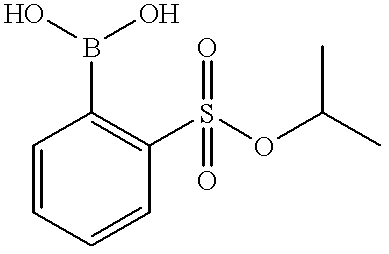
To the solution of the product from Example 3 (56 g, 200 mmol) in 280 mL of THF was added triisopropylborate (84 mL, 1.82 equiv.) and the reaction mixture was cooled to less than −65° C. To the cooled solution, n-butyllithium (144 mL, 0.9 equiv., 1.07 M in hexanes) was slowly added while maintaining the temperature below −65° C. The reaction mixture was stirred for at least 0.5 hours and then was quenched with IM sulfuric acid (200 mL). The reaction mixture was allowed to warm to ca. 20° C. The layers were separated and the rich organic layer containing 35 g (92 M %, HPLC area t 98) of the title compound was used as is in the next step (Example 6).
The THF solution from Example 4 containing 40 g (200 mmol) of product was cooled to less than −65° C. To the cooled solution, n-butyllithium (144 mL, 0.9 equiv., 1.07 M in hexanes) was slowly added while maintaining the temperature below −65° C. The reaction mixture was stirred for at least 0.5 hours and triisopropylborate (84 mL, 1.82 equiv.) was added while maintaining the temperature below −65° C. The reaction mixture was quenched with 1M sulfuric acid (200 mL) and the reaction mixture was allowed to warm to ca. 20° C. The layers were separated and the rich organic layer containing 33 g (87 M %, HPLC area % 94) of the title compound was used as is in the next step (Example 6).

The THF-Hexane-MTBE solution containing 23 g (93.3 mmol) of the title compound from Example 5 was concentrated to a concentration of ca. 7 mL/g. A portion of this solution containing ca. 4.7 g (19 mmol, 0.26 equiv.) was added to a solution of 20 g (75 mmol) of the title compound from Example 2 dissolved in 100 mL of degassed tetrahydrofuran. To this solution, tris(dibenzylidene acetone)dipalladium (0) (0.5 g, 0.6 M %) and degassed aqueous sodium carbonate solution (300 mL, 3 equiv.) were added. The reaction mixture was heated to ca. 50° C. to initiate the coupling reaction. During the reaction, Pd2(dba)3 (0.5 g per addition) and rich organic concentrate containing the title compound from Example 5 (4.7 g, 0.26 equiv. per addition) were added in several portions until all the iodooxazole was consumed. The reaction mixture was further heated at ca. 55° C. for an additional 4 hours. The reaction mixture was filtered and washed with methyl-tert-butyl ether. The pH of the product-rich aqueous solution was adjusted to ca. 4, treated with trithiocyanuric acid (1 g) and filtered to remove Pd containing by-products. The pH of the product-rich aqueous solution was adjusted to ca. 7 and was saturated with solid NaCl (118 g) to initiate the crystallization of the product. The salted-out product was dried in vacuo at less than 70° C. For recrystallization, the dried product was dissolved in 350 mL of 190 proof ethanol at ca. 75° C. The solution was filtered and concentrated to ca. 100 mL and cooled to ca. 30° C. to initiate crystallization. About 200 mL of methyl-tert-butyl ether was added to maximize the yield. The crystal slurry was filtered, washed and dried in vacuo less than 70° C., to give 19 g (74 M %, HPLC area % 100) of the title compound.

About 15.5 g (47.9 mmol) of the title compound from Example 6 was suspended in 200 mL of toluene and Vilsmeier reagent (9 g, 71.8 mmol) was added at room temperature. The mixture was stirred until the chlorination reaction was complete (ca. 3 hours). The reaction mixture was quenched with 50 mL of water and the pH was adjusted to 7-10 with 10N NaOH. Layers were separated and water was removed azeotropically from the rich toluene solution to a moisture content of less than 0.05%. This rich toluene solution was added to a solution of 5-amino-3,4-dimethylisoxazole (6.1 g, 54.4 mmol) in 90 mL of tetrahydrofuran. The reaction mixture was cooled to −15° C. and a slurry of sodium t-butoxide (10 g, 104.3 mmol) in 70 mL of tetrahydrofuran was added. After the coupling reaction was complete, the mixture was quenched with 100 mL of water and then warmed to ca. 50° C., to afford two clear phases. The spent organic layer was extracted with water (50 mL). To the combined rich aqueous solution, 85 mL of 190 proof ethanol and 15 mL of tetrahydrofuran were added. The pH was adjusted to ca. 2 with conc. HCl to precipitate the product. The resultant slurry was heated to ca. 75° C. to dissolve the product. The product was crystallized by slow cooling to room temperature. Additional water (120 mL) was added to maximize the yield. The crystal slurry was filtered, washed and dried in vacuo at less than 60° C., to give 16 g (85 M %, HPLC area % 99.6) of the title compound.
Claims (13)
1. A method for the preparation of a biphenyl sulfonamide of the following formula I: 
where the phenyl rings of the biphenyl group may independently be unsubstituted or substituted with one or more substituent groups, enantiomers and diastereomers, and salts thereof, wherein:
one of X and Y is N and the other is O;
R3 and R4 are each directly bonded to a ring carbon and are each independently
(a) hydrogen;
(b) alkyl, alkenyl, alkynyl, alkoxy, cycloalkyl, cycloalkylalkyl, cycloalkenyl, cycloalkenylalkyl, aryl, aryloxy, aralkyl or aralkoxy, any of which may be substituted with Z1, Z2 and Z3;
(c) halo;
(d) hydroxyl;
(e) cyano;
(f) nitro;
(g) —C(O)H or —C(O)R5;
(h) —CO2H or —CO2R5;
(i) —Z4—NR6R7;
(j) —Z4—N(R10)—Z5—NR8R9; or
(k) R3 and R4 together may also be alkylene or alkenylene, either of which may be substituted with Z1, Z2 and Z3, completing a 4- to 8-membered saturated, unsaturated or aromatic ring together with the carbon atoms to which they are attached;
R5 is alkyl, alkenyl, alkynyl, cycloalkyl, cycloalkylalkyl, cycloalkenyl, cycloalkenylalkyl, aryl or aralkyl, any of which may be substituted with Z1, Z2 and Z3;
R6, R7, R8, R9 and R10 are each independently
(a) hydrogen; or
(b) alkyl, cycloalkyl, cycloalkylalkyl, cycloalkenylalkyl, aryl or aralkyl, any of which may be substituted with Z1, Z2 and Z3; or
R6 and R7 together may be alkylene or alkenylene, either of which may be substituted with Z1, Z2 and Z3, completing a 3- to 8-membered saturated or unsaturated ring together with the nitrogen atom to which they are attached; or any two of R8, R9 and R10 together are alkylene or alkenylene, either of which may be substituted with Z1, Z2 and Z3, completing a 3- to 8-membered saturated or unsaturated ring together with the atoms to which they are attached;
Z1, Z2 and Z3 are each independently
(a) hydrogen;
(b) halo;
(c) hydroxy;
(d) alkyl;
(e) alkenyl;
(f) aryl;
(g) aralkyl;
(h) alkoxy;
(i) aryloxy;
(j) aralkoxy;
(k) heterocycle, substituted heterocycle or heterocyclooxy;
(l) —SH, —S(O)nZ6, —S(O)m—OH, —S(O)m—OZ6, —O—S(O)m—Z6, —O—S(O)mOH or —O—S(O)m—OZ6;
(m) oxo;
(n) nitro;
(o) cyano;
(p) —C(O)H or —C(O)Z6;
(q) —CO2H or —CO2Z6;
(r) —Z4—NZ7Z8;
(s) —Z4—N(Z11)—Z5—H;
(t) —Z4—N(Z11)—Z5—Z6; or
(u) —Z4—N(Z11)—Z5—NZ7Z8;
Z4 and Z5 are each independently
(a) a single bond;
(b) —Z9—S(O)n—Z10—;
(c) —Z9—C(O)—Z10—;
(d) —Z9—C(S)—Z10—;
(e) —Z9—O—Z10—;
(f) —Z9—S—Z10—;
(g) —Z9—O—C(O)—Z10—; or
(h) —Z9—C(O)—O—Z10—;
Z6 is alkyl; alkyl substituted with one to three groups selected from halogen, aryl, aryloxy and alkoxy; alkenyl; alkynyl; cycloalkyl; cycloalkyl substituted with one to three groups selected from alkyl, aryl, alkenyl and alkoxyaryl; cycloalkyl to which is fused a benzene ring; aryloxy substituted with one or two halogens; cycloalkylalkyl; cycloalkenyl; cycloalkenylalkyl; aryl; aryl substituted with methylenedioxy or one to four groups selected from alkyl, dialkylamino, cyano, halogen, trihaloalkyl, alkoxy and trihaloalkoxy; or heterocycle or substituted heterocycle;
Z7 and Z8 are each independently hydrogen, alkyl, cycloalkyl, cycloalkylalkyl, cycloalkenylalkyl, aryl or aralkyl, or Z7 and Z8 together are alkylene or alkenylene, completing a 3- to 8-membered saturated or unsaturated ring together with the nitrogen atom to which they are attached;
Z9 and Z10 are each independently a single bond, alkylene, alkenylene or alkynylene;
Z11 is
(a) hydrogen; or
(b) alkyl, alkyl substituted with one, two or three halogens, cycloalkyl, cycloalkylalkyl, cycloalkenylalkyl, aryl or aralkyl;
or any two of Z7, Z8 and Z11 together are alkylene or alkenylene, completing a 3- to 8-membered saturated or unsaturated ring together with the atoms to which they are attached;
each m is independently 1 or 2; and
each n is independently 0, 1 or 2; comprising the steps of:
(a) contacting a boronic acid of the formula II: 
or pinacol ester or salt thereof, wherein R is an alkyl group and where the phenyl ring of said formula II may be further substituted, with a halophenyl compound of the formula III or salt thereof: 
wherein the phenyl ring of said formula III may be further substituted, in the presence of a palladium(0) catalyst and a base containing an alkali metal atom selected from sodium, potassium or lithium, to form a compound of the formula IV or salt thereof: 
and converting said compound IV or salt thereof to a compound V or salt thereof with a chlorinating agent: 
where the phenyl rings of the biphenyl groups of formulae IV or V may independently be unsubstituted or substituted with one or more substituent groups; and M is sodium, potassium or lithium; and
(b) coupling said compound of the formula V or salt thereof with a compound of formula VI: 
in the presence of base to form said compound of the formula I or salt thereof.
2. The method of claim 1, wherein said compound of the formula I is a compound of the following formula Ia or salt thereof: 
wherein:
R1 and R2 are each directly bonded to a ring carbon and are each independently selected from those groups (a) through (j) recited above for R3 and R4;
R11, R12, R13 and R14 are each independently
(a) hydrogen;
(b) alkyl, alkenyl, alkynyl, alkoxy, cycloalkyl, cycloalkylalkyl, cycloalkenyl, cycloalkenylalkyl, aryl, aryloxy, aralkyl or aralkoxy, any of which may be substituted with Z1, Z2 and Z3,
(c) heterocycle, substituted heterocycle or heterocyclooxy;
(d) halo;
(e) hydroxyl;
(f) cyano;
(g) nitro;
(h) —C(O)H or —C(O)R5;
(i) —CO2H or —CO2R5;
(j) —SH, —S(O)nR5, —S(O)m—OH, —S(O)m—OR5, —O—S(O)m—OR5, —O—S(O)mOH or —O—S(O)m—OR5;
(k) —Z4—NR6R7; or
(l) —Z4—N(R10)—Z5—NR8R9;
J is O, S, N or NR15;
K and L are N or C, provided that at least one of K or L is C;
R15 is hydrogen, alkyl, hydroxyethoxy methyl or methoxyethoxy methyl; and
p is 0 or an integer from 1 to 2; comprising the steps of:
(a) contacting a boronic acid of the formula IIa or salt thereof: 
wherein R is an alkyl group, with a halophenyl compound of the formula IIIa or salt thereof: 
in the presence of a palladium(0) catalyst and a base containing an alkali metal atom selected from sodium, potassium or lithium, to form a compound of the formula IVa or salt thereof: 
wherein M is lithium, sodium or potassium; and converting compound IVa to compound Va with a chlorinating agent: 
and
(b) coupling said formula Va compound or salt thereof with a compound of formula VI in the presence of a base to form said compound of the formula Ia or salt thereof.
3. The method of claim 2, wherein said palladium(0) catalyst is a palladium (II) salt and triphenylphosphine.
4. The method of claim 3, wherein said palladium (II) salt is palladium acetate.
5. The method of claim 2, wherein said palladium caralyst is tris(dibenzylideneacetone)dipallidium (O).
6. The method of claim 2, wherein said base in step (a) is aqueous potassium carbonate or sodium carbonate.
7. The method of claim 2, wherein the halo group in said compound of the formula IIIa or salt thereof is bromo or iodo.
8. The method of claim 2, wherein said compound of the formula Ia or salt thereof is crystallized from solution subsequent to step (b).
9. The method of claim 2, wherein residual palladium is removed subsequent to contacting said compounds IIa and IIIa by use of a chelating agent.
10. The method of claim 2, wherein the chlorinating agent is Vilsmeier reagent, thionyl chloride, oxalyl chloride or phosphorous oxychloride.
11. The method of claim 2, wherein the base in step (b) is sodium hydride, potassium tert-butoxide or sodium tert-butoxide.
12. The method of claim 2, wherein said compound of the formula Ia is N-(3,4-dimethyl-5-isoxazolyl)-4′-(2-oxazolyl)-[1,1′-biphenyl]-2-sulfonamide or salt thereof.
13. The method of claim 2, wherein said compound of the formula Ia is N-[[2′-[[(4,5-dimethyl-3-isoxazolyl)amino]sulfonyl]-4-(2-oxazolyl)[1,1′-biphenyl]-2-yl]methyl]-N,3,3-trimethylbutanamide or salt thereof.
Priority Applications (1)
| Application Number | Priority Date | Filing Date | Title |
|---|---|---|---|
| US09/528,819 US6313308B1 (en) | 1999-03-19 | 2000-03-20 | Methods for the preparation of biphenyl isoxazole sulfonamides |
Applications Claiming Priority (2)
| Application Number | Priority Date | Filing Date | Title |
|---|---|---|---|
| US12514899P | 1999-03-19 | 1999-03-19 | |
| US09/528,819 US6313308B1 (en) | 1999-03-19 | 2000-03-20 | Methods for the preparation of biphenyl isoxazole sulfonamides |
Publications (1)
| Publication Number | Publication Date |
|---|---|
| US6313308B1 true US6313308B1 (en) | 2001-11-06 |
Family
ID=22418402
Family Applications (1)
| Application Number | Title | Priority Date | Filing Date |
|---|---|---|---|
| US09/528,819 Expired - Fee Related US6313308B1 (en) | 1999-03-19 | 2000-03-20 | Methods for the preparation of biphenyl isoxazole sulfonamides |
Country Status (11)
| Country | Link |
|---|---|
| US (1) | US6313308B1 (en) |
| EP (1) | EP1165472A4 (en) |
| JP (1) | JP2002540088A (en) |
| KR (1) | KR20020004974A (en) |
| AU (1) | AU3718900A (en) |
| CA (1) | CA2367916A1 (en) |
| HK (1) | HK1039778A1 (en) |
| HU (1) | HUP0201320A2 (en) |
| IL (1) | IL144708A0 (en) |
| MX (1) | MXPA01009362A (en) |
| WO (1) | WO2000056685A1 (en) |
Cited By (3)
| Publication number | Priority date | Publication date | Assignee | Title |
|---|---|---|---|---|
| US6639082B2 (en) | 2000-10-17 | 2003-10-28 | Bristol-Myers Squibb Company | Methods for the preparation of biphenyl isoxazole sulfonamides |
| US20040106663A1 (en) * | 2002-09-06 | 2004-06-03 | Talley John Jeffrey | Inhibitors of fungal invasion |
| US12709602B2 (en) | 2023-03-17 | 2026-08-18 | Supernus Pharmaceuticals, Inc. | Intermediates for making derivatives of substituted morpholines |
Families Citing this family (1)
| Publication number | Priority date | Publication date | Assignee | Title |
|---|---|---|---|---|
| CA2367916A1 (en) * | 1999-03-19 | 2000-09-28 | Ambarish Singh | Methods for the preparation of biphenyl isoxazole sulfonamides |
Citations (51)
| Publication number | Priority date | Publication date | Assignee | Title |
|---|---|---|---|---|
| GB804036A (en) | 1956-03-02 | 1958-11-05 | Hoffmann La Roche | A process for the manufacture of a sulphanilamide of the isoxazole series |
| US2888455A (en) | 1956-09-04 | 1959-05-26 | Shionogi & Co | New sulfonamide and process for producing the same |
| DE1059459B (en) | 1956-09-04 | 1959-06-18 | Shionogi & Co | Process for the preparation of the therapeutically useful 3-sulfanilamido-5-methylisoxazole |
| GB897440A (en) | 1960-02-08 | 1962-05-30 | Shionogi & Co | Improvements in or relating to sulfonamides |
| CH364506A (en) | 1956-09-04 | 1962-09-30 | Shionogi & Co | Process for the preparation of the therapeutically active 3-sulfanilamido-5-methyl-isoxazole |
| GB1473433A (en) | 1975-10-09 | 1977-05-11 | Banyu Pharmaceutical Co Ltd Hi | |
| US4415496A (en) | 1981-03-23 | 1983-11-15 | Merck & Co., Inc. | Bicyclic lactams |
| EP0194548A2 (en) | 1985-03-12 | 1986-09-17 | Dr. Karl Thomae GmbH | Sulfonylaminoethyl compounds, medicines containing these compounds and process for their preparation |
| US4661479A (en) | 1982-02-19 | 1987-04-28 | Merck And Co., Inc. | Bicyclic lactams as antihypertensives |
| EP0076072B1 (en) | 1981-09-24 | 1987-05-13 | BEECHAM - WUELFING GmbH & Co. KG | Sulphonamides |
| GB2228933A (en) | 1988-12-26 | 1990-09-12 | Hiroyoshi Hidaka | N-substituted isoquinolinyl-or naphthyl-sulphonamides |
| WO1991015479A1 (en) | 1990-03-30 | 1991-10-17 | Merck & Co., Inc. | Substituted pyrazoles, isoxazoles and isothiazoles |
| EP0526708A1 (en) | 1991-06-13 | 1993-02-10 | F. Hoffmann-La Roche Ag | Sulfonamide, preparation and use thereof as medicine and intermediate |
| WO1993008799A1 (en) | 1991-11-05 | 1993-05-13 | Smithkline Beecham Corporation | Endothelin receptor antagonists |
| WO1993010094A1 (en) | 1991-11-18 | 1993-05-27 | Kabi Pharmacia Ab | Novel substituted salicyclic acids |
| US5236928A (en) | 1991-03-19 | 1993-08-17 | Merck & Co., Inc. | Imidazole derivatives bearing acidic functional groups at the 5-position, their compositions and methods of use as angiotensin II antagonists |
| AU3401193A (en) | 1992-03-07 | 1993-09-09 | Hoechst Aktiengesellschaft | Imidazole derivatives with a biphenylsulfonylurea or biphenylsulfonylurethane side chain, process for their preparation and their use |
| WO1993023404A1 (en) | 1992-05-19 | 1993-11-25 | Immunopharmaceutics, Inc. | Compounds that modulate endothelin activity |
| US5270313A (en) | 1991-04-25 | 1993-12-14 | Hoffmann-La Roche Inc. | Sulfonamides and uses |
| EP0601386A1 (en) | 1992-12-10 | 1994-06-15 | F. Hoffmann-La Roche Ag | Sulphonamides |
| EP0626174A2 (en) | 1993-04-21 | 1994-11-30 | Takeda Chemical Industries, Ltd. | Methods and compositions for the prophylactic and/or therapeutic treatment of organ hypofunction |
| WO1994027979A1 (en) | 1993-05-20 | 1994-12-08 | Immunopharmaceutics, Inc. | Sulfonamides and derivatives thereof that modulate the activity of endothelin |
| US5378715A (en) | 1992-02-24 | 1995-01-03 | Bristol-Myers Squibb Co. | Sulfonamide endothelin antagonists |
| EP0634175A1 (en) | 1993-07-15 | 1995-01-18 | F. Hoffmann-La Roche Ag | Pharmaceutical combination, containing a renin-angiotensin-system inhibitor and an endothelin antagonist |
| EP0640596A1 (en) | 1993-08-30 | 1995-03-01 | Bristol-Myers Squibb Company | N-pyridazinyl-benzene (naphthalene-, biphenyl-) sulfonamide derivatives, their preparation and their use as endothelin antagonists |
| WO1995026957A1 (en) | 1994-03-31 | 1995-10-12 | Zeneca Limited | N-heterocyclyl sulphonamide derivatives and their use as endothelin antagonists |
| US5464853A (en) | 1993-05-20 | 1995-11-07 | Immunopharmaceutics, Inc. | N-(5-isoxazolyl)biphenylsulfonamides, N-(3-isoxazolyl)biphenylsulfonamides and derivatives thereof that modulate the activity of endothelin |
| EP0682016A1 (en) | 1994-05-13 | 1995-11-15 | Zeneca Limited | Pyridine derivatives |
| EP0443983B1 (en) | 1990-02-19 | 1996-02-28 | Ciba-Geigy Ag | Acyl compounds |
| EP0702012A1 (en) | 1994-08-26 | 1996-03-20 | Bristol-Myers Squibb Company | Substituted isoxazole sulfonamides and their use as endothelin antagonists |
| US5514696A (en) | 1992-05-06 | 1996-05-07 | Bristol-Myers Squibb Co. | Phenyl sulfonamide endothelin antagonists |
| US5514691A (en) | 1993-05-20 | 1996-05-07 | Immunopharmaceutics, Inc. | N-(4-halo-isoxazolyl)-sulfonamides and derivatives thereof that modulate the activity of endothelin |
| EP0404525B1 (en) | 1989-06-21 | 1996-05-15 | Takeda Chemical Industries, Ltd. | Sulfur-containing fused pyrimidine derivatives, their production and use |
| EP0725067A1 (en) | 1995-02-06 | 1996-08-07 | Bristol-Myers Squibb Company | Substituted biphenyl sulfonamide endothelin antagonists |
| AU4803996A (en) | 1995-03-18 | 1996-09-26 | Merck Patent Gesellschaft Mit Beschrankter Haftung | Endothelin receptor antagonists |
| US5571821A (en) | 1993-05-20 | 1996-11-05 | Texas Biotechnology Corporation | Sulfonamides and derivatives thereof that modulate the activity of endothelin |
| US5580894A (en) | 1996-01-11 | 1996-12-03 | Howard University | Isoxazolyl enaminones |
| WO1996040681A1 (en) | 1995-06-07 | 1996-12-19 | Zeneca Limited | N-heteroaryl-pyridinesulfonamide derivatives and their use as endothelin antagonists |
| EP0749964A1 (en) | 1995-06-22 | 1996-12-27 | Zeneca Limited | N-Heterocyclyl biphenyl sulfonamides |
| US5594201A (en) | 1993-05-10 | 1997-01-14 | Reinert, Sr.; Gary L. | Adjustable container set apparatus and method |
| EP0569193B1 (en) | 1992-05-06 | 1997-02-26 | E.R. SQUIBB & SONS, INC. | N-isoxazole-phenylsulfonamide derivatives and their use as endothelin antagonists |
| EP0768305A1 (en) | 1995-10-11 | 1997-04-16 | Bristol-Myers Squibb Company | N-Isoxazolyl-biphenylsulfonamide derivatives, their preparation and their use as endothelin antagonists |
| EP0558258B1 (en) | 1992-02-24 | 1997-05-07 | E.R. SQUIBB & SONS, INC. | N-isoxazole-naphthylsulfonamide derivatives and their use as endothelin antagonists |
| WO1997029747A1 (en) | 1996-02-20 | 1997-08-21 | Bristol-Myers Squibb Company | Methods for the preparation of biphenyl isoxazole sulfonamides |
| US5846990A (en) | 1995-07-24 | 1998-12-08 | Bristol-Myers Squibb Co. | Substituted biphenyl isoxazole sulfonamides |
| US5846985A (en) | 1997-03-05 | 1998-12-08 | Bristol-Myers Squibb Co. | Substituted biphenyl isoxazole sulfonamides |
| US5856507A (en) * | 1997-01-21 | 1999-01-05 | Bristol-Myers Squibb Co. | Methods for the preparation of biphenyl isoxazole sulfonamides |
| EP0632259B1 (en) | 1993-06-30 | 1999-04-28 | STN ATLAS Elektronik GmbH | Leak detection device |
| WO1999036393A1 (en) | 1998-01-20 | 1999-07-22 | Tanabe Seiyaku Co., Ltd. | INHIBITORS OF α4 MEDIATED CELL ADHESION |
| EP0617001B1 (en) | 1993-03-19 | 2000-01-26 | Merck & Co. Inc. | Phenoxyphenylacetic acid derivatives |
| WO2000056685A1 (en) * | 1999-03-19 | 2000-09-28 | Bristol-Myers Squibb Company | Methods for the preparation of biphenyl isoxazole sulfonamides |
Family Cites Families (1)
| Publication number | Priority date | Publication date | Assignee | Title |
|---|---|---|---|---|
| US5780473A (en) * | 1995-02-06 | 1998-07-14 | Bristol-Myers Squibb Company | Substituted biphenyl sulfonamide endothelin antagonists |
-
2000
- 2000-03-02 CA CA002367916A patent/CA2367916A1/en not_active Abandoned
- 2000-03-02 HK HK02101358.2A patent/HK1039778A1/en unknown
- 2000-03-02 WO PCT/US2000/005521 patent/WO2000056685A1/en not_active Ceased
- 2000-03-02 JP JP2000606550A patent/JP2002540088A/en active Pending
- 2000-03-02 HU HU0201320A patent/HUP0201320A2/en unknown
- 2000-03-02 AU AU37189/00A patent/AU3718900A/en not_active Abandoned
- 2000-03-02 IL IL14470800A patent/IL144708A0/en unknown
- 2000-03-02 KR KR1020017011870A patent/KR20020004974A/en not_active Withdrawn
- 2000-03-02 MX MXPA01009362A patent/MXPA01009362A/en unknown
- 2000-03-02 EP EP00916019A patent/EP1165472A4/en not_active Withdrawn
- 2000-03-20 US US09/528,819 patent/US6313308B1/en not_active Expired - Fee Related
Patent Citations (57)
| Publication number | Priority date | Publication date | Assignee | Title |
|---|---|---|---|---|
| GB804036A (en) | 1956-03-02 | 1958-11-05 | Hoffmann La Roche | A process for the manufacture of a sulphanilamide of the isoxazole series |
| US2888455A (en) | 1956-09-04 | 1959-05-26 | Shionogi & Co | New sulfonamide and process for producing the same |
| DE1059459B (en) | 1956-09-04 | 1959-06-18 | Shionogi & Co | Process for the preparation of the therapeutically useful 3-sulfanilamido-5-methylisoxazole |
| CH364506A (en) | 1956-09-04 | 1962-09-30 | Shionogi & Co | Process for the preparation of the therapeutically active 3-sulfanilamido-5-methyl-isoxazole |
| GB897440A (en) | 1960-02-08 | 1962-05-30 | Shionogi & Co | Improvements in or relating to sulfonamides |
| GB1473433A (en) | 1975-10-09 | 1977-05-11 | Banyu Pharmaceutical Co Ltd Hi | |
| US4415496A (en) | 1981-03-23 | 1983-11-15 | Merck & Co., Inc. | Bicyclic lactams |
| EP0076072B1 (en) | 1981-09-24 | 1987-05-13 | BEECHAM - WUELFING GmbH & Co. KG | Sulphonamides |
| US4661479A (en) | 1982-02-19 | 1987-04-28 | Merck And Co., Inc. | Bicyclic lactams as antihypertensives |
| EP0194548A2 (en) | 1985-03-12 | 1986-09-17 | Dr. Karl Thomae GmbH | Sulfonylaminoethyl compounds, medicines containing these compounds and process for their preparation |
| GB2228933A (en) | 1988-12-26 | 1990-09-12 | Hiroyoshi Hidaka | N-substituted isoquinolinyl-or naphthyl-sulphonamides |
| EP0404525B1 (en) | 1989-06-21 | 1996-05-15 | Takeda Chemical Industries, Ltd. | Sulfur-containing fused pyrimidine derivatives, their production and use |
| EP0443983B1 (en) | 1990-02-19 | 1996-02-28 | Ciba-Geigy Ag | Acyl compounds |
| WO1991015479A1 (en) | 1990-03-30 | 1991-10-17 | Merck & Co., Inc. | Substituted pyrazoles, isoxazoles and isothiazoles |
| US5236928A (en) | 1991-03-19 | 1993-08-17 | Merck & Co., Inc. | Imidazole derivatives bearing acidic functional groups at the 5-position, their compositions and methods of use as angiotensin II antagonists |
| EP0510526B1 (en) | 1991-04-25 | 1996-12-04 | F. Hoffmann-La Roche AG | Use of sulfonamides as drug and new sulfonamides |
| US5270313A (en) | 1991-04-25 | 1993-12-14 | Hoffmann-La Roche Inc. | Sulfonamides and uses |
| EP0526708A1 (en) | 1991-06-13 | 1993-02-10 | F. Hoffmann-La Roche Ag | Sulfonamide, preparation and use thereof as medicine and intermediate |
| US5292740A (en) | 1991-06-13 | 1994-03-08 | Hoffmann-La Roche Inc. | Sulfonamides |
| WO1993008799A1 (en) | 1991-11-05 | 1993-05-13 | Smithkline Beecham Corporation | Endothelin receptor antagonists |
| WO1993010094A1 (en) | 1991-11-18 | 1993-05-27 | Kabi Pharmacia Ab | Novel substituted salicyclic acids |
| US5378715A (en) | 1992-02-24 | 1995-01-03 | Bristol-Myers Squibb Co. | Sulfonamide endothelin antagonists |
| EP0558258B1 (en) | 1992-02-24 | 1997-05-07 | E.R. SQUIBB & SONS, INC. | N-isoxazole-naphthylsulfonamide derivatives and their use as endothelin antagonists |
| AU3401193A (en) | 1992-03-07 | 1993-09-09 | Hoechst Aktiengesellschaft | Imidazole derivatives with a biphenylsulfonylurea or biphenylsulfonylurethane side chain, process for their preparation and their use |
| EP0569193B1 (en) | 1992-05-06 | 1997-02-26 | E.R. SQUIBB & SONS, INC. | N-isoxazole-phenylsulfonamide derivatives and their use as endothelin antagonists |
| US5514696A (en) | 1992-05-06 | 1996-05-07 | Bristol-Myers Squibb Co. | Phenyl sulfonamide endothelin antagonists |
| WO1993023404A1 (en) | 1992-05-19 | 1993-11-25 | Immunopharmaceutics, Inc. | Compounds that modulate endothelin activity |
| EP0601386A1 (en) | 1992-12-10 | 1994-06-15 | F. Hoffmann-La Roche Ag | Sulphonamides |
| EP0617001B1 (en) | 1993-03-19 | 2000-01-26 | Merck & Co. Inc. | Phenoxyphenylacetic acid derivatives |
| EP0626174A2 (en) | 1993-04-21 | 1994-11-30 | Takeda Chemical Industries, Ltd. | Methods and compositions for the prophylactic and/or therapeutic treatment of organ hypofunction |
| US5594201A (en) | 1993-05-10 | 1997-01-14 | Reinert, Sr.; Gary L. | Adjustable container set apparatus and method |
| US5591761A (en) | 1993-05-20 | 1997-01-07 | Texas Biotechnology Corporation | Thiophenyl-, furyl-and pyrrolyl-sulfonamides and derivatives thereof that modulate the activity of endothelin |
| US5514691A (en) | 1993-05-20 | 1996-05-07 | Immunopharmaceutics, Inc. | N-(4-halo-isoxazolyl)-sulfonamides and derivatives thereof that modulate the activity of endothelin |
| US5571821A (en) | 1993-05-20 | 1996-11-05 | Texas Biotechnology Corporation | Sulfonamides and derivatives thereof that modulate the activity of endothelin |
| US5464853A (en) | 1993-05-20 | 1995-11-07 | Immunopharmaceutics, Inc. | N-(5-isoxazolyl)biphenylsulfonamides, N-(3-isoxazolyl)biphenylsulfonamides and derivatives thereof that modulate the activity of endothelin |
| WO1994027979A1 (en) | 1993-05-20 | 1994-12-08 | Immunopharmaceutics, Inc. | Sulfonamides and derivatives thereof that modulate the activity of endothelin |
| EP0632259B1 (en) | 1993-06-30 | 1999-04-28 | STN ATLAS Elektronik GmbH | Leak detection device |
| AU6735794A (en) | 1993-07-15 | 1995-01-27 | F. Hoffmann-La Roche Ag | A method of treating cardiovascular disorders using a combination of a renin angiotensin system inhibitor and an endothelin antagonist |
| EP0634175A1 (en) | 1993-07-15 | 1995-01-18 | F. Hoffmann-La Roche Ag | Pharmaceutical combination, containing a renin-angiotensin-system inhibitor and an endothelin antagonist |
| EP0640596A1 (en) | 1993-08-30 | 1995-03-01 | Bristol-Myers Squibb Company | N-pyridazinyl-benzene (naphthalene-, biphenyl-) sulfonamide derivatives, their preparation and their use as endothelin antagonists |
| WO1995026957A1 (en) | 1994-03-31 | 1995-10-12 | Zeneca Limited | N-heterocyclyl sulphonamide derivatives and their use as endothelin antagonists |
| EP0682016A1 (en) | 1994-05-13 | 1995-11-15 | Zeneca Limited | Pyridine derivatives |
| EP0702012A1 (en) | 1994-08-26 | 1996-03-20 | Bristol-Myers Squibb Company | Substituted isoxazole sulfonamides and their use as endothelin antagonists |
| US5612359A (en) * | 1994-08-26 | 1997-03-18 | Bristol-Myers Squibb Company | Substituted biphenyl isoxazole sulfonamides |
| EP0725067A1 (en) | 1995-02-06 | 1996-08-07 | Bristol-Myers Squibb Company | Substituted biphenyl sulfonamide endothelin antagonists |
| AU4803996A (en) | 1995-03-18 | 1996-09-26 | Merck Patent Gesellschaft Mit Beschrankter Haftung | Endothelin receptor antagonists |
| WO1996040681A1 (en) | 1995-06-07 | 1996-12-19 | Zeneca Limited | N-heteroaryl-pyridinesulfonamide derivatives and their use as endothelin antagonists |
| EP0749964A1 (en) | 1995-06-22 | 1996-12-27 | Zeneca Limited | N-Heterocyclyl biphenyl sulfonamides |
| US5846990A (en) | 1995-07-24 | 1998-12-08 | Bristol-Myers Squibb Co. | Substituted biphenyl isoxazole sulfonamides |
| EP0768305A1 (en) | 1995-10-11 | 1997-04-16 | Bristol-Myers Squibb Company | N-Isoxazolyl-biphenylsulfonamide derivatives, their preparation and their use as endothelin antagonists |
| US6080774A (en) * | 1995-10-11 | 2000-06-27 | Bristol-Myers Squibb Company | Substituted biphenylsulfonamide endothelin antagonists |
| US5580894A (en) | 1996-01-11 | 1996-12-03 | Howard University | Isoxazolyl enaminones |
| WO1997029747A1 (en) | 1996-02-20 | 1997-08-21 | Bristol-Myers Squibb Company | Methods for the preparation of biphenyl isoxazole sulfonamides |
| US5856507A (en) * | 1997-01-21 | 1999-01-05 | Bristol-Myers Squibb Co. | Methods for the preparation of biphenyl isoxazole sulfonamides |
| US5846985A (en) | 1997-03-05 | 1998-12-08 | Bristol-Myers Squibb Co. | Substituted biphenyl isoxazole sulfonamides |
| WO1999036393A1 (en) | 1998-01-20 | 1999-07-22 | Tanabe Seiyaku Co., Ltd. | INHIBITORS OF α4 MEDIATED CELL ADHESION |
| WO2000056685A1 (en) * | 1999-03-19 | 2000-09-28 | Bristol-Myers Squibb Company | Methods for the preparation of biphenyl isoxazole sulfonamides |
Non-Patent Citations (30)
| Title |
|---|
| A.M., van Leusen et al., J. Org. Chem. vol. 41, No. 4 (1976), pp. 711-713. |
| Allen et al., CA 116(11):1062847Z, p. 778, 1992. |
| CA 65:2241d (1966). |
| Cass, J. Am. Chem. Soc., vol. 64, pp. 785-787 (1942). |
| Chan et al., Biochemical and Biophysical Research Communications, vol. 201, No. 1, May 30, 1994, pp. 228-234. |
| Derwent Abstract No. 35012 K15, Beecham, Sep. 24, 1981. |
| Derwent Abstract No. 40927 D23, Nippon, Sep. 11, 1979. |
| Derwent Abstract No. 62299 E/30, Nippon, Dec. 11, 1980. |
| Derwent Abstract No. 87-152485/22 Oct. 11, 1985. |
| Derwent Abstract No. 88-061295/09 Jul. 9, 1986. |
| Derwent Abstract No. 88-195835/28 Nov. 26, 1986. |
| Derwent Abstract No. 88-289069/41 Feb. 27, 1987. |
| Derwent Abstract No. 91-254550/35 Feb. 19, 1990. |
| Doherty, J. Med. Chem., 35(9), 1493-1508 (May, 1992). |
| Ferrini et al., vol. 2, No. 2, p. 99 (1963). |
| G. B. Smith, et al., J. Org. Chem., 1994, 59, 8151-8156. |
| Kende et al., Tetrahedron Letters No. 23 (1982), pp. 2369-2372. |
| Khanna, CA 115:35728, p. 415 (1991). |
| Murugesan et al., CA 120:270370c, p. 1067 (1994). |
| Oie, CA 102: 197512x, p. 18 (1995). |
| Onofrio, et al., CA 92:41908v (1979), p. 782. |
| R. D. Desai et al., Chemical Abstracts, vol. 71, No. 11, (1969) 49825c, p. 382. |
| R. D. Desai et al., Chemical Abstracts, vol. 71, No. 3, (1969), 12872q, p. 304. |
| S. Norio et al., Chemical Abstracts, vol. 70, No. 19, (1969),87639g, p. 324. |
| Stein et al., CA 120:18233n, pp. 21-22 (1994). |
| Stein et al., J. Med. Chem., vol. 37, No. 3, Feb. 4, 1994, pp. 329-331. |
| T. Saito, CA, vol. 73, No. 23 (1970), 120511w, p. 368. |
| Vree et al., CA 97:84685r, p. 23 (1982). |
| Wang et al., CA 108:94444w, p. 651 (1988). |
| Williams, Tetrahedron Letters, vol. 33, No. 8, pp. 1033-1036 (1992). |
Cited By (3)
| Publication number | Priority date | Publication date | Assignee | Title |
|---|---|---|---|---|
| US6639082B2 (en) | 2000-10-17 | 2003-10-28 | Bristol-Myers Squibb Company | Methods for the preparation of biphenyl isoxazole sulfonamides |
| US20040106663A1 (en) * | 2002-09-06 | 2004-06-03 | Talley John Jeffrey | Inhibitors of fungal invasion |
| US12709602B2 (en) | 2023-03-17 | 2026-08-18 | Supernus Pharmaceuticals, Inc. | Intermediates for making derivatives of substituted morpholines |
Also Published As
| Publication number | Publication date |
|---|---|
| WO2000056685A1 (en) | 2000-09-28 |
| HUP0201320A2 (en) | 2002-08-28 |
| CA2367916A1 (en) | 2000-09-28 |
| EP1165472A4 (en) | 2002-11-20 |
| JP2002540088A (en) | 2002-11-26 |
| IL144708A0 (en) | 2002-06-30 |
| HK1039778A1 (en) | 2002-05-10 |
| KR20020004974A (en) | 2002-01-16 |
| EP1165472A1 (en) | 2002-01-02 |
| AU3718900A (en) | 2000-10-09 |
| MXPA01009362A (en) | 2002-06-04 |
Similar Documents
| Publication | Publication Date | Title |
|---|---|---|
| US6271248B1 (en) | Substituted biphenysulfonamide endothelin antagonists | |
| AU730111B2 (en) | Endothelin antagonists: N-((2'-(((4,5-Dimethyl-3-isoxazolyl) amino)sulfonyl)-4-(2-oxazolyl) (11'-biphenyl)-2-yl]methyl] N,3,3-trimethylbutanamide and N-(4,5-Dimethyl-3-isoxazolyl) 2'-((3,3-Dimethyl-2-oxo-1-pyrrolidinyl) methyl)-4' (2-oxazolyl)(1,1'-Biphenyl)-2-sulfonamide and salts thereof | |
| AU708926B2 (en) | Substituted biphenyl sulfonamide endothelin antagonists | |
| IL110743A (en) | Heterocyclic compounds and pharmaceutical compositions containing the same | |
| US5846985A (en) | Substituted biphenyl isoxazole sulfonamides | |
| EP0725067A1 (en) | Substituted biphenyl sulfonamide endothelin antagonists | |
| US5780473A (en) | Substituted biphenyl sulfonamide endothelin antagonists | |
| US5939446A (en) | Heteroaryl substituted phenyl isoxazole sulfonamide endothelin antagonists | |
| US6515136B1 (en) | Methods for the preparation of biphenyl isoxazole sulfonamides | |
| US6639082B2 (en) | Methods for the preparation of biphenyl isoxazole sulfonamides | |
| US5856507A (en) | Methods for the preparation of biphenyl isoxazole sulfonamides | |
| EP1165472A1 (en) | Methods for the preparation of biphenyl isoxazole sulfonamides | |
| RU2209815C2 (en) | Methods for preparing biphenylisoxazole sulfon- amides | |
| WO1997033886A1 (en) | Substituted biphenyl isoxazole sulfonamides | |
| CA2239209A1 (en) | Methods for the preparation of biphenyl isoxazole sulfonamides | |
| HK1014711A (en) | Substituted biphenyl sulfonamide endothelin antagonists | |
| HK1002391A (en) | N-pyridazinyl-benzene ( naphthalene-, biphenyl- ) sulfonamide derivatives, their preparation and their use as endothelin antagonists |
Legal Events
| Date | Code | Title | Description |
|---|---|---|---|
| AS | Assignment |
Owner name: BRISTOL-MYERS SQUIBB COMPANY, NEW JERSEY Free format text: ASSIGNMENT OF ASSIGNORS INTEREST;ASSIGNORS:SINGH, AMBARISH;CHEN, CHIEN-KUANG;GROSSO, JOHN A.;AND OTHERS;REEL/FRAME:011125/0921;SIGNING DATES FROM 20000626 TO 20000717 |
|
| FEPP | Fee payment procedure |
Free format text: PAYOR NUMBER ASSIGNED (ORIGINAL EVENT CODE: ASPN); ENTITY STATUS OF PATENT OWNER: LARGE ENTITY |
|
| FPAY | Fee payment |
Year of fee payment: 4 |
|
| REMI | Maintenance fee reminder mailed | ||
| LAPS | Lapse for failure to pay maintenance fees | ||
| STCH | Information on status: patent discontinuation |
Free format text: PATENT EXPIRED DUE TO NONPAYMENT OF MAINTENANCE FEES UNDER 37 CFR 1.362 |
|
| FP | Lapsed due to failure to pay maintenance fee |
Effective date: 20091106 |