US6232640B1 - Semiconductor device provided with a field-effect transistor and method of manufacturing the same - Google Patents

Semiconductor device provided with a field-effect transistor and method of manufacturing the same Download PDF

Info

Publication number
US6232640B1
US6232640B1 US09/413,513 US41351399A US6232640B1 US 6232640 B1 US6232640 B1 US 6232640B1 US 41351399 A US41351399 A US 41351399A US 6232640 B1 US6232640 B1 US 6232640B1
Authority
US
United States
Prior art keywords
film
isolating
semiconductor device
gate electrode
forming
Prior art date
Legal status (The legal status is an assumption and is not a legal conclusion. Google has not performed a legal analysis and makes no representation as to the accuracy of the status listed.)
Expired - Lifetime
Application number
US09/413,513
Inventor
Masakazu Okada
Keiichi Higashitani
Current Assignee (The listed assignees may be inaccurate. Google has not performed a legal analysis and makes no representation or warranty as to the accuracy of the list.)
Renesas Electronics Corp
Speedfam IPEC Corp
Original Assignee
Mitsubishi Electric Corp
Priority date (The priority date is an assumption and is not a legal conclusion. Google has not performed a legal analysis and makes no representation as to the accuracy of the date listed.)
Filing date
Publication date
Application filed by Mitsubishi Electric Corp filed Critical Mitsubishi Electric Corp
Assigned to MITSUBISHI DENKI KABUSHIKI KAISHA reassignment MITSUBISHI DENKI KABUSHIKI KAISHA ASSIGNMENT OF ASSIGNORS INTEREST (SEE DOCUMENT FOR DETAILS). Assignors: HIGASHITANI, KEIICHI, OKADA, MASAKAZU
Assigned to SPEEDFAM-IPEC CORPORATION reassignment SPEEDFAM-IPEC CORPORATION ASSIGNMENT OF ASSIGNORS INTEREST (SEE DOCUMENT FOR DETAILS). Assignors: SUNDIN, JAMES B., DRYER, PAUL W., TIRENDI, RICHARD S.
Application granted granted Critical
Publication of US6232640B1 publication Critical patent/US6232640B1/en
Assigned to RENESAS ELECTRONICS CORPORATION reassignment RENESAS ELECTRONICS CORPORATION ASSIGNMENT OF ASSIGNORS INTEREST (SEE DOCUMENT FOR DETAILS). Assignors: MITSUBISHI DENKI KABUSHIKI KAISHA
Assigned to RENESAS ELECTRONICS CORPORATION reassignment RENESAS ELECTRONICS CORPORATION CHANGE OF ADDRESS Assignors: RENESAS ELECTRONICS CORPORATION
Anticipated expiration legal-status Critical
Expired - Lifetime legal-status Critical Current

Links

Images

Classifications

    • HELECTRICITY
    • H10SEMICONDUCTOR DEVICES; ELECTRIC SOLID-STATE DEVICES NOT OTHERWISE PROVIDED FOR
    • H10DINORGANIC ELECTRIC SEMICONDUCTOR DEVICES
    • H10D30/00Field-effect transistors [FET]
    • H10D30/60Insulated-gate field-effect transistors [IGFET]
    • HELECTRICITY
    • H10SEMICONDUCTOR DEVICES; ELECTRIC SOLID-STATE DEVICES NOT OTHERWISE PROVIDED FOR
    • H10DINORGANIC ELECTRIC SEMICONDUCTOR DEVICES
    • H10D62/00Semiconductor bodies, or regions thereof, of devices having potential barriers
    • H10D62/10Shapes, relative sizes or dispositions of the regions of the semiconductor bodies; Shapes of the semiconductor bodies
    • H10D62/13Semiconductor regions connected to electrodes carrying current to be rectified, amplified or switched, e.g. source or drain regions
    • H10D62/149Source or drain regions of field-effect devices
    • H10D62/151Source or drain regions of field-effect devices of IGFETs 
    • HELECTRICITY
    • H10SEMICONDUCTOR DEVICES; ELECTRIC SOLID-STATE DEVICES NOT OTHERWISE PROVIDED FOR
    • H10DINORGANIC ELECTRIC SEMICONDUCTOR DEVICES
    • H10D30/00Field-effect transistors [FET]
    • H10D30/01Manufacture or treatment
    • H10D30/021Manufacture or treatment of FETs having insulated gates [IGFET]
    • H10D30/0212Manufacture or treatment of FETs having insulated gates [IGFET] using self-aligned silicidation
    • HELECTRICITY
    • H10SEMICONDUCTOR DEVICES; ELECTRIC SOLID-STATE DEVICES NOT OTHERWISE PROVIDED FOR
    • H10DINORGANIC ELECTRIC SEMICONDUCTOR DEVICES
    • H10D64/00Electrodes of devices having potential barriers
    • H10D64/20Electrodes characterised by their shapes, relative sizes or dispositions 
    • H10D64/23Electrodes carrying the current to be rectified, amplified, oscillated or switched, e.g. sources, drains, anodes or cathodes
    • H10D64/251Source or drain electrodes for field-effect devices
    • HELECTRICITY
    • H10SEMICONDUCTOR DEVICES; ELECTRIC SOLID-STATE DEVICES NOT OTHERWISE PROVIDED FOR
    • H10DINORGANIC ELECTRIC SEMICONDUCTOR DEVICES
    • H10D84/00Integrated devices formed in or on semiconductor substrates that comprise only semiconducting layers, e.g. on Si wafers or on GaAs-on-Si wafers
    • H10D84/01Manufacture or treatment
    • H10D84/0123Integrating together multiple components covered by H10D12/00 or H10D30/00, e.g. integrating multiple IGBTs
    • H10D84/0126Integrating together multiple components covered by H10D12/00 or H10D30/00, e.g. integrating multiple IGBTs the components including insulated gates, e.g. IGFETs
    • H10D84/0165Integrating together multiple components covered by H10D12/00 or H10D30/00, e.g. integrating multiple IGBTs the components including insulated gates, e.g. IGFETs the components including complementary IGFETs, e.g. CMOS devices
    • H10D84/0188Manufacturing their isolation regions
    • HELECTRICITY
    • H10SEMICONDUCTOR DEVICES; ELECTRIC SOLID-STATE DEVICES NOT OTHERWISE PROVIDED FOR
    • H10DINORGANIC ELECTRIC SEMICONDUCTOR DEVICES
    • H10D84/00Integrated devices formed in or on semiconductor substrates that comprise only semiconducting layers, e.g. on Si wafers or on GaAs-on-Si wafers
    • H10D84/01Manufacture or treatment
    • H10D84/02Manufacture or treatment characterised by using material-based technologies
    • H10D84/03Manufacture or treatment characterised by using material-based technologies using Group IV technology, e.g. silicon technology or silicon-carbide [SiC] technology
    • H10D84/038Manufacture or treatment characterised by using material-based technologies using Group IV technology, e.g. silicon technology or silicon-carbide [SiC] technology using silicon technology, e.g. SiGe
    • HELECTRICITY
    • H10SEMICONDUCTOR DEVICES; ELECTRIC SOLID-STATE DEVICES NOT OTHERWISE PROVIDED FOR
    • H10DINORGANIC ELECTRIC SEMICONDUCTOR DEVICES
    • H10D62/00Semiconductor bodies, or regions thereof, of devices having potential barriers
    • H10D62/10Shapes, relative sizes or dispositions of the regions of the semiconductor bodies; Shapes of the semiconductor bodies
    • H10D62/117Shapes of semiconductor bodies

Definitions

  • the present invention relates to a semiconductor device and a method of manufacturing the same, and particularly a semiconductor device which can suppress generation of a leak current as well as a method of manufacturing the same.
  • FIG. 30 is a schematic cross section showing a semiconductor device in the prior art. Referring to FIG. 30, description will now be given on a conventional semiconductor device.
  • a semiconductor device is provided with field-effect transistors 138 a and 138 b formed on a semiconductor substrate 101 . Further, a p-well 102 and an n-well 103 are formed at semiconductor substrate 101 . An isolating oxide film 104 is formed at a main surface of semiconductor substrate 101 for isolating element formation regions from each other. In a region provided with p-well 102 , n ⁇ -type impurity diffusion regions 110 a and 110 b as well as n + -type impurity diffusion regions 111 a and 111 b are formed at the main surface of semiconductor substrate 101 .
  • n ⁇ -type impurity diffusion regions 110 a and 110 b as well as n + -type impurity diffusion regions 111 a and 111 b form source/drain regions.
  • a gate electrode 106 a is formed on the main surface of semiconductor substrate 101 with a gate insulating film 105 a therebetween.
  • Side walls 107 a and 107 b made of TEOS oxide films are formed on side surfaces of gate electrode 106 a , respectively.
  • High-melting-point metal silicide layers 108 a - 108 c are formed on gate electrode 106 a and n + -type impurity diffusion regions 111 a and 111 b .
  • Gate electrode 106 a and gate insulating film 105 a as well as source/drain regions 110 a , 110 b , 111 a and 111 b form field-effect transistor 138 a.
  • p ⁇ -type impurity diffusion regions 112 a and 112 b as well as p + -type impurity diffusion regions 113 a and 113 b are formed at the main surface of semiconductor substrate 101 .
  • These p ⁇ -type impurity diffusion regions 112 a and 112 b as well as p + -type impurity diffusion regions 113 a and 113 b form the source/drain regions.
  • a gate electrode 106 b is formed on the main surface of semiconductor substrate 101 with a gate insulating film 105 b therebetween.
  • Gate electrode 106 b , gate insulating film 105 b and source/drain regions 112 a , 112 b , 113 a and 113 b form field-effect transistor 138 b .
  • a silicide protection film 109 made of a TEOS oxide film is formed on gate electrode 106 b and source/drain regions 112 a , 112 b , 113 a and 113 b.
  • An interlayer nitride film 114 which serves as an etching stopper when forming an opening 129 , is formed on field-effect transistors 138 a and 138 b and isolating oxide film 104 .
  • An interlayer insulating film 115 is formed on interlayer nitride film 114 .
  • interlayer insulating film 115 and interlayer nitride film 114 are partially removed by etching, and thereby an opening 129 is formed.
  • a metal electrode 116 is formed in opening 129 and on interlayer insulating film 115 .
  • An interconnection 130 is formed on interlayer insulating film 115 .
  • FIGS. 31-35 description will be given on steps of manufacturing the semiconductor device shown in FIG. 30 .
  • FIGS. 31 to 35 are schematic cross sections showing a method of manufacturing the semiconductor device shown in FIG. 30 .
  • etching is effected to remove portions of the polycrystalline silicon film and the insulating film so that gate insulating films 105 a and 105 b as well as gate electrodes 106 a and 106 b (see FIG. 31) are formed. Thereafter, the resist pattern is removed. An ion implanting method is executed to form n ⁇ -type impurity diffusion regions 110 a and 110 b as well as p ⁇ -type impurity diffusion regions 112 a and 112 b at the main surface of semiconductor substrate 101 .
  • etchback is effected to remove partially TEOS oxide film 117 .
  • side walls 107 a - 107 d are formed on the side surfaces of gate electrodes 106 a and 106 b , respectively.
  • the etching for removing TEOS oxide film 117 causes over-etching of about 40%. Therefore, the upper surface portion of isolating oxide film 104 is removed by a thickness A. More specifically, TEOS oxide film 117 is removed by about 60 nm in thickness, and a portion of thickness A (which is also referred to as a “removal thickness A” or a “drop amount” hereinafter) of about 25 nm is removed from isolating oxide film 104 .
  • the ion implanting method is executed to implant n- and p-type impurities into the main surface of semiconductor substrate 101 .
  • n + -type impurity diffusion regions 111 a and 111 b as well as p + -type impurity diffusion regions 113 a and 113 b are formed.
  • a TEOS oxide film 118 is then deposited on gate electrodes 106 a and 106 b , the main surface of semiconductor substrate 101 and isolating oxide film 104 .
  • TEOS oxide film 118 has a film thickness of about 100 nm.
  • a resist pattern 119 is formed on TEOS oxide film 118 .
  • TEOS oxide film 118 masked with resist pattern 119 is partially removed by etching so that silicide protection film 109 made of the TEOS oxide film is formed. Thereafter, resist pattern 119 is removed.
  • This etching for partially removing TEOS oxide film 118 likewise causes over-etching of about 40%.
  • This over-etching removes the upper surface portion having a film thickness B from isolating oxide film 104 as shown in FIG. 34 .
  • TEOS oxide film 118 has a film thickness of 100 nm
  • the removed portion of isolating oxide film 104 has film thickness B (which will also be referred to as a “removal thickness” or a “drop amount” hereinafter) of about 40 nm.
  • a high-melting-point metal film is formed on gate electrode 106 a , the main surface of semiconductor substrate 101 , isolating oxide film 104 and silicide protection film 109 by a sputtering method. Lamp annealing is executed as thermal treatment. As a result, a silicide reaction occurs at the main surface of semiconductor substrate 101 and the upper surface of gate electrode 106 a , and particularly at contact portions where silicon and polycrystalline silicon are in contact with the high-melting-point metal film. Consequently, high-melting-point metal silicide layers 108 a - 108 e (see FIG. 35) are formed. Thereafter, the unreacted high-melting-point metal layer is removed so that the structure shown in FIG. 35 is formed.
  • interlayer nitride film 114 is deposited on the entire surface of semiconductor substrate 101 . Further, interlayer insulating film 115 is deposited on interlayer nitride film 114 . The upper surface of interlayer insulating film 115 is flattened by a CMP (Chemical Mechanical Polishing) method. A resist pattern is formed on interlayer insulating film 115 . Using this resist pattern as a mask, interlayer insulating film 115 and interlayer nitride film 114 are partially removed to form opening 129 .
  • CMP Chemical Mechanical Polishing
  • etching conditions providing a high selectivity of interlayer insulating film 115 to nitride film 114 ((an etch rate of interlayer insulating film 115 )/(an etch rate of nitride film 114 )) are first employed for removing interlayer insulating film 115 and stopping the progress of etching in interlayer nitride film 114 . Thereafter, interlayer nitride film 114 is etched under different etching conditions. Then, metal electrode 116 and interconnection 130 are formed. In this manner, the semiconductor device shown in FIG. 30 is obtained.
  • FIG. 36 is a schematic fragmentary cross section showing, on an enlarged scale, an ideal semiconductor device.
  • FIG. 37 is a schematic fragmentary cross section showing, on an enlarged scale, the semiconductor device, and particularly shows objects to be achieved by the invention.
  • a field-effect transistor 138 a is formed on the main surface of semiconductor substrate 101 . It is preferable that isolating oxide film 104 neighboring to n + -type impurity diffusion regions 111 a and 111 b of field-effect transistor 138 a has the upper surface located at the substantially same level as the main surface of semiconductor substrate 101 . In this case, p-well 102 can be kept at a potential different from that of n + -type impurity diffusion regions 111 a and 111 b .
  • +2 V may be placed on n + -type impurity diffusion regions 111 a and 111 b , and ⁇ 0 V may be placed on p-well 102 , in which case a reverse bias occurs so that only a little current of tens of fA/ ⁇ m 2 occurs.
  • the upper surface of isolating oxide film 104 is located at a lower level than the main surface of semiconductor substrate 101 as shown in FIG. 37 . This is because the upper surface of isolating oxide film 104 is over-etched in the etching process, which is executed for forming side walls 107 a - 107 d and silicide protection films 109 .
  • the drop amount of the upper surface of isolating oxide film 104 (i.e., a sum of thickness A of the portion removed by the over-etching in the etching process for forming side walls 107 a - 107 d and thickness B of the portion removed by the over-etching in the etching process for forming silicide protection film 109 ) is larger than a depth Xj of n + -type impurity diffusion regions 111 a and 111 b .
  • each of high-melting-point metal silicide layers 108 a and 108 c is formed over not only n + -type impurity diffusion region 111 a (or 111 b ) but also p-well 102 . Therefore, n + -type impurity diffusion regions 111 a and 111 b are short-circuited to p-well 102 via high-melting-point metal silicide layers 108 a and 108 c , respectively.
  • n + -type impurity diffusion regions 111 a and 111 b carry the same potential as p-well 102 , or that a large leak current flows even when n + -type impurity diffusion regions 111 a and 111 b carry the potential different from that of p-well 102 .
  • n + -type impurity diffusion regions carry +2 V and p-well 102 carries ⁇ 0 V
  • a reverse bias occurs at the junction boundary surface between the above region and the well, but a large leak current (of hundreds of femtoamperes or more) occurs via high-melting-point metal silicide layers 108 a and 108 c .
  • the above problem likewise occurs between n-well 103 and p + -type impurity diffusion regions 113 a and 113 b in field-effect transistor 138 b.
  • An object of the invention is to provide a semiconductor device which can suppress generation of a leak current.
  • Another object of the invention is to provide a method of manufacturing a semiconductor device which can suppress generation of a leak current.
  • a semiconductor device includes an isolating and insulating film and a field-effect transistor.
  • the isolating and insulating film is formed on a main surface of a semiconductor substrate including a first conductivity type region to isolate an element formation region.
  • the field-effect transistor is formed in the element formation region.
  • the field-effect transistor includes a second conductivity type region, a gate electrode, a lower layer side wall film, an upper layer side wall film and a high-melting-point metal silicide layer.
  • the second conductivity type region is formed at the main surface of the semiconductor substrate and neighbors to the isolating and insulating film.
  • the gate electrode is formed on the main surface of the semiconductor substrate.
  • the lower layer side wall film is formed on a side surface of the gate electrode.
  • the upper layer side wall film is formed on the lower layer side wall film, and contains a material different from that of the lower layer side wall film.
  • the high-melting-point metal silicide layer is formed on the second conductivity type region.
  • the upper surface of the isolating and insulating film is located at a level substantially equal to or lower than the main surface of the semiconductor substrate and higher than a junction boundary surface between the first and second conductivity type regions.
  • the device includes the lower layer side wall film and the upper layer side wall film. Therefore, the etching process for forming side walls can be divided into two steps. Consequently, a thickness (drop amount) of a portion of an isolating and insulating film, which is removed by over-etching in the etching process, can be smaller than that in a conventional case where the side walls are formed by only one etching step.
  • the semiconductor device which includes the isolating and insulating film having the upper surface located at the level substantially equal to or lower than the main surface of the semiconductor substrate, and also includes the side wall films on the side surfaces of the gate electrode. Accordingly, it is possible to prevent effectively such a structure that the high-melting-point metal silicide layer is formed in contact with both the second and first conductivity type regions. Consequently, such a situation can be prevented that the first and second conductivity type regions are electrically connected via the high-melting-point metal silicide layer. Thereby, it is possible to prevent increase in leak current between the second and first conductivity type regions.
  • the field-effect transistor may include a high-melting-point metal silicide layer formed on the gate electrode.
  • the electric resistance of the gate electrode can be effectively reduced.
  • an operation speed of the semiconductor device can be improved.
  • the field-effect transistor may include a first field-effect transistor including a high-melting-point metal silicide layer formed on the gate electrode, and a second field-effect transistor not including a high-melting-point metal silicide layer formed on the gate electrode.
  • the lower layer side wall film may extend from a position on the upper surface of the gate electrode of the second field-effect transistor to a region neighboring to a region located on the second conductivity type region and provided with the high-melting-point metal silicide layer.
  • the lower layer side wall film can be utilized as a silicide protection film for preventing siliciding of the gate electrode during formation of the high-melting-point metal silicide layer. Therefore, the steps required for manufacturing the semiconductor device can be reduced in number compared with the case where the lower layer side wall film and this silicide protection film are formed in different steps, respectively. Consequently, the manufacturing cost of the semiconductor device can be reduced.
  • the isolating and insulating film is over-etched only one time. Accordingly, it is possible to reduce reliably the thickness of the portion of the isolating and insulating film which is removed by the over-etching. Accordingly, such a situation can be prevented that the upper surface of the isolating and insulating film is excessively removed by the over-etching, and thereby the surfaces of both the first and second conductivity type regions are exposed. Consequently, it is possible to prevent formation of the high-melting-point metal silicide layer extending from the position above the second conductivity type region to the position on the first conductivity type region. As a result, it is possible to prevent reliably increase in leak current which may be caused by such presence of the high-melting-point metal silicide layer.
  • the upper and lower layer side wall films may extend from a position above the upper surface of the gate electrode of the second field-effect transistor to a region neighboring to a region located on the second conductivity type region and provided with the high-melting-point metal silicide layer.
  • both the upper and lower layer side wall films can be used as the silicide protection films. Therefore, the thickness of the lower layer side wall film can be reduced as compared with the case where only the lower layer side wall film is used as the silicide protection film. As a result, it is possible to reduce further the thickness of the portion of the isolating and insulating film, which is removed by the over-etching in the etching process for forming the lower layer side wall film, even if the over-etching rate remains the same. Accordingly, formation of the high-melting-point metal silicide layer, which extends from the second conductivity type region to the first conductivity type region, can be reliably prevented. Therefore, increase in leak current can be prevented more reliably.
  • the semiconductor device of the above aspect may further include a coating film formed at the same layer level as the lower layer side wall film of the second field-effect transistor for covering the isolating and insulating film.
  • this coating film can be utilized as a protection film of the isolating and insulating film. Therefore, etching of the isolating and insulating film can be prevented. Thereby, the thickness of the portion of the isolating and insulating film, which is removed by the over-etching, can be equal to zero. Accordingly, formation of the high-melting-point silicide layer extending from the second conductivity type region to the first conductivity type region can be reliably prevented. Consequently, disadvantageous increase in leak current can be reliably prevented.
  • a single film can be deposited on the side surfaces of the gate electrode of the second field-effect transistor and the isolating and insulating film, and then can be etched, whereby the coating film and the lower layer side wall film can be formed in the same step. Consequently, the steps required for manufacturing the semiconductor device can be reduced in number, compared with the case where the coating film and the lower layer side wall film are formed in different steps, respectively. Accordingly, the manufacturing cost of the semiconductor device can be further reduced.
  • the coating film may include a coating film portion formed at the same layer level as the upper layer side wall film of the second field-effect transistor.
  • the coating film can be utilized as an etching stopper in the process of forming the contact hole by partially removing an interlayer insulating film, which is made of a material different from that of the upper layer side wall film and is formed on the upper layer side wall film. Consequently, the steps required for manufacturing the semiconductor device can be smaller than that in the conventional case where an etching stopper used for forming the contact hole is formed in an additional step.
  • the semiconductor device of the above aspect may further include a gate electrode coating film formed on only the upper surface of the gate electrode of the second field-effect transistor.
  • a film which will form the gate electrode coating film may be formed in advance on a conductive film which will form the gate electrode, whereby the gate electrode coating film can be formed at the same time as the gate electrode by performing the etching only one time.
  • This gate electrode coating film can be utilized as the silicide protection film.
  • the isolating and insulating film may be of a trench type.
  • the upper layer side wall film may include a silicon nitride film
  • the lower layer side wall film may include a silicon oxide film
  • an isolating and insulating film isolating an element formation region is formed at a main surface of a semiconductor substrate including a first conductivity type region.
  • a second conductivity type region neighboring to the isolating and insulating film is formed at the main surface of the semiconductor substrate.
  • a gate electrode is formed on the semiconductor substrate.
  • a first coating film is formed on the gate electrode and the isolating and insulating film.
  • a second coating film including a material different from that of the first coating film is formed on the first coating film.
  • Anisotropic etching is effected to remove the second coating film on the isolating and insulating film and form an upper layer side wall film formed of the second coating film on the side surface of the gate electrode.
  • Etching is effecting to remove the first coating film on the isolating and insulating film such that the upper surface of the isolating and insulating film is located at the lower level than the main surface of the semiconductor substrate and at the higher level that a junction boundary surface between the first and second conductivity type regions, and to form a lower layer side wall film made of the first coating film on the side surface of the gate electrode.
  • a high-melting-point metal silicide layer is formed on the second conductivity type region.
  • the first conductivity type region is not exposed during formation of the high-melting-point metal silicide layer. Therefore, it is possible to prevent formation of the high-melting-point metal silicide layer extending from a position above the second conductivity type region to a position above the first conductivity type region. Consequently, it is possible to prevent electrical connection between the first and second conductivity type regions via a high-melting-point metal silicide layer. Accordingly, it is possible to prevent increase in leak current between the second and first conductivity type regions.
  • the method of manufacturing the semiconductor device of the above aspect may further include a step of forming a high-melting-point metal silicide layer on the gate electrode.
  • the upper surface of the isolating and insulating film is located above the junction boundary surface between the first and second conductivity type regions even after the step of forming the silicide protection film. Therefore, it is possible to prevent formation of the high-melting-point metal silicide layer extending from a position above the second conductivity type region to a position above the first conductivity type region. Consequently, increase in leak current between the first and second conductivity type regions can be reliably prevented.
  • the step of forming the lower layer side wall film may include formation of the lower layer side wall film extending onto an upper surface of the gate electrode.
  • the lower layer side wall film may be used as a silicide protection film in the step of forming the high-melting-point metal silicide layer.
  • the steps required for manufacturing the semiconductor device can be reduced in number compared with the case of forming an independent silicide protection film. Consequently, the manufacturing cost of the semiconductor device can be reduced.
  • the step of forming the upper layer side wall film may include formation of the upper layer side wall film extending onto the upper surface of the gate electrode.
  • the upper and lower layer side wall films may be used as a silicide protection film in the step of forming the high-melting-point silicide layer.
  • the gate electrode and the silicide protection film can be formed in the same step. Consequently, the steps required for manufacturing the semiconductor device can be reduced in number.
  • the gate coating film forming the silicide protection film can be reliably formed on the gate electrode, siliciding of the gate electrode can be reliably prevented.
  • an isolating and insulating film isolating an element formation region is formed at a main surface of a semiconductor substrate including a first conductivity type region.
  • a second conductivity type region neighboring to the isolating and insulating film is formed at the main surface of the semiconductor substrate.
  • a gate electrode is formed on the semiconductor substrate.
  • a first coating film is formed on the gate electrode and the isolating and insulating film.
  • a second coating film is formed on the first coating film.
  • Anisotropic etching is effected to remove partially the first and second coating films such that a surface of the second conductivity type region is exposed, and the first and second coating films are left on the gate electrode and the isolating and insulating film.
  • a high-melting-point metal silicide layer is formed on the exposed surface of the second conductivity type region while leaving the first and second coating films on the gate electrode and the isolating and insulating film.
  • the upper surface of the isolating and insulating film can be prevented from being over-etched by the etching effected for removing the first and second coating films. Thereby, the upper surface of the isolating and insulating film can be prevented from being partially removed by the etching. As a result, the upper surface of the isolating and insulating film can be reliably located at a higher level than a junction boundary surface between the first and second conductivity type regions. Consequently, formation of the high-melting-point metal silicide layer extending over the first and second conductivity type regions can be reliably prevented. Consequently, increase in leak current between the first and second conductivity type regions can be prevented.
  • the second coating film can be utilized as an etching stopper in the process of forming the contact hole by effecting etching to remove partially an interlayer insulating film, which is made of a material different from that of the second coating film and is formed on the second coating film. Consequently, the steps required for manufacturing the semiconductor device can be reduced in number as compared with the case of forming an independent film used as the etching stopper.
  • the method of manufacturing the semiconductor device of the above aspect may include a step of forming a side wall film on the side surface of the gate electrode.
  • the side wall film may be formed prior to the step of forming the second conductivity type region, whereby it is possible to prevent expansion of the second conductivity type region to a region located under the end of the gate electrode, and thereby the position of the region in which the second conductivity type region is formed can be controlled more accurately.
  • FIG. 1 is a schematic cross section showing a semiconductor device of a first embodiment of the invention
  • FIGS. 2 to 8 are schematic cross sections showing 1st to 7th steps in the method of manufacturing the semiconductor device shown in FIG. 1, respectively;
  • FIG. 9 is a schematic cross section showing a semiconductor device of a second embodiment of the invention.
  • FIGS. 10 to 12 are schematic cross sections showing 1st to 3rd steps in the method of manufacturing the semiconductor device shown in FIG. 9, respectively;
  • FIG. 13 is a schematic cross section showing a semiconductor device of a third embodiment of the invention.
  • FIGS. 14 to 16 are schematic cross sections showing 1st to 3rd steps in the method of manufacturing the semiconductor device shown in FIG. 13, respectively;
  • FIG. 17 is a schematic cross section showing a semiconductor device of a fourth embodiment of the invention.
  • FIGS. 18 and 19 are schematic cross sections showing 1st and 2nd steps in the method of manufacturing the semiconductor device shown in FIG. 17, respectively;
  • FIG. 20 is a schematic plan showing a gate contact portion in a semiconductor device shown in FIG. 18;
  • FIG. 21 is a schematic cross section taken along line 200 — 200 in FIG. 20;
  • FIG. 22 is a schematic cross section showing a semiconductor device of a fifth embodiment of the invention.
  • FIGS. 23 and 24 are schematic cross sections showing 1st and 2nd steps in the method of manufacturing the semiconductor device shown in FIG. 22, respectively;
  • FIG. 25 is a schematic cross section showing a semiconductor device of a sixth embodiment of the invention.
  • FIGS. 26 to 29 are schematic cross sections showing 1st to 4th steps in the method of manufacturing the semiconductor device shown in FIG. 25, respectively;
  • FIG. 30 is a schematic cross section showing a semiconductor device in the prior art
  • FIGS. 31 to 35 are schematic cross sections showing 1st to 5th steps in the method of manufacturing the semiconductor device shown in FIG. 30, respectively;
  • FIG. 36 is a schematic fragmentary cross section showing, on an enlarged scale, an ideal semiconductor device in the prior art.
  • FIG. 37 is a schematic fragmentary cross section showing, on an enlarged scale, a state of a problem occurred in the conventional semiconductor device.
  • the semiconductor device includes field-effect transistors 38 a and 38 b formed at a main surface of a semiconductor substrate 1 .
  • An isolating oxide film 4 i.e., an isolating and insulating film
  • a p-well 2 and an n-well 3 are formed at the main surface of semiconductor substrate 1 .
  • Field-effect transistor 38 a is provided with a gate electrode 6 a , a gate insulating film 5 a and source/drain regions 11 a , 11 b , 10 a and 10 b .
  • Field-effect transistor 38 b is provided with a gate electrode 6 b , a gate insulating film 5 b and source/drain regions 13 a , 13 b , 12 a and 12 b.
  • Semiconductor device 1 is provided at its main surface with source/drain regions formed of n ⁇ -type impurity diffusion regions 10 a and 10 b , n + -type impurity diffusion regions 11 a and 11 b , p ⁇ -type impurity diffusion regions 12 a and 12 b , and p + -type impurity diffusion regions 13 a and 13 b .
  • Gate electrodes 6 a and 6 b are also formed on the main surface of semiconductor substrate 1 with gate insulating films 5 a and 5 b , respectively.
  • Side wall films 32 a - 32 d are formed on the side surfaces of gate electrodes 6 a and 6 b , respectively.
  • Side wall films 32 a - 32 d are formed of side wall film portions 31 a - 31 d , which are formed of oxide films and serve as the lower layer side wall films, and side wall film portions 20 a - 20 d , which are formed of nitride films and serve as upper layer side wall films, respectively.
  • High-melting-point metal silicide layers 8 a - 8 e are formed on n + -type impurity diffusion regions 11 a and 11 b , p + -type impurity diffusion regions 13 a and 13 b , and gate electrode 6 a .
  • a silicide protection film 9 made of a TEOS oxide film is formed on gate electrode 6 b and p + -type impurity diffusion regions 13 a and 13 b .
  • An interlayer nitride film 14 is formed on silicide protection film 9 , isolating oxide film 4 and field-effect transistor 38 a .
  • An interlayer insulating film 15 is formed on interlayer nitride film 14 .
  • an opening 29 is formed by partially removing interlayer nitride film 14 and interlayer insulating film 15 by etching.
  • a metal electrode 16 is formed in opening 29 and on interlayer insulating film 15 .
  • An interconnection 30 is formed on interlayer insulating film 15 .
  • the upper surface of isolating oxide film 4 is subjected to over-etching in the manufacturing step of the semiconductor device, and thereby is removed by a film thickness D (total drop amount).
  • this thickness D is smaller than a depth C (about 60 nm) of the region where n + -type impurity diffusion regions 11 a and 11 b are formed.
  • the upper surface of isolating oxide film 4 is located at a higher level than a junction boundary surface between p-well 2 (i.e., a first conductivity type region) and n + -type impurity diffusion region 11 b (i.e., a second conductivity type region).
  • high-melting-point metal silicide layers 8 a and 8 c are formed only on n + -type impurity diffusion regions 11 a and 11 b , respectively, and do not extend to p-well 2 . Therefore, such a problem does not occur that n + -type impurity diffusion regions 11 a and 11 b are electrically connected to p-well 2 via high-melting-point metal silicide layers 8 a and 8 c , respectively. Consequently, it is possible to prevent disadvantageous increase in leak current which may flow between p-well 2 and n + -type impurity diffusion regions 11 a and 11 b.
  • a TEOS oxide film 21 is formed on gate electrodes 6 a and 6 b , semiconductor substrate 1 and isolating oxide films 4 .
  • TEOS oxide film 21 has a film thickness of about 10 nm.
  • a nitride film 22 is formed on TEOS oxide film 21 .
  • Nitride film 22 has a film thickness of about 50 nm.
  • etchback is effected on the whole surface of nitride film 22 under the conditions which provide a high selectivity of the nitride film to the oxide film, and thereby side wall film portions 20 a - 20 d (see FIG. 5) made of nitride films are formed on the side surfaces of gate electrodes 6 a and 6 b .
  • over-etching of 40% is effected.
  • the selectivity of the nitride film to the oxide film is high according to the above conditions. Therefore, oxide film 21 is removed only slightly by the etching before the etching stops. And thereby side wall film portions 31 a - 31 d made of oxide films are formed.
  • etchback is effected on the whole surface of TEOS oxide film 21 .
  • the over-etching of about 40% is likewise executed so that the surface of isolating oxide film 4 is removed by a thickness A (i.e., removal thickness A and a drop amount).
  • the removal thickness A in this case is about 4 nm, and is smaller than 5 nm at most because TEOS oxide film 21 has a thickness of about 10 nm.
  • the removal thickness A of isolating oxide film 4 which is removed by the over-etching, can be smaller than that in the prior art.
  • n- and p-type impurities are implanted into the main surface of semiconductor substrate 1 by the ion implanting method.
  • n + -type impurity diffusion regions 11 a and 11 b as well as p + -type impurity diffusion regions 13 a and 13 b are formed. Consequently, a structure shown in FIG. 5 is obtained.
  • TEOS oxide film 18 is deposited on the whole surface of semiconductor substrate 1 .
  • TEOS oxide film 18 has a film thickness of about 100 nm.
  • a resist pattern 19 is formed on TEOS oxide film 18 .
  • TEOS oxide film 18 is removed by etching so that silicide protection film 9 is formed as shown in FIG. 7 .
  • This etching for forming silicide protection film 9 applies the over-etching of about 40%.
  • the upper surface of isolating oxide film 4 is removed by a thickness B (i.e., removal thickness B and a drop amount). Removal thickness B is about 40 nm.
  • resist pattern 19 is removed. In this manner, a structure shown in FIG. 7 is obtained.
  • a high-melting-point metal film is formed on the whole surface of semiconductor substrate 10 by a sputtering method.
  • a heat treatment using a lamp annealing method is carried out so that a siliciding reaction occurs at portions where the silicon is in contact with the high-melting-point metal (i.e., the surfaces of n + -type impurity diffusion regions 11 a and 11 b , the upper surface of gate electrode 6 a and the surfaces of p + -type impurity diffusion regions 13 a and 13 b ).
  • high-melting-point metal silicide layers 8 a - 8 e are formed.
  • unreacted high-melting-point metal is removed so that a structure shown in FIG. 8 is obtained.
  • interlayer nitride film 14 for protecting isolating oxide film 4 is deposited on the whole surface of semiconductor substrate 1 (see FIG. 1 ).
  • Interlayer oxide film 15 (see FIG. 1) is formed on interlayer nitride film 14 .
  • the upper surface of interlayer oxide film 15 is flattened by a CMP method.
  • interlayer oxide film 15 masked with this resist pattern is partially removed by etching.
  • Opening 29 (see FIG. 1) is formed by this etching. This etching is performed with a high selectivity of interlayer oxide film 15 to the nitride film.
  • a distance C (depth C) (see FIG. 1) of about 60 nm is kept from the main surface of semiconductor substrate 1 to the bottom surface of the region provided with n + -type impurity diffusion regions 11 a and 11 b as well as p + -type impurity diffusion regions 13 a and 13 b . Therefore, the upper surface of isolating oxide film 4 can be over-etched to reduce its thickness by up to 60 nm.
  • removal thickness A which is reduced for forming side wall films 32 a - 32 d is about 4 nm as shown in FIGS. 5 and 7.
  • removal thickness B of isolating oxide film 4 which is reduced for forming silicide protection film 9 is about 40 nm.
  • the total drop amount of isolating oxide film 4 (the thickness D) in the semiconductor device according to the invention is equal to about 44 nm as shown in a table 1. Therefore, it is possible to prevent effectively such a situation that high-melting-point silicide metal layers 8 a , 8 c , 8 d and 8 e extend from n + -type impurity diffusion regions 11 a and 11 b as well as p + -type impurity diffusion regions 13 a and 13 b to p-well 2 and n-well 3 . Accordingly, increase in leak current can be prevented.
  • the table 1 shows data relating to the drop amounts of the isolating oxide films as well as the film quantities and thicknesses of films forming the side wall films in the semiconductor devices in the first to sixth embodiments of the invention as well as the prior art.
  • the semiconductor device shown in FIG. 9 has a structure which is basically similar to that of the first embodiment of the invention shown in FIG. 1 .
  • side wall film portions 31 c and 31 d (see FIG. 1) formed of oxide films and serving as the lower layer side wall films of field-effect transistor 38 b are replaced with a silicide protection film 33 , which extends over the upper surface of gate electrode 6 b and p + -type impurity diffusion regions 13 a and 13 b .
  • silicide protection film 33 also has a function as side wall film portions 31 c and 31 d . Therefore, the steps required for manufacturing the semiconductor device can be reduced in number, as described below in connection with the manufacturing method.
  • TEOS oxide film 21 (see FIG. 10) has a thickness of about 30 nm
  • nitride film 22 (see FIG. 4) formed on TEOS oxide film 21 has a thickness of about 30 nm as shown in the table 1.
  • Etchback is effected on the whole surface of nitride film 22 under the etching conditions providing a high selectivity of the nitride film to the oxide film.
  • side wall film portions 20 a - 20 d (see FIG.
  • n + -type impurity diffusion regions 11 a and 11 b as well as p -type impurity diffusion regions 13 a and 13 b are formed as shown in FIG. 10 . In this manner, the structure shown in FIG. 10 is obtained.
  • a resist pattern 23 (see FIG. 11) is formed on a region located above gate electrode 6 b .
  • resist pattern 23 as a mask, TEOS oxide film 21 is partially removed. Thereby, the structure shown in FIG. 11 is obtained.
  • This etching for removing TEOS oxide film 21 causes over-etching of about 40% so that the upper surface of isolating oxide film 4 is removed by thickness B. As shown in the table 1, thickness B of the removed portion is about 12 nm.
  • silicide protection film 33 remains on the upper surface of gate electrode 6 b and p + -type impurity diffusion regions 13 a and 13 b.
  • resist pattern 23 is removed.
  • high-melting-point metal silicide layers 8 a - 8 e are formed on gate electrode 6 a , n + -type impurity diffusion regions 11 a and 11 b , and p + -type impurity diffusion regions 13 a and 13 b . In this manner, a structure shown in FIG. 12 is obtained.
  • silicide protection film 33 which is made of the oxide film and serves also as the side wall film portions. As shown in the table 1, therefore, isolating oxide film 4 is subjected only one time to the etching applied to its surface.
  • the removal thickness B of the surface portion of isolating oxide film 4 can be equal to 12 nm and thus can be remarkably small. Therefore, it is possible to prevent reliably formation of high-melting-point metal silicide layers 8 a and 8 c - 8 e extending from n + -type impurity diffusion regions 11 a and 11 b as well as p + -type impurity diffusion regions 13 a and 13 b to p- and n-wells 2 and 3 . Consequently, increase in leak current in the semiconductor device can be reliably prevented.
  • the manufacturing steps of the semiconductor device can be simplified as compared with the case where the silicide protection film is independent of side wall film portions made of the oxide film. Consequently, the steps required for manufacturing the semiconductor device can be reduced in number so that the manufacturing cost of the semiconductor device can be reduced.
  • the semiconductor device shown in FIG. 13 has a structure basically similar to that of the semiconductor device shown in FIG. 1 .
  • TEOS oxide film 21 and nitride film 22 are utilized as silicide protection films 33 and 34 .
  • the thickness of TEOS oxide film 21 (see FIG. 14) formed on isolating oxide film 4 can be smaller than that in the second embodiment of the invention.
  • TEOS oxide film 21 has a thickness of about 10 nm
  • nitride film 22 has a thickness of about 50 nm as shown in the table 1.
  • ions of n- and p-type impurities are implanted into predetermined regions of semiconductor substrate 1 to form n + -type impurity diffusion regions 11 a and 11 b (see FIG. 15 ), and p + -type impurity diffusion regions 13 a and 13 b (see FIG. 15 ).
  • resist pattern 23 (see FIG. 15) is formed on nitride film 22 for forming silicide protection films 33 and 34 on field-effect transistor 38 b (see FIG. 13 ). Then, nitride film 22 masked with resist pattern 23 is etched under conditions providing a high selectivity of the nitride film to the oxide film, and thereby is partially removed. In this processing, side wall film portions 20 a and 20 b made of nitride films are formed on the side surfaces of gate electrode 6 a , respectively. The etching conditions are then changed, and TEOS oxide film 21 masked with resist pattern 23 is partially removed. In this manner, the structure shown in FIG. 15 is obtained.
  • etching process for removing TEOS oxide film 21 over-etching of about 40% is executed, as is done in the first and second embodiments. Therefore, the upper surface of isolating oxide film 4 is over-etched and removed by thickness B. As shown in the table 1, thickness B of the portion thus removed is about 4 nm.
  • resist pattern 23 is removed.
  • high-melting-point metal silicide layers 8 a - 8 e can be formed as shown in FIG. 16 .
  • the semiconductor device manufacturing steps according to the first embodiment of the invention are executed so that the semiconductor device shown in FIG. 13 can be obtained.
  • silicide protection film 33 formed of a remained portion of TEOS oxide film 21 and silicide protection film 34 formed of a remained portion of nitride film 22 are used as the silicide protection films. Therefore, the thickness of TEOS oxide film 21 can be smaller than that of TEOS oxide film 21 of the second embodiment of the invention. Accordingly, in the etching step for removing the TEOS oxide film, thickness B of the portion of isolating oxide film 4 removed by the over-etching can be smaller than that of the removed portion of isolating oxide film 4 according to the second embodiment of the invention.
  • step of forming side wall films 32 a and 32 b can be executed at the same time as the step of forming silicide protection films 33 and 34 , the manufacturing steps of the semiconductor device can be simplified.
  • a semiconductor device has a structure basically similar to that of the semiconductor device shown in FIG. 13 .
  • TEOS oxide film 21 see FIG. 14
  • nitride film 22 see FIG. 14
  • isolating oxide film protection films 35 a - 35 c and 36 a - 36 c i.e., coating films
  • isolating oxide film protection films 35 a - 35 c and 36 a - 36 c are formed as described above, it is possible to prevent removal of the upper surface of isolating oxide film 4 due to etching in the manufacturing method, which will be described later. Therefore, such a situation can be reliably prevented that the upper surface of isolating oxide film 4 is position at a lower level than the main surface of semiconductor substrate 1 . Consequently, effects similar to those of the first embodiment of the invention can be achieved.
  • silicide protection films 36 a - 36 c made of nitride films are formed on isolating oxide films 4 , it is not necessary to form interlayer nitride film 14 (see FIG. 13) in contrast to the first to third embodiments of the invention. Therefore, the steps required for manufacturing the semiconductor device can be reduced in number. It is not necessary to change the etching conditions for forming opening 29 during the process in contrast to the first to third embodiments of the invention, and the conventional etching conditions can be used as they are.
  • TEOS oxide film 21 has a thickness of about 10 nm
  • nitride film 22 has a thickness of about 50 nm as shown in the table 1.
  • Resist patterns 23 a - 23 d are formed on nitride film 22 . Using resist patterns 23 a - 23 d as a mask, etching is effected to remove nitride film 22 under the conditions providing a high selectivity of the nitride film to the oxide film.
  • side wall film portions 20 a and 20 b are formed on side surfaces of gate electrode 6 a , respectively. Then, the etching conditions are changed, and the etching is effected to remove partially TEOS oxide film 21 . As a result, a structure shown in FIG. 18 is obtained.
  • silicide protection films 33 and 34 as well as side wall films 32 a and 32 b can be formed at the same time so that the steps required for manufacturing the semiconductor device can be reduced in number.
  • resist pattern 23 is essentially formed in regions where isolating oxide film 4 is formed but a gate contact portion 39 is not formed, as shown in FIGS. 20 and 21.
  • FIGS. 20 and 21 show the manufacturing step of the semiconductor device shown in FIG. 18, and particularly the state of the region where the gate contact portion is formed.
  • resist patterns 23 a - 23 d are removed.
  • High-melting-point metal silicide layers 8 a - 8 e are formed in a manner similar to that of the first to third embodiments of the invention.
  • interlayer oxide film 15 (see FIG. 17) is formed over the entire surface of semiconductor substrate 1 .
  • the upper surface of interlayer oxide film 15 is flattened by a CMP method.
  • a resist pattern is formed on interlayer oxide film 15 .
  • Etching is effected on interlayer oxide film 15 masked with this resist pattern so that opening 29 (see FIG. 17) is formed.
  • isolating oxide films 36 a - 36 c made of nitride films are formed on isolating oxide films 4 .
  • the semiconductor device shown in FIG. 22 has the basically same structure as that shown in FIG. 17 . However, the semiconductor device shown in FIG. 22 is provided with side wall film portions 20 c and 20 d , which are made of nitride films and are formed on the side surfaces of gate electrode 6 b of field-effect transistor 38 b , respectively.
  • TEOS oxide film 21 (see FIG. 10) has the thickness of about 10 nm
  • nitride film 22 (see FIG. 4) which will form side wall film portions 20 a - 20 d (see FIG. 23) have a thickness of about 50 nm.
  • the ion implanting method is executed to implant n- and p-type impurities into the main surface of semiconductor substrate 1 . In this manner, n + -type impurity diffusion regions 11 a and 11 b (see FIG. 23) as well as p + -type impurity diffusion regions 13 a and 13 b (see FIG. 23) are formed.
  • the structure is in such a state that only TEOS oxide film 21 (see FIG. 10) is formed on the main surface of semiconductor substrate 1 and gate electrodes 6 a and 6 b . Therefore, the profiles of n + -type impurity diffusion regions 11 a and 11 b as well as p + -type impurity diffusion regions 13 a and 13 b , which are formed by impurity implantation, can be controlled accurately as compared with third and fourth embodiments of the invention. As a result, the punch-through resistances of field-effect transistors 38 a and 38 b can be improved by adjusting the profiles of the impurity diffusion regions at the ends of gate electrodes 6 a and 6 b.
  • the impurities thus implanted may be distributed through gate insulating films 5 a and 5 b into the underlying channel regions in semiconductor substrate 1 . This deteriorates electric characteristics of field-effect transistors 38 a and 38 b .
  • gate electrodes 6 a and 6 b must have thicknesses which are increased to a certain extent for preventing arrival of the impurity to semiconductor substrate 1 .
  • n + -type impurity diffusion regions 11 a and 11 b as well as p + -type impurity diffusion regions 13 a and 13 b can be controlled accurately.
  • a nitride film (not shown) is deposited on the whole surface of semiconductor substrate 1 .
  • Resist patterns 23 a - 23 d are formed on the nitride film. Resist patterns 23 a - 23 d are necessarily formed over the regions provided with isolating oxide films 4 other than the gate contact portions, similarly to the fourth embodiment of the invention.
  • resist patterns 23 a - 23 d are removed.
  • steps similar to those of the first embodiment of the invention are executed so that high-melting-point metal silicide layers 8 a - 8 e are formed as shown in FIG. 24 .
  • steps similar to those of the fourth embodiment of the invention are executed so that the semiconductor device shown in FIG. 22 is obtained.
  • an oxide film which will form the gate insulating films as well as a polycrystalline silicon film which will form the gate electrodes are formed on the main surface of semiconductor substrate 1 .
  • a TEOS oxide film is deposited on the polycrystalline silicon film thus formed.
  • This TEOS oxide film has a thickness of about 100 nm.
  • a resist pattern is formed on the TEOS oxide film. Using this resist pattern as a mask, the TEOS oxide film is partially removed by etching. Then, this resist pattern is removed. Remaining TEOS oxide films 27 a and 27 b (see FIG. 26) are used as a mask, and the polycrystalline silicon film is partially removed by etching. Thereafter, the insulating film is also removed from the regions other than the regions used for gate insulating films 5 a and 5 b so that a structure shown in FIG. 26 is obtained.
  • n- and p-type impurities are ion-implanted into predetermined regions of semiconductor substrate 1 so that n + -type impurity diffusion regions 11 a and 11 b as well as p + -type impurity diffusion regions 13 a and 13 b are formed.
  • Resist pattern 28 has a configuration exposing a region where field-effect transistor 38 a (see FIG. 25) is present.
  • resist pattern 28 is etched and removed. Thereafter, resist pattern 28 is removed.
  • high-melting-point metal silicide layers 8 a - 8 e are formed as shown in FIG. 29 . Thereafter, steps similar to those of the first embodiment of the invention are executed so that the semiconductor device shown in FIG. 25 is obtained.

Landscapes

  • Metal-Oxide And Bipolar Metal-Oxide Semiconductor Integrated Circuits (AREA)
  • Electrodes Of Semiconductors (AREA)
  • Insulated Gate Type Field-Effect Transistor (AREA)
  • Element Separation (AREA)

Abstract

A semiconductor device can reduce a leak current, and a manufacturing method can provide such a semiconductor device.
A semiconductor device includes an isolating and insulating film formed on a main surface of a semiconductor substrate including a first conductivity type region, and also includes a field-effect transistor. The field-effect transistor includes a second conductivity type region neighboring to the isolating and insulating film, a gate electrode, a lower layer side wall film formed on a side surface of the gate electrode, an upper layer side wall film formed on the lower layer side wall film and containing a material different from that of the lower layer side wall film, and a high-melting-point metal silicide layer formed on the second conductivity type region. The upper surface of the isolating and insulating film is located at a level substantially equal to or lower than the main surface of the semiconductor substrate and higher than a junction boundary surface between the first and second conductivity type regions.

Description

BACKGROUND OF THE INVENTION
1. Field of the Invention
The present invention relates to a semiconductor device and a method of manufacturing the same, and particularly a semiconductor device which can suppress generation of a leak current as well as a method of manufacturing the same.
2. Description of the Background Art
Semiconductor devices provided with field-effect transistors have been known. FIG. 30 is a schematic cross section showing a semiconductor device in the prior art. Referring to FIG. 30, description will now be given on a conventional semiconductor device.
In FIG. 30, a semiconductor device is provided with field- effect transistors 138 a and 138 b formed on a semiconductor substrate 101. Further, a p-well 102 and an n-well 103 are formed at semiconductor substrate 101. An isolating oxide film 104 is formed at a main surface of semiconductor substrate 101 for isolating element formation regions from each other. In a region provided with p-well 102, n-type impurity diffusion regions 110 a and 110 b as well as n+-type impurity diffusion regions 111 a and 111 b are formed at the main surface of semiconductor substrate 101. These n-type impurity diffusion regions 110 a and 110 b as well as n+-type impurity diffusion regions 111 a and 111 b form source/drain regions. In a channel region located between n-type impurity diffusion regions 110 a and 110 b, a gate electrode 106 a is formed on the main surface of semiconductor substrate 101 with a gate insulating film 105 a therebetween. Side walls 107 a and 107 b made of TEOS oxide films are formed on side surfaces of gate electrode 106 a, respectively. High-melting-point metal silicide layers 108 a-108 c are formed on gate electrode 106 a and n+-type impurity diffusion regions 111 a and 111 b. Gate electrode 106 a and gate insulating film 105 a as well as source/ drain regions 110 a, 110 b, 111 a and 111 b form field-effect transistor 138 a.
In the region provided with n-well 103, p-type impurity diffusion regions 112 a and 112 b as well as p+-type impurity diffusion regions 113 a and 113 b are formed at the main surface of semiconductor substrate 101. These p-type impurity diffusion regions 112 a and 112 b as well as p+-type impurity diffusion regions 113 a and 113 b form the source/drain regions. On a channel region located between p-type impurity diffusion regions 112 a and 112 b, a gate electrode 106 b is formed on the main surface of semiconductor substrate 101 with a gate insulating film 105 b therebetween. Side walls 107 c and 107 d made of TEOS oxide films are formed on the side surfaces of gate electrode 106 b, respectively. High-melting-point metal silicide layers 108 d and 108 e are formed on the p+-type impurity diffusion regions 113 a and 113 b, respectively. Gate electrode 106 b, gate insulating film 105 b and source/ drain regions 112 a, 112 b, 113 a and 113 b form field-effect transistor 138 b. A silicide protection film 109 made of a TEOS oxide film is formed on gate electrode 106 b and source/ drain regions 112 a, 112 b, 113 a and 113 b.
An interlayer nitride film 114, which serves as an etching stopper when forming an opening 129, is formed on field- effect transistors 138 a and 138 b and isolating oxide film 104. An interlayer insulating film 115 is formed on interlayer nitride film 114. In a region located above n+-type impurity diffusion region 111 a, interlayer insulating film 115 and interlayer nitride film 114 are partially removed by etching, and thereby an opening 129 is formed. A metal electrode 116 is formed in opening 129 and on interlayer insulating film 115. An interconnection 130 is formed on interlayer insulating film 115.
Referring to FIGS. 31-35, description will be given on steps of manufacturing the semiconductor device shown in FIG. 30. FIGS. 31 to 35 are schematic cross sections showing a method of manufacturing the semiconductor device shown in FIG. 30.
First, isolating oxide film 104 (see FIG. 31) is formed at the main surface of semiconductor substrate 101 (see FIG. 31) to isolate the element formation regions from each other. Then, an ion implantation method is executed to form p- and n- wells 102 and 103 at the main surface of semiconductor substrate 101. By thermally oxidizing the main surface of semiconductor substrate 101, an oxide film which will form the gate insulating film is formed on the main surface of semiconductor substrate 101. This oxide film has a film thickness of about several nanometers. A polycrystalline silicon film which will form the gate electrode is formed on this oxide film. This polycrystalline silicon film has a film thickness of about tens of nanometers. A resist pattern is formed on this polycrystalline silicon film. Using this resist pattern as a mask, etching is effected to remove portions of the polycrystalline silicon film and the insulating film so that gate insulating films 105 a and 105 b as well as gate electrodes 106 a and 106 b (see FIG. 31) are formed. Thereafter, the resist pattern is removed. An ion implanting method is executed to form n-type impurity diffusion regions 110 a and 110 b as well as p-type impurity diffusion regions 112 a and 112 b at the main surface of semiconductor substrate 101. Thereafter, a TEOS oxide film 117 is deposited on gate electrodes 106 a and 106 b, the main surface of semiconductor substrate 101 and isolating oxide film 104. TEOS oxide film 117 has a film thickness of about 60 nm. In this manner, the structure shown in FIG. 31 is obtained.
As shown in FIG. 32, etchback is effected to remove partially TEOS oxide film 117. Thereby, side walls 107 a-107 d are formed on the side surfaces of gate electrodes 106 a and 106 b, respectively. The etching for removing TEOS oxide film 117 causes over-etching of about 40%. Therefore, the upper surface portion of isolating oxide film 104 is removed by a thickness A. More specifically, TEOS oxide film 117 is removed by about 60 nm in thickness, and a portion of thickness A (which is also referred to as a “removal thickness A” or a “drop amount” hereinafter) of about 25 nm is removed from isolating oxide film 104.
As shown in FIG. 32, the ion implanting method is executed to implant n- and p-type impurities into the main surface of semiconductor substrate 101. Thereby, n+-type impurity diffusion regions 111 a and 111 b as well as p+-type impurity diffusion regions 113 a and 113 b are formed.
As shown in FIG. 33, a TEOS oxide film 118 is then deposited on gate electrodes 106 a and 106 b, the main surface of semiconductor substrate 101 and isolating oxide film 104. TEOS oxide film 118 has a film thickness of about 100 nm. A resist pattern 119 is formed on TEOS oxide film 118.
Then, as shown in FIG. 34, TEOS oxide film 118 masked with resist pattern 119 is partially removed by etching so that silicide protection film 109 made of the TEOS oxide film is formed. Thereafter, resist pattern 119 is removed.
This etching for partially removing TEOS oxide film 118 likewise causes over-etching of about 40%. This over-etching removes the upper surface portion having a film thickness B from isolating oxide film 104 as shown in FIG. 34. In this case, since TEOS oxide film 118 has a film thickness of 100 nm, and the removed portion of isolating oxide film 104 has film thickness B (which will also be referred to as a “removal thickness” or a “drop amount” hereinafter) of about 40 nm.
A high-melting-point metal film is formed on gate electrode 106 a, the main surface of semiconductor substrate 101, isolating oxide film 104 and silicide protection film 109 by a sputtering method. Lamp annealing is executed as thermal treatment. As a result, a silicide reaction occurs at the main surface of semiconductor substrate 101 and the upper surface of gate electrode 106 a, and particularly at contact portions where silicon and polycrystalline silicon are in contact with the high-melting-point metal film. Consequently, high-melting-point metal silicide layers 108 a-108 e (see FIG. 35) are formed. Thereafter, the unreacted high-melting-point metal layer is removed so that the structure shown in FIG. 35 is formed.
After the above steps, interlayer nitride film 114 is deposited on the entire surface of semiconductor substrate 101. Further, interlayer insulating film 115 is deposited on interlayer nitride film 114. The upper surface of interlayer insulating film 115 is flattened by a CMP (Chemical Mechanical Polishing) method. A resist pattern is formed on interlayer insulating film 115. Using this resist pattern as a mask, interlayer insulating film 115 and interlayer nitride film 114 are partially removed to form opening 129. In this etching process for forming opening 129, etching conditions providing a high selectivity of interlayer insulating film 115 to nitride film 114 ((an etch rate of interlayer insulating film 115)/(an etch rate of nitride film 114)) are first employed for removing interlayer insulating film 115 and stopping the progress of etching in interlayer nitride film 114. Thereafter, interlayer nitride film 114 is etched under different etching conditions. Then, metal electrode 116 and interconnection 130 are formed. In this manner, the semiconductor device shown in FIG. 30 is obtained.
However, the conventional semiconductor device described above suffers from the problems, which will now be described with reference to FIGS. 36 and 37.
FIG. 36 is a schematic fragmentary cross section showing, on an enlarged scale, an ideal semiconductor device. FIG. 37 is a schematic fragmentary cross section showing, on an enlarged scale, the semiconductor device, and particularly shows objects to be achieved by the invention.
Referring to FIG. 36, a field-effect transistor 138 a is formed on the main surface of semiconductor substrate 101. It is preferable that isolating oxide film 104 neighboring to n+-type impurity diffusion regions 111 a and 111 b of field-effect transistor 138 a has the upper surface located at the substantially same level as the main surface of semiconductor substrate 101. In this case, p-well 102 can be kept at a potential different from that of n+-type impurity diffusion regions 111 a and 111 b. For example, +2 V may be placed on n+-type impurity diffusion regions 111 a and 111 b, and ±0 V may be placed on p-well 102, in which case a reverse bias occurs so that only a little current of tens of fA/μm2 occurs.
In the conventional semiconductor device shown in FIG. 30, the upper surface of isolating oxide film 104 is located at a lower level than the main surface of semiconductor substrate 101 as shown in FIG. 37. This is because the upper surface of isolating oxide film 104 is over-etched in the etching process, which is executed for forming side walls 107 a-107 d and silicide protection films 109. The drop amount of the upper surface of isolating oxide film 104 (i.e., a sum of thickness A of the portion removed by the over-etching in the etching process for forming side walls 107 a-107 d and thickness B of the portion removed by the over-etching in the etching process for forming silicide protection film 109) is larger than a depth Xj of n+-type impurity diffusion regions 111 a and 111 b. In this case, as can be seen in regions 100, each of high-melting-point metal silicide layers 108 a and 108 c is formed over not only n+-type impurity diffusion region 111 a (or 111 b) but also p-well 102. Therefore, n+-type impurity diffusion regions 111 a and 111 b are short-circuited to p-well 102 via high-melting-point metal silicide layers 108 a and 108 c, respectively. Consequently, such a disadvantage occurs that n+-type impurity diffusion regions 111 a and 111 b carry the same potential as p-well 102, or that a large leak current flows even when n+-type impurity diffusion regions 111 a and 111 b carry the potential different from that of p-well 102. For example, when n+-type impurity diffusion regions carry +2 V and p-well 102 carries ±0 V, a reverse bias occurs at the junction boundary surface between the above region and the well, but a large leak current (of hundreds of femtoamperes or more) occurs via high-melting-point metal silicide layers 108 a and 108 c. The above problem likewise occurs between n-well 103 and p+-type impurity diffusion regions 113 a and 113 b in field-effect transistor 138 b.
When the large leak current flows as described above, the semiconductor device malfunctions, and reliability of the semiconductor device is remarkably reduced.
SUMMARY OF THE INVENTION
An object of the invention is to provide a semiconductor device which can suppress generation of a leak current.
Another object of the invention is to provide a method of manufacturing a semiconductor device which can suppress generation of a leak current.
According to an aspect of the invention, a semiconductor device includes an isolating and insulating film and a field-effect transistor. The isolating and insulating film is formed on a main surface of a semiconductor substrate including a first conductivity type region to isolate an element formation region. The field-effect transistor is formed in the element formation region. The field-effect transistor includes a second conductivity type region, a gate electrode, a lower layer side wall film, an upper layer side wall film and a high-melting-point metal silicide layer. The second conductivity type region is formed at the main surface of the semiconductor substrate and neighbors to the isolating and insulating film. The gate electrode is formed on the main surface of the semiconductor substrate. The lower layer side wall film is formed on a side surface of the gate electrode. The upper layer side wall film is formed on the lower layer side wall film, and contains a material different from that of the lower layer side wall film. The high-melting-point metal silicide layer is formed on the second conductivity type region. The upper surface of the isolating and insulating film is located at a level substantially equal to or lower than the main surface of the semiconductor substrate and higher than a junction boundary surface between the first and second conductivity type regions.
As described above, the device includes the lower layer side wall film and the upper layer side wall film. Therefore, the etching process for forming side walls can be divided into two steps. Consequently, a thickness (drop amount) of a portion of an isolating and insulating film, which is removed by over-etching in the etching process, can be smaller than that in a conventional case where the side walls are formed by only one etching step. As described above, such a structure that the upper surface of the isolating and insulating film is located at a higher level than the junction boundary surface between the first and second conductivity type regions can be employed in the semiconductor device, which includes the isolating and insulating film having the upper surface located at the level substantially equal to or lower than the main surface of the semiconductor substrate, and also includes the side wall films on the side surfaces of the gate electrode. Accordingly, it is possible to prevent effectively such a structure that the high-melting-point metal silicide layer is formed in contact with both the second and first conductivity type regions. Consequently, such a situation can be prevented that the first and second conductivity type regions are electrically connected via the high-melting-point metal silicide layer. Thereby, it is possible to prevent increase in leak current between the second and first conductivity type regions.
In the semiconductor device of the above aspect, the field-effect transistor may include a high-melting-point metal silicide layer formed on the gate electrode.
In this case, the electric resistance of the gate electrode can be effectively reduced. As a result, an operation speed of the semiconductor device can be improved.
In the semiconductor device of the above aspect, the field-effect transistor may include a first field-effect transistor including a high-melting-point metal silicide layer formed on the gate electrode, and a second field-effect transistor not including a high-melting-point metal silicide layer formed on the gate electrode.
In the semiconductor device of the above aspect, the lower layer side wall film may extend from a position on the upper surface of the gate electrode of the second field-effect transistor to a region neighboring to a region located on the second conductivity type region and provided with the high-melting-point metal silicide layer.
In this case, the lower layer side wall film can be utilized as a silicide protection film for preventing siliciding of the gate electrode during formation of the high-melting-point metal silicide layer. Therefore, the steps required for manufacturing the semiconductor device can be reduced in number compared with the case where the lower layer side wall film and this silicide protection film are formed in different steps, respectively. Consequently, the manufacturing cost of the semiconductor device can be reduced.
Only one etching step is required for forming the lower layer side wall film and the silicide protection film. Therefore, the isolating and insulating film is over-etched only one time. Accordingly, it is possible to reduce reliably the thickness of the portion of the isolating and insulating film which is removed by the over-etching. Accordingly, such a situation can be prevented that the upper surface of the isolating and insulating film is excessively removed by the over-etching, and thereby the surfaces of both the first and second conductivity type regions are exposed. Consequently, it is possible to prevent formation of the high-melting-point metal silicide layer extending from the position above the second conductivity type region to the position on the first conductivity type region. As a result, it is possible to prevent reliably increase in leak current which may be caused by such presence of the high-melting-point metal silicide layer.
In the semiconductor device of the above aspect, the upper and lower layer side wall films may extend from a position above the upper surface of the gate electrode of the second field-effect transistor to a region neighboring to a region located on the second conductivity type region and provided with the high-melting-point metal silicide layer.
In the above case, both the upper and lower layer side wall films can be used as the silicide protection films. Therefore, the thickness of the lower layer side wall film can be reduced as compared with the case where only the lower layer side wall film is used as the silicide protection film. As a result, it is possible to reduce further the thickness of the portion of the isolating and insulating film, which is removed by the over-etching in the etching process for forming the lower layer side wall film, even if the over-etching rate remains the same. Accordingly, formation of the high-melting-point metal silicide layer, which extends from the second conductivity type region to the first conductivity type region, can be reliably prevented. Therefore, increase in leak current can be prevented more reliably.
The semiconductor device of the above aspect may further include a coating film formed at the same layer level as the lower layer side wall film of the second field-effect transistor for covering the isolating and insulating film.
Since the coating film covering the isolating and insulating film is present, this coating film can be utilized as a protection film of the isolating and insulating film. Therefore, etching of the isolating and insulating film can be prevented. Thereby, the thickness of the portion of the isolating and insulating film, which is removed by the over-etching, can be equal to zero. Accordingly, formation of the high-melting-point silicide layer extending from the second conductivity type region to the first conductivity type region can be reliably prevented. Consequently, disadvantageous increase in leak current can be reliably prevented.
A single film can be deposited on the side surfaces of the gate electrode of the second field-effect transistor and the isolating and insulating film, and then can be etched, whereby the coating film and the lower layer side wall film can be formed in the same step. Consequently, the steps required for manufacturing the semiconductor device can be reduced in number, compared with the case where the coating film and the lower layer side wall film are formed in different steps, respectively. Accordingly, the manufacturing cost of the semiconductor device can be further reduced.
In the semiconductor device of the above aspect, the coating film may include a coating film portion formed at the same layer level as the upper layer side wall film of the second field-effect transistor.
In this case, the coating film can be utilized as an etching stopper in the process of forming the contact hole by partially removing an interlayer insulating film, which is made of a material different from that of the upper layer side wall film and is formed on the upper layer side wall film. Consequently, the steps required for manufacturing the semiconductor device can be smaller than that in the conventional case where an etching stopper used for forming the contact hole is formed in an additional step.
The semiconductor device of the above aspect may further include a gate electrode coating film formed on only the upper surface of the gate electrode of the second field-effect transistor.
In this case, as will be discussed in connection with manufacturing steps, a film which will form the gate electrode coating film may be formed in advance on a conductive film which will form the gate electrode, whereby the gate electrode coating film can be formed at the same time as the gate electrode by performing the etching only one time. This gate electrode coating film can be utilized as the silicide protection film. As a result, it is possible to reduce the number of steps required for manufacturing the semiconductor device compared with the case where the silicide protection film is formed on the gate electrode in an independent step.
In the semiconductor device of the above aspect, the isolating and insulating film may be of a trench type.
In the semiconductor device of the above aspect, the upper layer side wall film may include a silicon nitride film, and the lower layer side wall film may include a silicon oxide film.
In a method of manufacturing a semiconductor device according to another aspect of the invention, an isolating and insulating film isolating an element formation region is formed at a main surface of a semiconductor substrate including a first conductivity type region. In the element formation region, a second conductivity type region neighboring to the isolating and insulating film is formed at the main surface of the semiconductor substrate. A gate electrode is formed on the semiconductor substrate. A first coating film is formed on the gate electrode and the isolating and insulating film. A second coating film including a material different from that of the first coating film is formed on the first coating film. Anisotropic etching is effected to remove the second coating film on the isolating and insulating film and form an upper layer side wall film formed of the second coating film on the side surface of the gate electrode. Etching is effecting to remove the first coating film on the isolating and insulating film such that the upper surface of the isolating and insulating film is located at the lower level than the main surface of the semiconductor substrate and at the higher level that a junction boundary surface between the first and second conductivity type regions, and to form a lower layer side wall film made of the first coating film on the side surface of the gate electrode. A high-melting-point metal silicide layer is formed on the second conductivity type region.
According to the above method, since the upper surface of the isolating and insulating film is located above the junction boundary surface between the first and second conductivity type regions, the first conductivity type region is not exposed during formation of the high-melting-point metal silicide layer. Therefore, it is possible to prevent formation of the high-melting-point metal silicide layer extending from a position above the second conductivity type region to a position above the first conductivity type region. Consequently, it is possible to prevent electrical connection between the first and second conductivity type regions via a high-melting-point metal silicide layer. Accordingly, it is possible to prevent increase in leak current between the second and first conductivity type regions.
The method of manufacturing the semiconductor device of the above aspect may further include a step of forming a high-melting-point metal silicide layer on the gate electrode.
In the method of manufacturing the semiconductor device of the above aspect, a third coating film may be formed on the gate electrode and the isolating and insulating film after forming the lower layer side wall film. A fourth coating film made of the third coating film may be formed on the gate electrode by removing the third coating film on the isolating and insulating film such that the upper surface of the isolating and insulating film is located at a lower level than the main surface of the semiconductor substrate and at a higher level than a junction boundary surface between the first and second conductivity type regions. The fourth coating film may be used as a silicide protection film in the step of forming the high-melting-point metal silicide layer.
In this case, the upper surface of the isolating and insulating film is located above the junction boundary surface between the first and second conductivity type regions even after the step of forming the silicide protection film. Therefore, it is possible to prevent formation of the high-melting-point metal silicide layer extending from a position above the second conductivity type region to a position above the first conductivity type region. Consequently, increase in leak current between the first and second conductivity type regions can be reliably prevented.
In the method of manufacturing the semiconductor device of the above aspect, the step of forming the lower layer side wall film may include formation of the lower layer side wall film extending onto an upper surface of the gate electrode. The lower layer side wall film may be used as a silicide protection film in the step of forming the high-melting-point metal silicide layer.
In this case, the steps required for manufacturing the semiconductor device can be reduced in number compared with the case of forming an independent silicide protection film. Consequently, the manufacturing cost of the semiconductor device can be reduced.
Formation of the silicide protection film does not require an etching step independent of the etching step for forming the lower layer side wall film. Thus, the silicide protection film and the lower layer side wall film can be formed by performing the etching step only one time. Therefore, the upper surface of the isolating and insulating film can be reliably located at a higher level than the junction boundary surface between the first and second conductivity type regions.
In the method of manufacturing the semiconductor device of the above aspect, the step of forming the upper layer side wall film may include formation of the upper layer side wall film extending onto the upper surface of the gate electrode. The upper and lower layer side wall films may be used as a silicide protection film in the step of forming the high-melting-point silicide layer.
In this case, the thickness of the lower layer side wall film can be reduced as compared with the case where only the lower layer side wall film is used as the silicide protection film. In the etching step of forming the lower layer side wall film, therefore, it is possible to reduce further the thickness of the portion of the isolating and insulating film removed by the over-etching. Accordingly, the upper surface of the isolating and insulating film can be reliably located at a higher level than the junction boundary surface between the first and second conductivity type regions. Accordingly, it is possible to prevent reliably formation of the high-melting-point metal silicide layer extending over the first and second conductivity type regions. Consequently, increase in leak current between the first and second conductivity type regions can be reliably prevented.
In the method of manufacturing the semiconductor device of the above aspect, the step of forming the gate electrode may include the steps of forming a conductive film on the semiconductor substrate; forming on the conductive film a gate coating film used as a silicide protection film in the step of forming the high-melting-point silicide layer; and forming the gate electrode and the silicide protection film by partially removing the conductive film and the gate coating film by etching.
In this case, the gate electrode and the silicide protection film can be formed in the same step. Consequently, the steps required for manufacturing the semiconductor device can be reduced in number.
Since the gate coating film forming the silicide protection film can be reliably formed on the gate electrode, siliciding of the gate electrode can be reliably prevented.
In a method of manufacturing a semiconductor device according to still another aspect of the invention, an isolating and insulating film isolating an element formation region is formed at a main surface of a semiconductor substrate including a first conductivity type region. In the element formation region, a second conductivity type region neighboring to the isolating and insulating film is formed at the main surface of the semiconductor substrate. A gate electrode is formed on the semiconductor substrate. A first coating film is formed on the gate electrode and the isolating and insulating film. A second coating film is formed on the first coating film. Anisotropic etching is effected to remove partially the first and second coating films such that a surface of the second conductivity type region is exposed, and the first and second coating films are left on the gate electrode and the isolating and insulating film. A high-melting-point metal silicide layer is formed on the exposed surface of the second conductivity type region while leaving the first and second coating films on the gate electrode and the isolating and insulating film.
Since the first and second coating films are left on the isolating and insulating film, the upper surface of the isolating and insulating film can be prevented from being over-etched by the etching effected for removing the first and second coating films. Thereby, the upper surface of the isolating and insulating film can be prevented from being partially removed by the etching. As a result, the upper surface of the isolating and insulating film can be reliably located at a higher level than a junction boundary surface between the first and second conductivity type regions. Consequently, formation of the high-melting-point metal silicide layer extending over the first and second conductivity type regions can be reliably prevented. Consequently, increase in leak current between the first and second conductivity type regions can be prevented.
The second coating film can be utilized as an etching stopper in the process of forming the contact hole by effecting etching to remove partially an interlayer insulating film, which is made of a material different from that of the second coating film and is formed on the second coating film. Consequently, the steps required for manufacturing the semiconductor device can be reduced in number as compared with the case of forming an independent film used as the etching stopper.
The method of manufacturing the semiconductor device of the above aspect may include a step of forming a side wall film on the side surface of the gate electrode.
In this case, the side wall film may be formed prior to the step of forming the second conductivity type region, whereby it is possible to prevent expansion of the second conductivity type region to a region located under the end of the gate electrode, and thereby the position of the region in which the second conductivity type region is formed can be controlled more accurately.
The foregoing and other objects, features, aspects and advantages of the present invention will become more apparent from the following detailed description of the present invention when taken in conjunction with the accompanying drawings.
BRIEF DESCRIPTION OF THE DRAWINGS
FIG. 1 is a schematic cross section showing a semiconductor device of a first embodiment of the invention;
FIGS. 2 to 8 are schematic cross sections showing 1st to 7th steps in the method of manufacturing the semiconductor device shown in FIG. 1, respectively;
FIG. 9 is a schematic cross section showing a semiconductor device of a second embodiment of the invention;
FIGS. 10 to 12 are schematic cross sections showing 1st to 3rd steps in the method of manufacturing the semiconductor device shown in FIG. 9, respectively;
FIG. 13 is a schematic cross section showing a semiconductor device of a third embodiment of the invention;
FIGS. 14 to 16 are schematic cross sections showing 1st to 3rd steps in the method of manufacturing the semiconductor device shown in FIG. 13, respectively;
FIG. 17 is a schematic cross section showing a semiconductor device of a fourth embodiment of the invention;
FIGS. 18 and 19 are schematic cross sections showing 1st and 2nd steps in the method of manufacturing the semiconductor device shown in FIG. 17, respectively;
FIG. 20 is a schematic plan showing a gate contact portion in a semiconductor device shown in FIG. 18;
FIG. 21 is a schematic cross section taken along line 200200 in FIG. 20;
FIG. 22 is a schematic cross section showing a semiconductor device of a fifth embodiment of the invention;
FIGS. 23 and 24 are schematic cross sections showing 1st and 2nd steps in the method of manufacturing the semiconductor device shown in FIG. 22, respectively;
FIG. 25 is a schematic cross section showing a semiconductor device of a sixth embodiment of the invention;
FIGS. 26 to 29 are schematic cross sections showing 1st to 4th steps in the method of manufacturing the semiconductor device shown in FIG. 25, respectively;
FIG. 30 is a schematic cross section showing a semiconductor device in the prior art;
FIGS. 31 to 35 are schematic cross sections showing 1st to 5th steps in the method of manufacturing the semiconductor device shown in FIG. 30, respectively;
FIG. 36 is a schematic fragmentary cross section showing, on an enlarged scale, an ideal semiconductor device in the prior art; and
FIG. 37 is a schematic fragmentary cross section showing, on an enlarged scale, a state of a problem occurred in the conventional semiconductor device.
DESCRIPTION OF THE PREFERRED EMBODIMENTS
Embodiments of the invention will now be described with reference to the drawings. The same members bear the same reference numbers, and description of them will not be repeated.
(First Embodiment)
Referring to FIG. 1, a semiconductor device will now be described.
Referring to FIG. 1, the semiconductor device includes field- effect transistors 38 a and 38 b formed at a main surface of a semiconductor substrate 1. An isolating oxide film 4 (i.e., an isolating and insulating film) is formed at the main surface of semiconductor substrate 1. Further, a p-well 2 and an n-well 3 are formed at the main surface of semiconductor substrate 1. Field-effect transistor 38 a is provided with a gate electrode 6 a, a gate insulating film 5 a and source/ drain regions 11 a, 11 b, 10 a and 10 b. Field-effect transistor 38 b is provided with a gate electrode 6 b, a gate insulating film 5 b and source/ drain regions 13 a, 13 b, 12 a and 12 b.
Semiconductor device 1 is provided at its main surface with source/drain regions formed of n-type impurity diffusion regions 10 a and 10 b, n+-type impurity diffusion regions 11 a and 11 b, p-type impurity diffusion regions 12 a and 12 b, and p+-type impurity diffusion regions 13 a and 13 b. Gate electrodes 6 a and 6 b are also formed on the main surface of semiconductor substrate 1 with gate insulating films 5 a and 5 b, respectively. Side wall films 32 a-32 d are formed on the side surfaces of gate electrodes 6 a and 6 b, respectively. Side wall films 32 a-32 d are formed of side wall film portions 31 a-31 d, which are formed of oxide films and serve as the lower layer side wall films, and side wall film portions 20 a-20 d, which are formed of nitride films and serve as upper layer side wall films, respectively. High-melting-point metal silicide layers 8 a-8 e are formed on n+-type impurity diffusion regions 11 a and 11 b, p+-type impurity diffusion regions 13 a and 13 b, and gate electrode 6 a. A silicide protection film 9 made of a TEOS oxide film is formed on gate electrode 6 b and p+-type impurity diffusion regions 13 a and 13 b. An interlayer nitride film 14 is formed on silicide protection film 9, isolating oxide film 4 and field-effect transistor 38 a. An interlayer insulating film 15 is formed on interlayer nitride film 14. In a region located above n+-type impurity diffusion region 11 a, an opening 29 is formed by partially removing interlayer nitride film 14 and interlayer insulating film 15 by etching. A metal electrode 16 is formed in opening 29 and on interlayer insulating film 15. An interconnection 30 is formed on interlayer insulating film 15.
As will be discussed later in connection with manufacturing steps, the upper surface of isolating oxide film 4 is subjected to over-etching in the manufacturing step of the semiconductor device, and thereby is removed by a film thickness D (total drop amount). However, this thickness D is smaller than a depth C (about 60 nm) of the region where n+-type impurity diffusion regions 11 a and 11 b are formed. The upper surface of isolating oxide film 4 is located at a higher level than a junction boundary surface between p-well 2 (i.e., a first conductivity type region) and n+-type impurity diffusion region 11 b (i.e., a second conductivity type region). Therefore, high-melting-point metal silicide layers 8 a and 8 c are formed only on n+-type impurity diffusion regions 11 a and 11 b, respectively, and do not extend to p-well 2. Therefore, such a problem does not occur that n+-type impurity diffusion regions 11 a and 11 b are electrically connected to p-well 2 via high-melting-point metal silicide layers 8 a and 8 c, respectively. Consequently, it is possible to prevent disadvantageous increase in leak current which may flow between p-well 2 and n+-type impurity diffusion regions 11 a and 11 b.
Referring to FIGS. 2 to 8, description will now be given on the method of manufacturing the semiconductor device.
Referring to FIG. 2, a resist pattern (not shown) is formed on semiconductor substrate 1. Grooves are formed on semiconductor substrate 1 using this resist pattern as a mask. These grooves are filled with oxide films so that isolating oxide films 4 are formed. Then, p- and n-type impurities are implanted into semiconductor substrate 1 by an ion implanting method so that p- and n- wells 2 and 3 are formed. In this manner, the structure shown in FIG. 2 is formed.
The surface of semiconductor substrate 1 is thermally oxidized to form an oxide film which will form gate oxide films 5 a and 5 b (see FIG. 3). This oxide film has a thickness of several nanometers. A polycrystalline silicon film (not shown) is formed on this oxide film. Then, a resist pattern (not shown) is formed on this polycrystalline silicon film. Using this resist pattern as a mask, the polycrystalline silicon film and the oxide film are partially removed so that gate electrodes 6 a and 6 b as well as gate insulating films 5 a and 5 b (see FIG. 3) are formed. Further, n-type impurity diffusion regions 10 a and 10 b (see FIG. 3) and p-type impurity diffusion regions 12 a and 12 b (see FIG. 3) are formed at the main surface of semiconductor substrate 1 by an ion implanting method. Consequently, the structure shown in FIG. 3 is obtained.
As shown in FIG. 4, a TEOS oxide film 21 is formed on gate electrodes 6 a and 6 b, semiconductor substrate 1 and isolating oxide films 4. TEOS oxide film 21 has a film thickness of about 10 nm. Then, a nitride film 22 is formed on TEOS oxide film 21. Nitride film 22 has a film thickness of about 50 nm.
Then, etchback is effected on the whole surface of nitride film 22 under the conditions which provide a high selectivity of the nitride film to the oxide film, and thereby side wall film portions 20 a-20 d (see FIG. 5) made of nitride films are formed on the side surfaces of gate electrodes 6 a and 6 b. In this process, over-etching of 40% is effected. However, the selectivity of the nitride film to the oxide film is high according to the above conditions. Therefore, oxide film 21 is removed only slightly by the etching before the etching stops. And thereby side wall film portions 31 a-31 d made of oxide films are formed. Then, etchback is effected on the whole surface of TEOS oxide film 21. In this case, the over-etching of about 40% is likewise executed so that the surface of isolating oxide film 4 is removed by a thickness A (i.e., removal thickness A and a drop amount). The removal thickness A in this case is about 4 nm, and is smaller than 5 nm at most because TEOS oxide film 21 has a thickness of about 10 nm.
By providing side wall films 32 a-32 d having the two-layer structure as described above, the removal thickness A of isolating oxide film 4, which is removed by the over-etching, can be smaller than that in the prior art.
Then, n- and p-type impurities are implanted into the main surface of semiconductor substrate 1 by the ion implanting method. In this manner, n+-type impurity diffusion regions 11 a and 11 b as well as p+-type impurity diffusion regions 13 a and 13 b are formed. Consequently, a structure shown in FIG. 5 is obtained.
Then, as shown in FIG. 6, a TEOS oxide film 18 is deposited on the whole surface of semiconductor substrate 1. TEOS oxide film 18 has a film thickness of about 100 nm. A resist pattern 19 is formed on TEOS oxide film 18.
Using resist pattern 19 as a mask, TEOS oxide film 18 is removed by etching so that silicide protection film 9 is formed as shown in FIG. 7. This etching for forming silicide protection film 9 applies the over-etching of about 40%. As a result, the upper surface of isolating oxide film 4 is removed by a thickness B (i.e., removal thickness B and a drop amount). Removal thickness B is about 40 nm. Then, resist pattern 19 is removed. In this manner, a structure shown in FIG. 7 is obtained.
Then, a high-melting-point metal film is formed on the whole surface of semiconductor substrate 10 by a sputtering method. A heat treatment using a lamp annealing method is carried out so that a siliciding reaction occurs at portions where the silicon is in contact with the high-melting-point metal (i.e., the surfaces of n+-type impurity diffusion regions 11 a and 11 b, the upper surface of gate electrode 6 a and the surfaces of p+-type impurity diffusion regions 13 a and 13 b). In this manner, high-melting-point metal silicide layers 8 a-8 e (see FIG. 8) are formed. Thereafter, unreacted high-melting-point metal is removed so that a structure shown in FIG. 8 is obtained.
In a subsequent etching step for forming opening 29 (see FIG. 1), interlayer nitride film 14 (see FIG. 1) for protecting isolating oxide film 4 is deposited on the whole surface of semiconductor substrate 1 (see FIG. 1). Interlayer oxide film 15 (see FIG. 1) is formed on interlayer nitride film 14. The upper surface of interlayer oxide film 15 is flattened by a CMP method. After forming a resist pattern on interlayer oxide film 15, interlayer oxide film 15 masked with this resist pattern is partially removed by etching. Opening 29 (see FIG. 1) is formed by this etching. This etching is performed with a high selectivity of interlayer oxide film 15 to the nitride film. Therefore, progress of etching once stops in interlayer nitride film 14. Thereafter, the etching conditions are changed, and etching is effected on interlayer nitride film 14 located at the bottom of opening 29. In this manner, opening 29 is formed. Thereafter, metal electrode 16 and interconnection 30 are formed so that the semiconductor device shown in FIG. 1 is obtained.
A distance C (depth C) (see FIG. 1) of about 60 nm is kept from the main surface of semiconductor substrate 1 to the bottom surface of the region provided with n+-type impurity diffusion regions 11 a and 11 b as well as p+-type impurity diffusion regions 13 a and 13 b. Therefore, the upper surface of isolating oxide film 4 can be over-etched to reduce its thickness by up to 60 nm. In the semiconductor device according to the invention, however, removal thickness A which is reduced for forming side wall films 32 a-32 d is about 4 nm as shown in FIGS. 5 and 7. Also, removal thickness B of isolating oxide film 4 which is reduced for forming silicide protection film 9 is about 40 nm. Consequently, the total drop amount of isolating oxide film 4 (the thickness D) in the semiconductor device according to the invention is equal to about 44 nm as shown in a table 1. Therefore, it is possible to prevent effectively such a situation that high-melting-point silicide metal layers 8 a, 8 c, 8 d and 8 e extend from n+-type impurity diffusion regions 11 a and 11 b as well as p+-type impurity diffusion regions 13 a and 13 b to p-well 2 and n-well 3. Accordingly, increase in leak current can be prevented. The table 1 shows data relating to the drop amounts of the isolating oxide films as well as the film quantities and thicknesses of films forming the side wall films in the semiconductor devices in the first to sixth embodiments of the invention as well as the prior art.
TABLE 1
surface drop
amount of isolating surface drop amount
silicide oxide film when of isolating oxide film total
protection forming side wall when forming silicide drop
side wall film film film protection film amount
structure structure (A) (B) (D = A + B)
prior art TEOS 60 nm TEOS 25 nm  40 nm 65 nm
100 nm
Embodiment
1 Nitride Film TEOS 4 nm 40 nm 44 nm
50 nm 100 nm
/TEOS 10 nm
Embodiment
2 Nitride Film 0 nm 12 nm 12 nm
30 nm
/TEOS 30 nm
Embodiment
3 Nitride Film 0 nm  4 nm  4 nm
50 nm
/TEOS 10 nm
Embodiments Nitride Film 0 nm  0 nm  0 nm
4 & 5 50 nm
/TEOS 10 nm
Embodiment 6 Nitride Film TEOS 4 nm  0 nm  4 nm
50 nm 100 nm
/TEOS 10 nm
(Second Embodiment)
Referring to FIG. 9, description will now be given on a semiconductor device.
The semiconductor device shown in FIG. 9 has a structure which is basically similar to that of the first embodiment of the invention shown in FIG. 1. In the semiconductor device shown in FIG. 9, however, side wall film portions 31 c and 31 d (see FIG. 1) formed of oxide films and serving as the lower layer side wall films of field-effect transistor 38 b are replaced with a silicide protection film 33, which extends over the upper surface of gate electrode 6 b and p+-type impurity diffusion regions 13 a and 13 b. Thus, silicide protection film 33 also has a function as side wall film portions 31 c and 31 d. Therefore, the steps required for manufacturing the semiconductor device can be reduced in number, as described below in connection with the manufacturing method.
Referring to FIGS. 10 to 12, the method of manufacturing the semiconductor device will now be described.
First, steps are executed in the same manner as the manufacturing steps in the method of manufacturing the semiconductor device according to the first embodiment of the invention shown in FIGS. 2 to 4. However, TEOS oxide film 21 (see FIG. 10) has a thickness of about 30 nm, and nitride film 22 (see FIG. 4) formed on TEOS oxide film 21 has a thickness of about 30 nm as shown in the table 1. Etchback is effected on the whole surface of nitride film 22 under the etching conditions providing a high selectivity of the nitride film to the oxide film. As a result, side wall film portions 20 a-20 d (see FIG. 10) made of nitride films are formed on side surfaces of gate electrodes 6 a and 6 b, respectively. Then, the ion implanting method is executed to implant n- and p-type impurities into predetermined positions of the main surface of semiconductor substrate 1. Thereby, n+-type impurity diffusion regions 11 a and 11 b as well as p -type impurity diffusion regions 13 a and 13 b are formed as shown in FIG. 10. In this manner, the structure shown in FIG. 10 is obtained.
Then, a resist pattern 23 (see FIG. 11) is formed on a region located above gate electrode 6 b. Using resist pattern 23 as a mask, TEOS oxide film 21 is partially removed. Thereby, the structure shown in FIG. 11 is obtained.
This etching for removing TEOS oxide film 21 causes over-etching of about 40% so that the upper surface of isolating oxide film 4 is removed by thickness B. As shown in the table 1, thickness B of the removed portion is about 12 nm.
After this etching, silicide protection film 33 remains on the upper surface of gate electrode 6 b and p+-type impurity diffusion regions 13 a and 13 b.
Then, resist pattern 23 is removed. By the manner similar to that already described in connection with the first embodiment, high-melting-point metal silicide layers 8 a-8 e are formed on gate electrode 6 a, n+-type impurity diffusion regions 11 a and 11 b, and p+-type impurity diffusion regions 13 a and 13 b. In this manner, a structure shown in FIG. 12 is obtained.
Since the structure described above is provided with silicide protection film 33 which is made of the oxide film and serves also as the side wall film portions. As shown in the table 1, therefore, isolating oxide film 4 is subjected only one time to the etching applied to its surface. The removal thickness B of the surface portion of isolating oxide film 4 can be equal to 12 nm and thus can be remarkably small. Therefore, it is possible to prevent reliably formation of high-melting-point metal silicide layers 8 a and 8 c-8 e extending from n+-type impurity diffusion regions 11 a and 11 b as well as p+-type impurity diffusion regions 13 a and 13 b to p- and n- wells 2 and 3. Consequently, increase in leak current in the semiconductor device can be reliably prevented.
The manufacturing steps of the semiconductor device can be simplified as compared with the case where the silicide protection film is independent of side wall film portions made of the oxide film. Consequently, the steps required for manufacturing the semiconductor device can be reduced in number so that the manufacturing cost of the semiconductor device can be reduced.
(Third Embodiment)
Referring to FIG. 13, description will now be given on a semiconductor device.
The semiconductor device shown in FIG. 13 has a structure basically similar to that of the semiconductor device shown in FIG. 1. In the semiconductor device shown in FIG. 13 and particularly in field-effect transistor 38 b, however, TEOS oxide film 21 and nitride film 22 (see FIG. 4), which are deposited for the purpose of forming side wall films 32 c and 32 d (see FIG. 1) in the first embodiment, are utilized as silicide protection films 33 and 34. As can be understood from the manufacturing method which will be described later, the thickness of TEOS oxide film 21 (see FIG. 14) formed on isolating oxide film 4 can be smaller than that in the second embodiment of the invention. Thereby, it is possible to reduce further the thickness of the portion of isolating oxide film 4, which is removed by the over-etching in the process of removing TEOS oxide film 21. Consequently, the upper surface of isolating oxide film 4 can be reliably positioned at a higher level than the junction boundary surfaces between p-well 2 and n+-type impurity diffusion regions 11 a and 11 b. Therefore, it is possible to prevent reliably formation of high-melting-point metal silicide layers 8 a and 8 c-8 e extending from n+-type impurity diffusion regions 11 a and 11 b as well as p+-type impurity diffusion regions 13 a and 13 b to p- and n- wells 2 and 3. Consequently, increase in leak current in the semiconductor device can be reliably prevented.
Referring to FIGS. 14 to 16, the method of manufacturing the semiconductor device will now be described.
First, steps are executed in the same manner as the manufacturing steps in the method of manufacturing the semiconductor device according to the first embodiment of the invention shown in FIGS. 2 to 4. However, TEOS oxide film 21 has a thickness of about 10 nm, and nitride film 22 has a thickness of about 50 nm as shown in the table 1. As shown in FIG. 14, ions of n- and p-type impurities are implanted into predetermined regions of semiconductor substrate 1 to form n+-type impurity diffusion regions 11 a and 11 b (see FIG. 15), and p+-type impurity diffusion regions 13 a and 13 b (see FIG. 15).
Then, resist pattern 23 (see FIG. 15) is formed on nitride film 22 for forming silicide protection films 33 and 34 on field-effect transistor 38 b (see FIG. 13). Then, nitride film 22 masked with resist pattern 23 is etched under conditions providing a high selectivity of the nitride film to the oxide film, and thereby is partially removed. In this processing, side wall film portions 20 a and 20 b made of nitride films are formed on the side surfaces of gate electrode 6 a, respectively. The etching conditions are then changed, and TEOS oxide film 21 masked with resist pattern 23 is partially removed. In this manner, the structure shown in FIG. 15 is obtained.
In the etching process for removing TEOS oxide film 21, over-etching of about 40% is executed, as is done in the first and second embodiments. Therefore, the upper surface of isolating oxide film 4 is over-etched and removed by thickness B. As shown in the table 1, thickness B of the portion thus removed is about 4 nm.
Then, resist pattern 23 is removed. In the same manner as that in the semiconductor device manufacturing method of the first embodiment of the invention, high-melting-point metal silicide layers 8 a-8 e can be formed as shown in FIG. 16.
Then, the semiconductor device manufacturing steps according to the first embodiment of the invention are executed so that the semiconductor device shown in FIG. 13 can be obtained.
As described above, silicide protection film 33 formed of a remained portion of TEOS oxide film 21 and silicide protection film 34 formed of a remained portion of nitride film 22 are used as the silicide protection films. Therefore, the thickness of TEOS oxide film 21 can be smaller than that of TEOS oxide film 21 of the second embodiment of the invention. Accordingly, in the etching step for removing the TEOS oxide film, thickness B of the portion of isolating oxide film 4 removed by the over-etching can be smaller than that of the removed portion of isolating oxide film 4 according to the second embodiment of the invention. Consequently, it is possible to prevent more reliably formation of high-melting-point metal silicide layers 8 a and 8 c-8 e extending from n+-type impurity diffusion regions 11 a and 11 b as well as p+-type impurity diffusion regions 13 a and 13 b to p- and n- wells 2 and 3. Consequently, increase in leak current can be reliably prevented in the semiconductor device.
Since the step of forming side wall films 32 a and 32 b can be executed at the same time as the step of forming silicide protection films 33 and 34, the manufacturing steps of the semiconductor device can be simplified.
(Fourth embodiment)
Referring to FIG. 17, a semiconductor device has a structure basically similar to that of the semiconductor device shown in FIG. 13. In the semiconductor device shown in FIG. 17, however, TEOS oxide film 21 (see FIG. 14) and nitride film 22 (see FIG. 14) remain also on isolating oxide films 4, whereby isolating oxide film protection films 35 a-35 c and 36 a-36 c (i.e., coating films) are formed. Since isolating oxide film protection films 35 a-35 c and 36 a-36 c are formed as described above, it is possible to prevent removal of the upper surface of isolating oxide film 4 due to etching in the manufacturing method, which will be described later. Therefore, such a situation can be reliably prevented that the upper surface of isolating oxide film 4 is position at a lower level than the main surface of semiconductor substrate 1. Consequently, effects similar to those of the first embodiment of the invention can be achieved.
Since silicide protection films 36 a-36 c made of nitride films are formed on isolating oxide films 4, it is not necessary to form interlayer nitride film 14 (see FIG. 13) in contrast to the first to third embodiments of the invention. Therefore, the steps required for manufacturing the semiconductor device can be reduced in number. It is not necessary to change the etching conditions for forming opening 29 during the process in contrast to the first to third embodiments of the invention, and the conventional etching conditions can be used as they are.
The method of manufacturing the semiconductor device will now be described below with reference to FIGS. 18 and 19.
First, steps are executed in the same manner as the manufacturing steps of the semiconductor device shown in FIGS. 2 to 4 and FIG. 14. TEOS oxide film 21 (see FIG. 14) has a thickness of about 10 nm, and nitride film 22 (see FIG. 14) has a thickness of about 50 nm as shown in the table 1. Resist patterns 23 a-23 d (see FIG. 18) are formed on nitride film 22. Using resist patterns 23 a-23 d as a mask, etching is effected to remove nitride film 22 under the conditions providing a high selectivity of the nitride film to the oxide film. In this processing, side wall film portions 20 a and 20 b are formed on side surfaces of gate electrode 6 a, respectively. Then, the etching conditions are changed, and the etching is effected to remove partially TEOS oxide film 21. As a result, a structure shown in FIG. 18 is obtained.
In the structure thus formed, isolating oxide film protection films 35 a-35 c and 36 a-36 c are formed on isolating oxide films 4. Therefore, the upper surface of isolating oxide film 4 can be prevented from being partially removed in the etching step for forming side wall films 32 a and 32 b as well as silicide protection films 33 and 34. Thus, in the fourth embodiment of the invention, the upper surface of isolating oxide film 4 is not removed by the over-etching, as can be seen from the table 1.
As described above, silicide protection films 33 and 34 as well as side wall films 32 a and 32 b can be formed at the same time so that the steps required for manufacturing the semiconductor device can be reduced in number.
When forming resist patterns 23 a-23 d, resist pattern 23 is essentially formed in regions where isolating oxide film 4 is formed but a gate contact portion 39 is not formed, as shown in FIGS. 20 and 21. FIGS. 20 and 21 show the manufacturing step of the semiconductor device shown in FIG. 18, and particularly the state of the region where the gate contact portion is formed.
Then, resist patterns 23 a-23 d are removed. High-melting-point metal silicide layers 8 a-8 e are formed in a manner similar to that of the first to third embodiments of the invention. Then, interlayer oxide film 15 (see FIG. 17) is formed over the entire surface of semiconductor substrate 1. The upper surface of interlayer oxide film 15 is flattened by a CMP method. Thereafter, a resist pattern is formed on interlayer oxide film 15. Etching is effected on interlayer oxide film 15 masked with this resist pattern so that opening 29 (see FIG. 17) is formed. In the process, isolating oxide films 36 a-36 c made of nitride films are formed on isolating oxide films 4. Therefore, it is possible to prevent reliably such a problem that isolating oxide film 4 is partially removed by the etching effected for forming opening 29. Accordingly, it is not necessary to form interlayer nitride film 14 (see FIG. 13) in contrast to the first to third embodiments of the invention. Consequently, the steps required for manufacturing the semiconductor device can be further reduced in number.
Metal electrode 16 is formed in opening 29 and on interlayer oxide film 15. Interconnection 30 is formed on interlayer oxide film 15. In this manner, the semiconductor device shown in FIG. 17 can be obtained. Since the opening 29 can be formed by only one etching step, the etching for forming opening 29 can be performed under the same etching conditions as those in the prior art.
(Fifth Embodiment)
Referring to FIG. 22, a semiconductor device will now be described.
The semiconductor device shown in FIG. 22 has the basically same structure as that shown in FIG. 17. However, the semiconductor device shown in FIG. 22 is provided with side wall film portions 20 c and 20 d, which are made of nitride films and are formed on the side surfaces of gate electrode 6 b of field-effect transistor 38 b, respectively.
Therefore, profiles of n+-type impurity diffusion regions 11 a and 11 b as well as p+-type impurity diffusion regions 13 a and 13 b can be controlled more accurately when forming these regions, as can be understood from the manufacturing steps which will be described later. Accordingly, the profiles of n+-type impurity diffusion regions 11 a and 11 b as well as p+-type impurity diffusion regions 13 a and 13 b can be steep at the vicinities of the opposite ends of gate electrodes 6 a and 6 b. Consequently, field- effect transistors 38 a and 38 b can have an improved resistance against punch-through.
Referring to FIGS. 23 and 24, the method of manufacturing the semiconductor device will now be described.
First, steps which are the same as the manufacturing steps of the semiconductor device shown in FIGS. 2-4 and FIG. 10 are executed. As shown in the table 1, TEOS oxide film 21 (see FIG. 10) has the thickness of about 10 nm, and nitride film 22 (see FIG. 4) which will form side wall film portions 20 a-20 d (see FIG. 23) have a thickness of about 50 nm. In the structure provided with side wall film portions 20 a-20 d thus formed, the ion implanting method is executed to implant n- and p-type impurities into the main surface of semiconductor substrate 1. In this manner, n+-type impurity diffusion regions 11 a and 11 b (see FIG. 23) as well as p+-type impurity diffusion regions 13 a and 13 b (see FIG. 23) are formed.
When the ion implantation is performed for forming n+-type impurity diffusion regions 11 a and 11 b as well as p+-type impurity diffusion regions 13 a and 13 b, the structure is in such a state that only TEOS oxide film 21 (see FIG. 10) is formed on the main surface of semiconductor substrate 1 and gate electrodes 6 a and 6 b. Therefore, the profiles of n+-type impurity diffusion regions 11 a and 11 b as well as p+-type impurity diffusion regions 13 a and 13 b, which are formed by impurity implantation, can be controlled accurately as compared with third and fourth embodiments of the invention. As a result, the punch-through resistances of field- effect transistors 38 a and 38 b can be improved by adjusting the profiles of the impurity diffusion regions at the ends of gate electrodes 6 a and 6 b.
During the above impurity implantation, only TEOS oxide film 21 is present on gate electrodes 6 a and 6 b so that the implantation energy required for implanting the impurities into gate electrodes 6 a and 6 b can be lower than that in the semiconductor device manufacturing method of the third and fourth embodiments of the invention. More specifically, the ion implantation requires a relatively high energy in the case where ions are implanted into gate electrodes 6 a and 6 b through nitride film 22 and TEOS oxide film 21 as is done in the third and fourth embodiments of the invention. In this case, the impurities implanted into gate electrodes 6 a and 6 b are distributed over relatively wide ranges. The impurities thus implanted may be distributed through gate insulating films 5 a and 5 b into the underlying channel regions in semiconductor substrate 1. This deteriorates electric characteristics of field- effect transistors 38 a and 38 b. For the purpose of preventing such deterioration of electric characteristics, gate electrodes 6 a and 6 b must have thicknesses which are increased to a certain extent for preventing arrival of the impurity to semiconductor substrate 1.
However, in the semiconductor device according to the fifth embodiment of the invention shown in FIG. 22, the impurities to be implanted into gate electrodes 6 a and 6 b must pass only through TEOS oxide film 21 as described before. Therefore, the energy required for the impurity implantation can be relatively low. Accordingly, the distribution of impurities in the depth direction is smaller than those in the third and fourth embodiments of the invention. Consequently, the thicknesses of gate electrodes 6 a and 6 b can be reduced. Thereby, the flatness of the upper surface of isolating oxide film 15 (see FIG. 22) can be further improved.
Since the impurities are implanted after side wall film portions 20 a-20 d are formed, the profiles of n+-type impurity diffusion regions 11 a and 11 b as well as p+-type impurity diffusion regions 13 a and 13 b can be controlled accurately.
After forming n+-type impurity diffusion regions 11 a and 11 b as well as p+-type impurity diffusion regions 13 a and 13 b as described above, a nitride film (not shown) is deposited on the whole surface of semiconductor substrate 1. Resist patterns 23 a-23 d (see FIG. 23) are formed on the nitride film. Resist patterns 23 a-23 d are necessarily formed over the regions provided with isolating oxide films 4 other than the gate contact portions, similarly to the fourth embodiment of the invention. Then, using resist patterns 23 a-23 d as a mask, the above nitride film is partially removed by the etching under the etching conditions providing a high selectivity of the nitride film to the oxide film. Then, the etching conditions are changed, and oxide film 21 is removed. Consequently, isolating oxide films 26 a, 26 b, 26 d and 35 a-35 c as well as silicide protection films 33 and 26 c are formed as shown in FIG. 23. Since isolating oxide film protection films 26 a, 26 b, 26 d and 35 a-35 c are formed on isolating oxide films 4, effects similar to those of the fourth embodiment of the invention can be achieved.
Then, resist patterns 23 a-23 d are removed. Then, steps similar to those of the first embodiment of the invention are executed so that high-melting-point metal silicide layers 8 a-8 e are formed as shown in FIG. 24. Thereafter, steps similar to those of the fourth embodiment of the invention are executed so that the semiconductor device shown in FIG. 22 is obtained.
The data such as thicknesses of the nitride film and the TEOS oxide film, and the removal thickness (drop amount) of isolating oxide film 4 are shown in the table 1.
(Embodiment 6)
Referring to FIG. 25, a semiconductor device will now be described.
The semiconductor device shown in FIG. 25 has a structure which is basically similar to that of the semiconductor device shown in FIG. 1. In the semiconductor device shown in FIG. 25, however, a TEOS oxide film 27 b serving as the silicide protection film is formed on only the upper surface of gate electrode 6 b. As shown in the table 1, the upper surface portion removed from isolating oxide film 4 has a film thickness D (total drop amount) of 4 nm. Consequently, effects similar to those of the first embodiment of the invention can be achieved.
Referring to FIGS. 26 to 29, a method of manufacturing the semiconductor device will now be described.
After executing steps for forming the structure of the semiconductor device shown in FIG. 2, an oxide film which will form the gate insulating films as well as a polycrystalline silicon film which will form the gate electrodes are formed on the main surface of semiconductor substrate 1. A TEOS oxide film is deposited on the polycrystalline silicon film thus formed. This TEOS oxide film has a thickness of about 100 nm. Then, a resist pattern is formed on the TEOS oxide film. Using this resist pattern as a mask, the TEOS oxide film is partially removed by etching. Then, this resist pattern is removed. Remaining TEOS oxide films 27 a and 27 b (see FIG. 26) are used as a mask, and the polycrystalline silicon film is partially removed by etching. Thereafter, the insulating film is also removed from the regions other than the regions used for gate insulating films 5 a and 5 b so that a structure shown in FIG. 26 is obtained.
Then, TEOS oxide film 21 (see FIG. 27) is deposited on isolating oxide films 4, semiconductor substrate 1 and TEOS oxide films 27 a and 27 b. TEOS oxide film 21 has a thickness of about 10 nm as shown in the table 1. Then, a nitride film (not shown) is deposited on TEOS oxide film 21. This nitride film has a thickness of about 50 nm as shown in the table 1. The nitride film is etched to form side wall film portions 20 a-20 d as shown in FIG. 27. Then, TEOS oxide film 21 is partially removed by the etching. In this process, the upper surface of isolating oxide film 4 is over-etched and removed by thickness A (see FIG. 28). Thickness A of the removed portion is about 4 nm as shown in the table 1.
Then, n- and p-type impurities are ion-implanted into predetermined regions of semiconductor substrate 1 so that n+-type impurity diffusion regions 11 a and 11 b as well as p+-type impurity diffusion regions 13 a and 13 b are formed.
Then, as shown in FIG. 28, a resist pattern 28 is formed on the main surface of semiconductor substrate 1. Resist pattern 28 has a configuration exposing a region where field-effect transistor 38 a (see FIG. 25) is present. Using resist pattern 28 as a mask, TEOS oxide film 27 a is etched and removed. Thereafter, resist pattern 28 is removed. By employing a method similar to that of the first embodiment of the invention, high-melting-point metal silicide layers 8 a-8 e are formed as shown in FIG. 29. Thereafter, steps similar to those of the first embodiment of the invention are executed so that the semiconductor device shown in FIG. 25 is obtained.
In the above method, isolating oxide film 4 is subjected to only the over-etching which is performed for removing TEOS oxide film 21. In this processing, as shown in the table 1, thickness A (see FIG. 28) of the removed portion of isolating oxide film 4 is about 4 nm. Therefore, effects similar to those of the semiconductor device of the first embodiment of the invention can be achieved.
TEOS oxide film 27 b serving as the silicide protection film is formed when forming gate electrodes 6 a and 6 b. Therefore, siliciding of gate electrode 6 b can be reliably prevented. Consequently, gate electrode 6 b can be utilized as a high resistance layer because the polycrystalline silicon which forms gate electrode 6 b exhibits a larger electric resistance than the high-melting-point metal silicide layer.
Although the present invention has been described and illustrated in detail, it is dearly understood that the same is by way of illustration and example only and is not to be taken by way of limitation, the spirit and scope of the present invention being limited only by the terms of the appended claims.
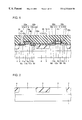
Claims (18)

What is claimed is:
1. A semiconductor device comprising:
an isolating and insulating film formed on a main surface of a semiconductor substrate including a first conductivity type region to isolate an element formation region; and
a field-effect transistor formed in said element formation region,
said field-effect transistor including:
a second conductivity type region formed at the main surface of said semiconductor substrate and neighboring to said isolating and insulating film,
a gate electrode formed on the main surface of said semiconductor substrate,
a lower layer side wall film formed on a side surface of said gate electrode,
an upper layer side wall film formed on said lower layer side wall film, and containing a material different from that of said lower layer side wall film, and
a high-melting-point metal silicide layer formed on said second conductivity type region, and
the upper surface of said isolating and insulating film being located at a level substantially equal to or lower than said main surface of said semiconductor substrate and higher than a junction boundary surface between said first and second conductivity type regions.
2. The semiconductor device according to claim 1, wherein
said field-effect transistor includes a high-melting-point metal silicide layer formed on said gate electrode.
3. The semiconductor device according to claim 1, wherein
said field-effect transistor includes:
a first field-effect transistor including a high-melting-point metal silicide layer formed on said gate electrode, and
a second field-effect transistor not including a high-melting-point metal silicide layer formed on said gate electrode.
4. The semiconductor device according to claim 3, wherein
said lower layer side wall film extends from a position on the upper surface of the gate electrode of said second field-effect transistor to a region neighboring to a region located on said second conductivity type region and provided with said high-melting-point metal silicide layer.
5. The semiconductor device according to claim 4, further comprising:
a coating film formed at the same layer level as the lower layer side wall film of said second field-effect transistor for covering said isolating and insulating film.
6. The semiconductor device according to claim 3, wherein
said upper and lower layer side wall films extend from a position above the upper surface of the gate electrode of said second field-effect transistor to a region neighboring to a region located on said second conductivity type region and provided with said high-melting-point metal silicide layer.
7. The semiconductor device according to claim 6, further comprising:
a coating film formed at the same layer level as the lower layer side wall film of said second field-effect transistor for covering said isolating and insulating film.
8. The semiconductor device according to claim 3, further comprising:
a gate electrode coating film formed on only the upper surface of the gate electrode of said second field-effect transistor.
9. The semiconductor device according to claim 1, wherein
said isolating and insulating film is of a trench type.
10. The semiconductor device according to claim 1, wherein
said upper layer side wall film includes a silicon nitride film, and
said lower layer side wall film includes a silicon oxide film.
11. A method of manufacturing a semiconductor device comprising the steps of:
forming an isolating and insulating film isolating an element formation region at a main surface of a semiconductor substrate including a first conductivity type region;
forming, in said element formation region, a second conductivity type region neighboring to said isolating and insulating film at the main surface of said semiconductor substrate;
forming a gate electrode on said semiconductor substrate;
forming a first coating film on said gate electrode and said isolating and insulating film;
forming a second coating film including a material different from that of said first coating film on said first coating film;
effecting anisotropic etching to remove said second coating film on said isolating and insulating film and form an upper layer side wall film formed of said second coating film on the side surface of said gate electrode;
effecting etching to remove said first coating film on said isolating and insulating film such that the upper surface of said isolating and insulating film is located at a lower level than the main surface of said semiconductor substrate and at a higher level that a junction boundary surface between said first and second conductivity type regions, and to form a lower layer side wall film made of the first coating film on the side surface of said gate electrode; and
forming a high-melting-point metal silicide layer on said second conductivity type region.
12. The method of manufacturing the semiconductor device according to claim 11, further comprising:
a step of forming a high-melting-point metal silicide layer on said gate electrode.
13. The method of manufacturing the semiconductor device according to claim 11, further comprising the steps of:
forming a third coating film on said gate electrode and said isolating and insulating film after forming said lower layer side wall film; and
forming a fourth coating film made of said third coating film on said gate electrode by removing said third coating film on said isolating and insulating film such that the upper surface of said isolating and insulating film is located at a lower level than the main surface of said semiconductor substrate and at a higher level than a junction boundary surface between said first and second conductivity type regions,
said fourth coating film being used as a silicide protection film in said step of forming said high-melting-point metal silicide layer.
14. The method of manufacturing the semiconductor device according to claim 11, wherein
said step of forming said lower layer side wall film includes formation of said lower layer side wall film extending onto an upper surface of said gate electrode, and
said lower layer side wall film is used as a silicide protection film in said step of forming said high-melting-point metal silicide layer.
15. The method of manufacturing the semiconductor device according to claim 14, wherein
said step of forming said upper layer side wall film includes formation of said upper layer side wall film extending onto the upper surface of said gate electrode, and
said upper and lower layer side wall films are used as a silicide protection film in said step of forming said high-melting-point silicide layer.
16. The method of manufacturing the semiconductor device according to claim 11, wherein
said step of forming said gate electrode includes the steps of:
forming a conductive film on said semiconductor substrate;
forming on said conductive film a gate coating film used as a silicide protection film in said step of forming said high-melting-point silicide layer; and
forming the gate electrode and the silicide protection film by partially removing said conductive film and said gate coating film by etching.
17. A method of manufacturing a semiconductor device comprising the steps of:
forming an isolating and insulating film isolating an element formation region at a main surface of a semiconductor substrate including a first conductivity type region;
forming, in said element formation region, a second conductivity type region neighboring to said isolating and insulating film at the main surface of said semiconductor substrate;
forming a gate electrode on said semiconductor substrate;
forming a first coating film on said gate electrode and said isolating and insulating film;
forming a second coating film on said first coating film;
effecting anisotropic etching to remove partially said first and second coating films such that a surface of said second conductivity type region is exposed, and said first and second coating films are left on said gate electrode and said isolating and insulating film; and
forming a high-melting-point metal silicide layer on the exposed surface of said second conductivity type region while leaving said first and second coating films on said gate electrode and said isolating and insulating film.
18. The method of manufacturing the semiconductor device according to claim 17, further comprising:
a step of forming a side wall film on the side surface of said gate electrode.
US09/413,513 1999-04-30 1999-10-06 Semiconductor device provided with a field-effect transistor and method of manufacturing the same Expired - Lifetime US6232640B1 (en)

Applications Claiming Priority (2)

Application Number Priority Date Filing Date Title
JP12389999A JP4999217B2 (en) 1999-04-30 1999-04-30 Manufacturing method of semiconductor device
JP11-123899 1999-04-30

Publications (1)

Publication Number Publication Date
US6232640B1 true US6232640B1 (en) 2001-05-15

Family

ID=14872103

Family Applications (1)

Application Number Title Priority Date Filing Date
US09/413,513 Expired - Lifetime US6232640B1 (en) 1999-04-30 1999-10-06 Semiconductor device provided with a field-effect transistor and method of manufacturing the same

Country Status (4)

Country Link
US (1) US6232640B1 (en)
JP (1) JP4999217B2 (en)
KR (1) KR100375119B1 (en)
TW (1) TW445574B (en)

Cited By (4)

* Cited by examiner, † Cited by third party
Publication number Priority date Publication date Assignee Title
US6614062B2 (en) * 2001-01-17 2003-09-02 Motorola, Inc. Semiconductor tiling structure and method of formation
US20040173851A1 (en) * 1999-11-18 2004-09-09 Kabushiki Kaisha Toshiba Semiconductor device and method of manufacturing the same
US20070122958A1 (en) * 2005-11-30 2007-05-31 Fang C C Spacer barrier structure to prevent spacer voids and method for forming the same
DE102006025364A1 (en) * 2006-05-31 2007-12-06 Advanced Micro Devices, Inc., Sunnyvale A method of increasing the transistor pass current by recessing an isolation trench

Families Citing this family (2)

* Cited by examiner, † Cited by third party
Publication number Priority date Publication date Assignee Title
JP4897146B2 (en) * 2001-03-02 2012-03-14 ルネサスエレクトロニクス株式会社 Semiconductor device manufacturing method and semiconductor device
DE102017124571B4 (en) 2017-10-20 2020-01-09 Asm Assembly Systems Gmbh & Co. Kg Holding and drive device, tool device, supplementary tool device from a modular component handling device, device for handling components and method for application-specific configuration of such a device

Citations (4)

* Cited by examiner, † Cited by third party
Publication number Priority date Publication date Assignee Title
JPH0729993A (en) 1993-07-07 1995-01-31 Seiko Epson Corp Semiconductor device
JPH0974199A (en) 1995-01-12 1997-03-18 Matsushita Electric Ind Co Ltd Semiconductor device and manufacturing method thereof
JPH09172063A (en) 1995-12-19 1997-06-30 Matsushita Electric Ind Co Ltd Semiconductor device and manufacturing method thereof
US6049113A (en) * 1997-06-05 2000-04-11 Nec Corporation Semiconductor device and semiconductor device manufacturing method

Family Cites Families (9)

* Cited by examiner, † Cited by third party
Publication number Priority date Publication date Assignee Title
US5021853A (en) * 1990-04-27 1991-06-04 Digital Equipment Corporation N-channel clamp for ESD protection in self-aligned silicided CMOS process
JP3775803B2 (en) * 1990-08-09 2006-05-17 Necエレクトロニクス株式会社 Semiconductor integrated circuit device and manufacturing method thereof
JPH05109760A (en) * 1991-10-18 1993-04-30 Seiko Epson Corp Semiconductor device
JPH07176727A (en) * 1993-12-17 1995-07-14 Fujitsu Ltd Semiconductor device and manufacturing method thereof
JPH08274187A (en) * 1995-02-03 1996-10-18 Sony Corp Method for manufacturing semiconductor device
DE19510777C1 (en) * 1995-03-24 1996-06-05 Itt Ind Gmbh Deutsche Process for producing a CMOS structure with ESD protection
JPH09326440A (en) * 1996-06-04 1997-12-16 Sony Corp Method for manufacturing semiconductor device
JPH10125915A (en) * 1996-10-24 1998-05-15 Nec Yamagata Ltd Semiconductor device and its manufacture
JPH10256390A (en) * 1997-03-06 1998-09-25 Yamaha Corp Manufacture of semiconductor device

Patent Citations (4)

* Cited by examiner, † Cited by third party
Publication number Priority date Publication date Assignee Title
JPH0729993A (en) 1993-07-07 1995-01-31 Seiko Epson Corp Semiconductor device
JPH0974199A (en) 1995-01-12 1997-03-18 Matsushita Electric Ind Co Ltd Semiconductor device and manufacturing method thereof
JPH09172063A (en) 1995-12-19 1997-06-30 Matsushita Electric Ind Co Ltd Semiconductor device and manufacturing method thereof
US6049113A (en) * 1997-06-05 2000-04-11 Nec Corporation Semiconductor device and semiconductor device manufacturing method

Cited By (8)

* Cited by examiner, † Cited by third party
Publication number Priority date Publication date Assignee Title
US20040173851A1 (en) * 1999-11-18 2004-09-09 Kabushiki Kaisha Toshiba Semiconductor device and method of manufacturing the same
US6614062B2 (en) * 2001-01-17 2003-09-02 Motorola, Inc. Semiconductor tiling structure and method of formation
US20070122958A1 (en) * 2005-11-30 2007-05-31 Fang C C Spacer barrier structure to prevent spacer voids and method for forming the same
US7411245B2 (en) * 2005-11-30 2008-08-12 Taiwan Semiconductor Manufacturing Co., Ltd. Spacer barrier structure to prevent spacer voids and method for forming the same
DE102006025364A1 (en) * 2006-05-31 2007-12-06 Advanced Micro Devices, Inc., Sunnyvale A method of increasing the transistor pass current by recessing an isolation trench
US20070278596A1 (en) * 2006-05-31 2007-12-06 Christoph Schwan Method of increasing transistor drive current by recessing an isolation trench
US7659170B2 (en) 2006-05-31 2010-02-09 GlobalFoundries, Inc. Method of increasing transistor drive current by recessing an isolation trench
DE102006025364B4 (en) * 2006-05-31 2015-01-22 Globalfoundries Inc. A method of increasing the transistor pass current by recessing an isolation trench

Also Published As

Publication number Publication date
KR20010014853A (en) 2001-02-26
JP2000315735A (en) 2000-11-14
TW445574B (en) 2001-07-11
JP4999217B2 (en) 2012-08-15
KR100375119B1 (en) 2003-03-08

Similar Documents

Publication Publication Date Title
US6770522B2 (en) Semiconductor device and manufacturing method thereof
KR100221063B1 (en) MOS transistor and its manufacturing method
JP5420000B2 (en) Manufacturing method of semiconductor device
JPH10214894A (en) Semiconductor device and manufacturing method thereof
US5073510A (en) Fabrication method of contact window in semiconductor device
US6469347B1 (en) Buried-channel semiconductor device, and manufacturing method thereof
US20030057498A1 (en) Semiconductor device having channel cut layers provided at different depths
US20030080429A1 (en) Semiconductor device
US20080280407A1 (en) Cmos device with dual polycide gates and method of manufacturing the same
KR20000040447A (en) Method for forming contact of semiconductor device
KR100280167B1 (en) Semiconductor device and manufacturing method
US6232640B1 (en) Semiconductor device provided with a field-effect transistor and method of manufacturing the same
JP2010165907A (en) Method of manufacturing semiconductor device
US6657263B2 (en) MOS transistors having dual gates and self-aligned interconnect contact windows
US6974999B2 (en) Semiconductor device and method of manufacturing the same
KR100293052B1 (en) Semiconductor device manufacturing method
US20020024112A1 (en) Semiconductor device
US5290728A (en) Method for producing a semiconductor device
US7432163B2 (en) Method of manufacturing semiconductor device that includes forming adjacent field regions with a separating region therebetween
JP3860408B2 (en) Semiconductor device and method for manufacturing semiconductor device
US20020033536A1 (en) Semiconductor device and manufacturing method thereof
KR100982959B1 (en) Manufacturing Method of Semiconductor Device
JP3058325B2 (en) Semiconductor device and manufacturing method thereof
JP4467162B2 (en) Manufacturing method of semiconductor device
US6403422B2 (en) Semiconductor device and method of manufacturing the same

Legal Events

Date Code Title Description
AS Assignment

Owner name: MITSUBISHI DENKI KABUSHIKI KAISHA, JAPAN

Free format text: ASSIGNMENT OF ASSIGNORS INTEREST;ASSIGNORS:OKADA, MASAKAZU;HIGASHITANI, KEIICHI;REEL/FRAME:010307/0235

Effective date: 19990917

AS Assignment

Owner name: SPEEDFAM-IPEC CORPORATION, ARIZONA

Free format text: ASSIGNMENT OF ASSIGNORS INTEREST;ASSIGNORS:SUNDIN, JAMES B.;TIRENDI, RICHARD S.;DRYER, PAUL W.;REEL/FRAME:010967/0378;SIGNING DATES FROM 20000622 TO 20000627

FEPP Fee payment procedure

Free format text: PAYOR NUMBER ASSIGNED (ORIGINAL EVENT CODE: ASPN); ENTITY STATUS OF PATENT OWNER: LARGE ENTITY

STCF Information on status: patent grant

Free format text: PATENTED CASE

CC Certificate of correction
FPAY Fee payment

Year of fee payment: 4

FPAY Fee payment

Year of fee payment: 8

AS Assignment

Owner name: RENESAS ELECTRONICS CORPORATION, JAPAN

Free format text: ASSIGNMENT OF ASSIGNORS INTEREST;ASSIGNOR:MITSUBISHI DENKI KABUSHIKI KAISHA;REEL/FRAME:025980/0219

Effective date: 20110307

FPAY Fee payment

Year of fee payment: 12

AS Assignment

Owner name: RENESAS ELECTRONICS CORPORATION, JAPAN

Free format text: CHANGE OF ADDRESS;ASSIGNOR:RENESAS ELECTRONICS CORPORATION;REEL/FRAME:044928/0001

Effective date: 20150806