US6147589A - Negative temperature coefficient thermistor - Google Patents

Negative temperature coefficient thermistor Download PDF

Info

Publication number
US6147589A
US6147589A US09/511,708 US51170800A US6147589A US 6147589 A US6147589 A US 6147589A US 51170800 A US51170800 A US 51170800A US 6147589 A US6147589 A US 6147589A
Authority
US
United States
Prior art keywords
temperature coefficient
negative temperature
coefficient thermistor
external electrodes
metal powder
Prior art date
Legal status (The legal status is an assumption and is not a legal conclusion. Google has not performed a legal analysis and makes no representation as to the accuracy of the status listed.)
Expired - Fee Related
Application number
US09/511,708
Inventor
Kingo Ohmura
Current Assignee (The listed assignees may be inaccurate. Google has not performed a legal analysis and makes no representation or warranty as to the accuracy of the list.)
Murata Manufacturing Co Ltd
Original Assignee
Murata Manufacturing Co Ltd
Priority date (The priority date is an assumption and is not a legal conclusion. Google has not performed a legal analysis and makes no representation as to the accuracy of the date listed.)
Filing date
Publication date
Application filed by Murata Manufacturing Co Ltd filed Critical Murata Manufacturing Co Ltd
Assigned to MURATA MANUFACTURING CO., LTD. reassignment MURATA MANUFACTURING CO., LTD. ASSIGNMENT OF ASSIGNORS INTEREST (SEE DOCUMENT FOR DETAILS). Assignors: OHMURA, KINGO
Application granted granted Critical
Publication of US6147589A publication Critical patent/US6147589A/en
Anticipated expiration legal-status Critical
Expired - Fee Related legal-status Critical Current

Links

Images

Classifications

    • HELECTRICITY
    • H01ELECTRIC ELEMENTS
    • H01CRESISTORS
    • H01C7/00Non-adjustable resistors formed as one or more layers or coatings; Non-adjustable resistors made from powdered conducting material or powdered semi-conducting material with or without insulating material
    • H01C7/04Non-adjustable resistors formed as one or more layers or coatings; Non-adjustable resistors made from powdered conducting material or powdered semi-conducting material with or without insulating material having negative temperature coefficient
    • H01C7/042Non-adjustable resistors formed as one or more layers or coatings; Non-adjustable resistors made from powdered conducting material or powdered semi-conducting material with or without insulating material having negative temperature coefficient mainly consisting of inorganic non-metallic substances
    • H01C7/043Oxides or oxidic compounds
    • EFIXED CONSTRUCTIONS
    • E04BUILDING
    • E04BGENERAL BUILDING CONSTRUCTIONS; WALLS, e.g. PARTITIONS; ROOFS; FLOORS; CEILINGS; INSULATION OR OTHER PROTECTION OF BUILDINGS
    • E04B9/00Ceilings; Construction of ceilings, e.g. false ceilings; Ceiling construction with regard to insulation
    • E04B9/18Means for suspending the supporting construction
    • E04B9/183Means for suspending the supporting construction having a lower side adapted to be connected to a channel of the supporting construction
    • EFIXED CONSTRUCTIONS
    • E04BUILDING
    • E04BGENERAL BUILDING CONSTRUCTIONS; WALLS, e.g. PARTITIONS; ROOFS; FLOORS; CEILINGS; INSULATION OR OTHER PROTECTION OF BUILDINGS
    • E04B1/00Constructions in general; Structures which are not restricted either to walls, e.g. partitions, or floors or ceilings or roofs
    • E04B1/38Connections for building structures in general
    • E04B1/41Connecting devices specially adapted for embedding in concrete or masonry
    • E04B1/4107Longitudinal elements having an open profile, with the opening parallel to the concrete or masonry surface, i.e. anchoring rails
    • EFIXED CONSTRUCTIONS
    • E04BUILDING
    • E04BGENERAL BUILDING CONSTRUCTIONS; WALLS, e.g. PARTITIONS; ROOFS; FLOORS; CEILINGS; INSULATION OR OTHER PROTECTION OF BUILDINGS
    • E04B9/00Ceilings; Construction of ceilings, e.g. false ceilings; Ceiling construction with regard to insulation
    • E04B9/06Ceilings; Construction of ceilings, e.g. false ceilings; Ceiling construction with regard to insulation characterised by constructional features of the supporting construction, e.g. cross section or material of framework members
    • E04B9/065Ceilings; Construction of ceilings, e.g. false ceilings; Ceiling construction with regard to insulation characterised by constructional features of the supporting construction, e.g. cross section or material of framework members comprising supporting beams having a folded cross-section
    • EFIXED CONSTRUCTIONS
    • E04BUILDING
    • E04BGENERAL BUILDING CONSTRUCTIONS; WALLS, e.g. PARTITIONS; ROOFS; FLOORS; CEILINGS; INSULATION OR OTHER PROTECTION OF BUILDINGS
    • E04B9/00Ceilings; Construction of ceilings, e.g. false ceilings; Ceiling construction with regard to insulation
    • E04B9/18Means for suspending the supporting construction
    • E04B9/20Means for suspending the supporting construction adjustable

Definitions

  • the present invention relates to a negative temperature coefficient thermistor consisting of LaCoO 3 rare earth transition element oxide, capable of inhibiting a rush current.
  • the LaCoO 3 rare earth transition element oxide has a larger B constant than that of a conventional manganese spinel negative temperature coefficient thermistor material, and is capable of further reducing a resistance value of a thermistor element at a high temperature. Therefore, when an electric current is applied, it is possible to inhibit a self heat generation of a negative temperature coefficient thermistor element, thereby increasing a rated current value. For this reason, LaCoO 3 rare earth transition element oxide is suitable for use as a material in forming a negative temperature coefficient thermistor element capable of inhibiting a rush current.
  • a negative temperature coefficient thermistor element consisting of a LaCoO 3 rare earth transition element oxide
  • Ag or Ag--Pd paste for forming a sort of thick film electrode which contains a kind of glass frit consisting of usual SiO 2 , PbO, Bi 2 O 3
  • an interface between a negative temperature coefficient thermistor element and the external electrodes will become non-ohmic, hence making the negative temperature coefficient thermistor element to have only an unstable resistance value.
  • a negative temperature coefficient thermistor element consisting of LaCoO 3 rare earth transition element oxide is formed on the outer surfaces thereof with external electrodes which are obtained by using a thick film electrode formation paste not containing the above glass frit.
  • the above negative temperature coefficient thermistor containing as its main component the above LaCoO 3 rare earth transition element oxide is provided with external electrodes which are formed by a fritless paste, there is only a lower adhesion strength between the negative temperature coefficient thermistor element and the external electrodes than that of a thick film electrode containing a common glass frit.
  • a sintering treatment is carried out at a temperature of 600 to 850° C. for one hour (just like a process in which a common thick film electrode is formed). Instead, such a sintering treatment is needed to be conducted at a temperature of 900 to 1000° C. for five hours.
  • a relatively long time is required in forming the external electrodes, there had been a problem that the external electrodes have to be formed with a high cost.
  • a first negative temperature coefficient thermistor according to the present invention is characterized in that said thermistor is obtained by forming external electrodes on the surface of a negative temperature coefficient thermistor element.
  • the negative temperature coefficient thermistor element includes LaCoO 3 rare earth transition element oxide, while the external electrodes include an electrically conductive material formed by adding one or more kinds of oxide powders of Ni, Cr, Mn and Fe in a metal powder.
  • a second negative temperature coefficient thermistor according to the present invention is characterized in that said thermistor is obtained by forming external electrodes on the surface of a negative temperature coefficient thermistor element, followed by connecting terminals on to the external electrodes by means of solderring treatment.
  • the negative temperature coefficient thermistor element includes LaCoO 3 rare earth transition element oxide
  • the external electrodes include an electrically conductive material formed by adding one or more kinds of oxide powders of Ni, Cr, Mn and Fe in a metal powder.
  • a third negative temperature coefficient thermistor according to the present invention is characterized in that said thermistor is obtained by forming external electrodes on the surface of a negative temperature coefficient thermistor element, said negative temperature coefficient thermistor element being received into a case under a condition in which the thermistor element is elastically held by terminals.
  • the negative temperature coefficient thermistor element includes LaCoO 3 rare earth transition element oxide
  • the external electrodes include an electrically conductive material formed by adding one or more kinds of oxide powders of Ni, Cr, Mn and Fe in a metal powder.
  • the metal powder includes Ag, Ag--Pd, or Ag--Pt.
  • the content of the oxide powders in the metal powder is preferred to be 1.0 wt % or less (however, not including 0 wt %).
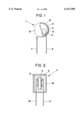
  • FIG. 1 is a partially cut sectional view schematically indicating a negative temperature coefficient thermistor made according to one embodiment of the present invention.
  • FIG. 2 is a cross sectional view schematically indicating a negative temperature coefficient thermistor made according to another embodiment of the present invention.
  • FIG. 1 schematically indicates a negative temperature coefficient thermistor 1 of a lead type.
  • the negative temperature coefficient thermistor 1 comprises a negative temperature coefficient thermistor element 2, two main surfaces of the negative temperature coefficient thermistor element 2, external electrodes 3 and 4 formed on the two main surfaces of the thermistor element, lead wires 6 and 7 attached thereon so as to be electrically connected with the external electrodes 3 and 4, a external decorative resin layer 8.
  • the negative temperature coefficient thermistor element 2 is made of a ceramic material containing LaCoO 3 rare earth transition element oxide as its main component, and is formed into a plate-like member, followed by a sintering treatment, thereby obtaining a circular plate-like member having a diameter of 7 mm and a thickness of 1.5 mm.
  • the external electrodes 3 and 4 may be formed in the following way. Namely, at first, one or more kinds of oxide powders of Ni, Cr, Mn and Fe are mixed in an amount of 0.1 wt % with a sort of metal particles consisting of Ag, Ag--Pd or Ag--Pt, thereby obtaining an intermediate mixture. Then, an appropriate amount of an organic vehicle is added into the mixture, followed by mixing and kneading treatments, thereby obtaining an electrically conductive paste with its viscosity adjusted. Subsequently, the electrically conductive paste is used to coat the two opposite main surfaces of the negative temperature coefficient thermistor element 2, followed by conducting a baking/sticking treatment at a temperature of 900 to 960° C. for one hour.
  • two lead wires 6 and 7 are attached on to the electrodes 3 and 4 formed on the two opposite main surfaces of the negative temperature coefficient thermistor element 2, with the use of a high temperature solder 5 such as Sn--Ag (having a composition ratio of 96.5:3.5).
  • a high temperature solder 5 such as Sn--Ag (having a composition ratio of 96.5:3.5).
  • an external decorative resin 8 such as a silicon resin is used to coat the outer surfaces of the above material, thereby obtaining a desired negative temperature coefficient thermistor 1.
  • the obtained negative temperature coefficient thermistor 1 was investigated for its adhesion strength between the negative temperature coefficient thermistor element 2 and the external electrodes 3, 4, also it was investigated for its change in its resistance when being used at a high temperature.
  • the two opposite main surfaces of the negative temperature coefficient thermistor element 2 was coated with a fritless thick film electrode paste not containing an oxide powder of any of Ni, Cr, Mn, Fe but consisting of Ag, Ag--Pd or Ag--Pt, followed by a sintering treatment at a temperature of 900 to 1000° C. for 5 hours, thereby obtaining a conventional negative temperature coefficient thermistor formed according to a prior art.
  • the conventional negative temperature coefficient thermistor was measured for its adhesion strength and its resistance change in the same manner as the above.
  • an adhesion strength between the negative temperature coefficient thermistor element 2 and the external electrodes 3, 4 in the present invention has been increased from 19.6 N to 29.4 N per ⁇ 3 mm, as compared with that of a conventional thermistor.
  • the reason for this fact may be explained as follows. Namely, it is allowed to consider that when the external electrodes 3, 4 are being formed through the baking/sticking treatment, there will be a chemical bond between the oxide particles of LaCoO 3 rare earth transition element oxides contained in the negative temperature coefficient thermistor element 2 on one hand, and the particles of NiO, Cr 2 O 3 , Mn 2 O 3 , Fe 2 O 3 contained in the external electrodes 3, 4 on the other.
  • the particles contained in the external electrodes 3, 4 are NiO, LaNiO 3 will occur on an interface between the negative temperature coefficient thermistor element 2 and the external electrodes 3, 4. Further, for example, it is allowed to consider that NiO will penetrate and diffuse into the negative temperature coefficient thermistor element 2, thereby producing a physical bond due to an anchor effect.
  • a content of the oxide powders containing one or more kinds of the metals Ni, Cr, Mn, Fe may be adjusted such that it is sure to obtain the same effects as the external electrodes should produce.
  • a content of the oxide powders should be 1.0 wt % or less.
  • the oxide powders of Ni, Cr, Mn and Fe contained in the external electrodes 3 and 4 are effective for preventing Sn contained in a solder from diffusing into the external electrodes 3 and 4, also effective for preventing the corrosion of Ag of the external electrodes 3 and 4 (such corrosion will otherwise be caused due to the solder), thereby preventing a possible decrease in the adhesion strength of the external electrodes.
  • FIG. 2 is used to indicate another embodiment of the present invention.
  • the negative temperature coefficient thermistor element 2 is elastically held by two terminals 16 and 17, with two electrodes 3 and 4 on two main surfaces being electrically conductive through the two terminals 16 and 17.
  • a negative temperature coefficient thermistor of the present invention may be formed not only as electric parts including lead terminals, but also may be formed as chip parts as well.

Landscapes

  • Engineering & Computer Science (AREA)
  • Architecture (AREA)
  • Physics & Mathematics (AREA)
  • Electromagnetism (AREA)
  • Microelectronics & Electronic Packaging (AREA)
  • Civil Engineering (AREA)
  • Structural Engineering (AREA)
  • Thermistors And Varistors (AREA)
  • Compositions Of Oxide Ceramics (AREA)

Abstract

It is an object of the present invention to provide an improved negative temperature coefficient thermistor capable of increasing an adhesion strength between a negative temperature coefficient thermistor element consisting of LaCoO3 rare earth transition element oxide on one hand and electrodes on the other, thereby improving a reliability of the thermistor product. The negative temperature coefficient thermistor of the present invention is obtained by forming electrodes on the surface of a negative temperature coefficient thermistor element consisting of LaCoO3 rear earth transition element oxide. Such electrodes are formed by adding one or more kinds of oxide powders of Ni, Cr, Mn and Fe in a metal powder, with the content of the oxide powders in the metal powder being 1.0 wt % or less (however, not including 0 wt %).

Description

BACKGROUND OF THE INVENTION
1. Field of the Invention
The present invention relates to a negative temperature coefficient thermistor consisting of LaCoO3 rare earth transition element oxide, capable of inhibiting a rush current.
2. Description of the Related Art
The LaCoO3 rare earth transition element oxide has a larger B constant than that of a conventional manganese spinel negative temperature coefficient thermistor material, and is capable of further reducing a resistance value of a thermistor element at a high temperature. Therefore, when an electric current is applied, it is possible to inhibit a self heat generation of a negative temperature coefficient thermistor element, thereby increasing a rated current value. For this reason, LaCoO3 rare earth transition element oxide is suitable for use as a material in forming a negative temperature coefficient thermistor element capable of inhibiting a rush current.
However, when external electrodes are to be formed on a negative temperature coefficient thermistor element consisting of a LaCoO3 rare earth transition element oxide, if Ag or Ag--Pd paste for forming a sort of thick film electrode is used which contains a kind of glass frit consisting of usual SiO2, PbO, Bi2 O3, an interface between a negative temperature coefficient thermistor element and the external electrodes will become non-ohmic, hence making the negative temperature coefficient thermistor element to have only an unstable resistance value. For this reason, a negative temperature coefficient thermistor element consisting of LaCoO3 rare earth transition element oxide is formed on the outer surfaces thereof with external electrodes which are obtained by using a thick film electrode formation paste not containing the above glass frit.
However, since the above negative temperature coefficient thermistor containing as its main component the above LaCoO3 rare earth transition element oxide, is provided with external electrodes which are formed by a fritless paste, there is only a lower adhesion strength between the negative temperature coefficient thermistor element and the external electrodes than that of a thick film electrode containing a common glass frit. When one tries to increase the adhesion strength between the negative temperature coefficient thermistor element and the external electrodes, it will not be sufficient if a sintering treatment is carried out at a temperature of 600 to 850° C. for one hour (just like a process in which a common thick film electrode is formed). Instead, such a sintering treatment is needed to be conducted at a temperature of 900 to 1000° C. for five hours. Hence, as a result, since a relatively long time is required in forming the external electrodes, there had been a problem that the external electrodes have to be formed with a high cost.
Moreover, there have been existing another problem which may be concluded as follows. Namely, if a negative temperature coefficient thermistor having formed thereon the external electrodes is attached to a circuit board, or if a lead wire is soldered on to a negative temperature coefficient thermistor having formed thereon the external electrodes, it is allowed to obtain a certain negative temperature coefficient thermistor product. If such a negative temperature coefficient thermistor product is continuously used under a temperature of 100° C. or higher, a solder component such as Sn will diffuse on to the external electrodes, so that an element Ag forming the external electrodes will be corroded due to the solder. As a result, the external electrodes will have only a low strength, and the resistance value of the negative temperature coefficient thermistor will become high.
SUMMARY OF THE INVENTION
It is an object of the present invention to provide an improved negative temperature coefficient thermistor capable of increasing an adhesion strength between a negative temperature coefficient thermistor element consisting of LaCoO3 rare earth transition element oxide on one hand and its external electrodes on the other, thereby improving a reliability of the thermistor product.
A first negative temperature coefficient thermistor according to the present invention is characterized in that said thermistor is obtained by forming external electrodes on the surface of a negative temperature coefficient thermistor element. In particular, the negative temperature coefficient thermistor element includes LaCoO3 rare earth transition element oxide, while the external electrodes include an electrically conductive material formed by adding one or more kinds of oxide powders of Ni, Cr, Mn and Fe in a metal powder.
A second negative temperature coefficient thermistor according to the present invention is characterized in that said thermistor is obtained by forming external electrodes on the surface of a negative temperature coefficient thermistor element, followed by connecting terminals on to the external electrodes by means of solderring treatment. In particular, the negative temperature coefficient thermistor element includes LaCoO3 rare earth transition element oxide, while the external electrodes include an electrically conductive material formed by adding one or more kinds of oxide powders of Ni, Cr, Mn and Fe in a metal powder.
A third negative temperature coefficient thermistor according to the present invention is characterized in that said thermistor is obtained by forming external electrodes on the surface of a negative temperature coefficient thermistor element, said negative temperature coefficient thermistor element being received into a case under a condition in which the thermistor element is elastically held by terminals. In particular, the negative temperature coefficient thermistor element includes LaCoO3 rare earth transition element oxide, while the external electrodes include an electrically conductive material formed by adding one or more kinds of oxide powders of Ni, Cr, Mn and Fe in a metal powder.
In the above first to third negative temperature coefficient thermistors, the metal powder includes Ag, Ag--Pd, or Ag--Pt.
In the above first to third negative temperature coefficient thermistors, the content of the oxide powders in the metal powder is preferred to be 1.0 wt % or less (however, not including 0 wt %).
In the above second negative temperature coefficient thermistor, its negative temperature coefficient thermistor element is coated with an external decorative resin.
In this way, it is possible to increase an adhesion strength between the negative temperature coefficient thermistor element and its external electrodes.
BRIEF DESCRIPTION OF THE DRAWINGS
FIG. 1 is a partially cut sectional view schematically indicating a negative temperature coefficient thermistor made according to one embodiment of the present invention.
FIG. 2 is a cross sectional view schematically indicating a negative temperature coefficient thermistor made according to another embodiment of the present invention.
DESCRIPTION OF THE PREFERRED EMBODIMENTS
One embodiment of the present invention will be described in the following with reference to FIG. 1 which schematically indicates a negative temperature coefficient thermistor 1 of a lead type.
The negative temperature coefficient thermistor 1 comprises a negative temperature coefficient thermistor element 2, two main surfaces of the negative temperature coefficient thermistor element 2, external electrodes 3 and 4 formed on the two main surfaces of the thermistor element, lead wires 6 and 7 attached thereon so as to be electrically connected with the external electrodes 3 and 4, a external decorative resin layer 8.
The negative temperature coefficient thermistor element 2 is made of a ceramic material containing LaCoO3 rare earth transition element oxide as its main component, and is formed into a plate-like member, followed by a sintering treatment, thereby obtaining a circular plate-like member having a diameter of 7 mm and a thickness of 1.5 mm.
The external electrodes 3 and 4 may be formed in the following way. Namely, at first, one or more kinds of oxide powders of Ni, Cr, Mn and Fe are mixed in an amount of 0.1 wt % with a sort of metal particles consisting of Ag, Ag--Pd or Ag--Pt, thereby obtaining an intermediate mixture. Then, an appropriate amount of an organic vehicle is added into the mixture, followed by mixing and kneading treatments, thereby obtaining an electrically conductive paste with its viscosity adjusted. Subsequently, the electrically conductive paste is used to coat the two opposite main surfaces of the negative temperature coefficient thermistor element 2, followed by conducting a baking/sticking treatment at a temperature of 900 to 960° C. for one hour.
Further, two lead wires 6 and 7 are attached on to the electrodes 3 and 4 formed on the two opposite main surfaces of the negative temperature coefficient thermistor element 2, with the use of a high temperature solder 5 such as Sn--Ag (having a composition ratio of 96.5:3.5). Finally, an external decorative resin 8 such as a silicon resin is used to coat the outer surfaces of the above material, thereby obtaining a desired negative temperature coefficient thermistor 1.
Then, the obtained negative temperature coefficient thermistor 1 was investigated for its adhesion strength between the negative temperature coefficient thermistor element 2 and the external electrodes 3, 4, also it was investigated for its change in its resistance when being used at a high temperature. Similarly, the two opposite main surfaces of the negative temperature coefficient thermistor element 2 was coated with a fritless thick film electrode paste not containing an oxide powder of any of Ni, Cr, Mn, Fe but consisting of Ag, Ag--Pd or Ag--Pt, followed by a sintering treatment at a temperature of 900 to 1000° C. for 5 hours, thereby obtaining a conventional negative temperature coefficient thermistor formed according to a prior art. Then, the conventional negative temperature coefficient thermistor was measured for its adhesion strength and its resistance change in the same manner as the above.
As a result, it was found that an adhesion strength between the negative temperature coefficient thermistor element 2 and the external electrodes 3, 4 in the present invention has been increased from 19.6 N to 29.4 N per φ3 mm, as compared with that of a conventional thermistor. The reason for this fact may be explained as follows. Namely, it is allowed to consider that when the external electrodes 3, 4 are being formed through the baking/sticking treatment, there will be a chemical bond between the oxide particles of LaCoO3 rare earth transition element oxides contained in the negative temperature coefficient thermistor element 2 on one hand, and the particles of NiO, Cr2 O3, Mn2 O3, Fe2 O3 contained in the external electrodes 3, 4 on the other. For example, if the particles contained in the external electrodes 3, 4 are NiO, LaNiO3 will occur on an interface between the negative temperature coefficient thermistor element 2 and the external electrodes 3, 4. Further, for example, it is allowed to consider that NiO will penetrate and diffuse into the negative temperature coefficient thermistor element 2, thereby producing a physical bond due to an anchor effect.
A content of the oxide powders containing one or more kinds of the metals Ni, Cr, Mn, Fe, may be adjusted such that it is sure to obtain the same effects as the external electrodes should produce. In particular, in view of a solder wetability, an adhesion strength of the external electrodes, an influence on the resistance value of a negative temperature coefficient thermistor, it is preferred that a content of the oxide powders should be 1.0 wt % or less.
Further, if the negative temperature coefficient thermistor 1 is used continuously at a temperature of 100° C. or higher, it was found that a change in its resistance value with the passing of time had been greatly inhibited as compared with a prior art, for such a change in resistance value has been reduced from 20% to a value which is less than 1%. The reason for this fact may be explained as follows. Namely, the oxide powders of Ni, Cr, Mn and Fe contained in the external electrodes 3 and 4 are effective for preventing Sn contained in a solder from diffusing into the external electrodes 3 and 4, also effective for preventing the corrosion of Ag of the external electrodes 3 and 4 (such corrosion will otherwise be caused due to the solder), thereby preventing a possible decrease in the adhesion strength of the external electrodes.
FIG. 2 is used to indicate another embodiment of the present invention. As shown in the drawing, the negative temperature coefficient thermistor element 2 is elastically held by two terminals 16 and 17, with two electrodes 3 and 4 on two main surfaces being electrically conductive through the two terminals 16 and 17. In fact, there is formed a case type negative temperature coefficient thermistor 11 in which the negative temperature coefficient thermistor element 2 and the two feeding terminals 16, 17 are all enclosed in a heat resistant case 18.
However, a negative temperature coefficient thermistor of the present invention may be formed not only as electric parts including lead terminals, but also may be formed as chip parts as well.
As discussed in the above, with the use of the present invention, by using electrodes formed by adding one or more kinds of oxide powders of Ni, Cr, Mn and Fe into a metal powder, it is possible to obtain a negative temperature coefficient thermistor having a high adhesion strength between the negative temperature coefficient thermistor element and the external electrodes.
Further, it has been found that even under a high temperature the intensity of the electrodes of the present invention will not become low, thereby inhibiting a change in the resistance value of the negative temperature coefficient thermistor. In this way, it is sure to increase a reliability of the negative temperature coefficient thermistor.
Claims (14)

What is claimed is:
1. A negative temperature coefficient thermistor,
wherein said thermistor is obtained by forming external electrodes on the surface of a negative temperature coefficient thermistor element;
wherein the negative temperature coefficient thermistor element includes LaCoO3 rare earth transition element oxide, while the external electrodes include an electrically conductive material formed by adding one or more kinds of oxide powders of Ni, Cr, Mn and Fe in a metal powder.
2. The negative temperature coefficient thermistor according to claim 1,
wherein said thermistor is obtained by forming said external electrodes on the surface of said negative temperature coefficient thermistor element, followed by connecting terminals on to the external electrodes by means of soldering treatment.
3. The negative temperature coefficient thermistor according to claim 1,
wherein said negative temperature coefficient thermistor element is received into a case under a condition in which the thermistor element is elastically held by terminals.
4. The negative temperature coefficient thermistor according to claim 1, wherein the metal powder includes Ag, Ag--Pd, or Ag--Pt.
5. The negative temperature coefficient thermistor according to claim 2, wherein the content of the oxide powders in the metal powder is 1.0 wt % or less (however, not including 0 wt %).
6. The negative temperature coefficient thermistor according to claim 1, wherein said negative temperature coefficient thermistor is a chip part.
7. The negative temperature coefficient thermistor according to claim 2, wherein the metal powder includes Ag, Ag--Pd, or Ag--Pt.
8. The negative temperature coefficient thermistor according to claim 3, wherein the metal powder includes Ag, Ag--Pd, or Ag--Pt.
9. The negative temperature coefficient thermistor according to claim 3, wherein the content of the oxide powders in the metal powder is 1.0 wt % or less (however, not including 0 wt %).
10. The negative temperature coefficient thermistor according to claim 4, wherein the content of the oxide powders in the metal powder is 1.0 wt % or less (however, not including 0 wt %).
11. The negative temperature coefficient thermistor according to claim 2, wherein said negative temperature coefficient thermistor is a chip part.
12. The negative temperature coefficient thermistor according to claim 3, wherein said negative temperature coefficient thermistor is a chip part.
13. The negative temperature coefficient thermistor according to claim 4, wherein said negative temperature coefficient thermistor is a chip part.
14. The negative temperature coefficient thermistor according to claim 5, wherein said negative temperature coefficient thermistor is a chip part.
US09/511,708 1999-03-11 2000-02-23 Negative temperature coefficient thermistor Expired - Fee Related US6147589A (en)

Applications Claiming Priority (2)

Application Number Priority Date Filing Date Title
JP6490499 1999-03-11
JP11-1164904 1999-03-11

Publications (1)

Publication Number Publication Date
US6147589A true US6147589A (en) 2000-11-14

Family

ID=13271525

Family Applications (1)

Application Number Title Priority Date Filing Date
US09/511,708 Expired - Fee Related US6147589A (en) 1999-03-11 2000-02-23 Negative temperature coefficient thermistor

Country Status (4)

Country Link
US (1) US6147589A (en)
KR (1) KR100358302B1 (en)
DE (1) DE10011009B4 (en)
MY (1) MY120265A (en)

Cited By (5)

* Cited by examiner, † Cited by third party
Publication number Priority date Publication date Assignee Title
US20030128098A1 (en) * 2001-01-26 2003-07-10 Lavenuta Gregg J. Thermistor and method of manufacture
US8482370B2 (en) 2010-06-09 2013-07-09 Pierburg Gmbh Location of an NTC resistor in an electromagnet
US20130214863A1 (en) * 2012-02-17 2013-08-22 Imec Front-End System for Radio Devices
USD705224S1 (en) 2013-03-12 2014-05-20 Aruba Networks, Inc. Wireless accessing device
US11525739B2 (en) * 2018-05-08 2022-12-13 Texas Instruments Incorporated Thermistor die-based thermal probe

Families Citing this family (2)

* Cited by examiner, † Cited by third party
Publication number Priority date Publication date Assignee Title
KR100734788B1 (en) * 2005-11-25 2007-07-04 주식회사 제임스텍 Negative temperature coefficient thermistor temperature sensor and its manufacturing method
KR102229703B1 (en) 2020-12-29 2021-03-19 디에스씨전자 주식회사 Negative Temperature Coefficient Thermistor for SMD Type Inrush Current Limitation System

Citations (2)

* Cited by examiner, † Cited by third party
Publication number Priority date Publication date Assignee Title
US5504371A (en) * 1993-07-19 1996-04-02 Murata Manufacturing Co., Ltd. Semiconductor ceramic device having a ceramic element with negative temperature coefficient of resistance
US5703000A (en) * 1996-02-06 1997-12-30 Murata Manufacturing Co., Ltd. Semiconductive ceramic composition and semiconductive ceramic device using the same

Family Cites Families (1)

* Cited by examiner, † Cited by third party
Publication number Priority date Publication date Assignee Title
JPH02152203A (en) * 1988-12-05 1990-06-12 Murata Mfg Co Ltd Thermal resistor

Patent Citations (2)

* Cited by examiner, † Cited by third party
Publication number Priority date Publication date Assignee Title
US5504371A (en) * 1993-07-19 1996-04-02 Murata Manufacturing Co., Ltd. Semiconductor ceramic device having a ceramic element with negative temperature coefficient of resistance
US5703000A (en) * 1996-02-06 1997-12-30 Murata Manufacturing Co., Ltd. Semiconductive ceramic composition and semiconductive ceramic device using the same

Cited By (8)

* Cited by examiner, † Cited by third party
Publication number Priority date Publication date Assignee Title
US20030128098A1 (en) * 2001-01-26 2003-07-10 Lavenuta Gregg J. Thermistor and method of manufacture
US6660554B2 (en) 2001-01-26 2003-12-09 Gregg J. Lavenuta Thermistor and method of manufacture
US8373535B2 (en) 2001-01-26 2013-02-12 Quality Thermistor, Inc. Thermistor and method of manufacture
US8482370B2 (en) 2010-06-09 2013-07-09 Pierburg Gmbh Location of an NTC resistor in an electromagnet
US20130214863A1 (en) * 2012-02-17 2013-08-22 Imec Front-End System for Radio Devices
US8971831B2 (en) * 2012-02-17 2015-03-03 Imec Front-end system for radio devices
USD705224S1 (en) 2013-03-12 2014-05-20 Aruba Networks, Inc. Wireless accessing device
US11525739B2 (en) * 2018-05-08 2022-12-13 Texas Instruments Incorporated Thermistor die-based thermal probe

Also Published As

Publication number Publication date
DE10011009A1 (en) 2000-09-28
KR100358302B1 (en) 2002-10-25
DE10011009B4 (en) 2008-07-24
MY120265A (en) 2005-09-30
KR20000062838A (en) 2000-10-25

Similar Documents

Publication Publication Date Title
US6660554B2 (en) Thermistor and method of manufacture
US5907274A (en) Chip resistor
JP3211641B2 (en) Conductive composition
US6147589A (en) Negative temperature coefficient thermistor
US3023390A (en) Applying electrodes to ceramic members
US4660017A (en) Chip-type varistor
US11136257B2 (en) Thick-film resistive element paste and use of thick-film resistive element paste in resistor
US5716552A (en) Thick-film conductor compostions comprising silver or palladium particles coated with alumina or zirconia
JPS635842B2 (en)
EP1035552A1 (en) Microchip-type electronic part
JP2550630B2 (en) Copper paste for conductive film formation
US5828123A (en) Chip resistor and method for producing same
JPH07105719A (en) Conductive paste and resistor element
JPS6322444B2 (en)
JP2899607B2 (en) Manufacturing method of chip type thermistor
JPH0955302A (en) Glass sealed thermistor for high temperature
JP3016560B2 (en) Method for manufacturing voltage non-linear resistor
JP2000323304A (en) Negative temperature coefficient thermistor
JP6836184B2 (en) Composition for forming a thick film conductor and a method for producing a thick film conductor
JPH11353940A (en) Thick film conductive material and negative characteristic thermistor
JPH0982135A (en) Conductive composition
JPH06223617A (en) Conductive paste composition
JPH05205903A (en) Thick film chip resistor
JPS58201201A (en) Conductive composition and electrode forming method for semiconductor porcelain
JPS6058561B2 (en) Electrodes for nonlinear resistors

Legal Events

Date Code Title Description
AS Assignment

Owner name: MURATA MANUFACTURING CO., LTD., JAPAN

Free format text: ASSIGNMENT OF ASSIGNORS INTEREST;ASSIGNOR:OHMURA, KINGO;REEL/FRAME:010885/0437

Effective date: 20000316

FEPP Fee payment procedure

Free format text: PAYOR NUMBER ASSIGNED (ORIGINAL EVENT CODE: ASPN); ENTITY STATUS OF PATENT OWNER: LARGE ENTITY

FPAY Fee payment

Year of fee payment: 4

FPAY Fee payment

Year of fee payment: 8

REMI Maintenance fee reminder mailed
LAPS Lapse for failure to pay maintenance fees
STCH Information on status: patent discontinuation

Free format text: PATENT EXPIRED DUE TO NONPAYMENT OF MAINTENANCE FEES UNDER 37 CFR 1.362

FP Lapsed due to failure to pay maintenance fee

Effective date: 20121114