US6135268A - Method and apparatus for controlling conveyor - Google Patents
Method and apparatus for controlling conveyor Download PDFInfo
- Publication number
- US6135268A US6135268A US09/081,538 US8153898A US6135268A US 6135268 A US6135268 A US 6135268A US 8153898 A US8153898 A US 8153898A US 6135268 A US6135268 A US 6135268A
- Authority
- US
- United States
- Prior art keywords
- motor
- controller
- belt
- load
- inverter
- Prior art date
- Legal status (The legal status is an assumption and is not a legal conclusion. Google has not performed a legal analysis and makes no representation as to the accuracy of the status listed.)
- Expired - Lifetime
Links
Images


Classifications
-
- B—PERFORMING OPERATIONS; TRANSPORTING
- B65—CONVEYING; PACKING; STORING; HANDLING THIN OR FILAMENTARY MATERIAL
- B65G—TRANSPORT OR STORAGE DEVICES, e.g. CONVEYORS FOR LOADING OR TIPPING, SHOP CONVEYOR SYSTEMS OR PNEUMATIC TUBE CONVEYORS
- B65G43/00—Control devices, e.g. for safety, warning or fault-correcting
- B65G43/08—Control devices operated by article or material being fed, conveyed or discharged
-
- B—PERFORMING OPERATIONS; TRANSPORTING
- B65—CONVEYING; PACKING; STORING; HANDLING THIN OR FILAMENTARY MATERIAL
- B65G—TRANSPORT OR STORAGE DEVICES, e.g. CONVEYORS FOR LOADING OR TIPPING, SHOP CONVEYOR SYSTEMS OR PNEUMATIC TUBE CONVEYORS
- B65G43/00—Control devices, e.g. for safety, warning or fault-correcting
- B65G43/02—Control devices, e.g. for safety, warning or fault-correcting detecting dangerous physical condition of load carriers, e.g. for interrupting the drive in the event of overheating
Definitions
- the present invention relates to swarf collecting apparatus and methods and more specifically to a method of controlling a swarf collecting conveyor to clear swarf obstructions which cause excessive conveyor motor and drive component loading.
- a conveyor belt is positioned below or adjacent a machine line to automatically catch flushed swarf and convey the swarf to a collection bin at the end of the belt. When the bin is full it is emptied or replaced with another bin.
- most conveyors include a section which conveys upwardly at an inclined angle (e.g. 45 degrees) so that a belt end can be located above an elevated bin wall.
- an inclined angle e.g. 45 degrees
- a conveyor housing including a roof section is typically provided along the inclined section. Conveyor belts are particularly useful where the number of work stations and associated metal removing machines is large.
- a liquid coolant is typically dispersed at or near the cutting bits.
- swarf inside the bin or on the belt may be cooled by direct coolant dispersion thereon.
- Swarf conveyor belts are typically driven by a motor capable of driving the belt in at least a forward direction. During machining, the belt is continuously driven to convey swarf from work stations.
- swarf removing systems of the above kind can become obstructed by swarf during operation in at least two different ways.
- swarf can cause conveyor clogging. Only a certain swarf volume can pass though a conveyor housing at any time. Where swarf accumulates adjacent or within a housing, eventually, the accumulation can clog between the belt and housing impeding belt movement.
- swarf can become entangled between a belt and a stationary conveyor component (e.g. the housing) acting as a harness impeding belt movement.
- a stationary conveyor component e.g. the housing
- an elongated piece of swarf typically a long corkscrew shaped shaving, can become ensnared at opposite ends between the belt and another component restricting belt movement.
- this solution to the problem has a number of shortcomings.
- this solution requires an operator to assist what is otherwise an automatic system for removing swarf from work stations. While the operator only needs to act after a clog or entanglement is detected, practically the operator must always be present to identify clogs and entanglements.
- clogged swarf may cause belt, housing and/or motor damage prior to an operator stopping the belt.
- swarf may accumulate upstream of the clog and fall from the belt.
- excessive cooling agent may be flushed into the belt system generally causing a mess or overflowing onto the floor.
- Another solution for removing swarf obstructions is to provide an automatic clutch on the motor which allows the shaft which drives the belt to slip when motor load becomes excessive.
- a clutch allows the motor to operate with a safe load and the belt stops until an operator can perform a clearing process to remove the obstruction.
- the present invention includes a method to be used with a motor controller to control a conveyor belt to eliminate, or at least substantially reduce the likelihood of, swarf caused obstructions.
- the inventive obstruction clearing method is to be used with a controller which both controls a belt driving motor and monitors motor load.
- the method includes a clearing process involving the steps of monitoring motor load and comparing the monitored load to a threshold load.
- the threshold load may be the maximum motor load. Where the monitored load is less than the threshold load there is no obstruction and the belt is continually driven in the forward direction. However, when the monitored load is equal to or exceeds the threshold load, an obstruction is likely. Therefore, when the monitored load is equal to or greater than the threshold load, the clearing process includes the steps of stopping the belt, reversing the belt during a reversal period of predetermined duration, stopping the belt again and once again driving the belt in the forward direction.
- the clearing method further includes repeating the clearing process until the monitored load is less than the threshold load (i.e. the obstruction has been eliminated).
- One object of the invention is to automatically clear swarf obstructions on a conveyor belt.
- the inventive clearing method is successful in automatically clearing obstructions in most instances.
- Another object is to eliminate the need for operator observation and interaction to identify and clear an obstruction.
- the controller automatically identifies overloading situations and can then be used to clear an obstruction by repeated forward and reverse belt movements to jostle and shake the obstruction free.
- the clearing method further includes the steps of, counting the number of clearing processes performed and comparing the number performed to the predetermined number. When the number performed equals the predetermined number, the controller stops the motor and belt.
- another object of the invention is to stop the belt when it is likely that another clearing process will not clear an obstruction.
- an operator would have to manually clear the obstruction. This ensures that an endless loop of stopping and starting the motor does not continue.
- the system includes an alarm.
- the method further includes the step of, after an obstruction has been identified and during the clearing process, signaling via the alarm that an obstruction has occurred.
- the method may include an alarm indicating when an obstruction persists after the predetermined number of clearing processes have been performed.
- Another object is to provide a method whereby obstructions can be detected even when an obstruction occurs along a section of the belt which is not easily observable (e.g. is in the belt housing) by an operator.
- One other object is to alert an operator only when manual clearing is required or when an automatic clearing process is being performed.
- the method can also be used to eliminate swarf conditions which will likely lead to an obstruction prior to the obstruction occurring.
- the threshold load which is typically correlated with the maximum motor load can be decreased so that it corresponds to a fraction of the maximum load. For example, where the maximum load is 10 ⁇ and a motor driving an unobstructed belt typically represents a 3 ⁇ load, the threshold load might be set to half the maximum load, in this example, 5 ⁇ , so that the clearing method is performed prior to the occurrence of a particularly serious obstruction.
- Yet one other object is to anticipate when a serious obstruction will occur and eliminate conditions which will likely lead to a serious obstruction. This is accomplished by setting the threshold load at a fraction of the maximum load so that the clearing method is performed prior to a serious obstruction occurring.
- the invention also includes an apparatus for implementing the inventive method.
- the inventive apparatus includes a controller for controlling an inverter which in turn controls a belt driving motor.
- the controller provides commands to the inverter to drive the motor in either forward or reverse directions at various speeds and also instructs the inverter when to stop the motor.
- the inverter provides exciting voltages to the motor to carry out controller commands.
- Current drawn by the motor from the inverter is a function of motor load such that motor drawn current increases as motor load increases.
- unique motor drawn current levels are associated with unique motor load levels. For example, the maximum load corresponds to a maximum motor current and any chosen threshold load corresponds to a specific threshold current level. Inverters typically monitor motor drawn current.
- the monitored current can be used to identify when a motor load exceeds a threshold load level.
- the maximum load 10 ⁇ may correspond to 10 Amperes of motor drawn current
- the typical load of 3 ⁇ may correspond to 3 Amperes
- the threshold load of 5 ⁇ may correspond to 5 Amperes.
- the controller can issue a series of commands to the inverter causing the inverter to initiate a clearing process.
- Controllers, inverters and motors controlled by inverters are standard components which are easily configured to provide the functionality required to implement the inventive method.
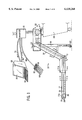
- FIG. 1 is a side elevational view of a swarf conveyor belt assembly and a control system according to the present invention
- FIG. 2 is an end elevational view of the conveyor of FIG. 1;
- FIG. 3 is a cross-sectional view taken along the line 3--3 of FIG. 1;
- FIG. 4 is a cross-sectional view taken along the line 4--4 of FIG. 1;
- FIG. 5 is a schematic of the inverter of FIG. 1;
- FIG. 6 is a flow chart illustrating an inventive method used by a controller to control the conveyor of FIG. 1.
- System 10 generally comprises five components or assemblies including a conveyor 12, a motor 14 for driving the conveyor 12, an inverter 16 for driving motor 14, a parameter programming unit 18 and a computerized numerical controller 20.
- conveyor 12 includes a belt guiding track 22, a track cover 24 and a conveyor belt 26.
- track 22 defines a course of movement for belt 26.
- track 22 includes a first horizontal section L 1 , a second horizontal section L 2 disposed generally above section L 1 , and an inclined section L 3 between horizontal sections L 1 , and L 2 .
- track 22 includes several different walls including a bottom horizontal wall 19, a central horizontal wall 34 and two lateral vertical walls 23 and 25. Walls 19, 21, 23 and 25 together define an upper channel 30 and a lower channel 32 below channel 30 along the entire length of track 22.
- Two low friction runners 36 and 38 are positioned on a upwardly facing surface 40 of wall 19. Runners 36, 38 are parallel, separated and extend along the entire length of track 22. Similarly, a pair of low friction runners 42, 44 are secured to an upwardly facing surface 46 of wall 34 in channel 30. Runners 42 and 44 are also parallel, separated and extend along the entire length of track 22.
- Swarf guidance extensions 48 and 50 extend inwardly from facing surfaces of walls 23 and 25 above runners 42 and 44.
- track 22 is supported by a leg 58 connected to section L 3 .
- Leg 58 includes two wheels collectively referred to by the numeral 60 which facilitate conveyor 12 movement.
- a rotating pulley-type hub 28 is located at a first end 22a and a laterally extending motor housing (see FIG. 2) 56 is located at a second end 22b of track 22.
- Track cover 24 (see FIGS. 1 and 4) is provided above channel 30 along sections L 2 and L 3 and along a section of L 1 adjacent L 3 .
- a door 62 is hinged to cover 24 at track end 22b which covers end 22b when closed but is openable by swarf exiting the track.
- a swarf collection bin 69 is illustrated in phantom.
- Belt 26 can be of any design known in the art and therefore will not be explained here in detail. Suffice it to say that belt 26 is continuous and passes from channel 30 into channel 32 around a motor shaft at end 22b and passes back from channel 32 into channel 30 around hub 28 at end 22a. Belt 26 is sized so that it rests on, and is supported by, runners 36, 38, 42 and 44.
- Motor 14 is a typical three-phase squirrel cage induction motor, the characteristics of which should be understood by those of ordinary skill in the art and therefore will not be explained here in detail. However, it should be understood that motor 14 receives three-phase alternating voltage from inverter 16 which causes the motor to rotate in either a forward or reverse directions at either a high, a medium or low speed, depending on the frequency of the received alternating voltage.
- Motor 14 is located inside housing 56 and includes a shaft which extends from housing 56 into track 22 at end 22b and is suitably linked to belt 26 to provide a rotating motivating force thereto. Therefore, when motor 14 operates in either the forward or reverse directions, the motor shaft causes belt 26 to move accordingly, conveying belt 26 in either forward or reverse directions.
- inverter 16 receives three-phase AC line voltage from a utility on lines 64, 66 and 68 at a utility frequency (e.g. 60 Hz) and modifies that frequency to provide three-phase alternating voltage at a controlled frequency on output lines 70, 72 and 74.
- Lines 70, 72 and 74 supply motor 14.
- Inverter also includes a brake output line 78 connected to motor 14 for stopping the motor 14 when required.
- a preferred inverter is the Mitsubishi Freqrol-A024 or the Freqrol-A044.
- Inverter 16 includes several input leads including forward start STF, reverse start STR, high speed HS, medium speed MS, stop select SS, and alarm reset RES leads.
- inverter 16 When a command signal to any of the leads (STF, STR, HS, MS, SS or RESP) is high, inverter 16 operates accordingly. For example, when a command signal to forward start lead STF is high, inverter 16 provides AC voltages on lines 70, 72 and 74 driving motor 14 in the forward direction. Similarly when a command signal to reverse start lead STR is high, inverter 16 drives motor 14 in the reverse direction. When the signal at STF is high and neither the signal at high speed lead HS nor at medium speed lead MS is high, inverter 16 drives motor 14 at a low speed. However, when either of the signals at HS or MS is high, inverter 16 drives motor 14 at the high or medium speeds, respectively. When the signal at stop select lead SS is high, inverter 16 uses line 78 to immediately stop motor 14.
- inverter 16 In addition to the three-phase voltages on line 70, 72 and 74 and the brake output 78, inverter 16 also includes at least one other output, a high load output on line 76. As inverter 16 provides voltages on lines 70, 72 and 74, inverter 16 monitors the current drawn by motor 14 on one of the three lines 70, 72 or 74. For the purposes of this explanation it will be assumed that inverter 16 at least monitors a drawn current I f on line 70. When the monitored current I f exceeds a threshold current level I th , a signal is provided on line 76 indicating that a high load has occurred. As well known in the motor controls art, current drawn by an induction motor increases as load on the motor increases. Therefore, when the load on motor 14 reaches a level which draws a current equal to the threshold current level I th , a signal is provided on line 76.
- inverter 16 can be provided with an alarm output 77 to indicate when monitored current If exceeds threshold current i th .
- parameter programming unit 18 is connected to inverter 16 via a first bus 80.
- Unit 18 includes a digital readout 82 and a key pad 84 which allow a user to program various inverter parameters via bus 80.
- unit 18 can be used to set the threshold current level I th which is required prior to inverter 16 generating a signal on line 76.
- unit 18 can be used to set a number of other parameters including high speed, medium speed and low speed frequencies, and can be used to manually run motor 14 in reverse, forward and at various speeds via inverter 16.
- controller 20 includes a touch screen 88 and an abbreviated key pad 90 which allow an operator to control inverter 16 and monitor motor 14 operation.
- controller 20 includes a microprocessor (not shown) which controls inverter 16 during motor operation as a function of the output on line 76.
- line 76 is received by controller 20 and a second bus 86 provides control signals from controller 20 to inverter leads STF, STR, HS, MS, SS and RESP.
- controller 20 can drive motor 14 via inverter 16 in the forward direction or the reverse direction at various speeds, can stop motor 14 and can reset an inverter alarm via the inputs.
- Controller 20 can also be used to alter operating parameters such as the duration T r0 of the reverse rotation periods during a clearing process and the maximum number X m of clearing processes in a clearing method.
- controller 20 sends a series of command signals via bus 86 to inverter 16 to stop motor 14, reverse motor 14 for the predetermined reversal time period T r0 , stop motor 14 and restart motor 14 in the forward direction.
- This sequence of stopping, reversing, stopping and restarting in the forward direction will typically be sufficient to jostle an obstruction free.
- inverter 16 provides a signal via line 76 to controller 20 which in turn cycles through the clearing process. After a predetermined number X m of times through the clearing process, if the obstruction persists, controller 20 causes inverter 16 to stop motor 14 and sound an alarm via output 77, either audio or visual or both, altering an operator that belt 26 has been halted.
- controller 20 and unit 18 are used to set various operating parameters. Specifically, unit 18 is used to set the threshold current I th parameter while controller 20 is used to set the predetermined number X m of clearing processes which should be performed prior to stopping conveyor 12 and is used to set reverse time period T r0 . These parameters are set at process block 100.
- controller 20 initializes a process number variable X and sets variable X equal to 0.
- a counter T r is set equal to period T r0 and controller 20 provides a high command signal to the forward start lead STF of inverter 16.
- inverter 16 provides output voltages on line 70, 72 and 74 driving motor 14 and belt 26 in the forward direction.
- inverter 16 determines whether or not monitored current I f is equal to or exceeds the threshold current I th . To this end, inverter 16 monitors current I f through line 70 and compares that current I f to the threshold current I th . If monitored current I f is less than threshold current I th , the motor load is less than the maximum load and controller 20 control passes back up to process block 102. However, when monitored current I f is greater than or equal to threshold current I th , control passes to process block 108 where variable X (i.e. number of clearing processes performed) is incremented by 1. Control then passes to decision block 110 where controller 20 determines whether or not variable X is equal to maximum number of clearing processes X m .
- variable X i.e. number of clearing processes performed
- variable X is equal to maximum number X m
- the clearing process including stopping, reversing, stopping and restarting the belt in the forward direction has been completed X m times without successfully clearing the obstruction which is causing the excessive load.
- the clearing process will not likely be able to clear the obstruction and therefore, control passes to process block 112 where controller 20 sends a control signal via bus 86 to the stop select lead SS of inverter 16.
- controller 20 sends a control signal via bus 86 to the stop select lead SS of inverter 16.
- inverter 16 stops motor 14 via brake output 78 thus causing conveyor belt 26 to stop.
- inverter 16 generates an alarm signal via output line 77 indicating that belt 26 has been halted.
- controller 20 first provides a high control signal at lead SS causing inverter 16 to stop motor 14 and belt 26. Then, controller 20 provides a high signal at reverse start lead STR which in turn causes motor 14 and belt 26 to move in the reverse direction.
- controller 20 starts a timer which tracks the amount of time motor 14 is operating in the reverse direction. The timer counts down counter T r to zero.
- controller 20 determines whether or not counter T r is equal to zero.
- control loops back to decision block 116.
- control passes to block 118 where controller 20 again sends a high signal to inverter lead SS causing inverter 16 to stop motor 14 and belt 26.
- control again passes up to process block 104 where controller 20 resets counter T r to period T r0 and again provides a forward rotation start input signal STF to inverter 16.
- STF forward rotation start input signal
- inverter 16 drives motor 14 in the forward direction causing belt 26 to move forward.
- the monitored current I f will be less than the threshold current level I th and control will again pass up block 102.
- the invention is meant to cover all types of conveyors such as parts or material conveyors, conveyors including a belt and other types of non-belt conveyors which may become jammed.
- the invention is also meant to include control wherein various operating parameters could be modified. For example, when the belt is reversed, different speeds and durations might be specified and/or the system might be equipped to identify obstruction during a cleaning process (i.e. during belt/conveyor reversal).
Landscapes
- Control Of Conveyors (AREA)
Abstract
A clearing method for use with a conveyor belt driven by a reversible motor for essentially automatically eliminating swarf or other obstructions along the belt including an clearing process including sensing motor load and comparing sensed load to a maximum load, when the sensed load exceeds the maximum, stopping the belt, reversing the belt, stopping the belt again and driving the belt forward, and repeating this process until the obstruction is eliminated or a predetermined number of clearing processes have been performed. Also an apparatus for implementing the method including an inverter.
Description
This application claims the benefit of provisional application No. 60/047,047, filed May 19, 1997.
Not applicable.
Not applicable.
The present invention relates to swarf collecting apparatus and methods and more specifically to a method of controlling a swarf collecting conveyor to clear swarf obstructions which cause excessive conveyor motor and drive component loading.
Many industries routinely employ lathes, drills, mills and other machinery having specially configured cutting bits to shape metal work pieces by removing metal "chips" therefrom. The chips which are removed come in many different shapes and sizes which are collectively referred to as swarf.
Many work piece shaping processes require a plurality of machines arranged at sequential work stations along a machine line. In these instances, after shaping at one station, a work piece is conveyed to a subsequent station for further shaping, each station generating swarf during the process.
To remove swarf from machine stations, often a conveyor belt is positioned below or adjacent a machine line to automatically catch flushed swarf and convey the swarf to a collection bin at the end of the belt. When the bin is full it is emptied or replaced with another bin. To facilitate use of large collection bins and thereby increase the time between emptying or replacement, most conveyors include a section which conveys upwardly at an inclined angle (e.g. 45 degrees) so that a belt end can be located above an elevated bin wall. To maintain swarf on the belt during inclined conveying (i.e. impede swarf from falling off lateral edges of the conveyor), a conveyor housing including a roof section is typically provided along the inclined section. Conveyor belts are particularly useful where the number of work stations and associated metal removing machines is large.
To cool work pieces and machine cutting tools and to flush swarf away from cutting bits during machining, a liquid coolant is typically dispersed at or near the cutting bits. In addition, swarf inside the bin or on the belt may be cooled by direct coolant dispersion thereon.
Swarf conveyor belts are typically driven by a motor capable of driving the belt in at least a forward direction. During machining, the belt is continuously driven to convey swarf from work stations.
Unfortunately swarf removing systems of the above kind can become obstructed by swarf during operation in at least two different ways. First, swarf can cause conveyor clogging. Only a certain swarf volume can pass though a conveyor housing at any time. Where swarf accumulates adjacent or within a housing, eventually, the accumulation can clog between the belt and housing impeding belt movement.
Second, swarf can become entangled between a belt and a stationary conveyor component (e.g. the housing) acting as a harness impeding belt movement. In this case, an elongated piece of swarf, typically a long corkscrew shaped shaving, can become ensnared at opposite ends between the belt and another component restricting belt movement.
In addition to damaging belt and other conveyor components, clogging and other forms of belt restriction caused by swarf (and or parts, bar ends, tools, etc.) increase motor load and, at some point, can damage motor components if the load becomes excessive.
One solution to belt obstructions has been to equip conveyors with manually operable motors capable of both forward and reverse operation. In this case, when swarf conditions cause motor overloading, an operator can stop the belt, reverse the belt, clear the obstruction and again restart the belt. Removing an obstruction is referred to herein as "clearing".
Unfortunately, this solution to the problem has a number of shortcomings. First, this solution requires an operator to assist what is otherwise an automatic system for removing swarf from work stations. While the operator only needs to act after a clog or entanglement is detected, practically the operator must always be present to identify clogs and entanglements.
Second, where the time required to clear a belt is appreciable, an entire machine line may have to be shut down during the clearing process, further increasing costs associated with the system.
Third, if the obstruction is not noticed immediately, clogged swarf may cause belt, housing and/or motor damage prior to an operator stopping the belt.
Fourth, if the obstruction is not noticed immediately, swarf may accumulate upstream of the clog and fall from the belt. In addition, excessive cooling agent may be flushed into the belt system generally causing a mess or overflowing onto the floor.
Fifth, where the obstruction occurs inside the housing, it may be difficult for an operator to identify the obstruction until swarf backs up to the mouth of the housing.
Another solution for removing swarf obstructions is to provide an automatic clutch on the motor which allows the shaft which drives the belt to slip when motor load becomes excessive. In this case, instead of damaging motor and conveyor components, a clutch allows the motor to operate with a safe load and the belt stops until an operator can perform a clearing process to remove the obstruction.
While this solution reduces the possibility of motor and conveyor component damage, it to is encumbered with shortcomings. For example, this solution still requires an operator to be present to clear every obstruction that occurs. In addition, when the belt is stopped due to overloading, either the entire machine line must be shut down or swarf will continue to accumulate on the belt. Shutting down the entire line is costly. However, swarf accumulation can eventually exceed belt receiving capacity with excess swarf falling off the belt onto a floor surface. This is especially dangerous when swarf is extremely hot as is often the case with metal shavings or the like.
Moreover, as swarf accumulates on a stationary belt during clearing, the accumulated swarf causes conditions which will likely lead to further obstruction once the belt is again running in the forward direction.
For at least these reasons it can be seen that an automatic obstruction clearing method and apparatus would be advantageous for use with a swarf conveyor belt.
The present invention includes a method to be used with a motor controller to control a conveyor belt to eliminate, or at least substantially reduce the likelihood of, swarf caused obstructions. Generally, the inventive obstruction clearing method is to be used with a controller which both controls a belt driving motor and monitors motor load.
The method includes a clearing process involving the steps of monitoring motor load and comparing the monitored load to a threshold load. The threshold load may be the maximum motor load. Where the monitored load is less than the threshold load there is no obstruction and the belt is continually driven in the forward direction. However, when the monitored load is equal to or exceeds the threshold load, an obstruction is likely. Therefore, when the monitored load is equal to or greater than the threshold load, the clearing process includes the steps of stopping the belt, reversing the belt during a reversal period of predetermined duration, stopping the belt again and once again driving the belt in the forward direction.
If the monitored load is still equal to or greater than the threshold load the obstruction likely persists. Therefore, the clearing method further includes repeating the clearing process until the monitored load is less than the threshold load (i.e. the obstruction has been eliminated).
One object of the invention is to automatically clear swarf obstructions on a conveyor belt. The inventive clearing method is successful in automatically clearing obstructions in most instances.
Another object is to eliminate the need for operator observation and interaction to identify and clear an obstruction. To this end, the controller automatically identifies overloading situations and can then be used to clear an obstruction by repeated forward and reverse belt movements to jostle and shake the obstruction free.
Preferably, there is a predetermined number of clearing processes wherein the predetermined number is chosen to likely clear an obstruction. The predetermined number is typically on the order of 5 to 10. In this case, the clearing method further includes the steps of, counting the number of clearing processes performed and comparing the number performed to the predetermined number. When the number performed equals the predetermined number, the controller stops the motor and belt.
Thus, another object of the invention is to stop the belt when it is likely that another clearing process will not clear an obstruction. Here, an operator would have to manually clear the obstruction. This ensures that an endless loop of stopping and starting the motor does not continue.
Preferably the system includes an alarm. Where an alarm is included, the method further includes the step of, after an obstruction has been identified and during the clearing process, signaling via the alarm that an obstruction has occurred. In the alternative or in addition, the method may include an alarm indicating when an obstruction persists after the predetermined number of clearing processes have been performed.
Thus, another object is to provide a method whereby obstructions can be detected even when an obstruction occurs along a section of the belt which is not easily observable (e.g. is in the belt housing) by an operator. One other object is to alert an operator only when manual clearing is required or when an automatic clearing process is being performed.
The method can also be used to eliminate swarf conditions which will likely lead to an obstruction prior to the obstruction occurring. To this end, the threshold load which is typically correlated with the maximum motor load can be decreased so that it corresponds to a fraction of the maximum load. For example, where the maximum load is 10× and a motor driving an unobstructed belt typically represents a 3× load, the threshold load might be set to half the maximum load, in this example, 5×, so that the clearing method is performed prior to the occurrence of a particularly serious obstruction.
Yet one other object is to anticipate when a serious obstruction will occur and eliminate conditions which will likely lead to a serious obstruction. This is accomplished by setting the threshold load at a fraction of the maximum load so that the clearing method is performed prior to a serious obstruction occurring.
The invention also includes an apparatus for implementing the inventive method. In this regard, the inventive apparatus includes a controller for controlling an inverter which in turn controls a belt driving motor. The controller provides commands to the inverter to drive the motor in either forward or reverse directions at various speeds and also instructs the inverter when to stop the motor. The inverter provides exciting voltages to the motor to carry out controller commands. Current drawn by the motor from the inverter is a function of motor load such that motor drawn current increases as motor load increases. Thus, generally, unique motor drawn current levels are associated with unique motor load levels. For example, the maximum load corresponds to a maximum motor current and any chosen threshold load corresponds to a specific threshold current level. Inverters typically monitor motor drawn current.
Thus, where an inverter is used to drive a motor, the monitored current can be used to identify when a motor load exceeds a threshold load level. For example, in the case described above, the maximum load 10× may correspond to 10 Amperes of motor drawn current, the typical load of 3× may correspond to 3 Amperes and the threshold load of 5× may correspond to 5 Amperes. Here, when the monitored current is equal to or exceeds 5 Amperes, the controller can issue a series of commands to the inverter causing the inverter to initiate a clearing process.
Another object is to essentially clear swarf obstructions using simple inexpensive off the shelf components. Controllers, inverters and motors controlled by inverters are standard components which are easily configured to provide the functionality required to implement the inventive method.
These and other objects, advantages and aspects of the invention will become apparent from the following description. In the description, reference is made to the accompanying drawings which form a part hereof, and in which there is shown a preferred embodiment of the invention. Such embodiment does not necessarily represent the full scope of the invention.
FIG. 1 is a side elevational view of a swarf conveyor belt assembly and a control system according to the present invention;
FIG. 2 is an end elevational view of the conveyor of FIG. 1;
FIG. 3 is a cross-sectional view taken along the line 3--3 of FIG. 1;
FIG. 4 is a cross-sectional view taken along the line 4--4 of FIG. 1;
FIG. 5 is a schematic of the inverter of FIG. 1; and
FIG. 6 is a flow chart illustrating an inventive method used by a controller to control the conveyor of FIG. 1.
I. Hardware Configuration
Referring now to the drawings, where like reference characters represent corresponding elements throughout the several views, and more specifically referring to FIGS. 1 and 2, the present invention will be described in a context of an exemplary swarf conveyor system 10. System 10 generally comprises five components or assemblies including a conveyor 12, a motor 14 for driving the conveyor 12, an inverter 16 for driving motor 14, a parameter programming unit 18 and a computerized numerical controller 20.
Referring to FIG. 4, conveyor 12 includes a belt guiding track 22, a track cover 24 and a conveyor belt 26. Referring specifically to FIG. 1, track 22 defines a course of movement for belt 26. To this end, track 22 includes a first horizontal section L1, a second horizontal section L2 disposed generally above section L1, and an inclined section L3 between horizontal sections L1, and L2.
Referring to FIGS. 1, 3 and 4, track 22 includes several different walls including a bottom horizontal wall 19, a central horizontal wall 34 and two lateral vertical walls 23 and 25. Walls 19, 21, 23 and 25 together define an upper channel 30 and a lower channel 32 below channel 30 along the entire length of track 22.
Two low friction runners 36 and 38 are positioned on a upwardly facing surface 40 of wall 19. Runners 36, 38 are parallel, separated and extend along the entire length of track 22. Similarly, a pair of low friction runners 42, 44 are secured to an upwardly facing surface 46 of wall 34 in channel 30. Runners 42 and 44 are also parallel, separated and extend along the entire length of track 22.
Referring to FIGS. 1 and 2, track 22 is supported by a leg 58 connected to section L3. Leg 58 includes two wheels collectively referred to by the numeral 60 which facilitate conveyor 12 movement. A rotating pulley-type hub 28 is located at a first end 22a and a laterally extending motor housing (see FIG. 2) 56 is located at a second end 22b of track 22.
Track cover 24 (see FIGS. 1 and 4) is provided above channel 30 along sections L2 and L3 and along a section of L1 adjacent L3. A door 62 is hinged to cover 24 at track end 22b which covers end 22b when closed but is openable by swarf exiting the track. A swarf collection bin 69 is illustrated in phantom.
Referring now to FIG. 5, inverter 16 receives three-phase AC line voltage from a utility on lines 64, 66 and 68 at a utility frequency (e.g. 60 Hz) and modifies that frequency to provide three-phase alternating voltage at a controlled frequency on output lines 70, 72 and 74. Lines 70, 72 and 74 supply motor 14. Inverter also includes a brake output line 78 connected to motor 14 for stopping the motor 14 when required. A preferred inverter is the Mitsubishi Freqrol-A024 or the Freqrol-A044. Inverter 16 includes several input leads including forward start STF, reverse start STR, high speed HS, medium speed MS, stop select SS, and alarm reset RES leads. When a command signal to any of the leads (STF, STR, HS, MS, SS or RESP) is high, inverter 16 operates accordingly. For example, when a command signal to forward start lead STF is high, inverter 16 provides AC voltages on lines 70, 72 and 74 driving motor 14 in the forward direction. Similarly when a command signal to reverse start lead STR is high, inverter 16 drives motor 14 in the reverse direction. When the signal at STF is high and neither the signal at high speed lead HS nor at medium speed lead MS is high, inverter 16 drives motor 14 at a low speed. However, when either of the signals at HS or MS is high, inverter 16 drives motor 14 at the high or medium speeds, respectively. When the signal at stop select lead SS is high, inverter 16 uses line 78 to immediately stop motor 14.
In addition to the three-phase voltages on line 70, 72 and 74 and the brake output 78, inverter 16 also includes at least one other output, a high load output on line 76. As inverter 16 provides voltages on lines 70, 72 and 74, inverter 16 monitors the current drawn by motor 14 on one of the three lines 70, 72 or 74. For the purposes of this explanation it will be assumed that inverter 16 at least monitors a drawn current If on line 70. When the monitored current If exceeds a threshold current level Ith, a signal is provided on line 76 indicating that a high load has occurred. As well known in the motor controls art, current drawn by an induction motor increases as load on the motor increases. Therefore, when the load on motor 14 reaches a level which draws a current equal to the threshold current level Ith, a signal is provided on line 76.
In addition, inverter 16 can be provided with an alarm output 77 to indicate when monitored current If exceeds threshold current ith.
Referring to FIGS. 1 and 5, parameter programming unit 18 is connected to inverter 16 via a first bus 80. Unit 18 includes a digital readout 82 and a key pad 84 which allow a user to program various inverter parameters via bus 80. To this end, unit 18 can be used to set the threshold current level Ith which is required prior to inverter 16 generating a signal on line 76. In addition, unit 18 can be used to set a number of other parameters including high speed, medium speed and low speed frequencies, and can be used to manually run motor 14 in reverse, forward and at various speeds via inverter 16.
Referring to FIG. 1 controller 20 includes a touch screen 88 and an abbreviated key pad 90 which allow an operator to control inverter 16 and monitor motor 14 operation. In addition, controller 20 includes a microprocessor (not shown) which controls inverter 16 during motor operation as a function of the output on line 76. To this end, line 76 is received by controller 20 and a second bus 86 provides control signals from controller 20 to inverter leads STF, STR, HS, MS, SS and RESP. Thus, controller 20 can drive motor 14 via inverter 16 in the forward direction or the reverse direction at various speeds, can stop motor 14 and can reset an inverter alarm via the inputs.
II. Control Method
Generally speaking, according to the inventive control method, with motor 14 operating in a forward direction so that conveyor 12 is moving forward, load on motor 14 will remain relatively constant and within an acceptable range during normal operation. However, when swarf obstructs belt 26 movement, motor load increases substantially. When load increases, the current drawn by motor 14 from inverter 16 also increases substantially. At some point, if the obstruction causes excessive loading, the drawn current exceeds the threshold current. Inverter 16 detects excessive load by comparing the monitored current If drawing by motor 14 to the threshold current Ith. When current Ith is exceeded the maximum load is exceeded. At that point, inverter 16 generates a signal on line 76 which is provided to controller 20. Then, to clear the obstruction, controller 20 sends a series of command signals via bus 86 to inverter 16 to stop motor 14, reverse motor 14 for the predetermined reversal time period Tr0, stop motor 14 and restart motor 14 in the forward direction. This sequence of stopping, reversing, stopping and restarting in the forward direction will typically be sufficient to jostle an obstruction free.
If the obstruction persists, monitored motor drawn current If will again quickly exceed the threshold current Ith and the excessive load will again be identified. Once again, inverter 16 provides a signal via line 76 to controller 20 which in turn cycles through the clearing process. After a predetermined number Xm of times through the clearing process, if the obstruction persists, controller 20 causes inverter 16 to stop motor 14 and sound an alarm via output 77, either audio or visual or both, altering an operator that belt 26 has been halted.
Referring now to FIGS. 1, 5 and 6, prior to conveyor 12 operation, controller 20 and unit 18 are used to set various operating parameters. Specifically, unit 18 is used to set the threshold current Ith parameter while controller 20 is used to set the predetermined number Xm of clearing processes which should be performed prior to stopping conveyor 12 and is used to set reverse time period Tr0. These parameters are set at process block 100. Next, at block 102 controller 20 initializes a process number variable X and sets variable X equal to 0. Continuing, at process block 104 a counter Tr is set equal to period Tr0 and controller 20 provides a high command signal to the forward start lead STF of inverter 16. When the STF command is received, inverter 16 provides output voltages on line 70, 72 and 74 driving motor 14 and belt 26 in the forward direction.
At decision block 106 inverter 16 determines whether or not monitored current If is equal to or exceeds the threshold current Ith. To this end, inverter 16 monitors current If through line 70 and compares that current If to the threshold current Ith. If monitored current If is less than threshold current Ith, the motor load is less than the maximum load and controller 20 control passes back up to process block 102. However, when monitored current If is greater than or equal to threshold current Ith, control passes to process block 108 where variable X (i.e. number of clearing processes performed) is incremented by 1. Control then passes to decision block 110 where controller 20 determines whether or not variable X is equal to maximum number of clearing processes Xm. Where variable X is equal to maximum number Xm, the clearing process including stopping, reversing, stopping and restarting the belt in the forward direction has been completed Xm times without successfully clearing the obstruction which is causing the excessive load. In this case, the clearing process will not likely be able to clear the obstruction and therefore, control passes to process block 112 where controller 20 sends a control signal via bus 86 to the stop select lead SS of inverter 16. When inverter 16 receives the SS signal, inverter 16 stops motor 14 via brake output 78 thus causing conveyor belt 26 to stop. In addition, at block 112, inverter 16 generates an alarm signal via output line 77 indicating that belt 26 has been halted.
Referring still to FIGS. 1, 5 and 6, at decision block 110, when variable X is less than maximum number Xm, control passes to block 114 where the clearing process begins. To this end, at block 114, controller 20 first provides a high control signal at lead SS causing inverter 16 to stop motor 14 and belt 26. Then, controller 20 provides a high signal at reverse start lead STR which in turn causes motor 14 and belt 26 to move in the reverse direction. In addition, at block 114 controller 20 starts a timer which tracks the amount of time motor 14 is operating in the reverse direction. The timer counts down counter Tr to zero. At decision block 116 controller 20 determines whether or not counter Tr is equal to zero. Where counter Tr is not equal to zero, control loops back to decision block 116. When counter Tr is equal to zero, control passes to block 118 where controller 20 again sends a high signal to inverter lead SS causing inverter 16 to stop motor 14 and belt 26. Next, control again passes up to process block 104 where controller 20 resets counter Tr to period Tr0 and again provides a forward rotation start input signal STF to inverter 16. Again, when signal STF is received, inverter 16 drives motor 14 in the forward direction causing belt 26 to move forward. At block 106, if the motor load is less than the maximum load, the monitored current If will be less than the threshold current level Ith and control will again pass up block 102.
Thus, a simple, inexpensive and reliable method and apparatus for implementing the method for automatically clearing swarf obstructions on a conveyor belt have been described.
It should be understood that the methods and apparatuses described above are only exemplary and do not limit the scope of the invention, and that various modifications could be made by those skilled in the art that would fall under the scope of the invention. For example, while the method is described in the context of an inverter and an inverter controlled motor, clearly the inventive method could be implemented using some other motor drive type wherein motor load could be determined by some other means. For example, a clutch type motor could be used wherein, when the clutch disconnects the motor from a driving shaft due to excessive motor load, a sensor could detect the disconnection and start the clearing process above. In addition, while the conveyor described above includes a single motor, clearly the inventive method applies to other systems which require two or more conveyors. Moreover, while the invention is described above as one for use with a swarf conveyor, the invention is meant to cover all types of conveyors such as parts or material conveyors, conveyors including a belt and other types of non-belt conveyors which may become jammed. Furthermore, the invention is also meant to include control wherein various operating parameters could be modified. For example, when the belt is reversed, different speeds and durations might be specified and/or the system might be equipped to identify obstruction during a cleaning process (i.e. during belt/conveyor reversal).
Claims (9)
1. A method for use with a motor controller for controlling a motor and an associated conveyor belt to essentially eliminate obstructions on the belt, the controller driving the motor and monitoring motor load, the method comprising the steps of:
(a) monitoring motor load;
(b) comparing the monitored motor load to a threshold load;
(c) where the monitored motor load is equal to or exceeds the threshold load, driving the belt according to a clearing process calculated to clear swarf;
(d) wherein the controller is programmed with a predetermined number which is the number of clearing processes which is likely to clear an obstruction, the method further including the steps of repeating steps (a)-(c), counting the number of clearing processes performed, comparing the number performed to the predetermined number and, when the number performed equals the predetermined number, modifying belt control.
2. The method of claim 1 wherein the step of modifying includes stopping the motor and belt.
3. The method of claim 1 also for use with a controller including an alarm, the method also including the step of, after an obstruction has been identified and during the clearing process, signaling via the alarm that an obstruction has occurred.
4. A method for use with a motor controller for controlling a motor and an associated conveyor belt to essentially eliminate obstructions on the belt, the controller driving the motor and monitoring motor load, the method comprising the steps of:
(a) monitoring motor load;
(b) comparing the monitored motor load to a threshold load;
(c) where the monitored motor load is equal to or exceeds the threshold load, driving the belt according to a clearing process calculated to clear swarf;
(d) wherein the controller controls an inverter which in turn controls the belt motor, the inverter providing exciting voltages to the motor to carry out controller commands and the belt linked to the motor as a load, current drawn by the motor from the inverter is a function of motor load such that motor drawn current increases as motor load increases, the step of monitoring including the step of monitoring current drawn by the motor and the step of comparing including the step comparing the monitored current to a threshold current level.
5. An apparatus for essentially eliminating obstructions on a conveyor belt, the apparatus comprising:
(a) a controller which provides command signals indicating how a motor should be controlled;
(b) a driving motor linked to the controller and receiving driving voltages for driving the motor and the belt which is attached thereto;
(c) an inverter which links the controller to the motor, the inverter receiving the command signals and generating the driving voltages as a function thereof, the inverter also monitoring current drawn by the motor, comparing the monitored current to a threshold current level and, when the monitored current exceeds the threshold current level, generating a high load signal which is provided to the controller;
(d) wherein, when the controller receives a high load signal, the controller modifies command signals to drive the belt according to a clearing process calculated to clear obstructions.
6. The apparatus of claim 5 wherein, when the controller receives a high load signal, the controller modifies by stopping the motor, reversing the motor during a reversal period of predetermined duration, stopping the motor and driving the motor in the forward direction.
7. The apparatus of claim 6 wherein, after the clearing process, if another high load signal is received by the controller, the controller steps through the clearing process again.
8. The apparatus of claim 7 wherein, each time the controller performs the clearing process, the controller increments a process number variable and, once the process number variable is equal to a maximum number, the controller causes the inverter to stop the motor.
9. The apparatus of claim 5 wherein the threshold current level is a fraction of a maximum motor current level.
Priority Applications (1)
| Application Number | Priority Date | Filing Date | Title |
|---|---|---|---|
| US09/081,538 US6135268A (en) | 1997-05-19 | 1998-05-19 | Method and apparatus for controlling conveyor |
Applications Claiming Priority (2)
| Application Number | Priority Date | Filing Date | Title |
|---|---|---|---|
| US4704797P | 1997-05-19 | 1997-05-19 | |
| US09/081,538 US6135268A (en) | 1997-05-19 | 1998-05-19 | Method and apparatus for controlling conveyor |
Publications (1)
| Publication Number | Publication Date |
|---|---|
| US6135268A true US6135268A (en) | 2000-10-24 |
Family
ID=26724574
Family Applications (1)
| Application Number | Title | Priority Date | Filing Date |
|---|---|---|---|
| US09/081,538 Expired - Lifetime US6135268A (en) | 1997-05-19 | 1998-05-19 | Method and apparatus for controlling conveyor |
Country Status (1)
| Country | Link |
|---|---|
| US (1) | US6135268A (en) |
Cited By (14)
| Publication number | Priority date | Publication date | Assignee | Title |
|---|---|---|---|---|
| US6407523B1 (en) * | 2000-10-25 | 2002-06-18 | Jorgensen Conveyors, Inc. | Method and apparatus for controlling conveyor |
| US6531969B2 (en) * | 2001-05-02 | 2003-03-11 | Portalplayer, Inc. | Resampling system and apparatus |
| WO2008135027A1 (en) | 2007-05-04 | 2008-11-13 | Wipotec Wiege- Und Positioniersysteme Gmbh | In-motion scales, especially conveyor scales comprising a conveyor belt |
| CN101378208B (en) * | 2008-08-30 | 2010-04-14 | 江苏天奇物流系统工程股份有限公司 | Control System of Rail Conveyor |
| JP2011115025A (en) * | 2009-11-30 | 2011-06-09 | Sumitomo Heavy Ind Ltd | Gear motor |
| US20140190084A1 (en) * | 2013-01-04 | 2014-07-10 | Schlagel, Inc. | Gate with variable gate control for handling agricultural granular materials |
| WO2013130947A3 (en) * | 2012-03-01 | 2015-06-18 | Biomass Technologies, Llc | Rotating biological contactor apparatus & method |
| US9133042B2 (en) | 2010-12-16 | 2015-09-15 | Biomass Technologies, Llc | Rotating biological contactor apparatus and method |
| US10059513B1 (en) | 2013-01-04 | 2018-08-28 | Schlagel, Inc. | Gate with anti-fouling proximity indicators for handling agricultural granular materials |
| US10836585B2 (en) | 2017-12-22 | 2020-11-17 | Flexible Steel Lacing Company | Apparatus and method for monitoring conveyor systems |
| WO2022197449A1 (en) * | 2021-03-15 | 2022-09-22 | Dexterity, Inc. | Singulation of arbitrary mixed items |
| US11752636B2 (en) | 2019-10-25 | 2023-09-12 | Dexterity, Inc. | Singulation of arbitrary mixed items |
| US12319517B2 (en) | 2021-03-15 | 2025-06-03 | Dexterity, Inc. | Adaptive robotic singulation system |
| TWI931814B (en) | 2021-03-15 | 2026-07-11 | 美商靈巧公司 | Robotic system and method for controlling a robot to move items in a workspace |
Citations (10)
| Publication number | Priority date | Publication date | Assignee | Title |
|---|---|---|---|---|
| DE2432928A1 (en) * | 1973-07-09 | 1975-01-30 | Goodyear Tire & Rubber | SAFETY SWITCHING SYSTEM FOR MONITORING OR CONTROL OF A CONVEYOR SYSTEM, IN PARTICULAR FOR THE TRANSPORT OF PERSONS OR LOADS |
| US4264905A (en) * | 1978-07-31 | 1981-04-28 | Dayco Corporation | Drive belt movement detecting system |
| US4809576A (en) * | 1987-08-25 | 1989-03-07 | Amp Incorporated | Scrap removal system for stamping and forming machine and sensor apparatus for detecting movement between conveyor belts |
| DE3912187A1 (en) * | 1988-04-13 | 1989-10-26 | Gebr Hennig Gmbh | Chip conveyor |
| DE4024183A1 (en) * | 1989-07-31 | 1991-02-07 | Mitsubishi Electric Corp | CONTROL FOR A PERSONAL CONVEYOR, ESPECIALLY AN ESCALATOR |
| US5042643A (en) * | 1988-11-21 | 1991-08-27 | Shinko Electric Co., Ltd. | Elliptic vibratory part-feeding device |
| JPH04277191A (en) * | 1991-02-28 | 1992-10-02 | Toshiba Corp | Control device for escalator |
| US5189624A (en) * | 1989-09-29 | 1993-02-23 | General Electric Company | Intelligent machining workstation operating logic |
| JPH05124787A (en) * | 1991-10-25 | 1993-05-21 | Hitachi Ltd | Passenger conveyor control device |
| JPH06144765A (en) * | 1992-10-30 | 1994-05-24 | Toshiba Corp | Man conveyor control device |
-
1998
- 1998-05-19 US US09/081,538 patent/US6135268A/en not_active Expired - Lifetime
Patent Citations (10)
| Publication number | Priority date | Publication date | Assignee | Title |
|---|---|---|---|---|
| DE2432928A1 (en) * | 1973-07-09 | 1975-01-30 | Goodyear Tire & Rubber | SAFETY SWITCHING SYSTEM FOR MONITORING OR CONTROL OF A CONVEYOR SYSTEM, IN PARTICULAR FOR THE TRANSPORT OF PERSONS OR LOADS |
| US4264905A (en) * | 1978-07-31 | 1981-04-28 | Dayco Corporation | Drive belt movement detecting system |
| US4809576A (en) * | 1987-08-25 | 1989-03-07 | Amp Incorporated | Scrap removal system for stamping and forming machine and sensor apparatus for detecting movement between conveyor belts |
| DE3912187A1 (en) * | 1988-04-13 | 1989-10-26 | Gebr Hennig Gmbh | Chip conveyor |
| US5042643A (en) * | 1988-11-21 | 1991-08-27 | Shinko Electric Co., Ltd. | Elliptic vibratory part-feeding device |
| DE4024183A1 (en) * | 1989-07-31 | 1991-02-07 | Mitsubishi Electric Corp | CONTROL FOR A PERSONAL CONVEYOR, ESPECIALLY AN ESCALATOR |
| US5189624A (en) * | 1989-09-29 | 1993-02-23 | General Electric Company | Intelligent machining workstation operating logic |
| JPH04277191A (en) * | 1991-02-28 | 1992-10-02 | Toshiba Corp | Control device for escalator |
| JPH05124787A (en) * | 1991-10-25 | 1993-05-21 | Hitachi Ltd | Passenger conveyor control device |
| JPH06144765A (en) * | 1992-10-30 | 1994-05-24 | Toshiba Corp | Man conveyor control device |
Cited By (25)
| Publication number | Priority date | Publication date | Assignee | Title |
|---|---|---|---|---|
| US6407523B1 (en) * | 2000-10-25 | 2002-06-18 | Jorgensen Conveyors, Inc. | Method and apparatus for controlling conveyor |
| US6531969B2 (en) * | 2001-05-02 | 2003-03-11 | Portalplayer, Inc. | Resampling system and apparatus |
| WO2008135027A1 (en) | 2007-05-04 | 2008-11-13 | Wipotec Wiege- Und Positioniersysteme Gmbh | In-motion scales, especially conveyor scales comprising a conveyor belt |
| US20100320008A1 (en) * | 2007-05-04 | 2010-12-23 | Udo Wagner | Transportwaage, insbesondere wageforderer mit einem transportband |
| US9261397B2 (en) | 2007-05-04 | 2016-02-16 | Wipotec Wiege- Und Positioniersysteme Gmbh | In-motion scale, in particular, conveyor scale with a conveyor belt |
| CN101378208B (en) * | 2008-08-30 | 2010-04-14 | 江苏天奇物流系统工程股份有限公司 | Control System of Rail Conveyor |
| JP2011115025A (en) * | 2009-11-30 | 2011-06-09 | Sumitomo Heavy Ind Ltd | Gear motor |
| US9133042B2 (en) | 2010-12-16 | 2015-09-15 | Biomass Technologies, Llc | Rotating biological contactor apparatus and method |
| WO2013130947A3 (en) * | 2012-03-01 | 2015-06-18 | Biomass Technologies, Llc | Rotating biological contactor apparatus & method |
| US20140190084A1 (en) * | 2013-01-04 | 2014-07-10 | Schlagel, Inc. | Gate with variable gate control for handling agricultural granular materials |
| US9527665B2 (en) * | 2013-01-04 | 2016-12-27 | Schlagel, Inc. | Gate with variable gate control for handling agricultural granular materials |
| US10059513B1 (en) | 2013-01-04 | 2018-08-28 | Schlagel, Inc. | Gate with anti-fouling proximity indicators for handling agricultural granular materials |
| US10836585B2 (en) | 2017-12-22 | 2020-11-17 | Flexible Steel Lacing Company | Apparatus and method for monitoring conveyor systems |
| US11440745B2 (en) | 2017-12-22 | 2022-09-13 | Flexible Steel Lacing Company | Apparatus and method for monitoring conveyor systems |
| US12006160B2 (en) | 2017-12-22 | 2024-06-11 | Flexible Steel Lacing Company | Apparatus and method for monitoring conveyor systems |
| US11752636B2 (en) | 2019-10-25 | 2023-09-12 | Dexterity, Inc. | Singulation of arbitrary mixed items |
| US11780096B2 (en) | 2019-10-25 | 2023-10-10 | Dexterity, Inc. | Coordinating multiple robots to meet workflow and avoid conflict |
| US12134200B2 (en) | 2019-10-25 | 2024-11-05 | Dexterity, Inc. | Singulation of arbitrary mixed items |
| US12214512B2 (en) | 2019-10-25 | 2025-02-04 | Dexterity, Inc. | Coordinating multiple robots to meet workflow and avoid conflict |
| WO2022197449A1 (en) * | 2021-03-15 | 2022-09-22 | Dexterity, Inc. | Singulation of arbitrary mixed items |
| TWI856295B (en) * | 2021-03-15 | 2024-09-21 | 美商靈巧公司 | Robotic system and method for controlling a robot to move items in a workspace |
| US12129132B2 (en) | 2021-03-15 | 2024-10-29 | Dexterity, Inc. | Singulation of arbitrary mixed items |
| US12319517B2 (en) | 2021-03-15 | 2025-06-03 | Dexterity, Inc. | Adaptive robotic singulation system |
| TWI931814B (en) | 2021-03-15 | 2026-07-11 | 美商靈巧公司 | Robotic system and method for controlling a robot to move items in a workspace |
| US12709487B2 (en) | 2024-06-10 | 2026-08-18 | Flexible Steel Lacing Company | Apparatus and method for monitoring conveyor systems |
Similar Documents
| Publication | Publication Date | Title |
|---|---|---|
| US6407523B1 (en) | Method and apparatus for controlling conveyor | |
| US4529134A (en) | Self-clearing shredding apparatus and method of operation thereof | |
| EP2404677B1 (en) | Staged paper shredder | |
| US20060054539A1 (en) | Method for controlling a screening machine and a screening machine | |
| CN110743699B (en) | Discharge hopper of ore washer | |
| US5512031A (en) | Method of centrifugal separation with load sensing circuit for optimizing cleaning cycle frequency | |
| US7121920B1 (en) | Rock saw | |
| KR20140003480U (en) | Take-Up Device for Safe driving sludge collecting device | |
| CN110902063A (en) | Garbage bag breaking machine and garbage disposal system having the same | |
| JP2023102955A (en) | scraper conveyor | |
| JP6235532B2 (en) | Chip discharger driven by synchronous motor | |
| CN113427395A (en) | Ball grinder with circulating filtration grinding fluid function | |
| JP3026562B1 (en) | Waste crusher | |
| EP3881920A1 (en) | Cleaning device for filters in evacuation systems for processing waste of machine tools and evacuation system equipped with said cleaning device | |
| US7220361B2 (en) | Torque-limited drive system, method, and apparatus for a fluid screening system | |
| CN221190353U (en) | Foreign matter detection and discharge system for belt conveyor head | |
| JP6857906B2 (en) | Chip conveyor control method and chip conveyor | |
| JPH02261722A (en) | Operating method of transferrer for chips | |
| KR101427981B1 (en) | Dust removing machine with adulteration detecting sensing function | |
| CN111515750B (en) | A device, control system and method for recycling iron scraps for CNC machine tools | |
| CN215968144U (en) | Green brick moving speed regulating and controlling system | |
| JP2004136422A (en) | Chip evacuation device | |
| JP2500393B2 (en) | Operating method of screw press and its equipment | |
| US3980241A (en) | Crusher and control circuit therefor | |
| CN110315438B (en) | Steel sand shot blasting machine for coating workshop |
Legal Events
| Date | Code | Title | Description |
|---|---|---|---|
| STCF | Information on status: patent grant |
Free format text: PATENTED CASE |
|
| FPAY | Fee payment |
Year of fee payment: 4 |
|
| FPAY | Fee payment |
Year of fee payment: 8 |
|
| FPAY | Fee payment |
Year of fee payment: 12 |