US6032706A - Woodworking jig - Google Patents
Woodworking jig Download PDFInfo
- Publication number
- US6032706A US6032706A US09/247,579 US24757999A US6032706A US 6032706 A US6032706 A US 6032706A US 24757999 A US24757999 A US 24757999A US 6032706 A US6032706 A US 6032706A
- Authority
- US
- United States
- Prior art keywords
- router
- guide
- clamp
- elongate
- jig
- Prior art date
- Legal status (The legal status is an assumption and is not a legal conclusion. Google has not performed a legal analysis and makes no representation as to the accuracy of the status listed.)
- Expired - Lifetime
Links
- 230000015572 biosynthetic process Effects 0.000 claims description 22
- 238000005755 formation reaction Methods 0.000 claims description 22
- 230000007246 mechanism Effects 0.000 claims description 3
- 239000000463 material Substances 0.000 claims description 2
- 238000005520 cutting process Methods 0.000 description 21
- 239000002184 metal Substances 0.000 description 4
- 230000004048 modification Effects 0.000 description 4
- 238000012986 modification Methods 0.000 description 4
- 230000009471 action Effects 0.000 description 3
- 230000005540 biological transmission Effects 0.000 description 3
- 230000008901 benefit Effects 0.000 description 2
- 230000000903 blocking effect Effects 0.000 description 2
- 230000006835 compression Effects 0.000 description 2
- 238000007906 compression Methods 0.000 description 2
- 208000027418 Wounds and injury Diseases 0.000 description 1
- 238000005266 casting Methods 0.000 description 1
- 230000008859 change Effects 0.000 description 1
- 230000006378 damage Effects 0.000 description 1
- 238000006073 displacement reaction Methods 0.000 description 1
- 239000000428 dust Substances 0.000 description 1
- 230000000694 effects Effects 0.000 description 1
- 210000001145 finger joint Anatomy 0.000 description 1
- 239000011521 glass Substances 0.000 description 1
- 208000014674 injury Diseases 0.000 description 1
- 238000003780 insertion Methods 0.000 description 1
- 230000037431 insertion Effects 0.000 description 1
- 238000004519 manufacturing process Methods 0.000 description 1
- 239000003550 marker Substances 0.000 description 1
- ISWSIDIOOBJBQZ-UHFFFAOYSA-N phenol group Chemical group C1(=CC=CC=C1)O ISWSIDIOOBJBQZ-UHFFFAOYSA-N 0.000 description 1
- 238000005096 rolling process Methods 0.000 description 1
- 239000005336 safety glass Substances 0.000 description 1
- 239000007787 solid Substances 0.000 description 1
- 239000002023 wood Substances 0.000 description 1
- 239000002916 wood waste Substances 0.000 description 1
Images
Classifications
-
- B—PERFORMING OPERATIONS; TRANSPORTING
- B27—WORKING OR PRESERVING WOOD OR SIMILAR MATERIAL; NAILING OR STAPLING MACHINES IN GENERAL
- B27F—DOVETAILED WORK; TENONS; SLOTTING MACHINES FOR WOOD OR SIMILAR MATERIAL; NAILING OR STAPLING MACHINES
- B27F1/00—Dovetailed work; Tenons; Making tongues or grooves; Groove- and- tongue jointed work; Finger- joints
- B27F1/08—Making dovetails, tongues, or tenons, of definite limited length
- B27F1/12—Corner- locking mechanisms, i.e. machines for cutting crenellated joints
-
- Y—GENERAL TAGGING OF NEW TECHNOLOGICAL DEVELOPMENTS; GENERAL TAGGING OF CROSS-SECTIONAL TECHNOLOGIES SPANNING OVER SEVERAL SECTIONS OF THE IPC; TECHNICAL SUBJECTS COVERED BY FORMER USPC CROSS-REFERENCE ART COLLECTIONS [XRACs] AND DIGESTS
- Y10—TECHNICAL SUBJECTS COVERED BY FORMER USPC
- Y10T—TECHNICAL SUBJECTS COVERED BY FORMER US CLASSIFICATION
- Y10T409/00—Gear cutting, milling, or planing
- Y10T409/30—Milling
- Y10T409/303416—Templet, tracer, or cutter
- Y10T409/303696—Templet
Definitions
- the present invention relates to a woodworking jig and, more particularly, to a jig for use in making joints between pieces of wood, and is useful in particular, but not exclusively, for making dovetail joints.
- One prior art dovetail jig of that type has double-ended guide fingers, each with a male guide at one end and a female guide at the opposite end. If the fingers are uneven, the router tends to be deflected upwardly and downwardly during the cutting of the dovetail pins and tails, causing a step to be formed in the joint. The router is not supported beyond the ends of the fingers.
- guide fingers are clamped onto guide rails and, to change from male to female guides, or vice versa, the guide rail, together with the guide fingers, must be removed from the jig, rotated and then reinstalled and repositioned on the jig for through dovetails or rotated end-to-end for half blind dovetails.
- a woodworking jig which has a pair of horizontally co-planar, elongate router plate guide surface areas, spaced apart from one another by an elongate opening, a workpiece clamp mounted below the opening, a guide member support extending along the opening and a plurality of router guide members.
- the router guide and the router guide members are releasably interengageable to mount the guide members in operative positions above the workpiece clamp and below the router plate guide surfaces.
- this woodworking jig When this woodworking jig is in use, a vertically extending workpiece is clamped, at an upper end of the workpiece, with the upper end edge of the workpiece located below the opening. A router is then positioned above the jig, with a base plate of the router in sliding, guided engagement with the router plate guide surface areas and with a router bit projecting downwardly from the router into the opening, so as to be guided by the guide members mounted on the guide member support. The downward pressure of the router is thus supported by the router plate guide surface areas, and not by the guide members.
- the guide member support comprises a row of locating formations which are interengageable with corresponding formations on the guide members.
- the guide members preferably comprise dovetail pin guides and dovetail tail guides which are separate from the dovetail pin guides, and may be readily engageable with the guide member support by snap-action engagement of the guide members onto the guide member support.
- the guide members may alternatively be shaped and utilized for cutting e.g. mortice and tenon joints, box joints, fingerjoints and decorative joints.
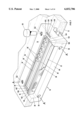
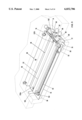
- FIG. 1 shows an isometric view of a dovetail jig according to the present invention installed on a workbench;
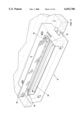
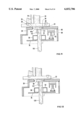
- FIG. 2 shows a view corresponding to FIG. 1, but with parts of the jig removed;
- FIG. 3 shows a view corresponding FIGS. 1 and 2, but with further parts of the jig broken away to reveal components in the interior of the jig;
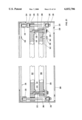
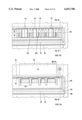
- FIG. 4 shows a broken-away view taken in horizontal section through the jig of FIG. 3;
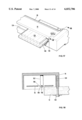
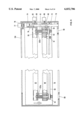
- FIG. 5 shows a broken-away isometric view of parts of the jig of FIGS. 1 through 4;
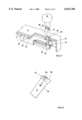
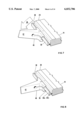
- FIG. 6 shows an isometric view of a dovetail pin guide forming part of the jig of FIGS. 1 through 4;
- FIGS. 7 and 8 show successive steps in the interengagement of the dovetail pin guide of FIG. 6 with a guide member support on the jig of FIGS. 1 through 4;
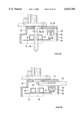
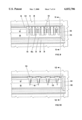
- FIGS. 9 and 10 show broken-away plan views of parts of the jig of FIGS. 1 through 4 set up for cutting dovetail tails and dovetail pins, respectively, for a through dovetail joint;
- FIGS. 11 and 12 show views taken in vertical cross-section along the lines 11--11 of FIG. 9 and the lines 12--12 of FIG. 10, respectively, during the cutting operations of FIGS. 9 and 10, respectively;
- FIGS. 13 and 14 show views corresponding to FIGS. 9 and 10 but with the jig set up for a half-blind dovetail joint;
- FIGS. 15 and 16 show views corresponding to FIGS. 11 and 12 and taken in vertical cross-section along the lines 15--15 and 16--16 of FIGS. 13 and 14, respectively, but during the cutting operations of FIGS. 13 and 14, respectively;
- FIG. 17 shows a broken-away isometric view of parts of the jig of FIG. 1;
- FIG. 18 shows a view in vertical cross-section along the line 18--18 of FIG. 17;
- FIG. 19 shows a broken-away isometric view of a modified router bit guide arrangement for use in the jig of FIG. 1;
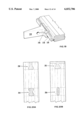
- FIGS. 20A and 20B show diagrammatic views in front elevation of alternative joints which can be produced by a jig according to the present invention
- FIG. 21 shows a view taken in horizontal cross-section through a modification of the jig of FIG. 1;
- FIG. 22 shows a diagrammatic view in vertical cross-section through a further modified jig according to the present invention.
- FIG. 1 of the accompanying drawings there is shown a dovetail jig indicated generally by reference numeral 10 mounted on an edge of a workbench 12.
- the dovetail jig 10 has a jig body in the form of a housing 14, formed as a casting, which is rectangular in plan view and which has, on its top, a router support comprising a pair of parallel, horizontally spaced raised top portions 16, which are elongate and straight and which extend along opposite sides of an horizontally elongate, rectangular, upwardly open top opening 18 between the raised portions 16.
- the raised portions 16 have flat, co-planar upper guide surfaces 20 which provide guide surface areas for slidably supporting and guiding a base plate 22 of a router 24, as shown in FIGS. 11 and 12.
- the raised portions 16 serve to raise the router base plate 22 above anyg7 dust or chips which may accumulate on the top of the housing 14.
- a recess 26 is formed in the top of the housing 14, and at the rear of this recess 26 a vertical safety plate 28, made of glass, is inserted downwardly into a vertically open slot 30 in the housing 14, so that the safety plate 28 forms a closure for a front opening 32 in the housing 14.
- FIG. 1 shows a plurality of dovetail pin guide members 40 mounted on the guide member support 36.
- the guide members 40 in the present embodiment of the invention, are made of plastic material, but they may alternatively be made of metal.
- One of these guide members 40 is shown in greater detail in FIG. 6, from which can be seen that this guide member 40 comprises a finger portion 42 which is partially bifurcated at one end to form opposed base portions 44a and 44b.
- the base portion 44a is provided with formations 46 in the form of teeth or serrations, which correspond to and are interengageable with the locating formations 38 on the guide member support 36.
- guide members 40 and dovetail members 40a described below are shaped for the cutting of dovetail pins and tails, it will be apparent that they may be modified as other male and female guide members for the cutting of other types of joint.
- the guide member 40 is mounted on the guide member support 36 by firstly interengaging the base portion 44a with the locating formations 38 on the guide member support 36 and by then rotating the finger portion 42 downwardly as indicated by arrow A in FIG. 7, so as to engage the base portion 44b of the guide member, by a resilient snap-action interengagement, with the lower flange 36b of the guide member support 36.
- the guide member 40 is similarly mountable on the guide member support 35.
- a clamping arrangement including a horizontally closable clamp 48, indicated generally by reference numeral 48, which comprises two clamp jaws in the form of clamp bars 50 and 52.
- the clamp bars 50 and 52 are horizontally displaceable to and fro, relative to one another, by rotation of threaded shafts 53 and 55 provided at opposite ends of the clamp bars 50 and 52.
- the shafts 53 and 55 are interconnected by means of a belt and sprocket drive 54, which is provided with a belt tensioner 51, and are rotatable by insertion of an actuating knob 56, shown in FIG. 1 through vertical circular openings 58 in a front wall 60 of the housing 14.
- the knob 56 has a hexagonal pin 62 (FIG. 5) which is releasably engageable with a corresponding hexagonal end recess in each of the shafts 53 and 55, and in other shafts as indicated by arrows A, for rotating the shafts.
- the clamp bars 50 and 52 are each made of sheet metal bent to form hollow bars of rectangular cross-section and plates 59 (FIG. 4) are secured to one interior wall of the clamp bar 52.
- the shafts 53 and 55 are in threaded engagement with the plates 59.
- Helical compression springs 61 which are co-axial with the shafts 53 and 55, are seated at opposite ends of the springs 61 on the plates 59 and on plates 63 which extend around the shafts 53 and 55 and are fixed to the exterior of the clamp bar 50, the shafts 53 and 55 being freely rotatable relative to the plates 63. Consequently, on rotation of the shafts 53 and 55, the clamp bars 50 and 52 are moved horizontally together against the action of the springs 61 or apart from one another, under the action of the springs 61, depending on the direction of rotation of the shafts 53 and 55.
- the clamp bars 50 and 52 extend at one end to respective blocks 66 and 68 (FIG. 3), which are carried on a shaft 70 extending transversely of the lengths of the clamp bars 50 and 52.
- the shaft 70 is fixedly mounted at opposite ends thereof in the jig housing 14 and carries a pair of blocks 72 and 74, which are secured by screws (not shown) to a rectangular plate 76.
- the plate 76, the blocks 68, 72 and 74 and the clamp bar 52 are thus fixed to one another to form an assembly which is slidable to and fro along the shaft 70.
- a helical tension spring 78 secured at opposite ends to the block 72 and the housing 14, resiliently biases the assembly towards the rear of the jig 10.
- Locking knobs 80 and 82 in threaded engagement with the blocks 66 and 68, respectively, can be tightened to releasably secure the clamp bars 50 and 52 one at a time to the shaft 70.
- the clamping arrangement of the jig 10 also includes a vertically closable clamp indicated generally by reference numeral 86 in FIG. 3.
- the clamp 86 comprises a vertically movable clamp bar 88 co-operating with a downwardly facing clamp surface 90 (see FIG. 11) formed on the interior of the housing 14 at the rear of the jig 10.
- the clamp bar 88 is suspended, at each end of the clamp bar 88, on a vertical threaded member 92.
- a threaded plate 94 provided within and fixed to the clamp bar 88 is in threaded engagement with the threaded member 92, the lower end of which carries a sprocket 96.
- a belt 98 interconnects the sprockets 96 on the two threaded members 92 and extends along and within the hollow interior of the clamp bar 88.
- the top of the housing 14 is formed with cylindrical recesses 100 for receiving heads 102 on the threaded members 92, which are also formed with annular flanges 104.
- the flanges 104 are rotatably slidably supported on the bottoms of the recesses 100 and the heads 102 are formed with hexagonal recesses 105 for receiving the hexagonal pin 62 to facilitate rotation of the threaded members 92 for raising and lowering the clamp bar 88.
- FIGS. 9 through 12 The use of the jig 10 for cutting a through dovetail joint is illustrated in FIGS. 9 through 12.
- tail guide members 40a are shown mounted on the guide member support 36, in a manner similar to the guide members 40, the tail guide members 40a being located at the required spacings from one another along the guide rail support 36.
- a vertically extending workpiece 110 is clamped between the horizontally closable clamp bars 50 and 52 and, as shown in FIG. 11, the workpiece abuts the undersides of the tail guide members 40a and also abuts one of the stops 125a and 125b (FIGS. 3 and 4) and the router 24 is positioned so that the router base plate is slidably supported on the guide surfaces 20 above the top of the housing 14.
- a dovetail router bit 112 is shown extending downwardly, with a slidable guide portion 114 of the router 24 engaging one of the tail guide members 40a and with a cutting portion 116 of the router bit 112 having cut through the thickness of the workpiece 110.
- the tail guide members 40a are disengaged from the guide member support 36 and the workpiece 110 is removed and replaced by another workpiece 120 (FIGS. 10 and 12), which is clamped between the clamp bars 50 and 52.
- the dovetail bit 112 in the router 24 is then replaced by a straight bit 122, and the tail guide members 40a are replaced by the pin guide members 40, as shown in FIG. 12.
- the position of the plate 76 and thus the position of the clamp bar 52 are determined by adjustment of the adjustment screw 77 to correspondingly adjust the size of the pins.
- the tail guide members 40a and the pin guide members 40 are each formed with a position marker 124 (FIGS. 9 and 10).
- a position marker 124 FIGS. 9 and 10
- pencil markings may be inscribed on the jig housing, opposite the indicator markings 124.
- the markings 124 on the pin guide members 40 can be aligned with these pencil markings in order to ensure correct positioning on the guide member support 36.
- the workpieces 110 and 120 are located in abutment with one or the other of two stops 125a and 125b (FIGS. 3 and 4) on the jig.
- FIGS. 13 through 16 show views corresponding to those of FIGS. 9 through 12, respectively, but with the jig being employed for the cutting of half blind dovetails instead of through dovetails.
- the plate 76 is displaced towards the front of the jig 10 through a distance sufficient to bring the block 66 into abutment with a stop 128 (FIG. 3) depending from the top of the housing 14 to thereby locate the clamp bar 50 in the position in which it is shown in FIG. 15 for the cutting of the tails.
- blocking members 127 are inserted between the tail guide members 40a to prevent the entry of the router bit between the tail guide members 40a.
- the blocking members 127 are secured to the guide member support 36 in the same manner as the tail guide members 40a.
- a horizontally extending workpiece 132 is inserted through an opening 134 in the rear of the jig housing 14 and secured by means of the vertically closable clamp 86, and pin guide members 135 are mounted on the guide member support 36.
- the jig 10 may be employed to cut a tenon.
- the depth of cut of the router bit during the cutting operations shown in FIGS. 15 and 16 determines the fit of the half-blind dovetails and pins.
- the safety plate 28 may be removed to allow a workpiece to project to the front of the jig, 10, e.g. for cutting a mortice in the workpiece.
- the end of the opening 134 is formed with a shoulder 136, the purpose of which is to accommodate a workpiece 138 formed with a rabbet 140.
- the shoulder 136 serves as a reference stop which determines the position of the workpiece during the cutting of the half-blind pins. Consequently, the pins are cut so as to be correctly aligned with the tails.
- FIG. 18 shows a securing bolt 142 inserted through a boring in the workbench 12 into threaded engagement with a threaded hole 144 in the housing 14 for releasibly securing the housing 14 to the workbench 12.
- FIG. 18 also shows a shouldered securing screw 146 which is inserted through a washer 148 and which abuts the plate 76 and extends through a slot 150 in the plate 76 into threaded engagement with a post 152 depending from housing 14 and serving to support the plate 76.
- the blocks 66 and 68 are provided with upstanding pointers 156, which project upwardly through a slot 158 (FIG. 1) in the top of the housing 14.
- a scale 159 on the top of the housing 14 adjacent the slot 158 can be used for centering the workpiece and to enable the clamp bar 52 to be readjusted back into a previous position, when required.
- the raised portion 16 at the front of the jig 10 near the safety plate 28 is provided on a metal strip 160, which is releasibly secured to the jig housing 14 by screws 162.
- a rectangular template (not shown) can be secured to the jig housing 14 by bolts (not shown) engaged through slots 164 formed in ledges 165 at opposite ends of the opening 18 and secured by nuts (not shown).
- the template may be formed with a straight slot or slots of other shapes, e.g. in the form of letters or numbers or decorative shapes.
- FIG. 19 shows a broken-away view, in perspective, of a modification of the router bit guide arrangement of the jig 10 of FIGS. 1 through 18.
- the elongate guide member support 36 has been replaced by an elongate guide member support 236 which, instead of the T-shaped locating formations 38, is provided with vertically upwardly extending cylindrical projections 238, which are uniformly spaced apart from one another in a linear row along the top of the guide member support 236.
- the guide member support 35 has also been replaced by a modified guide member support (not shown) which is similar to the guide member support 236.
- the router guide member which in this case is indicated by reference numeral 240, is similar to the guide member 40 shown in FIG. 6 but, instead of the teeth 46 of the guide member 40, is formed with a row of openings 246. These openings 246 are elongate and are dimensioned and spaced apart so as to be interengageable with the cylindrical projections 238, as shown in FIG. 19, for securing the guide member 240 to the guide member support 236.
- interengageable locating formations may alternatively be provided on the guide members and the guide member support for releasibly securing the guide members to the guide member support.
- the guide members 40 and 240 are shaped to form conventional dovetail joints.
- the shapes of the guide members and, more particularly, the surfaces of the guide members used for guiding contact with the router may be modified to produce other, unconventional shapes such as the joints indicated generally by reference numeral 250 in FIG. 20A and reference numeral 252 in FIG. 20B.
- the angle of the dovetails cut by the present jig can be varied in a very simple manner by replacing the guide members 40 or 240 by similar guide members having different angles.
- FIGS. 20A and 20B also show mortice and tenon joints, indicated generally by reference numerals 254 and 256, of unconventional shape, which can be cut employing the present woodworking jig.
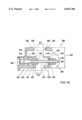
- FIG. 21 shows a view in horizontal cross-section through a modification of the clamping arrangement of the jig of FIG. 1.
- first and second clamp bars are indicated by reference numerals 302 and 304, respectively.
- the clamp bar 302 is supported, at opposite ends of the clamp bar 302, by a pair of threaded shafts 306 and 308 which are journalled in horizontally split bearings 310 on the housing 300.
- the threaded shafts 306 and 308 are in threaded engagement with opposite solid ends 312 and 314 of the clamp bar 302.
- a belt and sprocket transmission indicated generally by reference numeral 316, interconnects the shafts 306 and 308, so that rotation of the shaft 308 will cause a corresponding rotation of the shaft 306.
- the shaft 308 is formed, at its end facing the front of the housing 300, with a socket 318, into which an actuating knob 56 can be inserted, through an opening 320 in the front of the housing 300.
- the shafts 306 and 308 and the belt and sprocket transmission 316 thus form an adjustment mechanism for adjustably displacing the clamp bar 302 horizontally to and fro.
- the clamp bar 304 is connected to the clamp bar 302 by a connection which comprises a pair of threaded shafts 322 and 324, which are freely rotatably secured to the clamp bar 304 and which are in threaded engagement with the end members 312 and 314 of the clamp bar 302.
- Helical compression springs 325 on the shafts 322 and 324 bias the clamp bars 302 and 304 apart from one another.
- the shafts 322 and 324 are interconnected by a belt and sprocket transmission indicated generally by reference numeral 326, and the shaft 324, at its end facing the front of the housing 300, is formed with a socket 328, so that an actuating knob similar to the actuating knob 56 can be inserted through an opening 330 in the front of the housing 300 into engagement with the shaft 324 for rotating the shafts 322 and 324 and, thereby, moving the clamp bar 304 horizontally towards or away from the clamp bar 302.
- an adjustable stop in the form of a knurled threaded bush 332 and a knurled locking nut 334 are in threaded engagement with the shaft 308 and are manually accessible through a side opening 336 in the housing 300.
- Belt tensioners indicated generally by reference numerals 338 and 340 are secured to the rear wall of the housing 300 and to the clamp bar 304, respectively, and each comprise a replaceable cylindrical roller 342 on a screw 344, the roller 342 being in rolling engagement with the respective belt and being replaceable by a roller of larger diameter when necessary to tighten the belt.
- FIG. 21 replaces that shown in FIG. 3 in a jig which is otherwise similar to that of FIG. 1 and which, therefore, includes a router support, on the top of the housing 300, which is similar to that described above with reference to the jig 10, a router bit guide arrangement similar to that described above with reference to FIGS. 1 through 18 or FIG. 19, and front and rear openings in the housing, similar to those described above with reference to the embodiment of FIGS. 1 through 18.
- FIG. 22 shows, in a diagrammatic vertical cross-sectional view, a modification of the above-described jigs which is a simplified clamping jig, indicate generally by reference numeral 400, for use in cutting dovetail joints only.
- the housing of the jig 400 is indicated generally by reference numeral 402 and, corresponding to the above-described jigs, has a router support comprising guide surfaces 404 provided on the top of the housing 402 around and above an opening 406, which is of elongate, rectangular shape and has, along one side of the opening, a guide member support 408 which is similar to the guide member supports 36 of FIGS. 1 through 18 and which, therefore, will not be described in greater detail.
- the clamping arrangement 410 has an elongate clamp member in the form of a clamp bar 412, which has, on opposite sides of the clamp bar 412, first and second oppositely directed clamping surfaces 414 and 416.
- the clamping arrangement 410 also includes a fixed first abutment, indicated generally by reference numeral 418 and an adjustable second abutment, indicated generally by reference numeral 420.
- the first abutment 418 is formed by a pair of vertically spaced, horizontal flanges 422 and 424 on the housing 402, which are formed with co-planar first abutment surfaces 426 and 428.
- the second abutment 420 comprises a U-shaped channel member 430 having a pair of vertical co-planar second abutment surfaces 432 and 434 facing towards the front of the housing 402.
- the surfaces 426 and 428, and also the surfaces 432 and 434, are spaced apart vertically from one another by a distance sufficient to allow the clamping bar 412 to pass therebetween, so that the clamping bar 412 can be moved between a first operational position, in which it is located between the surfaces 426 and 428 and in which it is shown in full lines in FIG. 22, and a second operational position, in which it is located between the surfaces 432 and 434 and in which it is shown in broken lines in FIG. 22.
- the second elongate abutment 420 is mounted for displacement towards and away from the first elongate abutment 418 by means of an adjustment device indicated generally by reference numeral 440 in FIG. 22.
- This adjustment device comprises a threaded shaft 442, which is rotatably adjustable by means of the adjustment knob 56, which is not shown in FIG. 22 but which engages a head 443 of the shaft 442.
- the shaft 442 is in threaded engagement with the clamping bar 412 and is provided with a stop in the form of a knurled threaded bush 444, which is rotatably engaged in the abutment 420, and a knurled lock nut 446.
- the clamp bar 412 In a first operational clamping position, the clamp bar 412 is spaced from the co-planar surfaces 432 and 434 by a distance D1 for clamping a workpiece during the cutting of through dovetail pins or through dovetail tails in the workpiece.
- the thickness of the dovetail pins can be adjusted to fit the tails of the joint.
- the clamping bar 412 is adjusted into a second operative or clamping position, shown in broken lines in FIG. 22, in which a workpiece can be clamped between the second clamping surface 414 and the first abutment surfaces 426 and 428, which are spaced apart by a distance D2.
- the jigs can be used to cut half-blind dovetails without readjustment to take into account different workpiece thicknesses.
- the block 66 is simply moved back into abutment with the stop 128, as described above, for this purpose.
- a stop (not shown) acting as an abutment for the clamp bar 304 serves the same purpose and in the embodiment of FIG. 22 the abutment surfaces 426 and 428 are fixed and therefore do not require readjustment.
- the jig according to the present invention is simple to use, without requiring any special tools.
- the cutting region, at which the router bit cuts the workpiece, is fully enclosed in the jig housing, thus reducing the risk of injury to the user.
- the router is supported on the jig housing, and not on the pin and tail guide members, and is supported on both sides of the opening in the jig and therefore cannot tip.
- the safety glass plate allows the user to safely observe the router bit and the workpiece while protecting the user from flying wood waste and shattered router bit pieces.
- the pin and tail guide members can be positioned securely and incrementally and can readily be repositioned to provide precision repeatability.
Landscapes
- Life Sciences & Earth Sciences (AREA)
- Engineering & Computer Science (AREA)
- Wood Science & Technology (AREA)
- Mechanical Engineering (AREA)
- Forests & Forestry (AREA)
- Milling, Drilling, And Turning Of Wood (AREA)
- Dovetailed Work, And Nailing Machines And Stapling Machines For Wood (AREA)
Priority Applications (11)
| Application Number | Priority Date | Filing Date | Title |
|---|---|---|---|
| US09/247,579 US6032706A (en) | 1999-02-10 | 1999-02-10 | Woodworking jig |
| DE60010231T DE60010231T2 (de) | 1999-02-10 | 2000-02-08 | Holzbearbeitungsschablone |
| CA002357736A CA2357736A1 (en) | 1999-02-10 | 2000-02-08 | JOINERY TEMPLATE |
| PCT/CA2000/000118 WO2000047380A1 (en) | 1999-02-10 | 2000-02-08 | Woodworking jig |
| JP2000598323A JP4559637B2 (ja) | 1999-02-10 | 2000-02-08 | 木工用治具 |
| MXPA01008107A MXPA01008107A (es) | 1999-02-10 | 2000-02-08 | Montaje para labrado de madera. |
| EP00903454A EP1150813B1 (en) | 1999-02-10 | 2000-02-08 | Woodworking jig |
| US09/890,956 US6422276B1 (en) | 1999-02-10 | 2000-02-08 | Woodworking jig |
| CA002413516A CA2413516C (en) | 1999-02-10 | 2000-02-08 | Woodworking jig |
| AU25290/00A AU756076B2 (en) | 1999-02-10 | 2000-02-08 | Woodworking jig |
| ZA200107096A ZA200107096B (en) | 1999-02-10 | 2001-08-28 | Woodworking jig. |
Applications Claiming Priority (1)
| Application Number | Priority Date | Filing Date | Title |
|---|---|---|---|
| US09/247,579 US6032706A (en) | 1999-02-10 | 1999-02-10 | Woodworking jig |
Publications (1)
| Publication Number | Publication Date |
|---|---|
| US6032706A true US6032706A (en) | 2000-03-07 |
Family
ID=22935446
Family Applications (2)
| Application Number | Title | Priority Date | Filing Date |
|---|---|---|---|
| US09/247,579 Expired - Lifetime US6032706A (en) | 1999-02-10 | 1999-02-10 | Woodworking jig |
| US09/890,956 Expired - Lifetime US6422276B1 (en) | 1999-02-10 | 2000-02-08 | Woodworking jig |
Family Applications After (1)
| Application Number | Title | Priority Date | Filing Date |
|---|---|---|---|
| US09/890,956 Expired - Lifetime US6422276B1 (en) | 1999-02-10 | 2000-02-08 | Woodworking jig |
Country Status (9)
| Country | Link |
|---|---|
| US (2) | US6032706A (enExample) |
| EP (1) | EP1150813B1 (enExample) |
| JP (1) | JP4559637B2 (enExample) |
| AU (1) | AU756076B2 (enExample) |
| CA (2) | CA2357736A1 (enExample) |
| DE (1) | DE60010231T2 (enExample) |
| MX (1) | MXPA01008107A (enExample) |
| WO (1) | WO2000047380A1 (enExample) |
| ZA (1) | ZA200107096B (enExample) |
Cited By (29)
| Publication number | Priority date | Publication date | Assignee | Title |
|---|---|---|---|---|
| US6422276B1 (en) * | 1999-02-10 | 2002-07-23 | Lear Kevan | Woodworking jig |
| US20030175075A1 (en) * | 2002-03-15 | 2003-09-18 | Garrison Arthur L. | Dovetail with locking teeth |
| US20030196726A1 (en) * | 1999-06-18 | 2003-10-23 | Tucker Edwin C. | Router table joint making machine |
| US20030230359A1 (en) * | 2002-06-17 | 2003-12-18 | Schroeder Charles W. | Mortise and tenon adapters for dovetail jigs |
| US20060021676A1 (en) * | 2004-07-30 | 2006-02-02 | Mcdaniel Steven D | Jig apparatus |
| US20060249228A1 (en) * | 2005-05-06 | 2006-11-09 | Hart Design, Inc. | Dovetail jig |
| US20060283524A1 (en) * | 2004-07-30 | 2006-12-21 | Mcdaniel Steven D | Jig apparatus |
| US7195043B1 (en) | 2005-11-01 | 2007-03-27 | Neff Leslie A | Router guide |
| USD559287S1 (en) | 2006-08-22 | 2008-01-08 | Black & Decker Corporation | Variable-spaced finger assembly |
| USD559875S1 (en) | 2006-08-22 | 2008-01-15 | Black & Decker Corporation | Half-blind router bit depth guide |
| USD560235S1 (en) | 2006-08-22 | 2008-01-22 | Black & Decker Corporation | Sliding tapered dovetail and fixed half-blind dovetail template |
| US20080118318A1 (en) * | 2006-11-20 | 2008-05-22 | Grisley Kenneth M | Apparatuses for Supporting Cutting Tools |
| USD569882S1 (en) | 2006-08-22 | 2008-05-27 | Black & Decker Inc. | Miniature variable-spaced finger assembly |
| US20080121310A1 (en) * | 2006-11-20 | 2008-05-29 | Grisley Kenneth M | Joint Making Jig |
| USD571836S1 (en) | 2006-08-22 | 2008-06-24 | Black & Decker Inc. | Box joint template |
| USD573615S1 (en) | 2006-08-22 | 2008-07-22 | Black & Decker Inc. | Dust collector |
| USD574864S1 (en) | 2006-08-22 | 2008-08-12 | Black & Decker Inc | Mortise and tenon assembly |
| USD575312S1 (en) | 2006-08-22 | 2008-08-19 | Black & Decker Inc. | Outrigger for a jig apparatus |
| USD577752S1 (en) | 2006-08-22 | 2008-09-30 | Black & Decker Inc. | Jig apparatus |
| US20090019098A1 (en) * | 2007-07-10 | 2009-01-15 | International Business Machines Corporation | File system mounting in a clustered file system |
| US20090188584A1 (en) * | 2008-01-30 | 2009-07-30 | Lewis E Stepp | Wood Working Machine |
| US7703488B1 (en) | 2006-04-14 | 2010-04-27 | Douglas Lawrence M | Through dovetailing jig assembly |
| US7857020B2 (en) | 2004-07-30 | 2010-12-28 | Black & Decker Inc. | Jig apparatus |
| US20110000580A1 (en) * | 2009-07-06 | 2011-01-06 | Jack Yang | Guiding Device for a Tenoner |
| CN102886801A (zh) * | 2009-12-09 | 2013-01-23 | 杨瑞炤 | 木工机的导引装置 |
| US20150183126A1 (en) * | 2014-01-01 | 2015-07-02 | Carl Edward Korschgen | Box Joint Jig for Machine Tables |
| US11407122B2 (en) * | 2018-03-22 | 2022-08-09 | GIMATIC S.r.l. | Dovetail tool changer for industrial manipulators |
| US11585134B2 (en) | 2020-08-11 | 2023-02-21 | Malcolm Moe | Mortise jig assembly |
| US12350775B2 (en) | 2018-01-26 | 2025-07-08 | Bam Ip Holding Llc | Multi-joining system |
Families Citing this family (6)
| Publication number | Priority date | Publication date | Assignee | Title |
|---|---|---|---|---|
| US20080257452A1 (en) * | 2007-04-18 | 2008-10-23 | Jack Yang | Guiding apparatus for tenon fabrication machines |
| US8113249B2 (en) * | 2007-04-18 | 2012-02-14 | Jack Yang | Multi-function mortise/tenon apparatus |
| RU2471614C1 (ru) * | 2011-04-25 | 2013-01-10 | Государственное образовательное учреждение высшего профессионального образования "ВЯТСКИЙ ГОСУДАРСТВЕННЫЙ УНИВЕРСИТЕТ" (ГОУ ВПО "ВятГУ") | Способ формирования элементов шиповых соединений деревянных заготовок |
| KR101317405B1 (ko) | 2012-09-18 | 2013-10-16 | 문민기 | 목공용 지그 |
| KR101641029B1 (ko) * | 2015-12-24 | 2016-07-20 | 이현진 | 요철 구조 가공용 지그 및 이를 이용한 요철 구조 가공 방법 |
| KR102161920B1 (ko) * | 2019-10-11 | 2020-10-05 | 권경환 | 도브테일 클램핑 방식의 5축 센터링 바이스 작동 방법 |
Citations (4)
| Publication number | Priority date | Publication date | Assignee | Title |
|---|---|---|---|---|
| US4428408A (en) * | 1981-10-05 | 1984-01-31 | Grisley Kenneth M | Dovetailing jig |
| US4603717A (en) * | 1985-05-16 | 1986-08-05 | Thomas Donald E | Sliding dovetail template |
| US5711356A (en) * | 1994-07-14 | 1998-01-27 | Grisley; Kenneth M. | Finger joint template |
| US5832977A (en) * | 1997-04-24 | 1998-11-10 | Hampton; R. Terry | Apparatus and method for making woodworking joints |
Family Cites Families (2)
| Publication number | Priority date | Publication date | Assignee | Title |
|---|---|---|---|---|
| DE1042219B (de) * | 1955-03-18 | 1958-10-30 | Scheer & Cie C F | Zinkenfraesmaschine |
| US6032706A (en) * | 1999-02-10 | 2000-03-07 | Lear; Kevan F. | Woodworking jig |
-
1999
- 1999-02-10 US US09/247,579 patent/US6032706A/en not_active Expired - Lifetime
-
2000
- 2000-02-08 AU AU25290/00A patent/AU756076B2/en not_active Ceased
- 2000-02-08 EP EP00903454A patent/EP1150813B1/en not_active Expired - Lifetime
- 2000-02-08 CA CA002357736A patent/CA2357736A1/en active Pending
- 2000-02-08 US US09/890,956 patent/US6422276B1/en not_active Expired - Lifetime
- 2000-02-08 WO PCT/CA2000/000118 patent/WO2000047380A1/en not_active Ceased
- 2000-02-08 JP JP2000598323A patent/JP4559637B2/ja not_active Expired - Fee Related
- 2000-02-08 CA CA002413516A patent/CA2413516C/en not_active Expired - Fee Related
- 2000-02-08 MX MXPA01008107A patent/MXPA01008107A/es active IP Right Grant
- 2000-02-08 DE DE60010231T patent/DE60010231T2/de not_active Expired - Lifetime
-
2001
- 2001-08-28 ZA ZA200107096A patent/ZA200107096B/xx unknown
Patent Citations (4)
| Publication number | Priority date | Publication date | Assignee | Title |
|---|---|---|---|---|
| US4428408A (en) * | 1981-10-05 | 1984-01-31 | Grisley Kenneth M | Dovetailing jig |
| US4603717A (en) * | 1985-05-16 | 1986-08-05 | Thomas Donald E | Sliding dovetail template |
| US5711356A (en) * | 1994-07-14 | 1998-01-27 | Grisley; Kenneth M. | Finger joint template |
| US5832977A (en) * | 1997-04-24 | 1998-11-10 | Hampton; R. Terry | Apparatus and method for making woodworking joints |
Cited By (44)
| Publication number | Priority date | Publication date | Assignee | Title |
|---|---|---|---|---|
| US6422276B1 (en) * | 1999-02-10 | 2002-07-23 | Lear Kevan | Woodworking jig |
| US20030196726A1 (en) * | 1999-06-18 | 2003-10-23 | Tucker Edwin C. | Router table joint making machine |
| US20030175075A1 (en) * | 2002-03-15 | 2003-09-18 | Garrison Arthur L. | Dovetail with locking teeth |
| US20030230359A1 (en) * | 2002-06-17 | 2003-12-18 | Schroeder Charles W. | Mortise and tenon adapters for dovetail jigs |
| US20060283524A1 (en) * | 2004-07-30 | 2006-12-21 | Mcdaniel Steven D | Jig apparatus |
| US7434604B2 (en) | 2004-07-30 | 2008-10-14 | Black & Decker Inc. | Jig apparatus |
| US7819146B2 (en) | 2004-07-30 | 2010-10-26 | Black & Decker Inc. | Jig apparatus |
| US7717145B2 (en) | 2004-07-30 | 2010-05-18 | Black & Decker Inc. | Router support for a jig apparatus |
| US7857020B2 (en) | 2004-07-30 | 2010-12-28 | Black & Decker Inc. | Jig apparatus |
| US20090084467A1 (en) * | 2004-07-30 | 2009-04-02 | Mcdaniel Steven D | Jig Apparatus |
| US20090065095A1 (en) * | 2004-07-30 | 2009-03-12 | Mcdaniel Steven D | Router Support For a Jig Apparatus |
| US20060021676A1 (en) * | 2004-07-30 | 2006-02-02 | Mcdaniel Steven D | Jig apparatus |
| US7455089B2 (en) | 2004-07-30 | 2008-11-25 | Black & Decker Inc. | Jig apparatus |
| US20060249228A1 (en) * | 2005-05-06 | 2006-11-09 | Hart Design, Inc. | Dovetail jig |
| US7195043B1 (en) | 2005-11-01 | 2007-03-27 | Neff Leslie A | Router guide |
| US7931059B1 (en) | 2006-04-14 | 2011-04-26 | Douglas Lawrence M | Through dovetailing jig assembly |
| US7703488B1 (en) | 2006-04-14 | 2010-04-27 | Douglas Lawrence M | Through dovetailing jig assembly |
| USD574864S1 (en) | 2006-08-22 | 2008-08-12 | Black & Decker Inc | Mortise and tenon assembly |
| USD575312S1 (en) | 2006-08-22 | 2008-08-19 | Black & Decker Inc. | Outrigger for a jig apparatus |
| USD559287S1 (en) | 2006-08-22 | 2008-01-08 | Black & Decker Corporation | Variable-spaced finger assembly |
| USD577752S1 (en) | 2006-08-22 | 2008-09-30 | Black & Decker Inc. | Jig apparatus |
| USD571836S1 (en) | 2006-08-22 | 2008-06-24 | Black & Decker Inc. | Box joint template |
| USD559875S1 (en) | 2006-08-22 | 2008-01-15 | Black & Decker Corporation | Half-blind router bit depth guide |
| USD569882S1 (en) | 2006-08-22 | 2008-05-27 | Black & Decker Inc. | Miniature variable-spaced finger assembly |
| USD573615S1 (en) | 2006-08-22 | 2008-07-22 | Black & Decker Inc. | Dust collector |
| USD560235S1 (en) | 2006-08-22 | 2008-01-22 | Black & Decker Corporation | Sliding tapered dovetail and fixed half-blind dovetail template |
| US20080118318A1 (en) * | 2006-11-20 | 2008-05-22 | Grisley Kenneth M | Apparatuses for Supporting Cutting Tools |
| GB2446909B (en) * | 2006-11-20 | 2009-10-14 | Leigh Ind Ltd | Apparatus for supporting cutting tools |
| US7507060B2 (en) | 2006-11-20 | 2009-03-24 | Grisley Kenneth M | Apparatuses for supporting cutting tools |
| US20080121310A1 (en) * | 2006-11-20 | 2008-05-29 | Grisley Kenneth M | Joint Making Jig |
| GB2446909A (en) * | 2006-11-20 | 2008-08-27 | Leigh Ind Ltd | Stabilizer for supporting a cutting tool |
| US20090019098A1 (en) * | 2007-07-10 | 2009-01-15 | International Business Machines Corporation | File system mounting in a clustered file system |
| US20100108194A1 (en) * | 2008-01-30 | 2010-05-06 | Stepp Lewis E | Wood working machine |
| US20090188584A1 (en) * | 2008-01-30 | 2009-07-30 | Lewis E Stepp | Wood Working Machine |
| US7997308B2 (en) | 2008-01-30 | 2011-08-16 | Stepp Lewis E | Wood working machine |
| US8156973B2 (en) | 2008-01-30 | 2012-04-17 | Stepp Lewis E | Wood working machine |
| US20110000580A1 (en) * | 2009-07-06 | 2011-01-06 | Jack Yang | Guiding Device for a Tenoner |
| US7954522B2 (en) * | 2009-07-06 | 2011-06-07 | Jack Yang | Guiding device for a tenoner |
| CN102886801A (zh) * | 2009-12-09 | 2013-01-23 | 杨瑞炤 | 木工机的导引装置 |
| CN102886801B (zh) * | 2009-12-09 | 2014-12-17 | 杨瑞炤 | 木工机的导引装置 |
| US20150183126A1 (en) * | 2014-01-01 | 2015-07-02 | Carl Edward Korschgen | Box Joint Jig for Machine Tables |
| US12350775B2 (en) | 2018-01-26 | 2025-07-08 | Bam Ip Holding Llc | Multi-joining system |
| US11407122B2 (en) * | 2018-03-22 | 2022-08-09 | GIMATIC S.r.l. | Dovetail tool changer for industrial manipulators |
| US11585134B2 (en) | 2020-08-11 | 2023-02-21 | Malcolm Moe | Mortise jig assembly |
Also Published As
| Publication number | Publication date |
|---|---|
| JP4559637B2 (ja) | 2010-10-13 |
| CA2357736A1 (en) | 2000-08-17 |
| MXPA01008107A (es) | 2002-04-24 |
| CA2413516A1 (en) | 2000-08-17 |
| AU756076B2 (en) | 2003-01-02 |
| JP2002536217A (ja) | 2002-10-29 |
| DE60010231T2 (de) | 2005-05-25 |
| DE60010231D1 (de) | 2004-06-03 |
| WO2000047380A1 (en) | 2000-08-17 |
| AU2529000A (en) | 2000-08-29 |
| CA2413516C (en) | 2005-06-07 |
| EP1150813B1 (en) | 2004-04-28 |
| ZA200107096B (en) | 2002-04-24 |
| EP1150813A1 (en) | 2001-11-07 |
| US6422276B1 (en) | 2002-07-23 |
Similar Documents
| Publication | Publication Date | Title |
|---|---|---|
| EP1150813B1 (en) | Woodworking jig | |
| US4281694A (en) | Cutting guide for a router or similar tool | |
| US4059038A (en) | Assembly and method for guiding a portable power saw | |
| EP0511898B1 (en) | Mortise and tenon jig for a router | |
| US4787432A (en) | Apparatus and method for producing mortise and tenon joints | |
| US5823239A (en) | Work bench | |
| EP0698458B1 (en) | Finger joint template | |
| US4353672A (en) | Template device | |
| US4884604A (en) | Guide fence and mitre guide assembly for router mounting table | |
| US5862848A (en) | Hinge mortising fixture | |
| US5273091A (en) | Biscuit jointer | |
| CN201436162U (zh) | 供刨槽机使用的夹持设备 | |
| US4815215A (en) | Universal holding fixture with templates for routing door and door jambs | |
| CA2438349A1 (en) | Fence with a fine adjustment mechanism | |
| EP0362251A1 (en) | APPARATUS AND METHOD FOR CUTTING JOINTS. | |
| GB2309664A (en) | Router table fence | |
| US7287453B2 (en) | Woodworking table with an auxiliary device | |
| US6851345B1 (en) | Cutting table fence | |
| US5016358A (en) | Guide fence and mitre guide assembly for router mounting table | |
| US4553336A (en) | Latch face template for a portable router | |
| US4677881A (en) | Chain saw sharpener | |
| US4858507A (en) | Mat board cutter with adjustable cutter-carrying body | |
| GB2238752A (en) | Dovetail joint formation | |
| US4565228A (en) | Strike template for a portable router | |
| EP1545845B1 (en) | Mitre saw with adjustable fence |
Legal Events
| Date | Code | Title | Description |
|---|---|---|---|
| STCF | Information on status: patent grant |
Free format text: PATENTED CASE |
|
| FPAY | Fee payment |
Year of fee payment: 4 |
|
| FPAY | Fee payment |
Year of fee payment: 8 |
|
| FPAY | Fee payment |
Year of fee payment: 12 |